With One Accord
Formation Volume Two, Issue 2
Spring 2022
CONTENTS EDITORIAL Lucinda M. Vardey THE BODY OF CHRIST: THE CHURCH AS LIVING VINE Emily VanBerkum WOMEN RELIGIOUS: FORMING AND TRANSFORMING Judette Gallares R.C. FUTURE PRIESTS: REVIEWING SEMINARY FORMATION The Magdala Interview: Suzanne Mulrain with Msgr. Michael Magee SPIRITUAL COMPANIONSHIP IN THE CARMELITE TRADITION Alexander Ezechukwu O.C.D. JESUS’ FEET, SIDE AND MOUTH Catherine Aubin O.P. GEOMETRY FOR DIALOGUE John Dalla Costa BOOKS OF INTEREST Lucinda M. Vardey READER’S COMMENTARY Joanne Mosley
www.magdalacolloquy.org
1
Editorial Formation in the life of any Christian is an ongoing process of completing one course and beginning another. However, what is unique to this time, is that we’ve all been forced to undergo changes due to the pandemic, while focussing more attentively to what the Holy Spirit is saying to each of us and to the Church as a whole.
Companionship is at the core of Carmelite spirituality, and Fr. Alexander Ezechukwu O.C.D. of the Oxford Priory in England, gives us an overview of the formation of Carmelite friendship from its earliest roots. Progressed through the partnership between Teresa of Avila and John of the Cross, this legacy has led to the various in-depth programmes offered today in person and over the internet. Deepening intimacy with Christ on the cross is portrayed in St. Catherine of Siena’s experiential theology of the body by Sr. Catherine Aubin O.P., who depicts her original and ageless soul formation of journeying on a bridge or up a ladder.
And, with the emphasis on dialogue in the present Church movements, John Dalla Costa describes the ways and means for making space for inclusion in Pope Francis’ polyhedron model and method for renewal. Therein diversities of thoughts, opinions, positions, experiences and ideas are, instead of being contested, held together in creative tension. Diversity and unity are also common themes in a new publication In this issue we introduce what we on becoming intercultural reviewed on our believe are some of the relevant themes for Books of Interest page. forming ourselves in a more synodal way. Lucinda M. Vardey The first is Emily VanBerkum’s review of Editor the organic structure of belonging to Jesus’ With One Accord: Learning and Living community as Church, a reminder to return the Feminine Dimension as Church to the original vision after centuries of hierarchical abuses of power and decades of scandals. Sr. Judette Gallares R.C. addresses recent developments in forming women religious, and Monsignor Michael Magee All our life is only a journey, a series of Philadelphia’s St. Charles Borromeo of attachments and detachments. Seminary discusses with Suzanne Mulrain what is essential for the training of future Caryll Houselander (Essential Writings) priests.
2
www.magdalacolloquy.org
Emily VanBerkum is the Dean of Student Residence of Loretto College, affiliated with the University of St. Michael’s College in the University of Toronto. She holds a B.A. (Hons) with a specialist in Christianity and Culture and an M.Div degree from the St. Michael’s College Faculty of Theology in the Toronto School of Theology. She has volunteered widely in campus ministry settings and as a student intern in Ecumenical Chaplaincy. Her scholastic interests include the historical development of the liturgy, theology of ministry, Catholic social teaching, as well as inter-religious dialogue and practice. A past Director of pastoral ministries at St. Basil’s Parish, she is a founding member of the Magdala Conciliary. She also collaborated with her husband, Dr. John Paul Farahat, organist and choirmaster, to compose and perform the introductory theme to the Magdala interviews in the With One Accord journal.
The Body of Christ: The Church as Living Vine Emily VanBerkum
The true vine introduced in John 15: 1-11, reflects Jesus’ inter-relational directive for the ordering of the Christian community. He is the true vine, God is the vine grower, we are the branches called to bear fruit. St. Paul expands on the understanding in evoking the image of the Body of Christ. Either way in its truest form, the ecclesial body is a communion of mutuality, firmly rooted in inter-relationship and strengthened and sustained only through Jesus as vine and God as life-giving source. Johannine scholar, Gail R. O’Day, asserts that the true vine illustrates an organic and radically non-hierarchical model of Church. She points out that the metaphoric symbol of vine allows for the melting away of hierarchical thinking that creates distance between Christ and the Christian community. Instead the vine paves the way for a renewed and embodied vision of
www.magdalacolloquy.org
3
Church. She states that “All branches are rooted together in the one vine, and only as a result of their common root can they bear fruit. That task of assessing fruitfulness is God’s alone (15:2), not to any of the branches… Since God and God alone is the vine grower, all branches are equal before God. The future of the vine, of the church, is entrusted to God, not to any of the branches. There is no bishop branch, elder branch, or church bureaucrat branch with special status in this vine. One cannot establish between clergy and laity in this vine.”1 Today, the Church’s structure is considered by many to be rigidly resistant to change, governed by a patriarchal top-down method that continues to leave women’s and marginalized voices on the fringes. This impression of the Church belies the current climate of change signalled by a call to synodality and its three-fold attributes: listening, dialogue, and encounter. Pope Francis’ recent invitation to engage with synodality certainly leads us more directly to a receptive embrace of the Church’s feminine dimension and inter-relationship within the Body of Christ. As the branches are indistinguishable from one another and bear no status, everyone is equal before God, and hierarchy is non-existent since all members grow out of one vine and are nurtured by one vine grower.2 Love and relationship are the ties that bind the Christian community both to Christ and to one another. By example, St. Paul states in 1 Corinthians 27-28, “Now you are the body of Christ, and each one of you is a part of it. And God has placed in the church first of all apostles, second prophets, third teachers, then miracles, then gifts of healing, of helping, of guidance, and of different kinds of tongues.” In addition to serving a designated role within the Christian community, Paul later illustrates spiritual gifts as means of performing one’s role within the
4
Body of Christ. A Christian’s direct relationship to Christ, and communal orientation and formation within the Body of Christ irrespective of charism, talent or one’s ability in serving a designated function, models the way vines grow. Therein an inclusive, relational and eucharistic model of Church.
THEN AS NOW Our connection with Jesus is to “abide in him and in his words” for apart from the vine, branches “can do nothing” and “will wither and die” (John 15:5-6). It is as if Jesus echoes Isaiah’s teaching in The Song of the Unfruitful Vine (Isaiah 5:1-7) where the inhabitants of Jerusalem and Judah, called to fruitfulness on God’s vine, produced instead wild grapes that were impossible to be pruned or restored. Just as God had prepared the vineyard of old, Jesus, in one of his “I am” statements revives it to be in him the sustaining energy source that flows freely through vine and branches. Jesus bears an abiding commitment to nurture the essential, life-giving bond—designed for optimal fruitfulness—between God and God’s people. The Church’s current engagement with synodality is a reminder to return to the vine, to Jesus’ own teaching about the relationship and intercommunion desired for the whole Christian community. Only then may we journey together and experience a Church attuned to the transformative intentionality and living spirit. Only by abiding and growing in our common faith and relationship with Jesus, can we fully participate in the joys of his promise of fruitfulness. Works cited 1 Gail R. O’Day, “John” in Women’s Bible Commentary: Expanded Edition, edited by C.A. Newsom and S.H. Ringe (Louisville, KY: Westminster John Knox Press, 1992), p. 392. 2 Ibid.
www.magdalacolloquy.org
Judette Gallares R.C. from the Philippines is a member of the
Religious of the Cenacle and resides in Macau as a missionary to China. As well as being involved in the ministry of retreat/spiritual direction and religious formation, she is a professor of the Theology of Consecrated Life at the Institute for Consecrated Life in Asia in Manila. She is also an adjunct associate professor of Theology at the University of St. Joseph in Macau, China. She serves on the editorial board of Religious Life Asia and is a contributing editor of Orientis Aura, an annual journal of the Faculty of Religious Studies and Philosophy at USJ. An award-winning author of several books including “Images of Faith: Spirituality of Women in the Old Testament from a Third World Perspective” (Claretian/Orbis 1992) and “Images of Courage: Spirituality of Women in the Gospels from an Asian and Third World Perspective” (Claretian 1995) she contributes numerous articles in the areas of theology, biblical spirituality, religious formation, and consecrated life.
Women Religious: Forming and Transforming Judette Gallares R.C. Formation in religious life today is crucial for initiating and deepening a person’s commitment to the Gospel and Christ’s mission. Even before the Second Vatican Council, the Church has been concerned about religious formation. The 1990 publication of the Directives on Formation in Religious Institutes by the Congregation for Institutes of Consecrated Life and Societies of Apostolic Life (CICLSAL) documents the Church’s view of formation as key to building up the person according to the doctrinal principles and general norms put forth by Lumen Gentium and Perfectae Caritatis. Religious formation is understood primarily as the shaping of a person’s self-image and vocation in “conformity to the Lord Jesus in his total self-giving” (Vita Consecrata #65). It is the invitation to place one’s personal growth and spiritual journey within the framework of religious life where persons are immersed in the experience of God as it is gradually perfected in their lives (cf. Directives #35). The integral formation of a human being includes all processes that would aid a person in understanding and living the three calls: (1) the call to be a human person, which serves as a foundation of one’s response to, (2) the call to be a Christian, and gradually deepening this by one’s choice to respond to (3) the call to live one’s Christian faith radically that bears witness to evangelical counsels. These calls are integrated into the following formative stages:1. The Pre-Novitiate. This period forms the discerning of one’s attraction to religious life through three dimensions:- the human spirit, participation in the Church’s mission, and the chosen institute’s charism and mission.
www.magdalacolloquy.org
5
2. The Novitiate. During this phase the focus is to reorient the whole person to conform with the mind and heart of Christ. The novice at this stage must grow in her conviction that Christ is her all and test her suitability for religious life. 3. Post Novitiate. A period of temporary profession, from first vows to final vows lasting five to nine years, aims to strengthen and deepen what has been started from the earlier stages of formation. The transformation of the human heart continues as one lives the evangelical counsels of poverty, chastity, and obedience. 4. Continuing formation. Vita Consacrata #69 stresses that continuing formation “is an intrinsic requirement for religious consecration.” Due to human limitations the consecrated person can never be completely “formed” according to Christ’s mind and heart. Therefore ongoing renewal opportunities must be provided for one’s entire life.
CHALLENGES IN FEMININE CONSECRATED LIFE Many religious congregations have rapidly spread beyond their historical origins which has resulted in recruiting members from diverse cultures. Most institutes have not taken into consideration the psychological effects of being uprooted from one’s culture to be transplanted into a totally different one, and how diverse mindsets affect relationships, gospel witness, and mission. This has caused the CICLSAL to address the various challenges in a recent document entitled New Wine in New Wineskins. It acknowledges the need for focused attention on the “recent and hurried process of internationalization, especially of women’s institutes, and the solutions which are often improvised and lacking in prudent gradualness” (#39). Forming intercultural missionaries remains a challenge. As religious communities become increasingly multicultural, the questions that concern us are how can religious life bring the sociological reality of multiculturalism into an intercultural theological process? And how are we to respond to the pluralism that impacts the Church and religious life? New Wine in New Wineskins emphasizes the importance of learning to dialogue with cultures, “by asking concrete questions about the institutions and about the consecrated women as individuals and as a community…” (cf.#38). In addition, interdisciplinary studies affirm that human and cultural processes related to feminine identity are different from those of masculine identity. Therefore challenges to consecrated life involve identifying these differences in order to avoid perpetuating masculine models of discipleship and further undervaluing women in the Church. Growing in understanding one another in community, and the cultures that form each person, enables true listening, dialogue, and communion as it does in helping to overcome women’s sense of unworthiness. In highly restrictive and male-oriented cultures, the belief that “women are less worthy than men” has seeped deep into women’s unconscious, so that experiencing the liberating message of the gospel requires greater effort and openness. In my interactions with a number of women religious communities, primarily in Asia, I have noticed the debilitating effect of the inner conflict between the gospel message and the strong
6
www.magdalacolloquy.org
cultural conditioning that shapes a great number of their members’ personal identities. Many religious communities fail to give a true witness to communion and the joy of living the gospel, because they are bound by cultural and hierarchical barriers that stifle their members’ gifts and potentials, preventing the realization of their ‘feminine genius.’ Let me cite a case in point. From new local women’s congregations that have sprung up in Asia—many in repressed countries such as China, Vietnam, and Myanmar—the growth in numbers can be misleading. Lacking proper screening, discernment, and basic human and religious formation, their understanding of mission as “labourers in the Lord’s vineyard” is focused mostly on work that borders on servitude. Local ordinaries who established these communities have the tendency to equate obedience and humility with submissiveness. This further exacerbates the challenges for religious communities already undergoing cultural or psychological conflicts. And it has a profound negative effect on the younger generations of women who are relying on the institute to introduce them to—and educate them on—the sequela Christi. Instead of giving witness to the joy of living the gospel, these women find themselves obligated to adopt models of behaviour that are obsolete, especially with regard to roles that know more about ‘servitude’ than they do about service in evangelical freedom” (NW #38). Although women’s status in religious life has improved, much more is needed to be done. Religious women are challenged to lead the way in the changes required. I have learned in my role as formator in my own congregation, how important it is to create an egalitarian atmosphere within the community, where members can freely mature in their sense of self as gifted women in faith and commitment to the evangelical counsels and mission. I believe, with the increasingly multicultural world and growing human consciousness, that formation considers interdisciplinary processes. Forming and transforming in personal growth as a religious is about maturing in the humandivine relationship. It takes a lifetime converting to what matters most—Christ and his mission. Works cited Pope St. John Paul II, Vita Consecrata: Post-Synodal Exhortation (Rome: Libreria Editrice Vaticana, March 25, 1996). Congregation of Institutes of Consecrated Life and Societies of Apostolic Life (CICLSAL), Directives on Formation in Religious Institutes (Rome: Libreria Editrice Vaticana, February 2, 1990). New Wine in New Wineskins: The Consecrated Life and its Ongoing Challenges since Vatican II (Rome: Libreria Editrice Vaticana, May 2018).
www.magdalacolloquy.org
7
Monsignor Michael Magee, SSL, STD, ordained to the
Priesthood for the Archdiocese of Philadelphia in 1991,is Dean of the School of Theological Studies and Full Professor and Chair of the Department of Systematic Theology as well as Full Professor of the Systematic Theology and Sacred Scripture Departments. In addition, he serves as a Formation Advisor and a member of the Theological Seminary Formation Committee. He currently teaches Fundamental Theology, the Theology of Grace, Ecclesiology, the Pentateuch, Johannine Literature, and the Sacraments of Penance and Anointing. At various times in the past he has also taught courses for the School of Theological Studies (formerly the Graduate School of Theology and Religious Studies Division), including courses in the Old Testament, Fundamental Theology and the Theology of the Church. He was promoted to the rank of Full Professor in 2014.
Future Priests: Reviewing Seminary Formation Interview with Suzanne Mulrain and Monsignor Michael Magee
Suzanne Mulrain has an M.A. in Theology and serves in the
Administration and is an adjunct professor for The School of Theological Studies, her alma mater, and is the co-founder, codirector, and adjunct faculty at the Institute for Christian Formation; both part of Saint Charles Borromeo Seminary in Philadelphia. Suzanne’s passion and dedication for teaching the Catholic Faith began in parish pastoral work and led to her current teaching and administrative role. Suzanne worked twenty-five years in healthcare while she taught Theology part-time. She created a healthcare consulting LLC in behavioural health and addiction medicine in 2017 to assist physicians and hospitals create patient education and assessment programs. She enjoys her participation in the work of the Magdala Colloquy and With One Accord as well as The Catholic Women’s Forum, The Fellowship of Catholic Scholars and The American College of Healthcare Executives.
8
www.magdalacolloquy.org
Alexander Ezechukwu O.C.D. is a Carmelite priest and serves
as the prior of the Carmelite community at Boars Hill, Oxford (U.K.) and director of the Centre for Applied Carmelite Spirituality (CACS). He is a trained spiritual director with many years of pastoral experience in guidance in the spiritual life. Fr. Alex holds a Licence in Sacred Scripture from the Pontifical Biblical Institute, Rome and an M.Phil in Judaism and Christianity in the Graeco-Roman World from the University of Oxford.
Spiritual Companionship in the Carmelite Tradition Alexander Ezechukwu O.C.D. The original Hebrew meaning of the word Carmel is “God’s Garden,” which I have come to cherish more and more. It calls to mind the beautiful episode of harmony in the Garden of Eden. In the first chapters of the Book of Genesis, Adam and Eve as companions, and God their friend, would walk together in the garden in the cool of the evening. This aspect of friendship and companionship is at the heart of Carmelite spirituality and its origins. The early Carmelites were lay people who came together on Mount Carmel in search of new definitions for the Christian life. They were not isolated individuals who sought their own spiritual paths, but true companions on the spiritual journey. One of the defining characteristics of their daily life was their coming together once a day to celebrate the Eucharist.This was a celebration of their communion in Christ and their bond of love for one another. In the 16th century, Teresa of Avila captured this spirit and bequeathed it to her followers down the ages. As she famously instructed her nuns, “In this house, all must be friends, all must be loved, all must be held dear, all must be helped (Way of Perfection 4:7).” In fact it was the friendship between Teresa and John of the Cross and their working together in one accord, that led to the renewal of the Carmelite Order and had a seminal influence on the development of the Christian mystical tradition and the prayer life of the Church. On the one hand, Teresa, with her feminine intuition could recognize that God would be greatly served by John collaborating with her in the renewal of the Carmelite Order. On the other hand, John, newly ordained, had much to learn from Teresa and stayed in one of her monasteries to experience and imbibe the spirit Teresa wanted to characterize the renewed Carmel. Teresa’s vision of the spiritual life drew from the inspiration of the great early Christians, such as Augustine and Cassian as well as the first Carmelites on Mount Carmel. To this grand Christian
www.magdalacolloquy.org
9
tradition, Carmelite spirituality has made an immense contribution. From the outset, Teresa’s vision was ecclesial. Her mission was to create small praying communities, formed as friends of Christ, whose prayer would sustain the Church. Teresa worked closely with lay people who helped her to achieve her mission, and who, in turn, were supported in their spiritual lives by her inspiration and teaching. Even before Teresa, such collaboration had already been initiated by Blessed John Soreth (1394-1471) who, as Prior General of the Carmelite Order, championed the inclusion of laymen and women in the Carmelite Order. The participation of laypeople in the life of the Order witnesses to the universality of the Carmelite charism of prayer foundational to our relationship with God. In this connection, the Church officially acknowledges Carmel’s influence on her prayer life. For example the section on prayer in the Catechism draws on Teresa’s and John of the Cross’ teaching on prayer, both having been proclaimed Doctors of the Church.
CARRYING ON The Centre for Applied Carmelite Spirituality (CACS) strives to carry on this vision of Teresa. An apostolate of the Anglo-Irish Province of the Discalced Carmelites, it is based at the Carmelite Priory at Boars Hill, Oxford, England. From its beginnings it has been a work of collaboration between Carmelite friars and the many lay associates of the centre, especially the Secular Order. Set in seventeen acres of woodland, an oasis of peace, stillness and green spaces, it is ideal for quiet prayer, meditation and walks. Its focus and resources promote renewal and growth of the spiritual life, with a specialty in lay spiritual formation. Such formation is based on the conviction that the spiritual health of the Church in every age depends on a healthy spiritual formation of her laity. Through retreats and structured study and training programmes on spirituality from the Carmelite perspective, especially Prayer and Spiritual Direction, CACS supports the deepening of the spiritual life of lay people, empowering them to journey ever more fully into a place of growth and wholeness, a place of encounter with God. Recently, we’ve developed helpful online programmes and resources such as the Spiritual Enrichment Lecture series, a Prayer Guides course, Wisdom Lectures, online video resources and Evenings of Reflection for spiritual directors and formators. This work has borne much fruit as many have come to experience life-transforming friendship with God.
JOURNEYING TOGETHER We practice open and inclusive dialogue in the important work of spiritual-human formation. This, for us, is best realized through the Teresian three-pronged approach to formation: www.magdalacolloquy.org 10
who the person is, where the person is on their unique journey and what God is doing in the person’s life. It is an approach that respects the uniqueness and value of each person. In Teresa’s own understanding, each person has ‘magnificent beauty and marvellous capacity.’ Also at the heart of this formative approach is the place of community in helping each person attain spiritual maturity. No doubt, this approach to spiritual formation is challenging for us especially in a society which is very often superficial. Hence, practicing Christians may not even recognize the need for deeper interiority beyond observing traditional religious worship and prayer. However, it is in this inner place that an authentic relationship with God unfolds, and the values of prayer, silence and solitude become its bedrock. Despite these challenges, collaborating on this work in a relational manner has continued to prove fruitful. It creates a family that learns to love, trust, and share in the wisdom, insights, skills and expertise of all involved. This is very empowering and transformative. Ultimately, it is a surprising work of the Holy Spirit who gives fruitfulness to the work, creating communities that help people flourish and friendships that endure. Indeed, St Augustine’s words continue to be true, that the human heart is restless until it rests in Christ. Journeying with people to this place of rest remains the aim and purpose of our work of Carmelite spiritual formation.
For more information visit www.carmelite.uk.net
www.magdalacolloquy.org
11
Sr. Catherine Aubin, O.P. is a Dominican sister of the Roman
Congregation of St. Dominic. She graduated in Psychology and later in Theology at the Institut Catholique in Paris. Sr. Catherine has a doctorate in Spiritual Theology from the Pontifical University of St. Thomas Aquinas in Rome, where she subsequently taught Sacramental Theology and Spirituality. She also taught at the Institute of Theology of Consecrated Life in Rome. She currently teaches theology at the Le Pélerin Institute in Montreal, Canada. She continues to collaborate with various media including Vatican Radio, Radio Ville Marie and Radio Galilee. Her many books on spirituality have been translated into a number of languages, including “Windows of the Soul” (Paris, Cerf 2010) “Praying with the Body” ((Paris, Cerf, 2005) “The Flavours of Prayer” (Paris, Salvator, 2016), “Praying with Your Heart” (Paris, Salvator, 2017).
Jesus’ Feet, Side and Mouth: St. Catherine of Siena’s Embodied Theology Catherine Aubin O.P. St. Catherine of Siena (1347-1380), Doctor of the Church, shows us the way to Christian interiority through the body of Jesus. For her, we are present in the “Temple of his Body.” The three essential features are the feet, the side and the mouth of the crucified and risen Jesus, all of which have inexhaustible symbolic value. These features provide three steps up Jesus’ body. Catherine interprets these as a ladder or bridge, leading from earth to heaven and to communion with Jesus’ body in a higher, deeper and wider way until total communion is achieved.1 In Letter 74 (Vol 2) she writes of what Jesus conveyed to her: “Rise, my daughter, rise above yourself, rise on me. In order for you to rise, I made a ladder of my body for you when I was nailed to the cross.” And Christ explains to her that she must, first of all, direct her desire and affection towards him and she must rise towards his feet. He continues,“This is how you will begin to know yourself. Then you will come to my open side; through this opening I’ll show you my secret: that everything I have done, I have done out of love from my heart.” Catherine shared that It is there “that all my soul is intoxicated. In such peace you will taste the God-man. There you will find the warmth of divine charity: you will know the infinite goodness of God. When we have known ourselves and his goodness, we shall come to the peace of his mouth.” She then expands on the symbols of these three rungs of the ladder (or three steps of the bridge) in her Dialogue (26). “Know that this bridge, which is my only begotten Son, has three steps: two were made of the wood of the most holy Cross, and the third was when he experienced the great bitterness
12
www.magdalacolloquy.org
of the gall and vinegar they gave him to drink. You will recognize these steps as three spiritual stages. The first, his feet, which signify affection: for as the feet carry the body, so affection carries the soul. The feet…are a step to reaching his side where the heart’s secret is revealed to you. Thus, by rising to the feet of affection, the soul begins to taste the love of the heart by fixing the gaze of the intellect on the open heart of my Son, where we find perfect and ineffable love. I say perfect, because it is not self-interest that inspires it. What personal use can he derive from you, who is one and the same with me? Thus the soul is filled with love when she sees herself so loved. Having passed the second step, she rises to the third, that is, to the mouth, where she finds peace after the great war which her faults had unleashed. In the first degree, by freeing her feet from earthly attachments, she strips herself of vice; in the second, she fills herself with love and virtue; in the third she tastes peace.” During the final moments of his passion, Jesus drank vinegar before pronouncing his last words. “After this, knowing that everything was now completed so that the scripture would be perfectly fulfilled, Jesus said, ‘I am thirsty.’ A jar was there, filled with vinegar. A sponge soaked in vinegar was placed around a branch of hyssop and brought to his mouth. When he had taken the vinegar, Jesus said, ‘It is finished,’ and bowing his head, he gave up his spirit” (Jn 19:28-30). The Greek expression paredôken to pneuma, means simultaneously “he breathed out” as well as “he gave up his Spirit.” For Catherine, Jesus’ words “I am thirsty” mean both bodily thirst for Jesus crucified as well as spiritual thirst for our salvation, “this great desire,” which the saint calls “the mouth of holy desire.” After Jesus’ resurrection, his mouth utters peace to his disciples and breathes on them: “Having said this, he showed them his hands and his side. The disciples were filled with joy at the sight of the Lord. Then he said to them again, ‘Peace be with you! As the Father has sent me, so I send you. When he had said this, he breathed on them and said, ‘Receive the Holy Spirit’” (Jn 20:20-22). The Greek verb characterizes God’s creative action at the beginning, when he breathes on Adam: “The Lord God breathed into his nostrils the breath of life and the man became a living being” (Gen 2:7). The single spiritual reality, the Holy Spirit, comes to us through the body of the dead and risen Jesus, as the breath that comes from his mouth. In giving the Holy Spirit and peace, Jesus’ mouth sends that kiss, which the Bride in the Song of Songs asks for, “Let him kiss me with the kiss of his mouth” (Song 1:1). Catherine interprets this Bridegroom’s kiss as the gift of peace.
www.magdalacolloquy.org
13
St. Catherine by living this ineffable experience of communion with Christ translated it into a few simple words that illustrate the depth of her love. Christ led her first to his feet on the Cross and then to his side, wherein she entered. After this, Jesus embraced her with his kiss, passing on to her his peace. Her biographer, Raymond of Capua, wrote “It seemed to her that Christ was offering his mouth to her and she to Christ’s in the manner of a kiss.” Let us, in turn, allow ourselves to be loved and kissed by Christ: this is his greatest desire. Works cited 1 Cf., Fr-M. Lethel, Théologie de l’Amour de Jésus, Écrits sur la théologie des saints, Éditions du Carmel, Venasque, 1996, p 73-102.
John Dalla Costa is an ethicist, theologian and the author of five
books, including Magnificence at Work: Living Faith in Business. He holds an M.Div. from Regis College at the Toronto School of Theology. As well as teaching ethics at the Schulich School of Business (York University) John has worked with boards, is a director of St. Michael’s College School, Toronto, and has consulted with CEOs internationally to engage complex ethical problems. John’s research interests involve trust—between people, in society, as well as within and towards institutions. He has been involved in various initiatives of interfaith dialogue including through the Vatican, the Caux Round Table, where he has recently been appointed a fellow, and The Dialogue Institute at Temple University, Philadelphia. He is a founding member of the Magdala Conciliary in Toronto and the Round Table on the Feminine Dimension in Rome.
Geometry for Dialogue: Honing the Skills for Spiritual Solidarity John Dalla Costa In Pope Francis’ first Apostolic Exhortation, Evangelii Gaudium (2013), he not only set trajectories for his pastoral priorities, but provided principles for pedagogy that include a polyhedron. Geometry is an unusual partner for theology, but Francis summons this three-dimensional shape, both as a metaphor for Church structure, as well as a parable for inviting us to learn experientially. He writes, “Here our model is not the sphere, which is no greater than its parts, where every point is equidistant from the centre, and there are no differences between them. Instead, it is the polyhedron, which reflects the convergence of all its parts, each of which preserves its distinctiveness” (EG 236). The Pope had previously noted that “the Holy Spirit doesn’t create uniformity.”1 Differences, such as disagreements, divisions, exclusion and opposing views, are not impediments to the
14
www.magdalacolloquy.org
have something to offer which must not be overlooked. It is the convergence of peoples who, within the universal order, maintain their own individuality; it is the sum total of persons within a society which pursues the common good, which truly has a place for everyone” (EG 236). Theologian Raniero Cardinal Cantalamessa explains that Pope Francis’ systematic view is a breakthrough rooted in the Pauline tradition of diversity in unity. It cannot be surprising then that the Church by professing the Trinity as One God, bears this dynamic imprint of creative diversity. flourishing of the mystical body of Christ. These, rather, are the raw materials the Holy Spirit uses to effect personal conversion and Church renewal. It is a mark of his realism and practicality that one of Pope Francis’ principles is that “unity prevails over conflict.”
PROVOCATIVE AND PRACTICAL The polyhedron is certainly an apt metaphor for this paradoxical unity from diversity because it is composed of discrete parts. Each surface, or plane, has its own qualities and cohesion, each plane faces its own horizon. Yet, for being interconnected on all sides, these planes form a single body or united whole. In fact, the whole would be incomplete without any one of the planes, just as any one of the planes on their own, would be inadequate ciphers for the complexities at hand. The polyhedron can also be helpful in recognizing the indispensability of diversity to systems, be they natural, social, or ecclesial. In Francis’ model, “Pastoral and political activity alike seek to gather in this polyhedron the best of each. There is a place for the poor and their culture, their aspirations and their potential. Even people who can be considered dubious on account of their errors
A PARABLE FOR PARTICIPATION As an ecclesial or social construct, the polyhedron is not simply something to intellectually understand, but be spiritually experienced. The work and lessons of bonding occur at the points where the distinct parts touch. What force holds together the disparate? The love of neighbour (Mark 12:30-33). Which crazy-glue binds opposites? The love of enemy (Matt. 5:43-48). Building bridges of mercy to even those that shun connecting with us, require a willingness to forgive profligately (Matt. 18:21-22), humility to turn the other cheek, and persistence to walk the extra mile (Matt. 5:39-41). For being real in three dimensions the polyhedron is not only a unified object. It also encases a single space—what is technically called “volume.” Here is where we share both sacramental and practical communion. If the exterior planes of the polyhedron validate our distinctiveness and differences, the enclosed space is where we discover our interconnectedness and interdependence, where we share prayer, listening, and the prophetic. We might well conceive of the polyhedron as a monstrance of the diversity that encases the mystical body of Christ.
www.magdalacolloquy.org
15
Working in this space will challenge us to our bones, because it requires forming a creative facility with paradox and oppositions. Theologian Massimo Borghese describes Pope Francis’ intellectual development as working with “a symphony of opposites.”2 For Francis, polarities actually form reality. We live with the rich and the poor, experience holiness and profanity, can suffer and be joyful, worship in a Church that is progressive and conservative, have an economy that includes the superrich as well as slaves, and are hamstrung by politics pulled apart by radical extremists. Francis’ method is to neither deny polarities, nor presume to defeat either. In the mode of Jesuit formation based on St. Ignatius, he advocates living in the tension between opposites—and by contemplation and discernment—allow the Holy Spirit to create new possibilities within and through us. This pliable and creative embrace of opposites is both mystical and practical. Not knowing, not resolving, not finding a way through, invites us to apophatic prayer. In the polyhedron, the “dark night” is lived together. Disorienting as this suspension between polarities may be, the reference points for Francis are—as always—Christological. The incarnation of Jesus Christ makes present that impossible, unimaginable, inexplicable unity of one who is fully human and fully divine. Jesus’ death and resurrection are the wondrous Paschal mystery upon which the Church is founded. Embracing difficult diversity in the face of these mystical polarities is simply enacting discipleship. A final point to emphasize in this time. when the universal Church is called to contribute to the Synod on Synodality, is that moral authority in a polyhedron is derived not from expertise or hierarchical distinction, but from inclusiveness. The ethical glue holding the diverse planes together involves authentic, mutually respectful dialogue, and the grace to live in full the reversal Jesus taught—making the last first.
PRELIMINARY SUGGESTIONS FOR FORMING POLYHEDRON SKILLS TO ‘UN-LEARN’
TO NURTURE AND DEVELOP
Linear analytical thinking
Curiosity for the complex
Particular problem-solving
Recognizing embedded relationality
Taking positions based on what we know
Asking questions about what we don’t know
Being an expert, or being right
Trusting God’s illumination in confusion
Defaulting to hierarchical authority
Assuming answerability to one another
The competitive ethos of ‘winner/loser’
The preferential option to the most vulnerable
Forcing resolution of issues
Allowing ambiguity to incubate
Certitudes that prevent learning and dialogue
Kenotic listening to foment conversion
Integrity as self-defined moral coherence
Integrality from our moral interdependence
Dogmatic exclusion
Practicing the Beatitudes
16
www.magdalacolloquy.org
Works cited 1 Pope Francis, Address at the Pentecostal Church of Reconciliation, Caserta, Monday, July 28, 2014; available at https://w2.vatican.va/content/francesco/en/speeches/2014/july/ documents/papa-francesco_20140728_casertapastore-traettino.html. 2 Cited in the excellent studies of Pope Francis’ intellectual development continued in Discovering Pope Francis. The Roots of Jorge Mario Bergoglio’s Thinking, edited by Brian Y. Lee and Thomas L. Knoebel, Collegeville: Liturgical Press Academic, 2019. 3 Philip McCosker, “From the Joy of the Gospel to the Joy of Christ: Situating and Expanding the Christology of Evangelii Gaudium. Ecclesiology 12 (2016).
Books of Interest Lucinda M. Vardey When I first looked at this book it seemed unusual for it to be a German/Indian co-publication. But as I began to absorb its contents—a series of in-depth and very informative essays on the subject of intercultural awareness, formation and living—it was clear that the book’s focus was to address the challenges found within mission communities, some of which share a German founder. Certainly this does not, in any way, limit the scope of readership. Becoming Intercultural is an invaluable resource for any person in ministry, as, in this time of our global development and the movement/immigration of peoples, we are all faced with the need to learn skills for welcoming, listening and serving those from different cultures. Intercultural is not the same as multicultural. Multicultural is what forms a reality or society, and intercultural a community. Composed of a series of essays on a wide range of subjects under the theme, this book illustrates what has been formed, and is still forming, in the development of intercultural understanding and practice. These developments include not only the specific issues but informative data that aids comprehension of how people from quite different cultures are formed to think and act. What binds the process as vital is the shared faith in Jesus Christ, but, as this book intimates, self-examination on assumed positions and outlook, particularly within the colonial context, is still very much required. Individualistic ways of thinking and operating that exist in countries like U.S.A., Canada and Britain, need to be analyzed in how they affect the cohesion of a community (and this includes parish ministries as well as religious). There is much to unlearn, examine and re-learn in order to create safe spaces to meet in equal vulnerability with those already vulnerable formed within non-individualistic cultures, to arrive at true and reciprocal human relationships. The book is divided into three parts. The first is theologically focused, the second explores facets of intercultural living and the third the practice of intercultural mission. As in the natural world, unity and diversity are a given. In mission work the roots are intertwined in
www.magdalacolloquy.org
17
the Word and the sharing of scripture. Committing to attentive listening in prayer allows openness to the presence of the other. Love, as exemplified in the Trinity leads us by its unity to the cultural diversity that reflects the richness of the Triune God. Jesus embodied equality by the practice of “radical inclusion” where he, Laurie Brink O.P. wrote “chooses to go where love had not yet arrived.” In the case of a religious missionary, the vocation is to “embody the mission of Jesus by the witness of our lives” (Brink) and this undoubtedly includes embracing Jesus’ example of inclusive invitation. As noted in Sr. Judette Gallares’ article in this issue (she also contributed to this book) there is an urgent need to move away from expectations and directions for new members to be assimilated into already established mission orders and their accompanying cultural norms and structures. Assimilation is not considered intercultural. One example given is how body language, or a simple “yes” or “no” or even silence, can be interpreted as one thing in one culture and could, quite simply, convey a completely different message in another. Emphasis is given to listening in “a correct way.” Roger Schroeder SVD claims a truth to which we can all relate that “people are weary of speeches that do not connect with life.” To connect is to embrace the contradictions, to have the patience to grow and change. A healthy intercultural community takes time, because it requires ongoing formation in flexibility and the openness to be changed. With the growth of Christianity now being more evident in the southern hemispheres of our world, there needs to be fresh guidance and leadership in persevering on long term change. This formational change is one from patriarchal, hierarchical, dualistic thinking, to that of communion. It requires families to educate their children in valuing difference
18
in a positive light, breaking out of gender stereotyping and learning lessons from the natural world. The book ends with much practical wisdom in the areas of psychology, finance and social media. Katherine G. Schmidt emphasizes that social media is a culture unto itself, what she terms a “digital culture” with its many facets. Becoming Intercultural, then, includes the internet and requires training in “digital literacy” in seminaries, parishes and congregations. And evangelization online, she points out, needs to be focussed not just on “content delivery” but on relationship.
Becoming Intercultural: Perspectives on Mission Edited by Lazar T. Stanislaus, SVD and Christian Tauchner, SVD. 363 pages Available in paperback Published by SPCK Delhi & Steyler Institute for Mission Studies, St. Augustin, Germany.
www.magdalacolloquy.org
Reader’s Commentary EDITH STEIN AND THE FEMALE DIACONATE
In reference to the perceptive article by AnneMarie Pelletier The Catholic Church and the Feminine Dimension in the Community issue of summer 2021, I would like to offer an alternative vision of woman’s alignment with service (other than that of exclusion from “speaking” and “preaching” etc). In light of the continuing research into the women’s diaconate, I share some insights from Edith Stein (St. Teresa Benedicta of the Cross) who arguably believed in this call for women. Firstly, the historical precedent: “The fact that a gradual change took place [removing the diaconate from woman] indicates the possibility of development in an opposite direction.” Secondly, a theological line from Eve at the side of Adam, to Mary by the side of Christ, to the Church who “stands at [Christ’s] side…and assists in His work of redemption.” Edith Stein repeatedly highlights women as being by the side and helping and serving—in family life, the workplace, the Church. Regarding ordained ministries: on Mary as prototype of the Church, Edith writes: “we see
her always by the Lord’s side…She does not represent the Lord but assists Him.” Unlike the priest but, we can say, like the deacon, who at Mass “assists [assistit] the priest and remains at his side [ad latus]”—terms that exactly mirror Edith’s description of a vocation consonant with woman’s calling. For me, the female diaconate is ultimately not an issue of equal rights. It is not about what the Church can do for women, but what women can do for the Church, in service (diakonia) of God’s people. Standing “by the side” of the priest, “assisting” him; representing the Church as the bride of Christ in love with Jesus; preaching God’s love and being a maternal presence, like Mary at Cana, would enable the spread of ‘blessing everywhere.’ Dr. Joanne Mosley Oxfordshire, England. Quotations and citations from Edith Stein, Essays on Woman (Washington, DC, ICS Publications, 1996) and the General Instruction of the Roman Missal, 171, 174; cf. 171-4; https://www.vatican.va/roman_curia/ congregations/ccdds/documents/rc_con_ccdds_ doc_20030317_ordinamento-messale_en.html#B)_Mass_ with_a_Deaco
We welcome your comments and reactions and will consider sharing them in future editions or on our website. Please send to editor@magdalacolloquy.org
www.magdalacolloquy.org
19
With One Accord O God, our Creator, You, who made us in Your image, give us the grace of inclusion in the heart of Your Church. R: With one accord, we pray. Jesus, our Saviour, You, who received the love of women and men, heal what divides us, and bless what unites us. R: With one accord, we pray. Holy Spirit, our Comforter, You, who guides this work, provide for us as we hold in hope Your will for the good of all. R: With one accord, we pray. Mary, mother of God, pray for us. St. Joseph, stay close to us. Divine Wisdom, enlighten us. R: With one accord, we pray. Amen. 20
www.magdalacolloquy.org
If you haven’t already subscribed, you can do so at any time at no cost due to the generous support of the Basilian Fathers of the Congregation of St. Basil. Just visit our website www.magdalacolloquy.org where you can also read past issues of the journal and be informed of our ongoing activities. With One Accord journal is published in English, Italian and French. To access the other language editions please visit our website.
With One Accord signature music for the Magdala interview composed by Dr. John Paul Farahat and performed by Emily VanBerkum and John Paul Farahat.
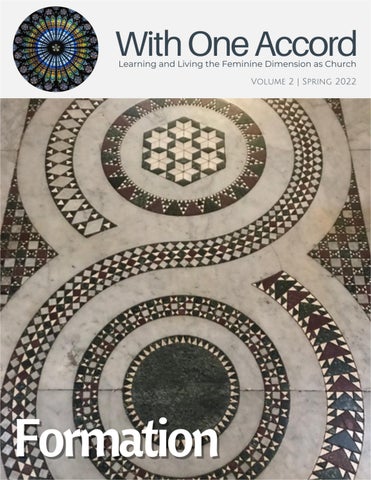
Images used in this edition: Cover: Floor in the Basilica of Santa Maria in Trastevere, Rome, photo by John Dalla Costa. Page 2 Egeria, the 4th century pilgrim writer by Sr. Elena Manganelli OSA. Used with permission. Page 3 “Mosaic” from the collection of Archaeological Museum D. Diogo de Sousa, Braga, Portugal. Page 10-11 “Garden of Eden” by Thomas Cole (1801-1848). Page 13 “St. Catherine and Jesus” by unnamed Sienese artist. Page 15 Polyhedron from the Divine Proportions by Luca Pacioli (1447-1517). Page 19 Detail from “Young Woman writing a Letter” by Ernst Anders (1845-1911).
www.magdalacolloquy.org
21
This edition Copyright © 2022 Saint Basil’s Catholic Parish, Toronto, Canada For editorial enquiries, please contact editor@magdalacolloquy.org ISSN 2563-7924 PUBLISHER Morgan V. Rice, CSB EDITOR Lucinda M. Vardey ASSOCIATE EDITOR Emily VanBerkum CONTRIBUTING EDITOR Gregory Rupik PRODUCTION COORDINATOR Michael Pirri VIDEO EDITOR Eric Patrick Hong CONSULTANT John Dalla Costa TRANSLATORS Diana Isacchi (Italian) Patricia O’Grady (French) ADMINISTRATOR Nancy Nobrega
22
www.magdalacolloquy.org
The Mystical body of Christ is neither male nor female, because it is the place of their integration. Paul Evdokimov