With One Accord
Community Volume One, Issue 3
Summer 2021
CONTENTS EDITORIAL Lucinda M. Vardey THE CATHOLIC CHURCH AND THE FEMININE DIMENSION Anne-Marie Pelletier CHURCH AS FAMILY The Magdala Interview: Emily VanBerkum with Archbishop Domenico Sorrentino THE SPIRITUALITY OF THE FOCOLARE MOVEMENT Maria Rita Cerimele DOROTHY DAY AND PETER MAURIN: COMMUNITY FROM BELOW Caterina Ciriello F.I. MORAL WISDOM BY HALF: MAKING CATHOLIC SOCIAL TEACHING WHOLE John Dalla Costa BELONGING TOGETHER Lucinda M. Vardey BOOKS OF INTEREST Emily VanBerkum UBI CARITAS The Augustinian Nuns of Pennabilli
www.magdalacolloquy.org
1
Editorial
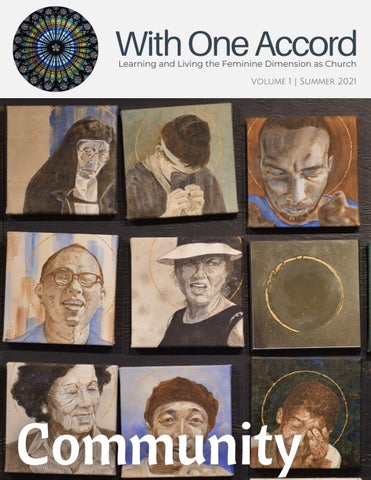
Our cover for this issue on Community is taken from a commissioned wall painting by Canadian artist Owen Swain that hangs in St. Basil’s parish hall in Toronto. Saints Sung and Unsung: 39 Portraits Plus One is its title, the “Plus One” being a mirror. It serves as a fitting reminder that who Jesus calls belong exactly as they are, and where they are, in the embrace of “one accord.” Hospitality is, therefore, key to every community, all are welcome at the table, particularly those who do not expect to be invited. In this edition of our journal French theologian, Anne-Marie Pelletier, proposes a return to the original source of communion, the common identify of belonging to the Body of Christ, and points out the pitfalls in applying segmentation. The Magdala interview this month is by associate editor, Emily VanBerkum with the Archbishop of Assisi, Domenico Sorrentino, who addresses the paternal and maternal role of the Church experienced so profoundly in the spiritual history of this Umbrian town made famous by St. Francis and St. Clare. Guiding his diocese as “a family,” the Archbishop provides us with many recommendations for today’s much-needed Church and lay renewal. The sort of changes that are relevant to our time, however, call for a complete new start. Building on Pope Francis’ claim for “a new different” Archbishop Sorrentino suggests we return to “the original different,” the revolution begun by the choices Jesus made.
2
In her brief overview of the history and spirituality of Focolare, Italian member, Maria Rita Cerimele, describes the movement’s charism as that of a revolution for establishing “a civilization of love.” And writer, Sr. Caterina Ciriello’s introduction to Dorothy Day and Peter Maurin’s partnership that formed The Catholic Worker reminds us of their vision in creating “a revolution of love.” Revolution is a term commonly associated with political aggression, violence and opposition. But a revolution to inclusion, unity, and community calls for taking a radical stand for preserving kindness, generosity and appreciation. It calls for a concerted effort to understand others’ viewpoints and to make space for grace in each encounter. As John Dalla Costa writes, it calls us to an enhancement and renewal of Catholic Social Teaching with the inclusion of women’s contribution to Church history, theology and practice. And it alleviates the “long loneliness” experienced so prevalently in the pews, which I address in a short piece on the gospel of Martha and Mary. This issue concludes with the blessing of the Augustinian sisters of St. Anthony of Padova Monastery who recorded especially for our readers, their Ubi Caritas, a beautiful expression of how faith, love, joy, prayer, and art shared for the glory of God is really what community is all about.
Lucinda M. Vardey Editor With One Accord: Learning and Living the Feminine Dimension as Church
“In Jesus we find not only our past but our future.” — Archbishop Domenico Sorrentino
www.magdalacolloquy.org
Anne-Marie Pelletier has for some years taught sacred scripture
and biblical hermeneutics at the Notre Dame faculty of the Collège des Bernardins, Paris, after being Professor of Literature in French Universities and taught at the European Institute of Science of Religions (IESR). Her research extends to Judaism, Christianity and the monastic world. She has published widely: notable works in the field of hermeneutics and biblical exegesis are “Lectures du Cantique des Cantiques. De l’énigme du sens aux figures du lecteur,” “Lectures bibliques. Aux sources de la culture occidentale”, “D’âge en âge les Écritures. La Bible et l’herméneutique contemporaine,” and “Le livre d’Isaïe, l’histoire au prisme de la prophétie.” With regard to the question of women in Christianity, she has written two books: “Le christianisme et les femmes. Vingt siècles d’histoire,” and “Le signe de la femme” and most recently published “L’Église, des femmes avec des hommes” (Paris, Cerf 2019). She is a recipient of the 2014 Ratzinger Prize for Theology, the first woman theologian to be awarded the prize. In 2017 she wrote the Stations of the Cross for Pope Francis’ Good Friday prayer at the Colosseum. She is member of the Pontificia Academia pro Vita and of the new Vatican commission for the Study of the Female Diaconate.
The Catholic Church and the Feminine Dimension Anne-Marie Pelletier The Church’s fundamental identity, along with its vocation and mission, is one of unity. As this defining quality was core to the first generations of Christians, it is natural that we should be re-visiting the right way to live and be together “with one accord.” A serene harmony of hearts is how the book of Acts (2: 44-47) characterized the way of life for the first believing community. And it is also what must occupy all Christians while journeying towards the end of their lives when all their relationships will be transfigured. The relationship between men and women is one that requires conversion, one that calls us to encounter each other, to deepen our knowledge of each other so as to peacefully arrive at mutual understanding. And in this regard, there is little doubt we are living in what constitutes a kairos (critical) moment. It calls upon us to make a real effort to be clear-sighted, not only in terms of what is happening in our societies, but also in terms of how we ourselves experience the masculine and feminine within the ecclesial body. We know that the question of gender identity is currently the subject of heated societal debate. The difference between the sexes, a fact that has certainly provoked human consciousness from the dawn of time, can no longer be proven solely through biology. Instead attention has to be paid to how men and women relate to each other. What is essential now is to identify the parts that social constructs play in the way in which men and women live. It is at these social constructs that gender theories aim and, if properly understood and applied, these theories do help in denouncing the anthropological prejudices and practices that perpetuate violence to women. But there is no doubt that in their radical forms, the problems are fraught with
www.magdalacolloquy.org
3
formidable hazards, especially when there arises the complexity of a sexual identity that can be individually decided upon or when parentage cannot be easily identified. The Catholic Church is naturally concerned about all this. The problem is that it really doesn’t address its concerns in a credible manner. There are obviously tensions— accentuated by suspicion—on how the magisterium’s discourse on the subject of the differences between men and women is truly free of prejudice and other ulterior motives. For it is clear that the ecclesial institution of today remains a bastion for discrimination between men and women that far outweighs the rest of society. You only have to push open the door of a church to experience this striking reality in the liturgy itself. Even with the inclusion of women, the space for worship still remains predominantly male. And the Motu proprio of January 2021 on readers and acolytes only accentuates the rather scandalous anomaly of a 1972 text which specified that these two ministries—even though they did not require ordination—were to be reserved solely for men.1 The obsession seems unfathomable: that women should not cross the symbolic boundary that separates them from the ministerial priesthood. Hence the ongoing vigilance for keeping women at a distance from the altar while preserving an order of clerical sacrality that is fundamentally foreign to the Gospel. The feminine dimension thus seems to have reached the status of a theological necessity, having almost the same impact as the prophetic fulfillments we read in our Gospel texts. OVERCOMING INEQUALITY It is true that we no longer uphold the tradition of systematically viewing sexual difference as detrimental to the feminine. Women today are held in a positive light, are
4
celebrated, extolled, even exalted over men. In the last third of the 20th century, we have seen declarations made by the magisterium on the “dignity of women,” even referring to them as the “pedagogue (teacher) of humanity.”2 In any event, complementarity of the sexes is now the official catchword. The fact is, however, that complementarity only reiterates traditional hierarchical inequality. By being celebrated for their interiority, their capacity for humility reputed to be Marian, their readiness to serve (the “genius” of their sex, it is said), women are kept at a safe distance from exercising any authority through speaking, teaching, preaching and sanctifying. This is especially the case in today’s theology, that attests to the two principle dimensions in the institutional Church, the first being Petrine, the bearer of the essential masculine authority, and the other Marian, whose mystical connotations are believed to overarch the first, but from which it is instead neatly separated. This problem—which puts men who are not priests in a quandary—affirms that “the Marian element in the Church embraces the Petrine element without any claims of its own.” Mary serves as an example and incentive, she who did not personally “claim to participate in apostolic power.”3 The formula that she “possesses something different and something greater,” can be rather misleading because, when extended to all women, it gives permission for the Church to evade the primary and fundamental reality of their baptismal grace that allows them full participation and communion. Thus, it is clear that any hastiness with which a specific female role is promoted has the perverse effect of entrenching inequality between both men and women in the ecclesial institution. It erases the true reality of the “equality of the sexes” to use a
www.magdalacolloquy.org
contemporary phrase, or, more pertinently, it erases the “all of you” in Scripture, so prominent in Paul’s preaching. It ignores the fact that “all” have put on Christ and received a share in the filial life (Gal 3:27), or that the famous “submission” associated with women in the letter to the Ephesians is first of all a mutual submission among all (Eph 5:21). It circumvents the truth stated in the letter to the Galatians: “From now on, in Christ ... there is neither man nor woman” (Gal 3:28). However, it is only after having fully honoured a baptismal identity that is common to all, that the Christian discourse can finally and credibly propose that men and women can live the same spiritual reality in a differentiated way. In order to implement this shared identity in a practical manner, the first, and urgent, priority is to make a break with past discrimination and injustices which Christ condemned in his words and deeds. We need to rediscover the generosity and freedom of the first Christian community recorded in Paul’s letters. And, as we have found in recent research, we need to retrieve the equal sharing of responsibilities and duties between men and women.4 This provides a basis for advocating alterity (otherness) to be not only feasible but clearly understood. The Church’s discourse can only be made relevant if it distances itself from discussing the quintessential, ontologically assigning some and others to pre-established roles constructed on the basis of prejudices that have subjugated the female condition. We need to return to what alone has true ontological (nature of being) value. In this instance, it is to an evangelical renewal which founds itself on all belonging to the one Body of Christ. This breaks the assumption that women, first and foremost, have “something else” from men; instead they share in the whole, and are placed on equal footing with men. It is only from this place that it can be possible to honour the preciousness of life, with all its diversities and gifts. Only from this place can the Church’s constitution and modus operandi be given a differentiated face, ultimately embodying the rich varieties of wisdom (polypoikilos) to which the letter to the Ephesians refers (Eph 3:10). In a word, just as Origen called to “ordain charity” in order to give it its truth, so must we order our discourse on the sexes by speaking of dimensions only after having firmly established, and affirmed, a single baptismal identity founded on unsurpassable dignity. Works cited 1 Motu proprio Spiritus Domini, January 2021, correcting Ministeria quaedam of 1972. 2 See the inventory of the texts of Pope John Paul II drawn up in 1999 by Patrick Snyder, La femme selon Jean-Paul II, Ed. Fides. 3 For a presentation and evaluation of this theology, see L. Castiglioni, Filles et fils de Dieu? Egalité baptismale et différence sexuelle, Paris, Cerf, Cogitatio fidei, 2020. 4 Chantal Reynier, Les femmes de saint Paul, Paris, Cerf, 2020.
www.magdalacolloquy.org
5
Emily VanBerkum is the Dean of Student Residence of Loretto
College, affiliated with the University of St. Michael’s College in the University of Toronto. She holds a B.A. (Hons) with a specialist in Christianity and Culture and an M. Div, degree from the St. Michael’s College Faculty of Theology in the Toronto School of Theology. She has volunteered widely in campus ministry settings and as a student intern in Ecumenical Chaplaincy. Her scholastic interests include the historical development of the liturgy, theology of ministry, Catholic social teaching, as well as inter-religious dialogue and practice. A past Director of pastoral ministries at St. Basil’s Parish, she is a founding member of the Magdala Conciliary. She also collaborated with her husband, Dr. John Paul Farahat, organist and choirmaster, to compose and perform the introductory theme to the dialogue portion of the With One Accord journal.
Church as Family Interview with Emily VanBerkum and Archbishop Domenico Sorrentino
Archbishop Domenico Sorrentino was born at Boscoreale,
near Naples on May 16, 1948 and ordained to the priesthood in l972. He obtained a doctorate in theology from Rome’s Pontifical Gregorian University and a doctorate in Political Science from the La Sapienza University in Rome. After serving as a pastor responsible for catechesis he taught at the Institute of Religious Science at Nola and in the theological faculty at Naples. In 1992, he was released by the Diocese of Nola to serve in the Italian Section of the Secretariat of State in the Holy See, where he served the future Saint John Paul II. In 2001 he was appointed Prelate of Pompei with the title of Archbishop, where he was largely involved in the pastoral ministry and administration of the Sanctuary of the Blessed Virgin of the Rosary. In 2003 Pope John Paul II appointed him Secretary of the Congregation for Divine Worship and the Discipline of the Sacraments, Vatican City State and in 2005 he was transferred by Pope Benedict XVI to the position of Archbishop to the Diocese of Assisi-Nocera Umbra-Gualdo Tadino, where he continues to serve. Archbishop Sorrentino has lectured widely and written a number of articles and books, the most recent in May 2020, “Crisi come Grazia: Per una nuova Primavera nella Chiesa” (“Crisis as Grace: For a New Springtime of the Church”).
6
www.magdalacolloquy.org
Maria Rita Cerimele is part of the Work of Mary (better known
as the Focolare Movement www.focolare.org). She has held many positions within the Focolare throughout Italy, at the national and international levels as well as having taught Latin and Greek in state high schools. She currently works in the area of public relations for the Movement. She has written several articles on topics relating to her specialization in Classical Philology, her teaching experience and current events, the latter primarily published in Città Nuova online and the website AngeliPress, where she works as editor. She is a member of the international planning committee for the World Day of Reflection and Prayer against Human Trafficking and collaborates with the planning of “I Dialoghi a Spoleto” (Dialogue at Spoleto). She is the editor of “Futuro Anteriore, alla ricerca di nuovi paradigmi” (Future Perfect: in search of new paradigms, April 2021 Francesco D’Amato editore), a new book recommended by SocialRAI.TV.
The Spirituality of the Focolare Movement: A Brief Overview Maria Rita Cerimele In his Apostolic Letter Novo Millennio Ineunte, Pope St. John Paul II wrote that “a spirituality of communion” is first developed as “the heart’s contemplation of the mystery of the Trinity dwelling in us, whose light we must also be able to see shining on the faces of the brothers and sisters around us…..This makes us able to share their joys and sufferings, to sense their desires and attend to their needs, to offer them deep and genuine friendship. …..unless we follow this spiritual path, external structures of communion….would become mechanisms without a soul, “masks” of communion rather than its means of expression and growth” (#43). He made the point that the spiritual climate of the Church at the dawn of the third millennium needed to “respond promptly and effectively to the issues which the Church must face in these rapidly changing times” (#44). And so it was with Chiara Lubich, who received the outpouring of the Holy Spirit’s charisms (including Unity) at just the right moment. With these charisms she founded the Work of Mary (better known as the Focolare Movement). The power of Focolare’s founding spirituality and the dynamism of its lived experience, opened the door to a new collective holiness by providing both men and women the opportunity to journey together to God. It began in 1943 (at the height of World War 2) in the town of Trent in northern Italy when Chiara, who had heard a similar call four years earlier at Loreto, was called again to form something quite different from the usual traditional communities. As bombs destroyed homes, relationships and dreams in a climate of hate, Chiara, as if in paradox, rediscovered God for who God was: Love and love could never be destroyed. So,
www.magdalacolloquy.org
7
together with a few young companions, she made God her life. When the alarms sounded, they’d go to the shelters armed only with the Gospel. They were specifically drawn by God to the words of scripture that expressed Love, and studied them as the foundation for their lives. The promises of Jesus—“Give and it will be given to you” (cf Lk 6:38) “Ask and you shall receive” (cf.Mt 7:7) — lived by him to the letter, were realized also to the letter by them. All this gave rise to a truly evangelical revolution, with spiritual and social implications. Living under a constant threat of death, the early group questioned what God cared about the most, so that they could focus their attention on that before they were to present themselves to God. The answer was “That you love one another as I have loved you” (cf.Jn 15:12) a commandment that demanded a life commitment. So they committed to giving their lives for each other and sealed it with a vow. They began their evangelical life by sharing their possessions and experienced much peace, fervour and unequivocal joy. ”Where two or more are united in my name, there am I in the midst of them” (cf. Mt 18:20); the invisible presence of the Risen Christ was made real by his gifts. Attracted to their Gospel witness, people of different ages, with various vocations and from diverse backgrounds, soon began to join them in a communion of spiritual and material goods, living like the first Christian communities with “one heart and one soul” (Acts 4:32). They were to arouse suspicion in some and hostility in others but the then Archbishop of Trent, Monsignor de Ferrari, made claim to clearly seeing the hand of God. Jesus’ prayer that “they all be One” (cf Jn 17:21) had a strong impact on Chiara and her companions. “We were born for these words,” she said, ”to contribute to their attainment.” Chiara’s spirituality then had been defined, confirmed later in the summer of 1949 by a profound mystical experience called “Paradise” which, after years of intensely living the Word, she shared with her small group. One of the many luminous truths Chiara received, was of Jesus forsaken, the key and summit of Love. By emptying himself completely on the cross, and experiencing the abandonment of God (a scandalous split within the Trinity) Jesus revealed that Unity is not a utopia. A CIVILIZATION OF LOVE Small communities of focolari sprang up composed of men and women (single and married) who consecrated their lives to God. They were also joined by others who identified with the ideals of the Movement. This spread crossed denominational and geographical boundaries while attracting people not only of the same faith but from other faith traditions. There are many other people in the Work of Mary who have no religious affiliation but follow the dictates of their own conscience.
8
www.magdalacolloquy.org
All Focolare members stand on the front line of what could be considered a silent, steady revolution, one that aims to build a new civilization of love through universal fraternity and sorority. John Paul II, when visiting the Focolare Centre in 1984, recognized in Chiara’s charism an experience of “radical love,” and, in the Movement the features of the Church of the Council, and its openness to dialogue. And, more recently, Pope Francis has applied the concept of the spirituality of communion to God’s design for all creation (Laudato Si) and to the human family in Fratelli Tutti. Seeing in the faces of those around us the light of the mystery of the Trinity that dwells in each of us, fosters a love directed not to certain people but to all as brothers and sisters. To love everyone, to love always, to love first, to love as oneself, to see Jesus in others, to make oneself one are the fundamental tenets of what Chiara calls “the art of loving.” This “art of loving” is the foundation on which to establish all relationships with whoever one encounters and wherever one is. But a special commitment has to be made to living the commandment of mutual love which requires at least two people to implement. This makes tangible the experience of holiness in the image of the Trinity in which the personal (indispensable) dimension and the communitarian dimension are simultaneously joined. It is a collective holiness that is penitential. The people with whom we seek to be one in Christ not only bring us joy but also serve as instruments for our purification, continually coaching us in benevolence, patience, humility and all the virtues that give substance to love. All articles in the Statutes of the Work of Mary (compiled by Chiara and approved by the Magisterium of the Church) are preambled by the indispensable phrase that “Mutual and continuous charity, which renders unity possible and provides for the presence of Jesus within the collective, is to form the basis of every aspect of a person’s life who is part of the Work of Mary. It is the norm of norms and the prerequisite of every other rule.” The experience of the Focolare Movement is young, compared to the various charisms that have been present in the Church over the centuries. But this type of love, which started from the heart of Trinitarian communion and lived out in interpersonal communion, modelled on Mary, continues to help sprout the seeds of the Word in many, opening them to new and uncharted paths of fraternity and sorority.
www.magdalacolloquy.org
9
Caterina Ciriello F.I. is a Religious of the Missionary Congregation of
the Daughters of Jesus (Salamanca) and lives and works in Rome. She is Associate Professor of Spiritual Theology and History of Spirituality in the Faculty of Missiology (ISCSM) and a visiting professor of Church History at the Pontifical University of Saint Thomas Aquinas (Angelicum). For many years she has dedicated herself to ecumenical spirituality, especially in the “feminine” dimension. She is part of the ISACEM Executive Committee (Rome) and is a member of the Association of Teachers of Ecumenism. She serves on the Editorial Board of the Journal “Notes et Documents” and is also a member of the Editorial Board of the Journal “CVII. Studies and research,” and of the scientific committee of the series of Theological and History Studies of the Church” Thesaurus (Aracne publishing house). Lately she has been appointed a member of the Editorial Board of the UUJ, at the Pontifical Urbaniana University. She has written many articles in various scientific and even popular journals, including Vita Pastorale. Among her book publications are Dorothy Day: The choices of love (2011); The Gospel in Life: A spirituality for everyday (2011); Pietro Pavan: The metamorphoses of Social Doctrine in the Pontificate of Pius XII (2012); The Contribution of Religious sisters to “Perfectae Caritatis”- Remembering to Look to the Future (2015). Her latest book is “Women and the Christianization of Europe - from Gregory the Great to Boniface of Fulda” (2017). Sr. Caterina is a founding member of the Round Table on the Feminine Dimension.
Dorothy Day and Peter Maurin: Community from Below Caterina Ciriello F.I. Dorothy Day (1897-1980) was born in Brooklyn at a time when America was experiencing a boom in industry and capitalism. It was the beginning of the great “American dream” that brought thousands of European emigrants to a largely “virgin” land. These emigrants were mainly Italians peasants who had left situations of deep socio-economic hardship to build a new life for themselves amid the rising skyscrapers and factories. Dorothy’s character was forged in this environment, her spirituality and search for meaning developed among people from other lands. Anthropologically speaking, the spiritual and
10
www.magdalacolloquy.org
human dimensions are held continually in tension, as a person searches for the transcendent dimension in which to authentically relate without the danger of being annihilated by the surrounding reality. This relationship with the “transcendent,” i.e. striving to live intensely in a “vertical” dimension, cannot but lead a person, over time, to initiate a process of selfgiving, oriented towards personal good and the good of others; a relationship in the end that contributes to the “humanization” of not only the giver, but also the receiver. This was Dorothy Day’s calling, one she identified through a chance meeting with a Frenchman called Peter Maurin. She described meeting Peter as a call to work in the Lord’s vineyard. “He convinced us in his own words that there was work to be done, that each of us had vocations, callings” (Day 1943). Peter Maurin was not a conventional man, least of all in his dress, and for this reason and despite his intelligence, he was repeatedly mistaken for what he was not. Habitually eccentric, excessively talkative, absent-minded but clear thinking, his mission was ‘to get others to think.’ This is the reason why, when he began his partnership with Dorothy Day and found the Catholic Worker (now a movement) he proposed she create a newspaper for Catholic workers, to promote the social teachings of the Church in order to counter the effects of communism. Dorothy Day and Peter Maurin had many things in common, particularly poverty. Both had the ability to leave everything behind to embrace voluntary poverty in the style of the first Christian communities (Acts 4:32). Fascinated by the life and conversion of St. Francis of Assisi, Peter was also profoundly influenced by Léon Bloy—one of the great exponents of French Catholic thought in the 1920s and 1930s—who had accompanied Jacques Maritain in his conversion to Catholicism. Dorothy had already consecrated herself to Benedictine spirituality by becoming an oblate in 1955 thus committing herself to the practice of radical poverty. Through the many stories of daily or regular guests to their Catholic Worker houses of hospitality, Dorothy emphasized that poverty held a fundamental distinction between the poor who have some hope and those in misery who are sick and lonely and devoid of hope. For her, she chose to live a life devoid of comforts, explaining that there is poverty by itself, as well as voluntary poverty and holy poverty. She wrote in her diary: “What is poverty? I’m sitting here on a cold winter afternoon down on Long Island, surrounded by a snowy landscape, listening to a Philharmonic Symphony. At the same time I darn socks, three pairs, all I own, of heavy cotton, grey, light brown and one of brown wool, and reflect on how they came to me from poor cancerous people who had come to the hospital to die. For ten years I have been wearing socks that an old lady, a dear friend, who spent her old age in this hospital, collected for me and carefully mended and patched. Often they would arrive dirty or with that heavy hospital smell, which doesn’t seem to leave them even after many washes. And the wear and tear on these second-hand socks and other clothes has saved me a lot of money to use for running our house of hospitality and publishing a newspaper. But the fact remains that I own socks to cover myself when others go naked and cold.” The first issue of the Catholic Worker saw publication in May 1933 with 2500 copies sold for the modest sum of one penny in New York during a communist demonstration. In future issues, Dorothy tackled real, difficult problems such as workers’ wages in factories, child labour,
www.magdalacolloquy.org
11
sharecropping and racial injustice. Peter instead preferred to describe his vision, his round tables and hostels for the unemployed and small Christian communities created close to nature in order to be self-sustaining. He was convinced that Roman Catholicism would be effective in rebuilding the social order and that Christ’s Gospel was the template for creating a perfect social order. The Catholic Worker—which still thrives and grows today—gave the homeless a home and the voiceless a voice. And the beatification of Dorothy Day continues to be eagerly awaited.
John Dalla Costa is an ethicist, theologian and the author of five books, including Magnificence at Work: Living Faith in Business. He has an M.Div. from Regis College at the Toronto School of Theology. As well as teaching ethics at the Schulich School of Business (York University), John has worked with boards and CEOs internationally to engage complex ethical problems, and nurture the moral values for responsible culture. John’s research interests involve trust—between people, in society, as well as within and towards institutions. He has been involved in various initiatives of interfaith dialogue including through the Vatican, the Caux Round Table, where he has recently been appointed a fellow, and The Dialogue Institute at Temple University, Philadelphia. He is a founding member of the Magdala Conciliary in Toronto and the Round Table on the Feminine Dimension in Rome.
Moral Wisdom by Half: Making Catholic Social Teaching Whole John Dalla Costa Imagine a textbook in which every other page is erased and left blank. Any learning would be incomplete, if not misleading. Lessons may still be gleaned from the words printed and available. But other context and insights will be lost. Issued in 2004, The Compendium for the Social Doctrine of the Church is basically the Catholic textbook for learning how to live our faith in community. Aiming to “enrich and permeate society with the Gospel,” The Compendium summarizes two millennia of Christian wisdom. However, of its 1,232 citations, only one—the very last footnote—is attributed to a woman (St. Thérèse of Lisieux). Four women have been formally recognized among the thirtysix Doctors of the Church for their significant contribution to doctrine or theology. If already an unrepresentative ratio, even this minority was left unstudied, meaning that the textbook for the Church’s social teaching is bereft of any feminine dimension.
12
www.magdalacolloquy.org
The habits of omission are of course cultural and historical. Language has long presumed “man” to be a synonym for all humanity. But consciousness has changed. It is no longer presumed that men’s interpretation yields the whole picture for defining any discipline, let alone discipleship to Jesus Christ. We need to ask: is it possible to diagnose the social problems afflicting the world without considering the wounds and perspectives of women? Can we develop the integral moral wisdom for unleashing authentic human freedom and flourishing without any reference to social position and women’s gifts? WHAT IS CATHOLIC SOCIAL TEACHING? The social doctrine of the Church has evolved as Christians of every generation have sought to incarnate their faith within the specific reality of their time. Catholic Social Teaching (CST) originated in 1891 with Pope Leo XIII’s encyclical Rerum Novarum. The Industrial Revolution was nearing its apex. Workers around the world were undergoing great suffering. Pope Leo sought to bring the Church’s moral authority to bear on those problems, summoning “for all men” basic rights for fairness and friendship. All popes since then (with the exception of John Paul I) have used encyclicals for social teaching to address the particular signs, stresses, or crises of their times. Catholic Social Teaching can be summarized by a handful of principles. It calls each of us to attend to one another’s dignity as children of God. It emphasizes solidarity for the mutuality needed to realize the difficult ideals of equality, peace and justice. CST preserves human liberty by summoning subsidiarity—a concept for making power accountable by having decisions exercised as close as possible to the people who are impacted. Given the self-preserving bias of most structures of power, CST stipulates that social analysis and action should give a preferential option for the poor. And because of our interdependence—on one another, and on the earth itself—the Church insists on the commitment to the common good. The most recent encyclicals, starting with Pope John XXIII’s Pacem in Terris, mention women, and address them alongside men. The Compendium dedicates part of its chapter on Human Work on the rights of women. That said, not one word of the actual core principles of Catholic Social Teaching link to an insight, or input, from someone who is not male. Pope Francis has inspiringly advocated for the Church to retrieve its feminine dimension. Nevertheless, the bias of omission persists in his social teaching. His two most recent encyclicals—Laudato si and Fratelli Tutti—model far-reaching inclusion. He quotes Orthodox and Sufi spiritual teachers, scientists and the Muslim Grand Imam of Al-Azhar, a panoply of Church Fathers, saints and theologians—but again, not a single woman. Why are citations important? Because encyclicals form the ultimate or most authoritative expression of the teachings of the magisterium. Pope Pius XI called this body of teachings “social doctrine.” Until women are cited, their experience, spirituality, theology, and wisdom remain unseen and unheeded—as if nothing has been contributed by them to the social morality of the Church.
www.magdalacolloquy.org
13
MAKING INTEGRALITY WHOLE. MAKING INCLUSIVENESS REAL. A partial-integrality, or an exclusive-inclusiveness, are by definition oxymorons. To untangle what Jesuit theologian Bernard Lonergan called “the bias of common sense,” we must, he advised, take the risk of hearing those voices that have been kept out, or that stand outside from a community’s sense-making. It is not enough for the Church to write about women. Women themselves must be heard and help fashion the Church’s social understanding and mission, for them to be fulsome. Some theologians have called the Second Vatican Council of the 1960s “an unfinished symphony.” Given that women were excluded from participating, we know where to go to find many of the missing notes and movements. Of course, forming the Body of Christ as Church is not a math problem to be solved simply by balancing word count and citations by gender. The real work of conversion to a community of equals is to see more fully together the wonder of God’s saving love, and to then work together to be the body, eyes, hands and feet of Christ in our time (ref. St Teresa of Avila). Perhaps we need a new Council, a sort of Vatican 2.5, with men and women, lay and religious, and from across a range of disciplines and expertise, coming together to update the Church’s social teaching. Regardless of process, the task is to finally fill in the missing pages by giving full weight to the spiritual and theological contribution from our women saints, mystics, and innovators. In a polarized world, there is much to learn from St. Catherine of Siena about peacemaking. In a time of growing inequality, St. Clare has much to teach us about living out the preferential option for the poor. At a juncture when the Church and other institutions desperately need reform, St. Teresa of Avila can guide us with the spiritual resources for change that is both radical and generative. With schools and universities in crisis, there is much to gained from Mary Ward’s innovations in education to create communities of friendship. With Pope Francis challenging the premise of any war as being “just,” there is much to ponder from Caryll Houselander’s theology in wartime. With Pope Francis pleading for us to extend mercy to migrants, we can mine the tireless example of St. Mother Frances Cabrini (who founded sixty-seven institutions, including schools, hospitals, orphanages, and nursing homes for immigrants). With Pope Francis calling for the Church to serve as a “field hospital,” we can draw determination from St. Marguerite d’Youville and other religious women who founded hospitals in precarious situations. With Pope Francis identifying nature as a sacrament, we can grow from St. Hildegard of Bingen an even more profound spiritual attentiveness for our natural environment. With Pope Francis stretching solidarity to embrace all of humanity, we have Dorothy Day and St. Mother Teresa of Calcutta to show us the Eucharistic qualities of fraternity and sorority in action. The communion of saints are our treasure. Let us now be immersed and enriched in that community in all its wondrous fullness.
14
www.magdalacolloquy.org
Lucinda M. Vardey has spent decades studying and teaching
feminine spirituality and the women saints through her writing, forming women’s communities and guiding retreats and pilgrimages. She was the organizer of the international seminars in Rome, Towards an Intrinsic Feminine Theology that took place over 3 years between 2016-2018. She has written nine books among them an anthology of women’s prayers called “The Flowering of the Soul” (Knopf/Ballantine 1999) and “Mother Teresa: A Simple Path” (translated in more than l8 languages) in l995. Her most recent books are “John XXIII: A Saint for the Modern World” (Paulist/Novalis 2014) and as editor/co-translator, “The Twelve Degrees of Silence” by Marie-Aimée de Jésus O.C.D. (Novalis 2014/BRF 2015). In 2012 she began a lay community for women under the auspices of the Archdiocese of Toronto, called The Contemplative Women of St. Anne. She is a founding member of the Magdala Conciliary in Toronto and the Round Table on the Feminine Dimension in Rome.
Belonging Together Lucinda M. Vardey
Dorothy Day wrote in her autobiography that when she was young the vastness of an ocean filled her with a tremendous sense of loneliness. She recalled that her sister too felt the same while growing up in their loving and supportive family. Dorothy came to the conclusion that loneliness is, in fact, a common human experience and one that can only be alleviated by belonging to a community. 1 Women suffer a particular kind of loneliness that is infrequently recognized by themselves or others, because it is familiar. From centuries of not being seen, heard, considered and upheld, women also bear loneliness, in many cases, from the tedium of expectations and duties that distract from time with God in quiet prayer and reflection. In a recent Round Table discussion in Rome, Maria Rita Cerimele pointed out that women live with this conflict, as reflected in Luke’s gospel account of Jesus’ visit with Martha and Mary. The role of women
in families, and especially in the Church, are presumed to involve the doing of not one, but many things. Thus the loneliness that exists in busyness becomes like an unquenchable thirst. Maria Rita said that Jesus understood this thirst as women’s suffering by addressing it directly in his encounter with his two women friends. His response to Martha’s complaint with the words “There is need for only one thing” (Luke 10:42) illustrates how he recognized—and taught—that women’s capacity for listening to him in prayer and relationship feeds their inherent prophetic gifts. The account of Jesus’ visit with Martha and Mary also provides guidance for a healthy structure for every Christian community, big or small. The food that’s required has to be always there; we need our daily bread, we need to meet the temporal needs of everyday living. But the other kind—food for the soul
www.magdalacolloquy.org
15
of each member—needs as much, perhaps even more, attention in order to contribute to the peace and harmony required for the spiritual health of all. Prayer, as St. Teresa of Calcutta taught, is food for the soul.2 And the prayer of quiet and listening to God is, as Jesus emphasized, not only the better part but the lasting part, that “will not be taken away” (Luke 10:42). Contemplative prayer could then be considered the essential component of all communities, the root from which they are able to grow and thrive: a love that listens to God, self and the other. St. Teresa of Avila wrote in The Interior Castle that “Martha and Mary must work together when they offer the Lord lodging and must have Him ever with them.” (Ch. IV, #17). This working together, the harmony of contemplation and action in a relationship with Jesus, is certainly expressed in the Benedictine monastic practice of “ora et labora.” However, varieties have morphed over time. St. Francis intuited the value of living together as small families, when he introduced the roles of Martha and Mary to reflect time assigned to monks for temporal duties to allow their brothers to focus entirely on contemplation. These would be for short periods and exchanged so that everyone had an opportunity to nourish their souls as well as serve the temporal needs of their communities. Francis could well have been inspired by the Camaldolese Benedictines, founded in the 11th century near Arezzo, Italy, by St. Romuald which, to this day, demarcates the eremitical tradition from that of a conventional monastery. Monks alternate for up to a year or more living in solitary cottages on top of a mountain, gathering once a week to pray together, while the active brothers welcome pilgrims at a retreat centre in the valley below. St. Teresa of Calcutta applied an even more interesting method to ensure the belonging of Martha and Mary. Within the Missionaries of Charity she established a branch of contemplative sisters who would devote their time to praying for the sisters and brothers in the field, serving Jesus in the poorest of the poor. Lay volunteers were, and still are, welcomed to work alongside the sisters and brothers, and for those who were not physically able to assist in this way, she offered affiliation as a “sick and suffering co-worker”—someone who could contribute their sufferings in prayer from their homes for the work and ministry of the missionaries worldwide. The wisdom of interiority that welcomes Jesus from within and serves God through exterior action is not reserved solely for religious but for all the friends of Jesus. It is surely a call for every member of the Church, especially in these changing times, to receive the grace to embrace the indispensability of this feminine dimension in the ways we live, pray, work and serve. Works cited 1 The Long Loneliness: The Autobiography of Dorothy Day, p. 243 2 Mother Teresa: A Simple Path (New York, Ballantine 1995) p.7
16
www.magdalacolloquy.org
Books of Interest Emily VanBerkum ethicist. Active for over forty years in the ministry of healing, she has participated in numerous delegates and commissions on Clergy Sexual Abuse. Her online lecture inspired me to read more about the underlying causes of this complex issue. In October 2020 I attended a virtual lecture called “Healing the Church: Diagnosing and Treating the Clergy Sexual Abuse Crisis,” thoughtfully delivered by Sister of Charity Nuala Kenny. I was first struck by Sr. Kenny’s genuine passion for Church reform and healing, her insights and experiences offering pastoral care to victim-survivors and their families, as well as outreach to non-offending clergy. I then learned that Sr. Kenny’s career is far reaching and multi-faceted, her being not only an emeritus bioethics professor at the University of Dalhousie but also a registered paediatrician and medical
Sr. Kenny’s book Still Unhealed: Treating the Pathology in the Clergy Sexual Abuse Crisis is a mustread for anyone wanting a summary of authoritative faith-based works and introductory reflection on the crises’ underlying causes, diagnoses of endemic illness, and treatment. Sr. Kenny uses accessible medical metaphors and incorporates Church history, theology, psychology, and knowledge of organizational change. For her, the primary diagnosis of the sexual abuse crisis is a dramatic personal and ecclesial contradiction of Jesus’ “mission, words, and ways,” as well as a misshaped understanding of power and authority. She suggests that healing the Body of Christ from the wounds of sexual abuse requires meaningful, ongoing dialogue, and restorative pathways for personal and Spirit-led ecclesiological
www.magdalacolloquy.org
conversion. The “theologies of conscience, virtue, and discernment” are explored as integral aspects of repentance, healing, and reform that demand transformation in Church “discourse, doctrine, and structures.” In Sr. Kenny’s own words her book “seeks to contribute to the ongoing conversion, reformation, and empowerment of disciples of Christ and to the practical organizational change that is needed to promote healing of these pathologies and prevention of a recurrence” (17). This book should be essential reading for those who have been affected by the scandals and crises—and that, sadly, includes us all. Sr. Kenny emphasizes the need to communally work together to ensure future stability. Such a renewal can only happen in collaboration: through personal and ecclesiological conversion involving both the laity’s prophetic voice and suggested actions in full participation with the clergy. Still Unhealed: Treating the Pathology in the Clergy Sexual Abuse Crisis Sr. Nuala Kenny, SC, OC, MD, FRCP(C), with David Deane 160 pages Available in Paperback and Kindle Published September 2019 by Novalis.
17
Ubi Caritas with The Augustinian Nuns of St. Anthony of Padova Monastery Pennabilli, Rimini, Italy www.osapennabilli.net
18
www.magdalacolloquy.org
With One Accord O God, our Creator, You, who made us in Your image, give us the grace of inclusion in the heart of Your Church. R: With one accord, we pray. Jesus, our Saviour, You, who received the love of women and men, heal what divides us, and bless what unites us. R: With one accord, we pray. Holy Spirit, our Comforter, You, who guides this work, provide for us as we hold in hope Your will for the good of all. R: With one accord, we pray. Mary, mother of God, pray for us. St. Joseph, stay close to us. Divine Wisdom, enlighten us. R: With one accord, we pray. Amen. www.magdalacolloquy.org
19
We welcome your comments and reactions and will consider sharing them in future editions or on our website. Please send to editor@magdalacolloquy.org
If you haven’t already subscribed, you can do so at any time at no cost due to the generous support of the Basilian Fathers of the Congregation of St. Basil. Just visit our website www.magdalacolloquy.org where you can also read past issues of our journal and be informed of our intent and activities. With One Accord journal is published in English, Italian and French. To access the other language editions please visit our website.
With One Accord signature music for the Magdala interview composed by Dr. John Paul Farahat and performed by Emily VanBerkum and John Paul Farahat.
Images used in this edition: Cover photograph: Detail from “Saints Sung and Unsung: 39 Portraits Plus One”, used by permission of the artist, Owen W. Swain, (C) 2013. Permanent installation, St. Basil’s Church, Toronto, ON, Canada. Page 16 “Jesus, Mary and Martha” by Anton Laurids Johannes Dorph (1831-1914).
20
www.magdalacolloquy.org
This edition Copyright © 2021 Saint Basil’s Catholic Parish, Toronto, Canada For editorial enquiries, please contact editor@magdalacolloquy.org ISSN 2563-7924 PUBLISHER Morgan V. Rice, CSB EDITOR Lucinda M. Vardey ASSOCIATE EDITOR Emily VanBerkum CONTRIBUTING EDITOR Greg Rupik PRODUCTION COORDINATOR Michael Pirri VIDEO EDITOR Eric Patrick Hong CONSULTANT John Dalla Costa
www.magdalacolloquy.org
21