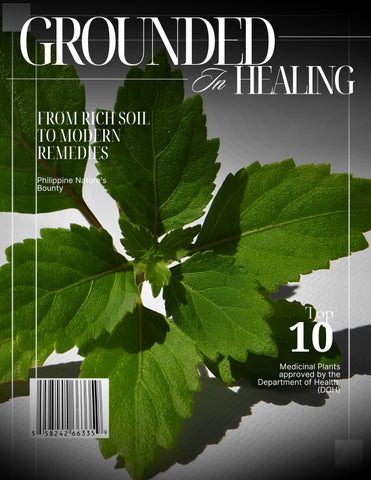
GROUNDED In HEALING FROM RICH SOIL TO MODERN REMEDIES Philippine Nature's Bounty
Top
10 Medicinal Plants approved by the Department of Health (DOH)
PAGE
01
PHILIPINE NATURE'S BOUNTY
Medicinal Plants in Filipino Culture
For centuries, long before modern pharmaceuticals arrived in the Philippines, pre-colonial Filipinos relied on babaylans (indigenous healers) and backyard flora for healthcare. The formal journey to medical approval began in the late 1970s and 1980s. The Philippines faced a major economic crisis, causing the cost of commercial Western medicine to skyrocket. Impoverished rural communities could no longer afford basic imported drugs. The World Health Organization (WHO) began advocating for the integration of traditional medicine into national primary healthcare systems. To ensure these traditional plants were actually safe and effective, the Philippine government funded the National Integrated Research Program on Medicinal Plants (NIRPROMP). Led by top scientists from the University of the Philippines Manila (UP Manila) and funded by the Department of Science and Technology (DOST), researchers spent years conducting rigorous clinical trials. They screened hundreds of indigenous plants, evaluating their chemical composition, toxicity, and efficacy. Out of all the plants tested, only 10 plants passed the strict scientific protocols required to prove they were safe for public consumption.
The TAMA Act of 1997
The final institutional milestone occurred on December 7, 1997, when President Fidel V. Ramos signed Republic Act No. 8423, otherwise known as the Traditional and Alternative Medicine Act (TAMA). Authored by the former DOH Secretary and Senator Juan Flavier, this landmark law: • Formally recognized the 10 herbal medicines under national health policies • Created the Philippine Institute of Traditional and Alternative Health Care (PITAHC), a government corporation tasked with legally promoting and manufacturing these local remedies
Herbal Revolution
Today, what started as simple backyard remedies have been transformed into a multi-million peso pharmaceutical industry. Plants like Lagundi and Sambong are no longer just boiled in clay pots; they are clinically formulated into tablets and cough syrups sold alongside Western medicine in mainstream pharmacies across the country.
PAGE
02
TOP 10 HERBAL MEDICINE
BAWANG (garlic or Allium sativum) is a cooking staple, belonging to the genus “allium,” and is closely associated with onions, scallions, and chives. In the Philippines, we know garlic as “bawang.” Bawang has this distinct smell that is perfect for most Filipino and Asian dishes, since it can easily sweeten or mellow down the taste of a dish. Aside from cooking, bawang uses and benefits include treatment and prevention of various health conditions and illnesses. To use bawang (garlic) as a medicinal plant, take two fresh cloves three times a day after meals to help lower high blood pressure and cholesterol. You can eat them raw, fry or roast them, blanch them in boiling water for five minutes, or soak them in vinegar for 30 minutes. High Blood Pressure and Cholesterol: Take 2 fresh cloves of bawang 2 to 3 times a day after eating. You can soak the crushed or cut cloves in vinegar for 30 minutes before eating to soften the strong taste. Toothache: Pound a small piece of a garlic clove and place it directly on the aching tooth. Insect Bites and Itchiness: Cut a clove crosswise and rub the fresh juice directly onto the affected skin. Headache: Crush a single clove and apply it gently as a poultice on your temples. HOW TO USE THEM - FOR HIGH LEVELS OF BLOOD CHOLESTEROL (HYPERCHOLESTEROLEMIA) Consult with a health center for a formal diagnosis and medical advice for hypercholesterolemia, including the use of garlic to control blood cholesterol levels. The health care professional may advise patients to eat 2-3 garlic bulbs (soaked in vinegar, sterilized, grilled, or fried in a little oil) 3 times a day with breakfast, lunch, and dinner.
AMPALAYAis believed to have originated in tropical Asia
and is now widely cultivated throughout the tropics and subtropics, including the Philippines, where it is a common backyard and commercial vegetable crop. ampalaya’s scientific name is Momordica charantia.Tropical regions such as Southeast Asia and the Caribbean grow this plant. As the name suggests, ampalaya has a bitter taste. In fact, many believe it to be one of the most bitter vegetables in the world. However, ampalaya leaves’ medicinal uses outweigh its undesirable taste. Ampalaya is a climbing vine that produces elongated fruits with a distinctive warty or ridged surface and a characteristic bitter taste. The plant bears yellow flowers and tendrils that allow it to climb supports. As the fruit ripens, it turns from green to yellow-orange and splits open to reveal bright red arils surrounding the seeds. Despite its bitterness, it is a staple ingredient in many Filipino dishes such as ginisang ampalaya. Interestingly, its bitterness is due to compounds like momordicin, which are also associated with its medicinal properties. All parts of the plant — leaves, fruits, seeds, and roots — are used in various traditional practices. Ampalaya for Diabetes: Consult a health center for a formal diagnosis and medical advice for diabetes, including the use of ampalaya leaves (Makiling variety) to help control blood sugar levels. Health care professionals may advise patients to eat 1 cup of ampalaya leaves twice a day (as salad or as an ingredient in meals). Health care professionals may also advise patients to boil 2 cups of sprouts in 2 glasses of water until only half of the water is left (around 15 minutes of boiling), and to drink ⅓ of the boiled water (decoction) thrice a day (30 minutes before meals). Ampalaya for Hemorrhoids: Powdered leaves and root decoction of Ampalaya are applied to hemorrhoids as astringent. Ampalaya for Stomach Problems: Ampalaya leaf juice is used to expel intestinal parasites, treat dysentery, diarrhea, and chronic colitis. Grounded seeds may also be used. Taken in a spoonfull 3x a day until ailment subsides. Ampalaya for Cough: Ampalaya leaf juice is used for mild coughs for children. Administered in a teaspoon 3x a day. Are usay o treat burs, ad a and wouds, Pounded Ampalaya seeds or leaf Ampalaya as Anti-Cancer: Two compounds extracted from ampalaya bitte melon, a-eleostearic acid (from ampalaya seeds) and dihydroxy-a eleostearic acid (from the ampalayafruit) have been found to induce apoptosis of leukemia cells in vitro. Diets containing 0.01% ampalaya bitter melon oil (0.006% as a-eleostearic acid) were found to prevent azoxymethane-induced colon carcinogenesis in rats.
PAGE
03
TOP 10 HERBAL MEDICINE
AKAPULKO (Senna alata), also known as candle bush or ringworm bush, is a medicinal shrub commonly found in tropical regions such as the Philippines. It can grow about 1–3 meters tall and is easily recognized by its large leaves and bright yellow flowers that grow in upright clusters, resembling candles. The plant grows well in warm, sunny places and is commonly found in gardens, fields, and open areas.
Akapulko has long been used in traditional Filipino herbal medicine, especially for treating fungal skin infections. Its leaves contain compounds with antifungal properties, making the plant traditionally useful for conditions such as ringworm and other superficial fungal infections. How to use as a medicinal plant? For ringworm and other fungal skin infections •Wash fresh akapulko leaves thoroughly. •Crush or pound the leaves until the juice is released. •Apply the extracted juice to the affected area of the skin. •Use regularly until the infection improves. •Avoid applying it to open wounds, the eyes, or other sensitive areas. •Consult a doctor or health center if the infection spreads, becomes painful, or does not improve.
SAMBONG (Blumea balsamifera) is a medicinal plant
commonly found in tropical countries, including the Philippines. It is a small, aromatic shrub that can grow up to about 4 meters tall. It has large, soft, hairy leaves with a strong camphor-like smell and small yellowish flowers. Sambong thrives in warm climates and is commonly found along roadsides, open fields, and other sunny areas. It has been traditionally used in Filipino herbal medicine because of its diuretic and anti-inflammatory properties. Sambong is particularly known for helping increase urine production and is traditionally used to help manage kidney stones and urinary problems. Its leaves are also used in traditional remedies for colds, coughs, and other minor health concerns. How to use as a medicinal plant? For kidney stones and urinary problems •Boil about 1–2 handfuls of fresh or dried sambong leaves in a pot of water. •Let the preparation cool and drink it as traditionally recommended. It may help increase urination and support the removal of small kidney stones. •Consult a doctor if there is severe pain, blood in the urine, fever, or difficulty urinating. For cough and colds •Boil fresh sambong leaves in water. •Allow the preparation to cool before drinking. •Seek medical advice if symptoms persist or become severe.
PAGE
04
TOP 10 HERBAL MEDICINE
LAGUNDI (Vitex negundo L.) is a small tree or shrub commonly
found in tropical and subtropical regions, including the Philippines. It is recognized by its five-part leaves, which are usually green-gray in color, and its small purple or bluish flowers. Lagundi can grow several meters tall and thrives in warm climates with plenty of sunlight. It is commonly found in gardens, roadsides, and other open areas. Lagundi is native to parts of Asia and has been widely used in traditional medicine in the Philippines and other Asian countries. The leaves are the most commonly used part of the plant and have traditionally been prepared as teas, decoctions, or other herbal preparations. In the Philippines, lagundi is particularly known as a traditional herbal remedy for cough and respiratory symptoms. The Philippine Department of Health recognizes lagundi as one of the medicinal plants used in traditional healthcare. Studies have also investigated its potential anti-inflammatory, antitussive (cough-relieving), and antimicrobial properties. Aside from its medicinal uses, lagundi is also valued as an ornamental and environmentally useful plant. Its flowers attract pollinators, while its hardy nature allows it to grow in a variety of conditions. How to use them – For cough • Boil crushed fresh lagundi leaves in a pot with 2 cups of water until only half of the water is left. •Leave the pot uncovered when it starts boiling. • Amount of crushed leaves according to patient's age: 1½ tablespoons (2–6 years old); 3 tablespoons (7–12 years old); 6 tablespoons (13 years old and above).
TSAANG-GUBAT (Carmona retusa) is a small, leafy shrub that commonly grows in tropical areas, including the Philippines. It has small, oval-shaped leaves and small white flowers.
The plant can grow in dry and warm environments and is commonly found in forests, grasslands, gardens, and along roadsides. Tsaang-gubat has long been used in Filipino traditional medicine because of the medicinal properties of its leaves. Tsaang-gubat is traditionally used for several common health problems, particularly stomachaches, diarrhea, and intestinal discomfort. The leaves are commonly prepared as a decoction or herbal tea. It is also traditionally used as a mouthwash or gargle because of its potential antimicrobial properties. The plant contains natural compounds such as flavonoids, tannins, and other substances that have been studied for their possible anti-inflammatory and antimicrobial effects. In the Philippines, tsaang-gubat is recognized as one of the medicinal plants promoted for traditional healthcare. How to use them– For stomach pains •Boil the chopped and freshly picked forest tea (tsaang-gubat) leaves in a pot containing 1 glass of water until the water is reduced to half its volume. •Remove the cover of the pot when it boils. •Measurement of chopped leaves based on age: 1½ tablespoons (7–12 years old); 3 tablespoons (13 years old or older); not recommended for children below 7 years old. •Let it cool and then strain. •Drink. If stomach pain symptoms persist, consult your doctor.
PAGE
05
TOP 10 HERBAL MEDICINE
PANSIT-PANSITAN (Peperomia pellucida,)
commonly known as “ulasimang-bato” or “pansit-pansitan” in the Philippines, is a small annual herb that grows up to about 40 cm tall. It has soft, succulent stems and heart-shaped, slightly transparent leaves with a waxy appearance. Its small flowers grow on thin, upright spikes. The name “pansit-pansitan” is believed to come from the way its stems and leaves spread and cluster, resembling strands of Filipino noodles or pansit. Pansit-pansitan has been traditionally used in herbal medicine to help manage conditions such as headaches, kidney problems, fever, BUENA also known as peppermint or mint, is a wounds, hypertension, acne, stomach pain, gout, and rheumatic pain. It YERBA medicinal plant belonging to the Lamiaceae family. Scientifically known as has also been used to help control bleeding, lower cholesterol, relieve Mentha × villosa Huds., it is one of the ten herbal medicines recognized and cough, and promote urination due to its diuretic properties. endorsed by the Department of Health (DOH) in the Philippines. Studies suggest that pansit-pansitan may have antihypertensive, Yerba buena is known by different names in various regions, such as antidiabetic, anti-osteoporosis, antimicrobial, analgesic, and antioxidant ablebana in Ifugao, herba buena and hilbas in Tagalog, and karapbo in properties. Compounds like peperochromen-A and flavonoids may Surigao del Norte. It also has several English names, including American wild mint, brook mint, corn mint, field mint, tule mint, and peppermint. contribute to some of these effects. Because of its potential health Traditionally, its leaves and preparations have been used to help relieve benefits, the plant may have applications as a nutraceutical or healthvarious health conditions, such as cough, toothache, colds, headaches, supporting product. migraines, dizziness, fainting, stomach discomfort, arthritis, intestinal worms, menstrual cramps, earaches, influenza, fever, and body pain. It can Tips on How to Control Uric Acid also be used as a mouthwash. ● Consult a doctor or health professional to properly assess your Of the 37 studies that were initially found, only 18 were selected symptoms and determine the appropriate treatment for gout, including after a careful evaluation. Laboratory and animal studies showed that yerba whether and how pansit-pansitan may be used to help manage uric acid buena may provide several health benefits, such as lowering blood pressure, levels. fighting bacteria and viruses, eliminating parasites, preventing tumor ● A doctor may recommend eating 1 cup of pansit-pansitan leaves three growth, and reducing pain. Safety studies also suggested that yerba buena times a day, prepared as a salad. may have properties that help protect cells from genetic changes. In a ● Another traditional preparation involves boiling 1½ cups of pansitclinical trial, yerba buena was compared with paracetamol, and the results pansitan in 2 cups of water until the liquid is reduced by half. This usually showed that its pain-relieving effect was comparable to that of the takes about 15 minutes. The resulting liquid may be divided into ⅓-cup commonly used medication. servings and taken three times a day after meals. How to Use Yerba Buena For Toothache: ● Crush freshly picked yerba buena leaves and boil them in 2 glasses of water until the liquid is reduced by half. Keep the pot uncovered after it starts boiling. ● Allow the mixture to cool, then strain the liquid. ● Divide it into two portions. Drink one portion, and take the second portion 3–4 hours later if the pain continues. ● The amount of minced leaves depends on age: 3 tablespoons for ages 7–12 and 6 tablespoons for ages 13 and above. ● If the toothache persists, visit a health center for proper consultation. For Headache: ● Crush or compress freshly picked yerba buena leaves and use the extract to massage the forehead and the top of the head. ● If the headache continues, consult a health center.
PAGE
06
TOP 10 HERBAL MEDICINE
BAYABAS (Psidium Guajava L.) is a shrub that usually grows in tropical
climates. It produces a round green fruit that turns a bit yellow when ripe. Inside are small hard seeds. Bayabas grows into a tree three to ten meters tall but can be kept smaller with regular pruning. It thrives in full sun, is drought-tolerant once established, and produces fruit within 2 to 3 years from planting. It originated in the American tropics, stretching from southern Mexico through Central America to Peru. Spanish colonizers introduced the plant to the Philippines via the galleon trade across the Pacific Ocean during the 16th or 17th century. Today, the fruit has major economic utility for local farmers and for regional export. Major delicacies and dishes are derived from parts of the bayabas plant. The fruit itself is packed with vitamin C and dietary fiber, and its high pectin content makes it a prime addition to various Filipino desserts. Aside from the nutritional benefits of eating guava fruit, the leaves have been long used as an antiseptic and antibacterial in treating wounds. Bayabas leaves have strong antimicrobial and antiseptic properties. A decoction of the leaves is traditionally used to wash wounds and as a gargle for tooth and gum problems. How to use as a medicinal plant? For scabies or wounds that discharge pus • Boil 1 or 2 handfuls of leafy tops of guavas in a small pot containing water. • Wash the wound with the lukewarm water after it has cooled. Do this twice during the day until the scabies will heal. • Consult a doctor at a health center if the symptoms persist, if sudden fever occurs or if there is reddening of the area around the scabies. For dizziness • Crumple the fresh tops and let it be inhaled by the person experiencing dizziness. • Consult a doctor at a health center if dizziness symptoms still persist. For Swollen gums • Boil one handful of leafy tops in a small pot with water. • Gargle with the lukewarm water after it has been cooled. Do this twice during the day until your gums feel better. • Consult a doctor at a health center if symptoms still persist or if sudden fever is developed. For cleaning the vagina after giving birth • Boil one handful of leafy tops in a small pot with water. • Wash with the lukewarm water after it has cooled. For taking a bath or for itchy skin • Boil enough leafy tops in a pot with water. • Take a bath with the lukewarm water after it has cooled.
NIYOG-NIYOGAN Also known as “Rangoon
Creeper” or “Chinese Honey Suckle,” niyog-niyogan (Combretum indicum) is a herbal plant usually mistaken for coconut, hence the namesake. It is a climbing shrub that can be found in most Southeast Asian countries, including the Philippines. This plant can grow to up to 20 feet. Aside from being an ornamental plant, it has numerous medicinal benefits for illnesses like rheumatism, headache, and intestinal parasites. The seed of the niyog-niyogan plant is considered anthelmintic, which means that it has the capability to get rid of intestinal parasites, even in children. Remember to use only mature, dried seeds. Researchers need more studies to judge the safety of using the niyog-niyogan plant for pregnant and lactating mothers. Side effects are also unclear. To stay on the safe side, avoid using any part of the niyog-niyogan plant unless your doctor permits you to do so. How to use them – For intestinal worms • Get the seed from the parent plant and its withered fruit. • Eat it; chew it well and follow with drinking a half full or 1 glass of water. • Dosage of seeds to eat based on patient's age: 4–5 seeds (4–6 years old); 6–7 seeds (7–12 years old); 8–10 seeds (13 years old and above). • If there is still no worm that came out during a bowel movement, you may use the same dosage after 1 week. • Possible side effects especially after overeating seeds: nausea, hiccups, stomach ache, or diarrhea. Do not eat more than the recommended amount of seeds.