
RESPONSIBILITY MAGASIN DU NORD




A HERITAGE OF TRUST
Magasin has been an integral part of Danish retail culture for generations. Our name is imbedded in Danish culture to a point where it intertwines with certain parts of our national identity. This kind of legacy has been built over more than 150 years of striving for the highest standard. The achievement is a product of equal amounts of continuous innovation and a bedrock of consistent values. The heritage is trust. And with trust comes great responsibility.
As a consequence responsibility - social, environmental and governance-related - is embedded in our corporate strategy and guide how we operate every day. As sustainability standards and reporting requirements continue to evolve, locally, within the EU and globally, we remain committed to strengthening transparency and responsible practices across our business.
We operate in a world marked by rapid change, climate challenges, geopolitical instability and technological disruption. In such an uncertain landscape, financial resilience is essentialbut it is not enough. We believe it is equally important to keep questioning how we can make better choices that benefit both people and the planet. Not all value is quantifiable and fit in a spread sheet.
“Responsibility is not a destination but an ongoing process of improvement and learning”
With deep Danish roots and a close connection to the communities we serve, our responsibility extends beyond commercial performance. How we conduct our business matters as much as what we deliver. We are committed to acting with care - for our employees, our partners, our customers and the world around us.
We also recognize that responsibility is not a destination but an ongoing process of improvement and learning. As we move into 2026, our focus remains on taking deliberate, meaningful steps that contribute to long-term positive impact. This is how we plan to sustain and evolve the heritage.
Though working to earn the trust for 158 years, we are only just beginning. Thank you for being part of this journey.
Peter Fabricius, Managing Director
PETER FABRICIUS


A MINDSET OF RESPONSIBILITY INTO OUR DAILY BUSINESS
This annual update reflects our continued work with responsibility - what we have learned, the progress we have made and our ongoing commitment to responsible business practices.
In a time of uncertainty, responsible values have become even more central to Magasin’s identity. We aim to be a reliable and transparent organisation built on care and integrity. Over the past year, we have strengthened our efforts to measure our environmental footprint, reinforced ethical practices in our supply chain and continued investing in an inclusive and respectful workplace culture.
Looking ahead, more detailed product and supplier data will be essential. This information is needed to conduct climate calculations, set long-term CO2 targets and validate our due diligence processes. To support this, we are building the necessary ESG data infrastructure to ensure structured, coherent and compliant reporting.
Magasin continues to work for comprehensive and aligned legal reporting with our many suppliers. The main challenge being our huge product, brand and supplier diversity. A portfolio ranging from small local manufacturers to international conglomerates and the consequential difference in dialogue and trading patterns.
Our owners, Peek & Cloppenburg, will report for the financial year 2027- requiring us to provide ESG data well in advance. A process that is already in place
for our own brand categories and well underway for other parts of the business. We are also preparing for an extensive wave of EU Green Deal legislation. The recent introduction of packaging producer responsibility is just one example of regulatory changes that require operational and structural preparation.
Magasin closely follows these developments and adjusts our approach as requirements become clearer. Our ambition is to integrate responsibility even more deeply into daily business operations, making it a natural part of how Magasin works, decides and creates value.
Anita Holm, CSR
“Our ambition is to integrate responsibility - making it a natural part of how Magasin works, decides and creates value”
ABOUT US – 2025 STATUS AND INSIGHTS IN OUR BUSINESS
In 2025, Magasin continued to strengthen its business through targeted investments and strategic developments that support long-term value creation. Across logistics, property ownership, brand development, digital innovation, data governance and regulatory readiness, responsibility remained an integrated part of how we operate and how we prepare for the future.
STRENGTHENING OUR SUPPLY CHAIN AND LOGISTICS
Our expanded collaboration with our logistics partner DSV supported more efficient logistics operations. The partnership improves inventory planning, goods flow and stock accuracy across stores and warehouses, reducing overstock, unnecessary transport and resource consumption - thereby strengthening our ability to reduce indirect environmental impacts and enhance supply chain transparency. As a side note, stock accuracy has enabled us to act more timely and efficient in our donation programs utilized for efforts in support of our social responsibility partners.
PROPERTY OWNERSHIP AND RESPONSIBLE STORE DEVELOPMENT
Through selective property acquisitions and continued modernisation of store environments, Magasin has increased its ability to invest in long-term, responsible improvements. Ownership enables us to integrate energy- efficient solutions, more durable materials and responsible design principles while preserving the cultural value of city centers and historical buildings.
STRATEGIC BRAND PORTFOLIO EXPANSION
The acquisition of Bitte Kai Rand and our expanded 60% ownership of MessyWeekend reinforce our focus on Danish brands rooted in craftsmanship, longevity and strong design DNA. These investments provide greater influence over governance, supply chain standards and responsible product development - supporting our
ambition to develop brands with long-term, sustainable growth potential. Furthermore, we can benefit from drawing inspiration on the responsibility processes of smaller and younger brands and align with our existing portfolio to elevate both.
DIGITIZATION, CUSTOMER EXPERIENCE AND RESPONSIBLE INNOVATION
We continued to strengthen our digital platforms with an enhanced Magasin.dk/se/no, offering improved navigation, richer editorial content and more intuitive customer journeys. Alongside a new POS and Mobile POS system, these advancements create smoother experiences, reduce inefficiencies and improve stock utilisation across channels.
To support responsible purchasing decisions, we established a dedicated product data and AI team in 2025. Their work improves data quality, traceability and compliance readiness, positioning Magasin for upcoming EU requirements such as Digital Product Passports, ecodesign rules and CSRD -aligned sustainability reporting.
Our upgraded Goodie 2.5 loyalty platform enables more relevant and responsible customer communication while strengthening secure data governance and encouraging more conscientious purchasing behaviour.
The digitization effort has sparked interest from the Danish retail environment and resulted in a nomination for the 2026 e-commerce award in the category of “Most coherent customer experience”.
GOVERNANCE, DATA QUALITY AND REGULATORY READINESS
2025 marked significant progress in preparing for EU Green Deal legislation, including Extended Producer Responsibility (EPR) for packaging. We are strengthening our data infrastructure and governance processes to ensure accurate reporting, improved material efficiency and full regulatory compliance.

RESPONSIBILITY STRATEGY – THE APPROACH
In 2025, Magasin continued transition towards a more structured, data- driven approach to responsibility.
Our aim is to embed ESG across products and services, organisational culture and physical surroundings, supported by CSRD -ready data systems and strengthened due diligence.
EMBEDDING RESPONSIBILITY ACROSS THE BUSINESS
Products: Improving material transparency, supplier documentation and product-level traceability to support due diligence and footprint reductions.
Services: Customer-facing guidance that supports responsible consumption, including care and maintenance to extend product lifespan, complemented by repair-friendly categories and vintage resale.
Organisational culture: Integrating responsibility into daily routines, leadership practices and internal learning, anchoring ESG accountability across all levels.
Physical surroundings: Ongoing property upgrades and store modernisation to improve energy performance, indoor environment and long-term resource efficiency.
BUILDING CSRD‑READY ESG DATA INFRASTRUCTURE
Climate calculations and modelling: Long-term CO2 target development, strengthened due diligence structures, reliable product and supplier data collection.
Data enrichment team: Using AI- supported enrichment, improved master data and deeper partner collaboration to enable Digital Product Passports and eco - design readiness.
Our new property strategy: Includes a full fledged digitization of our facility management effort. By fully digitising facility management across the department
(CSRD/ESRS‑ALIGNED)
store network, Magasin will gain real-time visibility into resource consumption and operational processes, enabling targeted reductions in energy, water, materials, waste, transport-related emissions, and maintenance resources connected to operating each individual building.
UPDATED CODE OF CONDUCT AND SUPPLIER REQUIREMENTS (NOV. 2025)
Formalised expectations on human rights and labour standards, environmental responsibility, anti- corruption and ethical business practices; embedded in partner agreements.
DOUBLE MATERIALITY WITH P&C
Together with P&C, we completed a double materiality assessment. Three topics emerged as key priorities; climate impact, working conditions in the value chain, and product responsibility. These topics will be utilized in - guiding governance, reporting focus and future target setting.
CO2 DATA PROGRESS AND SBTi AMBITION
We are building foundations for full value- chain CO2 calculations and a reliable baseline to support a future SBTi commitment, aligned with the Paris Agreement.
Magasin du Nord Collection is further in these processes than products from external suppliers due to structured supplier and product data controlled within our own business matrix. Detailed reporting will follow as data matures.
To sum up all this work is essential for building reliable ESG data, supporting regulatory readiness, and enabling reductions across supply chains, product categories, and online retailing.

ENVIRONMENT
& CLIMATE
–
progress, initiatives and preparation for future reporting
ENERGY CONSUMPTION
We are consolidating energy data for all stores, warehouses and offices to create a baseline for climate calculations and to identify the most impactful reduction opportunities. After reacquiring our historic Århus location a large scale replacement and redesign of ventilation systems is under way. This will not only manage energy consumption more efficiently but also include intelligent heat recovery to further reduce consumption.
Overall, MWh consumption (electricity, district heating and district cooling) has decreased by 640 MWh, which is a reduction of 2.7%.
In 2025, we replaced around 1900 old light fixtures with new spotlights. We can therefore look forward to a savings in kWh of approx. 93,200 kWh/year.
The exact CO2 savings can only be calculated for 2025 when the new electricity declaration is finalized by our energy supplier, but if we assume that it is approximately the same footprint as in 2024, then the savings of this exercise alone will be approximately 41.9 tons of CO2e.
We are working to replace 8 ventilation systems in Magasin Aarhus in 2026. This will result in an annual reduction of approximately 46,345.0 kWh, corresponding to a reduction of CO2 of 28% (ventilation energy only).
ENERGY LABELLING OF PROPERTIES
We are mapping the energy labels for all Magasin properties to prioritise upgrades, improve efficiency and strengthen long-term decarbonisation planning. We have not had new energy labels made for 2025.
Furthermore we will invest in digitizing the Facility Management department. The work in 2026 will therefore evolve around creating a consistent data flow for operation and maintenance. This will be used to identify potential for reducing cost and climate footprint.
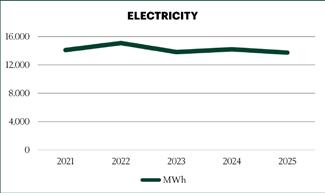
Electricity consumption has decreased by 471 WWh compared to 2024, which is a reduction of 3.3%.
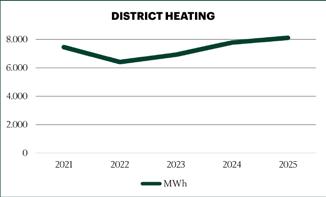
District heating has increased by 339 MWh, which is an increase of 4.4%.
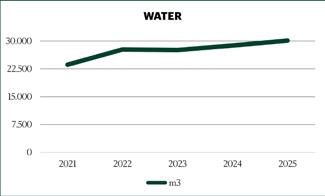
Water consumption has increased by 1,319 m3, which is an increase of 4.6%.
The minor increases occur on a backdrop of a much higher activity level. As such the footprint per costumer is declining.
REAL IMPACT RELATED TO ACTIVITY
Main figures (approximately)
Revenue in Magasin: +9.0%
Transactions: +7.1%
Store visits: +3.8%
Relative footprint reductions per DKK revenue:
Total energy: -10.7%
Electricity: -11.3%
District heating: -4.2%
Water: -4.0%
Waste: -9.1%
While several operational footprint indicators remained relatively flat in absolute terms in 2025, this was achieved alongside significantly higher commercial activity, including rising store visits. Consequently, Magasin reduced environmental intensity across most key indicators, most notably electricity use per DKK of revenue, which fell by approximately 11.3% year on year. The more modest improvement in district heating intensity should be seen in the context of somewhat colder conditions across the main heating months of January, February, November and December 2025 compared with the same period in 2024. Water consumption also improved more moderately, reflecting that earlier efficiency initiatives had already captured a significant share of the most readily achievable savings, and that water usage is to a greater extent determined by operational and structural conditions such as building mass, technical infrastructure and the number of people on site.

Production Magasin du Nord Collection towels in Portugal.
SUPPLY CHAIN AND DELIVERY
Logistics and operational efficiency: Continued optimization of the DSV set-up improves inventory accuracy, reduces unnecessary transport and minimizes resource consumption. We are awaiting confirmation of the warehouse’s energy classification to support future assessments.
Transport and CO2 data: Emissions-related data from most distribution partners has been received; final inputs are pending. These data will inform freight reduction targets and more transparent transport emissions tracking.
Fossil-free last mile: Most distribution partners now plan for fossil-free last-mile delivery. We will communicate externally once performance can be consistently guaranteed under all operating conditions to ensure full compliance.
Future developments: New distribution solutions for Norway and Sweden are being explored and will be made public once defined.

2025 CO2 EMISSIONS FROM DISTRIBUTION;
Emissions from distribution are based on data from logistics partners in Denmark, Sweden and Norway. The emissions are calculated as Well-to-Wheel (WTW), which includes both transport and fuel production.
The total emissions from distribution amount to 336.16 tCO2e distributed over 1.598946 shipments, corresponding to an average emission of approximately 0.21 kg CO2e per shipment. The emissions vary between carriers depending on the type of transport, delivery model and geographical coverage.
This overview provides details regarding carbon footprint per shipment in each country. The details are used to calculate the total carbon footprint per order.
However, since the different distributors act in a varied mix of shipment methods, this overview is not suitable for direct comparison between suppliers.
Data transport:
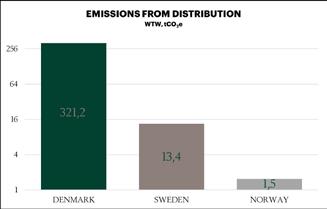
Total Danmark: 321,20 tCO2e (WTW), 1.380.320 shipments
Total Sverige: 13,42 tCO2e (WTW), 124.696 shipments
Total Norge: 1,54 tCO2e (WTW), 93.930 shipments
The significant variation in emissions between countries is driven by a combination of factors. Firstly, Magasin’s largest market remains Denmark. In addition, a substantial share of the products’ footprint flows through the Danish operation and cannot be separated from it, which means the WTW principle further distorts the picture. Finally, Norway in particular benefits from both a high penetration of zero-emission transport and strong availability of green energy.
Magasin’s transport emissions are concentrated in a limited number of markets and logisticals partners, with Denmark and GLS representing the most significant share. At the same time, substantial differences in emissions intensity across delivery models indicate a clear opportunity to reduce emissions through carrier selection, delivery optimization and increased use of consolidated distribution solutions.
The key to making these important decisions is the quality of data, and clear definitions of delivery models and product journeys. Our goal is to set a baseline for last mile delivery, inter-store shipments and bulk shipments to determine potential.
OWN CAR FLEET AND CHARGING CAPACITY
We are assessing internal vehicle usage and charging capacity to understand the climate impact of our fleet and to inform low-emission mobility choices. Data not ready.
REDUCING RETURNED GOODS
Returns drive avoidable emissions and waste. In 2025 we intensified efforts to reduce returns through data- driven insight and customer-facing improvements:
Enhanced product information: Improved size guides, material data, care instructions and fit details enriched through AI and partner data.
Returns portal (launching Q3 2026): Deeper insight into return reasons to enable preventive actions.
Paid return labels (approx. DKK 10): Discourages unnecessary returns while remaining accessible.
Proactive monitoring: Continuous product-level monitoring to spot patterns early and act fast.
Customer nudging: Collaboration with partners to discourage multi-size buying.
Returns:
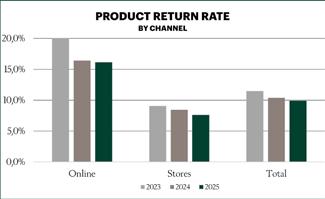
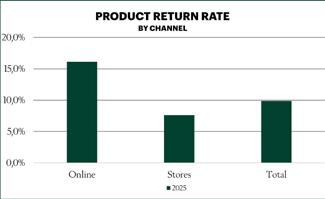
The product return rate for online has decreased from 16.4% to 16.1%, for stores from 8.5% to 7.6%, and has decreased overall from 10.4% to 9.9%. Further reductions remain a priority target.

RESPONSIBLE COMMERCE ASSESSMENT
An assessment conducted in late 2025 identified a set of priorities for 2026 focused on reducing waste, improving customer guidance and strengthening transparency.
Key initiatives include minimizing returns and split shipments, enabling customers to adjust orders to avoid unnecessary deliveries, and providing clearer guidance on sustainability. At the same time, we will improve product information - including adding sizing tools and transparency on materials, origin, certifications and care. And we will seek to actively highlight responsible product choices throughout the customer journey.
In addition, care and repair guidance will be more closely integrated into the customer experience, and preparations will begin for Digital Product Passports, initially targeting data-rich product categories.
PACKAGING AND WASTE SORTING
We are collecting packaging, waste and compliance data to meet EPR obligations and to identify reduction and circularity opportunities across operations.
As of 2026 Magasin packaging are predominatedly based on recycled materials. At the same time, emphasis has been placed on ensuring that materials, that do not originate from recycling, are produced based on sustainable concepts minimizing waste and energy consumption.
Wastesorting:

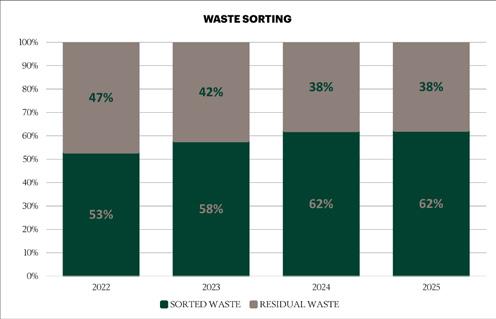
As in 2024, 62% of our waste is sorted, while 38% is residual waste. Our total waste volume has decreased by 10.3 tons*. This reduction should be viewed in correlation with increases in both revenue, number of sales transactions and store visits.
*In 2025 the total amount of waste was 1.150.142kg and in 2024 it was 1.160.475kg
CO 2 CALCULATION METHOD FOR PRODUCTS
Given a limited availability of product specific material data from our partners we will use a straightforward, category level method. For each selected product category, we set an average material mix and an average unit weight, multiply by units sold in 2025, and calculate the total amounts of key materials (e.g., cotton, polyester). We then apply recognized emission factors to estimate CO2. This approach enables us to create a baseline for sold products emissions. We recognize this method is not fully precise. However it is an appropriate and transparent starting point and we will improve the methodology as our data quality increases.
Further to this, we will seek to inform about our total footprint per DKK in revenue as well as per customer purchase transaction with the possibility of breaking down into store vs. online transactions at a later point.
This approach will inform the overall assessment of ongoing progress by staying consistent regardless of developments in sales.
Process: Map product categories and material composition; estimate material profiles (fashion and home); combine with weight data; apply recognized emission factors to create category‑level CO2 estimates; expand as data quality improves.
PREPARING FOR SBTi ALIGNMENT
Magasin’s long-term ambition is to commit to the Science Based Targets initiative (SBTi). As a first step, we will establish a complete and reliable greenhouse gas inventory across Scopes 1–3, including a robust baseline supported by spend-based analysis.
This will be complemented by identifying the most significant emissions hotspots in procurement and improving the quality of supplier-specific data in key categories. Together, these efforts will align Magasin’s approach with the GHG Protocol and create the foundation for setting science-based climate targets.
THE 2025 RESULTS AT A GLANCE
On the surface, most of the footprint from Magasin in 2025 appears relatively similar to the year before. However, when examining the figures more closely, it is clear the relatively modest reductions go hand in hand with an overall increase in activity. Revenue is up nearly 10%, number of purchases has increased significantly and store visits are also rising. This effectively means that the efforts have manifested itself in a significantly decreased footprint per product, per transaction, per DKK and per customer. This is why Magasin will continue to strive for a lower impact from every single purchase made from our stores and online shopping.

SOCIAL OUR PEOPLE
EQUALITY, DIVERSITY AND INCLUSION
We strive to foster a workplace where people feel welcome, respected and valued. Diversity is a natural part of Magasin’s culture, and strengthening inclusion is a continuous effort. We remain committed to fair opportunities, representation and equal treatment at all levels of the organization.
Magasin is still aiming for a better gender balance within top management. Thus, a pipeline program for leadership talent pool development has been created to facilitate internal promotion. We have achieved a gender distribution in middle management of approximately 62% women, reflecting the gender composition of the Danish retail business workforce making the internal recruiting potential very promising.
Gender distribution:
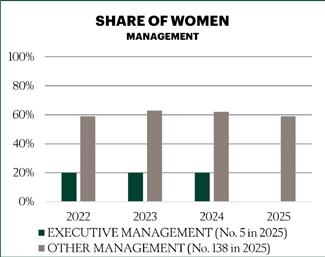
Restructuring from a 12 person top management team to five along with natural talent churn has effectively driven a negative development in the gender equality for top management. The mentioned initiatives aim to address this development.
Special attention has been focused on our internal leadership training to enable managers to foster inclusive teams and utilize the capacity of a diverse workforce. Further to traditional diversity training, managers are given tools to include neurodiversity and to recognize the different forms, strengths and challenges it represents.
Through anonymous self-reporting, we have surveyed how employees feel about being their authentic selves in the workplace. An average score of 4.18 out of 5 indicates that a clear majority feel safe to be themselves.
WORKPLACE SAFETY AND WELLBEING
Safety and wellbeing are integral to our social responsibility. We monitor work injuries, improve preventive measures and strengthen wellbeing initiatives across stores, offices and warehouses - ensuring all employees experience a safe, supportive workplace.
Last year 100 employees participated in courses or networks to enhance wellbeing in the workplace. In 2026 we will continue to increase the focus on a meaningful and satisfying work life and we aim to double the number of participants.
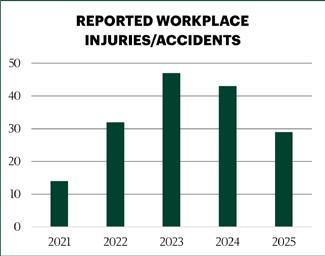
In 2025 we have increased efforts to reduce workplace accidents by adding extra resources to labor heavy areas that are considered higher risk. Furthermore, the HR department has been running a campaign to reinforce the collective effort of preventing accidents. The result was a 32% reduction in work-related accidents compared to the previous year.
We have run an awareness campaign to strengthen the utilization of our professional development resources allocated through our internal fund for employee skill development.
To help fulfil our ambition of continuing decline in employee churn, we have improved our onboarding processes both on site and online to better align expectations and increase sense of belonging.
Absence is, as in the rest of the retail sector, relatively high. This is particularly driven by a larger share of parttime, seasonal and young employees. While Magasin is in line with the industry, it is a clear ambition to reduce absence through a stronger focus on improving wellbeing and job satisfaction.
YOUTH DEVELOPMENT – SUPPORTING THE NEXT GENERATION
Young people have played a central role in Magasin for more than 150 years – as employees, students, customers, and community members. We see it as a natural extension of our social responsibility to contribute to their well being, growth, and development.
Investing in youth well being is one of the most meaningful contributions we can make to the communities we serve.
Through our HR initiative “Youth Development’”, we focus on providing students, trainees and young employees with a safe, inclusive and developmental environment. The program is designed to give young people a good start in their working life - both professionally and personally - especially as many encounter their first workplace at Magasin. The program aim to strengthen young people’s sense of agency, collaboration skills, and building confidence and human skills. The initiative has already provided valuable insights and resulted in adjustments to the trainee onboarding. Magasin now has set a goal of attracting and developing the best retail trainees in the country. In order to ensure full focus, the uptake of new trainees will be concentrated into biannual teams. This will ensure the allocation of more resources and provide better team dynamics. “Youth Development” insights also guided the implementation of teams for managerial sparring as well as equipping managers with tools to handle new generational challenges such as the increasing challenges to mental wellbeing among younger generations.
Youth in Magasin – selected indicators:
57% of employees are under 25 years old.
23% of managers are under 30.
“Investing in youth well being is one of the most meaningful contributions we can make to the communities we serve”

CHARITY & IMPACT – Supporting Youth Wellbeing
WE LOVE TO CARE – FOR PEOPLE
Magasin has a longstanding tradition of contributing to the communities we are part of. In 2025 we deepened our support for organizations improving youth wellbeing across Denmark.
PARTNERSHIP WITH THE DANISH RED CROSS
In 2025, we entered a strategic partnership with the Danish Red Cross to support their extensive work for youth wellbeing - creating safe, inclusive spaces where young people can belong and build positive futures.
Many young people face loneliness, pressure to perform, and a lack of stable adult networks. Through the partnership, our support helps the Red Cross invite more young people into communities that foster: belonging, confidence, strength, stability and joy.
Throughout 2025, several joint initiatives raised awareness and funds amounting to 250.000 kr. for youth programs, with a lot of further initiatives planned in 2026. Our ambition is to at least double the direct contribution. We also aim to increase use of our platforms to increase awareness among our customers and to further integrate the collaboration into more aspects of our daily business.
Some of the activities in favor of Red Cross during 2025:
• Scarf developed in collaboration with influencer and sold by Magasin • Christmas stockings made from leftover fabrics from production of our own brand and sold by Magasin • Flea markets with donations of sale of stands and sale of our own brand Magasin du Nord Collection samples • Donation of returned goods - that cannot be immediately sold in the regular assortment
• Donation of ‘scrap’ containers from our logistic partner DSV • Donation with all purchases/ transactions at the christmas opening.
PARTNERSHIP WITH JOANNAHUSET
We support Joannahuset, Denmark’s only 24 -hour refuge for children and young people in crisis. Here, the door opens almost every day to a young person experiencing violence, homelessness, or severe vulnerability - often with limited trust in adults or systems.
Our mission to help the young people in the process of moving from crisis toward stability through emotional support, practical guidance and structured activities.
Therefore Magasin aim to support Joannahuset in creating care for the young people during their stay. Supporting the young people by giving them access to products and experiences that give them the opportunity to feel safe and provide a break from their current crisis. Offering simple access to hygiene and self-care is crucial for both physical and phsychological well-being.
Magasin contributions:
• Care products, make-up, fragrances and clothing that support the sense of identity and self-care • soft pillows, blankets, mirrors and other homely elements that make the rooms warm and personal • food, snacks, drinks that provide nourishment and calm in a crisis situation • financial support to ensure care givers around the clock.
PARTNERSHIP LYNGBY FOOTBALL CLUB – “STARTBLOKKEN”
In connection with our sponsorship of the football club Lyngby we also support the initiative called Startblokken. Startblokken is a national initiative that has its origins in the Danish Sports Association (DIF). Around 150.000 citizens have difficulty finding their way into the job market and/or education.
As many as 40.000 of people struggling with these challenges are young people aged 18 to 29. Based on sports and in a unique collaboration across civil society, companies and the public system, Startblokken seeks to create a new and sustainable solution for those who have the most difficulty finding their way into a job or education.

GOVERNANCE
COMPANY POLICY ON DATA ETHICS
We handle data with care, transparency and integrity. Our approach ensures that personal and business data is collected and used responsibly, with full respect for privacy and individual rights, while supporting fair value creation and better customer experiences.
This is underpinned by clear principles, including transparency, data minimization, and safe and secure data handling. We also commit to the responsible use of AI, with human oversight, and to maintaining accountability through continuous improvement. In short, we aim to ensure that trust is not compromised
WHY DATA ETHICS MATTERS AT MAGASIN
Data plays an increasingly important role in how we operate, from improving customer journeys to strengthening our supply chain transparency. By applying a responsible and ethical approach, we ensure that data is used in ways that create value without compromising trust, fairness, or individual rights.
Data ethics is therefore not only a compliance requirement, it is a fundamental part of how we want to run our business, aligned with Magasin’s values and our commitment to responsible governance.
CYBER AND DATA SECURITY
We depend on a stable IT infrastructure supporting purchasing and sales (including environments with and without customer data). We are improving access controls, multi-factor verification, system monitoring and standard encryption, and we run annual security audits. We have clear policies for personal data in online sales and customer programmes, ensuring a high degree of compliance in storage and use of external data.
WORK SAFETY
As a major player in Danish retail, most of our organization is customer-facing. We minimize risks through physical settings and conditions that protect safety and wellbeing, including ergonomics, lighting and air conditions; we also prepare risk analyses for external factors and maintain contingency plans with psychological aftercare, in partnership with our health insurance provider.

MAGASIN DU NORD COLLECTION & FOOD
– THE PRIVATE LABEL BRAND
INTRODUCTION
Being a responsible brand is a continuous journey without a fixed endpoint. At every crossroads, new opportunities and challenges emerge. At Magasin Du Nord, we have chosen to approach this journey step by step, continuously evaluating what is most important for our brand, our customers, and the industry we operate in.
“In this section, we aim to provide transparency on our 2025 efforts and present the current status of our journey”
PROCUREMENT
In 2025 we conducted a survey among all textile partners, as textiles represent the majority of our turnover. The survey focused on our partners’ approaches to product responsibility, due diligence and transparency.
The insights gained enabled us to define a realistic yet ambitious strategy for Magasin’s Responsible Criteria. These criteria are designed to make our CSR efforts measurable and data-driven for our buyers, while ensuring transparency and credibility for our customers. The necessary IT development to operationalize the Responsible Criteria is currently under development. At the end of 2024, we also conducted an internal employee survey within the buying department to better understand the sense of meaningfulness in daily work. The results highlighted sustainability as a key priority for our employees.

To integrate sustainability into everyday decisionmaking, we defined a set of guiding principles outlining where we aim to decrease, increase and maintain our efforts:
Decrease: Over-purchasing, as it contributes to overproduction
Increase: Collaboration with relevant stakeholders, as well as communication and knowledge sharing on Responsible Criteria and CSR goals
Maintain: The Responsible Criteria project and our strong commitment to due diligence requirements and standards for private label
During our annual CSR workshop in the buying department, we further developed concrete actions to monitor over-purchasing and ensure continuous team engagement with the progress of the Responsible Criteria.
ABOUT MAGASIN DU NORD COLLECTION
Since 1868, Magasin has had its finger on the pulse of fashion and lifestyle — a position we continue to uphold today. With Magasin Du Nord Collection, our ambition is to create high-quality products that bring lasting value to our customers.
Our assortment spans Womenswear, Menswear, Kidswear, Lingerie, Loungewear, Accessories, Luggage, Home Textiles, Home Accessories, Home Spa and Food. Textiles represent the largest share of our collections.
At the Design Studio at Kongens Nytorv, our design team develops collections with a strong focus on quality and timeless design, enabling customers to use and value our products over a long period of time.
Our approach to responsible sourcing is anchored in internationally recognized frameworks for human rights and environmental due diligence, including the UN Guiding Principles on Business and Human Rights and the OECD Due Diligence Guidance for Responsible Supply Chains.
We continuously work to strengthen our internal processes, ensuring that our sourcing decisions are aligned with these principles and supported by documentation and risk-based assessments.
Our CSR strategy is structured around three key pillars: People, Product, and Planet. We prioritize areas where we have the greatest impact - primarily People and Product - while building a stronger data foundation to advance our Planet agenda.

PEOPLE
PARTNERSHIPS ‑ TEXTILE
We work with global suppliers and prioritize selecting the right partner for the right product and price. Longterm partnerships are a cornerstone of our approach, as we believe that meaningful improvements are achieved through collaboration and continuity.
We are proud that 70% of partnerships are maintained for more than five years.
We are members of amfori BSCI and require thirdparty audits (e.g. BSCI, SMETA, SA8000, or Fair Wear Foundation) to ensure transparency on working conditions.
For new suppliers, we set clear expectations regarding audit performance and do not initiate partnerships if requirements are not met.
For existing suppliers, we review all audits, provide feedback, and require re-audits within 1–3 years to support continuous improvement.
PARTNERSHIPS ‑ FOOD
Our chocolate supplier is a member of Cocoa Horizons, supporting fair income and improved working conditions for cocoa farmers.
Our coffee assortment is sourced through partners committed to responsible sourcing practices. We prioritize suppliers who work with recognized certification schemes such as Organic, Fairtrade, Rainforest Alliance, or equivalent programs that support improved livelihoods and environmental standards in coffee production.
Where certification is not yet in place, we engage in dialogue with suppliers to increase transparency and encourage alignment with internationally recognized due diligence frameworks.
We acknowledge that coffee supply chains are complex and often fragmented. Therefore, increasing traceability and strengthening documentation at origin level will remain a focus area in the coming years.

TRANSPARENCY GOAL 2028
Achieve transparency to Tier 3 for all textile products.
TRAINING
To ensure that employees in customer-facing roles can accurately communicate our certifications, we have developed a dedicated training program available across Magasin.
PRODUCT
Our products are designed with a focus on quality and longevity, enabling customers to care for and use them over time.
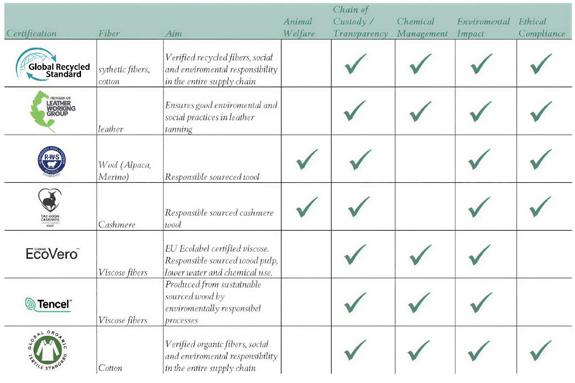
For textiles, our material strategy guides responsible raw material choices. In 2025, we strengthened this approach by prioritizing certified, licensed, or verified materials aligned with our key material categories. These standards support increased transparency and stronger due diligence in our supply chains.
In 2025, we reached an important milestone by becoming a member of The Good Cashmere Standard® by Aid by Trade Foundation. This enables traceability to raw material level (Tier 4) for all cashmere products and marks the first step towards our 2028 transparency goal.
For our textiles, we work with following standards and licenses:

STATUS OF CERTIFIED, LICENSED AND VERIFIED PRODUCTS (2025)
In 2025, we continued to increase the share of certified, licensed, or otherwise verified products across our assortment. Progress is measured based on product volumes carrying recognized third-party certifications aligned with our material strategy.
While we have seen positive development across key categories, the transition remains ongoing. Certain product groups present structural challenges due to limited availability of certified materials or immature certification systems.
We will continue to expand our certified assortment in line with our 2027 target, while ensuring that certification choices are relevant, credible, and material-specific.
PRODUCT SAFETY
Product safety is a key pillar of our product strategy. For non-apparel categories, we collaborate with specialized partners to ensure compliance across Food and Home Spa products.
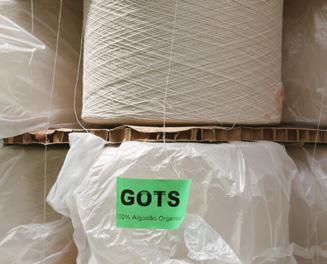
In 2025, a significant share of our textile assortment was covered by OEKO-TEX®, GOTS, or GRS certifications at final product level.
These certifications play a key role in ensuring compliance with chemical safety requirements and provide an additional layer of assurance for our customers.
For remaining product groups, we apply internal risk assessments to determine the need for supplementary testing and documentation.
Our ambition is to further increase certification coverage while maintaining a risk-based and productrelevant approach.
CERTIFIED, LICENSED AND VERIFIED OPTIONS PER SEASON
CHEMICAL OPTIMIZED OPTIONS PER SEASON
Magasin Du Nord Collection Beklædning (Dame, Herre, Børn, Nattøj, Lingeri)
Magasin Du Nord Collection Home, Ready Made Accessories
Target: By 2027, 90% of our apparel products will carry recognized certifications.
Magasin Du Nord Collection Beklædning (Dame, Herre, Børn, Nattøj, Lingeri)
Magasin Du Nord Collection Home, Ready Made Accessories
PLANET
We aim to reduce the environmental impact of our packaging and logistics:
• All polybags must contain at least 20% recycled plastic and be recyclable
• Packaging must be optimized for volume efficiency
• All cardboard must be FSC-certified
We prioritize low-impact transportation methods:
• Sea freight from the Far East
• Truck transport within Europe and Turkey
Air freight only in exceptional cases
GOALS 2026
To further strengthen our environmental approach, we are working towards improving data quality related to packaging and logistics.
In addition we are preparing for our first emissions report, which shall be released in 2027, that will enable us to:
• Establish a more detailed material strategy
• Measure the impact of product-related decisions
Build a data-driven foundation for reducing our environmental footprint across the value chain
NETWORKS
We believe that addressing ESG challenges requires collaboration.
We actively participate in industry networks to exchange knowledge, align standards, and engage with stakeholders across the value chain, including suppliers, industry peers, and policymakers.
This includes participation in:
• A CSR network with Danish fashion, home, and athleisure brands
• Dansk Erhverv’s Textile network
• Dansk Mode & Textile
MAGASIN DU NORD COLLECTION & FOOD SUMMARY OF 2025
APRIL 2026
Du Nord
Kongens Nytorv 13, 1095 København K
Magasin