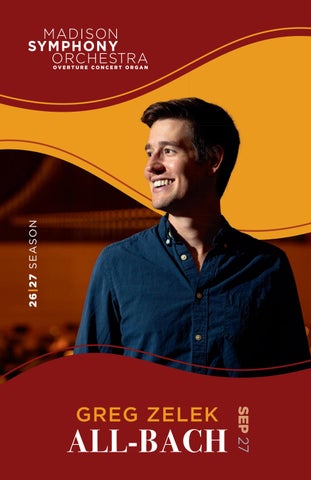
26|27 SEASON
ALL-BACH
SEP 27
GREG ZELEK
CONTACT Madison Symphony Orchestra 222 W. Washington Ave., Suite 460 Madison, WI 53703 Phone (608) 257-3734 madisonsymphony.org info@madisonsymphony.org ©2026 Madison Symphony Orchestra, Inc. Heather Rose, Editor Email: hrose@madisonsymphony.org All rights reserved. May not be produced in any manner, in whole or in part, without written permission from Heather Rose, Marketing Communications Manager. For advertising information, contact: Heather Rose (608) 257-3734 x231 hrose@madisonsymphony.org
Overture Center Box Office 201 State St. Single Tickets: (608) 258-4141 Ticket Office Hours: Mon. – Fri., 11:00 a.m. to 5:00 p.m. Sat. 11:00 a.m. to 2:00 p.m. Additional hours on Sunday event days.
2
GREG ZELEK ALL BACH 4 Concert Sponsors 5 Concert Program 6 Greg Zelek Biography 8 Program Notes
ORGAN
TABLE OF CONTENTS
SUPPORT 15 Adopt-A-Stop 20 Organ Specification 21 Friends of the Overture Concert Organ
LAND ACKNOWLEDGMENT
As we gather in this space for these concerts, the Madison Symphony Orchestra acknowledges the HoChunk Nation’s ancestral lands and celebrates the rich traditions, heritage, and culture that thrived long before our arrival. We respectfully recognize this Ho-Chunk land and affirm that we are better when we stand together.
madisonsymphony.org/26-27organ
3
SEP 27
GREG ZELEK
ALL-BACH
SUNDAY 2:30 PM
THANK YOU
to our generous sponsors
for supporting this performance
MAJOR SPONSORS
Fernando and Carla Alvarado Sue and Ellis Bauman Jane Hamblen and Robert F. Lemanske Peter and Leslie Overton Walter & Karen Pridham Charitable Fund
ADDITIONAL SPONSOR
Shirley Spade, in memory of Gerald Spade
The Overture Concert Organ is the gift of Pleasant T. Rowland. Support for all Overture Concert Organ programs is provided by the Diane Endres Ballweg Fund. We wish to thank our other organ contributors, the Malmquist Family, Margaret C. Winston, and Friends of the Overture Concert Organ. Greg Zelek is the Madison Symphony Orchestra’s Principal Organist and the Elaine and Nicholas Mischler Curator of the Overture Concert Organ.
4
PROGRAM
Overture Concert Organ Series | Subscription Program No. 1 Sunday, September 27, 2026 | 2:30 pm Greg Zelek, Organ
Johann Sebastian Bach Prelude and Fugue in A minor, BWV 543 Prelude in B minor, BWV 855a, arr. Siloti Toccata, Adagio, and Fugue in C Major, BWV 564 Siciliano from Flute Sonata in E-flat Major, BWV 1031 Pedal-Excercitium, BWV 598 Air from Suite No. 3 in D, BWV 1068, arr. S.N. Penfield Passacaglia and Fugue in C minor, BWV 582
madisonsymphony.org/26-27organ
5
GREG ZELEK Principal Organist
Praised as “extraordinary in the classical music world” (Jon Hornbacher, PBS Wisconsin Life) and a “musical star” (Bill Wineke, Channel 3000), Greg Zelek is the Principal Organist of the Madison Symphony Orchestra and Curator of the Overture Concert Organ. In this role, Greg performs and oversees all of the MSO’s organ programming. The MSO Organ Series regularly attracts over one thousand ticketed audience members for each of Zelek’s creatively curated and performed concerts. Since September 2017, Greg has proudly held the Elaine and Nicholas Mischler Curatorship. In addition to his unique position in Madison, Zelek is the Northrop Organist at the University of Minnesota and the Curator of the J.F. Bryan Concert Organ Series for the Jacksonville Symphony. Zelek also performs frequently as a soloist throughout the United States. Always playing his solo programs from memory, Zelek has played and premiered many of the large works of the organ canon, as well as new works that showcase the versatility of the instrument.
6
Alongside various orchestras, Greg has performed the organ concertos of Barber, Poulenc, Rheinberger, and Jongen. Greg has also been the organist for works such as Mahler’s 8th Symphony, Janáček’s Glagolitic Mass, Saint-Saëns’s Organ Symphony, Strauss’s Alpine Symphony, Respighi’s Pines of Rome, Foss’s Phorion, and Gounod’s Faust. Zelek is known for his inventive programming and collaborations. He has performed a classical and gospel concert with counter-tenor Reginald Mobley, arranged and commissioned works for cello and organ with cellist Thomas Mesa, performed in a Latin-American concert with a Cuban band from Miami, FL, and collaborated with electronic trombonist Mark Hetzler, in a concert featuring new music for organ, trombone, and percussion. He has also performed with the Canadian Brass in his continued role as Visiting Guest Artist at St. John’s Abbey in Collegeville, MN. Greg was selected as an InBusiness Madison 2026 40 Under 40 honoree, a distinction celebrating the region’s most impactful young leaders and creative forces. Zelek has won prizes in numerous organ competitions, and released his debut recording on the Overture Concert Organ in the Fall of 2022. A recipient of the inaugural Kovner Fellowship, he received his Bachelor’s and Master’s degrees, as well as an Artist Diploma, from the Juilliard School as a student of Paul Jacobs. Greg, who is Cuban-American and a native Spanish speaker, grew up in Miami, FL and resides in Madison, WI with his wife and two children.
madisonsymphony.org/26-27organ
7
PROGRAM NOTES SEPTEMBER 27, 2026 | SUNDAY 2:30 PM program notes by J. Michael Allsen
Johann Sebatian Bach as an Organist We know Johann Sebatian Bach (1685-1750) today as one of the supreme composers of the Baroque. However, his own day, Bach’s primary reputation was as a great organist, renowned throughout Germany for his phenomenal playing and for his skills as an improviser. At several points in his career, he was called on to consult with German churches on new organ projects. Bach’s earliest professional position, at age 17, was in Weimar, at the court of Duke Johann Ernst III. Bach later described his position as a “court musician,” but the court records actually describe him as a “lackey”—low-ranking musicians were apparently also expected to perform more menial work. It is probably not surprising that Bach left Weimar after only six months to take a much more attractive position as a church organist in Arnstadt, where he worked from 1703-07. One of the prime influences on many of his early organ works was the style of his acknowledged master, Dieterich Buxtehude. In 1705, the 20-year-old Bach took a leave from
8
his church position in Arnstadt to travel to Lübeck, where he hoped to study with Buxtehude. Many of his organ works over the next several years clearly show his admiration for Buxtehude’s music. After serving in a second organ position in Mühlhausen (1707-08), Bach was lured back to Weimar. The court organist, Johann Effler, had finished extensive renovations to the organ in the Duke’s chapel, but his health was failing. Knowing Bach’s growing reputation as an organ virtuoso and as an expert on organ construction, Effler invited Bach to Weimar to inspect the instrument and play an inaugural recital for the Duke in June of 1708. Bach was immediately offered the position of court organist. (Don’t worry: old Johann Effler was able to retire comfortably, with his full salary!) By July 1708, Bach was in Weimar, where he would remain until 1717, eventually serving as Konzertmeister (music director). In his early years at Weimar, Bach concentrated primarily on keyboard works. The court chapel had a fine renovated organ, and the Duke was apparently
a great fan of Bach’s organ works. According to Bach’s obituary, the Duke’s encouragement “fired him with the desire to try every possible artistry in his treatment of the organ.” Many of the 24 preludes and fugues later published as The Well-Tempered Clavier, Book 1 were written there, as were all but three of the 46 Lutheran chorale preludes published in his Orgelbüchlein. During the years 1717-1723, Bach served as Kapellmeister to the Cöthen court of music-loving Prince Leopold von Anhalt-Cöthen. Leopold’s musical establishment included a fine orchestra, and Bach was encouraged to create instrumental music in the latest style. Though he continued to perform on organ, much of his music from this period was secular. Half of the famous “Brandenburg” concertos were written for the Cöthen court, as was the lion’s share of Bach’s surviving orchestral music. In 1723, Bach arrived in Leipzig to become Kantor at the Thomaskirche: a challenging position that involved not only leading the music at Leipzig’s central church but also supervising the music at all of the city’s main churches and teaching the boys at the city’s choir school. Bach threw himself into the position with tremendous vigor, most notably completing five annual cycles of cantatas for the Thomaskirche, some 300 works in all. By 1728, however, his enthusiasm for the weekly grind of work as Thomaskantor seems to
have faded. That year, he became the director of the Leipzig collegium musicum, a group of amateur musicians who gave informal concerts in one of the city’s coffee houses. Bach clearly relished the chance to return to secular music-making, and he devoted much of his compositional energy to this group, writing new works, and adapting pieces he had written during his tenures in Cöthen and Weimar. At the same time, he also became more active as a recitalist. Though he was not employed specifically as an organist in Leipzig, Bach already had a reputation as one of Germany’s great organ virtuosos, and he occasionally played out-of-town concerts through the rest of his career. Though they are not well-documented, he probably gave public organ recitals in Leipzig as well, most likely on the relatively new organ at the Paulinerkirche. At least some of the masterful organ works he wrote late in his career, including the truly impressive Prelude and Fugue in E minor, BWV 548, composed sometime between 1727 and 1732 (and performed at these programs in 2023 by guest organist Ken Cowan) may have been written with these public concerts in mind. Prelude and Fugue in A minor, BWV 543 The Prelude and Fugue in A minor seems to date either from Bach’s years as organist in Weimar, or from his early years in Leipzig a decade later, though its style shows a bit of his early fascination with Buxtehude. The Prelude begins with a winding,
madisonsymphony.org/26-27organ
9
subtly chromatic line in the manuals, eventually joined by a long-held pedal. The pedals and manuals then begin to explore the opening material together, all the way through to a dramatic conclusion. The Fugue is set in 6/8, lending a dancing quality to this intensely complex work. In the opening exposition, the fugue subject is presented four times, lastly by the pedals. The fugue includes some long, chromatic episodes—typically passages without the fugue’s opening subject, though Bach subtly manages to work in fragments of this theme. The ending is dramatic: the writing for the manuals fades away, leaving the pedals exposed for a final passage. The work ends with a brilliant flourish from the manuals. Prelude in B minor, BWV 855a (arr. Siloti) The 48 preludes and fugues of Bach’s Well-Tempered Clavier, Books 1 and 2 were among Bach’s only well-known works in the period between his death and the revival of his music by Felix Mendelssohn and others in the early 19th century. Mozart, Beethoven, and many others avidly studied the “WTC” fugues as examples of masterful contrapuntal writing, and 19th-century pianists frequently adapted the emotional preludes. In 1722, Bach published WTC Book 1, 24 preludes and fugues in all 24 Major and minor keys, intended “for the profit and use of musical youth desirous of learning, and especially
10
for the pastime of those already skilled in this study.” WTC Book 2, a further collection of 24 preludes and fugues in all 24 keys, was published in1742. [NOTE: “Well-Tempered” is a reference to equal temperament, a tuning system that divides the octave into 12 exactly equal intervals. Without getting too far into the musicological weeds here, I’ll just say that it makes it possible to perform works in all 12 Major and minor keys. Though “Clavier” later came to be synonymous with the piano, a newly invented novelty in Bach’s time, he clearly used the word to mean any sort of keyboard instrument, including harpsichord and organ. JMA] The Prelude in B minor, BWV 855a was originally written as part of the Prelude and Fugue No. 10 in E minor from WTC book 1. The Russian pianist Alexander Siloti (1863-1946) adapted it for piano, romanticizing the harmonies and phrasing a bit, and transposing the whole thing to the key of B minor. This quickly became a popular recital piece among pianists, and the great French organist Charles-Marie Widor (1844-1937) subsequently published the organ adaptation of the B minor version. Toccata, Adagio, and Fugue in C Major, BWV 564 This bravura work was probably written during Bach’s tenure at Weimar in the early 1710s. The Toccata begins with a couple of surprisingly hesitant opening gestures, before Bach launches boldly into an extended
passage of winding, stop-and-start 32nd-note writing for manuals. But the real star of the show is the organist’s feet: showcased in a fierce passage for pedalboard alone and continuing throughout the denser closing section. Bach’s early years in Weimar saw a tremendous interest in the works of the latest Italian composers, particularly the concertos of Vivaldi (probably with the encouragement of the Duke himself ). This was the period when Bach arranged several solo “organ concertos” cribbed from concertos by Vivaldi and others. It’s hardly surprising, then, that he should have inserted a slow movement—in the manner of an Italian concerto— into this showy organ solo. The Adagio features an expressive and lyrical line set above a relaxed strolling bass. At the end, he inserts a change of mood: a Grave section filled with suspensions and gnarly harmonies and eventually gives way to a glowing C Major chord. The closing Fugue is an energetic piece in 6/8, based upon a playful stop-and-start main subject that takes its cue from the opening Toccata. This is one of Bach’s most harmonically adventurous fugues, working its way to surprisingly distant keys before closing with an extended coda that returns to the texture of the Toccata. Siciliano from Flute Sonata in E-flat Major BWV 1031 Pedal-Excercitium, BWV 598 Next comes a set of two pieces beginning with the slightly mysterious
Flute Sonata in E-flat Major. There is clearly a strong case to be made that Bach composed this work for one of his Leipzig collegium musicum performances in the early 1730s. However, in a 1995 article, UWMadison musicologist and Baroque flutist Jeanne Swack pointed to many similarities between this sonata and a Flute Sonata in E-flat Major by contemporary Prussian court composer Johann Joachim Quantz (1607-1773); she suggests either that BWV 1031 was also written by Quantz, or that Bach closely modeled it upon the Quantz piece. (The second possibility seems likely given his propensity to borrow his own and other composers’ music.) Whoever wrote this sonata, it is a masterful piece! At this program, we hear an adaptation for solo organ of the middle movement, a lovely Siciliano in G minor. This gently lilting rhythm was intended to conjure up pastoral associations in Baroque listeners. (Sicilianos, for example, are fixtures in the dozens of Italian “Christmas concertos”—where they stand for the shepherds of the Christmas story.) Once again, the Pedal-Excercitium, BWV 598 presents a bit of mystery. This is a piece whose date and attribution to Bach are both under question. It is not known exactly when or why Bach composed this his “Pedal Exercise.” Like much of Bach’s music, it survives in a copy by someone else, in this case, by his son, Carl
madisonsymphony.org/26-27organ
11
Philipp Emanuel Bach (1714-1788). Indeed, some authorities credit this brilliant little piece to C.P.E. Bach, rather than his father, though most seem to agree that Bach intended this work, which was probably initially an improvisation, as a practice piece for his son. What is clear is that Bach had some serious pedal chops. In 1732, for example, he visited Kassel, to test out and inaugurate a new organ at Saint Martin’s Church. (As Germany’s leading organist, he was frequently called on as an expert to check out newly installed or refurbished organs.) A local musician, Constantin Bellermann, wrote that Bach “ran over the pedals so quickly that his feet appeared winged, with a thundering fullness of sound, and penetrated the ears of the listeners like a bolt of lightning.” A “bolt of lightning” in fact describes this brief piece perfectly: it starts with a repeated figure and expands through multiple modulations to different keys in the course of about a minute and a half. Interestingly, the piece is in G minor, but ends on the “wrong” note, D—possibly as an invitation to the organist to improvise more! Air from the Suite No. 3 in D Major, BWV 1068 (arr. S. N. Penfield) The precise dates of composition for Bach’s four orchestral suites cannot be determined, but most scholars agree that they were probably written during the years 1717-1723, when Bach served as the Kapellmeister to
12
the Cöthen court of Prince Leopold. The orchestral suites were probably written for musical programs at Cöthen, and reflect popular French style, a lengthy and rather pompous overture followed by a series of French courtly dances. The most famous section of the suites—and one of Bach’s most beloved melodies—is the Air from the Suite No. 3 in D Major, BWV 1068, often known as the Air on the G String. In the original, which seems to have been inspired by vocal style, it is a lovely violin duet above a quietly plodding bass. The Air is played here in an arrangement for solo organ by the great American 19th century organist Smith Newell Penfield (1837-1920). Passacaglia and Fugue in C minor, BWV 582 Bach was not a well-travelled or cosmopolitan musician: he spent virtually his entire professional career within about 125 miles of his hometown of Eisenach. The only long journey ever took was in 1705, when the 20-year-organist took a leave from his position in Arnstadt to walk some 280 miles north to Lübeck. Though he was not exactly AWOL from Arnstadt, when he finally returned, his employers complained that Bach had requested a four-week leave but stayed away for “about four times that long.” The reason for his trip was to meet and study with the greatest organist of the day, Dieterich Buxtehude, organist at Lübeck’s grand
Marienkirche—a musician whom the young Bach seems to have admired above all others. Buxtehude’s music had a strong influence on the organ works Bach wrote over the next several years, including the Passacaglia and Fugue in C minor heard here. There is no agreement on exactly when this work was written, other than it was composed early in his career: whether for one of his church positions at Arnstadt or Mühlhausen (1703-08), or when he served as court organist at Weimar (1708-17). This is a brilliant example of the intensely contrapuntal style Bach adapted from Buxtehude. The Passacaglia begins with the theme laid out in the pedals. This is then played 20 more times as the basis for increasingly imaginative variations. Along the way, the theme migrates from the pedals to the manual...and back again...and Bach introduces subtle quotations of hymn tunes that would have been recognized by his Lutheran listeners. This leads directly into a magnificently complex double fugue, in which both the main subject and more active countersubject are based upon the Passacaglia theme.
Program notes ©2026 J. Michael Allsen
madisonsymphony.org/26-27organ
13
ENSURING A BRIGHT FUTURE for the OVERTURE CONCERT ORGAN Invest in the Overture Concert Organ’s future with your gift to the Organ Endowment Fund!
The MSO and Friends of the Overture Concert Organ invite you to support the Organ Endowment Fund through our Adopt-aStop naming program. The Overture Concert Organ is one of the Madison Symphony Orchestra’s most precious assets, and our Organ Endowment Fund provides a permanent source of longterm support for organ programming and care of the instrument. With an endowment gift of $1,000 or more, you can “adopt” part of the organ and make a lasting impact. Your gift will help to ensure a bright future for our magnificent Overture Concert Organ!
GIFT LEVEL
ADOPTION
$25,000
Division
$10,000
Stop
$5,000
Façade pipe
$2,500
Single pipe - Major
$1,000
Single pipe - Minor
Up to $999
General donation
LEARN MORE madisonsymphony.org/adoptastop Contact: Casey Oelkers, Director of Development, (608) 257-3734 Adopt-a-Stop gifts do not quality for Friends of the Overture Concert Organ (FOCO) annual membership benefits.
ADOPT-A-STOP Thank you to these generous donors for their gifts of $1,000 or more to the Madison Symphony Orchestra’s Overture Concert Organ Endowment Fund as part of the Adopt-a-Stop program. Donors who have chosen to adopt individual parts of the organ are listed with their individual adoptions.
ORGAN CONSOLE
Catherine Burgess, in memory of Jim Burgess
TUTTI
John and Christine Gauder Pedal Contra Bombarde 32’
Reynold V. Peterson Swell Basson 16’
Nicholas and Elaine Mischler
Lise Skofronick
BLOWER WINDING POWER SWITCH
John and Carol Toussaint
Solo Harmonic Flute 8’
Pedal Posaune 16’
Kay Schwichtenberg and Herman Baumann
Ann Wallace
DIVISION
Susan and Rolf Wulfsberg
Friends of the Overture Concert Organ in honor of Samuel C. Hutchison Great Division
Gamber F. Tegtmeyer, Jr., in memory of Audrey Tegtmeyer Swell Division
Friends of the Overture Concert Organ in honor of Gregory C. Zelek in celebration of his Golden Birthday Solo Division
STOP
In memory of Ruth and Frederick Dobbratz
Solo French Horn 8’
Great Gedeckt 8’
An Anonymous Friend
FAÇADE PIPE
Dr. Frederick W. Blancke Great Principal 16’ – F2
Daniel and Stacey Bormann in memory of Larry Shrode Great Principal 16’ – D2
Lau and Bea Christensen Great Principal 16’ – C2 John and Michele Erikson Great Principal 16’ - E1
Thomas A. Farrell in honor of Ann Farrell Great Principal 16’ – A3
Great Principal 8’
madisonsymphony.org/26-27organ
15
Jane Hamblen and Robert F. Lemanske Great Principal 16’ – B1
Dave Willow in honor of Mary Ann Willow Swell Basson-Hautbois 8’ - A2
Sandra L. Osborn
MINOR PIPE
Great Principal 16’ – C3
Peter and Leslie Overton Great Principal 16’ - E2
Reynold V. Peterson in honor of John Toussaint, the first Secretary-Treasurer of the FOCO Board of Directors Great Principal 16’ - D-Sharp2
William and Rhonda Rushing Great Principal 16’ - C#2
In Memory of Jennie Biel Sheskey and Biel Orchestra, The John and Twila Sheskey Charitable Fund Great Principal 16’ – B2
Fernando and Carla Alvarado Solo Principal 8’ – C3
Fernando and Carla Alvarado in honor of Nicholas and Elaine Mischler Swell Quintflöte 2 2/3’ – F1
Brian and Rozan Anderson Swell Basson 16’ – A2
Chuck Bauer and Chuck Beckwith Choir Clarinet 8’ – B2
Nancy Becknell Solo French Horn 8’ – C1
Ed and Lisa Binkley Pedal – Vox Balinae 64’ – C1
MAJOR PIPE
Anne Bolz in honor of Greg Upward Solo Harmonic Flute 8’ – G3
In Memory of Lila Smith Lightfoot
Patricia Brady and Robert Smith Solo French Horn 8’ – B2
Mary Kay Burton Choir Waldflote 2’ - B1
Capitol Lakes
Solo Tuba 16’ – C1
Swell Fugara 4’ – D3
Vicki and Marv Nonn Pedal Double Open 32’ – C1
Reynold V. Peterson Choir Unda Maris 8’ – A3
Barbara and Richard Schnell Solo French Horn 8’ – D
1
Barbara and Richard Schnell Solo French Horn 8’ – E
1
Carolyn White Swell Viola da Gamba 8’ -C1
Crystal Enslin in memory of Jon S. Enslin Swell Basson-Hautbois 8’ - D2
Friends of the Overture Concert Organ in honor of Reynold Peterson Great Trompete 8’ – G3
Friends of the Overture Concert Organ 2015-2016 Board of Directors in honor of Elaine Mischler Choir Clarinet 8’ – B-Flat1
16
Friends of the Overture Concert Organ 2019-2020 Board of Directors in honor of Ellsworth Brown Solo Harmonic Flute 8’ – E3
Paul Fritsch and Jim Hartman Solo French Horn 8’ – A3
Paul Fritsch and Jim Hartman in honor of Karissa Fritsch Solo French Horn 8’ – F4
Paul Fritsch and Jim Hartman in honor of Bethany Hart Solo Harmonic Flute 8’ – B3
Paul Fritsch and Jim Hartman in honor of Paige Kramer Solo French Horn 8’ – G2
Dr. Robert and Linda Graebner Great Principal 8’ – C1
Betsy and Bezalel Haimson
Stephen D. Morton Swell Bourdon 16’ – C1
Casey, Eric, Dylan, and Kendall Oelkers in honor of Walter & Barbara Herrod's 50th Anniversary Solo Harmonic Flute 8' - G2
Larry and Jan Phelps Pedal – Subbass 16’ – C1
Hans and Mary Lang Sollinger Swell Traversflöte 4’ – A2
Harriet Thiele Statz Choir Gemshorn 8’ – A3
Two Friends in memory of Jack Hicks Great Principal 8’ – C3
Anders Yocom and Ann Yocom Engelman Solo Principal 8’ – A2
Swell Basson-Hautbois 8’ - B1
Kris S. Jarantoski Swell Bordun 8’ – C3
Darko and Judy Kalan in honor of Samuel C. Hutchison Swell Basson–Hautbois 8’ – C1
Carolyn Kau and Chris Hinrichs Choir Suavial 8’ – C3
Gary Lewis Swell Basson–Hautbois 8’ – C3
Connie Maxwell Swell Basson–Hautbois 8’ – A3
Gale Meyer Solo French Horn 8’ – G1
Susanne M. Michler Swell Trompette Harmonique 8’ – C3
madisonsymphony.org/26-27organ
17
ORGAN SPECIFICATION Johannes Klais Orgelbau — Bonn, Germany 2004 • 72 Ranks
GREAT 4-1/2” wind Principal Principal Offenflote Salicional Gedeckt Principal Rohrflote Quinte Octave Cornett V Mixtura mayor V Trompete Trompete SWELL (enclosed) 4-1/2” wind Bordun Tibia Bordun Viola da Gamba Voix Celeste Fugara Transversflote Quintflote Octavflote Terzflote Plein jeu IV Basson Trompette harmonique Basson-Hautbois Clairon harmonique Tremulant
18
16 8 8 8 8 4 4 2-2/3 2 16 8
16 8 8 8 8 4 4 2-2/3 2 1-3/5 16 8 8 4
CHOIR (enclosed) 4” wind Geigen Principal Suavial Rohrflote Gemshorn Unda maris Octave Viola Waldflote Quinte Terz Mixtura minor IV Clarinet Tremulant SOLO (enclosed) 11” wind Principal Harmonic Flute Stentor Gamba Gamba Celeste Tuba Tuba French Horn
16 8 8 8 8 4 4 2 2-2/3 1-3/5 8
8 8 8 8 16 8 8
PEDAL 5” wind Vox Balinae (Resultant) 64 Double Open Untersatz Open Wood Violon (Gt) Bourdon (Sw) Subbass Octavbass Harmonic Flute (Solo) Stentor Gamba (Solo) Gedackt Octave Contra Bombarde Posaune Tuba (Solo) Trompete Clairon ACCESSORIES General Pistons General Toe Studs Divisional Pistons Pedal Divisional Toe Studs Divisional Cancel Pistons Sequencer Programmable Crescendo and Tutti
32 32 16 16 16 16 8 8 8 8 4 32 16 16 8 4 15 10 8 5 5
COUPLERS Gt to Ped Gt to Ped Sw to Ped Sw to Ped Ch to Ped Ch to Ped Solo to Ped Solo to Ped Sw to Sw Sw Unison Off Sw to Sw
8 4 8 4 8 4 8 4 16 4
Sw to Gt Sw to Gt Sw to Gt Ch to Gt Ch to Gt Ch to Gt Solo to Gt Solo to Gt Solo to Gt Gt to Gt Gt Unison Off Gt to Gt
16 8 4 16 8 4 16 8 4 16
Sw to Ch Sw to Ch Sw to Ch Solo to Sw Solo to Sw Solo to Ch Solo to Ch Ch to Ch Ch Unison Off Ch to Ch Pedal Divide
16 8 4 8 4 8 4 16
madisonsymphony.org/26-27organ
4
4
19
FRIENDS OF THE OVERTURE CONCERT ORGAN We gratefully acknowledge the Friends of the Overture Concert Organ for their support of Overture Concert Organ programming for the 2026-27 Season. This list includes current members as of August 27, 2026.
HONORARY LIFETIME MEMBERS W. Jerome Frautschi & Pleasant T. Rowland Diane Endres Ballweg Bruce & Suzanne Case Samuel C. Hutchison CURATOR CIRCLE $1000 & ABOVE Chuck Bauer & Chuck Beckwith Sue & Ellis Bauman James & Diane Baxter Barbara & Norman Berven Patricia Brady & Robert Smith Dorothy & Ellsworth Brown Martha Casey Richard Cashwell Dennis & Lynn Christensen Lau & Bea Christensen Mike & Quinn Christensen John & Christine Gauder George Gay Dr. & Mrs. Frank Greer John & Karla Groenenboom Jane Hamblen & Robert F. Lemanske Susan S. Harris Mark Huth, MD Darko & Judy Kalan Myrna Larson Doug & Norma Madsen
20
Ann & David Martin Joan & Doug Maynard Charles McLimans & Dr. Richard Merrion Bonnie McMullin-Lawton & Jack Lawton Joseph Meara & Karen Rebholz Elaine & Nicholas Mischler Genevieve Murtaugh Vicki & Marv Nonn Peter & Leslie Overton Reynold V. Peterson Walter & Karen Pridham Charitable Fund William & Rhonda Rushing Kimberly Santiago & José J. Madera Barbara & Richard Schnell Kay Schwichtenberg & Herman Baumann Lise R. Skofronick Shirley Spade William Steffenhagen Martha Taylor & Gary Antoniewicz Dr. Condon & Mary Vander Ark Judith Werner Jeffrey Williamson Susan & Rolf Wulfsberg Jennifer Younger & Thomas Rae Smith
J. S. BACH SOCIETY $650–$999 David & Karen Benton Daniel & Stacey Bormann Mike Byrne & Roberta Carrier Janet & Scott Cabot John & Deidre Dunn Audrey Dybdahl Tim & Renée Farley Donna B. Fox Joel & Jacquie Greiner Terry Haller Walter & Barbara Herrod James & Cindy Hoyt Kris S. Jarantoski Maryanne & Bob Julian Robert McCalla & Laurie Beardsley Barb Melchert David Myers Faith & Russ Portier Andrew & Erika Stevens Harry Tschopik James J. Uppena John & Janine Wardale Leonard & Paula Werner Faye Pauli Whitaker Dave Willow Anders Yocom & Ann Yocom Engelman One Anonymous Friend GREAT $300–$649 Lyle J. Anderson Donald & Deborah Beduhn Charles & Joanne Bunge Dr. Larry & Mary Kay Burton Louis Cornelius & Pris Boroniec Ross & Julie Cowing Douglas Deboer & Luke Zeka
Paula & Bob Dinndorf Paula K. Doyle Crystal Enslin Douglas & Carol Fast Bobbi Foutch-Reynolds & Jim Reynolds Paul Fritsch & Jim Hartman Vicki & Alan Hamstra Jerome & Dee Dee Jones Chris & Marge Kleinhenz Larry M. Kneeland Richard & Claire Kotenbeutel Peggy Lescrenier Dick & Cindy Lovell Tabitha Moldenhauer Casey & Eric Oelkers David Parminter Patricia Paska William E. Petig Sue Poullette Richard & Donna Reinardy Kathryn Richardson Wilton Sanders Orange Schroeder Gary & Barbara Schultz Mark C. Shults & Nancy Vedder-Shults Karla Stoebig Karen M. Stoebig David Stone Ellen M. Twing Teri Venker & Larry Bechler Ann Wallace Sally Wellman Steven Wendorff Dr. J. Andrew White Four Anonymous Friends SWELL $150–$299 Carolyn Aradine
madisonsymphony.org/26-27organ
21
Leigh Barker Cheesebro Bonnie & Marc Conway Jim Conway & Kathy Trace Steve & Shirley Crocker Marilyn Ebben Ann Ellingboe Elizabeth Fadell Jill Gaskell William & Sharon Goehring Barbara Grajewski & Michael Slupski Bob & Beverly Haimerl Peter & Candace Huebner Margaret & Paul Irwin Doreen & Greg Jensen Dan & Janet Johnson Valerie & Andreas Kazamias Kathy & Jim Kjorlie Gary Lewis & Ken Sosinski Chuck & Linda Malone Bruce Matthews & Eileen Murphy Wendy Miller Margaret & Paul Miller Ann & David Moyer Ernest J. Peterson Gerald & Christine Popenhagen Tom Popp Randy & Debbie Raasch John & Rachel Rothschild Steven & Lennie Saffian Greg Schmidt & Sinikka Santala Thomas & Lynn Schmidt Jonathan Senchyne & Brigitte Fielder Sandy Shepherd Thomas & Myrt Sieger Curt & Jane Smith Reeves Smith & Glenna Carter Prudy Stewart & Terry Bloom Rob & Mary Stroud Judy & Nick Topitzes Colleen & Tim Tucker
22
John & Shelly Van Note Carolyn White CHOIR $100-$149 Ginger Anderle & Pat Behling Emy Andrew George & Donna Beestman Bruce Bengtson Joyce Bringe Waltraud Brinkmann Lynn Burke Barbara Constans Eve & Carl Degen John & Joann Esser Alan & Kathy Garant Sam Gratz Susan Gruber Conrad & Susan Jostad Mina Kato & Steve Keith Noël Marie & Steven Klapper Miki & Ivan Knezevic Laurie & Gus Knitt Greg & Laura Kolden Jim Larkee Sally Leong Jeanne Marshall Mary Murray Mary Ann Nanassy Ron & Jan Opelt Christine & Robert Reed Mark & Zoe Rickenbach Sarah Rose Dennis & Janice Schattschneider John & Susan Schauf Jacqui & John Shanda Chris & Ronald Sorkness Stephen Thompson Jan Vidruk Karl & Ellen Westlund
Dorothy Whiting Wade W. & Shelley D. Whitmus Lyn & Lyman Wible Suzy Wilkoff M.J. Wiseman Jon Woods Three Anonymous Friends FRIEND $35-$99 David & Ruth Arnold Sue Barker Jennifer Bastian Bob & Bonnie Block Kathleen Boord Kathleen Borner Walter Burt Laurie Carlson Dory & Ole Christensen Joan & Scott Cramer Geraldine Cupery Sally Ann Davis Ann & Phil Dettwiler Joel Diemer Paul DiMusto & Molly Oberdoerster Connie Donkle Jim Esmoil John & Peg Faludi William Flader Emily & Milton Ford Kenneth & Molly Gage Pauline Gilbertson & Peter Medley Susan Glotzer Ed & Gloria Grys Mary Ann & Paul Hasenour Philip Haslanger & Ellen Reuter Kathy Hoch & Alan Strohschein Robert & Ellen Hull Teresa Hutson Brian Johnson
Joe Johnson Melissa Keyes & Ingrid Rothe Sage Kirkpatrick Linda Krueger Steven Limbach & Karen Rinke Doug & Mary Loving David & Joan Milke Douglas & Rosemary Moore Sue Mormann Don & Krista Nelson Darlene M. Olson Jordan O’Neil Dr. Zorba Paster & Penny Paster Phillip & Karen Paulson Mark E. Puda & Carol S. Johnston Kathleen Rasmussen Skip & Lindsay Resenhoeft Kara & Matt Ripley Cora Rund Jaret & Emily Schroeder David & Gail Schultz James & Diane Scorgie Terrell & Mary Smith Lorraine Ann Soltis Steve Somerson & Helena Tsotsis Robert & Barbara Stanley Joyce Throneburg Patricia Vanderhoef Greg Wagner & Fred Muci Steve & Pat Wehrley Bill & Jackie Wineke Celeste Woodruff & Bruce Fritz Kathryn Woodson Ledell Zellers & Simon Anderson Darlene & Richard Zimmermann Seven Anonymous Friends We have made every effort to ensure the accuracy of this list. If you have any questions or corrections, please contact the MSO’s development department at (608) 257-3734.
madisonsymphony.org/26-27organ
23
UPCOMING
ORGAN CONCERTS There’s More to Hear
LUCRECIA AND THE CELIA CRUZ ALL-STARS NOV 19 | 7:30 PM Greg Zelek, Organ Lucrecia, Guest Artist Celia Cruz All-Stars, Guest Artists
RAÚL PRIETO RAMÍREZ FEB 9 | 7:30 PM
Raúl Prieto Ramírez, Organ
GREG ZELEK WITH THE MADISON YOUTH CHOIRS MAY 11 | 7:30 PM
Greg Zelek, Organ Madison Youth Choirs, Michael Ross, Artistic Director
FRIENDS OF THE OVERTURE CONCERT ORGAN
MEMBERSHIP DONATION FORM
Name: Cell Phone: Home Phone: Email: Spouse/Partner Name: Cell Phone: Email: Address: City:
State:
Zip:
Name as you would like it to appear in member listings:
Anonymous
Please sign me up for emails (check all that you would like to receive) Organ News
Symphony News
Yes, I want to support the Organ with a FOCO membership gift!
$35
$100
$150
$300
Other Amount: $ Complete your gift on reverse
$650
$1,000
CHOOSE YOUR PAYMENT METHOD Check enclosed, payable to Friends of the Overture Concert Organ Charge to: Visa
MasterCard
American Express
Card No. CVV
Exp. Date
/
Signature:
Thank you for your support! CALL: (608) 257-3734 ONLINE: madisonsymphony.org/joinfoco
MAIL: Madison Symphony Orchestra 222 W. Washington Ave., Suite 460 Madison, WI 53703
Org-PB 27
Board of Directors and Administrative Staff FRIENDS OF THE OVERTURE CONCERT ORGAN BOARD OF DIRECTORS, 2026-2027 OFFICERS Charles McLimans, President William Steffenhagen, Past-President David Willow, Secretary-Treasurer Greg Zelek, Ex-Officio DIRECTORS Herman Baumann Quinn Christensen Paula Doyle Audrey Dybdahl Mark Huth Sage Kirkpatrick Douglas McNeel Mark Moore Mary Ann Nanassy Jennifer Younger ADVISORS Fernando Alvarado Diane Ballweg Jim Baxter Barbara Berven Ellsworth Brown Janet Cabot John Gauder Terry Haller Ellen Larson Latimer Robert Lemanske Gary Lewis Elaine Mischler Vicki Nonn David Parminter Reynold Peterson Rhonda Rushing Teri Venker Anders Yocom
EX OFFICIO Greg Zelek, Principal Organist and Elaine & Nicholas Mischler Curator of the Overture Concert Organ MADISON SYMPHONY ORCHESTRA INC. ADMINISTRATION Robert Reed, Executive Director David Gordon, Executive Assistant & Board Liaison Ann Bowen, General Manager Simon Arno, Receptionist/Office Manager Alexis Carreon, Personnel Manager Jennifer Goldberg, Orchestra Librarian, John & Carolyn Petersen Chair Jaquie M. Rice, Director of Finance Lisa Kjentvet, Director of Education & Community Engagement Katelyn Hanvey, Education & Community Engagement Manager Casey Oelkers, Director of Development Meranda Dooley, Manager of Individual Giving Rachel Cherian, Manager of Sponsorships & Institutional Giving Christopher Stager, Interim Marketing Director Heather Rose, Marketing Communications Manager Isabella Clinton, Audience Experience Manager Emma Potter, Digital Marketing Manager Greg Zelek, Principal Organist and Elaine & Nicholas Mischler Curator of the Overture Concert Organ
madisonsymphony.org/26-27organ
27
2 tickets for the price of 1 …to any of these three spectacular concerts
BEETHOVEN’S PASTORAL SYMPHONY OCT. 16, 17, 18 Kyle Knox, Resident Conductor Naha Greenholtz, Violin
Lili Boulanger, D’un matin de printemps Antonio Vivaldi, “Autumn” from The Four Seasons Astor Piazzolla, Primavera Porteña (Spring) from The Four Seasons of Buenos Aires Paul Hindemith, Symphonic Metamorphosis on Themes by Carl Maria von Weber Ludwig van Beethoven, Symphony No. 6, “Pastoral”
LAURA JACKSON CONDUCTS TCHAIKOVSKY NOV. 6, 7, 8 SIMON | RACHMANINOFF | TCHAIKOVSKY
Laura Jackson, Music Director Designate Joyce Yang, Piano Carlos Simon, AMEN! Sergei Rachmaninoff, Piano Concerto No. 2 Pyotr Ilyich Tchaikovsky, Symphony No. 4
STERLING ELLIOTT RETURNS JAN. 15, 16, 17 TICHELI | HAYDN | STRAUSS
Carl St. Clair, Guest Conductor Sterling Elliott, Cello Frank Ticheli, There Will Be Rest Joseph Haydn, Symphony No. 88 Richard Strauss, Don Quixote
SCAN TO SAVE.
Use code MSOBOGO Exclusively at Overture’s website. Call 608-258-4141 visit www.overture.org/tickets-events/residentcompanies/madison-symphony-orchestra not valid with previously purchased tickets