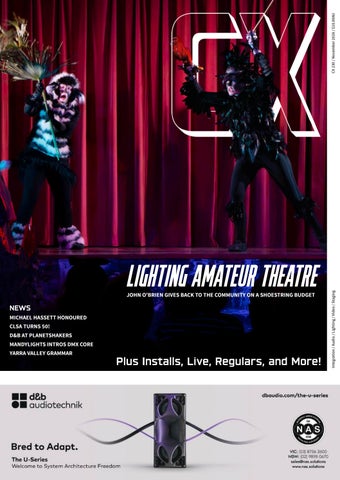
CX 230 / November 2026 / $10.00AU
JOHN O'BRIEN GIVES BACK TO THE COMMUNITY ON A SHOESTRING BUDGET
NEWS MICHAEL HASSETT HONOURED CLSA TURNS 50! D&B AT PLANETSHAKERS MANDYLIGHTS INTROS DMX CORE YARRA VALLEY GRAMMAR
Plus Installs, Live, Regulars, and More!
Integration / Audio / Lighting / Video / Staging
LIGHTING AMATEUR THEATRE
MODULAR FLEXIBILITY THAT SCALES NEW
NEW
NEW
POWERED MULTI-PURPOSE SPEAKERS
Introducing three point-source loudspeakers designed to support a range of multi-purpose applications, a full suite of supporting accessories, and the latest updates to our unified software ecosystem. These additions bring unmatched flexibility, broader deployment options, and deeper system integration to the comprehensive SRX900 Series. With powered line arrays, flyable and ground-stacked subwoofers, and now versatile point-source models, the SRX900 Series strikes the ideal balance of value, performance, and professional-grade capability. Complete Software Ecosystem including Venue Synthesis, Performance and Array Link
MadisonAV is your home of the JBL SRX900 series of multi-purpose speakers designed for small to medium-format sound reinforcement applications, delivering a system with powerful, capable and dependable performance.
Sales Enquiries 1800 00 77 80 www.madisonav.com.au
d&b audiotechnik’s Planetshaking Soundscape BY JASON ALLEN In early October, leading German PA manufacturer d&b audiotechnik ran a serious international operation in Melbourne through its APAC office. Concentrating mainly on the house of worship sector, d&b flew in representatives from 17 substantial churches across South-East Asia, plus d&b partners including Innosys, Illuminate and Sound Solution (South Korea), Louder Technologies (Indonesia), 808 International (Philippines), Soundsmith (Singapore) and Stage Audio Works (South Africa). Joined by local guests from across the production, installation, venue, consultancy and worship sectors, and hosted by local distributor NAS, the delegates visited multiple local d&b installations in both sacred and secular spaces over a period of three days, culminating in a major event at Planetshakers Church in South Melbourne on Monday 5 October, showcasing its impressive d&b PA with immersive d&b Soundscape processing.
4 / NEWS
The event at Planetshakers was no mere meetand-greet with a few tracks playing. This was a substantial deep dive into d&b’s philosophy and technology, with an in-depth session on the installed system, listening exercises and a Soundscape mixing workshop with Planetshakers’ Production Manager Terence Ong and NAS’s Dave Jacques, an expert worship audio mixer with a Grammy to his name for that very thing (which he really doesn’t enjoy us reminding people about). As we entered the auditorium, a gentle soundscape of a forest environment played. We were welcomed by NAS’s Director Shane Bailey, heard from d&b’s APAC Territory Manager and President Marco Baumgärtner, and got deep into the detail with Dave Jacques. Dave demonstrated both the En-Scene (objectoriented mixing) and En-Space (acoustic enhancement) capabilities of Soundscape. I’ve
said it before and I’ll say it again: object-oriented mixing makes me never want to hear stereo again. Even if you’re not using it to make objects fly around the room, its simple advantage of increasing the imaging sweet spot in the room from about 5% in the middle to up to about 90% of the auditorium is worth it. Then there’s the fact that it makes your brain identify the sound source as coming from the source, not just the loudspeaker nearest to your head. It is a better way to amplify both speech and music, and a vastly better way to hear it. Dave used several real-world examples from his own live work and let us prowl the room doing A/B comparisons. It was a generous and open way to share technical information, especially about material and techniques that are so obviously close to Dave’s heart.
CX November 2026
Blackmagic 2110 IP Converters
Blackmagic Design lets you build 2110 IP video systems for broadcast and live production! Now you can build affordable live production and broadcast systems with SMPTE-2110 video! Blackmagic Design has a wide range of 2110 IP products, including converters, video monitors, audio monitors and even cameras! You get the perfect solution for intergating SDI and IP based systems. Plus all models conform to the SMPTE ST-2110 standard, including PTP clocks and even NMOS support for routing.
Uses Simple 10G Ethernet for Low Cost
Build Professional SMPTE-2110 Broadcast Systems
Incredibly Easy to Install
The Blackmagic 2110 IP Converters have been designed to integrate SDI equipment into 2110 IP broadcast systems. The rack mount models can be installed in equipment racks right next to the equipment you’re converting. Simply add a Blackmagic 2110 IP Converter to live production switchers, disk recorders, streaming processors, cameras, TVs and more.
One of the biggest problems with SMPTE-2110 is needing an IT tech on standby to keep video systems running. Blackmagic 2110 IP converters solve this problem because they can connect point to point, so you don’t need to use a complex Ethernet switch if you don’t want to. That means you get the advantage of SMPTE-2110 IP video with simple Ethernet cables, remote power and bidirectional video.
Blackmagic 2110 IP Converters are available in models with RJ-45 connectors for simple Cat6 copper cables or SFP sockets for optical fiber modules and cables. Using simple Cat6 copper cables means you can build SMPTE-2110 systems at a dramatically lower cost. Plus copper cables can remote power devices such as converters and cameras. There are also models for optical fiber Ethernet.
Conforms to the SMPTE-2110 IP Video Standard Blackmagic 2110 IP products conform to the SMPTE ST-2110 standard for IP video, which specifies the transport, synchronization and description of 10 bit video, audio and ancillary data over managed IP networks for broadcast. Blackmagic 2110 IP products support SMPTE-2110-20 video, SMPTE-2110-21 traffic shaping/timing, SMPTE-2110-30 audio and SMPTE-2110-40 for ancillary data.
Blackmagic 2110 IP Converters From $515
Learn more at www.blackmagicdesign.com/au Integration / Audio / Lighting / Video / Staging
DAVE JACQUES AND TERENCE ONG AT FOH Then Dave let Terence Ong do what he does best in his own venue, mixing a huge worship band to incredible effect. Well, it was a multitrack, but between Terence’s skill and the Soundscape system, it was indistinguishable from the real, and very loud, thing. I have to give it up to the NAS team that designed and installed the system at Planetshakers South Melbourne, with input from Planetshakers staff. In particular, the subwoofer deployment is the most musical I have ever heard. The subs, and indeed the whole system, have a more-than-generous amount of headroom. There are 10 flown subs and 10 built under the stage, and the result is stunning.
While it’s easy to get caught up in the purist audio position that Soundscape provides superior results, there are also hard-headed practical and economic reasons for venues to consider the technology. The shorter PA hangs, due to the system’s distributed nature, mean better sightlines. The distribution of the loudspeakers also means you can use more lower-powered boxes instead of more expensive higher-powered boxes and their attendant amplification. You also increase the number of seats that get coverage. A beautiful Soundscape system is usually cost-neutral compared to a powerful left-right system and can often be cheaper. Hallelujah!
Planetshakers South Melbourne – The System FOH Five hangs of 6-box XSL arrays (20 × XSL8, 10 × XSL12) 10 flown KSL subs 10 floor SL subs
Fills Four V7P outfills and an outfill delay 12 8S front fills Four Y10P delays
Surrounds 28 10S loudspeakers
Monitors Four M6 monitors
Electronics Two D25 amplifiers (delays/monitors) 21 D40 amplifiers (flown system) Five D90 amplifiers (floor subs) 10 5D amplifiers (front fills and surrounds) One DS100M processor, 128 in × 64 out, with EnSpace Two RME M32DA units performing Milan-toanalogue conversion for the 5D amplifiers Klark Teknik DN9650s converting the AES50 signal from the Midas digital mixer to MADI inputs for the DS100M
6 / NEWS
CX November 2026
Integration / Audio / Lighting / Video / Staging
Michael Hassett Honoured with 2026 Australian Event Awards Lifetime Achievement Award
From backstage beginnings to the forefront of event technology, TDC founder Michael Hassett is recognised for 45 years of innovation, leadership and contribution to Australia's events industry. The Australian Event Awards has announced Michael Hassett, Founder and Managing Director of Technical Direction Company (TDC), as the recipient of the 2026 Lifetime Achievement Award, recognising his extraordinary contribution to Australia's events industry and his enduring influence on the evolution of technical production. The prestigious honour celebrates individuals whose dedication, leadership and achievements have left a lasting impact on the Australian events landscape. Michael joins an esteemed group of previous recipients, including David Atkins, Ignatius Jones, Peter Jones, Harvey Lister and Roslyn McLeod. Michael's journey into the industry was anything but conventional. From working as a roadie and managing bands to working in trades as an electrician and tiler, his early career was shaped by a hands-on approach, curiosity, and a determination to find his own path. In 1981, he did just that, establishing Technical Direction Company (TDC), a business that would grow to become a recognised name in Australia's technical production and event technology sector.
8 / NEWS
Over the following 45 years, Michael has been at the forefront of some of the industry's most significant technological transformations. From the early days of video and large-scale projection to the emergence of LED, virtual production and immersive technologies, his ability to combine engineering expertise with creative problemsolving has helped push the boundaries of what is possible in live events. Despite decades of success, Michael remains an engineer at heart, continuing to work directly on system design, complex technical challenges and the development of new production solutions. His expertise has contributed to some of Australia's most recognisable cultural experiences, including Vivid Sydney and the iconic Lighting of the Sails on the Sydney Opera House, where technical precision and creative ambition come together on an extraordinary scale. Yet Michael's legacy extends far beyond the technology itself. Throughout his career, he has shared his knowledge with generations of industry professionals, mentoring emerging talent, lecturing for industry bodies and consulting on complex technical projects internationally. Many of those who have worked alongside him have gone on to hold influential positions across the events and production industries.
His commitment to innovation, education and technical excellence has helped shape not only the experiences audiences enjoy, but also the people and practices behind their delivery. “Michael Hassett has helped shape the Australian events industry for more than four decades. His commitment to innovation and his ability to push the boundaries of what's possible have played a significant role in bringing some of Australia's most ambitious events to life. “Beyond his technical achievements, Michael's dedication to sharing his knowledge and mentoring the next generation has left a lasting legacy across the industry. “The Lifetime Achievement Award recognises those who have made an extraordinary contribution to our industry, and Michael is a truly deserving recipient,” says Ian Steigrad, Managing Director, Australian Event Awards. The Lifetime Achievement Award is one of the Australian Event Awards' most distinguished honours, recognising the individuals whose careers have helped build, advance and define the nation's events industry. Michael was formally recognised at the 2026 Australian Event Awards Ceremony on Wednesday 21 October 2026, where the industry came together to celebrate outstanding achievements in Australian events. CX November 2026
Integration / Audio / Lighting / Video / Staging
Work with Metallica or Kylie? How? EntPathways: an industry-supported way in New people enter the audio-video-lighting (AVL) industry in many ways. ENTECH now has a direct path: carefully curated seminars at the roadshow that help students and new entrants understand the realities, and give them a road map in. “Our tradeshow floor has always been just that: trade,” said CEO Kate McKenzie. “We always knew the growing skills shortage needed a solution, and we have it: EntPathways.” EntPathways also brings future customers to ENTECH exhibitors. Students know they are not there to get a job from an equipment distributor, but they will remember the brands they see. “ENTECH is about making friends and one-onone networking,” McKenzie continued. “For 33 years it has brought the industry together, and now with EntPathways we finally have a way to bring the next generation inside, without disrupting our primary role: providing exhibitors with a solid stream of current and new
customers who are there to see tech and gather creative ideas.”
embellishments that sometimes creep into recruitment pitches - and college brochures.
The website (entpathways.com.au) is now a gateway for anyone considering a career in entertainment and AVL tech, and at launch has gathered some high-profile supporters sharing their journeys. They plan to share these.
They’re asking production suppliers and employers like venues and crewing agencies to be supporters. It’s simple, free, and it just means a logo on the EntPathways supporters page and being seen as an industry backer.
We know the problem: shows are getting bigger and more complex. The people who can build, run and rig them are getting scarcer. Everyone is potentially fighting over retaining the same crew.
It costs nothing. No fee, no staff time, no sessions to run. The halo is real. Students, parents and teachers see who’s backing the way in. Be on that list. Email your logo to cat@alia. com.au
EntPathways is the industry’s answer. It’s a nonprofit program run by ENTECH, with live sessions at the 2027 roadshow in Brisbane, Sydney and Melbourne where working crew tell students and new entrants what the job actually is, how they got in, and how the money works. The sessions and the website entpathways.com. au will provide a real-world overview of the jobs, the journey, and the working reality without the
ULA Group and EuroSmoke ULA Group and EuroSmoke are proud to announce a new exclusive distribution partnership, bringing the renowned French manufacturer’s professional atmospheric effects technology to customers across Australia and New Zealand. The partnership sees EuroSmoke join ULA Group’s portfolio of leading international technology brands, further strengthening the company’s offering to the entertainment, touring, theatre, production and installation markets.
and look forward to building a strong future together.” And perhaps there is something inevitable about the combination: French passion, Italian drive and Australian determination – a partnership guaranteed to create some serious atmosphere!
The new partnership will give customers throughout Australia and New Zealand access to the complete EuroSmoke portfolio, backed locally by ULA Group’s experienced sales, technical service and support teams.
Manufactured in France by SFAT, EuroSmoke has built a strong reputation for professional fog, haze and atmospheric effects solutions, combining European engineering, performance and reliability for some of the most demanding applications in the industry. EuroSmoke will complement ULA Group’s established portfolio of professional stage and atmospheric effects, further broadening the range of technologies and solutions available to customers across different applications and production requirements. For ULA Group Managing Director Cuono Biviano, the partnership is also a reunion built on a longstanding professional relationship with Christophe de Lora, General Manager of SFAT. “Christophe and I have known each other for many years, and I am genuinely excited to have the opportunity to work together again,” said Biviano. “There is a great deal of mutual respect between us, both personally and professionally, and we share the same passion for quality products, innovation and looking after our customers.” “EuroSmoke is a fantastic addition to the ULA Group portfolio. The products are beautifully engineered, reliable and designed for the professional market. We see enormous potential for the brand across Australia and New Zealand 10 / NEWS
L-R: EUROSMOKE'S PIERRE DE LORA, ULA'S CUONO BIVIANO, EUROSMOKE'S CHRISTOPHE DE LORA AND JACQUES DE LORA CX November 2026
Integration / Audio / Lighting / Video / Staging
D2N - Technology Solutions appointed Australian distributor for CEDAR Audio
(L-R) PAUL ALEXANDER, HEAD OF SALES FOR CEDAR AUDIO, JASON OWEN, MANAGING DIRECTOR OF D2N - TECHNOLOGY SOLUTIONS AND STUART RUSSELL, HEAD OF MARKETING AND COMMUNICATIONS FOR CEDAR AUDIO D2N - Technology Solutions has been appointed the Australian distributor for CEDAR Audio, bringing one of the world's most respected names in audio restoration, dialogue noise suppression and forensic enhancement technology to the local market with dedicated in-country expertise and support. The appointment is a significant development for Australia's professional audio, broadcast, postproduction and forensic sectors, giving local users far stronger access to CEDAR's specialised technologies through a distributor with deep technical capability, strong market relationships and a long track record of serving demanding applications across Australia. CEDAR Audio is globally recognised as the inventor of digital dialogue noise suppression, spectral editing and real-time audio restoration. Its Academy Award- and Emmy-winning hardware and software technologies are used globally in film and television studios, live broadcast (including sports and newsrooms), recording studios, mastering suites, sound archives, theatres, live concert venues and on location. For both companies, the new distribution agreement is the result of a natural alignment in capability, market focus and values. Paul Alexander, Head of Sales for CEDAR Audio, said the company had been carefully assessing the Australian market and looking for a partner capable of representing the brand and delivering on its ambitious plans for growth. “I was researching companies in Australia and it quickly became clear that D2N and CEDAR Audio were a great fit. We share very similar values and D2N's existing portfolio complements ours very neatly. Jason and his team have great energy and enthusiasm, along with deep technical expertise and an impressive network of customers; we’re
12 / NEWS
very happy that D2N is the right partner to represent CEDAR Audio in the Australian market.” The range of products D2N will now distribute in Australia includes the CEDAR DNS2, DNS4 and DNS8 dialogue noise suppression systems, the CEDAR Icons plug-in range and the specialist CEDAR Cambridge and CEDAR Trinity solutions for forensic and audio surveillance applications. CEDAR's DNS technology is widely recognised for removing traffic noise, air conditioning, wind, rain, crowd noise and other unwanted background sounds from dialogue, while preserving intelligibility and natural tonal character. CEDAR also positions its DNS technology as the standard for dialogue noise suppression in demanding live sound and broadcast environments. These solutions are highly relevant to the Australian market because they address real challenges across broadcast, live production, postproduction, archival restoration, forensic investigation, government and security applications. In broadcast and post, the demand for clean, intelligible dialogue is higher than ever across news, sport, factual programming and live events.
performance in mission-critical workflows, as well as the breadth of its offering, from dedicated dialogue noise suppression hardware and production plug-ins through to specialist forensic and surveillance systems. That creates what many users describe as the real wow factor. CEDAR technology can take audio that seems unusable and make it clear, intelligible and operationally valuable. Whether the task is cleaning up dialogue for broadcast, restoring archive material, improving location sound, or extracting speech from a difficult recording, the before-and-after difference can be remarkable. The impact is often immediate and obvious, not just in sound quality, but in what users are able to achieve. D2N's Jason Owen concludes, “In a market where performance, accuracy and reliability are everything, D2N's appointment as Australian distributor gives CEDAR Audio users a clear advantage. It strengthens access, deepens support and brings some of the most advanced audio restoration, dialogue noise suppression and forensic audio technologies in the world much closer to the professionals who need them most.”
In forensic and investigative environments, the ability to extract usable speech from compromised recordings can be critical. CEDAR's advanced forensic systems have been installed in laboratories worldwide, with solutions ranging from plug-ins to standalone systems and full forensic platforms. What sets CEDAR apart is not just that it reduces noise, but how it does it. Its products are widely valued for achieving high levels of restoration and suppression while preserving the wanted audio, avoiding the harshness, artefacts and unnatural sound that can undermine lesser tools. CEDAR also stands out for real-time and near-zero-latency
CEDAR DNS 4: 4-CHANNEL DIALOGUE NOISE SUPPRESSOR
CX November 2026
Integration / Audio / Lighting / Video / Staging
400+ FIXTURES LATER: NO REGRETS BCL Puts ACME SANDANE FROST to the Ultimate Test
ROD MARSHALL - TECHNICAL SALES EXECUTIVE AT ULA GROUP & TIM MISSENDEN - MANAGING DIRECTOR OF BCL PRODUCTION SERVICES
When you invest in more than 400 fixtures, performance on a specification sheet is only the beginning. What really matters is what happens once those fixtures leave the warehouse, hit the road and start working night after night. For Brisbane Concert Lighting (BCL) owner Tim Missenden, that was precisely the thinking behind the company’s significant investment in ACME’s SANDANE FROST. Before committing to the fixture, BCL conducted an extensive shootout, putting the SANDANE FROST up against competing products and looking closely at the factors that matter in large-scale production: output, size, practicality, construction, durability and, above all, reliability. “The first thing we looked at was output, and it was superior to pretty much everything in its class,” says Tim. “In the shootout, it proved to be the best in terms of output, compactness, practicality, durability and reliability.” More than a year and 400+ fixtures later, that decision has been thoroughly tested in the field. Built for the Real World For Tim, reliability was never negotiable. “I just wanted a fixture that was reliable,” he says. “We can have these running for six hours straight, every night, for a month. I’ve never had one shut down. They don’t overheat and the overall performance is very good.” It is a simple requirement, but one that becomes critical when fixtures are deployed across expansive Australian outdoor environments where access can be difficult and a single failure can mean additional labour, troubleshooting and disruption. The SANDANE FROST combines powerful output with a compact format, IP66 protection and an 14 / NEWS
electronically controlled frost system, making it particularly suited to the type of large-scale outdoor work undertaken by BCL. But Tim’s assessment of a fixture goes well beyond its specification sheet. With a background in manufacturing, he admits he has always been interested in what is happening underneath the covers. “We were looking for a durable fixture. My background is manufacturing, so I’m always interested in breaking the lights down into pieces and finding out what they’re actually made of. I appreciate every aspect of the light.” That meant paying attention to details that can easily be overlooked during a conventional fixture comparison: the thickness of materials, strength of the yoke, quality of hardware and how the fixture is likely to withstand repeated handling. “The yoke is very strong and the thickness of the material is solid,” says Tim. “I’ve seen a lot of fixtures, but this one is a standout. If someone is looking at PARs, I’d say this is a really good product.”
Frost That Earns Its Place Interestingly, one of the SANDANE FROST’s defining features was something Tim initially questioned. “The electronic frost – initially I thought it was a bit of a waste of time,” he admits. “But on the job, it has proven to be very useful. Small amounts of frost are very useful in giving you wider coverage.” For applications such as The Enchanted Garden, that capability has proven particularly valuable. “When we’re lighting gardens and trees, we want wider frost,” he explains. “It’s not a zoomable PAR – it’s a PAR with frost. So if you’re looking at a nonzoomable PAR, you want that frost feature.”
M
Y
CM
MY
CY
CMY
K
The ability to subtly broaden the beam gives BCL greater flexibility in shaping coverage across foliage, trees and landscape elements without adding the mechanical complexity and physical size of a conventional zoom fixture. It is the kind of feature that can appear secondary during a product demonstration but becomes significantly more useful once a fixture is working in a real production environment.
The Enchanted Garden: Light on a Different Scale One project that demonstrates exactly why BCL invested so heavily in the ACME SANDANE FROST is The Enchanted Garden at Brisbane’s Roma Street Parkland. “When you’re running fixtures over multiple acres of space, there’s a lot of pixel mapping,” Tim explains. “When you’re doing pixel lighting on a big scale, you need reliability.” Transforming an expansive garden environment into an immersive after-dark experience presents a very different challenge from lighting a conventional stage. Fixtures are distributed across a vast site, illuminating trees, gardens, pathways and landscape features while becoming part of a much larger programmed visual environment. At this scale, simplicity and reliability become powerful assets.
C
THE ENCHANTED GARDEN CX November 2026
ICONIC DESIGN, NEXT LEVEL PERFORMANCE, 96kHz core.
Integration / Audio / Lighting / Video / Staging
www.allen-heath.com
When Small Details Become Big Savings With more than 400 units in inventory, seemingly minor design details can have a significant operational impact. The SANDANE FROST’s quarter-turn Omega bracket system is a good example, allowing BCL’s crews to quickly transition between a hookclamped fixture and a yoke-mounted configuration. For one fixture, it might save only a small amount of time. Across hundreds, those minutes quickly add up. That same thinking extended beyond the fixture itself. ULA Group designed custom road cases around BCL’s SANDANE FROST inventory, with transportation, durability and storage efficiency considered as part of the overall package. And this is one area Tim is particularly enthusiastic about. “The road cases are the winner,” he says. “They’re not a cheap case, but you get what you pay for. They’re great value.” The cases can be stacked four high, allowing BCL to accommodate 32 fixtures within a single vertical stack – a major consideration when transporting and storing an inventory of this size. Even details such as stainless-steel wheel cups were deliberately specified to withstand repeated outdoor use without rusting.
It reinforces an important point: when a production company invests in hundreds of fixtures, the product itself is only one part of the equation. How efficiently those fixtures can be stored, prepared, transported, deployed and maintained can have an equally significant impact on the return on that investment. Supporting the Investment The other non-negotiable for BCL was local support. “The support has to be there,” says Tim. “If I’m buying this number of fixtures, I want you to carry the spare parts.” For an inventory numbering more than 400 units, access to parts and technical expertise is not simply an after-sales benefit; it is an operational requirement. That support has extended beyond supplying the fixtures. ACME worked with BCL to customise elements of the fixture software to better suit the company’s workflow and help reduce preparation time across such a substantial inventory. Tim also gives credit to the ULA Group team for the support behind the investment. “Dealing with Rod has been wonderful. He’s been very supportive and helpful throughout the entire project.” It is the kind of manufacturer, distributor and production-company relationship that becomes
increasingly important as lighting systems grow in scale and complexity. 400+ Fixtures Later BCL’s original goal was refreshingly straightforward: find a compact PAR with serious output that was practical to deploy, built to withstand life on the road and the demands of Queensland’s weather, and, most importantly, reliable. The original shootout identified the SANDANE FROST as the frontrunner. More than a year, 400+ fixtures and countless hours of real-world operation later, the real test has been considerably tougher than anything that could have been recreated in a showroom. For Tim, the result speaks for itself. “We tested them against everything else we were considering, and the SANDANE FROST came out on top. Now, after running more than 400 of them in the real world, I can say we made the right decision. They give us the output we need, they’re practical, they’re built well and, most importantly, they’re reliable. I’ve seen a lot of fixtures over the years, and this one is a standout.”
CLSA Turns 50! Fifty years ago, two Monash engineering students decided to take their hobby of building, installing, and operating stage lighting and special effects seriously. Trevor Lloyd and Peter McCrindle left their ‘proper’ jobs to form Concert Lighting Systems Australia.
They were full of enthusiasm with little idea of what stage lighting would become. Dirty, heavy, bone-breaking, risky work, with regular meals and sleep hard to come by, became the norm. Along the way, there were motorbike, car, and truck accidents; electric shocks; pyro explosions gone wrong; falls from great heights; and remarkable stories of survival. Yet friendships, good times and a few remarkable strokes of luck made it all worthwhile.
CLSA' BILL RAINBOW & MATT HANSEN 16 / NEWS
CX November 2026
Integration / Audio / Lighting / Video / Staging
CLSA eventually grew into one of Australia’s main lighting production companies, supporting a host of famous acts such as U2, Simply Red, The Beach Boys, Cher, Diana Ross, Mick Jagger, Sade, Bryan Adams, James Brown, Cyndi Lauper, Tom Waits, and many, many more. They worked on musical theatre productions including Aida in Singapore, Cats, Les Misérables and The Rocky Horror Show, as well as The Three Tenors, corporate events and many new car launches. CLSA gradually moved from touring to designing and manufacturing high-quality equipment for sale, hire or installation. Today, the company designs, builds and delivers stages, outdoor roofs, lighting and rigging components. Its quality truss systems are widely used for events, exhibitions, concerts and stage productions, valued for their lightweight design, ease of setup and durability. “To stand the test of time, a company must be willing to adapt,” commented Trevor Lloyd. “Adapting to change has always required a willingness to learn, as well as to share knowledge with others. Over the years, I’ve been fortunate to have some excellent mentors, including John Abbott of Dane Hiring, John McKissock of Clearlight Shows, Ron Blackmore of ACT, Eric Robinson of Jands and Peter Trojkovic of Troy Balance.” Trevor is equally proud that some former employees have gone on to start successful businesses of their own. Tim Hall of Resolution X, Matt Hansen of MPH, and Denis Bourke of Republic Technology are just a few examples. For Trevor, seeing people develop their skills and build their own businesses is one of the most rewarding aspects of a long career in this industry.
“That decision helped provide the business with greater security and a solid foundation for future growth, while allowing us to continue expanding our sales and manufacturing operations,” he remarked. “Looking back, I believe our ability to embrace change, learn from others and invest for the long term has been central to CLSA’s survival and continued development.” To celebrate this incredible milestone, CLSA held a 50th anniversary party at its Port Melbourne premises in late October, attended by clients, staff, friends and family from around the country.
TREVOR LLOYD
PAOLA MAIN
A full gallery can be viewed on CLSA’s Facebook page: https://www.facebook.com/profile.php? id=100063672817284 www.clsa.com.au
TREVOR AND MUM DOROTHEA
Another important factor in CLSA’s longevity has been diversification. The business world is full of competitors, changing markets and unpredictable events. When CLSA peaked in the concert touring business, it would have been tempting to focus on touring and sell off the manufacturing side of the company. Instead, Trevor chose to reinvest the profits in warehouse properties in central Melbourne and Sydney.
18 / NEWS
CX November 2026
Portable column line array systems designed around accurate full-range audio, powerful low end reproduction and effortless deployment. The perfect workmate for solo musicians, bands, presentations and DJs.
EVOX V15
EVOX J11
EVOX JMIX9
EVOX J9
Active 3-way Array
Active 3-way Array
Active 3-way Music System
Active 3-way Array
Featuring an 8-Channel Digital Mixer with Bluetooth
Enhanced coverage and clarity in a tour-grade enclosure
The leader in low-end, featuring The most advanced a powerful 15” woofer line-source system in its class
NEW
Integration / Audio / Lighting / Video / Staging
Visit rcf.it to learn more.
Distributed in Australia by Group Technologies sales@grouptechnologies.com.au or (03) 9354 9133 86 Derby St, Pascoe Vale. Victoria, 3044, Australia
800 Universes, Deep Integration, No Limits BY JASON ALLEN I’ve written a lot over the last few years about immersive experiences that happen in parks, botanic gardens, museums, and a host of purposebuilt environments. CX has also covered some huge pixel count LED installations and projects for commercial promotions, architectural features, and art projects. Each year, festivals like Sydney’s Vivid and Adelaide’s Illuminate create multiple unique projects that run outdoors, automatically, in all weathers. The one thing that links all of these applications together is the delivery of a huge amount of control data and media. It’s usually run from media servers, control hardware or software such as QLab, controlled by a number of software platforms and integrated on a project-by-project basis. Add all the components up, plus the expertise to make it all work seamlessly, and it’s a sizeable budget commitment.
RACK MOUNTED DMX CORE 100 7"
For Mandylights, the award-winning multidisciplinary design and production house founded in Sydney that now has 30 staff worldwide, those kinds of projects are its bread and butter. Constant innovation is part of their DNA, so I was intrigued when their Head of Technical Design, Alex Hughes, invited me to their Melbourne office to see a new control platform that they have not only been using and helping to develop for years, but also believe in so strongly that they are now selling and supporting it in the UK, Europe, Australia and New Zealand. To do so, they’ve set up a new arm of the business, Mandylights Equipment, which you can find at mandylightsequipment.com DMX Core is the name of the platform, but that hardly does it justice. Yes, it can of course record and play back shows and deliver DMX over a network, but it can deploy just about every control protocol you’ve ever heard of, across both professional and domestic applications. You can
run it on dedicated hardware controllers with touchscreens (7” or 4.3”) or from software. Programming can be done via your hardware, such as a lighting console, media server or computer. You then record your show for playback. But there’s also a visualiser, lighting effects, fixture libraries, audio storage and playback, audio time alignment, scheduling, automation, multiple playback options including layers and loops, JavaScript scripting, an open .NET SDK for making your own plugins, and cloud access and management. And here’s the thing that really blows your mind: The dedicated DMX Core 100 with 7” touchscreen that runs the full version of the software can handle 800 Universes of DMX, and it costs, at time of publishing, $1,566.31 AUD incl. GST. This is a new era of affordable control power.
The Ultra Compact PoE Amplifier
Minimum Footprint, Maximum Output. USB-C and AES67 Enabled Audio 140w 2 channel PoE amplifier Onboard DSP Suite Easy Auto Set-up
The NOTA 124 combines power, flexibility and ease of use in a single, compact package - it’s the installation game changer for any audio and video installation.
Powersoft Engineering. Quality, reliability and control. It’s the generational change you’ve been waiting for.
AU: sales@pavt.com.au or +61 3 9264 8000 | NZ: sales@pavt.co.nz or +64 9272 8041 Integration / Audio / Lighting / Video / Staging
www.pavt.com.au
“For a long time, the limitations our projects would come up against were playback units that were only 32 Universes,” explains Alex. “We couldn’t find a solution that didn’t involve slaving multiple boxes together, which we wanted to get away from. Then we found DMX Core.” DMX Core hit the market in 2022 and has been continuously updated ever since. It runs on Windows, macOS, and Linux, or on the dedicated touchscreen hardware, and outputs Art-Net, sACN, and KiNet directly. It connects to the rest of the AV system over OSC, MQTT, a REST API, Q-SYS, Symetrix, and a long list of other integrations listed on their website. The software is written in-house by the same people who provide support, drawing on 30 years of enterprise software-architecture experience. DMX Core products are running in nightclubs, restaurants, houses of worship, corporate AV systems, and themed entertainment venues worldwide. Mandylights has had DMX Core installations running at a chain of holiday parks in the UK across six sites for the last two years, managing its seasonal Christmas lights activation. “Between the touchscreen and the web interface, the park’s ‘Elves’ can scan a QR code which logs them into the Wi-Fi, and start and stop shows,” explains Alex. “We have total access to all the systems from all of our offices globally via the DMX Core cloud management system.” There is a huge number of use cases for DMX Core, especially considering that its control capabilities extend well beyond lighting. “I firmly believe that there are a lot of projects out there with simple DMX playback where the control platform is consuming too much of the budget,” asserts Alex. “Those projects end up with such a small amount of actual light output for the money. We hope to rebalance that by providing something that is reliable and isn't proprietary or locked down. DMX Core is a product that's simple enough for an end user and will run for years. It’s also a product that can adapt, change, and hold multiple shows without a complete reprogram.” One of the nice features of DMX Core is its tight integration with local Australian manufacturer Advatek and its extensive line of pixel controllers. “We natively support Advatek products,” continues Alex, “and we take advantage of their API to provide constant monitoring of temperature, port status, and basically everything else their devices do.” Like all radically new gear in our understandably conservative industry, professionals have reservations before trying it on a project; Is it reliable? Is it robust? Will it survive the weather and my end-users? Alex has this to say: “We started using DMX Core because it solved a real problem: delivering reliable, flexible playback on hardware that was economical enough to deploy outdoors for extended activations. We know the product, we know the team behind it, and we know what it is like to depend on it when a show has to run.” “DMX Core does all the things, and it does them a lot,” Alex neatly encapsulates. “It absolutely could replace a media server. If you’re curious, download the software and run it as a free trial. You don't need to make the big jump to buy the hardware before you test it. If you like what you see, call us, and we can organise the hardware for you.” 22 / NEW GEAR
CX November 2026
At last A wireless PA system Experience our wooden battery PA system offering up to 25 hours of playtime, a 200-metre range, unlimited wireless connections, and up to 112 dB�A�. Also available in black.
Contact Audio Logistics to arrange a demo. p: 1300 859 341 e: sales@audiologistics.com.au Integration / Audio / Lighting / Video / Staging
DIGICO QUANTUM638
DiGiCo’s latest addition to the successful Quantum Range is the Quantum638 mixing console, with an optional Quantum638T version designed specifically for demanding theatrical productions. Combining the best elements of the SD7 and SD5 with the latest Quantum technology, the new desk gives theatre sound teams a familiar yet more powerful worksurface with quicker access to cue firing and Macros for musicals, plays, tours and installs where speed, redundancy and compact control are critical. Boasting 256 input channels and 128 aux/subgroup buses, the new desk sits in the ‘sweet spot’ between the company’s flagship Quantum852 and popular Quantum338 Pulse, a position previously occupied by the longstanding SD7 and SD5. Sporting three 17-inch (42 cm) LCD high-resolution touchscreens, 38 100 mm touch-sensitive motorised faders split into three worksurface sections with two dedicated Master faders, enhanced Macro buttons, InfoBar, and new usability features, the Quantum638 is notably available in single-engine and dual-engine versions, both with dual DMI card slots and hotswappable PSUs, for a choice of preferred redundancy options. Particularly well-suited for the theatre market when paired with DiGiCo’s optional “T” theatre software extension, the Quantum638T version adds indispensable functions like Auto Update, Aliases, Players, advanced CG programming tools, and Matrix Nodal Delays for plays and musicals. With a footprint that is nearly identical to that of the SD7, the console is an ideal upgrade for theatres where there is a need for increased horsepower but real estate is at a premium. Larger, brighter screens – plus three 6.8-inch (17.3 cm) TFT screens located adjacent to the fader bays – provide more workspace for enhanced
productivity, and dual headphone outputs allow the sound designer and audio engineer to each have individual control over what they choose to hear. The Quantum638 marks the first time that DiGiCo has offered a Quantum console in both single- and double-engine configurations – the latter of which can be run in single-engine mode – giving users the flexibility to choose the architecture that best suits their workflow, applications, and budget. Compact without compromise, the advanced Quantum638 combines the extraordinary might of large-scale, seventh-generation FPGAs whilst putting everything an engineer would need within easy ergonomic reach. In addition to offering 256 input channels and 128 aux/sub-group channels, all with full processing, DiGiCo’s latest console offers a 48 × 48 matrix with full processing, plus comprehensive and coveted Quantum Range features, including 128 Nodal Processing instances, 64 insertable Mustard Processing strips, 16 Spice Rack slots, and True Solo functionality. As standard, the product is equipped with onboard Dante and other connectivity options, including a built-in Fourier Interface Card for native worksurface compatibility with Fourier Audio’s transform.engine platform. Newly enhanced Macro buttons are found within easy reach, putting clear visual information exactly where it is needed, and there are four designated channel Macros, meaning the Macro moves with the channel depending on the console layout. The Quantum638 also sports assignable “Macroder” rotary encoder knobs, similar to those found on the Quantum852, that dynamically change their function to control programmable parameters on whichever channel is currently selected. Fans of DiGiCo’s SD7 will further appreciate seeing the line of Gain/Trim encoders found at the top of each channel strip, plus a choice of individually assignable Next buttons at hand.
The inclusion of a new InfoBar ensures that critical information is always visible, be it snapshots, timecode, actual time, or warnings that can indicate when the user is listening to copied audio or True Solo, or when the surface is offline or all touch is disabled. Beyond the console’s three primary daylightbright displays, comprehensive visual monitoring is achieved via three custom-mounted, 14-inch, high-resolution LCD meterbridge screens, three bank switcher screens, and a total of 53 1.5-inch touch-sensitive full-colour TFT LCD displays. Left, centre, and right worksurface sections each offer six layers of six banks, and all faders can be assigned to control any channels of any type. Also included are LR/LCR/LCRS/5.1 Master buses, 36 VCA-style or mute group-style control group channels, two solo buses, and an internal FX rack allowing users to pick from 34 different FX. Up to 48 stereo FX can be added, comprising up to 32 floating-point reverbs and up to 48 delay/chorus/ pitch/enhancer effects. An internal set of 32 32band graphic EQs is also accessible. The rear panel features eight 32-bit mic/line inputs, eight 32-bit line outputs, four AES/EBU inputs (eight channels), and four AES/EBU outputs (also eight channels), as well as a DSub37 GPI and DSub37 GPO (16 inputs and 16 outputs), one set of MIDI In/Thru/Out, and a set of XLR SMPTE LTC I/O. Additional connections include four switched Ethernet ports and eight sets of MADI I/O, giving up to eight MADI interfaces or up to four redundant MADI interfaces at 48 kHz or four interfaces at 96 kHz. Each engine is equipped with a MultiMode Optocore interface, providing 504 additional audio paths at 48 kHz and 96 kHz, with HMA, OpticalCon, and ST connection types available. An optional second Optocore loop can be added to each engine, effectively doubling the audio paths. Measuring 1555 mm W by 957 mm D by 535 mm H, the robust and tour-friendly Quantum638 worksurface weighs 93 kg.
Australia and New Zealand: Group Technologies grouptechnologies.com.au or +61 (0)3 9354 9133
24 / NEW GEAR
CX November 2026
NEW GEAR
GREEN-GO CONTROL
Green-GO Control is the smart, intuitive way to manage your Green-GO communication system with speed and confidence. Designed for modern productions, it gives users a clear overview of devices, groups, and settings in one powerful interface. With improved workflow efficiency, flexible configuration tools, and user-friendly control, Green-GO Control helps teams stay connected and focused, whether in live events, broadcast, or theatre environments. Free download from Green-GO, with no licensing required. greengocom.com/support/knowledge-and-downloads Australia: Event Communications Australia evcomaus.com.au 0412 908 432, 0411 186 917
AUSTRIAN AUDIO OC616 The OC616 is a professional multi-pattern largediaphragm condenser microphone. The CKR12 capsule, a next-generation evolution of the legendary CK12 brass capsule, pairs the unmistakable, larger-than-life character that made the original a studio icon with the consistency of a modern ceramic isolator design. With five selectable polar patterns (omni, wide cardioid, cardioid, hypercardioid, and figure eight), three switchable high-pass filters, and two switchable pads (−10 dB / −20 dB), the OC616 is built for versatility. It handles everything from intimate vocals and acoustic instruments to highSPL sources like guitar amps, brass, and live drum overheads, backed by a 157 dB max SPL and 134 dB dynamic range. Australia: Group Technologies grouptechnologies.com.au (03) 9354 9133 New Zealand: Jansen jansen.nz (09) 377 3663
Chain Hoists and Control Systems
YOUR VENUE ENGINEERING SPECIALISTS Event Communications
Venue Engineering
Staging Equipment for Venues
Actuators for Motorised Platforms Installed Systems
Sales & Service
papeople.com.au Integration / Audio / Lighting / Video / Staging
NEW GEAR / 25
ONYX NX Play is a compact expansion button wing designed to expand the physical command surface of the ONYX lighting control platform. NX Play provides programmers and buskers with additional direct access to playback functions in a compact, scalable format for use with both ONYX consoles and PC-based systems. ONYX NX Play includes four tactile button pads, OLED display, four command keys, RGB backlighting, magnetic alignment system, USB-C connectivity, ONYX Nova+ licence and dual boot modes: ONYX Mode, or MIDI Mode. Australia: ULA Group ulagroup.com 1300 852 476 New Zealand: ULA Group ulagroup.com (09) 218 6532
NEW
OBSIDIAN CONTROL SYSTEMS ONYX NX PLAY
ELECTRO-VOICE EVOLVE G2 The new EVOLVE G2 portable column loudspeaker series includes the EVOLVE 30M G2, EVOLVE 50 G2, and EVOLVE 50M G2 models. The EVOLVE 30M G2 delivers premium column performance with an integrated mixer in a compact package weighing just 19.4 kg, making it the ideal companion for smaller venues, ceremonies, and mobile performers. The EVOLVE 50 G2 scales output for mid-sized to large event spaces, while the EVOLVE 50M G2 includes a built-in mixer for solo performers and operators who need more inputs at the source. Beyond the family's core audience, the slim form factor and clean visual design, with black and white colour options, make EVOLVE G2 equally at home in a hotel ballroom, a modern worship auditorium, a corporate keynote, or a rooftop event. Under the hood, the G2 models answer the most consistent request from the EVOLVE community by raising maximum SPL to 125 dB on the EVOLVE 30M G2 and 129 dB on the EVOLVE 50 G2 and EVOLVE 50M G2 models. That extra headroom covers larger rooms and fuller dance floors, while the precise 120° × 40° coverage pattern delivers even, detailed sound to every listener. Australia: Jands www.jands.com.au (02) 9582 0909 New Zealand: Jands jands.co.nz (09) 941 9780
CLEAR-COM AVALON Avalon is a compact 1RU IP station supporting FreeSpeak wireless, HelixNet partyline, and V Series IrisX keypanels, with built-in support for I.V. Direct and Dante. Avalon delivers the same core performance and capacity as Arcadia, supporting up to 200 licensed ports, 100 channels, and 300 roles, while eliminating the cost of built-in analog hardware. The result is a powerful intercom engine optimised for IP workflows and cost-efficient system expansion. Need access to analog endpoints or additional user stations? Avalon can connect to Encore, Virtual Clients, and other devices as required. Expand your system incrementally by adding modular interfaces and licensed capacity. Australia: Jands www.jands.com.au (02) 9582 0909 New Zealand: Oceania oceaniaproductions.co.nz (09) 846 5533 KLOTZ AIS MIS 19" TRANSFORMER SPLITTERS KLOTZ AIS MIS Series adds two high-quality solutions for signal distribution: a 1:1+2 and a 1:2+2 splitter. The rugged, powder-coated aluminium housing provides reliable protection in everyday use and makes the splitters ideally suited to demanding touring applications. Depending on the configuration, up to 64 XLR input sockets with gold-plated contacts are available. Carefully selected transformers provide clean galvanic isolation at the SPLIT outputs on the rear panel and reliably prevent ground loops. With a distortion level of less than 1% at input levels of up to +6 dBu, the splitters ensure consistently high signal quality. A DIRECT output is also located on the rear panel, passing the input signal without a transformer so that 48 V phantom power is maintained. Australia and New Zealand: PAVT pavt.com.au +61 (0)3 9264 8000 26 / NEW GEAR
CX November 2026
GEAR
AYRTON FALCONER + HORUS Falconer is a high-performance remote followspot system designed to feel like a real followspot, with full ergonomics and a natural haptic feel. Falconer uses a camera mounted on a compatible Ayrton fixture, such as EagleStrike, which gives the operator the ideal view of the stage. Alternatively, a separate Ayrton Horus camera – released alongside Falconer - can be used to integrate the system into any lighting rig. Based on GDTF file definition, Falconer’s controllable parameters include Cyan, Magenta, Yellow, CTO, Colour Wheel 1, Colour Wheel 2, Tint, Dimmer, Iris, Zoom, Focus, Gobos, and Frost. Australia: Show Technology showtech.com.au (02) 9748 1122 New Zealand: Show Technology showtech.com. au (09) 869 3293
JBL 3 SERIES MKIII JBL 3 Series MkIII is a major overhaul of the 3 Series platform, combining new drivers, a redesigned JBL Image Control Waveguide, a frontfiring bass port utilising the patented JBL Slipstream port design, a new Class D amplifier, and 81 room EQ combinations. The 305P, 306P and 308P monitors are designed for use on desktops and monitor stands, with high output and exceptional stereo imaging. The 310S MkIII subwoofer adds extension down to 26 Hz and flexible crossover controls for a 2.1 configuration, as well as surround and immersive systems. With included mounting points on every full-range monitor, 3 Series MkIII is built for modern production and scales up to any studio configuration. Australia: MadisonAV madisonav.com.au 1800 00 77 80 New Zealand: JPRO jpro.co.nz (09) 275 8710
MEGA-LITE CIRCA SCOOP LED SERIES StageKraft is pleased to showcase the MEGA-Lite CIRCA Scoop LED Series, a range of four distinctive lighting fixtures combining the classic appearance of traditional theatrical scoop lights with modern LED technology and creative lighting possibilities. Designed for professional touring, rental, concerts, live events, theatre, broadcast and permanent installations, the CIRCA Series offers lighting designers a combination of warm white illumination, amber tones and vibrant RGB effects. The range consists of four models: CIRCA XS, CIRCA, CIRCA XL and CIRCA Giant, providing flexibility across different production scales, from compact scenic installations to large concert stages. Each fixture features three distinct LED sections: an RGB outer ring, warm white LEDs illuminating the internal reflector, and a warm white and amber centre cluster. This combination allows lighting designers to create everything from traditional tungsten-inspired looks to colourful, contemporary visual effects. Australia and New Zealand: StageKraft stagekraft.com.au +61 (0)2 9982 1494
Integration / Audio / Lighting / Video / Staging
NEW GEAR / 27
Western Springs Bowl: Building a Music-First Venue
BY JENNY BARRETTT
PHOTOS COURTESY AUCKLAND STADIUMS
A permanent stage deck, seasonal concert infrastructure and an unusual promoter partnership reshape one of Auckland’s best-loved outdoor venues
one from concert producer Campbell Smith and promoter Brent Eccles, focused on enhancing Western Springs' concert capability. A proposal led by Auckland FC’s ownership group was later withdrawn. Rather than compete, Ponsonby Rugby and Campbell and Brent combined into a single pitch: summer for concerts, winter for sport. Public feedback was sought by TAU before the concept went to Auckland’s councillors, who signed off on the proposal in March 2026.
For fifty years, Western Springs has been where Auckland goes to hear its biggest shows. Elton John played five times. Other acts have included Bowie, Led Zeppelin, Bob Marley, the Rolling Stones, U2, AC/DC and Eminem. The venue has hosted crowds of up to 80,000. Every one of those shows was built from scratch. From this October, that changes. Western Springs Bowl opens as a purpose-built, semi-permanent concert venue.
James says the offering’s split personality was central to what TAU wanted: “We were attracted to the ethos that Western Springs Bowl is through summer a music-first venue, a deliberate contrast to traditional stadiums built around protecting turf and shifting infrastructure in and out for every show, providing us a unique proposition, offering reduced costs to an embattled industry.”
From stadium to shared venue Western Springs' sporting history runs alongside its musical one. Ponsonby Rugby Club has called the site home since 1997, and speedway ran there for decades. But despite hosting some of the biggest touring acts in the world since the 1970s, for most of the year the site was doing comparatively little, pushing Tātaki Auckland Unlimited (TAU), the council-controlled organisation that owns and operates the venue as part of Auckland Stadiums, to test the market in 2024. Auckland Stadiums Director James Parkinson explains, “We felt that there was an opportunity to unlock more value through the venue's ability to attract acts that otherwise wouldn't tour New Zealand at all. We also have a broader social and economic mandate on the part of the city and two concerts in the last summer season alone generated an estimated $10 million in net regional benefit. So, we went out to the market basically inviting the private sector to bring their ideas forward to us.” Proposals emerged, including one from Ponsonby Rugby Club that was built around combining community sport with a boutique stadium, and 28 / NEW ZEALAND
What the promoters saw For Campbell, the appeal of Western Springs was never purely commercial. He talks about the Bowl as an “underappreciated jewel in the crown” of Auckland: a natural amphitheatre unlike anything else in New Zealand, with the potential to become part of the city’s identity rather than simply another place where concerts happen: “I’d like an iconic Auckland city T-shirt to be Western Springs Bowl, not just, you know, yachts on the harbour or the harbour bridge.” That affection also came with a promoter’s eye for what the venue could solve. Campbell and Brent saw a stubborn gap in Auckland’s live music market: shows too large for Spark Arena, but not large enough to make the cost of building a oneoff stadium show stack up: “To build a one-off show in a sports stadium, including the stage, you need a thirty-thousand-plus audience to be costeffective. With a permanent stage in Western Springs, we felt we could meet demand between Spark and Eden Park and Go Media Stadium.” The proposal Campbell had already tested the market's appetite at Western Springs' Outer Fields, where Rüfüs Du Sol (25,000), My Chemical Romance (20,000) and Post Malone (18,000) had all played. That
experience shaped the pitch to TAU: rather than asking the city to fund a fully permanent structure, Campbell and Brent proposed a "temporary permanent" stage, the same type of temporary staging used for one-off stadium shows but installed in situ for a fixed multi-year term to prove the concept without major capital risk on either side. The initial commitment is three years with stage supplier Acrow, and Campbell and Brent are committing to the same term as venue partners with Auckland Stadiums, tasked with helping to attract music content. That structure turns Western Springs Bowl into what Campbell calls a turnkey venue: “Now as a promoter, you aren’t doing a venue hire agreement for an empty stadium. You’re getting a built stadium. Bars, food, waste management, traffic management, community engagement, crowd care, toilets, ushering, security and medical are all provided with the hire. The promoter just brings the production team and production overlay.” For Campbell, as for James, that reduced build is particularly relevant in the current touring climate: “We’ve got an exchange rate that’s not particularly helpful right at the moment and continued elevated freight costs for bringing content to our shores. We believe that we’ve got the ability to at least offset some of those cost pressures.” Building the Bowl The upgrade, costing up to $2.5 million and delivered from July to October 2026 using TAU’s existing capital budget, centres on a permanent stage deck with a semi-permanent superstructure. Acrow’s 24-metre-wide Viking stage sits on a tenleg configuration on a concrete pad, with the deck remaining in place year-round. The specification was informed by the scale of touring productions Campbell had already brought through the Outer Fields: “We wanted a stage that was big enough to deal with most touring production specs but is still permanent. If an act comes and goes, ‘we need to hang this much weight’ and we can’t, then we’re not going to get the show, or they’re going to have to adjust CX November 2026
L-R: NICK HILL, CHIEF EXECUTIVE, TĀTAKI AUCKLAND UNLIMITED, GREG EDMONDS, CHAIR, PONSONBY RUGBY CLUB, JAMES PARKINSON, DIRECTOR AUCKLAND STADIUMS, TĀTAKI AUCKLAND UNLIMITED, CAMPBELL SMITH, VENUE PARTNER, SMITH & ECCLES, BRENT ECCLES, VENUE PARTNER, SMITH & ECCLES the rigging plot. Acrow’s structure provides substantial capacity for touring production.” The clever part is what happens between seasons. Through winter the walls and roof are removed and the stage deck becomes part of the sports configuration, able to carry marquees and corporate hosting. For the October-to-March music season, the roof and walls return and remain in place. The first test Western Springs Bowl has been designed around a 15,000–30,000 sweet spot but not limited to it. Its first music event will prove its flexibility, with Olivia Dean drawing a crowd of around 40,000 and immediately pushing the venue into its largest configuration. For James, that makes the opening show both a vote of confidence and an early demonstration of the Bowl’s scalability. “You always have to be careful what you wish for,” he laughs. “In many respects we couldn’t have wished for anything better.” Campbell, who is producing the Olivia Dean show, is equally confident in the physical infrastructure; what interests him more is how the venue behaves
Integration / Audio / Lighting / Video / Staging
at that scale. The Bowl divides audiences between the field, terraces and embankment, with capacity and access modelled across each area. For a highdemand show such as Olivia Dean, movement between those zones will be more controlled, while at smaller 15,000–20,000-capacity events there can be greater free flow. “How people move around, and what that means for the customer experience, is something you’re constantly learning with outdoor greenfield shows and festivals,” Campbell says. A different kind of partnership What makes Western Springs Bowl unusual isn’t just the infrastructure but who has helped shape it. Campbell and Brent have become venue partners through their own entity, Smith and Eccles Limited, working alongside TAU to source and deliver concert content. It is an unusually collaborative model for a council-owned stadium. For TAU, James says combining Auckland Stadiums’ industry relationships with Campbell and Brent’s broadens the network available to attract shows, while bringing Campbell’s years of experience producing concerts at Western Springs directly into the venue operation. The model is also about creating some consistency around
what promoters and audiences encounter each time: “We’re keen to establish a consistent look and feel for the public when they come to Western Springs Bowl, while the efficiencies created by building the venue once for the summer season are intended to flow back to promoters and hirers.” Campbell’s ambition goes well beyond filling the summer calendar. His north star has always been the Hollywood Bowl: a venue with an identity strong enough that artists actively want to play it. He wants Western Springs to offer something touring acts don’t get from another characterless interchangeable large venue: a natural amphitheatre, surrounded by trees, in the middle of the city: “I’d love it to be a place that artists want to play; that they may say to each other, ‘I played this place in New Zealand and it was just awesome. It was different… you should play there.’” For Campbell, that would be the real measure of success: not simply that promoters can make the numbers work, but that Western Springs Bowl becomes somewhere artists remember and recommend.
NEW ZEALAND / 29
Listen Here: When Passion Isn’t Enough
PHOTO BY ADI GOLDSTEIN ON UNSPLASH
BY ANDY STEWART
On loving your work, the value of experience, and the uncomfortable economics of a career in audio. Every now and then, one of the younger crew who works here at The Mill will say something to me along the lines of, “Jeez, I wish I had your life… look at this place!” On some level I understand why they say it, and what they mean by it – they’ve spent their entire lives looking at plug-in versions of half of this stuff, and when they see things ‘in the metal’ for the first time they’re naturally fascinated and excited. But while it’s all very flattering, the words ring quite hollow in my ears these days, and my response tends to confuse and disappoint them:
seriously wrong. What's more troubling is that the wider audio industry seems oblivious to the problem, which is why it does nothing to address it. Audio attracts people who are passionate about sound and music. Most of us didn't enter this industry because we'd carefully researched its long-term earning potential, compared remuneration packages or calculated the return on our educational investment. We got into it because we loved music, were fascinated by the technology, or discovered that we had an aptitude for making things sound good. The prospect of spending our working lives around music was indeed fascinating enough that the practicalities could wait. But that passion comes at a price.
experience doesn’t necessarily translate into financial security. You might become better at your job every year, develop an extraordinary depth of knowledge, learn how to solve problems that would leave others scratching their heads, and still find yourself negotiating fees that barely reflect what you bring to the table. The problem is that the value of an experienced operator can be difficult to recognise, largely because the importance of the role often becomes apparent only when something goes wrong. Ironically, an experienced engineer may prevent many of these problems from occurring in the first place, leaving little visible evidence of their contribution. When everything works as it should, expertise can be almost invisible. Audio equipment, on the other hand, is easier to value. We can point to a microphone, a console, a loudspeaker system or a particular piece of software and attach a price to it. Experience is harder to quantify (especially when it’s invisible). You can’t put it on a purchase order, and you can’t easily demonstrate its value to someone who doesn’t know what they’re listening for.
We work late, sacrifice weekends, invest in I say this half-jokingly, of course, mainly to deflect equipment, spend years the flattery. But there's a serious point behind it, honing our skills and accept too. I'm not sure I could recommend what I do – or what I've done – as a career path to anyone. After a poorly paid work that people But if we can’t make a living from the knowledge lifetime in audio, with all the opportunities and in other professions might we’ve spent decades acquiring, what incentive is success I've enjoyed, to find myself warning refuse. there for the next generation to acquire it? people away from the very career that's given me “Don't follow in my footsteps, though, whatever you do!”
so much feels almost tragic. And it's not because I don't love what I do. Of course I do (in most respects, at least). That’s precisely what makes this conversation so difficult. I'm not warning people away from a profession I've come to despise, but one I love, because I'm no longer convinced that loving it is reason enough to pursue it. When people who’ve spent decades in an industry start discouraging others from following in their footsteps because they fear they'll face the same poor pay and conditions – or worse – something has gone 30 / LISTEN HERE
And because we care so much about the outcome, we’re often willing to give more than we’re paid for, and that commitment gradually becomes an expectation. Our passion, which should be one of our greatest professional assets, has too often become a means of extracting more from us for less. The industry has been benefiting from that arrangement for decades. The price of doing what you love One of the more frustrating aspects of working in audio for a long time is discovering that
An industry built on goodwill There’s another aspect of this that has always bothered me: the way audio professionals are sometimes regarded by the very people whose businesses depend on their expertise. Venue owners and promoters have been crying poor for as long as I can remember. There’s always a reason why the budget won't stretch to a decent fee, why the sound engineer should be prepared to do a little more for a little less, or why the person responsible for making an entire show sound good CX November 2026
should be grateful simply to be involved. The negotiation often seems to begin with an assumption that the technical end of the business is somewhere costs can be cut. Of course, venues and promoters operate under genuine financial pressures of their own. Running a venue or putting on a show isn't necessarily a licence to print money, and budgets really can be tight. But it's worth asking why the technical end of the business so often becomes the flexible part of the equation, and why the people responsible for delivering the sound are expected to absorb that pressure.
isn't particularly valuable, and that perception in turn becomes the justification for the next low fee. Eventually, the treatment and the remuneration start to validate one another. The person isn’t paid well because their contribution isn’t considered valuable; their contribution isn’t considered valuable because they’re not paid well, and so on.
But you can't pay a mortgage with job satisfaction, and you can't fund your retirement with Then there's the language. How often have you the memory of a brilliant heard an audio professional casually referred to as a ‘soundie’? There's nothing inherently wrong with session. the word, and plenty of people in the industry use it themselves. But context matters. Too often, it's part of an attitude that diminishes the role, reducing a skilled professional to a vaguely defined technical function rather than recognising the experience, knowledge and responsibility the job entails. But the point isn't that we need grander titles. It's that we seem remarkably comfortable with language that diminishes the people doing the work, while reserving the more respectable terminology for those who manage the budgets and own the businesses. And language has consequences. When someone is repeatedly treated as an expendable service provider, rather than a skilled professional whose contribution is central to the success of an event, it becomes easier to justify paying them less. The low fee reinforces the perception that the work
Integration / Audio / Lighting / Video / Staging
Freelancers also have overheads that are easy to overlook. Equipment has to be bought and maintained, insurance paid, transport arranged, software licences renewed and time spent on the administration that surrounds the actual work. The hourly or daily rate a client sees is not the same as the money that ends up in someone's pocket. Nor does a full working week necessarily translate into a full working week of paid work. Even established professionals can find themselves caught in this cycle. They may have decades of experience and a reputation for delivering excellent results, but they still need to find the next job, negotiate the next fee and cover the next bill. Meanwhile, newcomers are often encouraged to accept low rates to gain experience, build a portfolio or get a ‘foot in the door’. It's a vicious cycle, one that's difficult to break.
What are we asking the next generation to do? When younger people work here at The Mill, I see the same fascination with sound and music that drew me into the industry. They're curious, enthusiastic and eager to learn. They want to understand how things work, why one mix sounds better than another, and how to develop the skills that make an experienced engineer valuable. But that enthusiasm shouldn’t be taken advantage of or used once again to prop up an industry that struggles to remunerate those skills properly. In short, the senior managers of our industry need to start addressing the financial shortfalls, because new apprentices can’t force a cultural shift on their own – they don’t wield that sort of power. And yet without new generations of audio engineers coming through the ranks, and without change, the industry is only going to degrade further: becoming more fragmented, less skilled, less professional and more poorly remunerated. The economic circumstances facing young people today make this particularly difficult to ignore. A career that might once have offered a modest but workable living is a much harder proposition today when the cost of establishing a home, raising a family and putting something aside for the future continues to climb at a rate disproportionate to income growth. It's one thing to make sacrifices when you're young and starting out. But there's a difference between making a temporary sacrifice to build a career and being expected to make permanent financial compromises simply because you love your job.
LISTEN HERE / 31
There's also a longer-term cost to getting this wrong. Experienced professionals carry an enormous amount of knowledge that isn't necessarily written down or easily transferred through a manual or tutorial. Much of it comes from having encountered difficult situations and developed the judgement to recognise problems before they occur. If the next generation can't see a viable future in audio, some of that knowledge will disappear with the people who hold it. And once that knowledge is gone, it isn't necessarily easy to get back. Loving the work isn't enough I realise this might sound like a rather gloomy assessment of an industry that has given me plenty. That's not my intention. I remain fascinated by sound and music, by solving problems, working with talented people and hearing the result when everything comes together. There are few things more satisfying than being part of a great recording or a live performance that connects with an audience. I also recognise that no industry can guarantee financial security, and that any creative career involves risks. Nor should financial success be the only measure of a worthwhile working life. There's enormous value in developing a craft and spending your time doing something that matters to you. But there's a difference between accepting the uncertainties of a creative career and accepting that the people who sustain it should routinely be underpaid. There's a difference between loving your work and being expected to subsidise it with your time, expertise and financial future. I don't want to discourage young people from working in audio. I want them to have the
opportunity to develop their skills, be recognised for what they contribute and earn enough to build a decent life around their work. I want experience to count for something, and those who benefit from it to understand its value. That means challenging the assumption that low fees are simply part of the deal, being honest with apprentices about the realities of the business, and questioning the idea that long hours and personal sacrifice are badges of honour. It also means that those who own, run and profit from audio businesses should take greater responsibility for the future of the profession. I know how fortunate I've been. I've had opportunities I could scarcely have imagined when I started out, and I've spent much of my life doing something I genuinely love. I wouldn't exchange those experiences for a different career. But that doesn't mean I can look at the industry's economics and tell a young person that following the same path is necessarily a good idea. When someone at The Mill tells me they wish they had my life, I understand why. I know how appealing it must look from the outside. But I also know what's behind it: the years of work, the compromises, the uncertainty, and the uncomfortable realisation that loving something doesn't automatically make it a sustainable way to earn a living. I'd like the next generation to be able to love what they do without having to wonder whether that love is being used against them. I want them to inherit an industry that values experience, respects expertise and understands that passion is something to nurture, not exploit. Surely, after all these years, that isn't too much to ask.
Andy Stewart owns and operates The Mill in Victoria, a world-class production, mixing and mastering facility. He’s happy to respond to any pleas for pro audio help … contact him at: andy@themill.net.au
PHOTO BY FILIP BARNA ON UNSPLASH 32 / LISTEN HERE
CX November 2026
The Trouble with Lighting Leo BY JOHN O’BRIEN
"Leo, king of the jungle, has bad breath but no one can find a way to tell him." Part pathos, part joy and full of tongue-twisting wordplay, The Trouble with Leo by Bruce HuntHughes is pure pantomime. A major health scare gave Bruce the impetus to dig out this old idea dreamed up before the distractions of a long career on stage and screen - and get it out in public. Which he did, on a local stage, not far from his home and mine. I heard it was happening but lay low, too busy with health concerns of my own. Eventually fessing up to prior performance-lighting experience, I joined this community endeavour on one condition: "that I get an understudy to pass on some knowledge of lighting the stage." Only then would it be worth the effort. I had nothing to prove in the LX world, content with the shows I made for a living way back when. What I had now was a golden opportunity to pass on some of the techniques and tricks to a future LD/LX tech.
PHOTOS BY JACQUIE KOOLEN lack thereof on both counts. Violet Town Community Memorial Hall was built in 1968 and it shows. It has a simple, elegant proscenium framing a decent-sized stage with modest wings but that is where the tech joy stops. No rigging bars or rated points above the stage (and I am not hanging lights off the curtain tracks!). No three-phase power, and a confusing mix of 240 V AC outlets on shared circuits. On a shoestring budget to boot. This might be a tricky problem to solve. Before I could do that, I asked Bruce what, if any, effects he might like. He marked up the script with some ideas and left me to my own devices to interpret them. Some vague mood boards provided the initial aesthetic guidance. From little things... Tech problems first: what gear could I get and how could I power it? Various local organisations had bits and pieces but not in a mix that would ensure a good outcome without major grind. With time and effort, I'm sure that I could jury-rig together something, but there would likely be more
frustration than it was worth. I suggested a modest hire. Hugh Drum at HD Productions was a great help. Learning of the power and budget limitations, he suggested using the ChamSys MagicDMX dongle's single-Universe demo mode, controlling Jands 4PAK-D dimmers over DMX. And yes, he had heaps of base plates for vertical truss. He also gave us a great deal, and his service is an example many bigcity providers could do well to emulate. Still not entirely sure of the exact stage layout or blocking, I erred towards a multi-functional plot, where fixtures could fill multiple tasks and cover general zones. Two offstage bars at FoH were adequate for front lighting applications and four onstage v-trusses held everything else. Gear selection and plotting were the easy bit. My excursions into programming a modern lighting console were far less successful. One step forward followed by five backwards. After early attempts, I was starting to feel out of my depth. An uncomfortable feeling at the best of times, but it was compounding the daily life struggles of an invalid going in circles.
During the initial testing-the-waters phase of Leo, Bruce and I realised that we had both once worked on the same theatrical piece - A Midsummer Night's Dream in Melbourne's Botanical Gardens, albeit in different years. How weird that we should now cross paths decades later in country Victoria? What am I lighting and how am I doing it? In my prime, this gig would have been a piece of cake. With a busted old body and a head full of pills, now more commentator than practitioner, it turned into quite a challenge. The first step of any design process is to establish a scope. What are you trying to do and what do you have to do it with? For this one: country panto, tight budget, light-hearted fun. The next step is defining technical limits, the most stringent of this job being power and rigging. Or a
Integration / Audio / Lighting / Video / Staging
LIVE / 33
Mentoring again
The (production) people
Not having anyone to teach was making the whole experience hollow and getting me down. All the creative youngsters I knew were neck-deep in Year 12. Out of the blue, local IT engineer Simon Jennings joined our party. We had a chat, he was keen to learn, and I quickly devised a broad plan around getting him up to speed enough so that I was not operating the shows.
At the initial tech production meeting, I was introduced to Jacquie Koolen and her astonishing costumery. We were all amazed - this kit looked awesome. We could light the whole thing in open white and it would dazzle. This high bar was excellent inspiration for me. It also gave Bruce the faith to bump up my budget a bit, adding some more RGBW Pars to help make it sing visually.
Lighting 101, profiles v washes v effects, dimming tech, DMX, and other basic LX concepts formed a rudimentary syllabus. By then, the plot was worked out as I was getting stuck into (or stuck at) programming. I gave him the basics on consoles and set him loose with MagicQ and the School of YouTube. "Concentrate on heads, colours, intensity, and cue stacks. That's all we need for this show. Ignore everything else."
We tried a few backdrops before settling on a simple jungle scene that I could highlight details of with basic lamp trickery. As we progressed, Jacquie's attention to detail went beyond even my lofty perfectionist standards. It was a real pleasure to create alongside someone so calm, considered and humble.
Two old pals, patience and perseverance, popped in to help. Breaking my learning into chunks, I forced myself to be diligent in solving one problem at a time. Further, I versioned fastidiously, saving often. Every day or so, I sent the most recent show file to Simon for his ongoing study.
34 / LIVE
In the meantime, other players were coming through with their own top-notch contributions, from music to props and accessories. Each layer of the Leo-cake was looking mighty tasty, providing me with the stimulus to leap over my programming hurdles and piece together something worthy.
The palette I ended up with was colourful but not quite cartoonish. Using bold primaries at times, I also filled with plenty of white. The trusty Lee 132/170/159 combo got dusted off, and completely launched on Leo's stunning frocks. I eventually got a working show file ready to demo at the next tech meeting. Pre-vis is one of the greatest advancements in show lighting. Period. What was once in my head was now on screen in glorious 3D for all to see. That got everyone very excited. It also gave us all a crucial chance to talk through scenes and blocking, identify tech or staging problems (with potential solutions), and get a better feel of what each department was up to. Greater than the sum of its parts Makeup, props, music - all lifted to a level beyond, each inspired by what everyone else was bringing to the party. And keep coming they did, with several roles written into the script to accommodate keen actors as they put their hands up.
CX November 2026
Integration / Audio / Lighting / Video / Staging
Though some of the cast had prior experience, many had not performed beyond school productions when they still used candles as footlights. Some had no stage time at all. Producer Charmayne Lane has form and played a delightful Volumnia as she kept everyone on track week by week. One of the most heartwarming aspects of this production was seeing so many people so far out of their normal comfort zones while bringing their everything to their parts. It must have given all those involved incredible self-worth and pride to be part of something so magical. Even as a seasoned professional cynic, I am equally proud of what we achieved. In the end, it was no trouble at all to light up Leo. Although personally challenging at times, the final result was well worth it. The best outcome was watching all my (old and new) local friends brim with confidence in rising to a challenge of risking looking foolish in public. Across the board, they all shone, and I couldn't be happier for them. I would have loved another 20 hours of programming, and a deeper understanding of both the control platform and the response of the lamps being controlled. But I stayed mindful of context here - this is a community pantomime in a small rural hamlet. No iconic Sir Whatsits to be seen and no deep budget either. Captain Sensible In a quiet moment after one of the tech runs, I asked Bruce if he was happy with the lighting design and whether it met his expectations. "Not only am I happy, I am astounded by what you have done." Coolio - job done. Once upon a time, I would have stressed about the bits that could be better, stayed up all night polishing looks and been a grumpy downer because my part wasn't absolutely perfect. Wiser now, I am very happy that I exceeded the brief and everyone had a fun experience. For my performance, the harsh professional critic of my past would score my lighting design 'a solid B. Nice try but could do better.' And I'm OK with that. Forever learning to let go of perfection, I did the best that I could with the time, energy, budget and scope available. I got another person inspired to delve into the theatrical world. And I got to share some of my past skills in lifting up the new skills of others.
At the next night's full and final dress rehearsal, I sat in the audience to watch the complete show and take notes. A few prompts were needed and a couple of moments felt clunky, but overall, it was coming up nicely. This final dress rehearsal was also the first chance I'd had as the lighting designer to see how my scenes and transitions worked. Most of them passed muster but a couple of effects were a tad underwhelming. With more time and energy, I may have made them sparkle more, but there were no Emmys on the line, so I let go and ran with it. Professionally Amateur I've been involved with many professionally run and staffed productions that were neither as slick nor as passionate as Leo. Everyone lifted manifold notches, the whole came together gloriously and, most importantly, the punters loved it. So much so that two of four shows sold out. The Trouble with Leo was a theatrical production in the truest sense of the word amateur - one of love. Love for performance, love for storytelling and love for sharing that with others. Bruce and I both got another chance to share our crafts, and to do so with a wonderful community that we both love. Oh, and we spread the love for good dental hygiene.
We did two tech runs after rigging all the lights. For the first, I stayed at the console and coached Simon over my shoulder, so that he could see how the theory ran in practice. This was the first time the entire cast and crew were assembled together. It was the first moment of everyone seeing what all the others had been up to, and the first time we had all seen it together. For the second, Simon got a hands-on feel for actions and timings on the (virtual) board. I loitered on and off stage, calling STOP when something was way off, but letting it flow as much as possible. It's worth noting that we ended up with the LX control onstage with the downstage prompt. The SM had roles around the stage and the ASM/showprompter was also a cast member. Good vocal projection sufficed for the reverberant room, so no audio enhancement was required. We had decided early on that the extra complexity of a comms system might be a bit much for this ensemble, so stageside LX it became. 36 / LIVE
CX November 2026
LX GEAR LIST
2 x Pa�23 profiles 3 x Selecon Pacific 1k profiles 2 x Selecon Rama 1.2k PC Fresnel
WE HAVE YOUR EVENT
BACKDROP SOLUTIONS
2 x Jands 4-pack dimmers 16 x Event Ligh�ng PAR 12x12 RGBW 1 x Event Ligh�ng WIP3120 ChamSys MagicQ on Mac mini
KEY PERSONNEL
Director - Bruce Hunt-Hughes Script - Bruce Hunt-Hughes Producer - Charmayne Lane Costumes and Stage - Jacquie Koolen Ligh�ng Design and Programming - John O'Brien Ligh�ng Operator - Simon Jennings
BIO: BRUCE HUNT-HUGHES
Director Bruce Hunt-Hughes was born in England but grew up in Perth. A�er a classics degree at UWA, he studied ac�ng at NIDA, gradua�ng in 1986. A variety of stage and screen roles around Australia followed, before the bright lights of London and a career as an interna�onal Shakespearean thespian. He con�nued ac�ng on his return to Australia, supplemen�ng this as a corporate trainer and communica�ons skills coach.
Integration / Audio / Lighting / Video / Staging
LIVE / 37
Versatility for Signals with JBL SRX900 BY JASON ALLEN Signals is a production and backline company that has been servicing NSW’s Illawarra region since 1990. The company has a long and enviable record of being in-house at several of the region’s venues, including 33 years at Wollongong University, 26 at the Towradgi Beach Hotel, and 15 at the Oaks Hotel Motel. Owner and operator Andrew West has a fair bit to juggle with those venues. The University has two spaces with capacities of 275 and 750 respectively, plus a busy calendar of smaller events. The Towradgi Beach Hotel runs three nights a week in its 330-pax space, while its Waves live music venue packs in 1,450. In addition to all that, there’s a lively local scene of festivals, corporate and community gigs, and more. What all this calls for is flexibility, and Signals has found it in the shape of JBL’s SRX900 Series of selfpowered line arrays. Counting them all up, deployed across its venues and in its general hire stock, Signals has 20 SRX910LA dual 10-inch line array elements, 12 SRX906LA dual 6.5-inch line array elements, 14 SRX928S dual 18-inch subwoofers, and four SRX918S single 18-inch subwoofers. “The first SRX900 Series units we purchased are now running in Waves,” reports Andrew. “That’s 12 SRX910LA tops and eight SRX928S subs. Wollongong University’s 750-capacity room has eight SRX910LA tops and six SRX928S subs.” CHILLIN IT AT WAVES
38 / LIVE
The simplicity of boxes with their own power and processing has made administering Signals’ venues a lot easier. “Because SRX900 is selfpowered, I got rid of all the amp racks, and everything’s so neat and clean now,” says Andrew. “We have one distro with a dbx DriveRack 4800 processor for distribution and limiting. Waves hosts a lot of hardcore bands, so the processor is doing some limiting before the actual limiters in the boxes.”
ANDREW WEST
The smaller SRX906LAs and SRX918S subs make a powerful yet compact system that can handle almost all of Signals’ other work. “That all fits in half a standard HiAce van, leaving the rest of the space for monitors and lights,” continues Andrew. “Or, we can go to Wollongong University Hall, which has a capacity of 2,500, and combine the existing rig and the smaller rig. We fly 10 elements per side, run 14 subs across the front, and use the SRX906LAs as our front fill. We then have enough gear left over to do either side fills or a big drum fill.” Versatility works both ways. “At the other end of the spectrum, we do smaller configurations, as we did at a conference last week at the Wollongong University Innovation Campus,” explains Andrew. “There were two rooms, side by side, operating at the same time. We had a single SRX918S sub with a pole mount and two SRX906LAs per side. The SRX906LA has become the mainstay of our small systems, covering capacities of up to 500.” CHILLIN IT AT WAVES
CX November 2026
Integration / Audio / Lighting / Video / Staging
YOURS & OWLS FESTIVAL
When I spoke to Andrew, Signals had just spent the weekend working at the Yours and Owls Festival in Wollongong, a two-site, 12-stage, two-day event. The first day was an outdoor, two-stage event held in a park, with the second day held in CBD venues. Signals supplied two PAs on the second day: one stage ran three SRX910LAs with three SRX928S subs per side, and the other ran six SRX906LAs and one SRX928S per side. Overall, it was the biggest event Signals has ever looked after, providing production to six stages and backline to seven. James Suckling, operations manager at Signals, is usually the operator at FOH for its SRX900 systems. He’s a JBL veteran, with experience dating back to the old VERTEC rigs, but he much prefers SRX900. “The old JBL VERTEC had eight drivers per element compared with SRX900’s three, which produce the same amount of level at even lower frequencies,” observes James. “The top-end and mid-range response is completely different, in a good way! We run the SRX910LA down to 60 Hz; they handle the 60 to 100 Hz range beautifully. I’ve demonstrated their low-end handling to visiting engineers by muting the subs, and most can’t believe they’re just listening to the top boxes.”
YOURS & OWLS FESTIVAL JAMES SUCKLING
At Yours and Owls, James enjoyed the SRX900’s flat response, lack of extra EQ and processing out of the box, and musicality. “I had a singer jump off the stage and stand on the crowd barrier directly in front of the PA stack,” he reports. “I was standing there with the pan knob, waiting for it to feed back. It did not feed back.” The festival weekend was made much easier by the SRX900’s rigging system, which every tech I’ve talked to raves about. “The rigging is just easy and simple,” agrees James. “If I’m flying 10 a side at a venue, I’ll set them up in two stacks of five, attach a fly frame, set all my pins, and just hoist it up and then lock it all in. Then, I drop the dolly and connect the next one. To bring it back down, it’s the same method: simple and easy.” SRX900 and all of JBL’s Performance Audio range are distributed and supported by MadisonAV and its newest recruit, National Performance Audio BDM Grant Embury. “Grant’s fantastic!” enthuses Andrew. “We’ve never had support like this before. It’s a huge help after being in business this long. It’s really important in a supplier relationship, and we love the fact that Grant’s on board.”
40 / LIVE
CX November 2026
L-Acoustics L2 Testifies at White Bay Power Station White Bay Power Station opened in 1917, built by the NSW Railway Commissioners to power Sydney’s trams and later its rail network, along with suburban homes and businesses. It ran for close to 70 years, was decommissioned in 1984 and was added to the NSW Heritage Register in 1999. Following remediation and conservation works carried out between 2021 and 2024, the coal-fired plant at Rozelle opened to the public in March 2024 as a cultural, commercial and community precinct. Its halls are large, highvolume industrial spaces with substantial height, hard surfaces, long throws and segregated open voids above the floor, and the site sits alongside the residential streets of Sydney’s inner west. In July 2026, the power station hosted the Sydney leg of Ministry of Sound Testament, a warehousestyle touring series built around curated sessions celebrating the club culture of the nineties and early 2000s. The 2026 edition ran across 11 nights in seven cities in Australia and New Zealand.
Integration / Audio / Lighting / Video / Staging
Sydney took three sold-out shows over two stages: a nineties session on 18 July with Danny Tenaglia, Darren Emerson, Brandon Block and Altern 8, and two 2000s sessions on 24 and 25 July with Booka Shade, Crookers, Riva Starr, and Sinden. Audio, lighting, video and staging were supplied by Sydney-based VLA Production, primary production supplier to Testament Sydney since the inaugural event in 2021 and a longstanding partner of Ministry of Sound Australia and its booking and talent division, Soapbox Agency. The building carries no in-house technical infrastructure, so every element of the production was brought in and built specifically for the run. For 2026, VLA invested in the L-Acoustics L2 platform, and Testament at White Bay was the company’s first major deployment of the system, supported on site by Group Technologies Australasia, the L-Acoustics distributor for Australia and New Zealand. When VLA took
delivery of the system earlier in the year, the LAcoustics Australian team conducted on-site training at the company’s Sydney headquarters, preparing the crew ahead of the Testament run. Concrete, Heritage Protection and Neighbouring Homes Set the Brief for L2 “The brief was clear: deliver a system that feels like a world-class festival inside a heritage-listed industrial building, without compromising the building, the neighbours, or the audience experience,” says VLA Production Director Keith Eisenhuth. The building’s industrial architecture of concrete, steel and vast reflective surfaces generated strong reflections and intelligibility issues that had to be modelled and controlled. Heritage protection limited where the team could rig, run cable and mount equipment, so every position had to be planned with precision. The venue’s position
LIVE / 41
among the residential streets of the inner west made off-site noise management critical, requiring a design that delivered high impact inside the building while tightly controlling spill outside it. Soundvision Resolves Coverage Before Load-In VLA had a generous lead time on the project and used it to design, model and refine the system well ahead of the physical build. Soundvision was used to model the system’s coverage throughout the venue, configure array aiming and angles, and workshop subwoofer configurations for controlling sub frequencies. This off-site modelling gave the team confidence on arrival at the venue that the coverage, SPL distribution and performance of the system would meet the requirements of the event. “Soundvision was invaluable because it let us solve problems before we ever set foot in the venue,” says Keith Eisenhuth. “By the time we arrived on site, we already knew the coverage, SPL distribution and potential trouble spots, which meant faster deployment, cleaner tuning and a system that behaved exactly as expected from the very first show.” L2 and L2D Cover the Main Dance Floor with Two Enclosures per Side The main dance floor was covered by one L2 and one L2D per side, L2 carrying the long throw down the length of the room and L2D covering the nearer floor. Both enclosures pair Panflex horizontal directivity control with an integrated cardioid pattern, holding energy on the dance floor and off the surrounding structure and the streets beyond it. The flush-fitting four-point captive rigging shared by the two enclosures and the single connector feeding each one held attachment points and cable runs to a minimum, which is what the heritage restrictions on the building demanded. Low frequency came from nine cardioidconfigured KS28 arranged in three clusters. Kara II provided in-fill across the front of the room. Delay 42 / LIVE
CX November 2026
positions ran two A15 Focus and one A15 Wide per side, while the VIP and upper-level areas were covered at four positions by Syva over Syva Low, each above an SB18 for extended low-frequency support. DJ foldback ran one KS21, one A15 Focus and one A15 Wide per side. Amplification ran on LA-RAK II and LA-RAK III. System control and tuning were handled by an LAcoustics P1, with an LC16D forming part of VLA’s primary AES signal path, keeping the architecture fully digital while carrying the channel count and distribution the L2 deployment required. Kara II and KS28 Run the Second Stage The second stage ran its own dedicated system. Nine Kara II and two SB18 per side formed the main hangs, with six cardioid-configured KS28 ground-stacked three per side and two X12 handling out-fill. DJ foldback matched the main stage at one KS21, one A15 Focus and one A15 Wide per side. Amplification ran on LA-RAK II, with control again handled by P1. L2 Sets the Benchmark for VLA’s Future Productions Feedback across the three nights was consistent. Visiting engineers remarked on how balanced and controlled the room felt even at high SPL, and on how quickly they could get comfortable on the rig. Artists and DJs praised the clarity and impact of the low end, noting that it translated their sets as intended without becoming harsh or fatiguing. “White Bay Power Station is a uniquely challenging space, and for our first major deployment of the L2 system we wanted to ensure every detail was validated,” says Eisenhuth, crediting both L-Acoustics and Group Technologies Australasia for their support. “Their willingness to come on site, review our design and assist during commissioning made it a great experience.” “Investing in the L2, and in the broader L-Acoustics ecosystem, has significantly elevated VLA’s capability, giving us the consistency, headroom and flexibility needed for bigger, more complex shows,” concludes Eisenhuth. “The launch of our L2 at Ministry of Sound was an incredible kick-off, a moment that immediately showcased what the system could do.”
THE NATURAL WOOD COLLECTION
Discover more at voidacoustics.com/naturalwood
1300 859 341 | sales@audiologistics.com.au Integration / Audio / Lighting / Video / Staging
LIVE / 43
Installation: Dr Mark Merry Performing Arts and Media School Yarra Valley Grammar, Ringwood, VIC
BY JASON ALLEN Factory Sound Projects, the installation arm of the major pro retailer, has been quietly building a reputation for excellence over the last few years. Their projects keep getting bigger and better, with excellent design, clever technology choices, attention to detail, and flawless finish. I’ve had the privilege of getting first-hand tours of their work, and Yarra Valley Grammar’s new Dr Mark Merry Performing Arts and Media School (PAMS) building is their best yet. Of course, a motivated customer who puts great stock in the performing arts and has the budget to back it up is a plus. Yarra Valley Grammar has been supporting their arts community for decades; the new building is added onto the existing George Wood Performing Arts Centre (GWPAC), an 895-pax theatre with an automated fly tower that first opened in 1991. It boasts an industry-standard lighting rig driven by an ETC desk, d&b audiotechnik A Series line array, and Allen & Heath dLive console. In addition to hosting the school and local community events, it’s also booked by professional theatre and dance companies. The PAMS building officially opened in July 2025, and it was almost exactly a year to the day later when I toured the facility with Matt Sibthorpe, Head Technician at GWPAC, and Matt Stevenson, Venue Manager at GWPAC. The new building expands the GWPAC organically and feels like it
was always there. The GWPAC’s foyers extend into corridors, classrooms, a black box space, a media room, a dance and drama space, and the absolute highlight, the purpose-built and acoustically engineered Music Recital Hall. The team have professional backgrounds in the industry. Matt Stevenson has worked extensively in ballet and in stage management. Matt Sibthorpe started at Yarra Valley Grammar, went to SAE, worked for production companies, and operated either lights or sound at most major venues in Melbourne. Both worked closely with Factory Sound to ensure the excellent outcome that the PAMS fit-out has become. The Music Recital Hall I have to start with the star space of the building, the Music Recital Hall. You know you’re in a serious acoustic space when you walk in and your breath is taken away by the floor-to-ceiling timber acoustic treatment. “The intention of this space was to provide a purpose-built acoustically appropriate venue for our music ensembles to rehearse and for smaller recital performances,” says Matt Stevenson. “Historically, all of our music groups at the school have rehearsed on the stage in the GWPAC, which is not an appropriate rehearsal venue, and availability is limited. Having a purpose-built
space for the music school was a key part of this project.” “This is a room with QRD (Quadratic Residue Diffusion) from all of the different slat depths from the timber, which is both beautiful and functional,” adds Matt Sibthorpe. “The timber on the side walls helps break up the standing waves. This is also a suspended floor, acoustically isolated from the junior school library below. It floats on various different levels of acoustic decoupling to ensure that the students downstairs can’t hear what’s going on up here.” The brief given to Factory Sound for the Music Recital Hall’s tech was to link the room to the GWPAC so it can act as a separate band room or orchestra pit for performances. “The Allen & Heath DM32 here in the Hall connects to dLive and the DM48 in the GWPAC via fibreACE cards, which give us 128 channels back and forth,” continues Matt Sibthorpe. For conductor vision, a Lumens PTZ camera sits in the Hall on a custom bracket connected to a Blackmagic Design fibre-optic converter box that takes 3G SDI and sends it over fibre to the vision rack, then to the conductor monitor. Latency is just a couple of frames. The Recital Hall is not just acoustic; its PA consists of flown d&b audiotechnik Y10 point-source boxes
MATT SIBTHORPE AND MATT STEVENSON 44 / INSTALLATION
CX November 2026
and d&b audiotechnik B6 subwoofers. “Factory Sound came on-site throughout the Hall build process to do a few key jobs,” outlines Matt Stevenson. “One of those was installing rigging points for the PA in the Hall before it was clad with timber. Getting the placement correct and lining up those details with the builder was a really important part of the process. They then came in and hung the PA.” In addition to students using the PA for playback and listening, it’s also regularly used for live performances. “We have vocal soiree nights and piano nights here,” continues Matt Stevenson. “They’ll often be playing with backing tracks. The sitzprobe that we had in here for our school musical, Mamma Mia, was fantatsic with four key parts and all the vocalists on mics coming through the system. It’s lovely to work with.”
Integration / Audio / Lighting / Video / Staging
INSTALLATION / 45
The Black Box The nearby Black Box space was designed to provide a more intimate venue for the drama students. It’s a space that sits between developing works in the classroom and presenting them on the main stage at GWPAC. The tech used in the Black Box is on a smaller scale than the GWPAC, but it’s still the same industry-standard equipment, including Allen & Heath mixers, Genelec monitoring, Sennheiser radio mics, grandMA lighting control, and Riedel Bolero wireless comms. As is the case throughout the campus, this space and its gear are heavily networked. “We’re running Sennheiser EW-D Series wireless mics because their Dante outputs go straight onto our network and into our desks,” demonstrates Matt Sibthorpe. 46 / INSTALLATION
“Each console in this building and next door in GWPAC can talk to each other over Dante. We have an Allen & Heath Avantis here in the Black Box and a smaller Avantis Solo next door in the Media Studio. The PA here in the Black Box is four Yamaha DZR12 powered loudspeakers with Dante inputs. While there’s one hung in each corner at the moment, we can move them into whichever configuration we want.” While the Black Box is a performance venue, it’s also a classroom. “The unique challenge here is that it has to function day-to-day for drama classes from Years 7 to 12,” Matt Stevenson illustrates. “We have to have easy functionality for teachers to walk up, turn on a screen, run their computer through it, and be able to teach a class.”
This is achieved with a basic touch panel running over Q-SYS that lowers a projection screen, which is fed a signal via Visionary Solutions networked video encoders and decoders. “Factory Sound recommended the Visionary Solutions system,” Matt Stevenson continues. “Running HD video over networked systems was a new concept for us, but it’s been rock solid. You can get signal into a Visionary encoder box almost anywhere in the building. From the HDMI you connect to, it then goes onto the network, and we can soft-patch to any Ethernet port. Q-SYS switches and controls signal from simple GUIs on iPads for the teachers.” CX November 2026
Cross-Venue Comms It’s not just signal and control that move between venues; it’s also students and staff. “One of the key points in this project from the very beginning was to have an integrated facility,” Matt Stevenson emphasises. “We wanted everything to link physically and technically into the existing GWPAC. We wanted students and staff on comms to be able to walk from here onto all floors of the PAMS, through the foyers and all through the GWPAC without any dropouts, and that’s been achieved with Riedel Bolero wireless.” “The beauty of Bolero is just the sheer number of programming options,” adds Matt Sibthorpe. “During our production of Mamma Mia, we did some serious programming so different areas could talk to each other. Our stage manager had direct lines with the music director who was running the band up in the Recital Hall. It was just incredible to have the Bolero wireless antennas throughout both buildings which gave us reception in all spaces.” The Media Studio If all that wasn’t enough, PAMS also houses the Media Studio, a mini TV studio production facility graced by a massive LED wall and Blackmagic Design cameras. “This is a multi-purpose space used for media subjects,” Matt Stevenson elaborates. “There are curriculum-based activities in here, and a strong co-curricular program in media as well. There are media teams who will run broadcasts from the space that are streamed around the school.” The 1.5 mm-pitch LED wall is a key feature. “The studio was designed around it,” continues Matt
Integration / Audio / Lighting / Video / Staging
Stevenson. "It’s the intention to use it for VR. Our tech team is currently in here configuring and setting things up. We’ve gone from HD to full 4K 50. That’s right through from input to output, and we’ve got Blackmagic HyperDecks to record.” Training the Future Yarra Valley Grammar’s AV design philosophy is all about preparing students for real-world conditions after they graduate. “We select equipment that is industry-standard,” states Matt Sibthorpe. “We scale it to make it easy for them to grasp on the small scale in the PAMS and then bring their skills, knowledge, and work ethic to the bigger scale of the GWPAC.” “I think it’s a credit to Yarra Valley Grammar that they’ve really engaged the key stakeholders of this space,” adds Matt Stevenson. “It’s not at every school that the end users and the Factory Sound team would be involved day-to-day in the planning and delivery of a project like this Leadership have been willing and open to engage us in the planning right from the get-go, which has delivered a building which really suits the unique needs of the school.”
“I've recently had a few moments of affirmation for the work we've all done,” shares Matt Sibthorpe. “I walked into the Black Box, where students were rehearsing a production. The lighting rig was on, there was a cue sheet with 100 cues, the audio students were operating surround sound. There was a student stage manager with the Riedel comms, and they were all talking to each other” “The whole operation was like clockwork and it really looked like a professional space. It's extraordinary that students will leave high school knowing how to work a grandMA. The school believed in our industry-standard vision for the equipment and we worked hand-in-hand with Factory Sound to deliver it. To see that in the hands of the students now is incredibly rewarding.”
INSTALLATION / 47
Adelaide Festival Centre Enjoys New Anolis Installation
Two venues at Adelaide Festival Centre’s multipurpose arts centre complex are now benefitting from new Anolis LED house lighting installations – featuring over 200 fixtures from Anolis’s highly flexible Ambiane range. This has transformed the audience experience in the 2,000-capacity Festival Theatre and Dunstan Playhouse, which seats 590, and resulted in an approximately 50% power reduction in addition to producing a beautiful, smooth, even wash of illumination across these two largest performance spaces. Adelaide Festival Centre’s head of technical and production, Nathan Luscombe, explained that the original 1973 house lighting installation was still in service, consisting primarily of PAR 56s and other downlights – all incandescent – which, after 50 years or more of service, needed replacing. The time had arrived to transition to a more effective and sustainable LED solution, which is also a government-driven initiative, so they started looking for the best solution. “Professional, high-grade dimming was high on our list of requirements for the new lighting,” elucidated Nathan. “We tested numerous products that snapped off or on during the last 5-10% of the dimming curve, and with a system life expectancy of around 10 years, it was vital to get details like this correct with any new installation.” Nathan also pushed hard for Adelaide Festival Centre’s environmental and architectural lighting to be DMX-controlled or controlled via DMX over Ethernet, learning from their experience at Her Majesty’s Theatre, another venue in Adelaide also run by the AFC, that this would be technically beneficial. He also wanted colour-changing lights as these opened numerous imaginative possibilities, including bespoke lighting of the venue for showcases, special occasions and immersive moments. Together with the DMX and Ethernet 48 / INSTALLATION
control options, this would also allow incoming productions to integrate the house lighting into their own systems if desired. These requirements were to help optimise the space for today’s contemporary production standards, and Anolis ticked all the boxes. The new lighting schemes were designed by Eddie Galak from Anolis’s Australian distributor, Jands, who developed an aesthetic that met the client’s requirements, together with a final proposal and extensive modelling. Eddie noted that Nathan and his team were impressed with the options on angles and lensing available with the Anolis products, as well as the quality and vibrancy of the light output. Another MUST was that the signature white walkin look should be 3200 K … a bit cooler than standard; however, they were keen to replicate the previous house lighting look, and Ambiane’s precisely tuneable whites were another massive plus here for choosing Anolis. The individual fixture breakdown includes 12 Anolis Ambiane XP56 recessed units with 45° lenses; 56 Ambiane XP56 recessed luminaires – 36 with 45° and 20 with 60° lenses, RGBW (3200 K); 93 Ambiane MP111s, 75 recessed with 80° lenses and 18 recessed with 60° lenses, all RGBW (3200 K) and with custom RAL trim; and 36 Ambiane MP111 surface mount RGBWs with 60° lenses (also 3200 K). A combination of these luminaires is used across both venues. In Festival Theatre, they are installed in multiple positions – in the ceiling, under the bridges, recessed on the balconies, under the boxes and in up and down configurations grazing along the walls. The scalloped side column covers were replaced as part of the general room refurbishment and interior upgrade, and the new Anolis fixtures are mounted in the up and down
positions complete with bespoke covers for heritage compliance. In Dunstan Playhouse, the new fixtures are installed on five different levels and under the balcony, also retrofitted into the previous lighting spaces. So, the versatility of the Ambiane range won the bid as it ensured lighting could be contained and focused, achieving the amazing new uniform coverage across the two auditoriums, and as the fixtures mostly fitted into the existing house lighting system holes, this greatly assisted the installation process, especially with it being a heritage-listed building. Nathan highlights how the house lights can now be run at around 70% intensity to produce the requisite 150/160 white lux levels (200/220 for colours), leaving plenty of headroom and removing the need for staff to work at heights to replace broken bulbs. Eddie – who has specified and designed Anolis lighting solutions for several leading auditoriums in Australia – mentions that another advantage of the Anolis Ambiane range is that the power supplies are available locally if needed. Lighting control for these two venues is through ETC Paradigm. The lights are on their own networks but can be hooked into a production lighting network and console extremely easily. The new lighting installation was completed by ITE, who have previously worked with Eddie at Llewellyn Hall in Canberra, and whom Nathan described as “excellent – helpful and knowledgeable, understood how we function and had worked with Anolis before.” The new look for both venues is a big hit with the public and with staff at the Adelaide Festival Centre, as the rooms in general feel brighter, crisper, more modern and more comfortable for audiences enjoying the performances and entertainment. CX November 2026
Nyaal Banyul Geelong Convention and Event Centre
Delivering a Flexible, Future-Ready Stage Engineering and Entertainment Infrastructure Solution When Nyaal Banyul Geelong Convention and Event Centre officially opened its doors in July 2026, it established a new benchmark for event and entertainment venues in regional Victoria. Positioned on Geelong's waterfront, the state-ofthe-art facility combines conference, exhibition and performance spaces under one roof, creating the largest and most versatile event destination in the region. For The P.A. People, the project represented an opportunity to deliver one of the most comprehensive stage engineering and entertainment infrastructure packages undertaken outside a capital city, providing venue operators with the flexibility to transform spaces for everything from international conferences and trade exhibitions to gala dinners, concerts and theatrical productions.
•
Robust power and control networks
•
More than 780 metres of truss
•
Safe and intuitive operation for venue staff
•
47 energy chain bins
Achieving this outcome required close collaboration between Built, Development Victoria, Plenary Conventions, the Victorian Convention and Event Trust (VCET), Woods Bagot and specialist contractors throughout the design and construction process.
•
43 Moveket MPC 4ID8 controllers
•
More than 3,000 m² of drapery
•
160 m² of stage decking
•
10 motorised acoustic banners
The P.A. People delivered the venue's specialist theatre and stage engineering scope, supplying and installing integrated stage machinery, rigging systems, lighting infrastructure and venue-wide control solutions.
•
660 power distribution circuits
•
7 LSC Unity lighting racks
•
2 stage lighting control racks
•
2 Moveket control systems
•
2 grandMA lighting consoles
At completion, the installation included: •
168 Moveket D8+ chain hoists
Flexibility was at the heart of the Nyaal Banyul design brief. The venue comprises a 1,000-seat theatre, two large exhibition halls, meeting rooms and a range of multi-purpose event spaces. Each area needed to support vastly different event formats while maintaining the technical capabilities expected of a world-class convention centre. The solution required: •
Extensive motorised rigging infrastructure
•
High-capacity truss and hoist systems
•
Flexible drape and acoustic treatment systems
•
Integrated stage lighting infrastructure
Integration / Audio / Lighting / Video / Staging
INSTALLATION / 49
Together, these systems provide venue operators with exceptional operational flexibility while maintaining high standards of safety, reliability and performance. Wala Mirr Theatre: A Venue Designed for Transformation The 1,000-seat theatre is designed to serve multiple event formats without compromising audience experience. Retractable raked seating allows the venue to transition between theatre-style presentations, banquets, exhibitions and flat-floor events. Acoustic drapes can be deployed to reduce the room's volume, creating a more intimate environment for smaller gatherings while maintaining acoustical performance. Above the venue sits an extensive overhead rigging infrastructure that allows lighting, audio, video and staging equipment to be quickly reconfigured to suit each event. Advanced Rigging Infrastructure The Wala Mirr Theatre rigging system was divided into two primary zones: •
Plenary Stage
•
Plenary Auditorium
Across these spaces, a combination of box truss, tri-truss and flat truss systems supports production lighting, audio systems, projector infrastructure and stage masking requirements.
The Plenary Auditorium area alone incorporates 11 motorised truss systems, each equipped with integrated cable management to support lighting, audiovisual and production services. Chain hoists ranging from 500 kg to 1,000 kg capacity provide the lifting capability needed for complex production requirements while maintaining operational safety. Intelligent Hoist Automation At the heart of the rigging system is a comprehensive Moveket automation platform. The P.A. People supplied and commissioned a total of 72 axes of hoist control in Wala Mirr Theatre, controlled from a single Moveket Basic CII console with KES motion software and satellite control racks in a climate-controlled rack room. The system allows operators to manage both stage and auditorium rigging from any of four control locations throughout the venue, delivering flexibility during event setup and operation. To further enhance safety and performance, motorised trusses are fitted with: •
Integrated load cells
•
Position encoders
•
Automated monitoring systems
•
Dual-brake D8+ chain hoists
These features provide real-time operational feedback and help to prevent overloading during lifting operations. 50 / INSTALLATION
CX November 2026
FEELING ? H C N I P E TH t the special
Check ou bership m e m d e c u d re ple in offer for peo rdship financial ha
H T G N E R T S E V I T C COLLE G N I N G I A CAMP T R O P P U S E C A L P K WOR S T I F E N E B & S T N U O DISC G N I K R O W NET
With more than a century as the leading advocate for workers in the arts and entertainment industries and dedicated and experienced staff, MEAA is the union for any lighting, audio, staging or rigging.crew who work in theatre, live music, concerts, conferences and events venues.
BECOME A MEMBER TODAY meaa.org/join 1300 656 513 members@meaa.org withMEAA @withmeaa withmeaa Integration / Audio / Lighting / Video / Staging
INSTALLATION / 51
Acoustic Control for Every Event
•
10 handrails
One of the venue's unique features is its motorised acoustic banner system. Located throughout the Wala Mirr Theatre, ten motorised acoustic banners allow operators to actively modify room acoustics to suit different event types and audience sizes.
•
2 modular stair systems
•
Integrated tread lighting
•
Soft masking systems
•
Storage trolleys
Each banner is individually controlled and can be raised or lowered to alter the room's reverberation characteristics, providing enhanced speech intelligibility for conferences or a more reflective acoustic environment for live performances. Professional Stage Package To complement the venue's fixed infrastructure, The P.A. People supplied a flexible stage rostra system. The package includes: •
80 modular stage decks
Unlike traditional fixed staging, the modular system can be assembled in multiple configurations and positioned anywhere within the venue, allowing operators to adapt the space to specific event requirements. Delama Event Spaces Built for Multi-Purpose Events The venue's two exhibition halls provide more than 2,000 square metres of configurable event space. Operable walls allow the halls to function either independently or as one large exhibition venue. To support this flexibility, The P.A. People
designed and installed a substantial motorised rigging system capable of supporting a wide variety of event formats. Motorised Truss System The exhibition hall infrastructure incorporates: •
10 perimeter truss sections
•
8 straight-span trusses
•
5 rectangular feature truss systems
Moveket D8+ chain hoists support each truss configuration, providing lifting capacities of up to 5 tonnes on a truss grid. Integrated cable management systems simplify installation of temporary event lighting and production equipment while reducing setup times and improving operational efficiency. The entire system can be controlled via the portable Moveket Basic C-II controller located at six floor-level connection points throughout the halls. As with the Wala Mirr Theatre installation, load monitoring technology is integrated into the primary truss systems to provide an additional layer of operational safety. Delivering a Venue Ready for the Future Nyaal Banyul Geelong Convention and Event Centre demonstrates how thoughtful engineering can directly enhance venue flexibility, operational efficiency and visitor experience. By combining advanced rigging automation, intelligent acoustic control, extensive lighting infrastructure and highly configurable staging systems, The P.A. People has delivered venue systems capable of supporting a diverse range of events for decades to come. As Geelong's premier convention and events destination begins welcoming national and international visitors, the technical infrastructure behind the scenes ensures every event can be delivered safely, efficiently and with world-class production capability.
52 / INSTALLATION
CX November 2026
Virtual Production at TAFE NSW St Leonards in Australia have access to Developed in collaboration campuses contemporary, industry-standard technology. with ULA Group, Mo-Sys lead systems integrator for the project, Gencom Engineering, and a team of As was responsible for designing, integrating, and leading technology partners, commissioning the technology that brings these individual systems together into an intuitive, the project delivers a reliable, and scalable production environment in commercial-grade learning collaboration with TAFE NSW. environment that prepares David Barnard, Managing Director of Gencom Technology, said virtual production relies on a students for the future of screen production.
complex relationship between multiple technologies. “Every element needs to communicate seamlessly with the next,” Mr Barnard said. “Our role was to design an environment where that complexity disappears, allowing students and educators to focus on production, collaboration, and creativity instead of the technology itself.” The project draws on Gencom's decades of experience delivering complex broadcast,
Designed to mirror a commercial virtual production environment, the upgrade to Studio A at TAFE NSW St Leonards gives students access to the same technologies, production methodologies, and collaborative workflows used across today's film, television, and live production industries. Developed with best-in-class technologies from leading industry partners, it represents one of the most advanced virtual production learning environments in Australia's vocational education sector. At the heart of the project is a fully integrated virtual production environment featuring a VuePix LED volume with Brompton processing, Mo-Sys StarTracker camera tracking, Unreal Engine realtime rendering, and ARRI camera systems. These technologies are supported by the media, networking, lighting, and control infrastructure that enables every element to operate as a single production ecosystem. The TAFE NSW St Leonards LED volume was funded through the Australian Government’s TAFE Technology Fund, ensuring students across TAFE Integration / Audio / Lighting / Video / Staging
INSTALLATION / 53
production, and media technology systems throughout New Zealand, Australia, and the Pacific. While the technologies continue to evolve, the engineering principles remain the same: designing production environments that are robust, intuitive, and built around the people who use them. James Uren, Chief Technical Officer at Mo-Sys Engineering, said the success of virtual production depends on carefully balancing technical sophistication with creative flexibility.
“This cutting-edge, multi-purpose facility gives TAFE NSW students across the state access to industry-standard technology used in leading production environments worldwide,” Mr Hady said. “It enables students to experiment, create and collaborate while developing the skills and confidence needed for careers in screen, live production, entertainment, gaming, and the broader creative sector.” The St Leonards project demonstrates Gencom's ability to bring together best-in-class
technologies, trusted partners, and decades of systems integration expertise to create production environments that are both technically sophisticated and designed around the people who use them. As virtual production continues to reshape film, television and other forms of content creation, facilities like the new environment at TAFE NSW St Leonards will play an increasingly important role in preparing the next generation of creative and technical professionals.
“Virtual production is a cocktail of technologies,” Uren said. “You have to be quite clever in your engineering because you don't want to take away flexibility. Ease of use is often a trade-off against creative power.” Jake Horsburgh, National Virtual Production Specialist at ULA Group, said authenticity was central to the vision for the studio. “The facility has been designed to reflect a professional virtual production environment, from the LED volume and camera tracking through to the supporting infrastructure.” Jory Enright, Technical Sales Executive at ULA Group, said the project demonstrated the importance of investing in the engineering foundations that underpin every successful production environment. “Quality is what gives a facility like this longevity.” Lutfi Hady, TAFE NSW Head Teacher of Film, TV and Live Production, said students can now develop in-demand skills in virtual production through training delivered on campus at TAFE NSW St Leonards. 54 / INSTALLATION
CX November 2026
I
ATNOS T AGE
STOPBULL YI NG HARASSMENT
Nomat t erwhatst agei nyourl i f e, ort hest agei tpl aysouton. . . AtNO St agewi l lbul l yi ngandhar assment bet ol er at edi nt hel i vemusi ci ndust r y!
Integration / Audio / Lighting / Video / Staging
WAAPA chooses DiGiCo for clarity, flexibility and versatility
Western Australian Academy of Performing Arts (WAAPA), part of Edith Cowan University (ECU) in Perth, has just completed a huge investment program in its performance spaces. When choosing audio equipment, the faculty wanted students to experience the best that the industry has to offer, so chose DiGiCo consoles and LAcoustics loudspeakers alongside Fourier’s transform.engine and KLANG.vokal systems. Equipment was supplied by Group Technologies, distributor for DiGiCo in Australia and New Zealand. With a reputation for excellence and one of the most comprehensive offerings for performing arts training in Australia, the WAAPA facility includes a vast mixture of performance spaces across the campus. Flexibility and power were priority features for its technical infrastructure updates. As Sound co-ordinator and lecturer Mike Vernau explains, the DiGiCo Quantum range was a perfect fit for the power behind this brand-new system. “We've chosen to go with DiGiCo consoles for various reasons, including flexibility of routing and layout, and the sonic clarity of the DiGiCo ecosystem,” he says. “The building is both a university and a production venue that has multiple contemporary music and theatrical spaces. In the Sound House, our contemporary jazz venue, we've got two DiGiCo Quantum 326 consoles, whilst our musical theatre venue, the Playhouse, has a Quantum 338 and Quantum 225. We've also got an SD12 in our Flex Theatre, which is predominantly used for training.”
consoles included T Software to maximise flexibility and deliver specialist functions like performer/alias tracking to manage complex sound design and cast changes. “We used Quantum with Dante outputs and DQRacks to best match the infrastructure within the building,” he recalls. “The system has to connect to the broadcast facility and actually be able to do both film and audio recording of live shows. We also ensured that the consoles were loaded with DiGiCo’s T Software to really get the most out of the theatre productions that WAAPA produces.” With DiGiCo Quantum at the heart of the system, console integration enables students and engineers to keep everything they need at their fingertips, so regardless of the type of performance, they can keep up. The KLANG system brings 3D immersive in-ear monitoring to performances with KLANG.vokal and KLANG. kontrollers. Fourier transform.engines allow students to experiment with a range of VST3 audio plugins, giving them the flexibility to bring studiograde effects into the live environment. Sam Jones works specifically with Sound on the Performance and Design course and has been enjoying the upgrades.
integrating into our DiGiCo consoles,” he expands. “We use those primarily for orchestra mixes, selfdriven immersive mixes for musical theatre, and we'd also like to integrate them into IEM mixes, driven from the DiGiCo Quantum consoles.” Having a choice of performance and rehearsal spaces makes the DiGiCo ecosystem even more important. The ease of integration with the LAcoustics, KLANG and Fourier systems makes transferring from one venue to the next seamless. The additional convenience of transferring show files means that immersive mixing, virtual sound checks and multitrack recordings can all be easily transferred from one space to another, a huge bonus for teaching. “DiGiCo acts as a nexus, integrating with products like KLANG, Fourier and L-Acoustics effortlessly,” Vernau concludes. “Because WAAPA is known as a leading trainer in Sound for Theatre, it made perfect sense to go with L-Acoustics and DiGiCo for our sound reinforcement needs. I've been teaching digital audio and live sound mixing for 12 years, and having a facility like this was a dream come true. There's nowhere in the world quite like WAAPA ECU CBD campus, and we're really excited to see how our first group of students through the door use the facilities this year.”
“We've recently taken delivery of two KLANG.vokal units and 24 KLANG.kontrollers, which we'll be
The system was designed to give students the best possible start to their careers. This enables them to leave university with a solid understanding of the latest technology and industry-leading equipment, while upholding the venue’s reputation for excellent musical theatre production values. For Russell Proud, Senior Consultant at Charcoalblue, responsible for venue and technical design, this was a key factor in the system design. With over 300 public shows a year on the schedule, flexibility and versatility were also high on his list of priorities for the venue. The
56 / INSTALLATION
CX November 2026
GCCEC Completes Phase One of Multimillion-Dollar Tech Investment The Gold Coast Convention and Exhibition Centre (GCCEC) has completed a multimillion-dollar upgrade to the lighting, sound and technical infrastructure across its four Exhibition Halls, giving event organisers greater flexibility, production efficiency and creative control. The Australian-first GDS lighting system features 168 new LED fixtures and more than 840 individually controllable colour channels, giving users precise control. The lighting can be programmed as one unified environment or tailored individually, enabling everything from subtle exhibition ambience to bold colour washes for gala dinners and special events. The initial phase also includes new speakers, upgraded cabling and a broadcast-standard network-based signal distribution system. The new network allows visual content and AV systems to be distributed more efficiently across the venue, supporting seamless event delivery. The investment gives clients a wider range of production solutions across different budgets, including lighting treatments that can deliver maximum visual impact at minimal additional cost. More complex briefs can now draw on a full suite of upgraded lighting, sound and network infrastructure. “Our clients should not have to choose between creative ambition and efficient delivery. This product gives them both, with greater freedom to transform our Exhibition Halls while reducing the Integration / Audio / Lighting / Video / Staging
INSTALLATION / 57
time, complexity and cost involved in bringing an event to life,” said Nick Jeffrey, General Manager of the Gold Coast Convention and Exhibition Centre. “We want organisers to see the Exhibition Halls as a creative canvas, not simply a space to fill. This technology gives us greater scope to shape the atmosphere and identity of an event from the moment delegates walk through the doors,” he added. The project forms part of a $3 million investment in technology across the venue over the past 18 months, enhancing the Centre’s ability to deliver more creative, efficient and technically sophisticated events for clients and audiences. GDS Lighting System The Exhibition Halls have been upgraded with 168 GDS Sirius Pro 120W RGBWW LED fixtures, powered by the GDS DriveHub system. Rather than replacing the existing 22-year-old track infrastructure, the project converted the legacy 240 VAC track to 48 VDC, allowing the existing infrastructure to be retained while significantly reducing installation costs and increasing the number of fixtures that could be supported on each circuit. Lighting control has been upgraded from grandMA2 to grandMA3, with the venue’s house show file migrated to the new platform. The system has also been integrated with Q-SYS, allowing everyday lighting control from iPads while retaining full grandMA3 functionality for productions requiring individual fixture control. Public Address System The Exhibition Hall public address system was upgraded from 6-inch Electro-Voice 100 V loudspeakers to 12-inch Electro-Voice 100 V loudspeakers, significantly improving speech intelligibility, dynamic range and overall audio
58 / INSTALLATION
quality. New amplification, zoning and cabling infrastructure provide greater operational flexibility and allow the system to support a wider variety of event formats. Broadcast Signal Distribution This marks the first deployment of Riedel MediorNet at GCCEC. The Exhibition Halls have been equipped with a combination of MicroN UHD and HorizoN nodes connected via new venue-wide fibre infrastructure. The system provides real-time routing of video, audio and data, allowing signals to be distributed anywhere in the Exhibition Halls without the need for dedicated point-to-point cabling. The MediorNet deployment forms the foundation for future expansion into the Arena as part of the venue’s staged technology roadmap.
CX November 2026
Creative Services for the AV and Entertainment Technology Industries.
Specialist Content Creation
Integrated Print & Digital Media
Marketing & Business Development
Professional Event Services
VCS Creative understands your products and services because we’ve used them professionally. We are AV, sound, lighting, video, comms, and staging professionals working as content creators and AV and entertainment technology business specialists. You don’t have to explain your products to us; we know how to sell them to your potential customers.
vcscreative.com
Integration / Audio / Lighting / Video / Staging
It Doesn't Take a Terrorist to Make a Vehicle Dangerous
BY BEA TOMLIN In late October, a Toyota HiLux was allegedly driven deliberately into a security barrier at the Staghorn Avenue entrance to the Gold Coast 500 precinct in Surfers Paradise. The barrier stopped the ute from entering the protected area, but, unfortunately, two people were injured during the incident, including a security guard, according to media reports. A 31-year-old Surfers Paradise man has since been charged with dangerous operation of a motor vehicle, failing to provide a blood specimen and failing to fulfil duties after a traffic crash. He is due to appear at Southport Magistrates Court on 13 November. Following the incident, Meridian Rapid Defense Group, the Australian company that supplied the barrier, released a statement on LinkedIn explaining what had happened to its equipment. According to Meridian, the driver continued pushing against the Meridian Rapid Gate, but, despite this, the barrier moved less than a metre and prevented the vehicle from getting through. The driver subsequently abandoned the ute and was arrested by Queensland Police. Meridian also confirmed that its crew had a replacement gate installed by 12.30 am, meaning the precinct remained protected overnight. We regularly hear about the importance of hostile vehicle mitigation (HVM), and here we have an actual incident where a certified, crash-tested barrier reportedly did exactly what it was designed to do. However, despite the vehicle being stopped, two people were still injured, which raises another question about how we manage vehicle access points and, in particular, the safety of the people working around them. We don't yet know exactly how those injuries occurred, so I am certainly not suggesting there was anything wrong with the arrangements at the Gold Coast 500. But it does give us an opportunity to look at how we manage similar risks at our own events.
60 / SAFETY
I have said this many times before, and I will probably keep saying it:
Terrorism is not the only vehicle threat we need to be concerned about at events, and I would argue that it is not the most likely one we will encounter. Understandably, when people hear the words hostile vehicle mitigation, their minds often turn to terrorist attacks and some of the horrific incidents we have witnessed around the world. But, in my experience, we are far more likely to encounter a driver who is intoxicated, distracted, aggressive or simply determined to get through a road closure than someone attempting an act of terrorism. That doesn't mean we should dismiss the terrorist threat, but our risk assessments need to reflect the much wider range of circumstances in which a vehicle could seriously injure someone. We also need to consider the possibility of vehicles being stolen from within event sites. I have lost count of the number of times I have taken keys out of unattended vehicles while working on site, and I still find it extraordinary how often people leave them in the ignition on site, as per my previous article: https://beaspoke.com.au/safety-news/f/ who-has-the-keys-the-risk-of-stolen-vehicles-onevent-sites Anyone who has worked at an event with vehicle access points will know how challenging they can be. Contractors turn up without the correct accreditation, delivery drivers insist they have been told they can come through, residents want to get to their properties and members of the public become frustrated because a road they normally use is closed. Most people are perfectly reasonable once you explain the situation, but occasionally you come across someone who isn't prepared to take no for an answer. And, unfortunately, the person dealing
with that situation is often a security guard, traffic controller or volunteer standing next to a temporary barrier. This brings me back to the Gold Coast incident and something I think we should be considering more carefully when planning these access points. We spend time looking at the type of barrier being installed, whether it is appropriately rated and where it needs to be positioned, but are we giving the same consideration to where the people operating that access point will be standing? If a driver suddenly accelerates towards a barrier, where does the person checking accreditation go? Is there somewhere they can safely move to, or are they effectively standing between the vehicle and the equipment intended to stop it? We also need to consider what happens if a barrier moves when struck, even if it successfully prevents the vehicle from entering. There is also a tendency to think that placing a few concrete blocks or water-filled barriers across a road means we have dealt with the vehicle risk. Unfortunately, it isn't quite that straightforward. Traffic management equipment and crash-tested hostile vehicle mitigation barriers serve different purposes, and we need to understand what protection the equipment we are using actually provides. The type of vehicle, potential approach speed, available space, installation requirements and location of pedestrians all need to be considered. We also have to think about how emergency vehicles will gain access and whether the barriers themselves could create problems with pedestrian movement or emergency evacuation. And while major events generally have the resources to engage specialist contractors and install certified equipment, what happens at smaller community events? Think about a local Christmas market, street festival or community celebration where a couple of volunteers are managing a road closure using temporary fencing and traffic cones. They may CX November 2026
PHOTO COURTESY MERIDIAN RAPID DEFENSE GROUP
Need support? Just call This has been a really long tour. I'm starting to feel pretty flat.
Yeah, I know what you mean. It just keeps going.
I don't know if I'm going to be able to get through this one.
Sounds like you might need to debrief with someone.
Free confidential phone counselling, advice and support.
Have you tried the Support Act Wellbeing Helpline?
Integration / Audio / Lighting / Video / Staging
SAFETY / 61
have been given a high-vis vest, a radio and instructions about who is allowed through, but have they been told what to do if someone decides to drive past them? More importantly, do they understand that they should never attempt to physically stop a vehicle? I think we sometimes underestimate what we are asking people to deal with at these access points.
A volunteer might be perfectly capable of checking vehicle permits and directing deliveries, but that doesn't mean they have the training or experience to manage an aggressive driver. Even experienced security personnel need clear procedures, appropriate positioning and a means of withdrawing safely if a situation escalates. We should also remember that vehicle risks aren't limited to the public roads surrounding an event. Once vehicles are inside a site, we have forklifts, delivery trucks, buggies, contractor vehicles and sometimes members of the public sharing the same spaces. We spend considerable time managing pedestrian and vehicle separation during bump-in and bump-out, but the same principles need to apply whenever vehicles are moving around an event. The Australian Government's Hostile Vehicle Guidelines for Crowded Places provide useful guidance on assessing these risks, including the importance of considering how a vehicle could approach a site and what measures might be appropriate. Not every event will need the same level of protection, but every event should at least consider whether vehicles could present a risk and what reasonably practicable controls are required. Coming back to the Gold Coast 500, the information released by Meridian suggests its barrier performed as intended and prevented the ute from entering the protected precinct. That is a positive outcome, and one that demonstrates why appropriately selected and installed vehicle mitigation equipment can be so valuable. However, the fact that two people were injured also reminds us that stopping a vehicle is only part of the overall risk management process. We need to consider the people working at these access points, the pedestrians nearby and what could happen when a driver behaves in a way that nobody was expecting. I would encourage anyone involved in planning an event, regardless of its size, to have another look at their vehicle access arrangements: not just whether the road is closed or what barriers have been installed, but who is managing those access points, where they are positioned and what they have been instructed to do if a driver refuses to cooperate. While we are relying on those people to prevent unauthorised vehicles from entering our events, we also have a responsibility to make sure we are not unnecessarily putting them in harm's way. Photographs courtesy of Meridian Rapid Defense Group Australia. Reproduced with permission.
62 / SAFETY
PHOTOS COURTESY MERIDIAN RAPID DEFENSE GROUP This article is based on publicly available information and statements issued as at 29 October 2026. The Gold Coast 500 incident remains subject to legal proceedings, and the allegations against the driver have not been determined by a court. The circumstances surrounding the injuries and the positioning of personnel have not been fully established. The discussion of vehicle risks and mitigation measures is intended as general event safety commentary and does not suggest any failure or wrongdoing by the event organisers, security providers or barrier suppliers. Event organisers should seek appropriately qualified advice when assessing and implementing vehicle mitigation measures. CX November 2026
Advertise with CX and Amplify Your Reach! Whatever your budget, we have options for every platform - print, web, email, and social media. Your advertisment will have the best chance at succeeding with CX readers. Our audience are evenly spread across all areas of the industry and have varied annual spending habits. Drop us an email at jason@vcscreative.com or give us a ring at 0407 735 920 for more details. Integration / Audio / Lighting / Video / Staging
When Do I Need to Replace My Chain Hoist? BY THE P.A. PEOPLE
Earlier this year, we published an article entitled “Do chain hoists expire after 10 years?” where we examined the question of the design life of the hoist and how this is measured in hours in service, combined with the state of loading, rather than as an arbitrary calendar period. Following on from this earlier article, we’d like to look at how the relevant Australian and European Codes and Standards approach the question of determining when it is time to either retire a hoist from service or undertake a major overhaul and rebuild to allow it to return to service after its original design lifespan has expired. The codes/ standards we will reference are: Australian – AS 2550.1-2011 Cranes, hoists and winches – Safe use Part 1: General requirements. European – FEM 9.755 Measures for achieving safe working periods for motorised serial hoists. Both of these documents rely on accounting for the Full Load Hours of operation of the hoist to determine its remaining safe working life. A hoist with a classification of 1Bm (EU) or M3 (AU) has the following:
Hours
When accounting for the Full Load Hours, you use both the time in service and the loading, which allows you to calculate either a) 1 hour at a Heavy load; b) 2 hours at a Moderate load; c) 4 hours at a Light load; or d) 8 hours at a Very Light load as 1 Full Load Hour. If you don’t know the state of loading, then you must use full load (Heavy) for your calculations. Both the European and Australian codes/ standards are based around a simple concept – that the design life of the hoist (in Full Load Hours) is known, and that the operator of the hoist knows how many Full Load Cycles the hoist has been subjected to. This permits the calculation of the remaining Design Working Period (DWP) in AS 2550, or the Safe Working Period (SWP) in FEM 9.755. The Australian Standard (AS 2550.1) has an entire chapter (Section 9 Major Assessment for Continued Use or Changed Operation) that describes the steps to be taken to determine the hoist’s suitability for continued safe use. These steps are significant, including a complete
Loading
Load Description
400
1 (Heavy)
>75% WLL
800
2 (Moderate)
>50% WLL to 75% WLL
1600
3 (Light)
>25% WLL to 50% WLL
3200
4 (Very Light)
<=25% WLL
64 / TECH TALK
dismantling and rebuild of the hoist, with nondestructive testing (NDT) of structural components. This must be carried out after 2/3 of the original design life of the hoist (in Full Load Hours), or at 7 calendar years if the number of Full Load Hours in service is unknown. If your hoist is infrequently and/or lightly used, this could mean that 2/3 of the design life may be many years beyond 7 calendar years. The European Code (FEM 9.755) is similar in its approach – it requires that, at 10 calendar years from the date of first entering service, the hoist must undergo a Major Service, which includes inspecting and replacing wear items, such as brakes and clutch pads and the chain (if elongated), and changing gearbox oils and drive belts. This should only be done if the hoist has a significant part of its original design life (in Full Load Hours) remaining. If the Full Load Hours are unknown, then the hoist must undergo a Major Rebuild, which entails dismantling, NDT of structure and replacement of major components. For a motorised chain hoist, the cost of such a major assessment (to AS 2550) or a Major Rebuild (to FEM 9.755) would usually be more than the cost of replacing the hoist with a new unit. You need to know how many Full Load Hours your hoist has accumulated if you want to keep the hoist in service for as long as possible.
Keep logbooks for your hoists and keep them up to date.
CX November 2026
Fan of online news, or maybe you’re the printed magazine type? Whatever your preference, we have the perfect subscription for you. Simply scan the QR code or visit cxnetwork. com.au and subscribe to the industry’s most comprehensive and relevant magazine delivered straight to your door or inbox! Integration / Audio / Lighting / Video / Staging
BIZ TALK / 65
Biz Talk Structuring Your New Business
Part 4: Profit vs. Cash Flow BY JULIUS GRAFTON, BUSINESS EDITOR
There are some nonnegotiables in my business mind. First up is honesty; I’m just wired that way. If we mess up, we make amends. Reflection and remorse are important in personal life and should be part of your business attitude as well. The idea of rip-offs and misleading conduct to make a buck repulses me. There are always people who profit from the misery of others, and I guarantee they are so self-assured they are not reading this article! Sadly, there are many businesses out there with low or no ‘social licence’ (Elon Musk’s X springs to mind) and some really marginal down-anddirty corporate conglomerates. Along with shysters, grifters and graspers, the ‘normalisation of nasty’ perfected by Trump types sends bad signals. Greed is not good, you guys.
66 / BIZ TALK
Moralising is a slippery slope, so I’ll move on. Accounts Payable We always pay on invoice; as soon as it lands, we pay. Because we can. It produces excellent goodwill. But there will be times you’ll need to front up and ask for time. One excellent lesson I learned: pay as many small bills as possible to ‘reduce the noise’. If you negotiate payment terms, for goodness’ sake, stick to them. It never hurts to ask for time, terms or discounts. Crisis Planning You’ll have a crisis eventually. It could be reputational (bad delivery, bad press); it could be physical (fire, theft, injury); it could be duplicitous (someone cancels on you without notice or doesn’t pay). It’s a solid idea to workshop worst-case scenarios. In my case, I got through outright failure, the Deloitte shafting, downturns like 9/11, truck crashes and a few smaller bad debts. The ones
that almost stopped me were personal issues like divorce and cancer. I didn’t ponder those then and still won’t, other than always having a redundancy plan. That’s the ‘How’ question, as in ‘how will I operate the business or do the show if I am offline?’ That leads to the ‘Who’ question, as in ‘who will step in?’ Our ENTECH business is 33 years old and it has absolute redundancy built in – two partners, each of whom can do any element or arrange others to do so. But if flight 401 to Adelaide craters, it wouldn’t matter; we would both be vaporised together! Even then, we have people (and at least one daughter) who could run the show. Investors I recently ran a campaign to attract an investor for a project and, with a lot of work and a sustainable plan, did indeed find one. It was VERY difficult and, along the way, an interesting conundrum arose.
CX November 2026
Initially, I was looking for several people to each pony up a couple of hundred grand. They exist and none of them understood the nuts and bolts of the business plan, other than agreeing it looked attractive from outside. Which leads to structure, specifically that specific structure which became too hard. Too hard for me, at least. Here’s how. We (my partner Kate and I) would retain 70% and sell 30%. Two people buy 15% each or four people buy 7.5% each. There would be 100 equal shares. Because people all think differently, I needed a shareholder agreement that dealt with ‘what happens when…’ we decide to sell the venture, or when any partner wants to sell out. What is the exit price? What triggers the exit? For this, I went to an expert after I’d run it through ChatGPT and Claude and aggregated that data. My expert lawyer agreed: I needed my potential partner investors to be one entity, not several. They would need to be contained within a Special Purpose Company (SPC), holding equal shares within it. The SPC would have its own shareholder agreement, structured by me, dealing with how they would decide to sell their shares, to whom (each other or to me), and how the sale price would be calculated. The details got too complicated, and we decided a single investor was the only way. One person to deal with. At the time of writing, our ideal single investor is there, but they are
Integration / Audio / Lighting / Video / Staging
having difficulty liquidating another asset to fund us. You could do the ‘start-up’ route with ‘angel investors’ or do what I did with Australian Monitor way back when I needed more money. I put an advert in the Australian Financial Review and found a cashed-up sophisticated investor: Hymie Meyerson. That slice of history is detailed in my book, ‘This Could Be Serious’. As partners went, he was hard but ultimately fair – and he taught a younger Julius the intricacies of Yiddish business! What a journey. Buying A Business The essential action here is ‘due diligence’, where you look under the hood to see how the engine is running. Chances are you know the business, have been watching it, or buy from it. I’ve bought some – Wazza Lighting in 1984 was solid and easy to know since I’d run a similar business previously at Barratt Lighting. I bought ENTECH back from the conglomerate I’d sold it to a decade earlier too. That one was easy and the price was about 1.5 cents in the dollar against what they had paid me!
employee issues and entitlements. If you proceed, you’ll need a fresh new structure into which you fold the assets and the operation. Ready, Go! If you’ve followed up on what you’ve read here, you now have a structured business and a product or service to flog. Hopefully, you have enough money put aside, and remember, ‘cash is king’ because it is very hard to find more when you need it. You know what? Maybe you do all this planning and decide with all the knowledge you’ve acquired not to do it. Or you do launch and the venture fails. You mustn’t treat that as a personal fail because you’ve acquired a lot of experience AND you won’t die wondering. Two things I say never to do: never, ever buy a franchise and never, ever borrow money from friends or family. That’s when failure becomes very personal.
Then, last year, I bought Sydney PA Hire, again easy to digest due to prior experience. And it’s a little ripper of a business, if I do say so myself!
The story of franchises is fairly obvious: you sign away everything and lose almost all rights and end up working like a wage slave. They control the premises and whether you can even sell the business and to whom. There are successful franchisees out there, but don’t be fooled – the vast majority are not happy.
There are some considerations: generally, you buy the assets and goodwill but not the structure. This is because you don’t want any contingent liabilities, of which there may be many, such as tax debts, business debts,
Feel free to look me up if you need some obligation-free advice. Remember to do what you like with it, and don’t blame me if you tank, but DO buy me an expensive lunch if you succeed!
BIZ TALK / 67
CONTROL WHAT YOU CAN Are you in control of your life? Career, family, housing (the stability trinity) all sorted? Healthy and happy on the treadmill of life? Or is it all just a dream, ready to become a nightmare on the whim of chance? Is this sense of togetherness real or an illusion of being on top of things? Any one of these rocks could easily crumble. A job becomes redundant, a partnership sours, illness or accidents strike; none of these are controllable. Then, rent or mortgage payments get missed, discussions spiral into arguments, and the edifice crumbles. Insurance helps if you can afford it, friends and family are there if you are lucky, but all you can do is try your best and hope that is enough. Oopsie… Just when you think everything is cruising along nicely, as per plan, fate decides to throw a crunchy spanner in your breakfast bowl. Your illusion of being in control is suddenly shattered. This just happened to me or, more specifically, my brother. He had ventured interstate to spend a few days helping us around the house and yard. Nick had spent several days being an excellent help with cleaning up in preparation for the pending fire season. Once-full gutters and years of accumulated detritus around the shed now stood gleaming and ready. Temporary internet setup remounted, rerouted and neatly tucked away. Yay. Then he got on to maintenance of the house eaves, which were finally showing signs of wear 10 years after it was built. While he was carefully pottering along replacing weathered caulking that seals the AC sheets in place, a short misstep on the ladder platform saw him face-plant 2 m into the gravel. Apparently, Superman he is not. Nor indestructible, as his newly mashed nose and split lip attested. After a quick visit to the medical centre, he returned sore and sorry, still determined to forge on with our house repairs. Ironically, we had been discussing the soundness of said platform just the night before, along with his dear wife as she passed through on the way to family duties of her 68 / BACKSTAGE
own. I left him to the task of letting her know what had happened! Later scans cleared him of a break but also showed a deviated septum. Docs couldn’t say if that came from recent trauma or he'd always had it. Either way, he accepted his mistake and just got on with what he was doing beforehand. You are in control of the (mis)steps you take and the response you make; everything beyond that is not worth worrying about. Do your best, accept the outcome and move right along. Far better that than dwelling on a mistake. What is done is done. Own it, learn from it and be stronger for the knowledge. Life as a lanyard-wearing corporate drone … or the phat controller? Our next visitor, Gerry, made a day trip from Melbourne to hang out in our paradise. He has spent decades in all manner of roles, many running small to medium-sized companies, but more recently his own operation. It was great reminiscing about old times and missed friends, but one thing stuck out: like me, he has long preferred working solo. No bosses to answer to, no employees to worry about, no responsibilities beyond yourself, and your responses to external events. That way we do not have to worry about micromanagement from employers, nor managing the overhead that comes with employees. When we win, the glory is all ours. And when we mess up, the mistakes and consequences are equally personal. Being responsible for soliciting clients, setting and then managing expectations while understanding and complying with business requirements is a burden for any sole proprietor, as is ensuring timely payment. For me (and Gerry), those costs outweigh any negatives inherent in the freelance approach. Ultimately, this approach requires personal flexibility and an appetite for risk management. When you get those things right, you gain control. Control of what you do, when you do it, and how you do it. You have a choice of working environment and can structure that however it suits your circumstance. You gain flexibility with which hours you work, how you structure your workflow and what you do day to day.
Conversely, some might view the self-employment option as one lacking control. You have little concrete idea of what is coming workwise, have to follow through with every aspect of administration, ensure compliance with applicable regulations and handle all the little stuff that is taken care of by an employer, whatever their size. Knowing exactly how much will land in your bank account, that you have sick days up the sleeve, or any number of full-time perks gives you the agency to plan your life a bit more easily. Cool while it lasts, but jobs are rarely lifelong these days. This is the swing to another's roundabout. I guess it comes down to asking 'What aspects of your (work) life would you like control of, and which ones are you comfortable having less control over?' The answer to that riddle should guide you towards your choices. My favourite aspect of self-employment is being able to choose clients. Do I like working with them? Is the work interesting or challenging? Do they pay their bills in a timely manner? Are they pleasant to transact with? All these traits matter when you have finite time to stretch around, so why waste that precious time on people or entities that are prepared to waste that time? Why? Money is why. Recompense for your time and effort, redeemed for fat stacks. Even if moolah is your primary aim with work, you'll still likely make more doing what you enjoy with people you enjoy than relentlessly grinding for a client who could not care less about your experience. Security/Insecurity Money in and of itself cannot bring happiness, but it can set up your situation in a way that makes life easier. Secure housing arrangements help you feel grounded and in control. Unfortunately, wealth through property, or access to it, is now a national religion and is hard to acquire without a silver spoon or an inherited leg-up. Not stressing about how to eat or fill the fridge gives you agency to follow pursuits beyond mere survival. Keep your pillars strong so that you stand a good chance at responding well to life's inevitable curveballs.
CX November 2026
A lot of the talk about the 2026 remix of The Beatles’ Rubber Soul album centres around the stereo panning. I owned an original stereo pressing of the album, and on the track ‘Run For Your Life’,
John Lennon’s vocals were panned hard right. So, I’d stand beside the left speaker and sing the lead along with the harmonies of Paul and George. Discovering that I could actually hit those notes and mesh in with the harmonies aroused my obsession with becoming a vocalist. I initially attempted singing in a Simon and Garfunkel-style folk duo, where a friend played guitar and we both sang. That partnership ended rather abruptly during early rehearsals when he told me that I sang flat, adding, “And you’re not a lead singer.” To add to this setback, my songwriting partner departed for Queensland, leaving me with no musical accompaniment to my song lyrics. I then bought my first guitar. I had two different guitar teachers, and I struggled with both the instrument and my vocals; regardless, I pressed on. When I auditioned for the position of guitarist/vocalist playing in a Sydney restaurant, the owner insisted that I audition live while his customers were dining. I don’t remember the customers’ reaction, but the disgruntled look
on the owner’s face as he showed me the door was enough to convey the message. The next venture was when I joined a folk club, which performed regularly at a hotel in Sydney’s west. I only performed my own material there, and it went over OK, although most of the applause came from the other performers. Ridiculously, one evening I decided to attempt a comedy number, and I performed the Barry Humphries/Bazza Mackenzie song, ‘Chunder in the Old Pacific Sea’, which included spraying the audience with a shaken can of beer. I was subsequently banned from the folk club. I was quite persistent in those days, and my next audition was at Dirty Dick’s Theatre Restaurant, which was themed around a bawdy 18th-century London cellar concept, where they served a multicourse Elizabethan-style banquet. The position was as a roaming troubadour, in which guitarists and other musicians circulated amongst the patrons, singing about the food and other guff. During my audition in front of the entertainment management staff, one of them jumped onto the stage and said in a flighty voice, “Oh, how tall are you?” I was 5 ft 10, and he looked about 6 ft as he shouldered up to me. That was the end of the audition, and either they didn’t like my performance or my height. Very few fledgling bands in those days attempted covers of The Beatles’ songs. Few singers could match Paul McCartney’s vocal range or The Beatles’ chemically sharpened harmonies. In the same year that I bought Rubber Soul, I also
purchased The Rolling Stones’ album Out Of Our Heads, which is one of the least-talked-about great albums of the mid-1960s. Songs on that album included ‘Satisfaction’ and ‘The Last Time’. I knew the words to every track and sang along with them. Mick Jagger was the first vocalist that I tried to emulate. By 1974, I had taken up electric guitar and moved to Queensland’s Gold Coast, where I decided to combine my electric guitar lessons with singing lessons, which were five dollars per session from a retired musical director. One night, during a drinking session with a mate who was visiting from Sydney,
I telephoned my singing teacher and said, “I’m sorry, but I can’t sing tonight.” He replied, “Who said you could sing in the first place?” I don’t remember too many lessons after that, especially because I was on a budget. I had to weigh up the five-dollar singing lessons against the five-dollar cost of a case of beer, and the beer took priority. When I returned to Sydney, I formed my first band, and we did six tracks off The Rolling Stones’ live concert album, ‘Get Yer Ya-Ya's Out!’ I loved singing in Jagger’s style with that sharp percussive attack, doing a kind of tongue-in-cheek impression of his vocals that included his use of the Southern American drawl. He always seemed to be in sync with Charlie Watts on drums, and I suppose that’s why I was so hard on drummers. In the four bands that I played in, I don’t remember ever having a serious argument with any of the other musicians; however, I was largely responsible for having five drummers replaced. When I joined my second band, they leaned towards a harder rock style, and we played a lot of Thin Lizzy songs. We worked hard to copy the harmony guitars that had become a feature of Thin Lizzy’s sound. I was a massive Lizzy fan, and I started styling my vocals after Phil Lynott. I loved his staccato delivery and short, punchy phrasing. Lynott was like a storyteller, a kind of hard rock Bob Dylan who made you listen to the lyrics. Seeing Thin Lizzy play live at the Sydney Opera House in 1978 left me completely in awe of how Lynott could effortlessly combine intricate vocal phrasing with his complex bass lines while locked tightly in sync with the drummer. Although we were together for about two years, my second band dramatically folded when I lost
Integration / Audio / Lighting / Video / Staging
THE GAFFA TAPES / 69
my voice during a performance. I subsequently had to see a specialist who examined my vocal cords. Luckily, I was free of vocal nodules, but there was acute inflammation and swelling, and I was advised to take complete rest, which meant absolute silence: no talking, singing, or whispering for about five days, and I had to give singing a rest. The other band members went their separate ways.
MICK JAGGER (PHOTO BY BERT VERHOEFF, WIKIMEDIA COMMONS)
A couple of years later, I got a call from the bass player, Mike, who wanted me to audition as the lead singer for a band he was playing in called Main Earth. It was a complete surprise to me, as I always thought he was a better singer than me. He was quite a reserved guy, and although we encouraged him, he didn’t sing much in our former band, and he never indulged in some of the excessive alcohol and substance abuse that we were involved in. In spite of this, we never quarrelled, but I sometimes thought he didn’t have much time for me. I was always lousy in auditions, as everything I do has to be heavily rehearsed, but this would be my first audition without the added stress of learning and playing new songs on guitar. I always asked for a band’s repertoire before I turned up for an audition, even down to which key the songs were in. Fortunately, they had Hey Baby in their repertoire. This song appeared on Ted Nugent’s debut solo album and was sung by his lead vocalist, Derek St Holmes. I knew the song, which had a lot of energy and was just within the limit of my vocal range. I remember auditioning with a tongue-in-cheek attitude, and I just ripped into the song. I then cheerfully said my goodbyes and left the audition. Surprisingly, I got the gig, and I later learned that they were impressed with my rendition of Hey Baby because their former singer had sung the song an octave lower. So, I became the new vocalist and frontman for Main Earth, but to ensure that I never strained my vocal cords again, I built my own foldback wedges, which I took to every gig. After Main Earth, I jumped ship and went into sound and lighting hire, which included a fouryear stint working in the Philippines. It would be some ten years before I returned to performing, when I put together a one-man-band act. Almost my entire repertoire was designed around imitating vocal performers. I’d always loved impressionists, and this was a way to perform and do impressions at the same time. I included a host of Beatles’ songs, which I transposed down about two semitones to be comfortable with the vocals. My MIDI sequencer sent ‘control changes’, triggering my Yamaha SPX90 that used MIDI note On/Off messages to control the pitch changes for the harmonies in real time. The SPX-90 produced surprisingly good harmonies, and the control changes could turn them on and off at any predetermined interval in the song. I had never sung an Elvis song in any band, nor had I ever purchased an Elvis record, but I decided to try impressions of the songs he sang in his lower register, such as Don’t Be Cruel, Teddy Bear, and Return to Sender. These were supposed to be comical impressions but were never taken as such. I’d simply use an exaggerated breathy tone with a deep baritone voice and add a lot of vibrato; it wasn’t all that hard. My repertoire of singing impressions also included Buddy Holly, Del 70 / THE GAFFA TAPES
PHIL LYNOTT WITH THIN LIZZY (PHOTO BY HARRY POTTS, WIKIMEDIA COMMONS) Shannon, and Ritchie Valens, which included singing La Bamba in Spanish, and my rendition of Lambada was, of course, in Portuguese. My four-year stint in the Philippines happened entirely by accident, sparked by a surreal twist of fate connected to my former singing career. It started when a two-week cruise in 1982 landed me in Manila. I’d heard how Filipino musicians and cover bands had a worldwide reputation for reproducing western R&B and rock music with stunning accuracy. I visited several venues, and I was astounded by the musicianship and the quality of the vocalists. However, their sound reinforcement and lighting needed some serious work, and at the time, I couldn’t think of a better place to work. One evening, I was invited on stage in a Manila nightclub to sing with a covers band. From that encounter, I got to know the club owner, who introduced me to an American who was building a huge entertainment venue. After learning that I was involved in sound and lighting, he offered me the position of outfitting the entire place as a rock‘n’roll venue. That ‘hold my beer’ singing appearance turned into four years of audio engineering, system installation, and band management for three of the main nightclubs in the country.
BRIAN AND JOEY, MAIN EARTH CX November 2026
Community
Business development
Enjoy a sense of belonging & mutual support amongst members & peers
Individual & corporate programs available
Skills Shortage & Education
Influence skills & development initiatives
Product Compliance Guidance
INFLUENCE NEW INITIATIVES By participating in our industry surveys
one industry, one voice.
Safety & compliance support saves you time & resources
TEN OF ACETA'S MOST CITED Member Benefits.
Networking
Expands commercial, social & developmental connections
Insurance
ACETA Member Accreditation
Acknowledging competence and adherence to standards to the benefit of constituents
Join ACETA today and start enjoying the perks of Membership. Email julie@aceta.org.au or visit aceta.org.au Integration / Audio / Lighting / Video / Staging
Increased Partnership Opportunity More credibility with recognition throughout the industry
Increased Commercial Advantage
Members commit to compliant & fair trading behaviour
Protect our industry from obstacles & promote beneficial reforms
REBEL LI NE 8
REBEL W ASH 4
REBEL W ASH 12
REBEL DARTZ
REBEL PROFI LE
RUGGED. ENT. LI RESI ABLE. RELI
Unl eashtheuntam edpoweroftheREBELSERI ES
Exper i encet heREBELSer i es-CALLUSFORADEMO AUS1300852476 |NZ092186532 |i nf o@ul agr oup. com |ul agr oup. com