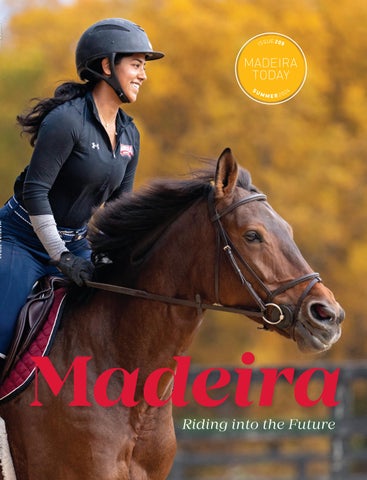
8328 GEORGETOW N PIKE
S U M M E R 2024
THE MADEIRA SCHOOL M C L E A N, VA 22102-1200
M A D E I R A TO D AY
Madeira Riding into the Future
I S S U E 209
Announcing Madeira’s Next “Home Improvement”
THE NEW STABLES
It’s back…
Graduation 2024 returns to the amphitheater!
See page 22 for details
Thank you to all who made this restoration possible.
Contents Madeira Today SUMMER 2024, Number 209 Published by The Madeira School 8328 Georgetown Pike McLean, VA 22102
2 Christina’s Corner
EDITOR: Karen Joostema DESIGN: LucidCreative.co PHOTOGRAPHY: James Kegley,
Sam Peat, Freed Photography, Rui Barros, & Cameron Davidson
BOARD OF TRUSTEES 2023–24
4
4 The Magic & Memories of Black Pond
10 Madeira Dining
Lili Avery ’72 Andy Blocher P’21, ’26 Eric Clark P’18 Lee Carol Cook P’19 Secretary Gaither Smoot Deaton ’88 Anne Faircloth ’87 Aileen Hawkins P’23, ’25
14 Saddles & Sisterhood 14
32 Reunion 2024
Ains Hill ’97 Sue Luangkhot Hoppin ’87 Bronwyn Hughes ’83 Carrie Southworth Johnson ’95 Vice Chair Joy S. Johnson ’77 Vice Chair George Kaczmarskyj P’19,’22 Treasurer Katherine Kies ’07 Alumnae Council President Emi Kolawole ’00 Christina Kyong Head of School Avery Miller ’86, P’19 Pilar Frank O’Leary ’87, P’21, ’24 Parents’ Association President
38 Arts Spotlight 40 Athletics Spotlight 42 Co-Curriculum:
32
Prepared for the Hill
46 Graduation
Tracy G. Savage ’66 Anita Patel Tolani ’91, P’24 Chair Nancy Rodwell Tuohy ’88
50 Class Notes
Julia Walker ’81 Kate Wisniewski Weir ’02 Madeira Today is published for alumnae, parents, and friends of the School. Send comments or suggestions to: KJoostema@madeira.org To unsubscribe from Madeira Today send your name and address to: advancement@madeira.org
46
80 Milestones
CHRISTINA’S CORNER
WE ARE REBUILDING T H E S TA B L E S
Dear Madeira Community & Friends, I always end each school year reflecting on what I am grateful for. I am grateful for a return to the Amphitheater for our Graduation. I am grateful for the many alums who returned to campus during Reunion (Go, Go, Escargot!). I am grateful for the many athletes and performers who
FROM THE EDITOR
spent time preparing and competing for Madeira. I am
“
We are excited to rebuild the stables! In doing so, we are not only incorporating best practices in equine care and safety, we are also expanding community and classroom spaces to focus on ways that every student can experience the riding program and stables.
”
2
wellbeing that we want to instill. Do you remember
Madeira’s campus offers an unmatched
showered me with advice and support over the year. And
hiking to Black Pond? Check out this magical place on
I am most grateful to my faculty, staff, and administrative
page 4 of this issue and re-live the allure of nature on
team members who have buoyed me in this year of learning
Madeira’s campus.
combination, where physical beauty meets enormous opportunity. It is an inimitable collection of places, programs, and people that makes an impact on our students. The stories in this issue celebrate some of those components. From the natural beauty of Black Pond to the skills and wellness benefits gained through our riding program, to life-changing Co-Curriculum internships, polished arts performances, and hard-won athletic accomplishments. Not to mention food (Madeira Dining has united our community for decades!), and, most importantly, our sisterhood of strong, independent women who support and celebrate each other with confident voices. Within the safety of Greenway’s gates, we learn, we practice, we make our community a better place. In the tradition of Madeira’s class rings, students first point the rays of the sunburst inward so that they soak in the light of learning and build skills. And just as graduating seniors, grasping their Madeira diploma for the first time, proudly turn their rings around so the sunburst rays point outward to share their light of learning with the world, we bring those skills beyond the gates of Greenway—to change the world, for the better.
and listening. And so, my listening tour is officially over.
We are excited to rebuild the stables! In doing so,
This does not mean that I will not listen and learn as
we are not only incorporating best practices in equine
I continue to understand the many gifts that a Madeira
care and safety, we are also expanding community and
education brings to our students. This does mean that I am
classroom spaces to focus on ways that every student
going to look to our accreditation process, which begins
can experience the riding program and stables. This is
this fall with a visit from our accreditation team, along with
exciting as we think about our third priority to make sure
our Strategic Plan, to help guide us as we start dreaming
that everyone feels included and experiences a sense
about the next 10 years.
of belonging in the community.
Part of this dream is already being realized. We named
Our fourth priority is to make sure that we develop
four priorities this year and we have made significant
healthy financial models to actualize our dreams.
progress on them. I am happy that we have begun to close
So, I end as I began, with great gratitude for you and
the gap in faculty and staff compensation and will continue
this wonderful community.
to close that gap so that our faculty and staff feel recognized for their many gifts to Madeira.
I appreciate your support.
Another priority was a focus on how we can use our physical campus in more purposeful and curricular ways, and we are already building time for students to enjoy our great outdoor campus next year so they can experience the beauty of their surroundings. Being outdoors not only helps
Christina Kyong Head of School
our students experience emotions like awe and wonder, but they also feed into a healthy lifestyle of balance and KAREN JOOSTEMA
Send comments to kjoostema@madeira.org
MA DEI RA TO DAY S UM MER 2024
C H R I S T I N A K YO N G, H E A D O F S C H O O L
grateful to our students and our parents who have
3
CHRISTINA’S CORNER
WE ARE REBUILDING T H E S TA B L E S
Dear Madeira Community & Friends, I always end each school year reflecting on what I am grateful for. I am grateful for a return to the Amphitheater for our Graduation. I am grateful for the many alums who returned to campus during Reunion (Go, Go, Escargot!). I am grateful for the many athletes and performers who
FROM THE EDITOR
spent time preparing and competing for Madeira. I am
“
We are excited to rebuild the stables! In doing so, we are not only incorporating best practices in equine care and safety, we are also expanding community and classroom spaces to focus on ways that every student can experience the riding program and stables.
”
2
wellbeing that we want to instill. Do you remember
Madeira’s campus offers an unmatched
showered me with advice and support over the year. And
hiking to Black Pond? Check out this magical place on
I am most grateful to my faculty, staff, and administrative
page 4 of this issue and re-live the allure of nature on
team members who have buoyed me in this year of learning
Madeira’s campus.
combination, where physical beauty meets enormous opportunity. It is an inimitable collection of places, programs, and people that makes an impact on our students. The stories in this issue celebrate some of those components. From the natural beauty of Black Pond to the skills and wellness benefits gained through our riding program, to life-changing Co-Curriculum internships, polished arts performances, and hard-won athletic accomplishments. Not to mention food (Madeira Dining has united our community for decades!), and, most importantly, our sisterhood of strong, independent women who support and celebrate each other with confident voices. Within the safety of Greenway’s gates, we learn, we practice, we make our community a better place. In the tradition of Madeira’s class rings, students first point the rays of the sunburst inward so that they soak in the light of learning and build skills. And just as graduating seniors, grasping their Madeira diploma for the first time, proudly turn their rings around so the sunburst rays point outward to share their light of learning with the world, we bring those skills beyond the gates of Greenway—to change the world, for the better.
and listening. And so, my listening tour is officially over.
We are excited to rebuild the stables! In doing so,
This does not mean that I will not listen and learn as
we are not only incorporating best practices in equine
I continue to understand the many gifts that a Madeira
care and safety, we are also expanding community and
education brings to our students. This does mean that I am
classroom spaces to focus on ways that every student
going to look to our accreditation process, which begins
can experience the riding program and stables. This is
this fall with a visit from our accreditation team, along with
exciting as we think about our third priority to make sure
our Strategic Plan, to help guide us as we start dreaming
that everyone feels included and experiences a sense
about the next 10 years.
of belonging in the community.
Part of this dream is already being realized. We named
Our fourth priority is to make sure that we develop
four priorities this year and we have made significant
healthy financial models to actualize our dreams.
progress on them. I am happy that we have begun to close
So, I end as I began, with great gratitude for you and
the gap in faculty and staff compensation and will continue
this wonderful community.
to close that gap so that our faculty and staff feel recognized for their many gifts to Madeira.
I appreciate your support.
Another priority was a focus on how we can use our physical campus in more purposeful and curricular ways, and we are already building time for students to enjoy our great outdoor campus next year so they can experience the beauty of their surroundings. Being outdoors not only helps
Christina Kyong Head of School
our students experience emotions like awe and wonder, but they also feed into a healthy lifestyle of balance and KAREN JOOSTEMA
Send comments to kjoostema@madeira.org
MA DEI RA TO DAY S UM MER 2024
C H R I S T I N A K YO N G, H E A D O F S C H O O L
grateful to our students and our parents who have
3
THE MAGIC and MEMORIES of BLACK POND The Madeira campus offers an abundance of natural beauty and serene trails. The ever forward-thinking Lucy Madeira was passionate about providing an excellent education while also offering opportunities for the students to enjoy nature. “From the beginning of the School,” Lucy Madeira stated, “we have wanted to be a country school ten or twelve miles out of Washington, where we could have a sense of outdoor life.” Lucy Madeira’s husband David Wing supported her dream of a country school by purchasing 210 acres of land at Greenway with the intention
MA DEI RA TO DAY SU MME R 2024
of leasing then selling the property
4
to the School. With her hope of the property being near water realized, Lucy Madeira described the “exquisitely lovely Black Pond and the wild stretch of the Potomac River as it curved around the Point.”
Black Pond Facts APPROXIMATE SIZE: 104,400 square feet WATER SOURCE: Underground spring W H E RE D ID TH E N A M E “ B L ACK P ON D ” C O M E F R O M ? It is likely that it came from the tint of the water. There are two large ponds in that area, the other being Yellow Pond. Black Pond’s water appears darker. There are many deciduous trees around the pond and the tannins from the leaves falling into the pond create its darker appearance.
THE MAGIC and MEMORIES of BLACK POND The Madeira campus offers an abundance of natural beauty and serene trails. The ever forward-thinking Lucy Madeira was passionate about providing an excellent education while also offering opportunities for the students to enjoy nature. “From the beginning of the School,” Lucy Madeira stated, “we have wanted to be a country school ten or twelve miles out of Washington, where we could have a sense of outdoor life.” Lucy Madeira’s husband David Wing supported her dream of a country school by purchasing 210 acres of land at Greenway with the intention
MA DEI RA TO DAY SU MME R 2024
of leasing then selling the property
4
to the School. With her hope of the property being near water realized, Lucy Madeira described the “exquisitely lovely Black Pond and the wild stretch of the Potomac River as it curved around the Point.”
Black Pond Facts APPROXIMATE SIZE: 104,400 square feet WATER SOURCE: Underground spring W H E RE D ID TH E N A M E “ B L ACK P ON D ” C O M E F R O M ? It is likely that it came from the tint of the water. There are two large ponds in that area, the other being Yellow Pond. Black Pond’s water appears darker. There are many deciduous trees around the pond and the tannins from the leaves falling into the pond create its darker appearance.
Bluebells Madeira is one of the region’s best places to spot bluebells, which are a perennial plant that blooms for just a few weeks per year, typically in April.
“My favorite memory by far is the first time I went down to see the bluebells in full bloom. My friend and I went way off the path, and we were climbing down the cliffs. Eventually, we stumbled down into a patch full of bluebells, and from then on they were all we could see. I remember thinking that people really MA DEI RA TO DAY SU MME R 2024
weren’t exaggerating
6
when they said it looks like an ocean in the forest.” Sophia Simpkins ’24
The fact that the waterfall used to be at the site of Black Pond is stunning. Standing there today, one cannot see the river most of the time. Black Pond sits nearly two miles from Great Falls, so it is amazing to think of the long and gradual process of nature that shaped the land into how it looks today.
Providing lifelong memories
Madeira science teacher, Heidi Santner Freeman ’89, has been enjoying Black Pond for more than thirty years. “I have such fond memories of hiking to Black Pond as a student,” Ms. Freeman began. “In those days, there was a trail from New Dorm that led straight down to Black Pond. It was very steep and not well maintained, which is why it is now closed. As a student I went canoeing and kayaking, and it was always such a blast.” Ms. Freeman has been teaching in the science department and leading Pond carved from nature hikes for decades, which has enwaterfalls abled her to pass down the knowledge to new generations of Madeira students. Because of Black Pond’s location on “I love hearing a student say, ‘I’ve Madeira’s gated campus, it has not been studied as widely as neighboring never been here before’ because I get to see their reaction when they finally geographical features, such as Great see it.” Ms. Freeman said. “We are Falls and Mather Gorge. Madeira science teacher Amber Saville-Andre so lucky to have this natural treasure recently had the opportunity to shadow on campus.” One story about Black Pond that a team from the United States GeologMs. Freeman loves to share is about ical Survey (USGS) that was studying naturalist John Trott, who taught in the land to learn more about the history and geology of the area. The team the science department at Madeira from 1982 to 1993. He had natural concame to campus to obtain samples nections to conservancy organizations through a process known as “coring.” and the Smithsonian, whom he often “What I was most excited to learn communicated with about Madeira’s about Black Pond is that it was campus. Mr. Trott was fascinated by carved out by what essentially used the question of whether bald cypress to be Great Falls. Waterfalls, as they trees could grow on campus. Legend erode rock, slowly move upstream.” has it that he planted bald cypress Ms. Saville-Andre added, “The other smaller ponds were plunge pools from trees here, and they have been thriving waterfalls!” ever since.
MA DEI RA TO DAY S UM MER 2024
Mrs. Christina Kyong
IN 1931 , the same year that Lucy Madeira moved her school from the increasingly commercialized Dupont Circle to McLean, Virginia, Black Pond was mentioned in A Brief Guide to the Private Schools of the Middle Atlantic States as they described the new location. “The grounds include woodlands, playing fields, and a pond for swimming and canoeing.” The allure of Black Pond has endured. When asked about the most beautiful parts of campus, generations of community members continue to mention Black Pond. Black Pond is a natural feature on campus less than a mile from the Oval. There is a well-maintained trail that leads to the pond. For decades, Madeira students have been taking advantage of the recreational activities afforded by the pond, such as hiking, kayaking, swimming, canoeing, and cliff jumping.
7
Bluebells Madeira is one of the region’s best places to spot bluebells, which are a perennial plant that blooms for just a few weeks per year, typically in April.
“My favorite memory by far is the first time I went down to see the bluebells in full bloom. My friend and I went way off the path, and we were climbing down the cliffs. Eventually, we stumbled down into a patch full of bluebells, and from then on they were all we could see. I remember thinking that people really MA DEI RA TO DAY SU MME R 2024
weren’t exaggerating
6
when they said it looks like an ocean in the forest.” Sophia Simpkins ’24
The fact that the waterfall used to be at the site of Black Pond is stunning. Standing there today, one cannot see the river most of the time. Black Pond sits nearly two miles from Great Falls, so it is amazing to think of the long and gradual process of nature that shaped the land into how it looks today.
Providing lifelong memories
Madeira science teacher, Heidi Santner Freeman ’89, has been enjoying Black Pond for more than thirty years. “I have such fond memories of hiking to Black Pond as a student,” Ms. Freeman began. “In those days, there was a trail from New Dorm that led straight down to Black Pond. It was very steep and not well maintained, which is why it is now closed. As a student I went canoeing and kayaking, and it was always such a blast.” Ms. Freeman has been teaching in the science department and leading Pond carved from nature hikes for decades, which has enwaterfalls abled her to pass down the knowledge to new generations of Madeira students. Because of Black Pond’s location on “I love hearing a student say, ‘I’ve Madeira’s gated campus, it has not been studied as widely as neighboring never been here before’ because I get to see their reaction when they finally geographical features, such as Great see it.” Ms. Freeman said. “We are Falls and Mather Gorge. Madeira science teacher Amber Saville-Andre so lucky to have this natural treasure recently had the opportunity to shadow on campus.” One story about Black Pond that a team from the United States GeologMs. Freeman loves to share is about ical Survey (USGS) that was studying naturalist John Trott, who taught in the land to learn more about the history and geology of the area. The team the science department at Madeira from 1982 to 1993. He had natural concame to campus to obtain samples nections to conservancy organizations through a process known as “coring.” and the Smithsonian, whom he often “What I was most excited to learn communicated with about Madeira’s about Black Pond is that it was campus. Mr. Trott was fascinated by carved out by what essentially used the question of whether bald cypress to be Great Falls. Waterfalls, as they trees could grow on campus. Legend erode rock, slowly move upstream.” has it that he planted bald cypress Ms. Saville-Andre added, “The other smaller ponds were plunge pools from trees here, and they have been thriving waterfalls!” ever since.
MA DEI RA TO DAY S UM MER 2024
Mrs. Christina Kyong
IN 1931 , the same year that Lucy Madeira moved her school from the increasingly commercialized Dupont Circle to McLean, Virginia, Black Pond was mentioned in A Brief Guide to the Private Schools of the Middle Atlantic States as they described the new location. “The grounds include woodlands, playing fields, and a pond for swimming and canoeing.” The allure of Black Pond has endured. When asked about the most beautiful parts of campus, generations of community members continue to mention Black Pond. Black Pond is a natural feature on campus less than a mile from the Oval. There is a well-maintained trail that leads to the pond. For decades, Madeira students have been taking advantage of the recreational activities afforded by the pond, such as hiking, kayaking, swimming, canoeing, and cliff jumping.
7
Students Sunbathing at Black Pond in 1956
A Continued Evolution of Outdoor Curriculum
beautiful campus as my backyard and want to make sure all students experience our natural treasures. My favorite outdoor moments have been on my journeys down to Black Pond.”
MA DEI RA TO DAY SU MME R 2024
Mrs. Christina Kyong
8
Lucy Madeira’s guiding vision of a country school where students could enjoy outdoor life, yet also be near the cultural and enriching learning opportunities of the city has stood the test of time. Opportunities to utilize the campus’ natural features to enhance teaching and learning abound. “We used to drive a picnic lunch down to Black Pond where the whole class used to gather each year,” shared Mr. Bobby Vogel, who has worked with the Facilities Team for the past 57 years. Mr. Vogel continued, “It was not always easy to reach, but the School wanted to carry on Miss Madeira’s commitment to making sure the girls spent time outdoors.” Head of School Mrs. Christina Kyong has expressed that it is critically important to make sure the students learn about the environment that surrounds them. Mrs. Kyong immediately recognized how special Madeira’s campus and Black Pond are and intends to further incorporate the campus into the curriculum. “I feel so lucky to have this beautiful campus as my backyard and want to make sure all students experience our natural treasures. My favorite outdoor
moments have been on my journeys down to Black Pond.” Madeira’s outdoor partners have been an important piece in the preservation and maintenance of its campus, especially places like Black Pond. Calleva, which runs outdoor education programs at Madeira, has built a boardwalk which enables access to the other side of the pond, previously accessible only via wading through water. Mrs. Kyong appreciates the beauty and restorative nature that Madeira’s campus provides. “I have experienced the awe of the blanket of bluebells on my way to Black Pond. I have so many peaceful moments taking in the view on the bluff across from the dock.” Black Pond has been an enduring feature on Madeira’s picturesque campus. Just as Lucy Madeira envisioned, it has served as a place of refuge, serenity, learning, science, and bonding. We continue to steward our treasured campus and favorite outdoor places such as Black Pond. Mrs. Kyong is committed to working with Madeira’s outdoor partners, teachers, and students on new ways to realize the founding vision of outdoor education.
Animals of Black Pond SNAKES Black and Copperhead SALAMANDERS BEAVERS BIRDS OF PREY Vultures, Hawks, Eagles FISH Largemouth Bass,
Bluegills, Catfish
MA DEI RA TO DAY S UM MER 2024
“I feel so lucky to have this
9
Students Sunbathing at Black Pond in 1956
A Continued Evolution of Outdoor Curriculum
beautiful campus as my backyard and want to make sure all students experience our natural treasures. My favorite outdoor moments have been on my journeys down to Black Pond.”
MA DEI RA TO DAY SU MME R 2024
Mrs. Christina Kyong
8
Lucy Madeira’s guiding vision of a country school where students could enjoy outdoor life, yet also be near the cultural and enriching learning opportunities of the city has stood the test of time. Opportunities to utilize the campus’ natural features to enhance teaching and learning abound. “We used to drive a picnic lunch down to Black Pond where the whole class used to gather each year,” shared Mr. Bobby Vogel, who has worked with the Facilities Team for the past 57 years. Mr. Vogel continued, “It was not always easy to reach, but the School wanted to carry on Miss Madeira’s commitment to making sure the girls spent time outdoors.” Head of School Mrs. Christina Kyong has expressed that it is critically important to make sure the students learn about the environment that surrounds them. Mrs. Kyong immediately recognized how special Madeira’s campus and Black Pond are and intends to further incorporate the campus into the curriculum. “I feel so lucky to have this beautiful campus as my backyard and want to make sure all students experience our natural treasures. My favorite outdoor
moments have been on my journeys down to Black Pond.” Madeira’s outdoor partners have been an important piece in the preservation and maintenance of its campus, especially places like Black Pond. Calleva, which runs outdoor education programs at Madeira, has built a boardwalk which enables access to the other side of the pond, previously accessible only via wading through water. Mrs. Kyong appreciates the beauty and restorative nature that Madeira’s campus provides. “I have experienced the awe of the blanket of bluebells on my way to Black Pond. I have so many peaceful moments taking in the view on the bluff across from the dock.” Black Pond has been an enduring feature on Madeira’s picturesque campus. Just as Lucy Madeira envisioned, it has served as a place of refuge, serenity, learning, science, and bonding. We continue to steward our treasured campus and favorite outdoor places such as Black Pond. Mrs. Kyong is committed to working with Madeira’s outdoor partners, teachers, and students on new ways to realize the founding vision of outdoor education.
Animals of Black Pond SNAKES Black and Copperhead SALAMANDERS BEAVERS BIRDS OF PREY Vultures, Hawks, Eagles FISH Largemouth Bass,
Bluegills, Catfish
MA DEI RA TO DAY S UM MER 2024
“I feel so lucky to have this
9
Madeira Dining:
Tasty Meals and
a Taste of Home
Madeira’s dining hall has been treasured for decades by students and faculty alike. From bonding with friends during a particularly good lunch or enjoying larger events such as Thanksgiving Dinner, the Madeira community connects around our dining tables.
STUDENTS ENTHUSIASTICALLY JOIN IN PREPARING A MEAL
from around the world in the kitchen with us where they can make recipes from home. Whether it’s a special cultural holiday they want to celebrate, or they just feel like
MA DEI RA TO DAY SU MME R 2024
making flatbread for brunch, I’ve opened
10
my ears, my heart, and my kitchen to them. These kids are very special to us.” — A N D R E A G O E , D I N I N G D I R E C TO R
MEMORABLE MEALS From comfort foods like chicken nuggets and tater tots to other crowdpleasing options such as salmon and beef bowls, our community is enjoying a great variety of meals from Madeira’s foodservice provider, Meriwether Godsey, Inc.
MA DEI RA TO DAY S UM MER 2024
“I made it my mission to get our students
11
Madeira Dining:
Tasty Meals and
a Taste of Home
Madeira’s dining hall has been treasured for decades by students and faculty alike. From bonding with friends during a particularly good lunch or enjoying larger events such as Thanksgiving Dinner, the Madeira community connects around our dining tables.
STUDENTS ENTHUSIASTICALLY JOIN IN PREPARING A MEAL
from around the world in the kitchen with us where they can make recipes from home. Whether it’s a special cultural holiday they want to celebrate, or they just feel like
MA DEI RA TO DAY SU MME R 2024
making flatbread for brunch, I’ve opened
10
my ears, my heart, and my kitchen to them. These kids are very special to us.” — A N D R E A G O E , D I N I N G D I R E C TO R
MEMORABLE MEALS From comfort foods like chicken nuggets and tater tots to other crowdpleasing options such as salmon and beef bowls, our community is enjoying a great variety of meals from Madeira’s foodservice provider, Meriwether Godsey, Inc.
MA DEI RA TO DAY S UM MER 2024
“I made it my mission to get our students
11
A Taste of Home In addition to providing an impressive menu, Meriwether Godsey has collaborated with students to help them feel closer to home. Food is an integral part of life and culture. It is one of the ways we remember and connect with family. A meal prepared with particular flavors can evoke memories of childhood. Certain dishes bring a comforting taste of home. Madeira wants to COOKING FOR KENYAN INDEPENDENCE DAY
PAYING HOMAGE TO KENYAN CULTURE WITH FAMILY When Nissi Sigei ’24 spoke with Andrea about collaborating on a dish to honor her Kenyan heritage for Kenyan Independence Day, she knew exactly who would be joining her and her friends: her mother. Nissi’s mom had always made an effort to cook traditional dishes and thought it was a wonderful idea. Nissi and her mom, along with some classmates, cooked foods that spoke to Kenyan tradition, including: Pilau, Mboga, Chipatis, Mandazis, Githeri, and Katchumbari.
“It was incredibly rewarding to be able to cook meaningful dishes for the community and for the community to be receptive. Students still ask us when
MA DEI RA TO DAY SU MME R 2024
we’re cooking again. It means a lot that
12
BRINGING A TASTE OF LATIN AMERICA TO MADEIRA
“Ms. Andrea and the Meriwether Godsey
Beacause Madeira has many students with Latin American backgrounds, Ms. Andrea knew it would be a popular idea to invite several of them into the kitchen to cook foods that reminded them of home. Emily Ramirez ’24, Lais Souza ’25, Leah Garcia ’26, and Ampi Sanchez ’25 made empanadas, guacamole, and salsa. According to Andrea, “One of the best guacamoles I’ve ever tasted.”
and have given me some of my favorite
staff connect with all Madeira students memories. With other Latine students at Madeira and the help of the kitchen staff, I’ve had the opportunity to share my cultural cuisine with the whole Madeira community. Not only has the experience allowed me to connect with my culture, but I’ve also grown to appreciate the process of preparing food alongside students of all grade levels. Having a mother who is a nutrition worker, I appreciate
they appreciated our food because it
Madeira dining so much for
such an important aspect of our
allowing me to put myself in
culture.” — N I S S I S I G E I ’ 2 4
her shoes, connecting even deeper with her hundreds of miles away.” — E M I LY R A M I R E Z ’24
MADEIRA DINING HALL STAFF
MA DEI RA TO DAY S UM MER 2024
ensure that students are able to experience “foods from home” as part of their Madeira dining experience. Students have taken turns cooking a cuisine they are passionate about with Meriweather Godsey.
STUDENTS PREPARED A LATIN AMERICAN-THEMED MEAL
13
A Taste of Home In addition to providing an impressive menu, Meriwether Godsey has collaborated with students to help them feel closer to home. Food is an integral part of life and culture. It is one of the ways we remember and connect with family. A meal prepared with particular flavors can evoke memories of childhood. Certain dishes bring a comforting taste of home. Madeira wants to COOKING FOR KENYAN INDEPENDENCE DAY
PAYING HOMAGE TO KENYAN CULTURE WITH FAMILY When Nissi Sigei ’24 spoke with Andrea about collaborating on a dish to honor her Kenyan heritage for Kenyan Independence Day, she knew exactly who would be joining her and her friends: her mother. Nissi’s mom had always made an effort to cook traditional dishes and thought it was a wonderful idea. Nissi and her mom, along with some classmates, cooked foods that spoke to Kenyan tradition, including: Pilau, Mboga, Chipatis, Mandazis, Githeri, and Katchumbari.
“It was incredibly rewarding to be able to cook meaningful dishes for the community and for the community to be receptive. Students still ask us when
MA DEI RA TO DAY SU MME R 2024
we’re cooking again. It means a lot that
12
BRINGING A TASTE OF LATIN AMERICA TO MADEIRA
“Ms. Andrea and the Meriwether Godsey
Beacause Madeira has many students with Latin American backgrounds, Ms. Andrea knew it would be a popular idea to invite several of them into the kitchen to cook foods that reminded them of home. Emily Ramirez ’24, Lais Souza ’25, Leah Garcia ’26, and Ampi Sanchez ’25 made empanadas, guacamole, and salsa. According to Andrea, “One of the best guacamoles I’ve ever tasted.”
and have given me some of my favorite
staff connect with all Madeira students memories. With other Latine students at Madeira and the help of the kitchen staff, I’ve had the opportunity to share my cultural cuisine with the whole Madeira community. Not only has the experience allowed me to connect with my culture, but I’ve also grown to appreciate the process of preparing food alongside students of all grade levels. Having a mother who is a nutrition worker, I appreciate
they appreciated our food because it
Madeira dining so much for
such an important aspect of our
allowing me to put myself in
culture.” — N I S S I S I G E I ’ 2 4
her shoes, connecting even deeper with her hundreds of miles away.” — E M I LY R A M I R E Z ’24
MADEIRA DINING HALL STAFF
MA DEI RA TO DAY S UM MER 2024
ensure that students are able to experience “foods from home” as part of their Madeira dining experience. Students have taken turns cooking a cuisine they are passionate about with Meriweather Godsey.
STUDENTS PREPARED A LATIN AMERICAN-THEMED MEAL
13
Saddles &
Sisterhood
MA DEI RA TO DAY SU MME R 2024
STORIES FROM M A D E I R A’ S S TA B L E S
14
PA S T, P R E S E N T, A N D F U T U R E
Saddles &
Sisterhood
MA DEI RA TO DAY SU MME R 2024
STORIES FROM M A D E I R A’ S S TA B L E S
14
PA S T, P R E S E N T, A N D F U T U R E
JANE GORDON RUPLEY ’69 IEA TEAM WITH BLUE RIBBONS AFTER REGIONALS 2013
T
MA DEI RA TO DAY
he iconic white fences that define the paddocks and grace the School’s entrance on Georgetown Pike often make riding nearly synonymous with Madeira. Any passerby notes the bucolic greeting of horses grazing in pastures. In fact, Madeira’s Equestrian Program has been a defining aspect of the School since its early days. But this signature program was not originally planned to be such an important piece of Madeira’s distinguished history. In 1967, Ceci Dickson Banner ’53 wrote, “Years ago, Miss Maynard explained to my mother that she and Miss Madeira had not really planned on having a riding program…” They changed their tune, Ceci’s mother noted, when, “they found that the girls who rode got into less trouble.” This tongue-in-cheek anecdote speaks to the dedication of the students who take part in Madeira’s Equestrian Program. Each afternoon, one can find riders at the stables, grooming horses, cleaning tack, and taking lessons. The current stable facilities were constructed in 1952 and have served Madeira well, supporting the teaching of horse care and riding technique to students of all experience levels and giving rise to generations of riders. “The program serves first time riders to students competing at national championships,” shared Ian McCartney, Director of the Equestrian Program. Mr. McCartney continued, “At every level our primary focus is teaching correct horse care based on an empathetic understanding of their needs.
16
MOLLIE THOMAS ’16
RIDING A PROUD LEGACY This focus on horse care has been a cornerstone of Madeira’s program for decades, which becomes clear when speaking with alumnae. Reflecting on her time as a rider, Cathy Stone ’69 shared, “The saying, ‘The outside of a horse is good for the inside of a person’ was definitely true for me and my Madeira classmates, as we picked out hooves, brushed, pulled manes, and sometimes braided.” During her 37-year tenure leading Madeira’s riding program, beginning in 1941, Mildred Gaines developed an internationally famous program with the first cross-country course built in the area and a state-of the art indoor riding arena. Miss Gaines is remembered fondly by alumnae across decades. “The legendary head of riding, Mildred Gaines, ran the summer program, and I entirely credit her for instilling my foundational horsemanship skills and teaching me classical riding,” shared Phoebe Lang ’85, who has gone on to pursue showjumping for 20 years, competing to the FEI 3* level in the US, Canada, and Europe. Like Madeira’s academic courses, the riding curriculum was rigorous. Famous for pushing riders to new limits, Miss
Gaines’ program included endless hours of practicing her version of the Canadian Mounted Police Drill, where riders performed complicated maneuvers with the horses’ hooves keeping beat to the music. “Mildred Gaines and Madge Barclay certainly helped me improve my skills both aboard my mount and off,” recalled Jane Gordon Rupley ’69. “I wanted of course to make First Team as my sister had eight years before, but it took me until my senior year. The riding exam was not easy!” Life lessons are part of the impact of the program for generations of Madeira riders. Gordon Rupley said, “We learned how to overcome obstacles, how to work toward a goal, how to take care of another living creature, and in many ways how to be independent and stronger.” “At Madeira, I learned how to become comfortable getting thrown off into the dirt, having the wind knocked out of me, dusting myself off, and getting right back in the saddle,” shared Mollie Thomas ’16. “Riding is so therapeutic and helps me reconnect with myself.”
PHOEBE LANG ’85
IEA TEAM AFTER WINNING HIGH POINT TEAM, DECEMBER 2015
SUKI PENSON JARZEMSKY ’66 WITH HER HORSE, “ODDJOB”
PHOEBE LANG ’85
MA DEI RA TO DAY S UM MER 2024
past
JANE GORDON RUPLEY ’69, SUSIE SCHOELLKOPH ’69, EMILY FISHER ’69, CATHY STONE ’69, AND HARRIET ‘KYN’ TOLSON ’69
17
JANE GORDON RUPLEY ’69 IEA TEAM WITH BLUE RIBBONS AFTER REGIONALS 2013
T
MA DEI RA TO DAY
he iconic white fences that define the paddocks and grace the School’s entrance on Georgetown Pike often make riding nearly synonymous with Madeira. Any passerby notes the bucolic greeting of horses grazing in pastures. In fact, Madeira’s Equestrian Program has been a defining aspect of the School since its early days. But this signature program was not originally planned to be such an important piece of Madeira’s distinguished history. In 1967, Ceci Dickson Banner ’53 wrote, “Years ago, Miss Maynard explained to my mother that she and Miss Madeira had not really planned on having a riding program…” They changed their tune, Ceci’s mother noted, when, “they found that the girls who rode got into less trouble.” This tongue-in-cheek anecdote speaks to the dedication of the students who take part in Madeira’s Equestrian Program. Each afternoon, one can find riders at the stables, grooming horses, cleaning tack, and taking lessons. The current stable facilities were constructed in 1952 and have served Madeira well, supporting the teaching of horse care and riding technique to students of all experience levels and giving rise to generations of riders. “The program serves first time riders to students competing at national championships,” shared Ian McCartney, Director of the Equestrian Program. Mr. McCartney continued, “At every level our primary focus is teaching correct horse care based on an empathetic understanding of their needs.
16
MOLLIE THOMAS ’16
RIDING A PROUD LEGACY This focus on horse care has been a cornerstone of Madeira’s program for decades, which becomes clear when speaking with alumnae. Reflecting on her time as a rider, Cathy Stone ’69 shared, “The saying, ‘The outside of a horse is good for the inside of a person’ was definitely true for me and my Madeira classmates, as we picked out hooves, brushed, pulled manes, and sometimes braided.” During her 37-year tenure leading Madeira’s riding program, beginning in 1941, Mildred Gaines developed an internationally famous program with the first cross-country course built in the area and a state-of the art indoor riding arena. Miss Gaines is remembered fondly by alumnae across decades. “The legendary head of riding, Mildred Gaines, ran the summer program, and I entirely credit her for instilling my foundational horsemanship skills and teaching me classical riding,” shared Phoebe Lang ’85, who has gone on to pursue showjumping for 20 years, competing to the FEI 3* level in the US, Canada, and Europe. Like Madeira’s academic courses, the riding curriculum was rigorous. Famous for pushing riders to new limits, Miss
Gaines’ program included endless hours of practicing her version of the Canadian Mounted Police Drill, where riders performed complicated maneuvers with the horses’ hooves keeping beat to the music. “Mildred Gaines and Madge Barclay certainly helped me improve my skills both aboard my mount and off,” recalled Jane Gordon Rupley ’69. “I wanted of course to make First Team as my sister had eight years before, but it took me until my senior year. The riding exam was not easy!” Life lessons are part of the impact of the program for generations of Madeira riders. Gordon Rupley said, “We learned how to overcome obstacles, how to work toward a goal, how to take care of another living creature, and in many ways how to be independent and stronger.” “At Madeira, I learned how to become comfortable getting thrown off into the dirt, having the wind knocked out of me, dusting myself off, and getting right back in the saddle,” shared Mollie Thomas ’16. “Riding is so therapeutic and helps me reconnect with myself.”
PHOEBE LANG ’85
IEA TEAM AFTER WINNING HIGH POINT TEAM, DECEMBER 2015
SUKI PENSON JARZEMSKY ’66 WITH HER HORSE, “ODDJOB”
PHOEBE LANG ’85
MA DEI RA TO DAY S UM MER 2024
past
JANE GORDON RUPLEY ’69, SUSIE SCHOELLKOPH ’69, EMILY FISHER ’69, CATHY STONE ’69, AND HARRIET ‘KYN’ TOLSON ’69
17
Memories & Musings “I remember Drill Team as a favorite experience. Remember, we did not have an indoor ring! It was cold, the footing slushy and the weather generally miserable. I loved it. I loved working as a team, the laughs when we went the wrong way and ended up with the wrong partner or at the end of the line when you were supposed to be at the beginning, the Souza band music, the bucking unruly horses full of beans in the cold weather. Then show day would come and we would orchestrate a beautiful dance.”
“One of my favorite memories of Madeira riding has to be when my close friend and I went to the barn on one of our off days to just hang out around the horses, give them apples, take photos, and catch up after a very long, very busy week.” – ALAINA WALKER ’24
– JANE GORDON RUPLEY ’69
“During the huge snowstorm freshman year, the barn staff couldn’t get to the barn, so the Director of Riding put out a call to the more advanced riding students to come give her a hand at the barn. Of course, we trudged up there in the snow and we had a surprisingly fun day helping with the barn chores and making sure all the horses were okay and comfortable in their stalls.” – ASHLEY POWELL NOSEK ’00
“My favorite memory of riding at Madeira was when I was in eighth grade and Mr. McCartney had a free weekend, so he took me and another middle school rider to Frying Pan Farm. He gave us a lesson and let us wander around on our horses all around the farm.’’
18
“My favorite memory riding at Madeira was competing at Turner Farm last spring. I went to the show with one of my best friends at the barn which made any stress caused by showing melt away. We both had great rides in the low children’s hunters and the horses were angels. It was just a fun, successful and simple day of showing which is pretty rare in this sport.” – ELLIE WILSON ’25
MA DEI RA TO DAY S UM MER 2024
MA DEI RA TO DAY SU MME R 2024
– CAROLINE DEL CORSO ’25
19
Memories & Musings “I remember Drill Team as a favorite experience. Remember, we did not have an indoor ring! It was cold, the footing slushy and the weather generally miserable. I loved it. I loved working as a team, the laughs when we went the wrong way and ended up with the wrong partner or at the end of the line when you were supposed to be at the beginning, the Souza band music, the bucking unruly horses full of beans in the cold weather. Then show day would come and we would orchestrate a beautiful dance.”
“One of my favorite memories of Madeira riding has to be when my close friend and I went to the barn on one of our off days to just hang out around the horses, give them apples, take photos, and catch up after a very long, very busy week.” – ALAINA WALKER ’24
– JANE GORDON RUPLEY ’69
“During the huge snowstorm freshman year, the barn staff couldn’t get to the barn, so the Director of Riding put out a call to the more advanced riding students to come give her a hand at the barn. Of course, we trudged up there in the snow and we had a surprisingly fun day helping with the barn chores and making sure all the horses were okay and comfortable in their stalls.” – ASHLEY POWELL NOSEK ’00
“My favorite memory of riding at Madeira was when I was in eighth grade and Mr. McCartney had a free weekend, so he took me and another middle school rider to Frying Pan Farm. He gave us a lesson and let us wander around on our horses all around the farm.’’
18
“My favorite memory riding at Madeira was competing at Turner Farm last spring. I went to the show with one of my best friends at the barn which made any stress caused by showing melt away. We both had great rides in the low children’s hunters and the horses were angels. It was just a fun, successful and simple day of showing which is pretty rare in this sport.” – ELLIE WILSON ’25
MA DEI RA TO DAY S UM MER 2024
MA DEI RA TO DAY SU MME R 2024
– CAROLINE DEL CORSO ’25
19
RIDING TODAY
MA DEI RA TO DAY SU MME R 2024
Strong leadership continues today. During Mr. McCartney’s tenure the program has expanded to serve more students. When he arrived in 2011, Madeira had 25 riders and five student-boarded horses. Currently, the equestrian team and facilities support a program of 45 riders and 20 boarded horses. This community is supportive and tight knit, according to student participants. “My favorite thing about MadEq (as the students refer to Madeira’s Equestrian Program) is the people,” shared Ellie Wilson ’25. “The barn brings together some of the friendliest, most hardworking, and devoted people in the School. The barn community is super strong and everyone is so invested in each other’s progress, which makes the barn such a safe place for athletes to take risks, fail, and get better.” This investment in one another extends beyond an individual lesson or riding team. “When I had to take a few months off riding due to medical reasons the barn community was supportive and gave me motivation to work towards riding again!” proclaimed Audrey Blocher ’26. Madeira’s emphasis on horse care elevates students’ abilities and allows them to pursue prestigious Co-Curriculum placements in the field. In recent years, seniors have interned with top-tier show barns, such as Code Four Stables and Shadow Pond Stables in Ocala, Florida. The hard work and values instilled through the Madeira Equestrian Program have had an impact far beyond the riding arena. “I have become much more confident as a rider, which has given me more self-esteem in classes, my Co-Curriculum internships, and the different volunteer positions that I hold,” shared Caroline Del Corso ’25.
20
Building confidence is just one element of Madeira’s focus on emotional health. For Mr. McCartney and his team, teaching responsibility and empathy are two significant program objectives. Students perform substantial hands-on care for the horses that they ride, to build a connection with their partner horses and to reinforce the depth of responsibility they own in the partnership. Empathy, as well as emotional awareness, plays a huge role in the experience. “There’s a difference between feeling emotion and outwardly emoting,” said McCartney. “That’s important, because your partner is a living being that can pick up on your reactions.” Awareness and control over one’s emotions can benefit students in the saddle and beyond: taking a test, managing interview nerves, collaborating with challenging colleagues in the workplace, and more. Courage and determination are two other important skills learned through riding. McCartney said, “It is said that confidence comes from competence. This is true, but the road to competence is built with courage and determination. The courage to push yourself outside of your comfort zone, make mistakes, and try again, often in a public setting! The determination to keep going when things don’t go as planned, which often happens in this sport.” A 2020 study about the perceived benefits of riding for mental and physical health, published in the International Journal of Environmental Research and Public Health, showed that horseback riding can reduce stress and anxiety and improve mood and well-being. Emotional awareness is bolstered by strong bonds developed within Madeira’s barn community. Phoebe Lang ’85 reflected, “I felt alive and in complete alignment when I was at the stable. Life there made sense to me. I felt at home.” An appreciation for the barn family and the community that develops taking care of the horses and each other is a sentiment echoed by each generation of Madeira riders. Jane Gordon Rupley ’69 summed it up: “The camaraderie at the stables, being far from the classroom and dorm halls at the other end of that beautiful campus was wonderful.” Cathy Stone ’69 agreed,“We all felt a freedom at the barn, away from the academic center of school, rushing from one class to another.” That freedom and responsibility allow lifelong lessons to take root. “The most significant lesson I gained through the riding program is that learning is not a linear process,” said Alaina Walker ’24, a four-year Madeira equestrian. “It has its ups and downs, has its scary falls and broken bones, and that it is okay to have moments of setback, for they make everything else that you learn worth it.”
MA DEI RA TO DAY S UM MER 2024
present
Wellness Through Riding
21
RIDING TODAY
MA DEI RA TO DAY SU MME R 2024
Strong leadership continues today. During Mr. McCartney’s tenure the program has expanded to serve more students. When he arrived in 2011, Madeira had 25 riders and five student-boarded horses. Currently, the equestrian team and facilities support a program of 45 riders and 20 boarded horses. This community is supportive and tight knit, according to student participants. “My favorite thing about MadEq (as the students refer to Madeira’s Equestrian Program) is the people,” shared Ellie Wilson ’25. “The barn brings together some of the friendliest, most hardworking, and devoted people in the School. The barn community is super strong and everyone is so invested in each other’s progress, which makes the barn such a safe place for athletes to take risks, fail, and get better.” This investment in one another extends beyond an individual lesson or riding team. “When I had to take a few months off riding due to medical reasons the barn community was supportive and gave me motivation to work towards riding again!” proclaimed Audrey Blocher ’26. Madeira’s emphasis on horse care elevates students’ abilities and allows them to pursue prestigious Co-Curriculum placements in the field. In recent years, seniors have interned with top-tier show barns, such as Code Four Stables and Shadow Pond Stables in Ocala, Florida. The hard work and values instilled through the Madeira Equestrian Program have had an impact far beyond the riding arena. “I have become much more confident as a rider, which has given me more self-esteem in classes, my Co-Curriculum internships, and the different volunteer positions that I hold,” shared Caroline Del Corso ’25.
20
Building confidence is just one element of Madeira’s focus on emotional health. For Mr. McCartney and his team, teaching responsibility and empathy are two significant program objectives. Students perform substantial hands-on care for the horses that they ride, to build a connection with their partner horses and to reinforce the depth of responsibility they own in the partnership. Empathy, as well as emotional awareness, plays a huge role in the experience. “There’s a difference between feeling emotion and outwardly emoting,” said McCartney. “That’s important, because your partner is a living being that can pick up on your reactions.” Awareness and control over one’s emotions can benefit students in the saddle and beyond: taking a test, managing interview nerves, collaborating with challenging colleagues in the workplace, and more. Courage and determination are two other important skills learned through riding. McCartney said, “It is said that confidence comes from competence. This is true, but the road to competence is built with courage and determination. The courage to push yourself outside of your comfort zone, make mistakes, and try again, often in a public setting! The determination to keep going when things don’t go as planned, which often happens in this sport.” A 2020 study about the perceived benefits of riding for mental and physical health, published in the International Journal of Environmental Research and Public Health, showed that horseback riding can reduce stress and anxiety and improve mood and well-being. Emotional awareness is bolstered by strong bonds developed within Madeira’s barn community. Phoebe Lang ’85 reflected, “I felt alive and in complete alignment when I was at the stable. Life there made sense to me. I felt at home.” An appreciation for the barn family and the community that develops taking care of the horses and each other is a sentiment echoed by each generation of Madeira riders. Jane Gordon Rupley ’69 summed it up: “The camaraderie at the stables, being far from the classroom and dorm halls at the other end of that beautiful campus was wonderful.” Cathy Stone ’69 agreed,“We all felt a freedom at the barn, away from the academic center of school, rushing from one class to another.” That freedom and responsibility allow lifelong lessons to take root. “The most significant lesson I gained through the riding program is that learning is not a linear process,” said Alaina Walker ’24, a four-year Madeira equestrian. “It has its ups and downs, has its scary falls and broken bones, and that it is okay to have moments of setback, for they make everything else that you learn worth it.”
MA DEI RA TO DAY S UM MER 2024
present
Wellness Through Riding
21
22
“This new facility is such an exciting part of Madeira’s future. We will honor the traditions and impact that our Equestrian Program was built upon, and we will bring all Madeira students, not just riders, into the facility to teach in ways we never imagined years ago.” CHRISTINA KYONG
RIDING ON
CONSTRUCTION PLANS
The time has come to modernize the stables. The challenge at hand is straightforward: The program has outgrown the 1950s facility. Program demand exceeds the current capacity, the structure is past its useful life, and equine care best practices have evolved greatly since the facility was originally built. While the School initially planned to refresh the original stables, the project pivoted to a rebuild this year when engineers deemed the current structure unsafe to support a redesign. This challenge presented the opportunity to centralize the core functions in the barn with the horses on the wings. It also highlighted a longsought opportunity to increase access to the stables by including more students, both riders and non-riders, in the educational opportunities the new facility will provide. According to Mr. McCartney, the new stables will offer “modern amenities for students, staff, and horses that will expand the ways in which we use the horses to teach and interact with students.” These improvements include classroom space for teaching, staff apartments to ensure around-the-clock care, new quarantine stalls to enact more defined equine biosecurity, and more.
Alumnae who have reviewed plans for the new facility note the wise thinking about the well-being of the horses that factored into the exciting design. “What thrills me is that we will finally have an equestrian facility at the forefront of our campus that reflects the quality of both our riding program and the quality of the School itself. I think the potential educational opportunities in that building for all of the girls on campus, not just the riders, will have a great long-term benefit to the reputation of our School,” observed Ashley Powell Nosek ’00, who has continued to ride as an adult, now primarily in the dressage discipline. The School hopes to begin construction in late 2024 (depending upon fundraising and the permit process), and the facility will take about 12 months to build. Upon completion, the redesigned stables will not only allow the equestrian program to serve more students and attract top-level riders, but also revive auxiliary income programs, such as summer riding camps and middle school feeder programs. Cathy Stone ’69 shared, “I hope the girls who have never ridden or been around horses will be able to experience the sport, take care of a large animal, and feel the freedom we felt away from the classrooms.” Mollie Thomas ’16 added a practical consideration for the new facility,
“Hopefully it won’t be quite so cold in the barn in the winter!” In her reflections, Phoebe Lang ’85 struck upon the heart of the matter: “All the years I spent riding at Madeira, all the horses I fell in love with, all the friends I made at the barn, all the adults who taught me how to ride, handle, and respect horses, all the older girls who inspired me... they’re all a part of my life story, my identity, and my heart.” Riding represents the ultimate classroom for life lessons and wellness. The School remains committed to its place in Madeira’s identity. The thoughtfully designed new facility allows best practices in equine care, improves safety, and enables more students to access the riding program and the stables. The new facility will take the program and its participants to new heights.
SIDE ELEVATION FOR THE NEW STABLES
MA DEI RA TO DAY S UM MER 2024
MA DEI RA TO DAY SU MME R 2024
future
23
22
“This new facility is such an exciting part of Madeira’s future. We will honor the traditions and impact that our Equestrian Program was built upon, and we will bring all Madeira students, not just riders, into the facility to teach in ways we never imagined years ago.” CHRISTINA KYONG
RIDING ON
CONSTRUCTION PLANS
The time has come to modernize the stables. The challenge at hand is straightforward: The program has outgrown the 1950s facility. Program demand exceeds the current capacity, the structure is past its useful life, and equine care best practices have evolved greatly since the facility was originally built. While the School initially planned to refresh the original stables, the project pivoted to a rebuild this year when engineers deemed the current structure unsafe to support a redesign. This challenge presented the opportunity to centralize the core functions in the barn with the horses on the wings. It also highlighted a longsought opportunity to increase access to the stables by including more students, both riders and non-riders, in the educational opportunities the new facility will provide. According to Mr. McCartney, the new stables will offer “modern amenities for students, staff, and horses that will expand the ways in which we use the horses to teach and interact with students.” These improvements include classroom space for teaching, staff apartments to ensure around-the-clock care, new quarantine stalls to enact more defined equine biosecurity, and more.
Alumnae who have reviewed plans for the new facility note the wise thinking about the well-being of the horses that factored into the exciting design. “What thrills me is that we will finally have an equestrian facility at the forefront of our campus that reflects the quality of both our riding program and the quality of the School itself. I think the potential educational opportunities in that building for all of the girls on campus, not just the riders, will have a great long-term benefit to the reputation of our School,” observed Ashley Powell Nosek ’00, who has continued to ride as an adult, now primarily in the dressage discipline. The School hopes to begin construction in late 2024 (depending upon fundraising and the permit process), and the facility will take about 12 months to build. Upon completion, the redesigned stables will not only allow the equestrian program to serve more students and attract top-level riders, but also revive auxiliary income programs, such as summer riding camps and middle school feeder programs. Cathy Stone ’69 shared, “I hope the girls who have never ridden or been around horses will be able to experience the sport, take care of a large animal, and feel the freedom we felt away from the classrooms.” Mollie Thomas ’16 added a practical consideration for the new facility,
“Hopefully it won’t be quite so cold in the barn in the winter!” In her reflections, Phoebe Lang ’85 struck upon the heart of the matter: “All the years I spent riding at Madeira, all the horses I fell in love with, all the friends I made at the barn, all the adults who taught me how to ride, handle, and respect horses, all the older girls who inspired me... they’re all a part of my life story, my identity, and my heart.” Riding represents the ultimate classroom for life lessons and wellness. The School remains committed to its place in Madeira’s identity. The thoughtfully designed new facility allows best practices in equine care, improves safety, and enables more students to access the riding program and the stables. The new facility will take the program and its participants to new heights.
SIDE ELEVATION FOR THE NEW STABLES
MA DEI RA TO DAY S UM MER 2024
MA DEI RA TO DAY SU MME R 2024
future
23
CAMPAIGN FOR THE FACILITY EXPANSION “RIDING INTO THE FUTURE”
STABLES DESIRED CONSTRUCTION START DATE: FALL 2024
Our new expanded facility will provide: • Space to accommodate escalating demand for lessons, horse boarding, and classes • Opportunities to serve more students with augmented experiential learning • Thoughtfully designed spaces incorporating best practices in horse safety and well-being • A preeminent structure at the campus entrance that is commensurate with the quality of the School and its Equestrian Program
PROGRAM EXPANSION “LEARNING TO TAKE THE REINS”
PROJECTED FACILITY CONSTRUCTION COST: $9.4 M
Consistent with Madeira’s vision of innovation in girls’ education, all students, not only riders, will benefit through: • New curriculum for programs such as Advisory and 9th grade Student Life/ Co-Curriculum
24
• Horses as a powerful educational modality that teaches students how to optimize nonverbal communication • Research-based programs that improve student health and well-being through interaction with horses
MA DEI RA TO DAY S UM MER 2024
MA DEI RA TO DAY SU MME R 2024
• A laboratory for experiential learning in soft skills, such as emotional awareness and leadership
25
CAMPAIGN FOR THE FACILITY EXPANSION “RIDING INTO THE FUTURE”
STABLES DESIRED CONSTRUCTION START DATE: FALL 2024
Our new expanded facility will provide: • Space to accommodate escalating demand for lessons, horse boarding, and classes • Opportunities to serve more students with augmented experiential learning • Thoughtfully designed spaces incorporating best practices in horse safety and well-being • A preeminent structure at the campus entrance that is commensurate with the quality of the School and its Equestrian Program
PROGRAM EXPANSION “LEARNING TO TAKE THE REINS”
PROJECTED FACILITY CONSTRUCTION COST: $9.4 M
Consistent with Madeira’s vision of innovation in girls’ education, all students, not only riders, will benefit through: • New curriculum for programs such as Advisory and 9th grade Student Life/ Co-Curriculum
24
• Horses as a powerful educational modality that teaches students how to optimize nonverbal communication • Research-based programs that improve student health and well-being through interaction with horses
MA DEI RA TO DAY S UM MER 2024
MA DEI RA TO DAY SU MME R 2024
• A laboratory for experiential learning in soft skills, such as emotional awareness and leadership
25
N EW BUILDING D E TAI L S
CA M PAI GN FO R T H E S TA B L ES Two apartments for staff housing; Quarantine stalls for sick horses; Off-site hay and sawdust storage for safety and improved air quality
Equine care best practices have evolved greatly since the stables were built over 70 years ago, and today’s program demand exceeds the current facility’s capacity. The thoughtfully designed new facility incorporates modern standards of best practices in equine care and safety. Beyond the benefits to our renowned riding program, the expanded facility enables innovative expanded curriculum with experiential learning for all students, not only riders, in ways that have never before been possible.
Larger stalls with better ventilation and natural light
Hallways allow for high traffic during D-block
Centralized feed room
Two tack rooms: centrally located, climate-controlled, and large enough for projected number of horses and students
2ND FLOOR OF STABLES
Eight indoor grooming/wash stalls Storage spaces Student locker rooms and changing area
“The stables are part of the
26
To learn more about the new stables and how you can support Madeira’s efforts, please reach out to Caitlyn Gart Goodman ’07 at cgoodman@madeira.org or 703-556-8258.
Accessible, climate-controlled staff offices
culture of Madeira. These plans will deliver a facility that will last for 50 + years and allow dramatic upgrades to the program.” ERIC CLARK, Trustee and Committee Chair for Building and Grounds Board Committe
Spacious student lounge and team space
MA DEI RA TO DAY S UM MER 2024
MA DEI RA TO DAY SU MME R 2024
Two-story bright and inviting entry space
Classroom for all students, non-riding learning space
27
N EW BUILDING D E TAI L S
CA M PAI GN FO R T H E S TA B L ES Two apartments for staff housing; Quarantine stalls for sick horses; Off-site hay and sawdust storage for safety and improved air quality
Equine care best practices have evolved greatly since the stables were built over 70 years ago, and today’s program demand exceeds the current facility’s capacity. The thoughtfully designed new facility incorporates modern standards of best practices in equine care and safety. Beyond the benefits to our renowned riding program, the expanded facility enables innovative expanded curriculum with experiential learning for all students, not only riders, in ways that have never before been possible.
Larger stalls with better ventilation and natural light
Hallways allow for high traffic during D-block
Centralized feed room
Two tack rooms: centrally located, climate-controlled, and large enough for projected number of horses and students
2ND FLOOR OF STABLES
Eight indoor grooming/wash stalls Storage spaces Student locker rooms and changing area
“The stables are part of the
26
To learn more about the new stables and how you can support Madeira’s efforts, please reach out to Caitlyn Gart Goodman ’07 at cgoodman@madeira.org or 703-556-8258.
Accessible, climate-controlled staff offices
culture of Madeira. These plans will deliver a facility that will last for 50 + years and allow dramatic upgrades to the program.” ERIC CLARK, Trustee and Committee Chair for Building and Grounds Board Committe
Spacious student lounge and team space
MA DEI RA TO DAY S UM MER 2024
MA DEI RA TO DAY SU MME R 2024
Two-story bright and inviting entry space
Classroom for all students, non-riding learning space
27
FACILIT Y A N D PRO G RA M E XPANS I O N
CURRENT FA CILITY
NE W STA B L E S
STALLS
32
40
QUARANTINE STALLS
0
4
OFF-SITE HAY & SAWDUST STORAGE
No
Yes
INDOOR GROOMING / WASH STALLS
1
8
CLIMATE CONTROLLED TACK ROOMS
No
Yes
STUDENT LOCKER AND CHANGING AREA
No
Yes
STAFF CLIMATE CONTROLLED & ACCESSIBLE OFFICES
No
Yes
NON-RIDING LEARNING/CLASSROOM SPACE
No
Yes
CENTRALIZED FEED ROOM
No
Yes
HYGENIC SPACES FOR VET & FARRIER WORK
No
Yes
ON-SITE STAFF APARTMENTS
1
2
MA DEI RA TO DAY SU MME R 2024
NEW FACILITY ALLOWS PROGRAM EXPANSION
28
TROPHY ROOM LOBBY OF STABLES
MA DEI RA TO DAY S UM MER 2024
CA M PAI GN FO R T H E S TA B L ES
29
FACILIT Y A N D PRO G RA M E XPANS I O N
CURRENT FA CILITY
NE W STA B L E S
STALLS
32
40
QUARANTINE STALLS
0
4
OFF-SITE HAY & SAWDUST STORAGE
No
Yes
INDOOR GROOMING / WASH STALLS
1
8
CLIMATE CONTROLLED TACK ROOMS
No
Yes
STUDENT LOCKER AND CHANGING AREA
No
Yes
STAFF CLIMATE CONTROLLED & ACCESSIBLE OFFICES
No
Yes
NON-RIDING LEARNING/CLASSROOM SPACE
No
Yes
CENTRALIZED FEED ROOM
No
Yes
HYGENIC SPACES FOR VET & FARRIER WORK
No
Yes
ON-SITE STAFF APARTMENTS
1
2
MA DEI RA TO DAY SU MME R 2024
NEW FACILITY ALLOWS PROGRAM EXPANSION
28
TROPHY ROOM LOBBY OF STABLES
MA DEI RA TO DAY S UM MER 2024
CA M PAI GN FO R T H E S TA B L ES
29
Riding Trophies
The Equestrian Program is honored to have several alumnae-donated trophies which are awarded yearly. The perpetual trophies tie together riders past, present, and future and honor their shared love for Madeira’s riding community.
GAY BYRON TROPHY Gay Byron Trophy recognizes Madeira’s Most Valuable underclassman rider. This trophy was a gift from the Class of 1951 in memory of Gay Byron ’51.
to success, or merely a vehicle on which to run, jump, and have fun. A horse is a partner,
2019: Maya Wyman-Pawar ’22
whose care and comfort
2020: Susanna Hardee ’23
2020: Maya Wyman-Pawar ’22
2021: Maya Wyman-Pawar ’22
are dependent on a
2021: Daisy Ballantine ’24
2022: Daisy Ballantine ’24
dedicated rider.”
2022: Daisy Ballantine ’24
2023: Daisy Ballantine ’24
ANN SWIFT CRONIN ’58
2023: Caroline Del Corso ’25
2024: Daisy Ballantine ’24
2024: Sadie McCance ’27
DIEDRE SYMINGTON TROPHY The Diedre Symington ’63 Trophy, donated in 1968, honors the Most Valuable upperclasswoman on the Madeira team. 2019: Bridget Vaughey ’19 2020: Grace Frulla ’21 2021: Chloe Plaschka ’22 2022: Alex Lockard ’22 2023: Daisy Ballantine ’24 2024: Caroline Donnem ’24 and Helen Taylor ’24
SUSAN'S TROPHY
JESSICA LEONARDI INTEGRITY AWARD Created in 2023, in honor of Assistant Director of Equestrian Programs Jess Leonardi, this award is given to a rider who demonstrates honesty and integrity at the stables and in life. This awardee has the courage to stand up for her principles and do the right thing, even when it is not the easy thing to do. 2023: Reagan Collins ’24 2024: Caroline Del Corso ’25
THE MAKE A DIFFERENCE AWARD This award was donated in 2019 by Maria Ophuls Grant ’62. The award recognizes the student or students that made a difference by volunteering at the stables. 2019: Ella Stux ’21 2020: Kyleigh Woodrick ’23 2021: Lillian Ballantine ’22 and Maya Wyman-Pawar ’22
2019: Chloe Plaschka ’22
2022: Lillian Ballantine ’22, Alex Woodruff ’24, Margaret Ayers ’23
2020: Hannah Bender ’22
2023: Susanna Hardee ’23
2021: Lizzy Iseler ’24
2024: Cate D’Antignac ’26
2022: Helen Taylor ’24 and Caroline Del Corso ’25 2023: Audrey Blocher ’26 and Cate D’Antignac ’26 2024: Ellie Wilson ’25
RIDING SPORTSMANSHIP
MA DEI RA TO DAY SU MME R 2024
“A horse is not a means
2019: Maya Wyman-Pawar 22
This trophy, given in memory of Susan Simmons ’49, was first awarded in 1951 and recognizes considerable improvement in horsemanship. This rider must demonstrate a desire to improve knowledge on the ground in caring for her horse, as well as a drive to learn and succeed in the tack.
30
MOST DEDICATED RIDER Madeira’s Most Dedicated Rider award was re-dedicated in 2005 by the Class of 1958 in loving memory of their classmate and dear friend Ann Swift Cronin ’58. This trophy is awarded to a rider based on contribution to the program both in the tack room and around the barn. Ms. Swift Cronin demonstrated the balance of not only being a fantastic rider—but a fantastic horsewoman as well.
THE MR. PEEPERS AWARD The Mr. Peepers Award was donated by Nancy David Dillon ’74 to honor her horse “Mr. Peepers.” This trophy is given to the favorite school horse as voted on by the students.
Established in 2002, the Riding Sportsmanship award recognizes an individual that wins and loses gracefully, is supportive of peers, and can appreciate progress and achievements no matter how big or small.
2019: Frankie
2019: Mikayla Connolly ’20
2022: Journey
2020: Tara Mered ’22
2023: Lucky
2021: Lillian Ballantine ’22
2024: Denzel
2020: Journey 2021: Oscar
2022: Lillian Ballantine ’22 2023: Helen Taylor ’24 2024: Reagan Collins ’24
31
Riding Trophies
The Equestrian Program is honored to have several alumnae-donated trophies which are awarded yearly. The perpetual trophies tie together riders past, present, and future and honor their shared love for Madeira’s riding community.
GAY BYRON TROPHY Gay Byron Trophy recognizes Madeira’s Most Valuable underclassman rider. This trophy was a gift from the Class of 1951 in memory of Gay Byron ’51.
to success, or merely a vehicle on which to run, jump, and have fun. A horse is a partner,
2019: Maya Wyman-Pawar ’22
whose care and comfort
2020: Susanna Hardee ’23
2020: Maya Wyman-Pawar ’22
2021: Maya Wyman-Pawar ’22
are dependent on a
2021: Daisy Ballantine ’24
2022: Daisy Ballantine ’24
dedicated rider.”
2022: Daisy Ballantine ’24
2023: Daisy Ballantine ’24
ANN SWIFT CRONIN ’58
2023: Caroline Del Corso ’25
2024: Daisy Ballantine ’24
2024: Sadie McCance ’27
DIEDRE SYMINGTON TROPHY The Diedre Symington ’63 Trophy, donated in 1968, honors the Most Valuable upperclasswoman on the Madeira team. 2019: Bridget Vaughey ’19 2020: Grace Frulla ’21 2021: Chloe Plaschka ’22 2022: Alex Lockard ’22 2023: Daisy Ballantine ’24 2024: Caroline Donnem ’24 and Helen Taylor ’24
SUSAN'S TROPHY
JESSICA LEONARDI INTEGRITY AWARD Created in 2023, in honor of Assistant Director of Equestrian Programs Jess Leonardi, this award is given to a rider who demonstrates honesty and integrity at the stables and in life. This awardee has the courage to stand up for her principles and do the right thing, even when it is not the easy thing to do. 2023: Reagan Collins ’24 2024: Caroline Del Corso ’25
THE MAKE A DIFFERENCE AWARD This award was donated in 2019 by Maria Ophuls Grant ’62. The award recognizes the student or students that made a difference by volunteering at the stables. 2019: Ella Stux ’21 2020: Kyleigh Woodrick ’23 2021: Lillian Ballantine ’22 and Maya Wyman-Pawar ’22
2019: Chloe Plaschka ’22
2022: Lillian Ballantine ’22, Alex Woodruff ’24, Margaret Ayers ’23
2020: Hannah Bender ’22
2023: Susanna Hardee ’23
2021: Lizzy Iseler ’24
2024: Cate D’Antignac ’26
2022: Helen Taylor ’24 and Caroline Del Corso ’25 2023: Audrey Blocher ’26 and Cate D’Antignac ’26 2024: Ellie Wilson ’25
RIDING SPORTSMANSHIP
MA DEI RA TO DAY SU MME R 2024
“A horse is not a means
2019: Maya Wyman-Pawar 22
This trophy, given in memory of Susan Simmons ’49, was first awarded in 1951 and recognizes considerable improvement in horsemanship. This rider must demonstrate a desire to improve knowledge on the ground in caring for her horse, as well as a drive to learn and succeed in the tack.
30
MOST DEDICATED RIDER Madeira’s Most Dedicated Rider award was re-dedicated in 2005 by the Class of 1958 in loving memory of their classmate and dear friend Ann Swift Cronin ’58. This trophy is awarded to a rider based on contribution to the program both in the tack room and around the barn. Ms. Swift Cronin demonstrated the balance of not only being a fantastic rider—but a fantastic horsewoman as well.
THE MR. PEEPERS AWARD The Mr. Peepers Award was donated by Nancy David Dillon ’74 to honor her horse “Mr. Peepers.” This trophy is given to the favorite school horse as voted on by the students.
Established in 2002, the Riding Sportsmanship award recognizes an individual that wins and loses gracefully, is supportive of peers, and can appreciate progress and achievements no matter how big or small.
2019: Frankie
2019: Mikayla Connolly ’20
2022: Journey
2020: Tara Mered ’22
2023: Lucky
2021: Lillian Ballantine ’22
2024: Denzel
2020: Journey 2021: Oscar
2022: Lillian Ballantine ’22 2023: Helen Taylor ’24 2024: Reagan Collins ’24
31
MA DEI RA TO DAY SU MME R 2024
MA DEI RA TO DAY S UM MER 2024
Reunion Weekend 2024
32 33
MA DEI RA TO DAY SU MME R 2024
MA DEI RA TO DAY S UM MER 2024
Reunion Weekend 2024
32 33
Reunion Classes 1954
1964
MA DEI RA TO DAY SU MME R 2024
1974
34
1959
1969
C E L E B R AT I N G T H E I R 50 T H R E U N I O N
1979
1984
1994
1989
1999
C E L E B R AT I N G T H E I R 25 T H R E U N I O N
2004
2009
2014
2019
MA DEI RA TO DAY S UM MER 2024
APRIL 26–27, 2024
35
Reunion Classes 1954
1964
MA DEI RA TO DAY SU MME R 2024
1974
34
1959
1969
C E L E B R AT I N G T H E I R 50 T H R E U N I O N
1979
1984
1994
1989
1999
C E L E B R AT I N G T H E I R 25 T H R E U N I O N
2004
2009
2014
2019
MA DEI RA TO DAY S UM MER 2024
APRIL 26–27, 2024
35
APRIL 26–27, 2024 As we celebrated Madeira alums with class years ending in 4s and 9s, we were pleased to honor and recognize the achievements of our outstanding 2024 award recipients.
1974 MA DEI RA TO DAY SU MME R 2024
The Class of 1974 won the Madeira Cup, raising
36
$54,880 for The Madeira Fund, and they also won the Festina Lente Cup, with a participation rate of 65%! You have set a high bar for future years, Class of 1974! Thank you for your generosity. The total dollars raised by all reunion classes was $138,113.
JILL ROBERTS ’84
SHEERIN GRYLOO ’14
FRANCIE VON STADE DOWNING ’74
Alumna Achievement Award Recognizes an alumna whose vision, perseverance, determination, and accomplishments have made significant contributions to a professional, educational, or civic field.
Young Alumna Achievement Award
The Louise Wheelock Willson ’48 Outstanding Volunteer Award
Recognizes a young alumna who embodies Lucy Madeira’s courage, vision, and self-confidence.
Established in 1998 by sisters Jo Monell ’83 and Kathleen Kavanagh to recognize volunteers whose service to Madeira makes an outstanding contribution to the School.
EMPOWERING NEIGHBORS
LEADER, ADVOCATE,
STEWARD OF ART, NATURE,
AND SEEKING JUSTICE
AND INSPIRATION
AND MADEIRA’S LEGACY
A native Philadelphian, Jill Roberts ’84 returned to the city following her education at Madeira and Wilson College to advocate for the financial empowerment of families in her hometown. As Director of Advocacy for Clarifi, Jill collaborates with various partners to understand systematic injustices and advance financial resilience in Greater Philadelphia’s neighborhoods. Jill also helped create and improve the City of Philadelphia’s “Restore, Repair, Renew” program, which preserves naturally occurring affordable housing through a low barrier, low fixed rate home repair loan that includes technical assistance and one-to-one trauma-informed counseling. Jill’s years of service in preserving and advocating for affordable housing in Philadelphia, and her commitment to improving residents’ lives on many different levels, exemplifies her leadership and dedication to her community. The passion she has for this work is inspiring and has had a profound impact on many. She rowed at the Philadelphia Girls Rowing Club, the oldest active all-women’s club of its kind in the country, for 25 years, and played ice hockey too.
After Madeira, Sheerin Gryloo ’14 pursued degrees in Economics and Psychology at the College of William & Mary. These degrees have served her well in her roles as founder, chairman, and board president for several sexual violence and equity organizations. Sheerin is the Founder and Chairwoman of the Women’s Advocacy Initiative, a nonprofit organization dedicated to eliminating the barriers that prevent victims of sexual violence from reporting their assailants. She is also the cofounder and Partner of Untitled IX, a company that develops a software platform to enable accurate reporting on broader trends about sexual assault and discrimination in the United States. Finally, Sheerin serves as the President of the Board of Nu Sass Productions, a nonprofit that promotes marginalized genders in all aspects of theater. The daughter of Iranian immigrants, Sheerin has spoken at middle and high schools in the Washington DC area, sharing her own story to raise awareness and reduce stigma of mental illness and addiction. By sharing her story and creating a platform where others feel welcomed and comfortable telling theirs, Sheerin has used her voice to help change the world.
One of three daughters to attend Madeira, Francie von Stade Downing is a proud member of the Class of 1974 and the White Team. After receiving degrees in art history (B.A., Vanderbilt) and the history of decorative arts (M.A., Parsons), she lived both stateside and abroad, serving as a trustee on several school, conservation, and museum boards. Francie’s career includes Curator of Decorative Arts at the New York Historical Society and Curatorial Assistant in the Department of Furniture and Woodwork at the Victoria and Albert Museum in London. While she has been active with other organizations, Ms. Von Stade Downing has also been a dedicated volunteer to Madeira. She served on the Board of Trustees from 2007–2011 and the Centennial Campaign Steering Committee. She was also a member of the Head Search committee that selected Madeira’s 9th Head of School, Pilar Cabeza de Vaca. She has been her Class Correspondent, Alumnae Council member, regional Admissions ambassador, event host, and more. When asked why she gives back in so many ways to Madeira, she said, “To serve my alma mater and help keep Madeira thriving for many decades to come.”
MA DEI RA TO DAY S UM MER 2024
Reunion Awards
37
APRIL 26–27, 2024 As we celebrated Madeira alums with class years ending in 4s and 9s, we were pleased to honor and recognize the achievements of our outstanding 2024 award recipients.
1974 MA DEI RA TO DAY SU MME R 2024
The Class of 1974 won the Madeira Cup, raising
36
$54,880 for The Madeira Fund, and they also won the Festina Lente Cup, with a participation rate of 65%! You have set a high bar for future years, Class of 1974! Thank you for your generosity. The total dollars raised by all reunion classes was $138,113.
JILL ROBERTS ’84
SHEERIN GRYLOO ’14
FRANCIE VON STADE DOWNING ’74
Alumna Achievement Award Recognizes an alumna whose vision, perseverance, determination, and accomplishments have made significant contributions to a professional, educational, or civic field.
Young Alumna Achievement Award
The Louise Wheelock Willson ’48 Outstanding Volunteer Award
Recognizes a young alumna who embodies Lucy Madeira’s courage, vision, and self-confidence.
Established in 1998 by sisters Jo Monell ’83 and Kathleen Kavanagh to recognize volunteers whose service to Madeira makes an outstanding contribution to the School.
EMPOWERING NEIGHBORS
LEADER, ADVOCATE,
STEWARD OF ART, NATURE,
AND SEEKING JUSTICE
AND INSPIRATION
AND MADEIRA’S LEGACY
A native Philadelphian, Jill Roberts ’84 returned to the city following her education at Madeira and Wilson College to advocate for the financial empowerment of families in her hometown. As Director of Advocacy for Clarifi, Jill collaborates with various partners to understand systematic injustices and advance financial resilience in Greater Philadelphia’s neighborhoods. Jill also helped create and improve the City of Philadelphia’s “Restore, Repair, Renew” program, which preserves naturally occurring affordable housing through a low barrier, low fixed rate home repair loan that includes technical assistance and one-to-one trauma-informed counseling. Jill’s years of service in preserving and advocating for affordable housing in Philadelphia, and her commitment to improving residents’ lives on many different levels, exemplifies her leadership and dedication to her community. The passion she has for this work is inspiring and has had a profound impact on many. She rowed at the Philadelphia Girls Rowing Club, the oldest active all-women’s club of its kind in the country, for 25 years, and played ice hockey too.
After Madeira, Sheerin Gryloo ’14 pursued degrees in Economics and Psychology at the College of William & Mary. These degrees have served her well in her roles as founder, chairman, and board president for several sexual violence and equity organizations. Sheerin is the Founder and Chairwoman of the Women’s Advocacy Initiative, a nonprofit organization dedicated to eliminating the barriers that prevent victims of sexual violence from reporting their assailants. She is also the cofounder and Partner of Untitled IX, a company that develops a software platform to enable accurate reporting on broader trends about sexual assault and discrimination in the United States. Finally, Sheerin serves as the President of the Board of Nu Sass Productions, a nonprofit that promotes marginalized genders in all aspects of theater. The daughter of Iranian immigrants, Sheerin has spoken at middle and high schools in the Washington DC area, sharing her own story to raise awareness and reduce stigma of mental illness and addiction. By sharing her story and creating a platform where others feel welcomed and comfortable telling theirs, Sheerin has used her voice to help change the world.
One of three daughters to attend Madeira, Francie von Stade Downing is a proud member of the Class of 1974 and the White Team. After receiving degrees in art history (B.A., Vanderbilt) and the history of decorative arts (M.A., Parsons), she lived both stateside and abroad, serving as a trustee on several school, conservation, and museum boards. Francie’s career includes Curator of Decorative Arts at the New York Historical Society and Curatorial Assistant in the Department of Furniture and Woodwork at the Victoria and Albert Museum in London. While she has been active with other organizations, Ms. Von Stade Downing has also been a dedicated volunteer to Madeira. She served on the Board of Trustees from 2007–2011 and the Centennial Campaign Steering Committee. She was also a member of the Head Search committee that selected Madeira’s 9th Head of School, Pilar Cabeza de Vaca. She has been her Class Correspondent, Alumnae Council member, regional Admissions ambassador, event host, and more. When asked why she gives back in so many ways to Madeira, she said, “To serve my alma mater and help keep Madeira thriving for many decades to come.”
MA DEI RA TO DAY S UM MER 2024
Reunion Awards
37
Rock of Ages: “Nothin’ but a Good Time” The feeling in the lobby was electric. Audience members purchased 80’s-themed accessories and were greeted with glow sticks at the auditorium doors. The cast peered down from Rolling Stone-styled poster art. The excitement
MA DEI RA TO DAY SU MME R 2024
was as high as the hairsprayed locks of the cast.
38
for a musical featuring “alternative”
to see the process of putting on a
nostalgia) of the Madeira community
elements, allowing students to
show from an entirely new perspective
as this year’s lively winter musical.
experiment with their voices in the
and apply skills that I learned in
The story follows the tale of an aspiring
rock genre, one that was unfamiliar
my directing and theatre arts classes
musician, Drew; a smalltown actress,
to many of them.
at Madeira. Working on this show
Sherri; and the fight to save the
Artistic Director Sasha Newman’s
ultimately solidified my commitment
famous Bourbon Room venue and,
electric set design featured over a
to remain involved with the perform-
more broadly, the Sunset Strip. The
dozen neon signs, giving life to the
ing arts in college, and I look forward
score is full of classic rock hits and
unseen Sunset Strip. The outfits
to coming back to campus in the
the cast more than delivered with
donned by the cast felt like they could
future to watch Madeira theater
energy that kept audiences engaged
have been pulled from their parents’
students continue to shine on stage!”
through the entire performance.
closets thanks to Adalia Tonneyck’s
Next season promises a play by
To offer Madeira students a diverse artistic education, faculty have
on-point costuming.
a female author and a stylized musical
Grace Hawkins ’23 embraced
theatre offering. We look forward to
developed a curriculum that rotates
the Act 1 finale, “Here I Go Again,”
discovering which titles get the
through several types of productions
by taking on a new role as assistant
committee to declare, in the immortal
and scripts. “This allows students the
director. “While I performed in several
words of the famous 80’s Suvivor song
opportunity to experience a variety
Madeira productions as a student,
“The Search is Over.”
of genres and to develop a myriad of
working on Rock of Ages allowed me
skills, as well as highlighting different students’ talents, thus creating more parity in our audition process,” explains Theatre Director and teacher Tro Allen. Rock of Ages filled the slot
Rock of Ages filled the slot for a musical featuring PHOTO CREDITS: SHADELL SEGREE AND ABBY SLADE ’26
“alternative” elements, allowing students to experiment with their voices in the rock “genre.”
MA DEI RA TO DAY S UM MER 2024
ARTS
Rock of Ages captured the hearts (and
39
Rock of Ages: “Nothin’ but a Good Time” The feeling in the lobby was electric. Audience members purchased 80’s-themed accessories and were greeted with glow sticks at the auditorium doors. The cast peered down from Rolling Stone-styled poster art. The excitement
MA DEI RA TO DAY SU MME R 2024
was as high as the hairsprayed locks of the cast.
38
for a musical featuring “alternative”
to see the process of putting on a
nostalgia) of the Madeira community
elements, allowing students to
show from an entirely new perspective
as this year’s lively winter musical.
experiment with their voices in the
and apply skills that I learned in
The story follows the tale of an aspiring
rock genre, one that was unfamiliar
my directing and theatre arts classes
musician, Drew; a smalltown actress,
to many of them.
at Madeira. Working on this show
Sherri; and the fight to save the
Artistic Director Sasha Newman’s
ultimately solidified my commitment
famous Bourbon Room venue and,
electric set design featured over a
to remain involved with the perform-
more broadly, the Sunset Strip. The
dozen neon signs, giving life to the
ing arts in college, and I look forward
score is full of classic rock hits and
unseen Sunset Strip. The outfits
to coming back to campus in the
the cast more than delivered with
donned by the cast felt like they could
future to watch Madeira theater
energy that kept audiences engaged
have been pulled from their parents’
students continue to shine on stage!”
through the entire performance.
closets thanks to Adalia Tonneyck’s
Next season promises a play by
To offer Madeira students a diverse artistic education, faculty have
on-point costuming.
a female author and a stylized musical
Grace Hawkins ’23 embraced
theatre offering. We look forward to
developed a curriculum that rotates
the Act 1 finale, “Here I Go Again,”
discovering which titles get the
through several types of productions
by taking on a new role as assistant
committee to declare, in the immortal
and scripts. “This allows students the
director. “While I performed in several
words of the famous 80’s Suvivor song
opportunity to experience a variety
Madeira productions as a student,
“The Search is Over.”
of genres and to develop a myriad of
working on Rock of Ages allowed me
skills, as well as highlighting different students’ talents, thus creating more parity in our audition process,” explains Theatre Director and teacher Tro Allen. Rock of Ages filled the slot
Rock of Ages filled the slot for a musical featuring PHOTO CREDITS: SHADELL SEGREE AND ABBY SLADE ’26
“alternative” elements, allowing students to experiment with their voices in the rock “genre.”
MA DEI RA TO DAY S UM MER 2024
ARTS
Rock of Ages captured the hearts (and
39
The collegiate athletic pipeline continues with signed letters of intent
ATHLETICS At Madeira, each athlete is instilled with the School’s values and motivated to be a successful Madeira Snail. Our athletes have learned what it means
CAMPBELL MCCLELLAN ’24
to be a competitor, a teammate, and a leader. We are fortunate to have such amazing individuals come through our program.
Sunny Chen ’26 (Swim) was named All-ISL this year
ROWING
AVA DONOHUE ’24
The collegiate athletic pipeline continues
have continued their athletic endeavors
this year with two athletes who have signed
in college. Sofie Davis ’20 has been
letters of intent to play in college next year.
successful in and out of the pool at the
Campbell McClellan ’24 will attend Stanford
university of Kentucky and has been named
for Rowing and Ava Donohue ’24 is set to
as a 2024 inductee for the Frank G. Ham
play Field Hockey at Bates College.
Society of Character. During her time at the University, she has been named ’23–24
named All-ISL for multiple sports this year.
Women’s Swimming team captain and
Congratulations to:
has volunteered at Kentucky Children’s
MA DEI RA TO DAY SU S UM MME MER R 2024
MICHAELA JOYCE ’22
40
In addition, several Madeira athletes were
Hospital. Michaela Joyce ’22 has taken her fencing skills to The University of Notre Dame, where she continues to achieve at a high level. Michaela is also a member of the USA Fencing team. Eliza Horne ’23 has continued her athletic career at Bucknell University, competing on the varsity squad of their Division 1 rowing program.
- Sophie Thomas ’24 (Field Hockey) - Maddie Gibian ’26 (Tennis)
ELIZA HORNE ’23
- Scarlett Olson ’24 (Soccer) - Sunny Chen ’26 (Swim)
Our athletes continue to “Snail it!”
ROWING
MA DEI RA TO DAY S UM MER 2024
Sofie Davis ’20 was named as a 2024 inductee for the Frank G. Ham Society of Character
In recent years, several Madeira students
41
The collegiate athletic pipeline continues with signed letters of intent
ATHLETICS At Madeira, each athlete is instilled with the School’s values and motivated to be a successful Madeira Snail. Our athletes have learned what it means
CAMPBELL MCCLELLAN ’24
to be a competitor, a teammate, and a leader. We are fortunate to have such amazing individuals come through our program.
Sunny Chen ’26 (Swim) was named All-ISL this year
ROWING
AVA DONOHUE ’24
The collegiate athletic pipeline continues
have continued their athletic endeavors
this year with two athletes who have signed
in college. Sofie Davis ’20 has been
letters of intent to play in college next year.
successful in and out of the pool at the
Campbell McClellan ’24 will attend Stanford
university of Kentucky and has been named
for Rowing and Ava Donohue ’24 is set to
as a 2024 inductee for the Frank G. Ham
play Field Hockey at Bates College.
Society of Character. During her time at the University, she has been named ’23–24
named All-ISL for multiple sports this year.
Women’s Swimming team captain and
Congratulations to:
has volunteered at Kentucky Children’s
MA DEI RA TO DAY SU S UM MME MER R 2024
MICHAELA JOYCE ’22
40
In addition, several Madeira athletes were
Hospital. Michaela Joyce ’22 has taken her fencing skills to The University of Notre Dame, where she continues to achieve at a high level. Michaela is also a member of the USA Fencing team. Eliza Horne ’23 has continued her athletic career at Bucknell University, competing on the varsity squad of their Division 1 rowing program.
- Sophie Thomas ’24 (Field Hockey) - Maddie Gibian ’26 (Tennis)
ELIZA HORNE ’23
- Scarlett Olson ’24 (Soccer) - Sunny Chen ’26 (Swim)
Our athletes continue to “Snail it!”
ROWING
MA DEI RA TO DAY S UM MER 2024
Sofie Davis ’20 was named as a 2024 inductee for the Frank G. Ham Society of Character
In recent years, several Madeira students
41
CO-CURRICULUM
for the Hill “The Madeira students are even better interns than many of the college students who work in our office.”
MA DEI RA TO DAY SU MME R 2024
While this may seem like something we just tell ourselves, the Co-Curriculum Office truly hears this message regularly from the intern supervisors on Capitol Hill. Some of the credit for the quality of Madeira interns lies with the typical traits of a Madeira girl—conscientious, responsible, and self-reliant. And some of it lies with the Madeira teachers who have helped our students become strong writers, researchers, and analytical thinkers. The final piece that helps explain the advantage Madeira students have over college interns is the extensive preparation, training, and orientation each girl completes before working on Capitol Hill.
42
Remembering Public Affairs During the years when Co-Curriculum was the “Wednesday Program,” many alumnae may remember that each Wednesday before they boarded the bus to go to Capitol Hill, they attended a morning class called Public Affairs. Andrew Sharp, the current Director of Co-Curriculum and former Public Affairs teacher recounts, “The idea behind the course was to give the students a foundation for understanding the structure of Congress, the work of Congress, and a knowledge of some of the issues facing the current Congress.” In 2013, when Madeira moved to the Modular Schedule and juniors attended their internships five days a week for five weeks, a different system had to be created. The new system is an interdisciplinary effort between Madeira’s History Department and the Co-Curriculum office. Larry Pratt, current Madeira History teacher and former Public Affairs teacher, says that, “We wanted to find a way to capture some of the lessons students learned in Public Affairs.” So, Pratt, in collaboration with the Co-Curriculum Office, re-designed Madeira’s U.S. History course, required for all Madeira juniors. Pratt continues, “Now all juniors in their first Mod of U.S. History, before they go to Capitol Hill, are learning about the Constitution and Congress, and beginning research on an issue that they will continue to explore during their time on Capitol Hill.”
THE CO-CURRICULUM PREP COURSE MET ME WHERE I WAS AND PREPARED ME FOR THE LEAP I WAS ABOUT TO TAKE INTO A GOVERNMENT ROLE. IT HELPED ME LEARN TO USE MY VOICE EFFICIENTLY AND TO MANAGE BEING IN A PROFESSIONAL GOVERNMENT ENVIRONMENT. Aliya Nour ’25
MA DEI RA TO DAY S UM MER 2024
Prepared
43
CO-CURRICULUM
for the Hill “The Madeira students are even better interns than many of the college students who work in our office.”
MA DEI RA TO DAY SU MME R 2024
While this may seem like something we just tell ourselves, the Co-Curriculum Office truly hears this message regularly from the intern supervisors on Capitol Hill. Some of the credit for the quality of Madeira interns lies with the typical traits of a Madeira girl—conscientious, responsible, and self-reliant. And some of it lies with the Madeira teachers who have helped our students become strong writers, researchers, and analytical thinkers. The final piece that helps explain the advantage Madeira students have over college interns is the extensive preparation, training, and orientation each girl completes before working on Capitol Hill.
42
Remembering Public Affairs During the years when Co-Curriculum was the “Wednesday Program,” many alumnae may remember that each Wednesday before they boarded the bus to go to Capitol Hill, they attended a morning class called Public Affairs. Andrew Sharp, the current Director of Co-Curriculum and former Public Affairs teacher recounts, “The idea behind the course was to give the students a foundation for understanding the structure of Congress, the work of Congress, and a knowledge of some of the issues facing the current Congress.” In 2013, when Madeira moved to the Modular Schedule and juniors attended their internships five days a week for five weeks, a different system had to be created. The new system is an interdisciplinary effort between Madeira’s History Department and the Co-Curriculum office. Larry Pratt, current Madeira History teacher and former Public Affairs teacher, says that, “We wanted to find a way to capture some of the lessons students learned in Public Affairs.” So, Pratt, in collaboration with the Co-Curriculum Office, re-designed Madeira’s U.S. History course, required for all Madeira juniors. Pratt continues, “Now all juniors in their first Mod of U.S. History, before they go to Capitol Hill, are learning about the Constitution and Congress, and beginning research on an issue that they will continue to explore during their time on Capitol Hill.”
THE CO-CURRICULUM PREP COURSE MET ME WHERE I WAS AND PREPARED ME FOR THE LEAP I WAS ABOUT TO TAKE INTO A GOVERNMENT ROLE. IT HELPED ME LEARN TO USE MY VOICE EFFICIENTLY AND TO MANAGE BEING IN A PROFESSIONAL GOVERNMENT ENVIRONMENT. Aliya Nour ’25
MA DEI RA TO DAY S UM MER 2024
Prepared
43
CO-CURRICULUM
44
In the Mod prior to their Capitol Hill internship, students complete several training sessions on Madeira’s campus. These sessions cover a wide range of topics to help students anticipate their days on Capitol Hill and to answer questions they may have. Gwendolyn Wilson Osborn ’95, the Assistant Director of Co-Curriculum who works with the juniors, says, “Our goal is to help the students feel confident about their first day and week. We know the offices will do their own training, but we think it is important that the students know what will be expected of them and are ready to hit the ground running.” One common area of concern for the students is attire. In a world of shifting norms about professional attire, even on Capitol Hill, it can be challenging for a student to understand what is appropriate to wear. Osborn also familiarizes students with office structures on Capitol Hill, helping students understand the difference between a Legislative Director and Aide, as well as the leadership of Congress. “We want our students to be able to recognize the House Minority Leader or the Majority Whip, so when they see them in the hallways or elevators they can be ready to talk to them,” adds Osborn. Finally, students also
learn about some of the work they will be doing in their offices. Students learn how a memorandum is different than a high school essay and how answering a phone in an office is different than responding to a text message. “The prep class was super useful in teaching us what different acronyms mean and how teams within a Congressional office work together,” notes Tara Bhatnagar ’25. “From my first day, I was able to jump into my tasks without having to ask my supervisor, since I had already learned to operate the phones and the website during prep class.”
Capitol Hill Orientation The final stage of internship preparation is an orientation day on Capitol Hill. The first day of the Mod, Osborn leads the juniors on an exploration of the Capitol Hill campus, which can be daunting. According to the architect of the Capitol, there are more than 18.4 million square feet of facilities and 570 acres of grounds, connected by tunnels, and even a Capitol Subway System. Students arrive on Capitol Hill by bus to learn their standard drop-off point. Students then walk to the standard pick-up point and make their way to the east side of the Capitol, where they take the iconic photo of the juniors on Capitol Hill. Next, the
students break out into groups and are sent to find their offices. After each student finds their office, they take a picture of themselves outside the office. The students get a chance to sit during lunch, but there is more training. During lunch, a staff member from a Congressional Office meets with the students to talk about working on Capitol Hill and how to be a great intern. After lunch, the students are back on their feet again, this time getting a tour of the Capitol Building, which includes
buses to the Capitol Hill campus for any reason. The ride back on the Metro tends to be fairly quiet as students are worn out from the amount of walking they did in one day. While we know students will encounter unexpected situations during their time on Capitol Hill, we also know that the skills they gained during their sophomore placements, along with the preparation they completed prior to the start of their junior internship, give them the confidence they need to deftly deal with the inevitable
WITHOUT THE PREP CLASS, I DON’T THINK I COULD HAVE ADJUSTED AS EASILY AS I DID TO THE FAST-PACED LIFE OF AN INTERN ON THE HILL. Tara Bhatnagar ’25 visiting the Crypt, the old Supreme Court, Statuary Hall, and, most impressively, the Dome of the Capitol. It is impressive to note how quickly Madeira students transform from following the tour to leading the tour as a guide for their office. Their day finally ends as they make their way to the Capitol South Metro Station, where the students learn to ride the DC Metro system, which is used as an alternative form of transportation if the School cannot get
unpredictability of life in a Congressional office. Bhatnnagar summarized the benefit of preparing students for their Capitol Hill Internships. “Without the prep class, I don’t think I could have adjusted as easily as I did to the fast-paced life of an intern on the Hill.” The Co-Curriculum team continues to prepare its students to maximize the life-changing experience this signature program provides.
MA DEI RA TO DAY S UM MER 2024
MA DEI RA TO DAY SU MME R 2024
On-Campus Training
45
CO-CURRICULUM
44
In the Mod prior to their Capitol Hill internship, students complete several training sessions on Madeira’s campus. These sessions cover a wide range of topics to help students anticipate their days on Capitol Hill and to answer questions they may have. Gwendolyn Wilson Osborn ’95, the Assistant Director of Co-Curriculum who works with the juniors, says, “Our goal is to help the students feel confident about their first day and week. We know the offices will do their own training, but we think it is important that the students know what will be expected of them and are ready to hit the ground running.” One common area of concern for the students is attire. In a world of shifting norms about professional attire, even on Capitol Hill, it can be challenging for a student to understand what is appropriate to wear. Osborn also familiarizes students with office structures on Capitol Hill, helping students understand the difference between a Legislative Director and Aide, as well as the leadership of Congress. “We want our students to be able to recognize the House Minority Leader or the Majority Whip, so when they see them in the hallways or elevators they can be ready to talk to them,” adds Osborn. Finally, students also
learn about some of the work they will be doing in their offices. Students learn how a memorandum is different than a high school essay and how answering a phone in an office is different than responding to a text message. “The prep class was super useful in teaching us what different acronyms mean and how teams within a Congressional office work together,” notes Tara Bhatnagar ’25. “From my first day, I was able to jump into my tasks without having to ask my supervisor, since I had already learned to operate the phones and the website during prep class.”
Capitol Hill Orientation The final stage of internship preparation is an orientation day on Capitol Hill. The first day of the Mod, Osborn leads the juniors on an exploration of the Capitol Hill campus, which can be daunting. According to the architect of the Capitol, there are more than 18.4 million square feet of facilities and 570 acres of grounds, connected by tunnels, and even a Capitol Subway System. Students arrive on Capitol Hill by bus to learn their standard drop-off point. Students then walk to the standard pick-up point and make their way to the east side of the Capitol, where they take the iconic photo of the juniors on Capitol Hill. Next, the
students break out into groups and are sent to find their offices. After each student finds their office, they take a picture of themselves outside the office. The students get a chance to sit during lunch, but there is more training. During lunch, a staff member from a Congressional Office meets with the students to talk about working on Capitol Hill and how to be a great intern. After lunch, the students are back on their feet again, this time getting a tour of the Capitol Building, which includes
buses to the Capitol Hill campus for any reason. The ride back on the Metro tends to be fairly quiet as students are worn out from the amount of walking they did in one day. While we know students will encounter unexpected situations during their time on Capitol Hill, we also know that the skills they gained during their sophomore placements, along with the preparation they completed prior to the start of their junior internship, give them the confidence they need to deftly deal with the inevitable
WITHOUT THE PREP CLASS, I DON’T THINK I COULD HAVE ADJUSTED AS EASILY AS I DID TO THE FAST-PACED LIFE OF AN INTERN ON THE HILL. Tara Bhatnagar ’25 visiting the Crypt, the old Supreme Court, Statuary Hall, and, most impressively, the Dome of the Capitol. It is impressive to note how quickly Madeira students transform from following the tour to leading the tour as a guide for their office. Their day finally ends as they make their way to the Capitol South Metro Station, where the students learn to ride the DC Metro system, which is used as an alternative form of transportation if the School cannot get
unpredictability of life in a Congressional office. Bhatnnagar summarized the benefit of preparing students for their Capitol Hill Internships. “Without the prep class, I don’t think I could have adjusted as easily as I did to the fast-paced life of an intern on the Hill.” The Co-Curriculum team continues to prepare its students to maximize the life-changing experience this signature program provides.
MA DEI RA TO DAY S UM MER 2024
MA DEI RA TO DAY SU MME R 2024
On-Campus Training
45
46 MA DEI RA TO DAY S UM MER 2024
Madeira Class of MA DEI RA TO DAY S UM MER 2023
2024 47
46 MA DEI RA TO DAY S UM MER 2024
Madeira Class of MA DEI RA TO DAY S UM MER 2023
2024 47
L E G A C Y G R A D U AT E S FRONT ROW (L-R):
BACK ROW (L-R):
Tiffany Yuan Paloma O’Leary Scarlett Olson Ava Donohue Eleanor Rocha Tasheni Mpundu
Shreya Tolani Josie Wildman Olivia Pettiford Daisy Ballantine Grace Gerrish (Christina Kyong)
48
Class of 2024
MA DEI RA TO DAY S UM MER 2023
MA DEI RA TO DAY S UM MER 2024
Congratulations!
49
L E G A C Y G R A D U AT E S FRONT ROW (L-R):
BACK ROW (L-R):
Tiffany Yuan Paloma O’Leary Scarlett Olson Ava Donohue Eleanor Rocha Tasheni Mpundu
Shreya Tolani Josie Wildman Olivia Pettiford Daisy Ballantine Grace Gerrish (Christina Kyong)
48
Class of 2024
MA DEI RA TO DAY S UM MER 2023
MA DEI RA TO DAY S UM MER 2024
Congratulations!
49
Announcing Madeira’s Next “Home Improvement”
THE NEW STABLES
It’s back…
Graduation 2024 returns to the amphitheater!
See page 22 for details
Thank you to all who made this restoration possible.
8328 GEORGETOW N PIKE
S U M M E R 2024
THE MADEIRA SCHOOL M C L E A N, VA 22102-1200
M A D E I R A TO D AY
Madeira Riding into the Future
I S S U E 209