Degree Options To apply to Anthropology, students must successfully complete the Social Sciences Level I program, including at least one of Anthropology 1AA3 or 1AB3. Honours Anthropology B.A. Grade Point Average of 5.0 (C) including a grade of at least 5.0 (C) in one of ANTHROP 1AA3 or 1AB3.
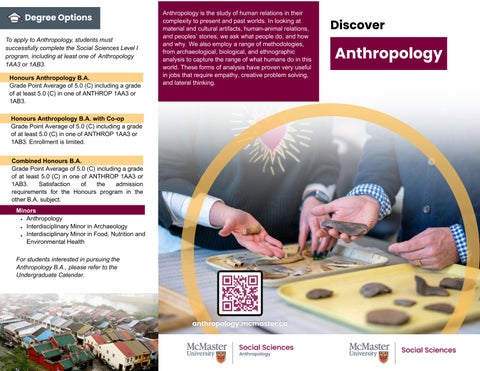
Anthropology is the study of human relations in their complexity to present and past worlds. In looking at material and cultural artifacts, human-animal relations, and peoples’ stories, we ask what people do, and how and why. We also employ a range of methodologies, from archaeological, biological, and ethnographic analysis to capture the range of what humans do in this world. These forms of analysis have proven very useful in jobs that require empathy, creative problem solving, and lateral thinking.
Honours Anthropology B.A. with Co-op Grade Point Average of 5.0 (C) including a grade of at least 5.0 (C) in one of ANTHROP 1AA3 or 1AB3. Enrollment is limited. Combined Honours B.A. Grade Point Average of 5.0 (C) including a grade of at least 5.0 (C) in one of ANTHROP 1AA3 or 1AB3. Satisfaction of the admission requirements for the Honours program in the other B.A. subject. Minors Anthropology Interdisciplinary Minor in Archaeology Interdisciplinary Minor in Food, Nutrition and Environmental Health For students interested in pursuing the Anthropology B.A., please refer to the Undergraduate Calendar.
anthropology.mcmaster.ca
Discover
Anthropology
Level I Courses Both Level I courses introduce anthropology and its sub-disciplines: archaeology, biological, and cultural anthropology. They focus on the big questions anthropologists use to investigate past and present societies. Anthropology 1AA3: Introduction to Anthropology: Sex, Food and Death Issues explored include: sex, gender, food, illness and death. Anthropology 1AB3: Introduction to Anthropology: Race, Religion and Social Justice Topics examined include: identity, race, religion, power, and inequality.
Beyond First Year
Research & Teaching Facilities ArchaeologyTeaching Lab Centre for Integrated Bioarchaeological Research in Health, Diet, Disease and Migration Fisheries Archaeology Research Centre Lab for Interdisciplinary Research on Archaeological Ceramics (LIRAC) McMaster Ancient DNA Centre McMaster Archaeological XRF Lab (MAX lab) McMaster Archaeology Centre for Minimally Invasive and Non-Destructive Science (MACMINDS) McMaster Paleoethnobotanical Research Facility (MPERF) Paleoepidemiology and Demography Lab (PaleoDem Lab) Sustainable Archaeology McMaster The Shelley R. Saunders Biological Anthropology Teaching Lab
Choose from a variety of courses, such as: Aliens, Curses, & Nazis: Archaeology and Hollywood Anthropology and the Business World Archaeology of Sport Bodies Through Time Medical Anthropology Pets and Their People Religion, Magic, and Witchcraft Anthropology of Data and AI Archaeology of Death Ceramic Analysis Forensic Anthropology Matters of Life and Death The Black Death Tourism: Sex, Sun, and Sightseeing Zooarchaeology Anthropology of Zombies and the Undead Critical Global Health Anthropology of Infectious Disease The Secret of the Gift
Careers & Experiential Education Meet with the Social Sciences career advisor to explore career options, review your resume, and find out how to gain experience. Register for SOCSCI 2EL3: Career Preparation in the Social Sciences explore career options, analyze labour market information, and develop job search strategies. Apply for an Undergraduate Student Research Award (USRA) to gain paid research experience working with a faculty member. Many of our courses offer experiential, hands on opportunities in our labs to analyze and learn from artifacts or skeletal material. For example, some courses include labs where students engage directly with ceramic collections, reproduce aspects of ceramic manufacture through hands-on activities
Potential Careers and Fields
“You’ll find that regardless of the result, you’ll learn something new, and even find a community who is there to help you succeed. I found Anthropology, I found such a beautiful community that thinks like me, but also challenges how I think. It cares about me, and I’m safe to do the same thing for them, too” -Eric Hynes (Anthropology ‘26 - Valedictorian)
Human Resources Professional Archaeological Field Technician Educator/Teacher Public Health Foreign Aid Heritage Planning Market or Clinical Research Cultural Resource Manager Museum Curator Public Service Archivist/Librarian