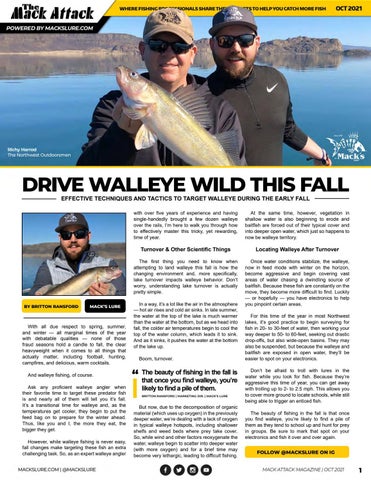
DRIVE WALLEYE WILD THIS FALL EFFECTIVE TECHNIQUES AND TACTICS TO TARGET WALLEYE DURING THE EARLY FALL
BY BRITTON RANSFORD
MACK’S LURE
With all due respect to spring, summer, and winter — all marginal times of the year with debatable qualities — none of those fraud seasons hold a candle to fall, the clear heavyweight when it comes to all things that actually matter, including football, hunting, campfires, and delicious, warm cocktails. And walleye fishing, of course. Ask any proficient walleye angler when their favorite time to target these predator fish is and nearly all of them will tell you it’s fall. It’s a transitional time for walleye and, as the temperatures get cooler, they begin to put the feed bag on to prepare for the winter ahead. Thus, like you and I, the more they eat, the bigger they get. However, while walleye fishing is never easy, fall changes make targeting these fish an extra challenging task. So, as an expert walleye angler
with over five years of experience and having single-handedly brought a few dozen walleye over the rails, I’m here to walk you through how to effectively master this tricky, yet rewarding, time of year.
At the same time, however, vegetation in shallow water is also beginning to erode and baitfish are forced out of their typical cover and into deeper open water, which just so happens to now be walleye territory.
Turnover & Other Scientific Things
Locating Walleye After Turnover
The first thing you need to know when attempting to land walleye this fall is how the changing environment and, more specifically, lake turnover impacts walleye behavior. Don’t worry, understanding lake turnover is actually pretty simple.
Once water conditions stabilize, the walleye, now in feed mode with winter on the horizon, become aggressive and begin covering vast areas of water chasing a dwindling source of baitfish. Because these fish are constantly on the move, they become more difficult to find. Luckily — or hopefully — you have electronics to help you pinpoint certain areas.
In a way, it’s a lot like the air in the atmosphere — hot air rises and cold air sinks. In late summer, the water at the top of the lake is much warmer than the water at the bottom, but as we head into fall, the colder air temperatures begin to cool the top of the water column, which leads it to sink. And as it sinks, it pushes the water at the bottom of the lake up. Boom, turnover.
beauty of fishing in the fall is “ The that once you find walleye, you’re likely to find a pile of them.
BRITTON RANSFORD | MARKETING DIR. | MACK’S LURE
But now, due to the decomposition of organic material (which uses up oxygen) in the previously deeper water, we’re dealing with a lack of oxygen in typical walleye hotspots, including shallower shelfs and weed beds where prey take cover. So, while wind and other factors reoxygenate the water, walleye begin to scatter into deeper water (with more oxygen) and for a brief time may become very lethargic, leading to difficult fishing.
For this time of the year in most Northwest lakes, it’s good practice to begin surveying for fish in 20- to 30-feet of water, then working your way deeper to 50- to 60-feet, seeking out drastic drop-offs, but also wide-open basins. They may also be suspended, but because the walleye and baitfish are exposed in open water, they’ll be easier to spot on your electronics. Don’t be afraid to troll with lures in the water while you look for fish. Because they’re aggressive this time of year, you can get away with trolling up to 2- to 2.5 mph. This allows you to cover more ground to locate schools, while still being able to trigger an enticed fish. The beauty of fishing in the fall is that once you find walleye, you’re likely to find a pile of them as they tend to school up and hunt for prey in groups. Be sure to mark that spot on your electronics and fish it over and over again. FOLLOW @MACKSLURE ON IG
1
Effective Lure Presentations So, you’ve found what looks like walleye — now to get them to bite. There’s a number of ways to trigger a school of walleye this time of year. Early in the fall, bottom bounce with 1- to 3-oz lead bouncers (depending on your depth) in front of spinners and crawler harnesses. Use a longer leader than usual — up to 60-inches — to give your lure as natural of a presentation as possible. This setup works especially well with lures that have some type of buoyancy, such as a Smile Blade® SpinDrift® Walleye, which features a Cha Cha® Pill Float. The silver-blue option, trolled at 1.2- to 1.4-mph, works tremendously well if the lake or reservoir holds an abundance of trout. If your body of water doesn’t hold many trout, try a Wally Pop® Crawler in green-chartreuse. This is another buoyant option with a larger profile that draws fish in from further distances when trolled a bit slower — generally 1- to 1.2 mph. Another go-to early fall presentation is bottom bouncing a Smile Blade® Super Slow Death Rig in a perch pattern with a slightly tighter leader — closer to 48-inches — at 1.2- to 1.4 mph. The walleye have likely been feeding on perch all summer, so it’s a familiar pattern they’ll gravitate towards. Similarly, the Double Whammy® Walleye in gold-black or orange-black will emulate a number of common baitfish in the 2- to 3-inch range.
VIDEO: BOTTOM BOUNCING SET UP
One of the most important parts of bottom bouncing is making sure your rig is at the perfect angle. In this video, Mack’s Lure Pro Staff Nick Harrington highlights how to make sure you’re running as snagless as possible and going to have the highest hooking percentage. For more from Harrington, visit Midwest Lip Rippers online.
THE WASHINGTON OUTDOORS REPORT BY JOHN KRUSE
CONTRIBUTOR
Wally Pop® Crawler
Smile Blade® SpinDrift® Walleye
Smile Blade® Super Slow Death
If the walleye are really stacked up, try to jig them up! Stop your troll and drop a silver-blue or glow white Sonic BaitFish™, attached on the back or the nose, and tipped with bait. Start with the smallest size that will reach your depth (1/6 oz. — 1/2 oz.) and start jigging one crank off the bottom. This is an incredibly effective — and fun! — method.
Keep Experimenting Those are just a few of the techniques and presentations at your disposal to target walleye during this tricky yet, as previously mentioned, rewarding time of year. To hunt a hunter, however, you need to be aggressive and willing to try new tactics. What worked one day may not work the next day, but the fish will tell you what they want — you just have to present them with the right combination of speed, color, size, and technique. Be versatile and quick to change when something’s clearly not working and sooner or later, they be unable to refuse your offering. Best of luck this fall!
ONE MORE FISH CAMP After a 2020 hiatus because of the coronavirus pandemic, it was wonderful to head back to the Peach Beach RV Park in the Columbia River Gorge this week to participate in Ed Iman’s annual Fish Camp. This event has been going on for almost 20 years now and brings together a combination of outdoors media members, fishing guides, tournament anglers, retailers and fishing industry manufacturers who camp, eat, drink, network and fish for up to five days on the Columbia and other rivers in the gorge. This year the focus was on the salmon staging off the mouth of the Deschutes River. One of the guides at Fish Camp, Aaron Peterson with Peterson’s Northwest Guide Service, was dialed into the fishery like no one else and returned with quick limits every day. The other guide boats grinded out Chinook and coho salmon for their anglers along with some bonus sturgeon, the largest one hooked approaching nine-feet in size. The few boats not after salmon targeted
walleye and smallmouth bass near Rufus, Arlington and Irrigon. The smallmouth bit readily and one of those caught weighed an estimated five plus pounds. The walleye, gorged on shad smolt this time of year, were harder to come by but a decent bite for them was found near Irrigon. Attendance at this event was lighter this year than usual. Part of the reason was the ongoing pandemic which kept several past attendees away. The other reason was that manufacturers, who often roll out new products to share with the media during this event, had little product to share and no new products to show off due to the challenges brought on by huge demand from customers and supply chain issues making it a challenge to get products into the marketplace. Despite this and the windy weather that made fishing a challenge several days, the company was good, the temperatures were mild and a good time was had by all in attendance. Odds And Ends The Washington Department of Fish and Wildlife (WDFW) is opening up coho salmon fishing on both the Upper Columbia River from Priest Rapids Dam near Vernita to Wells Dam below Pateros until October 15th. The Icicle River near Leavenworth is also opening for coho on September 18th and will remain open until November 30th. Steelhead runs are not only bad over Bonneville Dam, but disastrous on the Upper Columbia. As of September 13th, only 2240 fish have made it over Rock Island Dam, and an estimated 500 or so of these fish may be heading up the Wenatchee River. That Rock Island Dam Count is about one-third of the ten-year average when it comes to steelhead returns for this time
2
of year. Don’t count on any steelhead angling on the Upper Columbia or its tributaries this fall. On a brighter note, September 25th is Public Lands Day and Washington state as well as federal public lands are open for day use visitation with no fee or pass required. It’s also worth noting both the Washington Department of Natural Resources and WDFW has opened up all lands east of the Cascades to outdoor recreation (including overnight use) due to decreasing wildfire danger though campfire restrictions remain in effect. Last but not least, if you are hiking on our public lands this month consider wearing hot pink or blaze orange. Not only will you make a fashion statement, but you’ll also be visible to hunters who are afield after deer during the High Buck Hunt in the Cascade Mountains which goes on until the 25th or after both bear and grouse where seasons continue well into fall. Accidental shootings have happened before and wearing these visible colors will decrease the likelihood you’ll be involved in one. Thanks to John Kruse, producer and host of America Outdoors Radio and Northwestern Outdoors Radio, for this month’s contribution to the Mack Attack Magazine. To listen to Kruse’s radio shows, click on the links above.
SONIC BAITFISH (SBF)
TIPS & TECHNQUES
VERTICAL JIGGING TO SUSPENDED
KOKANEE & OTHER SPECIES BY PETE ROSKO
CONTRIBUTOR
One of the most difficult presentations in sport fishing is fishing to suspended fish. A line counter on a baitcaster reel is one method of delivering your offering to where the fish are located. Another, is watching the fall of your lure on the screen of your electronic fish locator. Then, at times, it is difficult to see the fall of your jig on the sonar screen to precisely place the lure where the fish are located. In any case, the use of a fish locator is still critical for your success in first locating your target species. Unfortunately, line counters are not available on spinning reels.
PODCAST: PNW TROUT FISHING
On Ep. 31 of the WAO Podcast pres. by Harrod Outdoors and Mack’s Lure, Bobby, Richy and Britton talk all things trout fishing across the Northwest. From streams to lakes and rivers and everything in between.
There is another option for determining depth and that’s with color-metered braided line at 25foot increments. However, I have not been able to locate any line less than 40-lbs. 6- to 10-lb. test would be ideal for kokanee jigging. Then, at times, it is difficult to see the fall of your jig on the sonar screen. Here’s what I do to dramatically increase my cath rate of suspended fish, whether a kokanee or any other species. First, my sonar screen will show me where the kokanee are located in the water column. I only start to fish after I locate the fish marks on my sonar screen. But, it is not consistent in showing me the zig-zag pattern of my Sonic BaitFish™ (SBF) falling in the water column. That’s okay as long as I can see the fish mark on the screen. Secondly, whatever casting or spinning reel I use, I am 99 percent assured that my presentation will be at the same level of that fish mark. That’s because I know how much line comes off every reel that I fish! This is critical in my success with precise vertical jigging that out-fishes any other technique! That’s because I stay “attached” to those fish marks instead of passing through, and beyond, them as in casting or trolling. My line counting method: for kokanee in Lake Sutherland, the 40 foot level (in 80- to 84 feet of water) has held the most kokanee for more than two weeks. As a result, I went to a calm 40-foot deep section of the lake and dropped my SBF straight down to the bottom. My level wind reel moved from one side to the other a total of five times. That represented 8- feet on one complete sideways movement on the level wind. Multiply this 8 by 5 to give you a line count of 40- feet. The spinning reel line count was different. After the SBF was dropped straight down and hit bottom, all slack line was reeled-in with the rod tip almost touching the water’s surface — as with the level wind procedure. Then, I counted each 360-degree turn of the reel handle until the SBF was fully retrieved, almost contacting the rod tip. That amounted to 20 cranks as my small spinning reel retrieved an average of two feet per full single reel handle crank. Now, to precisely release those 20 cranks, to fish my 40 foot “hot spot,” I disengaged my anti-reverse and backcranked (reeled in reverse) 20 times. The level wind technique is quicker, and easier, for me.
Also, there are some spinning reels that do not have an anti-reverse like one of my Shimano Stradic Ci4 reels. The only alternative with that spinning reel is to drop the lure all the way to the bottom, at my 80-foot-deep fishing spot, and forward-retrieve until I get up to the 40-foot level that’s holding the kokanee. That would be about 14 full cranks since one full handle turn retrieves 35-inches of line (40 feet equals 480 inches, divided by 35 inches equals just under 14 full handle turns). The bottom line is that a synchronized line counter reel is the most effective technique in catching suspended fish!
Note: This is precision fishing with superb results as long as the wind is not blowing. The key is keeping your line straight down (vertical jigging) while stationary or slow drifting. This applies to not only kokanee but to all species of suspended fish. The downward flutter of the metal jig is the most effective action in sport fishing to trigger strikes! Again, this is best accomplished with your line straight down, versus being horizontal, because of maximum line control and optimum feel of your lure. Finally, there are two weather-related conditions that are especially negative for kokanee success. They are related to the barometer and constantly shifting winds. Almost always, I can get the fish to bite by drastically down-sizing my lure and slowing down my presentation, whether when casting, trolling or vertical jigging. As always, thank you for subscribing to the monthly issue of the Mack Attack Magazine. — Capt Pete CLICK FOR SONIC BAITFISH TECH GUIDE
3
QUESTION
OF THE MONTH Have a question you want answered? Send your inquiry to media@mackslure.com or to @ MacksLure on Facebook or Instagram and your question may be featured! Q: How can you tune the action of the Double D™ Dodger and Sling Blade™? A: That’s a great question! You must remember that the Double D™ Dodger is best used at slow trolling speeds, which are between 0.8- to 1.6 mph. When using this dodger, you can change the action by shortening your leader or attaching your snap swivel into one of the five holes located on the top of the dodger. This can only happen when you are using a maximum of two rods. The attachments serve as a side planer, which is designed to cover more water, which helps prevent tangles and pushes those lines away from the boat path. If you are long lining from the stern of the boat, try flipping the dodger around and place your swivel in the middle hole of the dodger. This will create extra movement and action.
HOT DEAL : USE CODE PIPX10 The Original Pip’s™ Box allows you to store heftier hooks with longer leader, as well as dropshot rigs, double hook riggings, drift bobbers and tippets. Featuring antireverse and self-lubricating technology, you can now spend more time fishing and less time rigging. SHOP NOW & GET 10% OFF
PHOTO OF THE MONTH Mack’s Lure Pro Staff Jaime Rodriguez of J-Rod Angling shows off yet another fall walleye caught on a Double Whammy® Walleye. Thanks for the image, J-Rod!
Please note that this can only be accomplished with a long line; using the dodger this way when using a downrigger will create line tangles. Using two Double D™ Dodgers with an 11-inch leader between the two will also create added action. When in the water, the dodgers sway opposite of each other, causing the lure that have extra action. When using a Sling Blade™, you can actually bend the dodger to dodge more effectively at slower speeds. Just bend the bottom portion of the dodger to whatever angle works best for the lure for the lure you’re using. If you are trolling at faster speeds, the need to bend the dodger is not needed. As a rule of thumb, the shorter the leader, the more action you’ll get out of the lure.
VIDEO OF THE MONTH Mack’s Lure Pro Staff Mike Roth is joined by President Bob Schmidt at Vernita for some fall salmon fishing on Angler West TV. ScentFlash Paddles & Salmon Tech 3.5.
Download the Mack’s Lure Catalog
Follow Mack’s Lure on Facebook and Instagram and tag us with #MacksLure. Facebook.com/MacksLure @MacksLure To submit your catch, send us an email at media@mackslure.com or tag us on social media using #MacksLure.
4