BOTTOM BOUNCING BASICS
BOTTOM BOUNCING IS A STAPLE IN THE WALLEYE INDUSTRY, AS MACK’S LURE’S NICK HARRINGTON EXPLAINS
BY NICK HARRINGTON
MIDWEST LIP RIPPERS
Bottom bouncers have become a staple of the walleye fishing industry. The reason they are so popular is because they are easy to run, versatile, and just downright catch fish. This setup is so simple, yet can have so many alterations and difference styles of fishing. In this month’s issue of the Mack Attack Magazine, I’m going to discuss the different types of systems we like to run. RODS & REELS I like to use a stouter rod when bottom bouncing. This is because I like to run bigger bouncers and have a firm backbone when I set the hook. I favor a 6’6-7’0 medium-heavy rod with a fast or moderate action. The reason I favor these setups is because I still have a good feel for what is happening with
my line, but I have a firm backbone for setting the hook and fighting a fish.
a mainline and sees the pros and cons to each.
For reels, I favor a larger spool baitcasting reel. Line counters are not critical for bottom bouncing, but if you are fishing with someone that has not bottom bounced much, it helps to make sure that the lines are set at the right depth. As far as line, I favor 8-12 lb. Berkley Fireline. This is because it has no-stretch properties. This allows me to feel every pebble that the bouncer ticks across and also even the slightest bites. It also is strong for reeling in larger fish, especially with the heavy bottom bouncer. I like the crystal color because it is easy to see so you always can tell the angle that your bait is running.
“Mono is less visible for when I am fishing clear water,” Seylar says. “Also, if I am fishing around a lot of snags, when I do get snagged up, it breaks easily. This allows me to spend less time fighting a snag and get re-rigged and back on the fish.”
bouncers are easy “ Bottom to run, versatile and just downright catch fish.
NICK HARRINGTON | PRO STAFF | MACK’S LURE
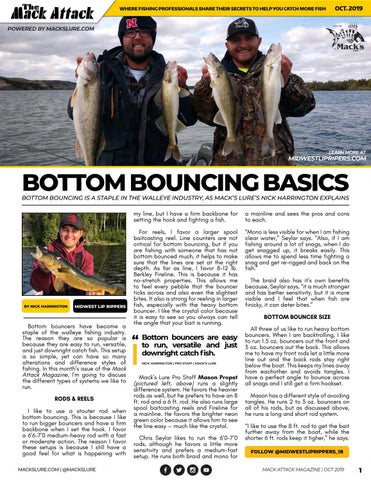
Mack’s Lure Pro Staff Mason Propst (pictured left, above) runs a slightly difference system. He favors the heavier rods as well, but he prefers to have an 8 ft. rod and a 6 ft. rod. He also runs large spool baitcasting reels and Fireline for a mainline. He favors the brighter neon green color because it allows him to see the line easy — much like the crystal. Chris Seylar likes to run the 6’0-7’0 rods, although he favors a little more sensitivity and prefers a medium-fast setup. He runs both braid and mono for
The braid also has it’s own benefits because, Seylar says, “it is much stronger and has better sensitivity, but it is more visible and I feel that when fish are finicky, it can deter bites.” BOTTOM BOUNCER SIZE All three of us like to run heavy bottom bouncers. When I am backtrolling, I like to run 1.5 oz. bouncers out the front and 3 oz. bouncers out the back. This allows me to have my front rods let a little more line out and the back rods stay right below the boat. This keeps my lines away from eachother and avoids tangles. I have a perfect angle to bounce across all snags and I still get a firm hookset. Mason has a different style of avoiding tangles. He runs 2 to 3 oz. bouncers on all of his rods, but as discussed above, he runs a long and short rod system. “I like to use the 8 ft. rod to get the bait further away from the boat, while the shorter 6 ft. rods keep it tigher,” he says. FOLLOW @MIDWESTLIPRIPPERS_18
1
This system allows him to fish the same weight, depending on depth, but still avoid tangling. When he’s fishing shallow, he runs to 2 oz., while deeper he will go up to 3 oz.
VIDEO: BOTTOM BOUNCING SET UP
Chris also prefers 1.5 to 2 oz. bottom bouncers. When he is fishing shallower or in thick cover he goes with the lighter bouncer. This allows it to bounce around easier and it is less likely to be snagged. When he is deeper or fishing a less thick area, he goes with the heavier bouncer. BLADE SELECTION I prefer two types of blades. Early in the season I like to use smaller blades. I occasionally use a size 0 silver Colorado blade, but the majority of damage I do when fishing with a smaller blade is with a Mack’s Lure Smile Blade®. I really like the Smile Blade® 0.8, as these are a nice, compact profile that adds a little flash and vibration to your bait. This makes it attractive, but doesn’t steal the show. I love fishing these blades at slow speeds, but they are also extremely versatile at higher speeds, as well.
How I like to approach the rig early in the season is to have a size #2-#4 Aberdeen or Octopus hook with a single 5 mm. bead. Usually, either the plain setup like that is going to be the top option or simply sliding a Smile Blade® 0.8 onto it will be the ticket (see above). As the season moves on, blades seem to be a bigger factor. Generally, when I will do is just put a different colored blade on. If I have multiple anglers in the boat, I will keep one plain hook out or possibly put out a size #2 Colorado blade. I will generally keep my Smile Blades® out, but as the summer progresses, I will be switching towards size #3 Colorado blades. I really like the metallic colors with these blades. Gold and silver are colors that I feel are pretty universal and baits I often have out when fishing a new body of water or I just do not know what to do. As far as Smile Blade® colors go, my favorites are Pink Silver Tiger, Chartreuse Sparkle, Gold Sparkle and Silver Scale.
One of the most important parts of bottom bouncing is making sure your rig is at the perfect angle. In this video, Mack’s Lure Pro Staff Nick Harrington highlights how to make sure you’re running as snagless as possible and going to have the highest hooking percentage.
Towards fall, I begin the transition to size #3 and #5 Colorado blades. This time of year the bigger blades resemble the bigger prey species and many walleye are going to be chowing on them. The larger baits are also going to give off more flash and vibration and be really appealing, especially in dark and dingy conditions. Many anglers are switching to crankbaits, but the large blades do some tremendous work.
SUBSCRIBE TO NICK’S YOUTUBE
Mason is also a huge believer in Smile Blades®. He also prefers the Smile Blade® 0.8 as he feels that smaller blades are just enough to attract attention to your bait, yet still present naturally. His favorite colors are Purple Scale, Green Silver Tiger, Silver Mirror and Pink Silver Tiger. He also favors using Tru-Turns or Slow Death hooks to get more action out of his nightcrawler. Chris prefers size #2 and #3 Colorado blades. He likes gold blades as well because they have a nice flash and pop when fishing clear water. He also likes Fire Tiger and natural perch colors to emulate the yellow perch that are in the Iowa Great Lakes system. The Colorado blades produce a lot of flash and thump so they can attract fish from a greater distance in the deep, clear bodies of water. Bottom bouncing is a very simple concept. This article outlined the basic setup, but when walleye anglers get their minds to work a simple concept can become very complex. This was all about laying the foundation for the basic bottom bouncing rig. In the next Mack Attack Magazine I will outline the more advanced ccncepts, such as speed, boat control and triggering mechanisms.
2
SONIC BAITFISH™ (SBF)
TIPS & TECHNIQUES
TECH GUIDE
VERTICAL JIGGING TO SUSPENDED KOKANEE BY PETE ROSKO
SBF TECH GUIDE
One of the most difficult presentations in sport fishing is fishing to suspended fish. A line counter on a baitcaster reel is one method of delivering your offering to where the fish are located. Another, is watching the fall of your lure on the screen of your electrontic fish locator. Then, a times, it is difficult to see the fall of your jig on the sonar screen to precisely place the lure where the fish are located. In any case, the use of a fish locator is still critical for your success in first locating your target species.
always, I can get the “ Almost fish to bite by drastically
down-sizing my lure and slowing down my presentation. CAPT. PETE ROSKO | SONIC BAITFISH™ INVENTOR
Unfortunately, line counters are not available on spinning reels. And, counters on baitcaster reels are more expensive and add extra weight to your set-up. There is another option for determining depth and that’s with color-metered braided line at 25 foot increments. However, I have not been able to locate any line less than 40 lbs. Six to ten pound test would be ideal for kokanee jigging. Then, at times, it is difficult to see the fall of your jig on the sonar screen.
Here’s what I do to dramatically increase my catch rate of suspended fish, whether a kokanee or any other species. First, my sonar screen will show me where the kokanee are located in the water column. I only start to fish after I locate the fish marks on my sonar screen.But, it is not consistent in showing me the zigzag pattern of my Sonic BaitFish™ falling in the water column. That’s okay as long as I can see the fish mark on the screen. Secondly, whatever casting or spinning reel I use, I am 99% assured that my presentation will be at the same level of that fish mark. That’s because I know how much line comes off every reel that I fish. This is critical in my success when vertical jigging and out-fishing any other technique! That’s because I stay “attached” to those fish marks instead of passing through, and beyond, them as in casting or trolling. This is my “line counting” method... For kokanee in Lake Sutherland, the 40 foot level (in 80-84 feet of water) has held the most kokanee for more than two weeks. As a result, I went to a calm 40 foot deep section of the lake and dropped my Sonic BaitFish™ straight down to the bottom. My level wind reel moved from one side to the other a total of five times. That represented 8 feet on one complete sideways movement on the level wind. Multiply this 8 by five to give you a line count of 40 feet.
get up to the 40 foot level that’s holding the kokanee. That would be about 14 full cranks since one full handle turn retrieves 35 inches of line (40 feet equals 480 inches; 480 inches divided by 35 inches equals just under 14 full handle turns). Note: This is precision fishing with superb results as long as the wind is not blowing. The key is keeping your line straight down (vertical jigging) while stationary or slow drifting. Finally, there are two weather-related conditions that are especially negative for kokanee success. They are related to the barometer and constantly shifting winds. Almost always, I can get the fish to bite by drastically down-sizing my lure and slowing down my presentation, whether when casting or vertical jigging.
The accompanying photo shows a 1/16 Sonic BaitFish™ in the jaw of a kokanee caught on the first cast after downsizing.
The spinning reel line count was different. After the Sonic BaitFish™ was dropped straight down and hit bottom, all slack line was reeled-in with the rod tip almost touching the water’s surface... as with the level wind procedure. Then, I counted each 360 degree turn of the reel handle until the Sonic BaitFish™ was fully retrieved, almost contacting the rod tip. That amounted to 20 cranks as my small spinning reel retrieved an average of two feet per a full single reel handle crank. Now, to precisely release those 20 cranks, to fish my 40 foot “hot spot”, I disengaged my anti-reverse and backcranked (reeled in reverse) 20 times. The level wind technique is quicker, and easier, for me. Also, there are some spinning reels that do not have an antireverse like one of my Shimano Stradic Ci4 reels. The only alternative with that spinning reel is to drop the lure all the way to the bottom, at my 80 foot- deep fishing spot, and forward-retrieve until I
SHOP MACK’S LURE UV SCENTS
NEW DOUBLE D™ 5.8 3
QUESTION
HOT DEAL OF THE MONTH
OF THE MONTH Have a questions you want answered? Send your inquiry to us and yours may be featured! Simply send an email to media@mackslure.com or reach out to us on Facebook, Instagram or YouTube. Just search @MacksLure and you’ll find us!
PHOTO OF THE MONTH Mack’s Lure Pro Staff Mark Harder’s son, Caleb, shows off a gorgeous Tiger Trout caught in Alberta. They don’t get much bigger or more colorful up there. Nice fish!
Q: I recently purchased a ScentFlash™ Paddle Flasher and have had a ton of success with it. However, it keeps opening up after hooking up. Is this normal? A: This is a great question. And we’re glad you’ve been able to find success with the new ScentFlash™ UV Paddle Flasher. While it’s not designed to open up at all, we’ve found that sometimes it will. Some remedies you can use to fix this are: using a rubber band to hold the lid shut. There are rivets in the flasher that are designed for bands. We’ve also been getting a ton of great feedback from anglers who are using a release on their Paddle Flashers. One we recommend is the GDF Release from GoodDayFishing.com. When a fish hooks up, you flasher releases, removing the drag when pulling the fish in and ensuring that your Paddle will not open up, risking the loss of your removable paddle fin.
@HARDEROUTDOORSJR
VIDEO OF THE MONTH Mack’s Lure’s Bobby Loomis and Bob Schmidt head out to Potholes Reservoir and the Columbia River to chase spring walleye with Mack’s Lure Pro Staffer Ted Beach.
Quick tip: check out the movement of the ScentFlash™ UV Paddle Flasher with the fin removed. It gives off an incredible dodger action that has been slaying the Coho.
Follow Mack’s Lure on Facebook and Instagram and tag us with #MacksLure. Facebook.com/MacksLure @macks_lure To submit your catch, send us an email at media@mackslure.com or tag us on social media using #MacksLure.
4