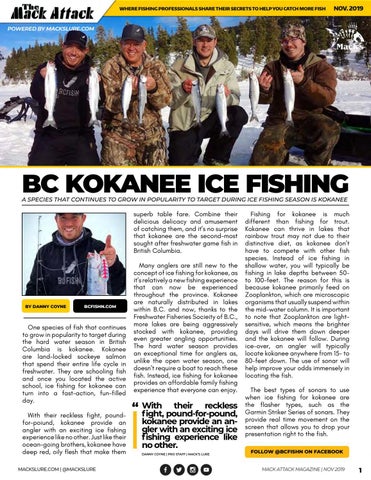
BC KOKANEE ICE FISHING A SPECIES THAT CONTINUES TO GROW IN POPULARITY TO TARGET DURING ICE FISHING SEASON IS KOKANEE
superb table fare. Combine their delicious delicacy and amusement of catching them, and it’s no surprise that kokanee are the second-most sought after freshwater game fish in British Columbia.
BY DANNY COYNE
BCFISHN.COM
One species of fish that continues to grow in popularity to target during the hard water season in British Columbia is kokanee. Kokanee are land-locked sockeye salmon that spend their entire life cycle in freshwater. They are schooling fish and once you located the active school, ice fishing for kokanee can turn into a fast-action, fun-filled day. With their reckless fight, poundfor-poiund, kokanee provide an angler with an exciting ice fishing experience like no other. Just like their ocean-going brothers, kokanee have deep red, oily flesh that make them
Many anglers are still new to the concept of ice fishing for kokanee, as it’s relatively a new fishing experience that can now be experienced throughout the province. Kokanee are naturally distributed in lakes within B.C. and now, thanks to the Freshwater Fisheries Socieity of B.C., more lakes are being aggressively stocked with kokanee, providing even greater angling opportunities. The hard water season provides an exceptional time for anglers as, unlike the open water season, one doesn’t require a boat to reach these fish. Instead, ice fishing for kokanee provides an affordable family fishing experience that everyone can enjoy.
their reckless “ With fight, pound-for-pound,
kokanee provide an angler with an exciting ice fishing experience like no other. DANNY COYNE | PRO STAFF | MACK’S LURE
Fishing for kokanee is much different than fishing for trout. Kokanee can thrive in lakes that rainbow trout may not due to their distinctive diet, as kokanee don’t have to compete with other fish species. Instead of ice fishing in shallow water, you will typically be fishing in lake depths between 50to 100-feet. The reason for this is because kokanee primarily feed on Zooplankton, which are microscopic organisms that usually suspend within the mid-water column. It is important to note that Zooplankton are lightsensitive, which means the brighter days will drive them down deeper and the kokanee will follow. During ice-over, an angler will typically locate kokanee anywhere from 15- to 80-feet down. The use of sonar will help improve your odds immensely in locating the fish. The best types of sonars to use when ice fishing for kokanee are the flasher types, such as the Garmin Striker Series of sonars. They provide real time movement on the screen that allows you to drop your presentation right to the fish. FOLLOW @BCFISHN ON FACEBOOK
1
If you do not have access to a fish finder, then start fishing at 10-feet and work your way down. When fishing with other anglers in your group, work as a team. Have one person start at 10-feet and the other at 15-feet, then progress deeper until you find the fish. Having a line counter on your reel will help recognize the depths in which you are fishing. If your reel doesn’t have a line counter, simply count out the amount of line in 1-foot pulls that you are using. When you discover the fish, you will want to repeat the same depth. A good tip is to add a threaded bobber stop every 20-feet on your fishing line so you can quickly mark how much line you let out. The schools of kokanee will cruise throughout the lake, but will tend to stay in areas that provide plenty of food. Even though there is ice cover, lakes still have current in them, which can push the Zooplankton to a specific end. Points and ledges that reach out into the lake can also provide good forage areas for kokanee, as the plankton will be pushed up against these zones. When approaching a new body of water, simply look around for other signs of anglers — the locals tend to find the best producing areas for kokanee and they don’t change much throughout the year.
One of the great benefits of targeting kokanee during the hard water season is the extended season. Due to these fish residing in deeper areas of the lake, they don’t become as deprived of dissolved oxygen as other fish species. Later in
NORTHWEST OUTDOORSMEN: ICE COLD KOKANEE
The Cariboo Region in B.C. is known as the Fishing Highway. Numerous lakes are found throughout this area making it a fishing destination at all times of the year. Friends Mark Roseboom and Danny Coyne invited the guys to hunt for trophy Kokanee. Winter’s grip is tight in the Cariboo.
the ice fishing season, such as midFebruary, the fish are not as lethargic and willing to strike a well-presented lure. The most productive way to catch kokanee through the ice is by jigging. These little critters are attracted to flash and lots of it! With this in mind, jigging techniques consists of using 4- to 6-inch attractors, such as the Mack’s Lure Sling Blade™. Run a 6-pound leader between 14- and 16-inches from the Sling Blade™ to your lure. Having a variety of colors of attractors will increase your odds immensely throughout the day. UV Pink, Silver, Glow and Gold or Copper Sling Blades™ tend to be the best-producing colors. The technique in which you want to jig is to jig up and down, slowly from between 6- to 20-inch pulls — just enough to get the flasher fluttering to attract these curious kokanee. When there are no fish around, make longer, swift jigs to get the attractor to reflect light to help attract the fish from afar. Once the school of kokanee move in, you’ll want to shorten up the amount in which you are moving the lure. Not only will the flash bring in the fish, but also the attractor will tranfer erratic action to your lure that will encourage the kokanee to strike. The key is to always
WATCH THE NWO ON YOUTUBE
keep moving your presentation as kokanee will strike very subtly — it’s the constant jigging that will set the hook before you even know you have one on. The hook can consist of a plan hook or small jigs. Mack’s Lure’s Glo Hooks® in red and chartreuse, hands down, produce the best results. The added glow appearance aids the kokanee to key in on the lure and encourages them to strike. If you are using a regular hook, choosing colors such as chartreuse or red will sometimes help entice the bite. If the hook is tangling with the flasher, add a small split shot weight to the middle of the leader. Some anglers prefer to use small spoons or jigs, such as the Mack’s Lure Sonic BaitFish™ or the Hum Dinger® spoon. The small jigs and spoons provide that extra bit of action that invites the kokanee to strike. It is best to try multiple presentations until you find a pattern that is working. What is working one day doesn’t necessarily mean it’s going to work the next day. No matter what lure you are using, it is best to tip the hook with some sort of bait. Popular baits that work great for kokanee include pink maggots 2
(live or synthetic), krill, shrimp, or cured and dyed white shoepeg corn. Take your presentation to the next level by adding Mack’s Lure UV Bait Scents such as Krill, Shrimp or Trout and Kokanee Magic, as it will attract fish from afar and get them to strike on the slowest days. It is possible to “still fish” for kokanee, which involved suspending bait with no movement. When using this method, scent and bait are a must or the fish will not strike. Be sure to hold the rod in your hand and not resort to a rod holder — you will need to set the hook the moment that kokanee bites. The use of bobbers is not recommended, as the bite is so light that it usually will not pull it down. The most effective way to identify bites is to hold the line between your fingers. Still fishing can be effective when the fish are somewhat less-active and not willing to chase your jigging presentation. The bait needs to be directly in front directly in front of the kokanee, as most of the time they won’t swim upwards to strike a suspended still presentation.
and Stump Lake (Region 3); Moyie Lake and Monroe Lake (Region 3); Bridge Lake, Deka Lake, Chimney Lake Timothy, 10 Mile Lake (Region 5); Alleyne Lake, Yellow Lake and Otter Lake (Region 8). Kokanee are fragile fish compared to rainbow trout. They require a wellbalanced water system of numerous contributing factors to survive. They do not handle catch-and-release well and their mortality rate is high, even when handled and relased with extra care and attention. Releasing the fish while still in the water is the best way to help their survival rate when not being selected for harvest. The FFSBC does stock the lakes with kokanee as a put-and-take fishery, which means they are there for harvesting. It is good etiquette to limit fishing for kokanee to the casual appetite for table fare and not just to fill a freezer. It is always recommended to check the fishing regulations before heading out fishing, as many water bodies in B.C. have specific ice fishing regulations.
TIPS & TECHNIQUES
SELECTING THE APPROPRIATE
SONIC BAITFISH™ FINISH BY PETE ROSKO
SBF TECH GUIDE
The three basic qualities, of a consistently productive metal jig, are flutter, vibration and finish. Finishes include flash (caused by the sun’s reflection off silver, or gold, metal surfaces), fluorescence (an ultraviolet glow paint; functions only in the presence of light) and phosphorescence (an ultraviolet, glow-in-the-dark paint; functions after light is removed). Of these three basic jig qualities, the finish is the only variable that may change continuously, according to light and water conditions. Across the country, the following SBF finishes have been personal consistent producers in fresh and salt water:
The fishing rod type isn’t as important as the presentation, however a softer rod will help you recognize the subtle strikes and land more kokanee, as they have soft mouths. A small, 5-foot casting rod or an ice fishing rod is adequate — it’s really up to you and what you have within your fishing arsenal. Since kokanee require high levels of oxygen, you will mainly find these land-locked salmon in midto large lakes around the province with kokanee and triploid kokanee. Triploid fish do not reproduce, which means triploid kokanee put all their energy into feeding and growing. It is not unheard of for triploid kokanee to sometimes reach over 3-pounds. To name only a few popular lakes in British Columbia that have been stocked with kokanee and offer good ice fishing include: Monte Lake
SONIC BAITFISH™ (SBF)
GOLD SBF FINISH
SHOP FOR ICE RIG VALUE PACKS
Effective for tea-stained, murky, water and clear or off-colored trout rivers. #1 finish for Gulf of Mexico snapper, redfish, grouper and cobia. 3
SILVER BLUE SBF FINISH Clear, sunny water. Superb flash and natural coloration of a live bait fish. Killer for chinook & coho salmon and most other fresh, and salt, water species — as long as the water is clear and sun reflects off its surface. SILVER SBF FINISH Clear, sunny water. Secondary choice to silver-blue. Deadly for Spanish & king mackerel. One of the largest walleyes ever caught through the ice in Lake Erie (14 lbs by 12 year old Will Tibbels, March 2015) was on a 1/3 oz silver SBF attached to the top of the back.
the smallest size SBF to effectively reach my target. Smaller lures fall slower and remain in the strike zone longer. As always, I hope these tips result in more strikes on your future fishing outings. Thank you for being a subscriber to the Mack Attack.
GARY’S FISHING CORNER
GLOW ORANGE SBF FINISH The No. 1 finish for kokanee fishing. FIRE TIGER SBF FINISH
NOVEMBER TROUT IN NORCAL
Most effective in fresh water with yellow perch populations. Killer for mangrove snapper in the Gulf of Mexico.
BY GARY MIRALLES
GLOW WHITE SBF FINISH Especially effective during low light periods and dark/deeper water. GLOW CHARTREUSE SBF FINISH If I was forced to pick only a single finish to fish the world it would be glow chartreuse. Whether salmon fishing in the Pacific NW, walleye jigging in Lake Erie/Columbia River, multi-species jigging in the Gulf of Mexico or casting for largemouth bass across the country, this UV glow finish catches the eye of fish and triggers strikes. Note: My finish selections work whether casting, jigging or trolling. For casting to shallow water trout and largemouth bass, I prefer the 1/10 and 1/6 oz SBF. For salmon, and other larger fish, I love casting the 1/4 and 1/3 oz sizes. Basically, when fish are suspended near surface, I cast
Often, I’m asked, ‘What are your favorite lakes to fish throughout different seasons?’ Of course, Shasta Lake often comes up as my favorite — I guess that’s why I lived there for 40 years of my life. That being said, I do also enjoy many other great fisheries located throughout Northern California. With November now upon us, Eagle Lake is a great fishery for this time of year. This 22,000 acre lake sits at 5,000 feet of elevation and about 20 miles north os Susanville, Calif., in Lassen County. Eagle Lake is relatively shallow, reaching maybe 60-feet at its deepest point. The fish hold in the south end of the lake in the summer months, but migrate north into the shallow water bays when the colder temperatures set in. November is my favorite month to fish this beautiful and peaceful lake. I primarily fish north of the little town of Spalding in areas called Halfmoon Bay, Bucks Bay, Troxel Bay and the North Basin during the
fall months. The shoreline in most of these areas are covered with cattails or tules, which provide good cover for hungry trout as they feed on the abundant populations of tui chub, the primary food source on Eagle Lake. It’s important to keep in mind, however, that the water in these areas is no more than 12-feet deep, so top-lining is the only method used. The Cripplure™, Hum Dinger® and Pee Wee™ Wiggle Hoochie™ are the best lures for these areas, as you’re able to fish them right on, or just below, the surface. Typically, I will spread out four rods out the back: a 1/4 oz. Cripplure™ about 100-feet behind the boat, another Cripplure™ at 150-feet, a Hum Dinger® at 200-feet, and a Pee Wee™ Wiggle Hoochie™ with a small split shot 3-feet in front of the lure out the back. Another good setup is a set of Mack’s Lure Flash Lite® Trolls or Troll Lite® Flashers and a Wedding Ring® Classic spinner tipped with a nightcrawler. For best reults, I usually troll just off the edge of the tules. I have even stopped the boat just off the tules and casted a Cripplure™ into areas inside the vegetation with great success. The trout in this lake often weigh 2- to 4-pounds with an occasional catch over 6-pounds. My favorite Hum Dinger® and Cripplure™ colors to use on Eagle Lake include: Brass Crushed Fire, Brass Prism, Brass Red Prism, Brass Crushed Midnight, Red Gold Sand, and Black Gold Sand. When using the Pee Wee™ Wiggle Hoochie™, look for the pink or orange and pair with gold Flash Lite® Trolls or Troll Lite® Flasher. At such a high elevation, the weather is cold this time of year, so be prepared and always check road conditions. Best of luck throughout the month! 4
QUESTION
HOT DEAL | VALID THROUGH NOV. 15
OF THE MONTH Have a questions you want answered? Send your inquiry to us and yours may be featured! Simply send an email to media@mackslure.com or reach out to us on Facebook, Instagram or YouTube. Just search @MacksLure and you’ll find us!
Q: I’m looking to get out on the water for some fall walleye. What gear do you recommend this time of year?
PHOTO OF THE MONTH Check out this photo of a gorgeous walleye caught on Potholes Reservoir two weeks ago with Mack’s Lure Guide Staff Shelby Ross. Smile Blade® Super Slow Death Rig.
A: This time of the year is a really good time to be out walleye fishing, as they’re going to be on the “bite” very soon. It’s starting to get cold and a lot of the plankton and weed growth is starting to die off, which is where all of your food base is. Thus, the food base will start moving to other cover and spreading out rather than being kegged up in the weeds. The walleye will still be around these weed lines, but will be moving much more than usual while also being more aggressive, eating anything they can find. Therefore, we would recommend trolling any of our larger profile products, such as the Double Whammy® Walleye, Smile Blade® Super Slow Death Rig and Wally Pop® Crawler. The larger the profile, the better this time of year.
VIDEO OF THE MONTH Mack’s Lure’s Mike Hall, Robin Shindelar and Bobby Shindelar target worl-class perch through the Cascade Lake ice using Sonic BaitFish™ in this episode of Angler West.
You can also try to throw a Sonic BaitFish™ at the edges of the weed lines once you’ve found the fish and vertically jig. Best of luck! .
Facebook.com/MacksLure @macks_lure
To submit your catch, send us an email at media@mackslure.com or tag us on social media using #MacksLure.
5