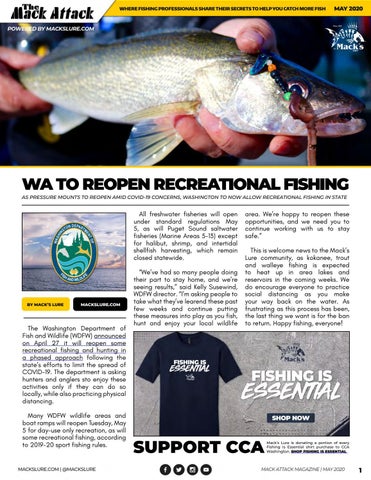
WA TO REOPEN RECREATIONAL FISHING AS PRESSURE MOUNTS TO REOPEN AMID COVID-19 CONCERNS, WASHINGTON TO NOW ALLOW RECREATIONAL FISHING IN STATE
All freshwater fisheries will open under standard regulations May 5, as will Puget Sound saltwater fisheries (Marine Areas 5-13) except for halibut, shrimp, and intertidal shellfish harvesting, which remain closed statewide.
BY MACK’S LURE
MACKSLURE.COM
The Washington Department of Fish and Wildlife (WDFW) announced on April 27 it will reopen some recreational fishing and hunting in a phased approach following the state’s efforts to limit the spread of COVID-19. The department is asking hunters and anglers sto enjoy these activities only if they can do so locally, while also practicing physical distancing. Many WDFW wildlife areas and boat ramps will reopen Tuesday, May 5 for day-use only recreation, as will some recreational fishing, according to 2019-20 sport fishing rules.
“We’ve had so many people doing their part to stay home, and we’re seeing results,” said Kelly Susewind, WDFW director. “I’m asking people to take what they’ve learend these past few weeks and continue putting these measures into play as you fish, hunt and enjoy your local wildlife
area. We’re happy to reopen these opportunities, and we need you to continue working with us to stay safe.” This is welcome news to the Mack’s Lure community, as kokanee, trout and walleye fishing is expected to heat up in area lakes and reservoirs in the coming weeks. We do encourage everyone to practice social distancing as you make your way back on the water. As frustrating as this process has been, the last thing we want is for the ban to return. Happy fishing, everyone!
SUPPORT CCA
Mack’s Lure is donating a portion of every Fishing Is Essential shirt purchase to CCA Washington. SHOP FISHING IS ESSENTIAL
1
MACK’S MESSAGE
BY MACK’S LURE
MACKSLURE.COM
We, at Mack’s Lure, want to take a minute to thank all of our loyal customers for sticking with us during these uncertain times. We have been humbled by your support and want to let you know that we’re doing everything we can to continue providing the products and service you’ve come to expect for over 50 years. As we slowly inch towards a return to normal, we have some exciting events, both physical and virtual, in the works. Over the next few weeks, Mack’s Lure and its Pro Staff will be producing LIVE virtual seminars on Facebook and YouTube, covering kokanee, trout and walleye tips and tactics. Stay tuned for updates on these seminars as they are planned. Mack’s Lure has also partnered with Fish Hunt Northwest to provide a Kokanee & Walleye Roundup on Banks Lake and Lake Roosvelt, June 4-6. This free gathering is open to the public and the only cost to you is your lodging, food and transportation. We’ll have Pro Staff seminars, raffles and plenty of fishing throughout the weekend. For more information, visit bit.ly/RooseveltRoundup. Stay tuned to our Facebook and Instagram for more information. If you have questions, please email media@mackslure.com. Thanks!
WATCH
Mack’s Lure President Bob Schmidt joins Pro Staffer Shelby Ross of Ross Outdoor Adventures for a summer day on Potholes Reservoir with Angler West TV. Plenty of good tips on catching these summe walleye, including rigging tips and more.
Mack’s Lure Pro Staff Ted Beach last year, a professional walleye angler whose knowledge compares to that of an encyclopedia. When Ted talks about fishing, people listen. He gives various seminars throughout Washington each year and loves to teach how to fish for walleye - and there is an art to fishing this species of fish.
LOWER COLUMBIA WALLEYE FISHING BY LANCE MERZ
MACKSLURE.COM
Walleye fishing on the Columbia River is a destination hot spot for anglers who seek this predatory fish. In fact, most walleye anglers will tell you that if you can catch a walleye, you can catch just about any species of fish. Over the past few years, Departments of Fish and Wildlife in Washington and Oregon have lifted limits while fishing the Lower Colubia for these fish. Studies are showing that walleye are eating the salmon and steelhead smolts and they want to eliminate the species altogether. Only one rod is authorized per angler, but there is plenty of fish to be had for all. I had the opportunity to fish with
We launched in an area of the Lower Columbia, just below McNary Dam, in a place called Crowe Butte. We were fishing in an attempt to catch some fish for one of our TV partners, Northwest Fishing Reports (NWFR). Due to the harsh winter that was felt by all, the current of the river was moving quite fast. Instead of moving into the main current, Ted sought his attention to areas of the river where current wasn’t as swift. Normally, these areas are closer to the shore and range in depth of 5- to 25-feet. We were trolling with bottom walkers with a 5- to 6-foot leader, primarily using Double Whammy Walleye and Smile Blade Super Slow Death rigs tipped with nightcrawlers. It wasn’t long after we started trolling that the first fish of the day came into the boat - a 16-inch walleye that knocked the funk off. A slow troll downstream revealed a few more fish in the live well - this was going to be a good day! 2
There are parts of the Columbia River that can be very intimidating and if you’ve never been on that particular area of the river, I’d recommend going out with a guide who knows the water. There are parts where channels are very shallow, which can take out a lower unit very easily. There are even areas of the middle of the river that can be as shallow as six inches. Ted and I fished throughout the day - a fish here, a fish there. The fishing was consistent, but it wasn’t light out, for sure. The water temperature for walleye was still a bit chilly - about 57 degrees - and the clarity was the color of chocolate milk. Then, the wind picked up. It is imperative that if you’re operating a boat on the Columbia River, that you are aware of the weather conditions at the time you are going to fish. Without warning, the chop on the water can produce 5- to 6-foot swells and without enough knoweldge of boat operations, it can be catastrophic. Since the wind was so severe on the main channel, Ted decided to tuck into a slough, which protected us from the wind. Not only did we start to catch walleye, but we also began catching smallmouth bass and perch, as well. Since walleye are a predatory fish, catching these other species was a good sign.
Ted call “The Plymouth Slough,” a branch of the Columbia River, just off the main channel, which, if needed, could protect us from the gusts that were coming later in the day. The fishing was consistent and, again, we were all using Double Whammy Walleye crawler harnesses and Smile Blade Super Slow Death Rigs. The hot Smile Blade on the day, however, was the UV Glo Burst 1.5, which produces a tremendous amount of flash and attraction, even in the murkiest of waters. We pushed the limits and ecided to then fish just below the McNary Dam. There was only one guide boat on the water and the preferred method was to troll up to the border, a line just below the dam where no one is allowed, and drifted down. All but one chute was open at the dam and the water was swift, to say the least. Even without the wind, the swells were at 5- to 6-feet. A few more walleye were caught in this area before the wind picked up, which forced us back down to the slough, producing more fish - this time in the rain. In all, 40 fish were caught in a two day period. Not bad. Ted is an excellent teacher. I learned a different way to rig up the walleye rod and even learned a new way to thread a worm on a
hook. What i learned most fro mTed, however, was that preparation is essential when fishing for walleye. As with any other fishery, having the line in the water longer will eventually lead to more fish. Ted’s boat was filled with additional tackle and riggings that made it very easy to slide off each lure and try different color combinations. That same week, Mack’s Lure’s Bob Loomis and Richy Harrod, owner of Harrod Outdoors, which produces The Northwest Outdoorsmen, took their shot at fishing the Lower Columbia, as well. They fished in an area of the Columbia River adjacent to Biggs Junction, Ore., in a place called “Peach Beach.” Trolling was their preferred method that day, just off the main channel using Wally Pop Crawlers, as well as Double Whammy Walleye and Smile Blade Super Slow Death Rigs, which, of course, we had success with earlier in the week. Although there are no limits on parts of the Lower Columbia River, it doesn’t mean that all fish have to be caught. I have seen firsthand where anglers will go out and catch in excess of 100 fish or more in one day. In my opinion, catch what you’re going to eat. Set a limit for your boat, which will allow other anglers the ability to catch fish, as well.My
The next day, we decided to fish in another area of the river, adjacent to the town of Plymouth, Wash. Ted made this decision because the forecast was calling for wind gusts of up to 22 mph that day, as well as rain. We met up with the NWFR crew and began to film the show. Mike Carey, owner of NWFR, jumped in the boat with Ted and I and his crew started fishing in another boat. We launched and the conditions were perfect - calm water and no rain. We decided to take advantage of the early morning by fishing what
WATCH
Mack’s Lure’s Lance Merz joins Northwest Fishing Reports and Mack’s Lure Pro Staff Ted Beach for a day fishing on the lower Columbia River for walleye at Crowe Butte and The Plymouth Slough.
3
SONIC BAITFISH™ TIPS & TECHNIQUES
MAXIMIZING YOUR TECHNIQUE WHEN HORIZONTAL JIGGING BY PETE ROSKO
SBF TECH GUIDE
My greatest satisfaction in sport fishing is in seeing the joy on the face of a successful angler. These are my time-proven tips in dramatically increasing you catches when horizontally-jigging a Sonic BaitFish (SBF). Basically, horizontal jigging is done best when you know exactly where your lure is in relation to bottom structure. Once the angler becomes proficient with this technique, no other technique will be so effective. TECHNIQUE 1) Always fish with braided line. The lighter, the better. Braided line is superior to monofilament line in the increased sensitivity of detecting light strikes and feeling your lure being jigged against structure. Attach 2- to 3-feet of fluorocarbon leader to your main line with a double uni-knot or a knot of your choice. 2) Rods. As with braided line, choose light and strong. A 6-foot “mag-light” G. Loomis spinning rod is an excellent choice. The lighter the rod, the better the sensitivity for feeling your lure and bottom. The rod action should be no less than medium with a “fast action” taper in the 1/3rd end of the rod. Spinning rods are superior for this technique.
When jig-retreiving, fish with a half turn of the reel between each 6to 12-inch rod lift. Do not jig with a whippy rod and hard jerking. The SBF is a finesse jig that requires very little rod movement to bring it to life. Hard jigging can spook fish. Finesse jigging attracts and triggers strikes. 3) Always use the lightest lure to effectively reach your target. It is critical to feel bottom with the lightest SBF so it can flutter and glide through the structure. Heavier lures will more easily snag when jigged through structure. in calm weather, a 1/10 oz. SBF can be fished in depths down to 15- to 20-feet. 4) Always use a single hook, attached to the tail, with the line/snap attached to the nose. Because of its versatility, the line/ hook attachments can be reversed on the SBF. A single hook snags far less than double and treble hooks. A siwash-type hook, with a deep throat and wide bend, is best for increased hook-ups.
leads to success. This technique is without equal, especially on calm days, from the shoreline or in a boat. Calm days permit the angler to methodically, and throroughly, finesse-jig the SBF in structure with maximum feel. This technique is equally effective in both fresh and saltwater. The SBF is so succsessful because of its deadly injured baitfish actions, which include darting, flashing, fluttering, fliding and swimming. Its hydrosonic vibration also makes it effective at night, especially when jigging with the Glow White finish. Horizontal jigging is just one of many different effective techniques engineered into the versatile Sonic BaitFish.
5) Always try to cast directly downwind, or upwind, to maximize sensitivity with a tight line. Avoiding a bow in your line dramatically increases bite detection and the feel of your lure being worked against eh bottom. This is critical. 6) During periods of mid-day bright sun, dead-calm wind, abnormally hot or cold weather and weatherrelated fronts, most fish descend and bury themselves in deeper bottom structure. It is critical to swim-jig the SBF through the structure and not above it. From shoreline, locate deeper holes by timing how long it takes for your lure to reach the bottom. After casting, timing starts once your lure hits the water’s surface. Keep your line taut. Once your tight line goes slack, the lure has reached the bottom. SUMMARY As with anything in life, knoweldge 4
GUEST COMMENTARY
TROLLING TIP: ALTER YOUR SPEEDS BY DANNY COYNE
BCFISHN.COM
Most anglers are aware that paying attention to trolling speeds is critical in acheiving a successful day of fishing. If we troll too slow, some of the gear we use won’t work correctly. And if we troll too fast, our gear can actually repel fish rather than attract them. There are numerous factors to take into consideration when selecting your trolling speeds, such as the lure you’re using, the species of fish you’re targeting and the time of the year, to name a few. The one trolling technique that remains consistent when targeting predator fish, such as rainbow and lake trout, is not to troll the same speed for the entire time in which you’re fishing. We hear and read all the time that precise trolling speeds can be ideal, however this doesn’t mean that you only troll that one speed consistently. Predator fish like to chase their prey! When a bait fish is trying to escape a predator, it doesn’t swim exactly at one rate, but rather they make quick bursts through the water. Think of castinga spoon or a crankbait and how we retrieve it. We don’t just keep reeling thelure in at one speed - we jerk the line, speed our retrieve up and down to create more action to the lure. The same idea applies to trolling.
Many anglers experiencevery good results when using planer boards and there’s a reason why - when the planer board surges in and out of the water with the waves, it transfers erratic burst-like action to the lure, which encourages a striking reaction from the trout. Introduce this trolling technique regardless if you are long lining or fishing off a downrigger. Find a consistent speed that is making your lures work the most effectively. Then, every couple of minutes, adjust your throttle to mimic a bait fish bursting through the water trying to escape from a predator. When practicing this method, be sure to select lures that mimic a bait fish, such as plugs, spoons, Wiggle Hoochies and a variety of bucktail flies. I can guarantee you that this will increase your hook-up ratio and put more fish in your net.
WATCH THIS: FLAMING GORGE TROPHY TROUT
Learn effective trout fishing techniques from Mack’s Lure Pro Staff Mike Hall and Melissa Nokes on Flaming Gorge (Wyo.) on this episode of Angler West TV. This highly instructional episode also features tips on cutthroat, lake trout and brown trout.
5
QUESTION
HOT DEAL | USE CODE: ROCK20
OF THE MONTH Have a questions you want answered? Send your inquiry to us and yours may be featured! Simply send an email to media@mackslure.com or reach out to us on Facebook, Instagram or YouTube. Just search @MacksLure and you’ll find us!
Q: How does the Ultra Release work with the Shuttle Hawk? A: Common question! The Ultra Release is an ultra-light release with a tension screw adjustment and has proven itself not only as a great release, but is ideal for stacking multiple lines on one downrigger with the Shuttle Hawk.
PHOTO OF THE MONTH Mack’s Lure Pro Staff Joseph McCarl and Jennifer Baumann landed this gorgeous springer on a Mack’s Lure ScentFlash UV Paddle Flasher & Smile Blade spinner.
To attach the line to the the release, you have to think of the back of the release as a temporary extra hand. Make several loops in the line, then use the edge of the back of the release to create leverage in the line, then pull and snap into place. If the line does not pop in with leverage on the line, ensure that the adjustable screw matches the diameter of your line and how easily you want it to release. Once you’ve established that, the relesae will let go at the exact same pressure every time. If the screw is too tight, you will never be able to snap the lin into place. For more information, click here to view an instructional video.
.
VIDEO OF THE MONTH Check our this awesome video from Richy Harrod of the Northwest Outdoorsmen. He depicts the relentless pursuit of kokanee throughout every season of the year.
Facebook.com/MacksLure @macks_lure
To submit your catch, send us an email at media@mackslure.com or tag us on social media using #MacksLure.
6