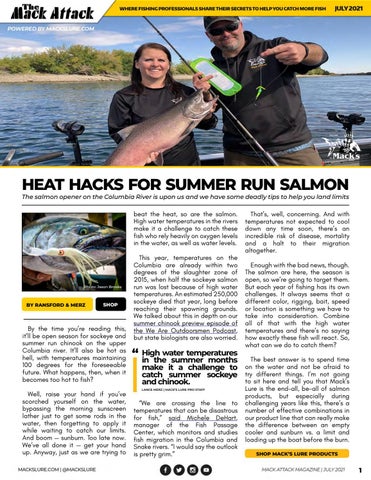
HEAT HACKS FOR SUMMER RUN SALMON The salmon opener on the Columbia River is upon us and we have some deadly tips to help you land limits
beat the heat, so are the salmon. High water temperatures in the rivers make it a challenge to catch these fish who rely heavily on oxygen levels in the water, as well as water levels.
Photo: Jason Brooks
BY RANSFORD & MERZ
SHOP
By the time you’re reading this, it’ll be open season for sockeye and summer run chinook on the upper Columbia river. It’ll also be hot as hell, with temperatures maintaining 100 degrees for the foreseeable future. What happens, then, when it becomes too hot to fish? Well, raise your hand if you’ve scorched yourself on the water, bypassing the morning sunscreen lather just to get some rods in the water, then forgetting to apply it while waiting to catch our limits. And boom — sunburn. Too late now. We’ve all done it — get your hand up. Anyway, just as we are trying to
This year, temperatures on the Columbia are already within two degrees of the slaughter zone of 2015, when half the sockeye salmon run was lost because of high water temperatures. An estimated 250,000 sockeye died that year, long before reaching their spawning grounds. We talked about this in depth on our summer chinook preview episode of the We Are Outdoorsmen Podcast, but state biologists are also worried.
water temperatures “ High in the summer months
That’s, well, concerning. And with temperatures not expected to cool down any time soon, there’s an incredible risk of disease, mortality and a halt to their migration altogether. Enough with the bad news, though. The salmon are here, the season is open, so we’re going to target them. But each year of fishing has its own challenges. It always seems that a different color, rigging, bait, speed or location is something we have to take into consideration. Combine all of that with the high water temperatures and there’s no saying how exactly these fish will react. So, what can we do to catch them? The best answer is to spend time
make it a challenge to on the water and not be afraid to catch summer sockeye try different things. I’m not going to sit here and tell you that Mack’s and chinook. LANCE MERZ | MACK’S LURE PRO STAFF
“We are crossing the line to temperatures that can be disastrous for fish,” said Michele DeHart, manager of the Fish Passage Center, which monitors and studies fish migration in the Columbia and Snake rivers. “I would say the outlook is pretty grim.”
Lure is the end-all, be-all of salmon products, but especially during challenging years like this, there’s a number of effective combinations in our product line that can really make the difference between an empty cooler and sunburn vs. a limit and loading up the boat before the burn. SHOP MACK’S LURE PRODUCTS
1
VIDEO: SCENTFLASH UV PADDLE Normally, when fishing for sockeye, less is more. A simple dodger with a leader tied to two 2/0 hooks with some beads and a Smile Blade® usually does the trick. With this heat, you can expect a more subtle bite, so ditching the downriggers and using lead instead can make a big difference. This change, though, requires a change in presentation. Use a Smile Blade® UV Glo® Burst in 1.1 or 1.5 with a 4mm glow bead just under the blade. Next, attach 3to 4-ounces of lead (depending on the depth you are fishing) to the line. Then, attach a bead chain swivel and put a Mack’s Lure Hot Wings® attached directly to a Double D™ Dodger 5.8 or 7.6. The Hot Wings® is a ultra-lightweight attractor and does not affect the action of the dodger at all. It does, however, provide an incredible amount of attraction in the water, which is exactly what you need when the fish aren’t biting — more attraction!
Obviously, you need to be using scent when salmon fishing. And there’s no better product in your arsenal than the new, patented ScentFlash™ UV Paddle Flasher. C’mon, you knew it was coming. But really, this thing is incredible. Simply unsnap the lid, exposing the scent chamber. Pack it full of your favorite scent — we like to mix our tuna with ScentFlash™ Herring Oil infused with UV Chartreuse Dye — and snap back into place. The ScentFlash™ UV Paddle Flasher will rotate at 360-degrees, dispersing a massive cloud of scent trail back to your lure for up to 20 minutes. Now, what do you throw behind your ScentFlash™ UV Paddle Flasher in these conditions? Dare I suggest something a tad different, again? We’re going to be running the Wedding Ring® Salmon Tech 3.5 Spinner on a 38” leader. Don’t tip it
Mack’s Lure Sales Director Bob Loomis, aboard Mike Roth of Team Takedown Guide Service, displays how to effectively scent the ScentFlash™ UV Paddle Flasher, then the crew lands a few nice Chinook on the Columbia River. Shop for the ScentFlash in Clear UV and UV Chartreuse.
with anything, just fish it as-is. The profile, flash and movement imparted on our version of a 3.5 spinner has worked up-and-down the Columbia river for the past two seasons and many anglers are moving to spinners behind their 360-degree flashers because of it. Give it a try. You won’t regret it. There’s just a couple examples of doing things just a little bit different when the fishing is challenging. And the bottom line is to not be afraid to do these things. I know we all have our favorite lure, but thinking outside the box may help you catch more fish. Don’t be afraid to set that traditional flasher aside and try using a Double D™ Dodger or switching from a plug to a spinner behind your paddle flasher. Moral of the story is that we’re in for another unpredictable salmon season and thinking outside the box could mean all the difference in the world on a summer day chasing salmon.
INFUSED WITH HIGH UV DYE SHOP MACK’S LURE UV SCENTS
2
SONIC BAITFISH™ (SBF) suspended kokanee. I had absolutely electric motor or tie your bow line to
TIPS & TECHNIQUES
TECH GUIDE
JIGGING FOR KOKANEE WITH
THE SONIC BAITFISH™ BY PETE ROSKO
SBF TECH GUIDE
For over 35 years, I have been jigging kokanee on Lake Sutherland, which is 15 miles west of Port Angeles, WA. During all those years, I have exclusively operated my 14foot fiberglass, duo tiller-operated outboard boat. In all that time, I was never skunked — quite the opposite. During those years, I never fished any other boat until a day before this year’s Father’s Day. That was the day I was invited to fish on my buddy’s mint, and full equipped, 18foot aluminum Willie Predator boat. In over 500 trips, in those 35 years, I finally got skunked on my buddy’s dreamboat. He was hooking kokanee on a glow pink Sonic BaitFish™ (SBF). The fish were suspended in 45- to 60-feet of water, in the middle of the lake, with one foot chop and noisy jet skis around us. Not an ideal scenario, especially since kokanee are adversely sensitive to sound. Everything was perfectly equipped, and positioned, on my buddy’s boat. Ten of my boats would not be a match for his boat except for just one detail. It was the location of the boat’s fishfinder! It was secured in a protective cabinet where only the boat operator had visual access to it. Conversely, I was flailing away next to the bow, without any idea where my SBF was relative to the
no idea what I was doing and was depending upon sheer luck for a bite which never came.
The single most important piece of equipment on the boat is a functional electronic fishfinder. It is especially critical for locating suspended fish like kokanee. Most serious anglers have their eyes constantly glued on their fishfinders. It’s easy to jig to bottom fish or to cast a SBF to fish working on the surface. Zeroingin to suspended fish takes talent and practice. Once proficiency is attained, jigging will outfish trolling, or any other technique, by a very wide margin in most conditions. The reason for this success is the action of a metal jig “on the fall.” This is the most effective trigger to cause any fish to bite because it represents an injured or crippled baitfish — and easy meal for any predator fish. All three main critical actions of a highly effective lure are included in the Sonic BaitFish™. They are its downward flutter, flash and vibration. The upward lift of the lure attracts fish, but it is its falling actions that cause fish to strike.
no-wake buoys if the drift becomes too fast after you locate the fish. Fish will position themselves next to structure, including buoys. Note: The buoys, at Lake Sutherland, almost always produce kokanee, because of their position along drop-offs; 4) A good fishfinder will show the zigzag pattern of the SBF as it is falling through the water column. Stop the jig just above the fish mark on the screen — deadly; 5) If you cannot see the fall pattern of the jig on your sonar screen, then fish with a rod with a reel counter. If you do not have a reel counter, note how many feet down where the fish are suspended on your sonar screen — let’s say 40-feet. Locate a spot on the lake where it is 40-feet deep, then lower your jig until it hits bottom. Reel in any slack while your jig is resting on the bottom. Lower your rod tip to the water’s surface until all slack is retrieved. Finally, with a little “white out,” mark your line at the tip. That is your “stop mark” as you return to that spot where the kokanee are suspended at 40-feet.
Tips for zeroing in to suspended fish. 1) A slow to moderate drift is the most natural and effective presentation; 2) Stay home on windy days; 3) Anchor, run a bow mount
PODCAST: SUMMER CHINOOK PRIMER On Ep. 30 of the WAO Podcast pres. by Harrod Outdoors and Mack’s Lure, Bobby, Richy and Britton get you primed and ready for an exciting summer chinook (and hopefully sockeye!) season on the Columbia River. The guys break down their expectations for this year’s run, then dial you in with gear and trolling tactics to make the most of this exciting fishery. Subscribe & Listen.
3
6) Best finishes: glow pink before the fall spawn and glow orange just immediately before, and during, the spawn. Tip: glow white at night, anytime. 7) Try dead sticking. Kokanee love to strike a SBF when it is dead still — almost like fishing with worms. I think they treat it as an intruder. This is especially common when they are near their spawning cycle in the fall. The last week of September and the first week of October are prime times at Lake Sutherland for hooking over a hundred kokanee at its west end by the buoy line on the left side of the lake as you stand at the boat ramp looking out over the lake. Look for my boat as I will be there. It’s all over by the end of the first week in October. My boat has a blue top, white bottom with twin Mercury’s — that’s me. Please come, I’d love to see you. Call Mack’s Lure at 800525-8737 for my phone number so you don’t miss me. Thank you for your trust in Mack’s Lure products and for subscribing to the Mack Attack Magazine. I hope our tips increase your success and add to your fishing enjoyment. Until next month, by happy and stay safe on the water. — Capt. Pete Rosko
GUEST COMMENTARY
COYNE: ALTER TROLLING SPEEDS
Most anglers are aware that paying attention to trolling speeds is critical in achieving a successful day of fishing. If we troll too slow, some of the gear we use won’t work correctly. And if we troll too fast, our gear can actually repel fish rather than
AWTV: POTHOLES WALLEYE
Learn how to adjust to a beautiful, calm summer day for some great walleye fishing on Potholes Reservoir with guide, Shelby Ross. Fish out of Mardon Resort with Shelby & Bob Schmidt of Mack’s Lure. Night Crawlers trolled with Smile Blades and Super Slow Death hooks produce.
attract them. There are numerous factors to take into consideration when selecting your trolling speeds, such as the lure you’re using, the species of fish you’re targeting and the time of year, to name a few. The one trolling technique that remains consistent when targeting predator fish, such as rainbow and lake trout, is not to troll the same speed for the entire time in which you’re fishing. We hear and read all the time that precise trolling speeds can be ideal, however this doesn’t mean that you only troll that one speed consistently.
fishing off a downrigger. Find a consistent speed that is making your lures work the most effectively. Then, every couple minutes, adjust your throttle to mimic a bait fish bursting through the water trying to escape from a predator.
Predator fish like to chase their prey! When a bait fish is trying to escape a predator, it doesn’t swim exactly at one rate, but rather they make quick bursts through the water. Think of casting a spoon, such as a Hum Dinger®, and how we retrieve it. We don’t just keep reeling the lure in at one speed — we jerk the line, speed our retrieve up and down to create more action to the lure. Many anglers experience very good results when using planer boards and there’s a reason why — when the planer board surges in and out of the water with waves, it transfers erratic burst like action to the lure, which encourages a striking reaction from the trout.
For more articles from Danny Coyne, visit BCFishn.com or follow him on social media at @bcfishn.
Introduce this trolling technique regardless if you are long lining or
When practicing this method, be sure to select lures that mimic a bait fish, such as plugs, spoons, Pee Wee™ Wiggle Hoochies™ and a variety of bucktail flies. I can guarantee you that this will increase your hook up ratio and put more fish in your net.
PRODUCT HIGHLIGHT
NEW WIGGLE HOOCHIE™ BILLS
Page 4
4
QUESTION
HOT DEAL: USE CODE PIPS20
OF THE MONTH
Have a questions you want answered? Send your inquiry to us and yours may be featured! Simply send an email to media@mackslure.com or reach out to us on social media.
Q: I’ve heard the term “pop gear” from a lot of people recently. What are they talking about? A: Pop gear is another name for a gang troll, which can be used in an assortment of ways when trolling. They generally consist of a wire leader that can have anywhere from 2- to 6-blades that spin to create extra flash and attraction to a line. Mack’s Lure carries a variety of gang trolls called Flash Lite® Trolls, Hot Wings® or Troll Lite™ Flasher. The Flash Lite® is our gang troll that offers both versatility and added attraction, allowing you to catch more fish by drawing them in. The blades themselves are similar to our Smile Blade®, made of mylar plastic, reducing the drag on your rod by up to 85%. The Hot Wings® are smaller in size when an angler wants a lower profile in the water column. The blades also counter-rotate to increase flash and attraction.
PHOTO OF THE MONTH Mack’s Lure Pro Staff Marc Christophel shows off a kokanee caught on the Koke-ANut Glo® Series paired with a Sling Blade™ UV 6” in Northern California/Truckee.
VIDEO OF THE MONTH Mack’s Lure Pro Staffer Blake Marshall and the Pisces Outdoors crew head into the high mountains of California to target golden trout with Cripplures & Hum Dingers.
Gang trolls can be used in-line with normally a 2- to 3-foot leader when using an in-line spinner such as a Wedding Ring® or just above a Double D™ Dodger, which adds side-to-side action of the dodger. Follow Mack’s Lure on Facebook and Instagram and tag us with #MacksLure. Facebook.com/MacksLure @macks_lure To submit your catch, send us an email at media@mackslure.com or tag us on social media using #MacksLure.
5