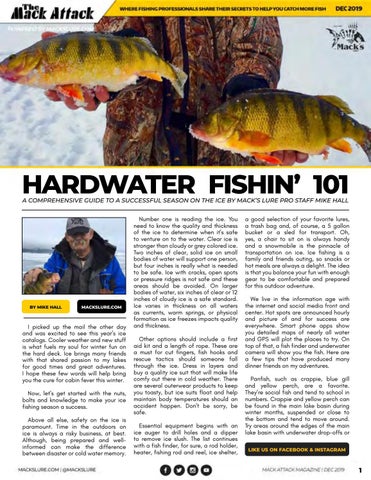
HARDWATER FISHIN’ 101 A COMPREHENSIVE GUIDE TO A SUCCESSFUL SEASON ON THE ICE BY MACK’S LURE PRO STAFF MIKE HALL
BY MIKE HALL
MACKSLURE.COM
I picked up the mail the other day and was excited to see this year’s ice catalogs. Cooler weather and new stuff is what fuels my soul for winter fun on the hard deck. Ice brings many friends with that shared passion to my lakes for good times and great adventures. I hope these few words will help bring you the cure for cabin fever this winter. Now, let’s get started with the nuts, bolts and knowledge to make your ice fishing season a success. Above all else, safety on the ice is paramount. Time in the outdoors on ice is always a risky business, at best. Although, being prepared and wellinformed can make the difference between disaster or cold water memory.
Number one is reading the ice. You need to know the quality and thickness of the ice to determine when it’s safe to venture on to the water. Clear ice is stronger than cloudy or grey colored ice. Two inches of clear, solid ice on small bodies of water will support one person, but four inches is really what is needed to be safe. Ice with cracks, open spots or pressure ridges is not safe and these areas should be avoided. On larger bodies of water, six inches of clear or 12 inches of cloudy ice is a safe standard. Ice varies in thickness on all waters as currents, warm springs, or physical formation as ice freezes impacts quality and thickness. Other options should include a first aid kit and a length of rope. These are a must for cut fingers, fish hooks and rescue tactics should someone fall through the ice. Dress in layers and buy a quality ice suit that will make life comfy out there in cold weather. There are several outerwear products to keep you toasty, but ice suits float and help maintain body temperatures should an accident happen. Don’t be sorry, be safe. Essential equipment begins with an ice auger to drill holes and a dipper to remove ice slush. The list continues with a fish finder, for sure, a rod holder, heater, fishing rod and reel, ice shelter,
a good selection of your favorite lures, a trash bag and, of course, a 5 gallon bucket or a sled for transport. Oh, yes, a chair to sit on is always handy and a snowmobile is the pinnacle of transportation on ice. Ice fishing is a family and friends outing, so snacks or hot meals are always a delight. The idea is that you balance your fun with enough gear to be comfortable and prepared for this outdoor adventure. We live in the information age with the internet and social media front and center. Hot spots are announced hourly and picture of and for success are everywhere. Smart phone apps show you detailed maps of nearly all water and GPS will plot the places to try. On top of that, a fish finder and underwater camera will show you the fish. Here are a few tips that have produced many dinner friends on my adventures. Panfish, such as crappie, blue gill and yellow perch, are a favorite. They’re social fish and tend to school in numbers. Crappie and yellow perch can be found in the main lake basin during winter months, suspended or close to the bottom and tend to move around. Try areas around the edges of the main lake basin with underwater drop-offs or LIKE US ON FACEBOOK & INSTAGRAM
1
points. Particularly, look for hard bottom, underwater springs, trees or rock piles, which can all be bonanzas. Crappie will often chart on the finder as clutter or clouds of fish, but perch will show up as single fish or in small groups. Both crappie and yellow perch are found from 10- to 50-feet of water as a rule. Bluegills are found in less than 20feet of water and near or in weed beds. Generally, they will stay in an area for several days or weeks. These fish like weed edges, holes in the vegetation and submerged trees or bushes. Trout can be found suspended in open water near underwater river channels and often visit weed lines and underwater points to feed. Trophy trout are generally single fish, but will inhabit areas that hold other trout. Feed types are the deciding factor. For example, minnows or insect life. Kokanee are near the edge of the main current line and suspended whereas walleye are more versatile predators and can be found in water from shore to center of the lake. The real keys here are temperature of the water, currents and preferred food resources. Be versatile in your search and move if you do not see fish on the finder. Early season fish are likely in or near the inflows of lakes because the temperature is stable. Late season fish tend to be toward the main lake basin and deeper because water at that depth is generally warmer. Search different depths and structure types until a pattern can be determined.
CLICK HERE TO SHOP FOR THE ICE RIG VALUE PACKS AT MACKSLURE.COM
Drill holes in a line from shallow to deep and try different depths. Compare the structure where you see fish to other similar places on your GPS maps. Decipher the graph or inspect in the hole for minnows, current, weeds, insect life or microbiology. All fish inhabit an area or depth for a reason. Find that reason and you will be more successful. Lures have five group types: spinners, jigs, crank baits, spoons and top water. Pointing out the obvious, top water lures are paramount for ice fishing. Although, the other groups have offerings that are commonly used for ice fishing as a vertical pursuit. Size is both detrimental and relative
CASCADE LAKE ICE FISHING WITH MIKE HALL, ROBIN AND BOBBY SHINDELAR ON ANGLER WEST
2
for success. Small lures and offerings are very popular, but are not always the answer. Using a small tear drop when fish are actively feeding on three-inch minnows can have its drawbacks. Try matching the lure to both the activity levels and the feeding behavior. Fish bite a lure for several reasons: anger, hunger, instinct, territory or spawn, to mention just a few. Neutral fish generally respond to smaller lures TECH GUIDE and active fish respond to larger lures. Address both the size of lures (small to large) and the colors when stocking your inventory of offerings. Colors should include or incorporate silver, brass, copper, pink, orange, chartreuse, white and, especially, glow in the dark. Target neutral and metallic patterns on clear water, painted lures in murky water and glow for dark water (use a Glo® Hook).
Again, size plays a large role in success. Smaller, more subtle attractors like the Flash Lite® Troll or the larger Sling Blade™ 6” with a weigh added to the bottom and jigged slowly are fish magnets. These can also be suspended at any depth to attract walleye, perch, crappie, trout or salmon. Jigging spoons are my favorite lure for ice fishing, as they will catch anything that swims. At the top of this list, of course, is the Sonic BaitFish™ because of the range in sizes from small to large, and its success with bass, crappie, yellow perch, rainbow trout, burbot, lake trout, kokanee and many more. This lure will work right out of the box with no tuning required. There are 12 different ways to rig this amazing spoon and endless application to cath whatever swims. Ice fishing is a vertical presentation of a lure, commonly termed jigging. These jigging presentations can be used on the ice and are also effective in open water for year round success on your favorite waters. The basic rule is to keep your line as vertical as possible. Allowing the line to drift to the side will aid in attracting fish, but for perfect presentations, pause and hold the rod still and allow the line to again become vertical. This gives the angler absolute control over the rise and fall rate, as well as the lure action. This is important because once you find an effective wiggle, you need to repeat the presentation. Here are four simple methods of presentation to make you a master at ice fishing and jigging with any lure, but especially jigging spoons:
Now, let’s talk attractors. They are generally tied in-line, 6- to 14-inches above the lure and aid the fish in finding your offering and enticing a strike. They come in all sizes. Small attractors, such as the Smile Blade® 0.8 or large attractors, such as the Sling Blade™ 4”. Thinking outside the box, attractors can also be used effectively by themsleves on a separate line in an adjacent ice hole. These are extremely productive for attracting especially large or schooling fishing to a certain location.
1) Lower the lure to the desired depth and simply hold it still. The trick is to watch the fish finder as the lure falls and stop where the fish are. Small bits of your favorite bait are just as effective as a plain lure. Be sure not to add too much bait to the lure, as this tends to restrict the action. Another tip is to use scents in place of bait, as they won’t affect the action of lures. My favorite is a new product for ProCure called Bait Waxx. Try using un-baited lures if the water is clear, but remember the thickness or snow covered ice restricts the light levels and fish may not be able to see an offering. Perhaps this is the reason the glow in the dark lures are the most popular.
NEW
SHOP MACK’S LURE UV SCENTS
2) Waving the flag. Lift and drop the rod, allowing the lure to free fall backwards. The lift and drop can vary from a few inches to several feet. Different waves are also effective. For example, slow up, slow down; fast up fast, down; or mix them. This action allows the lure to roll and flutter with full action. Don’t be a tourist. Jerking or waving without purpose may make you seem friendly with others, but won’t catch dinner. However, moving the lure with intention will. Remember, the strikes are often very soft and your full attention is absolutely necessary. Most strikes are felt and some are indicated by the lure stopping or the line becoming slack. 3) Gently pumping the rod with small lifts and drops. Remember to add long or short pauses to the pumping action to incite fish to strike. This imparts action not only to the lure but to the bait on your hook, making the lure appear alive. Again, pay attention to the finder as fish attracted to this action show up. Simply pause and wait for the strike. If the fish seem disinterested then very slowly lift the lure., as this often incites a strike. Adding a small blade or a glow bead to the hook is a tremendous way to increase catches with this presentation. Pounding the bottom, lifting the lure and pausing is another dynamic way to be effective. This is a big aid in attracting fish to the offering. 4) Swim or drag the lure side to side. Make sure to slightly pump the lure when moving it. This brings reaction strikes and lifelike attraction to the lure. Keep
3
in mind, using the zoom feature on your fish finder will help you to see fish and the lure better. Most often, fish swim upward to bite a lure so presenting the lure above the fish will be the most effective method. An exception to this, though, is pounding the bottom and leaving the lure to rest on the bottom. I’ve found that this produces walleye and lake trout quite often. These four presentations can be varied or mixed and matched to fine tune any catch. Watch your fish finder to see which presentation is effective in attracting fish and exciting a strike, then repeat it. The ticket here is (as is the case with all fishing) to become versatile. Information is everywhere, but it doesn’t work if you don’t use it. Move if you’re not seeing fish on the locator, try a different presentation or lure but, above all else, be flexible in your approach. Beginners only have a few ways to catch fish, but the pros have thousands of ways. A great fisherman is one that learns to climb the informational ladder to the top. The payoff is more fish, more fun and an increased interest in this sport that we all pursue. Be safe in your endeavors and remember to enjoy and share fishing with others. I’ll see you on the lake.
SONIC BAITFISH™ (SBF)
TIPS & TECHNIQUES
bait to the SBF: 1) Some states, such as Washington state, prohibit the use of live bait; 2) Many times, natural bait attracts nuisance fish and smaller fish; 3) Adding bait reduced the balance, and action, of the SBF; 4) Eliminates handling of mess (ordors and blood); 5) Eliminates needlessly killing of bait fish; 6) Eliminates extra costs of buying and handling live and dead bait; 7) Eliminates need for using a bait knife and cutting one’s self; 8) The most effective striketriggering feature in a fishing lure is the DOWNWARD FLUTTER! No other lure type comes close in matching this critical action. This is the concept, and principle action, of the SBF, which duplicates the action of crippled and injured bait fish. This is why, so many times, a SBF will out-fish a live bait fish, attached to a hook, that often-times will swim laterally instead of fluttering vertically. I consider vertical jigging on a slow drift to be without peer in consistently catching fish. This combination of a slow, natural drift, and the downward flutter of a SBF, is an unbeatable presentation!
Examples of tipping include: Nightcrawler pieces for walleye (Lake Erie or Columbia River); Shrimp, squid, octopus or cutbait (Gulf of Mexico snapper, grouper and other bottomrelated species. Note: These are very rare examples of when I had to tip the SBF.
Question: Is bait ever added to the Sonic BaitFish™ (SBF)? Personally, I almost never attach bait to the SBF in fresh or saltwater. Here’s some reasons for not adding
Critical tip: Always jig the smallest
BY PETE ROSKO
SBF TECH GUIDE
Thank you for subscribing to the Mack Attack Magazine. Please join us next month for the January issue. Best holiday wishes — Capt Pete.
The reasons for tipping (adding bait) to the SBF is to add scent: 1) When icejigging; 2) For certain conditions that cause fish to stop biting a bare SBF, such as: muddy water, increased tidal or river flow, abnormally cold or warm water, too fast of a drift, rapid barometer and wind changes.
Advantages of fishing with a tipped SBF instead of tipped jigheads and weighted hooks (hooks attached to lines that are weighted with a variety of sinkers) include: Even in very little water movement, the SBF is designed to move without any rod movement. Because of their natural appearance, and swimming action, fish will still-strike the SBF, after the bait has been removed. In comparison, the bare jigheads and weighted hooks will be “dead in the water.; The flash and flutter of the SBF still triggers strikes long after the tipped bait is gone.
IS BAIT EVER ADDED TO THE SBF
SBF that can easily reach your target species when drifting or at anchor. Why? Because a light-weight SBF flutters, and suspends, better than a heavier SBF.
4
QUESTION
OF THE MONTH Have a questions you want answered? Send your inquiry to us and yours may be featured! Simply send an email to media@mackslure.com or reach out to us on Facebook, Instagram or YouTube. Just search @MacksLure and you’ll find us!
Q: I’ve heard a lot about Glo® Hooks, especially for ice fishing. How would you recommend rigging them?
PHOTO OF THE MONTH Mack’s Lure Pro Staff Jeff Witkowski of Darrell & Dad’s Guide Service (Chelan, WA) shows off one of dozens of Lake Roosevelt walleye Harrod Outdoors has been on.
A: That’s a good question. And the Glo® Hooks are awesome ice fishing lures that can be used in conjunction with other products or as a standalone lure for various panfish. Attach a Glo® Hook with a 2-inch leader to the tail of a Sonic BaitFish™ or rig a Glo® Hook with a Double D™ Dodger or Sling Blade™ to increase your attraction. Be sure to rig your dodger backwards, however, as this will provide the Glo® Hook with more action on the rise and fall. Simply attach a 14- to 16-inch leader to a Glo® Hook in the color of your choosing. In between the dodger and the hook, attach a couple of split shot weights to help keep the presentation vertical, then slowly jig up 4- to 6-inches, then drop and repeat until your rod starts dancing.
VIDEO OF THE MONTH Mack’s Lure’s Mike Hall and Harrod Outdoors head to Cascade Lake (ID) to target giant perch through the ice with Sonic BaitFish on The Northwest Outdoorsmen.
Follow Mack’s Lure on Facebook and Instagram and tag us with #MacksLure. Facebook.com/MacksLure @mackslure To submit your catch, send us an email at media@mackslure.com or tag us on social media using #MacksLure.
5