AUTHENTIC TO THE INDUSTRY

Well OH MY GOODNESS!
It’s our very first full magazine of Demolition Spotlight! Can you believe it? No? Me neither.
This very first issue delves right to the heart of one of the biggest issues facing demolition today: people. No, I don’t mean that people are a problem! But it is people that drive demolition, and without them, it would collapse (but the building wouldn’t!)
When revenue is on the line, it seems that it becomes easy for the average demolition and construction worker to be forgotten about. The workforces’ wellbeing and mental health often takes a back seat to the labour required to make the demolition world go round, and if it’s not addressed soon, it will grind to a halt soon enough.
Sky News did a recent news story stating that ‘construction workers are four times more likely to die by suicide’, with a wealth of statistics from organisation On The Tools. The last 10 years has seen 7,000 construction workers lose their lives, with 73% affected by a mental health condition in some form or another. Those statistics are truly terrifying, and sadly, they don’t seem to be getting lower.
On The Tools Brand Manager, Alice Brookes, has been quoted as saying “If doctors or teachers were seeing those rates of suicide in any other industry, I think there would be a national outcry. But because it’s construction, I think people don’t necessarily have the best perception of tradespeople, it’s being ignored.”
It seems fitting then that for our debut issue that we take the time to delve deep into the lives of those incredible people that keep the demolition industry thriving. With a range of stories from those whose life is this industry, as well as all the very latest from the world of demolition, this issue is ready to go off with a bang! (terrible pun intended, I do apologise).
Happy reading!
Rebecca Phillips Managing Editor

is published by
Machine Power Media Ltd.
Unit 5, Basepoint, Enterprise Centre, Terminus Road, Chichester, PO19 8FY +44 (0) 1243 323311
Machine Power Media Ltd. © 2025 all rights reserved.
Reproduction in whole or part is prohibited except with permission in writing from the company.
Note to contributors: articles submitted to the Editor for consideration must be the original work of the author.
Where photographs are included that are not the property of the company or contributor, permission to reproduce them must have been received from the owner of the copyright. Any views or opinions expressed within this magazine are not necessarily those of the company. Registered in England No: 16081082
All advertisements are accepted subject to Machine Power Media’s standard of insertion.
For a copy of Advertising Terms & Conditions, please write to:
Darren Shelton, Machine Power Media Ltd.
Unit 5, Basepoint, Enterprise Centre, Terminus Road, Chichester, PO19 8FY

A round up of the news from the demolition industry over the past two months.
20 // demo report
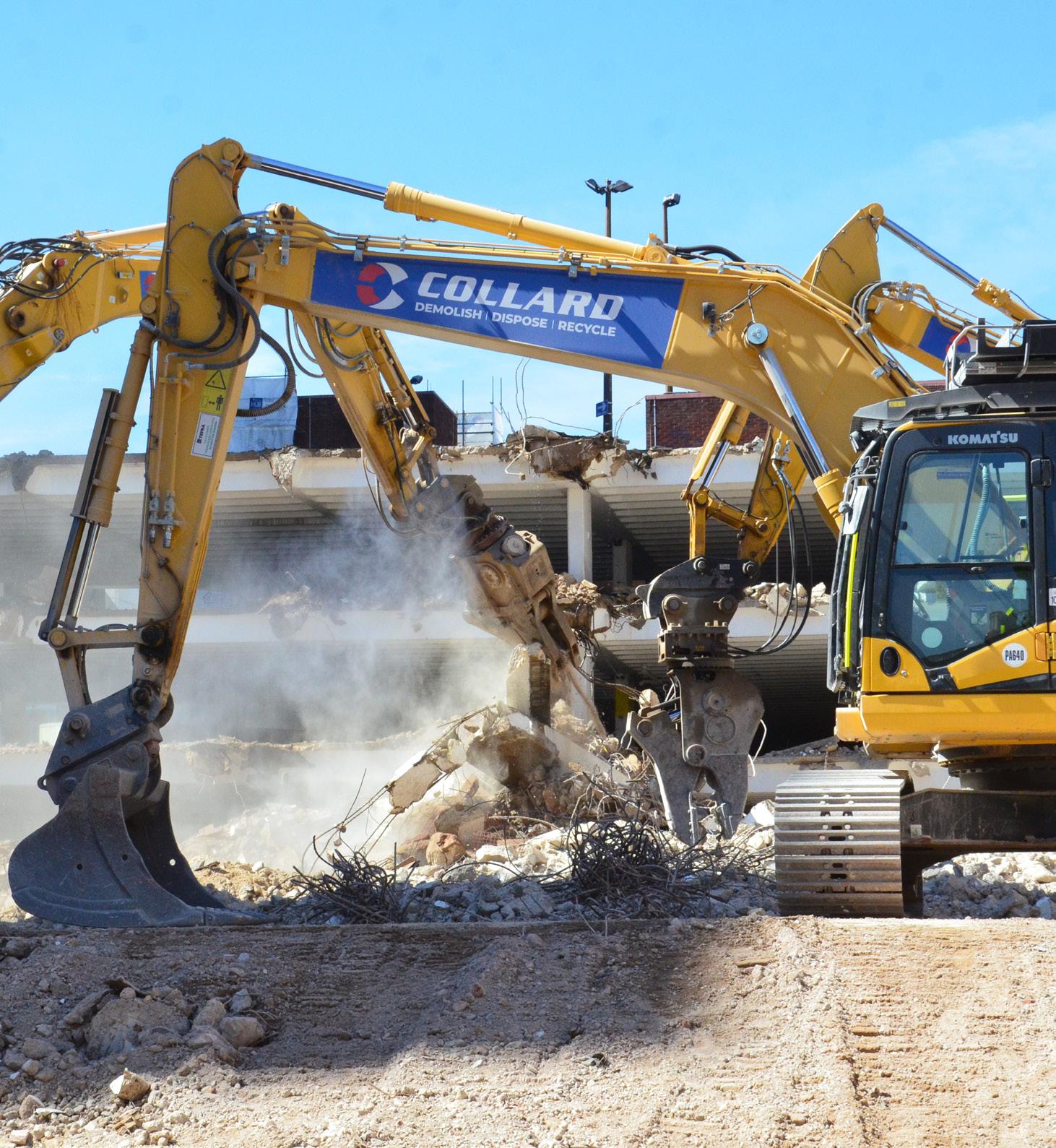
Managing Editor, Rebecca Phillips, sits down with Collard Group’s Sam Tunnicliff to talk about his career in demolition and his time as Contracts Manager.
26 // feature
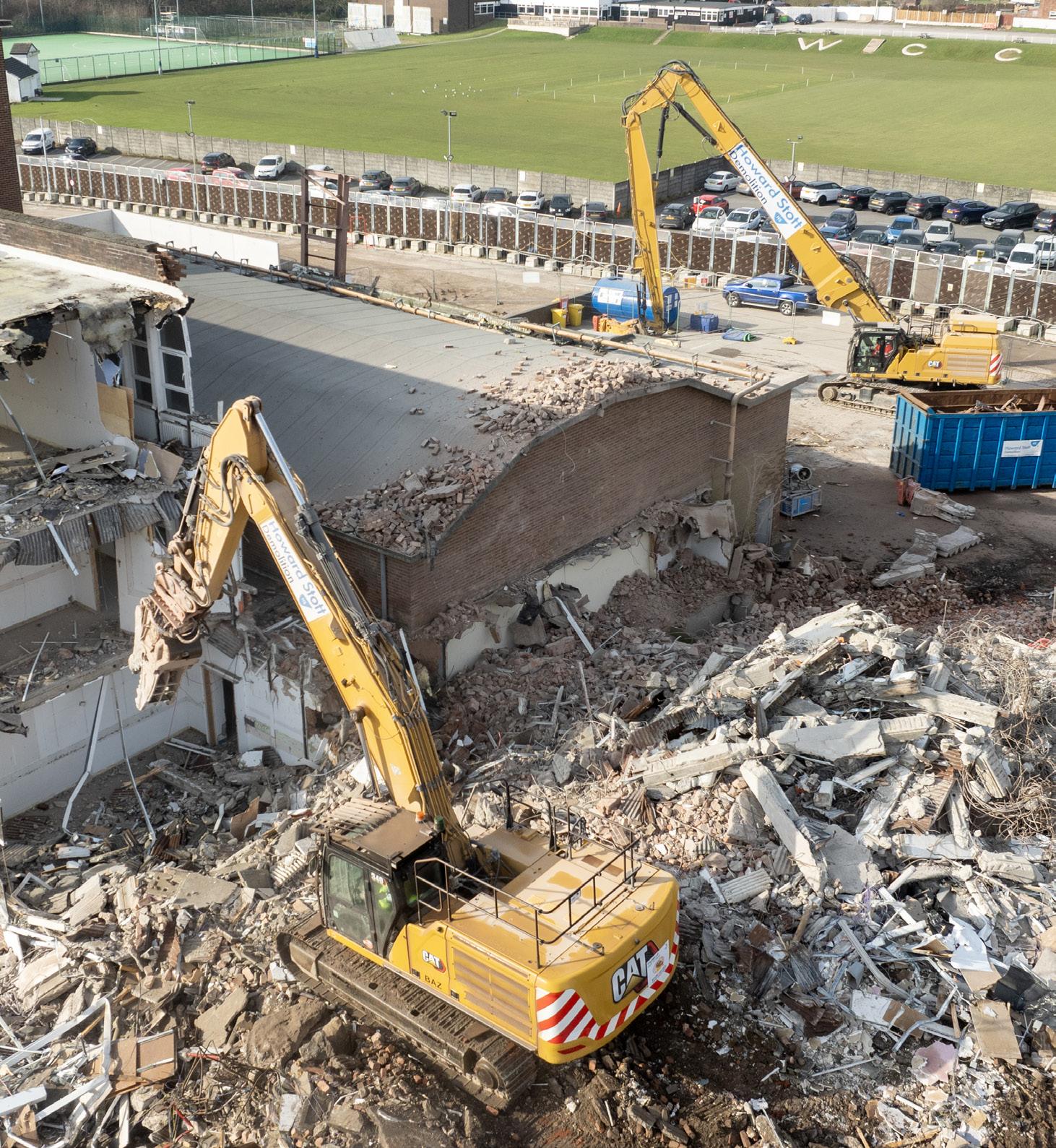
Howard Stott Demolition have been changing the landscape of towns and cities of the UK for over half a century.
34 // review
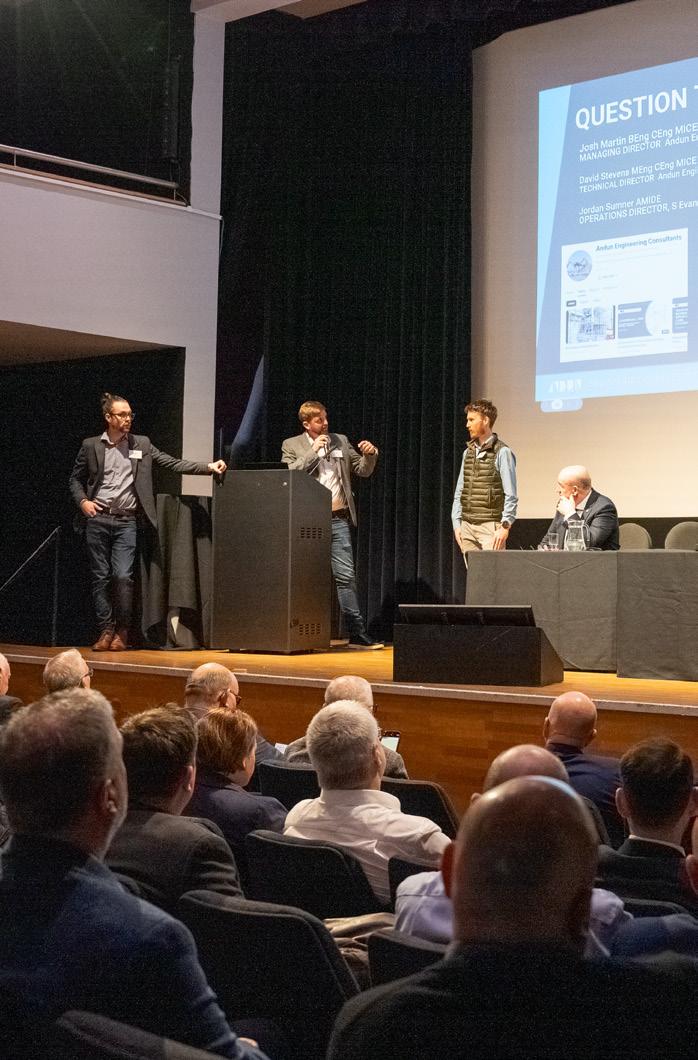
The Institute’s first main event of 2025 was packed with expert talks, real-world case studies, and plenty of valuable takeaways for anyone in the demolition industry.
37 // ON SITE
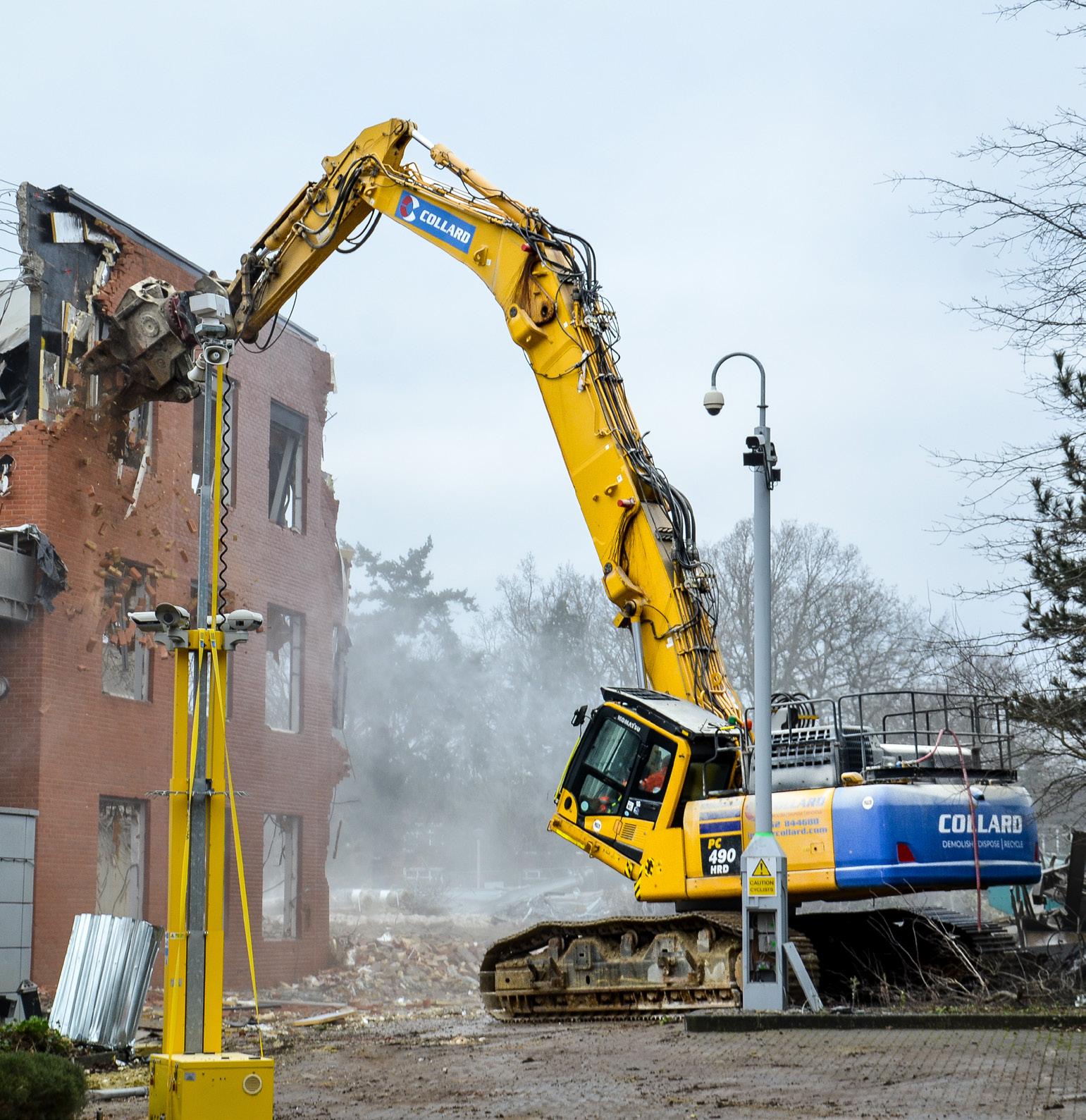
Rebecca travels to Surrey to visit one of Collard Group’s latest sites to see how they tackle demolition in a built-up area.
42 // demo report
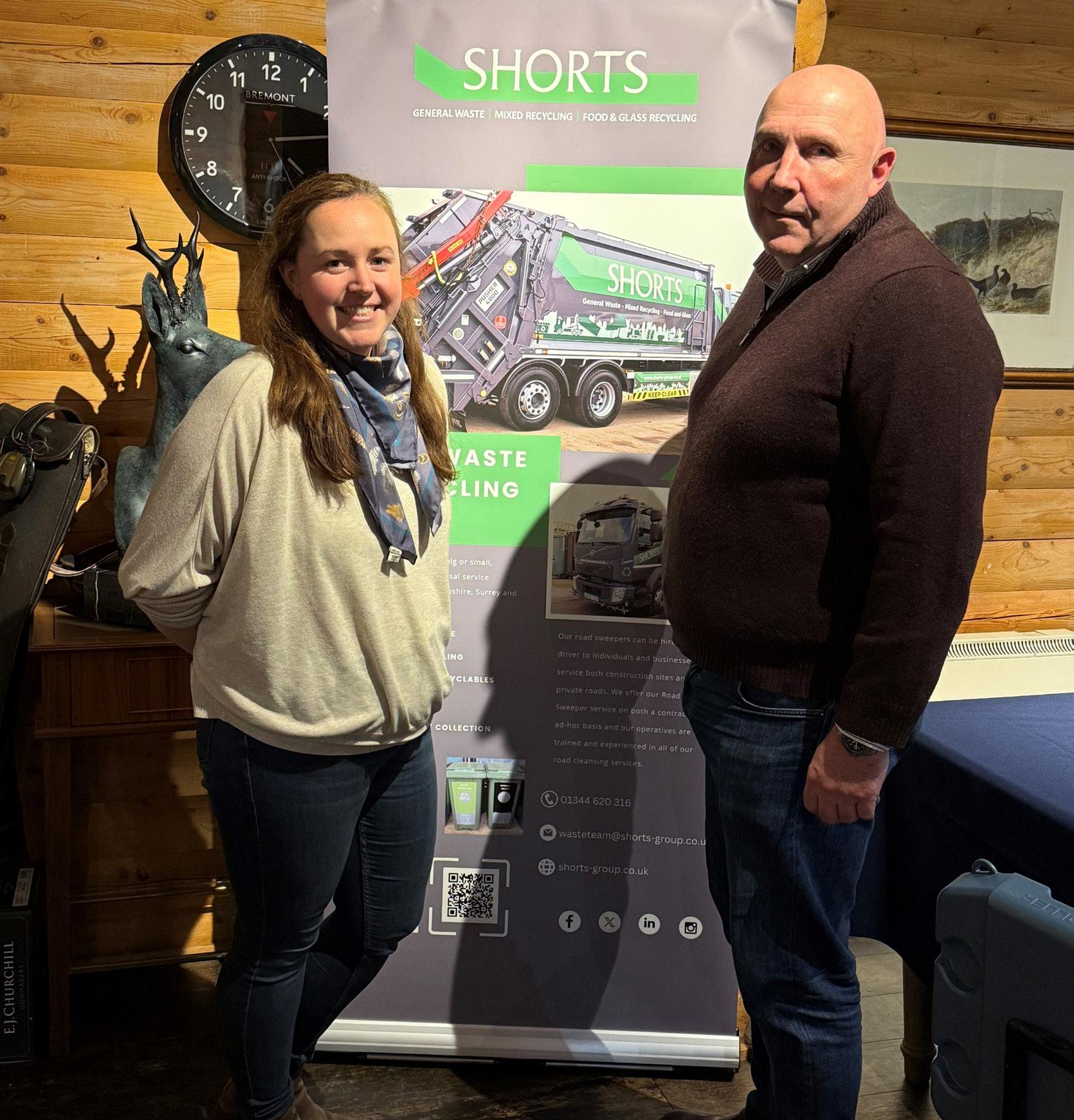
Rebecca gets chatting with Shorts Group’s own Bryony Morten-Short to look at her unique journey into the world of demolition, and how it has shaped her role today.
48 // review
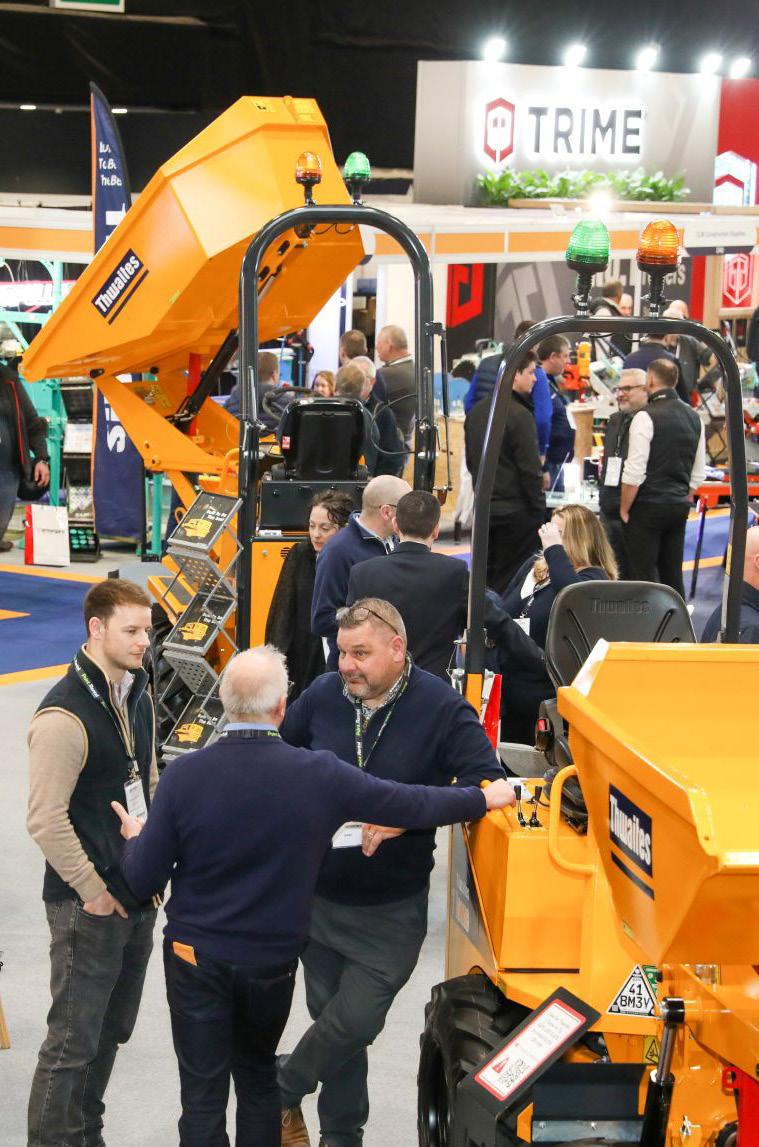
Executive Hire Show is one of the biggest industry exhibition shows that fuses together tool equipment and plant hirers, all under one roof together. And Demolition Spotlight was delighted to be in attendance for the first time!
55 // preview
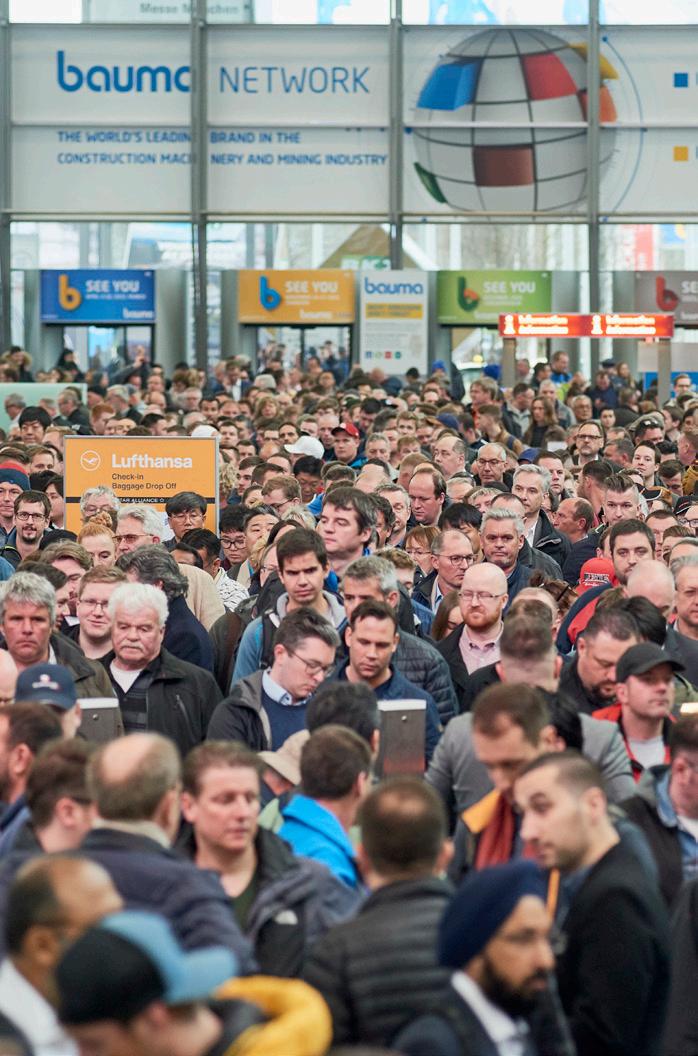
World-leading trade fair is a driving force for the industry!
48 34

DARREN SHELTON MANAGING DIRECTOR

MARTINA TONELLI MARKETING MANAGER
PAUL ARGENT RPA MEDIA SERVICES
ISOBEL WOODBURY IDE
BRYONY MORTON-SHORT SHORTS GROUP
SAM TUNNICLIFF R COLLARD
MADISON DUNN R COLLARD

PHIL EVERY GROUP SALES DIRECTOR

LORNA COWLIN CONTENT CREATOR

REBECCA PHILLIPS MANAGING EDITOR

STEVE WILSON DESIGN MANAGER

LANE BRAND MANAGER
For all content related queries, contact editor@demolitionspotlight.co.uk
For all sales related queries, contact charlotte@demolitionspotlight.co.uk





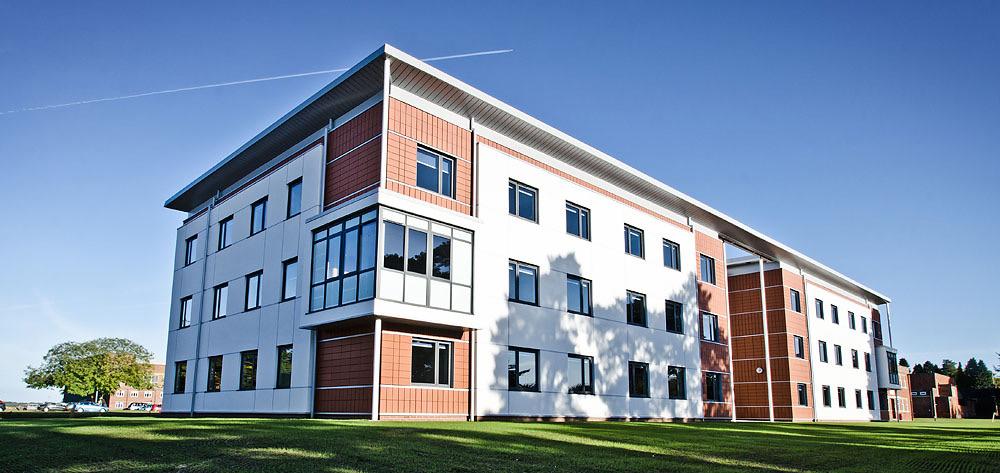
For more than half a century, National Construction College (NCC) has been a leading choice for construction training, shaping careers for today and tomorrow.
With 11,000+ learners trained last year, covering courses from one-day health and safety training to threeyear apprenticeships, we are one of the largest and most prestigious construction colleges.
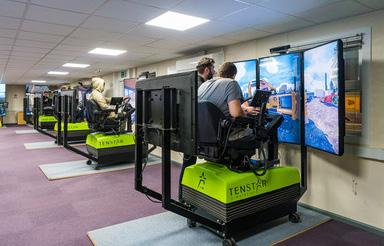
NCC England East based in Norfolk offers a wide selection of crane and plant related training programs. Giving you the learner, access to a variety of lifting accessories/cranes and top of the range plant equipment as well as our onsite state of the art simulators.
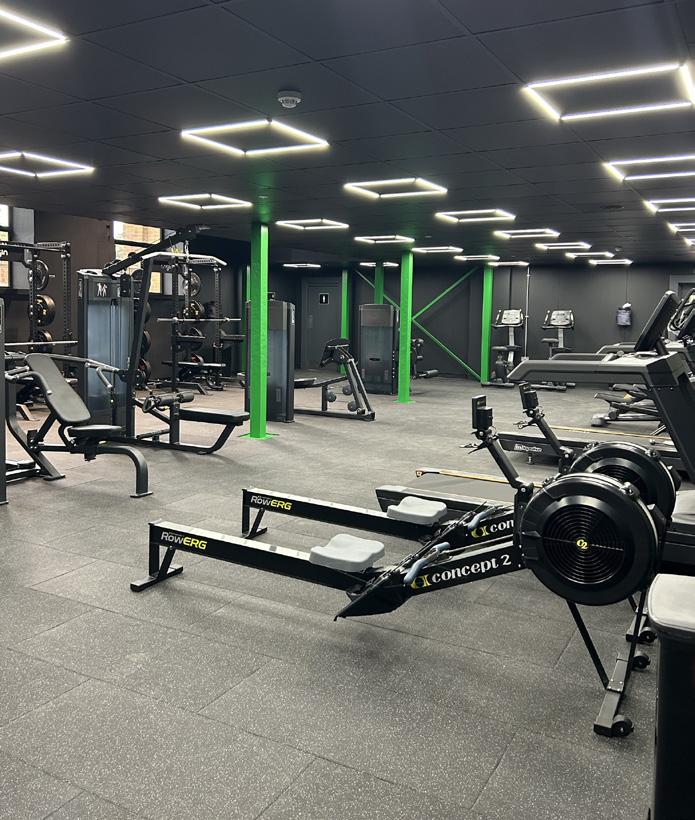
The college offers onsite accommodation, a restaurant with Costa Coffee, welfare support, a brand-new gym and is only 20 minutes from the local seaside resort, Hunstanton. So go on treat yourself to an ice-cream one evening!
NCC England East Tours
Don’t just take our word for it, book yourself on one of our tours today!
You will be able to tour the stateof-the-art facilities, accommodation, training areas, and meet our friendly team. You’ll even get an opportunity to try out the fantastic simulators!
Tours will start at 10:00am and last approximately four hours. Lunch is provided. Booking is essential, so to avoid disappointment email NCC. AccountManager@citb.co.uk selecting your preferred date from the list below.
2025: April 16th, May 14th, Jun 11th, Jul 16th, Aug 13th, Sep 17th, Oct 15th, Nov 12th, Dec 10th.
Want to have a chat about your training requirements? Call 0344 994 4433 or email NCC.accountmanager@citb.co.uk
CPCS and NCC
Training is accredited by Construction Plant Competency Scheme (CPCS); a professional and national scheme which recognises the skills, knowledge, competency, and qualifications of individuals.
This ensures operators meet nationally recognised standards. All courses are delivered by highly skilled and experienced trainers who bring real industry expertise to the classroom.
As part of CITB (Construction Industry Training Board), NCC is dedicated to supporting and advancing the construction sector. Our training aligns with industry demands and helps address skills shortages. Eligible candidates may also access CITB funding or grants, reducing the financial burden of training.

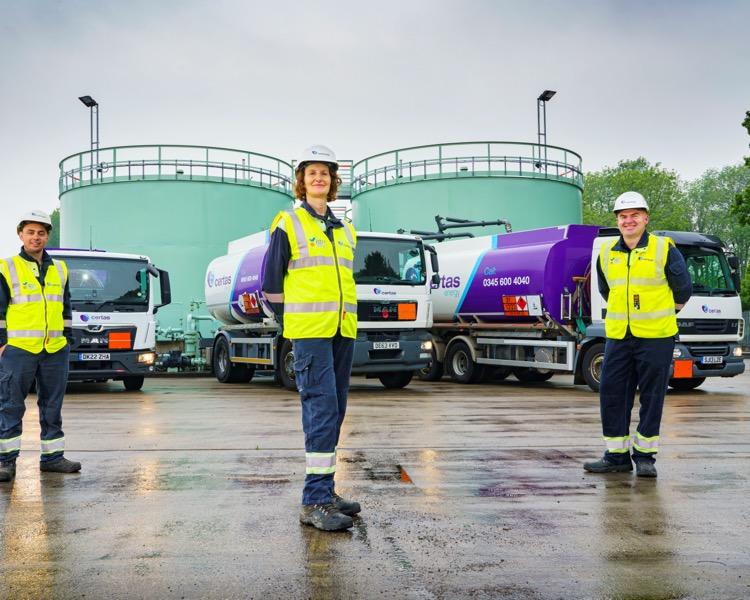
Spokesperson: Peter Cronin, Commercial Marketing Manager (Construction) at Certas Energy
Just over a month ago, the Construction Plant-hire Association (CPA), which represents thousands of construction plant businesses across industry, published an open letter to UK Government’s Secretary of State for Energy & Climate Change, Ed Milliband MP.
The letter aimed at raising awareness about the unique difficulties the planthire sector faces in decarbonising, to reaffirm the collective interest from businesses to run more sustainable operations, and to demand more incentives from the central government to help break down barriers to the transition to net zero.
As the Government ramps up plans to ‘Get Britain Building Again’ during this parliament, industry representatives are rightly deliberating over which decarbonising option presents the best return on investment, both in financial terms and in meeting their sustainability targets.
According to Glenigan’s latest forecast, it predicts the number of construction projects will grow by around eight per cent this year and then by 10 per cent in 2026, providing ample opportunities for growth for firms across plant-hire, demolition, and other subsectors within construction.
This growth is desperately needed to widen access to sustainable solutions, such as biofuels, and to ensure that every business is able to contribute to reducing the industry’s overall carbon footprint. Construction is responsible
for roughly a quarter of the UK’s total emissions produced, so it will play a central role in the country’s transition to net zero by 2050. In short, if construction doesn’t decarbonise successfully, we will likely not meet our targets.
Introducing HVOthe best alternative to diesel
One sustainable solution referenced in CPA’s open letter was Hydrotreated Vegetable Oil (HVO), otherwise known as renewable diesel, an alternative fuel that can significantly reduce carbon emissions and has been growing in prominence in recent years.
In the UK, HVO consumption doubled in 2023 compared to the year before, while demand for this biofuel steadily grew throughout 2024. We anticipate this trend to continue over the next decade, so HVO will undoubtedly play a major role in the country’s efforts to decarbonise.
Suitable for diesel-powered vehicles and machinery, HVO is a drop-in solution that requires no engine modifications, can deliver up to 90% of carbon emission savings, is 100% biodegradable, and has excellent cold weather performance.
Its hydrotreatment process removes oxygen, water, and other impurities, resulting in a longer shelf life compared to conventional diesel.
Furthermore, when compared to biodiesel like fatty acid methyl esters (FAME), HVO significantly reduces maintenance concerns like filter
It’s therefore no surprise that this fuel is fast becoming a popular shortand medium-term option across the construction sector.
Why choose Certas Energy HVO?
Not all HVO is the same, and we understand that not every business is ready to permanently switch right away.
As the UK’s leading independent supplier of HVO, Certas Energy has a strong track record in providing a reliable, responsive, and reputable supply that will meet the specific business needs of our customers, making us the ideal energy transition partner.
This means that businesses can feel comfortable knowing that Certas Energy HVO is made from sustainable and verifiable sources which meet the highest auditable standards.
Our extensive network of depots, tanks, and experts has also meant that the company has been able to launch a new ‘Tanks for Hire’ initiative, aimed at mainly small- and medium-sized businesses that want to keep costs down, while benefiting from switching to HVO.
By choosing to hire a tank, rather than purchasing outright, it will save a business on average £20,000 in the first year, making it ideal for the vast majority of plant-hire businesses that need support.
Learn more about how Certas Energy HVO can help fuel your transition here: certasenergy.co.uk/my-business/ agriculture
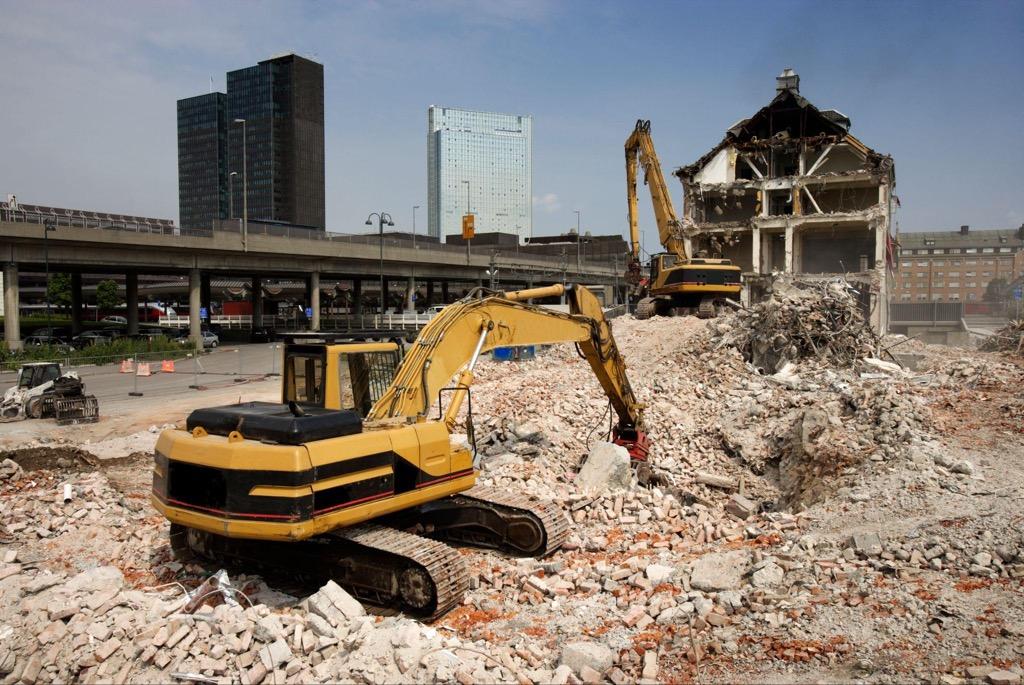
Founded by David Short after his Army National Service, Shorts Group has grown from timber and land clearing into a leader in demolition, waste management, and complementary services. With over 68 years of expertise, we provide a comprehensive range of services, including Demolition Contracting, Waste Management, Skip and Plant Hire, Bagged Materials, and Agricultural Contracting. Guided by our family values and dedication to customer satisfaction, we deliver professional, sustainable solutions tailored to meet the unique needs of every client.
Our Demolition Contracting service stands out for its precision, safety, and innovation. From small-scale projects to large-site clearances, we provide reliable solutions customised to meet your requirements. Fully insured and accredited with industry-related schemes, we uphold the highest safety standards on every project.
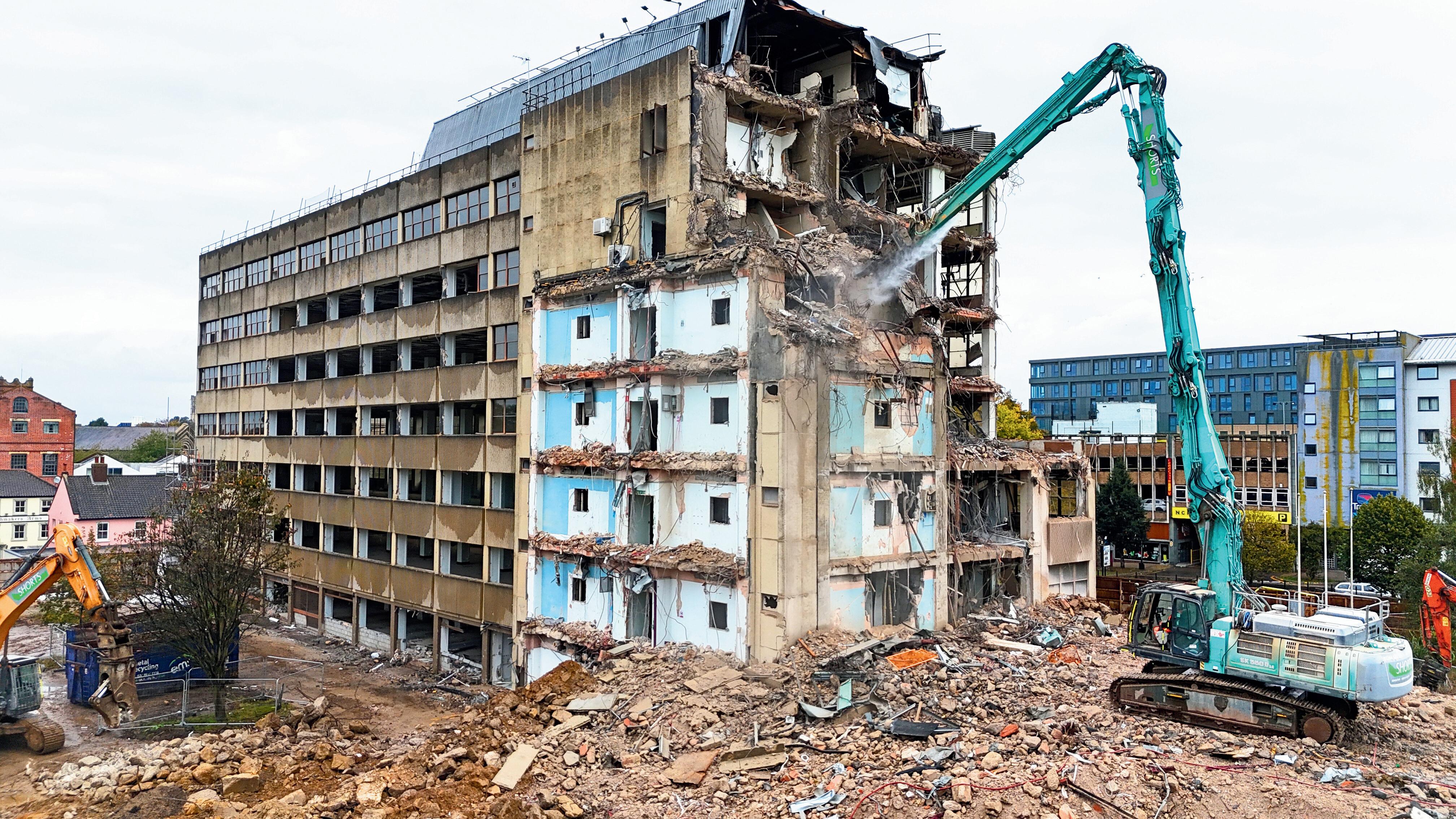
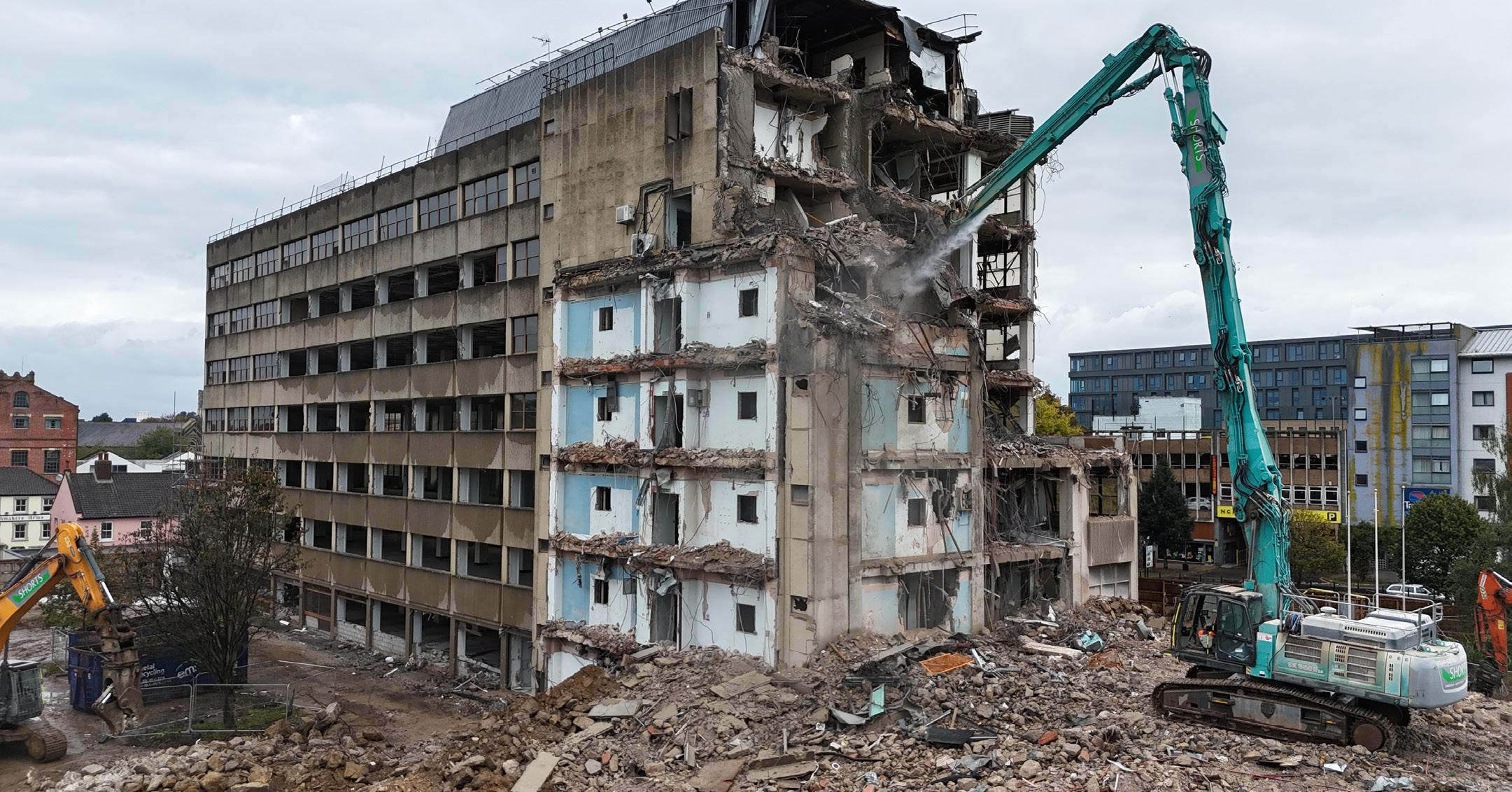
A prime example is our Norwich demolition project, where our team combined advanced machinery with innovative solutions like demolition curtains and environmental monitoring stations. Maintaining effective communication with neighbours and recycling up to 98% of materials ensured minimal disruption and maximum sustainability.
Our innovative closed-loop business model integrates all services under one roof, fostering seamless collaboration and efficiency. By relying on in-house capabilities, we maintain strict quality control, reduce costs, and deliver ecoconscious solutions.
Supporting these core services, our Skip Hire and Plant Hire divisions ensure every project is equipped for success. Whether it’s compact skips and machinery for residential needs or heavy-duty equipment for industrialscale operations, we provide the right resources for every job.

Sustainability is embedded in every aspect of our operations. Recycling is at the core of our approach, with a zero-landfill commitment ensuring waste is repurposed wherever possible. Our in-house Waste Management
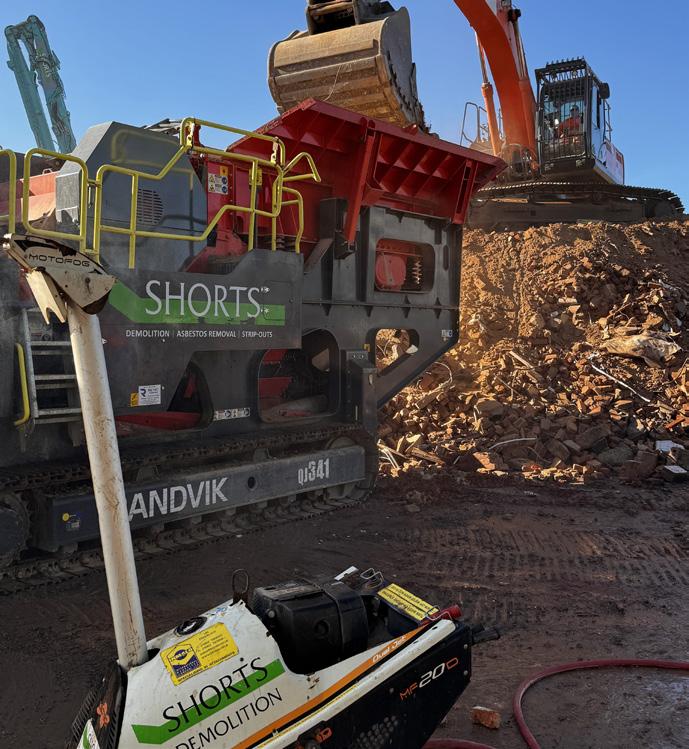
expertise enables the efficient handling of materials, focusing on repurposing, recycling, and recovering resources to minimise environmental impact.
Family values define our company culture and the way we work. We take the time to understand your needs, offering tailored advice and transparent communication at every step. For us, you’re not just another project—you’re a partner. Operating across Berkshire, Hampshire, Surrey, and surrounding counties, we combine this personalised approach with a strong commitment to sustainability, delivering exceptional results while contributing to a cleaner, greener future.
For more information visit: www.shorts-group.co.uk
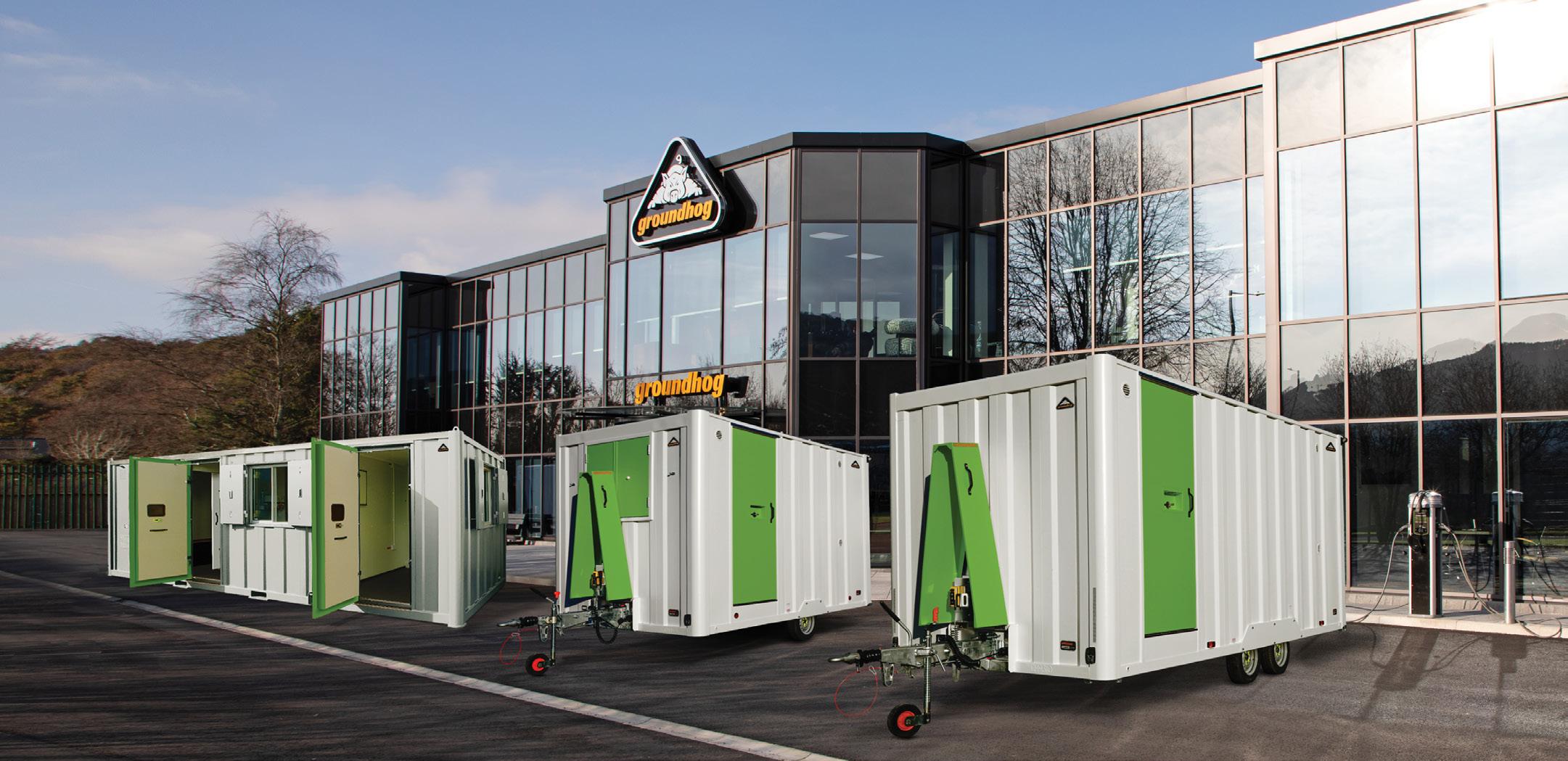
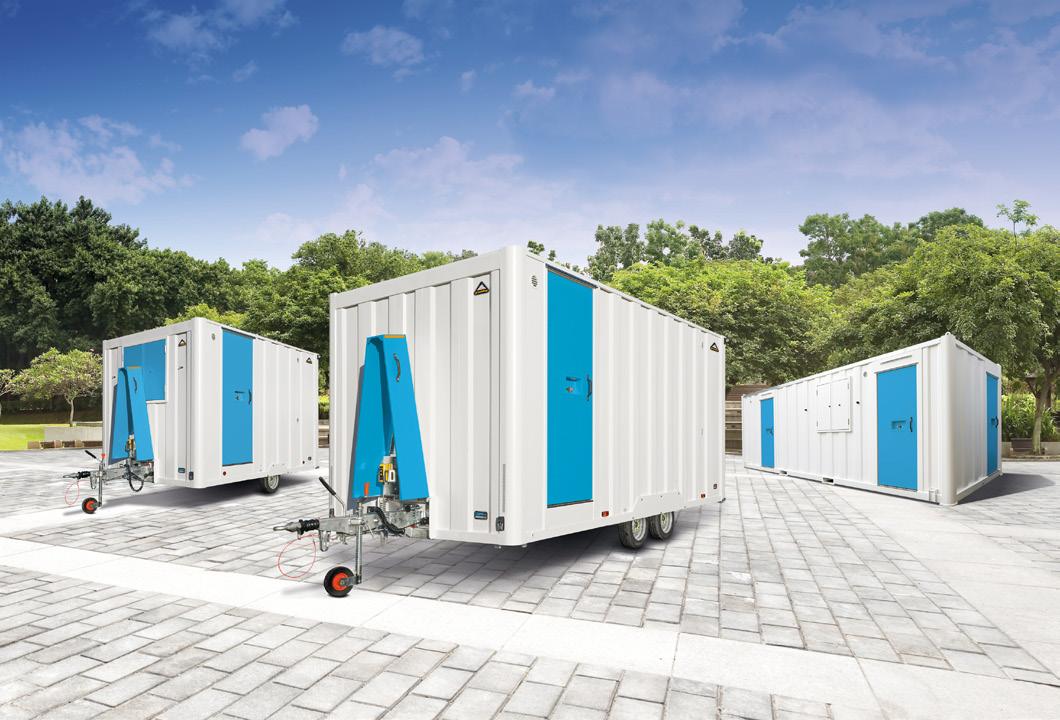
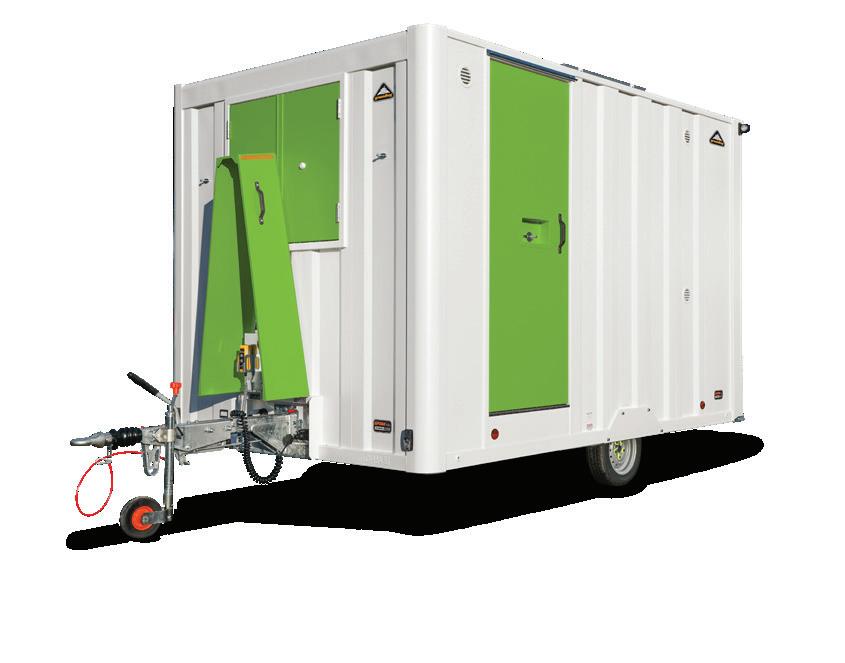
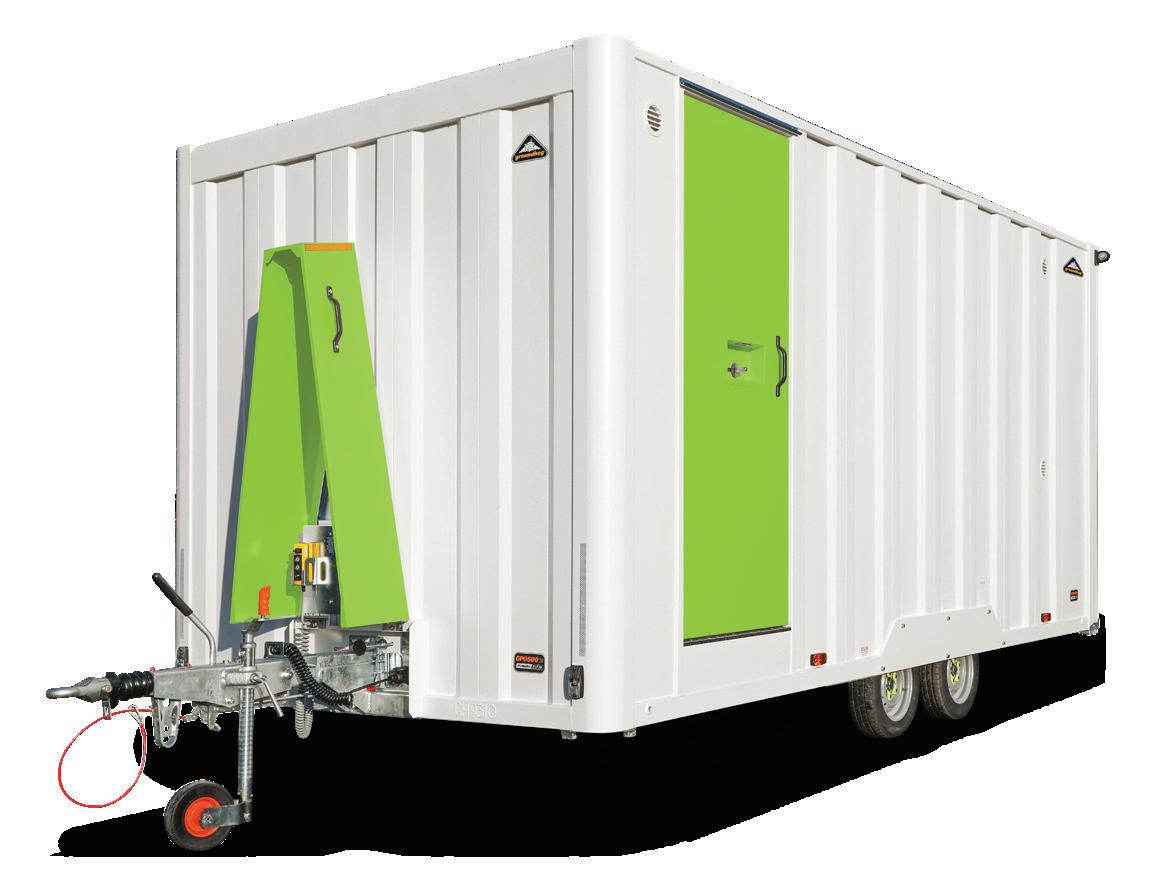
Groundhog is a long established privately owned company with a state-of-the-art modern manufacturing facility based in South Wales. We specialise in the manufacture of site welfare accommodation units, which include static, mobile and toilet offerings.
We are focused on developing sustainable products and helping you achieve realistic carbon reduction goals.
The first Groundhog mobile welfare unit left the production line in 1987, which we designed, developed and patented and has enjoyed huge success in the rental and end user markets, as well as major areas such as the Construction, Rail, Civils and Utilities sectors.
Groundhog places a large focus on continual development to ensure our products meet client requirements and the most up to date welfare regulations.
Groundhog’s range of products, are robust and easy to use and are known for their high quality and longevity in the demanding rental market.
Groundhog offer a large product range which includes mobile and static welfare
units as well as bespoke and highly specialised options. All Groundhog welfare units are wholly manufactured in our purpose-built factory in South Wales which holds ISO9001:2015 accreditation and fully comply with current CDM, HSE and VCA regulations.
2023 saw the launch of our new innovative, functional, and cost-effective iRange welfare units. These eco units are designed to run during summer months without the onboard power unit running offering up to 100% reductions in carbon emissions. With the solar powered battery charging facility, this gives large savings whilst delivering robust and easy to use onsite welfare accommodation.
Safe use and maintenance is a key factor when considering a Groundhog Welfare unit. With this in mind Groundhog offers a comprehensive range of training sessions to ensure all our customers are fully compliant in all aspects in the use of the Groundhog product range. These take place in our factory or at clients’ premises and range from full CPD accredited safe use and maintenance to hire desk and sales
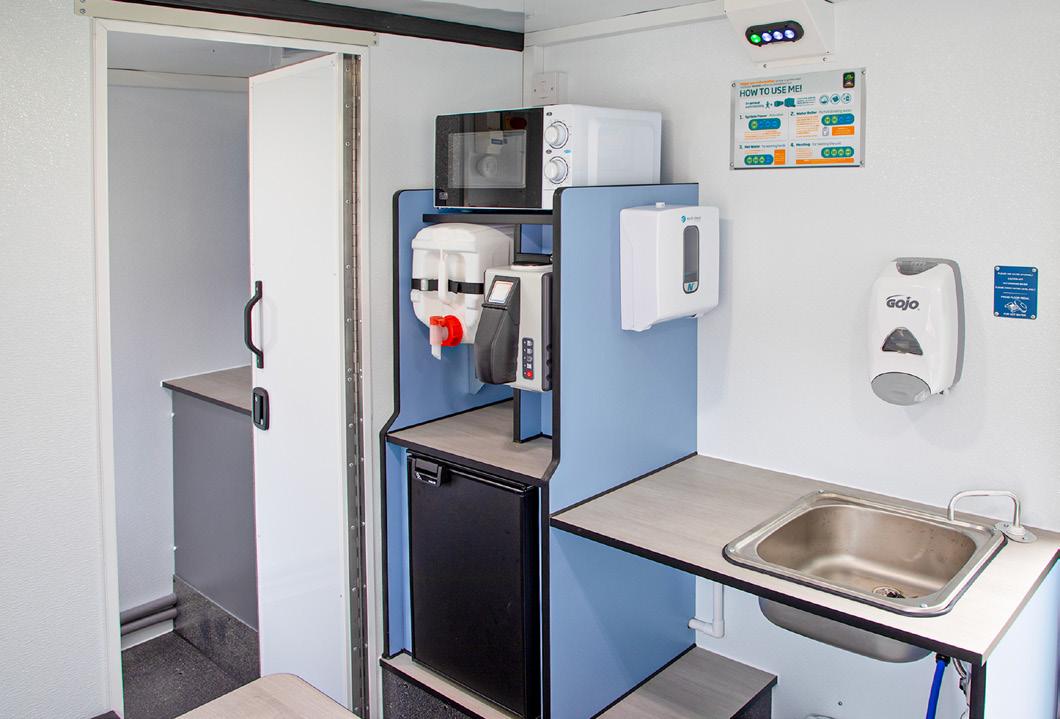
product awareness.
We are deeply committed to addressing the global climate crisis.
Aligning with the United Kingdom’s ambitious goal of achieving netzero carbon emissions by 2050, we recognise our role in contributing to this critical mission.
Many of our valued customers share these environmental ambitions and are actively working to reduce carbon emissions within their supply chains. As responsible suppliers, we are dedicated to providing the support they need to achieve these goals.
Groundhog have taken a significant step towards understanding and reducing our environmental impact by producing an indicative initial carbon footprint for our products, the first being our GP360 Fusion Pulse mobile welfare unit.
Groundhog consistently receives awards in acknowledgment of our innovative range of welfare products. These accolades serve as testament to the company’s commitment to pushing boundaries and delivering an enhanced environmental solution with our carbon
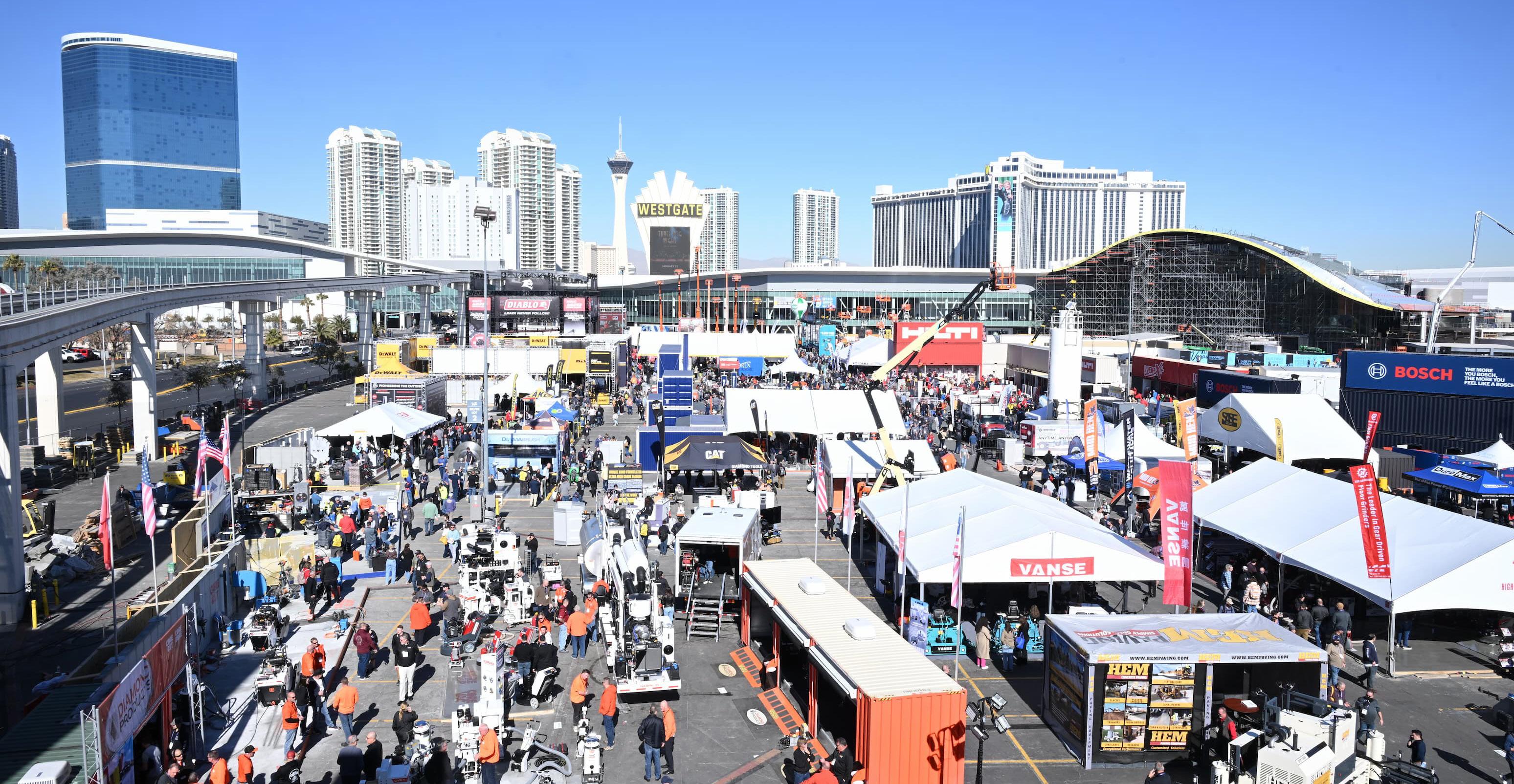
World of Concrete is the industry’s ONLY annual international event dedicated to commercial concrete and masonry construction industries. Featuring indoor and outdoor exhibits with the industry’s leading suppliers showcasing innovative products and technologies, exciting demonstrations and competitions and world-class education program. Save the date for World of Concrete 2026!
Exhibits: January 20-22, 2026; Education: January 19-22, 2026
Push limits. Smash barriers. Break boundaries. And when you’ve conquered all those obstacles? You discover your full capacity for greatness. World of Concrete delivers all the realworld solutions that will crush your challenges and take your expertise to new heights. Growth opportunities are everywhere, whether you’re looking for new products, getting hands-on with game-changing tools and tech, or shaking hands with your future partners.Ready for maximum success? Nothing’s standing in your way.

World of Concrete 2026 will take place in the North, Central & South Halls of the Las Vegas Convention Center, and will be utilizing the Silver and Bronze Lots for outdoor exhibits and events. Please see the designated areas as follows:
Material Handling: If it’s new or trusted in material handling, it’s here: find trucks, excavators, paving equipment and more for material delivery, distribution, concrete placement, and earth moving. World of Concrete General: Find equipment, tools, products and services for the commercial construction, concrete and masonry industries.
Work Truck LIVE! powered by Modern WorkTruck Solutions magazine, will highlight innovations in the design and configuration of work trucks and innovative accessories that will help contractors increase safety and productivity.
The Producer Center: Featuring a comprehensive marketplace of materials, equipment, demos, specifically for concrete producers.
Technology for Construction: The innovation showcase featuring the newest products and tools for the commercial construction industry from top information technology and systems providers.
Precast: Featuring the latest products and technologies in the precast/ prestressed sector.
Concrete Masonry: This area showcases everything for producers of concrete masonry (block, segmental retaining wall units, veneer, slabs, pavers, and roof tiles, admixtures, equipment & supplies and pigments).
Concrete Reinforcement: Features the leaders in concrete reinforcement, showcasing reinforcement bending,
cutting, straightening, and fabricating machinery, reinforced positioners & locators, epoxy-coated, steel, glass fiber, galvanized bar and all types of reinforcement accessories.
World of Concrete General: Find equipment, tools, products and services for the commercial construction, concrete and masonry industries.
Cement Production Pavilion: Features the leaders of the equipment and support services used in cement manufacturing: kilns, separators, mills, dryers, silos, bagging machines, and plant automation & instrumentation.
AAC - Autoclaved Aerated Concrete: State-of-the-art Production Plant
Solutions from internationally renowned experts. Discover the new building material. Discover new opportunities for the US construction industry including production technology, typical application of AAC in the construction industry, blocks, panels, claddings and more!
South Hall
World of Masonry: Find all things masonry, from products, tools, information, and emerging technologies that professionals need to stay on the cutting edge.
Concrete Repair & Demolition: View an array of the latest surface preparation equipment, scarifying, grinding, sawing equipment, sealants, joint fillers and more.
Concrete Surfaces & Decorative: Features surface protection products, coatings, cleaning solutions, stains, pigments, molds, and more products to help you capitalize on this expanding segment.
MB Crusher is preparing for a dynamic presence at Bauma 2025, the world’s leading trade fair for construction machinery, taking place from April 7 to 13 in Munich. Visitors will have the opportunity to explore the company’s innovative solutions at two key locations: the Showroom (Stand C5 303) and the Demo Area (Stand FN 1017/10).
At the Showroom, MB Crusher’s team of experts will showcase a full range of attachments, including the iconic crusher bucket, screening buckets, padding buckets, sorting grapples, and drum cutters. Attendees can engage in discussions about how these solutions optimize efficiency and sustainability on job sites. And for those looking for something unexpected—MB Crusher has a surprise in store.
The Demo Area will be a highlight of the event, featuring a diverse range of MB Crusher units in action. Visitors will witness firsthand how the attachments transform operations by crushing,
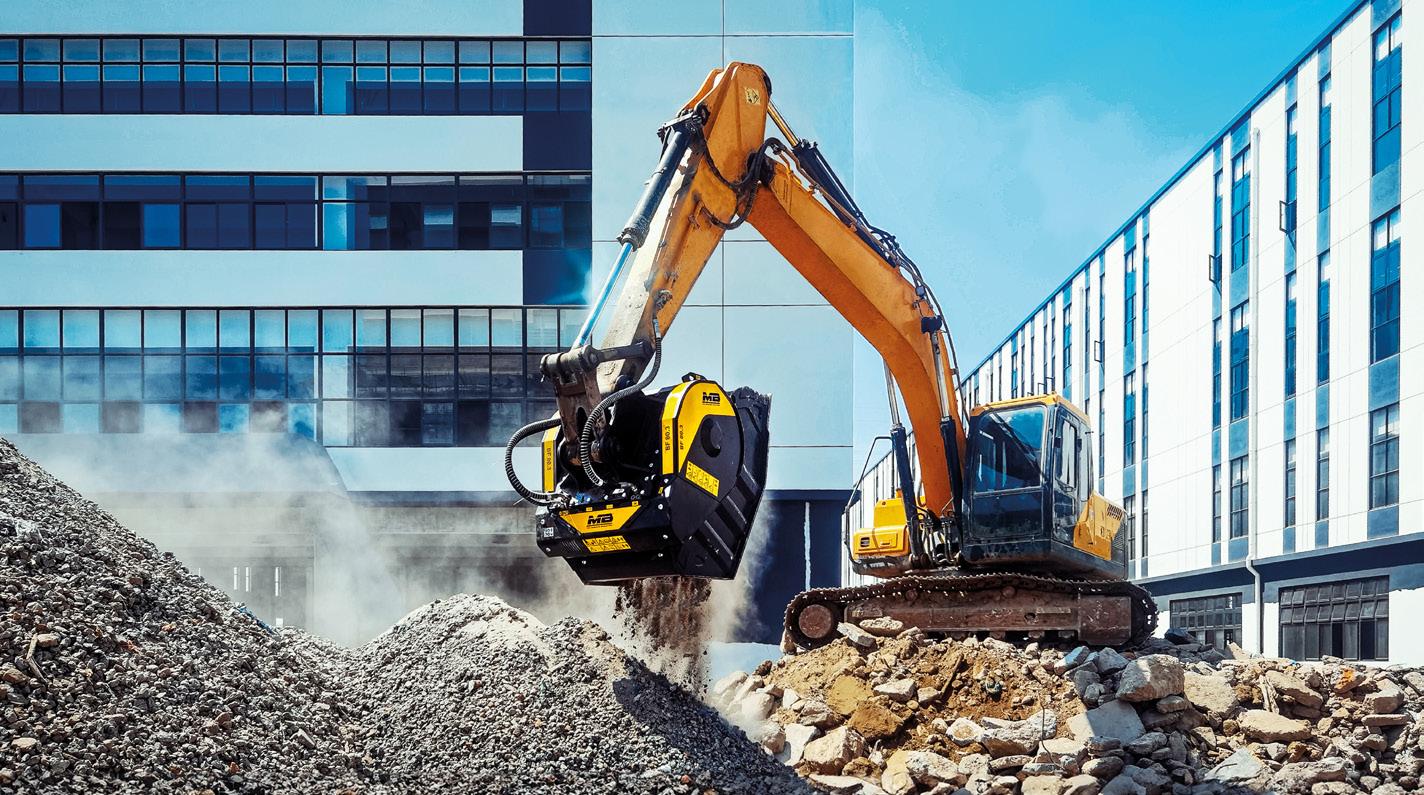
screening, and handling materials directly on-site. From compact models to powerful heavy-duty equipment, the live demonstrations will showcase versatility and performance across different applications.
MB Crusher’s participation in Bauma 2025 underscores its dedication to promoting a circular economy within the construction industry. By providing

efficient solutions for material processing and waste reduction, the company continues to empower businesses to maximize productivity while minimizing environmental impact.
With expert consultations, live demonstrations, and exclusive product reveals, MB Crusher’s stands promise to be must-visit destinations at Bauma 2025.


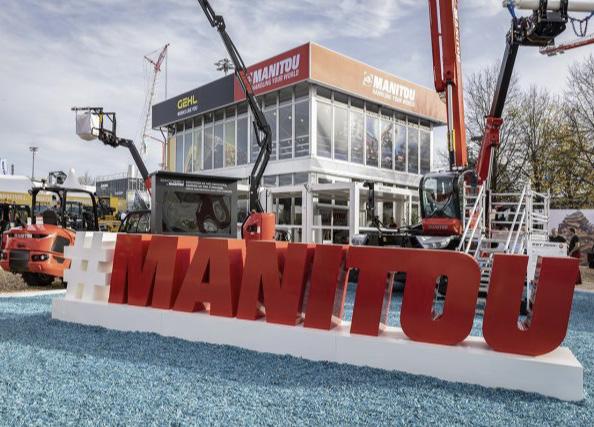
Manitou Group will be present at Bauma in Munich, from April 7th to 13th. The group will have many innovations to present during the event, with a focus on electric machines with zero emission.
Manitou Group will be exhibiting around 25 machines from the Manitou and GEHL brands on stand FS 908/1 in the outdoor area covering more than 1,600 m².
New hydrogen telehandler concept
Manitou Group is firmly committed to reducing carbon emissions, and after presenting an initial prototype of a fixed telehandler with an 18-metre lifting height and 4-tonne load capacity in December 2022, Manitou is taking another step forward. A second telehandler prototype concept will be unveiled, powered by green hydrogen via a fuel cell, guaranteeing a zero-emission solution.
Presentation of 2 high lift telehandlers zero emission models
Manitou takes another step forward in its drive to reduce emissions with the presentation of two electric models of high lift telehandlers that are entirely zero-emission. These high performance machines, designed for operator comfort, which comply with Low Emission Zone (LEZ) regulations, offer a full day’s working autonomy.
Rotative telehandler for high lifting
Manitou expands its range with a new rotating telehandler MRT designed for high-rise lifts. This MRT is ideal for carpenters, general contractors, rental companies and masons. Its benefits include faster positioning and fewer movements, the ability to work in tight site conditions, reduced crane rental costs and operator expenses, and a smaller footprint than a traditional crane. The grapple provides a powerful grip, allowing trees to be felled safely and branches up to 750 mm in diameter to be cut. Other attachments will also be showcased.
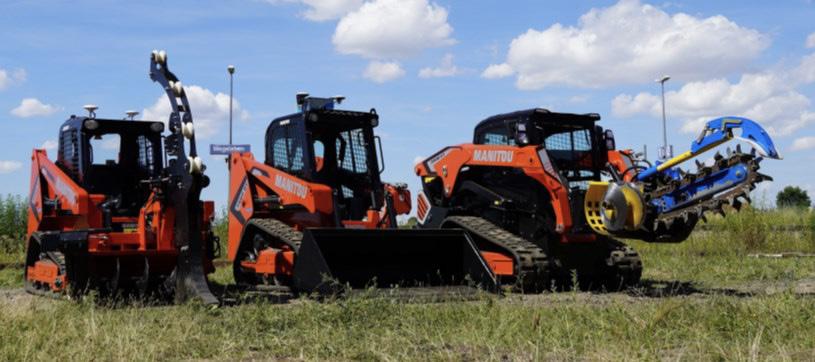
The innovative track loader solution for cable construction during ongoing rail operations, with which Manitou and its partners won the Supplier Innovation Award from Deutsche Bahn in 2024, will also be on site. These compact loaders emit fewer emissions than traditional machines, and this solution represents an optimal alternative to conventional underground cable construction and is faster, more effective and more resource-efficient.
The ultra compact ULM telehandler fits on a small trailer such as some mobile elevating work platforms like the scissor lift model SE 1008. The robust aluminum low loader trailer for K50 ball head coupling has access ramps and comes with an aluminum box with tailor-made lashing material.
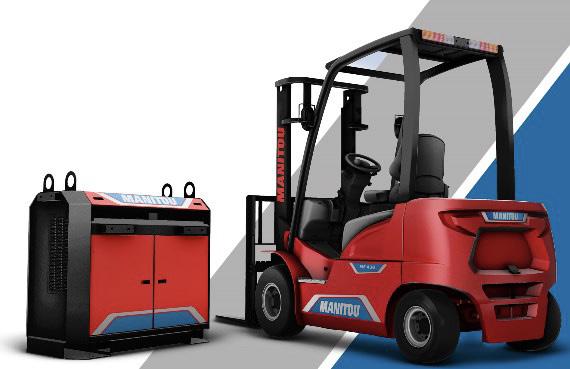
In the industrial sector, the new ME 430 Lift electric forklift truck is powered with lithium-ion batteries, which offers a load capacity of up to 3.5 tons and a zero-emission drive. The truck is characterized by high manoeuvrability and excellent ergonomics, making operation both efficient and safe.
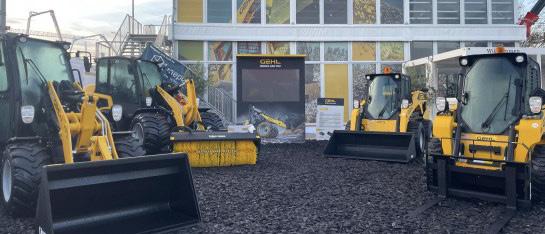
Fans of GEHL can look forward to a selection of articulated loaders, skid steer and track loaders that impress with their robustness and versatility. GEHL skid steers are known for their high performance and low maintenance requirements.
Manitou strengthens its range of electric charging solutions with a new outboard fast charger (30 kw), designed for maximum efficiency and extended compatibility with the MT range and ME Lift electric ranges, ensuring fast and reliable recharge. The new loader is scheduled to go on sale in the second quarter of 2025.
Manitou Group will reveal every detail on these new products during the press conference that will be held on its booth FS 908 /1 at 11.00 am on April 7th.
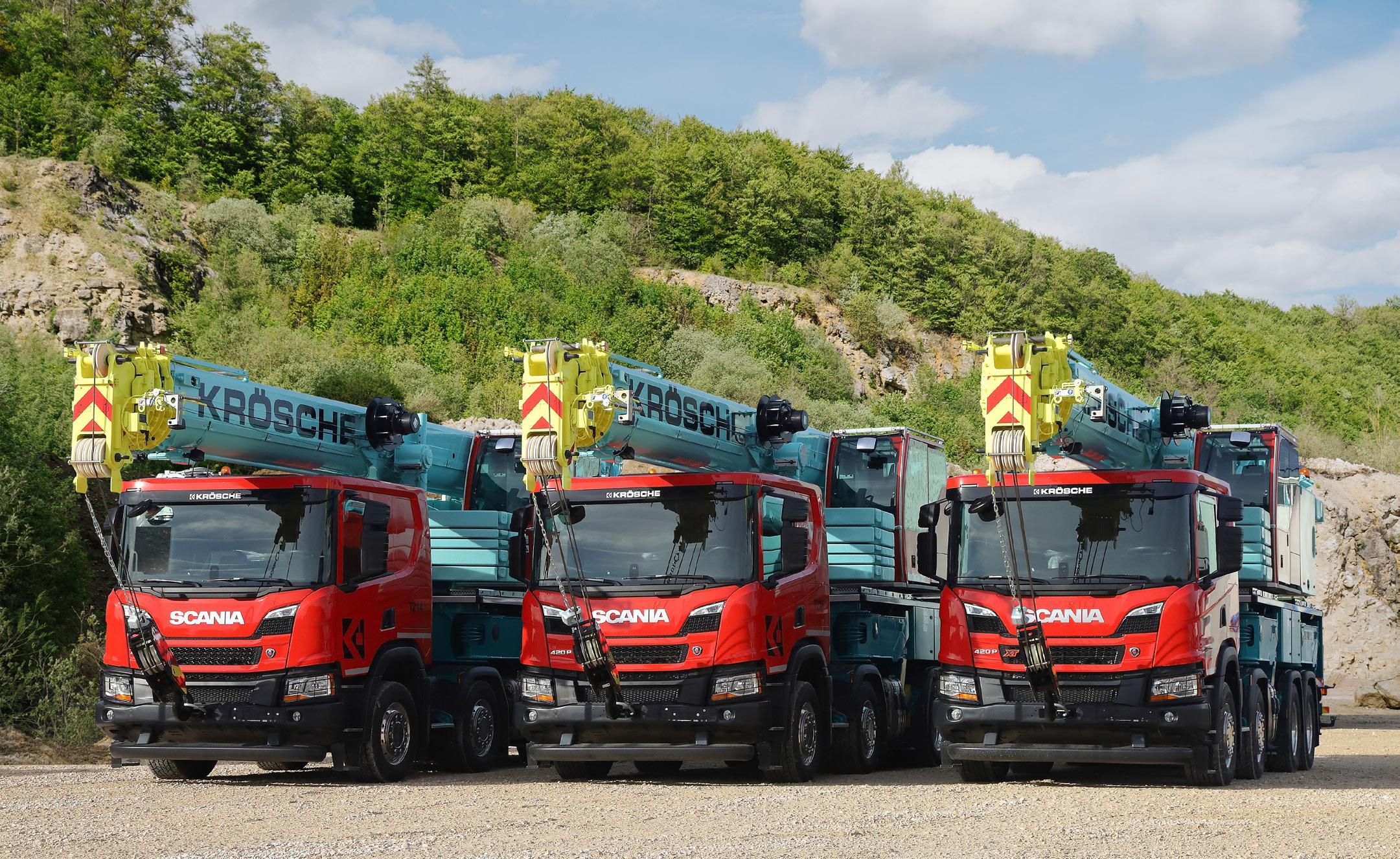
Krösche places its trust in Liebherr truck-mounted telescopic cranes
Greater flexibility and cost-effectiveness thanks to comprehensive road permits
The new LTF 1045-4.1 models replace older cranes in the fleet
Krösche-Kran Service GmbH, a specialist provider of assembly services for prefabricated houses, has taken delivery of three new LTF 1045-3.1 truck-mounted telescopic cranes. The company, based in Holzminden, Lower Saxony, exclusively uses telescopic cranes mounted on a standard truck chassis for its work throughout Germany
Managing Director Joachim Ruthe explains: “We’ve been exclusively using truck-mounted cranes in our fleet for around 35 years. The flexibility we get from comprehensive road permits is key for us. The LTF 1045-4.1 is the perfect example of this, because with five tonnes of ballast, its gross weight is still just 33 tonnes. So it’s the ideal machine for assembling prefabricated wooden houses.”
The main areas of use for the new 45-tonners will be prefabricated wooden constructions for detached and semidetached homes, as well as commercial prefabricated wood construction.
“Around 90% of all industrially producing German prefabricated house
manufacturers commission Krösche to provide cranes for the assembly of their prefabricated houses. The great flexibility in terms of deployment planning is supported by the long-term driving permit, which facilitates cost-effective operation in the smaller crane class.
The lorry driver’s cabin of the truck chassis also offers the crane driver the opportunity to stay overnight on site, removing the need for admin around hotel bookings. In light of the growing importance of CO2 reduction, the LTF 1045-3.1 will increasingly take centre stage in the future with its twin-engine concept and low fuel consumption during drive mode,” says Ruthe.
Truck-mounted telescopic cranes are economical alternatives in the taxi crane class for crane contractors who often cover long distances as a standard truck consumes less fuel than a similar all-terrain crane due to its design. Using a standard truck as the crane chassis also means lower costs for tyres and other wearing parts as they are mass produced.
The LTF 1045-4.1 crane attains hook heights of up to 44 metres and radii of up to 42 metres with its 35-metre telescopic boom and folding jib. With
its maximum ballast of nine tonnes, the gross weight of the 45-tonne crane is just 38 tonnes. The axle loads on the front axles are less than nine tonnes and less than ten tonnes on the rear axles.
Long-term partnership
Krösche-Kran Service GmbH has been a loyal Liebherr customer for over 40 years and has made a major contribution to the development of the current LTF series. Ruthe explains: “Liebherr’s aftersales service, with its ready availability of service engineers and spare parts, is of crucial importance for our concept.” Over the last 20 years, Krösche has been one of the largest purchasers of LTF cranes from Liebherr.
Currently, Krösche has a total of 30 cranes, of which 70% are Liebherr LTF models. With 50 employees, the company celebrated its 50th anniversary in 2024. Its roots extend as far back as 1899, when August Krösche founded a blacksmith’s shop in Holzminden. The company is entirely family-owned and has specialised in prefabricated wood construction for detached homes as well as commercial prefabricated wood construction.
Close Brothers Asset Finance’s Business Sentiment Index (BSI), which measures SME business confidence among the UK’s small business owners, has fallen for the first time since May 2023, following four consecutive periods of improvement. This comes despite half of businesses expecting to benefit from the changes announced in the Budget.
The decline in the BSI score hasn’t been felt across the board, with sentiment remaining flat in the Construction sector.
Appetite for investment
Despite recent economic news, firms’ appetite to invest in their business in the coming 12 months improved by 6% to 72% (May 2024: 66%). At 59%, this figure tracked significantly below the national sentiment in Construction, which is consistent with general sector confidence.
Missed opportunities
At 45% (Construction: 41%) of firms stating they have missed business opportunities because of a lack of available funding rose, this metric is at its highest level for over 18 months. Lack of access to finance has been identified by the Federation of Small Businesses (FSB) as a barrier to economic growth, along with uncertainty among small businesses as to where to get information about types of finance available to them.
Economic outlook
Overall, small business owners (including Construction) remained – on balance –marginally more positive than negative
about the UK’s economic prospects for the coming year. This figure still trails well behind sentiment in November 2021, when 75% of respondents were positive about the economy.
Q: How would you best describe your business’s economic outlook for the coming 12 months? (Please select best match):
• Confident the economy will grow: 47% (Construction 45%)
• Concerned the economy will slow down: 42% (Construction 44%)
• I don’t think there will be a significant change in the economy: 11% (Construction 10%)
Predicted business performance
Reflecting the overall BSI result, predictions about future business performance was relatively static and in line with recent government figures confirming the UK economy has experienced limited growth.
The majority of firms - 52% - expect to tread water during 2025, anticipating their prospects will remain unchanged. More positively, far more business owners (40%) are hoping to expand their operations compared to just 7% who think they will contract in the coming year.
Q: In general, how do you expect your business to perform over the next 12 months?
• Expand: 40% (Construction 41%)
• Stay the same: 52% (Construction 48%)
• Contract: 7% (Construction 8%)
• Close down: 1% (Construction 3%)

Our view
“Typically, sentiment in the sectors rise and fall together, but this time there’s a real and noticeable disparity, with some trending up and others the opposite way,” said Matt Roper, CEO of Close Brothers’ Commercial business. “Print and Packaging, Construction and Agriculture all dipped fairly significantly in the second half of 2024, but this was not unexpected given the challenges these industries have faced over recent months.
“Yet, that being said, there are some positives; for example, 72% of the firms surveyed will actively seek funding for business investment in 2025, and with our history of lending through the cycle, we remain well positioned to support our customers – old and new.”
For more information please visit: www.closeassetfinance.co.uk
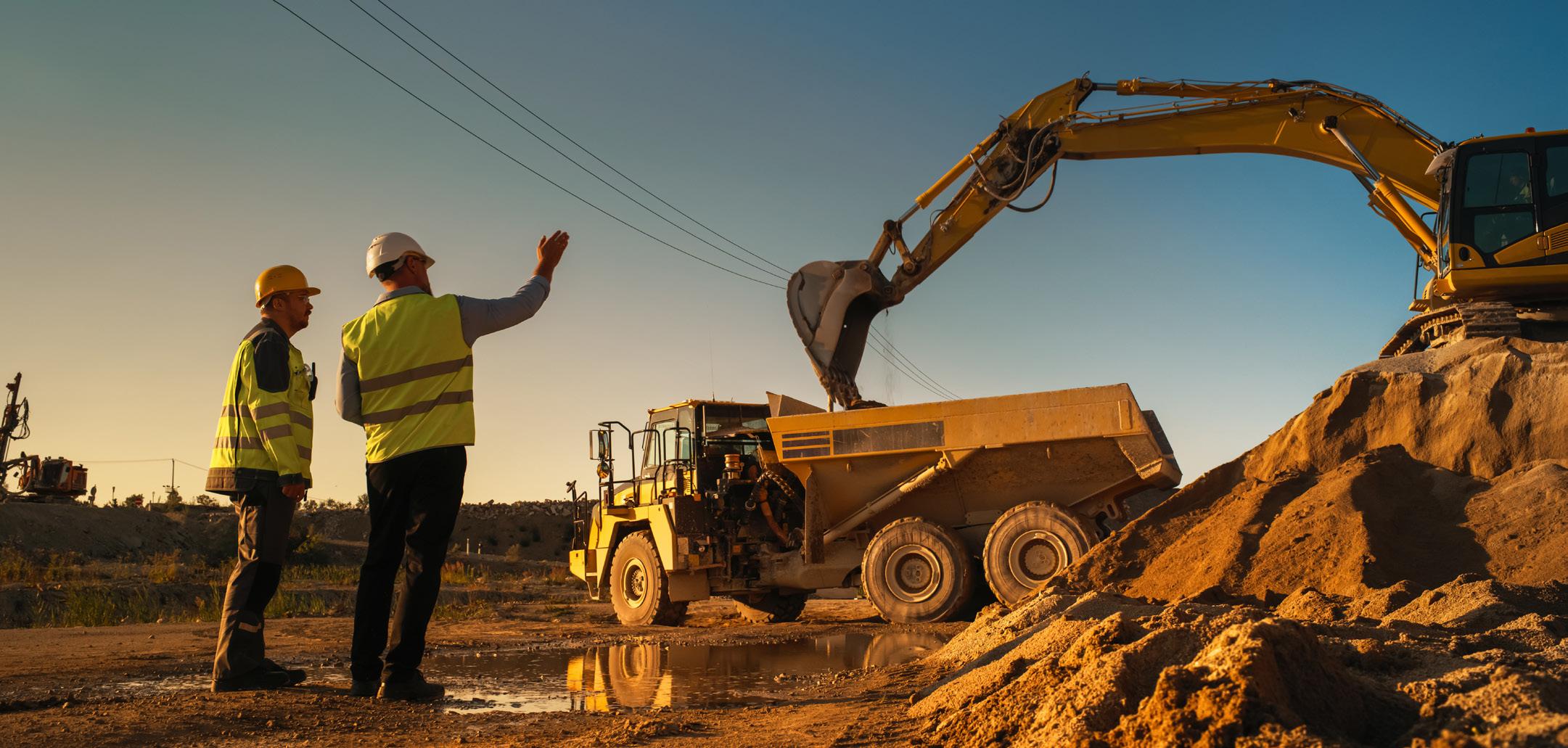
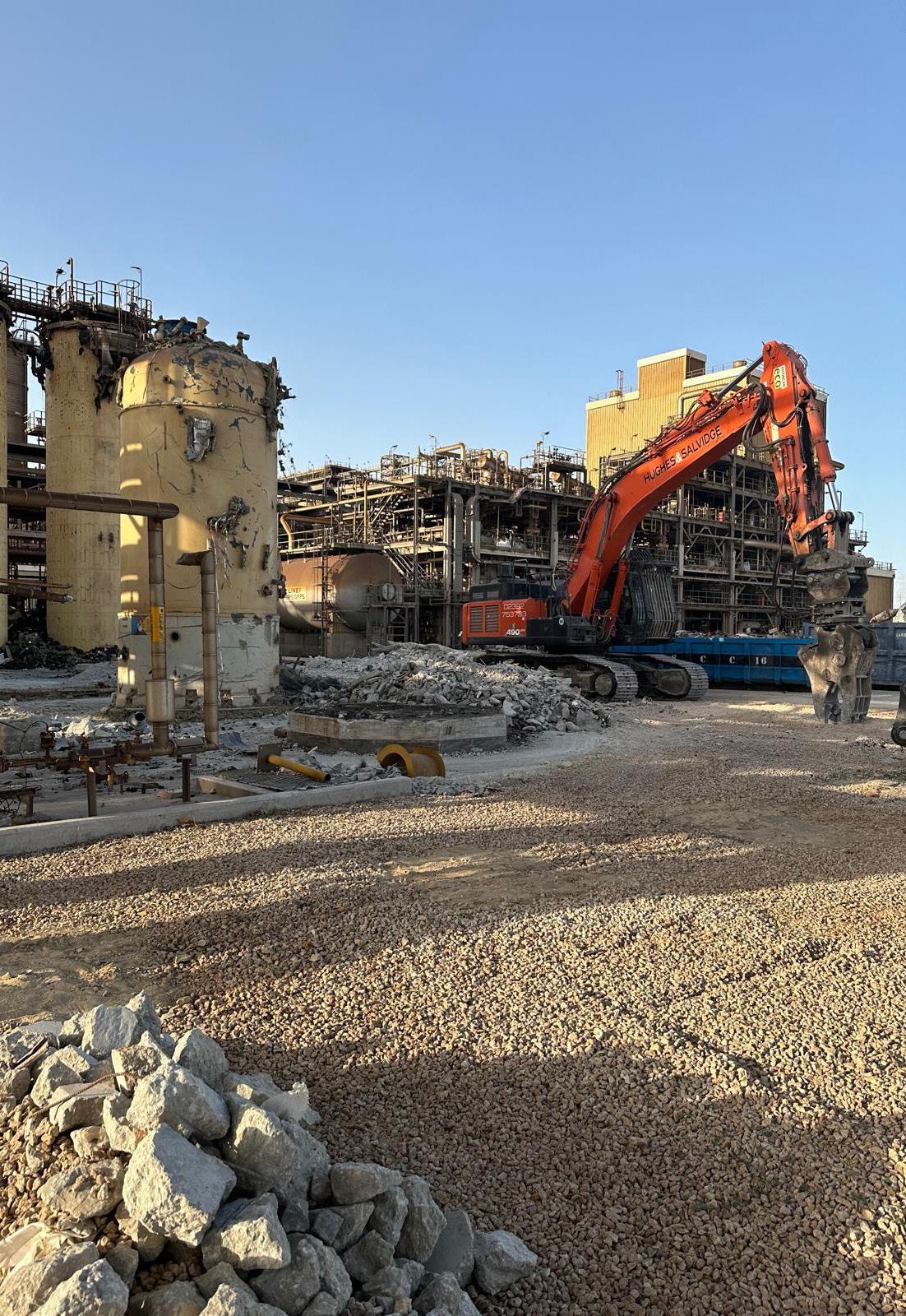
Hughes and Salvidge, having completed various flagship projects as a business in the last twelve months, are grateful to see the team recognised for their hard work!
With our appointment as Principal Contractor for the demolition and dismantling of S-Chem Polystyrene Production Plant in Al Jubail, Kingdom of Saudi Arabia in the last quarter of 2023, the successful completion of those complex works was highlighted across our submissions.
The NFDC carefully considered and evaluated all entries, identifying exceptional individuals who had demonstrated outstanding dedication, skill, and leadership within their respective roles. We are exicted to announce our very own Mark Mansfield was shortlisted for Plant Operator of the Year!
Mark was a key member of the team that demolished this chemical plant over an 8-month programme.
With 6 areas of works, the project was bordered by a live substation and sump system, a live main site pipe rack and by the live Teal plant and ground flares, with sections also adjacent to a live road to the wider S-Chem site.
The works included but was not limited to:
• The removal of an incinerator and furnace plant adjacent to a live teal plant
• The removal of a 65m styrene column again adjacent to the live teal plant
• The removal of 5 x 70-ton reactor vessels that were located at height within a steel framed structure
• The demolition of a 45m palletizer building adjacent to an operational plant within the site
• Ground remediation on completion for safe hand over back to client
Due to the incredibly successful work completed on-site, the project and the Hughes and Salvidge team are currently shortlisted for S-Chem Contractor of the Year, due to be announced in August.
Mohammed Habash from S-Chem had this to say following the successful completion of this complex and challenging project: “The strong bond we share in our work environment, coupled with Mark’s unwavering commitment to safety, has made a lasting impact on our collective journey. Mark’s exceptional work ethic and adherence to safety protocols have been instrumental in the successful and timely completion of the project.”
Sensational work from everyone involved, and good luck to Mark, along with all other nominees, at the awards dinner on 21st March.

The CEA (Construction Equipment Association), the trade association representing the UK construction equipment industry since 1942, has unveiled a refreshed brand identity reflecting the progress and direction ahead. Recognised by the UK government as the voice of the industry, the CEA plays a vital role in supporting its members through market insights, technical expertise, networking, trade exhibitions, and lobbying efforts with both the UK and European governments.
The refreshed brand is a natural evolution of the changes introduced over the past year. As the CEA has expanded its initiatives, strengthened its industry presence, and refined its engagement with members, it was important that its identity kept pace. The new look reflects this progress, ensuring the association presents itself in a way that is clear, professional, and aligned with the work it does.
The most striking update is the redesigned logo, which has been modernised while maintaining a strong connection to the sector. A key feature of the new design is the ‘A,’ now shaped to resemble a backhoe loader—a subtle but meaningful nod to the construction equipment industry. This, alongside a sleeker and more contemporary visual identity, ensures the CEA remains instantly recognisable while reflecting the innovation and development happening across the industry.
The rebrand coincides with a period
of transformation for the CEA, including a change in leadership. Viki Bell took on the role of Director of Operations in March 2024, bringing fresh energy and a renewed focus on the association’s role in supporting and advocating for the construction equipment industry. Under her leadership, the CEA has sharpened its strategy, enhancing member engagement, strengthening its position within government and regulatory discussions, and ensuring its initiatives align with the changing needs of the sector.
active than ever in shaping the future of the construction equipment sector. The new identity brings all these elements together, creating a strong and unified presence that supports the work being done.
Viki Bell, Director of Operations at the CEA, commented: “This rebrand is an important step forward for the CEA. The construction equipment industry is moving at pace, and our role as a trade association is to ensure we are keeping up, staying relevant, and providing real value to our members. Our new identity reflects the work we’ve already been doing—modernising how we operate, improving communication, and reinforcing our position as the voice of the sector. We wanted to show evolution, not revolution, and this new identity is a clear mark of the progress we’ve made over the past year.”
The updated brand follows a period of transformation for the CEA. Over the past year, the association has enhanced its communication channels, introduced new initiatives, and expanded engagement with industry partners. From hosting key events such as the new members forums to driving forward discussions on regulation, sustainability, and industry challenges, the CEA is more
The CEA’s mission is to represent the interests of its members within the UK construction equipment industry in an increasingly competitive global environment. Its vision is to be the voice of the construction equipment industry, deliver value and excellence to its members, positively influence government policy, and directly contribute to the sustainability and growth of the sector.
The association’s influence extends beyond the UK. It is represented in Brussels as an active member of the Committee for European Construction Equipment. Through its work in technical standards, regulatory affairs, and international trade, the CEA ensures that the voice of the UK construction equipment industry is heard worldwide.
The updated branding will be rolled out across all CEA platforms, including its website, events, and communications. This refresh reflects the association’s ongoing commitment to progress and delivering value to its members.
This marks an exciting step forward for the CEA, reinforcing its role in shaping the industry’s future. The association is confident that this refreshed identity will serve it well in the years ahead and looks forward to continuing to support its members and the wider sector.

Align with UK guidelines for reducing carbon footprints with HVO – a fully renewable biodiesel that reduces emissions by up to 90%* and promotes circular economy practices.
• Reduced impact on air quality, with less nitrous oxides and particulate matter compared to standard diesel
• Robust and accredited supply chain
• Practically fossil/FAME free** and odourless



Straight into it then, how long have you been with Collard Group now?
I think it’s six years the end of February.
And you went from Site Manager to Contracts Manager?
Missed a few rungs. Supervisor to Site Manager to Project Manager and into Contracts Manager.
Has your time in demolition always been with Collard?
No, I actually first started out as a labourer. That was around 13-14 years ago for a company called AR Demolition up in the Midlands. My future wife lived down this way which made me move
Managing Editor, Rebecca Phillips, sits down with Collard Group’s Sam Tunnicliff to talk about his career in demolition and his time as Contracts Manager.
locations to Ascot. I started down here with Shorts Group and was there for about five years before having the opportunity to move to Collards.
Sounds like you’ve had a rather expansive career in demolitions already! Seen it from the ground up, as it were.
I’ve worked my way up in order to learn key knowledge and experience in various roles to provide me with different aspects of what can be done, and how it can be conducted safely and effectively in future work roles.
Was demolition always where you wanted to be? Or is it the ageold story of ‘I accidentally fell into demolition and then loved it so much I never left’?
Sort of. I came out of school and decided to do bricklaying in college. After that I got some bricklaying work, but when AR Demolition offered me a role, I took the opportunity and ran with it.
So what was it that kind of took a fancy then about demolition?
I’m going to be honest with you… at the time I didn’t know a lot about demolition. It was more about having a steady job instead of being self-employed.

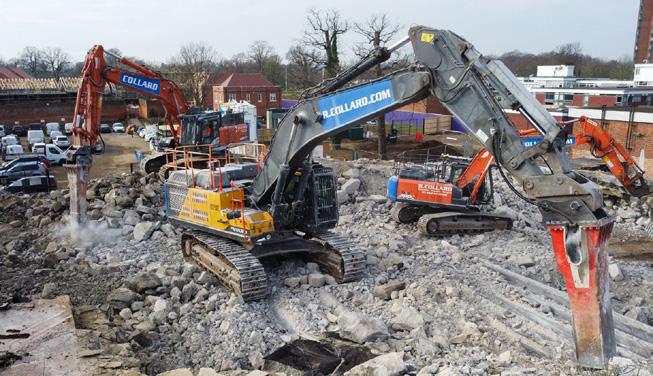
I think economic stability is a fair reason to take a job! What’s kept you in demolition?
I love the job. Immediately, I just loved it. I’ve never regretted coming into the industry. It’s certainly less back-breaking than bricklaying, and takes less time to bring a building down than it does to build one up! But it’s tricky, and I like the challenge.
Talk me through the progression then. What was it that captured you?
Well after labouring, I became a plant operator. I was one for a good number of years and I really enjoyed it. But then I knew I wanted to progress so that was when I went for the supervisor role.
Do you miss the machines?
I certainly do, especially when it’s this time of year, when I’m outside in the cold looking at the guys in their nice warm cabs! But it really has all been about moving forward for me. I didn’t really want to be stuck in one position and get 10 years down the line and find I’m bored. Particularly with my role now, it’s so diverse. Each one is so niche and specific, and I love the puzzle of figuring it all out. At the moment I’ve got six projects with three in the background that are coming up. I’m always kept busy, and I love that.
Do you think your on-site experience helps you with your role now?
It helps a lot because you learn how to get the best out of people, or what
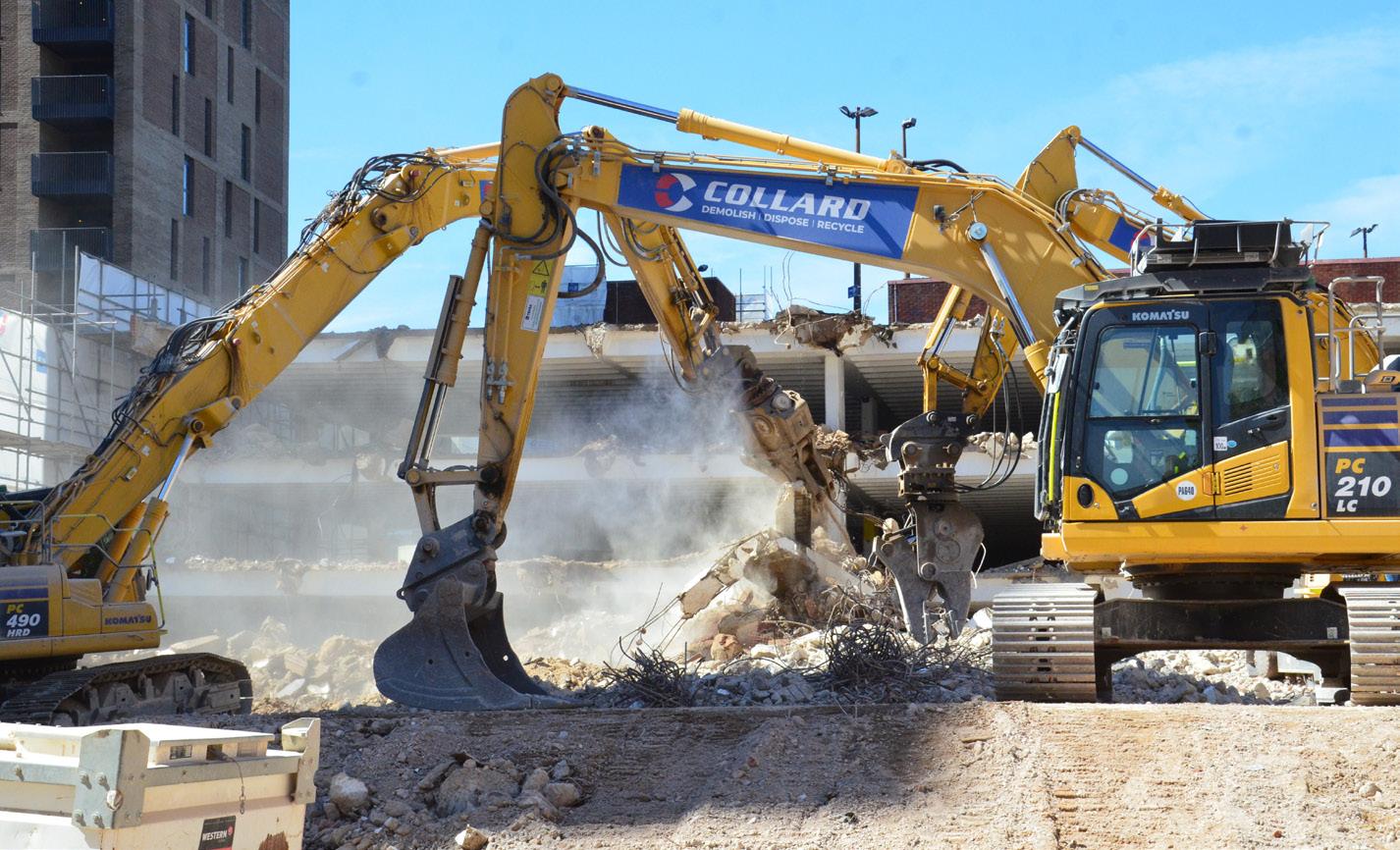
people should be doing on site and where best to utilise them. You also know what can and can’t be done from a machine basis, a labourer basis, supervisor, site manager; you have a good understanding having gone through all the roles. I think you get more respect from the on-site guys as well when you can answer their questions. You’ve been where they are, you understand them.
Does it change your approach to contracts?
I suppose so. It definitely helps, especially when you’re doing programs for jobs. You roughly know how many labourers for soft stripping or anything like that. It gives you a better basis than someone that hasn’t done it before.
Do you have a particular favourite project?
Broadway Car Park hands down.
I think that was the quickest answer I’ve ever had to that question! Why Broadway specifically?
Just all the information involved in it! It wasn’t just tearing down your average warehouse or industrial unit house, there was a lot more involved. You had live substations that were in the car park that had to be protected; you had a live shopping centre adjacent, all the fire exits coming out to the car park… there was a lot involved and it kept me really busy. But at the end of it there was such a sense of accomplishment.
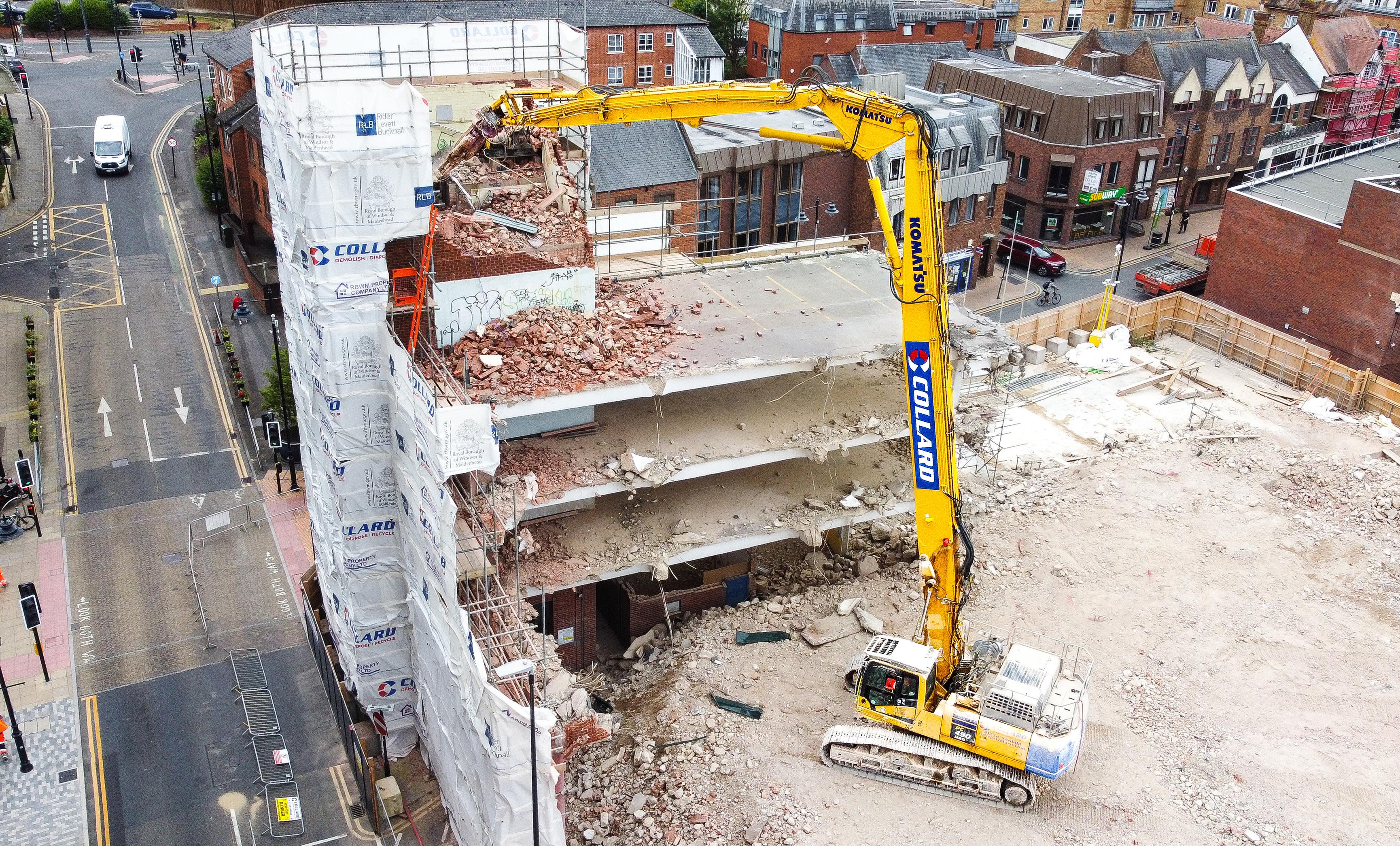
So the trickier ones are your favourites then?
I actually love doing paperwork, and there was so much with that one. I love making sure everything’s in place, everything is safe. I love going through all the details.
From a health and safety perspective, I suppose that has changed a lot over the years.
Oh, definitely! It’s changed so much over the last 20 years and all for the better. It’s so much better knowing everyone will go home safe at the end of the day, and all demolition contractors pride themselves on that now. That and waste. You can recycle most things these days, apart from asbestos of course. But we do really well with the ecological side because we’ve got all our own transfer stations.
We offer a complete package here, and I think the way Rob Collard has built it up is brilliant. Everything’s kept inhouse, and I think the service is better that way; we know all the departments and divisions and get answers for our customers really quickly. We have good relationships across our departments, and that then reflects to the clients.
A complete package is much more attractive to a client as well I’d guess? It’s a big benefit for the tender side. All the information they require comes from us and saves them having to deal with multiple contractors. We have a lot of returning clients which proves that the way we do things really works.
Is that what attracted you to Collard Group?
Again, it was about progression. There was another opportunity here that would keep me moving forward. But honestly? It’s the best move I’ve ever made. The people here are incredible. It’s a real family, and everyone works so well together and always strives for the best.
People make or break a job a lot of the time, don’t they?
Definitely! And I think good MDs help dramatically. If you haven’t got the support from above, I think you eventually give up. Rob certainly ensures we are all heard and that we have a nice environment in which to work. I think at the start, it used to be two or three cabins that they had here, and maybe a shed. And it’s just grown and grown. In fact, my wife used to be one of the girls in the cabins. She was a manager at the NFDC, that’s how we met. Then I moved down this way to be with her. She’s not in the industry anymore, but I’ve always known that Collard’s was a fantastic place to work.
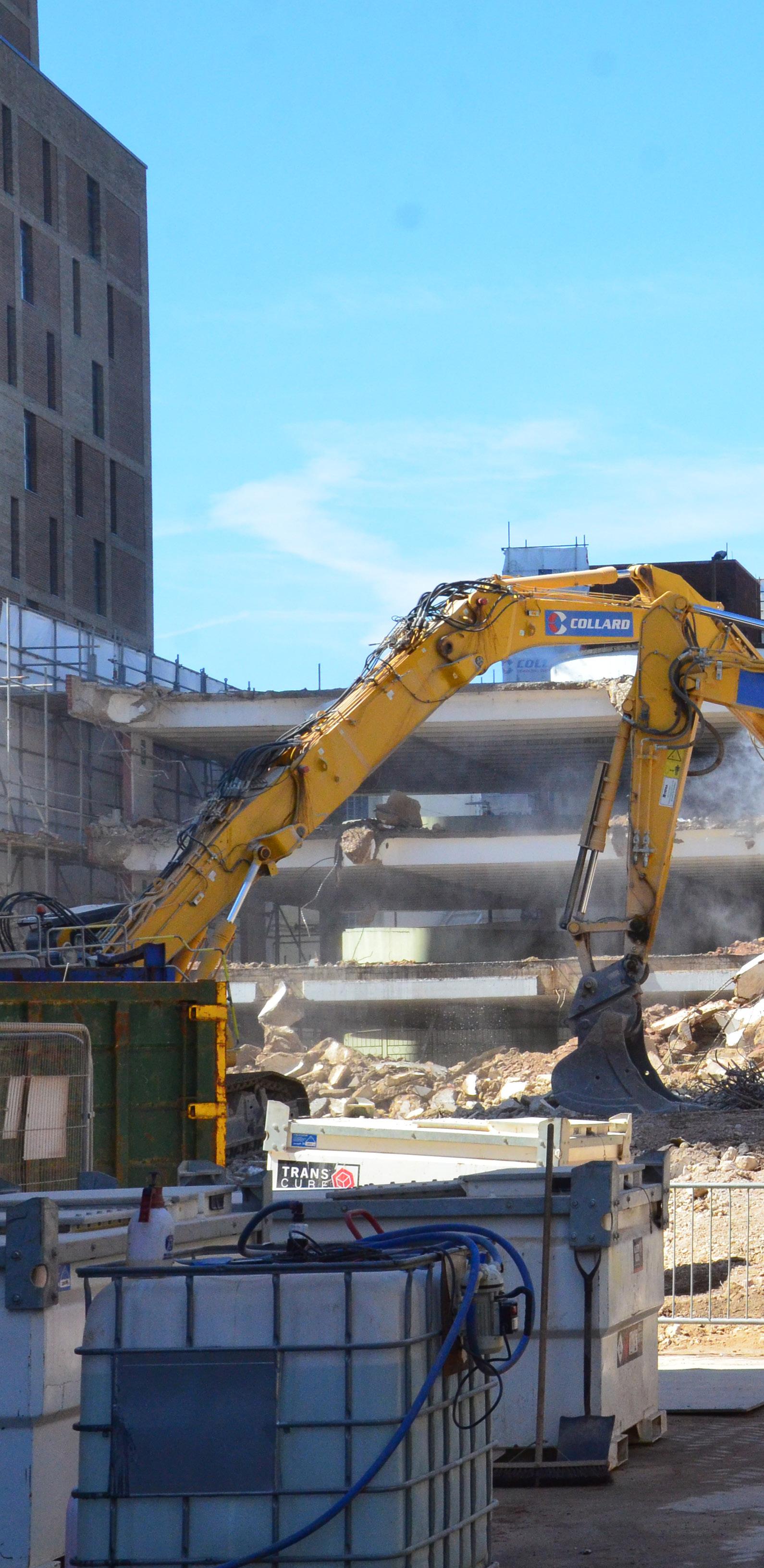
That’s my very first romantic demolition story! You’ve made history here!
I love it! But I’m not going to admit how long ago we met. She’d kill me.
Let’s save you then. I’m going to assume you aren’t done progressing?
No, not at all. But I am very happy where I am at the minute. I think years and years down the line there is obviously directorship to aim for, and all that sort of thing. But that’s a long way down the line. I have things I need to do first, and part of that is spending time with my family.
So you have a good work life balance here? That can be hard to find in demolition.
I’m very lucky. I don’t have to be away from home overnight all that much because of the way the business is set
up. We have four contracts managers, each with our own region; three of us are demolitions contracts managers and one is groundworks.
Do you ever work in tandem with other contractors?
Sometimes, if the client doesn’t want the all-in-one solution. But not all that often to be honest.
Have you ever had a job that was really tough to get through?
I don’t know to be honest. I can’t pick one out. I think you’ll always have good jobs, and you’ll always have bad jobs, and I think that’s with any job, not just demolition. I can’t think of one specifically. You always come across items on site that make your job harder than you wish it was, but like I said, that’s the part I really like. So, I suppose, no matter how frustrating a problem is, I always enjoy tackling it.
Was tackling qualifications something you also had to do?
Absolutely. I’m currently doing my testing for the IDE. I’ve done my NEBOSH qualification and all that surrounds that. Rob put me through it all. That’s one of the best things about Collards, they do so much training and really pride themselves on it. It’s particularly impressive when you look at the size of our workforce. And it doesn’t have to just be something required for the job; if you’re interested in it, Rob will try and put you through it. I have a lot of extra Health and Safety qualifications because it was something that interested me. I’d only been here for about a year as a supervisor and Rob said, ‘go for it!’ It’s such a supportive environment.
Sounds like the perfect company to work for, if you ask me. It is. It really is.
Howard
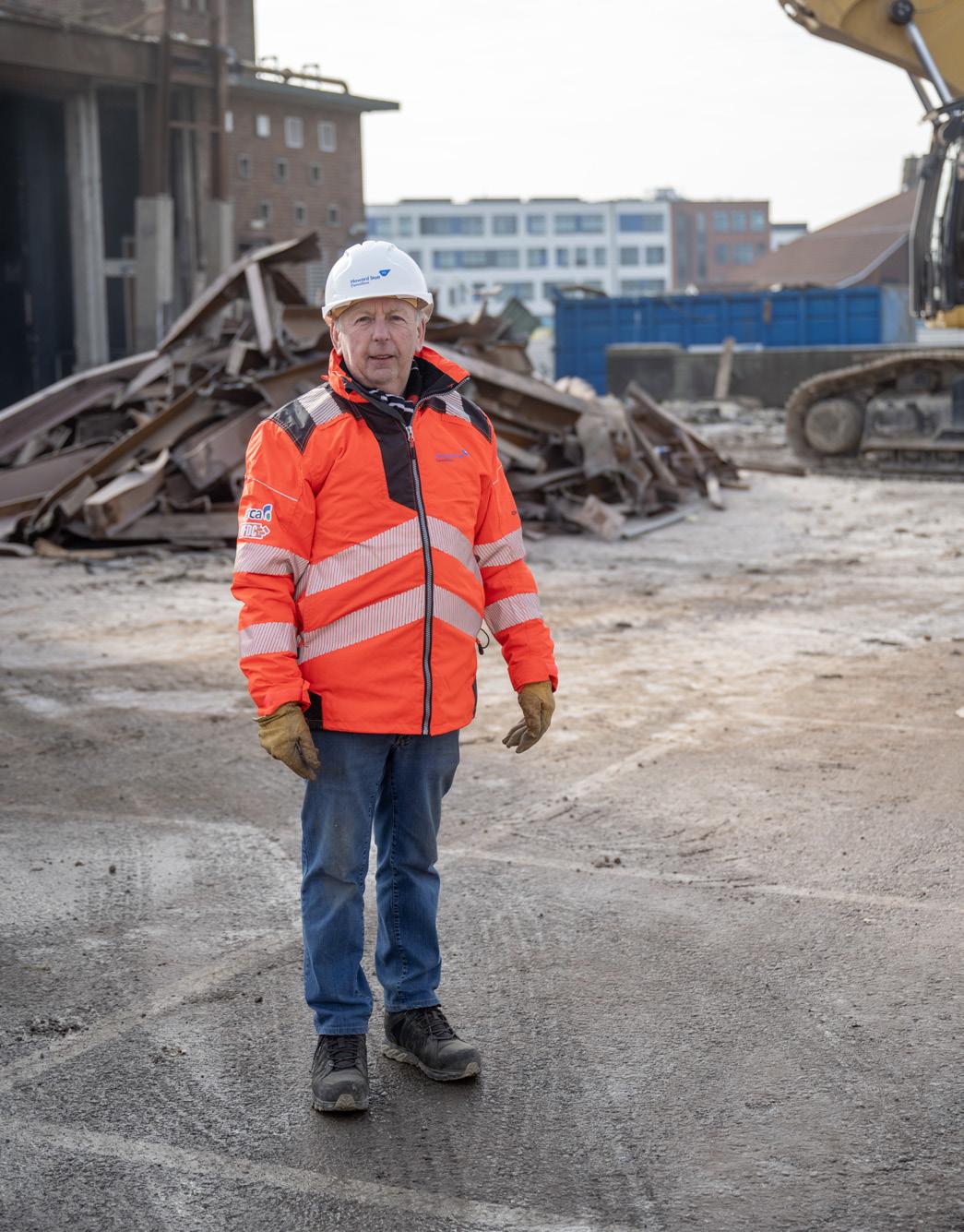
Stott Demolition have been changing the landscape of towns and cities of the UK for over half a century. Over this time Howard has used a variety of machines and attachments and at the age of 71, still prides himself
on having the ability to know a decent bit of kit when he sees one.
“Even though I have stepped back from the day to day operations, I will always take a huge interest in the kit we purchase,” Howard commented. “I still have all my tickets up to date and will happily spend a day or two on site helping the teams out when required. I appreciate the work the lads have to do on a daily basis and try and make sure we purchase the best equipment we can.”
Stott operate a wide range of equipment from mini excavators up to a pair of high reach machines, all of which are designed for work in the demolition industry and are equipped with a range of hydraulic couplers, mainly Lehnhoff Lehmatic hitches supplied by Worsley Plant Hire.
“When we decided that fully automatic couplers were the way forward in offering increased productivity and reduced downtime, we looked at both of the major brands on the market,” Howard comments. “We decided that Lehnhoff hitch was the ideal solution for us as it offered a combination of a robust build and ease of maintenance.”
Whilst the machine fleet is predominately serviced by Lehnhoff hitches, these aren’t the only Worsley supplied attachments used by the Stott team.
“Our attachment fleet is almost 70% sourced from Worsley Plant and includes Rotar grabs, pulverisers and shears, Montabert hammers and Dynaset magnets,” Howard commented. “We like the quality of the brands Worsley supply and find that the back up is excellent too, something we demand from our suppliers.”
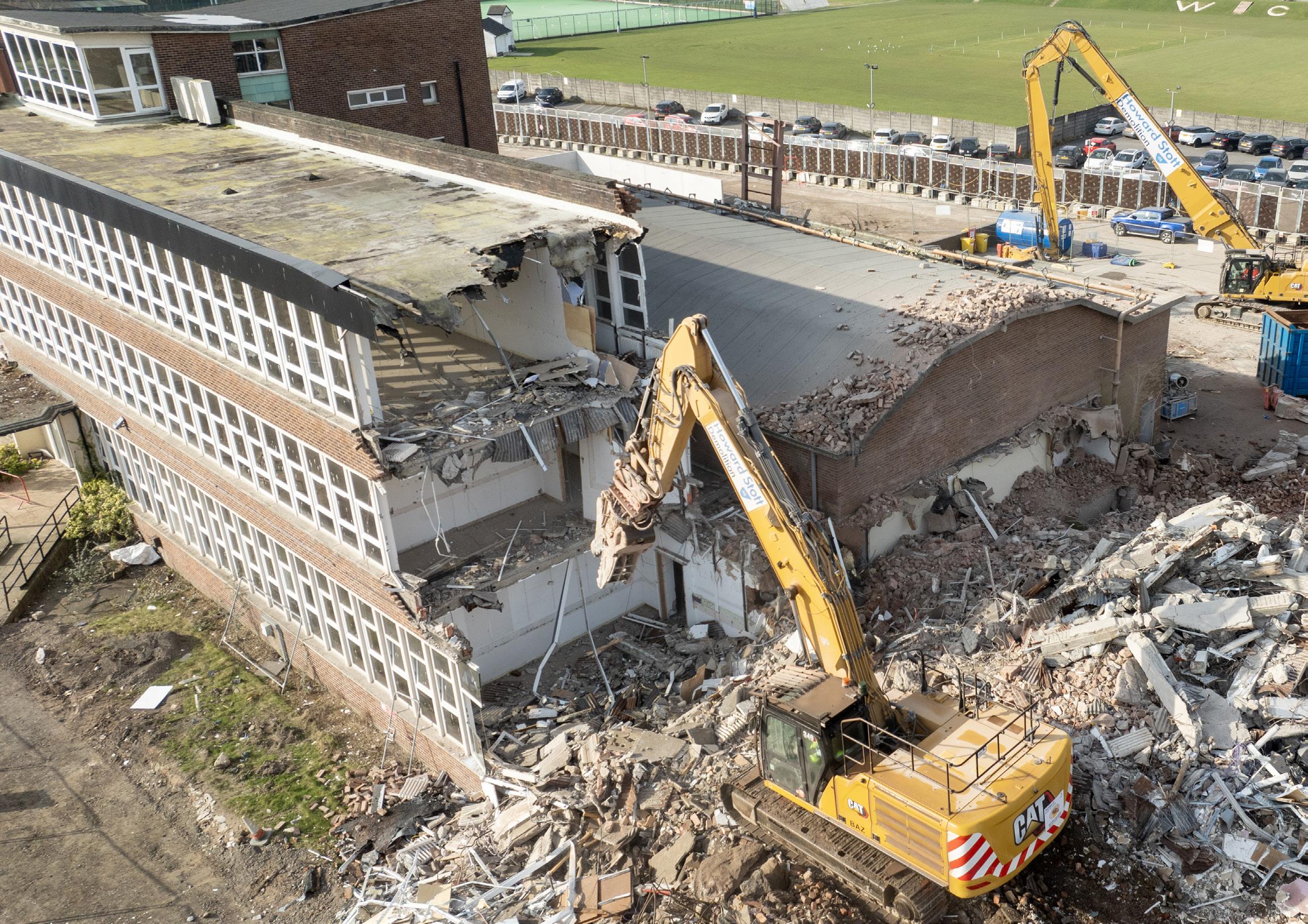
One of the latest jobs the company is currently undertaking is the demolition of some of the older buildings on the Wigan and Leigh College campus. Working for main contractor Wilmott Dixon, Stott have recently completed a substantial soft strip and asbestos removal program prior to the structural demolition works.
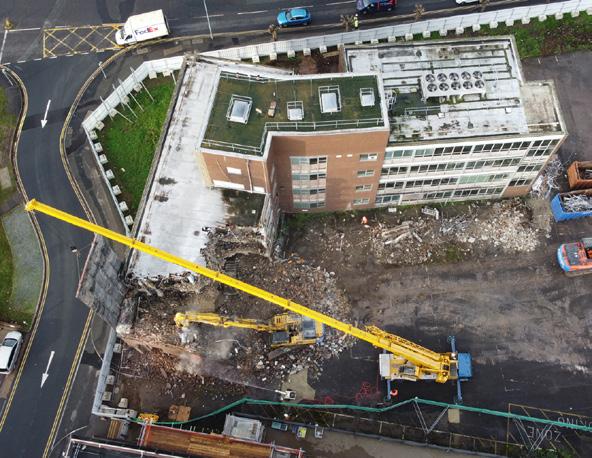
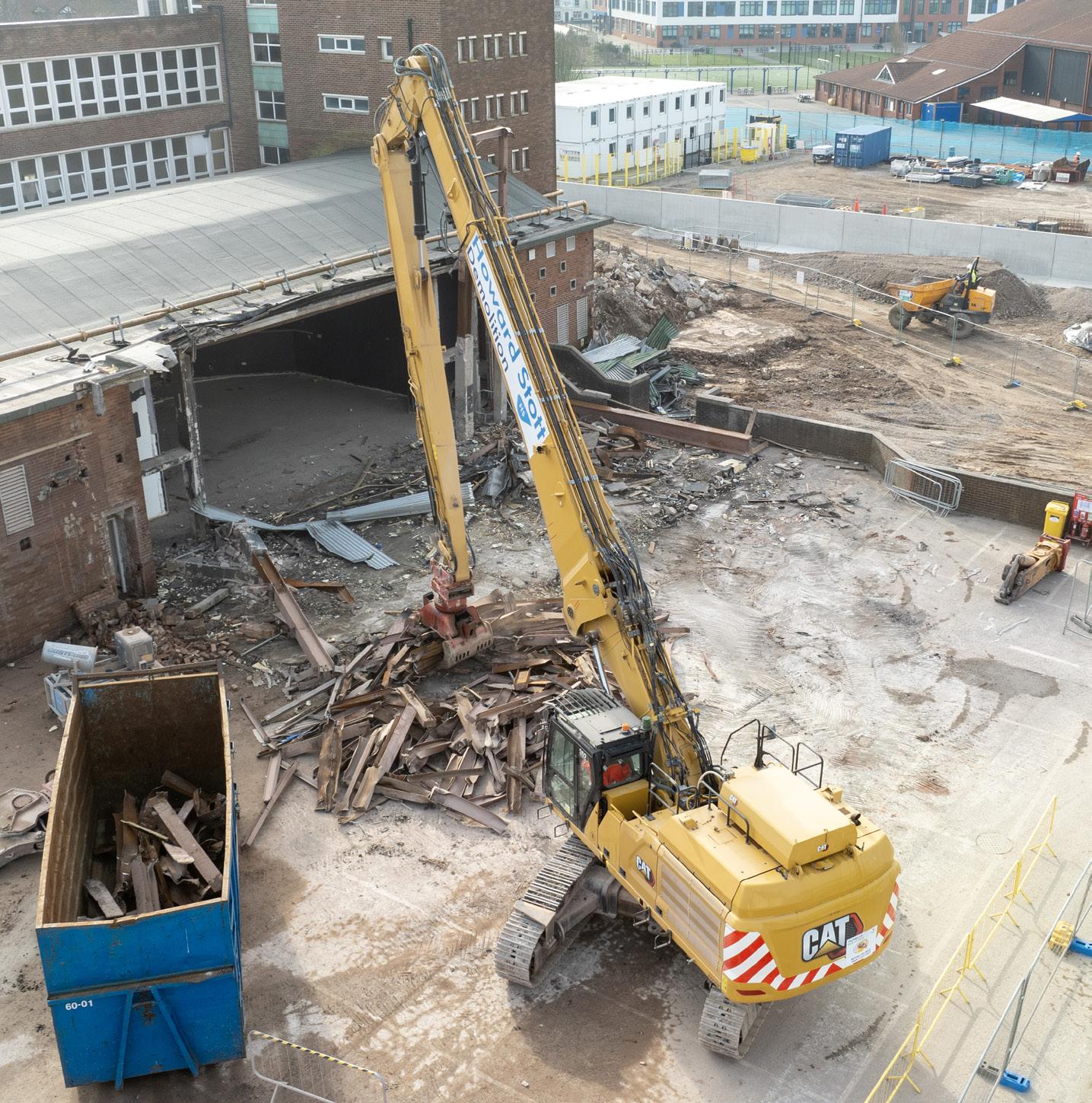
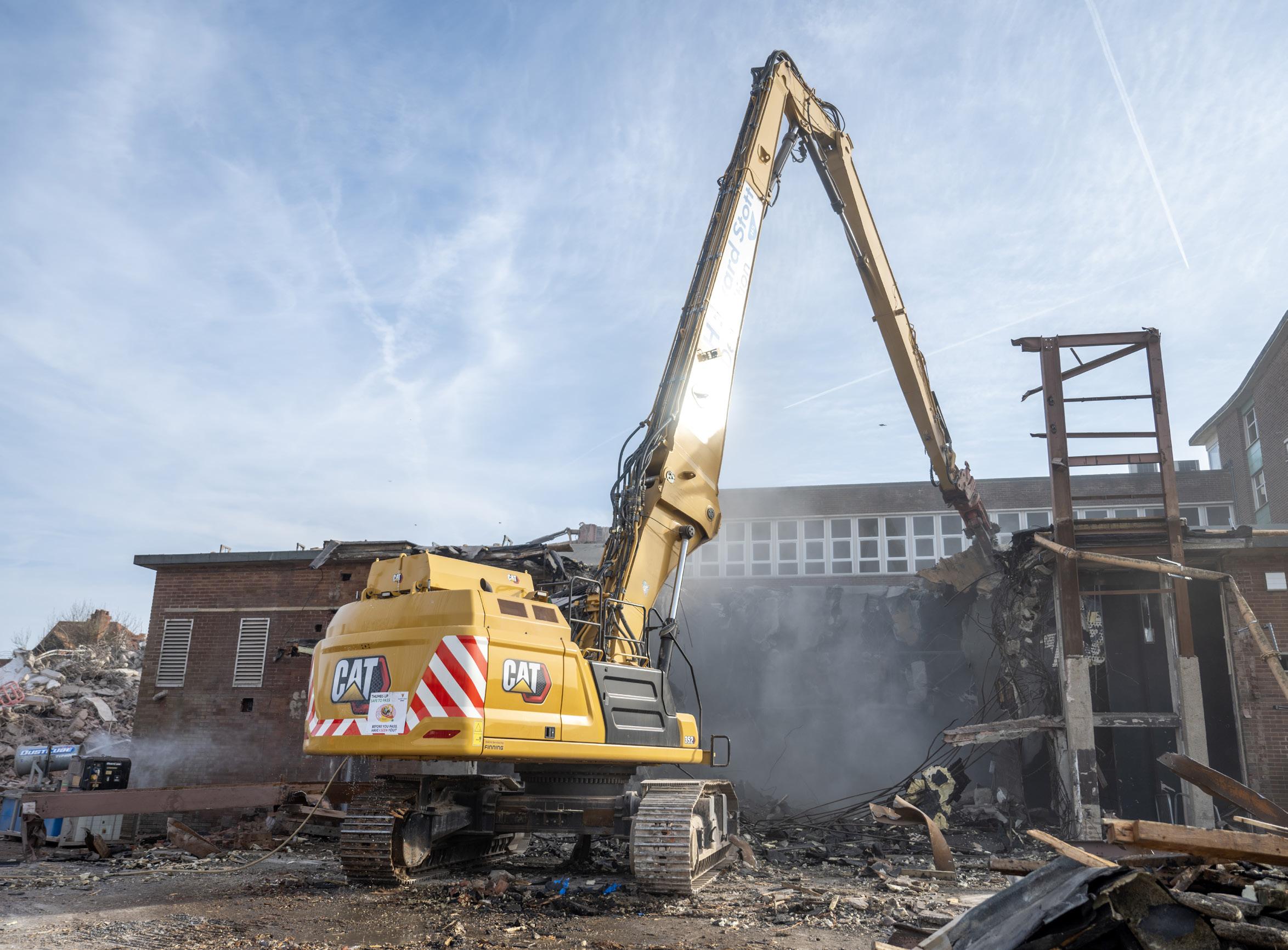
To ensure they and their client meet the tight deadlines, Stott have deployed their flagship CAT 352 high reach machine and a slightly smaller 340 with straight boom. Working from the gable end of the three storey teaching block, the CAT 340 was easily able to reach the top of the flat roofed building, quickly pulling it down and piling the material in front of it to create a stable platform on which to operate. The benefit of the Lehnhoff system comes to the fore with operator Neil regularly alternating between processor and bucket as he worked his way into the building.
On the other side of the building Director, Ryan Noon, was filling in on the 352 high reach and tackling a former plant room situated on top of the original brick built structure.
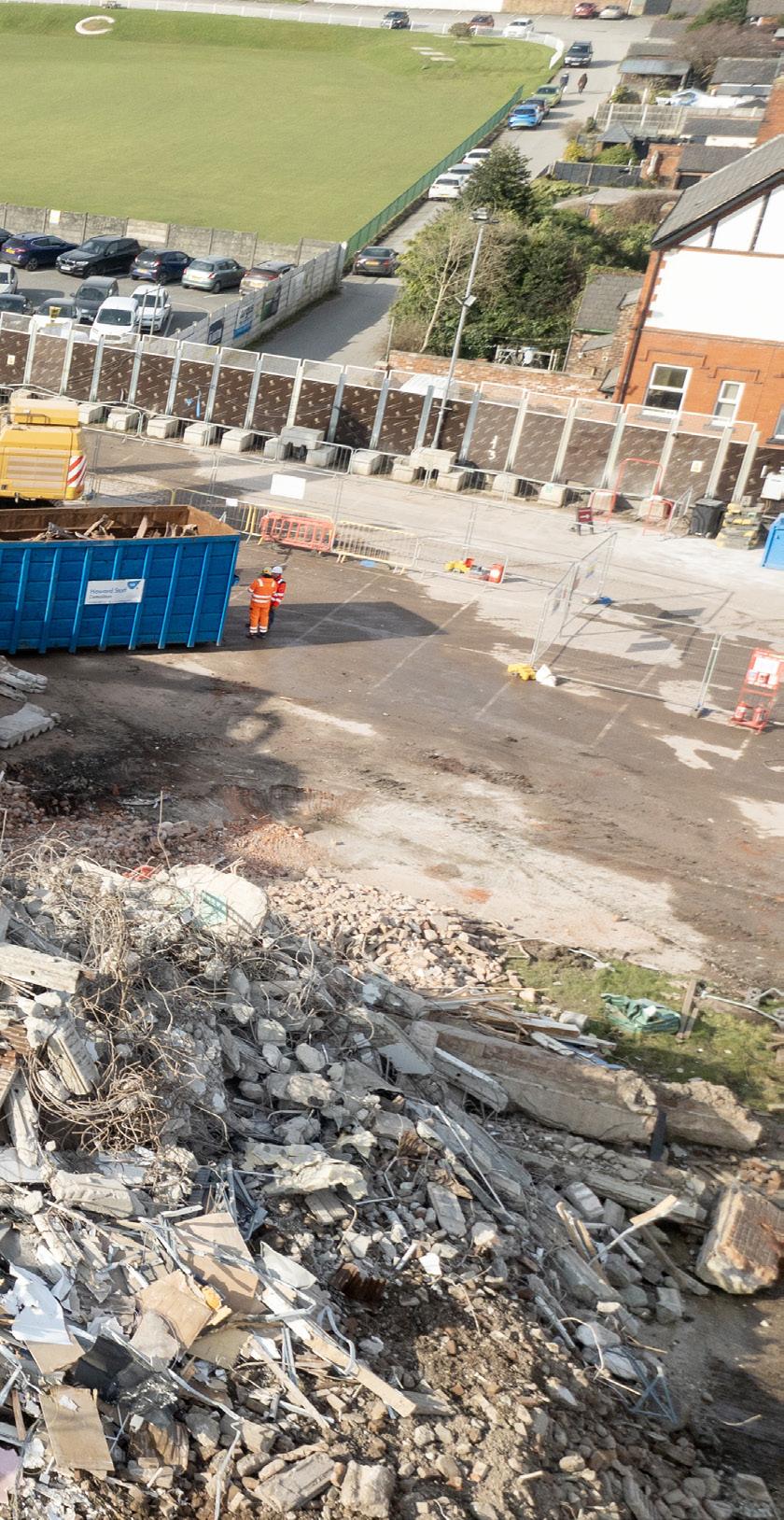
Whilst the 28m high reach could have been considered overkill for the structure, having the ability to stand a safe distance away from the potential of slipping tin sheeting made it the correct choice. Utilising one of the Rotar RG30N selector grabs, Ryan carefully removed the tin sheeting before folding it and placing it into an adjacent scrap bin. With the steel sheeting removed and the area in front of the building cleaned, Ryan quickly swapped the Rotar grab for a steel shear to carefully cut down and the five-foot steel frame. The arrival of an empty bin allowed another swap of attachments back to the Rotar grab for Ryan to load it up with some of the processed steel. Once loaded, a beam was picked up and used to scrape the area clean before the demolition work continued. “We like to keep on top of the housekeeping,” Howard explains. “It makes segregating materials easier and also makes the job site safer.”
With the steel out of the way, Ryan swapped the grab for a Rotar RDP25S pulveriser before Site Supervisor, Dave Coppock, connected the site’s water supply to the bespoke water suppression system built onto the CAT. “We designed the dust suppression system with Worsley who have built the system for us,” Howard explained. “We have used a stainless steel tank which we have built into a sturdy frame and fitted it onto the top of the engine cover. The tank and frame are easily removable should we need to access the engine and can be tipped out of the way for routine servicing. The tank has been fitted with a fixed stainless steel pipe which is routed over the engine and protrudes out of the sill just in front of the counterweight. Worsley’s engineers have fitted it with a hydraulic pump to more than adequately supply a spray of water over both sides of the attachment whenever we need it.”
With the RDP fitted, Ryan quickly makes inroads into the building’s convex reinforced concrete roof using the attachment’s powerful jaws to break up the concrete and the
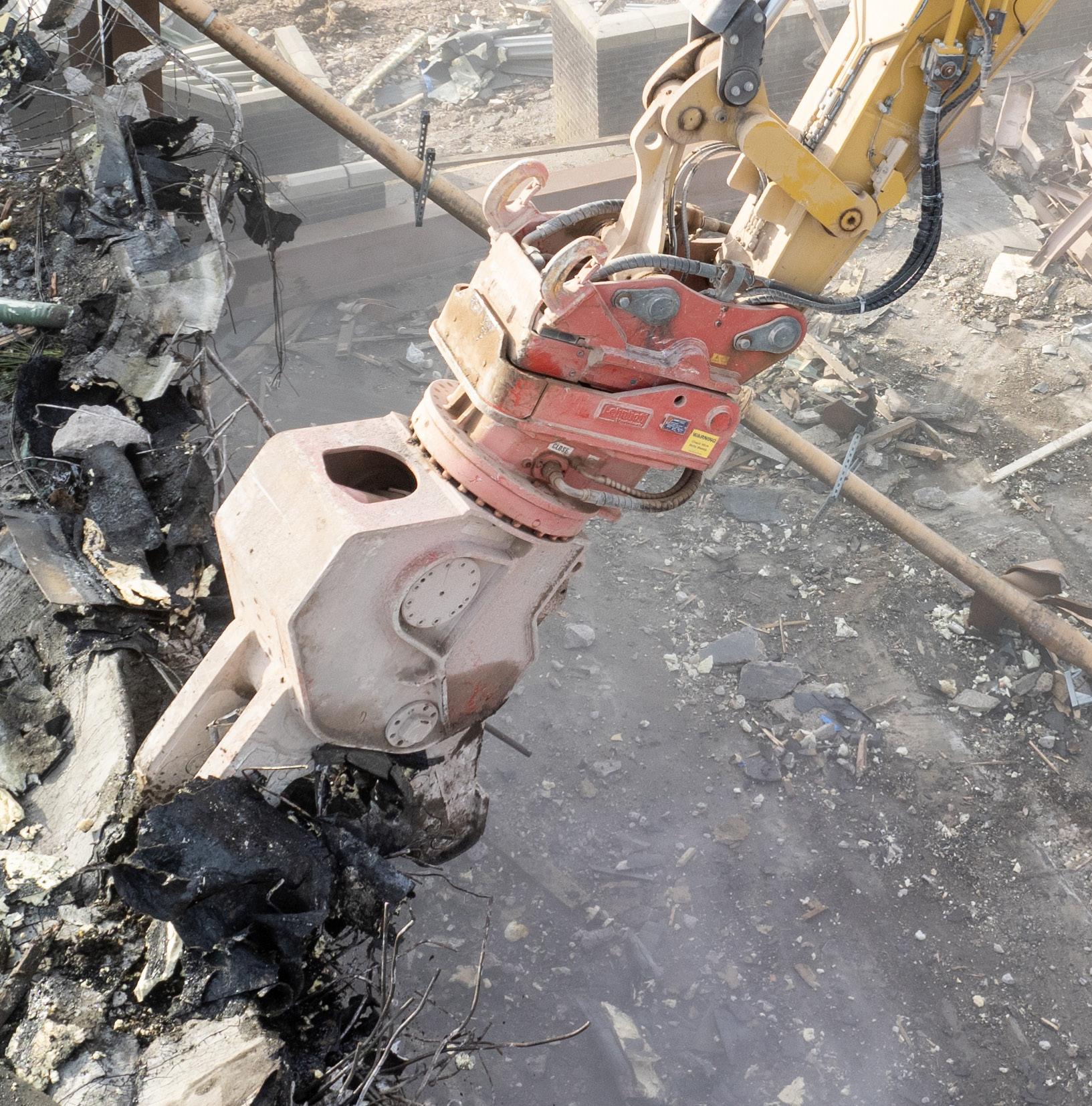
integrated shear blades to take care of the mesh of reinforcing bars. After just a few minutes of work, the CAT and Rotar combination had almost completely removed the concrete roof structure and many of the former supporting walls. Ryan echoed Howard’s comments on the Rotar equipment the company use; “They are very well made bits of kit and can handle any of the work we need them on.”
The relationship built over the years between the Stott and Worsley team has given the demolition contractor the confidence to heavily rely on the variety of products sold by the Middlewich dealer. “We have a great relationship with the Worsley team which has been built on their willingness to invest in their service and back up they offer the industry,” Howard commented. “We could go to other dealers and invest in their attachments and still be able to undertake our operations. It is when we have an issue with anything that we know that Worsley have our backs. Their attention to detail is excellent and they always have a ready supply of spares and consumables when we need it. They will even go the extra mile and source spares for brands they don’t deal in when the supplying dealer can’t.”

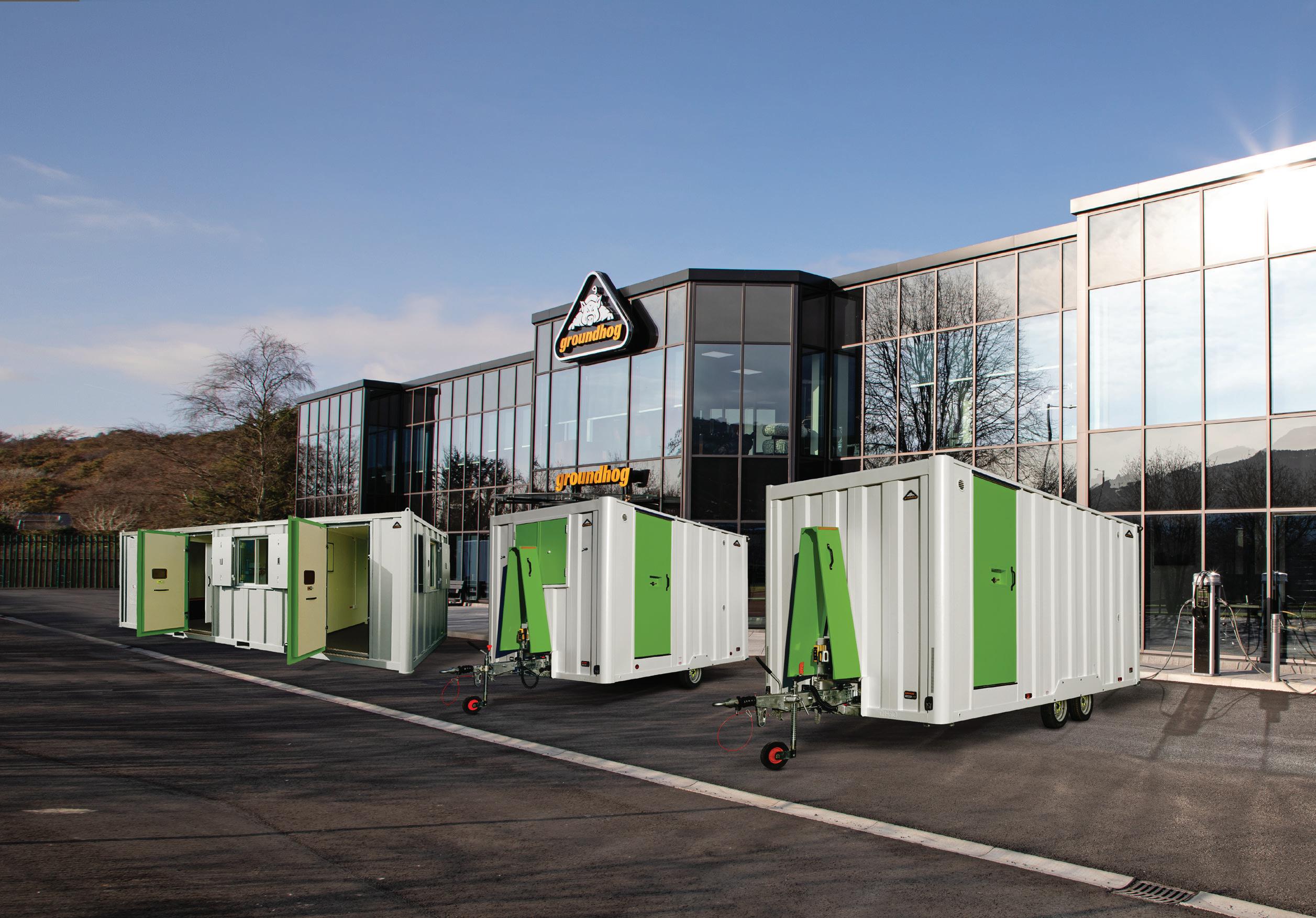
Committed to delivering innovation, quality, reliability and service across our extensive range of site welfare units, groundhog® are proud to be recognised as one of the UK’s leading manufacturers of welfare accommodation.




Managing Editor, Rebecca Phillips, dives deep into the history of demolition to take a close look at the evolution of controlled destruction.
With the constant need for development, demolition has become an everyday sight in the modern world. It seems almost hum drum to stroll through a city and walk past a building site with a half-collapsed property. Perhaps it’s because we intrinsically know it’s for the greater good, so we turn a blind eye to the literal chaos before us. But, in reality, the path that led us to this controlled destruction is a gruesome one. Two forms of demolition are still used in the world today: Manual and Building Implosion, and both of these have roots in sinister happenings.
So let’s wind the clock back and understand exactly how we came to modern day demolition.
First up, Manual Demolition. How did we get to smashing up buildings for our own personal gain? Well, it must be said that Manual Demolition doesn’t have the most heroic of histories. In fact, its early days lie solely in the military side of things, as it was often employed during ‘scorched earth’ tactics.
The earliest recorded example of demolition in British history actually dates back to the reign of William the Conqueror and his Harrying of the North. That particular series of military campaigns to drive out the last of the Danes from the newly conquered Britain resulted in the Normans laying waste to all of the Northern Shires, especially Yorkshire, which at one point was the Viking capital of Britain.
Many civilian dwellings were razed to the ground, and that particular method of destruction is seen by many scholars as an early form of demolition. It wasn’t a simple case of collateral damage or pillaging; this was the systematic and deliberate desecration of buildings. These sorts of attacks would ultimately inspire the later modern military tactics that in turn instigate the modern method of demolition.
Staying with medieval warfare, it could be argued that the trebuchet was the original wrecking ball. Just a couple of hundred years after King William demolished the north of England, these giant wooden catapults were used by the French to lay waste to castles and forts as early as the French crusades. In fact, until the invention of gunpowder, it was arguably the most powerful siege engine of the medieval period. Looking at the etymology of the word trebuchet gives even more rise to the idea it is the wrecking ball’s ancestor. In the original French, the verbal root came from trebucher (now trébucher) meaning “to overthrow, to bring down”. Combining this with the Anglo-Latin understanding of the word as a “medieval stone-throwing engine”, gives a clear link to the words “wrecking ball”.







Even the preferred type of trebuchet is similar to a modern day wrecking ball, in the fact it uses both gravity and the mechanics of the machine wielding the heavy stone to cause the destruction. Known as Counterweight Trebuchets, they relied on the potential energy that is stored by slowly raising an extremely heavy box (filled with the necessary materials for demolition) attached to the short end of the hinged beam and then releasing it on command. In contrast, Traction Trebuchets used human power, where a team of people would pull ropes attached to the short beam on command. Of course, relying solely on man power gave varying results and had too much result variance. So despite proving a more technical problem for the engineer, the ease of the Counterweight Trebuchet gave much more consistent results. Almost exactly like attaching the correct wrecking ball to the most appropriate crane. Funny how history repeats itself, isn’t it? At least this time, the building owners have requested the destruction of their property and won’t be trembling inside as an army swarms in.
So that gives us a glimpse of the first step towards manual demolition, but what about building implosion?
Well, curiously, the very first documented case of building implosion was the razing of the Holy Trinity Cathedral in Waterford, Ireland in 1733. Back then, there wasn’t such a thing as a planning and development department; it was only the Bishop that needed to be convinced that a snazzy new cathedral was the order of the day, replacing the Norman Gothic ‘monstrosity’ that had been there since the 11th century (which, by the way, many have now cited as a travesty). It’s said that potential builders were so enthusiastic about the new structure, that they arranged for pieces of rubble to fall in front of the Bishop to force his hand, and it worked! The use of 68kg of gunpowder, which was an extraordinarily high amount of explosives for the time period, instantly collapsed the building. It also created a deafening boom and destructive explosion that caused a problematic amount of collateral damage.
Luckily, exactly a century later in 1833, Alfred Nobel was born. This famous Swedish chemist was not simply the creator of the famous Nobel Prize, he was also the inventor of dynamite; an invention that led to writer Jeff Byles referring to him as “the patron saint of creative destruction.” Originally named ‘Nobel’s Blasting Powder’, the high velocity explosive was made using stabilised nitroglycerin and sorbents (usually shells or clay). Unlike traditional black-powder explosives, its compact design meant that accidental detonation was far less likely and that explosions could be reduced to a smaller scale. So with dynamite came a more controlled and precise way to destroy a building. This was just as well, as in the later half of the 19th century and throughout the mid-20th century, the Skyscraper was invented. To gain the extra height, the design had become far more complex. But with the erection of a new structure, ultimately comes the need to demolish it. So, tearing them down presented a brand new problem in the world of construction.
Unlike the scorched earth tactics of the Norman conquerors, the need arose to utilise buildings as shelter, look outposts or sniper spots in order to wage war in built-up city warfare. Battles like Stalingrad, for example, relied heavily on such a tactic. The need to blow up enemy outposts (without destroying your own) became essential. Not every battle could be like the Battle of Aachen; an operation that
destroyed the majority of the city and did, ironically, lead to mass scale construction.
So began the process of smaller scale implosion with less collateral damage. RDX, otherwise known as cyclonite, was invented in this time and was another high velocity explosive that could be more readily controlled. This non-electrical firing system combined with staggered detonation meant that after the war, when many cities globally required rebuilding, they could begin this process with proper implosion.
As we moved into the 21st century’s fast-moving world, demolition became not simply a much needed aspect of construction. It also drew interest from civilian parties who were fascinated by the display of such awesome power, so safety and control were paramount. If it went wrong, the damage went beyond collateral.
For example, when the Royal Canberra Hospital in Australia was demolished in 1997, many people wanted to come and watch its demise. The initial explosion of the site was not properly calculated and therefore, not properly contained. Huge pieces of debris were projected towards spectators who stood at a ‘safe’ distance of 500 m away. Sadly, a 12 year old girl was killed instantly on impact and a further 9 people were injured. In fact, fragments of masonry and metal were found as far as 650 m from the demolition site.
After such instances, safety measures were even more highly regulated. Nowadays, preparation for demolition can take anywhere between several weeks to a few months.
For implosions, which are used for smaller scale demolitions usually, site managers ensure any material that can form a deadly projectile, like glass or insulation, is removed. Explosives are then placed within building columns in order to properly collapse the building without projecting debris outwards.
Specific demolition, such as high reach, requires a manual approach, which in turn needs a wide range of tools, not just wrecking balls. For example, structural steel elements will require an excavator with a steel attachment, whereas concrete structures need hydraulic hammers. There’s even the “inside out” method, where a series of remotely operated mini excavators demolish the building’s interior, one floor at a time, whilst the outer structure remains intact as a sort of scaffolding. Other such structural specific equipment might be fire hoses to control any dust created or loaders or bulldozers with “rake” attachments. Loaders are also often used to sort steel and remove materials.


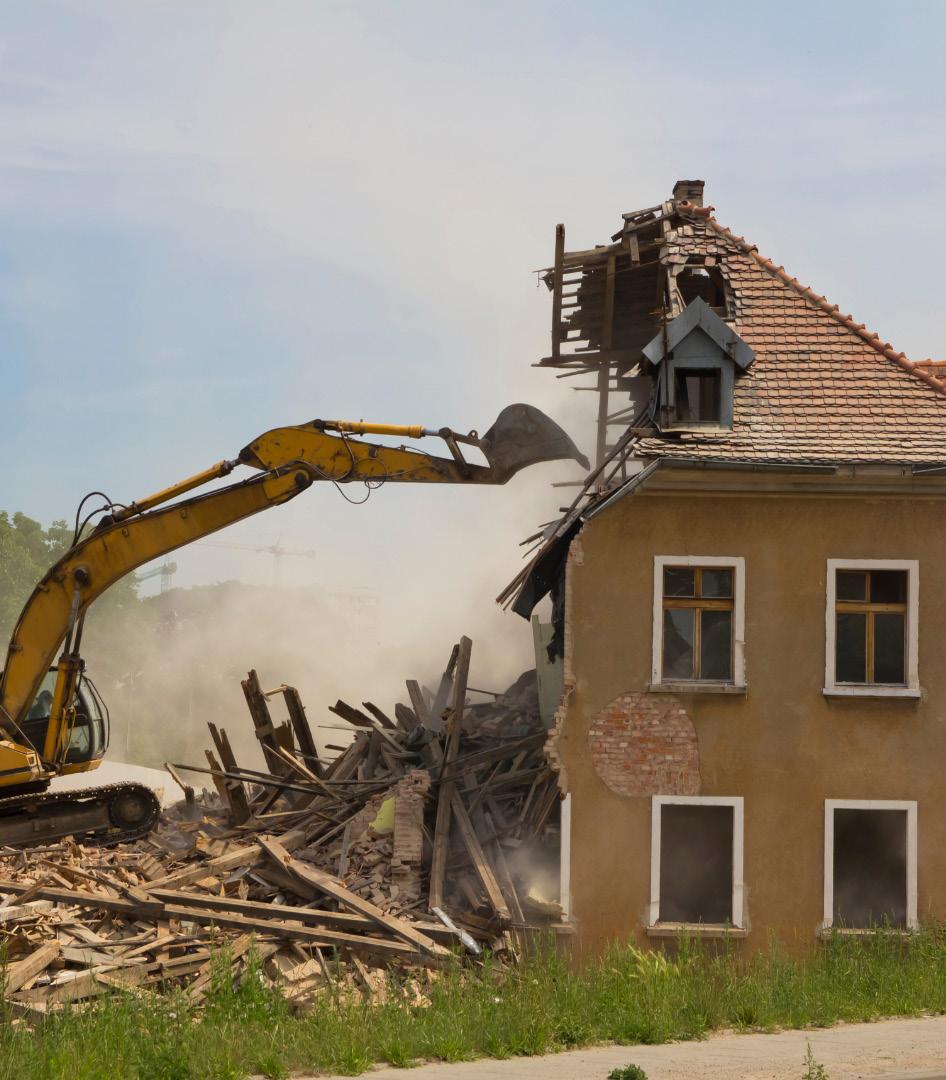
As with most things nowadays, there is an alternative “greener” approach to demolition, which really should be called Deconstruction. This is the standard practice in the UK today, as it is safe to use in built up areas and recycles most of the materials. It’s defined as the “selective dismantlement of building components” or even “construction in reverse” and rather than choosing the quickest way to clear a building site, it focuses mainly on proper waste management. By removing the materials by type, it ensures less ends up at landfill and more goes to recycling or is reused. As it is a veritably ancient method of demolition, it requires a high amount of hands on labour. It therefore provides opportunity for the training and development of unskilled or unemployed workers.
Despite its sinister beginnings, demolition has evolved into a booming (pun intended) business. In its many forms it provides the world with a fast and effective way to continually grow and develop. Gone are its days of pure chaos and destruction; like a phoenix rising from the ashes of its former self, so too can buildings from a pile of safely created rubble.

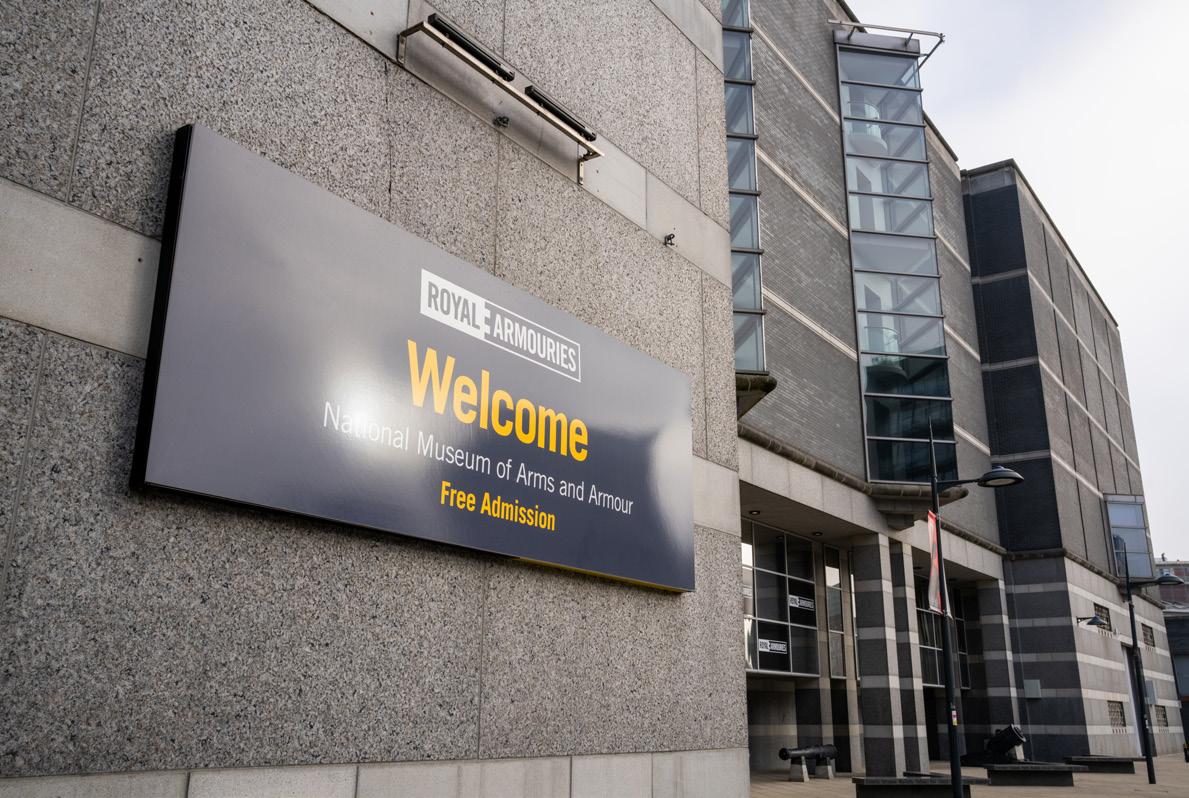
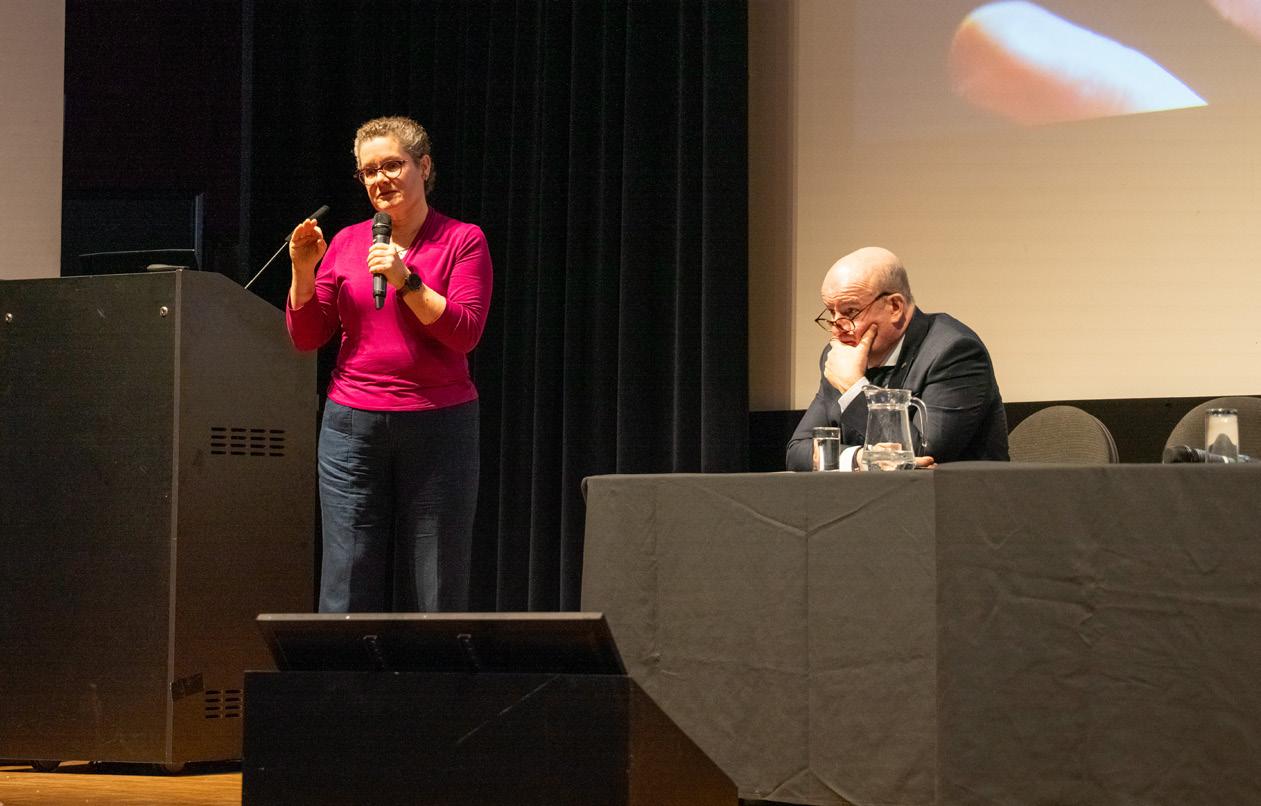
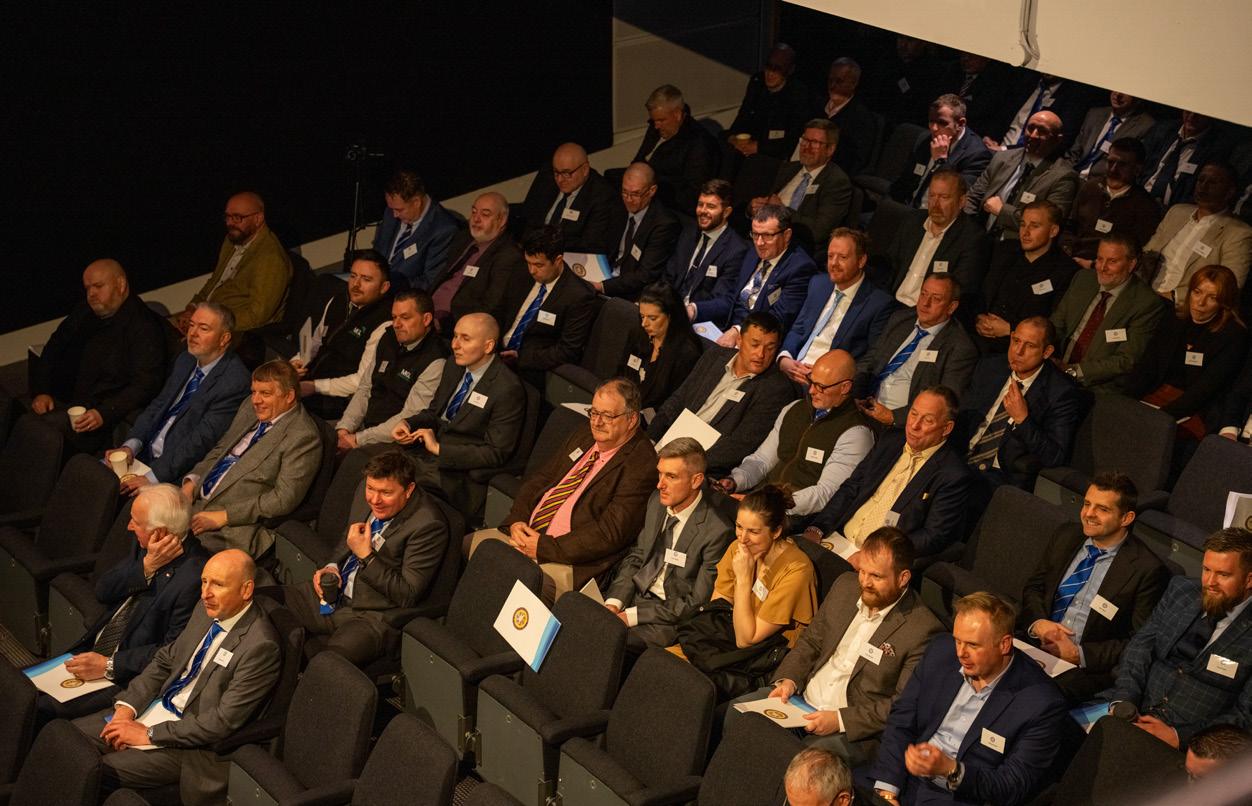
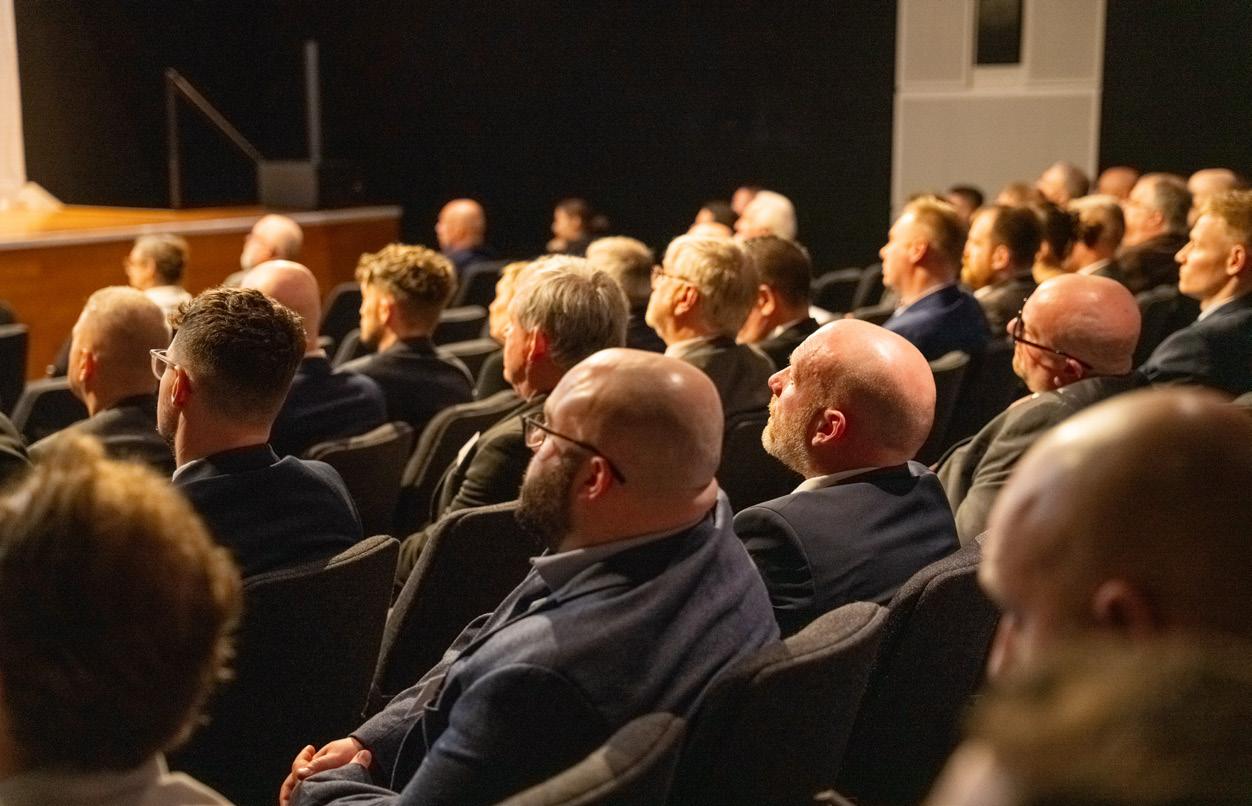
On Friday 28th February 2025, Industry experts and professionals gathered at the dockside in Leeds for the annual Spring Seminar held at the Royal Armouries. The Institute’s first main event of 2025 was packed with expert talks, real-world case studies, and plenty of valuable takeaways for anyone in the demolition industry. Mr Adrian McLean (IDE President) did a fantastic job hosting, keeping the energy high and ensuring the day flowed smoothly.
From cutting-edge demolition techniques to the human side of the industry, the speakers covered a wide range of important topics. Here’s a quick rundown of the key sessions:
Post-Tension Bridge Demolition & Temporary Works Design
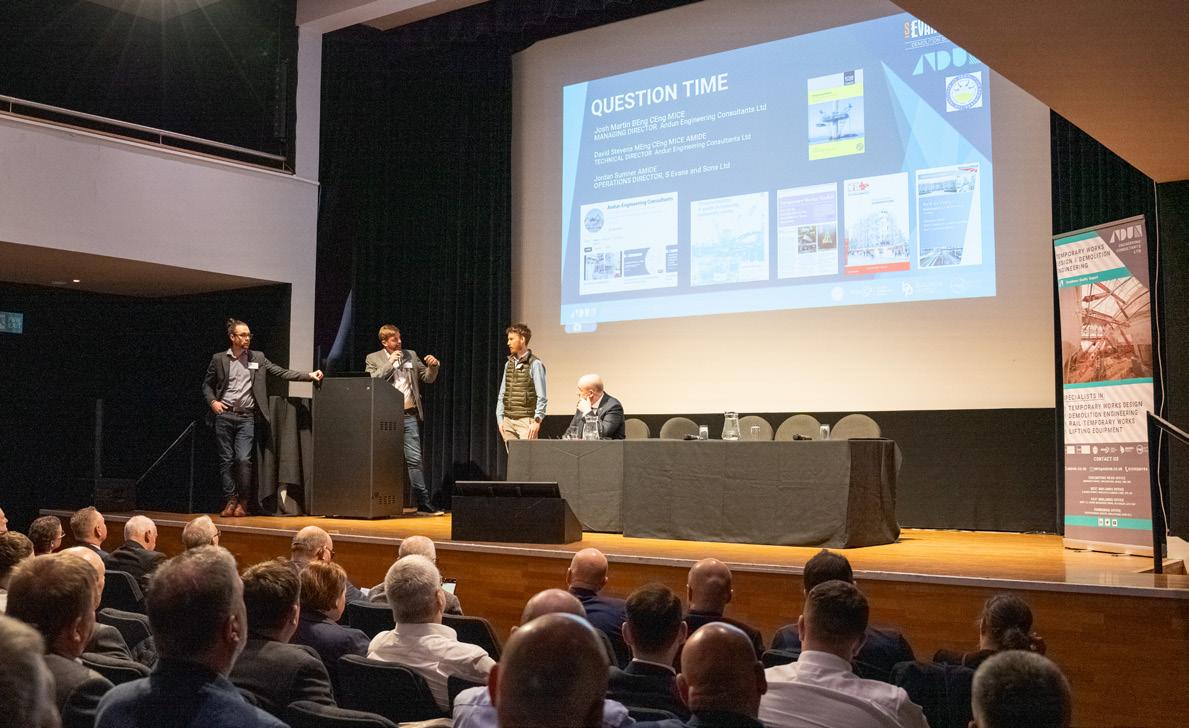
Speakers: Josh Martin, Jordan Sumner, and David Stevens
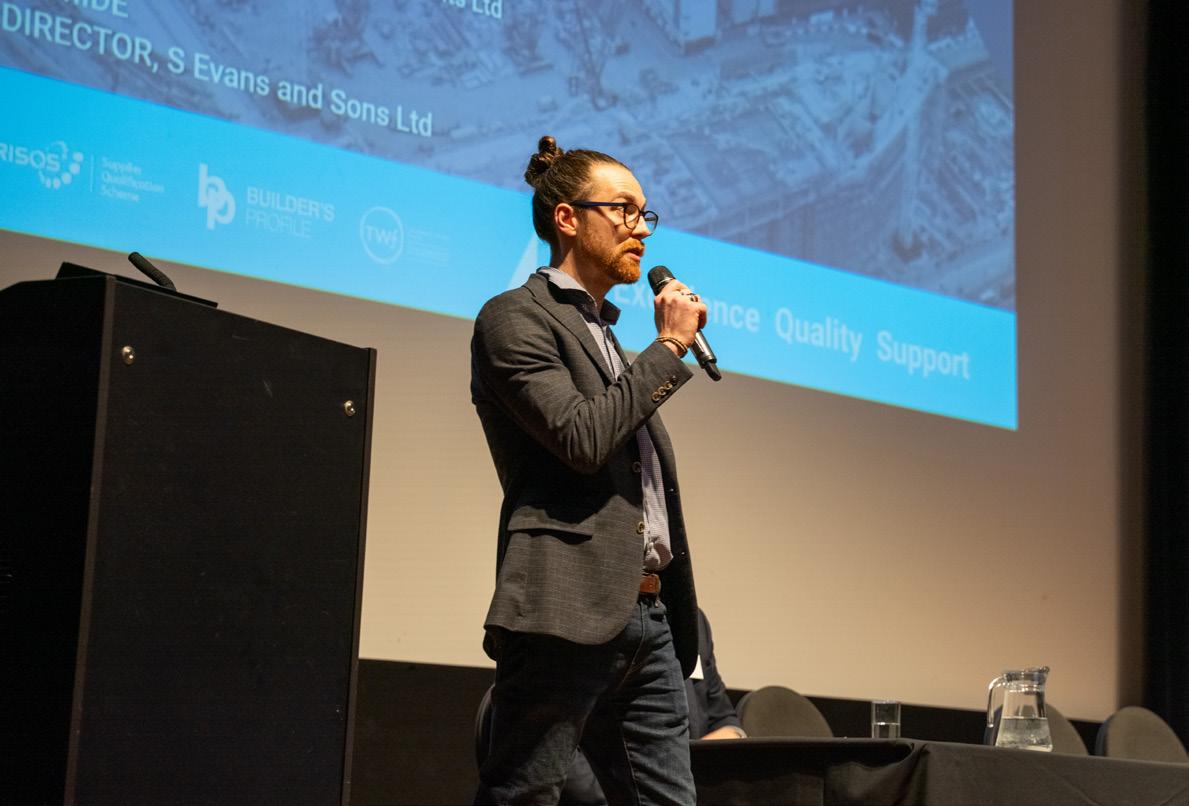
The team from Andun Engineering walked us through the Churchill Way Flyover Demolition in Central Liverpool, showing just how tricky it can be to take down a post-tensioned bridge. They stressed how crucial temporary works design is for keeping everything safe. Duncan Rudall made a cameo appearance during the detailed demonstration using string and toilet rolls.
From Risk to Reward: 4 Essentials to Clear the Way for a Better Demolition Deal
Speaker: Sarah Fox
Sarah broke down the legal side of demolition in a way that actually made sense! She shared key tips to help companies negotiate better deals while avoiding costly risks, which made a number of attendees check their contracts and insurance covers.
Smarter Demolition with Quick Boom Changes
Speaker: Timo Vestweber (KTEG)
Timo introduced quick-change boom systems, explaining how they can save time, boost productivity, and make demolition work more flexible. Great commentary and video of AR Demolition demonstrating it’s effective use.
Demolition of Spectrum Building, Dagenham
Speaker: Mark Mates (Hitec Demolition)
Mark shared the technical challenges and emotional impact of demolishing the firedamaged Spectrum Building. He talked about retrieving people’s belongings (it was surprising how many Rolex watches were meant to be in the building!) and highlighted something that’s often overlooked—how the demolition industry genuinely cares about people.
Mind the Gap – Choosing the Right Insurance Cover
Speakers: Andy Williams & Paul Dennis (Fenchurch Insurance)
Andy and Paul explained why having the right insurance is a game-changer in demolition. They covered the biggest pitfalls and how to avoid them.
Raising the Floors, Not the Roof
Speakers: Rob Millard (Deconstruction Solutions) & Stephen Dorer (Deconstruct UK)
Rob and Stephen showed how raising floors rather than roofs can be a smart, cost-effective solution for modifying buildings and how they overcame the constraints of a Central London location.
Hexham House Demolition
Speakers: Cormac McLean (PDC Explosives Engineering) & Paul Turbitt (Thompsons of Prudhoe)
Cormac and Paul highlighted how strong communication played a crucial role in the Hexham House demolition. From understanding individual circumstances to keeping the local community informed, clear dialogue ensured the project ran smoothly and safely for everyone involved, this was followed up by some great drone footage (and backup music) of the blowdown developed by Sky Revolutions.
How Integrating Monitoring within Demolition Projects Can Mitigate Risk on Sensitive Structures
Speaker: Dave Bradshaw (Mabey Hire)
Dave talked about the role of monitoring tech in reducing risk and protecting sensitive structures during demolition. His session gave some great insights into how real-time data can help prevent costly damage.
A Special Moment
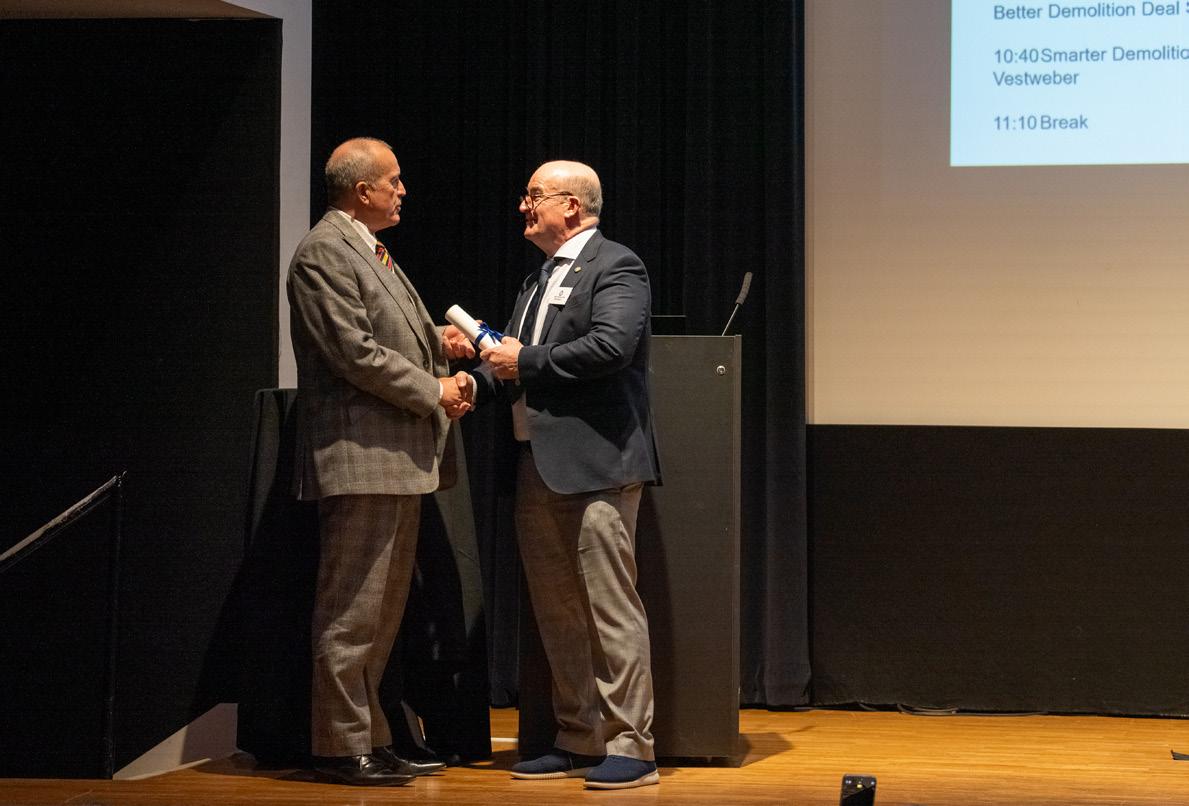
One of the most emotional parts of the day was when Angus Holdsworth’s parents took to the stage to accept an Honorary Membership Award in his memory. It was a truly touching moment that left a strong impression on everyone in the room.
Thanks are due to all our speakers and the event exhibitors: Worsley Plant Ltd, International Marketers London Ltd, Blue Machinery, Campbell Associates, Sky Revolutions, Greenpower, NDTG/NFDC, SitePlex, Conform Engineering, Liebherr, BPH Attachments, Hitachi Construction Machinery, Fenchurch, Spillards and HAV SOTC.


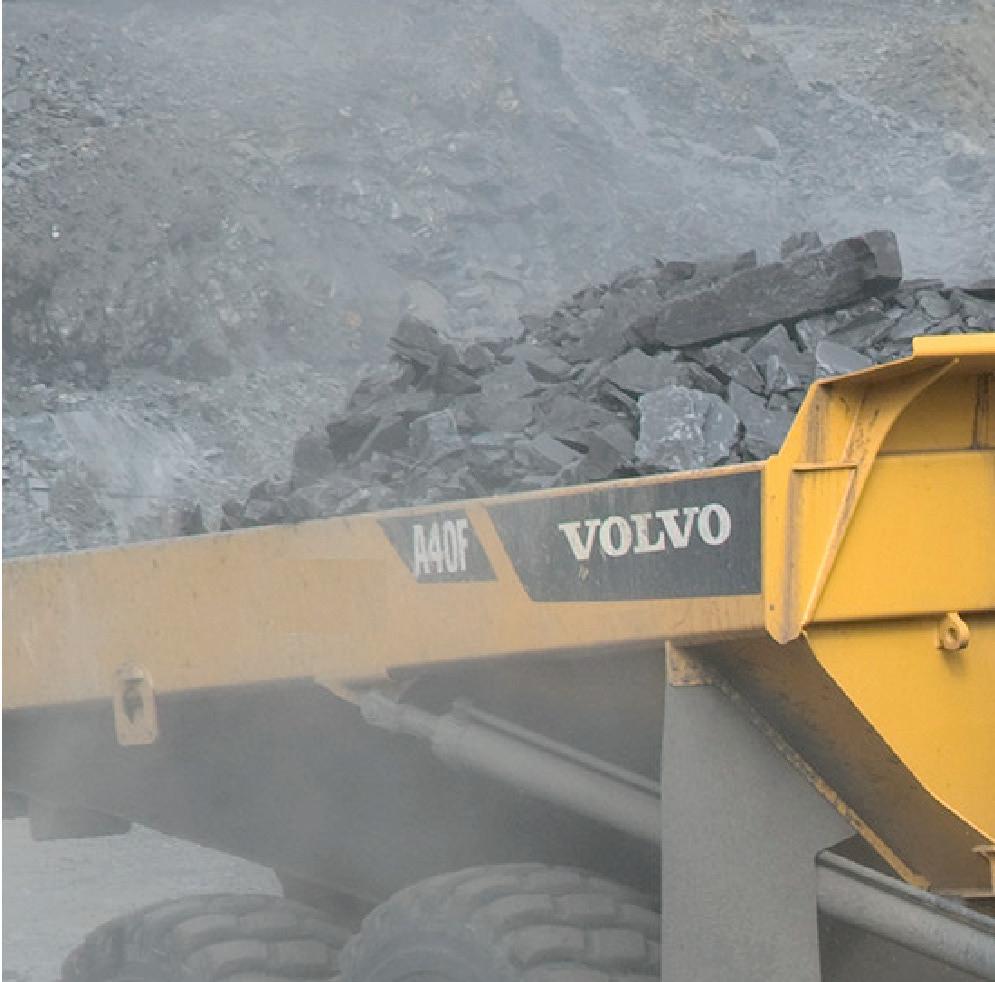
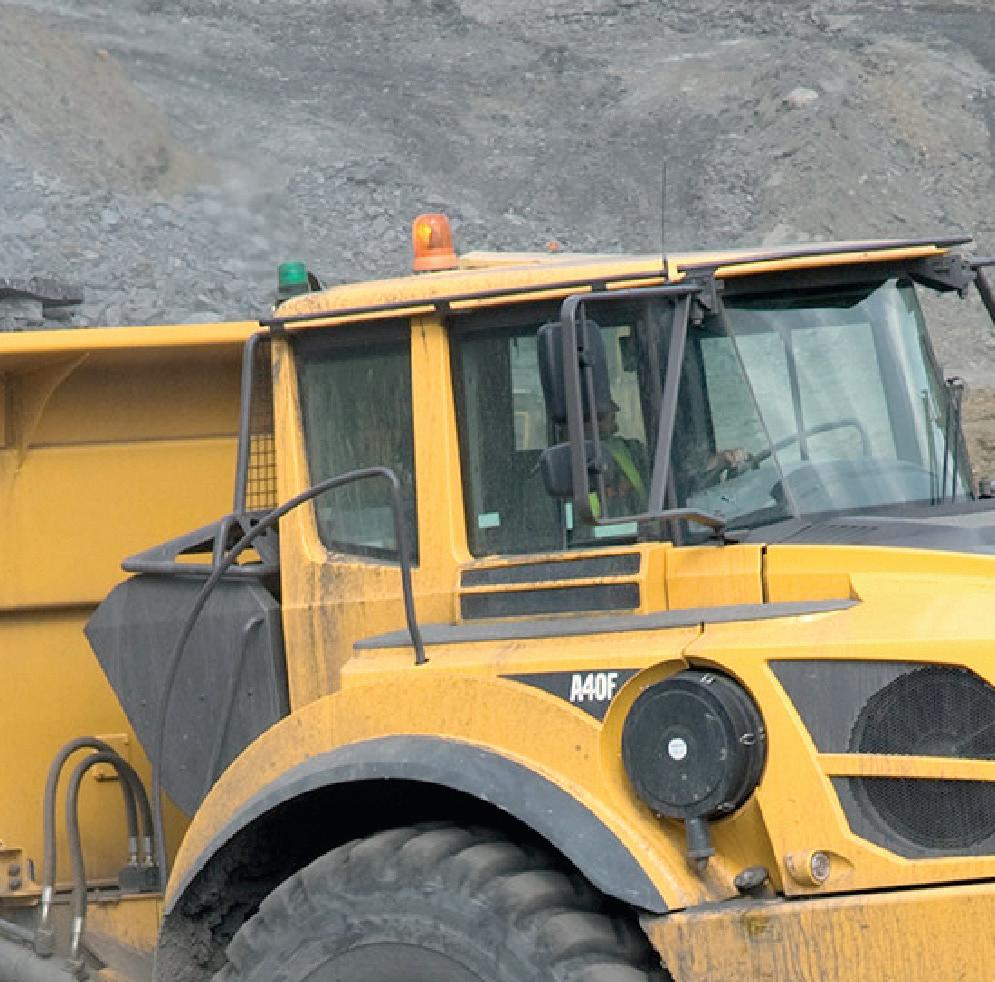
• 25 years’ experience with Volvo Dump-Trucks
• Selected-used or refurbished parts
• All models catered for
• Big savings • Engine and transmission rebuilds
• Maintenance and repairs
• Export enquiries welcome
• Your choice of Swedish quality SLP or genuine OEM



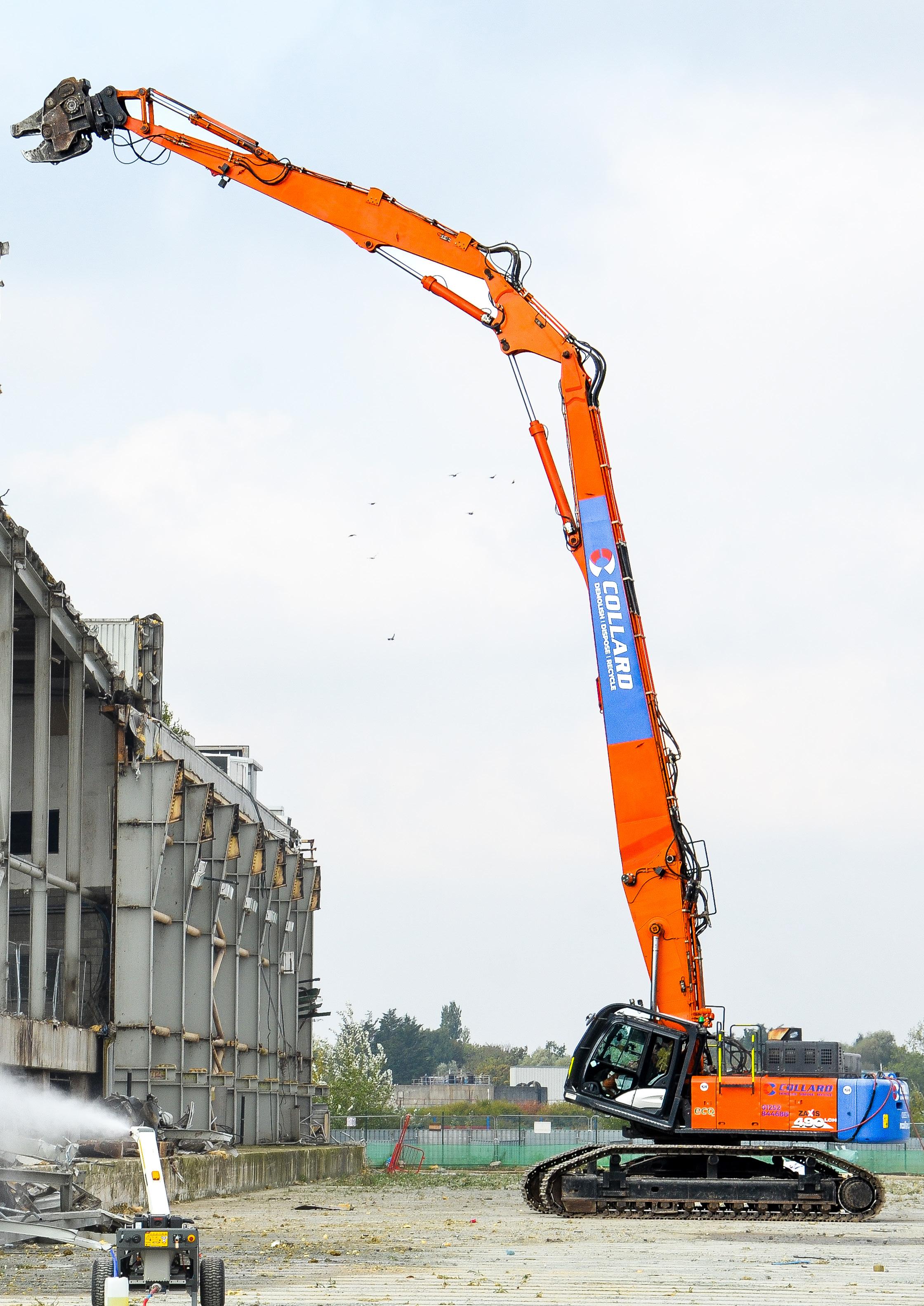
Managing Editor, Rebecca Phillips, travels to Surrey to visit one of Collard Group’s latest sites to see how they tackle demolition in a built-up suburban area.
Location: Frimley Square, Surrey
Client: Miller Homes
Start Date: 28th October 2024
Start Date: 25th May 2025
(current prediction, though this is dependent on the Vodafone mast being relocated)
Site Manager: John Nuthall
Contracts Manager: Sam Tunnicliff
Machines Used:
• 1x Volvo 750 Excavator
• 1x 490 Komatsu Excavator
• 1x 490 Hitachi Excavator
• 1x 360 Excavator
• 2x 210 Excavators
• 1x Terex Crusher
• 1x Skidsteer
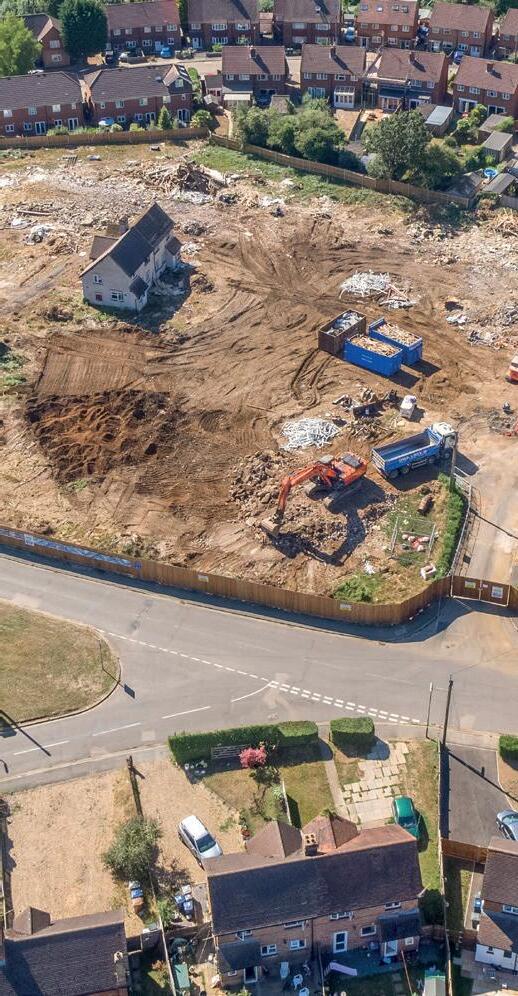
Collard Group has partnered up with Miller Homes for this project to demolish the old Siemens office buildings that once stood there, along with a multistorey carpark to the rear. Set to become a complex of new homes, the site comes with the added complication of being situated in a built-up suburban area. So just how has Collard Group approached this particular project?
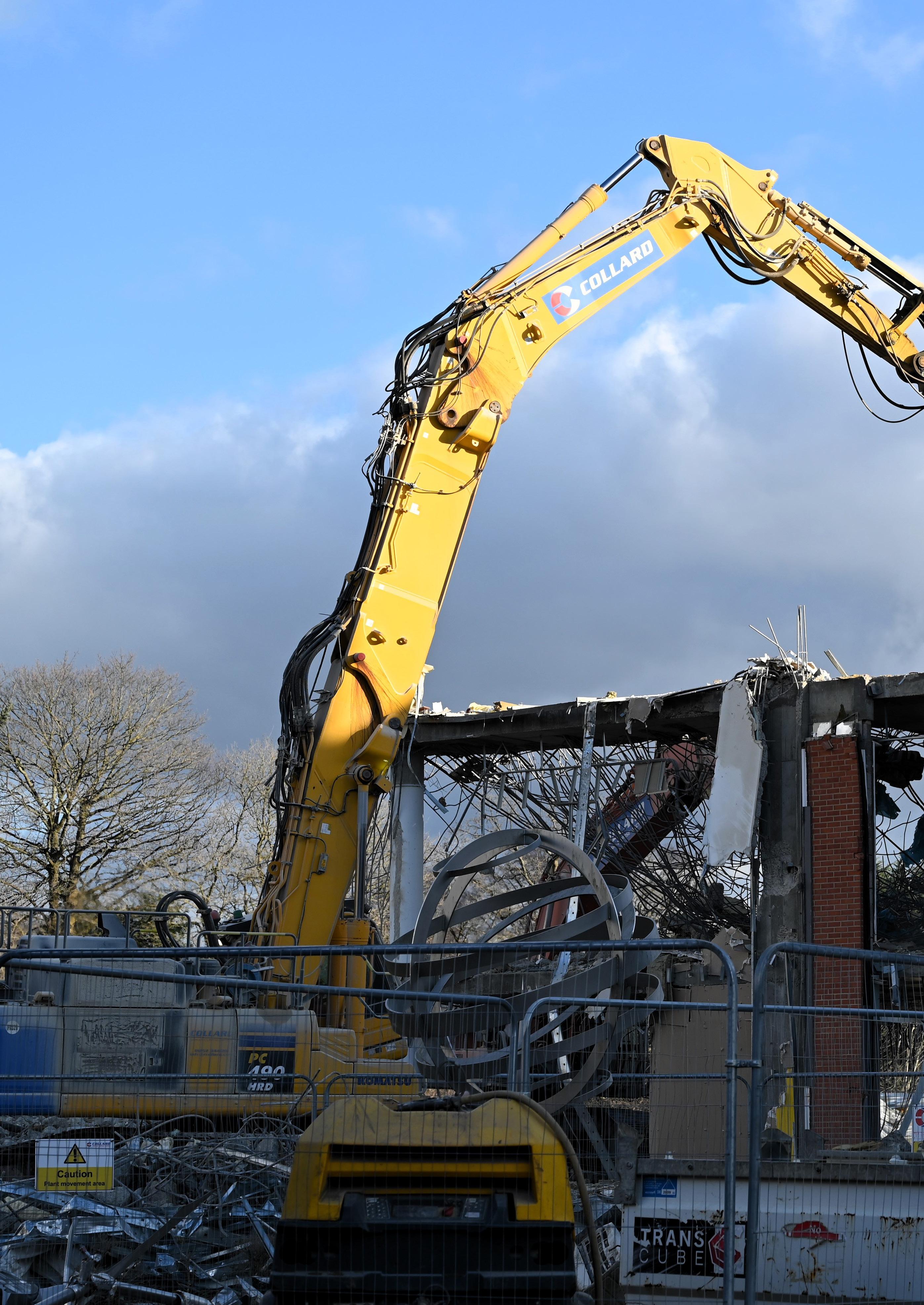
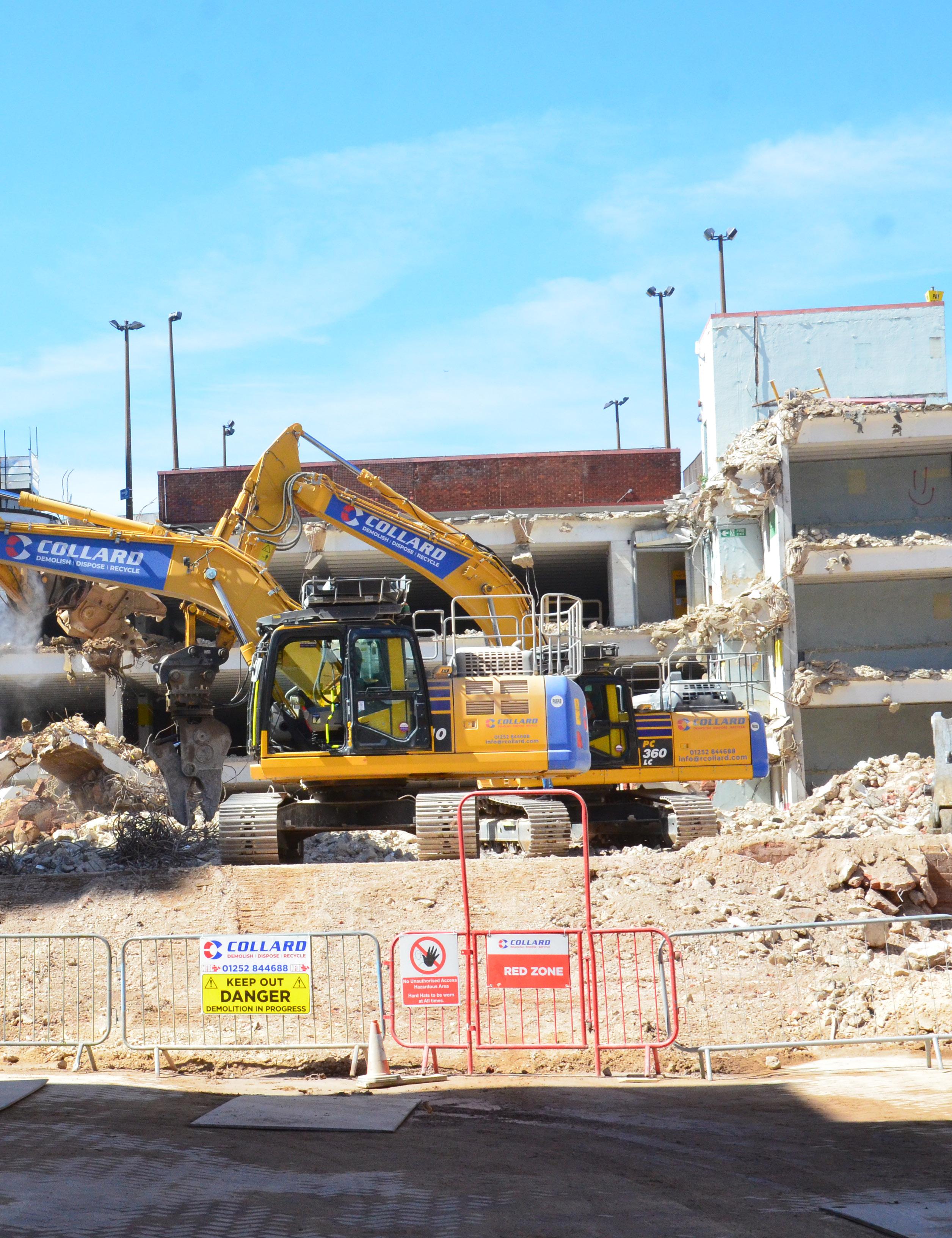
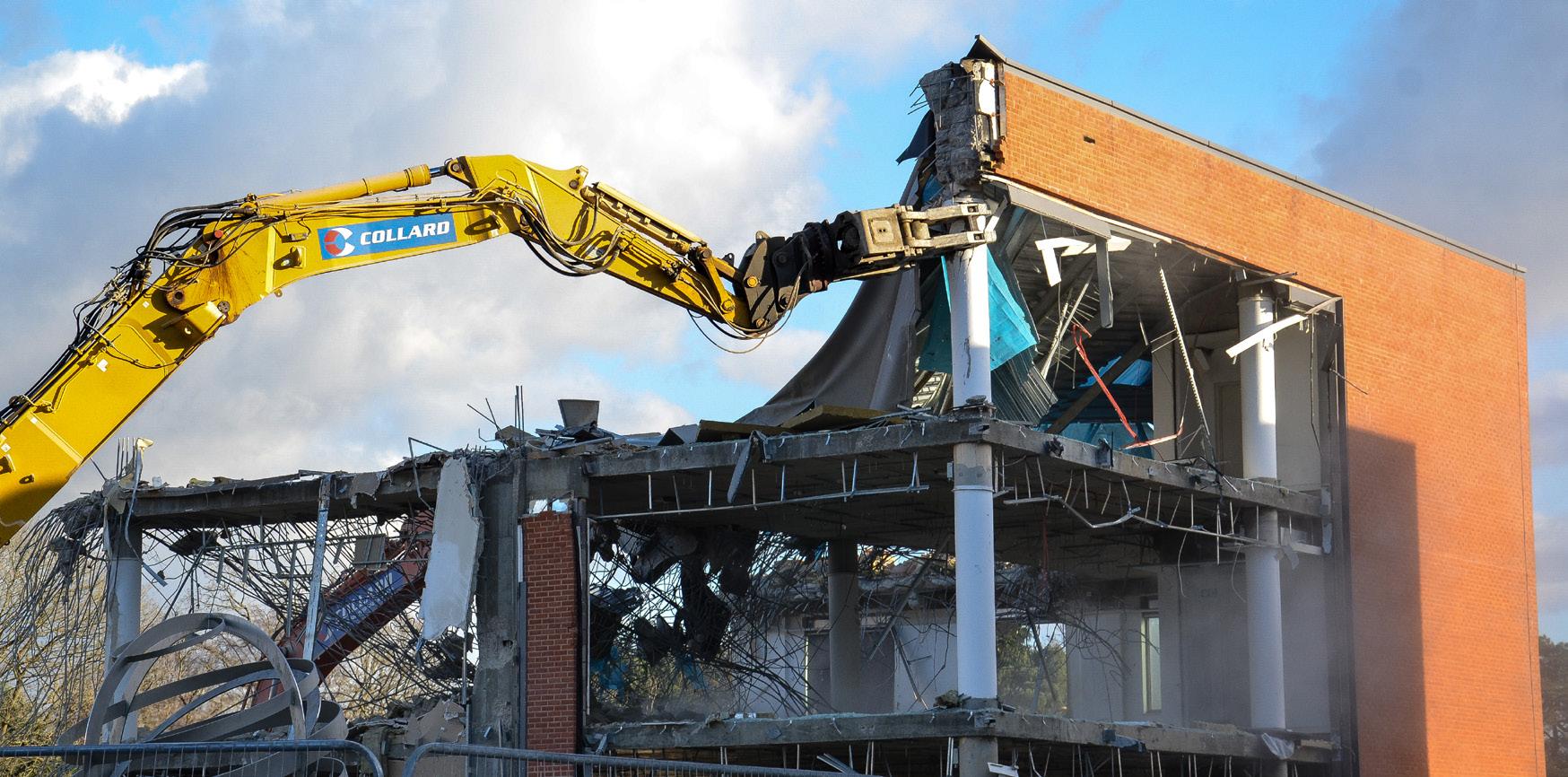
It’s always fascinating to visit a project right in the thick of it, and Frimley Square is no exception. When we arrived on site, the majority of the original 2no buildings and multistorey had now been flattened, with only 2no buildings remaining. It’s certainly a large site, which requires a large communicative team to work it. Soft strip, isolation of services and asbestos removal had long since passed, so now it is all about the remaining top down demolition.
John Nuthall, Site Manager, remained relaxed and approachable for everyone on site (including myself with my inane questions) but at all times had a tight handle on activity. I’m always interested to see how different site managers run their sites, and to say this one was a tight ship was certainly an understatement.
There were clearly posted safety zones which were sectioned off with proper fencing and gates. Access to site was also tightly controlled with a man posted at the front gate, with radios to continue clear communication at all times. It’s certainly something worth praising given the site’s location and demonstrates Collard Group’s clear commitment to safety.
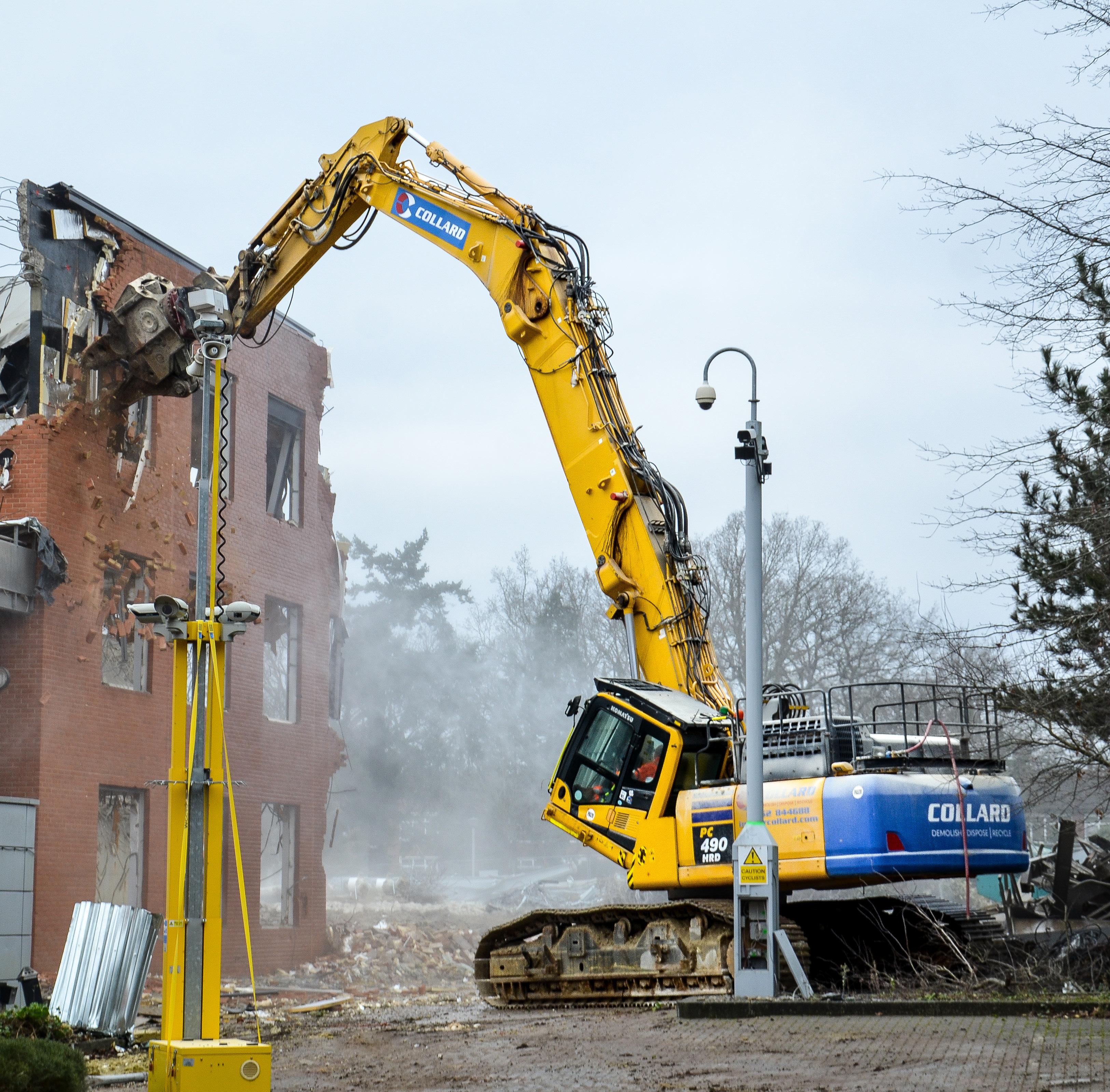
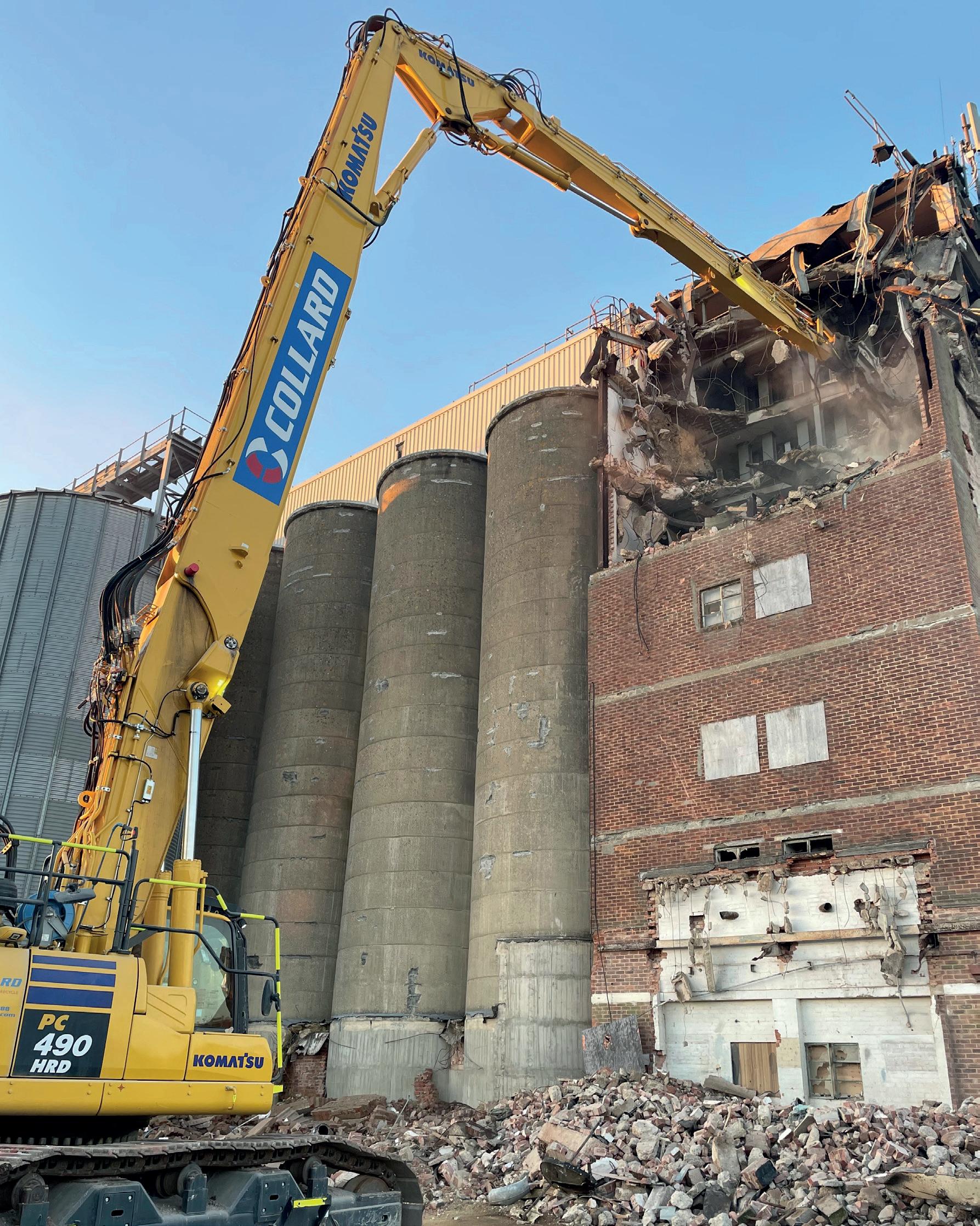
John escorted us to the rear of the site, where we actually got to see part of the building get pulled down. The operators used a hydraulic muncher to nip away at the upright concrete columns surrounding the outward pillar, leaving as little debris as possible when the supporting beam was ripped out. Dust suppression kept everything in check, and it was incredible to see everything happen so smoothly.
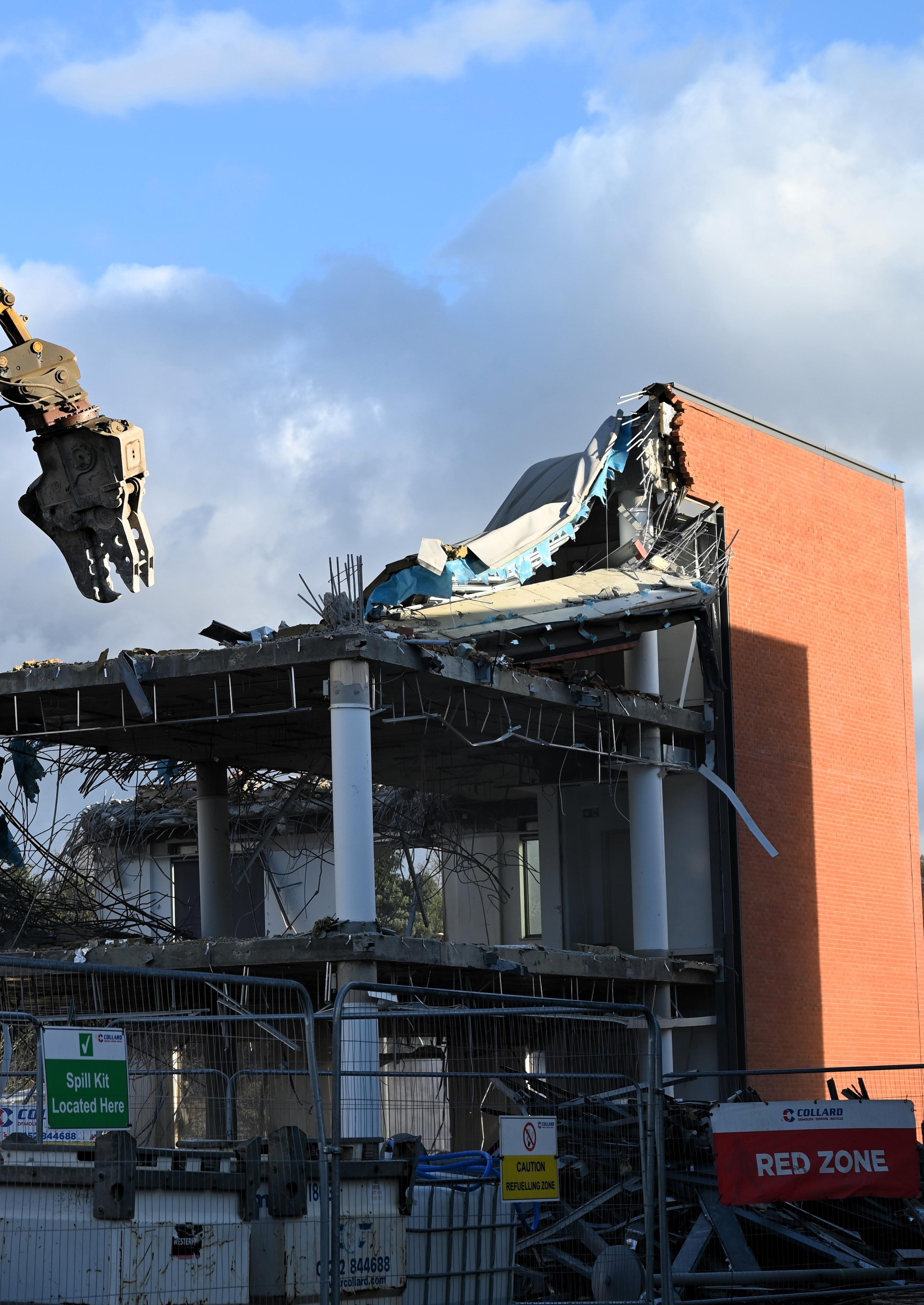
Of course, not everything can go so smoothly, and the art of a well-run demo site is how the complications are tackled. For example, Sam Tunnicliff explained that there is a live Vodafone mast situated on top of the 4th building (Stephenson) that unfortunately needs to remain live until it has been completely removed. That means working around it safely until it can be removed and installed in a different location. It also means that demolition works cannot be fully completed until its removal. It’s very much an ongoing process, with no clear answer in sight, but Sam is determined to find the solution in the imminent future.
As with any demolition project, neighbours and neighbouring properties are always a delicate matter. It’s certainly important to keep everyone on side so that work
can continue as smoothly and as efficiently as possible.
“We have been working very closely with the EA (Environment Agency) on this project,” explained Sam. “We’ve made sure to install noise, dust and vibration background monitoring in various areas, all of which are 24hr monitored with a ‘green, amber & red’ alert system.
These provide live alerts via text and email for agreed limitations, which in turn enables us to record and monitor these aspects throughout our works on site. It also ensures appropriate and adequate water suppression and as much communication and updates that we are able to provide to the surrounding neighbours. This way, they do not feel excluded and are aware of what is going on throughout our time on site.”
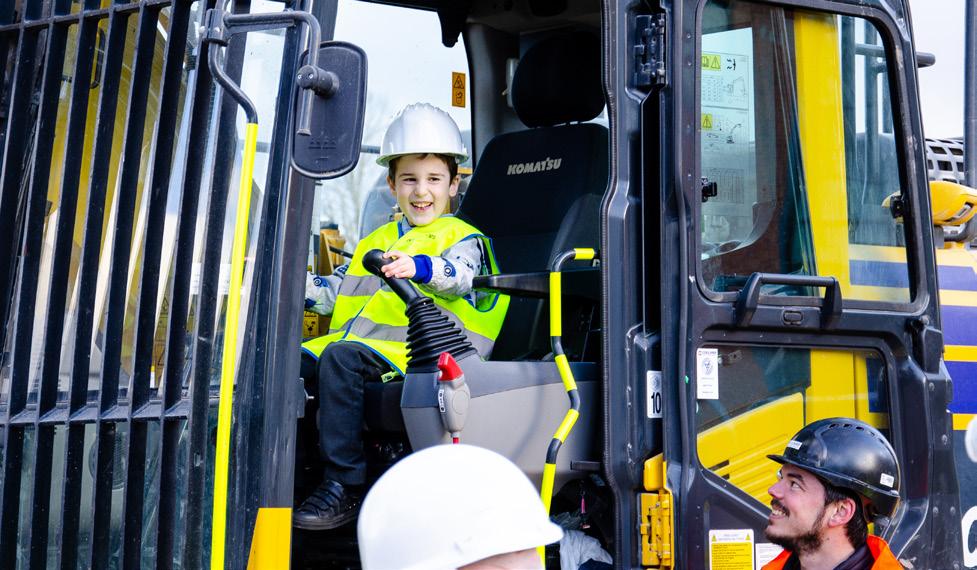
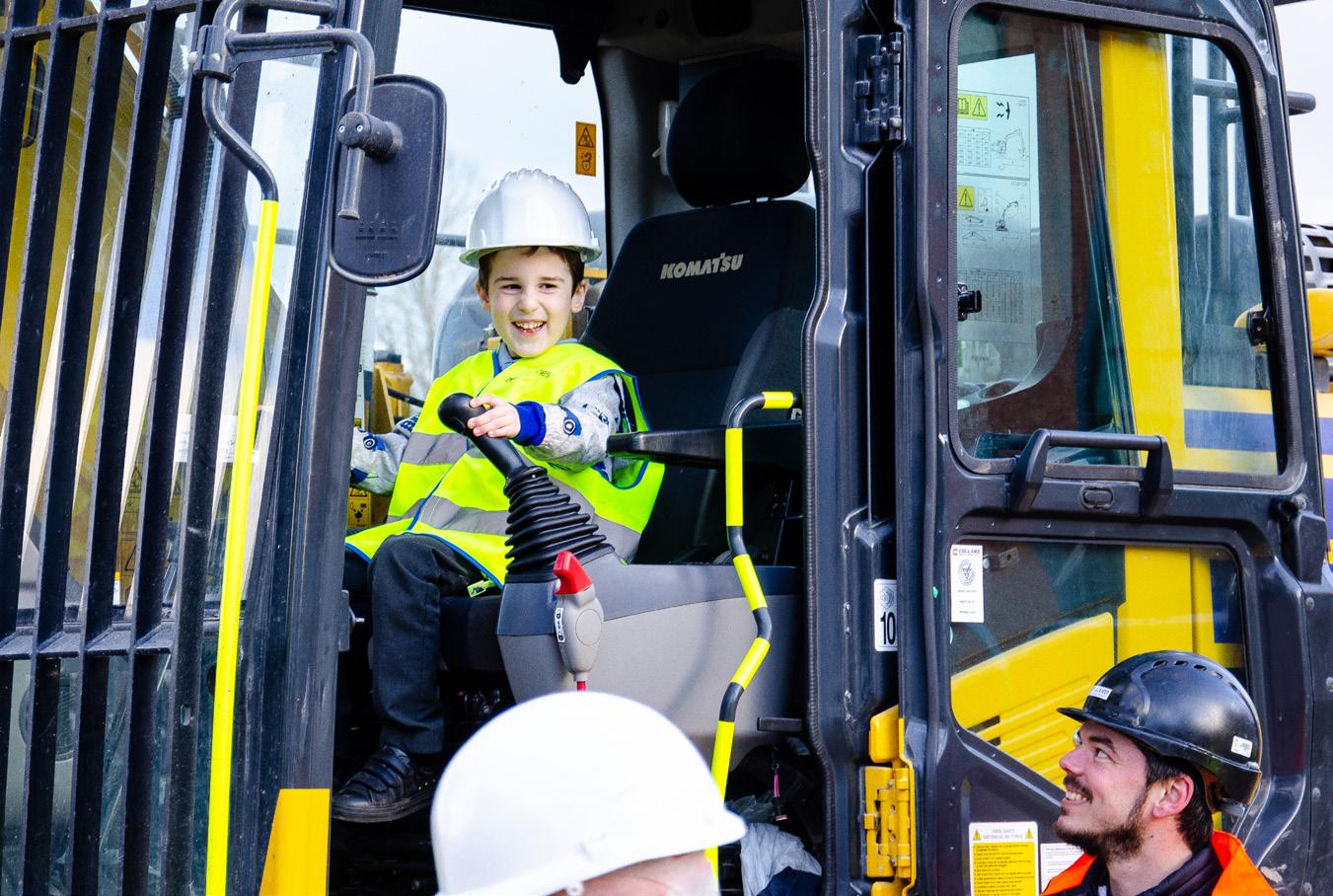
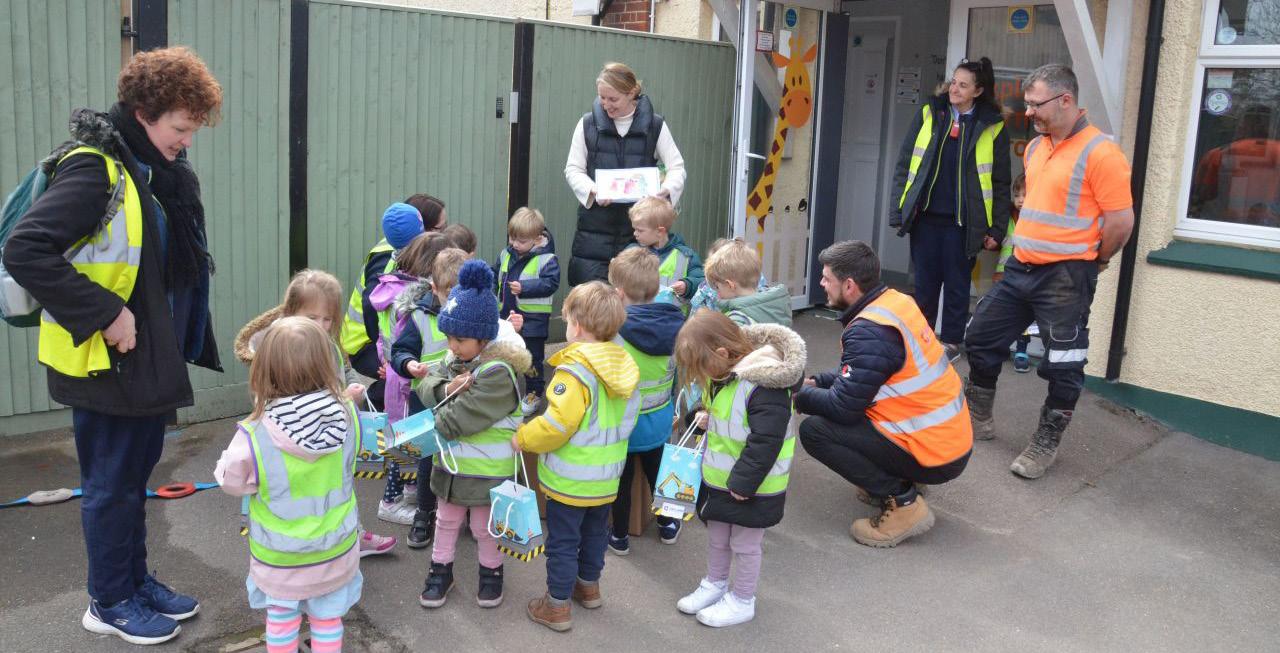
Community engagement is definitely something that Collard Group takes very seriously. We were very privileged to be on site when one such example was in full-swing. A sweet little six-year-old named Louie wanted to celebrate his 6th birthday with the diggers, so together with Miller Homes, Collard Group made it happen. One of the excavators was cleaned up and brought into the safety zone, so that Louie would be able to sit in the cab in complete safety. Armed
in a hard hat and high vis, the birthday boy got to ask a wealth of questions of the workmen, along with enjoying cake and presents provided by Collard Group. Although he wasn’t allowed onto the active demolition site (much to his disappointment), Louie was treated to a little display from the excavators when they all turned to wave at him. John explained that it was always a hit with kiddos. “We did the same thing for a school group that visited site, and they loved it! It’s great seeing their faces light up over something so simple.” Safely orchestrated and perfectly executed, Louie’s visit is another prime example of Collard Group going above and beyond.
So, what other wins have they had so far? Well, Sam had a fantastic answer for that. “I wouldn’t like to comment on this until the project is complete. We still have a few months to go on site and wouldn’t want to overlook a potential future achievement.”
I guess that means the best thing to do would be revisit the site in May and ask again. I certainly have no doubts that Collard will have achieved something truly spectacular.
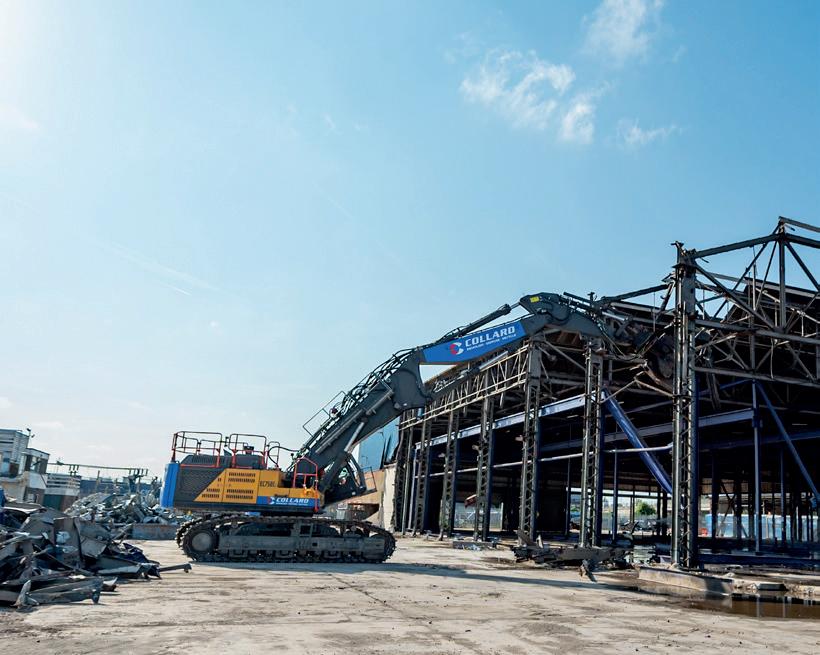
Our unique capability to repurpose virtually all construction and demolition waste from site helps our public sector, local authority, commercial and residential clients achieve zero-to-landfill targets.
Demolition
Structural alterations
Site clearance
Soft strip
Asbestos management
Remediation
Earthworks & civils
Temporary works

Demolition & Enabling Works Waste Management Aggregates & Concrete

Managing Editor, Rebecca Phillips, gets chatting with Shorts Group’s own Bryony Morten-Short to look at her unique journey into the world of demolition, and how it has shaped her role today.
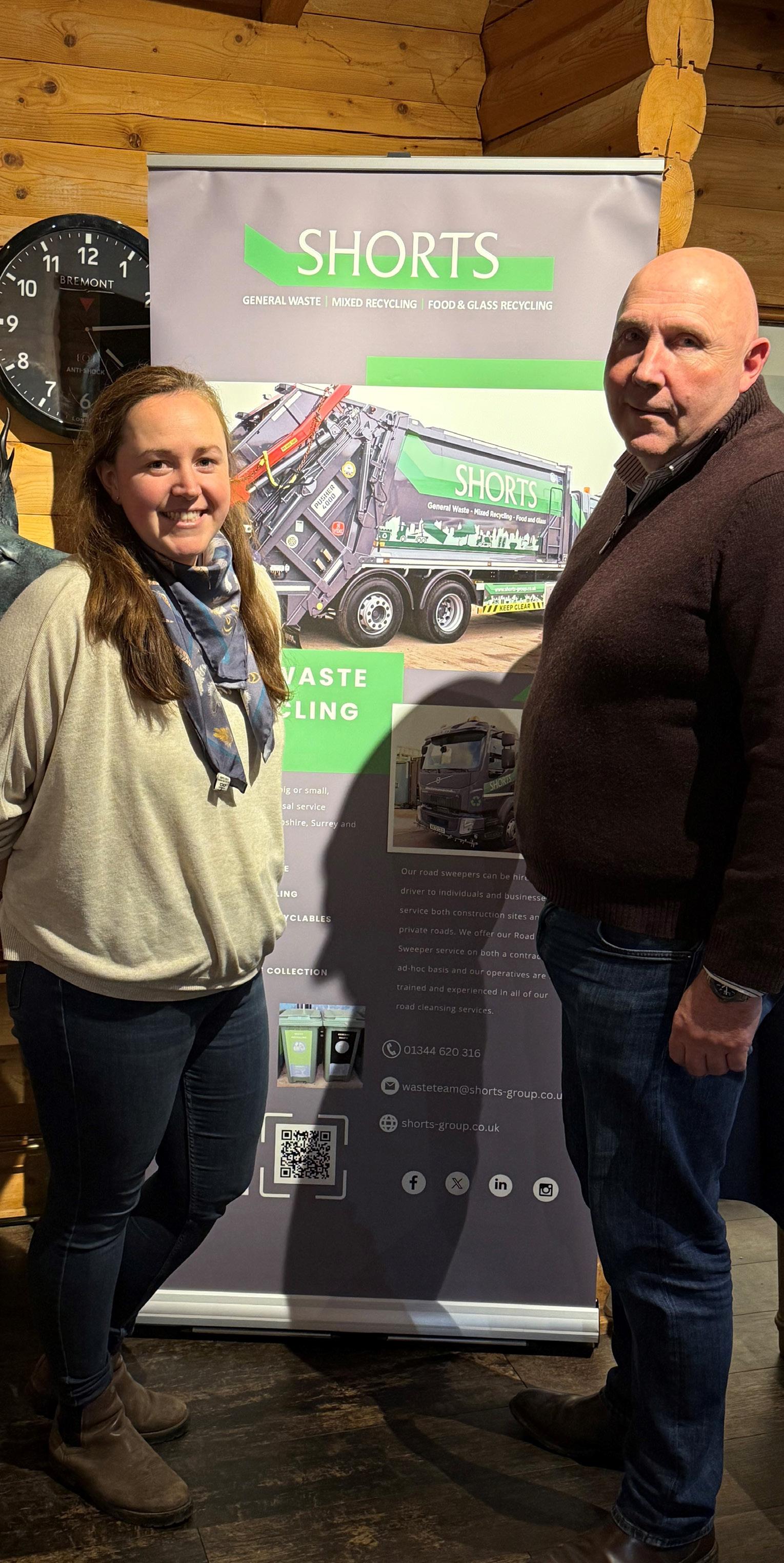
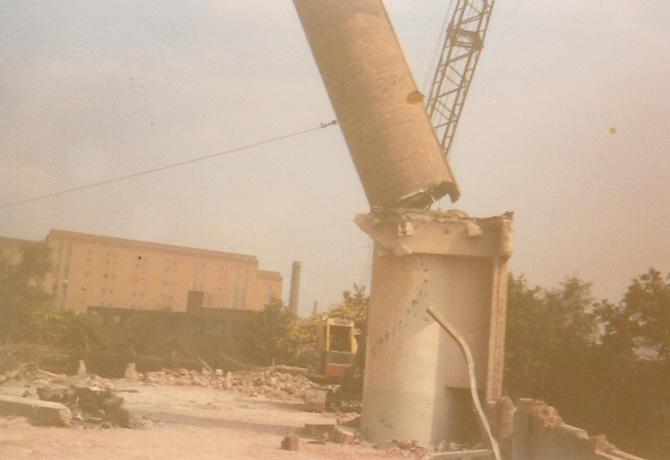
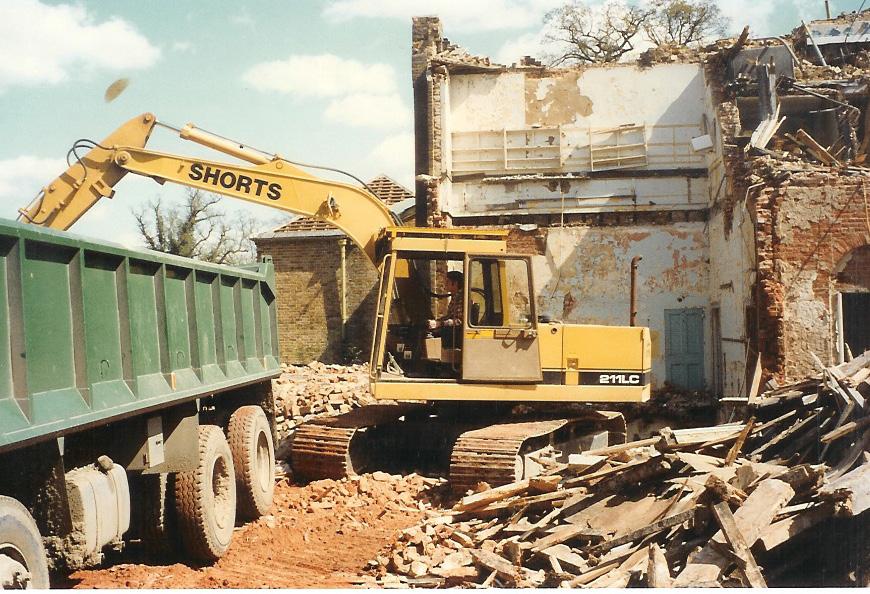
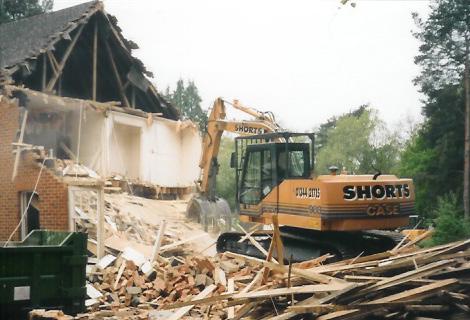
So, the first question I always start off with is ‘how did you get started in demolition?’, but this is quite a different question for you really, isn’t it? Most people accidentally fall into it, but for you, it was quite intentional. I suppose it was more that the company fell into demolition rather than me. In the 50s and 60s, my late grandfather, David Short, started work with tree felling, clearing trees for motorways. He came out of the army, bought the kit, and got straight to it. And from there it progressed into knocking buildings down. So, it might not have been the first thing the company did, but that’s where it really took off. And seeing as he had the kit, he started renting it out to those that needed it. I mean, he was always buying and selling machinery, even when he was still in school. He’d catch a bus down to an auction at the age of 12 and then drive a truck back up the motorway!
WOW! That is proper old-school stuff! I know, it’s madness to think about it nowadays. But that was the way of things back then. That’s how our plant hire side was born. Then obviously, because of demolition, waste naturally came off the back of that. And although waste is the biggest part of our business now, it massively supports demolition.
And you’ve been a part of that right from the beginning?
I grew up around it, absolutely. Gary, my father, came in as the MD back in 1995, so I was in the office with him from a very young age. Causing havoc, probably, but I loved it! I did odd jobs when I got older, filing and the like. And I used to work on the weighbridge at the farm every Saturday. I’d spend a lot of time with my grandfather, and I was very close to him. This was always where I was supposed to be.
And when did you officially join the business?
Nearly nine years ago, straight out of university. Everybody said I should go out and work elsewhere but I knew this was what I wanted. I started off in plant hire and learned everything from the bottom up. I didn’t want people to think that because I was the boss’ daughter that I would be handed a big role. I cared about the business, and I wanted to graft and work my way up. That, and honestly, I love learning about every facet of the business.
Definitely not “Princess Bryony” then? Absolutely not. Never have been, never will be.
So what does your current role entail? I have a lot of different parts to my role; Health and Safety, compliance and marketing. As well as the Plant Hire Department, the Composting and Soil Operations in our Agricultural Business and procurement for all the big asset purchases we make across the group.
What constitutes a big asset?
Anything that we might need to finance, from vehicles to screeners, shredders, crushers, excavators, attachments, all of that.
Do you like the variety of your job?
I absolutely love it! I hate sitting still and love to keep busy. It’s the perfect job because it’s so truly varied. No two days are the same. In fact, no two hours are the same! I also like the flexibility because it fits around my life as a working mum. And I’ll admit, sometimes I find it hard to stop working because I do truly love it. But Dad showed me how to balance that, so it’s always felt so right.
I must say, it’s so refreshing to hear about such an organic journey, both for you and the business.
I think that’s our biggest strength really. We have grown very naturally into what our customers need. For example, the most recent addition into our business is toilet hire. That was something that our customers were always using, but it wasn’t necessarily through us, therefore we were having to hire them from other people. It actually started off by buying welfare units for demolition because we were hiring them from competitors, and I wasn’t very keen on that. So I spent time looking into it, put a business case together and that’s become quite a big and very profitable part of the business. We like to be able to provide everything for our customers, offering them a onestop-shop approach so to speak.
That must be fantastic for clients, because it saves them having to shop around and find so many different contractors.
And they only speak to one person in finance to pay the bill every month. Our core value is service, and it’s always challenging to constantly be achieving that high level of service, because there are always so many different factors involved. We’ll never be the cheapest, I can guarantee that, but it’s always worth questioning HOW someone else is able to be so much cheaper. What part of their service have they cut to be able to keep that cost down? Of course, in this economy, cost has to be a consideration. But with us, you’ll know exactly what the price is right from the start, no hidden or added costs. For demolition especially, it’s more relationship-based than it is based on a tender, because there is so much involved. You need to be able to trust your demolition contractor to have factored everything into the price, and that is definitely something we take very seriously.
Duty of care is certainly a very important part of demolition, isn’t it? Because it’s not just to the customer, but also to health & safety and the environment.
Oh, absolutely! That’s where our waste department really plays a part, because we look at the ecological impact right from the very start and weave all of that into the initial plans. Environmental stats are very important, and we get asked for them constantly now. It’s why we also make sure to use the latest technology when it comes to the equipment we’re using. And that helps in other areas like downtime, which can be a project killer. Knowing you can rely on the machinery used is vital because you know the project won’t be halted due to faulty equipment. You already have to contend with uncontrollable factors like weather, so there’s no need for another time drain.
I do love a thorough business plan. We pride ourselves on that.
So, I do want to talk about the elephant in the room… you’re the first lady I’ve interviewed in demolition. That doesn’t really surprise me, to be honest.
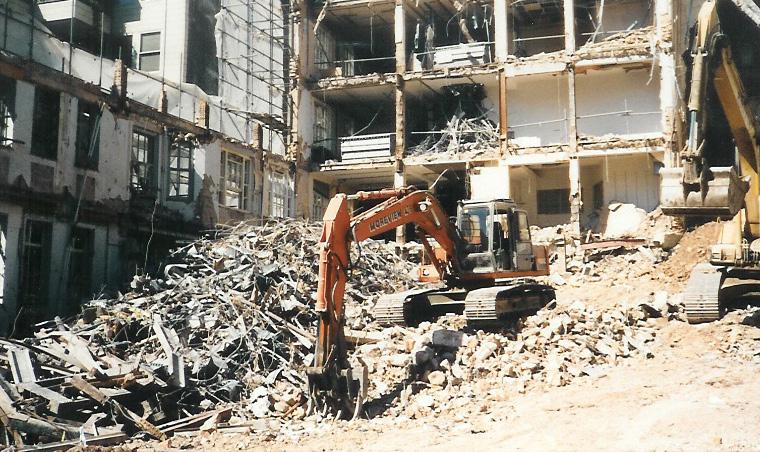
Knowing
you can rely on the machinery used is vital because you know the project won’t be halted due to faulty equipment.
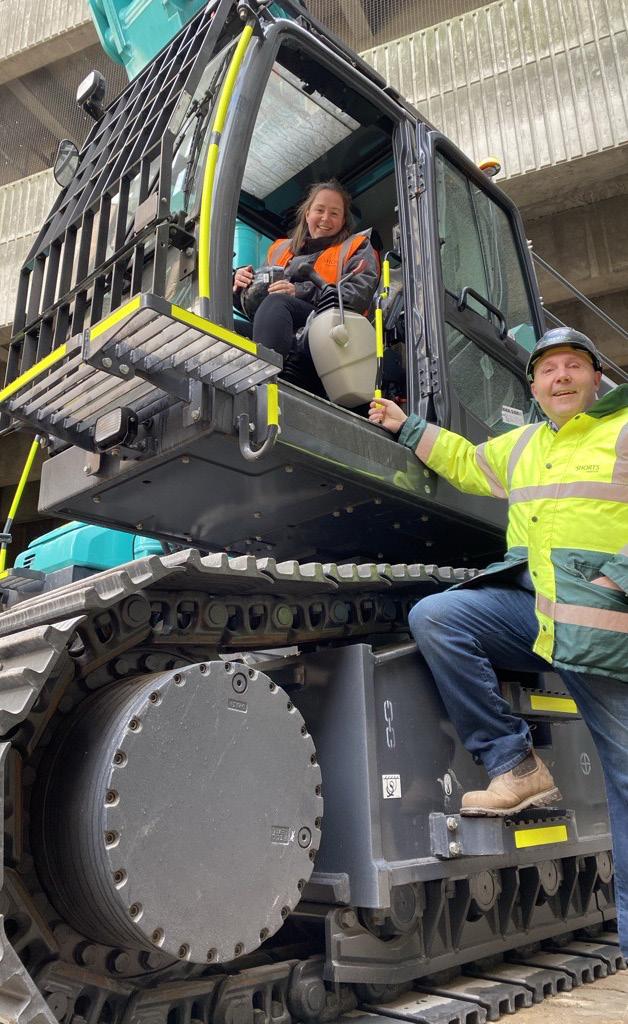
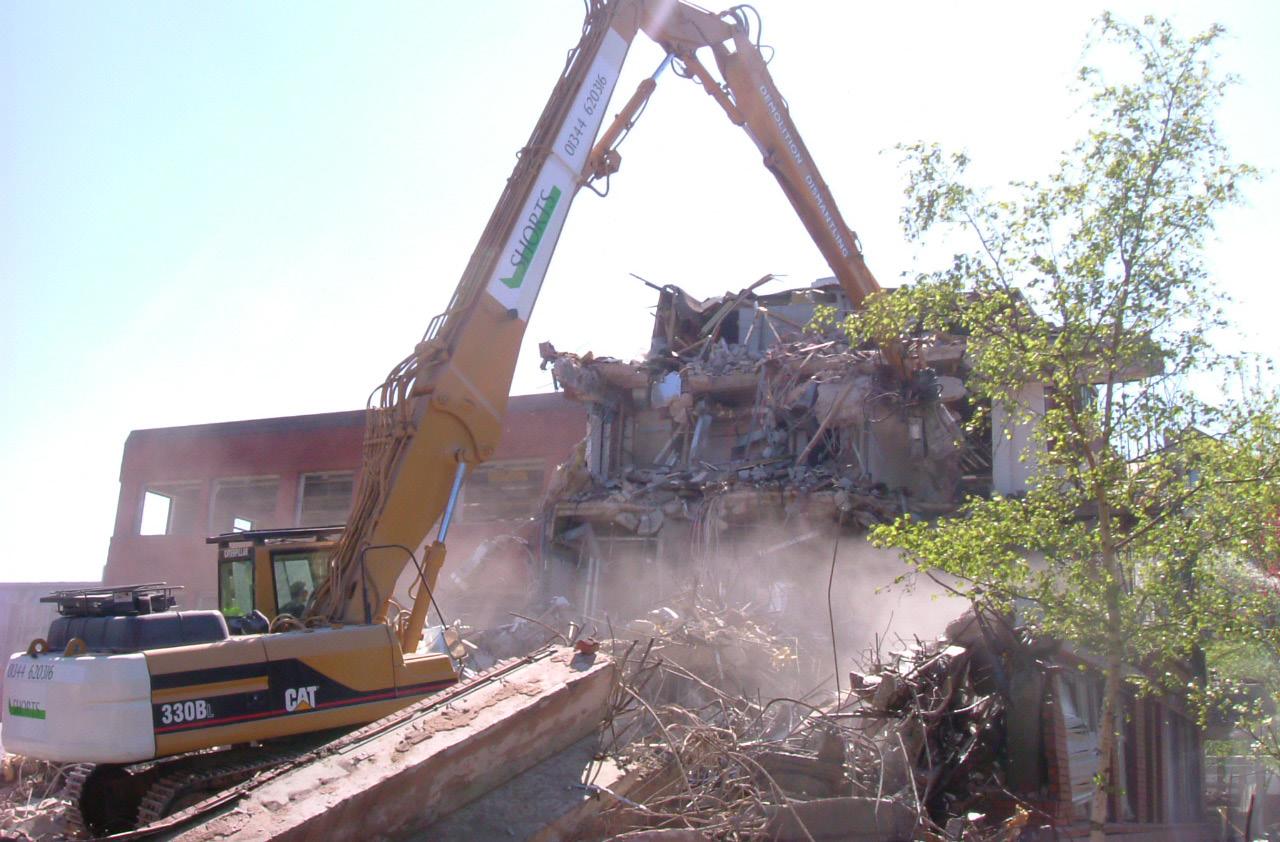
We’ll never be the cheapest, I can guarantee that, but it’s always worth questioning HOW someone else is able to be so much cheaper. What part of their service have they cut to be able to keep that cost down?
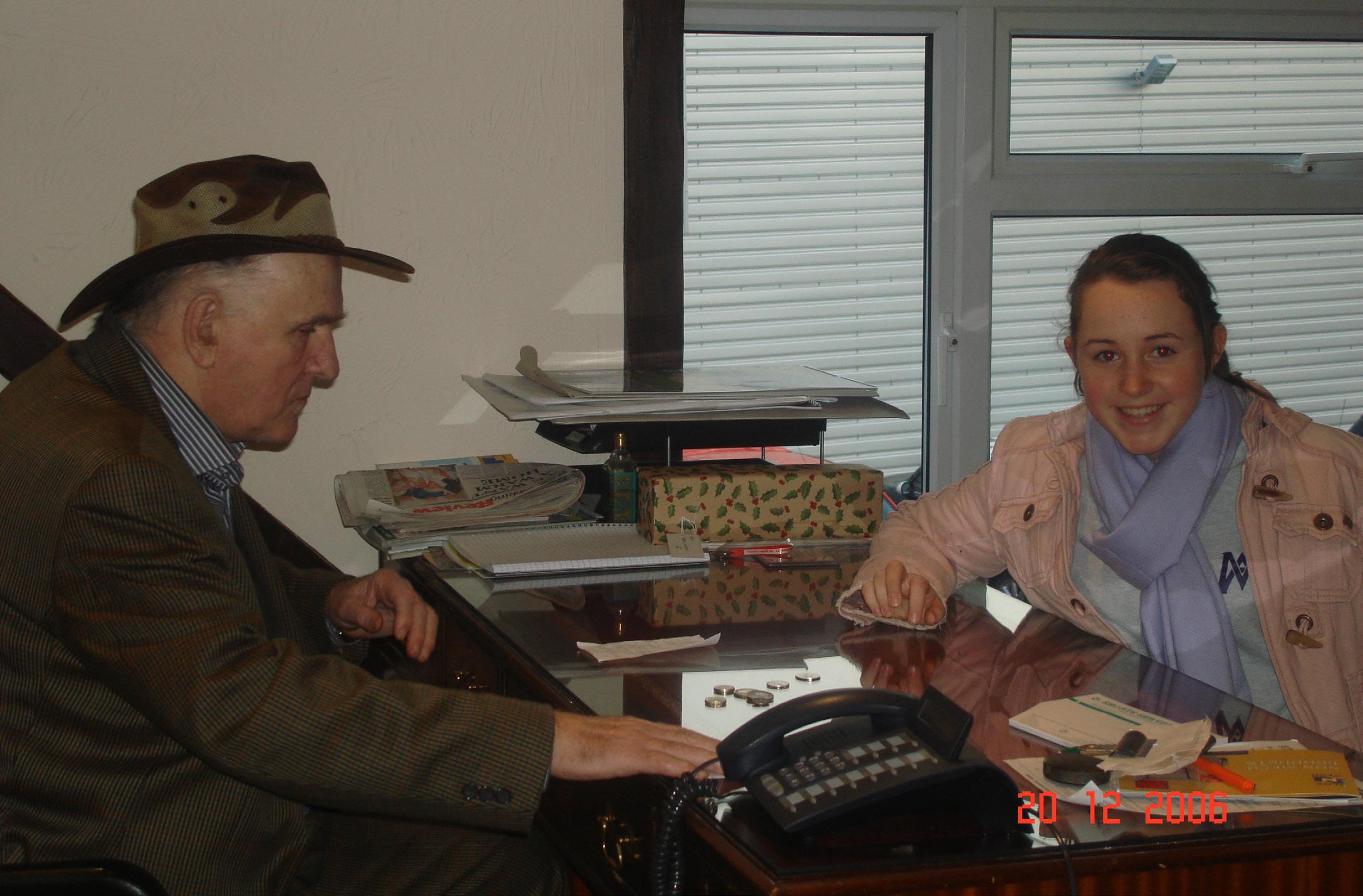
Has being a woman in what is often considered a man’s world made it harder for you?
That’s an interesting one to answer, because I suppose I’ve always been here, so people knew me. It didn’t feel like I was proving myself because I was a woman; it was more about proving I wasn’t just here because of nepotism. But have I encountered the odd bit of sexism here and there? Absolutely. I’ve gone to open days or big contract meetings and been the only woman there many times over. I’ve had people try the whole ‘sweetheart’ routine. But they only try it once. You have to have thick skin in this industry, and there’s a lot that might bother a different sort of person but for me, it just rolls off. I don’t stand for nonsense though. I know what I’m talking about. I put in the graft to ensure that I do, so I won’t put up with ‘Can I speak to a bloke?’ I’m very much a no-nonsense kind of person. Time is very important, so I like people to get to the point and lay out the facts. I don’t think that then leaves a lot of room for people to consider whether being a woman or not makes me less capable.
Oh you definitely aren’t Princess Bryony.
Told you, it’s not my style at all.
Sounds like you guys are growing well past a family business!
I think it’s about balance. We certainly have a lot we can offer clients, but we do try to maintain the values we’ve always stood by. Particularly with our staff. We’ve gone from 20 to a good 180 people in our workforce, and we want all of them to be a part of the Shorts family. Whether it’s the Christmas incentives or knowing they can approach us with an idea, we ensure that we have a good balance between the ‘old’ and the ‘new’ way of business.
So, dare I ask what your future plans are?
Honestly, I can never look further than a year ahead. There’s simply too much to do! Last year was a lot about acquisition, so this year it needs to be about maintaining the status quo. As with any business, you have to have peaks and plateaus, and a plateau certainly doesn’t mean there is anything wrong. It means firming the plans you previously put in place and strengthening what you have before your next boom.
Well I certainly wouldn’t bet against you!
Best not to. I’m pretty determined.
For more information visit: www.shorts-group.co.uk
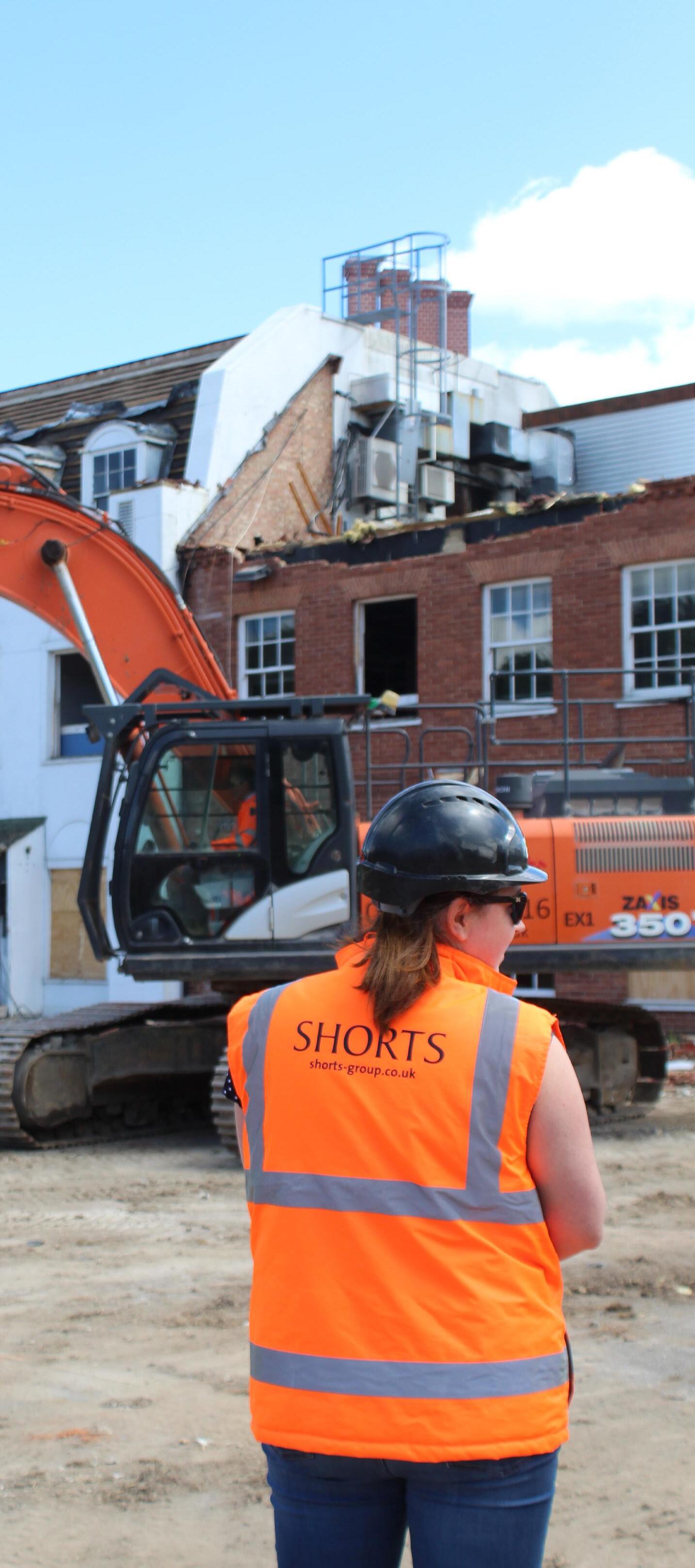
Push limits. Smash barriers. Break boundaries. And when you’ve conquered all those obstacles? You discover your full capacity for greatness. World of Concrete delivers all the real-world solutions that will crush your challenges and take your expertise to new heights. Growth opportunities are everywhere, whether you’re getting hands-on with game-changing tools and tech or shaking hands with your future partners. Ready for maximum success? Nothing’s standing in your way.

ACHIEVE PEAK PERFORMANCE

VIEW GLOBAL EVENTS
EXHIBITS: JANUARY 20-22, 2026
EDUCATION: JANUARY 19-22, 2026
LAS VEGAS CONVENTION CENTER


Executive Hire Show is one of the biggest industry exhibition events that fuses together tool equipment and plant hirers, all under one roof. And Demolition Spotlight was delighted to be in attendance for the first time!
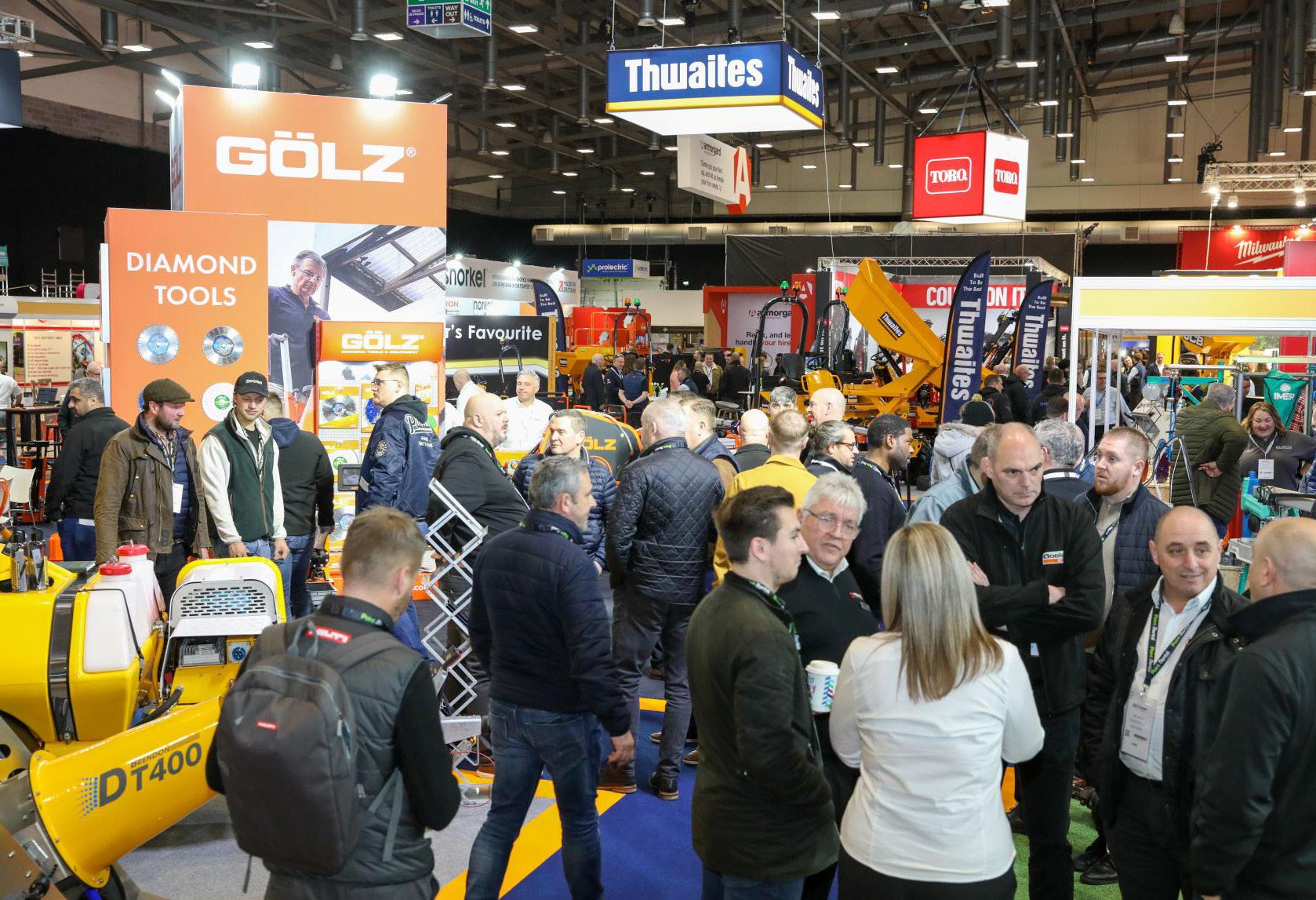
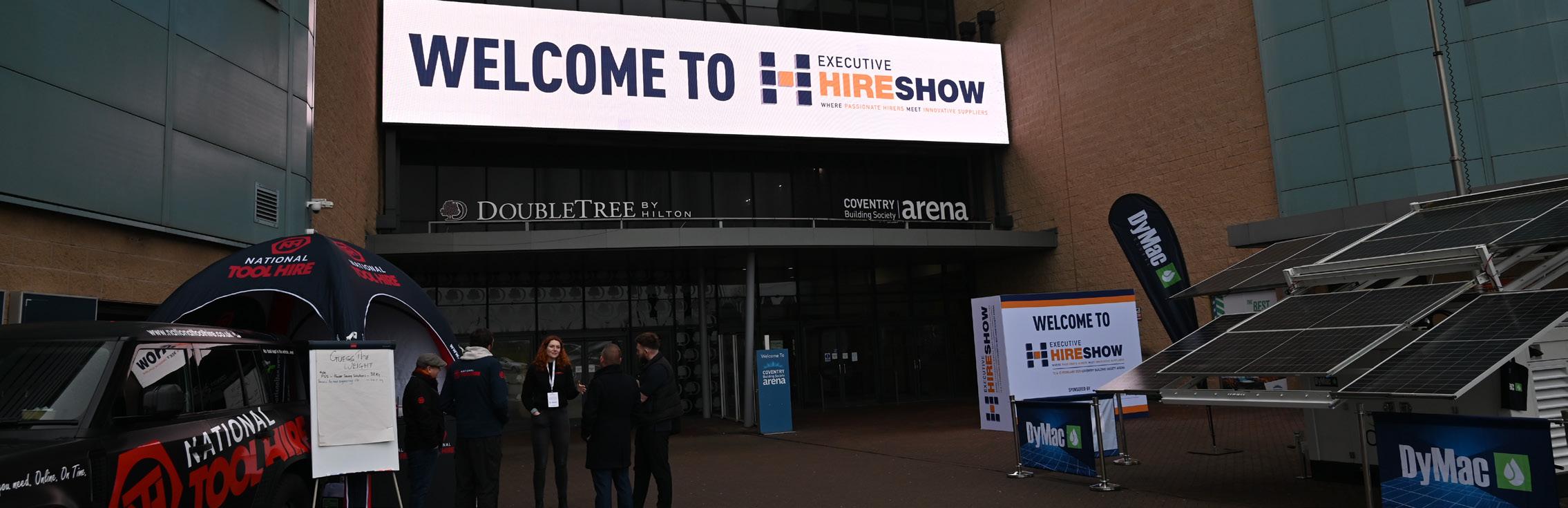
We were delighted to return to Executive Hire Show (EHS) last month, and this time, Plant Planet had an extra friend come along… Demolition Spotlight! We were thrilled to showcase both our magazines in the final month leading up to the big launch of this full magazine. The ever-popular show set a new record with 2,098 hire professionals in attendance and was fully booked with 145 stands. Truly, it was another standout year for the hire industry, and the best ‘first show’ for Demolition Spotlight!
“Over two days, industry professionals connected, discovered cutting-edge innovations, and secured business deals that will shape the hire industry in 2025 and beyond.”
The focal point for this year’s show seemed to be innovation, and a lot of clients and companies were there to showcase new products they had recently launched. Exhibitors were focusing on advancing and improving, the key message being that of growth and moving forward. Executive Hire Show really is the best event for investing in the future of hire!
Specialising in compact, versatile loaders and high-performance spider lifts, Avant Tecno are untouchable. At EHS, Leguan Lifts (part of the Avant family) displayed their latest Leguan 265 crane, a brand-new model, that was launched on 30th January, which is the tallest spider lift to date! This model offers a 26.5m maximum working height, 13.6m outreach, and a 250kg lift capacity, and is the fastest 27m spider lift on the market, as it extends to its full height in only one minute, thirtyfive seconds! The Leguan 265 is a perfect choice for fleet operators, with its 45% gradeability and the Elevated Driving Position (EDP) function; it offers extra height without compromising on efficiency and overall performance.
This is a huge breakthrough for Avant and Leguan, further emphasising how they always deliver on high-quality, highly durable and efficient machinery. It’s clear to see why they are an industry-leading company!
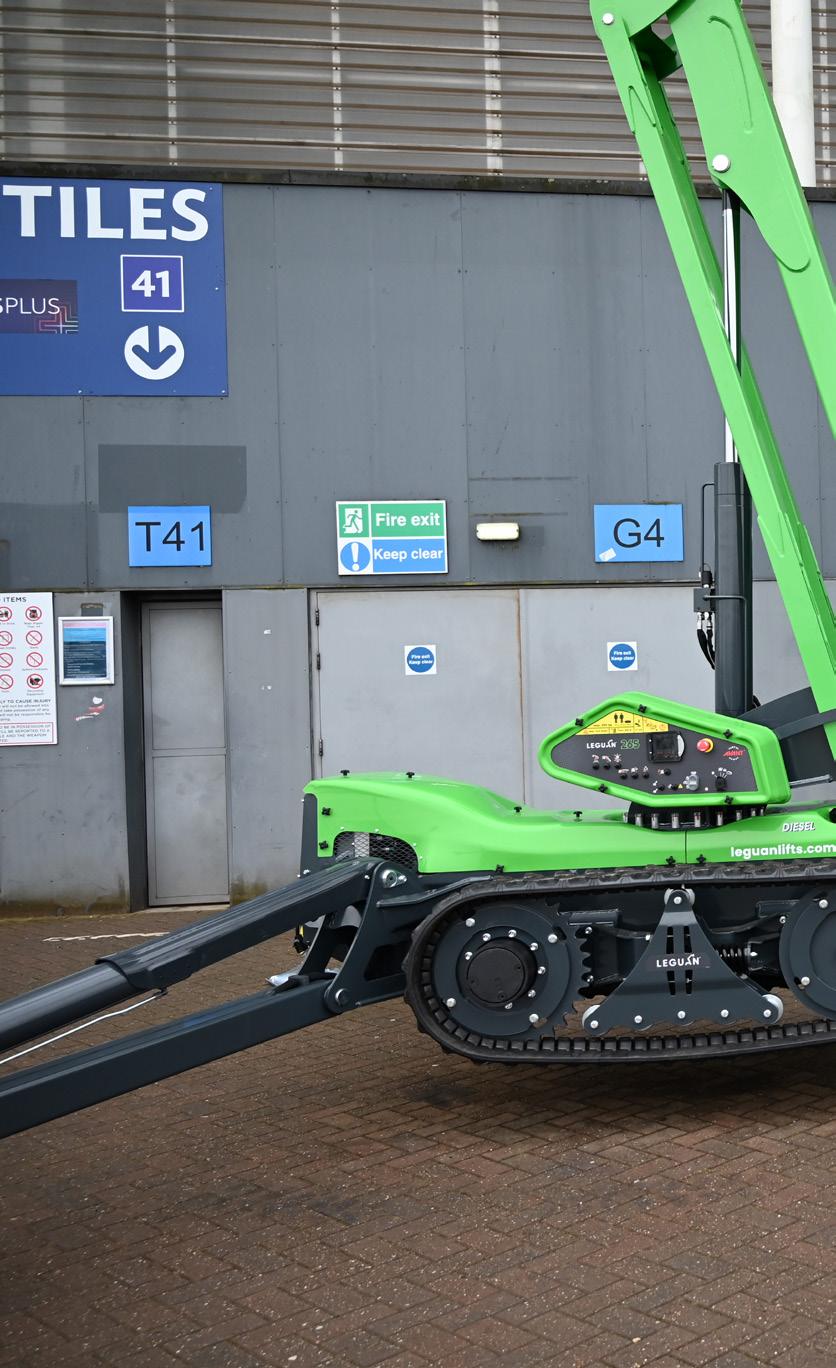
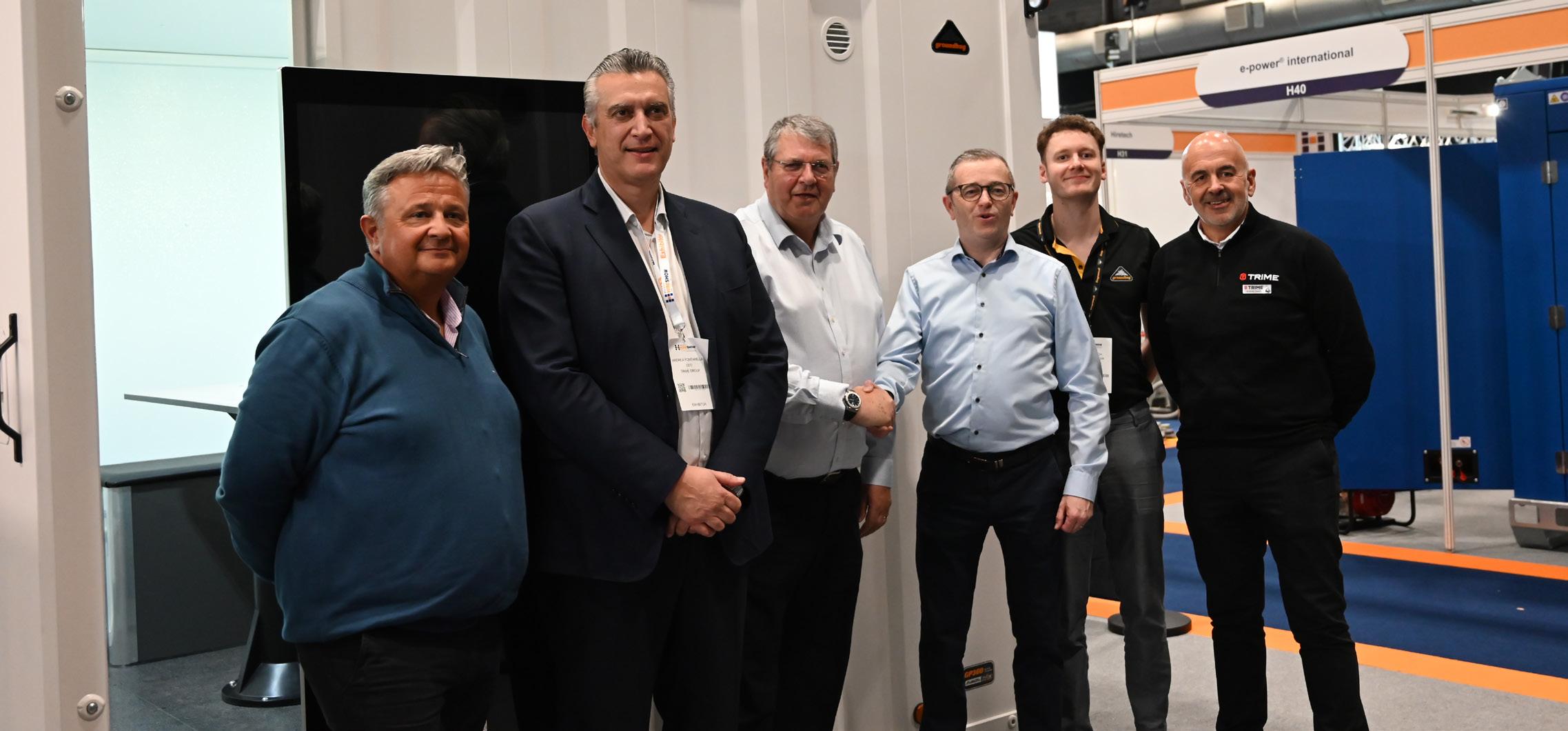
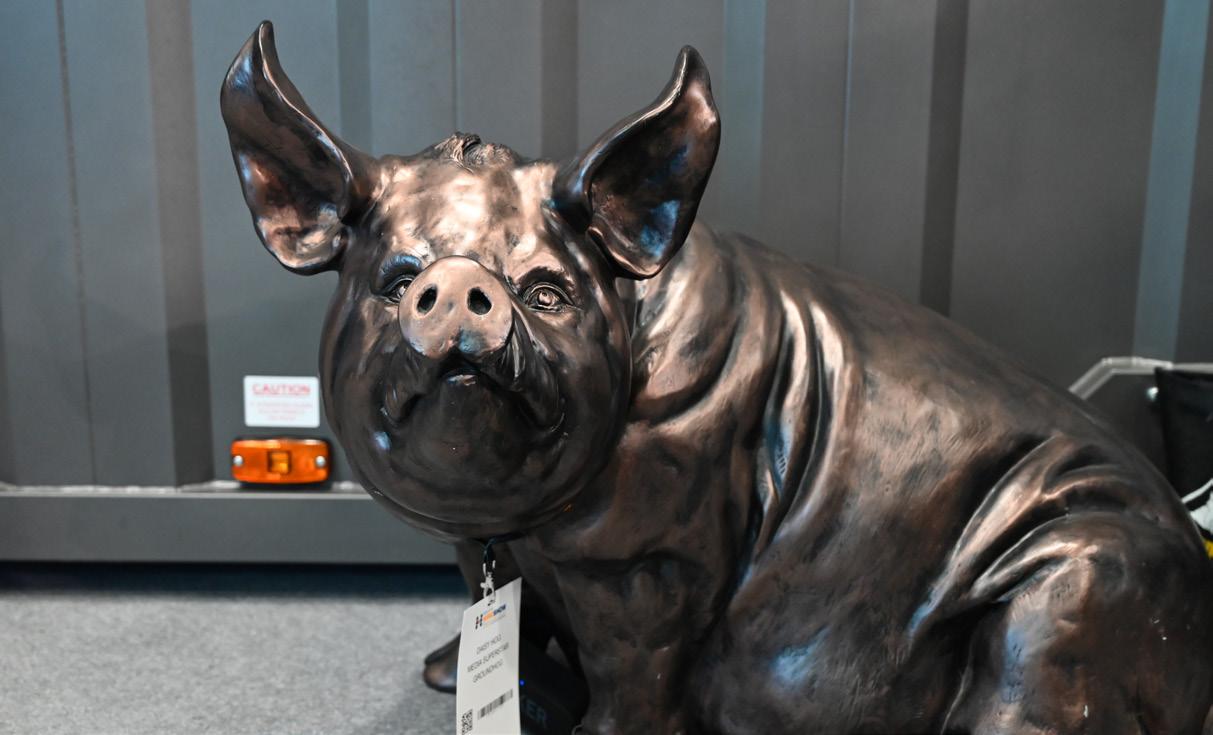
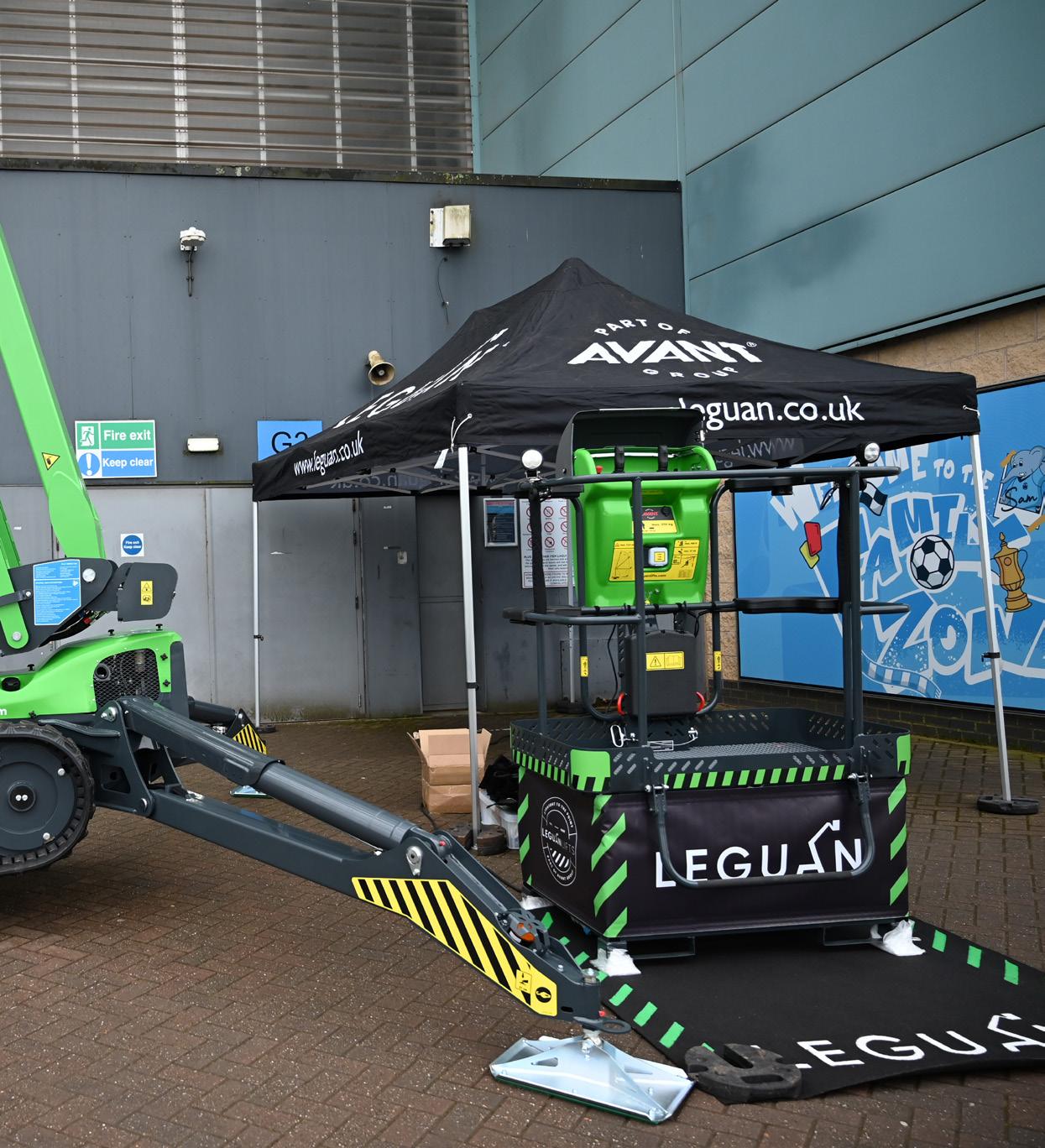
Groundhog have been a part of EHS for eighteen years now, which is just an incredible milestone! EHS has always been a fantastic show for them, and this year was no different with two jam-packed days engaging with passionate hire industry professionals. They too were focusing on product innovation by showcasing their single and twin axle sustainable welfare range, as well as a new exhibit, the Mobile Battery Charging Unit, a brandnew product launched at the show! And, as if all of that wasn’t enough, Groundhog also launched and displayed their brand-new spare parts service, offering Original Groundhog and Trime parts as well.
However, the star of the show was of course the wonderful Daisy Hog, who was also in attendance at EHS alongside her fellow Groundhog colleagues. She even had her own name badge! I can’t lie, I was almost starstruck upon meeting her, especially when she spoke to me! And in true paparazzi style, I stood on Groundhog’s stand for a good ten minutes just filming and snapping pictures of Daisy (I’m not sorry).
It’s easy to see that Groundhog delivered pure class at EHS, just like they do for their clientele.
“A brilliantly organised event from start to finish, and we can’t wait to do it all again next year!” Peter Beach, Groundhog Sales and Marketing Director.
Fully immersing themselves into EHS and all the show had to offer, inspHire were delighted to return to meet up with many faces, both new and familiar, in the industry. Here, they showed how they can help with rental operations by ‘futureproofing’ it from start to finish. Their technology is designed to save both time and money, so what’s not to like! By optimising hire and sales processes, as well as offering the “best-of-breed” rental software, all of this can improve the efficiency of any project, boosting profitable growth in the long run.
At EHS, inspHire were excited to launch the Telematics Linking Tool, available in their Asset Locator. This tool allows users to link up with any telematics provider by inserting basic credentials. This system then integrates telemetry data from all providers, keeping it all in the one place! This shows how technology and knowledge can create such helpful innovation for all industries and companies.
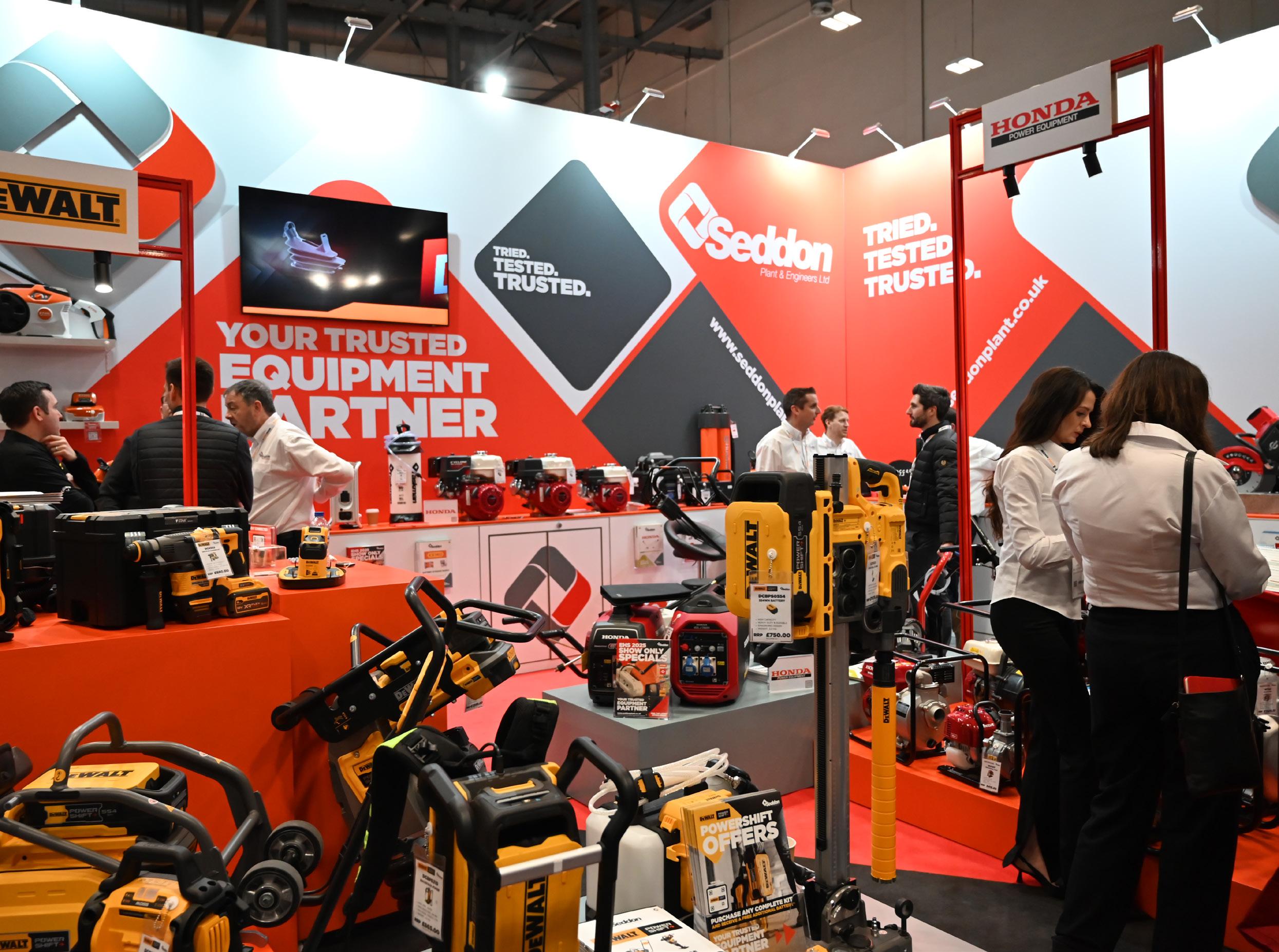
As leading suppliers of plant, tools and equipment, Seddons are ideal people for the job when it comes to construction and plant and tool hire! EHS was the chance for them to show off their wares and demonstrate what they called the future of plant and tool hire with their cutting-edge machinery. Some of their best equipment highlighted was:
• STIHL TSA 300 Disc Cutter: This battery powered cutoff saw is one of Seddon’s favourites to show off, and this equipment was also in a competition for a lucky customer to win!
• Cramer 82PC300: On their stand they showed how this disc cutter delivers exceptional performance, with an excellent runtime. This tool is perfect for demanding jobs.
• ENAR SPYDER PRO High-Frequency Poker: ENAR’s technology is best for improving the quality and durability of projects involving concrete. This is one tough piece of equipment that is designed specifically for efficiency and reliability.
• Honda EGX Battery Engine: Used to ‘power your fleet’, Seddons had a range of Honda engines, generators and water pumps on display, offering the solution to whatever power and waste management issues people had.
• DEWALT DCG460 Mitre Saw: This versatile saw delivers groundbreaking (literally!) results, whilst also offering a cordless performance, meaning this tool is more flexible with how it can be used.
Seddons certainly had it all on offer, and it was clear to see they are passionate about what they do and the tools they offer.
A global leader in construction and heavy machinery, XCMG are known for their innovation, which means this show was right up their street. Their extensive range of products include loaders, excavators, cranes, and way more, and at EHS, they showcased three innovative products:
• XGR10J Mast Lift
• 1.8-ton Lithium Forklift
• Mini Excavator
All these products were designed with one thing in mind: meeting the evolving needs of hire companies. With this approach, XCMG can constantly deliver durable and sustainable machinery that provides excellence and smooth operating. Their products, technologies and techniques match their slogan, and EHS was further proof that they are definitely Building a Stronger Future Together.
All round, it’s easy to say that EHS was a brilliant show to attend and offered so much and more. It opened my eyes to the new machinery and equipment on the market, upcoming business ventures and cutting-edge and competitive technology. It was truly insightful. And with the dinner and the 2025 Passionate Hirer Awards ceremony perfectly sandwiched in-between the two days, there were endless opportunities for business conversations and making new connections with people in the industry.
We cannot wait to return in 2026 to see what more EHS can offer! Save the date! The next Executive Hire Show will take place on the 11th & 12th of February 2026 at the home of hire—the CBS Arena! In the words of Publishing and Event Director, Chris Moore, “bring on 2026!”





































More economical, faster, comfortable - this is how the new generation of transshipment excavators at SENNEBOGEN can be described. The versatile 850 was reissued in the Gseries and not only equipped with the new Maxcab including a new control system, but also enriched with the Green Hybrid energy recovery system.
The G-Series is also the new benchmark for medium-sized transshipment excavators. The SENNEBOGEN 850, developed for scrap steel handling and port handling, has diverse equipment options with ranges between 17 and 21 metres. It allows a configuration according to customer requirements for the new 850 G Hybrid, including undercarriage variants from stationary to mobile. Equipped with the new SENcon control system and the Green Hybrid recuperation system, the machine also proves to be extremely economical and efficient.
The new 850 G Hybrid combines impressive performance with state-ofthe-art technology. The speed of the working functions could be improved, and the consumption was significantly reduced. A bonus for the environment and the wallet.
The new transshipment excavator now has a highly efficient 231 kW diesel engine of exhaust stage V, which runs at a speed of 1725 rpm as standard. Special eco settings as well as the possibility of refueling the machine with HVO allow a particularly environmentally friendly operation. Large-sized hydraulic valves and lines are the most efficient, which enables the transshipment excavator to save resources.
The Green Hybrid recuperation system integrated for the first time in this machine size. The energy recovery system consists of a gas pressure accumulator installed in the rear of the machine and a third hydraulic cylinder on the boom. The energy generated when the boom is lowered is stored in the nitrogen storage system and released back into the lifting cylinders during the next lifting process. This is proven to be particularly reliable and safe over 12 years as well as saving around 30% of fuel and 22 t of CO2 per year.
The newly designed Maxcab, installed in the 850 G Hybrid and the new generation SENcon control system launched for Bauma, has a standard cabin elevation stabilized by the centrally articulated cab lift cylinder and raised to 2.80 m, producing a comfortable
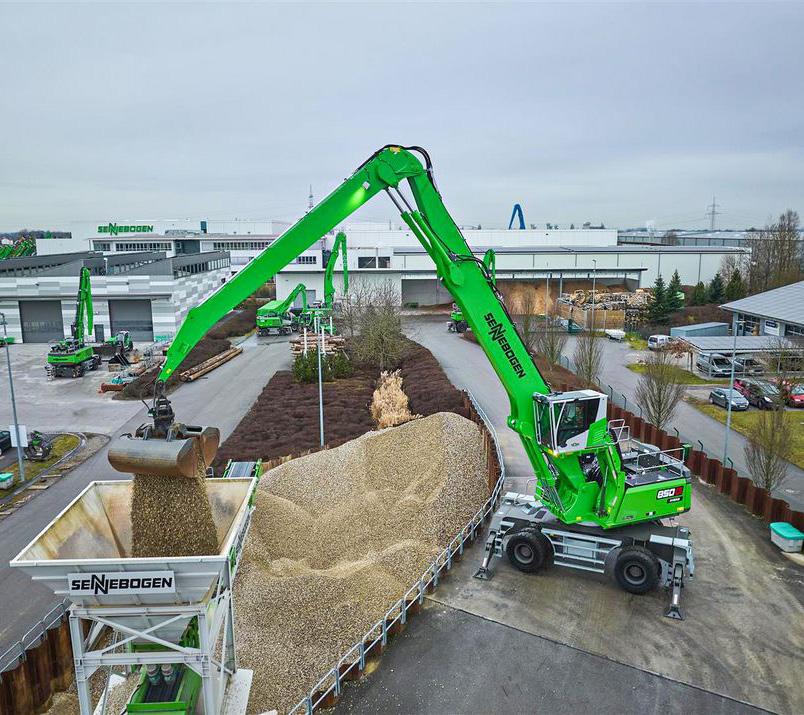
visibility height of 6.10 m. There is also a 10-inch touch display, which provides quick access to all the essential functions. The driver is supported by intelligent assistance systems that ensures optimized performance and increased machine-handling safety.
The new SENcon control system also offers increased communication capacity for the transshipment excavator, beneficial for the driver, fleet operator and the machine. The operator is provided with a large amount of data through the connection with the SENNEBOGEN telematics system SENtrack. Concrete cost savings can be achieved by avoiding on-site customer service operations. The customer service can switch to the machine and offer solutions remotely. Software updates can also be installed “over-the-air”. All of this saves time and costs and increases machine availability.
As with all machines of the new SENNEBOGEN G-series, the robust and clear machine design and easily accessible maintenance points are valuable.
The new 850 G Hybrid, along with ten machines, will be presented to the specialist audience at this year’s Bauma in Munich, at stand FM.712 outdoors, Messe München.
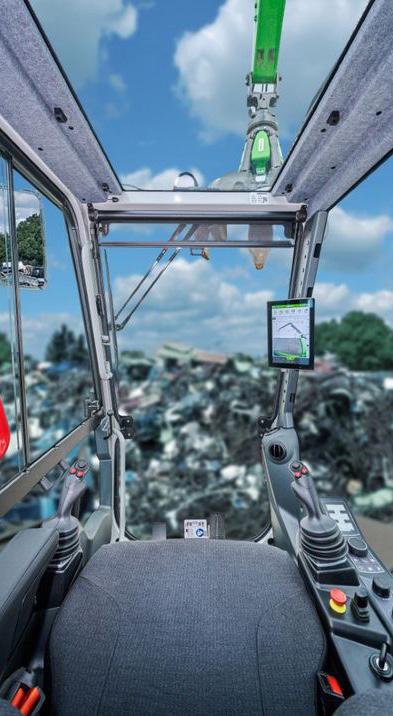
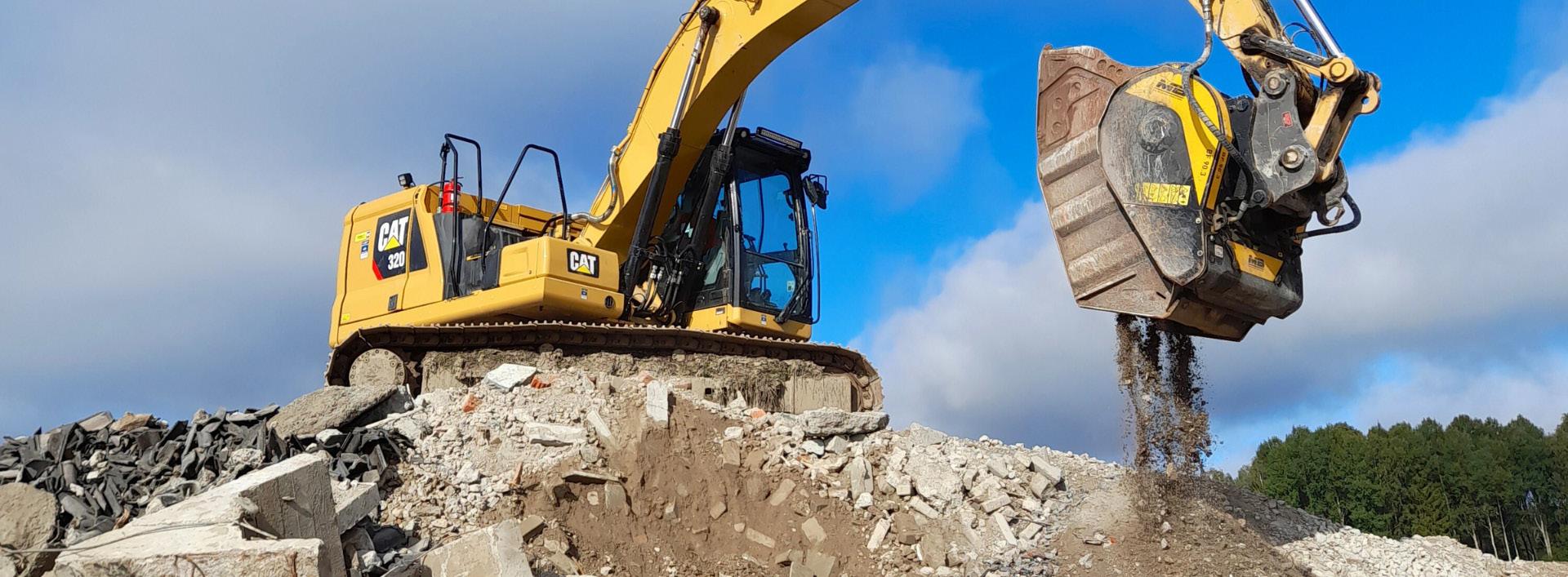
Concrete isn’t just the foundation of modern construction—it’s also the key to its future. In this article, we explore how to recycle concrete efficiently using MB Crusher’s innovative solutions.
Recycling concrete is no longer an option—it’s a necessity. In many countries landfills are filling up and environmental concerns are growing. In others logistics are difficult and transportation costs are rising. As the industry moves towards sustainability, the focus shifts to how to handle concrete waste.
It is pretty simple really. Don’t just demolish. Recycle. Reuse. Reinvent.
Instead of viewing used concrete as debris, see it from a different point of view from the excavator cab while MB Crusher units transforms it into valuable resources thatpower new projects.
In this article, let us guide you through how MB Crusher’s attachments will aid you, in a simple and cost-effective way.
Crushing concrete waste into value Construction and demolition companies are subject to growing environmental restrictions. But those who chose MB Crusher attachments have found an easy and practical solution to turn waste into a valuable asset directly on-site. Let’s break down the process:
1. ATTACH AN MB CRUSHER BUCKET
– Mounted on any brand of excavator, MB Crusher buckets transform any demolition site into a recycling hub.
2. CRUSH CONCRETE – The powerful jaws easily break down reinforced concrete, separating even iron rebars.
3. REUSE MATERIAL IMMEDIATELY –
Once processed, the crushed material is ready to be used for backfilling, roadbeds, or new construction projects, reducing the need for fresh aggregates.
To sum it up, by using your heavy machinery with an MB Crusher attachment you have a closed system to crush rubble into high-quality recycled aggregates.
Real-world success:
Turning waste into opportunity
So far it has been all pretty easy, right? It gets even easier as MB Crusher attachments will work with any brand of excavator. Plus MB Crusher offers broad range of units that will cover carrier machines from 6.5 tons transforming them from diggers to mobile crusher. Loaders, skid steers, mini, midi or big excavators there will be an MB Crusher unit.
• From demolition to railway infrastructure with a big excavator: A Liebherr 954 equipped with an
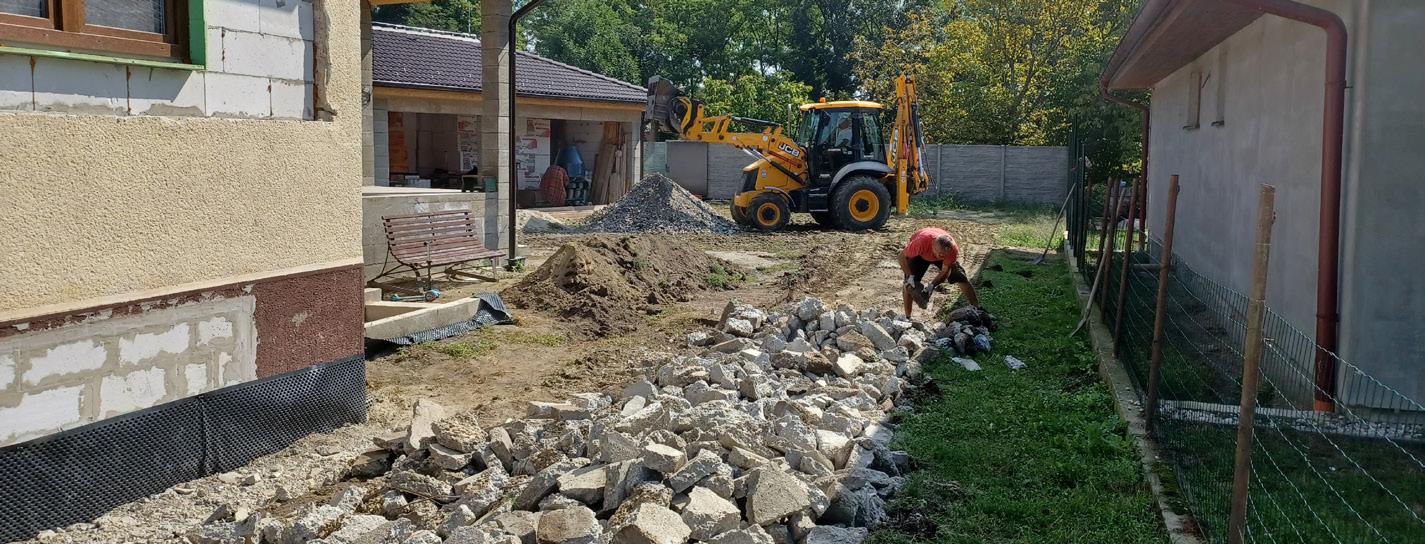
MB Crusher BF135.8 turned a massive pile of concrete rubble into highquality roadbed material for a new railway project—eliminating waste and cutting costs.
https://vimeo.com/1023919321
• Tight space logistic simplified: a Caterpillar machine fitted with an MB BF70.2 crusher bucket effortlessly transformed concrete waste into reusable material, reducing transportation and disposal expenses.
https://vimeo.com/1023923102
• The backhoe loader that became a mobile jaw crusher: A JCB 3CX 8-ton backhoe loader, equipped with an MB-L160 crusher bucket, reclaimed debris from a house renovation and repurposed it into a durable driveway surface—turning waste into a functional, eco-friendly upgrade. https://vimeo.com/813139070
A Sustainable Future with MB Crusher
Every demolition site has untapped potential. MB Crusher’s cutting-edge solutions unlock this value, making concrete recycling efficient, costeffective, and eco-friendly. The future of construction isn’t just about building— it’s about rebuilding smarter. Recycle. Reuse. Reinvent.
Explore more about MB Crusher’s solutions at MB Crusher’s website www.mbcrusher.com/en/gb
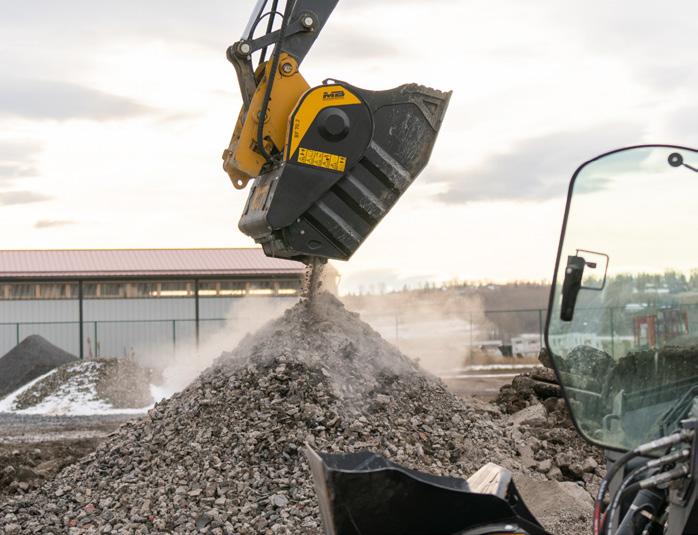
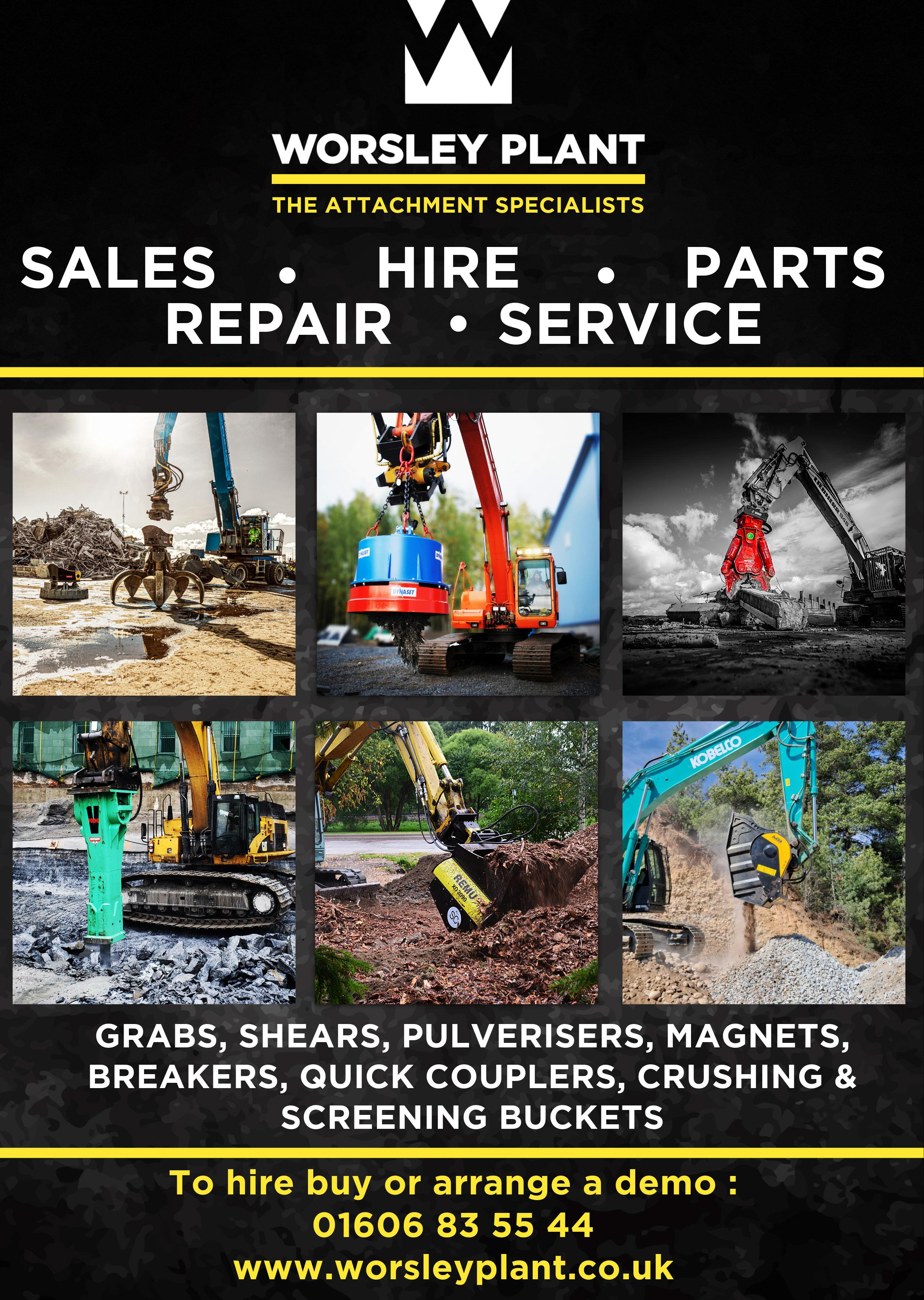

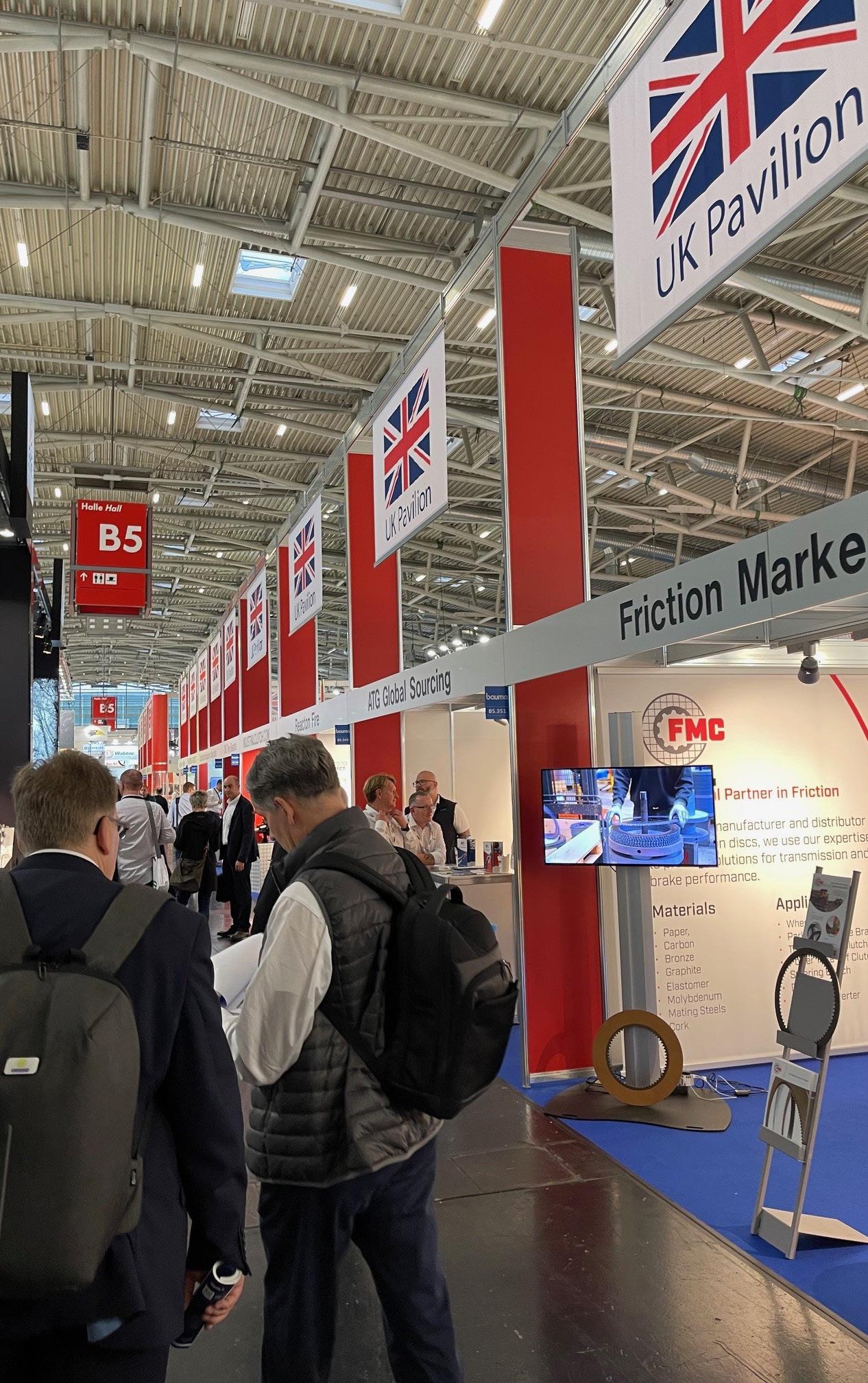
The countdown is on: Bauma, the world’s leading trade fair for construction machinery, building material machines, mining machines, construction vehicles and construction equipment, will start in Munich in a few weeks’ time. From 7 to 13 April, more than 3,500 exhibitors from 57 countries will be presenting their latest machines, technologies and innovations on a total of 614,000 square metres of exhibition space.
Noticeable increase in international participation Demand for exhibition space also remains high in 2025, and Bauma is once again fully booked. There has been a noticeable increase in international participation, primarily from Asia, specifically from India, Japan, China, Taiwan and Korea.
Europe also well represented Europe does, however, also remain present with a strong presence. Italy is the second largest exhibitor group after Germany, Turkey is the fourth largest. The number of exhibitors from Switzerland, Belgium, the Netherlands and Portugal has also grown. Companies from Argentina and the Philippines will be taking part for the first time.
Stefan Rummel, CEO of Messe München, emphasizes: “The persistently high level of interest in bauma underscores its global significance. bauma is and remains the heartbeat of the industry and will continue to provide important impetus even in the challenging market environment of 2025.”
The UK Pavilion at Bauma – 7-13 April 2025, Munich
Bauma is the world’s largest exhibition across all industry sectors, attracting over 3,600 exhibitors and 600,000 visitors from nearly 200 countries. With its vast 20 exhibition halls and extensive outdoor display areas, smaller UK exhibitors can struggle to stand out. The UK Pavilion, organised by the Construction Equipment Association (CEA), provides these businesses with enhanced visibility and a prime platform to showcase their innovations.
The CEA is proud to bring an even larger delegation of UK companies to Bauma 2025, featuring around 30 exhibitors, ranging from micro exhibition PODS to larger 50 sqm stands. Having supported Bauma for many years, we look forward to connecting with manufacturers and end-users of construction equipment from Germany and around the world.
The Construction Equipment Association (CEA) is the UK trade association representing manufacturers of construction equipment, components, attachments, and associated services. The UK construction equipment sector contributes over $18 billion annually to the UK economy and employs nearly 50,000 people.

The CEA can assist visitors by facilitating introductions to UK exhibitors at Bauma, as well as to our wider membership network through our website: www.thecea.org.uk
Visit them at Bauma –Hall B5, Stand 349
Fit For The Future Through Sustainable Construction
The construction industry uses significant amounts of resources and is one of the largest producers of greenhouse gases. For that reason alone, social development aimed at sustainability is inconceivable without essential contributions from the construction industry. Bauma 2025 will provide an overview of the diverse approaches in the construction machinery world for sustainable construction. The world’s leading trade fair for construction machinery, building material machines, mining machines, construction vehicles and construction equipment will be held from April 7 to 13 at the Munich exhibition centre.
Serial construction saves resources
When it comes to saving resources, serial construction is one of the most promising levers. “It uses raw and other materials more efficiently than with conventional construction methods, as prefabrication can be carried out in a controlled industrial environment,” explains Stephan Oehme, Consultant Mining & Minerals, Construction Equipment and Plant Engineering at the German Engineering Federation (VDMA). According to him, material waste can thus be reduced in several ways: Production waste and scrap materials generated at the factory can be better recycled. It is also easier to dismantle the buildings at the end of their useful life and to reuse their materials.
3D printing with secondary raw materials and biobased materials
As a further opportunity to protect natural resources, greater use can be made of recycled materials for 3D printing of buildings. The industry is also carrying out research on biobased materials for additive manufacturing. In any case, demand basically seems to be there: According to a study by the market research company Exactitude Consultancy, the global market for 3D printing mortar is expected to grow from around USD 3.5 billion in 2024 to around USD 13.8 billion in 2034.
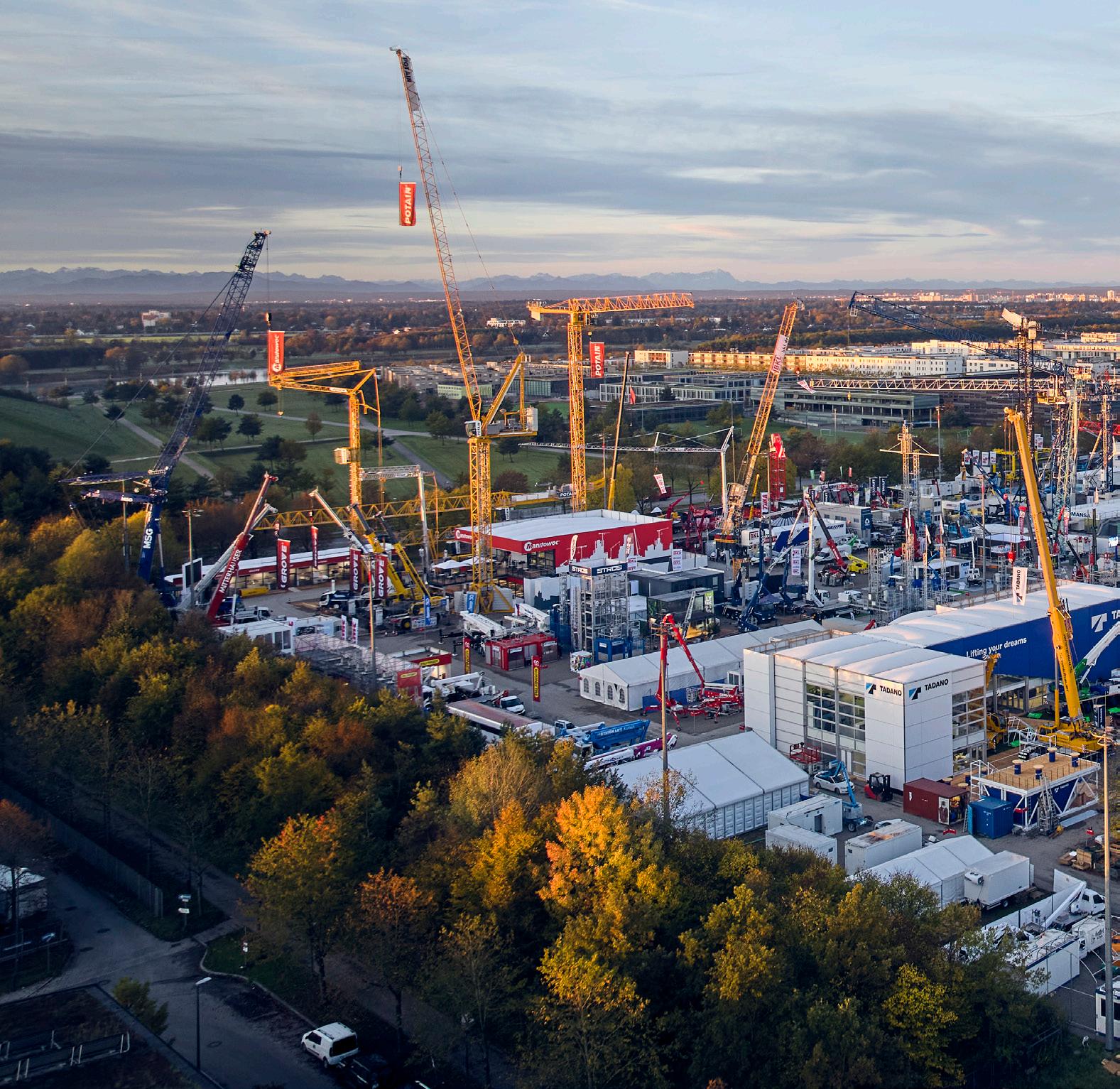
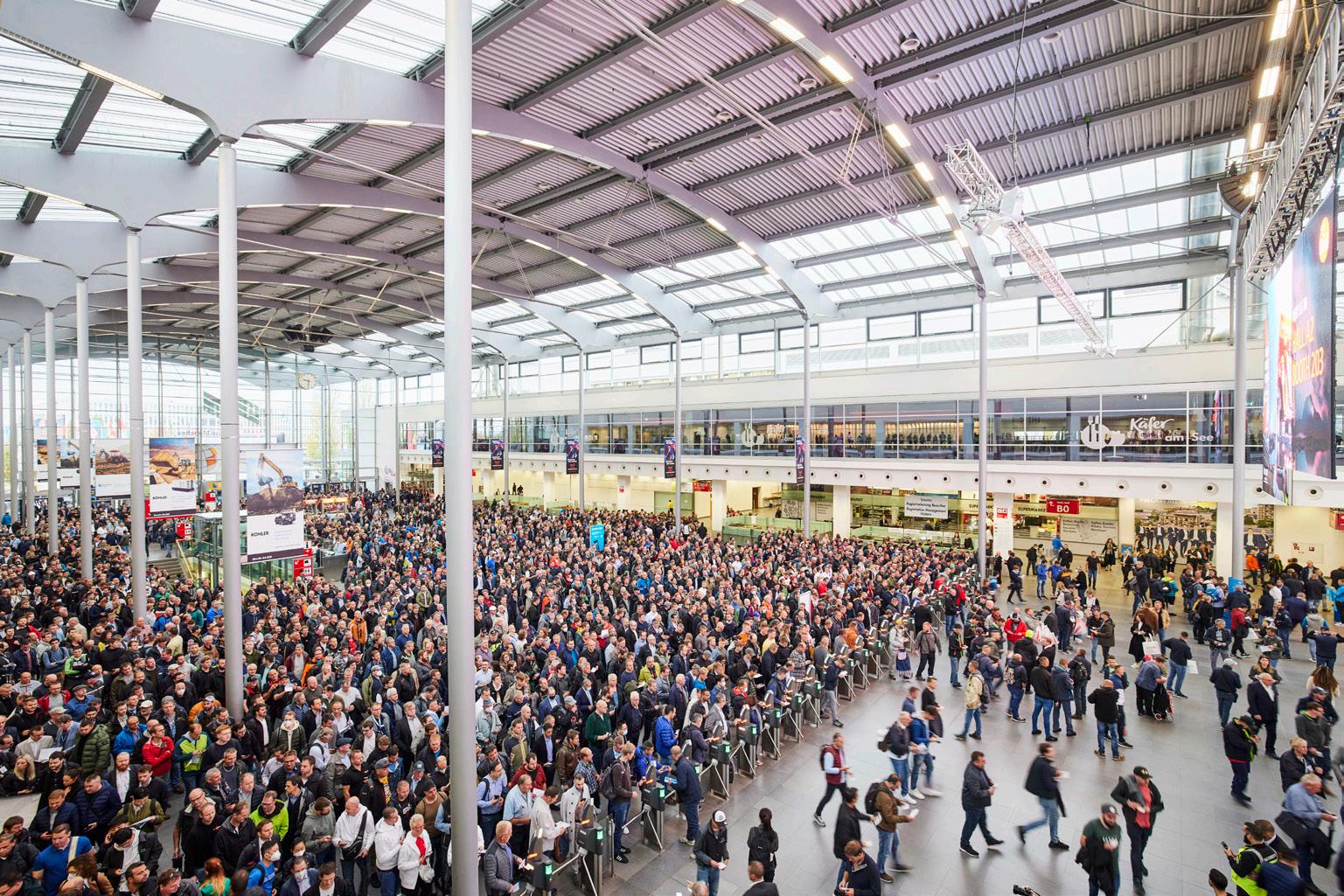
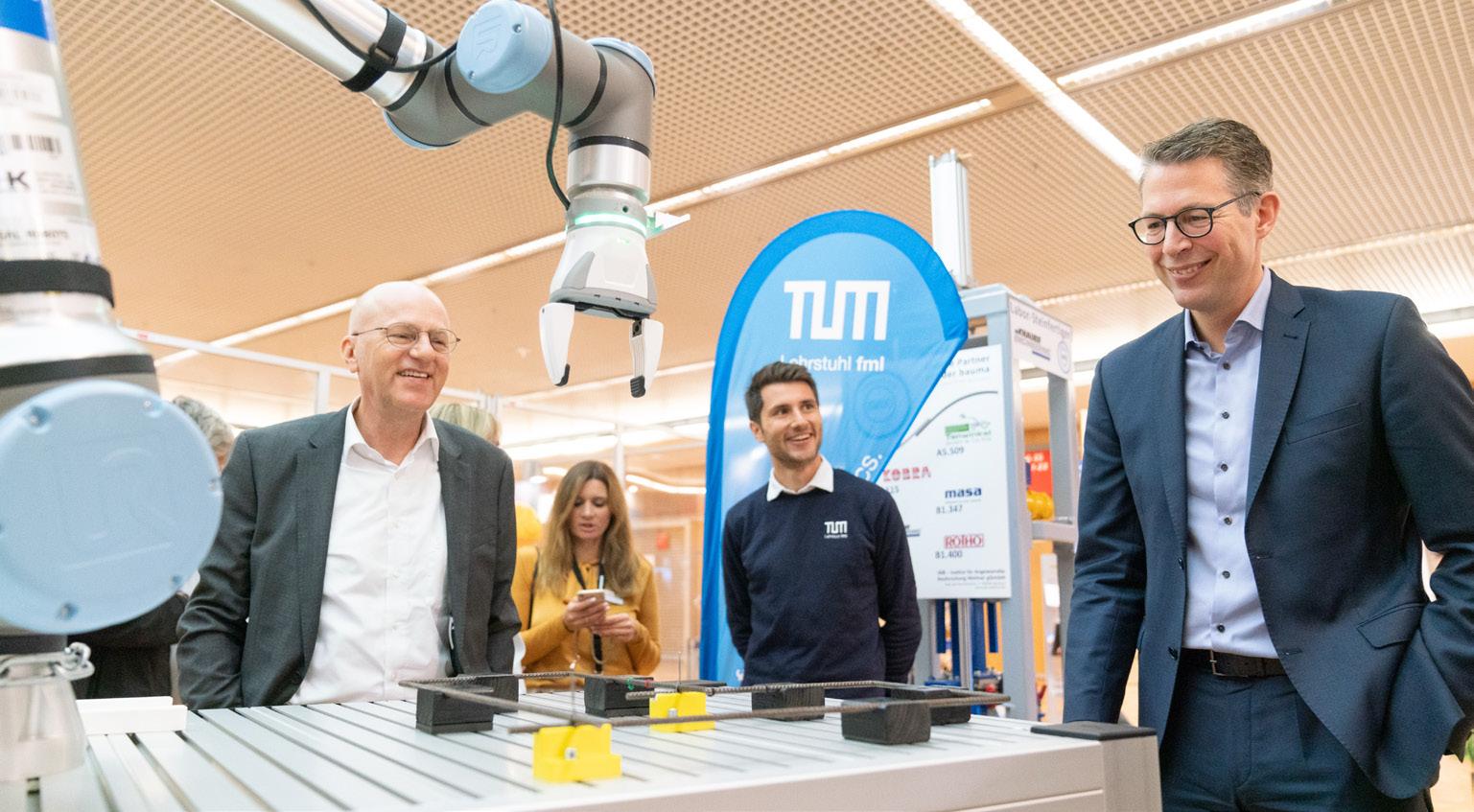
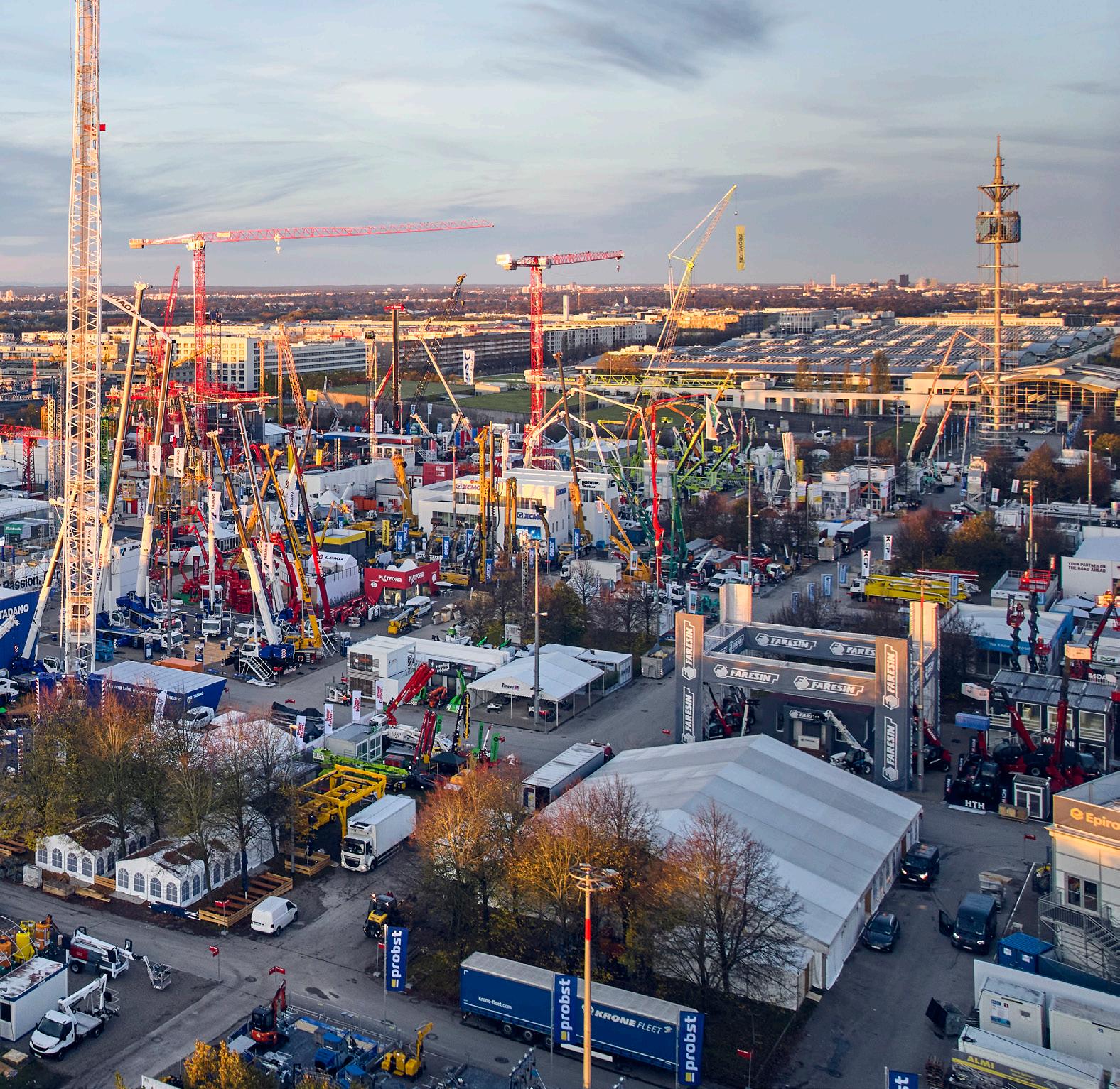
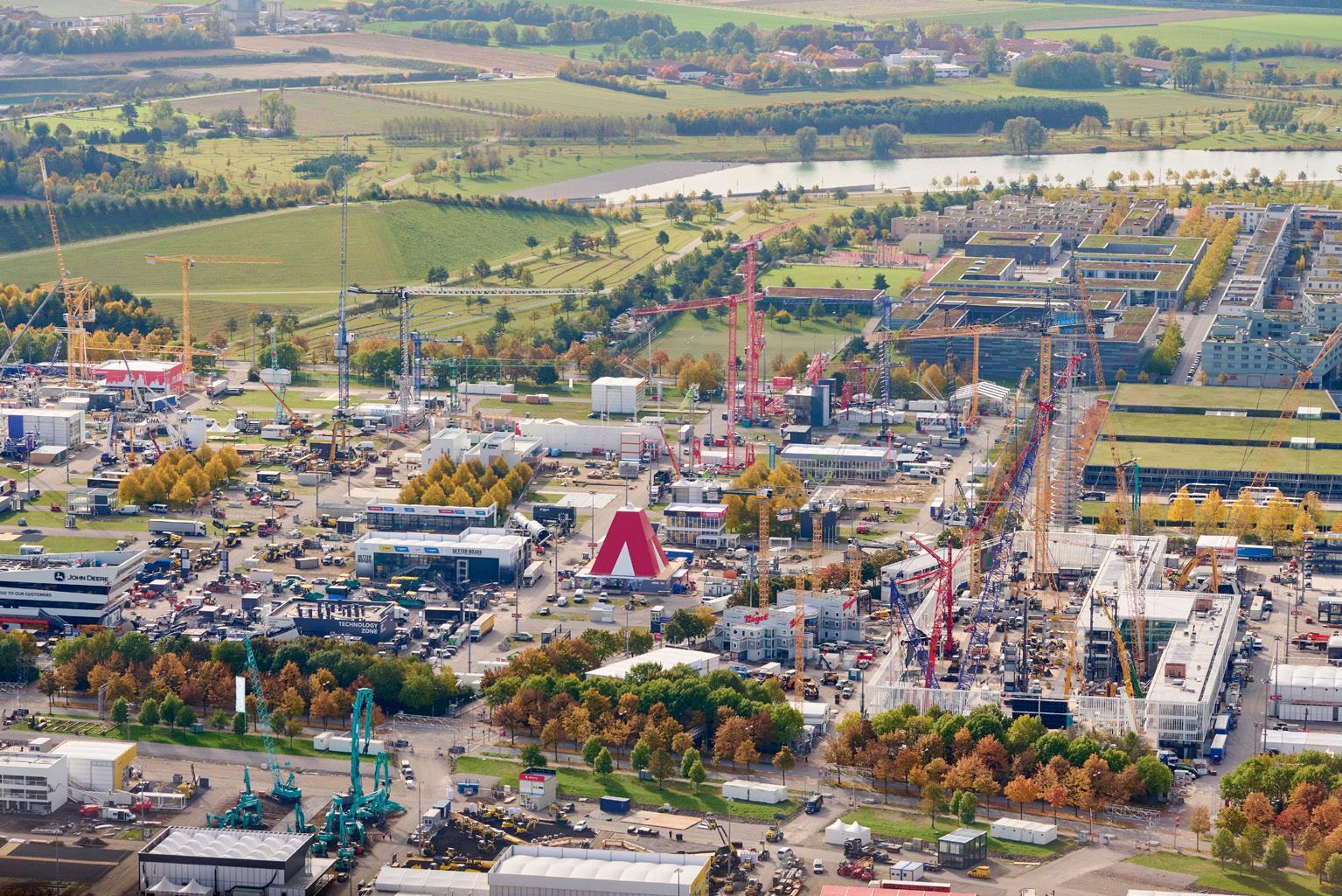
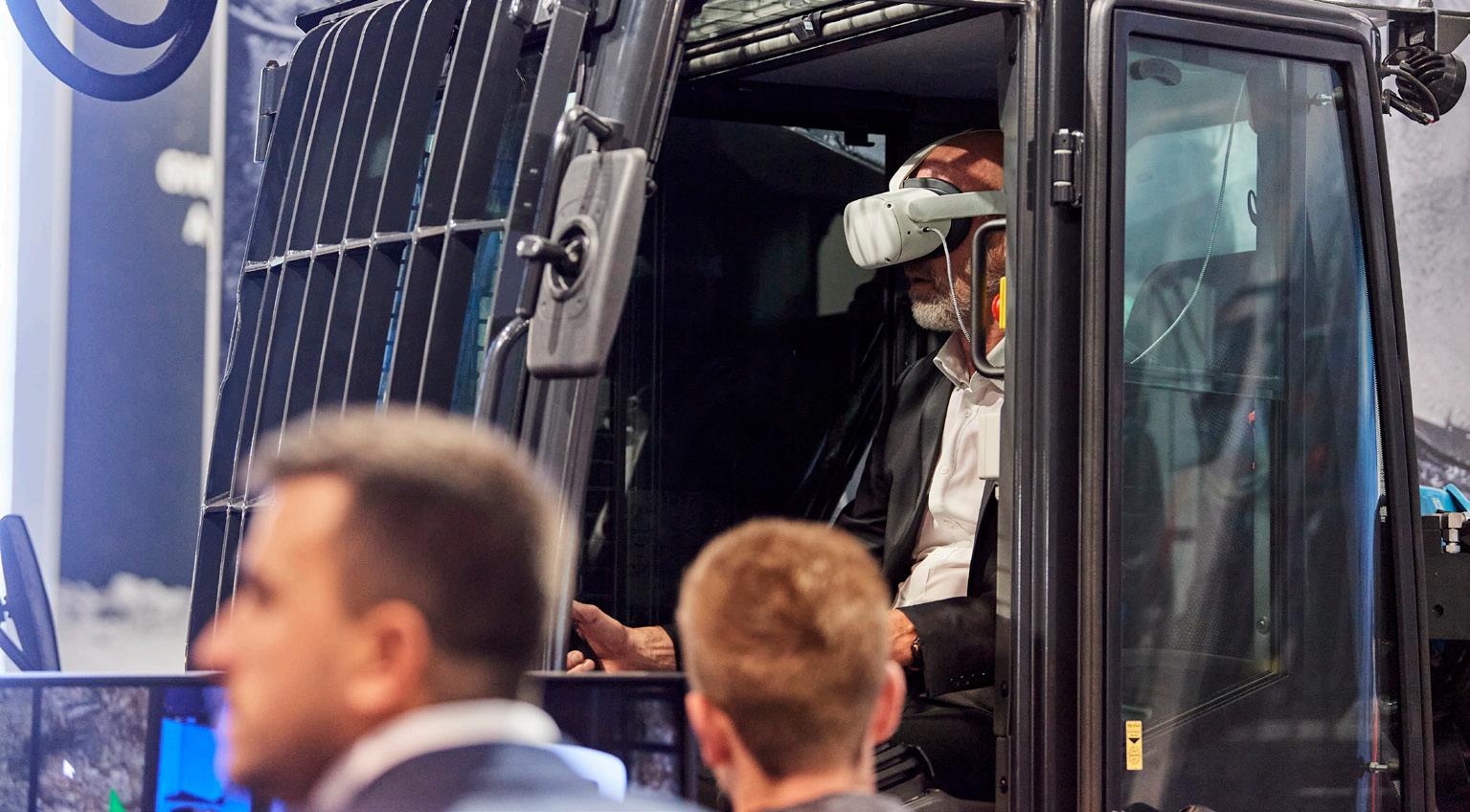
High recycling rate for mineral construction waste
Of the around 208 million tons of mineral construction waste generated in Germany in 2022, over 90 percent was recycled, according to the Kreislaufwirtschaft Bau initiative. “The idea of recycling is now deeply etched in the DNA of the construction industry, as demonstrated not least by the many extremely practical solutions,” comments Oehme. For example, asphalt pavements can be prepared on site using the cold recyclers from the Wirtgen Group. The existing pavement is granulated with a milling and mixing rotor and prepared by adding binding agents, cement and water. The result is a homogeneous material that can be directly reapplied.
Electric drives for a wide range of applications
Sustainable construction also includes the goal of decarbonization to the maximum possible extent. Contributing to that are the alternative drives for mobile construction machinery, which will also be a separate key topic again at Bauma in 2025. In addition, electric solutions also prevent exhaust fumes and noise from construction equipment, such as vibratory plates and tamping rammers. The range of products is now so wide that, according to the manufacturer Wacker Neuson, a completely emissionfree construction site is already possible today.
Low-emission asphalt mixing
Other market players also supporting climate-friendly construction are construction material manufacturers. For example, an asphalt mixing company in Nentershausen in the German state of Hesse, is now successfully using the Revoc system from manufacturer Benninghoven, which was presented as a world premiere at Bauma 2022.
The retrofitted “catalytic converter” enables total carbon emissions to be reduced by up to 50 percent, while the share of recycling material in the asphalt can be increased to up to 60 percent. Benninghoven also recently launched the world’s first asphalt burner that can be powered by 100 percent green hydrogen.


Sustainable also means socially responsible
“Sustainable construction is by no means limited to resource awareness, recycling of the materials used, and a smaller carbon footprint,” says the VDMA expert and goes on to say: “Alongside economic viability, safeguarding human health is also a key objective.” Reducing construction site noise, for example, is good for the health of both the workers and local residents. Many municipalities around the world, such as Munich, London, Paris, and Zurich, are boosting the use of quieter construction machinery through guidelines, regulations, and subsidies. E-machines are not only particularly quiet, but also emit no harmful exhaust gases or particulate matter where they are used.
More efficient, more transparent, more sustainable—digitalization and networking are seen as effective measures that help get a grip on the major challenges facing the construction industry. In view of this significance, Bauma 2025 has added “Networked Construction” to its key topics. The World’s Leading Trade Fair for Construction Machinery, Building Material Machines, Mining Machines, Construction Vehicles and Construction Equipment will be held from April 7 to 13 at the Munich exhibition centre.
Smart attachments with standardized digital language
In networked construction, digital technologies and communication systems are integrated into the construction process, which improves collaboration and efficiency. For example, attachments supply process data and communicate with the respective carrier machines. A standardized digital language is required for this communication to also work regardless of the manufacturer. The foundation for this was laid by the MiC 4.0 BUS protocol, which won the Innovation Award in the field of digitization at the last Bauma in 2022. Version 1.0 of this is now freely available with full functional security. Thanks to the common universal protocol, the carrier machine recognizes which attachment is to be used, which parameters it needs to function, and whether it is even suitable for use on this machine. “Accidents caused by incorrectly closed quick hitches, unsuitable hydraulic pressure or incorrectly dimensioned attachments can thus be reliably avoided,” reports Dr. Darius Soßdorf, Managing Director of the MiC 4.0 working group at the German Mechanical Engineering Industry Association (VDMA). The working group includes manufacturers of construction
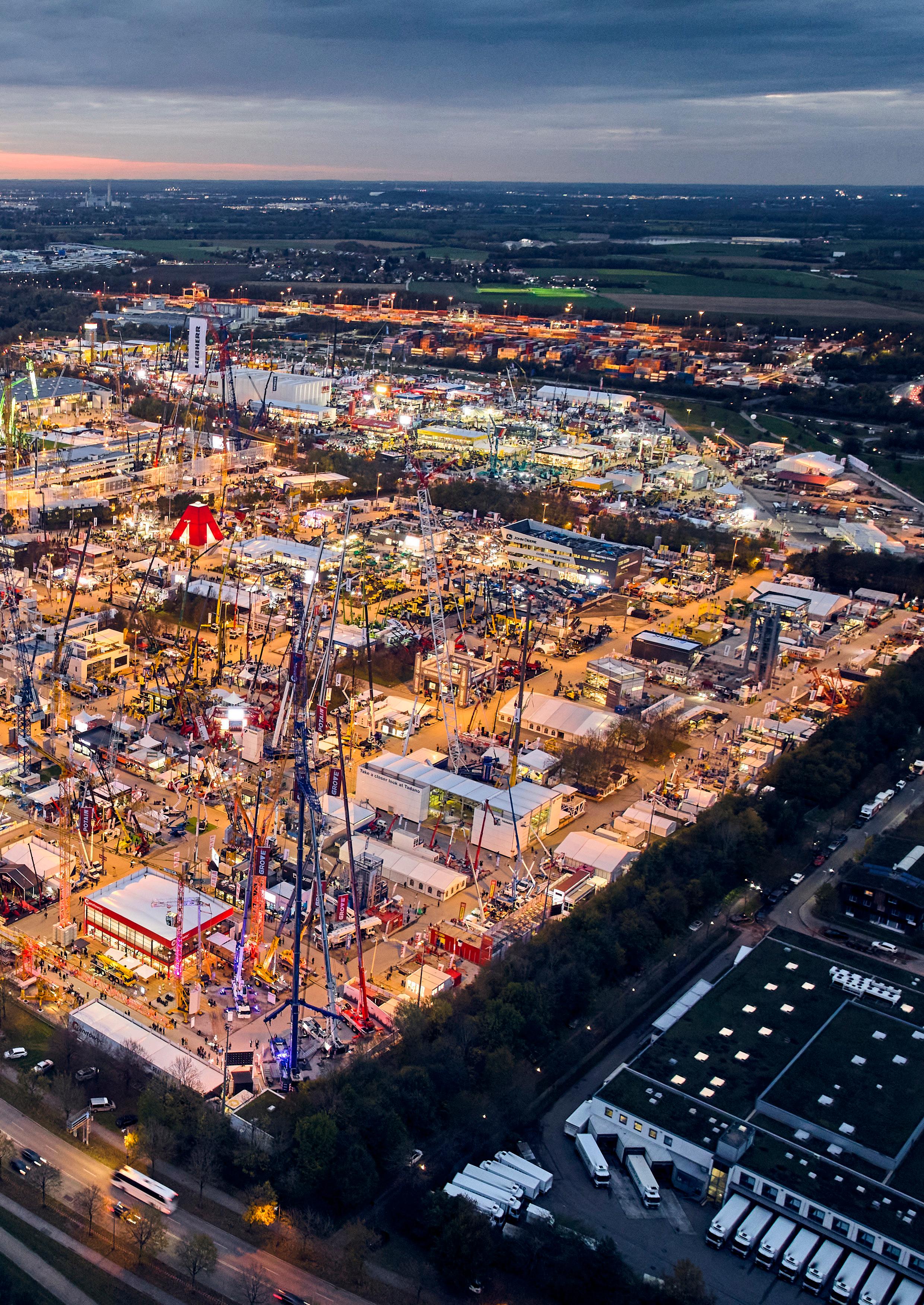
machinery and sensors, software companies, and construction firms.
Bidirectional information flow between construction machine and user
Through the advancing digitalization of construction machinery, users receive increasing amounts of data which not only show them the condition of the machines, but also provide valuable information on their performance and work quality. For example, more efficient fuel routes can be developed on the basis of current consumption data, while machine deployment can be optimized by accurately recording the respective capacity utilization. A new function of the telematics system from the manufacturer Bobcat shows that the information flow does not have to be a one-way street from the machine to the operator. The engine of wheel loaders, mini excavators, etc. can be remotely deactivated—and also reactivated—by the owner with just a few clicks. That prevents unauthorized use and theft, which can result in lower insurance premiums, among other things.
support for machine operators
On the basis of digital information, and given the shortage of skilled workers, even less experienced machine operators can avoid slight errors and accidents, and achieve very good work results. For example, the construction machinery manufacturer Develon, formerly known as Doosan Construction Equipment, together with surveying specialist Leica Geosystems, recently started offering 3D machine control as a retrofit option for one of its crawler excavator models. Design information and real-time cut/fill indications are displayed on the control panel in the cab so that the driver can carry out the excavator work exactly according to the reference model.
connect the physical and virtual world
Sensors are a prerequisite for the digitalization of construction machinery, including developing assistance and autonomy systems. For example, they register the boom and bucket position, are used for fluid management, or help detect structural loads and damage. One of the biggest challenges for using sensor technologies in the construction machinery industry is often the harsh working environment, which is why manufacturers like Baumer are developing extremely robust sensors specifically for use in mobile machines. Special material, design and test concepts ensure that the data required for digitalization flows even under the toughest operating conditions. For further information visit: www.bauma.de/en/
The advanced technology behind the new generation makeover of the 23-ton EC230 Electric excavator from Volvo CE gives customers double the typical operating hours of its predecessor.
Now capable of a full day of operation on a single charge, the upgraded EC230 Electric signals a groundbreaking and sustainable evolution in heavy construction. Furthermore, the batteryelectric excavator combines state-ofthe-art features and an updated design with enhanced efficiency, greater safety and superior operator experience. The zero-emission heavy-duty solution –available to see at Bauma 2025 – will be rolled out to customers in Europe and North America from Q1, 2025.
The launch of the updated EC230 Electric marks a significant milestone in the transition towards sustainable construction solutions, offering the same robust – and now long lasting –performance as its diesel counterpart but with the added benefits of zero exhaust emissions, near silent operation, reduced vibration and instant torque.
The mid-size machine, which has already been proving its worth on jobsites around the world, re-enters the market as the ideal partner for medium to heavy-duty applications, such as building, demolition and industrial material handling.
Kurt Deleu, Head of Product Management Excavators said: “Our first-generation EC230 Electric provided valuable customer insights and market feedback which played a pivotal role in shaping the development of this new generation model. With improved runtime, advanced technologies and expanded capabilities, the new and improved EC230 Electric builds on its strong legacy to deliver even greater benefits to customers and operators alike.”
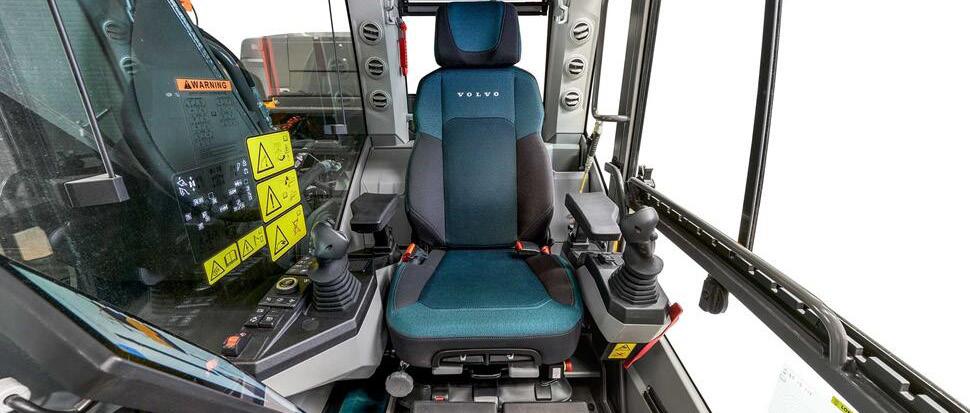
Offering an extended runtime of 7-8 hours per charge – powered by its 600V lithium-ion battery with a capacity of 450 kWh – operators can now work a full day without interruption, making it ideal for noise-sensitive and environmentally restricted areas.
Moreover, a peak motor power of 160 kW ensures a performance equivalent to diesel excavators, while fast charging capabilities allow the battery to reach from 20% to 80% in just 1 hour with a 250-kW charger.
Hydraulic efficiency is also improved by 10% and – when matched with additional features such as Volvo Active Control, On-Board Weighing and Dig Assist 2D and 3D – the electric excavator offers unparalleled machine guidance and control. This not only provides more precise digging, shorter cycle times and reduced operator fatigue, but it sets a new standard for electric performance by maximizing productivity while minimizing environmental impact.
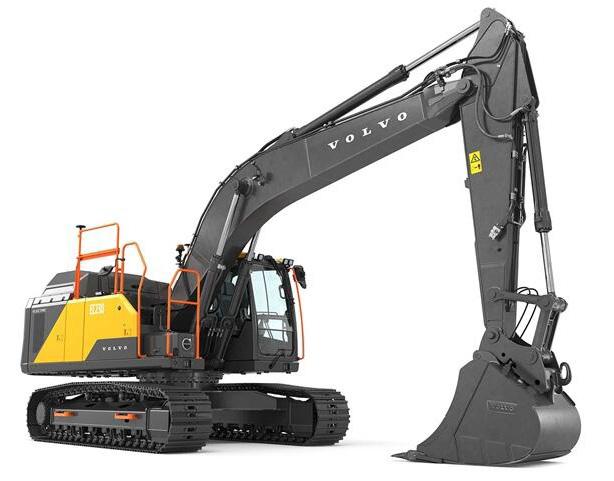
Building on the success of its predecessor, the enhanced EC230 Electric inherits a suite of improvements found in Volvo’s new generation excavators. These include:
• An enhanced operator experience, thanks to a revamped cab environment with greater space, comfort and functionality,
• An intelligent electro-hydraulic system enabling smoother, more precise movements of the boom, bucket and other attachments, and
• Innovative safety features such as HD Volvo Smart View with People and Obstacle Classification providing operators with 360° visibility and deep-learning technology to detect potential hazards.
The new and improved EC230 Electric will be seen for the first time at Volvo’s Bauma stand, from April 7-13, at the Messe München trade fair in Munich, Germany. Visitors will get the chance to see how its cutting-edge design and innovative features are helping to transform the industry with safer, more sustainable and more productive operation.
The new electric machine will be available in North America and select European markets starting in Q1, 2025. The first generation EC230 Electric will co-exist with the updated model for some time, with the current version suiting customers in light to medium duty applications, like waste and recycling and general construction.

Dust is a significant challenge in industrial and construction environments, impacting air quality and worksite safety. To address this, DYNASET introduces the EPW-DUST High Pressure Dust Suppression System, specifically designed for electrical machinery. With options for both AC and DC power ranges, this system provides versatile dust suppression solutions for mobile and static applications alike. Combining advanced technology with practical design, the EPW-DUST system is engineered to meet the demands of modern industrial operations.
The EPW-DUST High Pressure Dust Suppression System efficiently transforms electric power into a fine water mist, capturing dust at its source for cleaner and safer worksites.
The EPW-DUST High Pressure Dust Suppression System harnesses the power of the DYNASET EPW Electric High-Pressure Water Pump, transforming electric energy into a high-pressure water mist. Designed for maximum efficiency, the system is enhanced with specialized components tailored for effective dust suppression. Through precision-engineered nozzles, the water is atomized into a fine mist, capturing and neutralizing dust particles directly at their source.
We offer the dust suppression solution in both DC and AC versions to meet different application needs:
• The DC version is ideal for dust suppression in mobile work machines, such as electric excavators.
• The AC version is designed for stationary applications, such as dust suppression in crushers.
EPW-DUST DC version is ideal for mobile applications, providing effective dust suppression for electric excavators and other electric work machines. By offering both AC and DC power options, the EPW-DUST High Pressure Dust Suppression System adapts seamlessly to a variety of work environments. It integrates easily into mobile equipment, such as electric vehicles, and fixed installations, like crushers. Its compact design and dependable performance make it suitable for industries including mining, construction, demolition, material processing, and waste management.
With robust materials and IP-rated components, the EPW-DUST system is built for consistent performance, even in the most demanding conditions.
The EPW-DUST system combines electric operation, efficiency, and easy integration, providing a reliable dust control solution for both mobile and stationary work environments. Whether managing dust in dynamic operations or stationary setups, the EPW-DUST High Pressure Dust Suppression System offers a reliable and efficient solution. Its flexibility and adaptability make it an invaluable tool for modern industries embracing the electrification of machinery.
For further information visit: www.dynaset.com
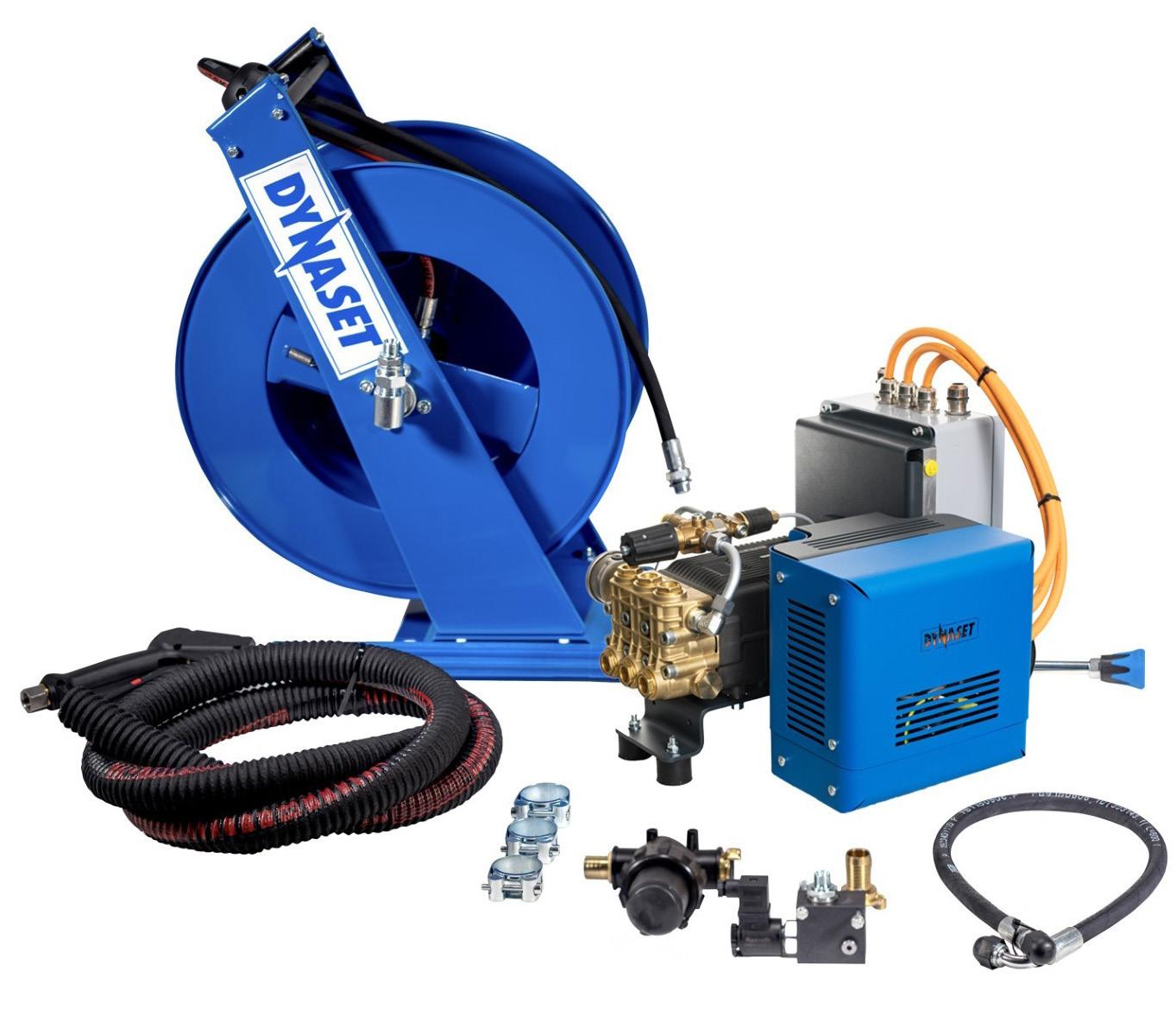
We’re on a mission to revolutionize the world of mechanical engineering for agriculture and construction. Our focus is on developing the 2-wheel loader. With our 2-wheel loader, we provide solutions for challenges in areas such as material transport, construction robotics, and agriculture. Our loader is particularly suitable for indoor work and environments with limited space. The electric drive technology of our product actively contributes to reducing CO2 emissions, supporting more sustainable work processes.
Four basic patents were applied for in different countries for the underlying concept, all of which have now been granted. With these inventions, we were able to win first place in the Arthur Fischer Inventor Award in 2023. This was followed in the same year by a silver medal at the Inventors’ Fair in Nuremberg. In 2024, we won second place in the VDBUM award in the category of developments from praxis.
Our Roadmap
We have been working on the development of a first prototype machine, a proof of concept (PoC). We have founded a consortium together with our partners Mobima at KIT (Karlsruhe Institute of Technology) and the robotics company InMach Intelligente Maschinen GmbH. This project is supported by the Baden-Württemberg Ministry of Economic Affairs through the InvestBW funding program, as well as by ESA through the ESA-BIC funding program. The PoC is to be controlled with a remote control, which initially only includes simple assistance functions. The advantages of gardening and landscaping applications are the lower dead weight with easy transport options, as well as the very good mobility on tight construction sites. Production is aiming to begin at the end of 2026.
The Concept
Wheel loaders move material over short distances with the help of a machine. Figure 1 shows that not much has changed since the invention of the wheel loader in the late 1940s. However, this design requires a high empty weight and, as a result, high energy consumption. These features make electrification and thus CO2-emission-free operation more difficult.
The idea of the 2-wheel loader is completely new, based on the Segway principle as it transports the material in an emission-free and automated manner.
This offers advantages for applications inside buildings, on narrow inner-city construction sites. For loading and unloading, the 2-wheel loader can move the counterweight, which contains the battery, backwards and support itself on a third wheel. The 2-wheel loader is characterized by its compact design, low weight and, as a result, energy savings of up to 40% are expected.
Key benefits:
• Lightweight construction
• Lower energy consumption
• Resource savings in the manufacture, operation and transport of the machine
• Exceptional 360-degree manoeuvrability
• Cost-reducing technology
• Enhanced off-road capability
Technical dimensions:
Height (short machine) 2080 mm
Length (short design, with fork) 2200 mm
Width (wheels) 1200 mm
Max. loading height pallet 2800 mm
Max. loading height bucket 1900 mm
Tare weight 1800 kg
Energy Efficiency in Operation
a) During Operation: Lightweight Design
This optimization greatly improves the payload-to-vehicle weight ratio, with a 1:1 ratio being achievable.
b) Material Savings
The reduction of drive train components in modern wheel loaders leads to substantial resource savings in the construction of the 2-wheel loader. This reduces the associated CO2 emissions during production.
c) Transport Efficiency
Relocating the vehicle is accomplished by transporting it on trucks or trailers. The reduced weight and smaller transport volume contribute to saving fossil fuels.
d) Promoting the Adoption of Electric Machines
The simplified design of the 2-wheel loader allows for cost-efficient production. This gives for faster adoption of fully electric construction machinery.
The initial concept machine models are shown in their compact, shortened configuration. When the working bucket or stacking fork is elevated and extended forward, the counterweight shifts backward. The auxiliary wheel serves as a stabilizing aid and allows for parking the machine.
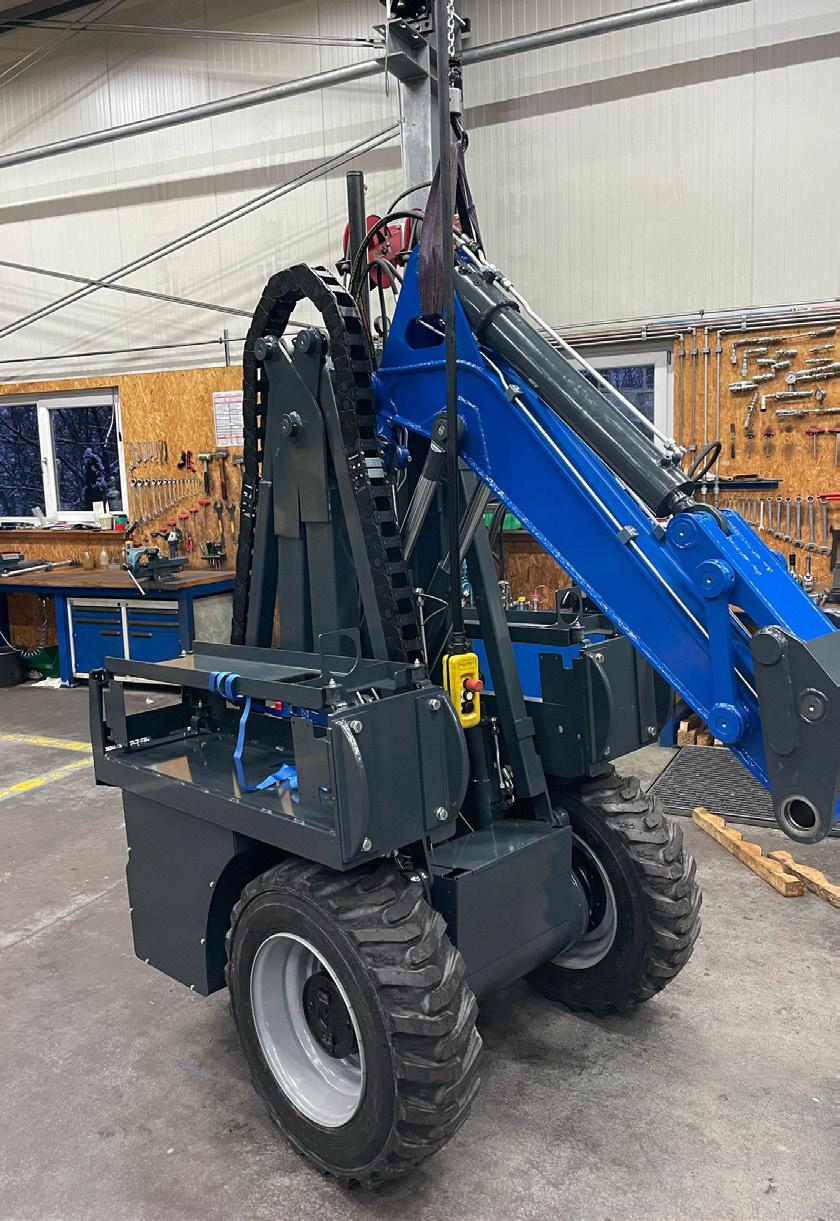
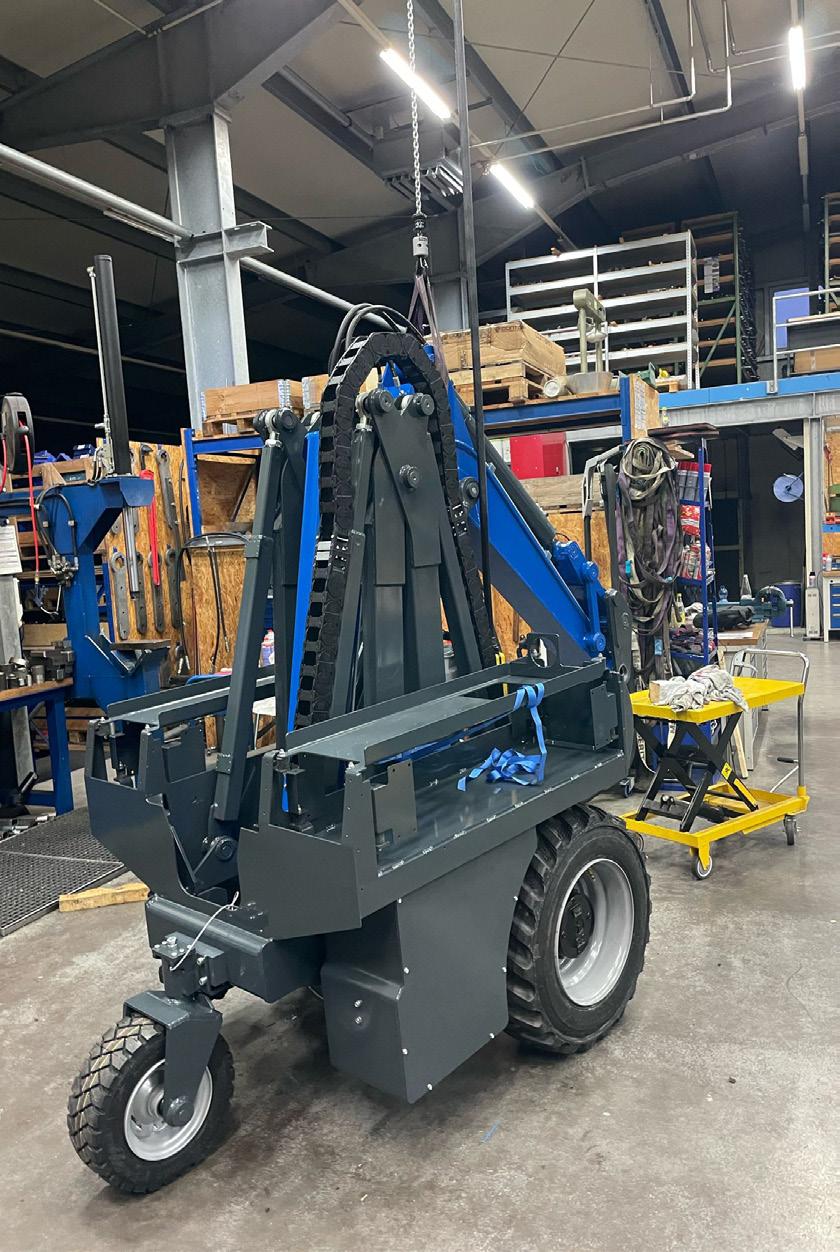
Conclusion:
We are pleased to announce that we will be presenting our 2-wheel loader at the highly anticipated BAUMA, the world’s leading trade fair for construction machinery. Come by our stand and let’s connect!
For further information visit: www.quimo-gmbh.de

The K100 boom change system allows to reconfigure your PC490HRD-11 high-reach demolition excavator within minutes. From the safety of your cab, without any outside help required. The most effective equipment can be used at every stage on the job site, offering you a new level of demolition project efficiency.