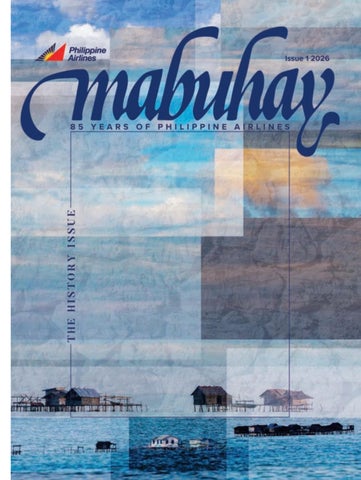
The History Issue
substack.com/@mabuhaymagazine
Mabuhay Magazine
The History Issue
substack.com/@mabuhaymagazine
1
Message from Dr. Lucio C. Tan, PAL Chairman and CEO Carrying the Heart of the Filipino: A legacy of flight
History is the enduring story of those who chose to believe and persevere. !is year, as Philippine Airlines marks its 85th anniversary, we commemorate more than eight decades of pioneering aviation in Asia. We commemorate the generations of builders, dreamers, and professionals who worked and flew together to make every heartfelt journey possible. From our very first flight in 1941, we understood that carrying cargo and passengers came with a greater responsibility of serving the Filipino people and their aspirations. We have lived through every chapter of triumph and challenge, fulfilling long-awaited reunions, nurturing ambitions, and ensuring the joy of coming home. PAL was built as a home in the sky for the Filipino people and our global passengers, and through it all, endeavoring to showcase the best of the Philippines to the world. Philippine Airlines’ success rests on its values, as well as its assets. For us, these have remained unbreakable: world-class excellence, genuine care, and the deep warmth of our hospitality. As Asia's longest-serving airline, our heritage is our greatest asset, but our future is our deepest commitment. We are investing in advanced aircraft such as the A3501000s, alongside the next generation of aviation talent through the PAL Aviation School. We are innovating our experience and upholding our responsibility to sustainability because we understand that true legacy is measured by the future we enable. For 85 years, Philippine Airlines has been an airline defined by resilience, purpose, and pride. As we look beyond the cabin, we remain committed to flying the Heart of the Filipino with genuine care, excellence, and unwavering purpose for generations to come. Mabuhay. !ank you for being a part of our 85-year history.
2
Mabuhay Magazine
The History Issue
substack.com/@mabuhaymagazine
5
Message from Mr. Lucio C. Tan III, PHI President and COO The Power of Shared Purpose
Eighty-five years of flight teaches one primary lesson: no great journey is completed alone. As we celebrate this significant anniversary—a legacy built on visionary foundations and carried by countless dedicated teams—look not just to the history we claim, but to the future we must earn. Our survival through wars, crises, and unpredictable skies was never a matter of luck; it was a testament to a shared purpose. !is strength comes from the vast community that keeps us flying: our employees who deliver the genuine Filipino heart and care every day; our steadfast allies in government and business who invest in our mission; and, most importantly, our passengers who grant us their trust. It takes a village to keep a flag carrier soaring. My commitment, as we enter this new era, is to foster the conditions for sustainable success. More than maintaining the fleet and growing the network; it is a commitment to the vision of Philippine Airlines’ shareholders—keep the dream of flight alive, meaningful, and accessible for the generations of Filipinos and global travelers to come. As the next chapter of PAL begins, we renew our promise: to empower every employee, uplift every partner, and fulfill the dreams of every traveler whose journey we are privileged to carry. Together, with care that comes from the heart, we will build a future worthy of this 85-year legacy. !ank you for your unwavering support and we look forward to many more journeys with all of you. Mabuhay!
4
Mabuhay Magazine
AD HERE
The History Issue
substack.com/@mabuhaymagazine
7
Message from Richard Nuttall, PAL President Philippine Airlines’ Enduring Legacy and Bold Future
Philippine Airlines has connected the Philippines to the world for 85 years. As the nation’s flag carrier, our legacy is filled with significant milestones—from launching the first trans-Pacific and European flights by an Asian airline in the 1940s, to pioneering the introduction of jet aircraft on both international and domestic routes in the country, and leading innovation as the first to operate the A350-1000 in Southeast Asia in 2025. Continuing this tradition of excellence, we are proud to be the first Philippine airline to be recognized with an APEX four-star rating, a testament to our commitment to service and quality that soars above the rest. Our history gives us much to be proud of and sets a high bar for how we move forward. Carrying this legacy into the years ahead is a responsibility we take seriously. While we honor what has come before, our focus today is on building the kind of airline the future demands: globally recognized, trusted for world-class excellence and customer experience, remembered for heartfelt care, and loved for bringing Filipino hospitality to every journey. !at direction is shaping how we invest and operate. We are improving our products and services, strengthening our systems and technology, and continuing to develop our people so they can deliver consistently, safely, and with confidence. !ese are deliberate choices—meant to support long-term growth and ensure PAL remains resilient in a changing industry. !ank you for your continued trust in Philippine Airlines. We commit to carrying the Heart of the Filipino to every corner of the globe. Happy 85th anniversary and Mabuhay!
6
Mabuhay Magazine
The History Issue
substack.com/@mabuhaymagazine
7
A N OTE FROM O U R GU ES T ED I TO R
The History Issue of Mabuhay is made possible by PAL’s network as the nation’s flag carrier: through one image, we present a soaring celebration of Philippine Airlines’ legacy since it first took flight. About Robby Galang Dr Robby Galang is the Dean of the School of Management in Ateneo de Manila University. Prior to rejoining Ateneo, he spent the previous nine years working as a Senior Private Sector Specialist for the World Bank and the International Financial Corporation. He also has extensive academic experience as a faculty of international business and strategy in Ateneo de Manila University and the Asian Institute of Management.
8
Mabuhay Magazine
Welcome aboard—and we hope you enjoy this journey of rediscovery.
Robby Galang Economist and Historian
Photo by Aaron Vicencio
On the cover Gio Panlilio’s collage traverses the Philippines through one image: the stilt houses of Tawi-Tawi, and the stone houses of Batanes, which are seen set against mosaic of a sky, evoking clouds.
Mabuhay! !is special History Issue of Mabuhay Magazine celebrates a major milestone that transformed the way we see the islands our airline calls home. Eighty-five years ago, the first Philippine Airlines flight took off from Nielsen Airfield in Makati, and suddenly, cities like Iloilo, Manila and Zamboanga were no longer separated by a multi-day journey by steamship. People could now imagine the possibility of having breakfast in Manila and arriving in Davao in time for dinner. Our articles are inspired by the spirit of adventure of our historic first passenger. We assembled this magazine as an invitation to use the lens of our history to reimagine the Philippines, as well as ourselves. Even myself, as by day, I am a fulltime educator but just for this issue, I have happily reinvented myself as your editor. Filipinos may hum the lyrics of the song that goes ‘Mula Aparri hanggang Jolo’, but few Filipinos venture beyond these places. Our story of PAL’s furthest domestic destinations—Batanes and Tawi-Tawi—not only showcases the beauty of the northern and southern reaches of our country, but also asks us to reimagine our architectural heritage beyond the traditional bahay na bato. We put a spotlight on the stories of Filipinos that are pioneering this quest for national reimagination. We speak of a chef dreaming of revitalizing traditional Filipino street food like balut into haute cuisine. We look at feature films by renowned directors that have reimagined classic Western novels such as Wuthering Heights and Lord of the Flies into Filipino masterpieces. (Copyright be damned!) We talk about musical artists pushing the boundaries of Original Pilipino Music. We asked a team of AI artists and a historian to help us reimagine what downtown Cebu City looked like across time, to remind us to value the underappreciated architectural jewels of one of the country’s most visited cities. So sit back, relax, and join us as we reimagine the islands we call home.
AD HERE
The History Issue
substack.com/@mabuhaymagazine
9
{ THE TEAM }
PAL
EDITORIAL PAULINE S UAC O!JUAN an d ER WIN R OMULO Editors-in-Chief MAR IAH R EODICA Managing Editor J ULIANNA YAP Intern
DESIGN KATRINA VELOSO TOR R E Art Director PAM TAB O NE S a nd R EISNEER ALLEN A. DE GUZMAN Digital Imaging
{ PUBLISHING TEAM } RIC HAR D J. ALAR CON Publisher C K D. BUENVIA JE General Manager E RWIN G. BAUTISTA Advertising Sales Manager KAZU MI A. POLICAR PIO Business Development Manager S H ER WIN F. LATOSA Finance Manager H ANNAH SHEKINAH Z. NASALGA Marketing/Brand Assistant
{ S P E C I A L P U B LI CAT I O N S } B R IAN F. MONGE Creative Director NICO LE M. DOMINGUEZ DAN AN TONIO E. R ECALDE Art Directors KBYO Media is a next-generation media company and the exclusive commercial sales partner of Philippine Airlines, specializing in advertising and branded content that connects brands with PAL’s premium global audience. We combine sharp storytelling with smart technology to deliver high-impact, globally minded media experiences from our base in Manila.
Connecting brands to the world —in flight and beyond
For advertising inquiries, please email info@kbyo.ph
10
Mabuhay Magazine
KBYO Media has been commissioned to manage Philippine Airlines’ Advertising Business, which includes the publication and management of Mabuhay Magazine. Mabuhay Magazine is a brand owned by Philippine Airlines. Philippine Airlines has granted KBYO Media a license to use the Mabuhay Magazine name and associated branding. KBYO Media and/or Philippine Airlines, including their respective a!liates and/or personnel shall not be held liable for any losses, damages, or adverse consequences resulting from reliance on any and all information found and published in the Mabuhay Magazine. The views and content presented by the authors, writers and/or contributors do not necessarily reflect the opinions or positions of KBYO Media and/or Philippine Airlines. This disclaimer is intended to protect KBYO Media and Philippines Airlines from any potential legal claims related to the content of the magazine.
AD HERE
The History Issue
substack.com/@mabuhaymagazine
11
12 Mabuhay Magazine
The History Issue
substack.com/@mabuhaymagazine
11
Mabuhay Magazine
The History Issue
substack.com/@mabuhaymagazine
TAB LE O F C O N T E NT S 60
52
32 { FEATURES }
22 24
21
Liner Notes: The Challenge Balut: Love it or hate it, it’s a part of our culinary canon. Philbert Dy sits down with Chef Kelvin Pundavela, who’s worked the kitchens of Bibio, Toka, and Now Now Canteen, about how he’s imagining this delicacy in a new light, illustrated by San Urquiaga.
22
Playlist: Global Classics Gone Local Wuthering Heights in Batanes and Crime in Punishment in Ilocos–Why do Filipinos adapt global classics? In return, film critic Ligaya Villablanca talks about six films that ask: Why not? Try to spot each film in the collage by Arden Ortiz.
24
Paging Passengers A Million Miler club is made up of the airline’s most loyal passengers. Multimedia writer Patricia Villoria asks eight Million Milers about their first flight with PAL, and the start of their journey through the skies.
28
16
Mabuhay Magazine
28 The Lore-Weaver Next Door Journalist and former CNN Life Associate Editor Gaby Gloria meets the young bard and internet sensation, Keath Ósk a.k.a. Yaelokre, while BritishFilipino photographer Ira Giorgetti goes backstage in London’s church-turnedvenue !e Tabernacle.
32
Homelands: When Islands Build Houses One typhoon followed another in Metro Manila, but in Tawi-Tawi and Batanes, the bluest skies showed off for Gio Panlilio, photographer, curator, and co-founder of Tarzeer Pictures, and Managing Editor Mariah Reodica’s adventure to the farthest ends of the Philippines.
48
Sugbu to Cebu Tracing the past to the present with technology, Cebuano professor and historian Jorisse Gumanay collaborates with Roman Gabriel Diu, Kyla Marie Uy, and John Teodosio from Madman Creatives, an agency run by kids, where AI-driven digital-first projects are par for the course.
60
Cover to Cover: Mabuhay We took our time digging through Mabuhay’s archives, savoring cover images that have been putting the Philippines’ best foot forward since 1963. Mica Magsanoc, Head of Publishing at Archivo 1984 Gallery, takes us on a trip down memory lane.
88
Touchdown: Behind the First Lady Ad Tetta Ortiz Matera wears many hats: former model, writer, and the founder of Lit Fashion Consultancy, which runs pop-ups and mentors designers. She reminisces about how she landed that
iconic 80s PAL ad.
The History Issue
substack.com/@mabuhaymagazine
TAB LE O F C O N T E NT S { ITINERARY } 70
Destination Guide
75
80
Route Map: Domestic and International CORPORATE NEWS
78
Meet the New A350-1000 Cabin Philippine Airlines proudly introduces its new flagship cabin that’s set to elevate long-haul journeys.
80
A Flight Through Time !e Philippine Airlines Museum is now open for boarding, with interactive exhibits and nostalgic artifacts for aviation enthusiasts, travelers, and the PAL community.
86
Cadets Today, Captains Tomorrow PAL relaunches its Aviation School in style by sending off a new batch of cadets to Airways Aviation Group’s campus in Australia.
CONTRIBUTORS JA R R O CA B A Ñ E S PHIL B ERT DY I R A GIO R GETTI GA BY GLOR IA J O R IS S E GUMAN AY CA R O LY N RAMORAN HAMILTON M A D MAN C R EATIVES M O N D R E I N MIKO L EI L IZ ARTE JAC K M A R I O N A RD EN O RTIZ T E T TA O RTIZ MATER A G IO PAN L IL IO TO N I P OT EN C IAN O A BB EY R O M IN A SAN UR QUIAGA L I GAYA VIL L AB L AN CA PAT R ICIA VILLO R IA Mabuhay Magazine is published by KBYO Ltd., Consultant. Suite 208, Vicente Madrigal Building, 6793 Ayala Avenue, Makati City, Metro Manila, 1226, Philippines +632.8844771 | +632.88120700 |
18
Mabuhay Magazine
Copyright 2026 by KBYO Ltd. All rights reserved. Mabuhay Magazine is a registered trademark of Philippine Airlines and is used by KBYO Ltd. under license from the Philippine Airlines trademark owner. All materials submitted for publication are subject to the publisher’s terms and conditions and, while every effort is made to ensure the accuracy of the content, the publisher remains the property of KBYO Ltd. Neither Mabuhay Magazine nor its agents accept any liability for loss or damage resulting from reliance upon the content of this publication.
Boost your flight experience with myPAL Travel Boost
myPAL Upgrade
Gift yourself the comfort of Business Class with myPAL Upgrade. Place your bid and enjoy the premium experience you deserve.
myPAL Baggage Plus
Travel with ease using myPAL Baggage Plus. Enjoy a worry-free airport experience with prepaid baggage and bring more of what matters on your journey.
myPAL Seat Select
Fly more comfortably in Economy with myPAL Seat Select. Choose your preferred seat in advance and enjoy a smoother travel experience.
Get myPAL Travel Boost: The History Issue
substack.com/@mabuhaymagazine
{ CHECK-IN }
Time Flies
Photo by Jack Marion
It began with Philippine Air Lines’ Ticket No. 1 dated March 5, 1941. Eighty-five years later, Mabuhay is taking you across islands and eras, a jump-off point into our exploration and history.
LI NER N OT E S
20
Mabuhay Magazine
P LAY LIST
DIS PATCH E S
LOCAL CUR R ENTS
HOMELANDS
SUGBU TO CEBU
{ LINER NOTES }
T H E C HAL L EN G E
Chef Kevin Pundavela has worked with some of the best ingredients in the world, but he shares a personal connection to a much more humble ingredient: balut. Words by Philbert Dy Illustration by San Urquiaga
Here is a common scene: some foreigner has visited the Philippines, and locals offer them a rite of passage—to have a balut, the boiled, fertilized duck egg that has long been fodder for reality television shows seeking footage of their participants making faces of disgust and gagging and struggling to swallow. “Is that all it can be?” asks chef Kevin Pundavela. “A challenge?” Pundavela works in fine dining, with a notable stint as a sous chef at Modan, generally regarded as one of the best restaurants in Metro Manila. He has recently struck out on his own, taking over the kitchens of various spaces, like Bibio, Toka, and Now Now Canteen, where he collaborated with artist Isabel Santos for a seven-course tasting menu meant to accompany her art. He has had access to many of the world’s finest ingredients. But recently, he has been thinking about the potential of a much more humble ingredient. Even locals can have a complicated relationship with balut. It becomes a rite of passage, too, if for example, you’re from an affluent family, and you go to college in the University of the Philippines. It is, according to legend, a food that enhances virility, or it might even be an aphrodisiac. !e connection between the consumption of duck embryos and getting turned on is perhaps better left unexamined. For most people, it’s just something that’s available when the sun goes down; maybe something to snack on during a beer run, or a last bit of sustenance before heading home. It is also a complete object: we rarely think of cooking it, or transforming it into anything else. So there is room to explore here. “It’s nostalgic for me,” he says. “My family is from Nueva Ecija, and when I was younger, we’d go to Gapan and stop for balut.” Gapan, Nueva Ecija, is a city where ducks are simply part of the landscape, so much of its local industry dedicated to the raising of mallards and the production of their derivative goods. Like balut. Pundavela speaks fondly of those times, his whole family gathered, cracking the shells, drinking the broth, and eating the chick. !ere’s a ritual to eating balut, one that is never reflected in its appearances on Western television.
!ey tend to pour out the broth, for one, unaware ofthe flavor and comfort that the warm liquid brings. !ey tend to focus on the horror of seeing the semi-developed chick, and also end up trying to bite through the hardened albumen that most balut eaters discard. It feels like most who take the challenge never actually process what it tastes like, the image in their head overriding their taste buds, creating disgust where there really isn’t any to be found. Pundavela admits that he’s made the challenge to foreign visitors before. “Maybe I’m part of the problem,” he laughs. He admits, too, that it isn’t easy for him to think of a way to use balut as an ingredient, to make it the star of a dish that he feels could introduce people to its pleasures. “It’s not an easy concept to grasp,” he says. “I’m a texture eater, but I understand that people can be squeamish about eating the bones and the beak.” “But it’s an interesting challenge, as a chef,” he says. It feels like the word “challenge” just can’t be separated from balut, even from one of its champions. But there lies the truth of sharing any substantial culture: there is always some difficulty in communicating something familiar to us to those that are unfamiliar. Pundavela doesn’t just want to convince people that balut isn’t some horrific foodstuff; he wants to somehow translate the memory of those road trips to his hometown, and whatever excitement he felt as their car neared this city of ducks. “With the expressways, it doesn’t happen anymore,” Pundavela says. “We don’t go through the smaller towns, with their smaller roads.” His foreign visitors all tend to say the same thing: balut isn’t as bad as others have made it out to be. But maybe he can do better. He can’t take them all out to Gapan to have the experience that he had, but maybe he can make a dish that tells that story. Once upon a time, back when we weren’t all in so much of a hurry to get somewhere, he and his family would stop in this town full of ducks, and they would crack the shells, drink the broth, and eat a chick. Perhaps this is what Filipino cuisine should be—a means of sharing a uniquely Filipino experience. !at is the challenge.
Liner Notes is a series on popular culture and why it still matters. Each essay is about the things we enjoy—be it what we see, read, or hear,—and how it shapes our lives in ways deeper than we even realize. The History Issue
substack.com/@mabuhaymagazine
21
{ P L AY L I S T }
GLOBAL STOR I E S GONE
LOC AL
Words by Ligaya Villablanca !e Philippine’s deep history of oral traditions is a testament to our imaginative storytelling. When it comes to cinema, filmmakers have long borrowed from global classics— not to copy them but to reshape them into stories deeply rooted in local soil. From rice fields buffeted by the winds north to the queen city of the south’s noir-tinted boulevards and disco island getaways, these movies take us on odysseys that uncover destinations and the Filipino spirit. Here are six movies that turn foreign inspiration into uniquely Filipino stories— excellent travel companions for those who want to experience the nation through film.
22
Mabuhay Magazine
Collage by Arden Ortiz
Here are six films that pay homage to beloved classics on our own terms
Temptation Island (1980) Borrowing from Shakespeare’s island drama, !e Tempest is directed into a queer mode in this satire. With conquest and power as its themes, beauty queens and their admirers are stranded on a desert island where the true battle is not survival against nature but living through the excesses of class and vanity. Released during the peak of disco-era excess, the film is as glamorous as it is absurd, relying on camp and humor to mock inequality. Temptation Island is a vacation that went awry, half beauty pageant, half survival tale, all comedy. It is a movie that celebrates the Filipino ability to convert crisis to spectacle, humor, and resilience.
These films may be borrowed, adapted, and influenced by foreign culture, but they come home with their passports full of uniquely Filipino stamps. Alkitrang Dugo [Asphalt Blood] (1975) William Golding’s Lord of the Flies, a tale of kids-turnedsavage, trades English school uniforms for the tropical heat of the Philippines. At first, the children attempt to impose rules to create structure. As a fragile order unravels into violence, beneath the surface survival drama lies a reflection of the 1970s—survival and the will to power exposes civilizational weakness. Showcasing children as protagonists brings loss of innocence. !e film mirrors the anxieties of authoritarian rule, where order is brittle; under the surface lurks violence. Alkitrang Dugo becomes more than just a brilliant adaptation but also a profound recreation of history and a poignant call to reality. Norte, Hangganan ng Kasaysayan [Norte, the End of History] (2013) Dostoevsky’s Crime and Punishment moves northward in Lav Diaz’s four-hour masterwork. Buzzy St. Petersburg streets are replaced by rice paddies, rivers, and small towns of the province. Using slow cinema, characterized by contemplative pacing, long pauses, and sweeping vistas, the film grapples with residual shadows of dictatorship, poverty, and oppression. Diaz’s shot intervals that comprise large landscape shots are akin to travel postcards which say more than whatever is scribbled behind. !e movie gets its most dramatic crime out of the way early on. !e peaceful, natural environment against violent outbursts is a chilling contrast, illustrating how peaceful sceneries always contained ugly secrets—something that just added richness to Dostoevsky’s work. Seeing Norte is going the long way through the country; slow and quietly overwhelming. It reminds us that travel can be more than the destination, if we let history, memory, and silence seep into the journey. Starzan (1989) If Tarzan is all about wild heroics, then Starzan (1989) was converted into a comedy club. !is vine-swinging hero, played by Joey de Leon, hardly tangled with lions; he wrestled with punchlines instead. His “jungle” turned out to be more like your typical Filipino’s provincial backyard, with coconut trees, sprightly songs, and jokes that only Filipinos can concoct. !e secret to Starzan’s popularity was in how parody underlined Pinoy humor. Starzan was here, in throws, slaps, and screams, warmed up for fun battles with karaoke instead of war cries–similar in tone to slapstick, Sunday noontime TV. More than just borrowing icons, we make them into something idiosyncratic. Like Tarzan, with some laughs, dance steps, and banana cue on the side.
The History Issue
Hihintayin Kita Sa Langit [I’ll Wait for You in Heaven] (1991) When Batanes’ windswept coasts met the stormy moors of Emily Brontë, Hihintayin Kita sa Langit (1991) was the result. Regal Films’ adaptation of Wuthering Heights swapped English fog for the Philippine seas, with Richard Gomez and Dawn Zulueta playing a passionate, near-mythical love story, hauntingly beautiful and all consuming, yet overshadowed by a class divide. !e film’s landscapes, which included rolling hills and crashing waves, and winds that seemed to never rest, reflected the inner turmoil of the characters, symbolizing the romance of Heathcliff and Catherine. It’s melodramatic in essence, but that’s what showcased the artistry of Filipino cinema, dramatic and grand. While Brontë may have dreamed in the gray of Yorkshire, Chito S. Roño painted in the blue and green of the northernmost islands. Darna: Ang Pagbabalik (1994) Wonder Woman may have her lasso, but Darna has her stone, mythology, and sass.!is movie directed by Lore Reyes and Peque Gallaga recounts how a long-revered comic-book heroine was brought to life through several campy spectacles and a political edge. To many, Darna is more than a caped crusader: she measures up the Filipino yearning for justice and grapples with fears about being a woman. !is revival fits the patriotic undertones of the camp-fun type of superhero action. !is proves that Filipinos can fly their own hero without bringing in the capes from the West. !is, with nostalgia and reinvention, is Darna. In Philippine cinema, stories travel. !ese films may be borrowed, adapted, and influenced by foreign culture, but they come home with their passports full of uniquely Filipino stamps. Whether you’re airborne, seated on a beach, surrounded by white sands or sipping coffee in a crowded city café, these films are just the thing with which to travel without leaving your chair. Because these films do not only adapt; they transform, taking world narratives to weave their own local truths. Interested in seeing more films that dive into Filipino culture? Turn to page 82 for our Inflight Entertainment special featuring the films of romcom queen Antoinette Jadaone.
substack.com/@mabuhaymagazine
23
{ D I S PAT C H E S }
PAGING PASSENGERS Avelyn Jahns
President, Association of Former Flight Attendants of Philippine Airlines My time with PAL was filled with serendipitous moments. As a flight stewardess for many years, I especially loved flying to Europe. It gave me the chance to explore new places and meet fascinating people. It was my first job, and I truly loved it. On a flight from Frankfurt to Manila, I met the man who would later become my husband. !e journey had several layovers, and the passengers were asleep for most of it. But during the final leg from Bangkok to Manila, we stewardesses were entertaining our first class passengers and I had a chance to speak with one of them—Mr. Jahns, who turned out to be the airline’s first Million Miler. !ere must have been a spark, because he courted me for five years on his frequent business trips to Asia before we finally married. When we did, he promised we’d never stop flying. And he kept that promise. He brings me along on every one of his business trips. !ough my days as a flight attendant are behind me, I’m grateful to still feel connected to PAL and its wonderful crew as a passenger.
Joey Luna
Wellness influencer
My first flight was a trip to Hong Kong when I was just seven years old in 1965. My dad, Roberto “Baby” Luna, was a go-kart and race car driver in the 1960s. During his races, he would take the whole family to Hong Kong and Macau. I can still remember it all clearly: my dad was always in a sharp suit, my mom was dressed as if she were heading to a glamorous dinner party, while my brother and I also wore our own suit jackets, too. Flying felt like an event and a celebration. It was a moment you prepared for, a celebration of life! Sixty years later, I still feel that sense of excitement when boarding a plane.
24
Mabuhay Magazine
A Million Miler isn’t just someone who’s flown far— it’s someone who’s come home, again and again. To celebrate 85 years of Philippine Airlines, we asked eight of them how their first trip with PAL made them fall in love with flying. As told to Patricia Villoria Illustrations by Abbey Romina
Dra. Evalyn Macasaet Anesthesiologist
I was a late bloomer when it came to travel. My first flight was after I became a doctor, attending an anesthesiology congress in the United States. I was with Dr. Greg Macasaet, who was still my boyfriend at the time. He had traveled many times before and knew how excited I was, so he let me have the window seat. Today, I often fly with my son, Raymond, one of the Philippines’ representatives to the Special Olympics and a proud Million Miler himself. I’m his number one cheerleader. Each time, it means a lot to him that he sees me, our helper, and his coach there with him, cheering him on. With our support on the sidelines, he has won medals in swimming events in Los Angeles, Singapore, Australia, and Greece. Even after his father, Dr. Macasaet, passed away as a frontliner during the pandemic, Raymond and I have continued moving forward. I bring Raymond along with me now when I go to my medical conferences. !rough our trips, my son and I make new memories together.
Jerry Doviak Top Million Miler
My first flight with PAL happened by chance. Back in 1983, I was at Manila International Airport (now NAIA), looking for another airline’s ticket counter. I asked the man beside me for directions and as it turns out, he was one of the Vice Presidents of PAL, Manny Panlilio. He said he recognized me from a few weeks earlier and was curious about my frequent trips to Manila. After I explained that I was a young VP regularly flying in for business, he took my Business Class ticket and upgraded me to PAL’s First Class with “Cloud Nine.” I have built my business around PAL flights after that moment, flying not only by myself but all my business associates on their trips to Manila and using PAL’s Cargo services on a daily basis for the past four decades. I don’t think I have met any other airline anywhere that would have better cabin crews than PAL. !ey are the backbone of PAL’s success in my mind.
The History Issue
substack.com/@mabuhaymagazine
25
{ D I S PAT C H E S }
Br. Augustine “Gus” Boquer FSC
Director for Advancement, La Salle Green Hills I was in Grade 5 when I first traveled with my mother to Iloilo for a vacation. It was on a two-engine C-47 PAL aircraft with beautiful interiors, 2 and 2 seats, middle aisle. !e flight attendant at the entrance door was a charming and friendly lady with an impressive looking PAL uniform. All the passengers were well dressed. !e flight was smooth, with a sumptuous full breakfast, nicely prepared and served; all I could think to myself then was, “Wow!” !ere was an air of genuine personal care for the passengers on that first flight I took. We felt very safe with a great flight crew—and I was happy to fly with my mother. My experience of riding domestic and international flights with PAL was something to look forward to. PAL has kept that very special touch, caring for the passengers well-being. As I look back, the airline was always representing the best of the Filipinos.
Jonathan Whiteman Executive in the solar energy industry
My very first flight with PAL took place over four decades ago, in the early 1980s. I still remember the feeling of stepping into the aircraft—nervous, excited, and full of wonder. I was young then, unfamiliar with air travel and unsure of what to expect, but PAL’s crew made me feel at ease immediately. It was the little things that stood out, like how the flight attendant noticed I was a first-time flier and took the time to explain how everything worked, even offering me juice as a treat. !at simple gesture has stayed with me through the years. Since that first flight, I’ve flown with PAL countless times (263 flights to be exact). Over the decades, I’ve watched PAL change their aircrafts, uniforms, and destinations, but the heart of the service has stayed. What makes my journey with PAL truly special is the people and the pride they carry as ambassadors of the Filipino spirit.
26
Mabuhay Magazine
Maria Lailani Velasco Sports and business leader
My first journey with PAL was an unforgettable one. When my husband and I had just gotten married back in 2000, we decided to visit Lake Tahoe and Nevada in the United States for our honeymoon. We were brimming with excitement travelling together for the first time as newlyweds. !ere’s nothing like the thrill of boarding the plane with so much anticipation and dreams of the future. It was a flight that marked the start of many memorable travels ahead. Twenty-five years later, I continue to choose PAL because every flight feels like coming home. Each journey reminds me of that very first one, proof that the heart of PAL’s service remains as special today as it was back then.
Marvin Caparros
Structural Consultant and golfer It’s amazing how small choices can make a huge difference in your life. I started flying with PAL in the early ‘90s, making frequent trips between the U.S. and Manila. A station manager encouraged me to try PAL just once—and I’ve been flying with them ever since. What made that first flight memorable was the convenience of finally having a direct flight and convenient schedules to my destinations. !e freedom to choose was really a plus. Over three decades later, I remain a loyal passenger. Back in 2010, my friends and I started this yearly tradition where we get together and organize golf trips. Wherever PAL flies, especially across Asia, our group follows. Now, we manage to do this about four times a year thanks to PAL’s comfort and convenience. When I’m flying with PAL, going back to the Philippines after a trip from anywhere in the world always gives me the feeling that I’m back home safe and sound with their best pilots. Being a Filipino flying with our own flag carrier brings me a huge sense of pride.
The History Issue
substack.com/@mabuhaymagazine
27
As an indie artist, Yaelokre’s love for lore brings their songcraft to life
28 Mabuhay Magazine
{ LOCAL CURRENTS }
The Lore Weaver Next Door The Filipino-Icelandic musician Yaelokre crafts stories that speak to a generation coming of age Words by Gaby Gloria Photographs by Ira Giorgetti
!e setting is at !e Tabernacle: a historic Notting Hill concert venue that once was a church. !e crowd has gathered to watch the Filipino-Icelandic folk artist Yaelokre (real name: Keath Ósk) bring their whimsical sound to the city for the first time at their Foreword Tour. A lone figure on stage sporting a cropped platinum ‘do and a Renaissance-era costume, the bespectacled Ósk begins the show with a spoken introduction about the world they’ve built through their songs. Speaking with the cadence of a skilled narrator while plucking their guitarlele, they invite the audience to listen to their story: “In verses it will be / Unspoken it was, as it were unseen / Until the meadowlark, with a wish to heed / !e bird came in search of a tale to sing its song…” Despite having only released six songs since debuting in 2024, Yaelokre has already outpaced many mainstream OPM acts numbers-wise, with close to half a million followers on Instagram and over 2.6 million monthly listeners on Spotify. Most of that following is outside of the Philippines. In addition
The History Issue
to the fan communities they’ve amassed on Facebook and Reddit, there are even TikToks and Wiki pages dedicated to decoding Yaelokre’s Meadowlark and the songs inspired by it. !e rapid rise of Yaelokre has been a pleasant surprise to many who have discovered the project in the past year, and even to Ósk themselves. Just over a year ago, the Philippineborn musician was recording songs and crafting the world of Meadowlark from their kitchen in Cavite. “It’s the quietest part of my house,” they tell me over Zoom a few days after that show. Starting with their first live show in the same month as their debut, then a performance at Ren Faire PH in Baguio, Ósk quickly built momentum through a series of intimate gigs in Manila—in which videos of their almost-theatrical set spread online. !ey eventually signed with their current manager, Lewis Varrilly of the UK-based Paintbox Agency. After a final show opening for Norwegian singer Aurora’s Manila concert earlier this year, Ósk took the leap and moved to London to further pursue their artist career.
substack.com/@mabuhaymagazine
29
“How do you begin when
the earth is ever changing? Neath the grove is a heart that’s still in slumber
You can remain, will you stay and tell a tale
Or would you want to tear it all down, to see better?”
—“Neath the Grove is a Heart” Hayfields (2024) by Yaelokre (Keath Ósk, 2024)
Keath’s turquoise and gold guitalele is weathered with countless hours of telling tales
30
Mabuhay Magazine
We are now talking about their first EP, Hayfields—a “diary-turned-storybook” released on March 2, 2024 (their cat’s birthday). Born to a Filipina mother who loved to sing and an Icelandic father who loved history and storytelling, Ósk’s creativity was encouraged at an early age. Yaelokre (a play on Ósk’s favorite color, yellow ochre) was born out of the desire to scratch a creative itch stifled during their teenage years. “It was a coping mechanism, an outlet to be able to create,” shares Ósk, who was originally set on becoming a kindergarten teacher prior to their big break (“for practicality, mostly”). When their friend, JD Santos of the band medyo maybe encouraged them to go back to making music after a long creative drought, Ósk became inspired. “I managed to create this little world that is just an epitome of my morals and principles and me as a person,” says Ósk about the project. Despite the lore being fictional, Ósk drew heavily from their own life growing up in the Philippines, with much of the material adapted from personal journals and old artworks. !e result was the prologue to what would become the world of Meadowlark, featuring the characters of the Harkers that would represent the foundations of storytelling. !e existence of the musical ensemble called the Lark in the lore was also their way of showing reverence for history through storytelling. “Everything is a foundation,” they say. “You are your own storyteller, and you have your own stories, and you have your own experiences growing up. And it’s plain and simple, but just saying that, if we don’t mind history, we’re gonna get messed up.” I tell them that it’s interesting how their on-stage persona suggests they’re a meek, quiet act who makes soft music. “!at’s a really common misconception when it comes to me,” they say. !ey compare the Yaelokre project to an iceberg. “!e tip of
Inside the Lore of Yaelokre
the iceberg is seeing Yaelokre and Meadowlark and going, ‘Oh, this artist has a guitarlele. !is artist probably sings soft songs. !is artist has very colorful and childlike characters. It must be pandered to children, to a younger audience.’” But that surface-level reading is part of the design. Ósk explains that structuring their shows and songs in this sort of narrative manner is a form of rebellion against short attention spans and algorithm-powered minds. It’s their way of encouraging their mostly Gen Z and Gen Alpha audience to “delve deeper into a topic and be philosophical and discover their own morals and what they stand for.” “!e more you go deeper into the iceberg, you start to notice that it’s literatureheavy, and it’s very philosophical, and explores the self and where that self is roosted within the world,” they add. One of the songs on the tour setlist, the unreleased “Kamahalan”, begins gently, with “Kamahalan” chanted slowly and tenderly. But as the song progresses, so does the power in Ósk’s voice. By the time Ósk reaches the peak of the song, singing over the chants, there’s no mistaking it: this is the Filipino throat chakra at work. !e biritability (ability to belt) in Yaelokre’s music, while a strong storytelling tool, was naturally shaped by Ósk’s years of competing in Filipino singing contests as a child. “You know how Filipino singing standards are. !e higher you get, the more powerful your voice is. !at’s how you win,” they laugh. And the crowd eats it up. Ósk beams as it belts the lyrics back to them. “!e [audience] are part of the set and the song and the music, and it just feels natural and alive and full of spirit.” Yaelokre sings not just to enchant, but to remind. And in doing so, they ensure that the stories and the histories behind them are not only heard but also felt.
The History Issue
THE LARK A musical ensemble composed of four kids that are inspired to do good by following in The Harkers’ footsteps. By portraying them, their voices bring Yaelokre to life.
Cole as The Storyteller the past
Clementine as The Bell Ringer the future
Kingsley as The Enkindled balance and equilibrium
Perrine as The Croon
entropy, chaos, or disharmony
THE HARKERS Four creatures that serve as the bridge and mouthpiece of the four cradles to the people. They are made from different aspects of the foundation of storytelling. They visit different villages and kingdoms to tell people these stories so that they’d learn from them.
Illustrations courtesy of Yaelokre
Like this night’s show at the Tabernacle, most of the shows on Yaelokre’s 2025 tour have been sold out
THE MEADOWLARK Yaelokre is Keath Ósk’s musical project in which they sing in the voices of four children representing storytellers from a fictional world. It starts off with a little bird called the Meadowlark. The Meadowlark was able to witness so many stories, and through those stories, they are able to sing a song, and through that song, they awoke the mother trees, the four cradles. Below is an explanation of the characters in Yaelokre’s world, straight from the storyteller’s mouth.
substack.com/@mabuhaymagazine
31
THE FOUR CRADLES The four cradles are kind of like Mother Nature, omniscient and omnipresent–from the trees, the roots, the air, the sky. They are not a singular body, but an overall state, similar to but not exactly gods.
{HOMELANDS }
When Islands Mabuhay travels to the northernmost and southernmost ends of the Philippines in search of houses as historic and iconic as the bahay na bato
32
Mabuhay Magazine
B
N
S
AN AT E
Build Houses Words by Mariah Reodica Photographs and collages by Gio Panlilio
S The History Issue
I - TAW
I
T
AW
substack.com/@mabuhaymagazine
33
As a town tucked in a cove, Tabawan’s shallow and calm waters reflect stunning sunsets over the Celebes Sea
34
Mabuhay Magazine
On clear nights, the Milky Way is visible to the naked eye over both the serene waters of Tawi-Tawi and the wind-carved cliffs of Batanes. But their respective landscapes and climates have shaped homes in very distinct and local ways—with methods that have made these structures outlast much of modern and contemporary design. Out of the myriad types of architecture in the Philippines, Mabuhay looks at two distinct kinds of ancestral homes: the spirit houses of Tawi-Tawi and the vernacular stone houses of Batanes. By going to the farthest ends of the Philippines, the story ventures into the degrees at which climate and cultural influences vary across latitudes—in this case, approximately 1,700 kilometers. !ese houses are treated as an inheritance to be passed on to future generations, and come with the responsibility of sustaining the resources around them. !ey’re built in conversation with their surroundings, in a reciprocal process of repair and regeneration—a stark contrast to a current system of extraction that comes at a human and ecological cost, even in the biggest metropolises. When it comes to craftsmanship and cohabiting with nature, the people that live on these islands have a lot of wisdom to share about how their homes have been tested by weather, colonization, and time itself.
The History Issue
substack.com/@mabuhaymagazine
35
For years, the Sama lived on houseboats (upper right) before beginning permanent settlements
36
Mabuhay Magazine
TAWI-TAWI: The Spirit House Never is an island out of sight. Signposts stick out of the ocean, their markings bleached by the sun. A pink house rises on stilts far from shore, planted on a shallow sandbar like one of Dalí’s elephants. From sudden outcroppings of stone, small yellow flags wave to mark spiritual sites. !e boat ride from Bongao to Tabawan, South Ubian, passes dreamlike vistas as it sails eastward, away from a sunset that paints the whole world in pastels. !e horizon blurs into the sky. Reefs and islands adorn the province of Tawi-Tawi like jewels, taming unruly waves coming in from the Celebes sea. !e archipelago is also protected from typhoons, which are weakened as they cross mainland Mindanao from the Pacific Ocean. !ese peaceful waters, for all their natural abundance, became home to Sama boatdwellers—the ancestors of the sacred village of Tabawan, South Ubian, where the last of Tawi-Tawi’s spirit houses still stand. Spirit houses and houseboats used to be many across Tawi-Tawi. But these have been lost to time, as historical conflict, displacement, and environmental extraction have taken their toll. Still, as far as Sitangkai, people still build their houses on water, navigating canals and channels with boats as naturally as cars drive down roads. As fisherfolk, the closer they are to water, the closer they are to their livelihood. In Tabawan, the tides lap gently against the wooden and concrete stilts that prop up a maze of pathways and houses, with paths radiating from the first spirit house of the town: the Luma’ Maheya. “Old civilizations have their own houses,” says Berto Sahilun, the custodian of Tabawan’s Luma’ Maheya. By his estimates, he’s the tenth generation of custodians taking care of this house. An architectural descendant of the lepa houseboats, the interior of the Luma’ Maheya is a single room. !ere are two openings in a parallel line: one facing the sunrise, and the other facing the sunset. !e palm floorboards have thin gaps which crystal clear water glints through.
The History Issue
!e rattan roofs meet in two embellished serpents, built without nails through an intricate system of wooden joinery and interlocking beams and columns. !e roof beams are centuries old. By using wood from the ipil tree, a native species that thrives in salt water, the wood is naturally resistant to decay, and even acquires a beautiful patina from ages under the sun. Across the Luma’ Maheya is the Langgal wooden mosque, which, by ancestral accounts, existed before the arrival of Islam in 1380 AD and was constructed with similar methods. !ese structures have survived at least six and a half centuries, witnessing the separation of Tawi-Tawi as a province from Sulu in 1973, the establishment of the Bangsamoro Autonomous Region in Muslim Mindanao in 2019, and finally the restoration of peace in the area at present. !e Luma’ Maheya and the Langgal mosque sit squarely in the middle of the town’s daily activities. In the afternoon, the wash of waves is drowned out by the laughter of children coming home from school, calls to salah prayer on loudspeakers, and the ever-present hum of pump boats in the distance. With a view of the sunset over Tabawan’s pier, neighbors and elders gather at this space to relax. !e precolonial coexists with the colonial, like how folk spirituality has endured alongside religions. “It’s part of our normal way of life, to have spirit houses,” says Omarjan Ibrahim Jahuran, an independent scholar and the Indigenous Peoples Mandatory Representative (IPMR) of South Ubian Municipality, who has dedicated his life to advocating for Tabawan’s cultural heritage. “Every family in Tabawan, they practice traditions of respecting their ancestors and their departed ones as if their spirits still reside in their house.” !is physical space is, metaphorically, a spiritual center or anchor for entire families. While Berto’s house where he lives day-to-day is nearby, he keeps the house clean and tidy for
substack.com/@mabuhaymagazine
37
ancestors, with beds laid out on one side should the spirits want to rest. !is sense of veneration for their forebears is a current that runs through the living traditions of Tabawan, from their traditional mat weaving to their traditional dance and song. To uphold and maintain a spirit house and Tabawan’s rituals is a duty to keep your family in good health, with fair fortunes and smooth sailing. !is sense of custodianship extends to its ecosystem. !e Sama used to plant trees for the next generation to use to repair houses. But as Tabawan grows in population, its small land area poses limits to forest cover for timber. !e coral pools to the east, known to the locals as the end of the rainbow, have been dismantled to be used as foundations. Considering scarcity, concrete and other modern materials turn out to be the more logical and convenient choice for the modern house. However, the Sama believe that palm leaves, rattan, and native materials are intrinsic to the spirit houses, as structures that are tied into their ecosystem. Modern materials can’t be quick fixes for these nonmaterial specifications. !ese buildings are an expression of connection not just to their ancestors, but
38
Mabuhay Magazine
the land and seas of Tawi-Tawi. !eir continued existence lies in a concerted effort of heritage protection and environmental conservation to ensure the spirit houses have the materials they need to stay standing. !e remarkable way that Tabawan extends into shallow waters instead of inland, with boats parked in between houses and rituals embedded in everyday life, is a continuation of houseboat moorages when the Sama lived on the sea—when the open water was a backyard, and the island on the horizon wasn’t so far. And when people pass away, they return to nature, always close to the wash of the waves. !e enduring presence of the Luma’ Maheya, along with the other spirit houses in Tabawan’s barangays, is a marvel. !eir environmental milieu, sheltered by Tawi-Tawi’s climate and geography, has gone hand in hand with its residents: living families and the souls of generations. Because these homes share footpaths and alleyways with modern buildings of concrete and corrugated steel, they’re vital reminders of history embedded in the everyday. And the spirit houses still have much to teach the living.
The Luma’ Maheya (second house from right) was declared as one of Tabawan’s heritage sites by the local government in 2020
The History Issue
substack.com/@mabuhaymagazine
39
Right: The roofs exhibit pre-Islamic architecture using rattan, baroque carvings, and serpentine roofs Below: Omarjan Jahuran authored an ordinance for the protection and preservation of the Luma’ Maheya and other heritage buildings in Tabawan Bottom right: The Luma Maheya basks in the golden glow of a sunset– of which Tawi-Tawi is no stranger to Bottom left: The houses’ stilts are made of hardwood, which does not rot even in saltwater
How to Get to Tabawan, Tawi-Tawi Flights to Tawi-Tawi operate three times weekly from Cotabato and three times weekly from Zamboanga. From Bongao’s Chinese Port, travelers can take a 3-hour pump boat or an 8-hour lancha to Tabawan, South Ubian.
“When you go out of a place and you miss home, you realize that this kind of tradition isn’t anywhere else. That’s when I realized that we’re the only ones with traditions like these. We have to protect it.” — Omarjan Ibrahim Jahuran
40
Mabuhay Magazine
Small boats serve as the primary means of daily transport, carrying everything from the morning’s catch to dry goods and cooked meals
The History Issue
substack.com/@mabuhaymagazine
41
BATANES: The Stone House Batanes is an archipelago of extremes. Rolling hills end in dramatic limestone cliffs that teeter over an intensely blue sea. Coves of silky white sand sit a few kilometers away from beaches of volcanic stone boulders, smoothened by millennia of roaring waves. A raging typhoon one day can be followed by perfect weather the next. When the sky is clear in Batanes, it’s hard to believe how volatile its climate can be. But its stone houses are humble proof of adaptation to forces of nature that put modern architecture to the test. “!e stone house is all-weather proof,” says Mel Fidel, a boatman and cultural mapper. Its structure is a marvel of Ivatan architecture and design with a nature-based approach to materials. !e walls are almost a meter thick, typically built
42
Mabuhay Magazine
of stone, boulders, and coral gathered from its surroundings, bound by hardened lime sand. Wooden doors and windows are small and easy to shutter against strong winds. !e roofs of cogon grass and reeds are secured to an intricate system of layering and reinforcement that affixes these to a lattice of bamboo and wood. !ese thatches are thicker than they seem, with dozens of cubic meters of cogon—by Ivatan measurements—needed for just one house. By being dried and densely packed, these provide protection from the elements. In the community library of Aklatan Savidug on Sabtang Island, Taming the Wind (2000) by Batanes historian Dr. Florentino Hornedo describes how Ivatan lived when they entered recorded history in 1686. !ey resided in settlements on Ijang stone fortresses and hilltops as strategic fortifications
Every stone house is unique because of the textures their walls hold: rugged stones, smooth boulders, and patterned coral
The History Issue
substack.com/@mabuhaymagazine
43
“We continue to preserve [the House of Dakay] so that the next generation can see what their ancestors did.”
against invading tribes. Some houses were made of cogon and wood, others had walls of mud and stones. But the Spanish occupation beginning in 1783—over two and a half centuries after they first arrived in Cebu in 1521—brought Batanes’ people into the lowlands settlements built around churches. With the Spaniards came techniques of carpentry, stonecutting, and masonry that locals assimilated into their construction. !rough a process of trial and error from the late 1700s onward, these were shaped into what we know today: the stone houses with cogon roofs. Because these are built with local materials for the province’s climate, these have come to be known as the Batanes vernacular houses. “People say it takes years to make a vernacular house,” says Jerold Figura, who restored his family’s 1949 stone house and turned it into Figura’s Homestay for visitors to Savidug. He consulted Vicente Villanueva, a house builder, about the meticulous process of preparing materials. Each component— cogon grass, stone, coral, and wood—all undergo their own processes of refining before they finally build a home. Take lime sand, a bonding component for stone. Jerold recalls watching his elders wade out into the waters to find limestone, which they’d pile up into a pit and burn for days. !e process of curing it and turning it into lime sand takes months. !e wood for beams is soaked in saltwater so it doesn’t rot, and the cogon grass and reeds for roofs are compacted and rendered waterproof through Ivatan engineering. It takes patience, and it pays off. When well-maintained and tended to, these houses, like the House of Dakay, often outlast their modern counterparts. In such close proximity to the shore, where the sea glows with saltwater mist on sunny days, concrete cracks and corrugated steel rust. But grass and stone are fit for the humidity, rain or shine. Come typhoon season, neighbors help each other secure houses with rope or synthetic mesh. In the aftermath of storms, people come together to clear houses and roads of debris, and check in on everyone else’s safety. It takes a village to make sure that everyone has a home. In the long term, custodians like Delia Estrella of the House
44
Mabuhay Magazine
of Dakay, take care of these houses as hallmarks of culture and architecture. !ese days, stone houses are rarely being made because of the sheer scale of time, materials, and labor it takes to make one. But the ones standing now have been made to last. With pride, she says, “We continue to preserve it so that the next generation can see what their ancestors did.” !e walls of these houses can be a century old, but the cogon roofs that are still intact are 25 to 30 years at most, because that’s how long these last before they need to be replaced. Fittingly, three decades is ample time for a new generation to come of age, and inherit the responsibility of stewardship over their homes. When it’s time to replace a roof, people come together in the name of kamañidungan: an innate sense of cooperation, and the collective duty to help in building and repairing structures. Every house that is lived in is still a home because of the communities who keep them standing, through whatever the climate throws their way. !e challenge to the next generation is maintaining these houses sustainably. As a Protected Landscape and Seascape, Batanes recognizes how the fundamental materials of these houses are limited natural resources. Where does one draw the line about what can be used in the name of maintaining heritage, like felled trees after a typhoon, dead coral washed up on the shore, or limestone landslide debris? What would a sustainable scale or pace at which to maintain these houses look like? !at’s the question their stewards face, and the answer is increasingly urgent with every act of nature. Considering Batanes’ distance from mainland Luzon, and its wildly changing weather year-round, these houses bear a deeply intuitive understanding of land, sea, and climate—and an innate sense of design. Every aspect of these structures channels the beauty of the province’s landscapes and seascapes, as homes built by and for the environment, with a local combination of materials that can only exist together here. In building houses that are meant to last, the Ivatans have made modest monuments to the untamable environment of Batanes—and the tenacity and ingenuity it takes for people to survive together.
House of Dakay, a UNESCO Heritage Building, is the oldest intact stone house in Ivana. It survived a magnitude 8.3 earthquake in September 1918 which leveled most structures in the area
The History Issue
substack.com/@mabuhaymagazine
45
How to Get to Basco and Sabtang, Batanes Flights operate once daily from Clark to Basco. From Batan Island’s port, Sabtang Island is a 30-minute boat ride away.
Top Left: The wood is weathered by the elements, which lend it character Top Right: Priscilla Cabugao, President of the Kamañidungan in the municipality of Uyugan is the third generation living in her vernacular house Right: The cogon roofs are secured by an intricate system of reinforcement that provides structural integrity
MABUHAY RECOMMENDS Batanes Travel and Tours | batanestravelandtours.com The trusted choice for curated tours bringing you to the best of Batanes. Try the cogon tricycle and sample the best of local cuisine on their itinerary. Bernardo’s Lantia Hotel, Basco | bernardoshotel.com A boutique escape that’s a stone’s throw away from a stunning sunset on Chanarian beach. (Bonus: fast, reliable Wi-Fi!) Figura’s Homestay, Sabtang | Figura’s Homestay on Facebook Experience a retreat in a stone house restored by its owners Jerold and Charo. In Figura’s cozy cafe, try local delicacies like lobster and vunong amid Pacita Abad posters.
46
Mabuhay Magazine
The archipelago is surrounded by large seas to the east and west and strong channels to its north and south, which carry strong waves and winds
The editors gratefully acknowledge the contributions and support of the following people, which were essential to the making of this story. { TAWI-TAWI } Hon. Yshmael Sali, Governor of the Province of Tawi-Tawi; Hon. Hadzri Matba, Municipal Mayor of the Municipality of South Ubian; Hon Rofaida A. Matba, Vice Mayor of the Municipality of South Ubian; Councilor Hadji Rajastan Alberto of the Municipality of South Ubian; Hon. Omarjan Ibrahim Jahuran, Indigenous Peoples Mandatory Representative of South Ubian; and Mr. Kin Usman, O!cer at the Bangsamoro Commission for the Preservation of Cultural Heritage.
{ B ATANES } archipelago is surrounded by Hon. German Caccam, Municipal Mayor of the Municipality of Basco; Hon. Jeronimo Carba, Municipal Mayor of the The Municipality of Mahatao; large seas to the east and west Hon. James-Richard Cabugao, Municipal Mayor of the Municipality of Uyugan; Hon. Terisita Neyala, Municipal Mayor of the Municipality of Sabtang; andMr. strong channels to its north Hon. Clemente Ladreza, Vice Municipal Mayor of the Municipality of Sabtang; Tourism O!cer Mr. Frederick Zenon Cataluña; Dominic Castillejos, and south, which carry strong General Manager of Batanes Travel and Tours; Ms. Charo Figura of Figura’s Homestay, Sabtang; Ms. Thea Ordas of Bernardo’s Lantia, Basco; waves and winds Ms. Mitzi Imperial and Mr. Dorian Merina of Aklatan Savidug; Ms. Aiah Fernandez; Mr. Wilbur Viola; and Mr. Mel Fidel.
The History Issue
substack.com/@mabuhaymagazine
47
REWIND& FAST FORWARD
From Sugbu to Cebu
In Cebu’s central business district, the past doesn’t disappear—it adapts. Through AIgenerated images, Madman Creatives traces how historic streets and façades evolved into today’s modern skyline, where commerce and culture continue to define the city’s spirit. Words by Jorisse Gumanay AI-Generated Art by Madman Creatives Photos by Roman Gabriel Diu AI Images by Kyla Marie Uy Prompts by John Teodosio
48
Mabuhay Magazine
Editor’s note: A new generation of artists is exploring how artificial intelligence can extend, rather than replace, human imagination. For this story, Madman Creatives, an agency that blends strategic intelligence with culturally-grounded creativity, reinterprets Cebu’s central business district. !e story traces its evolution through a series of digital compositions. We’re also including a carefully-engineered prompt on the last page to give you a glimpse behind the scenes. Together, they offer a glimpse into how technology is reimagining the way we see place, memory, and progress. During the precolonial times, Sugbu, as Cebu was then called, was already a thriving port. !e community was involved in long-distance trade, not only in the archipelago but also in the old trading routes of Asia, with industries that ranged from pottery to iron smithing. By the 1940s Commonwealth Era, Cebu claimed the title “Queen City of the South”, and lives up to that epithet to this day. A leading economy in the country, Cebu City was also hailed in 2019 as a UNESCO Creative City of Design. !e city has historically been an economic hub, regionally and internationally. !is long journey of economic progress began in the city’s downtown area, with its old business district. It’s where one can trace Cebu’s roots through infrastructures both old and new, from the Spanish and American colonial times to the post-war boom, and right up to the present. And here’s what those buildings can tell you.
The History Issue
substack.com/@mabuhaymagazine
49
{ SUGBU TO CEBU }
1600s
YAP-SAN DIEGO ANCESTRAL HOUSE (1600s) Cebu is officially the oldest city in the Philippines, the country’s first capital and Spanish colonial settlement. It’s also home to the oldest houses in the Philippines– like the famous Yap-San Diego Ancestral House, built sometime in the late 1600s to the early 1700s. It was owned by Don Juan Yap, a wealthy Chinese businessman. !e ancestral house is in the heart of the Parian District, where the Estero de Parian was originally a precolonial market. (Parian is the Cebuano word for bazaar.) It was once directly connected to the sea through an estuary, where barges could pass through the river to unload and load goods from trading ships. In 1590, a Chinese mestizo settlement was established in the Parian District. !e Chinese businessmen made the bazaar flourish more as a market center, where traders from around the city displayed their wares in the stalls and on the streets. But due to a commercial decline in the 17th and 18th centuries, the area transitioned into a residential district for the city’s Chinese mestizo community, who received spiritual guidance from Jesuit missionaries. Today, only a few houses remain standing, like the Yap-San Diego Ancestral House. Its beautiful blend of Spanish, Chinese, and Filipino cultures, evident in its gray molave and coral stone structure, along with its interior, tell tales from a bygone era.
50
Mabuhay Magazine
2000s
2025
The History Issue
substack.com/@mabuhaymagazine
51
{ SUGBU TO CEBU }
2010s
1910
52
Mabuhay Magazine
ADUANA BUILDING OR CUSTOMS HOUSE (1910)
2025
The History Issue
What is now Cebu City’s National Museum was once the Malacañang sa Sugbo from 2004 to 2013. Turn the clock back more to reach 1910, and you’ll see it as the Aduana Building, or the Customs House. !e Customs House played a huge role during the city’s economic boom during the American Occupation. It was constructed alongside Fort San Pedro and near the port area, which grew into an important hub for both domestic and international trade, maintaining connections with ports in the US, Europe, and Asia. In 2019, the colonial building was aptly rebuilt into a museum, opening to the public just recently in 2023. Today, it houses important art pieces and ancient artifacts that let you travel through Cebuano history.
substack.com/@mabuhaymagazine
53
{ SUGBU TO CEBU }
1951
2025
1990s SEN HIAP PING COMMERCIAL CENTER (1951) Like a number of places in the world, Cebu suffered much during the Second World War, which saw most of the city’s central district obliterated. By the end of the war, a new era of construction began, so that by the 1950s, the city began to bounce back, ushering in a period of post-war economic boom. One of the busiest hubs for trade during this time was Manalil Street, known for its textile shops. During the post-war years, Cebuanos began to keep up with Western lifestyles, buying rolls of fabric to be made by tailors into fashionable clothes, copied straight from American magazines. !e demand for goods led to shopping centers cropping up in Manalili and elsewhere in the city. !e most popular one of these was the Sen Hiap Ping Commercial Center, founded in 1951. Owned by the enterprising Chinese family of Pauline Cue and Julita Lee, it sold various goods such as school supplies and clothes. Today, it remains a go-to source for cheap wholesale goods, becoming Cebu’s longest-running department store. Manalili Street also became known for its many Chinese and Japanese bazaars. Many storekeepers lived on the upper floors of the buildings, while they opened the lower floors to the public, where they sold their goods.
54
Mabuhay Magazine
2025
1960s
1980s QUIRINO RODRIGUEZ BUILDING (1960S) Cebu City continued its economic boom right through the late midcentury, growing into an urban center. More businesses thrived in the city, especially along the historical Colon Street, which is considered among the country’s oldest and liveliest streets. Today, several of the structures in downtown Colon continue to be used as commercial centers, standing tall as witnesses of the city’s economic changes, like the Quirino Rodriguez Building along Colon Street. !e original structure was erected in 1920 by its eponymous businessman. In its heyday, it housed the famed prewar parlor, where the city’s upper class gathered: the Elite Restaurant and Bakery. It was owned by none other than Don Emilio Osmeña, a World War II martyr who was beheaded by the Japanese. !e Quirino Rodriguez Building was also destroyed during World War II, but it rose from the ruins in the 1960s, when the Rodriguez children had it rebuilt. !roughout the years, it had also housed the Oro Bonito Department Store and the Cebu Technical School, which were landmarks in the city’s economic growth. Today, the building houses the Novo Department Store, where folks go to buy affordable goods, such as RTW clothing and ukay-ukay.
The History Issue
substack.com/@mabuhaymagazine
55
{ SUGBU TO CEBU }
GAISANO METRO DEPARTMENT STORE AND SUPERMARKET (1982) An economy naturally goes through ups and downs. In the 1980s, Cebu experienced an economic downturn, but not without making a historic recovery late into the decade. !at astonishing period is now known as “Ceboom,” during which many significant properties were developed around the city. !e chaotic 1980s saw the rise of one of Cebu’s most popular economic markers: Metro Gaisano, or simply called “Metro” by the locals. It stands across the Quirino Rodriguez Building, sharing its aura of history. Over the years, the Gaisano Metro Department Store and Supermarket has become a top destination for Cebuano families who are looking for budget-friendly deals—from groceries, furniture, clothing, etc. From the late ‘90s to the early 2000s, whole families were known for making the trip to Metro on Sundays, right after attending mass at Santo Niño or at the Cathedral further downtown. Today, the Metro Retail Stores Group Inc. (MRSGI) is known all over Cebu for its chain of affordable department stores and supermarkets, and it still holds its legacy of affordability.
138 MALL (2008) At the turn of the 21st century, Cebu’s economy continued to grow, getting more modernized. More business and department stores were established in the city’s historical districts, with colonial buildings being reused for modern businesses and offices—a trend which continues up to the present. In 2008, the former Plaza Fair building built by Ye Sen Fa, Inc. in Colon Street was transformed into 138 Mall. It’s another structure showcasing Cebuano modern identity. Envisioned as a Cebuano bazaar but with the comforts of a modern mall, 138’s seemingly colorful and chaotic design is a testament to the evolution of Cebuano trade. !e mall imports goods from Taiwan and China, targeting the low to middle end of the market with its variety of affordable products, such as clothes, electronics, houseware, and more. It continues to be popular with budget-conscious shoppers, sending the message that Cebuanos love a good deal.
2000s
1982
56
Mabuhay Magazine
2025
CARBON MARKET INTERIM BUILDING (2022) Carbon might be the word you hear most when you’re walking downtown—from jeepney barkers and passersby and even curious travelers. !at’s because it has long been at the center of the city’s trade history. !e largest and oldest wet market in the city, the area got its name from carbón, the Spanish word for coal. Centuries ago, the area was near the coal depot of the Cebu Railway, which was also destroyed during World War II. Close to the port area, the market had existed back in the Spanish and American colonial periods, growing in size by the post-war years. In 2020, the market underwent contentious redevelopment aimed at modernization. !e traditionally open-air market, which spilled over to the American colonial era Freedom Park
and the Warwick Barracks, was known for its lively scenes, where one could haggle for the prices of goods while eating street food. Today, the market is housed in three structures, the most well-known of which is the Carbon Market Interim Building established in 2022. !e multi-level structure, also known as Unit 2, houses the vendors who used to sell their various goods in the park and at the Barracks. Unit 1 houses the wet market while Unit 3 features the fruit vendors. Despite the changes, Carbon is still a big part of Cebuano culture, where one can enjoy some of the city’s best street food while hunting for affordable goods in the various stalls. Be sure to haggle for the best price, because there is always something to buy in Carbon.
2025
1990s
2000s The History Issue
substack.com/@mabuhaymagazine
57
{ SUGBU TO CEBU }
2025
58
Mabuhay Magazine
Each image in this story began as a line of text—a “prompt”—describing the scene, the light, and the life imagined within it. In generative AI, prompts act as creative cues, guiding the software to interpret words into visuals. No two outputs are ever the same; the same prompt can yield countless versions depending on who writes, edits, or runs it. Below are the exact prompts used to reimagine Cebu’s historic downtown. Try them yourself—and share your own results with us at substack.com/@mabuhaymagazine.
Prompt Kits
1. HISTORICAL Generate Image :: Urban street, historical :: depict the street during its early decades, when the buildings were newly built :: vintage architecture, freshly painted façades, bustling storefronts, traditional signage, horse-drawn carriages or early automobiles, pedestrians in period clothing :: street vendors, small markets, local transport typical of the era :: warm daylight, soft sun glow, subtle film grain :: photo-realistic, human-centered, lively, community-driven, historically accurate :: perspective correct :: true to the materials, textures, and proportions of the time NEGATIVE PROMPT modern buildings, glass facades, digital signboards, solar lamp posts, futuristic elements, dystopian or apocalyptic tones, abandoned or ruined structures, harsh lighting, neon or sci-fi details, western human profiles 2. FUTURISTIC Generate image :: Urban street, futuristic :: modernize the older buildings, storefronts, street vendors :: modern buildings, glass facades, wide pavements with trees, solar lamp posts, digital signboards :: midday, sun high, bright clear sky :: south east asian human profiles, families walking, children playing, outdoor dining, cyclists, eco-friendly transport :: photo-realistic, optimistic, human-centered, vibrant, forward-looking :: perspective correct :: period correct historical details NEGATIVE PROMPT empty streets, dystopian, apocalyptic, sepia or vintage filter, abandoned buildings, ruined structures, flying cars, space-age towers, holograms, luxury palaces, surreal distortions, gloom, harsh shadows, western human profiles
How to get to Cebu
The History Issue
Fly to Cebu with Philippine Airlines from these destinations: Domestic—Bacolod, Borongan, Busuanga (Coron), Butuan, Cagayan de Oro, Calbayog, Catarman, Caticlan, Cotabato, General Santos, Iloilo, Ozamiz, Puerto Princesa, Siargao, Tacloban, and Zamboanga. International—Tokyo (Narita), Osaka, Ho Chi Minh, Seoul (Incheon), andsubstack.com/@mabuhaymagazine Guam.
59
Mabuhay, YOUR
Philippines For 85 years, PAL’s network has made countless journeys possible. And these stories continue to unfold in the pages of Mabuhay. Produced by Mariah Reodica Words by Mica Magsanoc
60
Mabuhay Magazine
Photo by Jack Marion
WINDOW SEAT TO THE
Since its debut in the 1960s, Mabuhay, the inflight magazine of Philippine Airlines, has functioned as more than light reading between take-off and landing. For passengers arriving from across the globe, it offered an introduction to the Philippines—shaping first impressions through stories of its history and culture long before their planes touched down. But more than that, Mabuhay became a mirror of the Philippines, reflecting how the country sought to present itself both to international visitors and to its own people. Across decades of political upheaval, tourism campaigns, and shifting global trends, the magazine’s glossy pages reveal how the Philippines consistently crafted its identity—balancing heritage with modernity, nostalgia with aspiration, and local pride with cosmopolitan belonging. Such identity-shaping was inseparable from the experience of flying itself. Fifty years ago, the idea of boarding a plane, crossing oceans, and landing in a new country would have seemed daunting. For many, it wasn’t just the fear of flying— it was the steep cost that made air travel feel out of reach. Nowadays traveling by plane is no longer the tedious and expensive undertaking it once was. It has become the more practical choice: Why endure a long road trip and a boat ride to reach another province when a quick 30-minute or one-hour flight will do just fine? Flying in Luxury In the Philippines of the 1980s, international travel was prohibitively expensive, domestic flights were still a luxury, and passengers were usually business executives, government officials, diplomats, entertainers, or members of the upper classes. While air travel was accessible to more than just the ultra-rich, the magazine positioned itself for an audience of prestige and privilege. In Mabuhay’s earlier decades, the content leaned heavily into national pride and cultural richness: spreads on the Philippines as one of Asia’s largest producers of gold, dramatic photo essays of the Cordillera tribes, and stories on riotous and colorful festivals that happen year round. Much of this content was likely aimed at wealthy foreign travelers, enticing them to linger longer in the islands or explore Manila’s cultural offerings. Even the advertisements reflected the audience’s affluence— Rolex and Cartier watches, imported cigarettes from London, Paris, and New York, or an in-flight promotion from Jewelmer offering South Sea pearls for purchase mid-air. Who, after all, could afford to buy pearls at 30,000 feet in the air? To be seated on a PAL flight was itself a marker of privilege, and in-flight shopping mirrored that sense of luxury.
The History Issue
From luxury items and crafts to distant destinations, Mabuhay’s advertisements and stories spoke to an affluent, international demographic of passengers
substack.com/@mabuhaymagazine
61
These features did not only boast of local treasures; they worked to position the Philippines within a global narrative. Mabuhay asserted: Look, we have gold! Look, we have pearls! Learn about our rich history! Despite centuries of colonization and the scars of war, the country still had wealth, culture, and beauty to offer the world. At the same time, the magazine balanced these national showcases with features on foreign locales. Articles on the “Stately Homes of Scotland”, stained glass windows in European churches, or California’s Marina del Rey positioned the Philippines in the company of Europe’s nobility and America’s leisure class. By curating this blend, Mabuhay projected not only pride in its homeland but also a sense of refinement and belonging to the global elite.
especially after the assassination of Ninoy Aquino in 1983. Yet amidst this turbulent climate, Mabuhay maintained its identity as a travel and lifestyle magazine, steering clear of overt political commentary. Such features mentioned earlier did more than just promote the Philippines, they also functioned as a strategic facade against the harsher realities of dictatorship and decline, presenting instead a polished, curated image of a thriving nation. At the same time, articles like “Music City, Manila!” spotlighted the capital as a hub of sound and creativity. The article proclaimed that “Manila can honestly lay claim to being the music capital of Asia because Manila is home to the region’s top music talents,” ultimately reframing the city from a site of political upheaval into one of cultural dynamism.
Putting our best foot forward on a global stage This yearning to be recognized and appreciated can also trace back to as far as 1963 where one of the earliest issues of Mabuhay featured a hand-drawn cover of Intramuros. Inside, short features returned to the walled city and to Corregidor, reminding readers of the scars both places bore from World War II while holding out the promise of rebirth. Just 17 years after independence, the Philippines—like many newly sovereign nations—was eager to make its mark on the world stage. Mabuhay reflected that ambition, its tone both elegiac and hopeful. “Intramuros now broods in disrepair, but will soon rise as a renewed metropolis to remind the Philippines and the world of her history,” one piece proclaimed, casting the old city as a phoenix ready to rise from the ashes. Another issue 30 years later once again returned to the walled city, but with a tone less elegiac. Rather than dwelling on ruin, it reintroduced Intramuros as a place of splendor, inviting readers to step into the 19th century and to “revel in the opulence of a Spanish casa.” It was a refreshing shift in tone that reimagined Intramuros not as a monument to loss but as a living heritage site, a phoenix indeed rising from the ashes. This impulse to highlight resilience and revival, however, stood in stark contrast to the realities of the period. While the magazine painted images of cultural rebirth, the nation itself was still gripped by authoritarian rule. In the 1980s, under Ferdinand Marcos’ dictatorship, political dissent swelled,
An evolving audience of passengers As the years went on, Mabuhay never ran out of stories to tell about the Phillippines—fitting for a nation of more than 7,000 islands— but these issues began to shift away from the earlier tone of exclusivity. Features still highlighted aspects of the country, but now with a stronger sense of accessibility and relatability. With the rise of budget airlines, promo fares, and the steady growth of overseas work, air travel became increasingly common. On a flight you might still spot a diplomat or celebrity, but more often than not you’d be seated beside a family on holiday, an OFW heading home, or a group of tourists traveling on a package deal. Mabuhay adapted to this changing audience. By the early 2000s, the magazine was front-loaded with nearly thirty pages of advertisements—many for hotels, condominiums, and housing developments. Instead of simply encouraging people to visit the Philippines, these ads suggested something more: an invitation to stay, whether for foreigners drawn to a warmer climate or balikbayans considering a permanent return. Editorial content followed the same trajectory. Practical travel features appeared, such as “10 Things to Do in Siargao,” affordable dining and lodging Continued on page 65
62
Mabuhay Magazine Mabuhay Magazine
STAYING FLY By Pauline Suaco-Juan
!rough the decades, Mabuhay magazine’s covers have reflected the evolving visual language of editorial design—from painterly compositions in the 1960s to full-bleed, high contrast photography in the 2000s. In the late 1980s, sweeping landscapes and panoramic vistas captured by George Tapan (Mabuhay’s director of photography for eight years, from the 80s-90s) added grand scale and cinematic depth to the magazine’s visual identity. Its 1999 redesign, featuring a condensed logotype marked a stylistic pivot; yet this iteration was short-lived, lasting only two issues. By the 2010s, densely packed cover lines echoed the content-heavy, newsstand-driven aesthetics that dominated international publishing. Seen together, these covers chart how Mabuhay continually rearticulates its design language to mirror both the editorial spirit and the visual codes of its time.
The History Issue
substack.com/@mabuhaymagazine
63
A MASTHEAD ICON By Toni Potenciano
I’ve always thought the old logo looked like the work of a practiced hand. Drawn with a broad-nib pen, you can tell where pressure is applied then released, forming a wordmark of contrasts. At some point, it was replaced by something more streamlined, because maybe modernity meant sanding down the more interesting bits of ourselves. A decade and a hiatus later, the old masthead is back, which perhaps makes it new again. It takes me back to a time before screens, when hours in the air were spent in the slow companionship of print—my quiet company on flights that carried me away or brought me home. Mabuhay: a greeting and a wish for life. Long live Mabuhay. JULY 1991 Photograph by Emil Davocol
64
Mabuhay Magazine
Continued from page 62
guides for Davao, or roundups of the best restaurants and bars. Lifestyle-oriented pieces entered the mix too, from lists of seasonal fruits worth buying, to essays on positive thinking, to primers on the benefits of yoga. The magazine also embraced a playful side. It spotlighted cultural icons like Carlos Celdran’s “Walk This Way” tour of Intramuros or Ivan Dy’s Binondo food walk. There were pages dedicated to “This Day in History” which marked everything from J.Lo’s birthday to the release of the first Penguin paperback to Gloria Diaz’s Miss Universe win. In almost every issue from the 2010s, you’ll find a page dedicated to the best night life spots–Republiq, Privé, Scarlet Wine Lounge, and many more favorites that have now since faded into memory. And in perhaps its most whimsical touch, some issues even ran pages on “spells” readers could cast for love, protection, or money, showing just how far Mabuhay had stretched its identity to entertain and engage a broader audience. It was also impossible not to notice the shift in cover designs. What had once been singular, striking photographs of landscapes, animals, or people gave way to busy collages, where graphic artists indulged in drop shadows and layered effects. The iconic script masthead was replaced, and the magazine adopted a pared-down color scheme of white and navy blue. All of these changes—whether favored by readers or not— speak to a magazine constantly reinventing itself, framing the Philippines in different ways: as a place of heritage, leisure, or a sprawling metropolis.
The present in print Mabuhay’s latest reinvention? It’s no longer just a travel magazine. In an age where social media provides instant access to every destination, experience, and trend, you might ask: what else is there for a travel magazine to say? The answer lies in Mabuhay’s evolution. Now a quarterly publication, it goes beyond the surface of travel and lifestyle. With guest editors bringing fresh perspectives on culture, community, and creativity, Mabuhay is carving out a space where Filipino voices—both at home and abroad—can tell meaningful stories that go beyond what you’ll find in your feed. As Philippine Airlines marks its 85th anniversary, Mabuhay’s pages invite us to look back and reflect on the stories the airline has carried through the decades. History books may give us the grand narrative, but Mabuhay offers something more intimate: a time capsule of everyday life. Its pages capture what was considered “in”—the music, food, travel destinations, and fashion of each era—details that formal histories often overlook, yet which together reveal the shifting textures of culture and the changing aspirations of a people. Despite its shift from elite cultural diplomacy to a mass travel and lifestyle magazine, Mabuhay has remained true to its central purpose— to showcase the Philippines and all it has to offer. And like the phoenix invoked in its early issues, rising from the ruins of Intramuros, the magazine itself has continually reinvented and reemerged, carrying the evolving image of a nation at 30,000 feet—resilient, hopeful, and determined to be seen.
Photo by Jack Marion
This article was made in collaboration with Archivo 1984 Gallery, an art gallery and publishing house dedicated to preserving Philippine film, music, art, and literature.
The History Issue
substack.com/@mabuhaymagazine
65
Latitude
Mabuhay Covers through the eyes of Ian San Gabriel, The PAL Museum Curator As told to Mariah Reodica Mabuhay has been a window to the world. While its stories were primarily about the Philippines, it also featured foreign destinations to showcase PAL’s reach as the country’s flagship carrier. !ese covers show how Mabuhay’s editorial design has transformed over the years, using photography and illustration across diverse topics and design. As the son of a PAL employee, I grew up with these issues—some of the ones in my personal collection were cut up for school projects! Before the advent of the internet, the magazine was sources of stunning photos and a part of childhood. Mabuhay sparked my passion for aviation. NOVEMBER 1988 Photograph by Eduardo Masferré “It’s a compelling portrait with a bold contrast of covers that, at one glance, lures you in to read the magazine.”
1960 SUMMER 1960 Illustration by Corky Trinidad
JUNE 1989 Photograph by George Tapan
“!e start of the magazine’s long journey to showcase the Philippines and PAL’s extensive network.”
“!e eagle is engaging with the camp ranger, showing the clear resolve of human beings when it comes to preserving our national bird: !e Philippine Eagle.”
FEBRUARY 1980 Photograph by Ricky Francisco “It’s a preview of what the Philippines is: lively and loud. It brings me back to a time when jeepneys were this colorful, which is also how foreigners remembered our country.”
66
Mabuhay Magazine
FEBRUARY 1992 Photograph by Wig Tysmans “Last year, I met the woman on the cover: Evelyn, a weaver from Mindanao. She was delighted when I gave her an extra copy from my personal collection!”
1991
MARCH 1991 Photograph by George Tapan “!e 50th Anniversary Mabuhay is one of my most cherished issues that showcased PAL in a nutshell from the 1940s-1990s. It was my first glimpse of the airline’s evolving service.”
The History Issue
OCTOBER 2025 Illustration by Raxenne Maniquiz “!is is one of the rare instances where elements intertwine with the masthead. We’re glad to be using the iconic logo again for Mabuhay’s return!”
2025
MARCH 2020 Photograph by Sarah Hewer “!is is the last issue before Mabuhay went on hiatus because of the COVID-19 pandemic.”
substack.com/@mabuhaymagazine
67
68
Mabuhay Magazine
{ CHECK-OUT }
Itinerary
DA NANG
The History Issue
KALIN_LI/shutterstock.com
KALIN_LI/shutterstock.com
From humble beginnings to new destinations, PAL carries on its legacy of care and Filipino hospitality
SAPPORO
SEOUL
SAMAR
A350-1000
PA L M U S E U M
AV I AT I O N S C H O O L
substack.com/@mabuhaymagazine
69
Destination Guide KIM YUK HYUN/shutterstock.com
Ready for your next adventure? Discover where Philippine Airlines can take you. Words by Juliana Yap
Seoul Seoul is a 21st century city that is still rooted in South Korea’s rich history
SEOUL
So
uth
a
re Ko
Seoul is a city where you’ll find ancient temples between bustling cityscapes, a quality that makes it the best place to enjoy both city life and traditions. Winters in Seoul typically drop to below freezing, and yet you’ll still find locals wandering its streets. Visit Cheonggyechon and Gwanghwamun Plaza and you’ll find people mingling, jogging, and reading on the benches that line the paths. Immerse yourself in the home of K-pop and file through the selection of CDs at Music Korea, Buruttrak and the infamous KTown4U. Drop by Olive Young for the best makeup and skincare for your skin type. While traversing the city, sample Seoul’s selection of freshly cooked street food straight out of a K-Drama: sweet and sticky hotteok (sweet pancake), hand-wrapped mandu (dumplings), and gyeran-ppang (egg bread). For a change of pace from the city life, explore ancestral places like the charming Bukchon Hanok Village and the iconic Gyeongbokgung Palace.
70
Mabuhay Magazine
A Relaxing Treat Unwind at a jjimjilbang, or Korean bathhouse. Pick from salt, charcoal and jade sauna rooms and various hot pools as your respite from the cold. After a restful session, have a cold glass of rice punch. See The Lights Lanterns are released into the air along the Cheonggyecheon Stream during the holidays. Enjoy the vibrant displays of light installations shining against the dark sky. King of Winter Fruits Visit a strawberry farm near Seoul and get your fill of fresh strawberries, jam, or fondue. Korean strawberries are known for an indulgent sweetness and a mild tartness. Its color is an even and vivid red with some white varieties like Mannyeonseol. Flights operate twice daily from Manila and once daily from Cebu.
Supachai Panyaviwat/shutterstock.com The former Hokkaido Government O!ce, which is among the iconic examples of American neo-baroque architecture from Meiji-era Japan
Sapporo
SAPPORO In the wintertime, Sapporo transforms into a charming frost-laden city. Snowflakes waft through the festively lit Susukino Intersection an before settling onto the Jap ground. As you wander about its vibrant streets, you’ll feel the cold’s magical embrace, sharp yet comforting. Take your pick of hot miso ramen meals or servings of freshlycaught crab and Ezo deer, all dishes especially popular during the colder months. At the start of the new year, visit the Hokkaido Shrine and do hatsumode, a tradition where locals pray for their health, prosperity, and happiness.
The History Issue
Ice Is Nice The Snow Festival in Odori Park is a must-see during the holiday season. Make your way through displayed sculptures, from meek and humble iterations to those towering to the heights of apartment buildings. Take On Sapporo Kokusai Ski or snowboard down the picturesque mountains of Sapporo through all 7 courses offered at the Kokusai Skiing resort. While aboard the ski lift, watch fellow skiers cruise down mounds of snow and ready yourself for the journey ahead. After gaining your bearings, you’ll find a sense of rhythm take over as you conquer each course. Cable Car Up Mt. Moiwa Take the Morris Car to Mt. Moiwa for panoramic views of the city draped in colorful, almost glittering lights. Once you reach the summit, allow yourself to bask in the cool breeze and marvel at the city enveloped in nature from 531 meters above. Flights operate three times weekly from Manila.
substack.com/@mabuhaymagazine
71
Elizaveta Galitckaia/Shutterstock.com
The Lady Buddha at the Linh Ung Pagoda towers over the majestic Son Tra peninsula
72
Mabuhay Magazine
Marvel at the Da Nang city skyline from the Son Tra Marina
JO PANUWAT D/shutterstock.com
V
m
na
t ie
Da Nang
DA NA N G Da Nang’s beauty lies in how it fuses its culturally rich history with the new. Modern bridges like the Dragon Bridge honor the legacy of King Ly Thai, while the Champa Kingdom’s indelible influence on art and architecture is commemorated in the Da Nang Museum of Cham Sculpture. The coastal city’s turquoise waters and soft sand make it especially popular during the summertime, with locals and tourists alike flocking to the sea. After a day under the sun, taste Da Nang’s fresh seafood in local specialties like Bún chả cá and Bánh xèo. Go With The Flow Try Stand Up Paddleboarding (SUP) in the Han River. Balance through the gentle waves and let the current guide you. Allow yourself to fall into the water and take a refreshing plunge before getting back up again. To get an unforgettable view of Da Nang’s skyline, paddleboard at sunset. Motorbike Around The Peninsula Visit the near-empty beaches and temples around the Son Tra Peninsula. Let the breeze rifle through your hair as you explore its nooks and crannies. To get an even better view of Da Nang’s coastline, have a go at paragliding. Lucky Ace Take a swing at the Bà Nà Hills Golf Club, an 18-hole course nestled within the Bà Nà Hills. Enjoy a challenging world-class golfing experience and a vibrant, picturesque view of the skyline. Flights operate four times weekly from Manila.
The History Issue
substack.com/@mabuhaymagazine
73
Supachai Panyaviwat/shutterstock.com Biri island’s stunning rock formations have been shaped by millenia of wind and waves
Catarman Calbayog Samar
s
ya
sa
Vi
Borongan
SAMAR Philippine Airlines is the sole airline flying to Borongan, Catarman, and Calbayog—unique destinations waiting to be explored by more travelers, both local and international. In Samar, you’ll find beautiful and distinct rock formations characteristic of its unique topography. The island’s hills and cliffs are bordered by an expansive 300-kilometer coastline, making it a hotspot for island hopping, spelunking and surfing. Invoke the creative spirit of Samar and learn traditional dances like the kuratsa, weave mats made of tikog (sedge grass), and handbuild pottery. Get your fill of tamalos, thick cuts of pork belly coated in a creamy peanut sauce and wrapped in banana leaves for steaming.
74
Mabuhay Magazine
Breathtaking Cliff Views Visit the surreal rock formations of Biri Island and marvel at the sight of vibrant blue waters cascading onto the jagged cliffs. You’ll find a mix of limestone and tilted marine sedimentary rock sequences that date back to the Miocene Period. Embrace The Dark Explore the Langun-Gobingob caves in Calbiga and wander through its massive chambers and underground rivers. In spite of the dark’s uncertainty, you will find that a sense of adventure takes over. Make sure to look out for guano (bat muck) when stepping into the water. Surf’s Up! Surf through Borongan City’s relaxing beach breaks and allow yourself to admire the ocean’s serenity on your way back to shore. If you’re up for a challenge, journey to Suluan Island and brave the big and powerful waves of Jurassic Point. Flights operate from Manila to Catarman (4x weekly) and from Cebu to Borongan (3x weekly) and Calbayog (4x weekly).
{ ROUTE MAP }
DOMESTIC
The History Issue
substack.com/@mabuhaymagazine substack.com/@mabuhaymagazine
75 75
Mabuhay Magazine
The History Issue
substack.com/@mabuhaymagazine
Eighty-Five& ASCENDING
As PAL celebrates a milestone year, the A350-1000 takes center stage— redefining comfort, design, and Filipino hospitality in the skies Words by Andi Ignacio
As Philippine Airlines marks its 85th anniversary, it turns another page in its story of innovation with the arrival of the Airbus A350-1000, the newest and most advanced in its fleet. Sleek and spacious, it’s designed to envelop passengers in comfort, carrying them farther with warmth and care on long-haul journeys to North America. Step inside and it feels like a home in the sky. Across Business, Premium Economy, and Economy, every detail reflects PAL’s signature Filipino hospitality: thoughtful and sincere. A 4K-resolution entertainment system transforms each seat into a personal cinema, while inflight Wi-Fi keeps travelers connected across continents. The adaptive moodlighting, uniquely tailored to convey the tropical beauty and warmth of the Philippines, makes each journey an experience.
A Symphony of Moodlighting
Tailored to Philippine Airlines, the custom lighting embodies the flag carrier’s signature hospitality. Here’s a preview of this symphony of moodlighting, with 22 scenarios, that gently scores each moment of the long-haul journey.
Welcome aboard!
Sweet dreams
A gradient in PAL colors serves as the overture to boarding
78
What truly sets the A350-1000 apart, however, is something beyond design or technology: the warmth of Filipino hospitality. The familiar smile of the cabin crew, the thoughtful gesture of offering a favorite dish, the quiet attentiveness that makes every traveler feel seen—these are the elements technology can’t replicate. From its first flight in 1941 to its global network today, PAL continues to set new standards in comfort and service, connecting the Philippines to the world and the world to the Philippines. The A350-1000 also embodies that leadership—a symbol of Southeast Asia’s growing aviation excellence and PAL’s enduring role at its forefront. In the soft glow of cabin light, as the world unfolds below, the feeling is unmistakable. This is travel the way that PAL does best—thoughtful, forward-looking, and heartfelt.
Mabuhay Magazine
An invitation to relax, in teal and blue resembling oceans and coral
Rise and shine
Mornings are greeted with the invigorating brightness of a sunrise
BUSINESS CLASS Savor the freedom of space in wide recliner seats with direct aisle access—even in full-flat bed mode for uninterrupted rest. Discover privacy on demand with sliding doors that transform your seat into a serene personal suite in the sky. Get your tasks done with built-in USB-C and AC outlets to keep laptops and devices fully charged. USB-A outlets also available. Recharge effortlessly with convenient wireless charging for your mobile device. Stow your essentials neatly in multiple storage compartments designed for ease and accessibility. Indulge in cinematic entertainment on your personal 20-inch 4K screen—crafted for exceptional clarity and immersion. Stay connected with unlimited complimentary Wi-Fi for browsing, messaging, and streaming. PREMIUM ECONOMY Ease into your journey—recline, stretch, and unwind with adjustable leg and footrests designed for all-day comfort. Organize your space effortlessly with a handy cocktail table and ample storage for everything you need inflight. Power up your essentials with laptop-ready USB-C and AC outlets. USB-A outlets also available. Enjoy hours of entertainment on a brilliant 13.3-inch 4K screen—your own private cinema in the sky. Browse, message, and stay in touch with unlimited complimentary Wi-Fi access throughout your flight. ECONOMY CLASS Travel in comfort with generous legroom and thoughtfully designed seating that let you relax throughout your journey. Secure your devices easily with a personal mobile holder right where you need it. Keep your laptop and gadgets powered via USB-C and AC outlets. USB-A option also available. Sit back and unwind with movies, music, and more on your own 13.3-inch 4K screen.
*Images are rendered for illustration purposes only. The History Issue
Connect effortlessly with complimentary Wi-Fi for Mabuhay Miles members, with affordable plans available for all passengers.
substack.com/@mabuhaymagazine
79
Mabuhay Magazine
The History Issue
substack.com/@mabuhaymagazine
{ I N F L I G H T E N T E R TA I N M E N T }
FLICK FEST
It’s ok to cry inflight with this special selection of Antoinette Jadaone films. We won’t tell. Words by Andi Ignacio Antoinette Jadaone’s films can make you laugh and sob at the same time. In a world of formulaic romcoms and showbiz cash-grabs, she makes films where protagonists are fleshed out, and their actions have a reason—even if love is infamous for making people fools. Since her debut film Six Degrees of Separation from Lilia Cuntapay in 2011, she’s built a filmography of movies and TV shows that explore different facets of love, and brings the finest, most vulnerable performances out of the Philippines’ top love teams. To see her films is also to travel, following her protagonists on soul searches to the peaks of Cordilleran mountains, the riverside of the Thames, and bustling crowds of New York.
Find out which classic will set your heart aflutter
ARE YOU?
Romantic WHAT KIND OF
Jadaone has attracted both commercial and critical acclaim, garnering awards from the Film Academy of the Philippines (FAP), the Berlin International Film Festival (BIFF), the Filipino Academy of Movie Arts and Sciences (FAMAS), the Cinemalaya Independent Film Festival, and more. She has the rare talent of grounding mainstream appeal in true-to-life experiences, tackling lived experiences that other genre films overlook. In her stories, everyone has a chance to find love, whether in others or within themselves. Not sure where to start with her films? We’ll make it easy for you. And if any of these make you tear up, fret not. Our flight attendants have tissues ready. Airing until March 2026.
The Realist
The Devoted
• Hustling to make ends meet • Finds late-night Makati romantic • Love, in this economy? Your movie: Never Not Love You (2018)
• Fights for you even if it takes decades • Braves horror movies for a loved one • Finds the beauty in everything Your movie: Six Degrees of Separation from Lilia Cuntapay (2011)
The Artist
The Believer
• Digs museum dates and picnics • What-ifs? Whatever • Passion is your compass, whatever the cost Your movie: Alone/Together (2019)
• Not a skeptic (even when it comes to aliens) • Walkable cities are their love language • A sucker for anti-meet cutes Your movie: Love You to the Stars and Back (2017)
The Survivor
The Soul-Searcher
• Mr. Right? To the left, please • Unafraid to be single • Me-time means margaritas with the girls Your movie: The Achy Breaky Hearts (2016)
Explore all of our FREE inflight entertainment on your own device!
• Sponty • Can be honest with strangers • Has a formidable arsenal of go-to karaoke songs Your movie: That Thing Called Tadhana (2014)
Access in 3 easy steps:
on your Scan the QR code or visit Connect to 1 Turn airplane mode 2 ‘myPAL_Media” 3 mypal.everhub.aero into network
Available on select PAL A330 and A321ceo aircraft
82
Mabuhay Magazine
your web browser
Now Showing
February-March 2026
February-December 2026
THROWBACK TITLES FORD V FERRARI (2019) Biographical, Sports, Drama NOBODY (2021) Action, Thriller
THE FANTASTIC FOUR: FIRST STEPS (2025) Marvel’s first family battles Galactus
DOWNTON ABBEY: THE GRAND FINALE (2025) The Crawleys face their last chapter
SACRAMENTO (2024) Two friends take a life-changing roadtrip
HOW TO TRAIN YOUR DRAGON (2025) The 2010 animated film goes live action
DOWNTON ABBEY (2010!2015) Historical Drama BLADE RUNNER 2049 (2017) Science Fiction ABOUT TIME (2013) Science Fiction, Drama, Romantic Comedy YOU’VE GOT MAIL (1998) Romantic Comedy, Drama PRIDE & PREJUDICE (2005) Period Romance, Drama
FREAKIER FRIDAY (2025) A new magic swap turns lives upside down
THE BAD GUYS 2 (2025) Reformed villains struggle to stay good
NOBODY 2 (2025) A retired assassin is pulled back into his lethal past
F1: THE MOVIE (2025) Brad Pitt stars as Formula 1’s star racer fighting for a comeback
THE CONJURING: LAST RITES (2025) The Warrens investigate the paranormal
WEAPONS (2025) When children vanish, a town searches for answers
ASIAN PERSUASION (2023) An underachiever outschemes his alimony
SUPERMAN (2025) Clark Kent launches a new era for the DC Universe
NOTTING HILL (1999) Romantic Comedy A STAR IS BORN (2018) Musical WEST SIDE STORY (2021) Musical
Want to explore everything you can watch onboard? Scan the QR code for our full inflight entertainment library.
The History Issue
substack.com/@mabuhaymagazine
83
With interactive experiences like the Wings Theater and The Cabin, the museum is an experience that demands to be seen in person
A Flight Path Through Time The story of a nation in motion is vividly brought to life at The Philippine Airlines Museum
Words by Mariah Reodica Photos by Jack Marion
84
Mabuhay Magazine
Step inside The Philippine Airlines Museum, and you enter a living chronicle of aviation history. As the first civil aviation museum in the Philippines, it offers a unique journey through the decades, showcasing how a national icon connected the archipelago and shaped the very skies it flew through. The Philippine Airlines Museum, at the Lucio K. Tan, Jr. Center in Pasay City, tells an 85-year story about the Filipino people through aviation, and the pivotal role that Asia’s first airline has played in shaping the nation and the global aviation landscape. Inside, visitors can explore the airline’s journey through aircraft models, in-flight service memorabilia, and retro PAL merchandise that show how air travel and Filipino hospitality have evolved through generations. A timeline of archival material and curated stories trace the excitement of early aviation from PAL’s first flight in 1941, through years of technological innovations, national progress, and the development of cultural identity. The Museum honors Chairman Dr. Lucio Tan, known to the PAL Community as “Kapitan”, who has led PAL to great heights as a catalyst for economic development and
the country’s flag carrier. His leadership has navigated PAL through triumphant and turbulent times, ensuring that the archipelago is connected to the rest of the world. More than a corporate archive, the museum is a place by and for the community. Curated by former Corporate Affairs Vice President Josen Perez de Tagle and PAL Museum Curator Ian San Gabriel, the collection has donations and loans from various individuals, both internal and external to PAL, such as airplane-shaped combs, old flight maps and an eclectic sampling of advertisements that echo the sign of the times. A runway of uniforms chronicling the evolution of flight attendant fashion up to the pandemic was donated by the Association of Former Flight Attendants of PAL (AFFAP) and Dr. Helen Mogan. The Museum is also an invitation for aspiring aviators to step into the industry, highlighting
the dedication that it demands and the adventures that it offers. Today, the Museum extends its welcome to a broad audience, including the general public, retired employees, aviation enthusiasts, students, historians, and families. After all, PAL is a family that has touched generations of Filipinos. As a dream come true for the PAL community, The Museum is a heartfelt homage that turns personal stories into a collective history–one that we can share with pride, well into the future. The PAL Museum is currently open to the public from Tuesday to Friday, 9:00 AM to 4:00 PM at the Lucio K. Tan Jr. Center, Philippine Airlines, PAL Gate 5, Andrews Avenue, Pasay City. To ensure a pleasant and organized experience, up to 20 visitors may be accommodated per session. Guests must register at the building lobby before entering.
What to SeeAD at theHERE PAL Museum
From community memorabilia to interactive experiences, here's what the PAL Museum has in store for you
The Wings Theater A mini-theater with short documentaries about Philippine Airlines’ 85year journey The Kapitan Wall A community’s homage to Dr. Lucio Tan and his contributions to aviation history
PAL and the Papacy Pay a visit to relics from the three papal visits that PAL served on as a flag carrier
The History Issue
The First Airline Ticket Purchased by William Smith for PAL’s inaugural ManilaBaguio-Manila flight in 1941
The Runway See iconic flight attendant uniforms and how fashion has evolved over the years
substack.com/@mabuhaymagazine
85
The Aviation School cadets are the first batch training under this landmark partnership between PAL and the Airways Aviation Group
Cadets Today, Captains Tomorrow PAL relaunches the Aviation School in partnership with Airways Aviation
Words by Mariah Reodica Photo by Philippine Airlines
86
Mabuhay Magazine
Behind every Philippine Airlines flight are pilots who carry the warmth of Filipino hospitality and the pride of a nation. In April 2025, PAL relaunched its Aviation School in partnership with Australia’s Airways Aviation Group to prepare a new generation of Filipino cadets for the skies. Since 1960, the PAL Aviation School has been shaping highly skilled, airline-ready pilots through cutting-edge training programs and state-of-the-art facilities. Over 1,200 pilots were trained before the school went on hold in June 2020 due to the pandemic. The Aviation School embarked on a new chapter last September 29, 2025, as 14 aspiring Filipino cadets departed to Airways Aviation’s campus in Australia for flight training designed to meet the highest international standards. Cadets will embark on a comprehensive 18-month program including hands-on flight experience on the Cessna 172R, simulator sessions replicating real-world conditions, and personalized instruction.
Meet the Cadets What inspires the next generation of pilots? Gian Franco Delos Reyes
I want to learn from the best, and ultimately enjoy the experience. After all, this is the first time that Philippine Airlines is collaborating with the Airways Aviation Group, and training their cadets abroad. It’s new for everyone, and I’m glad we’re navigating ourselves through this adventure.
Erin Medina
My grandfather and father are Aviation School graduates. I’ve witnessed the constant learning, the level of preparation, the discipline, and the sacrifices they’ve had to make. The same amount of care and dedication they gave to their families, they gave to their passengers as well. That’s the kind of person I’d like to be.
Mary Justine Bonalos Top photo: Capt. Roland Narciso (SVP, Operations), Atty. Carlos Luis Fernandez (Executive Vice President/Chief Operating O!cer), and Capt. Ed Medina (AVP, PAL Aviation Training Center) beam with pride alongside the new Aviation School cadets. Below photo: PAL and Airways Aviation Group launch a partnership that strengthens Australia–Philippines ties through aviation and education.
Training with a Global Outlook “Our revitalized Aviation School, in collaboration with Airways Aviation, will help develop a vital workforce for a sustainable future in aviation, built on the shared expertise and commitment to excellence of both our organizations,” said PAL Executive Vice President/Chief Operating Officer (EVP/COO) Atty. Carlos Luis Fernandez. PAL President Richard Nuttall emphasized the airline’s vision for the program. “This send-off reaffirms Philippine Airlines’ commitment to nurturing world-class aviators,” he said. “We are equipping them with skills and discipline, with the help of Airways Aviation Education, to carry forward our legacy of safety, service, and Filipino excellence and hospitality in the skies.” The School aims high: to raise the bar for training, and reinforce the Philippines’ role in shaping aviation talent recognized worldwide. By joining forces with Airways Aviation, PAL takes a significant step forward in strengthening education and training ties between the Philippines and Australia. “We are honoured to be selected as the official training provider for the next generation of Philippine Airlines pilots,” said Romy Hawatt, Founder and Chairman of Airways Aviation Group. “This partnership is not only a recognition
The History Issue
My dad wanted one of his children to be a pilot. I took up the challenge as the only daughter–and I fell in love with aviation. I know training is going to be challenging, and PAL wants us to be trained to the highest standards. I’m looking forward to doing flying school outside of the country.
of our global training capabilities, but a testament to the shared values and vision that bind our two organizations. Together, we are investing in the future of aviation.” In addition, Janet Dalby, CEO Australasia and Pacific, Airways Aviation Group, emphasized the broader impact: “Our goal is to create a seamless, globally connected training experience that benefits cadets and the broader industry. This collaboration allows us to support Philippine Airlines with the latest in aviation education technology, while also contributing to national workforce development objectives in the Philippines.” Where Aspirations Lift Off The Aviation School is also a place where aspiring pilots’ dreams come true. Here, where passion for flight takes shape through rigorous training, world-class mentorship, and the promise of someday wearing the wings of the nation’s flag carrier. Three more batches, with 20 trainees each, are scheduled to start in 2026. As a nod to history and a bold investment in the future, the PAL Aviation School ensures that the next generation of pilots will carry the same pioneering spirit and heartfelt care that defined the airline’s history.
substack.com/@mabuhaymagazine
87
{ TOUCHDOWN }
First Lady by Pacifica Publicity Bureau for Philippine Airlines (1983)
I was 18 years old in 1983 when the Philippine Airlines ad first came out. I had been modeling for about two years and was signed with Talents International, the first international modeling agency in the Philippines. I was still a college student then, often heading to castings in my St. Scholastica’s uniform. One day, I auditioned at Pacifica Publicity Bureau, the advertising agency handling the PAL account—the same team that coined the slogan Asia’s First Airline. A few weeks later, I was asked to return for a test shoot. I was up against some of the most well-known models at the time and was thrilled to be chosen alongside Anna Francisco and Joy Bustamante. Only then did we learn that the ad was for PAL. We were shown a mood board, dressed in flight attendant uniforms, and asked to pose behind mock airplane seats and smile for the camera.
88
Mabuhay Magazine
After the shoot, my agency called to say I’d been chosen to appear solo. !e agency’s creative director had seen the photos, “fell in love” with my smile, and decided to change the campaign’s direction. !ey called it First Lady. !e ad became a hit, turning into a years-long campaign with billboards across cities like Paris and San Francisco. Many people even thought I was a real flight attendant. I was paid only two thousand pesos for that first shoot. When the campaign expanded, I renegotiated to be paid by the hour instead of a flat fee, which is a first in Philippine modeling at the time. Looking back, that PAL ad remains what I am most remembered for as a model, and being part of one of the most iconic integrated print-and-TV campaigns of the 1980s was truly a privilege.
“
“
By Tetta Ortiz Matera
The History Issue
substack.com/@mabuhaymagazine
89
{ TOUCHDOWN }
First Lady by Pacifica Publicity Bureau for Philippine Airlines (1983)
I was 18 years old in 1983 when the Philippine Airlines ad first came out. I had been modeling for about two years and was signed with Talents International, the first international modeling agency in the Philippines. I was still a college student then, often heading to castings in my St. Scholastica’s uniform. One day, I auditioned at Pacifica Publicity Bureau, the advertising agency handling the PAL account—the same team that coined the slogan Asia’s First Airline. A few weeks later, I was asked to return for a test shoot. I was up against some of the most well-known models at the time and was thrilled to be chosen alongside Anna Francisco and Joy Bustamante. Only then did we learn that the ad was for PAL. We were shown a mood board, dressed in flight attendant uniforms, and asked to pose behind mock airplane seats and smile for the camera.
88
Mabuhay Magazine
After the shoot, my agency called to say I’d been chosen to appear solo. !e agency’s creative director had seen the photos, “fell in love” with my smile, and decided to change the campaign’s direction. !ey called it First Lady. !e ad became a hit, turning into a years-long campaign with billboards across cities like Paris and San Francisco. Many people even thought I was a real flight attendant. I was paid only two thousand pesos for that first shoot. When the campaign expanded, I renegotiated to be paid by the hour instead of a flat fee, which is a first in Philippine modeling at the time. Looking back, that PAL ad remains what I am most remembered for as a model, and being part of one of the most iconic integrated print-and-TV campaigns of the 1980s was truly a privilege.
“
“
By Tetta Ortiz Matera