
Published annually by Mid-America Baptist Theological Seminary, Arlington, Tennessee, Michael R. Spradlin, President.
Published annually by Mid-America Baptist Theological Seminary, Arlington, Tennessee, Michael R. Spradlin, President.
Michael R. Spradlin, PhD
Terrence Neal Brown, MLS, Editor, Book Review Editor
Van McLain, PhD
Candi Finch, PhD
Collin McAdams, Elisabeth McAdams, Editorial Assistants
Cayman Blount, Eun-Yeol "Daniel" Lee, Technical Assistant
The Journal of Mid-America Baptist Theological Seminary is published each spring under the guidance of the Journal Committee of Mid-America Baptist Theological Seminary.
Correspondence concerning articles, editorial policy, and book reviews should be addressed to the Editor, Terrence Brown (tbrown@mabts. edu). Manuscripts for consideration should be sent to the Editor. Writers are expected not to question or contradict the doctrinal statement of the Seminary.
The publication of comments, opinions, or advertising herein does not necessarily suggest agreement or endorsement by Mid-America Baptist Theological Seminary, Journal Committee, or the Trustees of the Seminary.
The subscription rate for the print edition of The Journal is $10.00 per year. The rate is for mailing to domestic addresses. The Seminary does not mail The Journal internationally, but makes it available worldwide through its online edition. The online edition is available free of cost at www. midamericajournal.com. Address all subscription correspondence to: Journal Committee, Mid-America Baptist Theological Seminary, 5640 Airline Road, Arlington, TN 38002.
© 2026 Mid-America Baptist Theological Seminary
ISSN: 2334-5748
“Mid-America Baptist Theological Seminary is a school whose primary purpose is to provide undergraduate and graduate theological training for effective service in church-related and missions vocations through its main campus and designated branch campuses. Other levels of training are also offered.”
Dedication
Dr. Larry Walker
Reflections: Mid-America Baptist Theological Seminary
Michael Spradlin
Symposium Program
The Southern Campaign of Joshua 10
Gordon Franz
Canaan’s Middle Bronze Age Strongholds
John Bimson
The Destruction of Canaanite Lachish and Hazor:The Archaeological Evidence
David Ussishkin
The Palestinian Evidence for a Thirteenth Century Conquest: An Archaeologist Appraisal
Bryant Wood
Egypt, Israel and the Mediterranean World
Cyrus H. Gordon
Who Was the Pharaoh of the Exodus?
Hans Goedicke, J. Maxwell Miller, John Bimson

1932-2021
The Man
Michael R. Spradlin
Born in Fort Wayne, Indiana, Larry Walker grew up with strongly conservative, midwestern values. Attending Bob Jones University, he met his wife Becky, and they married and raised a wonderful family together. But their journey from the ultra-conservative Bob Jones would take them in an unexpected direction.
Continuing his education, Larry moved his young family to Philadelphia, Pennsylvania. There, he enrolled in a Jewish school, the Dropsie College for Hebrew and Cognate Learning. He studied Hebrew and its related semitic languages such as Akkadian and Ugaritic.
Dropsie College was a Jewish school with many of the professors having emigrated from Europe after World War 2. This brought some of the best of European linguistic scholars to America and would open many doors for Larry in the world of evangelical scholarship.
Larry would later tell many stories to his seminary students about how the resources at Dropsie were mostly in the German language. He and his fellow students were expected to learn German on their own so that they could study the semitic languages.
The Scholar
Now with his Doctor of Philosophy degree in hand, Larry Walker taught at some of premier Southern Baptist Convention colleges and
seminaries. He was a full faculty member at Southwestern Baptist Theological Seminary in Fort Worth, Texas (1965-1980) and Mid-America Baptist Theological Seminary in Memphis, Tennessee (1980-1997). He also taught extensively at the Criswell Bible Institute in Dallas, Texas (1970-1980) and later at the Beeson Divinity School of Samford University in Alabama.
He authored numerous books, scholarly articles, Bible encyclopedias, and dictionaries.
The Bible Translator
Larry served as one of the founding members of the Committee on Bible Translation which was responsible for producing the New International Version of the Bible (NIV). His knowledge of the Hebrew language and other semitic languages such as Ugaritic (a language related to Hebrew in the ancient near east) were invaluable aids in his work.
He also served on the International Council of Biblical Inerrancy and helped to write the Chicago Statement on Biblical Inerrancy in 1978. He was one of the original signatories of this very important document defending the truth and authority of the Bible as the accurate Word of God.
The Seminary Professor
In addition to teaching the Old Testament to prospective pastors and missionaries, Larry also taught Biblical Hebrew. Other than the Bible, his great passion was introducing his students to the wonderful world of semitic languages and comparative linguistics.
I personally studied with Dr. Walker, taking a full year of Biblical
Hebrew. I also studied Akkadian, Ugaritic, and comparative linguistics under his tutelage. I have many cherished memories of time spent in his classes. One memory is that we students had to write the semitic language assignment of the day on the board. We would try to sneak in his name (Walker-u) in the text. He would stop and look at the unfamiliar semitic word until he realized that we had done it again. Throughout his teaching ministry he kept a notebook of every student he had ever taught.
Michael Spradlin, Ph.D.
Michael R. Spradlin, PhD
Michael R. Spradlin, PhD, President of Mid-America Baptist
Theological Seminary, received a BA from Ouachita Baptist University, and an MDIV and PhD from Mid-America Baptist
Theological Seminary. He has a versatile ministry background that includes preaching, teaching, church planting, military chaplaincy, and many international and North American mission trips. In addition to serving as the president, Dr. Spradlin is also professor of Old Testament and Hebrew, church history, practical theology, and missions and chairman of the evangelism department. He is the author of many scholarly articles and books, including The Sons of the 43rd: The Story of Delmar Dotson, Gray Allison, and The Men of the 43rd Bombardment Group in the Southwest Pacific. Dr. Spradlin served as editor of Studies in Genesis 1-11: A Creation Commentary, Beaman’s Commentary on the Gospel of John, Personal Evangelism, and That One Face: The Doctrine of Christ in the First Six Centuries of Christianity. Dr. Spradlin and his wife Lee Ann live in Memphis and have three children (David, Thomas, and Laura), two daughters-in-law (Laurel and Madelyn), a son-in-law (Cody), and four grandchildren.
Before, they were just names on the front of books to me. I hardly thought of them as people but only as the purveyors of information that I must learn to get through the next hurdle of seminary. I did not see my time in seminary as an academic endeavor but as a time to learn the Bible. Leaving the Master of Divinity degree and headed into the Doctor
of Philosophy degree, I had chosen Old Testament and Hebrew as my focus. This study encapsulated my passion for the Scriptures, love for languages, fascination with history, and curiosity of the obscure all in one package. Then came the conference.
I first heard of the conference, “Who was the Pharaoh of the Exodus?“, from my Old Testament professors. Larry Walker was an expert in Semitic languages and a member of the translation committee of the New International Version of the Bible. T. V. Farris had a unique gift for creative communication and made preaching from the Hebrew Old Testament an exegetical party (in a good way). David Skinner explained the nuances of Hebrew grammar on the one hand and instilled confidence in the inerrancy of the Scriptures on the other. Steve Miller was the first person I ever heard delineate liberal, neo-orthodox, and conservative theology in an understandable way and convince you that the conservative view was the only truthful way to read the Bible. Although he was not a part of the Old Testament department, James Powell explained the contributions of archaeology and how these insights could bolster the case for biblical inerrancy.
I never chose to go to the conference; I and my fellow students were told that we were required to attend. Motivation and leadership all in one. I was enrolled in several classes that led up to the conference, and one of the key discussion points was something called “bichrome ware pottery.” It had not occurred to me to think about what this phrase even meant until someone put up a color picture of pottery with two colored bands around the rim. So much for archaeological acumen on my part.
Among the many luminaries that spoke, several made a deep impression on me. The first was Hershel Shanks, the editor of Biblical Archaeology Review (BAR), who spoke at the kickoff dinner. The second was Cyrus Gordon who spoke “off the cuff” in one session and detailed
things about the Bible that I had never realized. Finally, Kenneth Kitchen made the biggest impression. I ended up in a small group walking with him at the Ramses the Great exhibit (the conference was planned to coincide with the Memphis Wonders Exhibit, Ramses the Great, showing of the Ramesside artifacts). As we walked, he read the hieroglyphs and explained the meanings of each and told humorous anecdotes as well. The conference ended and, as students, we moved on with our studies. Unknown to us, several challenges derailed the project to publish the papers presented during this event. It was a dream of MABTS professor James Powell, tremendous admirer of William F. Albright, to see the project to its completion, but he passed away before he could complete the work.
The papers languished in files for years until the intrepid work of Terrence Brown, Director of the Ora Byram Allison Memorial Library, brought them to my attention, and we decided to finish the dream of James Powell.
Because of the length of time involved, we have made several editorial decisions. We attempt to present papers exactly as presented, with little or no editing. I know that the format for transcribing ancient words has changed in the intervening decades, but we have striven to maintain the form used at the time of the conference. Also, further archaeological evidence has been published which may shed additional light on the matters at hand. We have chosen to avoid updating the materials and to leave them as they were presented at the time of the conference.
We hope that this project will fulfill the original intent of those MABTS professors who labored to bring the conference together. We further hope that these papers will continue to spark an interest into the field of Near Eastern Archaeology, especially as it pertains to the Bible and its rich history.
The Symposium WHO WAS THE PHARAOH OF THE EXODUS?
THURSDAY AFTERNOON, APRIL 23
1:30 Registration
2:30 Introductions
3:00 The Egyptian Background of the Exodus
Edwin Yamauchi
3:45 The Departure from Egypt and Egyptian Toponyms
James Hoffmeier
THE EGYPTIAN EVIDENCE
4:30 Raamses, Succoth and Pithom
5:15 Break
THURSDAY EVENING, APRIL 23
Ken Kitchen
5:15 – 6:30 BANQUET Holiday Inn Crowne Plaza Dining Room
7:00 The Expulsion and Pursuit of the Hyksos
7:45 Exodus: The Ancient Egyptian Evidence
8:30 Tour of Ramesses Exhibit
FRIDAY MORNING, APRIL 24
8:00 The Amarna Letters and the “Habiru”
Gleason Archer
Hans Goedicke
Ron Youngblood
THE WILDERNESS EVIDENCE
8:45 Tracks in Sinai
9:30 Break
10:00 Another Look at Transjordan
10:45 Egypt to Canaan
11:30 Critique
12:00 Adjourn
Itzhaq Beit-Arieh
Gerald Mattingly
William Shea
THE CONQUEST EVIDENCE
FRIDAY AFTERNOON, APRIL 24
1:30 A Survey of Theories
2:15 The Witness of Ai
Bruce Waltke
Maxwell Miller
3:00 Break
3:30 The Identity of Bethel and Ai
4:15 Critique
5:00 Adjourn
FRIDAY EVENING, APRIL 24
David Livingston
7:00 Jericho Revisited: The Archaeology and History of Jericho in the Late Bronze Age
7:45 Israelite Occupation of Canaan
Bryant Wood
Rivka Gonen
8:30 Hyksos Influence in Transjordan and Palestine-Canaan Adnan Hadidi
9:15 Adjourn
SATURDAY MORNING, APRIL 25
8:00 The Southern Campaign of Joshua 10
8:45 Canaan’s Middle Bronze Age Strongholds
Gordon Franz
John Bimson
9:30 Break
10:00 The Destruction of Canaanite Lachish and Hazor:The Archaeological Evidence
David Ussishkin
10:45 The Palestinian Evidence for a Thirteenth Century Conquest: An Archaeologist Appraisal
Bryant Wood
11:30 Critique
12:15 Adjourn
SATURDAY AFTERNOON, APRIL 25
1:30 Egypt, Israel and the Mediterranean World
Cyrus H. Gordon
SUMMARY
2:15 Who Was the Pharaoh of the Exodus?
3:15 Critique
4:15 Conclusion
5:00 Adjourn
Hans Goedicke
J. Maxwell Miller
John Bimson
Edwin Yamauchi
Each of the following presentations—essays—from the Exodus Symposium carry biographical sketches for the presenters from 1987, the time of the Symposium. While we understand some of the speakers from 1987 have died, others retired, and a few remain teaching and writing, in keeping with the spirit of The Journal’s effort in reproduction of the 1987 gathering, we have retained the brief biographical identifications from that time.
Staff member Associates for Biblical Researc. Instructor at the Institute of Holy Land Studies, Jerusalem, Israel. Author of numerous articles. His archaeological experience includes: Herodian Jericho, Lachish, Kh. Nisya, Jerusalem Tomb Survey, Hezekiah's (?), Ramat Rahel, Lachich.
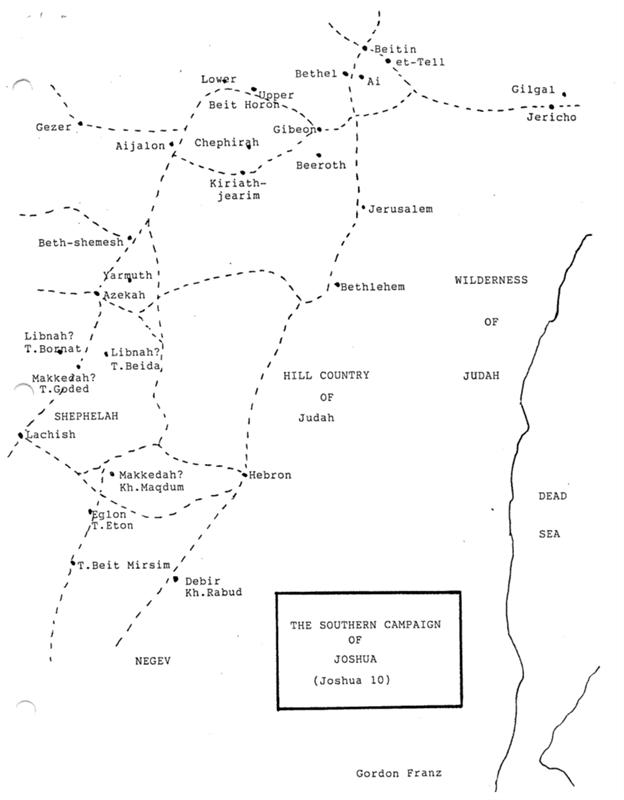
The Southern Campaign of Joshua (Joshua 10)
By Gordon Franz
This paper will approach the subject of the Southern Campaign by Joshua from two different perspectives. First, the literary aspect and second, the historical.
Literary Aspects
As in reading any literature, one must ask the question, “What is the central message the author is trying to convey?” And then the question, “What literary devices does he employ to convey that message?” Reading the Bible is no exception.
There are at least two literary problems which have been raised in the minds of some scholars. While there are other problems, this paper will limit itself to just two. The first problem deals with the comparison of Joshua 10 and Judges 1. Are these two accounts of the same event? Or, are they two separate events? The second problem deals with the literary structure of the chapter. Is Joshua 10 composed of three separate literary traditions, each dating to a different time period, gathered together to make one narrative? Or, is it one intricately and organically connected narrative?
A. The Comparison of Joshua 10 and Judges 1. This problem was dealt with by Dr. G. Ernest Wright in his article entitled “The Literary and Historical Problem of Joshua 10 and Judges 1.” (1946:105-114). In it, he is critical of George Moore’s position set forth
in his commentary on the book of Judges in the International Critical Commentary series. Moore pointed out the differences between the two accounts of the conquest of Canaan in Joshua 10 and Judges 1. He concluded that the Judges account was of “greater historical value” and that Joshua was not historically reliable (1903:7,8). Wright criticized him for oversimplifying the import of the Book of Joshua as well as the question of the reliability of Judges 1 (1946:106, 7). He then tries to prove that the account in Judges 1 is a collection of miscellaneous fragments of varying dates and of varying reliability, and not a unified document (107-9). As for Joshua 10, he contended that it made good geographical and archaeological sense (109-113). He was right in his contention, but for the wrong reasons. Geographically, he stated that there was a “high probability” that Lachish was located at Tel ed-Duweir, Eglon at Tel elHesi, Debir at Tel Beit Mirsim and Libnah at Tel es-Safi or Tel Bornat. As will be shown, he misidentified three of the four cities! Archaeologically, he dated the conquest at the end of the 13th century BC. This too has problems.
In order to understand the differences between the two accounts, one must understand the purpose of the conquest of the Land of Canaan. The Book of Deuteronomy states that the land was given to Israel because the Lord promised Abraham that his descendants would inhabit it. “Then it shall come about when the LORD you God brings you into the land which he swore to you fathers, Abraham, Isaac, and Jacob, to give to you, great and splendid cities which you did not build, and houses full of all good things which you did not fill, and hewn cisterns which you did not dig, vineyards and olive trees which you did not plant…” (Deut. 6:10, 11, cf. 9:4-6; 19:1; Josh. 24:13; Ps. 105:44), and so forth. The implication of these verses is that the cities and all that is in them will be given intact to the children of Israel!
What is recorded in Joshua 10 and Judges 1 are two separate
accounts of two separate events. Joshua 10 describes the initial campaign into the Land of Canaan in which the children of Israel either killed, or drove out the inhabitants of the land. It is important to note that they did not burn the cities except, Jericho (6:24), Ai (9:28), and Hazor (11:11, 13). Apparently after the initial campaign and before the land was allotted to the different tribes, some of the inhabitants which were driven out returned to their cities. The writer of Judges said this was to test Israel whether she would walk in the way of the Lord or not (2:20-23).
Judges 1 describes the battles by the individual tribes, “after the death of Joshua” (1:1), against those inhabitants who returned to their cities following the initial campaign of Joshua.
B. The Literary Structure of Joshua 10.
Some scholars see this chapter as originally three separate traditions; each dating to a different time period, which were brought together to make one narrative (Soggin 1972:121-131). The three traditions are: (a) The Amorite Confederacy against Gibeon and the Battle of Gibeon (vv. 1- 15); (b) The slaughter of the five kings in the cave of Makkedah (vv. 16-27); and (c) The campaign in the Shephelah and Southern Hill Country (vv. 28-42).
It might be better to approach this chapter from a literary perspective. Chapters 9 and 10 both deal with the Gibeonite covenant and its consequences. In Joshua 9, the Gibeonites disguised themselves as travelers from a far country seeking to make a covenant with Israel (9:3-15, cf. Deut. 20:10-13). A covenant was made, but later the deception was discovered (9:16-27). Israel must live with this covenant. In chapter 10, the king of Jerusalem is upset with this situation because his trade with the coast is effectively cut off. He called on his Amorite friends to join him in battle against the Gibeonites (10:1-5). Joshua received word of the ensuing battle. To make good on their covenant, the Israelites joined the battle against the Amorite confederacy (10:6-15). The rest of the
campaign is described in verses 16-43.
Rather than three sections in chapter 10, it would appear that there are only two. The first, in verses 1-15, which ends with the phrase, the LORD “fought for Israel. Then Joshua and all Israel with him returned to the camp to Gilgal.” This same formula is repeated at the end of the second section (vs. 42b, 43). It would not make sense, geographically or militarily, for Israel to go up from Gilgal to Gibeon, chase the Amorites down to the Shephelah, return to Gilgal and then go back to the Shephelah to continue the battle. The writer is using a literary device at this point. The first section (vs. 1-15) is an overview of the campaign, while the second (vs. 16-43) is an expansion of the first. This literary device is used elsewhere in Scripture.
The two sections are intricately and organically connected into one unit by the fate of the five kings (vs. 3 and 5 in the first half, and vs. 23 in the second), as well as the mentioning of the city of Makkedah (vs. 10 in the first half, and vs. 16, 21, 28 in the second).
Some scholars argue for three unconnected literary units (as mentioned before) because the lists of kings and cities are different. A discrepancy is in the lists of kings between the first and third section. In the third, the kings of Jerusalem and Yarmuth are missing and the kings of Makkedah and Gezer are added. Debir becomes a city rather than a kings name (Soggin 1972:129,30). As will be shown later, this campaign follows a logical geographical order. Jerusalem is missing because it is not in the line of attack (from Gibeon, the battle goes down the Beth Horan road, away from Jerusalem). Yarmuth is missing because the city apparently was taken by the Israelites on their way to Makkedah. Thus no need to mention them in the defeated city list. Makkedah apparently did not send a contingent in the initial Battle at Gibeon, yet the was taken in the pursuing battle. Gezer joined the fray later, yet only the king was killed. The city was not taken (Josh. 16:10; Judges 1:29; I Kings 9:15-17).
Like Makkedah, Debir (the city) did not sent a contingent to the Battle of Gibeon, yet Joshua wanted to take this important city south of Hebron. Joshua 9 and 10 should be taken together as a literary unit. Within chapter 10 there are two sections. Verses 1-15 is an overview of the campaign, while verses 16-43 expand on that campaign. This chapter describes one campaign by Joshua from Gilgal up to Gibeon, down to the Shephelah and back up to the Southern Hill Country of Judah and into the Negev before they return to Gilgal.
There are two limitations in dealing with the historical aspects of the Southern Campaign: (1) site identification and (2) lack of archaeological data.
A. Site Identification.
One archaeologist characterized Historical Geography as, “That discipline which moves biblical place names around like musical chairs!” He’s not too far from the truth. As will be seen later on, there are several cities where the identification is not certain and several sites have been proposed for certain cities
Dr. Anson Rainey, a historical geographer, has outlined the discipline involved in site identification. It involves the “co-ordination of four major disciplines; philology, linguistics, geography and archaeology, each with its own rules of evidence and frames of reference” (1976:825, 6).
The first, philology, deals with the analysis of the written historical sources. In the particular study it will include the biblical records as well as Eusebius’ Onomasticon. The second, linguistics, has to do with the toponymic investigations of names which are preserved in Arabic with the ancient place names. Sometimes the place name is moved. This phenomenon must be taken into consideration under the discipline. J. Maxwell Miller (1983:124, 5) gives two reasons for this
phenomenon. First, the population during the Hellenistic period usually left the safety of the tells and developed new settlements in close proximity to the ancient site. In so doing, brought the ancient name with it. Second, the name is artificially revived and given to a particular site. Possibly for nostalgic reasons as in the case of Arad, or because of a case of mistaken identification. The classic example of this is Kiryat Gat because when the name was given, Tel el‘Areni was identified as Gath of the Philistines. That identification is no longer tenable, (Rainey 1975:6376). The third discipline, geography, takes into consideration the physical topography of the land. The last, archaeology, entails the results from surveys, trial excavations and full scale excavations. In the identification of the sites, all four will be employed.
B.
There are three methods in which archaeological information is derived from a site: (1) survey, (2) trial excavations, and (3) a full scale excavation. Each has their own limitations as far as information available. The survey is conducted by an archaeologist who walks over the site noting and recording the architectural remains on the site. He also gathers sherds from the surface to determine when the site was occupied. The limitations are quite obvious. The sherds tell you what pottery was found at the time of the survey! A survey is helpful, but is not an absolute indicator as to the chronological sequence of when the site was occupied. The pottery on the surface may not give the whole subsurface sequence. That could only be determined by excavating.
Trial excavations are carried out at sites to find out when the site was occupied and to see if the site might be promising for a full scale excavation. Usually the trial excavations are in the form of several 5 x 5 meters squares forming a trench near the edge of the tel. The limitations here are two-fold. First, the trench might not penetrate deep enough to determine all the strata. Thus the full sequence cannot be realized.
Second, the trench might be situated in a section of the tel which was not inhabited during a particular period in antiquity. Thus a complete strata (or more) is missed!
The final method of deriving archaeological information is a full scale excavation. This is the ideal and yields the most information. However, time, manpower and money prevent many large scale operations. Yet even this has its limitations. For example, if a destruction level is uncovered, the culprit who destroyed it is not known unless some written inscriptions are found, or careful historical reconstruction is carried out. Another limitation, even with a full scale excavation, is that one must wait until all the appropriate strata can be excavated before theories can be tested and conclusions drawn. Another limitation, at least for the researcher, is the procrastination of the archaeologist to publish his findings!!!! It can be very frustrating sometime trying to get information before it has been published!
Let us turn our attention to the archaeological evidence, the “raw data”, or the “dirt facts”. This section will concern itself with three questions. When, archaeologically, could the conquest have happened? What, according to the written sources, are we looking for? And finally, what has been found and what does it mean?
This paper will assume a military conquest of some sort by Joshua of the Shephelah. There are basically three archaeological periods which have been suggested for a military conquest (refer to Waltke’s lecture Friday afternoon, 1:30 pm). The first, the “late date”, places the conquest at the end of the Late Bronze Age (13th century BC). The leading proponents are Albright, Wright, Bright (however, he has revised his ideas) and Yadin. The second theory, the “early date”, places the conquest in the Late Bronze I period (the beginning of the
14th century BC). Waltke, Wood and many conservative scholars favor this view. Recently, a third theory was set forth by John Bimson. In it, he suggests the conquest took place at the end of the Middle Bronze IIb period and that the archaeological timetable should be lowered about 100-150 years.
B. What are we looking for?
We are looking for basically two things. First, cities which were inhabited during the campaign. Second, fortified cities at that.
The book of Joshua mentions the cities of Jerusalem, Hebron, Yarmuth, Lachish, Eglon, Gezer, Makkedah and Debir. Each of these sites will be examined as to their possible site identification, what has been done archaeologically at them, when each was inhabited if at all, and then what conclusion can be drawn from the evidence.
The second aspect of our search is the fact that these are fortified cities. Joshua 10:20 states that Joshua and his men pursued the survivors until they “entered the fortified cities.” Most commentaries ignore this fact and those archaeologists who deal with this issue realize the problems and seek alternative explanations for the lack of fortifications. Dr. Rivka Gonen has pointed out that the number of fortified settlements in the Late Bronze Age is slim (1984:69, 70).
In this section we will look at the site identification and archaeological remains of each site individually.
1. Jerusalem
The ancient Jebusite city, without question, was located on the elongated spur just south of the Temple Mount (172-131). It has been excavated over the years by numerous scholars. The two recent excavations which have penetrated into the remains of the “City of David” have been by Dame Kathleen Kenyon (1962-1967) and Yigal Shiloh (19781985). Shiloh summarized his first five seasons in an interim report in the
monograph series by Hebrew University, Qedem (1984).
The ancient City of David was built on steep slopes. This creates a problem for the archaeologist trying to determine the stratigraphy. In antiquity, the builders tried to place their structures on the bedrock. This is clearly seen in the strata 12-10 (late Iron Age II, 8th to 6th century BC) building activities. In so doing, the Iron Age builders destroyed the earlier strata. Thus the earlier strata may exist only in depressions and the continuity of accumulated strata may not be uniform in each area (1984:25).
The Middle Bronze II A-B (Strata 18-17) is well represented, stratigraphically, in Area El. Other areas have scattered sherds, but this area has living floors, in situ (even though in a depression!) (1984:12). Built in this area was the MB city wall with its foundations which were laid ca. 1800 BC. This wall continued to be used, apparently until the Babylonian destruction in 587/6 BC (1984:26).
The Late Bronze Age II (Jerusalem of the el-Amarna period) is represented in Area G by the stepped podium which was probably the northern part of the Jebusite acropolis. Shiloh dates the construction of this about the 13th century BC (1984:16). Other areas had scattered sherds. Burial caves around Jerusalem attest to the occupation of Jerusalem during this period (1984:26). Even a Late Bronze Egyptian Temple was excavated in the area of the Ecole Biblique during the 19th century AD, but mis-identified as a Byzantine structure. In 1980, G. Barkay re-evaluated the evidence and suggested it was an Egyptian shrine!
2. Gibeon.
This site is located at modern day el-Jib (167-139). James Pritchard, the excavator, based on the amount of Middle Bronze II pottery on the site as well as some burial caves, said that the “area of occupation must have been extensive in this period” (1962:154).
As for the Late Bronze Age, there were several burial caves
(reused from the Middle Bronze II) with imported ware as well as scarabs of Amen-hotep II and Thutmose III. This 14th century material belonged to either a limited settlement or a settlement which has not been uncovered yet. (1962:156).
There was, according to Pritchard, no extensive city from the Middle Bronze to the beginning of the 12th century BC. Thus Gibeon was not an important city during the time of Joshua, which he dated to the end of the Late Bronze Age (cited in Bimson 1978:205, 6).
The Middle Bronze city would fit Bimson’s theory well. Those holding to a Late Bronze, either I or II, would have problems with a “great city, like one of the royal cities” (Josh. 10:2).
3. Yarmuth.
Yarmuth was probably taken by the Israelites as they went by on the way to Azekiah or Makkedah (Josh. 10:10).
The site, Tel Yarmuth, (147-124) is located 5 km southwest of Beth Shemesh and 2 km east of the Azekiah-Beth Shemeah road. The Arabic name Khirbet Yarmouk preserves the name. The city consists of two parts. The acropolis, covering 15 dunams and a lower city which covers 140 dunams.
This site consists of mostly Early Bronze III and some Early Bronze IV remains. There has been no Middle Bronze pottery found to date. The Late Bronze material is extremely limited. There was a fragment of a carinated bowl as well as a bodysherd with a handle which was white washed and had brownish-black painting on it. It was hand made and reminiscent of Cypriote pottery (1975:73). Y. Dagan, the surveyor for the Lachish Expedition and the one responsible for the Shephelah survey, found four sherds from milk bowls which dates to the Late Bronze II (personal communications). The 1986 season produced Iron Age I material for the first time. There is scattered Iron Age II material and quite a bit of Byzantine remains (1975:74).
An el-Amarna type tablet appeared in the excavations from Tel el-Hesi. Albright equated the “Ia-ra-mi” in line 10 with Biblical Yarmuth (1942:32-38). Some have challenged this equation, but if it is correct, there exists an extra-Biblical referenced to Yarmuth.
After the first season of excavation, the excavator Amnon Ben-Tor stated, “Only two sherds, both of doubtful attribution, have been dated to the period in which Yarmuth is mentioned both in the letter from Tell el Hesi and in the Book of Joshua. If future research and survey at Tell Yarmuth does not confirm the existence of a Late Bronze Age settlement at the site, the inevitable conclusion will be that the identification of Tell Yarmuth with Yarmuth of these two references is untenable” (1975:75).
This site does not really fit any of the three theories. There are several possibilities as to how this can be explained. The site may be elsewhere and the name moved to the tel during the Byzantine period (Ben-Tor 1975:75), or wait for further excavations to see if they reveal any substantial Middle Bronze or Late Bronze material.
4. Adullam.
This city, or its king, does not appear in the Joshua 10 account. The king is listed in the list of kings killed by Joshua (Joshua 12:15), situated between the king of Libnah and Makkedah. It would seem that this is the Adullam which is in the Judah city list (Josh. 15:35).
The ancient city has been identified with esh-Sheikh Madhkur (150-117). According to Y. Dagan, there are Late Bronze remains, but no Middle Bronze II.
5. Makkedah
Makkedah is a classic case of site identification musical chairs! Dave Dorsey has listed at least seven sites, from the Ephraimite foothills down to the southern Shephelah, which have been identified with Makkedah. From his own research, he has concluded that Makkedah was
located at Kh. el-Qom (147-104).
Eusebius, in his Onomasticon, places Makkedah eight Roman miles on the road going east of Eleutheropolis (Bet Guvrin). The “east road” goes south past Tel Maresha before it turns to the east. This would place Makkedah in the vicinity of Kh. Beit Maqdum. The name Makkedah is preserved in “Maqdum”. Unfortunately this site has only Byzantine and Middle Age pottery and a little Iron Age II. (However, the local population will show you the actual cave in which the kings were buried in!). Dorsey proposed Kh. el-Qom, located 600 meters west southwest of Kh. Maqdum, as Makkedah. This site has Iron Age II as well as Early Bronze II and III remains. There were also some nice rock hewn tombs with Hebrew inscriptions in them. J. Holladay found some Middle Bronze I artifacts, but as of yet, no Middle Bronze II or Late Bronze remains have been uncovered (Holladay 1971:106-8).
Judging from the preliminary note, Holladay had a short, six week trial excavation on the edge of the mound. It might be profitable if a renewed excavation was conducted at the site.
It is a possibility that Makkedah is located elsewhere. Y. Dagan has tentatively placed it at Tel Judeideh (Goded) where there is Late Bronze and Middle Bronze II remains. This site, however, does not conform to the distance recorded by Eusebius. 6. Libnah.
After the kings were killed, Joshua started a “mopping up” operation against the Amorite cities whose kings he had just killed. His first stop was Libnah.
Historical geographers have also played “musical chairs” with this site also. It should be located in the fourth district of Judah which is in the central Shephelah. This district extends from the “chalk trough” just west of the Hill Country of Judah westward to the north/ south Azekah-Tel Goded ridge. The question is, does it extend further
west from this ridge? Some (Rainey 1983:10, 11) think it did because the people of Libnah revolted to the Philistines during the reign of Je(ho) ram (II Kings 8:22; II Chron. 21:10). It should be pointed out that Libnah was a Levitical city (Josh. 21:13; I Chron. 6:57). During the revolt against Je(ho)ram, the people of Libnah (under Levitical influence?), revolted from the apostasy in Jerusalem, to the Lord! Not to the Philistines. Libnah does not necessarily have to be west of the north/south ridge. Eusebius places it “in the district of Eleuthropolis.”
The two leading candidates for Libnah are usually Tel Bernat (138-115) and Tel Beideh (145-117). A recent survey by Y. Dagan at Tel Bernat found Late Bronze and Middle Bronze II material at the site. On top was a small, Iron Age fortress measuring 25 x 25 meters square. When Sennacherib, King of Assyria, invaded Judah, the Bible records he was fighting at Libnah when Rabshakeh returned to Sennacherib (II Kings 19:8; Isa. 37:8). The impression given is that it was a large site, not a small fortress.
The second site, Tel Beideh, is a large site with Late Bronze remains, but no Middle Bronze II material. No excavations have been done thus far. Just a limited survey by Y. Dagan.
Another suggestion for this site, Tel Judeideh (Goded), (141-115) has been set forth by Z. Kallai. This is a very attractive possibility. One of the reasons people have not taken it seriously is because Moresheth Gath, the home of Micah the prophet, is placed there. That might well be located somewhere else, maybe Tel Bornat or Tel Beideh. Tel Judeideh has both Late Bronze as well as Middle Bronze II remains.
7. Lachish
The identification of Lachish with Tel ed-Duweir (135-108) is quite certain even though G. Ahlstrom (1980) raised some objections to this identification. G. Davies (1982) has adequately answered them.
Extensive excavations were carried out by the British in the
1930s under the directorship of J. L. Starkey with important remains from the Late Bronze and Middle Bronze Age. Renewed excavations have been carried out since 1973 under the directorship of Dr. David Ussishkin and sponsored by the Institute of Archaeology of Tel Aviv University. (Dr. Ussishkin will be giving a more detailed lecture on this site in the third session this morning).
One would expect that a site which has been excavated so extensively would provide some clear cut answers. Such is not the case. (contra Ussishkin 1987! I hope I still have a job this summer after that statement!)
A quick highlight of the important remains from the Late Bronze and Middle Bronze is in order. Starkey concentrated on the burial caves around the base of the tel. In so doing, he came across the Fosse Temple. The pottery from this temple helped establish the pottery chronology for the Late Bronze Age. The temple in the fosse (moat) indicated that the Late Bronze was a time of peace because there were no fortifications.
The renewed excavations have uncovered a Canaanite palace in Area P, as well as a Late Bronze Egyptian Temple. This area is waiting for more strata to be excavated in the Section (Area S) so the pottery can be correlated between the two.
The gate area (Area G) uncovered a destruction level in dating to the end of the Late Bronze age by a cartouche of Rameses III. This is an important find and has far reaching implications for the termination of the Late Bronze age. (I will not go into detail on this, I don’t want to steal Dr. Ussishkin’s thunder!).
The “Section” (Area S) has uncovered at least five Late Bronze strata and is not yet to the Late Bronze I period! This will have far reaching implications for the understanding of the Late Bronze pottery chronology. Of importance to this study, there have been no city walls
found in any of the Late Bronze levels thus far!
One of the elements we are looking for in each city is a fortified city wall. So far, none have appeared in the Late Bronze Age. There appears to be one in the Middle Bronze II level. Topographical considerations in the “Section” as well as the Middle Bronze glacis and fosse (moat) suggests that there will be a wall at this level. One of the objectives for the 1987 season at Tel Lachish is to penetrate to the Middle Bronze level. Is there a city wall in the Middle Bronze II? Is that the city which Joshua conquered? Another objective for this summer is the Late Bronze palace situated in the southwest corner of the plastered parade ground in front of the Iron Age palace. Will this reveal answers to questions relating to the Conquest? An archive would be nice at this point! You are most welcome to join us this summer as we seek answers to these questions.
8. Eglon.
After the conquest of Lachish, Joshua turns his attention to the Hill Country, but before he goes there, he must take care of Eglon.
Albright suggested Tel el-Hesi as the possible location for Eglon. Geographically, the line of attack in Joshua 10 would really be out of the way if this was the case. Rainey (1976:252) has suggested Tel ‘Eton as a likely candidate for Eglon. This is on the natural route to Hebron from Lachish.
A small salvage excavation was conducted by Etan Ayalon in August 1976. A trench, 5 x 20 meters long was dug and penetrated no more than 1 meter below the surface. Two strata were uncovered and were dated to the Iron Age. No earlier remains were recovered (1985:5462). Y. Dagan found Late Bronze remains in his survey. D. Alan found some Middle Bronze in his (Broshi and Gophna 1986:82), but as yet unpublished.
Here is a rich site and it should be excavated. It may help in the
identification of the site as well as answer stratagraphic problems for the Shephelah region.
9. Hebron.
The ancient site of Hebron is located at Tel Rumeideh (160-103). It was excavated in the 60’s by C. Hammond. He uncovered what he called a “Hyksos” wall, clearly from the Middle Bronze age (1965, 1966, 1968). Recently, Tel Aviv University renewed the excavations of the site under the directorship of Avi Ofer. He uncovered more of the Middle Bronze wall as well as Iron Age II remains, Roman and Early Bronze. No Late Bronze has been found on the site (Ofer 1984:94,95).
10. Debir
Albright identified Debir with Tel Beit Mirsim. However, this identification has its problems. Even the German “higher critics” said Albright was wrong because the Bible said it was supposed to be in the Hill Country! Albright would not budge on this one.
After 1967, lots of Late Bronze pottery began to appear on the antiquity market in Old City of Jerusalem. It was eventually traced to the site of Kh. Rabud. M. Kochavi surveyed the site and then conducted a trial excavation. He later identified Kh. Rabud (151-093) as Debir. His survey produced Late Bronze I and II as well as a few Middle Bronze II sherds (1972:74, site 215). A small scale rescue excavation was conducted by Kochavi in June of 1968. He put two trial trenches on the western slope of the tel in order to determine the stratigraphy of the site. Late Bronze and Iron Age remains were recovered from these trenches. No Middle Bronze II (1974:2-33).
There were a few Middle Bronze II sherds in the survey. Where were they from? Why were not more found in the excavation? This is a very impressive site and should be excavated on a larger scale. Definite conclusions as to the nature of the site cannot be determined by two narrow trenches.
Aharoni, Y.
1979 The Land of the Bible. Philadelphia: Westminster.
Ahituv, S.
1984 Canaanite Toponyms in Ancient Egyptian Documents. Jerusalem: Magnes.
Ahlstrom, G. W.
1980 Is Tell ed-Duweir Ancient Lachish? Palestine Exploration Quarterly 112:7-9.
Albright, W. F.
1937 Further Light on the History of Israel from Lachish and Megiddo. Bulletin of the American Schools of Oriental Research 68:22-26.
1942 A Case of Lese-majeste in Pre-Israelite Lachish, with some Remarks on the Israelite Conquest. Bulletin of the American Schools of Oriental Research 87:32-87.
Ayalon, E.
1985 Trial Excavation of Two Iron Age Strata at Tel ‘Eton. Tel Aviv 12:54-62.
Ben-Tor, A.
1975 The First Season of Excavations at Tell-Yarmuth, 1970. Qedem 1:54-87.
Bimson, J.
1978 Redating the Exodus and Conquest. Journal for the Study of the Old Testament, Supplement Series. Sheffield, England: University of Sheffield.
Boling, R. and Wright, G. E.
1982 Joshua, The Anchor Bible. New York: Doubleday.
Bright, J.
1981 A History of Israel. Philadelphia: Westminster. Broshi, M.
1977 Tell Judeideh. Pp. 694-696 in vol. 3 of The Encyclopedia of Archaeological Excavations of the Holy Land, eds. M. Avi-Yonah and E. Stern. Jerusalem: Massada. Broshi, M. and Gophna, R.
1986 Middle Bronze Age II Palestine: Its Settlements and Population. Bulletin of the American Schools of Oriental Research 261:73-90.
Butler, T. C.
1983 Word Biblical Commentary, Joshua. Waco, TX: Word. Davies, G. I.
1982 Tell ed-Duweir = Ancient Lachish: A Response to G. W. Ahlstrom. Palestine Exploration Quarterly 114:25-28.
Dever, W.
1976 Gezer. Pp. 428-443 in vol. 2 of Encyclopedia of the Archaeological Excavations of the Holy Land. M. AviYonah, ed. Jerusalem: Massada.
1986 Late Bronze Age and Solomonic Defenses at Gezer: New Evidence. Bulletin of the American Schools of Oriental Research 262:9-34.
Dorsey, D.
1980 The Location of Biblical Makkedah. Tel Aviv 7:185-193.
1981 The Roads and Highways of Israel During the Iron Age. Unpublished Ph.D. Dissertation, Dropsie University.
Garstang, J.
1931 Joshua-Judges. London: Constable.
Gonen, R.
1984
Hammond, P. C.
Urban Canaan in the Late Bronze Period. Bulletin of the American Schools of Oriental Research 253:61-74.
1965 Hebron. Revue Biblique 72:267-270.
1966 Hebron. Revue Biblique 73:566-569.
1968 Hebron. Revue Biblique 75:253-258.
Hayes, J. and Miller, M.
1977 Israelite and Judaean History. Philadelphia: Westminster.
Holladay, J.
1971 Kh. El-Qom, Notes and News. Israel Exploration Journal. 31:106-8.
Kochavi, M.
1972 The Survey of the Land of Judah. Pp. 17-91 in Judea, Samaria and the Golan. Archaeological Survey in 1968, ed. M. Kochavi. Jerusalem: Israel Exploration Society.
1974 Khirbet Rabud = Debir. Tel Aviv 1:2-33.
Miller, J. M.
1977 Archaeology and the Israelite Conquest of Canaan: Some Methodological Observations. Palestine Exploration Quarterly 109:87-93.
1983 Site Identification: A Problem Area in Contemporary Biblical Scholarship. Zeitschrift des Deutschen Palastina-Vereins 99:119-129.
Moore, G.
1903 The International Critical Commentary. A Critical and Exegetical Commentary on Judges. Edinburgh: T & T Clark.
Na’aman, N.
1981 “Hebron Was Built Seven Years Before Zoan in Egypt” (Numbers XIII 22). Vetus Testamentum 31:488-491.
Noth, M.
1960 The History of Israel. New York: Harper and Row.
Ofer, A.
1984 Tell Rumeideh – 1984. Excavations and Surveys in Israel 1984 3:94, 95.
Pritchard, J.
1962 Gibeon: Where the Sun Stood Still. Princeton, NJ: Princeton University. Rainey, A.
1975 The Identification of Philistine Gath. Eretz Israel 12:6376.
1976a Eglon. P.252 in The Interpreter’s Dictionary of the Bible, Supplementary Volume. Nashville, TN: Abingdon.
1976b Identification of Ancient Sites. Pp. 825-827 in The Interpreter’s Dictionary of the Bible, Supplementary Volume. Nashville, TN: Abingdon.
1980 The Administrative Division of the Shephelah. Tel Aviv 7:194-202.
1983 The Biblical Shephelah of Judah. Bulletin of the American Schools of Oriental Research 251:1-22. Shiloh, Y.
1984
Soggin, J. A.
Excavations at the City of David, I, 1978-1982. Interim Report of the First Five Seasons. Qedem 19:1-72.
1972 Joshua, A Commentary. Philadelphia: Westminster. Tufnell, O.
1940 Lachish II. The Fose Temple. London: Oxford.
1958 Lachish IV. The Bronze Age. London: Oxford.
1967 Lachish. Archaeology and Old Testament Studies. Oxford: Clarendon Press. Pp. 296-308.
Ussishkin, D.
1978 Excavations at Tel Lachish - 1973-1977. Preliminary Report. Tel Aviv 5:1-97.
1983 Excavations at Tel Lachish - 1978-1983. Second Preliminary Report. Tel Aviv 10:97-185.
1985 Levels VII and VI at Tel Lachish and the End of the Late Bronze Age in Canaan. Palestine in the Bronze and Iron Age in Canaan. London: Institute of Archaeology. Pp. 213-230.
1987 Lachish: Key to the Israelite Conquest of Canaan? Biblical Archaeology Review 13:18-39. de Vaux, R.
1970 The Settlement of the Israelites in Southern Palestine and the Origins of the Tribe of Judah. Pp. 108-134 in Translating and Understanding the Old Testament, Essays in Honor of Herbert Gordon May, eds. H. Frank and W. Reed. Nashville, TN: Abingdon. Wood, B.
1985 Palestinian Pottery of the Late Bronze Age: An Investigation of the Terminal LB IIB Phase. Unpublished Ph.D. Dissertation, University of Toronto.
Woudstra, M. H.
1981 The Book of Joshua. Grand Rapids: Eerdmans. Wright, G. E.
1946 The Literary and Historical Problem of Joshua 10 and Judges 1. Journal of Near Eastern Studies 5:105-114.
1971 A Problem of Ancient Topography: Lachish and Eglon. Harvard Theological Review 64:437-450.
Yanay, E.
1986 Tel Lachish at the End of the Late Bronze Age. Unpublished M. A. Thesis, Tel Aviv University.
Lecturer in Old Testament and Biblical Archaeology at Trinity College, Bristol, England. Old Testament Map Consultant for IVP's Illustrated Bible Dictionary, Research Assistant, Tyndale House, Cambridge, England. Contributor to Essays on the Patriarchal Narrative and The New Bible Atlas, The World of the Old Testament is forthcoming. Author of Redating the Exodus and Conquest.
CANAAN’S MIDDLE BRONZE AGE STRONGHOLDS: The Cause and Date of Their Downfall Re-examined
John J. Bimson
In my book, Redating the Exodus and Conquest (Bimson 1978), I made two proposals which together constituted a new archaeological setting for Israel’s conquest of Canaan. These proposals were: (i) that the Exodus and conquest occurred in the 15th century BC, broadly in line with indications contained in the Old Testament itself (Jdg 11:26; 1 Kgs 6:1), and (ii) that the fall of the Canaanite cities fortified in the Middle Bronze II period should be redated by roughly a hundred years, from the late 16th to the late 15th century BC. I argued that the destruction of those MBII strongholds provided the otherwise missing archaeological evidence for the Israelite conquest of Canaan.
These proposals spring from a conviction, shared with several other scholars (Kaufmann 1953, Greenberg 1965, Malamat 1978a, 1978b, 1979, 1982, Yadin 1982, 1985), that the theories of peaceful infiltration (Landnahme) and internal revolt both fail to do justice to the biblical tradition, i.e., that Israel acquired Canaan by force from outside its borders.
I cannot repeat in detail here the arguments for identifying the MBII fortresses as the cities conquered by the Israelites, but the following points deserve mention. By the end of MBII, the cities of
Canaan were, in W. G. Dever’s words, ‘characterized by fortifications of unprecedented mass and complexity’ (Dever 1985:73). Their character fits exactly the biblical description of Canaan’s cities before the Israelite conquest: ‘fortified and very large’ (Num 13:28); ‘great and fortified up to heaven’ (Dt 1:28)- a description supported by individual conquest accounts, which speak of cities with walls and gates (Josh 2:15; 6:1, 5; 7:5; 8:29; 10:20; 14:12; etc.). It has become clear through recent research that this is not (as has often been assumed) a description of Canaan in the Late Bronze Age, when cities were smaller and very few had any surrounding walls (Gonen 1984).
At the end of MBII, the cities mentioned in the conquest narratives (so far as they have been confidently identified and adequately excavated) all show signs of destruction and/or abandonment - with the exception of Ai, if it is to be identified with Khirbet et-Tell. At Jericho, for which the Old Testament provides an unusual amount of detail, the correlation between biblical information and archaeological evidence from the end of the MBII city is particularly striking: both imply a plague, an earthquake and a fire at the time of the city’s downfall (Bimson 1978:127-132; Bartlett 1982:94).
Finally, cities which (according to the Bible) the Israelites failed to take from the Canaanites are cities which either survived the MBII/ LBI transition without a destruction, or were rapidly rebuilt rather than abandoned in LBI (Bimson 1978:231).
A major difficulty in recognizing the fall of the MBII strongholds as evidence for the Israelite conquest is, of course, chronological. While their downfall is dated to the late 16th century BC, there is no correlation, even in approximate terms, with the biblical date for the conquest. However, if it was not already clear in 1978, it is certainly clear today that dating the end of Canaan’s MBII cities is by no means a straightforward exercise. In the present paper I will briefly review same of the problems
surrounding it, and I hope to show that a thorough reassessment of conventional views is now urgently needed.
2 The MBII Strongholds and the Hyksos
I must preface this discussion with a remark about terminology. While W. F. Albright placed the destruction of the MBII cities within the MBII period, between 40 and 20 years before its end (1965:56), other scholars have more recently referred to the same wave of destructions as occurring early in the Late Bronze Age (Redford 1982:117; Seger 1975:43* chart). This is not the result of a different chronology; rather, it reflects a lack of agreement as to what constitutes the division between MBII and LBI (1)· Following widespread practice, I will continue to speak of the destructions occurring at the end of MBII (or, more precisely, at the end of MBIIC (2)). As we will see later in this paper, further research may well show this terminology to be in need of revision. In the meantime, however, it remains the most convenient way of referring to the destructions.
On the question of the absolute dating of the destructions, there is a fair degree of unanimity. It is generally agreed that the MBII cities were destroyed in the second half of the 16th century BC. Most authorities adopt a round date of c. 1550 BC, while some place the destructions one or two decades later. W. G. Dever has proposed a more sophisticated view in which the cities fell in three main waves of destruction, beginning c. 1550 and ending c. 1480 BC (Dever 1985:80). Hence Dever adopts a round date of c. 1500 BC for the cities’ downfall and the end of MBII (Dever 1976:46; cf. Broshi & Gophna 1986:73).
Behind the traditional 16th-century dating lies an assumed connection between the fall of these cities and the expulsion of the Hyksos from Egypt. In its commonest form the assumption is that, after driving the Hyksos from Egypt, the armies of the early 18th Dynasty engaged in punitive campaigns against the Hyksos in Palestine. These
campaigns involved the destruction of the MBII cities, which are thought to have been Hyksos strongholds. However, in the last few decades every aspect of this scenario has been criticized.
2.1 The supposed ‘Hyksos’ connections of the MBII cities
Before about 1950 it was common for the overall culture of Palestine in MBIIB-C (fortifications, tombs, pottery, scarabs etc.) to be viewed as ‘Hyksos’ (Engberg 1939; Garstang 1940:94-103). This has since been vigorously denounced and the Hyksos connections of the MBII cities have been widely abandoned (Save-Soderbergh 1951:53-71; Van Seters 1966:3; Hayes 1973:55; Kenyon 1973a:90; Bienkowski 1986:131-33). However, the term ‘Hyksos’ continues to be used in a misleading way by some scholars (Aharoni 1979:147-50; 1982:100-106; Dever 1985). Indeed, the concept of a Palestine dominated by Hyksos fortresses has proved a difficult one to shake off. In particular the complex fortifications which appear in MBII have continued to be linked with the Hyksos by K. M. Kenyon (1973a:115; 1979:166), J. D. Seger (1975:44*-45*) and W. G. Dever (1985). Although the assumed Hyksos connections of these defenses have been heavily criticized from many angles and generally rejected (Save-Soderbergh 1951:60; Van Seters 1966:32-37; North 1967:265; Wright 1968:11-13; Parr 1968:18-45; Bimson 1978:136-38; Bienkowski 1986:132), Seger and Dever have recently attempted to rehabilitate them. Dever’s arguments (more recent and detailed than Seger’s) call for a response. After summarizing the mass of data supplied by recent excavations of MBII levels (Dever 1985:71-2), Dever raises a fundamental question: why were these complex fortification systems constructed? They cannot have been built as a defense against city-states to the north, because the city-states of Syria had gone into decline at this time and posed no threat. Dever also rejects the possibility that the defenses were a response to internecine strife within Palestine. In his opinion this leaves only one possible explanation: the MBII cities were fortified to
function as ‘basecamps from which to launch Asiatic campaigns into Egypt, as well as “backup systems” in case these were repelled’ (1985:73).
There are two major weaknesses with this view. Firstly, Dever admits that there is now overwhelming evidence that the development of these fortifications stretches back into MBIIA (contra Yadin 1978) – ‘in absolute chronology, certainly before 1800 BC, and probably much earlier’ (1985:72). In fact, there is good evidence that their development can be traced back through MBI and into the EBA (Parr 1968:24-44; Bienkowski 1986:132). This means, if Dever’s explanation is correct, that Asiatic infiltration of Egypt was a deliberately-conceived, long-term (indeed very long-term!) plan. This seems highly unlikely. Secondly, Dever admits that the MBII fortifications show tremendous variety. In his own words, we have ‘a bewildering array of defenses - enormous embankments of variegated fills, glacis and fosses, and various combinations of revetment and perimeter walls of stone and mud-brick’ (1985:72-73). He rightly says that this variety has undermined explanations based on the supposed introduction of chariotry or the battering ram, and theories with an ethnic basis. But the variety weakens his own explanation as well. If Dever’s theory is correct, we would surely find more uniformity of design, for his view assumes a high degree of unity among the Canaanite city-states.
The simplest explanation for their construction, and one which does full justice to the variety of fortifications encountered, is inter-state rivalry within Canaan itself. Friction and mutual suspicion among citystates would have led each to arm and defend itself more heavily than its neighbors, producing a ‘defense race’ in which each city constantly attempted to strengthen its fortifications by new and more elaborate methods. This is the logical conclusion to draw from what Dever himself calls ‘phase after phase of construction, accumulating until the end of MBIIC, by which time nearly every site in Palestine is characterized by
fortifications of unprecedented mass and complexity’ (1985:73).
In short, Dever’s speculations fail to produce a convincing link between the Hyksos and the MBII fortresses. This is an important point, for if no firm Hyksos connection can be established for the MBII cities, there is no compelling reason why the armies of the early 18th Dynasty should have sought to destroy them (3)
2.2 Inadequate evidence for Egyptian campaigns
We turn now to another criticism which has been levelled against the traditional scenario. As several recent writers have pointed out, there is a serious paucity of textual evidence for extensive campaigning in Palestine by either Ahmose or his successors in the early decades of 18th Dynasty rule (Redford 1973:225; 1979:270-287; Shea 1979:3-4; Bienkowski 1986:137-40) (4). Indeed, following the capture of Sharuhen in southern Palestine (the city to which the Hyksos retreated after the fall of Avaris), Ahmose had to turn his armies southward to gain control of Lower Nubia, and his successor Amenhotep I remained largely preoccupied with that region (Save-Soderbergh 1951:71; Gardiner 1961:169). D. B. Redford has also argued that Egyptian armies of the early 18th Dynasty were incapable of wreaking such widespread havoc, in view of the three years which it took them to reduce Sharuhen, which lay relatively close to their own border (Redford 1973:224- 25; 1982:117). He describes it as ‘inconceivable’ that the armies of Ahmose caused the destructions, and goes on to ask:
Where is the administration set up to control this far-flung and now completely subdued territory? Where is the cultural influence which must surely have flowed back from Palestine to Egypt in the wake of such a conquest? Textual evidence, administrative officers and signs of incipient cultural influence from Asia do not begin until the reign of Thutmose III; for the first four reigns of the dynasty they are conspicuously absent. Perhaps, then, we should reexamine our assumptions about the perpetrators of the destruction in Palestine at the end of MBIIC, (1973:225)
W. H. Shea draws a similar conclusion after discussing the paucity of
textual evidence for extensive Egyptian campaigns in the 16th century BC (Shea 1979:4).
A recent attempt to reply to Redford and Shea has been made by J. W. Weinstein. Weinstein argues that the majority of Hyksos royal name scarabs come from sites ‘in the same geographical arc’ as cities destroyed at the end of MBII; he therefore concludes that these cities were among ‘the principal centres of Hyksos power in Palestine’ (Weinstein 1981:10). He further argues that the primary goal of Ahmose’s (hypothetical) campaigns was ‘the complete destruction of the hated Hyksos princes and their cities’ (ibid.), not the creation of an empire; thus, he attempts to reply to some of Redford’s objections quoted above. However, Weinstein’s case has been critically examined by P. Bienkowski, who demonstrates that there is, in fact, little real correlation between the destructions and the provenance of Hyksos royal name scarabs. These scarabs cannot therefore be used as an argument for connecting the destructions with an Egyptian campaign against the “hated Hyksos” (Bienkowski 1986:127).
Bienkowski’s own explanation for the destructions is that Palestine received an influx of Asiatics thrown out of Egypt at the defeat of the Hyksos; this caused ‘tension, population pressure and tribal rivalries’, resulting in the wholesale destruction of cities (1986:128). The argument is unconvincing, especially since there is no real evidence for a significant influx of Asiatics into Palestine at the time of the Hyksos overthrow. The only evidence which might be used to bolster such a view is Manetho’s late account, as preserved by Josephus (Contra Ap. I.14), according to which 240,000 Hyksos left Egypt. But this account must be treated skeptically, since it confuses the defeat of the Hyksos with the departure of the Israelites at the Exodus, and this confusion is probably the source of the idea that a great multitude departed from Egypt when the Hyksos were defeated. (Indeed, Bienkowski does treat Manetho skeptically on this point [1986:1331]). J. Van Seters has pointed out that
the defeat of the Hyksos was essentially the overthrow of a foreign dynasty in a civil war, and did not involve the expulsion of all Asiatic settlers; he produces evidence which suggests that ‘a large part of the foreign population’ continued to live in the Eastern Delta during the 18th Dynasty (Van Seters 1966:176, 189-90, 194). Rather surprisingly (in view of his explanation for the fall of the MBII cities), Bienkowski himself arrives at a similar conclusion on different grounds. After discussing the account of the capture of Avaris, he remarks: ‘On the basis of these observations one can tentatively conclude that, in contrast to the vast hordes sometimes inferred, the number of Hyksos expelled from Egypt was not all that high’ (1986:134). Thus, he effectively undermines his own explanation for the widespread destructions in Palestine.
Bienkowski’s explanation is not unlike that offered by Kenyon in her later works, where she suggests that ‘Asiatics expelled from Egypt’ were the destroyers of the MBII cities (1973b:528; 1979:181). Kenyon’s view is of course open to the same objection as Bienkowski’s, but its weakness is compounded by her belief that the MBII fortifications were the work of the Hyksos. Kenyon therefore has the Hyksos attacking Hyksos fortresses! This is just as unlikely as the traditional scenario (cf. Dever 1985:81 n.6) (5) .
Redford has offered yet another alternative to the traditional explanation. He suggests the destructions should be viewed as ‘demolition from within’, performed by the cities’ occupants acting on ‘the directives of the Egyptian court to the conquered after the conquest...’ (Redford 1982:117). But Redford does not explain how this conquest of Palestine was achieved in the first place. His theory also founders on his own argument (quoted above) that we would expect such a conquest to be attested by various types of evidence, all of which are lacking in the early reigns of the 18th Dynasty.
The conclusion I wish to draw from all this is twofold. Firstly,
there is no solid reason to link the destruction of Palestine’s MBII cities with the defeat of the Hyksos and the beginning of the 18th Dynasty. Secondly, and following from this, their destruction cannot be dated to the 16th century BC by historical arguments.
What criteria can be used to date the fall of Canaan’s MBII strongholds? It has been claimed (in criticism of my proposals) that the ceramic chronology of Syria-Palestine is secure enough to fix the date of their fall in the 16th century BC. There is not space to deal with the arguments in detail here (6), but two new factors have recently entered the picture, posing a challenge to conventional views and lending plausibility to my lower dates for the end of MBII.
The first of these is the revision of MBII dates proposed by M. Bietak. Bietak is now well-known as the excavator of Tell el-Dabca, almost certainly the site of Avaris, the Hyksos capital in Egypt’s Eastern Delta. At this site Bietak has unearthed a material culture which is closely similar to that of MBII Canaan. However, the. dates which he gives to the various phases of this culture, based on Egyptian evidence, have surprised archaeologists working with Palestinian material. Bietak has dated the MBIIB period c. 1700/1650-1570 BC (Bietak 1979:232-37), whereas in Palestine MBIIB has conventionally been dated a century earlier, c. 1800/1750-1650 BC.
Dever has objected strongly to Bietak’s low dates. He accuses Bietak of ‘failing to give priority in dating to the Palestinian, rather than the Egyptian, material...’ (Dever 1985:76) (7), Dever therefore proceeds to revise Bietak’s dates for the Tell el-Dabca material, raising them to match his own dates for MBII in Palestine (Dever 1985:75 [fig. 2], 76-78). Although Dever’s paper was not published until 1985, Bietak evidently had access to it before publishing an important paper of his own in 1984 (see Bietak
1984:472, n. 4). In response to Dever, Bietak argues that it is: methodologically’ wrong to date the Tell el-Dabca sequence according to the Palestinian date . . . . It is far more reliable to obtain absolute dates for the Tell el-Dabca sequence from Egyptian material excavated at that site within the MB sequence. We can then correlate these findings with current Palestinian chronologies and thereby achieve a double check on their accuracy. (Bietak 1984:472)
Bietak goes on to defend his dating of the Tell el-Dabca material with more detailed arguments than previously, and also correlates it with a new examination of the scarabs and ceramics from the MB tombs at Jericho (1984:474-485). Although Bietak’s publication of the relevant material is still incomplete, the implication of his argument is clear. Instead of raising the Tell el-Dabca dates to produce harmony with Palestine’s MBII strata, Bietak would lower the Palestinian ones. Bietak thus places Palestine’s MBIIB roughly in the period c. 1700/1650-1570 BC, and MBIIC roughly 1570-1500 BC (8)
This redating of Palestinian strata is likely to prove controversial for a long time to come, with methodological issues as well as stratigraphical ones requiring fundamental reassessment. But if Bietak’s challenge to conventional dates is at all valid, it will require a lower date for the end of MBIIC than Bietak himself seems to envisage. From his redating of Jericho’s MBII tomb groups, it is evident that he would compress MBIIC into only about 70 years (c. 1570-1500 BC) (9). This is far too short a period for MBIIC in Palestine.
Archaeologically MBIIC was a very eventful period in Palestine’s history. Dever writes concerning it: ‘Careful stratigraphic excavation at several sites has revealed a complex series of building phases and fortifications that must apparently be compressed within a period of about a hundred years, i.e. from ca. 1650-1550 B.C.’ (Dever 1972:240; cf. Kenyon 1979:158). At Shechem, four major building phases have been dated to MBIIC. Kenyon found it improbable that all four should be
contained in a single century, and suggested attributing the last to LBI (Kenyon 1973:541-42). But subsequent studies proved the attribution of all four to MBIIC (Seger 1974), and Dever has therefore described the phasing as ‘tight’ (Dever 1974:45, 48). In short, MBIIC in Palestine seems to require more than a century, not less. With a starting date of c. 1570 BC, MBIIC should extend well down into the 15th century BC, almost certainly into its latter half. This would be in harmony with my own proposal that the MBII cities fell c. 1430/1420 BC (Bimson 1978:144 & chart).
Another development which deserves mention here is the new date proposed by B. G. Wood at this symposium for the end of the ‘MBII’ city at Jericho. His conclusion essentially supports my own arguments that the city fortified in MBII survived well into the 15th century BC, to be destroyed by the Israelites under Joshua (Bimson 1978:118-145). But it would be very surprising indeed if the destruction of Jericho could be redated in this way without repercussions on the dating of other destruction-levels usually synchronized with it. As the end of the ‘MBII’ city must seemingly be associated with Kenyon’s Group 5 pottery from the Jericho tombs, the new date suggests that pottery types belonging to this group, and hitherto considered characteristic MBII types, must now be seen as continuing into LBI. This in turn will affect the ceramic chronology of other sites. Further research is therefore required to reassess the whole situation in the light of the new date for Jericho’s destruction.
Indeed, future research on this subject may well show that the proposals which I made in 1978 require some modifications. In the light of Wood’s conclusions, it now seems likely that not all MBII destructions should be lowered as far as the late 15th century BC and attributed to the Israelites. There may well have been two, or even
three, distinct waves of destruction, as argued by Dever (1985:80), rather than one. Some destructions, as I will suggest below, may have been the work of Thutmose III and Amenhotep II prior to the arrival of the Israelites. It is now perhaps equally likely that some LBI destructions were the work of the Israelites (e.g. at Hazor). On the other hand, I would expect several ‘MBII’ destructions to require redating in line with the new Jericho evidence (and consequently reclassified as ‘LBI’). I have in mind particularly those sites which (in conventional terms) show a gap in occupation during LBI, but which had significant MBII settlement followed by destruction and/or abandonment (Hormah [Tel Masos], Arad [Tel Malhata], Hebron and Gibeon).
4 The Israelites as the Destroyers of the MBII Strongholds
Even if further research should establish a date in the late 15th century BC for the destruction of several MBII cities, would there not still be obstacles in the way of identifying their destroyers as the incoming Israelites? In the final part of this paper I will briefly address some apparent difficulties.
4.1 Could the Israelites have overthrown fortified cities?
In Redating the Exodus and Conquest I accepted J. W. Wenham’s interpretation of the biblical data, according to which the number of Israelites involved in the migration from Egypt to Canaan was about 72,000, with a fighting force of some 18,000 (Wenham 1967). I am now inclined to think these figures may be slightly too high. But could a fighting force of 18,000 or less have successfully overthrown over a dozen strongly fortified cities?
Several scholars (already referred to in the Introduction to this paper) have defended the plausibility of the biblical tradition that Israel acquired Canaan by force. Chief among these in recent years has been A. Malamat (1978a, 1978b, 1979, 1982). Malamat’s major argument is that the Israelites achieved victory by avoiding straightforward frontal assaults,
which would have resulted in protracted sieges. Instead, they employed a number of specific military skills which can be illustrated from the biblical traditions: intelligence-gathering beforehand, the enticement of city defenders, night operations and surprise attacks (cf. also Yadin 1985). Ironically, while Malamat assumes that Canaanite defense was based on ‘strongly fortified cities’ (1979:44), R. Gonen’s research has shown that LB Canaan had very few walled cities (Gonen 1984). Hence several of Malamat’s arguments are actually more applicable to the situation in MBII than they are to that in the LBA.
It is also important to notice that two factors in Canaanite society worked in Israel’s favour. From the fact that the Israelites sometimes received help from Canaanites (Josh 2:1-21; 6:25; Jdg 1:2226), we may infer that some Canaanites favoured the overthrow of their fortified cities. The reasons for this are not hard to find if Wright’s description of the MBII cities accurately reflects the social conditions of the period: ‘...Major royal capitals were dominated by royal palaces, around which clustered the huts of a populace composed mostly of very poor serfs’ (Wright 1961:90). Albright remarked: ‘...The mass of half-free serfs must have lived wretchedly, judging from the contrast between the mansions of the nobles and the hovels of the common man’ (1960:91).
While I do not find the internal revolt theory convincing as an explanation of Israel’s origins, I do find it likely that the Israelites had a great many Canaanite sympathizers.
A second factor which would have favoured the Israelites has already been referred to: the likelihood that there was friction and mutual suspicion among the city-states of Canaan. The eagerness of the four cities of the Gibeonite league to make an alliance with the newcomers, and the hostilities which ensued (Josh 9:3-10:15), perhaps illustrate how volatile relationships were between the city-states.
4.2 Too many MBII destructions?
W. H. Shea, in a review of Redating the Exodus and Conquest, objected: ‘If one credits the Israelites with all of the MBIIC destructions in Palestine then they destroyed quite a few more sites than the biblical record says they did’ (Shea 1980:89). It appears that over thirty sites suffered destruction and/or abandonment at the end of MBII or early in LBI (Weinstein 1981:2, 4), whereas only fourteen cities are said to have been conquered by Israel in Joshua and the first chapter of Judges (though 31 defeated kings are listed in Josh 12).
However, it is not difficult to find explanations for the ‘surplus’ destructions. Some should perhaps be attributed to Thutmose III, Amenhotep II and Thutmose IV, all of whom campaigned in Palestine during the 15th century BC. Others may have been overthrown by Canaanites making common cause with the Israelites, or at least exploiting the upheaval which the newcomers brought, in order to pursue their own ends. We have already noted biblical and archaeological evidence for believing that some Canaanites welcomed the downfall of their city-states. Thirdly, it is possible that some cities not mentioned in the conquest traditions were nevertheless destroyed by the Israelites. The biblical account of the conquest is obviously fragmentary, describing only a selection of battles (Yadin 1985). Josh 11:18 refers to a prolonged war against Canaanite kings, and Josh 12:17 and 24 mention the defeat of the kings of Tappuah and Tirzah, both in the central hill country, though no battles in that region are described either in Joshua or in the first chapter of Judges. Evidently the conquest was a longer and more complex affair than we might at first suspect from the biblical account.
4.3 Where is the evidence for an Israelite presence in the LBA? If the conquest occurred at the end of MBII, then the Israelites were present in the land throughout the LBA. However, J. A. Sauer has objected: ‘The argument for a substantial Israelite population in
Palestine and Transjordan during the Late Bronze Age founders on the character of the Late Bronze occupation itself, which is demonstrably and predominantly “Canaanite-Amorite”,’ (Sauer 1986:9)
I would suggest in reply that it is a mistake to expect the sudden appearance of a distinctive ‘foreign’ material culture to mark Israel’s arrival. Other significant conquests have gone unmarked by changes in material culture (Isserlin 1983; cf. especially his comments on the Muslim Arab conquest of Syria-Palestine). It is particularly unlikely that the Israelite conquest would have been thus marked. The Israelites had lived in Egypt as enslaved pastoralists, and then spent 40 years as semi-nomads before entering Canaan; this makes it improbable that they brought a distinctive material culture into the land. Their pottery would have been bought at local Canaanite markets, so there would be no distinctively ‘Israelite’ wares. They arrived as tent-dwellers and began their life in Canaan that way (Josh 3:14; 7:21-24; 22:4-8, etc.); that lifestyle was probably retained for a considerable time by those groups which were not assimilated into Canaanite society - as some evidently were (Jdg 1:29, 32, etc.). Broshi and Gophna have mentioned the impossibility of assessing, even approximately, the size of Canaan’s (semi-) nomadic population (Broshi and Gophna 1986:74), and Finkelstein has pointed out that we would have no knowledge of the Negev’s population of 60,000 Bedouin in the first half of this century if we were solely dependent on material remains (Finkelstein 1986:51).
However, R. Gonen’s study of LBA Canaan has shown that the MBII destructions were followed by a period of drastically reduced urban population (Gonen 1984). Furthermore, during the LBA there were many cemeteries not associated with settlements; this was true both of the pit burials which were characteristic of the lowlands, and the cave burials which were a feature of highland areas (Gonen 1984-85). This may well indicate a significant non-urban population during the period,
i.e. a population which was either nomadic or which lived in temporary, unwalled villages. If so, such a population would have included the Israelites, especially in the highlands, which the biblical traditions suggest was the region initially occupied by the newcomers. Such vague indicators as these are perhaps all we can expect in the way of evidence for an Israelite presence in the LBA. The important point is that we cannot rule out an Israelite presence in the way Sauer does.
In conclusion, there are good grounds for viewing the fall of at least some of Canaan’s MBII strongholds as the otherwise elusive evidence for the Israelite conquest. The major obstacle to this view is the chronological one, i.e., that the downfall of the MBII cities has traditionally been dated to the 16th century BC. However, recent developments have given new plausibility to the suggestion that this date should be reduced to one in the second half of the 15th century BC, broadly in line with the Bible’s own chronology for the Exodus. At the very least, this should be regarded as a hypothesis to be tested by further research.
Notes
1. As was first noted by S. Yievin (1960:11), the culture of Canaan in MBII, traditionally associated with the Hyksos, continued without break past the end of the Hyksos period and into the 15th century BC. This cultural continuity produces what J. D. Seger calls ‘the difficulties in determining a meaningful division... between MBIIC and LBI’ (Seger 1975:45*; cf, Kenyon 1979:178; Aharoni 1982:115). It has been suggested that the first real break in culture is to be linked with the establishment of Egyptian control of Canaan by Thutmose III in the 15th century BC (Yievin 1960:11, Seger 1975:45*).
2. An alternative terminology for the MBII period has been advocated by Dever and has been adopted by some scholars. In this
scheme, MBIIA becomes MBI, MBIIB becomes MBII, and MBIIC becomes MBIII.
3. Van Seters (1984:181-82) has argued that, since the culture of Canaan in MBIIB-C is closely related to that found at the Hyksos capital Avaris (Tell el-Dabca, on which see below), ‘it is not illogical to see the rulers of the Eighteenth Dynasty as extending their campaigns into Palestine against its “foreign rulers”’. Three points need to be made in reply. Firstly, similar culture does not necessarily imply political affiliation. Secondly, Van Seters himself has argued that a large part of Egypt’s Asiatic population remained settled in the Delta after the overthrow of the Hyksos (see below in this paper); if they were tolerated within Egypt itself, why should they have been harried in such far-reaching campaigns beyond Egypt’s borders? Thirdly, M, Bietak, the excavator of Tell el-Dabca, has stated that the cultural evidence ‘may point less to Palestine than to coastal Phoenicia, particularly to Byblos…’ as the source of the Delta settlers (Bietak 1984:474-75).
4. For a more positive appraisal of the Egyptian evidence see Weinstein 1981:5-7 and Dever 1985:80. In addition to Ahmose’s siege of Sharuhen, inscriptions suggest a further campaign by Ahmose (extent and exact location unknown, perhaps in southern Syria), and a campaign in Syria by Amenhotep I. Thutmose I definitely campaigned in Syria, presumably passing through Canaan along the coastal route. If we leave aside the notion that all Canaanite cities were ‘Hyksos’, their conquest was not a necessary prelude to such a campaign, as Dever seems to assume. (Dever attributes most of the MBII destructions to Thutmose I, who thus ‘paved the way for the triumphs of his grandson Thutmose III’ [1985:80]. But if Thutmose I achieved as much as Dever assumes, it is surprising that Thutmose III had to campaign so vigorously only a short while later. See also the comments of Redford [1979:274] on Thutmose I’s activity.) A campaign against the Shasu, either in the Negev or southern Syria, is known from the reign of Thutmose II. It can be seen from this brief summary that none of the texts provides evidence for extensive campaigning in the heart of Palestine before the reign of Thutmose III. Weinstein and Dever appeal to the MBII destruction levels to support their positive appraisals, but without better evidence that these were the work of the Egyptians this is a circular argument.
5. J. D. Seger adopts Kenyon’s explanation, applying it in particular to the first of the two destructions at Shechem (Seger 1975:45*, n, 44). Since in the same paper Seger argues that the MBIIC fortresses were ‘Hyksos city states’ (ibid, 44*), he has clearly fallen into the same methodological error as Kenyon, so that Hyksos expelled from Egypt become the attackers of their allies in Ca-
6. R. Moorey (1980:112) and P. Bienkowski (1986:128-9) have both claimed that my 15th-century date for the end of MBII runs counter to evidence from Alalakh. Their argument is essentially that at Alalakh the Bichrome Ware pottery characteristic of LBI is tied to the 16th-15th centuries BC and therefore prohibits a reduced date for the end of MBII. Moorey states that the beginning of Alalakh Level IV must be dated within the 16th century, and since Bichrome Ware occurs chiefly in the previous level (Level V), LBI must likewise begin in the 16th century. This argument rests on the assumption that Level IV was the level of king Idrimi, known from the Alalakh texts to have been a contemporary of Barattarna of Mitanni. Since Landsberger has argued that Barattarna must have reigned before the campaigns of Thutmose III, the levels at Alalakh seem securely dated relative to Egyptian chronology. In reality this is not the case. Level IV is not in fact tied to the reign of Idrimi, and other authorities have dated its beginning to roughly the Riddle of the 15th century on the basis of ceramic evidence (Collon 1975:169; Carre Gates 1981). Dever, too, envisages a 15th century date for Level V, since he puts the end of Level VII as late as 1550/1500 BC, with a possible overlap into LBI (Dever 1985:70 [fig, 1]). In keeping with this, he also has the Bichrome Ware level at Megiddo beginning in the 15th century BC (ibid.)
My own current thinking on Bichrome Ware, which is somewhat different from my position in 1978, is that the relevance of this pottery to the date of the MBII destructions is not at all clear-cut. Important issues of relative dating are unresolved. There is disagreement over whether Bichrome Ware was a purely Late Bronze phenomenon (Wright 1961:91; Kenyon 1973b:553; 1979:182, 187), or whether it was also a feature of MBII (Albright 1965:56 [but cf. 1967:214]; Aharoni 1982:111-12, 115; cf. Parr 1973;120-121; Wood 1982:74, n, 4), appearing before the fall of MBII cities in the south (Artzy, Asaro & Perlman 1973;446). Since Bichrome Ware is now known to have been a Cypriote import into Palestine, it is perfectly plausible that it should have reached there during MBII, especially if it is true that it appeared on Cyprus in the closing phase of the Middle Cypriote period (Astron 1972:273; but cf. Wood 1982:74, n, 4). Gittlen refers to eight examples of Late Cypriote Monochrome bowls found in secure MBII contexts in Palestine (1981:49), which shows that the Late Cypriote IA-B period, of which Bichrome Ware is characteristic, began before the close of MBII in Palestine (cf. also Dever 1985:70 [fig. 1]).
As Parr noted several years ago, the site of Tell el-cAjjul is crucial for the dating of Bichrome Ware’s appearance in Palestine, and unfortunately the evidence here is equivocal (Parr 1973:120). It seems likely that the earliest Bichrome Ware at Tell
el-cAjjul, on the southern coast of Palestine, is to be associated with Palace I (Epstein 1966:175-77; Stewart 1974:63; Tufnell 1975:59; Kenyon 1973b:553-4; though cf. Kempinski 1974:149, n, 18), but the date of this building’s destruction is a bone of contention. Scarabs and pottery provide conflicting dates for the relevant strata. Giving considerable weight to the scarab evidence, J. R. Stewart (1974:62-3), A. Kempinski (1974:147-50) and O. Tufnell (1975:52-60) have all placed Palace I’s destruction early in the 16th century BC. This implies a date of around 1600 BC for the beginning of Bichrome Ware and associated pottery types (Kempinski 1974:148, n, 15). If this is correct, then Bichrome Ware was as much a feature of MBIIC as it was of LBI. (Stewart and Kempinski both propose shifts in the ceramic chronology of other southern sites, in line with their dates for Tell el-cAjjul.) Kenyon, on the other hand, preferring ceramic criteria, has proposed a date in the 15th century for the destruction of Palace I, linking it with the campaigns of Thutmose III (1973b:554). This is over a century later than the date adopted by the above-mentioned authorities, and gives Bichrome Ware a purely Late Bronze status. Weinstein has also objected that the dates of Stewart, Kempinski and Tufnell are too high for the ceramic evidence, but has yet to present his case in detail (Weinstein 1981:4).
There are underlying methodological problems here which I do not have space to go into. Suffice it to say that unless and until such major differences can be resolved, the absolute dating of Bichrome Ware and associated pottery types, and their dating relative to the MBII destructions, will both remain in dispute.
7. Dever also says that Bietak ‘fails to comprehend the end of Dabca and the expulsion of the Hyksos in the framework of the MBIIC destructions in Palestine…’ (Dever 1985:84, n, 20). However, as we have seen above, Dever actually fails to prove that the MBII destructions had anything to do with the expulsion of the Hyksos. One could therefore reply that Dever’s historical speculation is in danger of prejudicing the chronological evidence.
8. These dates for archaeological periods in Palestine are not clearly staled by Bietak, but can be deduced from his redating of Jericho’s MBII tomb groups (1984:484-85, in conjunction with chart, 476-77).
9. Bietak synchronizes Kenyon’s group IV roughly with the last ‘Hyksos’ stratum at Tell el-Dabca, Stratum D/2, which he dates 1570/1560-1540/1530 BC, and has group V post-Hyksos (contra Kenyon, who ended group V at the start of the 18th Dynasty). But he clearly envisages only a short span for group V, hence my estimate that he would end it c, 1500 BC. Bietak’s date for the end of Stratum D/2 is actually open to question. The follow-
ing stratum (D/1) shows relatively little sign of occupation, so Bietak equates the end of D/2 with the expulsion of the Hyksos and the fall of Avaris. However, this assumes that the Hyksos expulsion meant the departure of all Asiatic settlers from the Eastern Delta. As we have seen above, Van Seters and Bienkowski have both shown this assumption to be doubtful. In theory, therefore, there is no reason why D/2 should not have extended into the 18th Dynasty; indeed H. Goedicke assumes that Asiatic settlement at Eastern Delta sites continued into the 15th century BC (Shanks 1981:44, 50).
Professor of Archaeology at Tel Aviv University. Ph.D., Hebrew University. Editor, Tel Aviv, Journal of the Institute of Archaeology, Tel Aviv University. Member of the Israel Archaeological Council and the Governing Board of the Bible Lands Museum in Jerusalem. Excavations include: Hazor, Megiddo, Cave of the Letters in Judean Desert and Masada, Ein-Gedi. Director, Archaeological Excavations Project of Tel Lachish. Director, Archaeological Excavations Project of Betar.
David Ussishkin
Synopsis of Presentation
Tel Hazor, the site of Biblical Hazor was excavated by Yigael Yadin and his colleagues. It was found that during the Middle Bronze Age and the Late Bronze Age, in the second millennium B.C., Hazor was the largest city in the land of Canaan, covering an area of more than 200 acres. At that time the city extended on the mound proper as well as the lower city to its north. The upper and lower cities were heavily fortified in the Middle Bronze Age, but it is not clear to what extent these massive fortifications were repaired, or continued to be in use, during the Late Bronze Age. The large Canaanite metropolis was destroyed and rebuilt several times. In following the destruction by fire of the uppermost Late bronze Age city level, the Canaanite city was abandoned. The lower city was never rebuilt, while a small Israelite settlement was later fortified on the mound proper.
There is no definite chronological datum accurately indicating the destruction date of the last Canaanite city, and all scholarly suggestions are based on the typology of the pottery uncovered in the latest Late Bronze Age city level. Yadin and his colleagues – largely basing their opinion on pottery imported from Greece (Mycenaean pottery) – reached the conclusion that Hazor was destroyed in the second third of the 13th century B.C., and in any case no later than 1230
B.C. Kathleen Kenyon, the famous British archaeologist, suggested that the destruction occurred earlier in the 13th century. Recently, Pirhiya Beck and Moshe Kochavi, basing their conclusion predominantly on the typology of the locally-made pottery, also advocated an earlier 13th century date for the destruction of Hazor.
Tel Lachish (Tell ed-Duweir), the site of Biblical Lachish, was first excavated in 1932-1938 by James Starkey. Since 1973, Lachish is being systematically excavated by a Tel Aviv University expedition directed by David Ussishkin. It was found that during the Late Bronze Age, in the second half of the second millennium B.C., Lachish was a large Canaanite city, covering an area of about 30 acres. After Hazor, Lachish was the largest city in Canaan, and in the period following the final destruction of Hazor Lachish was the largest Canaanite city. Massive fortifications were constructed in Lachish in the Middle Bronze Age, and no other fortifications were built at that period. It thus seems clear that during the late Bronze Age Lachish was an unfortified city.
Canaanite Lachish (city Level VII) was destroyed by fire at the end of the 13th century B.C. and was rebuilt shortly afterwards (city lever VI). Level VI represents a prosperous Canaanite city, and its remains indicate a direct association of Lachish with Egypt. Of special importance is the “acropolis temple” whose architecture and finds portray a strong Egyptian inscription on pottery bowls found at Lachish indicate that taxes were paid to an Egyptian religious institution. Similar inscriptions were found in Tel Sera to the south of Lachish, and we can then assume that Egypt ruled southern Canaan at that time.
Lachish Level VI was destroyed by fire and following the destruction the place was abandoned for a long period of time. A new settlement was founded here during the period of the United monarchy of Israel, in the 10th century B.C. A bronze object carrying the name of Pharaoh Ramesses III forms a clear indication as to the destruction date
of the Level VI city. It was a broken bronze object found in a cache of broken bronze objects sealed beneath the destruction debris of Level VI. According to the “four” chronology accepted today by most scholars, Ramesses III reigned between 1151-1182 B.C. Level VI could have not been burned before his reign, and we must allow for some time for the object to have been cast with the Pharaoh’s name to have been broken and discarded – all that before the destruction of Level VI took place. It thus seems to me that Level VI was destroyed not before 1150 B.C. or even later. We tend to assume that this large Canaanite unfortified metropolis was protected by the Egyptian government in southern Canaan. Once the Egyptian government collapsed during the reigns of Ramesses III’s successors, in the third quarter of the 12th century B.C., Lachish fell prey to a conquering enemy.
The archaeological evidence does not indicate who were the enemies who systematically razed to the ground the Canaanite cities of Hazor and Lachish. The primary duty of the archaeologist is to present the archaeological data in a most scrupulous and objective manner –and this was done above. The questions of who destroyed Hazor and Lachish and in what circumstances are left to the biblical scholar and to the historian to discuss.
The archaeological data from Hazor and Lachish fit the Biblical descriptions of the conquest as presented in Joshua 10. Consequently, the possible attribution of the final destruction of those two cities to the Israelite tribes, first and foremost depends on whether or not we accept Joshua 10 as having sound historical basis. As stated above, this question is not for the professional archaeologist to assume.
Nevertheless, one important point should be stressed here. If one accepts the conclusion that Hazor and Lachish were destroyed by the Israelites, it will follow that the Biblical concept of a swift campaign by Joshua’s focus is incompatible with the archaeological evidence,
because the evidence discloses that Lachish and Hazor were destroyed about a century or more apart. The Israelite conquest must have been, therefore, a much more drawn out affair than is described in the Book of Joshua.
Ph.D. in Near Eastern Studies from University of Toronto. Has served as instructor in Biblical Archaeology, and Intermediate Biblical Hebrew at Toronto Baptist Seminary. Field experience includes: Khirbet Nisya Excavation, Israel, Wadi Tumilat Project Survey, Wadi Tumilat, Egypt, Wadi Tumilat Project excavation at Tell el-Maskhuta, Egypt. Research interest is in the Archaeology of the Late Bronze and Early Iron Age Periods in Palestine. Forthcoming publications include: Egyptian Amphorae of the New Kingdom and Ramesside Periods: Their Function and Typology.
The Palestinian Evidence for a Thirteenth Century Conquest: An Archaeological Appraisal
Bryant G. Wood Associates for Biblical Research
Paper presented at the “Who was the Pharaoh of the Exodus?” Symposium Memphis, April 25, 1987
Bryant G. Wood 1987
The Thirteenth Century Conquest Model
One of the major theories concerning the Israelite entry into Palestine is that it was by military conquest in the second half of the 13th century B.C. This theory was formulated over 50 years ago by W.F. Albright (1935, 1937, 1939). Three sites were used as evidence: Beitin, which Albright identified as Bethel, Tell Beit Mirsim, identified as Debir, and Lachish. All three were excavated in the 1930’s and in each case a violent destruction layer was found which was dated to the end of the 13th century B.C.1 At both Beitin and Tell Beit Mirsim the destruction of the relatively prosperous Late Bronze Age city was followed by a much poorer Iron Age I culture which was identified as Israelite. At
Lachish, on the other hand, the destruction was followed by a period of abandonment. A hieratic inscription dated to “regnal year four” found at Lachish was assigned by Albright to the fourth year of Merneptah and utilized to date the conquest to ca. 1205 B.C.2
A fourth major site was added to the list when Hazor was excavated in the 1950’s (Albright 1963:27-28). Again, a violent destruction occurred toward the end of the 13th century B.C. This was followed by a period of abandonment, which in turn was followed by a poor Iron Age I settlement.
An important feature of the theory concerns the material culture sequence. At Tell Beit Mirsim, Albright believed that the poor Iron Age I culture was sandwiched between a Late Bronze Canaanite culture and a later Philistine culture. This he took to be evidence for the arrival of the Israelites at the end of the 13th century B.C. Other sites were thought to follow this pattern (Lapp 1967: 285-98).
Although the focus of the 13th century conquest theory has been on the above four sites, a total of 21 sites have now been published which have yielded remains from the Late Bronze-Iron Age transitional period. A major drawback in the past has been the fact that it has not been possible to assign accurate dates to the destruction levels from this time period. Sufficient data are now available, however, to allow a more precise dating of these destructions. Moreover, by synchronizing the evidence from all 21 sites, it is possible to gain a more comprehensive picture of the period. The sites of Beitin, Tell Beit Mirsim, Lachish and Hazor can then be viewed in a clearer historical context.
The heart of any chronological/synchronic study of ancient Palestine is an analysis of the pottery. In the past, Palestinian archaeologists have depended in large part on foreign imports for dating purposes in the Late Bronze Age (Amiran 1969:124; Malamat 1971:29 n.
26; Yadin 1975:35; Leonard 1981:87), rather than giving sufficient attention to the typology of locallyproduced wares. Imported pottery provides only approximate dates at best and, in fact, is often quite misleading. Because of their intrinsic value, imported wares were often kept as heirlooms for generations, or even centuries (Wood 1985:2-3).
The first step, then, in determining accurate dates for the Late Bronze-Iron Age transitional strata of Palestinian sites is to conduct a rigorous typological analysis of local pottery from this period (Gittlen 1977:523). I undertook such a study in my Ph.D. thesis completed in 1985. The present paper is a summary of the results of that work.
The ceramic analysis was carried out in three stages. First, a reference corpus of pottery from well-stratified deposits was assembled. Second, absolute dates were assigned to the phases of the period based on available epigraphic and historic data. Next, the morphological features of the reference corpus pottery were analyzed to determine chronologically diagnostic attributes.
An analysis of the pottery from poorly stratified sites was then made. Dates for the transitional strata of these sites were determined, thus providing accurate dates for all excavated strata from this period.
Spatial and temporal distribution studies of the destructions of the period were then conducted. The resulting patterns suggest possible causative agents for the destructions that occurred in the Late BronzeIron Age transitional period.
The results of the analysis can be conveniently summarized under two headings: (1) ceramic forms that were found to be important chronological indicators for the period, and (2) correlation of historical and archaeological data to provide absolute dates for the subphases of the period and to suggest possible causative agents for the destructions. With this information in hand, it will then be possible to undertake a
meaningful comparison of the archaeological data and the biblical data concerning the conquest.
Over the approximately 90-year interval from the end of the LB IIB1 period to the end of the Iron IA1 period, the formal changes in the local ceramic repertoire were gradual and, in some cases, indistinguishable. There was no one point in time where there was a sharp break in the ceramic tradition which would constitute a dividing line between the Late Bronze Age and the Iron Age. A number of chronologically significant attributes may be noted, however, and given a large enough sample, one may assign an assemblage to one of three phases within the Late Bronze-Iron Age transitional period, i.e., the. LB IIB1, LB IIB2 or Iron Age IA1 periods.3 There are 11 ceramic types which constitute the best chronological indicators for the period (cf. Wood 1985:369-436).
The flaring carinated bowl has a long tradition, extending from the Middle Bronze Age to the beginning of the Iron Age. The diagnostic attribute for this vessel is the crimp at the point of carination. The form begins with a pronounced crimp in the Middle Bronze Age, and the crimp becomes less pronounced with time. By the end of the LB IIB1 period, the crimp has all but disappeared, with only a vestigial ridge remaining at the point of carination. The crimp is no longer present in the LB IIB2 and Iron IA1 periods.
The cyma-rim bowl is first seen in the south in the LB IIB1 period and then it becomes very popular form in both the north and south in the Iron I period, with the cyma-profile tending to become more exaggerated with time. In the Iron IA period, the cyma-rim bowl was frequently decorated with the wavy-line and palm-tree-and-ibex motifs.
The tee-rim chalice is seen only rarely in the Late Bronze Age. In the Iron IA1 period, however, it is the predominant chalice type. Rim thickness is narrow through the LB IIB1 period and then becomes much wider in the LB IIB2 and Iron IA periods.
Cooking pots in the Late Bronze-Iron Age transitional period are handleless, round-bottomed vessels with a flanged rim. Regional variations in the rim cross section can be observed in the north, the south, and in Transjordan.
In the north, the rim of the cooking pot is triangular in crosssection, with the outer face of the rim usually inverted. This shape is maintained throughout the transitional period, continuing the tradition of the LB I and LB IIA periods. The overall rim stance remains everted throughout the period, with many examples exhibiting a sharp outward carination just below the rim. It is not until the Iron IA2 period in the late 12th-early 11th century B.C. that the rim cross-section of the northern cooking pot exhibits characteristics similar to those of the southern cooking pot, i.e., an elongated flange and, at this time, a vertical or slightly inverted rim stance.
In the south, the cooking pot rim maintains an everted stance until the end of the Late Bronze Age at which time it undergoes a change. In the Iron IA1 period, the rim stance becomes nearly vertical and, in the Iron IA2 period it is vertical or slightly inverted. The rim cross-section likewise undergoes significant morphological changes during the Late Bronze-Iron Age transition. In the LB IIB1 period the cooking pot rim has a wide flange with a vertical or sometimes everted outer face and a well-defined lower lip. In the LB IIB2 period, the rim
becomes pasted down or heavily bent over so that the flange is less clearly defined. The lower edge of the outer flange is now joined to the body of the vessel and rounded off in most cases. In the Iron IA1 period the rim cross-section is beginning to show the features which become standard in the Iron I period: a concave inner rim surface and a wide outer flange with an upturned lower lip. Flange width steadily increases in the transitional period, going from 1.5 em.in the LB IIB1 period to 1.52.0 cm.in the LB IIB2 period to 2.0 cm. in the Iron IA1 period. By the end of the 12th century B.C. the form which developed in the south became the standard form throughout the country.
The eastern cooking pot is similar in all respects to the northern and southern cooking pots, except for rim cross section. The eastern cooking pot has a profiled rim as opposed to the triangular shape of the north and the well-defined flange of the south. This type was found in abundance in the final phase of the sanctuary at Deir cAlla and is rarely found west of the Jordan River. Examples from the Iron IA1 period provide important chronological links between a number of sites.
The major diagnostic feature of the lentoid flask is the method of handle attachment. In the Late Bronze Age, the upper end of the handle is attached at the neck just above the point where the neck joins the body. The clay of the handle is then smoothed around the neck and down to the body. In the Iron I period, on the other hand, the handle is attached further up the neck, usually at a right angle.
The tapered store jar was in use in the south during the LB IIBIron IA1 period. Its equivalent in the north was an elliptical shaped jar with a profiled rim. The tapered store jar has a short neck with a vertical or slightly everted rim which is folded outward, loop handles with an
elliptical cross-section located at the maximum body diameter, and a tapered lower body which ends in a stump base. The morphology is unique to this period; the store jar which preceded it and the one which followed it were wider in comparison and had a more rounded base.
In the LB IIB1 period the tapered store jar has a straight taper along the lower body, while in the Iron IA1 period the body has a rounder and slightly piriform shape. A distinctive feature of many of the Iron IA1 store jars found in the southern part of the country is that they have four handles rather than the customary two. A large number of four-handled store jars were found in Lachish Stratum VI, and, in fact, the spatial distribution of these vessels suggests that Lachish was the distribution center. They may have been used in connection with a wine industry at Lachish.
Dipper Juglets
The dipper juglet of the LB IIB period has a narrow body with a bulge at the midpoint of the body, a pointed base, a short neck with slightly everted rim, and a loop handle which attaches just above the bulge and at the rim. In the Iron I period, the body becomes elliptical and the base more rounded. Another attribute which appears to have chronological significance is the trefoil mouth. In the LB IIB1 and earlier periods it is heavily pinched, while in the LB IIB2 and succeeding periods it is not.
Saucer Lamps
The saucer lamp is an excellent diagnostic indicator for the Late Bronze-Iron Age transitional period. The critical attribute for chronological purposes is the rim form. In the LB IIB1 period the rim is plain or slightly flattened, continuing the LB IIA tradition. In the LB IIB2 period, however, a slight flange is formed by playing the rim outward. This tendency becomes more exaggerated in the Iron IA1 period with the flange becoming wider.
The bell-shaped bowl and krater are important indicators for defining when the Iron Age begins in Palestine. They are found in the coastal region and are directly related to Mycenaean shapes (Furumark 1972:118; idem 1941: Fig. 14:282, 284, 285). These vessels provide archaeological evidence for the arrival of the Sea Peoples in the second quarter of the twelfth century B.C.
The bowl has a plain everted rim, a rounded and sometimes slightly carinated shoulder, two horizontal loop handles attached at the shoulder, and a small ring or flat disc base. Similar in shape, but larger in size is the krater. It has a deep rounded body, an outwardly thickened el-shaped rim, two horizontal loop handles just below the rim and a ring base.
The earliest examples of these Aegean-type vessels, attested now at Ashdod, Acco and Tel Miqne, are of the distinctive Myc. IIIC:1b ware. Newton activation analyses indicate that this ware was locally manufactured (Asaro, Dothan and Perlman 1971). Shortly thereafter, classical Philistine pottery with its characteristic white slip and dark brown decoration began to be produced, eventually supplanting the Myc. IIIC:1b ware.
The Late Bronze-Iron Age transitional strata of 21 sites were correlated by means of a comparative ceramic analysis (tables 1-3: Wood 1985:221-339, 437-548). It was found that the sites were not all destroyed at one time, but rather over a period of some 90 years. There is evidence that some sites suffered more than one destruction in this period. The destructions cluster around three chronological horizons which serve to divide the period into subphases.
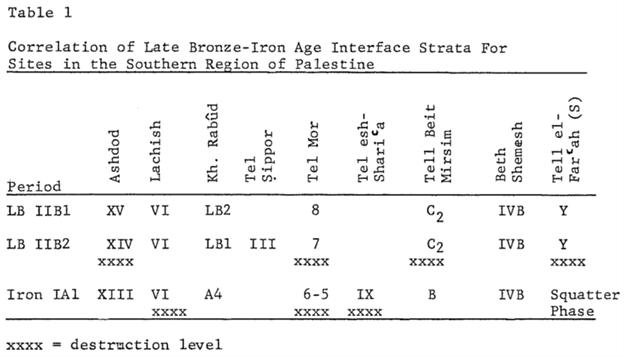
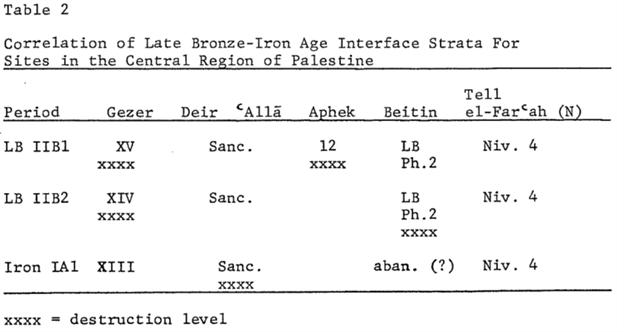
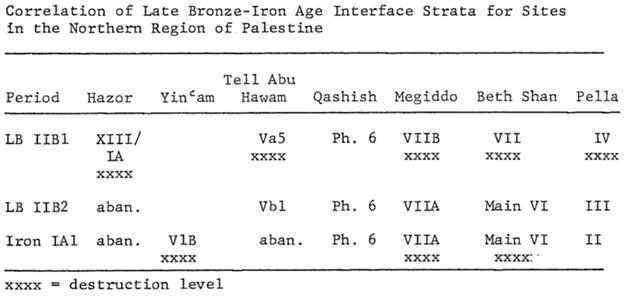
These destructions occur at the end of the LB IIB1 period, the end of the LB IIB2 period and the end of the Iron IA1 period. By studying the spatial distribution of these destructions, together with the available inscriptional data, it is possible to assign accurate dates and possible
causative agents to these destructions (Wood 1985:335-68; 558-92).
The End of the LB IIB1 Period
Aphek. Most of the sites destroyed at the end of the LB IIB1 period are located in the north. The decisive evidence for dating this horizon comes from Aphek. In a Stratum 12 building, probably an Egyptian garrison, a cuneiform tablet was found addressed to Haya, an Egyptian royal envoy, from Takuhlinu, governor of Ugarit (Singer 1983).
The political careers of both individuals are known from other sources, making it possible to date the tablet to the second half of the reign of Ramesses II, or ca. 1245-1212 B.C. A scarab of Ramesses II found in a trough at the entrance to the Str. 12 building and a scarab of Ramesses IV found in Str. 9, argue for a date around the end of the reign of Ramesses II for the destruction of Aphek Str. 12.
The Egyptian building at Aphek was destroyed in a violent conflagration brought about by military conflict as evidenced by numerous arrowheads found penetrating the southern facade of the building and the alley to the east. The most likely time for the overthrow of an Egyptian garrison would have been at the end of the reign of Ramesses II, when provincial control was at a low ebb. It seems reasonable to assume that the destruction of Aphek and other Palestinian sites at the end of the LB IIB1 period was caused by antiEgyptian forces, possibly coming from the north, at the end of the reign of Ramesses II, or possibly early in the reign of Merneptah. Sometime within his first four years, Merneptah carried out a campaign in Palestine. This was memorialized on the famous “Merneptah Stela” (Wilson 1969b:376-78). It is quite possible that this campaign was undertaken to counteract these hostilities and to reinforce Egyptian authority in the region.
Gezer. Merneptah claimed to have subdued four cities in his Palestinian campaign: Gaza, Ashkelon, Gezer and Yenocam. Of these, only
Gezer has so far been scientifically excavated. Evidence for a destruction was found at the end of the LB IIB1 period toward the end of the 13th century B.C. It is reasonable to assume in this case, then, that it was the Egyptians who were responsible for the destruction (Dever et al. 1971:128; Gezer 2:50; Dever 1976:439).5 If this scenario is the correct one, then the end of the LB IIB1 period can be dated quite accurately to ca. 1215-1210 B.C.
The majority of sites destroyed at the end of the LB IIB2 period are localized within the southwest coastal region. Four lines of evidence link these destructions with the Sea Peoples, who invaded Palestine in the reign of Ramesses III:
1. Spatial distribution. The destroyed sites are located within, or adjacent to, the geographical area known from biblical sources to have been occupied by the Philistines.
2. Chronological position. The destruction levels come between the end of the LB IIB1 period in ca. 1215-1210 B.C. and the end of the Iron IA1 period which can be securely dated to ca. 1125 B.C. as we shall see shortly. Inscriptional data from Tell el-Farcah (S) and Haruvit indicate that the destructions probably came shortly after the time of Sethos II.
3. Pottery. In the case of Tell el-Farcah (S), Tell Beit Mirsim, Ashdod and Gezer, Aegean-style pottery appears in the next occupational phase following the destruction.
4. Architectural tradition. New structures laid out along entirely different lines, or squatter occupation, following the destructions at Tell el-Farcah (S), Ashdod and Gezer suggest the arrival of newcomers at these sites.
Tell el-Farcah (S). The date for the end of the LB IIB2 period at Tell el-Farcah (S) can be fixed quite precisely. There, a pithos
fragment bearing the cartouches of Sethos II was found. A similar pair of cartouches was found on an in-situ pithos in the Egyptian fortress at Haruvit in the northern Sinai (Goldwasser1980) which was similarly destroyed at the end of the LB IIB2 period. The Tell el-Farcah (S)pithos fragment was found on a cobbled entrance court outside a large building, Building YR, which was probably an Egyptian administrative center (Beth Palet 1:18; Beth Palet 2:28-29,30). Following the violent destruction of Building YR, squatters occupied the entrance court and the ruined building. The pottery used by the squatters, some of it Aegean in style, can be dated to the mid-twelfth century B.C. (Wood 1985: 46065).
The pithos fragment is most likely associated with the life of the Egyptian administrative center, rather than the squatter phase which followed. This being the case, then, the destruction of Building YR occurred after the time of Sethos II, who ruled from 1191-1185 B.C., and before the squatter occupation of the mid-twelfth century B.C. The most probable candidate for the agent of the destruction of Building YR and other sites destroyed at the end of the LB IIB2 period is therefore the Sea Peoples.
Ramesses III fought against the Sea Peoples in Palestine in his eighth year, ca. 1165 B.C. The battle is described in great detail with pictorial reliefs and written texts on the walls of his mortuary temple at Medinet Habu near Luxor. He claims to have won a great victory, but the fact that the Sea Peoples destroyed many cities and settled in some of the prime real estate of the country leaves a large question mark over his boasts. They came by land and sea, with Egypt apparently as their goal. Their advance along the eastern Mediterranean coast is vividly described in the texts (Wilson 1969a:262).
Ramesses III was able to check their advance, but at great cost to Egypt. The Sea Peoples were able to settle along the south west
coast of Palestine and, in the process, took over Gaza, the Egyptian administrative center for all of Palestine, gained control of the terminus of “The Ways of Horus,” the major land route into the region from Egypt, secured the coastal harbors which in effect gave them control of the adjacent sea lanes, and acquired some of the best agricultural land in the country.
Thus, the archaeological and historical data combine to suggest that the Sea Peoples made a forced entrance into Palestine at the end of the LB IIB2 period and that this event can be dated to the eighth year of Ramesses III in ca. 1165 B.C.
There has been a considerable difference of opinion as to how to define the end of the Late Bronze Age and the beginning of the Iron Age in Palestine. As we have seen, there is no break in the ceramic repertoire that would constitute a line of demarcation. In my analysis, I have chosen to define the beginning of the Iron Age as the point in time when the Sea Peoples arrived in Palestine. This makes a convenient dividing line for a number of reasons.
Politically, the Philistines were the major power in Palestine during much of the Iron I period. Therefore, their initial entry into the land may be viewed as the beginning of a new era. Archaeologically, there are a number of common elements which appear in the archaeological record at this time over a large part of the country:
1. A number of sites along, and adjacent to, the coastal region suffered a violent destruction at this time.
2. At sites settled by the Sea Peoples, the previous architectural tradition suddenly comes to an end, and a new one begins which is totally unrelated to what was there before.
3. Locally-made versions of ceramic forms common to the Aegean and Philistine painted ware begin at this time.
4. Aegean imports cease just prior to this event, so Aegean
imports, except for heirlooms, are absent from the archaeological record from this time forward.
Sites destroyed at the end of the Iron IA1 period are either Egyptian centers (Tell esh-Sharica, Lachish, Tel Mer, Megiddo and Beth Shan) or are located in the Jordan Valley (Deir cAlla and Yincam). These destructions, and thus the end of the Iron IA1 period, can be securely dated by a number of inscriptional finds.
Tell esh-Sharica One of the most important of these finds comes from Tell esh-Sharica in the Negev. In a large building complex in Str. IX four complete bowls and a number of ostraca were found inscribed with Egyptian hieratic of the late New Kingdom. One of the inscriptions bears a date of “regnal year 22 + x,” where x is of uncertain value (Goldwasser 1984:77-80). Paleographic, historic and stratigraphic considerations require that this regnal date fall in the reign of Ramesses III, i.e., between his 22nd and 33rd years, or ca. 1152-1141 B.C. Tell esh-Sharica Str. IX and the Iron IA1 period therefore terminated at the end of the reign of Ramesses III or shortly thereafter. This is supported by corroborative evidence from Lachish, Megiddo, Beth Shan and Deir cAlla.
Lachish. A number of hieratic inscriptions similar to those from Tell esh-Sharica as well as a scarab of Ramesses III, have been found at Lachish. Unfortunately, these finds come from unstratified contexts. One of the inscriptions, found recently by the Tel Aviv University expedition, bears a regnal year between 10 and 19 (Gilula 1976:107; Ussishkin 1978:22). This discovery undermines Albright’s argument for dating the conquest to ca. 1205 B.C. based on the “year four” hieratic inscription found earlier at Lachish.
In 1978 a probe was made beneath the Level IV inner city gate. Beneath the gate, the destruction debris of Level VI, the level contemporary with Tell esh-Sharica Str. IX and other strata of the Iron IA1
period, was encountered. Sealed in this debris was a group of bronze objects, one of which bears a cartouche of Ramesses III (Giveon 1983).
Beth Shan. At Beth Shan, two Egyptian-style buildings and a number of hieroglyphic inscriptions were found in Main Level VI. One of these inscriptions is a limestone lintel bearing the cartouches of Ramesses III (Ward 1966:167-68).
Megiddo. At Megiddo, a cache of ivories was found in the basement of a building in Str. VIIA. Among them was a pen case bearing the cartouches of Ramesses III (Wilson 1939). A scarab with the name of Ramesses III was also found in Str. VIIA (Megiddo 2:154, L. 1814).
These data indicate that the Iron IA1 period ended at the end of the reign of Ramesses III or perhaps a little later. A date of ca. 1135-1125 B.C. cannot be far from wrong. The destructions of Egyptian centers at this time were no doubt related to the final withdrawal of the Egyptians from their northern province and are possibly the work of the Philistines, the next major power in the area.
Deir cAlla. The small sites of Deir cAlla and Yincam also suffered destructions at the end of the Iron IA1 period. At Deir cAlla, the excavators found evidence that the destruction was caused by an earthquake. Thus, it is possible that Deir cAlla and Yincam, both located in the rift valley fault, may have been victims of an earthquake at this time. Dating evidence in the form of an inscribed vase was found at Deir cAlla. It was discovered in the ruins of the final sanctuary and bears the cartouche of Queen Tewosret, who ruled from ca. 1184-1175 B.C. In addition, a carbon-14 date for a roof beam of the sanctuary gave a reading of 1180 +60 B.C. These data again support a date in the third quarter of the twelfth century B.C. for the end of the Iron IA1 period.
When the archaeological, epigraphic and historical data are properly synchronized, the Late Bronze-Iron Age transitional period emerges as one of the best-dated periods in the entire pre-Roman era.
The array of mutually reinforcing chronological data lends credence to the absolute dates assigned to the LB IIB1, LB IIB2 and Iron IA1 ceramic horizons (table 4). These dates cannot be far off because of the restrictions imposed by stratigraphic and epigraphic requirements.
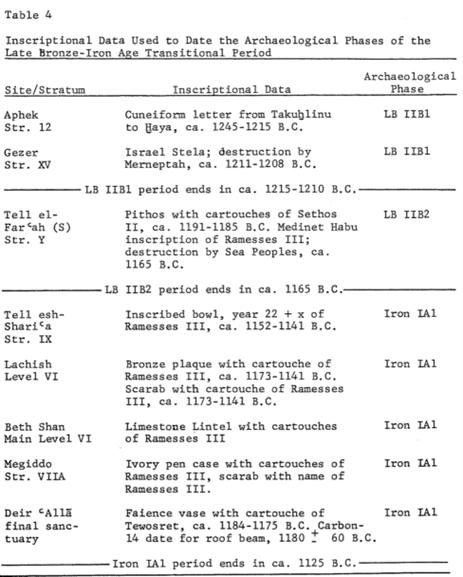
Once the destruction levels of the Late Bronze-Iron Age transitional period are accurately dated (table 5), the evidence for a
13th century conquest largely disappears. The major sites appealed to for support of this theory are Beitin, Tell Beit Mirsim, Lachish and Hazor. For the theory to be valid, the destruction levels of these sites would have to date to ca. 1215 B.C. or earlier, since the Israelites were already in Palestine at the time of Merneptah’s campaign in ca. 1210 B.C. The destructions of the Late Bronze Age cities at Beitin and Tell Beit Mirsim occurred at the end of the LB IIB2 period, which, as we have seen, dates to ca. 1165 B.C. some 45 years after Merneptah’s campaign. Lachish Stratum VI, on the other hand, did not come to an end until the Iron IA1 period in ca. 1125 B.C. These three sites, then, do not provide evidence to support a 13th century B.C. conquest by the Israelites.
We do, however, have seven sites which were destroyed at the end of the LB IIB1 period in the time of Merneptah, ca. 1215 B.C.: Gezer, Aphek, Pella, Beth Shan, Megiddo, Tell Abu Hawam and Hazor. Five of these sites are specifically mentioned in the Old Testament in connection with the conquest: Gezer, Aphek, Beth Shan, Megiddo and Hazor. Pella is not mentioned at all in the Old Testament and the ancient name of Tell Abu Hawam is not known. Of the five, four are singled out in the biblical narrative as cities that the Israelites could not conquer: Gezer (Joshua 16:10; Judges 1:29), Aphek (Judges 1:31), Beth Shan and Megiddo (Joshua 17:11-12; Judges 1:27). The Israelites, then, can hardly be held responsible for the destructions that occurred at the end of the LB IIB1 period.
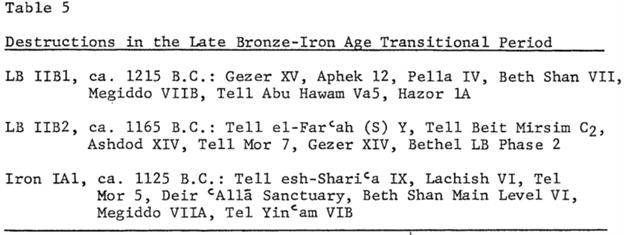
Before concluding this discussion on the archaeological evidence for a 13th century B.C. conquest, I would like to make a few comments about the Merneptah Stela, a document whose significance has not been fully recognized by most scholars. We have used the inscription to date the end of the LB IIB1 period. It records a campaign into Palestine by Merneptah at that time and, more specifically, mentions Gezer, which has a destruction layer dating to the time of Merneptah, as a city that was captured by this pharaoh. The stela is also important for another reason. It is the only extra-biblical reference to Israel in the preMonarchic period and therefore deserves special attention.
The Merneptah Stela is, after all, a religious hymn and it must be recognized as such. Its only purpose was to aggrandize the victories of the pharaoh. It matters little whether the Israelites were a settled or nomadic people at this time, or even if Merneptah actually carried out a campaign in Palestine. What is important for our purpose is the Egyptian scribe’s perception of Israel. We may first observe that by ca. 1210 B.C. Israel was a recognized entity, known by name to Egyptian authorities. Secondly, it can be concluded that the entity known as Israel was a major force in Palestine at this time (Albright 1939:22; Stager 1985:61*). She is mentioned in preference to the Shasu, the cApiru, or any other group that might have been present in the area. Merneptah would have gained little in prestige if he was portrayed as having subjugated an insignificant or unknown people.
There are two groupings of names in Merneptah’s inscription. The first is a group of four city-states: The Canaan, the Egyptian term for Gaza (Katzenstein 1982:112), Ashkelon, Gezer and Yenocam. Just before and after the city-state names are the names of larger national entities. It is in this latter group that the name Israel appears (Ahlstrom and Edelman 1985). Note the company that Israel is keeping: Tehenu, which is
Libya; Hatti, eastern Asia Minor and Northern Syria; and Kharu, a general designation for Syria-Palestine. In other words, Israel is listed with the major nations of the eastern Mediterranean, in parallel with the Hittites!
By ca. 1210 B.C., then, Israel was a fledgling nation with a measure of international standing.
The major point to be made here is that the processes that took place in bringing Israel to nationhood must have transpired long before the time of Merneptah in order for her to have achieved this status by 1210 B.C. Apart from the archaeological evidence, the Merneptah Stela alone indicates that the destructions which occurred in Palestine around the time of Merneptah or later, have nothing to do with the initial appearance of the Israelites in Palestine.
In summary, it is apparent that the archaeological data do not support a conquest of Palestine by the Israelites in the late 13th century B.C. The destructions that occurred in the Late Bronze-Iron Age transitional period can now be seen as part of a larger process that was taking place all around the eastern Mediterranean basin. The underlying causes are not yet under stood, but the end results are clear. The citystates, which were the dominant socio-political organization throughout much of the Bronze Age, became progressively weaker, until they reached a stage where they could no longer maintain themselves. Since Egypt depended upon the city-states to support her forces in Palestine, as the city-states became weaker, so did Egypt’s hold on her northern province. One-by-one the city-states fell; some were destroyed, others were not. In a weakened condition, they may have succumbed to attack by outsiders, revolts from within, or simply been abandoned when the citizens could no longer eke out a living. The collapse of the city-states eventually forced Egypt to withdraw from the area.
The factors at work in causing a weakening of the city-states
resulted in a major reorientation of the socio-economic system throughout the region. Rather than being concentrated at large citystates, the populace was now decentralized in small agricultural villages. These villages were dispersed across the landscape and had a much poorer material culture than the former city-states. This process took place all over the Levant and cannot be explained simply by the arrival of new people or the blossoming of indigenous groups. The changes were a result of economic conditions which were imposed upon the entire eastern Mediterranean littoral.
The destructions that took place in Palestine during the Late Bronze-Iron Age transitional period can no longer be associated with an Israelite conquest. Furthermore, based on historical and archaeological evidence, the 13th century B.C. must be abandoned altogether as a potential timeframe for the emergence of Israel in Palestine. We must look to earlier periods for evidence of this remarkable event.
Footnotes
1. For further discussion and references, see Bimson 1981:4347.
2. The dates used in this paper are based on the Egyptian low chronology of Wente and Van Siclen (1977).
3. Some regional variation may be noted, as well, in the pottery of this period.
4. Abbreviations used for excavation reports cited in this paper are listed alphabetically in the bibliography.
5. One of Merneptah’s epithets was “smiter of Gezer” (see Stager 1985:56* and 62* n. 2 for further discussion and references).
Bibliography
Ahlstrom, G. W. and Edelman, D.
1985 Merneptah’s Israel. Journal of Near Eastern Studies 44:59-61. Albright, W. F.
1935 Archaeology and the Date of the Hebrew Conquest of Palestine. Bulletin of the American Schools of Oriental Research 58:10-18.
1937 Further Light on the History of Israel from Lachish and Megiddo. Bulletin of the American Schools of Oriental Research 68:22-26.
1939 The Israelite Conquest of Canaan in the Light of Archaeology. Bulletin of the American Schools of Oriental Research 74:11-23.
1963 The Biblical Period from Abraham to Ezra. New York: Harper & Row.
Amiran, R.
1969
Ancient Pottery of the Holy Land: From Its Beginning in the Neolithic Period to the End of the Iron Age. Trans. From 1963 Heb. ed. Jerusalem: Masada.
Asaro, F. Perlman, I and Dothan, M.
1971 An Introductory Study of Mycenaean IIIC1 Ware From Tel Ashdod. Archaeometry 13:169-75.
Beth Pelet 1 Beth-Pelet 1 (Tell Fara), by W. M. F. Petrie. British School of Archaeology in Egypt Publication 48. London: British School of Archaeology in Egypt, 1930.
Beth Pelet 2
Beth Pelet Cemetery by J. L. Starkey and Lancaster Harding. Pp. 22-32 in Beth-Pelet 2. British School of Archaeology in Egypt Publication 52. London: British School of Archaeology in Egypt, 1932.
Bimson, J. J.
1981 Redating the Exodus and Conquest. Sheffield, England: Almond.
Dever, W. G.
1976 Gezer, Pp. 428-43 in Encyclopedia of Archaeological Excavations in the Holy Land, Vol. 2, ed. M. Avi-Yonah. Englewood Cliffs NJ: Prentice-Hall.
Furumark, A.
1941 The Mycenaean Pottery: Analysis and Classification. Stockholm: Kungl. Vitterhets Historie Och Antikvitets Akademien.
1972 Mycenaean Pottery 2: Chronology. Stockholm: Skrifter Utgivna Av Svenska Institutet I Athen. Gezer 2 Gezer 2: Report of the 1967-70 Seasons in Fields I and II, by W. G. Dever, et al. Jerusalem: Hebrew Union College/Nelson Glueck School of Biblical Archaeology, 1974.
Gilula, M.
1976 An Inscription in Egyptian Hieratic From Lachish. Tel Aviv 3:107-8.
Gittlen, B. M.
1977 Studies in the Late Cypriote Pottery Found in Palestine. Ph.D. dissertation, University of Pennsylvania. Ann Arbor MI: University Microfilms.
Giveon, R.
1983 An Inscription of Ramesses III from Lachish. Tel Aviv 10:176-77.
Goldwasser, O.
1980 An Egyptian store-jar from Haruvit. Qadmoniot 13:34 (Heb.).
1984 Hieratic Inscriptions From Tel Serc in Southern Canaan. Tel Aviv 11:77-93.
Katzenstein, H. J.
1982 Gaza in the Egyptian Texts of the New Kingdom. Journal of the American Oriental Society 102:111-13.
Lapp, P. W.
1967 The Conquest of Palestine in the Light of Archaeology. Concordia Theological Monthly 38:283-300.
Leonard, A., Jr.
1981 Considerations of Morphological Variations in the Mycenaean Pottery From the Southeastern Mediterranean. Bulletin of the American Schools of Oriental Research 241:87-101.
Malamat, A.
1971 The Egyptian Decline in Canaan and the Sea-Peoples. Pp. 23-38 in World History of the Jewish People Vol. 3: Judges, ed. B. Mazar. London: W. H. Allen.
Megiddo 2 Megiddo 2: Seasons of 1935-39, by G. Loud. Oriental Institute Publication 62. Chicago: University of Chicago Press, 1948.
Singer, I.
1983 Takuhlinu and Haya: Two Governors in the Ugarit Letter From Tel Aphek. Tel Aviv 10:3-25.
Stager, L. E.
1985 Merneptah, Israel and Sea-Peoples: New Light on an Old Relief. Eretz Israel 18:56*-64*.
Ussishkin, D.
1978 Excavations at Tel Lachish – 1973-1977: Preliminary Report. Tel Aviv 5:1-97.
Ward, W. A.
1966 The Egyptian Inscriptions of Level VI. Pp. 161-79 in The Iron Age at Beth Shan: A Study of Levels VI-IV, by F. James. Philadelphia: University of Pennsylvania.
Wente, E. F. and Van Siclen III, C. C.
1977 A Chronology of the New Kingdom. Pp. 217-61 in Studies in Honor of George Hughes, January 2, 1977, ed. J. H. Johnson and E. F. Wente. Studies in Ancient Oriental Civilization 39. Chicago: The Oriental Institute of the University of Chicago.
Wilson, J. A.
1939 Hieroglyphic Inscriptions. Pp. 11-13 in The Megiddo Ivories, by G. Loud. Oriental Institute Publication 52. Chicago: University of Chicago Press.
1969a Egyptian Historical Texts. Pp. 227-64 in Ancient Near Eastern Texts Relating to the Old Testament, Third Ed. With Supplement, ed. J. B. Pritchard. Princeton NJ: Princeton University Press.
1969b Egyptian Hymns and Prayers. Pp. 365-81 in Ancient Near Eastern Texts Relating to the Old Testament, Third
Wood, B. G.
Ed. With Supplement, ed. J. B. Pritchard. Princeton NJ: Princeton University Press.
1985 Palestinian Pottery of the Late Bronze Age: An Investigation of the Terminal LB IIB Phase. Ph.D. dissertation, University of Toronto. Ann Arbor MI: University Microfilms.
Yadin, Y.
1975 Hazor: The Rediscovery of a Great Citadel of the Bible New York: Random House.
Director of Center for Ebla Research, New York University. Ph.D., University of Pennsylvania. Reseach includes Glyptic Art and Classical Egypto-Semitic Relations and History of Antiquity. Archaeological expiditions to Mesopotamia, Judea, Jordan and Egypt. Author of Forgotten Scripts; Evidence for the Minoan Language; The Common Background of Greek and Hebrew Civilization; Ugarit and Minoan Crete.
By Cyrus H. Gordon
New York University
The Mediterranean has so many natural advantages, that it attracted enterprising people from several directions. The process is rooted in prehistory, but we may start our survey with the dawn of written records about 3000 B. C.
Early Sumerian conquerors reached the East Mediterranean deep in the third millennium.1 That Mesopotamian influence had penetrated Egypt by the First Dynasty is reflected in the appearance of seal cylinders at that time in the Nile Valley.2 The influence of Semites in the formation of Egyptian culture is also abundantly attested. Thus, in the repertoire of Egyptian hieroglyphs, one of the eye-signs3 has the phonetic value cn = the Semitic noun cayn “eye” in Arabic, Hebrew, Aramaic, Akkadian, etc. However, this word for “eye” is not used in Egyptian. The designers of hieroglyphic writing thus felt free to draw on Semitic even when the elements in question are not attested in Egyptian. Another illustration is provided by the alphabetic hand-sign to express
the consonant d. Egyptologists have drawn the correct conclusion that this is associated with Semitic yad “hand” familiar from Arabic and Hebrew.4 However, the form of this Semitic word cannot be yad, but must begin with d in accordance with the acrophonic principle. The form in question is the shorter uniconsonantal d- “hand” as preserved in Arabic la-dā- “at the hands of --, before”; with pronominal suffix la-day-ka “before thee”. Similarly, Ugaritic bd “in the hand(s) of--” and the Canaanite Amarna gloss ba-di-ú “in his hand”.5
Since such elements presuppose a Semitic milieu, it is likely that the system of hieroglyphs was invented in Lower Egypt, which was penetrated by Semites more often, and to a greater extent, than Upper Egypt. Memphis, the natural centrally located capital of the United Kingdom of Upper and Lower Egypt, is the most probable place of origin.6
The direction in which elements were borrowed will vary from case to case. Cuneiform writing in Egypt must have been imported ultimately from Mesopotamia. But other elements might move in other directions. An example of an Egyptian feature that may have moved into the cuneiform sphere in Syria came to light in my Egypto-Semitic seminar at N. Y. U. in January 1987. We were discussing the lore about a widely feared demon called Ḥabḥaby7 in the Ebla tablets (23rd century) and Ḥaby in Ugaritic8 (ca. 1300 B.C.) and in Isaiah 26:20 (clear in the Hebrew but lost in the translation). In Ugaritic he is described as ḥby bcl qrnm w ḏnb. “Ḥaby, possessor of horns and a tail” = our iconography of Satan. The Ebla tablets9 attribute to him the horns of the moon and the tails of the sun: a double merism signifying overwhelming power, for horns and tail, as well as sun and moon, are opposites denoting totality. Miss Sharon Keller, a doctoral candidate in the seminar, pointed out that Seth, the Egyptian god of evil, has horns and tails. His tail is forked so that it has two parts at the far end.10
It should be noted that the several Ebla incantations refer both to the demon’s tail,11 and to his tails.12 The discrepancy can now be explained: a tail forked at the end can be considered either “one” or “two” depending on which part of the tail is being considered. In any case, Egyptian Seth, with horns and tail(s), antedates the earliest Asiatic reference to Ḥaby/Ḥabḥaby with horns and tail(s); namely, the cuneiform tablets from Ebla around 2300 B.C., and from Ugarit around 1300 B.C.13
Our iconography of Satan with horns and tail has, accordingly, a long recorded history, going back at least to the time of the hieroglyphic system of writing ca. 3000 B.C., for that system includes the Sethanimal14 with horns and forked tail.
The foregoing illustration of an ancient Egyptian concept emanating to East Mediterranean areas beyond the Nile Valley is specific and graphic. Other examples, though also striking and specific, might alternatively be attributed to parallel and independent development, rather than diffusion. Thus, while we in the modern West think of man’s soul as a unit, the Egyptians reckoned with multiple souls. Man’s ba, and ka are represented differently, and are not interchangeable. The ba, in the form of a bird with the head of the person concerned, imparts the power of locomotion, while the ka is defined as our “individual personality” divinely fashioned on the potter’s wheel by the god Khnum. Similarly Hebrew assigns to everyone not only a nefeš which resides in the blood and controls desire as well as contains the life of every man and beast; but also a rûaḥ “wind, breath” which resides in the respiratory tract, and which God breathes into our nostrils to animate the divinely shaped sculpture of clay. Nefeš and rûaḥ are not interchangeable. Desire (for food, drink, sex, etc.) is always a function of nefeš, never of rûaḥ. l5
In Aristotle’s De Anima (the Greek title is Peri Psychês
“Concerning the Soul”), the soul is multiple with “different souls” (sometimes four, sometimes six) controlling different functions. The
concept of multiple souls is thus distributed among the following East Mediterranean countries: Egypt, Israel, and Greece. It may well turn up elsewhere in and around that region. (At Ugarit npš “soul” is paralleled by brlt in the poetry, where the two terms may well be synonyms.16) Multiple souls appear first in Egypt, making that country as of now, the best claimant to priority.
A considerable number of Egyptian words have been borrowed into Greek. The Hungarian linguist, Oswald Szemerényi, has stressed the fact that for future investigation of the Greek lexicon, scholars would do better to seek the origin of problematic Greek words in Semitic, Egyptian and Anatolian languages than in lndo-European. He then derives the Greek skhbída (a kind of ship) from Egyptian śkty. There are other nautical terms in Greek that appear earlier in Egyptian and Semitic. For instance, a kind of ship called the bâr-is appears in Egyptian group writing17 as b3yr and in Ugaritic as br. Greek gar (the almost untranslatable postpositive particle) is anticipated by the Egyptian postpositive gr, which appears also in Syriac as postpositive gēr. In all three languages it is unaccented and can never begin the sentence or phrase. A relationship between the Greek and Syriac has been generally recognized. The Syriac vocalization shows that it cannot be borrowed from the Greek. For gar would remain gar in Syriac, like the Syriac word bar “son (of---)”. The Greek and Syriac are best derived from the Egyptian, which also happens to be attested much earlier.
Linguistically it is hard to explain, but impossible to deny, the duals in Greek that go with Egypto-Semitic as well as simultaneously with Indo-European. The Greek dual suffix -ō is the same as the construct dual suffix in Canaanite -ō as in the Gezer Ca1endar.18 The oblique dual endings in Greek -oin/-ain go with Arabic -ayn, Aramaic -ayin, Hebrew -ayim. The rare dual of the first person attested in Old Egyptian and Ugaritic -ny survives in Homer as nôi “we two”.
The evidence at our disposal suggests that the Amarna Age was the culmination of Egypt’s integration into the ancient East Mediterranean Civilization. Pre-Amarna Egyptian literature already has ties with Greek and Hebrew epic. For example, Sinuhe (like the Odyssey) is the episodic tale of a hero who experiences all sorts of adventures climaxed by the nóstos “homecoming”. The story is set during the first two reigns of the Twelfth Dynasty and may go back to Middle Egyptian times, for the surviving copies of the Sinuhe tale are in the best Middle Egyptian without features of Late (= post-Amarna) Egyptian. In Hebrew literature, the theme may be applied to individuals but it is also extended to the People: Israel leaves its homeland and after long years of vicissitudes and slavery, followed by “forty years” of wandering in the wilderness, returns home. The prototype of this theme is the great classic of Akkadian literature, the Gilgamesh Epic, whose hero wanders far and wide, and after experiencing and suffering much, returns to his native city of Uruk. Odysseus, like Gilgamesh, returns to his native city (Ithaca) a wiser man.19
After the Amarna Age, Egypt transmitted a new set of traditions and motifs. The Late Egyptian tale of the Taking of Joppa (ca. 1200 B.C., which approximates the traditional Greek date of the fall of Troy; namely 1184 B.C.) by the ruse of sneaking soldiers concealed in huge baskets into Joppa, is essentially the motif of the Trojan Horse. And the tragedy of Oedipus, Jocasta and Laius is excerpted by Homer.20 The Egyptian background is evident despite the distortions that arose in transmitting Egyptian material to the Greeks. The two Thebes are an obvious association. The sphinx in the Riddle of the Sphinx is not quite the same as an original Egyptian sphinx, but the common denominator in the composite creature is there. Oedipus kills his own father and weds his own mother--albeit unwittingly. The close blood relationships in royal Egyptian marriage was unforgivable incest to the Greeks. Killing one’s
father was inherent in Akhenaton’s actual eradication of his father’s name which contained the execrated “Amon” (in “Amenophis”). The “name” was the identity or existence of the person. Sophocles has Oedipus killing his father in a more literal way, in keeping with Greek understanding. The very name “Oedipus” (“he of the swollen foot”) may hark back to the deformed body of Akhenaton with pathologically swollen thighs.
To the Late Egyptian stratum of influence is the “Joseph” motif of the virtuous youth, named Bata, who resists the advances of a lecherous woman. This first appears in the Late Egyptian Tale of the Two Brothers. It reechoes in Homer where it is transformed into the story of the “blameless Bellerophon”.21 In the Book of Genesis it is developed into the story of Joseph. All three (Bata, Bellerophon, and Joseph) suffer for their virtue, before being hailed as incorruptible paragons of virtue. Such really Late Egyptian material does not occur in the earlier literature of the ancient Near East, such as the Gilgamesh Epic. In the latter there are no counterparts of the Trojan Horse, Helen of Troy, or the incorruptible Joseph.
The Late Egyptian period, precipitated by Akhenaton’s revolution, is the age into which the Exodus best fits. Egypt is already called the Land of Ramses in Genesis (47:11), and the Hebrew slaves built the cities of Ramses and Pithom which cannot precede the Ramesside Age.
The long reign of Ramses II (ca. 1301-1234) is the earliest possible period of the Bondage, while the Exodus could be not only as late as the time of his successor Me(r)neptah/Mineptah (N.B. the “Spring of Mineptah” in the Hebrew of Joshua 15:9 arid 18:15), but more probably in the reign of Ramses III (ca. 1197-65) who warded off a great invasion of Sea Peoples who included Philistines and Denye(n) (= Danites?, represented as sea people in Judges 5:13). Dr. Gary Rendsburg of Cornell University will soon publish the evidence for placing the Exodus in the
reign of Ramses III. Meanwhile, let us remember that the independent chronologies of the fall of Troy (1184 B.C., according to ancient Greek tradition), of Hattusas, of Ugarit, Of Alalakh etc. all converge in the reign of Ramses III.
Messianic kingship is best known, in pre-Christian times, from Isaiah. The basic idea is that after the disintegration of society, the Golden Age will be inaugurated under a divinely chosen king of an ancient, destined line (= the Davidic, in the Old Testament) in fulfilment of prophecy. The concept is first attested in Egypt where a prophet predicts corruption, invasion and misery in the Nile Valley. But, when things are at their lowest ebb, a goodly king, Amen (= Amenemhet I, the founder of the Twelfth Dynasty) will arrive and usher in the Golden Age in accordance with the pristine divine order.22 While the Messianic doctrine, as far as our evidence goes, originated in Egypt, it spread to Israel eventually to reach its height in Christianity. But in the meantime, it had become an integral part of pagan Roman ideology.23
Shortly before the birth of Christ, Vergil (d. 19 B.C.) composed and lived almost to complete the official epic of Rome: The Aeneid.
The Golden Age was to be inaugurated by Augustus Caesar, heir to the throne as scion of the proper ancient line as predicted of old. Vergil’s Fourth Eclogue has been called ‘’Messianic” for good reason. It describes the Golden Age ushered in, in terms that anticipate the Gospels; complete with the Madonna and Child and other startling details. Probably the Messianic concept was introduced to Rome more by the Jews residing in Italy and other Roman provinces than by any direct influences from pagan Egypt, which was indeed an important province of the Roman Empire.
The Messianic doctrine imbedded in the official epic of Rome shows that it was not only the Jews who were familiar with the idea at the dawn of the Christian Era. Pagan Romans were also exposed to the
doctrine, and in their national Epic were told that the heir of a royal line would be born to establish peace on earth in fulfilment of prophecy. As history was to prove, the more likely candidate, the Roman Emperor Augustus Caesar, was not to stick as the Messianic hope of mankind; but rather the then less likely Jesus of Nazareth, King of the Jews. The success of Christianity was aided by the fact that Messianic hope had become a vital part of Mediterranean Civilization: Imperial Roman as well as Jewish. But that hope owed its ultimate origin to Pharaonic Egypt of the second millennium B.C.
1 Around 2350 B. C., Lugalzaggisi, the ruler of Umma and Uruk, conquered an ephemeral empire that reached the Mediterranean. He succumbed to Sargon of Akkad. Several generations before Lugalzaggisi, Lugal-anne-mundu of Adab carved out an empire up to the Mediterranean. The evidence for these two Sumerian conquests is varied. Lugalzaggisi’s is more ancient and generally accepted; Lugalanne-mundu’s is a tradition recorded centuries later, but whose historic kernal should not be disregarded.
2 The seal cylinder is a characteristic artifact of Sumero-Akkadian culture. Many museums have specimens of Egyptian seal cylinders; e.g., the museum on Elephantine. It is designed for continuous rolling (not originally for authenticating clay tablets). The cylinder seal is ideal for sealing large jar stoppers and even for sealing the four sides of doors of chambers in which entrusted goods were stored.
3 Sign D-7 (A. Gardiner, Egyptian Grammar, 3rd ed., 1957. P. 451).
4 Sign D-46 (Gardiner, op. cit. p. 455).
5 Akkadian ina qâtiti-šú= Canaanite ba-di-ú “in his hand” in Amarna tablet 245:35
6 In the Fayyumic dialect of Coptic (in Middle Egypt not very far from Memphis), r frequently shifts to l, so that rōme “person”, ran “name”, šēre “son”, etc. appear as lōme, lan, šēli, etc. Inasmuch as the falling together of r and l typifies the hieroglyphic system, the phenomenon in Fayyumic supports the “Memphite” (qua Middle Egypt) origin of the system.
7 Published by D. O. Edzard, Hymnen, Beschwörungen und Verwandtes, Archivi Reali di Ebla. Testi – V. Rome: Missione Archeologica Italiana in Siria, 1984. In text 1: 1:2, the reduplicated name is spelled ḫaba-ḫa-bi in accordance with the orthography that generally calls for open syllables (thus concealing the presence of closed syllables).
8 C. H. Gordon, “Poetic Legends and Myths from Ugarit”, Berytus XXV, 1977, pp. 5-133: see p. 127.
9 Texts l:III; 8-12; 4:III:1-6.
10 See sign E-20 (in Gardiner).
11 Text 4:III:2 has the singular zi-ne-éb-ti “tail”.
12 Text l:III:8 has the plural zi-na-ba-t[i] “tails”.
13 Some consider Seth to be of Asiatic origin. However, his name is entirely different from Ḥab(ḥab)y. It is interesting to note that the article in Hebrew (has-sātan “The Satan) and Greek (ho diábolos “The Devil”)
suggests that both terms are euphemistic epithets, designed to avoid pronouncing the real name of the dreaded Ḥab(ḥab)y.
14 The Seth-animal should not be sought in nature. It is mythological.
15 C. H. Gordon, The Common Background of Greek and Hebrew Civilizations, New York: Norton, 1965, pp. 153, 274.
16 C. H. Gordon, Ugaritic Textbook, Rome: Pontifical Biblical Institute, 1967, p. 376, §19.520.
17 Group writing (otherwise called syllabic orthography) is a pleonastic type of spelling often used for foreign names and loanwords, but sometimes also for native Egyptian words. Professor William A. Ward, of the American University of Beirut, is preparing a comprehensive monograph on group writing.
18 The Gezer Calendar (in Hebrew of the 10th century B.C.) writes yrh for “a month”, but yrhw (= yarḥo) for “two months (of --)”. See Donner and Röllig, Kanaanäische und aramäische Inschriften, Wiesbaden: Harrasowitz, vol I, 1962, p. 35. text 182.
19 The interplay among the literatures of Egypt, Mesopotamia, Ugarit, Israel and Greece is documented in Gordon, Common Background-- .
20 Odyssey 11:271-280.
21 Iliad 6:155-220.
22 The two well-known prophets of ancient Egypt are Ipu-wer and Nefer-ti (translated in J. B. Pritchard, Ancient Near Eastern Texts, 3rd ed., Princeton: Princeton University Press, 1969, pp. 441-446. See Nefer-ti on p. 445 for the reference to Ameni. On p. 446 the savior is called s3 s “son of man”, which, as Professor Allen Jones of Hilton Head, South Carolina rightly observes (in a personal communication), anticipates the special use of “The Son of Man” in the Bible.
23 Treated in detail by Gordon, “Vergil and the Near East”, Ugaritica VI, Paris: Geuthner, 1969, pp. 267-288; note especially pp. 271-278.
The following two “articles”—presentations—from the Exodus Symposium derive from tapes (highly uneven in quality and physical condition) of a “Summary Session” with Drs. Richard Melick, Hans Goedicke, J. Maxwell Miller, and John Bimson, and a concluding talk from Dr. Edwin Yamauchi. The editorial staff of The Journal have attempted to produce a transcription as sedulously and precisely as possible given the drawbacks of antique audiotapes and the accents and pronunciations of the participants. Any mistake that a reader or listener discerns lies with the inadequacies of the Editor.
Richard Melick:
I guess that means we’re ready to vote, since that’s the American way. And I gather that we have put together some representatives of diverse viewpoints and it’s an opportunity for each of them to present in short form some of their summation responses, that kind of thing, and to be able to dialogue a little bit with each other.
I’ll be here just to add a fourth dimension to it, and I don’t know exactly what that is, but it seems to me that a good place to start would be to ask each of these men the question of the hour, who was the pharaoh of the Exodus? And that will let us know right away where we are on things, and be able to have some discussion, of course, in a little bit you will be able to ask some questions of these men and all of the speakers as we have our final critique.
Dr. Hans Goedicke presented a paper to this effect. Seems like it was last night, but it was Thursday night. And so, the other two men have not had the opportunity to address this directly, but Dr. Goedicke, can you just answer upfront and straightforward, who do you think was the pharaoh?
Hans Goedicke:
If you put it in so few words, the answer is very simple, and I have given the answer two days ago. If you want one name, as far as I’m concerned, I came here with the idea that it is Hatshepsut and after nineteen lectures on the subject I have not changed my mind. Oh, I don’t think you expected me to do that either.
But the problem, of course, is that the answer is wanted only after really defining the question. I’m an Egyptologist, and I see the
question as a historian and not as an exercise to prove that the Bible is right, that the Bible is not right because either the Bible is the Bible, and then there’s no question if it is correct or not correct. What we have to do is, I think, define the question more clearly and then see if there is a method to answer it. But that, I think, should be done a little bit later.
Richard Melick:
We will have opportunity to address that, I think. Dr. Bimson?
John Bimson:
Well, I’ve always tried to avoid being specific, but If I can just . . . I’ve avoided being specific for two reasons partly because, although I do give weight to those biblical verses, Judges 11:26 and 1 Kings 6:1, I’ve always taken them as round figures rather than precise figures, and so I’ve always said the Exodus is somewhere in the middle decades of the 15th century BC without being more precise. I tend to go slightly earlier than 1450 rather than slightly later. And also, of course the Egyptian dates for the 18th dynasty tend to be moving up and down, though at the moment seem to be coming down. And the dates that you’ve got in the program approved by Dr. Kitchen for Thutmose III, are 1479 to, I think, 1425, and the earliest date you’ll find for him, I think, these days is 1504 to 1450 with another date in the middle of those beginning 1490.
So, with the Egyptian dates a bit fluid and with the biblical figures being round numbers, I’ve never wanted to be too precise about it, but, if you press, me I would say Thutmose III.
Richard Melick:
All right. Dr. Miller?
J. Maxwell Miller:
Well, I came particularly interested in seeing how the people that are advocating the late date would still advocate it in light of so many things that have happened since Albright. And how those who would advocate the earlier date would advocate that in light of other
developments as well. And I must say that both have convinced me.
The advocates of the early date have convinced me that the late date is impossible, and those of the late date have convinced me that the early date is impossible. Rather than coming up with what might be an obvious conclusion, let me tell a story that’s been coming through my mind all through this conference. It’s the usual story you’ve heard about the Sunday school teacher that gives a little boy the project to draw a picture of a Bible story. And he hands her back after a while, a blank sheet. She said, “what is this?” He says, “this is the Hebrew children exiting from Egypt.” She said, “well, where are they?” “Well, they’ve already passed on.” “Well, where’s the water?” “It’s all rolled back.” “Well, where’s the Pharaoh and the Army?” “He’ll be here any minute”, he said.
I think that one of the things that [a] historian has to be prepared to do is to say that sometimes we don’t know, and I do not think that the records we have available are such that allow us to begin a history of Israel by identifying a Pharaoh or even dating an exodus or conquest.
Richard Melick:
Thank you. I really was not trying to put each of these men on the spot, as I’m sure you know. But we have been dealing with some very complicated matters which may bring up another question, and each man will have an opportunity to give a more concentrated response. It seems to me we have at least presuppositions, methods, and evidences. And I’m interested in the question of methodology. And I wonder if we might have some address to that question of how you go about it and the methods. We’ve obviously heard different pieces of method put together, but can you make any comment about that? What’s important in terms of method of solving this problem? What’s important to each of you?
Hans Goedicke:
Since I’m obviously the first to answer that, let me start slowly.
The question is posed, “Who was the Pharaoh of the Exodus?”, is a specific question, and asks for a person who is supposed to have lived in the past. So, I have indicated in the opening of my paper, we have first to agree if we accept the Exodus as an historical event, and if it is accepted as an historical event, it has to be treated as history, and history is past life, and that means that all evidence has to fit together or arguments that are both false have to form one coherent picture.
We have heard, interestingly, arguments for a late date, we have heard arguments for an early date, both using exactly the same material because none of them seem to me, had approached the question in a holistic fashion. And the holistic fashion is, as in any other problem of life, it has to have an answer for the, the physical frame has to fit, the persons have to fit together, the historical events as far as they can be established for a specific period have to agree in order to come up with a meaningful explanation. Anything else remains too unsettled to be used as a basis for the second problem, and that is, once the point is established, then trying to understand what it is all about.
And in that connection, let me start out with a specific question in the methodology which has not come up in the whole meeting, and that is what kind of people are we are assuming? Everybody seemed to have started with an a priori, namely an ethnic entity, Israel. The question to me is, that according to the, should we say, the main source, the Bible itself, Israel, is first a religious and second an ethnic entity, to which it develops. The first mention of Israel itself, is the awarding of the name Israel, as you, I think you know better than I, at the Jabbok, after Jacob had a religious experience.
So, we have a single point at the beginning, and it is very difficult for me as a historian to suddenly invent an ethnic group and chase that through the Levant in one form or another . . . to cause . . . destruction levels here or there. And I must say I’ve excavated myself, and I want
to warn you, most of those destruction levels are tiny, tiny bits of large sherds, and I’m not always sure that they are really destruction levels, but that’s another point.
What I want to emphasize here is that history, and this is the question which I want to address here. History has to be seen in a holistic fashion, that means all features have to agree in order to be meaningful. And possibly once we succeed in reaching a certain degree of conformity, we might get to take the next step, maybe understand what has happened up to this point.
Richard Melick:
Dr. Bimson, any comments about methodology?
John Bimson:
I suppose, although I differ with Dr. Kitchen over the date of the Exodus, I share with him a good many of the convictions that he was defending so vigorously and entertainingly last night from this platform. And that is that the biblical accounts ought to be treated like many other ancient documents that we have, and that they should be assumed innocent until proved guilty, or in other words, assumed accurate until an overwhelming evidence forces us to go another way. And, so I suppose my starting point is with the Old Testament accounts of these events and I take them as a working hypothesis and test them against the available historical archaeological evidence, just to see how well they fit into the framework that we have. And I can’t really avoid talking about those chronological verses again, because if we’re talking about finding the correct historical background and testing the background to see how well the biblical account fits, then we are talking about knowing which historical background we’re looking at, whether it’s 13th century, 15th century or any other century. And I can’t really explain away to my own satisfaction and those two particular verses which both point to the 15th century BC. And so, the 15th century BC is my . . . is the place I go to first
to see whether I can find a suitable background to these events.
I perhaps ought to say a little bit more about that because Dr. Kitchen has accused, I don’t know whether it’s . . . whether I’m one of the people he’s got in mind, but he’s accused various people of ignoring what he wrote over twenty years ago and arguing that those figures need not be taken at face value. That is in his own words, they should be treated according to ancient oriental principles. Now this is an important point because I agree with him entirely. The Bible is not British or an American book, it has to be treated as an ancient Near Eastern document. And one of the points Dr. Kitchen wants to make from that, is that the ancient oriental principles he has in mind, are that periods which were in effect overlapping could be totaled in a way that suggested they were concurrent when they weren’t, and therefore 480 years need not mean 480, and 300 need not mean 300 years of elapsed time between one event and another.
Now, I think we can test those two figures against other pieces of other data in the Old Testament to see whether that principle applies or not. And there are two items important to me in this respect, and I’ve dealt with these both in my book, so I’ll just mention them briefly. 1) is the genealogy of Heman the singer in 1 Chronicles 6, where you’ll find eighteen or nineteen generations between the time of Joseph and the time of Solomon, and if you assume twenty-five years per generation you get at least 480 years out of that genealogy. Now this is the same sort of information that Dr. Kitchen himself uses to support the accuracy of the 430 years between . . . Sorry, the genealogy of Heman is from the Exodus to David. Dr. Kitchen uses similar data to support the accuracy of the 430 years between Joseph and the Exodus. And I think if it applies in one case, it applies in the other. And in this case we have a second thing against which to check the figure, and that is the verse in Judges 11:26, which gives 300 years between a date of around 1100 BC and the time
the Israelites arrived, which pushes that back to 1400. Forty years in the wilderness, takes you back again to the middle of the 15th century. And if those 300 years are also to be treated according to ancient Oriental principles, then it seems to me an amazing coincidence. In fact, I’d say an incredible coincidence that those figures both take us back to exactly the same point. So, although I do take Dr. Kitchen very seriously on this, it seems to me that the Bible itself gives us very good grounds for not disposing of the figures in the way that he suggests in order to put the Exodus in the 13th century BC.
So, the biblical account is my starting point and the biblical chronology is the starting point. And the task then is to test those events and that chronology against the background that’s implied. Dr. Kitchen has just arrived, I think, so he’s missed what I’ve just said, which is a terrible shame, and I’ll stop there.
Richard Melick:
Well, he can purchase the tape. Thank you. Dr. Miller, any comments on method? And then we’ll allow you to make some more comments in general.
J Maxwell Miller:
I think in the course of my paper I made a number of comments that had to do with method. Given the time, I ran past several of them. Many of them [are] similar to Bimson’s comments here. One must carefully work with the text and look at the different manuscripts. One must carefully be attentive to whatever evidence is available. We’ve got the problems like names moving around that we’re uncertain on and so forth. So, historical activity becomes a matter of juggling lots of balls at once and using your best judgment. And it’s always going to be that. But I’m going to say that my primary interest in this conference has been trying to identify those basic, those gut, those theological, philosophical presuppositions that we begin, that we often maybe are even unaware
that we have up front, but they . . . they influence the way we juggle the evidence, the way we interpret it, and thus the conclusions at the other end. And, a number of you I’ve talked with, aside from the papers, I had an excellent conversation with Professor Waltke this morning, for example. And it’s as if there have been two conferences going on for me. So, some of you in the audience will know that we’ve talked about this matter.
Okay, I touched in my paper on one very serious matter here, it’s the question of the biblical reliability. It’s certain that this group primarily would be a group that begins with a great deal of confidence in the reliability of that biblical record. So much confidence that even if you don’t see how it fits, you’re sure that eventually archaeology will fit. And I tried to indicate that that is going to direct the way you deal with the evidence and come at the other end. Now, that’s not the only kind of hidden bias that’s going on in the contemporary biblical scholarship. And a lot of our conversations have been about what would be a corresponding, almost opposite bias that would be heavily functional in a group I addressed three weeks ago. One of the Society of Biblical Literature meetings on new directions in the study of Israelite history. Biblical infallibility is less crucial an issue for them. Much more important is one’s maintaining strict historical critical methodology. I’d like to read the paragraph that I addressed to that group:
“There’s the overriding problem that our modern historical critical methodologies presuppose a quite different understanding of historical reality than does the Hebrew Bible. Which in turn is our primary source of information about ancient Israel. The biblical writers shared with their contemporaries and with many people today, a very dynamic understanding of divine involvement in human history. In their view, God not only intrudes upon history from time to time, He actually determined
the course of ancient Israel’s history to the extent that her national heroes were hardly more than pawns in His hand. God’s activity in history was often expressed in supernatural ways obvious to the faithful and unfaithful alike, to the Egyptian as well as the Hebrew. Moreover, from the biblical point of view, it was precisely with these supernatural intrusions into history that God chose to reveal Himself to humankind. The modern historian’s methodology, on the other hand, allows only for a very distant and indirectly involved sort of God at the most. It is a non-negotiable assumption of this methodology, in other words, that anything historical can be explained without reference to overt divine intrusion. It seems to me, in fact, that the historical critical methodology would collapse altogether if the traditional Judeo-Christian understanding of God’s dynamic involvement in history were even taken as a possibility.”
What this means, then, is that we modern critical historians, while depending on the Bible for almost all of our direct information about ancient Israel constantly reconceptualized what the Bible reports so as to bring its historical claims into line with our late 20th century notions of historical reality. This is a translation process in which much is lost and much is added along the way. Moreover, there’s the insecurity of knowing that we ourselves are also located in history, and that our modern notions of critical objectivity are also historically relative. I present that as just another one of those hidden presuppositions, sometimes not so hidden, that is functional among biblical scholars today. And I would say further that if there is a polarization within camps of biblical scholars, pertaining to biblical history, it’s largely because these two presuppositions that I’ve talked about are at odds with each other. And I don’t quite know what to do about it. I’m certainly not going to advocate to you, and I did not to them, that we can simply brush aside
the matters of historical critical methodology. It’s not that simple either, at least I am not convinced that it is. But at least one step along the way may be trying to identify these presuppositions and knowing that they are there, and talking a little bit more across the aisle about them.
I’ve seen a poster . . . [that] has a modest proposal for peace. “Let all the Christians of the world agree not to kill each other.” A modest proposal for some advancement in the discussion of biblical history right now in biblical scholarship migh be, “Let those of us who hold quite different presuppositions recognize that they’re there, agree with that they are there, and then talk a little bit more about them.”
Richard Melick:
All right. Thank you. Now, I know each of you has more extended evaluation of what has happened during the course of the symposium. Perhaps moving to the evidences, it seems like we’ve been bombarded with evidences, and to some it may even seem like that we have had conflicting evidences, and some rely more heavily on one kind than another. Let’s just take a moment and let you share some things in general, whatever you would like to as you evaluate our proceedings. And let’s go to Dr. Goedicke again.
Hans Goedicke:
Let me start with Dr. Miller. I find that much in the approach is what I would call the second question asked first. And that is, what the meaning of the event might be in an overall plan. My concern, as I said earlier, I’m [an] Egyptologist, and my concern is first of all to establish the physical event, what is its meaning, is not up to me, and there are many people in this room who are better trained and better suited to explain it. In order to approach, in order to grasp, as much as can be grasped of this past event, which is, after all, at the core of our deliberations, it is methodologically necessary to get outside help as much as can be done.
Archaeology is one of the approaches, but it is also an approach which has limited value. You have seen long charts of pottery shapes, but does the pottery shape in that really indicate who used it, or does the shape of the pottery really tell us anything about the political events going on at any particular time? So I would say, while archaeology is of enormous help, it is not a tool to come up with the first answer, and I’m coming back again to what I’ve said in my paper, that is, we have to look if there are possible written, if there’s any written information available which pertains to an event, which can be equated with the biblical account and which is closer, which gives us a better understanding how the tradition, as contained in the book of Exodus, came about. I don’t think we can answer it by invoking or turning first to the meaning and then to the substance, I think still the process should be to establish first the event we are looking for and then we can find what its meaning is in a larger scale.
Richard Melick:
Okay, Dr. Bimson, any observation?
John Bimson:
I’ve forgotten what the question was.
Richard Melick:
The question basically was, say whatever you’d like us to hear regarding your evaluation of things. We have had presentation..., excellent presentations of many kinds of evidences.
John Bimson:
I think Dr. Goedicke is saying something...
Hans Goedicke: Could I add one more word?
Richard Melick: Yes, you may.
Hans Goedicke:
In the methodological question, as Dr. Bimson has pointed out before, there is a certain selectiveness in the use and that is something which makes me rather nervous, as you also have indicated, we either have to accept the available account in the Bible as totally true or you have to be extremely careful in using it selectively and then is, of course, the question, what basis can we use for that? And for that I come back to what I said earlier, namely we have to try to build a platform outside of the biblical tradition to evaluate, just as Dr. Bimson indicated before, to evaluate the validity of the biblical information as we have it.
Richard Melick: Dr. Bimson.
John Bimson:
I think we’ve seen at this conference how certain arguments or presuppositions have tended to become fossilized as facts and have become the basis for further arguments when they had no right to acquire that kind of authority. And we’ve seen some of those presuppositions being very carefully and very objectively, I think, dismantled at this conference, opening the way for new approaches and new investigations. Just to give two examples of that, which I found very fruitful. Firstly, Dr. Wood’s papers, both of them I think, have broken very new ground and those... all of us here have been very privileged to hear those papers because we’re now, I suspect, at least two years ahead of all the journals and so on. We’ve seen very careful examination of the supposed evidence for a 13th century conquest, and we’ve seen all the weaknesses of that exposed in a way that I don’t think I have seen in any, well, I’ve seen it done, but I haven’t seen it done with such precision and such detail before. Also, Dr. Mattingly’s paper on the Transjordan has exposed afresh, the weaknesses of Glueck’s theory of a gap in occupation, which was, which has for many years been one of the pillars of the 13th century date, evidence that supposedly
precludes a date any earlier than the 13th century for the Exodus and the wilderness wanderings. And although this material has been available for a good many years now, there are still scholars, quite reputable scholars, who either ignore it or are completely unaware of it. And there was an article in BAR not long ago, I won’t mention the author, who seemed completely unaware of some of the recent reports of finds in Transjordan, which have exploded the myth of this gap, and Dr. Mattingly demonstrated very well that the Glueck’s gap theory has died the death of 1000 qualifications. So many things have filled in the gap that we now have to modify the theory almost beyond recognition. And then going back to Dr. Wood again, the paper on Jericho which has shown what bad methodology in some respects, though in many other respects
Kathleen Kenyon was a very fine, outstanding archaeologist, a great innovator, there were some very odd methodology really, going on in her assessment of the Jericho ceramics. And when that’s examined closely, we’ve seen that some major changes are required there. So, I think we’ve seen some very good examples of how presuppositions have tended to dominate the field when they’ve had no right to do so, and we’ve been privileged to see some of those presuppositions subjected to close scrutiny and shown to be false. And that’s very constructive, although it is superficially destructive. It’s constructive because it opens our eyes to new possibilities, new approaches, and it also gives us an example of very fine, objective methodology.
Richard Melick: Dr. Miller, your turn.
J. Maxwell Miller:
Yeah, I’d like to make a point about pottery dating, and particularly also from Professor Wood’s presentation this morning, which is a very excellent presentation, I thought. The point is that all pottery dating depends ultimately on historical critical evaluation of written
texts. You watched how he laid that out this morning. You begin by identifying some topology in your artifacts, pottery. There’s nothing about that topology that gives you dates. Nothing. There’s no date that comes with the topology. The pottery types have to be found in association with some kind of inscriptional evidence. Already you’re in the written neighborhood now. Then, you interpret these inscriptions in the light of the written records that you have available. In the case of the beginning of Iron Age, you jump immediately to Egyptian history. So, there you’re in the historian’s neighborhood. And the Egyptologist neighborhood. But by Egyptologist I mean specifically those that work with the texts. Then begin to make judgment calls. You’re going to play high chronology, low chronology. And how many times was the comment, “It seems reasonable to say,” or “This probably was.” And finally, you work through all of that until you can give dates to this type form, that type form, the other type form. See the point I’m making? Pottery dating may be too complex and serious a matter to leave to the archaeologist. This is really a historian’s and literary critic’s bailiwick. Now, though I disagree with Bimson on many . . . in many ways, I commend him on recognizing this from the beginning and plowing into it. When I first read his book, I’ve forgotten whether it was ‘78 or when it first came out, and when I reviewed it, I said as far as this historic conclusion, I thought he was dead wrong, I still do. But at least he has warned us about accepting too easily pottery dating that gets built into the potter canon and then doesn’t get rechecked and rechecked. We must constantly rework that. But when we do that, we’re going to find that it’s not just an archaeological matter. We’re back in the neighborhood of making judgment calls on the basis of written texts. And if you apply critical methodology, you’re certainly going to have to apply it at this point. And if you don’t, well, it’s interesting to see how it can be managed otherwise.
The second point I’d like to make is it seems to me that as far as
the role of archaeology in dealing with the issue of the dating, or even the historicity, of the Exodus and Conquest, it has, in fact, played more of a . . . well, the role it has played has been to force us to constantly rethink our theories. Before the 1920s, before pottery dating was developed enough to allow archaeology to have its own voice, it was simply a matter of excavating some of these ruins and deciding right which one of the levels must have been this event in the Bible, or that, or the other. 1920’s, the ceramic index begins to be worked out, and excavations at Jericho and Ai. Suddenly it throws a monkey wrench in the whole procedure there. Suddenly you have to take into account that it doesn’t appear that one or two of these sites were occupied at the time they should have been. And then that threw in the process all of our various efforts to come up with a later date, and then try to come back to an earlier date, and so forth and so on. To hear Albright tell it, archaeology solved the problem. But what archaeology really did was to throw a monkey wrench in it, and then he came up with a proposed solution that would fit. Now I think what has happened is that we have . . . we’ve had another monkey wrench thrown into the matter. Particularly with the materials that Professor Gonen has given us. This may be a monkey wrench as shattering as the first dig at . . . the first evaluation of the pottery at Jericho in absolutely demanding that we back up now and start over, again.
One final thing, I feel strongly about the role of archaeology in helping us to understand the biblical materials and helping us deal with the Bible and I think maybe using archaeology with the Exodus and Conquest gives a bad impression because it’s not as helpful at this point as I think it is at other points in our study of biblical materials. My own thing is, it turns out to be pretty much neutral, at this point. You come up with a theory, and I can show you how the archaeology will fit most of it, if you’ll throw out a few bits here and there.
Richard Melick:
All right. Since two of you, at least, have mentioned the presuppositional problem, let me just ask, isn’t there any value to presuppositional polarity in this whole endeavor? Would it not create a healthy tension that would tend to avoid excesses or directions that may be unfruitful? Are we at an impasse that we cannot go beyond until we reach a presuppositional unity?
Hans Goedicke:
I think you asked for something which is superhuman.
Richard Melick:
No, I didn’t ask for it, I asked about it.
Hans Goedicke:
I think we cannot do it, we can never really jump out of our own skin. We can only try to be as objective, as critical, as it can possibly be done, and be aware how much of a bias we are carrying in whatever we’re doing and carrying into the question we are posing. Let me illustrate that with something I would like to call the history of the interpretation, or the dating, of the Exodus itself. Albright had for a while talked about two Exodi in order to accommodate the two opposing points which have also dominated this meeting and with the 15th century date and the 13th century date. And if you look into Albright, I think carefully, he just forgot one on the way. There is one point in the late ‘20s Albright just plain forgot talking about his earlier views and from then on talks only about the late the Exodus date without any explanation whatsoever. So, the question to be asked again and I think that is very essential one and anybody working in history, and not only in biblical history, is constantly confronted with it and reminded of it, and that is to check again and again the suppositions which are the result of our efforts, if they have any validity.
And with that, let me make one comment about various
comments on the changes in Egyptian chronology. These are not as frequent and not as unmotivated as you might think. There is a very essential question behind it, which in recent years has received much attention, and that is the use of astronomical observation for the defining of Egyptian chronology. And there you have already the problem of the supposition. Which one is the point on where the astronomical observation was carried out. It makes fourteen years difference if that observation was carried out in Aswan, Elephantine, or if it was carried out in Memphis. Because, and I’m obviously not an astronomer, but that is one of the reasons why you have the vacillation. Somebody comes up, and recently we had had some very strong arguments, and my understanding is that there’s already another astronomer on the way, who opt for another observation point and it is basically a vacillation within a very narrow time frame, so I would say please do consider the Egyptian chronology as the only usable one we have for approaching the entire chronological pattern at the Levant.
There is, in Goethe’s Faust, the introduction, the “Prologue in Heaven”, and it says there whoever tries, and tries honestly, might eventually be redeemed. I think that is what historians ought to do. Try to be honest, which is not always the case, and try to be as critical with the tiniest supposition which we have to be aware that we are human. Absolute history is not up to us to write.
Richard Melick: Dr. Bimson.
John Bimson:
I’d almost forgotten the question again, but I remembered it now.
Hans Goedicke: Presuppositions.
John Bimson:
That’s right. Yes.
Richard Melick: Must not have been a very important question.
John Bimson:
I agree we, we can’t work without presuppositions, but we must always, I think, try to be as aware as possible of what our presuppositions are. And I think it’s also incumbent upon us to declare our presuppositions from time to time. And I think all three of us on the platform at the moment have tried to do that and I especially appreciated Dr. Miller’s statement of his position in one of the earlier critique sessions. So, I think those are the two essential things, to be aware of them, and for the sake of others who are reading or listening to our works, to declare them. I don’t think there’s anything particularly wrong with working with presuppositions; you can’t avoid it anyway. But they . . . I suppose we also need to be aware of other people’s presuppositions when we read their works, and they’re not always clear. And this is one of the great problems when you’re working with the work, especially of an archaeologist who’s perhaps not stating the basis of his conclusions, but simply is giving the interpretation. You can’t always know the grounds on which those conclusions are arrived at, and that’s often quite a difficult thing to penetrate to the bottom of. So, I’d make a plea for acknowledging our presuppositions and making them very clear to others.
J Maxwell Miller:
I think you asked if the balance or the opposites or the tension between presuppositions was not helpful.
Richard Melick: Could it be?
J Maxwell Miller: Or could it be? Yes, I think so. The kind of polarization that I was
talking about in contemporary biblical scholarship, I think is helpful, but only to the extent that we are in conversation and using the one to check the other, back and forth and back and forth. But beyond that, I described that as a polarization within contemporary . . . among contemporary biblical scholars. You have a camp here; you have a camp there. I expect it would be more realistic to say this is a polarization within each one of us who grew up with a strong religious commitment in a confessional community for whom the Bible is extremely important, but at the same time got involved in historical studies or scientific studies or whatever, that begins to tie into the perceptions of the modern age and we find it a struggle within ourselves. And that’s one of the things I had in mind when I was referring to earlier the kinds of painful struggles that I have tried to go through, one who engages in, committed to critical methodology, but aware that there’s some artificial rules built into it. The same one that, you know, I’ve spent my career studying Bible and trying to deal with biblical history and realizing the Bible is about the only source we have for dealing with that. But at the same time, having to come to points where I say, well, I just don’t believe this is accurate history we’re dealing with. That creates a tension, a struggle. We have to live with it, I think.
Richard Melick:
In about 5 minutes, we’re going to ask the other speakers to join us up here for interaction among themselves first and then your questions from the floor. Do any of you want to say anything further since you’ve been given this opportunity to represent your positions or your outlooks? Any comments from any of you?
Hans Goedicke:
I think it’s an ideal opportunity for all of us to compare our ideas and have a possibility to exchange and I think we ought first of all to be grateful to the Near Eastern Society here that it made it possible to have
such an concentration on one particular question and give us a better view of the large variety of ideas that is around and give us a chance to talk to each other because none of us, I think at least I would not, has the ready answer available and we have to learn and we can only learn from the experience of others to eventually come up with an understanding, which I hope is the last goal.
J Maxwell Miller:
If there’s no other place in the Congress, I think I want to second that as well. This is a fantastic idea to get a topic, with as much going on on the topic as has been selected, and then pull together people with such a wide range of views, and then to top all of that, let the three of probably the most exotic ones in the crowd have next to the last word.
Richard Melick: Anything?
John Bimson:
I’d agree with them. I agree with that as well. I agree with what Dr. Miller said earlier about two conferences going on. The conference that we’ve all taken part in and the conference, really, that’s gone on behind the scenes when we’ve been talking to each other. And I just want to say thank you as well for the organizers for thinking of this and for bringing us all together.
Richard Melick:
Well, I would like to express appreciation for the candor with which the questions have been answered and the openness and honesty. Not only now but throughout the sessions, and I think that has aided our symposium immeasurably.
Professor of History, Miami University, Oxford, Ohio. Ph.D., Brandeis University, Research in Gnosticism; Ancient Magic: Old and New Testaments. Editor-at-large of Christianity Today Publications include: The Stones and the Scriptures and PreChristian Gnosticism.
“[W]hen he had grown up, refused to be known as the son of Pharaoh’s daughter. He chose to be mistreated along with the people of God rather than to enjoy the pleasures of sin for a short time. He regarded the disgrace for the sake of Christ as of greater value than the treasures of Egypt, because he was looking ahead to his reward. By faith, he left Egypt not fearing the king’s anger. He persevered because he saw him who is invisible. By faith, the people passed through the Red Sea as on dry land, but when the Egyptians tried to do so, they were drowned. By faith, the walls of Jericho fell after the people had marched around them for seven days”. That’s the reflections of a New Testament writer about the events of Old Testament history.
Now, my opportunity and responsibility is both difficult and in some ways easy. It’s difficult because we’ve had such a variety of excellent papers, with so much information, and with such conflicting conclusions. It is easy because I can feel free to criticize people without . . . or making. . . [?] or I can make some mistakes, and I will have the last word and no one will be around to rebut what I have to say. But let me summarize under about fifteen different points, some observations that I would like to talk about.
First, the panel today rightly addressed the question of presuppositions. And we saw that our speakers share different presuppositions. Hans Goedicke, for example, did not believe that the Scripture should be our primary source of evidence, but that we should look elsewhere. He was able to cite geological material, Egyptological
material, and so forth. Professor Maxwell Miller approached the Scriptures from a historical, literary, critical point of view. With respect to the incident in Ai, he felt that it was more responsible to interpret that in an ecological fashion. Now, one can have faith in the documents, or one can have faith in one’s reconstruction in place of the documents, but in both cases some faith is necessary. For example, Professor Aharoni dug at Tel Be’er Sheva. He believed quite firmly that he had found Abraham’s Be’er Sheva, but because he did not find anything earlier than the Iron Age, no Middle Bronze and no Late Bronze, he then came to disbelieve in the biblical patriarchal narratives as late inaccurate stories. And so, in that case, we have an archaeologist who believed that he had found Abraham’s well at Be’er-Sheva, and that led him to disbelieve the biblical account. Professor Bill Deaver, as we’ve heard from Hershel Shanks at the banquet, has come to believe in his archaeological data as primary and since there is no evidence of Middle Bronze or Late Bronze in the Sinai, for example, and since the data from the from the Conquest period of the Canaanites is confused, and not uniform or simple to understand, he has expressed his disbelief in the biblical account of the Exodus and the conquest.
Now, again, there are certain biases, or predispositions, or presuppositions as regard the nature of the ancient documents, and that was addressed just briefly here. Many biblical scholars approach the narratives in Genesis and Exodus from the standpoint of the documentary hypothesis. Right on this panel, you have two critics of that point of view on the basis of contemporary Near Eastern documents. Not only Professor Gordon, who expressed himself, Professor Kitchen has written on this in his well-known work Ancient Orient and Old Testament. The study of ancient documents convinces them that the criteria that were raised by Wellhausen and others for the documentary hypothesis, which still dominates in many Old Testament schools of thought, do not
fit the evidence. Jozef Vergote in his study on the story of Joseph, came to that conclusion also.
Now the second point I’d like to make concerns the identification of sites. We’ve dealt both with the identification of sites in Egypt and with the identification of sites in Palestine. For a long time, Egyptologists did not know where to locate Pi-Ramesses and Avaris. Gardner started out with Pelusium in the northeast. Montet brought it back down to Tanis.
John Van Seters, in a very perceptive work on the Hyksos in 1966, argued that Qantir was Pi-Ramesses. He seems to have been proven right by the Austrian excavations at Tell el-Dab’a. Almost all of the speakers that expressed themselves in this conference, including Hoffmeier, Kitchen, Shae, and Bimson, expressed their belief that this was indeed Pi-Ramesses, that is Qantir Khatna, Tell el-Dab’a. So that there seems to be a relative consensus here. Now, Professor Goedicke is one exception to this, it just disagrees that Rameses in the Bible is necessarily equated with Pi-Ramesses in Egyptian text, and here I believe he is possibly following Professor Donald Redford, who wrote in that vein in an article in Vetus Testamentum in 1963. But Professor Redford’s proposals, which were rather radical and distrusted the Exodus account as authentic and ancient, were refuted by Wolfgang Helck in a subsequent issue of Vetus Testamentum in 1965.
And then the issue was raised, “Well, if this is Pi-Ramesses in the delta, what bearing does it have on the date of the Exodus?” Advocates such as Ronald Youngblood and Gleason Archer, who hold the early Exodus, have tended to explain this as a later modernization. But again, the difficulty is if you do hold the early date, then you must also believe that there are cities in the delta in the 18th Dynasty that were built by the Hebrew slaves, and that evidence thus far is lacking and is lacking in the historical texts. This is a point which is made by Bill LaSor in his article on the Egypt in ISBE, and is the point which Bill Shea, who holds to the early
date, concedes in his article in ISBE, as well.
As far as the evidence in Palestine is concerned about the identification of sites, the key issue centered around the correct identification of Ai and Bethel. David Livingston has, of course, believed that Ai is not to be located (at) et-Tell, but at Khirbet-Nisya, which he’s been excavating. And indeed, there are cases where names have shifted. We think of the name of Arad. And there have been cases where sites have been misidentified. Gath was identified as Tell esh-Sheikh Areini. Albright believed that the site which he excavated, Tell Beit Mirsim, was Debir, whereas most scholars now believe that it’s Khirbet-Rabud. Nelson Glueck believed that Tell el-Kheleifeh, the site which he excavated, was Ezion-geber, Solomon’s port on the Gulf of Eilat. So, we do have questions about place names that shift. Professor Max Miller would just caution us that there aren’t too many of these, and that these are not of an ad hoc nature designed to meet difficulties of harmonizing the Scriptures and archaeology.
The third point that was not completely acknowledged, as far as the consequences on our reconstructions and our attempt to match the biblical narratives with Egyptological data, is the issue of shifting chronologies that was mentioned in the panel by Professor Goedicke. For example, in one instance, which was not really mentioned except in passing by its . . . [?] by Professor Itzhaq Beit-Arieh. He dismissed one candidate for non-Sinai, recently proposed by Emmanuel Anati, this you may find in BAR 1985, is a mountain called Har Karkom, and there is an extraordinary mountain with all kinds of sacred objects, which Emmanuel Anati believes is Mount Sinai. The only difficulty is that all of the objects come from the third Millennium BC, and Anati is willing to take the radical step of saying that the Exodus took place in the third Millennium BC, but very few are willing to follow him along that path.
Now, Professor Bimson is trying to shift the chronological limits
of the Middle Bronze Period, so that he can ascribe the destruction of Middle Bronze Canaanite sites to the Israelites. And in this he is aided partway by the revision currently being proposed by Manfred Bietak at Tell el-Dab’a. But notice that Bietak only goes down to 1500, whereas Bimson is dating the destruction and the Conquest as low as 1430-1420. Seventy and eighty years is quite a gap still to stretch that chronology. Also, Professor Bimson was, I’m afraid, a bit inconsistent, as we tend to do as when we are arguing a case. He took Professor Redford to task. Excuse me, not Professor Redford, Professor Dever to task, for wanting to correlate chronology on the basis of Palestine rather than on Egypt. But notice that Professor Bimson wants to do the same thing. And if Professor Bietak is correct in making these changes, he evidently has some firm Egyptian data. I don’t know, I haven’t read the report that carefully. And of course, as Professor Goedicke reminded us, Egyptian dates are the foundation of all of our chronology. So, I have some problems there with that attempt.
And then some of you may not have realized the tremendous bombshell that is contained in your program. The dates adopted from Professor Kitchen’s recent book on Ramsses II are very, very low dates, and they have all kinds of repercussions, not only for the 19th dynasty, but for the 18th dynasty. Professor Kitchen rejects the early date of 1304 proposed by Rowton for Ramsses II and is willing to consider the 1290 date proposed by Hornung as a possibility, but the date which he gives to us for Ramsses II now starts at 1279. Now that shifts the dates of the Pharaohs of the 18th dynasty downward. For example, Thutmose III is dated to 1479-1425. And this wreaks havoc on carefully crafted precise interlocking matches of biblical chronology with Egyptian chronology. For example, most of us accept Thiele’s date of 971-931 for Solomon, and for those who take the year 480 very seriously and take that in the fourth year of Solomon’s date, you lined up with the date of 1446 for the Exodus,
which is in the reign of Thutmose III, to be sure, but my good friend Bill Shea, if I can pick on him, in his article, which is an excellent article in ISBE, had timed everything so precisely that the Exodus takes place in 1450, the date of Thutmose III’s death. And I noticed that Bill was asking some very interested questions of Ken Kitchen while we were at the dinner table, because that destroys that synchronism. It also destroys the synchronism that Professor Archer has proposed. Now, I had the privilege of reading all of the papers and the footnotes and some of this you may not be privy to.
In the fourth place, we have different manners of interpreting the text. Even for those who take the text quite seriously. We see that there are different ways of interpreting 480. As literal consecutive years, or as Professor Kitchen has proposed, a cumulative total of concurrent years, and same with the Book of Judges. There is a difference of opinion as to how to interpret the Hebrew word elef, aluf, and so forth, normally meaning one thousand, if taken literally, it would mean a multitude of some 2 million leaving Egypt in the Exodus. Professor Wenham’s article, which has been quoted several times, appeared in the Tyndale Bulletin, 1967, for those of you who are interested in looking that up. My own feeling about this issue is that, granted that God can do miracles, still, it’s mind boggling to imagine 2 million people in the Sinai. That’s the same number that Herodotus ascribes to the Persian army, and no historian accepts those figures. It is much more credible to accept the lower number proposed by Wenham.
Now in the fifth place, there are problems with the interpretation of artifacts. Paul Mackendrick, a classical archaeologist, has an interesting series of books illustrating archaeology among the Romans, the Greeks, and so forth. And one of the titles of this book for Roman archaeology is called The Mute Stones Speak, and as Professor Max Miller has reminded us, the stones themselves need interpretation. We
see this problem for example, with the work of Nelson Glueck. Nelson Glueck was certainly an outstanding archaeologist to whom we are all indebted. But he, for example, believed that the site which he had excavated at Tell el-Kheleifeh was a furnace. He interpreted holes in the walls as a flues for a blast furnace until he was criticized for that by Beno Rothenberg, and Professor Glueck changed his mind, somewhat reluctantly. He still believed that it was Ezion-geber, however. Gary Pratico of Gordon Divinity School, who did his PhD dissertation on Tell el-Kheleifeh at Harvard, has now completely reinterpreted the pottery. Mattingly, in his review of the materials again has shown that in many ways, Professor Glueck was mistaken.
Now, in the sixth place we have the issue of the lack of evidence. Professor Kitchen has forcefully reminded us that we must be very careful of arguments from silence. In my own book, called The Stones in the Scriptures, I tried to indicate how fragmentary our evidence is, both in terms of survival, of discovery, and of publication. We have no evidence of the Bronze Age from the Sinai. Does this mean, as Professor Dever has concluded, that there was no Exodus? I think not. I think that simply it’s asking too much to believe that there would be evidence there. We have problems with the lack of Bronze Age evidence at numerous sites, the classic examples I’ll mention later on, Jericho, Gibeon, and AI and so forth. But one must beware of certain presuppositions about the expectation of evidence. The article by Isserlin was cited, this appeared in the Palestine Exploration Quarterly. And Isserlin, this was in 1983, attempted to compare the evidence in Canaan for the Israelite Conquest with other invasions and conquests from later history, which are well documented. He took three examples. The example of the Arab invasion of Palestine in the 7th century. Second, the invasion of the Anglo-Saxons into Britain in the 5th century. And third, the invasion of the Normans into England in 1066. In each case, the documentary evidence, the
intentional history, like the Bible, spoke of numerous destructions and conquests. Whereas the archaeological evidence was extremely scanty, if nonexistent. Does this mean that we don’t believe that those invasions took place? I think not. I think that the invasions took place, but that the documentary evidence must be primary.
One example which occurs to me from classical history is the invasion of Hannibal into Italy. Hannibal invaded Italy in 218 BC. He remained there until 202 BC, defeating one Roman army after another, ravaging cities. The only archaeological evidence that Italian archaeologists have been able to discover are a few weapons at Lake Trasimene. If it were not for that, there would be no contemporary evidence for Hannibal’s invasion.
Now, in the seventh place, let’s look at sites in Goshen, again, apart from Rameses. Now, here there are some problems which Professor Kitchen tried to resolve for us. Most scholars think that Succoth is at Tell el-Maskhuta. Tell el-Maskhuta has been excavated, unfortunately, no early remains have come from those excavations. There are two responses to that negative result. Professor Kitchen still believes that it may well be Succoth because Naville, for example, in the 19th century reported the discovery of Ramesside materials there. Professor Goedicke, however, does not believe, evidently, that it is Tell elMaskhuta. Tell el-Rataba which Professor Goedicke has been excavating, is a candidate for Pithom. Unfortunately, I don’t believe that we’re able to hear Professor Goedicke speak directly on this subject.
One of the interesting developments of the sites in the Delta is the use of the satellite. Satellite photos show clearly the remains of a canal and this is one example of modern technology coming to the aid of the archaeologists. Now, sites in the further itinerary of the Hebrews would include Yam Suf. Har-El, Menashe Har-El, in his work on the location of the Sinai route, has said, quote, “As a result, the Red Sea alone
is cited by scholars at nine different spots. At three different lakes on the Mediterranean, at four lakes along the Suez Canal, at the northern end of the Suez Bay, and at the north of the Bay of Eilat.” So, those are the candidates and some of these were discussed for us.
Professor Hoffmeier particularly addressed this issue. He disputes Batto’s contention that Yam Suf is simply a mythological term, but that it is a real sea, a reed sea, and it is not necessarily, in his understanding, a freshwater sea because his scientific colleague at Wheaton College informs him that some reeds can grow in salt water. So evidently he envisions the possibility that points to the Red Sea may have been connected with some of those lakes to the north. And that’s why that whole area was designated Yam Suf.
Professor Shae takes us northwards because of the name BaalZephon, which Père de Savignac thinks may be located to the south, but Professor Shea thinks it’s north to Lake Balah, which no longer is there, but he has suggested that we might fruitfully excavate there. Now, professor Goedicke’s interesting theory about a connection between the eruption of Santorini and Thera and the Exodus necessarily requires a northern route. For tidal waves that were generated by that eruption to a swept [?] the Israelites into the sea means that they have to be in the north, in case that was not made clear to you. However, there is an objection to the northern route in the Bible itself, which tells us that the Israelites were warned not to go by the northern military route, and plain logic would have told them that also. So, there is a problem there.
Now, no one advocated, in this convention, a central route.
Menashe Har-El has suggested this in his book, a central route with Sin al-Bisher as the Mount Sinai.
Speaking now about Mount Sinai. Professor Itzhaq Beit-Arieh argued from ecological grounds that the southern route was the preferred route. Professor Shea also held that view for different reasons
from his interpretation of Proto-Sinaitic text. It is quite clear that the south is the area where there is water and where nomads live today. Now, for that very same reason, however, some other scholars have suggested that the Christian tradition which located Mount Sinai in the south may have been influenced by that kind of ecological consideration. There was published in BAR an article by two scholars, Perevolotsky and Finkelstein, in 1985 that argued the very same facts that the southern Sinai is a place where habitation is possible, and then argued that the Christian monks in the 4th century located there and, therefore, that that’s how the tradition of Jebal Musa arose. That was not brought out in the discussion.
Now, the issue of the Habiru or Apiru. Professor Youngblood gave us an excellent summary of this material. He denied that Yeshua is Joseph and that the Habiru can be easily identified with the Ivrim or Hebrews. And notice he didn’t say anything about Albright’s celebrated theory that the Apiru were the donkey caravanners, but I guess he gathered that that was not worth mentioning at this point. It will be in the footnotes, okay. While it’s rather difficult to identify, in a very simple, straightforward, fashion the Habiru with the Ivrim.
There is a group that has been mentioned, by a number of scholars, called the Shasu, Bedouin, who were found in Edom and were found in Goshen, who have an existence which in a remarkable way parallels the existence of the Hebrews in Egypt, as Raphael Giveon has pointed out in his monograph on the subject. In fact, Siegfried Herrmann goes so far as to argue that this experience is a basis for the story of the Israelites in the Bible. I would say that would be going too far, but the very fact that there are parallel experiences lends a certain verisimilitude to the story of the Israelite sojourn in Egypt and then the Exodus.
Now, Professor Mattingly surveyed the material in the Transjordan and rightly concluded that Nelson Glueck’s conclusions
about the lack of settled occupations, between 1900 to 1300 B.C. there, need to be abandoned. And a number of the advocates of the early view, namely Professor Wood and Professor Bimson were happy to remind us that one of the key pillars for the late date has now been demolished. But the other side of the coin is, remember that this evidence is neutral, as Mattingly pointed out, that although it does not exclude an early date, it does not exclude a late date either, so the rejoicing needs to be somewhat muted on the part of those who hold the early date. It does remove an obstacle, but it doesn’t necessarily prove that the early date is correct.
Now the issue of Jericho. I was very impressed with the very careful, thorough work on pottery which Bryant Wood presented, and it will be interesting to see how other scholars respond to that. I certainly am in no position to judge the merits of that. Certainly, Kenyon could be wrong and that can be shown by his analysis. And if so, then this would remove one problem for the idea of a Late Bronze Conquest of Jericho by Joshua.
One site which was mentioned in passing, but which bears mention, is the site of Gibeon, which was one of the problem sites, where Professor Pritchard concluded that there was no Late Bronze settlement, although he found some Late Bronze materials in tubes. But you need to remember that he excavated at only five sites and that there is a modern city of el-Jib on top of the city so that you cannot make any conclusive decisions about the lack of a Late Bronze city on that meager evidence.
Professor Miller gave us a thorough review of the problem city of Ai, which he identifies with et-Tell, as do most scholars. And certainly there is a problem here, as I pointed out in my book The Stones and the Scriptures. But I’m not entirely convinced that, and this seems a bit injudicious of me to say this, especially to those of you who worked very long and hard at Ai, at the tell itself, I’m not completely convinced that
everything that can be dug is dug there now. One of the speakers felt that this evidence, this negative evidence, was conclusive and therefore we have to look elsewhere. And the reason I say this is that with very few exceptions, and the exceptions are, for example, Masada or the early levels of Megiddo, very few excavations can afford to, or really need to, examine every meter of earth, but rather they take sample trenches. And this means you can miss things. Now if you do dig trenches you should hit walls.
But let me give you some examples of cases where things have been missed, from non-biblical examples. For a long time, no Mycenean wars were found in western Turkey. Until George Bass, who was mentioned as an underwater archaeologist, was sitting in a cafe and he saw a man walking down with a Mycenean jar and he located the Mycenaean settlement. For a long time, there were no Ionian materials found in western Asia Minor, and therefore George Hoffman declared that the tradition about the Ionian migration to the West Coast of Turkey was false. But now we have a lot of proto-geometric found in places like Smyrna. The British excavated at Kato Zakros in eastern Turkey and concluded there was no palace there. Well, the Greeks went back in the 1960s and discovered a complete palace, almost perfectly preserved by the ash from Thera. Kathleen Kenyon excavated at Jericho from 1961-67. She dug pits, trenches, and she came to certain conclusions about the extent of Jericho, I mean Jerusalem. She was then followed by Professor Benjamin Mazar from 1968 on, and more recently by Yigal Shiloh. In those new excavations that’s completely transformed our idea of Jerusalem. A picture which we did not get correctly from Professor Kenyon’s earlier excavations.
Now, the sites of Hazor and Lachish, which are mentioned together by Professor Ussishkin. Here Yadin dated the destruction of the Late Bronze Canaanite city to 1230. Professor Ussishkin believes that
(to be) certainly a good candidate for the destruction of Lachish by the Israelites only at a much later date, as shown by the discovery of a late Ramesside inscription. Now, his comments orally differed somewhat from his written comments. He pointed out in his talk that there has been a tendency to raise the stake at Hazor by Moshe Kochavi and others to about 1300. In all statements, he modified that to indicate that maybe that was not necessarily true. But if that was true and the date of destruction of Lachish is, let’s say 1150 or even 1160, then the problem is there is a gap. You can’t assign both destructions to Joshua and the same campaign, even if you did accept that the Israelites were the agents behind it. So, we have a problem there.
Now, concerning the position by Bryant Wood, that there can be no 13th century Conquest, which is the conclusion which I felt he was implying. I think he, at least from my point of view, confused a number of matters by first of all listing all of the late Bronze sites which have been destroyed, and then saying that these were not destroyed by the Israelites. But who has claimed that they were destroyed by the Israelites? Certainly, Gezer was destroyed by Merneptah and others by the Sea Peoples. In his discussion of the Merneptah Stela again, he was cautioned by Professor Kitchen on his conclusion that Israel was already an established people, otherwise the Pharaoh would not get much glory in mentioning them. Well, Egyptian Pharaohs are willing to mention their victories over such insignificant people as the Aamu, the Shasu, and so forth. So, this again does not carry much conviction. His third point, that the city states collapsed internally because of socio economic positions and that caused the Egyptians to withdraw, again seems to me to be rather difficult to accept. And so, I don’t think his arguments, as cogent as they are, can exclude the 13th century date with finality.
Finally, I might say concerning the historicity of the events of the Exodus and of the Conquest, Professor Yadin once remarked,
in reference to critics who disbelieved in the Exodus and Moses and so forth, what kind of people would invent for themselves a history of slavery and then a deliverance of slavery? Although the story of Ai may appear to be ideological, there are other passages in Joshua and Judges which prima facie are straightforward historical; a list of cities conquered, a list of kings conquered. And what is most remarkable to me is the admission of failure. Time and time again, the Israelites failed and failed and failed. And that, is to me, a very candid admission, exalting the God of Israel as the one who does not fail, but admitting that human beings do fail and it has a ring of truth to it.
Thank you very much.
Bingham, Clara. The Movement: How Women’s Liberation Transformed America, 1963-1973. New York: One Signal Publishers, 2024. 558pp.
Mid-America Baptist Theological Seminary and College. Vice president of Student Services; Associate Dean of Mid-America College; Director of Admissions; Dean of Women; Associate Professor of Women’s Studies in Theology.
As an award-winning correspondent for Newsweek and the author of several books, including Witness to the Revolution, Class Action, and Women on the Hill, Clara Bingham has specialized in chronicling social movements connected to feminism in the late twentieth century.
Bingham’s most recent work, The Movement, presents a narrative oral history of the early decade (1963-1973) of second-wave feminism in America. What sets this work apart from the existing canon of secondwave feminist histories? Readers familiar with this wave of feminism will recognize names like Betty Friedan, Gloria Steinem, and Shirley Chisholm. However, Clara Bingham offers insider perspectives from over 100 lesser-known figures who contributed to feminism’s development and spread in the 1960s and 1970s.
Bingham’s book showcases the varied strains of feminism with often opposing interests that developed during this time, challenging the common notion that this movement was monolithic and unified. As Bingham notes, “No single book can possibly convey the whole of this sprawling movement. There were too many feminists, womanists, and varieties of feminisms to attempt a complete approach to collecting voices from every branch and offshoot” (xiv). Almost as soon as any
organization began representing the “voices” of women, it fractured over competing visions of what empowerment meant. Bingham covers many major flashpoints and battlefields of second-wave feminism in her interviews, including abortion, birth control, discrimination in employment and education, legal battles, and political activism. What is apparent from reading this book is that Bingham is not writing as a detached historian. She was born in 1963, the same year American journalist Betty Friedan published her controversial book The Feminine Mystique, and Bingham grew up during a time of social turmoil. Both the civil rights and anti-war movements were at their heights, and the second wave of secular feminism was spreading across North America. Bingham’s own mother was one of the fifty-three original signers of the abortion petition in the inaugural issue of Ms. magazine. Before the passing of Roe v. Wade in America, these women were declaring their own abortions in an attempt to “eliminate the stigma” (349).
Structuring the book around firsthand accounts of women she unmistakably admires, Bingham is trying to capture the pathos of the feminist movement, the emotional energy and urgency these women felt. Bingham treats second-wave feminism as an unqualified moral good, rarely questioning its philosophical assumptions or long-term consequences. Though acknowledging that second-wave feminism’s “reputation” didn’t age well (xiii), Bingham admits her underlying purpose for the book is to “teach us the colossal debt we owe to these secondwave warriors” (xvi). Fair warning: some of these “warriors,” as Bingham calls them, use uncensored and offensively crude language in their interviews.
Despite the author’s clear bias, this book offers readers an eyeopening treasure trove of primary sources on second-wave feminism. Bingham’s interviews document how many women experienced injustice,
prejudice, and limited opportunities just a few decades ago. Women today grow up in a world profoundly altered by feminism. I never had to wrestle with what one woman called, “graduating magna cum laude [sic] and then being told to go to the typing pool.”1 There was never a time when I questioned whether or not I would pursue a college education; when I did, I never thought I might be barred because I was a woman. In fact, for most of my educational years, women have outnumbered men in colleges and graduate schools. Because of that, reading these insider interviews was quite emotional at times.
Consider just some of the chapters that describe a world unimaginable today for many American women: Bobbi Gibbs’ account of running the Boston Marathon in secret because women were barred from marathons (47-52); testimonies about wide-spread professional discrimination at Newsweek even though this magazine employed numerous women in the 1960s (79-84); and discussions about inane hindrances to women in legal contexts. In the 1960s, “Women were discouraged from serving on juries in New York because they were considered too emotionally disturbed during their menstrual cycle and couldn’t be counted on to give a good verdict” (250-51).
Some of the most disturbing accounts relate to medical contexts, such as the forced sterilization practices that happened without women’s consent (156). One woman describes feeling she could not ask doctors about her medical issues: “Doctors were the gods. You didn’t ask any questions. Whatever they told you, you did” (167). Another woman, Barbara Seaman, recounts, “When my son was born, I told my obstetrician that I planned to breastfeed. But he said I didn’t have the right personality, too educated. The infant formula companies, after all, had persuaded doctors in the 1950s that their product was ‘nutritionally
1 Cited in article by Claudia Wallis, “Onward Women!” Time (June 24, 2001).
superior’ to mother’s milk” (185). Seaman, a self-proclaimed feminist and a doctor herself, wrote her first book in 1969, The Doctor’s Case Against the Pill, due to her concern for the pill’s dangerous side effects.
From a biblical standpoint, the testimonies in this book express an understanding of freedom that is especially problematic. The Movement consistently frames freedom as liberation from constraint— whether biological, relational, or moral—rather than as freedom found in a relationship with God. Issues such as abortion and the sexual revolution are discussed primarily in terms of choice and power, with no consideration given to the costs of sexual intimacy detached from a covenant commitment. This anthropology conflicts sharply with the Christian vision of human beings as created by and accountable to God.
In fact, no subject is more heartbreaking than the topic of abortion. What is apparent is that many of the women Bingham spoke with viewed children as a burden rather than a blessing. This notion, which Margaret Sanger pioneered in her 1920 book, Women and the New Race, found committed adherents among second-wave feminists. Consider just some of the sentiments in the interviews: “You got pregnant and you had to get rid of it yourself or you were in the worst despair” (16). One woman justified her abortion by parroting Margaret Sanger: “Hey, every baby should be born loved and wanted” (40). Another woman reflected that the impact of having a baby, “would have been the end of my life” (227). While second-wave feminists clearly sought to champion the full personhood of women, they waged war on the personhood of babies in the womb.
Though Bingham celebrates the movement’s supposed victories, she gives little attention to the unintended consequences of the cultural shifts she chronicles. The destabilization of family structures and the increased pressures placed on women to “have it all” are largely unexplored. In October 2009, the cover of Time Magazine proclaimed
that women were more powerful but less happy. After over 50 years of second-wave feminism’s doctrines driving societal change, women were and are in many ways just as unhappy as they were back in the early days of the movement. Danielle Crittendan admits in her book What Our Mothers Didn’t Tell Us: Why Happiness Eludes the Modern Woman, “For all the ripping down of barriers that has taken place over a generation, we may have inadvertently also smashed the foundations necessary for our happiness…American women have achieved the most egalitarian marriages in the history of the world. And yet they actually feel more oppressed in their marriages than their grandmothers did. How is this possible?”2
Women (and men) will never find enduring happiness apart from a relationship with Jesus Christ. If secular feminism has proven anything, it is that human solutions to women’s unhappiness and injustices have not brought lasting satisfaction. The heartbeat of the feminist movement is irreconcilable with the Bible. The worldview of secular feminism shuns God and exalts humanity. While this movement correctly identified some injustices, it fell woefully short of identifying any lasting ways to address them. Bingham’s The Movement successfully peels back the veil on second-wave feminism. For Christian readers, this book is best approached as a primary source that reveals how second-wave feminists understood themselves, rather than as a definitive account of how to advance human flourishing. Ultimately, The Movement reminds readers that cultural revolutions are never neutral—and that discerning their legacy requires biblical clarity.
2 Danielle Crittenden, What Our Mothers Didn’t Tell Us: Why Happiness Eludes the Modern Women (New York: Simon and Schuster, 1999), 25, 80.
Bunyan, John. John Bunyan Daily Readings. Edited by Roger D. Duke. Scotland, UK: Christian Focus, 2024. 367 pp. $25.99, softcover. ISBN 9781527111721.
Reviewed by Michael Henry Gehringer
Mid-America Baptist Theological Seminary and College. Arlington, TN. Ph.D student and Alumni and Church Relations Associate.
John Bunyan’s Daily Readings presents daily devotional writings from the works of John Bunyan; however, it is far from being a simple devotional. The editor, Roger D. Duke, holds a Doctor of Ministry from the University of the South (Sewanee) School of Theology. He is an author, editor, and contributor of numerous books and a variety of journal articles and book reviews.
Duke has encapsulated the impactful writings of John Bunyan into a daily reflection so that many may be blessed, more people would receive exposure to the writings of Bunyan, and there would be additional exposure to the Daily Readings series by Christian Focus Press (ii). Duke organizes John Bunyan Daily Readings into 12 major categories, each separated by a month. Each month, there are specific daily readings organized around a central topic, all drawn from Bunyan’s various works. The January chapter focuses on Bunyan’s autobiography, Grace Abounding to the Chief of Sinners: A Brief Relation of the Exceeding Mercy of God in Christ to His Poor Servant.
The February chapter reveals Bunyan’s Reformed theology with a central focus on his book My Confession of Faith. Unlike January, this chapter primarily focuses on Bunyan’s ecclesiology and doctrine, evidenced by the frequent “I believe” statements and closing ecclesiological foundations. In the March chapter, Duke focuses on martyrdom, worldly persecution, and enduring trials, with God as the
everlasting help to sustain the believer unto death, drawing on Paul’s Departure and Crown. April is based on Bunyan’s writing, Saved by Grace. This chapter returns to a mix of January and February, focusing on Reformed doctrine and Bunyan’s soteriology. The soteriological focus shifts to a discussion of angels and heaven, which Christ gave up, and this leads into a multi-day exploration of grace unto salvation. The chapter closes with a view of God’s providence that through His grace, salvation was achieved by Christ, contra self-righteousness (111-121).
May’s musings draw from The Strait Gate, which explores the reality of entering heaven from Bunyan’s perspective. The central theme in this chapter is “strive.” This Bunyan sermon, focusing on the strait gate, explores the few who will enter heaven through Christ (the gate), and the many who will not. Bunyan separates people into profane and professors as those who will not enter heaven, while warning the reader of possessing a false assurance of salvation.
June and July center around Bunyan’s Justification by an Imputed Righteousness. Themes for the writing are developed and well organized, starting with sin and the Law, followed by imputation and justification, the incarnation, and the unrighteous righteous. June concludes with Old Testament examples of justification and an oddly placed New Testament account of a demon-possessed man. July opens with New Testament examples of Justification, and then mid-month switches focus on the Law.
August and September readings weigh toward devotion. The focus for these months is Bunyan’s writings on The Desire of the Righteous Granted The first twenty days lack a primary theme, which adds to the devotional feeling. However, the last ten days of August have a theme of desires and lust, and Bunyan’s thoughts of escape. September launches off the desire platform, and Duke does a fantastic job putting together a solid devotion based on the desires of the righteous during these
months. In October, Duke wisely follows Bunyan’s righteous desires by emphasizing Christ as our intercessor through the lens of Christ as a Complete Saviour.
The closing months focus on a variety of Bunyan’s books. November’s readings come from A Treatise of the Fear of God, while December observes Bunyan’s Dying Sayings, Bunyan’s Last Sermon of 1688, and Come and Welcome to Jesus Christ. Duke immediately makes Bunyan’s observations of ‘fear’ clear and suggests one must have reverence for the name of the Lord (311) and “… All transgression begins at wandering from the Word of God.” (324). These themes echo throughout November. The first two weeks of December contain a compilation of quotations from Bunyan. The next ten days contain excerpts from Bunyan’s final sermons, while the remaining days to close the year contain sayings from Pilgrim’s Progress and four oddly placed passages from Bunyan’s work to include a message about Judas on December 31st.
Duke’s choice readings from Bunyan undoubtedly blessed me, exposed me to additional writings by Bunyan, and piqued my interest in the Christian Focus Press, thus achieving his thesis. As for Bunyan, it was not difficult to notice his wrestling with Scripture. As many theologians alter their theology over time, Bunyan was no different. In this condensed work, it was challenging to comprehend Bunyan’s theological position, as it jumps from Arminian to Reformed doctrine. He will advocate for a loss of salvation one day, and then, a few days later, he will champion the doctrine of eternal security.
In conclusion, this writer was unfamiliar with much of Bunyan’s work until this book arrived. However, the editor, Roger Duke, did what he set out to do. I was exposed to one of the most prolific writers of the last half-century, and I am grateful for this book.
Watson, Terri. The Client's Guide to Therapy: How to get the Most out of Your Counseling Experience. Downers Grove, IL: IVP Academic, 2025. 148 pp. $18.
Reviewed by Dr. John Hofecker
Director of Institutional Assessment and Assistant Professor of Biblical Counseling at Mid-America Baptist Theological Seminary and College
Terri Watson is the Associate Dean of Psychology and Associate Professor of Psychology at Wheaton College, having been a faculty member there for 30 years. She is also a board-certified clinical psychologist and maintains a private practice.1 Having practiced as a psychologist for 40 years, she states that she identified a “scarcity of resources available to clients embarking on the counseling journey” (xiii). Seeking to fill in that gap, Dr. Watson has produced this work to empower clients to “cocreate a meaningful and effective therapy experience” with their chosen therapist.
Watson envisions the text as something similar to a “traveling guide,” a book that is written to help those who are traveling in foreign territory to be able to get the most from their trip, as the subtitle suggests. In her first chapter, she explains why someone might want or need to go on the “therapy journey.” The second chapter presents tips to consider as one chooses her therapist, and how to find one that will be a good fit. In the third chapter she describes the beginning of the journey and how to get off to a solid start by building a good relationship with a therapist and understanding how and why they do what they do. The fourth chapter purposes to help readers to understand better how to “map out” the counseling process, helping them to know what to expect
1 See https://www.wheaton.edu/academics/faculty/terri-watson/. Accessed March 10, 2026.
and to be able to contribute to their own personalized “road map.” The fifth chapter focuses on gaining the most from the therapy experience by being honest with the therapist and also what not to expect from the therapist. Chapter six speaks of the inevitable bumps, detours, and roadblocks that may be encountered in the counseling journey and how to work around them, and even to turn them into unexpected opportunities. Finally, the seventh chapter deals with how to finish well and celebrate growth, while being cognizant of the professional boundaries that will necessitate parting ways with your “tour guide.”
Watson also seeks to write the book from a Christian, or “faithbased,” perspective. As a professing Christian, she seeks to show how a client’s faith is an important part of the counseling journey. She uses biblical metaphors throughout the work, most often comparing the “counseling journey” to the wilderness journey of the children of Israel described in the Old Testament. She also concludes each chapter of her work with a special section called “Faith Perspectives” that are designed to resonate with a religious audience.
The book is well-written and easy to understand. Watson’s choice of the “journey” metaphor is one that is easy for her audience to grasp and understand. The chapters flow logically from one to the next, and she provides the reader with helpful information about what to expect from counseling and what not to expect from counseling. She presents relevant information and at the end of the chapters she also provides a good summary and “role recap” to help readers retain what they have read. However, in the end, it seems like the book is written to the “thoughtful consumer” (30) to encourage her to buy a product.
Watson writes from a certain perspective. In the “Christian counseling” world, there have been several categories that have been proposed to help readers identify the perspectives of Christian counselors. Christian counselors generally fall into one of four domains:
1) Christians who counsel, but don’t bring faith into the conversation; 2) Christians who seek to integrate secular psychology with the Christian faith; 3) Christians who see secular psychology as flawed, but seek to take good information provided and integrate that with biblical principles; and 4) Christians who seek to counsel strictly from biblical principles.2 Given the thrust of her work, Watson seems to write from position 2, seeking to integrate psychological principles with her Christian faith. As a reader who holds a different position (4), it was interesting to analyze Watson’s underlying presuppositions and contrast them with a differing perspective.
One area that raises questions for this reader comes in what seems like a category confusion. Watson goes to lengths at the beginning of the text to describe the scientific nature of psychotherapy. She describes it as a professional service carried out by licensed professionals with appropriate education and experience that is based on scientific principles (3). Therapy is consistently referred to as “treatment” throughout her work. She also points out, “Psychotherapy is considered a medical intervention and is covered by most mental health insurance plans where there is a reimbursable mental health diagnosis” (4). She refers to the field of positive psychology as the “science of human flourishing” (8).
Classifying psychotherapy as a scientific practice, one that is even recognized as a medical intervention, would seem to necessitate certain empirical practices that would be reproducible and would not vary from individual to individual. After all, that is what makes a science a true science. Also, science, by definition, focuses on the natural world through empirical observations.
However, Watson’s description of psychotherapy throughout
2 Eric Johnson and Stanton Jones, Psychology & Christianity: 4 Views, (Downers Grove, IL: InterVarsity Press, 2000). I realize there are supposedly now five different views, but these four will suffice for our purposes.
the book does not correlate with a science. Rather than treatment being defined by natural and reproducible empirical evidence, Watson makes the client themselves the most important guide in the therapeutic process. Treatment plans are customized to their needs and goals (27). Therapy is a process unique to each individual. Also, Watson understands the process of psychotherapy to address numerous matters that are simply not within the realm of scientific study, things like meaning, purpose, and identity (8, 9).
Following Watson’s understanding of the client setting the goals for therapy, she leads the reader to another area of contrast. Watson understands the psychotherapeutic process to be “client-centered” (50). By that she means that the client is in the driver’s seat and the therapist is merely suggesting navigational tips on the journey. Clients determine the goals based on their own needs and values (51). The client also determines if the therapist is going to be a good fit for her counseling journey (42). In fact, the choice of therapist will be the most important contributing factor to a good outcome. She states, “[c]hoosing a therapist you can connect with and trust will have a more significant impact on a positive therapy outcome than their specific degree or specialty” (30). In another location she notes, “[u]ltimately, who you travel with is more important than how you reach your destination” (75). To support that claim she also clarifies that “no one theoretical approach has been proven to be more effective across diagnoses” (76). Also, when choosing a therapist, Watson encourages the potential client to “go with your gut” (44-45).
Closely connected to the “client-centeredness” of psychotherapy is the definition of successful counseling. The client is the “expert of their [sic] own life” (91) and the ultimate goals of counseling are for them to become “the person they want to be” (116).
Watson optimistically shares that “humans possess an innate motivation
for psychological growth, health, and secure relational attachment to others,” and that psychotherapy is to alleviate symptoms “so that our natural inclination towards growth and health can occur” (9). A primary goal is to help the client increase her personal agency and selfconfidence (91). As an example, she provides her view of a successful client who was “more open, honest, and assertive about her needs and feelings” and that most clients replaced feelings of shame and selfcriticism “with a greater acceptance and compassion for their human struggles” (131). Ultimately, these claims seem to indicate that the goal for successful counseling is that the clients find the power within themselves to cope with their problems, be more self-confident, and be the person that they naturally want to be. Watson states, “I find that a successful outcome to therapy includes my client’s realization that they [sic] have been the primary author of their [sic] own healing and recovery success story” (91).
In contrast, a biblical counselor would hold that categories like meaning, purpose, and identity are inherently theological questions. As such, they should be brought under the light of God’s Word for true definition, rather than the whim of the client or the therapist. Additionally, a biblical counselor would understand that “the heart is more deceitful than all else and is desperately sick” (Jer 17:9), and that ‘going with your gut’ is thus a terrible idea. The ultimate goal of counseling should also be determined by God’s Word. A biblical counselor would also hold that counseling should be “Christ-centered,” that counseling should be directed towards sanctification, and that the primary goal is for clients to learn how to deny themselves and take up their cross daily and follow him (Luke 9:23). A biblical counselor would hope that his/ her counselee would come to the realization that Christ is the primary author of their healing journey (Gal 2:20-21; Heb 12:1-2). Taking these things into consideration, it would be difficult for a biblical counselor to
recommend this work, except perhaps to further expose the inherently flawed and futile task of trying to integrate secular psychological theory and methods with biblical truth (1 Cor 3:19; 2 Cor 6:14-15)
Book Review: Mark Glanville, Preaching in a New Key: Crafting Expository Sermons in Post-Christian Communities. InterVarsity Press, 2025. 238 pages
Reviewed by Dr. David L. Allen
Distinguished Professor of Practical Theology at Mid-America Baptist Theological Seminary and College; Dean of the Adrian Rogers Center for Biblical Preaching
Mark Glanville’s Preaching in a New Key presents a perceptive and inventive approach to expository preaching tailored for audiences shaped by doubt, cultural diversity, and growing disconnection from biblical presuppositions. Instead of setting aside verse-byverse exposition, Glanville works to renew and adapt it, proposing that sermons must evolve from straightforward textual explanation into something that forms character, builds shared life, and stirs the imagination. The result is both a measured challenge to conventional homiletical patterns and a positive blueprint for proclamation that connects meaningfully in settings where Christian assumptions no longer hold sway.
Echoing aspects of Fred Craddock’s inductive style, Glanville observes that much standard expository work—frequently direct, outline-heavy, and reliant on declarative authority—struggles to hold attention or stir response among today’s listeners. He advocates a more integrated model that speaks to intellect, affections, creative faculties, and collective experience alike. In this framework, preaching becomes less about conveying facts and more about nurturing a community formed by the gospel story. This shift does not diminish the Bible’s authority; it seeks to make that authority feel alive and persuasive to people who naturally question it.
The volume is organized around four key emphases: Depth,
Skill, Heritage, and Aesthetics. The opening section on Depth diagnoses the realities of post-Christendom culture while stressing the preacher’s personal spiritual and emotional health. Glanville makes a strong case that effective proclamation emerges from the preacher’s own life and cannot be separated from the ongoing formation of a faithful congregation. This grounds the entire discussion in a wider pastoral and outward-oriented perspective.
The Skill section forms the book’s practical heart. Glanville upholds a firm commitment to text-driven preaching and introduces helpful tools, including what he calls the central “through-line”—a concise, context-sensitive statement of the sermon’s driving idea. He maps a clear progression from detailed study of the passage, through shepherding considerations, to final shaping of the message. Especially useful are his sets of eight core disciplines and eight improvisational techniques, which turn abstract ideas into repeatable, hands-on habits for sermon preparation.
In the Heritage portion, Glanville anchors his method in the overarching biblical storyline, highlighting a Christ-focused interpretation that places every individual text within God’s larger rescue mission. Here preaching is portrayed as testimony and invitation rather than mere teaching, urging listeners to live out the gospel’s reality. This theological rooting helps prevent the approach from sliding into mere technique.
The final section on Aesthetics draws heavily on jazz imagery to champion a dynamic interplay between form and freedom. Glanville encourages preachers to awaken imagination through vivid metaphor, narrative, and artistic elements. This focus on beauty and inventive expression ranks among the book’s most original contributions, pushing back against views that reduce preaching to information delivery.
Glanville displays notable strengths throughout. He demonstrates deep awareness of the cultural landscape and genuine
care for those who serve in it. He accurately perceives that many hearers today navigate biblical unfamiliarity, wariness of institutional power, and disjointed personal stories. His insistence on engaging the imagination, attentively reading contemporary life, and crafting messages that land within that reality offers a helpful adjustment to preaching that can otherwise feel detached or inward-looking.
His comprehensive picture of the task—one that addresses mind, emotions, and shared life—counters narrower definitions. The renewed attention to aesthetic and imaginative dimensions feels especially relevant, and the repeated stress on preaching’s missionary character expands the preacher’s vision well beyond Sunday delivery. Even so, the book has areas that invite caution. At moments, the assessment of conventional expository methods may paint with too broad a brush, underplaying the vitality and ingenuity already evident in that heritage. The notion of “ironic authority” is provocative but could leave some wondering exactly how to voice biblical conviction with sufficient directness, especially on contested doctrines. Likewise, the priority given to creative and formative elements, while not rejecting clear teaching, might strike readers who value systematic doctrinal rigor as tilting the balance away from precision.
The book’s foundational claim—that Western societies have entered a distinctly “post-Christian” era demanding adjusted expository habits—warrants further examination. The label itself sometimes functions more as a cultural observation than a sharply defined category, raising questions about whether it marks a genuinely novel phase or simply names ongoing secular shifts. In addition, many elements of Glanville’s proposal build on established practices of context-sensitive preaching rather than breaking entirely new ground. Still, the volume succeeds in offering a timely and refreshing synthesis of familiar principles.
One especially valuable (and less commonly explored) discussion appears in the treatment of difficult biblical material involving justice and violence. Glanville urges preachers not to sidestep these texts but to address them with candor, robust theology, and compassionate insight. In an age when moral objections to Scripture abound, this call for honest, integrated handling of the whole canon is timely and courageous, even if some readers may wish for more detailed interpretive examples.
Overall, while Glanville’s vision may at points lean toward correction at the expense of equilibrium—particularly around questions of authority, clarity, and doctrinal exactness—these tensions help define the book’s particular contribution and locate it helpfully within ongoing homiletical conversations.
Preaching in a New Key represents a worthwhile addition to the field. Glanville presses preachers to examine both the mechanics and the deeper purpose of their calling, advocating for proclamation that is Spirit-shaped, community-forming, and oriented toward maturity. Pastors laboring in highly secularized settings will find it especially relevant, though its reflections hold value for a wide range of contexts. In the end, Glanville offers a thoughtful invitation to renewed practice. He demonstrates that careful attention to Scripture and sensitive engagement with contemporary realities can coexist, opening fresh possibilities for declaring the gospel with both fidelity and cultural resonance today.
The QR code below is a link to The Journal's website. The code will link the reader to the vocal presentations of the essays in this volume as well as the essays from the previous volumes.