MIZZOU T
H
E
M
A
G
A
Z
I
N
E
O
F
T
H
E
M
I
Z
Z
O
U
A
L
U
M
N
I
A
S
S
O
C
I
A
T
I
O
N
mizzou.com | Winter 2026
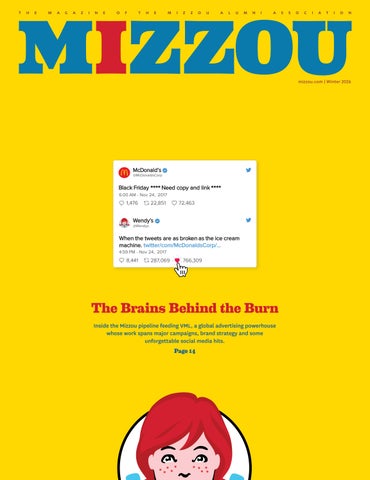
McDona onalld’s
@McDonaldsCorp
Black Friday *** ***** Need copy and link **** 6:00 AM - Nov 24, 2017
1,476
22,851
72,463
Wendy’s @Wendys
When th the e twe twee ets are as br bro oken as the ice cream machine. twitter/com/McDonaldsCorp/... 4:59 PM - Nov 24, 2017
8,441
287,069
766,309
The Brains Behind the Burn Inside the Mizzou pipeline feeding VML, a global advertising powerhouse whose work spans major campaigns, brand strategy and some unforgettable social media hits. Page 14
FIRST LOOK
BOOTS ON CAMPUS By the late 1950s, gangs of comic characters had stormed newspaper funny pages in search of coffee-time attention. Daily and weekly strips called Polly and Her Pals and Freckles and His Friends battled for attention alongside the Peanuts posse, Beetle Bailey’s unit and the entire Dick Tracy force. One sleeper strip that has received less attention,
Boots and Her Buddies, about campus life, appeared in more than 700 daily newspapers. Conceived, written and drawn by Edgar Everett “Abe” Martin, the serial comic delivered daily doses of four-panel scenes that advanced the larger narrative about an undergrad named Boots. In the 1950s, Martin, whose degree from Monmouth University prompted him to emblazon the letter M on
COMICS COURTESY OF SPECIAL COLLECTIONS AND RARE BOOKS, UNIVERSITY OF MISSOURI LIBRARIES
uniforms and sweaters in the comic, turned over writing responsibilities to his son-in-law, Thomas B. Harris, MA ’50, a Mizzou student and English instructor who ended up serving as associate dean of the College of Arts and Science from 1954 to 1984. With that shift, the M took on another meaning, at least for the Mizzou-minded. Shortly before his death in 1992, Harris donated a
bounty of Martin-drawn original Boots and Her Buddies strips to Special Collections and Rare Books at the University of Missouri Libraries. Extending from 1942 to 1959, each inked line, panel and strip seems to jump from the paper, evidence of a master illustrator with a deft command of his craft. To read more, visit library.missouri.edu/specialcollections.
1 1
T R AV EL MYT H #39
“I’LL HAVE NO TIME TO MYSELF” With Touring Tigers, every trip has built-in time to explore on your own, because life’s best moments aren’t always on the itinerary. Where will you go next? mizzou.com/travel
MIZZOU
®
FROM THE EDITOR Editorial and Advertising Executive Editor Robert D. Waller Editor Randall Roberts, BA ’88 Art Director Blake Dinsdale, BA ’99 Class Notes Editor Jennifer Manning, BJ ’18 Advertising Scott Dahl: 573-882-2374 Mizzou Alumni Association 123 Reynolds Alumni Center 704 Conley Avenue Columbia, MO 65211 573-882-6611 Executive Director, Publisher Todd A. McCubbin, M Ed ’95 Mission The Mizzou Alumni Association proudly supports the best interests and traditions of Missouri’s flagship university and its alumni worldwide.
ADVANCED LIGHT MICROSCOPY CORE
When the Small Becomes Spectacular In “Microscopic Masterpieces,” a feature focused on work unfolding inside Mizzou’s Advanced Light Microscopy Core (ALMC), writer Marcus Wilkins, BA ’03, describes the lab’s extraordinary images this way: “Each frame captured at ALMC is a constellation of color and code, a reminder that life’s deepest mysteries begin in miniature.” The line carries its own quiet shimmer. The photographs appear cosmic, yet they rise from details so slight as to be virtually invisible. As this issue was coming together, that idea surfaced in places far beyond the lab, often through the work and lives of our alumni. At VML in Kansas City (“Spot On,” page 14), where Mizzou graduates shape major campaigns for Fortune 500 companies, an ad concept can drift through a brainstorming session before anyone knows it matters. A quick line, a subtle shift, a moment someone catches by instinct. These sparks grow into the work a national audience remembers. The story about five McHaney siblings (“Bootheel Brotherhood,” page 34) follows the same pattern. It begins in the Missouri Bootheel with a father who believed all five of his sons should attend college. Their history lives in scattered records and photographs, an untold story pieced together through close research. Their shared effort eventually helped establish the Hal H. and Beulah Hale McHaney Scholarship, which now ensures that new Mizzou students can pursue their dreams and unlock their full potential. Margaret Weis, BA ’70, another distinguished
An image generated by the Advanced Light Microscopy Core: intercellular communication on 3D GelMA microsphere networks. Image taken on Leica SP8 confocal by Yingzi Li from the lab of Professor Xiaohua Liu.
graduate, brings that same instinct for detail to her work. Since the early 1980s, she has co-created the Dragonlance universe, helped define early Dungeons & Dragons fiction and written or cowritten dozens of novels that have defined fantasy gameplay and created a blueprint for countless campaigns. Her stories draw their force from precise moments that deepen knowledge of characters’ true nature. Bonus: the story includes a cameo from actor Joe Manganiello, best known for his roles in Magic Mike, True Blood and Sabotage. Across very different settings, these stories — and much of this issue’s writing — point to a common rhythm. Small moments set things in motion. They build, take shape and eventually shift the ground beneath them. RANDALL ROBERTS, BA ’88 Editor
Corrections: In the Fall 2025 issue, we neglected to note in “Before Regret, the Internet” (p. 10) that Tyler Jamison, MS ’08, also earned her PhD in 2012. We also misidentified Power the Roar campaign steward Jane Harris’ graduation date (p. 7). She earned her BS Ed in 1975. We regret the errors.
BOARD OF DIRECTORS President Kim Utlaut, BS ’89 President-elect Morgan Corder, BA ’18 Immediate Past President Leigh Anne Taylor Knight, BS HES ’89, BS Ed 90, M Ed ’91 Treasurer Kevin Gibbens, BS BA ’81 Secretary Todd McCubbin, M Ed ’95 Directors Adrienne Barber, BA ’01 Joanna Russell Bliss, BA, BS Ed ’97; Eric Braverman, BA ’87; Brent Buerck, MPA ’05; Clarissa Cauthorn, BS ’15; Adam Gafke, BS ’97; Chris Hurt, BA ’88; Ashley Hutcheson, BS CiE ’01 Cheryl Jordan, BA ’84; Emily Kueker, BS ’02; Col. Pete O’Neill, BA ’00; Daniel Pierce, BA, BJ ’99; Gabriela Ramirez-Arellano, BS BA ’91; Jermaine Reed, BGS ’06 Amber Rowson, BS ME ’99; BS ’07; Nick Ruthmann, BS ’05, MD ’13; John Twitty, BS Ed ’75 Vanessa Vaughn West, BA ’99 Justin Wilson, BS CoE ’07 Student Representative Andrew Gerstner
Editors Emeriti Karen Worley, BJ ’73, and Dale Smith, BJ ’88 MIZZOU magazine Winter 2026, Volume 114, Number 2 Published triannually by the Mizzou Alumni Association ISSN 2833-3970 Address changes: mizzou.com/update or call 800-372-6822 Comments: mizzou@missouri.edu mizzou.com/magazine Opinions expressed in this magazine do not necessarily reflect the official position of the University of Missouri or the Mizzou Alumni Association. ©2025
WINTER 2026
3
TABLE OF CONTENTS
Departments
MORE MIZZOU ONLINE
1 First Look
Exploring Boots and Her Buddies, a comic strip written for a time by alum Thomas B. Harris, MA ’50. Exquisitely crafted original drawings are preserved in Special Collections and Rare Books at the University of Missouri Libraries.
6 Around the Columns
CONTRIBUTORS Mara Reinstein, BJ ’98, a New York–based writer and longtime film critic for Us Weekly, contributes to outlets including Vulture, The Hollywood Reporter, Parade, The New York Times and more. For this issue, she wrote about the enduring connection between Mizzou and global advertising powerhouse VML, page 14; and profiled famed fantasy writer Margaret Weis, BA ’70, page 24. Tony Rehagen, BA, BJ ’01, a writer whose work has appeared in Popular Mechanics, GQ and Men’s Health, has been anthologized in Next Wave: America’s New Generation of Great Literary Journalists. As the basketball Tigers head into their SEC schedule, Rehagen profiled floor general Anthony Robinson II, page 40.
A decorated illustrator with awards from leading arts institutions, Steven Tabbutt exhibits work internationally and teaches in the Illustration programs at the Fashion Institute of Technology. He grew up on military bases in the South and studied illustration at Savannah College of Art and Design and later the School of Visual Arts. For this issue, Tabbutt illustrated fantasy writer Margaret Weis, BA ’70, page 24.
About the cover Art director Blake Dinsdale, BA ’99, designed this issue’s cover around the viral tweet exchange that cemented ad agency VML and its Wendy’s team as masters of the online comeback. The bold “Wendy’s yellow” field and centered social volley set up a story of the Mizzou alumni who have turned quick wit into a national branding moment. 4
MIZZOUMAGAZINE
facebook.com/mizzou x.com/mizzou instagram.com/mizzou @mizzou
46 Mizzou Alumni News Celebrating the winners of the annual Gold Standard Awards; following Brad Exton, BS ’73, from the National Park Service to the Ramblin’ Rangers; and more.
47 Class Notes Tigers change course, shift careers, pick up speed. Roll call inside.
64 Semper Mizzou
Nearly seven decades after graduating, Jim Walsh, MA ’59, stepped back into a Mizzou classroom as professor, closing a long, lovely loop.
Council for Advancement & Support of Education Awards 2025: District VI Awards: “Beneath a Tiger Moon”; “Punchlines in a Pressure Cooker,” (Winter 2025) 2024: District VI Award: General Interest Magazine 2022: Bronze, Periodical/Magazine Design 2021: Gold, Feature Writing (“Who Was I in College?,” Winter 2020) 2020: Bronze, Feature Writing (“Forever Young,” Spring 2019) 2019: Bronze, General Interest Magazine Society for Publication Designers Awards 2025 silver medal: “The Invisible Networks,” Fall 2024 2025 medal finalist: “The Guardians of Silent Worlds,” Spring 2024 2025 merit awards: “Hog Harmony,”(2) Winter 2024; “Capturing Jumpers,” Spring 2024 2024 merit awards: “Vlad Has Stories,”(2) Winter 2023; “The Cosmochemist’s Guide to the Galaxy” Spring 2023 2023 medal finalist: “A LIFE in Focus,” Spring 2022 2022 merit awards: “The Long Quiet,” Winter 2021; “International Reach,” Spring 2021; Spring 2021 cover
HENLEY: ABBIE LANKITUS; MUSICIAN: COURTESY BRAD EXTON
Lived Compassion A childhood leukemia diagnosis didn’t stop Dylann Henley from becoming the nurse she once needed. Now working on the pediatric floor of Mizzou’s new Children’s Hospital, Henley brings lived compassion to every shift. Her journey through treatment, nursing school and recovery shows how courage and support can change a life. Watch a video short to see what perseverance looks like at mizzou.us/dylann.
Get to know the students and alumnus behind the Melt Masters food truck; meet Kelce, the very good dog comforting clients at the College of Health Sciences; relive the shopping frenzy at CoMo’s first Trader Joe’s; and more.
Features
Three of the many books that fantasy writer Margaret Weis, BA ’70, has co-authored with her longtime writing partner Tracy Hickman.
14 Spot On
Kansas City-based marketing and communications firm VML rigorously instills the School of Journalism’s learn-by-doing philosophy known as the Missouri Method. story by mara reinstein, bj ’98
20
Mother of Dragonlance
From a barn in Wisconsin, Margaret Weis, BA ’70, spins vivid tales of quests and friendship that have defined modern fantasy. story by mara reinstein, bj ’98
26
Microscopic Masterpieces
Mizzou’s Advanced Light Microscopy Core brings hidden structures to light, drives discovery and unveils images that spark wonder. story by marcus wilkins, ba ’03
34
Bootheel Brotherhood
From the jazz era to today, the McHaneys’ path to Mizzou shaped a family legacy — and a scholarship that still opens doors for Southeast Missouri. story by randall roberts, ba ’88
40 Ant Man
After a breakout year and some firm coaching, Anthony “Ant” Robinson II is carrying more than his own weight for Mizzou. story by tony rehagen, ba, bj ’01
65
Kinder Institute on Constitutional Democracy Special Section
A decade of the Kinder Institute on Constitutional Democracy’s teaching, research and student mentorship, with stories that show how self-government takes shape, withstands pressure and continually renews itself. WINTER 2026
5
AROUND THE COLUMNS
Meet Kelce, Certified Good Girl
6
MIZZOUMAGAZINE
Part therapy dog, part classmate, Kelce has become a golden thread in Mizzou’s language-learning community, bridging comfort, focus and communication one wag at a time.
Kelce, a 3-year-old golden retriever and trained facility dog, plays alongside preschoolers outside of Clark Hall. She helps young learners build confidence, calm and communication.
TRAINING TOMORROW’S CAREGIVERS The University of Missouri’s Department of Human Development and Family Science has launched RISE-MO, a statewide effort to expand and strengthen Missouri’s early childhood education workforce. Funded by a MoExcels grant, the initiative offers flexible online pathways, from the child development associate credential to leadership certificates and a bachelor’s degree in early childhood education in a mobile society. Working with MU Extension, RISEMO also supports career exploration for youth and helps Missourians develop or enhance childcare options in their communities. “RISE-MO represents the promise of a land-grant university,” says Kui Xie, dean of Mizzou’s College of Education & Human Development. Department Chair Brenda Lohman added that the program empowers communities “to rise together.” The announcement coincided with the ribbon-cutting for the renovated Child Development Lab, which now features upgraded classrooms and newly accessible spaces.
P L AYG RO U N D : E R I C K I E K E B E N ; T I G E R : A D O B E STO C K
At the University of Missouri’s College of Health Sciences, one of the most effective members of the teaching team doesn’t use words at all. Kelce, a 3-year-old golden retriever, joined the Combs Language Preschool in Clark Hall at the beginning of 2025 as a trained facility dog through Retrieving Freedom, Inc. Named after Kansas City Chiefs star Travis Kelce, she works alongside faculty and graduate students in the Department of Speech, Language and Hearing Sciences to help children find their voices — sometimes literally. “Kelce has become an essential presence in our classroom,” says Christy Baker, associate clinical professor and director of the preschool. “She brings a calmness that helps our little friends refocus when they become dysregulated. And she motivates them to communicate when they might otherwise stay quiet.” The children in the preschool all have communication delays or disorders, but Kelce connects with them in unexpected ways. “She seems to have her own special language with many of them,” Baker says. “She’ll make eye contact, nudge them gently, and they’ll start engaging in ways they hadn’t before.”
FROM THE PRESIDENT Our Mizzou Moment
STATE OF THE SCHOLARS As autumn settles over Francis Quadrangle and the Columns cast long afternoon shadows, Mizzou hums with new energy. The numbers from this past fall tell a story of renewal and return, of a campus once again alive with footsteps on the Quad, voices in the air and a new class ready to write its chapter in the university’s long tradition.
31,564 24,726 6,033 6,838 Total student body
Total undergraduates
Incoming freshmen
Total graduate and professional students
Top 5 States in attendance
The most frequent names of incoming freshmen
(other than Missouri)
ME
DC
Illinois Kansas Texas Minnesota Iowa
Ava Addison Emma Jacob Sophia
Olivia Isabella Jack William
G R E T TA C O H O O N
DANNY’S LAW PROMOTES STUDENT SAFETY
Two Mizzou alumni helped lead the passage of Danny’s Law, Missouri legislation that encourages students to call for help in hazing emergencies while holding offenders fully accountable. Sponsored by State Sen. Kurtis Gregory, BS ’10, and Rep. Sherri Gallick, BS ’83, the law protects students who contact emergency personnel from prosecution, thereby removing a barrier that can delay life-saving action. Named for former student Danny Santulli, who suffered life-altering injuries in a 2021 hazing incident, the measure passed overwhelmingly and was signed into law by Governor Mike Kehoe as part of SB 43. It took effect on Aug. 28, 2025.
In September, we launched Power the Roar, a transformative $2 billion investment in Mizzou’s hard-working community. Power the Roar is the most ambitious campaign in our 186-year history and an important step in securing our landgrant mission for the future. I’m thrilled to share that we’ve raised an astounding $780 million so far, thanks to the leadership of our alumni. As part of the campaign, I’ve been meeting with alumni from across the country. Whether in Los Angeles, New York, Chicago or right here in Missouri, Tigers are proud to share how Mizzou changed their lives. Now, they are ready to get involved and create groundbreaking opportunities for the next generation. One Mizzoumade success story is campaign co-chair, Paul Vogel, BS Acc ’89, M Acc ’90, JD ’93. As a business and law student, Paul built lasting connections with professors, fraternity brothers and friends who supported his journey to become a successful entrepreneur. He and his wife, fellow campaign co-chair Lynn Ann, are proud to give back and grow our legacy of excellence. This issue of MIZZOU features many remarkable Tigers who achieved success in business, the arts and cutting-edge science. What unites them is a shared belief in the power of a Mizzou education to shape lives and prepare leaders for our state, nation and beyond. There’s so much to celebrate at Mizzou. We are ranked No. 4 best value flagship university in the country and No. 1 in the SEC, according to the latest U.S. News and World Report data. We also have the highest ever number of applications, graduation rate and research investments. Mizzou is back, and we need your help to keep breaking records and making a difference. You know Mizzou’s incredible impact on students, Missourians and all of society. This is our moment to share our story and build a better future for all through Power the Roar. M-I-Z! MUN Y. CHOI, PHD President, University of Missouri
WINTER 2026
7
AROUND THE COLUMNS ROBO
MAESTRO
From left, Melt Masters owners Connor McHugh, Sam O’Neill and graduate Kobe Messick show off their signature grilled cheese sandwiches from their Tiger-run food truck.
8
MIZZOUMAGAZINE
Three days a week, the enticing smell of food sizzling on a flattop grill permeates Speaker’s Circle as it wafts from the yellow food truck parked at a nearby curb. Since first firing up their griddle last year, the Melt Masters have made the location a semi-permanent residency. They sling hot sandwiches on Mondays, Wednesdays and Fridays. For students looking to grab a bite between classes, the truck is a cheese-colored beacon of hope. The Melt Masters began with three friends who understood mid-lecture hunger because they lived it. Co-owners Connor McHugh and Sam O’Neill are still Mizzou students, and Kobe Messick, BS Ed ’25, had just graduated when the idea took shape. All three were working in a bustling Student Center kitchen when they started sketching out a business idea they wished already existed. “We were basically like, ‘We cook all day for a living. We might as well cook for ourselves and make something cool,’” McHugh says. In true DIY fashion, the trio spent a summer retrofitting a horse trailer with professional kitchen equipment and documented it all on Instagram (@themeltmasters). The final touches were that cheddar-colored coat of paint and a prominently displayed Melt Masters logo: a smiling, googly-eyed grilled cheese face. The converted truck soon popped up all over Columbia and offered, among other menu items, the signature Master Melt sandwich, which stacks a quarter-pound beef patty, Swiss and cheddar cheese, grilled onions and house sauce on marble rye. Things were running smoothly until April, when thieves hit the Melt Masters truck and another food truck parked in the same lot during an overnight burglary. “Our money was stolen, all our merchandise, lots of equipment,” McHugh says. “Everything that wasn’t stolen was intentionally destroyed.” Thankfully, an online fundraiser to replace equipment raised enough money to get the truck operating again. McHugh described the community support as both immediate and incredible. The Melt Masters plan to continue expanding their menu — a chicken Philly is the newest offering — while serving up favorites such as the Master Melt. Long term, the crew hopes to add a second truck or even expand to a brick-and-mortar location downtown. — Jon Hadusek, BJ ’12
S A N D W I C H : A D O B E S TO C K ; M E LT M A S T E R S : A B B I E L A N K I T U S ; R O B OT: M A R C H I N G M I Z Z O U
The Holy Order of the Ooze
On Nov. 8, during the University of Missouri’s football game against Texas A&M at Memorial Stadium, Marching Mizzou handed its halftime spotlight to a 4-foot-4-inch Unitree robot named Grace. Wearing the band’s black and gold and powered entirely by student-written code, Grace conducted the 140-year-old ensemble in a singular collaboration with the College of Engineering. “We are surrounded by remarkable talent across campus,” says Amy Knopps, associate director of bands, “and it is a privilege to join with others who bring their own artistry and expertise to a shared vision.”
I L LU S T R AT I O N : A D O B E S TO C K , B L A K E D I N S D A L E ; W I B E : A B B I E L A N K I T U S
A COMPOSER FINDS HIS PATH The University of Missouri School of Music and the Mizzou New Music Initiative have named composer and cellist Dean Wibe winner of the 2026 Sinquefield Composition Prize, the top honor for student composers at the university. Supported by Jeanne Cairns Sinquefield, Rex Sinquefield and the Sinquefield Charitable Foundation, the prize includes a $2,500 scholarship and a commission to write a new work for the Mizzou Wind Ensemble. The piece will premiere at the Chancellor’s Arts Showcase on February 20 and receive a professional recording. Wibe, from Cedar Rapids, Iowa, earned his bachelor’s degree in music at the University of Iowa, completed a master’s in cello performance at Mizzou and now is pursuing a second master’s degree. He wrote his winning piece, “Entity,” while performing with the Mizzou New Music Ensemble. The musician experimented with a flute technique adapted from Italian composer Salvatore Sciarrino, known for his delicate, near-whisper extended techniques. “I am very inspired by nature,” Wibe said after receiving the award. “I spend a lot of time walking, letting the world around me, its sounds and beauty, fuel my creativity.” Cairns Sinquefield celebrated the announcement: “There’s nothing more wonderful than to sit in a concert hall and hear a piece of music that was written because of our program. The joy of life is music.”
RURAL TELEHEALTH BOOST The School of Medicine has secured about $4 million in federal funding from the Health Resources and Services Administration to launch the Center for Telehealth Research and Policy (C-TRaP), a new hub focused on virtual care in rural communities. The center will study how telehealth is used across rural areas, pinpoint access gaps and translate those findings into policy recommendations. Rural residents make up more than a fifth of the nation’s population and face higher mortality rates, limited specialty care and ongoing risks of hospital closures than their urban and suburban counterparts. C-TRaP researchers study tools such as AI, remote patient monitoring and Project ECHO, which links local clinicians with specialists. The hub is a collaborative effort across Mizzou’s School of Medicine, Sinclair School of Nursing, College of Health Sciences and College of Engineering, with partners in Mississippi and Michigan. Research activity is already underway.
Briefly University of Missouri Landscape Services received the Grand Award in the 2025 PGMS Green Star Awards, a national program recognizing excellence in groundskeeping. Presented at the PGMS Annual Conference, the award named Mizzou the top campus in the 500-plusacre category. Missouri Supreme Court judge and School of Law alumna Mary Russell, JD ’83, has received the National Judicial College’s 2025 Sandra Day O’Connor Award for extraordinary service and commitment to justice. Two School of Music faculty members, Stefan Freund and Bill Kalinkos, received 2026 Grammy nominations for their group Alarm Will Sound’s album Land of Winter. The ensemble collaborates with the Mizzou New Music Initiative, where both musicians play key roles. Howard H. Hinkel, who spent 37 years on the Mizzou faculty and twice chaired the Department of English, passed away on Nov. 11. He was a respected teacher and mentor whose steady leadership shaped the department for decades. WINTER 2026
9
AROUND THE COLUMNS #MizzouBuzz @MizzouAthletics Drink Inked @CoachDrinkwitz has signed a contract extension through the 2031 @MizzouFootball season! #MIZ | #WillToWin @MizzouHoops Starting the season Mizzou’s point win is its largest in a season opener on the road since 1941 #MIZ @BrianKisida It was fantastic to have @glukianoff of @TheFIREorg visit our campus to discuss free expression in an age of political polarization as part of Mizzou's Open Minds Initiative. Nearly 300 students, faculty, and community members attended.
Online dating has never been more popular — or more perilous. According to a 2024 international study, more than 228 million people in 15 countries fell victim to online-dating scams between 2021 and 2023, with Americans proving the most susceptible. Mizzou researcher Rui Yao, professor of personal financial planning in the College of Agriculture, Food and Natural Resources, studies how fraudsters build trust online. Her findings show a shift away from glamorous, too-good-to-be-true profiles toward what she calls “strategic imperfection.” “Scammers traditionally would create these glossy profiles to trick you,” Yao says. “Now they’ve evolved to include minor flaws like being divorced or having an ordinary job to seem more relatable.” Analyzing thousands of real scam reports, Yao’s team found that fake profiles often describe people around age 50, typically widowed 10 MIZZOUMAGAZINE
or divorced, who claim to work in prestigious or high-authority roles such as engineers, doctors or military personnel. Increasingly, scammers also adopt female identities and professions in caregiving fields. Yao says these adjustments reflect an effort to “align with the evolving social and digital landscape of online dating fraud.” She hopes her work will contribute to better safeguards on dating apps and social media platforms, including AI-driven tools that detect suspicious profiles in real time. “We could train AI to identify linguistic patterns and narrative tactics to warn users before they’re targeted,” Yao says. “It’s a constant battle between everyday people and the fraudsters.” This research, published in the European Journal on Criminal Policy and Research, reminds users that awareness is still the strongest safeguard: Understanding how deception works is the first step to stopping it.
@MizzouWrestling Ben Askren Announced as National Wrestling Hall of Fame Inductee. Congratulations, @Benaskren! #TigerStyle @mumedicine Hosted by the #Mizzou School of Medicine and @MizzouNursing, Health Sciences Research Day 2025 featured more than 260 poster presentations as student research was spotlighted throughout the day-long event
BLAKE DINSDALE
Catching Feelings and Fraudsters
@FanDuel Eli Drinkwitz is building something SPECIAL at Mizzou In the last 3 years, the Tigers have a better record than Arkansas, Auburn, Florida, Kentucky, LSU, Mississippi State, Oklahoma, South Carolina, Tennessee, Texas A&M and Vanderbilt.
CoMo’s New Crush
FREE SPEECH: BLAKE DINSDALE & ADOBE STOCK; TRADER JOE’S: BLAKE DINSDALE
Trader Joe’s opened its first Columbia store in October, and the response bordered on feverish. The store is located in the former Macy’s building in the Shoppes at Stadium retail complex. Lines curled around the building on opening weekend as shoppers treated the debut like a limited-run festival, compared photos of their hauls and discussed wait times in local online groups. On Reddit, the obsession went granular, with users tracking deliverytruck arrivals to forecast restocks and the presence of cult favorite products. The new Trader Joe’s store, a long-anticipated addition known for its playful labels and surprisingly affordable staples, brings a kind of grocery-store thrill Columbia rarely gets. Given the turnout, the chatter has already shifted to a familiar question: How long before Whole Foods follows the trail?
Humanizing Heart Research
ON SPEECH, MIZZOU DOESN’T MUMBLE The University of Missouri has been recognized as one of the nation’s leading universities when it comes to matters of free expression. Mizzou placed No. 2 among all flagship universities in the country for free speech, according to the latest data from the Foundation for Individual Rights and Expression (FIRE). FIRE is a nonpartisan nonprofit that defends the rights of all Americans to free speech and free thought through a mixture of student and faculty outreach, public education campaigns, individual case advocacy and policy reform efforts. The nonprofit awarded Mizzou a “green light” rating, its highest status. The distinction reflects Mizzou’s strong policies, which are consistent with the First Amendment. Mizzou also gained points for having no speech-related controversies during the period of the FIRE survey and for its commitment to the Chicago Statement on Free Expression, a 2015 University of Chicago declaration affirming every student’s right to speak, write, listen, challenge and learn.
Mizzou researchers have created the first known “humanized” model for studying aortic valve calcification, a condition caused by calcium buildup that stiffens the valve and can eventually lead to heart failure. Led by Shiyou Chen and Dunpeng Cai in the MU School of Medicine, the team implanted human heart valve tissue and matching immune cells into a mouse circulatory system to allow the disease to develop as it does in people. The model now gives scientists a platform to test therapies, which is crucial because, as Chen notes, “You can do surgery to repair or replace the valve, but surgery is not always an ideal option for older adults.” WINTER 2026 11
AROUND THE COLUMNS
Run the Floor
Nationals Run Through Columbia
On Track Work is underway at the Audrey J. Walton Track and Field and Soccer Stadium for a major overhaul of one of Mizzou’s key Olympic-sports venues. Crews are rebuilding the outdoor track surface and subsurface and installing a new natural-grass soccer field. The project, powered by Walton’s early-2025 gift, will position both programs for SEC-level competition.
“When they flashed that score, I was in awe,” says Mizzou gymnast Kennedy Griffin, of her perfect 10 last season.
Mizzou hosted the 2025 NCAA Division I Cross Country National Championships on Nov. 22 at the Gans Creek Cross Country Course, where the full men’s and women’s fields raced for national titles. Programs from across the nation advanced through automatic and at-large bids. Doris Lemngole of Alabama captured the women’s individual championship, while NC State took the women’s team title. Habtom Samuel of New Mexico won the men’s individual crown, and Oklahoma State claimed the men’s team championship as collegiate cross country returned to mid-Missouri for a fall finale worthy of the stage.
12 MIZZOUMAGAZINE
GATOR BOUND
On Dec. 27, Mizzou heads to its 38th bowl appearance, facing the University of Virginia in the TaxSlayer Gator Bowl at EverBank Stadium in Jacksonville, Florida. Kickoff is 6:30 p.m. CT on ABC. The No. 25 Tigers meet No. 20 UVA for the first time since 1973. Missouri won the lone previous meeting, 31-7.
M I Z Z O U AT H L E T I C S
What does it take to achieve perfection? For Mizzou gymnast Kennedy Griffin, who scored a perfect 10 in the floor exercise this past Valentine’s Day, the journey begins by listening intently to her creative muse: Beyoncé. “When I came in as a freshman, I decided I wanted to do Beyoncé all four years, to go through each of her eras and pick different songs from different albums and put them together to create a fun and engaging floor routine,” says Griffin, a junior from Strongsville, Ohio. Each summer, the gymnast sends Jackie Terpak, the Mizzou assistant coach in charge of choreography, clips from songs that have caught her ear. Last season, the music was from Beyoncé’s early solo albums. Terpak experiments with different mashups of the music until they find the right mix. Beginning in the fall, she works with Terpak to match the patterns and movements to the music, even incorporating some of Queen Bey’s own dance moves. As the season draws nearer, Griffin fine-tunes the routine down to the smallest details, such as eye contact and facial expressions. Meanwhile, she builds up the strength and endurance required to make a demanding 90 seconds of tumbling and dance look effortless. A self-described “bubbly person,” she doesn’t have to remind herself to smile on the mat during her routine or after, especially on the night she earned that perfect 10. “So much hard work had gone into it, getting super specific and nit-picky, whether it was form or pointing my toes or controlling my landing or how my feet looked on my jumps,” she says. “So when they flashed that score, I was in awe.” — Joe Walljasper, BJ ’92
A BOND BIGGER THAN BASKETBALL In January 2024, David “Dickey” Nutt walked into basketball Coach Dennis Gates’ office and told his boss the news he could hardly believe himself. The painless bump on his leg — no bigger than a mosquito bite — was cancer. The aggressive chemotherapy he needed to beat Ewing sarcoma wouldn’t allow him to continue as a Mizzou assistant coach. “With tears in my eyes, I said, ‘Coach, now’s your time. You can send me on down the road. I’ll go live in Florida and play golf,’” Nutt recalls. “He looked at me and said, ‘No way, man.’” Nutt and Gates met in 2015 as assistants at Florida State. Nutt was a folksy basketball lifer with two decades of head-coaching experience and a million stories to tell. Gates was a rising star with a serious demeanor and a knack for inspiring confidence in his players. They hit it off. Nutt followed Gates when he was named head coach at Cleveland State. He joined Gates again when he got the Mizzou job in 2022. They kept winning, and life was good — until two years later. Suddenly, Nutt was fighting for his life. Some days, he wasn’t sure he wanted to win. “I just lay in bed and pulled the covers up and prayed for one of two things: either I get well or be done,” Nutt says. “It was that brutal.” Meanwhile, Gates had his own problems. The injury-ravaged Tigers went 0-18 in the Southeastern Conference in the 2023–24 season. But even at his lowest moments, Gates didn’t forget about his friend. In the wee hours after a 27-point loss to Auburn in
0 Tony Vitello’s years of experience in professional baseball before he was hired from Tennessee to manage the San Francisco Giants. Vitello, a former Mizzou player and assistant coach, became the first person ever to go from college coach to MLB manager without any pro experience. 3 Number of times volDavid “Dickey” Nutt, who has coached alongside Dennis Gates since 2015, works the sideline during his return after a life-threatening illness.
March, Nutt awoke in a dark hospital room and saw someone at the foot of the bed. It was Gates. The support Nutt received from colleagues, family, friends and even strangers sustained him through six rounds of chemo and 25 radiation treatments. In October 2024, he was declared cancer-free. Now he’s back on the bench as a full assistant, doing what he loves alongside the friend who wouldn’t let him walk away. “I don’t think I would have been happy golfing in Florida,” Nutt says. “I’m in the right place, and I’m very appreciative of what Coach Gates has allowed me to do.” — JW
The Archivist Steps Into the Archive
N U T T: KO L D E N L A M ; B R E N D E L : M I Z Z O U AT H L E T I C S
Scoreboard
As Mizzou’s sports information director in 1990, Bob Brendel, BJ ’75, was one of the key figures in establishing the University of Missouri Intercollegiate Athletics Hall of Fame. Thirty-five years later, Brendel has joined the club. “I never, ever would have dreamed I would be in it,” he says of his 2025 induction into the Hall of Fame. Describing it as “kind of a validation that I did things the right way,” Brendel credits an earlier Mizzou sports information director for his successful career. “I carried forward the legacy I was given by my mentor, Bill Callahan,” Brendel says. “To have integrity, be accurate, provide the media access, build relationships and mentor the next generation of sports communicators.” At left, Brendel, who spent two decades in the sports information department and is currently the athletic department’s historian and archivist, offers his list of the five biggest Mizzou athletic achievements of the past 50 years.
Bob Brendel’s Best 1
orm Stewart’s men’s basketball N teams win eight Big Eight regularseason basketball titles, including four straight from 1980–83.
2
Missouri joins the Southeastern Conference in 2012.
3
Athletic facilities dramatically improve across the board.
4
5
leyball player Maya Sands has been named the SEC Libero of the Year. As a senior in 2025, Sands led the SEC with 4.66 digs per set in conference play.
4 Different teams Max Scherzer has pitched for in the World Series, an MLB record. Scherzer started Games 3 and 7 for the Toronto Blue Jays against the Los Angeles Dodgers in 2025. He also pitched in the World Series for the Detroit Tigers (2012), the Washington Nationals (2019) and the Texas Rangers (2023). 300 Rushing yards
gained by Ahmad Hardy in Mizzou’s victory over Mississippi State on Nov. 15. That total is second-best in Missouri history, trailing only Devin West’s 319-yard game in a victory against Kansas in 1998.
The football program takes a topsyturvy journey “from the upsets of the 70s through the desert and back to prominence.” Brian Smith builds the wrestling program into a national power. WINTER 2026 13
FEATURE
VML
14 MIZZOUMAGAZINE
PAGE 15
MIZZOU WINTER 2026
SPOT ON
One of the world’s largest advertising agencies calls Missouri home. VML’s global success is powered by generations of Mizzou-trained storytellers. STORY BY MARA REIN STEIN , BJ ’98
WINTER 2026 15
VML
As the Super Bowl approaches each year, teams across the country huddle up. So do the creatives inside Kansas City–based VML. The agency gathers its people to figure out how to score when the big game pauses and the ads take over. Whether the Chiefs make it to the Super Bowl or not, a breakout commercial counts as a touchdown. VML has delivered them for Progressive and the Foundation to Combat Antisemitism. It even reunited Billy Crystal and Meg Ryan to show a little extra enthusiasm for Hellmann’s mayonnaise. “We’re working on connecting with consumers nonstop,” says Beth Wade, BA ’95, VML’s global chief communications & integration officer. “A Super Bowl spot is still the showcase of traditional brand advertising. That said, there are a mind-boggling number of different ways to experience a brand today.” Take VML’s most audacious success story, for example. Starting in late 2016, the social media team began shifting Wendy’s presence from a polite corporate fast-food monotone to a sharp, quick-witted persona that treated the internet like
From left, VML founders John Valentine, Scott McCormick and Craig Ligibel, BJ ’70, at the agency’s Kansas City headquarters. An early boost came from former Mizzou student Christopher Clouser, then a senior VP at Northwest Airlines, who in the 1990s trusted the young agency with major marketing work. 16 MIZZOUMAGAZINE
a place to spar, tease and actually have a little fun. The shift crystallized a few months later when McDonald’s posted a promotional tweet with a broken link on Twitter (now X), prompting Wendy’s to reply with the line that defined its new voice: “When the tweets are as broken as the ice cream machine.” Among the world’s largest creative advertising agencies, VML boasts more than 25,000 employees across 64 international markets. Among its thousands of high-profile clients are ColgatePalmolive, Ford Motor Company, Microsoft, The Coca-Cola Company and Wendy’s. Beyond the big names and eye-popping numbers is an amazing, multibillion-dollar Mizzou-built success story. Although bustling ad agencies are typically associated with bluebloods in silver skyscrapers on Madison Avenue, this one bleeds black and gold.
• • • Start at the beginning. Co-founder Craig Ligibel — the “L” in VML — graduated from the Missouri School of Journalism in 1970 and received his master’s degree a year later. In addition to Wade, Jon Cook, BJ ’93, global CEO, is a proud alum as well, as is Brian Yamada, BJ ’93, VML’s chief innovation officer. There’s not enough space to list the dozens of VMLers with Mizzou diplomas, especially as the number continues to grow. “Missouri graduates tend to find their way here,” Cook says, “because the school has done such a good job at creating the right mindsets for our business.” There’s even an official collaboration. Since 2017, each semester the program has brought students from the Novak Leadership Institute and the Journalism school’s Strategic Communication program to VML’s headquarters in Kansas City for a day of mentorship and learning. The School of Journalism’s NY Campaign, co-led by New York program director Reuben
IMAGES COURTESY VML
VML campaigns for Hellmann’s, Ford, Colgate and Coca-Cola show how far the Mizzou-connected agency has evolved in a shifting media world. “There are a mindboggling number of different ways to experience a brand today,” says Chief Marketing Officer Beth Wade, BA ’95.
Stern, BJ ’93 MA ’16, offers students the chance to intern at VML’s Big Apple offices. Brandon Butcher, associate director at the Novak Leadership Institute and professor in the School of Journalism, says VML stands alone in the depth of its connection to the school. “But it makes sense,” Butcher notes. “VML understands how community engagement and professional ambition can thrive together.” It’s perfectly understandable if your idea of an old-school ad agency involves well-dressed men sitting around a conference room table smoking Viceroys and batting around slogans for cereal, Mad Men-style. But in the early 1970s, Ligibel started his unglamorous post-Mizzou life behind the wheel, rolling from farm to farm asking growers whether their Harvestore Silo feeding devices were doing what they promised. “I recorded their answers on black-and-white reel-to-reel videos,” Ligibel recalls. “I always had muddy feet doing it, but the work led me to work for a firm in Kansas City. It was literally a
grassroots effort on my part.” Cut to 1992, when he and his longtime friends John Valentine and Scott McCormick found themselves at a career crossroads. They decided to form an agency that would, as Ligibel put it, “be faster, cheaper and better” than their competitors. “We wanted to do important things for big clients,” he says. First, they designed a phone card for Sprint. Then they raised their profile by convincing former Mizzou undergrad Christopher Clouser, then a senior VP of advertising for Minneapolis-based Northwest Airlines, to let VML handle their marketing. Cook was just VML’s 28th employee when he joined the business in 1996. Fifteen years later he became global CEO. “There were a lot of us kids in our 20s who had the keys to the kingdom,” he says. “And most of the kids are still here. I look around now and realize we’re the adults.” Along the way, the agency has expanded to become a behemoth. A brief history: It was acquired by WPP in 2001 and merged with the
“ Missouri graduates tend to find their way here,” Cook says, “because the school has done such a good job at creating the right mindsets for our business.”
WINTER 2026 17
VML
legacy creative agency Young & Rubicam in 2018. In 2023, it merged with agency Wunderman Thompson, which itself was a merger between the famed agencies Wunderman and J. Walter Thompson. “I’m proud that the DNA of those companies live on in VML but in a more contemporary way,” Cook says. He adds that VML has grown to include offices everywhere from Seattle to Hong Kong.
• • • Despite the global reach, VML remains proud to call Missouri home. With good reason. “We’re grounded in our Midwest values,” Cook says. “I don’t mean as a cliché. We show up and never take anything for granted and never seem like we’re too big for the moment. We’re always appreciative and excited about where we are. We celebrate and thank one another, because we all work so hard.” VML also rigorously adheres to the School of Journalism’s renowned Missouri Method learn-by-doing philosophy. “We’re very hands-on in our approach with clients because we never want to lose touch with the texture of our business,” Cook says. “If you’re at Mizzou, you know to never give up and keep digging,” says Ligibel, who retired in the early 2000s “Learning how to communicate and answer all the questions is the only way to complete a sale.” (He makes a point of noting that he’s wearing a Mizzou sweatshirt as we talk.) VML was an established leader in the industry when the School of Journalism’s Butcher reached out to Cook in 2016 about a potential collaboration. “Our vision was to introduce students to a globally recognized communication company that also fosters a strong culture of community and human connection,” Butcher says. “We wanted students to see both sides.” The partnership now leans into VML’s annual Foundation Day, the agency’s companywide day of community service. In the morning, about 25 students from the Novak Institute and 18 MIZZOUMAGAZINE
the journalism school, along with VML staffers, volunteer in the Kansas City community. Everyone then heads back to the office — located in the former Kansas City Downtown Airport terminal building — for a 360-degree tour, presentations and discussions. A spring visit encompasses a full day of presentations and breakout sessions with VML employees and leadership. Wade is still raving about the school’s most recent visit. “We took a group photo,” she recalls, “and we were all saying that these were the best-dressed kids we’ve ever had in our offices because they were all in suits.” VML also struts its stuff as part of Mizzou annual winter internship program. For two weeks in January, a select group of strategic communication students from the School of Journalism heads to NYC to roll up their sleeves inside VML’s offices at 3 World Trade Center, adjacent to the 9/11 Memorial & Museum. Divided into teams, they conduct research, work on pitches, and present their strategic and creative recommendations to agency leadership. In 2025, the 21 students helped create a campaign for New Balance sneakers. Wade likens the experience to summer camp. Butcher adds an academic perspective: “They get mentoring and feedback from marketing professionals and learn so many aspects of agency life.” The relationship is ultimately a win-win, with Mizzou serving as a de facto farm system for the agency. “Mizzou holds a great place in our hearts,” Wade says. “So many of us had great experiences there. And the quality of interns and entry-level employees we get from Mizzou is fantastic. We want people who are motivated, sharp and entrepreneurial, and that’s what we receive with Mizzou graduates.”
• • • Cook spends much of his time traveling to VML offices and visiting clients around the globe. “Our industry has always been
ABBIE LANKITUS
At VML’s Kansas City headquarters, global CEO Jon Cook, BJ ’93, explains the agency’s guiding philosophy: “You have to make decisions on how to find relevance in a consumer’s life. The best brands find a way to hit those spots at the right moments.”
ABBIE LANKITUS
in a perpetual state of evolution,” he says. “These days it feels a bit more like a revolution with the proliferation AI and of mar-tech,” he adds. “That said, we rely on the fundamentals we learned at the J-School every day.” A brand campaign no longer revolves around a catchy jingle. Now there’s social media and celebrity influencers and digital marketing and personalized ads and, yes, AI. “It’s an amazing career to be in because you’re always learning and there’s no stagnation,” Wade says. “We especially need to understand what 20-somethings are doing so we can figure out how to market our brands in the most relevant way.” For an example, look again at Wendy’s, which coined the iconic phrase “Where’s the beef?” in the ’80s and longed to make a dent on social media in the ’00s. The agency not only sharpened Wendy’s online attitude, it carried that tone into real cultural moments. “We showed them a new way to tell their stories with sass and a sense of humor,” Wade says. Cook also points to a recent “Every Coca-Cola Is Welcome” campaign in which local shopkeepers and bodega owners around the world displayed personally designed Coke signs and artwork. “We put the brand in the hands of the people,” he says. “It was the most awarded campaign in the storied history of Coke’s brand.” Creative uses of technology and global reach will continue to be the long-term keys to industry success. “You have to make decisions on how to find relevance in a consumer’s life,” he says. “Think about the way you scroll through Instagram and do online shopping and entertain yourself online. The best brands find a way to hit those spots at the right moments.” By staying true to its roots, VML aims to thrive no matter what the future holds. “VML has come a long way since our three founders’ set up shop in a tiny Kansas City office 33 years ago,” Cook says. “Nevertheless, our goal is exactly the same: to earn the trust to be considered each and every client’s most important marketing partner.” M
Mizzou alumni and student interns gather for a group photo during a recent visit to VML’s Kansas City headquarters.
The Birth of the Sass In 2012, Wendy’s brought in VML with a simple mandate: Make the brand matter again. “They were losing relevance, especially with younger audiences,” says VML Global CEO Jon Cook. The early years focused on rebuilding the foundation, sharpening the “Fresh, Never Frozen” promise, refreshing the brand’s look and testing a looser, more playful tone in campaigns including the 2013 “Pretzel Bacon Love Song,” which turned customer comments into music videos. By late 2016, that groundwork had done its job. Wendy’s began to show a different kind of personality on Twitter (now X). The company began trading corporate courtesy for a voice that cracked jokes, cut through noise and treated the platform like a proving ground. “Fresh, Never Frozen” stayed the anchor, but the attitude around it shifted. The internet took notice when a user questioned the fresh-beef claim and dragged McDonald’s into the argument. Wendy’s snapped back with the line that set the tone: “You don’t have to bring them into this just because you forgot refrigerators existed for a second there.” A few weeks later, McDonald’s posted a promotional tweet with a broken link, and Wendy’s delivered the jab heard across timelines: “When the tweets are as broken as the ice cream machine.” From there, the account leaned into the fun. A fivetrack rap EP tapped fast-food rivalries and artistic beefs. The #NuggsForCarter saga, sparked when a teenager asked what it would take to earn free nuggets, briefly became the most-retweeted post on the platform. Stunts such as the 2024 “Wendy’s Frosty Fix,” which sent Frosty trucks to customers let down by McDonald’s broken ice cream machines, kept the same sharpened voice alive. An ongoing rebrand to “Tendy’s” to hype its chicken tenders has been carrying that sense of play forward. The following speaks for itself: 3.6 million followers on X, 2 million on TikTok, and one of the most decorated agency–brand collaborations in the industry, capped by a Penta Pencil, an international award recognizing long-term creative excellence between an agency and a brand. “Our work with Wendy’s is some of my favorite work we’ve ever done,” Cook says. WINTER 2026 19
From a barn in Wisconsin, Margaret Weis, BA ’70, spins tales of quests, friendship and the occasional dragon. Her worlds are so vivid and characters so fearless they have reshaped the landscape of modern fantasy. story by mara reinstein, bj ’ 98 illustration by steven tabbutt MIZZOU WINTER 2026
20
WINTER 2026 21
PROFILE
“I write every day,” she says. “I have contracts, and I have two dogs to support. And I still love working with words.” Weis, BA ’70, stands as one of the defining fantasy and science fiction voices of the past half century, a writer whose invented world of Krynn has become bedrock for generations of Dungeons & Dragons players shaping their own adventures. A New York Times bestselling author well into her fifth decade of writing, she’s penned so many series and trilogies that she freely admits she “has no idea” how many books feature her name. (The answer is 65 if you believe Wikipedia.) She doesn’t even have the space in her office to store them all. “I run out of room, so I keep giving them away,” she says. “I only have my research.” Most famously, Weis is one of the original creators of the Dragonlance saga. Fan conventions and internet forums run down all the details of this magical forgotten realm, but here’s the bottom line: In the four decades since its first edition, the Dragonlance series has collectively sold more than 25 million copies and been translated into multiple languages. The numbers hardly tell the whole story, though. Just look at Reddit, a crucial online hub for fandom. “If I had not read those books when I was a young kid, my life would have been so much different,” wrote one reader in a Dragonlance thread. “One of those few things that I can point to and say that it was truly life changing.” Weis and co-author Tracy Hickman returned to the fold a few years ago with a new trilogy, Dragonlance: Destinies (out in paperback). During a recent call, she was in the revision stage on the first book of another new Dragonlance series, War Wizard, featuring “a very famous wizard in the Dragonlance lore called Aegis and his friend, who was a Knight of Solamnia,” she says. It will 22 MIZZOUMAGAZINE
session zero It never occurred to a young Weis to be a professional writer. Sure, the Independence, Mo., native had a passion for reading and writing. She
Margaret Weis, BA ’70, poses during a fantasy convention where her long career and the world of Krynn still draw crowds. About her towering bibliography, she says, “I run out of room, so I keep giving them away. I only have my research.”
@ W E I S M A R G A R E T/ X
to Milwaukee, Wisconsin, and head southwest about 40 miles. You’ll arrive at a resort town called Lake Geneva. Somewhere on the outskirts is a converted barn that has stood for more than a century. Right at this very moment, author Margaret Weis likely is sitting inside furiously typing about the mystical adventures of the Solamnic Knight Huma and the Wizard Magius.
be published in August. In a fantastical, ever-expanding lore filled with sorcerers, dwarfs, bards, wizards, witches and dragons, Weis is the very real queen. Among her loyal subjects — er, fans — is actor, writer and host Joe Manganiello. Best known for roles in Magic Mike, True Blood and Sam Raimi’s Spider-Man films, the actor is a D&D die-hard and franchise entertainment consultant who first met Weis in 2018. They were both at a meeting to map out the relaunch of the fifth edition of Dungeons & Dragons Dragonlance: Shadow of the Dragon Queen. “Margaret is so funny and wily and mischievous in a hilarious way, and the juxtaposition of these multifaceted personality traits makes her a great writer,” Manganiello writes via email. “She’s not afraid to let her thoughts and feelings out through these characters, which is why all her characters have such different voices. She’s a pioneer who doesn’t get the credit she deserves.”
ABBIE LANKITUS
committed to Mizzou because it offered a creative writing program. Nonetheless, she majored in art. Then one day during her freshman year, a student teacher instructed her to stay after class. “I thought I was in trouble,” Weis says. Instead, the teacher gushed about her talent and suggested that she switch majors to literature and creative writing. “I’ve often said it was like when John Belushi decides he’s going to put the band together [in The Blues Brothers],” she recalls. “He looks up to the sky, and the heavens opened.” Being a student in the late 1960s had a profound impact. Never mind that the only protest she attended was to oppose the closing of a popular bar called the Huddle Club. Mizzou was where she discovered fantasy author J.R.R. Tolkien’s books. “In the days before the Internet, students spread the word by hitchhiking,” she says. “Students would come from the West Coast bringing along copies of Lord of the Rings. Eventually we saw it in bookstores and started reading it.” The book’s themes of resistance, antiindustrialism and friendship across cultural divides “came to symbolize the protests against the Vietnam War.” Weis returned to Independence after graduation and, at her mother’s urging, clocked in as a proofreader for the publishing arm of the Church of Jesus Christ of Latter-day Saints. She got married, had two kids and ended up spending 11 years on the job. Then, in the immortal words of Belushi’s “Joliet” Jake, she embarked on her mission from God. An article about an ascendent gaming company caught her eye as she perused Publisher’s Weekly in 1982. Tactical Studies Rule Inc. (TSR) was formed in 1973 and first headquartered in a Wisconsin basement. Fueled by a growing interest in fantasy fiction, TSR’s decade-old game Dungeons & Dragons had recently become a phenomenon. “I thought, ‘Wow, that would be such a neat game for my kids and I to play,’ because it was completely based on the imagination,” she says. A few months later, Weis spotted a job listing for a TSR games editor. She failed the interview pre-test miserably, but no matter. Jean Rabe, a TSR books editor, was looking for someone to edit a series to dovetail with a new role-playing game module co-created by Hickman. It was titled Dragonlance. “The editor found my application in the games department and contacted my agent,” she says. “I had lunch with her and was hired that day.” She packed up her family and two cats and moved to Lake Geneva, Wisc. As Weis immersed herself in the world, she and Hickman soon realized the only people equipped to write these books were staring back at them
Dungeon Diving Downtown Hexagon Alley’s Dungeons & Dragons nights are open to adventurers of all XP levels. The dance of a 20-sided die, illuminated by the golden glow of a fresh pint of pale ale. Metallica riffs churning in the background. The call of the dungeon master (DM) orchestrating a campaign: “Roll for initiative!” These sights and sounds are typical during Dungeons & Dragons night at Hexagon Alley in downtown Columbia. Located in the space once occupied by dance club Shattered!, the board game cafe has become a haven for the longrunning tabletop fantasy RPGs (role-playing games). On Monday evenings, aspiring adventurers can participate in D&D “One Shots” — self-contained campaigns that can be completed in one sitting. “We want as many people as possible, at any skill level, to come in and give it a try,” says Hexagon Alley employee James Long, who curates the D&D events. “If you’re someone who’s looking for that larger experience in gaming, the Monday night sessions are the perfect ones to get into.” First published in 1974, Dungeons & Dragons is now in its Revised 5th Edition ruleset. Although the basic concept remains the same: Players create and roleplay a character, dungeon crawling with their fellow party members. The rules have expanded vastly since then. As Long notes, this evolution has added to the creative freedom that makes D&D so unique. “There are more rules, but there are more possibilities,” Long says. “It’s one of the first rule books — Dungeon Master’s Guides — to emphasize that the rules are merely there to be a basis. They’re open to interpretation; they can be changed as the DM and players want. You’re welcome to make it your own.” In the 50-plus years since the game was designed by Gary Gygax and Dave Arneson, D&D’s player base continues to grow and transcend generations. Long says a typical table at Hexagon will include players of all ages, upstarts and veterans alike. “It has this appeal because it taps into a very childlike wonder that we get from playing games,” Long says. “It gives people the tools, the resources and a space to use their imagination.” For those who can’t make it to Monday D&D nights, Hexagon also runs a matchmaking service to help players seeking campaigns connect with one other. A signup survey can be found on hexagonalley.com. — Jon Hadusek, BJ ’12 WINTER 2026 23
D&D 101
24 MIZZOUMAGAZINE
in the mirror. Hickman, who had developed the Dragonlance setting with his wife, Laura, kept designing the game while Weis — whose storytelling instincts meshed well with his world-building — wrote the prologue and first six chapters in a single weekend. “Jean told me years later that she only agreed to read our stuff because she didn’t want to hurt our feelings,” Weis says. Instead, Rabe ended up bowled over by the results, and the Dragonlance Chronicles were born. The first volume, Dragons of Autumn Twilight,
Dice in Dungeons & Dragons resolve nearly every action in the game, from attacks and spellcasting to skill checks that determine what players can and cannot do.
was published in November 1984 and became an instant New York Times bestseller. “It was stunning!” Weis says. “I had never in my wildest dreams imagined this.” Even her tough-to-please mother, who envisioned her becoming the next Joyce Carol Oates, came around to embrace the success. “She bragged that she was the grand-
ABBIE LANKITUS
Dungeons & Dragons is a collaborative storytelling game where imagination drives the action. Instead of trying to win, players create characters and face challenges together while one person, the dungeon master, describes the world, controls the monsters and guides the unfolding story. Players respond in character, choose what to do next, and the adventure shifts accordingly. New players often start with familiar archetypes: fighters modeled after knights or samurai, wizards inspired by Gandalf and Merlin, rogues with a bit of Robin Hood flair and clerics who heal and protect like armored priests. Each character is defined by six abilities — strength, dexterity, constitution, intelligence, wisdom and charisma — that influence how they solve problems. When a task could either succeed or fail, players roll a twentysided die to determine what will happen. Good rolls spark heroics; bad rolls create chaos and comedy. The fun comes from building the world together.
PROFILE
Margaret Weis stands with her friend Joe Manganiello, the actor and devoted D&D fan who praises her influence: “In a world oversaturated with one-dimensional girl-boss archetypes in fantasy, Margaret was introducing multilayered female characters.”
mother of one of the characters.” As Weis penned more books throughout the decade and beyond, her legend grew. “If you played D&D, especially in the 1980s, you would have definitely read her books,” says Francis Huang, an education professor at Mizzou and a fan since his youth. “She created this whole world where people could identify themselves with these mystical characters. And the dragons ruled in her books. That was a big thing, because who doesn’t love dragons?” Manganiello started poring over her novels in the mid-80s. “I loved how the mythology was used to discuss topics of codependency, war, race, loves and loss,” he writes, noting that she was a trailblazer, as well: “In a world oversaturated with one-dimensional girl-boss archetypes in fantasy, Margaret was introducing multilayered female characters. People don’t understand how ahead of her time that was back then.” Weis, in turn, credits her readers for her longevity. “They’re the ones who put our books on the Times list and gave us the freedom to do more books,” she says. “Now it’s been 40 years with them. It’s been a wonderful ride.”
@JOEMANGANIELLO/X
the next campaign Occasionally, Weis does like to venture outside the barn. She and Hickman are frequent presences at the annual Gen Con, the largest tabletop game convention in North America. At the 2025 edition in Indianapolis, she hosted a Dragonlance celebration panel, signed books at the Penguin Random House booth and spent hours greeting readers. “It’s just so much fun because I love to meet the fans,” she says. She has yet to return to Mizzou since graduation, but not for lack of affection. “My parents moved from Missouri, so I don’t have ties there anymore and haven’t been inclined to go back,” she explains. “I just want to keep the memories, because they were really, really, good.” After her Lord of the Rings spiritual awakening, Weis stopped reading fantasy books. Now she loses herself in mystery and romance novels. She’s just made her way through all of Rex Stout’s works in chronological order. She still loves the classics of Charles Dickens and Jane Austen. Weis and her daughter, Lizz, once wrote two
paranormal romance books together, Warrior Angel and Rebel Angel, “because we thought it would be fun.” (Lizz is an investor at JP Morgan; Weis’ son, David, died years earlier.) Although Manganiello had signed on to write and produce a Dragonlance live-action streaming series based on the first six core books and scripted a pilot episode, the project was cancelled in 2024. The actor says he still “has the dream to bring them to life on the screen.” Still, fans have reason to be optimistic about potential new action on Krynn. In October, Wizards of the Coast — the Hasbro-owned publisher behind Dungeons & Dragons and Magic: The Gathering — revealed that Weis and Hickman are returning to the fold. This time they’ll join forces with Manganiello on new Dragonlance projects. The announcement, shared on social media by D&D head Dan Ayoub with a wink toward “amazing things ahead,” sent fans into a frenzy over what could be the long-awaited revival of one of the game’s most treasured realms. Weis welcomes the excitement but isn’t tempted to tackle a screenplay, were there to be one. “My talent doesn’t lie in that direction,” she says. Besides, she’s got plenty of books yet to write. Not just because she has contracts and dogs. Not even just because she has a passion for it. As she puts it, “I just wouldn’t know what to do with myself.” M
“ She’s not afraid to let her thoughts and feelings out through these characters, which is why all her characters have such different voices. She’s a pioneer who doesn’t get the credit she deserves.” — Joe Manganiello
WINTER 2026 25
[ Microscopic ]
Masterpieces Mizzou’s Advanced Light Microscopy Core illuminates discovery across disciplines and laboratories and produces picturesque images in service of science. By Marcus Wilkins, BA ’03
26
26 MIZZOUMAGAZINE
[ MIZZOU ] [ WINTER 2026 ]
WINTER 2026 27
MIZZOUFORWARD
[
Kaleidoscopic, multifaceted meteors of stained glass. Disembodied, violet-tinted and veinous pods. Luminescent, fluorescent, opalescent bits of ethereal debris.
Previous pages, left: Immuno-stained mouse ovary, part of a study on the effects of chemotherapy on oocytes, cells that have the potential to form an ovum. Image taken with a LeicaSP8 confocal microscope by Edgar Diaz-Miranda from Lei Lei’s laboratory, Department of Obstetrics, Gynecology and Women’s Health, School of Medicine. Previous pages, right: Immuno-stained muscle spindle in dog with a neurodegenerative disease. Sample prepared by Brandie Morgan-Jack, Interdisciplinary Neuroscience Program, and imaged with an Andor Dragonfly 602 spinning disk confocal microscope by Tara Finegan, ALMC director.
28 MIZZOUMAGAZINE
]
The images created at the University of Missouri’s Advanced Light Microscopy Core (ALMC) reveal a menagerie of alien forms within a planetarium of infinitesimal wonder. The surreal perspectives often feature curiously mundane sources: mosquito ovaries, cabbage white butterfly eggs, zebrafish larvae or the cellular scaffolding that supports beet stems. The mysteries revealed, though, might one day guide research advances in cancer care, orthopedic implant design and food production. Captured using a fleet of expertly maintained state-of-the-art microscopes housed in Mizzou’s Christopher S. Bond Life Sciences Center, ALMC photos so often are breathtakingly beautiful that the facility conducts an annual contest to celebrate them. “The first time I visited the ALMC, I was blown away with the instrumentation and the quality of the imaging here,” says Tara Finegan, ALMC director and a Cambridge University-educated researcher. “Collaboration is my favorite part of research, and one reason I am excited to be in this position is that it allows me to work with world-class researchers from across the university.” Finegan was hired as part of MizzouForward, the 10-year, $1.5 billion initiative to strengthen faculty, upgrade infrastructure and enhance student success. The ALMC, one of 17 Advanced Technology Core Facilities supported by the university’s Division of Research, Innovation & Impact, sits within a network that includes the Bioinformatics and Analytics Core, the Genomics Technology Core, the Metabolomics Center and many more across campus. The ALMC houses 11 light microscopes (as opposed to electron microscopes, which use beams of electrons to view much smaller objects) along with an array of related equipment. Researchers capture ALMC images using one of three types of microscopes: • Widefield microscopes are the classic variety. They shine light through the whole sample at once to capture an image but tend to blur above
and below the focal point. • Confocal microscopes use lasers and a small pinhole to focus on just one thin layer of a sample at a time, which cuts blur from other layers and provides detailed 3D images. • Stereomicroscopes are used to view larger, solid objects, such as insects or plants, in 3D and at a lower magnification. They also allow researchers to manipulate or dissect specimens while viewing. Among the core’s services, staff train visiting researchers to use the technology before independently embarking on their explorations. “The ALMC is an invaluable resource to my lab’s research,” says David Braun, professor of biological sciences and plant sciences. “We use their state-of-the-art microscopes to image proteins and cell structures to investigate their functions, and the staff are incredibly knowledgeable, highly experienced and always helpful.” For example, staff might assist with preparation by using a microtome, a precise slicing instrument for making thin samples of tissues. Staff also help with quantitative image analysis — counting and measuring things — using AIassisted software to extract data. Lei Lei, associate professor of obstetrics, has used the core to research cancer growth. “Our research examines how egg cells undergo cell death during cancer treatment, and the ALMC enables us to look deep inside mouse ovarian tissues to precisely examine the molecular and morphological features of different components,” she says. “The knowledge helps in developing medical interventions to preserve fertility for young female cancer patients.” The core’s suite of rooms housing its microscopes is named after Thomas E. Phillips, the core’s founding director and Curators’ Distinguished Teaching Professor Emeritus. The core has seen increased usage since 2021 thanks in part to MizzouForward bringing an influx of biomedical researchers. Work completed at the facility has resulted in 22 scientific publications during fiscal year 2024–25. The ALMC also provides hands-on research experience for undergraduates connected through the Office of Undergraduate Research. Each frame captured at the core is a constellation of color and code, a reminder that life’s deepest mysteries begin in miniature. “At the ALMC, we make the invisible visible,” Finegan says. “From single molecules to whole tissue and organisms, our microscopes, and the researchers who operate them, reveal how living systems are built and how they change — insights that drive progress in health, agriculture and biotechnology.” M
Top: Drosophila melanogaster (fruit fly) larva. Image taken with the Nikon Ti2 widefield microscope by Tara Finegan, ALMC director. Left: Stained Aedes aegypti (mosquito) ovaries. Sample prepared by Alexander Franz’s laboratory, Department of Pathobiology and Integrative Biomedical Sciences, College of Veterinary Medicine, and imaged with a Leica Sp8 confocal microscope by Tara Finegan. Right: Immuno-stained Drosophila melanogaster (fruit fly) ovaries. Image taken with a Leica Sp8 confocal microscope by Sahel Ghasemzadeh; Dan Bergstralh, associate professor of biological sciences; and Tara Finegan’s laboratory, Division of Biological Sciences, College of Arts and Science. WINTER 2026 29
MIZZOUFORWARD
30 MIZZOUMAGAZINE
Above: S2 Drosophila melanogaster (fruit fly) cells imaged live and stained with a marker for microtubules. Image taken on an Andor Dragonfly 602 spinning disk confocal microscope by Tara Finegan. From left: Plant parasite Cuscuta campestris infects beet stem and leaches nutrients and water from the host’s vascular system. Image taken with a Leica M205 FA stereomicroscope by Lydia Phillips, undergraduate in Soyon Park’s laboratory, Division of Plant Sciences; College of Agriculture, Food and Natural Resources. Immuno-stained Drosophila melanogaster (fruit fly) ovaries. Image taken with a Leica Sp8 confocal microscope by Evan Ost; Dan Bergstralh, associate professor of biological sciences; and Tara Finegan’s laboratory. Galaxy of Receptor Kinase Proteins. Protein-protein interaction using the BiFC system on the plasma membrane expressed in Nicotiana benthamiana. Acquired with the Leica SP8 Confocal Microscope. Captured by Shin-ichiro Agake, a visiting scholar from Tokyo University of Agriculture and Technology in Dr. Gary Stacey's Lab. WINTER 2026 31
MIZZOUFORWARD
“ The first time I visited the ALMC, I was blown away with the instrumentation and the quality of the imaging here.” — Tara Finegan, ALMC director
Facing page, clockwise from top: Tara Finegan joined ALMC as its director in 2023, bringing Cambridge training and a passion for collaboration as part of MizzouForward’s investment in research excellence. Whole-mount mouse embryo stained to highlight a network of nerves. Image taken using a Leica Thunder stereomicroscope by Nithya Nair, Christian Lorson and Monique Lorson’s laboratory, Department of Pathobiology and Integrative Biomedical Sciences, College of Veterinary Medicine. Immuno-stained mouse oocyte. Image taken with Leica SP8 confocal microscope by Edgar Soto-Moreno and Ahmed Balboula, Division of Animal Sciences; College of Agriculture, Food and Natural Resources.
Top: Hindbrain of a zebrafish larva expressing membrane-targeted red fluorescent protein (mRFP) in branchiomotor neurons. Image taken with a Leica Sp8 confocal microscope by Vimal Arora and Ramses Baguio, Anand Chandrasekhar laboratory, Division of Biological Sciences, College of Arts and Science. Bottom: Immuno-stained malphigian tubules from a Drosophila melanogaster (fruit fly). Image taken with an Andor Dragonfly 602 spinning disk confocal microscope, and 3D reconstruction on Imaris, by Tara Finegan.
WINTER 2026
33
MIZZOU WINTER 2026
34
BOOTHEEL brotherhood 1 The McHaneys’ arrivals at Mizzou spanned decades, but they each carried the same conviction: Education could lift a family, strengthen a region and echo long after the last diploma. S T O RY B Y R A N D A L L R O B E R T S , B A ’ 8 8
34
LEGACY
try left campus as community leaders and lifelong Mizzou advocates. “Mizzou was where McHaneys went — it was their school,” says Mary McHaney Bebout, BJ ’83, John’s granddaughter. John, BA 1921, became a doctor in Jefferson City. Hal, Powell and Flake earned law degrees. Robert built a career in accounting. And they never lost sight of the place that helped launch them.
The Architect of Opportunity
IN
1898, in White Oak, a dot of a town near Kennett in Missouri’s Bootheel, Hal McHaney, BA 1919, was born into a family that would leave a lasting mark on Mizzou. His father, James, was a shopkeeper and farmer who lost his first wife young, held on through the Great Depression and remarried, then raised five sons with grit and purpose. All became Tigers. From the trenches of World War I to the dawn of television, the McHaney brothers — oldest to youngest: Hal, John, Powell, Flake and Robert — stepped onto campus across four decades. They arrived as jazz heated up and stayed through blackouts, booms and the birth of rock ’n roll. Faurot Field was still a blueprint. Jesse Hall’s dome was staking its claim. Columbia — brickpaved and porch-lined — was starting to pulse like a real college town. Through years of upheaval, there was always another McHaney in line. “It’s extraordinary,” says Patrick McHaney, Flake’s son. “A small-town merchant holds on to the farm through the Depression and still pays to send all five sons to Mizzou.” From Hal’s 1919 graduation to Robert’s in 1954, the McHaney name became a quiet fixture on the Quad. This quintet of brothers from cotton coun-
36 MIZZOUMAGAZINE
Hal McHaney didn’t seek the spotlight, but his presence in Kennett was hard to ignore. The eldest son returned home after graduating from Mizzou in 1919 and became a principled attorney and civic leader. He served as president of the chamber of commerce and the school board, helped found the Dunklin County Historical Society, and was a pillar in the Presbyterian church. He also understood the land. Although his father had held onto the family farm through the Great Depression, Hal expanded his own footprint across the Bootheel’s fertile acreage. His success mirrored his approach to life: deliberate, grounded and generous in its yield. Eventually he and his wife, Beulah, chose to turn their good fortune into something lasting: The Hal H. and Beulah Hale McHaney Scholarship, a fund dedicated to supporting Mizzou students with deep ties to their region. “The brothers all navigated the upper echelon of business and society, but they never forgot their roots,” says Patrick, a county commissioner born and raised in Dunklin County. Hal walked onto campus first. Decades later, he and Beulah made sure the next generations could follow.
Shaping Civic Progress
When McHaney Hall opened at University Hospital in 1990 to house nursing students, it carried both Powell McHaney’s name and his legacy: practical, persistent and built to endure. Powell, BA 1925, studied law at Harvard after graduating from Mizzou and built a life in St. Louis driven by civic purpose. He began in public service before joining General American Life Insurance Company, where he rose to the position of president. Colleagues described him as sharp, grounded and committed to the overlap between public good and private responsibility. In 1953, Powell helped found Civic Progress Inc., a compact group of St. Louis CEOs who quietly shaped the city’s future. As its first president, he backed funding for schools, infrastructure and civic landmarks, including early support for the Gateway Arch. Critics considered it a kind of shadow
P H OTO S C O U RT E S Y PAT R I C K M C H A N E Y
Previous pages: Five McHaney brothers with their father, clockwise from top left: Hal, Powell, John, Flake, James and Robert.
Top: Hal McHaney, whose Hal H. and Beulah Hale McHaney Scholarship has supported more than 500 students with over $2.6 million since 2007. Far right: Powell McHaney walking across the Mizzou campus with former President Harry S. Truman in 1954. Right: At 23, Flake already had reached the rank of major and later received the Legion of Merit, the Bronze Star and the Italian Cross.
WINTER 2026 37
LEGACY
Flake also remained fiercely loyal to Mizzou. A gifted orator, he rallied alumni, led one of Southeast Missouri’s most active booster clubs and rarely missed a football game, despite the five-hour round-trip drive. government. But business leaders, Powell countered, owed more than taxes. They owed vision. In 1972, Flake was He brought that appointed judge of Missouri’s 35th philosophy to Mizzou. Judicial Circuit. As president of the University of Missouri Board of Curators in the 1950s, Powell pushed to reestablish the university’s four-year medical school, which had been dormant for decades. He helped secure funding for a proper academic hospital and insisted it should serve both students and the state. Tragically, in 1957 while in Washington, D.C., Powell was killed in a car wreck. One measure of his life: “When he passed away, there were 150 pallbearers,” Patrick says. “They stopped the street traffic in St. Louis for his procession.”
Courage in War, Clarity in Law
Before Flake McHaney, BA ’42, became a respected Missouri judge, he was a college kid with a mind wired for solutions. At Mizzou, he joined Army ROTC. That decision that landed him in the Italian campaign of World War II. As an operations officer, he hauled mortars through the fire-swept Apennines, where Allied forces faced German troops dug into ridgelines. The terrain was brutal. Flake adapted. With another lieutenant, Flake engineered hinge-mounted mortars for high-angle fire. Their quick math turned battlefield guesswork into strategy. By 23, the young soldier had become Major Flake McHaney and received the Legion of Merit, the Bronze Star and the Italian Cross. After the war, Flake earned a Harvard law de38 MIZZOUMAGAZINE
gree and returned to Kennett to practice alongside Hal. Their firm, McHaney & McHaney, became a local fixture. In 1972, he was appointed judge of Missouri’s 35th Judicial Circuit. When he hit the mandatory retirement age years later, the Missouri Supreme Court brought him back as a senior judge — a rare encore for a jurist trusted across the state. “He really relished practicing law,” Patrick says. “He had a sense of nobility, and it was very important to him to hold himself and all those who were in the arena with him accountable.” Flake also remained fiercely loyal to Mizzou. A gifted orator, he rallied alumni, led one of Southeast Missouri’s most active booster clubs and rarely missed a football game, despite the five-hour round-trip drive. For his devotion, he received the MU Golden Tiger Award in 1997 and the Distinguished Alumni Award in 2004. By the time the youngest McHaney, Robert, graduated in 1954, his brothers already were well established in Missouri. The age gap set him slightly apart, and after earning his degree, Robert moved to Texas, where he built a life and career largely independent of his four brothers.
Investing in Homegrown Potential
When each of the McHaney brothers passed through Mizzou, the world was in flux: war abroad, economic strain at home and a nation slowly stepping into modern life. They watched radio turn into television and politics shift in cycles of hope and division. When they returned home, it wasn’t just with diplomas but also with direction. Their towns needed doctors, lawyers and civic leaders. They were ready to serve, Patrick says. “The five McHaney brothers came from a little rural area, and all ended up making names for
PAT R I C K M C H A N E Y : R E A G A N M A N I S
themselves thanks to the level of excellence they received in their Mizzou education,” he says. Today, the students who carry their legacy face different uncertainties: climate change, fractured politics and algorithms shaping culture. These, too, require clarity, resilience and care. More than 500 students have been helped by the Hal H. and Beulah Hale McHaney Scholarship, which has awarded more than $2.6 million since 2007. While not limited to the region, the scholarship gives strong preference to students from Dunklin County to keep its roots close and its impact personal. Think of it as a generational handoff, from one family’s legacy to the next wave of rural students ready to lead. Richie Leeker, who has spent more than sixteen years serving the Kennett School District — first as high school principal and now superintendent — has seen the impact up close. “This scholarship doesn’t just open doors to higher education; it changes the trajectory of students’ lives,” he says. “The McHaney family’s commitment to lifting up rural students continues to leave a profound and lasting impact on our schools and our entire community.” Adiley Powers of Campbell is among these students. “I’m one of four siblings, and putting all of us through college wasn’t financially feasible for my dad,” she says of the impact of the Hal H. and Beulah Hale McHaney Scholarship. She’s studying agribusiness management and wants to be a force for women in agriculture. McHaney scholarship recipient Ben McMullan of Kennett is studying strategic communication and hopes to lead creative teams in the advertising world. “This scholarship allowed me to worry about the more important things in my journey instead of the payments in order to go here,” he says. College arrived at a hard moment for scholarship recipient Delayna Dalton. Her grandmother had just passed away, and she wasn’t sure how she’d manage. “I was so scared about how I was going to get through it, and now I can focus on my academics,” she says of the scholarship’s impact. “Since being at Mizzou, I’ve learned that I am not alone, and I’m not just another outcast kid that can’t seem to find anyone. There is something for me here.” Dalton is studying psychology and hopes to become a counselor or pursue a PhD. Like the McHaney brothers before her, she’s finding a way forward through hardship and with purpose. The world has changed since the first McHaney stepped on campus more than a century ago. But their values — will, service and belief in the power of education — still echo. Five brothers from the Bootheel marched into the unknown, and the traces they left behind still guide the way. M
Top: Flake McHaney with his brother, Hal, in an undated photo from the late 1930s or early ’40s. Bottom: Patrick McHaney, second from left, with scholarship recipients Kaetlyn Danley, Ben Cannon and Adiley Powers at Memorial Stadium during Mizzou’s win over Mississippi State. WINTER 2026 39
40
ANT After a break-out year and some firm coaching, Anthony “Ant” Robinson II is carrying more than his own weight for Mizzou
MAN TONY REHAGEN, BA, BJ ’01
BLAKE DINSDALE, BA ’99
MIZZOU MAGAZINE WINTER 2026
MIZZOU BASKETBALL 2025–26
after 11 a.m. on an October Monday, players start to trickle out of the Mizzou Arena locker-rooms onto the court. Members of the Tiger men’s basketball team, some still sweating from morning practice, spread out, each drifting to one of the folding chairs scattered across the hardwood. In what looks like an exercise in social distancing, the young men sit adrift from one another in the otherwise empty venue. Today is Media Day, the annual ritual of making the entire team available to members of the local press looking for quotes and color to preview the upcoming season. Reporters can approach any player they choose for a brief interview. Naturally, role players and less-heralded newcomers tend to sit scarcely disturbed, shifting in their chairs and exchanging awkward glances as they wait for the hour to run out. Returning starters and star recruits and transfers draw a constant stream of attention. No one is wading a stronger, steadier current of sportswriters than junior Anthony “Ant” Robinson II. The tide is so relentless that a trainer must come out and ice Robinson’s right knee in the middle of an interview. At the previous two Mizzou Media Days, Robinson was one of the lonely ones, drawing sparse inquiries befitting a 3-star prospect and underclassman point guard slotted behind more experienced and celebrated guards such as Caleb Grill, Tamar Bates, Nick Honor, Sean East II and Mark Mitchell. But Robinson broke out in his sophomore campaign. He worked his way onto the court for tip-off of the season-opener against Memphis and would go on to start 31 of the team’s 33 games. He’d eventually lead the team in assists (3.5) and steals (2.03) per game, and he finished fourth in scoring with an average of 9 points per game. He became just the second Tiger in school history to be named to the SEC All-Defensive Team, the only underclassman in the conference so honored. Of course, today is not about looking back; it’s about the months and games to come. And no one, least of all Robinson, will be satisfied with a mere encore in his junior year. With the departure of Grill and Bates, Coach Dennis Gates named Robinson and senior Mitchell Tiger co-captains for the 2025– 26 season. Each reporter that shoves a recorder or smartphone in Robinson’s face or broadcaster that pins a lapel mic to his gray practice jersey asks at least one question containing the word “lead,” “leader” or “leadership.” Robinson feels that responsibility. He understands all too well that if this program is to return to the NCAA Tournament for the third time in four years, he will have to blaze the way. As a result, he stands to garner a cocaptain’s share of the credit for any success. He also knows that if the team falls short, he’ll likely shoulder much of the blame. “This year is different,” Robinson tells me when it’s my turn to ask questions. “Before, I was a younger guy just moving up the charts and earning my spot. Now, I’m an upperclassman. It’s my job to bring guys along with me. When you’re a point guard, everything is somewhat your fault.”
TOUGH COACHING
Last year, everything was Robinson’s fault — and Coach Gates made sure he and everyone else on the practice floor knew it. 42 MIZZOUMAGAZINE
An errant pass: Ant! A forced shot: Ant! A teammate not being where he’s supposed to be: Ant! Gates’ scapegoating of Robinson in practice was so blatant that the “tough coaching” garnered headlines in the local press. “Coach was on him heavy. I was like ‘Damn, why is he on him like that?’” says Mitchell, who had just transferred to Mizzou from Duke. “He was riding him hard. Everything was his fault. He couldn’t do anything right. But now I understand that he was prepping him for something big.” If Robinson bristled under the relentless scrutiny, he couldn’t show it on the court. And he certainly couldn’t vent his protest or frustration to his parents, Anicia and Anthony Robinson Sr., both former collegiate athletes who had signed on for Coach Gates’ unorthodox plan when he recruited their son from Florida State University High School. “Mr. and Mrs. Robinson allowed me to coach their son hard,” says Gates. “Every time Ant tried to complain about Coach Gates, Mom and Dad would cut him off and tell him to go listen to Coach. It’s easy to run away from being blamed every single practice for what he’s done wrong. These kids have to be prepared to be pushed and not run away. It’s the journey that’s going to prepare them.” Robinson didn’t run. He understood his coach wanted the best for him and the best from him. And the sophomore responded. He recorded his first career double-double with 11 points and 11 rebounds, along with 7 assists, in a November 24 route of Arkansas-Pine Bluff and scored a careerhigh 29 points nine days later in a nonconference win over California. But it was after Robinson’s 15-point, 8-assist effort to topple Vanderbilt in the third SEC game of the year that Gates finally challenged his point guard publicly. Following an uncharacteristic 5-for-9 day at the free-throw line, Gates thought Robinson was letting his team down not just by leaving those free points on the table, but also by showing his annoyance in his body language. “This is a public challenge to Ant Robinson,”
“ This is a public challenge to Ant Robinson,” Gates told the media in the postgame press conference. “Because I’m gonna call his mom after this and tell her the same thing. Ant’s next stage of growth is ignoring his mistakes”
Trial by SEC After nonconference tilts against Notre Dame and rivals Kansas and Illinois, the Tigers enter the gantlet of the Southeastern Conference, again among the country’s toughest leagues. No opponent, home or away, will be a pushover, but the conference stretch will be the real test of the team’s mettle. Here are a few key matchups to circle on the 2026 calendar:
Anthony Robinson’s teammates rely on him, he says: “If they see me down or not energetic, it can carry over to them.”
Gates told the media in the postgame press conference. “Because I’m gonna call his mom after this and tell her the same thing. Ant’s next stage of growth is ignoring his mistakes, his missed free throws, because he makes it so visible, and then that distracts him from executing the next game plan.” “The team feeds off my energy,” Robinson says today. “If they see me down or not energetic, it can carry over to them. It’s my job to come in with positive vibes every day to help carry our team.”
M I Z Z O U AT H L E T I C S
MAKING THE JUMP
After about 50 minutes of media inquiries, the players gradually recede into the locker-room. Robinson is the last man, fielding questions even as he rises from his seat when Coach Gates corrals the reporters for an impromptu press conference at center court. When asked about the upcoming season, one the first names he mentions is Ant Robinson.” He’d like to see the latter shoot more often, Gates says, especially from 3-point range, but he seems satisfied with the point guard he’s molded. “I’m excited with what I’ve seen with their leadership,” he says, referring to Robinson and co-captain Mitchell. “You have a group of guys that could pull a group forward.” One of the ensuing questions is about incoming freshman point guard Aaron Rowe being a new focus of Gates’ “rough coaching” at practice. “He is going to take a little bit of that this year, and he has been,” says Gates of Rowe. “It’s his job to smile when Coach Gates gets on him, and it’s his job not to want or need affirmation or a pat on the back.” Noting the improvement such an approach produces, Gates added. “Ant Robinson is a product of that— you guys saw the jump.” M
Jan. 3 vs. Florida: A huge Tiger turning point last year was a one-point mid-January win over the eventual national champion Gators in Gainesville. Mizzou will get another chance to set the tone when the returning champs come to Columbia. Jan. 7 at Kentucky: There’s no rest in the SEC, and four days after trying to fend off the returning champ Gators, Mizzou heads to Lexington for their first conference road test against another pre-season ranked team, the vaunted Kentucky Wildcats. Feb. 14 vs. Texas: One of the more disappointing losses last year was on the road against the Longhorns who, uncharacteristically, weren’t very good (6-12 in SEC play). The rebuilding Texas squad, complete with a new head coach, has a Valentine’s Day date at Mizzou Arena, where the Tigers would love to get some revenge. March 3 vs. Oklahoma: Road games in the SEC are tough wins, no matter the opponent. Mizzou hosts an overlooked Sooner squad on Jan. 24, then heads to Norman looking to steal a victory — and potentially impress the NCAA Tournament Selection Committee. March 7 vs. Arkansas: The only other team the Tigers will face twice in a home-and-home series this year is Arkansas. The Battle Line rivals come into this year with heightened expectations, ranked No. 17 in the AP poll at press time. Mizzou might need this one, the regular season finale, if they are on the bubble for an NCAA Tournament bid. —Tony Rehagen, BA, BJ ’01 WINTER 2026 43
FREE SHIPPING ON GEAR & GIFTS OVER $99
WRAP UP THE SEASON IN BLACK & GOLD
ALUMNI ASSOCIATION
MEMBERS ENJOY
10% OFF* *Some exclusions apply
→ themizzoustore.com @themizzoustore 44 MIZZOUMAGAZINE
Noah Gilion, MU Health Care patient and cancer survivor
IT’S THE MOMENT after months of grueling treatment when relief rushes in and hope wins. A hand reaches out. A bell rings. Cancer free. Tears and applause. It’s that feeling when one day at a time becomes time to start thinking about tomorrow. At Mizzou, it’s how we roar. And it’s generosity that makes it possible.
WINTER 2026 45
MIZZOU ALUMNI NEWS
Homecoming for the High Achievers The MAA Hall of Fame welcomes graduates who have transformed their professions and helped shape the university’s path forward.
The University of Missouri alumni network now tops 370,000 around the world, a sweep of graduates who shape culture, commerce, science and public life. Since 2016, the Mizzou Hall of Fame has recognized standout Tigers whose work advances their fields. Each new class is celebrated during Homecoming, a fitting return for leaders who never stopped carrying the university forward.
Raymond Kowalik, BS CiE ’85, MS ’99 Ray Kowalik has built a career defined by leadership, innovation and a commitment to STEM education. After graduating from Mizzou, he joined Burns & McDonnell as a structural engineer in 1987. He was named chairman and CEO in 2017. Under his leadership, the firm grew from 6,300 to 13,500 employee-owners, expanded from 30 to 70 offices worldwide and nearly quadrupled its construction revenue. Upon Kowalik’s 2023 retirement, Burns & McDonnell was one of the largest design firms in the world, with nearly $7 billion in global revenue. As an advocate for science, technology, engineering and math education, Kowalik has invested time, resources and expertise into building the next generation of engineers. In addition to extensive K-12 outreach and support in and around Kansas City, he has championed early engagement in science and technology careers and regularly returns to Mizzou to share insights with engineering students. The longtime CEO encourages them to step outside their comfort zones, take initiative and trust those around them. Kowalik is a leader across engineering, construction and civic boards, serving on key advisory councils at the university and in the region’s business and health care sectors. He also chairs the board at Union Station and remains closely connected to Mizzou, where he and his wife, Jill, raised a daughter who followed him into engineering. 46 MIZZOUMAGAZINE
Robert J. Trulaske, BS BA ’40, LHD ’02 Originally from St. Louis, Bob Trulaske was one of only two graduates from his high school to attend college. At Mizzou, he distinguished himself as an ROTC officer and received his saber from then–Senator Harry S. Truman. While serving as a combat pilot in World War II, he flew C-47s across the European Theater and took part in both D-Day and the Battle of Holland, operations that relied heavily on transport crews whose precision and endurance were essential to the success of the Allied advance. Upon returning home in 1945, Trulaske married Geraldine Mae Mellor and, together with his father and brother, established True Manufacturing Company. Under his direction, the firm became a global leader in commercial, residential and lab-grade refrigeration. The company earned broad trust across the food service and hospitality industry. He and Geraldine created an endowment for business students that has supported more than 280 undergrad and MBA candidates. In 2002, the university awarded him an honorary Doctorate of Humane Letters degree for his business achievements. Trulaske died in 2004, at 86. Three years later, the university renamed its business school the Robert J. Trulaske, Sr. College of Business in honor of his enduring legacy and generosity.
Class Notes 1970
HMarc Smith, BS BA ’71, of Longmont, Colo., wrote Vestry Reflections: Cultivating Spiritual Growth in Church Leaders (Church Publishing, 2025). John Freeman, BJ ’75, of Gainesville, Fla., retired in May 2024 after 33 years as a professor at the University of Florida. Art Holliday, BJ ’76, of St. Louis, Mo., received the Chuck Stone Lifetime Achievement Award from the National Association of Black Journalists.
1980
Momentum You Can Feel
SAM O’KEEFE
It was an eventful fall at Mizzou and a joy to see and hear from so many of our members and alumni during the best stretch of the year. We even made a little history together by hosting our earliest ever Homecoming celebration, a milestone that carries real weight at a place where the tradition runs deep. A sincere thank you to the many student organizations, especially our Greek chapters, for adjusting their timelines and making late September vibrate with peak Mizzou energy. This season also marked the public launch of the Power the Roar campaign, where we unveiled a bold $2 billion vision for the university’s next chapter. Alumni support is central to that work, and the McHaney brothers’ story on page 34 captures the impact of that commitment with unusual clarity. Theirs is an extraordinary legacy built through persistence, generosity and belief in the power of education. In the coming months, we’ll be inviting you to engage even more as we move our campaign forward. More than 2,000 alumni and friends already have joined our new Mizzou Ambassadors program, in which they share their time and expertise in ways that strengthen the university daily. Many of you likely have received a message from me about the Alumni Directory project, which we sponsor every five years to ensure we maintain the most accurate and updated information about our community. Thank you to everyone who has already taken a moment to verify your details. As we close out 2025 with strength, I’m excited to see what the Mizzou community will accomplish in 2026. Thank you for your membership, your engagement and your steadfast support. MIZ! TODD MCCUBBIN, M ED ’95 Executive Director, Mizzou Alumni Association Email: mccubbint@missouri.edu X: @MizzouTodd
H M I Z ZO U A LUMNI A SSO C IATIO N ANNUAL M EM BER | H L IF E MEM BER
Susan Bowles Donsky, BJ ’84, of Washington, D.C., is senior editor of Young Children and Educating Your Children magazines. HEric Braverman, BA ’87, of Chicago is senior vice president, U.S. law firms practice leader at Lockton. HKimberly Wilhite Falcone,
BS Ed ’89, M Ed ’92, of San Diego was named the 2024 Southern California PGA Golf Professional of the year and the recipient of the 2025 SCPGA President’s Award.
1990
Keith Kenter, MD ’90, of Columbia, Mo., is board director elect for The American Board of Orthopaedic Surgery. Trina Ricketts, BS ’94, JD ’97, of Kansas City, Mo., was named to The POWER List: Employment Law by Missouri Lawyers Media. David Sprague, BA ’94, of Columbia, Mo., is a content strategy director at Williams-Keepers LLC. Rebecca Perry Magniant, BA ’95, of London is the founder of Your Mom Abroad.
LG Patterson, BA ’96, of Columbia, Mo., was inducted into the Missouri Photojournalism Hall of Fame. HKaren Randolph Rogers, BA ’96, of Kansas City, Mo., is president of the Liberty Public Schools Board of Education.
2000
Bart Bedsole, BJ ’00, of Colorado Springs, Colo., is director of communications for the City of Fountain. HDavid Townsend, JD ’00, of Columbia, Mo., is president of the American Land Title Association. Breck Dumas, BS BA ’03, is the owner of Affinity Office Furniture. HBrent Buerck, MPA ’05, of Perryville, Mo., was selected as the Missouri Economic Development Council’s Governmental Member of the Year. HJamaal Glenn, BJ ’05, of Washington, D.C., was selected as a 2025– 2026 Obama Foundation USA Leader. Sarah Primmer, BS Ed ’05, Ed D ’25, of Booneville, Mo., is upper school director at Columbia Independent School. Jessica Caldera, BJ ’07, of Columbia, Mo., was named to Como Business Times’ 20 Under 40 Class of 2025. Casey Elliott, BS BA ’07, MBA, JD ’11, of Columbia, Mo., was named to Como Business Times’ 20 Under 40 Class of 2025. Jacob Adams, BS ’08, Ed Sp ’20, of Columbia, Mo., was named to Como Business Times’ 20 Under 40 Class of 2025. WINTER 2026 47
START THE NEW YEAR WITH A LASTING IMPACT. Your Mizzou Alumni Association membership represents your Tiger pride and a commitment to future generations and we’re grateful for your generosity. The new year is the perfect time to take your pride to the next level by upgrading to life membership. Ensure future generations experience the same Mizzou moments that shaped your life, and turn your annual support into a lifelong investment for Mizzou.
48 MIZZOUMAGAZINE
UPGRADE TODAY Scan to learn more or visit mizzou.com/life
MIZZOU ALUMNI NEWS
Stewards of a Living Legacy The MAA Gold Standard Awards honor the alumni, faculty, friends and families whose dedication, service and leadership have shaped the University of Missouri in lasting ways. These honorees reflect the heart of the Tiger community: people who live the values of respect, responsibility, discovery and excellence while continuing to make Mizzou stronger.
Mizzoumade Business: Incisive Consultants Founded by Chris Blackerby, BS BA ’09, Kyle Adams, B Acc ’10, M Acc ’10, and longtime colleague John Freeman, Incisive Consultants helps hospitals use technology to improve patient care. The company specializes in electronic health record optimization and digital transformation. The trio previously built Sagacious Consultants, later acquired by Accenture, and continues supporting national causes through annual charitable initiatives.
Legacy Family: The LeFevre Family With 11 degrees across five members, the LeFevre family exemplifies multigenerational Mizzou commitment. Michael, BS EE ’75, MD ’79, MS ’84, and Judith, BS Ed ’75, anchored a lineage of service in medicine, education and community leadership. In 2024, they created the Michael L. LeFevre Health of the Public Endowment to spotlight Mizzou’s leadership in public health.
Honorary Alumnus: Alexis Jarrett After Title IX was introduced, Alexis Jarrett launched Mizzou’s first eight varsity women’s sports programs as head coach for women’s basketball, track and field, and softball. Beginning in 1974–75, she served as the university’s first assistant athletics director and sports information director for women’s sports. She was honored later through the Alexis Jarrett Invitational and ongoing celebrations of women’s athletics.
Distinguished Volunteer: Dawn Smith-Popielski, BA ’96, MBA ’23 Dawn Smith-Popielski has strengthened Mizzou through decades of volunteer leadership, including service as St. Louis alumni chapter president, roles on the Mizzou Alumni Association Board, Jefferson Club and Griffiths Leadership Society for Women. Inspired by life-changing care and research at Mizzou, she champions the humanities and global scholarship.
Distinguished Alum: James V. Grimaldi, BJ ’84 Three-time Pulitzer Prizewinning investigative journalist James Grimaldi has exposed fraud, lobbying abuses and conflicts of interest at major institutions through work at The Wall Street Journal, The Washington Post and other newsrooms. A leader in press-freedom advocacy, he remains closely involved with the Missouri School of Journalism while also supporting community relief efforts.
Distinguished Alum: David L. Johnson, BS BA ’78 Entrepreneur Dave Johnson began at Arthur Andersen and later led major real estate ventures as chairman of Maxus Properties and controlling shareholder of Verimore Bank. He founded Chicken N Pickle, a fastgrowing, pickleball-centered entertainment concept. A dedicated Trulaske College of Business supporter, Jefferson Club member and Legacy Society member, he continues investing in Mizzou’s future.
Distinguished Alum: Rosemary T. Porter, PhD ’83 Rose Porter spent more than three decades advancing nursing education at Mizzou, where she served as dean of the Sinclair School of Nursing and interim dean of the College of Education. She helped create TigerPlace, a nationally recognized aging-in-place model, and remains a Columbia civic leader, honored with the naming of Porter House.
Distinguished Faculty: Reginald E. Rogers Jr. Since joining Mizzou Engineering in 2019, Reginald Rogers has combined high expectations with genuine care by creating new graduate pathways in chemical engineering and leading efforts to build accelerated BS/MS and biomedical engineering programs. Known simply as “Reg,” he has earned national recognition for teaching and mentorship while centering student success.
Distinguished Faculty: Eli Lara Since 2016, Eli Lara has transformed Mizzou’s cello program, expanded the studio, founded the Mizzou Cello Choir and fostered an inclusive environment where students thrive. Her students earn top competition honors and placements in graduate programs and teaching roles. A global performer, she now serves as director of graduate studies for the School of Music.
Distinguished Faculty: Kerry S. McDonald Kerry McDonald, Bolm Distinguished Professor and chair of Medical Pharmacology & Physiology, has maintained continuous NIH funding since 1992 while advancing understanding of cardiac power generation. A key leader in NextGen Precision Health and mentor to nearly 30 trainees, he has shaped cardiovascular research, faculty development and academic leadership at Mizzou. WINTER 2026 49
CONNECTIONS THAT POP The Mizzoumade® Business Network helps entrepreneurs connect, partner and grow. Join for free at mizzou.us/MMBN. Our thanks to these Mizzoumade businesses, whose premium memberships Make Mizzou Stronger.
50 MIZZOUMAGAZINE
MIZZOU ALUMNI NEWS Martina Hoyt-Vail, BA ’08, MPA ’24, of Columbia, Mo., was named to Como Business Times’ 20 Under 40 Class of 2025. Adam Saunders, BS, BSF ’08, of Columbia, Mo., was named to Como Business Times’ 20 Under 40 Class of 2025.
2010
Bethany James, BS Ed ’10, of Columbia, Mo., is director of operations at Boys & Girls Clubs of Columbia. HMax Reiss, BJ ’10, of Hartford, Conn., was named to the Hartford Business Journal’s 2025 40 Under Forty. Garrett Walker, BA ’11, of Columbia, Mo., was named to Como Business Times’ 20 Under 40 Class of 2025. HEllen Young, BS ’11,
MPA ’18, of Columbia, Mo., was named to Como Business Times’ 20 Under 40 Class of 2025. HClaire Cook, PhD ’12, of Nashville, Tenn., is a professor of human development and family sciences at Middle Tennessee State University. HZachary Parolin, BJ ’12, of Antwerp, Belgium, received the 2025 Kershaw Award from the Association for Public Policy Analysis & Management. Joseph Chiodo, BJ ’13, of Kansas City, Mo., is director of communications for the Stowers Institute for Medical Research. Nick Domitrovich, BS BA ’15, of Columbia, Mo., is the founder of BookDrive. Tyler Easton, BS, BS BA ’16, of New York was
nominated as one of Citywire’s 2025 Rising Stars of Manager Research.
Louis is associate, brand marketing at Nestle Purina North America.
Ryann Kampeter, BA ’16, of Jefferson City, Mo., is assistant vice president, director of marketing for Mid America Bank.
Allie Greenspun, BJ ’19, of Chicago is director of marketing for NutriScience Innovations.
Abby Peoples, BS BA ’18, of Kansas City, Mo., is associate brand manager at Russel Stover Chocolates. HGretchen Aul, BS BA ’19, of Kansas City, Mo., is an associate merchant– dolls for Walmart. Connor Cross, BS BA ’19, of Chicago is vice president, private bank digital wealth planning at J.P. Morgan. Nnamdi Egwuonwu, BJ ’19, of New York is a reporter at MSNBC. Brian Etling, BJ ’19, of St.
2020
Kelly Draper, BA, BJ ’20, of Schaumburg, Ill., is associate manager of social media at Ulta Beauty. David Mason, M Ed ’20, of Greenwich, R.I., received the Milken Educator Award. Marissa Cox, BGS ’21, of Chesterfield, Mo., is the founder of Baked & Balanced STL, a small-batch bakery. HElizabeth Dorssom, PhD ’22, of Jefferson City, Mo., is vice chair of the American Political Science Association Civic Engagement Section.
Kate Ruediger, BS Acc, M Acc ’23, of Columbia, Mo., is a Missouri Society of Certified Public Accountants 2025 Women to Watch Award winner. Breanne Chamley, BJ ’24, of St. Louis is social media manager at Uncle Ray’s Potato Chips and Snacks. Cammille Medrano, BJ ’24, of New York is a creative producer at Newsweek.
Weddings
HEmma Smoczynski, BA ’16, and HChris Crawford, BA ’13, MPA ’17, of Kansas City, Mo., Sept. 13, 2025.
Births
Lucinda Housley Luetkemeyer, BA, BJ ’08, JD ’11, and Tony Luetkemeyer, BA’06, JD’09, of Kansas City, announce the birth of John Isaac “Jack” Luetkemeyer, July 21, 2025.
Columbia | East
3100 Interstate 70 Dr SE, Columbia, MO 65201
Columbia | Stadium Boulevard 1000 Knipp Street, Columbia, MO 65203
Our generous, free amenities are designed to help you…
◆ Free Ho t B reak f a s t ◆ Free Ho t F o o d & C o l d D r i n k s a t 5 : 3 0 K i c k b a c k ® ◆ Free W i - F i
Discount Rates Available! Use Rate Code 307840 DRURYH OTE L S. COM ◆ 8 0 0 -D RU RYIN N
H M I Z ZO U A LUMNI A SSO C IATIO N ANNUAL M EM BER | H L IF E MEM BER
WINTER 2026 51
MIZZOU ALUMNI NEWS REMEMBERING
Ben Arnet was so excited for the return of the MizzouKansas football game. So excited. Few people in the Columbia market care as much as he did about the history, the traditions and the stories surrounding our local teams, especially Mizzou. As the sports director at NBC affiliate KOMU, Ben had become one of our town’s chief storytellers. In 2025, there are few better stories than Mizzou and Kansas reviving their football series on Faurot Field. Ben, a Columbia native who proudly graduated from Hickman High School and The Missouri School of Journalism, started digging into this story long before the season’s first kickoff. The week before the game, he brought his TV camera to the Mizzou football offices to shoot footage of the MU-KU football trophy. He interviewed department historian Bob Brendel about the rivalry’s place in history. At Ben’s invitation, Director of Athletics Laird Veatch visited KOMU for an interview. Ben also asked me if Mizzou and Kansas had agreed to exchange the rivalry trophy after the game. I never got him an answer. There wasn’t enough time. A few hours before opening day kickoff against Central Arkansas on August 28, word spread quietly among colleagues at Memorial Stadium that, tragically, Ben had died of a sudden heart attack at age 43. He was supposed to be at the game. He had an interview planned in the south end zone. 52 MIZZOUMAGAZINE
Opening night at Memorial Stadium has become something of a local holiday around here, but that Thursday, the excitement on the field became a muted afterthought. We choked back spasms of grief as the game carried on. KOMU officially reported Ben’s passing shortly after the game ended. How could this happen? Just days earlier Ben was poking around Hearnes Center and gathering archival footage for one of his Border War stories. “He wanted a different piece of content every single day of the week leading to the Kansas game,” his dear friend and mentor Stan Silvey shared in the aftermath of Ben’s passing. On duty for the start of his 34th consecutive season as Mizzou’s radio sideline reporter, Chris Gervino learned of his friend’s death shortly before kickoff. He gutted through the broadcast over the next several hours. “Such a tremendous loss,” Gervino told me, adding that Ben had interned with him and they’d collaborated at KOMU. “Perhaps most importantly to me, I was honored to be his confirmation sponsor in the Catholic Church.” I knew Ben since his days at Hickman High. I was a sportswriter just out of college; he was a fearless, precocious teenager on the hunt for the town’s best stories. Long before he became a student, then a teacher at the School of Journalism, Ben launched his own local sports show — as a high schooler himself! — and later worked for
CAL TOBIAS
A Life Spent Telling Our Stories
Ben Arnet is survived by his wife, Nicole, and their daughter, Lyla.
Deaths
Nell Hurley Gross, BJ ’41, of St. Louis, Sept. 23, 2025, at 106. She was a member of Pi Beta Phi. HRobert C. Luker, BS BA ’49, of Plano, Texas, Aug. 12, 2025, at 98. He served in the U.S. Navy.
C O U R T E S Y A R N E T F A M I LY
Harold Anderson, BS BA ’51, of Louisville, Ky., Aug. 8, 2025, at 97. He served in the U.S. Navy.
Gervino at the ABC affiliate. He further learned the craft as a college student at KOMU. At 19, Ben worked under Silvey’s watch to produce the Mizzou coaches TV shows. “Someone asked me, ‘Why are you letting him do this?’” says Silvey, Mizzou’s Director of Broadcast Operations. “And I said, ‘Because he’s better than everyone else.’” “From the time he was 15, Ben knew what he wanted to do, and all of us were so lucky to get to watch him do it,” former KOMU Sports Director Bob Ballou says. “Nobody that I came across in our sports department ever worked harder than he did. And he was so particular about every story, which, as someone who was young in the business, is the best thing you can be.” Ben’s talent and drive as a broadcaster later took him to TV jobs in Arizona, Kansas and New York before he returned home in 2011 to work for his alma mater. He and Silvey launched the Mizzou Network, a cutting-edge digital storytelling one-stop shop housed in the athletics department. Their two-person crew would evolve into what is now Mizzou’s Broadcast and Creative departments, a pair of sizable production teams that now drive Mizzou Athletics’ multimedia work. “I couldn’t have done it without him,” Silvey says. “He was such a big part of what it’s become now.” For seven years, Ben wrote, recorded, produced, interviewed and anchored all things Mizzou sports. He covered and created countless stories about the teams, the coaches, the student-athletes, the games, the rivalries — everything Black and Gold. On the side, he provided TV play-by-play for nearly every Mizzou team. In 2020, Ben landed the dream job for a Columbia kid raised on Mizzou when he seamlessly followed the nicest man in local television as Gervino’s successor at KOMU. As the station’s lead sports anchor, Ben doubled as professor both in the classroom and out in the field, setting examples for hundreds of aspiring sports journalists. Teaching became a passion for Ben. As news of his death traveled, current and former students testified to the impact he left behind. That’s because Ben, who is survived by his wife Nicole and their 10-year-old daughter, Lyla, cared about connections and community. Students cycled in and out of the news station, but they wouldn’t leave without learning the history of what makes this place special. Ben Arnet was a hustler — and I mean that as the strongest compliment. As a teenager, he hustled to get the best stories. No assignment was too big or too small. As a storyteller, Ben was ahead of his time, and now gone way too soon. — Dave Matter, BJ ’00 H M I Z ZO U A LUMNI A SSO C IATIO N ANNUAL M EM BER | H L IF E MEM BER
James Baile, BS Ag ’52, of Warrensburg, Mo., June 16, 2025, at 95. David Dolan, BA ’52, of St. Louis, July 31, 2025, at 95. He was a member of Delta Tau Delta and served in the U.S. Army. William Fuchs, BA ’52, of Columbia, Mo., Oct. 23, 2025, at 94. He was a member of Sigma Nu and served in the U.S. Air Force. Barbara Lowenstein, BS Ed ’52, of Leawood, Kan., Sept. 27, 2025, at 94. She was a member of Alpha Epsilon Phi. Richard F. Taylor, BS ’52, of Camden, Ark., July 30, 2025, at 95. He served in the U.S. Army.
BA ’54, of Denver, Aug. 16, 2025, at 92. He was a member of Sigma Nu and served in the U.S. Air Force. Albert Silverman, BS ’54, of Leawood, Kan., Oct. 28, 2025, at 93. He was a member of Zeta Beta Tau and served in the U.S. Air Force. Marlene Hall, BJ ’55, of Punta Gora, Fla., Aug. 14, 2025, at 91. HHenry Carter Alden,
BS ME ’56, of Charlotte, N.C., Aug. 25, 2025, at 92. He was a member of Sigma Phi Epsilon and served in the U.S. Navy. Howard Dyer, BA ’56, of Leavenworth, Kan., Oct. 1, 2025, at 90. He was a member of Sigma Nu and served in the U.S. Army.
HDonna Harris Kniep,
BS Ed ’58, of Portage des Sioux, Mo., Sept. 5, 2024, at 88. She was a member of Gamma Phi Beta and an elementary school teacher. HHarold Hubbard, BS EE
’58, of Lathrop, Mo., May 23, 2025, at 93. He served in the U.S. Navy.
Nancy Brakhage, BS Ed ’53, of Columbia, Mo., June 18, 2025, at 93.
Jerry Presley, BS ’58, of Centertown, Mo., Aug. 9, 2025, at 94. He served in the U.S. Navy.
HJames E. Phillips, BS BA ’53, of St. Louis Jan. 29, 2025, at 96. He served in the U.S. Marine Corps.
Margery Tyler, BS Ed ’58, of Poplar Bluff, Mo., Oct. 7, 2025, at 90. She was a member of Delta Gamma.
HCharles “Huston” Bell, BS BA ’54, of Dallas, Oct. 19, 2025, at 92. He was a member of Beta Theta Pi and served in the U.S. Air Force.
Roger Brodbeck, BS Ed ’59, M Ed ’63, of St. Louis, Sept. 12, 2025, at 88.
William Bradshaw, BA ’54, of Prairie Village, Kan., Oct. 12, 2025, at 92. He was a member of Beta Theta Pi. HJoseph M. Kelso,
HArthur Gale, MD ’59, of St. Louis, Sept. 17, 2025, at 95. He practiced internal medicine for 60 years. HRobert Lehmann, M Ed ’59, of Palmer, Tenn., March 31, 2025, at 92. He served in the U.S. Army. WINTER 2026 53
MIZZOU ALUMNI NEWS
Road to Impact
54 MIZZOUMAGAZINE
January 20 Alarm Will Sound Sinquefield Music Center 23 Mizzou Wrestling vs. Oklahoma State Hearnes Center 24 Mizzou Men’s Basketball vs. Oklahoma Mizzou Arena 28 St. Louis Symphony Orchestra Jesse Hall February 4 Thomas Lecture and Performance Series featuring Sebastian Junger Monsanto Auditorium
in South Florida and California before accepting a job at The Sacramento Bee. In 2009, with the newspaper industry in peril, she realized her reporter’s resourcefulness, curiosity and tenacity might help her navigate California’s complicated government programs for people with disabilities. She earned a master’s degree in social welfare from UCLA and transitioned to advocacy. Focusing on California, Rutledge worked with the United Domestic Workers of America union chapter representing nearly 200,000 inhome supported service providers throughout California. After parlaying this work into jobs within state government, she caught the attention of Governor Gavin Newsom. He appointed her to her current role in January 2025. Rutledge says her disability shaped her early career without defining her work, “then I realized that millions of people must access these systems without the same skills. Knowing how to write, research, understand media and how to ask the right questions, I could help make these systems more accessible. My journalist mindset has served me well.” — Tony Rehagen, BA, BJ ’01
24 Mizzou Men’s Basketball vs. Tennessee Mizzou Arena 28 Peking Acrobats Jesse Hall March 1 Mizzou Women’s Basketball vs. Oklahoma Mizzou Arena 5–8 True/False Film Fest Downtown Columbia 11 SEC Men’s Basketball Tournament begins Bridgestone Arena, Nashville April 16–18 NCAA Women’s Gymnastics Championship Dickies Arena, Fort Worth, Texas
COURTESY KIM RUTLEDGE
When Kim Rutledge, BJ ’97, was picking a college, Mizzou was hardly at the top of her list. She’d grown up in Kansas, after all. Her parents were Jayhawks fans. A visit to Columbia changed her mind. Her interest in journalism drew her to the Missouri School of Journalism. She also found the campus layout far more accessible than any other school she’d considered. Rutledge was born with a physical disability and has been using a wheelchair since she was a toddler. Today, she is the director of the California Department of Rehabilitation, where she leads the nation’s largest employment and independent living programs for people with disabilities, overseeing a $600 million annual budget and a staff of 1,800 employees in 80 offices throughout California. Rutledge’s journey traces back to the foundation she built at Mizzou, a starting point that shaped the work she’s pursued ever since. When Rutledge lauds Mizzou’s “accessibility,” she’s talking about more than level terrain and fewer staircases; she’s also referring to the people. Before arriving on campus, she connected with what is today the Disability Center, which was run by a Mizzou alum, Carma Messerli, BS Ed ’83, living with a disability like hers. “It was my first time living independently from my family,” Rutledge says. “There were things I couldn’t do for myself. Between the support of that office and the setup and design of campus, my family felt comfortable with me being far away from home.” The faculty was more than accepting, she adds. Her teachers and advisors helped when she requested it but otherwise let her be a student. “If there were certain accommodations that needed to be made, they were made. But I was treated the way my peers were treated and given the same opportunities as everyone else,” Rutledge says. “When I was working at The Missourian and it snowed 20 inches, there was never any expectation that I wasn’t going to cover the storm like my classmates.” Upon graduation, Rutledge took newspaper jobs
Events
This holiday season, help support the university we love with a gift to the
Mizzou Traditions Fund
What have our donors made possible this year?
$750,000 in scholarship funds to 550 students The Mizzou Alumni Association is Mizzou’s largest on-campus provider of scholarship funding.
The launch of the Mizzou Ambassadors program More than 2,200 Tigers have registered to learn about local volunteer opportunities. Visit Mizzou.com/MIZAmbassador to join them!
Support for the Mizzoumade® Business Network Shop Mizzoumade — visit Mizzou.com/BizDirectory to view more than 225 alumni-owned businesses.
121 local alumni chapters nationwide Visit Mizzou.com/Chapters to learn more and find the chapter closest to you.
In addition to membership, the Mizzou Traditions Fund helps us create the exceptional experiences we want all our Tigers to have; the ones that make them Tigers for life.
MAKE YOUR GIFT TODAY Scan to give or visit Mizzou.us/TraditionsFund
WINTER 2026 55
MIZZOU ALUMNI NEWS
FULL COLOR
shop new officially licensed
apparel at your favorite local retailers.
56 MIZZOUMAGAZINE
Looking to the Future. David O. Lambeth, BS Ed ’62, began his career just down the road from Mizzou at Hickman High School and retired as a professor of biochemistry at the University of North Dakota. Grateful for a “life full of blessings,” he named Mizzou as the beneficiary of his retirement account to support students in the College of Education & Human Development — future educators, as he once was. Explore how you can give through your estate plan. Contact a gift advisor at 573-882-0272 or giftplanning@missouri.edu.
“Thanks to the scholarships I received, I was able to launch my teaching career. I’m pleased to
ERIC HYLDEN/GRAND FORKS HERALD
fund an endowment that will help future students do the same.”
Gift Planning University of Missouri
WINTER 2026 57
Harmony on the Range
Retired park rangers Brad Exton, BS ’73, and his wife Bonnie Jo, perform as the Ramblin’ Rangers, playing shows “from big concerts for one thousand people to little programs with an audience of 15 to 20,” Brad says. “We have a lot of fun.” 58 MIZZOUMAGAZINE
The way that Brad Exton, BS ’73, teamed up with his singing partner and wife, Bonnie Jo, could have been lifted from a Hollywood script. A park ranger is scheduled to put on a musical interpretive program at Grand Staircase-Escalante National Monument in Utah. The problem is, she comes down with laryngitis. She asks another ranger who can strum a guitar and sing if he can fill in. He does. Eventually, they fall in love and start performing together — which is exactly what happened to Brad and Bonnie Jo. For nearly 20 years, the couple performed as the Ramblin’ Rangers while working full-time in the National Park Service. Now retired from their three-decade ranger careers, they continue to tour and share their Western songs across the country. The duo entertains and educates thousands each year as they, their corgi, and three kittens travel the West and celebrate its musical heritage. Brad sings lead and plays six- and twelve-string guitar. Bonnie sings harmony and plays guitar, banjo and dulcimer. Their repertoire spans the Old West, contemporary Western folk and Bradpenned originals. Since 2006, they’ve performed from eastern Texas to Alberta, Canada, at towns, campgrounds, dance halls, and festivals along the way. Last year they played 59 gigs and covered 17,000 miles. “We’ve played everything from big concerts for one thousand people to little programs with an audience of 15 to 20,” Brad says. “We have a lot of fun.” They’ve also earned the respect of their peers: This year, after 15 years of performing together, the Ramblin’ Rangers were inducted into the Western Music Association Hall of Fame. A few lines from the original song “Boots on the Ground” sum up their craft: “From desert dust to mountain snow/We carry stories folks should know.” Brad grew up in Illinois and majored in forestry management at Mizzou. After graduation, he worked on the Jacks Fork River in the Ozarks National Scenic Riverways before heading west. His career took him to wilderness areas including the Willamette National Forest, Grand Canyon and Salmon-Challis National Forest. “I used to tell people that I get to work in places where the rest of you have to take your vacations,” he says. Bonnie Jo grew up in Colorado, where she rode horses and hiked through the Rockies. Trying to explain what makes the West so appealing, Brad says, “It’s everything out here: the clear blue skies, the mountains, the streams, the people. It’s a state of mind.” — Jack Wax, BS Ed ’73, MS ’76, MA ’87
COURTESY BRAD EXTON
MIZZOU ALUMNI NEWS
®
Shop and you could save Mizzou alumni like you can get multiple auto and home insurance quotes – all in one place in minutes.
$776
*
Average savings of those who switched their auto and home insurance to Farmers GroupSelect®
Call 866-586-6048 today and mention code FSQ or visit farmersinsurancechoice.com/mizzou to get started on your quotes.
*Based on average nationwide annual savings of new Farmers GroupSelect® customers surveyed from 2/1/23 to 9/19/24 who switched their auto insurance policies to Farmers GroupSelect branded policies, responded to the survey, and realized savings. Potential savings vary by customer and may vary by state and product. Advertisement produced on behalf of the following specific insurers seeking to obtain business for insurance underwritten by Farmers Property and Casualty Insurance Company and certain of its affiliates: Economy Fire & Casualty Company, Economy Preferred Insurance Company, Farmers Casualty Insurance Company, Farmers Direct Property and Casualty Insurance Company, Farmers Group Property and Casualty Insurance Company, or Farmers Lloyds Insurance Company of Texas, all with administrative home offices in Warwick, RI. List of licenses at www.farmers.com. Coverage, rates, discounts, and policy WINTER 2026 59 features vary by state and product and are available in most states to those who qualify. 7801265.1 ©️ 2025 Farmers Insurance®
MIZZOU, WE’RE LOOKING FOR YOU Get ready — the 2026 Mizzou Alumni Directory is coming! In partnership with Publishing Concepts (PCI), Mizzou Alumni Association is updating our alumni records to keep every Tiger connected. Watch your mailbox and inbox. You’ll soon get a postcard or email from PCI. Be sure to confirm your info so you don’t miss news, events and exclusive alumni opportunities. Even if nothing’s changed, your response keeps the Mizzou network roaring strong!
ROAR BACK
Update your info as soon as your postcard or email arrives. Details at mizzou.com/MAAdirectory
MIZZOU ALUMNI NEWS
Make someone's holiday brighter. Gift a Traditions Plaza paver.
CUSTOMIZE YOUR PAVER Scan to learn more or visit Mizzou.com/TraditionsPlaza
The lifelong perks of being a Mizzou alum. Your education and hard work should be rewarded — especially now. As a University of Missouri graduate, you and qualifying family members may be eligible for exclusive senior living discounts at Brookdale. Whether you’re considering independent living, assisted living or memory care, including Alzheimer’s, Brookdale offers the comfort of choice and the confidence of compassionate care. You’ll enjoy a lifestyle with less to manage and more to enjoy — housekeeping, laundry and restaurant-style dining included. And with staff on-site 24 hours a day, seven days a week, you’ll have peace of mind, too.
Call us at (866) 749-7445 or drop in for a visit and mention “Tigers” to learn more. For more details, visit brookdale.com/mizzoualumni. Applicable to all discounts: Residents under a Life Care Agreement are not eligible for the discounts. These discounts do not apply to any room, board or services which are paid for all or in part by any state or federally funded program. Discounts are available to members and their family members, including spouse, adult children, siblings, parents, grandparents, and corresponding in-law or step adult children. Subject to availability. Discounts cannot be combined with any other offer or discount. Further restriction may apply. * The Senior Living discount is only applicable to new residents of a Brookdale independent living, assisted living, or memory care community admitting under an executed residency agreement. Discount applies only to the monthly fee/basic service rate, excluding care costs and other fees and is calculated based on the initial monthly fee/basic service rate. ** The In-Home Services discount is only applicable to new clients of personal assistance services by a Brookdale agency under an executed service agreement. *** A Short-Term Stay discount is only applicable to new residents of a Brookdale assisted living or memory care community admitting under an executed respite agreement. Discount applies to the daily rate. 1405450 DSM
©2025 Brookdale Senior Living Inc. All rights reserved. BROOKDALE SENIOR LIVING is a registered trademark of Brookdale Senior Living Inc.
SENIOR LIVING:
7.5% OFF
monthly fee/basic service rate*
IN-HOME SERVICES:
10% OFF service rate**
SHORT-TERM STAY: DISCOUNTED RATES VARY
%
by community***
WINTER 2026 61
MIZZOU ALUMNI NEWS SAVE THE DATE: GIVING DAY 2026 Set a calendar alert for Mizzou Giving Day 2026, which takes place from noon March 11 to noon March 12. In 2025, donors across the world made 2,366 gifts and raised more than $5.4 million for scholarships, student programs, research, athletics and more. Whether you live in Columbia or halfway across the country, every contribution helps fuel opportunities and access for future Tigers. Join alumni, students and friends next spring and help strengthen the university through a concentrated day of generosity and community spirit.
Earl Eugene Borgman, BS Ag ’60, MS ’61, of Wellington, Mo., June 19, 2025, at 87. He served in the Missouri Air National Guard. HJudith Cavcey, BS Ed ’60, of Longmont, Colo., Oct. 10, 2025, at 88. She was a microbiologist at the Mizzou College of Veterinary Medicine for more than 25 years. HWilliam B. Kircher, BS EE ’60, of Fairway, Kan., Aug. 1, 2025, at 88. He was a member of Beta Theta Pi. William Lawson, BJ ’60, of Kirkwood, Mo., Oct. 27, 2017, at 80. HKenneth Rall, MD ’60, of Columbia, Mo., Oct. 13, 2025, at 90.
Jay Suchland, BS Ag ’61, of Tucson, Ariz., Aug. 30, 2025, at 89. He served in the U.S. Army. Marianne Carl, BS Ed ’62, of Ventura, Calif., Sept. 2, 2025, at 85. She was a member of Kappa Kappa Gamma. HDonald Cento, MD ’62,
of Sikeston, Mo., June 22, 2025, at 89. He served in the U.S. Army.
HDavid Carl Crawford,
BS BA ’62, of Birmingham, Ala., Aug. 7, 2025, at 85. He was a member of Pi Kappa Alpha and served in the U.S. Navy. Donald James, BS CiE ’63, of Jefferson City, Mo., Aug. 8, 2025, at 86.
BJ ’60, of Kansas City, Mo., Aug. 12, 2025, at 87. He was a member of Alpha Epsilon Pi.
Willard Livingstone, Jr., BS BA ’63, of Palm Springs, Calif., Sept. 25, 2025, at 84. He was a member of Alpha Tau Omega.
Edwin Yaeger, BS Ag ’60, of Marshall, Mo., Oct. 1, 2025, at 96. He served in the U.S. Army.
Paul Wilson, BS Ed ’63, M Ed ’67, of City of Industry, Calif., Oct. 2, 2024, at 87. He served in the U.S. Army.
Stanley Goldman, BS BA ’61, of Kansas City, Mo., Oct. 18, 2025, at 86. He was a member of Alpha Epsilon Pi and served in the U.S. Air Force.
HDarrell R. Ausherman, BS ME ’64, MS ’65, PhD ’69, of Torrance, Calif., Oct. 12, 2025, at 83. He was a member of Delta Tau Delta.
HGeorge Isely, BA ’61, of St. Charles, Ill., July 26, 2025, at 86. He was a
Jon W. Carlson, BS BA ’64, of Kirkwood, Mo., Sept. 17, 2025, at 83. He
HSteven G. Sherry.
62 MIZZOUMAGAZINE
member of Lambda Chi Alpha and served in the U.S. Navy.
ADOBE STOCK
HJoseph Miller, BA ’59, of Pacific, Mo., Aug. 7, 2025, at 94. He served in the U.S. Air Force
was a member of Sigma Alpha Epsilon. James Crum, BJ ’63, MA ’64, of La Canada, Calif., Aug. 8, 2025, at 84. He was a member of Sigma Chi. HSusan M. Hall, BJ ’64, of Roswell, Ga., Aug. 6, 2024, at 82. She was a member of Kappa Alpha Theta. Ron Wood, BS EE ’64, of Kansas City, Mo., July 15, 2025, at 84. HFrances Madden,
BJ ’65, of Columbia, Mo., Oct. 8, 2025, at 82. Carl “Bull” Reese, BS Ed ’66, of Hattiesburg, Miss., Sept. 25, 2025, at 82. He played football for the University of Missouri and was a member of the 1966 Sugar Bowl Championship team. Robert Boczkiewicz, BJ ’66, of Denver July 3, 2025, at 80. James Brown, BS BA ’66, of Tomball, Texas, July 21, 2025, at 81. He was a member of Sigma Chi.
HMark Kay Meek, BS Ed ’66, of Springfield, Mo., July 31, 2025, at 80. She was a member of Chi Omega. HAlfred Hempen, Jr., BS BA ’67, of St. Peters, Mo., Feb. 18, 2025, at 80. HRobert Lattimer, BS ’67, of Stow, Ohio, Oct. 12, 2025, at 80. He served in the U.S. Army. HStephen Shirley, BS Ag ’67, of Hardin, Mo., July 17, 2025, at 80. HRita Barger, BS Ed ’68, MA ’70, PhD ’99, of Kansas City, Mo., Sept. 26, 2025, at 77. Carol Sterneck, BS Ed ’68, of St. Louis, Sept. 26, 2025, at 79. She was a member of Alpha Delta Pi. HJames H. Straub, BS Ed ’69, M Ed ’70, of Columbia, Mo., June 18, 2025, at 81. He served in the U.S. Air Force. Harold Zenick, MA ’70, PhD ’72, of Apex, N.C., Feb. 25, 2025, at 78.
Cathy Fitzsimmons, BS ’71, of Ormond Beach, Fla., Aug. 5, 2025, at 75. HSteven B. Hellem, BA ’71, of Arlington, Va., June 28, 2025, at 75. He served in the U.S. Army. HLinda Green Horton, BS Ed ’71, M Ed ’81, of Athens, Texas, Aug. 22, 2025, at 86. HJean Howell, BSN ’71, of Mexico, Mo., Sept. 2, 2025, at 76. Larry Johnson, BS EE ’71, of Tulsa, Okla., July 31, 2025, at 75. Sanford “Sandy” Stass, MD ’71, of Williamsburg, Va., Sept. 9, 2025, at 82. HGene Wunder, MBA ’71, of Sun City Center, Fla., Sept. 25, 2025, at 86. He was a member of Delta Chi. HGary Beatty, BS BA ’72, MS ’76, of Edmond, Okla., Sept. 27, 2025, at 75. He served in the U.S. Army. Patricia Long, MA ’73, of Columbia, Mo.,
DEGREE KEY Bachelor’s degrees BS Acc, accounting BS Ag, agriculture BA, arts BS BA, business administration BS Ed, education BFA, fine arts BS FW, fisheries and wildlife BGS, general studies BHS, health sciences BS HE, home economics BS HES, human environmental sciences BJ, journalism BS Med, medicine BSN, nursing BS, science BSW, social work
July 8, 2025, at 94. HWalter Huizenga, JD ’74, of Grand Rapids, Mich., Oct. 7, 2025, at 76.
HDonald Rudolph, BS AgE ’79, of St. Charles, Mo., Aug. 8, 2025, at 68. He was a member of Beta Theta Pi.
HJames Anderson,
HRobert Perry, Ed Sp ’80, of Mansfield, Mo., July 30, 2025, at 76.
HJeanine Millikan, BS Ed ’75, of Cumming, Ga., Feb. 21, 2025, at 85.
HDonald Catlett, JD ’81,
Timothy W. Monsees, BS PA ’77, JD ’81, of Kansas City, Mo., Sept. 25, 2025, at 70. He was a member of Delta Upsilon.
Robert Jay Sappington, BS BA ’81, MS ’89, of Bruce, Wis., April 5, 2025, at 67.
BJ ’75, of Centertown, Mo., Sept. 25, 2025, at 73.
David Rickey, BJ ’77, of Prattville, Ala., Aug. 13, 2025, at 69. HJeanne Ewald, BS Ed ’78, M Ed ’79, of Colorado Springs, Colo., Sept. 7, 2025, at 69. HTommye Stolt, M Ed ’78,
of Columbia, Mo., Sept. 29, 2025, at 69.
HLarry Rose, BJ ’82, of Bolivar, Mo., Sept. 10, 2025, at 73. He served in the U.S. Navy. HJames E. Lowery,
MPA ’86, of Jefferson City, Mo., Sept. 25, 2025, at 76. He served in the U.S. Air Force.
of Columbia, Mo., July 6, 2025, at 88. She was an elementary school teacher for 25 years.
Tracy Wilt, BHS ’86, of Liberty, Mo., Oct. 17, 2025, at 61. She was a member of Kappa Kappa Gamma.
Barney Cargile, PhD ’79, of Northport, Ala., Aug. 25, 2025, at 80.
Maja Hill, BGS ’94, of Columbia, Mo., Sept. 14, 2025, at 82.
A DV E RT ISI NG I N DE X
Bachelor’s degrees in engineering BS ChE, chemical BS CiE, civil BS CoE, computer BS EE, electrical BS IE, industrial BS ME, mechanical Master’s degrees M Acc, accounting MS Ag Ed, agricultural education MA, arts M Ed, education MS, science MSW, social work MPA, public affairs
Doctoral degrees PhD, philosophy EdD, education JD, law MD, medicine DVM, veterinary medicine Incomplete degree Arts, arts and science Bus, business Educ, education Engr, engineering Journ, journalism Scan for detailed degree information.
Bocock Brothers . . . . . . . . . . . . . . . . . . . . . . . . . . . . . . . . . . 62 bocockbrothers.com Brookdale Senior Living . . . . . . . . . . . . . . . . . . . . . . . . . . . 61 brookdale.com Drury Hotels . . . . . . . . . . . . . . . . . . . . . . . . . . . . . . . . . . . . . . 51 druryhotels.com Farmers Insurance . . . . . . . . . . . . . . . . . . . . . . . . . . . . . . . 59 farmersinsurancechoice.com/mizzou Farmers National Company . . . . . . . . . . . . . . . . . . . . . . 56 farmersnational.com Missouri Soybeans . . . . . . . . . . . . . . . . . . . . . . . . . . . . . . . . 72 mosoy.org Mizzou Advancement . . . . . . . . . . . . . . . . . . . . . 45, 57, C-3 giving.missouri.edu Mizzou Alumni Association . . . . . . . 2, 48, 50, 55, 60, 61, mizzou.com The Mizzou Store . . . . . . . . . . . . . . . . . . . . . . . . . . . . . . . . . 44 themizzoustore.com Trulaske College of Business . . . . . . . . . . . . . . . . . . . . . . C-4 business.missouri.edu Unrivaled Teamwear . . . . . . . . . . . . . . . . . . . . . . . . . . . . . . 56 unrivaledteamwear.com To advertise in MIZZOU, call 573-882-6611
H M I Z ZO U A LUMNI A SSO C IATIO N ANNUAL M EM BER | H L IF E MEM BER
WINTER 2026 63
SEMPER MIZZOU
A Lifetime Out There, A Season Back Here Jim Walsh, MA ’59, and his wife, Nancy Markussen, returned to the Trulaske School of Business for the fall 2025 semester, where he taught human resources and she taught business law, while savoring what Walsh calls Columbia’s enduring kindness.
64 MIZZOUMAGAZINE
In the winter of 1962, a young Jim Walsh, MA ’59, headed west in search of a career with $100 in his pocket and a degree in economics from Mizzou, He didn’t imagine he would ever return to the place he was leaving behind. “I headed out to Highway 40 — that’s I-70 now — and I hitchhiked to Denver,” the St. Louis native, now 89, recalls. As it was for Jack Kerouac in On the Road, Denver was a brief stop for Walsh on the way to San Francisco and a job as a Johnson & Johnson sales rep. Soon after arriving, he began teaching at Gavilan College in Santa Clara County, where he kept one foot in academia while building a business career. It was the first stretch of a journey that would eventually bend back toward Mizzou. He kept that balance for decades. Even after stepping back from the business world, he kept teaching, a habit that would become the quiet thread leading to Mizzou in fall 2025 as an adjunct at the Trulaske College of Business alongside his wife, Christine Markussen. They met in Atlanta in the mid-’80s, and their first date unfolded at a horse barn. “You can’t hide anything on horseback,” he jokes, remembering how naturally she rode. She remembers it the same way. “It was love at first sight,” she said. “We just took off.”
They’ve been together ever since and have built lives shaped by work, teaching and travel. Markussen’s career has combined decades as a corporate attorney and educator. Together they have visited more than 100 countries and lived in New York City, Poland and China. All that motion made their autumn in Columbia extra meaningful. During the fall semester, Walsh taught human resources management and Markussen taught human resources and business law. Walsh says Columbia “hasn’t changed much” and that he was glad to be back, if only for the semester. “It’s a wonderful city, and the people in Missouri are so kind. They’ll hold the door for you.” In December, they returned to their home in Santa Barbara, Calif. Both will teach remote classes at Trulaske College in the spring while pursuing other professorships, as they always have. The pace may seem a lot, considering Walsh is pushing 90 years old, but he remains driven. On those rare days off during the semester, he took practice flights at Columbia Regional Airport. He made small landings in the place he first left on foot and hitchhikes, drawing on more than seven decades as a pilot. “Discipline is key,” he says when asked how he manages to do it all. — Jon Hadusek, BJ ’12
ABBIE LANKITUS
Jim Walsh built a global career in business and teaching, then came back to Mizzou for a semester that closed the circle.
MIZZOU K I N D E R
I N S T I T U T E
O N
C O N S T I T U T I O N A L
D E M O C R A C Y
The Work of Keeping a Republic Ten years on, the Kinder Institute on Constitutional Democracy continues to explore how selfgovernment forms, falters and renews. Its relevance grows daily.
The Kinder Institute suite on Jesse Hall’s fourth floor is more than a space — it’s a community where students and scholars share ideas and build lasting connections.
A Decade in, the Kinder Institute Matters More Than Ever As we mark the 10th anniversary of the Kinder Institute on Constitutional Democracy, I am struck by how our story mirrors that of American constitutional democracy itself. Both have thrived not through central planning but through the energy and initiative of people working from the ground up. From the beginning, our students, faculty, staff and partners have shaped the institute’s course. What began as a small academic forum has grown into a leading institute of its kind: 30 faculty and staff now oversee a thriving constitutional democracy major with more than 100 students, a one-year master’s degree, experiential programs on three continents and more than 50 annual public events. There is energy and action on the fourth floor of Jesse Hall. Our expanding alumni network and our advisory board have been critical to our development. They provide energy while fostering the institute’s entrepreneurial culture. We owe particular thanks to Rich and Nancy Kinder. Their vision and generosity provided the seed from which we have grown.
There is irony in all of this. The Kinder Institute’s stature has risen just as the foundations of American constitutional democracy have come under strain. Yet, this underscores our central lesson: Democracy endures when citizens take ownership of it, when problems are confronted and when trust is forged across partisan lines. Our work demonstrates that our nation is only as strong as our public institutions of education. Our programs are devoted to every level of constitutional democracy. Locally, our Missouri initiatives empower students to engage directly in their own state. Nationally, our emphasis on the U.S. founding and our Washington, D.C., program equip students to grapple with enduring questions of governance and civic life. Internationally, our partnership with Oxford’s Rothermere American Institute situates American democracy within global contexts at a moment when domestic and foreign politics have become entwined. Taken as a whole, 10 years of the Kinder Institute affirm a key lesson from the American past: Constitutional democracy is at its best when civic-minded, intellectually independent people bring their collective power to bear in pursuit of the nation’s founding ideals. JAY SEXTON Rich and Nancy Kinder Chair of Constitutional Democracy, Professor of History and Kinder Institute Director
66 MIZZOUMAGAZINE KINDER INSTITUTE ON CONSTITUTIONAL DEMOCRACY
P R E V I O US PAG E : WAY N E B R E Z I N K A ; ST U D E N TS : A B B I E L A N K I T US
KINDER INSTITUTE NEWS
SACHS: NEW EDEN STUDIOS; CHIPPS: NICHOLAS BENNER
PERSPECTIVES ON THE U.S. AT AGE 250 When it comes to political history, there’s power in perspective. This was clear in October as Albie Sachs transported a packed crowd at the State Historical Society of Missouri back in time to the early days of South African apartheid through his firsthand accounts and powerful protest songs. Sachs — a lawyer, anti-apartheid activist and later judge on the first South African Constitutional Court — served as the kickoff speaker in the Kinder Institute on Constitutional Democracy’s America at 250: Global Perspectives speaker series. The series is part of the institute’s overarching programming to both celebrate and study America’s constitutional democracy at age 250. In addition to Sachs, the Global 250 speaker series will include not only a United States historical view from Kinder Director Jay Sexton but also scholarly perspectives from experts around the world, including Australia, Italy, France, Mexico, Iceland, Canada, Japan, Korea and the United Kingdom. “Foreign perspectives provide us with the opportunity to step beyond our national frame, to transcend the stalemated culture wars that have come to structure and distort our understanding of the past, which in the process has limited the possibilities for the future,” Sexton said at the inaugural lecture. There’s also value in the local perspective — and in getting young people to share theirs at an early age. So as part of 250th anniversary programming, the Kinder Institute also held the first-ever Missouri Civics Bee in August. Nine middle-school students from around the state answered civics-minded quiz
questions and presented their own soluAbove left and tions to policy and community challenges. bottom right, the Konnor Chipps, an eighth-grader from Global 250 Lecture the Raymore-Peculiar School District, Series kicked off won the Civics Bee with a policy position with speaker Albie on the Missouri Department of Trans- Sachs. Top right, Konnor Chipps won portation’s winter road maintenance, an Missouri's inaugural issue he experienced firsthand during Civics Bee. hard winters riding with his father to school. Chipps used historical research on federal funding and policy as well as data on hiring practices and labor turnover to propose ways to improve and refine road maintenance. As Missouri’s state winner, he got a chance to present and expand upon his case at The National Civics Bee in Washington, D.C. on Nov. 11. Other Kinder Institute programming for America’s 250th is currently in the works, including the upcoming results of public history research from ASH Scholars, a joint program of Mizzou’s Honors College and the Office of Undergraduate Research. Working with Lily Santoro, associate teaching professor of history, the Public History ASH Scholars team is analyzing public sentiment about the Declaration of Independence as it nears its anniversary. These scholars will share their results both in an exhibit at the Missouri State Capitol and an upcoming podcast series in collaboration with Missouri Humanities. WINTER 2026 67
KINDER INSTITUTE NEWS
Where Missouri Matters Most are operating as laboratories for democracy in a federal system that often has partisan gridlock and polarization.” Another Missouri-focused ASH project will begin in in fall 2026. “We are going to study the broad history of the Lake of the Ozarks to add historical depth and complexity to people’s understanding of why the lake exists, why it is as it is today, and what the consequences of that are for the state,” says Jarod Roll, professor of Missouri history and constitutional democracy. These ASH projects are just the start of the Kinder Institute’s Missouri initiative. “The goal of this program is to create opportunities for students to deepen their engagement with Missouri’s history and politics, with the goal of preparing civic-minded leaders who are trained to appreciate and meet the needs of Missourians in the future,” Roll says. Along with the undergraduate research projects, Roll and LaCombe will lead new courses and a Missouri Studies minor as well as launch community engagement opportunities including a lecture.
68 MIZZOUMAGAZINE KINDER INSTITUTE ON CONSTITUTIONAL DEMOCRACY
Jarod Roll (left) and Scott LaCombe (right) joined the Kinder Institute in fall 2025 to lead a new emphasis in Missouri history and politics.
ROLL : SAM COX ; LACOMBE: SCOT T SCHAEFER
This fall, the Kinder Institute on Constitutional Democracy welcomed two new faculty members to lead a new initiative on Missouri history and politics. Through this initiative, Jarod Roll and Scott LaCombe are providing opportunities for students to understand our state, why it matters, and its significance within the nation and the larger world community. The Missouri initiative at Kinder began in Fall 2025 and is already involving students in its work through the ASH Scholars program, a joint venture between the MU Honors College and the Office of Undergraduate Research that supports undergraduate student research in the arts, social sciences or humanities. The institute sponsors ASH teams in public history, Missouri state politics and the Missouri-Kansas Border War, with a fourth Missouri history team beginning in fall 2026. “ASH students can become not just knowledge consumers but also knowledge generators through this program,” says Scott LaCombe, assistant professor of Missouri politics and constitutional democracy. “My research team is studying how states, particularly Missouri,
A Passion for Politics
CIVICS SUMMER CAMP
RUSSELL : SCOT T SCHAEFER; HERNANDEZ : NICHOLAS BENNER
Five days. That’s all it takes for curious incoming high school juniors and seniors at Mizzou’s Constitutional Democracy Academy (CDA), part of the Kinder Institute on Constitutional Democracy, to become engaged in all things political thought, political history and government. Underwritten by advisory board member Chuck Wall, the program runs twice during the summer and offers students the opportunity to learn about everything from the Federalist Papers to the use of religion in the Constitution, for just $100. “These are students who love the material,’” says CDA director Rudy Hernandez. “They’re thinking, ‘I want to be a political science major. I want to be a history major.’ Maybe they want to be a congressional staffer or run for Congress.” Beyond the classes, Hernandez likens the experience to camp — minus the s’mores. Twenty students per session reside on campus, tour various museums in the state, and enjoy a pizza and movie night. Thematic choices such as Legally Blonde and National Treasure are on the docket, of course. “Overall, it’s an amazing opportunity,” Hernandez says.
Missouri Supreme Court Justice Mary Rhodes Russell, JD ’83, spoke with students at their formal dinner. Applications for 2026 will be available Feb. 1 at democracy. missouri.edu.
Rudy Hernandez is a lifelong, self-proclaimed political nerd — and proud of it. “Even when I was a teen, you couldn’t take me away from a presidential debate,” he says. Years later, he brings that same political passion as director of the Kinder Institute’s Constitutional Democracy Academy (CDA). “I get to share this material with younger people,” he says. “This is the American story.” Hernandez’s Mizzou run started in 2017 after he received his doctorate in political theory at Louisiana State University. At the institute, he teaches constitutional democracy and political science and has served as the CDA’s director since its 2022 inception. Designed for rising junior and senior high school students in and around Missouri, the summer program has grown to include more college-level classes and lectures, as well as an annual formal dinner highlighted by keynote speakers including Missouri Supreme Court Chief Justice Mary Rhodes Russell, JD ’83. The CDA also supports the Wall Scholars program, in which four participants who aim to study constitutional democracy at Mizzou each earn a four-year scholarship. Several CDA graduates have come through his Intellectual World of the American Founders class, Hernandez says. “It’s always great to hear that the CDA got them excited about academics, and I love hearing what sessions meant the most to them — even if they weren’t the ones I taught!”
From Spark to Service Maddie McMillian Green, BA ’16, JD ’21, already had an interest in politics, but an internship her freshman year at Mizzou fanned that spark into a flame. “Working for a strong female in politics like then-Missouri State Representative Shelley Keeney Taylor was so inspiring,” she says. Green interned at the Missouri State Capitol nearly every semester afterward. After graduating from Mizzou, where she took part in multiple Kinder Institute programs, Maddie worked in the Office of the Missouri Governor, attended law school and joined a governmental affairs firm, where she represented Mizzou. She now serves as chief of staff to Missouri Attorney General Catherine Hanaway. As a member of the Kinder Institute’s alumni council, Green is helping fundraise for an endowment “to ensure that the next generation of students has the same types of opportunities that I did,” she says. WINTER 2026 69
When Academic Rigor Meets Relaxed Curiosity Perhaps the greatest privilege of academic life is getting to talk about your favorite subjects for a living. That is American history and politics in my case. In 2014, when we first started the Kinder Institute, then called the Kinder Forum, one of the first things we set out to do was share that joy with our colleagues around campus. We began to invite scholars to give what we called colloquium talks, during which they’d share their latest research or ideas on a Friday afternoon. Perhaps inspired by the fact that the very first talk was about taverns and the Stamp Act, we decided to make it a kind of academic happy hour with refreshments. The first spread was just a box of cookies, a bottle of soda and a six-pack of beer sitting in the middle of the Department of History’s conference table, but the idea was a hit. Scholarship could be both enlightening and fun. That insight became a key part of the Kinder Institute’s guiding ethos. Before long we were holding a colloquium eight or 10 times a semester before audiences that overflowed the then-new Jesse Hall seminar room. We recruited Logboat Brewing to sponsor it and declared the post-talk reception “Pursuit of Happiness Hour.” Soon we had a crew of enthusiastic regulars joining us from the community, as well as the expected faculty and graduate students. Freshmen were turning up, too, dutifully staying away from the beer but diving into the conversations and then delving into the topics they heard about on their own. Of course, the fun had a serious purpose: to get our participants relaxed enough to freely explore challenging ideas and detailed historical research involving perspectives and topics they might not otherwise have come across. We tried to take an interdisciplinary and, to coin a term, “interideo-
logical” approach to programming. David McCullough During the colloquium’s first month delivered the inaugural in Jesse Hall, on the eve of the 2016 elec- Kinder Institute Distintion, we paired a presentation by Black guished Lecture in Oct. socialist scholar Adolph Reed, of the 2015 (left). Associate Director Jeff Pasley University of Pennsylvania, on the fuvisited with colloquium ture of the left with another by conser- speaker Peter Onuf in vative historian George Hawley, of the April 2018 (center). University of Alabama, on the future of Doris Kearns Goodwin the right. We have been living through delivered the second much of what they predicted ever since. Distinguished Lecture in Perhaps the peak colloquium, in terms November 2017 (right). of combining whimsical fun with heady intellectualism, took place Feb. 14, 2019, when Stanford University historian Jonathan Gienapp visited to present the careful linguistic arguments of his book The Second Creation, about the founders’ struggle to bring “fixity” to the constitution’s text in the first years of its existence — to make it more than the set of guidelines many initially took it to be. Giving Gienapp’s argument a bit of a twist, we called the event, “How the Founders Made the Constitution Their Valentine,” and handed out bags of candy hearts with constitutional messages such as “A More Perfect Union” and “U Check & Balance Me.” Thus, the audiences got to chew on something sweet, along with the heavy ideas being dealt out from the podium. Mission accomplished, but still ongoing. JEFFREY L. PASLEY Professor, Chair of Early American History and Founding Associate Director of the Kinder Institute
70 MIZZOUMAGAZINE KINDER INSTITUTE ON CONSTITUTIONAL DEMOCRACY
M C C U L L O U G H : I M A N I C O B B S / C O L U M B I A M I S S O U R I A N ; P A S L E Y, O N U F : S C O T T S C H A E F E R ; G O O D W I N : A L A M Y
KINDER INSTITUTE NEWS
ATLANTIC HISTORY, GLOBAL FUTURES
L I B R A RY: S C OT T S C H A E F E R ; S H E P PA R D : A B B I E L A N K I T US
A GRANT TO TEACH THE COUNTRY’S ROOTS What better time than the 250th anniversary of the country’s birth to remind Missouri schoolchildren what the nation’s foundational document means? That’s the thinking behind the A250 Grant, a three-year, $2.6 million award from the U.S. Department of Education to help the Kinder Institute on Constitutional Democracy bolster constitutional education throughout the state. “It’s about engaging with Missouri teachers and helping them promote historical awareness of the Constitution and the country’s founding,” says Jay Sexton, professor of history and Kinder Institute director. “We have experts at Kinder who have worked on this their whole career. We’ll make them available to help teachers improve their lesson plans and improve our country’s civic health.”
Kinder also will use Community the grant to host in-per- members engage in son teacher professional thoughtful conversadevelopment seminars, tion during the Civil develop a virtual learning Dialogues event on July 22 at the Kansas module to aid civics eduCity Public Library. cation and expand Civil Dialogues, a road-show panel of academics and other politically engaged people discussing an issue in a public forum in partnership with Mizzou alumnae Linda Lorelle, MA ’87, and Jean Becker, BJ ’78, of Houston. Previous topics have included the history of bipartisanship, immigration, election results and presidential powers. “All controversial issues, to be sure,” Sexton says. “But when you step back and think about it historically, it diffuses the tension. These are not debates that are unique to our times.”
BOOKS ON A DURABLE DOCUMENT For nearly 250 years, the United States has been a constitutional democracy whose constitution doesn’t mention the word “democracy.” Despite spurts of political tumult, thus far that constitution has proved as stable as any other in the world. Those seeming contradictions are at the core of Studies in Constitutional Democracy, an interdisciplinary book series launched by the Kinder Institute on Constitutional Democracy and the University of Missouri Press in 2016. Since then, the institute has printed at least two books per year on topics ranging from voting rights to the origins of modern law to slavery to religious dissent. Titles in the series include The Panic of 1819: The First Great Depression; Reforming Legislatures: American Voters and State Ballot Measures, 1792–2020; and Pushback: The Political Fallout of Unpopular Supreme Court Decisions.
Through the Kinder Institute on Constitutional Democracy’s master's degree in Atlantic History and Politics, students explore the connections and conflicts that shaped the Atlantic basin, including the Americas, Africa and Europe. The one-year program opens with four weeks at Oxford University, then continues on campus. “This program gave me a deeper understanding of the forces that connect us across continents, which has been invaluable now that I live and work on the other side of the Atlantic,” says Quinn Sheppard, BA ’24, MA ’25. For Travis Fitzwater, MA ’22, the experience was transformative. “Earning my master’s degree while running for office was meaningful. Taking my young family to Oxford for a month of study was especially memorable,” he says. The Kinder Institute also supports graduate students through programs that foster research and professional growth, leading to fellowships, awards, publications and doctoral placements at universities worldwide.
Quinn Sheppard WINTER 2026 71
The Value of Place
The Kinder Institute’s experiential learning programs put the politics of the past in context by taking students to where history was made. BY C H R I S B L O S E , M A ’03
A student finds her future career in the stacks at the Library of Congress during a summer program in Washington, D.C. Across the Atlantic at Oxford University, eager learners walk stately halls where Thomas Hobbes, John Locke and others developed foundational political philosophy. Down near the southern tip of Africa, yet another cohort of students explores the space where race and politics met during and after apartheid. These scenarios have more in common than just being study abroad opportunities. They’re all carefully designed experiences created by the Kinder Institute on Constitutional Democracy. “It’s place-based learning,” says Billy Coleman, the institute’s associate director, “so all the things that they’re learning in the classroom are relevant to the place that they’re in.” Each Kinder experience provides ambitious students the opportunity not only to analyze and discuss elements of history but also put that history in context by simply being where it happened.
72 MIZZOUMAGAZINE KINDER INSTITUTE ON CONSTITUTIONAL DEMOCRACY
WINTER 2026 73
T
he Kinder Institute’s connection to Oxford is not new. Since 2021, graduate students have spent a month at Oxford’s Corpus Christi College as part of the year-long master’s degree program in Atlantic History & Politics program which begins with a residency each summer. What is new is offering a similar opportunity for undergraduates, launched in the summer of 2025. The undergraduate Oxford Summer School is open to students who have completed the Revolutions & Constitutions KinderHonors sequence, and it complements the Kinder Institute’s Spring Break Oxford program, which runs every other year with the next session in March 2026. “We wanted to be able to create a much more bespoke, immersive experience for our undergraduates,” Coleman says. “And we were able to do that by partnering with the Rothermere American Institute (RAI) at the University of Oxford.” In the first cohort of the new program, 20 undergraduates spent a month learning from Oxford professors, researching in the famed Bodleian Libraries, and dining and conversing in halls that were 500-plus years old. “They studied, through deep immersion in the British Civil Wars of the 1640s, right through to the Glorious Revolution, this fiery crucible in which ideas about liberty and about divisions of power were formed,” says Daniel Rowe, RAI’s director of academic programmes and one of the program’s instructors. A walking tour of Oxford took students to major sites from the civil wars they were studying. On a field trip to London, they visited the original site of St. Mary Aldermanbury Church. Destroyed first by fire in the 1600s and again during World War
Milestones of the Kinder Institute In 10 years, the Kinder Institute on Constitutional Democracy has grown into a statewide and international engine for constitutional learning and civic engagement.
II, the church was rebuilt with original stones in Fulton, Mo. “I would say the highlight for me was the practicums we did about museum studies,” says Carly Riggs, who is majoring in public history and Spanish. “We took tours of all the museums around Oxford. We actually got to go to a muon facility, which talked about carbon dating and how they use that cross-section of science and history to figure out where things come from.” At the end of the practicum, students got to redesign a museum exhibit. In addition to such field trips, the academic rigor itself was a highlight for strategic communications major Addeline Morlan. From the strenuous reading requirements to the highly personal Oxford tutorial style, she came away from the program both challenged and edified. “It’s not about memorizing information that we have learned throughout the four weeks,” she says. “It was thinking through the readings and defending our interpretations in real time. And that level of individual feedback completely changed the way that I write and I analyze information now.” Learning and writing styles aren’t all that changed for Morlan. Back at Mizzou, she’s pursuing independent research about misinformation, and she’s pondering constitutional law as a possible future. Ultimately, the success of the program is reflected in how it changes participants. “I think the links that students are drawing are to think about these big questions, and to realize that these big questions are long-standing,” Rowe says. “They’re perennial, but they have a deep context, a deep history. This is about giving students the tools and the context to make informed judgments.”
2014: The Kinder Forum on Constitutional Democracy is established and begins its first program, the Society of Fellows.
2015: A Kinder Foundation gift endows the institute. Justin Dyer is named director, with Jeff Pasley as associate director.
74 MIZZOUMAGAZINE KINDER INSTITUTE ON CONSTITUTIONAL DEMOCRACY
2016: The institute moves into its permanent home on the fourth floor of Jesse Hall.
OXFORD PHOTOS: ANDREW BAILEY
Dan Rowe and Billy Coleman led students in the inaugural KinderRAI Oxford Summer School on a walking tour of campus, including historical sites.
EXPERIENTIAL LEARNING
Where Race and Politics Meet
NEWMAN: MIKE MORGAN; SOUTH AFRICA : COURTESY ISAAC YONTZ ; TIMELINE: ADOBE STOCK , FILE PHOTOS
250 EXPERIENCE AND EDUCATION IN THE STACKS When Mary Grace Newman, BA ’20, MA ’21, was 12, she volunteered to narrate and record children’s books at the Wolfner Talking Book and Braille Library, located in the shadow of the Missouri State Capitol in Jefferson City. Years later, she’s a library technician at the Library of Congress, next door to the U.S. Capitol in Washington, D.C. Newman’s path between libraries in the two capital cities was bridged by a third domed seat of power: Jesse Hall, where she was introduced to the Kinder Institute through a freshman political science class at Mizzou. “It felt like this highin-the-sky place on the fourth floor of Jesse,” she says. “Majoring in political science and minoring in history and constitutional democracy, I kept going back to Kinder. I kept craving that learning environment and that space where I got to ask those questions of professors and experts outside of class and see the forefront of research.” Newman not only got to talk and read about history in the classroom, but she also had access to programs that took her to the places where these events happened, both in America and abroad. As a Kinder Scholar in Washington, D.C., she worked
2017: Kinder forms a partnership with the Rothermere American Institute at Oxford University and creates a spring break study abroad and student exchange.
at the National Archives in 2018. During that summer internship, Kinder facilitated weekly field trips to the Central Intelligence Agency, the U.S. Naval Academy at Annapolis and the Frederick Douglass House. The last visit was to the Library of Congress. “It was an amazing opportunity to tie history to the places that still exist today,” she says. “It was a big turning point for me.” After graduating with a bachelor’s in political science, Newman was accepted to the institute’s master’s degree program in Atlantic History & Politics, which took her abroad to study at the University of Oxford’s Corpus Christi College. She returned determined to get back to D.C. and back to the stacks of the Library of Congress, an opportunity that finally presented itself in September 2023. Two-plus years into her job there, Newman is living out her childhood dream. “I’m among the primary sources and maps, able to make collection materials more accessible to the researchers,” she says. “It’s reminiscent of my time at Kinder. I’m investing in history and education, building and possibly changing what we know.”
Students in America are used to debating and reckoning with a challenging racial history. What's less common, says Matt Frierdich, an assistant teaching professor who directs the program with assistant professor of history Merve Fejzula, is viewing that history through an entirely different lens — hence the value of the Kinder Institute’s Study Abroad in South Africa program. In a 10-day winter program full of seminars and guest lectures — paired with ongoing coursework back home at Mizzou — Kinder students visit sites such as Robben Island, where Nelson Mandela was imprisoned. It’s part of the university’s longstanding partnership with the University of Western Cape. Students return with a new perspective on geopolitical challenges. “They get to question their own understanding and think about how things play out in different places with different histories,” Frierdich says. “They study the South Africa experience and the efforts to live with a difficult past.” Kinder Institute students in South Africa in 2025
2018: The annual James E. Fleming & Linda C. McClain Constitution Day Lecture launches.
2019: The institute introduces the Residential College, today known as the Democracy Lab.
WINTER 2026 75
SPACES
The Life of Jesse Hall
When construction crews were renovating the fourth floor of Jesse Hall almost a decade ago, we pleaded with them to keep the original wood floors, creaks and all. One unexpected consequence of this is that I’ve come to know people by their style and gait. Former student Hope Davis’ vintage saddle shoes announced her long before she came into view. To this day, Jeff Pasley’s professorial shuffle inimitably precedes him. Fun parlor trick, but what I like is the metaphor twined up in it. When the Kinder Institute first started, we were five people scattered among three buildings on campus. We found ways to prioritize the form of communal learning that’s so central to our mission, as it is to any meaningful intellectual inquiry. Yet the structural limitation of being without headquarters — a democracy without a nation — was real. That all changed in August 2016, when the doors to our offices in Jesse Hall opened. We held the closing morning of our annual Society of Fellows undergraduate conference in our new classroom on the fourth floor that year, and when the final session ended, the students just kind of stuck around. They immediately took to the fact that they had somewhere to keep the conversation going. When the school year kicked off a few days later, back they came, spreading out across every flat surface we had to study and debate and laugh. Soon, our students who were out in D.C. for June and July started showing up to join them, and before long, undergraduates who just happened to be taking a seminar in Jesse 410 were hanging out after class. The coffee was free. The discovery of a space for discussing big ideas without the dulling 2020: Two new degree programs are offered: a bachelor of arts in Constitutional Democracy and master of arts in Atlantic History & Politics.
The fourth floor of pressure of grades was intoxicating. The Jesse Hall has housed wild rumpus had begun. And when you looked around, it was everything from a rifle everywhere. Historians and political sci- range to KBIA. During renovations in 2015, a entists were camped out in each other’s mural was discovered. offices, cats and dogs living together in The piece may be a a personification of the interdisciplinar- nod to the Departity that, from the beginning, we hoped ment of Art, which was to spark. Community members were housed in the space turning out in droves to our “Pursuit until the early 1960’s. of Happiness Hour” Friday afternoon lecture series. High school seniors visiting Mizzou found their way to us and asked about the books on our shelves and whether they could major in the Kinder Institute (they couldn’t then, but they can now). Even the bats started to drop in every once in a while when they tired of the maw of the Jesse Hall dome. The transformation of an ex-gymnasium/art studio/radio station/administrative building/ghost town into a living thing was as organic as it was immediate. It’s been that way ever since. The fall and spring at Kinder are delightful cacophonies of scholarly activity, the summers sometimes unnervingly lonesome. When you step back, it really is a little bit like Cheers, just transported to the heartland and bizarrely recast with academics of all ages and interests. Everybody actually does know everybody’s name. The floorboards give all of us away. THOMAS KANE, PHD ’14 Kinder Institute Director of Undergraduate Studies
2021: Kinder Institute debuts the Constitutional Democracy Academy for high school juniors and seniors.
76 MIZZOUMAGAZINE KINDER INSTITUTE ON CONSTITUTIONAL DEMOCRACY
2022: Students travel to South Africa to study in Cape Town for the first time.
WHY CONSTITUTIONAL DEMOCRACY
G R O U P : S C O T T S C H A E F E R ; B E N O I S T : C O U R T E S Y TJ B E N O I S T ; T I M E L I N E : A D O B E S T O C K
MATTERS MORE THAN EVER When Rich and Nancy Kinder gave their founding $25 million gift to launch the Kinder Institute on Constitutional Democracy in 2015, they truly believed in what they were doing. Still, they didn’t know just how relevant their work would be 10 years later. “I thought it would be important,” says Rich Kinder, BA ’66, JD ’68, “but I didn’t realize we were heading into a time where we would have such divisive politics at the state and federal level — where we’d have camps that just think whatever the other side says is a lie, and there’s no civil discourse anymore. Over the 10 years since we founded it, I think it’s become much more important than I ever dreamed it would become.” That importance comes from Kinder’s core mission. Whether students are learning the origins of American democracy on campus, exploring the inner workings of government and policy in the Washington, D.C. program or expanding their understanding of constitutional history at Oxford or in South Africa, the goal is not to sway them to any particular idea or ideology, but rather to ground them in context and critical thinking. That sort of grounding has served Kinder in his own highly successful business career. He’s more likely to turn to Winston Churchill than to a business text when it comes to negotiation tactics, for instance. Given his own varied career in law and business, he takes pride in the Kinder Institute’s service to students in a wide range of disciplines. “We don’t just want to educate lawyers,” he says. “We need doctors, engineers, journalists and architects to understand the founding. They’ll all go out there and be leaders in their community in a different discipline.” The couple’s belief in the institute’s mission is evident in follow-up gifts through the years, bringing their total funding to $60 million. That investment has helped Kinder evolve and expand every single program it offers, all benefiting some of the top-performing students at the University of Missouri. “I think that the Kinder Institute will help these students form an understanding of what this country’s all about,” Kinder says. “And I think they’ll carry that with them. That’s a positive for the state of Missouri, but in a broader sense for wherever these graduates go.”
2023: The institute expands its partnership with the Mizzou Honors College to build the Revolutions & Constitutions sequence and multiple ASH Scholars teams.
Nancy and Rich Kinder, center, pictured with members of the Kinder Institute Advisory Board, students and faculty at the annual awards luncheon.
From Classroom to Campaign Trail TJ Benoist is not your ordinary college student. At only 20, he ran for Missouri’s St. Francois County District 1 commissioner while studying constitutional democracy full time at the Kinder Institute. For the past 20 years, a Republican has run for this position unopposed, and Benoist, a Democrat, wanted to give voters in his home county a choice. So he spent weekends driving three hours home to campaign. Although he didn’t win the November 2024 election, now he is helping other Democrats with their bids for municipal office. His Republican opponent praised their friendship and said he respected Benoist for giving voters a choice. Benoist believes that democracy is “at its best when there’s competition,” and their race reflected that spirit.
2024: The institute introduces the inaugural fourweek Oxford Summer School.
2025: The program adds the Missouri History & Politics emphasis.
WINTER 2026 77
ALUMNI
Lives That Shape the Future Since its inception, the Kinder Institute has taught a new civic generation to study the past so they can navigate the present, and the alumni here show how far that practice travels.
All in the Family
History Comes Alive
A Legal Foundation
Jackson Bailey, Jefferson City, Mo.
Elise Milburn, State College, Pa.
Paul Odu, Chicago
Jackson Bailey, BA ’24, became well-schooled in political science as a child. His grandfather, Wendell Bailey, served as both a Missouri state representative and a U.S. representative. “From a very young age, I was taught the importance of straight talk with constituents and the people who shape policy in the state,” says the younger Bailey. He is already making his mark in politics after managing Vivek Malek’s successful campaign for Missouri treasurer, an election that made Malek the first person of color elected to statewide office in Missouri history. “It’s come full circle because my grandfather is a former Missouri state treasurer, and I’m now the chief of staff to our current state treasurer.” Bailey credits his Kinder Institute on Constitutional Democracy experience for his success. “I would not be where I am today without the mentorship I received from world-class scholars like Jay Sexton and Thomas Kane,” he says. As a student, Bailey received hands-on experience and researched topics he was passionate about. “We weren’t taught what to think, but how to think,” he says. “I was able to explore my questions about these topics, find implications to those answers in our everyday lives and apply those lessons toward ensuring we learn from, rather than repeat, the darker parts of history.”
When Elise Milburn, BA ’25, came to Mizzou, she quickly discovered what she didn’t want to do for a living: argue. “I did mock trial to prepare for law school, but I quickly realized that arguing wasn’t my specialty,” she says. “However, I loved legal history and the parsing of legal language and how it shaped our society.” Milburn decided to major in constitutional democracy and history and joined the Kinder Institute sponsored Public History Arts, Social Sciences and Humanities (ASH) team, which focuses on research projects in the arts, social sciences and humanities. Her team developed a podcast about the history of the Santa Fe Trail (original starting point: Franklin, Mo.). “It’s important for people to engage with history, and I learned how to reach people beyond academia,” Milburn says. Through the Kinder Institute and Department of History, Milburn also studied abroad at the University of Oxford and University College London. A scholar whose work she studied in London is now her advisor at Penn State, where Milburn is pursuing a doctorate in Latin American history. “The Kinder Institute was a wonderful community that showed me what humanities can do and prepared me for becoming a researcher,” Milburn says.
Someday soon, Paul Odu, BA ’22, will be making his case in a federal courtroom. “I’m definitely interested in public policy and economics from a litigation perspective,” he says. “I want to be arguing.” Odu is preparing for that eventuality as a law student at the University of Chicago, where he builds on his “absolutely integral” time at Mizzou’s Kinder Institute. I had a really rigorous education in the foundations of American democracy and how we got our legal norms,” he says of his time at Kinder. Odu also earned his master’s degree at the University of Cambridge in England thanks to Mizzou’s prestigious Mark Twain Fellowship. Beyond his studies, the Kansas City, Mo., native has gleaned invaluable firsthand experience. He spent the past summer in Washington, D.C. as a judicial intern for Amit P. Mehta, the U.S. district judge who recently ruled in a Google antitrust case. As a bonus, he met with high-profile attorneys Paul Clement and Noel Francisco. “It was awesome to hear their insights and pick their brains about legal issues,” he says. For the summer of 2026, Odu will return to the capital to intern at a prestigious firm. “D.C. is probably long-term,” he says. “But we’ll see where the world takes me.”
78 MIZZOUMAGAZINE KINDER INSTITUTE ON CONSTITUTIONAL DEMOCRACY
COURTESY KINDER INSTITUTE ALUMNI
Firm Beliefs
Pivots With Purpose
Public Health in Practice
Abby Ramirez, Washington, D.C.
Anurag Chandran, San Francisco
Jane Kielhofner, Boston
In May 2025, Abby Ramirez, BA ’25, was at a crossroads. She had just graduated from Mizzou with dual bachelor’s degrees in journalism and constitutional democracy, but she wasn’t sure what path to pick. Her experience with the Kinder Institute led her to the latter — and ultimately to a job with the Democratic Governors Association (DGA) in Washington, D.C. “When Kamala Harris became the [presidential] nominee, I knew it was time to step back from journalism and focus on getting women elected,” Ramirez says. “It was time to put down the objective lens and stand firm in my beliefs.” Those beliefs were forged in Los Angeles, where she says she rarely encountered Republicans. At the nonpartisan Kinder Institute, she engaged with fellow students from all walks of life who opened her mind to varied perspectives. She also learned how to parse primary and historical sources to support her arguments, a skill that serves her well at the DGA, where she does opposition research. Although her current work is strictly partisan, Ramirez says her time at the institute still influences what she does today: “It changed my personal beliefs and the way I see the world.”
Anurag Chandran describes himself as an “accidental entrepreneur.” A few years ago, his grandmother was suffering from Alzheimer’s disease and struggled to get proper help. He decided to use his hard-earned skills to create KuboCare, a product that uses radar technology to track the movement and vital signs of senior citizens in assisted living facilities and memory care units. “It helps ensure that people live longer and safer,” he says. Chandran, BA ’16, isn’t exaggerating when he says that he’s made some “big pivots” in his life and career. A native of Dubai, he experienced serious culture shock upon uprooting to Columbia, Mo. for school. Yet he excelled as one of the first Kinder Scholars and even founded the Journal of Constitutional Studies. After graduation, he became the first Mizzou recipient of the Schwarzman Scholarship and attended graduate school in China. That’s where he pivoted again, spurred by a newfound fascination with tech. The Silicon Valley-based KuboCare launched in 2023. His experience at the institute both gave him the confidence to lead his team and the desire to do something with purpose. “Senior care is a very noble cause,” he says, “and something that I think is going to be my life’s work.”
Growing up, Jane Kielhofner, BS ’19, witnessed issues with access to health care firsthand in her extended family in the rural Midwest. The experience led to her interest in public health. “So many people in health care don't have great knowledge of the policy and fiscal issues that impact health care,” Kielhofner says. Through the Kinder Institute at Mizzou, she secured an internship with U.S. Congressman Sam Graves, BS Ag ’86. She attended physician talks about medical research, potential cures for diseases, and public health during her time in Washington, D.C. “When I heard physicians discuss different patient stories, I realized I wanted to switch to premed while also pursuing a public health degree,” she says. Now a medical resident in urology at Harvard University, Kielhofner credits the Kinder Institute for shaping her career path — and even remains involved by serving on its alumni board. “My experience at the Kinder Institute and with my internship were paramount to my growth and education,” she says. “Being part of the alumni board allows me to give back to an organization that gave so much to me.” WINTER 2026 79
KINDER INSTITUTE IN D.C.
FROM CAMPUS TO THE CAPITOL Every summer since 2015, undergraduate students from all majors have immersed themselves in the study of constitutional democracy by living and learning in our nation’s capital. Through the Kinder Scholars D.C. Summer Program, students explore how their academic interests intersect with democratic governance, equipping them to become informed, engaged citizens. Kylie Schmerbach participated in 2024, spending her summer interning with the Child Welfare League of America, a nonpartisan organization advocating for foster care. “Working just two blocks from the White House was surreal,” Schmerbach said. “Alongside coursework and field trips that deepened my knowledge of beltway politics, I contributed to projects such as planning an advocacy day on Capitol Hill.” She noted that the experience strengthened her commitment to pursuing a career in public policy. The program is led by Jordan Pellerito, BA ’17, MA ’19, PhD ’25, and she helps place students in meaningful internships across Washington, D.C. Mizzou alumni have hired Kinder Scholars for summer internships in the past. If you’re interested in helping place a student this summer, contact Pellerito at pelleritoj@missouri.edu.
Capitalizing in D.C. Students participating in the Kinder Scholars D.C. Summer Programs have interned from the Hill to Mount Vernon. Their field trips have taken them across the city and beyond. Here's a snapshot of some of the places and spaces students have occupied during their time in D.C. Internships
Field Trips
•C apitol Hill with Rep. Sam Graves, BS Ag ’86
•N ational Museum of African American History and Culture
• F ederal Emergency Management Agency (FEMA)
• E mbassy Row
•N ational Women’s Political Caucus
• Ceder Hill, the home of Frederick Douglass
• John W. Kluge Center at the Library of Congress
• Gettysburg National Military Park
•N ASA
•U .S. Naval Academy
• ABC News
• Thomas Jefferson’s Monticello
First-year students have the chance to start college life at Mizzou by connecting with others interested in history and politics through the Kinder Institute’s Democracy Lab. Through a two-semester sequence of small discussionbased seminars, students dive into the revolutionary history and constitutional traditions of democracy in the U.S. and abroad. Outside the classroom, the Democracy Lab fosters community through field trips, social events and academic programs led by undergraduate and graduate fellows. With honors and non-honors options, reserved courses, behindthe-scenes access to Kinder Institute programs, and needand merit-based scholarships, the Democracy Lab is a gateway to learning, leadership and lifelong connections. Returning students dive further into the history and evolving ideas of democracy in the U.S. and worldwide through the Society of Fellows. Beginning with an all-expenses paid summer conference at the Tiger Hotel, Fellows engage in a community of inquiry through monthly events like faculty lectures, film screenings and student-designed outings. The program blends history, politics and law with art, literature and music, offering opportunities such as contributing to the Journal on Constitutional Democracy and joining a poetry and politics book club.
D.C . E V E N T: A ST R I D P H OTO G R A P H Y; C A P I TO L : A D O B E STO C K
A Close-Knit Community of Students
WHAT DOES IT TAKE TO ACHIEVE EXCELLENCE? Ensure Mizzou competes and thrives as a leading research institution. Support the Chancellor’s Fund for Excellence. mizzou.us/cfe • 573-882-6511
123 Fulton, MO 65251
Address change? Update at mizzou.com/update or call 800-372-6822.
ELECTRONIC SERVICE REQUESTED
FINISH THE EDUCATION. START A NEW PATH.
Master’s degrees offered at the Trulaske College of Business
CROSBY MBA
VOGEL MASTER OF ACCOUNTANCY
100% Online
100% on Campus
From entry-level to executive positions, today’s employers expect more. The Trulaske College of Business can give you a competitive edge in today’s business market. Take the next step
trulaskemasters@missouri.edu
573-882-2750 | business.missouri.edu/mpo