T
H
E
M
A
G
A
Z
I
N
E
O
F
T
H
E
M
I
Z
Z
O
U
A
L
U
M
N
I
A
S
S
O
C
I
A
T
I
O
N
mizzou.com | Fall 2026
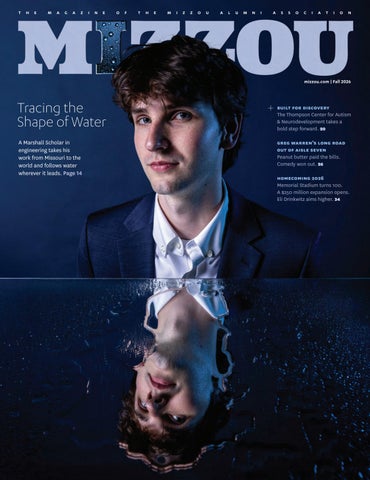
Tracing the Shape of Water A Marshall Scholar in engineering takes his work from Missouri to the world and follows water wherever it leads. Page 14
Mother of Dragons
+
builtWeis for discovery Author Margaret brings The Thompson Dungeons & Dragons to theCenter for Autism masses. 28& Neurodevelopment takes a bold step forward. 20
Hidden Worlds
warren’s Images fromgreg Mizzou’s cuttinglong road out of aisle seven edge Advanced Light Microscopy Peanut butter paid the bills. Core 42 Comedy won out. 26 homecoming 2026 Memorial Stadium turns 100. A $250 million expansion opens. Eli Drinkwitz aims higher. 34
FIRST LOOK WILY COYOTES After an absence of more than 75 years, coyotes have reclaimed San Francisco’s hills, parks and neighborhoods. Loren Elliott, who studied photojournalism in the Missouri School of Journalism master’s program, documented their return for The New York Times in “The Coyotes of San Francisco,” winner of the Environmental Vision category at Pictures of the Year International. The 83rd annual competition, a program of the Donald W. Reynolds Journalism Institute and the Missouri School of Journalism, recognizes the year’s best photojournalism. Elliott, based in Boise, Idaho, is a frequent Times contributor and a member of the Reuters team that shared the 2019 Pulitzer Prize for Breaking News Photography.
1 1
T R AV EL MYT H #42
“IT’S ONLY FOR PEOPLE WILLING TO GO HALFWAY AROUND THE WORLD.” Our Touring Tigers visit exotic locales... but we also offer domestic tours too. Explore the continental U.S. alongside the camaraderie of fellow Tigers. Where will you go next? mizzou.com/travel
MIZZOU
®
FROM THE EDITOR Editorial and Advertising Executive Editor Steven Adams Editor Randall Roberts, BA ’88 Art Director Blake Dinsdale, BA ’99 Contributing Editor Chris Blose, MA ’04 Class Notes Editor Jennifer Manning, BJ ’18 Advertising Scott Dahl: 573-882-2374 Mizzou Alumni Association 123 Reynolds Alumni Center 704 Conley Avenue Columbia, MO 65211 573-882-6611 Executive Director, Publisher Todd A. McCubbin, M Ed ’95 Mission The Mizzou Alumni Association proudly supports the best interests and traditions of Missouri’s flagship university and its alumni worldwide.
ABBIE LANKITUS
An Ever-Changing View For the past few years, Columbians have measured time by assessing the progress of the Memorial Stadium Centennial Project and watching cranes swing overhead as the structure gradually redrew the campus skyline. The transformation has been impossible to miss, especially at night. Before, commuters waiting at the traffic lights near Stadium Boulevard and Tiger Lane could look through the gap at the north end zone and see Faurot Field glowing green beneath the stadium lights. Today, a $250 million expansion mostly fills that gap, but the brilliance remains. It just radiates upward instead. That upward glow feels like a fitting image for the stories in this issue, all written by alumni journalists. MIZZOU Editor Emeritus Dale Smith, BJ ’88, takes readers inside the remarkable new Thompson Center for Autism & Neurodevelopment, speaks with Executive Director Connie Brooks, PhD, BA ’96, and sits down with alumni and philanthropists Bill and Nancy Thompson, JD ’75 and Arts ’67 (respectively), to discuss the vision behind it. Mark Godich, BJ ’79, explores what drives Eli Drinkwitz’s success at Mizzou and how he’s helped elevate the football program. Justin Heckert, BJ ’02, delivers a memorable portrait of
Piece by piece, a new silhouette emerges as crews erect structural steel for Memorial Stadium’s $250 million expansion, shown here in mid-August 2025.
comic (and former All-American Tiger wrestler and Déjà Vu doorman) Greg Warren, BJ ’90, while the profile by Jack Wax, BS Ed ’73, MS ’76, MA ’87, on recent graduate and Marshall Scholar Josh Donaldson, BS BE ’26, explores his education and success in expanding access to clean water around the world. We also look back at Memorial Stadium’s first 100 years. Our centennial timeline traces the stadium’s evolution from a simple memorial to the ever-changing home of Tiger football. That’s the thing about institutions that endure: They’re never really the work of a single era. Memorial Stadium’s first homecoming crowd watched Mizzou beat Kansas 15-0 in 1926. Another will gather on Oct. 3 when the Tigers host Florida. In between, each generation has inherited what others built, left its mark and passed it on. The stories in this issue are, in their own ways, stories about that handoff. RANDALL ROBERTS, BA ’88 Editor
BOARD OF DIRECTORS President Morgan Corder, BA ’18 President-elect Vanessa Vaughn West, BA ’99 Immediate Past President Kim Utlaut, BS ’89 Treasurer Kevin Gibbens, BS BA ’81 Secretary Todd McCubbin, M Ed ’95 Directors Adrienne Barber, BA ’01; Cathy Bien, BJ ’81; Joanna Russell Bliss, BA, BS Ed ’97; Eric Braverman, BA ’87; Mark Bremer, BHS ’20, MPH ’22, MPA ’22; Brent Buerck, MPA ’05; Adam Gafke, BS ’97; Chris Hurt, BA ’88; Ashley Hutcheson, BS CiE ’01; Cheryl Jordan, BA ’84; Emily Kueker, BS ’02; Col. Pete O’Neill, BA ’00; Jermaine Reed, BGS ’06; Amber Rowson, BS ME ’99; BS ’07; Nick Ruthmann, BS ’05, MD ’13; Gema Simmons, BS BA ’94, MD ’98; Pat Thomas, BS ’97; John Twitty, BS Ed ’75; Justin Wilson, BS CoE ’07 Student Representative Andrew Gerstner
Editors Emeriti Karen Worley, BJ ’73, and Dale Smith, BJ ’88 MIZZOU magazine Fall 2026, Volume 115, Number 1 Published triannually by the Mizzou Alumni Association ISSN 2833-3970 Address changes: mizzou.com/update or call 800-372-6822 Comments: mizzou@missouri.edu mizzou.com/magazine Opinions expressed in this magazine do not necessarily reflect the official position of the University of Missouri or the Mizzou Alumni Association. ©2026
FALL 2026
3
TABLE OF CONTENTS MORE FROM MIZZOU Explore the latest on research, student success and innovation at Show Me Mizzou. Subscribe for weekly highlights at showme.missouri.edu
Departments 1 First Look
Photographer Loren Elliott captured a coyote crossing San Francisco’s skyline in an image that earned him a Picture of the Year International award.
6 Around the Columns Power the Roar’s billiondollar milestone; Colonel Sanders’ pressure cooker; Tiger volleyball player Ceylin Kuyan; and more.
CONTRIBUTORS Justin Heckert, BJ ’02, is a freelance writer based in Charleston, S.C. His work has appeared in The New York Times Magazine, Vanity Fair, WIRED, ESPN and other publications. He profiles comedian Greg Warren’s unlikely path from Mizzou wrestler to stand-up comic in “Greg Warren’s Long Road Out of Aisle Seven” (page 26). Mark Godich, BJ ’79, is a semi-retired sports journalist who spent more than four decades in the business, including 22 years as a senior editor at Sports Illustrated and is the author of Tigers vs. Jayhawks: From the Civil War to the Battle for No. 1. He examines how Eli Drinkwitz is building a football program designed for sustained success in “Design by Drink” (page 34). Nigel Buchanan is a New Zealand–based illustrator whose work has appeared in The New York Times, Rolling Stone, Vanity Fair and other publications. See his portrait of Eli Drinkwitz in “Design by Drink” (page 34).
About the cover Photographer Abbie Lankitus captured new alumnus Josh Donaldson as he prepared for life after graduation. Donaldson is the subject of “Tracing the Shape of Water,” (page 14). Lankitus is an award-winning university photographer for Mizzou Visual Productions (see “Briefly,” Page 8). 4
MIZZOUMAGAZINE
facebook.com/mizzou x.com/mizzou instagram.com/mizzou @mizzou
54
Mizzou Alumni News Dani Wexelman and the Cardinals; Kevin Butterfield and the Library of Congress; Riverfront Times co-founder Ray Hartmann; and more.
55 Class Notes
Career moves, family news and milestones from the Mizzou community.
72 Semper Mizzou
The unofficially official rules for being a Tiger.
Council for Advancement & Support of Education Awards 2026: Bronze, Periodical/Magazine Design 2026: Silver, Cover Design (Spring 2025) 2025: District VI Awards: “Beneath a Tiger Moon,” Photo series; “Punchlines in a Pressure Cooker,” Feature Writing (Winter 2025) 2024: District VI Award: General Interest Magazine 2022: Bronze, Periodical/Magazine Design 2021: Gold, Feature Writing (“Who Was I in College?,” Winter 2020) Society of Publication Designers Awards 2026 merit awards: “The Botanical Soundsystem,” Winter 2025; First Look, Winter, Spring and Fall 2025 “The Alchemy Beneath Our Wheels,” Fall 2025; Spring 2025 cover 2025 silver medal: “The Invisible Networks,” Fall 2024 2025 medal finalist: “The Guardians of Silent Worlds,” Spring 2024 2025 merit awards: “Hog Harmony,”(2) Winter 2024; “Capturing Jumpers,” Spring 2024 2024 merit awards: “Vlad Has Stories,”(2) Winter 2023; “The Cosmochemist’s Guide to the Galaxy” Spring 2023 2023 medal finalist: “A LIFE in Focus,” Spring 2022
M E M O R I A L U N I O N : M I Z Z O U V I S U A L P R O D U C T I O N S ; K U YA N : M I Z Z O U AT H L E T I C S
Views Few See Eric Henley oversees nearly 5 million square feet of Mizzou roofs. From Memorial Tower to Jesse Hall and beyond, he experiences campus from a rare perch. “The sun’s out, the wind’s blowing. I’ve got a beautiful view.” Watch a video about Henley’s work by visiting mizzou.us/roofman
Features
The road from Columbia’s Déjà Vu nightclub to a journalism degree to The Tonight Show took a few detours down the peanut butter aisle. Read Greg Warren’s story on p. 26.
14 TODD OWYOUNG/NBC UNIVERSAL
20 26
Tracing the Shape of Water
New graduate Josh Donaldson is sharing his education by helping to expand access to safe, clean water wherever it’s needed most. story by jack wax, bs ed ’73, ms ’76, ma ’87
Where the Portal Meets the Path
A visionary new home for the Thompson Center for Autism & Neurodevelopment expands possibilities for research, treatment and support. story by dale smith, bj ’88
Greg Warren’s Long Road Out of Aisle Seven
The road from Mizzou wrestling to stand-up stardom wound through ankle picks, Jif peanut butter and plenty of hard-earned laughs. story by justin heckert, bj ’02
34 42 48
Design by Drink
Part architect, part foreman, Eli Drinkwitz is building a football program engineered to last. story by mark godich, bj ’79
The Bowl Game
One hundred years after Memorial Stadium opened, Homecoming arrives with a radically transformed home base ready for action. story by randall roberts, ba ’88
Homecoming 2026
Meet the student leaders, explore the festivities and prepare for an enduring tradition made new.
FALL 2026
5
AROUND THE COLUMNS
Marching Mizzou turned heads across the Atlantic this summer when they opened the prestigious London Band Week festival and brought Tiger spirit to some of the United Kingdom’s most iconic stages. The band made four appearances during its visit and earned the King’s Shield Award after advancing to the final round of Drumline London, a knockoutstyle competition. One highlight came during National Marching Music Day, when Marching Mizzou paraded down The Mall toward Buckingham Palace. The visit marked the band’s first trip to London since 1975. The trip also served as a study abroad experience, giving students opportunities to perform internationally while exploring British culture. Their production celebrated connections between Mizzou traditions and Great Britain’s musical heritage. “We were thrilled to represent Mizzou on a global stage,” says Amy M. Knopps, director of Marching Mizzou. “These performances showcased the remarkable talent of our students and the educational experiences that prepare them to lead and excel anywhere in the world.”
MINERAL SECURITY The U.S. National Science Foundation has selected the University of Missouri System’s Critical Materials Crossroads initiative for the NSF Regional Innovation Engines program, which makes it eligible for up to $160 million in funding. The initiative is among the largest investments in Missouri higher education and aims to strengthen America’s domestic supply of critical minerals used in transportation, energy, communications and national security. The UM System project, launched in 2022, brings together more than 260 partners across Missouri and Kansas. “This initiative demonstrates what can happen when higher education, industry and government unite behind a shared purpose,” said UM Board of Curators Chair Todd Graves. 6
MIZZOUMAGAZINE
MARCHING MIZZOU: M2 MEDIA ; MINERAL : ADOBE STOCK
From the Columns to the Crown
FROM THE PRESIDENT A Billion Reasons to Believe
A MILESTONE WORTH ROARING ABOUT Power the Roar surpasses $1 Billion.
TIGER: ADOBE STOCK
Just one year after its public launch, the University of Missouri’s Power the Roar campaign has surpassed $1 billion in philanthropic support, passing the halfway point toward its historic $2 billion goal. “This campaign is about letting the world know that Mizzou makes an impact for students, for Missourians and for society,” University of Missouri President Mun Choi says. “I cannot thank our supporters enough for helping us reach this incredible milestone.” Guided by five strategic priorities, more than 70,850 Power the Roar donors are creating opportunities across the university. This support has expanded access to scholarships, fueled groundbreaking research and advanced transformational facilities such as the Energy Innovation Center and NextGen MURR. These investments are opening doors for students, accelerating discovery and strengthening communities across the state. “Power the Roar is about more than fundraising — it’s a catalyst for impact,” says Vice Chancellor for Advancement Chris Smith. “Every gift is an investment in our future. The momentum we’re building is changing lives, advancing discoveries and expanding Mizzou’s impact across Missouri and around the world. But many great opportunities still lie ahead.” To learn more about the campaign, visit powertheroar.com.
AMONG THE BEST MIZZOU magazine recently received two CASE Circle of Excellence Awards, among higher education's leading communications honors, for Overall Periodical Design and for the Spring 2025 cover. The magazine also earned four Merit Awards in the Society of Publication Designers’ 61st Annual Competition, one of the design industry’s most prestigious international contests. Judges recognized the Spring 2025 cover, the feature “The Alchemy Beneath Our Wheels,” photography in the magazine’s First Look section and “The Botanical Sound System.” With these honors, MIZZOU joins a winner’s circle that includes The New York Times Magazine, Vanity Fair and National Geographic.
Last September, we launched Power the Roar, a transformative $2 billion campaign to invest in Mizzou excellence and expand our impact for generations. After just one year, we’ve already raised more than $1 billion! Thanks to your support, our momentum continues to grow. Mizzou’s proud traditions and land-grant mission drive us to meet Missouri’s needs and bring more value to all we serve. Our progress is reflected in extraordinary outcomes for student success — including 95% career outcome, 91% retention and 77% graduation rates — and another year of strong new student applications and enrollment. Tigers and their families continue to see the incredible power of a Mizzou education to change lives and prepare them for career success. As part of our enduring legacy, we’re also marking a number of important milestones this semester. In addition to opening the new north end zone and the completion of the Memorial Stadium Centennial Project, we’ll kick off a special 100th anniversary game on Sept. 19. Later this fall, we’ll recognize 100 years of Memorial Student Union, 60 years of the University of Missouri Research Reactor (MURR) and five years of the Roy Blunt NextGen Precision Health building. Together, these highlights show the continued resilience and accomplishments of our community. We are an SEC powerhouse and one of the fastest-growing research institutions in the elite Association of American Universities. We’re also investing in a new generation of Mizzou discovery, including the Energy Innovation Center and NextGen MURR, both of which will transform Missouri’s economy and workforce while creating unparalleled opportunities for students to address the most pressing needs facing our country. Mizzou’s reputation for excellence is also a recognition of the achievements and enduring support of alumni and friends. Thank you for your dedication, and I hope to see you at Memorial Stadium this historic centennial season. MIZ! MUN Y. CHOI, PHD President, University of Missouri
FALL 2026
7
AROUND THE COLUMNS Briefly Faculty support for University of Missouri President Mun Choi continues to trend upward, with 80% of respondents rating his performance satisfactory or better in 2026, up from 68% in 2024 and 38% in 2022. Faculty also gave some of his strongest marks for advocacy on Mizzou’s behalf with lawmakers and external stakeholders.
On a small table inside the Novak Leadership Institute rests a relic of America’s early fast-food history: one of Harland D. Sanders’ original pressure cookers. It’s unassuming. You might walk right by the steel pot and think someone here takes lunch very seriously. The founder of Kentucky Fried Chicken, better known as Colonel Sanders, used it to fry some of the earliest batches of his specialty and helped set the franchise on a course for global domination. David Novak, BJ ’74, the institute’s namesake, gifted the artifact as he was clearing out his office after retiring as CEO of Yum! Brands, which owns fast food chains including KFC, Habit Burger & Grill and Taco Bell. “We don’t have a forensic team to track the exact provenance of this pot,” Novak Institute Executive Director Margaret Duffy says with a smile, “but we know that Colonel Sanders and his restaurants used this pot in the original KFC cooking process.” It makes perfect sense that a pressure cooker would end up in Novak’s possession: He and Sanders are both considered trailblazers, and the Novak Leadership Institute was founded on educating kindred spirits for generations to 8
MIZZOUMAGAZINE
come. (David and Wendy Novak also support the current first-floor renovations in Jesse Hall.) Without Sanders’ unconventional approach, KFC might never have been fast. In the 1930s, he was a fried chicken aficionado operating the Sanders Café in Corbin, Ky. He was convinced that cast iron skillets made the best version. “The colonel believed that deep frying ruined chicken,” Duffy says. Still, the fast-food wars were on, and the hamburglers were winning. “In the ’30s and ’40s, there was a huge automobile culture growing, and people wanted fast food,” Duffy says. But made-to-order fried chicken was difficult to cook quickly. Then the colonel had an epiphany: He would transform a pressure cooker into a pressure fryer. At the time, pressure cooking was largely reserved for steaming vegetables, and the process was intimidating. But Sanders mastered the technique. Pairing it with his spice blend, he found a way to cook faster without sacrificing moisture or crispiness. In other words, leadership of the highest order, made to order. — Jessica Vaughn Martin, BJ ’15
Bess J. Pierce, a teaching professor in the University of Missouri’s College of Veterinary Medicine, was inducted as a fellow of the Veterinary Medicine Academy of the National Academies of Practice. The honor recognizes leaders advancing collaborative, team-based care across human and animal health. After 50 years as professor of violin and head of the string department, Eva Szekely has retired from the University of Missouri School of Music. A Juilliard-trained musician, Szekely also performed as first violinist of the Esterhazy Quartet and appeared as a guest artist at Berklee College of Music.
ABBIE LANKITUS
The Colonel’s Cooker
Mizzou Visual Productions photographer Abbie Lankitus was named one of the University Photographers’ Association of America’s top 10 university photographers, ranking No. 8 overall and earning honorable mention recognition in the organization’s annual competition.
THE REIGN OF SPAIN
G O L D F I S H : B I L L M AY E R ; S PA I N : A B B I E L A N K I T US
When Goldfish Go Rogue Rick Relyea has spent years studying how species alter freshwater ecosystems. His latest research highlights the outsized impact of an unlikely culprit. “If goldfish are released into the wild, they rapidly grow into very large fish that stir up lake sediments, consume large numbers of prey and compete with native fish,” says Relyea, a researcher in Mizzou’s College of Agriculture, Food and Natural Resources. Relyea’s new findings show the species can quickly destroy healthy lakes. The study, led by Relyea and William Hintz of the University of Toledo, was published in the Journal of Animal Ecology. To understand the scale of the problem, researchers conducted controlled outdoor experiments. Once introduced, goldfish grew rapidly, reduced water quality and displaced native fish and key organisms. Most severe ecological damage stemmed directly from the goldfish, with habitats declining through regime shift, a rapid decay that is difficult and costly to reverse.
Jim Spain, the University of Missouri’s vice provost for undergraduate studies, is known as much for his empathy as for his accomplishments. He is also a nationally respected dairy cattle researcher, an awardwinning College of Agriculture, Food and Natural Resources (CAFNR) professor and an unflappable leader who served as interim executive vice chancellor and provost in 2018. As he retires in September after 36 years at the University of Missouri, his success is perhaps best captured by a Theodore Roosevelt quote he often borrows: “They don’t care how much you know until they know how much you care.” Spain’s undergraduate experience at North Carolina State University shaped his commitment to bringing high-impact educational practices to Mizzou. As a first-generation college student struggling through organic chemistry while working at the campus bookstore, he accepted a research job and eventually won the American Dairy Science Association undergraduate research presentation competition. “It changed my trajectory,” Spain says. He would go on to oversee Mizzou’s Office of Undergraduate Research. Spain has influenced thousands of students. Former CAFNR Dean Thomas Payne saw those qualities when he hired Spain as assistant dean for academic programs in 1999. “He has always had that personal touch, caring about students’ individual situations to help them succeed,” Payne says. “He’s had a major impact on curriculum across the university.” And for many students, Spain’s message resonated because they knew he meant it. “You really believe that he cares,” says former student Drew Dampf, BS ’13, “because he does.” — Marcus Wilkins, BA ’03
FALL 2026
9
AROUND THE COLUMNS #MizzouBuzz @SXMCollege “What's the best thing that comes out of the state of Kansas? I-70.” Apparently @CoachDrinkwitz has a new standup routine Drinkwitz talks about the #BorderWar between #Missouri and #Kansas @SiriusXMSports
In a May Show Me Mizzou story on faculty offices around campus, writer Sara Diedrich spent time with professors examining how the spaces they inhabit with students reflect their work in quiet, telling ways. “The spaces that faculty occupy and the objects they collect reveal personalities and passions that shape their teaching,” Diedrich wrote. In Angie Zapata’s Townsend Hall office, where she’s an associate professor of language and literacies education in the University of Missouri’s College of Education and Human Development, nearly 750 children’s picture books form the backdrop, a collection she has built since 1997. “Story is a pathway to teach language and literacy,” Zapata told Diedrich. “But it’s also a way for people to feel seen and heard, to recognize their own lives in a text while also encountering worlds different from their own.” She added, “This work is serious, but it can also be incredibly joyful and intellectually creative. Stories help us reconnect to that.” Read the full story online at Show Me Mizzou.
WHERE THE WILD THINGS WENT The University of Missouri is one of 55 institutions collaborating with the Smithsonian’s National Zoo and Conservation Biology Institute on the Lewis and Clark Trail Resurvey, a nationwide project tied to the country’s 250th anniversary. Using trail cameras, artificial intelligence and a coordinated national research network, researchers, along with teams of undergraduate and graduate students, are documenting current mammal communities along Lewis and Clark’s historic route and comparing them with records from the original expedition. Their work is based at Baskett Forest in Boone County. The aim is to better understand how wildlife has changed over the past 200 years. “By comparing what Lewis and Clark saw to today’s landscape, we’re revealing how ecosystems have transformed and what that means for the future,” says Christine C. Brodsky, assistant professor of urban ecology in the College of Agriculture, Food and Natural Resources. 10 MIZZOUMAGAZINE
@MizzouAthletics True Sons. Times two. @CoachHillChiefs and @DrewLock23 are headed to the Mizzou Athletics Hall of Fame! @MizzouFootball | #MIZ @Mizzou Roaring with momentum. Driven by a commitment to innovation and discovery, #Mizzou conducted $553 million in research in the 2025 fiscal year, setting an all-time record and marking 12 straight years of growth. @byEliHoff #Mizzou alum Sheryl Crow will perform the national anthem before the Tigers’ Sept. 3 football opener against Arkansas-Pine Bluff, the school and singer announced.
B I S O N : C H A R L E S S C H WA RT Z ; Z A PATA : A B B I E L A N K I T U S
THE MAGIC WITHIN
@RepMarkAlford Stopped by @Mizzou for a long-awaited tour of the Research Reactor (MURR) & the engineering school with their outstanding team. It is on full display that Missouri is leading the way in innovation. Proud to support critical innovation from MURR by securing $4.2 million
SOUND WORK,
TOWER, GIGAFACT: BLAKE DINSDALE
LOUD RESULTS KBIA-FM, the Missouri School of Journalism’s NPR-member station, earned nine Regional Edward R. Murrow Awards for the second consecutive year. Competing in Region 5, which includes Iowa, Kansas, Missouri and Nebraska, KBIA led all stations in the small-market category and was surpassed overall only by Boston’s WBUR, which received 10 awards. The honors recognized a broad range of work from five reporters across categories including investigative reporting, news documentary, excellence in sound and writing. KBIA’s website also earned the Digital award, marking its 13th win in the category over the past 14 years. Standout projects included “Dumped in Berger,” a monthslong investigation into toxic waste storage, and “A Night at the Inn,” an immersive documentary about homelessness in Columbia. KBIA’s regional winners advanced to the national Murrow Awards competition, where honorees were announced in August.
Facts Machine Students at the Missouri School of Journalism will gain hands-on fact-checking experience through a new partnership between the Columbia Missourian and Gigafact, a nonprofit network that helps local news organizations respond to misinformation and online rumors. As part of the collaboration, students will produce what Gigafact calls Fact Briefs, Gigafact’s format for briefs that answer questions circulating in the community with clear, evidence-based reporting and links to supporting sources. The initiative gives students practical experience identifying claims, verifying information and presenting their findings in a concise format designed for digital audiences. Gigafact provides participating newsrooms with training, editorial support and technology to help reporters investigate rumors and public confusion that spread online. “This addition in Missouri is particularly interesting because students at one of the nation’s top journalism schools, the Missouri School of Journalism, will be publishing Fact Briefs as part of their curriculum,” said Gigafact founder and CEO Chandran Sankaran when announcing the partnership.
From Springfield, For Missouri The University of Missouri School of Medicine is expanding its Springfield campus into a full four-year medical school. The move aims to address physician shortages and improve access to care across Missouri. Beginning in 2027, students will be able to complete their entire medical education in Springfield through expanded partnerships with CoxHealth and Mercy Springfield Communities. The initiative will strengthen the pipeline of physicians serving southwest Missouri while creating new opportunities for local students to train close to home. “This expansion is about more than classrooms and labs,” says Richard J. Barohn, former executive vice chancellor for Health Affairs and dean of the School of Medicine. “It’s about building a healthier future for every Missourian.” FALL 2026 11
AROUND THE COLUMNS
Tiger volleyball's international contingent spans three continents. From left are Maca Lobaglio of Argentina, Nina Mandovic of Serbia and incoming freshman Ceylin Kuyan of Turkey.
In the age of NIL, it’s not uncommon to see incoming college athletes get paid like worldly professionals, but it’s rare to see a recruit arrive on campus with a readymade pro resume. That’s exactly what Tiger volleyball has in freshman Ceylin Kuyan. At 18, the Istanbul native already has logged two standout seasons for the Zeren Spor Kulübü club in Turkey’s toplevel Sultan League. She has also made her mark as a member of Turkey's under-19 women’s national team, where she was twice named best outside hitter — the first time at age 15. “With her ball control and the elite level she’s been competing at, I’m hoping she can step on the court and make an impact from day one,” says Mizzou Head Coach Dawn Sullivan. “It’ll be fun to see how she brings her experience and fits in with the team.” Kuyan is the Tigers’ third international recruit, joining junior setter Nina Mandovic of Serbia and sophomore right-side hitter Maca Lobaglio of Argentina. Sullivan says that in Europe, fewer in-game substitutions mean players have the stamina 12 MIZZOUMAGAZINE
and versatility to play a full game on both front and back rows. However, European teams practice so much (twice a day, five or six days a week) and play such a long season (October through May), that they don’t have time to focus on developing the small skills and conditioning like they do in the U.S. “We emphasize the ability to bring in perspectives from different cultures within our team,” Sullivan says. “We hear and value those individual experiences. We allow each player to lean into their strengths and connect to the whole.” The eclectic Mizzou program is a year removed from backto-back NCAA Tournament berths, including a Sweet 16 appearance in 2024. Kuyan is one of five freshmen reshaping a senior-heavy squad that missed the postseason last season for the first time in Sullivan’s tenure. “I don’t think of it as turning the page as much as building on who we are,” Sullivan says. “I loved laying the foundation of a championship culture. Now we are allowing this next group to continue building.” — Tony Rehagen, BA, BJ ’01
M I Z Z O U AT H L E T I C S
The International Talent Set
WA N J I KO, W E S T R U P G A E TA : M I Z Z O U AT H L E T I C S ; P O RT: U S G A / M AT T S U L L I VA N
TIGER ON TRACK When the Tiger women’s cross-country team takes to the course this fall, they’ll have a returning All-American setting the pace for the first time in almost a decade. Last November, Monica Wanjiko finished 35th in the 2025 NCAA Cross Country National Championships on the home course at Columbia’s Gans Creek with a time of 19:17.4 over six kilometers, making her the first MU woman to garner firstteam All-America honors since national champion Karissa Schweizer in 2017. A native of Kaimbu, Kenya, Wanjiko is only the second Mizzou woman ever to earn that honor as a freshman, joining Andrea Fischer, who did it in 1981. It’s the 14th time a Tiger woman has finished in the top 40 at the NCAA Championship, and the 22nd time including men. The Tigers’ performance bodes well for the future: Wanjiko and two other freshmen, Mirriam Chepkirui and Kobi Walker, led the team to a 28th-place finish overall in just its 13th NCAA Championship appearance as a team. — TR
Mizzou sophomore Monica Wanjiko hopes to build on her 2025 All-American season.
Port’s Honor
Scoreboard
Ellen Port, BS Ed ’83, is one of the most accomplished amateur golfers ever to have come out of Mizzou. That achievement was solidified in March when the U.S. Golf Association presented her with the 2026 Bob Jones Award, the governing body’s highest honor. The only asterisk? Port never actually competed using a club during her time as a Tiger athlete. When she first came to Mizzou, Port wielded a tennis racket instead of a golf club. After graduation, she moved to St. Louis to teach physical education at John Burroughs School and focused on the links. Then she just kept getting better. Eventually, Port went on to win the U.S. Women's Mid-Amateur Championship a record-tying four times, along with three U.S. Senior Women's Amateur titles. Those seven USGA championships place her behind only Bob Jones, Tiger Woods, Jack Nicklaus and JoAnne Carner on the association's all-time titles list. As a golf coach, she led John Burroughs to three state championships and helped build the collegiate golf program at Washington University. Not bad for someone who entered Mizzou thinking her future was in tennis. — TR
76 Mizzou studentathletes named to the SEC First-Year Academic Honor Roll this summer, representing 16 Tiger programs. 108 Spots
Mizzou Women’s Golf climbed in the national rankings under Caroline Westrup Gaeta, from No. 120 in 2022 to a schoolrecord 12th-place NCAA finish in 2026. Westrup Gaeta recently signed a contract extension through the 2030–31 season.
112 Missouri students and graduates honored when Memorial Stadium was dedicated 100 years ago as a memorial to those who died in World War I. 1996 Year Audrey J. Walton Track-Soccer Stadium opened. It’s now undergoing major upgrades that include a new natural-grass soccer field and renovated track facilities. $280,425 Estimated economic impact of the 7,700 hours of community service contributed by Mizzou student-athletes in the 2025–26 academic year, best in the SEC. FALL 2026 13
M I Z Z O U • F A L L • 2 0 2 6
14 MIZZOUMAGAZINE
New graduate
JOSH DONALDSON, a Marshall Scholar, takes his work from Missouri to the world and helps expand access to safe, clean water wherever it’s needed most.
JACK WAX, BS ED ’ 73, MS ’ 76, MA ’87
ABBIE L ANKITUS
1 5 FALL 2026 15
In St. Joseph, Mo., broken water mains triggered a boil-water order affecting part of the city’s aging water network and shutting down his high school for a week. Such disruptions were familiar. They stalled daily life, and over time a pattern became clear, with breakdowns occurring more often in older, poorer parts of town than in newer, more prosperous neighborhoods. For Donaldson, the issue was more than an inconvenience. It was an early lesson in how something as basic as clean water can divide a community quietly. Though he believes the imbalance is often unintentional, “We’ve structured infrastructure so that older and poorer parts of town experience a disproportionate water burden,” he says. That recognition stayed with him and, at the University of Missouri, sharpened into focus. Drawn to the intersections of engineering, public health and equitability, Donaldson began asking not just how systems functioned but also whom they served. Early on, he imagined a future in the nonprofit sector, possibly as a physician. That trajectory shifted during a Critical Language Scholarship program in Tanzania, where he studied Swahili while confronting water challenges far beyond anything he had seen at home. Tens of millions of Tanzanians lack safe drinking water. The scale alone demands a different way of thinking. “The process of applying for the CLS and the time he spent in Tanzania led to a change in his vision of who he could and would become,” says Lauren Pike, Mizzou fellowships coordinator. “It is important to him to create a world where everyone has a right to clean water.” Back in Columbia, the direction was clearer. Engineering could not exist in isolation. “I’ve loved all the engineering I’ve done, but I realized that I’m missing so much of everything else that makes an engineering solution work in context,” Donaldson says. “I need more depth in sociology, philosophy and politics to understand how to make those solutions accessible and equitable.” HOW SYSTEMS MOVE The idea that technical solutions succeed only when grounded in human context has guided Donaldson’s work since. With the Mizzou chapter of Engineers Without Borders, he joined a team supporting repairs to a gravity-fed water system in a rural village in Panama. What initially appeared straightforward quickly proved otherwise, as progress slowed when the effort was treated as a problem to solve from afar. In response, he shifted the approach and moved away from directing the work and toward relying on local capacity. “He internalized the idea of leadership coming from within a group, and he adopted the role of teacher,” says Erik Potter, program manager in Mizzou’s Office of Global and National 16 MIZZOUMAGAZINE
Fellowships. By training a community member in the relevant engineering principles, Donaldson helped locals take ownership of the project while his team moved into an advisory role. Once that transition occurred, the work advanced. That lesson carried into his work on campus, where a different need revealed similar dynamics. After attending a First Year Council lecture on campus food resource Tiger Pantry, Donaldson realized the scale of student food insecurity. “I had no clue about the extent of food insecurity among college students here on the MU campus
and its impact on their lives,” he says. What began as volunteer work soon expanded. Eventually, he became executive director of the student-run organization. Rather than treating the pantry as a static service, he focused on expanding its reach. Pop-up pantries extended access across campus, while monthly meetings of the Midwest Pantry Alliance brought together representatives from 20 colleges and universities to share ideas and approaches. “All the other pantry leaders are professional staff,” Potter says. “And Josh, as a sophomore, was pulling
them in with his vision and leading the meetings.” The context differed from the Panama project, but the underlying principle stayed the same. THE LONG WAY HOME Through research, Donaldson’s thinking took on another dimension. During his senior year, he worked at the Missouri Water Center, where he studied methods for recovering rare earth minerals from mining wastewater. Under the guidance of co-director Baolin Deng, the project linked
For Josh Donaldson, BS BE ’26, water is the starting point for understanding how communities run and how they can work better.
FALL 2026 17
18 MIZZOUMAGAZINE
Clockwise from top left: As president of the Engineers Without Borders chapter at Mizzou, Josh Donaldson meets with club members at the Heidelberg; Donaldson, who graduated in May with a degree in biological engineering, poses during an E-Week royalty photo session; at the May 2026 College of Engineering commencement ceremony, he shakes hands with University of Missouri President Mun Choi; Donaldson volunteers at Tiger Pantry.
engineering practice with broader questions of sustainability and resource use. “He has a wonderful combination of curiosity, intellect and compassion to help society,” Deng says of Donaldson. Across these experiences, a pattern comes into view. Whether working in a rural village, on a college campus or in a research setting, Donaldson approaches problems by examining how systems function and who benefits from the outcomes. That perspective, paired with strong academic performance, brought him national recognition for both leadership and public service. In his junior year, he was named a Truman Scholar. As a senior, he received the Marshall Scholarship, one of the most competitive postgraduate awards in the United States and a distinction earned by only a handful of Mizzou students since 1954. Now in the United Kingdom, Donaldson is extending the interdisciplinary path he began as an undergraduate. At the University of Leeds, he is pursuing a master’s degree in water, sanitation and health engineering, with plans to
“ H E HAS A WONDERFUL COMBINATION OF CURIOSITY, INTELLECT AND COMPASSION TO HELP SOCIETY.”
continue at the University of Edinburgh, where he will study global environment, politics and society. Together, the programs reflect a deliberate goal: pairing technical ability with a deeper understanding of how policy and power shape the distribution of resources. That goal traces back to the approach that first took shape in St. Joseph. “I want to be able to help communities facing water challenges,” he says, “to address their issues from a technical perspective but also to arrive at equitable solutions through community-led governance.” After completing his studies abroad, Donaldson plans to return to the United States and pursue a career in public service, potentially with the Missouri Department of Natural Resources or the Environmental Protection Agency. He’s interested in roles that allow him to shape policy, guide implementation and encourage younger students to engage with water-related challenges. For Donaldson, the governing principle hasn’t changed much since St. Joseph. It still begins with water. It just no longer ends there. M FALL 2026 19
MIZZOU MAGAZINE
FALL 2026
21
WHERE THE
PORTAL MEETS THE
PATH
One of the nation’s most advanced facilities of its kind, the new Thompson Center for Autism & Neurodevelopment is expanding access and accelerating discovery for families across Missouri. STO RY BY DAL E S MIT H, B J ’8 8
than the center’s previous two buildings combined. It will allow the nationally recognized program to double its previous patient capacity of 18,000 visits a year and match the volume of centers in larger cities. Families nationwide sometimes wait years for an autism diagnosis — a delay that can cost precious developmental time. With increased space and staff, the center has reduced its waiting list by 37 percent since 2025. “The point of having all of the different disciplines in one place is so that we can coordinate better patient care,” says psychologist Connie Brooks, BA ’96, PhD ’07, executive director. “When we were in two different buildings, even though it wasn’t far across the parking lot, it felt like miles.” The center, founded in 2005, gets much of its funding and other support from the Thompson Foundation for Autism & Neurodevelopment and other private philanthropy, the University of Missouri, the State of Missouri, grants and insurance payments. Although most centers emphasize one or two areas, the Thompson Center
P R E V I O US PAG E S, L E F T: A N N I E W I L L I A M S
T
THE THOMPSON CENTER for Autism & Neurodevelopment welcomed the first patient to its new building on March 10: a little girl wearing a pink bow. She took in the lobby and its soaring ceiling, but the stimulation soon tipped into overload. Her parents and a behavior therapist led the child to a quiet seat, where watching a few minutes of Frozen settled her. Then she spotted the blue line curving along the floor. “Follow the blue road,” she suggested, as the group walked into one of the nation’s most advanced centers for autism care. The graceful blue line represents the Missouri River. It’s part of a color-coded wayfinding system that threads the state’s ecosystems — forest, river, prairie — through 74,000 square feet of space devoted to caring for patients and discovering new ways to address neurodevelopmental needs. The $54.8 million facility is roughly 1.5 times larger
22 MIZZOUMAGAZINE
pursues initiatives including clinical care, research, education and family services. Its state‑of‑the‑art building was designed to make those functions, and the staff providing them, collide in productive ways. Brooks calls it “bumpability.” For starters, offices are assigned so psychologists sit near pediatricians, who sit near speech‑language pathologists and neurologists. Wide hallways open into huddle spaces for quick consultations. Brooks recalls how the proximity played out one day when she noticed something unusual about swirls in a patient’s hair, a possible sign of a genetic condition. She walked down the hall and asked pediatrician Benjamin Black, the center’s medical director, to take a look. Within less than 10 minutes, he had examined the child, recommended genetic testing and explained next steps to the parent, Brooks says. “That just wouldn’t happen if I were in a psychology‑only building.” Multiply that approach across 15 subspecialties — from neuropsychology to genetic counseling — and the design becomes a clinical strategy. “I don’t have to know everything,” Brooks adds. “I’m surrounded by really smart, amazing colleagues.” Patients’ needs take precedence on the first floor. Muted colors reduce overstimulation. Kid‑level cameras capture therapy sessions, and observation mirrors let colleagues and trainees observe. Height‑adjustable tables, sensory alcoves and sound‑dampening textures make rooms adaptable for each child. The clinic layout means that patients often can remain in a single room while various professionals visit to provide care. The building also houses Missouri’s first Intensive Outpatient Program (IOP) for patients with autism, a 12‑ to 16‑week multidisciplinary offering for those with severe behavioral concerns who might otherwise be hospitalized. Padded walls and anchored furniture protect children with severe behaviors. A rare feature is the elopement hallway, a safe, enclosed loop where children who tend to run away from caregivers can practice stopping when asked. Behavior analysts, therapists, physicians and social workers collaborate in a wing with its own entrance and safety features. “The program is not possible without this facility,” Brooks says. Outside, a playground doubles as a therapeutic space where providers can meet with parents while children play.
The Thompson Center’s new facility brings patients, families, trainees and specialists together under one roof and expands access to coordinated autism and neurodevelopmental care.
A FAMILY- FIRST PHILOSOPHY THE IDEA for the autism center that now bears Bill and Nancy Thompson’s name emerged gradually. Their daughter Emily, a behavioral therapist, may have planted a seed by sharing stories of her work with children on the spectrum. Those conversations made the Thompsons aware of a gap in services families desperately needed. When, in 2015, Mizzou’s For All We Call Mizzou capital campaign called out children’s health as a priority, “It clicked with us,” recalls Bill, BS CiE ’68, who co-chaired the campaign. “How can we help children and their families?” Through conversations with Mizzou researchers and clinicians, the Thompsons learned that many pediatricians didn’t recognize autism early enough, and the delay could be devastating to children’s development. What’s more, few physicians were well prepared to treat neurodevelopmental disorders. Families had precious few options. So the couple set out to build a center offering not only clinical care and research but also training for the next generation of providers across disciplines. The Thompsons live in California and could have launched the center close to home. But Missouri was where their story began. Both grew up in Affton, Mo., a suburb of St. Louis, and built deep ties to the university they say shaped them. Bill served as Missouri Students Association president, helped lead Homecoming and at 27 became the University of Missouri System’s youngest curator. For the couple, locating the center at Mizzou felt like returning a good deed. “It was pretty easy,” Bill says — a chance to give back. Rather than simply writing a check, the Thompsons have remained involved over the years, meeting with families to understand their needs and building a foundation to respond. Through the Thompson Foundation for Autism, chaired by Ron Ashworth, they have worked to shorten waitlists, recruit specialists and secure funding for capital and clinical purposes. The new building reflects their family-first philosophy. Designed with careful attention to acoustics, colors, angles and the features of the outdoor playground, Nancy, who met Bill in high school and studied human environmental sciences at Mizzou, says the result feels less like a clinic and “almost like coming home.” The couple’s mission remains clear and personal. “We strive to save and improve lives,” Nancy says. Bill is quick to add that much work remains: “This game is not over.” — DS FALL 2026 23
Upstairs, a research wing mirrors the clinical rooms below so children moving from clinic to a research session see familiar-looking spaces. A small cross‑trained team of coordinators supports faculty across campus running studies with neurodiverse patients — a model psychologist and researcher Stephen Sheinkopf says is rare among autism centers. The arrangement spares investigators the time and cost of building their own staff while giving the coordinators themselves a launchpad into graduate school, medical school and research careers. Combined with a longstanding patient database, the center’s research operation gives Mizzou investigators a study recruitment advantage few peers can match. The center attracted $9.6 million in research funding in 2025. “Lots of places have some of the elements we’re talking about,” Sheinkopf says. “Very few have all of them. That’s the secret sauce.” When it comes to training, last year, the center provided 4,800 hours of supervision to 400 trainees ranging from high schoolers to advanced graduate students. It also reached 3,400 educators and autistic students through schools, webinars and conferences. Its Autism Friendly Business program has certified more than 45 Columbia organizations. Telehealth services saved Missouri families roughly 583,000 miles of travel. Family services thread through it all. A navi24 MIZZOUMAGAZINE
PAT I E N T S : A N N I E W I L L I A M S ; B R O O K S : A B B I E L A N K I T U S
Above: Students, families and specialists work together in spaces designed for coordinated care. Right: Connie Brooks, BA ’96, PhD ’07, executive director of the Thompson Center for Autism & Neurodevelopment. Bottom right: The center's new playground serves as both a recreation and therapy space.
AUDRA'S MAGICAL MOMENT
ABBIE LANKITUS
The building also houses Missouri’s first Intensive Outpatient Program (IOP), a 12‑ to 16‑week multidisciplinary offering for patients with severe behaviors who might otherwise be hospitalized. “The program is not possible without this facility,” Brooks says.
gation team helps parents schedule appointments and stay connected long after visits end. Brooks recalls one mother who, weeks after her first visit, reached into her purse and pulled out the name and phone number of her navigator, Larissa, still her lifeline through the health system. The navigation team is invited to every clinical training the center offers. Brooks says this level of education and integration sets the center apart. Five months in, the staff is still discovering what the new building makes possible. Trainees are learning to provide care in real time. Researchers are enrolling patients in studies in the time it takes to walk down a corridor. Families are finishing four‑hour appointments on a playground bench instead of a waiting room. And somewhere in Missouri, a parent who has been looking for answers is about to get a call that the wait is over. M
WHEN TARA O’SHEA first brought her daughter Audra (left) to the Thompson Center for Autism & Neurodevelopment, she was desperate for answers. Did her toddler have autism, and could the center help? Audra was an eloper who would run off without warning, and their home bordered a busy road. “My biggest fear was that she’d get out and end up on the highway,” O’Shea says. At 22 months, Audra was nonverbal. They had just moved to Missouri from New Jersey, where O’Shea had tried to schedule an autism evaluation but couldn’t find an opening. The family had done the best it could, teaching her to sign words such as “please” and “thank you.” A turning point came through the center’s care. On a recommendation from pediatrician Benjamin Black, the center’s medical director, Audra was fitted with a “talker,” an iPad that speaks when its user presses buttons. Using the device, she began repeating words, then sentences. At about age 4, the magic happened. When Audra started talking, some troubling behaviors subsided, O’Shea says. “The first time she said ‘Mom,’ I was floored.” Audra’s care plan included applied behavioral analysis, social skills groups, and speech, physical, and occupational therapies. Before long, a reevaluation moved her from a Level 3 autism diagnosis, the highest, down to Level 1. Today, Audra holds conversations, tests ahead of her peers and loves helping classmates. Her preschool teacher calls her a “big helper” who cleans up messes, follows directions and keeps classmates in line. Now 5, she is headed to kindergarten alongside neurotypical students. O’Shea believes that without the center’s diagnosis and interventions, “we would not be anywhere near where we are right now.” The center’s care extends to caregivers. When O’Shea called the triage nurses in tears out of frustration with Audra’s school, they listened without judgment. “Sometimes I just need somebody who understands,” she says. Her hope for Audra now? “No limits.” — DS
FALL 2026 25
L o ng R OA D
etflix Long before N tze, and Nate Barga à Vu and there was Déj ler a Mizzou wrest hone. with a microp
27
2
MIZZOU
FALL
6
FALL 2026 27
except that it sticks to the roof of your mouth. Anyone who eats it knows this. That it ossifies the tongue and entraps the pterygoids, that it refuses to be scraped from where it cements itself, that even the dishwasher can’t totally remove it from a spoon. But peanut butter also makes everything better. Hamburgers and banana sandwiches, apples, bacon and ice cream. And it has no bigger advocate than Greg Warren, standup comic, who sold Jif peanut butter for a decade after he graduated from the Missouri School of Journalism. He drove around Texas with a trunk full of jars in his company car and extolled its creamy virtues. While working for Procter & Gamble, he even had a hand in launching “Simply Jif,” a lower-sugar option marketed to diabetics (he wanted to call it “Type-II Peanut Goo”). Warren, BJ ’90, seems like the kind of guy who might fight you in a restaurant if you went up to him and whispered, “Peter Pan is better.” Warren has a joke about this he uses onstage. About how, at P&G, Warren sold 18 oz. cans of Jif for just 99 cents in Kroger grocery stores throughout Ohio, which was such a rare price point that it propelled the state’s peanut-butter buyers to switch brand loyalty for the brief duration of the sale. “I did that!” he boasts to the audience at the beginning of The Salesman, the 2024 comedy special that catapulted his standup career. The special was produced by Nate Bargatze, maybe the most famous comic in America and a huge fan of the Kirkwood, Mo., native. Bargatze invited Warren to open for him on The Big Dumb Eyes tour and features him at other comedy shows, plus on his website and podcast, all under the Nateland umbrella. Warren’s favorite “peanut goo” is the throughline of The Salesman: “I was a big deal in the peanut butter game!” Warren tells the crowd. He boasts that 99-cent jars “will never happen again. Even the unchoosy moms bought Jif that week.” “‘Mama, this peanut butter tastes better!’” he says, imitating a kid trying Jif for the first time, and then replying as Mama, “‘Well, don’t get used to it, boy … I ain’t givin’ up cigarettes, and I ain’t givin’ up Red Bull. I wasn’t choosey about your daddy, and I’m not choosey about peanut butter!’” Warren, 58, has an auricular hematoma — cauliflower ear — and a middle-aged consternation as a comedian. He often dons black and gold while taping his podcast, The Consumers, 28 MIZZOUMAGAZINE
a weekly deep dive from a former salesman’s point of view into the story of random products such as Taco Bell burritos or Jolly Ranchers. He’s on top of the comedy world right now, propelled into the mainstream after 25 years grinding on the road as a mostly clean comic. (“I wasn’t clean my first ten years,” he says.) From the start, Warren kept his material mostly PG, and then a comedy friend who admired his work suggested Warren was “much too clean to not be all the way clean. You should do that. I think it would work in your favor.” So he switched to what he now calls “Nateland clean,” which is entirely family friendly. Warren’s the cohost of Bargatze’s primetime ABC game show The Greatest Average American, is headlining his own Impulse Buy tour and selling out theaters (including an April gig at the Missouri Theatre). This fall in Pittsburgh, he’ll record his first Netflix special. “I think Greg found something that nobody else was talking about,” Bargatze, currently the world’s highest-earning comic, says via email. “Most comedians are telling stories about their family or growing up, and Greg’s talking about peanut butter and Pringles. You hear that and think, ‘Well, this shouldn’t work.’ Then somehow it’s the funniest thing you’ve heard all night.” The story of how Warren, an advertising major, moved from Mizzou to peanut butter to a Jimmy Fallon appearance to a Netflix special is kind of a weird one that involves singlets (one-piece wrestling tights), the now shuttered Déjà Vu nightclub on Cherry Street and even his ear. •••
IF YOU LISTEN TO HIS STANDUP, you know Warren likes to talk about that ear. Which is really a way to talk about Mizzou. From the seats, it’s hard to see that the ear is pinkish and swollen unless it catches your eye under the stage light. He uses this morsel: Early in the set, Warren points out that it’s his right ear, sometimes blocked from display as he walks with his left side turned specifically toward the crowd. He might pick an audience member close to the stage and say, “I have a cauliflower ear. Don’t stare at it! I got this from wrestling. I wrestled in college. I wrestled for the University of Missouri. It’s hard. I figured that out quick.”
W R E S T L I N G P O RT R A I T: R O B H I L L ; W R E S T L I N G M ATC H A N D C O M I C P O RT R A I T: C O U RT E S Y G R E G WA R R E N
Future comic star Greg Warren first built a reputation in a singlet. He wrestled from childhood through an All-America career at Mizzou before trading takedowns for punchlines.
Warren presents material about his former sport as though he were terrible at it. During his 2025 special The Champ, he riffs on a coach who forced him to watch videos of himself getting totally dominated at Northern Iowa, with the coach saying, “Look at ya, Warren. I’d put it on pause but I don’t need to ’cause you’re not movin…” and about how weddings make him nervous now because he can picture the coach somehow popping up from the crowd and, “When it gets quiet and they say ‘Speak now or forever hold your peace,’ I can hear coach bellow, ‘Warren laid down at Northern Iowa! Don’t marry him!’” In his comedy, he makes his old coach sound insane. But the truth is, Warren was a four-year letterman, all-Big 8 and, in his final season, an All-American competing at 158 pounds. “Greg was a serious student-athlete,” says the wrestling coach in that joke, Mizzou great Wes Roper, BS Ed ’81, who offered Warren a wrestling scholarship. Warren was a twotime high school state champ who attended West Point for a year. “He had a great work ethic,” Roper says, “and didn’t come across to me as a guy you pictured being a comedian. He was a guy who kept grinding. He got better. His junior year he won two or three matches at nationals and then had a great finish FALL 2026 29
30 MIZZOUMAGAZINE
“Don’t stare at it!” Warren jokes about his cauliflower ear. At Columbia’s Missouri Theatre in the spring, stories from his wrestling days delivered some of the night’s biggest laughs.
By that point Warren had done stand-up a few times at Déjà Vu and had even won the interest of the club’s owner, Freddie DeMarco, who turned out to be Warren’s earliest comedy guide, lifelong friend and someone he still weaves into his act. At Déjà Vu, Warren worked the door, bartended, showed an unpolished knack in front of the mic and met traveling comics who provided sustenance for his ambition. But when he graduated, after moving to Chicago for only a few weeks and with DeMarco’s confidence that he actually could be good, Warren chickened out. •••
“I WAS SORT OF IN SHOCK at that time,” Warren says now, speaking one recent afternoon from his home in Kirkwood, Mo., before heading to a show in Chicago. Warren has never been married. He jokes about it a lot, though, that he looks hag-
ABBIE LANKITUS
to his career. He was very strong. He had a tendency on top position of gaining control of his opponent.” Warren was kind of a comedian wrestler, though. He had antics. Which entailed him being the guy trying to lighten the mood for his fellow teammates because Roper, a young coach back then who still took to the mat with members of the team, held brutal practices. Warren tried to make his teammates laugh by doing random bits influenced by Eddie Murphy and Bob Newhart tapes about “the misery we were about to go through.” He also did stuff like sneak out of the gym, order a pizza and have it delivered to one of the heavyweights — during practice. Warren had his caulifower ear drained and casted at MU Health several times but, he says, “you’re wrestling so much you can’t keep up with draining it. Your ear hardens up. I think it’s cartilage; I don’t know. Wrestling taught me that in order to get better you have to put the work in. It’s not going to get better on its own.” He draws this correlation between wrestling and stand-up: “Every now and then, especially in high school, you learn a new technique.” When he was a senior at Mizzou, the Columbia Missourian quoted Warren pondering his future. In an accompanying photo, he’s wearing his singlet and posed like he’s about to strike. “I feel so strongly about comedy now,” he says in the story, “that I think I’m going to have to give it a shot.” He was 22. In the picture he has a totally cherubic face, his arms and legs made muscly by competition.
gard from a bad marriage but has never had one. He lives close to his father in Kirkwood; the two attend Cardinals games and Mizzou matches and even travel to watch high school wrestling. “A girl had broken up with me,” Warren says of that time in 1990s. “I was not wrestling for the first time in my life, and I was lost. I went from having all this structure in my life to having zero. I think about that a lot. I stayed with a friend in Chicago. I left after a couple weeks. I didn’t love it.” He settled for what turned out to be a cushy sales job, a normal person’s job, a much safer job, a car of his own, a 401k, stores of his own, then a sales region of his own, and a proclivity for peanut butter. He was part of a team at P&G and liked the job and company but wasn’t inspired. The whole time, in his 20s into his 30s, his sense of humor and interest in writing nagged at him. So with the urging of friends including comic Mark Gross, he decided to quit and give it a real go.
“We both wrestled, we sorta connected on that,” says Gross, who now lives in LA and is an executive producer of the Chuck Lorre-created Netflix show Leanne. “He was still working for P&G, and I’d be like, ‘You need to quit your job and just go all in.’ He was one of a handful of people I would’ve said that to way back in the day. I could just tell, this guy has got it. He’s one of the people that I felt like should make this their life, you know?” Warren did get something valuable from the salesman life: a decade’s worth of salaried employment fodder for his current line of work. “I tried to write about my experiences at P&G, but I never really cracked the code until I did The Salesman, the first project for Nate,” he says. “I sort of adopted the character of a peanut butter loyalist, which is definitely partially true. I was loyal to my products and believed in my products. I was a company man. I exaggerate the qualities a little bit. It really resonated with audiences. That’s when things started changing.” FALL 2026 31
Wrestling, too, is both part of his act and informs how he conducts it. Not only does Warren donate to Mizzou wrestling, but also when he and his dad have road-tripped to watch the Tigers in action, Warren’s given talks to the team. Not even to offer advice, but to just say funny stuff about the sport to take their minds off the grind, like in February when he was in Columbia for Bargatze’s Big Dumb Eyes tour at Mizzou Arena. Before the show, Warren offered Bargatze and his fellow comics a tour of the Mizzou wrestling facilities at the Hearnes Center so that, Bargatze says, they could “see his name on the All-American wall. It was pretty cool because everybody there was proud of what he’s accomplished. You could tell they respected what he did as a wrestler, but they were just as excited about what he’s doing in comedy.” At the facility, Bargatze added, “He also started wrestling us and throwing us around to show he’s still got it even though he graduated in 1937. (Just kidding, Greg.)” The comedic writing exercises Warren undertakes — recording his own material and playing it back ad nauseum 32 MIZZOUMAGAZINE
ABBIE LANKITUS
Top: Moments before taking the stage at the Missouri Theatre, Warren prepares for a hometown show. Bottom: After the show, he catches up with former wrestling coach Wes Roper, whom Warren jokes would object at his wedding by shouting, “Warren laid down at Northern Iowa! Don’t marry him! ”
while folding laundry to hear his own words and phrases and try and refine them — is just a modern iteration of grappling. Most days he sits down to a blank page and, using three full notebook pages, writes aimlessly to employ continuity and spark his brain, which he describes as freewriting. Other comics he knows have adopted it. “When you do it on a regular basis,” he says, “When you check in with your thoughts, every now and then you’ll get an idea. In the shower or 11:30 at night. You think it comes out of nowhere, but I believe it happens if you do that work (in the notebook). Journalism school helped him express his thoughts as a salesman, he says. “In sales you need to go interrupt this grocery manager, and he’s got a truckload of stuff, and you have 45 seconds to try and convince him to put up a Pringles display or buy the new item. You have to communicate very concisely. Standup comedy is very much the same. You need to probably have a pretty good idea about exactly which word or which piece of punctuation are people going to laugh at. J-School was a big part of that.” “He’s so deserving of all of this,” says Colleen Quinn, the general managing partner of the Omaha Funny Bone comedy club, where Warren got one of his first breaks after leaving Proctor & Gamble. Déjà Vu’s DeMarco called her and vouched for Warren’s talent. “He put in the legwork,” she says, “Nate just helped boost where Greg should’ve been, in my estimation, 10 years ago.” “He’s in a spot right now where I can tell you he is selling out tickets everywhere we go,” says Sean O’Brien, fellow standup and one of the cohosts of The Consumers. A few weeks before, O’Brien had been with Warren in Eerie, Pennsylvania, opening for him during two sold-out shows. “Every single person was
there to pay money to see Greg Warren,” he says. “Greg is at the level where you could throw a dart at the US, hit a venue, and he’ll get people to come out to see him, and they’ll know him from the gameshow, opening for Nate, which is astronomical.”
TO P : D I S N E Y/A B C C O N N I E C H O R N U K ; R I G H T: N B C U N I V E R S A L
•••
WARREN JOKES A LOT about Déjà Vu, which is a way to joke about himself. About getting up and bombing, quitting, trying again. He employs a version of DeMarco’s voice, kind of a New York mafioso thing, DeMarco sounding skeptical about anything Warren does, and it’ll be a part of his sets forever. In The Salesman, peanut butter runs the whole show, and DeMarco is an important character. Warren tells stories about himself through “Freddie” being both smitten with the idea of his future success and then shocked when he left for P&G. Warren recently returned to Columbia to attend a memorial service for DeMarco, who died on Jan. 3. Quinn and other comics and former Mizzou wrestlers were there, too. Instead of eulogizing his late mentor, Warren just did the bit at the end of The Salesman. In it, after he’s told DeMarco he’s quitting his job in his 30s to try standup again, after a decade of success in the rat race, a company man through and through, Warren channels Freddie, loudly: “People don’t need comedy, Greg, they need peanut butter.” M
Top: Warren is a member of Nate Bargatze’s Nateland comedy collective and cohosts ABC’s The Greatest Average American with Bargatze. Bottom: Warren makes his Tonight Show Starring Jimmy Fallon debut in 2025, a milestone for the comic and for Freddie DeMarco, the Déjà Vu nightclub owner who first encouraged him to pursue standup. FALL 2026 33
Part architect, part foreman,
_Eli Drinkwitz_ is building a football program engineered to last.
Story by Mark Godich, BJ ’79 Illustration by Nigel Buchanan
mizzou fall 2026
34
Tigers were a play here and there from completing the hat trick. He has accomplished all this while continuing to evolve on the fly in a sport whose landscape seems to experience seismic shifts by the day. He estimates his staff has grown by 50 percent over those seven years. He has added a player personnel department and a small army of qualitycontrol assistants. He has dealt with staff turnover as seamlessly as possible. He is successfully navigating the ever-expanding transfer portal and an ever-expensive NIL. High school recruiting is nothing like it once was because the courting of those freshmen doesn’t stop when they set foot on campus. Yet amid the chaos, he seems unfazed by it all. “If you aren’t living it every day, it’s really, really crazy,” Drinkwitz says matter-of-factly. “But for us, it’s become the new normal. You have to adjust and adapt if you want to survive.”
EVERY DAY he walks into his office high atop the south end zone of Memorial Stadium, Eli Drinkwitz can see the progress. Two years ago, the view from his window showed nothing more than a mass of rubble and bulldozers shoving dirt this way and that. Now, on a sparkling spring morning, as he reflects on his time as the football coach at the University of Missouri, work crews scramble to put the finishing touches on the sprawling $250 million expansion at the opposite end of Faurot Field. “Drink,” as he’s known around the state and CORNERSTONES pretty much everywhere else in the college foot- EARLY ON, DRINKWITZ WORE multiple hats: ball universe, has a catchphrase he likes to share head coach, offensive coordinator, quarterbacks with his players and staff. It is appropriate not only coach, play-caller. Now he has adapted and for the massive project that is nearing completion brought on a new offensive coordinator, Chip but also for the ongoing construction Drinkwitz Lindsey, and QB coach, Garrett Riley. Lindsey has feverishly undertaken with his football pro- will call the plays with an assist from Riley, an gram. Eight simple words: assistant under Drinkwitz at App State who also Little by little. A little becomes a lot. has experience as a coordinator and play callMake no mistake: Memorial Stadium will er. New tight ends coach Alex Atkins also has always be “the house that Gary coordinator experience at the Pinkel built.” The former Mizzou Power Four conference level. Drinkwitz was coach was, you might recall, fond of It is quite the brain trust, and ala 36-year-old saying that if you don’t see cranes though some offense-minded head wunderkind in the sky, something’s wrong. But coaches might be reluctant to rewhen he arrived even as Pinkel laid the foundation linquish their stranglehold on the on campus in late by taking the Tigers to summits system, Drinkwitz wouldn’t have it 2019 after a year they hadn’t ascended in almost any other way. (Not to worry, Mizzou as the head coach five decades and paving the way faithful. The highly effective outside at Appalachian for Mizzou’s entry into the premier zone run that has become a Drink State. He has conference in college athletics, staple isn’t being retired.) From his become the face Drinkwitz is the man behind the days growing up in Alma, Ark., he of the university. expansion phase. always has had a curiosity about him He was a 36-year-old wunderand been eager to improve and grow kind when he arrived on campus in late 2019 while soaking up as much knowledge as possible. after a year as the head coach at Appalachian One colleague in the athletic department marvels State. Now, hard as it might be to believe, Drink- at Drinkwitz’ bandwidth and his ability to engage witz begins his seventh season in Columbia as in conversation with anyone on any subject. the second-longest tenured head coach at the “I think that’s a tribute to the way my parents same school in the SEC, behind only Georgia’s raised me,” Drinkwitz says, “and having a backKirby Smart. He ranks seventh in career wins at ground of being around a lot of different people and Mizzou, with 75, and could climb as high as fourth in a lot of different places in life. You have to have on the list by season’s end. He and Pinkel are the confidence in who you are and humility in who only coaches to guide the Tigers to consecutive you are. I think it’s being able to meet people where 10-win seasons. Last season, Drinkwitz and the they are and not having a sense of entitlement. 36 MIZZOUMAGAZINE
FALL 2026 37
M I Z Z O U AT H L E T I C S
But also having a sense of humility of trying to learn from every person you come in contact with.” An All-American tackle at Mizzou and a 1981 first-round draft pick of the Dallas Cowboys, Howard Richards knows a thing or two about the game. He played for the legendary Tom Landry. As an analyst who is beginning his 16th season in the Mizzou Network radio booth, Richards has had a front-row seat to 38 MIZZOUMAGAZINE
witness Drinkwitz’s maturation. “To me, the best part about Drink is he’s evolved as a head coach,” Richards says. “Every year, I think he gets better and better. You can see it in his demeanor. I love that he is learning as the CEO of this program how to do his job better. The toughest part, whether you are the head coach or the head of a corporation, if you want to thrive, you’ve got to identify the weaknesses and make hard decisions and hard changes.”
— University of Missouri President Mun Choi
STEELWORK
DYNAMIC IS THE WORD University of Missouri President Mun Choi used more than once in describing what he remembers about Drinkwitz when Mizzou was in the market for a football coach. “He didn’t try to sell us,” Choi says. “He just came across as being very dynamic, diligent and genuine.” In Choi’s view, not much has changed since that initial meeting. Drinkwitz, he says, wants to know what’s happening on the academic front and around campus, how he can help and what he can do. He seems to pop up everywhere: at sporting events, at alumni gatherings, at a meeting of construction workers at Faurot, you name it. Every interview and every address is punctuated by an “M-I-Z” signoff. He has become the face of the university. “I see him as someone who understands the importance of athletics and advancing the university,” Choi says. “He talks to me about the importance of a nuclear research reactor and the
M I Z Z O U AT H L E T I C S
Eli Drinkwitz's influence reaches far beyond Memorial Stadium. From fan meet-and-greets to alumni events and football practices, he has become one of Mizzou's most visible ambassadors across the state.
“ He didn’t try to sell us. He just came across as being very dynamic, diligent and genuine. I see him as someone who understands the importance of athletics and advancing the university.”
M I Z Z O U AT H L E T I C S
fact we are an AAU institution. This demonstrates to me he is part of our organization, not just the coach for football.” That inquisitive nature drives Drinkwitz in his never-ending quest to experience something new. In 2025, he took his juniors and seniors on a service trip to a mountain village in Jamaica for several days of home- and team-building. This spring he cleared his mind with a 22-mile e-bike trek through the Red Rock Canyons outside Las Vegas. “It was just something unique outside of football,” he says. “I’d never done anything like that. I got to see some beautiful artifacts, beautiful country. I pride myself on trying to do things I haven’t done before.” Whether he’s speaking to an alumni group or a gaggle of reporters, Drinkwitz has never shied away from the microphone. He believes having a sense of humor helps, and he’s not afraid to stick out his neck with a joke here and there. “Sometimes they land, sometimes they don’t,” he says. “You can’t be afraid when it fails.” Over the course of a couple of days in May at the SEC spring meetings, he addressed a variety of hot topics. His remarks spread like wildfire across social media. Among other things, he: • Took Big Ten coaches to task for their opposition to the newly adopted punt-formation rules. “Complain about something that you could have been a process to. Maybe they find a local judge to allow them to use whatever process they use.” • Showed he deals with everyday headaches just like the rest of us. He noted on Sirius XM radio that despite falling two votes shy in his battle with his homeowners’ association to get a fishing ban lifted at a neighborhood pond, he wasn’t giving
Eli Drinkwitz participates in a team-building and service trip effort in Jamaica, an experience that reflects his belief that “you have to have confidence in who you are and humility in who you are.”
up the fight. “We didn’t have enough turnout. The absentee ballots kill you. Next year I’ve got to plan for that.” • In an apparent acknowledgment to critics who say he needs to start winning more big games, jokingly told Paul Finebaum of SEC Network that he might be headed to a career in media. “If we don’t start beating Top 25 teams, they’re going to start putting my ass on TV.” In the end, of course, that’s what it all comes down: the wins and losses. So, no surprise, the deep desire to learn more extends to Drinkwitz’s day job. “I think curiosity is the only way to improve,” he says, “and I’ve always wanted to improve, get better, to accomplish more, to keep winning. The day you think you got all the answers is when you start losing.” “I think you have to be inquisitive, you’ve got to want to learn,” he adds. “You’ve got to be able to spread your wings, so to speak, to try to fly. You have to get some knowledge in order to do that.” Case in point: Last year, Drinkwitz wavered about what to do at quarterback and waited until fall camp to name a starter. Granted, injuries would become a factor, but the QB play was indifferent at best, and Mizzou lost a couple of games it was in position to steal. Lesson learned. This year, Drink not only FALL 2026 39
Drinkwitz has never shied away from the microphone. He believes having a sense of humor helps, and he’s not afraid to stick out his neck with a joke here and there. “Sometimes they land, sometimes they don’t,” he says. “You can’t be afraid when it fails.”
locked up the quarterback he wanted early in the portal season, but he also named Austin Simmons the starter during spring ball. “We knew Austin Simmons was here to be our starting quarterback, to give us the best chance to find success,” Drinkwitz says. “We need to allow him to grow his leadership with our team but also allow our offense to be developed around him and his strengths.”
DRINK HAS THRIVED in the transfer portal by identifying holes on the roster and then finding players who can fill them. As evidence, every one of the program-record-tying-high six Tigers who were selected in the 2026 NFL Draft was a portal addition. Simmons, who lost the starting job at Ole Miss to an ankle injury early last season and never got it back, is mature beyond his years. He graduated from high school two years early and earned his bachelor’s degree at the age of 19, three months before he had started a game at Ole Miss. The emphasis in the passing game will be to push the ball deeper down the field. Simmons’ arm talent stood out to Drinkwitz; he’s a former pitcher who can sling it. But that’s not all. “I like that he’s still young from a learning standpoint and that he’s hungry to improve and get better,” Drinkwitz says, “and then like anybody we bring in our program, guys with a chip on their shoulder, with something to prove, have traditionally panned out really well for us. He’s got the right kind of chip on his shoulder.” Bringing in a transfer at the game’s most important position comes with risks. What makes this situation even more of a challenge is that Simmons is left-handed. That can affect playcalling and the comfort of the quarterback rolling one way versus the other. The right tackle is now the blind-side protector. The ball comes out of the quarterback’s hand with the opposite spin, which will be an adjustment for every receiver not named Cayden Lee, a fellow Ole Miss transfer and Simmons’ best friend. Drinkwitz can’t recall coaching a lefty QB, but the good news is that Lindsey has such experience, having worked with Max Johnson during a recent stop as the offensive coordinator at North Carolina. As Richards notes, in Chapel Hill, Lindsey also was involved in the development of Drake Maye, a future first-round NFL draft pick who sang the praises of his offensive coordinator and who, in only his second pro season, had a breakout year with the New England Patriots in 2025. Richards also points to Drink’s track record in the portal. 40 MIZZOUMAGAZINE
“Whatever he’s doing to identify talent, he’s been very good at filling the holes,” Richards says. “The guys he brings in are as good if not better than what he’s had before. The development piece has to happen. How does a new guy come in and adjust to the system? How fast can he learn? For the most part, I think they’ve been successful.” What’s not to like? With 29 wins over the past three seasons, Mizzou is tied for 12th among Power Four conference schools. Choi mentions the four straight years of record applications and a steady rise in enrollment, increases that are largely tied to success on the football field. In his travels around the country and abroad, Choi says alumni and fans want to talk about Mizzou football. The unveiling of the north end zone complex will coincide with the Memorial Stadium centennial celebration. It is all happening under the direction of a football coach who is where he wants to be and believes he can win here. And win big. “Every day, you’ve got to have a little bit of success,” Drinkwitz says, “and over time, you stack it up, and you look back and you say, ‘OK, this is how far we’ve come.’ That’s what’s happened with us. It started with a vision of trying to get lights on the practice field. And then it was getting an indoor facility, and then it was redoing the weight room and recovery room and investing in our athletes. And then it was having a bigger vision of what we want to do with the north end zone.” It wouldn’t be wrong to say that, on the football field and off, a little is quickly becoming a lot. M
M I Z Z O U AT H L E T I C S
HORIZONS
FROM LEFT: Cayden Green, Jamal Roberts, Blake Craig, Austin Simmons, Donovan Olugbode, Marquis Gracial
CONSTRUCTING A CONTENDER In the transfer portal era, drastic roster turnover is the norm. Coming into 2026, Mizzou football head coach Eli Drinkwitz will have plenty of new faces behind the facemasks, most notably at quarterback and on defense. The Tigers, though, also return some key names to help stabilize a squad looking to make the College Football Playoff for the first time in school history.
QUARTERBACK: After coming into the
2025 season with a quarterback competition, Drinkwitz wasted little time naming Austin Simmons to start for 2026. The transfer portal prize brings an elite arm, good mobility, sound football sense and a cool on-field demeanor to the job. Simmons also has something to prove after an injury sidelined him at Ole Miss early last season, which opened an opportunity for Trinidad Chambliss to seize the starting position (he didn’t relinquish it).
M I Z Z O U AT H L E T I C S
RUNNING BACK: The closest thing to
certainty Tiger fans had early in the offseason was a chance to see the SEC’s leading rusher, Ahmad Hardy, return to Mizzou’s backfield. Tragically, over the summer Hardy caught a stray bullet in the leg as an innocent bystander. In July, he was medically cleared and is expected to make a full recovery. The Tigers also can turn to last year’s no. 10 SEC rusher in senior Jamal Roberts.
WIDE RECEIVER: Simmons inherits
one of Mizzou’s top young targets in Donovan Olugbode, who as a true freshman last season provided highlight-reel
grabs and runs after catches. The new QB also helped lure transfer senior wideout Cayden Lee from Ole Miss. Rounding out the starting receiver corps is another senior transfer, Caleb Goodie, from Cincinnati. OFFENSIVE LINE: This unit is one of
the few spots where the Tigers have continuity. Although the team lost All-American right tackle Keagen Trost and center Connor Tollison to the NFL, All-SEC left tackle Cayden Green returns to anchor the O-line along with returning starters Curtis Peagler and Dominick Giudice and a few key reserves from 2025. Senior tight end Brett Norfleet will be back from offseason shoulder surgery to resume his double-threat role as run blocker and downfield receiving threat.
DEFENSE: Last year’s defense was among the best in college football. The question now is whether the Tigers can reload rather than rebuild. The answer may determine whether 2026 is merely good or truly special. Drinkwitz pulled a staggering 15 defensive transfers out of the portal to fill gaps. Josiah Trotter and Zion Young
left for the NFL, and menacing edge rusher Damon Wilson transferred to Miami. Lack of star power is hardly the only potential concern. The defense features only one returning player who started in at least six games, defensive tackle Marquis Gracial. KICKER: When star kicker Blake Craig
tore his ACL in last year’s season opener, it put Mizzou’s entire offense on its heels and changed the way the team approached field goals. Having his long leg back this year should add some stability — and hopefully plenty of points. — Tony Rehagen, BA, BJ ’01
CHASING THE AIRWAVES Missouri football great Chase Daniel is joining SEC Network’s SEC Nation as an analyst this fall. The former Tiger All-American and 2007 Heisman finalist will appear on the network’s weekly traveling pregame show while continuing his college football and NFL analyst duties for ESPN, which he joined in 2025. FALL 2026 41
TH E
42
BOWL
MIZZOUMAGAZINE | FALL 2026
GA M E
MIZZOU HOMECOMING 2026 SPECIAL SECTION
One hundred years after Memorial Stadium opened, Homecoming arrives with the stadium closer than ever to a complete bowl. STORY BY RANDALL ROBERTS, BA ’88
“Missouri to Build Memorial Stadium,” the Columbia Missourian headline declared, with a story outlining plans for a 25,000-seat football field and a memorial to those lost in World War I. It was the eve of the annual Thanksgiving clash against the Kansas Jayhawks. The old Rollins Field dated to 1911. The university had created it for fewer than 14,000 attendees and later patched it with wooden stands, but capacity never kept pace, especially when Kansas came to town. The push for a new stadium followed the same simple math that has driven stadium projects ever since: too many people, not enough suitable space. A century later, that equation still holds. As Mizzou celebrates Memorial Stadium’s centennial on Sept. 19 against the Troy University Trojans, workers are putting the finishing touches on a $250 million renovation, the latest turn in a cycle defined by growth and demand. The project closes the stadium’s last open end, bringing Memorial Stadium closer than ever to a complete bowl, its shape still reflecting the hillside and the many eras that built it. To understand how the stadium arrived here, start at the beginning.
1923–1925 AN IDEA TAKES HOLD The first Memorial Stadium plan took some heavy lifting. As enrollment grew and football crowds surged, decision-makers envisioned a stadium simultaneously rising along with Memorial Union, one anchored in the natural valley south of campus. Long before anyone poured concrete, the shape was there: a broad horseshoe carved into a hillside and intentionally left open at one end. Money was hard to come by. Funding delays sent organizers back to the drawing board, and progress relied on many smaller contributions accumulating around an idea that still lived mostly on paper. By October 1925, memorial committee chair J. C. Jones could finally say, “The financial problem has been solved.” That fundraising success cleared the way even as ambition pushed past the first building plan. The stadium would seat 25,000, Jones said, but capacity would surely grow. “Will there ever be 98,000 people in Columbia?” he wondered. “It is very probable.” 44 MIZZOUMAGAZINE
1925–1926 BUILDING UNDER PRESSURE Construction began that winter between bluffs. Builders excavated and leveled the stadium’s horseshoe shape, and crews encircled the original field with a 440-yard running track. Pressure followed from the start. Limited resources, rising expectations and an unforgiving calendar shaped each decision. As opening day approached, rainy weather threatened to undo months of work. Grass refused to take root. Crews responded by spreading sawdust in a last-ditch effort to stabilize the surface enough to play.
Opening day When Memorial Stadium opened in October 1926, it nearly doubled the size of Rollins Field. The university dedicated the new stadium to the 112 Missouri students and graduates who died in World War I. Torrential rain greeted the debut as Missouri and Tulane played to a scoreless tie on a muddy field that crews had loaded with more sawdust. The following year, freshmen gathered leftover stone from the construction site and shaped it into the Rock M, an imposing marker overlooking the field and fixing the stadium’s identity in place almost as soon as it opened.
1949 FIRST EXPANSION By the late 1940s, a 25,000-capacity stadium no longer met demand. In 1949, Missouri added nearly 5,000 seats to the west stands in Memorial Stadium’s first major expansion. Designers paired the new seating with a larger press box, a nod to how football coverage, and radio broadcasting in particular, had begun to grow alongside the game itself. The horseshoe didn’t change form so much as deepen, growing taller and tighter around the field.
P R E V I O U S PA G E S : A B B I E L A N K I T U S ; R O L L I N S F I E L D : S TAT E H I S TO R I C A L S O C I E T Y O F M I S S O U R I
On Wed., Nov. 28, 1923, the University of Missouri announced its sporting future.
Opposite page: Before Memorial Stadium opened, Missouri football played at Rollins Field, whose limited capacity helped inspire its successor. Above left: The 1925 groundbreaking signaled an idea becoming a reality. Above right: An architect’s drawing from the 1920s envisioned the horseshoeshaped Memorial Stadium planned for the valley south of campus.
G R O U N D B R E A K I N G : U N I V E R S I T Y A R C H I V E S C : 0 / /4 7/ 1 2 ; R E N D E R I N G : U N I V E R S I T Y A R C H I V E S ; C R O W D : D O N A L D S M I T H
Left: Faurot Field became a sea of uniforms and instruments as visiting high school bands joined Marching Mizzou for High School Band Day during the 1961 season.
end zone with 10,800 permanent seats that pushed capacity beyond 62,000. With temporary bleachers installed in the north end, crowds swelled to 68,349, then the largest in stadium history (later topped by 75,298 in 1980). For the first time, the building felt less like an open structure stretched across a hillside and more like a space beginning to hold itself together. That move followed a failed idea four years earlier. In 1974, Mizzou explored lowering the field to add sideline seating, only to hit bedrock just beneath the turf.
1950–1965 COMPLETING THE ORIGINAL U Over the next 15 years, Missouri expanded Memorial Stadium in stages rather than leaps. Crews added seating along both the east and west sides and pushed capacity past 35,000 in the early 1950s, beyond 44,000 by the early 1960s, and finally to just over 51,000 permanent seats by 1965. With the final southeast corner expansion that summer, the original horseshoe took a more imposing shape and more than doubled the stadium’s 1926 size. In 1968, a privately funded press box added premium seating; it was replaced in 2000 by the current structure, which introduced private suites.
1985–1994 THE OMNITURF EXPERIMENT
1978 PARTIAL ENCLOSURE In 1978, Memorial Stadium changed shape in a way fans felt at once. Crews enclosed the south
MIZZOU HOMECOMING 2026
Not every upgrade worked out as intended. In 1985, Faurot Field replaced natural grass with an artificial surface called Omniturf. Billed as durable and modern, it debuted with a Tiger loss and quickly developed a reputation that went beyond victories and defeats. Over 10 seasons on the surface, Missouri went 20-38-3 at home, including a 0-7 home campaign in 1985. Players noticed, too. After rushing for 166 yards, Colorado running back Rashaan Salaam bluntly summed up the problem with the field: “It’s like getting hit twice. You get hit, and then you fall on that turf.” The experiment ended fittingly in 1994, FALL 2026 45
1996–2003 MODERNIZING INSIDE By the late 1990s, Memorial Stadium’s shape held steady, but the way people used it did not. In 1996, Mizzou installed permanent light towers that could stretch Saturdays later, open television windows and nudge the stadium into a sport increasingly organized around broadcast as much as attendance. The towers were part of a threeyear, $12 million modernization that restored grass, added brickwork and upgraded amenities. That shift continued at field level in 2003, when crews replaced the grass with FieldTurf. Mizzou was one of the earlier major programs to adopt the artificial surface. The switch required new drainage and a rebuilt base beneath the field. It aimed to solve wear-and-tear problems that had lingered for decades. Unlike the Omniturf experiment, the new approach worked at once: The Tigers opened the FieldTurf era with a shutout. More broadly, FieldTurf allowed the stadium to handle heavier use and harsher conditions.
Above: Memorial Stadium grew in stages. An experiment with Omniturf starting in the mid-80s resulted in complaints from players and coaches (left). To meet the demands of modern college football, upgrades in the 2010s included an east side upper deck and premium seating in the south end zone (right). Opposite page: Seen from the same vantage point, Memorial Stadium reveals the scale of its growth. What began as a modest venue carved into a natural valley (top) is nearing completion as a 21st-century sports and events complex through the university’s $250 million centennial renovation (bottom).
2014 A NEW MODEL A 2014 renovation shifted more than the stadium size; it shifted its purpose. The university added an upper deck, premium seating and expanded concourses, and pushed capacity to roughly 71,000 to reposition Memorial Stadium for a new competitive reality in the Southeastern Conference. The work reshaped the east side and layered new experiences including a multi-level concourse and 14 field-level open-air suites into the structure to adjust to how college football, and the expectations around it, had changed. 46 MIZZOUMAGAZINE
MIZZOU HOMECOMING 2026
2019 SHIFTING THE CENTER OF GRAVITY Completed in 2019, the south end zone complex reshaped how the stadium functioned more than how many it could hold. Designers brought football operations, premium spaces and a massive video board together into a single architectural presence that changed game day and the way players, donors and fans moved through the building. The addition also altered the stadium’s visual balance. The south end, originally the open part of the horseshoe, now carried more architectural weight than the north (Rock M) end. From Stadium Boulevard, the green expanse of Faurot Field still opened into view, which served as a reminder that, even after the upgrade, the bowl itself lacked a sense of closure.
2024–2026 ROUNDING THE BOWL The $250 million Centennial Project closes in the north end, long defined by the Rock M hill and the open sightline from Stadium Boulevard, and builds it out. Construction began in late 2024 and drew funding the same way most versions of this place have: a mix of major private gifts, premium seat commitments and backing approved by the Board of Curators. Rather than creating a perfectly symmetrical bowl, it completes the stadium’s enclosure and brings a century-long geometric evolution nearly full circle. The project adds roughly 200,000 square feet of new space in a multilevel north concourse and folds about 2,000 premium seats into the design through loge boxes, club seating and 66 suites. Capacity settles into the mid-60,000s, not as a retreat but as a recalculation. J. C. Jones was wrong about 98,000 seats. But he understood something about the trajectory. The stadium he envisioned never reached that size. It did, however, spend the next century closing the gap he left behind. M
M I Z Z O U AT H L E T I C S ; O P P O S I T E : TO P : U N I V E R S I T Y A R C H I V E S C : 1 / 8 1 / 1 ; B OT TO M : A B B I E L A N K I T U S
with a 31-14 home loss to Kansas. The following summer, the field returned to natural grass (for a few years).
FALL 2026 47
48 MIZZOUMAGAZINE
At the Heart of Homecoming
MIZZOU HOMECOMING 2026
REAGAN MANIS
Every fall, Mizzou Homecoming brings Tigers together through service, tradition and celebration. Events begin Sept. 18 with Tiger Food Fight and culminate Oct. 3 with the parade and football game. Before the festivities begin, MIZZOU magazine caught up with this year’s three Homecoming tri-directors for a quick Q&A.
Megan Mesikapp
Blake Ford
Owen Reynolds
Journalism Chicago
Agriculture Systems Technology Washington, Mo.
Agribusiness Management Boonville, Mo.
What’s been the most meaningful part of your Homecoming experience so far? MM: Getting to see the impact on not only university students and faculty, but within the Columbia community, as well! BF: The opportunity to give back to the university that has given me so much is incredibly meaningful. Even more rewarding is seeing the smiles on the faces of families during Homecoming events and witnessing the lasting positive impact Mizzou Homecoming has on both campus and the surrounding community. OR: I love the opportunity to work with thousands of students who are proud to make Homecoming happen and give back to our Mizzou community.
If your life had a three-word title, what would it be? MM: Little Miss Mizzou BF: Homegrown, Missouri made OR: Know your why
What’s something about college that turned out way different than you expected? MM: How quickly strangers can become your closest friends! BF: The lessons I have learned and the lifelong friendships I have made. OR: How small the campus becomes when you try new things.
What’s your favorite thing about Homecoming? MM: The parade! I was on parade committee last year, and prior to being on steering committee I always walked in the parade since freshman year. BF: Seeing generations of the Mizzou community coming together to celebrate each other and the university. OR: Sharing memories and connections with generations of Mizzou Tigers!
Describe your college experience so far using 5 emoji. MM: BF: OR: Which class has made you think, “Yeah, this is why I’m here?” MM: Reporting 1 with Kellie Stanfield. She is not only my favorite professor, but the work I did for her class produced projects I was most proud of. Plus, she is one of the kindest people you’ll meet. BF: Relationship and Professional Selling, taught by Linda Sowers OR: Economics of Managerial Decision Making Who’s your dream dinner guest, and what are you serving? MM: Megan Moroney and rigatoni pasta BF: Shane Gillis and Chili’s Triple Dippers OR: George Washington and T-bone steak (medium rare only)
What’s the one show you’d force your friends to watch just so you can talk about it? MM: Love Island BF: Yellowstone OR: Ted Lasso What’s your personal anthem — the one that hits every time? MM: “Suddenly I See” by KT Tunstall BF: “Backup Plan” by Bailey Zimmerman & Luke Combs OR: “Life is a Highway” by Rascal Flatts What’s your ideal way to do absolutely nothing? MM: Bed rotting BF: Playing video games with my friends OR: Watching college sports FALL 2026 49
2026 HOMECOMING EVENTS
50 MIZZOUMAGAZINE
CHERRY ST. PARADE FINISH
P
6TH ST.
MIZZOU HOMECOMING 2026
P
8TH ST.
P
N P
UNIVERSITY AVE. P
P
AVE.
Reynolds y Alumni Center
ROLLINS ST.
PARADE START
KEY P
HITT ST.
Greek Town/ House Decs
VIRGINIA AVE.
TURNER
HITT ST.
Y AVE.
MISSOURI AVE.
P CONLE
COLLEGE AVE.
9TH ST.
STEWART
E.
Parking restrooms accessible seating sensory-friendly area P
STADIUM BLVD. Faurot Field
HOSPITAL DR
.
1 9 8 7 S AV I TA R
Homecoming Football Game Faurot Field at Memorial Stadium Time TBA Mizzou Tigers vs. Florida Gators. Stay for halftime to see the 2026 Homecoming Royalty crowned.
BROADWAY
MONK DR.
SEPTEMBER 28–30 Talent Showcase Missouri Theater 6:30 p.m.–9:30 p.m. Three nights of skits, songs and performances from talented students.
OCTOBER 3 Homecoming Parade Campus & Downtown Columbia 9 a.m. Marching bands, floats and Tiger tradition on parade.
P
TIGER AV
SEPTEMBER 27 Light the Dome Traditions Plaza 7 p.m. Jesse Hall shimmers with gold to celebrate the official beginning of Homecoming week.
Spirit Rally Traditions Plaza 8:30 p.m.–9 p.m. Marching Mizzou and the Golden Girls help kick off the football excitement.
WALNUT P
5TH ST.
SEPTEMBER 21–24 Homecoming Blood Drive MizzouRec 10 a.m.–5 p.m. Mizzou hosts one of the largest student-run efforts in the country.
OCTOBER 2 Campus Decorations Greektown 6 p.m.–9 p.m. The whole family’s welcome for interactive skits, food trucks and activities.
PROVIDENCE
SEPTEMBER 18 Tiger Food Fight Reynolds Alumni Center, Circle Drive 9 a.m.–3 p.m. Contribute to the Food Bank for Central and Northeast Missouri, which benefits Tiger Pantry on campus.
Parade Route
Forever Faurotcious. First. Finest.
For most Tigers, Homecoming is a weekend — but for the students who bring it to life, it’s the culmination of an entire year’s worth of effort.
Your gift to the Homecoming Endowment Campaign provides students with the resources to build on our traditions, making each year’s celebration even more exceptional for the Tigers who come home.
SUPPORT THE ENDOWMENT Scan to give or visit mizzou.us/HoCoEndowment26
FALL 2026 51
Welcome to Traditions Circle With appreciation for our record number of donors who preserve our traditions, support students and strengthen Mizzou’s future! Ben & Jessica Jackson Angelette Marcia & Ted Ayres Gloria & Titus Blackmon Eric Braverman Brandy Burkhalter John L. Carter Maria & Frank Casella Julie & David Corley Elizabeth & Matthew Davis Eric & Donna Doerhoff Deborah & Robert Dolgin Julie McKittrick Engelbrecht & Scott Engelbrecht Cordelia (Dee) Esry Kate & Robert Fick Whitney & Kevin Gibbens Edwin Gladbach Janae Gravitz Barry P. Greenley, DDS. Lt Col Ret. USAF
Kathy & Steve Hays Ashley Hutcheson Pamela & Ralph Hylton Jan & Jim Jackson Robert D. Jenkins Jan & Ron Kessler Christine Ladd Cheryl & Craig Lalumandier Mindy & Jeffrey Mazur Beth & Dudley McCarter Debbie & Todd McCubbin Mary & Jerome McKinney Teresa & Bruce McKinney Richard Miller Rebecca Morton Grace & Brad Nowlin Pam & Randy Oberdiek Laura & Pete O’Neill Karl Lee Perrey Lisa & Frank Rodman
Paul Roth Allison Girvin & Nicholas Ruthmann Kate & Bill Schoenhard Valerie Lawlor & Frank Shelden Melodie Powell & Jerry Short Gema & James Simmons Carol & Gary Smith Jean & Larry Snider Ann & Jerry Snyder Jean Springer Nancy Staats Cheryl & Joseph Stephens Kris & John Twitty Kim Utlaut Julie & Jeff Vogel Robin Wenneker Michelle Williams-Leonard Barbara & Handy Williamson Julia & Douglas Wood
mizzou.com/traditionscircle 52 MIZZOUMAGAZINE
Teresa Pitts, College of Health Sciences Department Chair and Professor Ora B., Charles N., and Beatrice L. Davisson Faculty Scholar in Speech, Language and Hearing Sciences
DR. TERESA PITTS works daily to ensure everyone can breathe and swallow regardless of any medical issues they may be living with. Her lab is where bold ideas become groundbreaking discoveries. Where research challenges convention. Where innovation drives impact. To improve lives. To cure the previously incurable. To power a more resilient future. To redefine what’s possible. At Mizzou, it’s how we roar. And your generosity makes it possible.
Read Dr. Pitt’s story. POWERTHEROAR.COM FALL 2026 53
MIZZOU ALUMNI NEWS
A brochure spotted during a campus visit helped set Morgan Corder, BA ’18, on a path that would lead from the Civic Leaders Internship Program to public service and, now, the presidency of the Mizzou Alumni Association.
54 MIZZOUMAGAZINE
Morgan Corder vividly remembers visiting Mizzou as a high schooler obsessed with civics and government. He was sitting in the Honors College waiting room with his parents on the third floor of Lowry Hall when he spotted a brochure for the Civic Leaders Internship Program (CLIP). “Talk about divine intervention,” Corder says. “There were photos of students at the U.S. Capitol and the Missouri State Capitol in Jefferson City. At that moment I was like, ‘I’m coming to Mizzou. I’m doing CLIP. Cancel all the other college visits.’” Corder, BA ’18, never forgot that moment as he pursued a career in public service, including stints as policy director for the Missouri Attorney General’s Office and director of field operations for U.S. Sen. Eric Schmitt. He has always been grateful for the alumni support that made CLIP and so many other memorable moments from his time at Mizzou possible, a gift he hopes to pay forward as incoming president of the Mizzou Alumni Association. “Obviously my education at Mizzou was great, and I had a lot of opportunities,” Corder says, “but what I really remember is Homecoming, Tiger
Walk, the things that made my Mizzou experience, and these things wouldn’t exist without the alumni association.” Corder has been an MAA Young Alumni Ambassador since 2020 and was a council member of Mizzou’s Boone County Extension from 2021 to 2023. In 2022, he joined the MAA Board of Directors, so he’s been there since the start of Mizzou’s $2 billion Power the Roar fundraising effort. Part of the push is a 2-2-2 goal: $2 billion dollars in support; 200,000 Tiger alumni, donors and supporters engaged; and two million touchpoints of engagement. The latter is important because Corder understands that each alumni life cycle needs to be approached differently. “Schools often ask alums for their time, talent and treasure,” he says. “I learned that there’s a fourth T: Testimony. Dollars matter, but it’s not just about money. People can give in other ways. Share your story. People listen. That diploma on your wall or that Tiger sticker on your bumper, that’s an opportunity to give your testimony. People respond to that passion. And it’s free.” — Tony Rehagen, BJ, BA ’01
ABBIE LANKITUS
The Hand of Fate, Tri‑Folded
Class Notes 1950
HMaurine Beasley, BA, BJ ’58, of Bethesda, Md., received the Lewis L. Gould Award from the First Ladies Association for Research and Education.
1970
HJames Marzolf, BA ’72,
MS ’75, of Wooldridge, Mo., wrote Omega Rose (Coin Perdue Press, 2026). HRussell Metcalf, BS BA ’73, of Austin, Texas, is vice president, advisory services at Neo Group. Mitchell Baden, BS Ed ’78, of Wildwood, Mo., president and chief executive officer at Royal Banks of Missouri, is a 2026 St. Louis Titan 100 honoree. Scott Buer, BJ ’78, of Underwood, Iowa, was inducted into the Omaha Press Club Journalists of Excellence Hall of Fame.
Past Proud. Future Ready.
SAM O’KEEFE
One of the questions my fellow Tigers ask me most often is, “How is the north end zone project coming along?” The $250 million Memorial Stadium Centennial Project has captured the attention of alumni everywhere, and for good reason. It represents a bold investment in the future of Mizzou while honoring the traditions that make our university special. I drive by the project several times each week, but recently I had the opportunity to stand on the field and take it all in. What struck me most wasn’t the scale of the new construction. It was the care taken to preserve the iconic Rock M. That decision says a great deal about who we are. Mizzou has always balanced tradition with progress. Our history, symbols and shared experiences create lifelong connections among generations of Tigers. At the same time, our university continues to invest in innovative research, outstanding facilities and transformational opportunities that prepare students to change the world. As you return to campus this fall, I hope you’ll appreciate Mizzou’s unique balance. Whether you’re walking across Francis Quadrangle, gathering with fellow alumni or cheering on the Tigers in Memorial Stadium, you’ll experience a university that honors its past while confidently embracing its future. That enduring spirit is what keeps the Mizzou Family connected — and coming home. TODD MCCUBBIN, M ED ’95 Executive Director, Mizzou Alumni Association Email: mccubbint@missouri.edu X: @MizzouTodd
H M I Z ZO U A LUMNI A SSO C IATIO N ANNUAL M EM BER | H L IF E MEM BER
H Paul Wright, BA ’79, of
Kenmore, Wash., wrote Atlantises: Looking for the Lost Island and Finding It Everywhere (independently published, 2025) and The Poseidon Codex (independently published, 2026).
1980
Mark Grimes, BJ ’83, of Redmond, Ore., wrote Inadvertent Consequences: The Voice (Archway Publishing, 2026). HBeth McCarter, BS ’84, has been appointed a member of the St. Louis County Board of Police Commissioners. HChris Hurt, BA ’88, of St. Louis is chief executive officer at Build-A-Bear Workshop. JD Sosnoff, BJ ’88, of Chesterfield, Mo., vice president and general
manager at KMOV-TV, is a 2026 St. Louis Titan 100 honoree.
1990
HJon Gribble, BS ChE ’93, of Lenexa, Kan., is president of major projects & programs, Americas at Worley. Heidi Lutz, BJ ’94, of Galveston, Texas wrote Secret Galveston: A Guide to the Weird, Wonderful, and Obscure (Reedy Press, 2026). Shuntae Shields Ryan, BA ’94, of Florissant, Mo., chief marketing & communications officer at United Way of Greater St. Louis, is a 2026 St. Louis Titan 100 honoree. Tracy Ashby, JD ’97, of Baltimore was named to The Daily Record’s 2026 Leaders in Law. Chris W. Allen, BJ ’96, of Bella Vista, Ark., was inducted into the Omaha Press Club Hall of Fame. HAdam de la PeñaGafke, BS ’97, of Houston is senior foundation chief operations officer at Houston Methodist. David Tanner, BA ’97, of Oak Park, Ill., was named Real Estate Lawyer of the Year by REjournals. Sara Stock, BA ’98, of St. Louis, founding member of Stock Legal, LLC., is a 2026 St. Louis Titan 100 honoree.
2000
Matthew Murray, BA ’00, of Oak Park, Ill., is a principal at Cozen O’Connor Public Strategies. HNikki Howell, BA ’01, JD ’04, of Kansas City, Mo., is co-chair of the labor and employment department at Fox Rothschild LLP. FALL 2026 55
MIZZOU ALUMNI NEWS
Rough Drafts of History Events
56 MIZZOUMAGAZINE
September 6 Mizzou Volleyball vs. Nebraska at SEC-Big Ten Challenge Wrigley Field, Chicago 11 Mizzou Tigers vs. Kansas Jayhawks Football Watch Party KC Live!, Kansas City, Mo. 18 CAFNR Tiger Classic Lake of the Woods Golf Course, Columbia 26 CAFNR Showcase at South Farm South Farm (3600 East New Haven Road), Columbia October 1 Star Wars: The Empire Strikes Back In Concert Missouri Theatre, Columbia 3 115th Tiger Football Homecoming vs. Florida Faurot Field at Memorial Stadium, Columbia 16 Fred Tompkins Trio Whitmore Recital Hall, Columbia 29 The Robert Cray Band Missouri Theatre, Columbia
History, preserved: Kevin Butterfield, BA ’97, works with some of America’s most significant manuscripts at the Library of Congress in Washington, D.C.
Vernon, and now occupies multiple roles at the Library of Congress. His enthusiasm for the subject has not dimmed, in large part because of the bounty he has at his fingertips every single day. “The thing that's true of libraries across all of time is the way in which they create an opportunity for us to be in conversation with the past,” he says. “When you read Aristotle or Plato or Jefferson, you’re not limited by the time in which you're living.” — Chris Blose, MA ’04
November 13 Nicole Atkins Rose Music Hall, Columbia 20–24 SEC Volleyball Championship Enmarket Arena, Savannah, Ga. 28 Tiger Football vs. Oklahoma Faurot Field at Memorial Stadium, Columbia December 6 Men’s Basketball vs. Kansas (Border Showdown) T-Mobile Arena, Kansas City, Mo.
MIKE MORGAN
Somewhere in the bowels of the Library of Congress, a secret vault houses rough drafts that define America’s history. There, in Thomas Jefferson’s handwriting, sits an early iteration of the Declaration of Independence. Nearby are Lincoln’s early drafts of the Gettysburg Address and the Emancipation Proclamation. Climate control preserves the documents. Secrecy keeps them safe, and few know the vault’s location. Kevin Butterfield, BA ’97, is one. That’s because of his interim assignment as acting chief of the Manuscript Division, or as he says, “maybe the coolest job title I’ll ever have.” In his usual position, he directs the Library of Congress’ John W. Kluge Center, a hub for visiting scholars. But Butterfield was happy to step up as temporary chief, particularly during the country’s 250th anniversary. “Probably the signature thing that I’ve gotten to work on in both my roles is an exhibit featuring Jefferson’s rough draft of the Declaration of Independence for the anniversary,” he says. An excited expression crosses Butterfield’s face as he shows such documents — George Washington’s correspondence, for instance — to people. He knows the value of well-preserved ink on paper. Butterfield first felt this pull toward the past in a Mizzou classroom, where he studied under Noble Cunningham, a leading Jefferson scholar. “I got to learn that history is this thing that people go do as opposed to this thing that happened in the past.” Cunningham’s course The Age of Jefferson helped define Butterfield’s future, He earned a master’s and doctorate, taught at the University of Oklahoma, directed the library at Mount
CONNECTIONS THAT ADD UP The MIZZOUMADE® Business Network helps entrepreneurs connect, partner and grow. Join for free at mizzou.us/MMBN. Our thanks to these Mizzoumade businesses, whose premium memberships Make Mizzou Stronger.
FALL 2026 57
MIZZOU ALUMNI NEWS
LEAVE YOUR LEGACY AT MIZZOU Mizzou Botanic Garden and Arboretum is a living record of our history. Honor your loved one, current or former Tiger or your organization by dedicating a bench, tree or table through the Tribute Program, ensuring their legacy lasts for generations to come.
Scan to give
Your Education Continues to Pay Off Thanks to your University of Missouri alumni status, you and qualifying family members are eligible for senior living discounts and benefits. Help with cooking, cleaning and many things in between may be more affordable than you think. Unlock your savings today!
Call us at (866) 749-7445 or drop in for a visit and mention “Tigers” to learn more.
SENIOR LIVING:
7.5% OFF
basic service rate*
IN-HOME SERVICES:
10% OFF service rate**
For more details, visit brookdale.com/mizzoualumni. Applicable to all discounts: Residents under a Life Care Agreement are not eligible for the discounts. These discounts do not apply to any room, board or services which are paid for all or in part by any state or federally funded program. Discounts are available to members and their spouse, adult children, siblings, parents, grandparents, and corresponding in-law or step adult children. Subject to availability. Discounts cannot be combined with any other offer or discount. Further restrictions may apply. *The senior living discount is only applicable to new residents of a Brookdale independent living, assisted living or memory care community admitting under an executed residency agreement. Discount applies only to the basic service rate, excluding care costs and other fees and is calculated based on the initial basic service rate. **The in-home services discount is only applicable to new clients of personal assistance services by a Brookdale agency under an executed service agreement. ***A short-term stay discount is only applicable to new residents of a Brookdale assisted living or memory care community admitting under an executed respite agreement. Discount applies to the daily rate. 1830400 DSM
58 MIZZOUMAGAZINE
©2026 Brookdale Senior Living Inc. All rights reserved. BROOKDALE SENIOR LIVING is a registered trademark of Brookdale Senior Living Inc.
SHORT-TERM STAY: DISCOUNTED RATES VARY
%
by community***
25 years of excellence. For 25 years, the Chancellor’s Fund for Excellence has advanced Mizzou’s highest priorities — supporting innovation, empowering faculty and creating opportunities for students. As a flexible source of funding, the Chancellor’s Fund helps Mizzou seize opportunities and invest in high-impact initiatives that might otherwise go unsupported. Your gift will ensure this legacy of excellence continues for the next generation of Tigers.
Scan to give: mizzou.us/cfe 573-882-6511
FALL 2026 59
“I could not have gone to Mizzou without scholarships.” For Anne Carman (BS Ed ’65, MA ’68, PhD ’83), Mizzou wasn’t just an education — it was the foundation for the successful career to come. She went from first-generation college student to a PhD and taught at her alma mater while opening the door for her children and grandchilden to attend college and find their own success. Now, she’s paying it forward for future generations. Explore how you can give through your estate plan. Contact a gift representative at 573-882-0272 or giftplanning@missouri.edu.
Anne Carman with her sons, from left, Chris Carman, BS Ag, BS BA ’87 and Powell Carman, BS Ag ’83.
Gift Planning University of Missouri
60 MIZZOUMAGAZINE
Brad Burns, BA ’02, of Maryland Heights, Mo., founder of Burns Holdings Corp, is a 2026 St. Louis Titan 100 honoree. HSarah Jackson, BJ ’04, of Dallas is vice president, government relations and public affairs for Texas. Dane Barker, BS BA ’06, MBA ’08, of Liberty, Mo., is senior vice president, commercial team leader at Commerce Bank. HLiz Lidgett, BA, BJ ’07, of Des Moines, Iowa, wrote Art for Everyone (Simon and Schuster, 2026).
Baseball brought Dani Wexelman, BJ ’11, from Missouri to New York and back again, this time as a member of the Cardinals broadcast team.
HKirby Meyer, BJ ’08, MA ’09, of St. Louis is chief experience officer at the Saint Louis Zoo.
2010
Courtney Bond, BA ’11, of Kansas City, Mo., is vice president, operations at WellSky. Steele Shippy, BA ’11, of St. Louis, chief strategy officer at KnowInk, is a 2026 St. Louis Titan 100 honoree. Joey Goone, BS BA ’12, of St. Louis, co-founder of Utopia Experience, is a 2026 St. Louis Titan 100 honoree.
COURTESY DANI WEXELMAN
Eric Watkins, BS BA ’12, of St. Louis, president of Abstrakt Marketing Group, is a 2026 St. Louis Titan 100 honoree. Tyler Fine, BJ ’14, of Kansas City, Mo., is digital experience architect at Children’s Hospital Association. Mase Kerwick, BJ ’14, of Austin, Texas, is communications and operations manager for the Strategic National Arts Alumni Project.
Covering Home Plate Dani Wexelman’s journey from Missouri to New York and back came with a lot of curve balls. In 2019, her job at MLB.com was eliminated just before the COVID-19 pandemic shut down the sports world. To stay afloat, she briefly waited tables while working to find her way back into sports. “I tried my best, but in the back of my mind I knew I needed to hurry to get back into sports and figure something out,” says Wexelman, BJ ’11. In February, the Mizzou grad was named the new sideline reporter for the St. Louis Cardinals, her hometown team, after spending 15 years in New York juggling multiple gigs. Wexelman was hired as a freelance video editor for MLB.com in 2014 (with help from Brian Mortensen, BJ ’10). The gig required her to pass a test recognizing players by their faces, along with a baseball history quiz and editing test. She became a full-time employee in 2017. Even before the layoff, Wexelman had been building experience as a sideline reporter across multiple leagues, including working for New York’s professional rugby
H M I Z ZO U A LUMNI A SSO C IATIO N ANNUAL M EM BER | H L IF E MEM BER
and lacrosse teams. “I haven’t said no in my entire life,” she says. A job at Perfect Game, a national scouting service for top high school prospects, allowed her to build a rapport with many of baseball’s top young stars before they learned to drive. “Name a team, I’ve got a guy,” Wexelman says. “You’ve got to have a separator. Anyone can do these jobs. Anyone can talk to people. The separator is how you build and maintain your relationships.” Those scrappy gigs led to four years with ESPN as a sideline reporter from 2022 to 2026, along with hosting roles on SiriusXM and SportsNet New York. Now she’s taken that experience, and her network, back home to cover the team that first inspired her love of the game, the Cardinals. “It’s been incredibly rewarding and exciting to be part of an organization I grew up watching and having the opportunity to grow in my profession,” Wexelman says. “I’ve been able to be a part of an incredible broadcast crew; they make it easy to work hard.” — Alex Schiffer, BJ ’17 FALL 2026 61
MIZZOU ALUMNI NEWS Tigers are leading companies, breaking news, advancing research, improving THE NEXT WAVE >> Young health care and strengthening their communities. The Mizzou Recent Alumni
Honorees (R.A.H.) Award celebrates alumni age 35 and younger whose professional achievements reflect the ambition, innovation and leadership that define Mizzou graduates. Each year, nominations open in January, and a new class of honorees is recognized in June.
Jacob Bogage,
Margaret Cleveland,
Ashley Craft,
Ben Daniels,
BA ’16, BJ ’19
BS FW ’15
BS ’14, MS ’18
BA ’14, MPA ’16
White House Correspondent, Reuters
Senior Vice President, Ozark Fisheries
Strategic Communications Consultant, Crafted Communications LLC
Senior Associate Director of Development, Stanford University
Family Medicine Physician, Compass Health Network
Claire Early, BS ’15 Senior Director of Performance Marketing, Kansas City Chiefs
Vera Elwood, BA ’15 Ward 2 Council Member, City Council, City of Columbia
Tyler Kemp,
Mahir Khan,
BS BA ’14
BS ’13, MPA, MPH ’16
CEO, MK Machining
Public Health Advisor, U.S. Centers for Disease Control and Prevention
Amanda LaBrot, BJ ’15 Senior Manager, Leadership Communications, The Coca-Cola Company
Theresa Mullineaux,
Jenn Ott,
Jackie Rogers,
BJ, BS BA ’18
BS BA ’12, MHA ’16
Senior Associate, Husch Blackwell LLP
Senior Lead, Brand, Reddit
Manager, Planning & Business Development, MU Health Care
Catie Walker,
Shannon Yokley Reenan, BS ’15 Vice President of Culture & Communications, Engine Company Leather; Owner and Lead Creative, Incarnate Consulting
Cheng Zhang,
Michael Leahy,
Drew Lock,
BA ’14, JD ’17
BS ’18
Judge Advocate, United States Air Force
Quarterback, Seattle Seahawks
Arozo Shahabzada,
Lauren Smith, BSN ’14 Director of Community Engagement, Southwest Autism Research & Resource Center
BS BA ’15
Dealer Success Manager, Capital One 62 MIZZOUMAGAZINE
BS BA ’14, JD ’17
BS ED ’19, MA ’22
Senior Community Outreach Strategist, Witherite Law Group
Kelly Dougherty, BS ’18, MD ’22
PHD ’20
Associate Professor, Nanjing Agricultural University
TIGER PRIDE BEGINS HERE. From their first moments on campus to a lifetime of connection, Mizzou Alumni Association members help students become Tigers for life. Make your investment in Mizzou last a lifetime.
Tiger Walk, one of Mizzou’s many cherished traditions.
As a member, you make traditions like Tiger Walk possible. Help us continue Making Mizzou Stronger by becoming a life member.
UPGRADE TO A LIFE MEMBERSHIP TODAY. mizzou.com/life | 573-882-6611
FALL 2026 63
MIZZOU ALUMNI NEWS Katie Ottolin, BS ’14, of Chicago is senior manager, premier sales for the Chicago Cubs.
Julianna Kubiak, BS, BS ChE ’17, of Chicago is global supplier quality process manager at Kraft Heinz.
Allissa Gehring, BA, BJ, BS BA ’15, of Chicago is managing director, client partnership at Global Prairie.
Kevin Logan, BJ ’17, of Chicago is a brand manager at Verano.
Anna Nicholson, BA ’15, of Chicago is senior event manager at Yahoo.
Colton Kniffen, BS BA ’18, of St. Louis is manager, supply network planning at Anheuser-Busch.
Patrick Taylor, BHS ’15, of San Antonio, Texas, received the Future Leaders in Complex Rehab Technologies Award from WTWH Healthcare.
2020
HTracy Cook, BA, BJ ’16, MA ’17, of Arlington, Va., is senior editor, worldwide strategic communications at Amazon.
of Columbia, Mo., won the Pulitzer Prize for Audio Reporting as part of the Pablo Torre Finds Out staff.
Jordan Bruce, BS BA ’17, of Chicago received the 2025 Presidents’ Award from McDonalds.
Tori Foushee, BJ ’20, of Kansas City, Mo., is senior social & web manager at Radial Entertainment. HAndrew Northern, BS ’20,
James Yoon, BJ ’20, of Lowell, Ark., is senior manager, corporate strategy–AI acceleration for Walmart.
Clare Foley, BJ ’21, of New York is senior media manager at VML. Josiah Schueneman, BJ ’21, of Wheeling, W.V., is a sports reporter and multimedia journalist for WTRF 7News. Ashlyn Mavigliano, BJ ’23, of Austin, Texas, is manager, brand strategy and expression at Charles Schwab. Sabrina Tran, BJ ’23, of St. Louis is head of PR at Vicariously. Andreas Busse, BA, BJ ’24, of Portland, Ore., is a producer at KGW-TV. Avery Grosvenor, BA, BJ ’25, of New York is an associate producer at NBC News. Vince King, BJ ’25, of Nashville, Tenn., is a graphic designer with
the Tennessee Titans. HNicholas Tietsort, MPA
’25, of Jefferson City, Mo., is city administrator for the City of Holts Summit.
Kiran Griggs, BS ’26, of Kansas City, Mo., is assistant coordinator, venue operations for the KC Current.
HDonald Hollingsworth, BS Ag ’48, of Maryville, Mo., June 3, 2026, at 98. He was a member of Farmhouse. Jack Schwieterman, BS BA ’48, of Independence, Mo., March 10, 2026, at 99. He served in the U.S. Navy.
Weddings
William Hooper, BJ ’49, of St. Joseph, Mo., Feb. 13, 2026, at 99. He served in the U.S. Air Force
Births
Donald Stephenson, BS ME ’50, MS ’51, of Gilbert, Ariz., May 8, 2026, at 101. He was a member of Pi Kappa Alpha and served in the U.S. Army.
Jackson Sallee, BS ’24 and McKenna Henry, of Grain Valley, Mo., June 13, 2026. Shawn Davis, BS ’08, and Megan Noe Davis, BA, BJ ’12, of Columbia, Mo., announce the birth of Charlotte Ann March 26, 2026.
Deaths
H Leslie “Les” Nackman,
BJ ’47, of St. Louis, May 23, 2026, at 99.
Charles Herberger, BS CiE ’51, of Richmond, Mo., Feb. 2, 2026, at 96. He served in the U.S. Army. HRonald Dale, BS BA ’56, of Hot Springs Village, Ark., Jan. 15, 2026, at 92.
Columbia | East
3100 Interstate 70 Dr SE, Columbia, MO 65201
Columbia | Stadium Boulevard 1000 Knipp Street, Columbia, MO 65203
Our generous, free amenities are designed to help you…
◆ Free Ho t B reak f a s t ◆ Free Ho t F o o d & C o l d D r i n k s a t 5 : 3 0 K i c k b a c k ® ◆ Free W i - F i
Discount Rates Available! Use Rate Code 307840 DRURYH OTE L S. COM ◆ 8 0 0 -D RU RYIN N 64 MIZZOUMAGAZINE
H M I Z ZOU ALU M N I ASSOCI ATI ON AN N UAL M EM B ER | H L IF E ME MB E R
Farmers Insurance Choice
®
Save more. Live happy. Farmers Insurance Choice gives alumni special quick access to multiple auto and home insurance quotes, including from Farmers GroupSelect®. Comparing and choosing the best coverage for you has never been easier.
$1,093
*
Average savings of those who switched their auto and home insurance to Farmers GroupSelect®
Scan QR code to get quotes online or dial 844-485-3419 to talk with a licensed representative. Be sure to mention discount code FSQ when you call.
Scan
to quote
*Based on average nationwide annual savings of new Farmers GroupSelect® customers surveyed from 1/1/24 to 8/31/25 who switched their home and auto insurance policies to Farmers® branded policies, responded to the survey, and realized savings. Potential savings vary by customer and may vary by state and product. Advertisement produced on behalf of the following specific insurers seeking to obtain business for insurance underwritten by Farmers Property and Casualty Insurance Company and certain of its affiliates: Economy Fire & Casualty Company, Economy Preferred Insurance Company, Farmers Casualty Insurance Company, Farmers Direct Property and Casualty Insurance Company, Farmers Group Property and Casualty Insurance Company, or Farmers Lloyds Insurance Company of Texas, all with administrative home offices in Warwick, RI. List of licenses at at www.farmers.com/companies/state. Coverage, rates, discounts, and policy features vary by state and product and are available in most states to those who qualify. 8664440.1 FALL 2026 65 ©️ 2026 Farmers Insurance®
TION MEMBERS SAVE 10% EVERYDAY! ALUMNI ASSOCIA
BUY MIZZOU. FOR MIZZOU. The Mizzou Store is owned and operated by the University of Missouri. Every purchase you make at The Mizzou Store supports students, faculty, staff and campus initiatives.
SHOP IN-STORE OR ONLINE themizzoustore.com | 901 Rollins St., Columbia, MO 65211 66 MIZZOUMAGAZINE
HRonald Wade, BS Ag ’56, DVM ’59, of St. Joseph, Mo., May 2, 2026, at 91. He was a member of Alpha Gamma Rho.
MIZZOU PHILANTHROPY AWARD Established in 2026 and presented during Donor Recognition Weekend, the Mizzou Philanthropy Award honors donors, alumni and friends whose generosity advances the University of Missouri’s mission and reflects Mizzou's core values. Inspired by the families who helped found the university, the award recognizes lasting philanthropic impact. The inaugural recipients, Audrey and Don Walsworth Sr., BJ '56 and BS Ed '57, respectively, have championed student success, faculty excellence, global learning and Mizzou Athletics, and have strengthened the university's reach across Missouri and beyond.
HCarl Mastis, BS Ag ’57, of St. Louis, March 19, 2026, at 91. He was a member of Tau Kappa Epsilon and served in the U.S. Marine Corp. HGerald Schuh, BS Ag ’57, of Chicago, Jan. 18, 2026, at 94. He served in the U.S. Army.
2026 GOLDEN QUILL HONOREES
Presented annually by the Jefferson Club, the Golden Quill Alumni Excellence Award celebrates alumni whose accomplishments exemplify the best of Mizzou. The 2026 honorees are acclaimed photographer Jodi Cobb, pharmaceutical scientist Charles “Chuck” Harbert, energy executive and philanthropist Rich Kinder and business leader and ALS advocate Ed Rapp.
Weldon Jones, BS Ag ’58, of Columbia, Mo., Jan. 13, 2026, at 95.
Jodi Cobb, BJ, MA ’68
HDoris Lou Crawford, BA ’59, of Grove, Okla.,
Charles Harbert, PhD ’67
Rich Kinder, JD ’68
Ed Rapp, BS BA ’79
HRonald Burfeind, BS Ag ’59, of Malta Bend, Mo., June 13, 2026, at 89. He was a member of Alpha Gamma Sigma and served in the U.S. National Guard.
It’s your license to roar. Proceeds from the Mizzou license plate program directly support student scholarships. Order yours today and Make Mizzou Stronger. MIZZOU.US/PLATES
Photo by Jeff Zumsteg, BS Ed ’84, MBA ’86.
H M I Z ZO U A LUMNI A SSO C IATIO N ANNUAL M EM BER | H L IF E MEM BER
FALL 2026 67
A gift that’s a home run. Funds were tight in 1956, but a baseball scholarship helped Steve Lewis pursue his degree from the Missouri School of Journalism. Seven decades later, he and his wife, Felicia, are giving back through a baseball scholarship of their own — while securing themselves a reliable income in retirement. Discover how a charitable gift annuity can support Mizzou — and your future. Contact the gift planning team at 573-882-0272 or giftplanning@missouri.edu.
Gift Planning University of Missouri
Disclosure: State and federal laws regulate gift annuities, and regulations differ from state to state. The University of Missouri will provide you with a statement disclosing any information required by state and federal regulations governing your agreement. Certain states have specific disclosure requirements for gift annuities: Annuities are subject to regulation by the State of California. Payments under such agreements, however, are not protected or otherwise guaranteed by any government agency or the California Life and Health Insurance Guarantee Association. A charitable gift annuity is not regulated by the Oklahoma Insurance Department and is not protected by a guaranty association affiliated with the Oklahoma Insurance Department. Charitable gift annuities are not regulated by and are not under the jurisdiction of the South Dakota Division of Insurance. Persons should seek the advice of competent counsel when considering an annuity. The information on this page is for educational purposes only. Consult your financial and tax advisors before making a gift.
MIZZOU ALUMNI NEWS May 17, 2026, at 90. She was a member of Alpha Chi Omega.
May 22, 2026, at 86. He was a member of Alpha Gamma Rho.
HWayne Lee Currie, BS CiE’ 59, of Woodbridge, Va., June 18, 2026, at 89. He served in the U.S. Navy.
H Wayne F. Devilbiss, BS Ed ’63, MS ’65, PhD ’68, of Matawan, N.J., Jan. 17, 2026, at 86.
HHerbert Eggerding, BS BA ’59, of St. Louis, June 3, 2026, at 88. He served in the U.S. Air Force.
Nancy Kirkham Forderhase, MA ’64, PhD ’71, of Naples, Fla., March 7, 2026, at 85.
John Ringer, JD ’60, of Dexter, Mo., Jan. 27, 2026, at 89.
Mary Ann Lowary, BA ’64, of Waukee, Iowa, Oct. 18, 2025, at 83.
David L. Brown, BJ ’61, of Moab, Utah April 28, 2026, at 85.
Robert Mollenkamp, BS ChE ’64, MS ’68, of Columbia, Mo., March 16, 2026, at 83.
H Cynthia Farnham,
BA ’61, of Wichita, Kan., March 12, 2026, at 86. She was a member of Delta Delta Delta. Harold Lowenstein, BS BA ’61, JD ’65, of Kansas City, Mo., July 22, 2026, at 86. He was a member of Zeta Beta Tau. HIvan Nyberg, BS Ed ’61, of Ozark, Mo., Jan. 7, 2026, at 89. He served in the U.S. Army.
C O U RT E SY T H E G R E E N B AY PAC K E R S A N D M A R K B L A I N E
HCarroll Patterson, BA ’61, MD ’65, of Liberty, Mo., June 21, 2026, at 87. He served in the U.S. Army. HFrank Roeder, Jr., BS CiE ’61, of Vandalia, Ill., March 2, 2026, at 87. HFrank Dobler, Jr., BS Ed ’62, M Ed ’63, of Lakewood, Colo., March 16, 2026, at 86. He was a member of Sigma Tau Gamma. HJerry Fogel, BS BA ’62, of Kansas City, Mo., May 17, 2026, at 85. He was a member of Sigma Chi and served in the U.S. Army. HPaul Steele, BS BA ’62, of Chillicothe, Mo.,
HDavid Bjorseth, BJ ’65, of Sun City West, Ariz., Feb. 12, 2026, at 83. He was a member of Phi Kappa Theta. HDiane Cape, BS Ed ’65, of Steelville, Mo., May 2, 2026, at 84. HD. Caroline Davis, BSN ’65, MS ’90, of Columbia, Mo., May 18, 2026, at 88. HShirley Maxwell, BS Ed ’65, of Overland Park, Kan., July 9, 2026, at 83. HWilliam “Bill” Zollmann, BA ’65, JD ’67, of Foristell, Mo., May 27, 2026, at 82. HHJohn Conte, BS IE ’66, MS ’71, of Carrollton, Texas, May 7, 2026, at 81. Robert W. Davis, BS Ed ’66, of Columbia, Mo., Jan. 23, 2026, at 83. HJanice Gaylord, BS Ed ’66, of Atlanta, Feb. 15, 2026, at 81. HLarry F. Moore, BS AgE ’66, of Reynolds, Ill., Jan. 5, 2026, at 82. He was a member of Kappa Sigma and served in the U.S. Army.
H M I Z ZO U A LUMNI A SSO C IATIO N ANNUAL M EM BER | H L IF E MEM BER
REMEMBERING
DRAFTED BY LOMBARDI, DRIVEN BY SCIENCE
To many Mizzou fans, the mention of Ed Blaine, BS ’63, PhD ’69, conjures a mythic footballer: an All-American who played both offensive guard and linebacker for Coach Dan Devine’s undefeated 1960 Tigers before being drafted by NFL Hall of Famer Vince Lombardi to join the Green Bay Packers. But for Blaine, who died on March 22 at 86, his football scholarship was always a means to an end, a ticket out of small Farmington, Mo., to a university where he could continue to pursue his passion for science. That’s same mindset is why, five years into his pro-football career, at his physical peak, Blaine walked away from the gridiron for good. “My dad had a complicated relationship with football,” says son Mark Blaine. He always said, ‘I’m a scientist.’” Devotion to zoology brought Blaine back to Mizzou, where he finished his doctorate (defending his dissertation on the day Mark was born) and embarked on a career as a research scientist. He studied kidney function and its link to cardiovascular disease. He held six patents and was a pioneer in deciphering the ways hormonal systems use salt and water to regulate blood pressure. He helped develop drugs to fight hypertension. Blaine’s work took him all over the world, but he always returned to Mizzou. He settled in Columbia for good in the early 1990s to be director of the Dalton Cardiovascular Research Center. He later taught at the MU School of Medicine until he retired in 2015. “When he came back to Columbia, I was a student at Mizzou,” Mark says. “His return seemed like a puzzle piece coming together. It’s like he’d had a yearning for the community that he didn’t really know he had.” Mark stresses that his dad continued to be physically active — just out in the world instead of on the field. He enjoyed hiking, rock climbing, canoeing, skiing and knocking around the woods. He was a proud member of both the University of Missouri Hall of Fame and the Missouri Sports Hall of Fame. But to Mark, Mark’s sister Jennifer, and those who knew him best, Blaine was always a scientist. “What would have happened if he hadn’t gotten the football scholarship?” Mark wonders. “How would that have cost the scientific community?” — Tony Rehagen, BA, BJ ’01 FALL 2026 69
MIZZOU ALUMNI NEWS REMEMBERING
FROM RIVERFRONT TO DONNYBROOK Few media figures in St. Louis had the reach and influence of Ray Hartmann, BJ ’77, the co-founder of the Riverfront Times (RFT) and longtime co-host of the weekly televised roundtable Donnybrook. Hartmann, who started the RFT in 1977 as a weekly newspaper and later owned St. Louis Magazine, died April 23 at age 73 in a traffic accident in St. Louis County. Hartmann launched the Riverfront Times at age 24 and spent the next two decades building it into one of the nation’s most influential alternative weeklies. In 1987, he helped launch Donnybrook, the public television roundtable that became required viewing for generations of St. Louisans interested in politics, development and civic life. In 1998, he sold the newspaper and turned his attention to St. Louis Magazine, which he revived and led for years. Even as his public profile grew, Hartmann remained committed to developing young journalists. When Hartmann hired me at the Riverfront Times, I joined a long line of young reporters eager for bylines and experience. The paper itself felt oversize in every sense: physically thick, intellectually restless and stylistically freewheeling. Hartmann believed St. Louis’ wild history, culture and machinations were worth paying attention to. The influence of that newsroom spread far beyond St. Louis. Trained himself in the Missouri Method, he understood that young reporters learn by doing. Former staffers and freelancers moved into newspapers, magazines and digital media across the country. Many arrived with little
more than clips and a willingness to work. They left with careers. Meanwhile, Hartmann became one of the most recognizable voices in St. Louis through Donnybrook, where for decades he debated politics, development projects and regional controversies with a mix of conviction, skepticism and humor. Hartmann founded publications, mentored generations of young Mizzou graduates and helped define civic conversation in St. Louis. Yet his most enduring legacy may be the opportunities he created for others, and the confidence he showed in them before they had fully earned it. — Randall Roberts, BA ’88
DEGREE KEY
70 MIZZOUMAGAZINE
Bachelor’s degrees in engineering BS BE, biological BS ChE, chemical BS CiE, civil BS CoE, computer BS EE, electrical BS IE, industrial BS ME, mechanical Master’s degrees M Acc, accounting MS Ag Ed, agricultural education MA, arts M Ed, education MS, science MSW, social work MPA, public affairs
Doctoral degrees PhD, philosophy EdD, education JD, law MD, medicine DVM, veterinary medicine Incomplete degree Arts, arts and science Bus, business Educ, education Engr, engineering Journ, journalism Scan for detailed degree information.
Brookdale Senior Living . . . . . . . . . . . . . . . . . . . . . . . . . . . 58 brookdale.com Drury Hotels . . . . . . . . . . . . . . . . . . . . . . . . . . . . . . . . . . . . . . 64 druryhotels.com Farmers Insurance . . . . . . . . . . . . . . . . . . . . . . . . . . . . . . . 65 farmersinsurancechoice.com/mizzou Farmers National Company . . . . . . . . . . . . . . . . . . . . . . . 71 farmersnational.com Mizzou Advancement . . . . . . . . . . . . . . . . . . 53, 59, 60, 68 giving.missouri.edu Mizzou Alumni Association . . . . 2, 51, 52, 57, 63, 67, C-3 mizzou.com Mizzou Botanic Garden . . . . . . . . . . . . . . . . . . . . . . . . . . . 58 garden.missouri.edu The Mizzou Store . . . . . . . . . . . . . . . . . . . . . . . . . . . . . . . . 66 themizzoustore.com Trulaske College of Business . . . . . . . . . . . . . . . . . . . . . . C-4 business.missouri.edu To advertise in MIZZOU, call 573-882-6611
C O U R T E S Y H A R T M A N N F A M I LY
Bachelor’s degrees BS Acc, accounting BS Ag, agriculture BA, arts BS BA, business administration BS Ed, education BFA, fine arts BS FW, fisheries and wildlife BGS, general studies BHS, health sciences BS HE, home economics BS HES, human environmental sciences BJ, journalism BS Med, medicine BSN, nursing BS, science BSW, social work
A DV E RT ISI NG I N DE X
HBruce R. Wake, M Ed ’66, of Smithville, Mo., March 7, 2026, at 88. HDavid Broughton, BS BA ’68, of Chesterfield, Mo., July 9, 2026, at 79. Arthur Edward Fillmore, II, BA ’68, JD ’75, of Overland Park, Kan., Feb. 22, 2026, at 79. He was a member of Sigma Alpha Epsilon and served in the U.S. Army. HDennis Lane, BS BA ’68, M Ed ’73, of Chesterfield, Mo., June 3, 2026, at 80. He was a member of Pi Kappa Alpha and served in the U.S. Navy. HMerrill Watt II, BS CiE ’68, MS ’76, of Kansas City, Mo., Feb. 26, 2026, at 80. He served in the U.S. Army. Martha Farrington Grant, MS ’69, of
H Michael W. Felz.,
Central, S.C., May 10, 2026, at 83. HJo Carpenter, BS Ed ’70, of Camdenton, Mo., June 8, 2026, at 78. HRonald Pemstein, BJ ’70, of Tucson, Ariz., March 24, 2026, at 78. HRoss Duff, BA ’71, M Ed ’72, MD ’79, of Columbia, Mo., March 18, 2026, at 78. H Norman Moellering, BS BA ’71, of Wood River, Ill., July 2, 2026, at 77.
BA ’72, MD ’78, of August, Ga., May 3, 2026, at 75. He was a member of Kappa Alpha Order. HDerrill Langer, BA ’73, MS ’77, BS CiE ’99, of Chandler, Ariz., Jan. 31, 2026, at 76. He was a member of Kappa Alpha Order. HRonald Lankford, M Ed ’73, Ed Sp ’76, Ed D ’79, of Joplin, Mo., June 7, 2026, at 77.
Sanford A. Stass, MD ’71, of Williamsburg, Va., at 82.
HStephen L. Price, Sr., BS BA ’73, of Jefferson City, Mo., March 10, 2026, at 75. He served in the U.S. Army.
HJay Carr, BS Ag ’72, MS ’73, of Baker City, Ore., May 14, 2026, at 80. He served in the U.S. Navy.
Joanne Wagner Waterman Rios, BS Ed ’73, M Ed ’77, of Ashburn, Va., Jan. 12, 2019, at 67.
HRodney Chapman, BS Ag ’72, DVM ’77, of Versailles, Mo., May 24, 2026, at 76.
HStephen A. Ellis, BS Ag ’74, of Jefferson City, Mo., March 15, 2026, at 73. He was a member
of Alpha Gamma Rho HLesta S. Cordil, MA ’76, of Brewster, N.Y., Feb. 21, 2026, at 75. Joanne Cannell Jordan, BS HE ’76, of Cape Girardeau, Mo., Nov. 12, 2025, at 74. HHJames Langan, MD ’76, of Hoover, Ala., May 6, 2026, at 75. HDouglas Botner, BS Ag ’77, MS ’85, of Norman, Okla., May 22, 2026, at 72. HGregg Middleton, BS BA ’77, of Ridgewood, N.J., March 24, 2026, at 70. Melinda Springli, BS ’77, of Lawton, Okla., Dec. 31, 2025, at 70. HKaren Fleming, BS ’79, of Skokie, Ill., May 18, 2026, at 69. HJames Fields, PhD ’80, of
Seattle, Jan. 28, 2026, at 94. He served in the U.S. Army. HCarol Hildebrandt, BS ChE ’82, of Overland Park, Kan., May 27, 2026, at 67. She was a member of Alpha Delta Pi. HJonathan Boehm, BA ’83, of Kansas City, Mo., July 14, 2026, at 65. Chris McGuire, BHS ’84, of Fort Worth, Tex., March 31, 2026, at 63. HDonald Laird, MA ’97, of Columbia, Mo., March 12, 2026, at 79. He served in the U.S. Army. HW. Kirt Nichols, MHA ’98, of Columbia, Mo., Feb. 24, 2026, at 84. He served in the U.S. Air Force. Pate Richardson, BA ’21, of Richmond, Va., April 9, 2026, at 28. She was a member of Kappa Delta.
Let’s grow your legacy together At Farmers National Company, we understand that success starts with strong roots; whether in the classroom or in the field. For almost a century, we have helped generations of landowners, farmers, and agribusiness professionals manage, protect, and grow their assets. As proud supporters of our local universities and alumni communities, we are committed to preserving the lacy of the land and the people who make it thrive. Whether you are planning for the next season or the next generation, Farmers National is here to help.
SCAN THE QR CODE FOR MORE INFO!
Contact your local professional today!
Steve Morgan, ASM (316) 400-5460 | SMorgan@FarmersNational.com Ryan Sadler, Agent
H M I Z ZO U A LUMNI A SSO C IATIO N ANNUAL M EM BER | H L IF E MEM BER
Mandy Quinn, Agent FALL 2026 71
SEMPER MIZZOU
The Officially Unofficial Rules of Being a Tiger
The university confers the degree. The rest (irrational loyalties, inherited rituals and strong opinions about pizza and burgers) you pick up along the way.
No. 06
Mythologize that Blue Note show. R.E.M., Fugazi, Johnny Cash, A Tribe Called Quest: You were 40 feet from the stage. Then 20. Then 10. At this point, you’re basically in the band.
No. 01 Wear black and gold like your DNA demands it. Your closet looks less like a wardrobe and more like a merchandising agreement.
No. 07 Worship Booches. Bring cash. Know the rules. Burger. Wax paper. Cash only. Most restaurants chase trends. Booches barely acknowledges the passage of time. No.
05 No. 03 Defend your Shakespeare’s cup like an heirloom. It’s cloudy, faded and worth absolutely nothing. Don’t touch it.
No. 04
Remember the basement McDonald’s like a fever dream. It was tucked underground like a Cold War bunker stocked with McNuggets. Health experts may have had concerns. Students didn’t think twice. 72 MIZZOUMAGAZINE
Use your diploma to diagnose the Tigers. You took one psych class and now you’re identifying collective efficacy and maladaptive third-down decisionmaking. Coach Drink? A high-functioning visionary with elite executive function and a visor.
No. 08 Yell “M-I-Z” and expect an answer. It’s part greeting, part radar system. Somewhere nearby, a Tiger is obligated to respond.
No.
09
STILL HATE kANSAS. Obviously.
No red. No blue. Not even purple. The grudge is evergreen. No. 10 Treat Homecoming like high holy days. Cry at the parade. Roar at kickoff. Take the same Columns photo every year.
MIZZOU T
Bonus Play: Join, Read, Repeat. Real Tigers keep MIZZOU magazine on the coffee table.
H
E
M
A
G
A
Z
I
N
E
O
F
T
H
E
M
I
Z
Z
O
U
A
L
U
M
N
I
A
S
S
O
C
I
A
mizzou.com
Ready to
Roar
Mizzou unveils Power the Roar, its ambitious $2 billion campaign empower students, to drive innovation and build resilient communities .
Page 16
T
I
O
| Fall 2025
N
ADOBE STOCK; MU FILE PHOTOS; MIZZOU VISUAL PRODUCTIONS; BLAKE DINSDALE
No. 02 Name-drop like it’s no big deal. Pitt. Crow. Hamm. You say their names like they still owe you a Venmo.
Thy High Fame Shall Last For a decade, the Mizzou Hall of Fame
MIZZOU HALL OF FAME
has welcomed the university’s most
2026 Sophie Cunningham, BS ’20 Joon Byung Bai, BS ME ’66 Charles R. Wall, JD ’70
2021 Jean Becker, BA, BJ ’78 Don Walsworth, BS Ed ’57 James D. White, BS BA ’83
2025 Robert J. Trulaske, Sr., BS BA ’40, LHD ’02 Raymond Kowalik, BS CiE ’85, MS ’99
2020 Sheryl Crow, BS Ed ’84, LHD ’11 Richard D. Kinder, BA ’66, JD ’68 William V. Morgan, BA ’65, JD ’67 Dr. Gus T. Ridgel, MA ’51, ScD ’96
renowned alumni into its membership. These Tigers set the bar for what it means to lead and excel, as evidenced by their numerous accolades. Quite simply, they’re Mizzou’s greatest achievers.
2024 Hayes Barnard, BS BA ’95 Mary Rhodes Russell, JD ’83 William S. Thompson, Jr., BS CiE ’68, LHD ’05 2023 Margaret Holt, BJ ’73 Sara Parker Pauley, BJ ’87, JD ’93 Rodger O. Riney, BS CiE ’68, MBA ’69 2022 Ann K. Covington, JD ’77, LLD ’18 Jim Fitterling, BS ME ’83 John A. Gordon, BS ’68 James E. Nave, BS Ag ’66, DVM ’68 Nischelle Turner, BJ ’98
2019 Andy Bryant, BA ’72 Susan G. Komen, A&S ’63 Jim Lehrer, BJ ’56, LHD ’03 2018 Debbye Turner Bell, DVM ’91 Sam Walton, BA ’40, LLD ’84 William Trogdon, BA ’61, MA ’62, PhD ’73, BJ ’78, LHD ’11 2017 Norm Stewart, BS Ed ’56, M Ed ’60 Andrew Cherng, MS ’72 Peggy Cherng, MS ’71, PhD ’74 2016 Linda Godwin, MS ’76, PhD ’80 David Novak, BJ ’74 Kellen Winslow, BES ’87
Address change? Update at mizzou.com/update or call 800-372-6822.
123 Fulton, MO 65251
ELECTRONIC SERVICE REQUESTED
ANNOUNCING A NEW MBA! Transform your journey with an MBA in Analytics For leaders who can interpret data, leverage the latest technology and drive business innovation. >
Purpose-built for analytics leadership
>
Small cohort, high-impact experience
>
Immediate immersion in analytics
>
AI integrated throughout the program
Take the next step > > e: trulaskemasters@missouri.edu p: 573-882-2750