Pitch with pizzazz
Page 5
Are your presentations dry, technical and boring?
Immerse yourself Use augmented reality to kick-start your marketing
biztechreport.co.uk
BusinessTechnology
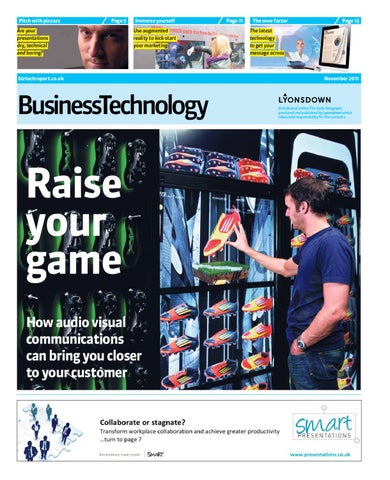
Raise your game How audio visual communications can bring you closer to your customer
Page 11
The wow factor
Page 13
The latest technology to get your message across
November 2011
Distributed within The Daily Telegraph, produced and published by Lyonsdown which takes sole responsibility for the contents
2
Business Technology
November 2011
an independent report from lyonsdown, distributed with the daily telegraph
an independent report from lyonsdown, distributed with the daily telegraph
November 2011
Business Technology
3
Audio visual communications – in this issue
17
A sight to behold
video walls are on display
Businesses need to raise their game and be far more imaginative with technology if they want to engage staff and clients, who are increasingly IT savvy By Sue Tabbitt
Publisher Bradley Scheffer brad@lyonsdown.co.uk Managing Editor Lucie Carrington lucie@lyonsdown.co.uk Editor Sue Tabbitt Creative Director Martin Nolan studio@lyonsdown.co.uk Sub Editor Amy Dickson amy@lyonsdown.co.uk Journal Assistant Natalie Luketic natalie@lyonsdown.co.uk Project Manager Aidan Neville aidan@lyonsdown.co.uk For more information on any of our supplements please contact us: Telephone: 020 8349 4363 Email: info@lyonsdown.co.uk Online: www.lyonsdown.co.uk
biztechreport.co.uk Cover: Lucy Ward
Supporters
Speak to any technology vendor for more than five minutes and the chances are they’ll slip in the somewhat ugly term “consumerisation of IT”. It’s a lever into the usual marketing pitch of course, but there is a point behind the hype – namely that consumer technology (and people’s imagination with and use of it) is now considerably ahead of business technology. Enter the world of work, and it’s like slipping back in time. Budget constraints, an inefficient approach to technology projects, concerns about control and security, and a general lack of imagination have prevented organisations from keeping pace with developments elsewhere. The result is a generation of staff who know more about technology and its potential than their employers do. From the dynamic ways they use the internet, social networks and mobile technology, to their expectations of 3D immersion when gaming or at the cinema, these upcoming employees – who are also consumers of course – have high expectations for the tools and technologies at their disposal in their office lives. When these aren’t met, individuals are likely to respond by bringing their own assets into
work – from smartphones and iPads to their own online software accounts – not just for social networks, but for file-sharing sites and so on. When it comes to communicating to a wider audience – and more formally – the same issues arise. Younger, technology savvy users want to be able to put together advanced, interactive collateral, using the latest presentation technologies, video and so on. Outside the workplace, meanwhile – as consumers – this is also how they want to engage with brands, retailers and service providers. They expect to be dazzled when being sold to; they demand that all of their senses are stimulated; they want to be able to watch the video, touch the product, get a sense of the experience. Most of the big brands know this and have responded – by allocating large budgets to digital media agencies. More traditional businesses typically do less well, however, believing rather complacently that they can cut corners and do everything in- house with a few core tools and a good sales team. As younger generations rise through the ranks, they will find that they can no longer get away with this. They shouldn’t have to, either. Digital media agencies have much to offer certainly, but advanced AV technology is now so accessible, affordable and easy to use that organisations really have no excuse not to raise their game. The opportunities to amaze and delight customers are unlimited; in most cases all that’s missing is the vision.
in the Westfield Stratford City shopping centre Page 8
£10m
is being raised for Team GB 2012 using the latest AV technology Page 9
7metres is the height of a helium balloon used to wow Opera Holland Park visitors with optical illusions Page 11
28,000 Randstad employees
worldwide watched the CEO appear holographically last year Page 13
Contributors Sue Tabbitt is a technology journalist covering a broad range of business and IT subjects for The Daily Telegraph, The Sunday Telegraph and The Guardian as well as specialist technology and industry publications. Jim Mortleman is a freelance writer, journalist and commentator with over
two decades’ experience examining technology developments and their implications for business and society. He has written for numerous trade, consumer, online and national titles, as well as organising and presenting at high-tech events. Tracey Caldwell is a freelance
business technology journalist with specialisms including networking and communications. She is a regular contributor to the Guardian Professional website. Paul Bray writes regularly on business and technology for many publications including The Daily Telegraph,
The Sunday Telegraph, The Guardian, The Sunday Times, Britain’s Top Employers, Computing, Director and Nasdaq International. Caramel Quin has been writing and broadcasting about technology on both sides of the Atlantic for 18 years, using her engineering background to translate tech jargon into
plain English. She won best writer in the BlackBerry Women & Technology awards, 2006 and this year won the CEDIA award for best technology feature for a piece in Grand Designs magazine. Gemma Stroud is a freelance journalist specialising in consumer issues.
4
Business Technology
November 2011
an independent report from lyonsdown, distributed with the daily telegraph
Industry view
Seeing is believing
face-to-face meetings. It estimates that the use of managed videoconferencing saves customers at least 25 per cent on their travel costs. The number of videoconferencing units being deployed to customers has increased by 34 per cent over the past 12 months. Internally, Cable&Wireless Worldwide uses videoconferencing extensively, clocking up more than 1.2m minutes across the business in 2010. Cable&Wireless Worldwide is also a founding member of the Open Visual Communications Consortium (OVCC), which opens up videoconferencing usage
It’s as easy as making a phone call – that’s why companies are jumping on the video calling bandwagon in their droves The business landscape has changed as organisations of all types are embracing new ways of working and communicating, both internally and with customers and suppliers. New platforms such as social media, instant messaging and video services enable better collaboration and encourage greater productivity. People still place a lot of importance in actually seeing peers and associates to discuss business matters but in today’s business environment travel is not always environmentally or financially viable. A recent survey by Cable&Wireless Worldwide found that 87 per cent of Britons claim faceto-face contact, either via videoconferencing or by being in the same room, is more likely to lead to a business decision. The survey also looked at people’s focus and attention span during phone calls, telephone conference calls and
The number of videoconferencing units being deployed to customers has increased by 34 per cent over the last 12 months videoconference calls, finding that in the UK 42 per cent of businesspeople admit to having checked or written emails during an audio conference call, while 35 per cent have doodled and 3 per cent have even fallen asleep – all quite hard to do on a video call. Dominic Jones, director of product and marketing at Cable&Wireless Worldwide, says: “More than ever, the need for new ways of working is critical. Businesses need to collaborate in real time across the
globe and to do so need to make use of interactive technologies. Video services provide a range of options, from full telepresence suites that offer a lifesize ‘same room’ experience, to meeting room units, desktop solutions and now handheld devices. The possibilities of these technologies are endless.” Cable&Wireless Worldwide’s Video Services have been designed to revolutionise videoconferencing by offering a reliable, high quality and simple-to-use service that is a genuine permanent alternative to
across networks enabling assured quality conversations across the globe. This adds further value to organisations as they embrace videoconferencing because they can move from using it in their own company to facilitating face-to-face discussions with their customers, partners, suppliers and so on. It will make video calling as simple as making a telephone call. www.cw.com/video-services
Driving forward new technologies Germany’s motorway operator is reaping the rewards of investing in digital signage for its service stations, but what are the benefits? German drivers who take a break from the autobahn have had a new audiovisual experience since the summer. Tank & Rast, Germany’s premier operator of motorway service areas, has installed more than 3,000 digital signage displays at 360 locations throughout the country, creating the largest digital signage network in Germany at motorway service areas, and the largest anywhere on Europe’s road system. “Tank & Rast used to display conventional printed advertisements, but the company wanted to switch to digital to increase its advertising revenues,” says Marius Marschall, group managing partner at Intelligent Service Solutions (ISS), the specialist AV company that planned and installed the system and will manage it for the next three years. “Tank & Rast expects to make a much greater return from selling advertising space on digital signage than it did from conventional poster sites,” he adds. The eye-catching displays are located in entrance halls and retail and catering areas, enabling digital advertising to be targeted where it will be most effective. Content creation and distribution is done by Tank & Rast’s advertising agency. All the content is scheduled from a single control centre by
ISS. Each screen can have a unique playlist of adverts that are carefully tailored to suit its location and the time of day. “By timeslicing the adverts, Tank & Rast is effectively multiplying the space available,” says Marschall. A study by Germany’s Centre for Consumer Research has already demonstrated the effectiveness of the digital adverts. Tank & Rast is now considering installing more screens in the restaurant areas to display menus that change at different times of day, and even photo frame-sized units in the toilets. The initial rollout consisted of 3,200 42, 32 and 22-inch high resolution LCD displays. All the 42 and 32-inch models, almost 1,600 in total, were supplied by ISS’s vendor of choice, Philips Public Signage. “We’re responsible for the entire system for the next three years and are contracted to provide more than 99 per cent up-time, so we have to rely heavily on our partners,” says Marschall. “That means we need a fully professional product and professional after-sales support, so there are only a few companies we’re prepared to partner with.” The technical specification of the Philips monitors met Tank & Rast’s exacting
Eye-catching: digital signage displays are used to target consumers
requirements, including being bright enough to compete with the high lighting levels inside a motorway service area. Availability was a major issue, and not all the monitor vendors ISS considered could have supplied the large quantities required. Philips’ pricing was also very competitive, and the low energy consumption of its displays means that the lifetime cost of ownership – as well as related carbon emissions – will be below average.
Finally, what impressed ISS was the sheer professionalism of the people from Philips. “We had confidence that they’d be as helpful after the sale as they were before,” says Marschall. “I’m more than happy that we did the deal with Philips, and in future I would definitely prefer Philips over other display vendors.” www.philips.com/publicsignagesolutions www.intelligent-services.eu
an independent report from lyonsdown, distributed with the daily telegraph
November 2011
Business Technology
5
Audio visual communications
The magic of engagement When it comes to presentation, corporate presenters have a lot to learn from the likes of Derren Brown if they want to keep their audience on the edge of their seats
By Sue Tabbitt
Fans of illusionist Derren Brown might rightly wonder at the stark contrast between his enthralling stage-based ‘experiences’ and the dreary business presentations they are forced to sit through in their working lives. It exposes another great gulf between the consumer and the corporate world. In the latter, people have lost the art of getting their message across. Of course, Brown is the consummate showman – a performer who combines magic, suggestion, psychology, audience misdirection and pure spectacle to apparently predict and control human behaviour. Those attending his shows hang on his every word – fully engaged, ready to believe anything. Corporate presenters could learn a thing or two from him. While it’s unfair to compare a professional showman with the average company executive, it’s puzzling that so many organisations with sizeable marketing budgets are so unimaginative and one-dimensional when presenting ideas and products. At a technology level, all of the tools exist now to enable companies and their front-line representatives to perform at their best – drawing audiences in to their business presentations, exhibition stands, seminars, webinars and sales pitches with pizzazz. Yet most don’t. For all that is possible, the average business presenter resorts time and again to a two-dimensional PowerPoint slide-deck. “Most business presentations are safe – bullet point after bullet point, graph after graph,” says Andy Harrington, a professional public speaking guru. “In practice, they are dry, technical and boring.”
Someone who broke the mould was the late Steve Jobs. Not only did he live and breathe technology, he also knew how to use it to connect with an audience. “The main thing that singled him out was his overriding passion for his message,” Harrington notes. “Without that, how will you ever get anyone to buy into what you’re saying?” Jobs, Apple’s staunchest evangelist, had such a conviction about everything he did that he was able to change people’s beliefs. “The technologies he used around that were very stimulating.” Crucially, Jobs led the story, rather than being prompted by what was on a screen. The technological show behind him merely backed up what he was saying. “Most people click, read, deliver,” Harrington says. “They have their backs to the audience most of the time, and will tell the audience what they’re going to bore them with, bore them, then sum up by telling them how they did it.” Harrington delivers a lot of his messages via the internet and swears by ScreenFlow, a software package for the Mac. “It lets you deliver video and slides and move seamlessly between the two,” he says. “It’s a great way of getting a message to a wider audience without having to be there in person.” But whatever technology a company draws on, it should be a supporting tool rather than a crutch the presenter relies on. “You can do a wonderful AV-driven presentation and still fail to win the pitch,” warns Paul Boross, also known as The Pitch Doctor. Boross, who has appeared on TV talking about the use of psychology in business, bills himself as the business world’s Derren Brown. He has amassed similar credentials in neuro-linguistic programming, a particular strain of psychology Boross: it’s all about the audience
that involves influencing people’s minds subliminally through the use of carefully chosen language, a technique he draws on when coaching business presenters. The trick is to then extend this influence with strategically chosen visual and audio aids. Boross’s book, The Pitching Bible, which sets out a series of “secrets” – Derren Brownstyle tips on winning over an audience. Those who inherently draw on such techniques include the former American vice president Al Gore, he says. Boross got to see him giving a keynote at the Edinburgh TV festival. “He had the audience in the palm of his hand.” Secret one is “It’s all about them” (“them” being the target audience). “Whether you’re presenting from a stage or in a one-to-one situation, you shouldn’t be focusing on what you’re going to say next. You should be able to read the audience and determine what they want at that moment,” he says. The problem with most presentations is that they’re just not adaptable enough. The speaker is working to a script and sequence of slides, from which he or she is unable to deviate. “In future, people who present most effectively using technology will be those who can feel the room and react dynamically to any change in the mood,” says Boross. Derren Brown also uses very precise language to steer the audience’s train of thought, something business executives could learn from. When one of Boross’s clients wanted to get across the message to its customers that everything they did was “all about them”, which it communicated on multiple different levels throughout a pitch, he helped cement the deal by slipping the driver £50 to play McFly’s chart hit All About You as the prospect left the meeting. “They won the business,” he adds. Having follow-through ideas like this is half the battle as businesses try to raise their presentation performance, but then the question returns to whether the typical senior executive has what it takes creatively.
“I’d love to see a huge change in the way companies approach presenting,” says Dale Smith, co-founder of the Article 10 Group of marketing and communications agencies. Given the colossal amounts big businesses invest in their brands, it’s astonishing how little goes into delivering the supporting content, he says. “You’ve got companies selling £10m solutions using A4 paper and slides. It’s 2011, for goodness sake.” To Smith’s mind, this means outsourcing more of the bells and whistles to external service providers such as Article 10. That carries a risk that business presenters become too removed from their own stories, though. A better approach may be for organisations to recruit more widely when boosting their marketing and sales teams, making sure they seek out people who are trained in the latest techniques and are capable of keeping content fresh and exciting. “The new generation of sales teams and executives is much more technology savvy and is pushing more for advanced tools and collateral,” Smith concludes. “This is certainly true at Microsoft, where Article 10 is doing a lot of work. They’re moving away from being a very corporate, grey-faced establishment to something much more engaging and cool. It’s nice to be a part of that.” Funny that – that the very company that brought us PowerPoint is only now realising presentation technology’s broader potential.
How to win the audience • Don’t turn your back while speaking • Think outside the box – keep content fresh and exciting • Be passionate about getting your message across • Be adaptable – react to the mood in the room • Use key words and language to steer train of thought
6
Business Technology
November 2011
an independent report from lyonsdown, distributed with the daily telegraph
Industry view
Meeting expectations Virtual conferencing is becoming ever more popular thanks to sophisticated technology designed to overcome any hurdle With videoconferencing becoming increasingly prevalent in business, organisations have begun to realise the potential of more immersive telepresence systems. In particular, demand for Polycom’s Architected Telepresence Experience (ATX) meeting solution is growing because of the many benefits it offers to users and businesses. It is well documented how telepresence helps improve collaboration, speeds up decision-making and yields vast cost reductions across a business. However, successfully generating these results needs careful consideration – realistic usage expectations with solid capital investment is imperative. Also, selecting an audiovisual (AV) specialist who is experienced in addressing these needs is crucial. From initial consultation through to design and installation, AVSolution works with businesses to guarantee solid return on investment and minimal disruption. Through its strong partnership with Polycom, it can overcome restrictive room dimensions, limited budgets, inferior network performance and existing legacy equipment. This is due to the flexibility of Polycom ATX, the stunning telepresence system that offers lifelike meetings through high definition (HD) video and audio. AVSolution’s
network of knowledgeable project managers and installation engineers has over 20 years’ experience in creating bespoke video installations. This year, AVSolution opened a purposebuilt London showroom to demonstrate the superior quality of the Polycom ATX solution as well as show that fully immersive telepresence is now an affordable solution. Polycom ATX can be branded to represent the business and AVSolution’s smart room design ensures the environment is adapted for visually appealing aesthetics, perfect acoustics and immersive calls. It can provide custom-built furniture or work within any constraints that already exist. For control, AVSolution utilises simple, customisable touchscreen systems for a room’s lighting, sound levels and temperature. This prevents users interrupting a meeting’s flow. Combined with unobtrusive in-table screens for information sharing, Polycom ATX is also ideal for presentations as well as standard collaboration. AVSolution understands the need for flawless network performance when videocalling. It partners with Masergy, a provider of secure virtualised network services, to implement a network that has been built with telepresence requirements in its DNA. This infrastructure is protected by the strongest
Adaptable: AVSolution technology can be used with current videoconferencing
global SLAs (service level agreements) in the telecommunications industry and ensures a stable, immersive telepresence experience. Completely personalised, AVSolution’s telepresence installations run on industryleading technology powered by Polycom’s unique HD video codecs, Sharp’s ultra thin bezel model screens and Crestron’s awardwinning control panels. If an organisation already has videoconferencing in place, AVSolution can incorporate the technology to avoid wasted investment and the telepresence offering is entirely customisable according to customer demand. The Polycom ATX solution is available in
two, three or four video displays, as well as trolley-based options, delivering flexibility and scalability to satisfy a wide range of customer environments. Finally, following implementation, AVSolution offers excellent after-sales care, long-term maintenance and market-leading customer support. It conducts regular visits to prevent the installation failing at a critical point. AVSolution is renowned for its support levels and protects an organisation’s investment long after its competitors would. 020 8549 5347 www.avsolutionuk.com
an independent report from lyonsdown, distributed with the daily telegraph
November 2011
Business Technology
7
Industry view
Better collaboration through technology The writing’s on the wall for outdated forms of communication. Interactive whiteboards can transform collaboration in the workplace Collaboration lies at the heart of the way business operates. Today, the latest generation of collaboration technology is playing a vital role in helping organisations to deliver more productive and efficient meetings, whether face-to-face or remotely. For years, collaboration was supported – or arguably hindered – by a rudimentary set of tools, whether it was flip charts and dry wipe boards or, more recently, the emergence of teleconferencing, video and web-based conferencing, which deliver communication but fall short of a truly collaborative experience. Moreover, the pressures on collaboration have grown dramatically. Businesses now handle far greater volumes of data than ever before. The demands of a globalised economy have led businesses to adopt more flexible working patterns and geographically dispersed teams that must work together. Finally, the global economic downturn has forced every business to cut costs and realise greater efficiencies. For many leading businesses, including BT, Computacenter and Scottish Water, the technology solution that meets their collaboration needs in the face of these challenges is the SMART Board interactive whiteboard from SMART Technologies. The SMART Board interactive whiteboard
Interactive: whiteboard enables users to highlight and annotate text
enables users to display and annotate documents, files and images in digital ink. Objects can be manipulated and highlighted, simply with a touch of the screen or the stroke of a pen, before being instantly saved and distributed. Users benefit from a far more intuitive and visually engaging collaborative process that delivers higher productivity, more creative solutions and, critically, better decisions. Using SMART Bridgit conferencing software, SMART’s interactive whiteboards
can be connected to create virtual meeting rooms where people in multiple locations can share their desktops and work on the same display, as if they were in the same room. It can also operate alongside other software and communication tools, such as videoconferencing, for a truly integrated solution. Such a powerful collaboration tool significantly reduces the need for nonessential travel. Whether it is a sales network meeting, a staff training programme or an international strategy planning session, less
business travel means cutting your travel bill. This also makes a major contribution to delivering a fast, verifiable ROI (return on investment), as well as a lower carbon footprint. With the ability to transform workplace collaboration, it is not surprising that businesses of all sizes are adopting SMART collaboration solutions. Indeed, SMART’s interactive whiteboards have been ubiquitous in British schools for years as an education tool. Businesses now need these tools to unlock the skillset of the next generation entering the workforce; the ‘net gen’ who have been educated using interactive whiteboards, who have grown up using touchscreen devices and for whom virtual communication and collaboration is second nature. The technology exists for businesses to optimise the dynamism and creativity that is generated when people work together, whether in the same room or remotely. The latest collaboration solutions are not only helping businesses to drive up productivity and save money, in the midst of the biggest global downturn for a generation, they are proving to be a business-critical tool. Installed and supported by Smart Presentations Limited 01296 642000 www.presentations.co.uk
Digital revolution
Matt Wain Photography
One company is leading the way in digital communication – and the future is already on display in one of London’s most dramatic buildings Enter the Atrium at the London Stock Exchange in Paternoster Square and you’ll be met by an extraordinary collection of video screens. The exchange chose Christie MicroTiles, an innovative modular digital display solution for the site of its new Market Open ceremony. Christie MicroTiles are a unique proposition in display technology, offering video and data display building blocks that can be used to create displays of varying size and shape – and which are complementary to their environment. Simply put, they lend themselves to spaces where no other display technology would physically fit without harming the aesthetic of an interior’s design. The installation of 508 Christie MicroTiles at the location follows a recommendation for their use by CMS consultant Jerry Collins and a subsequent tender won by Focus 21 Visual Communications – a long-standing Christie partner and Scala certified partner. Visitors are now welcomed by columns of Christie MicroTiles, their view directed to either side by two strips of MicroTiles, each consisting of 29 and 31 MicroTiles respectively, then on to an impressive video wall which uses 132 MicroTiles. The MicroTiles stream a variety of content throughout the day including live news and market updates from CNBC.
The displays are managed by six Christie Spyder X20 processors with content offered from a variety of sources, including Scala InfoChannel. A Crestron controller manages lighting, audio and live camera feed, and orchestrates an automated opening and closing of the market ceremony. Another MicroTiles video wall has been installed on the balcony overlooking the Atrium and can mimic the content on the main video wall. At ground level there is a mosaic of 46 MicroTiles of different depths and heights, while outside the Atrium, visitors are kept updated with another set of four columns of MicroTiles. “Many organisations are challenged to find innovative ways to deliver valuable content to target audiences in the short bursts of time available. Scala software not only provides a strong, highly usable, incredibly stable platform that meets 95 percent of the needs of most customers out of the box, it can also be easily customised well beyond many competitive offerings,” says new Scala CEO Tom Nix. “It is exciting how many customers keep pushing the envelope with the Scala platform in addressing their unique requirements and finding new ways to quickly engage and inform audiences.” Nix will continue to focus on building
customer satisfaction and expanding Scala’s role in the evolving global market for digital signage and digital communications solutions. “For 25 years, companies have seen the flexibility and benefits of communicating using digital signage in market segments from retail and quick service restaurants to hospitals, retail, banking and corporate communications,” he says. “Scala is leading the shift to digital signage’s next stage, where companies exploit their ability to connect to virtually any data source using almost any device. These devices can range from mobile applications, like tablets and smart phones, to CxO boards that provide real-time management information by consolidating and displaying a custom broadcast channel of key performance metrics from customer relationship management and enterprise resource planning packages such as Salesforce.com and Oracle.” Scala provides the leading platform for content creation, management and distribution in digital signage networks, which allows customers to connect digital signage to a variety of data sources, such as CRM and ERP systems, to create new content constantly and automatically. With Scala 5 Release 6, Scala will make it even easier for organisations to customise digital signage to their specific business
Digital display at London Stock Exchange
requirements, by supporting more video and streaming options to make it possible to add, size and position most of the popular industry standard streaming video formats in Scala. And high-definition digital video signals from many popular set-top boxes from both cable and satellite providers can now be captured by Scala, guaranteeing razor-sharp HD quality. The new release also raises the bar for dynamic visual effects in digital signage as dramatic new visual enhancements for Scala content developed in Designer are added. www.scala.com
8
Business Technology
an independent report from lyonsdown, distributed with the daily telegraph
November 2011
Audio visual communications
Sign of the times Digital signage is revolutionising billboards and other public promotional displays By Paul Bray and Gemma Stroud
Billboards that come alive before our eyes, menus that change by the minute and special offers that instantaneously tailor themselves to the customer. Once mere twinkles in the marketeer’s eye, they’re fast becoming the must-have technology for shopping malls, transport hubs, restaurants, even doctors’ surgeries. But while they’ll splash their offers across six-foot screens, many retailers are keener to keep the marketing science behind digital signage under wraps. It’s still new enough to offer a competitive advantage and they aren’t keen to share. Digital signage uses a network of computer screens to display ever-changing content that may include video, still images and text. What’s shown where is usually controlled from a central point, but the output of individual screens can be tailored according to location, audience and even time of day. Alternatively, the network may have just a couple of screens: to impress visitors in a corporate reception area, say, or keep patients quiet in the dentist’s waiting room. Screens may show a single stream of content, such as posters or video commercials, or several things at once. The latter might consist of a live news feed; tailored advertising (for the venue’s own products or paid for by third-party advertisers); and specific data (“next patient please”, “the 10.16 to Inverness is running late”, and so on). Size is no object. The new Westfield Stratford City shopping centre in east London features 17 huge video walls, each containing up to 51 screens operating as a single display. London Underground and CBS Outdoor are using cross-track projectors to display giant images on the walls of tube stations. But many digital signs consist of single TV-sized screens, 10-inch digital photo frames (sometimes inset into kiosks or store mannequins), or tiny shelf-edge displays a couple of inches high. The sheer eye-bludgeoning potential of a giant video wall is hard to beat. Outdoor clothing retailer Timberland has a 36-screen, 6.2 x 3.5m wall aimed at “bringing the
Debut: UK’s first interactive digital billboard at Westfield. Right, Cadbury Creme Egg interactive game
outdoors indoors” at its new Westfield store. “With more than 300 retailers at Westfield there’s a lot of competition, so it’s primarily designed to encourage customers into the store,” says Rod Pallister, managing director of AV specialist 53 Degrees, which installed it. But the opportunity for precision marketing can be equally attractive. Phone company O2 is installing two or three modestsized NEC displays in each of its retail stores. “It means O2 can react to offers very fast and with central control,” says Guy Phelps, corporate sales manager at NEC Display
Solutions which provides the service. “Managed from head office, messaging can be updated quickly to react to local market conditions, with different messaging at different times of day and across different geographical locations.” But companies are cautious about revealing the corporate secret that’s keeping the tills ringing. Several major retailers were unwilling to provide comment on their advertisement technology initiatives, with one well-known high street store concerned any information provided could be leaked to a retail rival.
And when the potential for industry expansion is explored, it’s little wonder. By linking digital signage to a store’s stock system, content and messaging can be changed in line with availability. And by linking signage to the products on display, the stock can start interacting directly with the customer. “Imagine a consumer picking up an item from a shelf and triggering instant product information and product comparisons on an adjacent screen,” says Jonathan Mangnall, sales director at control systems vendor AMX. “This is possible now, although the market’s only just realising it.” “Creating a one-to-one experience is the Holy Grail of marketing, and interactivity in digital signage is a massive trend, with touch being the obvious application,” says Mike Fisher, senior consultant at analyst firm Futuresource. It can be something simple like entering a shopping centre and finding the nearest chemist, or an interactive game like the highly successful one that Posterscope ran on bus shelters for Cadbury Creme Eggs (inset). Still in its infancy, digital signage is creating as much secrecy as it is excitement among marketing moguls and many are choosing to play their cards close to their chest. The grand unveiling is just as powerful as the technology itself. The real breakthrough will happen when NFC (near field communications) and QR (quick response) codes become widely implemented in mobile phones, Fisher believes. Users could walk up to a digital poster and download a coupon for the product it advertises or buy a ticket for the event it promotes. Technology is now becoming available that uses built-in cameras and clever analytics software to enable digital signage to watch the people watching it. Advertisers could be told exactly how many people have viewed a particular piece of content and for how long, and be charged accordingly – another Holy Grail for the advertisement industry. It’s even possible to work out the watcher’s age, sex and mood, and tailor the on-screen content to match. Try doing that with a roll of posters and a bucket of paste.
Wall of sound Having fabulous displays when communicating with a target audience is useless if no one can hear what’s being said By Paul Bray It’s shooting yourself in the foot to have stunning visuals with lousy sound, so the advent of HD video has necessitated similar enhancements in audio. “Video alone can seem rather flat (imagine a movie without the music). Video may capture someone’s attention, but it’s audio that retains it and draws them into the emotional experience you’re trying
to get across,” says Chris Havell, director for audio at technology specialists Cambridge Silicon Radio. One technique is to use sophisticated audio processing that can subtly influence what the listener hears by altering the balance between different frequencies. It can lift speech out of the background soundtrack to make it more intelligible.
Latency (the time gap between sound and video) can be a major issue. If a speaker’s mouth and voice are more than 45 milliseconds adrift the viewer’s concentration can be affected. Wireless speakers are becoming more popular because of their flexibility, but this can exacerbate latency issues as the sound must be digitised. A technology called Aptx can help, by ensuring
audio quality is maintained and the audio and video signals remain in step when they reach screens and loudspeakers. One downside of increased audio performance is that background noise is easily captured by the latest microphones, so echo cancellation and noise suppression technology have had to improve significantly in recent years.
Sound: frequency, balance and latency are important
an independent report from lyonsdown, distributed with the daily telegraph
November 2011
Business Technology
9
Audio visual communications
Give ‘em the old razzle dazzle Video’s potential in business is so much broader than simply replacing meetings with faceto-face conferencing links
By Tracey Caldwell
Video has enormous potential to enrich communications with employees and customers, especially with the proliferation of high-speed networks and affordable video technology. So it’s somewhat puzzling that videoconferencing – a straightforward replacement for physical meetings – seems to have hogged the limelight for so long. Now that the quality of video and audio is of a good standard, smart businesses are exploiting the facilities more widely – in their business presentations, at events, on the web and beyond. So much so that technology vendors have begun to talk about the videoready business – an organisation that is video-enabled to the point that it can apply the medium wherever it has the potential to add value. Any business that isn’t video-ready is vulnerable competitively, they argue. Richard Oliver, director of marketing strategy at BT iNet, identifies culture as one of the biggest barriers to broader video adoption until now. “Skills around making video usable can be brought to bear by a good supplier,” he notes. “What can’t be brought is the realisation that a company can’t keep doing what it has always done once it has reached a certain size.” Video can have a powerful impact within a company certainly, for keeping a highly dispersed workforce engaged and aligned to company messaging. A succinct weekly broadcast by the CEO can be much more powerful and effective than a company newsletter or email circular. Once the business has experimented with the medium internally, it can turn its attention outwards. Lloyds Bank Corporate Markets
uses a service provided by Kulu Valley to deliver on-demand video-based presentations with a twist to its business customers. The proposition differs from straightforward video in that it blends video content with standard presentation features to deliver a succinct yet rounded message to the target audience. Via the web, viewers see a video of the bank’s chief economist Trevor Williams speaking, while the slides or graphs he refers to change in line with what he is saying. “It is getting our commentary on to a wider platform,” Williams explains. “There are people who don’t typically look at our material who may well look at it now because it is on platforms they’re used to.” For Williams, the Kulu-based presentation
Taking stock of video As further evidence that video is becoming a mainstream communications vehicle for business, stock video (pre-recorded content that businesses can reuse in their own communications) is growing in popularity. iStockphoto’s video arm is already five years old and its library contains some 400,000 files, which are used in everything from national news programmes, documentaries and films to web-based advertising. According to Jim Goertz, director of video content development at the company, demand is currently particularly strong for authentic reality TV-styled scenes and fully edited mini films. Meanwhile, content is being uploaded increasingly from modern DSLR cameras (often with stills and video shot simultaneously), and from large-format high-definition video cameras.
has a higher impact than a fixed-time teleconference, a medium the bank used previously. “With the video, people can open it at their convenience or listen to it at their convenience. Whereas we used to get 20 or 30 people dialling in each month, now it’s more like 270 people opening the video and watching it,” he says. Video can transform the impact and feel of events, too. Take the example of a major ball hosted by the British Olympic Association recently. Video technology was used to add the wow factor to what chief commercial officer Hugh Chambers describes as “the biggest and the most ambitious Olympic ball in this country”. The organisation relies entirely on commercial funding to field Team GB; in 2012 this will amount to 550 athletes at a cost of £10m. “As well as raising money, of equal importance is to reflect the Olympic values and the quality of the Olympic brand. We needed to put on a show that was really going to dazzle people,” he says. The BOA used technology from Crystal CG to mount an enormous, high-impact video display all around the Grand Hall Olympia in London. The video culminated in the British team’s symbolic lion racing around the venue’s video screens before roaring onto a main screen that was the size of those providing the backdrop to major festivals like Glastonbury. In a retail environment, video is being used as a means of interacting with customers at the point of sale, via video chat with product experts on websites or using in-store kiosks. This has been found to encourage sales conversion, especially for high-value items. In future, IPTV (internet protocol television) viewers will be able to click through from
Wow factor: video used at the Olympic ball
adverts to a video link to a sales assistant. A major driver in using video is the need to respond to heightened customer expectations. Today, consumers will settle for nothing less than high-quality, compelling communications on demand. ”In the same way that businesses have accepted social media, they are going to need to accept some level of video as part of that conversation,” says Simon Hathaway, CEO of Saatchi & Saatchi X, which specialises in shopper marketing. “Video personalises the shopping experience. The technology is there – the big barrier is pinpointing the cost, and the return.” One company that has done the maths and sees real benefit in video is Renault in the UK. This month the company launched its futuristic range of zero emissions (ZE) electric vehicles. In parallel it is piloting an online video-based customer service channel for customers and for dealers that take on the new range. The video technology is provided by Vee24. Renault can now explain the technology behind its ZE range by showing it to customers during video conversations over the web with product experts. Noting that telephone contact to Renault is in decline, Peter Tilbury, front-office customer relations manager at Renault UK, says: “Customers are on our website; let’s talk to them.” Hathaway: barrier is pinpointing cost and return
10
Business Technology
an independent report from lyonsdown, distributed with the daily telegraph
November 2011
Industry view
Immerse yourself in video interaction Breakthrough in videoconferencing market enables affordable, high quality telepresence across a range of devices including smart phones and tablets Enterprise customers no longer have to choose between pristine telepresence quality and affordable solutions when looking to deploy video conferencing throughout their organisation. Finally, due to an innovative platform built by Vidyo, companies can purchase affordable enterprise-grade telepresence that is easily accessed by participants, whether they’re using desktop or laptop computers, tablets, smart phones, room systems or immersive telepresence systems. Vidyo has redefined video conferencing infrastructure and network costs, resulting in 10X better quality and density, 10X lower cost and power usage and, when running on virtual machines, saving up to 90 per cent of the cost of competitive solutions. One example of this technological breakthrough is VidyoPanorama, the industry’s first affordable telepresence solution that delivers immersive interactions on up to 20 screens of 1080p at 60fps resolution and is up to 10X less expensive than comparable telepresence systems. “The videoconferencing market has matured; customers today are sophisticated and no longer willing to settle for expensive, inflexible, hard to use, legacy-based hardware systems,” said Ofer Shapiro, Vidyo’s co-founder and CEO. “Vidyo’s
Industry first: Vidyo Panorama telepresence system
software-based platform delivers exceptional image clarity; natural, high definition fidelity that is affordable on any device, and accessible to anyone, via any network. Vidyo’s low-latency, highly scalable and error-resilient video communication solution also interoperates with legacy H.323 and
SIP endpoints, to leverage existing video conferencing investments.” “Vidyo has a game-changing, ‘disruptive’ platform offering quality, affordability and flexibility to businesses of all sizes,” said Ian Vickerage, managing director of Imago Group PLC, Europe’s largest distributor of
videoconferencing products, and distributor of Vidyo’s line of VidyoConferencing products in the UK. “Vidyo’s platform is software-based, so a Vidyo conference can be accessed on a full range of affordable, ‘off the shelf’ devices such as iPhones, iPads and Android smart phones and tablets, as well as laptops, desktops, and telepresence room systems.” Vidyo pioneered a new generation of video communications called “personal telepresence.” The patented VidyoRouter architecture introduces Adaptive Video Layering, which dynamically optimises the video stream for each individual’s endpoint, leveraging H.264 scalable video coding-based compression technology and Vidyo IP. Vidyo delivers unprecedented error resiliency, low-latency rate matching enabling natural, affordable, high-quality video to work over the Internet, WiFi, 3G and 4G networks. Vidyo’s communication and collaboration platform is simple to use, eliminates the costs of building and maintaining a network, and is today transforming large enterprises, small and medium-sized businesses, as well as telemedicine, manufacturing and education. Follow the company on Twitter @Vidyo or visit www.vidyo.com
Delivering a difference How can businesses use non PC-based hypermedia technology to communicate effectively with their customers? Getting your message across is important. With digital signage, electronic displays and hardware help organisations communicate their business needs and information to audiences in public spaces – whether it’s railway stations, shopping centres, hotel lobbies, educational lecture halls or even staff room areas. Digital technology has replaced print signs and billboards – and it’s easy to see why. Such signs are easy to configure, are live and offer instant updating of information, plus they can bring in revenue through advertising. And as well as earning money, digital signs can save businesses money on printing costs and wastage. With expert help, from suppliers such as SpinetiX, this can be a brave new world for businesses to enter. A good company will help its clients configure, install and manage a digital signage system, typically comprising screens, hardware and software (securely managed often over the internet using a simple log-in). Digital signage is often in public areas where space is tight, so it is important to have a flexible, future-proof digital asset management system that is compact and secure and able to be viewed the light levels of
its intended space. With the latest technology comes digital signage hardware devices – more commonly known as hyper media players – which aren’t PC anymore and which are able to manage graphics, audio, video, text and newsfeeds for information displays. These systems are easy to use – with a properly designed system, you can be communicating with customers in less time than it takes to make a cup of tea. It really is that simple! Hypermedia players can be set up to have access to public or private databases and display selected content with predefined graphic layouts; display RSS news based on key words; connect to public or private audio/ video, streaming servers and display live events, news and entertainment contents; retrieve from network disks images and videos; enable all sorts of network interactive services; and schedule which content to display when and where. These easy-to-use devices have embedded software to allow the management of content, but it’s not all about simplicity or versatility. Hypermedia players can offer an excellent return on investment, too. Advertising is an easy way in which businesses can recover their costs and even bring revenue into
Swiss digital signage manufacturer SpinetiX’s hypermedia player
the business. One such retailer is the Leroy Merlin flagship store in Nova Milanese, Italy. This is the first Italian retail store to use interactive screens to guide and educate customers as well as create a unique shopping experience, using hypermedia players.
With the right technology, digital technology can help bring the investment back into your business. Serge Konter is marketing manager at Swiss digital signage hardware manufacturer SpinetiX www.spinetix.com
an independent report from lyonsdown, distributed with the daily telegraph
November 2011
Business Technology
11
Audio visual communications
A feast for the senses Being wowed by attention-grabbing video and surround sound isn’t enough for today’s consumers who are being immersed in 3D and augmented reality in their personal lives By Tracey Caldwell
When there is a complex concept to get across, or you’re marketing an experience rather than a straightforward product, it helps to add a further dimension to audio-visual communications. Consumers are coming to expect it, too. Spoilt by immersive gaming, 3D cinema and advanced touch-enabled applications on their iPads and smartphones, customers now crave a more touchy-feely experience when they engage with companies and their marketing campaigns. Although virtual reality hasn’t quite caught on in the way that might have been expected 15 years ago, there are signs that businesses are becoming more innovative and open to three – and four –dimensional marketing. Effective applications include those where the consumers’ view of the real world is augmented by a technological dimension, giving them more information by video and allowing them more direct interaction. In two Inamo restaurants in London, diners are able to watch their meals being made in the kitchens via webcam, having placed their order using tabletop touchscreens. They can then play tabletop games on their E-Table while waiting for their order. One of the two restaurants has private dining areas and the technology enables branding for private or corporate events, a distinctive way of providing a platform for businesses to use some of their own audiovisual assets. The E-Table ordering system incorporates a waterproof Bluetooth touch panel, a special tabletop, and a Canon XEED projector and computer, housed in a pod in the ceiling above. The challenge has been to balance
Taste of innovation: customers can order their food via interactive E-Tables at Inamo, London
the potential of the technology with the requirement to provide a restaurant experience. “There is a huge amount we could do but we have chosen not to overpower the guests with the amount of digital information coming at them as we wanted the overall experience of a restaurant as opposed to an advertising platform, a games forum or an internet platform,” says Mark Boyle, sales director at Compurants, parent company of Inamo. Diamond jewellery retailer Forevermark, part of the De Beers group, was looking for a way to engage customers more effectively. It acknowledged that the retail environment for diamond jewellery could be intimidating because of the necessary security around the high-value items and it wanted a way to let customers try on diamond jewellery in a relaxed and fun way. In October it began trialling a system from Holition to enable customers to try on the jewellery using a webcam. The customer uses paper versions of the jewellery, which may be
supplied with catalogues or magazines. When the customer holds up a necklace, for example, while looking at his or her video image appearing on screen via webcam, the system reads the paper tab and inserts moving images of the jewellery wherever the tab is held. The customer can move his or her head this way and that and the jewellery will move and glisten in a realistic way, as if the customer were trying it on in a shop. “In the diamond jewellery sector we think this is a really innovative and new initiative,” says Stephen Lussier, CEO at Forevermark. “It gave us an opportunity to leap beyond what you see in a printed catalogue and create a relaxed environment, where customers could still experience trying things on.”
Swiss watch manufacturer Tissot has brought the Holition technology even closer to the point of sale, encouraging potential customers to try on watches virtually while standing outside the store looking in at webcams. The technology, pioneered in the UK and implemented at Selfridges and Harrods, has had a direct impact. “When the application has been integrated with activity at the point of sale it has shown a clear, direct link to sale,” says François Thiébaud, Tissot’s president. “The integration in our media campaign resulted in an increased flow of traffic to our website where consumers could ‘try on’ the watch seen in the press adverts.” Virtual reality: try on a Tissot watch via a webcam
Beam me up, Scotty Hologram technology is taking remote presence into a new dimension Imagine being able to teleport leading businesspeople to appear on stage at overseas conferences. Orange Business projected top executive Marie-Noëlle Jégo-Laveissière from Paris to a partner event in Amsterdam this summer, with the help of hologram specialist Musion. Jégo-Laveissière appeared on stage next to live employees to showcase a form of 3D videoconferencing. She is in good company – others who have appeared as 3D holograms include Prince Charles, King
Abdullah of Saudi Arabia, Al Gore, Sir Richard Branson, David Beckham, Madonna and the Black Eyed Peas. Orange also showcased the Musion technology at Hellodemain in Paris. Visitors had their image captured live and projected life-size on stage, apparently being teleported into the jungle. The 3D image was broadcast over a high-speed fibre optic network. The holograms are not in fact 3D but give the impression of being so. An image appears apparently in mid-air, projected on to a clear film.
Scenery in front of and behind this image adds to the appearance of three dimensions. While the technology of transmitting holograms from one place to another still has its challenges, using 3D audio-visual at events is very achievable and can have a high impact. Winton Capital Management, sponsor of Opera Holland Park, the annual opera festival in west London, worked with London creative agency Knifedge to give the event a wow factor. It released a seven-metre
helium illuminated balloon, on to which 3D images were projected. The next generation of hologram technology would be real 3D rendering but it is unlikely we will see such products before 2020. Dr Stéphane Pateux, head of voice and video coding research at Orange, says researchers are working on new technologies to decrease the bit rate bandwidth of the network needed to carry high definition signals. “We are looking at technology to improve the quality of media up to super high resolution and also 3D technology,”
he says. Meanwhile, the distance learning and education sectors are among those showing earlyadopter interest in this form of 3D videoconferencing, as well as the music industry, which makes much of its profits from live performances. “People perceive this as a business tool and that is certainly where it is at the moment, whereas we see it appearing at concert halls and upscale nightclubs and public venues,” says Ian O’Connell, a director at Musion.
an independent report from lyonsdown, distributed with the daily telegraph
November 2011
Business Technology
13
Audio visual communications
Bag of tricks A round-up of the hottest AV technologies currently making the headlines By Caramel Quin
Bringing content to life
Web-based tool Prezi gives users a free hand to position words, images and videos on a giant zoomable canvas, and then either set a presentation path or move around freely. You use the relative size and position of a piece of information to represent its importance and how it relates to other information. The result can be viewed online, on an iPad or downloaded and played offline. Prezi has passed the 5m user mark but the technology is still niche enough that clients have probably seen nothing like it.
Digital signage
Video screens can be a striking alternative to posters and billboards but, as they become commonplace, companies need to do more to make their messages stand out. In October Adidas installed a Virtual Footwear Wall (below) at its flagship Oxford Street store in London
– a touchscreen, two-metres high, that lets shoppers explore its latest football boot, watch videos, interact with social media and use a tablet computer to make a purchase. The modular wall can be reprogrammed to promote different products. Adidas, working with Intel, hopes to roll it out elsewhere and has demonstrated a wall with a built-in camera that detects the shopper’s gender and offers them suitable footwear.
Holographic keynotes
Time-pressed executives can’t be in two places at once, so cutting-edge holographic technology allows company CEOs to “appear” at events in any location, even simultaneously. Last year the CEO of recruitment specialist Randstad appeared holographically to 28,000 employees in 18 countries, his speech pre-recorded in four languages and subtitled in nine. Live holographic keynotes are also increasingly popular. Market leader Musion has worked with blue-chip companies including Cisco, Samsung, Microsoft and Orange to seemingly teleport speakers on to a stage.
iPad magazines
The sleek portability of tablet devices such as the iPad make them the ideal sales tool for one-to-one meetings and exhibition stand presentations. Thousands of business applications exploit the format already, and now there’s even a package to bring a professional magazine look to the way presented material is packaged. Special magazine publishing software from Adobe will cost a company around £5,000 a year, but much the same effect can be achieved with more affordable software such as Roambi Flow (around a tenth of the cost). Its intuitive desktop or iPad interface lets users drag and drop text, pictures, videos and documents to create a digital magazine.
Gamification
If you want to engage your customers, suppliers or workers in your message, make it fun. Welcome, gamification – the use of game design techniques and mechanics to solve problems and engage audiences. Foursquare, which runs the eponymous location-based social networking website, made more than 10m people obsess over earning badges by visiting ordinary places like cafés. Screenreach
Interactive recently created a billboard-sized video game on the wall of London’s Westfield shopping centre for car insurer Swiftcover. Passers-by were encouraged to download the free app to play a giant racing game, using their smartphones as controllers. Shoppers won prizes and discount vouchers, and in return Swiftcover was able to analyse the consumers that took part, gaining an insight into the target audience and seeing how they responded to the brand when trying out new technologies.
– customers pointed smartphones and iPads at posters to explore and buy clothes.
Augmented reality
special glasses. At recent catwalk events for Wella haircare, creative agency Knifedge combined projection mapping and spatial surround sound to make the audience feel they were looking at a motorised set costing millions, when it was pixels and processing power.
Augmented reality (AR) is a bit like virtual reality (VR), but instead of immersing themselves in a virtual world, users access the experience through a screen.
Projection mapping Projection mapping techniques give a wow factor to big events. Clever graphics are projected on to a big screen, fooling the eye into thinking it’s seeing something in 3D , without requiring the viewer to wear
Touch tables
For example, with an AR application on a smartphone a user might point their device at the Empire State Building (above) and see images of its construction (through a history app), a visual directory of which companies have offices there (via a business app), or King Kong fending off biplanes (using an entertainment app). There’s no real limit to the business applications for augmenting the real world with virtual objects. AR might be used to guide someone around a campus, demonstrate a product concept or engage shoppers. Online retailer Net-A-Porter recently created a virtual clothes shop in London and New York windows
Straight out of futuristic sci-fi films such as Minority Report come touch tables – large furniture with embedded touchscreens and custom software, promising to transform everything from the boardroom table to retail interaction (below). Marketing agency Imagination won two Marketing Design Awards for creating a motor show experience for Ford’s luxury
US car brand Lincoln using modular touch tables that can be reprogrammed and reused. Another Imagination client, Swire Properties, has used touch tables to revolutionise store directories in its flagship Hong Kong shopping centre, with multiple languages. These are more than just touch-screens that tell customers where to find a shop, being as tactile as an iPad. Think swiping pages to make them turn, having real-time updates on events and promotions in the store, and even a direct link to the Hong Kong weather observatory.
Video engagement
Video engagement uses video to interact with online users – with live talking heads guiding users through a company’s offering and
even showing them web pages, documents and more. This enables firms to drive up customer service without pushing up operating costs. The technology can boost business too – for example, in retail it can save the contents of online shopping baskets from languishing. Clients of video engagement specialist Vee24 have been known to experience a 38 per cent boost in website conversion rates after introducing the video engagement feature. Alternative propositions are available from companies including Netop which supports a blend of text, audio and video chat options which companies can combine to form a flexible customer support channel.
14
Business Technology
November 2011
an independent report from lyonsdown, distributed with the daily telegraph
Industry view
Putting your needs in expert hands Christian Bowman
Whether it’s for a corporate event or a school presentation, AV enhances communication. But without professional installation, your message could be lost The audiovisual (AV) industry has been helping people communicate for almost a century. While many conjure images of overhead and slide projectors when thinking about AV, today’s technology includes videoconferencing, command-and-control rooms, video walls, stadium screens and more. AV blends the worlds of art and science. But the heart of the industry’s heritage is solving communication challenges. AV provides solutions to many societal quandaries, such as ‘How can I communicate complex opportunities to a business halfway around the world without leaving my office?’ ‘How can I offer a comfortable and productive environment to everyone attending a meeting?’ ‘How do I provide direction to visitors in public spaces?’ and ‘How can I reach a new generation of hi-tech students?’ AV helps people communicate more effectively. These communications systems have provided business tools to generate and connect ideas.
Impact: AV can put the wow factor into product launches and corporate events
Shrinking travel budgets and a focus on reducing one’s carbon footprint means that the value of AV is increasing. Enterprise video communications is used in every aspect of sales, marketing, human resources, and management. Continued advances in AV technology and rapid adoption means that innovation and idea generation happen at the speed of business. The corporate world also relies on live event professionals to put the “wow factor” into product launches and special events.
Hiring AV professionals
When looking for an AV professional, hire a contractor with employees that have earned certification from InfoComm International. The Certified Technology Specialist (CTS) credential is for audiovisual professionals demonstrating extensive knowledge of the technology used in audio, video and display systems, and a competence, dedication and commitment to their profession. With agreement to a code of ethics pledging truth, accuracy and a commitment to excellence in
all aspects of the profession, CTS-holders are recognised as trusted service providers to customers of AV technology. “As audiovisual equipment has become more sophisticated, there is increased need for professional services to assure the highest performance levels of communications technologies,” said Randal A Lemke, PhD, executive director and CEO of InfoComm International. “Employers in the public and private sectors can be confident that AV professionals holding the CTS credentials possess the necessary skills to implement audiovisual best practices, processes and procedures anywhere in the world.” The International Organization for Standardization’s (ISO) United States representative, the American National Standards Institute (ANSI), has accredited InfoComm’s CTS, Certified Technology Specialist – Design (CTS-D) Certified Technology Specialist – Installation (CTS-I) credentials under ISO/IEC 17024. ISO/IEC 17024 establishes a global benchmark for the certification of personnel. ANSI accredits standards developers, certification bodies and technical advisory groups to both the ISO and the International Electrotechnical Commission. The CTS are the only audiovisual industry credentials to earn ANSI accreditation for its personnel certification program, setting the industry standard for competency in the AV industry. www.powerofav.com
Content is king Take a strategic approach to events and meetings. How can technology drive content, perception and insight for both the audience and organisers? It’s an interesting decision that businesses face when they consider the use of AV equipment at an event, meeting or conference; It is probably worth understanding the basis of how these decisions are made. How often is the decision about the use of AV equipment seen as a strategic one, rather than a tactical or convenient one? Generally, not often. Indeed, do senior people in many organisations even realise what the implications can be? For years, businesses have discussed the ROI (return on investment) of meetings and events, from the cost of getting people in one room to the overall benefit derived from attending seminars and conferences. The IML Connector – an interactive engagement tool – has driven a more strategic approach. At IML Worldwide we demonstrate that clients can receive a far better ROI by taking a more strategic view of what they are trying to achieve from these events. How often do people start with this premise? In our experience this is very rare but, crucially, when they do take this approach the impact and the success of the meetings are demonstrably better. So, what is the critical factor in this? Content. Capturing and using content that
is generated in these gatherings; moreover it is the ability to provide a means to gather this information that becomes increasingly important. When you look at ways you generate content, these include: voice, messages, voting, opinion gathering, response to presentations/questions, ability to manage the audience, and demographics. By enabling the audience with the capability to effectively contribute and offer instantaneous responses to what they see and hear, everyone achieves a far richer and rewarding event. This is two-fold. Firstly, by making it a more interesting and engaging experience for the attendees. Secondly, by gaining perspective and insight that organisers can use to drive decisions, changes in strategy and appeal to their clients more successfully. This is what executives both need and want but find difficult to achieve; it’s where the value lies. To an extent the industry has let itself become commoditised and allowed clients to take a view on price above anything else. Event organisers need to be striving to demonstrate the value that can be achieved from events and how technology can support them. Senior executives see the value; it just needs to be correctly articulated.
Opinion: event audiences can contribute content via the IML Connector
In recent months IML have run events that have used TVT (Text, Vote, Talk) on the award-winning IML Connector. This engages the audience to contribute content via messaging, speech and opinion; the results were astounding. In one meeting in the US, more than 1,200 messages were generated – the organisers expected less than 20.
Content is king and a strategic view is crucial. IML Worldwide recently won the Audio Product of the Year award for the IML Connector at the AV Awards 2011. Richard Fisher is CEO of IML Worldwide Call +44 (0)1428 787 591 or visit www.imlworldwide.com
an independent report from lyonsdown, distributed with the daily telegraph
November 2011
Business Technology
15
Industry view
An advert for the future? In the ever-increasing world of digitisation, companies must find ways to make the public switch on to out-of-home advertising Billboards and poster advertising have been part of our daily life for years and, with people spending as much as 42 per cent of their time away from home, this type of out-ofhome promotion has proved to be an ideal tool to advertise anything from small, local businesses to major consumer brands. But while billboards are static as an advertising medium – only changing every few weeks when someone posts up new material – as the world becomes increasingly digitised, so out- of-home advertising is adapting to become more dynamic. In recent years, we’ve seen a huge rise in digital out-of-home (DOOH) advertising where multimedia promotional material is transmitted via computer or a set-top box to digital screens and interactive media located in public places such as sporting arenas, bars, health clubs and retail outlets. The beauty of DOOH advertising is that it can be changed every few seconds and enables location owners and advertisers to extend their reach and engage with customers or prospects more closely, often at the point of purchase. This can lead to improved revenues, a better customer experience and increased footfall. Many are already recognising the benefits
of DOOH, with industry spend expected to more than double to $16.9 billion by 2015. However, this new and more dynamic channel opens up fresh challenges for advertisers. With many more locations available and a lack of audience data, it may be difficult and time-consuming to plan campaigns and buy locations. Furthermore, poor quality information and metrics can make measuring a programme’s success difficult. With as much as 60 per cent of these tasks requiring significant human input, the whole process can have a huge impact on the profitability of a campaign. Identifying these common challenges led NEC Display Solutions to develop Vukunet, an engine that powers the DOOH industry. Already available in the US, and launching in Europe in 2012, Vukunet is an automated advert delivery platform that links screen owners with advertisers. It can turn any internet-connected screen into an advertising media, opening up many more channels to advertisers and creating new revenue streams for screen owners who sign up, whether they have mega screens, kiosks, games stations, or just a shop owner with a terminal. Vukunet has introduced the first universal inventory management, advert delivery,
Digital: bringing billboard adverts to the 21st century
billing and payment, and reporting system to an industry that, to date, has had almost no standardisation across hundreds of operating networks. At NEC Display Solutions we believe this standards-based approach could be the tipping point for the DOOH industry. Industry-wide standards will help to simplify the business and make it easier for advertisers and buyers to book DOOH outlets and demonstrate success. The benefits of this
are clear to all – lower operating costs and increased transparency of campaigns. And, as revenues from DOOH channels flow in, it will encourage others to invest, thus benefiting and continuing to grow the DOOH ecosystem. Dirk Hülsermann is manager of DOOH Solutions – Vukunet/Advuku, marketing and business development, NEC Display Solutions. Call 0870 120 1160 or visit www.nec-displays.co.uk
A touch of innovation The world of video displays is changing at rapid pace to allow unparalleled levels of user interaction. Are touchable video walls the way forward?
As a world leader in speciality display solutions, Planar Systems became the first display manufacturer to introduce an LCD media wall with integrated, multi-touch capabilities. Planar’s Clarity Matrix Touch provides a turnkey solution for deploying multi-touch video walls in public spaces, interactive signage applications, and commercial and government environments. Clarity Matrix Touch combines DViT (Digital Vision Touch) technology from SMART Technologies with Planar’s ultra-thin LCD video wall system with ERO (Extended Ruggedness and Optics) optically bonded glass touch surface on to Planar’s highly successful, modular LCD video wall solution, Clarity Matrix. The new integrated touch solution is ideal for adding interactivity to busy retail locations, corporate environments, collaborative meeting rooms, and military or utility mapping rooms. Touch is changing the world of video displays and Clarity Matrix Touch enables new levels of user interaction, collaboration and annotation previously unachievable with a turnkey video wall solution. Planar
Touchable: video wall offers interactivity to retail locations and corporate environments
makes it easier than ever to specify, install, and maintain a world-class interactive media wall. Until now, implementing touch on LCD video walls has required ground-up custom design from system integrators, requiring significant time and effort. In addition to customised installation and configuration, integrators have had to install large panels of glass in front of the video wall to create a touch-enabled surface and, in doing so, endure issues associated with complexity of installation and service, increased costs, increased thermal load and compromised
visual performance and safety. “Over the past few years, we’ve witnessed an increasing demand for products that feature our DViT technology as a growing number of customers around the world continue to seek high quality touch and annotation capabilities for larger displays,” says Linda Thomas, vice president of products, for SMART Technologies, the leading provider of collaboration solutions. “The Clarity Matrix Touch solution will enable customers to deploy larger touch-enabled surfaces quickly and easily to enhance collaboration for all users.”
The Clarity Matrix Touch benefits include easy installation and maintenance. Planar’s ERO glass is optically bonded to the front of each LCD, eliminating the need for a separate protective surface and enabling modular installation and maintenance. It also offers dual-touch with gestures. This enables users to interact with the screen using fingertips and gestures to scroll through menus, expand and shrink images, or create written annotations. Email jaypaul.barrow@planar.com or visit www.planarcontrolroom.com