ART, FAITH & CRAFT AT DITCHLING
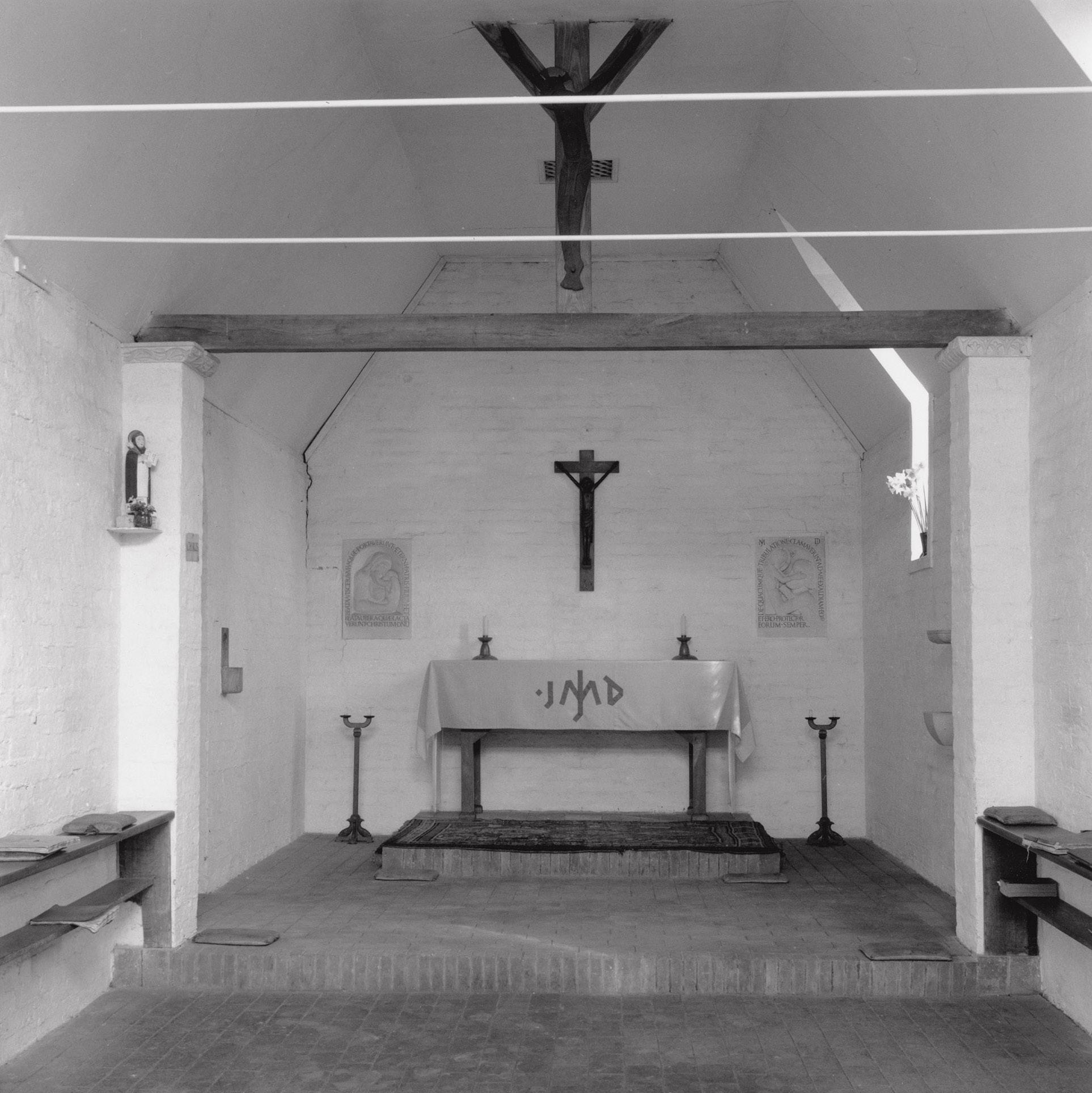
The Chapel of St Joseph and St Dominic at Ditchling stood as a remarkable expression of the ideals of the Guild of St Joseph and St Dominic, founded in 1920 by Eric Gill and his collaborators. Conceived as a union of faith, craftsmanship, and community reflecting Gill’s belief that art and religion were not two things but one - the Guild brought together artists and artisans committed to a shared spiritual and material practice. Central to this vision was Gill himself, alongside figures such as Desmond Chute, Joseph Cribbs, Edward Johnston, Hillary Pepler, David Jones, George Maxwell and Philip Halgreen whose contributions helped shape the distinctive early aesthetic and devotional character of the workshop.
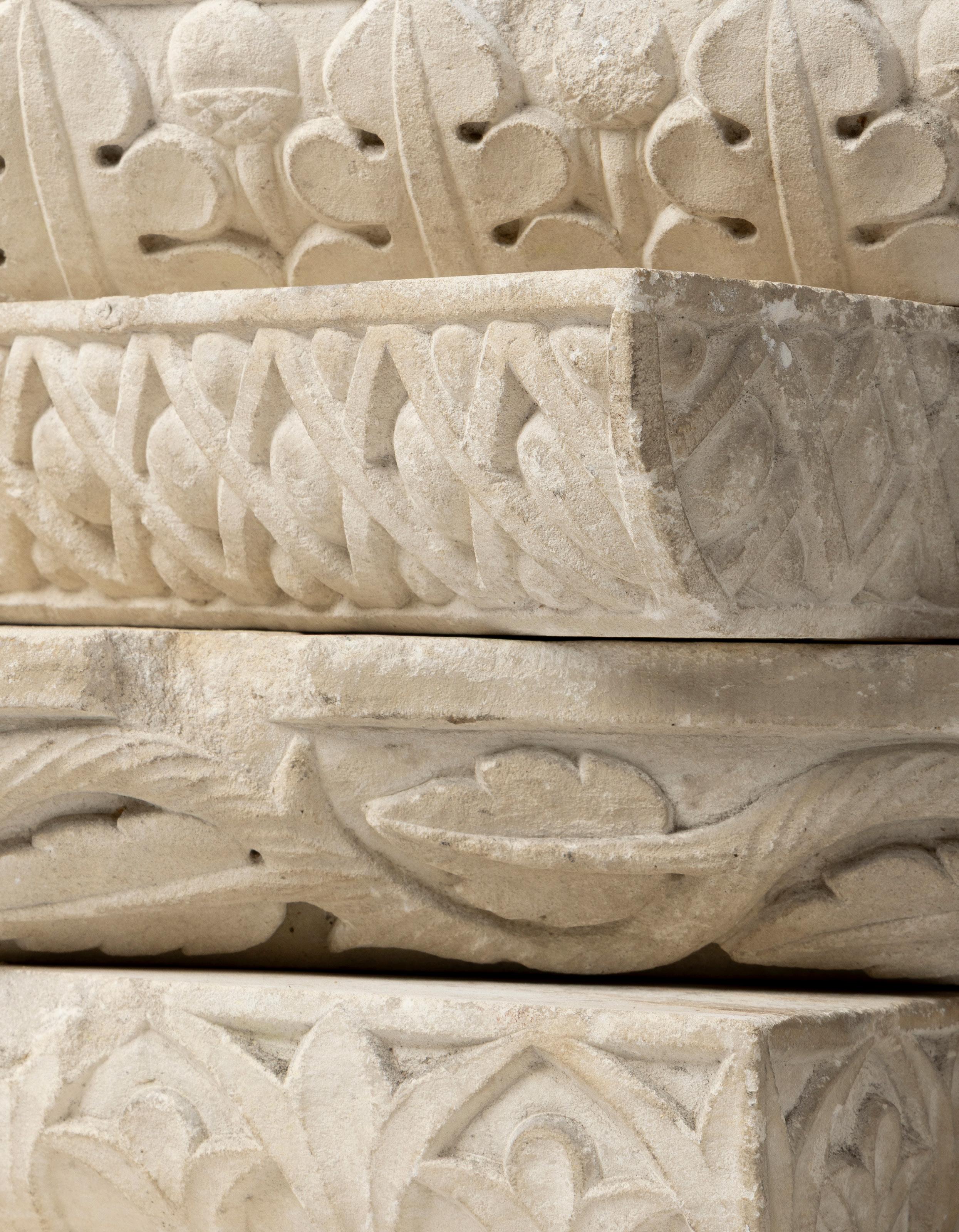
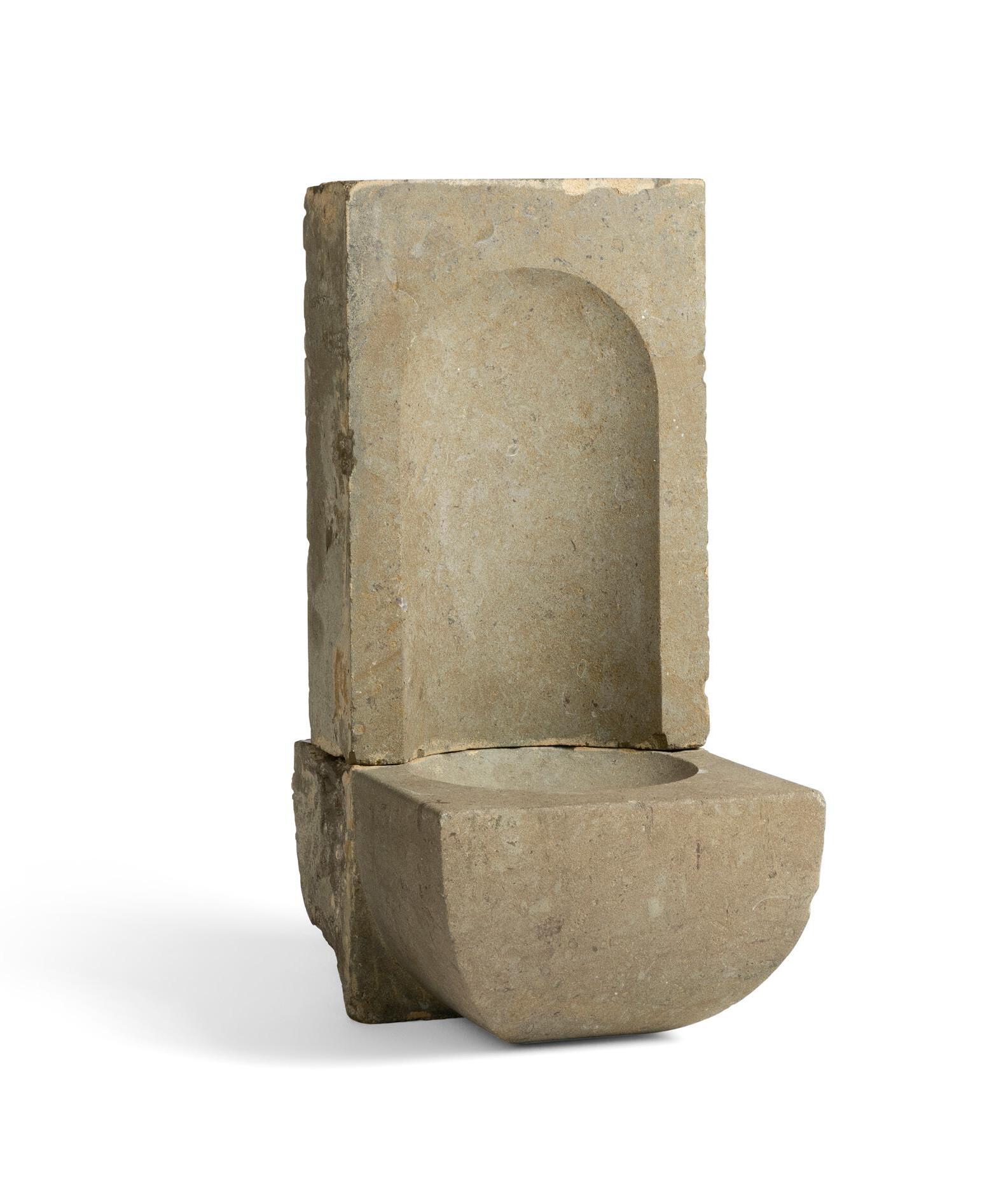
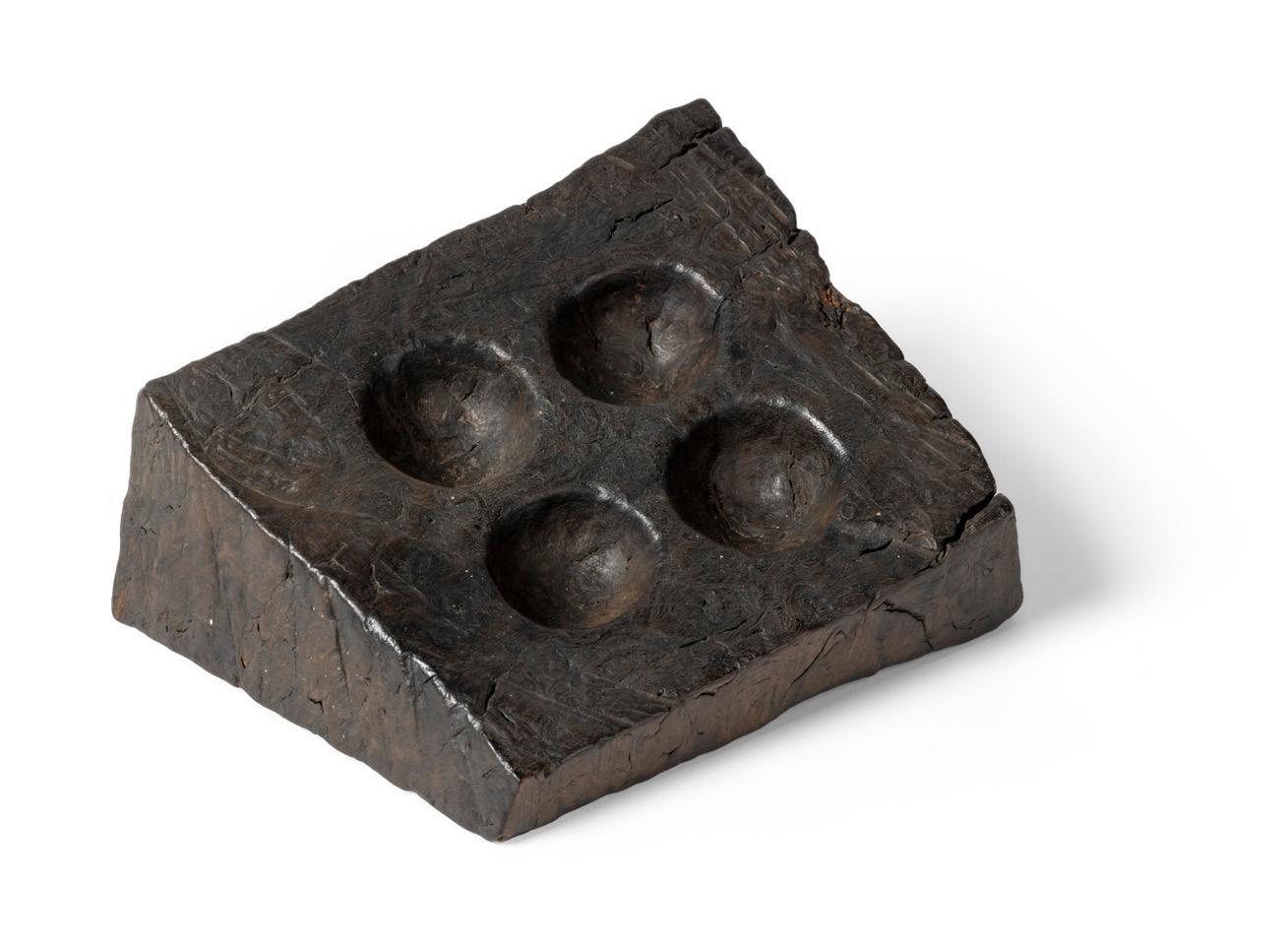
The present group of architectural elements - comprising four capitals, a piscina, and a devotional niche - originate from the Chapel and embody the Guild’s synthesis of sculpture and liturgical function. These works were formerly in the collection of the gallerist Gillian Jason, who acquired them directly from the Guild following the Chapel’s demolition in the 1980s.
Constructed between 1917 and 1918, the Chapel served not only as a place of worship but as the spiritual heart of the Guild’s activities. Built largely by hand using local materials, it reflected Gill’s belief in the integration of art, craft, and daily life, drawing on medieval precedents while
The chapel of the Guild of St Joseph and St Dominic showing carvings by Eric Gill and Desmond Chute, Ditchling, East Sussex, 1950s. Photo by Holloway, Edgar (1914-2008) © Bridgeman Images
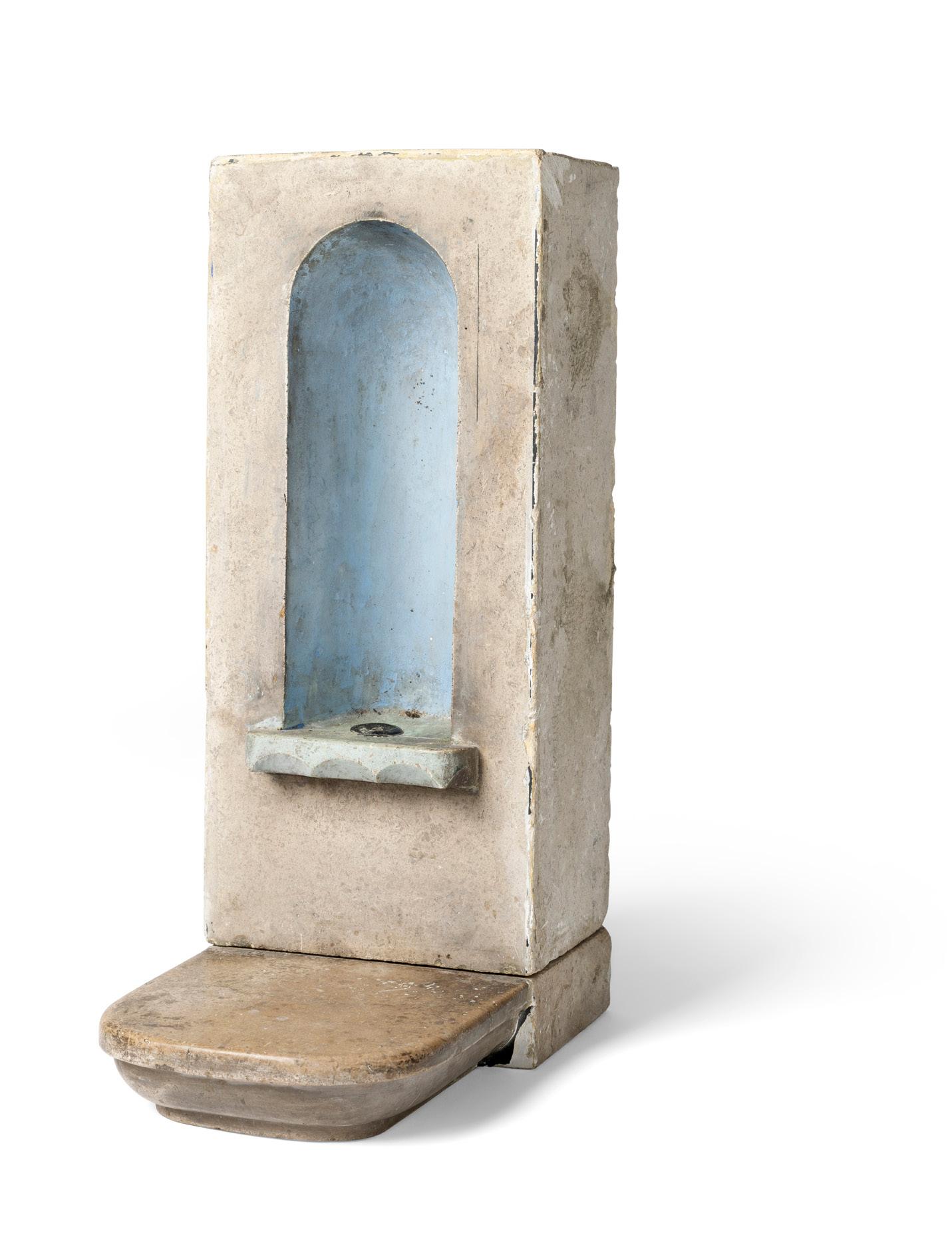
THE WORKSHOP DITCHLING, ATTRIBUTED TO DESMOND CHUTE (BRITISH 1895-1962)
DEVOTIONAL NICHE, c.1930
polychromed stone (possibly Hopton Wood) 37.5cm x 15cm x 25cm (14 ¾in x 5 7/8in x 9 7/8in)
Removed from Woodbarton, Ditchling, East Sussex, England. The house designed by Eric Gill and Desmond Chute. £800-1,200
remaining distinctly modern in its ideals. The village of Ditchling itself became a centre for artistic and intellectual exchange during this period, attracting a circle of like-minded makers committed to reviving traditional craftsmanship in opposition to industrial production.
The Piscina and Capitals were catalogued in a Fine Art Society exhibition catalogue as Workshop of Eric Gill. However, subsequent research has clarified their authorship. An entry in the Hove Museum catalogue attributes the carving of these elements to Gill himself. Definitive confirmation is provided by Gill’s original diary, held at the
William Andrews Clark Memorial Library, University of California, Los Angeles (UCLA). The relevant entries record the carving of the piscina on 24 February and the capital on 28 February, thereby confirming that these works were executed by Gill.
Alongside these, the devotional niche, attributed to Desmond Chute and the Ditchling workshop, reflects the collaborative ethos of the Guild, where individual craftsmanship operated within a shared spiritual and artistic framework.
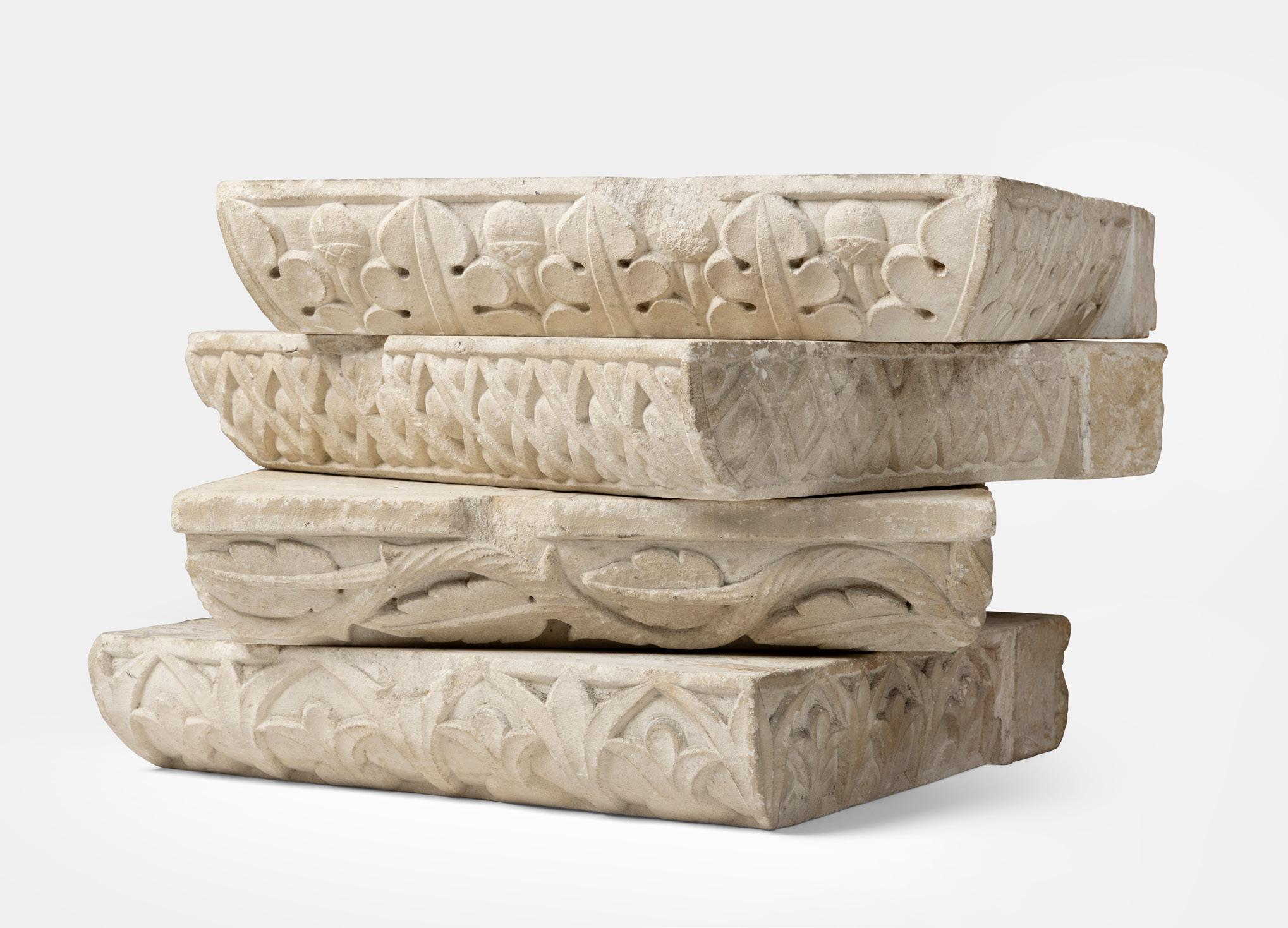
ERIC GILL A.R.A. (BRITISH 1882-1940)
FOUR CAPITALS FROM THE CHAPEL OF ST. JOSEPH AND ST. DOMINIC, DITCHLING, 1921
Bath stone
each 8cm x 40cm x 40cm, (3 1/8in x 15 ¾in x 15 ¾in) (4)
Provenance: Removed from the Chapel on demolition, c.1989; Purchased by gallerist Gillian Jason.
Literature: Eric Gill Diary, 28 February 1921 - ‘Carving Cap. in chapel before b’fast’ being one of numerous entries relating to his working on the chapel Hove Museum and Art Gallery, Eric Gill and the Guild of St. Joseph and St. Dominic, 25 November 1990-17 February 1991; (1921) “work on the Chapel and on Gills Workshop continued through the winter months… Much of the rest of the stone cutting fell to Gill himself, and his diary shows him racing to keep pace with the builder, cutting stone shelves, the Piscina, then the capitals day by day as the building neared completion”.
Exhibited: Gillian Jason Gallery, London, The Lost Idyll: Sculpture and Carving by Members of the Guild of St. Joseph and St. Dominic at Ditchling Sussex, 1913-1924, September - October 1989; Fine Art Society, London, Carving in Britain from 1910 to Now, November 2012 - January 2013.
£10,000-15,000
ERIC GILL A.R.A. (BRITISH 1882-1940)
THE PISCINA FROM THE CHAPEL OF ST. JOSEPH AND ST. DOMINIC, DITCHLING, 1921
Hornton stone
50.2cm x 22.8cm x 30.5cm (19 ¾in x 9in x 12in)
Provenance: Removed from the Chapel on demolition, c.1989; Purchased by gallerist Gillian Jason.
Literature: Eric Gill Diary, 24 February 1921, ‘Work on Piscina and Shelf for the Chapel all day’ being one of numerous entries relating to his working on the Chapel; Hove Museum and Art Gallery, Eric Gill and the Guild of St. Joseph and St. Dominic, 25 November 1990-17 February 1991; (1921) “work on the Chapel and on Gills Workshop continued through the winter months… Much of the rest of the stone cutting fell to Gill himself, and his diary shows racing to keep pace with the builder, cutting stone shelves, the Piscina, then the capitals day by day as the building neared completion”.
Exhibited: Gillian Jason Gallery, London, The Lost Idyll: Sculpture and Carving by Members of the Guild of St. Joseph and St. Dominic at Ditchling Sussex, 1913-1924
October 1989;
Fine Art Society, London, Carving in Britain from 1910 to Now November 2012 - January 2013.
£2,000-3,000
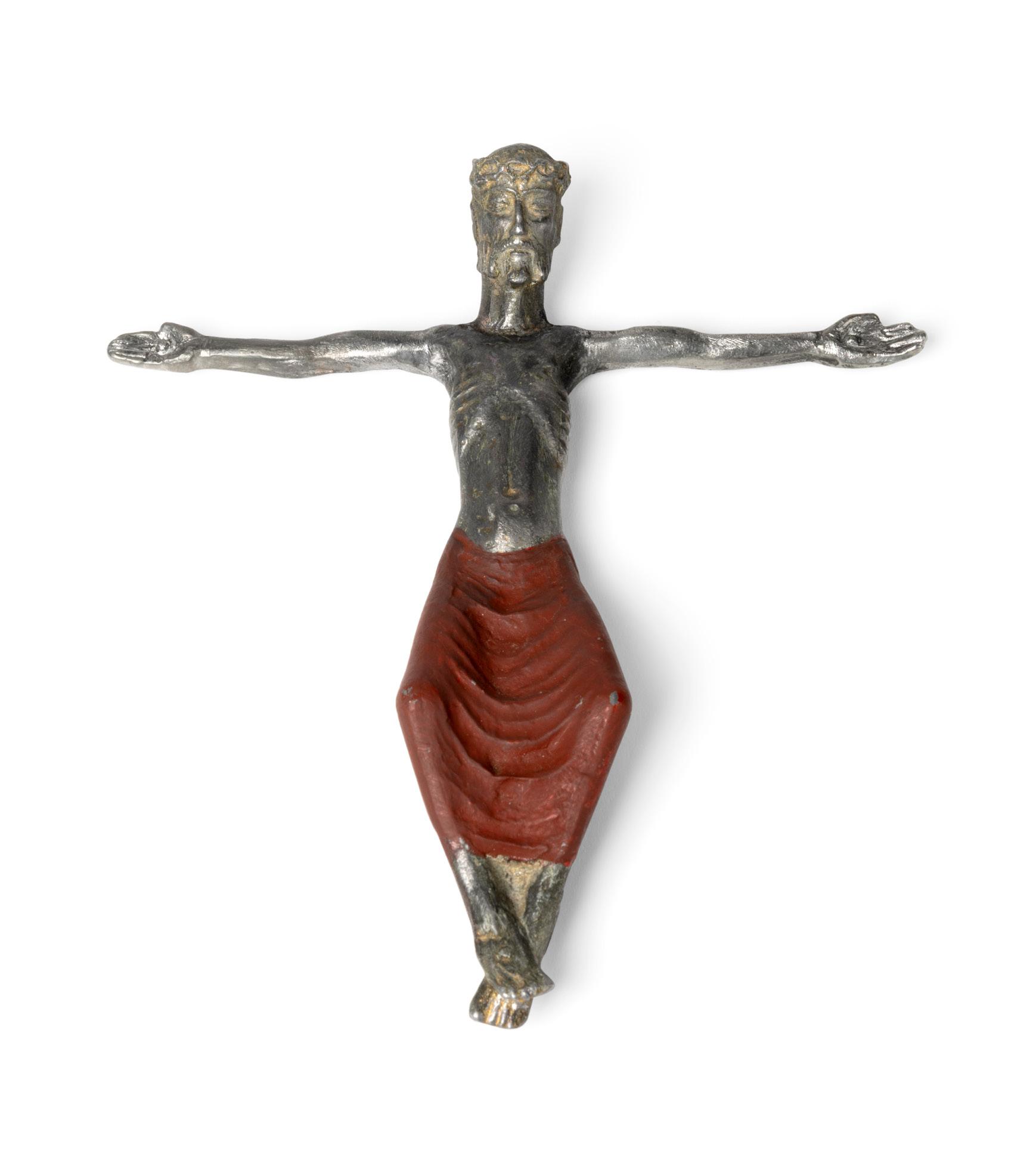
ERIC GILL A.R.A. (BRITISH 1882-1940) & PETER CRIBB (BRITISH 1920-1993) CHRIST FIGURE FOR CRUCIFIX, 1919/1968
posthumous casting by Peter Cribb in 1968 from the mould created in 1919 to cast the processional cross for the Guild Chapel on Ditchling Common from the wax original version, painted lead 20cm high, 18cm wide (7 7/8in high, 7in wide)
Provenance: Peter Cribb and by direct family descent.
£1,000-1,500
The lead Christ figure was cast in 1968 by Peter Cribb, son of Joseph Cribb (1892-1967), Eric Gill’s first assistant, from an original mould that had been preserved in the Guild workshop at Ditchling. This mould derived from a wax model created by Eric Gill as a preparatory study for the figure used on the Bisham war memorial. Gill’s diary records that the wax model was made on 1 March, and that two wax crucifix figures were sent for casting on 13 May. This entry has occasionally been confused with references to the Infant Christ of Prague.
The plaster mould for the crucified figure appears to have remained in the Guild workshop from the early 1920s, when the chapel at Ditchling Common was established. It is visible on a shelf in a photograph of the workshop taken around 1955–56, in which the foundation stone for the church of St Basil the Great at Basildon can be seen in the foreground.
Following the death of Joseph Cribb in 1967, the mould was removed from the workshop and used the following year to produce three lead casts. The mould subsequently deteriorated and collapsed, preventing any further examples from being made. One of these casts, finished with a goldcoloured paint, was later given to Ditchling Museum, while the remaining two are retained in the family’s possession. The museum also holds a plaster example of the figure, which was acquired in fragments and later restored.
24 §
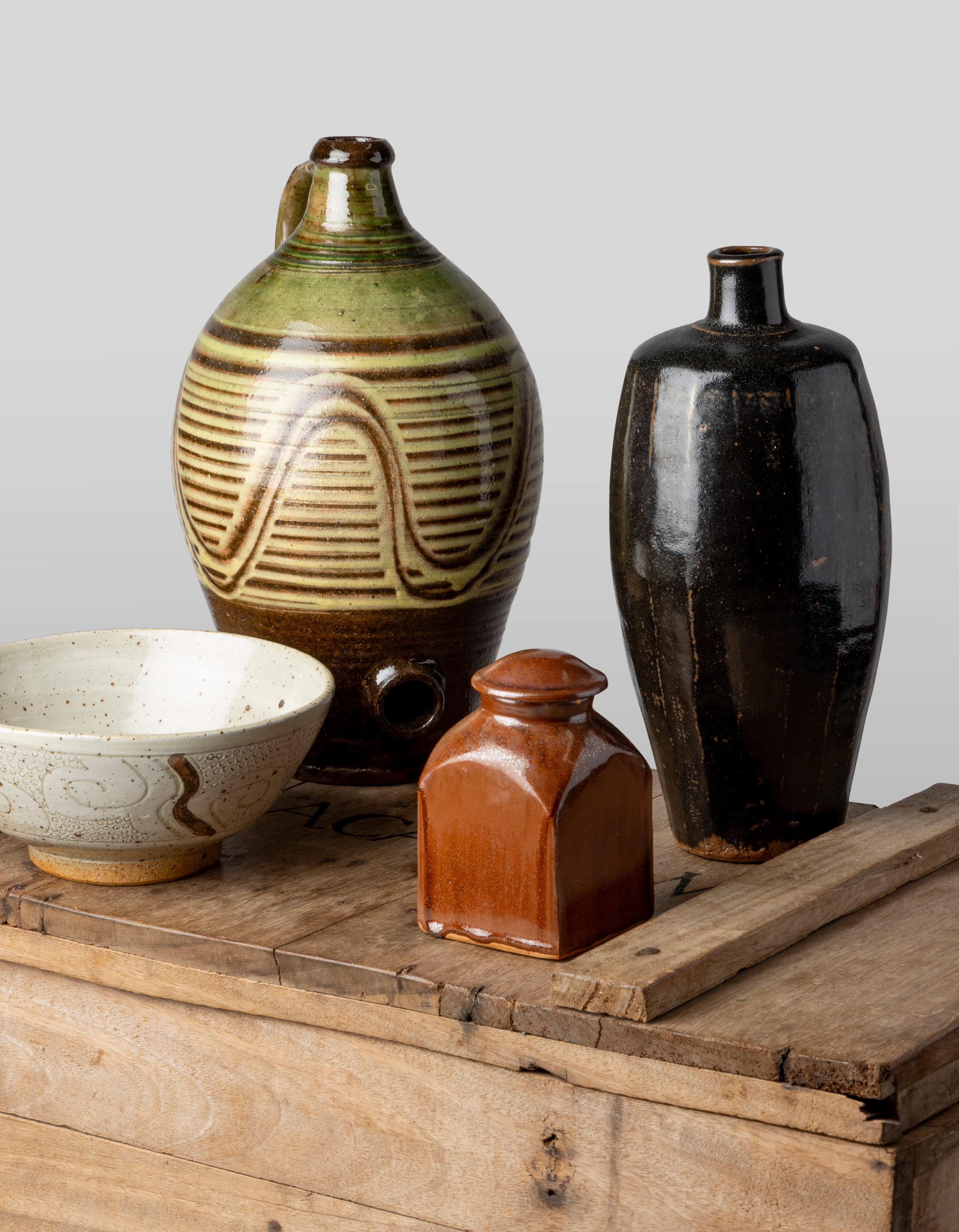
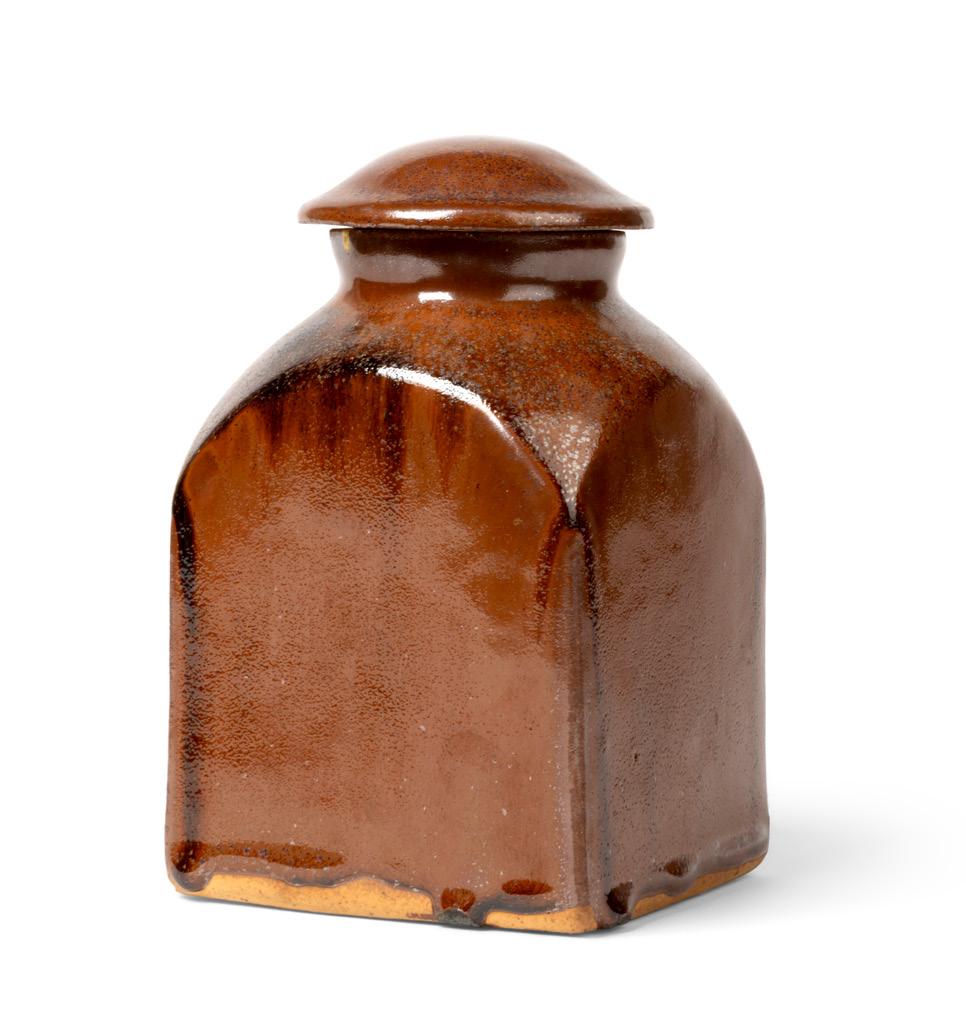
BERNARD LEACH C.H., C.B.E. (BRITISH 1887-1979) AT LEACH POTTERY TEA CADDY
impressed maker’s and pottery marks, stoneware, with iron glaze 17cm high, 10cm wide, 10cm deep (6 ¾in high, 4in wide, 4in deep)
£400-600
26 §
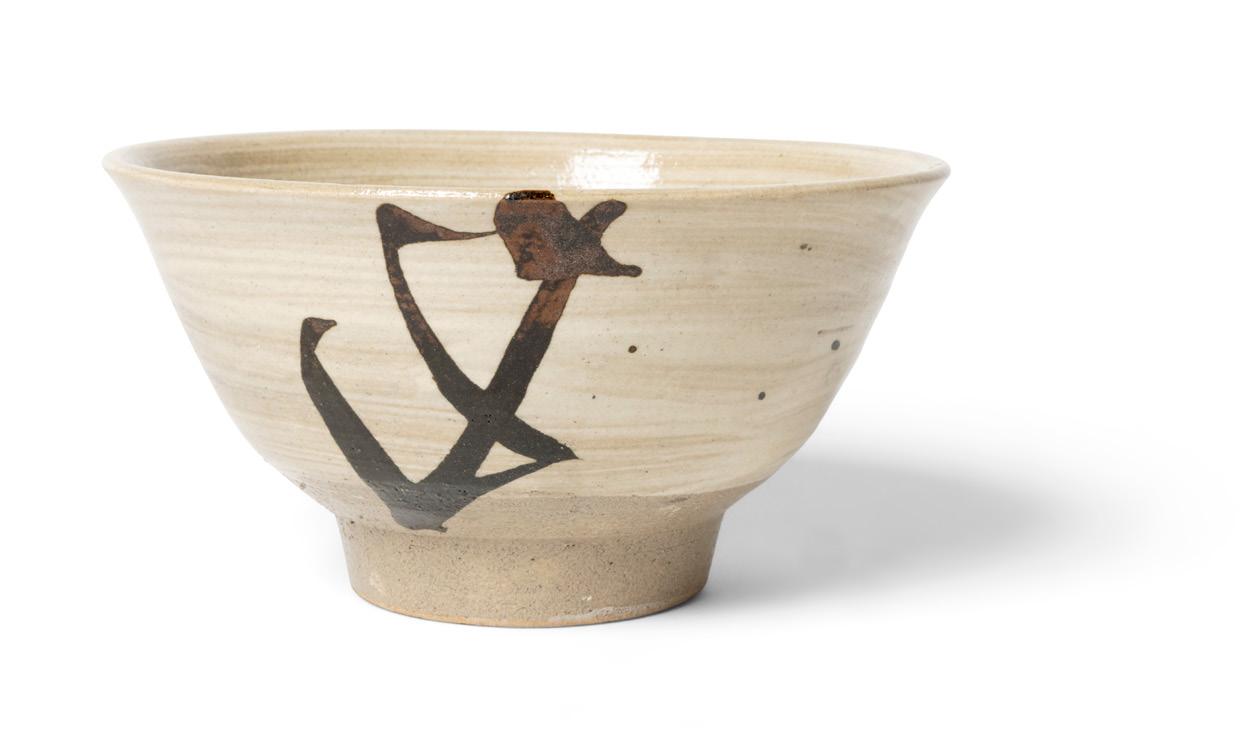
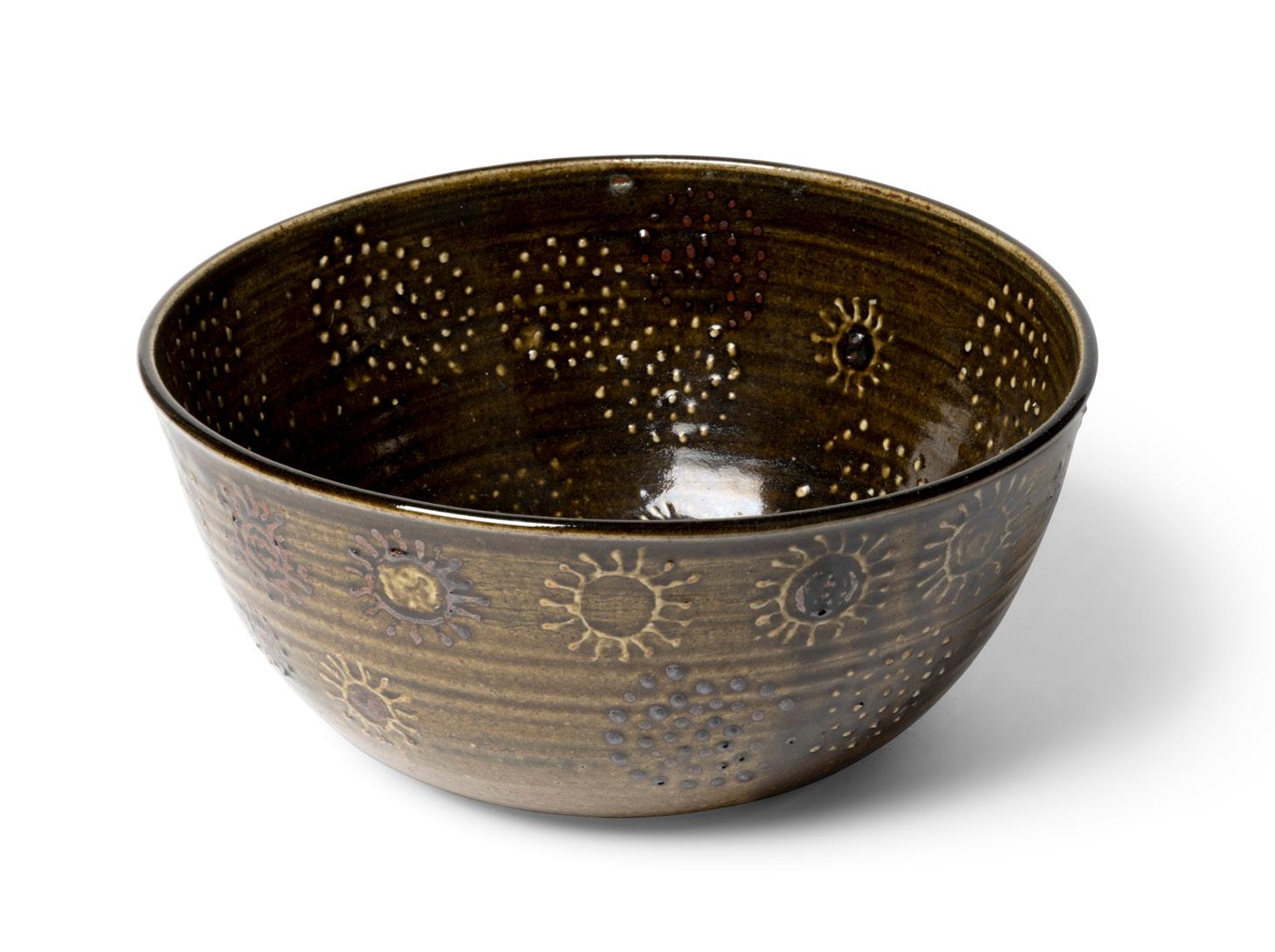
BERNARD LEACH C.H., C.B.E. (BRITISH 1887-1979) AT LEACH POTTERY FOOTED BOWL, c.1961
impressed maker’s and pottery mark, stoneware, with tenmoku brushwork decoration
11cm high, 25.5cm diameter (4 ¼in high, 10in diameter)
Literature: Bernard Leach, Asahi Shimbun Publishing Company, Tokyo 1966, pl.60 for a similar example.
£300-500
25 §
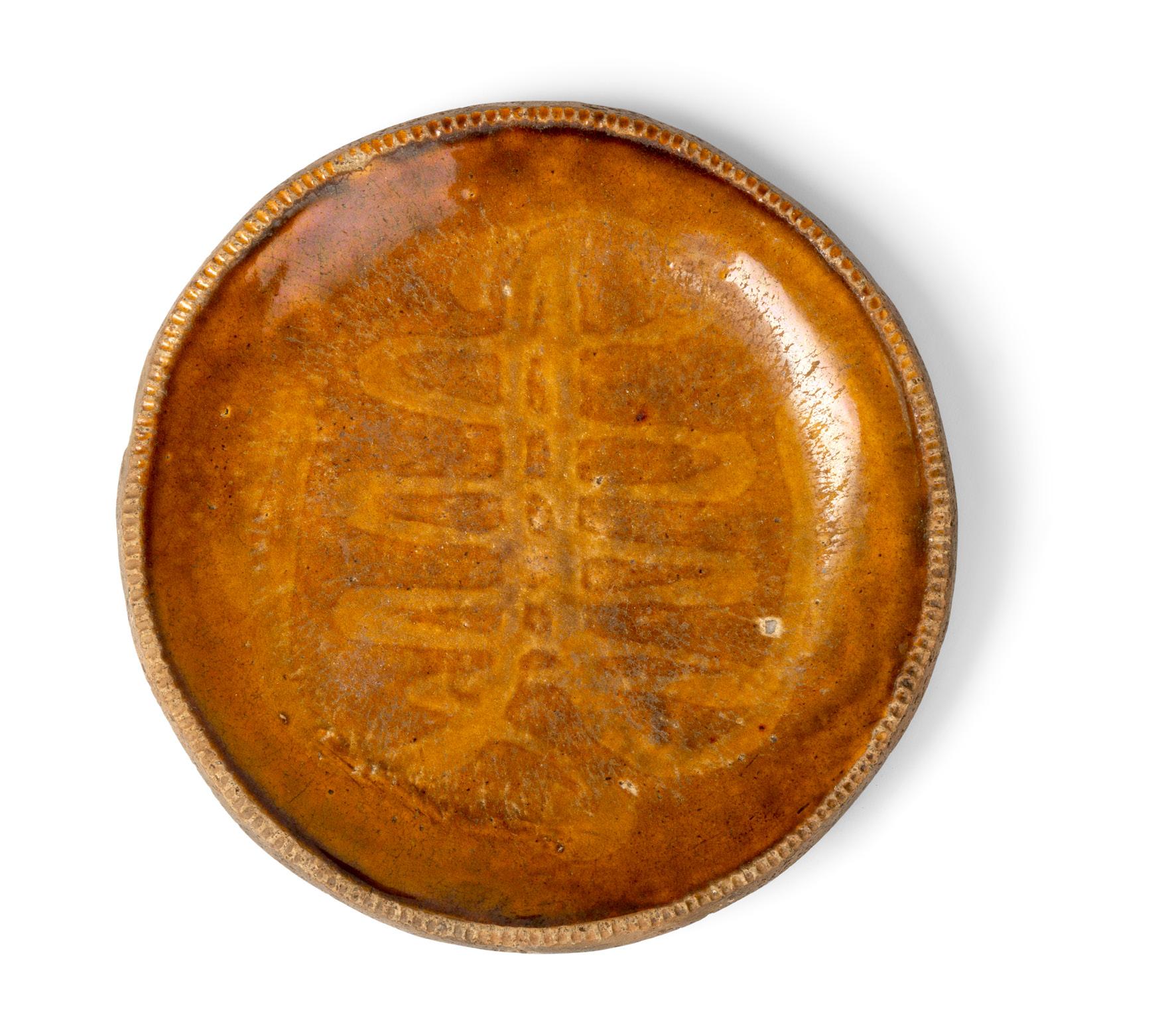
ATTRIBUTED TO BERNARD LEACH C.H., C.B.E. (BRITISH 1887-1979) AT LEACH POTTERY
‘BONEY PIE’ DISH
impressed pottery mark, earthenware, with pie crust rim
28cm diameter (11in diameter)
£400-600
Left From top:
Lots 33, 30, 26, 24 & 31
27
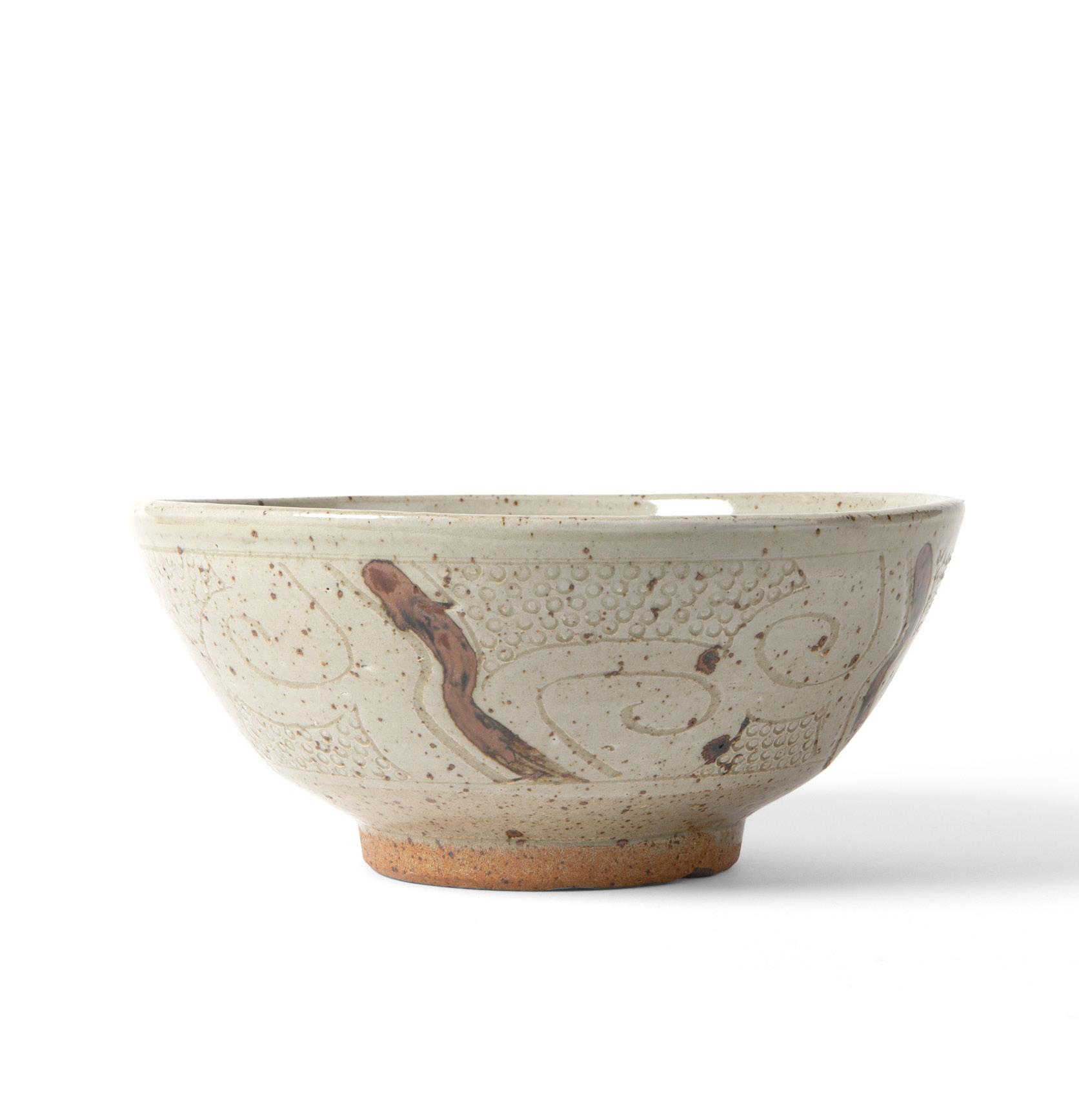
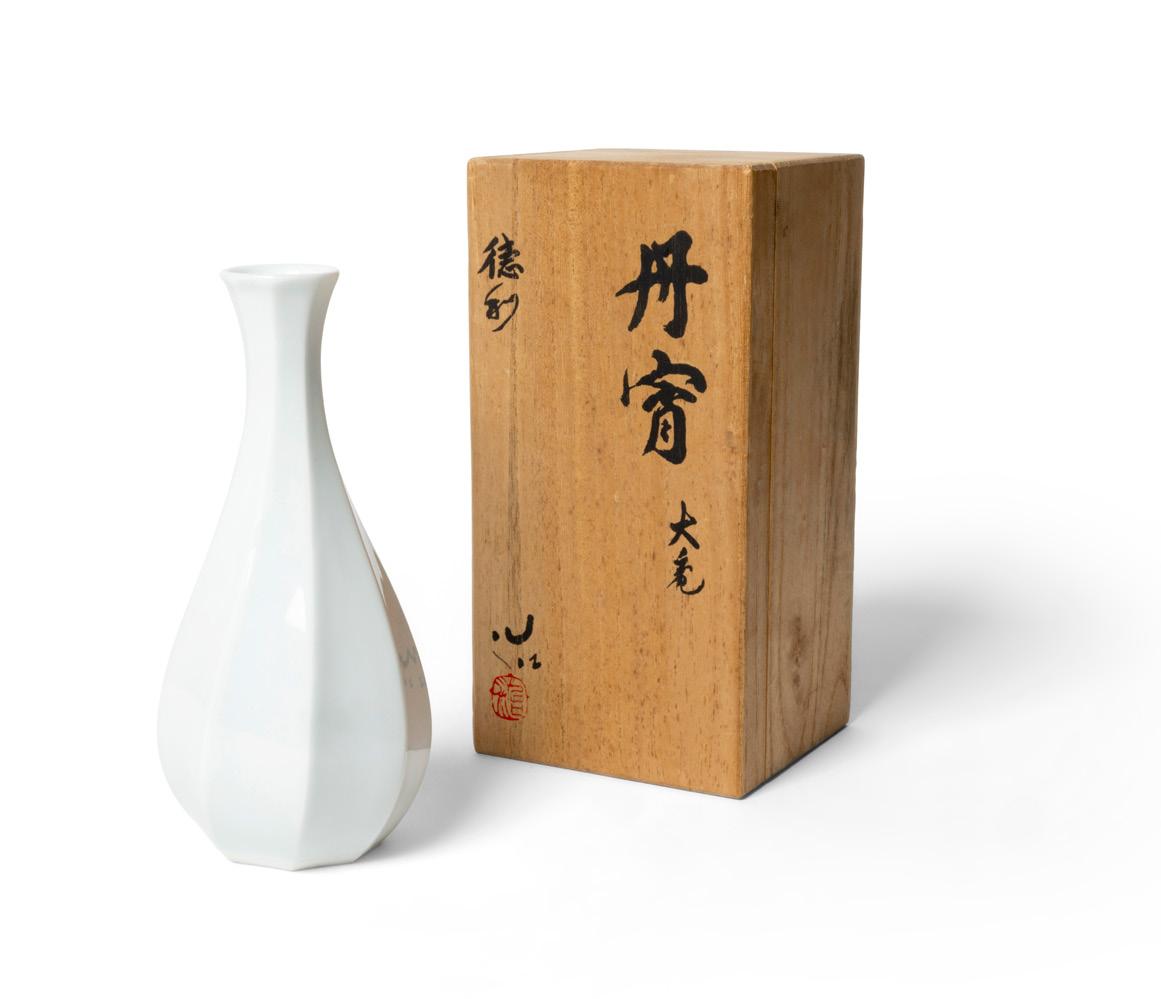
SHOJI HAMADA (JAPANESE 1894-1978) FOOTED BOWL
stoneware, with painted iron stem leaf motif, together with a signed wooden box 10cm high, 20cm diameter (4in high, 7 7/8in diameter)
Provenance: Private Collection, U.K.
£500-700
28
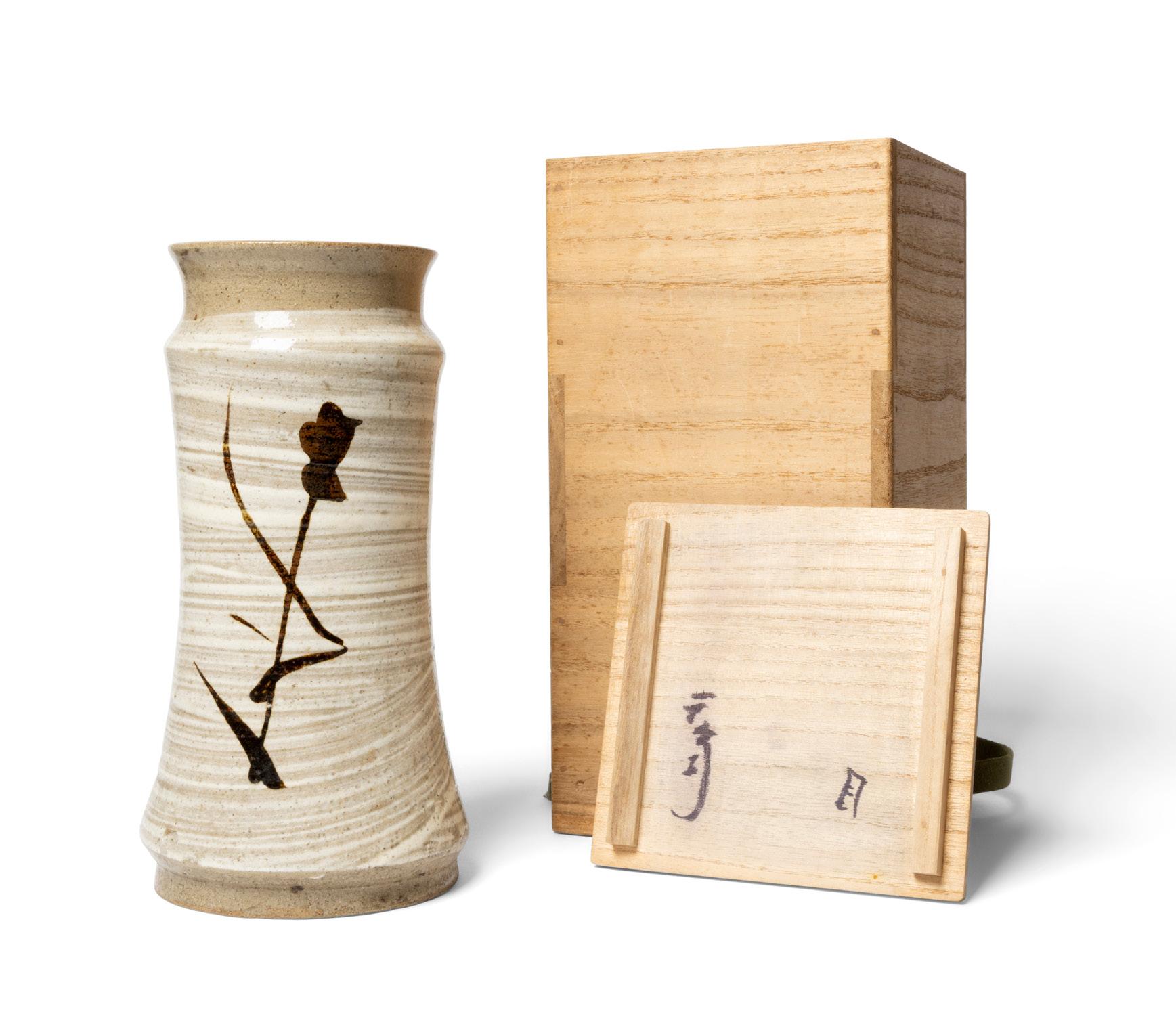
SHOJI HAMADA (JAPANESE 1894-1978) ALBARELLO JAR FORM
stoneware, with painted iron stem leaf motif, together with a signed wooden box
23.5cm high, 12cm diameter (9 ¼in high, 4 ¾in high)
Provenance: Private Collection, U.K.
£800-1,200
29
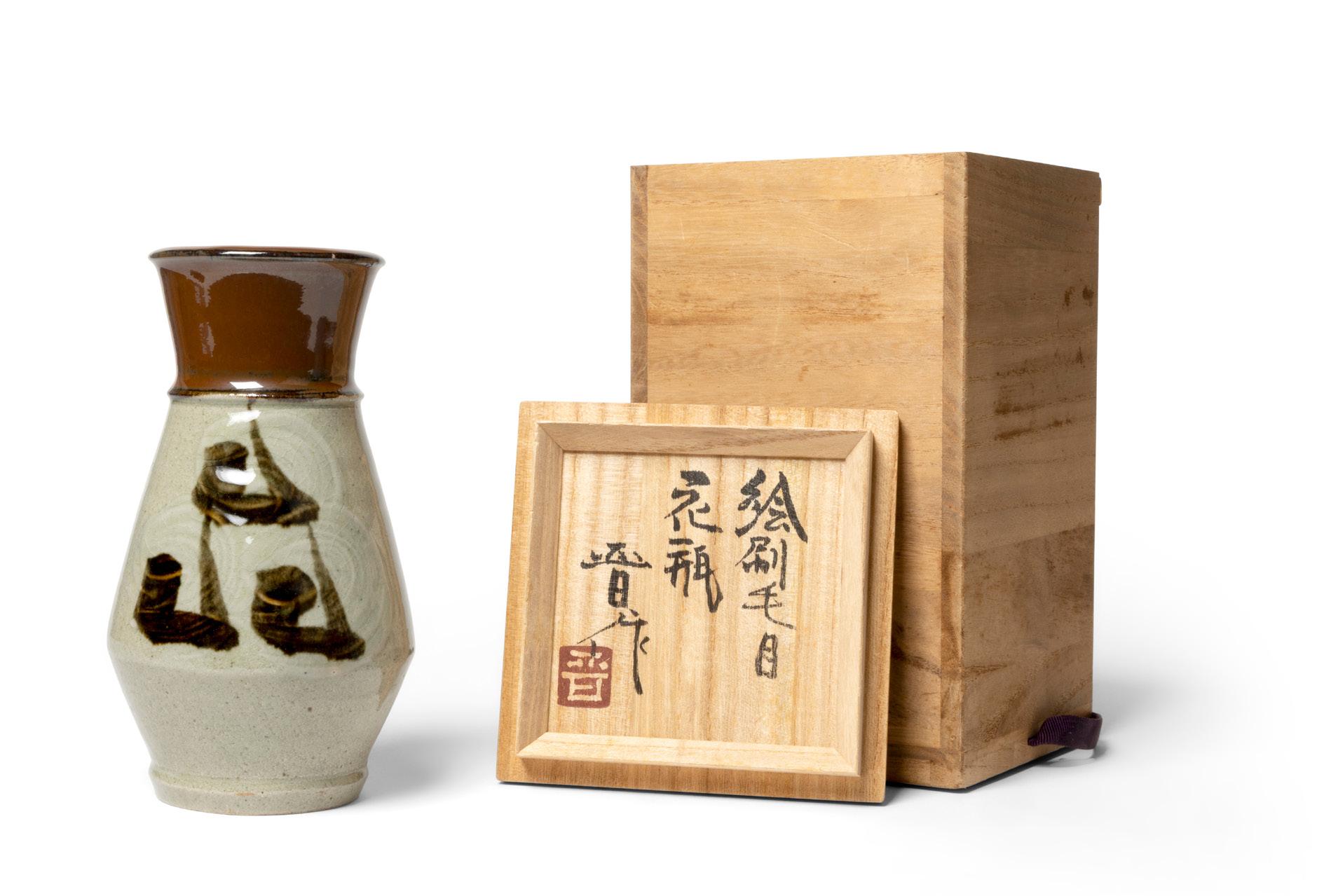
SHINSAKU HAMADA (JAPANESE 1929-2023) VASE
stoneware, with painted iron motifs, together with a signed wooden box 19cm high, 10cm diameter (7 ½in high, 4in diameter)
Provenance: Private Collection, U.K.
£400-600
§
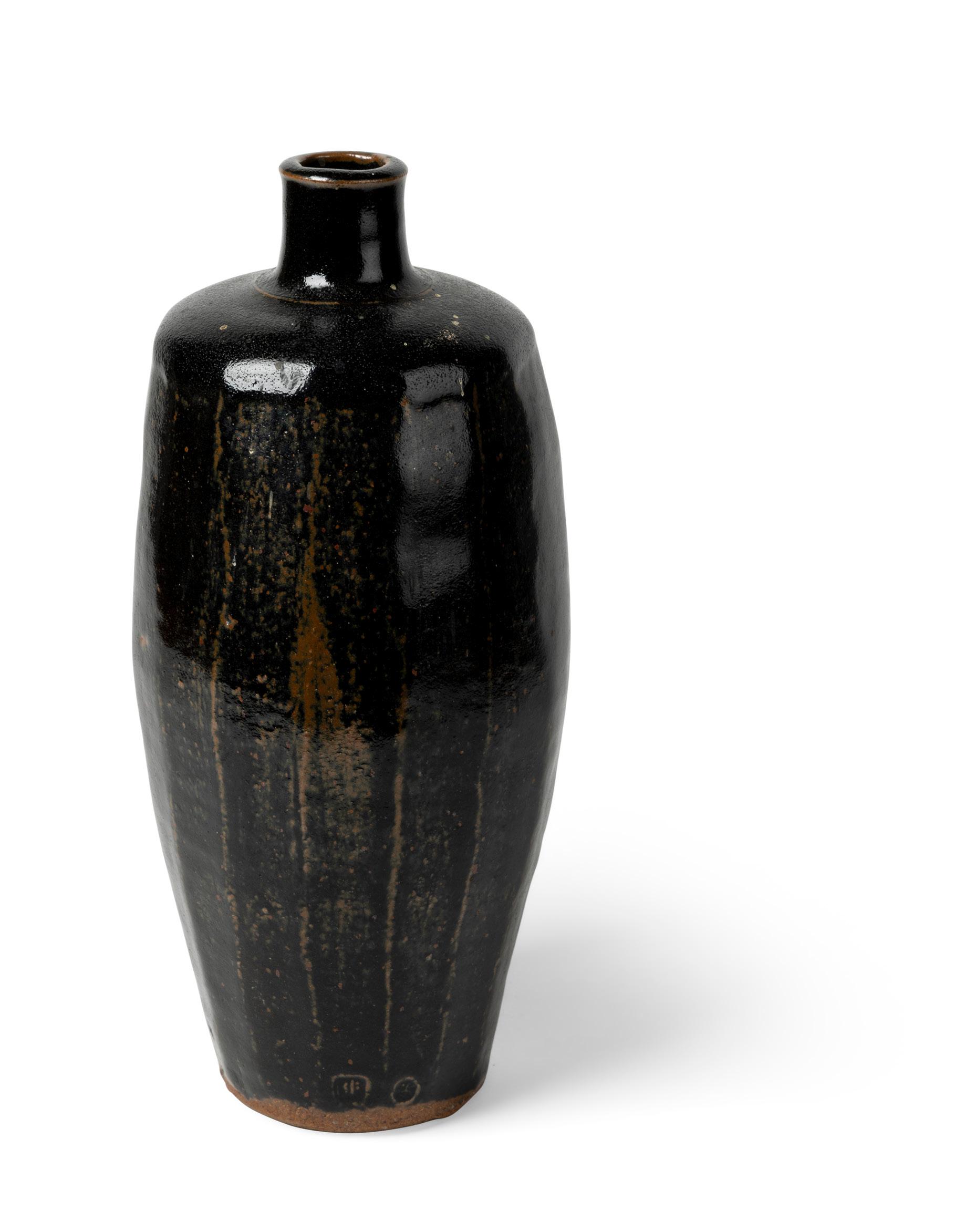
impressed maker’s and pottery seals, stoneware, tenmoku glaze
37cm high, 16.5cm wide (14 ½in high, 6 ½in wide)
Provenance: Private Collection, U.K.
£1,000-1,500
BERNARD LEACH C.H., C.B.E. (BRITISH 1887-1979) AT LEACH POTTERY VASE
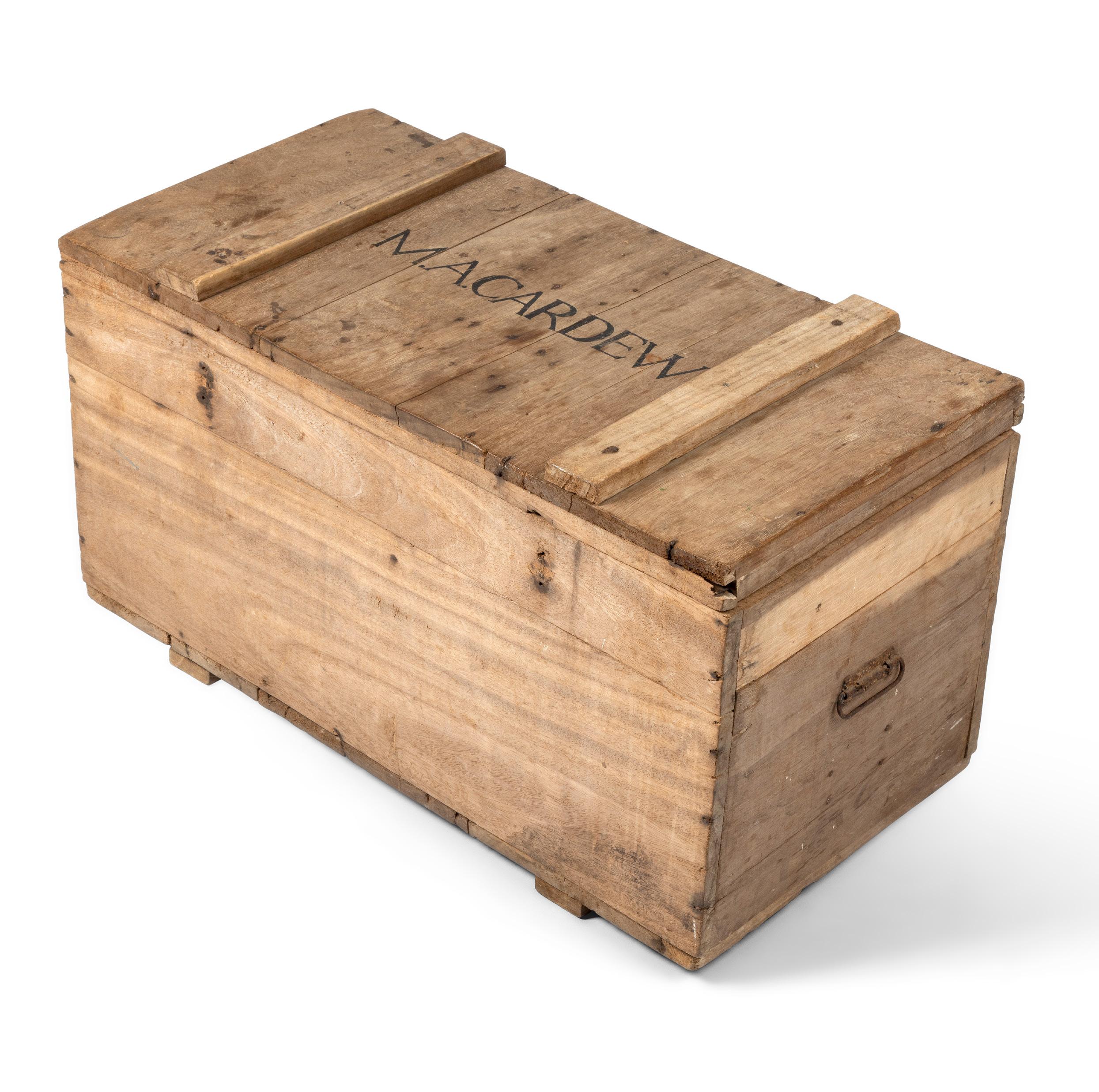
MICHAEL CARDEW C.B.E. (BRITISH 1901-1983) TRUNK
pine with black stencilled name M. A. CARDEW (to top) and metal side handles
47cm high, 90cm wide, 45cm deep (18 ½in high, 35 3/8in wide, 17 ¾in deep)
£500-700
32 §
JANET LEACH (AMERICAN/BRITISH, 1918-1997) AT LEACH POTTERY LETTER HOLDER
impressed maker and pottery marks, stoneware 8.5cm high, 24cm wide, 6.5cm deep (3 3/8in high, 9 3/8in wide, 2 ½in deep)
£300-500
34 § JANET LEACH (AMERICAN/BRITISH 1918-1997) AT LEACH POTTERY LARGE VASE, 1986
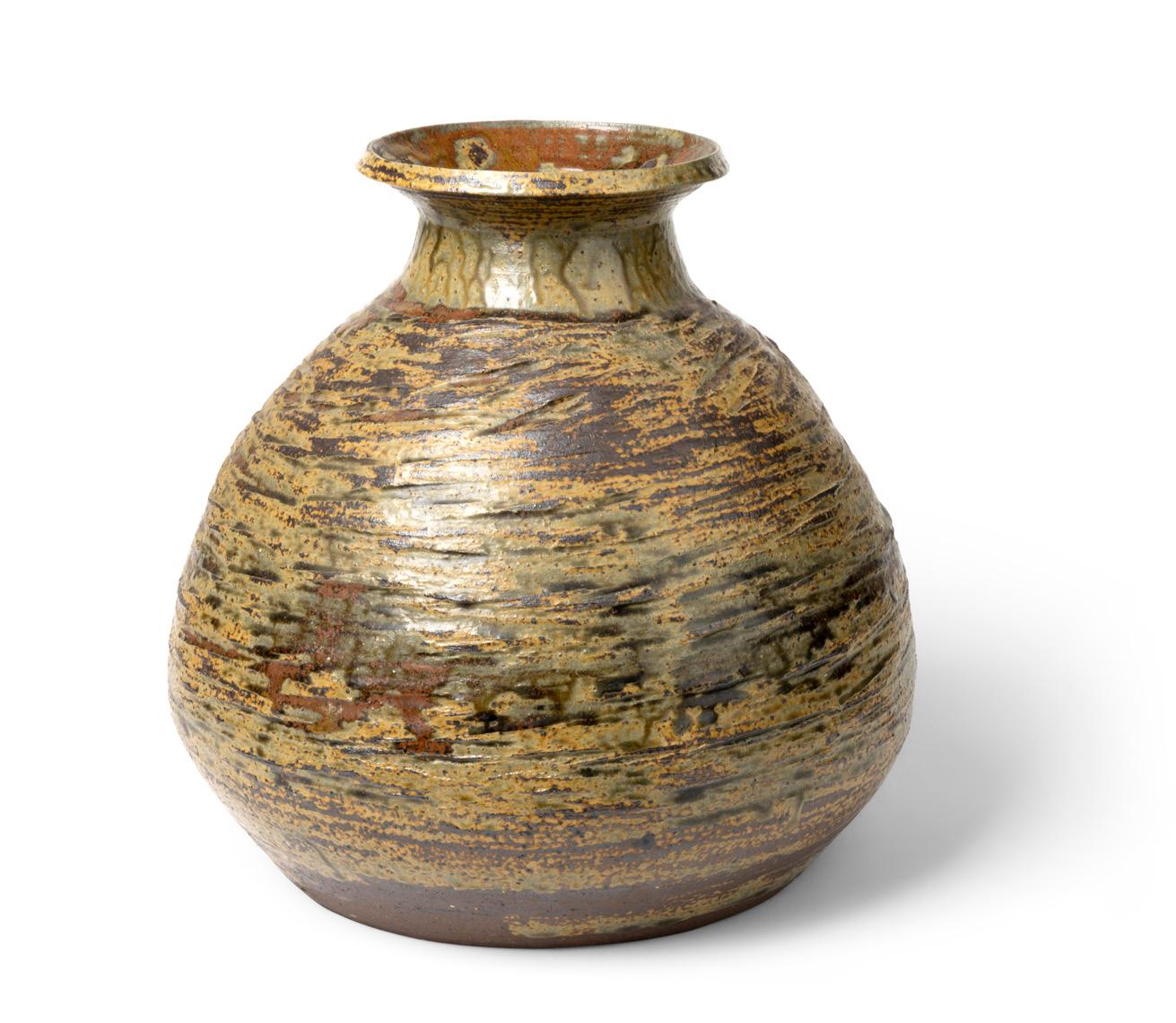
impressed maker’s and pottery seals, stoneware, with ash glaze 33cm high, 31cm diameter (13in high, 12 ¼in diameter)
£500-700
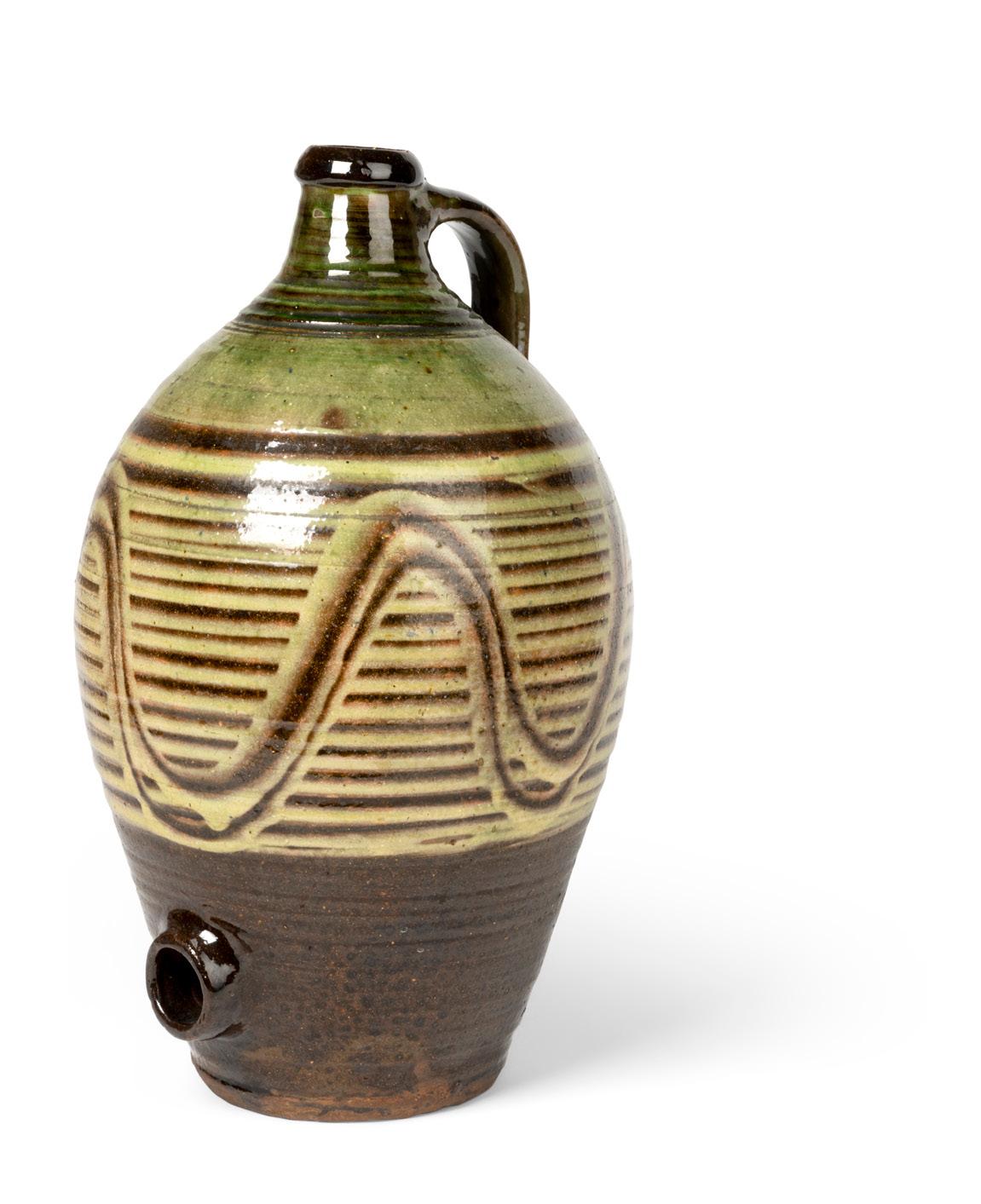
33 § MICHAEL CARDEW C.B.E. (BRITISH 1901-1983) AT WINCHCOMBE POTTERY FLAGON, c.1930
impressed maker’s and pottery marks, stoneware, with combed decoration
41cm high, 24cm diameter (16 1/8in high, 9 3/8in diameter)
Provenance: Woolley & Wallis, Salisbury, 5 March 2014, lot 444.
£600-800
35 §
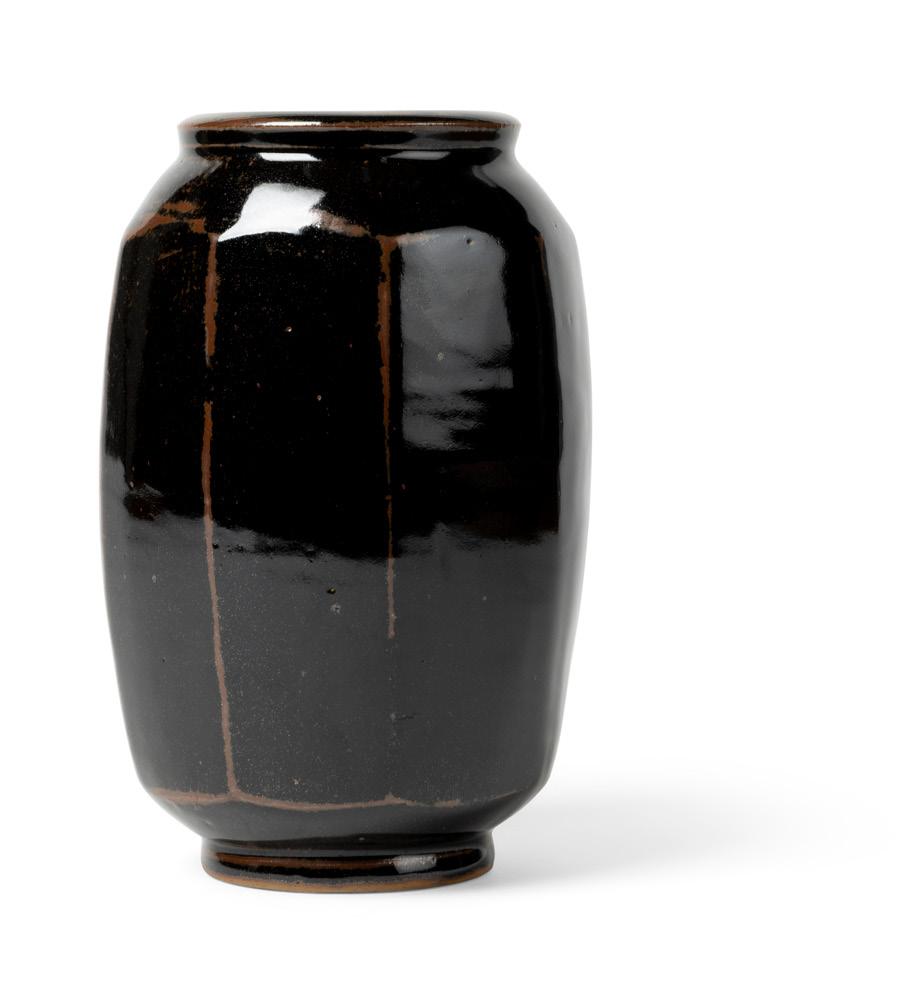
DAVID LEACH (BRITISH 1911-2005) VASE
stoneware, with tenmoku glaze, cut sided 21cm high, 13cm diameter (8 ¼in high, 5in diameter)
Provenance: Private Collection, London.
£300-500
36 §
DAVID LEACH (BRITISH 1911-2005)
‘FOXGLOVE’ VASE
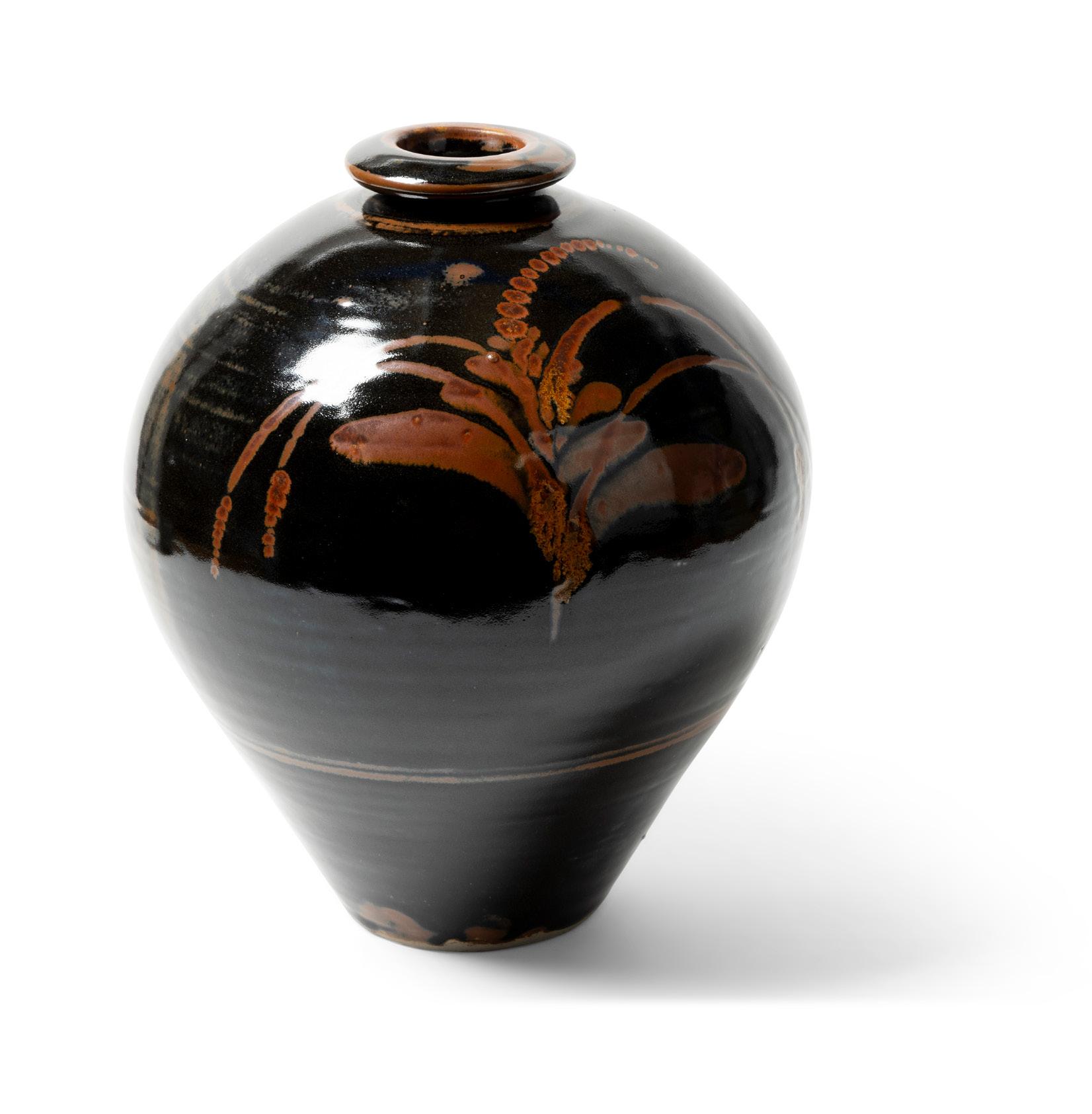
impressed makers mark, stoneware, with tenmoku and iron glazes
32cm high, 27.5cm diameter (12 ½in high, 10 ¾in diameter)
Provenance: Private Collection, London.
£600-800
DAVID LEACH (BRITISH 1911-2005)
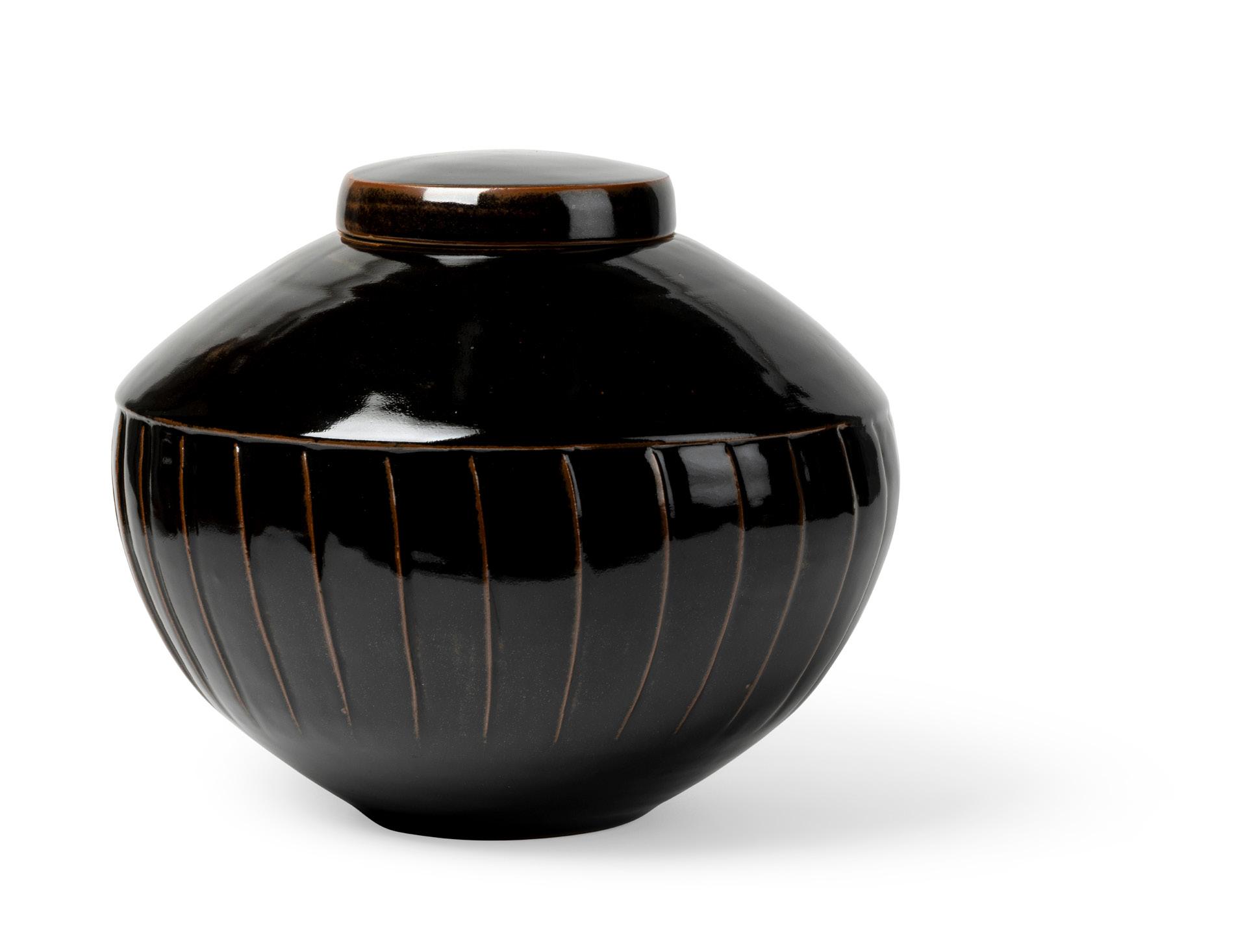
impressed maker’s mark, stoneware, with tenmoku glaze 26cm high, 32cm diameter (10 ¼in high, 12 ½in diameter) Private Collection, London.
38 §
KATHERINE PLEYDELL-BOUVERIE (BRITISH 1895-1985)
FOOTED BOWL, c.1960s
impressed maker’s mark, stoneware, with ash glaze
9.2cm high, 11cm wide (3 5/8in high, 4 3/8in wide)
£300-500
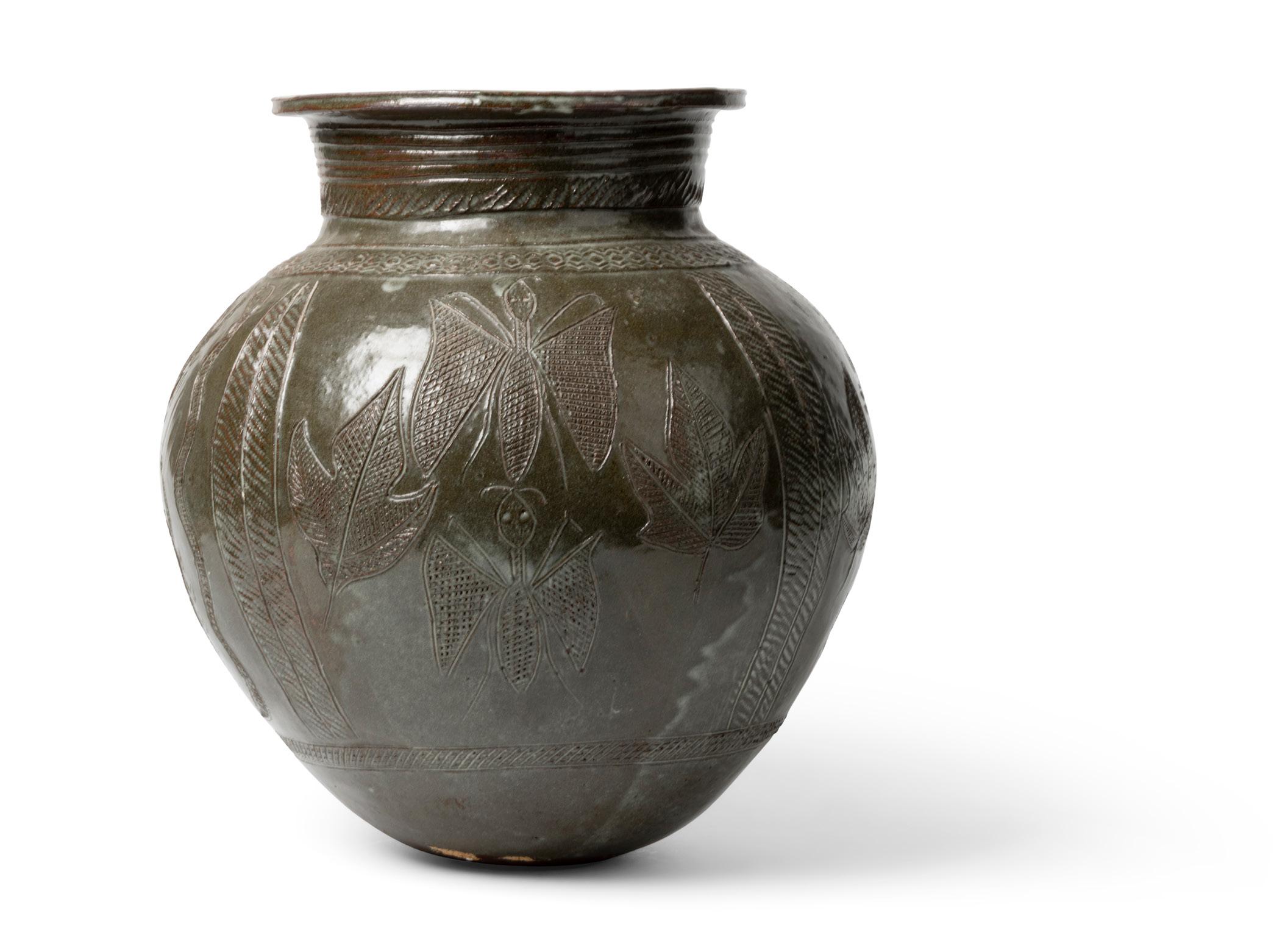
(to base), in the manner of Ladi Kwali, stoneware, with incised decoration of snakes,
40 §
SIDDIG EL NIGOUMI (SUDANESE 1931-1996)
LARGE BOWL, 1973
signed and dated, stoneware with slip-trailed decoration
13cm high, 29cm wide, 26.5cm deep
(5 1/8in high, 11 3/8in wide, 10 3/8in deep)
£400-600
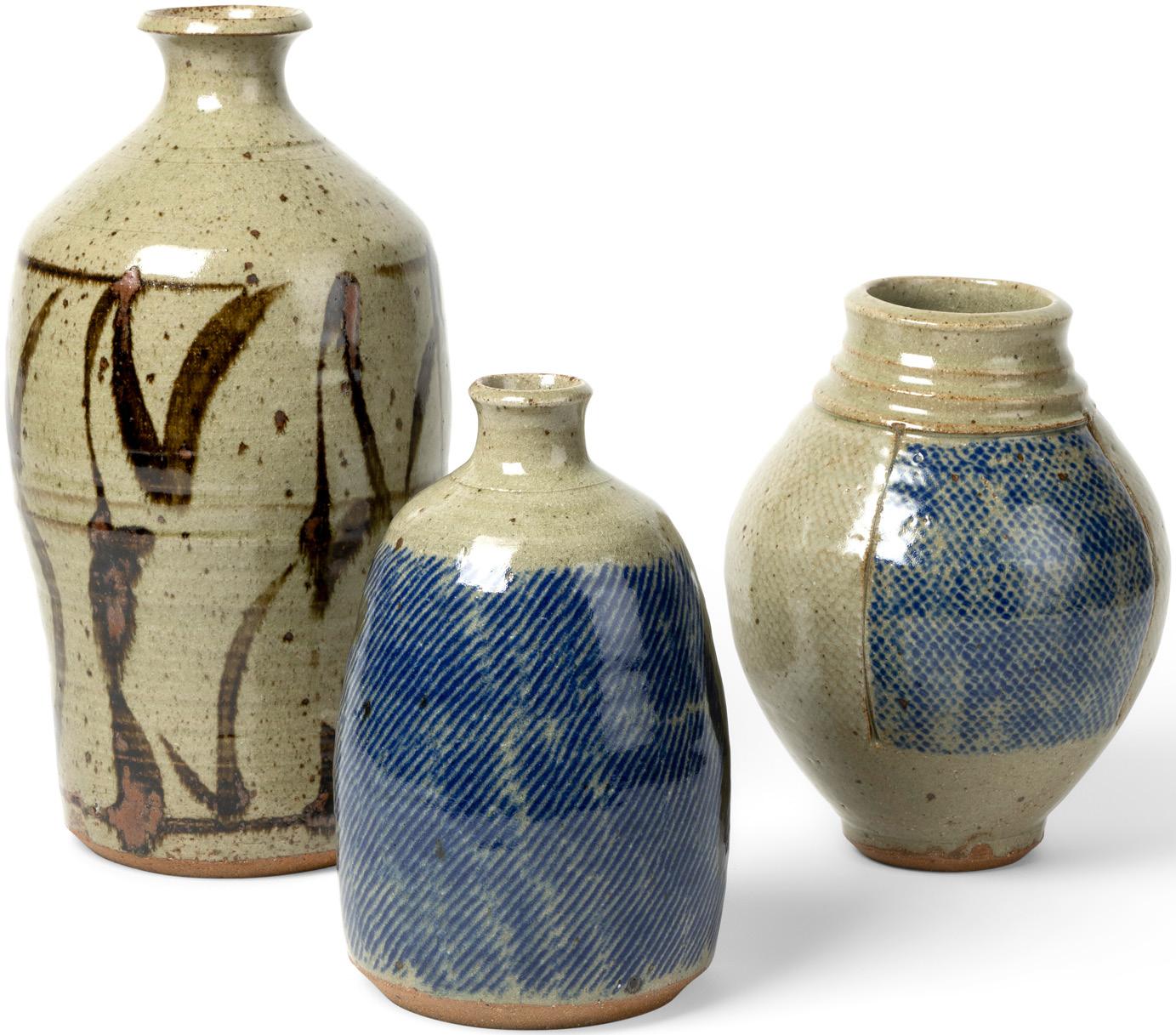
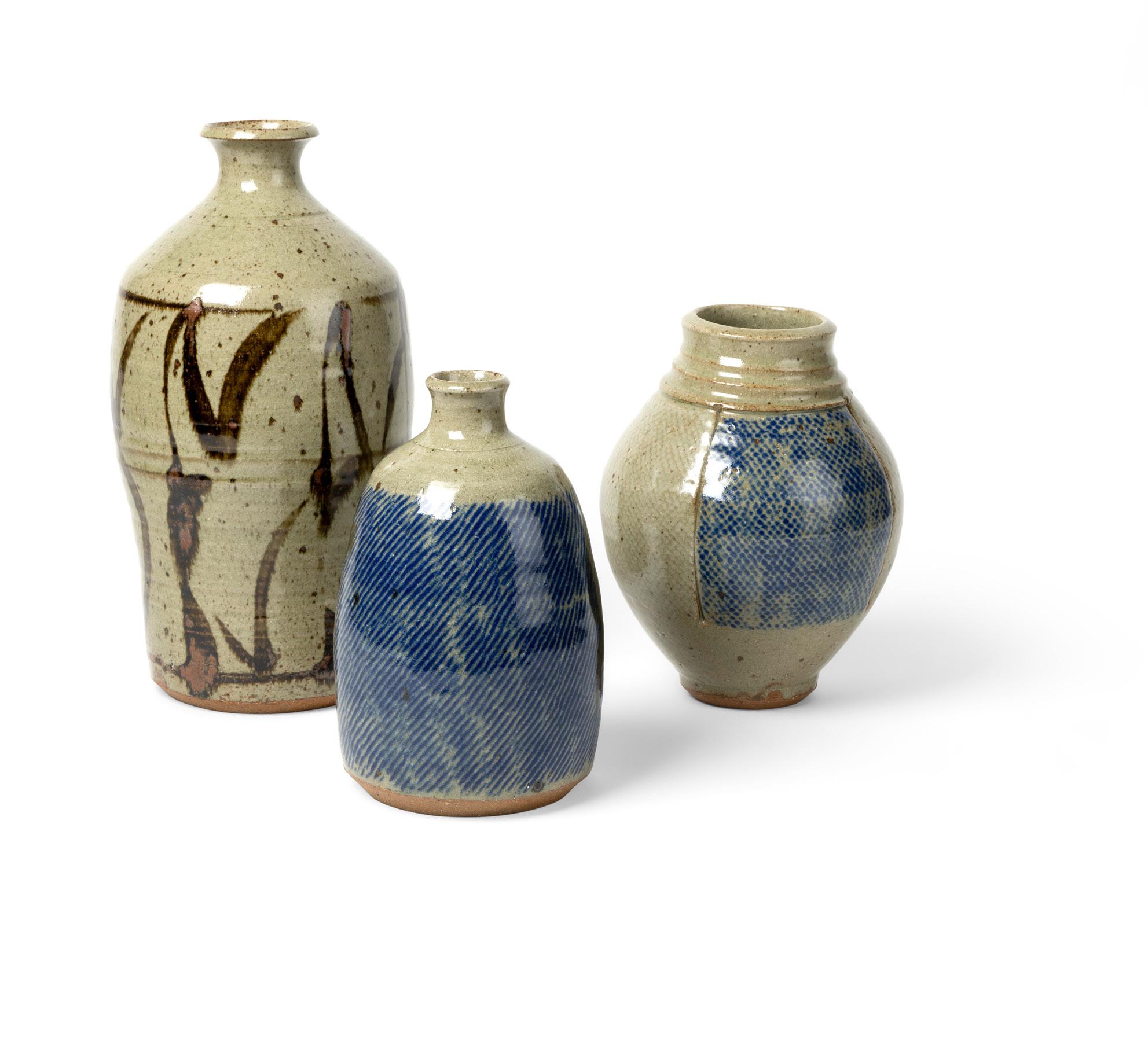
41 § WILLIAM PLUMPTRE (BRITISH 1959-) THREE VASES
each with painted monogram (to base), stoneware 31cm high, 21.5cm high and 21cm high (12 ¼in high, 8 ½in high and 8 ¼in high) (3)
Provenance: Private Collection, London.
£500-700
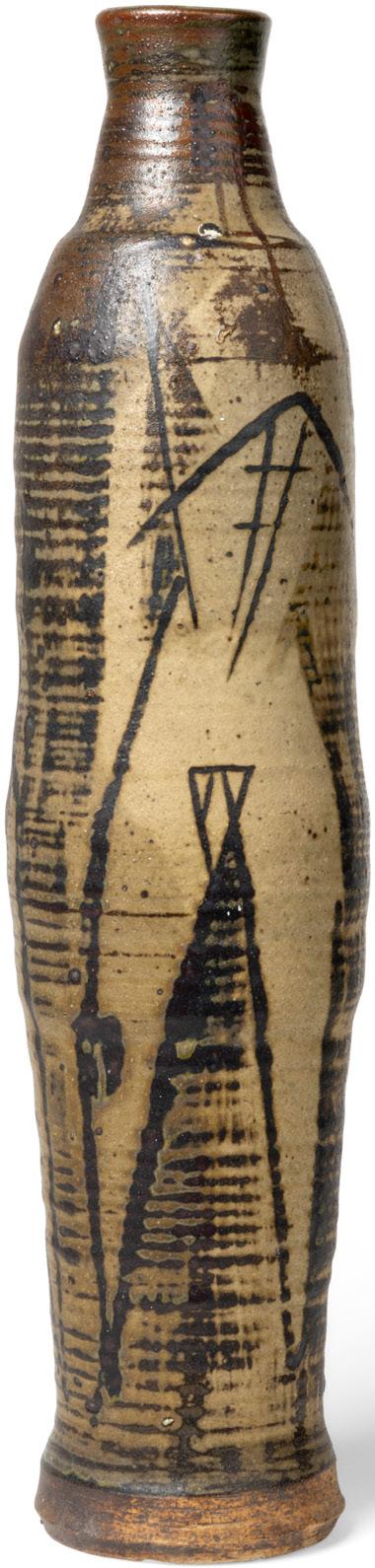
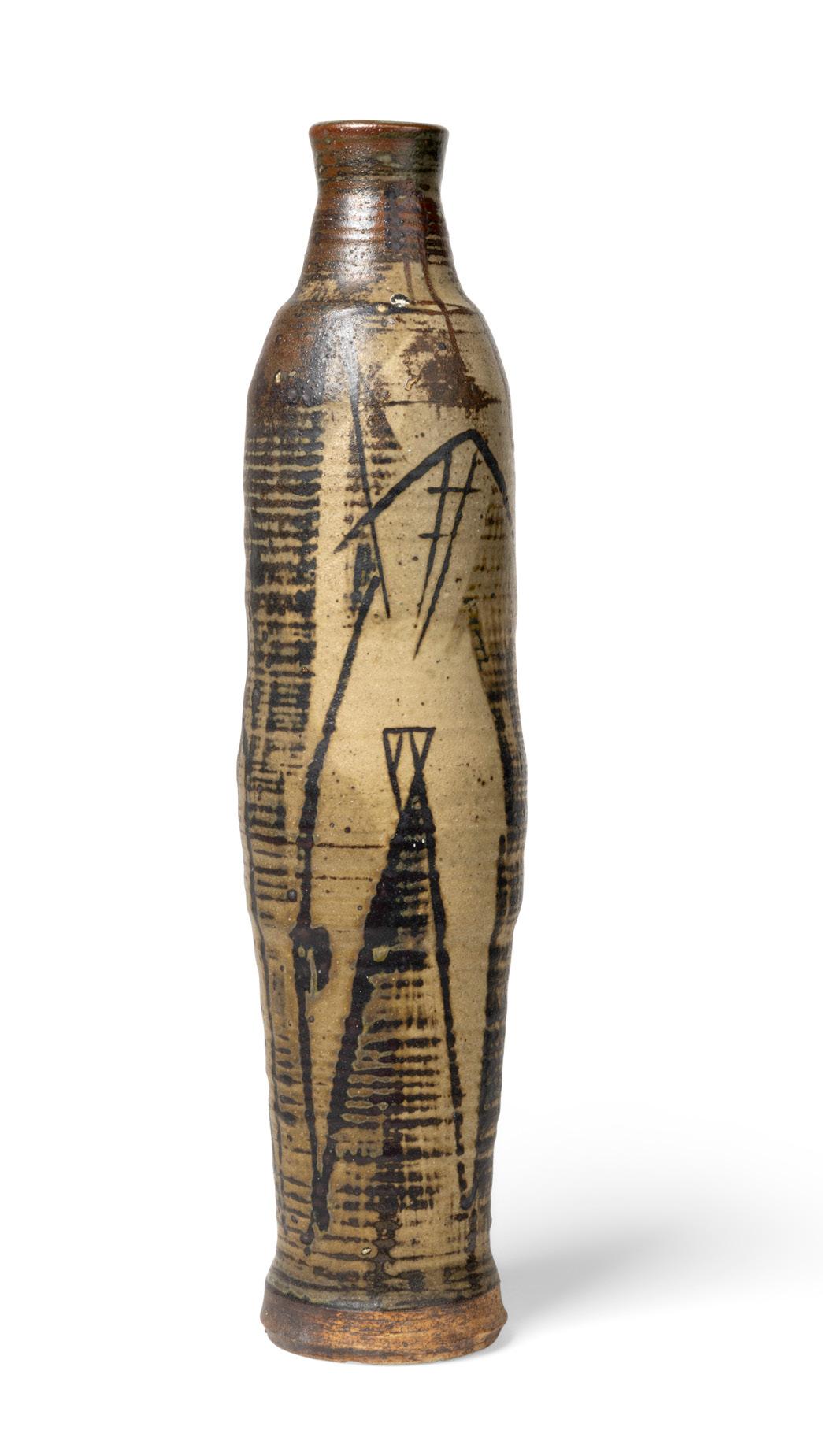
42 § ROBERT J WASHINGTON (BRITISH 1913-1997) BOTTLE FORM WITH THREE FIGURES, 1962/1982 incised initials RJW further incised RJW (to base), stoneware 51cm high, 11.5cm wide (20in high, 4 ½in wide) £600-800
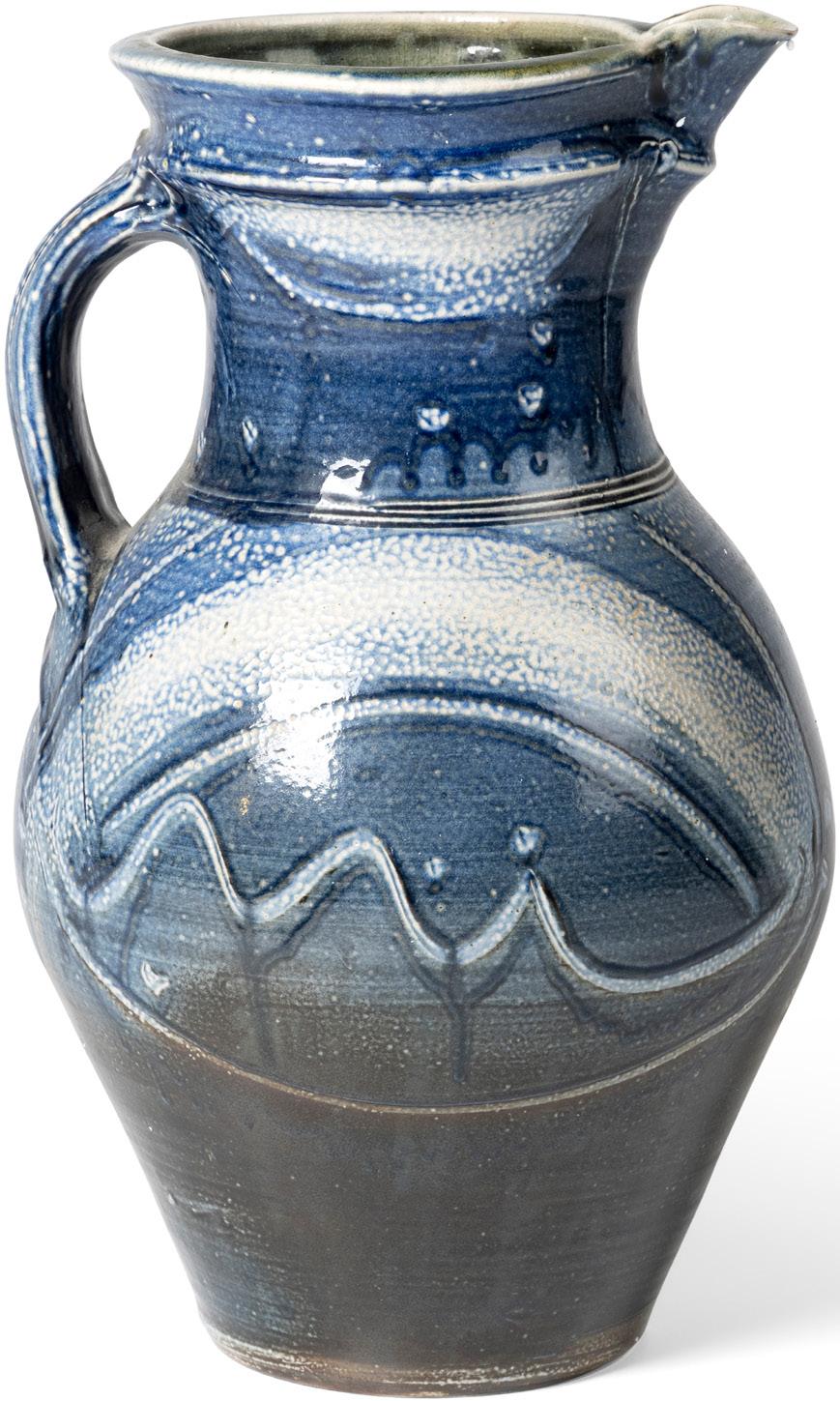
43 § MICK CASSON (BRITISH 1925-2003) JUG
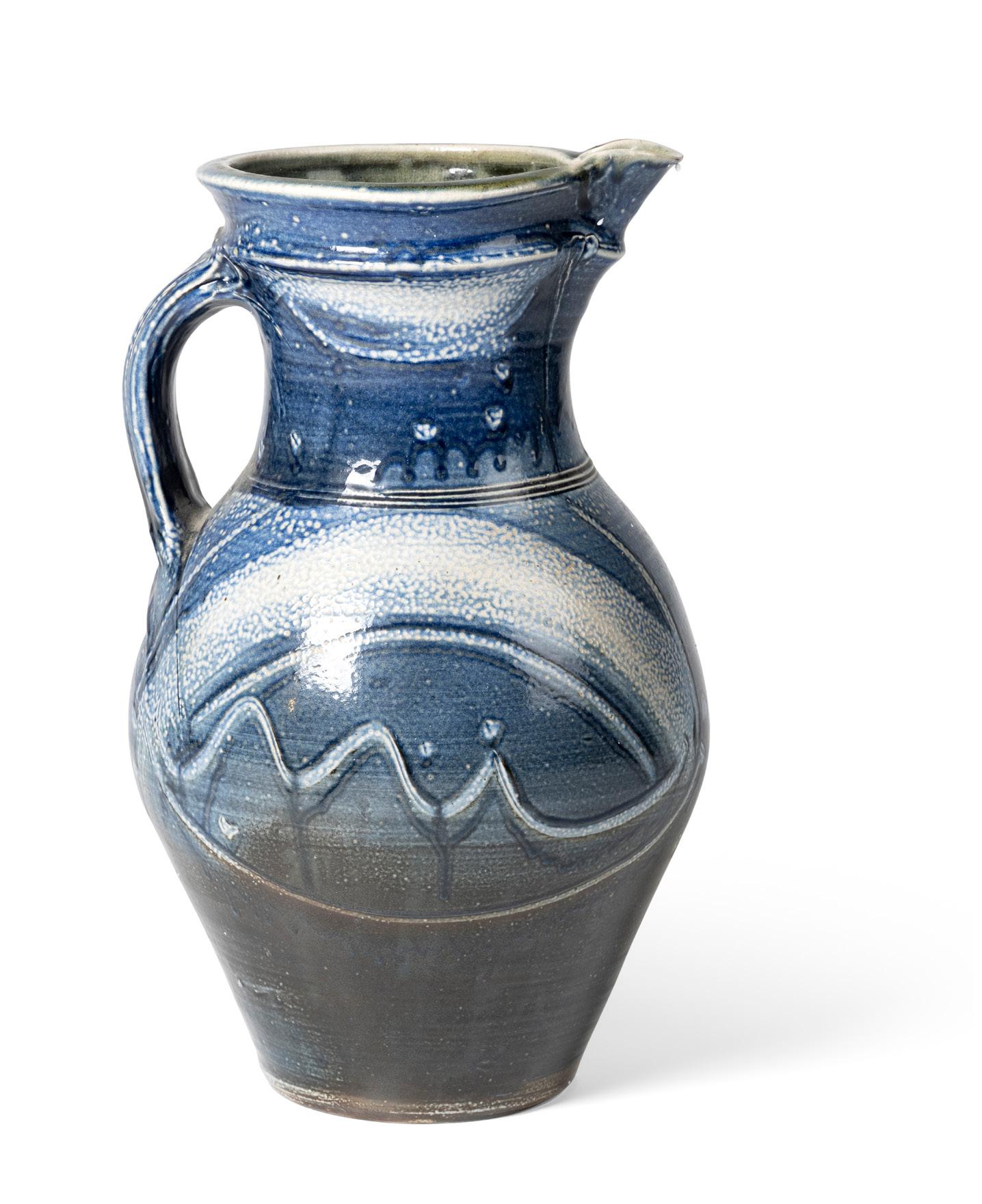
impressed maker’s mark, stoneware, salt glazed 43.5cm high, 25cm wide (17 1/8in high, 9 ¾in wide)
Provenance: Private Collection, U.K. £700-900
44 §
WAISTEL COOPER (BRITISH 1921-2003)
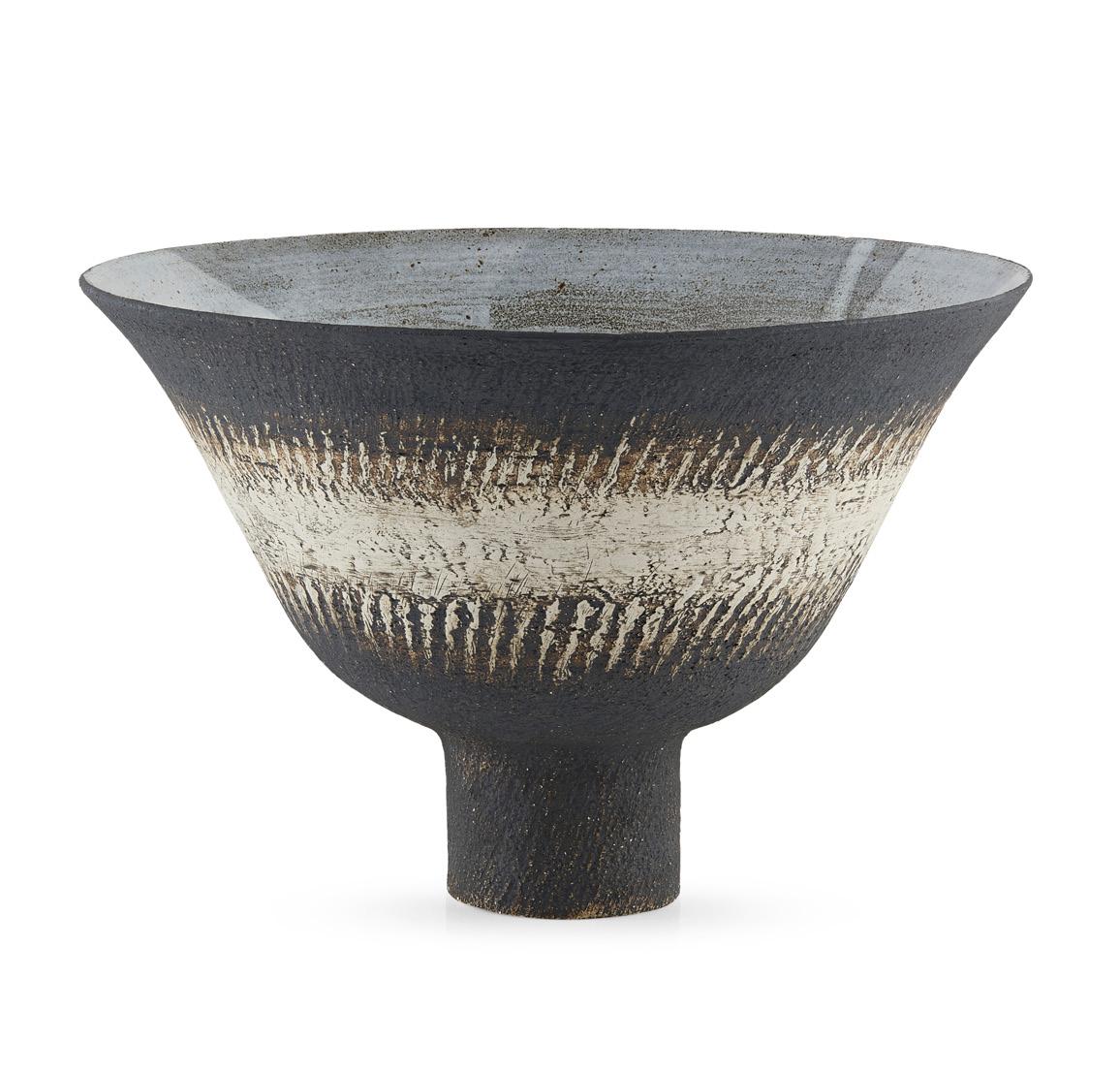
FOOTED BOWL, c.1992
signed Waistel (to base), stoneware, with linear sgraffito decoration on textured black and cream surface
18cm high, 27.5cm wide (7in high, 10 ¾in diameter)
£1,500-2,000
45 §
WAISTEL COOPER (BRITISH 1921-2003)
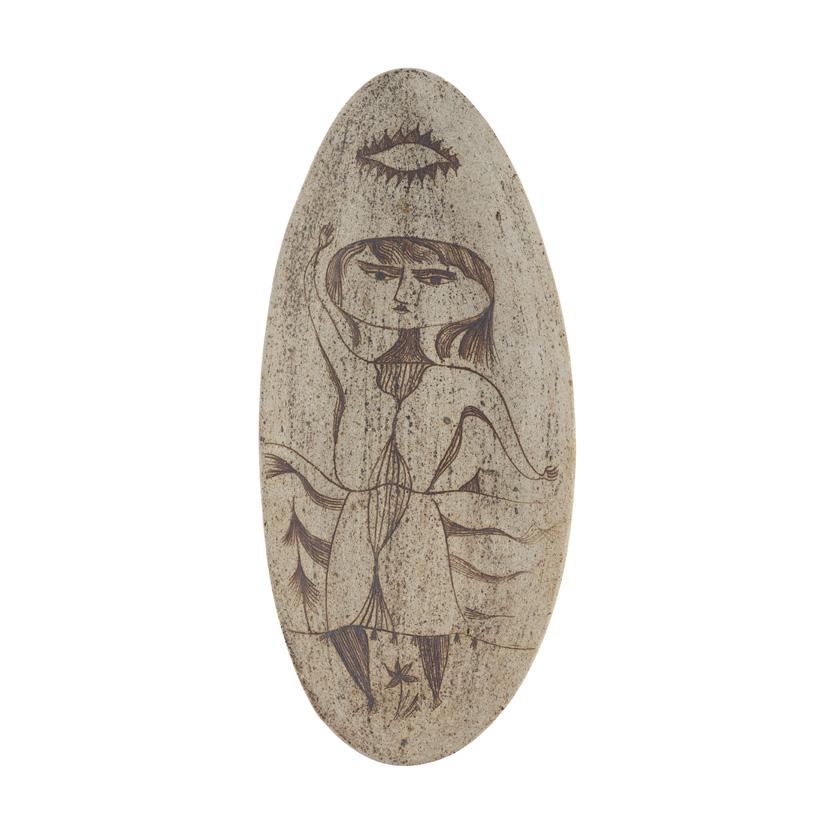
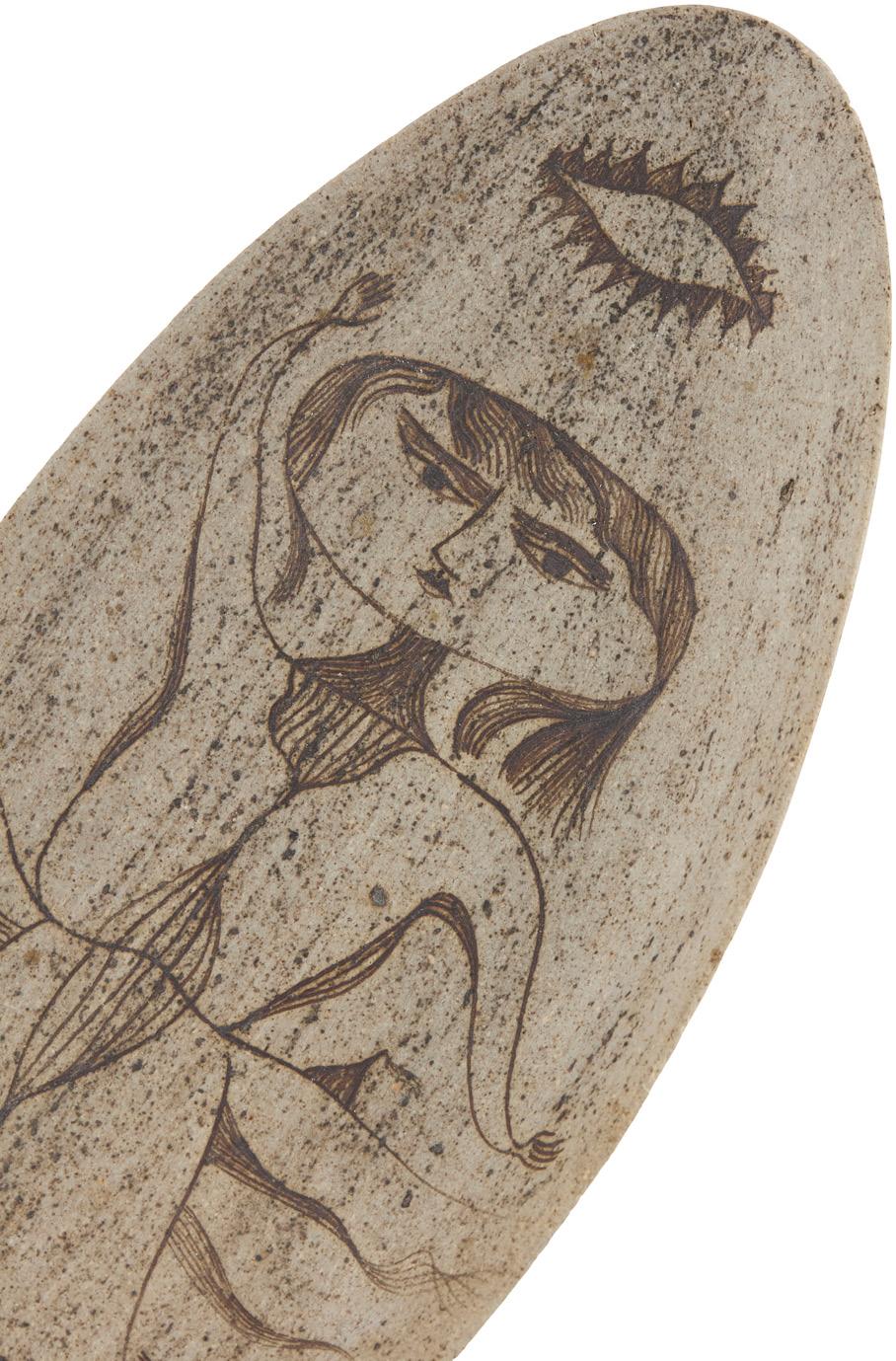
PIN DISH
signed Waistel (to base), stoneware, decorated with an incised female figure 2cm high, 19.5cm wide, 9cm deep (¾in high, 7 5/8in wide, 3 ½in deep)
£500-800
46 §
WAISTEL COOPER (BRITISH 1921-2003)
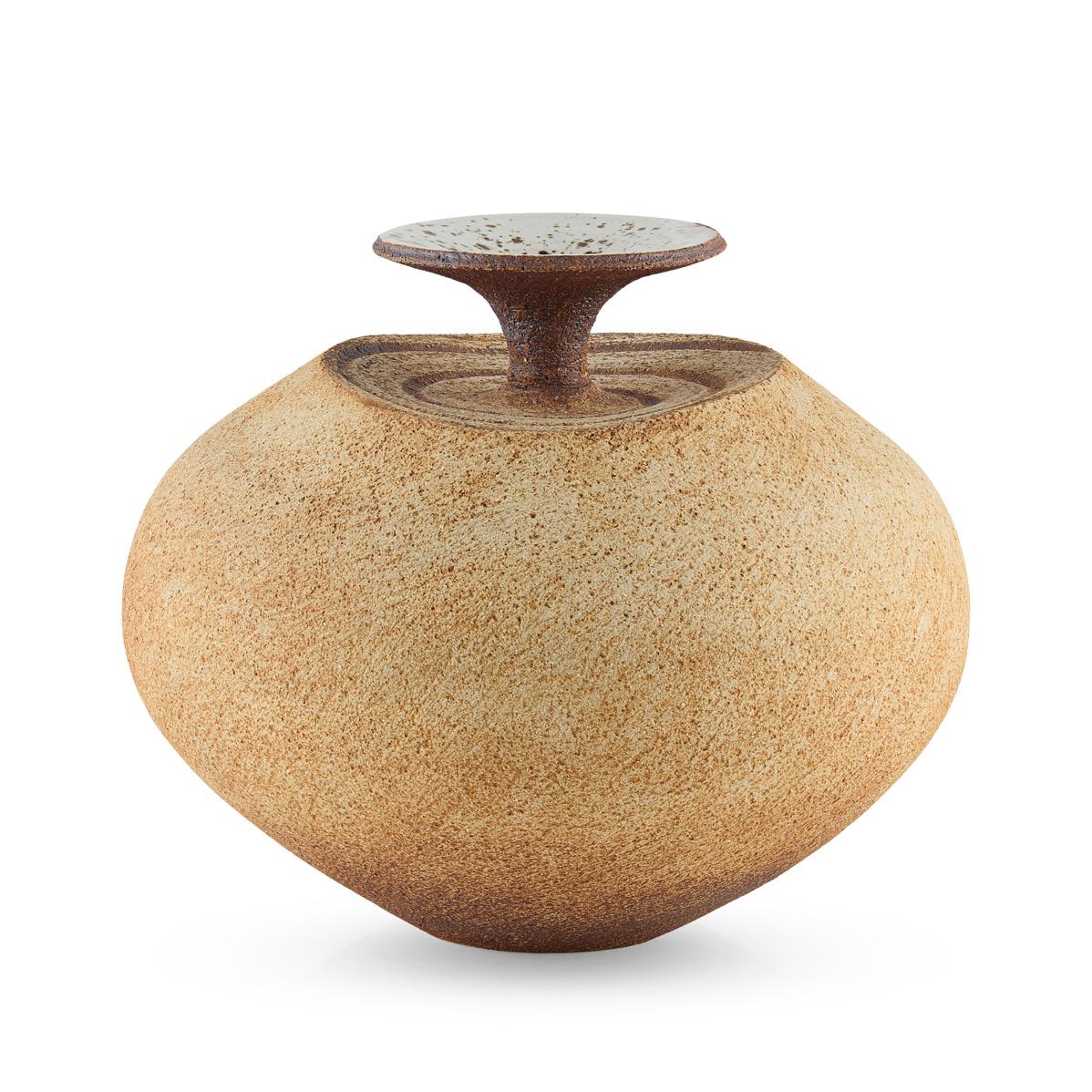
APPLE FORM VASE, 1970s
signed Waistel (to base), stoneware 22cm high, 26cm wide (8 5/8in high, 10 ¼in wide)
£800-1,200
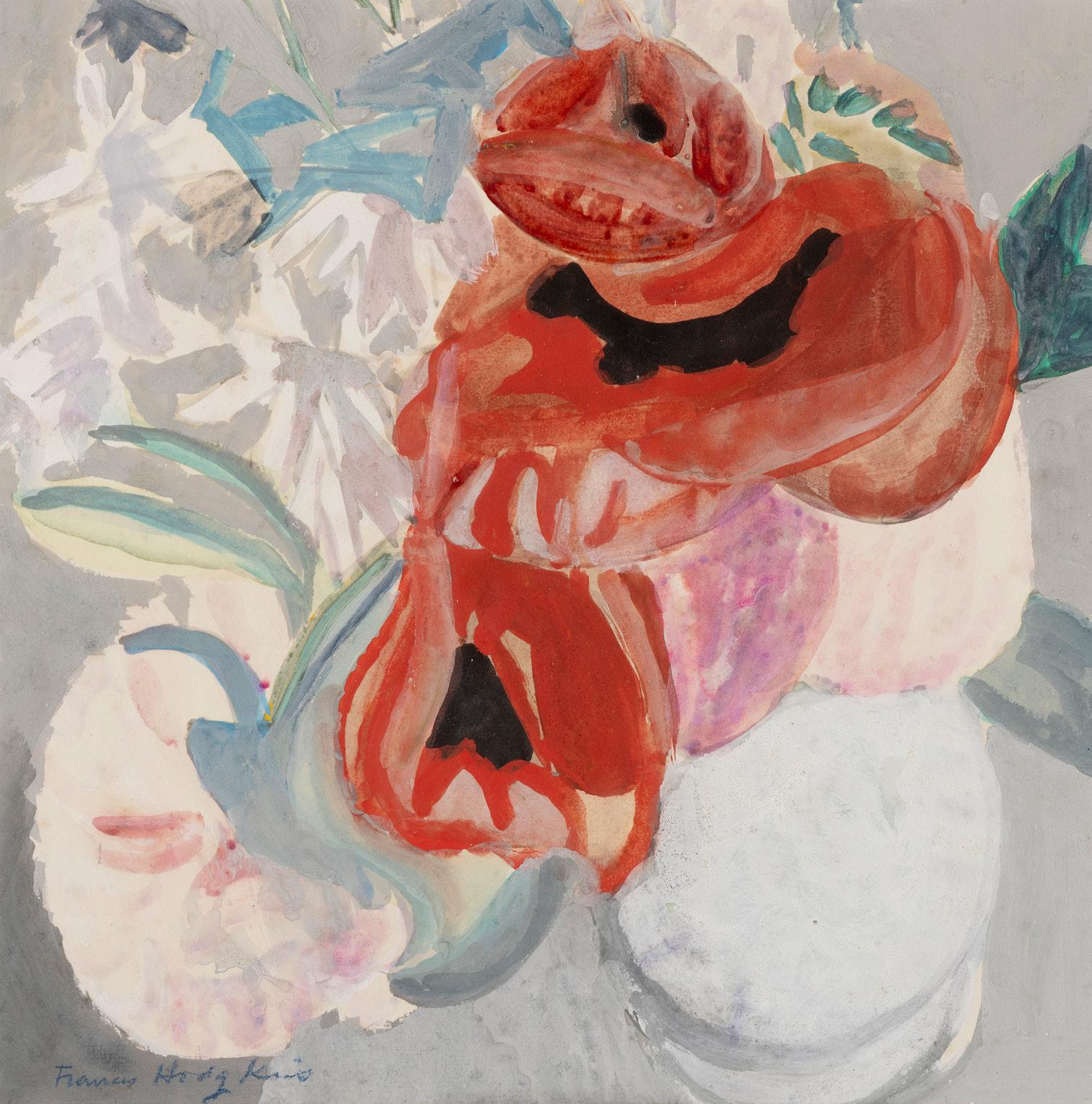
FRANCES HODGKINS (NEW ZEALANDER 1869-1947)
STILL LIFE, c.1930 signed in crayon (lower left), gouache and watercolour on paper 32cm x 32cm (12 ½in x 12 ½in)
Provenance: with Whitford Fine Art, London. £7,000-10,000
CEDRIC MORRIS
PAYSAGE DU JARDIN No.2, 1931
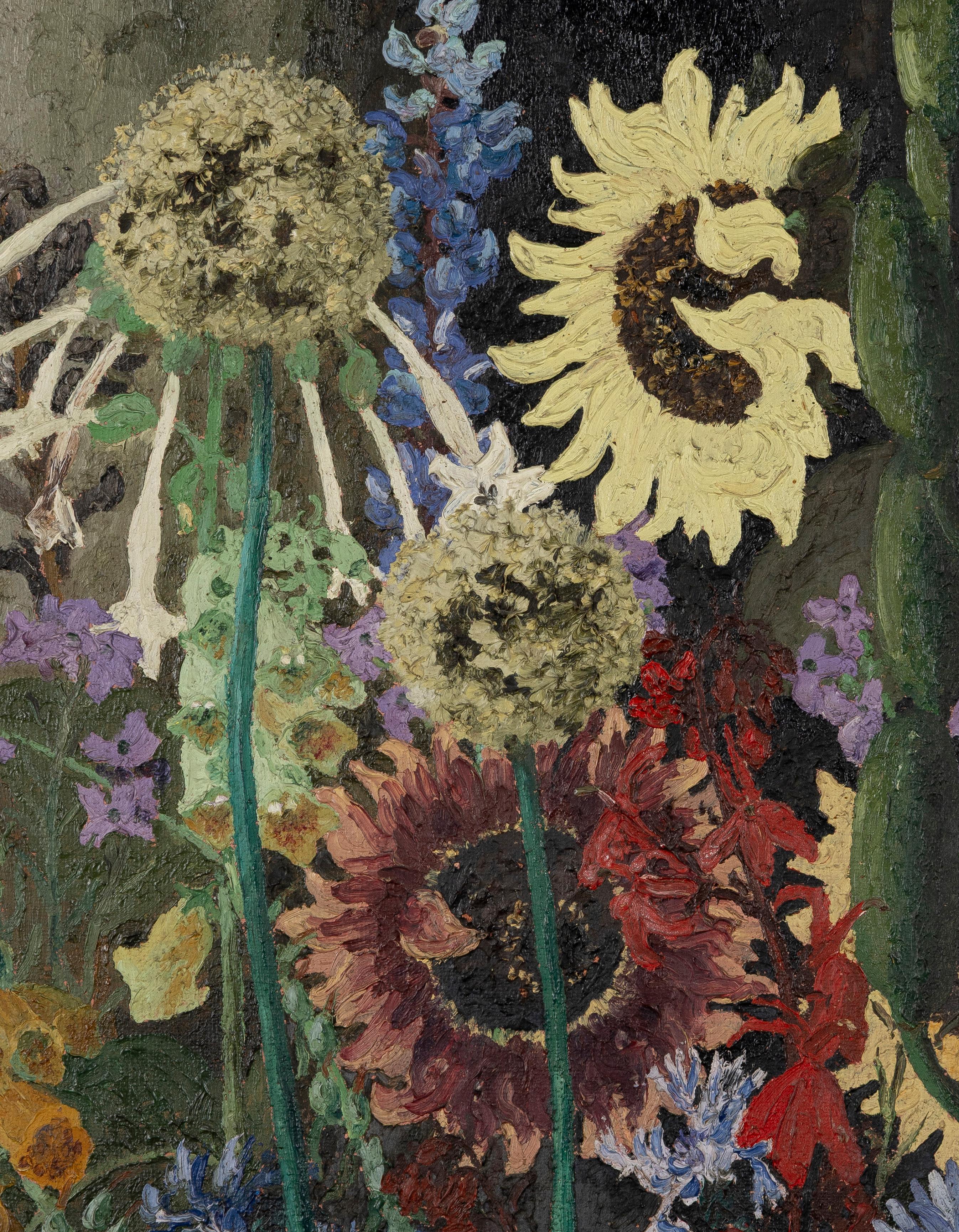
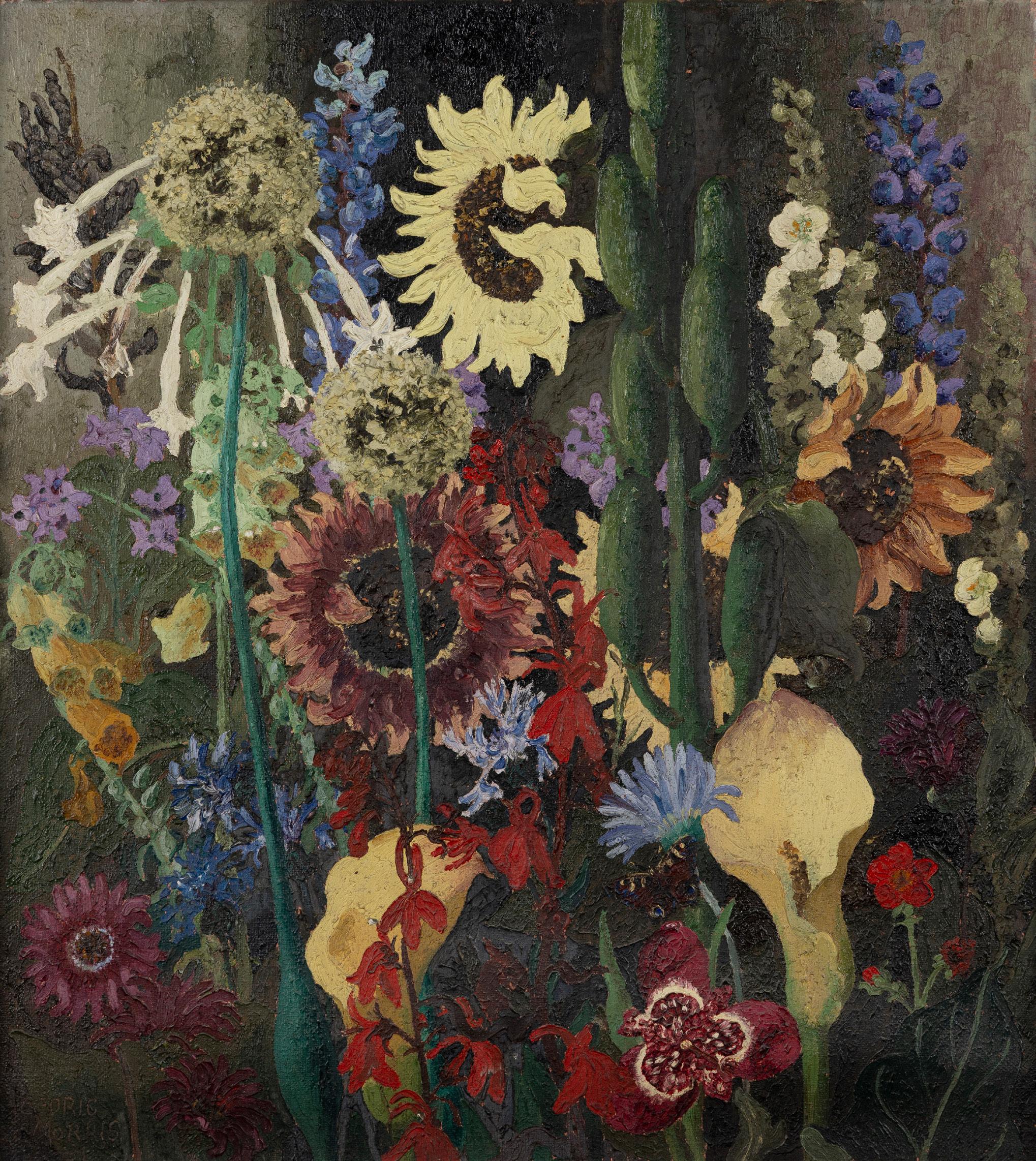
Paysage du Jardin No.2 epitomises the artist’s twin loves of painting and gardening as befits his reputation not only as a leading British artist of the twentieth century but also as a pioneering plantsman. Moreover, it was created during an auspicious period in Morris’s career and was acquired from him by the advertising executive and renowned collector Robert (Bobby) Bevan. The painting has remained in Bevan’s family to this day.
Morris, Bevan and the latter’s future wife, Natalie Ackenhausen, became friends in the artistic milieu of London of the late 1920s. After professional success in the British capital, in 1929 Morris and his partner Arthur Lett-Haines moved to The Pound, a farmhouse in Higham, Suffolk. Over the next eleven years, Morris transformed its four acres of land into ‘a beautiful, romantic garden where woodcock swooped in winter and nightingales sang on summer evenings’ (Hugh St Clair, A Less in Art & Life: The Colourful World of Cedric Morris & Arthur Lett-Haines, London, 2023,
p.63) and Bobby was able to attend the couple’s parties which the artist Joan Warburton recalled ‘showed me what real parties were! … Everyone behaved disgracefully and had a lovely time!’ (as quoted in Richard Morphet, Cedric Morris, London, 1984, p.48).
Paysage du Jardin No.2, translates to ‘Garden Landscape’ and can be understood as a portrait of Morris’s horticultural success. It brims with botanical beauty, symbolism and the sheer pleasure of gardening. Featuring a mix of cottage garden plants and rare exotics, it also includes short-lived flamboyant bursts of colour like the sunflowers. The Himalayan Lily with green seedpods at the right of centre is accompanied by Hollyhocks, Chicory, Lords and Ladies, Cornflowers, Foxgloves, Lupins, Onions and others, whose flower heads, petals, stems, natural colours and textures are brought together in a triumph of powerful abundance.
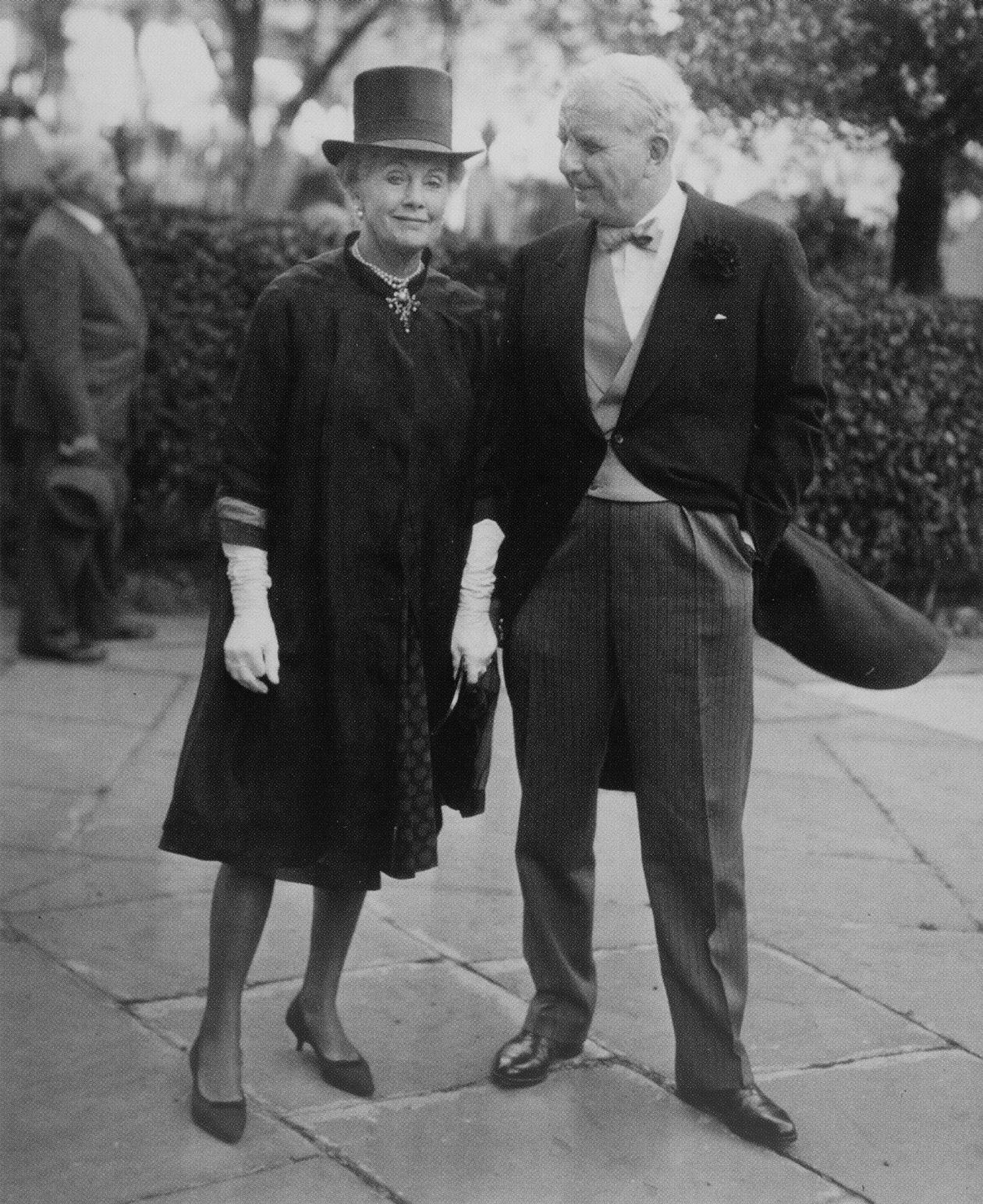
Natalie and Bobby Bevan in the 1950s, Private Collection.
The painting can also be read as a lexicon of the Victorian language of flowers, allowing Morris to express his knowledge and symbolist intent and adding an extra layer of interpretation to the work. Those chosen represent fecundity, majesty, pride, distinction, ardour, delicacy, youth, purity and imagination, amongst other references. Realised through the generous and expressive application of oil paint, his dynamic subjects are presented together in the frontal plane. Morris signed and dated the work into the surface whilst it was still wet.
Bevan was the son of the Camden Town painter Robert Polhill Bevan and became Chairman of the advertising agency S. H. Benson Ltd. Natalie, a painter, ceramicist and muse to several leading modern British artists, married him in 1946 and they moved to Boxted House, Boxted a year later. Situated some twelve miles from Benton End in Hadleigh, to where Morris and Lett-Haines moved in 1940, the friendship between the quartet flourished during the post-war period, in tandem with the growth of the Bevans’ collection of Contemporary, twentieth-century British and European art
Paysage du Jardin No.2 has been widely exhibited, from Morris’s successful solo exhibition at the Leicester Galleries in London in 1932, to his touring retrospective of 1968, Tate exhibition of 1984 and various iterations of the Bevans’ collection, most recently the touring exhibition mounted by the National Galleries of Scotland in 2008 to 2010.
The widespread press coverage that attended the 1932 exhibition could be referring to Paysage du Jardin No.2 when it declared ‘Mr Morris’s large flower pieces must be among the loveliest works of modern times’ (Daily News, 13 April 1932) and that ‘his flower pictures are really like gardens. You feel that he is taking you, as indeed he is, to beautiful bits in his own garden. He grows the flowers he wants to paint and he loves growing them as much as painting them.’ (Daily News, 12 April 1932).
We are grateful to David R. Mitchell, Curator, Muddy Feet Consulting for his help with our research.
48 §
SIR CEDRIC LOCKWOOD MORRIS (BRITISH 1889-1982)
PAYSAGE DU JARDIN No.2, 1931 signed and dated (lower left), oil on canvas 71.2cm x 63.6cm (28in x 25in)
£60,000-80,000
Provenance: Acquired from the Artist by Robert (Bobby) Bevan (1901-74) and thence by descent to the present owner.
Exhibited: Leicester Galleries, London, Recent Paintings by Cedric Morris, April 1932, no.30;
The Minories, Colchester, The Flower in Art, August – September 1967, no.31; National Museum of Wales, Cardiff, Cedric Morris Retrospective, 16 June – 29 July 1968, no.33 with tour to Cyfartha Castle Gallery, Merthyr Tydfil, Wrexham Public Library, Glynn Vivian Gallery, Swansea and The Minories, Colchester; Gainsborough’s House, Sudbury, The Bevan Collection, 5 – 27 August 1978, no.55; Tate Gallery, London, Cedric Morris, 28 March – 13 May 1984, no.48, illus. col. p.84; Scottish National Gallery of Modern Art, Edinburgh, From Sickert to Gertler: Modern British Art from Boxted House, 15 March – 22 June 2008 and partial tour to Gainsborough’s House, Sudbury, 4 October - 13 December 2008 and Brighton Museum & Art Gallery, 17 April to 12 September 2010, illus. col. pl.29. Literature: Reynolds, Gwynneth and Diana Grace (eds), Benton End Remembered: Cedric Morris, Arthur Lett-Haines and the East Anglian School of Painting and Drawing, Unicorn Press, Norwich, 2017, illus. col. p.50; St Clair, Hugh, A Lesson in Art and Life: The Colourful World of Cedric Morris and Arthur Lett-Haines, Pimpernel Press Limited, London, 2023, p.80.
49 §
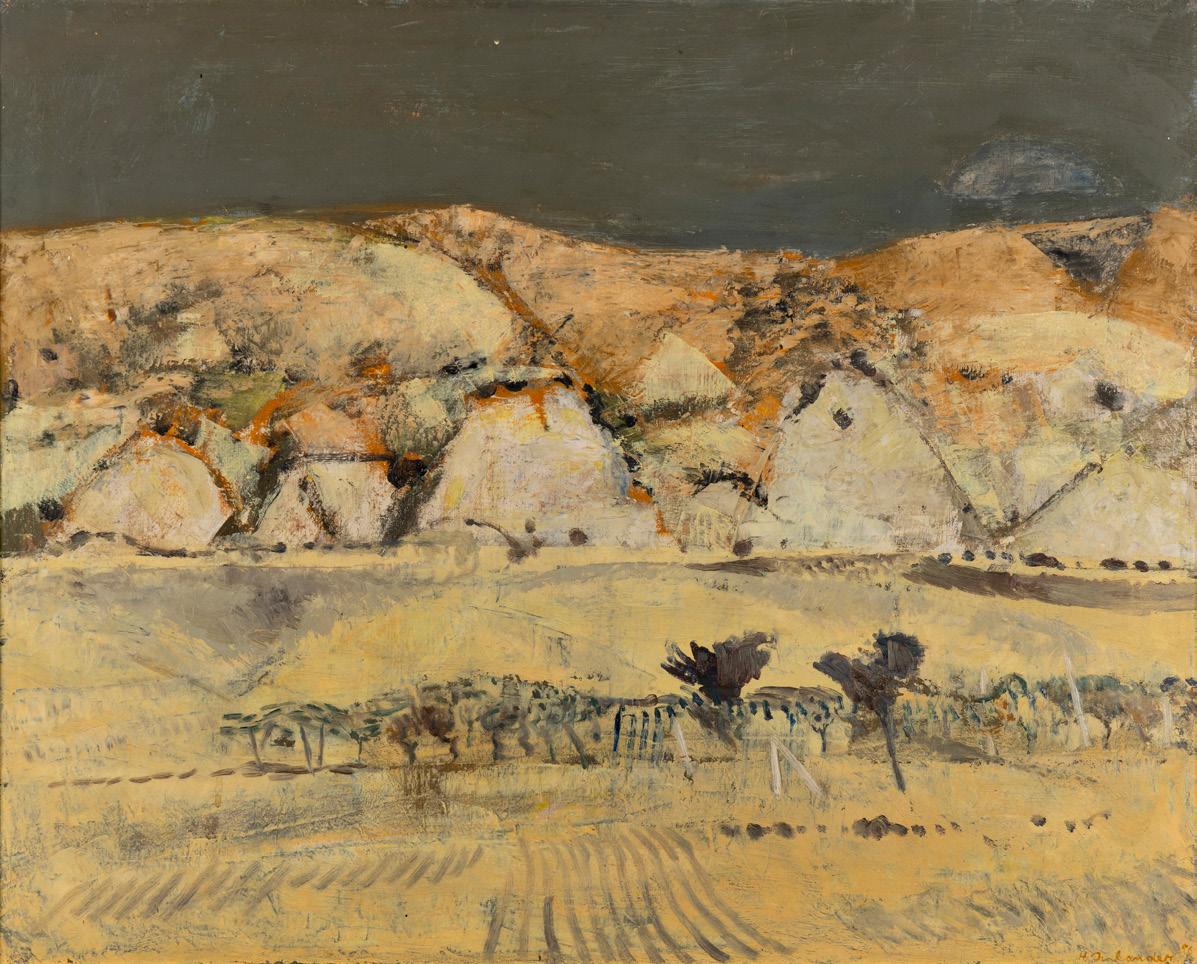
HENRY INLANDER (BRITISH 1925-1983)
HILLS NEAR SAN QUIRICO, 1956
signed and dated (lower right), also signed and inscribed (to reverse), oil on canvas
66cm x 81.2cm (26in x 32in)
Provenance: The Leicester Galleries, London, where acquired by Robin McEwen Esq. in 1956 and thence by family descent.
Exhibited: The Leicester Galleries, London, Henry Inlander, October 1956, no.8.
£1,000-1,500
50 §
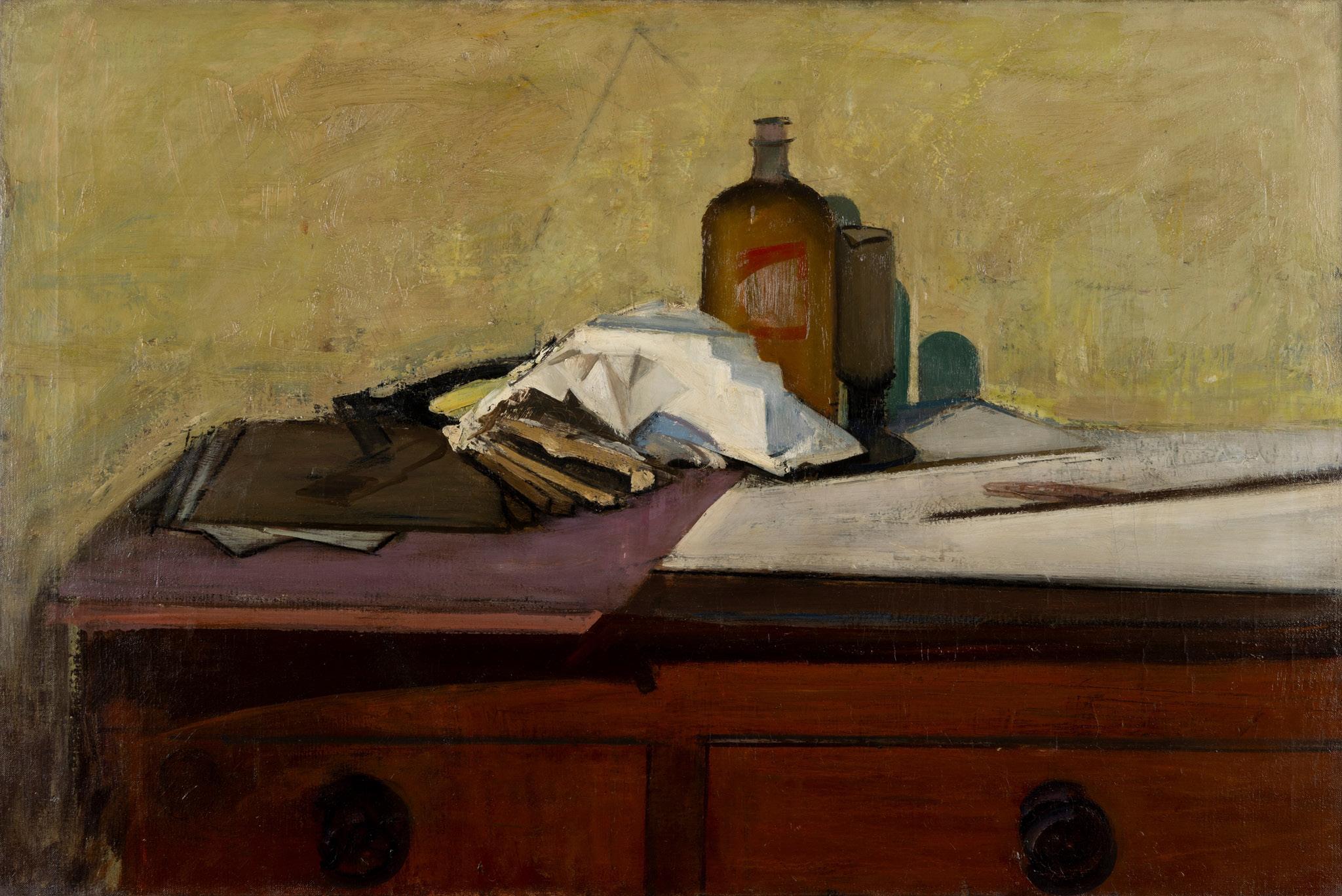
RODRIGO MOYNIHAN R.A. (BRITISH 1910-1990)
STILL LIFE
oil on canvas
60.5cm x 90cm (23 ¾in x 35 ½in)
Provenance: The collection of an Oxford college; Their sale, Mallam’s, Oxford, The Picture Sale, 11 July 2023, lot 289, where acquired by the present owner.
Exhibited: City Museum and Art Gallery, Leicester, Oxford Junior Common Room Exhibition, 17 December 1962 to 27 January 1963.
We are grateful to the Artist’s family for their assistance with the cataloguing of this work.
£5,000-8,000
51 §
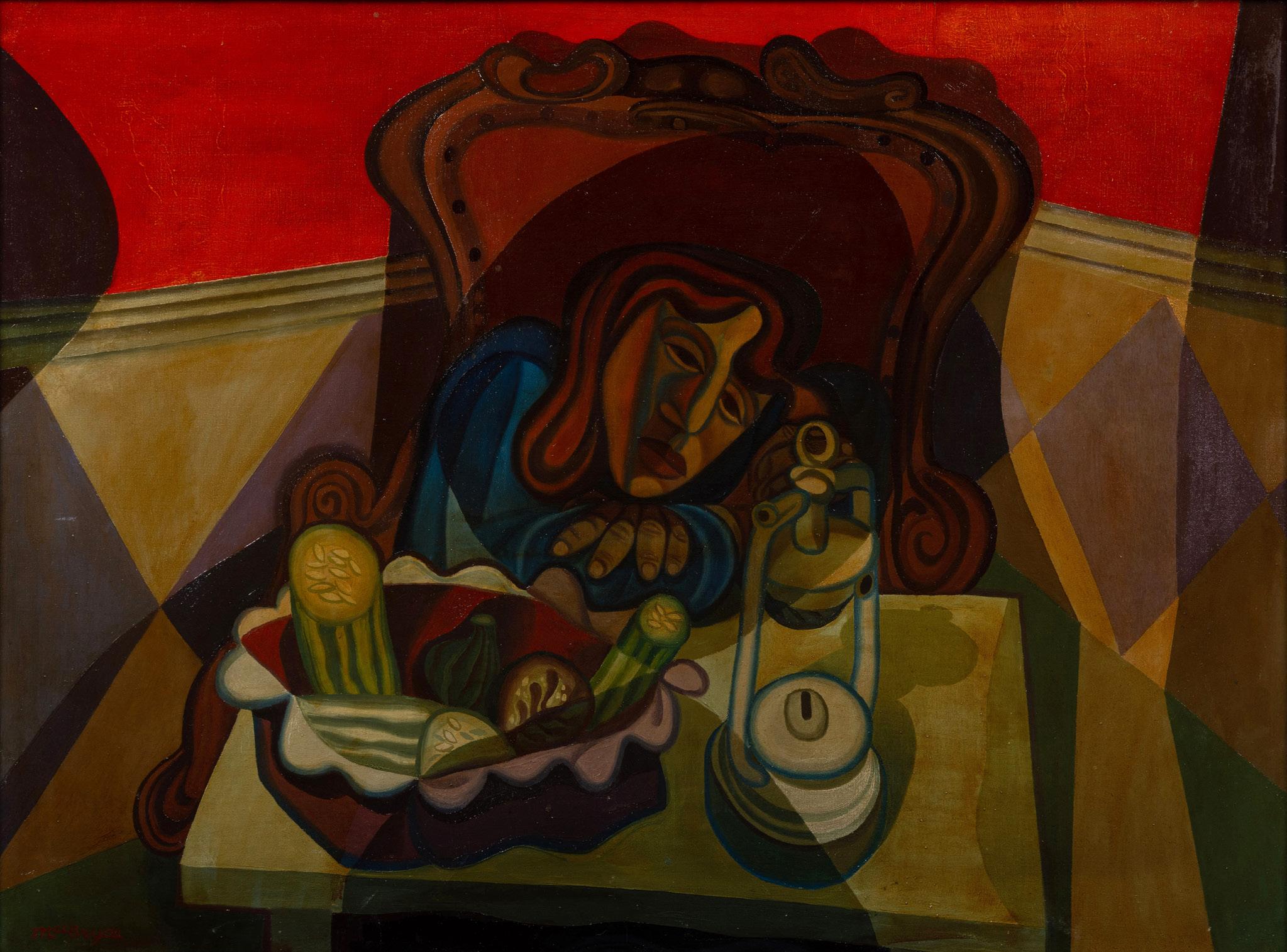
ROBERT MACBRYDE (BRITISH 1913-1966)
A WEE GLASGOW BUDDY
signed (lower left), oil on canvas
76.2cm x 101.5cm (30in x 40in)
Provenance: Acquired directly from the artist by the original owner; Christie’s, Edinburgh, The Scottish Sale, 28 October 1999, lot 277; Christie’s, Edinburgh, The Scottish Sale, 28 October 2004, lot 266 [as A Wee Glasgow Boy] where acquired by the present owner. £20,000-30,000
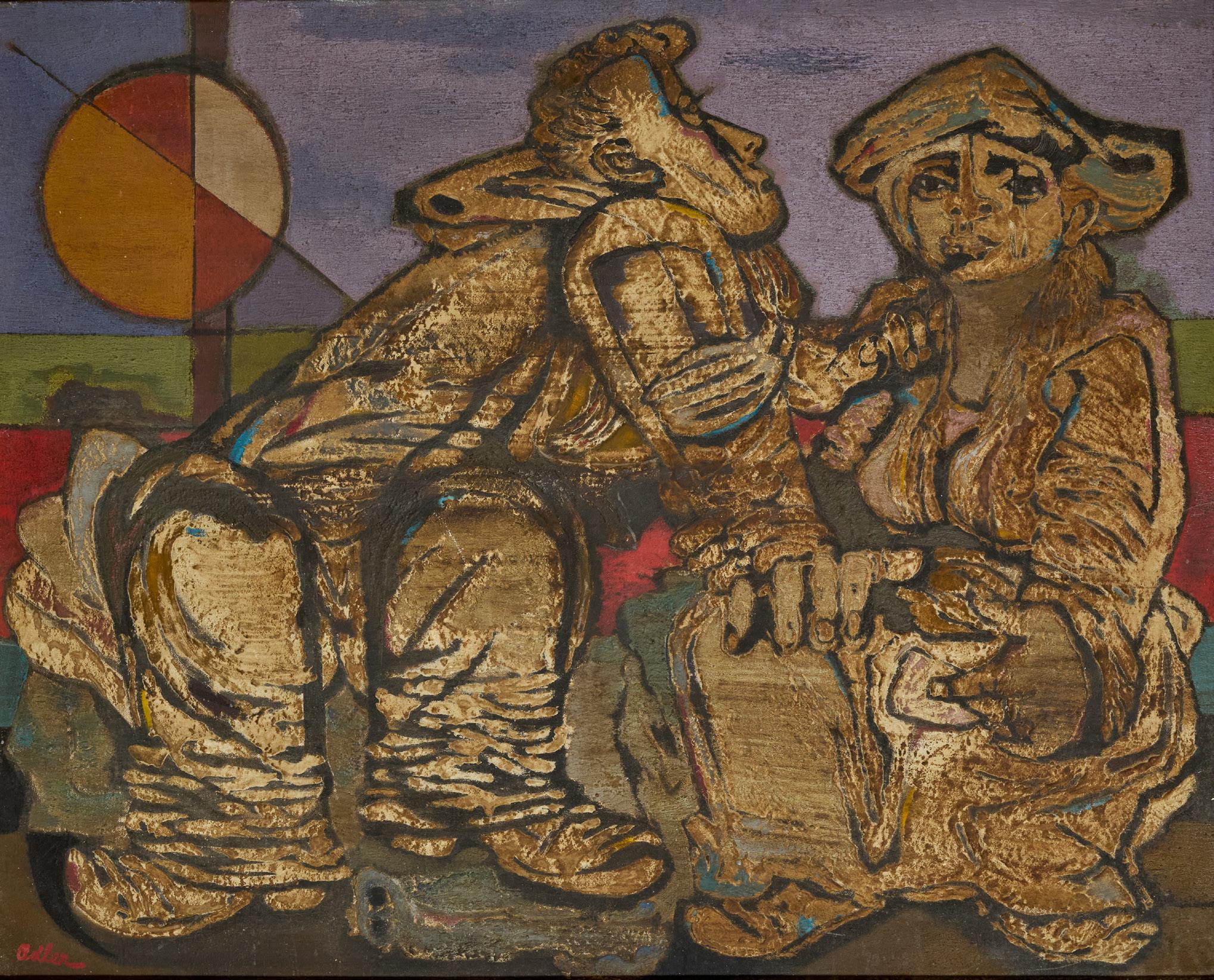
THE PEASANT AND HIS WIFE,
c.1941
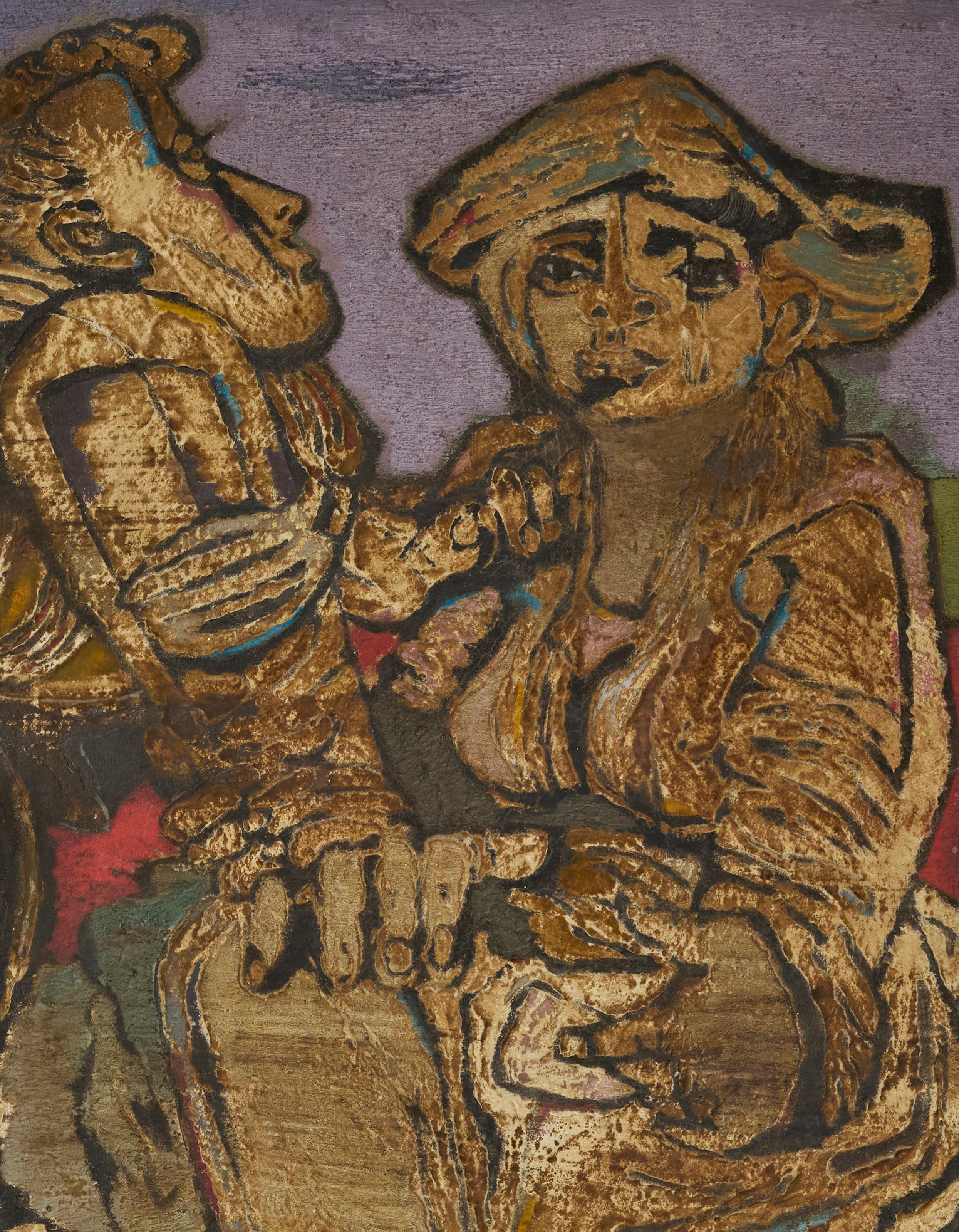
The Peasant and his Wife by the Polish-Jewish artist Jankel Adler is a rare and major example of European Modernism painted in Britain. It is also a testament to the importance of the time the artist spent in Glasgow between 1941 and 1942. It has remained in the same private Glaswegian collection ever since it was acquired from Adler in about 1941 by the late owner’s grandfather, in lieu of a dental bill.
Adler was born in Tuszyn, Poland in 1895. He studied in Belgrade, Barmen and Dusseldorf and joined various progressive art groups in Poland and Germany, where he met Otto Dix. In 1931 he became friends with Paul Klee when they were both teaching at Dusseldorf Art Academy. As a result of his work being declared ‘degenerate’ by the Nazis, Adler fled to Paris in 1933, where he met Pablo Picasso. He spent much of the next two years travelling before returning to France.
Following the outbreak of the Second World War, Adler joined the Polish army and was evacuated out of Dunkirk to Scotland, arriving on 22 June 1940. He moved to Glasgow on 6 December that year and was given a medical discharge on 23 January 1941. He lived first at 142 Renfrew Street in the city before moving to 15 Newton Street. By the time of his arrival, Adler was recognised as a major figure in the European avant-garde and his work was represented in the collections of public galleries including those in Berlin, Lodz, Moscow and Tel Aviv.
Adler was welcomed into Glasgow’s art world and soon held his first exhibition there, in the Jewish sculptor Benno Schotz’s studio. As Head of Sculpture and Ceramics at Glasgow School of Art, Schotz was in an ideal position to introduce Adler to the Glaswegian artists’ community, as well as to re-unite him with his fellow Polish-Jewish émigré artist Josef Herman, whom Adler had known in Warsaw.
In 1972, Herman recalled:
“His gift for making friends was prodigious … he was a joy to be with. His conversation ranged wide: Art linked with philosophy, philosophy linked with folklore … He believed in the existence of a technique for greatness and that all one had to do was to apply oneself to it … his mode of painting was built upon traditions of many countries and many peoples. In this lay his sophistication … He had an incessant thirst for rich and complex styles.” (Josef Herman, ‘Notes from a Glasgow Diary: 1940-43’, The Scottish Art Review, vol. XIII, no.3, 1972, pp.2-3)
The arrival of the Scottish Colourist John Duncan Fergusson and his dance pioneer partner Margaret Morris in Glasgow in 1939 had done much to energise the local art scene. In 1940 they were co-founders of the progressive discussion and exhibiting society the New Art Club, of which Adler became a member; he was to exhibit with its offshoot, the New Scottish Club, in November 1942. Adler was also soon involved with The Centre, established by David Archer as a bohemian café, bookshop and discussion forum, of which Fergusson and Adler acted as Chair and Vice-Chair respectively. Herman declared “These were the two men who gave Glasgow of the times a rare atmosphere. It was in their presence that one felt as though art was at the centre of the city’s life.” (op.cit., p.5). Adler himself claimed “For the painter, the bagpipe sounds are a new colour to his palette” (as quoted in typescript of Michael Middleton, ‘Jankel Adler: A Talk given at Ben Uri Art Gallery, London on 16 March 1950’, Ben Uri Gallery Archive).
JANKEL ADLER
Fergusson had spent the years from 1907 until 1913 in Paris, at the heart of the birth of European modern art and so was in an ideal position to understand Adler’s importance. When asked to write the foreword to the catalogue for Adler’s exhibition at Annan’s Gallery in Glasgow in June 1941, Fergusson could be referring to The Peasant and his Wife when he explained:
“It is as an ‘idea’ that I’d like to present Adler. Adler the man I don’t know. I’ve only met him a few times, but Adler the ‘idea’ I knew immediately I saw his paintings with their unusual combination of great force and extreme sensibility. Adler offers a great contribution to Scotland’s fight for Free Expression in Art and liberation from the idea that photographic and anatomical accuracy are standards for judging painting. These works of Adler’s are some of the best modern paintings I’ve seen.”
The painting also embodies the Jewish Echo’s review of the exhibition in which it was declared that ‘his sense of colour and form is superb. Most of the pictures have inner balance and a calm monumentality which is enhanced by his murallike technique … Adler creates a world of his own.’ (20 June 1941). Adler’s work was also included in the landmark Exhibition of Jewish Art organised by Schotz and Herman at the Jewish Institute in Glasgow in December 1942.
The Peasant and his Wife is an extraordinary bringing together of Adler’s profound compassion for mankind and his technical innovations. The monumentality of the figures is infused with the dignified emotion seen on their faces and expressed in the tenderness of their poses. The textured, layered technique is presented by way of a palette of muted earth tones, which is combined with the brilliantly coloured geometry of the setting. As Sarah Mac Dougall has pointed out, Adler’s work of this period reveals his assimilation of that of his Modernist contemporaries including Fernand Léger, Picasso and perhaps the Surrealists, realised within his own distinctive visual language.
After a sojourn in Kirkcudbright from August 1942 until September 1943, Adler moved to London in 1943 where his neighbours at 77 Bedford Gardens included the NeoRomantics Robert Colqhoun and Robert MacBryde. He was to have a tremendous impact on their work, as well as on other leading modern British artists of their generation. Indeed, the face of the seated woman in The Peasant and his Wife could be mistaken for a quotation from a painting by Colquhoun. The depth of impact that Adler had on British art is proven by the fact that a memorial exhibition of his work was organised by the Arts Council of Great Britain in 1951, two years after his death.
The importance of The Peasant and his Wife is demonstrated by its inclusion in several major exhibitions, including the international touring solo show of 1985-1986, proving Fergusson’s declaration that Adler’s work embodied ‘an unusual combination of great force and extreme sensibility’ (as quoted in the Jewish Echo, 6 June 1941).
JANKEL ADLER (POLISH 1895-1949)
THE PEASANT AND HIS WIFE, c.1941 signed (lower left), oil on canvas 85cm x 110cm (33 ½in x 43 ¼in)
Provenance: Gift of the Artist to the late owner’s grandfather, c.1941-42
Exhibited: Scottish National Gallery of Modern Art, Edinburgh, New Painting in Glasgow 1940-46, 6 July-4 August 1968 and tour to Scottish Arts Council Gallery, Glasgow, 7-28 September 1968 and Art Gallery and Regional Museum, Aberdeen, 5-19 October 1968, no.6 (reproduced in black and white on the catalogue cover); Art Gallery and Museum, Kelvingrove, Glasgow, Jewish Art: Paintings and Sculpture by 20th-century Jewish Artists of the French and British Schools, 5 September-7 October 1979, no.3; Städtische Kunsthalle, Dusseldorf, Jankel Adler 1895-1949, 1 November-8 December 1985 and tour to Tel Aviv Museum, 23 December 1985-11 February 1986 and Muzeum Sztuki, Lodz, 28 February-13 April 1986, no.67.
£50,000-80,000
56 §
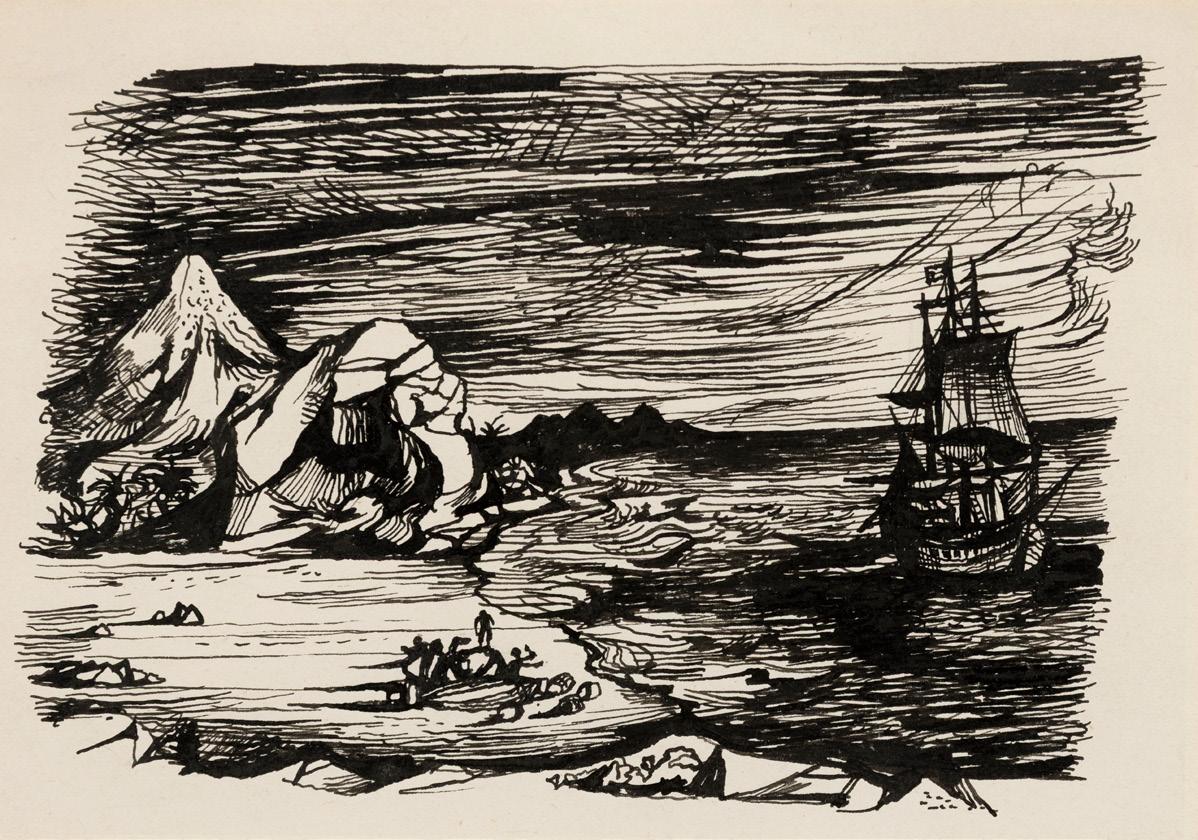
JOHN MINTON (BRITISH 1917-1957)
ILLUSTRATION FOR TREASURE ISLAND, 1947
Indian ink on paper
12.2cm x 17.8cm (4 ¾in x 7in)
Provenance: with Gillian Jason Gallery, London; with Michael Parkin Gallery, London; Private Collection, London.
Exhibited: Gillian Jason Gallery, London, Ayrton, Craxton, Minton, Richards, Vaughan, Wynter, 12 March - 16 April 1987, no.26; Michael Parkin Gallery, London, Dance til the Stars Come Down: Exhibition of the Works of John Minton, 15 May - 14 June 1991, no.27.
£1,000-2,000
53 §
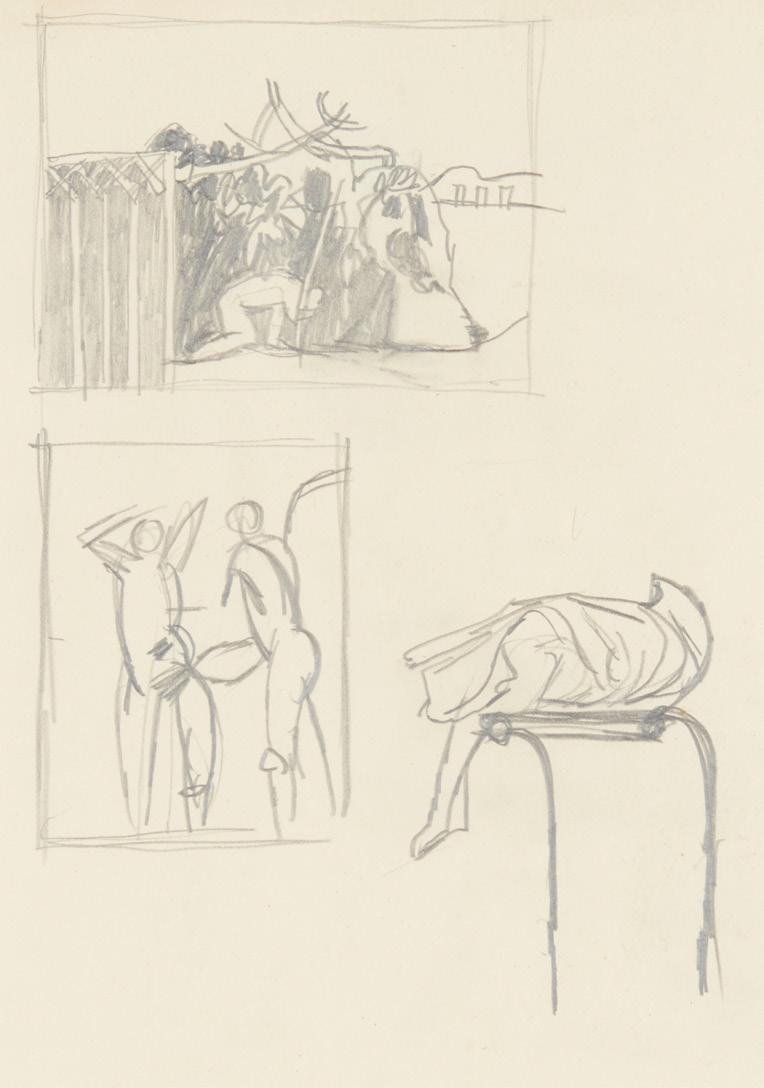
KEITH VAUGHAN (BRITISH 1912-1977) STUDIES OF AN ORNAMENTAL GARDEN
pencil on paper
23cm x 20cm (9in x 8in)
£300-500
54 §
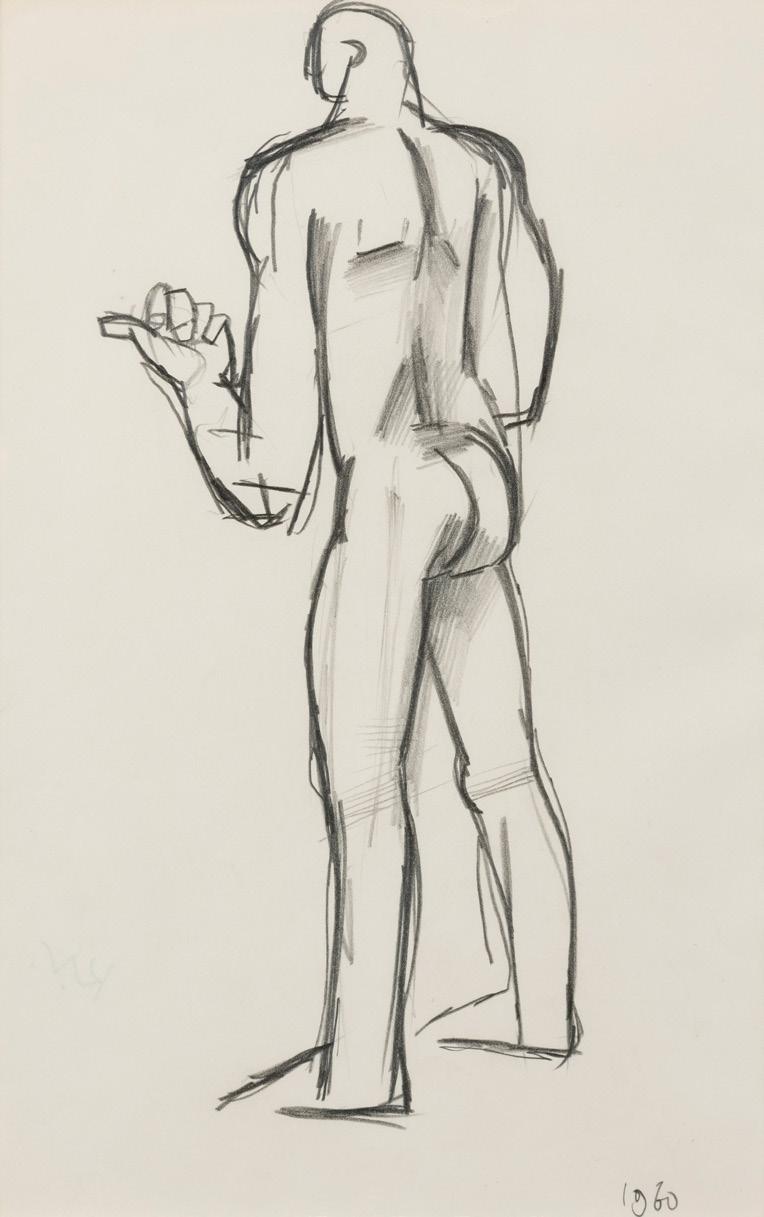
KEITH VAUGHAN (BRITISH 1912-1977)
STANDING NUDE, 1960 dated (lower right), estate stamp (to reverse), pencil on paper
26.5cm x 17cm (10 ½in x 6 ¾in)
Provenance: Estate of the Artist; with Redfern Gallery, London.
£600-800
55 §
KEITH VAUGHAN (BRITISH 1912-1977)
SHEET OF STUDIES, c. 1952 pencil on paper
27.2cm x 17cm (10 ¾in x 6 ¾in)
Provenance: The Collection of Gillian Raffles.
£400-600
§
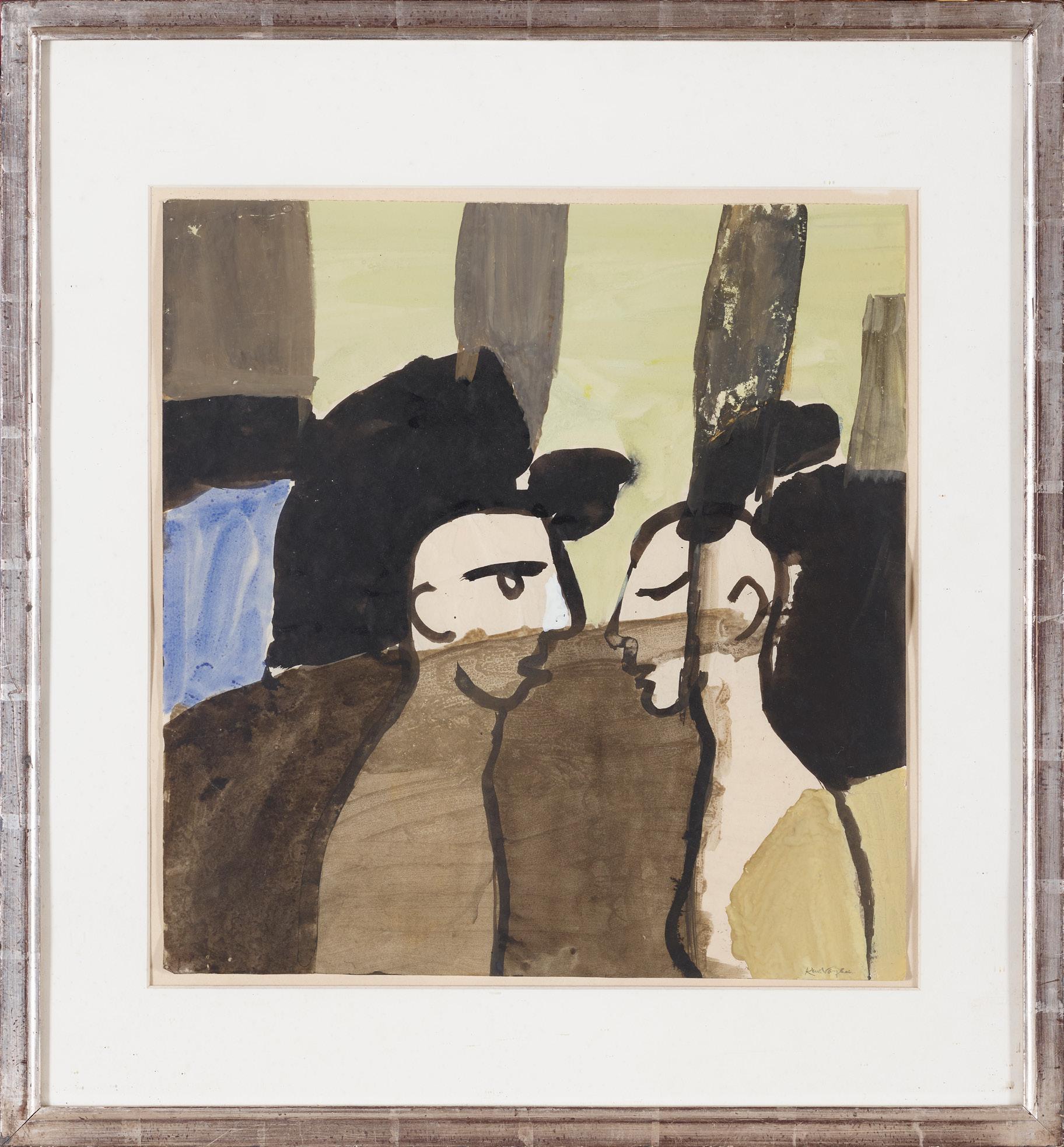
KEITH VAUGHAN (BRITISH 1912-1977)
FIGURES IN CONVERSATION, 1959
signed in pencil (lower right), watercolour and gouache on paper
42cm x 40.5cm (16 ½in x 15 ¾in)
Provenance: with Thomas Agnew & Sons, London; The Collection of Gillian Raffles.
£6,000-8,000
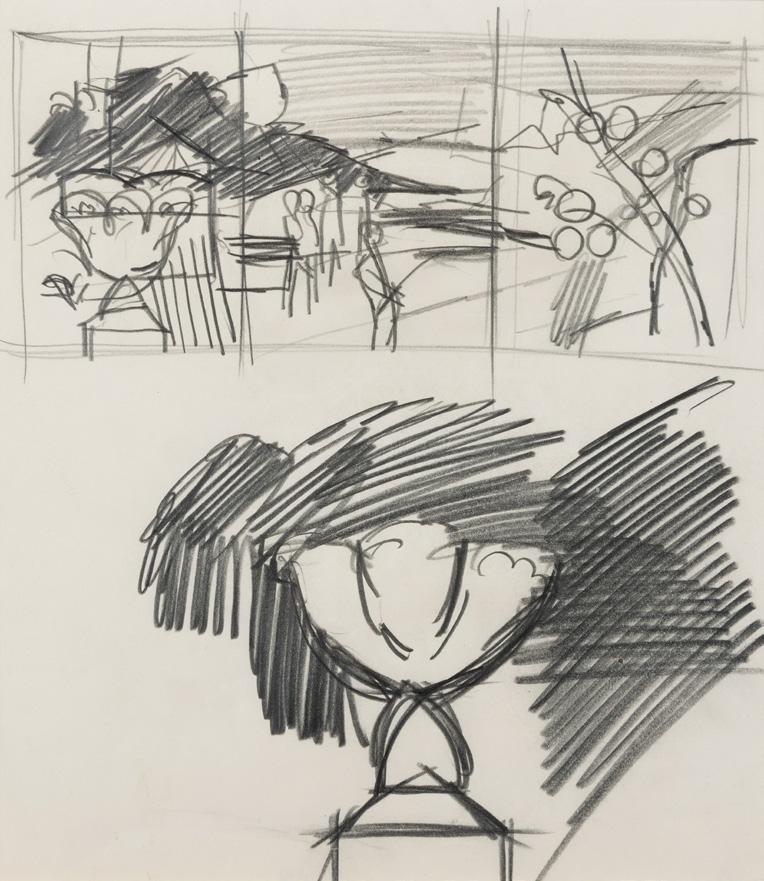
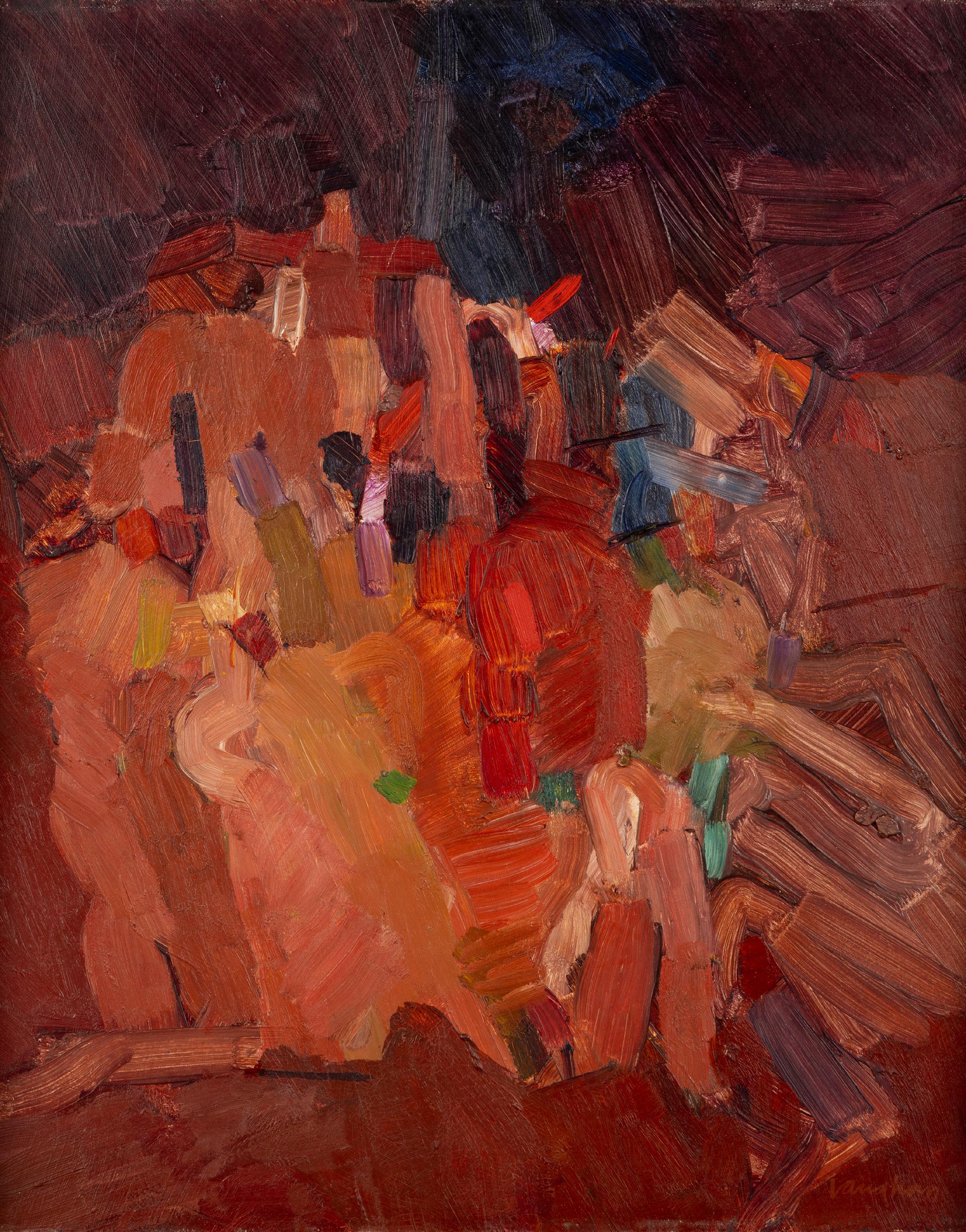
Study for Laocoön was one of a number of works that Vaughan created around the theme – itself the subject of one of the greatest sculptures if antiquity – which he exhibited as part of his solo exhibition at the Marlborough Gallery in London in 1963. It was around this time that Vaughan had also opened out his palette to encompass deep reds and oranges as counterpoints to his more usual dirty blues and greys and blacks. As work like Study for Laocoön, then, is both classic Vaughan, in conception and its concern with the male body and figural groups, but also quite rare, in its high key colour and particularly gestural brushwork.
In the original Homeric myth, Laocoön was a priest in the city of Troy, who tries to warn the Trojans against accepting the wooden horse that has mysteriously arrived outside their gates, even throwing his spear into the horse’s side. The gods, of course, were on the Greeks’ side, so punish Laocoön by sending two huge snakes to attack him, crushing him to death along with his two sons. In the famous Greek statue, the Roman copy of which is in the Vatican, this gruesome death is transformed into a tour de force of male anatomy in extreme contrapposto, as Laocoön and his sons manfully resist the coils of the snakes. It’s a powerful image, the sine qua non of any traditional art history, but also a deeply homoerotic image, something that wasn’t lost on Vaughan, who himself was looking to hide same-sex desire in plain sight.
58 §
KEITH VAUGHAN (BRITISH 1912-1977)
STUDY FOR LAOCOÖN GROUP VIII, 1964
signed (lower right), oil on cardboard 44cm x 35.5cm (17 ¼in x 14in)
Provenance: Sir Misha Black; Private Collection; Offer Waterman & Co., London, from whom acquired by the present owner.
Exhibited: Marlborough New London Gallery, London, Keith Vaughan: New Paintings, no.23.
Literature: Hepworth, Anthony and Ian Massey, Keith Vaughan - The Mature Oils 1846-1977, Sansom & Company, 2014, cat. no. AH456, p.161 (illustrated).
£25,000-35,000
The writer Malcolm Yorke, in his book Keith Vaughan - His Life and Work, in describing this series, hints as much:
“…In the past.. [Vaughan’s]…figures had been as selfpossessed as the Greek gods, but now [he] tried to depict the suffering of those who dared to offend the gods. In the Laocoön works the bodies rush together and merge in a scrum from which emerge wildly gesticulating limbs that cannot with any certainty be attributed to particular owners. Outlines have gone, and like the figures themselves the paint is dragged into the dark grounds, overlapped, merged and coarsened. They represented, he said, ‘in supremely dramatic form man’s conflict with his environment and with himself, his own body’. Appropriately serpentine strokes slither wildly to agitate the whole surface and carry energy right into the corners. it is as if Vaughan had been suddenly converted from classical ballet to the wildest extremes of modern dance…” (p.215)
And as Vaughan himself later noted, in 1971, in his journal:
“In the Laocoön paintings where there is a deliberate state of aggressiveness. I’m not concerned with a classical Poussinesque movement, or a mass in happy association, but a crowd like an Oxford Street mass, jolting, jostling and pushing, when every contour has an abrasive action on every other contour…”
59 §
GRAHAM SUTHERLAND O.M. (BRITISH 1903-1980)
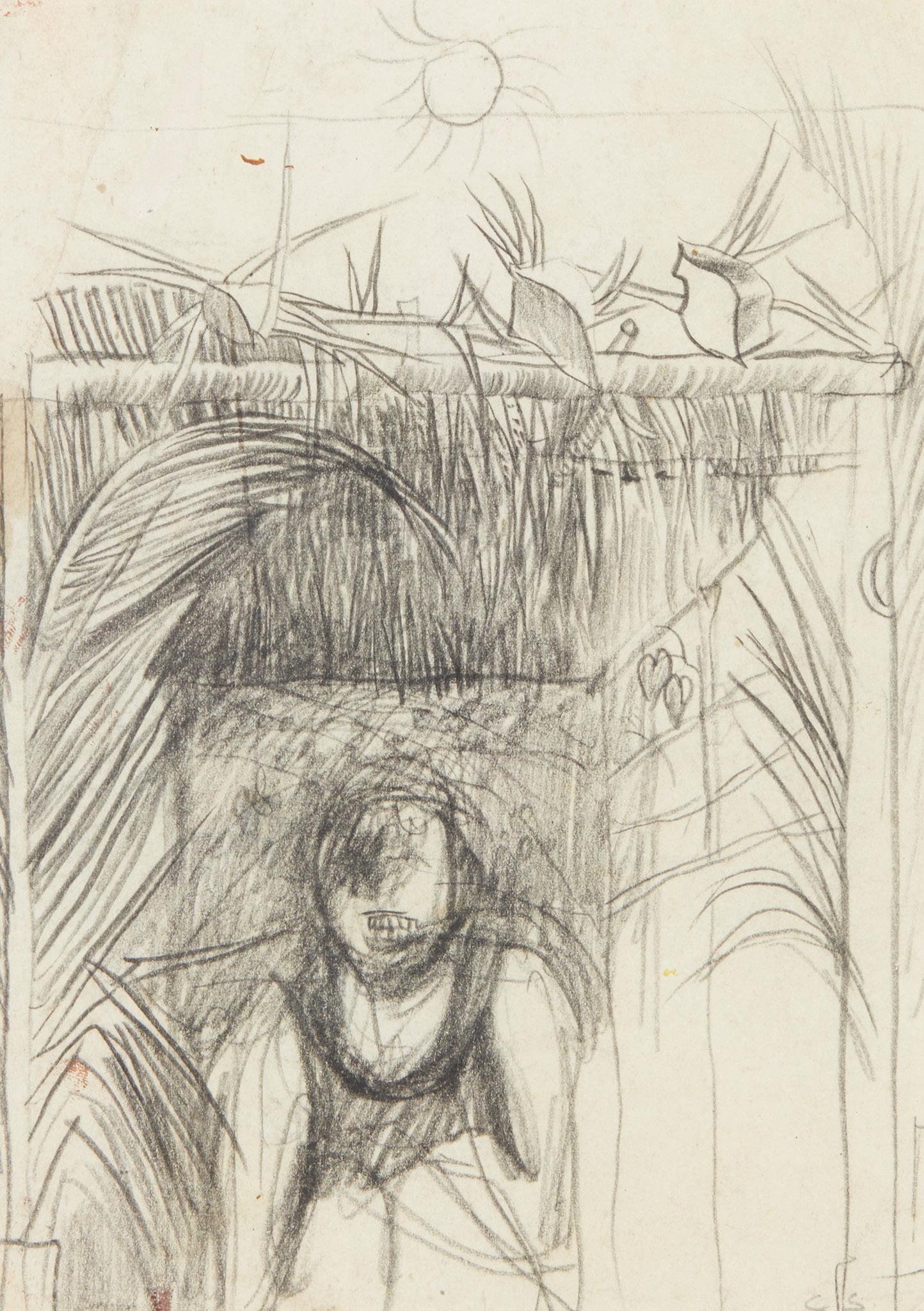
CABIN PALM / CACTUS (DOUBLE-SIDED DRAWING), 1948
initialled (lower right), titled and dated (to reverse), pencil on paper; Turning Root Form, pencil and gouache on paper
21.8cm x 16cm (8 5/8in x 6 ¼in)
Provenance: The Collection of Gillian Raffles.
£1,200-1,800
60 §
BERNARD MEADOWS (BRITISH 1915-2005)
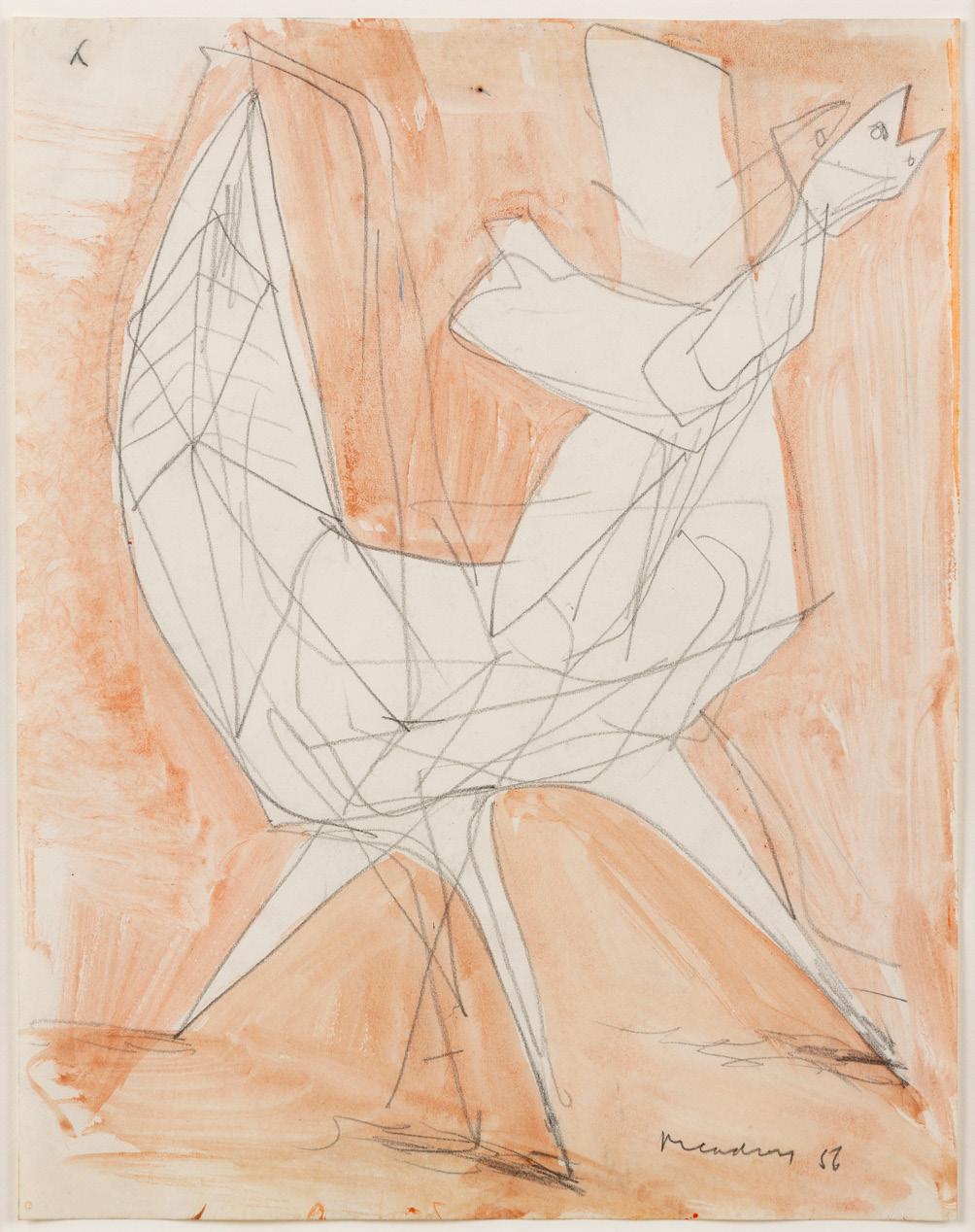
DRAWING FOR SCULPTURE (COCK), 1956
signed and dated (lower right), pencil and watercolour on paper
27cm x 21cm (10 ½in x 8 ¼in)
Provenance: Gimpel Fils, London, where acquired by the present owner.
£300-500
§
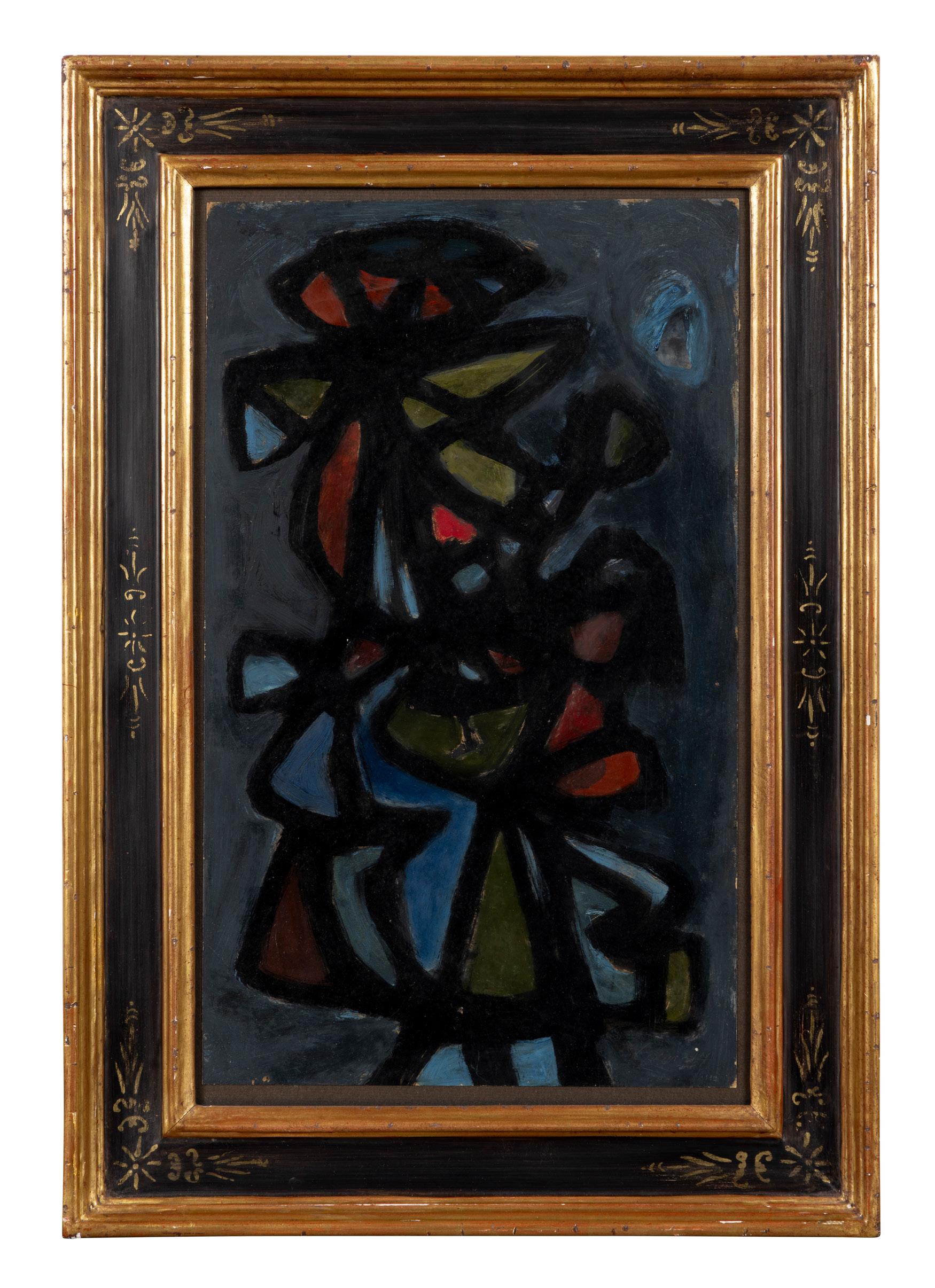
WILLIAM GEAR R.A., F.R.S.A., R.B.S.A. (BRITISH 1915-1997) PERSONNAGE, 1947
signed and dated (lower right), oil on paper laid down on card 47.4cm x 28.5cm (18 5/8in x 11 1⁄4 in)
Provenance: Redfern Gallery, London, by 1990; Private Collection, Switzerland, acquired from the above on 27 July 1994. £1,500-2,500
62 §
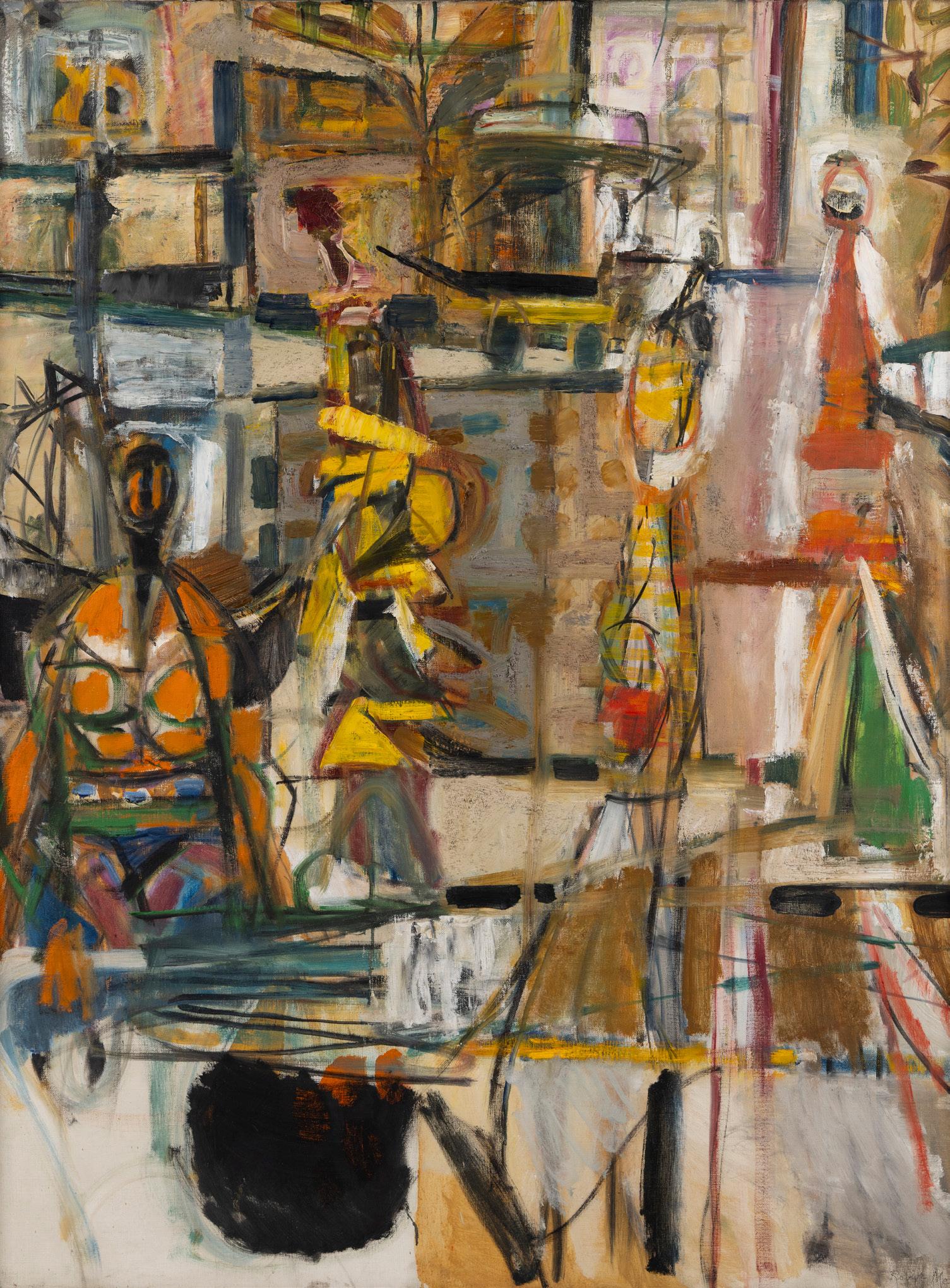
ROBERT MEDLEY C.B.E., R.A. (BRITISH 1905-1994)
STREET SCENE, 1952 signed (lower right), oil on canvas 142.5cm x 110.5cm (56in x 43 ½in)
Provenance: Private Collection, Suffolk, from whom acquired by the present owner.
Exhibited: Whitechapel Art Gallery, London, Robert Medley: Retrospective Exhibition 1928-1963, no.28, illustrated in catalogue (plate V). £3,000-5,000
63 §
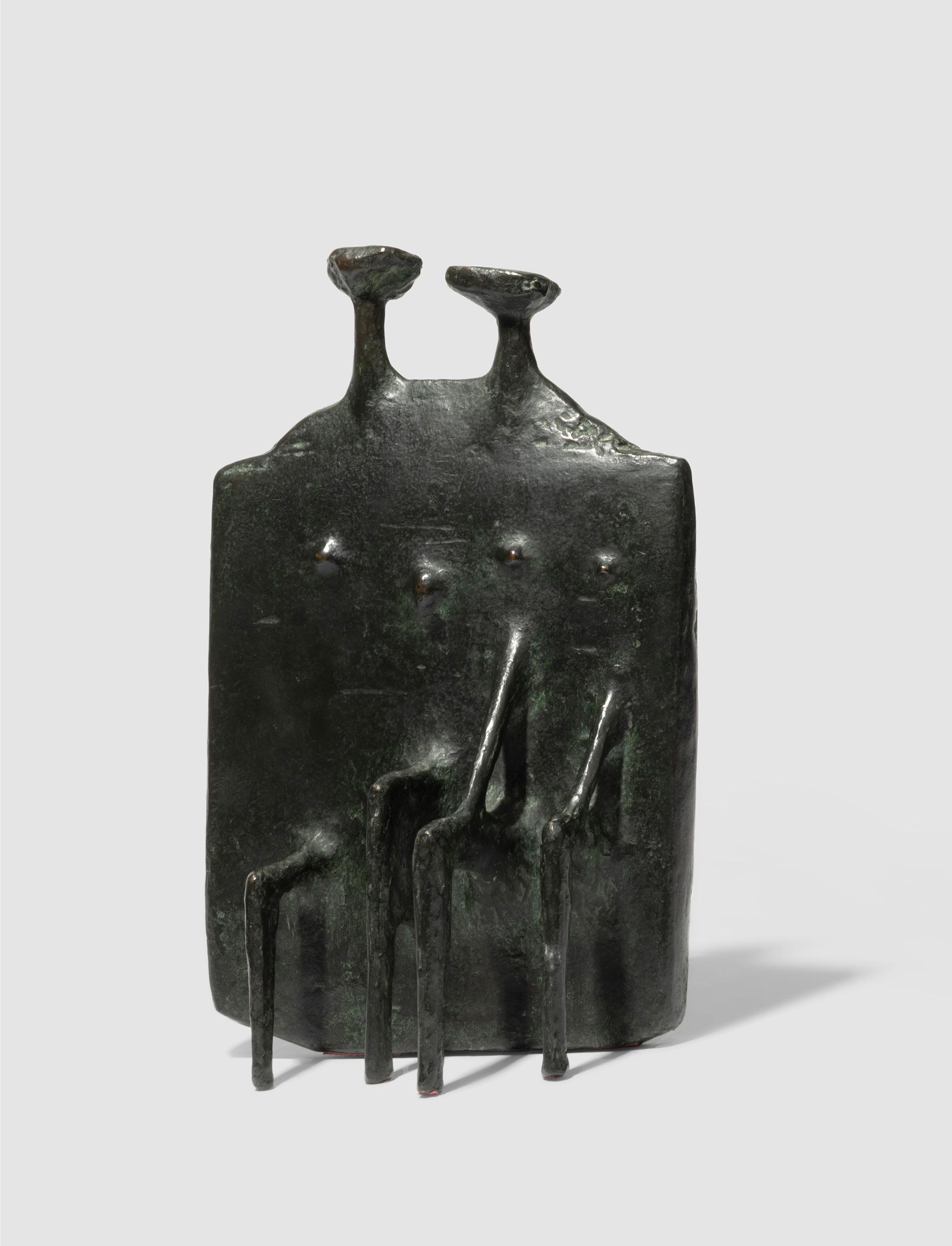
KENNETH ARMITAGE (BRITISH 1916-2002)
MODEL FOR DIARCHY (SMALL VERSION), CONCEIVED 1957
bronze with a dark green/black patina, cast by Fiorini in an edition of 6+1 in 1959
30.5cm high, 19cm wide, 17cm deep (12in high, 7 ½in wide, 6 ¾in deep)
Provenance: Sothebys, London, 20th Century British Art, 14 March 2006, lot 88; Private Collection, London.
Exhibited: Leeds, City Art Gallery, Modern Sculpture, 8th October - 5th November 1958, cat. no.1, illustrated (another cast); London, Whitechapel Art Gallery, Kenneth Armitage, July - August 1958, cat. no.38 (another cast); British Pavilion, XXIX Venice Biennale, Kenneth Armitage, S.W. Hayter, William Scott, 1958, cat. no.85 (another cast).
Literature: Woollcombe, Tamsyn (ed.), Kenneth Armitage Life and Work, Lund Humphries, London 1997, cat, no. 78, p. 144.
£25,000-35,000
64 §
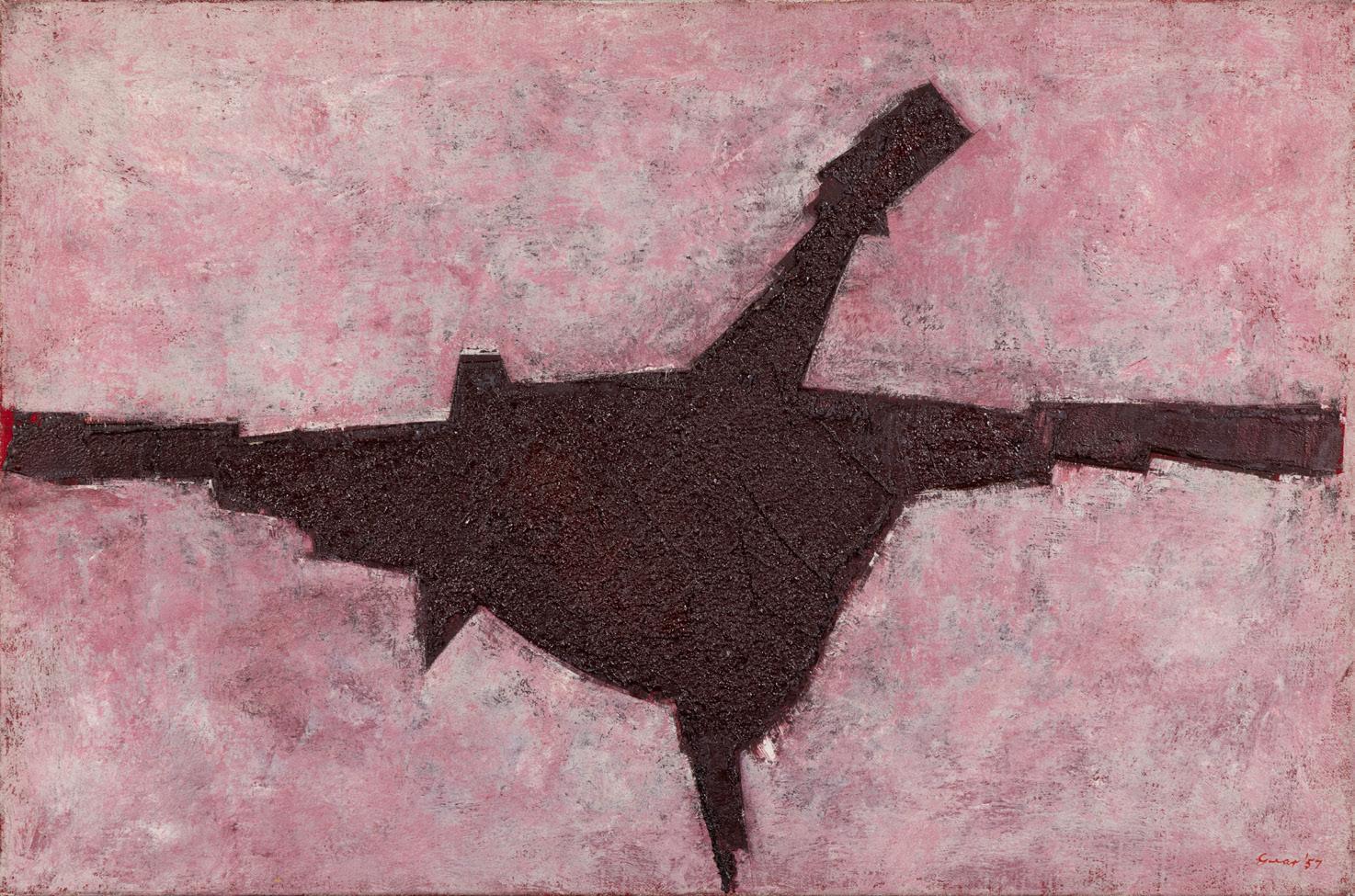
WILLIAM GEAR R.A., F.R.S.A., R.B.S.A. (BRITISH 1915-1997)
FIGURE, PINK GROUND, 1957
signed and dated (lower right), also signed, titled and dated May 57 (to reverse), oil on canvas
61cm x 91.6cm (24in x 36in)
Provenance: The Artist; Redfern Gallery, London.
Literature: Lambirth, Andrew, William Gear: A Centenary Exhibition, The Redfern Gallery, London, 2015, illustrated, the exhibition toured to the Towner Gallery, Eastbourne, 18 July - 27 September 2015 and the City Art Centre, Edinburgh, 24 October 2015 - 14 February 2016.
£1,500-2,500
65 §
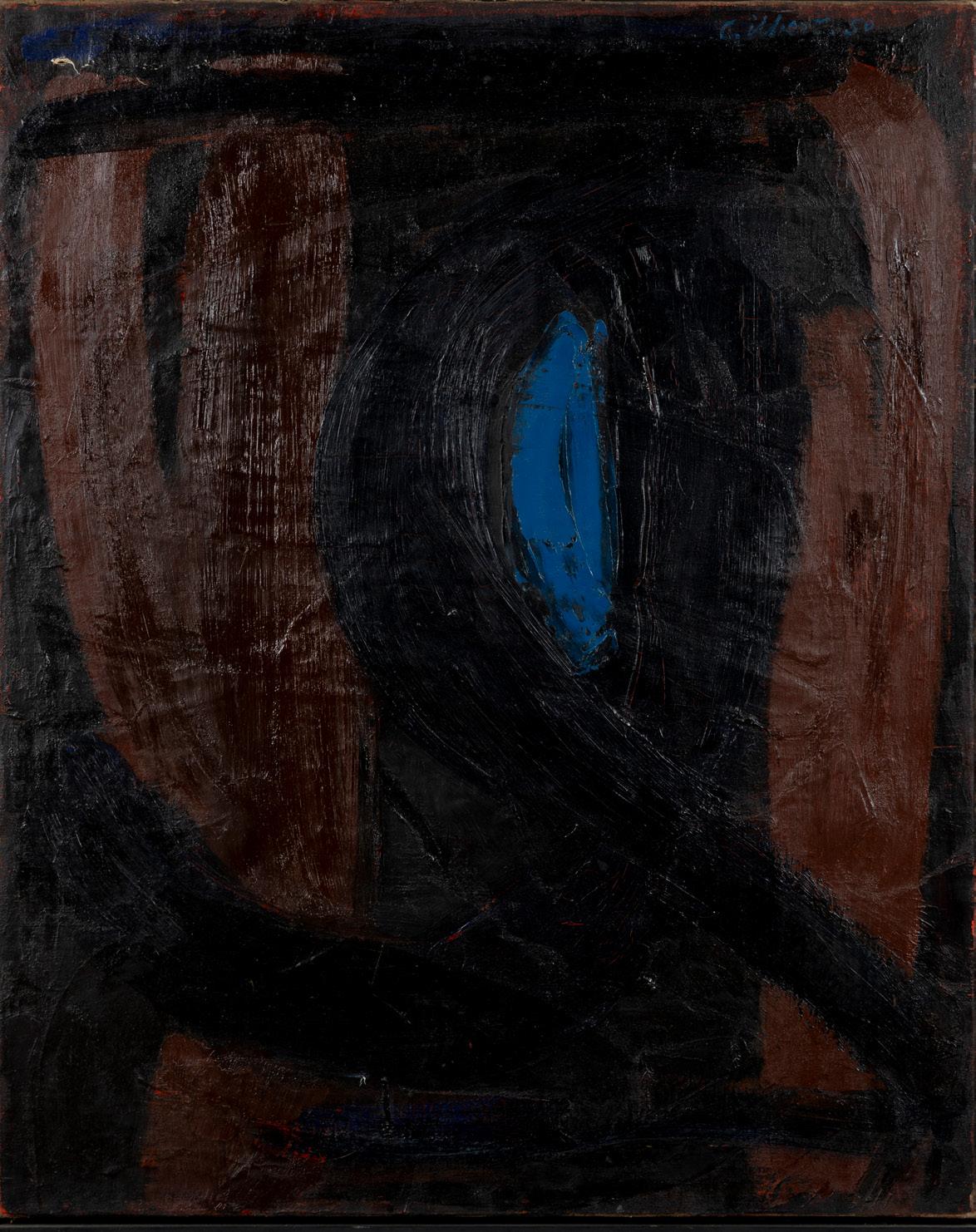
STEPHEN GILBERT (BRITISH 1910-2007)
BLUE, RED, BROWN ABSTRACT, 1950
signed and dated (upper right), oil on canvas
100cm x 81cm (39 ½in x 32in)
Provenance: with Louise Whitford Gallery, London; Whitford Fine Art, from whom acquired by the present owner.
£4,000-6,000
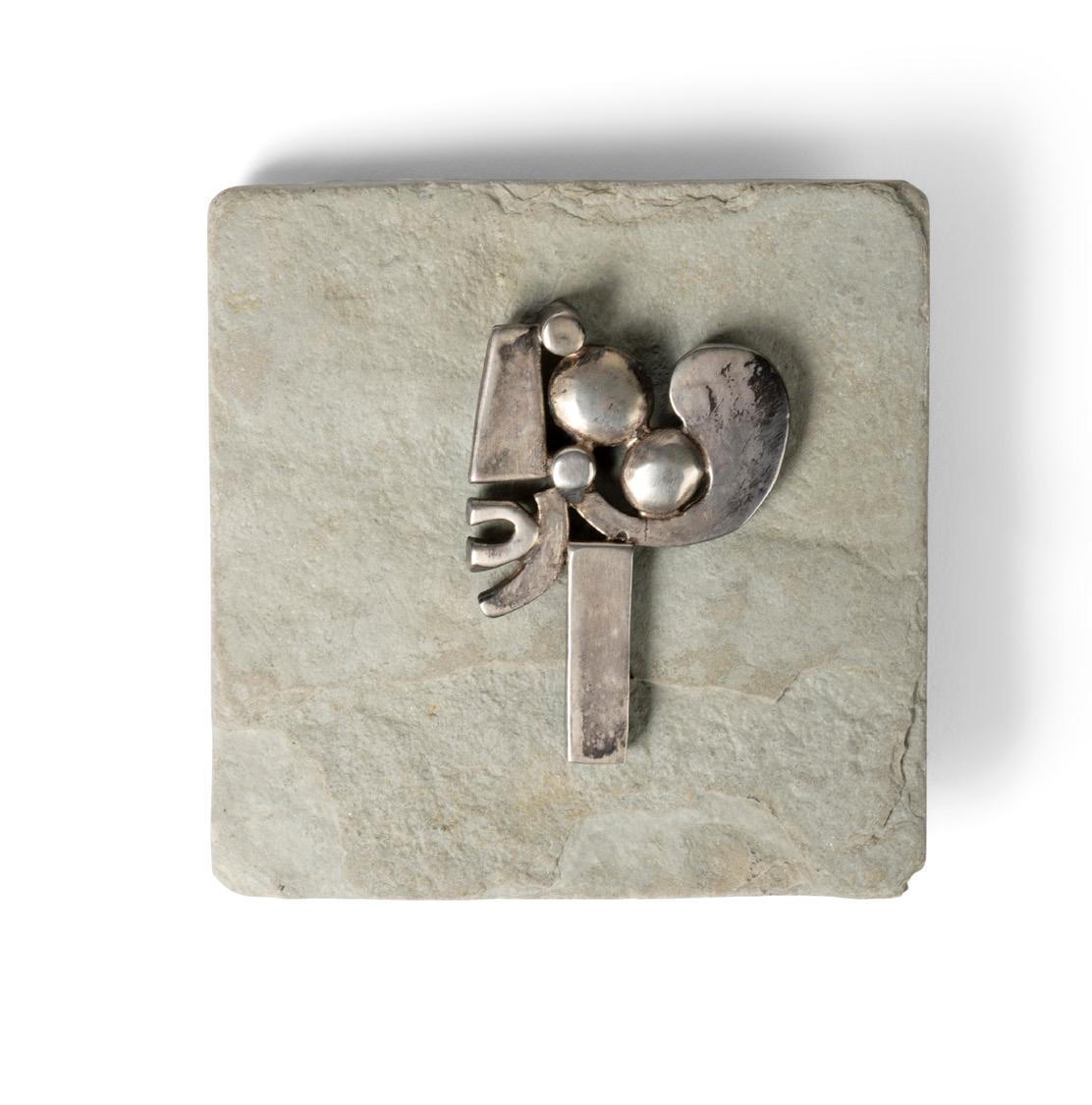
GEOFFREY CLARKE R.A. (BRITISH 1924-2014)
TOWARDS A CONSTANT, 1987 (S.646)
silver mounted on stone, cast in 2005 by Guiseppe Brollo, Venice, from an edition of 3 + 3 artist’s copies, some mounted on stone 10cm x 10cm (4in x 4in) overall including stone mount
Provenance: Private Collection, U.K.
Literature: LeGrove, Judith, Geoffrey Clarke Sculptor: Catalogue Raisonné, Pangolin & Lund Humphries, 2017, p.197, cat. no.646, illustrated in reverse.
£800-1,200
68 §
GEOFFREY CLARKE R.A. (BRITISH 1924-2014)
PRESSURE TEST, 2006 (M.95)
bronze, from the edition of 4 cast by Paul Joyce for Strand Gallery 7cm x 10.1cm x 1.5cm (2 ¾in x 4in x ½in)
Provenance: Private Collection, U.K.
Literature: LeGrove, Judith, Geoffrey Clarke Sculptor: Catalogue Raisonné, Pangolin & Lund Humphries, 2017, p.291, cat. no. M95.
£500-800
67 §
GEOFFREY CLARKE R.A. (BRITISH 1924-2014)
CENTAUR, 2008 (M.98)
bronze, from the edition of 15 cast from an aluminium original by Paul Joyce for Strand Gallery 9.9cm x 10.8cm x 2cm (3 7/8in x 4 ¼in x ¾in)
Provenance: Private Collection, U.K.
Literature: LeGrove, Judith, Geoffrey Clarke Sculptor: Catalogue Raisonné, Pangolin & Lund Humphries, 2017, p.291, cat. no. M98.
£500-800
69 §
ROBERT ADAMS (BRITISH 1917-1984)
BLOCK 4, 1970 (OPUS 325)
stamped ADAMS and dated (to base), chromed steel 13.5cm high, 8.7cm wide, 2.3cm deep (5 ¼in high, 3 3/8in wide, 7/8in deep)
Provenance: Private Collection, U.K.
Literature: Grieve, Alastair, The Sculpture of Robert Adams, The Henry Moore Foundation in association with Lund Humphries, London, 1992, p.230, no.590, illustrated.
£500-800
70 §
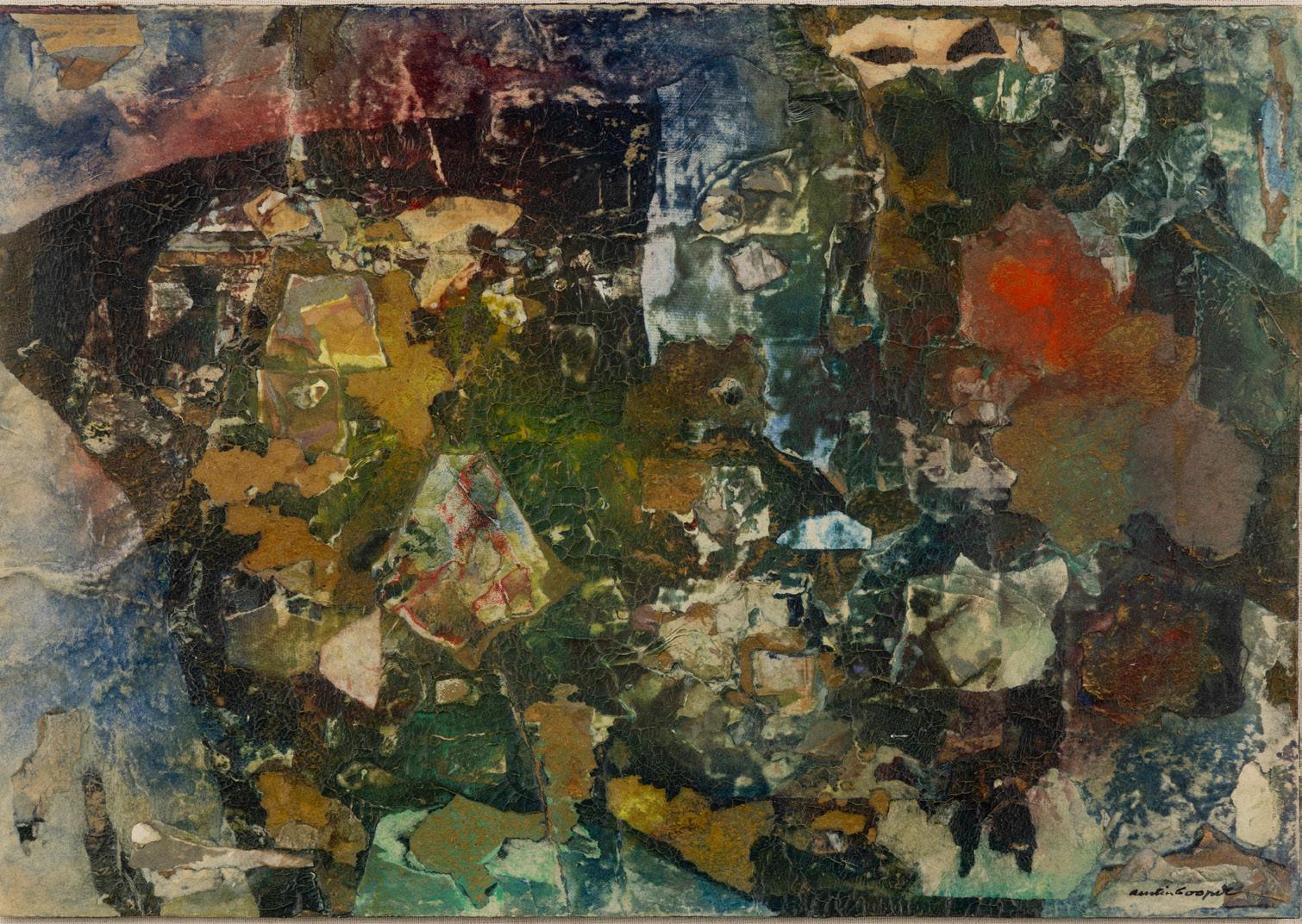
AUSTIN COOPER (CANADIAN/BRITISH 1890-1964)
CONGERIES 85, 1957
signed (lower right), mixed media and collage on cardboard 38cm x 54.5cm (15in x 21 ½in)
Provenance: The Artist; Gimpel Fils, London, where acquired by the present owner.
Exhibited: National College of Art, Dublin, Irish Exhibition of Living Art, November 1957.
£500-800
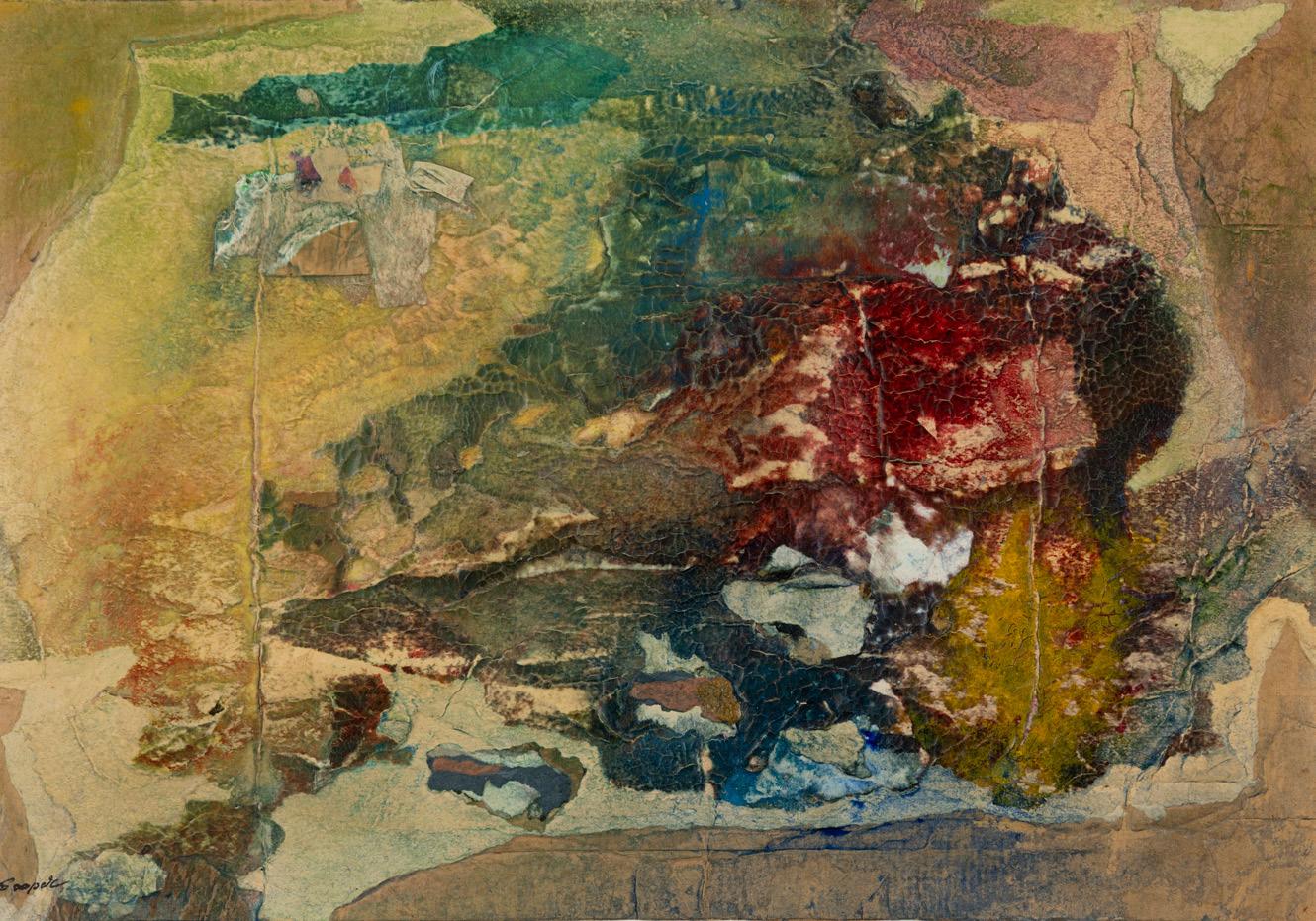
71 §
AUSTIN COOPER (CANADIAN/BRITISH 1890-1964) TRAJECT 66, 1958
signed (lower left), titled on Artist’s label (to reverse), mixed media and collage on card 28cm x 40cm (11in x 15 ¾in)
£300-500
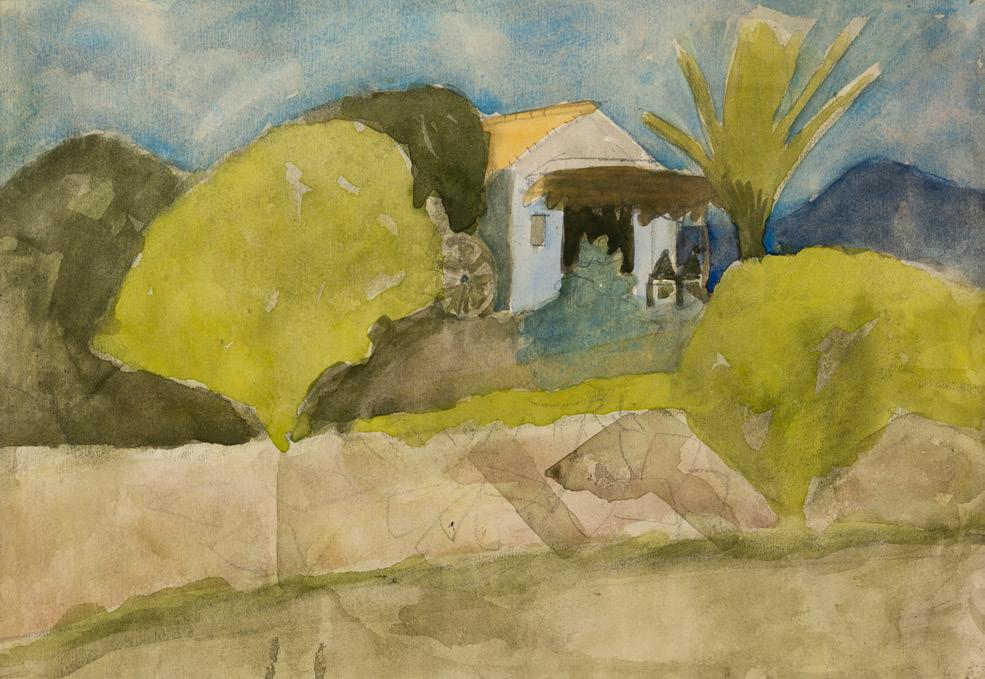
72 §
PETER POTWOROWSKI (POLISH 1898-1962)
SPANISH LANDSCAPE, c.1950s
watercolour on paper
22.5cm x 29.5cm (8 ¾in x 11 ½in)
Provenance: The Estate of the Artist; with Wenlock Fine Art, Much Wenlock.
£500-700
74 §
PETER POTWOROWSKI (POLISH 1898-1962)
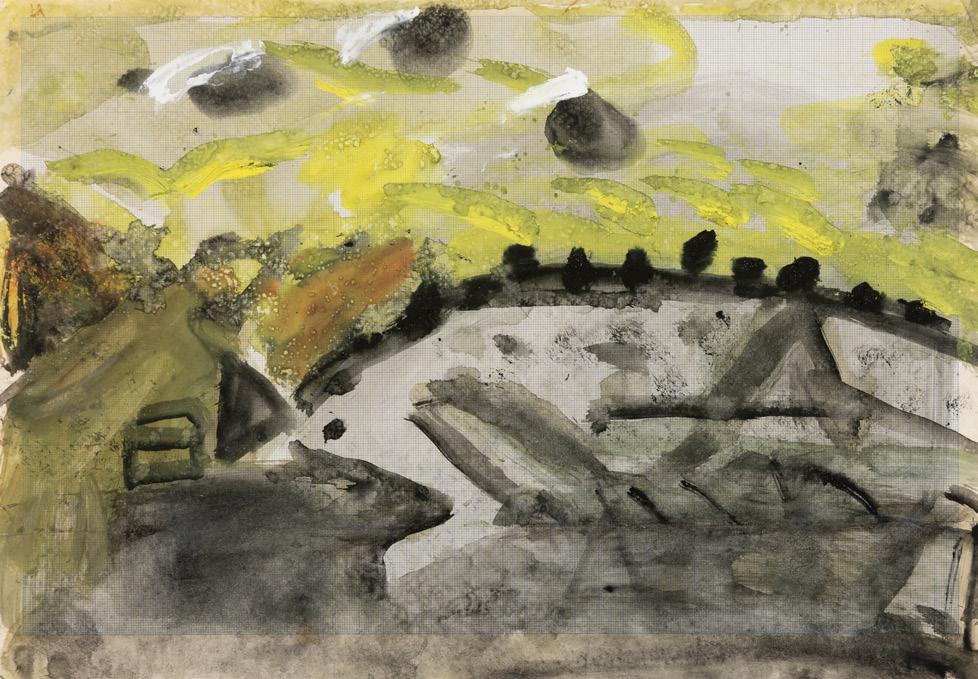
POLISH LANDSCAPE
watercolour
28.5cm x 41cm (11 ¼in x 16 1/8in)
Provenance: The Estate of the Artist; with Wenlock Fine Art, Much Wenlock.
£500-700
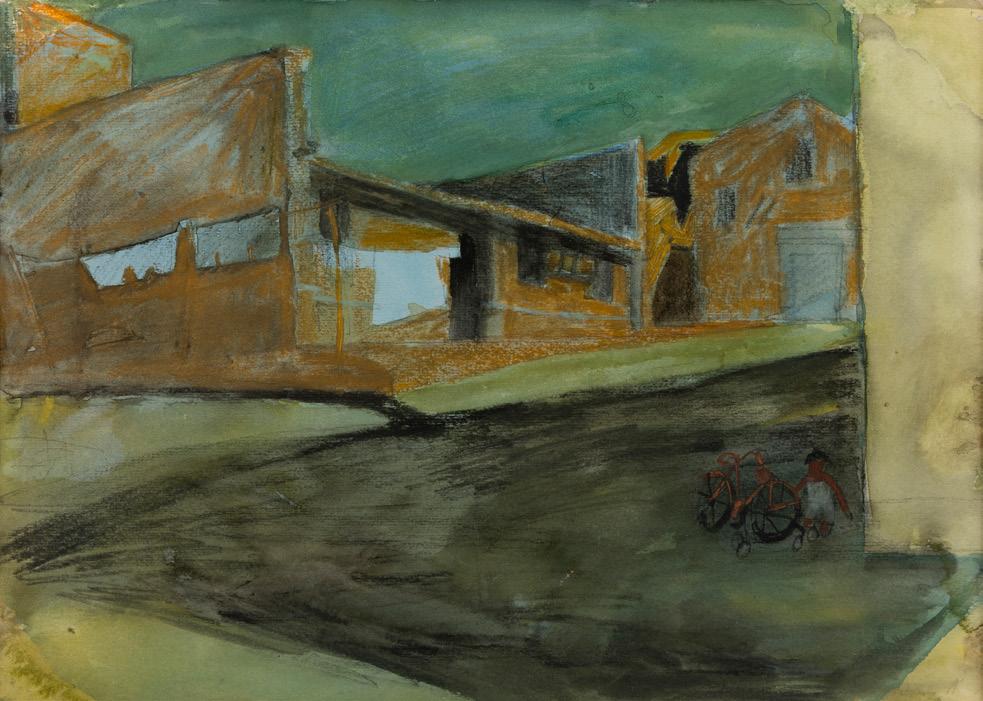
73 §
PETER POTWOROWSKI (POLISH 1898-1962)
SPANISH LANDSCAPE, c.1950s pencil and watercolour on paper 18cm x 26cm (7in x 10 ¼in)
Provenance: The Estate of the Artist; with Wenlock Fine Arts, Much Wenlock.
£400-600
75 §
PETER POTWOROWSKI (POLISH 1898-1962)
WASHING ON A LINE, SPAIN, c.1950s pencil and watercolour on paper 23cm x 31.5cm (9in x 12 ½in)
Provenance: The Estate of the Artist; with Wenlock Fine Art, Much Wenlock.
£400-600
76 §
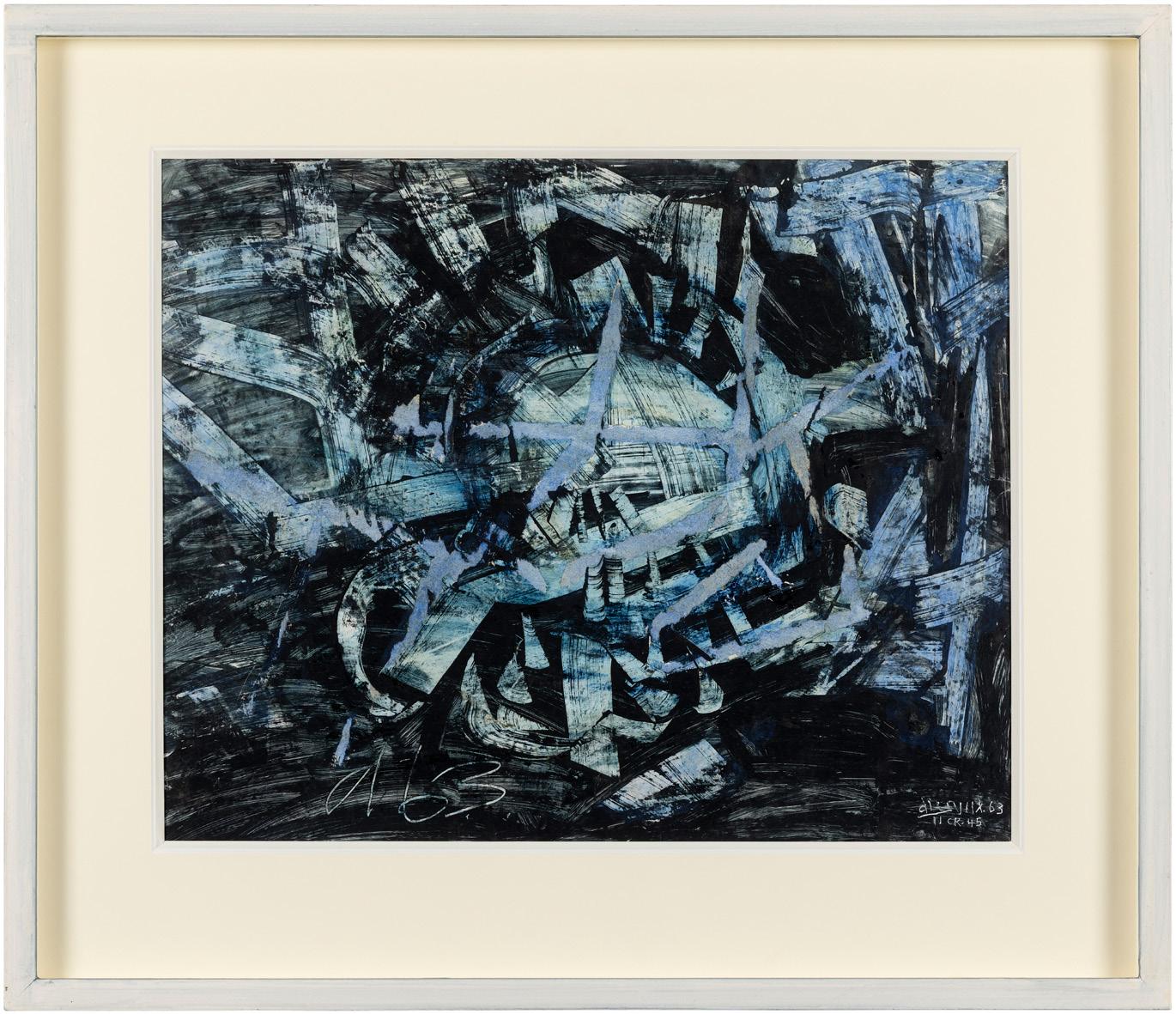
ROY TURNER DURRANT (BRITISH 1925-1998)
ENTRANCE, 1963
signed and dated (lower left), also signed, dated and inscribed II CR.45 (lower right), ink, watercolour and collage on paper 48cm x 59cm (19in x 23 ¼in)
£600-800
77 §
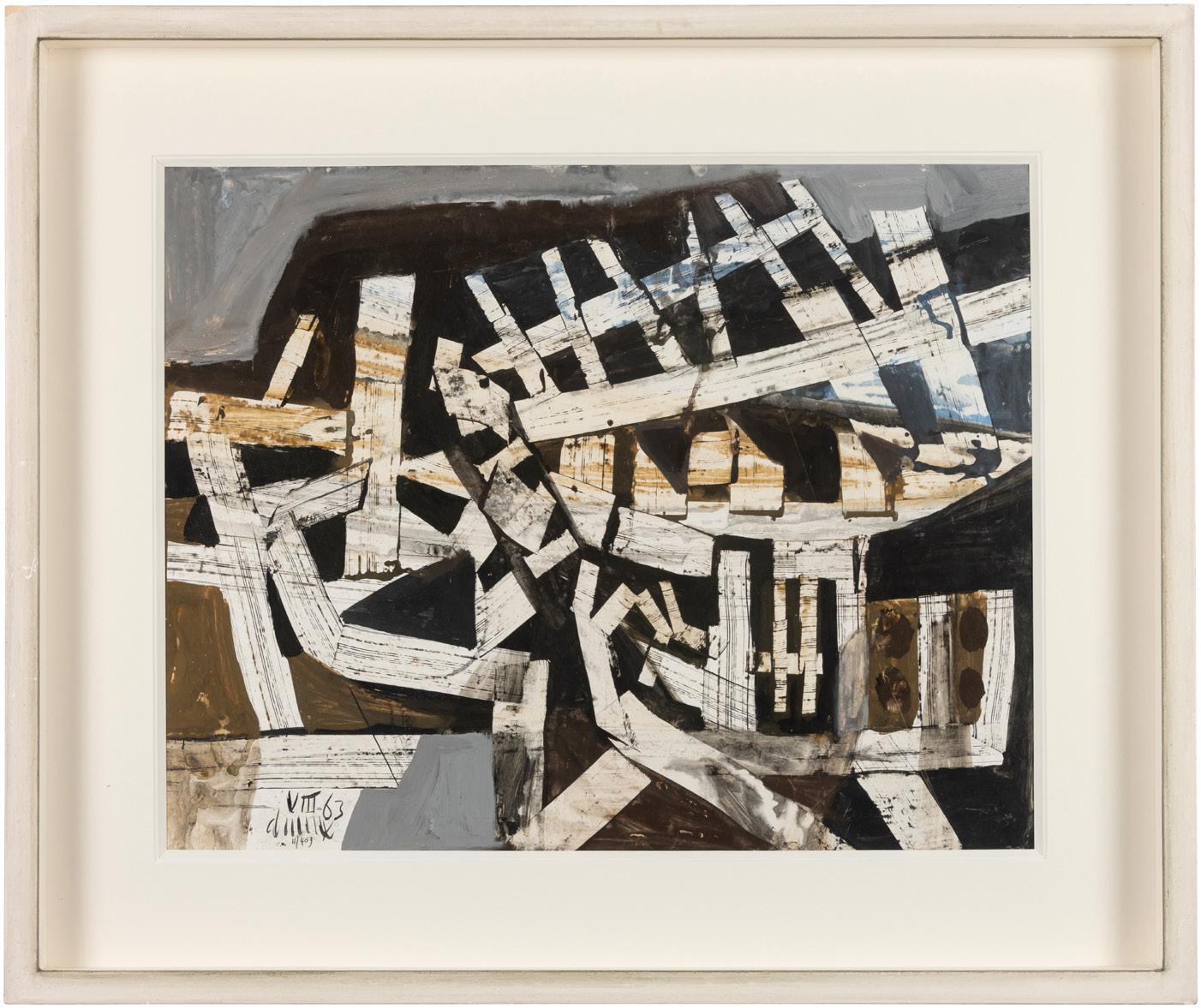
ROY TURNER DURRANT (BRITISH 1925-1998)
INSCAPE (DE VERE), 1963
signed and dated VIII. 63 (lower left), inscribed 11/459, ink, watercolour and gouache on paper
49cm x 61.5cm (19 ¼in x 24 ¼in)
£600-800
78 §
WILLIAM RALPH TURNER (BRITISH
1920-2013)
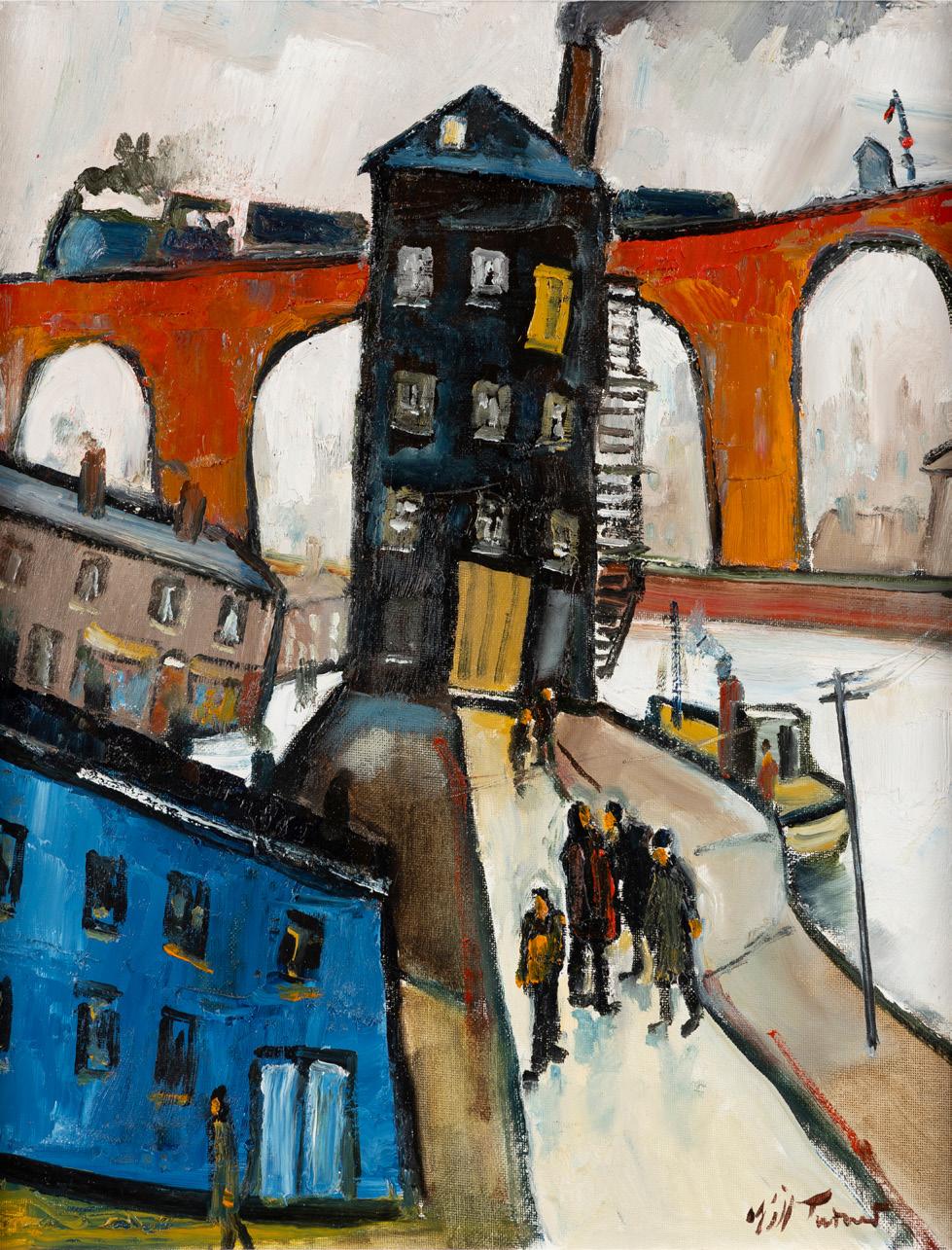
THE TUGBOAT, STOCKPORT
signed (lower right), further signed and inscribed (to backing board), oil on canvas-board
49.5cm x 39.5cm (19 ½in x 15 ½in)
Provenance: Bonhams, Chester, The Chester Sale, 13 June 2012, lot 506, where acquired by the present owner; Private Collection, U.K.
Literature: Archer, Stuart and Bill Clark, William Ralph Turner, 2010, p.149, no.133, illustrated.
£2,500-3,000
79 §
HAROLD RILEY (BRITISH 1934-2023)
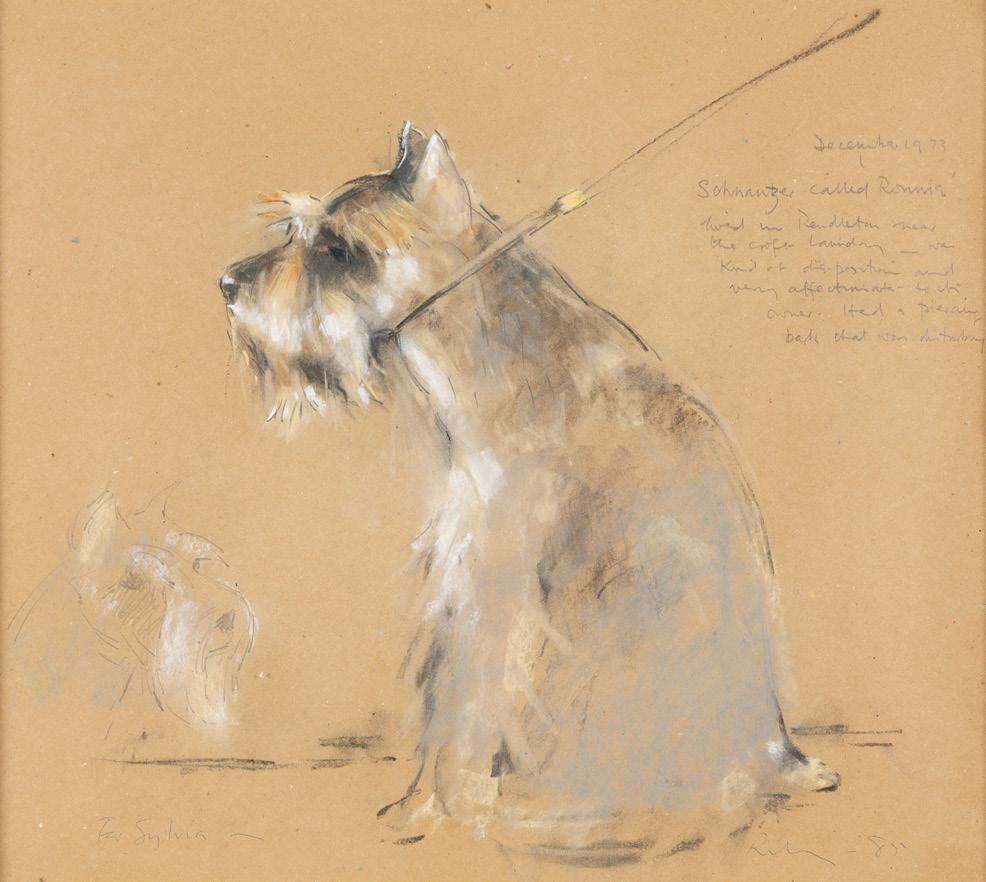
SCHNAUZER CALLED RONNIE
signed and dated Riley ‘85 (lower right), inscribed For Sylvia (lower left), further inscribed December 1973/Schnauzer called Ronnie/ Lived in Pendleton near/the croft Laundry- was/kind of disposition and/ very affectionate to it’s/owner. Had a piercing/bark that was disturbing (upper right), chalk and pencil
50.5cm x 56.5cm (19 7/8in x 22 ¼in)
Provenance: The Artist, from whom acquired directly by Sylvia Graucob; Bonhams, London, Modern British, Irish & East Anglian Art, 4 December 2018, lot 144, where acquired by the present owner; Private Collection, U.K.
£1,000-1,500
80 §
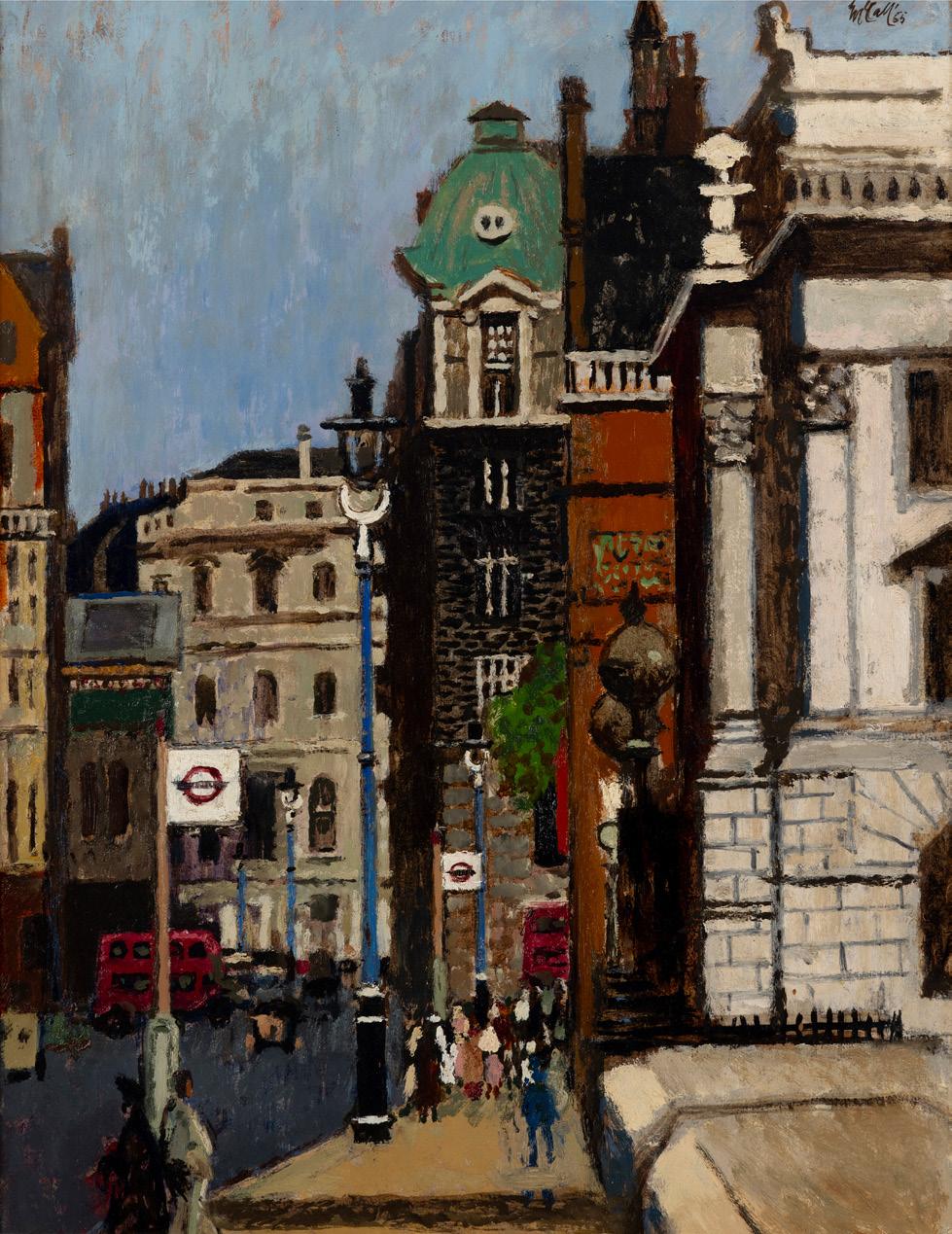
CHARLES MCCALL R.O.I (BRITISH (1907-1989)
THE ALDWYCH, LONDON, 1965
signed and dated (upper right), oil on board
59cm x 45.5cm (23 ¼in x 18in)
£1,000-1,500
81 §
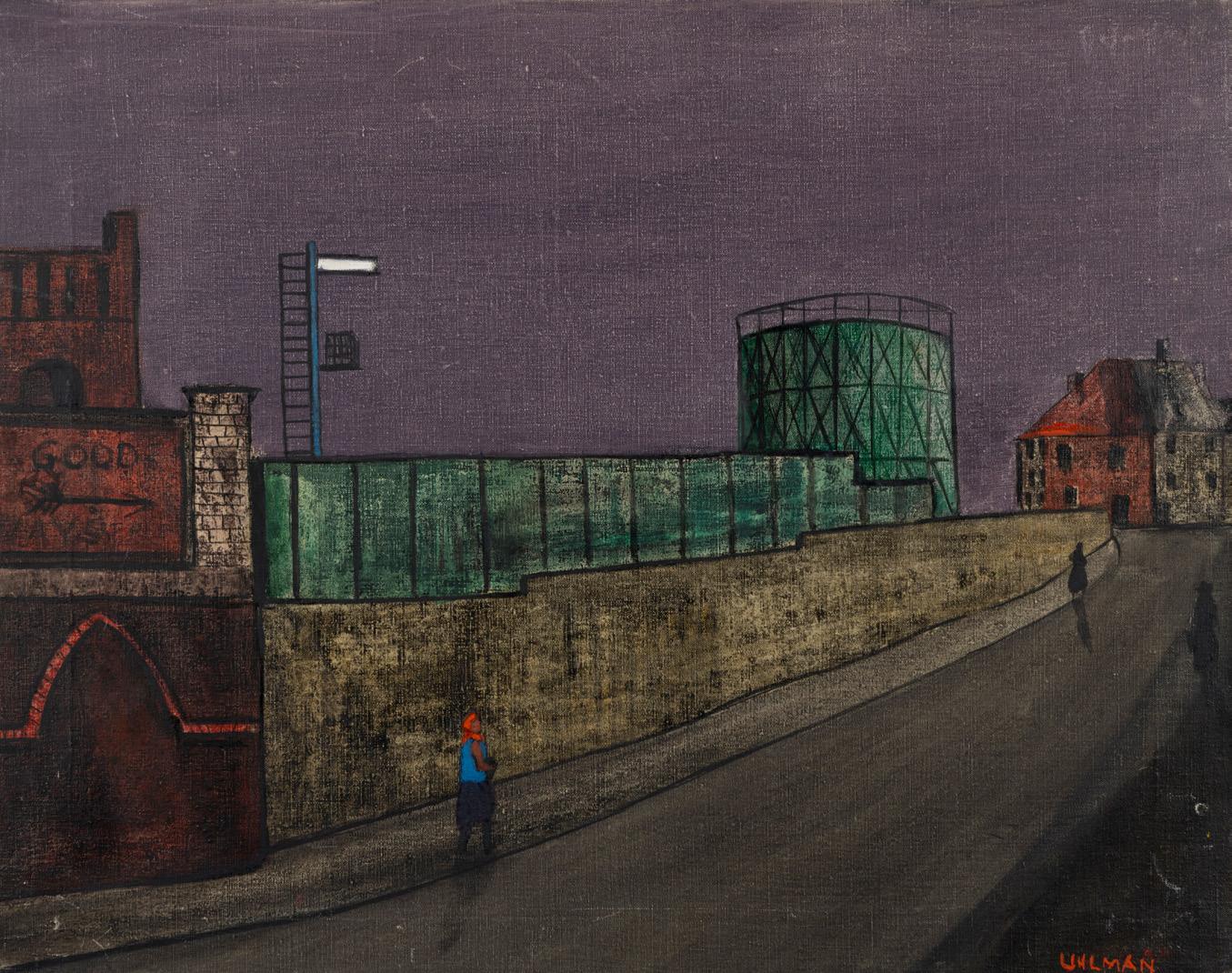
FRED UHLMAN (BRITISH 1901-1985)
STREET WITH GASOMETER, c.1957
signed (lower right), further signed to overap (to reverse), oil on canvas
53cm x 66 cm (21in x 26in)
£1,200-1,800
82 §
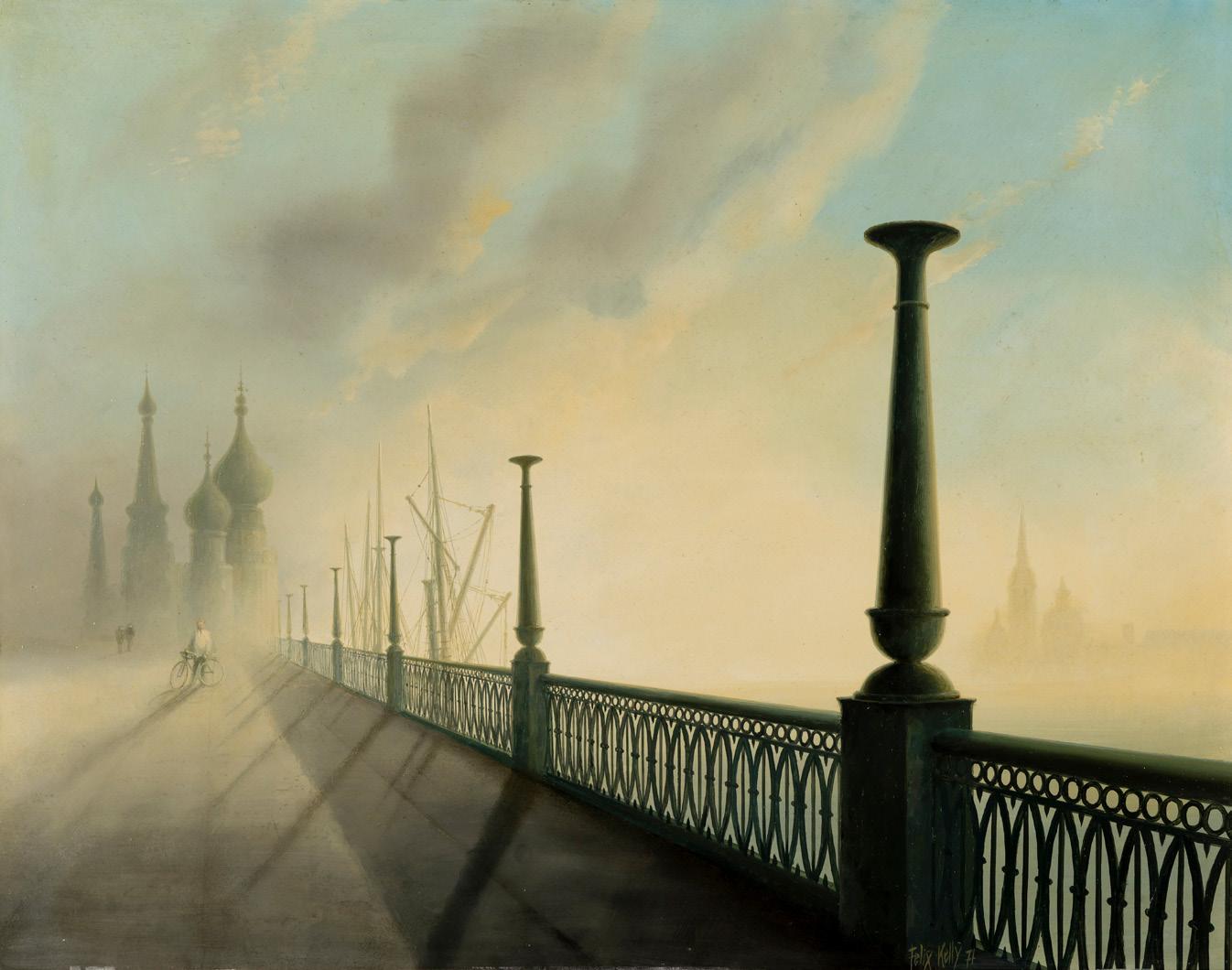
FELIX KELLY (BRITISH 1916-1994) BY THE NEVA, 1971
signed and dated (lower right), oil on board
56cm x 71cm (22in x 28in)
Provenance: with Arthur Tooth & Sons, London; Private Collection, UK: Their sale, Christie’s, London, Modern British Art, 21 November 2019, lot 262, where acquired by the present owner.
Exhibited: London, Arthur Tooth & Sons, Felix Kelly: Recent Paintings of Russia, October - November 1971, no. 11.
£4,000-6,000
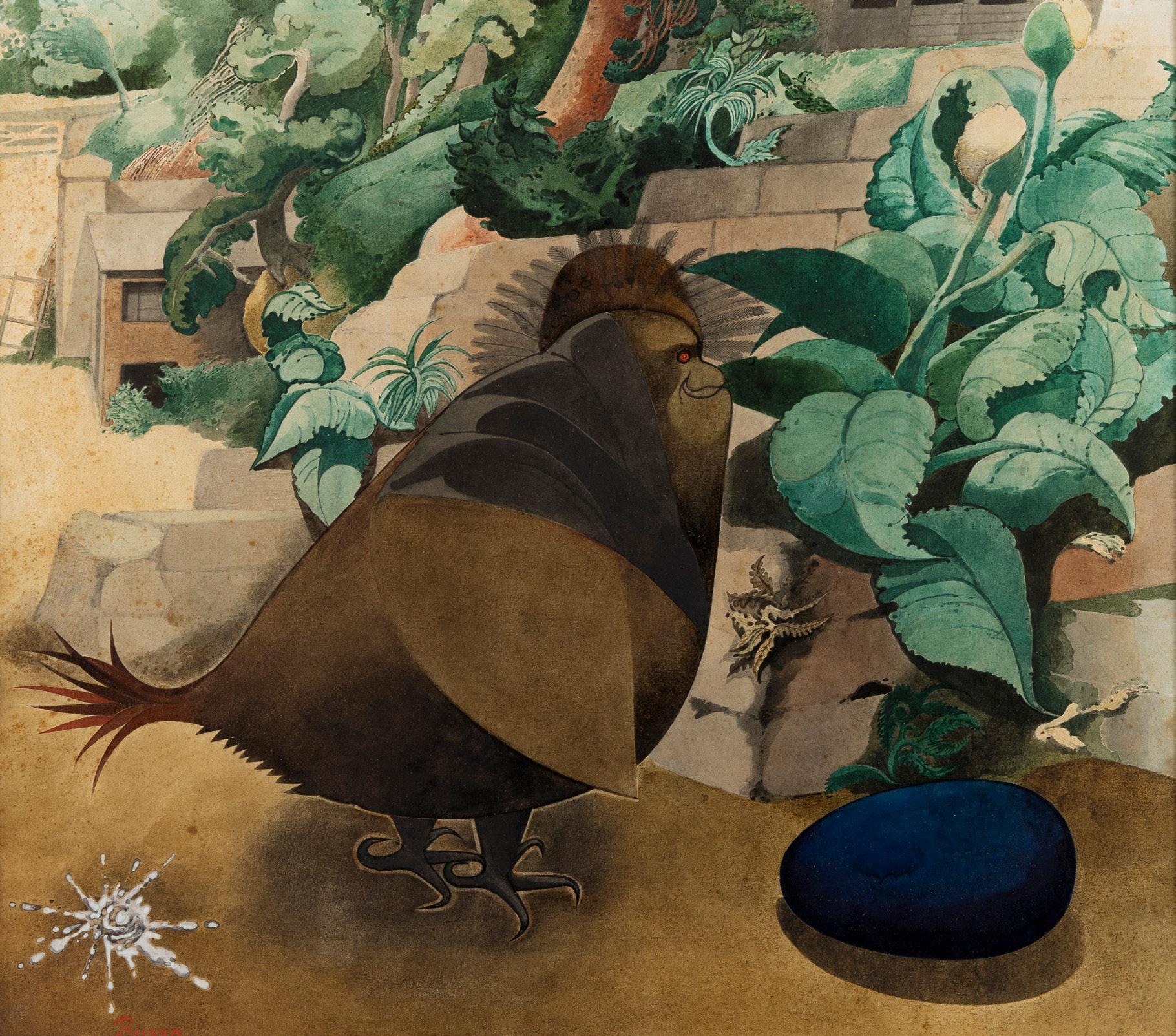
EDWARD BURRA (BRITISH 1905-1976)
THE BIRD, 1946 signed (lower left), watercolour and gouache on paper 48.7cm x 55.5cm (19 1/8in x 21 7/8in)
Provenance: Sotheby’s, Sydney, 22 November, 1992, lot 164 [the image inverted]; The Collection of Gillian Raffles.
£12,000-18,000
Born in Peking, China, in 1905, Hillier moved to the UK shortly after his birth, making Britain his home. He briefly returned to Peking in 1917 following the tragic deaths of his mother and brother. In 1926, he was offered a place at the Slade School of Art in London while also attending evening classes at Westminster School of Art. Under Bernard Meninsky, Hillier adopted a geometric approach to his drawings, which clashed with the traditional methods favoured at the Slade. After 18 months, following Meninsky’s advice to “go to Paris,” Hillier left London to further his studies.
Before arriving in Paris, he spent the summer in Cassis, in the south of France, where he befriended artists including Vanessa Bell and Roger Fry. Upon arriving in Paris, he trained under André Lhote and at Atelier Colarossi, immersing himself in the vibrant avant-garde scene of the 1920s and 1930s. He encountered many Surrealist ideas and aesthetics, which profoundly influenced his approach to composition, space, and symbolism. Hillier was particularly inspired by Giorgio de Chirico and Max Ernst, and he also crossed paths with Braque, Matisse, and Picasso.
Hillier’s association from 1933 with ‘Unit One’, a modernist group that was founded by Paul Nash and included important artist such as Henry Moore, Barbara Hepworth and John Armstrong, saw his place in the Surrealist and avant-garde circles solidify. Exhibiting with the group positioned him as one of Britain’s leading Surrealist artists.
Hillier’s paintings often feature dreamlike landscapes, deserted streets, and architectural forms immersed in an eerie stillness, reflecting the Surrealist fascination with the unconscious, mystery, and the uncanny. Unlike some contemporaries who embraced more abstract techniques,
Hillier combined precise detail with Surrealist ideas, creating works that were both technically precise and emotionally evocative.
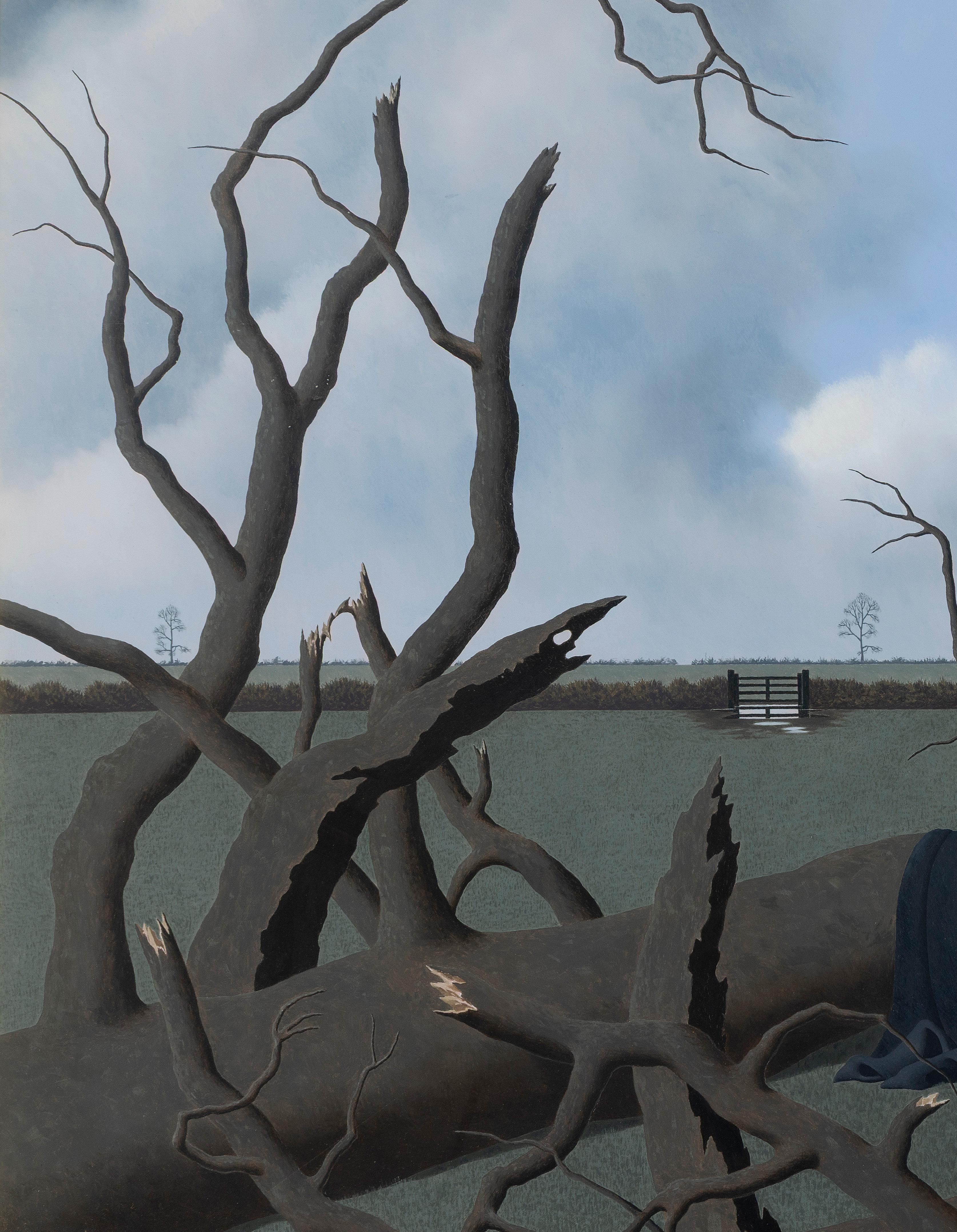
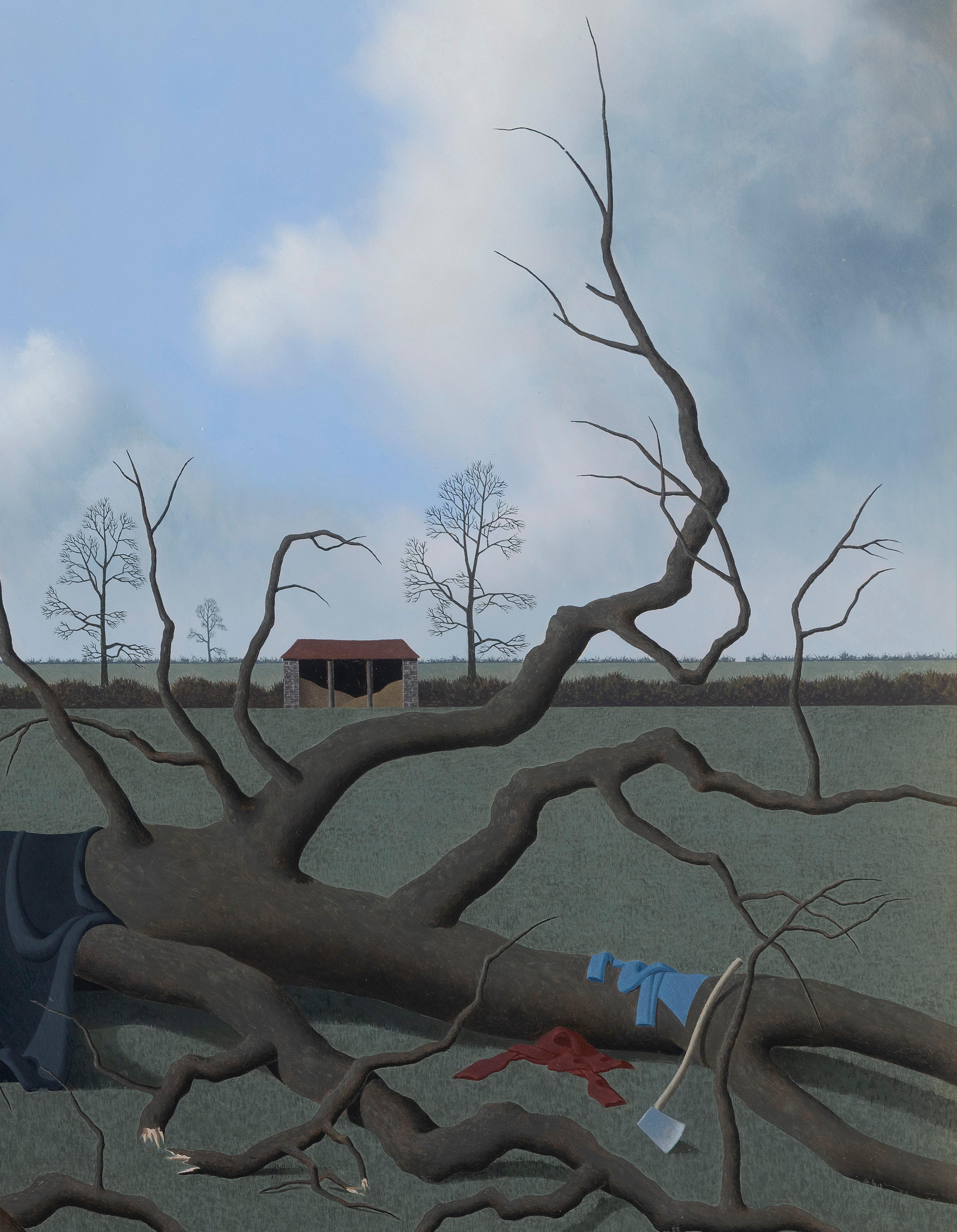
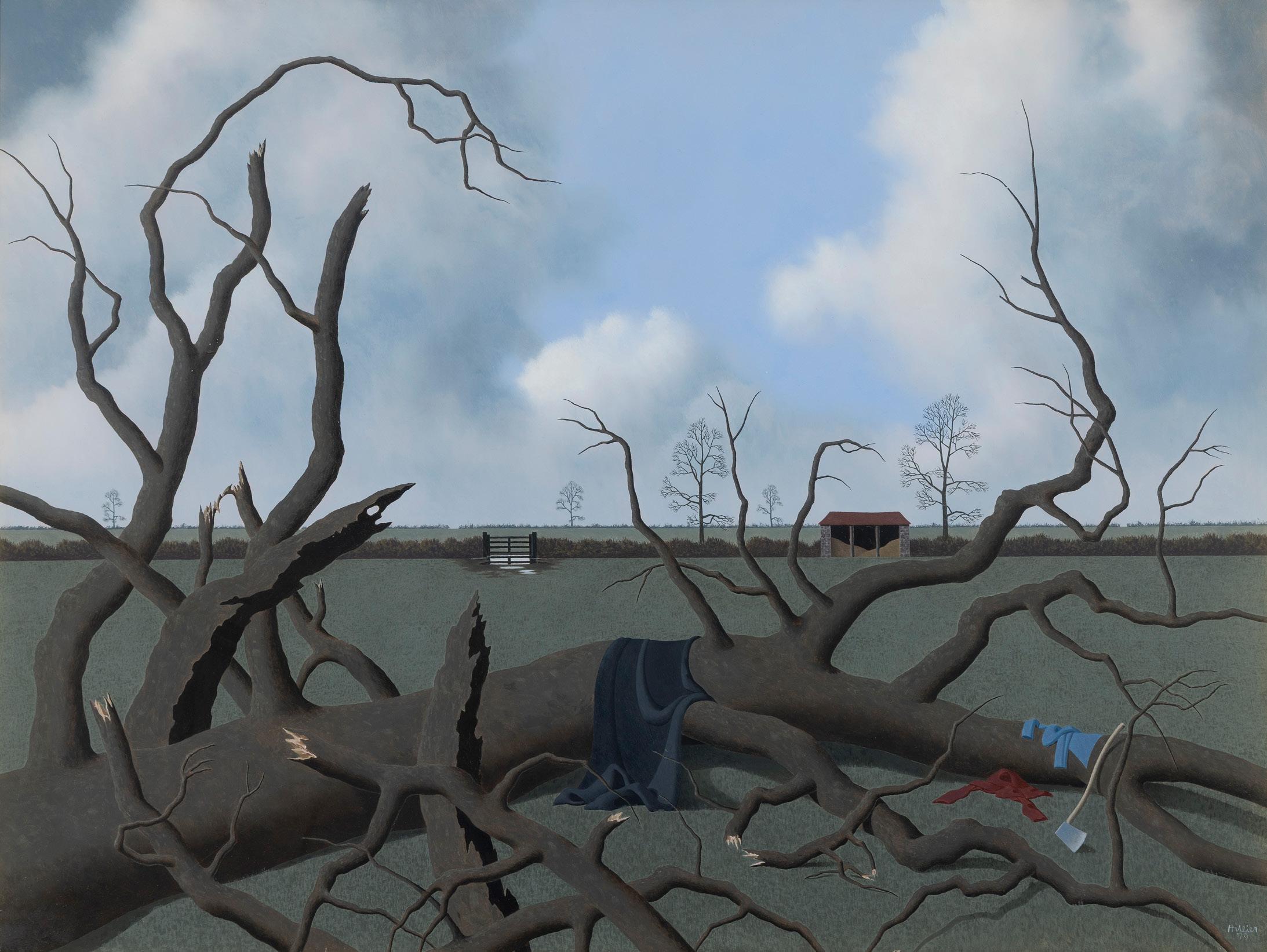
This painting by Hillier highlights his restrained and atmospheric approach to Surrealism, combining technical precision with a quiet sense of unease. The composition is dominated by a fallen, leafless tree whose twisted, skeletal branches stretch across the foreground, forming a jagged, lifeless structure. Draped over the centre of the trunk is a dark cloth, which could be a shroud, further adding to this feeling of death.
In the background, a flat, open landscape extends towards a low horizon, where a small, isolated building and sparse trees emphasise distance and desolation. The sky is filled with heavy yet softly rendered clouds, enhancing the stillness of the scene, creating an almost timeless atmosphere. Hillier’s Surrealism functions through suggestion rather than distortion, using unexpected juxtapositions and precise detail to evoke an idea of tension. The fallen tree may symbolise decay, loss, or aftermath, while the distant building, axe and clothes hints at a human presence without actually painting a figure in. Through a controlled use of colour and detail, Hillier constructs a contemplative yet unsettling image that reflects the Surrealist fascination with mystery, absence, and the unconscious.
Hillier travelled widely throughout his life, spending time in England, France, China and later Spain and Portugal. The Iberian landscape, in particular, proved enduringly significant. He worked from sketches and photographs made on his travels, developing them into carefully constructed studio paintings upon his return to Somerset, where he eventually settled in the 1950s. Today Hillier’s work can be found in the collections of Tate Gallery, Manchester Art Gallery, along with many private collections.
84 §
TRISTRAM HILLIER R.A. (BRITISH 1905-1983)
FALLEN ELM, 1979
signed and dated (lower right), oil on canvas
60cm x 79cm (23 5/8in x 31in)
Provenance: The Lefevre Gallery, London; Sothebys, London, 20th Century British Art, 11 December 2006, lot 51, where acquired by the present owner; Private Collection, London.
Exhibited: Lefevre, 1980, cat.no.8, illustrated (b&w).
Literature: Pery, pl.121, p.144, illustrated; Exh.cat, Taunton, 2019, fig.25, p.39, illustrated.
This work was first exhibited under the title ‘The Death of an Elm’ and this is the title under which it will be recorded in the forthcoming catalogue raisonné of the artist’s paintings being prepared by The Estate of Tristram Hillier. We would like to thank the Estate for their assistance in cataloguing the current work. If any owners of works by Hillier would like to put them forward for consideration for the catalogue raisonné please contact the department.
£20,000-30,000
THE FESTIVAL OF BRITAIN & ITS
LEGACY 75 YEARS LATER
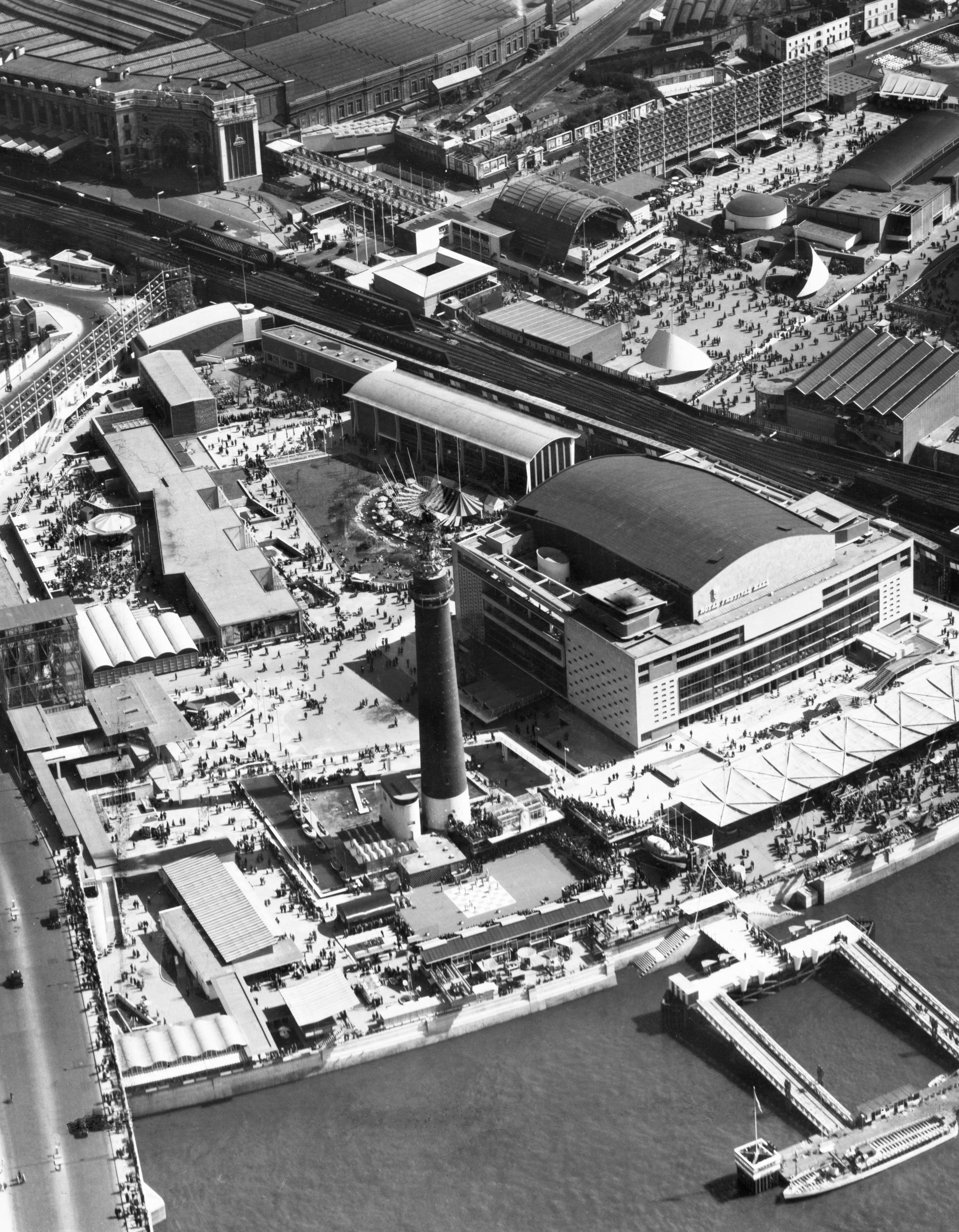
This year marks the 75th anniversary of the Festival of Britain and provides an opportunity to reflect on the impact of the last design festival the nation staged.
Between May and September 1951, over 8.5 million people visited the Southbank alone. Initially mooted at the Royal Society of Arts in 1943 as a centennial commemoration for the 1851 Great Exhibition, the concept gathered momentum until in 1947 the Deputy Prime Minister Herbert Morrison made a proposal to the House of Commons. The idea was for “a national festival that displayed the British contribution to civilisation, past, present and future, the arts, science and industrial design”. The Festival of Britain was intended to re-galvanise the national unity that existed during the war years, to define a sense of national identity, to showcase the best of British to the nation and encourage consumerism to regenerate the gloomy economy following of the war, whilst at the same time providing a shopfront to the world of what Britain had to offer. Simultaneously, another key objective was educational, informing people about an extraordinarily broad range of fields from architecture with new buildings and urban developments, to art with large scale murals and public sculpture, from graphic design and typography to textiles and wallpaper, as well as furniture and other furnishings.
Described as ‘a tonic to the nation’, the Festival of Britain began on 3 May 1951 with the King’s opening of the Royal Festival Hall on the Southbank in London. The following day the remainder of the exhibition site was declared open. Whilst London was the capital city hub for the event, there was a nationwide celebration including touring exhibitions on both land and sea, and local events. At the time it offered hope for the future following the hardships and austerity of the Second World War.
Prior to the Festival of Britain, London was largely considered to be north of the River Thames and the Surrey side viewed industrial and warehousing. The Southbank venue was selected as a site because it was central and an available area in desperate need of rejuvenation having suffered bomb damage and the neglect of wartime. Today the Southbank has been further developed into a cultural hub and south of the river is no longer viewed as an annex to the city itself.
Whilst most of the structures for the Festival were to be temporary in nature the Royal Festival Hall was an exception. It was the first significant public building constructed following the War and was also the largest venue of its kind in the country with a seating capacity of up to 2700. It was constructed from reinforced concrete and designed to be democratic in nature with no class segregation and to have wide open areas for ease of movement. Having undergone refurbishment, the Royal Festival Hall remains a vibrant centre for the arts.
As vertical feature for the event the Skylon was designed by the architects Philip Powell and John Moya and became the world’s tallest structure. It inspired awe as the light-weight illuminated aluminium form floated in space tethered by a triangulated structure of poles and steel ropes. It was arguably the most admired element
on the Southbank. In contrast to the Skylon, the largest temporary structure resembled a flat flying-saucer and housed displays about scientific developments and environmental exploration. Formed of concrete platforms on varying levels integrated under an aluminium lattice and covered with a light-weight skin. The exterior formed a canopied shelter with chairs designed for the Festival by Ernest Race and Robin Day.
Further up the Thames, part of Battersea Park hosted the Festival Pleasure Gardens accommodating a funfair, a miniature railway, the Fountain Lake, and a Guinness clock. What remains today is the lake and the landscaped area. At the time this aspect of the Festival was largely for entertainment and pleasure. It was fanciful in nature and provided a location for commercial advertising.
The Festival of Britain opened the gateway for the young into a new contemporary form of modernism differing from that of the early 20th Century. It was a new version that utilised new materials such as aluminium and steel out of necessity, delighted in bright colours after the dreariness of the wartime austerity and explored the possibilities of geometric patterns and abstract forms. There was no shying away from incorporating science, engineering and technology.
Further afield the Lansbury Estate regenerated a bombed site in Poplar. It was developed into a community with flats, houses and shops and presented a new possibility in terms of urban development. What began with the Festival of Britain paved the way for future town planning over the coming decades in Britain.
The Festival of Britain was a reset moment following the Second World War with all its hardship and austerity. The Government provided £7million of sponsorship but there were still significant post-war financial constraints and material shortages, so it was a creative venture in adaptability.
Gerald Barry, a newspaper editor was put in charge of the event and gathered a team around him. His objective was largely to draw people from the younger generation to participate. These individuals went on to shape the next decades and still remain familiar names today. In the field of furniture figures like Robin Day, Ernest Race, and AJ Milne working for Heals came to the fore, and Lucienne Day in the area of textiles, created her Calyx design. It was Abram Games the graphic artist who designed the logo for the Festival featuring Britannia surmounting a four-point compass decked with celebratory bunting. There was sculpture by Mitzi Cunlife who is perhaps better known now as the creator of the Bafta Awards mask trophy, and other household names such as Henry Moore, Barbara Hepworth, Lynn Chadwick, and Eduardo Paolozzi. All of these benefitted from Government patronage and went on to further establish themselves as leading cultural figures. A new vision of the future emerged and set the agenda for the coming decades. Art and design were young, vibrant, contemporary and modern.
Out of this resurgence from the Festival of Britain the nation and its designers gained a confidence to pursue a new direction arguably culminating in a cultural explosion of creativity in the 1960s - causing the rest of the world to take note. It should also be mentioned that the Festival of Britain was the time when luxury toilet paper was first introduced in public facilities and now the nation refuses to accept anything less.
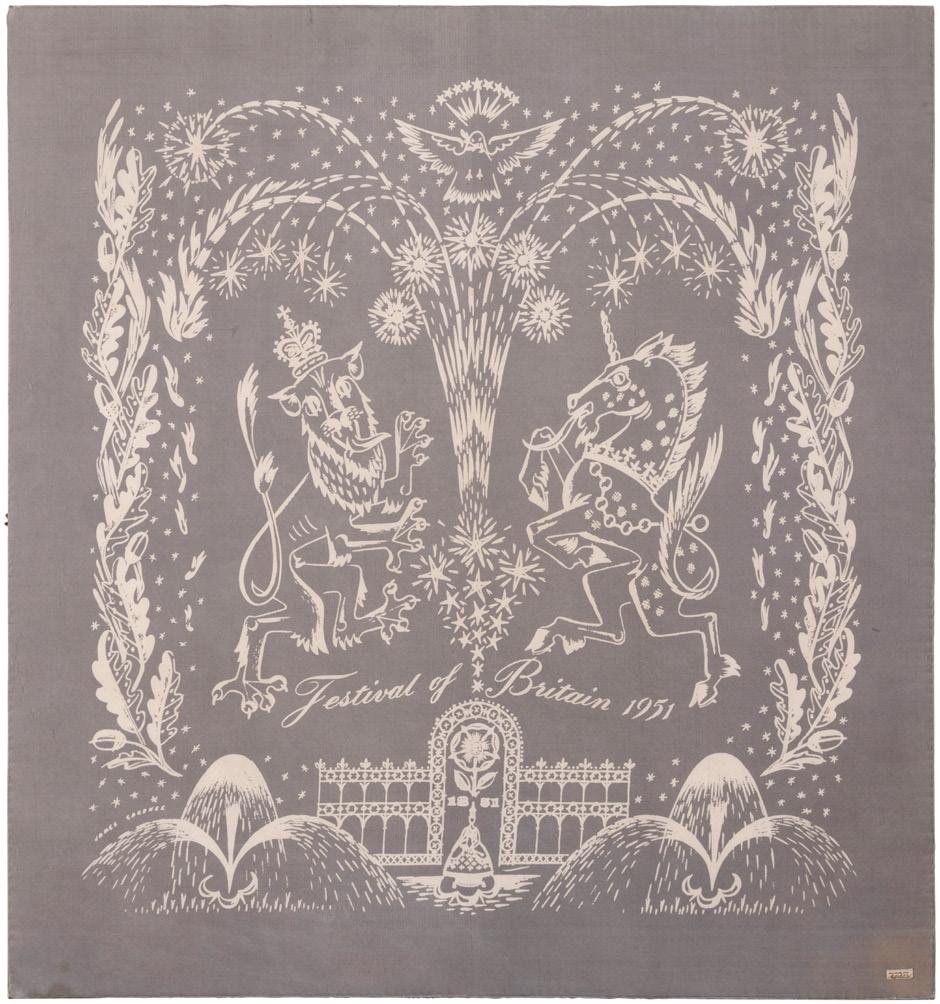
Alongside his exhibition work, Gardner also produced graphic designs for commercial and commemorative objects associated with the Festival. Among these were designs for Ascher silk scarves, produced by the celebrated textile house known for commissioning leading artists and designers of the period. Gardner’s Festival-related scarf reflects the spirit of the eventcombining modern graphic clarity with lively colour and pattern - capturing the optimism and forward-looking aesthetic that characterised Britain’s cultural revival in the early 1950s.
JAMES ‘LESLIE’ GARDNER O.B.E., R.D.I. (BRITISH 1907-1995) FOR ASCHER FESTIVAL OF BRITAIN SCARF, 1951 with Asher / 100% Pure Silk / Made in England label (lower right), silk 92cm high, 87.5cm wide (36 ¼in x 34 3/8in)
£300-500
James “Leslie” Gardner was a British designer whose work helped shape the visual language of mid-twentiethcentury Britain. Trained at the Westminster School of Art, Gardner began his career in commercial design and illustration before establishing a reputation as one of the leading exhibition designers of the post-war period. His early commissions included advertising and poster work for clients such as Shell, where he collaborated with art director Jack Beddington, developing
a clear and engaging graphic style that would later inform his exhibition and public design work.
Gardner’s contribution to Britain’s cultural identity became particularly visible in the years following the Second World War. He played an important role in the landmark Festival of Britain in 1951, designing elements of the People of Britain exhibition and contributing to the visual atmosphere of the South Bank site and the Battersea Pleasure Gardens.
89
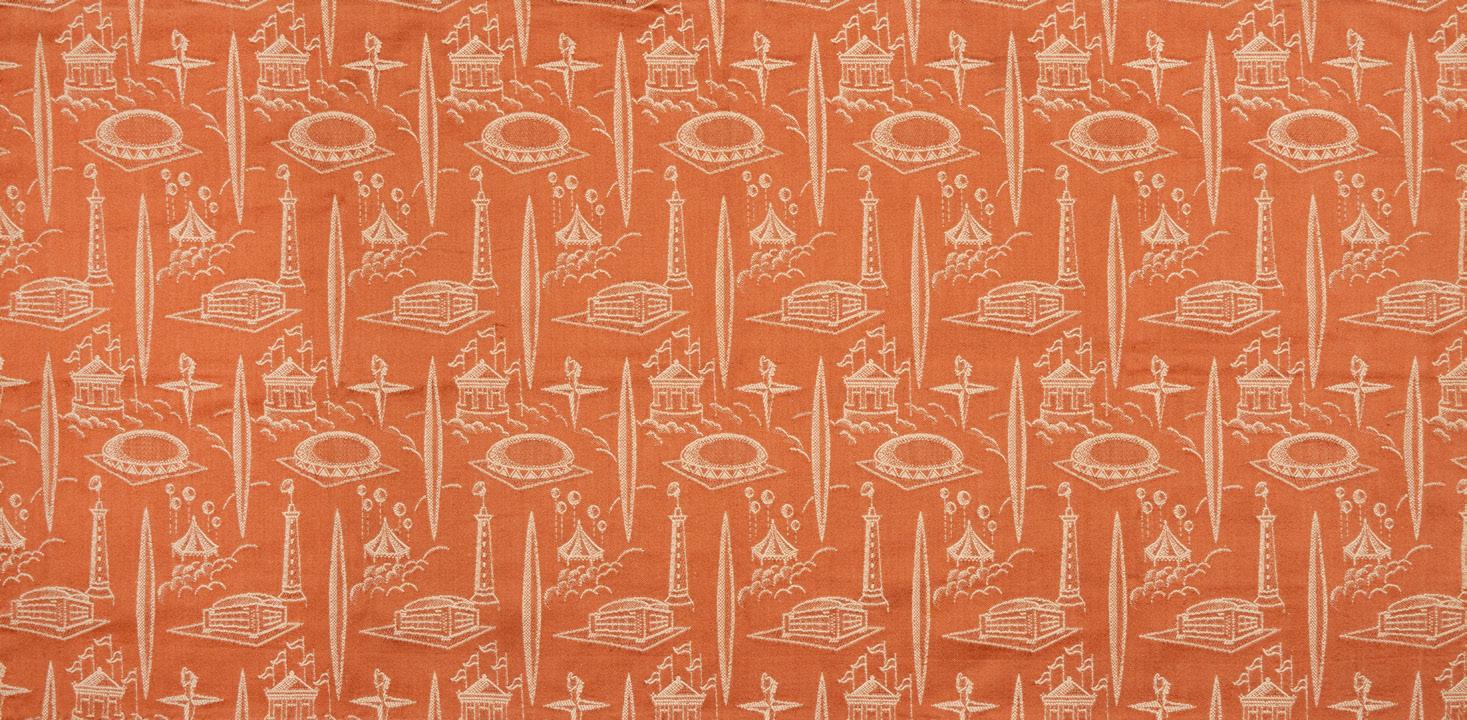
FESTIVAL OF BRITAIN
SKYLON, DOME OF DISCOVERY, ROYAL FESTIVAL HALL TEXTILE, c.1951
featuring key sites and the logo, silk and linen/wool
59.5cm high, 119cm wide (23 3/8in high, 46 ¾cm wide)
£500-700
90
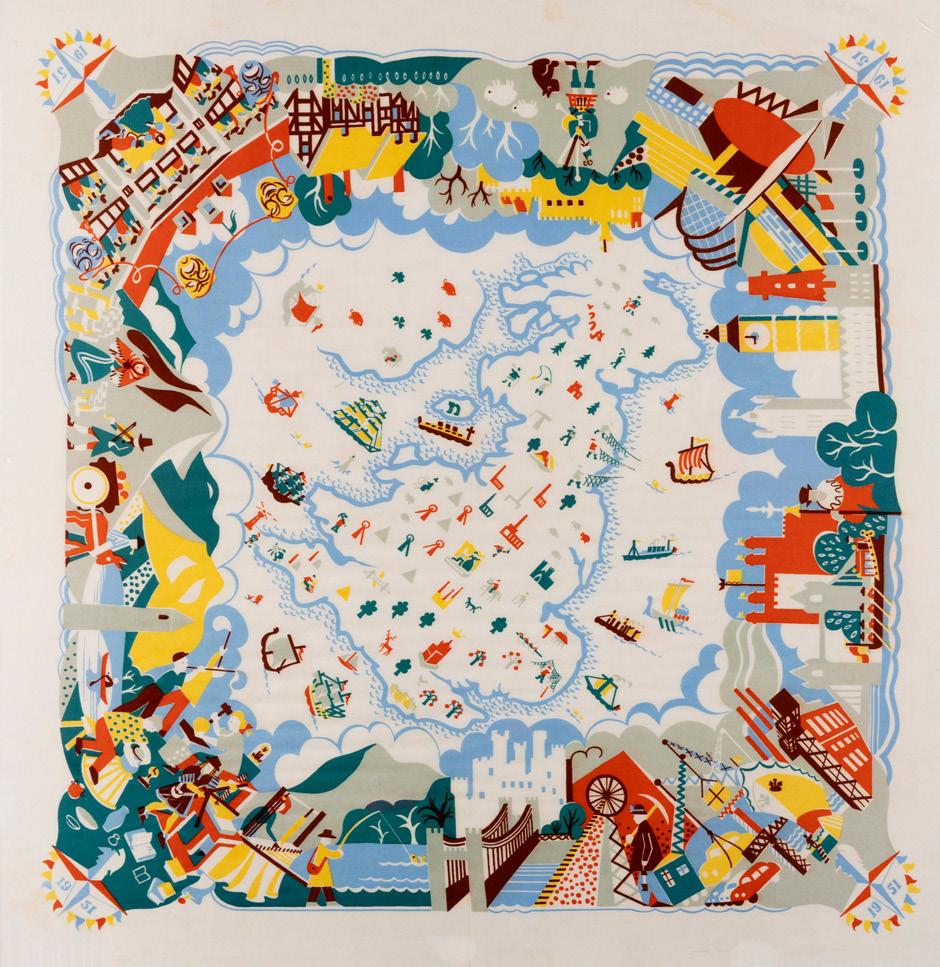
FESTIVAL OF BRITAIN SCARF, 1951
rayon
95cm high, 93cm wide (37 3/8in high, 36 ½cm wide)
£300-500
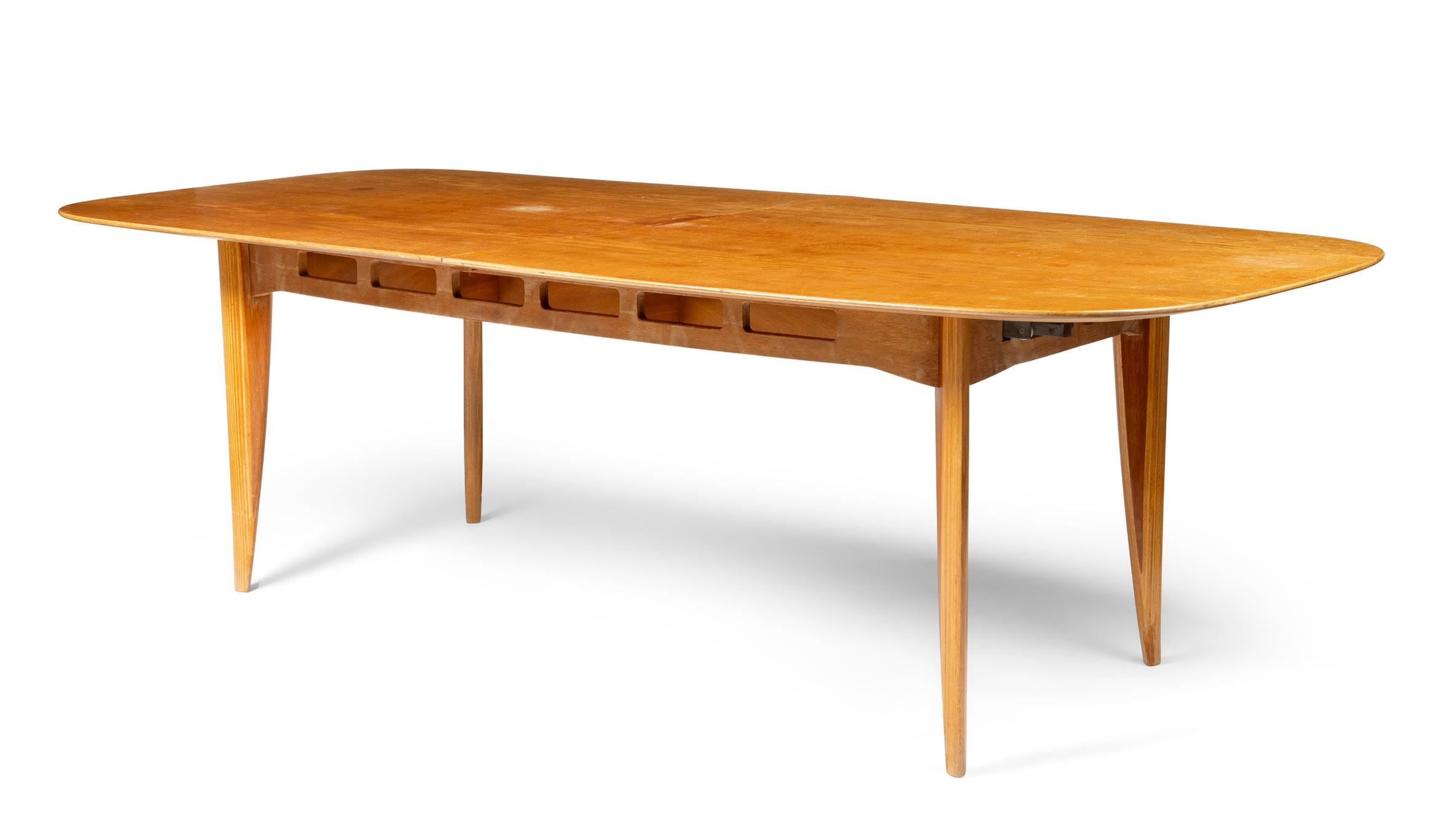
SIR BASIL SPENCE O.M., O.B.E., R.A. (BRITISH 1907-1976) ‘ALLEGRO’ EXTENDING DINING TABLE
laminated wood
74cm high, 235.5cm wide, 113.5cm deep (29 1/8in high, 92 ¾in wide, 44 ¾in deep) and 310cm wide (122in wide) when including extra leaf
Provenance: Private Collection, London.
Literature: Studio Yearbook of Decorative Art, 1949, p. VIII for an advertisement of a chair from this series; ‘Austerity to Affluence: British Art & Design 1945-1962’, The Fine Art Society, London, 1997, p. 14 and p. 22, cat. no. F27 for an example of the chair from this series; Philip Long, Jane Thomas, eds, Basil Spence: Architect, exh. cat. National Galleries of Scotland, Edinburgh, 2008, p. 52 and p. 54, fig. 55, an example illustrated of a non-extending table.
£1,000-2,000
92
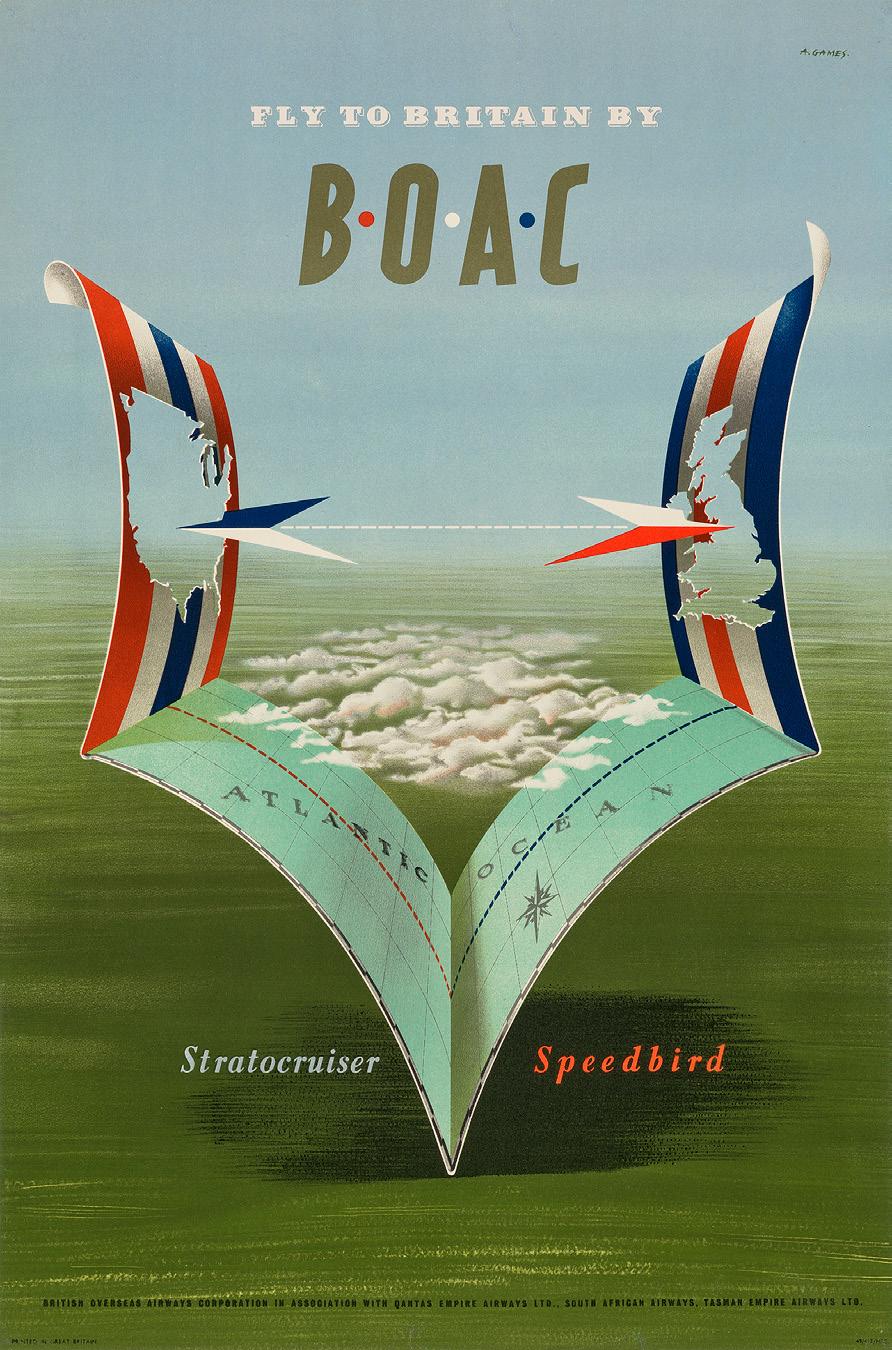
ABRAM GAMES (1914-1996)
FLY TO BRITAIN BY BOAC, STRATOCRUISER, SPEEDBIRD
lithographic poster; 1949, condition B+; backed on linen
30 x 20in. (76 x 51cm.)
£1,000-1,500
93
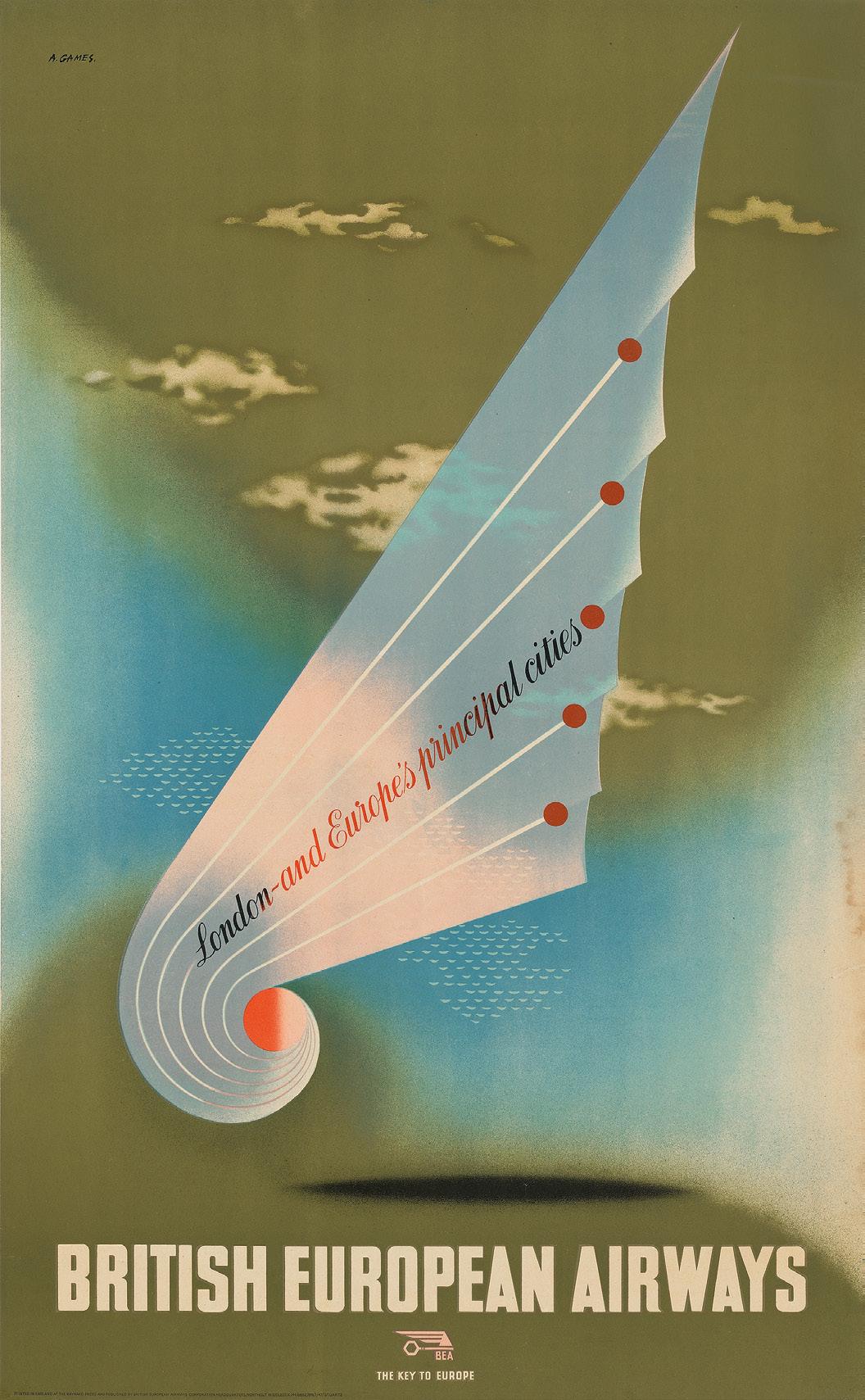
ABRAM GAMES (1914-1996)
BRITISH EUROPEAN AIRWAYS
lithographic poster, 1946
condition B+; backed on linen
40 x 24.5in. (102 x 63cm.)
£800-1,200
94 §
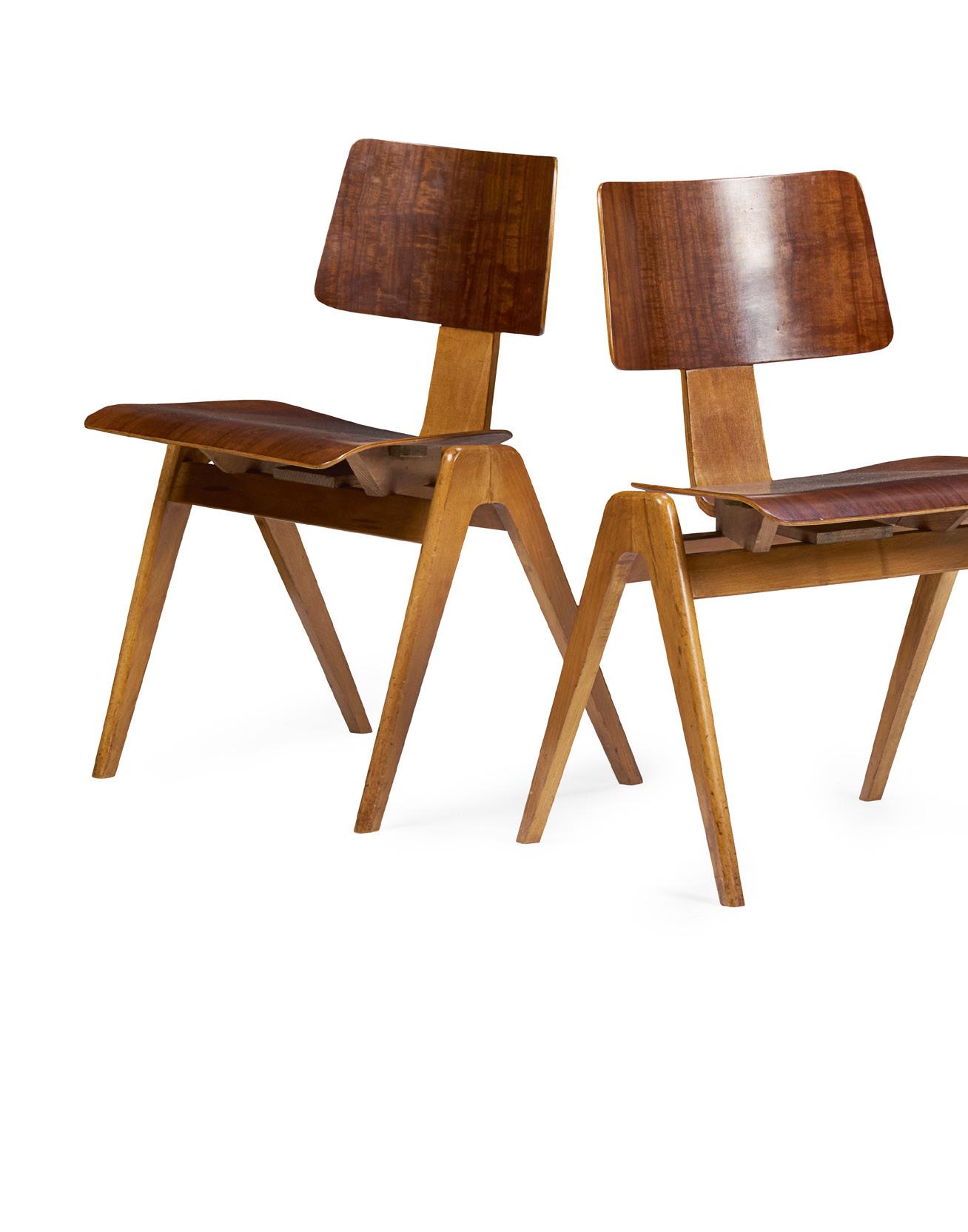
ROBIN DAY O.B.E.
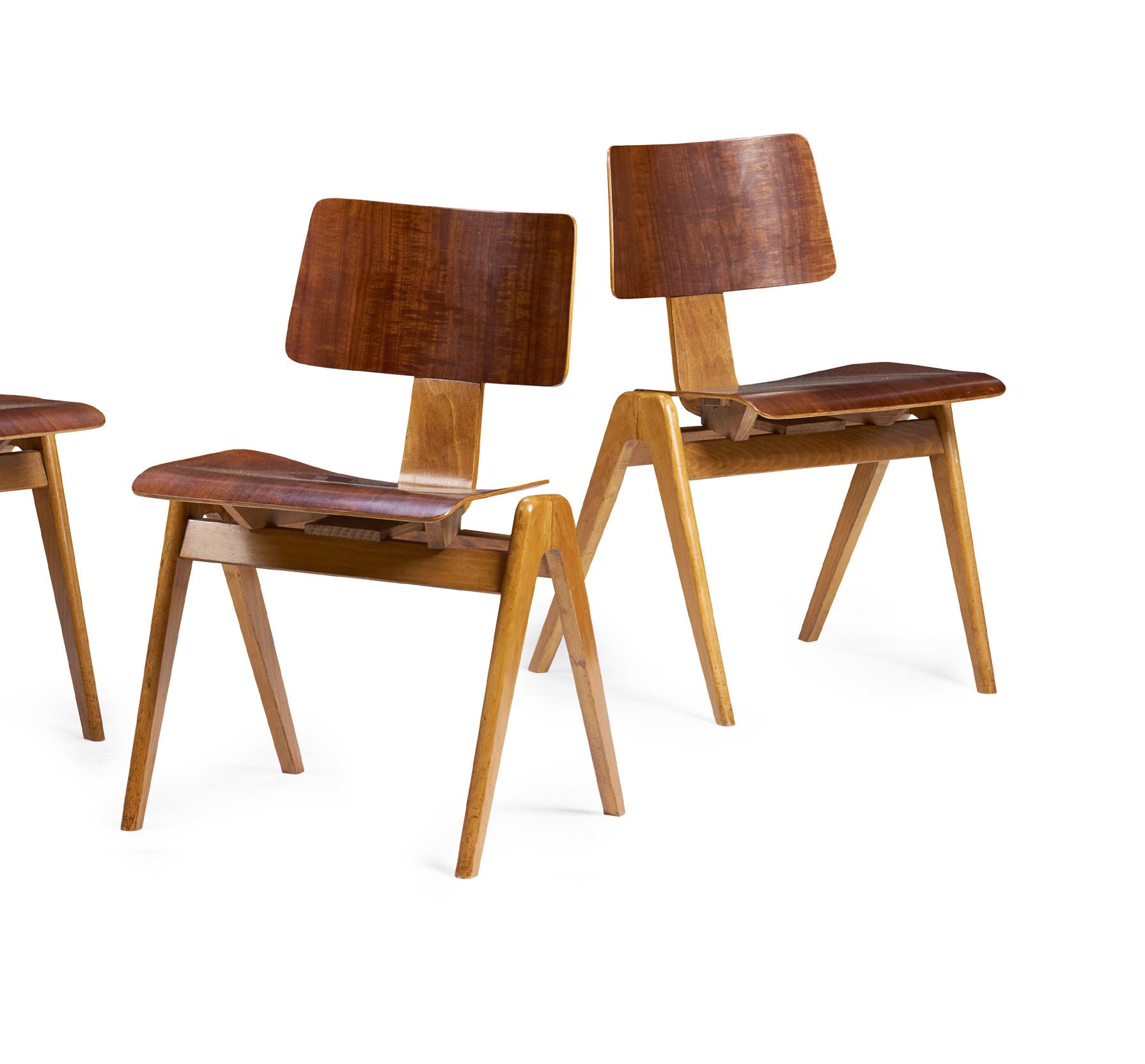
(BRITISH, 1915-2010) FOR HILLE SET OF FOUR ‘HILLESTAK’ CHAIRS, DESIGNED 1951
beech frame and moulded plywood seat
74.5cm high, 49cm wide, 42cm deep (29 3/8in high, 19 ¼in wide, 16 ½in deep) (4)
Literature: Jackson, Lesley, Robin & Lucienne Day: Pioneers of Contemporary Design, Hachette, London, 2011, p.33.
£600-800
The Hillestak was Robin Day’s first affordable, mass-produced design for Hille. Created during the era of government Utility restrictions, it was intended as a practical and economical solution, remaining in production until 1967. Early versions featured U-shaped dowelled leg joints, a detail that was revised in 1956.
95 §
ROBIN DAY O.B.E. (BRITISH, 1915-2010) FOR HILLE
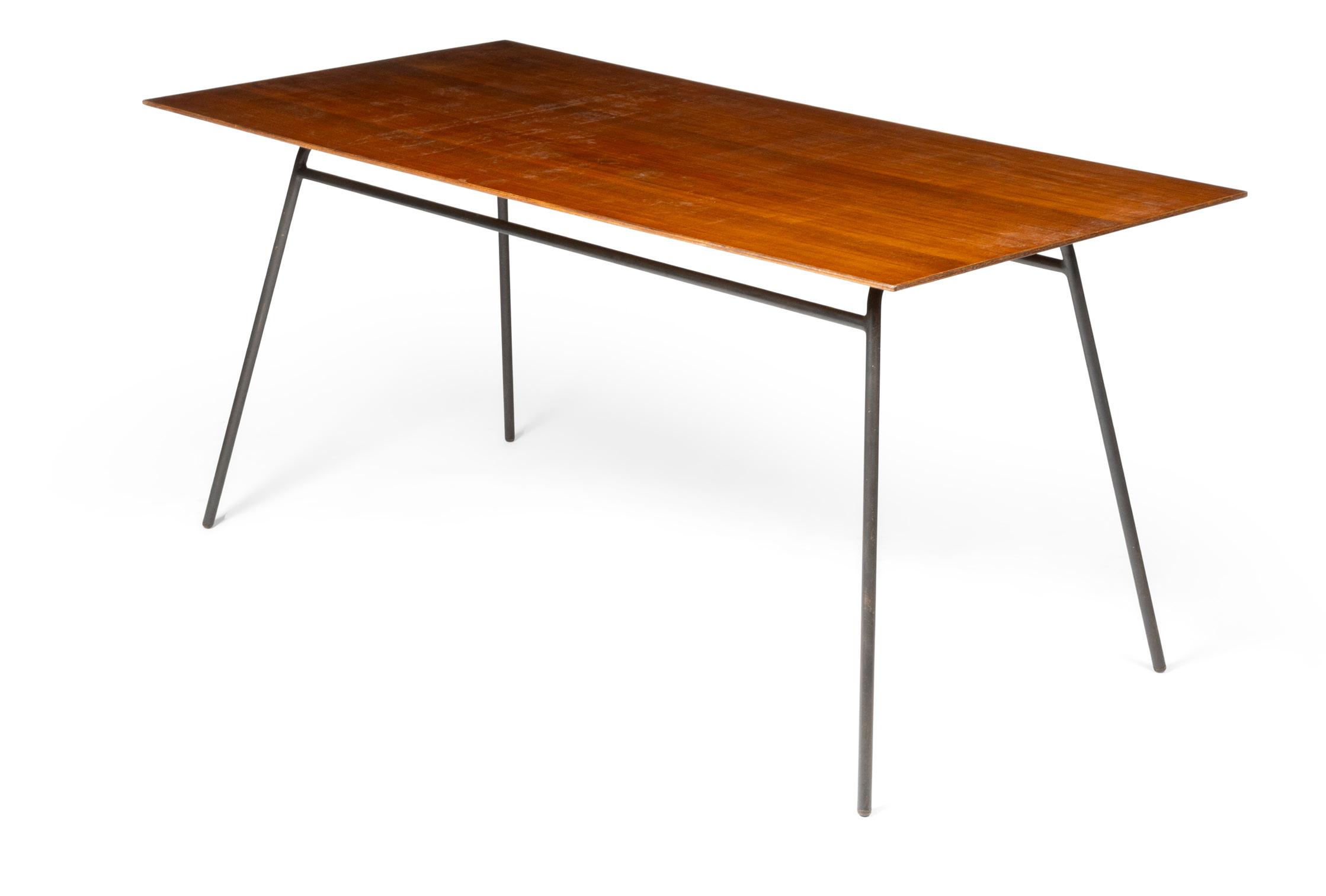
TABLE, DESIGNED 1952
model 677, manufacturer’s HILLE OF LONDON circular label (to underside), walnut and enamelled metal
72cm high, 152cm wide, 76cm deep (28 3/8in high, 59 ¾in wide, 30in deep)
Provenance: Private Collection, London.
Literature: Jackson, Lesley, Robin & Lucienne Day: Pioneers of Contemporary Design, Hachette, London, 2011, p.59 for an illustration of an original Hille Cabinets and Tablets leaflet from 1953-4 showing this model.
£600-800
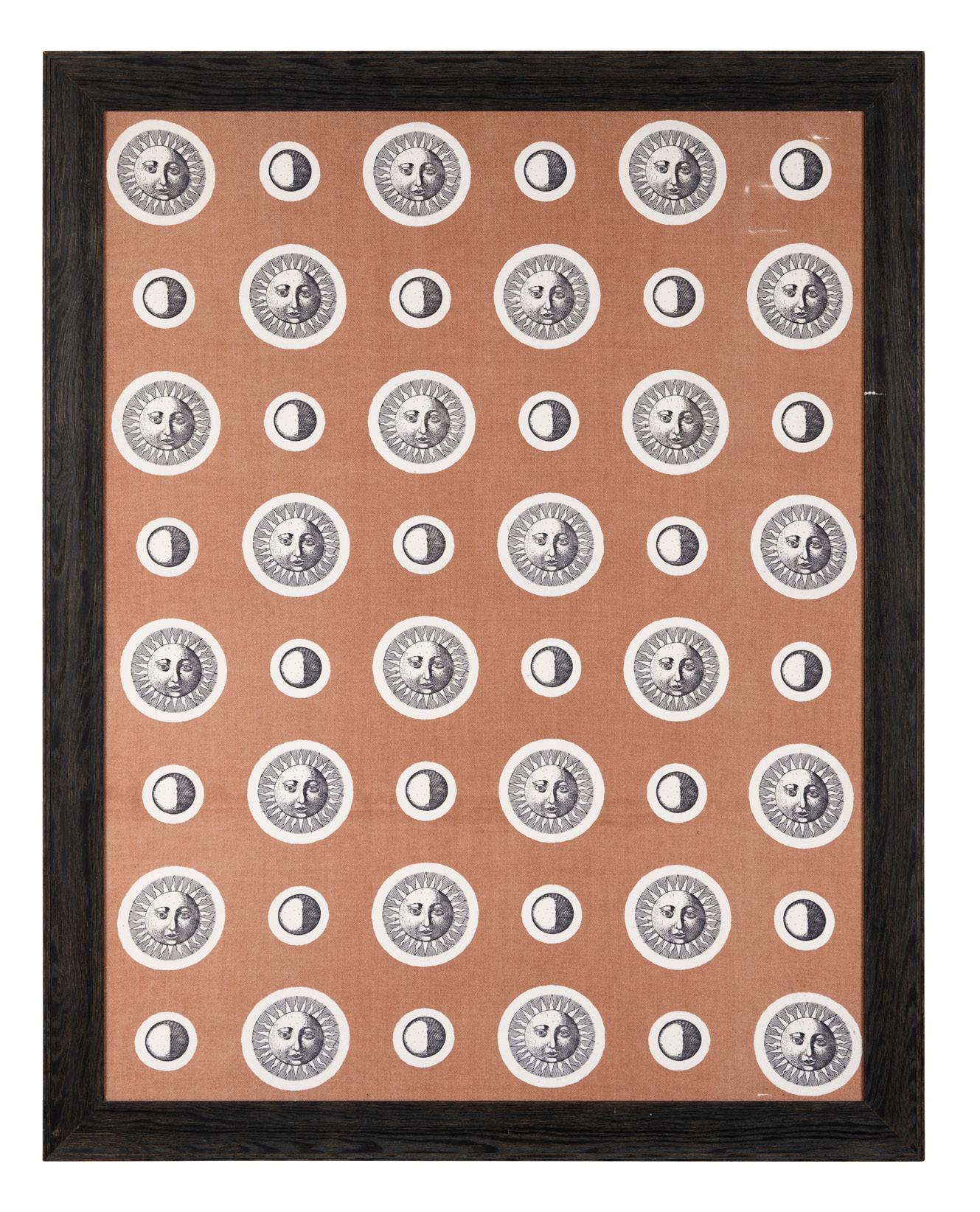
MITZI CUNLIFFE (AMERICAN 1918-2006) FOR DAVID WHITEHEAD LTD. SUN AND MOON PANEL, DESIGNED 1955-6
screenprint on cotton 113.5cm high, 87cm wide (44 5/8in high, 34 1/4in wide)
Literature: Ideal Home, June 1956, p.14; Peat, Alan, David Whitehead Ltd.: Artist Designed Textiles 1952-1969, Oldham, 1993, p.27; Stapleton, Annamarie Richard Chamberlain and Geoffrey Rayner, Austerity to Affluence: British Art and Design 1945-1962, Merrell Holberton, London, 1997, p.44, T23, for an example of this pattern in a differing colourway.
£300-500
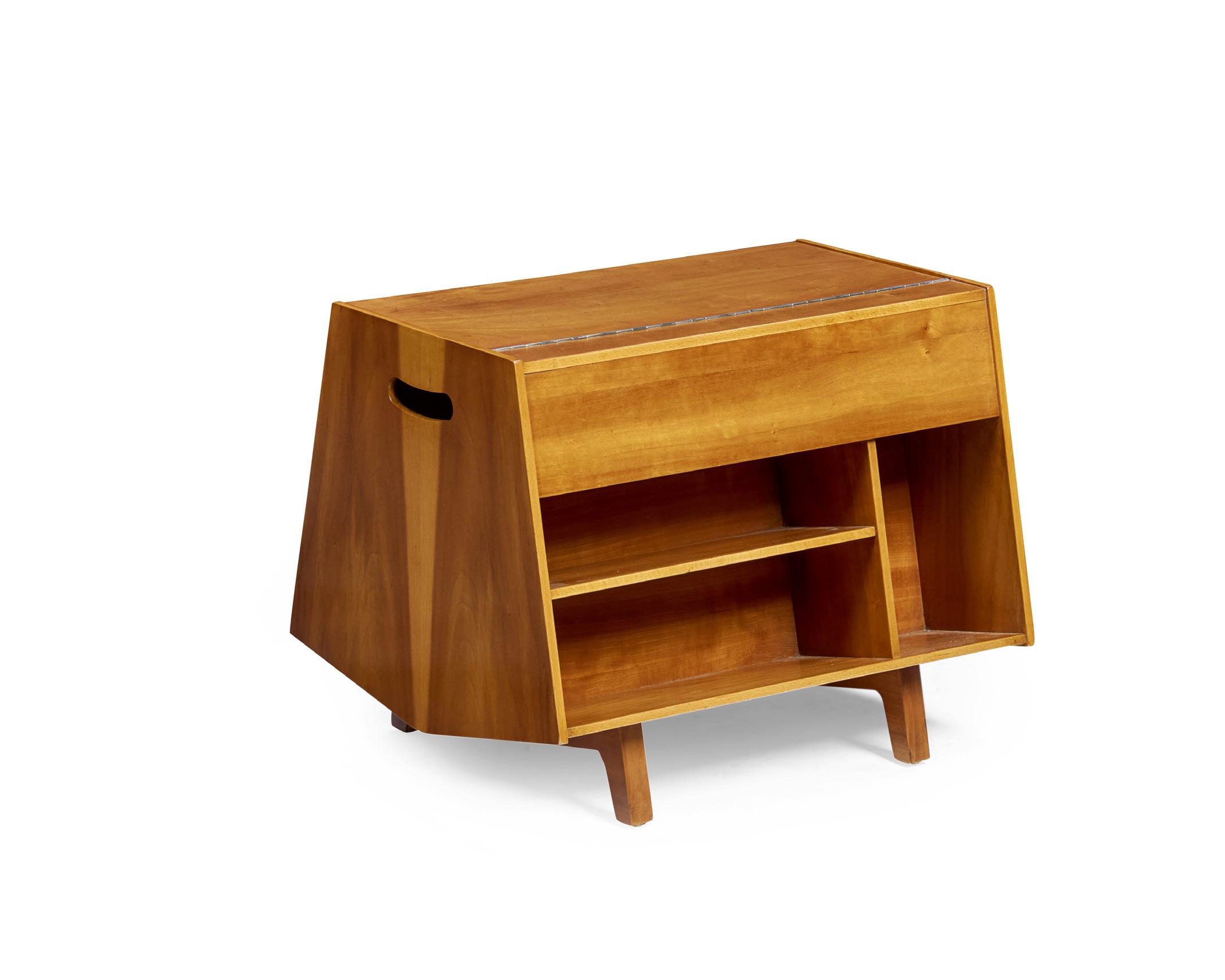
ERNEST RACE (BRITISH 1913-1964) FOR JOHN ALAN DESIGNS FOR ISOKON FURNITURE COMPANY, LONDON ‘BOTTLESHIP MARK 2’ COCKTAIL CABINET, DESIGNED 1963
American cherry laminated wood
43.5cm high, 55cm wide, 43cm deep (17 1/8in high, 21 5/8in wide, 16 7/8in deep)
Literature: Young, Dennis and Barbara, Furniture in Britain Today, London, 1964, n.p.; Grieve, Alastair, Isokon, London, 2004, p.43.
£700-1,000
98
JOHN & SYLVIA REID
(BRITISH 1925-1992 & 1924-2022)
ROTAFLEX LIGHTING LTD., LONDON
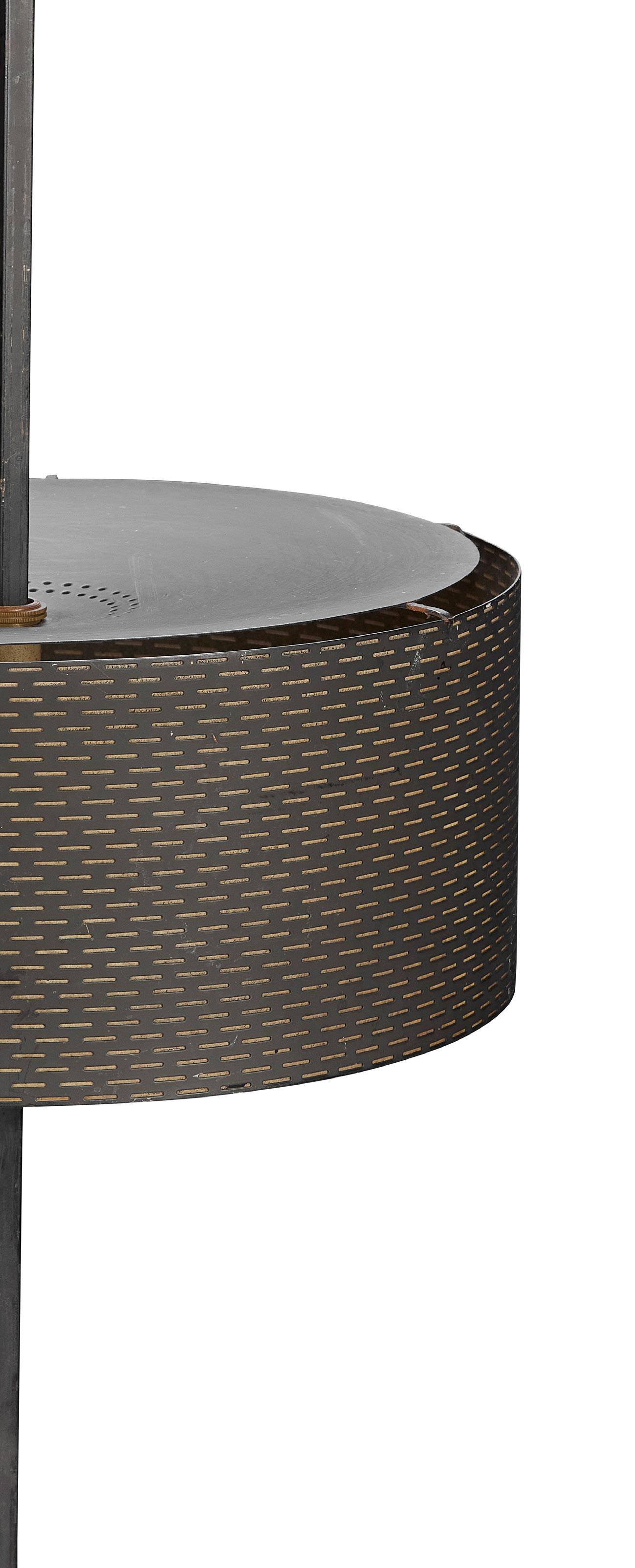
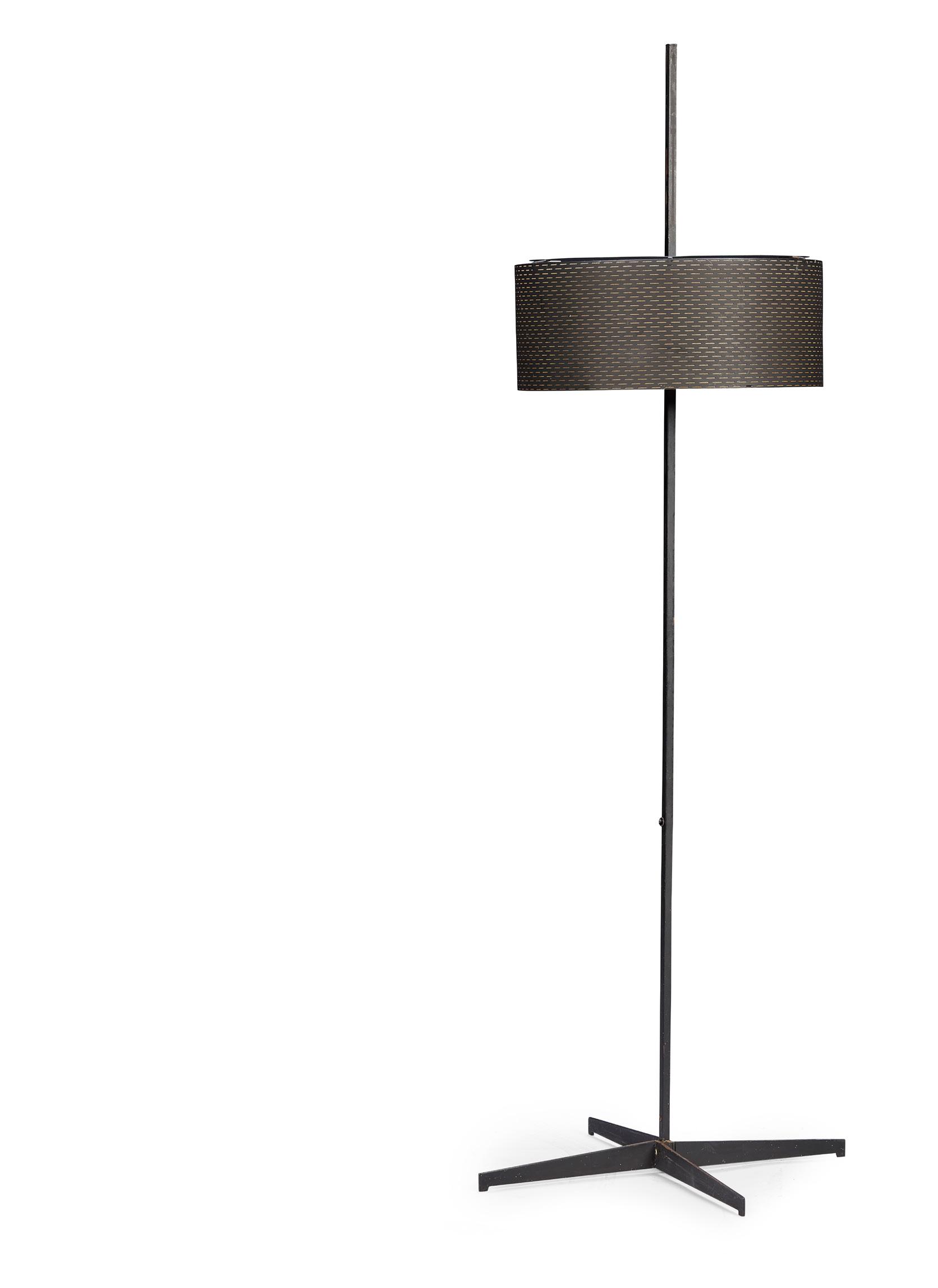
FLOOR LAMP, DESIGNED 1956
steel and brass fittings
154cm high (60 5/8in high); shade 40.8cm diameter (16in diameter)
Provenance: Private Collection, U.K.
Literature: Stapleton, Annemarie, Richard Chamberlain and Geoffrey Rayner, Austerity to Affluence: British Art & Design 194562, Merrell Holberton, London, 1997, p.101, PD38.
£2,000-3,000
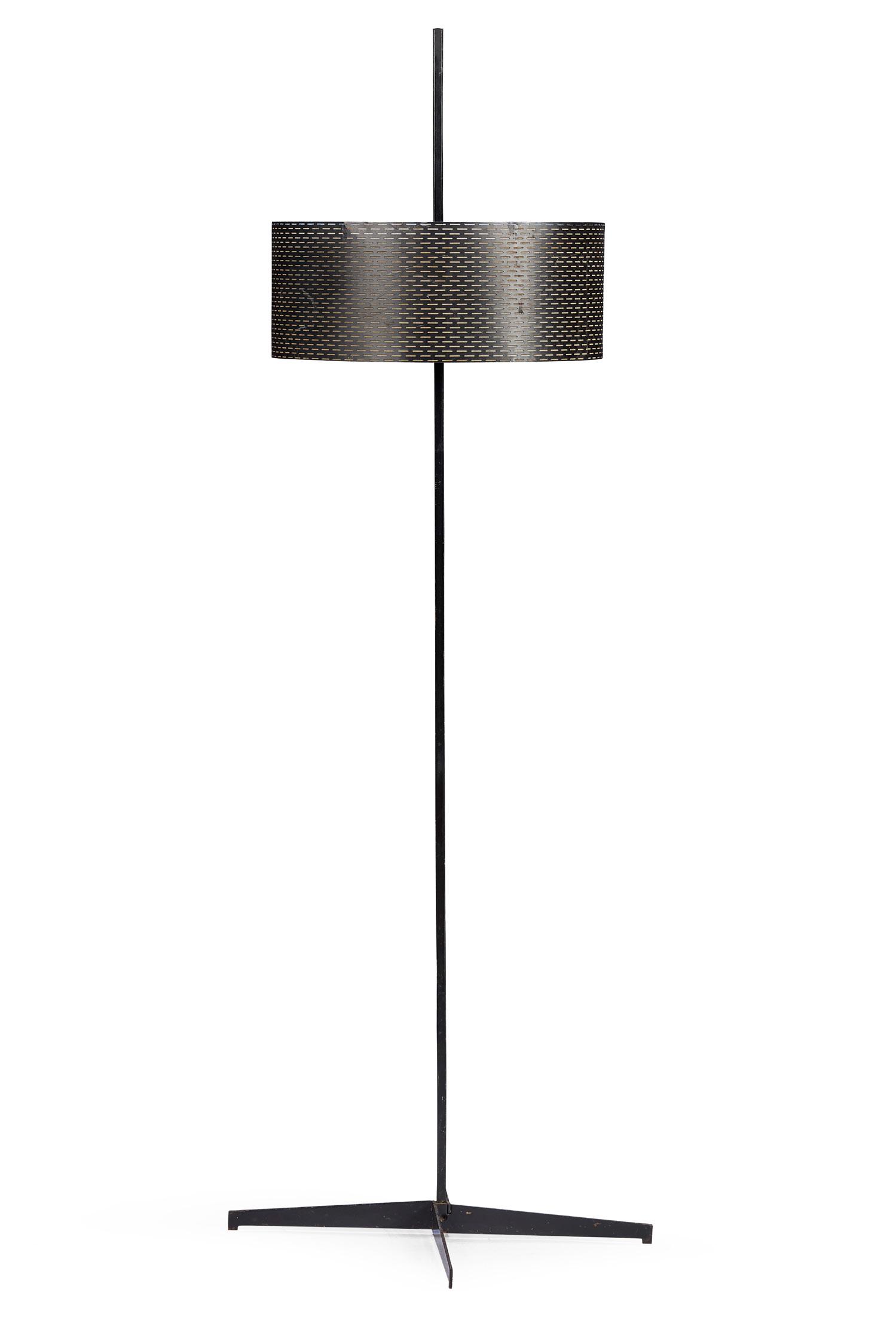
JOHN & SYLVIA REID (BRITISH 1925-1992 & 1924-2022)
FOR ROTAFLEX LIGHTING LTD., LONDON
FLOOR LAMP, DESIGNED 1956
steel and brass fittings
154cm high (60 5/8in high); shade 40.8cm diameter (16in diameter)
Provenance: Private Collection, London.
Literature: Stapleton, Annemarie, Richard Chamberlain and Geoffrey Rayner, Austerity to Affluence: British Art & Design 1945-62, Merrell Holberton, London, 1997, p.101, PD38.
£2,000-3,000
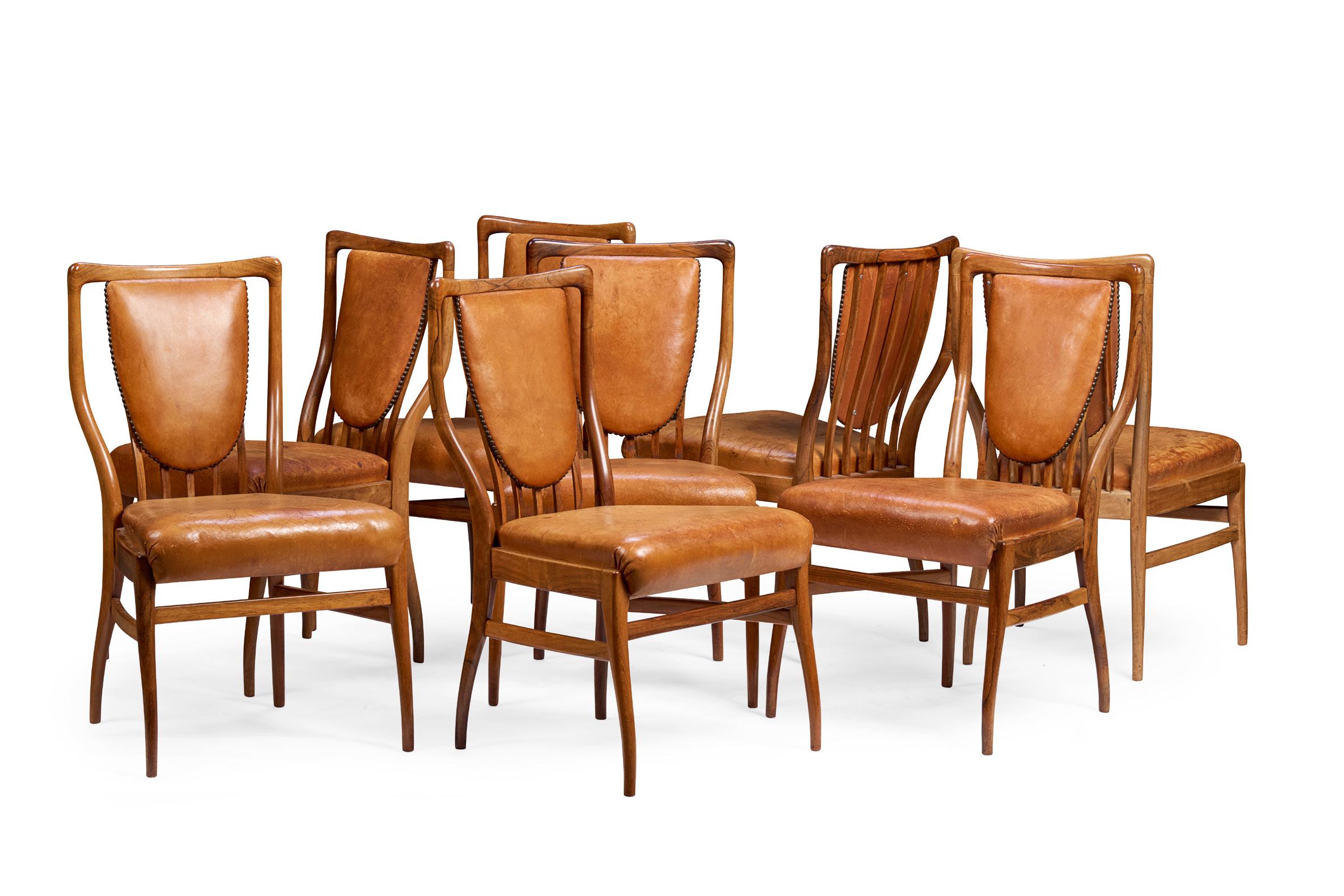
100 Y
ANDREW JOHN MILNE FOR HEALS & SONS LTD.
SET OF EIGHT CHAIRS
rosewood, with close nailed leather upholstery
90cm high, 52cm wide, 52cm deep (35 ½in high, 20 ½in wide, 20 ½in deep) (8)
Literature: Geoffrey & Richard Chamberlain, Austerity to Affluence: British Design 1945-1962, London, 1997, p. 29, cat. no.F51 (for example of the armchair illustrated).
Note: Sold in compliance with CITES regulations, with (non-transferable) Transaction Specific Certificate no. 26GBA10XMPM5G.
£1,200-1,800
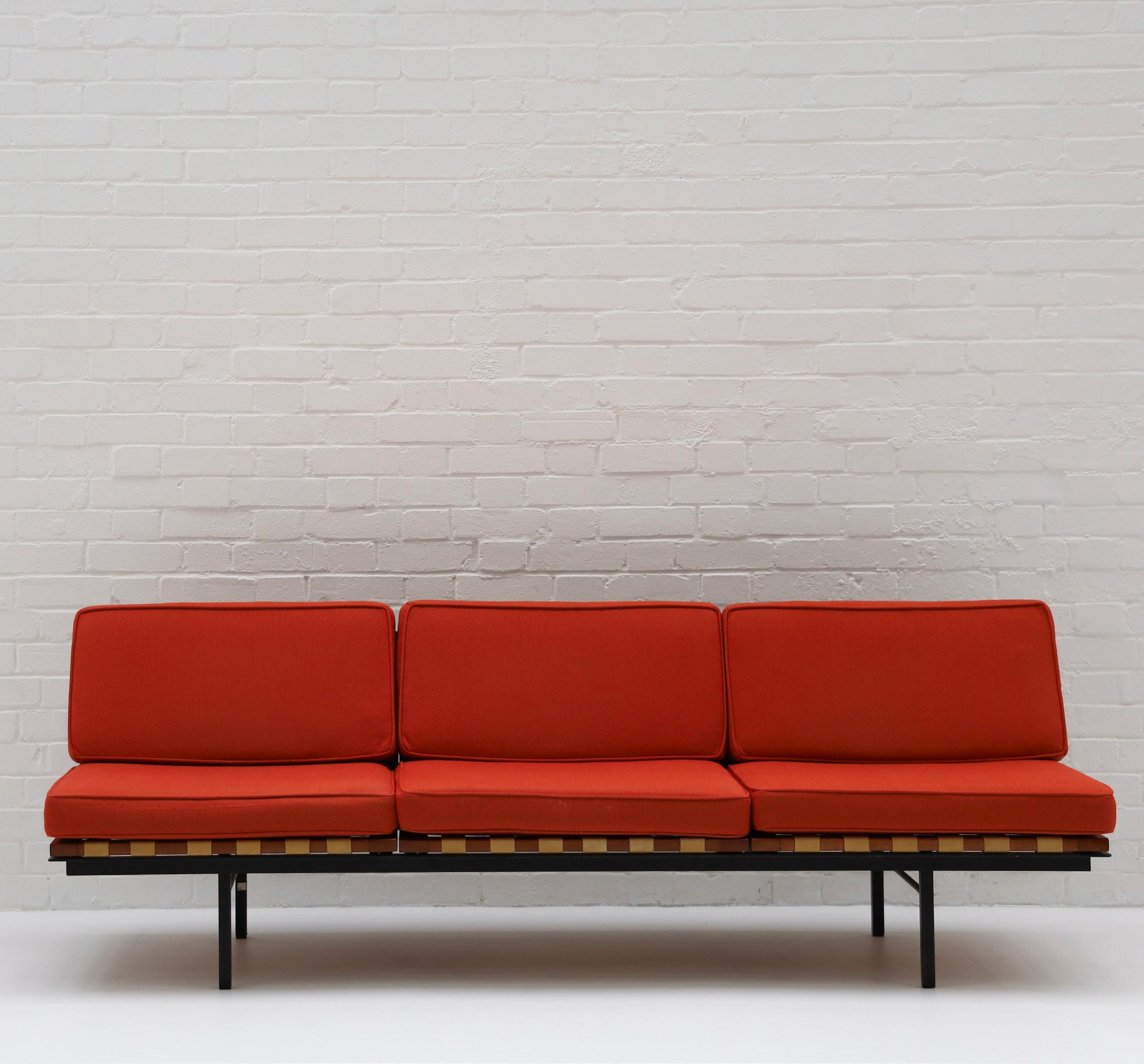
ROBIN DAY O.B.E. (BRITISH, 1915-2010)
‘FORM GROUP’ SOFA, DESIGNED 1960
enamelled steel frame with three mahogany seat frames, Pirelli webbing, and upholstered cushions
76cm high, 220cm wide, 70cm deep (30in high, 86 5/8in wide, 27 ½in deep)
Literature: Jackson, Lesley, Robin & Lucienne Day: Pioneers of Contemporary Design, Hachette, London, 2011, p.65 illustrating examples of the Form Group range.
£700-900
Designed by Robin Day for Hille, the ‘Form Group’ range was conceived as a modern alternative to the traditional three-piece suite and marked his first modular seating system, highlighting his innovative approach to furniture design. It received a Design Centre Award in 1961. The system allowed seating elements to be arranged alongside tables and drinks cabinets, with cushions supported by rubber webbing instead of conventional springs.
103 §
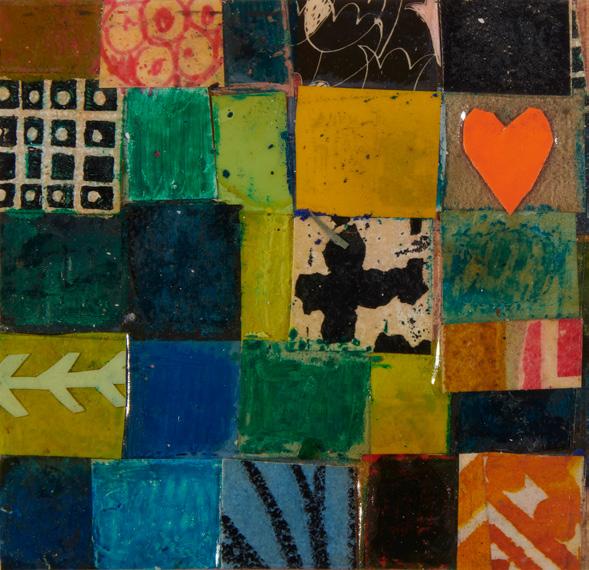
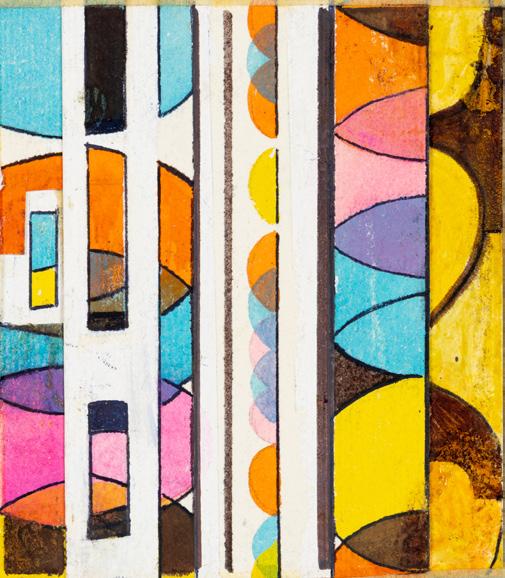
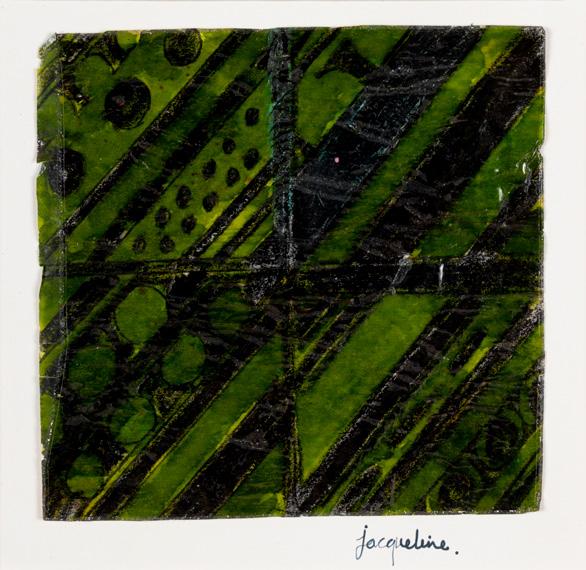
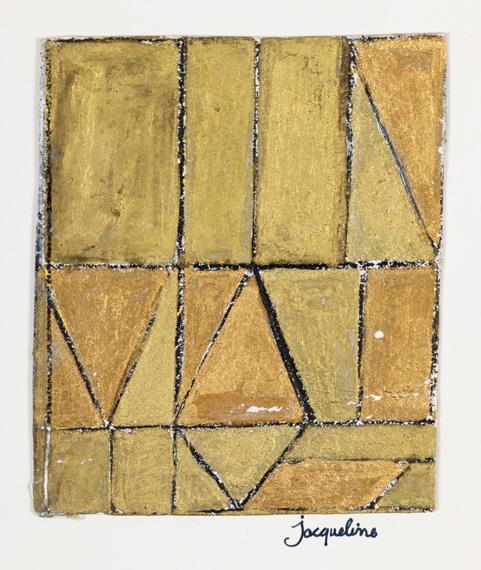
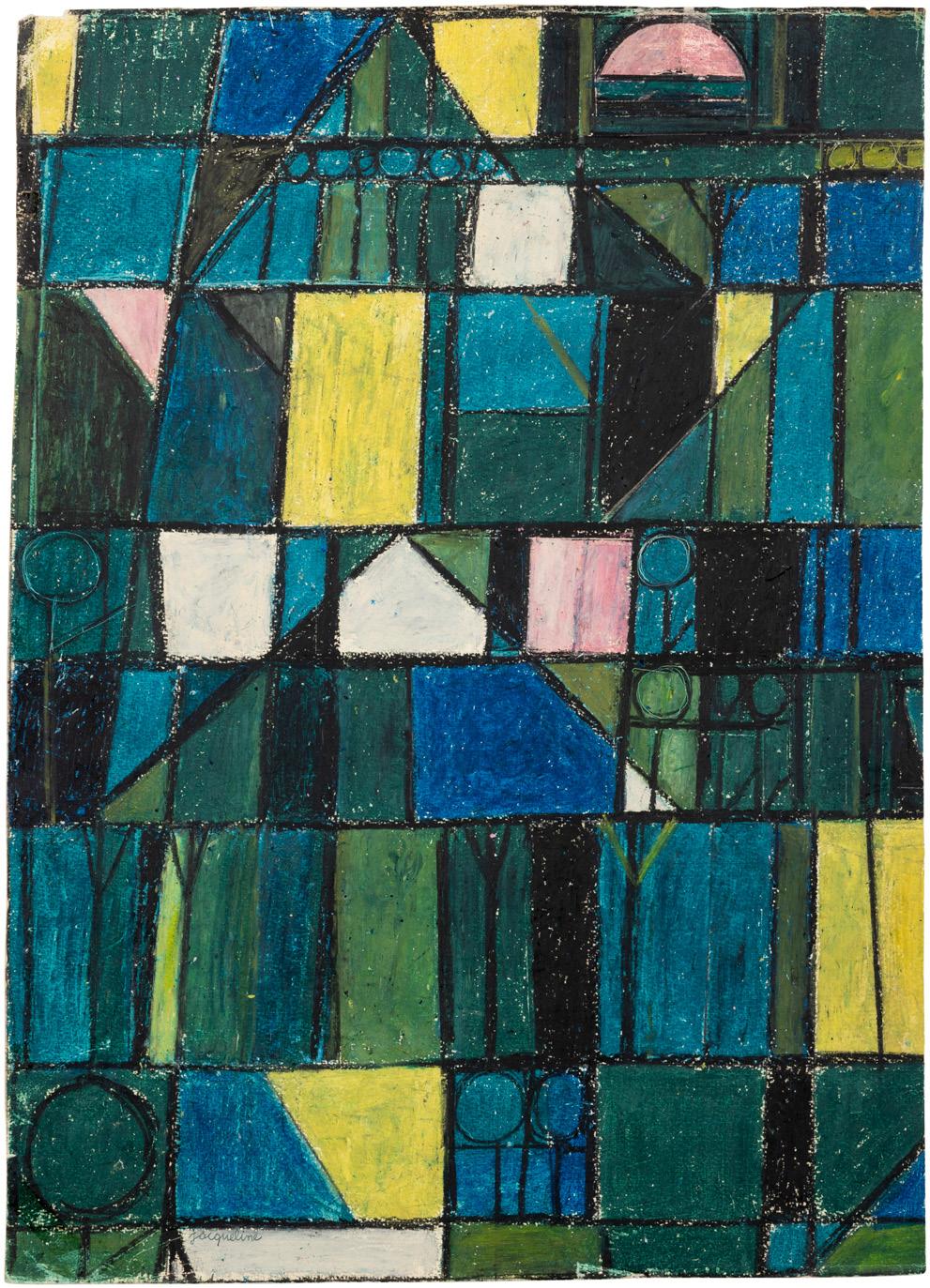
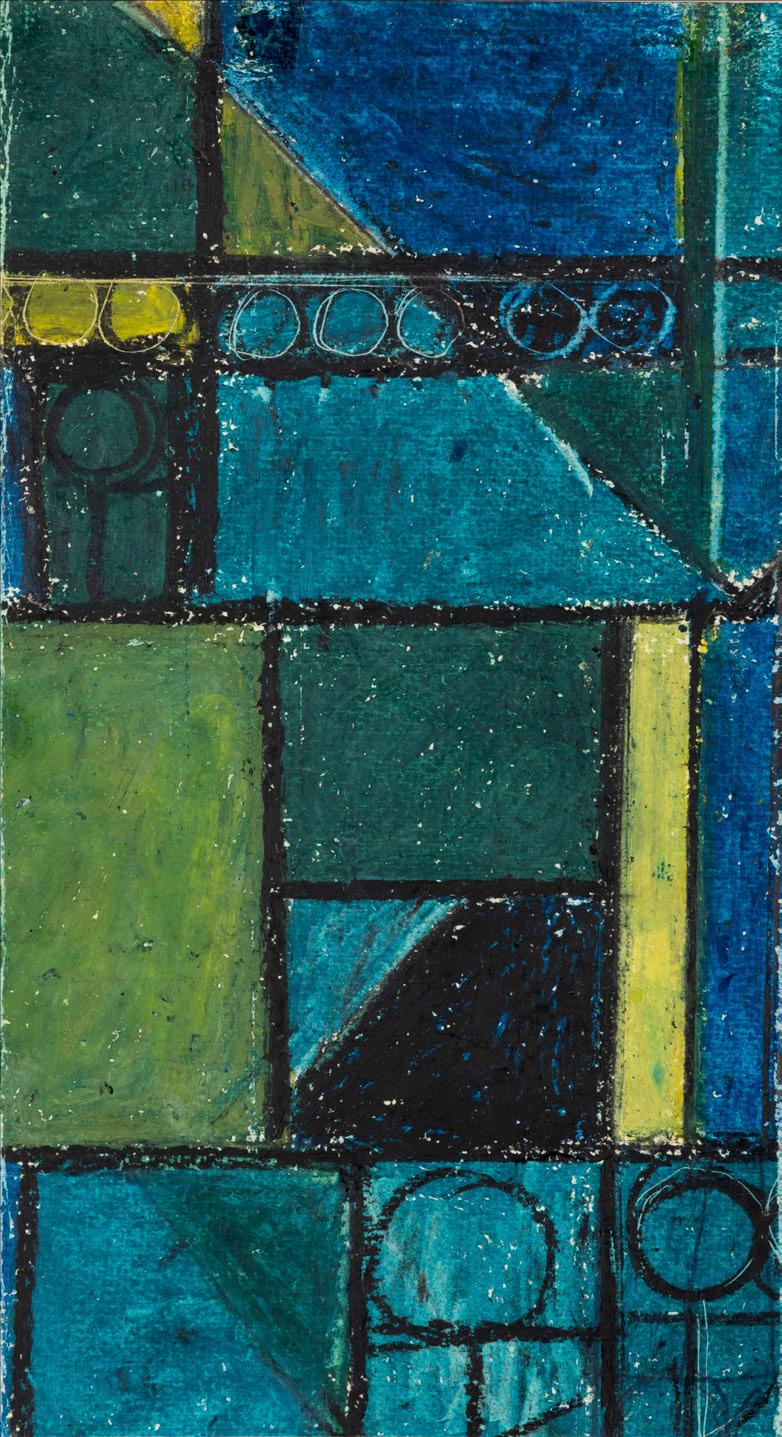
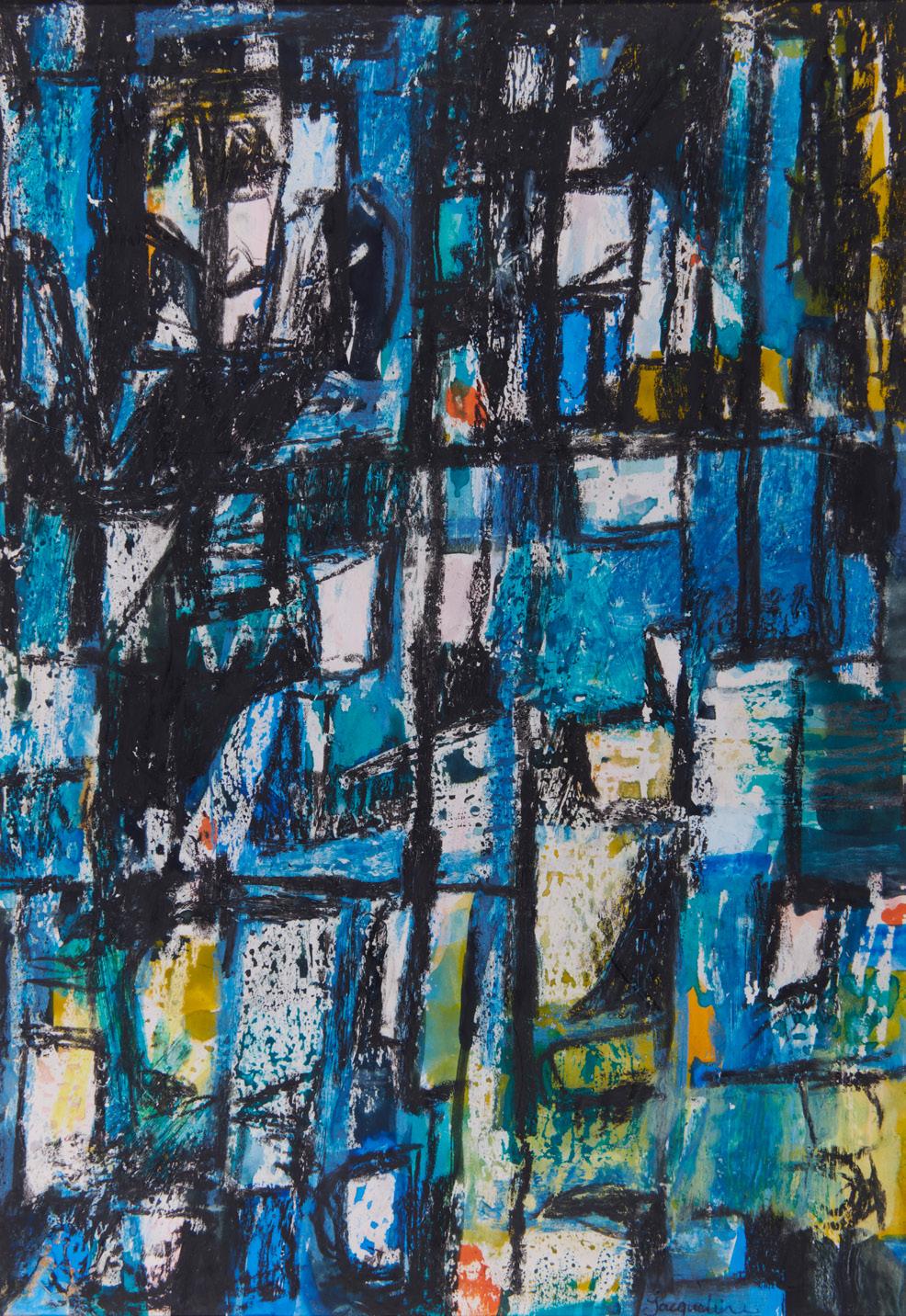
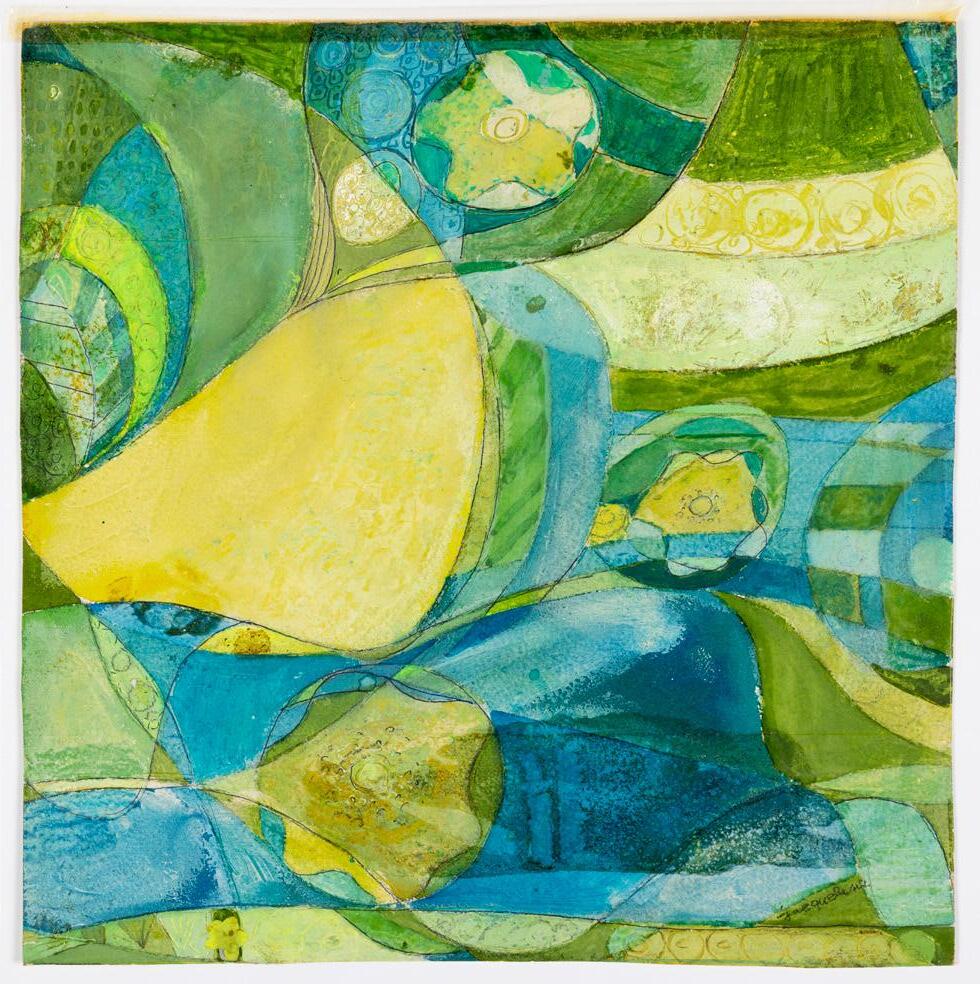
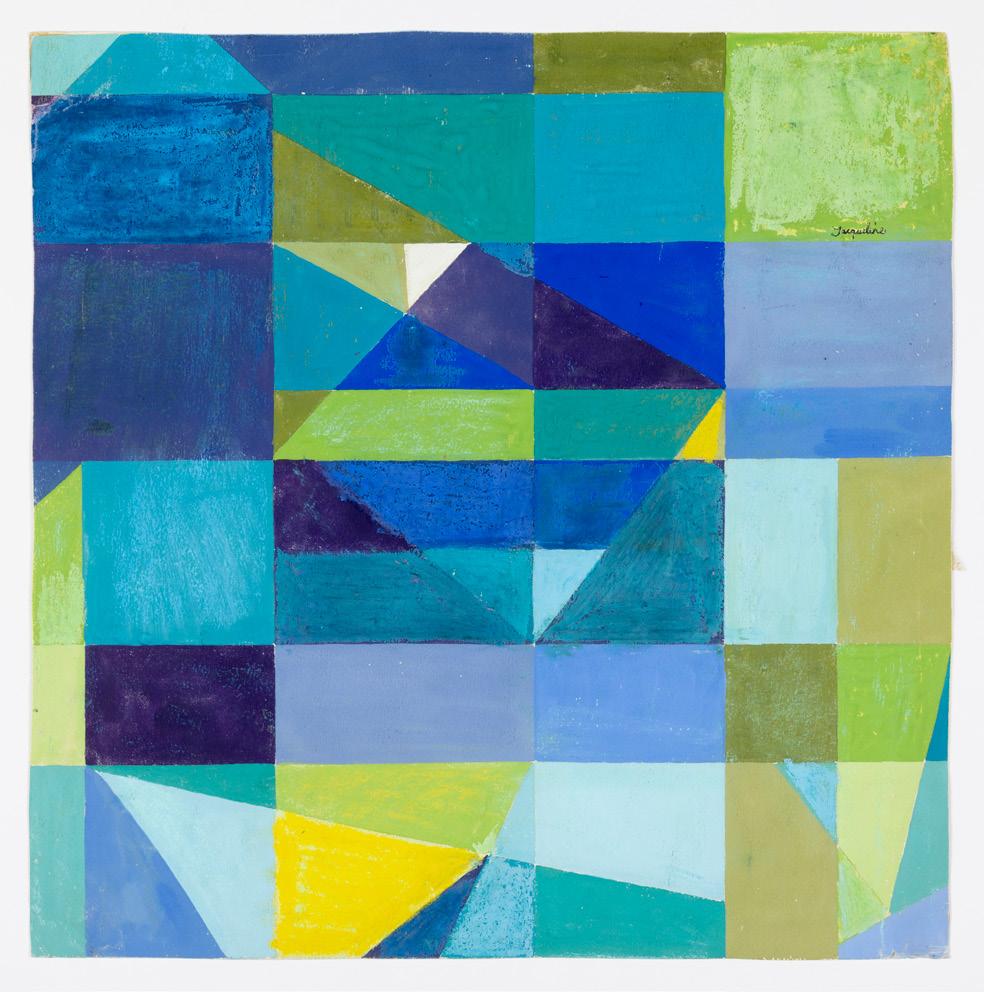
JACQUELINE GROAG (CZECH 1903-1986)
THREE STUDIES
signed in pen in margin (lower right), pen, ink and gouache on acetate; signed in pen in margin (lower right),pen, ink and oil on paper; and signed in pen in margin (lower right), ink and gouache on acetate on paper
9.5cm x 9.5cm ( 3 ¾in x 3 ¾in), 10.5cm x 9cm (4 1/8in x 3 ½in) and 13.5cm x 15.5cm (5 ¼in x 16 1/8in), unframed (3)
Provenance: Private Collection.
£500-700
The textile designs of Jacqueline Groag (née Hilde Pick) stand among the most distinctive and influential contributions to twentieth-century modern design. Renowned for their rhythmic patterning, vibrant colour, and clarity of form, her works helped to define an international visual language that bridged continental modernism and postwar British design.
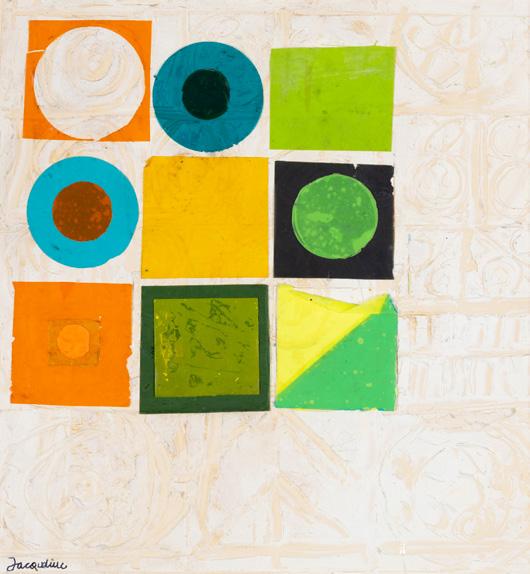
JACQUELINE GROAG (CZECH 1903-1986)
TWO UNTITLED DESIGNS
collage and acetate on paper; and pen, ink, gouache, watercolour and collage on paper
9.7cm x 10cm (3 7/8in x 4in) and 8.5cm x 9.7cm (3 3/8in x 3 ¾in), unframed (2)
Provenance: Private Collection.
£300-500
104 §
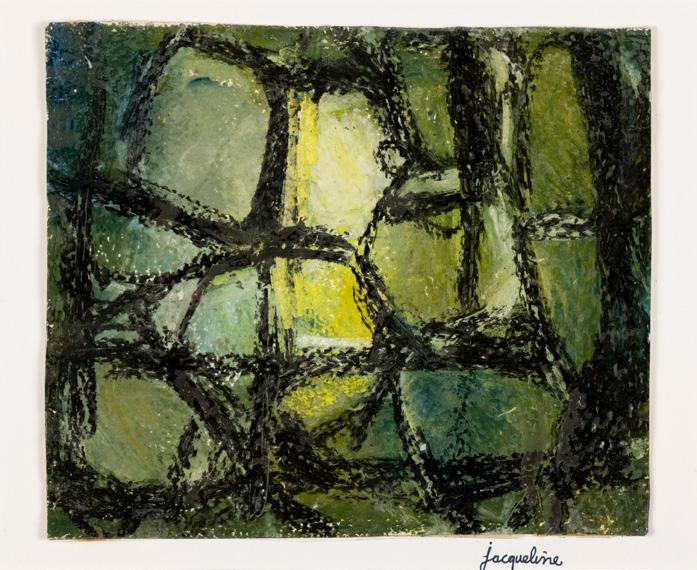
JACQUELINE GROAG (CZECH 1903-1986)
TWO UNTITLED DESIGNS
signed in pen (lower left), oil and collage on paper; and signed in ink (lower right), pen, ink and oil on paper
19.5cm x 18cm (7 5/8in x 7in) and 29.5cm x 18.3cm (11 5/8in x 7 ¼in), unframed (2)
Provenance: Private Collection.
£500-700
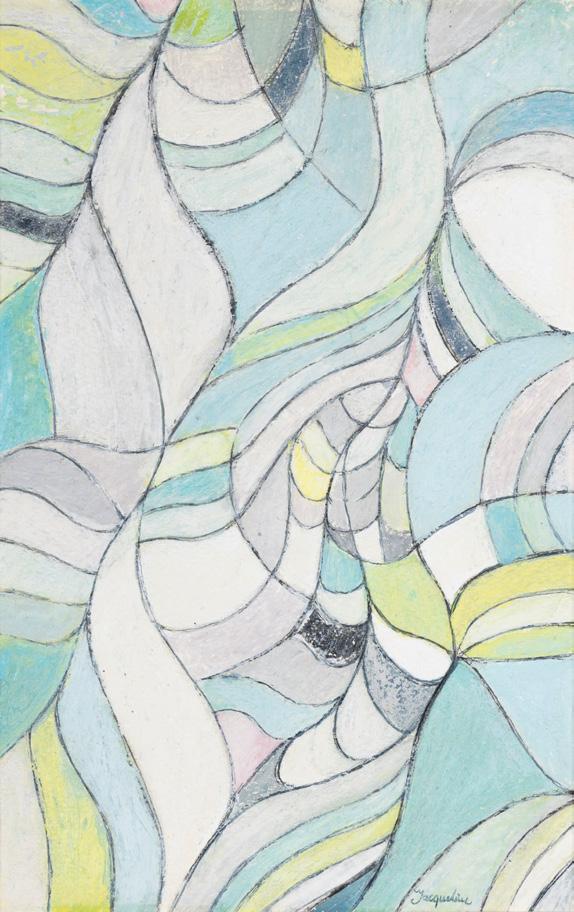
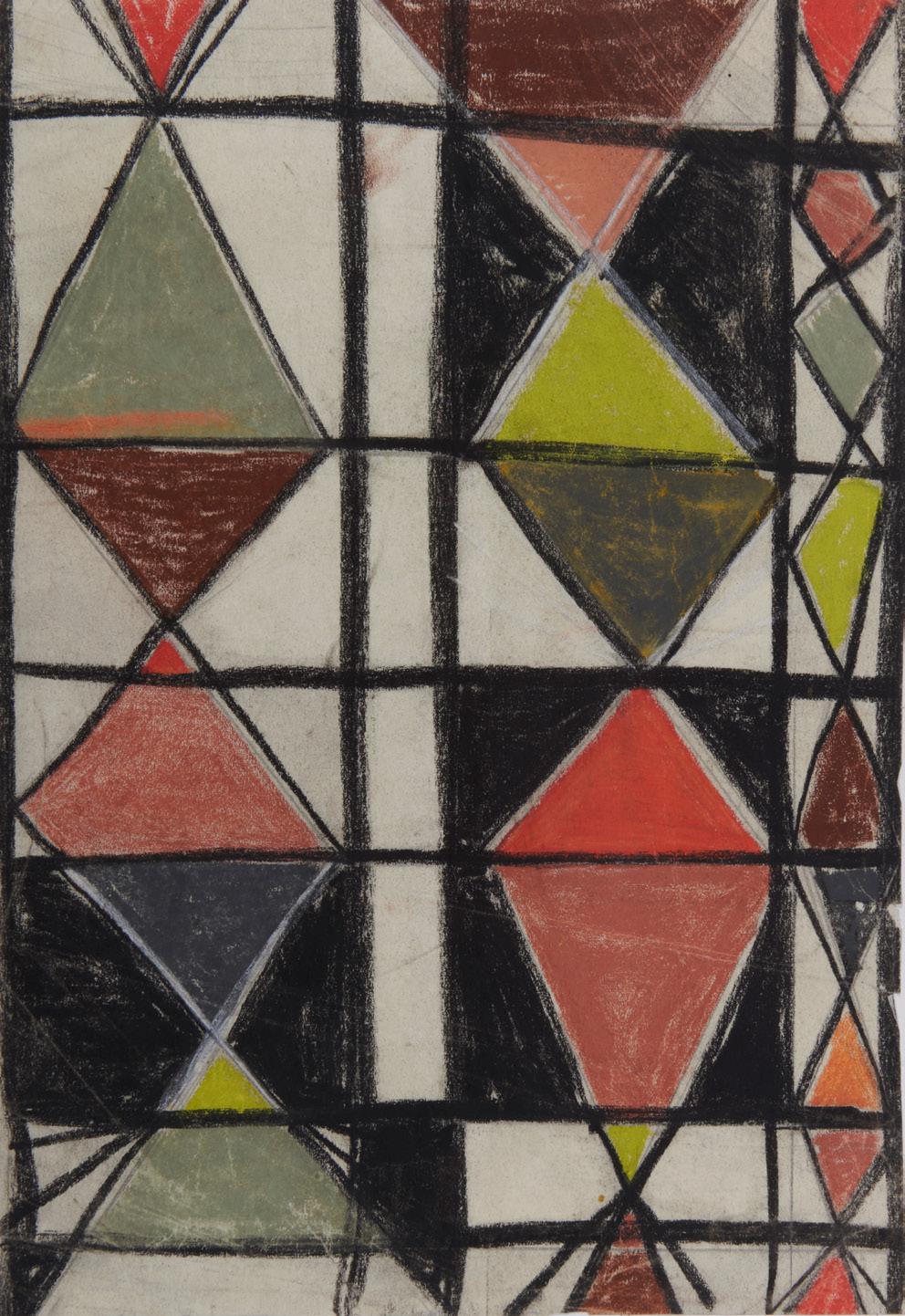
JACQUELINE GROAG (CZECH 1903-1986)
UNTITLED
signed in pen in margin (lower right), pastel on paper
30cm x 21cm (11 ¾in x 8 ¼in), unframed
Provenance: Private Collection.
£600-800
Born in Prague in 1903, Groag trained in Vienna during the 1920s, where she studied textile design in the progressive environment of the Wiener Werkstätte. This formative experience instilled in her a commitment to the integration of art, craft, and industry - principles that would remain central to her practice throughout her career. In 1939, following the Nazi invasion of Czechoslovakia, Groag and her husband, the architect and interior designer Jacques Groag, fled to London. There, they established a new life and creative partnership that would profoundly shape British modern design.
106 §
JACQUELINE GROAG (CZECH 1903-1986)
UNTITLED
signed in pen (lower left), pen, ink, oil and gouache on paper 54cm x 38.5cm (21 ¼in x 14 ¼in), unframed
Provenance: Private Collection.
£500-700
In London, Groag’s career flourished. She quickly established herself at the forefront of the textile industry, producing designs for an impressive range of clients, from leading fashion houses such as Chanel, Liberty, and Schiaparelli to major public and commercial bodies including British Rail and London Transport. Her work extended across an extraordinary variety of applications - fashion textiles, furnishing fabrics, wallpapers, carpets, and printed ephemera - each characterised by a refined balance of structure and spontaneity. Rooted in modernist principles yet animated by a playful and intuitive sensibility, her designs are both rigorously composed and immediately recognisable.
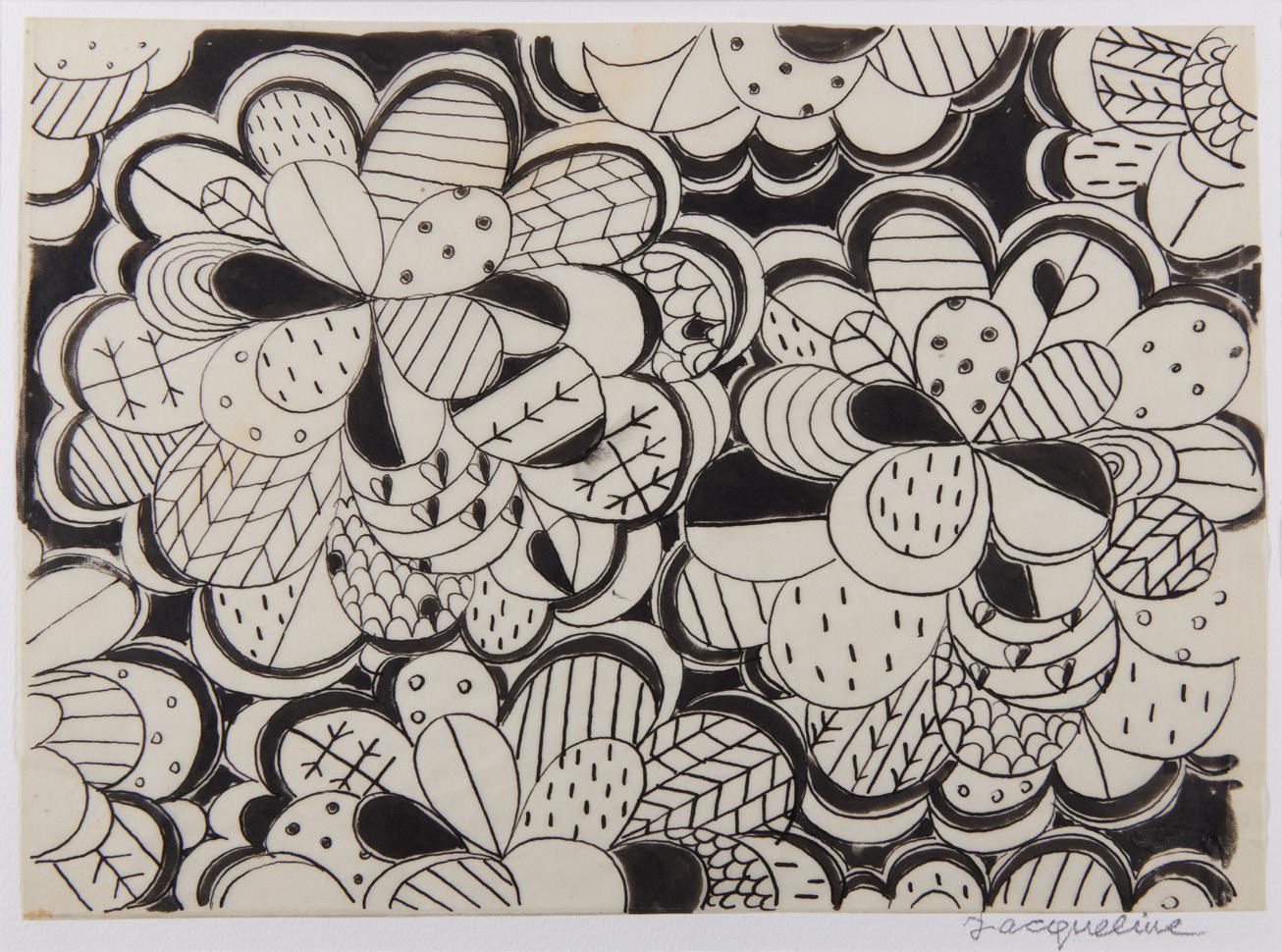
107 §
JACQUELINE GROAG (CZECH 1903-1986) FLOWERS
signed in pencil in margin (lower right), pen and ink on tracing paper
16.2cm x 23cm (6 3/8in x 9in), unframed
Provenance: Private Collection.
£300-500
108 §
JACQUELINE GROAG (CZECH 1903-1986)
UNTITLED
signed in ink in margin (lower right), ink, oil and watercolour on paper
26.7cm x 14.5cm (10.5in x 5 ¾in), unframed
Provenance: Private Collection.
£400-600
109 §
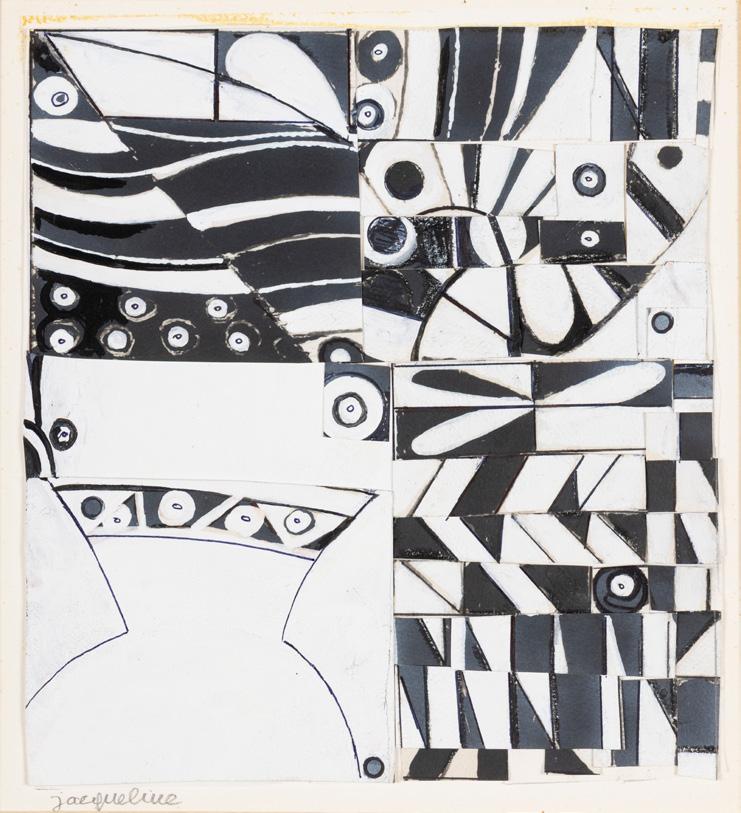
JACQUELINE GROAG (CZECH 1903-1986)
FOUR UNTITLED DESIGNS
signed in ink in margin (lower right), collage on paper; signed in pencil in margin (lower left), collage on paper; ink on acetate and silver paper; and signed in pen in margin (lower right), pen and ink
19cm x 24.5cm (7.5in x 9 5/8in); 19cm x 17.5cm (7.5in x 6 ¾in), 22cm x 22.5cm (8 5/8in x 8 7/8in) and 16.8cm x 24.8cm (6 5/8in x 9 ¾in), unframed (4)
Provenance: Private Collection.
£800-1,200
Building on her contribution to the 1946 Britain Can Make It exhibition at the V&A, Groag reached a defining moment in her British career with her involvement in the Festival of Britain in 1951. For this landmark event, she produced textile designs that captured the Festival’s spirit of optimism and renewal, most notably a curtain of simulated, threaded bones for the Dome of Discovery’s Living World exhibition. This work exemplified her ability to align a distinctly modernist visual language with the broader aims of post-war progress and public engagement. Her contribution not only consolidated her standing within the British design community but also highlighted her skill in translating avant-garde ideas into forms that were both functional and widely accessible.
110 §
JACQUELINE GROAG (CZECH 1903-1986)
‘AIRBORN’ AND UNTITLED
signed (lower right), titled and inscribed DESIGN BY JACQUELINE GROAG LONDON (to reverse of mount), pen, ink, watercolour and oil on card; and signed in pen (upper right), oil on paper
28.7cm x 28.7cm (11 3/8in x 11 3/8in) and 40.5cm x 40.5cm (15 7/8in x 15 7/8in), unframed (2)
Provenance: Private Collection.
£1,000-1,500
111 §
JACQUELINE GROAG (CZECH 1903-1986) WINDOW
signed in pen (lower right), inscribed and titled in pencil (to reverse), pen, ink and oil on paper
28.8cm x 20cm (11 3/8in x 7 7/8in), unframed
Provenance: Private Collection.
£400-600
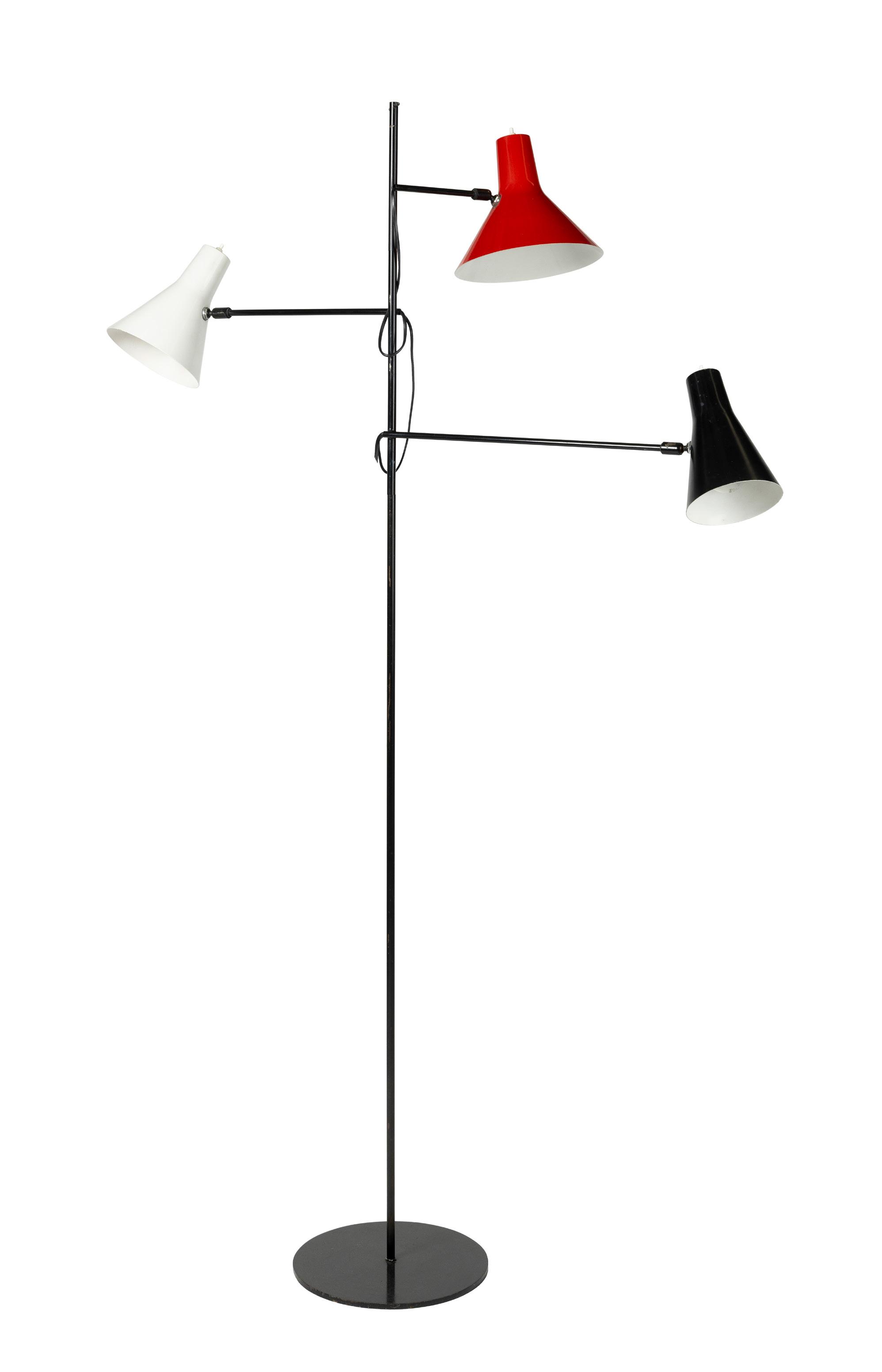
Although Bernard Schottlander is widely recognised for his largescale sculptural works, his earliest creative achievements were in the field of lighting design. Born in Mainz, Germany, he emigrated to Britain in 1939, settling in Leeds after fleeing the political climate of his homeland. There he worked initially as a welder and undertook wartime service before enrolling at the Leeds College of Art to study sculpture. He later continued his training in London at the St John’s Wood Art Centre and the Central School of Art and Design, graduating in industrial design in 1951.
That same year Schottlander established a small workshop in Swiss Cottage, London, from which he began designing and fabricating lighting by hand. Working largely on his own, he produced a series of striking and inventive lamps that combined the precision of metalworking with the formal sensibility of sculpture. His early designs quickly attracted attention, and by 1952 they were prominently featured in an Architectural Review article highlighting innovative lighting being developed by contemporary British and European designers.
BERNARD SCHOTTLANDER (BRITISH 1924-1999)
FLOOR LAMP, c.1957
painted aluminium and steel
178.5cm high, 70cm wide (70 ¼in high, 27 ½in wide)
Provenance: Target Gallery, London; Private Collection, U.K.
£4,000-7,000
Schottlander’s early output included a number of distinctive multi-arm lamps produced in very small numbers, often assembled using carefully balanced metal frameworks and adjustable shades. The present example, likely dating from around the mid-1950s, demonstrates his characteristic approach. Rising from a slender vertical structure, three arms extend at varying heights and support coloured metal shades, each adjustable to direct light as required. The use of different coloured shades reflects the optimistic palette associated with post-war British design and recalls the aesthetic atmosphere of the Festival of Britain era.
The design exemplifies Schottlander’s interest in combining functional lighting with sculptural composition. The asymmetrical arrangement of arms and the interplay of colour and metal lend the lamp a strong architectural presence while retaining a sense of lightness and movement.
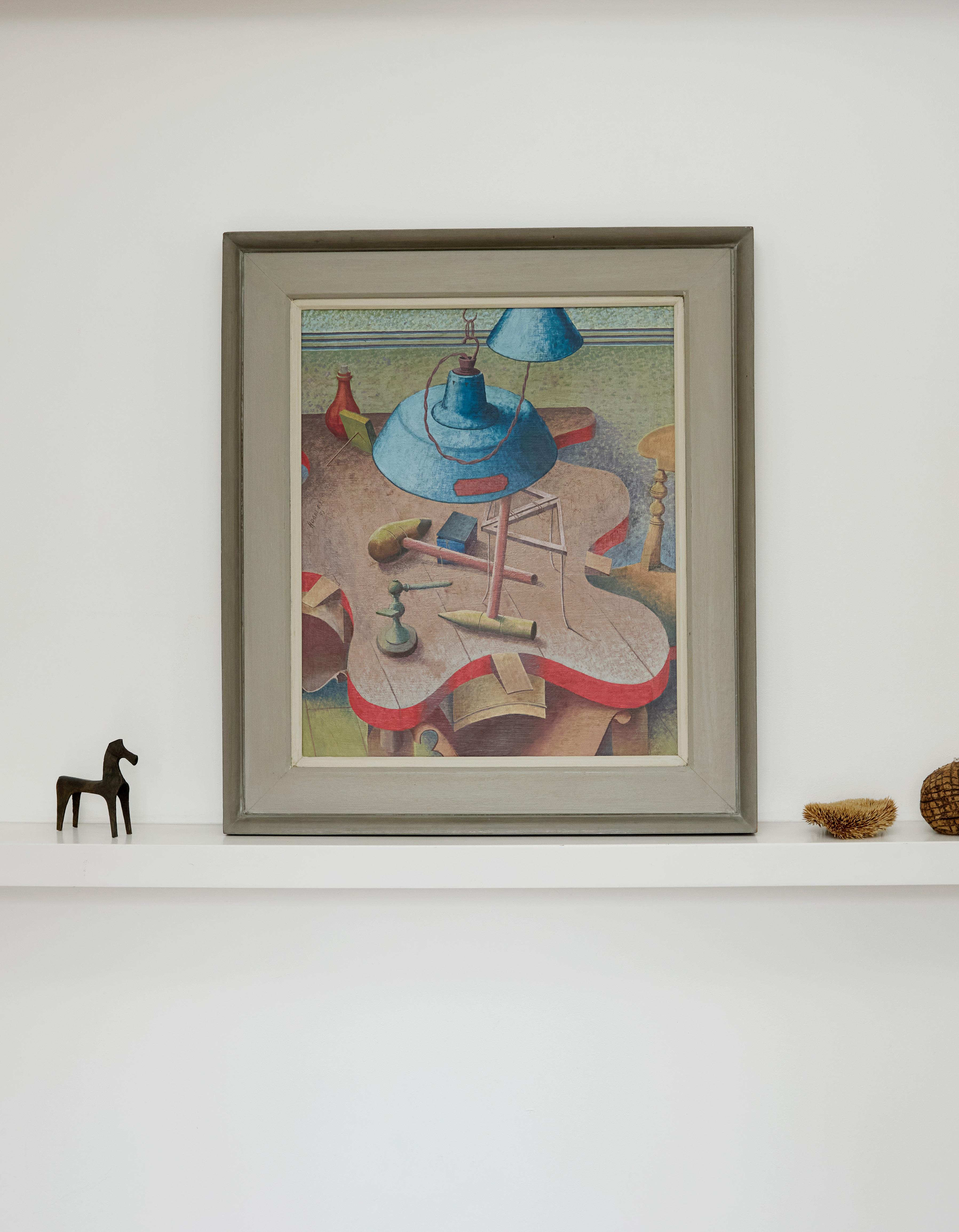
113 §
HARRY HOODLESS (BRITISH 1913-1979)
BENCH COMPOSITION, 1937
signed and dated (centre left); further signed and dated (to reverse), tempera on board 55.5cm x 46.5cm (21 ¾in x 18 ¼in)
Provenance: Bonham’s Knightsbridge, Modern Pictures, 17 May 2011, lot 128, where acquired by the present owner.
Exhibited: Williamson Art Gallery, Birkenhead, Wirral Society of Arts Exhibition, 1954.
£3,000-5,000
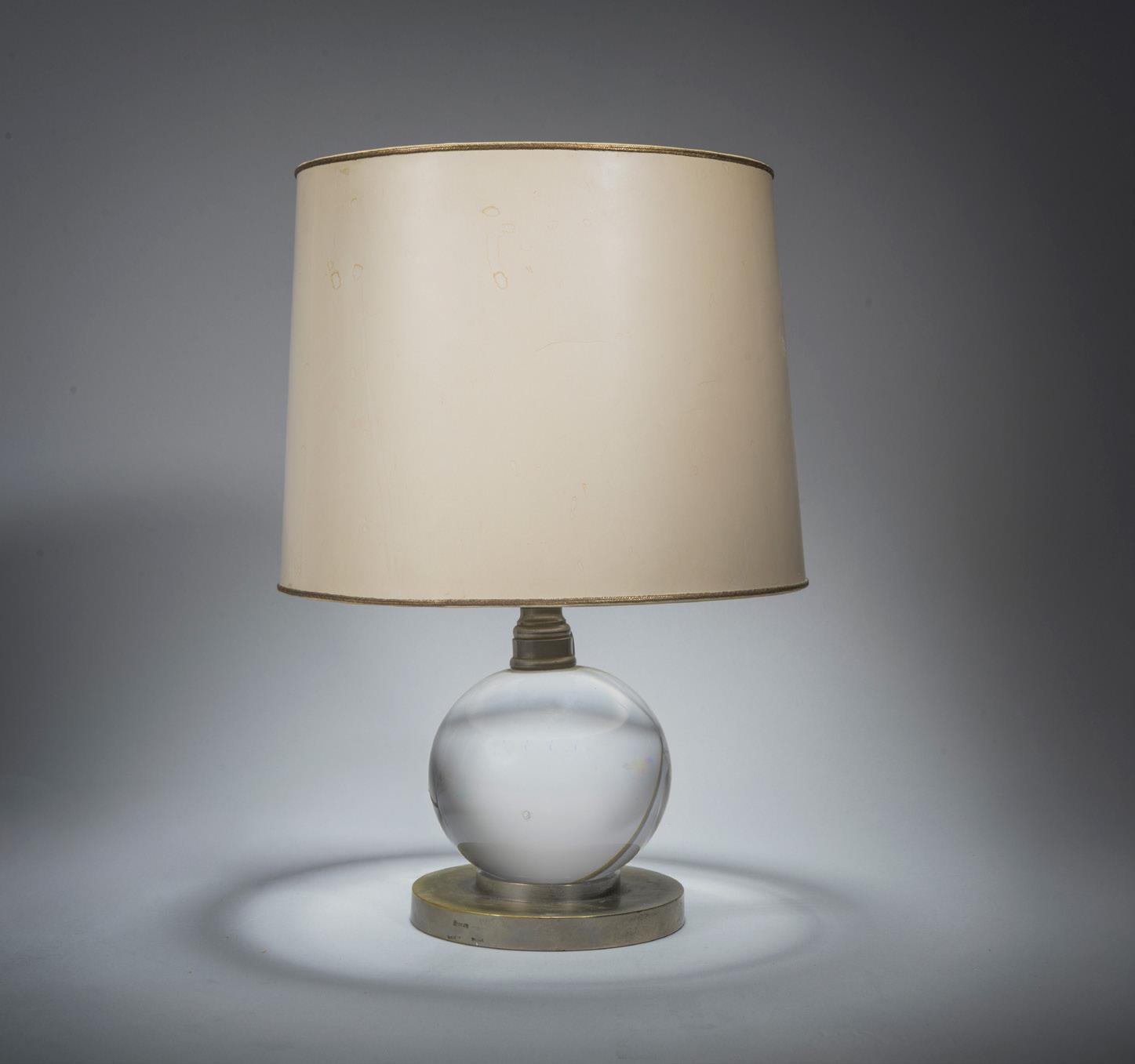
JACQUES ADNET (1900-1984)
TABLE LAMP, 1930-39 stamped Bronze MADE IN FRANCE (to base), glass attributed to Baccarat, nickel-plated bronze stand, with later shade base to fitment 14.7cm high (5 ¾in high), including shade 33.8cm high (13 3/8in high)
£1,000-1,500
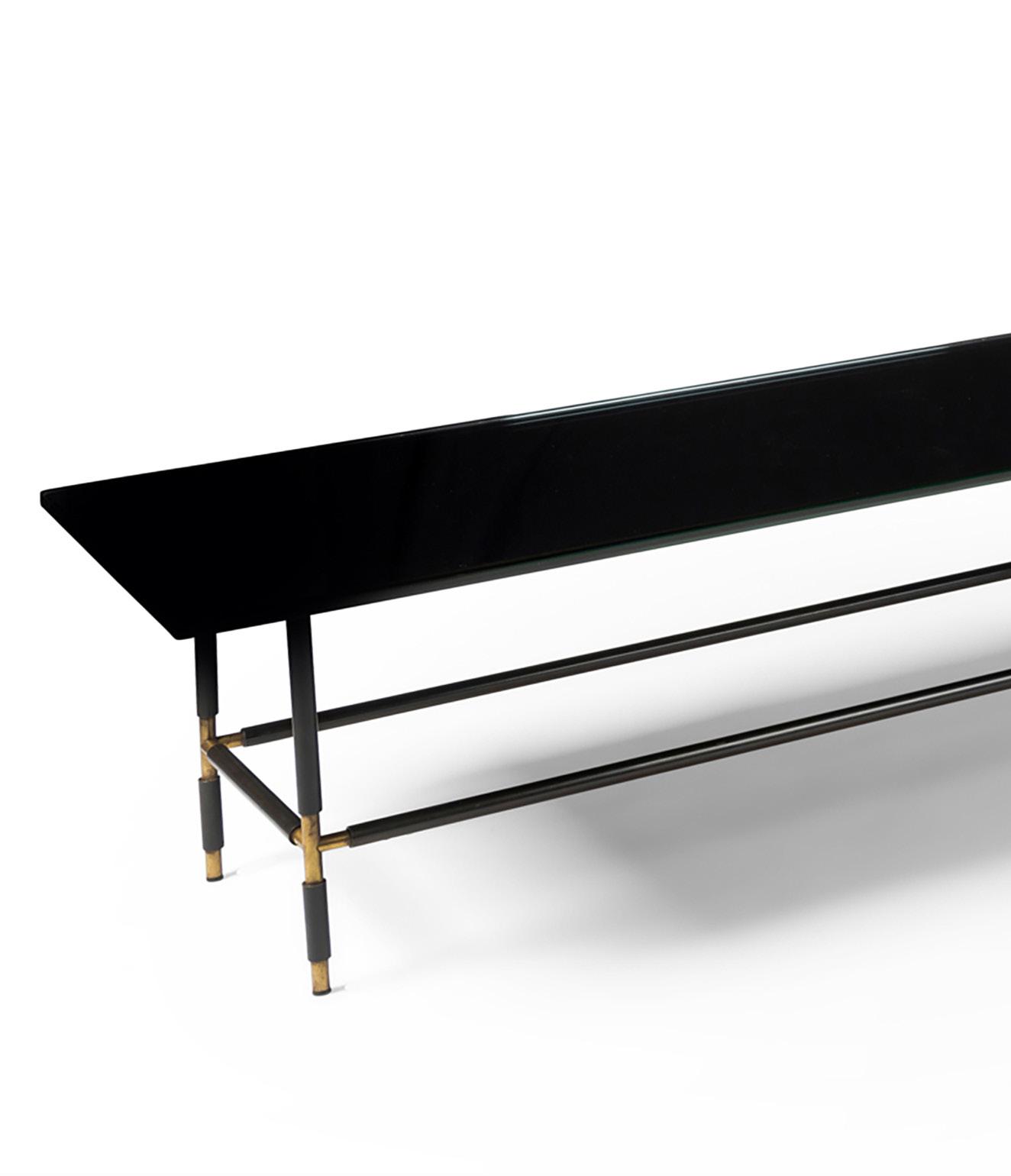
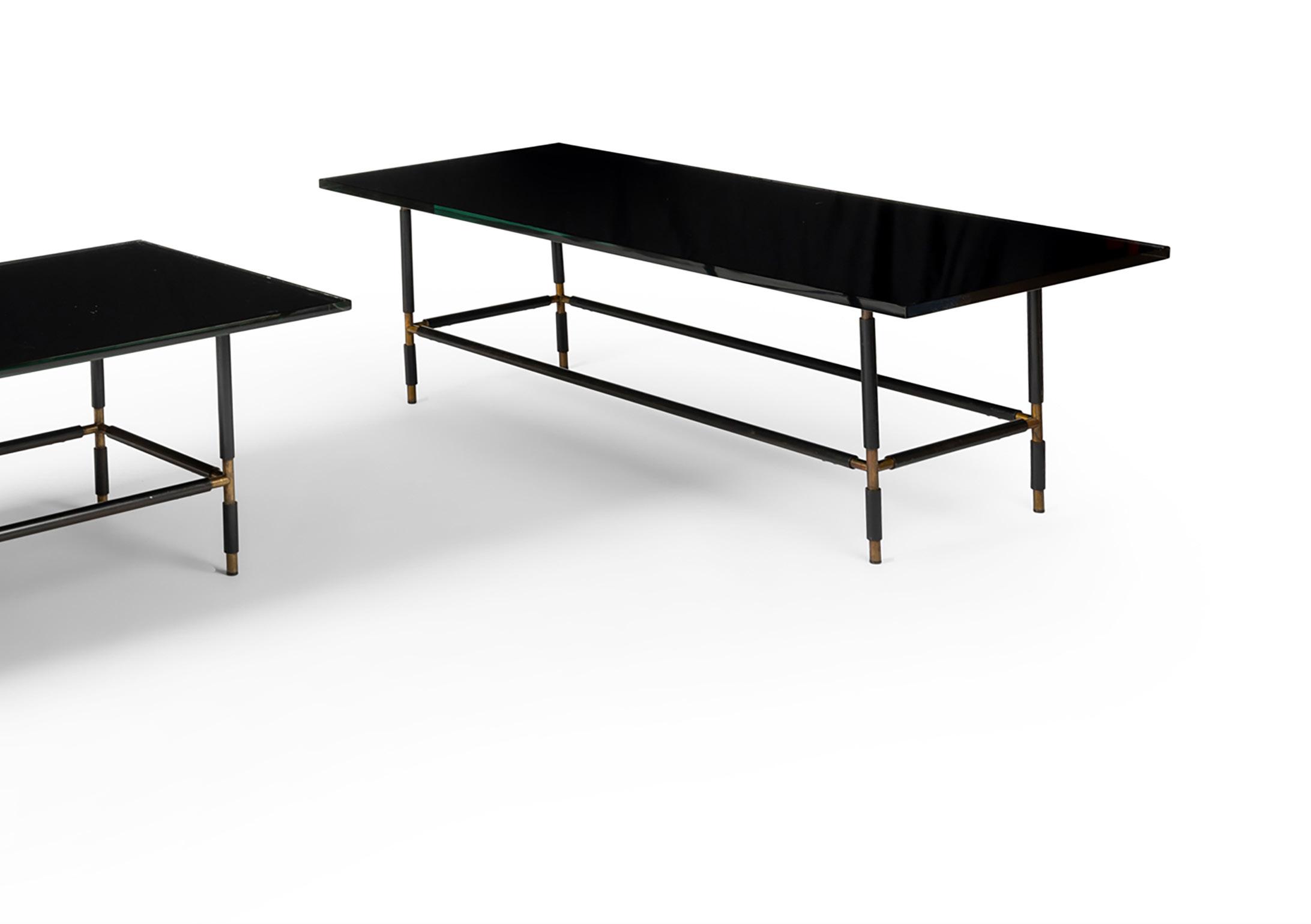
MAX INGRAND (ITALIAN 1908-1969) FOR FONTANA ARTE, MILAN
PAIR OF COFFEE TABLES, c.1958
model 1736, enamelled metal, polished brass and glass
40cm high, 124cm wide, 53cm deep (15 ¾in high, 48 ¾in wide, 20 7/8in deep) and 40cm high, 124.5cm wide, 53cm deep (15 ¾in high, 49in wide, 20 7/8in deep)
Provenance: Private Collection, Milan, from whom acquired by the present owner, 2005.
Literature: Fontana Arte Manufacturer’s Catalog, 1964, unpaginated.
£3,000-5,000
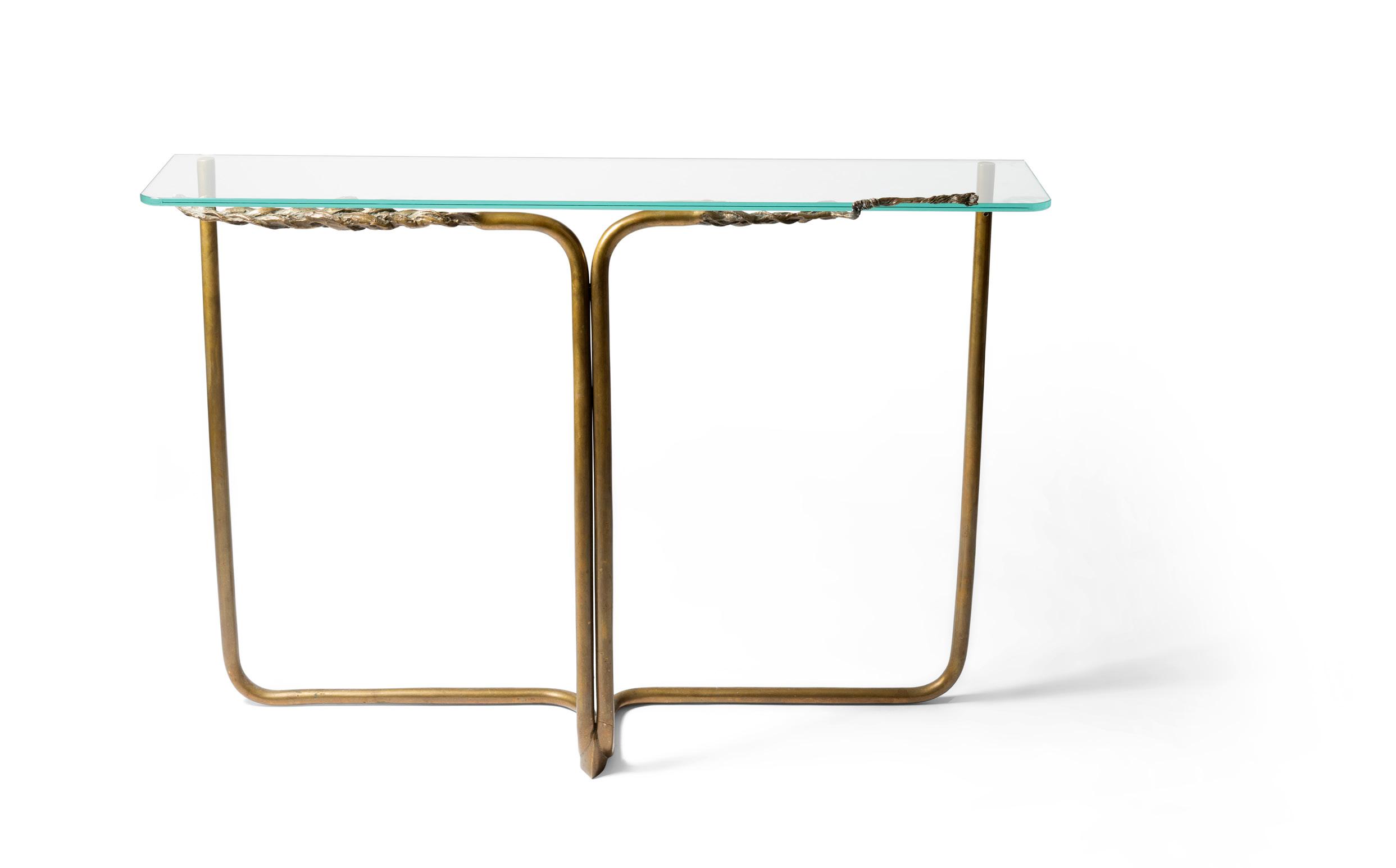
NOVELLO FINOTTI (ITALIAN 1939-) CONSOLE TABLE, c.1980 bronze and glass
84cm high, 120cm wide, 29cm deep (33in high, 47 ¼in wide, 11 3/8in deep)
Provenance: Acquired by the previous owner in 1981.
£1,500-2,000
117
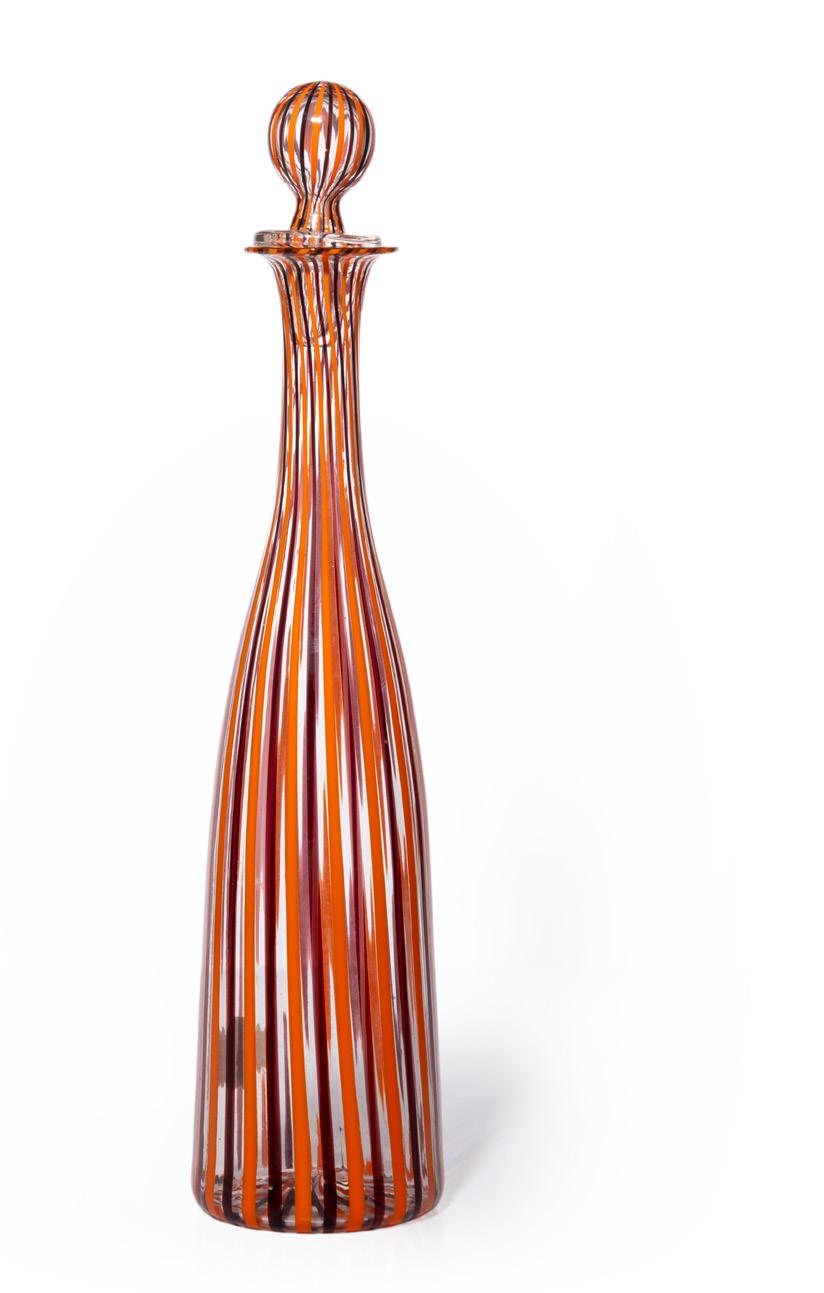
GIO PONTI (ITALIAN 1891-1979) FOR VENINI ‘ELIXIR’ BOTTLE AND STOPPER, DESIGNED 1949-50
glass with polychrome canes
36.5cm high (14 3/8in high)
Provenance: Christies, London, Modern Design, 8 November 2005, lot 92, where acquired by the present owner. Private Collection, U.K.
Literature: see Barovier, Marino and Carla Sonego (eds.), Paolo Venini and His Furnace, exh. cat., Le Stanze del Vetro, Milan, 2016, pp. 398-9, for similar models.
£700-900
118 §
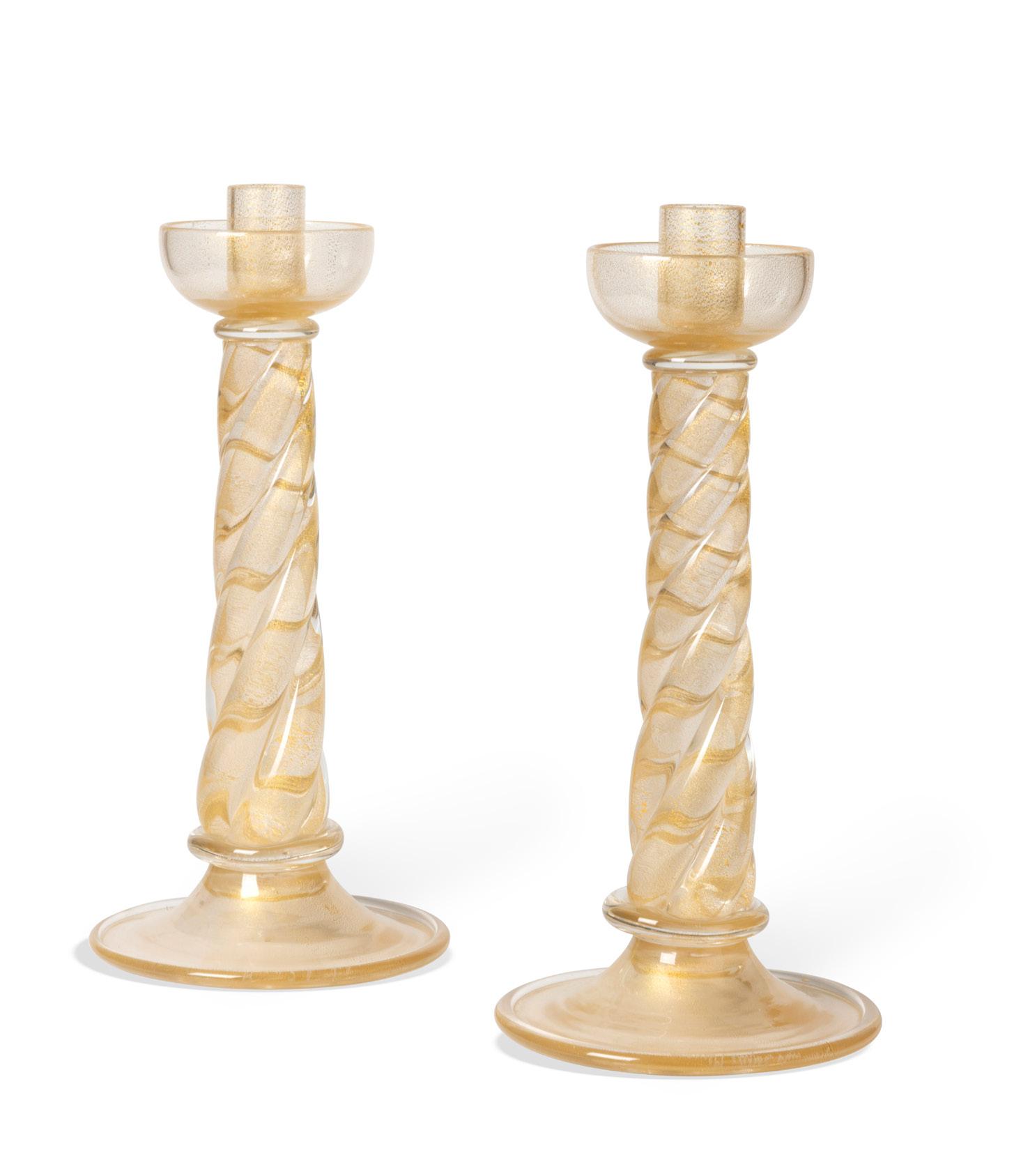
ARCHIMEDE SEGUSO (ITALIAN 1909-1999) PAIR OF MURANO CANDLESTICKS
each inscribed Archimede Seguso Murano, glass with twisted stems with gold flecks
40cm high, 18.5cm diameter (15 ¾in high, 7 ¼in diameter) (2)
Provenance: Private Collection, London.
£600-800
119
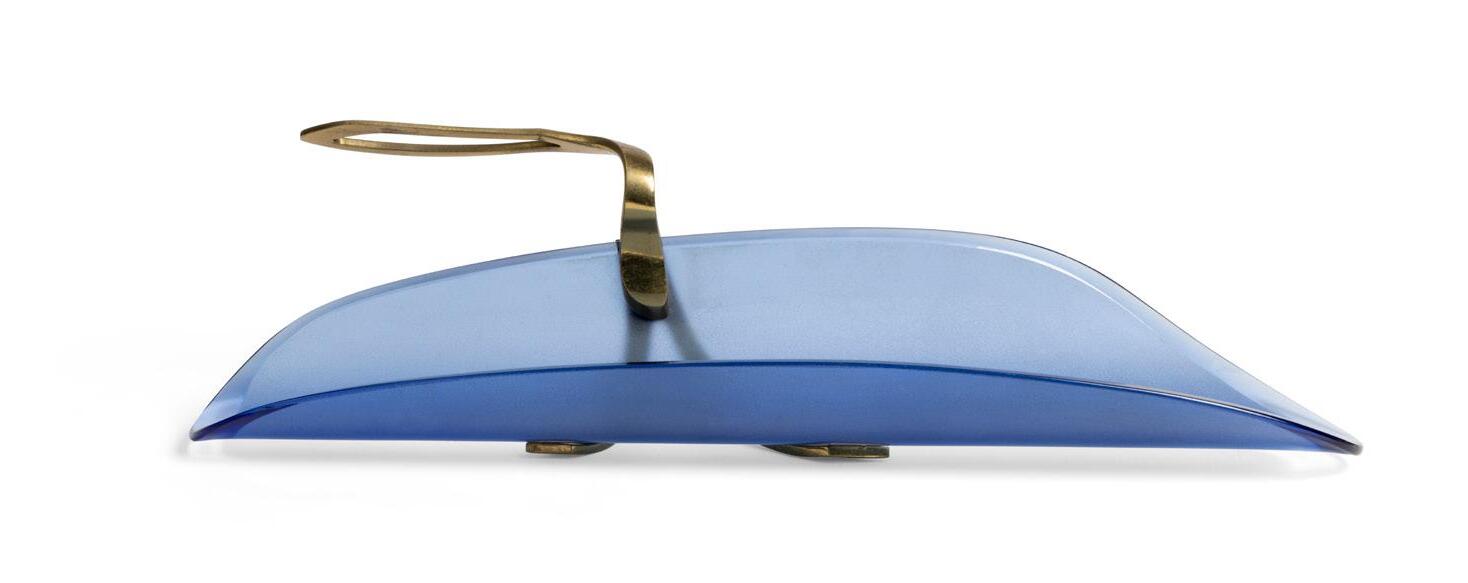
FONTANA ARTE, MILAN GRISSINI HOLDER
brass and coloured glass
9cm high, 35.5cm long, 12cm deep (3 ½in high, 14in long, 4 ¾in deep)
Literature: Domus 325, December 1956, similar example illustrated.
£600-800
120 §
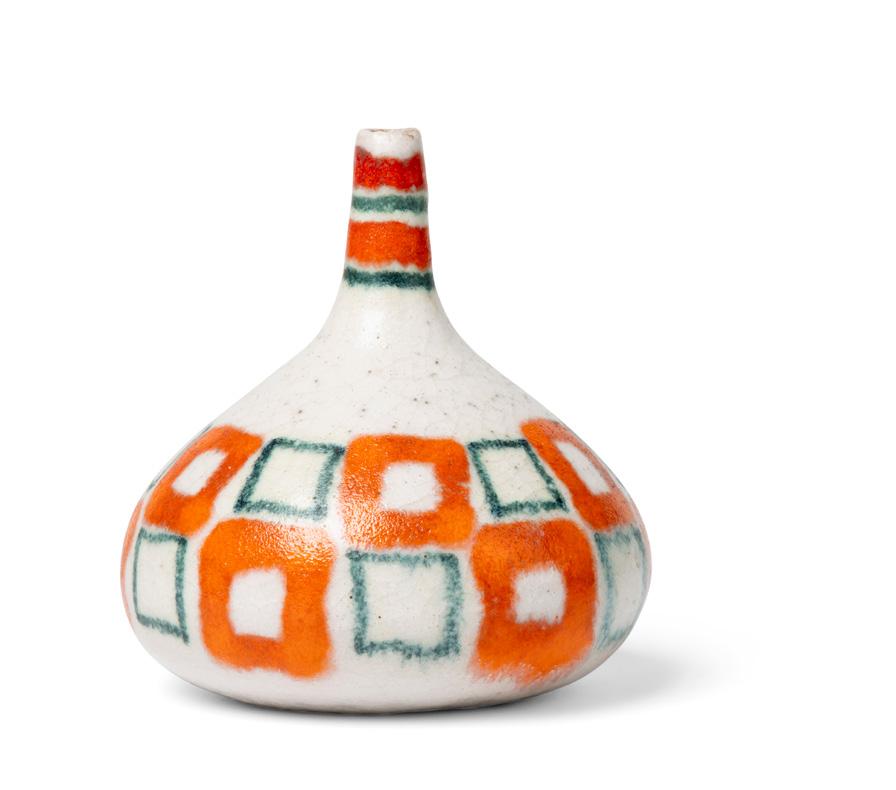
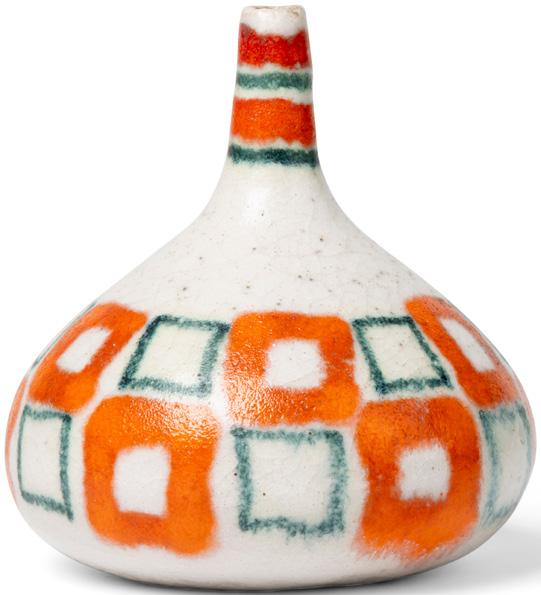
GUIDO GAMBONE (ITALIAN 1909-1969) VASE
signed GAMBONE / ITALY and with donkey mark, glazed earthenware 12cm high, 11cm diameter (4 ¾in high, 4 ¼in diameter)
Provenance: Private Collection, London.
£400-600
121
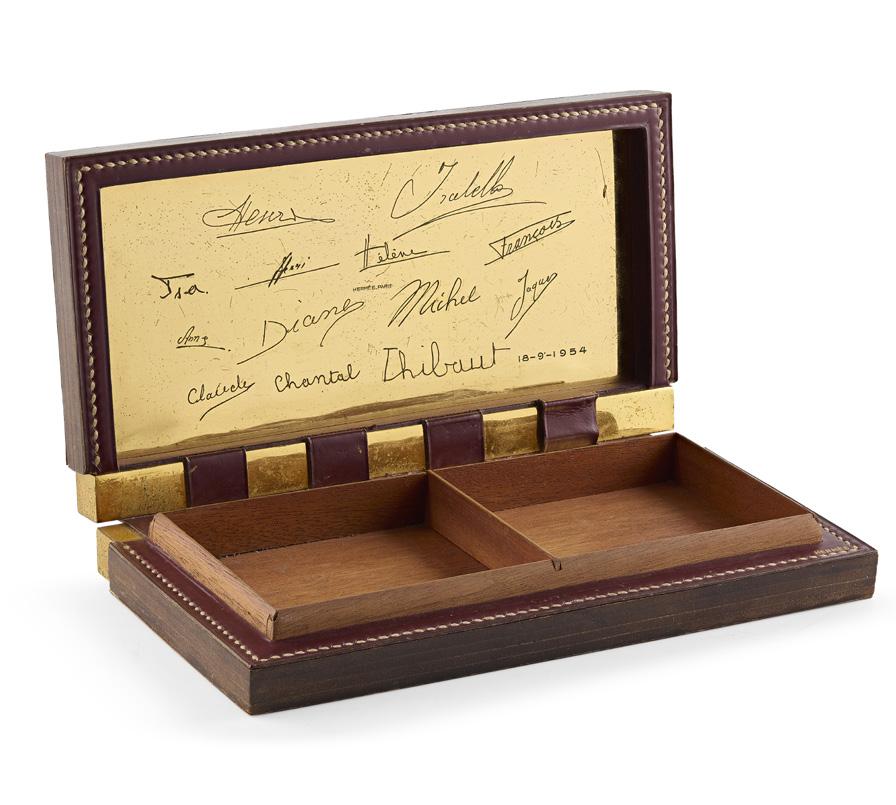
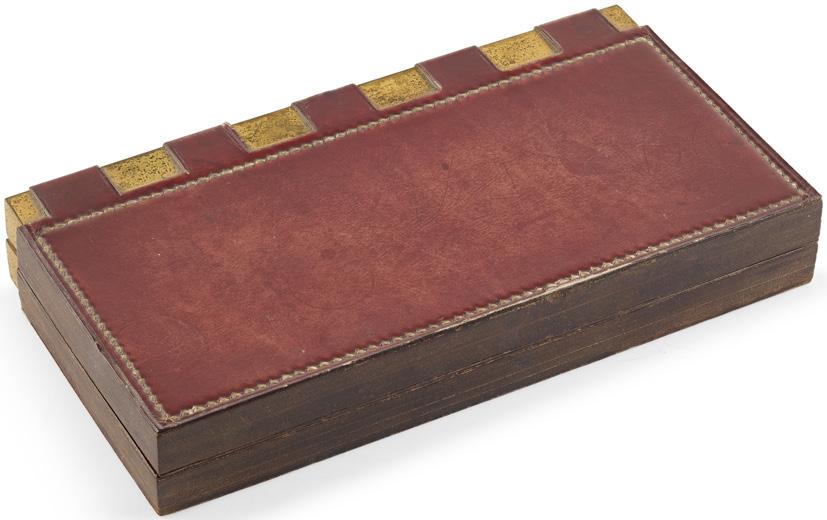
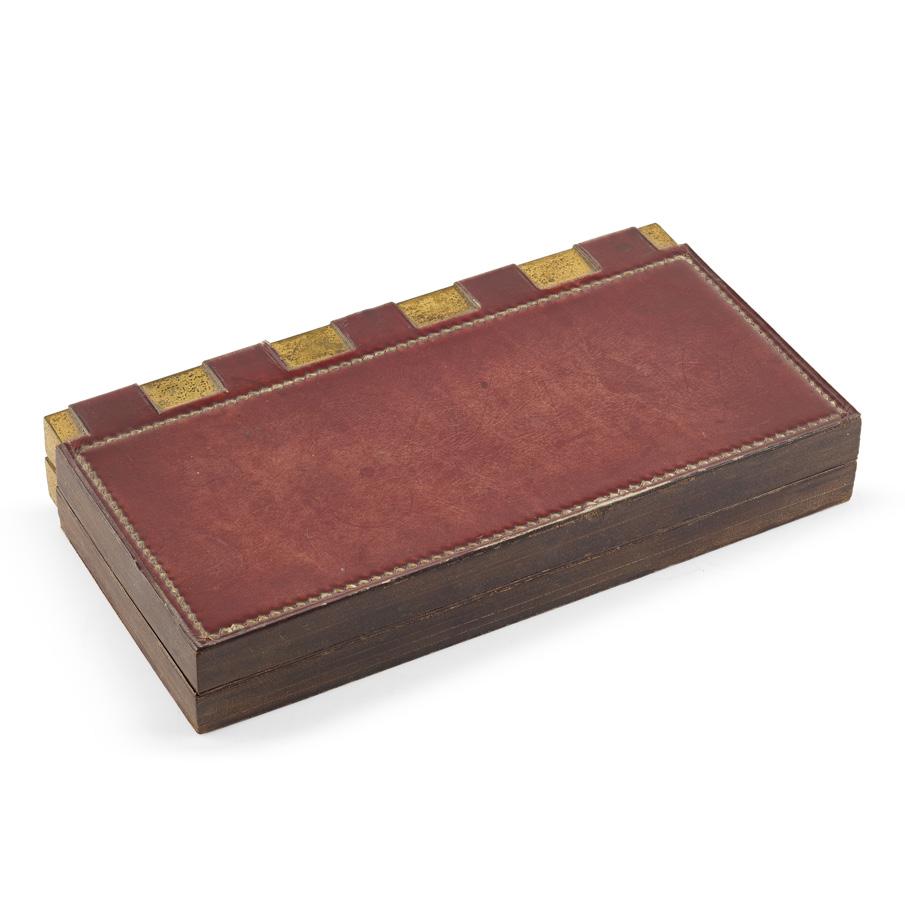
PAUL DUPRÉ LAFON (1900-1971) FOR HERMÈS BOX, c.1950 stamped HERMÈS.PARIS (to the gilt metal insert on lid) and stamped HERMÈS (to the leather), incised signatures by members of the House of Orléans (primary claimants to the defunct French throne) and dated 189-1954 (to the gilt metal inside of lid), leather, wood and gilt metal 3.4cm high, 22.5cm wide, 11.8cm deep (1 3/8in high, 8 7/8in wide, 4 5/8in deep)
Provenance: Sir Robert and Lady McEwen of Marchmont and Bardrochat, and by descent to the present owner; Private Collection, U.K.
£1,500-2,000
The box was given to Sir Robert and Lady McEwen of Marchmont and Bardrochat for their wedding in 1954, by members of the House of Orléans, the defunct French Royal Family.
The incised signatures include Prince Michel, Count of Évreux, Prince Thibaut, Count of La Marche, Henri, Count of Paris and Isabelle, Countess of Paris.
122 §
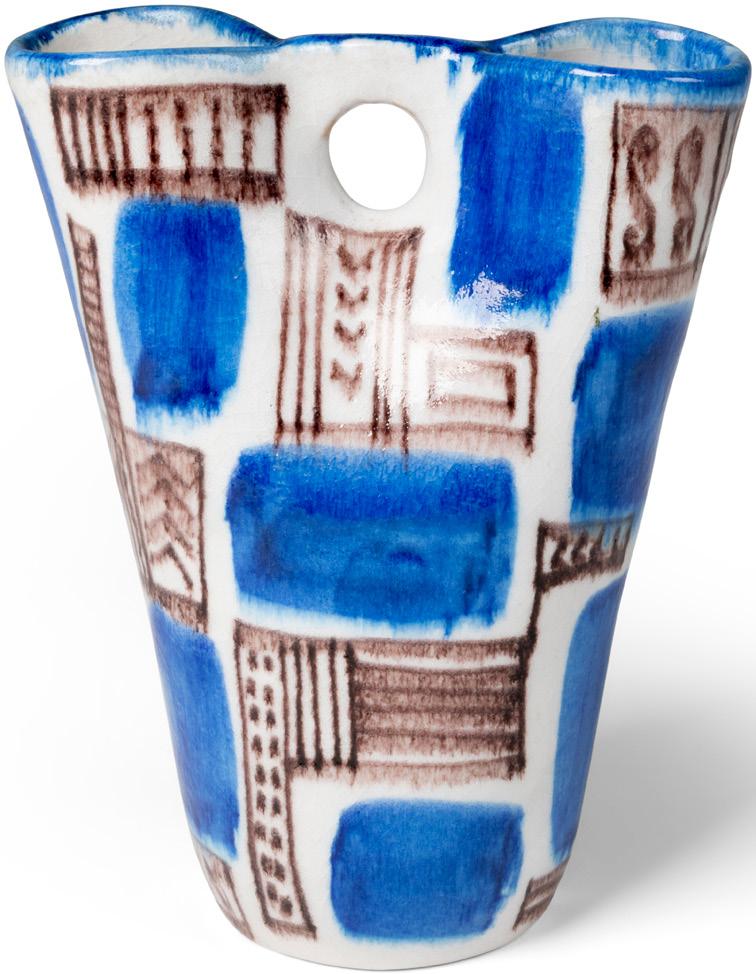
GUIDO GAMBONE (ITALIAN 1909-1969) VASE
signed GAMBONE / ITALY and with donkey mark, glazed earthenware
22cm high, 16.7cm wide, 8cm deep (8 5/8in high, 6 ½in wide, 3 1/8in deep)
£1,000-1,500
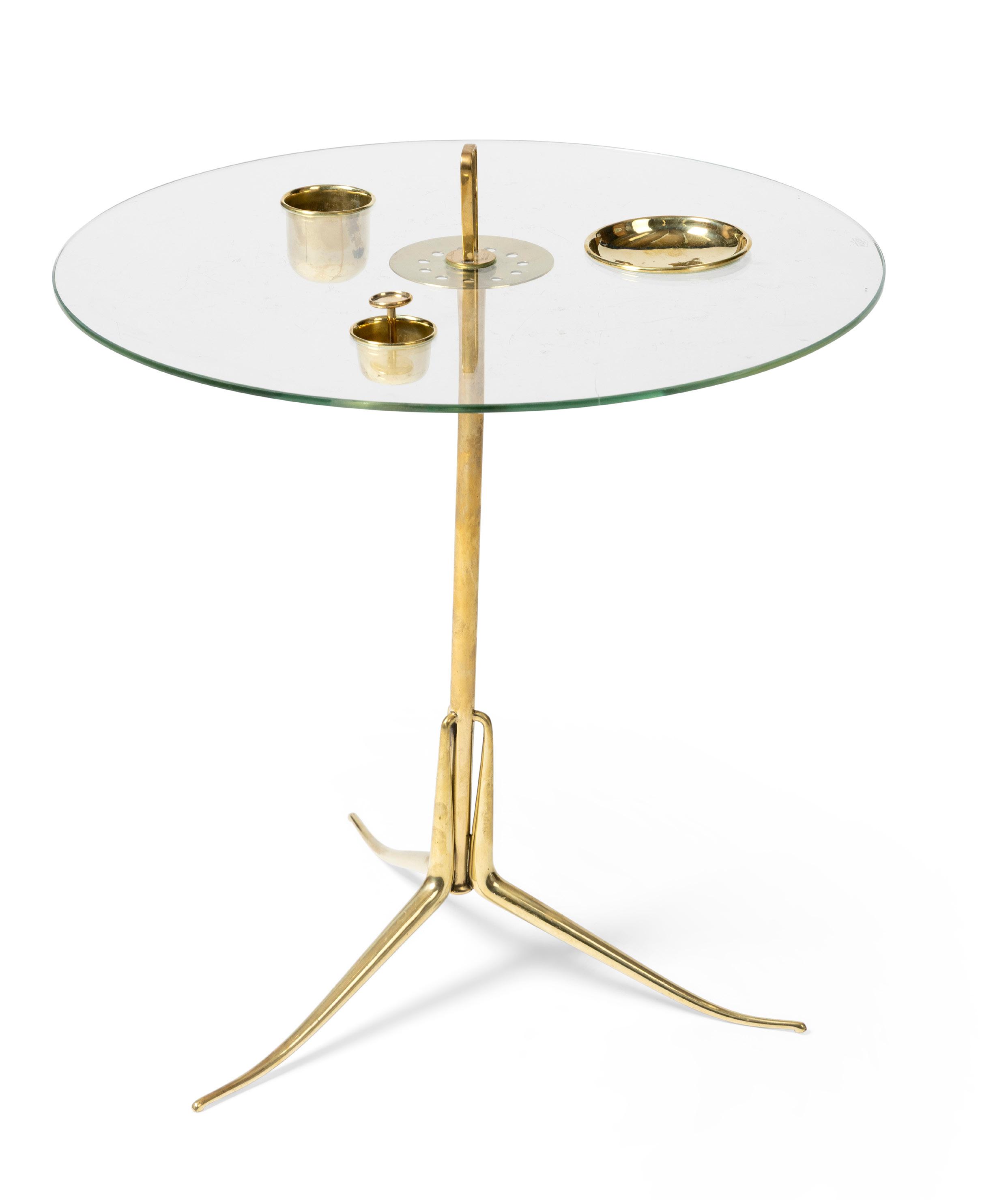
GINO SARFATTI (ITALIAN 1912–1984) FOR ARTELUCE OCCASIONAL / SMOKER’S TABLE, c.1943
stamped ARTELUCE / MADE IN ITALY, brass and glass
56cm high, 50cm diameter (22in high, 19 ¾in diameter)
Literature: Romanelli, Marco and Sandra Severi, Gino Sarfatti: Opere Scelte 1938-1973, Silvana Editoriale, Milan, 2012, p.164 for an example of an occasional table with similar stem and supports, illustrated alongside model 1030 lamp.
£3,000-5,000
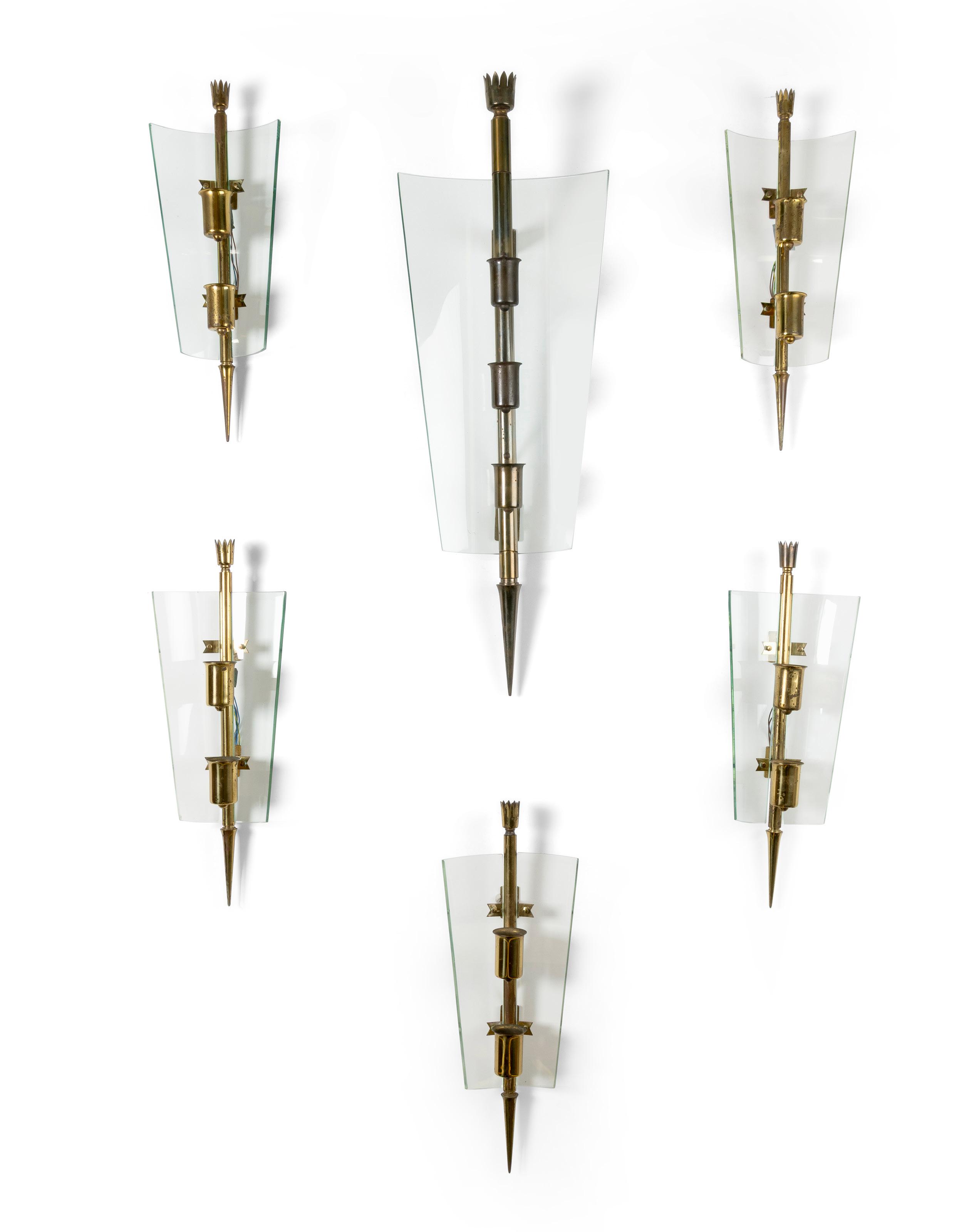
PIETRO CHIESA (ITALIAN 1892-1948)
FOR FONTANA ARTE, MILAN
SET OF FIVE WALL LIGHTS, DESIGNED c.1938
brass and bent glass
Larger model: 94cm high, 31cm wide, 23cm deep; smaller model (37in high, 12 ¼in wide, 9in deep): 57cm high, 20cm wide, 13cm deep (22 ½in high, 8in wide, 5in deep) (5)
Gio Ponti exhibited this model lamp in the Palazzo del Rettorateo ‘Il Liviano’, at the University of Padua, designed in 1939.
Literature:
Babuino Novencento, 2006, p.72, illustrated.
£5,000-7,000
125
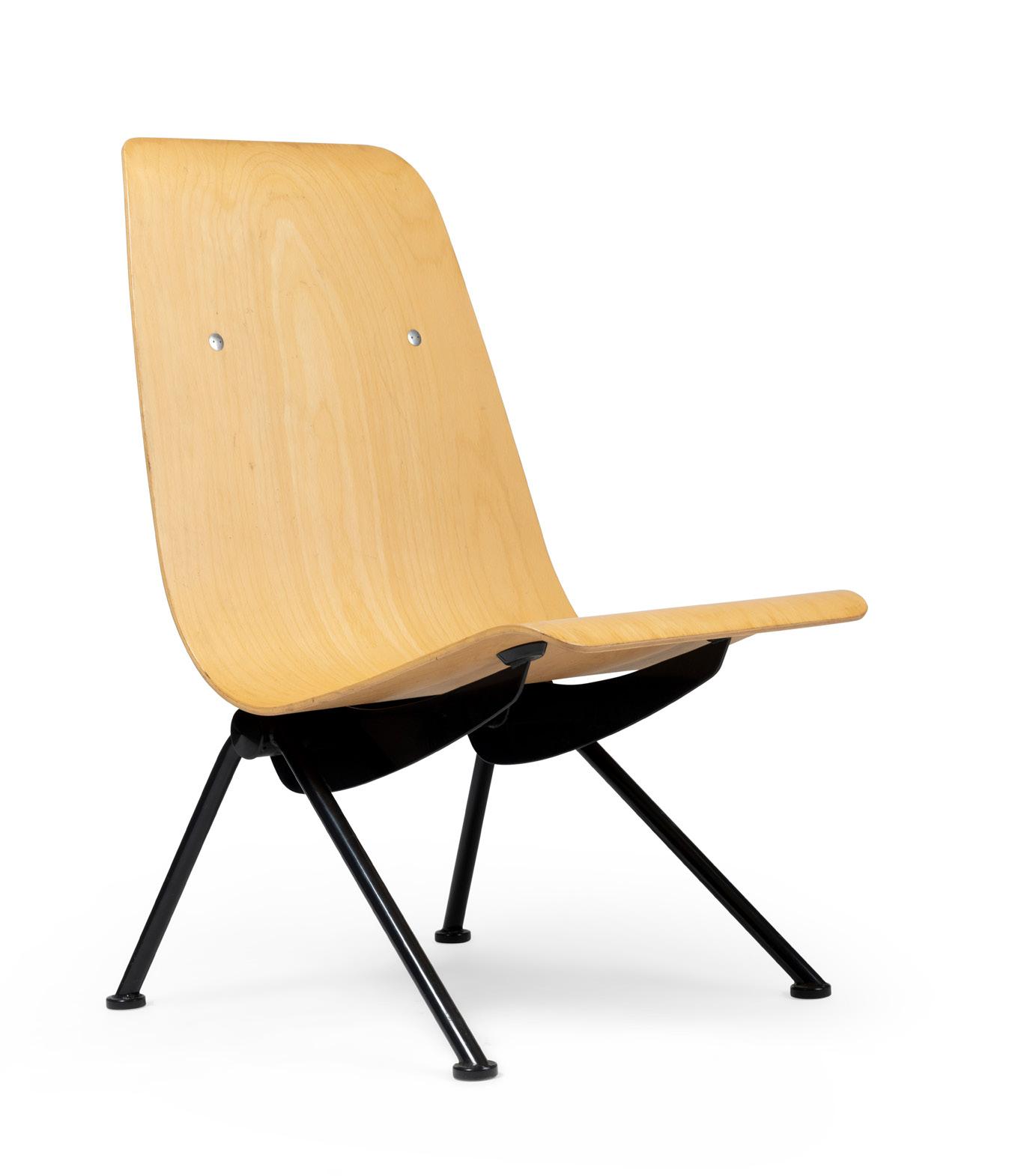
JEAN PROUVÉ
(FRENCH, 1901–1984)
FOR VITRA
‘ANTONY’ CHAIR, DESIGNED 1954 / MANUFACTURED 2002
manufacturer’s applied paper label (to underside), plywood and steel frame
88.5cm high, 50cm wide, 65cm deep (34 ¾in high, 19 ¾in wide, 25 ½in deep)
The Antony Chair, one of Jean Prouvé’s most celebrated designs, was created in 1954 for a residence hall at the Cité Universitaire d’Antony in France.
This example is from original Vitra-licensed re-edition, produced in 2002 in limited numbers.
£1,500-2,500
126
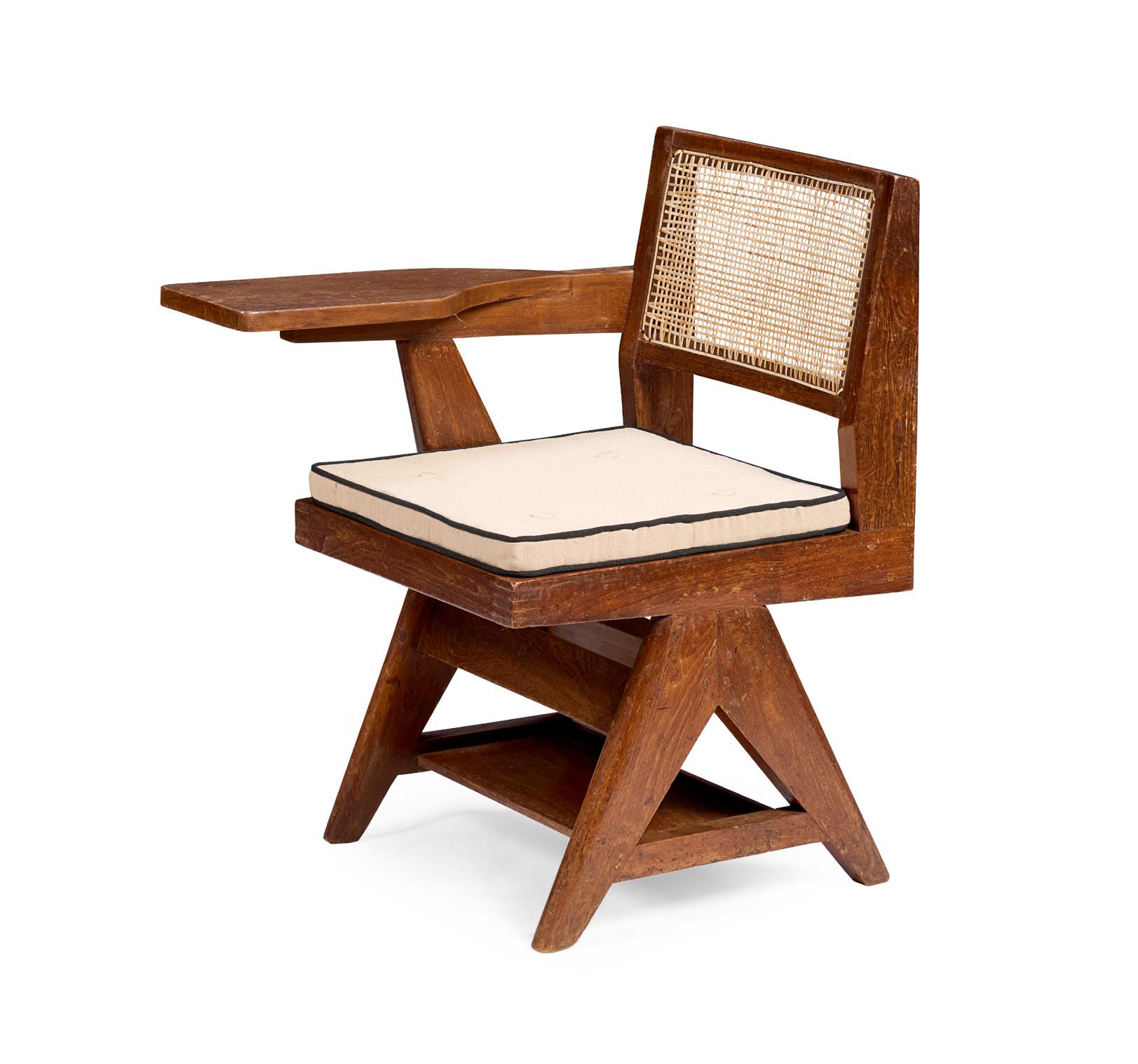
PIERRE JEANNERET (FRENCH 1896-1967)
‘UNIVERSITY’ CHAIR
stamped C.A.H.(S.R-2)-8 SOILS-2 (to seat back), teak, cane and upholstery
81cm high, 57cm wide, 62.5cm deep
(31 ¾in high, 22 ½in wide, 24 5/8in deep)
£2,000-3,000
127
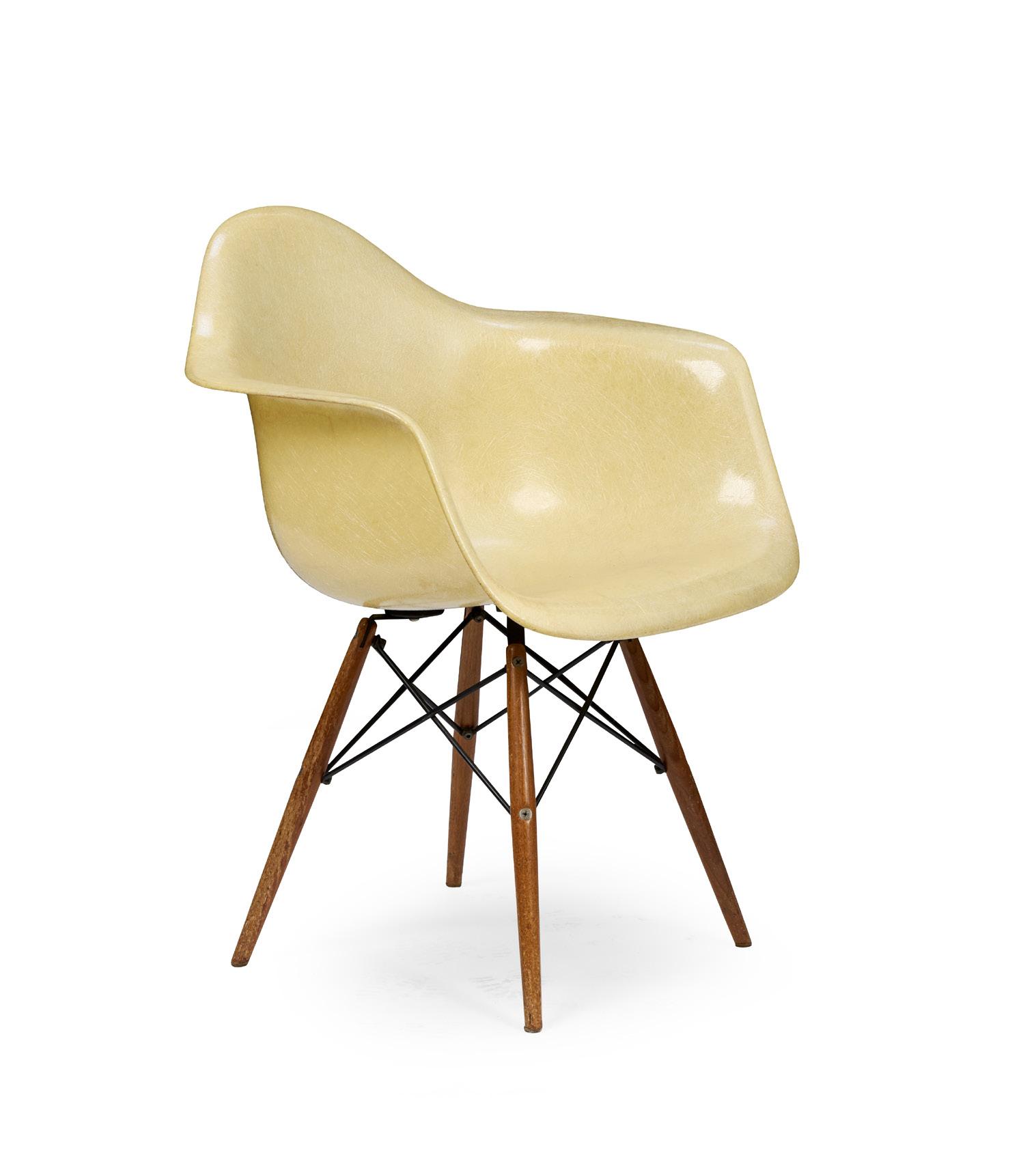
CHARLES & RAY EAMES (AMERICAN 1907–1978 & 1912–1988) FOR HERMAN MILLER
‘DAW’ CHAIR, DESIGNED 1951
manufacturer’s label (to base), molded fiberglass with rope edge, birch, enamelled steel, rubber
77cm high, 63cm wide, 55cm deep
(30 3/8in high, 24 ¾in wide, 21 5/8in deep)
£800-1,200
128
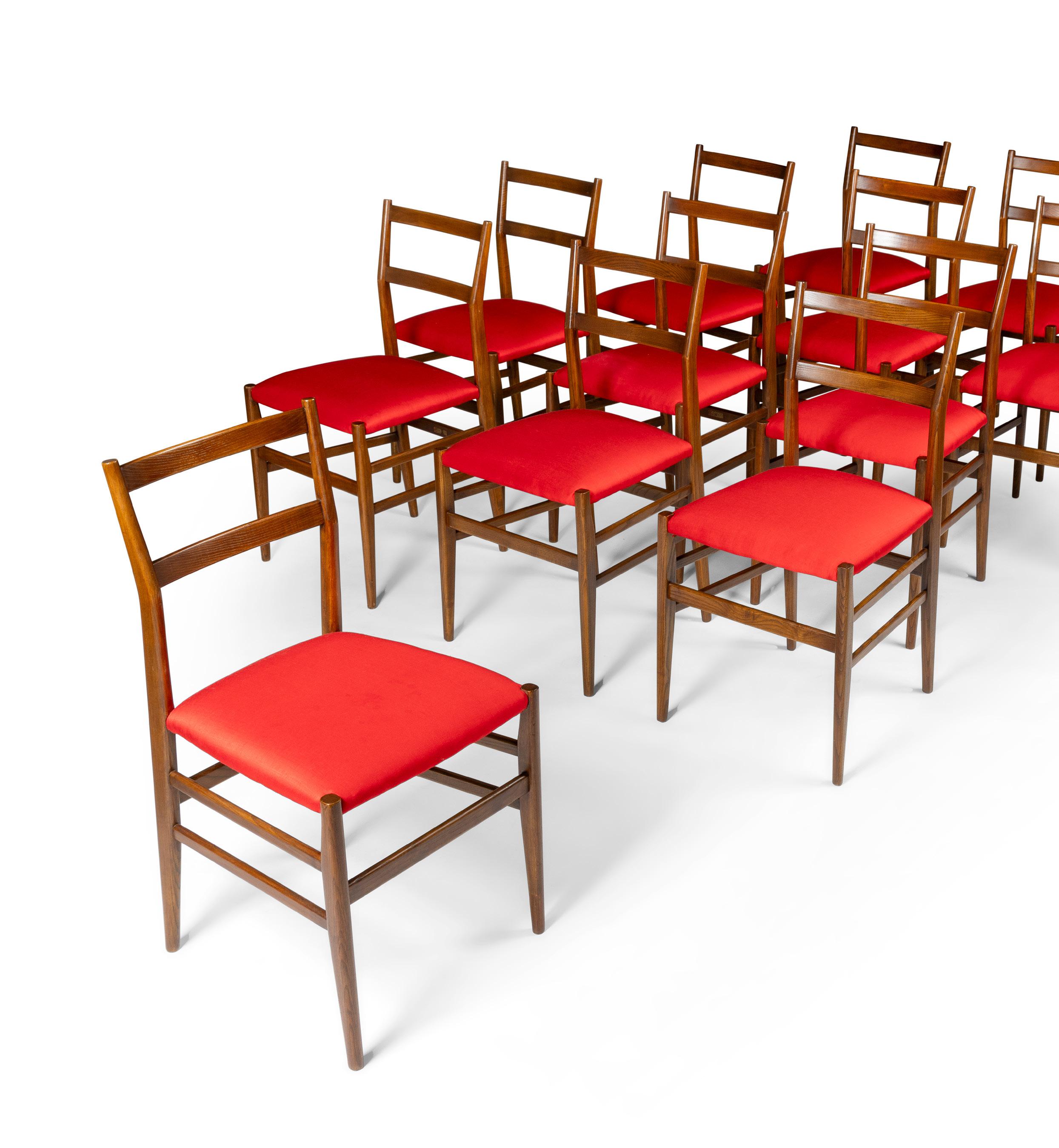
GIO PONTI (ITALIAN 1891-1979) FOR CASSINA SET OF 12 ‘LEGGERA’ CHAIRS, DESIGNED 1951 model 646, five with manufacturers Ca / Figli de Amedeo Cassino / Meda / Italy applied paper labels, wood and crimson silk upholstery
83cm high, 43cm wide, 43cm deep (32 5/8in high, 17in wide, 17in deep) (12) £4,000-6,000
129
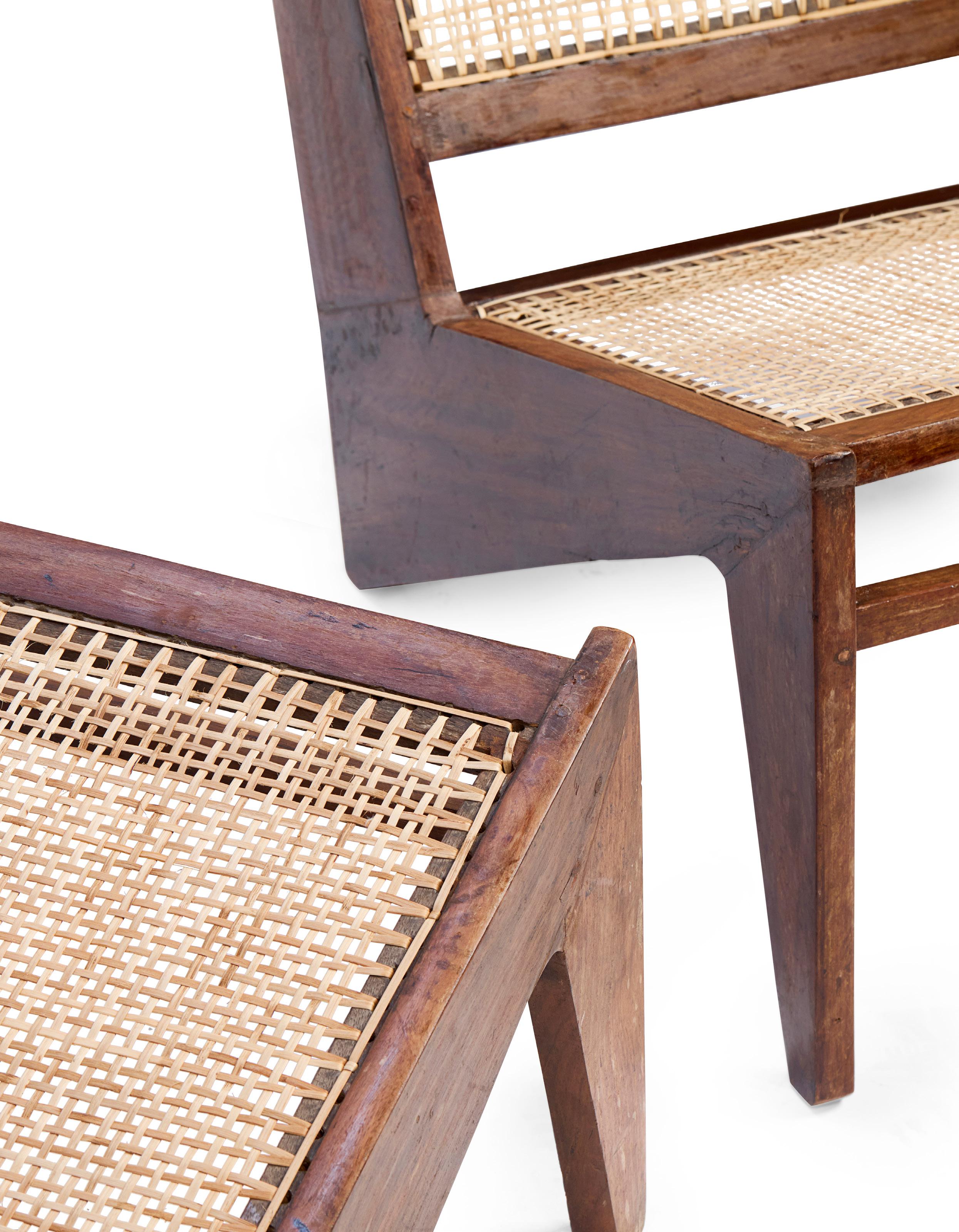
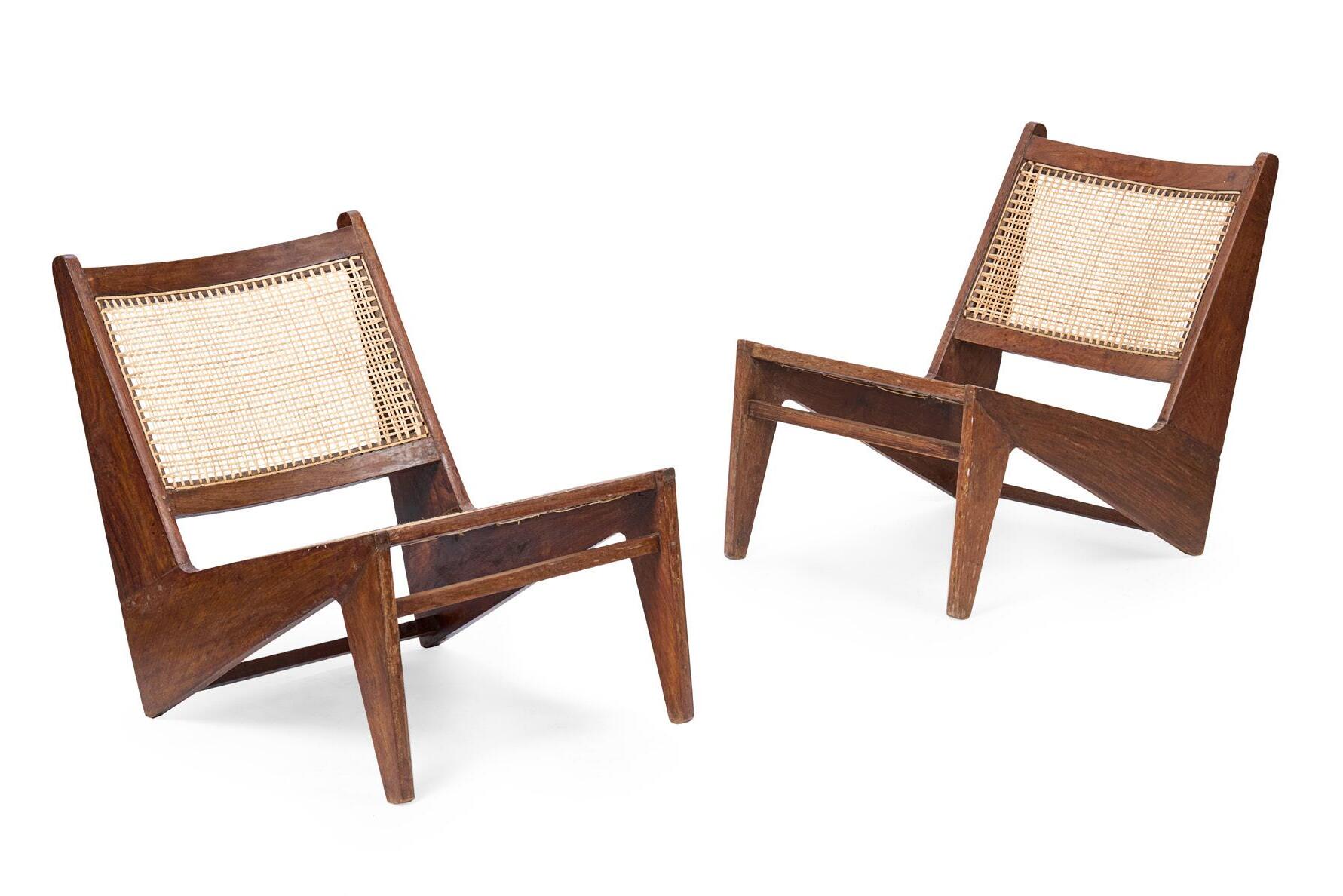
PIERRE JEANNERET (FRENCH 1896-1967)
PAIR OF KANGAROO CHAIRS
Indian rosewood and cane
65cm high, 52.5cm wide, 61cm deep (25 ½in high, 20 ¾in wide, 24in deep) (2)
£12,000-18,000
130
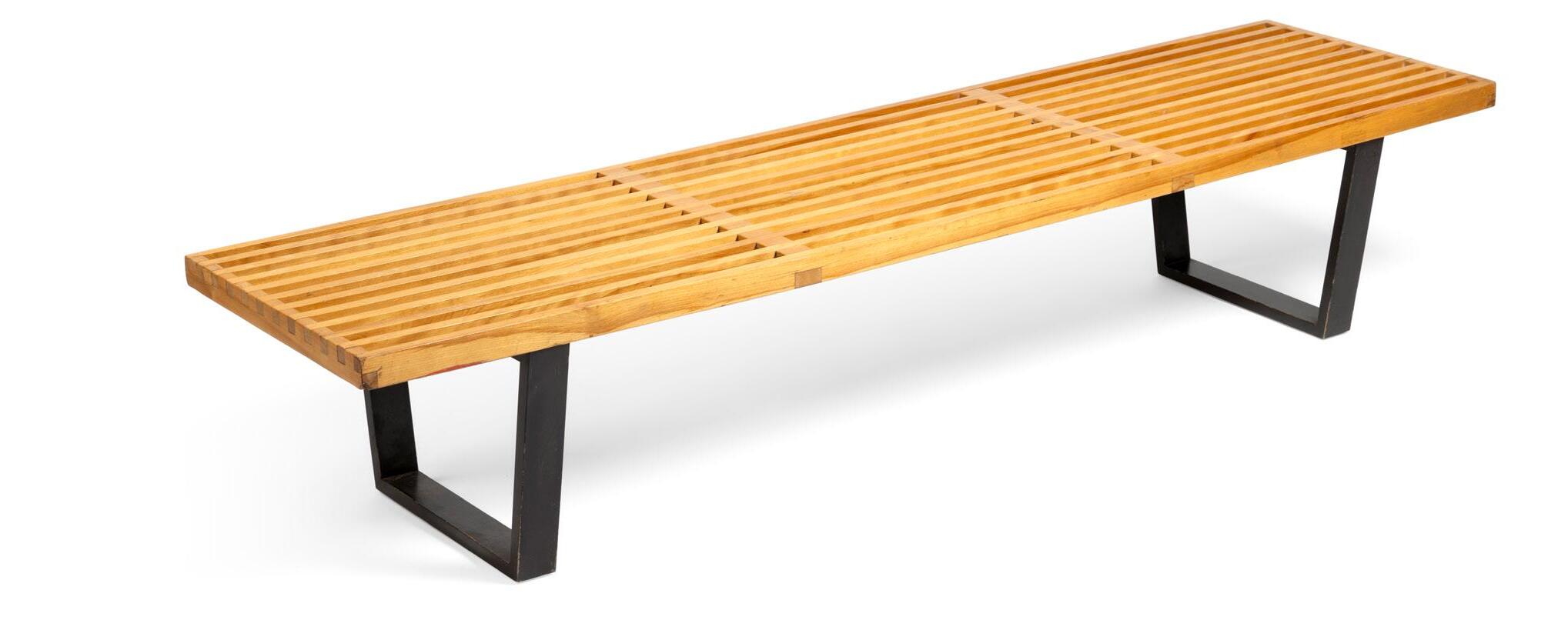
GEORGE NELSON (AMERICAN 1908-1986) FOR HERMAN MILLER BENCH, DESIGNED 1946
model 4692, applied foil manufacturer’s label George Nelson Design Herman Miller Zeeland, Michigan (to underside), birch and lacquered wood
36cm high, 183.5cm wide, 46.7cm deep (14 1/8in high, 72 ¼in wide, 18 3/8in deep)
£1,000-1,500
131
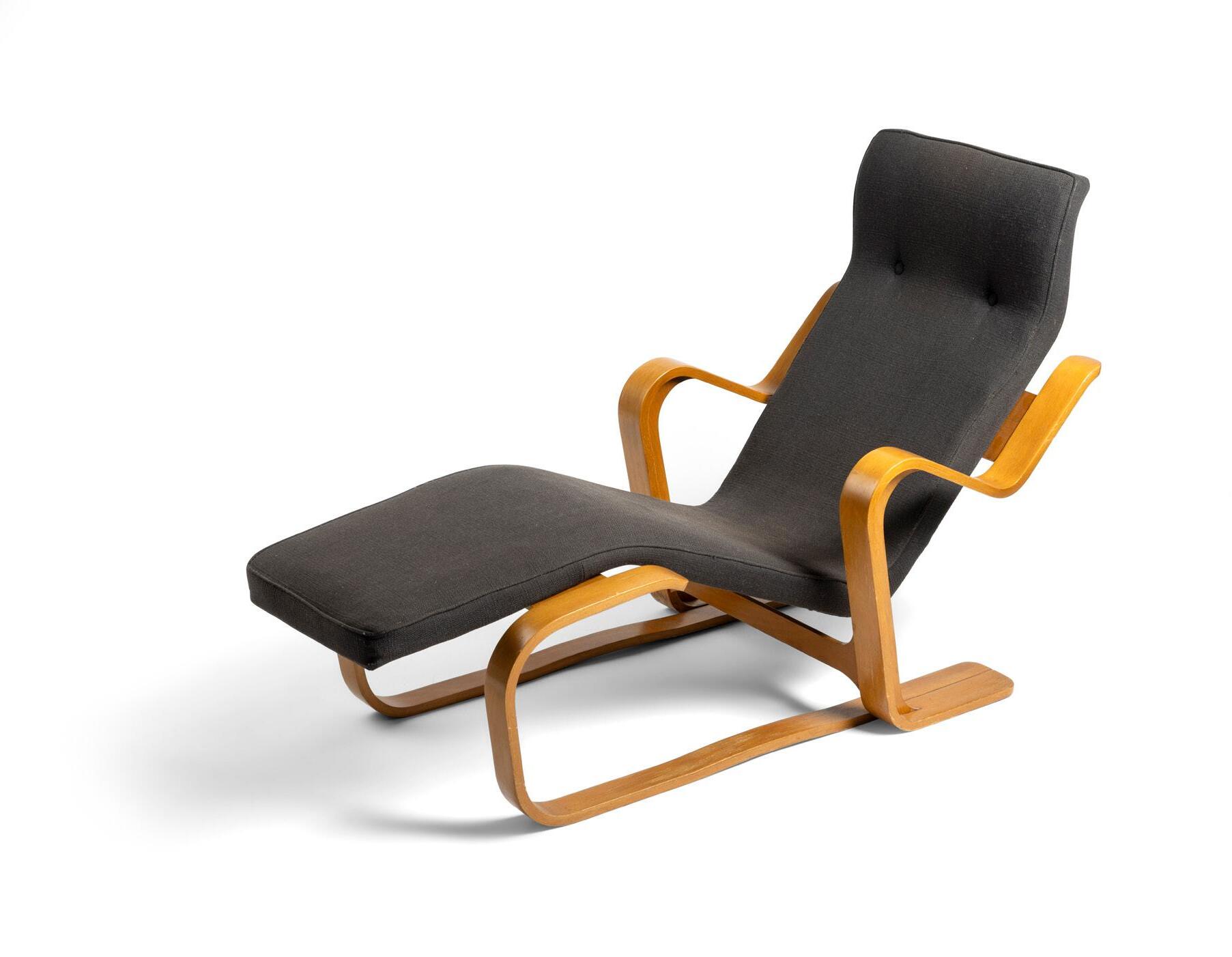
MARCEL BREUER (HUNGARIAN 1902-1981)
‘LONG CHAIR’, DESIGNED 1935-6 / MANUFACTURED c.1965
manufactured by John Alan Designs, London, laminated birch plywood, with upholstered seat 84cm high, 129cm wide, 61cm deep (33in high, 50 ¾in wide, 24in deep)
Provenance: Jack Pritchard; Gifted from the above to the current owner’s family in 1968, and by descent; Private Collection, U.K.
The present Isokon Long Chair, designed by Marcel Breuer, was produced by John Alan Designs. During the 1960s, Jack Pritchard licensed John Alan to manufacture the design, as documented in the Pritchard Papers held at the University of East Anglia Archives. These examples were made in laminated beech plywood, with the seat resting on a cross support - a later modification by Breuer to provide additional strength.
£1,500-2,000
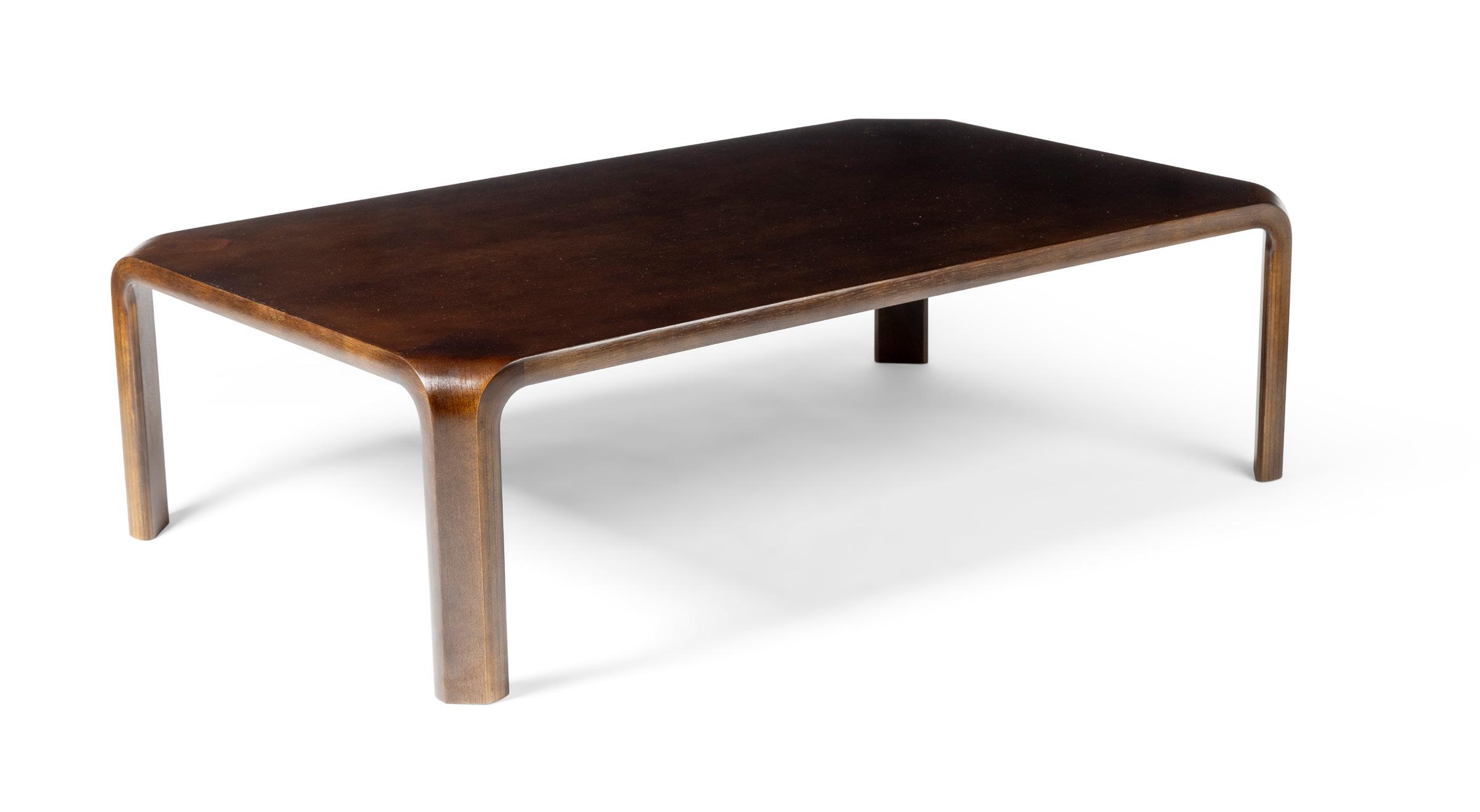
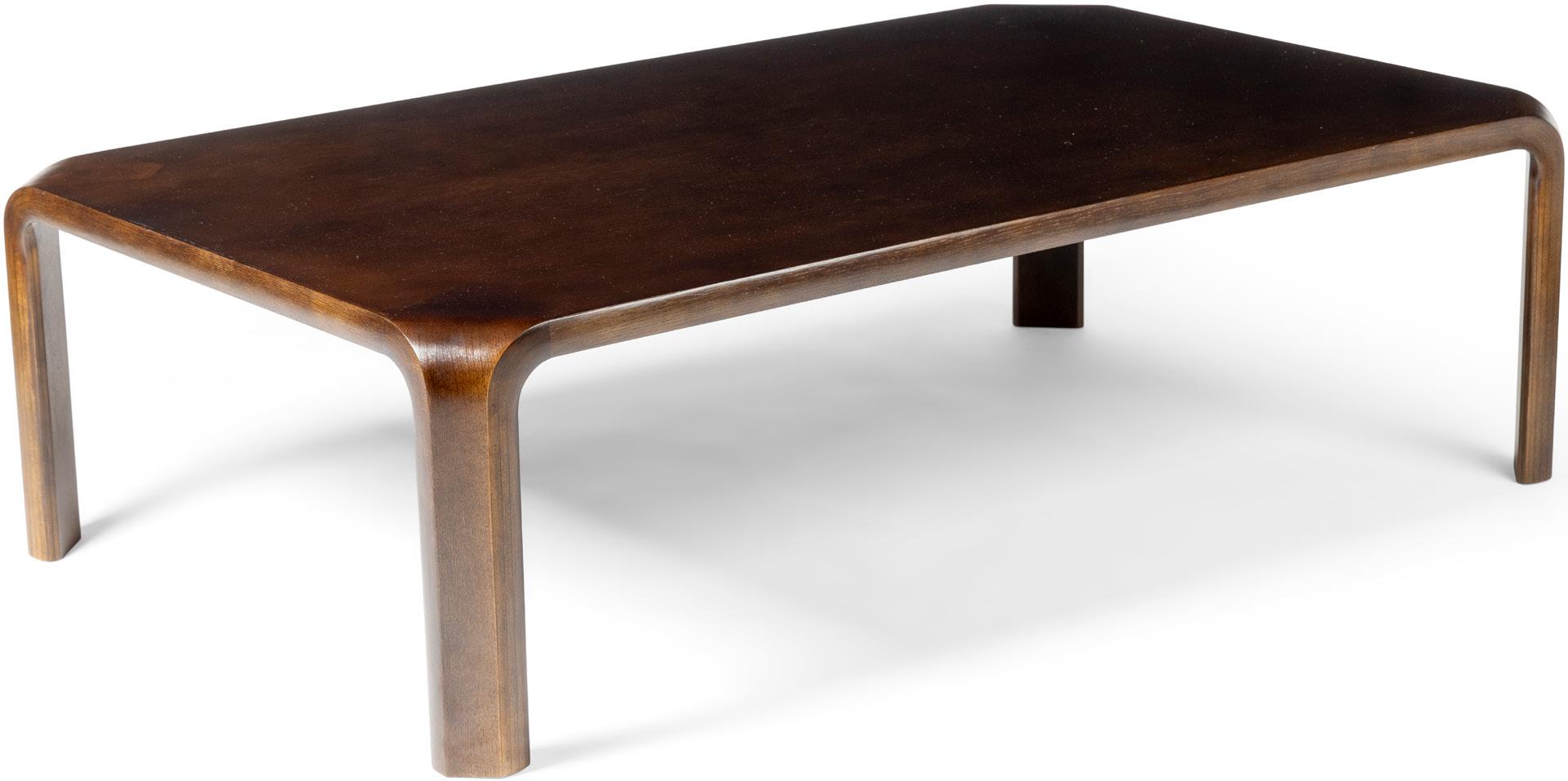
applied manufacturer’s label (to underside), beech plywood with maple veneer and dark walnut finish
40cm high, 140cm wide, 84.5cm deep (15 ¾in high, 55in wide, 33 ¼in deep)
Mitsumasa Sugasawa was the former chief designer at Tendō Mokko. After completing his studies at Chiba University’s Junior College of Technology in 1963, he joined the Japanese furniture manufacturer Tendō Mokko. In 1966 he travelled to Denmark to undertake further training at the Danish National Technical Institute, where he was introduced to Scandinavian methods of design and production. Upon returning to Japan, he spent much of his career in the development department at Tendō Mokko, working closely with architects and designers to provide technical expertise while also producing a number of designs of his own for the company.
£700-900
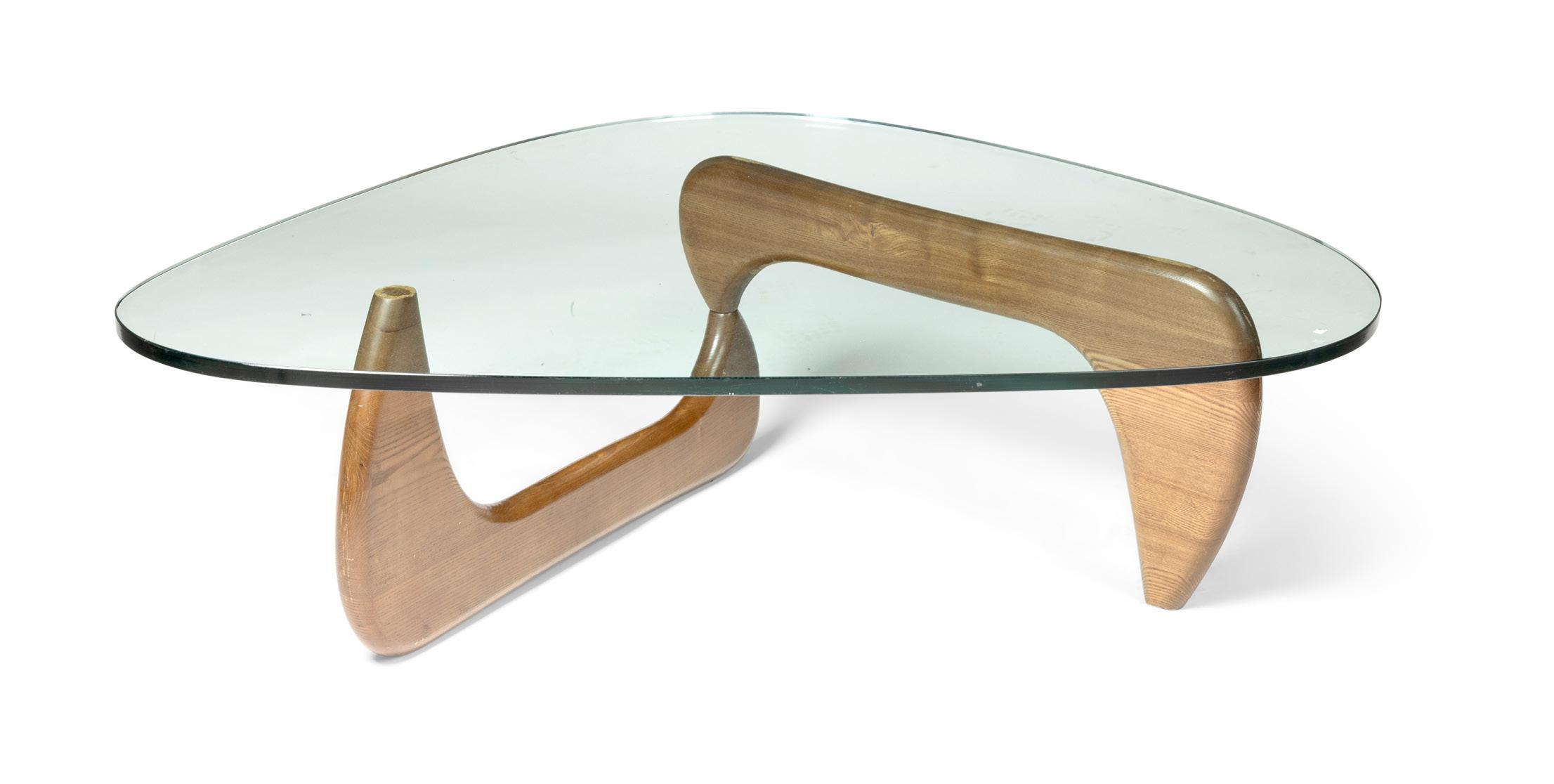
ISAMU NOGUCHI (AMERICAN 1904-1988) FOR HERMAN MILLER COFFEE TABLE, DESIGNED 1948
model IN-50, walnut, glass and steel pin
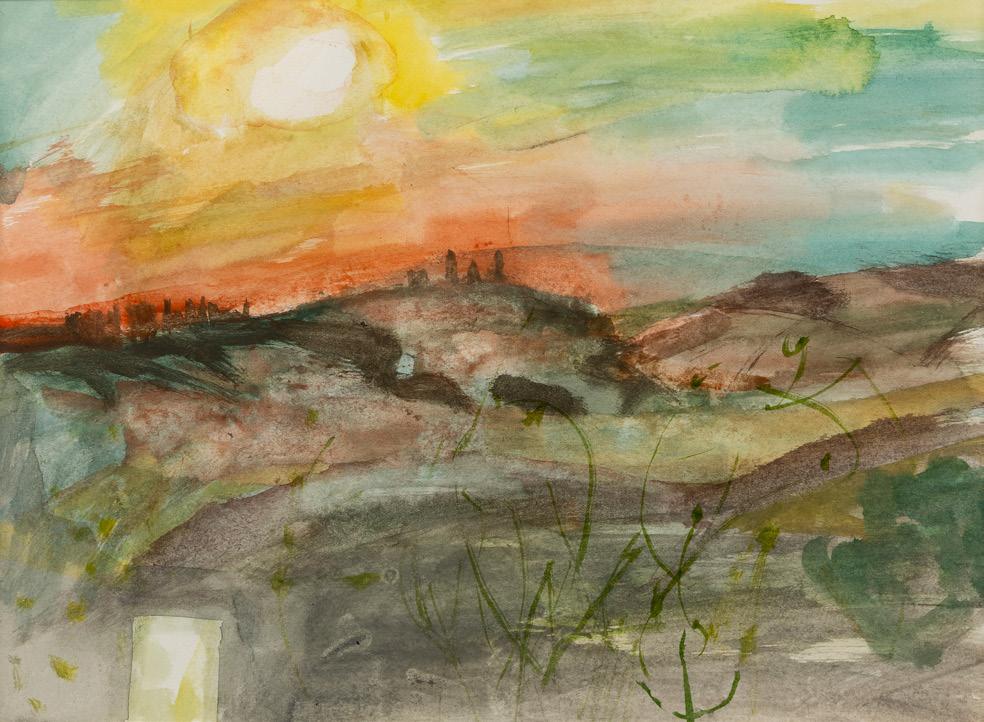
40cm high, 125cm wide, 91cm deep (15 ¾in high, 49 ¼in wide, 35 ¾in deep)
£1,000-1,500
134
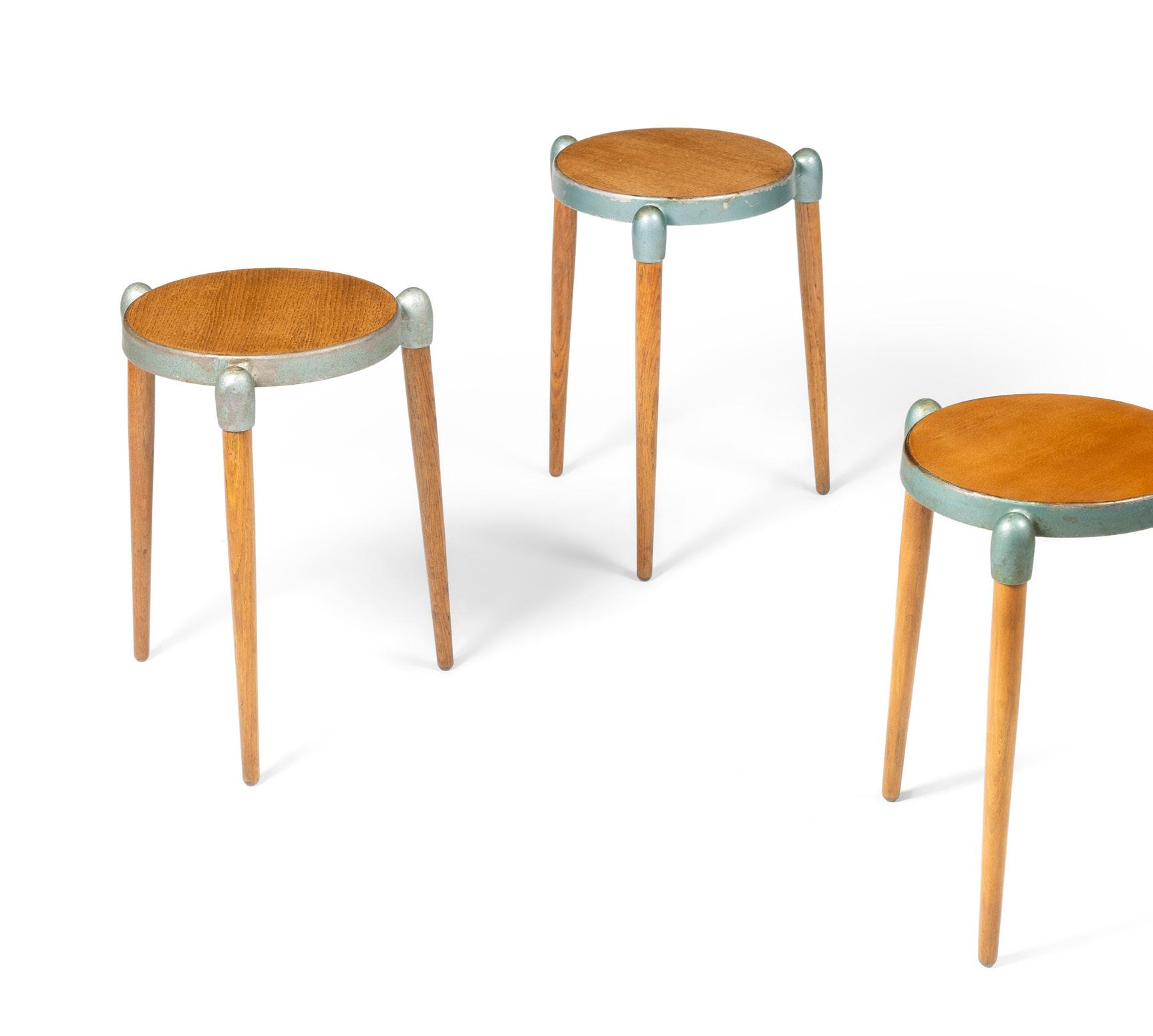
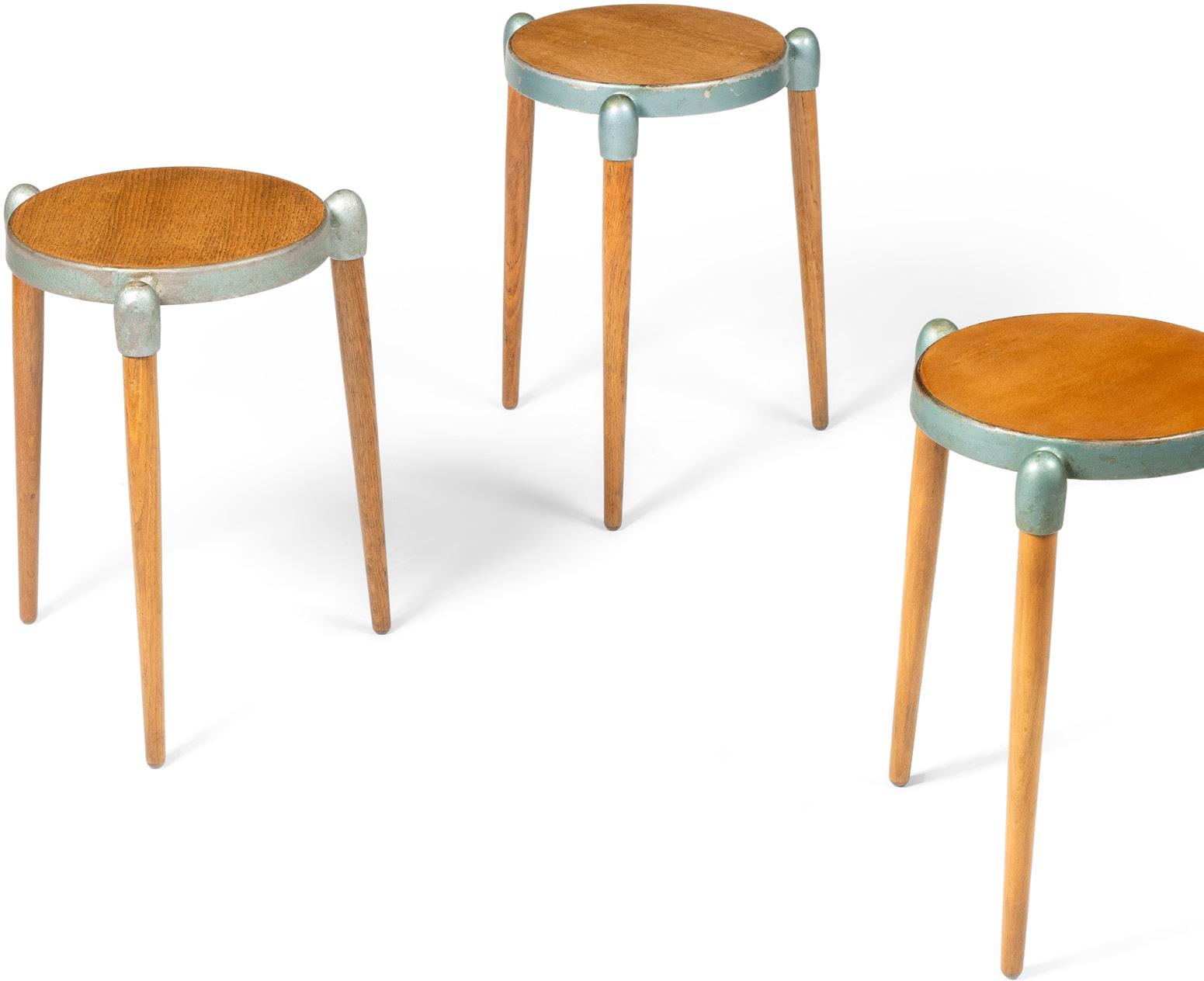
GERALD SUMMERS (BRITISH 1899–1967)
THREE ‘TV-T’ STACKING TABLES, DESIGNED 1953
each cast GERALD SUMMERS REGISTERED
DESIGN NO. 871987 (to underside), cast aluminium, two with oak legs and veneered top, the other with beech legs and veneered top
46cm high, 33.5cm wide, 33.5cm deep (18 1/8in high, 13 ¼in wide, 13 ¼in deep) (3)
Literature: Deese, Martha, Gerald Summers & Marjorie Butcher: Makers of Simple Furniture 1931-1940, Hatje Cantz, Berlin, 2024, p.281, fig.8.30, illustrated, for example of this model.
£1,500-2,000
136
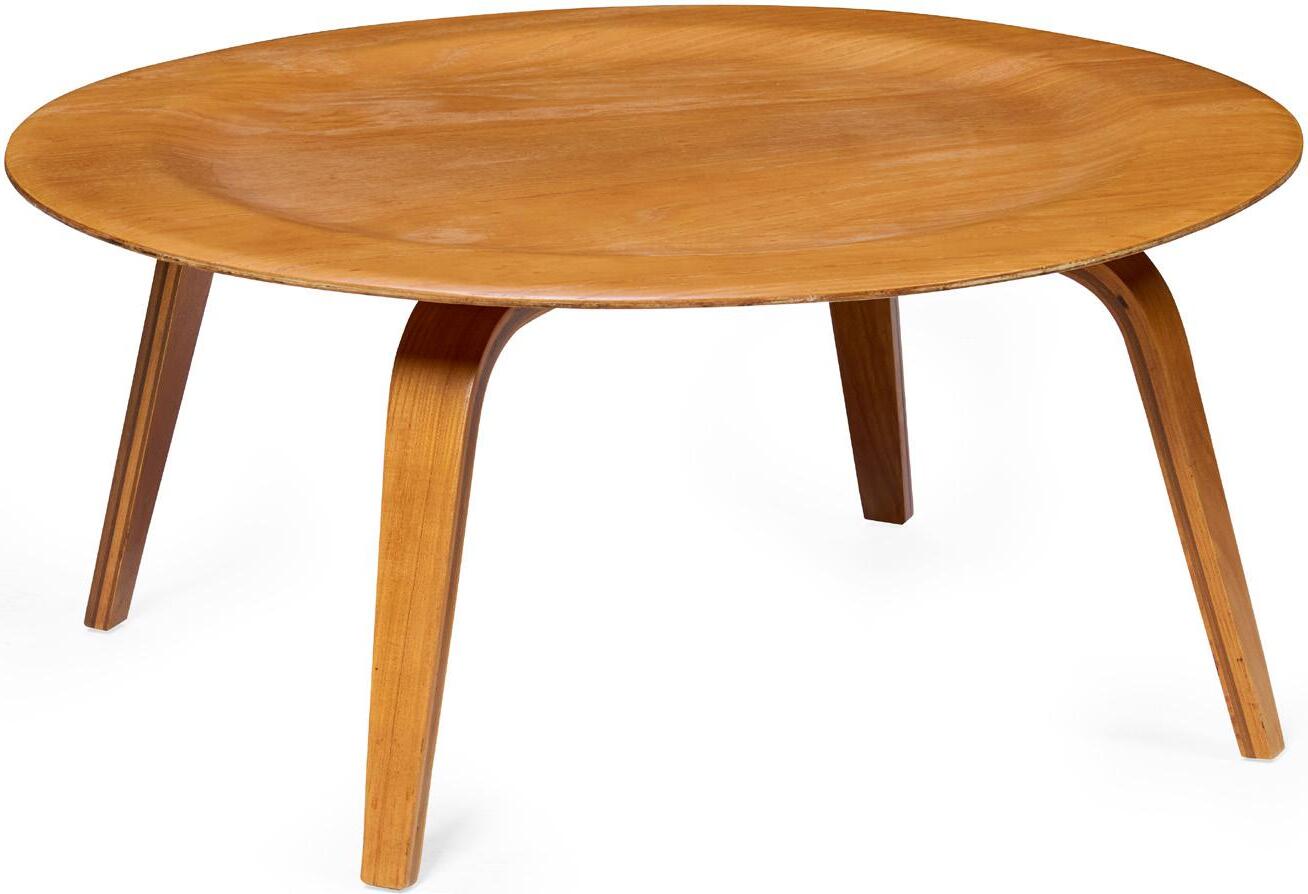
135
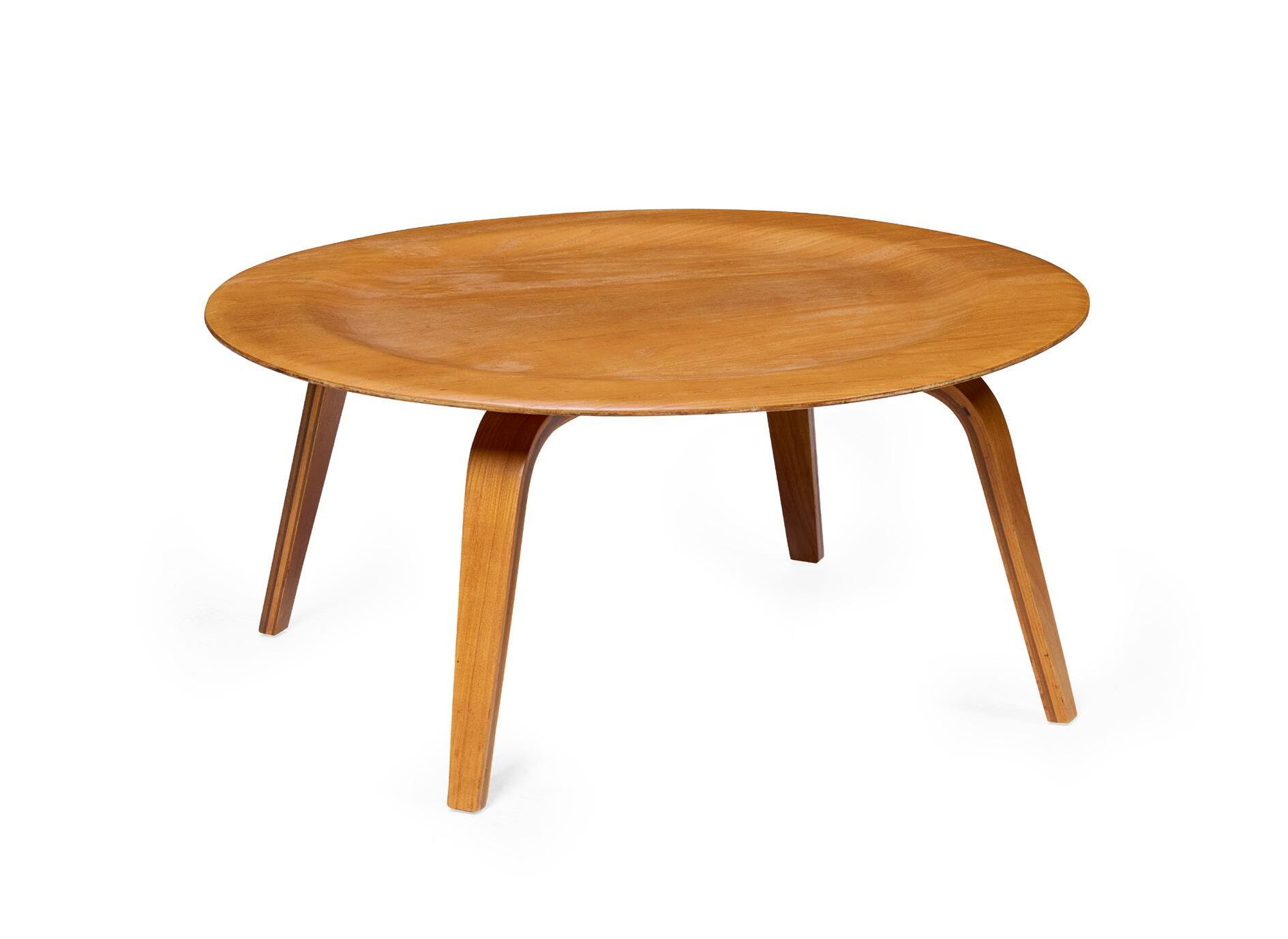
CHARLES & RAY EAMES (AMERICAN 1907–1978 & 1912–1988)
‘CTW-3’ TABLE bent plywood
39cm high, 87cm diameter (15 3/8in high, 34 ¼in diameter)
£1,000-1,500
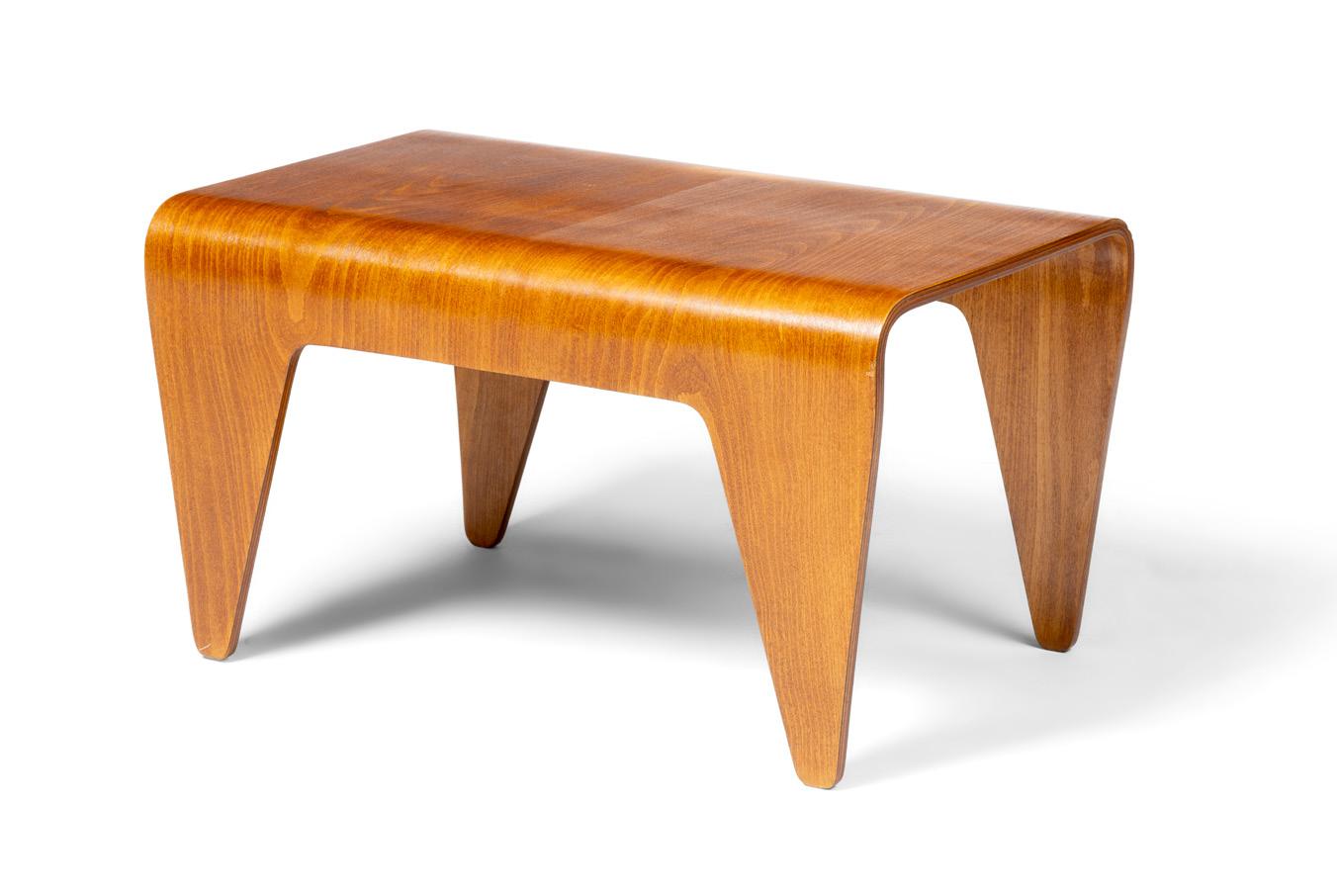
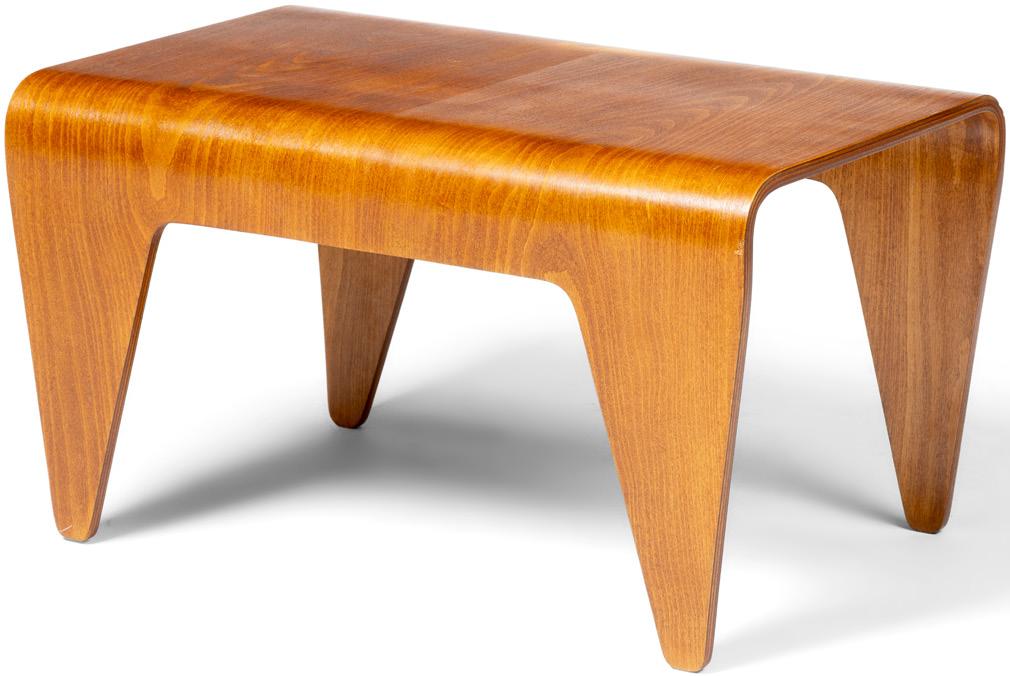
MARCEL BREUER (HUNGARIAN/AMERICAN 1902-1981)
OCCASIONAL TABLE, DESIGNED 1936
birch, post-1945 production
34cm high, 60cm wide, 39cm deep
(13 3/8in high, 23 5/8in wide, 15 3/8in deep)
Provenance: Private Collection, London.
£300-500
138
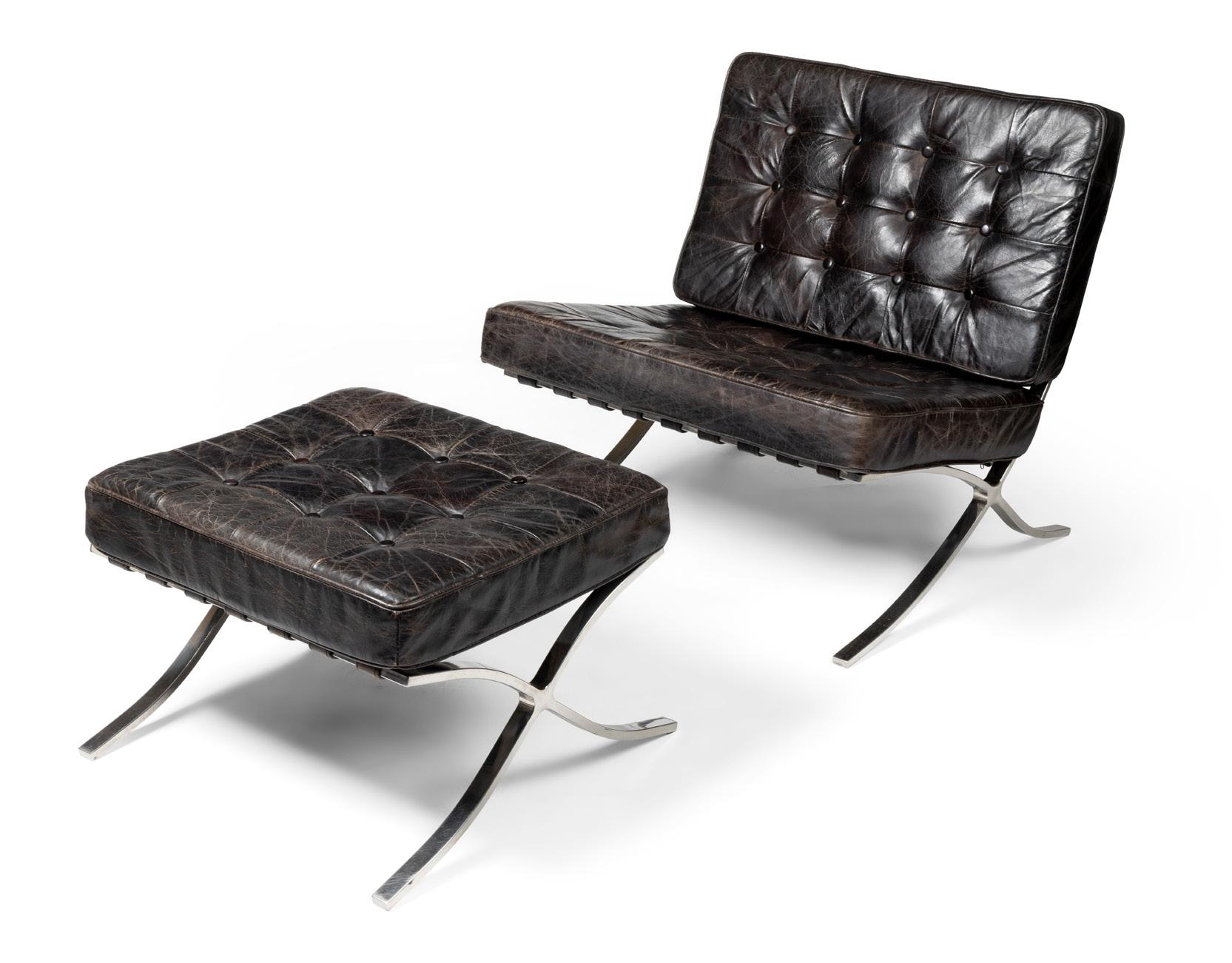
LUDWIG MIES VAN DER ROHE (GERMAN/AMERICAN 1886-1969)
‘BARCELONA’ CHAIR
& OTTOMAN, DESIGNED 1929
chrome plated steel and leather upholstery
chair: 80cm high, 78cm wide, 83cm deep (31 ½in high, 30 ¾in wide, 32 5/8in deep); ottoman: 43cm high, 63cm wide, 55cm deep (17in high, 24 ¾in wide, 21 5/8in deep)
£1,000-1,500
137
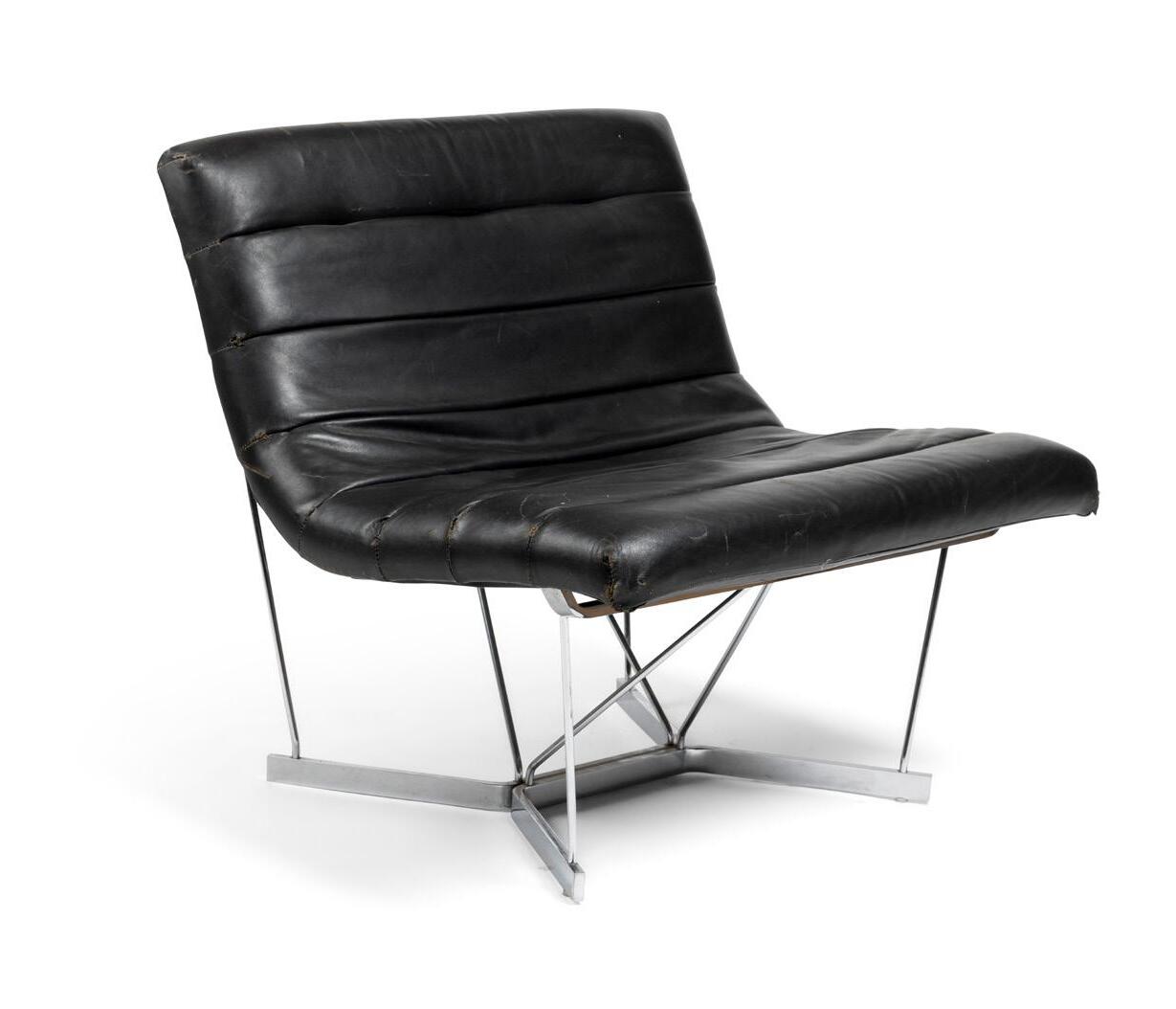
GEORGE NELSON (AMERICAN 1908-1986)
CATENARY CHAIR, DESIGNED 1962
model 6380, steel and black leather
72cm high, 75cm wide, 73cm deep (28 3/8in high, 29 ½in wide, 28 ¾in deep)
Literature: George Nelson: Architect, Writer, Designer, Teacher, von Vegesack and Eisenbrand, p. 251.
£2,000-3,000
139
CHARLES & RAY EAMES (AMERICAN 1907–1978 & 1912–1988) FOR HERMAN MILLER
CHAISE LONGUE, DESIGNED 1968
model ES106, aluminium, steel and leather
74cm high, 191cm long, 44cm deep (29in high, 75 ¼in long, 17 ¼in deep)
Provenance: with Liberty’s, London, 1971, from whom acquired by the previous owner; Private Collection, London.
Sold with original Liberty’s, London receipt.
£2,000-3,000
140
SŌRI YANAGI (JAPANESE 1915-2021) FOR AKITA MOKKO, JAPAN MIRROR, c.1975–1987
beech wood and glass
126cm high, 44cm wide, 4cm deep (49 ½in high, 17 3/8in wide, 1 ½in deep)
£1,000-1,500
141
CHARLES & RAY EAMES (AMERICAN 1907–1978 & 1912–1988)
FOUR ‘DCW’ CHAIRS, DESIGNED 1946
plywood
74cm high, 50cm wide, 52cm deep (29in high, 19 ¾in wide, 11 3/8in deep) (4)
£1,500-2,000
142
MORINO HIROAKI TAIMEI (JAPANESE 1934-) VASE
incised artist’s mark, stoneware, turquoise glaze with gold pours, together with signed wooden box 17cm high, 8.5cm diameter (6 ¾in high, 3 3/8in diameter)
Provenance: Private Collection, U.K.
£300-500
143
MORINO HIROAKI TAIMEI (JAPANESE 1934-) BOWL
pearlescent Taimei glaze with sgraffito decoration, together with signed wooden box 4cm high, 19.7cm wide (1 ½in high, 7 ¾in wide)
Provenance: Private Collection, London.
£300-500
144
MORINO HIROAKI TAIMEI (JAPANESE 1934-) DOUBLE GOURD VASE
incised artist’s mark, stoneware, turquoise glaze with gold pours, together with signed wooden box 21cm high, 10.5cm diameter (8 ¼in high, 4 1/8in diameter)
Provenance: Private Collection, U.K.
£400-600
146
145
OSAMU SUZUKI (JAPANESE 1926-2001) VASE
impressed makers mark, porcelain, with pale celadon glaze, together with signed wooden box
16cm high, 7.5cm wide (6 3/8in high, 3in wide)
Provenance: Private Collection, London.
£400-600
KAWAI HIROTSUGU (JAPANESE 1919-1993) VASE
stoneware, together with signed wooden box
16.5cm high, 13cm wide, 8.5cm deep (6 ½in high, 5 1/8in wide, 3 3/8in deep)
Provenance: Private Collection, U.K.
£300-500
147 §
JULIAN STAIR (BRITISH 1955-) VASE
148 §
ABDO NAGI (YEMENI/BRITISH 1941-2001)
FLARING FOOTED BOWL
impressed maker’s mark, stoneware, turquoise glaze with manganese rim
14.5cm high, 37.5cm diameter (5 ¾in high, 14 ¾in diameter)
Provenance: Bonhams, London, Contemporary Ceramics: Master Works, 17 June 1992, lot 86, where acquired by the present owner; Private Collection, London.
£1,000-1,500
impressed maker’s mark, earthenware
26cm high, 16cm wide (10 ¼in high, 6 ¼in wide)
£600-800
150 §
149 §
COLIN PEARSON (BRITISH 1923-2007) WINGED VESSEL
impressed maker’s mark, porcelain
22.5cm high, 22cm wide, 8.5cm deep (8 ¾in high, 8 5/8in wide, 3 ½in deep)
Provenance: Private Collection, London.
£600-800
JOANNA CONSTANTINIDIS (BRITISH
1927-2000) TALL VESSEL
impressed maker’s mark, stoneware
46.5cm high, 13cm wide (18 ¼in high, 5in wide)
Provenance: Private Collection, London.
£500-700
151 §
BETTY BLANDINO (BRITISH 1927-2011) VASE AND BOWL
each impressed maker’s mark, stoneware
vase: 26cm high, 21.5cm wide (10 ¼in high, 8 ½in wide); bowl: 6cm high, 29cm diameter (2 3/8in high, 11 3/8in diameter) (2)
Provenance: Private Collection, London.
£600-800
152 §
DAME LUCIE RIE D.B.E. (BRITISH 1902-1995) POURING VESSEL
impressed maker’s mark, stoneware, white glaze with manganese rim
12.5cm high, 17cm wide, 9cm deep (4 7/8in high, 6 ¾in wide, 3 ½in deep)
Private Collection, London.
153 §
DAME LUCIE RIE D.B.E. (BRITISH 1902-1995)
CUP & SAUCER
each with impressed maker’s mark, stoneware, the cup with manganese rim
cup: 5.8cm high (2 ¼in high); saucer: 13.7cm diameter (5 3/8in diameter)
£700-900
154 §
DAME LUCIE RIE D.B.E. (BRITISH 1902-1995)
CUP & SAUCER
each impressed maker’s mark, stoneware, the cup with manganese rim
cup: 5.8cm high (2 ¼in high); saucer: 13.7cm diameter (5 3/8in diameter)
£700-900
30cm high, 11.5cm wide, 8.5cm deep (11 ¾in high, 4 ½in wide, 3 3/8in deep)
£4,000-6,000
DAME LUCIE RIE D.B.E. (BRITISH 1902-1995) VASE
impressed maker’s mark, stoneware
156 §
ATTRIBUTED TO DAME LUCIE RIE D.B.E. (BRITISH 1902-1995) FOR BIMINI LTD. (LATER ORPLID)
COLLECTION OF 27 SAMPLE BUTTONS, c.1940s 26 with brass Bimini backs, pressed glass the largest 3.5cm wide (1 3/8in wide) (27)
£300-500
DAME LUCIE RIE D.B.E. (BRITISH 1902-1995) & HANS COPER (BRITISH 1920-1981) SET OF SIX CUPS & SAUCERS AND SIX SIDE PLATES, c.1955-8
cups & saucers impressed with LR and HC marks, the sugar bowl with LR mark, the smaller side plates with LR mark and the larger side plate with LR and HC mark, stoneware, manganese glaze and sgraffito decoration to the cups, and sugar bowl
cups: 6cm high (2 3/8in high); saucers: 11.5cm diameter (4 ½in diameter); sugar bowl: 4cm high, 9cm diameter (1 ½in high, 3 ½in diameter); smaller side plates: 15cm diameter (5 7/8in diameter); larger side plate: 18cm diameter (7in diameter) (12)
Provenance: Private Collection, London.
£3,000-5,000
158 §
THEO MOORMAN (BRITISH 1907-1990)
3-D WALL HANGING
silk, wool and cotton
77.5cm high, 60cm wide (30 ½in high, 23 5/8in wide)
£300-500
159 § PETER COLLINGWOOD (BRITISH 1922-2008)
MACROGAUZE M.137 NO.6
signed and numbered Peter Collingwood M.137 No.6 (to metal plate to reverse), black and natural linen with steel supports
87cm high, 73.5cm wide (34 ¼in high, 29in wide)
Provenance: Private Collection, U.K.
£3,000-5,000
The entire proceeds from the sale of this work, including the Buyer’s Premium, will be donated to Allkind,
Allkind is a London-based mental health charity, driven by a mission to ensure all kinds of people, of all ages, are supported through their mental health challenges, so they can live the life they deserve.
In 2025, they supported 20,000 people across 25 distinct services. From early intervention to ongoing support, Allkind work with people in a way that feels right for them, because no two mental health journeys are the same. They offer services and support across the whole mental health spectrum including talking therapies, community wellbeing programmes, peer support and a multitude of specialised services for children and young people.
Your support will help them continue providing lifechanging services and to be there when it matters most.
EMILY YOUNG (BRITISH 1951-)
QUARTZITE CRYSTAL DRYAD I (BRONZE), 2024
patinated bronze
34cm (13in) high, excluding base
Provenance: Gift of the Artist, sold to benefit
Allkind, in memory of Rosanna Wilson Stephenswe remember her well.
£20,000-30,000
Standing Girl is a classic example of Klimt’s drawing from the first decade of the 20th century, with its jagged but sure line that captures both the nervous energy of the sitter and the tension between artist and model. As with his great contemporary, Egon Schiele, Klimt presents the naked rather than the nude. The Academic life class is taken out of its gilded halls of idealised female perfection and into the backstreets and garrets of the city where real life teems. This sense of being naked rather than nude is accentuated here through the red lipstick, that stands stark as the focus of the drawing. It is a symbol of the worldly: this is no eternal goddess but a real woman.
In Standing Girl, the model’s face is beautifully drawn, with an emotional precision, the hair rendered almost as an abstract shape to keep our attention on the eyes and the arch of the eyebrows, the curve of the nose, the set of the chin. The body is a little looser, it has a lassitude that speaks of a real person standing for too long in the cold, the hand on the hip evoking impatience – less classical contrapposto and more a desire to be done. In Klimt, like Schiele, we see the unidealised bodies of the urban poor, working class or penniless bohemian, all angular bones and jutting vertebrae. It’s what makes their work feel so modern, so real.
161
GUSTAV KLIMT (AUSTRIAN 1862-1918)
STANDING GIRL [FRONTAL STEHENDER MÄDCHENAKT, DEN
LINKEN ARM IN DIE HÜFTE GESTÜTZT], c.1906-7
stamped with estate stamp (faded) (lower right), pencil and coloured crayon on paper
55cm x 36cm (21 ½in x 14 ¼in)
Provenance: Marlborough Fine Art, London (stock no. 35091.1), where acquired by the present owner.
Exhibited: Mathildenhöhe, Darmstadt, 3 Internationale der Zeichnung, Sonderausstellung Gustav Klimt und Henri Matisse, 1970, no.64 (illustrated).
Literature: Breicha, Otto, Gustav Klimt, Mazzotta, Milan, 1981, fig.79; Strobl, Alice, Gustav Klimt, Die Zeichnungen – 1912-1918, Verlag Galerie Welz, Salzburg, 1982, vol. II, no. 1575, illustrated p.120.
£40,000-60,000
In 1970, this drawing was included in a major exhibition of both Klimt and Matisse’s drawings at the Mathildenhöhe in Darmstadt, itself the architectural embodiment of the mad, syncretic spirit of the Vienna Secession and its dramatic expression of the modern. These two great masters of 20th century art couldn’t be more different. Matisse’s world of calme, luxe et volupté, in particular in his later years, situates modernity ‘elsewhere’, in a universalist dreamscape of pareddown classicism and Orientalism. The simple as modern. Klimt, on the other hand, situates modernity in the here and now, in complexity, in a lust for life. In Standing Girl our eye is also drawn to the very bottom of the work, to what appears to be a rolled-down stocking, or perhaps the top of a boot – this hint of the clothed reinforcing her nakedness, the raw and the cooked. Our model doesn’t live in Matisse’s Arcadia. She will get dressed, take her fee and step out into the streets of the modern world.
162
ERNST LUDWIG KIRCHNER (GERMAN 1880-1938)
ZWEI FRAUEN IM GESPRÄCH [TWO WOMAN IN CONVERSATION], c. 1921
stamped with the Nachlass E. L. Kirchner mark and numbered P Da/Ba 5 in ink and K6796 and 6450 in pencil (to reverse), Indian ink and wash on paper
30.2cm x 36cm (11 7/8in x 14 1/8in)
Provenance: Theo Hill Galerie, Cologne, 1968; Anthony Hepworth FIne Art, Bath; The Collection of Gillian Raffles.
This work is listed in the Ernst Ludwig Kirchner Archives, Wichtrach/Bern and will be included in any forthcoming catalogue raisonnés of the artist’s graphic works.
Exhibited: Mercury Gallery, London, Summer Exhibition, 11 June - 15 September 1973, no. 191, illustrated in exhibition catalogue.
£4,000-6,000
163
ERNST LUDWIG KIRCHNER (GERMAN 1880-1938)
ZWEI MÄDCHEN [TWO GIRLS], c. 1925
stamped with the Nachlass E. L. Kirchner mark and numbered F Be/Bh 4 in ink and K4535, 4167 and C-1241 in pencil (to reverse), Indian ink on paper 46cm x 36.5cm (18 1/8in x 14 3/8in)
Provenance: The Collection of Gillian Raffles.
This work is listed in the Ernst Ludwig Kirchner Archives, Wichtrach/Bern and will be included in any forthcoming catalogue raisonnés of the artist’s graphic works.
£4,000-6,000
164 §
PABLO PICASSO (SPANISH 1881-1973)
VIEIL HOMME SONGEANT AUX AMOURS DES VIEUX MESSIEURS (FROM SERIES 347), 1968 [BLOCH 1512, BAER 1528]
from Séries 347, signed in pencil (lower right), numbered 29/50 in pencil (lower left), etching on paper
30.3cm x 40.3cm (12in x 15 7/8in)
Provenance: Mitchell’s, Cockermouth, Fine Art & Antiques, 9-11 December 2020, where acquired by the present owner; Private Collection, London.
£2,000-3,000
165 §
GEORGES BRAQUE (FRENCH 1882-1963)
LA CHASSE [THE HUNT], CONCEIVED 1943
marked with initials and numbered GB 6/7 (lower right) and stamped VALSUANI CIRE PERDUE (on edge lower left), bronze bas-relief, on black painted metal stand, cast in 1953 in the edition of 7
30.5cm high, 23cm wide, 2cm deep (12in high, 9in wide, ¾in deep); overall including stand 34cm high, 11cm deep (13 3/8in high, 4 ¼in deep)
Provenance: Galerie Louise Leiris, Paris (ref. 02881/1567); M. Knoedler & Co., New York; Perls Galleries, New York; Christies, London, Impressionist, Modern Paintings, Watercolours & Sculpture Part II, 1 December 1992, lot 152, where acquired by the present owner; Private Collection, London.
Literature: Fumet, Stanislas, Sculptures de Braque, Jacques Damase, Paris, 1951, pl. XI (another cast illustrated); Gieure, Maurice, Georges Braque - Criticism & Interpretation, Zwemmer, London, 1956, p. 52 (another cast illustrated).
£10,000-15,000
166 §
GIUSEPPE CAMPANELLI (ITALIAN 1925-1995) CAVALLO, 1977
signed and dated, patinated bronze on wooden base
74cm high, 88.5cm wide, 35.5cm deep (29in high, 34 7/8in wide, 14in deep) including base
Provenance: Private Collection, London.
£700-900
Born in Syracuse, the artist spent his childhood (1931–1940) in Tripoli, Libya, before returning to Italy and settling in Lucca during the war years. The son of an artist, he learned the fundamentals of drawing, modelling, and metalwork in his father’s blacksmith workshop. He later studied at the Art School in Florence and the Marble School in Carrara, graduating in 1947. The following year he began teaching drawing in state schools while continuing his practice as a sculptor.
His work was exhibited widely in Italy, including at the Exhibition of the Two Seas, Palermo (1966); 2nd Biennial of Painting and Sculpture (1976); Gruppo 6 Art Club, Pachino (1978); and later shows in Avola, Syracuse, and Marzamemi. A posthumous retrospective, The Nudes, was held at Galleria Roma, Syracuse (1998).
A close friend of Corrado Brancato and Vittorio Giaracca, he shared a studio with the latter for a time. His sculpture reflects an admiration for Henry Moore and Pericle Fazzini, marked by an expressive yet timeless quality that recalls archaic and ancestral forms.
PABLO PICASSO (SPANISH 1881-1973)
FOR MADOURA POTTERY
PROFIL DE JACQUELINE (A. R. 309), DESIGNED 1956
stamped Madoura Plein Feu / Empreinte originale de Picasso / Edition Picasso (to base), and incised R = A 100, terre de faïence, from the edition of 100 41cm x 41cm (16 1/8in x 16 1/8in)
Literature: Ramié, A., Picasso Ceramics, p.158, no.309, model illustrated.
Provenance: Private Collection, UK.
£5,000-8,000
168 §
CORNEILLE (DUTCH 1922-2010)
ASMARA, 1957 (DONKERSLOOT 43)
signed an dated in pencil (lower right), inscribed e.a. and titled (lower left), colour lithograph, an Artist’s Proof aside from the edition of 100 plate: 36cm x 50cm (14 ¼in x 19 ¾in)
Provenance: Private Collection, London, acquired c.2010s.
£400-600
169 §
PIERO CATTANEO (ITALIAN 1929-2003)
UNTITLED, 1975
signed and dated, bronze 46cm high, 54.5cm wide, 18cm deep (18 1/8in high, 21 ½in wide, 7in deep)
Provenance: Lyon & Turnbull, London, Modern Made, 27 March 2019, lot 73, where acquired by the present owner; Private Collection, London.
£800-1,200
ERNST EISENMAYER (AUSTRIAN 1920-2018)
HEAD, 1967
initialled and dated, malachite on black hardstone plinth base
overall 27cm high, 13m wide, 13.5cm deep (10 5/8in high, 5 1/8in wide, 5 ¼in deep)
Provenance: Private Collection, London.
£500-800
171 §
DENIS MITCHELL (BRITISH 1912-1993) FOR PORTHIA PRINTS
TABLE MAT, c.1955-60 screenprint on linen
27cm x 35cm (10 5/8in x 13 ¾in)
Provenance: The Estate of an important St Ives Artist.
£300-500
172 §
DAME BARBARA HEPWORTH D.B.E. (BRITISH 1903-1975) FOR PORTHIA PRINTS
TABLE MAT, c.1955-60
initialled BH in the weave (lower right), screenprint on linen
33cm x 48cm (13in x 18 7/8in)
Provenance: The Estate of an important St. Ives Artist.
£400-600
173 §
ROBERT ADAMS (BRITISH 1917-1984) FOR PORTHIA PRINTS
TABLE MAT, c.1955-60
signed in the weave (lower right), screenprint on linen
30.5cm x 42.8cm (12in x 16 7/8in)
Provenance: The Estate of an important St. Ives Artist.
£300-500
WORKS FROM THE ESTATE OF AN IMPORTANT ST IVES ARTIST
174 §
DENIS MITCHELL (BRITISH 1912-1993)
LUXULYAN II, 1972
initialled, titled, dated and inscribed (to base of slate), conceived as an edition of 7, patinated and polished bronze on slate base
16.5cm high, 13.7cm wide, 7cm deep (6 ½in high, 5 3/8in wide, 2 ¾in deep) including base
Provenance: The Estate of an important St Ives Artist.
£3,000-5,000
175 §
unique, initialled, titled, dated and inscribed (to base), patinated and polished bronze on slate 8cm high, 11cm wide, 5cm deep (3 1/8in high, 4 ¼in wide, 2in deep)
Provenance: The Estate of an important St Ives Artist.
£3,000-5,000
DENIS MITCHELL (BRITISH 1912-1993)
BROOKA, 1972
176 §
RELIEF, 1951
1912-1993)
signed, titled and dated in pencil (to reverse), wood and copper 22cm x 34.7cm (8 5/8in x 13 5/8in)
Provenance: The Estate of an important St Ives Artist.
Exhibited: Penwith Galleries, St. Ives, 1992.
£1,000-2,000
DENIS MITCHELL (BRITISH
177 §
DENIS MITCHELL (BRITISH 1912-1993)
GYPSY ENCAMPMENT, TRINK, 1946
signed and dated (lower left), signed, dated and titled in pencil (to reverse), oil on board
30.5cm x 39.3cm (12in x 15 ½in)
Provenance: The Estate of an important St Ives Artist.
£800-1,200
178 §
DENIS MITCHELL (BRITISH 1912-1993)
CORNISH LANDSCAPE, 1936
signed (lower right), titled, dated and inscribed in pencil (to reverse), oil on board 27cm x 37cm (10 5/8in x 14 ½in)
Provenance: The Estate of an important St Ives Artist.
£800-1,200
179 §
DENIS MITCHELL (BRITISH 1912-1993)
NO.6 LEVEL, GEEVOR TIN MINE, 1946
signed and dated (lower left), titled, dated and signed in pencil (to reverse), oil on board
30.5cm x 39.5cm (12in x 15 ½in)
Provenance: The Estate of an important St Ives Artist.
£700-900
180 §
DENIS MITCHELL (BRITISH 1912-1993)
FIGURES, 1953
signed and dated in pencil (upper right), screenprint on paper sheet: 29.5cm x 29cm (11 ¾in x 11 ½in)
Provenance: From the Estate of an important St. Ives Artist. £300-500
181 §
WILHELMINA BARNS-GRAHAM C.B.E. (BRITISH 1912-2004)
XMAS SQUARE / THE NON STATIC SQUARE, 1979
signed and dated in pencil (lower right), titled and inscribed For Denis & Jane / With Very Best Wishes for Many Blessings for 1980 / with love from Willie / Dec 29 1979 in pencil (to reverse), gouache and pencil on paper
16cm x 7cm (6 ¼in x 2 ¾in)
Provenance: The Estate of an important St Ives Artist.
£800-1,200
182 §
DENIS MITCHELL (BRITISH 1912-1993)
FIGURAL STUDIES
oil on board
31cm x 22cm (12 ¼in x 8 5/8in)
Provenance: The Estate of an important St. Ives Artist.
£800-1,200
183 §
DENIS MITCHELL (BRITISH 1912-1993)
MAQUETTE FOR TRUNGLE, 1975
unique, initialled, titled TRUNGLE and dated, Delabole slate
11.5cm high, 16.5cm wide, 14.5cm deep (4 ½in high, 6 ½in wide, 5 ¾in deep)
Provenance: The Estate of an important St Ives Artist.
Exhibited: Festival Gallery, Bath, 1978.
£3,000-5,000
A PRIVATE COLLECTION OF WORKS BY WILHELMINA BARNS-GRAHAM
2026 is an important year for Wilhelmina Barns-Graham’s standing as a pioneer of British abstraction and we are delighted to present a group of her works which span from the 1950s to the 2000s across a range of media. The first exhibition of her work to be mounted outside the UK, Nature in Motion, will be held at the Museum Belvédère, Heerenveen this Summer and the first career-wide retrospective will open at Tate St Ives in the Autumn. The latter will be accompanied by a specially commissioned catalogue, whilst a new edition of Lynne Green’s monograph about the artist, A Studio Life, is soon to be published by Lund Humphries.
The oil paintings Black and White of 1954 and Black, White and Yellow of 1957 speak to Barns-Graham’s emergence that decade as an artist of significance. The former has been related to her celebrated ‘Geoff and Scruffy’ series, inspired by a friend and his dog. It was exhibited in Bradford two years after its creation and shortly before she and her husband, David Lewis, moved to nearby Leeds from St Ives. Black, White and Yellow was painted during her Northern sojourn. It epitomises Barns-Graham’s ability to express the experience of the local landscape in her unique visual language of form, rhythm and colour. Furthermore, it was included in the inaugural John Moores Liverpool Exhibition of 1957 which aimed to represent the best in contemporary British art.
The highly personal Xmas Square, executed in gouache and pencil on paper in 1979, was created for Barns-Graham’s great friends the sculptor Denis Mitchell and his wife Jane Stevens. It acts as a bridge between her earlier works and those of the late 1990s and early 2000s presented here. They represent the creative finale of her long and prolific career. Working with acrylic on paper, Geevor No.1 of 1997 is one of several examples of the artist using those materials. It comes from the artist’s Scorpio Series ‘of gestural, abstract images, in which bold brushstrokes carry saturated colour’. (Lynne Green, W. Barns-Graham: A Studio Life, Farnham, 2011, p.267).
The following screenprints, including Construction Series I of 2006, are a testament to the working relationship BarnsGraham established with Carol Robertson of Graal Press. As Ann Gunn has explained, together they created a ‘dictionary’ of brush marks in a range of colours printed onto sheets of clear PVC. Barns-Graham would experiment with them to achieve the right positions, colour combinations and opacity or transparency to achieve the multi-faceted harmony of the resultant prints. (Ann V. Gunn, The Prints of Wilhelmina Barns-Graham: A Complete Catalogue, Aldershot, 2007, p.53). Some of them were editioned posthumously following the artist’s death in St Andrew’s in 2004, at the age of ninetyone.
184 §
WILHELMINA BARNS-GRAHAM C.B.E. (BRITISH 1912-2004)
BLACK AND WHITE, 1954
initialled and dated (lower right), further signed, dated and inscribed BLACK + WHITE 1954 / 45 GNS / W Barns Graham to Artist’s label (to reverse), oil and pastel on canvas 81cm x 45cm (32in x 17 ¾in)
Provenance: Purchased directly from the artist in 1962; Bonham’s, London, 20th Century British Art, 8 November 2007, lot 144; Private Collection, U.K.
Exhibited: Bradford, City of Bradford Art Gallery, Sixty-third Spring Exhibition, 1956, no.805.
£12,000-18,000
185 §
WILHELMINA BARNS-GRAHAM C.B.E. (BRITISH 1912-2004)
BLACK, WHITE & YELLOW, 1957
signed and dated (lower left), further signed, titled and dated to stretcher (to reverse), oil on canvas
76cm x 122cm (30in x 48in)
Provenance: with Art First, London; Private Collection, U.K.
Exhibited: Liverpool, Walker Art Gallery, John Moores Liverpool Exhibition, 1957.
£15,000-25,000
186 §
WILHELMINA BARNS-GRAHAM C.B.E. (BRITISH 1912-2004)
WHITE CIRCLE SERIES III, 2006
numbered 4/70 in pencil (lower left), with printer’s blind-stamp (lower right), screenprint on Arches Velin Blanc 400gsm paper, published by Carol Robertson, Graal Press, editioned posthumously 57cm x 76cm (22 ½in x 30in)
Provenance: with Art First, London; Private Collection, U.K.
Literature: Gunn, Ann V., The Prints of Wilhelmina Barns-Graham: A Complete Catalogue, Lund Humphries, Aldershot, 2007, p.145, cat. no.101, with incorrect orientation and numbering of the work.
The edition was published posthumously by the Wilhelmina Barns-Graham Trust in 2006 using Artist approved proofs. The first numbers, 1–40, were issued as part of an edition of 70, while numbers 41–75 were issued as part of an edition of 75.
The Wilhelmina Barns-Graham Trust has kindly provided additional information following the original publication regarding the editioning of the work, and has also noted a possible alternative title: Untitled (Circle Series with Celebration)
£700-1,000
187 §
WILHELMINA BARNS-GRAHAM C.B.E. (BRITISH 1912-2004)
WIND DANCE SERIES No. V, 2006
numbered 5/70 in pencil (lower left), with printer’s blind-stamp (lower right), screenprint on Arches Velin Blanc 400gsm paper, published by Carol Robertson, Graal Press, editioned posthumously 57cm x 57cm (22 ½in x 22 ½in)
Provenance: Private Collection, U.K.
Literature: Gunn, Ann V., The Prints of Wilhelmina Barns-Graham: A Complete Catalogue, Lund Humphries, Aldershot, 2007, p.148, cat. no.106.
The edition was published posthumously by the Wilhelmina Barns-Graham Trust in 2006 using Artist approved proofs.
£600-800
188 §
WILHELMINA BARNS-GRAHAM C.B.E.
(BRITISH 1912-2004)
CONSTRUCTION SERIES I, 2006
numbered 4/70 in pencil (lower left), with printer’s blind-stamp (lower right), screenprint on Arches Velin Blanc 400gsm paper, published by Carol Robertson, Graal Press, editioned posthumously 57cm x 76cm (22 ½in x 30in)
Provenance: Private Collection, U.K.
Literature: Gunn, Ann V., The Prints of Wilhelmina Barns-Graham: A Complete Catalogue, Lund Humphries, Aldershot, 2007, p.108, cat. no.45. The edition was published posthumously by the Wilhelmina Barns-Graham Trust in 2006 using Artist approved proofs. A Stamp of Authentication is on the reverse.
£700-1,000
189 §
WILHELMINA BARNS-GRAHAM C.B.E. (BRITISH 1912-2004)
WIND DANCE SERIES No.III, 2004
numbered 4/70 in pencil (lower left), with printer’s blind-stamp (lower right), screenprint on Arches Velin Blanc 400gsm paper, published by Carol Robertson, Graal Press 57cm x 57cm (22 ½in x 22 ½in)
Provenance: Private Collection, U.K.
Literature: Gunn, Ann V., The Prints of Wilhelmina Barns-Graham: A Complete Catalogue, Lund Humphries, Aldershot, 2007, p.147, cat. no.104.
£600-800
190 §
WILHELMINA BARNS-GRAHAM
C.B.E. (BRITISH 1912-2004)
UNTITLED, 2000
signed and dated (lower right), acrylic on paper
57.7cm x 76.5cm (23in x 30in)
Provenance: with Art First, London; Private Collection, U.K.
£3,000-5,000
191 §
WILHELMINA BARNS-GRAHAM
C.B.E. (BRITISH 1912-2004)
GEEVOR No.1 (SCORPIO SERIES 3), 1997
signed and dated (lower right), further titled and dated on Artist’s label (to reverse), acrylic on Arches paper
57cm x 77cm (22 ½in x 30 ¼in)
Provenance: with Art First, London; Private Collection, U.K.
£4,000-6,000
192 §
WILHELMINA BARNS-GRAHAM
C.B.E. (BRITISH 1912-2004)
JANUARY 2001, 2001
signed and dated (lower right), acrylic on paper
58.5cm x 76.5cm (23in x 30in)
Provenance: with Art First, London; Private Collection, U.K.
£4,000-6,000
END OF COLLECTION
193 §
PRUNELLA CLOUGH (BRITISH 1919-1999)
GATE
oil on board
37cm x 48cm (14 ½in x 19in)
Provenance: Annely Juda Fine Art, London, from whom acquired by the present owner.
£5,000-8,000
194 §
SANDRA BLOW R.A. (BRITISH 1925-2006) NO. 3, 1969
signed and dated (to reverse), oil and mixed media on canvas 61cm x 167.8cm (24in x 66in)
Provenance: New Art Centre, London; Bonham’s, Knightsbridge, Modern Pictures, 20 September 2011, lot 245; Private Collection, London.
£8,000-12,000
195 §
ALEXANDER MACKENZIE (BRITISH 1923-2002)
DRAWING (RECLINING), 1960
signed, titled and dated (to backboard), inscribed To Eileen Wendy Geoffrey & Peter / with love and greeting for Christmas and the New Year 1960/61 (to backboard), oil and charcoal on paper 39cm x 52.5cm (15 ½in x 20 ¾in)
Provenance: Private Collection, from whom acquired by the present owner.
£2,000-3,000
196 §
PAUL MOUNT (BRITISH 1922 - 2009)
TARANTELLA, 1980
signed on slate base, moveable stainless steel, unique 175.5cm (69in) high including base
Provenance: Atkinson Collection; Beaux Arts, Bath, where purchased by Joy Barnes; Her sale, Greenslade Taylor Hunt , Taunton, 20 September 2012, lot 11, where acquired by the present owner.
Literature: Gaskell, Ronald, Paul Mount: A Selection of Sculpture 1958-2003, Nancherrow Studio, St Just, 1999, no.61, illustrated.
£18,000-25,000
BERNDT FRIBERG (SWEDISH 1899-1981) FOR GUSTAVSBERG VASE
incised maker’s and manufacturer’s marks, stoneware, with hares-fur glaze
44.5cm high, 12cm wide (17 ½in high, 4 ¾in wide)
Literature: see Ulf Hård af Segerstad, Berndt Friberg Keramiker, Nordisk Rotogravyr, Stockholm, 1964, for similar examples and shape silhouette.
£1,200-1,800
198 §
ALVAR AALTO (FINNISH 1898–1976) COFFEE TABLE, DESIGNED 1933
model 70, birch and ebonised wood
56cm high, 69cm wide, 69cm deep (22in high, 27in wide, 27in deep)
Provenance: Private Collection, London.
£1,500-2,500
199 §
ALVAR AALTO (FINNISH 1898-1976) DINING TABLE AND FOUR ‘MODEL 69’ CHAIRS, c.1940s
the chairs marked Artek (to underside), birch, the table top with red staining table: 71cm high, 183cm wide, 92cm deep (28in high, 72in wide, 36 ¼in deep); chairs: 88cm high, 46.5cm wide, 53cm deep (34 5/8in high, 18 3/8in wide, 20 7/8in deep) (5)
£2,000-3,000
200 §
ALVAR AALTO (FINNISH 1898-1976) FOR FINMAR LTD.
TABLE, DESIGNED c.1932
manufacturer’s label (to underside), birch and laminated birch
71cm high, 182cm long, 90.5cm deep (28in high, 71 5/8in long, 35 5/8in deep)
Provenance: Private Collection, London.
£1,000-1,500
201
JOSEF FRANK (SWEDISH 1885-1967) FOR SVENSKT TENN
FLOOR LAMP, c.1940s
model G3236, manufacturer’s applied label and stamped SVENSKT TENN / TYP / G2326, patinated brass with silk shade
124cm high, 32cm wide (48 ¾in high, 12 5/8in wide)
Literature: Johansson, Gotthard, Tjugo ar i Svenskt Tenn, National Museum, Stockholm, 1952, unpaginated.
£800-1,200
JOSEF
FRANK (SWEDISH 1885-1967) FOR SVENSKT TENN
DRINKS TROLLEY, DESIGNED 1938 model 889, brass, glass and rubber wheels
60cm high, 91cm wide, 50cm deep (23 5/8in high, 35 ¾in wide, 19 ¾in deep)
Literature: Schulz, Otto, Boet - tidskrift for hemkultur, Hantverk, konstindustri, Gothenburg, 1938, p.159, for the model illustrated; Ott-Wodni, Marlene, Josef Frank 1885-1967: Raumgestaltung und Möbeldesigni, Böhlau Verlag Wien, 2016, p.309, model no.889, for the model illustrated.
£1,000-1,500
203
SVEND AAGE HOLM SØRENSEN (DANISH 1913-2004)
FLOOR LAMP, 1950s
brass and linen shade
149.5cm high, 34cm diameter (58 7/8in high, 13 3/8in diameter)
£1,000-1,500
204 §
ALVAR AALTO (FINNISH 1898–1976) FOR FINMAR LTD.
CHAIR, DESIGNED 1933
model 21, with Finmar Ltd. label (to underside), Karelian birch
85cm high, 48cm wide, 57cm deep (33 ½in high, 19in wide, 22 ½in deep)
Provenance: Private Collection, London.
£3,000-5,000
205
ERIK OLE JØRGENSEN (DANISH 1925-2002)
SOFA
model EJ315, manufacturer’s applied label (to underside), mahogany and leather upholstery
76cm high, 154cm wide, 75cm deep (30in high, 60 5/8in wide, 29 ½in deep)
Provenance: Private Collection, U.K.
£800-1,200
206 Y
M. RYDER (DANISH 20TH CENTURY) AND ESKILD PONTOPPIDAN (DANISH 1933-) FOR DANSK MØBELKUNST
STACKABLE TABLES, c.1962
manufacturer’s metal label (to underside), rosewood stacked: 54cm high, 55cm wide, 55cm deep (21 ¼in high, 21 5/8in wide, 21 5/8in deep)
Literature: see Jalk, Grete (ed.), Dansk Møbelkunst gennem 40aar 1957-1966, Teknologisk Instituts Forlag, København, 1987, pp.2067, illustrated, for an example of this model which was exhibited in the Copenhagen Cabinetmaker’s Guild Exhibition in 1962. Bent Salicatb wrote that ‘… I am quite sure that Kaare Klint would have been pleased to see M. Ryder’s and Eskild Pontoppidan’s stackable tables, made by Ludwig Pontoppidan. Here is a beautiful example of a solution to a functional and mathematical problem: to make tables which could be stacked. As opposed to the usual suspended small tables, they were of the same height and they were made in sizes which allowed them to be placed end to end in spite of the fact that they were stackable. The construction is simple, elegant and strong…’
207 §
Note: Sold in compliance with CITES regulations, with (nontransferable) Transaction Specific Certificate no. 26GBA10E50X7S. £600-800
INGEGERD SILOW (SWEDISH 1916-2005) ‘HARDANGER’ RÖLLAKAN RUG initialled in the weave (lower left), artist’s label (to reverse), wool
230cm x 167cm (90 ½in x 65 ¾in)
Provenance: Private Collection, London £800-1,200
208
POUL HENNINGSEN (DANISH 1894-1967)
TABLE LAMP, DESIGNED c.1927
chromed and enamelled metal
52cm high, 37cm diameter (20 ½in high, 14 ½in diameter)
£1,500-2,000
ARNE JACOBSEN (DANISH 1902-1971) FOR LOUIS POULSEN
‘AJ’ TABLE LAMP, DESIGNED c.1960
applied manufacturer’s label (to the inner shade), lacquered steel
55cm high (21 5/8in high)
210
KAY BOJESEN (DANISH 1886-1958)
COLLECTION OF SIX ANIMAL FIGURES
the hippo, elephant, rabbit, bear and monkey stamped KAY BOJESEN / COPYRIGHT / DENMARK, oak and teak
the dog: 14.5cm high, 31.3cm long, 9cm deep (5 ¾in high, 12 ¼in long, 3 ½in deep); the rabbit: 9cm high, 10.5cm long, 7.5cm deep (3 ½in high, 4 1/8in long, 3in deep) (6)
£1,000-1,500
211 POUL KJAERHOLM (DANISH 1929-1980) FOR E. KOLD CHRISTENSEN SOFA AND CHAIR, DESIGNED 1958
models PK31 /3 and PK31 /1, each with stamped manufacturer’s cypher mark (to underside), steel and leather
sofa: 71.5cm high, 198.5cm wide, 79cm deep (28 1/8in high, 78 1/8in wide, 31 1/8in deep); chair: 69.5cm high, 76cm wide, 68cm deep (27 3/8in high, 30in wide, 26 ¾in deep) (2)
Literature: Sheridan, Michael, The Furniture of Poul Kjaerholm: Catalogue Raisonne, Gregory R. Miller & Co., 2008, pp.110-113.
£10,000-15,000
HARALD NIELSEN (DANISH 1892-1977) FOR GEORG JENSEN ‘PYRAMID’ MILK JUG AND SUGAR BOWL & COVER
each stamped manufacturer’s mark, DESSIN / HN / DENMARK / STERLING / 925S / 600B, and with import marks for London 1936 and 1938, silver milk jug: 7.6cm high, 14.2cm wide (3in high, 5 5/8in wide; pot and cover: 8.2cm high, 11.3cm diameter (3 ¼in high, 4 ½in diameter); 529 grams (2)
Provenance: Private Collection, U.K.
£1,200-1,800 213
HARALD NIELSEN (DANISH 1892-1977) FOR GEORG JENSEN FOOTED BOWL
stamped manufacturer’s mark, DENMARK / STERLING / 620D, silver
4.7cm high, 29.5cm diameter (1 7/8in high, 11 5/8in diameter), 764 grams
Provenance: Private Collection, U.K.
£1,200-1,800
214 §
GUNDORPH ALBERTUS (DANISH 1887-1969) FOR GEORG JENSEN)
‘MITRA’ 168 PIECES DINNER SERVICE, DESIGNED 1941
most pieces stamped GEORG JENSEN / STAINLESS / DENMARK, stainless steel, the set comprising 16 large dinner knives, 15 medium dinner knives, 14 large dinner forks, 16 medium dinner forks, 16 large dinner spoons, 12 medium dinner spoons, 15 soup spoons, 17 large tea spoons, 16 medium tea spoons, 11 two prong forks, 2 piece carving set, a cheese knife, 2 butter knives, a bottle opener, a cake server, a large two piece serving set, 3 medium two piece serving sets, a large sauce ladle, a medium sauce ladle, a large serving fork and spoon, and a further un-associated spoon the large ladle 29cm long (11 3/8in long)
Provenance: Private Collection, Oxfordshire.
£500-800
215 § VIVIANNA TORUN BÜLOW-HÜBE (DANISH 1927-2004) FOR GEORG JENSEN NECK RING AND ONYX PENDANT DROP
model nos. 410 and 311C, each stamped manufacturer’s marks, model number, 925S, TORUN, the neck ring also stamped M-L, silver and onyx inner width of neck ring: 14.2cm (5 5/8in)
£600-800
216
GEORG JENSEN LTD.
‘ARIA’ NECKLACE, DESIGNED 2014 stamped manufacturer’s mark, 925S, silver drop approximately 43cm (17in)
£300-500
217
ARNE JACOBSEN (DANISH 1902-1971) FOR FRITZ HANSEN
SET OF SIX ‘OXFORD’ CHAIRS, DESIGNED 1965
each with applied manufacturer’s label, leather and aluminium
89cm high, 46cm wide, 46cm deep (35in high, 18 1/8in wide, 18 1/8in deep) (6)
£1,000-2,000
218
ARNE JACOBSEN (DANISH 1902-1971) FOR FRITZ HANSEN ‘SHAKER’ TABLE, DESIGNED 1958
manufacturer’s applied label (to underside), teak and aluminium 71cm high, 182cm wide, 91cm deep (28in high, 71 5/8in wide, 35 ¾in deep) This model was designed in 1958 for Arne Jacobsen’s total interior scheme at the SAS Royal Hotel in Copenhagen.
£800-1,200
219
PREBEN FABRICIUS (DANISH, 1931–1984) & JØRGEN KASTHOLM (DANISH, 1931–2007) FOR BO-EX PAIR OF ‘SCULPTURE’ CHAIRS, DESIGNED 1964
model BO-591, first edition, leather and stainless steel 65cm high, 69cm wide, 45cm deep (25 ½in high, 27 1/8in wide, 17 ¾in deep) (2)
Literature: Mobilia, no.133, 1966, n.p.; Habegger, Jerryll and Joseph H. Osman, Sourcebook of Modern Furniture, New York, 1998, p.13.
£4,000-6,000
220 §
PETER HAIGH (BRITISH 1914-1994)
10- 89 APRIL, 1989
signed, dated and inscribed (to reverse), oil on canvas
106.5cm x 122cm (42in x 48in)
Provenance: The Artist, from whom acquired directly by the present owner.
£1,500-2,500
221 §
PATRICK HERON C.B.E. (BRITISH 1920-1999)
No. 11 (FROM THE JANUARY 1973 SERIES), 1973
signed and dated in pencil in margin (lower right) and inscribed Artist’s Proof in pencil in margin (lower left), screenprint in colours, an Artist’s proof aside from the edition of 72. Printed by Kelpra Studio. Published by Waddington Graphics, London
63.5cm x 82cm (25in x 32¼in)
Provenance: Private Collection, London.
£2,000-3,000
SIR TERRY FROST R.A. (BRITISH 1915-2003)
RED, BLACK & WHITE PILOT, 1998
signed, titled and dated in pencil (to reverse), oil and collage on board
24cm x 49cm (9 ½in x 19 ¼in)
Provenance: Private Collection, U.K.
£1,500-2,500
223 §
WILLIAM SCOTT C.B.E., R.A. (BRITISH 1913-1989)
STILL LIFE WITH FRYING PAN AND EGGS, 1973
signed and dated in pencil (upper left) and inscribed in pencil a.p. (lower left), screenprint on wove paper, an Artist’s Proof aside from the edition of 250. Printed by Kelpra Studio.
Published by CCA Galleries, London
66cm x 87.5cm (26in x 34¾in)
£3,000-5,000
DOUGLAS PORTWAY (SOUTH AFRICAN 1922-1993)
CONJUNCTION No.3, 1965
signed and dated lower right), titled and dated (to reverse), oil on canvas
147.5cm x 163cm (58in x 64 ¼in)
Provenance: The Artist, from whom acquired by A.D.F. Gilbert, of Gilbert Parr Gallery, London, c.1970s and thence by descent to the present owner.
£1,000-1,500
225 §
GABRIEL WEISSMANN (BRITISH 1944-1997)
TEMPO MALIGNO, 1975
signed and dated (lower right), also signed, titled and dated (to reverse), mixed media on board
91.5cm x 66cm (36in x 26 in)
Provenance: with The Nine British Art, London.
£1,200-1,800
PETER KINLEY (BRITISH 1926-1988)
GARDEN, 1975
signed, titled and dated on stretcher (to reverse), oil on canvas 138cm x 214cm (54 ¼in x 83 ¾in)
Provenance: Christies, London, Modern British Art Online, 17 November 2017, lot 149; Private Collection, London, from whom acquired by the present owner.
£5,000-8,000
227 §
DONALD HAMILTON FRASER R.A. (BRITISH 1929-2009)
PAINTING APRIL 1963 RED I, 1963 titled and dated in pencil to stretcher (to reverse), oil on linen
102cm x 101.5cm (40 ¼in x 40in)
Provenance: Gimpel Fils, London, where acquired by Joseph H. Hirshhorn, December 1963; Gifted by Joseph H. Hirshhorn to the Hirshhorn Museum and Sculpture Garden in 1966; Their sale, Sotheby’s, London, Modern & British Post War Art, 30 July 2020, lot 690, sold by the Order of the Trustees of the Hirshhorn Museum and Sculpture Garden to Benefit its Acquisition Program; Private Collection, U.K.
£4,000-6,000
228 §
JOHN WELLS (BRITISH 1907-2000) PAINTING, 1949
signed and dated in pen (to reverse); studio stamp (to reverse) and further inscribed with the Artist’s photo archive reference, oil on board 16cm x 31cm (6 ¼in x 12 ¼in)
Provenance: The Estate of the Artist; Private Collection, UK, from whom acquired by the present owner.
£8,000-12,000
229 §
ROBERT ADAMS (BRITISH 1917-1984) COL DEVELOPMENT, 1972 (OPUS 342)
from an edition of 6, bronze
11cm high, 17cm wide, 10cm deep (4 ¼in high, 6 ¾in wide, 4in deep)
Provenance: Estate of the Artist; Gimpel Fils, London.
Literature: Grieve, Alastair, The Sculpture of Robert Adams, The Henry Moore Foundation in association with Lund Humphries, London, 1992, p.232, no.609,, another example illustrated.
Exhibited: Gimpel Fils, London, Robert Adams, 1974, no. 9; Gimpel & Weitzenhofer, New York, Robert Adams, 1974, no. 9 (another cast); Gainsborough’s House, Sudbury, Robert Adams, 1978, no. 12 (another cast).
£1,500-2,000
230 §
FRANCIS DAVISON (BRITISH 1919-1984) COLLAGE, 1952
signed (to reverse), collage on board
45.5cm x 61cm (18in x 24in)
Provenance: with Goldmark Gallery, Rutland.
Literature: Lambirth, Andrew, Francis Davison, Sansom & Company, Bristol, 2013, p.63, illustrated.
£2,000-3,000
231 §
JOHN WELLS (BRITISH 1907-2000) DRAWING, c.1960s
Artist’s Estate blind stamp (lower right), pencil and pastel on paper 12.5cm x 20.5cm (5in x 8in)
Provenance: The Estate of the Artist; Private Collection, from whom acquired by the present owner.
£1,500-2,500
232 §
PATRICK HERON C.B.E. (BRITISH 1920-1999)
JANUARY 15: 1988: I, 1988 signed and dated (to the reverse), gouache on paper
30.5cm x 40.5cm (12in x 16in)
Provenance: Waddington Galleries, London; Christie’s, South Kensington, 20th Century British Art, 16 December 2010, lot 3, where purchased by the previous owner; Their sale, Christie’s London, Modern British Art, 29 September 2020, lot 47, where acquired by the present owner.
£8,000-12,000
233 §
ROGER HILTON C.B.E. (BRITISH 1911-1975) SELF-PORTRAIT, c.1966
pastel and charcoal on paper 61cm x 48cm (24in x 19in)
Provenance: The Estate of the Artist; Sotheby’s S/2, London, from whom acquired by the present owner, May 2019.
£3,000-5,000
235 §
JULIUS BISSIER (GERMAN 1893-1965)
47/24, 1947
signed and inscribed in pencil (lower right), monotype
15.7cm x 24cm (6 ½in x 9 ½in)
Provenance: The Artist; Gimpel Fils, London, where acquired by the present owner.
£400-600
234 §
JULIUS BISSIER (GERMAN 1893-1965)
47/24, 1947
signed and inscribed in pencil (lower right), monotype
15.7cm x 24cm (6 ½in x 9 ½in)
Provenance: The Artist; Gimpel Fils, London, where acquired by the present owner.
£400-600
236 §
JULIUS BISSIER (GERMAN 1893-1965)
UNTITLED, 1947
signed and dated (lower left), monotype 16cm x 25cm (6 ¼in x 9 ¾in)
Provenance: The Artist; Gimpel Fils, London, where acquired by the present owner.
£400-600
238 §
237 §
BEN NICHOLSON O.M. (BRITISH 1894-1982)
LAMBOUSA 2, 1973
signed and titled in pencil (to reverse), pencil and oil wash on paper
36.8cm x 52.8 cm (14 ½in x 20 ¾in)
Provenance: with Bernard Jacobson Gallery, London; with Blum Helman Gallery, London; with Bernard Jacobson Gallery, London, from whom acquired by the present owner.
£4,000-6,000
BEN NICHOLSON O.M. (BRITISH 1894-1982)
ST. REMY
signed and titled (to the reverse), pencil on paper
30cm x 37.5cm (11 ¾in x 14 ¾in)
Provenance: with Fischer Fine Art Ltd, London (dated c. 1950 on label to reverse); The Collection of Gillian Raffles.
£1,500-2,000
239 §
BRIAN WILLSHER (BRITISH 1930-2010)
FLAME, 1993
signed and dated (to base), mahogany 96.5cm high (38 ½in high) (including base)
Provenance: Belgrave Gallery, London, 2006; Private Collection, 2006-2015; with Paisnel Gallery, London. £800-1,200
240 §
PAUL FEILER (BRITISH 1918-2013)
JANICON XXXIX, 2000
signed, titled and dated in pen (to reverse), oil and gold paint on canvas laid on board in Artist’s silverpainted frame
76cm x 76cm (30in x 30in)
overall
Provenance: with The Redfern Gallery, London.
Literature: Raeburn, Michael, Paul Feiler: Connections, The Redfern Gallery, London, 2002, p.39, no.49, illustrated.
£4,000-6,000
241 §
ALAN DAVIE C.B.E, R.A. (BRITISH 1920-2014)
BOXES FOR JOY, 1963 (OPUS O.237A)
titled in pencil (to stretcher), oil on canvas
50.8cm x 61cm (20in x 24in)
Provenance: Gimpel Fils, London; Private Collection , U.K.
£5,000-7,000
242 ‡ §
MALCOLM HUGHES (BRITISH 1920-1997)
WHITE RELIEF No. 1, 1972
acrylic on wood relief
59.5cm x 121cm x 6cm (23 ½in x 47 5/8in x 2 ¼in)
Provenance: Galerie Riekje Swart, Amsterdam, from whom acquired by Jan and Tineke Hoekstra; Their sale, Christie’s, Amsterdam, Post-War and Contemporary Art, 30 April 2019, lot 106, where acquired by the present owner.
£3,000-5,000
243 §
DEREK CARRUTHERS (BRITISH 1935-2021)
RED VERTICAL, 1960
signed and dated (lower right), further signed and titled (to reverse), oil on board with relief elements
60cm x 96.5cm (23 5/8in x 38in)
£2,000-3,000
ALAN GREEN (BRITISH 1932-2003)
TWO REDS TO CREAM ANGLE, 1991 signed, titled and dated (to reverse), oil on linen 120 cm x 120 cm (47 ¼in x 47 ¼in)
Provenance: Hampel Fine Art Auctions, Munich, Modern & Contemporary Art, 22 September 2016, lot 555, where acquired by the present owner. £2,000-3,000
245 §
TERRY POPE (BRITISH 1941-)
SPACE RING CONSTRUCTION, 1979
signed, titled and dated (to reverse), also signed, titled and dated on Artist’s hand-written label (to reverse), Perspex and steel construction
61cm x 61cm x 21.5cm (24in x 24in x 8 ½in)
Provenance: Acquired directly from the Artist by the previous owner; Their sale, Christie’s, London, Modern/British Art Online, 24 November 2018, lot 70, where acquired by the present owner.
£1,500-2,500
246 §
painted wood construction
60.5cm x 60.5cm x 6.5cm (23 ¾in x 23 ¾in x 2 ½in)
Provenance: with Redfern Gallery, London.
£2,000-3,000
JEAN SPENCER (BRITISH 1942-1998) RELIEF
247 §
GILLIAN WISE (BRITISH 1936-2020) RELIEF (UNICURSAL CURVE SERIES), 1966/2007
signed, dated and inscribed on Artist’s label (to reverse), numbered 2/4, Perspex and aluminium, mounted on wood 61cm x 61cm (24in x 24in); 81.2cm x 81.2cm overall (32in x 32in)
Provenance: Gift of the Artist to the present owner.
£2,000-3,000
The 1960s versions of this series were often made in vinyl and rubber, which over time had cracked and deteriorated, creating a surface that ran contrary to the Artist’s initial intention. Therefore, in 2007, assisted by John Simons, Wise decided to remake this work, in this instance in a more durable Perspex, to preserve the original aesthetic. but at a larger scale. It is understood that no more than three of the intended edition of four were made.
VICTOR VASARELY (HUNGARIAN/FRENCH 1906-1997) FOR ROSENTHAL VASE, 3 BEAKERS, 2 MEDIUM PLATES AND A LARGE PLATE
each with manufacturer’s mark (to base), porcelain
vase: 24cm high, 11cm wide (9 ½in high, 4 3/8in wide); beakers: 11cm high (4 3/8in high); medium plate: 24cm x 24cm (9 ½in x 9 ½in); large plate: 30.5cm x 30.5cm (12in x 12in) (7)
£600-800
249 † §
VICTOR VASARELY (HUNGARIAN/ FRENCH 1906-1997) FOR ROSENTHAL VASE
manufacturer’s mark (to base), porcelain 32cm high, 37cm wide, 12cm deep (12 ½in high, 14 ½in wide, 4 ¾in deep)
£300-500
250 † §
VICTOR VASARELY (HUNGARIAN/FRENCH 1906-1997) FOR ROSENTHAL
4 LARGE CIRCULAR PLATES, 1 MEDIUM SQUARE PLATE, 4 SMALL SQUARE PLATES
each with manufacturer’s marks (to base), porcelain large plate: 31cm x 31cm (12 ¼in x 12 ¼in); medium plate: 22cm x 22cm (8 5/8in x 8 5/8in); small plate: 13cm x 13cm (5 1/8in x 5 1/8in) (9)
Provenance: Private Collection, U.K.
£600-800
251
RAYMOND COHEN (FRENCH 20TH CENTURY) FOR COHRAY
DESK, 1970s
brushed and polished steel with pale brass-finished drawer pull and two extending side panels
76cm high, 165cm wide, 70cm deep (30in high, 65in wide, 27 ½in deep)
£1,000-1,500
252
PAUL LEGEARD (FRENCH 20TH CENTURY)
DESK & SIDE TABLE, 1970s
brushed stainless steel and glass
desk: 73.5cm high, 140cm wide, 79cm deep (29in high, 55 1/8in wide, 31 1/8in deep); side table: 63.5cm high, 60cm wide, 40cm deep (25in high, 23 5/8in wide, 19 5/8in deep) (2)
£1,000-1,500
253
DEL CAMPO, ITALY
TWO PAIRS OF DOOR HANDLES, 1970s
enamelled metal and brass
30cm high, 12cm wide (11 ¾in high, 4 ¾in wide) and 30.5cm high, 12cm wide (12in high, 4 ¾in wide) (2)
£500-700
254 §
PIERO FORNASETTI (ITALIAN 1913-1988)
TUMBLERS, 1950s
stamped COPYRIGHT FORNASETTI (lower right), lithograph on zinc plate
81cm x 39.7cm (31 7/8in x 15 5/8in)
£400-600
255 §
PIERO FORNASETTI (ITALIAN 1913-1988)
‘COROMANDEL’ TRAY, 1950s
manufacturer’s paper label (to reverse), handcoloured lithographic print on metal
56.5cm high, 77cm wide (22 ¼in high, 30 ¼in wide)
Provenance: The Artist’s family; Themes & Variations, London.
£700-900
256
PAUL LEGEARD (FRENCH 20TH CENTURY) ‘DIALOGUE’ DINING TABLE, 1970s
stainless steel and glass
72cm high (28 3/8in high); glass top: 230cm x 115cm (90 ½in x 45 ¼in)
£800-1,200
Kinetic and light art, emerging with particular force in the 1960s and 1970s, represents one of the most ambitious attempts of the post-war avant-garde to redefine the relationship between artwork, space, and viewer. Moving beyond the static object, artists across Europe and the Americas sought to activate perception itself - introducing motion, light, and time as primary materials. As art historian Frank Popper noted, kinetic art is defined by its incorporation of movement as a core artistic component, treating motion itself as a fundamental visual element. (Frank Popper, Origins and Development of Kinetic Art, London: Studio Vista, 1968) The result was a body of work that remains strikingly contemporary, anticipating many of the immersive and experiential practices that define art today.
At the heart of this movement was a desire to challenge traditional authorship and fixed meaning. Groups such as Gruppo T in Milan and GRAV (Groupe de Recherche d’Art Visuel) in Paris pursued a more democratic, participatory model of art. Their works often required the viewer’s movement - or, in some cases, direct interaction - to fully come into being. One of the key assertion of these groupings was that the works did not exist without the participation of the spectators, which lay at the core of Gruppo T’s early Miriorama exhibitions, in which works were conceived as endlessly variable - each encounter producing a different perceptual experience.
Among the leading figures of this Italian context was Gianni Colombo whose environments and objects destabilised spatial perception through subtle shifts in light and structure. Works such as the Cromostruttura (Lot 266) a kinetic table lamp/sculpture exemplify this approach, transforming a functional object into a dynamic system of colour, light, and movement - where perception is in constant flux. This merging of art and design reflects a broader tendency within the period, one anticipated by earlier figures such as László Moholy-Nagy, whose Light-Space Modulator (1930) is often regarded as a foundational precursor to the integration of light and motion in artistic practice.
Parallel developments unfolded in France and within the international communities of artists working in Paris, where figures such as Martha Boto (Lots 257 & 259) and Gregorio Vardanega (Lot 258) who had both left Argentina in 1959 for Paris, explored optical vibration and programmed movement. Part of a wider network that included artists such as Julio
Le Parc, Jesús Rafael Soto, and Carlos Cruz-Diez, their work contributed to a global rethinking of visual experience. Boto’s Déplacement Optique works (Lots 257 & 259) employ light, rhythm, and repetition to create a continuously shifting visual field, dissolving the boundary between object and illusion. Vardanega similarly utilised motorised elements and luminous effect, as in Carré Lumineux (Lot 258) to produce works that seem to pulse with an internal energy, aligning closely with the ideas of other leading artists such as Nicolas Schöffer, who believed that the art work was no longer a static object, but part of a dynamic system.
Light itself became a sculptural medium in this period. Artists such as Jean-Claude Farhi and Jean Camuset (Lot 260) embraced industrial materials - Perspex, metal, and electric light - to create works that are at once precise and atmospheric. This intersection of art, technology, and design is perhaps most clearly embodied in the work of Gianni and Joe Colombo (Lot 261), whose Acrilica table lamp stands as a quintessential example of radical Italian design. Produced in the late 1960s, the lamp transforms light into a fluid, almost immaterial presence, blurring the boundary between functional object and sculptural form. In this sense, it echoes the thinking of designers such as Bruno Munari, who envisioned a future in which ‘the machine must become a work of art. We shall discover the art of machines’. (Manifesto del Macchinismo, Arte Concreta, (Turin), no. 10, 1952 – 1953, following p. 35)
The inclusion of works such as the 1980s Wave kinetic sculpture (Lot 262) demonstrates the enduring legacy of kinetic principles beyond their initial moment. While rooted in earlier experiments, such pieces reveal how the language of motion and optical play continued to evolve into subsequent decades. This model achieved notable renown in 1981 when it was featured in Jean-Jacques Beineix’s cult French film Diva, where its hypnotic, rhythmic motion and striking visual presence complemented the film’s highly stylised, atmospheric aesthetic. Its appearance brought the work to a wider international audience, significantly enhancing its cultural profile and cementing its status as an iconic example of late 20th-century kinetic art. Similarly, artists like Bill Culbert (Lot 269) extended the dialogue between light and object into more conceptual territory, using fluorescent illumination and everyday materials to subtly reframe our understanding of space and perception.
Lesser-known but equally compelling figures - such as Gianni Villa (Lot 267), Giorgio Garbari (Lots 263 & 265), and Matilda Alessandra (Lot 268) - underscore the breadth and diversity of the movement. Their works reveal a shared fascination with transformation: surfaces that shift, structures that respond, and light that animates form. Collectively, they contribute to a wider narrative in which art becomes an active, temporal phenomenon rather than a fixed entity.
What unites these artists is a commitment to experimentation and a belief in art’s capacity to engage directly with the viewer’s senses. Whether through the
precise optical systems of Boto and Vardanega, the spatial investigations of Colombo, or the luminous constructions of Farhi, Camuset, and Culbert, kinetic and light art redefined the possibilities of artistic practice in the post-war era.
In an age increasingly defined by digital immersion and interactive environments, the pioneering efforts of the 1960s and 1970s appear not only prescient but foundational. They remind us that the impulse to activate, to engage, and to transform perception is not new - but part of a longer trajectory in which art continually seeks to expand the boundaries of experience.
257
MARTHA BOTO
(ARGENTINIAN 1925–2004)
DÉPLACEMENT OPTIQUE –KINETIC SCULPTURE, 1969
from an edition of 200, published by Éditions Denise René, Paris, metal, Plexiglas and motor
47.5cm high, 39.5cm wide, 22cm deep (18 ¾in high, 15 ½in wide, 8 5/8in deep)
Literature: Editions Denise René, Multiples, Mini-Collection, Paris, 1970, no. 3, (another example illustrated).
£2,000-3,000
258
GREGORIO VARDANEGA (ARGENTINIAN 1923–2007)
CARRÉ LUMINEUX, KINETIC LIGHT SCULPTURE, c.1968
from an edition of 200, published by Editions Denise René, white and black painted metal with internal illuminated sequence
34cm high, 33.5cm wide, 24cm deep (13 3/8in high, 13 1/8in wide, 9 3/8in deep)
£1,000-1,500
259
MARTHA BOTO (ARGENTINIAN 1925–2004)
DÉPLACEMENT OPTIQUE C – KINETIC SCULPTURE, 1969 signed and numbered 53/200 on label (to reverse), published by Éditions Denise René, Paris, metal, Plexiglas and motor 47cm high, 38.5cm wide, 22cm deep
(18 ½in high, 15 1/8in wide, 8 5/8in deep)
£2,000-3,000
260
JEAN CAMUSET (FRENCH 20TH CENTURY)
NEAR PAIR OF ‘SPRAY’ KINETIC SCULPTURES, 1970s
steel wire and polished stainless steel base
74cm high and 71cm high
(29 1/8in high, 28in high); bases: 10cm and 9.5cm diameter
(3 7/8in and 3 ¾in diameter) (2)
£600-800
JOE COLOMBO (ITALIAN 1930-1971) & GIANNI COLOMBO (ITALIAN 1937-1993) FOR O-LUCE ‘ACRILICA’ TABLE LAMP, DESIGNED 1962
model 281, manufacturer’s applied label (to base), Perspex and enamelled steel
23cm high, 23.7cm wide, 25cm deep (9in high, 9 ¼in wide, 9 7/8in deep)
Provenance: Acquired in Paris by the present owner in 2004; Private Collection, U.K.
The Acrilica model won the gold medal at the XIIIe Triennale, Milan, 1964.
Literature: Gramigna, Giuliana, Repertorio Del Design Italiano 1950-2000, Vol. 1, Umberto Allemandi & C., Turin, 2003, p.99.
£1,000-1,500
262
1980S
‘THE WAVE’ KINETIC SCULPTURE
acrylic, steel, motor and liquid
29cm high, 78.2cm wide, 11.7cm deep
(11 3/8in high, 30 ¾in wide, 4 5/8in deep)
Provenance: Private Collection, U.K.
£2,500-3,500
This model kinetic sculpture achieved particular renown in 1981 when it was featured in the French film Diva, directed by Jean-Jacques Beineix. Its appearance in the film brought the work to a much wider international audience, where its hypnotic, rhythmic motion and striking visual presence complemented the film’s stylish, atmospheric aesthetic. The association with Diva significantly enhanced the sculpture’s cultural profile, cementing its status as an iconic example of late 20th-century kinetic art.
263
GIORGIO GARBARI (ITALIAN 20TH CENTURY)
LIGHT SCULPTURE, DESIGNED 1968
black Perspex with white and blue backlit projecting rectangles
70cm high, 70cm wide, 14cm deep (27 ½in high, 27 ½in wide, 5 ½in deep)
£400-600
264
ATTRIBUTED TO JEAN-CLAUDE FARHI (FRENCH 1940-2012)
OPTICAL DISC SCULPTURE, 1970s
cut and polished blue and clear Perspex
53cm diameter, 5.5cm deep (20 7/8in diameter, 2 ¼in deep)
£700-900
265
GIORGIO GARBARI (ITALIAN 20TH CENTURY)
LIGHT SCULPTURE, DESIGNED 1968
black Perspex with white and blue backlit projecting rectangles
70cm high, 70cm wide, 14cm deep (27 ½in high, 27 ½in wide, 5 ½in deep)
£400-600
266 §
GIANNI COLOMBO (ITALIAN 1937-1993) FOR EDITIONS STUDIO MARCONI, MILAN
‘CROMOSTRUTTURA’ KINETIC TABLE LAMP/SCULPTURE, DESIGNED 1961
signed and numbered 11/100 to label (to base), and with Galerie Withofs applied label (to base), plexiglas light column with electrical system on a stainless steel base
27cm high, 15.2cm wide, 15.2cm deep (10 5/8in high, 6in wide, 6in deep)
Provenance: with Galerie Withofs, Brussels; with La Galerie Autegarden-Rapin, Brussels, from whom acquired by the present owner in 2004; Private Collection, U.K.
Literature: Giovanni Colombo, una collezione 1959/1977, Editions Marconi, Milan, 1975, p. 32.
£2,000-3,000
Founded in Milan in 1959, the avant-garde artistic collective Gruppo T brought together key figures including Giovanni Anceschi, Davide Boriani, Gianni Colombo, Gabriele De Vecchi, and Grazia Varisco. The group sought to push the boundaries of artistic practice by fostering interactive works - objects, environments, and experiences that actively engaged the viewer and challenged traditional notions of static art.
Now regarded as important pioneers of kinetic and programmed art, Gruppo T laid critical groundwork for subsequent developments in experimental design. Their explorations directly informed the evolution of avant-garde lighting in the following decade, influencing designers such as Joe Colombo, Ugo La Pietra, and those associated with the progressive lighting company New Lamp, who expanded these ideas into innovative, immersive lighting concepts.
267
GIANNI VILLA (ITALIAN 20TH CENTURY) FOR VALENTI
‘KALAMO’ LIGHT, DESIGNED 1972 magnetic angled white metal elements, reconfigurable, metal frame with reflective lacquered metal plates that can be freely combined on the magnetic support to create a play of light and shadow.
46cm high, 48cm wide, 22cm deep (18in high, 19in wide, 8 5/8in deep)
Literature: Ferrari, Fulvio, Lights: Lamps 1968–73, New Italian Design, Umberto Allemandi & Co., 1999, fig. 116.
£800-1,200
MATILDA ALESSANDRA (ITALIAN CONTEMPORARY)
‘RED MADAM’ LIGHT SCULPTURE, 2015
matt acrylic square light with vertical slit for illumination
90cm high, 90cm wide, 4cm deep (35 ½in high, 35 ½in wide, 1 ½in deep)
£600-800
269 §
BILL CULBERT (NEW ZEALANDER 1935-2019)
SHELL RED YELLOW BLUE, 1994
signed, dated and titled on each bottle, found plastic bottles, fluorescent light tube and transformer
35cm x 60cm (13 ¾in x 23 ½in) overall
Provenance: Private Collection, U.K.
£1,500-2,500
270 §
JULIAN OPIE (BRITISH 1958-)
CROW WALKING (FROM CROWS), 2018 signed on Artist’s label (to reverse), continuous computer animation on 15’’ LCD Screen, from the edition of 20 34cm x 33.5cm x 15cm (13 ¼in x 13in x 6in ) overall
Provenance: Alan Cristea Gallery, London, where acquired by the present owner
£2,000-3,000
271
PAOLO RIZZATTO (ITALIAN 1941-) FOR ARTELUCE
WALL LIGHT, DESIGNED 1973
model 265, red lacquered metal
40cm high, 205cm long (15 ¾in high, 80 ¾in long)
Literature: Krzentowski, Clémence & Didier (eds.), The Complete Designers’ Lights II, JRP|Ringier, Zurich, 2014, p.314.
£600-800
273
272
JOE COLOMBO (ITALIAN 1930-1971) FOR O-LUCE ‘SPIDER’ TABLE LAMP, DESIGNED 1965
chrome-plated steel, enamelled aluminium, plastic 129cm high, 24cm wide, 80cm deep (50 ¾in high, 9 ½in wide, 31 ½in deep)
Literature: Domus, no. 440, July 1966, p.76; Gramigna, Giuliana, Repertorio 1950/1980, Milan, 1985, p.229; Bräuniger, Thomas, O-Luce di Giuseppe Ostuni, 2021, vol. 2, p.243.
£300-500
HARRY BERTOIA (AMERICAN 1915-1978)
PAIR OF ‘BIRD’ CHAIRS AND AN OTTOMAN, DESIGNED 1952
chrome plated steel and upholstery
chairs: 103cm high, 97cm wide, 75cm deep (40 ½in high, 38 1/8in wide, 29 ½in deep); ottoman: 39cm high, 61cm wide, 44cm deep (15 3/8in high, 24in wide, 17 3/8in deep) (3)
£1,200-1,800
275
ALDO ROSSI (ITALIAN 1931-1977) FOR MOLTENI ‘CARTEGGIO’ SECRETAIRE, DESIGNED 1987
cherry wood
160cm high, 46.5cm wide, 46.5cm deep (63in high, 18 3/8in wide, 18 3/8in deep)
Provenance: Private Collection, U.K.
Literature: Gramigna, Giuliana, Repertorio Del Design Italiano 1950-2000, Vol. 2, Umberto Allemandi & C., Turin, 2003, p.390. £600-800
276
AFRA & TOBIA SCARPA (ITALIAN 1937-2011 & 1935-) FOR MAXALTO ‘AFRICA’ CHEST OF DRAWERS, 1970s
from the Artona series, layered wood with ebonised detailing and leather fronted drawers
142cm high, 45cm wide, 45cm deep (55 7/8in high, 17 ¾in wide, 17 ¾in deep)
£1,000-1,500
274
ANGELO BROTTO (ITALIAN 1914-2002) FOR ESPERIA
TABLE LAMP
enamelled metal, marble, Perspex and brass, the top brass finial functioning as the switch, rotating to operate three light settings
56cm high, 33cm diameter (22in high, 13in diameter)
Provenance: Wannenes, Genoa, Design & Italian Style, 17 July 2025, where acquired by the present owner.
£500-700
277 §
GUIDO MAGGIORI (ITALIAN 1944-) TAPESTRY, c.1996
signed within the weave (lower left), wool
201.5cm x 151cm (79 ¼in x 59 ½in)
£1,500-2,500
279
STILNOVO, ITALY
PAIR OF WALL LIGHTS, c.1960
model 2086, each with STILNOVO / MILANO / ITALY manufacturer’s applied label (to reverse), brass, painted metal and Perspex
25cm high, 40cm wide, 18cm deep (9 7/8in high, 15 ¾in wide, 7in deep) (2)
Literature: Stilnovo Apparecchi per l’illuminazione,ed Luminaires Moderniste, Stampa, 2016, p 132; Brauniger, Thomas, Stilnovo: Milano, Lumi Press, Berlin, 2025, p.186, cat. no.2086.
£1,000-1,500
280 §
ETTORE SOTTSASS (ITALIAN 1917-2007) FOR STILNOVO
‘DORAN’ TABLE LAMP, DESIGNED 1978
glass and enamelled metal
25cm high, 19cm wide, 10cm deep (9 7/8in high, 7 ½in wide, 4in deep)
£300-500
278
BRUNO GATTA (ITALIAN 1904-1976) FOR STILNOVO
PAIR OF WALL LIGHTS, c.1962
model 232, lacquered metal and brass
46cm high, 42cm diameter, 35cm deep (18in high, 16 ½in diameter, 13 ¾in deep) (2)
Literature: Krzentowski, Clémence & Didier (eds.), The Complete Designers’ Lights II, JRP|Ringier, Zurich, 2014, p.67; Fiell, Charlotte & Peter, 1000 Lights: 1960 to Present, p. 296.
£1,000-1,500
281
ATTRIBUTED TO STILNOVO
TABLE LAMP
enamelled steel, enamelled aluminium, glass and brass
45.5cm high, 29.5cm wide, 29cm deep (18in high, 11 5/8in wide, 11 3/8in deep)
£400-600
282
GIUSEPPE OSTUNI (ITALIAN 1907-1994), ANGELO OSTUNI (ITALIAN 1904-1981) & RENATO FORTI (ITALIAN 1923-2015)
FOR O-LUCE, ITALY FLOOR LAMP, DESIGNED c.1952
model 339 PX, brass, Perspex and marble, telescopic and adjustable 158cm high, 141cm wide, 29cm diameter (62 ¼in high, 55 ½in wide, 11 3/8in diamter)
Literature: Bräuniger, Thomas, O-Luce di Giuseppe Ostuni: A Catalogue Raisonne, Vol. 2, Lumi Press, 2021, p.301, for an example of this model with two stems rather than three.
£4,000-6,000
glass panels, chromed metal and suede leather, of later production
70cm high, 90cm wide, 60cm deep (27 ½in high, 35 3/8in wide, 23 5/8in deep) (2)
Purportedly Bonhams, London, , 19 April 2016, lot 343;
PAIR OF ‘HYALINE’ LOUNGE CHAIR,
284
MARTINE BEDIN (FRENCH 1957-) FOR MEMPHIS
‘SUPER’ TABLE LAMP, DESIGNED 1981 manufacturer’s label (to base), fiberglass, enamel, steel and rubber. including bulbs 33cm high, 60cm wide, 16cm deep (13in high, 23 5/8in wide, 6 3/8in deep)
Literature: Krzentowski, Clémence & Didier (eds.), The Complete Designers’ Lights II, JRP|Ringier, Zurich, 2014, p.330-1; Gramigna, Giuliana, Repertorio Del Design Italiano 1950-2000, Vol. 2, Umberto Allemandi & C., Turin, 2003, p.306.
£700-1,000
285
MICHELE DE LUCCHI (ITALIAN 1951-) FOR MEMPHIS
‘OCEANIC’ TABLE LAMP, DESIGNED 1981
manufacturer’s label (to side), wood, laminate and metal
75cm high, 93cm wide, 12cm deep (29 ½in high, 36 5/8in wide, 4 ¾in deep)
Literature: Krzentowski, Clémence & Didier (eds.), Designers’ Lights II, JRP|Ringier, Zurich, 2014, p.330-1; Gramigna, Giuliana, Repertorio Del Design Italiano 1950-2000 Umberto Allemandi & C., Turin, 2003, p.306.
£800-1,200
ETTORE SOTTSASS (ITALIAN 1917-2007) FOR POLTRONOVA
‘DADO’ STOOL, DESIGNED 1963
model T29, walnut and painted wood
32cm high, 29cm wide, 29cm deep (12 ½in high, 11 3/8in wide, 11 3/8in deep)
£1,200-1,800
287
ETTORE SOTTSASS (ITALIAN 1917–2007) FOR MEMPHIS
‘CARLTON’ BOOKCASE, DESIGNED 1981 numbered 19, with MEMPHIS / MADE IN ITALY / MILANO / ETTORE SOTTSASS / 1981 / NO 19 metal tag (to reverse), plastic laminated wood
196cm high, 190.5cm wide, 40cm deep (77 1/8in high, 75in wide, 15 ¾in deep)
Literature: Gramigna, Giuliana, Repertorio Del Design Italiano 1950-2000, Vol. 2, Umberto Allemandi & C., Turin, 2003, p.300.
This is a rare example from the original numbered edition.
£8,000-12,000
Renzo Brugola and Ettore Sottsass met in the Jamaica bar in Brera. There, writers, artists, and artisans drank and played cards together and a lifelong friendship formed between designer and cabinetmaker. Sottsass designed Brugola’s workshop in Lissone where Bregola fabricated all Sottsass prototypes.
Brugola, the man who realised Sottsass ideas, also became one of the four founders of Memphis Milano, Sottsass’ biggest idea. Often just sketchesexpressive, colourful, playful; postmodern was a rejection of functionalism - Brugola turned the Memphis group’s ideas into producible designs. In that sense he rationalised the emotive - the irrational. It was presumed Memphis production would be small, hence the high quality of the first pieces - and their hand-stamped numbering. This Carlton is the
19th made and was presumably in Sottsass’s possession between its 1981 manufacture and installation in the Esprit showroom, Dussledorf, which he designed and furnished in 1985, the year he left Memphis.
Aside from the numbering, other features distinguish these first Carltons. The drawers are dovetailed wood and open on runners rather than the wheels and sliders of later iterations. The top box lacks the later visible joint between top and side. Lastly, the base of the cabinet is empty, the plywood interior black painted; a nice detail - Brugola’s - is the unseen under edges are faced with mitred Bacterium laminate.
This Carlton bookcase is from the initial run of the defining piece of postmodernism. It was produced by the same master maker who had fabricated all Sottsass prototypes, including the Commode Column, and comes from one of Sottsass most important architectural commissions, the European headquarters of Esprit.
288 §
BREON O’CASEY (BRITISH 1928-2011)
LONG HOOP NECKLACE
unmarked, yellow metal
100cm long (39 ½in long), 37.8 grams
Provenance: Klaus and Gertrud Anschel and by descent; Private Collection, London.
£3,000-5,000
Klaus and Gertrud Anschel were the founders and owners of The Anschel Gallery on the King’s Road in Chelsea, London, which they ran from 1962 to 1982. Klaus Anschel, born in Düsseldorf in 1921, fled Germany in 1938 and settled in Melbourne, where he later served in the Australian Army alongside other refugee volunteers. In Australia he met Gertrud (née Perger), who had emigrated from Vienna in 1939, and together they became part of Melbourne’s vibrant post-war art scene, forming connections with artists such as Mirka Mora, John Perceval, Arthur Boyd and Charles Blackman.
In 1961, after importing Picasso ceramics for exhibition at the Australian Museum of Modern Art, Klaus moved into dealing full-time. The Anschels relocated to London the following year and opened their gallery, which handled modern and Australian works and developed a particular focus on jewellery, ceramics and, increasingly, original graphics. Their stockroom became known for its discerning selection of unusual and rare pieces, including works by Richard Hamilton, Peter Blake, David Hockney and Victor Vasarely. The gallery built a loyal following including Princess Margaret, Lord Snowden and Peter Sellers - and remains recognised for its contribution to the post-war London art market.
290 §
BREON O’CASEY (BRITISH 1928-2011)
LONG NECKLACE AND BRACELET
unmarked, yellow metal and wire
Necklace: 46cm long (18 1/8in), internal width of bracelet: 5cm (2in) (2); gross weight: 88.2 grams
Provenance: Klaus and Gertrud Anschel and by descent; Private Collection, London.
£5,000-7,000
291 §
BREON O’CASEY (BRITISH 1928-2011)
THREE BANGLES
the thicker bangle stamped maker’s mark
BOC, hallmarked for Birmingham 1972, 18ct gold, the thinner bangles unmarked, yellow metal
Inner width of thicker bangle: 5.8cm (2 ¼in); inner width of thinner bangles: 6cm (2 3/8in) (3), gross weight: 39.1 grams
Provenance: Klaus and Gertrud Anschel and by descent; Private Collection, London.
£3,000-5,000
292 §
BREON O’CASEY (BRITISH 1928-2011)
RING
stamped maker’s mark BOC, hallmarked for Birmingham 1971, 18ct gold set with oval dark red hard stone
Ring size: M / M½
Provenance: Klaus and Gertrud Anschel and by descent; Private Collection, London.
£800-1,200
293 §
BREON O’CASEY (BRITISH 1928-2011)
BOX
stamped maker’s mark BOC, hallmarked for Birmingham 1971, 18ct gold
1.8cm high, 5cm wide, 3.4cm deep (¾in high, 2in wide, 1 3/8in deep), 84 grams
Provenance: Klaus and Gertrud Anschel and by descent; Private Collection, London.
£7,000-9,000
294 §
BREON O’CASEY (BRITISH 1928-2011)
TWO BOXES
each stamped maker’s mark BOC, hallmarked for Birmingham 1968 and 1969, silver, the smaller fitted with red velvet
6cm high, 5cm wide, 5cm deep (2 3/8in high, 2in wide, 2in deep) and 2.3cm high, 4cm wide, 3cm deep (7/8in high, 1 ½in wide, 1 ¼in deep), gross weight 220 grams (2)
Provenance: Klaus and Gertrud Anschel and by descent; Private Collection, London.
£700-900
295 §
BREON O’CASEY (BRITISH 1928-2011)
PAIR OF CIRCULAR EARRINGS, 1983
stamped maker’s mark, hallmarked for Birmingham 1983, 18ct gold
each 2.7cm wide (1in wide), 7.82 grams
£700-900
296 §
297 §
BREON O’CASEY (BRITISH 1928-2011)
PAIR OF DROP EARRINGS
stamped maker’s mark, yellow metal and lapis beads
each 4.5cm high (1 ¾in high), gross weight 6.6 grams
£600-800
BREON O’CASEY (BRITISH 1928-2011)
PAIR OF SQUARE STUD EARRINGS
yellow metal
each 0.9cm wide (3/8in), 1.2 grams
£300-500
298 §
PAUL PRESTON (BRITISH 1943-)
FISH AND HEART RING, 2009
stamped maker’s mark PP, dated January 2009 and impressed with maker’s Red Mole symbol (inside the band), yellow metal and white metal, the wide band adorned with various applied motifs, including geometric figures and a collet-set circular cabochon ruby
Ring size P½, gross weight 6 grams
Provenance: Electrum Gallery, London, where acquired by the present owner; Private Collection.
£500-700
Born in Leeds, Paul Preston, also known as the “Red Mole”, initially trained and worked as an architect before turning to jewellery as a self-taught maker. Blending meticulous craftsmanship with inventive design, he has established himself as one of the most distinctive figures in contemporary British jewellery. After practising architecture for only two years, Preston left the profession and spent time diving off Land’s End, catching crawfish and salvaging non-ferrous metals from shipwrecks. His fascination with jewellery began when he encountered the work of the artist and sculptor Breon O’Casey. Much of Preston’s jewellery draws inspiration from the natural world, particularly birds and fish. These subjects are reimagined in metal through forms that often feel playful and imaginative. Influences from cartoons and illustrated storybooks appear alongside a whimsical, almost poetic sensibility, giving his work a distinctive blend of fantasy and nature.
299 §
JOCELYN BURTON (BRITISH 1946-2020)
EMERALD, DIAMOND AND PLATINUM RING
stamped maker’s mark, hallmarked for London 1981 Ring size: N ½
Provenance: Private Collection, London
£500-700
300 §
JOCELYN BURTON (BRITISH 1946-2020)
SNAIL
white/yellow metal, in fitted maker’s case
4.8cm long (1 7/8in long)
Provenance: Private Collection, London.
£300-500
301 §
WENDY RAMSHAW C.B.E. R.D.I. (BRITISH 1939-2018)
SET OF FIVE STACKING RINGS, 1995/1996
comprising five silver rings with various applied polished silver shapes, stamped maker’s mark, hallmarked for London 1995 and 1996, one ring un-hallmarked, on a Perspex display stand
Ring size: O
Provenance: Private Collection, U.K.
£500-700
302 §
WENDY RAMSHAW C.B.E. R.D.I. (BRITISH 1939-2018)
SET OF THREE STACKING RINGS, 1986
comprising two 18ct gold rings with collet-set cabochon garnets, stamped maker’s mark, hallmarked for London 1986, and a silver band set with black enamel and gold-dust, un-hallmarked, on a Perspex display stand
Ring size: N/O
Provenance: Private Collection, U.K.
£800-1,200
303 §
WENDY RAMSHAW C.B.E., R.D.I. (BRITISH 1939-2018)
DRESS, 1980s
wool, with artist’s label (to inside of neck)
100cm high, 129cm wide (39 3/8in high, 50 ¾in wide) with arms extended
Provenance: Acquired directly from the artist by the mother of the present owner; Private Collection, London.
£500-700
304 §
WENDY RAMSHAW C.B.E., R.D.I. (BRITISH 1939-2018) JUMPER, 1980s
wool
47cm high, 129cm wide (18 ½in high, 50 ¾in wide) with arms extended
Provenance: Acquired directly from the artist by the mother of the present owner; Private Collection, London.
£400-600
Between 1986 and 1988 Wendy Ramshaw undertook a short but ambitious exploration into the design of knitted garments, extending her sculptural thinking into the realm of clothing. The full body of work was presented in 1988 at the Museum het Princessehof, Leeuwarden, where it was accompanied by a published catalogue documenting the project.
Ramshaw devised the designs using gridded drawings that functioned as precise pattern guides, and worked in collaboration with highly skilled knitters, specifying Rowan yarns for their quality and consistency. Domestic knitting machines are understood to have played a role in the making process. The project is discussed and illustrated in Graham Hughes’ David Watkins and Wendy Ramshaw: A Life’s Partnership (2008).
Works from this period are represented in public collections including the Victoria and Albert Museum, Reading Museum and Abbot Hall Art Gallery. Although the knitted clothing series was brought to a close in 1988, it forms a significant chapter within her wider practice, reflecting a lifelong engagement with textiles that can be traced back to her studies in Newcastle.
305 §
WENDY RAMSHAW C.B.E., R.D.I. (BRITISH 1939-2018)
LINE ENAMEL NECKLACE stamped ‘14k’, yellow metal and enamel
39.5cm long (15 ½in long), gross weight 11.58 grams
Provenance: Acquired directly from the artist by the mother of the present owner; Private Collection, London.
£800-1,200
306 §
WENDY RAMSHAW (BRITISH 1939-2018)
FIVE GOLD PINS, 2009 each stamped maker’s mark, 750 and hallmarked for London, 18ct yellow gold, from the Drawings In Gold series.
two 7cm long (2 ¾in), one 6.8cm long (2 5/8in), one 6.3cm long (2 ½in) and one 5.7cm (2 ¼in), 13.1 grams (5)
Provenance: The Scottish Gallery, Edinburgh
£1,500-2,000
307
NAKANO KAORU (JAPANESE CONTEMPORARY)
LOOPED & TWISTED RED BROOCH, 2008
hand crafted and prepared washi, with red lacquer, with white metal backing stamped SILVER, together with original box 10cm x 10cm (4in x 4in)
Provenance: with Leslie Kehoe Galleries, Melbourne, from whom acquired by the present owner; Private Collection, London.
£300-500
”To attire oneself is to move from the mundane to the extraordinary. I want the objects to make statements about the being, the existence, the identity of the person wearing them...I want them to be something to be looked at. So for me they are sculpture.”
Celebrated Japanese artist Nakano Kaoru creates sculptural brooches from washi, the traditional handmade paper made from paper-mulberry fibres. Through folding, rolling and binding the paper into layered forms, she produces intricate, organic structures that are both lightweight and durable. Her work transforms a humble traditional material into striking contemporary jewellery that blurs the boundary between adornment and sculpture.
NAKANO KAORU (JAPANESE CONTEMPORARY)
TSUKI NO SHIZUKU [DROPS OF MOONLIGHT] BROOCH, 2016
stamped red ink seal mark (to reverse), hand crafted and prepared washi, and white metal discs, one stamped SILVER, together with a signed wooden box 11cm x 18.5cm (4 ¼in x 7 ¼in)
Provenance: with Leslie Kehoe Galleries, Melbourne, from whom acquired by the present owner; Private Collection, London.
£300-500
309 §
GERALD BENNEY C.B.E. (BRITISH 1930-2008)
PAIR OF CANDELABRA, 1977
each hallmarked for London 1977, and with Silver Jubilee mark, silver
45.3cm high, 28cm diameter (17 7/8in high, 11in diameter), gross weight 4874 grams (2)
Provenance: Private Collection, London.
A design drawing for these candelabra is recorded in the Gerald Benney Archive.
£8,000-12,000
311 §
RACHAEL WOODMAN (BRITISH 1957-)
BEVELLED BOWL, 1990
signed, dated and inscribed N.W Devon (to base), glass 9.5cm high, 16.3cm diameter (3 ¾in high, 6 3/8in diameter)
Provenance: Private Collection, U.K.
Literature: Game, Amanda, Contemporary British Crafts, The Goodison Gift to The Fitzwilliam Museum, London, 2016, pp. 90-91 for a similar example illustrated.
£300-500
310 §
DAVID HUYCKE (BELGIAN 1967-)
‘PEARL SPHERES’ BOWL, 2007
stamped AG92, and signed David Huycke, 2007, oxidised white metal 5.3cm high, 10cm diameter (2 1/8in high, 4in diameter), 231 grams
Provenance: Private Collection, London.
Exhibited: The Scottish Gallery, Edinburgh, The Terry Brodie-Smith Silver Collection, May 2012; Lyon & Turnbull, Edinburgh, Jewellery & Silver, 10 July 2013, lot 4, where acquired by the present owner; Private Collection, London.
£400-600
312 §
ASH & PLUMB (BRITISH 1988- & 1987-)
THREE MINIATURE BOWLS, 2021
each stamped with maker’s mark (to base), turned oak, one aged with iron oxide, one with slaked lime and the third with natural finish, finished with linseed oil and beeswax 4cm high, 9cm wide (1 ½in high, 3 ½in wide); 3.5cm high, 10.2cm wide (1 3/8in high, 4in wide); 3cm high, 9.3cm wide (1 1/8in high, 3 5/8in wide) (3)
Provenance: Scottish Gallery, Edinburgh; Private Collection.
The oak is from Haywards Heath, West Sussex.
£300-500
313 §
GRAHAM MUIR (BRITISH 1961-) WAVE FORM
signed, blown, cut and polished glass
36cm high (14 1/8in high)
Provenance: Private Collection, U.K.
£500-800
314 §
ANDREW LOGAN (BRITISH 1945-) ‘ZUD’ BROOCH, 2006
signed, dated and titled (to reverse), mirrored glass set in resin
19cm x 16cm (7 ½in x 6 ¼in)
Provenance: Private Collection, London.
£300-500
Mary Restieaux is a textile designer, weaver and dyer whose career spans both commercial collaborations and fine art. Working primarily with ikat - an ancient resist-dyeing technique in which threads are bound and dyed before weaving - her textiles are known for their rich colour and fluid movement. After completing her MA at the Royal College of Art in 1974, she established a studio in South East London, where she continues to work on a traditional handloom producing designs for fashion and interiors. A member of the First Eleven Studio, she also worked for many years as colourist to the Paris designer Hervé Léger. Restieaux’s work has been exhibited internationally and is held in major collections, including the V&A, London.
The mulberry frames were made by Toshio Shimazaki in Japan.
MARY RESTIEAUX (BRITISH 1945-)
TWO IKAT TEXTILES
hand-dyed and woven, framed in Shimakuwa mulberry frames each 26.5cm x 23.5cm (10 3/8in x 9 ¼in) (2)
Provenance: Private Collection, U.K. £800-1,200
316 §
ASH & PLUMB (BRITISH 1988- & 1987-)
SET OF FIVE DRIED FLOWER VASES, 2021
each stamped with maker’s mark (to base), in brown oak, sycamore, ebonised chestnut, cherry and elm, finished with a natural hard-wax oil
5.4cm high, 4cm diameter (2 1/8in high x 1 ½in diameter); 5cm high, 5cm diameter (2in high, 2in diameter); 5cm high, 4 ½cm diameter (2in high, 1 ¾in diameter); 5cm high, 4.7cm diameter (2in high, 1 7/8in diameter); 5cm high, 4.7cm diamet er (2in high, 1 7/8in diameter) (5)
Provenance: The Scottish Gallery, Edinburgh; Private Collection.
£400-600
318 §
JIM PARTRIDGE (BRITISH 1953-)
EGG STAND
scorched oak
317 §
JIM PARTRIDGE (BRITISH 1953-) ‘TURNED VESSEL’ DISH, c.1988
stamped J.B. PARTRIDGE, scorched burr oak
11.5cm high, 24cm long, 15.5cm deep (4 ½in high, 9 ½in long, 6 1/8in deep)
Provenance: Private Collection.
Exhibited: Sotheby’s, London, Decorative Arts Award Exhibition, 1988, no. F20.
£500-800
8.5cm high, 20.5cm wide, 14.5cm deep (3 3/8in high, 8in wide, 5 ¾in deep)
Provenance: Private Collection, U.K.
£300-500
319 §
JULIENNE DOLPHIN WILDING (BRITISH 1960-) ‘GULLIVERS’ CHAIR
carved British Telecom wooden poles and nautical rope
193cm high, 52.5cm wide, 56cm deep (76in high, 20 ¾in wide, 22in deep)
£600-800
This pair were part of a set of fourteen chairs and a dining table commissioned by Sir Clive and Lady Sinclair for their home in Cambridge.
Makepeace stated: “I consulted with a structural engineer at Arup to establish the details for the stainless steel frames, keeping them as minimal as possible. This was especially important for the table, given the size of the top in relation to the base, to ensure stability and rigidity.”
PAIR OF CHAIRS, 1980s
John Makepeace (to rear leg), limed oak, steel and upholstered
125cm high, 51.5cm wide, 52cm deep (49 ¼in high, 20 ¼in wide,
Sotheby’s, Olympia, Decorative Arts & Design , 29 May 2003; Dreweatts, Newbury, 2009; Private Collection, U.K.
JOHN MAKEPEACE
321 §
LAURA DIAZ DE SANTILLANA (ITALIAN 1955–2019)
‘ESTATE’ PLATE, DESIGNED 1976 / MANUFACTURED 1999
signed, dated and numbered Venini / Laura / 1999 / 15, from the Quattro Stagioni series, glass, on metal stand
36.5cm diameter (14 3/8in diameter)
Provenance: Private Collection, U.K.
£800-1,200
322 §
MASSIMO MICHELUZZI (ITALIAN 1957-) VASE, 2004
signed and dated, black glass cased with cobalt blue glass, wheel-carved exterior
43cm high (17in high)
£800-1,200
324 §
PAUL PHILP (BRITISH 1941-) BOWL
impressed maker’s mark, stoneware
15.5cm high, 25.7cm diameter (6 1/8in high, 10 1/8in diameter)
£600-800
323 §
PAUL PHILP (BRITISH 1941-) VESSEL
impressed maker’s seal, stoneware
16cm high, 25.5cm wide, 16.8cm deep (6 ¼in high, 10in wide, 6 5/8in deep)
£800-1,200
325 §
CLAUDE CHAMPY (FRENCH 1944-)
LARGE CONTAINED VESSEL
signed (to base), stoneware
31cm high, 25.5cm wide, 22.5cm deep (12 ¼in high, 10in wide, 8 7/8in deep)
£400-600
326
ASTRID DAHL (SOUTH AFRICAN 1977-) ‘LEAFLOLLIPOP’, 2022
signed and dated, white earthenware, fired, sanded and waxed
29cm high, 50cm wide (11 3/8in high, 19 5/8in wide)
£1,000-1,500
328 §
KEN EASTMAN (BRITISH 1960-)
VESSEL, 1990
signed and dated (to base), earthenware
32cm high, 28cm wide, 25cm deep (12 ½in high, 11in wide, 9 7/8in deep)
Provenance: Private Collection, U.K.
£600-800
327
HYLTON NEL (SOUTH AFRICAN 1941-) PLATE
initialled and dated 25.3.93, glazed earthenware
25 ½cm diameter (10in diameter)
Provenance: Private Collection, London.
£300-500
329 §
KEN EASTMAN (BRITISH 1960-)
SET OF THREE VESSELS, 1994-5
each signed and dated (to base), earthenware
18cm high, 18.5cm wide (7 1/8in high, 7 ¼in wide); 18cm high, 16.5cm wide (7 1/8in high, 6 ½in wide); 18cm high, 17.5cm wide (7 1/8in high, 6 7/8in wide) (3)
Provenance: Private Collection, U.K.
£1,000-1,500
330 §
ALISON BRITTON (BRITISH 1949-) BLACK AND RED POT, 1988 signed and dated (to base), glazed earthenware 24.8cm high, 28cm wide, 22.5cm deep (9 ¾in high, 11in wide, 8 7/8in deep)
Provenance: Private Collection, U.K.
£1,500-2,500
331
ASHRAF HANNA (EGYPTIAN/BRITISH 1967-)
SET OF THREE PINCHED POTS WITH TRIANGULAR BASES
each signed ASH (to base), earthenware
11cm high, 12cm wide (4 ¼in high, 4 ¾in wide); 11.5cm high, 11cm wide (4 ½in high, 4 ¼in wide) and 12cm high, 11.5cm wide (4 ¾in high, 4 ½in wide) (3)
£600-800
332
ASHRAF HANNA (EGYPTIAN/BRITISH 1967-)
CUT & ALTERED BOWL FORM
signed ASH (to base), earthenware
23.5cm high, 21cm diameter (9 ¼in high, 8 ¼in diameter)
£800-1,200
333
ASHRAF HANNA (EGYPTIAN/BRITISH 1967-)
CUT & ALTERED BOWL FORM
signed ASH (to base), earthenware
25cm high, 21.5cm diameter (9 ¾in high, 8 ½in diameter)
£800-1,200
334
HYLTON NEL (SOUTH AFRICAN 1941-) ‘ELEPHANT’ PLATE
initialled and dated 23.3.93, glazed earthenware 25.5cm diameter (10in diameter)
Provenance: Private Collection, London. £300-500
335
HYLTON NEL (SOUTH AFRICAN 1941-) TWO PLATES
each initialled and dated 17.8.93 (to base), glazed earthenware each 25cm diameter (2)
Provenance: Private Collection, London.
£500-700
336
HYLTON NEL (SOUTH AFRICAN 1941-) TWO PLATES
each initialled and dated 5.2.94 and 19.4.94, glazed earthenware
25cm diameter and 26cm diameter (9 ¾in diameter and 10 ¼in diameter) (2)
Provenance: Private Collection, London. £500-700
337 §
ASHRAF HANNA (EGYPTIAN/BRITISH 1967-)
VESSEL WITH TRIANGULAR CUT RIM
incised ASH (to base), earthenware
25cm high, 15cm wide (9 7/8in high, 5 7/8in wide)
Provenance: Contemporary Ceramics Fair, Central St Martins, London, 2017; The Steve Allison Collection.
£300-500
339 §
PETER HAYES (BRITISH 1946-) THREE BOTTLE FORMS
each with impressed maker’s seal, the taller form and one smaller form signed and dated 1988 (to base), raku 31cm high, 12.5cm wide (12 ¼in high, 5in wide), 11cm high, 9cm wide (4 ¼in high, 3 ½in wide) and 11cm high, 9cm wide (4 ¼in high, 3 ½in wide) (3)
Provenance: Private Collection, U.K.
£400-600
338 §
PETER HAYES (BRITISH 1946-)
BOW FORM WITH DISC, 1992 signed and dated (to base), raku and copper 35cm high, 30cm wide (13 ¾in high, 11 ¾in wide)
Provenance: Private Collection, U.K.
£500-700
HALIMA CASSELL M.B.E. (BRITISH 1975-)
‘ICE DUNES’ BOWL, 2005
carved stoneware
14cm high, 30.5cm diameter (5 ½in high, 12in diameter)
Provenance: Mallams, Oxford, Design
Private Collection, U.K.
Literature: Nukta, Contemporary Art Magazine of Pakistan, Halima Cassell, 2007, Vol. 2, p.62, illustrated; Keramik Magazin Europa, October/November 2008, no.5, p.26 illustrated.
£3,000-5,000
341 §
STEVE HARRISON (BRITISH 1967-) MUG, 2014
stamped maker’s and dated marks, porcelain 8cm high, 9.5cm wide (3 1/8in high, 3 ¾in wide)
Provenance: Private Collection, U.K.
£600-800
342 §
STEVE HARRISON (BRITISH 1967-) MUG, 2000
stamped maker’s and date marks, stoneware, salt glazed
12.5cm high, 13.5cm wide (4 7/8in high, 5 3/8in wide)
Provenance: Private Collection, U.K.
£800-1,200
343 §
STEVE HARRISON (BRITISH 1967-) JUG, 1997
stamped maker’s and date marks, stoneware, salt glazed
13.7cm high, 16.5cm wide (5 3/8in high, 6 ½in wide)
Provenance: Private Collection, U.K.
£800-1,200
344 §
JOHN MALTBY (BRITISH 1936-2020)
BIRD & FISH
partially impressed maker’s mark, stoneware 20cm high, 13.5cm wide, 7cm deep (7 7/8in high, 5 ¼in wide, 2 ¾in deep)
Provenance: Private Collection, U.K.
£300-500
346 §
345 §
JOHN MALTBY (BRITISH 1936-2020)
3 FIGURES, 2 TREES
impressed maker’s seal, signed and titled (to base), stoneware 21cm high, 18cm wide, 14.5cm deep (8 ¼in high, 7in wide, 5 ¾in deep)
Provenance: Private Collection, U.K.
£400-600
JOHN MALTBY (BRITISH 1936-2020) SPADE FORM
signed MALTBY (to base), stoneware
18.5cm high, 15.5cm wide, 6cm deep (7 ¼in high, 6 1/8in wide, 2 3/8in deep)
Provenance: Private Collection, U.K.
£500-700
347 §
JOHN MALTBY (BRITISH 1936-2020) SPADE FORM
signed MALTBY (to base), stoneware 22.5cm high, 18.5cm wide, 5.5cm deep (8 7/8in high, 7 ¼in wide, 2 1/8in deep)
Provenance: Private Collection, U.K.
£500-700
§
ANGUS SUTTIE (BRITISH 1946-1993)
SCULPTURE IN THE FORM OF A TEAPOT incised Suttie (to base), glazed earthenware
54cm high, 28cm wide, 20cm deep (21 ¼in high, 11in wide, 7 7/8in deep)
Provenance: Private Collection, U.K. £1,000-1,500
349
AKIKO HIRAI (JAPANESE 1970-)
MOON JAR
painted artist’s mark, stoneware with porcelain deposits
24cm high, 26cm wide (9 ½in high, 10 ¼in wide)
£1,500-2,000
351 §
EDMUND DE WAAL
C.B.E. (BRITISH 1964-)
JUG
impressed maker’s mark, porcelain, celadon glaze, with cobalt blue band to rim
8.5cm high, 10cm wide (3 3/8in high, 4in wide)
Provenance: Private Collection, London.
£500-700
350 §
EDMUND DE WAAL C.B.E. (BRITISH 1964-)
JUG
impressed maker’s mark, porcelain, celadon glaze, with cobalt blue band to rim 14cm high, 13cm wide (5 ½in high, 5 1/8in wide)
Provenance: Private Collection, London.
£700-900
352
TAKURO KUWATA (JAPANESE 1981-) CUP
porcelain, with dripped gold glaze, together with wooden box
8cm high, 8.5cm wide (3 1/8in high, 3 3/8in wide)
Provenance: Private Collection, London.
£400-600
353
TAKESHI YASUDA (JAPANESE 1943-) HANGING BOWL
artist’s label (to base), porcelain
8.5cm high, 32cm diameter (3 3/8in high, 12 ½in diameter)
Provenance: Private Collection, U.K.
£400-600
354 §
NICHOLAS RENA (BRITISH 1963-) ‘ANNUNCIATION’ JUG FORM, 2008
earthenware, painted and polished
83cm high, 41cm wide (32 5/8in high, 16 1/8in wide)
£500-700
355 §
NICHOLAS RENA (BRITISH 1963-) BLUE CYLINDER SCULPTURE, 2008
earthenware, painted and polished
63.5cm high, 21cm diameter (25in high, 8 ¼in diameter)
£400-600
§
JAR AND COVER signed (to base), glazed earthenware 54.5cm high, 25cm wide, 25cm deep (21 ½in high, 9 7/8in wide, 9 7/8in deep)
Provenance: Private Collection, U.K.
£1,500-2,500
RICHARD SLEE (BRITISH 1946-)
357 §
MARY FEDDEN, O.B.E., R.A., R.W.A. (BRITISH 1915-2012)
VASE OF FLOWERS, 2002
signed and dated (lower left), oil on unstretched canvas
24.4cm x 20.3cm (9 5/8in x 8in)
Provenance: A gift of the Artist to the present owner.
£4,000-6,000
358 §
LUCY HARWOOD (BRITISH 1893-1972) STILL LIFE
indistinctly signed (to reverse), oil on hessian 49cm x 38.5cm (19in x 15in)
Provenance: Sir Cedric Morris: Gifted by the above to the previous owner, in memory of Arthur Lett-Haines; Private Collection, U.K.
£1,500-2,500
359 §
MARY FEDDEN, O.B.E., R.A., R.W.A. (BRITISH 1915-2012)
STILL LIFE OF FRUIT, 2003
signed and dated (lower right), watercolour and gouache on paper 12.7cm x 14.7cm (5in x 5 ¾in)
Provenance: A gift of the Artist to the present owner. £2,000-3,000
360 §
JUG
EGLIN (BRITISH 1959-)
earthenware with slip decoration
44.5cm high, 39cm wide, 24cm deep (17 ½in high, 15 3/8in wide, 9 3/8in deep)
£1,500-2,500
PHILIP
361 §
EILEEN AGAR R.A. (BRITISH 1899-1991)
UNTITLED (THREE FORMS), 1980 signed (lower right), collage and felt-tip pen 14.6cm x 21cm (5 ¾in x 8 ¼in)
Provenance: Jenna Burlingham Fine Art, Kingsclere, where acquired by the present owner. £2,000-3,000
362 §
ALAN DAVIE C.B.E., R.A., (BRITISH 1920-2014)
SOUVENIR OF VENEZUELA, 1992 (OPUS O.1193) signed, titled and dated (to reverse), oil on canvas 182.9cm x 152.4cm (72in x 60in)
Provenance: Private Collection; with Gimpel Fils, London.
Exhibited: Barbican Art Gallery, London, Alan Davie, 8 July - 5 September, 1993, cat. no. 100; ACA Galleries, New York, Alan Davie, March - April 1997.
£3,000-5,000
363 §
TESSA NEWCOMB (BRITISH 1955-) MICHAELMAS DAISIES, 1996
initialled and dated (lower right), further initialled and dated in pencil (lower left), oil on board 27.2cm x 39.2cm (10 ¾in x 15 ½in)
Provenance: Private Collection, U.K. £700-1,000
364 §
KEITH PURSER (BRITISH 1944-) NEW MOON, 1990
initialled and dated in pencil (upper left), titled (upper right), also titled on Artist’s label (to reverse), mixed media on card 50cm x 38.5cm (19 ¾in x 15 ¼in)
Provenance: Lyon & Turnbull, London, Contemporary Art, 27 September 2008, lot 104, where acquired by the present owner.
£600-800
365 §
KEITH PURSER (BRITISH 1944 - ) MOON FISH, 1993
initialled and dated (upper right), titled (upper left), also signed, titled and dated in pen (to reverse), mixed media and collage on card 39cm x 40cm (15 ¼in x 15 ¾in)
Provenance: Lyon & Turnbull, London, Contemporary Art, 27 September 2008, lot 105, where acquired by the present owner. £600-800
366 §
DEBORAH VAN DER BEEK (BRITISH 1952-)
THE GODOLPHIN
incised initials and numbered 5/9 (to underside), patinated bronze 18cm high, 22cm wide, 7cm deep (7in high, 8 5/8in wide, 2 ¾in deep)
Provenance: Private Collection, London.
£400-600
367 §
TIM SHAW R.A. (BRITISH 1964-)
THE
BRINGERS OF LIGHT
signed and inscribed ALL RUB (to base), patinated bronze 14cm high, 35.5cm wide, 9cm deep (5 1/2in high, 14in wide, 3 1/2in deep)
Provenance: Lyon & Turnbull, Edinburgh, Contemporary & Post-War Art, 20 April 2011, lot 198; Private Collection, London.
£1,000-1,500
369 §
DAME ELISABETH FRINK (BRITISH 1930-1993)
BULL, 1986 (WISEMAN 136)
signed in pencil (lower right) and numbered 48/100 (lower left), etching and aquatint on wove paper. Printed by Kelpra Studio, published by Harpvale Books as the frontispiece for 100 copies of the deluxe edition of the Elisabeth Frink Sculpture - Catalogue Raisonné plate: 21cm x 19.5cm (8 ¼in x 7 ¾in); sheet 29.5 x 27cm (11 ¾in x 10 ½in)
Provenance: with Beaux Arts, London, from whom acquired in 1993; Private Collection, U.K.
Literature: Wiseman, Caroline, Elisabeth Frink Original Prints - Catalogue Raisonné, Art Books International, London, 1998, cat.136.
£500-700
368 §
DAME ELISABETH FRINK (BRITISH 1930-1993)
MAN, 1986 (WISEMAN 137)
signed (lower right) and numbered 46/100, etching and aquatint on wove paper. Printed by Kelpra Studio, published by Harpvale Books as the frontispiece for 100 copies of the deluxe edition of the Elisabeth Frink Sculpture - Catalogue Raisonné plate: 21cm x 19.5cm; sheet: 29.5cm x 27cm (11 ¾in x 10 ½in)
Provenance: with Beaux Arts, London, from whom acquired in 1993; Private Collection, U.K.
Literature: Wiseman, Caroline, Elisabeth Frink Original Prints - Catalogue Raisonné, Art Books International, London, 1998, cat.137.
£500-700
370 §
GUTTING & GULLS, 1987-88
signed, titled and dated (to reverse), oil on shaped board
94cm x 162.5cm (37in x 64in)
£3,000-5,000
LAETITIA YHAP R.A. (BRITISH 1941 - )
371 §
LAURENCE BRODERICK (BRITISH 1935-2024)
BATHER
signed and numbered 1/7, patinated bronze
8.5cm high, 23cm wide (3 3/8in high, 9in wide)
Provenance:
£400-600
372 §
LAURENCE BRODERICK (BRITISH 1935-2024)
MOTHER & CHILD II
signed and inscribed A/P, and with Morris Singer
Foundry mark, bronze
48cm high, 22cm wide (18 7/8in high, 8 5/8in wide)
Provenance: Estate of the Artist.
£400-600
374 §
373 §
LAURENCE BRODERICK (BRITISH 1935-2024)
DANCER VIII, 1999
signed and dated, Cornish soapstone
18cm high, 27cm wide (7in high, 10 5/8in wide)
Provenance: Estate of the Artist.
£600-800
LAURENCE BRODERICK (BRITISH 1935-2024)
GIRL WITH LONG HAIR II, 1995
signed, titled and dated, Cornish soapstone
28.5cm high, 35cm wide (11 ¼in high, 13 ¾in wide)
Provenance: Estate of the Artist.
£500-700
375 §
LAURENCE BRODERICK (BRITISH 1935-2024)
MOTHER & CHILD, 1984
signed, dated and numbered 2/9, and with Black Isle Foundry mark, patinated bronze 117cm high, 56cm wide (46in high, 22in wide)
Provenance: Estate of the Artist.
£2,500-3,500
376 §
LAURENCE BRODERICK (BRITISH 1935-2024)
REARING HORSE
signed, titled and numbered 3/10 (to edge of base), signed again (to underside of tail), patinated bronze
31cm high, 36cm wide, 11.5cm deep (12 ¼in high, 14 1/8in wide, 4 ½in deep)
Provenance: Estate of the Artist.
£500-700
377 §
LAURENCE BRODERICK (BRITISH 1935-2024)
WILD BOAR
signed, titled and numbered 9/25, patinated bronze
12cm high, 22cm wide (4 ¾in high, 8 5/8in wide)
Provenance: Estate of the Artist.
£500-700
379 §
LAURENCE BRODERICK (BRITISH 1935-2024)
MIJBIL MAQUETTE
signed, titled and numbered 16/50, patinated bronze
17cm high, 22cm wide, 13.5cm deep (6 ¾in high, 8 5/8in wide, 5 3/8in deep)
Provenance: Private Collection, U.K.
£800-1,200
378 §
LAURENCE BRODERICK (BRITISH 1935-2024)
TORTOISE, 1976
signed, dated and numbered 3/10, and with Pangolins Editions foundry mark, patinated bronze
10cm high, 20cm wide, 14cm deep (4in high, 7 7/8in wide, 5 ½in deep)
Provenance: Estate of the Artist.
£600-800
380 §
LAURENCE BRODERICK (BRITISH 1935-2024)
ROYAL STAG MAQUETTE
signed, titled and numbered 7/25, bronze
35cm high, 32.5cm wide, 13cm deep (13 ¾in high, 12 ¾in wide, 5 1/8in deep)
Provenance: Private Collection, U.K.
£1,000-1,500
381 §
CHARLES BLACKMAN (AUSTRALIAN 1928-2018)
SCHOOL GIRL
inscribed For Gertie and initialled in pencil (to top), pencil on paper
20.3cm x 12.5cm (8in x 4 7/8in)
Provenance: Klaus and Gertrud Anschel and by descent; Private Collection, London.
£300-500
382 §
LAURENCE HOPE (AUSTRALIAN 1927-2016)
PORTRAIT OF A GIRL / MAN ASLEEP the former signed in ink (lower right), each watercolour and ink on paper
20cm x 15cm (7 7/8in x 5 7/8in) and 20cm x 15.8cm (7 7/8in x 6 ¼in) (2)
Provenance: Klaus and Gertrud Anschel and by descent; Private Collection, London.
£300-500
384 §
383 § IAN SIME (AUSTRALIAN 1926-1989)
VISIT TO BAAL, 1955
signed and dated 8/55 in ink (lower right), titled (lower left), ink, watercolour and oil on paper
25.5cm x 35.5cm (10in x 14in)
Provenance: Klaus and Gertrud Anschel and by descent; Private Collection, London.
£300-500
EMILY KAM KNGWARRAY (AUSTRALIAN c.1910-1996)
BUSH YAM, c.1990s
inscribed with Michael Hollow’s authenticating monogram (to reverse), synthetic polymer paint on canvas 93cm x 62cm (36 ½cm x 24 ½in)
Provenance: Aboriginal Desert Art Gallery, Alice Springs; Private Collection, U.K.
£8,000-12,000
385
MALCOLM DE CHAZAL (MAURITIAN 1902-1981)
BIRD ON A BRANCH
signed (lower right), poster paint on paper 76cm x 56cm (30in x 22in)
Provenance: John Walker, Durban, South Africa, acquired c.1990s and thence by descent to the present owner.
£2,500-3,500
386
MALCOLM DE CHAZAL (MAURITIAN 1902-1981)
QUAIL
signed (lower right), poster paint on paper 56cm x 76cm (22in x 30in)
Provenance: John Walker, Durban, South Africa, acquired c.1990s and thence by descent to the present owner.
£2,500-3,500
387
MALCOLM DE CHAZAL (MAURITIAN 1902-1981)
HIBISCUS FLOWER
signed (lower right), poster paint on paper
58cm x 77.5cm (22 ¾in x 30 ½in)
Provenance: John Walker, Durban, South Africa, acquired c.1990s and thence by descent to the present owner.
£2,500-3,500
388
MALCOLM DE CHAZAL (MAURITIAN 1902-1981)
TABLE STILL LIFE
signed (lower right), poster paint on paper 56cm x 76cm (22in x 30in)
Provenance: John Walker, Durban, South Africa, acquired c.1990s and thence by descent to the present owner.
£2,500-3,500
389 §
TOM DIXON (BRITISH 1959-) FOR CAPELLINI ‘S’ CHAIR, DESIGNED 1987
stamped capellini (to base), steel and rush
102cm high, 49cm wide, 41cm deep (40in high, 19 ¼in wide, 16 1/8in deep)
£500-800
390
MICHEL DUCAROY (FRENCH 1925-2009) FOR LIGNE ROSET ‘KASHIMA’ SOFA, DESIGNED 1976
cotton velour
75cm high, 229cm wide, 100cm deep (29 ½in high, 90 1/8in wide, 39 3/8in deep)
Provenance: Private Collection, U.K.
£600-800
391
DANNY LANE (AMERICAN 1955-) FOR FIAM ‘SHELL’ COFFEE TABLE
glass and stainless steel
40.5cm high, 118cm wide, 112cm deep (16in high, 46 ½in wide, 44in deep)
£800-1,200
SHIRO KURAMATA (JAPANESE 1934-1991) FOR XO, PARIS ‘SING SING’ CHAIR, DESIGNED 1985
stamped XO (to back of one arm), perforated and tubular steel
91cm high, 51.5cm wide, 57cm deep (35 ¾in high, 20 ¼in wide, 22 ½in deep)
Provenance: Private Collection, London.
Literature: Shiro Kuramata Catalogue of Works, Phaidon Press, London, 2013, p.335, no.415.
Sudjic, Deyan, Shiro Kuramata: Essays & Writings, Phaidon Press, London, 2013, p.140.
£1,500-2,000
Kuramata frequently drew inspiration from jazz, often naming his designs after well-known compositions. Sing Sing Sing takes its title from the famous Benny Goodman recording. The chair is among Kuramata’s earliest works to employ expanded metal, an industrial steel mesh more commonly associated with fencing. By sandblasting and chromiumplating the material, he sought to reveal an unexpected aesthetic quality within this utilitarian surface. The shimmering expanded metal seat contrasts with the sweeping cantilevered steel pipe frame, whose fluid curves and elongated base create a sense of movement, evoking a figure in dance. Three variations of the design were produced and presented at Kuramata’s solo exhibition in Tokyo in April 1985.
393
SHIRO KURAMATA (JAPANESE 1934-1991) FOR UMS-PASTOE EXPANDED METAL CHAIR, DESIGNED 1986
model R401, enamelled steel and rubber 84cm high, 52.5cm wide, 57cm deep (33in high, 20 5/8in wide, 22 ½in deep)
Provenance: Private Collection, London.
Literature: Shiro Kuramata Catalogue of Works, Phaidon Press, London, 2013, p.343, no.454.
£800-1,200
394
PATRICIA URQUIOLA (SPANISH 1961-) FOR MOROSO ‘ANTIBODI’ CHAISE LONGUE, DESIGNED 2006
felt and steel
80cm high, 146cm wide, 88cm deep (31 ½in high, 57 ½in wide, 34 5/8in deep)
£1,500-2,500
395
OLIVIER MOURGUE (FRENCH 1939-) FOR AIRBOURNE INTERNATIONAL ‘DJINN’ LOUNGE CHAIR AND OTTTOMAN, DESIGNED 1965
steel frame padded in foam and upholstered in turquoise Kvadrat fabric, on steel bar feet chair: 68cm high, 65cm wide, 67cm deep (26 ¾in high, 25 5/8in wide, 26 3/8in deep); ottoman: 38cm high, 67cm wide, 57cm deep (15in high, 26 3/8in wide, 22 ½in deep) (2)
£1,000-1,500
unique, galvanised zinc with illuminated Perspex insets
277cm high, 50cm wide, 50cm deep
(109in high, 19 ¾in wide, 19 ¾in deep)
£2,000-3,000
TOM DIXON (BRITISH 1959-) TOWER SHELVES, 1992
398
IFEANYI OGANWU (NIGERIA 1979-)
PEDESTAL TABOURET, 2016
numbered 3/200, moulded birch plywood, and cushion with Duniake fabric by Phoebe Boswell
50.5cm high, 50cm wide, 30cm deep (19 7/8in high, 19 ¾in wide, 11 ¾in deep)
£500-800
399
JIA LI (CHINESE CONTEMPORARY) PAIR OF ‘MEMORY BOX’ TABLES, DESIGNED 2008
each marked LISPACE / JIA LI / 2008, from a limited edition of 20 made in 2012, handmade red silk lantern and plexiglass each 40cm × 40cm × 40 cm (15 ¾in x 15 ¾in x 15 ¾in) (2)
Provenance: Themes & Variations, London.
£800-1,200
397
HAMED OUATTARA (BURKINABÈ 1971-)
PAIR OF TABOURETS, 2016
each with artist’s metal tag, recalibrated and painted oil drums each 44 cm high, 34 cm diameter (17 ¼in high, 13 3/8in diameter) (2)
£600-800
400
MAN RAY (AMERICAN 1890-1976) FOR STUDIO SIMON LE TÉMOIN [THE WITNESS], DESIGNED 1971 / MANUFACTURED 1990s
from the Ultramobile series, silk-screened methacrylate, leatherette over a wooden frame
55cm x 154cm x 74cm (21 5/8in x 60 5/8in x 29in)
Literature: Breuer, Marcel and Giorgio Celli, Il potere agli oggetti: Dino Gavina 1955-1975, Edizioni Centro Duchamp, Bologna, 1975, p. 24; Vercelloni, Virgilo, L’Avventura del design: Gavina, Jaca Book, Milan, 1987, pp. 116, 138, 173, 194; Orsini, Renzo (ed.), Dino Gavina: Ultrarazionale Ultramobile, Editrice Compositori, Bologna, 1998, pp. 148, 151, 157, 205.
£1,000-1,500
401 §
GAETANO PESCE (ITALIAN 1939-2024)
‘CROSBY’ CHAIR, DESIGNED c.1998
from the Open Sky series, polyurethane and enamelled steel
72cm high, 46cm wide, 44cm deep (28 ¼in high, 18in wide, 17 ¼in deep)
Provenance: Private Collection, U.K.
£2,000-3,000
402 §
HANNAH WOODHOUSE (BRITISH 1963-) CANDLELABRA, c.1998/2000
signed, patinated bronze
27cm high, 43.2cm wide, 18cm deep (10 5/8in high, 17in wide, 7 1/8in deep)
Provenance: Craft Council, 2004, from where acquired by the present owner; Private Collection, U.K.
We would like to thank the Artist for her assistance in cataloguing the present work.
£600-800
403 §
RICHARD WILSON (BRITISH 1953-) MAQUETTE FOR ‘FORMATIVE PROCESSES’ 1996 EXHIBITION, 1996
cardboard and mixed media on paper 46cm x 23.5cm x 17cm (18in x 9.25in x 6.75in)
Provenance: Gimpel Fils, London.
This maquette was made by the artist when planning the ‘Formative Processes’ exhibition at Gimpel Fils, London,1996.
£800-1,200
404 §
TONY CRAGG C.B.E., R.A. (BRITISH 1949-) BUST, 2017
from the edition of 75 published by Yorkshire Sculpture Park 15cm high, 7cm wide, 6.5cm deep (5 7/8in high, 2 ¾in wide, 2 ½in deep)
Provenance: Acquired directly from the Publisher by the present owner.
This work is accompanied by a Certificate of Authenticity issued by Yorkshire Sculpture Park.
£5,000-7,000
405 §
ALBERT IRVIN O.B.E., R.A. (BRITISH 1922-2015)
UNTITLED, 1970
signed and dated in pencil (lower right), coloured inks on paper 55.5cm x 76.2cm (21 ¾in x 30in)
Provenance: Private Collection, London, acquired c.2010s. We are grateful to the Estate of Albert Irvin for their kind assistance in cataloguing this lot.
£700-1,000
406 §
BERNARD COHEN (BRITISH 1933-) UNTITLED, 1964
signed and dated (lower right), pen & ink on paper 20cm x 13.5cm (7 7/8in x 5 ¼in)
Provenance: Private Collection, London.
£600-800
407 §
DEREK JARMAN (BRITISH 1942-1994)
UNTITLED, 1977
signed and dated December 1977 (lower left), pencil, crayon and gouache on paper
14.3cm x 19.2cm (5 5/8in x 7 ½in)
Provenance: Acquired directly from the artist by the previous owner; Gifted then to the present owner; Private Collection, London.
£800-1,200
408 §
TOM PHILLIPS C.B.E., R.A. (BRITISH 1937-2022) COLOUR SECTION STUDY, 1963
signed in pencil (lower right), watercolour 22.5cm x 19.5cm (9in x 7 ¾in)
Provenance: Marlborough Fine Art, London, where acquired by Margaret McLeod, 23 March 1973; Gifted by the above to the present owner, 14 May 2005.
£500-800
409 §
PAULA REGO R.A.
(BRITISH/PORTUGESE 1935-2022)
GIRL READING - 2001
Lithograph, proof aside from the edition of 35, signed, dated 18/9/01 and inscribed For CS in pencil, with pencil annotations from the studio, including Proof Passed, tear down to corners..., comments on colour and pencil registration marks, printer’s registration marks, with a King Charles lithograph proof verso the sheet 51.8cm x 74.8cm (20.3in x 29.3in), unframed
Provenance: Curwen Studio, Cambridge; Private Collection.
£1,500-2,000
410 §
PAULA REGO R.A.
(BRITISH/PORTUGESE 1935-2022)
JANE EYRE SQUATTING - 2002
Transfer drawing on zinc, titled and dated 29/10/02 in pencil lower left, with further pencil annotations: Paula Rego, Transfer drawing on Zinc, Dark - Re-working on dress the sheet 57.5cm x 76cm (22.6in x 29.9in), unframed
Provenance: Curwen Studio, Cambridge; Private Collection.
£1,500-2,000
411 §
VICTOR WILLING (BRITISH 1928-1988)
HEAD NO. 3
signed (to reverse), oil on canvas
44cm x 39 cm (17 ¼in x 15 ¼in)
Provenance: Saatchi & Saatchi Collection, London; Christie’s South Kensington, 24 November 2005, lot 362, where acquired by the present owner.
£1,200-1,800
412 §
LUCY STEIN (BRITISH 1979-) THE CONVALESCENTS 2, 2010
signed, titled and dated (to reverse), oil on hardboard
50cm x 50cm (19 ¾in x 19 ¾in)
Provenance: with Gimpel Fils, London.
Exhibited: Marc Jancou Contemporary, Paris, Rive Gauche / Rive Droite, 9 - 25 September 2010 (various locations); Musée de Toucoing, The International Bongo-Bongo, L’Amour Heroique, 22 June - 17 September 2012.
£600-800
413 §
ADAM DANT (BRITISH 1967- )
UNTITLED, 2005
signed and dated in pencil (lower right), watercolour on paper in bespoke Artist’s frame 168cm x 261.5cm (66in x 103in) overall
Provenance: Private Collection, London and thence by descent to the present owner.
£1,000-1,500
414
CLAES OLDENBURG (SWEDISH-AMERICAN 1929-2022)
ALPHABET IN THE FORM OF AN ICE-CREAM BAR, 1970
inscribed in crayon For Tamie from Claes 1 / 20 /71 (lower right), offset lithograph, aside from the edition of 250. Printed by Imprimeries Reunies, Switzerland, published by Paul Bianchini, New York
74cm x 51.5cm (29in x 20 ¼in)
Provenance: Acquired directly from Tamie Swett, of Petersburg Press, by the present owner, c.1990s.
£600-800
415 § CLIVE BARKER (BRITISH 1940-) TABLE & YELLOW JUG, 1992 painted bronze and painted cast iron 101.6cm (40in) high
Literature: Fermon, An Jo and Marco Livingstone, Clive Barker Sculpture Catalogue Raisonné 1958-2000, Skira Editore S.p.A., Milan, 2002, p.135, cat. no.238, illustrated. £1,000-1,500
416 §
IAN MCKEEVER R.A. (BRITISH 1946-)
VIGIL XII, 2003-04
signed and dated on stretcher (to reverse), acrylic and oil on canvas
117cm x 61.5cm (46in x 24 ¼in)
Provenance: with Alan Cristea Gallery, London; Private Collection, London.
£1,500-2,500
417 §
JOHN VIRTUE (BRITISH 1947-)
NORFOLK NO. 72, 2010
signed, titled and dated (to reverse), oil on canvas
99.5cm x 99.5cm (39 1/8in x 39 1/8in)
Provenance: Private Collection, London.
£2,500-3,500
418 §
FELIM EGAN (IRISH 1952-2020)
UNTITLED BLUE, 2002
signed and dated (to reverse), acrylic and mixed media on canvas 120cm x 120cm (47in x 47in), unframed
Provenance: Collection of the Late Dr. Tom Scott; His sale, sold to benefit the National Trust for Scotland, Lyon & Turnbull, Edinburgh, Contemporary Art, 13 August 2024, lot 74, where acquired by the present owner.
Exhibited: Ingleby Gallery, Edinburgh.
£1,500-2,500
GEDI SIBONY (AMERICAN 1973-) SERVING PRECISELY THE SAME PURPOSE, 2005
mixed media
124.4cm x 96.5cm x 20.3cm (49in x 38in x 8in)
Provenance: with Gimpel Fils, London.
Exhibited: Gimpel Fils, London, Gedi Sibony -Some Places Exist, 18 October - 26 November 2005; Gimpel Fils, London, Downstairs Review, 22 November - 12 January 2008; Gimpel Fils, London, Group Show, 1 July - 5 August 2017.
£1,500-2,500
420 §
ANDREAS GURSKY (GERMAN 1955-) CENTRE GEORGES POMPIDOU, 1995
signed, dated 10/95 and numbered 53/60 in pencil (to reverse), c-print on paper in Artist-designed wooden frame, from the edition of 60 plus 25 Artist’s Proofs, published by Parkett Verlag, Zurich, for Parkett No. 44 54cm x 70cm (21 ¼cm x 27 ½cm)
Provenance: Acquired directly from the publisher by the present owner in 1995.
£3,000-5,000
421 §
PAUL WINSTANLEY (BRITISH 1954-) STUDY FOR VEIL 10, 2001 (S231)
signed, titled and dated in charcoal (to reverse), oil on linen
38.2cm x 35.6cm (15in x 14in)
Provenance: The Artist; Maureen Paley / Interim Art, London; Bloomsbury Auctions, London, Modern & Contemporary Art, 27 June 2014, lot 162, where acquired by the present owner.
£1,500-2,500
MARC QUINN (BRITISH 1964-)
ITALIAN LANDSCAPE, 2001
titled, dated and inscribed For Gina / Love Marc / 2001 / Italian Landscape / Colour Test (to reverse), pigment print on canvas 110cm x 165cm (43 3/8in x 65in)
Provenance: Acquired directly from the artist by the present owner; Private Collection, London.
£1,000-1,500
423
BARNABY FURNAS (AMERICAN 1973-) BITS AND PIECES II, 2004
signed, titled and dated 10/2004 (to reverse), mixed media on linen
91.5cm x 61cm (36in x 24in)
£7,000-10,000
The Noughties gave us the iPod, MySpace and Spotify, which transformed the way music was made, marketed and consumed; YouTube changed television and film forever; and the j-peg and PDF killed the art magazine and the 10 x 8 transparency. If the internet changed the world in every aspect, it really changed the contemporary art world. Suddenly art was everywhere; everyone was an artist or a gallerist or both. Possibilities were endless and the bar for entry lowered.
This transformation had begun in the mid- to late-Nineties – with the YBAs stumbling out of the Groucho Club and into the tabloids, Tracey Emin’s unmade bed (and her being gloriously drunk on BBC2’s Late Show) sending shivers down spines across the shires, and Charles Saatchi’s Sensation at The Royal Academy in 1997 scandalizing little Britain with images of sex, death, genocide and serial killers. The late Nineties also saw the contemporary art departments at the major auction houses transform from one- and twoman bands of junior staffers to the whole-floor occupying behemoths they are today. But it was really in the Noughties, the first few years of a new millennium, that all this Nineties energy doubled-back into itself and exploded into an art world champagne supernova.
Pioneer gallerists in London’s industrial East End, such as Maureen Paley, found themselves surrounded by new spaces; White Cube moved to Shoreditch, which itself was filling with galleries that were anything but white cubes (the ‘Dream Bags and Jaguar Shoes’ effect: if you were there, you’d know). Banksys were just something you found on your live-work walls. The same was true for New York, L.A., Brussels, Copenhagen, Paris and Hong Kong: the Noughties was the decade that the art world became truly global, not just centred on the traditional art hubs of Europe and America. There seemed to be a new art fair starting in a new city every other week, followed by a Gagosian/Zwirner/ Ropac outpost. Frieze went from magazine to phenomenon to sine qua non. Basel became hip (to an extent).
This group of works reflect this unstoppable globalization - made by artists from all four points, shown by start-ups as well as established players across every continent. It makes for a perfect snapshot of the scene, a moment in time.
As the Tens and Twenties send us further into digital hinterlands and contemporary art has become as much an asset class for the upper class as the Impressionists were in the 80s and 90s, the Noughties art scene feels like another country – but one that albeit calls us back with a siren song (sung by a skinny guitar group in skinny jeans) to a time of unalloyed optimism and the possibility of youth. Who wouldn’t want to go back?
424
DAN COLEN (AMERICAN 1979-) UNTITLED (BIRDSHIT), 2007 (DC8561)
signed and dated in pen (to overlap), oil on canvas 30.5cm x 23cm (12in x 9in), unframed
Provenance: Peres Projects, Los Angeles.
£3,000-5,000
425 §
CHRISTOPHER BUCKLOW (BRITISH 1957-) GUESTS, 1996
initialled, titled, dated and inscribed 12.01pm 1st December, Cibachrome print
98cm x 70.5cm (38 ½in x 27 ¾in)
£2,500-3,500
BRIAN DEGRAW (AMERICAN 1974-)
WHY AMERICA IS BEAUTIFUL, 2000
signed and dated in oil stick (to reverse), mixed media and collage on canvas
183cm x 142cm (72in x 56in)
Provenance: Alleged Gallery, New York.
£1,000-1,500
427 ‡
MARI EASTMAN (AMERICAN 1970-)
PT REYES LIGHTHOUSE, 2001
signed and dated in pen (to overlap), glitter, acrylic, felt-tip pen and spray paint on canvas
91.6cm x 91.6cm (36in x 36in)
£700-1,000
428 §
HALUK AKAKÇE (TURKISH 1970-2023)
UNTITLED (I WISH I WAS AN ELEPHANT), 2006
titled and dated on artist label (to reverse), acrylic, pencil and China ink on archival museum board
78.5cm x 102cm (31in x 40in)
£1,500-2,500
429
152cm x 120cm (60in x 47 ¾in)
Provenance: with Monika Sprüth / Philomena Magers, Munich.
£3,000-5,000
MANUEL OCAMPO (FILIPINO 1965-) PEACE DOVE MONUMENT, 2003
acrylic on canvas
430
ELIZABETH PEYTON (AMERICAN 1965-) FONTAINEBLEAU (TONY), 2000
Cibachrome print on paper, numbered 2/10 on gallery label (to reverse) image: 32.5cm x 49cm (12 ¾in x 19 ¼in); sheet 40.5cm x 50.5cm (16in x 20in)
Provenance: Sadie Coles HQ, London, where acquired by the present owner.
£2,000-3,000
431
RONI HORN (AMERICAN 1955-)
UNTITLED (TO NEST), 2001
digital inkjet print on Arches Aquarelle paper, from the edition of 100 published by Counter Editions 40cm x 60.5cm (15 ¾in x 23 ¾in)
£2,000-3,000
432 ‡
RINKO KAWAUCHI (JAPANESE 1972-)
UNTITLED, 2001
signed and numbered 1/6 on Artist label (to reverse), C-type print on paper mounted on board
24.5cm x 19.5cm (9 ¾in x 7 ¾in)
£400-600
433 §
PIOTR UKLANSKI (POLISH 1968-)
UNTITLED (WAVE), 1997 (PU035)
C-type print mounted on aluminium under plexiglass, numbered 3/5 on gallery label (to reverse)
45.3cm x 59cm (17 ¾in x 23 ¼in)
Provenance: Gavin Brown’s Enterprise, New York, where acquired by the present owner. £2,000-3,000
434 ‡ §
MASSIMO VITALI (ITALIAN 1944-) ROSIGNANO SOLVAY, AGOSTO 1994, 1995 signed, titled, dated and inscribed 4/30 in pen (to reverse), C-type diptych print on Kodak paper image: 19cm x 49cm (7 ½in x 19 ¼in) overall £1,000-1,500
435 § GERMAINE KRUIP (DUTCH 1970-) COUNTER COMPOSITION, 2006
mirror, wood, stainless steel and motor
80cm x 80cm x 80cm (31 ½in x 31 ½in x 31 ½in)
£2,000-3,000
436 § KRIS MARTIN (BELGIAN 1972-)
SPACE I & II, 2007
C-type print on paper mounted on board, numbered 1/5 on gallery label (to reverse), from the edition of 5 plus 2 Artist’s Proofs
24cm x 39.5cm (9 ½in x 15 ¼in) each (2)
£2,000-3,000
437
JOHN SONSINI (AMERICAN 1950-)
ABEL VÁZQUEZ, 2003
signed, titled and dated Jan 2003 in pencil (to reverse), oil on canvas
152cm x 122cm (60in x 48in)
£4,000-6,000
438 §
PETER LIVERSIDGE (BRITISH 1973-)
AUSTRALIA IS A LONG WAY AWAY, 2001 stamped with Artist’s stamp and titled in pen (to reverse), enamel paint on prepared panel
29cm x 31.2cm (11 ½in x 12 ¼in)
£4,000-6,000
439 ‡ §
GEORGE SHAW (BRITISH 1966- ) SKINHEAD, 1999
pencil on paper
58cm x 42cm (23 ¾in x 16 ½in)
£1,000-1,500
440 ‡
ISHMAEL RANDALL-WEEKS (PERUVIAN 1976-)
UNTITLED (FOUR WORKS), 2008
acrylic and photo transfer drawing with cut-out on paper
23cm x 30.5cm (9in x 12in) each (4)
Provenance: Eleven Rivington, New York.
£1,000-1,500
441 §
BETTY BEE (ITALIAN 1963-)
LESBIANS KISSING, 1997
signed and inscribed on Artist’s label (to reverse), transfer print on mirrored plastic
25cm x 34.5cm (9 ¾in x 13 ½in) each (2)
£500-800
442 § BRAD GRIEVSON (BRITISH 1986-)
NEWSPAPER STACK No. 2 (BROADSHEET), 2014 initialled and dated in charcoal (to reverse), black casement fabric on canvas
190cm x 130cm (74 ¾in x 51 ¼in)
£700-1,000
END OF SALE
JOSEPH MORELL
AUCTION 30 APRIL 2026 LIVE FROM MALL GALLERIES LONDON & ONLINE
RENÉ LALIQUE (1860-1945)
LIBELLULES BOX, designed 1905-7 designed 1905-7 enamelled stamped LALIQUE
6.3cm high, 17cm wide, 7.7cm deep
£60,000-80,000 + fees