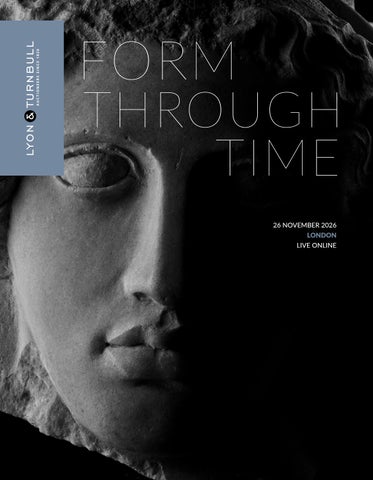
26 NOVEMBER 2026 LONDON LIVE ONLINE
Printed by Park Communications, a Carbon Neutral Company, on FSC® certified paper. Park works to the EMAS standard and its Environmental Management System is certified to ISO 14001. This publication has been manufactured using 100% offshore wind electricity sourced from UK wind. 100% of the inks used are vegetable oil based, 95% of press chemicals are recycled for further use and, on average 99% of any waste associated with this production will be recycled and the remaining 1% used to generate energy. This document is printed on Magno Satin paper made of material from well-managed, FSC®-certified forests and other controlled sources.
Lot 25: Roman Memorial Plaque Dedicated To Fadia Quieta (detail)
FORM THROUGH TIME H I G H L I G H TS THURSDAY 26 NOVEMBER 2026 AT 2PM Sale Number LT929
Lyon & Turnbull 20 Connaught St St George’s Fields LONDON W2 2AF
VIEWING IN LONDON 20 Connaught Street London W2 2AF Monday 23 November, 10am-4pm Tuesday 24 November, 10am-4pm Wednesday 25 November, 10am-4pm Thursday 26 November 10am-12 noon BIDDING AT THIS SALE Online, telephone and commission bidding only - please see the guide to bidding on page 60
CONTACT info@lyonandturnbull.com LONDON +44 (0) 207 930 9115 EDINBURGH +44 (0) 131 557 8844
2
BUYER'S GUIDE
This sale is subject to our Standard Conditions of Sale (available at the back of every catalogue and on our website). If you have not bought at auction before we will be delighted to help you.
BUYER’S GUIDE
REGISTRATION
IMPORT/EXPORT
BUYER’S PREMIUM The buyer shall pay the hammer price together with a premium, at the following rate, thereon. 28% up to £25,000; 27% from £25,001 to £500,000; 26% thereafter; VAT will be charged on the premium at the rate imposed by law (see our Conditions of Sale at the back of this catalogue).
All potential buyers must register prior to placing a bid. Registration information may be submitted in person at our registration desk, by email, or on our website. Please note that first-time bidders, and those returning after an extended period, will be asked to supply the following documents in order to facilitate registration: 1 – Government issued photo ID (Passport/ Driving licence) 2 – Proof of address (utility bill/bank statement). We may, at our option, also ask you to provide a bank reference and/ or deposit. (Particularly for bidding on lots marked by the high value lot symbol ) By registering for the sale, the buyer acknowledges that he or she has read, understood and accepted our Conditions of Sale (available at the back of every catalogue and on our website).
Prospective buyers are advised that several countries prohibit the importation of property containing materials from endangered species, including but not limited to; rhino horn, ivory, coral and tortoiseshell. Accordingly, prospective buyers should familiarise themselves with all relevant customs regulations prior to bidding if they intend to import lots to another country. It is the buyer’s sole responsibility to obtain any relevant export or import licence. The denial of any licence or any delay in obtaining licences shall neither justify the recession of any sale nor any delay in making full payment for the lot.
ADDITIONAL VAT † VAT at the standard rate payable on the
hammer price ‡ Reduced rate of 5% import VAT payable on the hammer price Ω Standard rate of import VAT on the hammer price Lots affixed with ‡ or [Ω] symbols may be subject to further regulations upon export /import, please see Conditions of Sale for Buyers Section D.2. No VAT is payable on the hammer price or premium for books bought at auction.
DROIT DE SUITE § indicates works which may be subject to the Droit de Suite or Artist’s Resale Right, a royalty payment for all qualifying works of art. Under legislation which came into effect on 1st January 2012, this applies to living artists and artists who have died in the last 70 years. This royalty will be charged to the buyer on the hammer price and in addition to the buyer’s premium. It will not apply to works where the Hammer Price is less than £1,000. The charge for works of art sold at and above £1,000 and below £50,000 is 4%. For items selling above £50,000, charges are calculated on a sliding scale. More information on Droit de Suite is available at www.dacs.org.uk.
BIDDING & PAYMENT For information on bidding options see our Guide to Bidding & Payment at the back of the catalogue.
REMOVAL OF PURCHASES Responsibility for packing, shipping and insurance shall be exclusively that of the purchaser. See Collections & Storage section for more info specific to this particular auction.
CATALOGUE DESCRIPTIONS All item descriptions, dimensions and estimates are provided for guidance only. It is the buyer’s responsibility to inspect all lots prior to bidding to ensure that the condition is to their satisfaction. Our specialists will be happy to prepare condition reports and additional images. These are for guidance only and all lots are sold ‘as found’, as per our Conditions of Sale.
IMPORTING INTO THE EU From 28 June 2025, the import into the EU of non-EU property of a certain age (and in some categories above a certain value) is subject to additional requirements. Under the relevant EU Regulation, it is the buyer’s sole responsibility to assess whether any lot meets the criteria for import into the EU. The refusal of any required Import Licence or Importer Statement, or any delay in obtaining such Licence or Statement shall neither justify the recession of any sale nor any delay in making full payment for the lot.
ENDANGERED SPECIES Please be aware that lots marked with the symbol Y contain material which may be subject to CITES regulations when exporting outside Great Britain. For more information visit http://www.defra.gov.uk/ahvla-en/ imports-exports/cites
PURCHASE COLLECTIONS FOR SALE 929 FORM THROUGH TIME Following the auction, the works will be moved to Crown Fine Art, Art Central, 20-22 Union Road, London, SW4 6J. Tel +44 (0)20 7732 7610 | uk@crownfineart.com Items will be available to collect by appointment from Crown Fine Art from Tuesday 1st December onwards. Items will be stored free of charge until 15th December. From Tuesday 15th December, clients will be charged by our storage partners. Please ensure payment has been made prior to collection.
3
MEET THE SPECIALISTS
At Lyon & Turnbull we want to make buying at auction as easy and enjoyable as possible. Our specialist team are on hand to assist you, whether you are looking for something in particular for your home or collection, require more detailed information about the history or current condition of a lot, or just want to find out more about the auction process.
ALEX TWEEDY Head of Ancient, African & Oceanic art and Natural History alex.tweedy@lyonandturnbull.com
POLLY BAKER Sale Coordinator polly.baker@lyonandturnbull.com
CONTACT EDINBURGH +44 (0) 131 557 8844 LONDON +44 (0) 207 930 9115 GLASGOW +44 (0) 141 333 1992
5
8 LARGE GREEN RIVER FISH PLAQUE GREEN RIVER FORMATION, USA, LOWER EOCENE PERIOD, 50 MILLION YEARS B. P. a large an impressive limestone panel containing twenty-one smaller Knightia eocaena, and one larger Diplomystus dentatus; mounted on a burr yew panel with a small ammonite inset on the bottom right 155cm x 85cm Provenance: Private collection, England, acquired 2000s Note: The present specimen was excavated from the Green River Formation, located predominantly in present day Wyoming. Today, the landscape is dry and windswept, with open plains and sparse vegetation stretching across an exposed terrain of layered limestone and shale that records ancient lake environments. However, during the early Eocene, around 50 million years ago, this region was not arid but subtropical, with broad freshwater lakes surrounded by lush vegetation. The climate was warm and humid, supporting crocodiles, early mammals, insects, fish and dense forests along the lake margins, including palms such as Sabalites, whose fronds are preserved in exceptional detail within the fine sediments, contributing to a serene depiction of this ancient environment. The lakes themselves teemed with life. Schooling fish such as Knightia eocaena, among the most abundant species in the formation, moved in vast numbers through the water, while larger predatory fish such as Diplomystus dentatus occupied a higher position in the food chain.
£4,000-6,000
Other fees apply in addition to the hammer price: see the ‘Buyer’s Guide’ section on page 2
6
7
10 MARINE REPTILE FOSSIL, ICHTHYOSAUR MIXOSAURUS SP., LOUPING BIOTA, MIDDLE TRIASSIC, C. 250 - 240 MILLION YEARS B.P. a complete and large adult mixosaurus sp. skeleton, contained within a micritic limestone matrix with calcite veining 81 x 50.5cm (inc. frame), total specimen length 96cm Provenance: Private collection, United Kingdom, acquired 2020, previously in a private European collection since 1980. Note: This large and fine Mixosaurus inhabited the warm, shallow waters of the ancient Tethys Ocean during the Middle Triassic, 250–240 million years ago. The marine reef environment in which it lived was rich in biodiversity, an agile predator, it possessed a long, slender jaw lined with needle-like teeth, ideally adapted for catching small fish and prehistoric squid. The oxygen depleted conditions on the seabed limited scavenging and disturbance, allowing the skeleton to be preserved with remarkable completeness and detail.
£8,000-12,000
8
13 DINOSAUR FOSSIL PLAQUE, ANCHIORNIS CHINA, LATE JURASSIC PERIOD, 165 - 153 MILLION YEARS B. P. a well preserved Anchiornis skeleton, set within the original limestone matrix 62cm across Provenance: Private collection, London, United Kingdom, acquired 2000s Note: The small, feathered Anchiornis huxleyi was a species of dinosaur that lived around 160 million years ago during the Late Jurassic, in what is now northeastern China. It inhabited a warm, humid, forested environment, where dense vegetation, lakes and wooded landscapes provided shelter and an abundance of small animals. Measuring around 60 centimetres in length, Anchiornis was covered in feathers, with particularly long plumage extending along its arms, legs and tail. It was likely a carnivore, feeding on small lizards, fish and insects, while larger predatory dinosaurs would have posed a threat to it. Despite its impressive covering of feathers, Anchiornis was probably unable to achieve true powered flight, although its feathered limbs may have helped it glide or manoeuvre between trees. The present specimen is exceptionally well preserved, retaining an extraordinary level of detail, from the individual claws and delicate bones to the finer features of its skeletal structure.
£12,000-18,000
Other fees apply in addition to the hammer price: see the ‘Buyer’s Guide’ section on page 2
9
10
17 SCANDINAVIAN NEOLITIHIC FLINT DAGGER TYPE III. SOUTHERN SCANDINAVIA, C. 2100 - 1900 B.C. knapped caramel and brown flint, with central “stitching”, an elongated leaf shaped blade and thin handle, with the remnants of an early 20th or 19th century label on the base of the blade 23cm long Provenance: Private collection, Edinburgh, United Kingdom, formed 1940s - 1960s, thence by descent
£1,500-2,500
reverse
Other fees apply in addition to the hammer price: see the ‘Buyer’s Guide’ section on page 2
11
12
For similar, please see; The Salisbury Centre, Norwich, United Kingdom, accession number RLS 55. This fine blade is an example of the remarkable heights achieved by flint workers in late Neolithic Scandinavia. It dates to c. 2400 – 1800 B.C., aptly named the “Dagger Period”, an era where much of the rest of Europe had already adopted metallurgy. The common consensus is now that these daggers were a symbol of status. Used to demonstrate prestige or given as gifts. Microwear analysis on these items reveals that they were unlikely to have been used for practical purposes. Rather, the wear was found to be consistent with frequent removal from a protective sheath. Though fashioned from flint, daggers such as these were inspired by contemporaneous European metal counterparts. During this period, Scandinavia lacked a sustainable supply of copper ore to support a metallurgical industry, so communities were traditionally thought to have lacked the ability, rather than the will, to produce copper daggers. However, recent studies have found that the delicate finishing could only have been completed with the aid of a metal-tipped tool. Furthermore, during the centuries around 2000 B.C., maritime routes and established exchange networks were becoming increasingly important, allowing materials, finished objects and ideas to travel considerable distances. Amber, in particular, was a highly desirable commodity, with northern Europe providing an important source of this material. Its movement southwards demonstrates that Scandinavia was by no means isolated from developments elsewhere on the continent. As such, it appears that the continued use of flint as a medium was made through choice as opposed to necessity. Indeed, even as bronze became very popular, the production of these beautiful flint daggers continued well into the Bronze Age. The remarkable consistency and refinement of these objects suggest a highly specialised industry, where techniques and knowledge were passed between generations of flint workers. By the time this dagger was produced, flint working was not simply a utilitarian industry, but an established cultural tradition, capable of producing objects of considerable beauty. As such, daggers such as the present example are widely considered to represent the very pinnacle of a European flint working industry that dated back tens of thousands of years.
Other fees apply in addition to the hammer price: see the ‘Buyer’s Guide’ section on page 2
15
19 SCOTTISH NEOLITHIC STONE BALL NORTHEAST SCOTLAND, NEOLITHIC, C. 3200 - 2600 B.C. pink granite carved into a petrosphere, and adorned with eight raised bosses, four large and four small, evenly spaced across its surface to create a balanced form 7.4cm wide, 503g Provenance: Found in Aberdeenshire, north-east Scotland, during the 1990s and subsequently held in a private collection. Accompanied by a certificate disclaiming Crown title, issued under Treasure Trove Scotland reference number TTNC2026/0494. For another example also carved from pink-red granite, see the specimen held at The Hunterian Museum, Glasgow. Although granite was commonly used for Scottish carved stone balls, pink-red granite appears to have been a relatively uncommon choice. Notably however, the earliest Scottish carved stone ball to enter a museum collection was itself carved from pink granite, entering The Hunterian as part of the 1783 founding bequest of the antiquarian Dr William Hunter. Note: The carved stone sphere is an icon of Scottish prehistory, remarkable for their geometric precision and the enduring mystery surrounding their purpose. Carved between four and a half and five thousand years ago, more than five-hundred examples are known, with the vast majority discovered in northeast Scotland, though they have been found as far afield as Orkney, Ireland and northern England. Made from a variety of stones, their forms and decoration vary considerably, yet each sphere was shaped with considerable care, its surface transformed into a precise arrangement of raised bosses, often alternating in size to create a striking geometric pattern. This care and elaborate decoration suggest that they were valued for reasons beyond any obvious practical use. Their function remains uncertain. More practical explanations have suggested that they functioned as mace heads or elaborate slingstones. Whilst others have argued that they may have served as oracles, tactile memory aids through which oral histories were remembered and passed down in a pre-literate society, or as “tokens” granting the holder the right to speak during communal gatherings. Further evidence for their possible ritual importance comes from the Ness of Brodgar in Orkney, where a carved stone ball was deliberately placed beneath a wall during construction, raising the possibility that these objects held an apotropaic significance, offering protection to a building and its occupants. Whatever their original purpose, the simple fact of the considerable time and skill required to carve one is confirmation of their prestige. There is considerable evidence that these objects, whatever their purpose, were passed down through generations, no doubt acquiring further significance as they become entangled with stories, traditions and beliefs. The people and societies that carved these stones were deeply connected to the materials from which objects were made and the places from which they came. The arrival of farming had brought about a new material existence, as the cultivation of crops and the rearing of domesticated animals tied people to places in new ways, while large scale monuments transformed their experience of landscape and place. Monumental sites may also have provided settings in which the movements of the sun and changing seasons were observed, helping communities understand the cycles of the natural world upon which their agricultural lives depended. It also brought about a revolution in the types of objects that people made, carried and valued. Certain stones may have been regarded as more than simply raw materials, possessing qualities that set them apart from the ordinary world. Across Neolithic Britain, particular materials appear to have been sought out, exchanged and deposited in ways that suggest they carried meanings beyond their everyday utility. Stone axes fashioned from Langdale tuff, for example, were transported over considerable distances from their source in the Lake District, reaching communities across Britain and Ireland, with some examples also found in continental Europe. The choice of material may therefore have been as important as the object itself, with particular stones valued for their rarity, appearance, place of origin or perceived qualities. In this context, the carved stone ball can be understood not simply as an example of skilled craftsmanship, but as an object whose significance may have been inseparable from the natural properties of the stone from which it was made. In this context, the pink granite from which the present example was carved takes on an interesting dimension. Its surface is flecked with quartz, which catches the light and creates a gentle shimmer as the object is turned. To a Neolithic viewer, this may have been more than an attractive feature. The stone seems to possess a life of its own, changing subtly in appearance as it moves between light and shadow. Its colour and its lustre distinguish it from an ordinary piece of rock, giving it a quality that might have seemed unusual or even extraordinary. We cannot know how its makers understood these properties, but it is possible that such qualities were interpreted through a spiritual worldview in which the natural world was alive with meaning. When discussing the stone axes of the unrelated Corded Ware culture of Central and Northern Europe (c. 2900 – 2350 B.C.), the archaeologist André Grisse (2000) wrote: ”These artefacts convey a spiritual and ideological message. Their forms, shaped by mathematical principles… bore invisible geometric traces, suggesting their creators’ advanced understanding of design and symbolism. Those who carried these objects were likely not just warriors but also scholars or astronomers, connected to earthworks.” The makers of Scottish carved stone balls similarly inhabited a world in which monumental architecture, symbolic objects and observations of the natural world and heavens were closely intertwined. As Stewart-Moffitt (2022) suggests, these spheres may have served as expressions of shared cultural identity, their carefully ordered forms conveying a significance beyond their physical function. Like the stone axes discussed by Grisse, they invite us to consider whether mathematical precision and skilled craftsmanship were not simply aesthetic choices, but ways of giving form to ideas and beliefs that remain elusive today. Beauvarlet, M. (2000) La Hache de Pierre à Travers le Monde. Paris: Editions Errance. Garrow, D. and Wilkin, N. (2022) The World of Stonehenge. London: British Museum Press. Stewart-Moffitt, C.L. (2022) The Circular Archetype in Microcosm: The Carved Stone Balls of Late Neolithic Scotland. Oxford: Archaeopress.
£12,000-18,000
Other fees apply in addition to the hammer price: see the ‘Buyer’s Guide’ section on page 2
16
20 ROMAN BRONZE DODECAHEDRON DORSET, UNITED KINGDOM, C. 2ND - 4TH CENTURY A.D. cast copper alloy, with twelve faces and holes of various sizes on each face and a small sphere on each corner; each perforation is decorated with concentric bands and carved lines 4.5cm tall, 69g Provenance: Private collection, acquired 2025 at a local antique fair, Somerset, United Kingdom, subsequently reported and recorded with local finds liaison and Portable Antiquities Scheme; Previously in a private collection, southwest England, found whilst fieldwalking in Dorset, 1980s.
£4,000-6,000
17
Among the most mysterious objects to survive from the ancient Roman world are the so-called dodecahedra. First brought to the attention of archaeologists in the 18th century, these unusual twelve-sided objects have continued to puzzle academics for almost three-hundred years. Over one-hundred examples are now known, yet despite extensive theories, their precise purpose remains unknown. Dating from the 2nd - 4th centuries A.D., they are found almost exclusively in the north-western provinces of the Roman Empire, with the majority originating from the territories of modern-day France and Britain. A handful have been discovered further east, as far as modern Hungary and Serbia, yet none have been recorded in Spain, North Africa or the eastern Mediterranean, nor the Roman heartland of Italy. Formed of copper alloy, these hollow objects are typically between 4 -10cm in diameter, with twelve pentagonal faces, each pierced by a circular aperture of varying size. Small spherical knobs project from each of the twenty corners, while some examples feature concentric engraved circles surrounding the openings. Their casting would have required considerable skill, suggesting that they were relatively valuable objects. Numerous theories have been proposed to explain their function, ranging from candleholders, dice and gaming pieces to astronomical instruments, surveying devices and measuring tools. One particularly intriguing suggestion is that they were used in textile production, perhaps as implements for knitting gloves. Their variously sized openings could, in theory, have accommodated different finger widths, allowing individual fingers to be knitted to a consistent size. Others have suggested that they served a religious or ceremonial purpose, perhaps as objects used in divination or ritual practices. Despite this range of interpretations, none has been proven. No surviving Roman text describes the objects, nor have they been identified in contemporary paintings, mosaics or sculpture. Their discovery in a variety of settings, including settlements, military sites, religious contexts and burials, has done little to resolve the mystery.
Other fees apply in addition to the hammer price: see the ‘Buyer’s Guide’ section on page 2
18
33 NANAI FIGURE NANAI PEOPLE, AMUR RIVER, EASTERN SIBERIA, C. EARLY 20TH CENTURY larch wood, depicting an anthropomorphic figure with a diamond face and pronounced brow-line, with a rectangular torso and bent legs 34.5cm Provenance: Galerie Frédéric, Paris, France Arnaud Kurc, Paris, France Private collection, Belgium Private collection, London, acquired from the above Note: Within the culture of the Nanai people of the Middle Amur Basin, if a person were to suffer an ailment of the mind or body, a shaman would be called to determine which spirit was causing the problem. The shaman would ask a craftsman to create a wooden figure that would act as a container for the spirit, which could only be made with an axe or knife, hence the distinctive 'hacked' look present here, and they could only be spoken about as having been 'made' rather than 'cut' or 'sawn'. The figure could not be made with eyes, arms or nostrils as it was believed that if the spirit was enclosed in a figure with these features, they could do harm to the people around it. Once made, the shaman would cut away any malignant manifestations of the spirit and move the spirit into its wooden figure. This would transition the spirit from being a sevhe (a free spirit and patron of the natural elements) into a sevhen (the enclosed spirit); the sevhen, having been pacified by the shaman, would then act as the shaman's assistant, with more powerful shamans would often have several sevhen.
£3,000-5,000
Other fees apply in addition to the hammer price: see the ‘Buyer’s Guide’ section on page 2
19
25 ROMAN MEMORIAL PLAQUE DEDICATED TO FADIA QUIETA ROMAN EMPIRE, C. 2ND CENTURY A. D. carved marble, the inscription reading: “To the Shades of the Dead. Fadia Quieta lived 16 years, 6 months, 27 days. Fadius Felix her father did [this] for a most dutiful daughter. She lies here. May the earth be light upon you” 31cm wide Provenance: Private collection, Paris, France; acquired 1970s Karsten Schubert (1961-2019), London, UK; acquired July 2014 Private collection, Oxfordshire, UK; by descent 2022 from the above Note: Exhibited: Mazzoleni, London, UK, ‘Mythology Reinterpreted. A Journey through Ancient Inspiration in Modern and Contemporary Art’, 8th October-6th December 2024 Published: Luigi and Davide Mazzoleni, Benedetta Casini, Mythology Reinterpreted. A Journey through Ancient Inspiration in Modern and Contemporary Art, exhibition catalogue, (London, 2024), pp.18-19
£12,000-18,000
20
21
34 ‡ CYCLADIC MARBLE IDOL CYCLADES ARCHIPELAGO, C. 2500 - 2300 B.C. OR LATER carved marble, the bodily proportions reduced to an abstract minimalism, the arms folded across the chest, the shoulders angled, a long neck leading to a head with smooth facial plane and a convex form, bending back as if gazing upwards, with gently rounded chin and central rectangular nose, raised on a bespoke mount 58.4cm tall Provenance: Previously in the Private Collection of Georges Frédéric Keller (1899-1981), Davos and New York. Fine Antiquities, Christie’s, London, 13-14 December 1983, Lot 277, pp. 42-43. Private Collection, Rhineland, Germany, acquired from the above sale, accompanied by purchase invoice. Published: Fine Antiquities, Christie’s, London, 13-14 December 1983, Lot 277, pp. 42-43. Note: The Cyclades, an archipelago in the southwestern Aegean, comprises thirty-nine small islands and many more islets. In ancient Greek they were referred to as the kyklades, envisioned as a circle (kuklos) around the sacred island of Delos, home to the most sacred temple of Apollo. In the fourth millennium B.C. a distinctive culture emerged in the islands which ran for over two thousand years. Sitting at a favourable location in the Aegean sea and rich in mineral resources, in particular iron ores and copper, the inhabitants of the Cyclades benefitted from the trade in these raw materials at a time when metallurgy was developing rapidly across the Mediterranean. Existing largely tangentially with the great civilisations of the Minoans and Mycenaeans, Cycladic people are counted among the three major Aegean cultures. It was the Cycladic people who produced the very first masterpieces of Greek marble sculpture. “Idols” such as the present example were spread throughout the archipelago, with the tradition of carving such figures lasting for well over one thousand years. Their exact use is unclear, some resemble fertility figures encountered across the Near East. Others have been interpreted as images of the deceased or servants for the afterlife. It is clear however that they were used in both funerary contexts and day-to-day ritual life, as some have been found with ancient repairs. Though they are today notable for their minimalist appearance, scientific analysis has shown that the surface of the marble would originally have been painted with mineral-based pigments, azurite for blue and iron ores or cinnabar for red. Many of the figures show a remarkable similarity in their proportions, suggesting that the production of these idols was regulated using a type of early compass. The sense of abstraction offered by ancient Cycladic art stimulated many of the great twentieth century artists, including Brancusi, Modigliani, and Picasso. The present piece is a wonderful example of the type, though carved over four thousand years ago its geometric appeal remains distinctly modern.
£20,000-30,000
Other fees apply in addition to the hammer price: see the ‘Buyer’s Guide’ section on page 2
22
43 ROMANO-CELTIC SANDSTONE HEAD WESTERN EUROPLE, LIKELY BRITAIN, EARLY FIRST MILLENIUM A.D. carved sandstone, likely a architectural fragment, depicting the head of a woman with hair parted down the middle, with downturned eyes and a downturned mouth; attached behind her head is a large sandstone block, raised on a bespoke mount 20cm tall Provenance: Collection of Stanley and Ingrid Clapham, London, probably acquired 1950s and thence by descent Note: For comparable examples, see the terracotta votive heads recovered from Magna Roman Fort, Northumberland: one during excavations in 2025 and an earlier example discovered in the late nineteenth century and published in Archaeologia Aeliana, Second Series, Volume XIII (1889). Celtic art has its roots in the ancient traditions of Bronze Age Europe, yet developed a distinctive style of its own. Far from primitive, it is often abstract in character, with a mysterious quality quite unlike the more naturalistic art of the Greek and Roman worlds. Once regarded as unusual and even unsettling, Celtic art is now recognised as one of the most distinctive artistic traditions of Western and Central Europe. The present example depicts a head with a subtle smile, the elaborate coiffure being a particularly distinctive feature. This comprises four clearly defined strands, drawn to either side of the face, an unusual attribute which bears a striking resemblance to the hairstyles of two terracotta votive heads discovered at Magna Roman Fort, along the line of Hadrian's Wall. The similarities between the examples extend beyond the coiffure, particularly in the treatment of the facial features and the subtle expression. The close association between the two Magna heads has led to the suggestion that they may depict the same female figure, possibly a local goddess or deity who held particular significance for the inhabitants of the fort. Further evidence supporting a northern borderland origin for the present example is provided by its material, red sandstone of a type widely used throughout the region, particularly along the line of the Wall.
£3,000-5,000
Other fees apply in addition to the hammer price: see the ‘Buyer’s Guide’ section on page 2
23
24
44 ROMAN MARBLE HEAD OF A MAN ROMAN EMPIRE, JULIO-CLAUDIAN PERIOD, C. 1ST CENTURY B.C. - 1ST CENTURY A.D. carved marble, over life sized, depicting a young man, clean shaven, with cropped haircut of comma locks incised across the forehead, round eyes with eyelid and tear-trough articulation set in a deep inner socket, an aquiline nose, high and prominent cheekbones, and a straight mouth with small lips, raised on a bespoke mount 28cm high Provenance: Private collection, Philadelphia, acquired in the 1970s Note: The head appears to date to the early imperial period at Rome with similarities between the head and the Ara Pacis portrait type of the Emperor Augustus (27 BC- AD 14). Due to the facial similarities in portraits of Augustus and his successor Tiberius, made in an effort to give the illusion of blood relation between them, the head also resembles Tiberius (AD 14-37). This head could be an imperial portrait but cannot be certainly attributed. Zeitgesichte, meaning ‘period face’, could equally mean that this head is a portrait of a private individual from the early imperial period, perhaps taking inspiration from imperial forms of representation.
£12,000-18,000
Other fees apply in addition to the hammer price: see the ‘Buyer’s Guide’ section on page 2
25
26
27
28
45 ROMAN MARBLE OVER-LIFESIZED BUST OF A LADY ROMAN EMPIRE, CIRCA EARLY 2ND CENTURY A.D. carved marble, originally forming part of an over-lifesized figure, she is depicted wearing a chiton and himation, the latter drawn up over her head, with the folds of the drapery gathered in her right hand, raised on a bespoke mount 68.8cm tall Provenance: Sotheby’s, New York, Antiquities and Islamic Works of Art, 21–22 November 1985, lot 304 Subsequently with Robin Symes Ltd, London Published: Sotheby’s, New York, Antiquities and Islamic Works of Art, 21–22 November 1985, lot 304. Note: Quiet and dignified, this elegant sculpture epitomises the Roman pudicitia sculptural tradition, whereby feminine beauty was expressed not simply through physical appearance, but through the Roman virtue of modesty. Such works were not necessarily intended as faithful likenesses of individual women, but rather as idealised representations of the qualities they were expected to embody. The enveloping mantle is particularly characteristic of the type, concealing much of the body whilst allowing its underlying form to emerge through the carefully arranged folds of fabric. The veiled head reflects Roman ideals of feminine representation, with dress serving as an important marker of social standing and identity. For a similar example from this period, please see The Louvre, Paris, inventory number SMD 20.
£20,000-30,000
Other fees apply in addition to the hammer price: see the ‘Buyer’s Guide’ section on page 2
29
30
31
48 ANCIENT ARABIAN ALABASTER HEAD SOUTHERN ARABIA, C. 1ST CENTURY B.C. carved alabaster, depicting the head of a young man, with textured hair, recessed almond eyes and thin lips; light facial hair includes stubble around the chin and sporadic hairs around the upper lip; raised on a bespoke mount 21cm tall (excluding mount), 27.9cm tall (including mount) Provenance: Before 1967, Private Collection, Aden; Collection of Dr. Brian Doe, Beeley Old Hall, Beeley, Matlock, Derbyshire; Collection of a gentleman (G. Turner) from 1981 until 2018; Property of Mme P Boekstal, widow of M. G. Turner Note: The present piece is a fine example of the distinctive and enigmatic sculpture produced by the wealthy South Arabian kingdoms at the turn of the first millennium BC. With its facial features reduced to their essential forms, the head reflects the highly stylised aesthetic characteristic of the region. Most likely created to adorn a small rectangular niche within a tomb or ritual setting, as suggested by the flattened top of the head, it would have belonged to a high status private individual and may have functioned as a votive image commemorating the deceased. Originating in a land of considerable prosperity, the Sabaeans were a powerful trading people whose wealth derived largely from the exchange of prized aromatics such as frankincense and myrrh. Some scholars associate their kingdom with the biblical land of Sheba, famed as the home of the wealthy Queen of Sheba. Literature: St John Simpson, ‘Queen of Sheba, Treasures from Ancient Yemen’ (London, 2002), p. 198. A head with beard and moustache similarly indicated can be seen in ‘Yemen, au pays de la reine de Saba’ (Paris, 1997), p.156.
£10,000-15,000
Other fees apply in addition to the hammer price: see the ‘Buyer’s Guide’ section on page 2
32
52 ANCIENT EGYPTIAN FRAGMENT DEPICTING OSIRIS EGYPT, 18TH DYNASTY, C. 1450 B.C. carved limestone, depicting Osiris, shown facing right, with false beard and wearing the atef crown; he holds a crook, flail and Was-sceptre in his left hand, while his right hand is raised up to his side; raised on a bespoke mount 21cm wide Provenance: By repute previously with the Paul Drey Gallery, New York c. 1950s; Gawain McKinley (1945-1996), London, United Kingdom; James Ede, London, United Kingdom; Private collection, United Kingdom, acquired 2010s on the UK art market Note: The present piece would originally have formed part of a much larger funerary scene, possibly decorating the approach to a tomb. Such scenes were an important feature of ancient Egyptian tomb decoration, depicting the deceased making offerings to the gods in the hope of securing divine favour and protection in the afterlife.
£25,000-30,000
34
53 ANCIENT EGYPTIAN VOTIVE HAND EGYPT, LATE PERIOD, 664-332 B.C. carved limestone, typically stylised form, depicting a hand resting on a platform with the palm facing downwards 18cm long Provenance: Private collection, France, acquired 1980s Accompanied by French passport Note: The exact purpose of this piece remains uncertain. It has been suggested that it may be a fragment from a naophorous statue, depicting the hand alongside part of a shrine. However, the angle of the hand in relation to the edges of the piece may suggest otherwise when compared with other naophorous statuary. Alternative theories propose that the piece may have served as a votive offering or as a sculptor’s trial piece. Neither suggestion can be confirmed, although numerous examples of anatomical votives are known from the Temple of Asclepius at Epidaurus and elsewhere in Greece during the same period. This may indicate that such practices were also taking place in other regions. A model of a fist in the collection of the Metropolitan Museum of Art (acc. no. 66.99.74) is intended to be complete, yet depicts its subject in a partial or unfinished manner. Another example of a hand lying flat in a similar position is on display at the Cairo Museum. For the positioning of the hand as it appears on a naophorous statue, see Lawrence M. Berman, with Kenneth J. Bohac, Patricia S. Griffin and Bruce Christman, The Cleveland Museum of Art: Catalogue of Egyptian Art (Cleveland, 1999), pp. 422–423, no. 316.
£4,000-6,000
35
36
55 ANCIENT EGYPTIAN RELIEF FRAGMENT DEPICTING A LIBYAN NEW KINGDOM, LIKELY 19TH DYNASTY, C 1292-1189 B.C. carved limestone, a fragment from a large scene, depicting the head of a Libyan in captivity, his head bowed, with almond shaped eyes and prominent lips, traces of yellow pigment remain, with a bespoke metal bracket attached to the reverse for mounting 10.6cm high Provenance: Joseph Halle Schaffner (1897-1972), Chicago and Santa Barbara, USA Elmer “Pete” Schlesinger (1919-1982), Chicago, USA; by descent from the above, his brother Sumner Schlesinger, California, USA; by descent from the above, her father Note: This fragment would have formed part of a larger sculptural scene depicting Egypt’s defeat of its enemies, in which foreign captives were often represented in submission to the pharaoh. The figure can be identified as a Libyan (known by the Egyptians as the Libu) by his short pointed goatee and the deeply incised, curved parallel lines running from the edge of the nose down to the corners of the mouth. His head is bowed in submission, suggesting his status as a captive of war. The treatment of the eyes and fleshy mouth reflects the influence of the Amarna art style. However, a date in the subsequent 19th Dynasty is more likely, when the Libu invaded Egypt alongside the Sea Peoples. The latter were a group of maritime peoples whose origins remain uncertain, but who raided and migrated across the eastern Mediterranean during the Late Bronze Age, contributing to the collapse of several established civilisations in the region. They posed a significant threat to Egypt during the reign of Pharaoh Merneptah (1212–1203 B.C.), when Libyan and Sea Peoples forces launched an invasion from the west. During the fifth year of his reign, Merneptah repelled a large scale invasion at Perire, near the western Nile Delta. The campaign is recorded in an inscription beside the sixth pylon at Karnak, which names the Libu and several Sea Peoples, among the invading forces. For similar, please see a procession of foreigners in the Metropolitan Museum of Art, New York, USA, accession number 1985.328.13. Also compare an example showing two foreign captives, one of whom has a pointed beard, in the Allard Pierson Museum, Amsterdam, the Netherlands, inventory number APM08753.
£4,000-6,000
Other fees apply in addition to the hammer price: see the ‘Buyer’s Guide’ section on page 2
37
38
56 GALLO-ROMAN MARBLE HEAD WITH INSCRIPTIONS WESTERN EUROPE, 2ND - 4TH CENTURY A.D. carved and heavily weathered marble, depicting a male figure with short, stylised hair, carved with simplified facial features, a prominent nose and closed mouth, the head is formed from a roughly worked rectangular section of marble, with inscriptions (likely medieval in date) to the sides and top of the head Provenance: Private collection, United Kingdom, acquired on the French art market; Private collection, France, acquired mid-20th century and thence by descent Note: The present piece was likely at one point part of a larger architectural element, Of particular interest on are the deeply incised markings to the sides and top, which appear to have been added at a later date. It has been suggested that these represent schematic depictions of ecclesiastical buildings, perhaps executed as a form of devotional graffiti. One composition comprises a rectangular structure with a round-headed doorway, whilst elsewhere crosses appear to surmount domed architectural forms. Although somewhat rudimentary in execution, the depth of the incisions suggests a degree of deliberation beyond casual sketching.
£3,000-5,000
Other fees apply in addition to the hammer price: see the ‘Buyer’s Guide’ section on page 2
39
40
SELECT OBJECTS FROM THE COLLECTION OF STANLEY SEEGER Stanley J. Seeger (1930–2011) was an extraordinary collector whose interests extended far beyond the traditional boundaries of art. With a remarkable eye and an instinct for the unusual, he assembled an eclectic collection encompassing antiquarian books, manuscripts, ancient sculpture, religious artefacts and objects of historical significance, alongside more personal curiosities. His interests ranged from important works of art to ancient figures and objects of worship, reflecting a fascination with the beliefs and traditions of different cultures. Never bound by convention, Seeger brought together pieces from different periods and disciplines, guided by his own individual taste rather than established collecting conventions.
Other fees apply in addition to the hammer price: see the ‘Buyer’s Guide’ section on page 2
41
42
70 ANCIENT EGYPTIAN CARTONNAGE MASK PTOLEMAIC PERIOD, C. 2ND - 1ST CENTURY B.C. painted pigment over cartonnage, the white face with almond eyes and large black irises, with cosmetic lines extending beyond the eyes and accentuating the eyebrows, the ears emerge from in front of the dark blue wig, with painted details of the collar below executed in red, white and green 35cm tall Provenance: Christie's, London, Antiquities, 15th May 2002, lot 613 Acquired by Stanley J. Seeger (1930–2011) at the above; Thence by descent. Note: The ancient Egyptians believed that the first to achieve eternal life following death was the god Osiris. Following his murder by his brother Set, Osiris’ body was scattered throughout Egypt. It was Osiris’ devoted wife Isis who travelled across the country, collecting body parts with the aid of the other gods, to restore her husband. Thus, Osiris became the first mummy and the mythological basis for Egyptian embalming practices. It is through painted scenes such as this that we can understand how the deceased wished to be transfigured, achieving eternal life in the same way as Osiris himself. This is further emphasised by the use of white paint to the face, reflecting a change in funerary artistic conventions during the Ptolemaic and Roman periods, when the earlier preference for gilded faces increasingly gave way to white-painted examples. Whilst gold represented the incorruptible flesh of the gods, white was similarly associated with purity, sacredness and divine radiance. Its luminous appearance could therefore evoke the supernatural nature of the gods, allowing the deceased to be presented as a divine being. As such, the use of white on a mask such as this was not simply an aesthetic choice, but helped to express the deceased's transformation into an immortal being in the hope of eternal life.
£3,000-5,000
Other fees apply in addition to the hammer price: see the ‘Buyer’s Guide’ section on page 2
43
44
45
46
47
71 OVER-LIFESIZED GRAECO-PHOENICIAN ANTHROPOID SARCOPHAGUS HEAD EASTERN MEDITERRANEAN, C. MID 5TH CENTURY B.C. carved marble, a fragment of the top of an over-lifesized anthropoid sarcophagus, depicting a female figure with her face framed by short curls, a broad forehead, almond-shaped eyes, a straight nose and softly modelled lips; traces of red pigment survive in the hair, raised on a bespoke mount 45.8cm tall Provenance: Acquired by Stanley J. Seeger (1930–2011) from Galerie Nefer, Zurich, Switzerland, on 29 January 1989, for $120,000; a copy of the original invoice accompanies the lot. Thence by descent. Note: The proportions of this sculpture identify it as the head from the lid of an anthropoid sarcophagus, reflecting the cultural and artistic exchange that characterised the Phoenician world during the mid first-millennium B.C. The principal Phoenician cities, including Sidon, Tyre and Byblos, prospered through maritime trade, connecting the eastern Mediterranean with the Aegean, Egypt and the wider Mediterranean world. Their commercial networks facilitated not only the exchange of goods, including timber, metals, glass and luxury commodities, but also the movement of craftsmen, and with them artistic techniques and ideas. These varied influences were particularly evident in funerary sculpture. The tradition of anthropoid sarcophagi in Phoenicia is thought to have come from Egypt, with the earliest known local example being the sarcophagus of King Ahiram of Byblos, dating to the 13th–12th century B.C. During the late 6th and early 5th centuries B.C., several kings of Sidon were buried in imported Egyptian basalt sarcophagi, which retained distinctly Egyptian stylistic features, indeed, two of the most notable examples, the sarcophagi of King Tabnit and King Eshmunazar II, are both thought to have originated during Egypt’s Twenty-sixth Dynasty, and may have originally been acquired by the Sidonians following their participation in the Battle of Pelusium in 525 B.C. Their Egyptian character is reinforced by their resemblance to contemporary examples, including the sarcophagus of Horkhebit from Saqqara, now in the Metropolitan Museum of Art. These kingly sarcophagi inspired a local tradition of anthropoid sarcophagi carved in white marble, which increasingly took on a distinctly hybrid Phoenician style. Produced during the 5th and 4th centuries B.C., these works (of which the present example is one) combine the Egyptian-derived form with Greek sculptural conventions. The modelling of the facial features and rendering of the eyes in particular are attributed to Greek craftsmen, illustrating the cosmopolitan character of Phoenician society and the circulation of artistic expertise across the Mediterranean. From its origins in Sidon, the tradition spread throughout the Phoenician world, as far as Carthage and even Iberia, demonstrating how local funerary practices evolved through sustained cultural and commercial contact. See Moscati, ‘Sarcophagi’, in The Phoenicians, pp. 292–299. For similar, please see: The Metropolitan Museum, New York, accession number 74.51.2452.
£20,000-30,000
Other fees apply in addition to the hammer price: see the ‘Buyer’s Guide’ section on page 2
48
72 FINE ROMAN GOLD RING WITH GARNET INTAGLIO C. 2ND - 3RD CENTURY A.D. gold ring with thick shoulders and tapered band with a centrally bezel set, oval shaped cabochon garnet with engraved intaglio of Minerva wearing a helmet and long chiton, holding a spear and shield UK: I, US: 4¾ Provenance: Acquired by Stanley J. Seeger (1930–2011); Thence by descent. Note: The intaglio engraved onto the stone on this ring would appear to depict Minerva, the Roman goddess of wisdom and war, identifiable through her military costume. Minerva was a popular choice of goddess to adorn the reverse of imperial coins due to her suggestion of military readiness and divine favour in battle. Particular iconographic similarities between this intaglio and a silver denarius of Septimus Severus minted in AD 195-196 may suggest a dating of the ring to the late 2nd century to early 3rd century AD.
£3,000-5,000
49
73 ANCIENT GREEK GOLD RING EASTERN MEDITERRANEAN, C. 5TH CENTURY B.C. engraved gold, intaglio ring welded from one piece of metal to form a thin cylindrical band and a flat leaf shaped bezel engraved with an intaglio depicting a seated woman, with wavy hair secured with a fillet, draped with chiton and himation, gesturing towards the sky Provenance: Acquired by Stanley J. Seeger (1930–2011); Thence by descent. Size: UK: J US: 4¾ £1,200-1,800
50
51
52
74 ROMAN GOLD RING WITH NICOLO INTAGLIO C. 1ST - 2ND CENTURY A. D. gold ring with thick oval bezel bearing a centrally set nicolo intaglio of a dolphin, a staff, and a bird Provenance: Acquired by Stanley J. Seeger (1930–2011); Thence by descent. Size: UK: G US: 3¼ Note: Nicolo is a style of engraving which uses a banded onyx or agate and carves through the paler upper layers of stone to reveal a darker layer enabling the design to stand out. Resultantly, nicolo was popular for use in Roman intaglio rings due to the clarity of image it could create. The symbols forming the intaglio on this ring are not suggestive of any particular deity, although dolphins have been linked to both Venus and Bacchus through various mythical traditions. The unusual combination of symbols may, therefore, have been developed with special relevance to its owner. A unique and clear intaglio was important for use as a seal for reasons of distinction and document security.
£2,500-3,500
53
75 ROMAN ITHYPHALLIC GOLD RING C. 1ST CENTURY B. C. solid gold ring, the bezel decorated with the image of a phallus UK: B US: 1 Provenance: Acquired by Stanley J. Seeger (1930–2011) from Wartski, London, 1st June 2011, accompanied by original invoice; Thence by descent. Note: In Rome, the symbol of the erect phallus was one of protection, with gods such as Fascinus and Priapus depicted with large erect phalli. It was believed that this image embodied the attributes of these deities, such as fertility, abundance, health, and protection from evil spirits. Resultantly, a large number of artistic forms made use of this phallic iconography, including women’s hair pins, windchimes, and wall paintings. The small size of the ring suggests that it could only have been worn by a child. This is supported by Pliny the Elder writing in the AD 70s about the use of apotropaic symbols to protect those most at risk, namely infants, from the harmful effects of the ‘evil eye’ or the oculus malus. “and this, although infants are under the especial guardianship of the god Fascinus, the protector, not of infants only, but of generals as well, and a divinity whose worship is entrusted to the Vestal virgins, and forms part of the Roman rites. It is the image of this divinity that is attached beneath the triumphant car of the victorious general, protecting him, like some attendant physician, against the effects of envy” Pliny the Elder, Naturalis Historia, XXVIII.7
£800-1,200
54
80 MEDIEVAL GOLD AND SAPHIRRE RING WESTERN EUROPE, LIKELY ENGLAND, C. LATE 14TH - 15TH CENTURY solid gold ring engraved with vegetal pattern on shoulders, centrally claw set pale blue cabochon sapphire with lengthwise drilled perforations suggesting an original use as a bead UK: T US: 9¾ Provenance: Acquired by Stanley J. Seeger (1930–2011); Thence by descent. Note: It was believed in the Middle Ages that gemstones held amuletic powers. Sapphire’s blue colour was seen as reminiscent of the sky, and in turn heaven, making the prayers of the wearer head more favourably by God. Thus, sapphires were a popular stone for rings worn by prominent clergymen. According to the Liber Lapidum of Marbodus of Rennes, written in the 3rd quarter of the 11th century to explain the properties and uses of gemstones, it was also believed that sapphires had protective and medicative effects which could alleviate headaches and eye strain, as well as curing stammers.
£3,000-5,000
55
81 ANGLO-NORMAN MEDIEVAL GOLD AND GARNET RING WITH INSCRIPTION WESTERN EUROPE, C. LATE 14TH - 15TH CENTURY gold ring set with a garnet or spinel, the interior of the band inscribed: + Honor + et + lyec + translates as “Honour and Joy” (given as the medieval synonym liesse) UK: I, US: 4¾ Provenance: Acquired by Stanley J. Seeger (1930–2011); Thence by descent. Note: Chivalric inscriptions in French on the inner surfaces of rings were commonly found on medieval British examples, particularly during the 14th and 15th centuries, when the tradition of courtly love was at its most prominent in Western Europe. Such objects have become known as posy rings, a term derived from poesy, referring to the short poetic verses with which they were inscribed. It is therefore believed that these rings were often exchanged as tokens of love, conveying intimate or secret messages intended to remain close to the wearer. In the present example, the spelling “lyec”, as a variation of “liesse”, may represent a phonetic rendering of the word by the craftsman, or simply reflect a period in which spelling conventions had yet to become standardised.
£3,000-5,000
56
CONDITIONS OF SALE 26.2 FOR BUYERS (UK) These Conditions of Sale and the Saleroom Notices as well as specific Catalogue terms, set out the terms on which we offer the Lots listed in this Catalogue for sale. By registering to bid and/or by bidding at auction You agree to these terms, we recommend that You read them carefully before doing so. You will find a list of definitions and a glossary at the end providing explanations for the meanings of the words and expressions used. Special terms may be used in Catalogue descriptions of particular classes of items (Books, Jewellery, Paintings, Guns, Firearms, etc.) in which case the descriptions must be interpreted in accordance with any glossary appearing in the Catalogue. These notices and terms will also form part of our terms and conditions of sales. In these Conditions the words “Us”, “Our”, “We” etc. refers to Lyon & Turnbull Ltd, the singular includes the plural and vice versa as appropriate. “You”, “Your” means the Buyer. Lyon & Turnbull Ltd. acts as agent for the Seller. Lyon & Turnbull Ltd. acts as agent for the Seller. On occasion where Lyon & Turnbull Ltd. own a lot in part or full the property will be identified in the catalogue with the symbol (🄰) next to its lot number.
A. BEFORE THE SALE A1. DESCRIPTIONS OF LOTS Whilst we seek to describe Lots accurately, it may be impractical for us to carry out exhaustive due diligence on each Lot. Prospective Buyers are given ample opportunities to view and inspect before any sale and they (and any independent experts on their behalf) must satisfy themselves as to the accuracy of any description applied to a Lot. Prospective Buyers also bid on the understanding that, inevitably, representations or statements by us as to authorship, genuineness, origin, date, age, provenance, condition or Estimated selling price involve matters of opinion. We undertake that any such opinion shall be honestly and reasonably held and only accept liability for opinions given negligently or fraudulently. Subject to the foregoing neither we the Auctioneer or our employees or agents accept liability for the correctness of such opinions and no warranties, whether relating to description, condition or quality of Lots, express, implied or statutory, are given. Please note that photographs/images provided may not be fully representative of the condition of the Lot and should not be relied upon as indicative of the overall condition of the Lot. All dimensions and weights are approximate only.
A2. OUR RESPONSIBILITY FOR OUR DESCRIPTION OF LOTS We do not provide any guarantee in relation to the nature of a Lot apart from our authenticity warranty contained in paragraph E.2 and to the extent provided below. (a) Condition Reports: Condition Reports are provided on our Website or upon request. The absence of a report does not imply that a Lot is without imperfections. Large numbers of such requests are received shortly before each sale and department specialists and administration will endeavour to respond to all requests although we offer no guarantee. Any statement in relation to the Lot is merely an expression of opinion of the Seller or us and should not be relied upon as an inducement to bid on the Lot. Lots are available for inspection prior to the sale and You are strongly advised to examine any Lot in which You are interested prior to the sale. Our Condition Reports are not prepared by professional conservators, restorers or engineers. Our Condition Report does not form any contract between us and the Buyer. The Condition Reports do not affect the Buyer’s obligations in any way. (b) Estimates: Estimates are placed on each Lot to help Buyers gauge the sums involved for the purchase of a particular Lot. Estimates do not include the Buyer’s Premium or VAT. Estimates are a matter of opinion and prepared in advance. Estimates may be subject to change and are for guidance only and should not be relied upon. (c) Catalogue Alterations: Lot descriptions and Estimates are prepared in advance of the sale and may be subject to change. Any alterations will be announced on the Catalogue alteration sheet, made available prior to the sale. It is the responsibility of the Buyer to make themselves aware to any alterations which may have occurred.
A3. WITHDRAWAL Lyon & Turnbull may, at its discretion, withdraw any Lot at any time prior to or during the sale of the Lot. Lyon & Turnbull has no liability to You for any decision to withdraw.
A4. JEWELLERY, CLOCKS & OTHER ITEMS (a) Jewellery: (i) Coloured gemstones (such as rubies, sapphires and emeralds) may have been treated to enhance their look, through methods such as heating and oiling. These methods are accepted practice but may make the gemstone less strong and/or require special care in future. (ii) All types of gemstones may have been improved by some method. You may request a gemmological report for any Lot which does not have a report if the request is made to us at least three weeks before the date of
the sale and You pay the fee for the report in advance of receiving said report. (iii) We do not obtain a gemmological report for every gemstone sold in our sales. Where we do get gemmological reports from internationally accepted gemmological laboratories, such reports may be described in the Sale Particulars. Reports will describe any improvement or treatment only if we request that they do so, but will confirm when no improvement or treatment has been made. Because of differences in approach and technology, laboratories may not agree whether a particular gemstone has been treated, the amount of treatment or whether treatment is permanent. The gemmological laboratories will only report on the improvements or treatments known to the laboratories at the date of the report. (iv) For jewellery sales, all Estimates are based on the information in any gemmological report or, if no gemmological report is available, You should assume that the gemstones may have been treated or enhanced. (b) Clocks & Watches: All Lots are sold “as seen”, and the absence of any reference to the condition of a clock or watch does not imply the Lot is in good condition and without defects, repairs or restorations. Most clocks and watches will have been repaired during their normal lifetime and may now incorporate additional/newer parts. Furthermore, we make no representation or warranty that any clock or watch is in working order. As clocks and watches often contain fine and complex mechanisms, Buyers should be aware that a general service, change of battery or further repair work, for which the Buyer is solely responsible, may be necessary. Buyers should also be aware that we cannot guarantee a watch will remain waterproof if the back is removed. Buyers should be aware that the importing watches such as Rolex, Frank Muller and Corum into the United States is highly restricted. These watches cannot be shipped to the USA and only imported personally. Clocks may be sold without pendulums, weights or keys. (c) Alcohol: may only be sold to persons aged of 18 years and over. By registering to bid, You affirm that You are at least that age. All collections must be signed for by a person over the age of 18. We Reserve the right to ask for ID from the person collecting. Buyers of alcohol must make appropriate allowances for natural variations of ullages, conditions of corks and wine. We can provide no guarantees as to how the alcohol may have been stored. There is always a risk of cork failure and allowance by the Buyer must be made. Alcohol is sold “as is” and quality of the alcohol is entirely at the risk of the Buyer and no warranties are given. (d) Books-Collation: If on collation any named item in the sale Catalogue proves defective, in text or illustration the Buyer may reject the Lot provided he returns it within
21 days of the sale stating the defect in writing. This, however, shall not apply in the case of unnamed items, periodicals, autographed letters, music M.M.S., maps, drawings nor in respect of damage to bindings, stains, foxing, marginal worm holes or other defects not affecting the completeness of the text nor in respect of Defects mentioned in the Catalogue, or at the time of sale, nor in respect of Lots sold for less than £300. (e) Electrical Goods: are sold as “works of art” only and if bought for use must be checked over for compliance with safety regulations by a qualified electrician first. Use of such goods is entirely at the risk of the Buyer and no warranties as to safety of the goods are given. (f) Upholstered items: are sold as “works of art” only and if bought for use must be checked over for compliance with safety regulations (items manufactured prior to 1950 are exempt from any regulations). Use of such goods is entirely at the risk of the Buyer and no warranties as to safety of the goods are given. We provide no guarantee as to the originality of any wood/material contained within the item.
B. REGISTERING TO BID B1. NEW BIDDERS (a) If this is Your first time bidding at Lyon & Turnbull or You are a returning Bidder who has not bought anything from us within the last two years You must register at least 48 hours before an auction to give us enough time to process and approve Your registration. We may, at our discretion, decline to permit You to register as a Bidder. You will be asked for the following: (i) Individuals: Photo identification (driving licence, national identity card or passport) and, if not shown on the ID document, proof of Your current address (for example, a current utility bill or bank statement) (ii) Corporate clients: Your Certificate of Incorporation or equivalent document (s) showing Your name and registered address together with documentary proof of directors and beneficial owners, and; (iii) Trusts, partnerships, offshore companies and other business structures please contact us directly in advance to discuss requirements. (b) We may also ask You to provide a financial reference and/or a deposit to allow You to bid. For help, please contact our Finance Department on +44 (0)131 557 8844.
B2. RETURNING BIDDERS We may at our discretion ask You for current identification as described in paragraph B.1. (a) above, a finance reference or a deposit as a condition of allowing You to bid. If You have not bought anything from us in the last two years, or if You want to spend more than on previous occasions, please contact our Finance Department on +44 (0)131 557 8844.
57
B3. F AILURE TO PROVIDE THE RIGHT DOCUMENTS If in our opinion You do not satisfy our Bidder identification and registration procedures including, but not limited to, completing any anti-money laundering and/or antiterrorism financing checks we may require to our satisfaction, we may refuse to register You to bid, and if You make a successful bid, we may cancel the contract between You and the Seller.
B4. B IDDING ON BEHALF OF ANOTHER PERSON (a) As an authorised Bidder: If You are bidding on behalf of another person, that person will need to complete the registration requirements above before You can bid, and supply a signed letter authorising You to bid for him/her. (b) As agent for an undisclosed principal: If You are bidding as an agent for an undisclosed principle (the ultimate Buyer (s)) You accept personal liability to pay the Purchase Price and all other sums due, unless it has been agreed in writing with us before commencement of the auction that the Bidder is acting as an agent on behalf of a named third party acceptable to us and we will seek payment from the named third party.
B5. BIDDING IN PERSON If You wish to bid in the saleroom You must register for a numbered bidding paddle before You begin bidding. Please ensure You bring photo identification with You to allow us to verify Your registration.
B6. BIDDING SERVICES The bidding services described below are a free service offered as a convenience to our clients and we are not responsible for any error (human or otherwise), omission or breakdown in providing these services. (a) Phone bids Your request for this service must be made no later than 12 hours prior to the auction. We will accept bids by telephone for Lots only if our staff are available to take the bids. If You need to bid in a language other than English You should arrange this Well before the auction. We do not accept liability for failure to do so or for errors and omissions in connections. (b) Internet Bids For certain auctions we will accept bids over the internet. For more information please visit our Website. We will use reasonable efforts to carry out online bids and do not accept liability for equipment failure, inability to access the internet or software malfunctions related to execution of online bids/ live bidding. (c) Written Bids While prospective Buyers are strongly advised to attend the auction and are always responsible for any decision to bid for a particular Lot and shall be assumed to have carefully inspected and satisfied themselves as to its condition we shall, if so instructed, clearly and in writing execute bids on
their behalf. Neither the Auctioneer nor our employees nor agents shall be responsible for any failure to do so. Where two or more commission bids at the same level are recorded we Reserve the right in our absolute discretion to prefer the first bid so made. Bids must be expressed in the currency of the saleroom. The Auctioneer will take reasonable steps to carry out written bids at the lowest possible price, taking into account the Reserve. If You make a written bid on a Lot which does not have a Reserve and there is no higher bid than Yours, we will bid on Your behalf at around 50% of the lower Estimate or, if lower, the amount of Your bid.
C. DURING THE SALE C1. ADMISSION TO OUR AUCTIONS We shall have the right at our discretion, to refuse admission to our premises or attendance at our auctions by any person. We may refuse admission at any time before, during or after the auction.
C2. RESERVES Unless indicated by an insert symbol (∆), all Lots in this Catalogue are offered subject to a Reserve. A Reserve is the confidential Hammer Price established between us and the Seller. The Reserve is generally set at a percentage of the low Estimate and will not exceed the low Estimate for the Lot.
C3. AUCTIONEER’S DISCRETION The maker of the highest bid accepted by the Auctioneer conducting the sale shall be the Buyer and any dispute shall be settled at the Auctioneer’s absolute discretion. The Auctioneer may move the bidding backwards of forwards in any way he or she may decide or change the order of the Lots. The Auctioneer may also; refuse any bid, withdraw any Lot, divide any Lot or combine any two or more Lots, reopen or continuing bidding even after the hammer has fallen.
C4. BIDDING The Auctioneer accepts bids from: (a) Bidders in the saleroom; (b) Telephone Bidders, and internet Bidders through Lyon & Turnbull Live or any other online bidding platform we have chosen to list on and; (c) Written bids (also known as absentee bids or commission bids) left with us by a Bidder before the auction.
C5. BIDDING INCREMENTS Bidding increments shall be at the Auctioneer’s sole discretion.
C6. CURRENCY CONVERTER The saleroom video screens and bidding platforms may show bids in some other major currencies as Well as sterling. Any conversion is for guidance only and we cannot be bound be any rate of exchange used. We are not responsible for any
error (human or otherwise) omission or breakdown in providing these services.
C7. SUCCESSFUL BIDS Unless the Auctioneer decides to use their discretion as set out above, when the Auctioneer’s hammer falls, we have accepted the last bid. This means a contract for sale has been formed between the Seller and the successful Bidder. We will issue an invoice only to the registered Bidder who made the successful bid. While we send out invoices by post/or email after the auction, we do not accept responsibility for telling You whether or not Your bid was successful. If You have bid by written bid, You should contact us by telephone or in person as soon as possible after the auction to get details of the outcome of our bid to avoid having to pay unnecessary storage charges.
C8. RELEVANT LEGISLATION You agree that when bidding in any of our sales that You will strictly comply with all relevant legislation including local laws and regulations in force at the time of the sale for the relevant saleroom location.
D. THE BUYER’S PREMIUM, TAXES AND ARTIST’S RESALE ROYALTY D1. THE PURCHASE PRICE For each Lot purchased a Buyer’s Premium of 28% of the Hammer Price of each Lot up to and including £25,000, 27% of the Hammer Price from £25,001 up to and including £500,000, 26% thereafter. VAT at the appropriate rate is charged on the Buyer’s Premium. No VAT is payable on the Hammer Price or premium for printed books or unframed maps bought at auction. Live online bidding may be subject to an additional premium (level dependent on the live bidding service provider chosen). This additional premium is subject to VAT at the appropriate rate as above.
D2. VALUE ADDED TAX Value Added Tax is charged at the appropriate rate prevailing by law at the date of sale and is payable by Buyers of relevant Lots. (a) Lots affixed with (†): Value Added Tax on the Hammer Price is imposed by law on all items affixed with a dagger (†). This imposition of VAT maybe because the Seller is registered for VAT within the European Union and is not operating under a Margin Scheme. (b) Lots affixed with (*): A reduced rate of Value Added Tax on the Hammer Price of 5% is payable. This indicates that a Lot has been imported from outwit the European Union. This reduced rate is applicable to Antique items. (c) Lots affixed with [Ω]: Standard rate of Value Added Tax on the Hammer Price and premium is payable. This applies to items that have been imported from outwit the European Union and do not fall within the reduced rate category
outlined above.
D3. ARTIST’S RESALE ROYALTY (DROIT DE SUITE) This symbol § indicates works which may be subject to the Droit de Suite or Artist’s Resale Right, which took effect in the United Kingdom on 14th February 2006. We are required to collect a royalty payment for all qualifying works of art. Under new legislation which came into effect on 1st January 2012 this applies to living artists and artists who have died in the last 70 years. This royalty will be charged to the Buyer on the Hammer Price and in addition to the Buyer’s Premium. It will not apply to works where the Hammer Price is less than £1,000. The charge for works of art sold at and above £1,000 and below £50,000 is 4%. For items selling above £50,000, charges are calculated on a sliding scale. All royalty charges are paid to the Design and Artists Copyright Society (‘DACS’) and no handling costs or additional fees are retained by the Auctioneer. Resale royalties are not subject to VAT. More information on Droit de Suite is available at www. dacs.org.uk.
E. WARRANTIES E1. SELLER’S WARRANTIES For each Lot, the Seller gives a warranty that the Seller; (a) Is the owner of the Lot or a joint owner of the Lot acting with the permission of the other co-owners, or if the Sellers is not the owner of or a joint owner of the Lot, has the permission of the owner to sell the Lot, or the right to do so in law, and; (b) Had the right to transfer ownership of the Lot to the Buyer without any restrictions or claims by anyone else. If either other above warranties are incorrect, the Seller shall not have to pay more than the Purchase Price (as defined in the glossary) paid by You to us. The Seller will not be responsible to You for any reason for loss of profits or business, expected savings, loss of opportunity or interest, costs, damages, other damages or expense. The Seller gives no warranty in relation to any Lot other than as set out above and, as far as the Seller is allowed by law, all warranties from the Seller to You, and all obligations upon the Seller which may be added to this agreement by law, are excluded.
E2. AUTHENTICITY GUARANTEE We guarantee that the authorship, period, or origin (collectively, “Authorship”) of each Lot in this Catalogue is as stated in the BOLD or CAPITALISED type heading in the Catalogue description of the Lot, as amended by oral or written saleroom notes or announcements. We make no warranties whatsoever, whether express or implied, with respect to any material in the Catalogue other than that appearing in the Bold or Capitalised heading and subject to the exclusions below.
58
In the event we, in our reasonable opinion, deem that the conditions of the authenticity guarantee have been satisfied, it shall refund to the original purchaser of the Lot the Hammer Price and applicable Buyer’s Premium paid for the Lot by the original purchaser. This Guarantee does not apply if: (a) The Catalogue description was in accordance with the opinion (s) of generally accepted scholar (s) and expert (s) at the date of the sale, or the Catalogue description indicated that there was a conflict of such opinions; or (b) the only method of establishing that the Authorship was not as described in the Bold or Capitalised heading at the date of the sale would have been by means or processes not then generally available or accepted; unreasonably expensive or impractical to use; or likely (in our reasonable opinion) to have caused damage to the Lot or likely to have caused loss of value to the Lot; or (c) There has been no material loss in value of the Lot from its value had it been in accordance with its description in the Bold or Capitalised type heading. This Guarantee is provided for a period of one year from the date of the relevant auction, is solely for the benefit of the original purchaser of the Lot at the auction and may not be transferred to any third party. To be able to claim under this Authenticity Guarantee, the original purchaser of the Lot must: (a) notify us in writing within one month of receiving any information that causes the original purchaser of record to dispute the accuracy of the Bold or Capitalised type heading, specifying the Lot number, date of the auction at which it was purchased and the reasons for such dispute; and (b) return the Lot to our registered office in the same condition as at the date of sale to the original purchaser of record and be able to transfer good title to the Lot, free from any third party claims arising after the date of such sale. We have discretion to waive any of the above requirements. We may require the original purchaser of the Lot to obtain, at the original purchaser of Lot’s cost, the reports of two independent and recognised experts in the field. The reports must be mutually acceptable to us and the original purchaser of the Lot. We shall not be bound by any reports produced by the original purchaser of the Lot, and Reserves the right to seek additional expert advice at its own expense. It is specifically understood and agreed that the rescission of a sale and the refund of the original Purchase Price paid (the successful Hammer Price, plus the Buyer’s Premium) is exclusive and in lieu of any other remedy which might otherwise be available as a matter of law. Lyon & Turnbull and the Seller shall not be liable for any incidental or consequential damages incurred or claimed, including without limitation, loss of profits or interest.
E3. YOUR WARRANTIES (a) You warrant that the funds used for settlement are not connected with any criminal activities, including tax evasion and You are neither; under investigation, have been charged with or convicted of money laundering, terrorist activities or other crimes. (b) Where You are bidding on behalf of another person You warrant that: (i) You have conducted appropriate customer due diligence on the ultimate Buyer (s) of the Lot (s) in accordance with all relevant anti-money laundering legislation, consent to us relying on this due diligence, and You will retain for a period of not less than five years the documentation evidencing the due diligence. You will make such documentation promptly available for immediate inspection by a third party auditor upon our written request to do so; (ii) The arrangements between You and the ultimate Buyer (s) in relation to the Lot or otherwise do not, in whole or in part, facilitate tax crimes, and; (iii) You do not know, and have no reason to suspect that the funds used for settlement are connected with the proceeds of any criminal activity, including tax evasion, or that the ultimate Buyer (s) are under investigation or have been charged with or convicted of moneylaundering, terrorist activities, or other crimes.
F. PAYMENT F1. MAKING PAYMENT (a) Within 7 days of a Lot being sold You will pay to us the Total Amount Due in cash or by such other method as is agreed by us. We accept cash, bank transfer (details on request), debit cards and Visa or MasterCard credit cards. Please note that we do not accept cash payments over £5,000 per Buyer per year. (b) Any payments by You to us can be applied by us towards any sums owing by You to us howsoever incurred and without agreement by You or Your agent, whether express or implied. (c) We will only accept payment from the registered Bidder. Once issued, we cannot change the Buyer’s name on an invoice or re-issue the invoice in a different name. (d) The ownership of any Lots purchased shall not pass to You until You have made payment in full to us of the Total Amount Due. The risk in and the responsibility for the Lot will transfer to You from whichever is the earlier of the following: (i) When You collect the Lot; or (ii) At the end of the 30th day following the date of the auction, or, if earlier, the date the Lot is taken into care by a third party unless we have agreed otherwise with You in writing. (e) You shall at Your own risk and expense take away any Lots that You have purchased and paid for not later than 7 working days following the day of the auction or upon the
clearance of any payment whichever is later. Please note we do not accept cheques. We can provide You with a list of shippers. However, we will not be responsible for the acts or omissions of carriers or packers whether or not recommended by us. (f) No purchase can be claimed or removed until it has been paid for. (g) It is the Buyer’s responsibility to ascertain collection procedures, particularly if the sale is not being held at our main sale room and the potential storage charges for Lots not collected by the appropriate time.
F2. IN THE EVENT OF NON-PAYMENT If any Lot is not paid for in full and taken away in accordance with these Conditions or if there is any other breach of these Conditions, we, as agent for the Sellers and on their behalf, shall at our absolute discretion and without prejudice to any other rights we may have, be entitled to exercise one or more of the following rights and remedies: (a) To proceed against You for damages for breach of contract; (b) To rescind the contract for sale of that Lot and/or any other Lots sold by us to You; (c) To resell the Lot (s) (by auction or private treaty) in which case You shall be responsible for any resulting deficiency in the Total Amount Due (after crediting any part payment and adding any resale costs). (d) To remove, store and insure the Lot in the case of storage, either at our premises or elsewhere and to recover from You all costs incurred in respect thereof; (e) To charge interest at a rate of 5% a year above the Bank of Scotland base rate from time to time on all sums outstanding for more than 7 working days after the sale; (f) To retain that or any other Lot sold to You until You pay the Total Amount Due; (g) To reject or ignore bids from You or Your agent at future auctions or to impose conditions before any such bids shall be accepted; (h) To apply any proceeds of sale of other Lots due or which become due to You towards the settlement of the Total Amount Due by You and to exercise a lien over any of Your property in our possession for any purpose until the debt due is satisfied. You will be deemed to have granted such security to us and we may retain such property as collateral security for Your obligations to us; we may decide to sell Your property in any way we think appropriate. We will use the proceeds of the sale against any amounts You owe us and we will pay any amount left from that sale to You. If there is a shortfall, You must pay us the balance; and (i) Take any other action we see necessary or appropriate.
G. COLLECTION & STORAGE (1) It is the Buyer’s responsibility to ascertain collection procedures, particularly if the sale is not being held at our main sale room and the potential storage charges for Lots not collected by the appropriate time. Information on collection is set out in the Catalogue and our Website (2) Unless agreed otherwise, You must collect purchased Lots within seven days from the auction. Please note the Lots will only be released upon full payment being received. We will assume your authority to release your item(s) to a recognised shipper providing they can provide your invoice details. (3) If You do not collect any Lot within seven days following the auction we can, at our discretion; (i) Charge You storage costs at the rates set out on our Website. (ii) Move the Lot to another location or an affiliate or third party and charge You transport and administration costs for doing so and You will be subject to the third party storage terms and pay for their fees and costs. (iii) Sell the Lot in any way we think reasonable.
H. TRANSPORT & SHIPPING H1. TRANSPORT AND SHIPPING We will include transport and shipping information with each invoice sent to You as well as displayed on our Website. You must make all transport and shipping arrangements.
H2. EXPORT OF GOODS Buyers intending to export goods should ascertain; (a) Whether an export licence is required; and (b) Whether there is any specific prohibition on importing goods of that character, e.g. items that may contain prohibited materials such as ivory or rhino horn. It is the Buyer’s sole responsibility to obtain any relevant export or import licence. The denial of any licence or any delay in obtaining licences shall neither justify the recession of any sale not any delay in making full payment for the Lot.
H3. C ITES: ENDANGERED PLANTS AND ANIMALS LEGISLATION Please be aware that all Lots marked with the symbol Y may be subject to CITES regulations when exporting these items outside the EU. These regulations may be found at http:// www.defra.gov.uk/ahvla-en/importsexports/cites We accept no liability for any Lots which may be subject to CITES but have not be identified as such.
59
I. OUR LIABILITY TO YOU (a) We give no warranty in relation to any statement made, or information give, by us, our representatives or employees about any Lot other than as set out in the authenticity warranty and as far as we are allowed by law, all warranties and other terms which may be added to this agreement by law are exclude. The Seller’s warranties contained in paragraph E.1 are their own and we do not have a liability in relation to those warranties. (b) (i) We are not responsible to You for any reason whether for breaking this agreement or any other matter relating to Your purchase of, or bid for, any Lot other than in the event of fraud or fraudulent misrepresentation by us other than as expressly set out in these conditions of sale; or (ii) We do not give any representation, warranty or guarantee or assume any liability for a kind in respect of any Lot with regard to merchantability, fitness for a particular purpose, description, size, quality, condition, attribution, authenticity, rarity, importance, medium, provenance, exhibition history, literature or historical relevance, except as required by local law, any warranty of any kind is excluded by this paragraph. (c) in particular, please be aware that our written and telephone bidding services, Lyon & Turnbull Live, Condition Reports, currency converter and saleroom video screens are free services and we are not responsible for any error (human or otherwise) omission or breakdown in these services. (d) We have no responsibility to any person other than a Buyer in connection with the purchase of any Lot (e) If in spite of the terms of this paragraph we are found to be liable to You for any reason, we shall not have to pay more than the Purchase Price paid by You to us. We will not be responsible for any reason for loss of profits, business, loss of opportunity or value, expected savings or interest, costs damages or expenses.
J. OTHER TERMS J1. OUR ABILITY TO CANCEL In addition to the other rights of cancellation contained in this agreement, we can cancel the sale of a Lot if; (i) Any of our warranties are not correct, as set out in paragraph E3, (ii) We reasonably believe that completing the transaction is or may be unlawful; or (iii) We reasonably believe that the sale places us or the Seller under any liability to anyone else or may damage our reputation.
J2. RECORDINGS We may videotape and record proceedings at any auction. We will keep any personal information confidential, except to the extent disclosure is required by law if You do not wish to be videotaped, You
may make arrangements to bit by telephone or a written bid or bid on Lyon & Turnbull Live instead. Unless we agree otherwise in writing, You may not videotape or record proceedings at any auction.
J3. COPYRIGHT We own the copyright in respect of all images, illustrations and written material produced by or for us relating to a Lot. (Including Catalogue entries unless otherwise noted in the Catalogue) You cannot use them without our prior written permission. We do not offer any guarantee that You will gain any copyright or other reproductions to the Lot.
J4. ENFORCING THIS AGREEMENT If a court finds that any part of this agreement is not valid or is illegal or impossible to enforce, that part of the agreement will be treated as deleted and the rest of this agreement will remain in force.
J5. TRANSFERRING YOUR RIGHTS AND RESPONSIBILITIES You may not grant a security over or transfer Your rights of responsibilities under these terms on the contract of sale with the Buyer unless we have given our written permission. This agreement will be binding on Your successors or estate and anyone who takes over Your rights and responsibilities.
J6. REPORTING ON LYONANDTURNBULL.COM Details of all Lots sold by us, including Catalogue disruptions and prices, may be reported on www. lyonandturnbull.com. Sales totals are Hammer Price plus Buyer’s Premium and do not reflect any additional fees that may have been incurred. We regret we cannot agree to requests to remove these details from our Website.
J7. SALE BY PRIVATE TREATY (a) The same Conditions of Sale (Buyers) shall apply to sales by private treaty. (b) Private treaty sales made under these Conditions are deemed to be sales by auction and subject to our agreed charges for Sellers and Buyers. (c) We undertake to inform the Seller of any offers it receives in relation to an item prior to any Proposed Sale, excluding the normal method of commission bids. (d) For the purposes of a private treaty sale, if a Lot is sold in any other currency than Sterling, the exchange rate is to be taken on the date of sale.
J8. THIRD PARTY LIABILITY All members of the public on our premises are there at their own risk and must note the lay-out of the premises, safety and security arrangements. Accordingly, neither the Auctioneer nor our employees or agents shall incur liability for death or personal injury or similarly for the safety of the property of
persons visiting prior to, during or after a sale.
J9. DATA PROTECTION Where we obtain any personal information about You, we shall use it in accordance with the terms of our Privacy Policy (subject to any additional specific consent (s) You may have given at the time Your information was disclosed). A copy of our Privacy Policy can be found on our Website www. lyonandturnbull.com or requested from Client Services, 33 Broughton Place, Edinburgh, EH1 3RR or by email from data enquiries@ lyonandturnbull.com.
J10. FORCE MAJEURE We shall be under no liability if they shall be unable to carry out any provision of the Contract of Sale for any reason beyond their control including (without limiting the foregoing) an act of God, legislation, war, fire, flood, drought, failure of power supply, lock-out, strike or other action taken by employees in contemplation or furtherance of a dispute or owing to any inability to procure materials required for the performance of the contract.
J11. LAW AND JURISDICTION (a) Governing Law: These Conditions of Sale and all aspects of all matters, transactions or disputes to which they relate or apply shall be governed by, and interpreted in accordance with, Scots law (b) Jurisdiction: The Buyer agrees that the Courts of Scotland are to have exclusive jurisdiction to settle all disputes arising in connection with all aspects of all matters or transactions to which these Conditions of Sale relate or apply.
K. DEFINITIONS & GLOSSARY The following words and phrases used have (unless the context otherwise requires) the meaning to given to them below. The go Glossary is to assist You to understand words and phrases which have a specific legal meaning which You may not be familiar with.
K1. DEFINITIONS “Auctioneer” Lyon & Turnbull Ltd (Registered in Scotland No: 191166 | Registered address: 33 Broughton Place, Edinburgh, EH1 3RR) or it’s authorised representative conducting the sale, as appropriate; “Bidder” a person who has completed a Bidding Form “Bidding Form” our Bidding Registration Form our Absentee Bidding Form or our Telephone Bidding Form. “Buyer” the person to whom a Lot is knocked down by the Auctioneer. The Buyer is also referred to by the words “You” and “Your” “Buyer’s Premium” the sum calculated on the Hammer Price at the rates stated in Catalogue. “Catalogue” the Catalogue relating to the relevant Sale, including any representation on our Website
“Condition Report” the report on the physical condition of a Lot provided to a Bidder or potential Bidder by us on behalf of the Seller. “Estimate” a statement of our opinion of the range within the hammer is likely to fall. “Hammer Price” the level of bidding reached (at or above any Reserve) when the Auctioneer brings down the hammer; “High Cumulative Value of Lot” several Lots with a total lower Estimate value of £30,000 or above; “High Value Lot” a Lot with a lower Estimate of £30,000 or above; “Lot” each Item offered for sale by Lyon & Turnbull; “Purchase Price” is the aggregate of Hammer Price and any applicable Buyer’s Premium, VAT on the Hammer Price (where applicable), VAT on the Buyer’s Premium and any other applicable expenses; “Reserve” the lowest price below which an item cannot be sold whether at auction or by private treaty; “Sale” the auction sale at which a Lot is to be offered for sale by us. “Seller” the person who offers the Lot for Sale. We act as agent for the Seller. “Total Amount Due” the Hammer Price in respect of the Lot sold together with any premium, Value Added Tax or other taxes chargeable and any additional charges payable by a defaulting Buyer under these Conditions; “VAT” value added tax at the prevailing rate at the date of the sale in the United Kingdom. “Website” Lyon & Turnbull’s Website at www.lyonandturnbull.com
K2. GLOSSARY The following have specific legal meaning which You may not be familiar with. The following glossary is intended to give You an understanding of those expressions but is not intended to restrict their legal meanings: “Artist’s Resale Right” the right of the creator of a work of art to receive a payment on Sales of that work subsequent to “Knocked Down” when a Lot is sold to a Bidder, indicated by the fall of the hammer at the Sale. “Lien” a right for the person who has possession of the Lot to retain possession of it. “Risk” the possibility that a Lot may be lost, damaged, destroyed, stolen, or deteriorate in condition or value. “Title” the legal and equitable right to the ownership of a Lot.
26.2
60
GUIDE TO BIDDING & PAYMENT
REGISTRATION
BIDDING OUTSIDE THE SALEROOM
PAYMENT
All potential buyers must register prior to placing a bid. Registration information may be submitted in person at our registration desk, by email, or on our website. Please note that first-time bidders, and those returning after an extended period, will be asked to supply the following documents in order to facilitate registration:
BY PHONE
Our accounts teams will continue to be available to process payments and answer queries. We will be able to accept online payments through our website and bank transfer. On-site payment facilities are available by appointment.
1 – Government issued photo ID (Passport/Driving licence) 2 – Proof of address (utility bill/bank statement). We may, at our option, also ask you to provide a bank reference and/or deposit. By registering for the sale, the buyer acknowledges that he or she has read, understood and accepted our Conditions of Sale.
BIDDING Registered bidders will be assigned a non-transferable bidder number. Once the first bid has been placed, the auctioneer asks for higher bids in increments determined by the auctioneer. All lots will be invoiced to the name and address given during your registration. There will be no in-room bidding for this auction.
A limited number of telephone lines are available for bidding by phone through a Lyon & Turnbull representative. Phone lines must be reserved in advance. All bid requests must be received an hour before the sale. All telephone bids must be confirmed in writing, listing the relevant lots and appropriate number to be called. We recommend that a covering bid is also left in the event that we are unable to make the call. We cannot guarantee that lines will be available, or that we will be able to call you on the day, but will endeavour to undertake such bids to the best of our abilities. This service is available entirely at our discretion and at the bidder’s risk.
IN WRITING Bid forms are available at the sale and/ or the back of the catalogue. These should be submitted in person, by post, or by fax as soon as possible prior to the sale and we will bid on your behalf up to the limit indicated. In the event of receiving two identical bids the first one received will take precedence All bids must be received an hour before the sale. This service is provided entirely at the bidder’s risk.
ON THE INTERNET - ABSENTEE BIDDING Leave a bid online through our website, call us on 0131 557 8844 or email info@lyonandturnbull.com
- BID LIVE ONLINE Bid live online, for free, with Lyon & Turnbull Live. Just click the button from the auction calendar, sale page or any lot page online to register.
Payment is due within seven (7) days of the sale. Lots purchased will not be released until full payment has been received. Payment may be made by the following methods:
BANK TRANSFER Account details are included on any invoices we issue or upon request from our accounts department.
ONLINE CREDIT OR DEBIT CARD PAYMENTS We no longer accept card payments by phone. Please use our online payment service (provided by Stripe). You will find a link to this service in any email invoice issued or you can visit the payments section of our website.
CASH No cash payments will be accepted for this auction.
COLLECTION OF PURCHASED LOTS Please refer to page 2 of this catalogue.
Lot 57: Fresco Fragment From Roman Glevum (Gloucester) Colonia (detail)
LOND ON | EDINB URGH | GL A SGOW LYONA NDT UR NBULL.COM