Exhibition: 24th November 2017 – 5th January 2018 Lyndsey Ingram 20 Bourdon Street London W1K 3PL (0)20 7629 8849 info@lyndseyingram.com W. lyndseyingram.com T. +44 E.
3
Miles Aldridge (after)
Projects with Harland Miller Maurizio Cattelan Gilbert & George
Foreword Lyndsey Ingram
This show of new work by Miles Aldridge is essentially about creative encounters – between artist and artist and between photography and printmaking. For his exhibition (after), Aldridge has created three new bodies of work, each born out of his response to the work of artists he knows and admires: Gilbert & George, Maurizio Cattelan, and Harland Miller. Pursuing his voracious appetite to explore various printmaking techniques, Aldridge has reworked and reinterpreted his photographic images using screenprint and photogravure. The resulting body of work is dynamic and unexpected, far exceeding the boundaries of traditional photography. Alongside these newly realised prints, we are showing the chromogenic prints for which Aldridge is better known. This exhibition also includes a selection of Polaroids and drawings, which form an essential part of Aldridge’s working practice and offer a meaningful insight into his creative process. This exhibition comes from Aldridge’s desire to have creative conversations with other artists – to interact with their practices visually and also texturally, by pushing the limits of photography and printmaking. In doing so, Aldridge has reconsidered the complex role of photography today and created a show of rich and wonderful surprise.
7
Introduction Michael Bracewell
The photography of Miles Aldridge alludes to a broad yet intense spectrum of cultural, art historical and aesthetic references. In adapting the allure, honed artifice and abbreviated narratives of fashion photography to a more singular and filmic practice, Aldridge has become a master of technical and thematic hybridization. In his work, the tension of film noir conflates with Pop and post-Pop vibrancy; what could be tableaux of science fictional erotica mingle with a hyper-stylized account of domestic British vernacular; the visual language of a mid-twentieth century centrefold pin-up articulates icily de-personalized desire. Within Miles Aldridge’s artistic vision, the iconography of mass cultural glamour is haunted by a sense of minutely constructed sexual presence that is at once dominant and vacated – functional yet controlling, psychologically askew or removed while physically and stylistically pristine. In this, the sexual psychology of Hitchcock, David Lynch, the Nouvelle Vague and Guy Bourdin might all come to mind – but imported in Aldridge’s work to a pictorial sensibility that shares the wit, exuberant Pop-imagistic extravagance, and sensory understanding of gloss, texture and surface that typifies the art of classic American Pop and post-Pop artists such as James Rosenquist, Tom Wesselmann or Jeff Koons. In both his vision and technical refinement, therefore, Aldridge has developed the capacities of fashion photography to become a venue for broader artistic enquiry. Preliminary drawings, Polaroid studies, printing techniques, story boards and the art direction of mise-en-scène for individual images assume a more significant role – aesthetically empowered and conceptually open-ended – than that of mere process. From this basis, Aldridge makes images that conflate erotic theatricality, cultural and art historical reference, and cold, postPop (as opposed to classically postmodern) deployment of synthetic colour, cultural comment and stylistic wit. Such a position, artistically and thematically, has enabled Aldridge to create responses to work by other artists that are at once interventional and complementary. It seems as though, in more fanciful terms, the iconography of other artists – in this case that of Miller, Cattelan, Gilbert & George – and that of Aldridge himself, enter into a transference of visitations, each ‘haunting’ the other. And as such, the practice of hybridization that seems so central to the work of Miles Aldridge has been extended. Aldridge’s stylized portraits of the iconic British anti-artists, Gilbert & George (titled Love Always and All Ways) were created at the artists’ ceremonial home in Fournier Street, in East London. These portraits have the appearance of lobby cards for a film in which Gilbert & George might seem like the somewhat sinister uncles of a dapper and androgynous visiting younger guest. We see this ‘guest’ arriving to be greeted by George as Gilbert watches from a downstairs window; the three wheel archaic bicycles down the eighteenthcentury street, take tea, meet on the narrow staircase. Gilbert & George intrude into the bathroom to see their (clothed) guest taking a bath. These images pay homage to the career long dedication of Gilbert & George to their lives together as ‘living sculptures’, within which they embody their moral and artistic vision: detached, seer-like [oracular? Prophetic?], vaudevillian, at
8
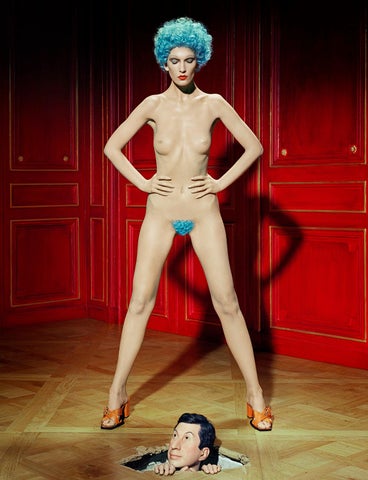
once ultra-modern and conservative, genteel and radical. Pictorially, Aldridge’s portraits likewise reference spot-colourized Edwardian postcards, with their simultaneously dream-like and vividly artificial luminescence, abutting monochrome with patches of intense, prettified colour. The characteristic otherworldliness of Gilbert & George, as they take their place in their own pictures, is mirrored by that of Aldridge’s model. A distinguishing trait within Aldridge’s artistic vision is the vacated expression of many of his female models. The model stares ahead, seemingly unblinking, robotic, de-personalized, yet also statuesque. The pose is both mannequin-like and entranced; the model becomes the embodiment of the constructed image of a model – no longer sentient (the pose disturbed by personality) but a work of living artifice, pure image, aesthetically, sartorially, sexually and semantically related solely to her hyper-stylized imagistic context. In Aldridge’s response to the art of Harland Miller (whose work often takes the form of paintings of book covers, with drily ironical titles, all authored by Harland Miller) a seductive, platinum blonde centrefold-style model is seen – with extravagant coiffure and make-up – in a variety of stereotypically retroBritish domestic settings. She appears to be in solitary reverie, alone with her book. These tableaux appear like post-Pop reclamations of soft pornographic glamour magazine photo-spreads from the early 1960s: the domestic interior as an erotic venue. In responding to the different titles of Miller’s books-as-artwork, Aldridge creates a dialogue between Miller’s work and fantasy worlds of the ‘centrefold’ models. As ever, colour, surface and texture are fundamental to Aldridge’s aesthetic; and as his responses to the art of Harland Miller are in the medium of screenprint, so the colour is intensified – this time by a block of transparent ink printed over one section of each image. The retro-kitsch settings make a pictorial and sensory fetish of a quilted bed head, a swimming pool turquoise mattress, mustard yellow floral curtains, pale pink and spearmint green cosmetics bottles, a bright red sofa and one-bar heater, primary coloured bathroom tiles and a wet plastic shower curtain. Here we see the model in her various domestic-fetish settings reading books with titles such as Thought After Filthy Thought, Better Than Life and Circling The Small Ads. With enhanced vibrancy, these settings and accoutrements concentrate and explode the synthetics and artifice of the constructed image – revelling in the orgiastic super-realism of colour and texture, in which the sexualized, overtly constructed presence of the model becomes the dramatic focus and essence. As Aldridge’s response to the art and aura of Gilbert & George makes play with eerie otherworldliness, and his engagement with the work of Harland Miller explores a form of ironical bookish solitude, so his address to the iconoclastic sculptural works of Maurizio Cattelan is confrontational, dramatic and declamatory. A statuesque nude model, somewhat android-Valkyrie like, her hair in various chemically bright colours, attends or participates within the scenarios depicted
9
by Cattelan’s sculptures. She prays alongside a diminutive, adult schoolboy Adolf Hitler; stands astride the emerging head of an exaggerated self-portait sculpture of Cattelan who has broken through the gallery floor; lies on the red carpeted floor with her eyes closed and legs provocatively spread, beside the Pope struck down by a meteorite. Empowered by her dominating nudity, her role as witness-participant becomes ambiguous and erotically charged. Each image becomes a surreally cartoon-like event that both comments upon and pays homage to Cattelan’s absurdist cultural satire. The projects brought together in (after) are unified by their wit, otherworldliness and eroticism. They could be updates of Surrealist excursions into the scenarios of fashion, or equally post-Pop variations on the work of modern masters. They exist with ease on an aesthetic continuum that is at once homage and intervention, adapting tableaux of contemporary art to new, filmic uses that are entirely Aldridge’s own.
10
11
(after Cattelan)
“...Empowered by her dominating nudity, her role as witness-participant becomes ambiguous and erotically charged. Each image becomes a surreally cartoon-like event that both comments upon and pays homage to Cattelan’s absurdist cultural satire...�
13
14
15
Untitled (after Cattelan) #4 Chromogenic print, 2016 Edition of 10 101.6 Ă— 77.5 cm
16
17
Untitled (after Cattelan) #3 Chromogenic print, 2016 Edition of 6 116.3 Ă— 168.1 cm
18
19
Untitled (after Cattelan) #1 Chromogenic print, 2016 Edition of 10 101.6 Ă— 77.6 cm
20
21
The Ninth Hour (after Cattelan) – Study Unique Polaroid print, 2016 Signed verso 8.6 × 10.8 cm
22
Untitled (after Cattelan) #2 – Study Unique Polaroid print, 2016 Signed verso 8.6 × 10.8 cm
23
Untitled (after Cattelan) #4 – Study Unique Polaroid print, 2016 Signed verso 8.6 × 10.8 cm
24
Untitled (after Cattelan) #3 – Study Unique Polaroid print, 2016 Signed verso 8.6 × 10.8 cm
25
Untitled (after Cattelan) #1 – Study Unique Polaroid print, 2016 Signed verso 8.6 × 10.8 cm
26
27
28
(after Miller)
“...These tableaux appear like post-Pop reclamations of soft pornographic glamour magazine photo-spreads from the early 1960s: the domestic interior as an erotic venue. In responding to the different titles of Miller’s books-asartwork, Aldridge creates a dialogue between Miller’s work and fantasy worlds of the ‘centrefold’ models...”
29
Circling The Small Ads (after Miller) Screenprint in colours, 2017 Signed in pencil verso and numbered from the edition of 15, plus 3 artist’s proofs Printed on 410gsm Somerset paper by K2 Screen, London Published by Polígrafa Obra Gráfica, Barcelona 75 × 103 cm
30
31
Thought After Filthy Thought (after Miller) Screenprint in colours, 2017 Signed in pencil verso and numbered from the edition of 15, plus 3 artist’s proofs Printed on 410gsm Somerset paper by K2 Screen, London Published by Polígrafa Obra Gráfica, Barcelona 75 × 150 cm
32
33
In Shadows I Boogie (after Miller) Screenprint in colours, 2017 Signed in pencil verso and numbered from the edition of 15, plus 3 artist’s proofs Printed on 410gsm Somerset paper by K2 Screen, London
Published by Polígrafa Obra Gráfica, Barcelona 103 × 75 cm
34
35
Hell... It’s Only Forever (after Miller) Screenprint in colours, 2017 Signed in pencil verso and numbered from the edition of 15, plus 3 artist’s proofs Printed on 410gsm Somerset paper by K2 Screen, London Published by Polígrafa Obra Gráfica, Barcelona 134 × 75 cm
36
37
Better Than Life (after Miller) Screenprint in colours, 2017 Signed in pencil verso and numbered from the edition of 15, plus 3 artist’s proofs Printed on 410gsm Somerset paper by K2 Screen, London Published by Polígrafa Obra Gráfica, Barcelona 75 × 103 cm
38
39
In Shadows I Boogie (after Miller) – Drawing Indian ink, liquid acrylic and oil pastel on Fabriano paper, 2017 Signed verso 29.7 × 21 cm
40
Thought After Filthy Thought (after Miller) – Drawing Indian ink, liquid acrylic and oil pastel on Fabriano paper, 2017 Signed verso 29.7 × 21 cm
41
Hell... It’s Only Forever (after Miller) – Drawing Indian ink, liquid acrylic and oil pastel on Fabriano paper, 2017 Signed verso 21 × 29.7 cm
42
Better Than Life (after Miller) – Drawing Indian ink, liquid acrylic and oil pastel on Fabriano paper, 2017 Signed verso 21 × 29.7 cm
43
Circling The Small Ads (after Miller) – Drawing Indian ink, liquid acrylic and oil pastel on Fabriano paper, 2017 Signed verso 29.7 × 21 cm
44
45
46
Love Always & All Ways (after Gilbert & George)
“...Pictorially, Aldridge’s portraits likewise reference spotcolourized Edwardian postcards, with their simultaneously dream-like and vividly artificial luminescence, abutting monochrome with patches of intense, prettified colour...”
47
Love Always & All Ways (after Gilbert & George) The complete portfolio of 5 photogravures printed in colours, with hand-painting, presented with the title page, 2017 Signed in pencil and numbered from the edition of 12, plus 2 artist’s proofs Printed on 300gsm Somerset paper by Paupers Press, London Each sheet: 38.1 × 41.9 cm
48
49
Love Always & All Ways (after Gilbert & George) #1 Photogravure printed in colours, with hand-painting, 2017 Signed in pencil and numbered from the edition of 12, plus 2 artist’s proofs Printed on 300gsm Somerset paper by Paupers Press, London 38.1 × 41.9 cm
50
Love Always & All Ways (after Gilbert & George) #2 Photogravure printed in colours, with hand-painting, 2017 Signed in pencil and numbered from the edition of 12, plus 2 artist’s proofs Printed on 300gsm Somerset paper by Paupers Press, London 38.1 × 41.9 cm
51
Love Always & All Ways (after Gilbert & George) #3 Photogravure printed in colours, with hand-painting, 2017 Signed in pencil and numbered from the edition of 12, plus 2 artist’s proofs Printed on 300gsm Somerset paper by Paupers Press, London 38.1 × 41.9 cm
52
Love Always & All Ways (after Gilbert & George) #4 Photogravure printed in colours, with hand-painting, 2017 Signed in pencil and numbered from the edition of 12, plus 2 artist’s proofs Printed on 300gsm Somerset paper by Paupers Press, London 41.9 × 38.1 cm
53
Love Always & All Ways (after Gilbert & George) #5 Photogravure printed in colours, with hand-painting, 2017 Signed in pencil and numbered from the edition of 12, plus 2 artist’s proofs Printed on 300gsm Somerset paper by Paupers Press, London 38.1 × 41.9 cm
54
55
56
Biography
Miles Aldridge was born in London in 1964. He studied at Central St. Martins and after graduating worked briefly as an illustrator before coming to photography. His photographs have appeared in museum and gallery exhibitions worldwide including in 2013 a major retrospective of his work entitled I Only Want You to Love Me 2013 at Somerset House. In 2014 he was invited by Tate Britain to create a photographic installation entitled Carousel II as a response to Mark Gertler’s 1916 painting Merry-go-Round. There are several monographs on his work, including Pictures for Photographs (2009), Other Pictures (2012); and his most recent book Please return Polaroid (2016) which chronicles his creative process through the use of Polaroids. He has works in the permanent collection of The National Portrait Gallery and The V&A in London and the ICP in New York.
57
Selected Solo Exhibitions
58
2016
Please return Polaroid, Steven Kasher Gallery, New York Please return Polaroid, Lyndsey Ingram, London
2015
The Pure Wonder, Fahey/Klein Gallery, Los Angeles A Dazzling Beauty, OCA, Sao Paolo
2014
The Age of Pleasure, Christophe Guye Galerie, Zurich One Black & White and Twenty Four Colour Photographs, Reflex Gallery, Amsterdam Miles Aldridge’s Carousel: Lithograph and Screenprints, Drawings and Photographs, Sims Reed Gallery, London
2013
Short Breaths, Brancolini Grimaldi, London I Only Want You to Love Me, Somerset House, London CAROUSEL, Brancolini Grimaldi, London I Only Want You to Love Me, Steven Kasher Gallery, New York
2010
13 Women, CONTRIBUTED Studio For The Arts, Berlin New Work, Brancolini Grimaldi, Florence Kristen As seen by Miles Aldridge and Chantal Joffe, Reflex Gallery, Amsterdam
2009
Pictures for Photographs, Collette, Paris Pictures for Photographs, Steven Kasher Gallery, New York Doll Face, Hamiltons Gallery, London
2008
Acid Candy, Reflex Gallery, Amsterdam
2007
The Cabinet, Reflex Gallery, Amsterdam
Selected Group Exhibitions
2017
The Critic as Artist, Reading Museum, Reading Showroom, Christophe Guye Galerie, Zurich
2016
Fashion Show. 60 Years of Fashion Photography, Atlas Gallery, London
2015
Coming into Fashion: A Century of Photography at Condé Nast, Multimedia Art Museum, Moscow; Norton Museum of Art, West Palm Beach Sleepless – The Bed in History and Contemporary Art, 21er Haus of the Belvedere, Vienna
2014
Slaves of Mimesis: Nine Years On 23rd Street, Steven Kasher Gallery, New York The Fashion World of Jean Paul Gaultier: From the Sidewalk to the Catwalk, Barbican Art Gallery, London; The Brooklyn Museum, New York Beauty of Darkness II, Reflex Gallery, Amsterdam
2013
New Fashion Photography, CONTRIBUTED Studio for the Arts, Berlin Dream Women + Dream Men, Central Exhibition Hall ‘Manege’, Saint-Petersburg
2012
Icons of Tomorrow – Contemporary Fashion Photography, Christophe Guye Galerie, Zurich Best of Fashion Photography, CONTRIBUTED Studio for the Arts, Berlin
2011
Ein Bild von einem Auto, Galerie der Stadt Sindelfingen, Sindelfingen Beauty Culture, The Annenberg Space for Photography, Los Angeles
2010
A Positive View, Somerset House, London
2009
Weird Beauty: Fashion Photography Now, ICP, New York
2008
Traumfrauen – Beauty in the 21st Century, Deichtorhallen, Hamburg Something for Everyone, Hamiltons Gallery, London
2004
The Beauty of Darkness, Reflex Gallery, Amsterdam
2002
The Archeology of Elegance, Deichtorhallen, Hamburg
59
Shoot Credits (after Cattelan) Model: Valerija Kelava Stylist: Samuel Francois Hair stylist: Seb Bascle Makeup: Alice Ghendrih Manicurist: Christina Conrad Props: Vincent Olivieri (after Gilbert & George) Model: Iris Strubegger Stylist: Samuel Francois Hair stylist: Kerry Warn Makeup: Alice Ghendrih Manicurist: Michelle Humphrey Props: Michael Howells (after Miller) Model: Cleo Cwlek Stylist: Samuel Francois Hair stylist: Seb Bascle Makeup: Lloyd Simmonds Manicurist: Trish Lomax Props: Trish Stephenson
Published by Lyndsey Ingram Designed by Lucy Harbut Printed by Dayfold Opening section quotes excerpted from Michael Bracewell’s introductory essay Artist’s studio portraits: Megan Jordan Images © 2017 Miles Aldridge
61
63