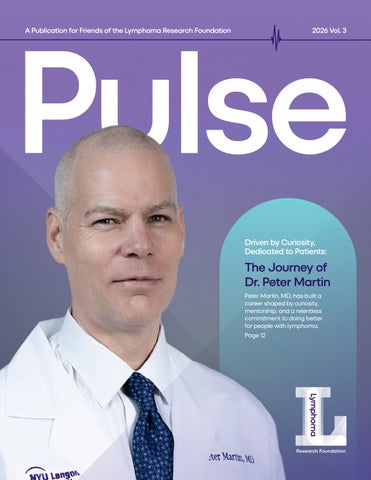
Pulse A Publication for Friends of the Lymphoma Research Foundation
2026 Vol. 3
Driven by Curiosity, Dedicated to Patients:
The Journey of Dr. Peter Martin Peter Martin, MD, has built a career shaped by curiosity, mentorship, and a relentless commitment to doing better for people with lymphoma. Page 12
Pulse A Publication for Friends of the Lymphoma Research Foundation Pulse is a publication of the Lymphoma Research Foundation, providing the latest updates on the Foundation and its focus on lymphoma research, awareness, and education. The Lymphoma Research Foundation is devoted to funding innovative lymphoma research and serving the lymphoma community through a comprehensive series of education programs, outreach initiatives, and patient services.
Contact Us National Headquarters Wall Street Plaza 88 Pine Street, Suite 2400 New York, NY 10005
Helpline 800 500 9976 helpline@lymphoma.org
212 349 2910 lymphoma.org
Foundation Leadership
Editor
Zainab Hameed
Jeff Block Chair, Board of Directors
Nichole Musumeci
David Meehan-Romero
Andrew M. Evens, DO, MSc, FACP Chair, Scientific Advisory Board
Editorial Board
Sarah Quinlan
Hope Avalone
Laura Wallenstein
Meghan Gutierrez Chief Executive Officer
Micah Banner
Eva Migliore
Kyle Haines
Our disease and treatment-specific guides are now available in a dynamic and engaging digital format—making it easier than ever for patients and loved ones to explore personalized lymphoma information and support. Explore trusted information, navigate resources more easily, and learn at the pace that feels right for you.
Visit lymphoma.org/publications to learn more
PULSE | 2026 VOL. 3
Personal Care.
Read and Learn at Your Own Pace
Community Support.
Pulse © 2026 Lymphoma Research Foundation
Table of Contents Features
Driven by Curiosity, Dedicated to Patients: The Journey of Dr. Peter Martin Peter Martin, MD, has built a career shaped by curiosity, mentorship, and a relentless commitment to doing better for people with lymphoma. As he prepares to receive the Lymphoma Research Foundation’s Distinguished Leadership Award, he reflects on the mentors, patients, discoveries, and relationships that have shaped his journey—and continue to inspire his vision for the future of lymphoma care.
12
Meet the 2026 Lymphoma Scientific Research Mentoring Program Grantees The new class of Foundation Scholars are pursuing projects covering a diverse range of lymphoma subtypes, with a goal to improve the lives of all those touched by lymphoma.
20
The Beer, the Battle, and the Jorts: Chris Fedor’s Road Back from Lymphoma Chris Fedor was healthy, working, and living a typical life when an unexpected episode of chest pain led to a diagnosis he never saw coming: Hodgkin lymphoma. What followed was a two-year journey shaped by chemotherapy, uncertainty, friendship, humor, and an evolving understanding of resilience. Chris reflects on the perspective cancer gave him, the people who carried him through it, and his belief that hope means finding a reason to laugh even when you’re scared.
28
In Every Issue
Community Impact
4
From the Field
12
Living With Lymphoma
28
1
A Free CME Program for Professionals
The Lymphoma Rounds program provides a forum for practicing physicians from academic and community-based settings to meet and address issues specific to the diagnosis and treatment of their lymphoma patients. Physicians network, share best practices, and learn the latest information on new therapies and advances in the management of lymphoma through interactive presentations.
2026 Schedule 10/14 – Lymphoma Rounds at Lymphoma, Leukemia & Myeloma Congress
2027 Schedule 1/28 – Lymphoma Rounds Virtual Program 2/25 – Lymphoma Rounds: East Coast (New York) 4/15 – Lymphoma Rounds: New England (Boston) 5/6 – Lymphoma Rounds: West Coast (Seattle) 5/13 – Lymphoma Runds Virtual Program Visit lymphoma.org/hcpeducation to register and learn more.
From the CEO One of the most powerful aspects of the Lymphoma Research Foundation’s work is that it connects generations. A discovery made in a laboratory today may change the life of a patient years from now. A patient whose life is changed by that progress may, in turn, become an advocate, a philanthropist, or a source of hope for someone newly diagnosed. And sometimes, that commitment grows into a legacy that extends from one generation to the next. That spirit comes to life in this issue of Pulse. You will meet the Werner family, whose connection to the Foundation began with Michael Werner’s lymphoma diagnosis and grew into a remarkable, multi-generational commitment to advance our mission. Michael’s journey from patient to Foundation leader, alongside the dedication of his father, Bob, and his daughter, Margot, is a powerful example of how one person’s experience with lymphoma can create an impact far beyond a single individual. You will also get to know Dr. Peter Martin, this year’s recipient of the Lymphoma Research Foundation’s Distinguished Leadership Award. Throughout his career, Dr. Martin has been guided by a simple but important question: How can we do better? His work in mantle cell lymphoma, his commitment to mentoring young investigators, and his deeply personal approach to patient care reflects the curiosity and compassion required to move our field forward. That commitment to the future is also reflected in this year’s class of Lymphoma Scientific Research Mentoring Program Scholars. These emerging investigators are pursuing bold and diverse ideas—from improving the patient experience with CAR T-cell therapy to developing more personalized treatments and uncovering new approaches for the most challenging disease types. Their work represents an important investment in the future: the questions yet to be asked, the discoveries waiting to be made, and the researchers who will lead us there. Chris Fedor’s Story of Hope reminds us that the lymphoma experience is about much more than a diagnosis or a treatment plan. It is about navigating uncertainty, leaning on the people around us, and finding ways to hold onto hope and humanity through some of life’s most difficult moments. Together, these stories reflect the many ways in which progress takes shape. It happens through scientific curiosity and rigorous research. It happens through mentorship and collaboration. It happens when patients and families share their experiences. It happens when supporters choose to invest in a cause larger than themselves. And it happens when an entire community comes together with a shared determination to improve the lives of everyone affected by lymphoma. Thank you for being part of this extraordinary community and for your continued commitment to the Lymphoma Research Foundation. Together, we are building on the progress of the past, investing in the promise of the future, and moving ever closer to a world without lymphoma. Sincerely yours,
Meghan Gutierrez Chief Executive Officer 3
COMMUNITY IMPACT
Philanthropy in Action
2026 Minnesota Lymphoma Walk Raises $113,000
2026 Chicago Lymphoma Walk Raises $162,000
On June 6, 586 walkers joined us for the 2026 Minnesota Lymphoma Walk, taking steps toward a cure and raising over $113,000 to power the Lymphoma Research Foundation’s lifesaving mission. This year’s event honored Robin Klebig, APRN, CNP, AOCNP, from Mayo Clinic, Rochester, for her work as a nurse practitioner, helping to support patients, survivors, and their loved ones.
On July 26, more than 1,000 walkers, volunteers, and supporters came together for an incredible day at the 2026 Chicago Lymphoma Walk! Fueled by the energy, determination, and generosity of our community, participants raised over $162,000 to advance lifesaving lymphoma research and support critical patient programs. This year’s event honored Dr. Peter Riedell of The University of Chicago Medicine for his dedicated work caring for lymphoma patients and advancing treatment options. A Foundation grantee, Dr. Riedell has made significant contributions to improving care and outcomes for people living with lymphoma.
4
PULSE | 2026 VOL. 3
JOINTHE THE JOIN
WERNER LEGACY LEGACY SOCIETY SOCIETY For For patients patientsand andfamilies familiesfacing facinglymphoma, lymphoma, research researchbrings bringshope—hope hope—hopefor forbetter bettertreatments, treatments, more effective therapies, and ultimately, more effective therapies, and ultimately,aacure. cure.
When you you include include the When the Lymphoma LymphomaResearch Research Foundation in your estate plan, you Foundation in your estate plan, youcan canmake makeaa lasting investment investment in lasting in lymphoma lymphoma research researchand and help support patients, survivors and their loved help support patients, survivors and their loved ones as as they they navigate navigate lymphoma. ones lymphoma.
Werner Werner Legacy Legacy Society Society
AAplanned forfor tomorrow. plannedgift giftisismore morethan thana agift gift tomorrow. ItItisisaastatement about the future you want statement about the future you want totohelp bebe aa very helpcreate. create.“Planned “Plannedgifts giftscan can very meaningful contribution that can help support meaningful contribution that can help support the Werner theFoundation’s Foundation’sfuture futurework.” work.”- Bob - Bob Werner
Scan the QR code to learn Scan the QR code to learn how you can make a difference how you can make a difference through planned giving. through planned giving. 5
COMMUNITY IMPACT
Three Generations. One Mission. A Legacy That Will Last. Twenty years ago, Michael Werner received news that would forever change his family’s life. Diagnosed with follicular lymphoma (FL) and initially given a devastating prognosis, Michael was told he might have only four years to live. The diagnosis arrived in stages. First came the shock of learning he had lymphoma. Then, six months later, a genetic test suggested his disease was far more aggressive than originally believed, dramatically altering his outlook. For many, that news would have been paralyzing. For Michael, it became a challenge to solve.
6
PULSE | 2026 VOL. 3
Rather than accepting the prognosis as the final word, Michael immersed himself in research. He met with leading lymphoma specialists across the United States and Europe, studied emerging therapies, and searched tirelessly for the treatment approach that would give him the greatest chance at a long, healthy life. Along the way, he discovered the Lymphoma Research Foundation, an organization that provided not only trusted education but also access to physicians, researchers, and a community that would ultimately help shape his future. It also sparked something much bigger than a patient’s journey. It ignited a family legacy. Together, the Werner family represents what can happen when gratitude becomes action—and when one family’s experience creates lasting change for countless others.
From Patient to Leader For Michael Werner, surviving lymphoma was never the end of the story. It was the beginning of a lifelong commitment to ensuring others would have the same opportunity. When Michael was diagnosed, his entire family rallied around him. His father, an engineer with a lifelong passion for science, dove into medical literature alongside Michael and his wife, Laura, determined to understand every possible treatment option. Michael approached his diagnosis the same way he had approached building successful companies throughout his career, with relentless curiosity and an unwavering determination to solve difficult problems. Over the next 18 months, he traveled extensively, consulting many of the world’s foremost lymphoma experts. He evaluated clinical trials, compared treatment strategies, and even designed what he believed would be the ideal treatment sequence for his disease. Although he ultimately couldn’t pursue that exact protocol, the education and connections he gained through the Foundation helped him identify a clinical trial that would prove life-changing. “When I think about why I’m a survivor,” he says, “I am here for one really simple reason—because of the Lymphoma Research Foundation.” Rather than stepping away after treatment, Michael chose to give back.
Michael Werner
He joined the Lymphoma Research Foundation’s Board of Directors in 2007, ultimately serving as vice chair and then chair of the board from 2016 through 2020. Throughout nearly two decades of leadership, he helped strengthen governance, sharpen long-term strategy, expand fundraising, recruit exceptional board leadership, and deepen relationships throughout the scientific, medical, and philanthropic communities. His goal was never simply to grow the organization. It was to help the Foundation reach its full potential so it could serve more patients, accelerate more research, and ultimately save more lives. His impact extended well beyond the boardroom. Whenever Michael heard someone had been diagnosed with lymphoma, he’d ask to speak with them personally. “I know how scary this is,” he would tell them. “Let me walk you through it.” Over the years, he has become a trusted mentor to countless newly diagnosed patients. He often returns to a favorite quote from Warren Buffett: “Someone is sitting in the shade today because someone planted a tree a long time ago.” For Michael, every patient benefiting from today’s breakthroughs is living proof of that idea.
7
COMMUNITY IMPACT For his daughter, Margot, watching those conversations became one of the defining memories of her childhood. “When I think about my dad and his lymphoma journey,” she says, “I think about how every time he heard someone had been diagnosed, he’d ask to speak with them. He wanted them to know they weren’t alone and that they were going to be okay.” Twenty years after a diagnosis that once came with a devastating prognosis, Michael’s life stands as proof of what’s possible through scientific progress, expert care, and the power of community. Every anniversary is celebrated by the Werner family—not simply because of another cancer-free year but because every milestone represents memories they might never have had.
Building More Than a Foundation Recognizing his father’s deep experience leading nonprofit organizations and building successful fundraising programs, Michael made a simple request. “Dad,” he said, “please come help.”
From left: Bob and Michael Werner
Bob answered without hesitation.
Long before philanthropy became a significant part of the Werner family’s story, Bob believed that if you could help— even in small ways—you had a responsibility to do so. Michael remembers watching his father support hundreds of charitable organizations each year. Some gifts were substantial. Others were only a few dollars. The amount never mattered.
For Michael, that invitation represented more than recruiting another volunteer. It was an opportunity to build something meaningful alongside the person who had shaped his understanding of leadership, service, and philanthropy from the very beginning. Growing up, Michael often heard his father repeat a simple principle: “Leaders lead.” It wasn’t just a saying. It was how Bob lived.
If you have something, it’s important to share whatever you have with others.
8
PULSE | 2026 VOL. 3
What mattered was showing up whenever there was a need. “It was just his mentality,” Michael recalls. “If you have something, it’s important to share whatever you have with others.” After retiring from the family’s business, Bob devoted himself full-time to philanthropy. True to form, he approached nonprofit leadership with the same rigor he had brought to engineering and business. He immersed himself in fundraising strategy, governance, development systems, and nonprofit management, eventually serving on more than a dozen nonprofit boards and becoming a trusted mentor to executive directors across the country. Over the years, Bob helped professionalize the Foundation’s development efforts, strengthen board governance, mentor staff leadership, and champion investments that transformed fundraising into a strategic engine for growth. He also played a pivotal role in establishing the Foundation’s planned giving program,
recognizing early on that legacy gifts would provide lasting support for lymphoma research, patient education, and critical services. He often describes fundraising using a single analogy. “Fundraising puts gas in the car’s tank,” he says. “That gas enables the entire organization to function at the highest level.” For Bob, every improvement ultimately came back to one goal: giving researchers, physicians, patients, and caregivers the resources they needed to move closer to eliminating lymphoma. For Michael, working alongside his father at the Foundation became one of the greatest gifts of the experience. Having spent years together in the family business, the Foundation gave them another opportunity to build something together—this time with a mission that reached far beyond business. When Michael served as Board Chair, Bob became his trusted sounding board. “He’d never tell me what to do,” Michael says. “But he would help me think through how to approach a problem.” Those conversations helped shape countless leadership decisions over the years and deepened a father-son partnership already rooted in mutual respect.
Growing Up With Hope For Margot Werner, lymphoma has always been part of her family’s story. She vividly remembers the evening her father came home with his diagnosis. She was just 8 years old. “I remember swinging open the door after hockey practice,” she recalls. “My dad was usually this bubbly, smiley guy, and his face was just white.” The family still went to the Chicago Blackhawks game that evening. They quietly shared french fries, unsure what the future would hold. Those early memories remain vivid—not because of fear alone but because of what came afterward. One particular memory from another Blackhawks game has stayed with Michael ever since. Shortly after his diagnosis, he stopped to speak with a friend about it during the game’s intermission. Trying to reassure him, Michael casually said, “I should be fine.”
From left: Margot Werner and Aviv Brawer-Cohen
As the conversation ended, young Margot tugged on his hockey jersey. “Dad,” she said, “do you know what you said?” “No,” he answered. “You said you should be fine.” Then she paused. “You will be fine.” Those four words profoundly changed something. From that day forward, Michael consciously changed his language—and his mindset. Instead of speaking in terms of uncertainty, he committed himself completely to finding every possible path toward a cure, not only for himself but for others facing lymphoma. Sometimes, the greatest perspective comes from the smallest voices. Over the years, Margot watched her father attend Foundation conferences, connect newly diagnosed patients with resources, and devote countless hours to helping others navigate the uncertainty he had once faced himself. She also watched him surpass every expectation. “He always says he’s not a survivor—he’s a thriver,” Margot says. “Every passing year we don’t take it for granted. We celebrate it.”
9
COMMUNITY IMPACT She points to the Jewish principle of tikkun olam— repairing the world—as a philosophy her grandfather instilled in her father and her father instilled in her. “I feel like I’ve been dealt such a lucky hand,” she says. “It’s important that I contribute to society and help make other people’s lives better.” Today, the Foundation has become a true family mission, and together, they have created something extraordinary.
A Legacy That Lives On This fall, the Werner family will receive the Lymphoma Research Foundation’s Legacy Award at the Annual Gala in recognition of their extraordinary commitment to advancing the Foundation’s mission. The honor extends beyond a single award. The Foundation’s planned giving society will also be renamed the Werner Legacy Society, recognizing not only decades of leadership and generosity but also the enduring example their family has set. From left: Margot and Bob Werner
Carrying the Legacy Forward As an adult, Margot began asking herself a simple question. If lymphoma is one of the most common cancers among young adults, where were the young adults at the Foundation’s events? That question led to action. Working alongside the Foundation and her friends Isabel Sessions and Alexandra Rose, Margot helped launch what has become the Emerging Philanthropists Gala, creating a vibrant community of young professionals committed to raising both awareness and funding for lymphoma research. What began as a small gathering has grown into a thriving annual event welcoming hundreds of attendees while raising hundreds of thousands of dollars to advance the Foundation’s mission. Just as importantly, it has introduced an entirely new generation to lymphoma advocacy and philanthropy. For Margot, philanthropy isn’t simply about giving back. It’s about carrying forward values that have been passed down through generations.
10
PULSE | 2026 VOL. 3
For Michael, the Legacy Society represents something much larger than estate planning. It is an opportunity to invest in people he will never meet. The research that ultimately saved his life existed because previous generations believed in funding science long before they would ever see the results. Today’s legacy gifts ensure that future patients will benefit from breakthroughs still waiting to be discovered. “What is important is that the Foundation has enabled a multi-generational family to make a difference,” Bob says. “Our story of commitment to the Foundation’s mission will encourage others to join us.”
What is important is that the Foundation has enabled a multi-generational family to make a difference, our story of commitment to the Foundation’s mission will encourage others to join us.
Looking ahead, Michael remains deeply optimistic. He believes exciting advancements are on the horizon. But those breakthroughs won’t happen on their own. They will require continued investment in researchers, physicians, education, and patients. “The Foundation,” he says, “is trying to train the next generation of scientists and researchers and get people the same kind of outcome that I’ve had.” Margot hopes that legacy extends far beyond her own family. “The Foundation has meant the world to my family,” she says. “We truly credit it with my dad being here today. The work they do every day is saving lives. My dad is the purest example of that.” Twenty years after one diagnosis changed everything, three generations of the Werner family continue to prove that a legacy isn’t measured simply by years of service or dollars raised. It is measured by lives transformed.
The research that saved Michael’s life was possible because someone, years earlier, chose to invest in a future they would never see. Today, the Werner family is planting those same seeds—supporting the discoveries, treatments, and hope that future generations of patients will one day depend on. Their story is ultimately not just about one family’s commitment. It is about what becomes possible when gratitude is transformed into action, when leadership inspires leadership, and when one life saved becomes the beginning of countless others.
It’s important that I contribute to society and help make other people’s lives better.
From left: Bob and Michael Werner at the Foundation Golf Invitational 11
FROM THE FIELD
Driven by Curiosity, Dedicated to Patients:
The Journey of Dr. Peter Martin When Peter Martin, MD, looks back on the path that led him to become one of the world’s leading lymphoma specialists, he doesn’t point to a single defining moment. Instead, he describes a journey shaped by curiosity, inspiring mentors, meaningful relationships with patients, and a desire to continually ask one simple question: How can we do better? Today, Dr. Martin is a nationally recognized lymphoma specialist, researcher, and professor of medicine at NYU Langone’s Perlmutter Cancer Center, where he serves as co-chair of the Hematologic Malignancies Disease Management Group. This November, he will also receive the Lymphoma Research Foundation’s Distinguished Leadership Award in recognition of his extraordinary contributions to lymphoma research and patient care. Yet despite decades of accomplishments, he remains remarkably humble. “I think we’ll all end up where we’re supposed to be,” he says. “This is just where I fit in the best.”
12
PULSE | 2026 VOL. 3
A Lifelong Curiosity Growing up in Edmonton, Alberta, Dr. Martin was surrounded by science. His grandfather was a physics professor, his father a chemist, and his mother worked as an oncology nurse before transitioning into epidemiology. Although medicine wasn’t necessarily the obvious destination, scientific discovery would always be a part of his future. “I always kind of knew I would be somewhere in science,” he recalls. That curiosity eventually took him from Canada to Santiago, Chile, where he conducted molecular biology research after completing his undergraduate degree. Those early experiences reinforced his love of discovery while exposing him to different cultures and perspectives—qualities that continue to influence his work today. Now based in New York City, where he has lived with his wife and son for more than 20 years, Dr. Martin balances a busy clinical practice with a thriving research program dedicated to improving the lives of people diagnosed with lymphoma.
Seeing the Person Before the Disease
Transforming Mantle Cell Lymphoma
For Dr. Martin, medicine has never been just about treating lymphoma.
Over the course of his career, Dr. Martin has become internationally recognized for his work in mantle cell lymphoma (MCL), a rare and often aggressive subtype of non-Hodgkin lymphoma.
“The relationship that I get to have with patients for years and years and years—I really enjoy that part of it,” he says. His approach begins long before treatment decisions are made. Every new patient is an opportunity to understand not just a diagnosis but also a person. “I always start off trying to learn as much as I can about this person, what’s important to them, who’s important to them. That sits at the center of everything.” That philosophy also shapes the advice he gives patients and families navigating a lymphoma diagnosis. Rather than expecting patients to become medical experts overnight, he encourages honest communication. “Your job is to tell me how you’re feeling,” he says. “We’ll figure it out together.”
When he began focusing on MCL, progress had stalled for decades. “There was recognition that we were seeing a lot of progress in other lymphomas and not as much in mantle cell lymphoma,” he says. Rather than accepting a one-size-fits-all approach to treatment, Dr. Martin became interested in understanding why patients’ experiences with MCL differed so dramatically. “I wanted to understand some of that diversity from person to person and be part of the team that helps move along newer and better treatments.” Looking back over the past decade, he has seen remarkable progress.
Research That Reaches Beyond the Clinic Although caring for patients remains his favorite part of every week, Dr. Martin realized early in his career that he wanted to make an even broader impact.
“It’s been a pretty big paradigm shift,” he says of advances in mantle cell lymphoma research. Yet he believes there is still much more work to do.
As a clinical researcher, Dr. Martin helps design studies that evaluate new therapies, improve existing treatments, and answer important questions about how lymphoma behaves. For him, the most exciting part isn’t simply conducting research; it’s imagining new possibilities. “I like forming the question and then coming up with the plan to answer the question,” he says. “That’s really the best part of clinical research.”
In 2024, Dr. Martin was appointed as chair of the Foundation’s Mantle Cell Lymphoma Consortium (MCLC). The MCLC was established in 2003 to advance research for this underserved patient population, and it is now a global network of nearly 150 researchers. As chair, one of his priorities is ensuring that momentum doesn’t slow. Under his leadership, the Consortium is currently working to better define high-risk forms of MCL so researchers can develop more targeted approaches for the patients who need them most.
That same curiosity makes him a stronger physician. “You see a situation and you say, ‘Boy, I wish we could do something better.’ Well, then as a researcher, you get to do something better.”
I like forming the question and then coming up with the plan to answer the question. That’s really the best part of clinical research.
13
FROM THE FIELD
Why Research Can’t Wait
Finding Joy in the Lymphoma Community
Over nearly two decades in lymphoma care, Dr. Martin has witnessed extraordinary scientific breakthroughs.
Despite his leadership roles and research accomplishments, Dr. Martin measures success differently than most.
“The kinds of treatments we have today almost feel like science fiction,” he says. “It would have been hard to foresee where we are today 20 years ago.” But from his perspective, progress never comes quickly enough. That urgency fuels his advocacy for continued investment in research. “Over a million people are walking around with some form of blood cancer, and every single one of them deserves something better,” he says. He believes scientific progress depends on both brilliant minds and sustained support. “The people are there—they just need inspiration and time.”
Building the Next Generation Dr. Martin has experienced firsthand how mentorship can shape a career, and he is passionate about creating those same opportunities for young investigators. He credits mentors like John Leonard, MD (NYU School of Medicine), and Selina Chen-Kiang, PhD (Weill Cornell Medicine), with inspiring his own involvement in the Foundation early in his career, eventually leading him to serve on the Foundation’s Scientific Advisory Board.
There isn’t one award, publication, or milestone that stands above the rest. Instead, his greatest career highlights happen every day. “Every day you walk into the clinic, you see a familiar face that’s there,” he says. “You see them smiling back at you and know that you’re part of the reason they’re smiling. It’s hard to beat that feeling.” As he prepares to receive the Lymphoma Research Foundation’s Distinguished Leadership Award, Dr. Martin views the honor not as recognition of past accomplishments, but as another opportunity to advance the Foundation’s mission. “It’s an opportunity to help further the mission of the Foundation,” he says, “and contribute to the Foundation what the Foundation has contributed to my career and the careers of hundreds of my friends and colleagues.” For Dr. Martin, the future of lymphoma research has always been about more than scientific discovery. It’s about people—the patients who inspire every question, every study, and every breakthrough and the next generation of researchers who will carry that work forward.
Today, he encourages his mentees to become involved with the Foundation not only because it advances their careers but also because it allows them to make an impact far beyond their own clinics. The Foundation’s investment in young investigators, he says, helps launch careers that can change the future of lymphoma treatment. “I’ve seen people who came in fresh-eyed ... later on be involved in clinical trials that literally change the treatment landscape.”
The people are there—they just need inspiration and time. From left: Michael Williams, MD, and Peter Martin, MD 14
PULSE | 2026 VOL. 3
15
FROM THE FIELD
Where Are They Now?
Christina Poh, MD Christina Poh, MD, is an associate clinical professor in the Division of Lymphoma and the director of the T Cell Lymphoma Program at City of Hope® Cancer Center, Duarte.
When did you become interested in studying medicine? In lymphoma specifically? I’ve had multiple family members and friends diagnosed with cancer, and the medical care available to them was not always as advanced or accessible as what we have in the United States. Witnessing that firsthand motivated me to contribute to the progress being made here, with the hope that I can one day bring that knowledge and expertise back to my community. I was also drawn to oncology because it is a rapidly evolving field—one where scientific discovery directly translates into better outcomes and new possibilities for patients. At the same time, it offers the opportunity to build deep, meaningful relationships with the individuals and families you care for. That combination of innovation, impact, and human connection is what inspired me to pursue hematology and oncology.
You work with patients diagnosed with all types of lymphoma but specialize in the rare and aggressive subtype known as T-cell lymphoma. Why was this subtype interesting to you, and how have you seen treatments evolve for this patient population? One of the things that drew me to T-cell lymphoma is that it is one of the areas of lymphoma with the greatest unmet need. While many patients with B-cell lymphomas have highly effective targeted therapies and even curative options, patients with T-cell lymphoma have historically had far fewer treatment choices and generally poorer outcomes. As a physician, it’s hard to accept that disparity, and I felt this was an area where meaningful advances could have a real impact on patients’ lives.
16
PULSE | 2026 VOL. 3
I also find T-cell lymphoma scientifically fascinating. It’s not a single disease but a collection of many distinct subtypes, each with unique biology and clinical behavior. Understanding those differences has opened the door to more personalized approaches to treatment, which is an exciting direction for the field. Over the past decade, we’ve seen important progress. We’ve gone from relying almost exclusively on chemotherapy to having several targeted therapies, antibody-based treatments, and novel immunotherapies available for relapsed disease. We’re also seeing clinical trials move these newer agents into earlier lines of therapy and explore rational combinations that may improve long-term outcomes. Perhaps most exciting is that we’re beginning to tailor treatment based on the biology of each T-cell lymphoma subtype rather than using a one-size-fitsall approach. Despite this progress, there’s still much more work to do. That’s what motivates both my clinical practice and my research—to develop more effective, less toxic treatments and ultimately improve the outlook for patients living with T-cell lymphoma.
At what point in your career did you receive funding from the Lymphoma Research Foundation? What kind of grant(s) did you receive? What scientific project did you pursue as part of your Foundation research grant, and how did the Foundation support your interest in T-cell lymphoma? The Lymphoma Research Foundation has been instrumental in my career development at multiple stages. In 2024, I participated in the Lymphoma Scientific Research Mentoring Program (LSRMP), which provided invaluable mentorship, research training, and connections with leaders in the lymphoma field. The experience helped shape my research direction and accelerated my development as an independent investigator. Building on that foundation, I was honored to receive a Lymphoma Research Foundation Career Development Award (CDA) in 2026. The award has enabled me to pursue research focused on improving frontline treatment strategies for T-cell lymphoma, particularly nodal T-follicular helper cell lymphoma. Beyond the funding itself, the Foundation’s investment has given me the protected time, mentorship, and collaborative network needed to develop innovative clinical trials and translational research aimed at improving outcomes for patients.
How has the treatment landscape for lymphoma/CLL changed since you first started conducting your research? The treatment landscape for lymphoma has changed dramatically since I began my research. When I started, treatment for many lymphoma subtypes relied heavily on chemotherapy, and while it was effective for some patients, others, particularly those with rare lymphomas like T-cell lymphoma, had limited options and poor outcomes. Today, we’re in a very different era. We’ve seen the development of targeted therapies, antibody-drug conjugates, bispecific antibodies, CAR T-cell therapy, and other immunotherapies that have transformed the care of many patients with lymphoma. For chronic lymphocytic leukemia (CLL), we’ve moved away from chemotherapy for most patients and now have highly effective targeted therapies that can produce durable remissions with fewer side effects. We’re also becoming much more precise in how we treat lymphoma. Instead of thinking of lymphoma as a single disease, we now recognize that each subtype has distinct biology, and we’re increasingly designing treatments that target the specific pathways driving each disease. Advances in genomic sequencing and biomarkers are also helping us better predict which therapies are most likely to benefit individual patients. For T-cell lymphoma, the progress has been slower than in B-cell lymphomas or CLL, but it has been meaningful. We now have several approved targeted therapies that didn’t exist a decade ago, and there is tremendous momentum in developing rational combination therapies, novel immunotherapies, and biomarker-driven clinical trials. I believe the next major advances will come from matching the right treatment to the right patient based on the biology of their disease rather than using the same approach for everyone. It’s an incredibly exciting time to be in lymphoma research because the pace of discovery continues to accelerate. Most importantly, these advances are translating into longer, better-quality lives for our patients.
Looking back, the Foundation has supported me from early mentorship through career development, and that continuity has had a tremendous impact on my growth as a clinical investigator.
17
FROM THE FIELD Was the support and grant funding you received from the Foundation vital to advancing/ dedicating your career to studying lymphoma?
What research or projects are you currently pursuing that you would like to share with our readers?
Absolutely. The Lymphoma Research Foundation’s support has been instrumental in my career development. Beyond the financial support, the Foundation provided mentorship, education, and a community of investigators who are all committed to improving outcomes for patients with lymphoma. I truly believe that the Foundation’s support has accelerated my career and strengthened my commitment to studying lymphoma. I’m incredibly grateful for their investment—not just in me but in the next generation of lymphoma researchers who are working to improve the lives of patients.
My research focuses on improving outcomes for patients with T-cell lymphoma through clinical trials and translational research. I’m currently involved in studies evaluating novel targeted therapy combinations, with the goal of developing more effective and less toxic treatment approaches. I’m particularly interested in moving beyond a one-size-fits-all approach by identifying which patients are most likely to benefit from specific therapies and incorporating biomarkers, such as circulating tumor DNA (ctDNA), to better monitor treatment response and guide future treatment decisions.
How has your involvement with the Foundation continued since being a Foundation LSRMP Scholar?
What are you most excited about in the field of lymphoma research today? Why?
The Lymphoma Research Foundation has remained an important part of my career since I participated in the LSRMP. The relationships and mentorship I developed through the program have continued well beyond the year itself, and I’ve stayed engaged with the Foundation through its educational programs, scientific meetings, and research community. Receiving the Clinical Investigator Career Development Award has allowed me to continue building on that foundation and advance my research in T-cell lymphoma. I’m grateful for the Foundation’s continued investment in my career, and I hope to give back by mentoring future investigators and contributing to the lymphoma research community in the years ahead.
Why is the Foundation’s mission and focus on lymphoma-specific research and programming important? Put another way: How would the lymphoma community be impacted if there was no Lymphoma Research Foundation? Without the Lymphoma Research Foundation, progress in lymphoma research would almost certainly be slower. There would be fewer opportunities for young investigators to enter the field, fewer collaborations to tackle difficult research questions, and fewer resources dedicated specifically to the unique needs of lymphoma patients. The Foundation has created a community where researchers, clinicians, patients, and advocates work together toward the same goal: improving outcomes and, ultimately, finding cures for every type of lymphoma. That kind of focused, disease-specific investment is incredibly difficult to replace and has had a lasting impact on the entire lymphoma community.
18
PULSE | 2026 VOL. 3
What excites me most is that we’re entering an era of precision medicine in lymphoma. We’re learning that lymphoma is not one disease but many biologically distinct diseases, and we’re increasingly able to develop treatments that target the specific pathways driving each subtype rather than relying on a one-size-fits-all approach. I’m also excited by advances in biomarker research, particularly ctDNA, which has the potential to help us monitor treatment response, detect relapse earlier, and personalize treatment. Combined with the development of novel targeted therapies and immunotherapies, I believe these advances will continue to improve outcomes for patients with lymphoma.
The Foundation has created a community where researchers, clinicians, patients, and advocates work together toward the same goal: improving outcomes and, ultimately, finding cures for every type of lymphoma.
The Lymphoma Research Foundation created the Lymphoma Resource Center to help patients, survivors, and care partners find trusted information, compassionate support, and personalized guidance — all free of charge. Whether newly diagnosed, in treatment, or navigating survivorship, the Resource Center connects individuals with: • • • • • •
One-on-one support from our trained support team Lymphoma Resource Kits tailored to your specific needs Treatment Navigation Services offering guidance on treatment options and clinical trials Patient Aid Grants to ease the financial burden of lymphoma care Up-to-date, medically reviewed educational materials Peer connection through our Lymphoma Support Network
A lymphoma diagnosis can feel overwhelming. The Lymphoma Resource Center is here to make sure no one has to navigate it alone.
Connect with the Lymphoma Resource Center today by visiting lymphoma.org/resourcecenter
Personal Care. Community Support.
Introducing the new Lymphoma Resource Center
FROM THE FIELD
Meet the 2026 Lymphoma Research Mentoring Program Grantees The Lymphoma Research Foundation’s Lymphoma Scientific Research Mentoring Program (LSRMP) is a first-of-its-kind education and mentoring program for junior scientists who wish to focus on lymphoma and CLL research, whether in the lab or in the clinic. The primary goal of the LSRMP is to retain its talented participants—called Foundation Scholars—in the field of lymphoma by providing mentoring and education programming and fostering research collaboration among expert faculty and grantees. Led by the 2026 LSRMP Clinical Research co-chairs Alison Moskowitz, MD (Memorial Sloan Kettering Cancer Center), and Neha Mehta-Shah, MD, MSCI (Washington University in St. Louis), and Laboratory/Translational Research cochairs Teresa Palomero, PhD (Columbia University Institute for Cancer Genetics), and Mark Roschewski, MD (Memorial Sloan Kettering Cancer Center), the new class boasts translational and clinical researchers pursuing a diverse range of research projects to improve patient outcomes.
20
PULSE | 2026 VOL. 3
Clinical Research Scholars Amaris Balitsky, MD McMaster University Stephanie A. Gregory, MD, FACP Distinguished Scholar
Although most patients who receive chimeric antigen receptor (CAR) T-cell therapy never develop serious complications, most patients are admitted to hospital for extended stays after receiving treatment so that they can be monitored for potential side effects. Dr. Balitsky’s research aims to determine whether patients can instead be monitored at home using virtual care, remote monitoring, and real-time symptoms tracking. “If successful, this approach could reduce unnecessary hospital stays, lower healthcare costs, and significantly improve patient quality of life without compromising safety,” she explains. Treatments such as CAR T-cell therapies have transformed the lymphoma research landscape, offering potentially curative results to patients who once had very limited treatment options. But these breakthroughs have also introduced new challenges in patient care. “During my clinical training, I cared for patients undergoing CAR T-cell therapy who spent long periods in hospital despite feeling relatively well,” Dr. Balitsky says. “Many expressed a strong desire to be at home with their families, especially during such an intense and vulnerable time. This project grew out of those conversations. It aims to bridge the gap between cutting-edge treatment and patient-centered care— ensuring that as we advance scientifically, we also improve the lived experience of our patients.” Dr. Balitsky earned her medical degree from the University of Toronto and currently serves as an assistant professor at McMaster University. As a clinician scientist, she is focused on work that improves the patient experience for those receiving cellular therapies such as CAR T-cell therapy. “My primary source of inspiration is my patients,” she says. “Seeing their resilience, especially while undergoing intensive therapies, is incredibly motivating.” Dr. Balitsky is most inspired by her patients who are willing to pursue innovative treatments not just for themselves but for the hope that it will help other patients in the future. “That sense of trust and contribution is something I carry with me in my work,” she adds. “It is a constant reminder that research is not abstract—it directly impacts real people and their families.”
Yun Choi, MD The Ohio State University Kristie Blum, MD Scholar
Dr. Choi has always been passionate about using science to help others, and her lymphoma research journey followed an accomplished first career in information technology. After earning a Master of Engineering from Cornell University, she spent more than 10 years in the IT field before deciding to pursue medicine. She went on to earn her medical degree from Albert Einstein College of Medicine in New York and completed a fellowship in hematology/ oncology at NYU Langone Medical School. “I have chosen the field of hematology/oncology, specifically lymphomas, as blood cancers are one of the most dynamic areas in medicine with an urgent need for new therapies,” says Dr. Choi. “I have come to understand that investigators with a unique ability to navigate both the clinical and research worlds have opportunities to help advance patient care by formulating a research question based on the bedside experience and efficiently translating research findings from the bench back to the bedside.” Dr. Choi now serves as an assistant professor at The Ohio State University, where her work focuses on the development of new chemotherapy-free treatment combinations for people with marginal zone lymphoma (MZL). “While the last decade has improved the therapeutic landscape of MZL with newer agents, there remains an unmet need for more effective treatment options with improved toxicity profiles for this disease that predominantly affects older adults,” she says.
21
FROM THE FIELD
Hunter Cochran, MD Washington University in St. Louis Kellie and Jeff Fellinge Scholar
Many traditional immunotherapies for lymphomas work by broadly suppressing the immune system. Dr. Cochran’s research focuses on the development of a personalized cancer vaccine for patients with lymphoma, with the goal of training each patient’s own immune system to recognize and attack the unique cancer cells within their body. “We begin by analyzing a patient’s tumor using advanced genetic sequencing to identify unique ‘neoantigens’—small pieces of protein found only on their cancer cells,” explains Dr. Cochran. “We then create a customized vaccine targeting those neoantigens, with the goal of stimulating a precise and durable immune response.” Vaccination can then be combined with other immunotherapies for those who do not receive a robust response to vaccination alone to further boost the immune system to kill off cancerous cells. Dr. Cochran hopes that this strategy will lead to longer-lasting remissions (including potentially curative results), reduce the need for chemotherapy, and ultimately shift the lymphoma treatment paradigm away from chronic immunosuppression and toward immune-based control of the disease. Based on feedback she received as part of the Lymphoma Scientific Research Mentorship Program, Dr. Cochran has already refined her project by incorporating patientreported outcomes into her proposal to better capture patients’ experiences with treatment. “What makes lymphoma so meaningful is the long-term relationship we often develop with our patients,” she explains. “Many patients live with this disease for years, and as physicians, we have the privilege and responsibility of caring for them over that entire journey. Because of this, I am deeply motivated not only to extend patients’ lives but also to improve how they live during that time. That means minimizing treatment-related side effects while maximizing durable disease control.”
22
PULSE | 2026 VOL. 3
Efrat Luttwak, MD, MPH Memorial Sloan Kettering Cancer Center Condon Family Scholar
Transformed follicular lymphoma (FL) is an aggressive type of lymphoma for which there remains no clearly established standard approach to treatment. Dr. Luttwak’s research aims to develop more biologically informed strategies for the treatment of transformed FL by combining newer immune-based therapies—such as bispecific antibodies— with targeted therapies that block key lymphoma survival pathways. In parallel, her work also seeks to better understand why some patients respond to these therapies while others relapse or develop resistance. “Ultimately, I hope this work will contribute to more personalized treatment approaches and improve outcomes for patients with high-risk lymphoma,” she says. Dr. Luttwak earned her medical degree and a Master of Public Health from Hebrew University in Israel. She completed a fellowship in hematology/oncology at Tel Aviv University Sourasky Medical Center and a lymphoma fellowship at Memorial Sloan Kettering Cancer Center, where she now serves as an assistant attending in the Lymphoma Service. “I was initially drawn to lymphoma because it sits at the intersection of clinical medicine, immunology, pathology, and translational science,” she says. “This project specifically grew from caring for patients in clinic and recognizing how urgently we need better biologically driven therapies and more individualized approaches.” Dr. Luttwak’s greatest inspiration comes from the resilience, optimism, and trust of her patients, who consistently remind her why this work is so important. “I am equally inspired by the collaborative nature of lymphoma research,” she adds. “Advances in this field often happen because clinicians, scientists, pathologists, statisticians, and patients work together toward a common goal. Being part of that collective effort is incredibly motivating.”
Graham Wehmeyer, MD Icahn School of Medicine at Mount Sinai
Translational Research Scholars
Kanti R. Rai, MD Clinical Scholar
Amin Aalipour, MD, PhD Doxorubicin is a commonly used chemotherapy regimen that can be very effective against different types of lymphoma. However, doxorubicin can also cause damage to the heart, which can increase the risk for heart failure later in life. Dr. Wehmeyer’s research aims to determine whether sotagliflozin, a medication that is used to treat heart failure and diabetes, can reduce or prevent heart injury in patients with non-Hodgkin lymphoma being treated with doxorubicin. “If successful, this approach could provide a new way to help patients receive effective cancer treatment while lowering the risk of serious long-term heart complications,” he says. Dr. Wehmeyer’s interest in lymphoma research began during his time in medical school and residency at Weill Cornell Medical College in New York, where he saw firsthand the transformative nature of novel therapies that have emerged in the clinic. “As lymphoma therapies become increasingly effective, I have become especially interested in how we can reduce treatment-related toxicities and improve long-term survivorship,” he says. “That is what makes this project so exciting to me. Identifying strategies to reduce doxorubicin-related cardiac complications has the potential to meaningfully improve patients’ health not only during treatment but for many years after they complete lymphoma therapy.”
Dana-Farber Cancer Institute Paul Walker Schaffel Scholar
Chimeric antigen receptor (CAR) T-cell therapy has emerged as a transformative treatment option for many patients with lymphoma, but many patients still eventually relapse with time. Understanding the mechanisms of relapse after CAR T-cell therapy remains a central challenge in the lymphoma research field, and Dr. Aalipour’s work aims to uncover the role of the immune system in these processes. “A key part of the answer lies in cytokines, which are the molecular signals that act as fuel for T cells,” he explains. “Without the right cytokine environment, even the most potent CAR T cells can exhaust or fail to persist long enough to do their job.” Dr. Aalipour’s research focuses on the development of a system for the modular reprogramming of cytokine signaling within CAR T cells, essentially giving them the tools to help them better sustain themselves and maintain their cancer-fighting functions. “The goal is a flexible toolkit that can be adapted and optimized across different lymphoma subtypes and patient contexts,” he says. “Ultimately, I hope this work contributes to a future where more patients achieve deep, durable remissions after CAR T-cell therapy.” As a physician scientist with a background in engineering, Dr. Aalipour’s research marries his two passions: technology development and the translation of research into meaningful outcomes for lymphoma patients. “Lymphoma is a remarkable disease to study, in part because the therapeutic landscape is so rich and rapidly evolving,” he adds. “From small molecules and antibody-drug conjugates to bispecific antibodies and CAR T-cell therapy, lymphoma sits at the intersection of nearly every exciting modality in modern oncology.” With the support of the Lymphoma Scientific Research Mentorship Program, Dr. Aalipour hopes to develop an integrative research program that combines synthetic biology, protein engineering, and high-throughput screening to develop cellular therapies that reshape the cancer immunity cycle.
23
FROM THE FIELD
Makoto Iwasaki, MD, PhD
Anouchka Laurent, PhD
Massachusetts General Hospital
The Trustees of Columbia University in the City of New York
Harwood Family Scholar
Most cancer-related genetics research focuses on the small fraction of human DNA that harbors protein-encoding genes. However, most of the genome consists of much larger “non-coding” regions, which include a variety of regulatory elements (or “switches”) that can turn on, turn off, or amplify gene expression. “We believe that broken or hijacked switches help drive peripheral T-cell lymphoma (PTCL) and that mapping them—together with how DNA folds in three dimensions inside a tumor cell—will reveal new vulnerabilities that we can target with drugs,” explains Dr. Iwasaki. Dr. Iwasaki completed his graduate and medical training at Kyoto University. During his time as a clinical trainee in Japan, he cared for many patients with PTCL, particularly adult T-cell leukemia/lymphoma and extranodal NK/Tcell lymphoma, which are unusually common in East Asia. “I watched too many patients exhaust their options too quickly with conventional chemotherapy and even with hematopoietic stem cell transplantation due to early and high rates of recurrence,” he says. “Most new drugs that had earned accelerated approval based on early-phase trials failed to deliver lasting benefit.” “That gap between promise and reality stayed with me, and I came to believe that without a deeper understanding of what actually drives these diseases at the molecular level, we will keep meeting the same wall,” Dr. Iwasaki explains. Using advanced, integrative technologies and computer modeling, he hopes that his research will serve to elucidate the molecular biological underpinnings that drive T-cell lymphomas, with the ultimate goal of translating those discoveries into improved therapies for lymphoma patients.
Dr. Laurent is an assistant research scientist in the Institute for Cancer Genetics at Columbia University in New York. She completed her doctoral research at the Gustave Roussy Institute and the Paris Diderot University, Paris VII, in France before moving to Columbia University for her postdoctoral research. During this time, she was awarded the Postdoctoral Fellowship Award from the Foundation for her work on ID2, a key driver of lymphoma cell survival and proliferation. Her current research builds on this initial work to understand how ID2 interacts with other proteins (such as ARID1A) to alter gene expression programs in cells to promote lymphoma development. “We are also investigating how these pathways help cancer cells adapt and survive under stressful conditions,” she explains. “By understanding the molecular mechanisms that lymphoma cells depend on, we hope to identify new vulnerabilities that can ultimately be targeted therapeutically.” “The long-term goal of this work is to contribute to the development of more effective and less toxic treatments for patients with T-cell lymphoma,” explains Dr. Laurent. “Finding new ways to specifically target lymphoma cells while sparing normal cells is particularly important for these aggressive diseases, where treatment options remain limited.” Dr. Laurent emphasizes that her hope is that her work will be built on strong interactions with both laboratory researchers and clinicians to ensure that the results of this research (and beyond) will translate to meaningful results for patients. “I believe there is still a need to better connect mechanistic research and clinical practice,” she says. “I would like to contribute to building an international and collaborative lymphoma research community where scientists and clinicians work closely together to accelerate discoveries and improve patient care.”
I would like to contribute to building an international and collaborative lymphoma research community where scientists and clinicians work closely together to accelerate discoveries and improve patient care. —Anouchka Laurent, PhD 24
PULSE | 2026 VOL. 3
John Patton, MD, PhD
Reid Shaw, MD
The Ohio State University
The University of Chicago
Warwick Foundation Scholar
Errol M. Cook Memorial Scholar
Many lymphomas increase protein production to grow, survive, and evade the immune system. A key helper in this process is a molecule known as eIF4A. When eIF4A is active, it helps cells translate genetic instructions into proteins that promote tumor growth and immune evasion. “We have found that blocking eIF4A makes lymphoma cells more susceptible to being killed by the immune system,” says Dr. Patton. His research therefore aims to identify which genetic messages depend on eIF4A to drive immune suppression and to test whether inhibiting eIF4A can remodel the lymphoma microenvironment. “If successful, this work could provide preclinical evidence for a treatment strategy that both directly weakens lymphoma cells and improves responses to immunotherapies,” he explains. “Ultimately, it may help inform early-phase clinical trials and rational combination therapies.” Dr. Patton was first drawn to a career in lymphoma research during his time as a graduate student at The Ohio State University. “During my PhD training, I saw firsthand how laboratory discoveries can translate into meaningful real-world impact for patients,” he says. “I also saw how much unmet need remains—especially for patients whose disease relapses or resists current therapies.” These experiences motivated him to pursue his medical degree so that he could directly care for the same patients he was working toward helping through his research. “Caring for patients underscores the urgency, especially when current therapies fall short, and it’s clear we need better options,” he says. With the support of the Lymphoma Scientific Research Mentorship Program, Dr. Patton hopes to develop a collaborative research program focused on the development of novel treatments for B-cell lymphomas. “I want my lab to be known not only for strong science but also for teamwork across disciplines and for training the next generation of physician-scientists and researchers committed to improving patient outcomes,” he adds. “As I build my own program, I see mentorship as both a foundation and a responsibility, and I aim to create an environment where trainees develop strong scientific instincts, gain confidence in their ideas, and remain connected to the ultimate goal of improving outcomes for patients with lymphoma.”
For some patients with relapsed or refractory large B-cell lymphoma (LBCL), chimeric antigen receptor (CAR) T-cell therapy can produce dramatic and even curative responses; however, less than half of patients have lasting benefit, and it is not yet clear why some patients experience lasting responses while others don’t. Recent research has revealed that the gut microbiome may play a role in influencing responses to CAR T-cell therapy—patients exposed to certain antibiotics before treatment tend to fare worse, whereas patients harboring beneficial bacteria tend to do better. “My project is built on the idea that we can harness this microbial influence to make CAR-T therapy more effective and safer for more patients,” says Dr. Shaw. In addition to preclinical and mechanistic studies to better understand how the microbiome shapes responses to CAR T-cell therapy, Dr. Shaw is also planning a clinical trial to test if and how a live biotherapeutic product—a live preparation of beneficial bacteria—can help enhance treatment outcomes when given alongside CAR T-cell therapy. The latter part of his project developed as a direct result of his participation in the Lymphoma Scientific Research Mentorship Program, in which Foundation mentors and faculty encouraged him to transition from a purely observational study to a more ambitious interventional trial. “That kind of pivot is hard to make on your own, and it was the LSRMP environment, the candor of the feedback, the experience of the mentors, and the structured mock study section format that gave me both the confidence and the specific direction to pull it off,” he says. Dr. Shaw was drawn to a career in lymphoma research during his time as a medical resident at Loyola University Medical Center, where he saw the extraordinary impact CAR T-cell therapy could have on patients. “I watched patients who had exhausted every option walk out of the hospital in remission,” he says. “I have also sat with patients whose disease returned, and with families when CAR-T did not deliver what we had all hoped for.” Dr. Shaw hopes that his research will help to better understand why some patients respond to these therapies while others don’t and offer a new option to help improve outcomes for all. “The opportunity to bring microbial therapeutics into the lymphoma clinic—to give the next patient a better answer— is what motivates me at the bench and at the bedside.”
25
FROM THE FIELD
Anli Zhang, PhD The University of Texas Southwestern Medical Center Chike Springer Legacy Scholar
Dr. Zhang is an instructor at UT Southwestern Medical Center in the field of cancer and immunology. She earned her doctoral degree at Fudan University in Shanghai, China, before coming to UT Southwestern for her postdoctoral research on immunological regulation in cancer. Building on these experiences, Dr. Zhang’s Foundation-funded research focuses on the development of novel therapeutic cancer vaccines using lipid nanoparticle technology. Her goal is that these mRNA vaccines can be used alongside other forms of immunotherapy to help boost cancer-targeting immune responses in patients with B-cell lymphomas.
The opportunity to bring microbial therapeutics into the lymphoma clinic— to give the next patient a better answer—is what motivates me at the bench and at the bedside. —Reid Shaw, MD
26
PULSE | 2026 VOL. 3
Protect the Next Generation of Lymphoma/CLL Investigators Proposed Federal Policy Shifts Threaten the Future of Cancer Research — Especially for Rare Diseases Like Lymphoma and CLL Lymphoma research has long been a catalyst for innovation across the field of oncology. Yet, because lymphoma and chronic lymphocytic leukemia (CLL) are considered rare diseases, they have historically received less federal research funding when compared to other disease states. Now, that gap may widen. Proposed changes to agencies like the National Institutes of Health (NIH), the Centers for Disease Control and Prevention (CDC), and the U.S. Food and Drug Administration (FDA) could stall vital progress — jeopardizing care, discovery, and hope for the lymphoma community. These cuts don’t just slow progress, they also threaten researchers’ careers. Early career scientists, the very pipeline to tomorrow’s cures, are at risk. Job offers are being rescinded. Projects are stalled. Mentorship and training opportunities are reduced. Once lost, these researchers may not return to careers in lymphoma research.
That’s Why Your Support Is More Critical Than Ever Despite federal uncertainty, the Lymphoma Research Foundation remains committed to advancing lifesaving research, supporting the next generation of lymphoma experts, and serving every person touched by this disease. To that end, the Foundation is announcing the creation of the Early Career Investigator Fund.
Your Gift Today May Be the Key to Unlocking Tomorrow’s Cures By making a gift to support our Early Career Investigator Fund today, you will help ensure that the Foundation can fully support its world-class mentoring programs and early-career grants for the next generation of lymphoma and CLL experts. Thanks to your continued generosity, we can keep moving forward. Together, we can protect progress, empower researchers, and push toward a world without lymphoma.
Visit giving.lymphoma.org/research to support the future of lymphoma research today!
LIVING WITH LYMPHOMA
The Beer, the Battle, and the Jorts:
Chris Fedor’s Road Back From Lymphoma For Chris Fedor, life changed with a beer. It was September 2023. Chris was 25 years old, healthy, working, making plans, and moving through life like anyone else in their 20s. Then, over the course of a few weeks, something started to feel different. It began with shortness of breath. Nothing dramatic. Nothing painful. Just the strange sensation that his lungs could only fill about 90% of the way. It seemed easy to explain away—maybe allergies, maybe stress, maybe something temporary. Then came the moment he couldn’t ignore.
28
PULSE | 2026 VOL. 3
After a stressful day at work, Chris sat down, opened a beer, and took a drink. About a minute later, a sharp, burning pain shot through his chest. “It felt like I got stabbed right in the chest with a burning knife,” he later recalled. Concerned, Chris looked up his symptoms online. While all signs led him to feel he needed to seek medical attention, he hesitated. He had always been known in his family as someone who occasionally went to urgent care for things that turned out to be minor. But this time felt different. After texting a friend whose sister was a nurse, he decided to get checked out. That decision would ultimately save his life.
The Diagnosis He Never Saw Coming
Building an Army of Support
At urgent care, doctors performed an X-ray and an EKG, ruling out a heart attack. The initial conclusion was that he was likely experiencing heartburn.
At first, disbelief took over. He wondered whether there had been a mistake. But quickly he realized this was real.
Chris wasn’t convinced. He knew what heartburn felt like. The next morning, his phone rang. The radiologist who reviewed his X-ray had taken another look and noticed something unusual. She recommended a CT scan. Chris assumed it would reveal something routine, perhaps pneumonia or another easily treatable issue. He tried not to let his thoughts go further. Then the results arrived. While at work, Chris opened the report on his phone. Most of it was filled with medical terminology he didn’t understand. But at the very bottom were four words that changed his life: “Consider workup for lymphoma.” In that moment, everything stopped. Chris struggled to process what he was reading. He wanted to cry but couldn’t. He wanted to move but felt frozen. Eventually, a coworker noticed something was wrong.
Until that point, Chris had never personally known anyone with cancer. He felt isolated and uncertain about what came next. He was preparing for a fight he had never trained for. Then he realized something important: While he couldn’t control his diagnosis, he could decide whether he faced it alone. So he built a team—a support system. His family was the part of that team he didn’t have to recruit. In the earliest appointments, someone was in the waiting room with him—most often his mom—and someone was there for the conversations that followed. Then he started building outward. Chris sat down and made a list of friends from every chapter of his life. He had always been someone who struggled to ask for help—someone who would say “no worries if not” even when he needed support. Cancer forced him to change that. One by one, he called his friends and shared the news.
Two days later, he underwent a biopsy.
The first conversations were difficult. He could hear the fear and sadness in their voices. He wanted to reassure them that he was still the same person he had always been. He didn’t want them to see him only as a cancer patient.
The diagnosis came on September 22, 2023—his 26th birthday. When his doctor called with the results, Chris knew immediately. It was Hodgkin lymphoma.
But over time, he began to understand something: Allowing people to help was not a burden. It was an opportunity for the people who loved him to show up.
When Chris finally spoke, he could only get out a few words: “It might be cancer.”
His community became one of his greatest sources of strength.
Choosing Hope in the Infusion Chair When chemotherapy began, Chris made a decision. Cancer was not going to take away his personality. If anything, he was going to bring more of it into the treatment room. His goal became to make his nurses laugh. “I knew if I let cancer beat me down mentally, it had already won,” Chris said. “So, I wanted to stay positive, not just for myself but for everyone around me.” That attitude quickly became part of his identity at the cancer center. During one infusion, a nurse walked in to help double-
29
LIVING WITH LYMPHOMA check his chemotherapy medications. When she realized it was Chris, she turned to her colleague and said: “This is the guy I was telling you about.” For Chris, it was a small but meaningful victory. He wasn’t just another patient receiving treatment, he was someone bringing joy into the room. Chris also discovered how much uncertainty surrounds chemotherapy. Before his diagnosis, he knew very little about cancer treatment. As he began sharing his experience, he realized many others had misconceptions too.
At first, he thought he might be one of the lucky ones who kept it. But after his second infusion, the reality became impossible to ignore. His hair began falling out. Eventually, Chris made the decision to cut it off. He expected sadness but instead, he felt something unexpected. A renewed sense of determination. He realized that losing his hair represented letting go of the last thing cancer could take from him. He was ready to fight. After six infusions, Chris received encouraging news from his PET scan: There was little evidence of cancer remaining.
So, he invited friends to join him during his infusions. Some conversations lasted for hours. Some friends read books or worked remotely beside him. Others simply sat with him.
Throughout treatment, Chris worked when he could, spent time outside, maintained relationships, and continued doing the things that made him feel like himself.
By seeing treatment firsthand, his friends gained a better understanding of what he was experiencing—and Chris felt less alone.
He learned to redefine what was possible. A simple task became something meaningful when he added two words: “on chemo.” Walking his dog was different on chemo. Going to concerts was different on chemo.
Positive News and New Challenges Showing up for life while undergoing treatment became something worth celebrating. After six months, Chris completed chemotherapy. But finishing treatment brought a new challenge. Survivorship. Many people assume the hardest part of cancer is the treatment itself. For Chris, the months afterward were unexpectedly difficult. His body needed time to rebuild, and emotionally, he needed time to process everything he had experienced. Then came the news he had been waiting for. On May 31, 2024, Chris met with his oncologist to review his scans. Chris was in remission.
Losing His Hair, Finding His Strength Then came one of the biggest emotional challenges of his journey: losing his hair. Chris had long, curly hair that had become a signature part of who he was. People often complimented it or asked about his routine. For him, it represented confidence and identity. When he first heard the word “chemotherapy,” his first thought wasn’t about the treatment. It was about his hair.
30
PULSE | 2026 VOL. 3
But surprisingly, the victory did not immediately feel the way he expected. For nearly a year, his purpose had been clear: defeat cancer. Now, he had to figure out what came next. Eventually, he realized his next challenge wasn’t fighting a disease, it was rebuilding himself. He looked in the mirror and saw someone who had survived something extraordinary. Someone who was stronger, more resilient, and more determined than before. So, he started running.
Running as a Way of Healing
The Lessons Left Behind
At first, Chris could barely run a mile or two. His body was still recovering from months of treatment. But he kept going.
In November of 2026, he is running another marathon but this time to support the Lymphoma Research Foundation. While Chris lived most of his life in Utah, California, and Washington, he was born in Brooklyn. To honor his roots, he will be running in the TCS New York City Marathon and because he doesn’t like to do things the “easy” or “normal” way, he will of course be running in jorts.
Eventually, he signed up for a half marathon. Then he set a bigger goal. A marathon. His first attempt was interrupted by injury, but even that setback felt different. Instead of seeing it as failure, Chris put it into perspective. He had fought cancer, and this was just another challenge he could defeat. On September 6, 2025, exactly two years after his first urgent care visit, Chris stood at the starting line of a marathon. Just as he had throughout his cancer journey, he wanted to make the moment his own. So he decided to run the race in cutoff jean shorts—jorts. The $5 pair of jorts represented everything Chris had learned throughout his journey: resilience, humor, individuality, and refusing to let difficult circumstances define him. The race was challenging. Around mile 14, exhaustion set in. His body wanted to stop.
Looking back on his journey, Chris doesn’t minimize how difficult cancer was. The diagnosis, treatment, and uncertainty changed him forever. But they also gave him something unexpected. Perspective. “Hope isn’t pretending you aren’t scared,” Chris says. “Hope is being scared and finding a reason to laugh anyway.” For Chris, hope looked like making nurses laugh during chemotherapy. It looked like accepting help from friends. It looked like baking cookies, finding joy in small moments, and eventually crossing a marathon finish line. Cancer changed his life, but it didn’t define it. And now grateful for his second chance at life, he looks forward to being able to give that same chance to everyone else facing their own battle.
Then he remembered the question that had carried him through cancer: Was this harder than what he had already survived? The answer was no. So he kept moving, crossing the finish line in 3:59:41, breaking four hours by just 19 seconds— a long-shot goal of his. Two years after cancer changed his life, he accomplished something he once never thought possible. In jorts.
To learn more about Chris’ “Cutoffs for a Cure” fundraising efforts, hear more about his story, and support him on this journey, visit giving.lymphoma.org/ cutoffsforacure. 31
Scientific Advisory Board Scientific Advisory Board The Lymphoma Research Foundation’s volunteer Scientific Advisory Board, comprised of 45 world-renowned lymphoma experts, guides the Foundation’s research activities, seeking out the most innovative and promising lymphoma research projects for support.
2026–2027 Membership Andrew M. Evens, DO, MSc, MBA Chair Rutgers Cancer Institute of New Jersey Christopher R. Flowers, MD, MS Chair-Elect The University of Texas MD Anderson Cancer Center Jeremy Abramson, MD Massachusetts General Hospital Kristie A. Blum, MD Winship Cancer Institute of Emory University Jennifer Brown, MD, PhD Dana-Farber Cancer Institute Sharon Castellino, MD, MSc Emory University School of Medicine James Cerhan, MD, PhD Mayo Clinic, Rochester Ethel Cesarman, MD, PhD NewYork-Presbyterian Hospital Weill Cornell Medicine Sandeep Dave, MD, MS Duke University Kieron M. Dunleavy, MD Lombardi Cancer Center of Georgetown University Kojo S.J. Elenitoba-Johnson, MD Memorial Sloan Kettering Cancer Center Todd Fehinger, MD, PhD Washington University School of Medicine Jonathan W. Friedberg, MD, MMSc University of Rochester James P. Wilmot Cancer Institute
Michael Green, PhD The University of Texas MD Anderson Cancer Center Alex Herrera, MD City of Hope Medical Center Steven M. Horwitz, MD Memorial Sloan Kettering Cancer Center Eric D. Hsi, MD Mayo Clinic, Rochester © 2026 Lymphoma Research Foundation
32
PULSE | 2026 VOL. 3
Ann S. LaCasce, MD, MMSc Immediate Past Chair Harvard Medical School Dana-Farber Cancer Institute John P. Leonard, MD Past Chair, 2012-2015 NYU Langone Health, Perlmutter Cancer Center
Gilles Sales, MD, PhD Memorial Sloan Kettering Cancer Center Kerry J. Savage, MD British Columbia Cancer David Scott, MBChB, PhD BC Cancer, Vancouver
Laurie Sehn, MD, MPH BC Cancer, Vancouver Margaret Shipp, MD Harvard Medical School Dana-Farber Cancer Institute
Megan Lim, MD, PhD Memorial Sloan Kettering Cancer Center
Eduardo M. Sotomayor, MD Tampa General Hospital
Kami Maddocks, MD Ohio State University Comprehensive Cancer Center
Christian Steidl, MD BC Cancer, Vancouver
Peter Martin, MD New York University
Gita Thanarajasingam, MD, PhD Mayo Clinic, Rochester
Matthew Maurer, ScD, MS Mayo Clinic, Rochester
John M. Timmerman, MD UCLA Jonsson Comprehensive Cancer Center
Neha Mehta-Shah, MD, MSCI Washington University in St. Louis
Hans-Guido Wendel, MD Memorial Sloan Kettering Cancer Center
Ari Melnick, MD NewYork-Presbyterian Hospital Weill Cornell Medicine
Andrew D. Zelenetz, MD, PhD Past Chair, 2019-2021 Memorial Sloan Kettering Cancer Center
Lindsay Morton, PhD National Cancer Institute Markus Müschen, MD, PhD Yale School of Medicine Teresa Palomero, PhD Institute for Cancer Genetics, Columbia University Laura Pasqualucci, MD Institute for Cancer Genetics, Columbia University Lisa Rimsza, MD University of Arizona Scott Rodig, MD, PhD Brigham & Women’s Hospital Mark Roschewski, MD Memorial Sloan Kettering Cancer Center Lisa Roth, MD NYU Langone Health, Perlmutter Cancer Center
Research. Community. Cure.
Leo I. Gordon, MD, FACP Past Chair, 2015-2017 Robert H. Lurie Comprehensive Cancer Center of Northwestern University
Kara Kelly, MD Roswell Park Comprehensive Cancer Center University at Buffalo Jacobs School of Medicine
Upcoming Events 10.10-10.11
11.4
Educational Forum on Lymphoma
Supporting a Loved One With Lymphoma: A Webinar for Care Partners
10.11 Amica Newport Marathon
10.12 Ask the Doctor About Lymphoma: Navigating Relapsed/Refractory Disease
11.5 Lymphoma Talk: Houston
11.13 Annual Gala
10.14
11.12
Lymphoma Rounds at Lymphoma, Leukemia & Myeloma Congress
Ask the Doctor About Lymphoma: Information for Newly Diagnosed Patients
10.20
11.16
Novel Therapy Update: Protein Degraders for Lymphoma and CLL Webinar
Update on Follicular Lymphoma Webinar
10.22 Ask the Doctor About Lymphoma: Navigating Relapsed/Refractory Disease
10.22-10.25 Disney Wine & Dine Half Marathon Weekend
10.29 Understanding and Accessing Chimeric Antigen Receptor (CAR) T-Cell Therapy
Want to receive information about Lymphoma Research Foundation events happening in your area? Visit lymphoma.org/emailsignup to select your email preferences and stay up to date with the latest from the Foundation.
33
NONPROFIT ORGANIZATION U.S. POSTAGE
PAID NEW YORK, NY PERMIT NO. XXX
Wall Street Plaza 88 Pine Street, Suite 2400 New York, NY 10005
Commit to Your Future Impact Today When you include the Lymphoma Research Foundation in your estate plan, you are investing in the most promising research that has the greatest potential to dramatically improve the lives of those impacted by lymphoma. To learn more about Planned Giving, contact Jessica Sharrow at jsharrow@lymphoma.org or visit lymphoma.org/legacy.