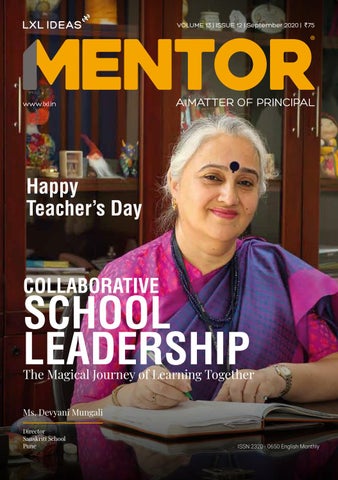
VOLUME 13 | ISSUE 12 | September 2020 |
Happy Teacher’s Day
COLLABORATIVE
SCHOOL LEADERSHIP
The Magical Journey of Learning Together Ms. Devyani Mungali Director Sanskriti School Pune
75
IS NOW DIGITAL ACCESS OUR CONTENT NOW
LOG ON TO WWW.LXL.IN/MENTOR
ACCESS THE LATEST ISSUE OF MENTOR BECOME A CONTRIBUTOR READ YOUR FAVORITE ARTICLES SHARE YOUR FAVORITE ARTICLES SIGN UP FOR COURSES
FOLLOW US @FACEBOOK.COM/MENTORPORTAL/ WRITE TO US @ MENTOR@LXL.IN | CALL US @090191 11110
VOICE YOUR OPINION. SHARE A THOUGHT. STIR THE THOUGHT PROCESS! Mentor is what it is today through the stories of educators who have entrusted Mentor to be a voice to their ideas and successfully helped raise the benchmarks of education! To be part of this team that is in the forefront of fostering lifelong learning for educators, join the Editorial Committee of Mentor today! If you feel you are the right fit for this role,
WRITE TO INFOLXL.IN with the following details: 1) Your Resume 2) Details of Committees or Teacher Forums (preferably magazine) that you are part of. 3) Your published article/paper 4) Your areas of interest in education 4) A 100-words write-up on “Why do you want to be part of the Mentor Editorial Committee?”
POSTAL REGN NO: KA/BGW-1635/2018-2020 RNI NO. KARENG/2008/26567 PUBLISHED ON 28TH OF PREVIOUS MONTH. POSTED AT BANGALORE PSO BG 560026 ON 3RD, 6TH & 10TH OF EVERY MONTH TOTAL 36 PAGES (INCLUDES COVER PAGES) LICENSED TO POST WITHOUT PREPAYMENT LICENSE NO: WPP - 114
BRING YOUR
WORDS TO LIFE Share with us your best practices about the following: 1. The growing trend of securing high marks in exams and its impact on students. 2. Shifting from STEM to STEAM approach of learning - the challenges, the benefits and the way forward.* 3. Social Education – Asset or Liability? and we'll publish it in Mentor!*
Word Limit: 1300 Words Email: info@lxl.in Submission Deadline: 5th September 2020 E-mail Subject: “Mentor Magazine”
Period
1 Copy
2 Copies
5 Copies
1 year
1200
2000
4000
2 years
2000
3500
7000
* inclusive of courier & GST charges
*Subject to Editorial Discretion
Contents
04
Mentor Thoughts Letter from the Editor
��
What’s Trending
��
Sultan Speaks
08
Personalised Learning
14
��
Pedagogy Education and Educators
��
Principal: The CEO
��
the Leader’ s Leadership
��
All Rights Reserved ���� EduMedia Publications Pvt. Ltd. Publisher & Owner: Syed Sultan Ahmed Editor: Kalpa Kartik Sub Editor: Devina Wallang Content Developer: Farah Javid Layouts : OneAndOnlyDesign.in Production: Praveen U. M., Sathish C. Printer: Elegant Printing
23
Cover Story Collaborative School Leadership
28
��
Governance Towards the Land of WOW!
��
Philosophy to Parents
��
Translating a School’ s Teaching
��
Leadership Levels That Lead
18
Innovation Children and Emotional Intelligence Education for a Better World
�� ��
Notice: The contributions in Mentor Magazine are solely the views of the author and are in no manner to be directly associated with the views of the editorial team or LXL Ideas. Authors/contributors are responsible for the authenticity of information they provide in the article. The publishers do not accept liability for errors or omissions contained in this publication. By submitting letters/emails or other publication materials to Mentor Magazine the author/contributor agrees that it is the property of Mentor Magazine. All communication to Mentor Magazine must be made in writing. No other sort of communication will be accepted. All decisions regarding publishing of a contribution is the prerogative of the publisher and editorial team of Mentor Magazine. Mentor Magazine is owned and published by EduMedia Publications Pvt. Ltd. for and on behalf of Mr. Syed Sultan Ahmed. All disputes are subject to the exclusive jurisdiction of the competent courts and forums in Bengaluru City.
Mentor | September ���� | www.lxl.in
3
letter editor
from the
Education is a double-edged sword. Masterminds can utilise it to make or mar the world. It’s the trait of life that confronts you with values and varied ways of knowing the surrounding. It fortifies the mind and soul and allows one to think in the right direction, thereby, honing one’s talent and sharpening one’s skills. A leader is the product of education. Like many things in education, organisations and people tend to make concepts more complicated than they really are. Or they craft a vision and definition that solely meets their needs or goals. However, through the power of education, you as an educator have the ability to equip today’s young people to become the thinkers, creators and engineers of tomorrow – ready to solve society’s most pressing challenges and build a better, more sustainable world for all. But, as an educator, you must consider, are you doing everything you can to empower students to make a positive impact on tomorrow’s world? This is an important consideration to always have at the top of your mind when you are lesson planning, teaching, or assessing your students’ work. The ways in which you do this will be unique to your school and your students, and it takes time to understand the needs of every learner. Children are the best judges as they are very pure in their thoughts and can assess who is closer to their heart. We may forget them, but they remember us for the strong impressions we leave on their minds. Thus, personalised learning is about meeting the individual needs of all learners in utilising digital and non-digital strategies. Most learning in life is iterative and is based on more in-depth and better insights which are, in turn, shaped by our experiences. Ultimately, one of the core aspects of sharing any learning/training is to catalyse behavioural change. The process is most effective when there is a strong component of live interactions/sessions among students and teachers. If the teachers can enable students to distil some wisdom/insights from these experiences, then they have done an excellent job. Undeniably, schools have no shortage of challenges, but when people feel heard and know that their school leader values their voice and opinion, a culture of mutual trust and respect develops, thus opening up a platform where stakeholders provide authentic solutions to various challenges. Let the staff collaborate and conceptualise the moving on effect with the child at the centre of focus.
4
Mentor | September ���� | www.lxl.in
The purpose is to enable ownership so that the ‘WOW’ factor is created in the classroom. The art of teaching is what makes super teachers – those who do everything it takes to bring the sparkle in the eyes of their children. The impact of the increased focus on empowerment has been immediately reflected in the change in attitudes. There is an enhanced sense of ownership, belonging and commitment which follows increased participation in the various initiatives of the schooling system. Most importantly, these become essential life skills that are then passed on to students and others. Furthermore, in today’s highly-connected world, where most of the parents are well educated and are very much concerned about their child’s schooling, it is more important than ever to establish trust. Including parents in the expectations and goal-setting process makes students more likely to reach their goals and creates parent partnerships along the way. However, above all, would you dispute that across the globe the need of the hour is to develop young people who are well prepared for life in an inter-connected 21st century – who will be able to contribute to a better, more peaceful world? So, as educators, the power is in our hands! Let’s do our best!
Kalpa Kartik Editor
Our Contributors
DEVYANI MUNGALI
Founder & Director Sanskriti School, Pune
SATISH M. GANDHI TOK Coordinator Sanjay Ghodawat International School, IBDP, Kolhapur
ERIC SHENINGER Associate Partner International Centre for Leadership in Education (ICLE), Texas USA
NINETTE DSOUZA
STUART JONES
Maths & Science Teacher Canossa High School, Mahim, Mumbai
Head of IB Schools International Baccalaureate, Singapore
SKAND BALI Principal The Hyderabad Public School Begumpet, Hyderabad
ALKESH VERMA General Manager - Training and Development IQuotient Consultant Private Limited, New Delhi
RAMA DEVI Sr Principal (Retd) Bharatiya Vidya Bhavan’s Public School, Jubilee Hills, Hyderabad
SAROJ RAO Mentor Educator, Nakshatra Pre School, Davangere
Mentor | September ���� | www.lxl.in
5
Sultan Speaks
Why should children participate in literary & cultural events? Way back in 1997 still a college kid I organised my first Interschool event called Activity, the idea of the event was to give a cool platform for students to participate. Over the years this event was renamed Wizkids more popularly known as Horlicks Wizkids. For over 20 years of my life, I have been traveling across South Asia hosting and organising this event. The event was held across 30 to 40 cities every year an over a million students participated in singing, speaking, dance, writing, art, literary, and all kinds of competitions. I can safely claim to have witnessed more kids performing than most people can imagine. Wizkids was not the only event we organised - Spell Bee, Pogo Amazing Kids, Financial Quest, Dell Champs, Pogo Funtakshari are among the 1000 odd student events we organised over the years.
Once she submits her entry she waits in anticipation for the results. If she wins she learns what it means to succeed and if she doesn’t she learns the value of participation, she learns that there are dancers better than her and if she can applaud their victory that moves her up a notch in her journey of maturity and confidence.
While we have been very successful in organising school events and allowing children to participate. One challenge that we have always faced was the attitude of schools towards events, they mostly prioritize academics over extra-curricular activities. We are living through an event of a lifetime, the lockdown due to the COVID situation. All schools have moved their learning online and learning for them still means academic subjects. Online education means academic learning and we somehow cannot seem to think of anything beyond that. The sad reality is that today despite all the talk about overall development the priority of most schools remains academics.
I have seen millions of kids on stage and I have seen this journey over and over again. That is the reason why I believe that one of the best ways to help prepare children for life is to give them opportunities to express their talent. The biggest role of parents and schools is not to teach children but to create opportunities for them to experience and explore.
Overall these years of organising innumerable events for children what I have learned is that children learn more important skills for life by participating in these activities than they do studying academic subjects. Take the case of a little girl participating in an online dance event, lets live her story for a while. The fact that she chooses to participate in itself is a big test for her self- confidence and decision-making ability. Once her decision is made starts the journey of anticipation and waiting for the competition day. In the meantime, she has to make a lot of choices - what theme to dance on, what music to choose, what costumes to wear, what steps and choreography would suit her performance. All of this would involve a lot of research, speaking to friends, looks for guides and suggestions, living with budget constraints. While this little girl is doing all of this she realizes the importance of practice and puts in a lot of effort to get her performance up to her expectations. On the day she is meant to shoot she will do a lot of takes and retakes to make sure she gets the video right. Once the video is made she is going to spend time editing and packaging it well. In all this process she has to collaborate with a lot of people or online learning to make things happen.
6
Mentor | September ���� | www.lxl.in
If we look closely at this little dancers' journey it is an amazing journey of life skills education. She learned decision making, problem-solving, creativity, critical thinking, handling stress and emotions, self-awareness, empathy, and a lot more by just participating in the event. The lessons she picks up from this journey will shape her personality and will go a long way in building her future.
The legendary Wizkids is coming back this year in a brand new online avatar to give students across the country an opportunity to participate. This is a great opportunity for students to do something beyond academics in these lockdown times. Wizkids is not just an event where children will dance or speak or paint or write, Wizkids is an experiential master class in life skills!
Syed Sultan Ahmed MD & Chief Learner @ LXL Ideas
What’s Trending
In these uncertain times, schools are shifting towards online learning and teachers are busy creating online content for students. Even the government is utilising satellite TV for transmission of lectures by teachers. However, the irony is that, data suggests most students do not enjoy online-classroom sessions. They are so used to being spoon-fed and told what to do next. Now that they are on their own, expecting them to be responsible for their own learning, is a big challenge.
According to you, how important is the role of a teacher under these circumstances? How do teachers motivate students and make them responsible for their learning/actions? “The most important thing is to have faith in your students. For motivating them, the lesson content and the presentation should be attractive. Children can be motivated to take up parts of the lesson and take the class like a flip class. Parents should also be taken into confidence for monitoring children. Small MCQs can be given after each lesson. Above all, self-motivation is most critical. Make them understand the need and value of home teaching and learning.” Deepshikha Srivastava, Principal Rajhans Vidyalaya, Mumbai
“The concept of online classes is becoming trend-changing these days. The fact is that technology or virtual classes cannot replace teachers ever, but it can change the pattern of the teaching-learning experience. These days, the challenge is to give kids sitting far away a chance by engaging them and involving them for a couple of minutes. A few teachers have successfully done it, but not all. The days are not far behind when kids will start expecting to study a few subjects online. It’s a question of debate on how successful or viable virtual teaching is, but gradually, it will be a paradigm shift in the academic world.” Dr. Sanjay Mehta, Founder & Head Countryside International School, Surat Mentor | September ���� | www.lxl.in
7
Pedagogy
Education and Educators Better Together Mrs. Ninette D'Souza
“EDUCATION BREEDS CONFIDENCE; CONFIDENCE BREEDS HOPE; HOPE BREEDS PEACE” - CONFUCIUS How we best learn has been a hot topic for many years. As most would agree, experiences that are in Mumbai – days from the end of January and moving into early February – are times when schools bid farewell to the students of standard 10, who have nestled in this home away from home for 12 precious years. This recent Valedictory Day in our school led me to think of a few essential and crucial points.
“EDUCATION IS NOT PREPARATION FOR LIFE; EDUCATION IS LIFE ITSELF” - JOHN DEWEY A term bandied around frequently these days – ‘Holistic Education’ – necessitates a paradigm shift in understanding that, education today is not meant to advise but to enlighten, not meant to push problems aside – because they are not related to our syllabi – but to work towards a solution, and to realise that every naughty child is a story untold. The field of education is being swept by a new wave of awakening in the teaching-learning process. The onus is now on the learner while the teacher is looked upon as a ‘facilitator’.
Our classrooms are increasingly becoming learning laboratories, and we, as educators, are called to move beyond our traditional roles and become like ‘social scientists’ or maybe even ‘researchers’.
“OUR PROGRESS AS A NATION CAN BE NO SWIFTER THAN OUR PROGRESS IN EDUCATION” - JOHN F. KENNEDY
As educators, we need to stress on prayer, meditation and other forms of spirituality as a means of combating the rat race of marks and percentages. Prayer and its ilk also provide courage to not give up on one’s self or to give in to negativity.
“EDUCATING THE MIND WITHOUT EDUCATING THE HEART IS NO EDUCATION AT ALL” - ARISTOTLE The way we educate our children must reflect a power inherent in them – one which arises from a consistent ideolog – a power that will allow them to grow up with a no-nonsense attitude, in combination with a warm, affectionate heart.
“CHILDREN LEARN MORE FROM WHAT YOU ARE THAN WHAT YOU TEACH” - W.E.B. BOIS The great psychologist and contemporary of Freud and Alfred Adler (1870 – 1937) stated over and over again that, the teacher was the second chance for every student. So powerful is the influence of the teacher that Adler believed that s/he could overcome nearly all the mistakes in child-rearing that the parents have made! The critically important role of the classroom teacher, in both Primary and Secondary Schools, is being strongly underlined by new Neuro Scientific Research. Recent research has uncovered a group of Neurons (cells of the Nervous system) located in the brain called ‘Mirror Neurons’ which are activated when we do something such as playing music, dancing, moving our limbs, etc. They are also enabled when we watch someone else do the same. Fancy that! Hence, when a child in the classroom sees the smiling face of the teacher, the child responds with feelings of comfort.
The vital role of these mirror neurons thus make it possible for a teacher to correct
In this day of high-end technology and student-friendly education, the most critical factor in any classroom continues to be the teacher. In a world where young lives vacillate between conflicting values, this truth assumes greater proportions.
8
Mentor | September ���� | www.lxl.in
attachments that are not secure, therefore, laying down new and positive attitudes that help the child to feel loved, cared for and nurtured not just within the confining walls of a classroom, but even in the big wide world.
Pedagogy The demography of our classrooms has changed radically. It is an indisputable fact that today a multitude of children come to our schools from dysfunctional homes. It is this very situation that gives the teacher the privilege to become that second chance and help those children and adolescents who enter the classroom – as a collection of rough and jagged edges – become refined and smooth. Edgar Lee Masters, an early 20th-century lawyer in America, who was also a scholar of Greek and Latin, began to write poems which enunciated the notion of the teacher being the second chance. Through them, he unites across time and space, the teacher and the student, whose life is healed by a teacher who never gave up on him, and continued to see the good in him despite the messy reality of his life.
What an incredible vision of the healing and lifesaving role of a teacher.
Masters – the millionaire poet, knew in his heart years ago, what contemporary neuroscientists are proving today. There’s a saying that if we are good to the child, he will come to us tomorrow. Unfortunately, the potential for the teacher to become the second chance for every child is significantly reduced, as I see it, by: a) An education policy that harps on ‘inclusive education’ while paying scant attention to training mainstream teachers to handle children with special needs. b) An education system that does precious little to provide
continuing professional development, the burden of which falls on the management. c) Social factors like accommodating a large class in a small classroom, limited teaching resources, pressurised curriculum, and an exam-driven Secondary educational system that emphasises how many students achieve those unbelievable percentages as opposed to how many students leave school equipped to live a life of dignity, self-respect, self-confidence and the ability to be a contributing member of society.
It truly surprises me that our children continue to come to us to be nurtured, to be groomed, to be healed.
“INTELLIGENCE PLUS CHARACTER – THAT IS THE GOAL OF TRUE EDUCATION” - MARTIN LUTHER KING JR. As educators of the citizens of a bright present and an even brighter future, we need to ensure that our children combine dignity with courage, are empowered to face the worst of crises in their personal lives, and to endure a lot from the outside and come out stronger for that. Then and only then, will we as educators be able to align ourselves with the above sublime quote by Martin Luther King Jr.
Mentor | September ���� | www.lxl.in
9
Pedagogy
Personalised Learning Understanding Its Nuances and Why It Really Matters Mr. Eric Sheninger
How we best learn has been a hot topic for many years. As most would agree, experiences that are relevant, practical to our needs, meaningful, and applicable drive learning.
The ability to acquire and construct new knowledge, then apply it in ways to solve complex problems, is at the heart of what education has been tasked with accomplishing.
This lofty goal has fallen way short of expectations as our education system has changed very little over the past 100 years. As a result of mostly the ‘one-size fits all’ approach, students enter an environment where not only their needs are not met, but there is very little motivation to learn. With this stark reality in place, changes in schools and instruction are definitely needed to better meet the needs of all learners. Education is at a crossroads. The Fourth Industrial Revolution is chugging ahead with the fifth on the horizon. New technologies have radically changed the world that all of us live and work in across the globe. In many cases, this has been a good thing, but not always. The fact of the matter is that change isn’t coming; it is banging on the door every day. The mantra of “that’s the way we’ve always done it” is beginning to fade more and more. As times change, many schools and districts are grappling with what to focus on in an effort to keep up with societal demands, a changing workforce, new areas of study, disruptive technologies, and learners who crave more relevant experiences. As a result, many educational entities have embraced a shift to a more personalised approach to learning. While this is admirable, what I have experienced first-hand is a lack of a uniform vision and plan or collective understanding as to what it means to personalise learning. It is definitely not about putting all kids on a device at the same time with no discourse under the guise that a tool can create a truly personal experience. It doesn’t even have to involve technology, but virtually every educator sees it as necessary. The goal of this article is to help schools and educators develop a clear understanding of what personalised learning really is in order to implement it effectively at scale.
10
Mentor | September ���� | www.lxl.in
Personalisation represents a shift in focus from the “what” (content, curriculum,tests, programmes, technology) to the “who” to create a more personal learning experience for all kids.
This shift not only results in a refined focus, but also some important benefits such as: - Knowledge and how it is used - Authentic, relevant, real-world contexts - Building on diverse strengths/needs of all students - Fostering independence and self-directed learning - Ownership of learning - Different ways to facilitate learning - Use of tech to support and enhance learning At the forefront is developing and sustaining a culture that imparts purpose, meaning, relevance, ownership, and various paths that cater to both the strengths and weaknesses of all students. It is critical to come to a consensus as to what this then means in the context of teaching, learning, and leadership. Common vision, language, and expectations matter if the goal is to move beyond just a buzzword or isolated pockets of excellence.
LEARNING ENVIRONMENT The learning environment makes or breaks personalised learning. It is impacted by school culture and leadership decisions at both the administrator and teacher levels, such as policies, procedures, schedules, and facilities that treat all learners as unique individuals. This could include both where kids learn and when. Technology can, in many cases, be a central component, but as I stated above, it doesn’t have to be. Some specific examples of learning environments that cater to a more personalised approach include: - Flexible classrooms and spaces - Innovative schedules - No bells
Pedagogy - Virtual courses - Work-study and internship programmes - Academies and small learning communities - Outdoor classrooms and spaces - Field trips - Bring Your Own Device (BYOD) and 1:1 - Augmented and virtual reality The key takeaway here is that personalised learning is much more than what just happens in a classroom or the use of a tool.
The right culture has to be in place to create a learning environment conducive to unleashing the genius and talents of all kids, which means focusing on equity and social-emotional learning (SEL) when needed.
CURRICULAM Content knowledge is still essential across the board. What kids are (and will be) learning matters regardless of assertions by some pundits that claim otherwise. In some cases, the curriculum can be customised for learners to create a more personal experience. A more practical approach is to be more diligent as to the specific strategies that help learners master it in ways beyond just traditional means. No matter the path taken, a rigorous and challenging curriculum is pivotal to successfully implementing and scaling personalised learning. It also must be created in a way for students to master standards and concepts in a more personal fashion.
PEDAGOGY Whereas instruction is what the teacher does, pedagogy is the “how” and empowers learning on behalf of the students. It is essentially the science and art of teaching. It requires that teachers understand how kids learn and have the autonomy to design, implement, and assess activities that meet the needs of all students. Effective pedagogies involve a range of techniques such as cooperative learning, guided and independent practice, differentiation, scaffolded questions and performance tasks, innovative assessment, and feedback. No matter the strategy selected, the goal is to develop higher-order thinking and metacognition through dialogue and relevant application. Blended learning is one of the most popular pedagogical techniques to personalise learning.
ASSESSMENT DATA Assessment determines whether learning occurred, what learning occurred, and if the learning relates to stated targets, standards, and objectives. Well-designed assessment sets clear expectations, establishes a reasonable workload (one that does not push students into rote reproductive approaches to study), provides opportunities for students to self-monitor, and provides educators with valuable data. Most schools and districts are good at collecting data through benchmark assessments and adaptive learning tools. Where the challenges and inconsistencies arise is how it is analysed and then used effectively to personalise learning. The following are some great starting points to better use data: - Grouping and re-grouping - Targeted instruction - Differentiation - Tiered tasks - Re-assess The critical aspect here is to collect good data and then use it in ways to help students learn and grow no matter where they are.
INSTRUCTION Instruction involves the “what” in terms of what students need to know and is what the teacher does. Strategies can include delivery of content, modelling, explanation, and review. It centres around teacher actions as opposed to teacher learning.
The key takeaway here is to take a critical lens to the instructional strategies that are being implemented to ensure they impart a sense of relevance and allow all learners the opportunity to be authentically engaged in the lesson.
Mentor | September ���� | www.lxl.in
11
Pedagogy
VOICE Honouring the voices of kids and allowing them to have a say during the learning process is a central tenet of student agency. There are many definitions, some of which are broad in the sense that they address how students can be empowered to use their voices to improve the learning environment, as described earlier in this post. An article by the American Progress Institute defines it as authentic student input or leadership in instruction, school structures, or education policies that can promote meaningful change in education systems, practice, and/or policy by empowering students as change agents, often working in partnership with adult educators. In the classroom, it can be facilitated by posing questions or problems to solve and then allowing students to use digital tools to respond through text, video, audio, drawings, images, and gifs. In many cases, voice can be amplified through the cover of anonymity, which is critical for introverts and shy students. They can also be provided with opportunities to share opinions on classroom design, assessments, and feedback.
12
Mentor | September ���� | www.lxl.in
All in all, it is any act that empowers all kids to make their voices heard to help shape their learning experience.
CHOICE Choice might be one of the most uncomplicated components to integrate daily. This could come in the form of kids selecting the right tool for the right task to demonstrate conceptual mastery, choosing where to sit in a classroom with flexible seating, or deciding how much time to spend watching a flipped lesson. It could also manifest itself in blended learning models such as choice boards and playlists. As principal, I allowed my students to choose to swap out a face-to-face class we offered in the building for a virtual course as well as to be a part of one of our three learning academies.
Pedagogy PATH, PACE, PLACE If all kids are doing the same thing the same way at the same time, individual needs are not being met. Just throwing technology into the mix isn’t a pedagogical solution. I will say this again. Putting all kids on a device to use an adaptive learning tool is not personalised learning.
The three “P”s provide added flexibility to emphasise a more personal approach to learning by allowing kids to follow their own path at their own pace while being afforded the optimal place to learn.
Path could come in the form of customised curriculum, asynchronous virtual courses, selecting the order in a playlist, or independent study. It allows students to progress towards standards based on their mastery levels, interests, and goals. In my former school, students were able to determine their individual paths to learn something new through our Independent Open Courseware Study (IOCS) programme. Pace is as simple as allowing kids to work through activities where they have to self-manage their time in order to achieve mastery. In many cases, a timeframe is established in the classroom as students work through activities in a variety of blended learning models. Some kids need more time while others less. Place refers to where kids learn and can include flexible seating, hallways, outdoors, home, or virtual spaces. Like many things in education, organisations and people tend to make concepts more complicated than they really are. Or they craft a vision and definition that solely meets their needs or goals. Personalised learning is about meeting the individual needs of all learners in utilising digital and non-digital strategies.
Mentor | September ���� | www.lxl.in
13
Leadership
Principal: The CEO A Look at the Subtleties That Transform Principals into CEOs Mr. Skand Bali
Schools of yesteryears were school-centric, meant to make children learn and make their living. Over the years, schools have evolved many folds and are now student-centric. They are beyond the idea of just centres of learning and are now responsible for bringing holistic development in children which help them make their life, and not just their living. This paradigm shift has ramified the entire process of functioning of schools thus evolving the role of the principal to another level of complexity which can perfectly be defined as that of a Chief Executive Officer (CEO).
A HEAD THAT WEARS MANY HATS Principals today wear many hats that represent the ever-increasing and complex dimensions of their job. Today, their job is far more challenging than ever as they seek ways to categorise and fit together a plethora of programmes, plans, and promises to determine what works and what is critical for the success of the school and its students. The idea of principals as CEOs comes from the overall scope of responsibilities that our role now encompasses. We are expected to attract and retain talented staff, build morale among faculty and students, manage school budgets, improve productivity, encourage employee excellence and create a vision as well as a strategic plan. Sometimes, principals are also expected to plan parent engagements, build a school brand to increase student applications, and work with multiple external groups from service providers to media and community-based organisations. As a CEO, I understand we are expected to juggle these roles and are accountable for our school’s success.
That’s why I define a CEO as a Collaborative Education Officer, where collaboration is the key to our evolving leadership style.
We at the Hyderabad Public School have embedded this in our work culture. Though a legacy school with years of its stand in imparting quality education, we are always open to views from all our stakeholders – staff, parents and students.
14
Mentor | September ���� | www.lxl.in
Leadership THE COMPLEXITIES AND INTRICACIES OF BEING CEO Being a CEO isn’t an easy job. It requires a complex set of skills to translate the vision of the school efficiently to all the stakeholders – so that collaborative decisions come out in the same, as opposed to different directions. In the end, when things don’t go well, the buck stops with the principal – no one else. We have lots of responsibilities, and we are never finished with the job; however, I never want to seem too busy for those who need me, and that’s where I continuously struggle – to remain approachable and to invest in staff, community, and students because they need to see my human side as well. I understand that’s the yin and yang of leadership. Many principals face the challenge of coping up with this evolved role as typically, principals often begin as teachers, heads of departments, vice principals, and then principals. They usually don’t get any exposure to management training which are so required to run complex organisational structures of 21st-century schools.
limited resources to carry out these programmes, how does one best support their teachers while ensuring to maximise their work efficiency? • CEOs must be well-read with the newest publications on leadership and the latest research reports. Being informed with the right knowledge will bring confidence in decision making.
A ROLE ABOVE AND BEYOND Our role as school leaders is much beyond the title of principal or CEO, or our office and our chair. As CEO of the school, we need to listen and engage with all members of our school community, including students, teachers, staff, parents as well as community members. It can seem intimidating when you have a larger school, but every person in the school must understand us and our leadership style, while it is equally important that we understand their needs.
Schools have no shortage of challenges, but when people feel heard and know that their school leader values their voice and opinion,
Thus, I am a big supporter of collaborative learning programmes where schools can share best leadership practices and learn from one another.
At the Hyderabad Public School, we always support various organisations who conduct leadership programmes, and this is our way of encouraging collaborative leadership and supporting the change.
THE EVOLUTION FROM PRINCIPAL TO CEO Principal positions are very crucial as they directly impact the success of the schools. Here, I would like to share four essential qualities that are required to evolve from the principal of the school to the CEO of an organisation: • CEOs have to be well versed in new learning technologies and should know which one fits their particular school, which one doesn’t, which are worth stretching a budget for and which will be outdated in a year. For example, the integration of online classes. With almost 20 per cent of schools opting for it, many school leaders are facing the dilemma of whether or not to provide it in their schools – should it only be used for staff professional development or should it be tailored for their students too? • CEOs need to be well informed and sensitive to the array of social support services in which their students from the most disadvantaged to the most privileged may be connected and to understand how to balance them all. • CEOs must also be increasingly adept at balancing the professional development budget and needs. With a universe of professional development programmes available and
a culture of mutual trust and respect develops, thus opening up a platform where stakeholders provide authentic solutions to various challenges.
CONCLUSION With more than a decade of experience as a school leader, I have realised that our role is about relationships. We need to takeout time to walk around and hear stories of the people that we are serving. Ask them how they’re doing. Ask them how we can help. We can’t be stuck in our office doing only paperwork. We need to make sure that we are showing them our human side. I would also like to highlight and ask all of you to think of what you are doing for yourself. I keep watching many of my fellow leaders dwindle because of health issues or because of stress. We need to take care of ourselves. Self-care isn’t selfish. As leaders, we need to make sure that we focus on our priorities outside of the school as well. Set some limits on how much time we are spending at school and invest some time on ourselves, our hobbies and our family. It all goes back to the relationship piece — the relationships with those you serve and the relationship with your family and yourself — making sure that you’re fuelling all of those. This will create a better you, which will directly impact the productivity of the organisation you lead.
Mentor | September ���� | www.lxl.in
15
Leadership
Levels That Lead the Leader’s Leadership The Qualities of Gandhi to Help Leaders Stay Ahead of the Curve Mr. Satish M. Gandhi
Education is a double-edged sword. Masterminds can utilise it to make or mar the world. It’s the trait of life that confronts you with values and varied ways of knowing the surrounding. It fortifies the mind and soul and allows one to think in the right direction, thereby, honing one’s talent and sharpening one’s skills. A leader is the child of education. For instance, it was M. K. Gandhi who voluntarily decided to get justice for his heinous insult by the train authorities. Education made him think well and to be a good decision-maker, in a real sense, the risk-taker.
TIME WELL INVESTED GIVES RICH DIVIDENDS A leader always has novel ideas in his mind and is on the verge to get the same materialised. To bring ideas to life, a person has to pass through several easy and cryptic levels retaining the boost. The lawyer Gandhi spent every moment, putting it to use productively. It may be introspection, group communication or observation of the happenings in the surrounding.
According to great leaders, every human has a set of fixed hours. What matters is its quality utilisation, and the output is experienced.
A leader sets an example by not wasting time.
A PATIENT LISTENER AND AN EFFECTIVE ORATOR Approach lifts the leader to the next level. Think of a problem as a problem, and it is never solved. Look at it as a challenge that has a solution, and it is cracked. The greatness of a leader reflects the former statement. A leader leads people with sheer confidence and courage. Based on personal and shared knowledge, the leader can make claims and take the responsibility to justify the same. Any revolution begins with a keen interest in the matter. An ordinary peasant Raj Kumar Shukla from Champaran – Bihar, poured out the pathetic condition of the cultivators in front of Mr. Gandhi. Gandhi keenly listened to him. The listening skills strengthened the vocabulary of the leader, and thus, any issue could be handled with efficiency. This
16
Mentor | September ���� | www.lxl.in
‘Satyagraha’ was his laboratory – where he explored the tyrannical behaviour of the Britishers and made up his mind to free India from their clutches. Knowledge is Power A leader could be active or passive. The passive leader has a burning desire to solve problems faced by society but lacks power. The passive leader, for want of literacy and its incompleteness, fails to lead. However, such leaders can march ahead to seek the aid of the ones who are active. On the contrary, the active leader needs fuel to act upon the problem. Once sought, the keen interest, devotion, dedication and determination helps him to reach to the roots of the problem. In this transit, such leaders have to face challenges, pitfalls and non-alliance, but yet, remain brave. M. K. Gandhi had to face many other revolutionaries, leaders and politicians who seemed to have a different bias. Nevertheless, he was the man to convince them satisfactorily. M K Gandhi felt for sure that change; that only change is constant in the universe. What you saw yesterday, may not exist today and perhaps, maybe long forgotten tomorrow. Gandhi adapted to the Indian style and soon was followed by many. The title of ‘Mahatma’ and ‘Bapu’ made him more responsible. For better reach, leaders accept the culture and rituals of society. Gandhi turned into a man clad with a dhoti – one who led a simple life with high thinking.
Leadership SELF-BELIEF IS THE BEST BELIEF Let the world say anything about you. Leaders believe in their words and deeds and set an example for many to do the same. If you strongly believe in your verbatim, there’s no one to catch hold of life. Education empowers your vocabulary. The Mahatma was confident enough to answer boldly any question that was posed on him – he was well armed with LLB and above all, a true patriot. He never cared for the rich societies’ comments on his living.
TRUTH TRIUMPHS
than counter view the criticism. A leader’s attitude towards any task – small or big, towards a person – poor or rich, and the place – filthy or clean, count for not only the improvement of the society but also for the strengthening of the nation and its economy. An optimistic leader will see a half-filled glass as full. It is full with half water and half air. He will consider both the components essential and use it in accordance.
A right attitude towards anything and everything will always assist in an amicable settlement of a problem, or otherwise, it will be a sheer pandemonium.
Truth triumphs is the maxim.
A leader believes in oneself and is an outspoken, though less spoken at times. He is ever ready to face new challenges and spend quality time to ruminate over its outcomes. This quality of a leader inspires not one, but many souls.
People trust such leaders who assure success. Leaders gain maturity as they form a crucial part of society. In every thick and thin, the leader has to keep moving forward. The weak give up and run away from the field without knowing or trying to know the solution to a problem if they sense some danger or feel they are into crises.
INHALING RISK A person reaches to a great post by subjecting himself to new ventures. Failures teach him to know the errors that are committed and thus, accept the process of unlearning and relearning.
CONTINUING TO PRACTICE Do you remember your KG teacher made you trace and write pages of A to Z? Now, if you are woken up from half-sleep to identify any alphabet, you are pretty sure it’s perfect. So, what’s the magic? It is a practice that has helped to gain perfection. Leaders always practice what they want to preach; it is a matter of fact that people will follow you on what you do and not on what you say.
THE SHOW MUST GO ON
THE HIGHEST LEVEL
At times, the leader teaches you that whatever the consequences are, one has to keep going. The quality of a person is put to the test in hard times. Gandhi kept attending various conferences all while knowing the reflections of the delegates about the despotic foreign rulers. A man is with strengths and weaknesses, opportunities and threats. Leaders analyse this scrupulously and remain focused on their strengths. They convert their weaknesses into their strengths by facing them with courage and confidence. Non-violence is the perfect example that fits in here. They are committed to make themselves the winners and become the role-models to the generations that follow them.
Time and tide wait for none.
A leader always maintains his emotional quotient to the highest level. He converts the mourning situation into an acceptable fact and then takes people along to see the bright side of the world.
KEEPING THE FLAME OF GUIDANCE EVER BURNING A leader always remains with his crew. The crew is motivated more by the actions of a leader and less by the sermons. He is under surveillance for his walks, talks and mannerisms. The slightest error in the demeanour of a leader is often criticised. The active leader takes the mistake as a lesson well learnt, rather
A cheerful person is always admired. It is genuinely believed that one must not be overjoyed by happiness and over dejected by sorrow for happy and sad times are part and parcel of life. The leader always finds a ray of hope even in hard times, which creates a positive aura for the people with and around him. Mentor | September ���� | www.lxl.in
17
Cover Story
Collaborative School Leadership The Magical Journey of Learning Together
This Volume’s Cover Story has undergone a reformation and has been transformed to provide an insight into the world/mind of a leader. In this particular story, we travel to Pune through the vivid words of Ms. Devyani Mungali, who brings to life the story of Sanskriti School, and as Director of the School, provides crucial answers to some pertinent questions.
THE GOLDEN CIRCLE The ‘Golden Circle’ , coined by Mr. Simon Sinek – a man who deciphered the minds of various global leaders such as the Wright Brothers, Steve Jobs, Martin Luther King, etc.– said that exceptional leaders had a way of life; a way of doing things. Having realised this, Mr. Sinek gave birth to the concept of the Golden Circle. The Golden Circle consists of three concentric circles. It begins with the ‘Why’, followed by the ‘How’ and finally, the ‘What’. The purpose of this, as brought to view in this feature too, is to understand what a leader is made of in their core, and what drives them in this dynamic world.
18
Mentor | September ���� | www.lxl.in
Cover Story EMBARKING ON A JOURNEY What made you embark on this remarkable journey and what keeps you going every day? During my journey as a teacher, at times, I felt handicapped by the boundaries that either the organisation defined, or I experienced as an individual working in a large establishment. I had this dream to start a school where each child would be respected as an individual and not be churned out like assembly-line products. My unconditional love for children and the faith that we can bring change in so many young lives keeps me going. Tell us about ‘You’ – about who you are and what’s your story. I grew up in Nainital, in Uttarakhand, close to nature. I have over 30 years of experience in teaching English in some of the finest educational institutions in the country. The tryst with education began with my great grandfather – Pt. Hariram Pande – one of the founders of Banaras Hindu University, who was also a renowned Sanskrit scholar. My grandfather was an eminent educationist with Rajkumar College, Rajkot. My father was a world-renowned yogi and philosopher and founder of several institutes world over. I am a trained ‘Bharatnatyam’ dancer and well versed with the ‘Warli’ and ‘Tanjore’ styles of painting. I have been writing stories for children and have been the recipient of several awards for my work in the field of education. An avid reader and music lover, I firmly believe that unconditional love and patience are the prerequisites for an excellent educator. I have also been fortunate to be blessed by eminent people like Dr. APJ Abdul Kalam, his holiness the Dalai Lama and Dr. Kiran Bedi. What is your core belief? My core belief is that in our school, the child is the centre of all considerations, and each child has some potential or hidden talent that he or she should be able to discover and explore during the learning process. A prerequisite for teaching at Sanskriti School is an unconditional love for children. Describe some of the instances that changed your life. Elaborate on the instance that you felt was your calling. • My childhood experiences of looking out of the classroom
window at the colourful birds and being punished for doing so has always been etched on my mind. I had to write a hundred times that ‘I will not look out of the window.’ • My experience as a teacher where I attended an excellent workshop for creative teaching, came back all inspired but found that my hands were tied by a straight-jacketed approach of the organisation where I was constantly looking over my shoulder to see if I was in pace with the others for completing the decided syllabus. This particular incident
affected me deeply, and I started chalking a framework for starting something on my own.
Share an instance that deeply challenged you and tested your strength. How did you overcome the same? Initially, when I started the school, I faced many challenges which became meaningful learning experiences for me. So far, I had been a teacher – soft-spoken, empathetic and creative. Now I had to wear the hat of an entrepreneur where I was expected to sell my dream, my vision for Sanskriti. My husband and I brought the prospective parents to the school site, and passionately spoke about what we envisaged. Many parents were sceptical as they had been short-changed by educational institutes earlier. Ultimately, we overcame this challenge. I think my sincerity and passion was convincingly articulated, and as a result, many parents believed in the dream of Sanskriti.
TRANSLATING ASPIRATIONS FOR A BETTER FUTURE INTO REALITY What were your aspirations, and how did you turn them into reality? I aspired to create a unique centre of learning where both the teacher and the students would embark on a magical journey of learning, discovering new aspects and growing together. I started working with a small core group of educators who understood and internalised the school’s philosophy and translated it to the young ones in their care. The school which started with six children in a rented bungalow now has three campuses and 6000 children across these campuses.
What is your leadership strategy in the field of education, and how have you implemented this strategy? As a leader, I believe in working collaboratively. I like to take inputs regarding any new initiative from all team members. I believe in empowering all team members and decentralising the decision-making process. At Sanskriti, ideas can be initiated by anyone and can be received from all quarters. All Senior Team Members are guided to identify and nurture the next rung of leaders. Educators Mentor | September ���� | www.lxl.in
19
Cover Story need to be abreast of the latest developments in the field of education. At the same time, they need to be open-minded and review the existing practices and moderate them, or change/modify them if that is the need of the hour. At Sanskriti, we believe that the buy-in of all team members is essential to make an initiative accepted by the team and be a success.
What all changes have you brought about in your school that matched your beliefs for a better future for children? We have tried to incrementally and iteratively develop a programme to enhance the communication and reasoning skills of our children. This has been done by incorporating various initiatives like introducing moot courts for children which are conducted under the aegis of a retired High Court Judge, etc. We are currently working on bringing more external experts from a wide range of fields to help us enhance this further.
What is the future you want for your school? What future do you see for your school? What will you do to bridge any existing gaps so you can achieve what you want for your school? A chasm in our programme (which we are working on addressing) is the paucity of opportunities and activities for children to learn the importance of climate change. We are currently bequeathing our young ones with a terrible legacy of gross environment degradation. I would like all schools across India to have a broad-based programme where there is basic-level education about the environmental laws in our country which already exist. We can then also share with them, some of the more enlightened laws which exist in countries like Norway. This is with the hope that when our next generation grows up, they will have environmental protection at the top of their minds. The youth can be powerful change agents. Activists like Greta Thunberg have proved that.
FOUNDATIONAL LEARNING THEORIES Educators are driven by the desire to understand what makes students effective and efficient learners. They usually embrace one or more of the five foundational learning theories [i.e. Behaviourism, Cognitivism, Constructivism, Humanism, and Connectivism (Social & Contextual)], which also serve as foundations of current learning research.
This feature explores if Ms. Mungali’s teaching methods pertain to any one of these theories, or are they, a combination of a few/all?
What are your views on memory, motivation, thinking and reflection and how does it work in a school/classroom context? The meta-skill, which is the foundation of a robust lifelong learning process is the ‘Ability to Learn’. Rather than being in a rush to teach a particular concept or enhancing memory, it is far more productive for educators to teach children how to learn and think originally. In the context of schools, this process starts from the pre-school stage where children should be encouraged to be curious, inquisitive and come to their conclusions. At a later stage – from age 6-7 and upwards – creating a positive feedback loop for children is an essential catalyst to create an encouraging environment. The development of memory, whilst useful, is a skill, which is increasingly likely to be done by machine/Artificial Intelligence (AI) in the future.
Is teaching the transmission of information from someone who knows (such as an ‘expert’ as opposed to facilitators) to learners who do not know? A teacher (especially in the Indian context) is expected to be the directional ‘North Star’ for the students. Working on building the emotional, social and interpersonal skills is as important as imparting academic concepts. With the advent of smarter technology and digitisation, a lot of the academic content can be delivered by other means but, the building of social and emotional skills can only be honed by a teacher.
Describe a learning activity, and when is it complete. Any activity which catalyses the process of enquiry and independent thinking for the student is learning. Merely memorising concepts and regurgitating them without true application of the mind is not fruitful. Most learning in life is iterative and is based on more in-depth
20
Mentor | September ���� | www.lxl.in
Cover Story and better insights which are, in turn, shaped by our experiences. If the teachers can enable students to distil some wisdom/insights from these experiences, then they have done an excellent job.
Is knowing the interest and motivation level of children enough to be able to teach a concept to them? This is a necessary requirement, but not a sufficient one. For sufficiency, the teacher needs to also know the aptitude, current knowledge level, and also have a holistic understanding of the overall personality of the individual learner. What are the pros and cons of distributing knowledge across an information network that can be stored in a variety of digital formats? Archiving and dissemination of information digitally are inevitable as an organisation achieves some scale. This is useful as a supplement but not a substitute to more conventional means of sharing information like meetings etc. because of the personal touch where the recipients can interact with you. Ultimately, one of the core aspects of sharing any learning/training is to catalyse behavioural change. The process is most effective when there is a strong component of live interactions/sessions.
STORY OF A SUCCESSFUL SCHOOL There has been plenty of debate and research over the aspects that attribute to a thriving school. What makes a school successful? With multiple paradigms for school operations, how can we judge if a school model is effective? If not, what can be done to improve it? In the cover story, we explore some of the key factors that distinguish effective from the least effective schools.
On what parameters do you judge the success of your school? The most critical founding value when I started the organisation was that I envisioned creating an ecosystem where the entire community of teachers and students should be happy. On the face of it, this may seem simplistic, but it’s the most fundamental substratum of a thriving culture. Unless the teachers are happy and motivated, they will be unable to impart the right social, emotional and motivational skills for the students. If the teachers are satisfied, then the energy they bring to the classroom ensures that the whole is greater than the sum of its parts. I gauge this regularly by trying to meet and speak with an extensive cross-section of people from the Sanskriti fraternity – students and teachers alike.
What are the problematic areas of learning at the classroom level that have been successfully identified and resolved? What are the different methods that were adopted to solve the same? One major problem area which is inherent in the school education system is that the class teacher who plays a pivotal role in shaping the overall development of a child only has about 9-10 months (barring holidays) to work with and understand the child. It very often takes 2-3 months for a teacher to properly understand the child and the remaining time left (6-7 months) is not sufficient to bring about behavioural change. By the time the teacher finds her groove, it is time for children to move to the next class. To address this dichotomy, we have worked towards creating a proprietary intelligent system which ensures that no insights gleaned about the child are lost/restricted to an individual teacher. All the learning and insights are archived and autonomously shared with all the subsequent teachers, so the model of personalised education becomes very easy.
What are some of the 21st-century skills being addressed by your school curriculum? Communication, creativity and good people skills shall survive the onslaught of the creative destruction and disruption that the age of AI shall herald. From this year, we have introduced specific new modules to work on the communication and presentation skills of our students. To enable this, we have created some bespoke content programmes to suit the needs of our students.
Share one success story/unique achievement of your school. Fostering a culture to promote creativity amongst our students is a significant objective for us at Sanskriti. Recently, a team of more than 20 students participated in an ‘All India Level Creative Competition’ where children were expected to compose their original lyrics, an original tune and perform the same in front of a crowd. The theme was expected to be something connected with the heritage of India. Our children came first amongst a set of more than 7000 children across India. They gave us a lot of joy because we have known most of these children since they were pre-schoolers and to see them blossom in this manner, is very gratifying for our entire team. Mentor | September ���� | www.lxl.in
21
Cover Story looks up to in the teaching fraternity and in the organisations that she headed. She is a true embodiment of the ‘Gandhian Way of Life’ and always leads by example.
What are you currently reading for enjoyment? I am reading Mary Angelou’s autobiography ‘I Know Why the Caged Birds Sings’. She was an acclaimed American poet, singer, memoirist and civil rights activist. This book describes her early years and is a coming-of-age story that illustrates how the strength of character and a love of literature can help you overcome racism and trauma.
CHAI TIME CHIT-CHAT WITH MS. DEVYANI MUNGALI If you could pen down your mantra for managing a school into words, what would it be? Mantra for managing a school into words – stay calm, level-headed, focused and follow your dream.
Do you think you chose this profession or did it choose you? The profession chose me as I had inspiring, larger-than-life role models like my mother from early childhood who were respected for their value systems and teaching skills.
If you could witness any event of the past, present, or future, what would it be? I would like to have worked closely with the great educationist – Maria Montessori.
Share one of the most exceptional advice that you have been given that you still carry with you today. The best advice I received from one of my teachers at school was never to respond in anger; angry and hurtful words uttered in the heat of the moment can’t be taken back and cause irreparable damage.
Tell us about someone who had a significant impact on making/shaping the leader that you are today. My mother has always been my role model, my shining beacon, who has guided me through life. She faced extraordinary challenges in life with exceptional grace and stoicism. Every blow dealt at her by fate became an opportunity to show how she could ride over rough weather. She is a bundle of talent, positivity, wisdom and my North Star who never fails to steer me in the right direction. She is an exceptional leader whom everyone
22
Mentor | September ���� | www.lxl.in
What do you want to be doing in five years? I would like to spend more time in creative pursuits like painting, writing for children, my music (‘Rabindra Sangeet’ Classes) and ensure that many creative aspects are woven into children’s curriculum and teaching.
List five adjectives to describe yourself. The five adjectives that describe me are sincere, creative, dedicated, loving and perfectionist.
What are your interests or hobbies outside of the classroom? I am an avid reader. I love listening to music, and I've been learning Rabindra Sangeet for the past two years. I love to play with my grandchildren and spend time with them devising innovative games and telling them stories.
Governance
Towards the Land of WOW! Unveiling the Essence and Importance of the ‘How’ of Teaching Over the ‘What’ of Teaching Mr. Alkesh Verma
My father learnt that the sun rises in the east and sets in the west; his father learnt it too, and today, I have learnt it from my teacher what was documented by the first human who used charcoal and stone to draw this phenomenon. The curriculum says - we have to learn it and be tested for it. Where is the fun? Where is the joy? You can’t create wonder in Stephen Spender’s ‘Elementary School Classroom in a Slum’ which looks out into foggy streets and grey skies. The colours have to be bright. Open the doors and let the ripples of freshness come as clear waves into the learning arena.
The language of the sun and the colours of the environment have to create a riot in the brain of the child so that he learns the curriculum and enjoys it too.
In the present scenario when a significant chunk of concept teaching has been taken over by technology, the art of keeping the child enthralled and engaged meaningfully and fruitfully is the role that an educator has to play. The magic of the words the teacher uses, the crisp sound of the pages turning, and the feel of the paper between your fingers is the art each of us has to master.
The art is not in ‘what’ you teach, but rather in ‘how’ you teach and reach the student.
THE DAWN OF SMART CLASSES Some time back, smart classes invaded the terrain of teaching, and then there came – Google Classroom. Will Artificial Intelligence (AI) take over completely? This art of teaching concepts with the help of technology is soon going to be the story of the past.
Will AI take lessons beyond the classroom? Will it focus on the quintessential details of the hand and the heart? There is a lot that is not listed on Google and even in textbooks for that matter. So, it is the Teacher who can create and draft. After all, it is not what but how. EVA – a robot teacher at a Bangalore school – cannot make the connect. She may know the content accurately, but her reach to the students is not individually customised for the heart that needs compassionate teaching. The novelty of the robot teacher may create the interest, but it is bound to wear off.
THE ARTISTRY OF TEACHING
Teachers have to take on the role of queens wearing the crown so that the kids are awed by them.
The pied piper knew no music, but the children queued up to follow him; his method was such. It all boils down to the art of teaching. The artistry of teaching is seen in the teacher’s ability to spike the curiosity of children – their inquisitiveness and imagination – by a pragmatic, yet idealistic approach. As stated at the beginning of this write-up, students today exude smartness, are tech-savvy and are better informed than their teachers. The only thing they lack is the experience, and that is why experiential learning is what has been recommended by those who frame the curriculum. The rising and setting of the sun will not change, but the way the child imbibes the learning will change and has to.
Mentor | September ���� | www.lxl.in
23
Governance Practices to Implement • Create magic and get rapt attention in class. Start using headlines and profound statements relevant to them of contemporary ‘success stories’ by avoiding the old adages of welcome, today we will learn. • During your first day in a class, make students fall in love with your persona and let them romance the subject. It is possible to innovate your introduction – even if they may have already formed opinions about you, try to get them to change the way they view you. “Oh! I didn’t know this about her” could be something you strive towards. Come to their level and be the ordinary extraordinary. Exalt them to the level above you, where they believe they already are. • Have you, as a teacher, never made a mistake, a blunder? Yes, you do have some stories up your sleeve. One caution – never let it be anything that would later be used to get back at you. Human errors, mistakes and corrected blunders are acceptable. You know your subject well, that is why you are the teacher, and they may know it too.
How well they learn will depend upon how you reach them by coming down to their level or raising them to yours.
• Customise your lesson for the mediocre student. Make your assignments for the very bright students and assess as you would a student who is average but attentive when you created the experience. • To all leaders, it is advised that the artistry needs to be designed by an exclusive curriculum designer. Hire one for your school who just approves the designs created by subject matter experts; co-planning and collaborative teaching help. Teachers of a subject need to be given one day in a week to create and improvise, to discuss and draft the design of the experience.
Few examples: In-class KG, the clay can be used to roll out shapes of letters of the English alphabet or numbers. Think of the glow on the face of the little four-year-old who prides himself at his creation. He will never forget. Cognitive learning and motor skill are also enhanced. Most importantly, the little student will love the teacher who has empowered him to create. Coming to primary school, let the child get a sense of achievement by actually witnessing processes and people, and elaborating them out to his teachers or classmates or even parents. It is not so essential to write impressively here, but more important to be coherent and correct. Can we show the child how a pot is made and let the potter tell him why a particular kind of soil is used? From where is it procured? Why is a certain measure of water used? How is the wheel used, and for what else can the wheel be used?
24
Mentor | September ���� | www.lxl.in
Cross-curricular teaching/imparting of the content has to be done. Children at this age love to tell stories and glorify the process or incident they have witnessed. The assessment should be based on the way they narrate and its accuracy. Appreciate whatever they reproduce in reporting. The focus in all subjects at the primary level has to be on the accuracy of the report.
A dispute can’t be called a fight, and a fight can’t be called a war.
At the middle school level, the shift has to be towards the accuracy of the content. Have faith in the ability of the child. Keep the child engaged. Let him assess you on the condition that he has to be ready with the answers. The category you rate average has to be identified, and they should be the ones to assess you or their classmates. At the middle school level, their hormones are always thriving, and they need acknowledgement. So be it! At high school and senior secondary level, the art of teaching lies in peer learning – that is the most exciting and creative way to learn. Here, the application of learnt concepts is understood and applied. The scores are the focus, but the careers are in purview. Hence, once again, the teacher has to become a mentor. One of the most trending methods that have caught the attention of Gen X is Gamification.
This approach towards learning helps to perform the art of teaching most effectively. G.A.M.E. is the new acronym for ‘Go Ahead for Meaningful Education’.
Organise a workshop for high-school students and train them to make their software. All will applaud outcomes in the form of teaching tools created by students. Two of the tools are ‘Scratch’ and ‘Green Foot’.
CONCLUSION Let the staff collaborate and conceptualise the moving on effect with the child at the centre of focus. The purpose is to enable ownership so that the ‘WOW ‘factor is created in the classroom. The art of teaching is what makes super teachers – those who do everything it takes to bring the sparkle in the eyes of their children.
Governance
Translating a School’s Teaching Philosophy to Parents The Essence of Parent and School Partnership Mrs. Saroj Rao
In today’s highly-connected world, where most of the parents are well educated and are very much concerned about their child’s schooling, it is more important than ever to establish trust. One of the main contributors to trust is creating a culture of transparency. To most of us, being transparent means, you’re hiding nothing. Parents are too eager and anxious to know about the curriculum, teachers’ professional expertise, and also a clear picture of how their child is coping and performing. Schools have to let parents look through a window into the school’s involvement in shaping and moulding their children.
GUIDING PRINCIPLE OF SCHOOLS The expectation that all students can achieve at high levels, under the right circumstances, should be the guiding principle of every school. James Comer of the Yale Child Study Centre has developed a process to foster good relationships among children, teachers and parents or guardians. Parents or guardians are encouraged to be an active presence in the school. Social activities bring families and school staff together, helping parents or guardians gain trust in the school. The programme has reportedly contributed to lower dropout rates, among other benefits.
Considering somewhere between 75 per cent and 85 per cent of a child’s waking hours are spent outside school, there has been growing recognition across the world of the importance of engaging parents.
Parents are a significant influence on a child’s success in life. While the quality of schools and the nature of the child’s peer group matter significantly, it is from the home that young people derive lasting effects on their character, mindset and attainment. We should not be surprised that parents have an influential role in the education of their children. They are, after all, a child’s first teacher and role model, well before the formal world of education is encountered.
allow parents to use complex language and a wide variety of vocabulary, asking “what,” “where,” and “why” questions and leaving room for children to think, reason, and respond. Providing learning materials such as books and regularly reading together are also crucial parental support for children’s cognitive development according to the National Academies of Sciences, Engineering, and Medicine, 2016.
PARENT ENGAGEMENT – PARTNERING TOGETHER Parent engagement refers to all activities that parents do to help their children succeed in school and life. It includes everything from making sure they are prepared to go to school every day to attending parent meetings and conferences, to volunteering their time and talents to the school and their child’s classroom, and to the importance and value of their place in their child’s education. Parent engagement is vital to student success. When parents are engaged, - students have better attendance, increased motivation, better self-esteem, and fewer behavioural issues, so they are present in school to learn. - they have more confidence in the school and hold higher expectations and opinions of the teachers. - teachers feel better when the parent shows interest; this translates into higher student achievement. When teachers feel supported and valued by the parents, their morale improves.
Parental support for learning need not be special events; essential cognitive support can be embedded in everyday interactions. Conversations between parents and children are extremely valuable as they promote the sharing of ideas, and
Mentor | September ���� | www.lxl.in
25
Governance POSITIVE APPROACHES THAT PARENTS MUST ADOPT Some positive strategies that parents who want to be involved in their child’s education must adopt include: • Parents must respect teachers as professionals. • Parents must recognise that both society and education have changed since they were children. • Parent need to cooperate with teachers. • Parents must hold their child accountable for their progress. • Parent education is necessary to help parents gain greater insight and understanding.
HOW TEACHERS CAN INCREASE PARENT ENGAGEMENT
It’s never too late to build the foundations for parent-teacher communication in schools. But the sooner you do, the more equipped your students will be to reach their academic potential.
• Give parents your contact information and get to know them early in the school year. That way, when they have questions, they’ll feel comfortable reaching out. • Provide opportunities for parents to connect with the school. Volunteer shifts, class activities, or parent-teacher committees are all great engagement opportunities. • Share your classroom goals or expectations openly with parents, and ask them to do the same. • Connect with parents in-person as much as possible. Use e-mails, texts, or apps to keep parents up-to-date on upcoming class events. It is always better to have a positive approach to connect with parents, rather than to flood them with complaints about the child. • Both the teacher and the parent must be a patient listener and work together in dealing with the child’s academics, physical, mental, emotional concerns and keep the information confidential.
• Attend parent-teacher meetings regularly. • Talk with your child about school daily. • Be an advocate for your child to make sure that the child’s needs are being met. • If a problem arises, address it quickly by requesting a meeting with the teacher. • Advise the teacher of any issues at home that may affect the child’s school performance. • Encourage your children on successes and support them on poor performances, motivate them. • Participate in PTA or other parent organisations, school advisory councils, or committees. • Consider involving grandparents, who may be retired and have more time in their grandchildren’s education.
GOAL SETTING FOR CHILDREN’S ACADEMIC ACHIEVEMENT The goal of a parent and teacher is the same – to bring in the best out of the child with their guidance. Setting goals and expectations together keeps teachers and parents on the same page throughout the year. It encourages mutual understanding and a shared vision for their student’s academic growth. Parents who help their students set goals engage more often with their children’s schools, too. When parents involve themselves at school, their children are also more likely to achieve their goals, feel motivated to succeed, and see themselves as competent.
TIPS FOR BEING AN INVOLVED PARENT
Including parents in the expectations and
The following are some suggestions that teachers can give parents who wish to get involved or become more involved, with their children’s education. It is important to remember that doing even one thing on the list can make a difference to a child’s academic progress. • Read with your children and talk with them about the books and stories you read. • Help your children work on homework assignments. • Organise and monitor a child’s time. • Tutor a child with materials and instructions provided by teachers (or found on the internet). • Attend and actively support school activities. • Volunteer in classrooms, on field trips, or for special events.
likely to reach their goals and creates
26
Mentor | September ���� | www.lxl.in
goal-setting process makes students more parent partnerships along the way.
Some topics to bring up while setting parental expectations include: • Contact methods • Student behaviour standards • Volunteering opportunities • Academic goals • Classroom atmosphere
Governance Establishing parental expectations encourages commitment and follow-throughs during the year. It also helps teachers to understand family needs and priorities while educating students. It is always a good idea to establish these parental expectations at the beginning of the academic year. The teacher can also discuss with the parent their commitment towards the child. This gives a lot of confidence to the parent. For students, SMART goals can not only boost their academic achievement but also set definite future goals. When students have goals as a guideline, they’re more likely to enjoy learning, feel self-motivated, and earn higher grades. What are SMART goals, and how can it be used to help students reach their potential? The acronym SMART stands for: • Specific – The goal has to be clear and involve a particular end objective (like mastering a skill or completing a project). • Measurable – You can easily track your progress on the goal, and when you have reached it. • Agreed – Your goal has been agreed upon by everyone involved. • Reasonable – Your goal is challenging, yet within reason to meet during the goal period. • Time-bound – You have set a deadline to reach the goal by. A teacher can set a SMART goal for the child to accomplish during the academic year, depending on the child’s past performance, to be assessed at the end of the school year. That way, teacher and parents have a set task to reach that is easy to track and to know when the student has achieved it. If the student has trouble reaching the goal, teachers and parents can always re-evaluate later. What needs to be kept in mind by teachers while setting goals is the individual student or child and not a common goal for the whole class.
Keep in mind that SMART goals should never be one-size-fits-all. They work best if used as a format, but tweak them to individual student’s needs.
The following parent-teacher conference tips may help the teacher to set goals at the beginning of the school year: • After sharing classroom expectations and goals, give parents time to talk and, after listening to their concerns, ask questions. A set of collaborative goals can be worked out if parents can voice their opinions. • Make goals as early as possible for slow learners to nip concerns in the bud. • Incorporate parental values or interests when creating goals or expectations. • Write your goals down with the parents, as you are 33% more likely to achieve written goals than the ones kept in your head. • Follow up about the set goals or expectations in the coming weeks to encourage engagement. • Children must be motivated, a critical task for a teacher and parent without putting too much pressure on them. Here, both the teacher and parent must keep in mind not to compare two students or siblings, but enable each child to reach or achieve their goals.
COMMUNICATION IS KEY My 14 years of experience in a residential school has made me realise the importance of communication a school must have with parents. We are not only teachers, but also foster parents and mentors to the children, and we act as a bridge between the child and parent. Some tools for communication include: School Website – The communications hub from which everything else radiates, including social media, newsletters, parent notification systems, local media articles, employee intranets, governing board meetings, parent e-mails, staff e-mails. Every special activity done in the class, festivals celebrated, competitions conducted, birthday celebrations of students, field trips etc. need to be communicated to parents regularly with few photos and videos. Parents send their children to school with a lot of hope and trust. For every single parent, it’s a dream to see their child achieving success. Chat Time – In a residential school, students and parents must get a chance to chat every week at a fixed time on skype in the computer lab. This is the time a child can share with a parent the daily routine followed. Regular Communication – I used to make it a point to attend students’ birthday party in the dorm, call the child to my office, click photos of the child with his/her friends, get the child talk to the parent. All the NRI parents and many Indian parents who were in touch with me were pleased to be well informed about their children. Be it positive or negative information about the child, I used to discuss with the parent in detail. It is better parents are informed by the school rather than by the children of any positive or negative happenings. Parents were very supportive and cooperative. Trust is essential, and this has to be stable between a teacher-school-child-parents. Audio-visual Videos – Create school videos; let children tell their stories and speak their truths right into the camera. Alumni Students – These are an asset to the school. It is just word of mouth – old students’ feedback to their friends, family and neighbours works well. Most of the admissions we got were through former students. They bring their siblings, cousins, friends once they feel comfortable and get accustomed to school. Even after quitting school, my old students contact me to guide in admission into the school.
CONCLUSION
Mother is the first and the best teacher. After all, the hand that rocks the cradle rules the world.
This proverb exhausts that a mother is the only personality who teaches the first word to call her and the morality that the child has to follow throughout his/her life so that the child develops a holistic personality. The father is recognised as the second teacher. With time, each relation has added its flavour in catering to the needs of children. But when we speak of an amalgamation of all the relationships, it comes out in the guise of a ‘Teacher’. Both parents and teachers need to co-exist to bring out the best in the child. Both are equally important, and both have to be respected.
Mentor | September ���� | www.lxl.in
27
Innovation
Children and Emotional Intelligence Strengthening EQ and Raising Emotionally-Intelligent Kids Ms. Rama Devi A Bollywood movie could shake the teacher community with a strong message signalling the personality development of a little kid; this, also gave jitters to those who deal with generations of children with a rich experience running in decades, and I, happen to be one among them. Now, as a senior Principal, I oversee the kaleidoscope of emotions in all age groups, bubbling with energy in my campus, adding life to all of us who are always with them. Every day starts with a prayer for all my family members (my school too) for the safety and security of each and every soul who has been entrusted to us by parents – trusting us to groom them to be a good personality for this bright nation. At this tender age, ‘emotion’ is a big word for them to understand and to come to teachers at times, when students don’t pay attention, fall into the grinding mill to silence them with their voices and the dusters that come to their rescue. Unfortunately, students also take the same path following us unconsciously.
Emotional Quotient or EQ has to be stable, and this is not possible in the modern mechanical lifestyle.
28
Mentor | September ���� | www.lxl.in
Different elements of this EQ have its strings at home, neighbourhood, peer group, relatives, teachers, helpers, etc. who have a role to play in the child’s life and enable him/her to maintain emotional stability – which has become an essential ingredient for the happiness index in life.
THE ROUNDS “Hello, darling! How are you?” is a common question I asked the students at school, but the answers vary and how strange… few students take me to the unseen facet of life, which could disturb me and fortunately, I am blessed with a vibrant environment that smells the fragrance of positivity everywhere. I am proud to say my children come running to the school, and so do my teachers. Wonder why? I make it a point while we end the school and open the school, we have a general discussion to take upon issues that could be disturbing us like drug abuse, girl child safety – even with boys at times – that hit the headlines of newspapers frequently. We get prepared as we vouch that such incident has never happened but still, we can’t take things for granted, as the teachers, non-teaching staff, housekeeping and many more who work in this school come along with varied backgrounds to achieve a common goal. To check the deviations, I make it a point to interact with all daily during my rounds where I can read them with all the experience during these four decades in this field.
Innovation THE KEY PRIORITIES Our priority is to conduct workshops, training and development sessions on emotional wellness, spiritual wellness, physical wellness, environmental wellness, intellectual wellness, social wellness, financial wellness, occupational wellness to all the adults so that the institutional goal, social and personal goal gets connected with every child’s well-being which is essential. Let me highlight an experience while I was interacting with a child who opened up about the conflicts at home that wouldn’t allow him to concentrate in class, and he was branded for all the wrong reasons. Luckily our school counsellor and I had a talk with the parents and then, with the teachers which solved the problem within a couple of weeks and slowly the child has settled emotionally and is a happy teenager now.
In the same way, I have 90% of children expressing their love for all of us irrespective of being firm with them at times.
They have listed the following reasons: • It is like a second home, and we feel very comfortable with the infrastructure. • Teachers are so approachable and help us realise what is right and wrong. • The vast playground that helps us stay healthy and fit. • The spiritual activity that grooms us to be secular. • The co-curricular activities bring out the best in us. • National festivals have rooted the responsible attributes in us. • The annual events gave us a platform to project our real talent. • The excursions bonded us with our teachers and helped us make new friends while we learn practically. • The labs expose us to experiential learning. • The extended family in the school (cows, sheep, ducks, birds, pet dogs) have helped us understand the love towards nature. • The resource persons have given us a turning point in life. • The ‘Grandparents’ day’ gave us a chance to serve the elders. • The social events like MUN, Heritage Week, etc. have retained the cultural connection. • Regular health check-ups guided us to physical up keeping. • The ‘joy of giving’ events developed empathy in us. • Visit to government schools awakened the spirit of brotherhood and financial literacy.
The above are only a few to be listed. I feel children are the best judges as they are very pure in their thoughts and can assess who is closer to their heart. We may forget them, but they remember us for the strong impressions we leave on their minds.
It is rightly said that teachers can build or break a student’s life. I want to suggest that we focus more on moral development than preaching moral values. We can also practice a positive attitude as a pleasant disposition can create a better impact on students. We at school believe there are few ways to change the teacher demeanour, but one has to figure out personally on their weak areas like anger management, fragile relations with students and staff, lack of ethics, lack of initiative, and lack of attention to nature. The body language, the accent and exemplary mannerisms leave an indelible mark on the students who are the future stakeholders and pride of this nation. Recent issues like drug abuse, bullying have taxed the students who are introvert and hyperactive. We at school have an anti-bullying team who are in the +2, and they try to get us information while we design a module to work on it at a slow pace without disturbing or interfering much into their personal space. A nutritional day every week emphasises on their intake that supports healthy food habits for holistic well-being. We shoulder a great responsibility to enable them to sustain the spirit of enthusiasm, scientific temper, passion for understanding and helping others, strengthening relationships at every juncture of life that is also very essential for well-being. As a Senior Principal, a lover of child psychology and through experiences, I have scheduled my time to attend to the most critical issues like connecting with the students, parents and teachers simultaneously every day. I call randomly to know their well-being and take suggestions from them. Usually, I speak to single-parent children to make them feel that problems are only a passing cloud, and we in the school are part of a big family to support the child whenever required. Finally, I end this topic with more emphasis on exams, preparation and outcome, which is the main reason for a child’s academic excellence. Before exams, they usually panic, and we see to it that we take remedial classes for students who require that extra effort and that is also open for all who are interested. I give a pep-talk stating that it is not marks alone that give you an identity, but as a person, we need to develop a humane attitude. During the exams, I encourage classes to come out with some tips to promote and help peer group learning that also enhances team spirit. After the exams when the results are out, I watch them while they go home and reach out to the low students. I am told that such things give them a cover of moral support and keep them away from fear, without creating any pressure on them to learn under stress. Thus, motivational talks, timely help, focus on academics, numerous opportunities in sports, and the joy of learning shapes the personality of the students and helps to attain a desirable emotional quotient. I end with Gandhiji’s wise words – “Happiness is when what you think, what you say, what you do are in harmony”.
Mentor | September ���� | www.lxl.in
29
Innovation
Education for a Better World Empowering Young People to Make a Difference Mr. Stuart Jones
More than half of the world’s population is currently under the age of 30, making this the biggest generation of children and young people the planet has ever seen. These young people are inheriting a world which will challenge them in unprecedented ways, and, as educators, it is our responsibility to work together in empowering them to rise to these challenges. The discussion around what makes for an effective education has been debated for decades.
But, would you dispute that across the globe we need to develop young people who are well prepared for life in an inter-connected 21st century, able to contribute to a better, more peaceful world?
This is the driving principle behind everything that International Baccalaureate (IB) World Schools do: ‘education for a better world’. The IB, which is taught in 174 schools across India, is a global curriculum framework which is unique in that we value students' open-minded, resilient and reflective capabilities as highly as their academic ability. Each of the IB’s four educational programmes for students aged 3-19 years is designed to create well-rounded young people, with the skills, empathy and confidence they need to thrive. Here, we share the ways IB educators work to develop future-ready citizens, and offer some practical advice for how you can incorporate these best practices into your own day-to-day teaching.
30
Mentor | September ���� | www.lxl.in
PLACE STUDENTS AT THE CENTRE OF THEIR EDUCATION From the very beginning of their education, our learners are encouraged to take ownership of their learning, and an inquiry-based approach forms the foundation of all IB programmes. At the heart of the IB’s Primary Years Programme (PYP), for learners aged 3-12 years, is a commitment to nurturing student agency. Student agency is present when students partner with teachers and members of the learning community to take charge of what, where, why, and with whom they learn. In the classroom, agency can be cultivated by providing students with plenty of opportunities to influence and direct their learning and to take positive and meaningful action. Place an emphasis on how we learn, rather than what we know, and give students the opportunity, wherever possible, to demonstrate voice, choice and ownership of their learning. For example, at the beginning or end of the week, you could encourage children to reflect on the previous week, and set daily learning objectives for the week ahead. This helps them carefully consider their learning and take true ownership of their own studies.
By introducing this style of learning as early as possible, we can foster a generation of decision-makers, who are aware of their actions and confident to take a lead.
Innovation EMPOWER STUDENTS TO MAKE A MOVEMENT FOR SOCIAL CHANGE Encouraging young people to use their actions to make positive change is another important way we, as teachers, can prepare the next generation for the demands of 21st century life. The IB Middle Years Programme (MYP), for learners aged 11 to 16, and the Diploma Programme (DP), for learners aged 16-19, both require students to complete projects to develop their independent learning skills while benefitting their local community through service. Every day in IB World Schools around the world, students undertake projects to support charitable initiatives, volunteer and dedicate their own time to support local community development projects, and even establish their own charities. No matter where your school is based, or what curriculum you deliver, ensure you allocate time in the school week for students to undertake projects to support your local community or a charitable cause.
Not only will students engage better with their studies, and look forward to the activity, but they might end up having an incredible impact too.
USE ASSESSMENT TO DEVELOP SKILLS, NOT TEST MEMORIES Ensuring assessment practices provide meaningful insight into the development of learners today is a challenge every school faces. In particular, a key consideration for educators is how do we assess the skills students now need to thrive in the modern world? In order to develop the ‘whole learner’, examinations should not purely be a memory test and you should try as much as possible to use assessment to push students to go beyond the rote memorisation of content, and enable them to demonstrate their ability to apply knowledge to problem solve. In IB World Schools across the world, we move past acquisition of knowledge to knowledge use, analysis and evaluation. In the MYP in particular, teachers organise continuous assessment throughout the programme according to specified assessment criteria which corresponds to the objectives of each of the eight subject groups. In 2016, we introduced MYP eAssessment which utilises the latest innovations in education technology to thoroughly, and fairly, assess the capabilities of students. It features coursework for performance-oriented subjects and a range of innovative
on-screen examinations for language and literature, biology, chemistry, physics and integrated sciences, mathematics, history, geography, integrated humanities, and interdisciplinary learning. In the modern age, technology lends us many opportunities to develop the way we assess student’s skills – and as educators, it is our responsibility to continually update and innovate our practices to ensure we are offering the most rigorous, effective and fair assessment for our students, which provides them with valuable insight in order to continuously develop.
ALWAYS CONSIDER, WHAT ELSE CAN I BE DOING? Through the power of education, you have the ability to equip today’s young people to become the thinkers, creators and engineers of tomorrow, ready to solve society’s most pressing challenges and build a better, more sustainable world for all.
But, as an educator, you must consider, are you doing everything you can to empower students to make a positive impact on tomorrow’s world?
This is an important consideration to always have at the top of your mind when you are lesson planning, teaching, and assessing your students’ work. The ways in which you do this will be unique to your school and your students, and it takes time to understand the needs of every learner.
CONCLUSION The IB has been working to create a better world through education for more than 50 years, and we provide teachers with ongoing personal development to enable them to reach their full potential – as such, enabling students to reach their full potential too. All types of schools all over the world offer the IB – from international and independent schools, to state-funded schools and faith schools. It is also possible to run the IB curriculum alongside your national curriculum, which suits the requirements of some local governments and means schools can adapt the curriculum to their local context and culture.
Mentor | September ���� | www.lxl.in
31