VOLUME 2 | ISSUE 06 | OCTOBER 2020
www.lxl.in/mentor
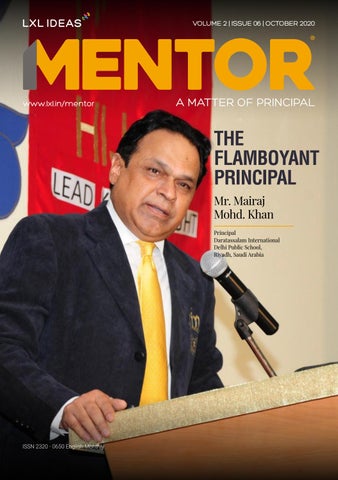
THE FLAMBOYANT PRINCIPAL Mr. Mairaj Mohd. Khan Principal Daratassalam International Delhi Public School, Riyadh, Saudi Arabia
IS NOW DIGITAL ACCESS OUR CONTENT NOW
LOG ON TO WWW.LXL.IN/MENTOR
ACCESS THE LATEST ISSUE OF MENTOR BECOME A CONTRIBUTOR READ YOUR FAVORITE ARTICLES SHARE YOUR FAVORITE ARTICLES SIGN UP FOR COURSES
FOLLOW US @FACEBOOK.COM/MENTORPORTAL/ WRITE TO US @ MENTOR@LXL.IN | CALL US @090191 11110
VOICE YOUR OPINION. SHARE A THOUGHT. STIR THE THOUGHT PROCESS! Mentor is what it is today through the stories of educators who have entrusted Mentor to be a voice to their ideas and successfully helped raise the benchmarks of education! To be part of this team that is in the forefront of fostering lifelong learning for educators, join the Editorial Committee of Mentor today! If you feel you are the right fit for this role,
WRITE TO INFOLXL.IN with the following details: 1) Your Resume 2) Details of Committees or Teacher Forums (preferably magazine) that you are part of. 3) Your published article/paper 4) Your areas of interest in education 4) A 100-words write-up on “Why do you want to be part of the Mentor Editorial Committee?”
POSTAL REGN NO: KA/BGW-1635/2018-2020 RNI NO. KARENG/2008/26567 PUBLISHED ON 28TH OF PREVIOUS MONTH. POSTED AT BANGALORE PSO BG 560026 ON 3RD, 6TH & 10TH OF EVERY MONTH TOTAL 36 PAGES (INCLUDES COVER PAGES) LICENSED TO POST WITHOUT PREPAYMENT LICENSE NO: WPP - 114
BRING YOUR
WORDS TO LIFE Share with us your best practices about the following: 1.What path does a principal's decision-making process follow? What are the parameters involved before he/she makes a decision for the school? 2. How important is it for teachers to help students learn effective studying strategies?* 3. Foolproof methods to make homework a child's play and we'll publish it in Mentor!*
Word Limit: 1300 Words Email: info@lxl.in Submission Deadline: 5th November 2020 E-mail Subject: “Mentor Magazine�
Period
1 Copy
2 Copies
5 Copies
1 year
1200
2000
4000
2 years
2000
3500
7000
* inclusive of courier & GST charges
*Subject to Editorial Discretion
Contents
04
Mentor Thoughts Letter from the Editor
��
What’s Trending
��
Sultan Speaks
08
Emotional Quotient in Education
12
��
Pedagogy Innovative Pedagogy At School
��
The Evolving Role of a School Leader
22
��
Leadership To Do or Not To Do
16
�� ��
Cover Story The Flamboyant Principal
Governance Fearlessly Free
��
Training Calendar in School
��
How to Determine the Teacher
26
Innovation Finding A Balance Between Creating
An Experiential Learning Environment For Children And Completion Of The Syllabus
School Innovation
All Rights Reserved ���� EduMedia Publications Pvt. Ltd. Publisher & Owner: Syed Sultan Ahmed Editor: Kalpa Kartik Sub Editor: Umme Farnaz Content Developer: Farah Javid Layouts : OneAndOnlyDesign.in Production: Praveen U. M., Sathish C. Printer: Elegant Printing
��
�� ��
Notice: The contributions in Mentor Magazine are solely the views of the author and are in no manner to be directly associated with the views of the editorial team or LXL Ideas. Authors/contributors are responsible for the authenticity of information they provide in the article. The publishers do not accept liability for errors or omissions contained in this publication. By submitting letters/emails or other publication materials to Mentor Magazine the author/contributor agrees that it is the property of Mentor Magazine. All communication to Mentor Magazine must be made in writing. No other sort of communication will be accepted. All decisions regarding publishing of a contribution is the prerogative of the publisher and editorial team of Mentor Magazine. Mentor Magazine is owned and published by EduMedia Publications Pvt. Ltd. for and on behalf of Mr. Syed Sultan Ahmed. All disputes are subject to the exclusive jurisdiction of the competent courts and forums in Bengaluru City.
Mentor | October ���� | www.lxl.in
3
letter editor
from the
In today’s world where pedagogy is mostly uniform across schools, what sets a school apart? Well, that is where the philosophy of education- particularly school education plays a part. The philosophy of education goes beyond books, curriculum and pedagogy. Schools no longer are shaped by the visionary leader but are more system-driven. School leadership will have to be more democratic and leaders will have to be greater multi-taskers managing both the academic transactions and the whole school development through well-defined systems and processes. The articles featured this month talk about the focus being shifted to more on making sense of information, sharing and using it in smart ways in the classroom. The role of the teacher is to offer experiences and empower students with the skills of creativity, critical thinking, communication and collaboration to succeed and to give them the confidence to practice these skills. There is also an interesting case study of how emotional quotient(EQ) is as, if not of more importance as intelligence quotient(IQ) in children. Our cover story this month from DPS Riyadh highlights the strong belief that nobody or nothing can ever replace a teacher. A good teacher is an integral part of a good educational system. Therefore, teachers’ development and continuous training is of vital importance. Teachers must understand that any decision taken for a child can have a long-lasting effect on his/her life if a child feels that it is injustice done to him/her due to personal bias; he/she will have less love and respect for teachers and it affects the school in the long run.
4
Mentor | October ���� | www.lxl.in
Articles on Teacher Training here essentially mean capacity development of teachers that entails learning various competencies, skills, knowledge, tools and technologies to improve teaching-learning in schools. Finally, the aim of schools should be to judge themselves and improve on their own performance. They need to ask themselves if what they are doing today is getting them closer to where they want to be tomorrow.
Kalpa Kartik Editor
Our Contributors MR. MAIRAJ MOHD. KHAN
Principal, Daratassalam International Delhi Public School, Riyadh, Saudi Arabia
LIPIKA GHOSH Principal St. Xavier’s Institution, Kolkata
SANJAY KUMAR MALLICK
Principal Sant Nandlal Smriti Vidya Mandir Ghatsila, Jharkhand
Gowri Venkatesh Vice Principal Delhi Public School, Nacharam Secunderabad
BIKASH MONDAL Principal DON Bosco School, Park Circus, Kolkata
LAVANYA SURESH KUMAR Middle & High School In-Charge Mitra Academy, Bangalore
MITTRA SINHA ROY Principal Adamas International School, Kolkata
ALKA KAPUR Principal, Modern Public School, Shalimar Bagh, New Delhi
JAYSHREE PATEL Principal, GD Goenka Public School Indore
Mentor | October ���� | www.lxl.in
5
Sultan Speaks
When The Fear Is Not Natural But Created! “Fear of my child missing out” Fear of Missing Out (FOMO) is a relatively new term in our vocabulary, but fear is as old as man itself. A few millennia ago, when man was a hunter-gatherer, ‘FOMO’ must have driven him to always remain with the pack so that he does not miss out on the ‘prized’ hunt or the fresh fruit. While man has evolved with time, this fear continued to live within him and it drove him to remain in organised societies and served his well-being. As long as the fear was natural and the driving force of this fear was the well-being of man, things remained pretty much normal. This fear started taking a different form and its impact changed dramatically when the fear was not natural but created. It was in the middle of the 17th century that King Louis XIV at Versailles introduced the idea of organised fashion. If you had to remain in the high society, it was important for you to be in-vogue. If not, you were not deemed fit to be in the high society. This is probably the first example of organised and orchestrated FOMO. It was an example of royalty deciding what’s ‘IN’ and what’s ‘Trending’ in the 1900’s. This leads us to reason with the numerous examples of how corporations and products were marketed to us and played on our emotions and psychology. Diamond is a classic example; even today it is not a commodity and does not have any universal benchmark for pricing yet millions of people buy diamonds as it is marketed to them. Similarly cigarettes, coke, liquor and many other products which are not our ‘Needs’ but ‘Wants’ are sold to us by the power of marketing and inducing FOMO. FOMO was taken to the next level by social media and all of us wanted to be there and to show the world our lives and lifestyles. Technology products especially mobile phones are sold to us by inducing a lot of FOMO. Every other quarter, a new model is launched and after a year we all feel compelled to buy that next handset as every ad is trying to tell us how old your phone features have become and how you are missing out if you didn’t have the next model. While FOMO has a deep-rooted seat in the society it takes a very different dimension when a parent is involved in the form of ‘Fear Of My Child Missing Out’ (FOMCMO). The foundation of this fear is - parents want the best for their children, they did not get it while growing up so they want to make sure that their children get it. “Everyone around me is doing it so how can my child miss out?” Some parents feel that for overall development, children need to do a lot of activities so they push them into many such activities.
6
Mentor | October ���� | www.lxl.in
Probably the fact that they saw it online makes parents believe that it is necessary for their children; the fast changing world and uncertainty of the future brings in a fear in parents and they act on that fear. Whatever may be the reason, parents today expect a lot more from children and push them to doing things that most kids don’t enjoy. Educational companies and online learning platforms today are using this parental fear to push products and services in a manner that is extremely unhealthy and this FOMCMO reached a breaking point. The most relevant example is the manner in which coding is being marketed to parents and kids as young as 5. These kids are being lured into online classes for coding. This is leading to a lot of stress-related disorders amongst children due to the pressure of expectations. It is very important for parents to have a better understanding of this fear and they should question their decisions on what they buy for their children with a lens of – Is it essential for my child? Is it helping build a better personality? FOMCMO is here to stay and as long as gullible and naive parents exist. More and more products and services will be created to feed that fear. It is time to address the prevailing ‘fear of missing out in parents’.
Syed Sultan Ahmed MD & Chief Learner @ LXL Ideas
What’s Trending
"Teaching is not a lost art, but the regard for it is a lost tradition." Jacques Barzun American Historian
Teachers are entities where there are endless expectations. A teacher, along with his/her umpteen capabilities always has to have adaptability in situations, resilience is the worst of times, and leadership at all times. They live a life-giving and are under tremendous pressure at all times. This World Mental Health Day, we need to highlight the state of Teachers' Mental Health in our community. How does your school help its teachers stay in the best of health mentally? What support do they get? Aklavya international school is an integral part of Achariya Group of World Class Institutions. Achariya's tagline speaks about its philosophy in a nutshell - empowering minds and enriching lives. Given the uncertainty of these times of Covid-19, our chief mentor Dr.J.Arawindhan ensures that all stakeholders i.e, teachers, students and parents are empowered mentally and enriched intellectually. He has started a group called regular mediators and he personally guides everyone online daily at 5.30am in the morning and 8.00pm in the evening. Every week on Sunday mornings, from 5.30am to 8.00am, sessions are held on topics like - how to win over stress, how to conquer fear, how to convert challenges into opportunities, to cite some examples. He also has interactions with students wherein students can enquire about any topic to him. This brings closeness with the stakeholders and ensures that spiritually, everyone stays calm. Other than this, I personally have a zoom meeting every week with my teachers to ensure that they are staying healthy, physically and mentally strong during these times. Ms. Sugandhi Viswanathan Principal Aklavya International School, Pondicherry
"Emotions matter for decision-making" We are living through a pandemic that most of us could never have imagined. Our teachers are experiencing hyper-vigilance or edginess. Now more than ever, teachers need to be incredibly kind to help themselves to maintain mental health. As heads of schools, let's help teachers to take good care of themselves by giving positive comments and feedback, which make them feel and understand that they have been appreciated. This essentially helps to keep them at peace mentally. The heads of institutions should make sure they do not put too much pressure on themselves when they make a mistake. We should insist on setting a cut-off time on gadgets, even going to the extent of switching off their phones after working hours. I always tell my teachers that we can't control what is happening to us and around us, but we can control how we respond to it with positive optimism. This ultimately helps teachers to relax and puts great focus on teachers’ mental health and well-being. Subsequently, they can thrive during this pandemic and be psychologically ready to return to school in no time. Dr. Padmanavaneeth, Ex. Principal of East West Public School, Psychologist and Students Counsellor, Bangalore Mentor | October ���� | www.lxl.in
7
Pedagogy
INNOVATIVE PEDAGOGY AT SCHOOL How St.Xavier’s Panihati & Ruiya use diverse methods to educate their students better Lipika Ghosh Pedagogy has come a long way from the days of the disciples spending a quarter of their lives at the "Ashrama" of their "Guru" who taught them all that he himself knew through methods unique to his Ashrama without there being any common or accepted criteria for formulating the method or standard of pedagogy. Those were the times when we find Plato, often credited with the birth of the idea on which the institutional method of pedagogy in the western world rests, taking walks with his students or other philosophers through the groves of his "Academy" in Athens, spreading the knowledge he had acquired from his teacher, Socrates. This ancient method of dissemination of knowledge and stimulation of thought in the student incorporated the idea of the teacher being the "Storer" and "Giver" of knowledge and the student as the "Receiver" of the same, evoking the formation of such expressions as " Gurudeva parama brahma, tasmaisree guruve namah ."
The philosophy of pedagogy has seen a sea of change and has yielded the present concept of the student being "The seeker" and the teacher being "The facilitator".
Innovations in the field of teaching as well as those in the world in general have given birth to different theories of educational principles .The discovery by the Italian scientist Rizolatti in the last decade of the twentieth century of the " Mirror neurons " of the brain which are concerned with excitement at both participating in an act and watching others perform it has helped educational theorists re-evaluate and enhance some of the older methods. One of such methods is what is popularly known as "Learning through wonder". Wonder is where learning begins.
The everyday quote, "I wonder how it works" can give rise to a quest that ultimately results in acquisition of knowledge.
From Socrates, Plato and Aristotle to the likes of Vashishtha, Krupacharya and Drona, teachers the world over have been using the method of creating wonder in the minds of their students to generate the all-pervasive curiosity that makes them search out and imbibe knowledge. Yet, this method has
8
Mentor | October ���� | www.lxl.in
immense potentials for innovation. The "Wonder rooms" and "Cabinets of Curiosities" of yore were the forerunners of museums. While this has been the most important form adopted by teachers since time immemorial, we at St. Xavier's Institutions at Panihati and Ruiya in West Bengal decided to take it to the next level through generating innovative ideas. While still acknowledging the powerful impact of watching the transformation of a caterpillar into a butterfly or the making of a spider's web, we invited our teachers to come up with ideas for going a step further. Next we began the process of implementation of the ideas. It required diligent and painstaking rebuilding of and planning the curriculum while adhering to that prescribed by the CISCE. To this end, we incorporated projects that were proposed by the students, inculcating the sense of responsibility that ensues in such activities, encouraged classes to be held outside classrooms, arranged "field trips" where teachers and students collected artefacts that attracted and interested both, instituted "Digital Curiosity Rooms" and "Virtual Cabinets of Wonder", all directed towards igniting the passion in and urge to learn all about the world outside. The students still have to follow the curriculum prescribed by the CISCE, but the zeal with which they pursue this goal has increased manifold, thereby easing the "Burden of Learning" somewhat. Personally, it has been satisfying to see all concerned with the process of imparting knowledge come forward and contribute enthusiastically in planning and execution of this form of pedagogy. Every passing day, as we see the enthused faces looking for the blossoming bud or an elusive line that begins a poem, to begin their search of the unknown, we know that once ignited, this passion and thirst for knowledge will never cease and let them rest on their laurels. In our quest for infusing more of wonder into their daily endeavors, we are planning to enhance our technology-intensive resources. Yet the road was not always covered with roses. There were the inevitable thorns too. Some hiccups occurred and we had to overcome or bypass roadblocks while trying to implement the ideas. First of all, teachers had to be motivated to undertake the extra efforts in coming up with and executing newer ideas of adding wonder to the existing emotions associated with the process of learning in the children's minds.
Fortunately, the encouraging and forbearing attitude of the school leaders ultimately succeeded in bringing out the best in the teachers. In order to get the students do it, the teachers had to do it first and exhibit their competence which they did with élan.
Pedagogy In some fields this required exposure to and assimilation of the data and techniques associated with usage of technological innovations. Once interested, the teachers took to it like fish to water. In no time they were operating, improvising and conducting classes through audio-visual presentations on the smart boards. Even in the most experienced hands the method of exciting wonder and making the seeker seek knowledge spontaneously, though immensely rewarding and satisfactory, tends to yield results slowly. It was all the more tedious in our case due to the general psycho-social blockades inherent in the products of socio-economic conditions prevalent in a predominantly middle-class populace of a developing nation like ours. The grit and integrity of our leaders Sri Dyutiman Banerjee ,the Secretary of the Managing Committee, SXI and Sri Jyoti Prasad Banerjee, the General Secretary of Suburban Educational Society that runs and manages the schools, combined with the zeal to bring in change espoused by the teachers helped in overcoming this hurdle with relative ease. This method of imparting education has been tried all through the history of Pedagogy with mixed results. Wherever success with this method has been lacking, it's mostly due either to a lacuna in administration or improper application on part of the facilitators resulting in incomplete incitement and ultimately, indecisive results. Inappropriate application of the method may even result in inducing curiosity in the wrong direction too, causing more harm than benefits. Improper planning and execution by the teachers and all concerned with the conduct of the method may give rise to great embarrassment and failure to generate the results expected. The alacrity, dedication and diligence of all concerned at our institutions have not let anything like that happen here. On the brighter side, this method achieves the main aim of Pedagogy like no other method can. Mathew McFall, who has defined this method through the five steps namely "Anticipation", "Encounter", "Investigation", "Discovery" and "Propagation" set up his first "Wonder Room" in a school in Nottingham, UK. Therein, he placed on display objects as diverse as an African voodoo lily that gives off the smell of rotten meat once a year to attract flies to a mechanical typewriter from before the Second World War. He reports great interest on the part of students, faculty and the community. The educational philosopher Rudolph Steiner envisaged the early years of the children as a period to stimulate their imagination through wonder at the beauty of nature, the elegance of numbers, the design of artworks or the telling of a suspenseful story. He has attempted to do this at his Waldorf school with much success. Once catching on, the students themselves go on questioning in an attempt to form and adhere to logical solutions strengthening the arguments themselves, thereby successfully implementing the Socrates method which attempts to make the postulates put forth by the pupil stronger by at first negating them, thereby making the pupil search for the logical basis of the postulates. The challenges to the physical and mental capabilities of the pupil lead the latter on to find answers. All this has generated a proportionate rise in the confidence and the sense of achievement in my fellow educators which reflects quite positively on their professional and personal presence. The innovative ideas put forward by the teachers are often drawn from real-life situations, evidence of their enhanced perception of their surroundings thereby bringing about improvement in the quality of their own life.
In our institutions, the results of the implementation of this method of pedagogy were slow in coming, but once they began, there has been no stopping them. The children have grown more proactive, inferred from the increase in percentage of participation in co-curricular activities inside and outside school. They have become more conscious about their surroundings as is evident from the care and affection they exhibit towards the environment around the school and their respective homes.
We have implemented this method at our institutions for last decade. The average marks obtained in the examinations have shown marginal increase of the order of 4 to 6 % overall, mostly because our students had been performing quite well even before. The most significant rise has been seen in the subjective evaluation of happiness at school and the paradigm shift in the positivity they express while interacting regarding their future plans. More and more of the students exhibit a tendency towards goal oriented plans for their future than in the past. There has been an appreciable increase, in the order of around 20 percent increase in the use of library and internet facility provided by the schools. This percentage is on the rise and drives home the point that we have succeeded in instigating curiosity. Finally to summarize, the pedagogical method of learning through wonder, when brought up-to-date with the help of technology, keeping in mind the modern concept of a "Seeker-Facilitator" model of student-teacher relationship pays rich dividends in terms of students' satisfaction and serving the main purpose of teaching which is to incite and maintain curiosity in the learner. It has however, to be implemented with the utmost care, taking cognizance of the fact that wonder when presented wrongly may cause fear or frustration instead of the desired result. This method may be implemented in any institution by motivating the educators to think out of the box and embrace innovation, providing the basic infrastructure required for the system to function, plan the curriculum properly to accommodate the activities pertaining to implementation of this method and motivating the students by demonstrating the possible betterment in their education and aptitude. This article has been presented with an introduction to Pedagogy itself, followed by the description of the innovative method of Pedagogy namely learning through wonder at St. Xavier's Institution, Panihati and Ruiya. It has also been attempted to give a basic idea about how other institutions may also follow and gain from our experience.
Mentor | October ���� | www.lxl.in
9
Pedagogy
Emotional Quotient in Education Can Emotional Intelligence affect performance in students? Gowri Venkatesh
It was Akshaj’s birthday. Akshaj was in class 6. Eagerly, he opened his lunch box to share his special meal with his class mates. Suddenly, to the astonishment of his class teacher who was busy having her own lunch in the class, there was a piercing scream from two students. She rushed to find out the reason and saw Akshaj forlornly trying to share his lunch with his friends. It was fish rice! And the boy to whom it was offered was a vegetarian! It created a pandemonium in the class! Off marched the angry class teacher to the Vice-Principal’s office! How dare Akshaj share non- vegetarian food with a vegetarian! The boy was in tears out of fright. On further enquiry, the Vice-Principal found that this was the birthday celebration of Akshaj as his mother had neither given him sweets nor allowed him to wear a new dress as he had got a B grade! The poor boy had only the fish rice to share. The teacher could have assuaged the situation and empathized with the child. Instead, she never understood the boy’s feelings. She should have used emotional intelligence in understanding the child! Emotional Intelligence is the most important discovery for the next hundred years! Good feelings are like lubrication for the brain — mental efficiency goes up, memory is sharpened, people can understand directions and make better decisions. A team’s effectiveness can depend on how well it works together in harmony. A leader skilled in creating good feelings can keep co-operation high. Uncovering the particular habits ingrained in a team or organization can drive behaviours. One of the first tasks of a teacher is to build greater awareness and instill a sense of responsibility in students for the well-being of the class. In the book ‘Emotional Intelligence-Why it can matter more than IQ, Daniel Goleman says, ‘On the positive
side, imagine the benefits for work of being skilled in the basic emotional competencies-being attuned to the feelings of those we deal with, being able to handle disagreements so they do not escalate, having the ability to get into flow states while doing our work. Leadership is not domination but the art of persuading people towards a common goal.’(Page-171) Important research has been done in organizations to show that feelings and emotions have a direct impact on effectiveness and efficiency and boosting performance.
Positive, effective interpersonal relationships are an important element of successful teams as an English teacher and Vice-Principal, it took me quite some time to understand its extreme importance.
I wanted my students to be aware of the role played by skills like active listening, empathy, and social competence, acceptance of a group and the importance of a good leader. I had read that the performance of a student increases with confidence, which in turn depends on the ability to recall. I started to browse websites and research many books and realized I could only skim the surface but not delve deep as the topic is very, very vast and exhaustive. The action research that I did was only the tip of the iceberg but it set me thinking and made me more reflective. If I carry forward this to my team of teachers, I can certainly enhance learning in my young body of students.
I was always of the opinion that it was the IQ levels which actually mattered for any success but I now realize that emotional skills play a greater part in the success of any team building exercise in work and in professional domains.
10
Mentor | October ���� | www.lxl.in
Pedagogy
My interview with the students and the feedback given by the students gave me confidence that my action research was moving in the right direction. I was extremely happy when I found that my students used to wait for me during the allotted periods for the project. They were as excited as I was. I launched my research with a pre-test to analyze my students. The Pre-project questionnaire was taken from the website http://www2.warwick.ac.uk/ from the Learning and Development centre where it was used for the measurement of emotional intelligence using team building.
BENEFIT TO SCHOOL COMMUNITYGLOBAL IMPLICATIONS I believe Education must be transformative and bring shared values to life. It must transform the way students think and act. As the issue is of global importance, I see its importance and relevance to all teachers locally and globally.
The pre-project questionnaire and the post project ratings of self and team showed that there was good improvement in almost all students in all the skills assessed. Post the session, feedback from students was taken. The tests showed the students were highly motivated as a team as they rated themselves highest on Motivation and Relationship Management. When Daniel Goleman wrote his landmark books on emotional intelligence in the 90 s (Emotional Intelligence, 1995, Working with Emotional Intelligence, 1998), he probably did not realize the revolution he would create in the educated world.The concept of Emotional Intelligence has great potential for creating positive change and increase effectiveness in both work and personal lives. Currently, the concept is often applied to teams. I have realized the importance of self-awareness, self-management, motivation, active listening, empathy and social skills.
I have realized that the aim of education is to be emotionally literate so that students can manage their emotions to enhance their learning and form rewarding relationships in their personal and professional lives; to contribute in a positive and meaningful way to bringing about a just and fairer society; to lead balanced lives; to find a career which will be rewarding, challenging and enjoyable.
Based on my action research, Daniel Goleman’s groundbreaking brain and behavioural research that when people of high IQ flounder, people of modest IQ do surprisingly well clearly proves that
though IQ played a significant role, Emotional Intelligence played a bigger role in the success of my team.
In the current competitive environment where students are expected to perform multi roles with efficiency and effectiveness, it is highly necessary to develop their right attitude and emotional intelligence towards the unseen complexities of life and quality education. The session met with defined objectives. A healthy balance between group work and individual characteristics, discussion and planning sessions, a non-threatening and democratic environment impacts the whole process of teaching.
Mentor | October ���� | www.lxl.in
11
Leadership
To Do or Not To Do Dilemmas of an educator while leading Mr. Sanjay Kumar Mallick
The success of a school depends on effective leadership and decision-making capabilities. The decision-making process in any school system has to be systematic and rational or else it can damage the school’s image and can create a hindrance to the progress. It is very important to train teachers for school management, supervision, and good governance through various in-house training and/or by professional bodies to make the school successful and establish it as a brand. Every teacher who joins our school SNSVM, firstly goes for a month of rigorous induction program that helps them to understand the vision, mission, organizational structure, ethos, co-curricular activities, and work culture of the school. This induction training is well-structured and conducted under the supervision of a mentor teacher. The progress of training is being assessed by the senior leaders and it is emphasized during the training that how important it is to become a leader who is capable to take decisions at various levels which helps the school grow. In the school decision-making process, we choose one course of action from a few possible alternatives.
As we are dealing with children, our decision shall be judged for short-term as well as long-term effects on children and on the school itself.
In the process of decision-making, we use many tools, techniques, perceptions, and experiences. We prefer to take a collective decision on the concerning behavioral issues, discipline problems, counseling and even guidance services. This collective decision-making system in our school minimizes the effects of personal values, beliefs, and past experiences in the decisions. The collective decision-making structure we follow in our school is:
12
Mentor | October ���� | www.lxl.in
Leadership DECISION MAKING PROCESS The process we adopt for decision-making in our school can be shown below, and it is followed throughout the organization, in across all divisions -
It is important to note that the criteria for decision-making shall be consistent and stated rules shall be followed. The consistent criteria based decision will eliminate any biases in the decision and implementation will be easy at any level. Teachers must understand that any decision taken for a child can have a long-lasting effect on his/her life if a child feels that it is injustice done to him/her due to personal bias; he/she will have less love and respects for the teachers and it affects the school in long term.
IMPORTANCE OF RIGHT DECISION AT THE RIGHT TIME:
Every teacher is a role model for a student, he/she learns more from the teachers and peers than from the textbooks. A teacher must understand that what a student sees and observes, they tend to follow particularly when they are in middle school.
The timing process is crucial because sometimes it is best to delay a decision, and other times delaying a response can cause more problems, the teacher shall keep this in mind while making decisions.
DECISIONS CAN IMPACT A CHILD’S LIFE AS WELL AS YOURS, BE CAREFUL Every teacher must keep in mind that while taking even the smallest decision, the thought processes of a child and a teacher is entirely different. A child is a learner whereas a teacher is a learned person. Expected behaviors from both entities are different in the teaching-learning process. Any decision is taken, if not understood in the right context by child or parents and they are not satisfied, can have an ill effect on a child’s life. Be careful • Don’t take decisions related to a child when you are annoyed, upset, or highly emotional. Be emotionally intelligent while making decisions. • Ego driven decisions can cost you professionally as well as harm a child. • Never hesitate to discuss with your colleagues and seniors before making any decision, their experience on a similar matter can be of great help. • Every decision you make, it shall benefit the child and causes no harm to the organization • Misidentifying the problem can create more problems. Role of a school leader in developing decision-making capabilities:
Every school leader shall plan for the development of decision-making capabilities in their teachers. This can be achieved by• Providing opportunities and authority to make a decision. • Creating an environment where continuous professional development is being emphasized. • Avoid criticizing the teachers for any decision made; help them to learn how to make a better decision using leadership experiences. • Appreciate the good decisions made by the teachers and, their abilities to deal with any situations effectively. • Decision making is a continuous process, every new decision we make, it teaches us a new thing. Share knowledge and learn together, grow as a team.
Never think that if a teacher grows and becomes an effective leader, they will look for a job in another school. Remember, they are still serving
A teacher has to take several decisions in a day related to students, fellow teachers, seniors, and parents. Everyone feels that if you do not know how to make the right decision, you are not a teacher. Professionalism demands that teachers must make the right decision at the right time else the effect of the decisions will not have the optimal outcome. At SNSVM, every teacher maintains a teacher’s diary where day to day decisions are taken and logged. End of the day teachers discusses the day’s activities particularly about any decision taken on any matter with the segment coordinator. If the coordinator feels that the decision was not appropriate, then immediately he/she discusses with the senior authorities and does the amendments. This work culture minimizes the errors in decision making at the teacher’s level.
the education sector. Their proficiency will help society and the country at large.
“A true leader doesn’t create followers, creates more leaders”
CONCLUSIONS In the school system, we teachers evolve every day. Teachers are learners too. They must be groomed for proper decision-making abilities as per the school’s rules, mission, vision, and values. Encouragement and motivations are a must for developing decision-making skills in teachers. Mentor |October ���� | www.lxl.in
13
Leadership
The Evolving Role of a School Leader Mittra Sinha Roy
The word ‘Leadership’ has had various definitions. The definitions changed with the times and with the context in which it was used. What defined leadership in the industrial age is very different from what defines leadership in the knowledge era. A political leader is very different from a corporate leader and again from a school leader. But broadly speaking a leader is someone who can guide a team to achieve specific goals. The leader also can get work done by people willingly and in an effective manner for a shared goal.
A school leader particularly must also be a visionary and show exemplary dedication and passion for education.
It is interesting to note how schools have evolved over the years. Starting with the gurukul system where the guru was the ultimate leader to whom parents trusted their children, not only for education but also to teach them ethics, life skills, prepare them for life. A teacher’s methods were rarely questioned because he himself was a living example of all that he taught. Over the years, schools evolved into institutions primarily for education. Here again the headmaster was the unchallenged leader who often wielded a stick to get his way. The cane in the headmaster’s office was enough deterrent for naughty students and almost all boys of that age have had a taste of it sometime or the other.
14
Mentor | October ���� | www.lxl.in
Parents were in awe of the principal or headmaster and accepted his word as law. He was accepted as an expert in his field and rarely questioned on his methods. Teachers followed instructions meted out to them without much thought and seldom voiced discontent. Then, came the age of information. Information was readily available with one click. Ideas floated around and opinions were expressed freely. Transparency became the order of the day and schools ceased to be what they were. Parents and other stakeholders had many questions to ask and schools and school leaders were made accountable. The leadership styles of the schools had to change considerably, and people skills became of paramount importance. The modern day school follows this model where school leaders have to meet growing expectations of parents, compete with the market forces and at the same time innovate and offer something that makes the school unique.
The most recent change is the age of technology where learning moves out of the classroom and is available online. In the current situation of an unprecedented pandemic, schooling has taken on a whole new meaning and the role of the school leader has become even more challenging.
Leadership What is the future of leadership in schools?
The future schools will see more of blended learning where technology will perhaps get more priority. Schools will no longer be shaped by the visionary leader but be more system driven.
The future schools will see more of blended learning where technology will perhaps get more priority. Schools will no longer be shaped by the visionary leader but be more system driven. School leadership will have to be more democratic and leaders will have to be greater multi-taskers managing both the academic transactions and the whole school development through well-defined systems and processes. This will only be possible if the leader has a strong team working for him. So the school leader, along with his ability to guide and motivate his team has to be an efficient manager too. Along with this he will have to make efforts to connect with students , teachers and parents to infuse them with the vision and mission of the school as otherwise the tendency will be to concentrate on the routine tasks without keeping the larger picture in mind. Above all, the universal qualities of a school leader still remain – qualities of integrity, prioritizing students and education before self-interests and an unprejudiced approach. Having said all that let me come to my own experience as a principal. Over the several years that I have been a head of different schools, I have personally seen some of the above changes happening.
What has worked mostly in our school is a democratic or collegiate style of leadership where teachers are included in decision making and have a sense of ownership.
The strength of each teacher is identified and he/ she is then given a role that is best suited to the person. Proper training is given in their area of weakness so that they can upgrade their skill and become more confident. The expectations from the teachers are clearly defined and hands-on guidance is given for execution of any project undertaken. If necessary, expert advice is sought, either from amongst the teachers, or from outside. The ultimate decision making rests with the principal but the teachers feel they have been heard and their ideas given importance. Student involvement has also played a major role in bringing about changes and instilling discipline. Students can be very creative and this creativity is often killed by a top down authoritarian system. Students are made to participate in the management of the school and find solutions to student-related problems effectively. Of course the ultimate control lies in the hands of the school leader. What is important is the involvement of the school principal in spirit. There is delegation of duty at every stage but nowhere must the school community feel that the principal is merely giving orders and passing on the job to others. Above all, what works best in impacting change is empathy for the team.
A firm but kind leader always has the team going with him and can make great progress for the school.
WHAT ARE THE CHALLENGES YOU FACE WITH THIS FORM OF LEADERSHIP? There are times when even the most democratic of leaders must come down with a heavy hand. With members who mistake this style as weakness, the leader has to exert his authority and instill work culture. Then again, the functioning of such a leader is largely invisible. The leader is rarely visible in the frontlines shouting instructions or managing the show. This is often interpreted by outsiders as a weakness or inefficiency. Such a leader may also seem redundant at times as it is the team members who are working so efficiently. Only the discerning few realize the significant role played by the leader . Again with a new school where the staff is mostly untrained, the leader has to be more of a guide and play a more dominating role. Such a leadership gets the desired result most of the time. The school environment remains happy and great progress can be made. But great care must be taken not to drive all change merely on the basis of the personality of the leader. Systems, checks and balances must be put in place so that the school can function smoothly even in his absence. Although the leader is the ultimate influencer, the influence must have a permanent effect to outlast the leader. The philosophy of education goes beyond books, curriculum and pedagogy. The philosophy sets one school apart from the rest because of the values and beliefs it holds and imparts to its students under its care. These values and beliefs are prioritized differently and vary from school to school. The school leadership structure must be assessed to determine this unique quality of the school. The leadership structure propels the school forward. Under a weak leadership, the school will stagnate. I am happy to mention that the form of leadership that I have followed has given me compliance from both students and teachers. Since most decisions are shared decisions, fellow educators have willingly undertaken the tasks. An approachable attitude has brought me closer to the student community and taking the school forward has become that much easier.
To put it in a nutshell, where on one hand school leadership is a tightrope walking with expectations to be met from teachers, parents, students and management, it can be very gratifying if handled with wisdom and empathy. In today’s society, every stakeholder has a voice and that must be respected.
At the same time, one must remember that the education scenario is rapidly changing. In an increasing contactless education system, how will the role of a school leader play out? We will have to wait and watch and adapt accordingly.
Mentor | October ���� | www.lxl.in
15
Cover Story
The Flamboyant Principal How a 29-year old manager accepted a challenge & went on to change the fate of a boarding school in Nainital & Riyadh This volume’s Cover Story has undergone a reformation and has been transformed into an insight into the world of a leader. The world’s simplest idea –the ‘Golden Circle’, coined by Mr.Simon Sinek. A man who deciphered the minds of leaders – leaders like the Wright Brothers, Steve Jobs, Martin Luther King, etc. He said exceptional leaders had a way of life; a way of doing things and realising this gave birth to the Golden Circle. It consists of three concentric circles. It begins with the Why? How? And finally,the What? The purpose of this is to understand what a leader is made of in their core and what drives them in this dynamic world. We speak to Mr. Mairaj Mohd.Khan, the principal of Daratassalam International Delhi Public School at Riyadh, Saudi Arabia about his journey into the world of education.
16
Mentor | October ���� | www.lxl.in
Cover Story My story of becoming the principal of a boarding school in Nainital at an age of twenty-nine years is a little different from most principals, who reach this position after years of teaching and gaining experience at various stages of promotion. In my case it was a challenge thrown at me by the owner of the school, for whom I was working as a manager in his business organization. He had established a very good state-of-the-art boarding school for boys in Nainita. It was his dream project. Somehow, the school in its early years of infancy was not coming up to his expectation. Once, on a visit to the school in October 1987 he asked me,
“Mr. Khan, you are fond of accepting challenges. Can you take charge of
challenged me. I thought over it and the next day, I told him about my decision. I was ready to accept the challenge but with just one condition. He should let me run the show on my own accord, something which he very graciously agreed to. The next day, I was bestowed upon as the Principal of Amtul’s Public School, Nainital. The rest was history. There were three principals in a period of four years before I took over. I had no experience of running a school except the times when I was enrolled in some good schools during my student life. I had seen some brilliant principals then. My immediate task was to keep my house in order and then to improve the standard of education. My competitors were centuries-old established missionary schools, which were located in the same neighbourhood.
the school as an administrator and principal?
I want to see the school amongst the top educational institutions.” I told him that it was not my cup of tea. I could never imagine myself in the role of a principal especially at such a young age, where the students of grade 10 were only about 12 years younger than me. I had to give it a serious thought when he insisted and
I believed my biggest asset was my passion to change the situation. I also realized after some time that to run a boarding school successfully is more of a manager’s job than an academician’s job.
Mentor | October ���� | www.lxl.in
17
Cover Story My passion to bring up the general standards of the school and carve a niche for it amongst the best schools of Nainital drove me to work tirelessly and prepared me to work against all odds with a lot of determination. I raised a wonderful team of teachers and administrative staff. Together, we brought in the desired results. In just about two years time, Amtul’s Public School was considered as one of the top six boarding schools in Nainital and one of the best 100 boarding schools in India. In these arduous but satisfying endeavors, we did a number of things which were worth mentioning but I would like to share just one instance here. Incidentally, we did not have a full-sized football ground. There was an interschool football tournament which was a prestigious event wherein all leading schools would take part. This tournament used to generate so much interest amongst the general public inspite of being an interschool event that the common people of Nainital used to look forward to these matches. The stadium used to be packed. As these matches were played on the only public field in Nainital which was called Flats, it was open to all and would draw huge crowds. Two leading schools of the town, namely Sherwood College and St. Joseph College were sharing the winners’ trophy between them for the last fifty years. I made my physical education teacher and football coach train my boys at 5am each morning. We used to take them downhill to Flats for a regular practice at a proper ground every day. The players would practice for two hours and then would climb about 500 feet back to school every day. The students were provided with a special diet to keep them fit. In just two years, our football team won the winner’s trophy in spite of the fact that we did not have a full-sized football ground. With my students’ hard work and good coaching by the teachers, they achieved this feat. I laid emphasis on basketball too for which the school had good facilities. Amtul’s Public School’s team of basketball was a regular winner for about ten years. The results were for all to see and hence, the school was packed to capacity. Though I had not chosen this profession, the profession had chosen me. About two years after becoming a principal, it had dawned on me that principalship was the best thing which had ever happened to me. The satisfaction of the job, the pleasure to be with kids at all times, their immense respect and love, the admiration of your staff and the recognition and acknowledgement of your hard work by the parents and general public is indescribable. For more than ten years during my tenure, I was the Vice-President of the Nainital Gymkhana and District Sports Association. I was always re-elected unopposed. The District Magistrate of the city used to be the Ex-Officio President. Nainital Gymkhana is the oldest in the country. From the beginning, I had started teaching English to Grade 10 students and later to Grade 11 and 12 students, when the school was upgraded to Grade 12. I decided to do it to have first-hand experience of teaching and also to remain in touch with the senior most students of the school on a personal level. The students enjoyed my classes as I would not keep myself confined to only the syllabus. I would discuss any topic under
18
Mentor | October ���� | www.lxl.in
the sky with them. They would always remember this part of the class. By God’s grace, nobody ever failed in my subject and since 1989, 80% or more students of my class always secured distinction in English in Grades 10 and 12, which holds true till today. In the context of a principal as a leader, I always quote a couplet of Allama Iqbal, the great Urdu poet
“Nigah buland, sukhan dilnawaz, jaan pur soz yehi hai rakhte safar meer-e-karwan ke liye.”
It means that the leader has to have these qualities: (a) He has to be a visionary (b) He has to be a good communicator who should have the quality to convince people and (c) He must have empathy for the people he leads. A leader must practice what he preaches, that is what gets him the respect and admiration of his team members. I believe that all school leaders should have a clear objective of educating and training their students. Nowadays, most of the schools are merely educating their students and not training them, which is a very important part for the character-building of a student. We should not only make our students capable of earning their livelihood respectfully by developing some skills in them, but we must also make them good human beings. Unless we produce decent human beings from our institutions, our job is half done. I left Amtul’s in 2007 to join Daratassalam International Delhi Public School at Riyadh, Saudi Arabia. This school was established in the year 2003. It had already seen three principals within five years of its inception, almost the similar or even worse conditions than the school where I had started my career as a principal. If the number of students is any parameter of the school’s success, which I don’t believe in, the school had 800 students up till Grade 10th when I joined. Then, in the next three years, we had a population of 2400. This was an International school which mostly had Indian students, along with other nationalities. Once again, the key to success is passion and hard work. In my thirteen years of tenure here, I was elected the chairman of CBSE schools in Saudi Arabia twice, a role which I am holding currently too. Saudi Arabia has about 40 schools affiliated to CBSE. We also have a Gulf Council of CBSE schools, which has about 200 schools spread all over the region in six countries. In my long career of thirty three years as a principal, I have seen the transformation of education and the tools of education, from the conventional black boards to smart classes and online classes.
Cover Story
Then, success is bound to come to you. Always try to do something for others and you will always be happy”.
I am still of the strong belief that nobody or nothing can ever replace a teacher. A good teacher is an integral part of a good educational system. Therefore, to me the teachers’ development and continuous
We had the pleasure of talking to Mr.Mairaj’s former colleagues and faculty to take a leaf out of his profound wisdom and understand his best practices and leadership style, along with the challenges they face.
training is of vital importance.
Anju Roy, HOD English, DPS Riyadh I want my teachers not only as experts in their subjects but also in other facets of life. They must be trained in other important aspects of life as how to carry themselves, how to dress, how to talk to students and to others, handle their department etc. The teacher is an ambassador of the school. The performance of an ambassador can make or destroy the reputation of the country. Lately, I have felt that developments like technological innovations have made this world a better place and have made living easier but common sense in people generally is on the wane. That is the result of absence of the right training both at home and at school. My message to students has always been “Be passionate and honest about what you do. Don’t leave any stones unturned to achieve your goals.
My journey of a long decade at Delhi Public School Riyadh can be summed up in only word one word - RICH. It has been a great growing experience in every aspect of educational pedagogy. This school has a unique culture of its own. When you enter the school and talk to a student, be it from kindergarten, you feel the difference. Each and every child is a confident, well-informed, articulate individual with a strong personal opinion. There is an air of disciplined freedom. You come back much enlightened. Most schools call themselves International schools but DPS Riyadh stands up to its name. It is a mini globe in its truest sense. You can see children from more than 20 nationalities (Indians, Saudis, Sudanis, Egyptians,
Mentor | October ���� | www.lxl.in
19
Cover Story Russians, Syrians, Africans, Malaysians, Indonesians, Filpinos, Sri Lankans, Pakistanis, etc) filing up in the morning assembly on the school grounds. This multicultural fabric of this school is being beautifully nurtured by the head of the institution, Mr.Mairaj Mohd. Khan and his team of enthusiastic educationists.
A teacher in DPS Riyadh is not just a teacher. If she is an Urdu teacher, she is a famous poetess. If he is a music teacher, he is a famed musician. If he/she is an English teacher, she is known for beautiful calligraphy.
The Science / Math teachers have authored books; the Art teacher holds his own exhibitions, the Quran teachers are highly evolved Islamic preachers. Such is the selection of teachers. The ship reaches its shores only when the helmsman steers the wheel with his experienced hands. All this would not have been possible without a wise, strong, visionary, leadership behind. Our Principal Mr. Mairaj Mohd is a tall institution himself. He is not only a firm administrator but also great orator, singer, sportsman along with a history, literature and poetry enthusiast. Being a voracious reader and a seasoned traveller, you can talk to him about anything under the sun. His sartorial style and mannerisms have been much emulated by his students over the decades. The parents of DPS Riyadh are global citizens and are invited with open arms to be a part of this family. Their voices are heard, their grievances addressed personally, and their ideas held in high regard. Every event in the school from the more serious inter-school debates to farewell parties of the passing out batch, is like a royal wedding being planned. The Principal, teachers, student council, nannies, peons, drivers all put in meticulous efforts to translate any event to a success.
CHALLENGES AS A TEACHER AND THE SWEET TASTE OF SUCCESS As a teacher of English language in present times, the biggest challenge is to wean the child off the overwhelming internet influence. On one hand the internet is a handy tool and on the
20
Mentor | October ���� | www.lxl.in
other it’s like Aladdin’s Genie. Everything is ready at one command. The use of SMS lingo is another challenge. In the times of audio books, how many students would be interested to read old classics, write poetry or learn the rules of grammar? Today’s children have no patience for creative writing. I have always told my students stories about the lives of famous authors, their traits, their times which gets them interested about a bygone era. I also ask them to research and tell me if they come across something interesting. This gets them started. My class is always a meeting room of friends where everyone exchanges anecdotes, honest personal opinions and nobody is ‘afraid’ of the teacher. They discover a new passion as I ask them to pen down their thoughts. I teach synonyms of words e.g. hurry-haste, girl-lass, brothers-brethren, etc. Every beautiful piece of writing is read out in the class to encourage the child and motivate others. They fall in love in love with the language. Then I keep honing their pronunciation and voice modulation with role plays, drama, elocution, and debates. With the passage of time, some of my students have gone on to become highly successful editors, anchors, correspondents of famous international journals, TV channels like BBC, Bloomberg TV, Times of India, etc. They have lifted many a trophy at Toastmasters Clubs.
SOME PRACTICES THAT HELPED IMPROVE STUDENTS’ PERFORMANCE As the Head of Department of English, I have had a free reign given by our Principal to bring in teaching practices / curriculum changes to improve the performance of the students. Mr. Khan has been co-teaching prose to grades 11 and 12. I realised that certain English books had a lot of exercises on formal writing like notice, formal letter etc. in grades 3,4 and 5, which was stressing the children to write in a controlled format. In my opinion children at this age should let their imagination run. I introduced content like informal letters, story writing, picture composition, persuasive poetry writing, descriptive paragraphs, pictorial travelogues, interviewing grandparents, neighbours etc. in the curriculum. I also introduced small abridged English classics from grade 4 to 8 to encourage reading for joy. The pictorial books were very well received by the students and parents alike. I laid a lot of stress on comprehension passages in every grade for better and effortless understanding of English later in life. All the above were highly fruitful exercises.
Cover Story HOW I RATE THE SUCCESS OF MY SCHOOL DPS Riyadh stands out by every parameter possible, be it academic results, extra-curricular activities, physical education, discipline, ethics, to name a few. Our students are academically proficient, ambitious, talented and get easy admissions in the top universities of the world. They go on to make meaningful contribution to the society and bring laurels to their alma mater.
S.I.M.Jafri (former teacher English and Librarian Amtuls Public School) Mr.Mairaj Mohd Khan, Principal DPS, Riyadh and former Principal of Amtuls Public School, Nainital,was my mentor for almost a decade and a half. He worked very hard for improving its standards of teaching, learning and dissemination of ethos and values for making it a top-class liberal school.Under his able guidance and mentorship ,the school rose to such a staggering height that we were at par with other century-old schools in Nainital,a place famous for its residential schools. Being one of his subordinates, I personally admire his qualities as a considerate,accomodative, caring and stern principal cum leader,who had put his signature all around. During my tenure in the school, we had the honour of having Mr.Shatrughan Sinha, Azharuddin, Kapil Dev, Manoj Prabhakar, Ms.Kiran Bedi, Mr.Motilal Vohra, Mr.Romesh Bhandari, the then Governors, Salman Khursheed, Sunil Dutt, Vinod Khana, Jagjit Singh, Shahnawaz Hussain, Bishan Singh Bedi and many more.
Another unique tradition which he had established in that institution was the celebration of the festivals of all religions with equal enthusiasm and gaiety. He would distribute Eidi, a token amount of money to all on Eid and would celebrate Holi, Diwali and Christmas with equal spirits.
Sarah Sultan, Headmistress, Junior Wing My journey at DPS Riyadh has been very challenging and rewarding. As a Kindergarten teacher, we have challenges to overcome like developing in children the passion and love for learning and simultaneously making the procedures of learning enjoyable, engaging, exciting and full of fun.
To me the best measure of success is to ensure that children are always happy and look forward to come to school.
The spontaneous love, warmth and affection from these angels is the highest form of success or reward any teacher can dream of achieving. There have been innumerable elements which have played a vital role in improving the standards of learning. For instance, some of them are teaching color concepts by incorporating play way method which involves celebrating color days with a particular color theme. There are many other examples of integrating real life scenarios and situations such as teaching children about various fruits and vegetables by setting up a fruit & vegetable market. In fact we aim to develop a unique and innovative concept whilst not leaving out the element of fun. DPS is famous for quality education and our school is par excellence as far as the methodology is concerned. We have a team of experienced and qualified teachers that make us proud.
Right now,our old students of all class, clan and race are busy in nation- building and also serving foreign lands as well.
Our Principal Mr.Mairaj Mohammed Khan is a visionary and under his able leadership and guidance, the school has reached heights of success. His style of functioning has set out high academic standards while concurrently encouraging the entire staff to meet and exceed the expectations of parents by striving to deliver the very best a child can get. We are very lucky to have him as our leader, guide and mentor.
Mentor | October ���� | www.lxl.in
21
Governance
FEARLESSLY FREE Why a sense of amicability towards approaching teachers & education is important for students Bikash Mondal
People refer to a vicious cycle when it comes to poverty, a cycle that one finds difficult to free themselves from. But, when I look at it from another perspective, I see a different vicious cycle play itself out in front of our very own eyes, right at the heart of our society- in our very own education system. When I was a student in school, I feared some of my teachers. While I admit, that also came from a sense of respect for them, I realised later that, it also resulted in hampering my ability to question as well as learn well enough to match the potential that I had. This was one of the many things I felt I needed to address when I fulfilled my aim of becoming an educator. I know a system where a group of adults who want to dedicate their lives for the service of the humanity, in their formation period have such strict formation that even if they nurture doubts and serious questions regarding certain areas of life, they are restricted from asking or clarifying. They would be targeted as entertaining ‘bad thoughts’ in their minds, so they grow with doubts and such horrifying questions of life. Often they make blunders in life.
22
Mentor | October ���� | www.lxl.in
Change in the education system is not easy in our country, where a generalized approach to academics is followed, irrespective of every child's uniqueness and ability. Underlying it all is a fear.
From every angle. The teachers fearing being unable to complete their syllabus on time; fear of the students being unable to attain the scores that are expected of them and thus disappoint those around them; fear of parents that their child will not perform as well as their friends and classmates and of course, the fear of the school management that the overall school ratings would drop if certain academic criteria are not met.
Governance
But, have we all ever stopped to question how instrumental this system is in making or breaking the self-esteem of a child which will have repercussions right into their adulthood?
I very strongly feel that a child will learn the most in a fear free environment, in
Have we realised how much "self-dissatisfaction" within every individual is being created, which manifests itself in so many negative ways much later in life, that we don’t even realise it's our education system that is to
which he or she is enjoying the learning experience-where one is able to question and get answers to satisfy their curiosity, instead of a brush off as there is a syllabus desperately needing to be completed by the teacher.
be questioned? Have we ever stopped and questioned how many fish we are trying to teach to fly?
It saddens me to admit that there is plenty of tension and stress in adulthood coupled with the ever prevalent fear of not reaching up to the expectations of society. So, why should there be an intentionally induced fear of ANY kind for anyone during the most joyful and care free period in one's life-their childhood? Childhood is short lived and yet, as we all know, it's the time that there is maximum learning taking place. Learning therefore should be a natural process, where stress should be on the relevance of what children are being taughtValues. Ethics. Morals. Good habits, Respect. All this,along with basic intellectual academic based skills.
So, as an educator, I feel proper and professional evaluation of a child's strengths and interests, followed by a focus on building on those same aspects, will result in a better society with confident young minds and definitely less suicides among the young which is now a major cause of concern today. In my school as well as personally, I do not believe that the child should fear the teacher and so, I encourage BOLD YET RESPECTFUL encounters between teachers and students. I do this as I believe that it is when a student is able to question fearlessly, that most learning is achieved, as questions come from an active mind-a mind that is thinking and has the interest to know. And that, at the end of each and every day, makes all the difference.
Mentor | October ���� | www.lxl.in
23
Governance
How to Determine the Teacher Training Calendar in School The advantages of having a well-planned teacher training calendar in schools Jayshree Patel
• What is teacher training? What are the different
types of teacher training? Teacher training essentially means capacity development of teachers that entails learning various competencies, skills, knowledge, tools and technologies to improve teaching-learning in schools. • Why is teacher training essential? It is essential for improving the learning of students and thereby improving their achievements. It is also important for teachers to build their confidence and empower them with tools and skills to conduct their classes. • Mention a practice or practices that you have
implemented in your school with regard to teacher training. Recently, I have implemented Google Classroom for remote learning. The practice was implemented by the method, ‘Learning by doing’, in other words experiential learning rather than just a lecture and a Powerpoint presentation. The teachers were excited and the training was fun-filled with teams working together on various applications and they were all curious to learn. • What factors do you consider while designing the training calendar for your teachers? How do you determine this calendar at the beginning of the school year? There are several factors that I consider before designing the training calendar for the teachers such as; • Subject knowledge of the teacher • Teacher’s own future goal • Current problems in teaching-learning • Mandatory training by CBSE and GD Goenka, Delhi • Time of the year • Technology and 21st century skill enhancement The training is an ongoing process in our school and is planned in the calendar in different months. We make sure that the teacher does not have a full school day and it is not the time of other important activities such as Annual Day or Report card submission, PTMs etc. As we are part of the GD Goenka group, some of our training program is planned at the beginning of the new term before the school reopens. CBSE also provide ongoing training programs that are mandatory and spaced out during the year. • Do you agree that teacher training sessions help teachers learn and create/implement new
24
Mentor | October ���� | www.lxl.in
teaching strategies which would lead to more interesting classrooms? Absolutely, I feel teachers come from different backgrounds with different school experiences and it is important to integrate them to our school ethos. Moreover, BEd training in our country is not enough for the different challenges a teacher faces day-to-day in a classroom. These training sessions impart them with the requisite knowledge to make their teaching better. Thereby, by improving student outcome, regular feedbacks and motivation is given to the teacher to carry out what they have learnt. • Explain the other benefits of teacher training. Some other benefits are: a. It promotes a growth mind-set b. It encourages the success of a new teacher-professional development which can help new and experienced teachers develop the skills they need to feel confident in the classroom. c. Integrating new practices- With focus on positive student learning outcomes, one has to move with the generation as well as technology. So it becomes pertinent to impart new and improved teaching-learning methods to teachers so that they can make their lessons interesting and engaging for students • Describe the importance of designing a training calendar for the teachers.
Schools who work in the same way for years together will not work in the long run. Without teacher training, schools cannot evolve and grow.
• What are the different types of teacher training
that you have in your school? Some are initiated by CBSE and the GD Goenka group which are mandatory. Others are mostly around building technological skills, experiential learning pedagogies, project-based learning and classroom management. Sometimes programs like ISA by British Council, Bal Vigyans, MUNs etc give teachers something new to experience and they learn while they are helping students with it.
Governance • What challenges do you face when it comes to teacher training? How do you solve these challenges? Sometimes teachers take time to change their mindset from their usual way of teaching. I encourage them to try and motivate them when they do. Some training workshops can be very expensive and it is difficult to call experts. Along with my teachers, I educate myself too and make modules for them. • What are the benefits that you observe in your teachers and students as a result of the teacher training programmes
in your school? The teachers feel more confident, empowered and motivated. Students are more engaged and learn faster. • Please share some tips or practices that other school leaders can follow to address the concept of designing a teacher training calendar.
It is important to chalk out the need of a school. If you make a list of the problems in teaching-learning while observing the classes throughout the year, you will be able to understand it better and plan what kind of training will help. It is also important to have a system of monitoring the implementation of the training program by the teachers.
Teacher training is integral to the development of any school as it makes a huge impact on student learning outcomes. Teachers play a very important role in schools and these trainings make them confident and abreast with the latest pedagogies and practices. Training conducted for subject enhancement, implementing experiential learning and project-based learning, 21st century skill development and technology integration in lessons can enhance student engagement in the classroom. While planning the training calendar, it will be useful to list the problems and challenges that the school has faced in the last term and take appropriate training session for teachers accordingly. Teacher training institutes in India are not well-developed and this has impacted the quality of education in our country. India needs strong teacher education which is relevant to present generation and the current world scenario. With the changing landscape of professionals and businesses, we no longer can imagine the future work scenario for our children. The whole pedagogical approach for education should shift from “teaching” based to “learning” based, so as to prepare “life-long learners.” The post-Internet and cell phone generation need to be equipped with skills of acquiring and filtering tons of information thrown at them with the click of a button; therefore teacher education should be ongoing.
Mentor | October ���� | www.lxl.in
25
Innovation
Finding A Balance Between Creating An Experiential Learning Environment For Children And Completion Of The Syllabus S. Lavanya The education system has undergone a paradigm shift in the present generation with information readily available to the students at the press of a button. The focus has shifted to more on making sense of information, sharing and using it in smart ways. The role of the teacher is to offer experiences and empower the students with the skills of creativity, critical thinking, communication and collaboration to succeed and to give them the confidence to practice the skills.
Experiential learning is a process through which students develop knowledge, skills, and values from direct experiences outside a traditional academic setting.
As an upcoming ICSE school in South Bangalore, Mitra Academy is trying to make a mark in the field of education through the experiences it offers. Experiential learning encompasses a variety of activities for classes 3 upwards where in the students have been exposed to individual and group work to acquire and integrate knowledge, extend and refine the same, use knowledge meaningfully and inculcate habits for lifelong learning. Teaching the subjects of Chemistry and Biology for classes 8 to 10, I feel the need to place the curriculum in the wider context of the children’s environment to equip them with the requisite knowledge and skills. The prerogative is to guide the students to enter the outside world with confidence. I always make it a point to relate their learning to everyday experiences and help them go beyond the prescribed content. It could be relating to the names of chemicals present in food substances, advising an elder at home about the benefits of exercise to improve heart health, the need and advantages of electroplating an article, the aftermath of the harsh winters in North India, the floods in Chennai, the bushfires in Australia to name a few.
The efficiency of the modern age teacher lies in the adaptability to use varied teaching strategies with the main focus on the students’ skill development rather than the marks.
26
Mentor | October ���� | www.lxl.in
Different elements of this EQ have its strings at home, neighbourhood, peer group, relatives, teachers, helpers, etc. who have a role to play in the child’s life and enable him/her to maintain emotional stability – which has become an essential ingredient for the happiness index in life. I have moved on from lecturing to planning group activities, flipping classes, brainstorming ideas and organising hands-on activities. The shift is reflected with my students expecting a surprise element of innovation in each session. The joy on their faces while playing a tambola on the properties of metals, adopting the inquiry-based method to learn about the factors that influence dissolution, to using a jigsaw and a Tarsia puzzle to relate to the key structures in the heart, balancing chemical equations and tic tac toe and science menu bringing about differentiated learning through various activities was clearly evident. Students also have presented a short video on topics related to changes occurring in the kitchen, garden, human body, industries, construction sites and uploaded the same on the Google classroom to have a feel of the change in the trends of education. For the group projects, the students have the liberty of selecting a leader amongst themselves, collect authentic information, with creativity in their plan and present their views with confidence and clarity. Colourful charts, presentations, models, role play, skits with original dialogues gave vent to their creativity winning the appreciation of their peers and teachers. Topics included positive and negative impacts of Green Revolution, organic farming versus regular farming, artificial propagation versus sexual reproduction, making a carbon footprint of themselves or their parents to realise how they are polluting the environment knowingly or unknowingly, etc.
Innovation
Teaching is a continuous learning process; learning from peers, students, parents and the community, and also a lifelong process where we need to constantly learn, unlearn and relearn strategies, ideas and philosophies. By incorporating all these changes, the pressure on the students has been alleviated to a certain extent as they take up the ownership for their own learning. I agree that our educational system focuses mainly on the content and the rote memory of the concepts with the application of the concepts minimally, but the burden and stress of examination can definitely be done away with by the teacher by adopting a different student centric approach.
The pressure of portion completion is a common problem that plagues all teachers but the delicate balance of creating an experiential learning environment for children and completion of the syllabus is best handled by the teacher herself. Does it make sense to just say that syllabus is completed in which students get almost nothing? Learning that is considered "experiential" contains the following elements: • Reflection, critical analysis and synthesis by both the teacher and the student which is constantly communicated to the parents. • Opportunities for students to take the initiative, make decisions and be accountable for the results. • Opportunities for the students to engage intellectually, creatively, emotionally, socially or physically. • A designed learning experience that includes the possibility to learn from natural consequences, mistakes and successes.
self-evaluate, we are able to set goals that we feel we can attain with the new knowledge we have about ourselves. Self-evaluation is important at any stage in our lives. To understand the necessity of self-evaluation, we teachers periodically model self-assessment too. We need to show children that it is important for everybody to self-assess themselves by doing our own self-evaluations. During group projects dissemination, the teacher as well as the students assess their peer group’s performance and a collective grade is given openly which the students agree upon. In this way, the students are able to judge the strengths and the weaknesses of their as well as the peer group’s assessment without any bias. The aim is to judge ourselves and improve on our performance. We need to believe in asking ourselves whether what we are doing today, is getting us closer to where we want to be tomorrow, and to achieve that we rely on self-evaluation. The interest shown by the students in performing the varied activities, the approach of the differentiated learners and their progress; the ability of the gifted to extend their learning and yearn for more; the quality of the projects done without the help from their parents, fills me with pride and that I have achieved a bit of what I set out to achieve.
It really requires some time for the students and the teachers to adapt to a new set up. Working closely with the students over a period of time is absolutely essential to set up the bonding.
At our school, we plan to work with our students, teachers and parents to ensure that we challenge ourselves to become critical thinkers, inspire students to set aside fears and inhibitions and teach them to support one another so that they can become the leaders of their generation.
Human beings have an innate nature to learn continuously, we all are learners. Our species has evolved beautifully as we have the desire to introspect and improve ourselves. In order to ensure we become lifelong learners, it is imperative that we- parents, teachers and students understand the importance of self-evaluation. When we evaluate themselves, we are assessing what we know, do not know, and what we would like to know. We begin to recognize our own strengths and weaknesses. We become more familiar with our own beliefs, and possible misconceptions. After we
Mentor | October ���� | www.lxl.in
27
Innovation
School Innovation How Model Public School in New Delhi is bringing in innovations to learning Alka Kapur
IF WE TEACH TODAY’S STUDENTS AS WE TAUGHT YESTERDAY’S WE ROB THEM OF TOMORROW. The innovative methods in educational institutions have the potential not only to improve education, but also to empower people, strengthen governance and galvanize efforts to achieve human development goal for the country. Education is a light that shows mankind the right direction to surge. The purpose of education is not just making a student literate but to develop rational thinking, knowledge ability and self-sufficiency. When there is a willingness to change, there is hope for progress in any field. Creativity coupled with innovation are the hallmarks of a progressive institution. We at Modern Public School believe that both these ingredients are integral to all learning because the mind that is empowered to think is the mind that can create and invent. The Modern Public School Academic Team in my school has designed and implemented a system that encourages innovation, creativity and entrepreneurship amongst children which would equip them to meet the challenges besetting them in their chosen professions.
As an experiential educator, my practice in the school as a facilitator has always leaned towards the idea of “learning” as inherently tied to “doing”.
The following are a few innovative pedagogies implemented to facilitate Learning By Doing: • To make students environmentally conscious citizens, they engage into different eco projects like maintenance of Herbal Garden Sanjeevni, a tree census program, paper recycling, Sustainable Gardening,etc. The key to zero waste being embraced by Modernites is a comprehensive educational programme that extends across the campus. • The school has been running a program namely Creative Connections. The students of commerce run and maintain a business initiative wherein they are required to maintain the financial records like Trial balance, Balance Sheet etc. This helps the students to learn various entrepreneurial skills. The striking feature of the whole business initiative for the students of commerce is the amalgamation of theoretical and practical knowledge of entrepreneurship.
28
Mentor | October ���� | www.lxl.in
• To celebrate and uplift the spirit of universal
brotherhood, the school has been successfully running school exchange programmes with countries across the globe for the last decade. The collaboration with overseas partner schools in other counters like UK, Korea, China, Singapore, Japan, Dubai and America is a unique testament to the importance that the school places on teaching and learning in a global context. • Implementation of the 3D laboratory in the classroom has gone beyond Google search. It gives boost to the learning ambience of the school. • Astronomy Club is a new pedagogy added to the curriculum of Modern Public School. It is an effective endeavour to keep the children engaged with activities different from the daily routine. It gives them the opportunity to know more about the celestial objects. Hands-on activities and night sky sessions are a few activities that are a hit amongst the students. • The pedagogy for transacting Life Skills Education is interactive and experiential. Different interactive activities like role-plays, advertisements, buddy letters are also designed for the most vulnerable group. • Alongside, activities like ‘Youth Parliament’ bring out the best in the students and foster the development of critical thinking, problem solving and collaborative skills through engagement in civic issues. • Atal Tinkering Laboratories in our school under the aegis of Government of India is a testimony to the fact that the motive of deliverance of education here is to ignite the spark of curiosity by reiterating how to think instead of what to think. • Flip classes, cloud based learning and use of Edmodo have made the curriculum of the school at par with the global standards. With such new endeavours, the students not only connect and create connections in Integrated Classrooms but they are also more actively engaged. Integration helps to achieve retention. When children are able to master subject matter using this approach, the impact definitely multiplies.
Innovation
Interdisciplinary approach towards integration is simply fun. The idea behind this interdisciplinary approach is to have students learn more than just the immediate content being taught. They put on their thinking caps and integrate all disciplines and get lifelong learning and learning for life as well.
The classrooms have become lively, bubbling with enthusiasm wherein they have engaged learners. The students are free to explore and question as much as they can.
Digital technology gives enormous opportunities for powerful and effective collaboration. We have already seen the power of technology-enabled collaboration within education, and how it helps to improve teaching and learning. But everything comes with a cost. Use of excess information can have its drawbacks, such as giving children information which can do more harm than good if not kept in check. Here comes the role of the facilitator who first hand experiences at various conferences for Principals in countries across the world have added hues to the fabric of education system at Modern Public School.
FEEDBACK FROM STAKEHOLDERS Ankit Pannu, an IAS Officer and alumni of our school applauded the school for its constantly evolving pedagogies. He said, “Education at the institution is about more than just technology. The students here are empowered with values, empathy along with skilled competencies and have made them agents of change.“
However it becomes a difficult task at times to improve the education system while maintaining balance between the co-curricular activities and academics. A special team of educators have been delegated with the task of maintaining this balance to bring the best out of every blooming bud.
Mentor | October ���� | www.lxl.in
29