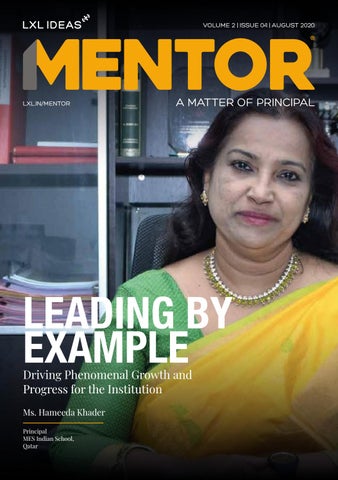
VOLUME 2 | ISSUE 04 | AUGUST 2020
LXL.IN/MENTOR
LEADING BY EXAMPLE
Driving Phenomenal Growth and Progress for the Institution Ms. Hameeda Khader Principal MES Indian School, Qatar
IS GOING DIGITAL FROM AUGUST 2020!
LOG ON TO WWW.LXL.IN/MENTOR
ACCESS THE LATEST ISSUE OF MENTOR BECOME A CONTRIBUTOR READ YOUR FAVORITE ARTICLES SHARE YOUR FAVORITE ARTICLES SIGN UP FOR COURSES
FOLLOW US @FACEBOOK.COM/MENTORPORTAL/ WRITE TO US @ MENTOR@LXL.IN | CALL US @090191 11110
VOICE YOUR OPINION. SHARE A THOUGHT. STIR THE THOUGHT PROCESS! Mentor is what it is today through the stories of educators who have entrusted Mentor to be a voice to their ideas and successfully helped raise the benchmarks of education! To be part of this team that is in the forefront of fostering lifelong learning for educators, join the Editorial Committee of Mentor today! If you feel you are the right fit for this role,
WRITE TO INFO@LXL.IN with the following details:
1) Your Resume 2) Details of Committees or Teacher Forums (preferably magazine) that you are part of. 3) Your published article/paper 4) Your areas of interest in education 4) A 100-words write-up on “Why do you want to be part of the Mentor Editorial Committee?”
POSTAL REGN NO: KA/BGW-1635/2018-2020 RNI NO. KARENG/2008/26567 PUBLISHED ON 28TH OF PREVIOUS MONTH. POSTED AT BANGALORE PSO BG 560026 ON 3RD, 6TH & 10TH OF EVERY MONTH TOTAL 36 PAGES (INCLUDES COVER PAGES) LICENSED TO POST WITHOUT PREPAYMENT LICENSE NO: WPP - 114
BRING YOUR
WORDS TO LIFE Share with us your best practices about the following:
1. Does the current evaluation system promote rote learning or meaningful/conceptual learning? 2. The role private schools can play to ensure quality education to underprivileged students (provide teaching materials to these schools, use of school facilities by NGOs on weekends, etc.) 3. Shifting from STEM to STEAM approach of learning - the challenges, the benefits and the way forward. and we'll publish it in Mentor!*
Word Limit: 1300 Words Email: info@lxl.in Submission Deadline: 5th September 2020 E-mail Subject: “Mentor Magazine�
Period
1 Copy
2 Copies
5 Copies
1 year
1200
2000
4000
2 years
2000
3500
7000
* inclusive of courier & GST charges
*Subject to Editorial Discretion
Contents
04
Mentor Thoughts Letter from the Editor
��
What’s Trending
��
Sultan Speaks
08
in Their Life
Museum Pedagogy
14
��
Pedagogy Helping Students Apply Self-Awareness
��
in Schools
��
All Rights Reserved ���� EduMedia Publications Pvt. Ltd.
Cover Story Leading by Example
Finding a Balance
and School Education
28
��
Governance National Education Policy-����
��
Outstanding Leadership
Publisher & Owner: Syed Sultan Ahmed Editor: Kalpa Kartik Sub Editor: Devina Wallang Content Developer: Farah Javid Layouts : OneAndOnlyDesign.in Production: Praveen U. M., Sathish C., Guna V. Printer: Elegant Printing
24
��
Leadership Mindfulness and Consciousness
18
Home Learning
�� �� ��
Innovation The ABCs of Youth Skill Development �� Balanced and Thoughtful
Implementation of Technology
��
Notice: The contributions in Mentor Magazine are solely the views of the author and are in no manner to be directly associated with the views of the editorial team or LXL Ideas. Authors/contributors are responsible for the authenticity of information they provide in the article. The publishers do not accept liability for errors or omissions contained in this publication. By submitting letters/emails or other publication materials to Mentor Magazine the author/contributor agrees that it is the property of Mentor Magazine. All communication to Mentor Magazine must be made in writing. No other sort of communication will be accepted. All decisions regarding publishing of a contribution is the prerogative of the publisher and editorial team of Mentor Magazine. Mentor Magazine is owned and published by EduMedia Publications Pvt. Ltd. for and on behalf of Mr. Syed Sultan Ahmed. All disputes are subject to the exclusive jurisdiction of the competent courts and forums in Bengaluru City.
Editorial Committee: Ismat Ahmed, Amrita Burman, Jawairia Saleem, Jaya Narayan, Leena Satuluri, Manjula Raman, Prsahant Muley, Pria Pillai, Rama Krishnamurthy, Sandhya Nair, Shahista Ismail, Skand Bali, Stella Punitha, Swapnali Deore, Vijayam Kartha, Dr. Shweta Gaur & Aaparjita Dasgupta
Mentor | August ���� | www.lxl.in
3
letter editor
from the
In this issue of Mentor, we travel to Qatar, through the vivid words of Ms. Hameeda Khader – Principal of MES Indian School. The focus of this school is to motivate youngsters to pursue their dreams with their knowledge and skills, thus helping them to face future challenges with confidence. The school wishes that all students regardless of their race, creed or circumstance, achieve their full potential. MES Indian School has initiated interesting ways to spread the philosophy by not only making sure that the campus is maintained well, but also by introducing the ‘Campus Care Force’ which imparts civic sense amongst the students, as well as the ‘Kitchen Garden’ which helps bring the children closer to nature, and wherein students experienced the joy of sowing and reaping. This ensures that students who are used to living in concrete jungles realise the fact that investing time with nature is always a gratifying experience.
Other topics featured this month, emphasise learning wisdom through three methods – first, by reflection which is the noblest; second, by imitation which is the easiest; and third, by experience which is the bitterest. All learning of concepts and skills should start with acquiring the necessary knowledge. Schools can be the focal point of doing so! Teaching in classrooms with projects, model making by students, group work to search, and application of concepts in daily life are a step to ensure students get an opportunity to use this knowledge. This leads the way for the creative use of acquired knowledge to produce solutions. After which, problem-solving skills emerge, and it sets the path for the peak of the pyramid, which includes creating new knowledge, innovation, new vision and new possibilities.
The need to prepare a student for life has never been so evident as it is today. Counselling, coaching, and mentoring by educators is essential to build skills and make the youth future-ready for employment and innovations so that they emerge as an empowered community of techno-savvy, strongly-motivated youth with skills to excel! The 21st century is an era of technological changes. We cannot deny the benefits of utilising technology in our daily routine. Using it to get children to learn experientially allows students to engage intellectually, emotionally, socially and physically.
Let 2020 be a year that redefines education. We are good, but it is time to move to be great. But even that is not enough; let us build skills the same way we taught ABC and be ready for the best!
Speaking of preparing for life The New National Education Policy-2020 (NEP-2020) replaces a 34-year-old National Policy on Education, framed in 1986. The NEP-2020 provides glimmers of hope in rejuvenating school education with a core policy objective to ‘revitalize school education through effective regulation and accreditation mechanisms that ensure integrity and transparency and foster quality and innovation for continually improving educational outcomes’. In line with this, the NEP-2020 recommends significant reforms in school curriculum and pedagogy, school administration/governance, and teacher education.
Self-awareness is one of the most essential skills. Practised with activities planned around reflection, journalising, understanding immediate family personalities, finding out character strengths, becoming your best friend and living with who you really are seems to be trending conversations given the current scenario of the world pandemic. How a school includes these issues and other topics of bringing hope, joy, inspiration, awe, better gratitude, pride, amusement, and optimism in life will be interesting to see.
4
Mentor | August ���� | www.lxl.in
Kalpa Kartik
Editor
Our Contributors MS. HAMEEDA KHADER Principal of MES Indian School, Qatar
M. RAMESH KUMAR Academic Coordinator Sanjay Ghodawat International School, Kolhapur
MANSI JINADRA Lxl Ideas, Bangalore
D. SRIVIDYA Vice-Principal Navy Children School, Visakhapatnam
SALONY PRIYA Director, Counselling Psychologist, HR Trainer & Education Consultant UMMEED Counselling & Consulting Services, Kolkata
YOGESH POPAT Principal Delhi Public Elementary School, Indore
KRISHNA KUMAR Founder Director - Indian School of Counselling and Healing Studies (ISCHS) Senior Vice President - ICC Club Global Organisation, Bangalore
SHEETAL MUKHERJEE Emotional Consultant and Co-founder The Good Soul Workshop, Nagpur
SHIBANI GHOSH Founder Parvarish - The Museum School, Bhopal
MR. CHETAN SINGAI
Dr Chetan Singai, Deputy Director, Ramaiah Public Policy Center, Bengaluru, KA, India Member, Technical Secretariat, Committee to Finalize the Draft National Education Policy-2019/2020, MHRD, GoI, New Delhi.
Mentor | August ���� | www.lxl.in
5
Sultan Speaks
Digital Learning is Here to Stay! Way back in 1999, as a young engineering student, I had a start-up in education called ‘Activity’, and we conducted Life Skills workshops in schools of Bangalore and organised ‘Activity - The Kool Skool Festival’ which later was rebranded and went on to become the legendary school event ‘Horlicks Wizkids’. Not being happy with one start-up and being highly influenced by the ‘dot com’ bug, I started a company called ‘SchoolKingdom.com’ with an aim to bring education online. We offered websites to schools, online marks and attendance, student information management system, et al. The project was so innovative that Wipro Netkracker – one of the original ISPs – funded it and provided tech support. The only problem was that we were doing this at a time when we had to dial-up for the internet, and the penetration of the web was very low. We were at least a decade ahead of time, and the venture failed. Almost a decade later, around 2010, when Mentor Magazine was taking shape, we had visualised an online platform for educators called ‘Mentors Connect’. It was an online platform that gave educators an opportunity to learn, share and connect with each other. As wonderful as the idea was, the educators in India were still not ready for the online medium and preferred the print magazine to the online platform. We tried hard and failed again. In 2019, we launched the Mentor Magazine Middle East edition. This time we had no choice but to make it a digital edition as we were working with six different countries and getting media publishing permission in so many countries was a nightmare.
With the success of the Middle East edition, we have been seriously contemplating making our Indian edition digital. While our thinking hats were still on, we are now struck by the Corona Virus pandemic, and it made our decision simple. The Indian edition of Mentor is going digital from April 2020. Chances are that most of you will be reading this article online, and if you are not, then, LXL.in/Mentor is where you will find all the articles of Mentor present and past. You can now share your favourite articles on all digital platforms and contribute many more articles.
6
Mentor | August ���� | www.lxl.in
While we at Mentor Magazine are moving with the times, I find it quite amazing that despite having such amazing online learning and teaching tools available for more than a decade, most schools have not even attempted to experiment with them and keep it as an option for home learning. Today, we are faced with an unprecedented situation, and most schools are caught unprepared. I have said this very often and written about it multiple times in my articles, that schools of the future will be a combination of online and offline learning. Subjects like math, science etc. can be taught by the digital medium as effectively or at times, better than classroom learning. Schools have to gear up to this reality; they have no choice now with the kind of situation we find ourselves in. Every school should now have a digital learning plan along with their regular classroom learning plan. Children should spend more time on getting doubts cleared, interacting with fellow students, doing art, life skills, value education, sports, etc. in their school time. Let us trust in the power of digital learning and leave some of the Math & STEM learning online, and when we are offline, let’s focus our time in making humans of our future generation. While we are forced to work from home, I hope you enjoy reading Mentor online at LXL.in/Mentor.
Syed Sultan Ahmed MD & Chief Learner @ LXL Ideas
What’s Trending
Once the schools reopen, they will be thrown open to a big challenge of following the health protocols set by the Government. However a few protocols will be easier to follow like, sectioned off common spaces, and floor markings to direct foot-traffic flows can help students and staff maintain distance. However, permanent changes to the physical environment, such as no-touch bathrooms or upgraded ventilation, may be unrealistic for many school systems’ budgets—especially given the short time frames involved. Under such circumstances, what according to you will be the biggest challenge you foresee in following the safety norms and precautions for reopening of the school? School staff, parents and students are eagerly looking forward to schools reopening and life returning to normal but not without apprehension. While the greatest fear is of following norms of physical safety, there is also the fear of students and staff adjusting emotionally and socially to the new normal. After six months, maybe more, of lockdown and online classes, returning to school will first be met with euphoria which may be short-lived. Younger children, true to their nature, will find it next to impossible to maintain social distancing. Every time they breach their boundaries, they will be racked with fear of infection and guilt of disobeying. Feedback from many older students is that they find online classes better because they have more time and fewer distractions. When school reopens, they will be comparing this advantage to time spent with friends, which they’re missing now. Moreover, will friends be friends anymore or strangers? After all, the pandemic has changed many of us, in some way or other. Anxiety levels of management and staff will increase, because there’s never enough protection that can be taken but guarantees of safety will be demanded. Finally, we have to wait to see whether isolation has eroded our social skills. Mukta Chatterjee, Executive Director, Centre Point Group of Schools, Nagpur, India.
The greatest challenge in reopening schools would be to ensure that children conform to the safety precautions and norms set in the school. It is going to be a given that high levels of sanitation would be maintained at school premises. Proper wearing of masks and social distancing is going to be non-negotiable. What we have to really keep a check on would be the return of children to school. We would need to understand that these children have spent months at home and not had a chance to interact or play with their peers, an essential part of their growth in these years. This is a natural instinct and curtailing this under these current norms would be the challenge. A way to ensure social distancing can be to split a classroom into 3-4 smaller batches and ensure that they are taught in a staggered manner. Classes on alternate days can also be an option that can be considered. This would ensure adequate social distancing and also ensures teacher and other students' safety. In addition, the simple and bonding tradition of sharing one's food with others can potentially be dangerous. Hot Food can be served inside the campus itself so that "Interesting Items" from one's lunch does not lead to food being shared. This would also ensure that the children have access to hot food rather than stale food which was packed a few hours ago. At length, we could be looking at the possibility of schools opening up for students only when a vaccine for COVID has been found and distributed. Kalpana Mohan, Academic Consultant Bangalore Mentor | August ���� | www.lxl.in
7
Pedagogy
Helping Students Apply Self-Awareness in Their Life Laying the Foundation in our Children Ms. Sheetal Mukherjee
Research carried out by the Carnegie Institute of Technology shows that 85 per cent of your financial success is due to skills in “human engineering,” your personality and your ability to communicate, negotiate, and lead. Shockingly, only 15 per cent is due to technical knowledge. Additionally, Nobel Prize-winning Israeli-American psychologist, Daniel Kahneman, found that people would rather do business with a person they like and trust rather than someone they don’t, even if the likeable person is offering a lower quality product or service at a higher price.
THE NEW GAME We live in a world that’s increasingly chaotic directly impacting the society and environment around us. Everyday lifestyle changes affect the pace of change in our emotional and social needs, stemming from the rapid intrusive and disruptive evolving technological landscape.
Constant learning and relearning is the new name of the game.
We need to accept that the recent generation has different capabilities and need newer skill approaches in finding winning solutions. These are very different from the traditional belief of high academic performance as the best way of being empowered in life. High exposure and access to social media along the way has created confusing situations for choosing the right paths, attitudes, ambitions, dealing with competitions, etc. Today’s students have access to a virtual world where there are absolutely no boundaries in levels of thinking, believing and aspiring. They are impatient to unleash their potential, which brings up other sets of challenges, notably emotional issues.
EMOTIONS MATTER In an increasingly emotional world, emotions need to be addressed. It has become imperative that children are taught how to recognise, understand and manage their emotions. With this, we are instilling a coping mechanism
8
Mentor | August ���� | www.lxl.in
that brings about awareness of self and makes them emotionally and socially competent.
Self-awareness is the ability to see ourselves clearly for who we are and how we fit in this world. We may not like everything that we see, but there is a certain comfort in knowing ourselves.
Research says that people who are self-aware are more fulfilled, achieve greater happiness, communicate better, have better relationships, are creative and are less likely to lie, cheat or steal. They are also better performers at work, more promotable and most importantly, are more effective leaders. For bringing up healthy achievers, the new rule for education and the teaching system of today has changed and now include developing not just Intelligence Quotient, but also Emotional Quotient and Social Quotient. To understand the necessity of incorporating self-awareness in the new education system, let’s think of ourselves as we are. As adults, we are aware that our potential is a balance of physical, professional, social, financial, and interpersonal attributes. Any imbalance in these factors takes a toll on our inability to perform and to maintain the balance, we really need to become ourselves and in doing that, we need to become self-aware.
We can with high degrees of selfawareness have a solid understanding of our own emotions, our strengths, weaknesses, and what drives us. Neither overly critical nor unrealistically hopeful, we are honest with ourselves and others.
Pedagogy We recognise how our feelings impact us, people around us, and our performance at work. We have a fairly good understanding of our values and goals and where we are going in life. We are confident as well as aware of our limitations and less likely to set ourselves up for failure. While we are successful in our right and ensure the best for our children, we are unable to comprehend our own children’s growing emotional needs. We can only conclude that it's our inability to fathom the pace of the paradigm shift that is constantly taking place in the emotional and social landscape in newer generations as well as the new skill sets that are required in the navigation of life.
THE ESSENCE OF EMOTIONAL AND SOCIAL SKILLS To develop and help our children become self-aware, we need to make them understand that everyone has emotions that drive us and while there is nothing we can do to avoid them, we can control the feelings that arise out of them. We can introduce and adopt age-appropriate preventive emotional programmes that teach self-regulation and managing emotions so that we can keep our words and actions in check. Such programmes teach that bad moods and impulses co-exist, but the need is to realise if and not to act upon them.
Anyone who acts upon their negative feelings creates havoc, disruptions, and lasting bad feelings all around them, but then negative feelings are also needed for survival and success.
The ability to wait until emotions pass, allowing us to respond from a place of reason, rather than simply reacting to feelings can also be inculcated. The signs of someone who is good at self-regulation are reflection, thoughtfulness, comfort with ambiguity, change, and not having all the answers. Social skills are another area of emotional intelligence that is highly important. To have good social skills requires a high level of other aforementioned skills as well as the ability to relate and find common ground with a wide range of people. It goes beyond just friendliness and the ability to get along with others. Children can be taught specific social skills making them excellent team players so that they develop the ability to move an agenda along and keep focus while at the same time remaining aware of the emotional climate of the group and possessing the ability to respond to it.
Social skills can help in forging healthy relationships, connections and bringing other players together to form a common social fabric and support.
ACTIVITIES TO INCULCATE SELF-AWARENESS Other ways that help children in becoming self-aware are activities that train them to set aside just five minutes each day in learning about: 1. Personality – The idea is to get to know oneself inside out – what you are and what you are not. To ask questions like, Why did I do that? Who are you behind your name? What are you like on a good day or a bad day? How do you react to upsetting situations? etc. 2. Core Values – Values that you will not compromise that could include loyalty, integrity, inflexibility, learning, etc. 3. Getting to Know One’s Body – How well you know your body, health, breath, limits of tolerance, balance, flexibility, etc. 4. Getting to Know Dreams – Dreams matter and are important. Getting to know details and the specifics and making them a part of daily pursuits. Taking them seriously and working on them. 5. Getting to Know Likes and Dislikes – Just writing down likes and dislikes requires courage and builds resilience. 6. Setting Goals – Having a life vision and a mission.
CONCLUSION In the end, self-awareness can also be practised with activities planned around reflection, journalising, understanding immediate family personalities, finding out character strengths, becoming your best friend and living with who you really are. Other topics that can be woven in is the importance of bringing hope, joy, inspiration, awe, better gratitude, pride, amusement, and optimism in life. Finally, we need to teach our children that we are all more than just our body.
The need to accept oneself with flaws and to work on them is extremely critical in an age of high social comparison.
Self-awareness is a journey of commitment to ourselves in discovering who we are as human beings. It is, in fact, the need of the hour. The integration and challenges of navigating social media in our daily lives bring up the importance and necessity of becoming more self-aware. Yes, it is certainly good to be an intelligent, rational thinker and have a high IQ; this is an important asset. If a child can master the complexities of emotional and social skills that are often underrated forms of intelligence, research tells us today’s and coming generations will achieve greater success and be regarded as more personally and professionally competent and capable. Education doesn't stop when you graduate from school. It's a lifelong journey. As Elon Musk says, "Don't confuse education with schooling. I don't go to Harvard, but people who work for me did." Mentor | August ���� | www.lxl.in
9
Pedagogy
Museum Pedagogy Museums as Learning Spaces Ms. Shibani Ghosh
Imagine knowing about animals, birds and reptiles by studying their fossils, skulls and specimens to better understand their features, habitats and diets. Or examining coins, manuscripts, maps and understanding first-hand, how history has been preserved using objects and texts, and what they tell us about our past. Learning in Museums makes classroom subjects come alive. Museum Pedagogy refers to using museum exhibits as teaching aids, and museum staff as subject experts, to facilitate practical learning experiences for children. Museums create a conducive learning environment sparking curiosity, inquisitiveness and conceptual understanding. It is not only relevant but essential for children, because: - Museums are subject-focused, or they have subject-focused galleries. - Existing learning spaces created by the Government and/or Private Organisations. - Museums have a mandate to make themselves available as learning centres. Therefore, the subjects available in museums can be taught there. - Museums have exhibits for all age groups, from children to adults. - Exhibits of the museums are the best teaching aids that can be very well used by schools without creating new ones. - If museum exhibits are mapped properly with the curriculum and subject topics, then almost all subjects of all classes can be taught through museums.
MAKING THE IDEA OF LEARNING FUN AND INTERESTING You need not work hard for this. All you have to do is to understand the exhibit, build it into a story form, and give daily life examples already known to the children, by which they can see the applied form of the topic. Then the subject taught automatically becomes interesting. Social and environment-related topics are taught through interesting role-plays, as it really helps the children understand the topic easily.
10
Mentor | August ���� | www.lxl.in
PRACTICES TO HELP CHILDREN UNDERSTAND MUSEUM PEDAGOGY
The museum acts as the school for children, providing an open learning space, where children learn by doing, touching and observing models and artefacts. It provides an environment that sparks off inquisitiveness in every child and creates his/her appetite for knowledge and information.
Different Museums and their infrastructure and changing galleries create such an attraction for children that they can’t wait to visit them. B.Ed students from different colleges are invited to demonstrate their best teaching skills, as they are evaluated for practice teaching. At the Museum School, we try to bring quality education to underprivileged children at almost no cost, using existing resources most optimally. The disparity in quality of education is thus removed, giving every child the same education, irrespective of economic disparity.
Pedagogy DISTINCTIVE ADVANTAGES OF MUSEUM PEDAGOGY Learning in museums facilitates deeper conceptual understanding by enhancing students’ sensory literacy — absorption of information through the senses of sight, touch, hearing, smell, and taste. Another important outcome of museum-based pedagogy is that it develops students’ ability to make interdisciplinary connections between concepts and ideas beyond the confines of curriculums and subjects. This helps to build lateral thinking and problem-solving skills.
Museums and their infrastructure create the best learning environment that few schools can match.
The exhibits in the museum are powerful, high-quality teaching aids, that no school can match, as all artefacts are unique and life size. Further, museum staff are selected based on their deep knowledge and real-life applications of the subject, and explaining abilities, hence, are the best subject experts available, even better than school teachers. All these put together bring quality education to all children, giving them enough space and time to develop their conceptual understanding as per their learning abilities. Undoubtedly, museums of all types have integrated a stronger educational emphasis.
PRACTICES AT PARVARISH - THE MUSEUM SCHOOL The following practices have helped our school develop interest, knowledge and confidence amongst out-of-school children, and increased their retention abilities till higher studies. - Mapping exhibits with subjects and topics for different levels and grades of children. - Train the teachers on how to use the exhibits as teaching aids. - Teachers create a story format for every topic that makes the class interesting. - It starts with identifying the exhibit matching the story (improving observation skills). - Giving children the space to understand the working/function of the exhibit, and reason it logically (developing inquisitiveness and logical reasoning). - Answering questions by providing examples of daily life, matching the functioning of the exhibit, and seeing its application in the real world (develop conceptual and applied understanding). - After completing the explanation, asking the children to pen down their understanding in their own words (developing expression and explaining skills in written form). When new children join in every year, we start with a baseline assessment of each of them. This tells us their present levels in all aspects. For new children, the initial focus is on literacy, oratory skills and confidence-building (in the museum environment). This helps them in joining back to a regular school in the next academic session. In subsequent years, the children are taught concepts of various subjects through museums. This builds their knowledge base and makes them surge ahead of other students in their class. The children are also taught soft skills and arts-based skills to give them exposure to all areas. While paid junior artists/professionals teach the basic skills, eminent artists and professionals volunteer to teach the finer skills. Adolescent students are taught vocational skills based on their choice and selection, and are also given entrepreneurial skills. Regular practitioners and professionals are engaged to teach vocational skills to the children.
Mentor | August ���� | www.lxl.in
11
Pedagogy
The curriculum is designed in such a way that, at each level, children learn from everything around them, and also learn to share and care for others.
The classes inside the museums are taken in a story form so that it not only becomes easy for the children to understand, but they also learn to help each other understand and express their understanding in both vocal and written forms. From school dropouts to engineering colleges, from slum dwellers to performing on a national channel, from the everyday struggle of life to the New York Film Festival, from child labour to an entrepreneur, from dreams to reality shows, from identifying and naming basic colours to a painting-competition winner, the outcomes are many for the children in our school. All children have joined mainstream schools, are performing above average, and leading their schools in oratory skills and performing arts. Some of the benefits include, but are not limited to: - The confidence level of the children has grown high. - They have learnt the skill to explain any topic conceptually, without books. - The knowledge gained through this pedagogy is for a lifetime. - Children do not need to do rote learning to remember the topic. The impact of our work can be seen in both the students and their families, as the children take all their life skills learning back home, to improve their families.
The impact is also seen in the families of our teachers, as they are no longer oppressed women, but now decision-makers in their families, and also counsellors in their community.
MAINTAINING TRANSPARENCY AND BRINGING IN DIVERSITY THROUGH MUSEUM PEDAGOGY Transparency We have developed a regular assessment model that brings in complete transparency and facilitates easy monitoring. The assessments result in every teacher
12
Mentor | August ���� | www.lxl.in
knowing the growth of every child, irrespective of whether he/she has taught the child. It also results in performance evaluation of every teacher. The assessment is conducted in such a way that no child realises that he/she is going through an examination. Neither do the teachers realise that they are being evaluated too at the same time. This removes the fear of examinations and hence brings out the best in every domain honestly. Also, every sponsor gets a growth report of all students, irrespective of whom they have sponsored. The growth report is also shared with all the collaborating museums so that they can add value wherever required. Diversity We maintain enough diversity in our pedagogy, as children from different communities are enrolled in the project, without any bias or prejudices. And to deal with this diversity in language, behaviour and communication skills, we chose the best environment to bring them under one roof, in the ambience of a museum, where everything is equally strange to all. Also, they get to know the whole world through interaction with tourists from different countries who also speak different languages. These interactions bring in a wider diversity, bringing together people and children from different parts of the world. It helps in bringing a subconscious behavioural change in the children and develops their personality. Languages are taught through role-plays and stories related to museum exhibits. Multiple skills are taught through different methods equally to all ages. Boys and girls equally learn the same skills, and there are no differences created. All festivals of all religions are celebrated by all equally, and the history behind those festivals are also explained. This helps in respecting all religions equally.
Pedagogy
Diversity is used positively to expose children to all aspects of life, and give the same quality education.
We have seen tremendous improvement in the confidence of the children, as they take the initiative in explaining some exhibits to the tourists themselves.
ENCOURAGING THE ACCEPTANCE OF MUSEUM PEDAGOGY WITHIN THE FRATERNITY During training sessions, we let our team use any pedagogy they know to teach a particular topic. We then show them the related museum exhibit, and ask them to make a lesson plan using the exhibit as a teaching aid. Next, we ask them to knit this in a story form, and teach other teachers in the group. When the team finds that the strength of using the exhibit is much more than any bookish knowledge and can very well be used as teaching aids for the children then the team easily accepts the pedagogy and starts teaching accordingly.
CHALLENGES FACED The biggest challenge initially was to take children out from the slums. We tried to convince their families that anyone from the family can accompany their children to the museums and see on their own what is being done through this project. The next challenge was to convince them that education is equally important as earning for the family. We convinced them that no profession is big or small, but the child can attain the dignity of the same labour, if he or she is educated too. We did not pull them out from their work, but scheduled our class timings in such a way that the working children need not have to leave their work. Gradually their interest towards studies and skill development pulled them out of their work, and they are being trained in different skills, to take that as their livelihood in future. Another challenge was to take them out from bad habits, stop abusive language, and to maintain discipline. To overcome that, we started speaking to them using simple language full of good words and love as a response to their bad words. Slowly the children started speaking our language and started grasping good things that changed their life.
We also faced a challenge when we mainstreamed our students with government schools for the first time. The school teachers discouraged our students from coming to our project. On enquiring further, we found out that the prime reason was that our children were asking questions in the class. We supported the teachers by answering the questions that they could not, and this helped them in upgrading their knowledge too. Our students now get the top rankings in their classes. However, the biggest challenge has always been to get funds for the project. To overcome that we started approaching individual sponsors to meet our expenses. The project now is completely citizen-funded. However, every year, we have to struggle to get more sponsors as we add more non-school-going children to our project. Many more slums in Bhopal still wait for the opportunity to be a part of The Museum School.
CONCLUSION Since the model has proved its worth and impact, and has also been recognised internationally, it can be replicated as a model by the Government, by creating more museums in different cities, and associating Government schools with them. We will be happy to support the Government and train their school teachers for the same.
The plan is also to make such museum schools in various cities as training grounds for B.Ed students, so that they too learn to use the exhibits as teaching aids, and implement the same approach in the schools they join as teachers later.
In the end, there are three determinants of quality education: - Appropriate infrastructure that provokes inquisitiveness and eagerness among children to know, understand and learn new things. - Appropriate and lively teaching aids that help both the teacher to teach and the student to learn concepts easily. - Subject matter experts and good teachers, who can go down to the level of the student, to build up his/her knowledge from there. The Museum School and Museum Pedagogy meets all these three determinants easily.
Mentor | August ���� | www.lxl.in
13
Leadership
Outstanding Leadership Being a Dealer of Hope Ms. D. Srividya
Management is doing things right, but leadership is doing the right things. This is the essence of outstanding leadership. A leader has to be very conscious of telling the team what to do rather than how to do it. This approach brings out the best in others as they know the task and the expected results of the same.
Meanwhile, the leader has to stand with them as a person and not someone special, but someone with more responsibility and with answers. If a leader cannot show the torch to others, that means the leader has failed in leading the team.
In this procedure they are guided to achieve the best and reach positions they ought to be. The secret of success lies in doing the opposite of what everyone is doing and trying to be good at the existing will only forbid one to be great at anything. However, like many things, being a great leader requires hard work and dedication, coupled with a passion for excellence and ongoing development.
TRAITS THAT MAKE A LEADER
The most progressive leaders hence, have to be able to “park their ego” and focus on the team.
For this, I suggest that every leader must have the following personal traits: • Self-Awareness • Passion for Mobilising Team Members • Assertive Communication Abilities • Empathy • Respect • Resilience to Handle Stress
14
Mentor | August ���� | www.lxl.in
• Exemplary • Courage and Willingness to Take Risks • High-Level Intuition • Clear Vision of the Goal
Leadership These traits help the leader in team bonding, forming deep relationships and co-created plans, to see the link between behaviour and outcomes, and use systems to provide greater clarity and the space for meaningful conversations.
For, in the end, it isn’t very easy to have a meaningful life without meaningful work. For this, the key is focusing on results and performance rather than on self-interest and self-gratification. Getting results, however, also involves expending energy on relationships within the organisation.
LEADERSHIP AND THE TEAM The team is benefitted as they think and act systemically, they understand how action follows reaction, how mutual gains create loyalty and commitment, how confidence provides a springboard to motivation and creativity and how trust speeds interactions and enables people to take personal risks and succeed. They give significant amounts of time and focus on people. For, they are the only route to sustainable performances for an outstanding leader. “A good leader meets the expectations, but an outstanding leader exceeds expectations.” Self-confidence, self-motivation and self-awareness help him/her to achieve excellence and to be focused on organisational outcomes, vision and purpose. Also, care has to be taken that this sense of self is not ego-driven. Leadership should actively build trust by delivering on promises and acting with consistency, which, in turn, leads to a sense of security and greater freedom of expression. They understand the power of trust to speed up interactions, enable people to take risks, as well as diminish arguments or disputes. The values of a team are most often a reflection of a leader’s values. For this is essential to stay on track, treat the staff with respect, be open about plans and programmes, protect the integrity of the colleagues, and focus on the main thing. All this is essential because leadership is not a place; it is a process. It’s a process in which the leader becomes an architect and implementer of strategy; a mediator in conflict situations; an integrator who assures the climate of the organisation; and a person able to motivate subordinates by persuasion, compulsion or example to others. “The extraordinary determination differentiates leaders from ordinary people.” The success of leadership depends and displays on what you do with all kinds of resources provided to you. One utilises the human resources to its best by: • Delegating the work • Supporting at every step of execution • Providing coaching to execute • Directing in a proper way to reach the desired results
POSITION DOES NOT MAKE THE LEADER; THE LEADER MAKES THE POSITION Trust happens when leaders are transparent and believe in correcting the wrong with honesty which will result in mutual trust and happy and healthy relations as it’s known that happiness is the key to success. Change is inevitable; growth is intentional. There is always a need that a leader willingly adapts to the changing trends in all the areas; only then a leader can become a facilitator and consensus-builder.
It is about striving to make a positive difference in the organisation so that the organisation can make a positive difference in the community or region it serves.
Effective leadership is more about building character. As stated by Frances Hesselbein,
“The leader for today and the future will be focused on how to be – how to develop quality, character, mindset, values, principles, and courage.”
So, as a strong leader, one should be a visionary with the belief that I can and should be shaping the future, and to act on those beliefs by “walking the talk.”
BEST PRACTICES OF OUTSTANDING LEADERS - Never say you are too busy - Never stop learning - Identify problems and put forth solutions - Inspire a shared vision - Challenge processes - Model the way - Empower others to act - Be punctual, respectful and open-minded - Help instead of criticising - Never take rejection personally - Work hard for success Mentor | August ���� | www.lxl.in
15
Leadership
Mindfulness and Consciousness in Schools Learning to be Free of Fears, Stress and Anxiety Mr. Krishna Kumar
The life of every individual in the current generation very much resembles the operation of a pendulum in a wall clock. The time always remains in the present, whereas the pendulum keeps moving to and fro without ever staying stable. It is the same story for every individual human being’s life too – as all of us are physically living in the present, but keep on swinging towards the past as well as the future. We are stressed about past events which won’t ever come back and worried about the future which has not yet come to us. So, are we aware of losing the present moments?
MINDFULNESS IN THE CLASSROOMS Sitting inside the classroom with friends and teachers, how many students are enjoying the moments of studies without worrying about exams, scores and expected achievements? How many students are happily being in the present without bothering about their past experience-based stresses? Of course, this story is not only limited to kids, but also to teachers, parents and the rest of the associated individuals within the school environment who are going through the same situation in different ways. Ultimately, an eight-year-old child and an 80-year-old adult are prone to go through stress or anxiety in various levels throughout their lives as a result of these swinging thoughts. There’s a growing amount of anxiety, depression, performance issues, behavioural damages, and succeeding psychological disorders that result from such cases. Eventually, this will also affect people’s physical and social well-being. How many kids or teachers or parents are out of this interdependent stress? The moments we forget to live are equal to the moments we never lived. “Mindfulness can make a significant impact in this scenario as a powerful toolbox to regulate such troubles.” For instance, you can imagine the academic performance possibilities of the students who are enjoying mathematics class very well in the present. At the same time, most students tend to postpone studies or homework hours or tuition moments to the last minute. In the end, they feel stressed and suffer a lack of concentration, lack of attention, and many more things which eventually result in poor academic performance too. If the entire classroom is mindful, the teacher and students will live in the present going through the subjects with ease and learning effectively. In essence, the grasping capacity grows, memorisation power raises, and attention span improves. “Mindful meditation practice is one of the most powerful methods to help members of the school community irrespective of their age, lifestyle, stress levels and capabilities.” Anyone who wants to live in the present and stay attentive as well as focused can start this practice.
16
Mentor | August ���� | www.lxl.in
PRACTICES IMPLEMENTED IN SCHOOL REGARDING MEDITATION AND MINDFULNESS A simple method which can be easily practised in any school community is an awareness exercise about surroundings. Here is a simple two-minute try out model: • Stand up on the ground, preferably barefoot. Take a long breath in and out (around ten seconds). • Observe five different types of sounds that you can identify around you (may take 15-30 seconds). Once you have done so, observe five different kinds of things around you. Find the names and colours of it (may take 15-30 seconds). • Once this is completed, observe five different types of sensations around you, starting from the feet, which is touching the ground. Observations can be smell, temperature, skin feel or even taste also (may take 15-30 seconds). • Once again, take a normal long breath in and out (around ten seconds). It is not necessary to force yourself to describe what you were observing, though you can speak about your observations if you like to. Whoever is giving instructions can share instructions, and no force or examples are required to share. Let the individuals’ mind stay focused by letting them be liberal in observations at the present moments, instead of being stressed to do other things.
MAINTAINING MENTAL WELL-BEING IN SCHOOL When we feel stressed or mentally weak, most of us are wired to resist it instead of accepting it first, embracing it and letting it go. When I don’t accept that I have a fever, how can a medication consumed by me for fever work? When I do not understand, or I am unaware of what I am feeling, how can I heal? Resistance, friction and Newton’s law do not only apply to physics but apply to an individual’s personal life too. “Staying mentally healthy requires acceptance, letting go as well as resonance, which is opposite to resistance, friction and Newton’s third law of motion. Mindfulness is a pathway where we experience all these states of mental well-being.”
Leadership BENEFITS OF MINDFULNESS
TIPS FOR OTHER SCHOOLS
The results of these practices are proven by an uncountable number of scholars from thousands of years till now starting from the Nalanda, Taxila era or even before that. As the access to and reach of knowledge became higher, thousands of schools are practising mindfulness as they found massive improvements in the wellness of individuals. This is not only limited to early schooling but also practised by training academies including armed forces training centres, science research centres, business communities and professional offices as well.
Some more practices that schools can regularly implement without spending too much time are shared below: • Have A Breathing Exercise with Counts – Take a long breath in and count one to five, hold your breath for a count of one to five (or even six to ten), breathe out for a count of one to five (or even 11-15). This can be done two to five times in a stretch at any point in time. The brain will be more focused and observant of various activities around. Eventually, it will lead to improved focus, attention and concentration apart from a relaxed mind. • Finding the Fragrance – Olfactory senses are highly essential, and many times, we are less aware of it. How many of us can sense the mild smells or fragrances in and around us? This exercise of mindfulness uses your olfactory senses. Take a deep breath in and out. Start identifying any five different types of fragrances around you. Remember not to force anyone who is not able to identify even a single smell. The focus is not on how many types of fragrances people can identify, but about being aware and attentive in the present. • Stethoscope – One of the biological signs of being alive for human beings is through heartbeats. Though we know that our heart is beating, how many of us pay any attention to it? Let us do this quick exercise of mindfulness where we are going to focus on our heartbeats. The exercise can be done in 30 or 60 seconds or even more based on the practitioner’s convenience. Start counting your heartbeat. Keep counting till 30 or 60 seconds are over. The best results will come when you do not use any clock or schedule as you are free enough to observe for as much as you want to. This is a good exercise for people with anxiety and can help to stay relaxed and healthy even during exams or other high-stress situations.
As per a report published in August 2014 by the Indian Journal of Medical Research, nearly ten-30 per cent of young people suffer from health impacting behaviours and conditions that need urgent attention of policymakers and public health professionals. As per this report, tobacco use, harmful alcohol use, other substance use, high-risk sexual behaviours, stress, common mental disorders, and injuries (road traffic injuries, suicides, violence of different types, etc.) specifically affect this population and have a long-lasting impact. If we look at the severity across age groups, we will understand the importance of creating a healthy society from the early stages, which is best possible at schools. Moreover, other precious benefits such as improved attention span, learning capacity, focus, concentration and memorisation skills are also going to be improved in kids. This in-turn will have long-running benefits such as positively impacting the community, society and the nation’s growth. We are practising prayers, national anthems and lot more exercises as part of our academics in schools focusing on various socio-psychological and physio-academical benefits of kids which are everyday habits and a regular part of our curriculum from decades. Most of these practices are happening in a well-organised fashion which most kids, teachers or even parents do not practice out of school days or out of school premises.
CONCLUSION
“One of the most significant benefits of mindfulness is that it does not need a specific time to practice nor any particular environment is required. In mindfulness practices, we are working on our self-awareness, acceptance, embracing the present and being in it.” This can be done in a noisy atmosphere or silent atmosphere equally. It does not need any yoga mat nor an instructor. It does not require a fixed amount of time as there are exercises that can be practised just in 15-30 seconds and some that last for hours, depending on one’s availability.
We are worried about lifestyle diseases and growing stress levels in the world from the past few decades. What if we can be mindful towards the present and start working on creating healthy individuals right from schools? We proudly talk about our ancestral culture and its powers, including the Indus valley or Taxila scholars and what if we create a better one ahead in this century by the learnings which are available to us?
Do you know that you can do a mindfulness exercise even while you are waiting for the other person to pick your call? You can be mindful even while you are standing in a queue. Doesn’t it sound interesting that mindfulness meditation or practices are convenient than any other meditation or methods all while it can give amazing inter and intrapersonal benefits to individuals and hence, the society? Just imagine a teacher asking the students in the classroom to listen and observe the loud noises stemming from the next-door classroom and to identify how many sounds they can recognise by paying attention for a few seconds. The conventional belief of a connect between silence in the surroundings and concentration of individuals will soon become a myth once this practice becomes regular inside the classroom. When we prepare a set of practices like this matching the school environment and implement it as part of the curriculum, it can lead to incredible benefits for the larger communities. Moreover, the practice is not limited to ages or categories, and hence, the benefits can be availed by anyone who is involved in it directly or indirectly.
Given that the most prominent youth population in the world is in our country, why can’t our nation be an absolute global power with amazing possibilities through the strong collective of mental, social, emotional, physical and academical well-being? This, of course, needs to begin right from here. References 1.https://www.ncbi.nlm.nih.gov/pmc/articles/PMC4216492/ 2.https://www.questia.com/library/journal/1P3-3466318121/mindfulness-training-for-indian-armed-forces 3.https://positivepsychology.com/mindfulness-education/ 4.https://www.mindfulnessfoundation.org.uk/paradigm/who-action-plan-2013-2020/ 5. https://www.who.int/mental_health/evidence/MH_Promotion_Book.pdf
Mentor | August ���� | www.lxl.in
17
Cover Story
Leading by Example
Driving Phenomenal Growth and Progress for the Institution
There has been plenty of debate and research over the aspects that attribute to a thriving school. What makes a school successful? What are the key factors that distinguish effective from the least effective schools? With multiple paradigms for school operations, how can we judge if a school model is effective? In this story, we travel to Qatar, through the vivid words of Ms. Hameeda Khader – Principal of MES Indian School, Qatar – who provides crucial answers to these pertinent questions. Using the ‘Five Factor Theory’ based on research by celebrated international authors and educators – David Miller Sadker and Karen R. Zittleman, Ms. Hameeda Khader brings to life the story of MES Indian School, Qatar, based on the five common characteristics that effective schools seem to share.
QUALITY LEADERSHIP Is quality leadership integral to the success of your school? I do believe that quality leadership is integral to the success of my school. As the Principal of a school with colossal proportions, I adhere to the words of Martin Luther King, “A genuine leader is not a searcher of consensus, but a moulder of consensus.”
I believe leadership is setting an example. It is all about knowing how to appreciate and take a little more than one’s share of the blames and, a little less of one’s share of the credit. I believe that in any school, a good Principal is like a good CEO.
Empowering the staff with self-esteem and ensuring that they face the day with confidence is essential in any institution. Besides all this, I have a clear and strong vision about leading the school to heights yet, unattained.
18
Mentor | August ���� | www.lxl.in
Cover Story What is the form of leadership your school follows? A school principal’s job is often to balance between being rewarding and challenging. I place a lot of trust in my teachers and have high expectations about them. The teachers, in turn, have very high expectations from the students. A fundamental practice singular to MES is the formation of ‘Buddy Groups’ in all the classes. Buddy Groups are heterogeneous groups of students who are encouraged to study together. Each group has a couple of good students, average students and weak students. Buddy Groups help good students attain leadership qualities, average students to rise above the mediocre and weak students to improve in their studies. Another key practice is the ‘Star Class Award’. ‘The Star Class of the Month Award’ goes to the class, which has students who excel in studies and are disciplined while making sure that their class is clean and tidy. What are the outcomes that directly result from practising quality leadership? The outcomes of implementing the above-mentioned form of leadership has given way to phenomenal improvements in the institution’s progress. There has been a marked change in the attitude and performance of the students, as well as the teachers. The Buddy Group helped in empowering the high achievers and encouraging the low achievers. The Star Class helped in creating healthy competition amongst the classes.
HIGHER EXPECTATIONS FROM THE WORKFORCE Should a leader have high expectations from his/her workforce? Yes, I believe that as a leader, one should have higher expectations about their workforce.
I am of the view that a pat on the back or the right words of encouragement in the appropriate moment can transform a mediocre teacher into an exceptional teacher.
I have always set my expectations high and expect my teachers to rise above the level of mediocrity. I guide my teachers with patience to rise above the mediocre. The advantages of placing one's trust in one’s workforce have been extremely rewarding. Involving teachers in sustained dialogue and decision making about educational matters helps in building a good rapport with them. My staff trusts me and is always eager to improve themselves. Yet, my efforts to mould teachers have also resulted in ego clashes between some of them. Is there a mismatch between the expectations of the teachers and the school management? As the Principal, I find myself in the position of a mediator between the school management and the teachers. Sometimes a teacher feels that the school has failed to recognise his or her efforts then I intervene on the particular person’s behalf and speak to the management. At other times, the school expects a teacher to produce excellent results, but the teacher fails to do so. There is a mismatch between the school and the teacher. I speak on behalf of the teacher and ensure that the teacher rises to the expectations of the school. Some teachers who teach secondary and senior secondary classes tend to take leave a few days before the Board Examination is about to begin. The teacher may have her reasons, but the school may not accept it. I handle the situation diplomatically. At yet other times, the school assigns a teacher a task based on the capacity of the teacher. He or she refuses to do the same, which again leads to a mismatch. I resolve the same by convincing the teacher about his or her capability to do the task in the best possible way while convincing the school that the teacher needs to be promoted to a higher status. Mentor | August ���� | www.lxl.in
19
Cover Story What are the parameters to judge the success of your school? According to the ‘Five-Factor Theory’, the five characteristics which judge the success of a school are quality leadership, high expectations of students and teachers, ongoing screening of student performance and development, goals and direction, and safety and security for students. I encourage my staff to involve themselves in decision-making and problem-solving. Special care is taken to emphasise responsibilities and rights, developing staff skills and encouraging a positive school culture. We have high expectations from students both in terms of behaviour and academics.
The above-average students are given ample attention so that they top the class while the slow learner is gradually raised to the level of the average student with care.
We wish that all students regardless of their race, creed or circumstance, achieve their full potential.
Achieving high academic standards without inculcating values in students is of no worth.
We make sure to instil values in students while catering to their academic needs. High-level performance is expected from the staff while the school ensures that they are encouraged to do their best. How does your school enable teachers to reach their highest potential? Frequent orientation sessions are held in the school. Every academic year begins with an orientation session. Noted and experienced resource persons from India are invited to conduct the orientation sessions. Teachers are regularly evaluated by the Principal, Head of Sections and Head of Departments. The teachers who are too committed and passionate about teaching are provided with an opportunity to rise up the ladder. There is a category of teachers who are exceptionally good but are ready to resign any moment. They belong to the leaver’s category. They have to be given constant encouragement. There is yet another category of teachers – they work hard, but they are incompetent. Such teachers are given opportunities to attend as many training and orientation sessions as possible.
SCREENING STUDENT DEVELOPMENT REGULARLY How does your school screen student development regularly? Through ‘Continuous and Comprehensive Evaluation’, each student’s academic performance is monitored. Today, differential teaching is a must. There are three groups of students in every class. The above average, average and slow learners. In MES, even though we do not differentiate between these groups, we make sure that each group is handled differently.
20
Mentor | August ���� | www.lxl.in
What are your best practices that have improved student performance? There are a few essential practices which make the school unique in its way. They are: • Water Bell – At the stroke of eleven O’ Clock, MES makes sure that the students are well hydrated. It is time for drinking water for the tiny ones to the grown-up teenagers. Lack of water content in the body leads to a lot of lifestyle diseases, diseases which have to be prevented. So, the water bell was introduced. • Readathon – To encourage the habit of reading, MES conducts the readathon. Students are awarded based on the number of books they read every month. This helps in promoting the habit of reading amongst students. • Buddy Group – Each class has four to five Buddy Groups with a group leader in each group. The groups are heterogeneous, with a combination of high, average and low achievers. Buddy Groups help slow learners to pick up while fostering the spirit of sharing and caring. • C.C.F. – To make sure that the campus is maintained well, the ‘Campus Care Force’ was introduced. The members of C.C.F. make sure that the campus is kept neat and at the same time, CCF also imparts a civic sense amongst the students. • Star Class – To make sure that the cleanliness and discipline of the school are maintained well, the practice of selecting the Star Class of the Month was introduced. This gives the students a sense of belonging besides making them responsible. • Kitchen Garden – To bring the children closer to nature, the Kitchen Garden was introduced, wherein students experienced the joy of sowing and reaping. It helped students who were used to living in concrete jungles realise the fact that investing time with nature is a gratifying experience.
Cover Story How do you assess the individual skill sets of students beyond academics? • Each child is a storehouse of latent talents. The holistic development of a student is the prime objective of the school. Our youth festivals are exclusive platforms where budding artists are bred. I believe that art and education are interlinked. • We also arrange special coaching classes in Music, Dance, Karate, Athletics, Swimming, Basketball, Table Tennis, Football, Volleyball, Hockey, etc. in the afternoons by experts in their respective fields. Students find an opportunity for full and free expression of their talents in the various literary, cultural, sports and games activities organised in and outside of the school campus at the Inter-House, Inter-School, National and International Levels. • Co-curricular activities such as games, sports, music (classical/vocal/instrumental), dance, orchestra, gymnastics, dramatics, debate, public speaking, photography, etc., are promoted. Individual and group competitions in these are conducted to bring about all-round development of the pupil. Special coaching classes are held for athletics and various games like Basketball, Football, Table Tennis, Volleyball, Cricket, Shuttle Badminton, Tennis, Throw Ball, Taekwondo and Karate.
What are your school’s assessment measures to compare student performance nationally and internationally? Our students take an active part in national and international competitions such as Talent Search, Olympiads in Physics, Mathematics, Chemistry, Biology and Computer Science conducted by the Council of CBSE affiliated schools in the Gulf, debates, symposiums, elocution and other activities like painting, quiz, etc. and bring laurels to the school. They also bring credit and honour for themselves and to the school in the inter-school competitions conducted in Doha.
MES has always been a worthy model for other educational institutions in Doha.
Our students also represented the school in the International Science Congress in the United States. Describe some of the problem areas of learning at the classroom level that has been successfully identified and resolved At MES, we recognise the innate abilities, skills and talents of our students, guide and nurture them for their holistic development. Their confidence and urge to face the world with the knowledge and wisdom that they have attained with us is the reward that will encourage us to be constructive in serving the education society in the future as well. The slow learners are given special care. The Buddy Group is one of our best practices which helps the slow learners to improve. The Department of Guidance and Counselling in the school handles students with behavioural problems and learning disabilities. Special education service is provided for children who require additional support in learning due to specific learning disorders. What are some of the 21st-Century skills being addressed by your school curriculum? We at MES Indian School have already taken the initiatives to move with the times. Making sure to adhere to the mission and vision of the school we intend to incorporate 21st-century skills in our school curriculum. The 21st-century skills are a mix of old and new, encompassing traditional academics with life skills and creativity and career skills. The present curriculum provides students with opportunities to hone their problem-solving skills. The C.C.A. periods help students to showcase their creative skills. As a part of enhancing career skills such as innovation and technology, the Science Exhibition is held every year. Mentor | August ���� | www.lxl.in
21
Cover Story CLEAR GOALS AND DIRECTION FOR THE SCHOOL What are your focus areas and goals for your school?
We believe education is the birth right of every child. They deserve the best of knowledge and skills that will assist them in a fruitful living, develop a happy society and feel confident to face every aspect of life.
The goal of the school is to advance, communicate and sustain knowledge through the conduct of teaching at the highest international level. Our focus is to motivate youngsters to pursue their dreams with their knowledge and skills, thus helping them to face future challenges with confidence. We focus on providing outstanding educational and co-curricular facilities meeting international standards. How does a school leader bring together every stakeholder to accomplish goals? Good teachers need to feel supported. They should be led to believe that in case an issue rises up, they will be supported. I make sure that my teachers feel protected. I encourage them to rise to their highest potential. Competent teachers are given opportunities to handle important positions. The seemingly incompetent are given a chance to attend orientation sessions. The fourth-grade employees are treated with respect. Their problems are catered to. In short, every stakeholder works in unison to accomplish the high goals set forth.
SAFETY AND STRUCTURE What are the parameters you use to consider your school a safe school? Safety is our commitment. The school ensures that the students are provide with a safe and conducive environment to study. The clinics in all the sections of the school are well equipped. For any emergency and medical attention required by the student, there are male and female welfare officers to facilitate the first-aid service. Our topmost priority is providing the safest transportation to students and staff. Therefore, we have preventive plans at various levels. After leaving children, vehicles are checked to ensure safety. Disembarkation record is strictly monitored and signed by conductors and drivers to prevent children’s overstay in school vehicles. Preventive training is provided for newly-joined transport staff, method of using a fire extinguisher, familiarising routes, essential vehicle maintenance, transport rules and regulations, and code of ethics and conduct. We are maintaining vehicles on a daily, weekly, periodical and annual basis, as per the preventive vehicle maintenance plan for safe and smooth operations. The school holds fire drills so often that the students are familiar with all the fire exeunt. The ‘Health Safety Security and Environment (HSSE) Department’ of MES Indian School in collaboration with the ‘National Fire Protection Association (NFPA)’ organises a Fire Marshall/Warden training programme at the school campus. Teaching and non-teaching members of the school staff were trained by NFPA-approved expert personnel. The staff were trained on topics such as basic fire-fighting system, and it’s uses, identifying the right fire extinguishers and how to use them, use of fire hose reels, fire alarm systems, roles and responsibilities of a fire warden, as well as emergency procedures.
UNIQUE ACHIEVEMENTS OF THE SCHOOL Describe some unique achievements of the school stemming from having addressed these parameters • MES Indian School produced outstanding results in the Central Board of Secondary Education (CBSE) Grade XII, Examination held in March 2019.
22
Mentor | August ���� | www.lxl.in
Cover Story • As many as 464 students sat for the examination. The school topper emerged with 97.6 per cent. A. A total of 23 students secured A1 in all five subjects. MES Indian School produced record-breaking results in the Class X CBSE Examination held in March 2019 with a top score of 98.2 per cent. A total of 595 students appeared for the Board Examination, and the school has secured 100 per cent pass. It is praiseworthy to note that MES maintained the remarkable performance for the second consecutive year with an impressive number of 167 students achieving 90 per cent and above, and 417 students achieved the distinction of 75 per cent and above. • MES has been the Overall Champions in the CBSE National Athletics Meet held in India for two consecutive years, i.e. 2015-16 and 2016-17. • MES has won accolades in inter-school competitions in literary, sports and games, Islamic competitions held in Qatar as well as in India. • National level winners in various sports categories. Our students have participated in numerous quizzes, debate and speech competitions and brought laurels for the school. Four students from our school represented the International Science Congress held in the United States.
A SUCCESS STORY OF THE SCHOOL For a school that was established 45 years ago, the school has witnessed many proud moments. Yet, a singular success story that I can site is when Dithi Dinesan brought laurels to the school by securing 97.6 per cent which placed her in as one of the toppers in the Gulf region.
Mentor | August ���� | www.lxl.in
23
Governance
Finding a Balance
The Fine Line Between Creating an Experiential Learning Environment and Completion of the Syllabus Mr. M. Ramesh Kumar
“The roots of education are bitter, but the fruit is sweet” – Aristotle
Experiential learning provides opportunities for students to engage intellectually, emotionally, socially and physically.
According to Confucius, “We learn wisdom through three methods – first, by reflection which is the noblest; second, by imitation which is the easiest; and third, by experience which is the bitterest.”
While talking about experiential learning, there are four steps of the learning cycle cited by Dr. Kolb.
CONCRETE EXPERIENCE (BY DOING)
ACTIVE EXPERIMENTATION
KOLB’S EXPERIENTIAL LEARNING CYCLE
ABSTRACT CONCEPTUALISATION (THINKING)
24
Mentor | August ���� | www.lxl.in
REFLECTING OBSERVATION (OBSERVE)
Governance Success is directly proportional to planning. If you plan anything, you will achieve success. The same principle applies here – if we want to implement experiential learning for children and ensure the completion of the syllabus on time. One has to know how to maintain a balance between both. Unless we plan, before the academic year starts, it isn’t very easy. Here, the teacher’s creativity and collaboration with other subjects count a lot. In the present scenario, simply handing knowledge of the subject is not enough because children are far ahead than teachers in collecting information. This is just like dynamite in their hands which can either be used for the better or, the worse, just as it was not known to amateur scientists. As educators, we play a pivotal role in guiding children. To handle today’s generation, we need to amalgamate more than two to three subjects to create interest for students. Given this context, the teaching community must come together in advance before the academic session starts. Academic Coordinators play a significant role here. He/she has to bring all the subject teachers under one umbrella and ask them to sort out the topics which can work together for experiential learning. Once they sort out the topics, teachers have to plan the topics to cover in two or three classes which take approximately six periods in total. For instance, if we are dealing with a biography of a scientist in a language class, we can use his work in science class when dealing with the same invention of the same scientist. This will help teachers provide relevant instances rather than explaining the concept.
This system also helps to create interest in the subject for which students may not be interested. For instance, if a child is not interested in maths but interested in language, the teacher can discuss the life of a mathematician which may develop curiosity in the student and motivate him/her to learn maths. Similarly, while dealing with botany, students can explore nature and learn about plants and poems on nature.
Through this collaborative, experiential learning, teachers can shoot two birds with one stone.
ASSIGNING COLLABORATIVE, INTER-DISCIPLINARY PROJECTS Assigning collaborative projects provides an opportunity for students to learn more than two or three subjects at a single point of time, all of which covers different concepts. Based on the topic, subject teachers can collaborate and take up the task, which will also be more interesting to the students and time and effort can be saved. Plus, this breaks the monotony of the class and ensures students are learning in a conducive environment.
For example, the story of ‘making of scientists’ deals with Richard Ebright and how his curiosity made him become a scientist that studied cell life. To a literature student, to read about a scientist and his interests will be a bit boring. However, if this topic is covered while teaching cell life to children, they will be far more motivated by the concept.
By doing so, we as educators can save a lot of time as well as provide a better platform for children to reflect on the topic.
The execution of this plan is also critical. There should not be any deviations. If teachers can successfully implement this, undoubtedly, they will be able to balance experiential learning as well as complete the syllabus on time. Further, to help them achieve this, the school can conduct extensive workshops under the supervision of professionals at the beginning of the academic year. Schools can also invite external faculty members to interact with their students to break the monotony.
Mentor | August ���� | www.lxl.in
25
Governance Usually, in school, the library and computer science periods go to waste without any accountability. These one or two wasted periods in a week, means nearly 30-40 periods over time. Here, educators can utilise at least 25 hours in a year which can be benefited by asking students to do research and present their research paper related to specific topics. From this, children will learn research skills, the ability to choose content, and constructively make use of time.
ROLE OF RESOURCE PERSONS To be successful, resource persons play a very significant role to make it convenient for both the teaching and student fraternity. These resource persons can design lesson plans in such a way that there won’t be any confusion in dealing with topics under different circumstances/environment.
REFRAMING OF CURRICULUM If you want to implement all this, the curriculum should be teacher-friendly. It should start as a pilot project so that children and teachers will be well adapted.
COOPERATION NOT COMPETITION Teachers should execute the above principle to balance experiential learning and syllabus completion.
LONG HOURS WITH SHORT BREAKS To implement experiential learning, we need long hours of instruction because it involves many steps like identifying the concept, learning by doing, executing and collecting and sharing feedback for better understanding, etc.
Taking short breaks is essential to regenerate ideas.
WEEKEND WORKSHOPS To encourage students, once in a fortnight, teachers can organise workshops which will motivate students to use weekends productively. This is indispensable for the present generation, so they are driven in learning new life skills, and they can be diverted from factors which have become a great hindrance to their studies.
26
Mentor | August ���� | www.lxl.in
SPECIAL ASSEMBLIES While planning for special assemblies, coordinators and teachers should sit together and chalk out the topics which can be implemented so that at the end of the year, they can cover at least five per cent of the topics.
FIELD TRIPS At the beginning of the academic year, before planning a field trip, subjects/topics need to be segregated so that at the time of the field trips, teachers can cover the topics by providing questionnaires, feedback forms, datasheets, articles, diary entries, etc.
EDUCATIONAL TOURS In many institutions, educational tours have become more entertainment rather than informative. So, before deciding the destination of national and international trips, children need to be educated regarding the trips, and they need to be prepared mentally for the activities. The concerned staff should be made accountable because parents are investing lakhs of money for their wards.
IT’S A PASSION NOT A JOB Unfortunately, teaching has become a job rather than a passion – a job by chance rather than by choice. Looking at the last two decades, the teacher and student relation has been invaluable.
The teacher was everything for a student because he/she was the only source of information for him/her. But in the present scenario, it is entirely vice versa because of the extensive development in technology.
Today, ten per cent of information is delivered by teachers while the remaining 90 per cent can be obtained through technology. Unless teachers consider teaching as a passion, it cannot happen effectively. If it is a passion, the teacher does not see any hindrances for completing the syllabus through experiential learning. To conclude, the quote by Confucius – “I hear and I forget, I see and I remember, I do and I understand” – best explains the need for experiential learning for students.
Governance
National Education Policy-2020 and School Education: (Re)invigorate, (Re)structure and (Re)form Dr Chetan Singai
John Taylor Gatto’s book Weapons of Mass Instruction begins with an interesting debate on compulsory schooling (read Right to Education (RTE)) in India. Gatto examines the question of ‘what type of education will help learners to be self-reliant, reflective and sensitive human beings. Is our existing education system sensitive enough towards the needs of the child? Are we propagating and reinforcing the traditional higher-order approach of three ‘R’s (Reading, W(R)iting, A(R)thematic)? Arguably, the three ‘R’ approach accentuates basic literacy with limited or not much scope for the holistic development of the child. As Mahatma Gandhi once expressed (in 1937) ‘education should aid in the development of the brain, body and the spirit. Literacy, in itself, does not constitute education’. Such higher-order approach exposes us to debates on education vs learning: the former being teacher and teaching-centric and the latter promulgating learner and learning-centric approach. India’s education system, in the last decades, has been teacher and teacher-centric, due to an emphasis on the traditional higher-order approach I.e.., the three ‘R’s, at the level of the policy and practice, across most of the schools in India.
Such an approach is deeply rooted in our education system since Independence. The new National Education Policy-2020 (NEP-2020) replaces a 34-year-old National Policy on Education, framed in 1986. The NEP-2020 provides glimmers of hope in rejuvenating school education with a core policy objective to ‘revitalize school education through effective regulation and accreditation mechanisms that ensure integrity and transparency and foster quality and innovation for continually improving educational outcomes’. In line with this, the NEP-2020 recommends significant reforms in school curriculum and pedagogy, school administration/governance, and teacher education.
REFORMING CURRICULUM AND PEDAGOGY The NEP-2020 envisages an unprecedented structural shift in school education in India, including the medium of instruction. According to the NEP-2020, “language is a medium of expression of the individual, society and its collective continuity in culture, in addition to being a tool for communication’. Language has a direct bearing as the mediator in all cognitive and social capacities, including in knowledge acquisition and production. The science of child development and language acquisition suggests that young children become literate in (as a language) and learn best through (as a medium of instruction) their “local language,” i.e. the language spoken at home”. Hence, the NEP-2020 recommends. Wherever possible, the medium of instruction until at least Grade 5, but preferably till Grade 8 and beyond, will be the home language/mother-tongue/local language/regional language’. A much needed and debated recommendation of the NEP-2020. The NEP-2020 recommends that the existing 10+2 structure in school education will be modified with a new pedagogical and curricular restructuring of 5+3+3+4 covering ages 3-18. The proposed pedagogical and curricular structure is divided into four stages as against the current two-stage structure: - Foundational Stage (Ages 3 to 6 OR 3-years pre-primary and class 1 to 2) - Preparatory Stage (Ages 8 to 11 OR class 3 to 5) - Middle Stage (Ages 11 to 14 OR class 6 to 8) - Secondary Stage (Ages 14 to 18 OR class 9 to 12)
Mentor | August ���� | www.lxl.in
27
Governance
To this end, the NEP-2020 early childhood care and education (ECCE) as a part of the Foundational stage of school education, a single curricular and pedagogical phase of play and discovery-based learning for very young children, between the ages of 3-8 years. The Eighty-sixth Constitutional Amendment in 2002 extended the provision of ECCE to children from age three onwards, and this commitment has been honoured. The policy takes cognizance of the differences in the development of cognitive abilities in children. The flexibility in the first five years will enable equalizing of the multiple cognitive abilities of children. This is followed by a Preparatory stage consisting of three years (Grades 3, 4 and 5) of basic education incorporating some textbooks as well as aspects of more formal classroom learning. The next three years of Middle stage school education (Grades 6, 7 and 8) would involve developing more abstract thinking and subject teaching leading up to a Secondary education stage of four years (Grades 9, 10, 11 and 12). This last phase of four years of secondary school education will facilitate multidisciplinary studies with appropriate exit options besides preparing for the next phase of the undergraduate programme of study, including an early introduction to Liberal Arts education. To this end, the NEP-2020 considers education as an integral part of the Children’s holistic development and sees education as a continuum – between the primary, secondary and higher education.
28
Mentor | August ���� | www.lxl.in
REFORMING SCHOOL ADMINISTRATION AND GOVERNANCE At the level of schools, effective governance and administration will be critical to engage with proposed reforms. To this end, the NEP-2020 recommends that the “State/UT Governments adopt innovative formats, such as school complex, rationalization of schools, without in any way reducing accessibility, for effective school governance, resource sharing, and community building. The creation of school complexes could go a long way toward building vibrant teacher communities”. The NEP-2020 proposes to establish School complexes ensuring the availability of all resources like infrastructure, academic (e.g. libraries) and people (e.g. art and music teachers). The NEP-2020 suggests robust collaboration with parents and other key local stakeholders, wherein teachers will also be more involved in the governance of schools/school complexes, including as members of the School Management Committees/School Complex Management Committees. With such macro and micro-level reforms, the NEP-2020 envisages an efficient and effective administration and governance across schools and school education in the country.
Governance REFORMING TEACHER EDUCATION The proposed restructuring of curriculum and pedagogy in school education is dependent on the capacity and capability of teachers to engage with the proposed structure. To this end, the NEP-2020 recommends reforming teacher education in the country. According to the NEP-2020, Teacher capacity also plays a central role in the attainment of foundational skills. Currently, few teachers have had the opportunity to be trained in a multilevel, play-based, student-centred style of learning, especially for the foundational and preparatory stages. Further, the policy recommends that teacher education should include methods for the recognition and fostering of such student talents and interests. The NCERT and NCTE will develop guidelines for the education of gifted children. B.Ed. Programmes may also allow specialization in the education of gifted children. The NEP-2020 identifies that the ‘the quality of teacher education, recruitment, deployment, service conditions, and empowerment of teachers is not where it should be, and consequently the quality and motivation of teachers does not reach the desired standards.’ In order to address this problem, the policy recommends essential provisions to ensure that ‘outstanding students enter the teaching profession - especially from rural areas - a large number of merit-based scholarships shall be instituted across the country for studying quality 4- year integrated B.Ed. programmes.’ The NEP-2020 suggests that the Teacher Eligibility Tests (TETs) needs to be strengthened to inculcate better test material, both in terms of content and pedagogy. The TETs is extended to cover teachers across all stages (Foundational, Preparatory, Middle and Secondary) of school education.
THE WAY FORWARD: IMPLEMENTING THE RECOMMENDATIONS OF THE NEP-2020 According to the Constitution of India, education is a Concurrent subject (Seventh Schedule of the Constitution). The Concurrent list includes the subjects to common interest to both union/centre and state government. Both the centre and state government can make laws. In case of conflicts, laws by central government prevail. The provision could unpack specific barriers and drivers to translate the policy recommendations to actual implementation. At the level of the states, issues related to party ideology, resource allocation/optimization and anxiety of centralization are some of the significant barriers for implementing the reforms proposed by the NEP-2020. In sum, the NEP-2020 envisages a need to reduce curriculum and to propagate learning as an interactive process based on practical learning. The focus is on the practice of concepts and making education more flexible, practical, learning, and diversified. The NEP-2020 visualizes school education to be a lifelong process of transforming information and experience into knowledge, skills, behaviours, and attitudes.
Mentor | August ���� | www.lxl.in
29
LXL Article
Home Learning An LXL Ideas Article by Mansi Jinadra
Billions of students have stopped going to schools due to the COVID-19 closure, and as a result, are completely disconnected with their teachers and the learning process itself. During such times of social distancing and isolation, only the Multi-Faceted Tools of Digital Learning can help us maintain the connection. Here are some recommendations of the tools of Home Learning that teachers can use to encourage, inspire and empower their students. - Video Chat with your students via Hangouts for a group tutoring session or Skype for a one-to-one session - Create Webinars for your students via Zoom. If live-streaming is not possible, record your webinars and send them to your students. - Use Virtual Whiteboards like Jamboard to demonstrate concepts, chart out diagrams and engage students in activities like making mind maps.
At such times, it is equally important to be connected with your fellow teachers to stay updated. Here are some ways to help teachers stay connected: Guide Your Teachers: • Envision: Explain Need for change, describe it with enthusiasm and optimism • Clarify: Set specific performance goals and maintain quality standards • Support: Provide support and encouragement when there is a difficult task • Modify: Encourage participation, include member suggestions and deal with concerns to formulate decisions • Plan: Help organize unit activities to use people, equipment and resources efficiently • Delegate: Empower team to resolve problems • Monitor: Check on progress of quality of work in systematic manner • Recognise: Praise for contribution and achievements
- Set up an Online Class with Google Classroom to make announcements, give students assignments and to grade their assignments.
TIPS TO USE THESE TOOLS EFFECTIVELY • Share an agenda for the call beforehand • Moderate the session for questions • Acknowledge each child • Use gestures • Practice before you go live • Maintain eye contact while recording
TOOLS FOR EFFECTIVE PLANNING AND MONITORING OF VIRTUAL CLASSES - Build up excitement in your virtual class by giving your students a Live Quiz through Google Slides. - Create and share Assignments in Google Docs, helping you provide real-time feedback to your students and track their progress. - Store the assignments in Google Drive so that you can easily access them anytime and anyplace. - Assess your students’ progress by creating quizzes in Google Forms. - Schedule 1:1 meeting with students and parents regularly via Google Calendar. - Create a Class Website via Google Sites to share academic and generic information.
30
Mentor | August ���� | www.lxl.in
Stay Connected: - Take virtual Tea/Coffee Breaks together on Video Calls via Hangouts Meet or Zoom and discuss your day - Share your resources with other teachers via Google Drive. - Stay connected with fellow teachers via Chat on Hangouts Chat individually or in a group. - Conduct virtual Group Sessions to upskill together from Online Tutorials or Webinars available freely on YouTube. In these times, where tangible meetings seem like a far-fetched dream, it is crucial to adopt and embrace technology to keep us all connected and help us tide over the crisis.
Innovation
The ABCs of Youth Skill Development Awareness of Abilities, Building Opportunities, Creating Possibilities Ms. Salony Priya Counselling, coaching, and mentoring by educators is essential to build skills and make the youth future-ready for employment and innovations so that the India of 2030 emerges as an empowered community of techno-savvy, strongly-motivated youth with skills to excel!
This is the ultimate dream for all of us who believe that despite all distractions and all kinds of behaviour, we see in our children and youth that they do have potential, and also, they are bright and brilliant in some other ways than us.
They are the techno-generation that has to master technology and not be its slave; they have to compete with artificial intelligence and strive to save this world they see as having major environmental issues. We had conducted a study in ten schools with grade four students and realised that the children were worried if they have a future as schools were shut due to pollution. The questions of the children were disturbing. So, are we as educators making children future-ready in and beyond our schools?
SKILLS PYRAMID
Invent
Solve
Work
Play
Know
CREATING NEW KNOWLEDGE, SKILLS, PRODUCTS, SERVICE; LEADERSHIP
Craftsman
CREATIVE USE OF SKILLS TO RESOLVE PROBLEMS
Expert
PURPOSEFUL USE OF KNOWLEDGE
MOTIVATIONAL USE OF KNOWLEDGE
ACQUIRING BASIC KNOWLEDGE
Specialist
Apprentice
Student
Mentor | August ���� | www.lxl.in
31
Innovation KNOWLEDGE BASE LEADS TO SKILL BUILDING All learning of concepts and skills starts with acquiring the necessary knowledge. Then, comes the motivational use of knowledge – many reforms of teaching in classrooms with projects, model making by students, group work to search, and application of concepts in daily life are a step to ensure students get an opportunity to use this knowledge. Post that, comes the purposeful use of knowledge where not just knowing, understanding or learning is enough. The person moves up the skill building pyramid and starts applying this knowledge to meaningful use.
This leads the way for the creative use of acquired knowledge to produce solutions. Problem-solving skills emerge, and it sets the path for the peak of the pyramid, which includes creating new knowledge, innovation, new vision and new possibilities.
THE PROMISE OF A NEW WORLD From conventional teaching in the last 50 years, we have focussed heavily on the first two stages of skill-building, giving knowledge and to some extent allowing motivational use of knowledge to our students. It has done good, created a broad base of knowledge and our students know a lot. Now we need to innovate and move to the next two stages. How wonderful it would be when the Indian youth would be recognised for their talent, innovations, and they would create solutions for so many environmental, medical, urban-life disaster issues. This would lead to a tech-savvy society, based on strong value systems and driven with passion as the youth would have the right blend to create, deal, cope and change! The largest youth population on this planet is Indians. While this is an awesome feeling, it is also a great responsibility. Our Indian youth has grown with a rich cultural base, a diverse community, exposure to a variety of languages, cuisines, costumes, rituals, and the stage for a colourful life is already set. How wonderful it would be if educators could see the immense potential we have currently in our schools and colleges to create a new world.
32
Mentor | August ���� | www.lxl.in
THE ESSENCE OF SKILL BUILDING When I listen to students with care and empathy, not to correct them, but to understand their perspective, I strongly feel the need to build skills in them. To quote, a 17-year old said this to me: “Teachers being our elders, we expect them to guide us and show us the path, but instead they treat us like ‘come on, Amit’ (a hypothetical name to ensure confidentiality). Are you a kid? Do I need to tell you what you need to do? You should know.” To its reply, I stay silent, but a lot is going on in my head. With the frustration of not knowing how to handle things, I seek refuge in the internet, things like chatting with people who aren’t real but we do it anyway because it keeps our mind off from stress. I hear these similar statements every day when I counsel and coach – from the internet to drug addiction being chosen by young people who are stuck with hours of watching meaningless things on the internet – thinking it would distract them or give them happiness. I meet competent young people who are in a vicious cycle of helplessness. They trust their teachers; they crave for their attention even when they are now five feet ten inches tall. Now they do not say anything, but wait for us to reach out to them and understand them. Can we judge them and leave them, labelled as bad?
Innovation It’s a very short-term view when we feel the need to reduce stress on the youth – reduce syllabus, reduce examination pressure, change assessment pattern so that all could score higher marks, give them more subject options – but, is that the complete, sustainable solution? I have seen more and more students with marks above 85 per cent feeling low, empty and have no direction, no belief in themselves, even though in the last two years they have studied hard.
It’s obvious we are not doing enough for our students who are failing, not just in examinations, but more importantly, in life. We need to do something more tangible, involving them in building more people skills. Will it not be better to teach them how to decide when they have options, will it not be better to teach them how to deal with situations where they could not cope, how to bounce back, what do they do when they have very tempting offers all-around bombarded from media, everyone and every product offering quick solutions, easy ways and short cuts, and how does a 17-year-old see wisdom in practising and taking the long and more difficult route?
Let us accept that our youth is the largest global market. Hence, everyone is selling them everything possible, packaged with exceptionally lucrative promises, whether it’s a beauty product or a health drink or a quick memory potion or a friend for life data card.
In such circumstances, will it not be essential then to teach them skills to deal and cope and change?
THE UNIFIED FORCE OF INTELLECT, EXPERIENCE AND PASSION Thus, educators need to: Adopt Mentoring Build emotional skills, empathy, resilience, and the ability to coexist and not compete! Adopt Coaching Build thinking skills, problem-solving and decision-making skills, so that they learn to handle life situations. Adopt Counselling Build coping skills and let them learn to face disappointments, learn to lose with dignity and handle stress with calmness. Let 2020 be a year that redefines Indian education. We are good, but it is time to move to be great. But even that is not enough; let us build skills the same way we taught ABC and be ready for the best!
Mentor | August ���� | www.lxl.in
33
Innovation
Balanced and Thoughtful Implementation of Technology Looking at Technology as a Teaching Aid and Not as a Burden Mr. Yogesh Popat The 21st century is an era of technological changes. The use of technology can be considered as a necessary evil for the education sector. We cannot deny the benefits of utilising technology in our daily routine. Still, the other side of this coin also includes many harmful consequences, especially on the health of our young generation. It is our duty as educators to train students to have a balanced use of technology.
A BOON OR A BANE? Technology has several benefits like it makes learning exciting for students, it reduces the use of paper, social networks help students and others connect to the broader community, but on the other hand, the excessive use of digital devices affects the eyes and postures of students very severely, as well as it reduces their imagination and thinking capability. Sleep deprivation, social isolation, and cyberbullying are some of the points negatively affecting the mindset of young students. A recent Internet survey found that 78 per cent of teenagers have mobile phones, up from just 23 per cent in 2011.
THE RESPONSIBLE USE OF TECHNOLOGY Instead of using smart classes daily to teach the varied topics in different subjects, only one period of smart class per week per subject is suggested. Playgrounds, nearby areas, and laboratories can be utilised as teaching aids which not only attracts the attention of students but also develops the scientific temperament of students. Nowadays, it has been observed that instead of doing practical in labs, students and teachers are both using virtual labs to understand the same concept, which affects the learning capability of the students.
British Columbia’s Society of Occupational Therapists in their letter in 2009, stated that the young generation is so dependent on technology for their study, play and entertainment, that it is negatively impacting their optimal sensory and motor development.
34
Mentor | August ���� | www.lxl.in
In schools, a digital citizenship curriculum is of utmost importance for young students to behave as safe and responsible digital citizens. Google, in association with NCERT, has launched a programme which integrates safety and digital citizenship for young students. Still, statistics reflect that students spend on average seven to nine hours per day on entertainment media, social media, and gaming. Media balance is a topic of great importance for the younger generation. Technology can be considered as a giant room in which we are very close to everyone. So, what is the correct answer? Which way should we direct our young students to move to? We may not have an immediate answer, but we need to look at both sides of the coin and accordingly, as educators, we need to guide children.
Innovation
In the present scenario, technology can be considered as a necessity more than a luxury.
To have balance and control in the use of technology, a certain degree of parental supervision is also necessary. At home and in school, freedom for students is required but with the necessary licensing. Periodic sessions on topics like correct body postures, caring for our eyes, cybersecurity and daily lifestyle, is need of the hour for every school – not only for students but also for teachers and parents.
TIPS TO MAINTAIN A HEALTHY BALANCE BETWEEN DIGITAL AND NON-DIGITAL LIFE
Teach Young Students About E-Safety and Fake News We must introduce students to the concept of ‘fake news’. Additionally, teach students about safe online activity, and the threats of internet grooming, sexting, cyberbullying and identity theft. We must ask students to cross-examine all information before they develop a complete trust in any of the news.
Challenge Covert Advertising Which Has Greater Impact on Young Minds It is a proven fact in many kinds of research studies that promotions and advertisements have a more significant impact on children’s minds. For example, junk food TV ads have been shown to make children hungry and tempted. Teachers should train children to understand and examine the commercial reasons behind every advertisement.
Encourage Students to Think Ethically and Emotionally To teach students about digital citizenship, an ethical dimension is required.
It is essential to teach children how to behave in an online environment where public and private worlds are blurred.
Create Digital Ambassadors In any school, there are a group of people who are digital innovators. These groups can be used to serve as digital ambassadors who can plan and execute different kinds of youth leadership programmes revolving around the responsible use of technology and digital citizenship.
Mentor | August ���� | www.lxl.in
35
Innovation STATISTICS AND RESEARCH
17
297
75%
India is the second fastest digital adopter among 17 major digital economies.
The growth of 297 million new users represents a year-on-year increase of more than 10 per cent. In January 2019, 3.26 billion people used social media on mobile devices.
increase in internet users has been noted since 2014.
CONCLUSION
When it comes to introducing digital citizenship, we can’t bury our heads in the sand. Instead, it should be the joint venture of the government, school, parents, teachers, and leaders to use digital media for the betterment of society.
Using social media and technology is like the age-old question of the chicken or the egg. It is the collective responsibility of leaders, administrators, teachers and parents to train young minds in such a way that they must be able to efficiently decide whether spending time on social media and the internet is a waste or an investment. References 1.Tikam, Madhuri V. “Impact of ICT on Education.” IGI Global, IGI Global, 1 Jan. 1AD. 2.Makosa, Pawel. (2013). Advantages and disadvantages of digital education. Biuletyn Edukacji Medialnej. 3.Ohler, J. B. (2013). Digital storytelling in the classroom: new media pathways to literacy, learning, and creativity (2nd ed.).https://doi.org/10.4135/9781452277479. 4.Sook-Jung, L., & Young-Gil, G. (2007). Children's internet USe in a family context: Influence on family relationships and parental mediation. Cyberpsychology & Psychology, 10(5) doi:10.1089/cpb.2007.9975
36
POSTAL REGN NO: KA/BGW-1635/2018-2020 RNI NO. KARENG/2008/26567 PUBLISHED ON 28TH OF PREVIOUS Mentor | August ���� | www.lxl.in MONTH. POSTED AT BANGALORE PSO BG 560026 ON 3RD, 6TH & 10TH OF EVERY MONTH TOTAL 36 PAGES (INCLUDES COVER PAGES) LICENSED TO POST WITHOUT PREPAYMENT LICENSE NO: WPP - 114