RNI NO. MAHENG/2018/75890
VOL 8 ISSUE 6 2026
2
VOL 8 ISSUE 6
4
VOL 8 ISSUE 6
6
VOL 8 ISSUE 6
8
Contact us |
gssj@sealy.in
+91 81308 54747
www.sealy.in
VOL 8 ISSUE 6
EDITOR’S NOTE
E
very issue finds its own thread, and this one arrived quietly, story by story, until it was impossible to miss. Again and again, the people and places in these pages are asking the same question: what is worth keeping? At ZOYA, the answer lies in the spice box. Her Again turns turmeric, mace and cardamom into rubellites and citrines, treating colour as a keeper of memory. ITRH stitches the weight and glow of a grandmother’s Polki into couture meant to be handed down, garments imagined not for a single occasion but for the next generation. The architects in this issue make the same choice in stone and timber. In Hyderabad, Aamir and Hameeda redrew an entire house rather than lose its mature trees, then built its walls from the rock they dug out. In Chennai, Empatio Architecture lets Indian limestone and handcrafted furniture age gracefully around a family’s art. In Delhi, a French château is reimagined, not copied, while in Kolkata one apartment holds three generations and gives each a room of its own. Keeping is not the same as standing still. Ann Sankey 3D prints clay but lets the material have its say. Abner coaxes light from alabaster and concrete. In Gujarat, a weekend retreat is rewired into a home for every day. Tory Burch reminds us that the joy of dressing lies in how we pull together the things we already love. And in Goa, IHCL’s Ranjit Phillipose argues that a destination’s future depends on protecting the very character that made it desirable. Luxury, it seems, is moving away from what we acquire and towards what we choose to preserve: a tree, a technique, a memory, a sense of place. The most valuable things in this issue are not so much new as renewed. I hope you find something here worth keeping.
RINI MUKKATH rini@luxecode.in Insta handle: @luxecodemagazine
Printed and Published by YOGITA RAKESH AGRAWAL on behalf of WARE INNOVATIONS LLP, RAGHUVANSHI MILL COMPOUND, NEXT TO ADDRESS HOME, SENAPATI BAPAT MARG, LOWER PAREL, MUMBAI 400 013.
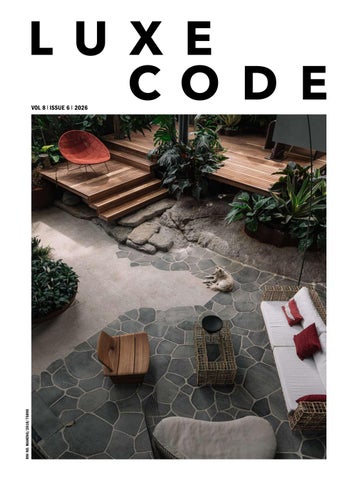
Editor: RINI MUKKATH Creative Head: ALOYSIUS DSOUZA On the cover - Coco Beans By Aamir & Hameeda Design Studio 10
VOL 8 ISSUE 6
CONTENTS VOLUME 8 ISSUE 6- 2026 WWW.LUXECODE.IN
14-27
58 SLOW ASSAGAO Auraya Homes’ Dahlia is a private four-bedroom pool villa in the heart of Assagao, made for unhurried group stays in North Goa.
PEOPLE
48 HOME, REWIRED AS Architects turns Nirvaan, a Gujarat weekend retreat, into a full-time family home where intuitive technology and Vastu planning shape everyday life.
16 WORN LIKE HEIRLOOMS ITRH’s POLKI couture collection turns the splendour of Polki, Jadau and temple jewellery into richly embellished contemporary silhouettes.
62 FAMILY PORTRAIT Aanchhal Bhuwalka of AB Designs layers brass, fluted glass and dark marble into a Kolkata apartment that gives each of three generations a room of its own.
20 THE COLOUR OF MEMORY ZOYA’s Her Again High Jewellery collection, with sitarist Anoushka Shankar as its muse, translates India’s spices into a vivid language of rare gemstones. 24 READING GOA IHCL’s Ranjit Phillipose, Senior Vice President, Operations, Goa, on a destination that is moving beyond the beach, beyond the season and beyond the obvious.
74-77
26 THE JOY OF DRESSING Tory Burch’s Spring/Summer 2027 collection pairs opulent femininity with American pragmatism, in rich textures, bold colour and witty craft.
ART 76 ARTISTIC CONNECTIONS Curated by Erum Khan, Aura Planet presents a considered showcase of contemporary artworks at India Art Festival, bringing together artistic expression, collectors and opportunities to discover emerging creative talent.
28- 73 PLACES
78-89
30 ROOM FOR TREES Aamir and Hameeda shape a Hyderabad family home around its mature trees, excavated stone and a Keralainspired roofline.
THINGS 80 FATHER OF LIGHT Abner opens its first Experience Centre in Worli, Mumbai, where alabaster, concrete and marble luminaires are seen as part of the architecture around them.
40 FRENCH ACCENT Aparna Kaushik Design Group reimagines the French château for a well-travelled Delhi family of collectors, with classical grandeur softened by contemporary ease
86 WHERE THE MACHINE MEETS THE HAND Bengaluru architect and maker Ann Sankey uses CNC machines and clay printers not to perfect the object, but to discover new kinds of craft. Through her studio Nava Design Labs and its ceramic practice Nadirah, the machine sets the structure and the material has the final word.
48 QUIET GRAVITAS Empatio Architecture’s Chandhana Ramesh shapes Nayam, a 12,000 sq ft Chennai villa where stone, Indian craft and a growing art collection live in calm conversation.
12
VOL 8 ISSUE 6
PEOPLE
14
VOL 8 ISSUE 6
PEOPLE
16
VOL 8 ISSUE 6
WORN LIKE HEIRLOOMS ITRH’s POLKI couture collection turns the splendour of Polki, Jadau and temple jewellery into richly embellished contemporary silhouettes. Photos by ITRH
S
ome things we inherit are worth far more than their material. A grandmother’s necklace, a mother’s sari, an embroidered textile brought out for a family celebration: each carries the memory of the hands that made it and the lives it has passed through. With POLKI, Indian couture label ITRH explores this bond between ornament, craft and memory, reimagining the grandeur of heirloom jewellery for a contemporary wardrobe. The collection takes its name from Polki, the uncut diamonds treasured in Indian royal jewellery for centuries. Passed down through generations, such jewels become keepers of lineage, celebration and personal history. Rather than copying jewellery literally, ITRH translates its luminosity, intricacy, VOL 8 ISSUE 6
17
weight and texture into couture, treating each silhouette as an ornament in its own right. JEWELLERY IN THREAD The visual language draws on the sculptural grandeur of Jadau and temple jewellery, the irregular brilliance of uncut stones, the movement of motis and the carving of traditional ornaments and idols. At the heart of the collection is jewellery-inspired embroidery. Motifs drawn from temple ornamentation rise through layers of moti, beads, Polki-inspired details, dabka, sheesha, nakshi, gota and fine zari. The embellishment is deliberately dimensional, recalling ceremonial necklaces treasured over decades. Some surfaces are densely encrusted; others are
PEOPLE
18
VOL 8 ISSUE 6
Some things we inherit are worth far more than their material. A grandmother’s necklace, a mother’s sari, an embroidered textile brought out for a family celebration: each carries the memory of the hands that made it and the lives it has passed through.
punctuated by fragments of mirror, pearls and jewel-like details that catch the light as they move. Ghungroos and motis add another sense. Attached to the garments, they sway and softly sound with the wearer, lending the couture an almost talismanic quality. Ornament becomes something experienced through movement, touch and sound, not sight alone. WOVEN INHERITANCE Textiles form the foundation. Tissue and Benarasi brocades, alongside rich Bandhej, bring depth and lustre, their metallic surfaces recalling the warmth of aged gold. Heirloom Phulkari embroidery adds another layer of cultural memory, enriched with ITRH’s signature mirror work, dabka and nakshi, so that regional traditions meet in a tactile play of light and texture. Through its silhouettes, POLKI brings the vocabulary of Indian ceremonial dressing into the present. Volume, drape and structure sit alongside intricate surface work, revisiting familiar forms of occasion wear without losing the craft that informs VOL 8 ISSUE 6
19
them. Its maximalism is grounded in the intelligence of its textiles and the skill of the artisans behind each piece.
THE LABEL ITRH was founded by Ridhi Bansal and Mohit Rai. Rai, one of India’s leading celebrity stylists, brings more than 12 years of experience across fashion and film, while Bansal anchors the label in craft and textile storytelling. Together they have built a design language that carries techniques such as Bandhani, Chikankari, Gota Patti and Kutch embroidery into expressive contemporary couture. POLKI reflects a deeply personal idea of luxury, measured not only by materials or workmanship but by the meaning a garment gathers over time. It speaks to the Indian tradition of keeping beautiful things, wearing them for life’s most important moments and passing them on with their stories intact. Each piece is imagined not for a single occasion, but as an heirloom for the next generation.
PEOPLE
20
VOL 8 ISSUE 6
THE COLOUR OF MEMORY ZOYA’s Her Again High Jewellery collection, with sitarist Anoushka Shankar as its muse, translates India’s spices into a vivid language of rare gemstones. Photos by ZOYA
T
he golden warmth of turmeric. The deep red of mace. The green of cardamom, the richness of saffron and rose. For its new High Jewellery collection, Her Again, ZOYA, the luxury jewellery atelier from the Tata Group, turns to one of India’s most enduring cultural languages, its spices, and treats them as keepers of memory. The collection follows a woman returning to herself, drawing on the rituals and recollections that connect us to our past. Colour becomes the doorway: curious, playful, spontaneous, expressive and deeply feminine. Rubellite, emerald, Madeira citrine, Orissa rose garnet, golden heliodor and yellow sapphire form an unexpected, saturated palette, set in intricate compositions shaped over thousands of hours of craftsmanship. A MUSE BETWEEN WORLDS The campaign finds its voice in sitarist and composer Anoushka VOL 8 ISSUE 6
21
Shankar, who has built a distinctive musical language across cultures and genres while carrying her Indian heritage into a practice that is personal and unmistakably her own. “What I love about ZOYA is the way it takes what we inherit and allows it to evolve through colour, gemstones and craft,” she says. “I’ve always believed you can be deeply rooted in a culture and still speak to the world in a way that feels relevant, simply through the lens of your own experience. ZOYA captures that beautifully, creating pieces that feel timeless in spirit, yet fresh, inventive and entirely their own.” For Arun Narayan, Chief Executive Officer, Jewellery, Titan Company Limited, India is an extraordinary source of design inspiration, from its colours and cultural heritage to the craftsmanship that has shaped its visual language over centuries. “At ZOYA, we see an opportunity to reinterpret these influences through a distinctive design lens, creating High Jewellery where meaning
PEOPLE
22
VOL 8 ISSUE 6
and emotional resonance are as integral as rarity and artistry,” he says. “Her Again reflects this approach, drawing from India’s richness and diversity while expressing it in a way that is contemporary, personal, and unmistakably our own.”
UNBOUND BANGLE Here, 6.4 carats of deep crimson rubellites, Orissa rose garnets and diamonds are shaped by clove buds and unfurling mace. Fine fretwork and sculpted detail create a jewel of exuberant depth, made for a woman who knows herself and wears her freedom with confidence.
INSIDE THE COLLECTION ETERNAL EMBER NECKLACE The centrepiece of the collection translates India’s palette of colour and spice into 748 stones sculpted into movement. At its heart sits a 5.4-carat cabochon Mandarin garnet in saturated orange, recalling turmeric and marigold. Sapphires, rubellites and citrines surround it, and 102 individually crafted elements, brought to life over 2,112 hours, form a fluid, three-dimensional architecture. In motion, the diamonds set within its sculptural forms catch the light, revealing shifting layers of brilliance and colour.
AMBER BLISS NECKLACE AND EARRINGS A 38-carat Madeira citrine takes centre stage in the necklace, surrounded by pink tourmalines, orange and yellow sapphires and diamonds, with sculpted marigold forms flowing around the stones. An open-back setting reveals the citrine’s inner fire, and more than 1,000 hours of craftsmanship bring the piece to life. The matching earrings carry 22 carats of Madeira citrine accented with pink tourmalines, sapphires and diamonds, their open backs letting light filter through the stones.
ETERNAL EMBER EARRINGS Two rubellites totalling 7 carats glow in rich shades of pink, intensified by diamonds and intricate settings. Inspired by the fiery depth of mace, they capture an ember held close and ready to glow again. AFTERGLOW RING A vivid 2.7-carat rubellite is set within custom-cut matte rock crystal and framed by sculptural tendrils inspired by mace, while Zambian emeralds echo the form of cardamom. Stone-on-stone craftsmanship gives the ring its layered depth, a dialogue of crimson, green and translucent light. VOL 8 ISSUE 6
23
THE ATELIER Founded in 2009 as the Tata Group’s flagship luxury jewellery atelier, ZOYA is known for its quiet, personal approach to luxury, its gemstone artistry and its patented innovations, including the ZOYA Baoli® setting, the ZOYA Bloom Cut™ and the ZOYA Aeterna Diamond Cut™. Today it has 13 flagship boutiques and 12 galleries across India and the United States. With Her Again, ZOYA brings a familiar sensory world into new light. Through the interplay of gemstones, colour and craft, the collection gives form to the memories we carry, and to the parts of ourselves we keep returning to.
PEOPLE
READING GOA IHCL’s Ranjit Phillipose, Senior Vice President, Operations, Goa, on a destination that is moving beyond the beach, beyond the season and beyond the obvious. Photos by IHCL
F
or Ranjit Phillipose, hospitality is less about managing hotels and more about understanding people, places and the changing reasons we travel. A career that has taken him through London, Mauritius, the Seychelles, New York, Boston, San Francisco, Hyderabad, the Maldives and Dubai has brought him back to Goa with a far wider view of the industry and a sharper sense of how destinations evolve. Today, as Senior Vice President, Operations, IHCL Goa, he oversees one of the country’s most significant hospitality portfolios, spanning Taj, Vivanta, SeleQtions, Gateway, Ginger and amã Stays & Trails. Yet for all the scale of the business, it is not the numbers that seem to occupy him most. It is the destination itself, and the many ways in which Goa is changing. A CAREER BUILT FROM THE GROUND UP Phillipose’s journey began with the Taj, after what he describes as the only formal interview of his life, and those early years gave him an instinctive feel for the business that has stayed with him ever since. An eight-year stint at St. James’ Court in London opened the door to an international career, followed by roles in Mauritius, the Seychelles and the United States. He was part of the team at The Pierre in New York, and went on to work in
Boston and San Francisco, absorbing the cultures and operating styles of some of the world’s most competitive hospitality markets. When IHCL brought him back to India to open Taj Falaknuma Palace in Hyderabad, he was entrusted with a property where luxury was inseparable from history, heritage and a strong sense of place. It taught him that a memorable hotel is not simply a physical product, but the story, the people and the sense of belonging around it. A YEAR-ROUND GOA That perspective shapes the way he reads Goa today. He does not see it simply as a beach destination, nor does he measure its transformation by occupancy alone. The Goa of a decade ago was seasonal, with the monsoon marking a sharp slowdown. Now a more confident, affluent domestic traveller, better connectivity and a shift towards shorter, more frequent holidays have made it a year-round proposition. The Indian traveller may stay fewer days, but is increasingly likely to return several times a year. For a hotelier, that changes everything, from how rooms are sold to how restaurants are positioned and experiences are created. It is also why Phillipose sees so much potential in the Goa beyond the one the world already knows. The beaches will remain 24
VOL 8 ISSUE 6
central, but a new generation of travellers is curious about what lies past the shoreline: heritage, architecture, food, art, music, wellness and the hinterland. For IHCL Goa, this has meant creating experiences that draw guests out into the destination rather than keeping them within a resort. The growing amã Stays & Trails portfolio places travellers in private villas and neighbourhoods, closer to the everyday rhythms of the state. Goa’s greatest wellness proposition, he believes, does not need to be manufactured. It already exists in the greenery, the air, the slower pace and the chance to disconnect. Goa does not need to imitate anywhere else; it simply needs to recognise and protect what it has.
pressure on its infrastructure and communities. Transport remains a concern, waste management needs You do not have to be on greater attention, and connectivity the beach; even a glimpse must keep improving if the state is to attract more international travelof the sea can be enough. It lers. Above all, there is the question captures something essenof how tourism can grow without eroding the character that made Goa tial about the destination, desirable in the first place. When and about his approach to private spaces become backdrops luxury. It does not always for social media, or visitors disregard local customs, the line between need to announce itself. experiencing a place and consuming Sometimes it lies in the feelit begins to blur. For Phillipose, the answer lies ing of being somewhere, and in a more thoughtful kind of tourthe freedom to experience it ism. Goa does not necessarily need at one’s own pace. more visitors; it needs visitors who understand what makes it special. THE TABLE AND THE MONSOON Having worked in destinations at Food and beverage have become central very different stages of development, to Goa’s evolution, with independent restaurants, chefs and bars he has seen what happens when tourism grows unchecked, and reshaping how visitors and locals dine. Hotels can no longer treat what becomes possible when hospitality works in harmony with their restaurants as extensions of their rooms. Under Phillipose, the identity of a place. the IHCL portfolio has leaned into destination dining, collaboraHis outlook is at once global and deeply local. He sees a Goa tions and new concepts, with the aim of placing its hotels within that can be a serious culinary address, a wellness retreat, a wedGoa’s wider gastronomic conversation. ding and MICE destination, a cultural and heritage destination The monsoon offers a clear example of this thinking. Once and a year-round escape, provided no single facet is allowed to written off as the off-season, it is now being reimagined as a overwhelm the others. time of discovery. The Goa Monsoon Feast grew from a simple One of his observations about Goa is disarmingly simple: you observation: people were still coming during the rains, but the do not have to be on the beach; even a glimpse of the sea can be dining scene went quiet. The initiative has also drawn local audienough. It captures something essential about the destination, ences into hotel restaurants they may once have seen as reserved and about his approach to luxury. It does not always need to anfor residents or special occasions. It is a telling example of how nounce itself. Sometimes it lies in the feeling of being somewhere, Phillipose works, responding to changes in behaviour rather than and the freedom to experience it at one’s own pace. waiting for them. For Ranjit Phillipose, the next chapter of Goa is not about making it bigger. It is about making it richer: more connected to GROWTH WITH CARE its communities, more conscious of its environment and more His vision is not without caution. Goa’s popularity places real confident in the many identities it can offer the modern traveller. VOL 8 ISSUE 6
25
PEOPLE
THE JOY OF DRESSING Tory Burch’s Spring/Summer 2027 collection pairs opulent femininity with American pragmatism, in rich textures, bold colour and witty craft. Photos by Tory Burch
26
VOL 8 ISSUE 6
F
or Spring/Summer 2027, Tory Burch turned to the personal rituals of getting dressed. Shown at New York Fashion Week in the Isamu Noguchi Sunken Garden, the collection explores how beauty, utility and a little humour come together in a woman’s wardrobe. “Opulent femininity meets American pragmatism, seen through the collector’s eye,” says Burch. “Spring/Summer 2027 explores the psychology of how women pull things together. They want beauty, utility, and humour: the joy of getting dressed.” EASE, UNSETTLED Athletic knits, hip-slung skirts, drawstring trousers and patch-pocket shirts set a relaxed tone, sharpened by considered detail. Opera coats borrow the ease of a favourite trench, while sharply tailored pieces are subtly unsettled, giving familiar forms a fresh angle. Texture leads the season. Menswear wools are softened with silk, paper cotton is tie-dyed and washed, and wallpaper-inspired jacquards meet contrasting silks and fils coupés. Chenille lends beachside terrycloth unexpected richness, and glazed crepe de chine falls in liquid folds. The palette is just as expressive: coral, turquoise, violet, mint, vermilion and butter yellow against deep browns and cool neutrals, optimistic without losing sophistication. Metallic embroidery, flocked pie-crust cardigans and polka-dot yarns add exuberance, while paint-
VOL 8 ISSUE 6
27
erly, handmade feathers are tufted into scarves and pompoms, draped over shoulders and bags. DETAILS WITH WIT Accessories carry the same dialogue between practicality and ornament. The new Lee Radziwill shopper takes its cue from the humble paper bag, reworked with ultra-thin straps, and a soft shoulder bag is framed by kiss-lock pouches. The Handwoven Basket Tote, made in continued partnership with Indian artisans Marasim, returns in new colours and patterns. Footwear explores drape, with peep-toe pumps and Venetianinspired slippers that fold around the foot. Handwoven leather-cord slingbacks sit beside thong sandals adorned with mother-of-pearl, beads and faux shark teeth, and on select styles hand-painted soles spiral around the heel, continuing Burch’s interest in twisted forms. Jewellery brings more play. Classic beaded necklaces return as stacked resin beads, knotted nylon and articulated brass spheres that open to reveal stones within, while sporty metal speed frames and quirky safety goggles offer a spirited counterpoint. The result is a wardrobe of contrasts: polished yet relaxed, practical yet extravagant, familiar yet delightfully unexpected. Set to a soundtrack produced by Wladimir Schall, the show made a persuasive case for dressing as personal expression, where the pleasure lies as much in the details as in the whole.
PLACES 28
VOL 8 ISSUE 6
VOL 8 ISSUE 6
29
PLACES
30
VOL 8 ISSUE 6
ROOM FOR TREES Aamir and Hameeda shape a Hyderabad family home around its mature trees, excavated stone and a Kerala-inspired roofline. Photo courtesy:Ishita Sitwala
VOL 8 ISSUE 6
31
PLACES
32
VOL 8 ISSUE 6
A
LETTING THE LAND LEAD The site arrived with its own identity: existing trees, uneven terrain, excavated stone, shifting light and natural contours. Early concepts were set aside when it became clear the original footprint would mean removing several mature trees. The design began again, this time with the landscape as its guide. Instead of flattening the terrain, the plan grew around what was already there. Trees informed the layout, courtyards emerged between preserved pockets of greenery, and openings were placed to keep a constant relationship with the outdoors.
t its heart, Coco Beans is a home about coexistence: with the land, with the trees, with light and with the rhythms of everyday life. Set on a rocky 700 sq yd site in Hyderabad, the 6,000 sq ft residence by architecture and interiors studio Aamir and Hameeda, led by Aamir Sharma and Hameeda Sharma, unfolds across three levels for a family deeply connected to nature. Named after the family’s cat, the house carries a sense of warmth from the very beginning, personal not through overt gestures but through the way its spaces respond to daily living.
VOL 8 ISSUE 6
33
PLACES
34
VOL 8 ISSUE 6
VOL 8 ISSUE 6
35
PLACES
36
VOL 8 ISSUE 6
STONE, WOOD AND A RISING ROOF One of the project’s defining moves is the reuse of stone excavated from the site. Reworked into CRS walls and sculptural elements, it embeds the land physically in the identity of the house. A restrained palette of concrete, wood and stone is kept deliberately neutral, so the greenery remains the strongest presence throughout. Sloping roofs inspired by traditional Kerala architecture, a language the homeowners felt drawn to, emerged later in the process as the elevations developed, and became one of the home’s signatures. Rising and dropping across the structure,
The aim was not simply a view of nature, but a way of living between inside and outside. The process remained adaptive through construction. Some spaces were reduced, reworked or removed altogether in favour of openness, trees and stronger links to the courtyards. Conventional markers of scale and luxury, such as expansive formal rooms and additional built-up area, were consciously given up. The result is a house that breathes. Mornings bring filtered light through the courtyards, afternoons retreat into shaded transitional spaces, and evenings soften against stone, wood and warm pools of light.
VOL 8 ISSUE 6
37
PLACES
38
VOL 8 ISSUE 6
the roofline brings movement, shade and sculptural depth, and shapes the character of the rooms below. Louvered wooden windows encourage ventilation and privacy, while semi-open sit-outs, shaded thresholds and layered circulation blur the boundary between in and out. At the centre, a single-cast reinforced cement concrete spiral staircase rises sculpturally through the house, both connector and anchor. The first floor holds two guest bedrooms linked by a lobby overlooking the courtyards, while the master suite above sits immersed in soft light and views of the trees. LIVED IN, NOT PERFORMED
VOL 8 ISSUE 6
Though minimal, the home never feels austere. Animal-inspired sculptures, collected art and a bold Art Deco couch bring playfulness and personality to the restrained palette. Nothing feels overly polished. The house is made to be fully inhabited, whether by muddy paws racing across the courtyard, conversations spilling into semi-open spaces or long stretches of stillness framed by trees. Rather than maximising floor area or relying on familiar symbols of luxury, Coco Beans prioritises openness, atmosphere and coexistence with the landscape. It feels less built on its site than born of it.
39
PLACES
40
VOL 8 ISSUE 6
FRENCH ACCENT Aparna Kaushik Design Group reimagines the French château for a well-travelled Delhi family of collectors, with classical grandeur softened by contemporary ease. Photography - Ashish Sahi and Atul Prathap Chauhan
VOL 8 ISSUE 6
41
PLACES
42
VOL 8 ISSUE 6
VOL 8 ISSUE 6
43
PLACES
44
VOL 8 ISSUE 6
S
et within a quiet enclave in Delhi, Oaklane Villa explores classical grandeur through a contemporary lens. Designed by Aparna Kaushik Design Group for a well-travelled family of collectors, the 17,800 sq ft residence on a 59,000 sq ft plot reinterprets the romance and discipline of a French château for modern Indian life, as both an architectural statement and a deeply personal home.
tion, rhythm and precision rather than ornament, so its classical references feel poised rather than imposing. Arrival sets the tone. A sweeping stone-paved driveway, punctuated by custom planters and pockets of greenery, leads gradually to the portico, and this interplay of hardscape and landscape keeps the villa’s scale connected to its setting. A CINEMATIC PLAN Inside, the home unfolds across two levels and 19 rooms. The ground floor holds the formal living and dining rooms, a bar and lounge, and an expansive master suite; upstairs are a second master suite, the daughter’s quarters and guest bedrooms. Wide corridors, framed views and daylight-moderated transitions give the interiors a cinematic pace, with moments of grandeur yielding naturally to intimacy.
MEASURED GRANDEUR The architecture draws on the vocabulary of classical French estates: fluted and Corinthian pilasters, limestone façades, wrought-iron railings and a mansard roof. Finished in deep Astros Blue tiles, the roof gives the villa a strong silhouette, while Ferragamo Beige limestone lends the façade a warm, sunwashed softness. The house earns its presence through propor-
VOL 8 ISSUE 6
45
PLACES
46
VOL 8 ISSUE 6
A grand staircase in wrought iron and brass defines the central axis, a sculptural anchor between the villa’s public and private worlds. Throughout, materials are layered with restraint: polished marble against warm wood panelling, carved boiserie with stone skirtings, hand-blown glass fixtures for luminosity, champagne-leafed ceilings for a subtle shimmer, and bronze and brass for warmth.
Integrated automation discreetly controls lighting, curtains and security. Oaklane is not a period piece, but a contemporary residence that borrows from the past while responding to the present. OUTDOOR ROOMS Lawns, terraces and a poolside cabana soften the built form and create a series of outdoor rooms. Seasonal planting, filtered sunlight and reflections from the pool become active parts of the composition, lending the residence movement and atmosphere. Oaklane Villa finds its strength in equilibrium: classical symmetry and permanence balanced with the warmth and ease of a contemporary Indian home. Rather than reproducing another era, it reinterprets it, creating a home that feels timeless yet closely tied to the lives within it.
COLLECTED, NOT DISPLAYED Craft is expressed in precision rather than excess. Marble inlays, bespoke metalwork, custom joinery and carefully composed lighting create a sequence of tactile encounters. Art and collected objects are integrated into niches, ledges and surfaces instead of standing apart as displays, so the interiors feel collected and lived in despite their formality. Modern life is embedded quietly within the classical frame.
VOL 8 ISSUE 6
47
PLACES
48
VOL 8 ISSUE 6
QUIET GRAVITAS Empatio Architecture’s Chandhana Ramesh shapes Nayam, a 12,000 sq ft Chennai villa where stone, Indian craft and a growing art collection live in calm conversation. Photography - Meister Meister
VOL 8 ISSUE 6
49
PLACES
50
VOL 8 ISSUE 6
S
et in one of Chennai’s most prestigious neighbourhoods, Nayam is a residence defined not by spectacle but by restraint, tactility and lasting sophistication. Designed by Empatio Architecture for a family of four with a love of art, travel and cultural rootedness, the 12,000 sq ft villa offers a deeply personal take on luxury, one that values atmosphere over ornament and experience over excess. The home balances global sensibilities with an unmistakably Indian warmth. Its language is contemporary Indian with
VOL 8 ISSUE 6
subtle brutalist undertones: stone, wood, concrete and glass create spaces that feel grounded and quietly monumental, drawing their richness from proportion, texture and the play of light on material rather than decoration. A CALM SPATIAL RHYTHM From the entrance, the villa reveals an unhurried flow. Open living areas give way to quieter, contemplative zones, letting the house move easily between gathering and solitude. Expansive glazing draws daylight deep inside, animating surfaces through 51
PLACES
52
VOL 8 ISSUE 6
the day and strengthening the dialogue between interior and landscape.
textured walls, the warmth of wood, and materials allowed to age gracefully.
MATERIALS WITH HONESTY Materiality is the emotional core of the project. Indian limestone, sandstone and granite were chosen for depth and honesty rather than polished perfection, lending the interiors permanence. Concrete adds a contemporary edge, while warm timber softens the architectural rigour. Luxury here is quiet: the cool touch of stone underfoot, the changing light across
ART AS ARCHITECTURE Art was conceived as part of the architecture rather than an accessory. Works by emerging and established artists are woven through the home, creating moments of depth without disturbing its calm. Neutral backdrops, carefully orchestrated natural light and flexible layouts let the collection grow and shift over time.
VOL 8 ISSUE 6
53
PLACES
Under water snorkelling by Padi
54
VOL 8 ISSUE 6
VOL 8 ISSUE 6
55
PLACES
56
VOL 8 ISSUE 6
Indian craftsmanship is celebrated at every scale. Much of the furniture, lighting and detailing was handcrafted by artisans from across the country, bringing individuality to the spaces and anchoring the villa in material heritage.
evolve from its context, client and climate, with sustainability built in from the start through natural ventilation, daylight and water-conscious design. Ramesh studied at the School of Architecture and Planning, Anna University, Chennai, and holds a Master’s in Sustainable Environmental Design from the Architectural Association, London. She was named to the IGen 2024 list of Top 50 Architects under 40 and was a finalist for FOAID’s Creative Minds Next 2025. At Nayam, that sensibility results in a villa of effortless confidence, where architecture, art, material and craft sit in seamless harmony.
THE STUDIO Founded by Chandhana Ramesh, Chennai-based Empatio Architecture works across luxury residences, hospitality, retail and large-scale developments, guided by the belief that spaces shape human behaviour and emotion. Rather than a single visual signature, the studio lets each project VOL 8 ISSUE 6
57
PLACES
58
VOL 8 ISSUE 6
SLOW ASSAGAO Auraya Homes’ Dahlia is a private four-bedroom pool villa in the heart of Assagao, made for unhurried group stays in North Goa. Photography - Auraya Homes
VOL 8 ISSUE 6
59
PLACES
60
VOL 8 ISSUE 6
A
ssagao has become North Goa’s most coveted address for travellers who prefer leafy lanes to crowded beaches, and Dahlia by Auraya Homes sits right at its centre. Set beside Izumi and a short walk from Gunpowder, Bawri and Avo’s, the villa places some of Goa’s best-loved tables almost at the doorstep. A grand entrance opens into a fully private home designed for families and friends travelling together. Four spacious ensuite bedrooms come with private balconies, abundant natural light and views over a quiet orchard, and the master bathroom features a deep tub for long, slow soaks. Life gathers around the private pool and its generous lounge deck. Indoors, sunlit living rooms offer room for everyone, with a dining table that seats up to ten and a lounge for film nights. Upstairs, a large terrace sets the scene for open-air
VOL 8 ISSUE 6
gatherings and barbecue evenings under the sky. For those who would rather not cook, private chefs can be arranged for curated meals and live barbecues, though the fully equipped kitchen is there for anyone who wants it. Daily housekeeping and a dedicated caretaker take care of the rest. It is a home built for celebrations, reunions and the kind of slow Goan living that makes a long weekend feel like a proper escape. Villa: Dahlia by Auraya Homes Address: Villa 4, La Stella, Assagao, Mapusa-AnjunaChapora Road, Goa 403507 Configuration: Four ensuite bedrooms, private pool, terrace Bookings: +91 81781 98641
61
PLACES
HOME, REWIRED
AS Architects turns Nirvaan, a Gujarat weekend retreat, into a full-time family home where intuitive technology and Vastu planning shape everyday life. Photography - Nayan Soni
62
VOL 8 ISSUE 6
VOL 8 ISSUE 6
63
PLACES
64
VOL 8 ISSUE 6
N
irvaan began life as a weekend retreat for a family of four. Then the owners decided to make it their primary home. For AS Architects, led by Ar. Anish Patel and Er. Suresh Mistry, that shift prompted a complete rethink of the Gujarat residence, not only in planning, but in how the house would work day to day. For the 60-year-old homeowner, ease and efficiency sat at the centre of the brief. The answer was a home in which technology does much of the work. A fully integrated system controls lighting, air-conditioning, security and surveillance from a single interface, and fingerprint access extends to doors, wardrobes and even the lift. Geofencing adds a further layer, so the house begins preparing for the family’s arrival, switching on lights, cooling rooms and starting entertainment systems before anyone walks in. But Nirvaan is not simply a smart house. It is architecture adapted to the realities of daily life.
VOL 8 ISSUE 6
65
PLACES
66
VOL 8 ISSUE 6
REWORKING THE VOLUMES The home unfolds across two main levels with a landscaped backyard. The main living room keeps its dramatic double height, crowned by a cascading chandelier inspired by strands of pearls. A second double-height zone was reworked entirely as the brief evolved: instead of leaving it open, the architects added a slab to create a dedicated entertainment level above. This upper floor holds a home theatre, a poker table and a bar finished in Italian stone. Layered in charcoal finishes, deep wine-toned acoustic panels and controlled lighting, it is a moodier, more intimate counterpoint to the rest of the house. A PATH TO THE TEMPLE The backyard is equally considered. Following Vastu principles, a temple sits at the rear of the property, linked to the living
VOL 8 ISSUE 6
67
PLACES
68
VOL 8 ISSUE 6
room by a landscaped pathway. Along the way, a water feature adds a soft soundtrack that drifts back into the house. A small seating nook beside the temple offers a quieter, personal moment, and the planting responds to Gujarat’s climate with flowering species and layered greenery. PRACTICAL, PERSONAL The private spaces bring the same attention to practicality. Bathrooms flow into walk-in wardrobes, with upgraded finishes, integrated seating and mirrors giving them a cohesive feel. Furniture throughout was chosen to complement the home’s clean architectural lines. What makes Nirvaan compelling is not its technology alone, but the way the house was reshaped around a real change in lifestyle. Designed for occasional escape, it now supports everyday living, and has become far more personal, intuitive and lived in as a result.
VOL 8 ISSUE 6
69
PLACES
FAMILY PORTRAIT Aanchhal Bhuwalka of AB Designs layers brass, fluted glass and dark marble into a Kolkata apartment that gives each of three generations a room of its own. Photographs courtesy - AB Designs
70
VOL 8 ISSUE 6
D
esigning for three generations under one roof is rarely simple. At The Elysian Haven, a 2,100 sq ft four-bedroom apartment in Kolkata, Aanchhal Bhuwalka of AB Designs answers the challenge with a home that reflects the personality of every family member while holding together as one calm, cohesive whole. The guiding idea is a delicate balance: minimalist restraint with maximalist impact. Muted tones, sinuous and geometric mouldings, and brass accents recur across furniture, lighting and joinery. Each intricate detail is placed with intention, offering moments of discovery within a quiet, largely monochrome shell.
strengths were respected rather than reworked. Floor-to-ceiling windows flood the living and dining areas with light and frame green views. At the entrance, fluted glass partitions softly separate the kitchen and mandir, leading into a double-height living and dining space grounded by a dark marble floor. Rather than compete with the outdoors, the design steps back with a palette of taupe, pastels and warm veneers, lifted by brass and crystal. A custom contemporary crystal chandelier hangs above the dining table, its rhythm echoing the geometric mouldings on the walls. Veneer marquetry in three stains backs the dining area, a leaf-patterned wallpaper anchors the living room, and diamond-tufted sofas, a brass-legged console and coffee table complete a quietly glamorous picture. The kitchen is built for function and easy upkeep, its light ceramic tiles and cabinetry offsetting the dark marble for a timeless monotone look.
LIGHT AND FLOW Received as a bare shell in a high-rise, the apartment’s
VOL 8 ISSUE 6
71
PLACES
72
VOL 8 ISSUE 6
A ROOM FOR EVERYONE The master bedroom, lit by a narrow plant-lined balcony, is kept bright and light. A tufted headboard stands against straight-lined moulding on a brown accent wall, while blackand-gold mosaic tiles and brass-framed glass partitions carry the metal detailing into the bathroom. The parents’ bedroom is a cocoon of plush luxury. A dusty purple upholstered wall with brass inlay frames a raised wallpaper panel within a veneer backboard, and floral-textured wardrobe fronts and a corner vanity niche add intimate drama. The daughter’s room was where the project began. Her favourite colour, pink, runs through the space, which is planned for movement and play and makes the most of every inch for storage. A sketched rabbit decal decorates the wardrobe beside a custom bunk bed, and the bathroom picks up the same play-
VOL 8 ISSUE 6
ful shapes and hues. In the guest room, a hand-stencilled Tree of Life mural and pocket niches in the closet create space for objets d’art. ONE LANGUAGE, MANY VOICES Bringing together the tastes of young children and grandparents was the natural challenge. The answer lies in a consistent language of material and colour that lets each room have its own identity. The dark marble runs throughout, grounding the varied palettes, while brass, fluted glass and geometric mouldings return as quiet signatures. The Elysian Haven shows how minimalist discipline can amplify maximalist detail. It is a home where craft and family life coexist, and where warmth comes not from clutter but from considered restraint.
73
ART 74
VOL 8 ISSUE 6
VOL 8 ISSUE 6
75
ART
76
VOL 8 ISSUE 6
ARTISTIC CONNECTIONS Curated by Erum Khan, Aura Planet presents a considered showcase of contemporary artworks at India Art Festival, bringing together artistic expression, collectors and opportunities to discover emerging creative talent. Photo courtesy: Aura Planet
A
rt finds its greatest appeal in the way it transforms a space, invites interpretation and creates a personal connection with the viewer. At India Art Festival’s Mumbai edition, Aura Planet brings this spirit of discovery to the forefront, presenting a curated selection of contemporary artworks for collectors, art enthusiasts and those looking to build their own collections. Taking place at Mumbai’s Nehru Centre in Worli, the festival offers a platform for artists, galleries, art buyers and collectors to connect. Aura Planet will be showcasing at Booth No. 31, with its presentation curated by Erum Khan, offering visitors an opportunity to explore artworks across a contemporary visual landscape. The experience of discovering art is often as important as the work itself. From expressive compositions to sculptural forms, contemporary art can introduce colour, texture and character into an interior while reflecting the tastes and sensibilities of its collector. Aura Planet’s participation places this relationship between art and its audience at the heart of its festival presence. For established collectors, the showcase offers another opportunity to engage with contemporary artistic practice. For first-time buyers, it provides a welcoming entry point into the VOL 8 ISSUE 6
art world, where personal instinct, visual appeal and conversations about an artwork can inform the process of choosing a piece. The emphasis is on making art accessible while encouraging a deeper appreciation of the creativity behind each work. Beyond the exhibition itself, India Art Festival creates opportunities for meaningful connections between artists and the people who collect, commission and champion their work. These encounters are particularly valuable for artists seeking wider visibility and for audiences interested in discovering perspectives beyond the familiar. Aura Planet is also inviting artists from Mumbai who wish to exhibit their work to connect with the platform, with limited space available for participation. This initiative reflects the importance of creating opportunities for artistic talent to reach new audiences and become part of a wider cultural conversation. With its focus on contemporary art and collector engagement, Aura Planet’s presence at India Art Festival offers a reason to look beyond the familiar and explore the possibilities of living with art. Whether the intention is to discover a new artist, find a statement piece for an interior or begin a collection, the showcase invites visitors to approach art with curiosity and an open mind. 77
THINGS
THINGS 78
VOL 8 ISSUE 6
VOL 8 ISSUE 6
79
THINGS
80
VOL 8 ISSUE 6
FATHER OF LIGHT Abner opens its first Experience Centre in Worli, Mumbai, where alabaster, concrete and marble luminaires are seen as part of the architecture around them. Photo courtesy: Abner
VOL 8 ISSUE 6
81
THINGS
82
VOL 8 ISSUE 6
W
hat happens when light is experienced not as an object, but as part of a space? That is the question behind Abner’s first Experience Centre, which opened in Worli, Mumbai, over three days in August 2026. Here, lighting is presented within architecture, material and atmosphere, rather than displayed as products on a wall. The name holds the idea. In its Hebrew lineage, Abner joins ab, meaning father, and ner, meaning lamp or light: the Father of Light, not simply its maker but its source. “I have always believed that we do not live in rooms; we live in the light that fills them,” says founder Shashank Nayak. “Abner, the Father of Light, is not just a title, but a responsibility that I inhabit.”
practice rather than a finishing layer. The brand introduced concrete outdoor lighting, Spanish alabaster decorative fixtures and marble-based exterior lighting to the Indian market, categories with little prior use in domestic settings. Its work studies how stone diffuses light, how concrete absorbs it and how form can balance durability with refinement, from sculptural alabaster pendants to weather-resistant luminaires for landscape architecture. The approach marries European design sensibility with engineering built for Indian climates and lifestyles. Every piece can be customised to a project, and a manufacturing facility in Bhiwandi gives the brand control over quality and timelines. A SPACE TO EXPERIENCE IT Designed by Karan Desai, the Experience Centre is a journey of warm terracotta surfaces, curved forms, recessed niches
LIGHT AS MATERIAL Founded in 2015, Abner approaches illumination as a material
VOL 8 ISSUE 6
83
THINGS
84
VOL 8 ISSUE 6
and built-in seating. Dark accents, black metal, natural moss and translucent elements form a considered backdrop, letting Abner’s Stone, Concrete, Marble and Architectural Lighting collections be seen in different settings and applications, decorative and integrated alike. “This Experience Centre is an important milestone for Abner as we establish a physical presence in the country where people can experience the breadth of our work firsthand,” says Nayak. “A lot of thought has gone into creating this space, and I’m excited to see how people interact with it.”
Nayak brings over two decades of experience exploring how light shapes perception, mood and materiality. One of his early projects, at JW Marriott Juhu, set the tone for the practice. Today he leads a 30-member team working with a network of more than 120 architects and interior designers, and Abner has completed over 1,000 projects across residential, retail and hospitality, including more than 100 Bluestone Jewellery stores. His next ambition is a fully integrated manufacturing ecosystem in India, bringing every stage of chiselling and finishing in-house. For now, the Worli centre gives Mumbai’s design community a place to see what he has long argued: that light is not an afterthought, but the material that makes a space.
THE MAN BEHIND THE LIGHT
VOL 8 ISSUE 6
85
THINGS
86
VOL 8 ISSUE 6
WHERE THE MACHINE MEETS THE HAND Bengaluru architect and maker Ann Sankey uses CNC machines and clay printers not to perfect the object, but to discover new kinds of craft. Through her studio Nava Design Labs and its ceramic practice Nadirah, the machine sets the structure and the material has the final word. Photo courtesy: Ann Sankey
VOL 8 ISSUE 6
87
THINGS
T
here is a moment in every Nadirah piece that no software can fully predict. A layer of porcelain settles a fraction lower than planned. A terracotta wall leans as gravity takes hold in the kiln. Glaze gathers in the fine ridges left by the printer. For most manufacturers, these are flaws to be engineered away. For Ann Sankey, they are the point. “Technology should expand the possibilities of craft rather than replace it.” It is a line that could serve as a manifesto for her studio, Nava Design Labs, and for a wider conversation now unfolding in contemporary Indian design: how technology can be used not to distance objects from craft, but to find new forms of it.
from rooms to tableware. Central to her thinking is the belief that designing and making are not separate acts. How something is fabricated, she argues, can matter just as much as the form it takes. Nava Design Labs works across architecture, interiors, furniture and collectible objects, with projects that move between residential and hospitality spaces and more experimental, gallery-minded pieces. Its toolkit is resolutely contemporary: computational design, CNC machining, digital prototyping and ceramic 3D printing. Yet Sankey treats these technologies as instruments of exploration rather than mass production. What interests her most is the territory between machine precision and the human hand, and the way a material’s own behaviour, whether in timber or clay, can be allowed to shape the outcome. That approach found its fullest expression yet in Aura, a collection of sculpted ash wood furniture that debuted at London Design Festival 2025. Each piece began as a digital model, was carved by CNC machine and then finished by hand, so that the
AN ARCHITECT’S WAY OF MAKING Sankey trained as an architect, first at RV School of Architecture and then at The Bartlett, UCL, where she completed an M.Arch in Design for Manufacture. That grounding in space, material and structure runs through everything she makes,
88
VOL 8 ISSUE 6
softness of the final surface carries the trace of both.
and table lights, terracotta screens and modular forms, decorative and functional pieces, and collectible objects that pair ceramic with other materials. What unites them is a refusal to treat 3D printing as a means of making the same thing over and over. Here, the printed layer is a design element in its own right, left visible and celebrated, while clay, firing, glaze and the finishing hand ensure that no two pieces are quite alike.
NADIRAH: CLAY WITH A VOICE OF ITS OWN If Aura showed what the machine and the hand could do with timber, Nadirah asks the same question of a far less obedient material. The studio’s ceramic and collectible object practice began with a simple curiosity: what happens when a machine works with something as unpredictable as clay? The answer, it turns out, is a kind of conversation. The printer brings structure and precision, but the clay continues to have its say. Layers shift, surfaces change, forms respond to gravity and to the heat of the kiln, and hand-finishing adds a further layer of intervention. Rather than concealing these traces, Nadirah builds its design language around them. Each clay body brings its own character to that conversation. Stoneware offers strength and texture. Terracotta lends warmth and an earthy quality. Porcelain allows for finer, more delicate forms and, crucially, translucency, and it is this relationship between porcelain and light that is fast becoming the heart of Nadirah’s work. The resulting body of work spans sculptural vessels, wall VOL 8 ISSUE 6
A PRACTICE, NOT A COLLECTION Perhaps the most telling thing about Nadirah is that it has no finish line. It is conceived as an ongoing practice rather than a fixed collection, with new forms emerging from continual testing of geometries, materials, printing methods, glazes and firing conditions. Some experiments succeed and some do not, and both are folded back into the work. The ambition behind it is disarmingly simple: to use technology to discover what clay can become, while holding on to everything that makes ceramics feel handmade. In Sankey’s studio, the future of craft looks less like a break with the past and more like a new chapter in a very old dialogue between maker and material. 89
90
VOL 8 ISSUE 6
Elegant House Raghuvanshi Mills Compound, S.B. Marg, Lower Parel (W), Mumbai-400013. T: +912224939676
VOL 8 ISSUE 6
Airtport Showroom Plot No. 2099 Western Express Highway, Vileparle (E) Mumbai- 400099. T : +912226150120 91
WORKS : E-7, RIICO Industrial Area, Abu Road - 307026, Rajasthan- India. T: +91 2974 294792
VISIT OUR ABOVE STORES FOR A SPECTACULAR RANGE OF GEMSTONE COLLECTION.
What if you could stack your dinnerware to make a sculpture? Pivot transforms your table into a canvas. Stack vertically for drama or arrange horizontally in rhythm. Designed for play and built for versatility, 92 VOL 8 ISSUE 6 it invites you to reimagine the art of setting the table.
VOL 8 ISSUE 6
93 at wareinnovations.com Shop The Pivot Collection
Tableware for Modern Homes! Ware Innovations, a Mumbai-based design house and table decor brand, that is reimagining the things that surround us everyday. wareinnovations.com
+91 8369998726 | info@wareinnovations.com
@wareinnovations
Raghuvanshi Mills, Lower Parel - 400013
WWW.LUXECODE.IN TO SUBSCRIBE PLEASE CONTACT US ON INFO@LUXECODE.IN