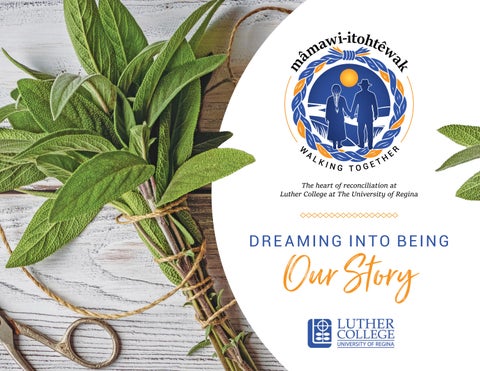
The heart of reconciliation at Luther College at The University of Regina
DRE AMING INTO BEING
Our Story
S TA R T I N G I N A G O O D W AY
Prayer from Our Elder Gitchie Manitou, Creator, Maker of Heaven and Earth and the whole Universe, we humbly ask your Blessings on each and every one of us to be good Human Beings on Mother Earth. Bless us Spiritually, Mentally, Physically and Emotionally all the days of our lives and to always remember the Sacred Four in our lives. We humbly ask your Blessings on each and everyone of us as we walk hand in hand through this difficult time of Reconciliation. Bless us all we humbly ask Gitchie Manitou. Thank you, Thank you, Meigwiche, Meigwiche, Hiy, Hiy. Amen and Amen. Ekosi.
2
Dreaming into Being: Our Story • August 2026
LAND
Acknowledgement We live and are sustained by Treaty 4 lands, which are the traditional territories of the nêhiyawak, Anihšināpēk, Nakoda, Dakota, and Lakota peoples and the homeland of the Métis/Michif Nation. We are all Treaty people learning to walk together in a good way with one another, with the land and with all creatures who call this home. Luther College is humbly committed to learn and teach about the truths of what has unfolded on this land. We are equally committed to humbly setting things right.
Prepared by the mâmawi-itohtêwak Walking Together Committee, consultant Karen Henders, editor Lynn designer Rapoport, August 3 2026. Dreaming intoGidluck, Being: Our StoryDiana 2026 • August
THE MEANING OF THE LOGO mâmawi-itohtêwak is Plains Cree for “walking together.” This became the name of Luther College’s committee following the guidance from our Elder-in-Residence, Dr. Elder Lorna Standingready. Our logo represents the nature of our work, with those from the settler, colonial background walking alongside the Indigenous community, figuring out together what this path of reconciliation looks like. The couple reminds us to look, listen and learn from the teachings of our kêhtê-aya, our old ones, perhaps a kookum (grandmother) and a mushum (grandfather). We privilege Indigenous teachings because these have been ignored and denied for so long, and the loss of that wisdom has resulted in deep harm amongst peoples and to our land and nature. We believe that together, hand in hand, we model for our students how to live good lives of reciprocity and dignity. The sweetgrass, one of the four medicines used in smudging, encircles our image to further remind us that this path must be walked together. Blue is our traditional Luther College colour, and orange reminds us of the teachings from Orange Shirt day. We commit to telling the truth that must come before reconciliation is possible. Our journey is located primarily in Treaty 4. The significance of this shared responsibility of all people living under Treaty law is expressed in the familiar words, “as long as the sun shines, the grass grows, and the river flows.” Our human relationships take shape in good ways when the land and all that dwell here, animals and humans, are respected and given dignity. Luther College is committed to our Treaty promises.
4
Dreaming into Being: Our Story • August 2026
Table of Contents Prayer from Our Elder . . . . . . . . . . . . . . . . . . . . . . . . . . . . . . . . . . 2
What it Looks Like to Walk Together . . . . . . . . . . . . . . . . . . . . 18
Land Acknowledgement . . . . . . . . . . . . . . . . . . . . . . . . . . . . . . . . 3
“When You Can No Longer Turn Away” – Dr. Brenda Anderson . . . . . . . . . . . . . . . . . . . . . . . . . . . . 19
The Meaning of the Logo . . . . . . . . . . . . . . . . . . . . . . . . . . . . . . . 4 The Call to Action . . . . . . . . . . . . . . . . . . . . . . . . . . . . . . . . . . . . . . 6 A Story of Love, Humility, and Relationship: Brenda Anderson, Professor and Elder’s oskâpêwis (helper) . . . . . . . . . . . . . . . . . . 7 Learning to Walk Together: Tom Phenix, President of Luther College . . . . . . . . . . . . . . . . . . . . . . . . . . . . . 8 Discovering My Place in the Work: Derrek Eberts, Dean of Luther College . . . . . . . . . . . . . . . . . . . . . . . . . . . . . . . . . 8 Walking the Rocky Path: Lorna Standingready, Elder-in-Residence . . . . . . . . . . . . . . . . . . . . . . . . . . . . . . . . . . . 11 Who We Are . . . . . . . . . . . . . . . . . . . . . . . . . . . . . . . . . . . . . . . . . 12 Our Commitment . . . . . . . . . . . . . . . . . . . . . . . . . . . . . . . . . 12 Our Way of Being . . . . . . . . . . . . . . . . . . . . . . . . . . . . . . . . . 12 How We Walk Together . . . . . . . . . . . . . . . . . . . . . . . . . . . . 13 What Becomes Possible When We Walk Together . . . . . 13
The Meeting Place . . . . . . . . . . . . . . . . . . . . . . . . . . . . . . . . 20 Elder Lorna’s Reflections . . . . . . . . . . . . . . . . . . . . . . . . . . . 21 Reserve 107: A Model for How Our Committee Creates Programming . . . . . . . . . . . . . . . . 22 Project of Heart . . . . . . . . . . . . . . . . . . . . . . . . . . . . . . . . . . 24 Supporting Community . . . . . . . . . . . . . . . . . . . . . . . . . . . . . . . 26 Honouring the Buffalo People . . . . . . . . . . . . . . . . . . . . . . 26 Honouring Treaty 4 . . . . . . . . . . . . . . . . . . . . . . . . . . . . . . . 26 Ceremonies . . . . . . . . . . . . . . . . . . . . . . . . . . . . . . . . . . . . . 27 An Elder’s Breakfast . . . . . . . . . . . . . . . . . . . . . . . . . . . . . . 27 Re-Shaping Relationships . . . . . . . . . . . . . . . . . . . . . . . . . . . . . 28 Nonprofit and Voluntary Sector Studies Network – Colleen Strauch . . . . . . . . . . . . . . . . . . . . . . . . . . . . . . . . 28
Bringing into Being – Dreaming . . . . . . . . . . . . . . . . . . . . . 14
Connected in Creator: Relationship and Reconciliation – Reverend Brooklynn Lane . . . . . . . . . . . . . . . . . . . . . . . . 29
In Gratitude for the Path We Are On . . . . . . . . . . . . . . . . . . . . . 16
Re-Shaping Research and Knowledge . . . . . . . . . . . . . . . . . . . 30 Re-Shaping Teaching . . . . . . . . . . . . . . . . . . . . . . . . . . . . . . . . . 31 Bringing Into Being – Dreaming . . . . . . . . . . . . . . . . . . . . . . . . . 32 Acknowledgements with Gratitude . . . . . . . . . . . . . . . . . . . . . . 35
The Call to Action Four Voices on Walking Together
have described for you a mountain, “ We we have shown you the path to the top. We call upon you to do the climbing.”
Walking together can be difficult, like travelling over rocky terrain. But with the Seven Grandfather Teachings in our hearts, we can look, listen, learn, and yet deeper, to climb the mountain to reconciliation that the late Murray Sinclair told us about. Elder Lorna Standingready
This is a story of Luther College’s ongoing journey toward reconciliation — a journey of love, humility and relationship. We do not always get it right, but we are learning to listen deeply, accept hard truths, and act with courage toward healing. Brenda Anderson
Dreaming into Being: Our Story • August 2026
Reconciliation is not simply a statement or symbolic gesture. We are working to embed it into how we teach, support students, use our spaces, and build relationships with honesty, humility, and trust. Tom Phenix, President
Walking together creates space for reconciliation that is thoughtful, constructive, and real. Through many voices and shared responsibility, the work moves into action across Luther College. Derrek Eberts, Dean
6
— Commissioner Justice Murray Sinclair at the issuing of the final report of the Truth and Reconciliation Commission of Canada
A Story of Love, Humility, and Relationship Brenda Anderson, Professor and Elder’s oskâpêwis (helper)
These pages tell the personal and institutional story of reconciliation at Luther College at the University of Regina, a story that began more than two decades ago. It is a story about love, and about an ongoing journey. We do not always get it right, but we humbly share this story of reconciliation as one of thousands being told across Turtle Island. Luther College is largely made up of non-Indigenous employees and students. Therefore, the starting principle is to first decolonize our own minds and ways of being. Educational institutions have produced, replicated, and promoted ongoing colonization. How do we grasp what we do not know? How do we ask good questions? How do we listen well, and act accordingly? You will find the word relationship used often in these pages because relationship is at the heart of this work. We have begun to answer these questions by seeking wisdom from the lived experiences of Indigenous peoples living on Treaty 4 land. Re-learning the history of intentional colonialism and genocide carried out through the institutions of this country is difficult work, but it is necessary work. As the Truth and Reconciliation Commissioners told us, we have to hear and accept the truth before there can be reconciliation. For me, this work is about deep or sacred listening. It asks us to witness a past that has privileged many of us while continuing to harm others through exclusion and racism. Witnessing is not passive. It calls us toward action, healing, and repairing. Our story shows how Luther College is bearing witness. As an educational institution, we respectfully engage with this work so that we can inspire our students to think critically, exercise empathy, and learn through collective wisdom. Elder Lorna’s words guide us: Are we being good human beings? Are we creating a welcoming, healing and safe(r) space for Indigenous students? In our hallways, classrooms, chapel, residence, cafeteria, library, and offices, the answer is shaped by what we teach, how we teach, whose wisdom we honour, what art we display, what stories we hear, and how we treat one another. We recognize that Luther College still has so much work to do, just as our nation has much yet to redress. How much more important is it, then, to pause and celebrate the journey, to be grateful for the wisdom we share with one another, and to find courage and inspiration to take the next steps. The Seven Grandfather Teachings — love, respect, wisdom, courage, humility, honesty and truth — offer a path forward. I hope you are equally inspired to take up, or renew, the work needed in your own life and community. The story will differ because of circumstance, but may we lift up the commonality of necessity and our collective longing for justice and healing.
Dreaming into Being: Our Story • August 2026
7
Learning to Walk Together
Discovering My Place in the Work
As President of Luther College, I am deeply grateful for the reconciliation work taking place through mâmawi-itohtêwak, Walking Together. This work reflects some of the best of who we are and who we are called to become.
When I arrived at Luther College in the summer of 2024, I knew that I wanted to make Indigenization and Reconciliation a central focus of my work as Dean. I was welcomed with this mission and discovered a college that has already made important steps on this path. A college with an Elder-in-Residence, workshops on the Grandfather Teachings. Amazing! Student-led REDress events. Unbelievable! But, as Elder Lorna reminds us, “there is much work to do.”
Tom Phenix, President of Luther College
Luther’s strategic plan speaks of academic excellence, community of care, and the formation of whole persons. Reconciliation is not separate from those commitments. It grows directly from them. If we are serious about educating students for lives of meaning, community, and responsibility, then we must also be serious about truth, relationship, humility and repair. We must learn the history of this land more honestly, listen more deeply to Indigenous voices, and examine the assumptions and institutional habits that continue to shape our life together. One of the most powerful aspects of this work is that it is not abstract. It is lived through relationships: through the presence and teaching of Elder Lorna Standingready, the leadership of Brenda Anderson and the Walking Together Committee, Project of Heart, the Seven Grandfather Teachings, and public events that bring students, faculty, staff, and community members together. This work also asks something of us institutionally. It asks us to make reconciliation part of how we teach, support students, use our spaces, and build relationships beyond our walls. “Walking together” reminds us that reconciliation is not a destination we claim to have reached. It is a way of being that requires steadiness, accountability, and courage. My hope is that Luther College will continue to grow in this work with honesty and humility. We will not always get it right. But we can keep showing up, learning, and building trust. With Indigenous partners, Elders, students, faculty, and community members, we can continue walking together in right relations toward a more grace-filled, just, and joyful world.
8
Dreaming into Being: Our Story • August 2026
Derrek Eberts, Dean of Luther College
There are opportunities around every corner for those who are willing to see them. Sometimes this work requires us to accept uncomfortable truths. Sometimes it requires us to allow our norms and our institutional culture to be destabilized. Unsettled. I have already been humbled in this work. Walking in the Grand Entry at the Treaty Four Gathering in Fort Qu’Appelle in 2024, and again in 2025, reminded me that we are learning to walk in two worlds. My humility is my admission that I am discovering as I go, not only what we can do together, but who I am and what is my place in this work. I am proud to work with and support the mâmawi-itohtêwak (Walking Together) committee. I embrace the challenges of this work and look forward to what we can accomplish with a shared vision of living Reconciliation. It is relationship and community. It is the best of what Luther College can be when we live our vision of being rooted and open, and our mission to make transformative change for a more grace-filled, just and joyful world.
Elder Lorna out in the Community,
Revitalization Project 9 Dreaming into Being: OurLakeview Story • Park August 2026
contribute
doing
Wanting to
Not just
to the legacy and be a part of
what you are told…
inspired I am
patience, courage and determination by the
of fellow Committee members…
Walking Together.
injustices
It started with
So that
don’t continue or happen again…
“I should”
feeling that become involved but now goes
way beyond
change thinking education Wanting to
Self-growth and
the ways of
and the
ideas
Wanting to get
for where we can go and what we can do
together.
‘lopsided’ words being used…
Curiosity
as a settler in
Treaty 4 …
to start.
.
Walking the Rocky Path
Lorna Standingready, Elder-in-Residence
“Hearing her
speak about lived history, broken promises, resilience, and what it means to be Treaty people made the responsibilities of living on Treaty 4 land tangible for me. It shifted reconciliation from an abstract concept to something personal and immediate. I wanted to be a part of work that responds to that history in practical
”
ways.
– mâmawi-itohtêwak Committee member
Walking Together is not easy. It is difficult. Like a rocky terrain, so it is with people from different ways of life to live and work together. Growing up in the Big Bush on the Peepeekisis Indian Reserve was the very foundation for my understanding of how to be a good human being. Moshum (grandfather) and kokum (grandmother) and my mom and dad were my foundation of traditional teachings, to be good to one another. Today, we have the 7 Grandfather Teachings to guide us in life to be good to one another. The teachings of love, humility, respect, courage, truth, honesty and wisdom that are symbolized with the animals that embed these teachings in our hearts. Teachings that are of the heart withstand all the human cruelty we inflict on one another in our weak moments, or sometimes intentionally. The Indian Residential Schools across Canada were geared to kill the Indian in the child but instead failed to kill the traditional teachings that went underground. These traditional teachings are surfacing today after a long slumber. So it is as I (Elder) was told recently from the Elders in Treaty 6 Territory, that my language is awakening. Having related a story during a speaking engagement, Elder could not say the good English word for bowel movement but instead said it in Cree. The Lieutenant Governor, Russ Merasty and his wife, Donna, both fluent Cree Speakers, laughed because they knew what kind of bowel movement I meant. They were the only ones who laughed, and that gave me strength to go on with my story about my life in St. Mary’s Residential School, in Prince Albert, Saskatchewan. The old people said laughter is good medicine, and it is good to laugh but not to laugh too hard, meaning we should do things in life in moderation. So many teachings and so little time as the Elders are leaving this world. Being told that no one would listen to me in the Indian Residential Schools is so hard to overcome. The Truth and Reconciliation Commission that went across the country was a major breakthrough. Survivors are now telling their stories, albeit falteringly, and leaving some parts of their stories out because of the unspeakable crimes. We follow the traditional way that says these are not my stories to tell, but we were witnesses, forced to watch in horror, and traumatized for life. That is why the late Senator Murray Sinclair said we must listen to the stories even if they are told many times. Today at Luther, it is challenging for Elder and faculty and staff to understand each other. The irony is that as a child, Elders were forced to do things the colonial way, programmed into saying what you think the teachers and staff wanted to hear. But now, Elder must remember this is a time of reconciliation and it is a free world to think and say what is on one’s mind. The late Senator Murray Sinclair said that the Truth and Reconciliation Commission has shown us the way, like a mountain and it is up to us to climb the mountain of Reconciliation. Let us mamawi-itohtewak.
Dreaming into Being: Our Story • August 2026
11
WHO WE ARE
mâmawi-itohtêwak Walking Together:
The heart of reconciliation at Luther College at The University of Regina
OUR
Commitment
The mâmawi-itohtêwak Committee at Luther College creates a safe(r) space to personally and institutionally heal from past and present wrongs of colonialist policies and practices. We seek to set things right through good relations with one another, with the land, and with all that lives therein. We do this together in many ways, especially through our Elder-in-Residence program, which transforms our ways of being and knowing. Events and programming invite students, faculty, staff, and community members to look, listen, learn, and yet to go deeper. We seek to become good human beings and to dream ourselves into the future. For the Committee, dreaming is not abstract or passive. It is a way of listening, learning, and accepting responsibility for what we are called to bring into being together. Our philosophy is rooted in a Lutheran intellectual tradition that is open to insights from other spiritual and secular traditions. Alongside this historic tradition, we are especially guided by the teachings of our Elder-in-Residence, recognizing the need to centre, and honour, Indigenous ways of knowing and being, in particular the lived experiences of Indigenous peoples today. We are informed by the larger context of the Truth and Reconciliation’s 94 Calls to Action, its Ten Principles of Reconciliation, and the UNDRIP framework for reconciliation through education.
OUR WAY
of Being
The path of reconciliation is unknown and uncomfortable. It is a lifelong personal journey that starts with a commitment to unlearning colonial misrepresentations and re-learning our history properly, in particular privileging oral teachings. Indigenous knowledge systems remind us that education is as much about the heart as the mind. It is about the whole person. At the institutional level, change requires broad ownership, Indigenous and non-Indigenous perspectives, strong support from senior leadership, humility, persistence, and a willingness to keep showing up. Strong support from college administration is crucial. Change in communities requires an enduring commitment at all levels, and a willingness to serve as a trusted conduit between peoples. Engaged learning, research, and action uplifts us so that we are collectively braver and stronger.
» The Committee way of being is welcoming – anyone can join and
contribute as and when they can; they are encouraged to bring their whole self.
» The Committee way of being is we – let’s help each other to not be afraid, let’s work together. We each bring unique strengths and perspectives that support our collective learning and action.
» The Committee way of being is grassroots – responsive to the needs at Luther College, the main campus, First Nations of Canada (FNUC) and community; with openness, working together in a good way.
» The Committee way of being is real – thoughtful, constructive and tangible.
» The Committee way of being is guided by traditional teachings such as the Sacred Four and the Seven Grandfather Teachings.
12
Dreaming into Being: Our Story • August 2026
Indigenization and decolonization work is proceeding because the committee guides us. Dean Derrek Eberts
HOW W E
Walk Together
We focus on right relations while tending to personal, pedagogical, administrative, and community transformation. Walking together asks something of our hearts, our classrooms, our institutional practices, and our relationships with the wider community. It reminds us that reconciliation is not held in one office or one event but carried through the whole life of the College.
What becomes Possible
W HEN W E WA L K TOGE T HER
When we create space to connect through stories, songs, ceremonies, food, with those with lived experience it becomes difficult to turn away from injustice. Our ears and eyes are opened, and our hearts start to soften. We begin to see that we need each other. We want to act beyond ourselves. We want to learn more and begin to seek out more Indigenous knowledge, and situate Indigenous peoples front and centre. We start to heal from the divisiveness of racism and colonialist mindsets. The path of reconciliation starts to unfold in good ways. Members come to this work because of their passion, determination and a sense of what is possible when we walk together. “There is always something to learn and to do together. So, this won’t end. It will continue with different people.”
Reconciliation is not something that can be resolved quickly or in a perfunctory way. In academic institutions, which are inherently colonial in their structure, it is our unique place to speak truth and to allow the space for this journey to take place. Marc Jerry, former President of Luther College
Look, listen, learn, and yet go deeper, to become good human beings to dream us into the future. Dreaming into Being: Our Story • August 2026
13
BRINGING IN TO BEING –
Dreaming
“…reconciliation is no longer a special
initiative, instead it becomes embedded into how Luther College operates...”
“ Indigenous ways are
integrated into courses and across disciplines…”
“ reconciliation is part of everything…”
“ Indigenous knowledge holders are teaching alongside faculty.” “ …Indigenous students
feel connected and at-home on campus.”
“ Students are expected to engage with Treaty responsibilities as part of their education.”
Walking together has transformed our relationships and become a permanent way of being. Reconciliation is part of everything as long as the sun shines, the grass grows and the river flows.
Walking Together in right relations to build a more grace-filled, just and joyful world. 14
Dreaming into Being: Our Story • August 2026
Dreaming into Being: Our Story • August 2026
15
In Gratitude
Honouring the Past
for the Path We Are On
2008-2011
Raising Awareness and Building Relationships
Luther’s early learning and advocacy around Missing and Murdered Indigenous Women, Girls and Two-Spirit people grew through its first participation in the First Nations University of Canada Annual Pow Wow Grand Entry, partnership with First Nations University of Canada, a Women’s and Gender Studies study abroad course in Mexico, the international Missing Women conference, support for walkers raising awareness of the crisis, and the publication of Torn from Our Midst: Voices of Grief, Healing and Action from the Missing and Murdered Indigenous Women Conference. In 2008, Senator Lillian Dyck became the first Indigenous Luther Lecturer, speaking on the history of Indigenous peoples in Canada and the intersections of racism and sexism in the Indian Act and Chinese immigration labour policies.
2012-2014
Strengthening Student Leadership and Reconciliation Learning
Luther partnered with Canadian Roots Exchange, supporting students to lead reconciliation events on residential schools, MMIWG2S+, sacred water and other pressing issues. These years were a time of relationship-building, exploration and laying a stronger foundation for the work to come.
2015-2017
Deepening Dialogue, Learning and Public Witness
Luther co-hosted the North American Interfaith Network (NAIN) Connect Conference, Restoring Spirit through Sacred Listening, with a focus on sacred listening, especially in Indigenous traditions, and expanded its multifaith chaplaincy. During this period, Project of Heart was launched as an annual heart-based learning and art activism program, bringing Indigenous and non-Indigenous participants together to learn about residential schools, intergenerational trauma and reconciliACTION. Luther also installed Steps along the Red Road: Following Christ the Creator, an art exhibit by Ovide Bighetty of Pukatawagan First Nation, celebrated with the first pipe ceremony held at Luther, and in 2016 received a United Nations Regional Centre of Expertise on Education for Sustainable Development Award for its work with Canadian Roots Exchange.
16
Dreaming into Being: Our Story • August 2026
2018-2021
Expanding Learning, Art, and Community Connection Luther’s reconciliation work continued to grow through student learning, community partnerships, public events and art-based education. Project of Heart became an important annual practice, inviting participants to remember the children who attended residential schools and to connect learning with reconciliACTION. The Committee also continued to support events and partnerships that helped students, faculty, staff and community members engage more deeply with Indigenous histories, Treaty responsibilities, MMIWG2S+ advocacy and the ongoing work of decolonization.
2022-2023
Creating New Spaces for Reconciliation Luther launched the educational resource Relationships and Reconciliation Toolkit, installed a Project of Heart art exhibit, and established its first Elder-in-Residence Program with Elder Lorna Standingready and oskâpêwis Dr. Brenda Anderson. This marked a major transformation in reconciliation work across the College.
2024
Expanding Teachings and Recognition Luther’s reconciliation work deepened through the Seven Grandfather Teachings series, its first landbased teachings in sage and berry picking, participation in the 150th anniversary Treaty 4 Grand Entry, and the celebration of Elder Lorna Standingready’s honorary doctorate from St. Andrew’s College. Luther also received its second United Nations Regional Centre of Expertise Sustainability Award for innovation and excellence in Project of Heart.
2025-2026
Continuing to deepen relationships and build community Walking Together continued to expand through the Sacred Four Teachings, a student- and community-led REDress Workshop on MMIWG2S+, a Reserve 107 dialogue event exploring reconciliation in everyday life, and Luther’s third United Nations Regional Centre of Expertise Sustainability Award for innovation and excellence.
Moving forward Together
Dreaming into Being: Our Story • August 2026
17
WHAT IT LOOKS LIKE TO WALK TOGETHER
PERS O N A L
A DMINIS T R AT I V E
By walking together, committee members help others begin and Walking together also changes institutional habits. We are a small continue their own journeys of reconciliation. Teachings, ceremonies college with a culture of administrative, academic and institutional and shared meals connect students, parents, faculty, staff, collaboration. This makes it possible to move from intention to administrators, and community members with the action across many parts of college life. We are aligned and moving stories and experiences of those who have forward, together, on the Path of Reconciliation. This way of being been marginalized. Through events and is reflected in our committee membership and in how we work initiatives such as Project of Heart (POH), from the bottom-up and across the different levels of the the Seven Grandfather Teachings, oneinstitution to get things done, and in a good way. We may be on-one conversations with the Elder-inLearning to walk in two worlds – Indigenous and nonResidence, and the shared space of the small but we are a Indigenous – we continue to improve our policies around Meeting Place, reconciliation becomes such things as smudging protocols, honorarium gifts for mighty family. personal rather than abstract. kêhtê-aya (old ones, Elders), a cafeteria menu reflective of
PEDAGO GICA L
Elder Lorna
Walking together changes what and how we teach. As a member of the Academic Advisory Committee, which is positioned in the President’s Office, our Elder-in-Residence is active in all aspects of life at Luther College. Alongside this role is the acknowledgement of the need for an Elder’s oskâpêwis, to truly walk together. The permanent presence of an Elder centres Indigenous voice, knowledge, and practice, helping faculty and students move beyond the fear of making a misstep and toward deeper learning for all. Our Relationships & Reconciliation Toolkit provides faculty with easily accessible resources for classroom use, is updated regularly, and is supported by the Elder’s availability for in-class teaching and faculty consultations on course content and delivery. Communityengaged learning through the Nonprofit and Voluntary Sector Studies Network also brings community voices into the classroom, including Indigenous perspectives and partnerships. Through this work, students learn not only about reconciliation, but work alongside communities already responding to the social, economic, and cultural impacts of colonialism.
Indigenous foods, changing library cataloguing language away from racist and outdated language, increasing our Indigenous artwork throughout our campus, including flying the Treaty 4 flag, and much more.
We are committed to supporting and building upon the University of Regina’s Indigenous Engagement initiatives and to foster everstronger relationships with the ta-tawâw Student Centre and First Nations University of Canada campus.
C O M M U NI T Y Walking together also means building relationships beyond Luther College. Public events, community partnerships, research collaborations and shared meals create space for students, faculty, staff, Elders, Indigenous partners, faith communities, nonprofit leaders and members of the wider public to learn from one another. These relationships are not about duplicating the work of others. They are about showing up with humility, listening carefully, sharing the College’s resources where they are useful, and supporting community-led priorities. Through events such as ReDress, Reserve 107, the Seven Grandfather Teachings, Treaty 4 participation, community-based research and nonprofit sector learning, Luther College helps create bridges between people, organizations and ways of knowing.
In this way, community engagement becomes part of reconciliation. It helps students see that reconciliation is not only an idea discussed in classrooms, but a responsibility lived through trust, reciprocity, allyship and action.
S TORIES OF WA L K ING TOGE T HER
“When You Can No Longer – Dr. Brenda Anderson
My moment of transformative cognitive dissonance occurred in 2006 in the village of Fort Qu’Appelle. My eye was drawn to a poster on a local drugstore window asking “Have You Seen…” and my gut reaction was “Not Another One.” It was the picture of Amber Redman, gone missing and later found to be murdered. It followed a succession of similar posters and news stories about Indigenous women and girls, including Tamra Keepness, Melanie Goodman, Danita BigEagle and many — far too many — more. My academic focus was about the colonization of Muslim countries and the efficacies of Muslim-Christian feminist dialogue, not about Indigenous matters on Turtle Island. My undergraduate and graduate work left huge gaps in my knowledge about my own country and the people inhabiting this land. How was I to synthesize my white narrative of Canada with these glaring inconsistencies? I am grateful for cognitive dissonance, because the reasonable response is to figure it out. In 2008, two major events occurred as a result of figuring this out. I talked with Indigenous women, solicited the aid of brilliant feminist students, and partnered with Rev. Carla Blakley. Collaboratively, and with the support of many communities, Luther College hosted an
Turn Away”
international conference, Missing Women: Decolonization, Third Wave Feminisms and Indigenous People of Canada and Mexico. The conference brought together more than 300 people from across Mexico and Canada to understand the complexities of the issue and chart a path forward where being a woman with brown skin did not make you disposable.
The conference led to Torn from our Midst: Voices of Indigenous Women and, later, the open-source second edition, Global Femicide: Indigenous Women and Girls Torn from Our Midst. It also helped inspire two University of Regina courses: a study abroad course in Mexico and Missing and Murdered Indigenous Women: Global Femicide, offered every two years. In these ways, cognitive dissonance was transformed into concrete action. From my own experiences, and from being mentored by two Luther College colleagues, Dr. Mary Hampton, the first to bring Elders into the classroom, and Dr. Mark Anderson, who wrote and taught about media (mis)representations of Indigenous people, I could no longer turn away. The work of Indigenization and decolonization continued into other facets of life at Luther College. In 2025, the work of our mâmawi-itohtêwak Committee and students from my Feminisms
and Activism class merged in a daylong arts activism workshop, “ReDress: Workshop on MMIWG2S+.” We partnered with the University of Regina’s Women’s Centre, RPIRG, Buffalo Boy Singers and The Matriarch’s Collective to offer a space to learn, be supported and be inspired. The day included drums and dancing, shared stories and a meal, and the creation of a RedDress art exhibit used today at Luther College. Students learned how to plan, write grant proposals, work with community organizations and host the kind of day that requires much empathy and heart work. The work of reconciliation continues to grow and flourish as more and more people experience their own desire to transform from a colonizing institution to one where we are working, and walking together, on this healing path. Don’t ever think that your own actions or ruminations don’t matter. As Margaret Mead says, “Never doubt that a small group of thoughtful, committed citizens can change the world. Indeed, it is the only thing that ever has.” Institutionally, Luther College has realized that it can no longer turn away. We continue to grow, humbly, in our awareness and passion for looking, listening, learning, and yet to go deeper. We are on a good path, together.
Dreaming into Being: Our Story • August 2026
19
S TORIES OF WA L K ING TOGE T HER
Our Elder-in-Residence Program Our Elder-in-Residence is structurally positioned in the President’s office, a member of the Academic Advisory Committee (AAC) and active in all aspects of life at Luther College with smudging, ceremonies, teaching circles, and classroom chats. The permanent presence of an Elder centres Indigenous voice, knowledge and practice to start to overcome the fear of making a misstep. Alongside this role is the tradition of an Elder’s oskâpêwis. An oskâpêwis traditionally supports an Elder in ceremonies, but the role is much more than that. A relationship is built and through that, teachings are given and new ways of reconciliation are being formed at Luther College. Indigenous and non-Indigenous understandings and practices are brought into this relationship which truly represents our commitment to walking together in a good way. Elder Lorna’s traditional Cree name, “Noo-Ta-Ka-A-Pay-Taht-Mee-Ooo-Mus-Ki-Ki,” means “old woman who brings good medicine” and indeed, she does. Elder Lorna is from Treaty 4 territory and is a 10-year Indian residential school survivor who has dedicated herself to serving her community. She recently received an Honourary Doctorate from the United Church of Canada’s St. Andrew’s Theological College, in recognition of her lifetime commitment working towards reconciliation by walking together. Elder Lorna provides wisdom, teachings, and guidance to students of all backgrounds. She assists in all programming to further decolonize all the University’s work and help with Luther’s commitment to reconciliation. Through a variety of Indigenous initiatives, she teaches us about: principles guiding human behaviour towards others; the residential school system and the people and families who were, and still are, affected by this system; missing and murdered Indigenous women, girls and 2SLGBTQI+ people, raising awareness and telling the stories. Elder Lorna’s stories demonstrate the power of resilience, cultural pride, and the interconnectedness of all.
20
Dreaming into Being: Our Story • August 2026
The Meeting Place
The Meeting Place (created in 2023), is a shared space with the Elder-inResidence and her oskâpêwis. This is not an office, but rather a place where tea and teachings, dreaming and visioning can be done together. Tobacco ties made each year by a group of students are available to pick up when you need to offer an Elder some tobacco. Come see our unique Treaty map, and stay to listen to Elder Lorna’s stories and advice. Look for the “Kokhum’s Corner” sign on the second floor, Room 214!
Elder Lorna’s Sharing stories is a traditional way to bring an understanding of our teachings. I am so very thankful to share my story here, knowing that Luther College faculty and staff embrace this traditional way. The Elder in Residence at Luther College University of Regina is a good step forward. This may seem like a baby step but it is the guiding light that leads us through the tough times ahead. The old ones have seen leaders who guide the people through the many challenges in life. They share their stories of survival to guide the leaders’ thoughts and actions for the betterment of the people. As Elder In Residence, these stories and actions of long ago are the guiding light that has come to shine brighter each day at work. Elder is very thankful that she gets to hone her skills of looking, listening, learning and yet deeper with all the senses that are gifts from Gitchie Manitou, to help guide her work of Reconciliation at Luther College. When Elder’s moshum was asked by the missionary, the late Dr. Ida Drake, of File Hills to have Daily Vacation Bible School for his grandchildren in the Big Bush on Peepeekisis Indian Reserve, moshum said yes. Moshum said that if it was good for his grandchildren then
Reflections
she could continue to have Daily Vacation Bible School in the Big Bush. So it is with this in mind that Elder has said yes to being Elder at Luther College. Moshum paved the way to see if this works for Elder and Luther College.
what to say and do compared to reading and riting, rithmatic and Religion of many kinds. The blending of these two thought systems will be hard, but the teachings shared by my terminally ill daughter, Michelle help us build a better world – perseverance, positivity, prayer and hope. As Elder helps in this process, it is challenging. “There is lots of work to do,” were the last words spoken by my little spirit when I was near death during Covid. The little spirit is a guiding force that tells us to continue on with life in a good way. It is this time in history that Elder acknowledges that ceremony is accepted, and that praying in our own way is a sacred right that has been the guiding force to persevere in life. These rights were once forbidden by the Indian Agent, but they have survived. Today, Elder walks the great halls of learning at Luther College with courage, knowing that life here is safe and is a place Elder lovingly calls home with the Family of Luther. Ekosi.
Here at Luther there is a chapel to meditate and to have pipe ceremonies, smudging ceremonies, and to pray in one’s own way. Sharing these ceremonies and to acknowledge the Creator through prayer brings heartfelt thankfulness to Elder’s heart, sharing a way of life since time immemorial. The faculty and staff want to learn about the teachings of long ago, and how the Indian People have survived is a Blessing. Elder shares what little knowledge she has through stories from the heart to help with the traditional teachings of long ago. Elder treasures each time she says prayers to start the faculty meetings in a good way, as this is how the Indian People of long ago always prayed to acknowledge Gitchie Manitou before sacred times together. It is a strong combination of blending the traditional way of By relating her looking, listening, learnstories, past and present, ing and yet deeper to what Gitchie ManiElder Lorna holds a mirror up tou wants of you as to our assumptions about things a good human being,
We look, listen, learn and yet go deeper.
we take for granted that are not necessarily the experiences of Indigenous people, past and present.
S TORIES OF WA L K ING TOGE T HER
Project of
Heart
Project of Heart is an arts-based educational program created by University of Regina graduate student Sylvia Smith along with her middle school students. Project of Heart facilitates reciprocal learning opportunities between participants and communities focusing on the impacts of our shared colonial history. The presentations and stories help participants understand how the forced institutionalization of Indigenous children into Government and Church run Indian Industrial and Residential Schools was an instrument of genocide. POH connects this history to the continued intergenerational trauma disproportionately impacting the overall health and well-being of Indigenous Peoples today. The reciprocal heart-based learning and teaching is supported with guidance from Elders and Knowledge Keepers. This way of collective learning uncovers truths and fosters empathy. Once people know and care then they are often compelled to step away Programs such as Project from being bystanders, thus of Heart and Elder Lorna’s gentle igniting their journey of stepping into actions of reconciliation. teaching build awareness and shared For our work with Project of Heart, Luther College received the second of three awards from the United Nations RCE (Regional Centre of Expertise on Education for Sustainable Development) Sustainability Awards in 2024.
understanding as we journey together as children of a fragile earth. There is more that binds us together than sets us apart. Participant Helga Hein, former Board of Regents
22
Dreaming into Being: Our Story • August 2026
The activism component is determined by the students, so it is not known in advance. It is done in ceremony with an Elder, because of the respect it requires and because of the vulnerability of those who share their heart-felt stories. Jenna Ives, first POH facilitator
Dreaming into Being: Our Story • August 2026
23
S TORIES OF WA L K ING TOGE T HER
Reserve 107:
A Model for How Our Committee Creates Programming The committee approach is to make space for ideas to come forward from our members, who then see their ideas take shape. They know their voice and work matters. Together, it was decided to host a screening of the documentaries Reserve 107: Reconciliation on the Prairies (2016) with its update of Reserve 107: A Path Forward (2025). We determined how to do this in a good way with grounding & guidance from Elder Lorna. Attendees were engaged throughout the event with dialogue and discussion, sharing food together. The length and “openness” of the event allowed space for people to come when it was possible for them. They could participate as they were comfortable to do so, including having space just to be quiet. This film event was attended mostly by non-Indigenous people from all walks of life. It was noted that different events and initiatives attract different audiences. An intentional diversity of offerings allows different stories to be shared to meet people where they are on their journey of reconciliation, so they feel heard. This taps into the living reality of where communities are at. Specific groups were invited to share their stories of reconciliation in their own way. Members from the Ahmadiyya Mosque in Regina, and The Healing Garden committee from Westminster United Church, attended and discussed how they understand reconciliation and act on it within their own spaces. In this way, relationships continue to be strengthened and different models of reconciliation are offered to those in attendance. Because the day began and ended with Elder Lorna’s and our Chaplain’s prayers and blessings, the call to our hearts and passion invested all of us in transformational decolonizing work wherever we work and live.
24
Dreaming into Being: Our Story • August 2026
“ This approach
felt like truly walking together. We held space for people wherever they were at in their journey
”
of reconciliation. – Committee organizer
Storytelling Circles Storytelling Circles are held in the student lounge, beginning with a smudge, soup and Bannock and a teaching. Notable among these was the 7 Grandfather Teachings sessions in 2024, with over 80 in attendance over 7 sessions. Faculty was invited to offer this as an option for course credit. The Seven Grandfather Teachings lay the foundation for being a good human being. They are a series of principles guiding human behavior towards others. These teachings: Wisdom, Love, Respect, Bravery, Honesty, Humility, and Truth have been essential since traditional times and remain crucial for the survival of communities today.
Providing food creates an inviting atmosphere. As well, when people eat together it encourages dialogue. People can experience the similarity of “others” because we all need to eat and we all enjoy food and conversation. We don’t always agree, but we have this connection.
Elder Lorna’s Seven Grandfather Teachings truly feel like ‘walking together’ in the sense that everyone is gathered within our space and learning from our Elder-in-Residence: teachings such as they encourage staff, students and the larger University community to come together… The qualities and characteristics of events such as Seven Grandfather Teachings and our graduation ceremonies combine community, education, human connection, sharing (e.g. sharing food), and wisdom in a more intimate, comfortable environment. Being able to learn and listen to an Elder is an experience that is truly invaluable: it is an opportunity for those present to gain a deeper understanding of reconciliation and why it matters.
Dreaming into Being: Our Story • August 2026
25
SUPPORTING COMMUNITY
Walking Together extends beyond Luther College. It is lived through relationships with Indigenous communities, Elders, faith communities, nonprofit leaders, students, faculty, staff, and the wider public. These relationships grow through ceremony, shared meals, public gatherings, acts of support, and the willingness to show up when invited.
HONOURING T HE
Buffalo People
I was honoured to walk with Elder Lorna at the Grand Entrance to the Treaty 4 Days powwow for the last two years. The act of walking together is difficult to put into words. It is like a spiritual experience that affirms that the work is important and is making a difference. The experience is extraordinarily humbling.
Individual relationships matter. When LifeSpeaker Dennis Omeasoo and the Buffalo People’s Arts Institute approached Luther College in 2023 to support the Honouring the Buffalo Project, the College was honoured to respond. The project brought forward Dean Derrek Eberts traditional teachings about the buffalo and culminated in the return of the traditional Buffalo Dance to the First Nations University of Canada’s annual spring pow wow. Luther supported the initiative through a funding letter, participation in ceremonies and events, and a financial contribution toward a buffalo robe for the women’s dance. We are grateful to have been invited into this work in good relations with Indigenous communities.
HONOURING
Treaty 4
Luther College has participated for many years in Treaty 4 Days at Fort Qu’Appelle, including the pow wow and community parade. In 2024, the 150th anniversary of the signing of Treaty 4 held special meaning because Elder Lorna’s great-grandfather, Ca-Na-Ha-Cha-Pay-O, Skillful Archer, was a Treaty signatory. Luther “showed up” by supporting Elder Lorna’s full participation in the week’s events, culminating in Acting President Murray Knuttila, Dean Derrek Eberts and Dr. Brenda Anderson accompanying her in the Grand Entry. Luther was honoured to walk with Elder Lorna again in the 2025 Treaty 4 pow wow. Quite literally, we walk together on a good path.
26
Dreaming into Being: Our Story • August 2026
Ceremonies
Walking Together is also a spiritual experience because it aligns our hearts and our goals. Luther College now opens many meetings and events with prayers from both our Elder and Chaplain. Smudges, pipe ceremonies and feasts have become significant moments in our shared life, including the ceremony held when the committee received the name mâmawi-itohtêwak, Walking Together. Beginning projects with right intention and in a good way is now part of how we work. Feasts also teach us through food, preparation and participation, with the cafeteria supporting this work through Three Sisters soup, hamburger soup, Bannock, tea and other foods shared in Indigenous communities.
A N EL DER’S
Breakfast
The Elder’s Breakfast brings Elders and nonprofit leaders together for connection, support and shared learning. Grounded in conversation and community care, the gathering honours the wisdom, guidance and cultural teachings Elders offer while Elder Lorna reminded creating space for nonprofit leaders me that inviting her into public to reflect on their work, feel supported ceremony must be on her terms and and strengthen relationships as they time. I had to respect and honour her respond to community needs and wisdom while ‘doing’ reconciliation. ongoing social injustices.
She has brought Luther College a warmth and grace I continue to be in awe of. Marc Jerry, former President
Dreaming into Being: Our Story • August 2026
27
RE-SHAPING RELATIONSHIPS 28
At Luther College, reconciliation begins with relationship. Before teaching, research, policy, or programming can be reshaped in a good way, trust must be built, stories must be heard, and people must learn how to walk alongside one another with humility and care. The Nonprofit and Voluntary Sector Studies Network and Luther College Chaplaincy show how relationships can reshape learning, community engagement, spiritual care, and institutional life.
Nonprofit and Voluntary Sector Studies Network
– Colleen Strauch
Collaboration between the Nonprofit and Voluntary Sector Studies Network (NVSSN) and the mâmawi-itohtêwak Committee reflects Luther College’s commitment to relationship-centred learning, reconciliation, and community transformation. Our collective way of being i grounded in reciprocity, shared responsibility, and respect for Indigenous ways of knowing. NVSSN was established to strengthen Saskatchewan’s nonprofit and voluntary sector through learning, research, innovation, and community engagement. Its guiding framework of “learn, research, innovate” aligns closely with the values of mâmawi-itohtêwak, which centres walking together in good relations. Through this connection, nonprofit education at Luther College becomes more than professional training. It becomes part of a broader process of reconciliation, ethical engagement, and collective learning. The Elder-in-Residence program has helped shape how nonprofit sector learning and research are approached. Indigenous perspectives and teachings are increasingly embedded in classroom discussions, community-based projects, partnership development, and leadership learning. Students are encouraged to understand nonprofit work within the broader contexts of Treaty relationships, social justice, and community wellbeing. Through programs such as the Growing Nonprofits Series, community-based research projects in the Certificate in Nonprofit Sector Leadership and Innovation, and nonprofit leadership development opportunities, NVSSN brings together students, faculty, nonprofit practitioners, Indigenous leaders, and community members to address community challenges collectively. In this way, reconciliation is not a separate initiative. It becomes part of how Luther College teaches, researches, builds partnerships, and contributes to a more grace-filled, just, and joyful world.
Dreaming into Being: Our Story • August 2026
Connected in Creator: Relationship and Reconciliation – Reverend Brooklynn Lane
The Indigenous philosophy, All My Relations, expresses a profound sense of interconnectedness and belonging. This vision resonates with the Christian understanding expressed in Acts 17:28: “the One whom we live and move and have our being.” Both perspectives invite us to recognize that our lives are sustained by a Source outside ourselves and that this Source connects us to one another in a sacred way. At the heart of both traditions is relationship: relationship with Creator/God, with one another, with the earth's creatures, and with all creation. If relationship is foundational, then it must also shape how we live as a community. As such, Luther College has been on a journey of discerning what this calling means in everyday life and within the reality of being a federated college in Canada. For Luther College Chaplaincy, this call has meant expanding spiritual care to welcome people of many faiths, and those with no faith. It has meant creating space for multifaith peer chaplains, ecumenical relationship, and big questions about meaning, belonging, and how to walk in two worlds, or more than two worlds. This commitment is also expressed through institutional changes: creating an indoor smudging space in the chapel, inviting the Elderin-Residence to lead prayers and blessings, and supporting a dedicated space where the Elder can share wisdom, knowledge, and spirituality with students, faculty, staff, and community. When the Elder and Chaplain offer prayers and blessings side by side, the community witnesses reconciliation not simply as an idea but as a lived relationship grounded in mutual respect, shared purpose, and in gratitude of the Creator's presence among us. Reconciliation is not an addition to Luther College’s mission. It is an expression of its identity, values, and heart. It is about showing up, listening deeply, making space for diverse voices, honouring multiple ways of knowing and continually responding to the call to live in right relationship with one another and with all creation.
Dreaming into Being: Our Story • August 2026
29
Re-Shaping Research and Knowledge Pahkôpe nôsimis: Walk in the water, my grandchild
ReconciliACTION at Luther College Library
Dr. Nicole Hansmeier’s research, Biology, has been deeply inspired and informed by Elder Lorna, as well as by the work of the mâmawiitohtêwak Committee and NVSSN. These influences helped shape her approach to developing research that meaningfully engages with and benefits Indigenous communities.
Luther Library supports reconciliation through its policies, collections, teaching, and community engagement. One important project was the creation of the Relationships and Reconciliation Toolkit, developed in consultation with Elder Lorna. This curated collection of books, articles, videos, and teaching resources helps faculty and staff engage with Indigenous knowledge, respectful protocols, equity practices, land acknowledgements, Indigenous research methodologies, and classroom resources.
This approach is reflected in the project Pahkôpe nôsimis: Traditional Indigenous Water Knowledges and their Role in First Nations Community Health Surveillance, co-led by Drs. Cassandra Opikokew Wajuntah, Cari McIlduff, Tzu-Chiao Chao, and Nicole Hansmeier. The project builds on Nicole’s earlier COVID-19 surveillance work with Indigenous community partners, where local data were shared to support community-informed decision-making. What emerged is more than a research project; it is a different way of doing research: community-led, guided by Indigenous water knowledges, and aligned with health priorities identified by First Nations and Métis partners. Working with Elders from Cumberland House, the team is co-developing environmental surveillance approaches in which Indigenous knowledge systems are foundational and Western scientific methods are used in a complementary role.
The library has also participated in the Saskatchewan Indigenous Subject Headings Project, replacing harmful or outdated language in library metadata with terms developed in consultation with Indigenous communities. More than 2,700 subject headings were updated, affecting over 67,000 records. Within the library itself, Cree welcome and vocabulary signs, Indigenous art, beaded artwork, Seven Grandfather Teachings posters, book displays, and expanded Indigenous print and digital collections help create a more welcoming and inclusive space. Information literacy instruction has also been redesigned so students learn how to find, evaluate, and respectfully cite Indigenous sources and traditional knowledge. As a repository of knowledge and a natural gathering place, Luther Library continues to advance decolonization and reconciliation by supporting access to diverse voices, building relationships, and helping students, faculty, and staff engage knowledge in more respectful and responsible ways.
30
Dreaming into Being: Our Story • August 2026
Re-Shaping Teaching What we teach, and perhaps more importantly how we teach, is central to our work as an educational institution. Reconciliation asks us to move beyond an over-reliance on textbooks and classroom lectures, and to make room for oral teachings, ceremony, lived experience, relationship, and land-based learning. Through Elder Lorna’s presence in classrooms and on the land, students encounter knowledge in ways that are personal, embodied, and lasting. In a Religious Studies course on Death and Dying, students reflected on the importance of learning directly from Elder Lorna: “Elder Lorna shared in-depth knowledge of Indigenous teachings about death and dying, which is something our textbook has only been able to generalize about.” “Listening to Elder Lorna and learning directly from her is something that words in a book could not compare. I will treasure this gift.” “I feel honoured and incredibly grateful, not only to have been included in your smudging ceremony, but to hear your wisdom. I will take what I have learned from you with me for the rest of my life.” Barbara Reul also invited Elder Lorna into her History of Canadian Music class in September 2025. “Having an Elder speak to my students was a first in my twenty years of teaching at the College,” she said. “Elder Lorna’s many heartfelt stories about the role that music has played in her life were so memorable that I have been sharing them in and outside of my classroom ever since.” Students in the class described Elder Lorna’s openness, passion, and stories as a privilege. One student reflected that she was able to take her own experiences and share “the truth that music is constant in life before birth and after death” as a message that is universal to all.
Land-Based Teaching Re-shaping teaching also means learning on the land. Under Elder Lorna’s guidance, groups of students, faculty, and staff travel outside the city to learn about the gifts of medicines around us, including berries and sage used in ceremony and feasts. Participants learn how to offer tobacco in prayer, how to pick respectfully, and how to leave enough for the next year’s bounty. These teachings centre our reciprocal relationship with all of creation. Each land-based teaching ends with a picnic, where participants share food, traditional teachings, and their own stories of being on the land. As student Tessa Antrobus reflected, “It was really nice to bring our learning to the land, taste berries, feel the wind, and share stories with community. Sage picking was a great event that brings people together.” Dreaming into Being: Our Story • August 2026
31
Bringing Into Being – Dreaming Walking together has transformed our relationships and become a permanent way of being. Reconciliation is part of everything, as long as the sun shines, the grass grows, and the river flows. The mâmawi-itohtêwak Committee dares to dream into being a future where all people are supported and able to become good human beings. This dream has grown from years of listening, learning, ceremony, teaching, relationship building and shared action. In this dreamed future, reconciliation is not a separate initiative. It is part of how we teach, learn, research, gather, pray, make decisions, build partnerships, and respond to community needs. Students, faculty, Elders, nonprofit leaders, faith communities, and community members come together not as separate actors, but as co-creators of change. We dream of community-led initiatives that grow naturally from relationships nurtured over time. We dream of networks that reduce isolation among organizations and strengthen work already underway in response to housing insecurity, food insecurity, systemic inequities, community wellbeing, and the lasting impacts of colonialism. We dream of students and researchers contributing meaningfully to this work, not as external observers, but as active participants in ongoing community life. This dream is grounded in action and aligned with the best of Lutheran heritage: a commitment to grace, justice, learning, service, humility, and the dignity of every person. The work of the mâmawi-itohtêwak Committee is also anchored in the United Nations Declaration on the Rights of Indigenous Peoples, including Article 15, which affirms the right of Indigenous peoples to the dignity and diversity of their cultures, traditions, histories, and aspirations in education and public information. This work calls us, in consultation and cooperation with Indigenous peoples, to combat prejudice, eliminate discrimination, and promote tolerance, understanding, and good relations. As an educational institution, we also commit to the Truth and Reconciliation Commission’s Calls to Action #63.iii and #63.iv: building student capacity for intercultural understanding, empathy, and mutual respect, and identifying teacher-training needs related to this work. In this way, Luther College contributes to the larger call to renew Treaty relationships based on mutual recognition, mutual respect, and shared responsibility. Righting wrongs takes courage and conviction, respect, and reciprocity. It asks us to look, listen, learn, and go deeper. We call on all who enter our hallways to join us on this journey toward a more grace-filled, just, and joyful world.
Walking Together in right relations to build a more grace-filled, just and joyful world.
32
Dreaming into Being: Our Story • August 2026
Dreaming into Being: Our Story • August 2026
33
Acknowledgements with Gratitude With gratitude to Elders, Knowledge Keepers, and ceremonial leaders Dr. Elder Lorna Standingready, kêhtê-aya Betty McKenna, Elder Norma Jean Bird, Elder Ken Goodwill, Elder Isadore Pelletier, Pipe Carrier Preston Littletent, LifeSpeaker Dennis Omeasoo, oskâpêwis Roland Kaye, and others who have guided this work through teachings, ceremony, story, and relationship.
With gratitude to past and current Luther College leaders who supported the path President Bryan Hillis, President Marc Jerry, Acting President Murray Knuttila, President Tom Phenix, Dean Mary Vetter, Dean Franz Volker Greifenhagen, Dean Yvonne Petry, Dean Derrek Eberts, Derrek Eberts, Luther College Board of Regents, and others who helped create institutional space for reconciliation.
With gratitude to faculty, staff, students, and artists Dr. Brenda Anderson, Dr. Mary Hampton, Dr. Mark Anderson, Dr. Nicole Hansmeier, Dr. Barbara Reul, Dr. Shauneen Pete, Dr. Wendee Kubik, Reverend Sean Bell, Reverend Sarah Diamond, Reverend Brooklynn Lane, Reverend Cheryl Toth, Reverend Carla Blakely, Librarian Carla Flengeris, NVSSN director Colleen Strauch, artists Frank Armistead, Elke Brass, Maria Perez, Project of Heart facilitators Jenna Ives , Maysa Haque, Veronique Mireault, consultant and community member Karen Henders, and the many students, staff, faculty, and in particular the mâmawi-itohtêwak committee members who shaped programs, research, artwork, teaching, and events.
With gratitude to community partners First Nations University of Canada, University of Regina’s Office of Indigenous Engagement and the Reconciliation Action Committee, Canadian Roots Exchange, Regina Multifaith Forum, Multifaith Saskatchewan, North American Interfaith Network (NAIN), Indigenous Christian Fellowship, Regina Public Interest Research Group, the University of Regina Women’s Centre, Buffalo People Arts Institute, The Matriarchs Collective, Buffalo Boy Singers, Ahmadiyya Mahmood Mosque, Westminster United Church Healing Garden Committee, Treaty Education Alliance, RCMP Heritage Museum, and many others.
With gratitude to funders and supporters Conexus Credit Union, Saskatchewan Community Foundation, Saskatchewan’s Evangelical Lutheran Church in Canada Synod’s Indigenous Ministry’s Fund, Luther College President’s Research Fund, and the United Nations Regional Centre of Expertise on Education for Sustainable Development that has recognized and encouraged this work.
Dreaming into Being: Our Story • August 2026
35
Luther College
University of Regina 3829 Lee Gren Avenue Regina, SK S4S 0A2