CHAPTER 1
Introduction
Films drawing on Middle Eastern or Arabian tropes and characters have been a recurrent aspect of Euro-American cinema since the silent era. Many of these early productions feature heroes marked as both Western and white, such as Rudolph Valentino’s The Sheik (1921). There is, however, a counter-tradition of protagonists who, though usually played by actors of European descent, are explicitly portrayed as ‘Other’ to EuroAmerican audiences. Yet these characters exhibit few of the problematic traits this label routinely confers. Whether derived from folklore, such as Sinbad, or history, notably Saladin, these fgures are often confated with a wider cycle of ‘Arabian Nights’ fantasies that highlight ‘exotic’ spectacle and are generally regarded as either escapist entertainment of negligible importance or pernicious examples of ‘brownface’ and/or ‘whitewashing’. This book makes the argument that Euro-American screen depictions of Sinbad, the Thief of Bagdad, and other Arab-identifed heroes are more complex and nuanced than such limited readings allow. This is especially the case in terms of the multitudinous, ever-shifting concepts and assumptions that inform their Muslim identity as Western flmmakers create it.1 My concern is not so much the accuracy of this conferred status,
1 In fact, the majority of the global Muslim population are Indian, Pakistani, Indonesian, Malaysian, or Bangladeshi. Yet Euro-American cinema and media discourse in general have made the terms ‘Arab’ and ‘Muslim’ virtually synonymous (cf. Shaheen 4; Gottschalk and Greenberg 5).
© The Author(s), under exclusive license to Springer Nature Switzerland AG 2021
D. O’Brien, Muslim Heroes on Screen, https://doi.org/10.1007/978-3-030-74142-6_1
but the extent to and manner in which it imbues their overall representation that is notably at odds with the majority of screen Muslims who are often rendered as bystanders, victims, or antagonists. I contend that these characters, however Westernized, possess a cultural signifcance which cannot be fully appreciated by Euro-American audiences—from whatever interpretive vantage point—without reference to their distinction as Muslim heroes and the associated implications and resonances of an Islamicized protagonist.
At the risk of perpetuating Euro-American generalizations that surround Islam, the latter is, at the very least, a complex, evolving network of multi-faceted historical, geopolitical, cultural, and religious phenomena which have been simplifed, essentialized, and distorted in much Western discourse. The post-9/11 tendency to (re)cast Islam as a retrograde, alien ideology that threatens liberal democracies—which has roots in Medieval European attitudes—shows little sign of abating (cf. Garcia 28; Dajani and Michelmore 55; Morgan and Poynting 2). The Euro-American media emphasis on exceptional negative stereotyping and open hostility renders Islam in heavily ideologized, propagandized, and fctionalized terms that offer minimal insight or analysis (cf. Said 1997: xlviii, lxx; Dajani and Michelmore 53–4). I also draw on theories of Orientalism, popularized by Edward Said’s seminal, if contested, 1978 study.2 Said argues that Europe and America3 created a schismatic image of the ‘Orient’ as Other, contrasted and opposed to the Occidental world (2019: 1–2). ‘Orient’ in this context refers to a perceived ‘geographical, cultural, linguistic, and ethnic unit’, as constructed and reproduced by Western countries over the course of centuries (2019: 50, 166, 201). Where Westerners are ‘rational, peaceful, liberal, logical’, what Said terms Arab-Orientals ‘are none of these things’ (2019: 49) and, it seems, incapable of becoming so. In this
2 For example, Humberto Garcia criticizes Said for the anachronistic application of an East-West binary to the early modern period (xi), while Daniel Martin Varisco and Joshua David Bellin note the objection to Said’s implication that Orientalist fantasy transcends history, seemingly impervious to individual, cultural, or geopolitical circumstances (Varisco 2007: 252; Bellin 75). Nickolas Haydock endorses Said’s ‘mutual implication of imperialism and representation’ yet observes that the latter’s scholarly credentials ‘have been devastatingly questioned by many’ (2008: 127n.13). My own small contribution is to query Said’s citation of Western governments as ‘stabilizing infuences’ (2019: 201), in terms of Orientalism or any other feld.
3 For the purposes of this book, the terms America and American refer to the United States, unless otherwise stated.
scenario, only a Westerner can be entrusted to manage the Orient and to know its totality (2019: 256). Thus, the Orient serves as both a validation of colonial power, affliated with knowledge, and an object of selfcontemplation (cf. Said 2019: 1, 27, 32; Said 1997: xlix), while denying the colonized any right or even ability of self-representation (cf. Said 2019: 32; Varisco 2007: 40, 290).
Furthermore, Europeans have repeatedly remoulded their identity and shored up a sense of self via ongoing interaction with and reference to non-Europeans (cf. P. O’Brien 16; Wade 38). This process remains ongoing and new iterations of Orientalism, such as neo-Orientalism (Asef Bayat) and fractal Orientalism (Ghassan Moussawi), address the further complexities of continued colonialism. Islam in particular became a reference point, often framed in adverse terms, for the gradual construction and assertion of European identity (cf. Jonker and Thobani 4). The Muslim has been systematically and consistently Othered in religious, ethnic, and racial terms and consequently proved fundamental to shaping the Western worldview, through the Reformation to the globalization era (cf. Akbari 1; Blanks and Frassetto 2, 3; Jonker and Thobani 2).4 Simultaneously, there has been considerable, if often unacknowledged, cultural similarity, exchange, and assimilation (cf. Blanks and Frassetto 4; Morey and Yaqin, 207). In the American context, for instance, it is argued that Arab-Islamic fgures were appropriated by and woven into the fabric of American culture and collective consciousness during the nineteenth century, exerting an infuence on the national and personal imaginary (cf. Friedlander 363–4; Berman x–xi).
While this book is not intended as a study of Islam, I provide background material on this religious-ideological-political-sociocultural phenomenon to anchor my arguments based around a series of flm case studies. My approach contextualizes characters and performers on various levels—historical, economic, industrial, and racial—while examining their reception in terms of media response. Primary research sources include flm-related journals such as Variety, Boxoffce, Monthly Film Bulletin, and American Cinematographer, alongside more mainstream outlets, to underpin my discussion of the flms’ contemporary contexts, in terms of both production and release. One of my methodological tools is textual
4 The situation is of course more complicated than this. For instance, Akbar S. Ahmed states that hostile attitudes to Muslim men exist in India and even Pakistan, accompanied by a comparable homogenizing essentialism (xvi).
analysis, and this book offers an in-depth study of a wide range of flms, many of which have not been examined previously in detail, especially in terms of their Islamic content. I focus in part on the status of the protagonists in regard to narrative function and dialogue and visual factors, such as costume, make-up, lighting, and framing. While relatively few of these flms are widely considered to be major contributions to cinema culture and history, my analysis of particular roles and titles explores how Muslim heroes have been deployed on the Western screen by a white, Christiandominated industry across numerous eras.
If it is tempting to think of this relationship in terms of a symbiotic interplay between West and East, Christian and Muslim, this approach must be recognized as both problematic and inappropriate since Muslims were largely absent from the case studies examined in this book. As noted, the history of Euro-American Muslim representation is concerned largely with self-identifcation and defnition, rather than producing knowledge of the Islamic world.5 Writing in 1997, Said stated that Western culture and discourse had little place to contemplate, let alone articulate or portray Islam in a sympathetic fashion (6). I argue that mainstream American and European cinema has provided such a space, one where portrayals of Muslims can be sensitive to cultural nuance and religious detail. These depictions are often both conceived and received through an investigative lens anchored in Orientalist framing, yet their modes of representation— historical, romantic, or fantastic—may enable them to transcend its parameters and confnes. Most of the Euro-American world, if not entirely ignorant of Islam, will only ‘know’ it from a narrow, incomplete, and biased interpretive viewpoint. Within this context, it is important to examine how and speculate on why some flmmakers depict Muslim fgures as heroic protagonists and the ways in which audiences may understand them. In the following section I will outline Euro-American perceptions and representations of Islam prior to the cinematic age. I then provide an overview of the broader depiction of Muslims in flm, a defnition of the term ‘hero’, and the criteria that signify ‘Muslim’ for these fgures.
The term ‘Islam’ may be translated, or transliterated, as surrender or submission, specifcally to God’s will (cf. Gregorian 6). A monotheistic Abrahamic faith originating in the Middle East, neither monolithic nor wholly defned by its religious aspect, Islam can be characterized as a
5 As with Sir Richard Burton and his ‘studies’ of Muslim men’s sexualities during the nineteenth century.
multiethnic, highly infuential civilization built and advanced by Muslims (cf. P. O’Brien 12, 13), which also refracts the great diversity of Muslimmajority countries and the retention of national individuality (cf. Varisco 2005: 1, 8; Khattak 9; Jung 1). By and large, Euro-American cultures have taken an essentialist, reductive approach to Islam that ignores national, political, sectarian, or ethnic affliations, regarding it as an aggressive competitor, not least in military terms, and as a challenge to Christianity (cf. Said 1997: 4–5).6 A Muslim may be defned as one who submits to God (cf. Gregorian 6), though some maintain that this is a relatively modern term, little used before the second half of the twentieth century (cf. Berger 20).7 The Qur’an8 can be characterized as a collection of discourses delivered by the Prophet Muhammad during the last two decades of his life. It consists mainly of short passages of religious or ecumenical teaching, arguments against opponents, commentaries on current events, and rulings on social and legal matters, all taken as the word of God, as dictated to the Prophet via the angel Gabriel (cf. Gibb 3).
From the Middle Ages into the early Renaissance, Christian commentators depicted Islam, in Said’s phrase, as ‘a demonic religion of apostasy, blasphemy, and obscurity’ (1997: 5). Suzanne Conklin Akbari notes how medieval literary cultures both rejected Islam and sought to integrate aspects of it, citing Dante’s vision of paradise as drawing on the Mi’raj, which recounts Muhammad’s night journey to Heaven and Hell (5, 262; cf. Khattak 50; Southern 55).9 Islam was both dangerous and alluring, offcially an unassimilable anathema yet also enculturated, however
6 David Tyrer argues that Muslim identities disrupt and implicitly challenge Western distinctions and categories relating to race, religion, and secularism, resisting Eurocentric classifcation (167, 168). Furthermore, specifc historical geopolitical factors are often sidelined in Western discourse on Islam, as with the late 1960s rise of militant piety, in countries such as Egypt, Lebanon, and later Iran, as a reaction against secular modernity and the perceived failures of socialism and Pan-Arabism (cf. Elgamri xi; McAlister 200).
7 Imam Dr. Abduljalil Sajid defnes Muslims as an ethno-religious group who in EuroAmerican discourse are often constructed or construed as a distinct race (1–2).
8 The title of this sacred text translates literally as ‘recitation’.
9 S.A. Nigosian stresses that the link can only be assumed rather than proven (81, 102, 128), while Annemarie Schimmel asserts that this possible infuence ‘cannot be excluded’ as the sources were well known in the medieval Mediterranean world (219; cf. Shalem 3). Karla Mallette cites Miguel Asín Palacios’ monograph La escatología musulmana en la Divina Comedia/Muslim Eschatology in the Divine Comedy (1919) as initiating this debate, while stating that the author’s argument lacks ‘a plausible means of transmission of Islamic notions of the afterlife to Dante’ (190).
superfcially, on various levels (cf. Akbari 5; Shohat and Stam 58). Akbari argues that the loaded term ‘Saracen’, frequently though not exclusively applied to Muslims during the medieval era, manifested in European literature and cultural production as dark, malformed, and irredeemable (cf. Blanks and Frassetto 3), yet also as white, well-proportioned, and assimilable (Akbari 156). While the white European stood as the norm in medieval discourses of masculinized bodily diversity, some Saracens came close to matching him (160). For example, Baligant, in the French epic poem La chanson de Roland/The Song of Roland (c.1040–1115), has an attractive, European-looking body (163). Thus, the supposed gulf between Christian and Muslim could be problematized and implicitly challenged within certain European cultural contexts.
The frst signifcant Muslim presence in Europe remains a source of contention. While the eighth century has been cited (cf. Obaid 12), others maintain there was minimal Western awareness of Islam until the sixteenth century, linked with the expanding Ottoman Empire (cf. Khattak 7–8).10 This era also marked a growing European interest in Islamic culture, manifested in forms such as design, language, and theatre (cf. Khattak 50). Hammood Khalid Obaid cites The Battle of Alcazar (1589), by George Peele, as the frst English play to feature a Moor in a major role, followed by William Percy’s Mahomet and His Heaven (1601) (x). Obaid argues that both works are topical constructions refracting contemporary local and national issues and events; neither can be taken as representing existing knowledge of the Muslim Other (x). The Digby Mary Magdalene is a late ffteenth-/early sixteenth-century play, where the redeemed Mary converts pagans to Christianity (cf. Wade 22, 23). As Erik Wade notes, the term ‘Muslim’ is not used, yet the heathens invoke Muhammad, and their association with idolatry and carnality refracts Christian propaganda of the era (31, 22–3, 30, 32–3). Islamic characters and motifs featured frequently on the Elizabethan stage (Obaid 2), just as Protestant Queen Elizabeth I established relations with Muslim Barbary states, especially Morocco, both parties recognizing a common enemy in Catholic Spain (137; cf. Hawting 74).11 While Islam was favourably regarded, in part at least, by
10 Andrew Jotischky argues that for most Europeans, Muslims were a distant reality before the twelfth century, with rare exceptions such as the Iberian Peninsula (26; see Chap. 4). Furthermore, Islam as a religion was barely understood in the West (26).
11 Elizabeth I also made successful overtures to the Ottoman emperor Murad III, believing the latter to rule the only military power capable of maintaining the balance of control in favour of anti-Spanish factions (cf. Inalcik 330; Ansari 26).
Enlightenment fgures such as Voltaire, by the late nineteenth century much of the Muslim world had been colonized (cf. Khattak 133). In this context, many Western stereotypes developed to be employed and perpetuated more or less unconstrained and unchallenged, even within Muslim countries (cf. Khattak 133).12 Ilyse R. Morgenstein Fuerst identifes the 1857 Indian rebellion as the point when the hugely diverse Muslim communities came to be defned by the British ruling elite as homogenized, racialized, minoritized13 religious actors, and as subjects of empire who must submit to imperial power (3, 7, 8, 49–50, 132). Furthermore, they were regarded as possessing inherent, intractable, yet transmittable traits that included the potential for jihad, a theological, textual, and legal category here reduced to a violent religious fundamentalism (7, 12).14
Events from the 1970s, including oil disputes, the Iranian Revolution, and the American hostage crisis,15 consolidated and calcifed the predominant Western view of Islam as being a fxed set of premodern attitudes and beliefs16 unaffected by the multiplicity of contextual factors in play since its foundation in the seventh century (cf. Said 1997: l, 36; Dajani and Michelmore 57–60; Ansari 389; Elgamri xi; Mamdani 18; Gottschalk and Greenberg 124). This attitude has been encapsulated as a modern expression of medieval perceptions that advances Western political, military, and industrial interests (cf. Dajani and Michelmore 55; Elgamri 5; Arjana and Fox 3). Karen F. Dajani and Christina Michelmore address the idea of a manufactured ‘Green Peril’,17 in the form of a threatening Islamic fundamentalism (55). The latter replaced the Soviet Red Peril at the behest of the American foreign-military policy establishment, as an effective means
12 Addressing the British context, Humayun Ansari identifes a new sense of cultural superiority emerging in the early nineteenth century; a combination of colonialism, stereotyping, and technological advantage fed a prejudice towards non-white and/or non-Christian peoples as mental and moral inferiors (59–60).
13 Defned by Morgenstein Fuerst as ‘the systematic process by which a ruling elite denies one group access to power through local, national or […] imperial politics’ (50).
14 Jihad may be broadly defned as a struggle or striving, external and internal, to achieve a praiseworthy goal in line with Divine precept.
15 Melani McAlister argues that these events led to Islam becoming the major signifer of ‘the imagined geography’ of the Middle East, rather than oil wealth, Arabs, or Christian Holy Lands (200). The dominant American perspective reconfgured this political-religious phenomenon into ‘the essential character of an entire region’ (200).
16 Often assumed to be also antimodern (cf. Mamdani 18).
17 A term attributed to Jules Régis Debray (cf. Mamdani 21), a French journalist and academic.
of mobilizing popular support for defence expenditure and American interventionism (55). Mahmood Mamdani notes how this menace is supposedly even more fearsome than the USSR as it lacks ‘rational selfrestraint’ (21), deriving from fanaticism rather than calculated geopolitical powerplay.18 Khambiz GhaneaBassiri argues that, in times of crisis, national unity may be sustained and strengthened ‘by ascribing undesirable values to religious out-groups’, Muslims being an obvious and familiar target (70).19 These attitudes and assumptions have been refracted, in various forms and to varying degrees, in Euro-American flm production.
Screening MuSliMS
Case studies aside, space does not allow for more than a partial survey of Euro-American flms that feature Muslim settings and characters. I will confne myself here to examples from the late silent era, when cinema was well established as an industrial and cultural entity, then discuss some later titles before engaging with debates over flms produced from the 1980s onwards. With these provisos in mind, it can nevertheless be stated that the history of Muslim screen representation is marked by an enduring ambivalence, whatever the period or location. For instance, the German flm Der müde Tod/Destiny (1921), partly set in ‘the city of the faithful’20 during ‘The Holy Month of Ramadan’,21 depicts the muezzin call to prayer and an imam22 with his Qur’an. Other Muslims, however, are shown as blade-wielding fanatics who thirst for infdel blood. The caliph likens the Christian in love with the ruler’s sister to ‘a mangy dog’ and has
18 Mamdani states that any actual peril from this source is a direct legacy of the American attempt in the mid-1980s ‘to harness extreme versions of political Islam in the struggle against the Soviet Union’ (119). Groups trained and sponsored by the CIA acquired three key operative tools: terror tactics, holy war as political ideology, and transnational recruitment (163). The long-term effects of this policy are vividly illustrated in the FrancoMauritanian flm Timbuktu (2014), where a multinational jihadist force delivers strictures via loudhailer yet exhibits little grasp of Islam—the troops are more interested in European soccer teams—and is largely concerned with misogynist subjugation.
19 GhaneaBassiri also claims that the United States in particular has employed this strategy as a pattern of governance ‘that has often obfuscated the political and economic sources of the crisis to the beneft of the state’ (70).
20 Mecca? Bagdad?
21 The annual commemoration of the Prophet Muhammad’s frst revelation.
22 An Islamic leadership role that is centred on the local mosque while also extending to the wider community.
him buried up to his neck. A more nuanced approach is found in Les contes de mille et une nuits/The Tales of a Thousand and One Nights (1921), a French production with a cast and crew consisting largely of Russian émigrés.23 The Muslim heroine, a shipwrecked princess, is shown at prayer, her bowed head touching the sand. Stranded in a brutish pagan land, where belief in Islam is a capital crime, the princess is saved by the king’s son, who was secretly converted to the faith by the vizier who raised him. This depiction of Islam allows for miracles, or at least divine intervention, as when a written message descends from heaven, decreeing ill-fortune for the king and his people if the prince is harmed. Having scorned this divine warning, the entire court is turned to stone. The prince’s climactic rescue of the princess is aided by heavenly fre which appears at his invocation. Evoking a Euro-American literary trope of persecuted Christian lovers (e.g., The Last Days of Pompeii, 1834; Quo Vadis, 1896),24 The Tales of a Thousand and One Nights appears to depict Islam as the One True Faith, and thereby displacing Christianity, though any potential controversy is mediated by the explicitly fantastical setting. On a more personal level, themes of persecution and exile would have held especial resonance for Russian nationals who had recently fed the new communist regime.
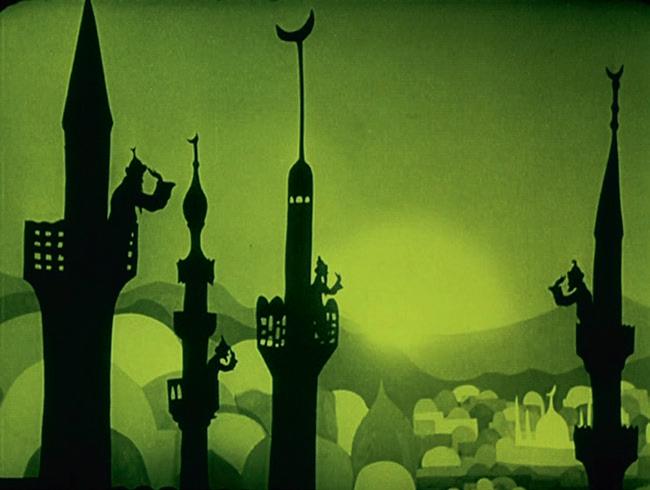
Das Wachsfgurenkabinett/Waxworks (1924) includes an episode based around the Bagdad caliph Haroun al Raschid. As played by Emil Jannings, a major German flm star, he is a semi-comic fgure, short and overweight, with his bulk emphasized by a vast bulbous turban. A polygamist with hundreds of wives, he prioritizes sexual exploits, pursuing a baker’s wife. The put-upon baker fnds sanctuary seated within the arc of an Islamic crescent on a domed rooftop. Whatever the signifcance of this image, religious or otherwise, the resolution highlights Haroun’s dubious patronage rather than Muslim values. The German animated flm Die Abenteuer des Prinzen Achmed/The Adventures of Prince Achmed (1926) has been cited for its respectful treatment of Islam (cf. Shaheen 46). The flm exhibits such Muslim-infected tropes as a banner bearing a crescent moon and a star, along with calls to prayer from minarets. However, a caliph’s oath, ‘By the beard of the Prophet’, is problematic, suggesting a trivialization, or ignorance, of the religious context. Prince Achmed’s invocation of Allah’s grace is linked with female capitulation to patriarchal control, often
23 The edition under review is an abridgement prepared for home viewing, entitled The Arabian Nights. The original version is believed lost.
24 Both books had been adapted into flms several times by the early 1920s.
cited in Euro-American discourse as a prime example of Muslim subjugation. The penultimate shot of the flm, in its surviving version, is a long view of four muezzins calling from towers, as the sun rises in the distance, the men raising their arms then bowing (Fig. 1.1). This image is associated with the restoration of normalcy and order, which could be read as an endorsement of Islam. The fnal shot, framing Achmed with his family and fancée, may be interpreted as affrming this perspective, yet the adventures depicted manifest little sense of an Islamic milieu.
The Hollywood-produced The Desert Song (1929) is a white saviour narrative that depicts Muslims and their religion as fundamentally alien to the West, or at least France, birthplace of the masked hero. The latter serves as the leader of Moroccan Riffs, without their suspecting his true identity. This implies an inherent superiority over a people who, it seems, cannot comprehend the basic Western virtues, let alone embrace them. Conversely, Ali Baba and the Forty Thieves (1944), one of Universal’s series of Arabian Nights spectacles (see Chap. 2), offers a clear wartime
Fig. 1.1 The Adventures of Prince Achmed (1926)
parallel: better to die resisting tyranny than face a living death under the foot of an oppressor. At the end, the Mongol fag emblematizing the occupation of Bagdad is replaced by a green fag bearing Arabic script and a crescent moon. Whatever the intentions of the flmmakers, this imagery both invokes Islam and links it with deliverance and freedom. Later American examples refract a conservative retrenchment whereby Islam is casually trivialized, if not openly condemned. The Desert Hawk (1950), set in ancient Persia, associates the Muslim faith with sexually available young women, described as the ‘fairest fowers of Islam’. The eponymous hero invokes the Qur’an and Allah to protest his romantic and marital fdelity, yet at this point he is posing as the flm’s archvillain, whose own appeals to Islamic ideals are blatantly bogus. Counterexamples to this approach are discussed in the case study chapters.
One of the more notable depictions of a historical Muslim protagonist is Lion of the Desert (1980), the second and last feature flm directed by Moustapha Akkad, who made the birth-of-Islam epic Al-Risalah/The Message (1976, see Chap. 6). Like its predecessor, Lion of the Desert was Libyan fnanced, yet the production drew heavily on Euro-American personnel both sides of the camera. Hollywood actor Anthony Quinn plays Omar Mukhtar, a Libyan Bedouin, who from 1911 to 1931 led the resistance against occupying Italian forces. Associated from his frst scene with Islam, the Qur’an, and education, Mukhtar is calm and understanding, fnishing class early so that his pupils may watch street entertainers. His insistence on making one fnal point25 underlines the conviction and determination that mark both his religious observance and his abilities as a military leader. Walking through the burnt-out ruins of his home village, Mukhtar question his decisions while holding a singed Qur’anic tablet, which emblematizes both the dangers the rebels face on a daily basis and the values which make these risks and sacrifces worthwhile. It is notable that the politically savvy Mukhtar looks beyond Islam to further his cause, seeking international recognition of the struggle for freedom. He refuses to be lectured on Islamic doctrine by a condescending Italian bureaucrat and knows that the honourable peace sought by his compatriots is impossible under Fascist colonialism. Concerned with nation, ethnicity, and tribe, Mukhtar is defned and represented largely through his religious identity. A scene where he addresses his men in a cave evokes the Prophet
25 The importance of balance in all things, illustrated by the spectacles poised on Mukhtar’s fnger.
Muhammad’s similar refuge during the journey from Mecca to Medina (see Chap. 6). Having been captured, his ritual prayer is witnessed by a ‘decent’ Italian offcer who is well aware of his own side’s moral and spiritual bankruptcy. Mukhtar’s sentence of death is calmly received as a return to God and he is framed on the gallows, Qur’an in hand for a fnal reading. A medium close-up emphasizes not so much the rope around his neck as a last prayer, Mukhtar content to die at the hands of his enemies in the service of a just cause.
The science-fction flm Pitch Black (2000) is unusual for its genre in featuring a major character explicitly identifed as a Muslim. Black actor Keith David plays Imam,26 one of several spacecraft passengers who crash land on a desert planet only to fnd their lives in further peril. Turbaned, bearded, and robed, Imam is dismissed by the flm’s antihero, Riddick (Vin Diesel), as ‘some hoodoo holy man’.27 Leading his young followers in prayer, Imam is on hajj or pilgrimage. He exhibits both optimism and faith, fnding signs from Allah where Riddick sees only self-interest and brute survival. The location of water is treated as a cause for celebration. Prayer rugs and beads have positive connotations, in contrast to their depiction in many American flms.28 Imam states that hajj refers to selfknowledge as well as knowledge of Allah. In this sense, he and his fellow survivors are now on the same hajj, whatever their religious beliefs or lack thereof. Iman serves as a trusted member of the group, in contrast to fugitive convict Riddick, and in some ways is treated as just another person trying to make the best of a bad situation. He speculates that the creatures which threaten them operate largely by sound and rightly cautions his fellow humans that the phase of darkness referenced in the flm’s title will be long lasting. While it would be a stretch to argue that Imam’s Muslim faith facilitates the redemption of Riddick, he does at least guide the latter towards alternative ways of thinking which contribute to both men’s deliverance. In the sequel, The Chronicles of Riddick (2004), Imam is integrated into both the public and domestic space, as community leader and family man. Faced with alien invasion, he recruits Riddick’s help and draws enemy troops away from his wife and daughter. Devout in the face of
26 The character is not otherwise named. Some coverage refers to him as Abu al-Walid, though this name does not appear on the credits for this flm or its sequel.
27 Hoodoo may refer to traditions of Black American spirituality, esoteric knowledge, or folk magic, though the flm does not pursue this angle.
28 See for instance Executive Decision (1996), discussed below.
death, he submits to Allah’s will rather than be transformed, or converted, to the dark religion of the Necromongers.29 Imam’s unshakeable faith helps to ensure the survival of his family and spurs Riddick’s fght back against the literally soul-stealing villain.
Rubina Ramji argues that cinematic Islam continues to refract and endorse longstanding Euro-American perceptions that rarely stray from the homogenous, monolithic, and essentialized (1). At best Islam is mysterious and exotic; at (usual) worst it is violent, confrontational, and barbaric (2, 1). Old stereotypes of lustful, desert-dwelling bearded sheiks on camels have simply been replaced or supplemented by new stereotypes— hijackers, kidnappers, and terrorists (2). Waleed F. Mahdi identifes three distinct processes by which Hollywood has downgraded, or degraded, Arabs and Muslims from human to nonhuman/animal status: denigration, naturalization, and alienation (148). While this approach may appear overly schematic, not to say extreme, all three factors can be seen in play across a variety of American flms, with a consistency evocative of political and ideological disempowerment (cf. Mingant 178). Similarly, Nolwenn Mingant identifes a longstanding Hollywood practice whereby Middle Eastern characters are denied proper voice and thereby stripped of their humanity, whether in terms of fractured English and/or pleading tones (Three Kings, 1999; The Hurt Locker, 2008), or muteness (The Hurt Locker), coupled with bodies reduced to silhouettes to achieve an audiovisual blankness (176, 178, 179).30
In Three Kings, set during the First Gulf War, the American hero has his wounded arm treated by Muslim rebels to the sound of Muslim prayer, yet exhibits scant regard for either their cause or their religion. His
29 The flm plays on the theme of renouncing religious faith in the name of survival.
30 In a similar ploy, Muslims are rendered as mostly distant fgures who barely impinge on a narrative or diegesis concerned with Euro-American protagonists. See for example Jarhead (2005), A Mighty Heart (2007), and Kajaki/Kilo Two Bravo (2014). Episode six of Generation Kill (2008) gives screen-time to a young Iraqi woman, fuent in English, who questions the American military presence, the need for permission to travel in her own country, and the reasons for bombing Bagdad, her native city. Though a rare shift in focus from the central marine battalion, this scene can be read as tokenistic and didactic, not least when the woman declares that the American operation is an oil-based war of aggression, not liberation. Argo (2012) depicts the civilians of revolutionary Iran as either a threatening mob or isolated individuals, such as a housekeeper loyal to her Canadian employers; American culpability for this upheaval is acknowledged then sidelined. In Whiskey Tango Foxtrot (2016), an Afghan fxer refuses to work with an American journalist who puts both their lives at risk, yet returns to her side as the narrative requires, negating his previous agency.
subsequent enlightenment and redemption are frmly entrenched in the white saviour tradition. The Hurt Locker, set largely in Bagdad, does not entirely silence the locals, though Arabic dialogue is untranslated. An Iraqi professor and soldier speak fuent English in polite fashion, while the latter’s baffement with the protagonist’s humour and demeanour is shared by his American colleagues. An interpreter who seeks the protagonist’s help to save an involuntary suicide bomber is treated dismissively as a nuisance rather than an asset. Physically the locals serve largely as background colour and atmosphere.
Ramji cites Reagan-era flms such as Iron Eagle (1986) and The Delta Force (1986) to evidence her assertion that the Hollywood narrative of Islamic threat ‘has become a constant imagination of impending terrorism’ (3). Both flms explicitly reference the recent Iran hostage crisis that arguably facilitated the President’s frst election victory.31 In Iron Eagle, the minaret and muezzin are visually linked with machine gun emplacements and armoured vehicles, as the call to prayer dominates the soundtrack. Yet any threat to the United States is nullifed by an American teenager who singlehandedly beats the aerial might of a (fctional) Middle Eastern country. The Delta Force focuses on the terrorist hijacking32 of an airplane flled largely with American tourists. The leader33 is framed in close-up as he prays in Arabic, connoting a man of faith, yet is then shown beating female fight attendants with his gun. Vocally anti-American and anti-Zionist,34 the terrorists are equated with Nazis as they identify and segregate Jewish passengers, then torture and murder an American serviceman. Needless to say, the hijack is foiled by the eponymous heroes,35 with the terrorist leader fambéed into oblivion rather than paradise by Reaganite action hero Chuck Norris.
The James Bond series, regarded as an Anglo-American enterprise, did not follow this route. The Living Daylights (1987), references ongoing
31 Ayatollah Khomeini is a pervasive presence throughout The Delta Force, in terms of images and verbal references. See also Argo.
32 The flm prevaricates over the hijackers’ national origin, hinted to be either Palestinian or Lebanese.
33 Played by white American actor Robert Forster, who wears brownface make-up and speaks in accented English.
34 Here treated as synonymous with antisemitic.
35 Based on a United States Army elite special operations force involved in counterterrorism. The flm evokes the 1976 Israel Defense Forces raid on Entebbe airport, in Uganda, where Jewish hostages were held by Palestinian and West German hijackers.
American-Soviet antagonism, focused on the latter’s invasion of Afghanistan and American support for rebel mujahideen forces. Bond (Timothy Dalton) forms an alliance with Kamran Shah (Art Malik), a local leader. Shah’s frst appearance plays on negative Muslim stereotypes: he is abused in a Russian jail, his hands clutching the cell bars as he pleads for mercy in an ‘ethnic’ accent, while the jailer mockingly invokes Allah. Liberated by Bond, Shah reappears elegantly dressed and now speaking in a refned ‘regular’ British-Asian accent.36 Unwilling to serve as Bond’s lackey, Shah sets conditions for a joint mission that will beneft them both. In visual terms, he dominates the frame as much as Bond does during these scenes and is highlighted in imposing low-angle close shots as he negotiates with 007. Shah also takes care of his forces, risking his life to save an injured man from the advancing Russians. It is notable that the flm does not openly depict Shah as a Muslim, focusing rather on the character’s Anglicized traits—such as an Oxford education—and status as a Bond confederate. The Living Daylights sidesteps more problematic aspects of mujahideen activities. Rambo III (1988), which highlights the Cold War context, also presents them as heroic freedom fghters against the occupying Soviet troops. While Rambo’s mission—to rescue an old army friend—is ostensibly personal, rebel leader Masoud regards the confict as a holy war. After a Soviet massacre, Rambo declares that this is now his war and effectively becomes a mujahideen. Offered Allah’s blessings by Masoud and branded a terrorist by the Soviet commander, Rambo triumphs as part of a collective endeavour that evokes, however spuriously, an Islamic identity.
Navy Seals (1990) casts its shadowy Muslim antagonists as deceivers, thieves, and murderers. The leader articulates his reasons for hating Americans—condemned as invaders, hypocrites, and killers—and justifes his own actions as retaliatory. This perspective is, however, given little weight and his statements are contradicted by a female journalist, whose half-Lebanese parentage invests her with both neutrality and authority. These terrorists despise the West and care nothing for Islam, treating Muslim pilgrims as hostages and human shields. The journalist records a television feature on ‘True Islam’, which cites the religion in terms of tolerance, equality, justice, antiterrorism, and kinship to Christianity and
36 Malik is Pakistani-English.
Judaism. While this counter to negative Muslim stereotypes is tokenistic,37 and distanced from the viewer via the television framing, it is unusual for an American flm of this era.
True Lies (1994) has no interest in depicting such niceties, pitting American secret agent Harry Tasker (Arnold Schwarzenegger) against terrorist Salim Abu Aziz. The latter is played by Art Malik, who portrayed the heroic mujahideen leader in The Living Daylights. Aziz, by contrast, leads the Crimson Jihad, a name which invokes Western notions of bloody fundamentalist violence committed in the name of Islam. Aziz is introduced undercover in a Washington DC art gallery. Having infltrated the United States capital, if not yet the Capitol, he reveals his base nature by verbally and physically abusing a female cohort who displeases him. Though not unhandsome by Western aesthetic standards, Aziz is framed in harsh, horizontal shadows that mark and break up his face, stressing his sinister, Othered essence. Aziz is known as Sand Spider, a less than human status conveyed further through a series of images that highlight his wild fanatic stare, as observed by Tasker on a monitor.38 Aziz is not depicted as an overt sexual threat to Western women, yet his outrages are often gendered, as when he uses a woman as a human shield, holds Tasker’s wife at knifepoint, and kidnaps his teenage daughter. The danger posed by Aziz is diminished through ridicule, such as camera batteries failing as he records his threat to the American people, and a groin trauma that confrms his ultimate impotence in the face of American resilience, both national and familial.
Executive Decision (1996), another hijacking drama, associates the Qur’an, prayer beads, and by extension Islam with terrorist atrocities.39 Aside from reworking The Delta Force, a decade on, the flm ups the ante by placing plans for an attack on America inside the Holy Book.40 None of which is countered by the leader’s chief henchman belatedly turning
37 Images of Muslims at prayer and digs at CIA intransigence are unlikely to have gained much traction at the time, especially in the flm’s country of origin.
38 Once again, this brutal terrorist leader condemns Western nations, and America in particular, as killers of women and children, and as cowardly bombers of cities. The hypocrisy— and illegitimacy—of this claim has already been established, not least in the image of Aziz resting his hands on a stolen nuclear weapon. Similar strategies of representation continue to be employed in American flms, such as the recent Rogue Warfare trilogy (2019, 2019, 2020).
39 Images of Muslim men at prayer are associated solely with acts of violence.
40 After public complaints of anti-Islamism, most home video and television versions of the flm were reedited to remove perceived offensive content.
against him and claiming their mission has nothing to do with Islam or the will of Allah. Air Force One (1997) repeatedly invokes Iraq and Saddam Hussain as a clear and present danger to the United States, yet the villains here are Russian and Kazakhstani ultranationalists. While Kazakhstan is a Muslim-majority country, albeit secular by constitution, the flm makes nothing of this. Perhaps the producers felt these antagonists lacked suffcient audience recognition and impact without linkage to the number one American bogeyman of the era.41 Black Hawk Down (2001), loosely based on real events, is set in Somalia during the 1992–1993 civil war when American-led UN Peacekeepers were assigned to keep order. The depiction of Islam is clichéd, with an aerial shot of a minaret as the faithful are called to prayer, then weaponized, as a man bowed down on a beach rises to shoulder his frearm. Thus, Islamic imagery and observance are again the province of militant fanatics (cf. Mingant 174). The flm acknowledges the presence of UN troops from Pakistan, a Muslim-majority country, yet leaves their contribution vague, with the implication that they are not equal to the Americans.
It is argued that the post-9/11 climate generated a more heterogeneous mix of flms, which attempted to redress the previous imbalance of Muslim representation, offering greater complexity (cf. Ramji 16; Mingant 168).42 Mingant identifes a tendency to give Middle Eastern characters ‘a new power over language, word, and action’ (179). For instance, Syriana (2005) is cited for its relatively nuanced depiction of Muslims, not least in terms of ethnic and national diversity (cf. Ramji 10). A young Pakistani immigrant in an unnamed Arab country is faced with language barriers, unemployment, and police brutality, fnding refuge in an Islamic school that offers sustenance for both mind and body. Most of the non-English dialogue is subtitled, still a rarity at this time. Complexity need not of
41 The Russian terrorist leader refers to the American mass murder of Iraqis for cheaper oil.
42 Even United 93 (2006), which reconstructs one of the 9/11 hijacks, hints at intragroup tensions and disagreements among the terrorists. That said, stereotypes still proliferate (cf. Ramji 16). Act of Valor (2012) has terrorists detonate a bomb in an ice-cream van, surrounded by children. In Billy Lynn’s Long Halftime Walk (2016), the only visually prominent Iraqi is an insurgent framed in prolonged close-up as he is stabbed in the neck by Lynn, his head inverted in the frame and haloed by his blood. Sicario: Day of the Soldado (2018) grafts anti-Muslim tropes onto an unrelated narrative of people-smuggling on the United States-Mexico border, with prayer rugs, darker skins, and the Arabic language linked to an assault on white America. The Swedish television series Kalifat/Caliphate (2020) replays the argument that young Muslims cut off from their roots and/or alienated from their environment, whether community or family, are especially susceptible to radicalization.
course equate with subtlety, depth, or a radical revision of Muslim representation to counter decades of ingrained negative stereotyping. Mingant argues that Syriana highlights similarity as much as difference between American and Middle Eastern characters (185). While these parallels are present, the flm also deploys familiar anti-Muslim tropes. The Islamic school has an agenda of anti-West, antiliberal, and anti-Christian indoctrination, not to mention a cache of stolen American weapons. The call to prayer is heard over images of an American agent’s tortured, mutilated body. The Pakistani youth, recruited by the school’s leader, records a martyrdom video before participating in a suicide bombing. In Rendition (2007), Anwar (Omar Metwally) is an Egyptian chemical engineer long resident in America and married to a white American woman. Westernized and to a degree Americanized, though not a citizen, he is abducted, stripped, shackled, and tortured on the order of a senior CIA operative. While the flm stresses the harshness and injustice of this treatment, Anwar’s predicament is sidelined in favour of depicting the emotional toll exacted on his supportive wife43 and the soul-searching of a consciencestricken CIA offcer. The flm also equivocates over exonerating Anwar— who has the expertise to make a bomb and confesses, under duress, to contact with a known terrorist—while the key evidence against him, an incriminating mobile phone, remains unresolved.
The Reluctant Fundamentalist (2012) employs a fashback structure to depict how Changez Khan (Riz Ahmed), a Pakistan-born New York fnancial analyst, becomes a CIA suspect in a terrorist kidnapping back home. A Princeton graduate, Khan subscribes to the American doctrine of equal opportunity, seeking the high professional and social status he believes his parents are now denied in Pakistan. Detached from his cultural and religious roots, he appears to be losing his sense of identity, rather than becoming a ‘true’ American. Disoriented by television coverage of the 9/11 attacks,44 Khan responds less with anger or sorrow than a sense of awe at the terrorists’ audacity, putting himself at odds with the groundswell of American public feeling. Despite this reaction, he claims that he couldn’t choose a side after 9/11: the decision was made for him via
43 A match cut depicts both of them enveloped in shadow, suggesting that her mental suffering is on a par with his torment.
44 Conveyed through a series of jump cuts.
government-sanctioned intimidation and humiliation (an airport strip search,45 an FBI interrogation), alongside regular verbal abuse. The flm raises various strands of moral, political, and ideological complexity. As a university lecturer in Pakistan, Khan teaches his students that violent revolution may be viewed as an acceptable form of social change, with the caveat that analysis and debate are not synonymous with endorsement, propaganda, or indoctrination, whatever the CIA may believe. These concepts gain little traction, with Khan stating that America and Pakistan both follow forms of fundamentalism, in business and politics, treading a path of amoral reductivism that wrecks innocent lives. His own stance seems precariously balanced between (every)man of conscience and CIA stooge.
Body of Lies (2008) contrasts the tactics of CIA agent Roger Ferris and Jordanian security chief Hani Salaam (Mark Strong) as they pursue terrorist leader Al-Saleem. As the flm’s title suggests, Ferris is not concerned with strict veracity, making empty promises of protection for informers. Hani insists that their working relationship, and tentative friendship, must be based on truth. Placed centre-frame in sharp close-up, with Ferris positioned on the side, out of focus, Hani has a visual dominance to underline his laying down of terms. Where Hani recruits a jihadist as an informant, claiming it will make him a good Muslim, Ferris frames an innocent man, to draw Al-Saleem, and gets him killed. Hani disowns Ferris as a liar who violated their friendship yet also spares the latter a painful death, emerging from the light to rescue the captive CIA man from fgurative and literal darkness. Adopting a pragmatic, even Machiavellian approach to combat terrorism, Hani succeeds where the CIA, with all its resources, could not, capturing Al-Saleem through his inside man. While Ferris is fuent in Arabic and affects a knowledge of the Qur’an, his ignorance of the local Muslim culture leaves him both adrift and a liability in the Islamic world, refracting the wider failings of American foreign policy.
Moustafa Bayoumi identifes a cycle of flms, including The Siege (1998), The Kingdom (2007), and Traitor (2008), which focus on Black AmericanArab understanding and friendship, with a clear implication that the former ‘know better than whites how to talk to Arabs’ (117).46 Bayoumi links this trope with a Black tradition of seeking transformative antiracist,
45 Lest the point be lost on the viewer, a medium close-up of the naked Khan merges with a dust cloud formed by one of the collapsed Twin Towers.
46 Three Kings also plays on this idea, with a Black American praying alongside the Muslim faithful, albeit to Jesus—a Prophet in Muslim doctrine—rather than to Allah.
anti-imperialist alliance with Arab and Muslim regions (123). I suggest it facilitates another agenda. The Black American serves as a mediator between his white seniors and the Arab-Muslim ally; the latter thus observes the American-decreed agenda without being fully incorporated into the team or recognized as an equal. Any appreciation of their abilities is depicted as the personal response of a fgure whose own minority status is rarely elided, even if not explicitly problematic.
In The Siege, Tony Shalhoub, a Lebanese-American actor, plays Frank Haddad, a New York-based FBI agent partnered with Anthony Hubbard (Denzel Washington). Depicted as a dedicated professional, Haddad deploys both logic and instinct. He is also humanized, or rather Americanized, employing local colloquialisms, playing football, and displaying a keen sense of humour.47 His family life is depicted as warm and affectionate and includes attendance at a religious service, alongside Hubbard and other colleagues. Fluent in Arabic, Haddad serves as Hubbard’s translator, often in high-risk situations. He advocates a hard line with suspected Arab terrorists48 and, more contentiously, seems dismissive of American civil liberties laws. Haddad elbows a Palestinian suspect in the face and is reprimanded by Hubbard, the flm’s unwavering embodiment of American fair play. Haddad’s perspective is challenged after terrorist attacks in New York prompt the declaration of martial law and the internment of Arab Americans, including his teenage son. Referring to himself as an FBI ‘sand nigger’, he quits on the grounds that his 20-year American citizenship and ten years with the Bureau count for nothing in the new political climate. Haddad and his family are no longer Americans, rather Arabs in America and therefore both automatically suspect and disqualifed from basic human rights. For all the rote melodrama of these scenes, and the tokenistic resolution,49 the point is made that Arab Americans, whatever their religion, have no effective public voice.
47 In terms of costuming, Haddad wears a blue shirt, which carries warmer, less formal connotations than white. Peter Gottschalk and Gabriel Greenberg argue that the Westernized Haddad has minimal association with Islam, in contrast to the terrorist leader, which tends to endorse the supposed link between Muslims and religiously infected violence (62).
48 Haddad states that this is the way things are done in his (unnamed) home country, so therefore neither originating in nor intrinsic to United States law enforcement practices.
49 Hubbard brings Haddad back into the FBI fold and their renewed bond is affrmed as they jointly gun down their terrorist enemy. The mistreatment of Arab Americans, Haddad’s family included, is attributed to a rogue general, downplaying any wider culpability, not least in regard to institutional attitudes.
The Kingdom features a Saudi Arabian police offcer, Colonel Faris Al Ghazi, played by Arab-Israeli actor Ashraf Barhom. After a terrorist attack on an American oil compound, Faris is obliged to work with an FBI team, led by Ronald Fleury (Jamie Foxx). Shown as a humane man, who protests a brutal interrogation, Faris acknowledges local problems but will not accept criticism from patronizing American agents. Both sides are depicted as plagued by internal dissent and interdepartmental conficts which hamper the fght against a common enemy. Depicted in his domestic environment, Faris is a good husband, father, and son, and also a devout Muslim, leading his family in prayer. Faris gradually bonds with Fleury, their growing empathy affrmed with a series of prolonged closeups and an image of the men fring their weapons in unison during a rescue operation.50 When Faris is cut down in the line of duty, another exchange of intense close-ups shows Fleury holding his dying colleague, and declared friend, assuring him that their mission was a success. Faris has proved his worth, with the ultimate sacrifce, yet only Fleury bears testament to the fallen offcer and the flm makes it clear that the terrorist threat will inevitably persist for generations to come.
Traitor confates these two fgures in the form of Samir Horn (Don Cheadle), a Sudanese- American. Formerly with the United States Army Special Forces, Horn now operates as a freelance arms dealer, frst seen offering explosive to Yemeni terrorists. Visually associated with confnement and shadow, he is regarded by American intelligence as an opportunist rather than a fanatic, and not trusted by any side, his darker skin contrasted with both Arabs and white American agents. In jail, he is mocked by fellow prisoners for his Muslim stoicism and observance, as when he shares his food with a stranger. It is implied that this behaviour is merely a strategy to gain the trust of an incarcerated fundamentalist leader,51 yet the flm has already hinted otherwise. A 1978 prologue shows the young Samir’s Muslim observance, in terms of prayer and Qur’anic study, just as his life is shattered by the car bomb that kills his father. This scene subverts the Euro-American practice of equating Islam with
50 Fluent in English, Faris has visited the United States, training at Quantico, and enjoys American sports and television shows. Thus, Fleury is not required to gain any understanding of his new friend’s language, culture, or traditions.
51 The flm’s visual motifs include a chess board, a conventional means of denoting schemes and agendas as yet not fully revealed.
terrorism, the latter instead depicted as an assault and outrage upon the former.52
Horn is revealed to be a deep-cover American agent who reports to an older white man.53 Isolated in the frame, he expresses guilt over a covert operation that resulted in unplanned casualties. A low-angle close-up depicts the angst-ridden Horn seeking consolation and reassurance in his faith, eyes closed, hands raised in prayer. This focus on a devout Muslim, who serves as a willing agent for international security despite great personal cost, physically and mentally, is arguably unprecedented in EuroAmerican cinema. The flm’s penultimate scene is a somewhat perfunctory encounter with a white FBI man, whose exchange of Qur’anic quotes with Horn—related to the taking and saving of innocent lives—appears to offer a racially infected establishment endorsement of the latter’s choices.54 The problematic aspects of this scene are visually overwritten by the flm’s fnal shot. The relocated Horn is once more at prayer, his face tightly focused in medium close-up. Samir’s head rises to be bathed in sunlight, connoting at least a momentary sense of peace, harmony, and clarity informed by his Muslim faith and identity.
More recently, a series of flms depicting post-9/11 American operations in Iraq and Afghanistan refracts a wariness towards Muslims where the development of mutual trust is possible but problematic and usually feeting. The British-produced Battle for Haditha (2007) is perhaps an anomalous outlier to the cycle in its depiction of an actual incident in 2005 Iraq. Employing a nonprofessional cast of former American servicemen and Iraqi civilians, the flm centres on the planning, execution, and aftermath of an IED attack on an American convoy. Battle for Haditha aims to humanize all parties, even those involved in terrorist acts or military atrocities. Locals try to maintain a semblance of normal life, aware that Al Qaida-led insurgency is worsening the situation. There is tension between combat-weary home-grown fghters and more zealous foreign recruits, with the former being paid to undertake missions. Fatigued American ground troops regard any Iraqi as a potential enemy, not
52 Horn later asserts that the real traitors are the traitors to Islam, a loaded statement that seems to be applied specifcally to his current predicament.
53 The latter views their mission—as a war to be won at all costs, with pawns sacrifced where necessary—in terms not dissimilar to those of Horn’s main terrorist contact.
54 The agent’s line ‘You’re a hero, Samir’ can be read as an empty valorisation, directed at a man who will not simplify or sanitize his actions in these Americanized, or Hollywoodized, terms.
realizing that the DVD seller who banters with them in English is an insurgent. Caught between Al Qaida and the Americans, noncombatants face being killed as either collaborators or traitors. Post IED attack, the resulting panic, fear, and anger trigger lethal retaliation in almost any direction. As the flm makes clear, American slaughter of innocent Iraqis serves Al Qaida’s interests in the propaganda war.
Green Zone (2010), set in 2003 Bagdad, is concerned with the search for Weapons of Mass Destruction, with an emphasis on fawed American intelligence, interdepartmental conficts, coverups, and political and media pressures. The key Iraqi character is Freddy (Khalid Abdalla),55 who warns American troops of a Sunni Ba’athist plot involving General Al Rawi, an associate of Saddam Hussein. Pinned down by a wary soldier, Freddy’s agitated manner refracts the flm’s overall visual design (unstable framing and rapid edits). Embedded in this volatile environment, he is at least in tune with what is happening at ground level. A veteran of the 1987 IranIraq war, which impaired his body but not his will,56 Freddy is established as a voice of experience and authority. He points out American ignorance, irrationality, and misuse of resources to protagonist Roy Miller, an Army Chief Warrant Offcer. Aware that Americans distrust him, Freddy will not be reduced to a Middle East cliché and stands up to Miller’s brusque treatment. Uninterested in fnancial incentives, he is concerned with the people and future of his country, pursuing an agenda that Miller does not comprehend. Freddy clashes with Miller over Al Rawi, who is an asset to the American but a power-hungry traitor to the Iraqi. Freddy’s viewpoint prevails when he kills Al Rawi, which effectively terminates Miller’s covert mission. Placed centre-frame, Freddy assumes visual and narrative dominance as he informs Miller ‘It is not for you to decide what happens here’.57 While this statement may appear simplistic, given the geopolitical complexities in play, it underlines Freddy’s perspective: whatever Miller’s intentions, his actions serve the interests of America, not those of Iraq.
Lone Survivor (2013) is based on a real-life Navy SEAL mission in Afghanistan. The target, a Taliban leader, is depicted with a montage of
55 Freddy gives his birth name as Farid Youssef Abdul Rahman. The flm’s credits list him only as Freddy.
56 Freddy has a prosthetic leg.
57 This stance is taken up in Mosul (2020), where a Nineveh SWAT team hunt down ISIS forces in the title city. Drawing on conventions of the patrol flm, Mosul highlights issues of national identity and legitimacy; the low-key ending suggests that the long process of reconstruction and reconciliation begins at the level of immediate family.