Agora, an interdisciplinary journal grounded in the humanities, is a project of the Luther College Paideia Program. The Luther College Paideia Program encompasses many activities and resources for students, faculty members, and the broader community. It includes an annual lecture series, library acquisitions, student writing services, a faculty development program that includes sabbatical grants and summer workshops, and Agora: The Liberal Arts at Luther College. All these activities receive financial support from the Paideia Endowment, originally established through National Endowment for the Humanities grants matched by friends of Luther College. The Paideia owl logo was designed by Professor of Art John Whelan.
The primary Agora contributors are Luther College faculty; writing is also solicited from other college community members and, occasionally, from outside writers. Agora was established in 1988 by Paideia Director Wilfred F. Bunge, Professor of Religion and Classics, who edited the journal from 1988-1998. Other editors include: Mark Z. Muggli, Professor of English, 1998-2004; Peter A. Scholl, Professor of English, 2004-2014; and Martin Klammer, Professor of English, editor since 2014. Agora is distributed to on-campus faculty and administrators as well as to off-campus friends of the college. Anyone wishing to be included on the print copy list or donate to Agora should contact us at (563) 387-1153 or email agora@luther.edu.
To see the current issue and archival issues online, go to https://www.luther.edu/offices/academicaffairs/paideia/agora
2025-2026 Paideia Texts and Issues Lecture
Anglo-Indian Belonging and the Imperial Construction of Race
Brian Caton
Sabbaticals
Tales from the Archives, Hollywood, and Smalltown Iowa Andy Hageman
Reconstructing the Easter Sunday Visit of the Sepulcher Rite from the Middle Ages
Melanie Batoff
Understanding “Longshot” Political Campaigns
Mike Garcia
Special Essays
Iphigenia, Mother of the Greeks?
Holly Moore
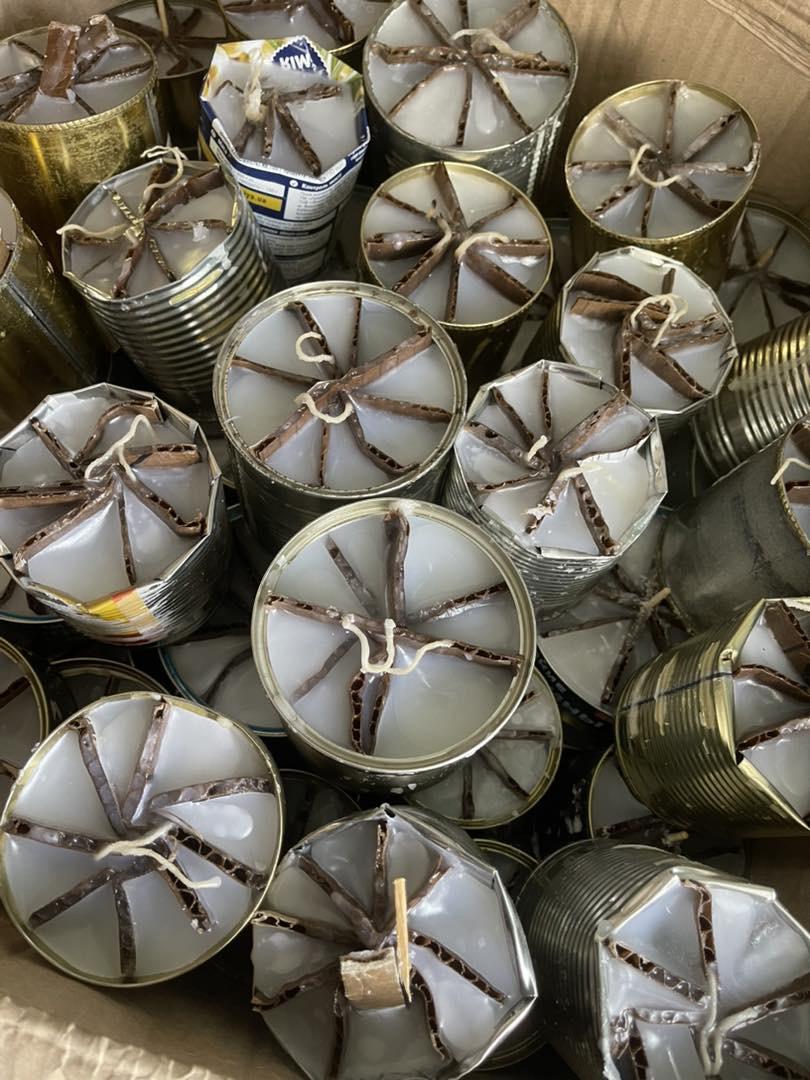
Living with War in Ukraine: A Photo Essay
Maryna Nading
“Your New York Times Have Arrived” John Moeller
First Generation Student Essay Contest
Winner Zayden Charity with Hattie Miller, Thuy My An Tran, Que An Luong, Marcia Addo, Carina Crouse, and Jaylon Whidbee
Sharing Stories of Invisible Women for the Common Good (March 6, 2026)
Nagham Boulos ’26
The Gift of Courage Within Us (March 20, 2026)
Laura Gentry ’92
Listening with the Ear of Our Heart for the Common Good (April 15, 2026)
Grace Rosholt ’26
Courage for the Common Good (April 20, 2026)
Brad Chamberlain
Postscript
Letters to the Editor on Knut Klinger
Klammer
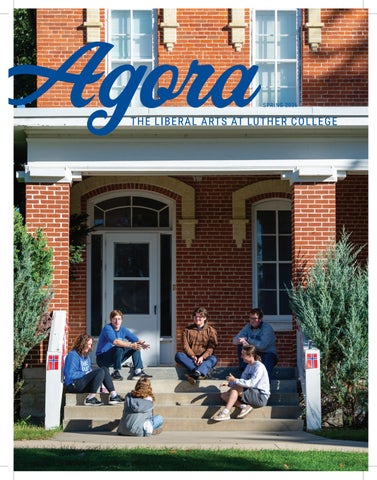
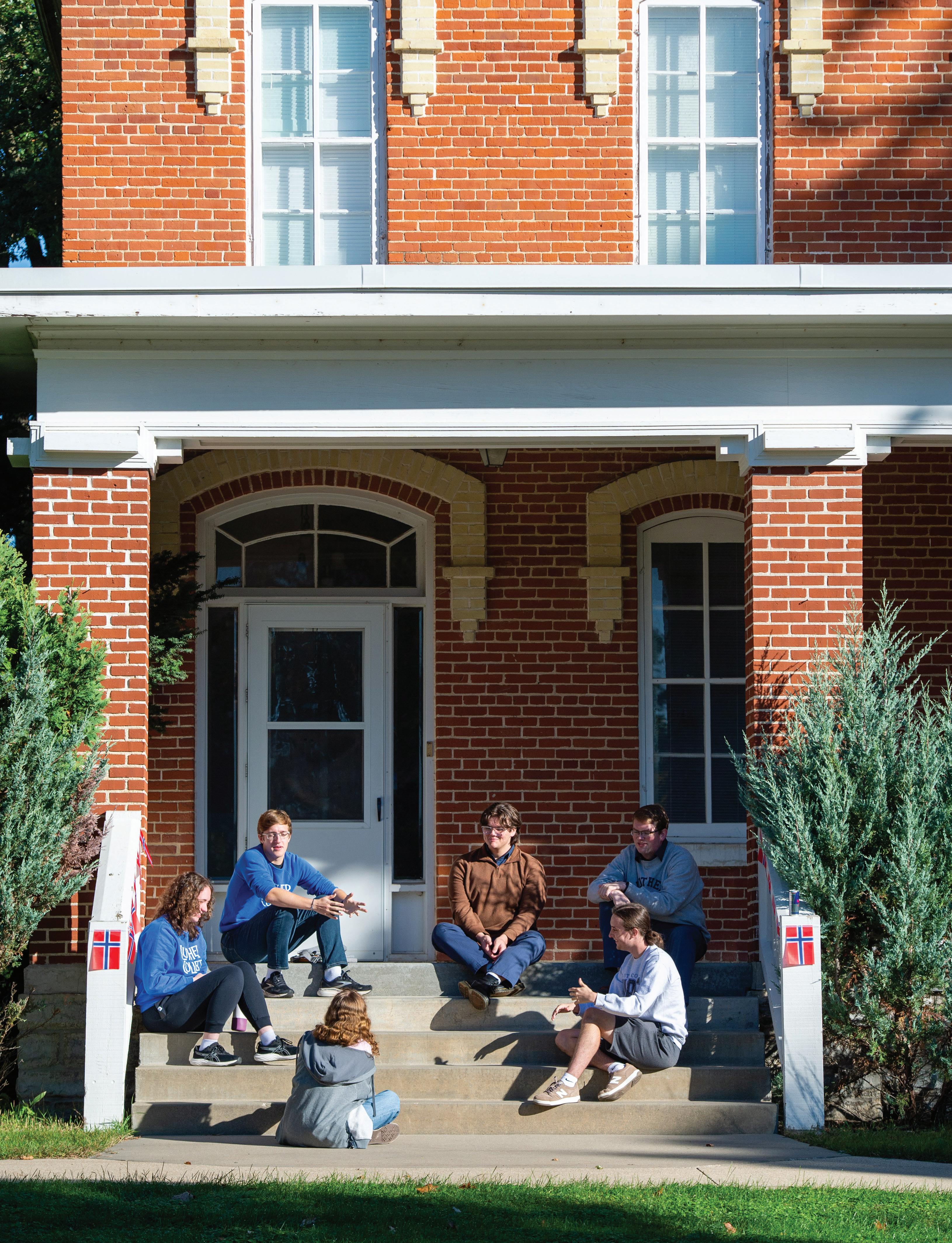
Cover: Students relax at Campus House, the oldest existing structure at Luther, built in 1867. The building is currently being renovated to preserve the exterior, upgrade the interior, and add a new addition to the back, which will serve as a gathering place for students.
Introduction
by MARTIN KLAMMER, Professor of English, Editor of Agora
In this edition of Agora, John Moeller writes about “the trials and tribulations of getting the Sunday New York Times to Decorah” from 1986 to 2001 (see page 31). In the essay, John describes how delivering the Times to colleagues was his way of contributing to the sense of community he felt at Luther in those years.
John’s essay made me wonder about “flipping the script”: John brought the Times into Luther, but I wondered how many times Luther was in the New York Times
So I typed “Luther College” in the search bar of the New York Times database at Preus Library. The answer: 203 times. But not quite! I quickly learned that there were other Luther Colleges in the United States that occasionally made it into the Times:
Luther College of the Bible and Liberal Arts in Teaneck, New Jersey, operational 1968-78, originally established as a branch of the Lutheran Bible Institute in 1948. Herbert W. Chilstrom (19312020), the first presiding bishop of the Evangelical Lutheran Church in America (ELCA), was a professor of religion and academic dean from 1962-1970.
Pleasant View Luther College in Ottawa, Illinois, founded in 1896 by the United Norwegian Lutheran Church in America as an academy and junior college before closing in 1936 during the Great Depression.
Luther College and Academy in Wahoo, Nebraska, founded by Swedish Americans in 1883 and operational until 1962, begun as an academy before adding a junior college in 1925. The college merged with Midland College in Fremont to become Midland Lutheran College (now University) in 1962.
Luther College at the University of Regina (Canada), a federated liberal arts college of the University where students are technically enrolled in both the college and the university.
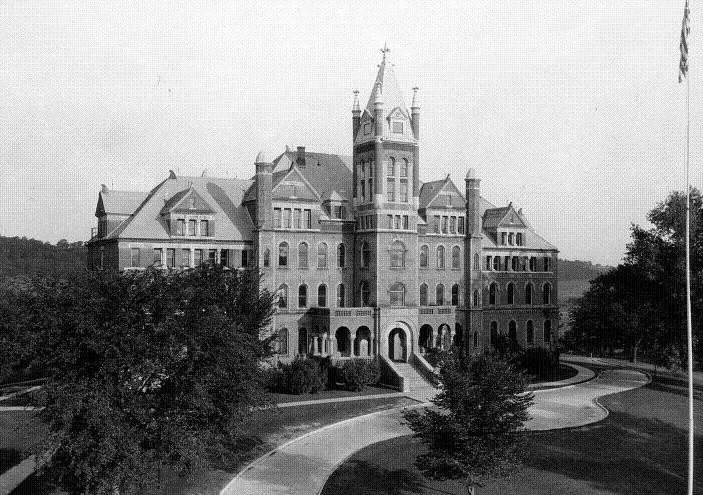
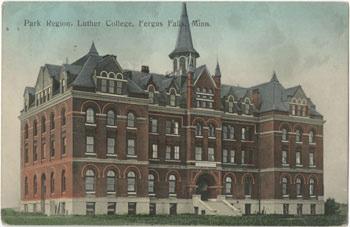
Park Region Luther College in Fergus Falls, Minnesota, established in 1892 by the Norwegian Lutheran Synod, first as a high school then a four-year liberal arts college in 1909. In 1917, the college programs moved to Concordia College-Moorhead. Park Region Luther College continued as a junior college until it closed in 1932. The campus was purchased by the Church of the Lutheran Brethren and has been home to Hillcrest Lutheran Academy since 1935. The similarities between Park Region Luther and our Luther are striking: both are liberal arts colleges founded by Norwegian-American Lutherans on a hill above a river in a small picturesque Midwestern town. Park Region’s “Old Castle” red brick building, erected in 1901, even looks like Main II, erected in 1890. See for yourself on the next page!
Having spent a fair amount of research time looking at most of the 203 mentions of “Luther College” in the Times, I can confidently state that our Luther College appears far more frequently than the others.
The most frequent references to Luther College in the Times are the notices and occasional reviews of music ensembles led by Weston Noble, first as conductor of the Concert Band and then as Director of the Nordic Choir. A 1957 Times review noted that the band played “with the smoothness, precision, and polish of professionals” under the “guidance of an able bandmaster.” A 1970 review was no less effusive: The band “had been molded into a top-notch ensemble, thanks largely, no doubt, to the leader
of the band, Weston Noble…. Many of these musicians would be a credit to any of the country’s symphony orchestras.”
Weston was also interviewed by the Times in 1999 on the death of the choral conductor Robert Shaw. Given Weston Noble’s stature in American choral conducting, it’s surprising—and unfortunate—that his death in 2016 was not acknowledged in the Times.
One of the longer pieces Luther College pieces in the Times is a June 1970 feature article on Luther student Cheryl Browne—“Miss Iowa, the Black Girl From Queens”—highlighting that she was the first Black American contestant in the then 50-year-old Miss America Pageant. The article said she carried a B average in psychology, and that among her extracurricular activities was “marching in picket lines with the Black Students Union, which eventually persuaded Luther College officials to start a Black Studies program.”
Martin Klammer
A Times feature from 2017 is about Luther alumna and Emeritus Regent Wendy Davidson, when she was vice chairwoman of the Luther Board of Regents. Titled “First, Get Uncomfortable. Second, Start Growing,” the article is an interview with her about her career and role as president of Kellogg Specialty Channels in Elmhurst, Illinois. “I gained a broader perspective on life during my time at Luther College,” she said. “I studied theater in the U.K. one semester, which shaped my belief that the world is smaller than we think.”
There’s a 1954 feature story detailing the exhibits of the Norwegian-American Historical Museum downtown, and occasional sports stories—football star Brad Hustad leading all small colleges in rushing in 1959, Bob Naslund succeeding Edsel Schweitzer as football coach in 1978, and an impressive baseball result from 1932: Luther College 3, Michigan State 1. And then there’s this quirky little item from July 1915: A baseball team of brothers plays in Bode, Iowa. The team, known as the Sorlein Brothers Club, has a line-up of nine brothers, ranging in age from 17 to 30 years. Six of the nine are graduates of Luther College.
There are also obituaries of notable Luther alumni:
• the Rev. Dr. Lauritz Larsen (18821923), president of the National Lutheran Council in America and son of the first Luther College President Laur. Larsen and Ingeborg Astrup Larsen;
• William Koren (1865-1937), one of eight children of the Reverend U.V. and Elisabeth Koren, Professor of Modern Languages at Princeton for 32 years;
• J.C.M. Hanson (1864-1943), an “internationally known librarian” who, as Professor of Library Science at the University of Chicago, shaped the American Library Association system of cataloguing and helped “re-form the Library of Congress in Washington and the Vatican Library in Rome.”
And more recently:
• O. Ivar Lovaas (19232010), who developed a behaviorist approach that “helped change the treatment and public perception” of autism in children;
• Adolph Herseth (19212013), for 53 years the principal trumpeter of the Chicago Symphony Orchestra, “one of the most accomplished and influential orchestral trumpeters of his time,” and for whom a fouryear music scholarship at Luther is named.
There are certainly more! But there’s also an obituary of a famous Luther student who never quite graduated: Rasmus B. Anderson (1846-1936), described by the Times as “the father of Norse literature in America.” One of the first Americans to claim that Leif Ericsson discovered America, he founded the Scandinavian Department at the University of Wisconsin and served as US Minister to Denmark. Before all that, however, “His education at Luther College, Decorah, Iowa, was terminated abruptly as he was about to be graduated when he rebelled against the stern discipline. He was expelled and turned to farming….” Well, I guess we lost one there!
The similarities between Park Region Luther College in Fergus Falls and our Luther are striking; even Luther’s Main II building (top image) is similar to Park Region Luther’s “Old Castle” (bottom image).
and Maryna Nading’s photo essay strikingly depicts “the new abnormal” in Ukraine. Four chapel talks address different perspectives on the semester chapel theme of “Courage of the Common Good.” And, in a rare coda, there are two letters to the editor that remind us not to take ourselves too seriously.
As editor of an admittedly more modest publication, I’m struck by the consistently high quality of the writing I am able to feature in Agora. In addition to our usual fine batch of sabbatical essays and Brian Caton’s scholarly Paideia Text and Issues lecture, we again include student writing from the First-Generation Student Essay contest. In addition to John Moeller’s New York Times piece, there are two other special essays: Holly Moore offers a provocative reading of Iphigenia as the “mother” of the Greeks,
We’d like to remind you that the issue is in full color on our website: https:// www.luther.edu/offices/academicaffairs/paideia/agora.
Production Editor Bonnie Johnson and I hope you enjoy the issue!
Anglo-Indian Belonging and the Imperial Construction of Race
by BRIAN CATON, Associate Professor of History and Director of the Paideia Program
Editor’s note: This was the Paideia Texts & Issues Lecture on February 17, 2026.
For a few decades now, historians have been making efforts to explain the processes whereby Europeans, mainly, began to assign meanings to “race” and “nation” that were discrete, the one grounded in pseudo-biology and the other increasingly limited to political discourse.1 The discursive processes at work served to simultaneously include and exclude people from racial or national categories. The goal of this essay is not to review exhaustively these processes in an authoritative manner but to question the categories of person central to the narratives of such processes, particularly those pertaining to “race.”
The most persuasive narratives of the concept of race as a distinct construct, or of categories of person within that construct, focus on the post-conquest colonization of the Americas, in the period roughly 1550-1650, when high mortality among indigenous populations led European plantation owners to demand a labor force that could be fulfilled by the importation of African slaves. Although the sexual mixing of indigenous and imported populations proceeded quickly in these American environments, the needs of legal regimes that prioritized the formalization of material and human property tended to reduce rather than enlarge the number of racial categories. It may be worth noting that, in the same historical period, other political and social systems that relied on slavery—in the Ottoman Mediterranean and in numerous small central Indian kingdoms—were mindful of the place of origin of their slaves but did not develop a social or cultural system based on the notion of observable physical traits.2 In the Americas, then, one finds social identities bound to racial categories, which had legal
sanction and definition, and which fed a dominant culture obsessed with racial purity as a means of policing access to economic and political power.
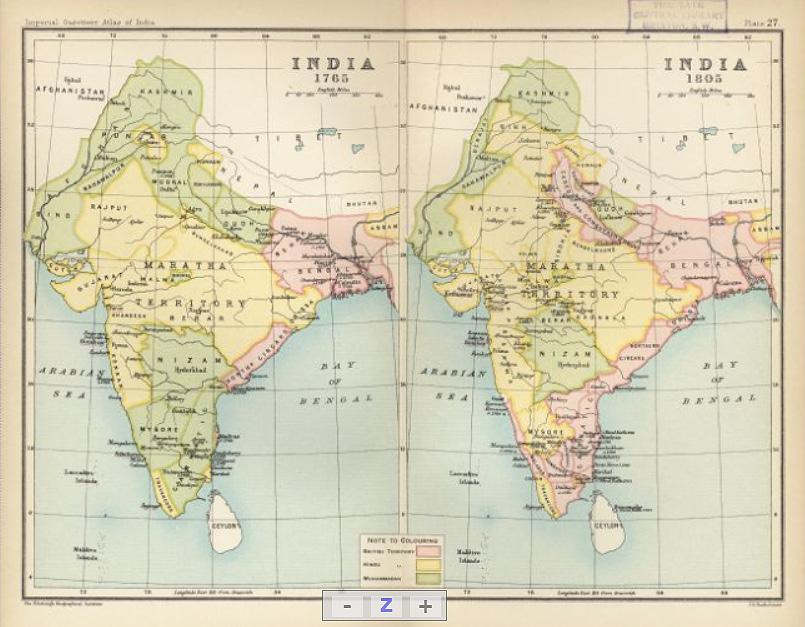
In most parts of Asia in the sixteenth and seventeenth centuries, European political power did not extend much beyond coastal enclaves, and American racial culture did not develop there at that time. The military might of several Asian states compelled Europeans to ask, often politely, to conduct commercial and missionary activities, and there were instances when Asian powers did expel Europeans they deemed troublesome. European trading companies in the seventeenth and into the eighteenth centuries encouraged the young men holding positions requiring their long-term presence in India to take on a local woman for a variety of domestic and occasionally public duties, though in most cases, since she did not convert to Christianity, the arrangement was not legally binding as a marriage. Such arrangements resulted in what we might now call mixed-race children, and in the eighteenth-century English-language sources called “Eurasians” or “countryborns.” Because most of these children were fathered by men who held either a civil or military rank that did not allow them to pay for their children’s education or who abandoned them upon their return to Britain, the East India Company came to view Eurasians as a social problem akin to orphans in Britain, rather than as a racial problem.
In the last two decades of the eighteenth century, Anglo-Indians came to be understood as a political problem. In 1786, the Company’s Government of India banned Anglo-Indian orphans from traveling to England for their education, the means by which one might qualify for service in the Company’s government, particularly the army. In 1791, this was made more
explicit when the Government prohibited anyone with an Indian parent from employment in the civil, military, or marine branches of the Company. In 1795, anyone with an Indian parent was disqualified from serving in the Company’s army except as “pipers, drummers, bandsmen and farriers.” Anglo-Indians were also banned from owning land. Historian William Dalrymple argued that this stemmed from the paranoia of Governor-General Lord Cornwallis that a “settled colonial class” should not emerge in India to challenge British rule, as had happened in what became the United States.3 If that were true, then one might expect rules prohibiting British land ownership and permanent residence in India. Why unleash such crippling measures against Anglo-Indians, particularly in limiting their access to wealth and power?
I argue that Cornwallis, his successors as Governor-General, and their governments in India sought a justification for the governance of India, and that justification was grounded upon the notion of racial difference. Anglo-Indians belied the notion of the racial purity of both
Brian Caton
British and Indians, and refusing Anglo-Indians wealth and prestige was a conscious effort to make a dream of racial purity a social reality. These efforts succeeded in pushing AngloIndians into increasingly poorer straits by the middle of the nineteenth century, a moment when British racial arrogance allowed the government to ignore what had been perceived as a threat.
Yet exceptions to this pattern may help us to better understand how Anglo-Indians thought of themselves and their life chances. James Skinner is probably the best-known Anglo-Indian, if only because of the persistence of his unit of irregular cavalry, even into the modern Indian Army, and the publication of a biography in 1851 written by the brother of his best British friend.4 Henry Charles van Cortlandt is less well-known to historians, but enough of his life and career may be pieced together to make a productive comparison. Both men had military careers culminating in being awarded a Companionship of the Bath, but they ended their days differently: Skinner died on an estate in Hariana given him for the maintenance of his cavalry unit but was soon after carted to Delhi to be buried beneath the church he built there; van Cortlandt died in a relatively new home built in the trendy and modestly wealthy London neighborhood of South Kensington. Why these different outcomes? I argue that their different childhood and young adult experiences shaped their sense of where they belonged, and their late-life experiences reflect conscious choices that they hoped would lead to the sense of comfort that belonging encourages.
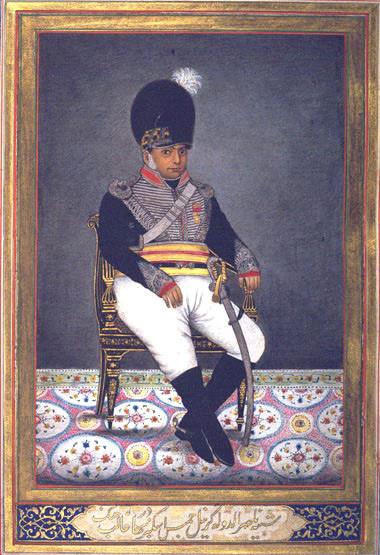
Colonel James Skinner (1778-1841). Oil on canvas by an unknown artist, a copy of the portrait by William Melville, 1836, in the vestry of St James’s Church, Delhi
James Skinner
James Skinner’s father, Hercules Skinner, operated within the norms established by and for middle-class Scotsmen of the eighteenth century. After the Acts of Union ended Scottish colonial enterprises in 1707, ambitious Scottish families sent their sons abroad as settlers, traders, civil servants, and military men, on broadly geographical lines—those from western Scotland migrated to Ireland and across the Atlantic, and from eastern Scotland to London and thence to Africa and Asia.7 Hercules Skinner’s father, David, served as provost of the town of Montrose, on the coast between Dundee and Aberdeen, from 1733 to 1746.8 This political position facilitated the entry of David’s older son James into an army regiment sent to Bengal in 1762, from which James was transferred at the rank of lieutenant to the Company’s Bengal Army in 1763. James served well enough to smooth his brother’s entry to the Bengal Army as a cadet in 1771.
The historical literature on AngloIndians has been undertaken in earnest beginning in the middle of the twentieth century and may be safely characterized as an effort in narrating the origin and development of a category of person to which the British government
gave political significance during the negotiations relating to Indian self-government held in London between 1930 and 1932. The small number of people who claimed this political identity, and their poverty, led at least some figures in the Indian Independence movement to view Anglo-Indians as an instrument of a British strategy to weaken the Indian National Congress’ claim to speak on behalf of all Indians. Thus, after the achievement of Independence in 1947, Anglo-Indians felt the need to demonstrate both their cultural distinctiveness and their sense of belonging to the new Indian nation.5 Historians who do not claim membership in the Anglo-Indian community began to take up questions pertaining to the history of Anglo-Indians beginning in the 1990s, and that very small trickle of scholarship has tended to connect to other historical studies of race and sexuality in colonial environments in other parts of the world.6
Probably at some point between this date and his promotion to the rank of ensign in March 1773, Hercules entered into a domestic arrangement with a native woman named in some records as “Jeany,” by whom Hercules fathered six children, four of whom were born by 1778.9 Skinner, in his memoir, claims that his mother was the daughter of a Rajput zamindar of the Bhojpur region, one long known for providing seasonal military labor.10 Hercules was promoted to Lieutenant in 1778 and remained at that rank until his promotion to Captain in 1784.11 The sources note that Hercules Skinner’s fifth child, Robert, was born around 1783 but do not date the birth of his sixth and last child, Elizabeth.12 James Skinner notes that, in 1790, his father sent his two eldest sisters to school, probably in Calcutta. “Jeany” became distraught at the prospect of the two unmarried girls “being separated from the protection, and care of their mother, apprehensive
of their disgracing themselves, being left, without any near Female relation to watch them, as the custom of the Rajpoot.”13 Her daughters’ izzat (honor) having been stained, she killed herself. In the wake of her suicide, Hercules sent all of the children to school and appears not to have remarried. The three oldest children did not remain in school for very long; the two girls were married off to white men of middling rank in Calcutta (a fate not uncommon for mixed-race girls) and the older brother went to sea and out of historical record. Hercules Skinner at last obtained his majority in late 1797. In the midst of campaigns at the turn of the century, he was promoted to Lieutenant-Colonel in 1800, and died in Baragaon, a small suburb of Varanasi, in 1803. Baragaon is located within the territory usually included within the Bhojpuri-speaking area of northern India, and it is quite possible that Hercules Skinner’s in-laws were connected to this village.
Skinner put his full energies into becoming “a Master of all the Hindoostan[ee] modes of Warfare.”
In 1803 James Skinner was quite unavailable to attend his father’s funeral, being in the middle of building his own prestigious military career. At age eighteen, he was bound to a printer for seven years. He hated the work, and escaped from the printer’s compound in less than a week, surviving in the bazar on day labor until he was picked up by a servant of his brother-in-law, who put him to work copying papers in his own office.14 His godfather, a Colonel Burn, arrived in Calcutta three months later, giving him a boat fare up the Ganges and a letter of recommendation to serve the Maratha army under a French commander. It was quite common in the period during and after the Napoleonic Wars for European mercenaries to travel east, to Persia and India, to look for work training local infantry in European techniques; this was the only pathway to military rank available to mixed-race men in India, as the Company’s anxiety
over mixed-race children led them to prohibit offering them commissions in the Company’s army and civil service.15 Skinner, by his own account, put his full energies into becoming “a Master of all the Hindoostan[ee] modes of Warfare.”16 Skinner highlights the several campaigns and exploits that peppered his early career, since he intended his memoir, in 1826, to demonstrate the merit in his unanswered claims to prestige. One such exploit involved being injured in the groin during a battle at Uniara, in eastern Rajasthan. Having survived two nights and days on the battlefield after the battle had ended, he was taken prisoner to the Uniara king’s camp. Skinner reports:
As soon as I arrived [to the king’s tent as prisoner] a chokedar [attendant] came with 500 Rupees, and a Tray of Khanah [food]. I gave the chokedar a hundred Rupees, and the other 4 I divided amongst the Men [of Skinner’s battalion who were also prisoners there] also the Khanah, the Surgeon gave me a good dose of Opium, which gave me fine rest all night. Next morning the Rajah pitched a small Tent for me, and wanted to remove me from the Men, which I begged he would not….17
The point of this passage is to emphasize Skinner’s regard for the men under his command, a point that suffuses his memoir and others’ accounts of his demeanor. The Uniara king clearly recognized Skinner as European, yet Skinner did what he could to identify with his Indian men. This tension came to a head in 1803. The French General Perron, in charge of the largest contingent of Maratha forces, had grown suspicious of the British and half-British officers under his command during a period when the East India Company sought to extend its control over the Gangetic valley up to and including Delhi, the nominal capital of the long-crumbling Mughal Empire. On 28 August, when one British and one half-British officer refused to fight the Company’s army quickly massing against Maratha positions, Perron dismissed all British and half-British officers from the Maratha army. Skinner and several others, despite
being ordered from Maratha territory, resolved to approach Perron’s Maratha patron for redress, and proceeded to Aligarh. The Company’s army surrounded the small group of officers outside the fort and handed them over to the Commander-in-Chief Lord Lake, who treated them “kindly.”18 Skinner remained with Lake as the army pushed on to Delhi, which Lake took from Perron on 11 September. Lake offered Perron’s defeated Maratha cavalry service in the Company’s army, and asked them who they might want to command them. They uniformly asked for Skinner, and Lake gave him a local commission.19
Skinner’s regard for the men under his command suffuses his memoir and others’ accounts of his demeanor.
Skinner’s successful military career in the service of the Company depended on his ability both to maintain connections with the soldiers under his command and to cultivate relationships with British officials, often high-ranking ones. Skinner’s unit served with distinction under Lake for the remainder of the Second Anglo-Maratha War, which wound up in 1805. At the end of the war, Lake offered Skinner the reward of a jagir, a tract of land whose revenue was given up by the government on the assumption that it would provide a regular income of a fixed annual amount. Lake’s offer was rescinded by the Governor-General, George Barlow, on the grounds that as a commissioned British officer, Skinner could not hold a jagir in the way an Indian could. Lake took this disappointment personally, awarding Skinner the pension owed to a Lieutenant-Colonel and promising him that he would take the issue to the Company’s Court of Directors upon Lake’s return to London in 1807. Unfortunately, Lake died early in 1808, before he could take up the matter.20 Skinner spent his time from 1806 in Delhi, attempting to make money through commerce. In 1808, however, Archibald Seton, Resident at the court
of the Mughal Emperor, decided to grant Skinner his jagir, which probably was the one near Aligarh that Lake had initially granted. However, Skinner was given very little time to set himself up as a jagirdar on this estate, as in 1809 he was called to supply 300 horsemen to a force assembling at Karnal with the intent of intimidating local chiefs into granting the Company’s army an outpost at Ludhiana, across the Sutlej River from the Lahore kingdom. The force quickly achieved this objective, and nearly immediately Skinner was ordered to increase his unit to 800 horses, in order to provide the muscle for the settlement of the Hariana country.21 Between 1803, when Hariana had passed to the Company along with the rest of the neighborhood of Delhi, and 1809, the Company had given the duty to collect all of Hariana’s revenue to a single individual. A series of such individuals proved unable to carry out this duty, because of the widespread local resistance to collections, and the settlement operation beginning in 1809 was meant to map out the entire countryside, assign ownership to land (or claim ownership for the state if no one came forward as an owner), and to pin down landowners to a schedule of regular assessments and collections of revenue. This work continued through 1814. During this period, Skinner acquired, perhaps initially through a purchase, his estate in Dhana, east of Hansi, on which his unit of irregular cavalry could supply themselves with crops and
animals, which the Bengal Army did not provide to irregular units.22 In 1815 Lord Moira, then Governor-General, ordered Skinner to increase the number of horsemen under his command to 3,000, which were later deployed in the Third Anglo-Maratha War (1817-19).23 At the end of the war, Skinner’s Horse was ordered returned to Hansi, reduced in number, and limited in its deployment in major military operations. In 1822, Skinner traveled to Calcutta to see off the Governor-General (who had recently been renamed the Marquess of Hastings) upon his return to Britain. Lord Hastings treated Skinner with consideration, but “no sooner [had] he left the Country, [Skinner’s command] was immediately reduced to 800.”24 Although Skinner’s Horse remained a viable military force—it remains part of the modern Indian Army—Skinner himself seemed to have reached the limits of his military career.
“I thought I had now served a nation that had no prejudice against cast or colour, but alas! I was mistaken.”
mixed-race status lay at the root of the obstacles to the official approbation he constantly sought. Skinner’s memoir concludes with a statement astonishing in its incisiveness and transparency: In the Mahratta Service from 1796 to 1803 I always had hope of rising, my merits were rewarded, my birth not questioned[.] When I enter[ed] the British Service, I thought I had now gained a field which will bring its fruit in perfection, no exertion on my part was left undone to bring myself forward. I thought I had now served a nation that had no prejudice against cast or colour, but alas! I was mistaken. I only wanted justice, which has been denied, for if they will allow me to be a Native, reward me, as such. Did not my exertions, and fidelity to the Service merit a better reward than 300 Rupees per month? What did the Natives that were Traitors to the state do, to get the rewards they now enjoy? If they had considered me as a British subject, did I not deserve a better treatment, for 20 years hard labour, than to be reduced to this state? To be commanded by the youngest subalterns? No hopes of gaining any advantage where I may respectably pass my old age, with peace and comfort, in the line I was brought up? I have one great consolation, and satisfaction, for myself, and for which I thank my Creator, that gave me birth; only, that I honorably discharged my duty as a soldier, that no European in the period of the 20 years can accuse me of dishonoring the Steel, altho’ my Birth has been the cause of my not gaining what I deserved (that is Rank) but I have proved to the world that I have served my King and Country as Loyally as any Briton in India.25
For someone so accomplished on the battlefield and in the construction of meaningful relationships with individuals at the apex of the Company’s military and civil ranks, Skinner clearly understood that the ambiguity of his
At the beginning of this passage, Skinner posits his former, Indian, employer as merit-based, a virtue that British officials ascribed to themselves. And in fact Skinner pitches his claim here in terms of “justice”: that skill, fidelity, and “labour” should earn their reward. And Skinner makes clear that the reward he thought most fitting was
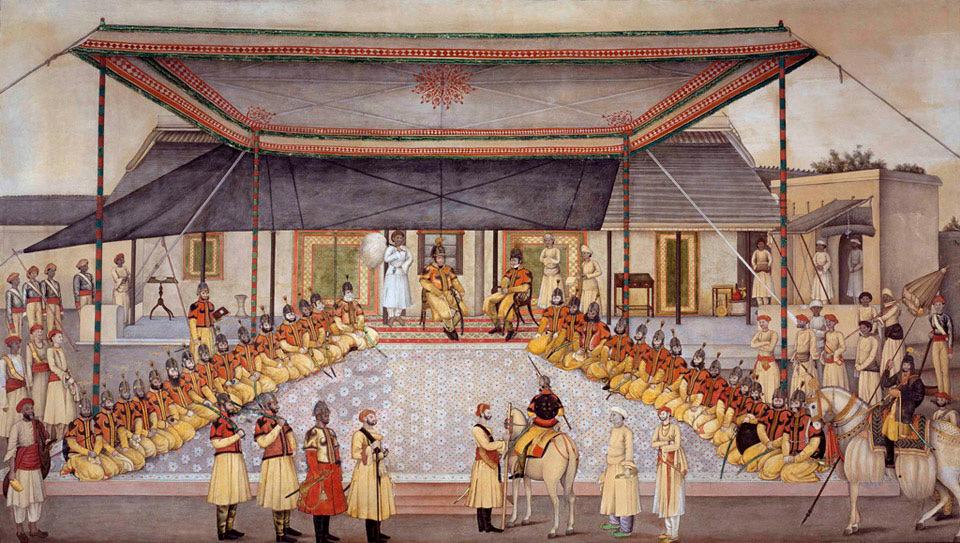
Colonel James Skinner holding a Regimental Durbar, which is a formal assembly of a commanding officer and his regiment. Watercolor by Ghulam Ali Khan, Delhi, 1827
WIKIMEDIA COMMONS
that of rank. As an officer holding local rank, he could always be commanded by the lowest-ranking officer holding a commission; he sought what, as a mixed-race man, he was prohibited from holding: a commissioned rank. In other words, he hoped his service would be rewarded with honorary whiteness, membership in the ruling class. Friends and confidants, such as Sir John Malcolm, could describe Skinner to be “as good an English man as I know”; however, informal approbation did not confer the respect and material reward of official rank.26 Formality required the continued cultivation of personal relationships with high-ranking officials, in this case Lord Combermere, who had commanded Skinner at the siege of Bharatpur and later became Commander-in-Chief in 1825. In this capacity, Lord Combermere recommended that Skinner be made a Companion of the Bath and, in order to make possible this honor, that Skinner be given a royal commission as a Lieutenant-Colonel (to match the local rank he held at that time). The Company’s Board of Directors agreed to Lord Combermere’s recommendation, and in turn King George IV granted both the commission and the honor in December 1826.27 Lord Combermere, on a tour of the NorthWestern Provinces in 1828, announced this honor personally to Skinner at Hansi, and asked him to communicate the news to his troops in Urdu.28 Although there continued to be some
delay in publicizing this double honor in the official Indian press, Skinner had achieved the status for which he had worked so diligently.
Marriage alliances, land ownership, funding public buildings, and patronizing the arts point to Skinner’s desire to shape his life into patterns for the north Indian nobility.
Yet his mixed-race status dogged the remainder of his years, in part because he had built his personal life in an Indian or hybrid style. Skinner’s memoir includes nothing of his personal life, with barely a mention of the sons who did follow him into the Company’s army, and in one case into his own unit. Hodson’s list of officers notes Skinner’s son Hercules as “by one of his [James’] Indian wives,” and his entry for Skinner’s son James does not mention a maternal relation.29 Sources disagree on the precise number of wives Skinner had and do not mention the dates across which he may have engaged in these relationships. However, it is clear that Skinner built these relationships in an effort to make himself into a petty nobleman; regional and microhistories of India in the eighteenth century, if
not earlier, abound in examples of such individuals engaging in marriage alliances to cement political relationships through social ones.30 In a letter to her sister, Emily Eden (sister of the thenGovernor-General, Lord Auckland) described Skinner as “a native of this country, a half-caste, but very black, and talks broken English. He…has made several fortunes and lost them; has built himself several fine houses, and has his zenana and heaps of black sons like any other native. He built this church [St. James’ in Delhi], which is a very curious building, and very magnificent—in some respects; and within sight of it there is a mosque which he has also built, because he said that one way or the other he should be sure to go to heaven.”31 Skinner’s house in Delhi was “fitted up in the native fashion,” and he was able, in the event of needing to entertain guests, to hire “all the best singers and dancers in Delhi, [who] acted passages out of Vishnu and Brahma’s lives, and sang Persian songs which I thought made a very ugly noise.”32 Scholars, particularly art historians, have long been aware of Skinner’s commission of miniature paintings, primarily of the north Indian nobility, that were assembled into books and often given as gifts to Skinner’s British friends. All of the things mentioned here—marriage alliances, land ownership, funding the construction of public buildings, patronizing the performing, literary, and visual arts—point to Skinner’s desire to shape his late adulthood into patterns for the north Indian nobility that had been established for hundreds of years. It would be difficult to support a claim that he had learnt these norms at the knee of his Bhojpuri Rajput mother, or in the Calcutta bazaar. A stronger case could be made for a claim that these norms were made plain to him during his period of service with the Maratha armies, through interactions with his peers and his opponents. One may read of other Anglo-Indians with successful military careers, but without Skinner’s pattern of patronage. It seems clear that Skinner sought to enjoy the benefits of his prestige, but with an eye toward his legacy. It made sense to him to build that legacy in India, rather than among strangers in Britain.
Exterior view of St James’s Church, Delhi, 1836. Watercolour by anonymous artist
WIKIMEDIA COMMONS
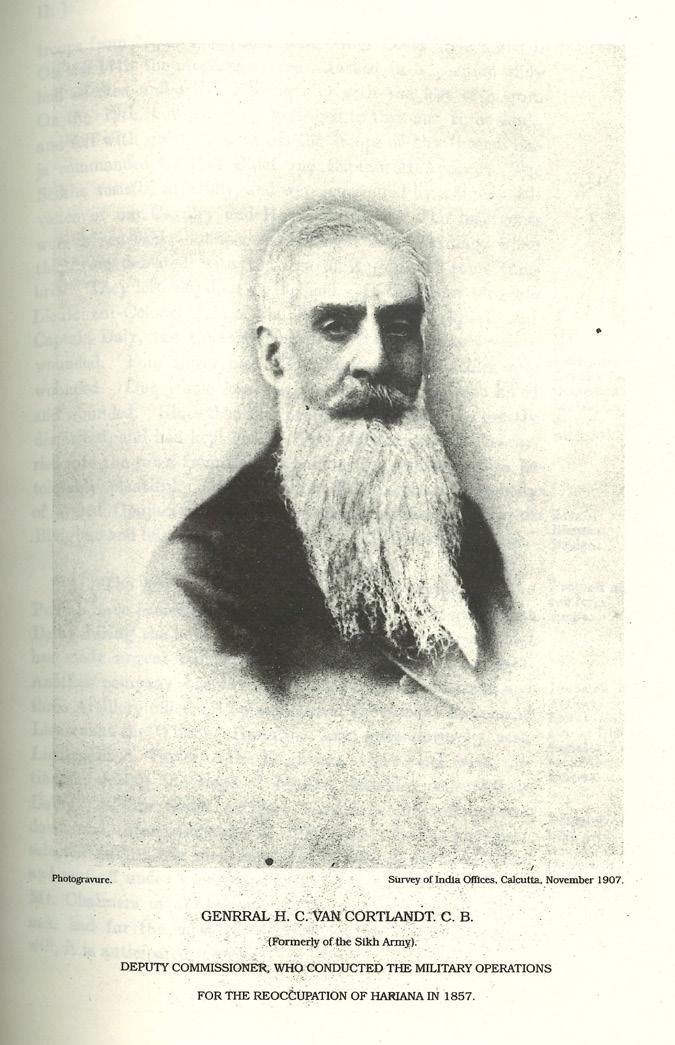
Henry Charles van Cortland (1814-1888) from Mutiny Records Correspondence Part I (Lahore: Punjab Government Press, 1911)
Henry Charles van Cortlandt
The story needs to begin two generations prior, with Henry’s grandfather, Philip van Cortlandt. Philip belonged to one of the “major” branches of the van Cortlandt family, descended from one of the first Dutch migrants who established the colony of New Amsterdam at the mouth of the Hudson River in the seventeenth century. Philip grew up in a position of remarkable wealth and privilege, belonging to the first batch of students admitted to King’s College (now Columbia University).33 Despite his education, he briefly engaged in what turned out to be an unsuccessful career as a merchant, before living the life of an “improving landlord” in New York and later New Jersey, in the style of Britain in the mid-eighteenth century. Although many others in his family sided with the revolutionaries, Philip held fast to the crown. This led him to flee New Jersey in December 1776, in hopes of finding refuge in New York City, which was then still controlled by British forces. His wife, nine children, and servants remained on his New Jersey estate, needing a special permission from General George Washington to travel to New York City to rejoin Philip. The reunion must have been a
happy one, for Philip and his wife had at least three children while in New York, before departing for England in 1783. One of these children was Henry Clinton van Cortlandt, born in 1780.
Undoubtedly, Henry Clinton’s childhood was framed, if not heavily influenced, by Philip’s efforts after 1783 to recover compensation for his property in land now within the United States. Historian Jacob Judd suggests that Philip took his substantially large family with him in 1786 to Nova Scotia, where he “filled minor posts” while attempting a reconciliation with his American relatives. He gave up this effort after about a decade, returning to England in 1799, where he died in 1814.34 This provides two options for imagining the education of Henry Clinton: either he was left behind in England, to live at a boarding school, without really having relatives to retreat to during holidays, or he was sent to school in Nova Scotia. It may also be possible that he did his early schooling in Canada and shifted to a boarding school in England in preparation for adulthood. In any case, he cannot be counted among the “adult children” among whom Philip declared pleasure in living near, while living in England after his return from Canada. Henry Clinton sailed for India in 1801, and we have no good evidence that he returned to England, at least during the remainder of his father’s lifetime. One might conclude that much of Henry Clinton’s childhood was defined by Philip’s sense of dispossession. His decision to pursue a career in the Army surely was a logical effort to build his individual prestige and rebuild his family’s fortunes through what was at that time the most certain pathway.
Henry Clinton was commissioned into the 27th Light Dragoons in 1801; this unit departed for India not long after (if it was not there already), as it formed part of the army commanded by Lord Lake that resulted in the capitulation of Delhi to the East India Company in 1803.35 It is not clear when Henry Clinton developed the relationship with the woman who became the mother of Henry Charles, but he must have done so before he was commissioned captain in the 8th Light Dragoons in 1814. One
source claims that Henry Clinton had “married” no ordinary Indian woman but “a Durani Princess, daughter of an Afghan Prince,” of whom Henry Charles was their only son, born in Meerut in 1814.36 In the absence of a marriage record, it is reasonable to conclude that this domestic arrangement was similar to others made between low-ranking British officers and Indian women in the period between 1780 and 1830.37 Henry Clinton retired at the rank of Lieutenant-Colonel in 1844 and died in London in 1864. Despite his increased rank, it is highly unlikely that his Durrani “wife” accompanied him into his retirement.38
Mixed-race men in the 1840s and ’50s were simply not offered commissions in an increasingly race-conscious service.
Records agree that Henry Charles van Cortlandt went to England for his education, but they do not indicate when or where. Historians agree that it was highly unusual for Anglo-Indians to be educated in Britain, and Henry Clinton clearly hoped that English manners and social connections would position his son advantageously in adulthood. Upon his return to India, Henry Charles seems to have emerged from his education with only his English manners and without the connections needed to secure a military commission or a civil service post with prospects for promotion. In 1832, at age eighteen, Henry Charles took a job with Maharaja Ranjit Singh of Lahore. Ranjit Singh had by that point hired several Europeans, Anglo-Indians, and Americans to train and lead infantry and artillery, and by that year the scope for mixed-race young men to serve as officers in Indian armies had decreased considerably since the 1780s. In 1833, Henry Clinton wrote to the military secretary for permission to visit his son in Punjab, arguing that he “would be, in his present situation, so materially benefitted by my visiting him that I trust there may be no reason
for objecting to my request.” Henry Clinton, in his letter, did not specify what aid he intended to offer his son. Not surprisingly, the Governor-General, Lord William Bentinck, declined the request, arguing that British soldiers should be prevented from traveling to Lahore, and that other similar applications had been denied in the past.39
Henry Charles’ early career appears to have been taken up with assignments on Lahore’s western frontier. This included attachment to Lahori troops assigned to facilitate the supply of the British troops sent to punish Afghanistan in 1841-42; by this point the Lahore court had promoted him to the rank of colonel.40 He managed to avoid the worst of the internecine politics of the Lahore court after the death of Ranjit Singh in 1839— struggles that consumed the lives of several members of the royal family and eventually set off the first Anglo-Sikh War in 1845. When that war began, van Cortlandt had been on leave in the hill station of Mussoorie but travelled to Ferozepore to serve as a “political agent” of the Bengal Army. The war resulted in the continued nominal independence of Lahore. However, the British installed Ranjit Singh’s youngest grandson, Dalip Singh, on the throne as a minor; the court had a British Resident, a feature common to other nominally independent “Princely States” in India in the nineteenth century; and British officers toured the districts to measure and map fields and assess revenues owed to the Lahore state.41 Van Cortlandt was promoted to the rank of general and assigned to manage the western district of Dera Ismail Khan, wedged between the Indus River and southern Waziristan.42 When rebellion in Multan broke out against Lahore—the beginning of the second Anglo-Sikh War—in 1848, van Cortlandt’s disciplined troops formed the core of the forces commanded by Lieutenant Herbert Edwardes that initially captured Multan from the rebels.43 The war ended with the East India Company’s annexation of Lahore’s territories; the pensioning off of the royal family; and the defeated Lahori army disarmed.
The new political situation would not have posed much of a problem for van
Map of India 1848 from Joppen, Charles [SJ.] (1907), A Historical Atlas of India for the use of High-Schools, Colleges, and Private Students: Longman Green and Co.
Cortlandt but for his mixed-race status. In his correspondence with Sir Frederick Currie, the Resident at Lahore, Edwardes reported that, prior to the outbreak of rebellion in Multan in 1848, van Cortlandt had contemplated retiring after two more years of work as the nazim of Dera Ismail Khan, “on the saving of his Nizamut and whatever pension the Sikh Durbar…would have given him.”44 The Company could not simply return van Cortlandt to his prior position in Dera Ismail Khan commanding Bengal Army forces at the rank of general or even colonel, as doing so would require the Company to offer him a commission at high rank without having prior service at a lower rank, bypassing the very men he might have been asked to command. And mixed-race men, in the 1840s and 50s, were simply not offered commissions in an increasingly race-conscious service. Even before the conclusion of the war, Edwardes recommended that van Cortlandt be given charge of Multan, noting that van Cortlandt had a reputation for diligence, incorruptibility, and taking personal oversight of accounts in civil cases, in order to guard against potential fraud by lower-ranking civil servants: “No kardar can deceive him, for he inspects all accounts himself and spares
no one.”45 While his mixed-race status kept him from easy recruitment into the officer corps to be deployed in the newly-annexed province, it apparently did not pose a bar to his recruitment into the civil service, in which his prior administrative experience in western Punjab was clearly an asset.46 His willingness to serve the British military in 1841-2, 1845-6, and 1848-9 must also have shaped positively decision-makers’ views of his character.
Van Cortlandt served in the civil service of the new Punjab provincial government before the outbreak of the Great Rebellion in May 1857.47 In 1849, the new government of Punjab province appointed him Deputy Commissioner of Dera Ghazi Khan district, the highestranking civil authority at the district level. In 1854, he accepted a lateral transfer to the post of Deputy Commissioner of Gugera District. When the Rebellion broke out, van Cortlandt had just been transferred to take up the Deputy Commissionership of Ferozepore.48 Because of the timing of the outbreak, and perhaps because of his prior experience in military command, he was relieved of the civil duty in Ferozepore and instead ordered to assemble and command a corps of levies, including those sent by local strongmen, such
as Ghulam Mustafa Khan Khakwani of Multan District.49 This corps of levies was assigned to recover the territory between Ferozepore and Rohtak, nearly all of which was perceived to have been under the control of mutineers and various other rebels against British rule. This included action in Sirsa, Hissar, and Hansi (from which James Skinner’s descendants had been forced to flee). Although many volunteer corps serving under British officers continued to march through Delhi, Lucknow, and points south and east of Punjab, van Cortlandt was ordered to remain in Hissar, in order to oversee the recovery of government property; to punish rebels and reward those who aided white people; and to stand at the ready to mobilize military force if rebellion flared up in the neighborhood. For his efforts, he was made a Companion of the Bath in 1858.
Van Cortlandt had a reputation for diligence, incorruptibility, and taking personal oversight of accounts in civil cases.
From this point in his life, at age fortyfour, van Cortlandt took a series of steps that raise several puzzling questions. At some point in 1858, he put in a request to retire on the pension of his rank; the Chief Commissioner of Punjab had approved this request and forwarded it to the Government of India for final approval.50 In the correspondence related to this request, it is noted that since 1849 van Cortlandt had been paid a salary of 2000 rupees per month, which was 500 rupees greater than the maximum allotted to civil officers at the rank of Deputy Commissioner. Why did van Cortlandt fix on retirement at such a relatively young age? Did the Great Rebellion highlight the personal risk he faced by continuing to serve the colonial regime, even in a civil capacity, as he had done for most of the ten years prior? Did his lateral, rather than vertical, transfer just prior to the Rebellion, or just after it, suggest that his prospects
for greater prestige within the Punjab administration were limited, perhaps as a result of his mixed-race status? Whatever the reason, the Court of Directors rejected his request, offering him instead a pension calculated on length of service. Van Cortlandt, in 1860, pressed his case again, arguing that his case was exceptional and could not serve as a precedent—for what or for whom, he does not specify—and that his retirement would actually save the government £700 per annum, the difference between his proposed pension and his then-current salary.51 The GovernorGeneral, when considering van Cortlandt’s appeal, observed that the highest “ordinary military pension” was that of a full Colonel, £456 and five shillings per annum, and that van Cortlandt should be awarded this pension at his retirement, “in consideration of the long and valuable services performed by General Van Cortlandt under the Durbar and the British Government.”52 This sum was somewhat less than the £500 per annum that van Cortlandt had originally proposed. Government sources do not record van Cortlandt’s reaction to the Governor-General’s proposal, but his continued service in the Punjab civil service suggests some degree of dissatisfaction and perhaps the hope that he could accumulate the twenty-five years of civil service needed to lift him to the pension reward of £500 per annum.
The remainder of van Cortlandt’s civil service career passed relatively quietly. Van Cortlandt remained in Hissar as a Deputy Commissioner, through at least early 1861. That year he accepted yet another lateral transfer to become Deputy Commissioner of Multan, the last post in which he served before his retirement in 1868 and return to England.53 It is difficult to know his reasons for returning to England, rather than finding an estate in India on which to live out his retirement. Perhaps his father, having not remarried in England or left another potential heir, left a substantial inheritance that could be accessed only in person. Perhaps he had no offspring or family connections to bind him to India. In any case, once he returned to England, he had saved enough, and drew enough in pension, to buy a relatively new house on Onslow
Crescent in South Kensington, London, where he died in 1888.54 Extant records say virtually nothing of van Cortlandt’s retirement years. This fits consistently with the public record of a man who carried out his duty, competently and without flair or drama; expected just and fair compensation; and lived constantly in the shadow of his mixed-race identity.
Conclusion
One could plausibly argue that James Skinner and Henry Charles van Cortlandt were more alike than not: given the options available to them, they both chose, in the end, to hang their hats on the prestige and power structures created by the British East India Company and, after 1858, the Crown’s government in India. But it seems clear that, for Skinner, service to the Company was the means to an end—land—through which he could live out the model of a north Indian petty nobleman, someone whose wealth and privilege were to be exercised in the reproduction of culture and civilization. For van Cortlandt, service to the Company in 1846 (and again in 1848) was not much of a choice: why would he waste his career, or even his life, by remaining in the service of a native state certain to implode? It may be that Skinner had retired at the end of a historical moment in which it was possible for an Anglo-Indian to even imagine cultural power in an Indian idiom, and that van Cortlandt retired in the middle of a historical moment when racial purity was at the apex of its normativity. But for both men, being Anglo-Indian was not always at the front of their decisions about how to act within a particular instant, yet they never could escape their uncomfortable position of belonging entirely with neither a dominant British order nor an Indian Other as its foil.
NOTES
1.Emmanuel Chukwudi Eze, “Introduction,” in Emmanuel Chukwudi Eze, ed., Race and the Enlightenment: A Reader (Malden, MA: Blackwell Publishers Inc., 1997), 1-8; E. J. Hobsbawm, Nations and Nationalism Since 1780: Programme, Myth Reality, 2d ed. (Cambridge: Cambridge University Press, 1992), 63-7; Ann Laura Stoler, Race and the Education of Desire: Foucault’s History of Sexuality and the Colonial Order of Things (Durham and London: Duke University Press, 1995), 28-42; Claude Blanckaert, “Of Monstrous Métis? Hybridity, Fear of Miscegenation, and Patriotism from Buffon to Paul Broca,” in Sue Peabody and Tyler Stovall, eds, The Color of Liberty: Histories of Race in France (Durham and London: Duke University Press, 2003), 53-4.
2. Ehud R. Toledano, Slavery and Abolition in the Ottoman Middle East (Seattle and London: University of Washington Press, 1998); Richard M. Eaton, “Malik Ambar (1548-1626): The Rise and Fall of Military Slavery,” in A Social History of the Deccan, 1300-1761: Eight Indian Lives (Cambridge: Cambridge University Press, 2005).
3. William Dalrymple, White Mughals: Love and Betrayal in Eighteenth-Century India (New York: Viking, 2002), 39-40.
4. James Baillie Fraser, Military Memoir of Lieut.-Col. James Skinner, C. B., vol. 2 (London: Smith, Elder and Co., 1851).
5. Frank Anthony, British Betrayal in India: the Story of the Anglo-Indian Community (Bombay: Allied Publishers, 1969); Lal Bahadur Varma, Anglo Indians (New Delhi: Bhasha Prakashan, 1979).
6. C. J. Hawes, Poor Relations: The Making of a Eurasian Community in British India, 1773-1833 (London: Curzon, 1996); Durba Ghosh, Sex and the Family in Colonial India: The Making of Empire (Cambridge: Cambridge University Press, 2006).
7. Andrew Mackillop, “Locality, Nation, and Empire: Scots and the Empire in Asia, c.1695c.1813,” in Scotland and the British Empire, ed. John M. Mackenzie and T. M. Devine (Oxford: Oxford University Press, 2011), 70-1.
8. Maj. V. C. P. Hodson, List of the Officers of the Bengal Army, 1758-1834, vol. 4 (London: Phillimore & Co. Ltd., 1947), 108.
9. Hodson, List, 108; see also James Skinner Papers, Mss. Eur. 173, India Office Records (IOR), British Library, 1. It is likely that the name is a shortened and Anglicized rendering of a name ending in -jini, such as Rajini, but official sources, such as birth and marriage records, seldom provide Indian women’s names, most often recording an English name (such as “Elizabeth”) when indeed a name was recorded. See Ghosh, Sex and the Family, 18-20.
10. On Bhojpuri military labor, see Dirk H. A. Kolff, Naukar, Rajput & Sepoy: The Ethnohistory
of the Military Labour Market in Hindustan, 1450-1850 (Cambridge: Cambridge University Press, 1990).
11. Hodson, 108. Skinner’s memoir implies that Hercules was promoted to Captain only in 1794. IOR Mss Eur 173, James Skinner Papers, 1.
12. Hodson, 581.
13. IOR Mss Eur 173, James Skinner Papers, 1. 14. IOR Mss Eur 173, James Skinner Papers, 3-4.
15. Ghosh, 7-9.
16. IOR Mss Eur 173, James Skinner Papers, 8.
17. IOR Mss Eur 173, James Skinner Papers, 109.
18. IOR Mss Eur 173, James Skinner Papers, 160.
19. IOR Mss Eur 173, James Skinner Papers, 179.
20. IOR Mss Eur 173, James Skinner Papers, 255.
21. IOR Mss Eur 173, James Skinner Papers, 256.
22. There is evidence that suggests, mainly indirectly, that Skinner oversaw experiments in plant and animal breeding on this estate.
23. IOR Mss Eur 173, James Skinner Papers, 257.
24. IOR Mss Eur 173, James Skinner Papers, 258-9.
25. IOR Mss Eur 173, James Skinner Papers, 259-60.
26. John Malcolm to James Skinner, 23 Dec, 1819, IOR Mss Eur 173, James Skinner Papers, letter no. 31. Malcolm had commanded Skinner during the Third Anglo-Maratha War and, at the time of writing this letter, had been given military and civil charge of Central India, before its attachment to the Bombay Presidency. See John William Kaye, The Life and Correspondence of Major-General Sir John Malcolm, G. C. B., vol. 2 (London: Smith, Elder, & Co., 1856), 299-312.
27 The London Gazette, no. 18319 (2 January 1827), 1-2.
28. Fraser, Military Memoir, vol. 2, 192-201.
29. Hodson, vol. 4, 579-80.
30. See, for example, Joseph Davey Cunningham, A History of the Sikhs, ed. H. L. O. Garrett (London: Oxford University Press, 1918), 118. The long history of marriage alliances in India may be inferred from the marriage alliances contracted by the central characters of the Sanskrit epics Mahabharata and Ramayana.
31. Emily Eden, Letter from Camp Delhi, 20 Feb. 1838, in “Up the Country”: Letters Written to Her Sister from the Upper Provinces of India, new ed. (London: Richard Bentley, 1867), 96.
32. Eden, Letter from Delhi, 25 Feb. 1838, in “Up the Country,” 101.
33. Jacob Judd, “The Unknown Philip van Cortlandt: Loyalist,” New York History 64, no. 4 (October 1983): 395-407; L. Effingham de Forest, The Van Cortlandt Family (New York: The Historical Publication Society, New York, 1930).
34. Judd, 406-7.
35. George Call, “Extracts from a Journal of the Campaigns of 1803 and 1804 in India, kept by Cornet George Call, 27th Light Dragoons,” Royal United Services Institution Journal 62, no. 447 (1917): 581-605.
36. A. N. McClenaghan, “General H. C. van Cortlandt,” Journal of the Orders and Medals Research Society 30, no. 3 (Autumn 1991): 182, photocopy included as folio 5 in British Library, IOR Mss Eur F/370/1412.
37. Ghosh, Sex and the Family.
38 . Several sources list Henry Clinton as unmarried; see, for example, John Burke, A Genealogical and Heraldic History of the Landed Gentry, or Commoners of Great Britain and Ireland, Enjoying Territorial Possessions or High Official Rank but Uninvested with Heritable Honours, v. 4 (London: Henry Colburn, 1838), 245.
39. No. 59, from Captain Cortlandt of H. M.’s 31st Regiment, to Mr Secretary Macnaghten, dated Kurnaul, Septr. 21st 1833, and No. 60, from Mr Secretary Macnaghten, to Captain Cortlandt, dated 3d October 1833, in British Library, IOR/F/4/1523/60151, Collection No. 216 25, Fort William India, Poll. Dept., Para: 366. Letter dated 10th July 1834, No. 11 [strikethrough in original].
40. Alexander Gardner, Soldier and Traveller: Memoirs of Alexander Gardner, Colonel of Artillery in the Service of Maharaja Ranjit Singh, ed. Major Hugh Pearse (Edinburgh and London: William Blackwood and Sons, 1898), 338.
41. Andrew J. Major, Return to Empire: Punjab under the Sikhs and British in the Mid-Nineteenth Century (Karachi: Oxford University Press, 1996).
42. Gardner, 339.
43. This is related in several sources. Gardner adds that “Mrs Van Cortlandt showed herself on this, as on other occasions, the fit wife of a soldier—suppressing by her own vigour and courage an incipient mutiny.” Gardner does not provide any other information about Mrs van Cortlandt, certainly not her ethnicity. Gardner, 339. The many folios in the British Library, IOR Mss Eur F/370/1412, do not indicate whether Henry Charles was married and, if so, whether his wife (or any children) accompanied him upon his return to England. A notice in the Times reports that “Susanna, the beloved wife” of van Cortlandt died in 1883 at age 63. The Times, 22 March 1883, 1. Van
Cortlandt’s obituary in the Times reports that he was married in 1836, without providing further information: The Times Register of Events in 1888 (London: The Times Office, 1889), xi. A notice in the Times reports the death of “Philip Harry, second son” of van Cortlandt. The Times, 31 January 1888, 1.
44. Herbert Edwardes, to Sir Frederick Currie, Resident of Lahore, 23 October 1848, in Ganda Singh, ed., Private correspondence relating to the Anglo-Sikh wars, being private letters of Lords Ellenborough, Hardinge, Dalhousie and Gough, and of political assistants, addressed to Sir Frederick Currie as British Resident at Lahore, etc. (Amritsar: Sikh History Society, 1955), 300. I am indebted to Louis Fenech for obtaining the relevant pages of this book for me while interlibrary loan services were suspended during June 2020.
45. J. Royal Roseberry, Imperial Rule in Punjab: The Conquest and Administration of Multan, 1818-1881 (Lahore: Vanguard Books (Pvt) Ltd, 1988), 118; Herbert Edwardes to Sir Frederick Currie, 24 June 1848, in Ganda Singh, ed., 223.
46. Even on the civil side, mixed-race status was viewed as exceptional, and van Cortlandt was one of only two Anglo-Indians appointed to the rank of Deputy Commissioner. General Report on the Administration of the Punjab, for the years 1849-50 and 1850-51 (London: J. & H. Cox, 1854), 20.
47. Imperial apologists have long used the term “Mutiny” or “Indian Mutiny” to refer to the outbreak of violence, led by the mutiny of certain units of the Company’s Bengal Army in northern India. Some nationalists have used the term “First War of Indian Independence” to describe the events. I use the term “rebellion” because the events were much more than an act of mutiny; and because Indians had not articulated a national consciousness by that date, to say nothing of the ongoing debate regarding who does and does not belong in the “Indian nation.” I use the term “great” to indicate the scale of the rebellion.
48. William St. Clair, John Laird Mair Lawrence, A Viceroy of India (London: Hamilton, Adams, & Co., 1887), 144.
49. Roseberry, 175-6.
50. No. 632, R. H. Davies, Esq., Secretary to Government. Punjaub and its Dependencies, to the Secretary to Government of India, Foreign Department, Fort William, 31 August 1860, encl. in Proceedings of the Government of Bengal, Military Department, for October 1860, No. 145 (British Library, IOR P/191/43), No. 4048, C. U. Aitchison, Esq., Under-Secretary to the Government of India, Foreign Department, Fort William, 11 September 1860.
51. Copy of No. 106, [H. C. van Cortlandt] Deputy Commissioner, Hissar, to Secretary to
Government, Punjab, 30 March 1860, encl. in No. 632, Davies to Secretary to Government of India.
52. No. 498, Extract from the Proceedings of His Excellency the Governor General of India in Council, in the Military Department, 8 October 1860, Proceedings of the Government of Bengal, Military Department, for October 1860, No. 215 (British Library, IOR P/191/43).
53. Some sources claim that van Cortlandt served at the rank of Commissioner, in both Hissar and in Multan, but this is not borne out in the official sources. See, for example, Gazetteer of the Mooltan District, 1883-84 (Lahore: The Arya Press, 1884), 34-5. Note that he took leave for seven months in 1863, not long enough to travel to England to see his aging father.
54. On the neighborhood of Onslow Gardens, see “The Smith’s Charity Estate: Charles James Freake and Onslow Square Gardens,” in Survey of London: Volume 41, Brompton , ed. F. H. W. Sheppard (London: London County Council, 1983), 101-117, British History Online, accessed July 7, 2020, http:// www.british-history.ac.uk/survey-london/ vol41/pp101-117. For an example of van Cortlandt’s obituary, see The Times Register of Events in 1888, xi. Van Cortlandt is buried at the Brompton Cemetery: The Times, 16 March 1888, 1. The Burial Register notes that van Cortlandt had a “private grave, 4th interment,” which might suggest other family members buried there. The Royal Parks Brompton Cemetery, accessed February 8, 2026, https://portal. royalparks.org.uk/LANSA/TRP/TRPw0005. html?_gl=1*scca3i*_ga*MTcxMTI2OTMyN C4xNzcwNTg1MDA2*_ga_3YBB8NZXVC *czE3NzA1ODUwMDUkbzEkZzEkdDE3 NzA1ODUyMzckajExJGwwJGgw. It is possible that two of the previous interments were for Henry Clinton and for a son, Philip Harry. “Henry Clinton van Cortlandt,” Find A Grave, accessed Feb. 8, 2026, https://www.findagrave. com/memorial/222108283/henry-clintonvan_cortlandt; “Philip Harry van Cortlandt,” Find A Grave, accessed Feb. 8, 2026, https:// www.findagrave.com/memorial/222108284/ philip_harry-van_cortlandt.
Tales from the Archive, Hollywood, and Smalltown Iowa
by ANDY HAGEMAN, Professor of English and Director of the Center for Ethics and Public Engagement
Rare access to Stephen King’s newly-opened archive in Bangor, Maine; road trips to interview people connected to David Lynch’s 1999 film The Straight Story in Laurens and Clermont, Iowa; writing correspondence with one of Hollywood’s top set decorators–all of these research activities, and a few smaller forays too, comprised my fall 2025 sabbatical that I titled “Narrative Ideologies and Ethics.”
I am grateful to Luther College and to the Paideia Program for supporting faculty sabbaticals that help us expand and explore materials and speculations that we bring back to our knowledgeproduction and instruction work with our students. I write this article to share some of my experiences and insights as well as how the intellectual peregrinations of autumn are already circulating on campus and beyond.
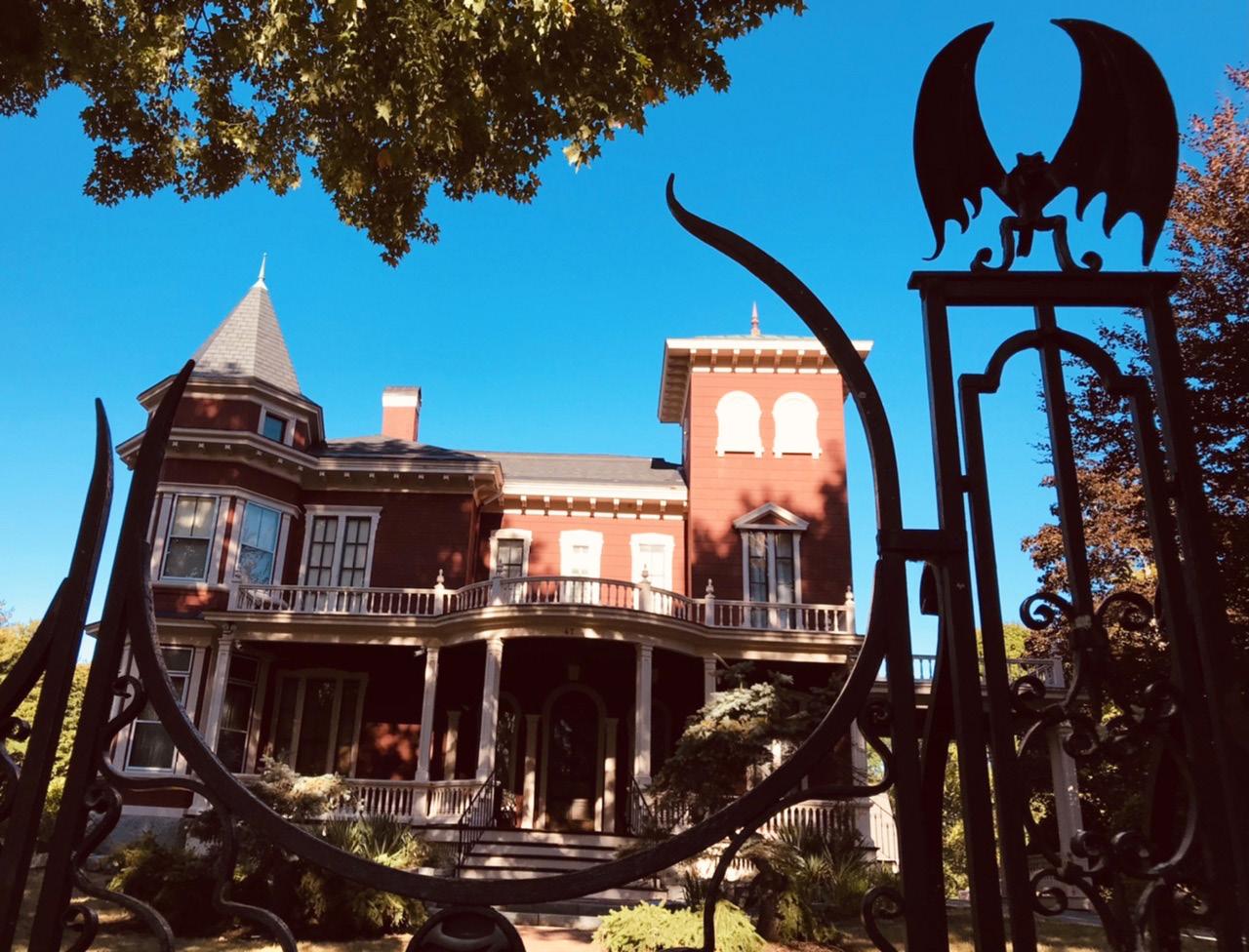
At the heart of this sabbatical was a sojourn in September to Bangor, Maine where I had a full week of Research Fellow access to the Stephen Edwin King Archive that is housed adjacent to the iconic King home that has been part of the prolific horror writer’s image for decades. While the archive only opened recently, I submitted my research application to the Stephen and Tabitha King Foundation approximately one year in advance–when news of the archive first went public. That timing was key because the archive is currently overloaded with applications. The application required a robust project description, so I outlined my current focus on the ecological signals in Stephen King’s fiction. Through teaching lots of weird, horror, and other speculative fictions in Luther courses, I have grown increasingly fascinated with how genre narratives open spaces for alternative problem diagnosis and solution. Examining the paper sematary of King’s creative process would help me grasp the roles that
ecological signals such as water, wind, trees, nonhuman animals, pollution, and more play in his contributions to American gothic narratives.
Within my ecological approach, two options occurred to me. I could look exclusively at files attached to narratives that King set in his fictional town of Castle Rock, Maine. This appealed to me as a longitudinal study with one geographic location as a constant factor. The idea reminded me of an article published some years ago in the Smithsonian magazine by scientists who used Henry David Thoreau’s journals to observe climate change as he documented the annual reappearances of plants, birds, insects, and so on. The second option was to apply my 30 total hours of archive access to look at files attached to the Dark Tower series, largely considered to be King’s literary opus. This appealed to me as a chance to monitor King’s ecological signals in a series of novels that form a cohesive whole yet
they range wildly across different genres and the characters move across interconnected dimensions. The Dark Tower option felt more attuned to the “Global Weirding” aesthetics and ethics that I’ve been cultivating in classes with Luther students, so I committed to this in my application, but with the Castle Rock tales as a Plan B.
Working in the archive was a wonder! The head archivist, Robin Furth, has been Stephen King’s personal researcher for decades, so she has vast knowledge of his work and its history. Monday through Thursday of that week in September I moved through all of the typescript drafts of the Dark Tower tales, making extensive notes of my findings for future writings and conference presentations. Physically handling the oldest extant copy of the first novel in the series, The Gunslinger, was a spiritual encounter for me. Like many a Gen-X person, I lived a childhood with King as a ubiquitous cultural
Andy Hageman on the tractor from the film The Straight Story
figure; and more personally, I lived with King as an author whose books built bonds between my mom and me (for the record, though, she gave them as gifts with reservations as it was a time of ’80s Satanic Panic) and among the friends who traded them around and with whom I still meet on Zoom to talk about whatever King books we’ve been reading.
By Friday morning, I had a handful of hours remaining, so I asked Robin to pull a few of the Castle Rock tales from the archive. The moment that I opened the folder with the 1989 novel The Dark Half I knew that I had a discovery to write about immediately. Shortly before drafting this novel King’s pseudonym Richard Bachman was discovered and he went public to acknowledge that he had published several novels under that pen name. The Dark Half is a novel about a writer whose pseudonym is discovered, but when the author stages a publicity stunt to put his alter ego to rest the faux funeral fails and his family is haunted by the dark half that has mysteriously come to life. What I discovered in the typescript was that King originally drafted this story as written by himself AND Richard Bachman. So, the whole drafting process was an active co-authorship, however that worked out when sitting at the typewriter. Further-
more, I found that this typescript had a series of Post-It notes containing ideas for revision; intriguingly, many of the notes had two parts to them written in slightly different hands yet identifiable as King’s writing. So, the revision work embodied a multi-identity struggle in which the author confronted what the pseudonym produced and meant for him as a writer, parent, and person. Lastly, this first draft had the pseudonym character die totally differently from the published version of the novel that the public knows. These three discovered elements reframe the way we understand what King was doing when creating the novel that is already known to be a personal reflection.
My excitement over the discovery sparked me to prioritize writing about The Dark Half, and that piece found a publication home in the Los Angeles Review of Books, which has over half a million readers/sharers in 150 countries per month. It’s a particular thrill when an academic research discovery poses wide-ranging interest such that a publication like LARB wants to put it in front of their smart and curious audience that goes beyond literary academics. As a lovely secondary outcome, that essay got me invited to guest on an episode of The Kingcast, one of the top podcasts dedicated to Stephen King’s
fiction and cultural impacts. And a third outcome of my King Archive research was a conference talk delivered to the Society for the Study of the American Gothic in Salem, Massachusetts, in March of 2026. Meanwhile, all of the findings in the Dark Tower typescripts, maps, and other files continue percolating in my mind, whispering to me about how to engage them this summer when more thinking-through-writing time becomes available.
For a different piece of sabbatical work, yet one that also involves writing on paper, I reached out to the nine-time Academy Award nominated, two-time winning set decorator Nancy Haigh. My film studies syllabus for spring semester 2026 already contained a sustained unit on Quentin Tarantino’s Once Upon a Time… in Hollywood. I wanted to bring someone deeply involved in the film production industry to our class, virtually, so that students could learn more about the profession and about cinema as a collaborative art that requires tiptop communication and cooperation across many professionals. Ms. Haigh, who created the sets for films by the Coen Brothers, Steven Spielberg, Tim Burton, Robert Zemeckis, Michael Mann, Terry Gilliam, and many more, replied to my handwritten letter. She agreed to zoom into a day of our film class, and then she also posted me a large envelope filled with 11” x 17” pages, each one a photocopy of a few set photos she had taken for continuity and annotated by hand to explain the particular sets from No Country for Old Men, O Brother, Where Art Thou?, Waterworld, and Once Upon a Time… in Hollywood. Students enjoyed Ms. Haigh’s virtual class visit on March 30, during which she answered their many questions and regaled us with stories of working with Tom Hanks and George Clooney. That class visit was a highlight of 2026 for me and for the students, and I was proud to have applied some of the open space that sabbatical provides to make it happen.
The other piece of my sabbatical focused on the 1999 film The Straight Story directed by David Lynch. For decades I have researched the cinema works of Lynch, and I have taught his work in film studies, Paideia, and English
The iconic home of Stephen King in Bangor, Maine, adjacent to the archive
courses at Luther. The Straight Story is a heartwarming film, and it’s one of the very few Hollywood films set and shot in Iowa. If you’re not yet familiar with the film, it is based on the actual events of a septuagenarian named Alvin Straight, from Laurens, Iowa who felt compelled to reconnect with an estranged brother before one of them passed on and making amends in life would become impossible. As he didn’t currently have a valid driver’s license, Straight determined to drive his riding lawnmower with a trailer attached across over half of Iowa and into Wisconsin in order to see his brother. His small tractor broke down in Clermont, Iowa, just south of Decorah and Luther, and there his story was published in a local newspaper that got picked up at the state, national, and international levels. During my sabbatical, I traveled to Laurens and Clermont to meet with folks who knew the Straight family and/or who were present in those towns when Lynch and his cast and crew came to shoot the film. Friendly folks generously brought out photos, stories, and memories. I was heartened to find out that the overwhelming response to how the film represents small-town Iowans was quite positive. These local links to one of the most important film directors of the last 50 years will inform my teaching for years to come, and I have a writing project in progress to share what I learned through conversations that took place in public libraries, private homes, assisted living apartments, and on the streets of these small towns.
As a final note, I also wrote and published an essay during my sabbatical on the Iowa born and raised actor, Margaret Lindsay, in the online film journal Senses of Cinema. You can find Ms. Lindsay in a massive number of films from the 1930s through the 1950s–from her extended starring spree as Nikki Porter in the Ellery Queen films of the 1940s to dramatic turns in The House of the Seven Gables with Vincent Price and The Spoilers with Marlene Dietrich and fellow-Iowan John Wayne. In short, this was a sabbatical inspired by research that’s directly interconnected with teaching and as often as possible that recognizes Iowa’s heartland contributions to national narratives.
Reconstructing the Easter Sunday Visit of the Sepulcher Rite from the Middle Ages
by MELANIE BATOFF, Associate Professor of Music
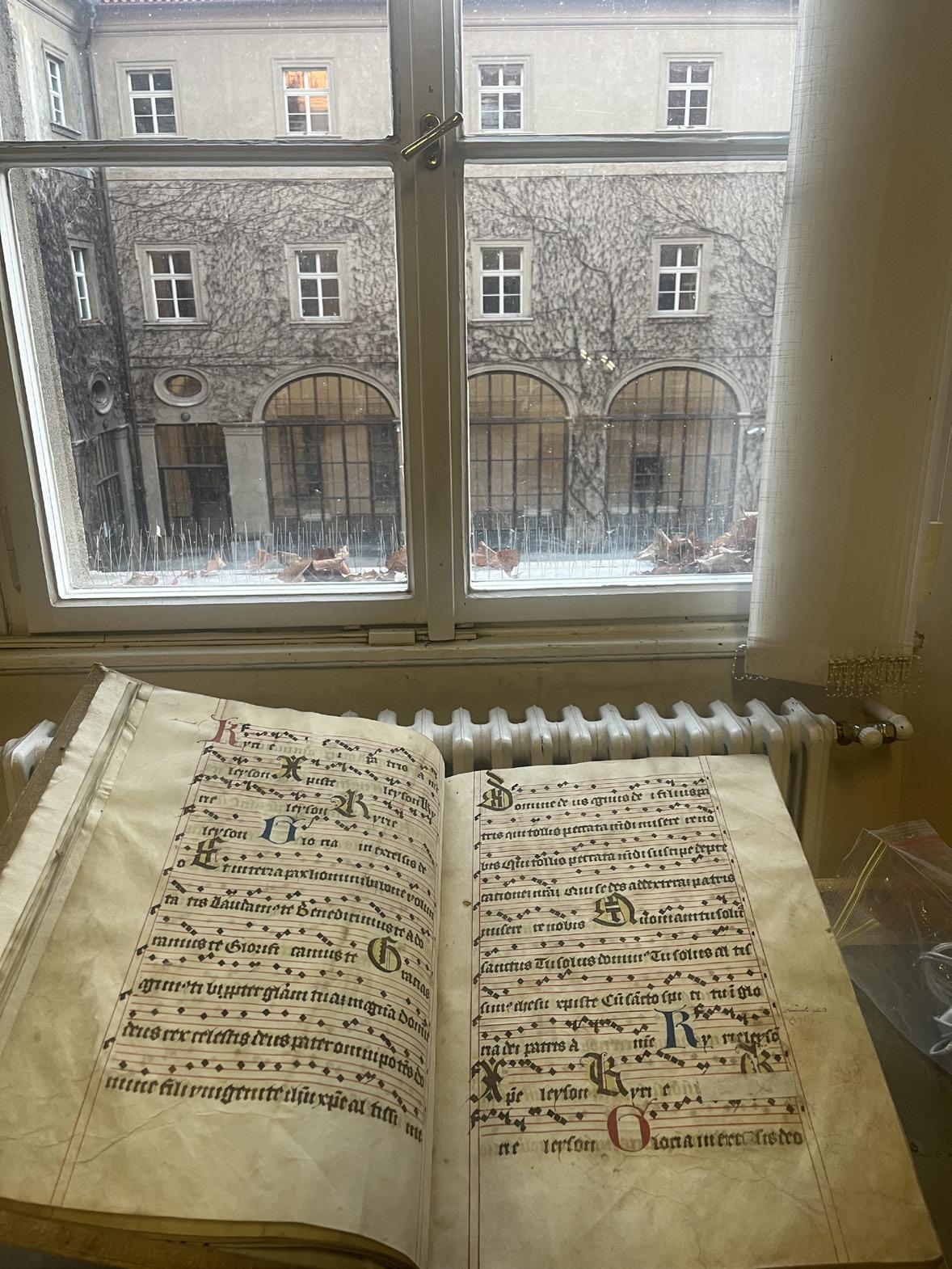
During the 2024–2025 academic school year, I took a sabbatical in order to devote myself fully to planning my book and to writing my book proposal. This was my first time going through the process of proposing a book to an academic publisher. My book is titled The Visitatio sepulchri in the Middle Ages: Elucidating the Corpus of a Liturgical Rite through Musical, Textual, and Performance Aspects. As a musicologist (someone who specializes in music history), my research centers on religious music of the medieval period, particularly between the tenth and the fifteenth centuries. Specifically, I study a religious rite known as the Visitatio sepulchri (the Visit of the Sepulcher), which was a reenactment of the Gospel accounts of Christ’s resurrection performed first thing in the morning on Easter Sunday.
During the Middle Ages, medieval worshippers gathered to see members of the clergy, monks, or nuns assume the biblical roles of the three Marys who travelled to Christ’s sepulcher (tomb) to anoint his body. At the sepulcher, an angel proclaimed that Christ had risen, and urged the Marys to inspect the empty tomb, and spread the good news to Christ’s followers. The clerical performers attempted to dress and move like the biblical figures that they portrayed, and sometimes communities erected a temporary structure representing the sepulcher that served as the focal point of the reenactment. The Visitatio sepulchri rite is of particular interest to me because it was entirely sung to Gregorian chant. These singlelined melodies accompanied Latin texts, and the chants were typically performed in a free-flowing rhythm, with mostly stepwise melodic motion.
The process of finding a publisher who would be a good fit for my proposed
book was quite fortuitous. An acquisition editor at the University of Liverpool Press emailed me to ask if I would be interested in meeting with her at the International Congress on Medieval Studies conference in Kalamazoo, Michigan, which we would both be attending in May of 2025. I accepted the invitation to discuss the book that I was planning, and she was very receptive to the ideas that I presented and encouraged me to write a book proposal for her press. After seeing the names of several medieval musicologists, whose work I greatly admire, on the list of authors who were writing books for that publisher, and feeling a strong rapport with the acquisition editor, I decided that the University of Liverpool Press was the perfect publisher for my book. I went through the proposal process, and in March of 2026, I was delighted to learn that the board had accepted my proposal.
The Visitatio sepulchri has sustained my interest for twenty years because of how fascinating and challenging it is to envision how the rite was performed in different religious communities. Unlike performances from the past century, where recording technology enables us to hear the melodies being sung and see the movements of the participants, my research involves considerable detective work. I am entirely reliant on manuscripts for information about the music, performance aspects, and the chant texts. Some manuscripts offer detailed information, but in most sources there are a lot of gaps or ambiguities to reconcile, sometimes by consulting multiple manuscripts from the same religious institution.
I have had the honor of working firsthand with hundreds of medieval manuscripts that are housed in libraries and archives throughout Europe. Medieval
Melanie Batoff at the Hungarian State Opera House in Budapest, ready to watch Verdi’s La Traviata
manuscripts are handwritten documents, in which scribes wrote the texts and musical notation in ink on pages made of animal skin. The musical notation has little resemblance to the notation used today, and the shapes of the letters often differ from the letterforms that we are accustomed to. The Visitatio sepulchri will easily keep me busy for the rest of my career because it is extremely well documented in medieval manuscripts, with more than seven hundred sources surviving from the tenth to the fifteenth centuries. There are always new things to discover about this rite.
Working with medieval manuscripts requires specialized skills that I began developing during my doctoral work at the University of Michigan, and through summer courses in more recent years. In the summers of 2019 and 2023, I took advanced courses in paleography (the study of medieval handwriting and abbreviations), medieval art history, and textual editing. I was one of only twelve
PHOTOS COURTESY OF THE AUTHOR
students admitted into the Diploma Program in Manuscript Studies through the Pontifical Institute of Mediaeval Studies in Toronto, Ontario, where these courses were taught. These invaluable learning experiences were funded through a Mellon Fellowship, and brought me to Toronto, Canada, and to Rome, Italy. Prior to my sabbatical, I had already examined many of the manuscripts documenting the Visitatio sepulchri rite in Germany, Austria, Switzerland, Italy, and the Czech Republic. During the first summer of my sabbatical, when I was in Europe to present a paper at the Cantus Planus conference (under the aegis of the International Musicology Society) in Gödöllö, Hungary, I had the opportunity to study additional manuscripts of the Visitatio sepulchri at the National Széchényi Library (Országos Széchényi Könyvtár) in Budapest, Hungary and at the National Library of the Czech Republic (Národní knihovna České republiky) in Prague, Czech Republic. A highlight of my trip to Budapest involved watching an excellent performance of Giuseppe Verdi’s opera La Traviata at the Hungarian State Opera.
the new methodology that I have developed for studying the musical, textual, and performance aspects of the Visitatio sepulchri and for understanding the relationships among the extant versions of the rite. This new methodology provides the framework for my book.
For practical and financial reasons, I also consult digital images and microfilms of some manuscripts. I consider myself very fortunate to be only about four hours away from Hill Museum & Manuscript Library, housed at Saint John’s University in Collegeville, Minnesota. They have an extensive collection of microfilm and digital images of medieval Christian manuscripts.
Much of my sabbatical was spent in Decorah, analyzing the information that I had gathered on prior research trips about the Visitatio sepulchri and the manuscripts in which it was recorded. The sabbatical finally gave me the
uninterrupted time necessary to put my skills into action. This work involved the time-consuming tasks of deciphering the medieval handwriting, transcribing the medieval musical notation into modern notation, and translating the Latin into English to make the Visitatio sepulchri more accessible to a wider readership. What makes this work particularly challenging is that the scribes frequently abbreviated the Latin texts in order to fit more words into a condensed space. Consequently, I often feel as though I am working with word problems, as I attempt to decipher the intended meaning of the abbreviations.
In addition to laying the groundwork for my book and writing the book proposal, I also completed two additional publications. The first involved revising my conference paper for publication in the conference proceedings for the Cantus Planus conference. In my conference paper and article, I introduced
My other writing project is a book chapter for a festschrift (a book in honor of a scholar) that provides a case study of the Visitatio sepulchri at St. Vitus Cathedral in Prague. Drawing on the ten medieval manuscripts from St. Vitus Cathedral that transmit the rite, I tried to make sense of the unusual aspects of this Visitatio, such as the inclusion of the kiss of peace from communion, and the presence of a prelate who sang the incipits (beginnings) of the chants, but did not assume a biblical role. My visits to St. Vitus Cathedral during J-term of 2024 and in July of 2024 enriched my understanding of how the rite would have been performed within that space. St. Vitus Cathedral is special in the sense that the physical layout of the location where the Visitatio sepulchri was performed has changed very little since the fourteenth century. Since many performance aspects of the Visitatio sepulchri are described in detail in the fourteenth-century manuscripts from St. Vitus, it was possible to visualize how the rite unfolded within that space, which was particularly exciting for me.
I am so grateful to have had the opportunity to spend the 2024–2025 academic year focusing on my research, so that I could lay the groundwork for my book, and complete two additional publications. This time away from teaching has propelled my research forward in new and exciting ways, and I am eager to continue making progress on my book in the upcoming years.
View of a medieval manuscript from St. Vitus Cathedral, in the manuscript room of the National Library of the Czech Republic
Understanding “Longshot” Political Campaigns
by MIKE GARCIA, Associate Professor of English and Director of Writing Programs
My spring 2025 sabbatical project was inspired by the campaign of Marcus Flowers, a Democratic Army veteran who ran against Marjorie Taylor Greene in Georgia’s 13th U.S. House district in 2022. Flowers ran a charismatic, seemingly tireless campaign: he traversed the district wearing his signature black cowboy hat, often going door to door, and he raised more than $16 million along the way. Nobody would say he didn’t put in the work. But in the end, Greene won the election by more than 30%, a landslide victory. An observer of that district and its voting patterns would probably say that the outcome was never in doubt; that area of Georgia is “deep red,” politically speaking.
We might ask, why did Flowers run? Why does anyone put so much time and money into an underdog campaign in these longshot races? Let’s assume that the candidates aren’t delusional about their slim chances of winning. What are their goals, then? And with those goals in mind, what does it really mean for them to run an effective political campaign? I’m a scholar of rhetoric and persuasion, so that last question is particularly interesting to me. I think we tend to measure the persuasive work of campaigns by the wins and losses: if you lose, that means you failed to persuade the public; if you win, you succeeded. But if there are less obvious, longerterm goals for campaigns, then maybe we should think about persuasion differently as well.
I decided to research the campaign rhetoric of these underdogs: candidates for whom gerrymandering, voter demographics, or other factors almost certainly put them on track to lose their races. To keep the project manageable, I narrowed my scope down to the 2024 U.S. House candidates running in the
20 most Republican and 20 most Democratic districts in the country, according to the Cook Political Index (CPI). These were districts represented by the likes of Nancy Pelosi and Alexandria Ocasio-Cortez on the Democratic side and Steve Scalise and Ronny Jackson on the Republican side. I also selected a couple of candidates from very competitive races to use as a baseline. I read through the campaign materials posted on the challengers’ websites and the posts on their social media accounts. I watched hours of video from their campaign events and interviews. Although these candidates all lost by decisive margins, like Flowers did, they all put similar energy into their campaigns and saw them through to the end; there were no “placeholder” candidates.
It’s a common practice in this sort of analysis for researchers to “code” the content they’re reading: that is, to read each piece of content, determine what kind of content it is, and give it a label. This makes it easier to zoom out and see thematic patterns, as well as similarities and differences among different writers or across a time period. I won’t go into my methods of sampling, coding, and analyzing content here (I hope to have an article published soon with these details); instead, I’ll summarize some of the most interesting findings.
None of the candidates gave any obvious clues that they expected not to win.
First, I should note that none of the candidates gave any obvious clues that they expected not to win—not even the Republican candidate for Maryland House district 4 (the least competitive district in the country), who won
Mike Garcia
only 11% of the vote. He and his fellow underdogs had as many posts about the large crowds at their events, their endorsements, their plans for the future, and so on. Again, I feel certain that these candidates understood their odds of winning, but if you were to judge by their campaign rhetoric, you might believe that they were in competitive races.
Beyond that, however, there were some differences. Although these longshot candidates usually had detailed policy proposals, plans, and promises on their website, they discussed these things less frequently in their campaign materials than the candidates in competitive districts did. When they did discuss policy, it was more often bills proposed by the established leaders and legislators in their political party. In other words, their campaigns often functioned as platforms to promote their party’s agenda, independently of the race they were running.
I wasn’t completely surprised by this— political scientists and media figures
have been discussing the nationalization of American politics for years—but I was sometimes surprised by how far it went. For example, even their attacks and criticisms were noticeably different. Candidates in competitive races often criticized their opponents directly. The longshot candidates did this notably less often, choosing instead to focus their attacks on national-level figures like President Biden, Vice President Harris, Donald Trump, and the opposing party’s state and national political leaders. When they did attack their opponents, the attack was often just a brief setup for criticizing the opposing party (e.g. “This candidate’s statement is yet another example of the Democratic Party’s corrupt agenda”).
It makes sense, then, to see these campaigns as serving a couple of functions: 1) to bring the candidate some name recognition, which might serve their future career plans, and 2) to provide another form of advertising (or, if you’re less charitable, propaganda) for their political party and its priorities. Cognitive scientists tell us that mere repetition of a message can be persuasive. Candidates spread these messages across the web, social media, print media, and by word of mouth as they campaign.
Longshot candidates focused their attacks on national-level figures like President Biden or Donald Trump.
As a rhetorician, though, what was most interesting to me is how these candidates had to place these messages within the framework of a competitive race, to go through the motions of putting up the fight. A campaign can only be a platform if people are paying attention to it; if it doesn’t appear to be competitive, then people stop paying attention to it, and the candidate (and the party) loses the platform. It was fascinating to see all the work that candidates were willing to do, from speeches to Facebook posts to radio interviews to handshakes and town halls, to maintain that platform.
Iphigenia, Mother of the Greeks?
by HOLLY MOORE, Professor of Philosophy and Identity Studies
It is often said that the Trojan War was the instigation for the sense of a Greek identity in the ancient world. It stands to reason, then, that Helen— the reputed cause of the war—should be considered the “mother” of the ancient Greeks. If Helen is the mother of the Greeks, however, she is only so by means of some of the most pernicious stereotypes that prop up ancient Greek patriarchy: she is by turns the irresistible object, the beguiling beauty, the seductress, the conniving cheat, as well as the naïve victim of persuasion. This is just one such story from ancient Greece that exemplifies the way that feminine gender roles and stereotypes lend support to the broader structures of patriarchy that dominated Greek civilization. In so far as ancient Greek literature, culture and history were constructed in the nineteenth century as the ‘origin’ of modern European civilization, and in turn, in so far as European colonization (and subsequent United States’ imperialism) globalized contemporary patriarchal systems, it remains important to those who seek to defy these structures to understand their origins as well as points of resistance that appear within those origins. In what follows, I will be tracing some of these ancient Greek figures of resistance to try to better understand: What does it mean for a woman to be the origin of a people?
I’ve been studying ancient Greek philosophy since I was an undergraduate student. One could even say I’ve been trying to understand it since I picked up my dad’s old college copy of Plato’s Republic when I was 10. (Spoiler: I didn’t actually read the whole thing until I was studying for my comps in graduate school!) I now teach the text for three and a half weeks every January in one of my favorite courses, “Philosophy 125: Big Questions.”
Despite the fact that Plato is one of the most poetic and dramatic of the Greek philosophers, I have never done as much in-depth study of ancient Greek drama as I’d like. However, as I’ve been working on a project about the rhetorical power of the slaves deployed in Plato’s dialogues (think Meno’s slave in the Meno, the Thracian slave woman of Theaetetus, the doorman at Protagoras’ house in the Protagoras, etc.), the allusions to the contemporary Athenian stage embedded in Plato’s dialogues have become more and more evident. Plato scholars have also become more interested in these cross-disciplinary elements that have an impact on how we understand the way Plato’s works were read by his contemporaries as well as how we interpret the philosophy of the dialogues today.
It came as a great delight, then, to learn that my longtime colleague, Emanu-
ela Bianchi (Comparative Literature, NYU) would be delivering a week-long seminar course at the 2025 Collegium Phaenomenologicum in Città di Castello, Italy that would focus on the theme of genos, with a reading of Aeschylus’ Oresteia, the trilogy of tragedies that traces the dramatic events that led to the end of the curse of the house of Atreus.1 I was thrilled when my travel to Italy was selected by the Faculty Development Committee for support by the Doris and Ragnvald Ylvisaker Endowment for Faculty Growth and prepared myself for an intensive week of study and discussion with an intergenerational and interdisciplinary cohort of exceptional scholars.
Genos in ancient Greek can mean a host of things, including kind/type, race, breeding, stock, lineage, genre and gender. In addition to Bianchi’s week long course, Giulia Sissa (Classics &
Holly Moore in the Piazza del Popolo in Rome in July 2025, just following the Collegium Phaenomenologicum seminar
PHOTO
Political Science, UCLA) delivered a powerful lecture on Sophocles’ Antigone, and John Proios (Philosophy, University of Chicago) introduced his collaborative work with Patricia Marechal (Philosophy, University of California, San Diego) on the genesis of a theory of race in ancient Greece. Both of these lectures provided important points of inflection for our study of the Oresteia and genos
In her seminar, Bianchi sought to investigate how genos is operating in ancient Greek culture, thought, and literature in order to reveal a better way of understanding the architecture of Western patriarchy at the point of some of its earliest formulations. Rather than focus upon specific claims about the superiority and fitness of men over women, however—a discourse which by and large comes much later than the instigation of the politics and culture of patriarchy—Bianchi instead focused on the way genos functioned to encode notions of gender, generativity, and reality into the idea of a “people,” a “line” and a “kind.” In this way, Bianchi set patriarchal thought at the origin of a series of interconnected systems of thinking, rather than as a later, culminating result of social forces. For this reason, she drew attention to the stories the Greeks told themselves about the origins of things (looking at both Parmenides’ metaphysical poem depicting all of being as one, as well as Hesiod’s Theogony, which traces the multiplicitous generations of the gods). The Oresteia trilogy is also a story of origins: the story not only speaks to the lineage of violence in the House of Atreus, it also tells the story of the origins of “human justice.” This makes it a unique site for witnessing the entanglement of multiple senses of genos as origin.
of Iphigenia by Michel-Ange
Academy of Sciences, Belles-Lettres, and Arts of Lyon
Sissa’s lecture, “Symbiosis, polis, nekros: Antigone’s Antagonistic Life,” fit well into the theme of the seminar with its attention to the notorious Anti-gone
(against birth). Though Antigone has been a darling of feminist literature for her opposition to the tyrannical will of Creon (and her eponymous rejection of women’s social function as mothers), Sissa’s argument was novel. She began by acknowledging the outsized and lasting influence of G.W.F. Hegel’s account of Antigone as defending the importance of private life and familial ties in contrast to Creon’s legislation of public action and state power, as well as the now extensive and varied feminist critiques of this reading. However, unlike feminists who have sought to rescue Antigone from Hegel’s re-inscription of her entombment in the home by reading Antigone as antagonistic to traditional ancient Greek values, Sissa takes a new approach. Still reading her as a “revolting” subject, Sissa contends that Antigone is nevertheless seeking
to fulfill her traditional role as woman and sister. Following Solon’s laws, ancient Greek women’s civic duty was to their household and an essential part of that was their participation in funerary rites. Thus, according to Sissa, what Sophocles dramatizes is not the conflict between public and private (which was always Hegel’s anachronistic error), nor the rebellious woman defying oppressive state power, but the dutiful and gender-conforming woman of status defending a traditional women’s practice and rite. It is Ismene, Antigone’s sister, who perverts the role of women in the city to that of mere subjects to the will of powerful men (as a sort of ancient Greek tradwife), defining women as ruled and men as rulers. Sissa supports her argument referencing the report of Hymon (Antigone’s betrothed and Creon’s son, who will join Antigone in death) that the people of the city agree with Antigone and support her actions. This is consistent with the fact that the antagonist of the play is clearly Creon, not Antigone. Ultimately, Sissa argues that Sophocles is satirizing tyranny—Antigone is resisting Creon’s power grab by fulfilling her ancestral, sex-assigned obligations to both city and family.
Hegel paints Antigone as the hero of family against the polis (city), but Antigone sees her role in preserving her family’s honor as her duty as a citizen-woman. Her name (Anti-gonē) and her story is that of the “anti-birth” hero, but she nevertheless maintains the status and endurance of her family line. Despite her sister’s patriarchal betrayal of her political and civic femininity, Antigone will not allow Ismene to be implicated in her act, thereby sacrificing herself for both her brother (who was killed and labelled an enemy of the state2) and her sister, and her family name as a whole. She
IMAGE COURTESY OF ROMAIN
BEHAR, CC0, VIA WIKIMEDIA COMMONS
Marble bust
Slodtz, 1740.
dies with Hymon in the womb/cave, having borne no heirs, but her family line is preserved because Ismene lives. Though Antigone is praised by modern feminists as a strong woman who stands up to tyrannical power, she does so only because she is perhaps the most traditional woman of all. She carries out her obligation to preserve her family lineage and its dignity by means of her very death. Thus, the individual sacrifice of Antigone preserves the genos of her family.
This reading of Antigone had a great influence on me, then, as we continued in our seminar to study the Oresteia, particularly the sacrifice of Iphigenia which instigates its action. After all, Antigone is a sort of mother in spite of her virginity; her actions make possible the continuation of her family’s genos When we engaged with the character of Iphigenia and her brutal sacrifice, I thought to myself: could Iphigenia, too, be a sort of mother in spite of her virgin death?
The story of Iphigenia is told in multiple sources (with some important differences), but the earliest seems to be in the Homeric epic, the Iliad (“the one about Ilion/Troy”). The Iliad retells the story of the Trojan War, launched by the Greeks to defend Menelaos’ honor when his wife, Helen, the most beautiful of all the Greeks, is “seduced” by Paris.3 Menelaos, king of Sparta, entreats his powerful brother, Agamemnon, himself the king of the Argives, to call on all of Helen’s suitors who had pledged to defend the honor of whomever she chose to wed. A naval force is assembled to “retrieve” Helen from Troy.
However, the Greek ships are all stalled in Aulis (Boeotia) for lack of wind to sail by, and as the armies begin to get short on food, Menelaos is afraid that the army may disband if they do not begin their journey. The seer Calchas informs the Greek generals that Artemis (virgin goddess of the hunt and of wild things; sister of Apollo) is causing the trouble because her sacred deer were killed by some of Agamemnon’s men. Calchas tells Agamemnon that Artemis requires that he sacrifice his eldest daughter, Iphigenia, to appease her and allow the ships to sail (Artemis will go
on to fight for the Greeks throughout the war). Agamemnon is shocked by the demand but believes that he must do it if they are to sail, and he sends a message to his wife, Clytemnestra, purporting that Iphigenia must come to Aulis to be married to Achilles, the army’s greatest warrior.4
Rather than giving birth to a founder or hero, Iphigenia dies the Greeks into being.
Iphigenia arrives prepared for her wedding, which is instead her funeral: Greek tragedy at its best. One important point to note is that Iphigenia is portrayed as an (unsurprisingly) unwilling sacrifice. Aeschylus’ audience would have noticed this stark contrast with the sacrificial non-human animal victims of their religious practice, which were also festooned with ribbon or garland (like a bride) and were most prized as sacrifices when they were compliant, for this was read as consent to the will of the gods. In addition, the sacrifice of Agamemnon’s virgin daughter before she is able to wed would be seen as a fitting tribute to Artemis, who guards her sexual purity with violence when necessary. Having no children, the animals of the forest are her kin, so her demand for Iphigenia speaks to a sort of proportional (rather than simply punitive) divine justice. This “eye for an eye” retributive justice, however, motivates the entire action of the trilogy, just as it haunts the House of Atreus from its roots.5 Indeed, the trilogy ends only when Athena commands a final forgetting of the many injustices that have occurred, so that the curse on the House of Atreus can finally be broken, and the family (a synecdoche for Greek society) escape the cycle of violence. Just as the Greeks “overcame” their (now) taboo practice of human sacrifice, the House of Atreus required one last human victim to give birth to the “modern” Greek civilization, where justice is no longer a continuous cycle of violence but again a substitution for the sacrificial victim is invented (in the form of restitution).
Thus, I wish to reread Iphigenia, the sacrificed girl, whose death vouchsafes the “launch of a thousand ships,” as the “mother” of the Greeks. Without her, there would be no Trojan war. Without her, there could have been no glorious tale of conquest and the just “reclamation” of Helen. Though Helen’s return galvanized the Greeks into a force with a single purpose, I argue it is Iphigenia—her living body, along with its possibilities, rather than her actions, beliefs, or progeny—which actualizes the unification of the Greeks. In a sense, they do not become Greeks until Agamemnon has sacrificed his daughter and they begin their epic journey together. Rather than giving birth to a founder or hero, Iphigenia (only suitable for sacrifice because she is a virgin), dies the Greeks into being.
In light of Bianchi’s interest in genos, I think this reading of Iphigenia locates a moment of resistance to the notion of politics as consistent with generativity, generation, and growth, and instead demonstrates the way identities and cultures are often in fact built upon the sacrifice of human possibilities, particularly those of women and femmes. Antigone chose her fate and made herself an enemy of the state (though constrained by tyranny) and through her will maintained her family line, her genos. Her death was not in vain, for she preserved her family by saving her sister and by saving her family’s honor by burying her disgraced brother.
Iphigenia, on the other hand, was the unwilling and innocent victim of divine justice, whose death not only reanimated the gruesome infanticides of her family’s dark history but also inaugurated the chain of violence that would lead to both her father and mother’s deaths. Antigone’s participation in genos can only come through her preservation of her family rather than her own line; Iphigenia’s participation in genos initiates the inevitable murders of her parents but in such a way that what it is to be Greek may take shape. Though Antigone’s participation in genos pushes beyond the individual to the family, Iphigenia’s pushes beyond the family to the broader social and cultural level of genos
Holly Moore at the Circolo Tifernate in Città di Castello, Italy, home of the Accademia degli Illuminati and the venue of the daily lecture course
So, what does it mean for a woman to be the origin of a people? Well, in the case of Helen, it means confirming the patriarchal belief that women are untrustworthy, duplicitous, or naïve (and, given the ambiguity, all three at once). In the case of Antigone, it means defying tyranny by using the only legitimate power she has in order to sustain her family line. And in the case of Iphigenia, it means that the life and blood of a girl can be traded for myths of mortal “justice.” What do these points of resistance tell us about our own confrontations with patriarchy? Even though these stories demonstrate the way that women’s bodies, minds, and actions were woven into the myths that secured their subordination, those bodies, minds, and actions themselves were not thereby erased. They leave the trace of their resistance in the story and its telling. As a result, the staging of our stories of ourselves and our many practices of genealogy ever open us to connecting with these origins, these mothers. We must ask ourselves today: Where are our Antigones? Who are our Iphigenias, our Helens? Even the process of asking these questions reveals the places where we too might find resistance within the stories we tell ourselves.
NOTES
1. Aeschylus’ Oresteia consists of three sequential tragedies concerning the fate of the House of Atreus and its remaining heir, Orestes: Agamemnon, the Libation Bearers, and The Furies . It was performed for the Athenian Dionysia festival in 458 within two years of Aeschylus’ death,along with a now lost comedy.
2. In one current staging of Antigone in New York City, Antigone’s brother is named a “domestic terrorist.”
3. This is not a euphemism so much as a nod to the fact that the precise mechanism of Helen’s departure is hazy in all the Greek tales of the story. Did she want to go? Was she forced? The ambiguity of Helen’s will is perhaps itself a testament to the inconsequential nature of women’s volition in the ancient Greek imaginary. But one thing was for sure: whether she was willing or not, she’s the one who’s responsible.
4. In Euripides’ Iphigenia at Aulis (produced in 405 B.C.E. near the end of the Peloponnesian War), Agamemnon has misgivings after sending the first note and sends a second one to negate the first. Menelaos intercepts it, however, and the brothers argue over the matter, with each coming to the opposite view by the end. Agamemnon is persuaded that the army will turn against him and his whole family and thus he must sacrifice his daughter in order to save his family, whereas Menelaos comes to see the brutality of the sacrifice as unsupportable. This tweak on the story piques the tragic aspect of Agamemnon’s decision and its consequences for his family. In his Iphigenia at Tauris, Euripides appeals to another version of the legend (preserved in the Cypria), depicting a divine rescue of Iphigenia by Artemis as well as a reunion with her brother and sister, Orestes and Electra.
5. The “original sin” of the House of Atreus begins with Tantalus, who sought to test the knowledge of the gods by serving his son, Pelops, to them to eat. The gods, however, knew what had happened (all but Demeter, who was distraught by the abduction of Persephone) and did not eat, resurrected Pelops, and punished Tantalus with perpetually being unable to eat or drink what was right before him. Pelops had two sons with Hippodamia, Atreus and his brother Thyestes. After conspiring to kill their half-brother, Chrysippus, and being banished to Argos, Thyestes contrives with Atreus’ wife, Aerope, to usurp the throne of Atreus. Atreus is helped by the gods to regain his throne, but he also discovers his brother and wife’s affair and plots revenge against his brother. Atreus, in a call back to his grandfather Tantalus’ trick, murders Thyestes’ two children, then cooks and feeds them to their father. Thyestes must go into exile for breaking the taboo of eating human flesh. In a later
telling by Sophocles, he has a son with his own daughter, Pelopia, who will go on to kill Atreus. Aegisthus is this incest-born son of Thyestes who does indeed go on to kill Atreus. Menelaos and Agamemnon are Atreus’ sons. In Aeschylus’ Agamemnon (the first play in the Oresteia trilogy) Aegisthus is Clytemnestra’s lover (unrelated to Agamemnon) who kills Agamemnon upon his return.
PHOTO COURTESY OF THE AUTHOR
Living with War in Ukraine: A Photo Essay
by MARYNA NADING, Professor of Anthropology
Ithe last four years, the world has tired of watching the war in Ukraine. For the most part, people I meet in the US and Europe are clear about who the perpetrator is and understand that Ukrainians are mounting an admirable fight at a very high cost. At the same time, I have often felt the pressure to justify why the war is ongoing. What is the endgame, I’ve been asked. In these kinds of questions, there seems to be an implicit assumption that there is actually a way to appease the foe and end the war, if only Ukraine was willing to give up some of its territory.
Ceding territory is of course not just about land, but also about allowing occupation, with its purges, prosecutions, and other “banalities of evil” (Arendt 1963). Reports of brutalities inflicted by the Russian troops in Ukraine are numerous (The UN Human Rights Monitoring Mission in Ukraine 2026) As Nataliya Gumenyuk, a Ukrainian journalist who is writing a book about drone warfare, has recently noted in the New York Times, what really matters is not when the war ends, but how. When I am asked the endgame question, I say that fighting is less scary than occupation. I haven’t found better words to explain why Ukrainians won’t budge.
Cultural critic Kateryna Botanova has called this state of limbo “the new abnormal.” People live with war, she notes in a February issue of Eurozine. They go to work, they send children to school, they buy groceries, they attend birthday parties. Botanova says, “… the present stops being just an unfortunate pause between the past and the future. It becomes a continuum where society learns to be together in a constant flow of loss and mutual support, of physical and symbolic coping and making sense, of turning experience into knowledge, of constantly changing and adapting, of seeing life as victory, of shared responsibility and accountability.”
In this photo essay, I follow the lead of Gumenyuk and Botanova and show how people domesticate war. I use this term in reference to a multitude of ways in which people adapt to the changing terrains of their cities or small towns in response to continuing air raids, drone strikes, power grid damages, the freezing cold of winter, and losses of family, friends, or neighbors. I like this term
because it highlights the active nature of building a sense of normalcy and order in the darkest of times. The photographs you are about to see were either shared with me directly for the purposes of this photo essay, or they were publicly shared online by people I’ve met and interviewed during my fieldwork research in a town of approximately 300,000 people in Western Ukraine.
This is a photograph of a cafeteria in a corporate office of a grocery chain. LED string lights create a surreal atmosphere of celebration while the reality is somber. Russian strategy involves targeting civilians by guided bombs, missiles and drones (Ukrainian Ministry of Foreign Affairs, Press Release, Nov. 19, 2024) as well as by striking crucial civilian infrastructure like electric stations and dams (Armed Conflict Location and Event Data Project, April 3, 2025). In four years, more than 15,000 civilians have been killed, including more than 763 children, and 41,000 people have been injured (The UN Human Rights Monitoring Mission in Ukraine 2026). Many people have left the country. Since January 2022, the population living in Ukraine’s internationally recognized borders has shrunk by eight million (Sysak et al. 2025) Ukrainians far removed from the frontlines are viscerally aware of the warfare and entangled in it, be it through the piercing sound of sirens, an actual explosion, oversized portraits of the fallen soldiers displayed in the alley of fame that stretches the entirety of the pedestrian city center, frequent fundraisers for drones and anti-drone systems, or their worries about conscription. In other words, the violence of war is close to home for many, if not all, people living in Ukraine, and it seems to be worsening. The UN Human Rights Monitor documents that in 2025 and 2026, “the harm to the civilian population demonstrably worsened: more civilians were killed and injured than in 2023 and 2024, and civilians across the country suffered the dire consequences of sustained and systematic attacks on Ukraine’s energy infrastructure.”
PHOTOS COURTESY OF THE AUTHOR
Artistic representation of a power outage by Yuliya Osyka. People in towns far removed from the frontline average up to eight hours a day with electricity, two to three hours at a time. On bad days, power outages can last 16 hours a day in subzero winter cold. The return of power is welcomed with a spur of household activity, ranging from vacuuming to homework, regardless of the time of day. According to the UN Human Rights Monitoring Mission in Ukraine, “As of January 2026, Ukraine had lost more than half of the electricity generation capacity it had before the full-scale invasion.”
This image features an elderly volunteer who is weaving a camouflage uniform cover for Ukrainian soldiers. Camouflage weaving is a widespread group-based activity, and skillfully woven camouflage nets are in high demand by the army. The caption for this image shared online says, “Electricity is out again, and the radiator has been disconnected. But we have to support our defenders…Their conditions on the frontlines are way worse. The victory is ours despite everything!”
This image captures a candle-lit dinner in the making. The cook, who is a mother of two school-aged children, rejoices at the abundance of light when all of her gadgets are engaged: “Sometimes I also pop my laptop on the external battery and have plenty of light from the screen, the burning candle, the headlamp, and the gas stove!” Depending on apartment configuration, some are better off than others with only an intermittent energy supply. Gas stoves are a noticeable advantage. Many have devices that use gas to heat water tanks sufficient for several people to take a quick shower even when the power is out.
Here you see a series of images of a camouflage net passing hands from its creators to its anonymized wearer. This particular net provides concealment in winter conditions. Three older women who wove this net playfully pose seated atop the bundled net, banana-boat style, before it is dispatched to the front. Weavers enjoy a sense of purpose, camaraderie, and even what they call a “therapeutic effect” of making nets by hand.
This image invites you to visit an elementary school basement repurposed into a bomb shelter. Children in this photo do not seem to be afraid of the unfolding air raid, and are used to the sound of sirens. A couple of them are smiling, including the daughter of my friend wearing a pink hat and a black hooded jacket. Several others are enjoying an animated conversation or some sort of fun game. Children usually carry their “emergency backpacks” with them. Parents pack them with comfort items, like blankets and fidgets, as well as a change of clothes, food, and water. They go on with their lessons once everyone settles down in the school basement.
A friend’s son has transformed their bathroom into a fantasy land complete with PAW Patrol stuffed animals, a play tent, cozy blankets, puzzles, and pillows. This is because people are advised to use the “two walls rule,” if unable to reach the bomb shelter. Staying away from the windows can shield one from broken glass and debris in case of a hit. When the sirens alert people of danger, the boy emulates an officially sounding broadcaster, “Air raid! Proceed to the nearest shelter!” and heads for the bathroom.
Right and below: the Ukrainian National Post Service issued a series “Heroic Professions” in February 2023. One of the first was entitled “Soldiers of Light, Soldiers of Good,” devoted to energy, water, transportation, communication, and gas service workers. When a drone or missile strike hits critical infrastructure, the risk and the urgency of remedying the dire situation falls on these civilians, and Russia is notorious for its double-tap strikes. The postal envelope accompanying these series reads, “Light will win over darkness, and good over evil.” The war is ever present, because civilians far removed from the front lines are often the target.
You may think that these handmade trench candles at left are from a World War I movie set, but they are actually a ubiquitous item in wartime Ukraine. Volunteers fashion these from recycled tins, cardboard, and a mix of paraffin and beeswax. The candles can provide between three to seven hours of heat, and are often made by the grade schoolers. In a post thanking the schoolchildren for their work, a volunteer center social media coordinator cited Ukraine’s beloved poet and a bard of freedom, Taras Shevchenko, “A heart once warmed by kindness will never become cold,” emphasizing the symbolic as well as the practical value of the trench candle. In so doing, she highlighted the essential nature of service and inventiveness in the face of hardship.
Conclusions
I hope that these images have offered you a glimpse into civilian lives during war. This situation is neither inevitable, nor natural, but it has become somewhat normalized. For people inside Ukraine, the injustice of being attacked, having to engage in warfare, and the uncertainty of what to expect became the baseline. For people abroad, another historical building burning in an overnight strike or more casualties does not rise to the level of headline news. The war has already done its damage, but of course it must come to an end. People who serve in the Russian army or support its operations, who launch missiles and drones into peaceful Ukrainian cities, do not have to do it. There is always a choice not to kill, even if it comes at a cost. As Timothy Snyder has pointed out in his final, twentieth, lesson from the twentieth century, “If none of us is prepared to die for freedom, then all of us will die under tyranny.” Being on the right side of history is within reach for everyone.
The title of this essay is inspired by a recent Eurozine piece “The New Abnormal” by Kateryna Botanova.
References
Arendt, Hannah. 1963. Eichmann in Jerusalem: A Report on the Banality of Evil. Viking Press. Armed Conflict Location and Event Data. 2025. Ukraine Conflict Monitor. April 3. https://acleddata.com/ukraine-conflictmonitor/
Botanova, Kateryna. “The New Abnormal.” Eurozine. February 25, 2026. Gumenyuk, Nataliya. “When Will This War End? The Question Is Meaningless.” Guest Essay. New York Times. February 15, 2026
Snyder, Timothy. 2017. On Tyranny. Twenty Lessons from the Twentieth Century. Penguin Random House.
Sysak, Iryna, Koliesnichenko, Tetiana, and Ivan Gutterman. 2025. “How Many Ukrainians Will Remain In Their Country After The War?” Radio Free Europe/Radio Liberty, March 17. https://www.rferl.org/a/ ukraine-population-war-migration-refugees/33347583.html
This humorous image is by an unknown author and was shared with me by several of my high school classmates to jokingly honor the feat of making it through the cold season this year. The fictitious medal reads “Medal Awarded for Surviving the Winter 2025-2026” and features a generator, a thermometer registering negative thirty degrees celsius, and a snowy homestead. The loud, vibrating hum of generators powering Ukrainian shops and cafes is a new urban sound. Together with sirens, the work of air defense units, and actual drone or missile explosions, these are the sounds and sights of war that people have become accustomed to, so that they often feel like a nuisance, rather than mortal danger.
The UN Human Rights Monitoring Mission in Ukraine. 2026. “Four Years Since the Full-Scale Invasion of Ukraine: Key Facts and Findings.” Accessed April 5, 2026. Ukrainian Ministry of Foreign Affairs. 2024. “Statement of the MFA of Ukraine on the 1,000 Days since the Beginning of the Full-Scale Military Invasion of Ukraine by the Russian Federation.” Press Release. Accessed January 29, 2025. https://usa.mfa.gov. ua/en/news/statement-mfa-ukraine-1000days-beginning-full-scale-military-invasionukraine-russian-federation
“Your New York Times Have Arrived”
by JOHN MOELLER, Professor Emeritus of Political Science
When I joined Luther College in 1981, I admit that I may have been a bit smug about the constant talk about community. I was convinced the word was overused and that Luther was not the only institution where community mattered. I came to realize, though, that if I stopped every person walking from Preus Library to the Student Union and asked them to use one word to describe Luther, community would have topped the list. It wasn’t simply that the idea had been drilled into them, but rather that it was a reality everyone experienced.
Community does not require unity, but it does depend on shared values. My introduction to those values came during my job interview when Jim Rhodes, head of the Political Science department, left me at Glenn Nelson’s office in Main. I still can see my first academic dean at Luther counting off on his fingers the three characteristics I needed to know about Luther: it was a liberal arts college, it was a college of the church, and its Norwegian heritage was a defining characteristic. Years later, I asked him if he always presented those points in the same order. The order varied, he said, but what mattered was that anyone thinking about teaching at Luther needed to understand those three pillars on which Luther rested. Not everybody bought into all three—in my case, the liberal arts was much more important than the church connection, although over time I learned the value of being a college of the Church—but the number of faculty, staff, and students who held those values in 1981 was the key to the sense of community that permeated Luther.
As I came to understand, there were important institutional practices that advanced the social capital, which made community so strong. For example, on the Thursday night before the Friday
faculty meeting at the start of each year we gathered in the Center for Faith and Life for a Service of Dedication. Faculty members, administrators, staff, and spouses attended, and even I, in the early years, wore a tie and sport coat. After a short worship service, the president gave a State of the College talk, and then department heads introduced new faculty members (each year I wondered which new colleague might one day become a good friend). At the social hour that followed—it would be many years before beer and wine were served—I talked to colleagues I had not seen since Commencement and the spring faculty meeting.
Another important activity was the daily lunch for faculty and staff in Peace Dining Room. For a modest price we ate whatever was being served in the student cafeteria (this was long before the presence of multiple stations with a variety of culinary options). It was a chance to see faculty who one rarely saw otherwise, and when most of the attendees had just come from the monthly faculty meeting there was the usual faculty kibitzing. It also was a place for informal meetings: it was there, for example, that Dennis Jones and Dick Ylvisaker invited me, a junior faculty member, to join them in designing and teaching a Paideia II class. We called it “Moral Dilemmas in Literature,” and it was one of the highlights of teaching at Luther. Morning chapel was not required by the time I came to Luther, but attendance was large and 40 years later I can summarize some of those faculty homilies. Faculty members routinely came back to campus for evening lectures, concerts and recitals, and many attended athletic events (some even played in the faculty pep band). I smile when recalling the time Phil and Ruth Reitan, who never missed a basketball game, found their usual seats
John Moeller
occupied by students; Ruth explained to the students that they were sitting in the Reitans’ spot. The students moved elsewhere.
Perhaps most memorable were three annual events, which brought faculty and administrative staff together: the Christmas dinner where I first tasted lutefisk and each year listened to Pip Qualley recite the Christmas story in Greek; the Homecoming dinner where accomplished alumni received Distinguished Service Awards; and the endof-the-year recognition dinner where faculty speakers honored colleagues who had served for 25 years or were retiring. How could one not feel joy and a sense of belonging after hearing the stories and laughing with one’s friends on each of these occasions?
While I came to appreciate the sense of community at the college, I admit to a certain ambivalence I felt about living in rural Iowa. Bob and Joan Thompson had come to Luther a few years before me to teach in the Political Science department as the first joint-tenure hire
at the college, and it did not take long for Bob and me to become friends. Bob had grown up in Brooklyn and Joan was from Washington, D.C., and each year they migrated back to Brooklyn for most of the summer. I was sad but not surprised when in 1985 they found a teaching position in a suburb of Philadelphia. They liked teaching at Luther but knew they never could be happy living in rural Iowa. My situation was not the same but I did grow up in an industrial city of 130,000, went to a racially integrated high school, and except for a year in western Alabama had no first-hand knowledge about rural America.
I first knew Decorah was different from anywhere else I had lived when it seemed as if an inordinate number of television ads were encouraging me to buy a range of agricultural products: hybrid seeds, chemicals for controlling weeds, and farming machines much bigger than the tractors with which I was familiar. Whenever my mother and sister visited, with half of the trip on two-lane roads, they quizzed us about small town life. I explained to them that Decorah seemed different than most Midwestern small towns. Some already were showing the early signs of decline, which would be intensified by the farm crisis of the 1980s. Decorah, to the contrary, had a robust commercial sector with few empty storefronts. It also had a meandering scenic river well suited for the Grumman canoe I had bought as a graduate student, nearly 20 miles of trails for walking and biking, and cultural opportunities one wouldn’t find in many bigger towns. Luther played a big role in this: its strong music program offered quality recitals and concerts on a regular basis; Bob Larson’s theater productions were provocative and of the highest quality; and not only did Yvonne Kuhlman’s Center Stage Series offer a good mix of traditional and experimental dance and music, she consistently brought thoughtful, provocative speakers to campus.
But what really impressed me about Decorah was the number and diversity of interesting, curious people: entrepreneurs, farmers, counter-culture types, artisans, professionals, and what many
would call “good Midwestern stock.” It was no wonder that so many retirees chose the cold and snow of the upper Midwest (my first January in Decorah we had close to 30 days where the temperature never got above zero) over the warmth of Florida or Arizona. I knew then and still believe that as small towns go, Decorah is unique.
What impressed me about Decorah was the number and diversity of interesting, curious people.
And yet—and here is where the ambivalence came—I was not convinced that Decorah was the “Shangri-La” so many people believed it to be. For the first time in my life I had to have opinions on movies I had not seen but only read about. In Decorah I discovered a new metric for evaluating the quality of a movie: if it played on the Viking Theater’s single screen only between Monday and Thursday at the 9:00 p.m. showing, it had a good chance of winning an Oscar in at least one major category. The exception to that rule was
Titanic, which played for one-third of a year. Imagine: for four months in 1998 there was only one option for seeing a movie in a theater (and because there was no Netflix that meant movie going was put on hold for those four months). Popcorn at the Viking was decent but the floors were sticky, the seats were uncomfortable, and I never did find out how a Sally Field movie ended when the film broke with thirty minutes left and we all were herded out.
The restaurant scene was similar. True, there were a fair number of supper clubs that led to exploration of the surrounding towns. The Café Deluxe in the Armory had great breakfasts, although I never could get them to serve an eggs benedict with a soft yolk (some years later I realized the cook was not at fault but the servers regularly let the egg sit under the warming light so long that the yolk was hard by the time I got it). There was a Chinese restaurant run by a local Korean family, Mabe’s Pizza (most Luther students left Decorah with fond memories of Mabe’s but it troubled me that one could not predict whether there would be too much or too little sauce, and cutting pizza in squares seemed odd), Ronnies, which had terrific cinnamon rolls and opened at 6:00 a.m., and Mexican food on Tuesday
The political science department in 1982: Joan Thompson, Robert Thompson, John Moeller, and Jim Rhodes (Photo credit: 1982 Pioneer Yearbook)
nights at the Haymarket (having moved from South Texas I was impressed that the cook actually included cilantro in his homemade Push Cart salsa at a time when one couldn’t buy cilantro at the local Fareway). But if one longed for a really good dinner there were no options other than being invited to dinner at the home of colleagues who hosted dinner parties, both large and small.
And then there were the newspapers. The twice-a-week Decorah paper did a nice job of covering local news, but the statewide papers were unimpressive. The Des Moines Register, which once had been on a list of the top ten papers in the nation, still covered the entire state and had a reporter who resided in Decorah, but in 1985 Gannett bought the paper. Not only did it gradually focus on Des Moines, there was a noticeable decline in quality. We switched to the Cedar Rapids Gazette because it included the evening baseball scores (the Register did not), covered northeast Iowa (for a number of years a Gazette reporter lived in Decorah and did an especially good job of covering Luther events), and it arrived early enough that I could read it before going to work. Neither of those papers, though, covered national news extensively or spent much time on culture and the arts.
The truth is, by temperament I probably was better suited for living in the provinces than in urban America. I didn’t long for the world of theater and concerts and lacked the artistic background and sensibility of so many of my close friends. But I did care about the larger world and wondered whether Decorah could satisfy my interest in politics, policy, and the world of ideas.
I sensed this keenly in 1985 when Lindy and I spent the summer in Princeton, where I participated in a National Endowment for the Humanities seminar. We shared a white farm house in the outskirts of Princeton with a black lab named Aida, a cat, and a flock of ornamental chickens (based on the destruction we observed one morning we are pretty sure a fox joined our party for one night). It was an intellectually stimulating summer, which included daily reading of the New York Times. When we returned to Decorah I knew
I could not recapture the conversations about constitutional interpretation, but I wondered whether there might be a way to get the Sunday New York Times to Decorah.
When I called the subscription department I am certain the New Yorker who answered the phone did not fully understand where I lived because she was too confident this would be easy. I saw no reason to lay out the obstacles I foresaw and we began making a plan. The first step, she explained, was for me to become a New York Times wholesaler. That meant I had to be bonded, which required a fee, but it also meant I would pay only $1.90 per paper. If I charged $2.00, I could pay for the bonding, reduce the need to make change, and offer the paper to colleagues for $1.00 less than New Yorkers were paying.
This was before email so I don’t remember how I announced my intent, but I opened an account at the Mid-America Savings Bank on Winnebago Street, mentioned my plan to a few colleagues, and congratulated myself for how easy this was going to be.
The original plan was to send the papers from Minneapolis to the Rochester bus station where a Hawkeye Stages driver would pick them up. I never knew for sure how they got to Rochester and I’m not sure anyone did, because more often than not the papers made it to the bus to Decorah. Starting in Chicago seemed like a better option because it would be easy to throw an additional bundle on the truck delivering papers along I-80.
The Chicago driver would deliver a bundle to a Greyhound driver in Des Moines who would carry the bundle to the Cedar Rapids bus station where a Hawkeye Stages driver would be waiting to anchor this relay. When everything worked I would pick up the papers at the bus depot off Short Street around 5:00 pm on Sunday and take them to the Information Desk in the Union. In the summer months I often delivered the papers to front porches throughout Decorah, hoping this small act of goodwill would bring to an end the recurring dream I had been having about trying to collect a large overdue payment from a recalcitrant customer on my Chicago Tribune paper route.
At the beginning I allowed my “customers” to choose which Sundays they wanted the paper, but calling in changes each week didn’t work—one week we would be short and the next we would have to pay for too many papers—so I moved to three-month subscriptions. I did not advertise, but the readership grew by word of mouth. In the fall of 1987 there were ten of us, which included three non-Luther families. By 1990 we had increased to 17, and we reached a high of 28 subscribers around 2000, the same year Luther’s enrollment also peaked. Over the course of this enterprise more than 40 different persons, including a few students, participated.
The
substitute driver turned
to the passengers and asked if anyone knew the way to Cedar Rapids.
Over the years, getting the Times to my customers faced formidable challenges and required a variety of strategies. For a while the system worked well, but there always seemed to be a new hurdle. In the summer of 1990, for example, the Greyhound bus drivers went on strike. One student returning from a weekend in Des Moines reported the substitute driver stopping the bus, turning to the passengers, and asking if anyone knew the way to Cedar Rapids. In the fall of 1990, my NYT contact suggested we skip Des Moines and take the papers directly to a wholesaler in Cedar Rapids, but within a year the Cedar Rapids bus station ended Sunday service. In 1991 Minneapolis again became the point of origin, and the papers arrived by noon on Sunday—almost in time for a morning bagel and coffee. But that, too, came to an end when Hawkeye Stages ended daily bus service.
And then one day I stopped at the Kum & Go on College Drive on my way to work and saw copies of USA Today and Chicago Tribune. Somebody was bringing these papers to Decorah from somewhere, so why couldn’t that somebody add a few New York Times? I asked around and eventually got in touch with
a guy from LaCrosse who was willing to bring the papers if I was willing to pay $.30 per paper. It had become obvious that the dream of getting the Sunday paper on Sunday was not realistic, but the certainty that they would be here early Monday morning each week—and still at the wholesale price—seemed like a reasonable trade-off.
In early 1997 there was a further improvement: an Iowa courier was willing to bring the papers to Luther’s bookshop. Not only did we get the student price, which was the same as our wholesale price; I no longer was required to be bonded. And billing became easier because we could run the finances through Luther’s Office of Financial Services.
I continued overseeing this program through 2001 when the bookshop took over completely. I don’t recall exactly when all of this ended, but it didn’t matter as much as it once did because the paper had become available online. Eventually the library purchased an institutional subscription, which allowed students, staff, and faculty to read the paper at no cost, a service that continues to this day.
I wasn’t the only one interested in bringing national papers to Decorah, and by 2004 the Iowa courier was delivering the daily New York Times to convenience stores in town.
One morning that summer Martin Klammer went to pick up a paper at the Kwik Star, which then was located on Mechanic Street, and ran into Philip Freeman, a new faculty member, who also was there to buy a paper. The papers had not arrived so Martin and Philip went outside and began chatting. They still were talking when they heard a voice over the loud speaker by the gasoline pumps: “Gentleman,” the clerk announced, perhaps for the first time in Decorah’s celebrated history, “your New York Times have arrived.” Today Decorah has three Kwik Stars, once again the Times is available at the newest one on College Drive, and the retail price for the daily paper is $4.00. These days the only time the Sunday New York Times makes it to the Moeller house is when Marguerite and Hamza visit from Atlanta and bring their copy. And that’s
fine with me because I can read it on my computer screen and, more important, both Luther College and Decorah, Iowa—and the same can be said for me—have changed in many ways.
The myriad small communities spread across campus reflect the passions of those involved.
I wasn’t surprised that the most recent history of the college did not include the 15 years a small group of us reveled in the trials and tribulations of getting the Sunday New York Times to Decorah (when passing each other we often began conversations with “did you see that article on . . . ?”). To be sure, bringing the paper to Luther is pretty far down on the list of what I regard as my contributions to the college and it pales in comparison to designing Paideia for first year students or developing a robust January study abroad program. Those signature programs are essential to the college’s well-being, but so too are the myriad small communities spread across the campus, each of which reflects the passions of those involved. What strikes me most about my years delivering the New York Times to my colleagues is not only that it was fun, but that I never would have attempted to pull it off had it not been for the intellectual curiosity, willingness to experiment, and collegial atmosphere that were so much a part of the community I had the good fortune to join in the fall of 1981.
First Generation Student Essay Contest
We are again happy to feature the winning essays from the First Generation Student Essay Contest, initiated and sponsored last year by Dr. Reneé Watson, Interim Dean for Student Engagement at Luther College, 2024-2025. Nine students submitted essays this year on the theme of resilience. The contest was organized by Jake Dyer, Director of Student Activities and Leadership Development.
Winner: Zayden Charity ’28
For as long as I can remember, football was more than a game—it was a foundation. From the time I was six until I turned eighteen, it shaped my daily routine, my relationships, and the way I saw the world. Every drill, every practice, every late-night game felt like it held weight far beyond the field. Football taught discipline, endurance, and focus, and for years, it defined who I was. My sense of purpose, my identity, and even my self-worth were deeply tied to the sport, and I could not imagine life without it.
Resilience is about continuing forward when the world you’ve known shifts beneath you.
Walking away from the game was one of the hardest choices I had ever made. In that moment, it felt as if the ground had shifted beneath me. I was leaving behind something that had structured my life for more than a decade. People told me I was taking “the easy way out” or that there would be time after graduation to “do nothing.” Their words lingered because they touched on the fear I felt myself—that without football, I was undefined. But leaving was not
about giving up; it was about recognizing that staying would mean sacrificing my growth, my sense of self, and the ability to explore who I could be beyond the game.
The decision did not come suddenly. It grew out of seasons of doubt, reflection, and questioning my purpose. I noticed that the excitement that once fueled me was fading, replaced by exhaustion and frustration. Even with accomplishments like being a 7A First Team All-Region player in Georgia, I began to wonder if I was truly enough. Resilience, I came to realize, is not just about enduring pain or proving ability—it is about confronting uncertainty and making choices that protect your growth, even when those choices were uncomfortable or misunderstood by others.
After leaving football, I experienced a disorienting quiet. My days no longer followed the predictable rhythm of practices and games, and I had to create
my own structure. At first, I felt lost, as if a piece of myself were missing. My identity had always been tied to measurable performance, to clear goals and results. Without the game, I felt unmoored, unsure of how to measure progress. Slowly, I began to discover that resilience is not always loud or visible. It is found in the quiet persistence of learning, of showing up for myself, and of redefining what success means. I channeled the discipline I once used on the field into academics, personal projects, and relationships. Each step forward—small though it may have seemed—became a victory of endurance, creativity, and self-trust.
Reflection teaches me that resilience is both strength and flexibility. Football gave me lessons in perseverance, teamwork, and leadership. Leaving it taught me humility, patience, and the courage to embrace change. Stepping away did not erase what I learned; it transformed
Martin Klammer congratulates Zayden Charity on winning the 2026 First Generation Student Essay Contest. LUTHER
it into something more personal and enduring. I understand now that resilience is not just bouncing back—it is adapting, finding meaning in new challenges, and continuing forward even when the world you’ve known shifts beneath you.
Now, when I think of resilience, I no longer picture a player pushing through exhaustion to win a game. I picture someone willing to face uncertainty, redefine identity, and build a life on their own terms. I carry the lessons of the field with me, but I apply them to new challenges. True strength, I realize, often comes not from holding on, but from having the courage to let go, trust yourself, and move forward. Walking away from football did not diminish my past—it gave me the freedom to shape my future. It is in that freedom, and in the choice to continue despite fear, that I find the truest expression of resilience.
Runner-Up: Hattie Miller ’28
The biggest challenge I faced as a firstgeneration college student was growing up in poverty. Ever since I was twelve, I have worried about bills being paid. After my Mom passed away, my Dad and I lived paycheck to paycheck, and I learned quickly not to ask for things. If I wanted something, I had to work hard for it. That time in my life built the resilience that I have today. I came to understand hard work, never quitting, and knowing that my effort can bring me opportunities that I never expected. For most of my childhood, college felt out of reach. My Dad never encouraged me to go. He just wanted me to be
happy. He didn’t want to disappoint me by telling me we couldn’t afford it. I had dreamed of attending Luther College ever since middle school. However, I never thought it would be possible. On the final Luther College tour day for my senior year, everything changed. Something about the warmth of faculty and students, the feeling that there were so many opportunities for me here, ignited in me a determination I had never felt. A fire was started in my spirit that day. If being accepted at Luther was going to take hard work, then I was going to do everything in my power to do it.
After that moment, life was a cycle of school, work, homework, scholarships, and more work. I worked multiple jobs, spent countless hours writing scholarship essays, and looked for opportunities that could make my dream a reality . . . I developed time-management skills, selfadvocacy, and resourcefulness.
When I received the acceptance letter with my family around me, I cried tears of happiness and pride. Neither of my parents had gone to college, but I was going to. The acceptance letter was solid proof that the resilience I had pushed me to somewhere I never thought possible. But I was not going to stop there; I needed to push myself harder.
You aren’t born with resilience; it is forged in the moments when you must have strength.
The day I stepped onto campus with my student ID was the happiest day of my life. The reality of everything I had worked so hard for had finally happened. I made it through loss, financial hardship, and exhaustion. I finally achieved my dream of going to college.
The whole college experience has shaped me into the person I am today. Inside my heart, I learned that you aren’t born with resilience, but it is forged in the moments when you must have strength. The wisdom that I now carry with me extends beyond my academics. I have learned that self-advocacy
is important, resourcefulness creates opportunities, and resilience can turn dreams into reality.
Runner-Up: Thuy My An Tran ’29
“Look closely,” she said. “The flame might be brief, but the burning and the incense fragrance—that’s what lasts, what fills your prayers.”
When I was seven, my mother fell deeply into debt. All she could do was turn to Buddha, praying earnestly for relief from our financial burdens. She taught me Buddhist teachings and how to pray, yet I couldn’t reconcile her devotion with our struggles. How could a statue help us pay our bills? But for a woman whose schooling had ended in seventh grade, what else could she do besides pray? I couldn’t blame her, just as I couldn’t blame her for extinguishing my dreams.
When I was ten, I was admitted to the conservatory as the valedictorian, without any exam preparation. They called me a once-in-a-decade prodigy, one of the young talents expected to bring Vietnam’s name to the world. But by my second year, I stopped.
“It’s impractical. You’ll starve,” she said. I couldn’t blame her. I knew what she wanted for me: a life unburdened by debts and sacrifice. My family couldn’t afford the path of a pianist, and becoming one wouldn’t be enough to pay off the debt. But I couldn’t live with the dissonance between the world she wished for me and the world I wanted
Hattie Miller
Thuy My An Tran
to create for myself. I withdrew into my sanctuary, searching for meaning, for a way out. I took the teachings to heart: “No one saves us but ourselves. We ourselves must walk the path.” And so, I walked.
I left music behind and began selling rice paper snacks at twelve, determined to help pay off our debts. Balancing school and work was difficult, but by fifteen, my first startup took off. At seventeen, success arrived. Our debts were slowly paid off, my mother no longer had to work, my dream of becoming a pianist was reborn through Sunny Days, and I even sparked an educational revolution in Vietnam through BeFriends. Yet, standing at the peak of success so young, I sometimes wondered: if my mother had a higher education, would I have had to give up my dream of becoming a pianist? And should I go to college, or devote myself entirely to business?
Day after day, as I searched restlessly for an answer, I returned to the place I once believed those lifeless statues could never save me. But the peace there, and the faint scent of incense, made me realize something: my mother, a woman who only finished seventh grade, was the one who braved rain or sun to drive me to school, who waited hours outside my tutoring classes. Without the education she gave me, would I have achieved any of this?
My mother’s teachings had laid the foundation for resilience, but I now understood that resilience alone wasn’t enough. Dreams, too, needed tending.
When a woman is educated, an entire generation changes.
My mother’s sacrifices had taught me: when a woman is educated, an entire generation changes. Just like incense, my life’s purpose needs both the spark and the slow burn for its fragrance to emerge.
Honorable Mention Excerpts
Que An Luong ’29
. . . Being a first-generation college student shaped more than my academics; it shaped the way I see people and the world. Growing up around relatives who doubted me or dismissed my goals taught me what kind of person I did not want to become. Instead of letting their negativity break me, I used it as motivation to build a life filled with self-belief. I learned to seek opportunities beyond what I saw around me, not because I wanted to escape my environment, but because I wanted to redefine what was possible.
Even with all of this, I never blamed my parents. They worked endlessly to give me and my younger sister a different future. Even though they couldn’t explain my homework or prepare me for competitions, they supported every decision I made and protected my mental wellbeing. Their trust gave me confidence; their sacrifices gave me purpose.
Resilience is choosing to keep moving even when no one is watching.
Resilience is not forcing yourself to be strong, it’s choosing to keep moving even when no one is watching, even when you feel alone. It taught me that independence is not isolation; it is the ability to guide yourself, while still being grateful to those who built the foundation beneath you.
And now, as the first-generation student in my family, I know I won’t be the last. My younger sister will not sit alone crying over her math homework the way I did. She won’t have to search for opportunities blindly or navigate everything by herself. I will be there to help her, the way no one could help me.
Being a first-generation student is not a barrier, it is a launch pad.
Marcia Addo
’28
Being a first-generation college student means learning how to walk a path that
no one in your family has ever walked. Resilience, to me, means learning how to keep going even when everything around you feels new, difficult, or confusing. This is something I have had to practice every single day since leaving my home country and coming to Luther College to build a new life. When I think about resilience, I think about all the moments when things felt overwhelming, confusing, or lonely, but I still found a way to push forward because I knew what was at stake. My education is not just for me, it is for my family back home, for younger siblings who look up to me, and for the future I am working toward.
One of the biggest challenges I faced was adjusting to a completely different education system while being far away from home. It was not easy to balance classes, cultural differences, and the constant pressure of knowing that I am the first in my family to do this. There were moments when I doubted myself, especially during my first semester when I struggled with courses in my nursing program. But every time I felt discouraged, I reminded myself why I came here. I want to become a nurse who makes people feel safe, understood, and genuinely cared for, and that purpose kept me going.
Resilience is also about showing up for others even when you feel uncertain.
Working my first on-campus job while taking difficult classes also taught me resilience. Some days I woke up tired, stressed, and unsure how I would balance everything, but I still showed up. Working helped me build skills such as communication, patience, and confidence in dealing with people from different backgrounds. It also made me appreciate how hard my parents have worked all their lives. Their strength motivates me to keep pushing.
My internship at a nursing home taught me even more about resilience. Caring for older adults, especially residents with dementia, requires gentleness, empathy,
and emotional strength. There were days when a resident would forget who I was and still trust me enough to let me help them. Moments like this made me realize that resilience is not just about surviving challenges, it is also about showing up for others even when you feel uncertain.
. . . These experiences have shaped me not only academically but also socially, emotionally, and personally. They have taught me that resilience is a skill I will carry into my nursing career, my community, and my life. It has helped me understand myself better and believe in the power of my own story. Being a first-generation student has shown me that even when the journey is hard, I am capable of rising, adapting, and growing. And that strength will carry me far beyond college.
Carina Crouse ’26
I didn’t understand what it meant to be a “first-generation college student” the first time I heard the term in my General Studies 100 class. It sounded official, almost distant, like it belonged to someone else, and I had no clue what it meant. Growing up, going to college, and getting a full degree wasn’t a familiar idea in my household—my Dad had taken some classes, but my Mom had barely graduated from a nontraditional high school. It lived somewhere outside the rhythm of our daily lives. Only later did I realize that this unfamiliarity wasn’t a personal shortcoming, but the very essence of what it means to be first-generation: stepping into a world no one in my family had entered before, without a map, but with the determination to draw one as I went . . . .
If I were to give advice to someone facing a major “first” in their life, I would tell them this: being first is not about having all the answers—it’s about having the willingness to walk forward without them. There is power in beginning something new, even when you feel unprepared. There is strength in continuing, even when the path is uneven. I remind myself of the motto my theater director, Mr. J, would constantly repeat: “Fail forward.” Even though we may not succeed every time, we learn, and now can try something new.
Today, my first-generation identity is no longer defined by what my family didn’t have access to. It is defined by what I am building—the persistence to never stop failing, because the moment you are afraid of failing is the moment progress stops. I am not just the first; I am the beginning of something larger.
Jaylon Whidbee ’29
As a freshman from Texas, it was really hard leaving my home to come here for college. When I got here, I felt very overwhelmed and like I didn’t have a place. I had spent my whole life being an athlete, and for the first time, I felt like I was no one.
During this rough time without my parents, I called on the only name I knew—the name of Jesus Christ. I continued to stay in my word and kept dedicating and pushing myself. I have fallen many times while being here at Luther, but I’ve always gotten back up, reinvented myself, and kept going. It is through the grace and patience of Jesus that I am able to continue doing what I love, even after falling down.
. . . For the first time here at Luther, I feel like I have a place and a purpose. It wasn’t easy at first—I was lost, and the worst part about being lost is not knowing that you’re lost. But through His grace and mercy, He found me and pointed me in the direction I needed to go to be successful and happy.
A lot of college students come to school thinking about how they can make the most money in the future. But what they don’t think about is how they can be happy in the future. That was a mistake I made. So if you want my advice, the first step to being happy is to open your Bible and read the wise words of God. Through Him, you can accomplish your dreams and goals—you can do all things in the name of Jesus Christ.
Sharing Stories of Invisible Women for the Common Good
by NAGHAM BOULOS ’26
Iwanted to take this opportunity today to talk about Women’s History Month, a month that celebrates courage, persistence, and the ongoing struggle for recognition and equality. And most importantly, celebrates women.
March is recognized as Women’s History Month, along with International Women’s Day falling on March 8. But this recognition did not come easily. It started off as Women’s History Week in California, then with years of effort and advocacy, countless protests and marches, it was officially recognized as Women’s History Month in the United States in 1987. It took the courage and persistence of many women who believed that they, and all of us, deserve to be recognized and remembered.
I am proud of women who spoke up like Rosa Parks and Eleanor Roosevelt. I celebrate their achievements along with the many women who came before them, such as Harriet Tubman and Susan B. Anthony. We should honor those
women who made space for us when no one made space for them.
But Women’s History Month is not just for those we learn about in our textbooks. It is not just about those that we see on our motivational posters or those that we quote. It is not just about those whose achievements are publicly recognized. Women’s history month is not just about the women who “made it.”
Women’s history month is not only about the women we can see, but also about the women who are invisible. The women who have not yet had the chance to speak, to achieve, or to be recognized.
Women’s History Month also includes the women whose accents are mocked, those who are forced to use a language foreign to them, whose brilliance and wisdom are overlooked by a loss in translation. Those whose names are often mispronounced. Those who packed up and came to this country in hopes for a better life, just for them to be faced with a system that is set up to exclude and alienate them. A system that is constantly out to push them down. A system that silences and forces them to hide.
Women’s History Month is about the women who do not have the privilege to speak, to try, to fight. Those without the opportunity to advocate for themselves.
MARCH 6, 2026
I want to use my opportunity to speak for the women back home, the women in Palestine. The women who have been suffering for years . . . decades with no one to listen.
Shireen Abu Akleh was a PalestinianAmerican journalist. Growing up in Palestine meant seeing her on TV more often than cartoons. She was very well known and loved, and I admired her for being so successful in a field that is not only male-dominated, but also very dangerous in Palestine.
She was killed four years ago on May 11 by Israeli forces while covering their aggression in a city in the West Bank. Her job was to speak for those who could not speak for themselves and to make their voices heard, and she was punished for it. I remember the devastation and anger that followed her death. My mom kept talking about how brave of a woman Shireen was for continuing to do her job of speaking up, even if it meant her dying. I want to honor her because she spent her life speaking for people who were suffering. And growing up, she showed many of us that our stories deserved to be heard.
Nagham Boulos
Journalist Shireen Abu Akleh
She is one of many Palestinian women who were silenced by the Israeli occupation of Palestinian territories. Who were punished for speaking, or even trying to speak. I want to honor all of them, and to continue sharing their stories until they are finally heard.
My hope for us today is that we speak for the women whose voices are not heard, who are invisible, who are silenced by the system. To speak for them until they can speak for themselves. We should listen to them until they are heard. We should use this month, and every month, to recognize them until they are no longer invisible. Because women’s history is not only about remembering the women who made it . . . it is also about making sure the women who are still invisible are finally seen.
And if we truly believe that we are all members of one body, then we cannot ignore the parts that have been made invisible. Speaking for them, listening to them, and standing with them is how we work toward the common good.
The Gift of Courage Within Us
by LAURA GENTRY ’92, Pastor of Our Savior’s Lutheran Church, Lansing, Iowa
Courage for the Common Good is the theme for chapel this semester. We heard about it from ELCA presiding bishop Yehiel Curry during his powerful address at the Martin Luther King Jr. Day event here.
This courage calls us to “bold, brave, benevolent action.”
Yeah, but that sounds kind of daunting, doesn’t it?
When I hear words like bold and brave, I’m pretty sure they’re not talking about me.
Do you remember the Cowardly Lion in The Wizard of Oz? Big, loud, dramatic—but convinced he has no courage at all. He spends the whole time trying to get courage and in the end (spoiler alert) he finds out he had it all along.
And I wonder if that’s true for us, too. I wonder if part of what makes courage for the common good feel so daunting is that we’re imagining courage as something we don’t yet have. You know, something out there. Something incredible. Something we just really hope we can attain.
But the Apostle Paul, in 1 Corinthians, paints a different picture. He says there are varieties of gifts, varieties of services, varieties of activities. And yet, it is the same Spirit at work in all of them.
Paul adds: To each is given the manifestation of the Spirit for the common good. Did you catch that? He says to each Not just the most confident. Not just the ones who look like they have it all figured out. To each.
Which means—you.
Courage isn’t something you have to go out and find. It’s a gift. And it’s already alive in you.
Alive in you.
And I realize that may sound farfetched. But courage doesn’t usually show up in big ways as much as it does in small ways.
I was once a student here, too. And I loved the religion classes in particular (well, obviously—I did become a pastor). But at one point, all that learning about the Bible threw me into a full-blown faith crisis. My Sunday school theology began to unravel and the ground beneath my feet turned to quicksand.
You’ve got to help me God! I prayed. And also, I’m so pissed that you don’t exist! In desperation, I ran to the Valders Computer Lab. Do they still have one? I sat down at a gigantic computer and feverishly typed a letter explaining all my doubts. I was totally honest about my struggle, about how intensely I wanted to hold onto my relationship with Christ but just…couldn’t.
Then I printed out the twelve-page document—actually, I made twelve copies of it for my closest friends. I remember because it took the dot-matrix printer all night to get the job done. The next morning, I stamped and mailed them off.
Then waited. And waited.
I had been so vulnerable. So raw. Would my friends declare me a heretic and refuse to write back?
Just when I began to regret having sent out that letter, I started to receive responses in my SPO. Lovely cards flowed in with comments like:
Oh Laura, I’m sorry you’re hurting. and God, that sucks. But you know what? I love you sooooo much!
A few of them actually made trips to campus to give me a hug and sit with me in my pain.
MARCH 20, 2026
The other day, I was telling this story to my colleagues at text study and it surprised me that it still brought me to tears. All these decades later.
Because what my friends did—accompanying me through my crisis—carried me. They believed for me when I couldn’t do it for myself. I honestly don’t know that I’d have gone into ministry were it not for their compassion.
That was courage. It wasn’t loud or dramatic. But they showed up. They kept me connected. And that’s a rare gift.
I’m reading the book How to Know People by David Brooks and he says most people don’t really know how to see each other. They don’t know how to listen deeply to one another in a way that makes them feel seen and heard. And he argues that this is one of the most important skills we can develop.
Paul is basically making the same argument in this letter to the Corinthians. He says: you’ve all got different gifts and that’s not a problem. It’s a good thing. Because together you function like a body.
Laura Gentry
PHOTO COURTESY OF THE AUTHOR
A body doesn’t work because every part is strong all the time. A body works because when one part is weak, the others respond. When one part can’t hold on, another part carries. That’s the common good.
And it’s built not on extraordinary moments—but on ordinary, faithful ones.
Looking back, I realize something now that I couldn’t see then: My courage wasn’t in having strong faith. My courage was in telling the truth—and letting others see me.
And their courage was in responding. In caring. In staying.
Kind of like that Cowardly Lion—the courage was there all along. It just showed up in ways I didn’t expect.
And so maybe the invitation today is not to go out and become more courageous. Because we’ve already got the courage we need. We’re totally equipped for bold, brave, benevolent action. We just need to practice it together. By showing up. By telling the truth and allowing ourselves to be known. By advocating for justice. By listening. By loving.
And so, as you go from this place, remember this:
You are part of the body of Christ. Your presence absolutely matters. Your gifts are needed.
And if there comes a moment when you cannot believe—someone else just might believe for you.
And you can do the same for someone else.
Because the Spirit is in you. That manifestation has already been given to each of you.
And it’s activating your gifts— not someday, not when you have it all figured out— but right now.
So, friends, take courage— and use it for the common good.
Amen.
Listening with the Ear of Our Heart for the Common Good
by GRACE ROSHOLT ’26
Good morning! My name is Grace Rosholt, and I am a senior music education major. I am a violinist in the Luther College Symphony Orchestra, as well as a member of Collegiate Chorale.
This morning, I want to turn our attention to words written in the sixth century, almost 1500 years ago, by St. Benedict. For those of you who don’t know, St. Benedict was an Italian monk and abbot, and is widely regarded as the “Father of Western Monasticism.”
Perhaps his most significant written contribution was the Rule of Benedict, a practical guide to living in community with humility, stability, and hospitality. The words that begin the Rule of Benedict are these: “Listen carefully, my child, and attend with the ear of your heart.” This is quite a strange image if you think of it literally, an anatomical heart with an ear attached to it. Now, as an individual who grew up in a religious community with Benedictine roots, this was an image that I personally encountered as a child. Although listening with the ear of one’s heart is mystical at face value, I have found its meaning to be an increasingly relevant throughline and guiding force in my journey of personal development.
Benedictine sister and author Joan Chittister reflects on these opening words by suggesting they invite us to pay attention: to attend to what is most important, and to remain open to being nourished by the deeper meaning of our experiences.
At the age of three, I was baptized into the spiritual community of Holy Wisdom Monastery in Madison, Wisconsin. This monastery is home to the Benedictine Women of Madison, who, at the time of their re-founding in 2006, became the first ecumenical Benedictine community of sisters in the United
States. My family and I tend to refer to the sisters as “rebel nuns,” but their story is, more accurately, one of deep and courageous listening.
Over many years, beginning in the 1950s, the sisters paid careful attention to those entering their monastic space. They welcomed people from different Christian traditions, and eventually people of other faith backgrounds, to pray and commune alongside them. Through consistent and honest prayer, study, and conversation, the sisters listened closely to where they were being called. And after a long and patient process, they became an ecumenical community, which intentionally created space for people of different traditions to participate fully in shared worship and life lived in community.
Two of the values that guide the trajectory of the monastery come directly from the Rule of Benedict: “All guests who present themselves are to be welcomed as Christ,” and simply, “ You are welcome here.” This type of hospitality is not passive; it is rooted in a deep and ongoing commitment to listening to one another, to people’s lived experiences, and to the needs of the greater world.
Unity does not begin with agreement, but with listening.
This is where I see a connection to this semester’s chapel theme: “Courage for the Common Good.” The kind of listening that Benedict describes is seldom easy. It requires patience, humility, and openness. It also requires the courage to respond to what one hears. The sisters of Holy Wisdom Monastery did not become an ecumenical community overnight; they transformed through years
MARCH 20, 2026
of listening. And from their willingness to act on that listening, they successfully created a more inclusive and responsive community.
Growing up in an environment shaped by ecumenism and Benedictine values meant being steeped in a way of life in which listening was central: listening to one another, in silence, and to the earth. It meant being part of a community grounded in hospitality, where people are welcomed as they are and space for others is intentionally made.
In many ways, listening has also been central to my experience as a student over the past four years at Luther. As an education major, I have had numerous opportunities to develop my ability to listen: to students, to peers, and to mentors. As a musician, listening is foundational to ensemble work, rehearsal, and performance. And in relationships and leadership, listening is what enables us to be present and responsive to one another. At the same time, listening with the “ear of the heart” extends beyond technical skill. It calls us to a deeper attentiveness; to notice what is happening around us, and to remain open to perspectives beyond our own.
Grace Rosholt
When we listen in this way, we may begin to notice where others feel unseen, where there is tension or division, or where care is needed. Choosing to respond, make space, advocate, or support others is an act of courage.
At Holy Wisdom, there is a simple phrase from the Gospel of John that is central to the life of the community: “that all may be one.” These words are written above the doorway as you enter the monastery. I think that kind of unity does not begin with agreement, but with listening.
So, as you go about your day, I invite you to return to the words of St. Benedict: “Listen carefully, my child, and attend with the ear of your heart.” What might you notice if you listened more deeply? And where might that listening call you to act, not only for yourself, but for the common good?
Courage for the Common Good
by BRADLEY CHAMBERLAIN, President of Luther College
Now there are varieties of gifts but the same Spirit, and there are varieties of services but the same Lord, and there are varieties of activities, but it is the same God who activates all of them in everyone. To each is given the manifestation of the Spirit for the common good. For just as the body is one and has many members, and all the members of the body, though many, are one body, so it is with Christ. (1 Corinthians 12:4-7, 12)
Two weeks ago I had the opportunity to visit with students and faculty participating in our study away program in Münster, Germany. It was the capstone, and a highlight, of a week of engaging with Luther alumni, students, and faculty, and of strengthening partnerships with international secondary schools in Europe. It was powerful to experience firsthand the setting of one of our long-standing, semester-long study away locations, and to hear from students how their studies in an urban university in Germany, as well as living with host families, is advancing their learning and changing them personally.
It was also powerful to experience Münster itself, a historic city that, among other notable events, was the location of the signing of the Peace of Westphalia in 1648, a treaty which ended one of the most destructive conflicts in European history—a thirty-year war that arose from religious conflict between Catholics and Protestants and resulted in an estimated 4.5 to 8 million combined civilian and military deaths.
What struck me the most about Münster was not its charming architecture or commitments to sustainability, which were abundant, but the echoes of religious conflict and violence that still mark the character and identity of the city. Two weeks later, I am still haunted by St. Lambert’s Church. St. Lambert’s
is a stunning example of late Gothic architecture. It is located in the city’s market square just a few yards away from the Hall of Peace. It is a striking example in my mind of beauty and horror superimposed upon each other.
Hanging high on the majestic tower of St. Lambert’s Church are three iron baskets—baskets that displayed the corpses of three of the leaders of a sixteenth century Anabaptist rebellion following their public torture and execution in the market square. The baskets have been hanging on St. Lambert’s tower since 1536. During World War II, St. Lambert’s tower—and the baskets—fell during the allied bombing of Münster. When the city rebuilt St. Lambert’s tower, they debated what to do with the baskets. In the end, they decided to rehang them on the church tower.
Why were the baskets originally hung on St. Lambert’s? Why do they remain there to this day? Are they a warning? Are they a remembrance? Likely both. But I would also speculate that the citizens of Münster, over the past five hundred years, believe that the baskets, at least to some extent, support and advance the common good
Last summer, Luther College revised its mission statement following a year-long process of discernment and dialogue. Our new mission statement reads, in part: “Luther College inspires and equips students to courageously serve the common good.”
Serving the common good has been an explicit element of Luther’s past three mission statements dating back to 1987. And the concept of serving the common good has been implicit in the eleven other mission statements that were articulated between 1883 and 1987. Serving the common good has always been
APRIL 8, 2026
Brad Chamberlain
part of who we are as a community. This is why we have been spending the past year reflecting on the theme “Courage for the Common Good,” including here in Chapel.
Many of our discussions to date have understandably focused on the first word of the theme—“courage.” What does courage look like in this moment, especially when so many members of our community and society feel vulnerable, if not threatened? What does it mean in this moment to courageously serve the common good?
In our ongoing discussions, I would suggest that we explore and emphasize the latter half of the theme—“the common good.” What is the common good? Seems obvious, right? Maybe not—it has certainly not been obvious in my experience. Over the past year, I have found the phrase “the common good” to be both unifying and divisive. Some in our community have shared with me that they are inspired by our
use of the words “the common good.” Some in our community have shared with me that they are troubled by our use of these words—that use of the phrase “the common good” signals an affinity to a particular philosophical approach, economic model, or political agenda. That emphasizing “the common good” privileges the community over the individual. That it constrains personal freedom.
“What is the Common Good?” is an enduring question—indeed, it is one that served as the focus of the Paideia program during the 2024-2025 academic year. I would argue that the question of “What is the Common Good?” should remain top of mind for us as a community of learners each academic year. Before we can courageously serve the common good, we must first discern what it is—and what it is not. Sadly, history is replete with examples of harm inflicted in pursuit of the common good. Those iron baskets hanging in Münster are just one example of what happens when we assume we know what is best for others. Their foreboding presence, almost 500 years later, is a cautionary tale for all of us—what are our iron baskets?
Helping society discern what is the common good is one of the best ways we can serve the common good.
As an academic community and a college of the church, I would argue that helping society to discern what is the common good is one of the best ways that we can serve the common good. To support that discernment and those discussions, I offer this morning some calibration—and an exhortation.
First, the calibration:
As a community of learners grounded in the Lutheran tradition, we will be well served to consider the question of “What is the Common Good?” by recalling Martin Luther’s concept of “neighbor-love,” and by engaging with the new ELCA Social Statement “Faith
and Civic Life: Seeking the Well-being of All.”
Kathryn Schifferdecker, Professor of Old Testament at Luther Seminary, notes that Martin Luther argued that “free in Christ, forgiven of our sins...we are bound to our neighbor in Christian love and service, following the example of Jesus.” That the “common good” is “manifested and supported by love lived out in generous service to the neighbor.”1 That our faith should be manifested in service to others.
The ELCA social statement addresses the “broad responsibility for seeking the good of all through civic participation.”2 It is grounded in the Hebrew word shalom, which “describes God’s intention in creation for an abundance of peace, well-being, goodness, truth, beauty, justice, freedom, joy, wholesomeness, and love, all woven together.”3 It affirms the Lutheran tradition that “speaks of all humans…serving…as ‘channels of God’s work,’ that humans should use their knowledge, wisdom, and power to foster the common good.”4 And it acknowledges that “while God’s people are called to do justice and love kindness (Micah 6:8), it is not always clear what that means in any particular situation.”5
And, so, the exhortation:
As a community of learners grounded in the Lutheran tradition, we value bold inquiry and intellectual humility. “We acknowledge that truth transcends our fallible reasoning.” “As a result, [we] strive to be a [community] of moral and intellectual deliberation,” knowing “that truth and wisdom emerge from…deliberation in community.”6
In the Monday Message last week, I encouraged our community to spend time together. I repeat that invitation again this morning. Grab a cup of coffee. Take a hike in one of our natural areas. Enjoy each other’s company for its own sake. Spending time together is not wasteful, it is not frivolous—it is necessary. If we are to courageously serve the common good, we must first discern what it is. And, I would argue, we must spend time together in community in order to discern what it means to do justice and love kindness. Only then will we be able
to see ourselves as one body with many members. Only then will we be able to see the manifestation of the Spirit that has been given to each of us for the common good.
Soli Deo Gloria NOTES
1. Kathryn Schifferdecker, “For the Common Good,” Working Preacher, January 10, 2022, https://www.workingpreacher.org/dearworking-preacher/for-the-common-good.
2. Evangelical Lutheran Church in America, “Faith and Civic Life: Seeking the Well-being of All,” August 1, 2025, p.10.
3. Evangelical Lutheran Church in America, “Faith and Civic Life: Seeking the Well-being of All,” August 1, 2025, p.11.
4. Evangelical Lutheran Church in America, “Faith and Civic Life: Seeking the Well-being of All,” August 1, 2025, p.13.
5. Evangelical Lutheran Church in America, “Faith and Civic Life: Seeking the Well-being of All,” August 1, 2025, p.16.
6 “The Characteristics of Lutheran Higher Education,” Luther College Board of Regents Handbook.
Letters to the Editor on Knut Klinger
by MARTIN KLAMMER, Professor of English, Editor of Agora
Dear Readers,
The fall 2025 issue of Agora generated an unexpected amount of mail about our endnote on Reverend Knut Klinger, the unusual (and failed) candidate for the position of campus pastor in 1982.
Readers will recall that in reviewing the candidacy file submitted to Agora by President Emeritus H. George Anderson, we felt moved to reprint Klinger’s “Hymn of the Day,” originally penned for Stewardship Sunday at his home congregation of Blackduck Lutheran Church in northern Minnesota. The hymn’s final stanza struck us as especially stirring: “I give my purse to Jesus/ “Here, take it all,” say I./ “My life will soon be over/ And I don’t want to fry.”
It appears we were not the only ones so inspired! Usually no one writes us, but this time we received two—count them, two—emails: the first from a member of the call committee in 1982 and the second from a former president—not of the United States, but of another Lutheran college (though the writer seems to have a passing familiarity with Luther). We offer these missives for your information and enjoyment.
Dear Editor,
I enjoyed your Agora mention of Rev. Knut Klinger who submitted an application in the 1982 search for campus pastor. I was on that search committee, and that application was clearly a committee favorite. H. George Anderson, to celebrate the successful end of our search, gave the committee a formal dinner in the Nobel Room. And he agreed to our suggestion that we have one additional interview at the end of that dinner. And Rev. Knut Klinger (dressed in his Norwegian sweater), appeared and we had the chance ask him special “interview” questions. My
question (that I never got to ask other candidates) was one I thought an objective biology faculty member might ask: “Do you think Adam had a navel?” I believe I may have warned our interview candidate ahead of time about this question . . . and Knut Klinger had an interesting response. As I recall he said something like “The bigger theological question would be was the navel an ‘innie’ or an ‘outie’ as that would reveal more about the process of creation.” He went on to elaborate, and we all enjoyed his answer.
Over a number of years I tried to convince Knut Klinger to do a Luther chapel talk, but he never rose to that challenge.
Cheers,
Jim Eckblad, Professor of Biology Emeritus
Dear Editor,
I write in gratitude for the serious, somber, and inspired story of Rector and President Knut Klinger in the new edition of Agora. Who could not be uplifted by the story of his faithful service—and his remarkable recovery after being rejected as a candidate for campus pastor, only to rise to the heights of the presidency of the Julebakken Folkhogskole? And who could not be moved by the beautiful hymn whose text he wrote? I have submitted it to our church music leadership here for use on Stewardship Sunday, though so far, no reply. Sometimes the voice of the prophets is just too powerful to accept.
How good as well to be reminded of Blackduck MN, not at all far from the Concordia Language Villages, which I visited often. Let me note that with a population of 816, there is room for growth there, perhaps for a branch campus of one of our ELCA colleges
One letter to the editor suggests there is a resemblence between Rev. Knut Klinger (top) and the late Luther Professor Emeritus Harley Refsal. We fail to see it.
affiliated with the thriving Folkhogskole in Norway.
Finally, the resemblance between Klinger and our friend Harley Refsal is astonishing, isn’t it? Some investigation may be in order.
Bill William Craft President Emeritus Concordia College
Find the current issue and back issues of Agora online
You can read the current issue of Agora online, and you can also find and search all back issues by going to our webpage: www. luther.edu/paideia/agora.
Changing your address? Want to stop receiving Agora? If you do, please email or write us. Contact Agora at agora@luther.edu or write Agora, Main 215, Luther College, 700 College Dr., Decorah, IA 52101.
The image at left illustrated early issues of Agora. The journal was established by the Paideia Program, and paideia translates as education. The image shows a teacher with his tablet on his lap and stylus in his hand.
THE LIBERAL ARTS AT LUTHER COLLEGE
Luther College, 700 College Drive, Decorah, Iowa 52101-1045