Agora
THE LIBERAL ARTS AT LUTHER COLLEGE
SPRING 2017
LUTHER COLLEGE, DECORAH, IOWA
Anderson Prairie: Joyful Stewardship in Community
THE LIBERAL ARTS AT LUTHER COLLEGE
Martin Klammer, editor
SPRING 2017 VOLUME 29 NUMBER 2
Judy K. Boese, production editor
Agora, an interdisciplinary journal grounded in the humanities, is a project of the Luther College Paideia Program. Paideia consists of many activities and opportunities, including a three-course interdisciplinary core curriculum; performances and events, including an annual lecture series; library acquisitions; student writing services; networked computer classrooms; and a faculty development program that includes sabbatical grants and summer workshops. All these activities receive support from the Paideia Endowment, originally established through National Endowment for the Humanities grants matched by friends of Luther College. To see the current issue and archival issues on-line, go to <http://www. luther.edu/paideia/agora>. The primary Agora contributors are Luther College faculty; writing is also solicited from other college community members and, occasionally, from outside writers. The journal was established in 1988 by then Paideia Director Wilfred F. Bunge, Professor of Religion and Classics. Mark Z. Muggli, Professor of English, was the editor from 1998-2004 and Peter A. Scholl, Professor of English, from 2004-2014. Agora is distributed to five hundred on-campus faculty and administrators and to another five hundred off-campus friends of the college. Anyone wishing to be included on the mailing list should contact the editor. phone: (563) 387-2112 e-mail: klammerm@luther.edu
Contents Essays Paideia Retrospective Martin Klammer............................................................................................................ 3 Inside Out: The Work of the Liberal Arts William Craft................................................................................................................. 7
Sabbatical Reports The Role of Anderson Prairie in Our Educational Mission Kirk Larsen.................................................................................................................. 10 The Bang Collection in Preus Library: A Significant Holding and Resource Andrea Beckendorf........................................................................................................ 15
2016-17 Paideia Texts and Issues Lecture Series: Who Do You Trust? The Racialization of Trust: Who Have We Been Taught Not to Trust? Wintlett Taylor-Browne and Michelle Boike.................................................................. 21 Set in Stone? Trust and Authenticity in Memorials and Museums Nancy Gates Madsen and Lea Lovelace......................................................................... 27
Chapel God’s Gift of Hope (February 6, 2017) Kirsten Roverud Heine................................................................................................. 37 Why We Seek to Serve (March 29, 2017) Robert Christman......................................................................................................... 39
Poetry Global Warming Carol Gilbertson........................................................................................................... 40
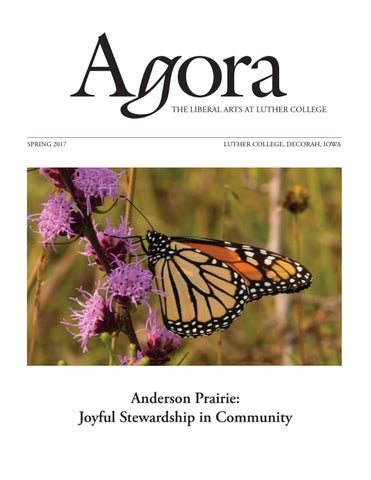
Cover: Monarch butterfly on liatris aspera in Anderson Prairie. Photo by Kirk Larsen
Introduction
by MARTIN KLAMMER, Professor of English, Agora Editor
A
short while back, President Carlson sent an email to the faculty in which she announced that the college had discontinued its discussions with the Decorah Community School District over the possible use of Anderson Prairie for a proposed new elementary school. The announcement was met by gratitude and a sense of relief from many members of the faculty and the Decorah community, including me. During discussions about the future of Anderson Prairie, members of the Biology Department, in particular, sought to inform the college and the public about the value of Anderson Prairie as a site for learning, as well as a natural resource to be cherished that would be compromised if a portion of it were to be developed. The faculty member most involved in the development, sustainability, and educational use of the prairie has been Kirk Larsen, our resident entomologist. For this issue, Kirk offered to write an essay on Anderson Prairie that grew out of his public advocacy of the prairie. The combination of Kirk’s passion for the prairie, his expertise as a teacher and scholar, and the fine photos that accompany the article help us appreciate
2
Agora/Spring 2017
the enduring value of Anderson Prairie as a resource to be nurtured, respected, and enjoyed. This issue features several aspects of life at Luther College that are of enduring value. The Paideia Program is marking its 40th anniversary. Paideia grew out of two earlier first year programs, the Core Program (1964-1971) and Freshman Studies (1972-1977). The emergence of Paideia was made possible by the vision and commitment of the faculty in the 1970s. We who teach in Paideia and the college as a whole benefit from the work of those before us in ways we perhaps cannot fully appreciate. We hope that we, too, might make lasting contributions to the college and to our students’ lives. This issue also features the last two of four Paideia Texts & Issues lectures on the question of “Who Do You Trust?” In the final lecture of the year, Nancy Gates-Madsen and Lea Lovelace raised the profound question of how family members of victims of “incomprehensible” horrors such as the Holocaust can trust that memorial sites and museums will honor the memory and dignity of their dead loved ones. In this way they speak about how that which is of most enduring value—the memory of those we love—might be fully honored. Their lecture concluded an excellent lecture series which featured Storm Bailey challenging us to consider how trust in God can promote civil discourse, Rachel Brummel illustrating how trust at the community level can lead to more effective environmental decisions, and Wintlett Taylor-Browne and Michelle Boike helping us think about how race affects whom we trust. Together, the four lectures demonstrated the breadth of the liberal arts at Luther College from the perspectives of philosophy, environmental studies, critical race
theory, sociology, museum studies, history, cultural studies, and art. In his address to Luther’s Phi Beta Kappa initiates, Concordia College president and former Luther College dean of academic affairs Bill Craft encouraged students to turn their liberal arts education “inside out” through forms of citizenship and service that, in the Lutheran tradition, turn “our thought and action toward our neighbor.” In particular, Craft told the initiates to tell the truth. “I cannot think of a time in my own life,” he said, “when this has mattered more. Take your learning, the learning you love … and turn it toward a world that has radical need of your habits of mind and heart.” That process begins at Luther College in Paideia. As one of my students wrote in his final paper: Paideia significantly helped me expand beyond my black and white view of the world that I came to college with, and made me think deeper and harder about the texts …Through Paideia I am in the process of asking myself questions about deeper meaning, listening to all different viewpoints, and trying to find myself as a person and what I want to do in life, something that has eluded me but that I now have the tools to accomplish.
Paideia Retrospective
by MARTIN KLAMMER, Professor of English, Agora Editor
P
While the program called Paideia began in 1977, it was preceded in scope and mission by the Core Program (19641971) of separate courses taught by faculty in the English, history, and religion departments, and by Freshman Studies (1972-1977), an attempt to make the Core program more interdisciplinary. In 1977 the common curriculum took its current form of two first-year courses and a third course focused on values to be taken in the student’s junior or senior year. The new course was designed by a committee of four faculty members— two from English ( John Bale and Mary Hull Mohr) and two from history (Richard Cole and Robert Davis)—and chaired by Assistant Dean Jane Borelli. The name “Paideia” was proposed by Borelli, according to a brief “History of the First-Year Common Course at Luther: Paideia and its Precursors” by emeriti professors of English Martin A. Mohr and John Bale. Borelli wrote at the time: Paideia, the ancient Greek word for education, is the name of a new program continuing a decade-long tradition of interdisciplinary, required freshman courses at Luther College. Designed as a prologue to the liberal arts, Paideia awakens students to the accumulated wisdom of their cultural heritage and to their
LUTHER COLLEGE LIBRARY
aideia turns 40 this year! Can you believe it? Paideia was established in 1977 as a curriculum of three required interdisciplinary courses: Paideia 111-112 (formerly Paideia 1), a common two-semester sequence for first-year students, and Paideia 450 (formerly Paideia 2 or Paideia Capstone), a one-semester course requirement for juniors and seniors.
Professor Gracia Grindal lectures to the first-year class in the 1980-81 academic year role in carrying on that heritage. It concentrates on the college’s roots in the Classical, Lutheran, and Norwegian backgrounds, combining a body of historical and literary material with an emphasis on the development of critical writing skills. As a result, Paideia develops a sense of identity and self knowledge through the ability to think and write clearly, allowing the student to see the present and the personal in the context of broad social, cultural, and historical perspectives. Several grants from the National Endowment for the Humanities (NEH) were critical to the development of the program, particularly a challenge grant in 1983 of $350,000 which was matched by Luther on a three-to-one basis, for a total of $1.4 million to establish the Paideia Endowment Fund. That endowment continues to support the breadth of the Paideia program,
including support for the Director of the Paideia Program and the Writing Director, the Writing Center, the Texts and Issues Lecture Series (two such lectures are featured in this issue), library resources, sabbatical grants, and this publication, Agora. Professor Emeritus of Religion and Classics Will Bunge, director of the Paideia Program from 1979 to 1991, was chiefly responsible for the successful proposal. An owl was selected as the symbol for the new program. The design by John Whelan of the art department still adorns the cover of the Paideia Reader today. In a drawing contest of the owl some years ago, students had fun suggesting the challenging and sometimes stressful nature of the course in their satiric depictions of the owl. For much of its history, first-year Paideia featured four case studies: Classical Greece and Renaissance humanism in the fall, and China and American Ethnicity in the spring, the latter Spring 2017/Agora
3
subdivided into units on the NorwegianAmerican and African-American experiences. In 2004 the Paideia faculty decided to change from a case studies approach to a focus on “Enduring Questions.” In recent years the questions have been “What does it mean to be human?” (fall semester), and “What can we know and how can we know our understanding is reliable?” (spring). Regardless of course content, the goals and values of the first-year program have remained the same. The first-year course provides a foundation in the liberal arts and develops the habits of mind of reading, writing, critical thinking, and research. Professor of history and former Paideia director Jackie Wilkie says, “The idea is that any educated person ought to be able to deal with the texts we are studying, and those texts help students develop the skills of close reading and careful analysis that they can use throughout their careers at Luther College, no matter what their major is.” Paideia students and their instructors are engaged in a common mission of “seeking wisdom in community”—the Paideia motto. Over the course of an academic year, faculty get to know their students well. One of the joys of teaching the course is seeing the students grow from start to finish of their first year of college. Paideia 450 builds on the abilities students learn in Paideia 111-112 by addressing ethical challenges students face or will face in the larger world in such areas as education, technology, health care, sustainability, and race relations. Faculty for both Paideia 111112 and Paideia 450 are drawn from all disciplines—a distinctive strength of the Paideia program. “What we want in Paideia is a variety of texts, a variety of approaches to texts, and a variety of faculty so that we can wrestle with questions from multiple disciplinary perspectives,” says Storm Bailey, professor of philosophy and also a former Paideia director. Like the classical Greek Paideia (education) for which it is named, Paideia seeks to foster “a way of learning 4
Agora/Spring 2017
Seeking Wisdom in Community REBECCA SULLIVAN Paideia Program Director
I
that moves us beyond immediate interests into the larger world—an education that “develops whole persons” who are equipped to “serve with distinction for the common good” (Luther Mission Statement). Other institutions are taking notice. In December 2016, the Association of American Colleges and Universities (AAC & U) featured the Paideia curriculum as a “campus model” in a chapter from its forthcoming book, Rising to the LEAP Challenge: Case Studies of Integrative Pathways to Student Signature Work. In the article Bailey tells the AAC & U interviewer, “The common intellectual experience is a terribly important thing for a residential college. It plays a crucial role in the formation of our community as an academic community.”
n the Paideia classroom, it has been my privilege to help guide students to discover their abilities and to empower them with the nuanced language of persuasion. I am delighted by moments of surprise when a student discovers his or her ability for critical reading or just the right turn of a phrase. But even beyond that, I feel honored to be present when young adults share their thoughts and experiences. There are moments when readings in Paideia take class discussion to a place where students can be profoundly revealing about what it means to be human: one student trusts her classmates with a story about her family seeking safety amidst political turmoil, another talks about the struggles his mother faced as a single parent, yet another offers a glimpse of his passion for teaching adapted physical education. A student we don’t often hear from has an opportunity to demonstrate perfect pitch. The room is quiet when another classmate describes the drive and apprehension she felt as she applied for a student visa. In our Paideia readings, there are glimpses of struggle and triumph, and poignant moments when characters choose to bend their more selfish impulses toward the common good. Students try out new convictions as they discuss the assigned narratives and as they listen to one another. It is moments like these when students develop foundational skills and navigate toward their place in community. I know—not only as their instructor, but as a former Paideia student myself. In fact, I may have been in the audience in Valders when Gracia Grindal lectured on writing or the Norwegian-American experience [photo, page 3]. Observing the growth of my students gives me profound satisfaction, in large part because of the generosity shown me by my Paideia instructors. Those individuals who developed the Paideia program are the ones who made the most difference in my own intellectual life. I am glad to be a part of this vital, ongoing tradition at Luther College today.
First-year students (Class of 2020) on the value of Paideia
W
hile a large part of Paideia’s value is on writing and critical thinking, I find that an overlooked value of the class is the vast diversity of material covered. Throughout the year, we read plays, traditional folklore, classic novels, contemporary works, speeches, letters, and more. In addition to reading, Paideia also integrates art, music, and film to explore the enduring questions. Not only did I come to appreciate a large variety of genres, but I realized that there are common themes that transcend time and cultures. Because of this, I was able to relate to many of the materials, making the course more intriguing and valuable to myself. All in all, I learned that everything read, seen, or heard this year has something of value in it, and that it is definitely worthwhile to explore many different types of works. First-year Biology major
L
ooking back on the year I find that Paideia has taught me useful critical thinking skills that will help me throughout my college experience. Paideia has shown me how to find reliable knowledge and how important that knowledge is. This mandatory first year class has broken down many walls for students at Luther College such as the ability to critically think, write, and read, while at the same time building a great community of learners that enjoy going to class. First-year Management major
P
aideia is what makes Luther College stand out in a world where state schools seem to reign over the college domain. It provides the aspect of well roundedness that state schools do not have, which helps us as students have a better understanding of the world in which we live outside of our major. For me, Paideia has helped improved my time management skills and study habits. An example of this is writing papers. In high school, it was very easy to get away with writing a draft before class and still do well on the assignment. In fact, many of my friends at state schools still do that and seem to expect the same results. Paideia helped me step away from that bad habit to start early in the process and give myself plenty of time to edit and revise for the best possible results. I’ve noticed that it has affected other areas of my study as well; I get assignments done more efficiently and I’m more motivated to work if I don’t constantly feel like I’m behind in class. My writing has vastly improved over this year, from writing Paideia papers to lab reports to reflections. Paideia prepares us for the future by giving us a sense of well-roundedness while also motivating us to use our time wisely and think critically and carefully about the work we do. First-year Nursing major
I
think I will realize the value of Paideia even more when I take more difficult courses later on in my academic career. As a Communication Studies major, having effective written communication is of utmost importance in the field I hope to go into. In Paideia, I learned how to write in such a way that even exceeds some of the standards of writing that we are expected to adhere to in communications. I have learned that not all opinions are created equal, and if I want people to listen to what I say, I have to back it up with reliable sources and evidence. This is something that I find reinforced in my communications classes, but I learned how to do that in Paideia. First-year Communication Studies major
T
he value of Paideia, for me, is that it gave me a reason to think critically every day. When you are asked to reflect on how people in a novel from centuries of the past would have felt about the things that are happening to them, you begin to think in many different ways that I found to be new to me. Paideia makes you understand “feelings” better than any course that I have ever taken. I enjoyed writing my Paideia papers, because it allowed me to enter parts of my mind that I didn’t even know were there until I was forced to enter them. I was able to write about love, I was able to write about anger and deceit, and I was even able to write about myself. Paideia allowed me to look into the lives of the characters, while also reflecting back on my own life and the events that shaped me into who I am. That’s the beauty of Paideia. You get to learn who these characters are in the novels we read, but you also find little pieces of yourself in these characters too. First-year English major
W
hen I first started Paideia I thought it was going to be like any other high school English class; you could get an A if you showed up to class and did the required work. However I quickly found at that the course would require much more dedication and thinking than I originally anticipated. I realized this after I got my first paper back accompanied by a grade lower than I was used to. When I was told my paper lacked evidence, I made it my mission to improve on the next paper and every paper after that. With time, I was able to hone my ability to shape arguments using data or evidence from a text, and I’ve found that it comes a lot easier to me now. This skill has not only helped me in Paideia. I’ve been able to use what I’ve learned in Paideia in other classes such as Spanish, when writing lab reports in Biology, and writing my term paper for Religion. I firmly believe that the work I’ve done in Paideia will help in other classes, and that every student can benefit from this course in some way if they are willing to apply themselves. First-year student, undecided about major
Spring 2017/Agora
5
PAIDEIA READINGS Fall 2016 Fowler, We Are All Completely Beside Ourselves Hurston, Their Eyes Were Watching God Shelley, Frankenstein Darwin, excerpts from On the Origin of Species and The Descent of Man Mann, Judgment at Nuremberg Anishinaabe-Ojibwe Creation Story: “Turtle Island” Genesis 1 & 2, Proverbs 8, and Revelation 20:11-15. Michelangelo, Sistine Chapel Paintings Haydn, Die Schöpfung (The Creation) 2016-17 Paideia readings, from an illustration by Paideia student Karina Hoff
Fall 1977
Spring 1978
Spring 2017
Homer, The Odyssey
Niane, Sundiata
Davis, The Return of Martin Guerre
Herodotus, Histories
The Autobiography of Malcolm X
Aeshylus, Persians
M.L. King, “Letter from Birmingham City Jail”
Plato, “Allegory of the Cave” and Apology
Plato, “Allegory of the Cave” Dante, Inferno Machiavelli, The Prince More, Utopia Luther, excerpts from “Concerning Christian Liberty” and “The Bondage of the Will” Shakespeare, Othello
Rolvaag, Giants in the Earth Koren, Diary of Elisabeth Koren Fairbank, The United States and China Lu Xun, “The New Year’s Sacrifice” Marx and Engels, Manifesto of the Communist Party Essays by Mao Kane, Ambiguous Adventure Highet, Man’s Unconquerable Mind
6
Agora/Spring 2017
Akutagawa, “In a Grove” and “Rashōmon” Rashōmon. Dir. Akira Kurosawa. Luther, “Address to the German Nobility” and “To the Councilmen of All Cities in Germany that They Establish and Maintain Christian Schools” Shakespeare, Much Ado about Nothing Adichie, The Thing Around Your Neck
Inside Out: The Work of the Liberal Arts by WILLIAM CRAFT, President of Concordia College
G
ood afternoon! It is a good afternoon: Good because it’s Shakespeare’s birthday, and good because we can honor Ruth Davis, for whom this ceremony’s lecture is named. She was a member of the math and computer science department here until her death in 1983, had a deep interest in the role of women in science, and played an important part in founding the Luther chapter of Phi Beta Kappa. This day is good, most of all, because we have come to honor students who have excelled in liberal learning, and to honor the teaching scholars—Luther’s faculty—who have inspired, challenged, and guided them in that endeavor: the arts of inquiry and discovery; the recovery and renewal of wisdom. Congratulations to every student gathered here! And to their teachers and families. I want to add that it is a good afternoon for me, and for my wife Anne. We worked at Luther for eleven years, and our beloved daughter Meg earned her baccalaureate here: she teaches at the John Cline School. Omnia Mutantur, Nihil Interit, goes the line in Ovid’s Metamorphoses: Everything changes, but nothing is lost (15:165). Standing with you today, I learn again how limited language can be in telling how much we love something, especially a place and people who have transformed our lives. The students here, you know that, especially as you look ahead to your life and work after commencement. I want you to know that Anne and I know it too, having commenced from Luther into the next chapter of our lives. A wonderful chapter it is, and yours will be too. Seven years ago, I gave an honors convocation talk at Luther. It was called “Reason Not the Need.” My argument was that the act of learning is good, good in itself, without the need to serve
some other end, either for private gain or even for saving the world. Good like love is good; like someone you love is good; like beauty is good; with no need to demonstrate that it has some transactional use. My title that year came from Shakespeare’s King Lear— from a scene after the miserable old monarch has banished those who love him and placed himself in the hands of those who mock him in his weakness and ask why he needs anything at all from them. This is his reply: O, reason not the need! Our basest beggars Are in the poorest thing superfluous. Allow nature not more than nature needs, Man’s life is cheap as beast’s. (2.4.264-267a) We are born to learn: to question, to discover, to invent, and to remember. To learn fulfills our nature. Neither profit nor service is needed to defend the act of finding a cluster of variable stars or composing a memoir. If inquiry, reflection, and creation are not good in themselves, then our lives are narrowed, cheapened, with a loss of joy, of wit, of happiness, of health. I still believe this, and I would say again to the students here now, never trade away your educational birthright and diminish your capacity to flourish as a free human being. Reason not the need, I said. I affirm that today. But today, honored students, I would tell you this: there is a need. Not a need to justify your liberal learning by some utilitarian formula, but the need for your learning to get to work in the world—and not just after you graduate: right now. For the rest of this talk I want to do three things: look at the experience of learning, consider with you the danger of it, and
end with the need to turn it inside out. We live at a threshold moment: I want to encourage you to cross that threshold for the common good.
Learning is good in itself, but it is never cozy; it is never safe; it can pick us up like a wave and throw us on a farther shore. It can turn us, and our lives, inside out. I’ve never come across a better story of what it feels like to learn than in a scene from John Williams’ Midwestern novel, Stoner. The title character grows up on a farm 40 miles from the University of Missouri, a hard scrabble existence with his parents until, when Stoner is 20, his father abruptly declares that his son ought to go to college. The father has heard of a new degree in agricultural science at Missouri, and after some hesitation, Stoner sets out for this unexpected life. He does well in the Ag School, but in his sophomore year, in the midst of a lit survey the university requires him to take, he finds himself cornered by his English professor. The prof, whose name is Sloane, reads Shakespeare’s Sonnet 73: That time of year thou mayest in me behold When yellow leaves, or none, or few do hang Upon those boughs that shake against the cold, Bare ruined choirs where late the sweet birds sang. Sloane, sensing that his students are tuned out, asks a series of them what Spring 2017/Agora
7
the sonnet means: they have nothing to say. Then he turns to Stoner, who freezes under his teacher’s gaze. Then Sloane stops, and speaks the poem again, slowly—and as he does, Stoner becomes acutely aware of everything around him: “the faces of his fellow students,” the down on a classmate’s cheek “caught [in] the sunlight,” and roughness of his own hands, hardened by farm labor (13). He tries to speak but can’t. Sloane, dry witted but not hard of heart, recognizes that something has happened to Stoner and ends his questioning. In my own teaching experience I remember, long ago, my first-year students were studying Dante’s Inferno, a pilgrim’s journey into and then out of the depths of addiction to things that draw us into isolation and ruined lives. A student came up to me in the hallway, after a class, to tell me how disappointed she was at the end of the poem to see Dante’s Satan: “I was expecting someone magnificent, powerful, and alluring,” she told me, “but all I found was an impotent monster frozen in the ice.” I can still see her in that hallway in Maryland. My response was only one word: Right. She flinched, her arms shook for a second, she put her hand to her mouth, and she began to laugh. A good laugh, a liberating laugh. Learning, real discovery, begins in wonder. It’s joyful. But I am quick to add: it isn’t free of risk. It’s been a rough go of late in this country for liberal education. When Barack Obama and Mitt Romney faced off in 2008, neither of their higher education platforms said a word to indicate that a college degree had any other value than making you more money—and making the nation more rich. Not a word about human flourishing; not a word about citizenship. And it hasn’t gotten any better: Our current administration has proposed junking the national endowments for the humanities and the arts. If we’ve grown defensive, or if we feel like sheltering in a corner, it’s no surprise. But it’s not smart. We need now to remember that learning never was and never will be safe—if safe means free of challenge or free from change. Back to John Williams’ novel: After 8
Agora/Spring 2017
that epiphany in Sloane’s class, Stoner changes his university course of study, abandons his Ag major, and with it, his plan to return to his family’s farm. And he still doesn’t know what he’s going to do. Read the novel to find out! My long-ago student, led by her restless imagination to discover a truth about good and evil in Dante, came to see me two years later to say that she had decided she wanted to do in the world: become an ordained pastor. She was Catholic.
Take your learning, the learning you love, the learning that has led you into unexpected and not always safe places, and turn it toward a world that has radical need of your habits of mind and heart. In my first month at Concordia College, a 2006 Concordia graduate walked into my office. Her name is Miquette Denie McMahon; you can read about her on the web.1 She had majored in Nursing, a very good science student who had completed the liberal arts core required of everyone. Miquette grew up in Haiti. Her family had, we would say, nothing. She and her siblings took turns selling food in the streets to generate some income, meaning that they could go to school sporadically at best. But someone saw her, someone helped her get to high school in Minnesota and then North Dakota, and Concordia offered her a college scholarship. I asked Miquette what learning at Concordia had done for her, and I expected her to say, “It enabled me to become the first person in my family to go to college.” It would have been a more than fine answer. That’s not what she said. Here is her answer: “Concordia led me to dream bigger dreams.” Though a nursing major, and a very good one, Miquette returned to Haiti and founded a nonprofit to raise scholarships to send Haitian children to
school. By 2010, she had begun a still bigger project of building schools—and the faculty to teach in them. Now the School of Hope in Port-au-Prince teaches children in grades one through six, and children there and elsewhere through TeacHaiti scholarships are receiving an education—hundreds of children who would otherwise have never crossed the door of a school in their lives. The most memorable line I have yet heard in a college senior’s speech I heard here, at Luther, given by then senior Sarah Strandjord at an honors convocation in the CFL. She’s now an attorney. “The best thing I learned in college,” Sarah told us, “was to change my mind.” Learning is good in itself, but it is never cozy; it is never safe; it can pick us up like a wave and throw us on a farther shore. It can turn us, and our lives, inside out. And that too is good: good for you, and good for the world. And now I come near my ending: Knowing that learning is good, and knowing that learning changes us, we need to turn our learning inside out. That’s what the word education means: to lead outward. And at Luther and Concordia both, we know from our Lutheran heritage that outward is the direction of grace. The love of God isn’t a confining thing but a liberating one: it sets us free to turn our thought and action toward our neighbor. Equally radically, it tells us that we cannot be fully and completely ourselves unless we do so. I cannot think of a time in my own life when this has mattered more. Take your learning, the learning you love, the learning that has led you into unexpected and not always safe places, and turn it toward a world that has radical need of your habits of mind and heart. Though I could urge you now to many needful things in the world, I will limit myself to one imperative: tell the truth. Your nation, your world, needs you to seek it out in your learning and to tell it. Odd to think that truth can fall out of favor, but it’s far from unprecedented. Right before Anne and I started in college, Martin Luther King Jr. was
trying to tell the truth in Memphis about race and class and the full flourishing of America. He was killed. When we graduated and got married, the Select Committee on Presidential Campaign Activities, the Watergate Committee, was underway before a stunned America. We find ourselves now living at a moment when manufacturing misinformation is embraced, without apology, as a tactic, and our best comedians—like Shakespeare’s wise fools—remind us of the folly and damage this does to human lives.
I will limit myself to one imperative: tell the truth. Your nation, your world, needs you to seek it out in your learning and to tell it.
Notes 1. See the website for TeacHait: <http:// teachaiti.org/about-us/part-1/>.
Works Cited Ovid. Metamorphoses. The Latin Library: <http://www.thelatinlibrary.com./ovid. html>. The Pulitzer Prizes: <http://www.pulitizer. org/prize-winners-by-category/208>.
Shakespeare, William. Riverside Shakespeare. 2nd Edition. Ed. G. Blakemore Evans and others. Boston and New York: Houghton Mifflin, 1997. Williams, John. Stoner. New York: NYRB Classics, 2006.
We can seek out and tell the truth in small ways and large: in research and publication, in the deep truths of the arts, in the mundane, everyday work of being a citizen—a citizen of our colleges and our country. 2001 Luther grad Erin Alberty did it as part of a team of journalists working for the Salt Lake Tribune that won the Pulitzer Prize for “vivid reports revealing the perverse, punitive and cruel treatment given to sexual assault victims at Brigham Young University” (http://www.pulitzer.org/ prize-winners-by-category/208). Truth telling, as with Erin’s work, sometimes requires seeing what is ugly, what is fearful, what diminishes our common life. But it can be equally a joyful thing: discovering and proclaiming the embrace of difference that makes us whole, working with knowledge and insight and patience for the renewal of creation, and like Miquette, seeing the necessity of learning and making it possible for others. Luther has offered you the transforming arts of liberal learning, and you have embraced them. Go out now and practice the liberal arts. Do the work the world needs of you. Tell the truth with courage and with joy. Spring 2017/Agora
9
The Role of Anderson Prairie in Our Educational Mission by KIRK LARSEN, Professor of Biology
KIRK LARSEN
of the traditional non-native seed mixes that were popular at the time.
Baker Village from Anderson Prairie
Anderson Prairie was the first sizable tallgrass prairie planting on the Luther College campus. Led by Professor Roger Knutson, the biology department had previously planted several acres known as Aikman Prairie just east of US-52 and north of Pole Line Road in approximately 1968. By the 1980s, the college farm (i.e. the big red barn) ceased producing food for the college cafeteria, and soil erosion was becoming a problem on the sloped area of the college farm fields that are now known as Anderson Prairie. In 1988, this eroding land was entered into the federally-funded conservation reserve 10
Agora/Spring 2017
program (CRP) which required the landowner to plant erosion-controlling vegetation on highly erodible land to improve water quality. Luther College was ecologically progressive and chose to seed these 21 acres with nine species of native wildflowers and four species of native tall grasses, instead of using one
KIRK LARSEN
A
nderson Prairie is a 24.7-acre planted tallgrass prairie located along College Drive directly across from the central campus of Luther College. This natural area is both visible at our main entrance and easily accessible from the central campus. As such, it is arguably our most heavily used “outdoor classroom” on campus, and supports our educational mission in a wide variety of ways.
On November 11, 1995, the Board of Regents dedicated this 21-acre area as Anderson Prairie, in honor of the then presidential couple, Jutta F. and H. George Anderson, who enjoyed taking walks through the prairie. Not long after, by the mid-1990s, the college was in the process of planning a new upper-class housing complex that eventually became known as Baker Village. Initially, the plans were to build this complex along College Drive, but the ad hoc planning committee thought it would be better to place the village on a site away from College Drive along Hickory Ridge Woods on a 7.5-acre area which had been planted to prairie in 1988. Knowing that Anderson Prairie was used in teaching and research with students, college President Jeffrey Baker proposed that the college expand Anderson Prairie out to College Drive. This would use the area of the field along College Drive that had been used by a local farmer to grow oats and host an annual horse-drawn plowing match. Given the opportunity to expand and
Aerial photo of Anderson Prairie, showing College Drive, Baker Village, Ridge Road, Hickory Ridge Woods, and main entrance to Luther College
expansion would provide the college and Decorah with some significant ecosystem services. Ecosystem services are both direct and indirect benefits from ecosystems that support our economy and maintain our quality of life, and as such have hidden yet real economic value. These services include absorbing rainwater runoff, sequestering atmospheric carbon, and hosting pollinators. As a result of the Baker Village project, the college ended up with a planted prairie of 24.7-acres
There were several specific goals developed for this expansion of Anderson Prairie. The first goal was to give both the college and the Decorah community an example of the native tallgrass prairie habitat that historically covered over 85% of the state of Iowa. The remaining 15% of Iowa, including much of northeast Iowa, was oak savanna, which some affectionately call “tallgrass prairie with trees.” Essentially, almost all of Iowa had been covered with some form or variation of tallgrass prairie. Today, less than one tenth of 1% of the historic tallgrass prairie in Iowa still exists, so providing an Anderson Prairie tallgrass and wildflowers example of this unique and important habitat created educational that was dedicated for use in education, outreach opportunities for the college. research, outreach, and recreation. A second goal of this prairie expansion In 1994, I started using Anderson was to increase the biodiversity of Prairie as an outdoor laboratory in my Anderson Prairie. Therefore, a diverse teaching and also as a research site. Our seed mix of 76 species of tallgrass first major study was a 5-year project prairie plants was planted, including that evaluated the impact of 3-year five species of grasses and 71 species of burn cycles on insects within a planted wildflowers. This was still a relatively prairie. At the time, the common low species list compared to some of our practice among prairie restoration highest-quality remnant prairies, which folk was to burn a prairie every three may contain 300 to over 500 species years, so we wanted to look at the or more on site, but was an extremely impact of this management practice on diverse seed mix for a prairie planting at biodiversity. My work evaluated how the time. different types of insects (I specialize in A third goal was to increase the ground beetles), an important part of recreational and educational the biodiversity of prairies, are affected opportunities for Luther College and by this management practice. With the the broader Decorah community. expansion of the prairie, we now had a Finally, we knew this prairie unique research opportunity with both
a low diversity planting area (the 13 species originally planted) and a high diversity planting area (the 76 species planted during the Baker expansion) within the prairie. In 1998 the prairie was divided by mowed paths into 18 research plots of just over one acre in size, and each plot was assigned to a unique management schedule. Historically, tallgrass prairie was maintained by two significant natural processes: fire, which would sweep across the landscape, and grazing by herds of large animals such as bison. Both of these natural processes cause significant disturbances to the landscape. Native tallgrass plants are adapted to these periodic disturbances, and are specialized to live in habitats that experience what we might consider major negative impacts, but in fact these disturbances preferentially stimulate native prairie plants to grow. To mimic these natural disturbances, today we use both prescribed fire and mowing. A mower, like a herd of grazers, basically takes in the vegetation, chops it up and spits it out the rear. Thus our combination of low diversity and high diversity plantings, combined with fire and mowing management options, allowed us to create a unique experiment in 1998 that we have now been studying for almost 20 years. KRIK LARSEN
increase the diversity of the prairie, the college increased the planted size of Anderson Prairie from 13.5-acres (after Baker construction) to 24.7-acres.
From our management of the site, one of the most important lessons that we’ve learned is how to train Luther students to participate in safe prescribed burns. We now require all students who want to assist with prescribed burning on campus to attend an hour of classroom training led by Dr. Molly McNicoll, assistant professor of biology and natural areas land manager, Spring 2017/Agora
11
KIRK LARSEN
Students assisting with a prescribed burn in Anderson Prairie
From my research that has monitored both plant and insect communities, we’ve learned that Anderson Prairie is the most diverse planted prairie in the Decorah area. We have documented 118 species of plants in Anderson Prairie, including 71 of the 76 species that were planted. This is a very successful establishment rate for a prairie planting, and although not nearly as species rich as a remnant prairie, it is a species rich prairie planting that is starting to function like a remnant prairie in many ways. We’ve also found over 50 species of butterflies over the years, and have documented repeatedly that more species of butterflies live in the higher diversity planting areas of the prairie along College Drive than in the low diversity planting areas. These more diverse areas of the prairie have more wildflowers, which provide more pollen and nectar as resources for pollinators such as butterflies and native bees. Pollination is a vital ecosystem service relative to food production. In my various studies of beetle biodiversity with students, we have so far found five species of beetles in Anderson Prairie that to date had been found nowhere else in the state of Iowa. 12
Agora/Spring 2017
Luther College is also now part of the Iowa Monarch Conservation Consortium, with the goal of increasing monarch butterfly production here in Iowa to help slow the decline of this iconic species and lead to larger populations of monarchs at their overwintering grounds in Mexico. As part of our studies, we have been both counting butterflies and estimating milkweed density within Anderson Prairie. In 2016, we estimated Anderson Prairie contained over 42,000 common milkweed plants, which supports the production of over 1,050 monarch butterflies.
Prairie is clearly an excellent monarch habitat which as a college we need to try to preserve and protect. On March 10, 2017, the rusty patched bumble bee was officially listed as an endangered species by the U.S. Fish and Wildlife Service. Since this species has been found in one of our tallgrass prairie plantings on campus in 2014 and its habitat is tallgrass prairie, our tallgrass prairies on campus must now be managed with burning and mowing specifically to protect a possible local population of this bumble bee. At a college that carefully tracks its carbon footprint, Anderson Prairie is a valuable asset because of the carbon sequestration ecosystem service it performs. Carbon sequestration is the removal of carbon from the atmosphere. Tallgrass prairies remove carbon from the atmosphere at a rate
In September 2016, we held a monarch butterfly migration banding outreach event in Anderson Prairie. A number of current Luther students, faculty, staff, and families from the Decorah community came to help us capture, tag, and release over 200 monarch butterflies in just two hours and send them on their way to Mexico for the winter. In December 2016 at a joint meeting about monarch butterflies, the Natural Resources Conservation Service and the U.S. Fish and Wildlife Service concluded that to maintain monarch butterflies, we have to minimize disruption to or disturbance of existing monarch butterfly Tag on the hind wing of a monarch butterfly used to track its habitats. Anderson migration to Mexico
KIRK LARSEN
and myself. Once they complete this training, they can join the burn crew and be on the fire line. It is important they understand the ecological reasons for burning, the safety issues involved, and what to do if there is a major shift in wind direction.
Anderson Prairie provides at least one additional significant ecosystem service to the Decorah community and Upper Iowa River watershed. During and after heavy rain events, large quantities of
Anderson Prairie is used extensively by classes and community groups. In the past, the entire first year class was marched out through the prairie during orientation to help remove invasive species such as buckthorn. High school biology classes have used the prairie for laboratory exercises, and faculty workshops and other groups that meet in Baker Commons often use the prairie trails during breaks or for activities. The former environmental college for young leaders and current discovery camps use Anderson Prairie extensively for environmental education in the summer. This area is used by students, staff, faculty, and community members for walks and hikes. Groups like the Greening of the Church conference have used Anderson Prairie specifically to learn about some of our land stewardship efforts. Scientific conferences such as the Prairie Invertebrates Conferences in 2001 and 2007, the Dragonfly Society of America meeting in 2004, and the Iowa Prairie Conference in 2013 have all come to Luther College and used Anderson Prairie to study prairie restoration and
the organisms that call Anderson Prairie home. Anderson Prairie is probably our most heavily used “outdoor classroom” on campus. At least thirty two different classes have used Anderson Prairie during the past five years. Biology uses it extensively in 13 different courses; Environmental Studies for five additional classes; Education uses it in their science methods courses; and Dance uses it in a variety of ways. English has their students go out into the prairie to complete writing assignments. Even Paideia, Philosophy, Art, and Physical Education Fit and Well courses have used the prairie to some extent. This area is truly an outdoor classroom used by the entire college. Luther College provides undergraduate research experiences for our students, and Anderson Prairie is a primary site each summer and during the school year to provide our students with research opportunities, partially due to its proximity to Sampson Hoffland labs, but also because it is the only non-flood plain prairie in the area. Providing students with research experiences is a crucial component in our training of future scientists. Some of these research students have presented talks or posters at professional scientific meetings on their studies in Anderson Prairie. Even
Luther summer research student quantifying plant diversity and counting milkweed plants within Anderson Prairie Spring 2017/Agora
KIRK LARSEN
of approximately one and a half metric tons of carbon per acre per year, whereas our mowed lawns typically sequester only 120 to 140 pounds of atmospheric carbon per acre per year. The four inch deep roots of our mowed grass lawns also dry out in the summer (and become dormant and turn brown), and simply are unable to capture or store much carbon. In contrast, tallgrass prairie plants remain green throughout the droughts of summer because of their deep and dense root systems. Tallgrass prairies sequester almost as much carbon as most forest ecosystems, and place most of that carbon underground in their extensive root systems, which in the long run is the best location to store that carbon and help form the rich topsoils of Iowa. Some people believe burning the prairie would contradict this sequestration, but the flush of new plant growth soon after a prairie burn more than compensates for the carbon dioxide released into the atmosphere during a fire.
LUTHER COLLEGE PHOTO BUREAU
First-year class stroll in the prairie
water flow down through Hickory Ridge Woods from areas along Ridge Road, Nordic Drive, and Highland Drive near the Vennehjem retirement community into Anderson Prairie. The tall prairie vegetation slows down this runoff, and the deep extensive root systems allow the water to infiltrate into the soil, replenishing the ground water. Since Anderson Prairie soaks up almost all the water dumped into it during a rain event, the amount of water that otherwise would end up in the storm sewers dumping into the Upper Iowa River and contributing to flooding is reduced dramatically. This infiltration occurs particularly in the low flat area of Anderson Prairie near the intersection of College Drive and Ridge Road.
13
more impressive are the seven research articles published in peer-reviewed scientific journals that have presented data collected from Anderson Prairie since 1994. Four of those articles were co-authored by Luther students, and all were published with data collected with the assistance of Luther research students.
actions and decisions, including the management and preservation of our unique educational natural areas such as Anderson Prairie. At 24.7-acres, Anderson Prairie is just a postage stamp in a sea of lawns, fields, woods, buildings, and roads, yet this small prairie supports plant and animal biodiversity, provides significant ecosystem services to the community such as pollination, absorbs runoff during rain events, and sequesters atmospheric carbon dioxide which otherwise would contribute to climate change. As our most visible and heavily used outdoor classroom, Anderson Prairie plays a vital role in supporting our educational mission of teaching all members of our community how to be better citizens in the world, and to care for the creation that surrounds and supports us.
KIRK LARSEN
Luther College has a reputation as a leader among Iowa colleges in natural areas land management. Conservation organizations like the Iowa DNR, the Nature Conservancy, and the Iowa Natural Heritage Foundation look to us for advice, research, and for student interns. Anderson Prairie attracts students to Luther and, as a model of natural areas land management and conservation to our region and state, provides our students with distinctive educational opportunities.
Luther College students, faculty, staff, and alumni have made it known they value Anderson Prairie as part of our sense of place and its connection to the college. Luther College has a unique connection to this specific piece of northeast Iowa, and this sense of place affects our educational program and impacts the lives of our students. In our sesquicentennial strategic plan, Luther College proclaimed that we wanted to deepen our “commitment to a sustainable future by creating awareness [of ] and nurturing a connection to place,” and our extensive and diverse natural areas are part of fulfilling that effort. We teach Aldo Leopold’s land ethic, and boldly proclaim in our current mission statement that we “practice joyful stewardship of the resources that surround us.” We not only teach about joyful stewardship, but we live out this joyful stewardship of creation in our
Anderson Prairie and Baker Village in wintertime
14
Agora/Spring 2017
The Bang Collection in Preus Library: A Significant Holding and Resource by ANDREA BECKENDORF, Associate Professor in Library and Information Studies
proven to be helpful in answering research questions.
Acquisition History of the Bang Collection Reports of the size of the Bang library vary in accounts of college history, and range anywhere from 5,000 to 7,000 items. College records mention a telegram confirming the purchase of over 6,000 items, but we have been unable to locate the telegram in the Archives. Bang’s own handwritten catalog of his library collection was re-discovered in the Archives collection in November 2016 (after my sabbatical), and has not yet been examined in order to determine how many items he listed. In addition, Bishop Bang’s handwriting poses a challenge in deciphering the list. The Archives also contain record that Bishop Bang corresponded with Laur. Larsen as early as 1879. These materials are handwritten in Norwegian, so will take additional work to determine content.
The acquisition of the library of Anton Christian Bang was a significant milestone in the history of the Luther College library collections. My sabbatical project was driven in part by questions about the size of that collection, a desire to know how many of the items are still part of the library collection, and how the Bang Collection fits into the larger picture of Norwegian and NorwegianAmerican library materials at Luther and beyond. Analysis of these areas of the library collection will help to better connect the materials to the college curriculum and external researchers, to identify items that are unique to Luther College, and to identify the strengths of the library collection and whether there are additional materials we should consider for acquisition. More thorough knowledge of these sources has already Pages 1 and 2 of the Bang Catalog
Despite a published account that the Bishop’s library had been acquired by a state institution in the Midwest, it was Luther College that emerged successful on this front. The Honorable Laurits Swenson (class of 1886) and Herman Haugan, a Chicago banker, were the primary financial backers for this effort. The original contract for purchase of the collection can be found in the Luther College Archives. Dated 6 October 1913, the contract was undersigned on behalf of the Bishop by his daughters Gulla, Liv, and Maia (Maria), for a total of 4000 kroner. News of the acquisition reached the College on Founder’s Day 1913, and was a first step in securing funding for a new library building that would eventually be Koren Library. Anton Christian Bang died in May 1914, and the contents of his library were shipped to Luther College. Maia Bang apparently visited the Luther College library in 1935, and wrote a letter to Karl T. Jacobson expressing her surprise that the
ANDREA BECKENDORF
I
n 1914 friends of the college arranged to acquire 5,000 books of Anton Christian Bang (18401914) for the Luther College library. Bang was a leading figure in the church of Norway in the late 19th and early 20th centuries. Bishop of Christiania (Oslo) from 1896-1912, church historian, and professor of theology, Bang authored numerous books on general and Norwegian church history. Bang also had an extensive personal library. The collection acquired by the college was especially rich in Norwegian literature and history, church history, and geography. When the college library moved from Koren to Preus Library in 1969, the Bang Collection was dispersed into the public Main Stacks, the Rare Book Room, and closed stacks in the library basement.1
Spring 2017/Agora
15
Bang Collection had been dispersed throughout the entire library (as opposed to being kept together as a separate special collection), and wondered why the Bang Library bookplates had not been used on the books. Jacobson wrote back with an explanation of the collection arrangement and an apology about the book plates (he surmised they must have been lost in unpacking) and expressed regret that he had not been in town when she visited.
Methodology of the Project Given the acquisition history and the fact that only 729 items were known to be in the library’s Bishop Bang Collection, the initial phase of my project was to try to identify additional items that were still part of the library collection. Since we had not been able to locate Bang’s own catalog of his library, there was no straightforward methodology with which to begin. However, thanks to a tip from Librarian Emeritus Duane Fenstermann, the library accession logs were located in the Archives, with 2,500 items from the Bang Collection enumerated in the gifts and special collections volume. I used a search of 150 items from the beginning of the list to develop a workflow process and test my hypothesis that searching every title in the log would yield additional items that could be added to the Bishop Bang Collection. That sample search identified 28 titles that were likely part of the Bang Collection but that were not included on the “known item” list. As part of the accession log, each of them should have a unique number stamped inside, along with “Bang Collection” either written or stamped somewhere on the book. I was able to locate 27 of the items, 25 of which were positively identified by Bang Collection markings. Given the success of the sample in identifying “new” items for the collection, I divided the accession list into 12 sections and developed a workflow. The first steps involved looking at the accession list to identify notable items by publication date, interesting title, significant author, place of publication, etc. The next steps 16
Agora/Spring 2017
involved searching WorldCat for a record and noting library holdings. WorldCat lists were used to track the titles: the “Add” list was then used to search for each physical item in the library. Each item was examined for markings that might identify it as part of the Bang Collection, and positive matches received a special collections slip noting the accession number and any unique library holdings. Decisions were made as to whether each item should be part of closed stacks or the Rare Book Room. The final steps involved updating the online catalog record to include the Bang Collection designation and any special holdings note, such as whether Luther College holds the only copy or only U.S. copy of an item. A “Missing” list was also created which contains the items listed on the accession list but which are no longer in the Luther College library collection. I built a project cart that would allow me to carry materials and supplies with me throughout the library (pencils, pens, sticky notes, string, scissors, scratch paper, Bang Collection slips, etc.) while searching for the books, and that would then allow me to easily transport books for additional cataloging, repair, or relocation. Most of the titles on the accession list required more than one catalog search, and in some cases, close to 10 searches in order to identify the best record for an item. Complications included foreign language titles (i.e., figuring out search strings for transliterated Greek and Russian), the availability of many editions of an item, virtually illegible handwriting in the accession list or items that simply did not match anything from the holdings on OCLC (a global library cooperative that provides shared technology services for its membership). A librarian at another institution pointed me to a public catalog search for the physical materials in the National Library of Norway (their main page directs people to digitized resources), so I was often able to use information from those records to determine whether or not there was an appropriate record on OCLC. A special thanks should go to both René Donlan, for helping me with the ins and outs of working with WorldShare
and for updating the more complicated cataloging issues, and to Eddy Atwell, for working to track down the items on my “Missing” and “Need to Locate” lists. After working through the accession list, I examined the 729 items on the “known item” list in order to verify that these were, indeed, part of the Bang Collection. A handful of items did not exhibit any Bang Collection markings and will be removed from the collection. Several of the records were placeholders for collections of things, most notably 14 collections of pamphlets related to politics in Norway, primarily related to the Sweden-Norway Union and its dissolution in 1905. Out of 171 political pamphlets, only 31 were cataloged as part of our collection. Two additional sets of similar items included a folder of “folksong” pamphlets and a folio-sized volume of cathedral and architectural drawings, only one of which had an accession number. After all of the positively identified items had been given a “Bang Collection” slip, I could visibly identify high-concentration areas of the collection in the Rare Book Room and the closed stacks in order to make an educated guess on where some additional Bang items might be located. Five such areas were subsequently checked by hand, which meant pulling each item off the shelf and checking it for marks identifying it as part of the Bang Collection. These sections were: •BV 490 – BV 2085: Practical theology, such as hymn books and prayer books
•BV 2450 .C – BV 3690: Christianity: Missions and evangelism, including books about Norwegian missions in Africa •BX 8070 .L75 – end of BX: Christian denominations (.L is for Lutheranism), including catechisms •CC – CT: Archaeology, calendars, numismatics, genealogy, including books about Norwegian families •DL 501 – DL 596: Scandinavian history, including books about regions and cities
This methodology also brought to light many unaccessioned pamphlets that had markings indicative of Bang Collection items. I also found accessioned items that had not been discovered through catalog searching, and about a dozen items that had no catalog record. The fact that there are unaccessioned pamphlets that are part of the Bang Collection helps to explain, in part, the discrepancy between published accounts of the size of the collection as described in the college histories, which range from 4,000 to 7,000 items. Our goal will be to find records, update records, or create records so that all of the items can be discovered through the Luther College library holdings.
Updated Collection Profile The breakdown on the final count is included below. To some degree, this remains my best estimation, rather than a hard and fast number, due in part to the fact that some items (such as catechism editions) do not have individual catalog records. 729
Known-item shelf list
-6
Items on the known list that are not Bang Collection
-3
-9 -8 +326 +45
+17
[31] +140
Known items without call nos., yet to find
Items on known list because they are on one record bound with a Bang item
Pamphlet collection “dummy records” used as placeholders in the catalog Items identified, located, examined and added to the Bang Collection “Missing” items identified through hand-searching high-concentration call number areas
“No OCLC” items identified through hand-searching high-concentration call number areas Political pamphlets on the known-item list
Political pamphlets added to the collection
+5 +5
+86 1327
“Folksong” pamphlets added to the collection Folio of oversize items related to cathedral architecture (only one item with accession number) Unaccessioned pamphlets (and one book)
ITEMS IN THE BANG COLLECTION
Additional context for the Bang Collection searching: 15 11 753
153
Items that are on the “Mysteries” list that need follow-up
Items that are on the “Fix Multiple Copies” list that need cataloging follow-up
Items that remain on the “Missing” list (798 minus 45 items found through handsearching stacks) Items that did not have OCLC records
Notable Aspects of the Collection Anton Christian Bang’s primary scholarly work related to Martin Luther’s Small Catechism, Bible translation, and a study of magic and witchcraft. I was surprised to find that Bishop Bang had an extensive Bible collection, most of which were not included in the known collection. Languages represented in his collection of Biblical texts that were added to the Bang Collection include: Danish, Dutch, English, French, German, Greek, Hebrew, Hungarian, Icelandic, Italian, Latin, Latvian, Lithuanian, Malagasy, Norwegian (both Bokmål and Landsmål), Portuguese, Russian, Sami, Spanish, Swedish, and Zulu. The accession log indicates that there were also Biblical texts in Turkish (possibly Armenian), Chinese, Czech, and Finnish, but these have not been located. Bang was responsible for creating a Norwegian edition of the Small Catechism, and his collection had MANY different editions of this work, including several of his own. Luther College is the only library on OCLC that holds many of these catechism
editions, which makes our collection an important repository for study of the publication of this text. The Bang Collection description on the library website will be updated to include this information, so that researchers may be led to our holdings. A couple of items in the bishop’s library belonged to Laura Bang, Bishop Bang’s wife, including an early 19th century score by H.O.C. Zinck. The Bang Collection also included Luther-affiliated authors U.V. Koren and H.G. Stub. Women authors were represented, as well, including Dorothea Englebretsdatter, Louisa Isaksdatter, Henriette Gislesen, Ingeborg Andersdatter Grytter, Kristine Nordby, Anna Rogstad, Karen Stenersen, Wilhelmine Andresine Brandt, and Johanna Borchgrevink. Additional items of interest include Fra hexernes tid (1887) and Trolldom (1911) related to magic and witchcraft; two books about fishing (that are held only by Luther College; Bang’s father was a fisherman on the west coast of Norway); an Icelandic version of The Illiad (1856); a 1699 gradual of Thomas Kingo; items related to Norwegian missions; travel guides for Norway and Europe; and books related to art and craft. There are additional psalm books that were part of the collection, and Icelandic materials, including the Flateyarbók and sagas related to the bishops. Many of the items included inscriptions from the author to Bishop Bang; in some instances, items were identified as part of that collection based solely on an inscription. Some items in the Bang Collection are no longer part of the library. Part of this can be explained by the normal course of replacing older editions with new ones, such as with foreign language dictionaries, encyclopedias, etc. However, I am at a loss to explain why some of the more specialized materials are missing. The items of note that we no longer have are an Arabic version of Locmani fabulae (1823) and a 1787 book about the Norwegian mission to the Lapp (Sami) people. Unfortunately, we are also missing many of the works which Bang himself wrote or edited, most notably Hexeformularer og Magiske Opskrifter (1901-02), the book he wrote Spring 2017/Agora
17
ANDREA BECKENDORF
Several U.S. publications were included on the accession list, and 17 were added to the collection, with Chicago (5) and New York (4) at the top of the list followed by Minneapolis (2), Decorah (2), Boston (1), Fargo (1), Philadelphia (1), and St. Louis (1). The New York titles were primarily Bibles in different languages. Six U.S. publications are on the “Missing” list: New York (3), Minneapolis (1), St. Louis (1), and Racine, Wisconsin (1).
Paste Papers with patterns of figuration about magic and witchcraft in Norway. That book is still used as a reference to this day, and others have been able to build on Bang’s research as new sources have come to light over the last century. I hope to keep working on the thread of missing items as time allows, since it seems like an important question to address.
It was also a surprise to find artistically interesting paste papers and marbled papers that were used in the construction of the books. The paste paper examples seemed to fall into two categories: design that incorporated patterns or figuration, or more abstract designs that are reminiscent of a view through a microscope. There were also some decorative inscriptions in some of the books.
ANDREA BECKENDORF
A majority of the items were published in major European cities, with Copenhagen and Christiania (Oslo) at the top of the list. It was surprising that many Norwegian cities were
also represented, including: Ålesund, Bergen, Christiansand, Christiansund, Drammen, Elverum, Frederikshald, Homestrand, Larvik, Lillehammer, Lund, Molde, Nordfjordeid, Porsgrund, Skien, Stavanger, Tromsø, and Trondheim. The collection has not yet been compared to that of the National Library of Norway, as they do not participate in OCLC; separate searches would need to be done in their public catalog interface. The national libraries of Sweden, Denmark, and Iceland do participate in OCLC, as does the Bibliotheque Nordique in France.
The call numbers with the most items added to the Bang Collection were BV—Practical Theology, BX—Christian denominations, DL—History: Scandinavia, and PT—Literature: Germanic (primarily Scandinavia). It was surprising to find items added from throughout the call number ranges, including books on ancient coins, art and architecture, science, and library science.
Paste Papers of more abstract designs 18
Agora/Spring 2017
Collection Comparisons
Each of the institutions I visited have specific subject areas or material types that are a focus of collections, and each library also has at least one “special collection” (corresponding to the Preus Library Rare Book Room, which houses materials that are old, rare, or of particular importance to the institution):
Early Works Important to the Scandinavian Immigrant Community Bibliographic work was also done by reading Orm Overland’s The Western Home: A Literary History of Norwegian America (1996), which outlined types of literary sources that were important to Norwegian immigrants, and listed many specific titles. A Zotero bibliography of over 250 items was created to support this thread of investigation of the collection, with additional holdings for lesser works noted in my copy of the book. The items identified through TWH now need to be located in the Luther College collection, with decisions to be made about where to retain them in the collection (many are still in the Main Stacks) and notes to be made for unique holdings. At this point, we appear to have a respectable collection of the literary works (novels, poetry, plays, etc.), though St. Olaf tends to have more of the titles than we do (not surprising, given the intentionality of their Norwegian-American Imprints Collection). However, Luther tends to have a strong collection of Scandinavian newspaper sources. Given interest that has been expressed by various institutions and entities over the past 10 years, it may be time for an update to newspaper holdings, or further investigation of digitizing these resources, possibly through a collaborative project. Some of the newspaper titles are part of the Center for Research Libraries Newspaper Project, which may be another option to provide greater access to these unique resources. ANDREA BECKENDORF
The highest degree of overlap for the Bang Collection turned out to be with Luther Seminary (St. Paul), followed by St. Olaf College and Pacific Lutheran University. I visited St. Olaf, Pacific Lutheran and the University of North Dakota, in part to see some of the titles we no longer have from the Bang Collection, but also to get an overview of the content and extent of the Scandinavian collections. The foreign libraries most frequently encountered as part of the library holdings work on OCLC were the Danish Union Catalog, the Danish Royal Library, the National Library of Sweden, and the British Library. The Bibliotheque Nordique and National Library of Iceland were also represented.
I also visited the Preus Collection at the Vesterheim Museum, which consists of their rare book, Norwegian-American imprints and books immigrants brought with them. Vesterheim does not participate in OCLC, so holdings cannot be determined any other way than by visiting in person. The catechisms in the Vesterheim collection tend to be later than those held at Luther, with focus on Decorah and other American imprints. Some notable holdings include 1721 and 1753 small catechisms printed in Copenhagen, an 1845 small catechism (also Copenhagen) that includes a printed end-page
Inscription to Anton Christian Bang
•University of North Dakota: Icelandic materials; items related to immigration to the Red River Valley; internationally recognized bygdebok collection; focus for purchase is on items related to the curriculum; •Pacific Lutheran: interest in items published in the U.S. and items brought by immigrants, especially practical “how-to” things; items related to the slavery issue and Uncle Tom’s Cabin in all of the Scandinavian languages; large collection of Swedish Bibles; items related to Scandinavian immigration to the Northwest;
•St. Olaf: Norwegian-American Imprints (NAI) collection; fourcopy policy for titles in the NAI collection; Kierkegaard Library and NAHA (Norwegian-American Historical Association) collections located on-site.
commemorating U.V. Koren’s 25-year jubilee in 1878, and a 1782 printing of Sjælens sang-offer (Copenhagen) by Dorothea Engelbretsdatter. Several of their literary first editions (Rølvaag, Hamsun) include dust jackets, which tend not to be present on copies held by academic libraries. Much of the Scandinavian history and literature collections at Luther College came to us through gifts from student reading societies that became part of the library’s collection; the Haldor Hansen Collection; the Landsverk Foundation; and various other individual and group entities. This has resulted in somewhat of a potpourri of materials in some cases (coffee table books about the Norwegian landscape, for example) and a collection that is somewhat dated. A renewed focus on purchase of materials to support the curriculum will help to concentrate the collections to be most helpful to students.
Impacts The most direct benefit of having undertaken this project and collection analysis will be with regard to the library collection and how it supports the curriculum and profile of the College. Familiarity with the Norwegian and Norwegian-American collection in Preus Library and some Spring 2017/Agora
19
There are a variety of future projects that could raise the profile of the Norwegian and Norwegian-American collection at Luther College. During the 2017 Reformation Commemoration at Luther College, several of these items will be featured in library book displays. Materials that are unique to the Luther College library collection—such as the Bang political pamphlets and catechism collection—could be digitized in order to provide wider access to the resources. In the literature collection, there is the potential for additional named special collections by donor. Accession log information could be used to identify items that became part of the library collection from the student reading societies, such as Normannalaget, Mimer, and P.A. Munch. A similar work process could be done to identify additional materials in the Haldor
Hanson Collection, which accounts for 3,000 items in the accession log. I look forward to talking with colleagues about how our Norwegian and Norwegian-American materials might be used in service of the curriculum. The most direct relationships will likely be with Art; Modern Languages, Literatures and Linguistics; History; and Religion. Many of these materials could be used in contexts where language proficiency is not necessary. This rich collection provides an explicit connection between the heritage of the college and the current context of our teaching and learning. Notes 1. <http://www.luther.edu/library/ about/collections/special/bishop-bang/>
ANDREA BECKENDORF
knowledge of the Norwegian language have allowed me to answer research questions more thoroughly and efficiently. These questions come from a variety of researchers on campus and worldwide, and some of the questions I answered during my sabbatical include such things as inquiries about the provenance of our works by 17th century Lutheran clergyman and poet Petter Dass (some of which belonged to Bishop Bang); hymn tunes in the Pontoppidan psalmebog; Norwegianlanguage almanacs published in the United States; the authorized liturgical text for the dedication of an early 20th century Norwegian Lutheran church; and materials related to the Norwegian mission in Madagascar (some of these items are part of the Bang Collection). As a result of this project, I am also better able to evaluate gift materials that are offered to the library.
Bang stamp and marbled end pages
20
Agora/Spring 2017
The Racialization of Trust: Who Have We Been Taught Not To Trust by WINTLETT TAYLOR-BROWNE, Interim Director, and MICHELLE BOIKE, Assistant Director, Diversity Center
Introduction
C
laude Steele, an AfricanAmerican social psychologist and an expert on the phenomenon of stereotype threat, tells the story of Brent Staples, an African-American who, at the time of the story, was a graduate student at the University of Chicago. While walking down the street dressed as a student, Staples noticed that his presence was making the Whites he encountered very uncomfortable. They avoided him and even crossed the street to get away from him. He realized that they were seeing him through the lens of a negative stereotype about African-Americans in that neighborhood and that perhaps as a young black male he might be violent. He decided to show them that he was not and so he learned how to whistle one of Vivaldi’s pieces. He noticed that his whistling of Vivaldi made them relax. Why? A potential thug or criminal could not possibly know anything about classical music. Right? He was now being seen as a man of “refinement.” He could be trusted. Brent was the victim of the racialization of trust. During Luther’s annual Gospel Sunday service in February, Professor Alisha Jones of Indiana University talked about her research among black males where she learned the various methods they employed to make Whites comfortable around them, methods such as owning a poodle, talking or pretending to be talking on the phone, and slumping to appear smaller and less intimidating. In July 2010, there was a media frenzy around the story of Shirley Sherrod, an African-American rural development agent in Georgia who confessed to having a difficult time deciding how to treat a White farmer fairly earlier in her
career. “I was struggling with the fact that so many Black people have lost their farmland and here I was faced with having to help a White person save their land. So I didn’t give him the full force of what I could do” (New York Daily News, July 22, 2010). Breitbart news released a clip of this part of the speech but did not indicate that the incident happened over twenty years ago and that the experience had transformed the way she viewed race and justice. Sherrod was asked to resign. When the full text of the speech was publicized it showed that Sherrod was using her own struggle with the situation as an example of how not to use past racial retribution as a standard of justice. She had also come to understand that poverty played a big role in the lives of both black and white farmers and their family.
We distrust decisions made by the “other” because of our perception that members of other racial groups will have ill will towards people who are not in their own racial group. Why was it so easy to paint Sherrod as untrustworthy? One conclusion is that we have been taught to distrust the “other.” There is the tendency to judge each other on the basis of race and consequently, we distrust decisions made by the “other” because of our perception that members of other racial groups will have ill will towards people who are not in their own racial group. These incidents show that race impacts trust and that people think about race and whether it will disproportionately affect them negatively.
Every day each of us has to decide whom to trust or risk suffering real consequences. When perceiving persons for the first time we may categorize them according to the salient features of their face, sex, age, or ethnicity (Devine, 1989; Fiske and Neuberg, 1990). Research shows that we use stereotypes to attribute characteristics to each category and consequently, the impressions we form about each other can be biased both explicitly and implicitly by those stereotypes. These stereotypes have had and continue to have serious consequences for those negatively stereotyped. In the text, Are We Born Racist?: New Insights from Neuroscience and Positive Psychology, the authors explain that society has taken a natural ability to recognize differences and created a racist ideology with supporting institutions which in turn is used as a basis for distrust, discrimination, and promoting fear and hate. Unfortunately, we see this being played out most glaringly in the current U.S. political climate.
Relevant Trust Conditions Sandra Susan Smith, an associate professor of Sociology at the University of California-Berkeley, concludes that trust literature from philosophy, psychology, sociology and political science points to four main social conditions within which trust is relevant and or important (2010): I.
Both trusters and trustees agree that the outcome is important to both of them. An example of this is driving on the road with other drivers. Each driver has to trust the other driver to operate his or her vehicle safely.
II. The trustees have the freedom to choose/act; there is no coercion. Spring 2017/Agora
21
Theoretically, a person can choose to vote or not vote in an election and trust that his or her vote will count. III. The trustees’ motivations and intentions are not completely known because, if they were, there would be no need for trust. Past actions serve as a guide in these situations. A potential employer is trusting the recommendation of Luther students based on the reputation of Luther College. IV. Costs associated with a negative outcome are significant and potentially greater than the benefits. The negative costs of never traveling abroad makes you susceptible to isolationism and xenophobia, whereas the potential benefits are expanding your worldview, learning from others, and understanding interconnectedness between people and places. Effective social interactions depend on trust. According to Dinesen and Sønderskov (2015) trust signals a positive expectation that others are trustworthy, that others are to be respected not feared. It implies egalitarian treatment of everyone and that we see people in their individuality as well as their group membership. Trust has been described as an important ingredient for a functioning democracy, collective decision making, and economic performance. Political Scientist Eric Uslander (2004) states that at the individual level trust reflects optimism and a sense of control, a belief that the world is a good place, it is going to get better and I can help make it so. At the societal level trust is described as a “social lubricant that reduces complexity,” a promoter of health, happiness and safety, and a vehicle for developing mutually beneficial relationships and creating economic prosperity. It has even been suggested by Brad Reid in a 2011 blog for the Huffington Post that trust of others is embedded in the last sentence of the Declaration of Independence: “And for the support of this declaration, with a firm reliance on the protection of Divine Providence, we mutually pledge 22
Agora/Spring 2017
to each other our lives, our fortunes and our sacred honor.” Of course, not every American was included in the “we” cited in the document. Reid went on to lament the corrosive cynicism that has been eroding the country’s general social trust that he sees as far worse than a natural and or economic disaster. Society needs trust because it increasingly finds itself operating at the edge between confidence in what is known and the contingency of new possibilities. Without trust the numerous contingent possibilities would lead to paralysis and inaction.
At the individual level, trust reflects optimism and a sense of control, a belief that the world is a good place, it is going to get better and I can help make it so. According to Twenge et al, (2014) the levels of trust among Americans have significantly decreased since the 1970s, reaching historic lows in 2008 and in 2012. In 1972-74, 46% of American adults reported that they trusted most people. This dwindled to 33% in 2010-12. Conversely, 51% of American adults reported skepticism in others in 1972-74, increasing to 62% in 2010-12. These results were mirrored among high school seniors, whose trust in others dropped from 32% in 1976-78 to 18% in 2010-12. If this does not change, then the country is poised to achieve paralysis and inaction.
Conceptualization of Trust
From the literature we learn that there are three main conceptualizations of trust—generalized, particularized and strategic (Uslander 2004, Smith 2010, Dinesen & Sønderskov 2015). All three are attempts to explain why people behave the way they do in trust-relevant situations. For each there is a different explanation of what trust is based on, to whom or what it is applicable, and how it functions in the larger society.
Generalized trust, also known as social trust, is the belief that most people can be trusted most of the time. It is not contingent on reciprocity. According to the 1950s and 1960s social-psychological school of thought in the United States, social trust is a core personality trait of individuals. It is learned in early childhood, and tends to persist in later life, changing only slowly as a result of experience thereafter. However, there are times and situations that can and do impact this form of trust, but more importantly it’s one’s physiological disposition to trust that is the important consideration. Using civic engagement and political participation as measures of generalized trust, Uslander (2002, 2004) defines generalized trust as the belief that “people who are different from ourselves are nevertheless part of our moral communities and that we have a responsibility to take care of each other.” Because it is based on egalitarian principles, trusters are more supportive of policies and programs that are more inclusive. The argument continues that in societies where generalized trust is high, there are more redistributive policies geared towards benefitting those who are marginalized. It has been pointed out that this kind of trust is easier to foster in relatively homogeneous societies than in more diverse ones. The Scandinavian countries are the usual examples cited but, according to Uslander, here in the United States African-Americans fare better in states with high levels of generalized trust. They have lower poverty rates, fewer emotional disturbances and learning disabilities, and are less likely to be suspended from school. Unfortunately, economic inequality tends to undermine this type of trust. Particularized trust is the belief that people like me can be trusted. Because there is no assumption that others, who are not like me, share the same moral values, social categories are used to determine who is in and who is out, thereby creating a larger but exclusive moral community (Smith 2010). According to Uslander, race is the most powerful determinant of this kind of
There is a general human tendency to evaluate members of a different racial/ ethnic group as less trustworthy and therefore more threatening compared to their own group members. The Implicit Association Test (IAT), developed by Harvard University, is a simple test that measures subjects’ reaction time to images of people both like and unlike them. The researchers found that if you identify yourself in one group, it’s easier to pair images of that group with pleasant words—and easier to pair the opposite group with unpleasant words.
In societies where generalized trust is high, there are more redistributive policies geared towards benefitting those who are marginalized. We can therefore expect each racial group to trust only members of their own group because they had no choice, or because they wanted to, or both. Historical and contemporary experiences of discrimination, past and present neighborhood segregation, and ethno-racial socialization account for this type of trust. Examples of this type of trust in action from past and contemporary history include the Klu Klux Klan (1866) and other white supremacist organizations, Universal Negro Improvement Association (1914-1918), the Black Power Movement (1960s-1970s), the Asian-American Movement (1960s-1970s), and the National Council of La Raza (1968-). Recently, one group supporting a candidate for Congress developed a billboard which proclaimed “Make America White Again.” The focus of each organization is on the needs of the members of their own racial group.
LUTHER COLLEGE PHOTO BUREAU
trust. R.S. Burt supports this position when he writes that, “Where people have little history together, or an erratic history of cooperation mixed with exploitation … people will distrust each other, avoiding collaborative endeavours without guarantees” (2001).
Wintlett Taylor-Browne and Michelle Boike lecturing on race and distrust The third type of trust, strategic, aka rational choice or personalized trust, is based on the individual’s expectations that specific trustees will act in accordance with the trusters’ interests in specific situations and around specific issues (Smith 2010). In this context, if the trusters’ motivations and interests are not fully known, then trustees will rely on past behavior to determine whether or not to trust. Relationships and contexts are most important for this type of trust. My trust in you depends on our relationship either through direct interaction or via intermediaries. It is also based on generalized reciprocity, that we do things without expecting anything back in the confident expectation that someone else will return the favor later (Kendi 2016). Examples of this would include various informal and other cooperative efforts that are found in contexts where obligations are expected to be honored, such as Greek organizations and some student groups. Having briefly examined trust, let’s turn our attention to racialization.
Racialization Racialization is the process of creating a race; it’s also injecting a racial element into a situation. The Critical Race Theory (CRT) movement studies and explains the relationship among race, racism, and power. The theory looks at conventional civil rights and ethnic studies discourses but places them in a broader perspective that includes economics, history, context, group, and self-interest. There are three basic tenets
of this theory. First, racism is normal, i.e. the usual way the society does business, the common everyday experience of most people of color. This makes it difficult to address or cure because it is not acknowledged. Secondly, racism serves the interests of white elites materially and working class whites psychically. A large segment of the society has no incentive to eradicate it. Third, it is a social construct—race and races are products of social thought and relations (Delgado & Stefancic, 2012). Ibram X. Kendi (2016) supports this third tenet when he writes that racist ideas did not arise from ignorance or hatred but were created and popularized in an effort to defend deeply entrenched discriminatory practices and to rationalize the nation’s racial inequalities in everything from wealth to health. Kendi notes that Thomas Jefferson’s Notes on the State of Virginia (1785) is a landmark White supremacist text that serves as a canonical work for the establishment of Whiteness in the United States. Jefferson writes: “To our reproach it must be said, that though for a century and a half we have had under our eyes the races of black and of red men, they have never yet been viewed by us as subjects of natural history. I advance it therefore as a suspicion only, that the blacks, whether originally a distinct race, or made distinct by time and circumstances, are inferior to the whites in the endowments both of body and mind” (138). Structural racialization describes the dynamic process that creates cumulative Spring 2017/Agora
23
Structural racialization describes [when] the … interactions between individuals are shaped by and reflect underlying and often hidden structures that shape biases and create disparate outcomes even in the absence of racist actors or racist intentions. An understanding of racialization is incomplete without discussing differential racialization. Differential racialization describes the ways in which the dominant society racializes different historically minoritized groups at different times in response to their needs (Delgado & Stefanic, 2012). An example of this dates back to when Europeans who came to America were not considered to be free white citizens; they were identified by their ethnicities, not skin color. According to Matthew Jacobson in Whiteness of A Different Color: European Immigrants and the Alchemy of Race: The history of whiteness in the US can be divided into three periods. The first was a naturalization law in 1790, limiting citizenship to free “white” persons. 50 years later with the massive influx of persons from Ireland & Scotland, the meaning of whiteness changed and we saw the fracturing of whiteness into a hierarchy of plural and scientific white 24
Agora/Spring 2017
races. Post-1920, in response to the new racial category of black persons, whiteness was reconsolidated. The late 19th century probationary white groups were now remade and granted the scientific stamp of authenticity as the unitary caucasian race. ( Jacobson, 1999) The accompanying image shows how some white immigrants were treated before they became part of the “Whiteness” narrative, i.e. in chains, not unlike slaves.
to break out of this cycle into a more inclusive one in which generalized trust becomes the norm. Efforts like multicultural education, anti-racist and anti-bias trainings, awareness and understanding of intersectionality, privileges, and power are examples of these efforts. As Smith reminds us, trust is easier to achieve when the outcome is important to all the participants irrespective of their various motives, there is no coercion, and the costs of doing nothing is too high compared to the potential benefits of doing something. Historically, the racialized messages both Whites and Native Americans received about each other led to horrific outcomes, especially for the Native Americans. They experienced genocide, loss of land and sacred sites, loss of many of their languages and cultures as well as being “corralled” onto reservations with unproductive lands and limited or no viable options for gainful employment. Contrast this brutal history to the current situation
A recent example of this differential rationalization is the case of Guido Menzio, an Ivy League economist whose differential equation work was mistaken for terrorist writings by a fellow passenger on a flight from Philadelphia to Syracuse. As an Italian American, his whiteness should have protected him from suspicion unless he should be mistaken for a person of color. Amid the reverberating outcry around Menzio’s treatment, the fact that no one should be treated that way may have gotten lost (Washington Post, May 7, 2016). The model minority myth is an example of differential rationalization in a different way. Asians are being portrayed as the “good people of color” that the other groups need to emulate in order to be included and trusted. White immigrants in chains
Trust and Distrust in Action Racialized messages create the conditions for particularized trust, the kind of trust that is extended only to others who are members of “our” group. Such particularized trust is often manipulated by the dominant group to divide and promote fear and can lead to institutional policies and programs that exclude and discriminate against others. Ethno-racial socialization plays a significant role in this scenario both historically and contemporarily. For decades there have been many efforts
CREATIVE COMMONS - XSTEPHENHU
and durable inequalities based on race. Interactions between individuals are shaped by and reflect underlying and often hidden structures that shape biases and create disparate outcomes even in the absence of racist actors or racist intentions. The presence of structural racialization is evidenced by consistent differences in outcomes in education attainment, family wealth and even life span (Kendi, 2016).
of various groups of Americans who see the value of the sacred land and the need to protect the environment, joining the Standing Rock Sioux in protesting the construction of the oil pipeline. The introduction of black slavery into the American landscape gave white Americans the opportunity to develop mechanisms to create a social hierarchy and power structure. Kendi (2016) explores the association of Blacks with violence, depravity and ignorance, owing much to the work of the first western criminologist, Cesare
Political cartoon about The Chinese Exclusion Act of 1882 William Hannibal Thomas’s work, The American Negro: What He Was, What He Is and What He May Become (1901), described a record of black lawlessness led by every impulse and passion, especially immorality and stupidity. He continues that 90 percent of black women were lascivious by instinct and in bondage to physical pleasure, living lives of filth without parallel in modern civilization. The racialized messages were internalized by both blacks and whites. This reinforces a learned consciousness that black people are inherently inferior and should be treated as such.
previously in the case of the Standing Rock Sioux, the Civil Rights Movement showed over and over again this same type of trust behavior across every social category. People who were socialized into distrusting Black persons pushed against that narrative to work with Blacks to create a more inclusive vision of America. This pattern continues in the current situation with the Black Lives Matter movement. Throughout Asian-American history in the United States, there have been different groups who have been racialized in different ways. The first Asian-American immigrants were Chinese and they were seen as foreigners who were racially inferior to whites and incapable of assimilation. The Chinese Exclusion Act of 1882 was passed in response to white Americans fears that Asians were a threat to the economic, social, and political wellbeing of the United States. That law created racial hostility against Chinese and a narrative of distrust (Lee, 2015). The Chinese were the first and only immigrant group to be specifically denied entry to the U.S.A.
WIKIMEDIA COMMONS
Lombroso (1876), who claimed that Blacks have a natural proclivity for violence and criminality: “Non-White men loved to kill, mutilate the corpse, tear its flesh and drink its blood.” It is ironic that this descriptor was not applied to white terrorists who were brutalizing, raping and killing blacks and other people of color. The criminal—the brute—had a black face.
Later, when the Japanese started to arrive in larger numbers along the Pacific coast, the term “yellow peril” appeared in San Francisco newspapers. They were described as a “plague” on American society. Because they were skilled and adapted white methods to their own needs and ideas, they
were seen as a threat to American nationalism (Lee, 2015). The threat and fear of Japanese persons created the 1942 forced relocation and incarceration of Japanese Americans during World War II. 120,000 men, women and children were forced to live in harsh conditions. They were stereotyped as foreigners, even though 60% of them were American citizens (Lee, 2015). In spite of these beginnings, Chinese and Japanese Americans as well as other groups of Asian-Americans have learned to collaborate with each other, other minoritized groups and whites towards making the country live up to its principles and ideals. Group members participated in the Black Power and Civil Rights Movements and have joined the Black Lives Matter protests.
Conclusion Race and trust have consistently been integral components in the American story, more so because of the country’s racial diversity. With the declining levels of trust across the country, there is a lot of work to be done to restore higher levels of trust in order to move the country forward in more inclusive ways. Racialized groups have always found themselves portrayed as untrustworthy and worse, dangerous and unfit to live in a “civilized” society. But these groups
However, in spite of these racialized messages and as it was pointed out
CREATIVE COMMONS - MARCELA
Kendi writes that we individualize White negativity while generalizing Black negativity. Black negativity is whatever is wrong with one black person is wrong with all black persons. What is wrong with one white person is their own personal issue. The interpretation of Dylan Roof ’s actions and subsequent trial illustrate this point. Imagine how he would have been treated if he had been a person of color. Americans joining together in a Black Lives Matter protest Spring 2017/Agora
25
have some experiences of progress by working with other groups and not only within their narrow, particularized trust groups. Racial justice is the work of everyone and that begins by learning about each other and rebuilding trust. We are very hopeful. References: Daily News Staff. (2010, July 22). Shirley Sherrod speech: The words that spurred a controversy. New York Daily News. Retrieved from <http://www.nydailynews. com/news/politics/shirley-sherrodspeech-words-spurred-controversyarticle-1.465769>. Delgado, R., & Stefancic, J. (2012). Critical race theory: An introduction (2nd ed.). New York, NY: New York University Press.
Devine, P. G. (1989). Stereotypes and prejudice: their automatic and controlled components. J. Pers. Soc. Psychol, 56, 5–18. Dinesen, P. T. & Sønderskov, K. M. (2015). Ethnic Diversity and Social Trust: Evidence from the Macro-Context. American Sociological Review, 80 (3), 550-573. Retrieved from <http:// www.journals.sagepub.com/doi/ abs/10.1177/0003122415577989>.
Fiske, S. T. (2003). Five core social motives, plus or minus five> In Motivated Social Perception: The Ontario Symposium (Vol. 9, pp. 233-246). Mahwah, NJ: Erlbaum).
Fiske, S. T., and Neuberg, S. L. (1990). A continuum of impression formation, from category-based to individuating processes: influences of information and motivation on attention and interpretation. In Advances in Experimental Social Psychology (Vol. 23, pp. 1-108). San Diego, CA: Academic Press). Jacobson, M.F. (1999). Whiteness of A Different Color: European Immigrants and the Alchemy of Race. Cambridge, MA: Harvard University Press.
Jefferson, Thomas. Notes on the State of Virginia. New York: Harper and Row, 1964.
Kendi, I. X. (2016). Stamped from the Beginning: The Definitive History of Racist Ideas in America. New York, NY: Nation Books. Lee, E. (2015). The Making of Asian America: A History. New York, NY: Simon and Schuster Paperbacks. Marsh, J., Mendoza-Denton, R., Smith, J.A. (2010). Are We Born Racist?: New 26
Agora/Spring 2017
Insights from Neuroscience and Positive Psychology. Boston, MA: Beacon Press.
Rampell, C., (2016, May 7). Ivy League economist ethnically profiled, interrogated for doing math on American Airlines flight. Washington Post. Retrieved from <https://www.washingtonpost. com/news/rampage/wp/2016/05/07/ ivy-league-economist-interrogatedfor-doing-math-on-american-airlinesflight/?utm_term=.c95decd9b3fb>. Reid, B., (2011, July 7). The Importance of Social Trust. Huffington Post. Retrieved from <http://www.huffingtonpost.com/ brad-reid/the-importance-of-social_b_889538.html>. Smith, S. S. (2010). Race and Trust. Annual Review of Sociology. Vol., 36, 453-475. Retrieved from <http://www.annualreviews.org/doi/full/10.1146/annurev. soc.012809.102526>.
Thomas, W. H. (1901). The American Negro: What He Was, What He Is, and What He May Become. New York, NY: The Macmillan Company. Twenge, J. M., Campbell, W. K., Carter, N. T. (2014). Declines in Trust in Others and Confidence in Institutions Among American Adults and Late Adolescents, 1972-2012. Psychological Science. Vol. 25(10), 1914-1923. doi: 10.1177/0956797614545133.
Uslander, E. M. (2004) Trust and Social Bonds: Faith in Others and Policy Outcomes Reconsidered. Political Research Quarterly. Vol 57. Retrieved from <http://www.russellsage.org/sites/ all/files/u4/Uslaner_Trust & Social Bonds>.
Set in Stone? Trust and Authenticity in Memorials and Museums by NANCY GATES MADSEN, Associate Professor of Spanish and LEA LOVELACE, Adjunct Faculty in Art
Tonight, Lea and I approach the issue as scholars of museums, memorials, and monuments. In particular, we want to talk about trust and authenticity in sites dedicated to the memory of historical trauma. We’re probably all familiar with these types of sites: examples include former concentration camps in Europe, the 9/11 Memorial and Museum in New York City, The Killing Fields Museum in Cambodia, or the Cape Coast Slave Castle in Ghana, to name only a few. Because these places arise out of violent death or genocide, the ethical stakes to provide an accurate interpretation of events prove quite high, and the sites raise important questions regarding trust and authenticity. Family members of victims trust that sites will honor the memory of their dead loved ones. Visitors trust that the site will provide an authentic interpretation that allows them to better understand what is often deemed “incomprehensible” horror. And museum and memorial curators trust that visitors will behave appropriately at sites whose purpose is to remember victims of genocide or other massive human rights violations. Tonight we’d like to take a close look at a few museums and memorials devoted
LUTHER COLLEGE PHOTO BUREAU
T
hus far this lecture series has explored issues of trust from various perspectives. In the fall, Storm Bailey challenged us to consider how trust in God can promote civil discourse, while Rachel Brummel illustrated how trust at the local and community levels can lead to more effective ways to mitigate environmental damage. More recently, Wintlett Taylor-Browne and Michelle Boike encouraged us to consider how race can impact whom we trust. Their lectures approached the question of Who Do You Trust? from the perspective of philosophy, environmental studies, and critical race theory.
Professors Storm Bailey, Kate Elliott, and Jackie Wilkie attending to the lecture to “dark” tourism and see how curatorial practice and exhibition design choices impact issues of trust and authenticity. Lea will begin by exploring the memorialization of the Holocaust, I’ll then provide an analysis of a Memory Park in Buenos Aires dedicated to remembering victims of the so-called “Dirty War” in Argentina. Finally, Lea will offer thoughts about the Nanjing Massacre Memorial Hall in Nanjing, China, designed to remember victims of the Japanese occupation. But first, a definition of terms. The practice of visiting sites that commemorate massive human rights violations or genocide goes by many names, including Death Tourism, Trauma Tourism, Thanatourism, Black Tourism, Grief Tourism, Dark Tourism, and even Darker Tourism. To make things easier, we’ll use John Lennon and Malcolm Foley’s term “Dark” tourism to refer to the practice of visiting memorials and museums dedicated to past horror, but which are not situated on the actual site where violations occurred. (An example of “dark” tourism would be a visit to the United States Holocaust Memorial Museum in Washington, D.C. dedicated to remembering the Holocaust but not located on the site of a concentration camp. A visit to a concentration camp, then, could be considered “Darker” tourism
(to use William Miles’s term), since it involves travel to the actual place where atrocities happened. And at the end of the talk Lea will offer some ideas about what might be considered “Darkest” tourism. Regardless of terminology, when we consider the meaning of such sites, we follow the work of Laurie Beth Clark, who explains that monuments and memorials to historical trauma serve multiple functions, including education, mourning, healing, nationalism, and activism (3). Tonight we’ll focus mainly on education and mourning, and we’ve structured our talk around three central questions: 1.
Is the purpose of these memorials more to educate or to emotionally move visitors, or to do both? How do the design of the space and the curatorial choices affect the ability of a particular memorial to transmit its message?
2.
Who are these memorials for? In particular, are they more for the victims who lost their lives or the visitors who come to the sites?
3.
Can a constructed site of memorialization (such as the U.S. Holocaust Memorial Museum) have the same “authentic” power Spring 2017/Agora
27
While some of these questions could apply to any type of monument or memorial, we want to emphasize that the ethical stakes are much higher for “dark” and “darker” tourism sites, due to their connection to past trauma. A failed monument to a national treasure— for example the “Scary Lucy” statue that was constructed in Lucille Ball’s hometown—while perhaps a cause for dismay, does not impact a nation’s interpretation of a dark chapter in its own history. In this case the sculptor simply apologized and the town erected a replacement. Contrast this with Eric Fischl’s “Tumbling Woman” sculpture, meant to commemorate the 9/11 attacks. A New York Post columnist began an article on the piece by proclaiming: “Is this art? Or assault?” and the sculpture was removed shortly after its unveiling, due to public outcry (cited in Peyser, “Time to Let People Decide”). The strong feelings associated with Fischl’s work arise from its perceived representation of human suffering, and the general public’s tolerance for what constitutes an “appropriate” memorial to the 9/11 attacks. This piece was not simply replaced with a more acceptable sculpture, for its design and display raised issues regarding just how disturbing public art dedicated to commemorating disturbing events can (or should) be, as well as how best to honor or dignify the victims of violent death. As this controversy illustrates, monuments, memorials, and museums to past trauma have an ethical burden to “get it right” the first time, for they serve to preserve the memory of a difficult past in the spirit of “Never Again.” Let’s move to our first example of commemorating a difficult past with Lea’s analysis of memorials and museums dedicated to Holocaust remembrance.
Holocaust Memorials/Museums (Lea) In my personal experience as a museum educator, I can tell you that the primary focus of the job is to provide the visitor 28
Agora/Spring 2017
LEA LOVELACE
as a former site of torture or atrocity? Visitors’ trust in a site often depends on their perceived authenticity of the location. Put simply, does place matter?
Gate at Auschwitz with a memorable visit that bridges the gap between visitors’ personal experiences they bring with them and the artifacts or objects on display. Museum personnel are constantly studying data to learn more about visitor learning, human psychology, and current shared experience. The goal is to help bridge that meaning-making gap, asking questions like: Who is coming? How do we help them to make meaning from our exhibitions? What are they taking with them when they leave the space? Memorial museums hope to impact a visitor’s experience through various strategies including written didactics, object display, and experiential interpretive tactics, or simulations. The way in which these strategies are implemented may highlight or problematize issues related to museum ethics, memorialization, and dissemination of information. Therefore, these tactics may also impact public trust in the institution to achieve memorialization for victims and impart factual information to the general public, so the highlighted atrocity is not forgotten. Keeping in mind that museum practice involves informed choices to create visitor understanding, my portions of this talk will focus primarily on how curatorial practice and exhibition design choices impact issues of trust and authenticity. I will also question whether an ethical line exists in regards to memorial museum practice and whether or not it shifts depending on whether the memorial site would be
deemed an example of dark or darker tourism. So, before we unpack curatorial practice and exhibition design related to dark vs. darker tourist places, let’s agree on a shared definition: Paul Williams defines a Memorial Museum as a specific kind of museum dedicated to an historic event, commemorating mass suffering of some kind (8).
Pedagogical Museum Tactics: Dark vs. Darker Tourism As previously mentioned by Nancy, the Holocaust Museum is a dark tourist site far from the darker tourist death camps of Europe and, therefore, may raise questions regarding how museum practice influences visitor understanding. However, instead of focusing solely on the Holocaust Museum, I prefer to highlight varied pedagogical strategies used by the Holocaust Museum, The AuschwitzBirkenau State Museum, and Yad Vashem, the World Holocaust Remembrance Center in Jerusalem. I start by analyzing the display of material evidence of the Holocaust, questioning methods of curatorial practice to achieve visitor empathy.
Object Authenticity: Artifacts as Authentic “Witnesses” One pedagogical technique used in most Holocaust Memorial Museums involves exhibiting authentic personal objects of victims as “witnesses” to the
atrocity. Through their authenticity they seem to bridge the geographic and temporal distance between contemporary museum visitors and victims of the atrocity. However it is the way in which these authentic objects are displayed that challenge our notions of trust. Holocaust memory scholar Jennifer Hansen-Glucklich explains how “they belong to a different world, and thanks to their authentic presence, or ‘aura,’ we can come closer to that distant, vanished world through them” (120).
Authentic objects “belong to a different world, and thanks to their authentic presence, or ‘aura,’ we can come closer to that distant, vanished world through them.” One of the most memorable experiences for anyone who has visited either the Holocaust Museum or AuschwitzBirkenau would be the nearly indescribable massive piles of personal artifacts of Holocaust victims sorted by genre. Both the State Museum at Auschwitz-Birkenau and the Holocaust Museum try to help visitors develop empathy by exhibiting heaps of objects which belonged to victims who lost their lives at the concentration camps. On the third floor of the Holocaust Museum shoes donated from the Majdanek State Museum in Poland are heaped in two uneven piles, one on either side of a walkway. The shoe display immediately engulfs visitors with a sensory and visceral experience, as their eyes scan the dimly lit concrete gallery and they smell the musty leather of the shoes surrounding them. The poem, “ I Saw a Mountain” by Moishe Shulstein, is printed on the walls in both Yiddish and English. “We are the shoes, the last witnesses. We are the shoes from grandchildren and grandfathers, from Prague, Paris, and Amsterdam, and because we are made of only fabric and leather, and not flesh and blood, each one of us avoided the hellfire.”1
Not that the visitor needs to be pushed further to develop empathy from witnessing these artifacts, but it is the combination of smell with sight and the final touch of offering a poem naming the shoes as witnesses and survivors which actually humanizes even more of these non-human artifacts. And one can’t help but associate the piles of shoes to the piles of human remains seen in a huge photograph upon entrance to the Holocaust Museum. But there have been many critiques regarding whether this kind of exhibition design truly honors the victims or simply discounts them, sacrificing individual experience or identity to simply shock the viewer into empathy. Exhibition designers at Israel’s Yad Vashem were committed to doing this “better” by rejecting the pile pedagogy and instead displaying artifacts as singular objects linked to the individual identity and personal narrative of an individual victim. Since individual identity, other than an assigned number, was taken from Jews by the Nazis, it is criticized that simply piling objects dehumanizes victims further, again missing an opportunity to recognize the loss of each individual. Furthermore, the overwhelming proliferation of “authentic” artifacts in the Holocaust Museum has led some critics to challenge the idea that artifacts bring us closer to the Holocaust. Due to the constructed and artificial nature of the artifacts’ presentation in the museum, is their presence inherently false, or rather, by taking artifacts away from original context, are they actually “inauthentic”? Or do we feel shoes from Majdanek at the Holocaust Museum are less authentic since they are twice removed from original ownership rather than shoes from victims of Auschwitz displayed at Auschwitz, which are only once removed? This first example of curatorial practice certainly raises questions of whether methods of educating the public so they don’t forget might actually be at odds with memorializing victims.
Simulation Tactics: Holocaust as Metaphor Upon entrance to the Holocaust Museum each visitor is greeted with an ID card. As exhibitions are encountered, the visitor takes on the identity of a European Jew and, at a later point on the tour, will be prompted to open a hidden segment discovering whether he or she survived or perished, how and where. The tactic of using ID cards for developing empathy and understanding must be somewhat popular because other museums across the globe have adopted this pedagogical tactic.2 However, do we trust this tactic of using the Holocaust as metaphor? Doesn’t offering primarily U.S. visitors an individual European Jewish identity to maintain interest during touring blur visitor understanding? Considering most Jews scrambled for false identities and non-Jewish papers during this time, does this simulation confuse history? In effect, our ID card becomes our souvenir for visiting the museum. Lennon and Foley address this as the problem with using the Holocaust as metaphor. This level of human suffering cannot be a metaphor for anything, and the more it becomes one, the more it becomes removed from reality (156).
“Authentic” Railway Car On the third floor of the museum’s permanent exhibition on deportations, visitors will find the Holocaust Museum authentic railway car courtesy of the Polish government which can be viewed both as a simulation tactic and an authentic object. It is the story about this railcar that may highlight questions related to trust. There are several reports that prior to the Holocaust Museum opening, the Polish government “spruced up the railcar with a fresh coat of red paint before shipping it off to the US,” clearly having missed that the museum wanted the railcar particularly because of the “authentic” look it had when it was viewed in a Warsaw depot. So, the new layer of paint along with eight others were subsequently removed and the car was restored to its original “authentic” appearance. Currently, the railcar appears convincingly discolored and Spring 2017/Agora
29
But how do we feel about having an environment curated for us to experience and enter? Should authentic personal objects like suitcases of Auschwitz victims be incorporated into a scene with authentic rail tracks taken from outside the Treblinka camp and combined with an “inauthentic” railway car which has been manipulated to look “authentic”? Is this helping us with the meaning-making process or simply “getting our attention”? Does it cross an ethical line of museum practice, sacrificing historical details for shock and simulation? Is the line more fluid at a dark tourist site because it is an “inauthentic” site to begin with, and the stakes of creating authenticity inside are high, helping us to connect to an atrocity so far away in both years and miles? Although not quite as contrived as combining similar items from alternate provenance, when visiting Auschwitz and Birkenau one can visit once overcrowded barracks and latrines, walking the same grounds walked by victims, eventually ending the tour in the crematorium. Although Auschwitz barracks are filled with text panels and large photographs helping to give historical insight to horrific events and also personal narratives of those who were there, Birkenau is devoid of many didactics. Tour guides or audio tours mediate the silent experience of walking the vast camp grounds and give specific information about life and death at Birkenau. But one experience is entering a building where deportees would have been sent if they had passed inspection upon railcar arrival. Upon entering the shower block visitors immediately take the same path as former victims, past the area for delousing/shaving and stripping off clothes, entering the shower room, and ending up in a memorial space filled with photos of children and families who were sent to Auschwitz and never left. Now granted, visitors are led on 30
Agora/Spring 2017
a raised glass walkway through the industrial laundry areas and showers, but the fact that we take part of an experiential simulation walking the same path that inmates did leaves a lasting memory. Is this an effective interpretive strategy for educational purposes, or does this cross the appropriate line of simulation, as we can never really understand or empathize with the fearful, degrading and (most often) fatal experience of being in the camp? For in reality, after visiting the photo galleries, we are ushered back into the light of the day outside, anticipating what we will eat for our next meal.
Upon entering the shower block visitors immediately take the same path as former victims, past the area for delousing/shaving and stripping off clothes, entering the shower room. Again, does our definition of ethical museum practice shift as we move from a dark to a darker tourist site? In other words can we trust that museums know when they are crossing the ethical line for their public? And what about museums trusting that visitors will engage appropriately at memorial sites or at memorial museums? I’ll let Nancy address this in her next section.
Parque de la Memoria (Nancy) Before diving into the next memorial site, the Parque de la Memoria in Buenos Aires, I’d like to provide a little bit of context. While most members of this audience are probably familiar with the Holocaust, I’m betting the Argentine dictatorship of the 1970s and 80s may be less well known. After the armed forces overthrew the democratic government in 1976, they established what they termed a “Process of National Reorganization,” implementing policies of torture and disappearance in order to eradicate the country of “subversives.” Thousands of citizens were taken from their homes or workplaces, brought to clandestine detention centers, subjected to torture, and ultimately killed, their bodies buried in secret gravesites or thrown into the river. The military’s refusal to account for the missing victims—known as los desaparecidos or “the disappeared”— prompted the creation of human rights groups such as the Mothers of the Plaza de Mayo, who wear white headscarves embroidered with the names of their missing children and have demanded accountability and justice. The legacy of the dictatorship also includes physical sites, including the Parque de la Memoria, a space dedicated to the remembrance of the disappeared. Inaugurated in 2001 along the banks of the River Plate, the park contains a monument to victims of state terror, as well as a sculpture garden intended to provoke reflection upon the difficult years.
NANCY GATES MADSEN
worn at the museum. Surrounding the car sitting on authentic railroad tracks from Treblinka are discarded suitcases from victims of Auschwitz, scattered as if they were abandoned in a hurry, thus suggesting a reconstructed environment.
Access plaza to Parque de la Memoria
The central issue of trust facing the Parque de la Memoria relates to siteauthenticity. For the park is not located on the site of a former clandestine detention center where victims were tortured and killed. Rather, it sits on the banks of the River Plate, at the end of a long recreational walkway (the costanera), which on any given day is populated with individuals fishing, couples strolling, or young people bicycling. It is also well removed from the center of Buenos Aires, where one finds the majority of monuments to other national triumphs (and tragedies). Envisioning Decorah as a model, it would be like locating a memorial at the Fish Hatchery; thinking of the Twin Cities, it would be like placing it in Fridley. The story of how the Parque de la Memoria ended up at such a remote location is a long (and fascinating) tale; for the purposes of this talk, the salient point is that the human rights groups tasked with creating the park (the Pro-Monument Commission) had to make many compromises along the way in order to bring the project to fruition. Location was one of them. So, when looking at the park’s ability to provide a meaningful, educational, or moving experience about the horrors of the dictatorship, does place matter? Can a park on a “neutral” location be considered a “sacred” memorial to the victims? Here’s where things get interesting. Some theorists of sacred space claim that in order for a space to be considered “sacred,” it must be somehow set apart from the rest of the world. According to Mircea Eliade, for example, humans do not choose sacred spaces; rather, they arise through some type of revelation or sign. Contrast this with David Chidester and Edward Linenthal, who believe that space is made sacred through the hard work of cultural practices and ritual. What is considered “sacred” depends upon human intervention and interpretation to grant it meaning, and there is often debate over such sites (Mount Rushmore, for example: symbol of national pride or shame?).
“30,000” by Nicolás Guagnini pays tribute to the artist’s disappeared father Why is this important? Because it’s pretty clear that designating the Parque de la Memoria a sacred space of mourning and remembrance involves certain social actors (in this case, human rights groups) claiming the site for a particular purpose (“This Space Is For Remembrance”). This sacred space is constructed, NOT given. However, the Pro-Monument Commission describes the site in terms of revelation and signs of sanctity. Rather than bemoan its remote location, they emphasize its connection to the river, and this rhetoric has permeated everything from media coverage of the site to scholarly articles. To those aiming to highlight the park’s sacred location, they view the river as the “unmarked tomb” of many of the disappeared victims. For one of the means by which the military “disappeared” victims during the dictatorship was the notorious “Death Flights,” in which prisoners were drugged and thrown out of airplanes into the river, thereby ensuring their bodies would not be found. The river’s significance as an unmarked grave serves to infuse site-authenticity into the park. Never mind that this location was not initially selected for its commemorative potential. Or that those who walk along the costanera do not cease to view the river as a source of recreation upon crossing the threshold into the park. Perhaps as a way to compensate for its more neutral character, or for its relatively remote location, the description of the park as essentially
NANCY GATES MADSEN
Site-Authenticity
sacred appears to attempt to make a space sacred by declaring it so. This rhetoric reveals the central importance of perceived site-authenticity; the proponents obviously feel the need to emphasize both the park’s connection to the river and the river’s significance as an unmarked tomb. But this repeated insistence on the importance of location—we’re not remote, we’re sacred!—feels like overcompensation. The insistent rhetoric of unmarked graves and symbolism seems like the memorial equivalent of a middle aged man with a comb-over and a Ferrari. But I digress.
Design Choices Given the somewhat tenuous link between the site of the park and the events of the dictatorship, the design choices gain added importance. In other words, when the site does not “speak for itself,” the burden is on the sculptures and monuments that populate the space to transmit the intended message of commemoration. The Park contains a Monument to the Victims of State Terrorism as well as a sculpture garden with around a dozen pieces. The Monument is a long wall of names that extends across the space; its designer explains the zigzag wall as “a scar” that cuts across the landscape. The wall has around 10,000 names, with 20,000 additional spaces representing disappeared victims yet to be identified. Yet the wall itself has generated quite a bit of debate among human rights groups. Given the past reluctance by government officials to acknowledge the violence, let alone memorialize the victims, some human rights groups opposed the construction of an officially sanctioned space for memory. One branch of the Mothers of the Plaza de Mayo, for example, refused to collaborate with the project, arguing that they prefer to honor their loved ones through working on initiatives that continue their children’s struggles for a better society. Although it may seem surprising that opposition to the park comes from family members of victims the memorial aims to honor, these mothers resisted any memorializing impulse sponsored by those whom they viewed as having contributed to the Spring 2017/Agora
31
The sculptures that surround the monument have also generated a different type of debate. The biggest question facing the park’s designers was what type of visual language to employ in order to transmit the message of commemoration: abstract or figurative. Again, given the importance and solemnity of the subject matter, such design choices have added weight. In general, while artists and architects often advocate abstract forms of expression for monuments to past horror, many times victims and their families prefer more traditional forms that utilize the human figure. Perhaps Nathan Rapoport, sculptor of the Monument to the Warsaw Ghetto Uprising, put it best when he pointedly asked: “Could I have made a rock with a hole in it and proclaimed ‘Voilá! The heroism of the Jewish people?’” Abstract art, for all its evocative power, cannot tell a specific story, and if the aim is
Some sculptures invite contemplation, others perhaps puzzlement, while still others have a more interactive feel. When I visited the park with my family, my children (then ages 11 and 5) climbed on the “Monument to Escape,” which they fondly called “the Tippy Houses” and played hide and seek in “30,000,” an installation that pays tribute to the artist’s disappeared father. But we were not alone in using the space for more recreational purposes. As I pondered the massive wall of names, skateboarders slid back and forth across my view, taking advantage of the gently sloping ground and scattering of benches for practicing tricks. Couples canoodled on benches, a family was having a picnic, and the only group of folks who appeared to be meditating on the dictatorship turned out to be a group of North American students led by a professor I had met in Buenos Aires years earlier when we participated in a research seminar about the dictatorship. Were these recreational activities appropriate behavior for a park dedicated to remembering the dark years of state terror? There were no posted signs dictating behavior rules, nor did any employees reprimand the skateboarders or climbing children. In terms of trust, does diminished siteauthenticity allow (or encourage) more inappropriate behavior? Can one build a series of red playhouses and not expect visitors to climb inside? How can we trust visitors to exhibit the proper decorum if the space does not make clear what that decorum is?
“Reconstruction of the Portrait of Pablo Míguez” by Claudia Fontes 32
Agora/Spring 2017
Behavioral Expectations The issue of appropriate behavior recently came to the fore with the
“30,000” by Nicolás Guagnini Yolocaust project by the Israeli satirist, Shahak Shapira (yolocaust. de). The name YOLOcaust combines the name of the Holocaust with the acronym YOLO (You Only Live Once), highlighting the awkward juxtaposition of selfie culture with Holocaust remembrance. Having noticed people taking what he considered to be inappropriate selfies at Berlin’s Holocaust Memorial, Shapira overlaid the selfies with scenes from death camps. So a photo of a woman doing yoga on one of the stones of the memorial transforms into a shot of the same individual balancing on top of a pile of corpses. The smiling faces of selfie-takers suddenly appear in front of the gaunt, serious faces of concentration camp victims. Shapira’s project was designed to make viewers think twice about the purpose of the memorial they were visiting, and naturally, it prompted quite a bit of debate. All individuals whose photos appeared on his site had to write an email asking to be removed, to an address subtly titled “undoucheme.” Could I envision a similar project arising at the Parque de la Memoria, in which images of skateboarders or children playing are combined with footage from the clandestine detention centers? Of course. A solemn place for remembrance should be kept solemn and sacred; the curators of the park trust that visitors will behave appropriately. However, what is the
NANCY GATES MADSEN
to ensure that visitors viewing the sculptures understand the dictatorship, can that story be told abstractly? The point here is that it can be very tricky to choose a visual language that will effectively speak both to victims’ families and to a general public with varying degrees of understanding of the dictatorship. The Parque de la Memoria has ended up with a conglomerate of sculptures, some figurative, some more abstract, all entrusted with the task of commemorating the victims.
NANCY GATES MADSEN AND NAN HIBBS
culture of amnesia and injustice, a group whom they fundamentally mistrust. At one point they even threatened to physically remove the names of their loved ones from the monument. To these mothers, the creation of the park was tantamount to closing a chapter of the past that could only be resolved when the government provided a full accounting of the fate of each victim. In other words, they could not trust any memorial that appeared before efforts to achieve justice.
definition of “appropriate behavior?” Recall the Mothers who desperately want their missing children to be remembered as living individuals who were working toward a better society rather than mere victims of the military. They hope to honor their children’s life rather than their death through the creation of a memorial space that invites love, laughter, and growth. In fact, these Mothers have advocated creating Cultural Centers on the sites of former detention centers rather than memorials. Memorial space always risks becoming “dead” space if no one visits, thus the overseers of the park strongly believe that the most important aspect of the site is that the space be actively used. They trust that the use of the space in a non-reflective way (picnicking and playing) will eventually lead to some type of reflective moment in the visitor (consideration of the victims), yet such reflection is far from guaranteed. And the challenge of reflection is always increased the greater the temporal and spatial distance from the event.
When considering the thorny issue of appropriate behavior, it may help to use Laurie Beth Clark’s distinction between ethics and propriety. Clark explains that ethics refers to a shared sense of right and wrong that follow from our moral obligations. Propriety, or etiquette, refers to “conformity to established standards of good or proper behavior” (11). In the context of memorials to trauma, she suggests that ethics guides the permanent
Nanjing Massacre Memorial Museum: Darkest Tourism? (Lea) My last example of a death tourism site might be deemed “darkest.” From questions of authenticity, to visitor interactives, to curatorial design, to seemingly dramatically written didactics, to human remains on view, the museum educator in me would challenge that this museum is raising more questions of mistrust than discussed before. But is the pedagogy offered by this institution truly unethical given our current culture of commemoration? NANCY GATES MADSEN
Nancy’s children inside “Monument to Escape” by Dennis Oppenheimer
designation of sites, while propriety guides behavior at any particular site. So, while it may have been unethical to transform a former detention center in Uruguay into a shopping mall (yes, this really happened), it’s not unethical for teenagers to giggle while shopping at that particular center. In the case of the Parque de la Memoria, a lack of posted guidelines, coupled with the design of the space, allows for a broader range of activities. It is not solely a solemn place of mourning but one that hopes to attract visitors, even if that means allowing (or tacitly encouraging) behaviors that do not appear related to commemoration. But I’ll let Lea talk more about propriety and ethics in her discussion of the Nanjing Massacre Museum.
The Memorial Hall for the 300,000 Victims of the Nanjing Massacre by the Japanese Invaders (obviously defining the perpetrators and victims within the title) memorializes victims and recounts the Nanjing Massacre, a six week event starting December 13, 1937 with the Japanese occupation of the then capital of the Republic of China, Nanking. It has been referred to as the Rape of Nanking/Nanjing because of the number of rapes of both women and children during the time of occupation. The Hall was inaugurated in 1985 at the site of an excavated mass grave of 10,000 corpses (which have been unearthed and in some cases reassembled for visitors to view, something I discuss later). The complex outside the Memorial Hall is an extensive memorial park, each section
very different in design and slightly varied in message, but far from subtle. Although, there is much history to reveal about this including controversy over the actual numbers of victims, I will leave those details to the historians. My point here is to highlight issues of trust regarding museum practice. Since visitors are greeted with text panels, warning that lessons learned from history must never be forgotten, before they even enter the main museum space they may be cautious of the kind of history they are receiving and how one will encounter and experience it once inside. This memorial museum seems to call upon all museum pedagogical approaches, from a warfare simulation upon entrance to a candle lit memorial hall for the victims; from galleries of floor-to-ceiling documents, photographs, and artifacts to enlarged documentary images of gruesome atrocities; from long narrative text panels of historical information to mural sized artist renderings of the massacre. But just as visitors may turn to seek respite from this “everything but the kitchen sink” exhibition design, they encounter a large archeological dig site featuring human remains in a mass grave. Just steps away, visitors peer through windows in what looks like the exterior of a home. Through the first window, a multigenerational family with two young girls prepare a meal. In the next window visitors see the aftermath of a gang rape with bodies strewn on the floor and the two girls dead, pantless and disheveled. Although narratives revealed throughout the museum continue to claim that these scenes were too horrible to witness, visitors are continually forced into observing. This forced voyeurism along with the encounter of human remains, which some may argue removes the victim’s right to an honorable burial, raises questions of about whether this is an institution emphasizing Japanese brutality rather than meaningful memorialization of victims, despite all the memorials and monuments interspersed on site and the Memorial Hall name. Laurie Beth Clark questions immersive environments which have been created at memorials to help tourists develop Spring 2017/Agora
33
Although the Nanjing Massacre Museum is a space of original atrocity, a true darker tourist site filled with authenticity, do portions of it or the combination of all these tactics cross over into kitsch? After experiencing simulations, image flooding, nationalist didactics, human remains, and a reconstructed rape scene, visitors are thrust out into an extensive memorial park. However this is directly preceded by reading a quote by former President Hu Jintao stating, “This is a good place to carry out patriotic education. We must never forget the patriotic education of the young” (Tatt). These things, combined with my experience of many visitors using cell phones in Memorial Hall, raised questions of both institutional trust and also trust in visitor etiquette. But was it just me? As I have already addressed, there is a relationship between the overarching message that museums or memorials want you to take away from your visit and the way in which they get your attention to receive that message. Now, knowing that museums are studying everything from demographics to educational psychology to media literacy in order to best bridge this meaning making, I’ll reveal a recent research statistic related to our increase in technology use. Recent research highlights how, for the first time in history, Humans have a shorter attention span of eight seconds compared to goldfish at nine seconds. This is a four second drop from 2000 (Liao, McSpadden). Let’s revisit my experience of the Nanjing Memorial Hall. Despite signage asking people to refrain from 34
Agora/Spring 2017
On the grounds of The Memorial Hall for the 300,000 victims of the Nanjing Massacre taking photographs, nearly everyone was on their phones, taking calls, texting, or in some cases taking selfies or photos of what they were seeing, including human remains. I don’t want to single out only the Nanjing Massacre Memorial Hall because maybe I was motivated to pay more attention. After all, I was in a foreign country, not a native language speaker, and also possibly looking through a critical lens negotiating my ideas of memorial museums, especially with viewable mass graves, as ethical spaces with codes of propriety (to refer back to Nancy’s discussion). To be fair, I have paid better attention to fellow visitors in U.S. museums since that time. Although one might argue that our measurements for museum etiquette may be different in a memorial museum with human remains than an art or natural history museum, I have noticed phones are everywhere and often out in the galleries as an extension of the visual culture experience. Given current research on human use of technology, can we assume this is the new normal for the typical museum visitor? Can we really blame museums for using tactics of shock to try and bridge that meaning-making gap if those are the only ways to get us off the phone? Maybe we can’t trust museums to get our attention without shocking us. Or must we resort to only using digital
technology to present information since that appears to be the proven methodology to which we respond best? If we want these institutions to stay relevant to developing theories on digital learning, many memorial museums will need renovations to make sure the exhibitions and educational materials are on par with the way current visitors take in information. In the past, Auschwitz has been criticized for preservation efforts to buildings that were never built to stand the test of time. Is restoration of these spaces important to continue the memory of this atrocity? Should there be limits on restoration efforts to assure the camps still look “authentically” awful? To bridge the meaning gap for our global tech-savvy audience, Auschwitz recently launched a new digital learning center in a newly renovated barrack. There visitors can interact with a digital program which generates questions related to national identity, religious faith, and historical perspective and invites the viewer to click on those of most interest. The digital program is designed to engage the navigator with personal perspectives from scholars, survivors, and faith leaders, essentially designing his or her own path of study related to past history and current social justice. This offers a new tool to aid contemporary visitors in making
LEA LOVELACE
empathy. Often tactics or technology used can blur the distinction of shock (dismay) and sensation (thrill). Although these participatory exhibits emerge from the best intentions of designers and curators to help visitors empathize with the highlighted atrocity, they can border on, or even cross into, kitsch. For often they use similar technology or tactics to haunted houses or other environments that mine fear for pleasure, threatening to cheapen the experience of trauma rather than develop visitor understanding (24-25).
Closing So, looking forward, how do we negotiate the changing audience of memorials and museums while still honoring the victims of these atrocities? We can’t promise to tie everything up neatly, but we can offer a few concluding thoughts. When we consider the issues of trust and authenticity at play, we see two opposing poles. On the one hand, critics such as Paul Williams worry that if museums, monuments, and memorials are “set in stone,” they will simply become forgotten, irrelevant lumps in the landscape. As Robert Musil once claimed, admittedly tongue-in-cheek, “There is nothing more invisible than a monument” (61). However, on the other hand, attempting to provoke some type of emotional response through simulation or experiential learning may be equally dangerous, as tactics designed to shock visitors into some type of empathetic response may paradoxically distance the visitor from comprehending the experience or even betray the memory of the victims. At heart lies the definition of authenticity: Is authenticity defined by artifacts (and their attendant ‘aura’), locations, and spaces where historical horror occurred? Or is authenticity defined by provoking some type of emotional experience in the visitor through virtual reality or simulation? Or is authenticity some combination of the two? As easy as it might be to dismiss the search for authenticity as impossible (or irrelevant), victims’ family members and visitors alike need to trust that memorials and museums will provide an authentic interpretation of events that honors the victims in the spirit of “Never Again.”
Sadly, if the memorial museum’s goal is to not forget and not let the past be repeated, history seems to continue to give us new opportunities to memorialize new atrocities. Despite (or because of ) the ticking clock moving our collective personal memory farther away from atrocities like those during World War II and the Argentine dictatorship, the culture of commemoration seems more relevant now than ever. Therefore, if we start to see more memorial museums on the rise, what will prevent us from comparing them in terms of their ability to engage us as visitors? I reflect upon my students’ propensity to rate Holocaust memorial sites as if they were writing a review on Trip Advisor in terms of their “authentic” capacity to evoke an emotional response. For example, the recreated dormitory room at Theresienstadt (Terezin) concentration camp outside of Prague, where students felt the replication of laundry hanging between bunks, was too clean looking compared to the horrible written personal accounts by camp detainees about the filth, lice, illness, and overcrowded conditions which truly existed. Rather than offering visual information to help the visitor empathize, it lacked credibility, and wasn’t “authentic” enough in the minds of my students, and therefore,
didn’t seem as bad as visiting the empty barracks in Birkenau. Will we start to demand that the bar be continually raised in terms of what is truly an authentic experience for us as visitors? Or will our notion of authenticity change as we care less about seeing authentic objects in authentic spaces where events occurred, and rather demand being made to feel an authentic emotion related to victim experience? With virtual reality glasses on the rise, will the sacred memorial spaces be less necessary if we can visit them from our recliners through our Google cardboard glasses and an app on our phones? Will ethical museum practice be challenged to gain our attention in new ways as we experience image flooding through our devices every minute of every day? Or, because of our diminishing attention span, will we find memorial museums and monuments who offer witness to the atrocities may be the only way we trust museums to teach us? Will we trust these spaces to effectively educate visitors and honor victims, or will we simply have to place more trust in each visitor’s capacity to approach historical horror? For ultimately the act of remembrance lies not in the stones or structures themselves, but within each individual.
LEA LOVELACE
meaning of those atrocities revealed in the adjacent barracks, devoid of digital interaction but full of objects and written didactics. How will aging museums keep up with the growing numbers of tech-savvy individuals within current and future populations? Might this be more impactful to the viewer and more sensitive to memorializing victims than displaying piles of authentic artifacts?
Sculptures at The Memoral Hall for the 300,000 victims of the Nanjing Massacre Spring 2017/Agora
35
Notes 1. Poem by Moishe Shulstein, “I Saw a Mountain,” translated by Beatrice Stadtler and Mindele Wajsman in From Holocaust to New Life, edited by Michael Berenbaum (New York: The American Gathering of Jewish Holocaust Survivors, 1985), p. 121.
2. The National Museum of American History and the Museum of Tolerance also offer personalized identification cards as a pedagogical tactic to help develop visitor empathy and understanding. A recent international traveling exhibition on the Titanic similarly offered all visitors replica boarding passes of actual passengers on the Titanic.
Works Cited: Chidester, David and Edward Tabor Linenthal. American Sacred Space. Bloomington, IN: Indiana University Press, 1995. Print. Clark, Laurie Beth. “Ethical Spaces: Ethics and Propriety in Trauma Tourism.” Death Tourism:
Disaster Sites as Recreational Landscape. Ed. Brigitte Sion. Calcutta: Seagull Books, 2014. 9-35. Print.
Eliade, Mircea. The Sacred and the Profane: The Nature of Religion. New York: Harcourt Brace Jovanavich, 1987. Print. Hansen-Glucklich, Jennifer. Holocaust Memory Reframed: Museums and the Challenges of Representation. New Brunswick: Rutgers University Press, 2014. Print.
Lennon, John and Malcolm Foley. Dark Tourism: The Attraction of Death and Disaster. New York: Continuum Books, 2002. Print.
Liao, Jaja. “Our 8 Second Attention Span and The Future of News Media.” <https://venturebeat.com>. December 4, 2016. Web. January 18, 2017. McSpadden, Kevin. “You Now Have a Shorter Attention Span Than a Goldfish.” <http://time.com>. May 14, 2015. Web. January 18, 2017 Miles, William F.S. “Auschwitz: Museum Interpretation and Darker Tourism.” Annals of Tourism Research, Vol. 29, No. 4, 2002, pp. 1175-1178. Print.
Musil, Robert. “Monuments” in Posthumous Papers of a Living Author. Trans. Peter Wortsman. Hygiene, Colo 1987. 61-64. Print.
Peyser, Andrea. “Time to Let People Decide if 9/11 Sculpture is Art or Exploitation.” New York Post, 8 September 2016. Web. 36
Agora/Spring 2017
Tatt, Lewis. “Conflicts of National and International Memory at the Nanjing Massacre Memorial Hall.” <https:// impressionsofeastasia.com>. February 6, 2014. Web. January 18, 2017. Williams, Paul. Memorial Museums: The Global Rush to Commemorate Atrocities. Oxford: Berg, 2007. Print.
God’s Gift of Hope
FEBRUARY 6, 2017
by KIRSTEN ROVERUD HEINE, ’92
And the leaves of the tree are for the healing of nations. Revelations 22:2
I
t honestly feels like yesterday, but it is now 25 years ago when I was a senior here at Luther College. Unlike my friends and classmates at the time, I was not enjoying the magic of my senior year—looking forward to job interviews, graduate school applications, or even making plans for graduation. In February of 1992, I had just received the news from my doctors at the Mayo Clinic that I had exhausted all of the therapies currently available to help me. There was nothing more that they could do for me. And based on the severity and regularity of my seizures due to hypoglycemia, I would be lucky to have three months left to live. I was one seizure—one low blood sugar away—from not waking up. My only hope was to be their first patient for an experimental pancreas organ transplant. As you can see, I said yes to their life-giving transplant. So when Pastor Blair emailed me last week to be here this morning with you, I really had never entertained the idea of ever speaking at chapel—other than to have the opportunity someday to be able to talk about the importance of organ donation. Little did I know that in delving into the text from Revelations today and the prescribed writing of Martin Luther that I would indeed end up right back here: the Gift of Life, and the even more Amazing Gift of Eternal Life. My transplant gave me the Gift of Life, and I never take it for granted. It has allowed me blessings beyond my imagination—one of the biggest being the adoption of our two sons 13 years ago. My husband David and I drove to pick up these two little brothers who were being emergently removed from a placement that had gone terribly wrong.
We would be their seventh foster care placement, and we had to promise the presiding judge that it would be a forever placement—no matter what. They simply could not endure any more trauma. We had never met Zach and Andrew— had never even seen a picture of them, breaking all of the Department of Human Services protocols. Yet that day in the social worker’s small office, these two little scared boys would be carefully handed over and entrusted to our care. They were just two and-a-half and three and-a-half at the time. Within days, our eldest son Zach matter-of-factly told us, “I am so naughty that Jesus doesn’t even love me.” And sadly, he really believed it! That is where we started our parenting journey. And where, as new parents, do you go from there? We immediately set out two priorities that have remained our guiding principles to this day: first, we want them to know each and every day that they are LOVED to the moon and back— unconditionally; and second, we want them to be HAPPY. Through everyday activities we intentionally weave in messages of love and resilience. And now I want to read to you one of our family’s favorite books: The Carrot Seed, by Ruth Krauss. A little boy planted a carrot seed. His mother said, “I’m afraid it won’t come up.” His father said, “I’m afraid it won’t come up.” And his big brother said, “it won’t come up.” Every day the little boy pulled up the weeds around the seed and sprinkled the ground with water. But nothing came up. And nothing came up.
Everyone kept saying it wouldn’t come up. But he still pulled up the weeds around it every day and sprinkled the ground with water. And then, one day, A carrot came up Just as the little boy had known it would. So what do a transplant and a carrot seed have to do with Revelations 22:2: “And the leaves of the tree are for the healing of the nations” and with these words of Martin Luther written 500 years ago, “Even if I knew today that the world were to collapse tomorrow, I would still plant my apple tree”? Well— for me, it is all about hope. Martin Luther is reminding us that God gives us each a promise. God gives us hope. God gives us the Gift of Eternal Life. Not earned—but given. For me, hope is an essential part of my faith and the faith journey. God gives us hope—wherever we are in life. God meets us there. Have you ever had one of those moments where you felt like your pastor’s sermon was meant just for you? Well for me one of those times was when Pastor Paul Jordahl was giving what would be his last Lenten sermon a few years ago. He was battling melanoma at the time. He talked about the image we all have of God reaching down to help the one in need. He shared that evening that he instead saw his God as not reaching down to help, but being down in the despair right along with us and lifting us out. God meets us in the craziness of life. Life is messy. Life is complicated. Life is confusing. And life can be chaotic. But in that very chaos we find God. Bishop Elizabeth Eaton stated last Thursday at convocation “that the cross is planted in Spring 2017/Agora
37
those broken places in our world” and I am going to add “in our hearts.” God— is—there. I know this to be true because I have witnessed it in my own life countless times. I am broken, and I find myself as a human on the remedial path nearly every single day. I, like Pastor Nadia Bolz-Weber so poignantly and honestly shares, struggle with my very nature as both sinner and saint. This wrestling within me is a daily reflection and meditation. A few days before my transplant, Dr. Elwin Farwell, former president of Luther College, came to visit and shared with me, David, and my family a poem by Gerhard Frost called “God’s Perennials.” Frost’s words are simple, yet his message is profound, and the poem still speaks to me today. The longer I live with unanswerables The more I see them as God’s perennials His invitation to walk by Faith. The more I know of God’s love The greater my tolerance of ambiguities And the fewer certainties I need. I turn often to Frost’s words for peace, comfort, and strength, but most of all as a reminder to have faith and to have hope. God calls us forward to stand in that uncomfortable ambiguity— the brokenness—and know that the cross is planted there. And when I am courageous enough to stand amidst that ambiguity and be vulnerable and have those intimate personal dialogues with God, I find that my faith is richer for doing so. In that struggle my faith is deepened and becomes more meaningful. For many of us right now, we feel lost. We perhaps feel alone and are trying to navigate this new political and societal landscape. Now more than ever we must be open to that ambiguity and be open to God’s invitation. Be open to allow hope to reside within us. Be open to the calling to serve others. Be engaged in nurturing hope for tomorrow. For Martin Luther, this hope—this Life—was freely given by our persistent, tenacious, unwavering and loving 38
Agora/Spring 2017
God. It is a hope and promise that is so big that it is really inconsequential whether we see the carrot seed or apple tree mature. We do not need to worry about it—we can surrender to the ambiguity. Bishop Eaton said it like this: “We as humans can’t possibly know all that God intends.” With a gift so marvelous—and beyond what we can possibly comprehend—certainty is not needed. It is a hope rooted in our souls. But it does require that we take action and are engaged. In one of my favorite books, The Man Who Planted Trees, it is the quiet gesture of a man who plants hillsides with acorns, knowing he will never see or benefit from the fruits of his passion. Later when the author was interviewed about his book and asked what the book and his life were about, he simply stated both were about faithfulness and unparalleled generosity. Martin Luther writes, “Faith is permitting ourselves to be seized by the things we do not see.” And in our hearts we already really know how this beautiful and complicated story ends. If we pull the weeds around the seed and sprinkle the ground with water, hope and eternal life have already taken root. My dear brothers and sisters in Christ, this a gift given freely—without hesitation—by a God who loved us so much that He gave his only son so that each of us has Eternal Life. So let us be grateful for the simple reminder of this awesome gift in the trees that were recently planted in Wittenberg, the ones here on Luther’s campus in front of Main, and the one to be planted at First Lutheran this spring in celebration of the 500th anniversary of the Reformation. We can surely take solace in the roots, the branches, and even in the leaves yet to unfold. There is hope for our broken world and hope for our broken selves. Martin Luther says, “Everything that is done in the world is done by hope.” Soli Deo Gloria.
Why We Seek to Serve
MARCH 29, 2017
by ROBERT CHRISTMAN, Associate Professor of History
‘I was hungry and you gave me food, I was thirsty and you gave me something to drink, I was a stranger and you welcomed me, I was naked and you gave me clothing, I was sick and you took care of me, I was in prison and you visited me.’ Then the righteous will answer him, ‘Lord, when was it that we saw you hungry and gave you food, or thirsty and gave you something to drink? And when was it that we saw you a stranger and welcomed you, or naked and gave you clothing? And when was it that we saw you sick or in prison and visited you?’ And the king will answer them, ‘Truly I tell you, just as you did it to one of the least of these who are members of my family, you did it to me.’ Matthew 25:35-40
T
his passage from the Gospel of Matthew illustrates to Christians what service to others should look like: assisting, visiting, welcoming, feeding, and clothing the stranger and anyone in need. It makes the point that such actions are, in fact, a service to Christ Himself. Those in need are the family of Christ. But there is another aspect to this story, one that I find deeply intriguing: the righteous are surprised by the fact that all along they have been serving the king. They do not even see their kindness to those in need as service. I would like to consider, for a few minutes, this unwitting, unconscious, undeliberate brand of service and ask whether it has any connection to the tradition of service we seek to inculcate at Luther College. Let us begin first with the general. The term “service” is everywhere these days. We speak of the service industry—those who work in hotels, restaurants, bars, and the like. But while they might be fine people, those who occupy such positions do so primarily for the paycheck. They are simply doing their jobs. This type of service is clearly not what Jesus is talking about. We frequently and fittingly thank firemen, policemen, and members of the military for their service. And although they are paid for their work like bartenders and waitresses, we recognize a certain altruism attached to their willingness to risk their lives for others. For them, it is not just about a paycheck—so perhaps we are getting
closer to the form of service described by Jesus in these Bible verses.
trying to improve the world so that we can all live in a slightly better place?
Some individuals are simply brought up to serve. We have all met military families, political families, families where everyone becomes a doctor or a pastor. While I do not want to suggest that I know their motivations, it seems likely that, at least in part, such individuals are raised with this notion that that is what one does. In other words, simple family tradition looms large in their decision to do so. This is also not quite what Jesus is talking about.
In order to answer this question we need to go back to the Lutheran origins of this college and the understanding of service articulated at the time of the Reformation. During Martin Luther’s time, the chief virtue promoted by the church was caritas (charity). If you gave to the poor and needy—if you did service to others, was the reasoning— you would be rewarded by God in heaven. But that suggests a sort of intentionality, an expectation of future compensation, and so is also not quite in keeping with Jesus’s example where the righteous are surprised that they had served Christ.
Many, many institutions have service as part of their creed. The Boy Scouts, NGOs, the United Nations. Many and perhaps even most institutions of higher learning—certainly every Christianbased one, and undoubtedly most every institution connected with any religion—attempt to inculcate service. Education, they contend, is not just for personal enrichment, but for the benefit of society. This value is deeply important, but still in each case it would be difficult to imagine that the surprise of the Righteous referred to in our verses would be part of the equation. Here at Luther College our mission statement addresses the notion of service: we challenge one another to “serve with distinction for the common good” and “care for all of God’s people.” Where does this understanding of service fall on the spectrum? Is there anything unique about it? Or are we, like so many other institutions, simply
Martin Luther had his own distinct view: thankfulness, not the hope of future reward, is the motive for service toward one’s neighbor. He argued that Christ had sacrificed himself in the ultimate act of service for humankind, an act undertaken wholly out of love for humankind and obedience to the Father. This incredible act of selflessness, argued Luther, should fill each Christian with the desire to care for all of God’s people. The motivation here is not, then, one’s own benefit, nor is it simply making the world a better place, nor is it that wonderful feeling one receives from simply helping others. Rather it is the response of a heart overcome with gratitude that in turn overflows with service to others. Out of sheer thankfulness, we should mirror back Christ’s service and his motives in our work toward others. We should, Spring 2017/Agora
39
suggests Luther, become “Christs” to our fellow humans. But I wonder if even this understanding of service quite captures the surprise of the Righteous in Jesus’s story. To me Luther’s view might be likened to that of refugees from a war-torn country who is allowed to enter the United States or some stable European country. We have all seen interviews with such people who are brimming with thankfulness for the kindnesses and opportunities they have been received. Often they respond with incredible love for and dedication to their adopted land. In any way they can, they want to give back for what they have received. Here we are, I
believe, very close to service as described in our Matthew passage—but even such overflowing goodwill has an air of intentionality, a whiff of a quid pro quo. Perhaps it is simply impossible to avoid this altogether. Humans simply think in these terms. But maybe not. Have you ever seen a little child draw a picture and give it to a parent or grandparent? “Look at what I made for you grandma,” they say. It is a small act of service—really quite insignificant. But where does it come from? What does it hope to achieve? Is there anticipation of future reward? “If I give my grandma this picture, maybe someday she will remember me favorably in her will?”
Is it out of a discernable sense of thankfulness for anything specific? “Last Christmas grandma gave me the doll I wanted, so now I am giving her something in return?” Certainly love and gratitude are involved, but if you asked the child if they had done a work of service to their grandmother, they, like the Righteous in Matthew 25 would have no idea what you were talking about. This is an example of service so unpremeditated that the protagonist does not even realize they are engaging in it. It is aspirational—at least in the world of adults. But that should not stop us from striving for it.
Global Warming
by CAROL GILBERTSON, Professor Emerita of English
For a week the sickbed is my world, and I learn what germ warriors already know— how illness kills the will. The enemy draws closer, the militia knocks in the wee hours: let them come in, you say. You couldn’t care less that the bullets graze, the floodwaters rise. My house grows dust, the plants go dry. Emails wait in their digital rows, and envelopes drop in a heap by the door. Then one day I find myself at the sink stacking unwashed plates. A sun glint draws me outdoors where I shear some gray stalks down to their green base. 40
Agora/Spring 2017
Now I feel the faint rise of forgotten desire for the world’s things to be fixed. Let the dishes be spotless again. Let the phone be answered, the hems be tight-sewn. Let the bills be paid. I am hungry again for the headlines. Warn me of bombs. Tell me anew how the earth grows too warm, the ocean too high for the land. Let the just battalions be rallied, the cruel stopped in their boots. Show me again the frail limbs of the starving, the flat glances of the proud. I have warmed again to the world.
Find the current issue and back issues of Agora online
Y
ou can read the current issue of Agora online and you can also find and search all back issues by first going to our webpage: search “Agora” on the Luther College homepage. The current issue can be viewed right on that page. For back issues, click on the link that takes you to the webpage titled “Luther College Publications Archive.” Enter and then “select publication,” to search either Agora or The College Chips—the complete files of both Agora and the campus newspaper are available. You can search using names, words or phrases, and dates. You can read online or download as a PDF.
Changing your address? Want to stop receiving Agora? If you do, please email or write us. Contact Agora, c/o boesejud@luther. edu, or write Agora, Main 126, Luther College, 700 College Dr., Decorah, IA 52101. The image above illustrated early issues of Agora. The journal was established by the Paideia Program, and paideia translates as education. The image shows a teacher with his tablet on his lap and stylus in his hand.
THE LIBERAL ARTS AT LUTHER COLLEGE Luther College, 700 College Drive, Decorah, Iowa 52101-1045 Address Service Requested
Nonprofit Org. U.S. Postage PAID Rochester, MN Permit No. 289