THE LIBERAL ARTS AT LUTHER COLLEGE
SPRING 2015
LUTHER COLLEGE, DECORAH, IOWA
LUTHER COLLEGE IN CONVERSATION
Martin Klammer, editor
SPRING 2015 VOLUME 27 NUMBER 2
Judy K. Boese, production editor
Agora, an interdisciplinary journal grounded in the humanities, is a project of the Luther College Paideia Program. Paideia consists of many activities and opportunities, including a three-course interdisciplinary core curriculum; performances and events, including an annual lecture series; library acquisitions; student writing services; networked computer classrooms; and a faculty development program that includes sabbatical grants and summer workshops. All these activities receive support from the Paideia Endowment, originally established through National Endowment for the Humanities grants matched by friends of Luther College. To see the current issue and archival issues on-line, go to <http://www. luther.edu/paideia/agora>. The primary Agora contributors are Luther College faculty; writing is also solicited from other college community members and, occasionally, from outside writers. The journal was established in 1988 by then Paideia Director Wilfred F. Bunge, Professor of Religion and Classics. Mark Z. Muggli, Professor of English, was the editor from 1998-2004 and Peter A. Scholl, Professor of English, from 2004-2014. Agora is distributed to five hundred on-campus faculty and administrators and to another five hundred off-campus friends of the college. Anyone wishing to be included on the mailing list should contact the editor. phone: (563) 387-2112 e-mail: klammerm@luther.edu
Contents Reflections The Ascent from Darkness into Light Martin Klammer............................................................................................................ 2 Honoring Our Retirees Martin Klammer............................................................................................................ 3 Looking Back: Reflections on Metanoia Ruth Caldwell.............................................................................................................. 10
Chapel The Gospel of Malthus Robert Shedinger.......................................................................................................... 11 Are We Ready to Accept this Savior Unconditionally? Sharon Jacobs................................................................................................................ 13
Sabbaticals Macbeth Comes to the Children of Fire Martin Klammer.......................................................................................................... 15 Receiving What Was Written: Performing Brooke Joyce’s Une Cité Moderne Heather Armstrong....................................................................................................... 20 Listening to Voices from the Past Laurie Zaring.............................................................................................................. 23
2014-15 Paideia Texts and Issues Lectures: Secrecy and Transparency Watching the Secret Sleeper in Early Modern Drama Nancy Simpson-Younger............................................................................................... 26 Adam Smith and the Wizard of Oz, or, The Invisible Hand Behind the Curtain C. Nicholas Gomersall................................................................................................... 33
Poetry Windbreak David Faldet................................................................................................................ 40
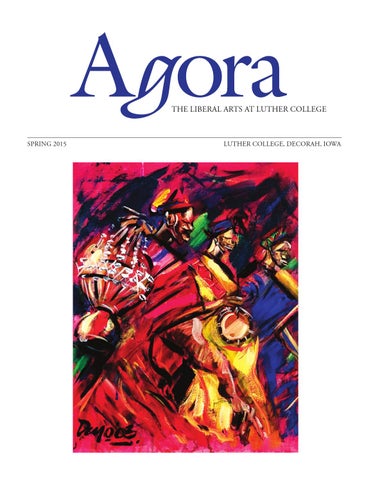
Cover: “ Yoruba drummers” (oil on canvas) by Dayo Laoye. His series, “Feminine Power and Spirituality,” was the featured exhibit at the 12th Annual Black History Month Conference in February. Laoye graduated from Yaba College of Technology’s School of Fine Art in Nigeria. While studying at Howard University in Washington, D.C., he began to explore the meaning of the Yoruba tradition. Laoye has been exhibiting for the last 25 years and has a studio on Chicago’s south side.
The Ascent from Darkness Into Light
“T
he unexamined life is not worth living” Socrates said, according to Plato. One of the pleasures of teaching Paideia 111112 is asking our students to examine their learning and lives through our readings. Plato’s “Allegory of the Cave” is especially useful in this regard. The “Allegory” has been read every year in Paideia since I came to Luther in 1991 and a good many years before I arrived, too. It’s a short text that only seems to get richer each year in its possibilities for teaching and learning. The allegorical journey of ascent from darkness to light is intellectual and moral. Indeed, one might say, it is moral because it is intellectual. The one who completes this journey to see the Sun (The Good) is then compelled to lead others for the common good. Following our discussion of “The Allegory” I asked my students to write in-class about how their education has been a journey of ascent from darkness into light. The writings below are thus spur-of-the-moment, unrevised. And yet I think they provide a window into our students and a testimony to their thoughtfulness. I received permission from each of the students to publish his or her writing anonymously. •My moral education has been a journey. I don’t know that it ever started as a dark cave, but what I have come to know as truth, and what I will continue to learn is all part of the journey. When I think about this question of reality and how you can become educated to reach that point, it makes me think of religion. The question of how do we know which religion is the true religion or belief has been with me for a while. Since I’ve grown up in a Christian household, that is what I have come to believe. But I have 2
Agora/Spring 2015
to imagine that if I were born in a different family with a different religion, I would assume that would be my belief. So, it has to be a moral journey to find what you truly believe in order to find your true reality and find what your light will be. •My education has been a journey of ascent from a dark cave into the light. As I went through (and continue to go through) school, I realize/learn/am exposed to many things that constantly cause me to think or re-evaluate what I believe are my perceptions on certain things. At Luther College what I’ve learned has brought my education toward a true-er reality. I’ve in a way been crossing out things in my mind that I thought were “true” and have bolded (figuratively) things/concepts I think are trueer. Experiencing many things in high school and college that have forced me to deal with growing up and making decisions has helped me to get rid of illusions I thought were true and has also helped me to learn how to back up what I believe to be true. It’s definitely still a process and really cool to look back on and see how I’ve grown and the growing I still need to work on. •The ascent to light for me has been more of a realization that all concepts are not compartmentalized. There is an intertwining regularity between all forms of knowledge. Biology helps you understand philosophy, philosophy helps you understand history, etc. There is no useless knowledge because at some point it brightens something else. I guess that for me the cave was the assumption that knowledge is like a bunch of little pools. In reality
it’s so much more enlightening and contentful to see knowledge as a sea intertwining us all in all of its collective parts. •Taking my talents and using them in the world is kind of what Plato is referring to as the need for leadership. Since he believed that those who know good should lead, his idea relates with college students receiving knowledge that could potentially be used for good. My education here at Luther College I believe is helping me to become a more well-rounded and understanding person. I look for different views and want to learn about what others think in order for me to fully understand how to think about something. I believe I will do good in the world once I learn to look past my views and listen to others with an open mind. •How has my education been a journey of ascent from a dark cave into the light? I would say that my largest dark cave was my unintentional ignorance to the privilege I have as a white, middleclass American. My schedule, which includes Paideia, Intro to the Bible, U.S. history, and cultural anthropology has made me well aware of how lucky I am simply for being born as I was. Because I am white, I have avoided hardships that I didn’t even fathom until I read about Reconstruction in history and learned about oppression from the two black girls in my biblical studies class. That is one of many examples and these lessons were uncomfortable and awkward to learn. However, now I am conscious of my privilege (to a degree) in a way I have never considered. That being said, I also recognize I have a ways to go. MK
Honoring Our Retirees
H
ow can we possibly measure and appreciate the service our retiring colleagues have given us in their 359 years (by my count) at Luther College? We can’t, though at the Faculty Recognition dinner recently we did our best.
The heart of our retiring colleagues’ contribution was of course in their classroom teaching, but it was so much more. They also published scholarship, performed music, led departments, served on countless committees, advised (collectively) thousands of students, led study away programs, wrote program reviews, mentored colleagues, and became such an integral part of the community that we will hardly know what to do without them. The thumbnail sketches in the pages that follow provide, we hope, a group portrait of the retiring class of 2015. (The year in parenthesis indicates the first year of service at Luther College.) We cannot adequately honor our colleagues who lifted us, inspired us, consoled us, and yes, taught us. All we can say finally is thanks—thanks and Godspeed. You will be missed. MK
Nick Preus (2000) PhD Wisconsin-Madison English
Nick
is a Luther grad with majors in English and Scandinavian Studies, including study at the University of Oslo. Before coming to Luther, Nick taught at Decorah High School and Waldorf College, where he was associate dean. At Luther, Nick taught 19th century British literature courses and, for the last several J-terms, “Tales of the Sea,” in which students read maritime literature while they worked as crew on the historic schooner Roseway as it sailed in the Caribbean. Nick headed the Education department for three years and also directed our Nottingham program. His research interests included Jane Austen and, more recently, how evolutionary psychology helps us re-see literary texts.
Spring 2015/Agora
3
Mary Lewis (1995) MS Minnesota Biology
Mary
lectured and/or taught labs in human anatomy, microbiology and principles of biology. Prior to coming to Luther, Mary was co-founder and co-director from 1977-1994 of Badgersett Research Farm in Fillmore County, Minnesota, a privately owned and operated horticultural farm whose primary goal was intensive domestication of woody perennial plants for agriculture. Mary has privately taught piano, directed her own dance studio, and skated in the Nordic Fest Parade every year since 1996. Mary is also Decorah’s primary garlic mustard weeder. In addition to being an avid gardener and outdoorsperson, Mary is a writer with more than two dozen published short stories and personal essays.
Odette Bruneau (1995) PhD Texas Woman’s U. Education
Odette
taught in the public schools in the Twin Cities and Albuquerque, New Mexico and was a professor at Lamar University, Texas Christian University, University of New Mexico and College of Santa Fe-Albuquerque before coming to Luther. At Luther she taught a wide range of education courses—eight in this year alone. While her PhD specialization was in Special Education with emphasis on behavior disorders and assessment, Odette published widely in reading and reading assessment as well as youth suicide. She taught ESL at the elementary, high school, and university levels in Chengdu, China, and presented papers at many national conferences as well as in Hong Kong, China, and Spain.
4
Agora/Spring 2015
Joe Thompson (1995) PhD Wisconsin-Madison Health and Physical Education
Joe
wore three hats in his time at Luther: athletic director, health and physical education department head (16 years), and associate professor of physical education. As athletic director Joe provided leadership to 25 full-time professionals and formulated polices for 19 sports serving about 600 studentathletes. He provided oversight to all athletic facilities and served as project manager to enhance facilities including The Legends: Fitness for Life Center and track, baseball, softball, football, and soccer facilities. Outside of Luther, Joe served on various Iowa Intercollegiate Athletic Conference committees, chaired the NCAA Division III wrestling committee, and was president of the NCAA Division III Track & Field Coaches Association.
John Goodin (1994) MLS Indiana Library & Information Services
John
was head of the Technical Services Department at Preus Library, responsible for cataloguing, acquisitions, periodicals, serials, and interlibrary loan. Outside of Luther John is, quite simply, one of the leading composers of mandolin music in the United States and perhaps the world. His compositions have been featured on numerous CDs and been performed or published in Germany, Greece, and Australia as well as throughout the United States. John is not only a prolific composer but also a frequent performer who plays mandolin in the contra dance band Contratopia, among other groups, as well as on numerous CDs. John merges his library and musical interests in his digitization of musical journals and in publications of bibliographies and discographies.
Spring 2015/Agora
5
Jim Griesheimer (1991) PhD Indiana Music
Jim
is well known among music students for his lectures in music history. He routinely taught three of the four courses in the required sequence for majors: Antiquity through 1750, The Classical Period, and The Romantic Era. Jim was also the primary reader of senior papers in the department. Before coming to Luther Jim taught at Arizona State (where he earned his master’s degree in oboe performance), New Mexico State, and Middlebury College. Jim also studied for two years at the University of Munich as a Fulbright Research Fellow. Jim has presented papers several times at the EighteenthCentury Studies Conference at Oxford and directed Luther’s Nottingham program. Jim is an ordained priest who serves Grace Episcopal Church in Decorah and in Charles City.
Charles Christianson (1988) MBA South Dakota Accounting
Charles
came to Luther from Augustana-Sioux Falls, where he taught for nine years. At Luther, Charles taught accounting and federal income taxation, among other courses. He headed the Economics and Business Department from 2001-2010, during which time he presented collaboratively at conferences with his colleagues Mona Nelson, Rob Larson, Julie Jensen, and Liang Chee Wee. Several of those presentations focused on business ethics, also the focus of one of the grants Charles won for the college related to business education and leadership. In addition to his service to Luther, Charles has been an active leader at Washington Prairie Lutheran Church.
6
Agora/Spring 2015
Donna Kubesh (1982) PhD Iowa Nursing
Donna
has been a leader both inside and outside of Luther. In addition to serving as Nursing department head for 14 years and twice faculty representative to the Board of Regents (among many college service commitments), Donna was president for a year of the Iowa Council of Nurses and the Association of Lutheran College Faculties. A former Iowa Nurses’ Association district ‘Nurse of the Year,’ Donna taught Pathways to Practice I and II and Trends & Issues in Nursing, among other courses. She has presented her research at numerous national conferences as well as in Israel, Wales, Ireland, and the United Arab Emirates.
Tex Sordahl (1980) PhD Utah State Biology
Tex
earned his BA in Biology magna cum laude from Luther in 1973. His senior thesis (not surprisingly, with 40 years of hindsight) was “Bird life in a boreal sphagnum bog at the Audubon Camp of Wisconsin.” Tex’s courses focused on vertebrates, environmental conservation, and the behavior and ecology of birds. He has published on the distribution of color morphs of the Eastern Screech-Owl and use patterns and behavior at a Turkey Vulture roost in northeastern Iowa. Tex is director of the Hoslett Museum of Natural History, housed in Valders, which includes plant and bird egg & nest collections as well as over 1000 plant specimens, 5,000 vertebrate specimens, and 6,000 invertebrate specimens.
Spring 2015/Agora
7
Marjorie Wharton (1979) DMA Iowa Music
Marjorie
Running Wharton earned her BA summa cum laude in French from Luther in 1966 and in 1986 completed her undergraduate music major at Luther. She holds an MA in French from Tulane University and a DMA in Piano from the University of Iowa. Her thesis, Visual Art and Poetry in the Songs of Francis Poulenc, reflects her interest in French poetry, music, and art history. She presented numerous illustrated lecture recitals on Poulenc and has also published articles in French on Poulenc. For many years Marjorie taught both French and class piano at Luther. As a pianist and teacher of piano, she is particularly interested in the development of tension-free technique.
Carolyn Mottley (1975) PhD North Carolina Chemistry
Carolyn
came to Luther with a BS magna cum laude from Wayland Baptist College and a PhD in physical chemistry from University of North Carolina-Chapel Hill. At Luther she taught chemistry courses at all levels for both majors and non-majors. Most of her research was done collaboratively at the National Institute of Environmental Health Sciences in Research Triangle Park, but she also did research at the University of Alabama, Northwestern, and Argonne National Laboratory, resulting in more than 40 co-authored publications. Among her service to Luther, Carolyn was NCAA faculty representative, department head for more than 15 years, and Interim Dean in 1999-2000.
8
Agora/Spring 2015
Steve Hubbard (1973) PhD Iowa Mathematics and Computer Science
Steve
graduated summa cum laude from Luther in 1968 and five years later earned his PhD at Iowa. As a member of the mathematics and computer science departments, Steve regularly taught Calculus 1 and Discrete Structures. Tenured at Luther in 1979 and promoted to full professor in 1985, Steve was also a visiting professor of mathematics one year at the University of Iowa.
Ruth Caldwell (1971) PhD Chicago Modern Languages (French, Italian)
Ruth
graduated summa cum laude in French from the University of Southern California and won a Fulbright teaching fellowship to Poitiers where she studied in route to her MA and PhD in Romance Languages at the University of Chicago. In addition to serving as department head twice (18 years total), Ruth was active in the American Association of University Professors (AAUP), helping write a key report on academic freedom and tenure. From 1996-1998 Ruth was one of the early recipients of the Dennis M. Jones Distinguished Professorship in the Humanities. In 2006 Ruth earned an MA in Italian from Middlebury Language Schools and began offering Italian language courses at Luther. In her January 185 course on Dante’s Divine Comedy students read all 100 cantos (though not in Italian!). In recent years Ruth has twice been the Affiliated Scholar of the ACM Florence fall semester program. Arriving in 1971, Ruth has taught at Luther College 44 years, the most among this year’s group of retirees. Spring 2015/Agora
9
Looking Back: Reflections on Metanoia by RUTH CALDWELL, Professor of French One such service our retiring colleagues offered to the community was speaking in chapel. Another was writing for this publication, Agora. In this regard Ruth Caldwell was nonpareil, sharing her writing 12 times in Agora since its inception in 1988—almost once every two years. I had hoped to include excerpts of Agora writings from many of the retirees, but for lack of room I have chosen just one which is representative both of Ruth and of her fellow retirees in its articulation of what it means to be self-reflective and open to change—in other words, to always be learning. Here then are the closing paragraphs of a chapel talk by Ruth published in Agora in 2002 about an exchange she had with a stranger during a study abroad course and what she learned about the New Testament concept of metanoia. MK
O
ne day all of us in the seminar needed to leave the Paris Chamber of Commerce in order to visit a business school across town. We all piled into the underground train—the métro—and this woman ended up in a seat next to me. She was from Egypt and spoke French as if it were her first language. Suddenly, she took out her wallet and said “This is a picture of me.” I looked, and saw a photograph of this woman facing the camera, with thick, brown, undulating hair cascading to her waist. It was stunning. “You have beautiful hair,” I murmured wondering to myself why she was showing me this picture. As if reading my thoughts, she returned, “But, I don’t show my hair to most people. It is against my faith. I am a Muslim.” She went on to explain that this was her choice, that her husband disagreed with her interpretation, but that this is how she lived her faith. And then: “Why do American Christians say that Muslims are evil people?” I answered, “I don’t know that we do.” But she went on to quote some American politicians and religious leaders who had spoken ill of Muslims. I knew she was right. “Well,” I said, “these people aren’t really mainstream Christians, and in fact…” Just then, the metro arrived at our stop. End of dialog. Hundreds of people poured into the corridors and up the stairs. We herded into a large amphithéâtre in the business school. I lost sight of my new acquaintance. She went to her meetings and I went to mine. Why didn’t I run after her and continue our conversation? She bravely made an overture to me, the equivalent of showing me a picture of her in intimate apparel and I didn’t take her into my confidence. Perhaps I even shut her out with a familiar “oh, but not me” kind of argument, in which I distanced myself from intolerant people who nevertheless make up my community and with whom I share responsibility. And yes, I regret that, and several other missed opportunities as well. I can only hope I will do better tomorrow and even today. Today is a new day and we can be of new mind. There is no more important thing to do in the coming days than to participate in the events of Diversity Week, think in a new way about a person or an idea that we resist, talk to someone different from ourselves, look at their pictures, critique the “categories” that Pastor Vásquez referred to yesterday, and say “no” to all the busyness that keeps us from reflection. Then, perhaps, we can experience a change of mind, or metanoia.
10
Agora/Spring 2015
The Gospel of Malthus by ROBERT SHEDINGER, Professor of Religion I hate, I despise your festivals, and I take no delight in your solemn assemblies. Even though you offer me your burnt offerings and grain offerings, I will not accept them; and the offerings of well-being of your fatted animals I will not look upon. Take away from me the noise of your songs; I will not listen to the melody of your harps. But let justice roll down like waters, and righteousness like an ever-flowing stream. Amos 5: 21-24
I
was on sabbatical during the fall semester, immersing myself in a detailed study of the evolution/ intelligent design controversy as a way to strengthen the teaching of my Science and Religion class. I learned much during this sabbatical, but there is one particular lesson I want to share with you today. There is a principle that I already knew, but whose truth was brought home to me in a whole new way during my sabbatical. The principle is this: Never accept the common wisdom about another scholar’s work without having first read that person’s work for yourself. Let me explain. As part of my sabbatical research I wanted to delve into the life and work of Charles Darwin, and so I read several biographical accounts of his life. You don’t have to engage research on Darwin for long before you encounter the idea—that Darwin himself expressed—that he hit on the concept of natural selection as a result of reading Thomas Malthus’s Essay on the Principle of Population. Malthus’s essay is well known for explaining how human populations tend to increase geometrically while food supplies increase arithmetically, meaning that human populations will always outstrip their food supply leading to mass starvation unless the population is constrained in some way. Reading this, Darwin theorized that the same would be true in populations of other organisms, but if some organisms happened to possess characteristics making them better able to compete in the struggle for limited resources, those organisms would be more
likely to reproduce, pass along their characteristics to the next generation, and that over time the ability of better adapted organisms to leave more progeny would lead to evolutionary change.
directs his efforts, and the more successful these efforts are, the more he will probably improve and exalt his own mind and the more completely does he appear to fulfill the will of his Creator.
Whatever you think of Darwin, Malthus’s essay seems to consign us to a depressing view of a life that is all about ruthless competition and the struggle for survival, and it has been viewed by many as the ideological underpinning for everything from the ruthless competition of laissez faire capitalism to the Charles Dickens character Ebenezer Scrooge. To describe someone today as Malthusian is usually not taken as a compliment. But wanting to know more about the influence of Malthus on Darwin I decided that I should read Malthus’s essay for myself, and I was shocked at what I discovered.
Wow! When I began reading Malthus I was expecting to encounter an eighteenth-century version of, say, the Koch Brothers. What I met instead was an eighteenth-century version of Jim Wallis or Cornel West. Malthus refuses to capitulate to cynicism, but rather lays out for us a template for how we might live both a fulfilling and a Godly life. But this is not a template that most people are following in our contemporary self-centered and materialistic world. Perhaps we need to embrace—dare I say it—a Malthusian Gospel.
After laying out in great detail the population dynamics for which he is so well known, Malthus ends his essay by quoting a line from Alexander Pope: “Hope springs eternal in the human breast, man never is, but always to be blest.” He then concludes with the following paragraph: Evil exists in the world not to create despair but activity. We are not patiently to submit to it, but to exert ourselves to avoid it. It is not only the interest but the duty of every individual to use his utmost efforts to remove evil from himself and from as large a circle as he can influence, and the more he exercises himself in this duty, the more wisely he
I often surprise students in my Introduction to Biblical Studies class by telling them they tend to practice a form of narcissistic faith. Their faith is all about them—it is Jesus loves me this I know, ‘cause the Bible tells me so. Now, I also tell them that their narcissism is not their fault. They have been raised in an increasingly narcissistic and materialistic society; how could they not be narcissistic! They have been bathed in a media culture designed to convince them that their own happiness is of utmost importance, a happiness by the way that can be guaranteed by the purchase of all the latest gadgets and gizmos. They may have attended a church whose worship revolves around emotion rather than reason, a church where they sing songs about how awesome God is, but rarely Spring 2015/Agora
11
hear a message about God’s desire for just and fair societies. They may have been socialized from a young age into the idea that they are born sinners destined to an eternity in hell unless they make a personal profession of faith in Jesus. In so many ways, we are all socialized into the belief that our faith is a vehicle for our own happiness, contentment, and eternal reward. Unfortunately, this Gospel does not appear to be working. If modern American individualistic faith were the key to happiness and contentment, we would not be living in a society characterized by near epidemic levels of anxiety and depression, with a suicide rate of 30,000 people a year. Malthus implies that by putting our own needs aside and dedicating ourselves to a life of resistance to evil, we will probably improve and exalt our own minds. He may be right. It may be that when we move outside of our own concerns and see our lives as bound up in relationship with all other life on the planet—human and more than human alike—that we will discover a higher purpose for our existence, and thereby find rest for our troubled souls in the knowledge that we are part of something bigger than ourselves. This fundamental change in perspective may go a lot farther in helping to relieve our emotional suffering than an individualistic faith or another prescription for medication. But Malthus goes beyond the concern for our mental and emotional wellbeing. He suggests that in dedicating our lives to resisting evil, we thereby appear to fulfill the will of our Creator. Here I think Malthus is absolutely right. Where oh where do we find the Gospel of individualistic happiness and contentment in the Bible?! I can’t find it and I’m a biblical scholar! What I do find are words like that of the prophet Amos, according to whom God could care less about our worship and our sacrifices if we are not working to bring about justice. I recall someone named Jesus saying something about how the one who prioritizes his/her own life will lose it. But the one who is willing to lose their own life for the sake of the Gospel will find it. And Jesus knew of 12
Agora/Spring 2015
what he spoke, for his life was a model of dedication to resistance to evil—the evil of Roman imperial oppression and military occupation of Jesus’s Jewish community. It is in the work we do for others, to relieve their suffering by transforming violent and unjust structures into ones of justice and peace, that we find favor with God, not in our individualistic pronouncements of faith that absolve of us our civic duty to get involved in the messiness of the world.
It is in the work we do for others, to relieve their suffering by transforming violent and unjust structures into ones of justice and peace, that we find favor with God, not in our individualistic pronouncements of faith. If we want to follow a Malthusian Gospel, there are no shortage of evils for us to tackle. We live in a time of growing wealth inequality that consigns more than twenty percent of American children to poverty and chronic food insecurity. We live in a time of continuing and even growing racism in which it is not safe for young black men to even walk on our streets without taking their lives in their hands. We live in a time when voting rights are being eroded under our feet in reputedly the greatest democracy in the world. We live in a time when women still earn less money for doing the same work as a man—and maybe even doing it better. We live in a time of looming environmental catastrophe that threatens the very livability of the planet. Depressed yet? Don’t be. Malthus says that evil exists not to drive us to despair, but to activity. It is in— dare I say—serving with distinction for the common good (not our own good) that we will find the sense of purpose that will improve and exalt our own minds, and allow us to fulfill the will of our Creator. Thank God for the Gospel of Malthus.
Are We Ready to Accept this Savior Unconditionally? By Sharon Jacob, Visiting Assistant Professor of Religion
T
amar, Rahab, Ruth, Bathsheba, and Mary. What do all these women have in common? For starters, all of these women are Interrupters! They interrupt a predominantly masculine lineage with their female presence. They are the only five women to be mentioned in Matthew’s genealogy, a lineage that works very hard to connect Jesus not only back to his Jewish roots, but more specifically to the patriarchal figures of Abraham and David. In addition to their female presence, these women interrupt Matthew’s genealogy because of their behaviors. Each of these women conceives in a fashion that falls outside the traditional norm and that is highly irregular and scandalous. The question is why does the author of Matthew incorporate such bold, trangressive women in his genealogy? There is definitely a purpose but how are we as readers supposed to read and interpret their presence? Four out of the five women interrupt this genealogy with their race. Tamar and Rahab are Canaanites, Ruth a Moabite, and Bathsheba a Hittite. In short, none of them are Israelites. Some interpretations have argued that the four foreign women must be seen as converts who are setting up the scene for Jesus to come in and convert the rest of the nations into Christianity. Such interpretations, while valid, are extremely problematic because they bear a supersessionist tone that creates an air of inequality. Assertions such as these are dependent on a kind of assimilationist reading where foreigners, immigrants, and other people who belong to the margins are only accepted when they give up their cultural or religious identity and take on the values of the dominant population. In any case, assimilation never really works. Once a foreigner always a foreigner!
In the contemporary context, these women could be likened to immigrants, people who are reminded everyday that they will never fully belong to the land which they live in and work for. As immigrants these women are automatically lower than the citizens. As people belonging to another racial or ethnic category, they are already inferior. Their bodies are harvested, contracted, employed, and exploited to give birth to sons that will help pave the way for the ultimate savior Jesus. And yet, when we as readers encounter these women in the Biblical text we turn a blind eye and ignore their presence. We all know that Jesus’ mother is Mary, but how many of us know who are his foremothers? We call him the Son of David, but isn’t he also the Son of Bathsheba? We prefer not to say this too loudly because it reflects the foreignness of Jesus. And Jesus could not be foreign, he could not be an immigrant, he could not belong to, perhaps even have traces of another race in him. That would be too controversial, so we politely deny the contributions of these women. We turn a deaf ear to their cries for dignity, for justice, for humanity. By refusing to acknowledge the otherness of these women, aren’t we also refusing to see the otherness of Jesus? If we were to read the Gospel of Matthew just in the way it is written then the blood that runs through the veins of Jesus is as much that of the immigrant as it is of the citizen. These women also interrupt Matthew’s lineage with their shameless behaviors. They each are mothers who conceive in a manner that is non traditional, highly irregular, and scandalous. Some may even say that each of these women produces sons in relationships that would have been seen as illegitimate. Genesis 38 tells us that Tamar tricks her father-in-law into having sex with her
once she learns that Judah, her fatherin-law, is planning to get rid of her. Joshua 2 introduces us to the character of Rahab, the Canaanite prostitute who hides the Israelite spies in her house. Gauging by her profession, one can safely make the assumption that this woman, not only in the ancient world but also in the contemporary world, would be seen as a scandalous woman. Ruth the Moabite widow is advised by Naomi to go and lie with Boaz on the threshing floor. Finally Bathsheba, the wife of Uriah, is preyed upon by King David, a man the text tells us is after God’s own heart. Following in the footsteps of these women comes Mary, a woman who is found to be with child before her marriage to Joseph. One way some have connected these women is by highlighting the sexual transgressions of the four Hebrew Bible women and contrasting them with the virginal birth of the NT woman, Mary. But readings such as these dichotomize women into pure vs. impure, virgin vs. whore and create a false hierarchy among women. As women with scandalous pasts they are all also victims—victims who are on some occasions exploited, and on some occasions actively exploit those systems of power that render them powerless. We as readers are quick to point out the indiscretions of these women, but at the same time, we conveniently forget our part that contributes to such a negative reading. These women are deviant; they conceive in an illegitimate manner, they transgress societal norms and boundaries. We know this because we are the ones who construct and give power to those systems that continually oppress, marginalize, and sexualize these women. Truth is that these women make us uncomfortable, they make us question everything we have ever known. Reading the text in such a way may even lead us to ask questions Spring 2015/Agora
13
about Jesus’ lineage and the legitimacy of his birth. So the question remains, Why does the author of Matthew include such controversial women in his genealogy? What is he asking his readers to see and take away from his text?
To see God in our pastor, in the face of an innocent child, in the sunset: that is the easy stuff…. Can we see God in Matthew Shepherd, the young student beaten and killed for being gay? Can we see God in Michael Brown, Eric Garner, Walter Scott—young Black men whose lives were brutally ended in violent police shootings? Could it be possible that these subversive, transgressive, scandalous women are setting the stage for the ultimate scandal embodied in the form of Jesus? Jesus is a scandalous figure in life and death. Crucifixion was a punishment reserved by the Roman Empire for those who committed crimes against the state; it is by no means a glorious act. Thus, could the presence of these four women foreshadow the deviant life style of Jesus? And if this is the case, then why must we be embarrassed, apologize, or explain away the scandalous presence of these women? Maybe the text of Matthew is calling us as readers, as a faith community, as a learning community to be scandalous in our own lives? Could it be possible that the author of Matthew is telling his readers, ancient and contemporary, that we need to stop explaining, stop taming, stop erasing our deviations? Could Matthew be calling us to be deviant by standing with those whom we have made deviant, whom we have oppressed? It is easy to see God in the face of Abraham and David, because that is where God is already supposed to be. 14
Agora/Spring 2015
But how then can we see and read God in those scandalous spaces that challenge everything we know about the divine? To see God in our pastor, in the face of an innocent child, in the sunset: that is the easy stuff. But can we see God in Jyothi Singh, the 21 year old medical student gang raped by four men in New Delhi? Can we see God in Matthew Shepherd, the young student beaten and killed for being gay? Can we see God in Michael Brown, Eric Garner, Walter Scott—young Black men whose lives were brutally ended in violent police shootings? We can easily see God in a face that is familiar to us, because it makes us feel safe, makes us feel comfortable because— lets face it—there is no challenge in that. But to see God in a face that is unfamiliar, deviant, strange and to accept that person unconditionally— now that is a challenge. What do I mean when I say unconditionally? I mean acceptance without explanations, without conversions, without apologies. Unconditional means no more hiding, erasing, censoring our speeches, our race, our genders, our sexuality so that those around us can feel comfortable. When we accept Tamar, Rahab, Ruth, Bathsheba, and Mary as sacred women with scandalous pasts standing in the margins, defiant, deviant, unwilling to silence themselves, unwilling to apologize, unwilling to convert, refusing to break away their gaze that holds readers to a higher and more critical standard, then and only then will we be able to accept Jesus unconditionally. Unconditionally accept Jesus without taming him, without dominating him, without apologizing for him, without silencing him and more importantly without converting him into a passive imperial symbol that justifies our domination and imperialism. The question is: are we ready to be scandalous, deviant, and irregular just like Jesus and his five mothers were? Or are we going to pass up this opportunity as we have done in the past and play it safe?
Macbeth Comes to the Children of Fire by MARTIN KLAMMER, Professor of English
W
Nthabiseng, who lost her leg as a baby when she was dropped in a fire by an epileptic aunt, is one of the Children of Fire I had the great good pleasure of working with as a volunteer during my spring 2014 sabbatical in South Africa. I had come to Johannesburg as a visiting scholar in the new Diversity Studies Centre at the University of Witwatersrand, planning to attend seminars and work on my writing, which I did. But merely by going to church one day I was pulled into volunteering at Children of Fire, an experience that gave more meaning to my sabbatical than I could ever have anticipated. That morning at St. Peter’s Anglican Church in Auckland Park, a leafy suburb of Johannesburg, six young women crowded into my pew just before the service started. Not really seeing them at first, I moved to make room. Then I looked up. The face of the girl next to me was wholly burnscarred, a dark mask over her black skin. The girl next to her had a burn mark from the neck all the way through her shoulder into her arm and hand. The girl next to her had only one leg (Nthabiseng). As the younger children came from Sunday school to receive communion, I saw two of them were so badly burned that parts of their ears and noses were missing. And yet all of these children seemed happy, not troubled by their appearance. I had to find out who these kids were and where they came from. After the service I googled combinations of
MARTIN KLAMMER
hen Nthabiseng Nkashe, the young actress playing Macbeth, needed a sword in a fight scene she didn’t take one of the long sticks I offered. Instead, she simply lifted her crutch, hopped on her one leg, and charged at Macduff. Wisely, Macduff retreated!
Nthabiseng as Macbeth battles Munashe as Young Siward. words like burn, victim, children, and Johannesburg. Up popped Children of Fire, a charitable organization that treats and is home to child burn survivors throughout Africa. It was only three blocks away. I knew I had to visit. I thought perhaps the students I take to South Africa could do a service learning project with these children. When I arrived at the large house that served as the head office, I was surprised to be greeted by a tall British woman in her 50s with long auburn hair and a cherubic ruddy face: Bronwen Jones. She was in the middle of several things—giving directions to a volunteer, responding to an email, answering the phone. After inviting me to sit on a back-less broken chair, she thrust into my hands a volunteer application form. “I’m not here for this,” I said. “You will be,” she replied. “But I’m a professor of literature,” I said. “What could I possibly do?” She reached into a stack of books on her desk and handed me a copy of Macbeth. “Teach this,” she said.
“Seriously?” “Seriously.” “But why Macbeth,” I asked, “or any Shakespeare for that matter?” “Someone sent me the book,” she said, “but it wasn’t just because I had the book. I love the play and I love Shakespeare. These kids will have to learn Shakespeare as one of their set pieces in high school. This will prepare them for that. Who knows, they may even get to like it.” She smiled. “Maybe it has something to do with the fact that when I was a teenager I had a boyfriend named Banquo. But mostly it’s because I know these kids can do anything.” So there I was the next day with five used copies of Macbeth, waiting for my young thespians to come filing into our classroom at the small Johannesburg School for Blind and Multiple Disability Children (like Children of Fire, started by Bronwen about 15 years ago). The children ranged in age from 10 to 17. That first day I realized their reading abilities were below grade level, Spring 2015/Agora
15
Still, they were an enthusiastic bunch. They immediately loved playing the three witches—and, as it turned out, that’s pretty much all they did for the six weeks I was there. Early on in rehearsals they perfected witchy laughs and antics, delighting the smaller kids who would watch them rehearse out on the school driveway. When I arrived each day they would already be reciting the witches’ lines: “When shall we three meet again, In thunder, lightning, or in rain?” And they loved to do their witches’ dance around the cauldron (a garbage can), reciting in sing-song voice: “Fair is foul and foul is fair, Hover through the fog and filthy air.” As for casting, I chose Nthabiseng to play Macbeth. She was the oldest (17), the group leader, and a dramatic reader, even though she spoke so fast at times we weren’t sure what she had just said. The other young actors included: •Lance Van Rooyen, 11, a day schooler from Johannesburg—not burned as the other children, but visually impaired. To be able to read he held the text a few inches from his face. Lance had a macabre sense of humor, finding great delight in the play’s beheadings and ghosts. •Dikeledi Mboko, 11, from Lesotho, the tiny “mountain kingdom” nation within the borders of South Africa. Dikeledi is an orphan, one of three siblings whose mother died and father is unknown. While her siblings were placed with families, Dikeledi was not. Her head, hands, and feet were burned when she was 7, and she continues to have skin repair surgeries on her scalp. Though one of the younger members of our Macbeth group, Dikeledi was a strong reader. She also liked to sing and sings well. •Anele Qhashu, 13, from Mthatha in the Eastern Cape. She is the girl with the facial burns who sat next 16
Agora/Spring 2015
The three witches around the cauldron: Lance, Feleng, and Munashe. to me at church. When she was three months old a candle fell over, setting on fire the paper covering the shack walls and badly burning her face and hands. When Anele came to Children of Fire just before she turned 6, the skin on her face was so contracted from scar tissue that she could not close her eyes and mouth while sleeping. Since then surgery has successfully loosened the skin on her face. Anele was not a strong reader but a hard worker, always attentive to what I asked and also very kind to the others. •Munashe Anderson, 14, an orphan from Zimbabwe, terribly burned in a shack fire in 2011 along with her cousin Clara, 10, also at Children of Fire. The girls’ burns were so severe they were hospitalized for ten months in a government hospital in Harare. When they came to Children of Fire in January 2013, Bronwen wrote on the website: “No child should have to live like this.” Each girl needed major reconstructive surgery of hands, arms, and eyes that was not available in Zimbabwe. Munashe also lost sight in her left eye due to lack of eyelid reconstruction, but Children of Fire has since obtained a scleral shell (for US $1650) that has been inserted over the eye. Despite these injuries, Munashe is a lively, outgoing girl who bursts with energy and has learned English in two years. In her home language,
Shona, her name means “God is with you.” •Feleng Lebaka, 12, badly burned in a shack fire at the age of one month. Among other injuries, he lost much of his forehead in the fire. The gaping hole in his skull was exacerbated by sepsis. In 2009 Bronwen arranged for Feleng to have surgery in Zurich, Switzerland, during which several of his ribs were extracted and inserted in his skull to cover the hole at the top of his forehead. Feleng’s ongoing medical needs are “huge,” Bronwen says. “Feleng needs a nose grown from his arm (tagliocozzi)”—a method developed by Gaspare Tagliacozzi (1547-1599), an Italian plastic surgeon, for replacing a missing nose with skin from the patient’s upper arm. According to Bronwen, Feleng’s family has “entirely abandoned him.” He has lived at Children of Fire since he was 3. He is mischievous and sometimes does not pay attention. But he loves to hold the stage! As one of our witches he wore a long black robe and made grand, sweeping gestures whenever he spoke. Macbeth is famously a cursed or “jinxed” play, with a long history of accidents and even deaths during rehearsal and performance. Some theater people claim that merely saying the name of the play inside a theatre invites disaster. For that reason it is called “the Scottish Play,” “the Scottish Tragedy,” or just
MARTIN KLAMMER
not because they weren’t bright—they were—but because they had missed so much school due to operations for skin grafting and repair to injured heads, hands, and feet.
“What does that mean?” Mongezi asked her. “I don’t know.” “What are you feeling when you say ‘Anon’?” “Happy,” she said. “Why are you happy?” “Because we are going to see Macbeth.” “Why are you happy to see Macbeth?” She thought for a minute. “I don’t know,” she said. I felt a huge inadequacy for what the children didn’t know. Mongezi was tough, maybe too tough, but the children did not wilt. They’d been through lots of storms in their lives. Mongezi was but a passing raincloud. By the end of the afternoon they had earned his respect. Our final rehearsal was interrupted by an attempted mugging. The children heard women’s screams from the street and ran out to investigate. A man with a gun was running away. Nthabiseng asked two women if they were all right and was there anything we could do, like call the police. They said no and soon were let through the front gate of a house where they’d been standing. I told Bronwen what happened and expressed my amazement about how well Nthabiseng reacted. “Our children have responded to various muggings,” Bronwen said matter-of-factly. “They’ve even stopped a few.” We eventually performed our abbreviated version of Macbeth for an audience of 20 Penn State students and four professors I met at the guesthouse. The ‘stage’ was the Children of Fire house lawn, with interesting
props such as the little kids’ 3-foot high plastic castle as the royal palace. Our Macbeth was more comedy than tragedy, with actors laughing between otherwise serious lines and dead soldiers being counted out and carted off like unconscious boxers. But of course the Penn State students loved it, even more so when the kids and I performed a Macbeth “rap” that summarized (as I told the audience) the 97% of the play we’d left out! After the Penn Staters left, our group ate pizza on the house lawn. The children played hide-and-seek as the sky darkened and stars came out over Johannesburg. When I returned from my sabbatical in South Africa I could not let go of all this, so I began researching pediatric burns. I was shocked and saddened by what I found. More than 95,000 children and teenagers die from burns each year—on average 262 children per day, or one every five and-a-half minutes. More than 90% of burn-related child deaths occur in low- and middleincome countries, disproportionately concentrated in Africa and South-East Asia (i.e. India, Bangladesh, Indonesia).2 Sub-Saharan Africa has the highest pediatric burn mortality in the world. The World Health Organization estimates that between 18,000 and 30,000 children younger than 5 years old die annually in Sub-Sahara Africa from fire-related injuries. As elsewhere in the developing world, the youngest children in South Africa are by far the most often injured. In
one year 60% of all pediatric burn admissions at Red Cross Children’s Hospital in Cape Town were under the age of 2. Most burn-injury children are of low socioeconomic status and come from informal settlements.3 (Nearly 20% of homes in Cape Town are shacks in informal settlements.) Such settlements have “a high population and child density, low aggregate income, and household structures that are compact, with minimal facilities and typically no permanent physical separation between rooms, including the kitchen.”4 These small homes usually consist of one room or two rooms with a room divider made of flammable curtains or tall boards. Water is available only from a common water tap, often not close to the dwelling. Candle lighting, paraffin stoves and unsafe electrical supplies are common.5 In addition, the sheer number of children in these settlements under age 14 creates a high risk for fire. Women who are single parents often have so much to do—cooking, cleaning, and laundry—that they cannot attend to all of the children, especially curious toddlers.6 These children are often left unsupervised or in the care of older children.7 In short, little children of exhausted mothers in crowded squatter camps are highly susceptible to getting burned. Developed countries have made great strides in the prevention and treatment of burns, but the same cannot be said in the developing world, especially Africa, because of a far different set of socio-economic realities: “lower
MARTIN KLAMMER
“That Play.”1 Our rehearsals were not cursed, but they were interesting—and challenging. For one rehearsal I brought in two professional actors I’ve known for 10 years. One of them, Mongezi, tried to get the children to understand their character’s motivation. It was both painful and comic to watch my suddenly shy Thespians. Some of them didn’t give Mongezi much to work with. He asked them what their most important line was. Munashe said “Anon.”
Munashe with her drawing of the witches. Spring 2015/Agora
17
MARTIN KLAMMER
environmental South Africa with her health and safety husband and toddler regulation, lower son Tristan. She began levels of caregiver visiting an 18-monthknowledge about old girl in hospital burn prevention, and named Dorah after poorer access to power reading newspaper and water utilities.”8 accounts of how Dorah Some progress had been horribly has been made. burned when a candle Education through fell and set a hut alight. the media such as Dorah lost her nose, short radio messages eyelids, lips, hands, and teaches families bone in her forehead. and communities to When Bronwen first The cast does the Macbeth Rap: Lance, Feleng, Nthabiseng, Anele, Nelson (seated, recognize child burn saw Dorah, she was playing drums), Zanele, Dikeledi, and me. risks and organize as shocked as anyone. child supervision But when she played blood availability in countries with high when possible. Home safety focuses on Schubert on Tristan’s little music box HIV/AIDS rates. Nursing staff may creating a safer environment in shacks and saw Dorah’s toes wriggling, she felt be inadequately trained or reluctant to and small huts by raising cooking fires in her heart that behind the mask of treat burn patients whom they may see on bricks or stones, guarding open fires a face lived the precious life of a fully as unclean and lower class. Mortality by using fire grids, and safely storing human child. under these conditions is high. While flammable substances. Legislation has American or European patients with Surgeons wanted to excise little Dorah’s enacted safer standards for products burn wounds exceeding up to 90% of eyes because they felt it made the most such as paraffin (kerosene) stoves and total body surface area (TBSA) can now medical sense (Dorah was blind and candle-holders.9 survive, African patients exceeding 45% had no eyelids). But Bronwen appealed TBSA rarely survive. Young children to readers of The Times of London, where with as little as 20% TBSA often die.11 she had once worked, to raise funds to More than 95,000 children save Dorah’s eyes. Bronwen set up the Burn care in South Africa is far better Dorah Mokoena Charitable Trust in than in the rest of Africa, largely due to and teenagers die from burns the United Kingdom and within days improved practices at major hospitals each year—on average 262 more than £10,000 in donations came in Johannesburg, Durban, Cape Town, pouring in. Bronwen flew Dorah and and other urban areas. South Africa can, children per day, or one every her mother, Margaret, who’d been living at its best, offer an integrated system of five and-a-half minutes. in a squatter camp, to London for the care involving surgeons, occupational first of what would be Dorah’s many therapists, physiotherapists, and social surgeries. By the end of the year Dorah workers. If, however, a child in Africa is burned, had had 16 operations. The three of Still, Children of Fire is unique. It is the options for care are usually not them had come for six weeks but stayed the only full-time facility devoted to good. In Sub-Saharan Africa outside 11 months. housing and caring for young burn of a few countries such as Nigeria and During this time people kept telling survivors, going to whatever lengths South Africa, hospitals do not have Bronwen of other badly burned necessary to get children the high burn units. Those that do exist lack children in the thousands of unheated quality medical care they need. basic resources such as food, drugs, shacks in the sprawling townships of equipment, and sometimes even “I don’t mean to sound arrogant, Johannesburg, where residents cook drinking water. Most burn care in but there’s nothing like Children of over open fires or light their homes Africa occurs in rural health centers Fire,” Bronwen told me. “No one else with candles. In response, Bronwen or district hospitals where treatment is anywhere in the world walks the walk established the Children of Fire Trust often limited to administering tetanus alongside the kids. We’re there in every in South Africa and later a sister shots and antibiotics, caring for minor facet of the children’s lives until they charity in Great Britain, Children burn wounds, and providing analgesic can truly fly the nest and no longer need of Fire International. Together, the 10 tablets, vitamins and iron. And us. It’s a 24 hour thing, every day, every two charities help children injured by because treatment is usually provided week of every year.” fire receive the best available medical on trauma or general wards, patients treatment. Bronwen believes that at Bronwen’s commitment to care for are exposed to infection. Skin grafts Children of Fire, “We’re not so much a burned children in Africa began more can also be delayed for weeks due to charity as a family.” than 20 years ago when she came to inadequate operating time or limited 18
Agora/Spring 2015
They were a family. Last January students in the J-term course taught by Nancy Barry and me (“Stories in South Africa”) saw this first-hand at the barbecue we had with the Children of Fire. One student, Greta Hartmann, found herself sitting next to Dorah at poolside. The next day she wrote this:
Greta’s account concludes a short book I’ve written called Out Out Brief Candle: Macbeth Comes to the Children of Fire. I’m hoping that sales of it will raise funds for the children’s badly needed operations. Bronwen reports via Facebook on how the children are doing. Nthabiseng has since left the school and gotten an office job—and a new leg. Like the others, she has an indomitable spirit, a pride and a zest for life. I asked the children
7. Albertyn et al: 607.
8. Asha Parbhoo et al, “Burn prevention programs for children in developing countries require urgent attention: A targeted literature review,” Burns 36.2 (2010): 165.
GRETA HARTMANN
…Bronwen told me to make sure someone stayed with her [Dorah] by the water and just to splash her legs. Then Bronwen left. I sat there for a long time with my legs in the water saying nothing. The other kids were running around us, coming and going. At first I felt a bit jealous. When Dorah and I were alone for a while Martin came over and said, “Thank you for sitting with her. She knows you’re there.” Then it sort of hit me. Whether Dorah could see me—not say anything or respond to me at all—she is still a person who deserves love, attention, and care. After this, I began talking to her, asking about the water and the kids. Feleng (13-year-old boy) brought Dorah a plate of carrots. At first when he gave it to her I was nervous. Should she be eating that? Can she chew? Should I tell Feleng no? He put one between her arms and she immediately repositioned it before putting it into her mouth. She ate it without a problem. Throughout the evening I realized and saw for myself the great way the children all cared for one another. They all took turns bringing Dorah food and helping her to eat the food from the braai.
6. Ashley Van Niekerk et al, “Area characteristics and determinants of hospitalised childhood burn injury: A study in the city of Cape Town,” Public Health (2006): 118.
9. Ibid., 168-174. See also Ashley Van Niekerk et al, “Barriers and Enablers to the Use of Measures to Prevent Pediatric Scalding in Cape Town, South Africa,” Public Health Nursing 27.3 (2010): 203-220. 10. Albertyn et al, 608.
11. Ibid. 608-612 passim.
Dorah Jones and Greta Hartmann once how they felt as children of fire. Nthabiseng said: “People like to ask me, How do I feel I’m burnt, neh? Me, I’m telling them I feel happy because there are people that like me and they understand that even though I’m burnt and I’m not looking like them, I’m proud of myself because other people love me.” She continued: “God didn’t mean that if you are burned people mustn’t love you. We have to love one another, because He created us the same. We have the same souls—it doesn’t matter just because we are burned as children of fire.” Notes 1. Robert Faires, “The Curse of the Play,” The Austin (Texas) Chronicle,” Oct. 13, 2000, and Garry Wills, Witches and Jesuits: Shakespeare’s Macbeth (New York: Oxford University Press, 1995): 4.
2. K.H. Wesson Hadley et al, “Pediatric burn injuries in South Africa: A 15-year analysis of hospital data,” Injury: International Journal of the Care of Injuries 44 (2013): 1477.
3. A.I.C. Teo et al, “A comparison of the epidemiology of paediatric burns in Scotland and South Africa,” Burns 38 (2012): 802. 4. Ashley Van Niekerk, “Caregiver experiences, contextualizations and understandings of the burn injury to their child: Accounts from low-income settings in South Africa.” Child: care, health and development 33.3 (2007): 237. 5. A.I.C. Teo et al: 805.
Spring 2015/Agora
19
Receiving What Was Written: Performing Brooke Joyce’s Une Cité Moderne by HEATHER ARMSTRONG, Associate Professor of Music Giving up our struggle opens us to the music. And the performer’s job is to do just that—to open fully to music, to let it come in, physically and mentally, and to become an unobstructed channel for its transmission to other people. We cannot possibly give music to others without first receiving it ourselves. Practicing is the process of receiving what was written. Madeline Bruser1
Two years prior to my sabbatical, Jason Weinberger, the music director of the Waterloo-Cedar Falls Symphony, where I play principal oboe, invited me to perform a concerto with the orchestra in an upcoming season. I was excited by the invitation and at some point over the next few months, as I was pondering pieces to perform, I found myself in conversation with my colleague, Brooke Joyce, about my upcoming performance opportunity. Since Brooke is a composer, I mentioned to him several relatively new oboe concertos by female composers that I was considering. Perhaps this conversation gave Brooke something to consider as well, for several weeks or months later, on a walk with him and his family around Decorah, Brooke off-handedly suggested he could write a concerto for me to perform with the Symphony. Now I had a completely unexpected project to ponder, and the more I did, the more I was taken with the idea! I had performed and heard several of Brooke’s pieces during my time at Luther and had always found his musical style and creative voice appealing. Since performing new music is essential to my own mission 20
Agora/Spring 2015
as a musician, my original notion of performing a fairly new piece of music would be realized in an even more immediate and personal way—by being a direct and collaborative part of the process of bringing a new piece of music to life.
the piece, and once to experiment with extended techniques that are possible on the oboe so that Brooke had a more complete “sound vocabulary” of the instrument. “Extended techniques” refers to less-conventional or lesstraditional ways of creating sound on musical instruments. For example, besides the fundamental tones usually characteristic of the oboe, it is also
And so it began—not with music, but with drawings. A stack of architectural drawings by Robert Mallet-Stevens (French architect and designer, 18861945) appeared in my mailbox at Luther, with a short note from Brooke. He had seen an exhibit of MalletStevens’ work in Minneapolis, was intrigued by his style, and thought the drawings might make an interesting framework for a piece someday. The Cinéma, Une Cité Moderne, sketch by Robert Mallet-Stevens. 32 ink drawings published in 1921 capable of producing harmonics were Mallet-Stevens’ playful, whimsical (fingering a lower note but producing ideas for a city of the future: Une Cité an ethereal-sounding higher note), Moderne. The set includes sketches multiphonics (creating two pitches at for public buildings, homes, schools, once), exceptionally fast trills (double and shops. Like Brooke, I found the trills), flutter-tonguing, etc. drawings charming, and though I had no idea how the drawings might During the fall of 2013, bits of music influence a concerto for oboe and started appeared in my mailbox at orchestra, I made a list of sketches that Luther. As Brooke finished musical especially appealed to me and returned sketches for each movement, he gave the copies of the drawings to Brooke. them to me to look over, play through, and critique. Besides a few questions Brooke and I met a few times before about articulation, style or dynamics, I he started writing the piece, once to had very few criticisms, however, and talk through his developing concept for
MINNEAPOLIS INSTITUTE OF ARTS
D
uring my sabbatical in the spring of 2014, I had the opportunity to devote a great deal of time to learning, practicing, and “receiving” a piece of music, receiving not only in the metaphorical sense that Madeline Bruser writes about, but receiving a true paper and ink gift of music that appeared in my mailbox at Luther, page by page, in the months leading up to my sabbatical.
Brooke decided to name the concerto after its inspiration: Mallet-Stevens’ set of architectural drawings, Une Cité Moderne. The music is light, Frenchinfluenced, and sparkling with variety. The oboe part, according to Brooke, is particularly influenced by his impression of my playing and generally influenced by what he describes as the more lyrical, singing qualities of the oboe. Brooke and I chose seven of MalletStevens’ drawings to create a sevenmovement concerto. Each movement is inspired not only by the building for which it is named, but also by a musical homage to a French composer (all contemporaries of Mallet-Stevens)— Brooke’s imaginative idea of how that composer might have musically responded to Mallet-Stevens’ work.
Une Cité Moderne: Concerto for oboe and chamber orchestra I. Beffroi (Hommage à Vierne) II. École Primaire (Hommage à Debussy) III. Halles (Hommage à Poulenc) IV. Bureau de Postes (Hommage à Honegger) V. Magasin de Nouveautes (Hommage à Satie) VI. Église (Hommage à Messiaen) VII. Cinéma (Hommage à Ravel) In his program notes for the work, Brooke writes that: … if the resulting music sounds steeped in 1920’s Paris, that’s intentional. One might imagine a citizen of this modern city awakened by the sounds of the beffroi (bell tower), dropping off children at the école primaire (school), doing some shopping at the halles (market), doing an errand at the bureau de poste (post office), stopping to buy a gift at the magasin de nouveautes (novelty shop), attending a late afternoon service at the église
(church), and ending the day at the cinema. The oboe, in a way, represents this “citizen” or character, wandering through space and time to experience, react to, and participate in the architectural and musical world of the concerto. By January, 2014, I had received the entire oboe part from Brooke and began working on the music in earnest. I have always found the oboe to be particularly well suited to French music (Lully, Couperin, and Poulenc for example), and Brooke’s Frenchinspired writing in Une Cité, although somewhat difficult at times, felt very natural on the instrument. Since the oboe (hauboit, or “high wind” in French) was developed in France during the middle of the 17th century and had its heyday at the court of Louis XIV, the music also seemed connected to the oboe’s past, as if I were playing in a stream of past, present and future as I prepared the concerto for its premiere.
learning. In March, Jason Weinberger, Brooke and I met to work through the entire piece (Brooke playing the orchestra part on the piano) so that we could discuss tempi, style, pacing, cuing, and other strategies for rehearsing the piece with the orchestra. Four short rehearsals were scheduled with the Waterloo-Cedar Falls
MINNEAPOLIS INSTITUTE OF ARTS
was immediately drawn to Brooke’s music, which, like Mallet-Stevens’ sketches, I found whimsical, charming, and enjoyable to play.
Magasin de Nouveautes, Une Cité Moderne, sketch by Robert Mallet-Stevens.
Practice time during my sabbatical allowed me to encounter, absorb and receive Brooke’s music in a less hurried, more mindful way than is often possible during a semester of teaching and performing. That spacious practice time was a gift, allowing me to receive and then internalize and interpret Brooke’s music in a way that will always make Une Cité Moderne particularly special to me.
By mid-winter Brooke had written a piano reduction of the orchestra score. We met and played together several times so that I could begin to get an idea of the orchestra parts that would support and complement the part I was
Symphony for the week leading up to the premiere of Une Cité Moderne, including a rehearsal and runthrough of the piece on the day of the performance. The day before the performance, Jacqueline Halbloom interviewed Brooke and me for Iowa Public Radio’s Symphonies of Iowa program. We talked about how the project came to be, the process of collaborating with each other and with the orchestra, and shared background on the piece that would help listeners connect to it more immediately. After the radio interview, we attended a “Meet-the-Artists” luncheon for symphony audience members. There Spring 2015/Agora
21
was not a great deal of time to continue “receiving” the music that week, but having the opportunity to talk with several audiences about the music and the process of bringing it to life was an important part of preparing me to give Une Cité Moderne to others through my playing. The premiere of the piece was on Saturday evening, April 5, 2014. Une Cité Moderne was tucked between several antiphonal pieces for brass choir by Giovanni Gabrieli and Gustav Mahler’s Symphony No. 1, on a concert titled “Spaces.” It was a privilege to play the piece with my colleagues in the orchestra and to have friends and family in the audience. Of particular relevance to my work at Luther, however, was the presence of some of my Luther oboe students. If, as Madeline Busser writes, “we cannot possibly give music to others without first receiving it ourselves,” I believe we cannot teach music without first receiving it ourselves. Knowing they were present to participate in the public culmination of my sabbatical work means it was, and will be, a point of connection between my artistic work and theirs. What I ask them to do (practice, perfect, receive, interpret, share), is what I strive to do too, and I hope that my musical performances reinforce, maybe even speak louder than, my words. I stumbled upon Madeline Bruser’s words in the early days of my sabbatical, 22
Agora/Spring 2015
HEATHER ARMSTRONG
Heather Armstrong and her oboe students: Erin Steward, Emma Hohulin, Karin Hecht, Heather, Madeline Davidson, Sarah Sturm, and Kierra Blackstad.
as I was beginning to peruse a stack of books about music and performing that I set aside for that time. Her words impressed me deeply, because on many levels they seemed to articulate what I hoped my sabbatical would be: a time to let go of the mental and physical stresses and obstructions that can get in the way of artistic work, to have the time and the space to practice mindfully and thus more fully receive the music Brooke had written for me, and to then share that musical gift—both mine and his—with my colleagues in the orchestra and with the audience in Cedar Falls on April 5th. When I first read Madeline Bruser’s quote, I copied it on an index card and kept it in my oboe case as a reminder of what I hoped my practice would be about each day—receiving the music of Une Cité Moderne and preparing to share it. That same index card, though a lot more wrinkled and worn now, is still in my case, a reminder to stay connected to the spirit of my sabbatical even though I have returned to the routines of my work at Luther. Notes 1. Madeline Bruser, The Art of Practicing, A Guide to Making Music from the Heart (New York: Bell Tower, 1997) 14-15.
Listening to Voices from the Past
by LAURIE ZARING, Associate Professor of Linguistics and French
How do linguists listen to voices from the past? The early philologists of the 18th, 19th, and 20th centuries spent decades analyzing single manuscripts, finding examples of grammatical constructions, copying them by hand, assembling and comparing examples, and then seeing what generalizations might be made. These scholars, who included J.R.R. Tolkien for English and Lucien Foulet for French, offered remarkable insights into how these languages changed, providing the foundation for most of the work that has come since. But the laboriousness of the task meant that it was nearly
WIKIMEDIA COMMONS
L
anguage is constantly in flux. What was once “groovy” is now “awesome,” we are asked if we’d like a “beg” when we buy something, and even faculty members at Luther are now SPO-ing each other. For a linguist, language change represents a fascinating window onto the complex forces that shape the language we use. Of particular interest is the idea that by closely analyzing written documents, we can trace the ways in which language changes not simply in the recent past but over a thousand years ago and in the course of many centuries. This enterprise contributes not only to our understanding of how languages are related but also to our appreciation of how social and cognitive factors interact to bring about change. My Fall 2013 sabbatical project sought to contribute to our understanding of syntactic change in medieval French by examining documents dating from about 980 to 1300. Ironically, delving into the past required me to catch up with the present, first by honing my skills in using computer software to create a large database and then by developing a better understanding of statistical analysis using the computer language R.
Charlemagne, Roland and the Knights on their way to Compostela, Spain; Codex Calixtinus (Liber Sancti Jacobi), 1135-1139AD Folio 162v. impossible for them to examine a large number of examples or any but the most widely available documents. These difficulties have been resolved by the arrival of the computer. First, an increasing number of medieval documents of all sorts have been digitized and made available to researchers. More importantly, however, some of these documents have been annotated for parts of speech and syntactic structure, such as the corpora assembled for French by the University of Ottawa (Moyens de changement/Voies du français or MCVF) and for English
by the University of Pennsylvania (e.g., Penn-Helsinki Parsed Corpus of Middle English). Individual examples of particular grammatical constructions can be extracted from the annotated texts using the software CorpusSearch developed at the University of Pennsylvania. With the correct query, a corpus of twenty texts can yield thousands of examples in an instant. But the devil is in the details— CorpusSearch is a computer program which has its own specific command syntax, and it will do only and exactly Spring 2015/Agora
23
what you tell it to. Part of my sabbatical was spent learning how to construct queries to extract from the MCVF the sorts of data I needed for my research. For example, one strand of my current research project investigates the change in word order of Old French (OF) verbs and their direct objects. Both object-verb (OV) and verb-object (VO) orders occur in OF, although only the latter is possible in Modern French. I am interested in seeing how frequently the two orders occurred and whether there was any consistent change across time. So, I could type the following two queries in CorpusSearch to extract examples of OV and VO, respectively:
a. NP-ACC* precedes V*
b. V* precedes NP-ACC* However, it turns out that past participles and infinitives are the only types of verbs that alternate in order with their objects, so my queries had to specify the type of verb involved. Furthermore, the queries above will find objects (NP-ACC*) and verbs (V*) that don’t actually belong together (for example, the query could find an object belonging to a verb in a main clause while the verb it finds is in a subordinate clause), so that also needed to be taken into account. Finally, certain personal pronoun objects in OF have a special property that requires them almost always to precede the verb, and these are of no interest to me, so they needed to be excluded from the results as well. The following query found all of the desired past participles and objects
from twenty-five texts, which totaled just under 4,000 examples: (IP-MAT*|IP-SUB* idoms NP-ACC*) AND (NP-ACC* hassister VPP) AND (NP-ACC* idomsfirst !CP*) AND (NP-ACC* idoms !PRO*) AND (IP-MAT*|IP-SUB* idoms AJ) Once I had a corpus of examples, the next step was to code each one—i.e., to attach an indication of the values the example had for the properties that I wanted a statistical analysis to take into account. These properties included the date of the text (to see if there was any change over time), the type of object (full noun or pronoun), the type of clause in which the example occurred (main or subordinate), the “heaviness” of the object (to see if longer objects tended to occur in VO order), and the genre of the text (verse or prose). CorpusSearch is able both to code each example for all of these attributes and to extract just the codes into a type of file that the statistical programming language R can read. R is a particularly versatile tool for statistical analysis and has its own rich syntax which users must learn in order to use it. The learning curve it presents is particularly steep when, as in my case, the user is also learning how to perform and interpret binary logistic and multinomial regressions. Suffice it to say that I am still climbing that particular learning curve. However, preliminary analysis of a subset of the data (those containing infinitival verbs) shows first
that while there is no consistent trend of change from OV to VO apparent in the 12th c., the overall rate of OV does decrease significantly after about 1220. Second, the type of clause in which the verb and object occur is not a factor in determining their order, but that the type of object is—pronominal objects occur more often in OV order, while heavier objects occur more often in VO order, as can be seen in the box at the bottom of the page. What do these voices from the past tell us about how and why languages change? First, they highlight the importance of communicative function in determining how we make use of the word order possibilities our language offers us. Just as you and I vary the complexity of our sentences according to our audience and purpose, so, too, did the authors of my medieval texts. To meet the demands of meter and rhyme, the authors of the verse texts needed to make use of every syntactic trick available to them, and accordingly, we find a higher rate of OV order in verse texts than in prose. These “syntactic tricks” probably reflect the grammar of an earlier stage of French that was useful for poets but which most likely became less and less representative of the actual speech of the general population as time went by. Prose, on the other hand, more closely mirrors everyday speech in the sense that it doesn’t require a rhyme or meter. Prose authors use OV order only for objects that have already been mentioned in the immediate discourse and are clearly
A pronominal object (in bold face) preceding the infinitive (in italics) Nostres Sires par son pleisir Vous ha eslut a lui servir … Our Lord by his pleasure you have elected to him to-serve ‘Our Lord, by his pleasure, has elected you to serve him …’ Robert de Boron, Joseph d’Arimathie, c. 1190 (source: 1190-BORON-R,104.1662, Penn Supplement to the MCVF, prepared by Beatrice Santorini and Anthony Kroch.) A heavy object (in bold face) following the infinitive (in italics) Lors comença en a livrer les nés et les galies et les uissiers as barons por movoir. then started one to to-release the ships and the galleys and the horse-barges to-the barons for to-move ‘Then they started to cast off the barons’ ships and galleys and horse barges in order to get going.’ Geoffroy de Villehardouin, La Conqueste de Constantinople, c. 1207. (source: Julian Eugene White (ed.). New York: Appleton-Century-Crofts. 1968.) 24
Agora/Spring 2015
what the discourse is about. In the course of the 13th c., OF places these objects more and more to the right of the verb in position of emphasis and resorts to OV order less and less. But why would the use of a grammatical construction diminish over time and eventually cease altogether? One important factor has to do with how children acquire a language. Over the past few decades, research has provided increasing evidence that the structure of human language is part of humans’
anew, and individuals’ grammars will vary insofar as UG and the language environment allow. If OV order is present only in restricted situations in a child’s language environment, it becomes ever more difficult as time passes for enough children to incorporate this order into their grammars for its survival to be ensured in the next generation. Finally, my medieval voices also reveal that French must be added to a group of Western European languages that
English came into close contact for extended periods of time with speakers of two Germanic languages—Frankish (in the case of French) and Old Norse (in the case of English). What role might language, social, and cultural contact have played in the change? Or, since the change did not occur in all of these languages at the same point in time, is the change from OV to VO one that all languages with OV eventually undergo? As more and more texts from the past are given voice, we linguists will be eager to listen to what they have to tell us.
( (IP-MAT (NP-SBJ (NPRS Carles) (NP-PRN (D li) (NCS reis)) (PON ,) (NP-PRN (DZ nostre) (NCS emperere) (ADJP (ADJ magnes)))) (PON ,) (NP-MSR (ADJNUM Set) (NCPL anz) (ADJP (Q tuz) (ADJ pleins))) (AJ ad) (VPP estet) (PP (P en) (NP (NPRS Espaigne))) (PONFP :)) (ID ROLAND,1.2)) A sample of a syntactically annotated text: the first two lines from the Song of Roland, c. 1100: “Carles li reis, nostre emper[er]e magnes / Set anz tuz pleins ad estet en Espaigne.” (“Charles the King, our Lord and Sovereign, Full seven years hath sojourned in Spain.” Translated by C.K.S. Moncrieff (London, 1919)). Source: MCVF: Corpus MCVF annoté
syntaxiquement (2005-2010), directed by France Martineau, with Paul Hirschbühler, Anthony Kroch, and Yves Charles Morin. biological endowment. In particular, researchers posit the existence of a universal set of conditions (Universal Grammar, or UG) which underlie every human language. These conditions have a limited number of options, defining the ways in which languages may vary. In acquiring a language, children “take” their knowledge of UG, observe the language used around them, and induce what the overall structure—the grammar—of this language is. Thus, a language is not transmitted as such from one generation to another; rather, each child builds his or her own grammar
underwent a change from OV to VO order in the course of their history. Some of these are Romance languages, closely related to French (e.g., Spanish, Italian), while others belong to the Germanic language family and are only loosely related to it (e.g., English, Norwegian, Icelandic, Danish, Yiddish). The common changes we find in these languages pose important questions for understanding not only their individual trajectories but also what factors there might have been to trigger change in all of them. We know, for example, that speakers of both Old French and Old Spring 2015/Agora
25
Watching the Secret Sleeper in Early Modern Drama by NANCY SIMPSON-YOUNGER, Visiting Assistant Professor of English
W
hy study acts of watching a sleeper?1 At first glance, the topic doesn’t seem to hold much material for research. A person is simply sleeping, and a watcher is simply observing that process. What more is there to say? Well, it turns out, that depends on how you frame the ideas of sleep and watching themselves. In the early modern period, which ran in England from about 1500 to 1700 CE, human beings thought of these concepts much differently than we do today. For example, according to A. Roger Ekirch, a person’s nightly sleep in this period was divided into two “segments”—the “first sleep” and the “second sleep”—which were split up by a period of wakefulness in the middle of the night (299-302). In light of this research, the experience of sleep becomes something that depends on historical context. Scholars have to know about cultural circumstances in order to know how someone might think about sleep, and to get a sense of what a historical figure might expect from slumber. Because of this, sleep becomes a rich experience to investigate: it highlights both the differences and the similarities between past and present human lives. One key similarity is that sleepers, in any time period, can be watched. This watching can be a form of caregiving: a parent can watch a sleeping child, or a nurse can watch a sick patient. It can also be hostile: a killer can sneak up on a sleeping victim. Either way, it’s impossible for a sleeper to know who might be watching, or what their intentions are. At the same time, though, a person might expect certain relatives or roommates to be nearby during sleep, or to be looking out for their welfare. These expectations are rooted in historical context, because different historical 26
Agora/Spring 2015
periods have different expectations for watching behaviors. In the early modern period, for example, it could be perfectly normal to pull up a chair and watch your mother nap, in case her illness gets worse. (This happens in a text from the 1580s called the Old Arcadia [101].) Acts of watching the sleeper, then, turn out to be a really convenient path toward uncovering the ethical frameworks of a particular society. By taking a simple human act, and asking how it changes in different social and historical circumstances, we can start to highlight assumptions about behavior and obligation within particular cultures.
A person’s nightly sleep in this period was divided into two “segments”—the “first sleep” and the “second sleep”—which were split up by a period of wakefulness in the middle of the night. Because I’m an English professor, and because I’m especially interested in Shakespearean drama, my focus here is on the ethical overtones of watching a sleeper in three early modern plays: The Taming of the Shrew, Measure for Measure, and Cymbeline. Shrew is a comedy from the 1590s, Measure is a later “problem comedy” from the early to mid-1600s, and Cymbeline is a romance dating from five to ten years after that. The combination of these plays will let me address changes in Shakespeare’s portrayals of watching a sleeper over time. As I move through each of these texts, my goal is to prove that Shakespeare becomes increasingly serious about the act of watching a
sleeper—turning it from a joke or comic moment into an opportunity to protect someone else’s secret, even if that secret isn’t quite knowable to the onlooker. The theme of this 2014-15 Paideia Texts and Issues lecture series is “Secrecy and Transparency.” But what does a person sleeping on stage in 1595 have to do with either of those concepts? To understand this, we need quickly to explore what secrecy might have meant in the early modern period. According to scholar Elizabeth Hansen, “the struggle to discover the secrets in another’s heart, or to resist being the object of such discovery, is rehearsed” repeatedly in Shakespeare’s time, and it constitutes “one of the most prevalent and historically specific versions of inter-subjectivity in Renaissance England” (1). In other words, from Hansen’s perspective, the act of trying to keep a secret (or trying to discover someone else’s secret) becomes one of the most significant ways to relate to other people in this time period. If Hansen is right, then early modern society might have been like a constant, ill-intentioned masquerade ball: combatants seek over and over to forge an impervious self while exposing the posturing of the other participants. I’m not sure that I agree completely with this thesis, because it doesn’t make much room for benevolence, goodwill, or loyalty. Still, as a way to explain one mode of human interaction, Hansen’s theory provides an interesting foundation for further thought, and it begs a few questions. First, could it apply equally to all human beings, in every situation? Second, what ethical demands might accompany such a system? At this point, you can probably imagine what I’m going to say. Sleepers, I propose, can’t participate in this sneaky
Shakespeare becomes increasingly serious about the act of watching a sleeper— turning it from a joke or comic moment into an opportunity to protect someone else’s secret, even if that secret isn’t quite knowable to the onlooker. In general terms, there are two options here. The first option is to treat the sleeper like a parent might treat a sleeping child: with reverence and care. This option involves safeguarding the sleeper at a physical level, without prying into his secrets or attempting to perform any hostile actions. We have evidence that early modern sleepers might have expected this kind of treatment—and even active physical assistance in the act of sleeping. In Thomas Cogan’s The Haven of Health (1636), an early modern medical manual, the ideal sleeper is supposed to observe moderation in four categories: time, place, “the lying of the body,” and “the quantity of sleepe.” While the sleeper himself can probably select the time and place of falling asleep, he has little hope of controlling his own bodily
movements during sleep, as Cogan prescribes: [I]t is most wholesome to sleepe first on the right side... and after to turne to the left side. For this change doth greatly ease the body... But to lie upon the backe, causeth flegme and other humours to fall into the hinder part of the head, where is the originall of the sinewes, and by that meane the spirits being stopped, the nightmare (as they call it) and palsie, and such like maladies be engendred (274). Cogan gives us a play-by-play of the physical movements that were considered ideal for a sleeper. At the same time, though, it’s hard to imagine a sleeping person executing this set of movements in an unconscious way. (I guess the Facsimile of the title page of Cogan’s earliest sleeper could opt to fall asleep on version of The Haven of Health (1584). his right for the first sleep, and on his left for the second sleep. But to head remains secret, no matter what the control the act of rolling during sleep observer does, or what her intentions itself seems impossible—particularly are. Cogan hints that the best way to if the goal is to avoid any time at all approach those secrets is simply to care spent lying “upon the backe.”) What for the sleeper’s body—not because Cogan tells us, then, is that the best it proves what’s happening in the quality of sleep might depend on the sleeper’s mind, but because physical help of nearby observers. To avoid acts of caring are the only possible way unpleasant or unhealthy outcomes, like to safeguard the circumstances of the “nightmares” or “palsies,” the sleeper sleeper’s health. either has to prop herself up with a lot If the watcher chooses not to help of pillows and hope for the best, or rely out, though, there are more ominous on the intercession of a nearby watcher: possibilities. In his or her vulnerable someone who will take physical state, the sleeper is available to be killed responsibility for her posture. (which almost happens in Measure for Here, it’s important to note that secrets Measure); raped (which almost happens don’t enter into the picture at all. (In in Cymbeline); or transported, renamed, Cogan, no one is trying to overhear and dropped into a different social the sleeper’s mumbling about former context (which does happen in The boyfriends, for example.) Instead, the Taming of the Shrew). In these cases, the watcher is simply trying to influence sleeper’s body is not safeguarded, but the sleeper’s health by helping his or threatened—and new secrets, including her positioning. Now: this physical lies or bent versions of the truth, can be positioning could turn out to have written about that body itself, changing non-physical consequences. In early the sleeper’s status in potentially drastic modern thought, it might prevent a ways. Crucially, the sleeper himself nightmare, and it might lead to a more may not be privy to these new secrets, refreshed state of mind upon waking. putting him or her at a distinct social For my argument here, those “mights” disadvantage. This situation would are essential, because the onlooker has deprive the sleeper of the chance to no way to prove that they’re happening mount a defense against a hostile until the sleeper wakes up. In other invasion—effectively circumventing words, what’s happening in the sleeper’s the implied rules of Hansen’s secretSpring 2015/Agora
FOLGER SHAKESPEARE LIBRARY
secret-based game—or, at least, they can’t do so in a conventional way. This is because a sleeper’s secrets can’t ever be fully explored or proven during the sleep state. (In other words, even if a sleeper is hoping to commit adultery or harboring a fugitive, it would be pretty fruitless for an observer to try to figure that out by, for example, interrogating him while asleep.) Still, though, there’s an easy solution to this problem: the watcher could simply wake the sleeper up. Here, then, the watcher has to make a choice. Should his or her desire for information be prioritized over the other person’s need for sleep? And, more broadly: on an ethical level, how should an onlooker treat a sleeper, who can’t actively respond to either hostile or beneficent actions, but who still harbors secrets, and who can’t participate consciously in social games of secret-exchange?
27
exchange paradigm, in which one person is on offense and the other is on defense. If a hostile watcher chooses to take advantage of a vulnerable sleeper, in other words, he or she is failing to provide a sleeper-opponent with a fair playing field, and also failing to protect the sleeper’s unknowable, private interior life (as Cogan implicitly encourages). Instead of honoring the sleeper’s physical and mental secrets, in other words, the hostile watcher tries to capitalize on the sleeper’s vulnerability, using it for his or her personal advantage.
called Christopher Sly. The lord quickly hatches a plan to take advantage of this defenseless person: Lord: Sirs, I will practice on this drunken man... [We will] persuade him that he hath been lunatic, and when he says he is, say that he dreams, for he is nothing but a mighty lord... It will be pastime passing excellent…
identity: Sly literally “cannot choose” an alternative persona or status. Despite his own history or memories, within this context, Sly can no longer function socially as the person he was before. (Indeed, the joke-players do their best to undercut both his history and his memories, telling him that he’s been incapacitated by both insanity and sleep itself, and therefore he was previously unable to understand his true nature.) Because of the Lord’s joke and the group’s complicity, Sly begins to think that he can act in society as “a mighty lord” himself, and that his words and actions will now carry an authority that he has never before possessed.
FOLGER SHAKESPEARE LIBRARY
Huntsman: We will play our At this point, keeping the options of part hostile and protective watchers in mind, As he shall think by our true we’re ready to turn to Shakespeare, and At the same time, though, both the diligence to see how his portrayals of sleepers and real audience and the joke-players He is no less than what we say watchers change over the course of his understand that Sly’s fundamental he is. 2 career. While Shakespeare is not the identity hasn’t changed. For these (Induction 1.32, 59-67) only early modern writer to tackle this observers, he remains a lower-class In these lines, the Lord’s idea of a topic, as David Bevington points out, he “gull” (or fooled figure), whose real joke forces Sly’s identity to change. addresses it more frequently than any social status is a commonly held secret other dramatist, and that Sly himself does so the patterns in his not share. This status work loom large in is emphasized for all the literary history of the onlookers when on this topic (51-2). Shakespeare makes a My argument will series of jokes at Sly’s be that Shakespeare expense, pointing out moves from poking how Sly still yearns for fun at a re-named, relower-class ale and has identified sleeper (in no idea how to address Shrew) to exposing a lady (Induction 2.73, the ethical problems 2.104-8). In other of trying to discover words, with the figure the sleeper’s secrets of Christopher Sly, (in Cymbeline). As Shakespeare takes a we proceed through vulnerable sleeper’s three Shakespearean identity, overwrites it treatments of sleep (but only partially), and watching, we’ll and then makes it the Image by Charles William Sharpe, “Christopher Sly (Taming of the Shrew).” keep this trajectory in secret joke of a group mind. of onlookers. This joke Carried to a sumptuous home, and can create group cohesion—potentially deposited in a well-appointed bed, bonding audience members with the The Taming of the Shrew Sly wakes in new circumstances, and Lord and his cronies because their The first important thing to know his assertions of identity are met with shared knowledge can create feelings of about The Taming of the Shrew, for my cheerful denials. In the words of the complicity. However, the joke also turns purposes, is that it starts with a frame huntsman, “he cannot choose” but to Hansen’s secret-discovery motif on its tale. That means that there’s a twoaccept the new persona being presented head, because powerful watchers have scene “Induction” preceding the main to him (1.38). Sly no option but to generated a new secret (or deception) action, in order to set up and justify perceive himself as a lord, in the way about a sleeper, and then used that the play that’s about to be performed. that the others are describing him. In secret against their victim to amuse In this Induction, a lord comes back fact, the huntsman’s words even imply themselves. In this way, the Induction from a hunting trip and stumbles across that community opinions—and not of Shrew seems to hint that this a drunken, sleeping, lower-class man Sly’s own self-knowledge—dictate his type of secret-generating and secret28
Agora/Spring 2015
On this last point, it’s important to know that the Induction sets up both the opportunity and the themes for the subsequent play. The Taming of the Shrew—which lasts for five subsequent acts—begins as a comic piece of entertainment for the new “lord” Christopher Sly. In fact, Sly and his ‘wife’ (a servant disguised by the Lord for this purpose) watch much of the action, perhaps from a balcony above the stage. In setting up and then viewing the main action, Sly enables a vital perspective on the performance, because Shrew, as a whole, traffics in the manipulation of identity. In the play that Sly watches, a servant dresses like his master, and gives his master orders; more upsettingly, the male protagonist Petruccio seeks to “tame” his new bride Katherine, torturing her by withholding food and sleep until she displays character attributes that are more to his liking. In this context, Sly’s Induction scenes and continued stage presence introduce a series of important ethical questions which are gradually investigated through the later events of the play. When is it legitimate to manipulate someone else’s idea of his or her own personality? Is it possible for a victim like Katherine to secretly maintain the knowledge of her “true” identity, even though she’s outwardly bending to the demands of those in power? And how might the vulnerability of Sly’s sleep lay the groundwork for a fuller exploration of these questions? Tantalizingly, Shakespeare raises these tricky ethical issues in the main portion of the play, but he never addresses them again through Sly. In fact, he doesn’t even finish the Christopher Sly storyline in a definitive way. (While one version of the play does conclude with Sly waking up outside a tavern and deciding to tame his own wife, this version isn’t necessarily Shakespeare’s; the more canonical Shakespearean version of the play simply abandons Sly’s character in the middle of Act Three.)3 Whether Shakespeare intended it or not, then, the Shrew that we
have only starts to hint at questions of ethics, secrecy, and manipulating the sleeper, without providing an in-depth exploration of the consequences of the Lord’s ‘promotion’ of Sly. In this early comedy, then, the sleeper’s vulnerability is simply a means to an end. It provides comic relief, it enables the performance of the main play-within-a-play, and it raises ethical questions about manipulated identity that get either dropped or deferred to a different storyline.
Measure for Measure Like The Taming of the Shrew, Measure for Measure features a drunken sleeper in a small role with big ramifications. The Duke listening in Measure for Measure. Image While Shrew is a comedy by Louis Rhead, before 1918. that talks about identity and manipulation, Measure is definitely funny, it’s also serious food for a later comedy that focuses on the thought: balance between justice and mercy. Hangman: “You must be so Because of this difference in focus, the good, sir, to rise and be put drunken sleeper in Measure for Measure to death.” invites his onlookers to question the Barnardine: “Away, you rogue, role of the sleeper’s consciousness in away! I am sleepy...” judicial decisions (and, by extension, Hangman: “Pray, Master spiritual matters) about him. As we Barnardine, awake till you talk about the role of the sleeping are executed, and sleep drunk Barnardine in this play, I want afterwards.” to explore the way that Shakespeare Barnardine: “I have been is deepening his investigation of the drinking hard all night, ethics of watching. While Sly raised and I will have more time important questions in Shrew, he also to prepare me... I will not served as comic relief to his watchers, consent to die this day, and his presence fades gradually from that’s certain.” (4.3.23-27, the play as other characters discuss 46-9) major ethical questions. Barnardine, I will argue, serves a different role. Here, Barnardine is cunningly As a prisoner who games the system objecting to his own execution by to avoid his own death, Barnardine claiming that his soul is unfit for exposes the raw power of the sleeper’s death. Now: to be honest, from an secret nature—the fact that no one early modern standpoint, he might can tell what’s really inside a sleeper’s be right. Barnardine is being held for head. Because of this stance, he ends murder, and, by his own admission, he up challenging his captors to perform has spent so much time drinking and ethically in light of their own lack of sleeping that he has not “prepare[d]” knowledge. himself to be executed for this crime. This situation is set up in the jail, when the executioner and his new apprentice arrive for Barnardine’s scheduled beheading. While the dialogue here is
In other words, Barnardine is implicitly claiming that his drinking—and thus, his sleeping—has prevented him from confessing his sins and receiving Spring 2015/Agora
29
FOLGER SHAKESPEARE LIBRARY
withholding creates comedy—both at the level of single jokes and at the level of a “comic” play scenario more broadly.
forgiveness. But is this behavior under his conscious control? Can he be held accountable for failing to rein it in? And, even worse: can any observers tell the answers to these questions, in a definitive way? By implying all of these questions in the lines above, Barnardine is creating a difficult situation for his onlookers—hinting strongly that there’s a vital truth inside of him that they can’t assess. After all, no one can say what the state of his soul might be, or even if his vice permits him to access that soul himself. By gesturing toward the unknowable, Barnardine is actually being even sneakier than he appears at first. Explaining that he isn’t prepared for death, and then gesturing toward his obvious drinking (and sleeping) habits, Barnardine capitalizes on his observers’ inability to view his inner secrets, even though they can clearly see his external, vice-ridden behavior. (In other words, he extends and capitalizes on the idea of the sleeper as someone whose inner thoughts aren’t accessible, even though his outer physical behavior can be perceived.) Ultimately, he uses this gap (and his repeated naps) as leverage to keep himself alive. While this might seem like a minor loophole to us, and an insufficient reason to delay the execution, the state of Barnardine’s soul would have been a serious matter in an early modern context. As the earlier tragedy Hamlet emphasizes, for example, a soul that was deprived of the chance to confess before death might suffer terribly in the afterlife—even to the point of haunting its family members and seeking revenge. The question here, then, is not whether Barnardine is trying to take advantage of the system. (Clearly, he is!) The question is whether or not the authorities are willing to accept the metaphysical consequences of killing an “unshriven” man, who has not confessed or prepared himself for death. The authority figure who gets to make this decision is the duke, who disguised himself as a friar in order to observe what happens to his country in his absence. After visiting the jail and hearing of Barnardine’s situation, the duke laments his own dilemma. He calls the prisoner “unfit to live or 30
Agora/Spring 2015
die... A creature unprepared, unmeet for death;/ and to transport him in the mind he is/ were damnable” (4.3.60-61). The duke’s final phrase is particularly telling. He isn’t necessarily worried that Barnardine’s ghost will come back and haunt him. Instead, he’s worried that someone will suffer damnation, but he doesn’t say who that person might be. (Because Barnardine is a murderer, and he hasn’t faced up to that fact in a responsible way, it clearly might be Barnardine. If, on the other hand, “damnable” is modifying the verb phrase “to transport him,” then the duke himself—as the virtual transporter or executor of the prisoner—would be facing the eternal penalty.) Since damnation is an enduring, serious state of being, the duke feels pressure to be certain before deciding Barnardine’s case. At the same time, he understands that such certainty is impossible, because the secrets of a sleeping, drunken man can never be fully known by an outsider.
Ethically, then, Shakespeare is deepening his approach to the problem of the sleeper and his secrets in Measure for Measure… Shakespeare is hinting that it’s ethical to err on the side of caution— meaning that the sleeper’s secrets should be acknowledged and ethically dealt with, even when it’s impossible to know what they are. In light of all of this, the duke is understandably hesitant to commit himself to an action. First, he demands Barnardine’s execution. Later, though, a string of events gives him an excuse to delay that decision, allowing Barnardine the mercy of a temporary reprieve (4.3.69). So far, this seems reasonable: it makes sense to defer someone’s death when the stakes are this high. Then, in a shocking move at the end of the play,
the duke suddenly grants Barnardine a full pardon—not only refusing to kill him, but actually releasing the murderer from jail (5.1.477). What prompts this sudden display of mercy? There are many possible answers. The duke’s impending marriage made him soften, perhaps, or he might have had a violent counter-reaction to the justice-driven policies of his replacement. (One critic, Andrew Majeske, even thinks that Barnardine’s pardon is a Machiavellian ploy by which the duke can reconsolidate his own power (176-7)). While any or all of these motivations could be feasible, I’d suggest that they overlook another crucial point: that the pardon exempts the state (and the duke) from responsibility for Barnardine’s soul, by transferring that whole burden back to Barnardine himself. The duke still believes that Barnardine will probably be “condemned” in the afterlife (5.1.476); in other words, the duke himself is no longer an instrument of this condemnation. Instead, the pardon will give Barnardine sole agency over his own fate, allowing him to “provide/ for better times to come” if he chooses (5.1.478-9). In this way, the duke emphasizes that only Barnardine can monitor, influence, or assess his own soul—and the duke, like an ethical observer, opts only to protect his body, leaving the frequent napper to wrestle with his own spiritual secrets. Ethically, then, Shakespeare is deepening his approach to the problem of the sleeper and his secrets in Measure for Measure. While Christopher Sly ended up as a comic introduction to some of the larger themes of Shrew, Shakespeare never really capitalized on Sly’s potential to expose ethical issues. The case of Barnardine’s body, though, is a different matter. This is not because Barnardine is on stage for a longer period of time, or has a more major role in the play. Instead, it’s because Barnardine’s body and soul contain secrets that need to be addressed at the highest levels of government. After all, whether or not Barnardine is verifiably vice-ridden (or, even, whether or not he’s hatched a cunning plan to avoid his own death), the ruler who passes judgment on his body could answer for the consequences of his demise.
driven relationship with implications for a marriage. While Othello and Midsummer both feature husbands watching their wives, Cymbeline performs an important substitution— one requiring a bit of backstory. In this play, the British princess Innogen is married to Posthumus, who has been exiled to Italy. When he arrives, he meets the treacherous Iachimo, who overhears him boasting about Innogen’s chastity. Iachimo makes a bet that he can corrupt Innogen, and sets sail for England, where he hides inside a trunk in her bedchamber. After Innogen falls asleep, Iachimo pops out, and sets to work recording the details of her surroundings (including her body, down to a mole on her left breast) (e.g. 2.2.38). While Shakespeare compares him to Tarquin, who rapes Lucrece, Iachimo doesn’t actually rape Innogen. Instead, he sails back to Italy, telling Posthumus that she cheated on him and listing Innogen’s physical features as evidence. Just like Othello and
theory follows the Bible in positing a “one-flesh” model of marriage: Mark 10:8 underscores that the husband and the wife are not two separate beings anymore, but are tied together as a single entity. For Innogen and Posthumus, this oneness means that the small daily details of bedroom furniture and each other’s bodies are a matter of common knowledge, shared only by Cymbeline the two unified halves of a partnership. After thinking about sleep in an early When others try to learn about these comedy and a later problem comedy, details, they violate the one-flesh model I turn now to one of Shakespeare’s by prying into the jointly-held secrets final romances. ( Just a side note: a of the couple. In Cymbeline, Iachimo Shakespearean romance isn’t necessarily performs these violations not once, a love story. Instead, “romance” is a but twice: first, when he listens to technical term that literary critics use Posthumus discussing Innogen’s sexual to describe a quest story. Shakespeare habits, and second, when he views the wrote a series of these toward the end objects and body parts that only the of his career—most famously, The married couple should be privy to. (It’s Tempest—and they tend to involve also very possible that Posthumus, by finding a missing family member.) I’ve talking about Innogen’s chastity in chosen Cymbeline for a few reasons. public, is the first person to violate the First, there’s a single, extended scene couple’s secrets. Still, Iachimo capitalizes in which a watcher sees a sleeper, on Posthumus’ speech in an unexpected learns her secrets, and then uses that and threatening way.) When information to damage Iachimo looks at Innogen’s her marriage (at least room and body, then, he’s temporarily). This scene actively prying into the secrets allows us to talk about secrecy of a unified, married couple, and sleeping in new ways, and he understands exactly while following the threads what he’s doing. Speaking of my thesis toward the end of Innogen’s mole, he crows of Shakespeare’s career. The “Here’s a voucher,/ Stronger second reason that I chose than ever law could make. This Cymbeline, in the spirit of full secret/ Will force him think I disclosure, is because I wrote have picked the lock and ta’en/ a dissertation chapter and an The treasure of her honour” article on it a few years ago. (2.2.39-42). By learning the (While this section of the talk couple’s joint secrets, in other isn’t drawn specifically from words, Iachimo can infiltrate that material, and it advances and threaten their marriage, a different argument, I do Cymbeline, Act II, Scene II: “O, sleep thou ape of death, lie dull to satisfy his own hostile want to be sure to cite that upon her!” Samuel Begg, 1896. intentions. article, because Ashgate holds The most important thing the copyright!) Midsummer, then, Cymbeline is the story about Iachimo’s observation of Innogen, of a marriage under attack, and this So: how does Shakespeare introduce though, is what happens afterward. attack involves a third party viewing, sleep and watching in this later play, Unlike the peripheral observations labeling, and making use of the wife’s and how does he build on the ethical of Christopher Sly or the prisoner physical, sleeping body. questions that he’s already raised about Barnardine, Iachimo’s observation these ideas? To begin with, Cymbeline Clearly, complicated things are of Innogen is the nerve center of the frames sleep and watching in very happening here on the level of gender. play: it spreads out and affects nearly gendered terms. Taking a page from Tonight, I’m just going to talk about every subsequent event. When Iachimo both Othello and A Midsummer Night’s one of them: the way that Iachimo’s returns to Italy, telling Posthumus that Dream (two of Shakespeare’s previous act of observing says new things about Innogen slept with him (and providing works), this play shows a male figure secrecy and disclosure within a marriage the details to prove it), Posthumus sends watching a female figure in a powerrelationship. Early modern legal a servant to kill his wife. Innogen, in FOLGER SHAKESPEARE LIBRARY
By showing that the Duke remembers Barnardine’s case and considers its ramifications carefully, Shakespeare is hinting that it’s ethical to err on the side of caution—meaning that the sleeper’s secrets should be acknowledged and ethically dealt with, even when it’s impossible to know what they are.
Spring 2015/Agora
31
disguise and on the run, then kicks off a series of events that impacts the outcome of a war between the Romans and the Britons. The observation of this sleeper, in other words, was a violation that caused vehement repercussions at the level of plot points, ideas and actions. What distinguishes Innogen’s observation from Sly’s or Barnardine’s, to make it this influential? Well, for a start, Innogen’s observation threatens a marriage, and therefore undermines the patriarchal basis of early modern society. It also shows the vulnerability of a royal figure—a British princess—as opposed to a peasant or a criminal. In these ways, Iachimo’s observation of Innogen threatened the core, conservative assumptions of Shakespeare’s society, and demanded a deep, considered response.
Shakespeare moves from poking fun at a re-named, re-identified sleeper (in Shrew) to exposing the ethical problems of trying to discover the sleeper’s secrets (in Cymbeline). At the same time, though, coming toward the end of Shakespeare’s career, Iachimo’s observation of Innogen emphasizes the increasing care of the playwright in following the consequences of a secret’s violation. This distinguishes Cymbeline from Shrew, and puts it in dialogue with Measure. While onlookers created new secrets about Christopher Sly in The Taming of the Shrew, those secrets only temporarily threatened the social hierarchy. In fact, they actually ended up reinforcing the idea of the class system, because Sly behaved very differently than a lord would behave. In the Folio version of the play, moreover, Sly simply disappears before the ending; his character was only a starting mechanism, and the consequences of his re-identification (and the lord’s secret game) are never fully explored. In Measure for Measure, though, Shakespeare begins to follow 32
Agora/Spring 2015
the consequences of the sleeper’s secrets in greater detail. By tracing Barnardine from his near-execution to his pardon, Shakespeare explores a deeper series of events, asking how the duke can ethically approach the body of a recalcitrant, cunning nap-taker. Here, Shakespeare starts to hint that the secrets of the sleeper’s soul must be preserved, so that only the sleeper can process and assess them after waking (if he chooses to do so). Cymbeline then takes this assumption and builds on it by introducing a hostile watcher and asking how violations of the sleeper’s secrets can affect a relationship as well as larger social institutions. This example gestures toward the need for onlookers to respect and safeguard the sleeper’s secrets. By recognizing this trajectory we see that Shakespeare devotes increasing amounts of attention to the ethics and consequences of watching the sleeper. This increasing attention, in its depth and nuances, sheds new light on the cultural mandate to preserve the secrets of vulnerable individuals. Notes 1. Versions of the ideas below about Hansen, Cogan, Christopher Sly, Innogen, and sleep more generally have appeared in my dissertation, Watching the Sleeper in Early Modern England (UW-Madison, December 2013), in different contexts and from different perspectives. 2. All quotations from Shakespeare’s works are drawn from the Norton Shakespeare, and will be cited parenthetically. 3. The Norton edition reprints Sly’s “Additional Passages” from the alternative version at the end of its playtext, on pages 227-8.
Works Cited Bevington, David. “Asleep Onstage.” In From Page to Performance: Essays in Early English Drama. Ed. John A. Alford. East Lansing: Michigan State University Press, 1995. 51-83. Cogan, Thomas. The Haven of Health. London: Anne Griffin for Roger Ball, [1584] 1636. Ekirch, A. Roger. At Day’s Close: Night in Times Past. New York: Norton, 2005. Hansen, Elizabeth. Discovering the Subject in Renaissance England. Cambridge: Cambridge University Press, 1998. Majeske, Andrew. “Equity’s Absence: The Extremity of Claudio’s Prosecution and
Barnardine’s Pardon in Shakespeare’s Measure for Measure.” Law and Literature 21:2 (2009): 169-84. Shakespeare, William. The Norton Shakespeare. Vols. 1 and 2. Ed. Stephen Greenblatt, et al. New York: Norton, 2008. Sidney, Sir Philip. The Old Arcadia. Ed. Katherine Duncan-Jones. Oxford: Oxford University Press, 1994. Simpson-Younger, Nancy. “The garments of Posthumus: Identifying the NonResponsive Body in Cymbeline.” In Staging the Blazon. Ed. Deborah Uman and Sara Morrison. Farnham: Ashgate, 2013. 177-188.
Adam Smith and the Wizard of Oz, or, The Invisible Hand Behind the Curtain by C. Nicholas Gomersall, Associate Professor of Economics
T
his is the first time, in more than twenty years at Luther, that I’ve had occasion, in public, to refer to the Mission Statement: “We challenge one another to serve with distinction for the common good.” I like that: we challenge each other. Not just faculty challenging students, but students challenging faculty, faculty challenging each other, students challenging each other. This assumes, of course, that there is such a thing as the common good, not something we can assume lightly. It also assumes that we can agree on what it is, and I’ll get back to that point later. What happens, though, if we agree that there is such a thing as the common good, and that we even agree on what it is—but that we have different ideas about how to achieve it? What if two students, each serving with distinction for the common good, do so in ways that work against each other, or even cancel each other out? I’m going to suggest that there are two kinds of answers to this question. One way looks at social institutions, or at political institutions, or cultural institutions—I’ll call this the social science view. Those of you who haven’t studied economics might want to call it just common sense! The other way to deal with the problem is what I’ll call the economist’s view. You may think it’s odd that I contrast the economist’s view with the social science view. That’s because many economists have forgotten that their subject is, or used to be, a social science, that economic activity takes place in a social and political and cultural and historical context. Yes, we have largely forgotten that: we pretend that economic truths, so-called economic principles, exist in a vacuum. Unfortunately, the public at large, though it has a dim view of
economists in general, tends to trust us on just this one point where we have least to offer, where we stand on the weakest ground. For this I shall blame Adam Smith, the father of our discipline, and his notion of the invisible hand (although, to be fair, the fault probably lies more with those who’ve taken his ideas out of context). I’ll get to the hand in just a minute, but first I’ll summarise what I’ve called the economist’s way of solving the problem of conflicting behaviours, of conflicting ways to serve with distinction for the common good: just let people do what they want and assume that the common good will be the result. You can see why I oppose this view to the one I’ve called common sense. Most of the time, it’s hard to see this idea working—that is, leaving people to act in their own interests and assuming that the public good will result. These days Luther students are registering for spring semester courses—some of them even as I speak. In my introductory class I sometimes ask students to imagine how it would be if we had no Registrar. It’s possible to imagine the process working out for the common good, but it would certainly be painful. Be that as it may, the idea that people can safely be left to their own devices has a bad press. At the last talk in this series, Prof. Swanson quoted a passage from the Book of Judges to the effect that “at that time there was no king in Israel (we might say, no central planner), and every man did that which was right in his own eyes.” From the context, we’re to assume that this wasn’t a recipe for social peace, but rather for turmoil and strife. Before we leave this passage, let’s just note that when we hear the word “right”—as in “every man did that which was right in his own eyes”—the word isn’t used to mean “right” as in “morally commendable.” It means,
instead, something like “convenient” or “justifiable.” If I’m a baker, let’s say, and I respond to food shortages by raising my prices, that may not be “right” in a moral sense, but it could be “right in my own eyes” in that I can justify it to myself as the most suitable response to the scarcity around me. Notice that in this case, as the baker I have no concern for the common good. It’s perhaps not surprising, then, that in this passage from Judges we don’t find the common good coming about. Perhaps the people of Israel needed a registrar, needed a king, needed a central planner after all.
The work of the invisible hand actually appears to be more widely accepted, by a greater range of people, than the work of God herself. Smith’s idea that the invisible hand orders the economic world—quietly, unseen, to our collective benefit—is perhaps more widely shared than any other system of belief. I’m going to skip a couple of millennia, give or take, to arrive at Adam Smith, a Scottish philosopher whose main works date from the late eighteenth century. It was his idea that, even when people were pursuing what might be called their own self-interest (like the baker in my example), they are led by an invisible hand to bring about the public interest—which, for the time being, I’m going to equate with the common good in Luther’s mission statement. I’m not suggesting that Smith was the first to come up with the idea that individual Spring 2015/Agora
33
self-interest can have social benefits. Smith was not even the first to use the phrase “the invisible hand.” Again, it would take us too far off topic to hunt for precursors, but they can certainly be found. Economists have become so used to this idea—to the idea that, by pursuing our own ends, we are led by an invisible hand to bring about the public good— that we forget how surprising it really is. Suppose, for example, that the passage from Judges had read: “In those days there was no king in Israel, and every man did that which he found convenient and in his own interests— but not to worry, the people of Israel did just fine anyway, in fact they were better off.”
with distinction, and you’ll actually be helping to bring about the common good, just like we say in the mission statement. You can see how convenient this is. It’s not a huge stretch to connect Adam Smith to Gordon Gekko (Michael Douglas, in the movie “Wall Street”) and his motto: Greed is Good. Our theme, then, is the reconciliation of individual interests in the common good, but our particular concern this evening is the metaphor Smith uses— the metaphor of the invisible hand. I’m going to suggest that this metaphor has had pernicious effects. As I’ve just said, it may encourage us to believe that greed is good—but then perhaps greed is good if, like a base metal, it’s transmuted into the gold of the public
as articles of faith much that was never part of Smith’s intention. Let’s become familiar with the invisible hand; let’s meet it; let’s give it a name. Some people have called it Providence, or perhaps God. Smith could have said that the butcher and the baker are led by God to bring about the public good, and certainly there must be a number of people who believe that when they make daily decisions they are led by God—sometimes in spite of themselves—to do good in ways they may not have intended and may not even be aware of. I’m not taking issue with such beliefs. Whether Smith shared them or not I don’t know, but I do know that he didn’t name the invisible hand as being divine.
The idea that people pursuing I also know that the hand their own self-interest, with no has seized our collective thought of the common good, imaginations to an extent that will bring it about anyway, would be quite impossible stands common sense on its if it rested only on a shared head. Yet this is what Adam understanding of the way God Smith was claiming. It’s time works. After all, a great many to quote him directly: “It is economists, not to mention not from the benevolence of policymakers and citizens in the butcher, the brewer, or general, do not share a belief the baker, that we expect our that Providence has designed dinner, but rather from their the world to work for our regard to their own interest.” It benefit. is very clear: the butcher, baker The work of the invisible hand and so on have no concern for actually appears to be more the common good. But, Smith widely accepted, by a greater says in another chapter, “he range of people, than the work intends only his own gain, and of God herself. Smith’s idea Title page of Adam Smith’s The Wealth of Nations (1776). he is in this, as in many other that the invisible hand orders cases, led by an invisible hand the economic world—quietly, to promote an end which was no part interest by the invisible hand. I’m going unseen, to our collective benefit—is of his intention…. By pursuing his own to need to step outside the metaphor perhaps more widely shared than interest he frequently promotes that of itself if I want to show that it is indeed any other system of belief. This may society more effectually than when he pernicious, as I’ve been claiming. surprise you, because I’ve been calling really intends to promote it.” 1 the invisible hand by the name Smith What, then, is the accusation I make I can’t help noting that Smith’s example gave it. People around the world today, against the invisible hand? I charge of the public interest is the fact that we though, give it a more familiar name: that it encourages us to believe that have food on our tables. In his day, and they call it the Market. economics is governed by iron laws. even in ours, there are plenty of people I’m going to suggest that the metaphor Now, under this name, perhaps you for whom this isn’t true. Leaving the of the invisible hand encourages us recognise its influence. Whenever butcher, the baker and so on up to their to think that “the Market” is efficient, you hear the Market personified, the own devices may not be such a good when we don’t really know what this mechanism is that of the invisible idea, perhaps, from the point of view of means and why we believe it. And hand. When you hear that “Market those who go without. that’s really the focus of this talk, the forces” require us to act in such-andSo perhaps Smith is telling our Luther punchline: whatever may be true of the such a way, require us to cut public students: go and look out for your butcher and baker, we ourselves have spending, to “live within our means,” own interests, serve your own interests been led by an invisible hand to accept what you’re hearing is not so much the 34
Agora/Spring 2015
invisible hand as the invisible bar-arm, compelling us, constraining us, for our own good. As I’ve said before, that’s my charge against the invisible hand: that it brings with it the assumption that we are compelled, constrained to act in certain ways. However, before going further into my reasons for making this charge, it may be worth taking a closer look at the public interest to which the invisible hand is said to be leading us. What is the public interest, at least in this context? Here we have to look, not to Smith’s own words, but to the work of later economists. Economists are often accused of putting everything in dollar terms, but that’s actually not true. We may try to measure everything, but our scale is much less tangible than money: it’s called utility. I actually prefer not to use the word because the word “utility” has associations of usefulness; instead, let’s measure everything by the satisfaction it provides (where this is just a translation of “utility” in economic theory). If we’re trying to find the public interest, perhaps it lies in making total satisfaction as big as possible. So all we need to do, if we’re looking at various policies or various ways of distributing resources within society, is to see which one leads to the highest amount of total satisfaction. There’s a problem here: how can we compare one person’s satisfaction with another? Economists say that we can’t. I sometimes make the point in class by bringing an Oxfam poster showing a big-eyed, starving child and the caption underneath: Do you really need $25 more than she does? The message is clear but, I tell the class, the conventional economist would have to reply: I’ve no idea, I’ve no way to tell if I need $25 more than she does. (I told you that economics doesn’t always match with common sense.) If we can’t add up different people’s satisfactions, how else can we define the public interest, or the common good? As an example, I’m going to take an issue that came up recently in one of my classes. The syllabus had set out a particular date for a certain exam.
However, when it came closer to the time, I wanted to delay the exam by a couple of days. I asked the students: what did they think? Some of them appreciated the extra time to prepare. Let’s suppose that almost everyone in the class was in this position, but that there were also one or two students who wanted to stick to the original date. In that case, even though only one or two students would have been hurt by the change, and many more would have benefitted, a conventional economist would say that the change should not be made; it is not what is called a Pareto improvement. In fact, if every possible date I could propose, no matter how popular with most students, would hurt even one person, then the status quo— the date set out in the syllabus—is what conventional economists would call optimal, or efficient. That’s what conventional economists mean when they say that “markets are efficient.” They don’t mean that markets allow us to make a lot of stuff. They mean that markets—the invisible hand, if you like—will guide us to an efficient outcome in this very limited sense: any further change is going to hurt someone. (There’s a name for this assertion: it’s the First Fundamental Theorem of Welfare Economics.) It sounds great that the invisible hand will take us to an efficient outcome, but I want to stress that efficient outcomes might not be all that pleasant. Let’s suppose that there are 50 people in the audience, and that we have 100 units of some good to distribute. Suppose that each of you ends up with one unit, and I have 50 (making 100 altogether). That’s an efficient outcome, if the only way of making you better off is by taking one unit away from me. It’s efficient, even though you might agree that it’s not very fair. Fortunately, there are a great many efficient outcomes, and society may be able to choose which one it wants. Going back to our example, it would also be efficient if one of you had 50 units, and the rest of us—including me, this time—had one each, as before. But it would also be efficient if every single one of us had two units (OK, 51 people into 100 units isn’t quite two,
but you get the idea.) We could have an equal distribution, and that too would be efficient—in this highly simplified example I’m using. That’s the Second Fundamental Theorem of Welfare Economics, which says that society can get the particular efficient outcome it wants by distributing resources in the way that it wants, and then letting the invisible hand do its efficient thing. In other words, the invisible hand—or markets, if you like—can take us to a place that’s both efficient and fair, if only we distribute resources appropriately and then let markets rip. I’ve gone into all this detail because I wanted to make it clear just where the invisible hand is taking us. It’s taking us to an efficient outcome, but that’s not necessarily a desirable place. It may be leading us to a place where we don’t want to go. Not to worry: we can have both efficiency and fairness if we choose to do so. That’s not up to the invisible hand; it’s up to us.
It sounds great that the invisible hand will take us to an efficient outcome, but I want to stress that efficient outcomes might not be all that pleasant. Let’s suppose, then, that we’re in agreement on the destination: did Smith have to use the invisible hand to get us there? Are there other ways to think about an alleged link between individual self-interest and the common good? If I’m to back up my claim that the metaphor of the invisible hand has had pernicious consequences, I first need to show that he could have made the same point in other ways. We might, for example, think of the public good as resulting, not from the operation of the invisible hand, but from the Law of Unintended Consequences. As with many such “laws,” it’s really no such thing, and it’s not a term that an academic economist should use, Spring 2015/Agora
35
MARTIN KLAMMER
Devin Hanggi seeks an efficient outcome in Paideia 112 by asking a question. but it is commonly used on the fringes of economic reasoning, such as in the press. Usually, the Law of Unintended Consequences has negative associations, where some piece of well-meaning legislation ends up having adverse effects. (One example might be making a congested stretch of two-lane highway into four-lane, with the unintended result that more people use the road.) Perhaps, then, we could look at the butcher and the baker, all presumed to be acting in their own interests, and say that the social benefit they provide—the efficient outcome, if you like—is a positive example of the Law of Unintended Consequences. Thinking of it in this way, rather than using the metaphor of the invisible hand, leads us to a quite different conclusion. For it turns out that academic economists do have language for unintended consequences of this kind. They call them externalities; in this case, positive externalities. Here’s an example: In class, students are encouraged to ask questions. The stereotypical economist might think of each student weighing the costs and benefits of asking a question. The benefits would include, one hopes, having the question answered. (Let’s suppose, for now, that there are no grade points available for class participation. I’ll get back to that policy in a moment.) The costs of asking a question might 36
Agora/Spring 2015
include the embarrassment of asking a question to which everyone else already knows the answer, or merely the awkwardness that many people feel at speaking in public. The student weighs these private costs and private benefits against each other, and acts accordingly. However, when a student asks a question, there is usually a public benefit as well: very often, other students have the same question or, at least, they gain from a discussion of the issue. The student in question, though, doesn’t think about these public benefits which the rest of the class would gain from his or her question. As a result, the typical student asks too few questions, from an economic perspective. Leaving the decision up to the student results in an inefficient outcome because, to use the jargon, there are positive externalities. Fortunately, there is a solution. When there are positive externalities, economists recommend subsidies for the activity in question, nudging people to provide more of a good. In the case of the student in class, the syllabus might specify that part of the student’s grade would come from class participation. This intervention, this policy, would have the effect of increasing the supply of questions, and so getting us closer to an efficient outcome in which thirdparty benefits were recognised.
Without some kind of nudge—in this case, a kind of subsidy for asking questions—the market will not produce an efficient outcome. It can’t be expected to. This isn’t some farleft, fellow-travelling fantasy; it’s standard theory you’ll find in the most conventional, mainstream text. Where there are externalities, you can’t expect the market to be efficient.
A digression: I said earlier that economists keep track of people’s utility, or satisfaction, from various choices. That sounds very selfcentred, but many people—perhaps most—get satisfaction from the wellbeing of certain others (family, close friends, colleagues, students, perhaps their fellow citizens or even humanity at large). Many people—perhaps most— get dissatisfaction when people in these groups suffer in some way. That means that when you make a choice, then your increased (or decreased) wellbeing results in greater (or lesser) satisfaction for someone else. But, when you made your choice, you probably didn’t take that third party’s satisfaction (or dissatisfaction) into account: there was a positive externality. As a result, you won’t make an efficient choice from the point of view of society—trust me on this, as it’s hard to prove without equations or a graph. We can’t expect the market to be efficient when there are externalities; as I say, this is standard stuff. But, because many— perhaps most—of us care about the wellbeing of at least some other people, externalities of this kind are all around. Getting back to the butcher and baker: if we do think of their decisions, their self-interested decisions, as leading to efficient outcomes, then, using the language of positive externalities, there must have been something along the way which provided the necessary nudge. Looked at in this
light, some economists have turned to the institutional setting within which markets operate, and focussed on the importance of such matters as laws and custom in shaping individual behaviour and social outcomes. This is taking us far from the invisible hand. We might even find ourselves talking about “social structures of accumulation,” an umbrella term which some economists use to describe the politico-socioculturaleconomic framework that shapes, and is shaped by, individual decisions. If you’re used to thinking of economics as being atomistic or, to use the jargon, methodologically individualistic— if, like me in my first year as an undergraduate you were tempted to write off economics as a possibly beautiful, consistent but self-contained and largely irrelevant discipline, then I’ll take this opportunity to remind you that economics is a social science, and you can’t do social science without looking at the politics, without looking at the sociology and history, without, indeed, looking at the ecological issues embedded in the society you’re studying. These aren’t optional add-ons, or extensions, of economics. They are part and parcel of what it means to do economics well—to do economics at all. Smith, however, did not use the language of institutions, of social science —not surprisingly, as there was no social science in his day, at least in the modern sense. He used the metaphor of the invisible hand, and this decision, as I’ve said before, has had consequences down to our own day. It’s time to examine some of these consequences. I’ve already mentioned that the invisible hand is convenient for those who support the status quo. If the economic world around us has been shaped by an invisible hand, who are we to argue with its decisions? We’re in dangerous territory here, concluding that what is implies what ought to be: philosophers at least since Hume have been warning us against this fallacy. I’ve been saying for some time that the invisible hand constrains us, compels us, forces us to do this or that. That statement too needs to be justified. At least at first sight, the invisible hand seems to be, not confining, but
liberating: it would leave us alone to follow our own devices, but with a clear conscience. There would be no king in America, but everyone would do that which was right in his own eyes. However, as opposed to the suggestion in the Book of Judges, the invisible hand would bring about the common good through the operation of the free market. Freedom is a wonderful thing, even if Americans are tempted to make a fetish of it. But the very term “free market” gives me an excuse to bring in one of my favourite quotes, taken from Goethe’s novel Elective Affinities: “There are none so enslaved as those who falsely believe themselves to be free.” There are none so enslaved as those who falsely believe themselves to be free—and, in our case, the so-called free market is not free! The invisible hand operates by compulsion. We are not encouraged by the invisible hand to bring about the common good, we are not urged by it, not implored by it, we are led by the invisible hand, we are compelled by it. Some years ago the British Prime Minister, Margaret Thatcher, trying to persuade the public that the cuts in government spending which she was putting through—what we’d now call austerity—were necessary, constantly used the phrase, “There Is No Alternative.” She used the phrase— There Is No Alternative—so often that she got her nickname from its acronym: T.I.N.A., or TINA. We hear that language often today: that if we don’t reduce the deficit (for example), or if we raise the minimum wage, or if we take active measures to reduce unemployment, we’ll be “punished by the market.” That’s actually what people say: punished by the market. This may be an invisible hand at work, but it’s clenched—it’s more of an invisible fist. I’m puzzled. Here’s my question: why is that some people, who complain about so-called government intervention, can assume that government intervention in the economy is a bad thing, but when “the Market” tells them what to do, they’re happy to go along? We let the so-called free market push us around, tell us what to do. “People are born free,” to bring Rousseau up-to-date, “but everywhere they are in chains.” Rousseau continues in The Social
Contract: “One person thinks him or herself the master of others, and still remains a greater slave than they.” I’ll quote from Goethe again: “There are none so enslaved as those who falsely believe themselves to be free.” The free market may be free, but we certainly are not, when the market’s policeman, its enforcer, the Invisible Hand, comes knocking on the door.
There are none so enslaved as those who falsely believe themselves to be free—and, in our case, the so-called free market is not free! The invisible hand operates by compulsion. “There is no alternative,” said Margaret Thatcher. “There is no alternative,” say policymakers and governments and opinion leaders and, indeed, a great many ordinary citizens, when talking of the need to balance the budget, or to limit regulation of the economy, or to weaken unions still further. “There is no alternative.” Please be very clear about something: I’m not arguing here about whether it’s a good thing to balance the budget, or to limit regulation, or to weaken unions. They may all be very good ideas. (I don’t think so, but that’s not the issue.) What I am contesting is an idea that stems, I claim, from the idea of the invisible hand: that there is something inevitable about such measures, that we cannot resist them, that there is no alternative. I believe that there are alternatives, and that we can start with an alternative slogan. I like the one that’s associated with the World Social Forum, an annual gathering which often takes place at the same time as the World Economic Forum. (That’s a meeting of economic and financial movers and shakers which is held in Davos each January.) The World Social Forum has this slogan: Another World Is Possible. I always stress to students that they are perfectly free to look at alternatives and to say that no, thanks very much, I’m quite Spring 2015/Agora
37
happy with the world as it is. That’s fine—as long as they recognise that Another World Is Possible. In this competition between slogans or, rather, between different ways of looking at the world, Adam Smith has a lot to answer for. With his metaphor of the invisible hand, he has made it easy for us to think that There Is No Alternative. If, however, as I’d suggested earlier, Smith had looked at the social benefits provided by the butcher and the baker through an institutional lens—by studying the laws and customs and social links in which economic activity is embedded—if Smith had taken this approach, we’d have found it easier to see that Another World Is Possible.
Why is that some people, who complain about so-called government intervention, can assume that government intervention in the economy is a bad thing, but when “the Market” tells them what to do, they’re happy to go along? The concept of the invisible hand, I suggest, has put us in awe of the market, and when it speak we have no choice but to obey. You know, of course, that the title of this talk mentions not only Adam Smith but also the Wizard of Oz. You might think I’m going to say that the awesome power of the market is all bluster, and that in fact it rests on very little. Or you might expect me to say that the story of market power is all a ruse concocted by a small group of rich men (probably men, probably working for Goldman Sachs) operating invisibly, behind the curtain. Some such ideas may have been in my mind when I came up with the title of the talk months ago, but the analogy of the Wizard will take us only so far. We should pull back the curtain; we should get a good look at the invisible hand (if that’s possible), bring it into the light of day, cause it to be seen. But, when we do so, we’ll find, not an unassuming little man, but a 38
Agora/Spring 2015
system of real, tangible and yes, possibly awe-inspiring power. In fact, only once or twice have I met someone whose mission, whose calling was to pull back the curtain and to show the innermost workings of the invisible hand. I’ll have to tell you the story. About ten or fifteen years ago, I was lucky enough to be in New York for a J-term course with my colleagues Kate Narveson, in the English Department, and Karla Suomala, who teaches religion. One of the speakers I’d invited to meet our students was an activist and performance artist who goes by the name of the Reverend Billy. (If you’re interested, you can look him up under revbilly.com, or watch his movie “What Would Jesus Buy?” which is available free online.) I won’t go into detail about the Reverend Billy’s schtick, but at one point he mentioned the Starbucks across the street. “Let’s go there and occupy it,” he suggested. (OK, those aren’t his exact words, as the Occupy movement didn’t come along for another decade.) He told us what he and his colleagues often did at Starbucks outlets: two or three of them would go in separately, and then “discover” each other across the room. They would then talk about Starbucks, holding their conversation in loud voices—as I say, they’d be at opposite sides of the room—so that all the customers could hear their views about how Starbucks was destroying neighbourhoods, commodifying our lives and so on. I asked the Reverend Billy what management did in such cases. “They ask us to leave,” he said. “So you leave?” I asked. “No,” he replied, “we continue.” “And then what happens?” I asked. “They call the police,” he told me calmly. “So then you leave? When the police come you leave?” I asked. “No,” he replied, “that’s when we get arrested.” Taken out of context, all this may sound a bit pointless, exhibitionist, puerile even. But, for our purposes, there is a point to the Reverend Billy’s mission, and he was very explicit about it: to show that, when we pull back the curtain, the power of the invisible hand rests, necessarily, on force and coercion. The hand may be invisible but, as the saying goes, it’s an iron fist inside a velvet glove.
So was Margaret Thatcher right, when she said There Is No Alternative? The power of the invisible hand is real, it seems, when we pull back the curtain (as we so rarely do). But, precisely because that power is real and tangible, it can be restrained, it can be corralled, it is subject to control. It may be subject to democratic control; it may be subject to social control. The point is that the foundations of market power do not depend on so-called economic principles which guarantee efficient outcomes (efficient, remember, only in some limited sense). I teach an introductory course called “Principles of Economics” and the very name of the course is false advertising: economics has no principles, not in the sense of being immoral or even amoral, but in the sense that economic theory, economic practice, economic policy is up for discussion, up for debate, up for grabs. The invisible hand suggests economic determinism, but this is an illusion. Pull back the curtain, and we see that it rests on social and political power. And that means we have the opportunity, the means, some would say we have the duty, to control that power ourselves, as a society—to use it ourselves to bring about the common good, whatever we may democratically decide that common good to be. How, though, are we as individuals to think about the common good? Are we at liberty to pursue our own ends, to do that which is right in our own eyes? Or are we called to extreme measures like those of the Reverend Billy, pulling back the curtain to reveal the workings of the previously invisible hand? I have a different role model to suggest, one taken from Hans Christian Andersen’s story of The Emperor’s New Clothes. This story is often misunderstood. We often assume that the citizens, who could plainly see that the emperor was naked, chose to keep quiet because they were afraid. Perhaps, if they spoke up, they would have their heads cut off. But the reason that the citizens keep quiet is because they see that nobody else is saying anything, including those who are presumably expert and knowledgeable. It’s not fear of the emperor, it’s assuming that other
people share a different point of view, that keeps people silent. Everybody else thinks that the emperor’s new clothes are splendid, so I must be wrong. In class, everybody else seems to understand what the instructor is saying, so I’ll keep my questions to myself. Everybody else thinks that the invisible hand, the market, will automatically bring about the common good without the need for democratic debate and coordination, that the invisible hand will join with ours, will take us by the hand, and will lead us to prosperous and public-spirited efficiency, so I must be wrong in thinking that the outcome is just as likely to be inequality and waste.
I always stress to students that they are perfectly free to look at alternatives and to say that no, thanks very much, I’m quite happy with the world as it is. That’s fine—as long as they recognise that Another World Is Possible. John Maynard Keynes, an English economist, once said that even the most practical people, who think of themselves—in Keynes’ words—as “quite exempt from any intellectual influences,” are “usually the slaves of some defunct economist.” Let us not be slaves to Adam Smith, or to anyone else, but look around us with our eyes open and decide matters for ourselves. Not ourselves as individuals, but ourselves as neighbours, as colleagues, as citizens. We won’t agree but, through the political process, shaped by our culture and by social norms, even as we in turn shape those norms and processes— through these social means we shall— aspire to mediate any conflicts, as we challenge one another to serve with distinction for the common good. Notes 1. The Wealth of Nations (London: P. F. Collier & Son Corp., 1937). Spring 2015/Agora
39
Windbreak by DAVID FALDET, Professor of English
As day closes in the arborvitae break behind his house the pheasant cocks rake through their cries. They fly at dark to high limbs, abandoning the ground to the arrow-straight tread of foxes, the shuffling observances of coon, and the heart-shaped hooves of whitetail. On waking, before dawn, Robert will see against the blank field a dark spike buck lifting its head from the strewn bale. His job is moving cows and pigs through pens. Each tagged and inventoried springing heifer, feeder, and gilt will have its weight or breeding record sung from the selling ring. He farmed for fifty years, and now keeps only hens. And though in winter he strews corn and hay in the shadow at the rim of trees the creatures in his windbreak keep themselves, and that is what he likes in them.
40
Agora/Spring 2015
Find the current issue and back issues of Agora online
Y
ou can read the current issue of Agora online and you can also find and search all back issues by first going to our webpage: search “Agora” on the Luther College homepage. The current issue can be viewed right on that page. For back issues, click on the link that takes you to the webpage titled “Luther College Publications Archive.” Enter and then “select publication,” to search either Agora or The College Chips—the complete files of both Agora and the campus newspaper are available. You can search using names, words or phrases, and dates. You can read online or download as a PDF.
Changing your address? Want to stop receiving Agora? If you do, please email or write us. Contact Agora, c/o boesejud@luther. edu, or write Agora, Main 126, Luther College, 700 College Dr., Decorah, IA 52101. The image above illustrated early issues of Agora. The journal was established by the Paideia Program, and paideia translates as education. The image shows a teacher with his tablet on his lap and stylus in his hand.