Agora
FALL 2025
THE LIBERAL ARTS AT LUTHER COLLEGE
THE LIBERAL ARTS AT LUTHER COLLEGE
Martin Klammer, editor
FALL 2025 VOLUME 38 NUMBER 1
Bonnie Tunnicliff Johnson, production editor
Agora, an interdisciplinary journal grounded in the humanities, is a project of the Luther College Paideia Program. The Luther College Paideia Program encompasses many activities and resources for students, faculty members, and the broader community. It includes an annual lecture series, library acquisitions, student writing services, a faculty development program that includes sabbatical grants and summer workshops, and Agora: The Liberal Arts at Luther College. All these activities receive financial support from the Paideia Endowment, originally established through National Endowment for the Humanities grants matched by friends of Luther College. The Paideia owl logo was designed by Professor of Art John Whelan. LUTHER COLLEGE
PAIDEIA Seeking Wisdom in Community
The primary Agora contributors are Luther College faculty; writing is also solicited from other college community members and, occasionally, from outside writers. Agora was established in 1988 by Paideia Director Wilfred F. Bunge, Professor of Religion and Classics, who edited the journal from 1988-1998. Other editors include: Mark Z. Muggli, Professor of English, 1998-2004; Peter A. Scholl, Professor of English, 2004-2014; and Martin Klammer, Professor of English, editor since 2014. Agora is distributed to on-campus faculty and administrators as well as to off-campus friends of the college. Anyone wishing to be included on the print copy list or donate to Agora should contact us at (563) 387-1153 or email agora@luther.edu. To see the current issue and archival issues online, go to https://www.luther.edu/offices/academicaffairs/paideia/agora.
Contents Special Essays The Stories That Bind Us Together His Royal Highness Prince Haakon of Norway......................................................... 3 Explore Your Place in the Tapestry That Surrounds You Camara Lundestad Joof............................................................................................ 6 Hard Times and Great Expectations: Literature and the Call to the Good Life Erin VanLaningham............................................................................................. 10
Inauguration Called to Work Together for the Common Good Julie Chamberlain.................................................................................................. 16 What We Need is Here Bradley Chamberlain............................................................................................. 19
Essays Supporting Neurodivergent Students at Luther College Anita Carrasco....................................................................................................... 22
Sabbaticals Forgiveness Research and Education: A Growing Global Movement Loren Toussaint..................................................................................................... 26
Chapel Talks Just for Today (May 12, 2025) Angela Kueny........................................................................................................ 28 Why Worry? Just Keep Sailing (September 26, 2025) Mark Potvin......................................................................................................... 30 Changed by the Journey (October 1, 2025) Paul Hemenway.................................................................................................... 32 In Between (November 14, 2025) Allie Scott.............................................................................................................. 33
Postscript Hymn for the Day Martin Klammer................................................................................................... 35
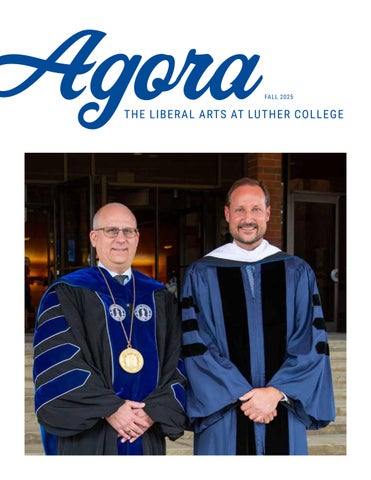
Cover: Luther College President Brad Chamberlain and Crown Prince Haakon of Norway on October 6, 2025 outside the Center for Faith and Life
Introduction by MARTIN KLAMMER, Professor of English, Editor of Agora
T
he contents of this issue suggest a theme of journey, or perhaps changed by the journey, which is also the title of Paul Hemenway’s chapel talk (p. 32). In his address at Luther College, Crown Prince Haakon of Norway highlighted several journeys in “the stories that bind us together”: Leif Erikson’s voyage to Vinland, the area of North America explored by Vikings around 1000 AD; the first Norwegian immigration to America aboard the Restauration sloop in 1825; the Norwegian royal family’s flight from Nazi occupation in 1940 to Washington, D.C. where they were received by President Franklin D. Roosevelt; and Prince Haakon’s own journey to the University of California-Berkeley, where he learned from “impressive professors” and fellow students “from every corner of the globe.” Camara Lundestad Joof, a Norwegian playwright and performance artist, told the audience at the Opening Convocation how, when she accepted the invitation to speak at Luther, “I had no idea what kind of United States of America I would be coming to.” But the more important journey Joof told first-year students was the journey of learning to “open oneself to the possibility of failing to create something new. It took me years and years to unlearn the fear of failure.” She encouraged her listeners to seize the opportunity that college offers: “This is what studying is for: failing in an uncontrolled controlled environment. Failing and getting feedback. Failing, trying again, and failing better.” Joof also encouraged the students to “Read. Read. Read.” She recalled a time in her childhood when, having read all the books in the children’s section of the library, she was thrilled to learn there was “another room”—the youth section. “The worlds that expanded my horizons,” she said, “became allegories
2
Agora/Fall 2025
that changed the way I saw my surroundings.” Erin VanLaningham (’96) ends her Phi Beta Kappa lecture with a similar narrative in a poem by classmate Jill Osier (’96) about a return visit to the library. That return journey to the library was both real and metaphorical, the “return to a familiar psychological or emotional or spiritual shelf that we learn more about each time we visit.” The physical journeys narrated in this issue may be long or short. Loren Toussaint journeyed to projects and conferences on forgiveness in Trinidad and Tobago, Germany, Italy, and England; Mark Potvin (’01) took a shorter but life-changing roundtrip from Luther College to his first teaching job in Minnesota and back again to Luther, where he now directs the Norsekkor and Cathedral choirs. In all cases, these journeys are about growth: intellectual, emotional, or spiritual growth. Anita Carrasco writes about the “intellectual journey into the disability world” that the Faculty Learning Community she led undertook to listen to neurodivergent learners at Luther College who told of their fears, frustrations, and joys. The long-term goal, she said, is to “champion and support neurodiverse learners . . . better than any other college in the Midwest.” This semester’s chapel theme was “crossing over,” based on Mark 4:35-40 when Jesus and the disciples cross over to the other side of the lake. The disciples become terrified of a huge storm until Jesus calms the storm and reprimands the disciples for their faithlessness. Various speakers took different lessons from this story. Mark Potvin learned in his journey to “trust the guy asleep in the back of the boat.” Paul Hemenway encourages us to pause in our journey “to rest, to prepare, and to reflect.” And
Martin Klammer Allie Scott reminded listeners that in our journey, “Best of all, God is with us” by becoming “one of us. Our God crossed the border between heaven and earth to walk alongside us—to know our struggles, to feel our pain.” Luther College begins the next stage of its 164-year journey with the inauguration of Brad Chamberlain as its twelfth president. In his speech, President Chamberlain stated that “What we need is here.” He acknowledged the “critical moment” in which we find ourselves, when people are “questioning the value of higher education itself.” But he called us to remember “Who we are” and “Whose we are” to understand the work we must do together: “Called by our Mission, grounded in our Identity, animated by the Spirit, and sustained by our Community, we have all that we need to catalyze the creation of a more sustainable and just world.” Enjoy the journeys in this issue!
The Stories That Bind Us Together by HIS ROYAL HIGHNESS CROWN PRINCE HAAKON OF NORWAY
Editor’s note: We are grateful to The Royal House of Norway for permission to print this speech, given at Luther College, October 6, 2025, during the official visit to the United States of Crown Prince Haakon. We have added the audience’s responses. The speech may be viewed on YouTube. IMAGES COURTESY LUTHER COLLEGE PHOTO BUREAU
P
resident Chamberlain, members of the Board of Regents, faculty, students, alumni, distinguished guests, dear friends: First, let me say how deeply honored I am to receive this recognition. To be granted an honorary doctorate from Luther College is not just a privilege— it’s a moment that I will treasure. Now, I should confess: my father received his honorary doctorate at the early age of 28 [audience laughter]. So, yes, it took me a little longer. But as I stand before you today, I like to think I’ve eventually caught up [laughter]. I would like to thank you for the very warm welcome that I have received here at Luther College—outside with all the students, the faculty and all the people. And of course also with the music—with the brass outside, with this orchestra, with the choir. With a very high level, I must say. What a gift to listen to all of you. Thank you. Today, I want to talk about the stories that bind us together—the story of Norway and the United States. What is it that connects our nations? What ties our people together across oceans? I believe it’s the stories that we share, that we tell ourselves and that we tell each other. Stories of courage and curiosity. Stories of hardship and hope. Stories that remind us who we are—and who we aspire to be. Let me start with one of those stories. It begins, as so many good stories do, with a man in leather clothes, long hair, and a helmet [laughter]—actually
Crown Prince Haakon speaks at the Celebration Convocation as Luther President Brad Chamberlain looks on. without horns. Because, as you know, the Vikings didn’t wear horns. You can see some horns around campus [laughter]. They are everywhere, but they didn’t actually use them. Maybe some of you have seen the series Vikings: Valhalla. You might remember this character Leif Erikson—a bold, thoughtful explorer. Now, the show does take some liberties, but don’t look to it for historical facts. But the true story is just as inspirational and interesting. As you know, Erikson is believed to be the first European to set foot on the American continent over a thousand years ago. I should note here that our understanding of the Viking age continues to be shaped by the saga literature, which was often written down a couple of hundred years after the fact and formed as stories that would grip the reader. So maybe not the best source for accuracy. But we
have found remains of Norse settlements in Newfoundland in Canada so the Norse were there around this time. In any case, the settlers soon came into contact with indigenous Americans who had already lived in the area for more than 20,000 years. Sources suggest that there was trade between them, but they also indicate that there were episodes of conflict and violence. Probably a bit of both. [Picture on large sceen.] This is Christian Krohg’s depiction of when Leif Erikson sees land. Vinland. Now, let’s be clear: To claim Eriksson as “Norwegian” is not entirely correct. Probably born in Iceland, raised in Greenland, son of a Norwegian father and an Icelandic mother—he was Norse. And his journey to Vinland didn’t change history the way Columbus’s voyage did 500 years later. The Norse settlements didn’t last more Fall 2025/Agora
3
One in three left their homeland. They came for land. For liberty. For a chance to live their faith. And when they arrived, they built communities—right here in Iowa, and across the Midwest. They built churches and schools. They built lives. And they built a bridge between our nations that still stands today. That bridge held firm in our darkest hour. On April 9, 1940, my family fled as the Nazi forces marched into Oslo. My great-grandfather, King Haakon, and my grandfather, Crown Prince Olav, moved to London with the exile government. My grandmother, Crown Princess Martha, fled to Stockholm with my father and his sisters.
Crown Prince Haakon and Luther President Brad Chamberlain lead a group across campus, followed by Julie Chamberlain, Associate Professor of Nordic Studies Maren Johnson, Ambassador Anniken Huitfelt of Norway and Kjetil Thomsvik, the prince’s aide-de-camp. than a few years. But the story did. It endured in the sagas. It echoes through time. And in three days, this country will celebrate Leif Erikson Day. Why? Because his voyage said something about us. It said we were a people willing to sail into unknown territory. To risk the storms for the promise of something better. That spirit—the courage to cross an ocean—would resurface centuries later.
they are fifty-three. Martha’s child is born on the journey—a promise of a new life. It was considered a miracle that everyone had survived. That voyage marked the beginning of something extraordinary. Over the next century, more than 800,000 Norwegians would follow.
But Sweden wasn’t considered safe enough. So they continued north through Finland and boarded the SS American Legion that was sent by President Franklin D. Roosevelt. At the invitation of the President, they found a safe home in the United States. They moved to Pooks Hill just outside Washington D.C. In those years, America was not just an ally. It was a lifeline. And for that, Norway will always be grateful. [Photograph shown on screen.] Here we see a picture. To the left you can see the First Lady Eleanor Roosevelt; my grandfather, Crown Prince Olaf; in
Fast forward 800 years. A young woman named Martha Jørgensdotter is born on a small island in Norway. Life is hard. Her family is poor. When her father dies, they lose their farm. But Martha dreams of something more. She meets a Quaker named Lars Larsen Geilane. They share a vision—a life of freedom, a life of opportunity. And so, in 1825, they board a tiny sloop called Restauration. Fifty-two souls on a boat that could not really fit sixteen. Martha is also pregnant when she goes on board. After a 98-day journey through several storms in the Atlantic ocean, the small vessel finally arrives in New York on the 9th of October. And when they step ashore, 4
Agora/Fall 2025
Crown Prince Haakon speaks to a group of students on campus.
Two Hawk. I’m paraphrasing, but it went something like this: May the wind blow to strengthen your mind. May the sun always shine on your back. May the path you walk be smooth. May you find the strength to fight your inner enemies. May your life be in balance. There was something soothing about his words. They seemed universal and deeply human, like they could apply to people anywhere, at any time. Still, it felt like he was talking directly to me.
Crown Prince Haakon with a large group of Luther students, with Luther President Brad Chamberlain at right. the middle is the mother of the president, Sara Roosevelt; my grandmother, Crown Princess Martha; and President Franklin D. Roosevelt. [Photograph of a boy playing with a dog.] I was showing these pictures to my father, and he said, “Ah yeah, that is Fallah, the president’s dog.” [Laughter.] He used to play with him. [Another photograph.] And here he is at the Potomac River outside Washington, D.C. And he said, “See? I’ve been into fishing my whole life.” [Laughter.] He’s a very keen fisherman. Half a century later, I came here myself —not as a refugee, but as a student. After serving in the Navy, I wanted to learn more about the world. And like so many before me, I looked to America. Because this country has always believed in the power of knowledge, building some of the best learning environments in the world. Luther College is part of that proud tradition. It was an easy choice. My years at Berkeley were a time of freedom—intellectual and personal. I learned from impressive professors, and they were impressive. But I learned just as much from my fellow students—people from every corner of the globe, with every kind of perspective. We didn’t always agree. But we listened. We argued.
We learned. That is the essence of a free society: the courage to exchange ideas without fear. [Sustained applause.] Universities have an absolutely critical role to play as sites for the free exchange of ideas. Independent teaching and research is at the heart of a free society. And so, to the students here today: cherish that freedom. Seek out those who are different from you. Be curious. Be generous. Because that is how we grow.
Dear friends, thank you again for the honorary doctorate. I will carry it as a symbol of the close friendship between the United States and Norway. Thank you for keeping alive the stories that bind us together—across oceans, across generations, across time. Thank you for your attention and may your life be in balance. [The audience responds with a standing ovation.]
When I had finished my studies at Berkeley, I made an official trip to eleven states to visit Norwegian-American communities. This was one of those places. Another was Sioux Falls in South Dakota. I forget what the exact event was, but I remember that there were two short prayers before we started. The first was given by a local priest, and the second by Tribal Chairman Webster
Luther President Brad Chamberlain awards Crown Prince Haakon an honorary doctorate of civil law. Fall 2025/Agora
5
Explore Your Place in the Tapestry that Surrounds You by CAMARA LUNDESTAD JOOF
Editor's note: Camara Lundestad Joof is a queer Black Norwegian playwright and performance artist whose work addresses racism and identity in a Scandinavian context. Her memoir I Talk About It All the Time was the summer reading for the incoming class of first-year Paideia students. Joof gave this talk at the Opening Convocation, September 4.
IMAGES COURTESY LUTHER COLLEGE PHOTO BUREAU
W
hen I was first asked to stand before you here today, to do the honor of delivering this convocation, I hesitated, for a good many reasons. I was asked to do this in the early fall of last year. I had just given birth to my son, I was on maternity leave, your elections were dominating the news cycle of every news station in the world, as you are wont to do, and I had no idea what kind of United States of America I would be agreeing to travel to. Honestly, I still don’t. I understand that I don’t understand your country. I have dedicated my career to not talk about you. In Norway, there is an inevitability in that you cannot use the word racism without being interrupted and dismissed with “America.” It is an impossibility to talk about discrimination without being accused of importing your culture wars. It is difficult to talk about structural challenges without it being labeled identity politics. And it is vexing how we have become unable to carry on conversations about justice or inequity without having it described as woke. But I can assure you that you do not hold the patent on inequality—though you do have your own definitive brand. (I don’t know if this makes you feel better or worse.) 6
Agora/Fall 2025
Camara Lundestad Joof speaking at Luther’s Opening Convocation So I have devoted my work, my writing, to finding a language outside of you. Trying to distil the essence of what is purely Norwegian, Nordic, Scandinavian in how we treat each other, what we owe to one another. How to converse without the mentions of you. And then you call, and invite me to cross the Atlantic? To say: what? I hesitated because I “only” have the Norwegian equivalent of a high school diploma. This is a college. Traveling across the globe to go traipsing about in academic settings always makes me ask myself the question: AM I EVEN GOOD ENOUGH TO HAVE IMPOSTER SYNDROME? Thankfully, writing this speech was not my first encounter with all-consuming crippling doubt.
When I became the playwright in residence at the National Theatre of Norway, some colleagues forgot that we were acquainted, that we were Facebook friends. I saw in the comment sections of the status updates of people I had admired and looked up to, that some were not happy for me. Or for the state of Norway. An author I respected wrote: “It’s so disappointing to see the national theatre sacrifice artistic integrity on the altar of political correctness and affirmative action. Has anyone even read any of her works? Can she even write?” Can she even write? Can I, though? Can I write? Every word I put to paper after that felt like a mockery. A sentence might be good, but was it good enough for the National Theatre?
Was it good enough for the nation of Norway? NO. If it was not perfection, then it was rubbish and that meant failure. And I could not afford to fail. And so, for months, I became unable to write. Time may not heal all wounds, but time will bring you closer to your deadlines. And when it runs out, the only thing that has worked for me so far is to flip it and reverse it: rename, rebrand. I was being paid to be put up on the national stage as the playwright laureate of a country that won’t even accept my father’s family’s Gambian passport? Without even knowing how to write? I’m gonna travel across the Atlantic to talk out of my uneducated ass to these college students forced by their professors to read my book—me, a high school graduate that can’t. Even. Write? Damn, girl. And so I give to you, the coping mechanism of my career—the hustler syndrome. In every room you find yourself panicking that you’re gonna be found out, that you don’t belong, that you being there is a mistake that they are going to call you on. If any of you are feeling this today, remember that if you are here, that means that you have managed to deceive every single one of the people that should have seen through you up until this moment. And that, my
friends, that is something to be proud of. You got all these fools, fooled. I said yes to come here because I feel a bit envious of you, on this day, with all the possibilities that are opening before you. Not of your student debt—your educational system is broken, America, and you should all be rioting. But envious of this time and space: these years are a privileged period of exploration. Of testing. And most importantly, of failing. Failing is not a natural talent. It is something that has to be practiced. Having the space, and time to fail is a gift. Having the capacity, the bandwidth, to open oneself up to the possibility of failing is the only way to create something new. It took me years and years to unlearn the fear of failure, and I do think that I would have been braver earlier, trusted my instincts earlier, if I had had a space as the one you are carving out for yourselves, right now. This is what studying is for: failing in an uncontrolled controlled environment. Failing and getting feedback. Failing, trying again, and failing better. So while you are here, applying yourselves, I am grateful for the opportunity to give you some advice, from one hustler to a generation of future hustlers, from across the ocean:
Camara Lundestad Joof enjoys a moment with first-year student Cato Stracke.
Beware that some words might try to hold you hostage, that some expressions will try to impress their supposed neutrality on you, and make you conform. Quality, and especially the artistic kind, will always be colored by what you have been exposed to, and what you have consumed, and then dirtied up with something as fickle as taste. If someone insists to have the answer key as to what is and what isn’t quality, without talking about culture and plurality, they are a less interesting critic than you deserve. Professional: what it looks like, what it sounds like and when something transforms from amateur to certified and who gets to decide what’s what and when what is, is as often a part of a salary negotiation as it is another way for the mean girls from the school yard to let you know if you’re invited to the party. If what you want to do doesn’t fit into their framework, but you are meticulous and do it well? Keep on keeping on. Risk: know that everyone, absolutely everyone, has a differing understanding of what that word entails. Every single happenstance in your life has been part of forming what you will understand as low risk or high risk. If something is perceived as a gamble or a done deal. What is vulnerable, what is unsure, and what is perceived as safe, or whom. So: First and foremost: Be careful with your language. Not your grammar; it’s nice to use correct punctuation, but that’s not the essence of writing, errors are a natural part of language learning and development, there/their/they’re, your/ you’re, if you are waiting on or waiting for someone, are or is, a or an and all the other adverbs? Fuck them up! Create your own words, the English language has already colonized the world, others can be the defenders of its perfection, so make your language your own, just make yourself understood. Do not hold your peace, speak up. Both you who are afraid of being called on in class, you who think no one is really interested in what you have to say (that’s not true), and you who lie awake at night, tossing and turning over the fact that you talked too much again, you spoke too much, the Fall 2025/Agora
7
words just galloped out of your mouth, tripped over your tongue, and you did not plan for what you were going to say, still you just said it, as we say in Norwegian: you who talked a hole in your own head? I promise you, you didn’t. Either way, it doesn’t matter whether you talk too much or too little, your voices are not noise, whisper or shout if you want! But be careful with how you speak to each other, about each other, how you talk with others. Think about all the space that others’ words have taken up in you, that live inside you: That space, you will also occupy, in other people. We carry each other’s words and thoughts about our bodies in our bodies. So look upon your language as a gift. And read. Read. Read. Read. I still vividly remember the day the librarian in my childhood town put her hand on my shoulder, after I had perused all the shelves in the children’s department, searching for something new, something I hadn’t read, another adventure, I remember her seeing me when I asked for help, and telling me that there was another room, that I might find what I was looking for on another floor, and then she led me into the youth department. Ungdomsavdelinga.1 She was my first crush. And though it would yet take years before I read a book where the main protagonist looked like me. Loved like me. The worlds that expanded my horizons still became allegories that changed the way I saw my surroundings. We all deserve to see ourselves as the hero of the stories we read. Our dreams stretch, they swell when we can imagine ourselves as something other, something bigger, something braver. But it is also a privilege to transform the self by approaching the world from the perspective of the unfamiliar. To celebrate the discovery of the other. If one is unable to conceive someone else, someone other than oneself, as the hero of the tale, if you are unable to envision something completely apart from you as the focal point of a story, it is a crime against your imagination. 8
Agora/Fall 2025
Then the uniformity of narratives you have been given has stolen something from you. So read. Read, read, read. Read to pull yourself outside of yourself, to stand firm in your own self, to dream yourself away into something else, into someone else, read to sharpen your arguments, read to find out you were wrong, read every single book those that have power over you do not want you to read, read to bolster your resilience, read to get better at writing, read for fun, read romance, fantasy, romantasy, horror, sci-fi, mystery novels, poetry, magazines, essays, short stories, newspapers, nonfiction, comics, plays; read from cover to cover, with the scent of dust in between your hands, read on your mobile, on a tablet, listen to an audiobook, read with your ears, read it aloud, have someone read for you, read for someone else, read it with your fingers in braille. The libraries are yours—use them. Defend them. And look at art. Go to museums, to the theatre, to concerts. Know that most of the institutions have youth or student discounts, that the shamefully expensive tickets are cheaper when you want them, because the institutions know they need you more than you need them, because you will come to look at art, and you will make art, you will create your own genres and your own expressions and your own eras, what doesn’t exist yet will be created by you, but not necessarily at the Kennedy Center. Or at the Guthrie Theater. You will make it wherever you want. So traditions are maybe peer pressure from dead people. But I want to make a case for the dusty old buildings. Because we must meet. We must sit in rooms together and disagree, we must laugh and cry together, because the next pandemic, if the bird flu doesn’t get us first, will be one of loneliness. And the only vaccine against that is each other. So, take these houses, these communal spaces, which you all pay for, and make them yours. Be impatient. Make demands. Take ownership. Go in and figure out what you like, and even more importantly, what you don’t like, and find out why you don’t like it, why one painting can make you cry and another can make you
angry, furious, and allow yourself to be surprised by what you can end up creating after admiring something someone else has made. And be careful about who made it. Maybe one piece of advice should be to stand up for what you believe in? But most of all, be cautious about what you believe. While consuming the artificial, in exposure to the generated, tangling with the automated: Ask questions, even the stupid ones.
Whether you talk too much or too little, your voices are not noise, whisper or shout if you want! Someone has probably tried to tell you that there are no stupid questions? Of course there are. My god, there are so many stupid questions. Annoying questions, plain dumb questions, bothersome, intrusive questions. But if you are in doubt, if something seems too good to be true, it probably is. If something confirms your worldview so perfectly that it feels like it was made just for you, it probably was; made just for you. So ask them, all the questions. Plaster your question marks everywhere. You can bet that others around you are wondering the same thing, the emperor’s new clothes and all that, and by being the one that dares to ask, you might not only stand up for what you believe in, but you might also stand up for someone else. Even if it’s uncomfortable. Maybe especially if it’s uncomfortable. And if something is uncomfortable for the minority in the room, but not for the majority, the only solidaric thing to do is to make sure that everyone is uncomfortable together. So call out that comment or that joke, or that misunderstanding, every single time. And if you find yourself as the source of the uncomfortableness. Apologize. Allow yourself to change your mind. No. Truly. Open yourself up to the possibility that you might be wrong. That your
theories are flawed, that your perspective is limited, that your understanding of something is biased. This pertains to every single one of us. Growth hurts. Recognize what is growing pains and what is just plain pain. Guilt is a low-frequency emotion, it’s unproductive. It is often necessary, but it can’t be the end game. But if we are to move past it, into something that facilitates change, then we must be on the same page. At the same time. And that means sharing the unpleasantness. Because your friends now, those you have and those you don’t have, won’t be the same people in the future, and neither will you. You will be so many versions of yourself throughout life, and a few will follow you through all the experiments, both the successful ones and the failed ones, and some you will lose along the way. And you will get new friends. And you will become a new friend. You will need to rely on someone, and someone will need to rely on you. But the most formative, the ones you will live your life the closest with, the ones you choose entirely yourself, the ones you end up building your life around, the ones who become your chosen family, most of them—they are still out there. And they don’t even know they are waiting for you. So be kind to strangers. Make eye contact, look up, look out, say hi. Most of the people who will become your people, you haven’t met yet. And before you find them, you must decide whether you want to be liked or whether you want to like yourself. And the latter, that will come, I promise. It might not happen today, maybe not tomorrow, but one day you will wake up and like yourself, and you won’t look for that confirmation from the people around you anymore, you will first and foremost get it from yourself. It won’t be a house of cards, but a solid concrete foundation. The wolf can come and blow down house number one and house number two, but damn it, before you know it, that third little piggy is you, and you’ve bricked up your walls, and it can huff and puff as much as it
likes. But when that happens, that’s when it counts, that’s when you find out if you are a person others can seek shelter with, if you are a person others can hide behind. We all need someone who stands up for us, and we must all strive to be someone who stands up for someone. I always felt that the adults that would spew cliches about their belief in the next generation were trying to dodge their own responsibilities, their own culpability in the affairs of the world. I feel like I am becoming one of those adults before your very eyes. I hate to be one of the adults that depends on you. Manifesting our lack of action in our hope/dependence on your capabilities. There is a genocide in Gaza: 123 women, men, and children burned to death last night, 20 Palestinians starved to death in the last few hours. There is a civil war in Sudan. A humanitarian crisis in the Congo. A full scale invasion in the Ukraine. And global warming waits for no one. And it is all tied into your lives, it is a part of your foundation as a human being, no matter if you wake up in the morning thinking of it or not. It’s an impossibility, existing parallel to the man-made tortures of the world. Realizing that almost all the pain you bear witness to is intentional. And yet you must. You must get up. And go to your classes, and figure out what’s for dinner, and what to wear, and what book to read or to write. And it’s insufferable. And at the same time, it’s cruel how easy it is. And it is in this parallel, in-between, the upside-down of this that you must figure out how you want to impact the world, and how you want the world to impact you. This is what these next years will hopefully give you, the space to explore your place in the tapestry that surrounds you.
on you, expecting you to be more: more responsible, to use less, consume less, own less, do less harm. It is unfair. Yet here we are. Right now, a part of the history books, in the making. Somebody else, somebody after you, will go to college, maybe this one, and study what we are living right now. They will write their papers and go to their classes and read their books about right now. What we are doing, or not doing, right now. It will not be without consequence how any single one you will choose to partake, contribute to the right now. Your time. My time. Our time. And while you figure out how to do that: load and unload the dishwasher. Without anyone asking you to. Because someone has to do it, and it might as well be you. It could be someone else, and someone other than you is probably going to do it, but the one who does it could also be you. In and out. In every living situation that you find yourself. Just do it. Empty and stack the dishwasher. By your damn self. Lastly: Always heed all advice with a pinch of salt. Except: floss, use sunscreen, and fight fascism. In any form or shape it takes; in any figure it presents itself. Always. I’m really looking forward to being a fellow citizen in this world with you all. Thank you for your time. And congratulations. NOTES 1. Editor’s note: Ungdomsavdelinga is a Norwegian term that translates to “youth department” or “youth section.”
I am one of the adults that builds my hope for the future on you. That was unable to fix this, so now we are leaning Fall 2025/Agora
9
Hard Times and Great Expectations: Literature and the Call to the Good Life by ERIN VANLANINGHAM ('96)
T
hank you, Martin, for that introduction. It is not often in a person’s life that their college advisor is truly still their advisor, and now friend. And thank you Dr. Marie Drews and to Luther College for this warm invitation. It certainly feels like a homecoming to me to see so many familiar faces here, especially at this early hour. As I prepared for this lecture I came across a picture that makes me very aware of the journey between my years as a Luther student and this moment in time—Julie Torkelson Chamberlain and me, standing near each other at commencement. What roads have been travelled return us both to this place. Congratulations to everyone in the Luther community upon the inauguration of your new president this weekend, and for all the promise the future holds for Luther College. I also want to acknowledge the very humbling moment this is for me to present in front of the faculty who first introduced me to the works I’m about to explore. I begin my remarks this morning with a reference to a different homecoming, my return home to Manitowoc, Wisconsin after my first year at Luther College in 1993. A few things stand out to me about that summer. First, I was armed with a reading list that included the Autobiography of Malcolm X and Toni Morrison’s Beloved, very earnest about continuing my learning in between my 10
Agora/Fall 2025
waitressing shifts at the local restaurant. My parents—enlightened and accomplished public school teachers—didn’t raise an eyebrow when I told them that I had changed my major from Biology to English. If they had reservations, they didn’t share them with me and I thank them for that. After church one Sunday morning, my pastor—who had played a pivotal role in encouraging me to attend Luther—asked me what I had decided to major in. After my response, “English,” he said, “Excellent. That isn’t just a college degree; that is a degree for life.” That perspective has proven to be one of the most prophetic things anyone has said to me. Pastor Bruce Hanstedt knew what he was talking about. And while I believe that really any formative liberal arts education provides students with perspectives that will stay with them throughout the life course— they all earn degrees for life—I would like to take the short time I have today to really make an argument for why the study of literature especially prepares us to live a good life. Such exploration of “the good life” reaches back to Aristotle’s notion of eudaimonia, which frames a pursuit of the good life as an engagement with the habits of practicing the virtues. Such virtues—like courage, wisdom, and justice—are the principles that we can apply to various spheres and seasons of our life and when we practice them, we can, in the words of philosophers Meghan Sullivan and Paul Blashko, “become better at being human by learning to direct [our] lives toward worthy goals.”1 Of interest to me is the rise of college courses that students from all different disciplines seem to flock to that focus on purposeful living and communal well-being. Sullivan and Blashko, both at the University of Notre Dame, have taught the highly popular course on “God and the Good Life” for many
IMAGES COURTESY OF THE AUTHOR
Editor’s note: Erin VanLaningham is director of project development for NetVUE (Network for Vocation in Undergraduate Education), an organization of over 300 colleges and universities. She has edited two NetVUE volumes of scholarly essays, as well as Cultivating Vocation in Literary Studies (2022). Erin is professor of English and Special Advisor to the President at Loras College in Dubuque. She gave this talk October 4 at the Phi Beta Kappa Symposium on the Liberal Arts.
Erin VanLaningham years. Similarly, Yale theologian Mirsolav Volf and his colleagues teach a course on “Life Worth Living” which explores what they see as the “Question of our Lives:” a question (capital Q) that encompasses these ideas: “What matters most? What is a good life? What is the shape of a flourishing life? What kind of life is worthy of our humanity?”2 These are important questions—and I am delighted to hear that so many sign up for these classes to consider them. As an English professor and a scholar of vocation, I always turn my attention to the ways that other disciplines in the university also do this work and ask such important questions. Literature, I believe, offers the complexity of such intersections to prepare all of us to better understand, hear, and respond to callings throughout our lives. This is an “apology” or “defense” of sorts, then, for the use of literature in our understanding of the call to the good life. While the study of calling or vocation has its roots in theology—vocare or vocatio meaning a calling or a summons by
God—recent vocation scholarship casts a wider framing to include each person’s purpose in work and personal roles as a calling that involves domestic and civic realms, and political and social life.3 This is, of course, rooted in Martin Luther’s insistence that all people—not just those in religious roles—have a calling. And, while some might frame a vocation as a calling from God, others hear that call through the cries and hopes of the world from our communities, our families, and our neighbors, along with our own internal compass. Thus, we can explore the contours of purposeful living when we explore how our individual life contributes to the flourishing of others and how the roles we are called to fulfill change over time.
Reading literature develops capacities for purposeful living in a complicated and at times unwelcoming world. When we talk about a call to the good life, we are not talking about the call to wealth, status, or individual success at the expense of others’ wellbeing. We are instead talking about the good life that is felt through a sense of individual purpose connected to a communal flourishing of neighbor and stranger alike. In a recent volume on vocation and the common good, I suggest that “vocation is a summons to a place within traditions, communities, cultures, and histories; it is not a place within oneself divorced from others.”4 It is the meeting place between ourselves and the world as we navigate difficult choices, cultivate empathy and curiosity, critically think and reflect, and see complexity of circumstance. When we pay attention to who we are and what our relationship to the world looks like, we are building a capacity for the good life. Literature helps us do this. I am trained as a nineteenth century British literature scholar, what I describe to those outside of academia as a training in all of the best and longest books. These include the impactful tomes of George Eliot’s Middlemarch, Wilkie
Collins’ Woman in White, Thomas Hardy’s Tess of the D’Urbervilles, and the works of the Bronte sisters, Jane Austen, Mary Shelley, and Charles Dickens. As I said, the best and the longest books. As with many professors of literature, the study of narrative and critical theory, of form, of socio-historical influence, of cultural context made up much of my training and research; it continues to motivate my thinking and my teaching. I have taught courses in the British novel, Romantic poetry, Irish women’s writing, and the spiritual memoir. I also have taught many first-year writing courses and senior research seminars. It is fun to teach all of this and also very hard to teach all of this in the challenging landscape of contemporary higher education. I don’t need to go too far in the news cycle to point to the many accounts of the those who discount the value of a college degree, the growing resistance to reading and writing, especially now in the age of AI, and the decline of interest in the humanities. As I have returned each year to my own sense of purpose as an educator and scholar in higher education, I always return to the ways literature invites readers to better understand the call to the good life. This started to inform my research projects and professional roles more directly as I sought to understand the connections between literature and vocation. I have written about the connections between reading and vocation in college classrooms and the ways shared reading experiences help students “build a capacity to understand the stranger beside them and create a ritual of thinking about problems together.”5 I have considered scholarship in narrative ethics, such as Amanda Anderson’s analysis of Charles Dickens’ novel Bleak House, in which she probes the impact on readers when they consider the lived impacts of the various levels of literacy of the characters in the novel—she points to the moment when the street sweeper Jo cannot sign or recognize his name.6 When we approach literature in this way, we can ask “what does it mean to read . . . if we only sympathize but do nothing to mitigate the situations we encounter through reading?”7 Finally,
A volume of essays edited by Erin VanLaningham and published by Oxford University Press in 2024 I have considered Middlemarch in particular as an exemplar of the ways “the novel’s capacity for vocational exploration rests in holding the multiple parts and the whole of narrative in tension. Such tension brings meaning and purpose and allows us to see new, alternative narratives.”8 This is how the study of literature can invite considerations of the good life. Generally speaking, I believe that educators across the university—faculty, student development professionals, officers in career services and community engagement, chaplains and coaches, and cabinet level leaders—can engage with the teaching of vocational exploration with students. In so doing, they are able to frame the student experience within the larger socio-economic, cultural, and civic contexts that inform both campus life and public life. They are able to talk about career and life readiness, about how purposeful living is rarely straightforward, and that cultivating practices of deep listening and reflection to self and others can help us navigate success and failure throughout our lives. This is part of mentoring, teaching, leading, and living, especially in a liberal arts context. This is what we are doing in many places already; an attention to making the practice more explicit helps students Fall 2025/Agora
11
connect various aspects of their college formation. In addition, through such attention to the ways our shared work across the university can better prepare students for their present and future callings, we are able to discern our own vocational pathways and shifts, and also better understand institutional calling and purpose. Thus, while my own examples today draw from my disciplinary training, it is really the questions and framework that they emphasize that I am offering as a model. Furthermore, I want to be clear that while the exploration of meaning or purpose can and does happen when we hold up exemplars to ourselves or to students—of people who have made great contributions to society through their professional and personal efforts, who show leadership informed by virtue, or who inspire in ways that impact others for good—for the most part, literature does not offer us a lot of these exemplars. I spend a great deal of time consoling students that the characters they meet in the books I teach are flawed, and perhaps even extraordinarily unrelatable. Have you ever met Jane Austen’s Emma? What about any of the characters in Matthew Lewis’s The Monk? Have you considered what it would be like to have dinner with Heathcliff or Rochester in the novels of Emily Bronte and Charlotte Bronte? These are not individuals we see as role models but instead we understand what it means to be human because of our encounter with them. So let’s begin with a few examples. Charles Dickens’ 1854 industrial novel Hard Times is not considered a good book. It is regarded by scholars as uneven at best—it has been criticized for its inaccurate picture of labor unions, incoherent in terms of an integrated narrative voice and point of view, and not very artistically written. And yet, the opening of the novel and its statement about education is widely quoted and cited, and for good reason. Here, the community leader, Thomas Gradgrind speaks: Now, what I want is, Facts. Teach these boys and girls nothing but Facts. Facts alone are wanted in 12
Agora/Fall 2025
in the class, represents the value and attraction of “fancy” or the imagination. She is the foil to Gradgrind’s philosophy. If one did not read any further in the novel, it still would invite contemplation about how to define a good life. What is the relationship between facts and imagination? What is the value of wondering about human hopes and fears? Who are we listening to—Gradgrind or Sissy Jupe—and why? How does this inform our sense of purpose today in framing our individual and collective choices about how to educate?
Essays co-edited by Erin VanLaningham in a 2023 publication of Edinburgh University Press. life. Plant nothing else, and root out everything else. You can only form the minds of reasoning animals upon Facts: nothing else will ever be of any service to them.9 The Gradgrind utilitarian philosophy does not stop at schools but extends to libraries as well: There was a library in Coketown, to which general access was easy. Mr. Gradgrind greatly tormented his mind about what the people read in this library . . . . They wondered about human nature, human passions, human hopes and fears, the struggles, triumphs and defeats, the cares and joys and sorrows, the lives and deaths, of common men and women! They sometimes, after fifteen hours’ work, sat down to read mere fables about men and women, more or less like themselves, and about children, more or less like their own.10 Grandgrind’s daughter Louisa, is commanded to “never wonder.” Not too far into the novel, Mr. M’Choakumchild (school master, in a chapter entitled “Murdering the Innocents”), appears in agreement with Gradgrind’s utilitarian viewpoint. Sissy Jupe, another student
The “hard times” Dickens refers to draws upon a “vernacular phrase, common in folk songs especially between 1820 and 1865 . . . . Hard times . . . usually meant a period, often a slump, when scanty food and low wages or unemployment bore particularly hard;” it addresses “the degradation of life."11 Hard Times is divided into three sections according to the Biblical ideas of what it means to sow, reap, and garner. The first chapter takes its title from Luke 10:40-42, “The one thing needful,” the story of Christ’s admonition of Martha for focusing on distractions and Mary choosing what is better. In considering what is necessary in framing a good life, the novel starts with the premise that perhaps wonder, imagination, and human decency are needful. And, the hard times of the novel of course invite a consideration of the major question—how does one resist such systemic injustice experienced by Stephen Blackpool, the protagonist, in factory work, and how does one carry the weight of difficulty and trauma, as we consider what it means to live a full and meaningful life. Theologian Deanna Thompson describes this as the ways our callings are informed by deep sadness and the importance of acknowledging and naming the effects of injustice as we live our vocations.12 The playwright George Bernard Shaw remarks that what Hard Times offers us is a reminder that “We do not read novels to escape from them or forget them; quite the contrary.”13 Some years later in 1861, Dickens published Great Expectations, a more promising sounding novel in regards to
a conversation about the good life. And yet, for anyone who has even opened the early pages of the novel, we realize that Pip’s deep desire to become a gentleman—aspirations to climb social classes from being apprenticed to his father figure Joe as a blacksmith to being educated and wealthy enough to woo his love interest Estella—comes with all sorts of problems. The novel, a bildungsroman—or a coming-of-age story—is the perfect sort of literature for vocational exploration. What Dickens demonstrates about how one comes to understand purpose and relationship to others and the world is by tracing out the effects of the lack of self-knowledge. Early on in the novel, Pip’s humiliation and shame when he realizes how the markers of class label him as undeveloped and backward serve to sever his loyalty to those he loves the most. The narrator Pip says, “It is a most miserable thing to feel ashamed of home.”14 This is a difficult but rich topic of consideration when we think about our callings to the good life—how does our growth through education or other life experience make us rethink our relationship to our family, our home, our sense of known identity? How can we reconcile all of these influences and to whom should we listen?
The novel starts with the premise that perhaps wonder, imagination, and human decency are needful for the good life. The novel is narrated by Pip looking back on his life; he reflects, “What I wanted, who can say? How can I say, when I never knew?”15 This lack of selfknowledge leads him down all sorts of problematic roads and poor life choices. He continues: “That was a memorable day to me, for it made great changes in me. But, it is the same with any life. Imagine one selected day struck out of it, and think how different its course would have been. Pause you who read this, and think for a moment of the long
chain of iron or gold, of thorns or flowers, that would never have bound you, but for the formation of the first link on one memorable day.”16 I don’t want to spoil the rest of the novel but suffice it to say that the great expectations are neither what Pip or the reader expected, nor are they necessarily great. However, what Dickens gives us in this novel is a consideration of what might have happened had different choices been made with the opportunities provided. We see the dreams of an emerging adult unfold in a context and with influences outside of one’s control, while also tracing the impact of decisions that cause him to lose his way. This is what Bonnie Miller-McLemore describes in her book Follow Your Bliss and Other Lies about Calling as the way callings involve both benefits and burdens.17 Taken together, these literary representations of hard times and great expectations give readers so much to think about in terms of what it means to pursue the good life. In Dickens’ panoramic world building, we see the many barriers to the good life based in world view and class structure, but we also see the ways self-discovery, imagination, and dignity emerge in this pursuit. But that is Dickens, you might say— what about other voices and perspectives? How do they invite us to consider the good life? Well, let’s take Zora Neale Hurston’s Their Eyes Were Watching God, published in 1937. Here is a book about what Hurston describes as “that oldest human longing—selfrevelation.”18 The book frames such selfrevelation in terms of a Black woman’s growth and awakening within the structures of racism, sexism, colorism, and violence of late nineteenth century America. She writes of the protagonist, Janie, that she “saw her life like a great tree in leaf with the things suffered, things enjoyed, things done and undone. Dawn and doom was in the branches.”19 Hurston’s juxtapositions of suffering and joy, things done and undone, dawn and doom are exactly the parameters of exploring purpose, self-knowledge, and the summons to a meaningful life. Janie demonstrates moments of deep discernment—giving what Hurston
calls “a hard thought” to a demeaning speech by her first husband and “placing it beside other things she had seen and heard.” Janie decides to leave Joe, and on her journey, she observes: “The morning road air was like a new dress . . . from now on until death she was going to have flower dust and springtime sprinkled over everything. A bee for her bloom.”20 The narrative resists such unity however, and Janie encounters further suffering, this time through domestic violence by her second husband, Jody. After this traumatic experience, Hurston explains, “Janie stood where he left her for unmeasured time and thought. She stood there until something fell off the shelf inside her. Then she went inside there to see what it was.”21 Such selfexamination and reflection moves her to consider the future, and “[imagine] her life different from what it was.”22 There is of course so much more to say about this novel, but I want to draw forward one significant piece—and that is the sense of deep observation of self and world that the novel presents. Certainly there are important literary arguments about female agency and subjectivity, about the construction of communities and even the realities of climate disaster. Here though, for our consideration of how literature might engage with questions of the good life, I would say that Hurston invites us into a regular habit of observation—of our family, our partners, our communities, the natural world—and of our own responses and changes in relationship. One way Hurston’s novel explores how their eyes were watching God is by showing Janie watching throughout the novel, observing the ways she is treated and the status of her inner strength and meaning. Literature and the call to the good life can be seen in what Hurston calls “the new dress of the air on the morning road.” It brings a certain clarity of purpose through observation and self-revelation. I have obviously spent the majority of my time on narrative this morning, but of course poetry, creative nonfiction, drama, and so forth also present us with ways to explore meaning and purpose. The study of drama can offer us an Fall 2025/Agora
13
avenue to consider what it means to inhabit different roles in the world, to consider what tragedy means for individuals and groups, what comedy can show us about our own shortcomings.23 The personal essay, like the work of Anne Lamott or Annie Dillard or Mary Catherine Bateson, explores the contours of the good life. In her essay, “Composing a Life Story,” Bateson links the ideas of composing in writing to composing in music, suggesting that when you do this “you have to look at the change that occurs within a lifetime—discontinuities, transitions, and the growth of various sorts—and the artistic unity, like that of a symphony with very different movements, that can characterize a life.”24 I’ll end here with a consideration of poetry, drawing from the work of Stephanie Johnson and her exploration of the ways poetry invites us to embrace ambiguity, paradox, and multiplicity of meaning.25 When I think about the ways literature invites us to develop capacities for purposeful living in a complicated and at times unwelcoming world, I often think of William Wordsworth’s poem of homecoming or what he calls “revisiting,” in “Lines Composed a Few Miles above Tintern Abbey.” The return to the Sylvan Wye helps Wordsworth to bear what he describes as the “heavy and the weary weight/of all this unintelligible world.”26 The return to the river banks allows him to return to himself—changed but also familiar. There are many poets whose work lends itself to conversations of the good life, including Mary Oliver, Wendell Berry, and Ada Limón. I’ll point here to this poem by Lucille Clifton, entitled “i’m not done yet”: as possible as yeast as imminent as bread a collection of safe habits a collection of cares less certain than i seem more certain than i was a changed changer i continue to continue what i have been most of my lives is where i’m going27 14
Agora/Fall 2025
The language here of possibility, of certainty, and change directs the reader to consider the cares and habits that inform who the speaker is now, and who the speaker will become. The idea of continuing to continue is such a wonderful iteration of life and the anticipation of where one is going, bubbling, like yeast, under the surface. The poem I’d like to close with is by my Luther College classmate and fellow English major Jill Osier (’96), an accomplished poet living in Fairbanks, Alaska. Jill lived across from me senior year in Larsen Hall. I love her 2017 poem “Elegy,” which meditates on a treasured visit to a library. An elegy is a poem that invites reflection, focused emotion, and often lament; it is certainly an invitation to consider the contours of the good life. Jill writes: Not every day but most days that summer I went calmly and quietly and climbed to the sixth floor of the library and walked not fast and not slow but with purpose down the last row and reached almost without looking to the same place on the shelf and pulled out the large book and carried it to a chair that looks out toward the ridge, to a mountain that is there, whether it is or it isn’t, the mountain people love, maybe for this, love and die with all their love, trying, and I opened to the page where I left off before, and sometimes the library announced it was closing, sometimes I got hungry, sometimes it looked like rain, and I’d close the book and carry it again, with purpose, back to its exact
place on the shelf, and I’d walk down the stairs and out of the building, and it was like I’d left it ticking.28 On the face of it, the journey Jill describes in the poem of taking a book off a shelf again and again and returning it to its place “ticking” with life and possibility is a familiar experience for many. The elegy reflects on the familiarity and measured pace of the visits to the library, of what it means to look out beyond the confines of her experience and, after a while, return the book until she visits again. She invites us to consider how we approach a familiar story—not fast, not slow, but with purpose. She invites us to think about how we carry the story each time.
Literature allows us to be distracted enough from the hard times and even great expectations of our lives, so that we can see them more clearly. And yet we might ask what if the journey to the library is metaphorical—that the return to a place in a narrative that is about love and death, of a mountain we can see or not see, is also about what it means to return to a familiar psychological or emotional or spiritual shelf that we learn more about each time we visit. I, of course, can’t help but make the connection to the shelf Hurston references inside of Janie. The poem invites us to return to the unfinished book, again and again. I’ll close with some final wisdom from the Pulitzer prize-winning writer Barbara Kingsolver, who describes reading short stories after a painful and tragic moment in her family’s life, saying “the stories were, for me, both a distraction and an anchor.”29 I believe that this is the gift of literature to the consideration of the call of the good life—that it allows us to be distracted enough from
the hard times and even great expectations of our lives, so that we can see them more clearly. It also gives us ways to carry the effects of the contemporary realities of public life and bear concern for the future. It offers us an anchor in those very realities to keep us connected to our inner compass and to those with whom we share a common life. When we invite students, and each other, into conversations about meaning and purpose, we are grasping for these sorts of anchors and distractions. Any discussion of the purpose of a college education ought to include a discussion of what it means to live a good life and support the flourishing of others in doing the same. Hard times and great expectations abound; the study of literature gives us but one way to navigate the journey.
11. F.R. Leavis, “Hard Times: An Analytic Note,” in Hard Times, eds. Fred Kaplan and Sylvère Monod, 3rd ed. (W. W. Norton and Co, 2001), 369. 12. Deanna A. Thompson, “Beyond Deep Gladness: Lamenting Trauma, Injustice, and Suffering in Service of the Flourishing of All,” in VanLaningham, Called Beyond Our Selves, 46.
13. Bernard Shaw, “Hard Times,” in Hard Times, eds. Fred Kaplan and Sylvère Monod, 3rd ed. (W. W. Norton and Co, 2001), 360. 14. Charles Dickens, Great Expectations (Oxford World Classics, 1993), 97. 15. Dickens, Great Expectations, 98. 16. Dickens, Great Expectations, 66.
17. Bonnie Miller-McLemore, Follow Your Bliss and Other Lies about Calling (Oxford University Press, 2024), 7. 18. Zora Neale Hurston, Their Eyes Were Watching God (Harper and Row, 1990), 6. 19. Hurston, Their Eyes Were Watching God, 8.
20. Hurston, Their Eyes Were Watching God, 31.
21 Hurston, Their Eyes Were Watching God, 67. NOTES 1. Meghan Sullivan and Paul Blaschko, The Good Life Method: Reasoning Through the Big Questions of Happiness, Faith, and Meaning (Penguin, 2022), 2.
2. Miroslav Volf, Matthew Croasmun, and Ryan McAnnally-Linz, Life Worth Living: A Guide to What Matters Most (Viking/Penguin, 2023), xv. 3. David S. Cunningham, “Introduction, “Language that Works: Vocation and the Complexity of Higher Education” in Vocation Across the Academy: A New Vocabulary for Higher Education, ed. David S. Cunningham (Oxford University Press, 2017), 7–8. 4. Erin VanLaningham, “Introduction” in Called Beyond Our Selves: Vocation and the Common Good, ed. Erin VanLaningham (Oxford University Press, 2024), 2.
5. Erin VanLaningham, “Reading with Strangers: Our Collective Vocation” in VanLaningham, Called Beyond Our Selves: Vocation and the Common Good, 202. 6. VanLaningham, “Reading,” 208.
22. Hurston, Their Eyes Were Watching God, 72.
23. Jason Stevens, “The Drama of Vocation,” in Johnson and VanLaningham, Cultivating Vocation in Literary Studies, 89-108. 24. Mary Catherine Bateson, “Composing a Life Story,” in Leading Lives that Matter: What We Should Do and Who We Should Be, eds. Mark R. Schwehn and Dorothy C. Bass, 2nd ed. (Wm. B. Eerdmans, 2020), 530-31.
25. Stephanie Johnson, “Poetry’s Lyric Call” in Johnson and VanLaningham, Cultivating Vocation in Literary Studies, 67-88. 26. William Wordsworth, “Lines Composed a Few Miles above Tintern Abbey,” in The Age of Romanticism, 3rd ed. (Broadview, 2018), 375-377. 27. Lucille Clifton, Good Woman: Poems and a Memoir, 1969-1980. 1st edition. (BOA Editions, Ltd, 1987). 28. Jill Osier, “Elegy,” Poets.org, 2017, https:// poets.org/poem/elegy-1.
29. Barbara Kingsolver, Small Wonder: Essays (HarperCollins, 2002), 214.
7. VanLaningham, “Reading,” 209.
8. Erin VanLaningham, “Novels, Vocation and the Call of the Unfinished Story,” in Cultivating Vocation in Literary Studies, eds. Stephanie L. Johnson and Erin VanLaningham (Edinburgh University Press, 2023), 50.
9. Charles Dickens, Hard Times, eds. Fred Kaplan and Sylvère Monod, 3rd ed. (W. W. Norton and Co, 2001), 5. 10. Dickens, Hard Times, 42.
Fall 2025/Agora
15
Called to Work Together for the Common Good by JULIE CHAMBERLAIN (’96)
O
n the October Friday when Brad’s presidency was announced, I was two days home from the hospital after having some major surgery. After (joyfully) dragging my still-very-much-recovering body here to the CFL to be present for that announcement, I quickly returned home for a nap. But later that afternoon, as the rest of the community gathered at Pulpit Rock for a celebratory drink and I was stuck at home on the couch, I found myself doing a little research. See, there was a number that was kind of haunting me that day. It was the number 12. It just didn’t feel like a very big number to me. I kept thinking about 164 years of Luther history, and all of the thousands of lives that have been marked by their time as a student, a staff member, a professor, a coach, a parent, a friend of Luther College. And the reality that the kid that played clarinet across the band from me my sophomore year of high school, the guy who changed my kids’ diapers and taught them how to build a campfire and play Guitar Hero, the man who STILL makes my eggs for me every morning, that he was going to be one of only twelve people to lead this incredible place as president, well, I was still trying to wrap my mind around that.
These eleven men and women had been called and equipped by the same Spirit. And so, I began to read about each of the eleven presidents that came before Brad. And while it didn’t appear as 16
Agora/Fall 2025
though any of them had played much Guitar Hero, I realized as I read that these eleven men and women were regular clarinet-playing, campfire-building, breakfast-making folks just like Brad who had, over 164 years, been called and equipped by the same Spirit—the Spirit of the Living God—to serve and lead this place. Now there are varieties of gifts but the same Spirit, and there are varieties of services but the same Lord, and there are varieties of activities, but it is the same God who activates all of them in everyone. To each is given the manifestation of the Spirit for the common good. (1 Corinthians 12:4-7.)
IMAGES COURTESY LUTHER COLLEGE PHOTO BUREAU
Julie Chamberlain is the lead pastor of Decorah Covenant Church. She gave this reflection October 3, prior to the inauguration of her husband, Brad Chamberlain.
Julie Chamberlain speaking at her husband’s inauguration
The very same Spirit has called and activated the gifts of each of these twelve leaders. In fact, over these 164 years, it is the same Spirit who has called and equipped each and every professor and coach and food service worker and custodian and music director and RA and gift officer and admissions counselor and student—into service for the common good. To each is given the manifestation of the Spirit for the common good. When Brad gave his first chapel talk as president last spring, he talked about his favorite Hebrew word, hineni. Hineni is a compound word that means Here am I. It’s what Samuel says in our text this morning in response to God’s repeated
call. It’s also how Moses responds to God’s call in chapter 3 of the Book of Exodus. And how Isaiah responds to God’s call in chapter 6 of the Book of Isaiah. Hineni. Here am I. It’s a response of openness, willingness, attentiveness, surrender even. Brad first learned the word hineni from Marjorie Hass, president of the Council of Independent Colleges, while we were participating together in a year-long seminar involving two retreat experiences sponsored by the CIC. The purpose of this seminar, and particularly these focused retreats, was to discern together as a couple whether we were being called to a college presidency. Brad and I talked and prayed a lot on those retreats. Were we being called? And if God was calling us, were we willing to respond with our hineni?
Brad left our seminar experience with that word hineni echoing in his spirit. I left with another phrase echoing in mine. It came from one of the other participants in our cohort, who reminded us on our last day together: The call comes from a generous God. The call comes from a generous God. I lost count of how many times I repeated those words as Brad moved through the search process last summer. And as I sat on my couch on that October afternoon almost exactly one year ago, reading about the eleven presidents whose legacy Brad would now carry, I heard that phrase again. The call comes from a generous God. A God who gives us what we need to do that to which we’ve been called.
work we do here about recognizing the unique ways the Spirit is made manifest in each other, drawing out those gifts and nurturing them, pointing one another toward the ways those gifts are needed in service to the common good? I know I would not be standing here speaking if it weren’t for Mark Muggli and Carol Gilbertson and David Faldet and Jessica Paul and so many others who named and nurtured those gifts in me 30-plus years ago when I was a Luther student. Some of the seeds
It is because Mark and Carol and David and Jessica and Dale and Carolyn and Mona and Bill said hineni to their call, that Brad and I are able to say hineni to ours. And it will be because Steve Holland and Carly Foster and Storm Bailey and Aaron Zander and Maren Johnson and Mark Potvin and Juan-Tony Guzman and so many others said hineni to their calls that our boys will be able to hear God’s call and say their own hineni. And it is, of course, because—164 years ago—courageous immigrants said hineni to their calls, that we are here today.
To each is given the manifestation of the Spirit for the common good. Indeed, each of us has been called and gifted by the Spirit for the sake of one another. In fact, it is in answering our own call, and using our own gifts, that we help others discern and live into theirs. See, Samuel’s repeated hineni in our text this morning is not actually a response to Yahweh. It’s a response to Eli, his teacher. Samuel doesn’t yet recognize God’s voice and doesn’t know that it is the Spirit of the Living God who is calling him. He hears the call and assumes it is coming from his mentor and teacher. Samuel responds first to Eli. And Eli points him to God. It is Eli, the text says, who perceives that the Lord is calling Samuel. It is Eli who instructs Samuel in how he might respond to the voice of the Lord. Eli lives into his own calling as he helps young Samuel discern the voice of God and respond to God’s call.
The call comes from a generous God. Isn’t this precisely the work we are called to do here at Luther College? If each is given the manifestation of the Spirit for the common good, isn’t the
Julie Chamberlain shares a moment with her husband, the new Luther College President Brad Chamberlain, and their sons Liam (’29) and Drew (’26). they planted in me—about how my particular gifts could serve the common good—some of those seeds bore fruit in ways I could never have anticipated: as a parent, as a church musician, as a community member. And some of those seeds didn’t come to fruition until 20 years after graduation, when I went to seminary. But those seeds were planted here. And I know Brad wouldn’t be the president of Luther College if it hadn’t been for Dale Nimrod and Carolyn Mottley and Mona Nelson and Bill Craft and so many others who named and nurtured his unique gifts, who modeled for him what it looks like to care deeply about a place and its people, who helped him hear the voice of God calling at numerous points in his own Luther journey.
As Nordic sang over us earlier: We are our grandmothers’ prayers and we are our grandfathers’ dreamings, we are the breath of our ancestors, we are the spirit of God. Four years ago, when I was ordained, Brad had this stole made for me by a dear friend. It is made from the handprints of every person in our family and in our congregation. As I said hineni to God’s call on my life in a new way that day, he wanted me to remember that the Spirit’s gifts are alive and active in each one of us—that we have a generous God, that He has given us ALL good gifts, that we are called to do this work together for the common good. I wear it this morning to remind him— and each one of us—of those same truths. Because the work we are called Fall 2025/Agora
17
to do here at Luther College is holy work. And it will take all of us. The reception that we will enjoy together after our service today feels a little bit like this stole. People all throughout our community were asked to bring a dozen bars for our “dozeneth” president. It is cute and fun and yes, quintessentially Midwestern—but it also serves as a powerful reminder: this work will take all of us bringing what we have, sharing it with one another… there are varieties of gifts but the same Spirit, and there are varieties of services but the same Lord … The Spirit’s gifts are alive and active in each one of us—we have a generous God, He has given us ALL good gifts, and we are called to do this work together for the common good. I have known Brad since he was 16 years old. He has always been thoughtful and wise, strategic and futuristic, funny and compassionate and courageous, a natural leader, and the guy you want by your side in a crisis. I don’t know a single person more committed to the people and the institutions he loves. He’s only been president for seven months, but he’s been thinking and dreaming and hoping and believing and working toward what’s best for Luther College for the entirety of his 24 years here. I believe, without a shadow of doubt, that Brad is the right person to lead Luther College in this moment. But it’s not because of all of those things. It is because he lives his life in conscious dependence on the Holy Spirit, the same Spirit that has been at work in and around this place and its people for 164 years. But Brad isn’t called to do this work alone. The Spirit calls and equips each of us. We are each given gifts. And our responsibility to those that came before us—and to those who will come after us—is to steward these gifts for the common good, to remind one another that the call comes from a generous God, to help one another recognize God’s voice, and to answer God’s call with our own “hineni.” Here am I. 164 years. Twelve presidents. Thousands of people. One Spirit. Soli Deo Gloria.
18
Agora/Fall 2025
Presidents of Luther College 1861 - 1902 Peter Laurentius (Laur) Larsen 1902 - 1921 Christian Keyser Preus 1921 - 1932 Oscar L. Olson
1932 - 1948 Ove J. H. Preus 1948 - 1962 J.W. Ylvisaker
1962 - 1963 David T. Nelson (acting) 1963 - 1981 Elwin D. Farwell
1982 -1995 H. George Anderson
1995 -1996 David J. Roslien (acting) 1996 -1999 Jeffrey D. Baker
1999 Richard C. Hemp (interim)
1999 - 2013 Richard L. Torgerson
2013 - 2014 David L. Tiede (interim) 2014 - 2019 Paula J. Carlson
2019 - 2025 Jennifer K. Ward 2025 - Brad Chamberlain
What We Need is Here Wild Geese A poem by Wendell Berry:
I
Horseback on Sunday morning, harvest over, we taste persimmon and wild grape, sharp sweet of summer’s end. In time’s maze over fall fields, we name names that went west from here, names that rest on graves. We open a persimmon seed to find the tree that stands in promise, pale, in the seed’s marrow. Geese appear high over us, pass, and the sky closes. Abandon, as in love or sleep, holds them to their way, clear, in the ancient faith: what we need is here. And we pray, not for new earth or heaven, but to be quiet in heart, and in eye clear. What we need is here.
am a chemist by training, and I taught students organic chemistry here at Luther College for sixteen years. Much of my teaching, of course, focused upon atoms and molecules and their various transformations. But identity was also a constant theme of my teaching—and not just the identity of atoms and molecules. Why? Well, because organic chemistry has a notorious reputation. Some of my students initially saw organic chemistry as a barrier to their professional aspirations. For them, organic chemistry was to be endured. It was a gate through which they must pass. And I was sometimes seen as a gatekeeper. I resisted that identity. For some of my students, organic chemistry was the first moment in their academic careers when they struggled with a course that was foundational to their dreams. When that happened, I often saw students question not only their abilities but also their identities. “Maybe
I’m not a good student after all. Maybe I don’t have what it takes to be a physician or to go to graduate school. I’ve spent so much of my life thinking that this is who I am or this is what I was going to be—now what?” I spent as much time in my office talking with these students about who they were, what they were passionate about, and what defined them as individuals as I did discussing chemistry. I encouraged them not to let one course (or even one exam) define who they were or what they could do. We talked about their struggles in organic chemistry as a path toward rather than a path away from their goals. Luther College President Brad Chamberlain speaking at his inauguration on October 3, 2025 We talked about struggle and discomfort as a sign that the educational process was working— an education focused on the common not that it, or they, were failing. good, an education that is focused upon others naive? Is it a sucker’s bet? I don’t During my sixteen years in the classbelieve so. And I don’t want you to room, I often saw crises of identity in believe it either. my students. And in the same way, to varying extents in my administrative roles over the past eight years, I have seen Luther College struggle with its own sense of itself—its identity.
It’s understandable. Demographic changes are rapidly compounding challenges centered on access, affordability, accountability, sustainability, and differentiation.1 Higher education’s business model is arguably fragile, if not outright broken. More people are questioning the value of higher education itself. The questions are striking at our core, a core that feels more vulnerable with each day’s headlines. Is higher education still a public good? Is a liberal arts education an anachronism? Is seeking
Together, we are at a critical moment. And, together, we have decisions to make. Will we be sustained by conforming to the world? Or will we instead remain committed to transforming it? Will we seek to become the best version of some other college or university? Will we seek to mimic its identity and its mission to the best of our abilities and resources in this place? Or will we instead find confidence in OUR identity? In OUR mission? Will we look outward for solutions? Or will we instead find peace in knowing that WHAT WE NEED IS HERE? That each of us has been given gifts— Fall 2025/Agora
19
IMAGES COURTESY LUTHER COLLEGE PHOTO BUREAU
by BRADLEY CHAMBERLAIN, Luther College President
gifts intended to serve our neighbor so that all may flourish. That, as one body with many members, we are equipped to collectively and courageously answer our collective CALLING. To faithfully and humbly answer our CALLER. When our children Drew and Liam started school, Julie and I began a practice of praying over each of them individually as they left for the day. Some mornings, I got the honor. Those morning prayers over time evolved into a call-and-response that I still often use with each of them, especially before and after moments I suspect may challenge their sense of themselves. Holding them tightly, I ask: “Who are you?” They respond: “A child of God.” I then ask: “What did you do to earn it?” They respond: “Nothing.” Finally, I ask: “What can you do to lose it?” They respond: “Nothing.” In those moments when I can’t be physically with them, I instead send a short text: “Remember who you are.” In times of both trial and triumph, what I want Drew and Liam to remember is that WHO they are matters most of all. That WHOSE they are matters most of all. Because knowing WHO we are— because knowing WHOSE we are— will tell us WHAT we need to do. My prayer for Luther College is much the same. That we know WHO we are. That we know WHOSE we are. And that with this knowledge, we know WHAT we must do together. And so I ask: WHO ARE WE? We are a community of learners named for a reformer who was “compelled by conscience” and was known for taking courageous stands. A theologian whose “most basic insight was that humans are unable to make themselves worthy of God.” A scholar who recognized that hospitality makes deep learning possible. Who asserted that the hospitality of an educational community is rooted in the hospitality of God, who reaches “out to heal broken relationships, freeing people for flourishing.”2 WHO ARE WE? We are a community of learners committed to academic 20
Agora/Fall 2025
President Brad Chamberlain reacts to a standing ovation during his inauguration ceremony. excellence, the development of whole persons, servant leadership, and the exploration of faith, vocation, and values in an inclusive residential community grounded in the Lutheran tradition. And so we provide a transformational education that is marked by the collective pursuit of excellence; an openness to the insights and perspectives of all traditions and peoples; the pairing of bold inquiry with intellectual humility; the development of mind, body, and spirit; the interconnectedness of ideas, people, and place; and the liberating power of learning in community for the sake of others. WHO ARE WE? We are a community of learners that produces professional leaders—the best physicians, musicians, teachers, lawyers, pastors, and accountants. That produces community leaders—creative and committed volunteers, fundraisers, artists, and advocates. Our graduates stand out in their professions and their communities because of their focus on others. Because they are inspired and equipped to build bridges across differences. Because they strengthen communities. Because they make everyone around them better. WHO ARE WE? We are a community of learners who take seriously
the exploration of enduring questions. The world is crying out for adaptive approaches, adaptive solutions, and adaptive leaders. The world is crying out for the liberal arts, whether or not it knows it. The technical alone cannot help society address what I see as some of its most pressing challenges—some of its most pressing questions. Questions such as “What does it mean to be human?” Questions such as “Who is my neighbor?” Because we are a liberal arts college grounded in the Lutheran tradition—because we excel at teaching students how to wrestle with bold, enduring questions—Luther College can provide leadership during the rise of artificial intelligence. We can provide leadership in restoring civil discourse in a society marked by polarization. There are several thousand colleges and universities in the United States of America. Jon McGee, author of Breakpoint: the Changing Marketplace for Higher Education, argues that colleges like Luther share upwards of 98% of their organizational DNA with these other institutions. This overlap is especially acute for the 211 national liberal arts colleges listed in U.S. News and World Report. In a time of challenge and disruption in higher education, McGee asserts that our two percentage points
OF difference need to make A difference.3 In my mind, that two percent is about WHO WE ARE and WHOSE WE ARE. In my mind, the question before us is not IF we have a relevant and compelling two percent. The question before us is instead: WILL WE CLAIM IT? Luther College—what we need is here. Called by our Mission, grounded in our Identity, guided by our Values, animated by the Spirit, and sustained by our Community, we have all that we need to catalyze the creation of a more sustainable and just world. We have all that we need to elevate individuals, communities, and society, one graduate at a time. Luther College—we are the sower of seeds. Seeds of compassion, wisdom, curiosity, and hope. Seeds that inspire and equip students to courageously serve the common good. Seeds that draw excellence out of every student and prepare them for lives of meaning and purpose. Spread them with HONESTY. Spread them with HOPE. Spread them with PRIDE. Spread them with BELIEF. Not for our sake, but for the sake of a world in desperate need of transformation. And, together, we proclaim: Soli Deo Gloria. NOTES 1. Jon McGee, Breakpoint: The Changing Marketplace for Higher Education ( Johns Hopkins University Press, 2015), 3-5.
2. Quotations in this paragraph are from Inspired. Empowered. Engaged: Luther College Strategic Plan, 2018-2023, and Network of ELCA Colleges and Universities, Rooted and Open: The Common Calling of the Network of ELCA Colleges and Universities (May 2018), https://resources.elca.org/colleges-universities-and-seminaries/rooted-and-open/. 3. Jon McGee, 114.
Fall 2025/Agora
21
Supporting Neurodivergent Students at Luther College by ANITA CARRASCO, Professor of Anthropology
Neurodiversity is a term sociologist Judy Singer coined in 1998. It refers to the idea that all brains function differently and that this diversity is natural and beneficial for our species. According to the Centers for Disease Control and Prevention (CDC), approximately 11.4 percent of U.S. children between the ages of 3 and 17 have been diagnosed with ADHD. Also, a recent report by the CDC indicates that approximately 1 in 31 children in the U.S. has been diagnosed with autism. Every year, we encounter some students with these invisible disabilities in our classrooms. At Luther College, the percentage of students registered with the Office of Accessibility Services is 20 percent (Ann Smith, Director of the Office of Accessibility Services, personal communication). This statistic does not include the students who choose not to document their disabilities with this Office; 20 percent is statistically significant and should be an incentive for educators to begin to understand the role that neurodiversity plays in classroom learning and beyond. As an anthropologist, I believe diversity is good for our species and, in the context of education, different needs should be recognized by making our teaching environment inclusive for our neurodivergent students. To do this, the first step is to understand the diversity of the 22
Agora/Fall 2025
brain, so we can learn to recognize the signs of difference that require accommodations. To develop effective strategies for working with neurodivergent learners, I along with four other faculty (Shayla Van Hal, Carly Hayden Foster, Jill Leet-Otley, and Lindsey RowHeyveld) and two staff (Sarah Franklin Crose and Kay Bronshteyn) read and analyzed Edward M. Hallowell’s text ADHD 2.0. With greater understanding of neurodivergence, faculty and staff can begin to remove barriers to learning by demonstrating that we care and are willing to adapt our teaching and practice. Our hope for this intellectual journey into the disability world is to begin steering our teaching methodologies and cultural attitudes to eventually position Luther College among the top neurodivergentfriendly liberal arts colleges in the Midwest. For this ambitious goal to become a reality, we have to do our homework. We need to learn about invisible disabilities and adapt some of our teaching practices and cultural attitudes accordingly. This homework will be much easier when the college administration invests in systematic efforts to promote faculty and staff development opportunities that provide incentives to improve the culture surrounding disability on campus. Panel of Student Disability Experts In line with the anthropologist’s recognition of the importance of the expertise of those with lived experience, one of the activities during our FLC was inviting students with different disabilities (autism, ADHD, anxiety, depression, and chronic pain) to share their stories in a panel. The students were thrilled that a group of faculty and staff were interested in their struggles. All members of the FLC concurred that this panel was the single most impactful learning experience we had during
IMAGE COURTESY OF THE AUTHOR
A
s a member of the Luther College community, my goal is to enhance support systems for students with disabilities on our campus. With this purpose in mind, and sponsored by the Center for Excellence in Learning and Teaching (CELT) during the 2024-2025 academic year, I led a Faculty Learning Community (FLC) titled “Supporting Neurodivergent Learners” to explore the impacts of conditions like ADHD and autism on student learning and success.
Anita Carrasco our year-long collaboration. Clifford Geertz’s essay, “From the Native’s Point of View,” argues that anthropologists must prioritize understanding a culture from the perspective of its members, moving beyond superficial or external descriptions. He emphasizes two concepts: “experience-near” (the native’s internal view) and “experience-distant” (an external, formal analysis). The methodology of the panel was to provide seven questions (in italics below) that were distributed in advance to the invited participants, so they had time to reflect about what they wanted to share. I took handwritten notes during the panel to avoid the use of a tape recorder. To protect anonymity, I assigned numbers to each student disability expert. I will refer to student #1, student #2, and student #3 to indicate change of speakers: Introduce yourself and tell us what is the nature of your disability? Student #1: My diagnosis came late in life when I was about 18. I have an assortment of different disabilities including depression/anxiety, ADHD, autism, PTSD, and others.
Student #2: I divide my disabilities into physical (chronic pain) and mental (depression due to the chronic pain). Student #3: I am on the Autism/ ADHD Spectrum and have dyslexia. Tell us about the most difficult experience you’ve had at Luther because of your disability. How did you cope? Who helped? Student #1: I have a GPA of 4.0, so one of the first barriers I faced when I asked for help was, “Why are you here? You have a 4.0.” So people don’t believe that I struggle, but at my best I am unpredictable and unreliable when it comes to my disability. I can go days without eating or bathing because of school work and experience intense fear because I don’t want to disappoint my professors. Student #2: I am involved in extracurricular activities and had to miss rehearsals because I was experiencing panic attacks, and I was suicidal. People involved in this activity did not understand, so Student Life had to get involved, and for me this meant the excruciating emotional pain of having to disclose personal information that makes me feel vulnerable. I was singled out by a professor for not doing my best (not an isolated incident but recurrent) in front of my fellow classmates and friends. Student #3: I was participating in an intense program and one of the professors was not using my accommodation and boldly told me: “You’re not good enough. If you want to succeed you need to measure up to my expectations.” I ended up getting academically dismissed; my advisor helped me. But I remember the injustice, and how the Center for Academic Enrichment (CAE) chose the worst timing to email me (one day before Christmas) with the notice that I had been academically dismissed. I plummeted into a depression. My Paideia professor helped me, and eventually I returned to Luther. Tell us about the most rewarding experience you’ve had at Luther because of your disability. Student #1: I don’t have a clear answer, I can’t think of anything immediately, maybe… this meeting.
Student #2: I paused with this question; it was hard to think of any, but basically all the humans—professors and classmates—who don’t judge me. I have had good experiences with [Professor xxxx]. They told me that if there was anything I needed that was not in my accommodation that we could work on it. They do weekly check-ins.
If you could recommend one way in which Luther College could improve the experiences of neurodivergent students, what would you recommend?
Student #3: My friends. After the dismissal incident happened, I became closer with a small community of friends that had experienced similar issues. As a result of my negative experience, a really positive experience happened when I found myself a second major (Identity Studies) in addition to my religion major. Why Identity Studies? What I was feeling was identity studies, so I ended up finding a positive out of a negative.
What would you ask faculty and staff to do differently so they can better support neurodiverse students?
How would you describe Luther College’s cultural attitude toward disability? Student #1: I think that it all depends on the extent to which a person has exposure to disability. When there is no exposure and no personal connection, it usually results in not a good cultural attitude, especially with invisible disabilities and what they expect you to be like. Student #2: Not great. Everyone would say they support disability, but in reality, both the attitude and the infrastructure for mental and physical disabilities are poor on our campus. I can say I feel comfortable walking around campus, but I don’t feel like I belong. Student #3: Among majors in the arts and social sciences, the cultural attitude is positive. But in the hard sciences and in sports, not so much. There is a “just figure it out” attitude among my classmates, it’s a male-centered perspective aligned with capitalist ideology of pulling yourself up by your bootstraps. In science and music there is a fixed thinking of only one way to get things done, no alternative. So there is a lot of preaching that we have an inclusive campus, but when we demanded campus-wide disability training we were told it could not be done. Unfortunately, if you can’t see it you can’t understand it. It’s a systemic issue.
Student #2: Luther could improve labbased assessment accommodations. Student #3: Training for faculty and staff (equality is not the same as equity).
Student #1: One of the most debilitating conditions is my ADHD, which forces me to become vulnerable through disclosure so I don’t disappoint my professors. It’s awkward for people with disabilities to constantly have to explain themselves to their professors and experience the anxiety of receiving a response that is not compassionate. (This student proceeded to share a positive experience when a professor responded with an email that ultimately communicated: I see you, I hear you, I don’t judge you, you are more important than a XYZ music group. With the permission of the student and the professor, the anonymized version of the email exchange is copied below as it exemplifies a model for compassion that other professors could derive inspiration from. ) Student #1 first email: Hello Dr. XXXX, I apologize for the last minute notice, but I will not be present at rehearsal today. I will send you a further email later this afternoon regarding my attendance. Thank you for your consideration, Student #1 Student #1 follow-up email: Good morning, Dr. XXXX, Here is my promised follow-up. This will be a rather vulnerable email, the purpose being to give you context about my current state, which led to yesterday’s absence. I want to be transparent: I am struggling to take proper care of myself. I have an assortment of mental disabilities causing this, and they’ve unfortunately reached an impasse where it’s increasingly difficult to maintain normal daily function. Fall 2025/Agora
23
This results in routine periods where my body and/or mind, for lack of a better term, gives up on me, and those periods are much more frequent than I’ve been able to recover from. I am working with professionals to manage everything. I will, of course, be doing my best as always not to miss rehearsals—but I have to acknowledge the reality that ‘my best’ is unpredictable and unreliable. Being in Luther College [XYZ music group] has been a highlight of my experience at Luther, and I hate to be a burden on the ensemble. The unpredictability of my condition makes it difficult to say how many rehearsals I may miss in the future and if the amount will be enough to challenge my position in the ensemble. I desperately hope not and will do my best not to make it so. With all that being said, I understand this is an unwanted complication. Please let me know what further conversation we should have at this point, and how I can work things out with you and the ensemble. Thank you, Student #1 Professor XXXX's email response: Hi Student #1, I’m sorry I was not able to respond sooner. My Tuesday schedule is wild. I appreciate you sharing your situation. I hope you know I will be as flexible as needed. Never hesitate to contact me if there is a rehearsal you are struggling with. Your wellbeing and health are more important to me than the [XYZ music group.] As always, I’m here if you need anything.
Student #2: Education on how to support neurodiverse students. In my experience, older faculty express openly that they don’t know how to do this. Student #3: If someone says they have accommodations, don’t ask for further clarification for why the student needs the accommodation, you just need it. If they question the accommodation letter, as a student you tend to shut down. What advice would you give future neurodiverse students who come to Luther College (what you wish you knew)? Student #1: You are going to have to advocate for yourself a lot. Get rid of your shame quickly, don’t apologize or over justify. Know what you need and be firm with it. Student #2: They give us so much information the first week in orientation that you end up overwhelmed, having no idea what to do. I was unable to grasp that there were resources at the college, and ways to get help if you had a disability. Student #3: The TRIO program. If you have a disability, you are a part of it and as a beneficiary you have access to a lot of resources. There are a few things I could advise future students with a disability coming to Luther: fight tooth and nail to get a single room, and know that there are ways to report if your professor is not using your accommodations on the Luther 360 platform.
After sharing this email correspondence, Student # 1 concluded that “In general when you gather the courage to explain yourself to your professors and become vulnerable, there is always the fear that they will not believe you. It would be nice if there was radical acceptance. It’s exhausting having to continuously justify yourself.”
To the college I could advise: give a packet of resources and information for faculty and students, and remember that inclusion is fluid, never fixed. It’s hard to build a community for people with disabilities, so make it easier for the students. Be flexible. Base it on individualized needs. Working with students, don’t forget there’s a power dynamic, a gender dynamic, think about what things you have done in the past, what things you can do to make this better, and be proactive as professors. How do we remove the burden from the students? The barriers get stronger when you are dismissed. For example, as a student I was told: “If I find out that you are lying to me, you’ll be in trouble.”
(The conversation returns to the question of what faculty and staff could do differently.)
Student #3 argued that the power dynamics “can have a tremendous impact
I’m thrilled to have you in the ensemble, and will never pressure you to do anything that jeopardizes your mental or physical health. All the best, XXXX
24
Agora/Fall 2025
on a student’s perception of their own sense of self worth. If it’s a positive dynamic versus negative power dynamics it makes a difference. What professors say to their students has an impact, you should never forget that. Even if it’s a comment that seems insignificant at the time, it can have lasting impacts on the student, positive or negative.” Takeaways: Trust, Patience, Kindness As the panel concluded, the students voiced how good it felt to be heard. They recommended doing panels like this more often, maybe even once a year, using it as a thermometer to measure the disability experience temperature on campus. The model of the panel of student experts can serve to move the lived experience of the disability community on campus “from the margin to the center.” This idea is directly inspired by the feminist and anti-racist work of bell hooks. She viewed the margin as a space of both oppression and possibility, where dominant narratives could be challenged and transformed. This idea has been adapted by disability scholars to argue for bringing the lived experiences of marginalized disabled people to the forefront of research and advocacy. As a result of our conversations with the students in this panel, we reflected that there’s a culture of mistrust. As a consequence, there is a holistic sense of fear experienced by many students with disabilities on campus. They fear disappointing us, they fear being judged, they fear not being believed, and they fear failure. Students should not fear their professors. As faculty we can practice three important principles in our classrooms starting today: Trust, Patience, and Kindness. Believe your students, be patient, and be kind. No need for training, and no need for a workshop to practice this approach. You probably noticed I have been preaching to the choir. The attendees at disability workshops are already dedicated—they’re usually the parents, spouses, or people with a direct personal connection. The people that need to be there normally don’t show up. We have to recognize that not everyone goes into education for the same reasons. Forget
workshop attendance for a moment. We need to ask some tough, underlying questions: what is the responsibility of the educator to their student? What makes teaching a worthwhile profession? What makes education a worthwhile pursuit? And if we’re honest with ourselves, would our answers to these questions be different for a student with a disability? The Office of Accessibility Services has had successes. Retention data following the 2023-2024 academic year, for students who are registered with the accessibility office were impressive: 93% of the students were retained and returned for the fall of 2024. This data is a cause for celebration. Behind this statistic someone on campus was trusting, someone was patient, and someone was kind. Going forward, our goal is clear: to accumulate a long list of triumphs as we champion and support neurodiverse learners at Luther College. We can strive to do this better than any other college in the Midwest. REFERENCES Danielson, C. K., Claussen, A. H., Bitsko, M. J., et al. 2024. Prevalence of parent-reported ADHD diagnosis among children ages 3–17 years: United States, 2022. Centers for Disease Control and Prevention, National Center for Health Statistics. [Link: CHADD https:// chadd.org/about-adhd/general-prevalencechildren/]. Edward M. Hallowell, M.D. and John J. Ratey, M.D. 2022. ADHD 2.0: New Science and Essential Strategies for Thriving with Distraction—from Childhood through Adulthood. Ballantines Books. Geertz, Clifford. 1983. “From the Native’s Point of View: On the Nature of Anthropological Understanding.” Local Knowledge: Further Essays in Interpretive Anthropology, Basic Books, pp. 55–70. hooks, bell. 1984. Feminist Theory: From Margin to Center. Cambridge, MA: South End Press.
Maenner, M. J., Shaw, K. A., et al. 2023. Prevalence and characteristics of autism spectrum disorder in young children—United States, 2020. Centers for Disease Control and Prevention. Singer, Judith. 1998. “Odd People In: The Birth of Community Amongst People on the Autism Spectrum. A Personal Exploration of a New Social Movement Based on Neurological Diversity.” Honors Thesis. The University of Technology Sydney (UTS).
Fall 2025/Agora
25
Forgiveness Research and Education: A Growing Global Movement by LOREN TOUSSAINT, Professor of Psychology
M
IMAGE COURTESY OF THE AUTHOR
y primary efforts during my sabbatical in the spring 2025 consisted of working on the Caribbean Self-Forgiveness and Flourishing Program in Trinidad and Tobago and advancing professional work with Forgiveness International and Templeton World Charity Foundation. I have leadership roles in all of these projects and at the time of my sabbatical we had already begun work, or in some cases, we had made significant progress. The aim of the sabbatical was to get these projects significantly advanced, and if possible, across the finish line!
Caribbean Self-Forgiveness and Flourishing Project The Caribbean Self-Forgiveness and Flourishing Project was the main focus of my sabbatical. This project has been supported through a grant from the Templeton World Charity Foundation which covers the expenses incurred in the collection of these data. My sabbatical offered the significant time needed to finish out all the necessary requirements of the project including: data analysis, conference presentation, publication, and broader dissemination. In this project, we are examining self-forgiveness as a mechanism to promote better mental health, and reduced addictive and suicidal ideology in the twin-island country of Trinidad and Tobago. Trinidad and Tobago has high levels of mental illness, substance use, and suicidal behavior. Our hypothesis is that these conditions derive from and contribute to self-condemnation and hopelessness. Promoting self-forgiveness to reduce these self-destructive behaviors might seem self-evident, but no one has studied the cultural relevance and utility of self-forgiveness in the Caribbean. Over the past three years we have been conducting a multi-study project using 26
Agora/Fall 2025
Loren Toussaint, his wife Kim Toussaint, Sebastian Skalski, and Janusz Surzykiewicz in Eichstätt, Germany a programmatic series of investigations in the Caribbean to better understand the role of self-forgiveness, which we believe will improve mental health and reduce addictive and suicidal behavior. Study 1 examined motivation and feasibility perceptions for self-forgiveness improvement (sample size = 200). Study 2 focused on cultural adaptation of the Moving Forward self-forgiveness workbook intervention that we are using (sample size = 30). Study 3 (sample size = 1000) sought to establish cross-cultural validity of the key measurements of interest. Study 4, the focus of the spring 2025, was a test of the effectiveness of the Moving Forward self-forgiveness workbook intervention (N = 500). University of the Southern Caribbean and University of the West Indies students and Trinidad and Tobago community residents were recruited in all studies.
My sabbatical allowed me to ensure that our data collection phase (which was just beginning) came to a strong finish and it allowed me to focus more intently on data analyses and writing. We have the data, but we are still completing analyses and probably will continue working for some time. Our remaining aims are to continue analysis and writing to gain as much insight and yield from the collected data and to disseminate our findings within both academic and broader community circles. We hope that this work will provide a brief, low-cost, easily obtainable intervention for people with self-condemnation struggles, lowering the risk for suicide, addiction, and mental health problems. This work is designed to immediately help people in Trinidad and Tobago and eventually generalize to people in other Caribbean islands, and potentially beyond.
Speaking, Networking, and Bucket List I received an invitation to deliver a keynote speech at an international conference held at the Catholic University of Eichstätt-Ingolstadt in Germany. Here I was able to speak on forgiveness and suffering and meet and connect with scholars and practitioners from many different countries. Our dear friends and colleagues, Janusz Surzykiewicz and Sebastian Skalski (see photo of the four of us), were able to meet us at the conference and we enjoyed good discussions about research and a little fun. Janusz took us to Rome for a couple of days after this conference. My number one bucket list item was checked off as a result! For a professor to be speechless is quite a feat, but that’s it, I’m speechless about Rome. As chair of the Templeton World Charity Foundation’s Discover Forgiveness Advisory Council, I was also invited to attend an international advisory council meeting in Canterbury, UK in July where we had important visioning discussions. Kim and I were able to cross another couple of things off our bucketlist by arriving in London a couple days early to see Buckingham and Kensington palaces, St Paul’s Cathedral, and the National Gallery. Fortunately, my sabbatical allowed more flexibility with travel and other contributions to these international events.
part of the Flourishing University project at Universidad del Sinú in Montería, Colombia. To sum up, I was able to complete the planned work that I proposed for my sabbatical and am very pleased both with the immediate outcomes and the potential each project holds for the future. The unforeseen opportunities were welcome blessings. I am happy that I was able to honor my original sabbatical plan but also expand my work and engage in these other projects. In most every case I believe that I would not have been able to do the work without the time afforded by the college by my sabbatical. I am grateful to the college for its support of my scholarly work, both during my sabbatical and going forward. Dr. John B. Slaughter once said, “Research is to teaching as sin is to confession. If you don’t participate in the former, you have very little to say in the latter.” I have long believed this to be true. Without consistent engagement in research, it is difficult to convey to students the dynamic and growing nature of one’s discipline. For this reason, I’m grateful every time the college supports faculty research and, in so doing, give us something to say in the classroom.
I am on the board of directors for the nonprofit Forgiveness International. This small organization promotes a forgiveness education approach that has been used for 20 years and in 20 different countries. During my sabbatical we have been in visioning and planning discussions, and we have a goal to move this work into a more significant online sphere, one where students can both support the education and benefit from it more readily. We have been discussing opportunities for student internships and research opportunities with collaborations between Forgiveness International and Luther College that I would facilitate. An unexpected opportunity that I was thrilled be involved in resulted in my writing a 16-week stress, coping, and forgiveness curriculum for Fall 2025/Agora
27
Just for Today MAY 12, 2025
by ANGELA KUENY ('02), Associate Professor of Nursing
The theme for chapel talks this spring is Romans 12: 9-18, Love in Action. While I was reflecting on this chapel’s preparation, I was struck by a moment of coincidence for me personally with this Bible chapter! Around twenty years ago, I started working as a nurse with Amish families with genetic bleeding conditions, and I have remained tightly connected to these families, seeing my original pediatric patients now bringing their own babies to our clinics. The Amish are outwardly identified by their strict lifestyle, limited electricity, plain clothing, straw hats or bonnets, and buggies. Inwardly, the Amish are a religious community who base every decision around remaining separate from society’s technological and social advances that get in the way of their connection to God. So many times I have asked myself how they can stay so committed to their lifestyle and not give in to the conveniences of this world! Wouldn’t a refrigerator in your home be more convenient to grab a glass of milk in the morning? Or a warm toilet seat more comfortable on a winter’s night? At the very center of the Amish lifestyle are two Bible verses, Romans 12:1-2. I will focus my talk on this part, sort of like when your teacher gives you an assignment and you want to pick the piece of that assignment that you want.
28
Agora/Fall 2025
A Living Sacrifice: Romans 12: 1-2 Therefore, I urge you, brothers and sisters, in view of God’s mercy, to offer your bodies as a living sacrifice, holy and pleasing to God—this is your true and proper worship. Do not conform to the pattern of this world, but be transformed by the renewing of your mind. Then you will be able to test and approve what God’s will is—his good, pleasing, and perfect will.
IMAGE COURTESY OF THE AUTHOR
I
feel honored and blessed to be with you today, in this space. I remember being in your seats, attending chapel as a senior nursing student, and I was grateful for the time to reflect in the midst of incredible life transitions. Congratulations to those moving on to your next chapter in life, and best wishes to those of you transitioning to summer activities, rejuvenating yourself to return here in the fall.
The chapter then has a section about us being one body, and many parts. Then, we get to the part of the chapter about how to love others. First, we need to know and love ourselves, and not conform to the patterns of this world. Only then can we bring our genuine selves to the world to share the love it so greatly needs. Romans 12:9 states “Love must be sincere.” In Hindi, sincere means firm and humorless belief in the validity of your opinions. How do you drill down to the validity of your opinions and emotions? What makes your axis spin in the direction and at the speed that you want it to go?
We need to know and love ourselves, and not conform to the patterns of this world. The world will tell you that in order to have enlightenment, you need to take up yoga, do ten minutes of Pilates before you start the day, drink matcha tea instead of coffee, make time for your loved ones, visit a lonely neighbor, eat more chocolate (okay, maybe that’s just me), and maybe even take up painting.
Angela Kueny Who has time for all of this? And which one do I pick to have the most enlightenment? Sometimes I get de-centered thinking about all of the self-centering activities I am supposed to be doing but not doing! Does this happen to you? I have come to believe that in order to find the validity of my own opinions and emotions is to stop in as many moments as possible, and ask myself, “What am I feeling about this? What is my body, mind, spirit telling me?” I listen to myself. I learned to do this once again in my time with the Amish. A Luther anthropology student asked me to help with a research project about how the Amish teach their children to be ready to forgive. After several interviews with bishops and parents, one couple invited us to an Emotions Anonymous meeting in their community. Emotions Anonymous is a group who gathers to work through a 12-step process in recognizing and working
through emotions, formed after the model of Alcoholics Anonymous. We didn’t know what was going to hit us. At the time of the meeting, Ashley and I drove to the farm, walked into the barn, and were met by a small circle of Amish individuals around a candle and small table with 12-step pamphlets. It was an organized meeting in which individuals shared their experiences and the emotions connected to that experience. The point was to recognize their own and hear others’ emotions. Not to judge, not to analyze, not to criticize. Just to see that our emotions are a part of our daily life, and we welcome them. I want to read just a couple of the twelve “Just for Todays” practiced in Emotions Anonymous: Just for today I will try to go out of my way to be kind to someone I meet. I will be considerate, talk low, and look as good as I can. I will not engage in unnecessary criticism or finding fault, nor try to improve or regulate anybody except myself. Just for today I will try to be happy, realizing my happiness does not depend on what others do or say or what happens around me. Happiness is a result of being at peace with myself. Just for today I choose to believe that I can live this one day. If my body is a living sacrifice, holy and pleasing to God—this is my true and proper worship. To find myself, love myself, and bring myself everywhere I go. I wish you a beautiful day.
Fall 2025/Agora
29
Why Worry? Just Keep Sailing SEPTEMBER 26, 2025
by MARK POTVIN (’01), Associate Professor of Music
This story from Mark’s gospel has always resonated with me. (Dimwitted disciples? I mean, c’mon!) But in this story, I think the disciples really make sense to me because I’ve always been a worrier. Now, I rarely worry about the things over which I have control. But I almost always worry about stuff over which I have no control: big decisions, details, events, or info someone else is in charge of ? What someone else thinks of me or my work? Replaying a conversation from the previous day at 2 am? Sensationalized headlines. The safety of my wife and kids when they leave the house each morning or for my parents when we part ways because . . . you just never know. I’ve lived a blessed life, but I guess I’m always waiting for the other shoe to drop. My mom says that worry has always been part of my DNA. But I’m not here to talk about worry. Our chapel theme this fall is about crossings. Liminal space. The space where, frankly, my worry often feels biggest. Just like the disciples on the water—between the two coastlines— traversing liminal space can leave us feeling completely untethered, unmoored, and adrift when storms rage. I 30
Agora/Fall 2025
want us to think about why maybe we don’t need to worry as much as some of us do. I often say to my students that I love walking alongside them on their journey of becoming—with each passing day—the person they were always meant to be. If that paradigm is legit, then a successful crossing isn’t a matter of if we’ll make it (the source of our worry), but how the journey will take shape. Because if we have a little faith, it always works out. In the fall of 1997, I arrived at Luther College as a first-year student from Detroit Lakes High School in northwestern Minnesota. I knew NO ONE when I got here. I made some friends, but by fall break found myself missing the deep connections I had with folks I’d known since birth and those I met through scouts, music, football, and school. I was uncomfortable and lonely. I thought about transferring and changing majors. Sound familiar? My first BIG crossing. By spring, I had developed the beginnings of an abiding friendship with three Luther guys I didn’t know well in the fall but with whom I share a brotherly bond today. Each came into my life somewhat unexpectedly and they likely would have, whether I worried about finding them or not. I had to make the crossing to encounter them. In the fall of my senior year, now a music education major, I was panicking over the spectre of student teaching. I was excited to get into a classroom, of course, but my piano skills were HORRIBLE. Not good. (And not for lack of trying to improve them—thanks, Kathy Reed.) In tears, I told a mentor that I was dropping my education certification. Tim Peter talked me out of it and encouraged me to have a little patience. In retrospect, I think I was afraid to leave a community I had come to hold so dear. Ready or not, I had no choice
IMAGE COURTESY OF THE AUTHOR
L
ate in the day Jesus said to the disciples, “Let’s go across to the other side.” They took him in the boat as he was. Other boats came along. A huge storm came up. Waves poured into the boat, threatening to sink it. And Jesus was in the stern, head on a pillow, sleeping! They roused him, saying, “Teacher, is it nothing to you that we’re going down?” Awake now, he told the wind to pipe down and said to the sea, “Quiet! Settle down!” The wind ran out of breath; the sea became smooth as glass. Jesus reprimanded the disciples: “Why are you such cowards? Don’t you have any faith at all?” (Mark 4:35-40)
Mark Potvin but to make the next crossing and leave Luther College. That’s true for all of us, isn’t it? Eventually? And yet, by the time I took a job in Princeton, Minnesota, I had improved my piano skills (marginally) and started a relationship with an outwardly funny, infinitely kind, and curly haired percussionist from the World Famous Luther College Concert Band. That panicked moment was just the start of a huge crossing—into my professional life, marriage, grad school, and parenthood. (#adulting) And? It seems to be working out so far. (Serious credit to Susan, of course….) I spent 16 years living in Princeton, Minnesota. Sixteen years! That’s more lived memory than I have of growing up in Detroit Lakes. My entire adult life until 2017. We had friends there. Jobs we loved. A church home that had become our extended family. I helped coach our kids and their friends in baseball. Susan had a regular group of folks with whom she worked out. When we moved to Decorah, we were running
toward something about which we were incredibly excited but we left all that stability behind. Susan had no job. I was on a visiting contract with no promise of ongoing employment. Our kids were thrown into a new school. It was a tumultuous time . . . rocky waters. We held tight to each other and our faith as we worked through that crossing, too. We’re still doing it—navigating and adapting to evolving workloads, lending a hand to students who are making crossings themselves, trying not to capsize from feelings of inadequacy, encountering waves of hustler and imposter syndrome. And as parents? Oof. Every day seems like a crossing for us or for them. Driving the car, navigating peer stuff, discovering limits. They’re almost ready to fly the coop, a transition I’m anticipating with both joy and lament. My parents and in-laws are healthy, but reaching milestone birthdays. We cherish our time together, and I’m nowhere near ready to let them go when the time for that crossing comes.
It’s about trusting the guy asleep in the back of the boat. So, I’ve sometimes wondered when the “crossings” of life will let up. But in recent years I’ve come to really buy into the idea that life is a crossing. This is all crossing. Moment to moment, day to day, era to era we are ALWAYS in the boat. So, you know what? I keep trying not to fear what feels like perpetual crossing. It’s about trusting the guy asleep in the back of the boat. Somebody who’s not worried in the least about outcomes because—from His perspective—our inevitable safety and well-being couldn’t be more obvious. He’s not worried. Why should we be? Have a little faith, right? When I feel the brokenness of the world around us, I try to just keep on keeping on. Trust. Hold onto faith—even when it’s the size of a mustard seed. Walk the walk. Keep sailing. And? For this kid, raised in the United Methodist Church, the Wesleyan idea of “do all the good you can, in all the
places you can, by all the means you can, as long as ever you can” keeps cropping up. So while we keep endeavoring to have faith, let’s also renew our commitment to trust each other, our social contracts, and the process of becoming. Let’s encourage one another to listen for the quiet voices rather than automatically entertain the loudest ones. Let’s look for ways to uninstall harshness and cynicism in favor of rebooting kindness and gentleness. Anytime you see a chance to cross into that world—the one the meek will inherit—for even a moment? Boldly go. (You didn’t think we’d make it through without one Star Trek reference, did you?) Yes, every time you sense the waters of the ongoing crossing, boldly go . . . and keep your equilibrium. So with that, a prayer for equilibrium using John O’Donohue’s blessing for the same:
NOTES 1. O’Donohue, J. To Bless the Space Between Us: A Book of Blessings. New York: Doubleday. 2008. (adapted)
Like the joy of the sea coming home to shore, May the relief of laughter rinse through [our] souls. As the wind loves to call things to dance, May [our] gravity be lightened by grace. Like the dignity of moonlight restoring the earth, May [our] thoughts incline with reverence and respect. As water takes whatever shape it is in, So free may [we] be about who [we are becoming]. As silence smiles on the other side of what’s said, May [our] sense of irony bring perspective. As time remains free of all that it frames, May [our] minds stay clear of all it names. May [our] prayer of listening deepen enough to hear in the depths the laughter of God. 1 Soli Deo Gloria. Fall 2025/Agora
31
Changed by the Journey OCTOBER 1, 2025
by PAUL HEMENWAY, Career Coach and Curriculum Integration Manager
At least 41 times the word immediately (or variations of it) is used in the Gospel of Mark. Forty-one times in just 16 chapters. There is an urgency on Jesus’s part to teach, demonstrate, and bring about the good news of the Gospel in the world, seeing the Kingdom of God become reality through healing, transformation, and forgiveness. And then there is Mark 5:1, “They went across the lake,” and verse 21: “When Jesus had again crossed over.…” The words of the Gospel accounts are pregnant with meaning, so why would the Gospel writer of Mark include the details about “going to the other side”? For Jesus, movement was a physical act of changing one’s geographic location; to do his work of bringing the good news of God’s Kingdom he had to go to different places, to different people. It was also an image of transformation and change. For the Kingdom to come there needed to be change, including change in the human heart and mind. Just in the verses in and around chapter 5, Jesus, his disciples, the followers, and a crowd of others witnessed significant events. A dramatic healing of a person from “the wrong side of the tracks” and a demonstration of the destructive power of evil. Just before that a violent storm that was so severe everyone (including the fishermen) believed they were going to drown was calmed. In a couple of hours after starting their trip across the sea, they were about to see Jesus bring back to life the daughter of one of Jesus’s greatest enemies and heal 32
Agora/Fall 2025
another person who spent decades, and their life savings, trying to cure a debilitating medical condition. These were intense, life-changing experiences for the people directly involved and those observing.
IMAGE COURTESY LUTHER COLLEGE PHOTO BUREAU
G
reat storytellers draw attention to important pieces and then give us the space to have “Aha!” moments. Comparisons, contrasts, and juxtapositions show similarities and differences. Repetitions bring themes to the forefront and keep them there. Nuances highlight small, important details.
Time and shared experience with Jesus was challenging. When people were with him, what they assumed was challenged. When people were with him what they hoped for changed. When people were with him they experienced dissonance. Challenge, change, and dissonance naturally can feel uncomfortable and they are avenues to new ways of life. When we experience these, time, space, and rest can help bring clarity. “Going to the other side” meant time to rest, to prepare, and to reflect. While traveling from one place to another Jesus, his disciples, his followers, and the crowd had space to rest or pay attention to what was happening in and around them. Sometimes they talked with one another about what had just happened. Sometimes they asked Jesus about what just happened. Sometimes they simply took a nap—even Jesus. Jesus knew that all of these pieces were crucial for their transformation and growth and he was with them each step of the way. Luther College exists to inspire and equip us to courageously serve the common good through a holistic education in the liberal arts. Our time here is a precious opportunity to be challenged because we know that out of challenge is the opportunity for growth. Pay attention to the challenge and the dissonance, the questions in your mind and heart. Wrestle with them. Engage them. May our times together be transformational as we press in together. May our classes be times of learning as well as questioning and inspiration; may our travels around campus and the world be times of movement, exploration and
Paul Hemenway connection with others; may our meals be times of nourishment of body, mind, soul, and relationships; may our times of rest refresh our bodies and inspire our minds; may our appointments and meetings be times of collaboration and inspiration; may our practices, rehearsals, and seminars be times of honing our skills and inspiring our spirits. Go Norse . . . and do great things, being changed through the journey, leaving one another and the world around us hopeful and whole. Amen.
In Between NOVEMBER 14, 2025
by ALLIE SCOTT, Director of Annual Giving and Campaigns
That was the question my friends used to mock me with in college. And they weren’t wrong—I was always changing my majors or minors. Nearly every semester, in fact. Not because I was lost or in crisis—I just wanted to explore. I entered college as an Elementary Ed major, but then fell in love with Biblical studies, and added a theology major. And then I realized that music theory just made sense to me—which is weird—so I added a music minor. And my Spanish minor became a major because I was going to take every class on Latin American literature whether or not I got credit for it . . . But my “Math for Elementary Ed majors” class and the class on assessments made me realize that maybe teaching wasn’t for me, so I dropped that one down just in time to add a music major instead. And so on, and so on. It really frustrated my dad, all these changes. He, like so many, thought I was being indecisive, like I was wasting my college experience. And sometimes, it got to me—like I was supposed to have it all figured out before it even began. That being decisive was a sign of maturity, and I was just flitting along. But in hindsight, what I was also doing was learning to explore: explore interests, and identities, explore what was and what might be. Which is to say: I was learning to live in a liminal space. An in-between space. A space where there’s a clear before, but we don’t yet know the after. And that’s hard, because we’re human—and humans like stories with a beginning, a middle, and an end. When in the middle, we want to rush to find resolution, to wrap it all up neatly.
But the truth is: in the exploring, the wandering, the waiting—that’s where transformation often happens. This is where this Methodist shares with some of her favorite Lutherans (and others) what John Wesley, the founder of the Methodist movement, said in his dying breath: “Best of all, God is with us.” Best of all, God is WITH us. Not God was with you back then, not God will be with you one day when you have all your stuff together, but God is with us. Now. Whether we have arrived or not, whether we have achieved or not, whether we are waiting for that next thing to come or praying that other shoe doesn’t drop, God is with us. Even—and especially— in the middle. Which reminds me of a story in the book of Joshua, chapter 4, that I wanted to share with you today. Joshua—Moses’ protege, over-eager, zealous kid that he is—is the one to finally lead God’s people into the promised land. After 40 years of wandering, complaining, exhaustion, and in the grief of Moses’ death, they cross the Jordan river, and finally, finally, their feet step on solid ground. And as soon as the entire nation had finished crossing the river Jordan, as soon as Israel had finally reached the Promised Land, God tells Joshua to send twelve men back into the river. Excuse me? Now, I don’t know about you, but if my feet had finally touched solid ground, after 40 years of wandering and dreaming about reaching the finish line, the place where all would be right and resolved, the last thing I would want to do is turn right around and go back. But that’s what God tells them to do. Send twelve men back into the river,
IMAGE COURTESYOF THE AUTHOR
W
hat’s your major this week?
Allie Scott right into the middle, and have them each pick up a stone. Carry those stones to the edge of the river, and set them down on the shore. They will be a monument, a memorial, of how God was with them in-between the shores. In-between. At that same time, in that same place, they could have made a memorial of their arrival. A physical proclamation of how they made it, how God had been waiting for them in the promised land that they have so long been moving towards. But instead, they make a memorial of the middle. Of the in-between. Israel was called to remember God’s presence with them before they arrived, before the Promised Land, when their feet were covered with the mud and muck of a river floor and they could barely stand on shifting ground. Even still, even then, God was with them. There’s something about this image— the image of people, whose feet are shifting on a river floor, marking the way that God was with them—before Fall 2025/Agora
33
a resolution, before they had settled, before they knew the end of their long, complicated story—that is utterly captivating and reassuring to me. God was with them in the in-between. Which is to say, God is with us in the in-between. Not only when everything is clear and solid, but right in the messy middle. When we remember that—when we remember that God is with us in those in-between moments—we gain the courage to become an in-between people ourselves. We don’t have to wait until things are clean, tidy, and well-edited to tell our story. We don’t have to wait until we have everything figured out to show up. We don’t have to wait until life is perfectly settled to take a chance. But we can wade. We wade into the water, willing to get our feet muddy. We wade into conversations that challenge us. We wade into a messy, beautiful story, one that proclaims that “best of all, God is with us,” in the little things like some rocks and some water and in the miraculous things of community and salvation.
We can be an in-between people because our God is an in-between God. We can be an in-between people because our God is an in-between God. Our God did not stay in the heavens, reveling in what she had Created while humanity made a mess of things. And friends, we really know how to make a mess of things. No, our God became one of us. Our God crossed that border between heaven and earth to walk alongside us— to know our struggles, to feel our pain. Our God became human and dwelt among us. Our God stuck their hands 34
Agora/Fall 2025
in the mud to bring sight to the blind. Our God drank from the well-bucket of a Samaritan woman and welcomed her into a community. Our God felt tears streak down his face when friends had died. God crossed every border we built— between holy and ordinary, between divine and human, between heaven and earth—and said “The kingdom of God is within you. The kingdom of God is among you.” Here. Now. In-between. Not that it’s easy. It’s hard to keep your feet in the mud when you could instead stand on solid ground. It’s hard to tell a story without resolution when you want to rush to an ending. It’s hard to trust you’ll have a decent future when you keep changing your major every time in college. But the in-between is the place of transformation. I love the life I have. And I could never have imagined where I am, were it not for all the diversions along the way. So, whenever you find yourself in the midst of an uncertain, in-between time, I invite you: pick up your stone—whatever it may be—and mark the ways that, “Best of all, God is with us.” Maybe your stone isn’t an actual rock. For me, at that time, it was an intensely colored table that showed me that everything I had studied led me to where I was—and that I could still graduate on time. Maybe yours is the email you’ve saved from a professor that assured you that you’re moving in the right direction, even if you’re not there yet. Or maybe it’s the Post-it note on your mirror that your friend wrote two years ago that you’ve held onto all this time. And maybe it’s a bunch of little memories, stacked on top of each other—each one a stone, an anchor in its own right, each one a reminder that you have crossed hard waters before, and you will again—and you will never, ever, do it alone. Best of all, God is with us. Amen.
Hymn for the Day by MARTIN KLAMMER, Professor of English, Editor of Agora
R
eaders of Agora may recall a headline-grabbing essay in our Fall 2022 issue titled “The Peculiar Case of the Reverend Knut Klinger,” written by H. George Anderson, president of Luther College from 1982 to 1996.
Reverend Klinger was a most unusual candidate for campus pastor, recommended by Professor Harley Refsal as “a highly respected Lutheran who currently lives near Blackduck, Minnesota.” In his note to the committee, Refsal described Klinger as an unemployed Lutheran pastor of various qualities, including his theology (“flexible”), concern for social issues (“currently organizing a Save the Lemmings group”), and active mind (“subscribes to Reader’s Digest, People, High Fidelity, Money, and Grit”). Refsal also noted Klinger’s range of interests: “sailing, Kierkegaard, French cooking, trapping, and restoring antique tractors.” Refsal concluded: “If you want more information on this candidate, I would be happy to supply it. Frankly, I think your worries are over.”
Klinger’s range of interests included sailing, Kierkegaard, French cooking, trapping, and restoring antique tractors. After an interview with the search committee, however, Klinger learned of his rejection in a letter from Anderson that
IMAGE COURTESY OF AGORA
Anderson recounted the “storied case” of Reverend Klinger’s candidacy for campus pastor in 1982. Anderson had inherited the candidacy file from Robert Shoffner, who had led the search committee and “was apparently cleaning out old files.”
Rector Knut Klinger, who bore a striking resemblance to the late Professor Harley Refsal, at the Julebakken Folkhogskole with his faculty in 1983. thanked him for his “moderately welltyped application” and suggested he might be more suited for a profession in “arts and crafts.” At the time of his 2022 essay, President Anderson generously submitted the entire Klinger file to Agora, including the recommendation from Refsal, the correspondence between Klinger and the search committee, and two letters of reference for Klinger: one from Charleen Sumstad, president of the Cottonwood County Gideons in Westbrook, Minnesota, and the other from the candidate’s wife, Mrs. Klinger, who characterized herself as “a beautiful piano player” with an “interesting assortment of hats” who dresses “quite classy!!” In her letter, Mrs. Klinger hoped the committee “would have something lined up fairly soon” by way of housing.
More to the point, the file also included a “Hymn for the Day” that Klinger had written for Stewardship Sunday at Blackduck Lutheran. Given Luther’s ever-evolving fundraising strategies, it behooves us at Agora to share Klinger’s hymn in hopes that it might inspire our most senior emeriti, alumni, and friends of the college to “live generously.” By the way, Klinger landed on his feet as “president of a university in Norway,” though the caption to the picture that accompanied his note to Shoffner read: “Rector Knut Klinger, Julebakken Folkhogskole, with his faculty.” Folkhogskole are folk high schools or adult education centers in Scandinavia that generally do not grant academic degrees. See hymn on next page
Fall 2025/Agora
35
HYMN FOR THE DAY by Rev. Knut Klinger
To be sung to the tune of “The Church’s One Foundation” The church doth need my money To save more souls this year. I give my bucks to Jesus So I can’t spend ‘em here. My dollars only tempt me. I spend them all on sin. But once upon the altar My money will help HIM. God loves a cheerful giver, And that I am, for sure. I love to spend my paycheck On things that all are pure. So take my all this Sunday Lest I fall into sin. My tax-deducted dollars He safely gathers in. I raise my pledge for missions To save souls far and near. ’Tis better to make Christians Than buy more snoose and beer. I give my purse to Jesus “Here, take it all,” say I. “My life will soon be over And I don’t want to fry.”
36
Agora/Fall 2025
Find the current issue and back issues of Agora online
Y
ou can read the current issue of Agora online, and you can also find and search all back issues by going to our webpage: www. luther.edu/paideia/agora.
Changing your address? Want to stop receiving Agora? If you do, please email or write us. Contact Agora at agora@luther.edu or write Agora, Main 215, Luther College, 700 College Dr., Decorah, IA 52101. The image at left illustrated early issues of Agora. The journal was established by the Paideia Program, and paideia translates as education. The image shows a teacher with his tablet on his lap and stylus in his hand.
Agora
THE LIBERAL ARTS AT LUTHER COLLEGE
Luther College, 700 College Drive, Decorah, Iowa 52101-1045 Address Service Requested
Nonprofit Org. U.S. Postage PAID Rochester, MN Permit No. 289