Agora
THE LIBERAL ARTS AT LUTHER COLLEGE
FALL 2014
LUTHER COLLEGE, DECORAH, IOWA
LUTHER COLLEGE IN CONVERSATION
Martin Klammer, editor
FALL 2014 VOLUME 27 NUMBER 1
Judy K. Boese, production editor
Agora, an interdisciplinary journal grounded in the humanities, is a project of the Luther College Paideia Program. Paideia consists of many activities and opportunities, including a three-course interdisciplinary core curriculum; performances and events, including an annual lecture series; library acquisitions; student writing services; networked computer classrooms; and a faculty development program that includes sabbatical grants and summer workshops. All these activities receive support from the Paideia Endowment, originally established through National Endowment for the Humanities grants matched by friends of Luther College. To see the current issue and archival issues on-line, go to <http://www. luther.edu/paideia/agora>. The primary Agora contributors are Luther College faculty; writing is also solicited from other college community members and, occasionally, from outside writers. The journal was established in 1988 by then Paideia Director Wilfred F. Bunge, Professor of Religion and Classics. Mark Z. Muggli, Professor of English, was the editor from 1998-2004 and Peter A. Scholl, Professor of English, from 2004-2014. Agora is distributed to five hundred on-campus faculty and administrators and to another five hundred off-campus friends of the college. Anyone wishing to be included on the mailing list should contact the editor. phone: (563) 387-2112 e-mail: klammerm@luther.edu
Contents Student-Faculty Research
Twenty Years of Collaborative Research Martin Klammer............................................................................................................ 4 Teaching with the Fine Arts Collection: Gerhard Marcks Woodcuts Kate Elliott, Hans Becklin and Aaron Zauner................................................................. 5 Liberal-Conservative Differences on Moral Foundations and Social/Political Values David M. Njus and Katrina Okerstrom.......................................................................... 8
2014-15 Paideia Texts and Issues Lecture: Secrecy and Transparency
Transparency in the Eye of the Reader: How Inner-biblical Allusions Make Clear and Obscure Meaning(s) in the Book of Judges Kristin A. Swanson....................................................................................................... 11
Essays and Occasions
Inauguration Speech, October 10, 2014 Paula J. Carlson............................................................................................................ 18 President Carlson’s Schottische John S. Goodin.............................................................................................................. 23 Seaside: A Photo Series Aaron Lurth................................................................................................................. 24
Sabbaticals
Trauma and the Power of Silence in Post-Dictatorship Argentina Nancy Gates Madsen.................................................................................................... 26 “Why can’t we all just get along?”: An Ethics of Expression Gereon Kopf.................................................................................................................. 29 The Reformation Turns Bloody Robert J. Christman...................................................................................................... 32 Persecution and Toleration in the New Jerusalem Victoria Christman....................................................................................................... 34 Making “Small” Work Kent Lee....................................................................................................................... 37
The Annual Knut Gjerset Lecture
Remembering Knut Gjerset Øyvind Gulliksen......................................................................................................... 38 How to Write a Constitution in (less than) Five Weeks: The Fateful Events of Spring 1814 Anna Peterson............................................................................................................... 39 “Hundreårsfesten”: The Centennial of the Norwegian Constitution, Minneapolis-St. Paul, May 17, 1914 Øyvind Gulliksen......................................................................................................... 43
Poetry
Autumn Diane Scholl................................................................................................................. 47
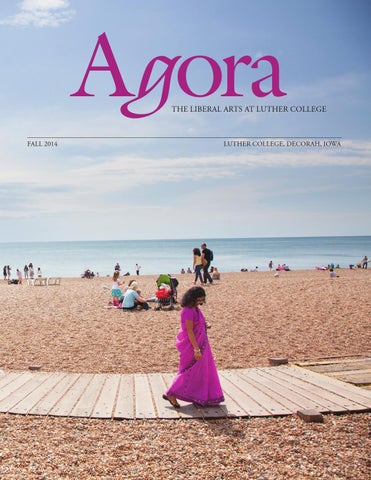
Cover: Brighton Beach, England, by Aaron Lurth, part of the Seaside series continuing on pages 24 and 25.
Introduction
O
ne of the first things I did when I learned I would be the new editor was find the initial issue of Agora in a cabinet in Judy Boese’s office. I wanted to discover the original mission of the journal and how I could promote that mission in my own way. With a pale green cover, prepared on Microsoft 4.0 (MS-DOS) and printed at the Luther College Print Shop, Agora: A Journal of Interdisciplinary Discourse (Fall 1988) is a gem of a window into the college’s not-so-distant past. It includes sabbatical reports by Ruth Caldwell (on French author Annie Ernaux), Phil Reitan (Darwin in the Galapagos Islands), and John Moeller (papers of Supreme Court justices at the Library of Congress). It features non-sabbatical scholarly essays by Carol Gilbertson (T.S. Eliot), John Bale (“British Theater and the Human Condition”), and Jim Rhodes (the 1988 election won by the first George Bush). There are also reports on life at the college—Mary Hull Mohr on “The Revitalization of Paideia I,” Carolyn Mottley and Jim Eckblad on a PEW science grant, and Virginia Strauss on a J-term course she taught with husband John on “Museums, Monuments, and Music in the Great Cities of Europe.” Martin Mohr and Jackie Wilkie debate on the value of—and ways of reading— the literary canon. (Professor Wilkie acknowledges “no one would ever describe me as ideologically neutral— particularly about feminism.”) Brad Hanson addresses the identity of Luther as a liberal arts college of the Lutheran Church (the ELCA was just coming into existence). College president H. George Anderson writes in “The Growth Issue at Luther College” 2
Agora/Fall 2014
that “Luther is in danger of losing its special character if we cap enrollment” (a very different growth issue indeed!). Perhaps most striking to me, however, is Ruth Kath’s sabbatical essay, “Artists in Dialogue: Gerhard Marcks and Marguerite Wildenhain”—the same Marcks and Wildenhain described by 2014 Luther graduates Hans Becklin and Aaron Zauner in this issue. I saw that and wondered if I was doing anything new? The answer of course is both yes and no. The splash of color in Aaron Lurth’s cover photo suggests, I hope, that some things about Agora will be new—or maybe just a little different in style and content from Agora’s three previous editors: Will Bunge (1988-1998), Mark Z. Muggli (1998-2004), and Peter Scholl (2004-2014). But I also hope to affirm, preserve and extend the original mission of the journal, so eloquently expressed by Will Bunge 26 years ago: Agora intends both to manifest and to nurture that ongoing conversation which is the genius of a small, residential liberal arts college. Whereas disciplinary distinctions occupy a large share of our time in this place, we attend as well to our common humanity—to community—to shared traditions, values, and responsibilities for present and future. For that the college becomes the marketplace—the agora—where Socrates 2400 years ago taught the obligation to live the examined life.
I
3 3 3 3
s there a gender gap at Luther College?
I don’t mean the ratio of women to men, which is pretty much in line with
the national ratio of 58% women to 42% men at private colleges (Forbes, 2012). I mean a gender gap in the quality of a Luther student’s experience measured by what she or he brings to it. Earlier this fall Charlie Blaich and Kathy Wise, director and associate director of the Wabash College Center of Inquiry, came to Luther College at the invitation of Jon Christy, director of Assessment and Institutional Research. He’d asked Charlie and Kathy to campus because of their hands-on experience in assisting colleges and universities across the country on how to use learning assessment results (including survey data) to improve teaching and students’ learning. About 20 faculty members attended a late afternoon workshop to explore and interpret our own institutional student assessment data. What intrigued many of us were the differences by gender that Blaich and Wise highlighted among Luther seniors in the Cooperative Institutional Research Program (CIRP) 2013 College Senior Survey. In short, Luther women’s responses showed a significantly higher level of engagement in their education than that of Luther men—and than that of women at similar institutions. Here are some of the categories in which Luther women’s responses were “significantly higher” than Luther men’s, according to Blaich and Wise: • How often you revised your papers to improve your writing • How often you took a risk because you felt you had more to gain • How often you looked up scientific research articles and sources
• How often you communicated regularly with your professors • How much time you spent in a typical week doing homework • The extent to which you agree with the statement, “Faculty empower me to learn here” • The extent to which you agree with the statement, “If asked, I would recommend this college to others.” The data did not, however, show any category in which Luther men responded less positively than men
nationally. It’s simply a matter of Luther women taking that much more initiative than Luther men and than women at other institutions. In fact, there are eight categories in which Luther men and women were not statistically different but in which Luther women responded higher than women at similar institutions, such as “Ask questions in class,” “Support your opinions with a logical argument,” and “Seek solutions to problems and explain them to others.” Perhaps most importantly, both Luther women and men had significantly higher responses than seniors at other institutions on what matters most: “Amount of contact with faculty,” “Overall quality of instruction,” and “Overall college experience.”
Professor Amy Weldon’s Scholars Colloquium for first year students.
The good news is that we have many self-motivated and highly responsible women at Luther College! Perhaps that’s not news at all for those of us who teach here. One challenge for us on the faculty is to engage Luther men to the same extent we do women in their education. What can we do to make sure that the only gender gap at Luther College is one of enrollment, and not performance?
Martin Klammer, Editor
LUTHER COLLEGE PHOTO BUREAU
• How often you sought feedback on your academic work
Fall 2014/Agora
3
Twenty Years of Collaborative Research
I
n the last 20 years Luther students and faculty have collaborated on more than 300 summer research projects, according to data provided by the Dean’s office. The vast majority of these projects are in the sciences, with biology leading the way with 65 collaborations (about one-fifth of the total). Student-faculty research work is widespread throughout the campus, however, with 115 professors since 1995 working with students in 25 majors. Last summer the projects ranged from “Investigation into the complex frictional behavior of aluminum oxide surfaces using an Atomic Force Microscope” (physics Professor Erin Flater with Steve Sorenson) to “Living Off the Grid: The Culture of Voluntary Simplicity in Decorah, Iowa” (anthropology Professors Lori Stanley and Anita Carrasco with Emily Dufford). The average number of projects per summer has more than doubled in this 20 year period (see below). In this issue we feature two studentfaculty collaborative projects: Hans Becklin (’14) and Aaron Zauner (’14) working with Professor Kate Elliott in art history to curate an exhibit of Gerhard Marcks woodcuts in Preus Library, and Katrina Okerstrom (’14) working with Professor David Njus in psychology on “Liberal-Conservative Differences on Moral Foundations and Social/Political Values,” which they presented at the 2014 annual meeting of the Midwestern Psychological Association in Chicago.
MK
SUMMER STUDENTFACULTY COLLABORATIVE RESEARCH PROJECTS (does not include NCUR)
PROFESSORS DIRECTING 5 OR MORE STUDENTFACULTY RESEARCH PROJECTS SINCE 1995
SCIENCES & HPE (57%)
20
Kirk Larsen, Biology
14
Jeff Wilkerson, Physics
12
Richard Bernatz, Mathematics
12
Brad Chamberlain, Chemistry
11
Jodi Enos-Berlage, Biology
10
Kristy Gould, Psychology
8
David Faldet, English
65
Biology
32
Chemistry
30
Physics
19
Mathematics
6
Health-PE
3
Computer Science
1
Nursing
8
Jim Greisheimer, Music
HISTORY & SOCIAL SCIENCES (17%)
7
Brooke Joyce, Music
7
Beth Lynch, Biology
6
Olga Rinco, Chemistry
6
John Moeller, Political Science
5
Lori Stanley, Anthropology
5
Eric Baack, Biology
5
Mark Eichinger, Biology
5
Brian Solberg, HPE James Perez, Physics
10
Anthropology
10
Political Science
8
History
6
Communication Studies
6
Education
6
Sociology
5
Economics & Business
5
3
Social Work
NUMBER OF PROJECTS
HUMANITIES-FINE ARTS (23%) 23
Music
14
Theater/Dance
13
Religion
11
English
5
Art
3
Modern Languages
1
Classics
1
Philosophy
Other: Environmental Studies 9 (3%) 4
Agora/Fall 2014
1995-1999= 46 (9.2 per year) 2000-2004= 69 (13.8 per year) 2001-2005= 76 (15.2 per year) 2006-2010= 91 (18.2 per year) 2011-2014= 81 (20.3 per year)
Teaching with the Fine Arts Collection: Gerhard Marcks Woodcuts INTRODUCTION by KATE ELLIOTT, Assistant Professor in Art History
do independent, original research at the advanced level.
ike many colleges our size, Luther College has a substantial collection of fine art objects that have been collected over our institution’s history. This collection is as varied as it is large. Given our roots within the NorwegianLutheran tradition, we have, perhaps unsurprisingly, a sizable collection of paintings by Norwegian and Norwegian-American artists. More surprising to many is our extensive collection of sculptural work and prints by Bauhaus professor Gerhard Marcks.
In the spring of 2013, Hans Becklin (’14) and Aaron Zauner (’14) approached me with an idea for a curatorial project. They wanted to research our sizable collection of Gerhard Marcks prints and curate a small exhibition to be displayed in the Preus Library gallery space. In fall 2013, Hans and Aaron did directed readings with me in order to establish the artistic and political context in which Marcks was working. They read up on the theory and pedagogical mission of the influential Bauhaus School, where Marcks was a professor from 1919 to 1925, and also looked into the intense political situation of Germany in the inter-war period. Over January term and during the first half of the 2014 spring semester, Aaron and Hans worked closely with the collection in storage, sifting through prints and identifying themes that seemed to preoccupy Marcks over the course of his life. Finally the pair collaboratively wrote the accompanying text for the exhibition, which was on view in the library Art Gallery from March through this September.
L
Collections such as ours have long been associated with the learning missions of our colleges and, in that spirit, when I was hired in 2010 I was given a very direct charge to transform our fine art collection into a teaching collection. The challenge has been how to more fully integrate art objects into the educational experience of our students. We have significant operational limitations that make this task more difficult. For instance, the Luther College Fine Arts Collection has a limited professional staff, for whom collections management is only part of their daily duties. We also have no museum on campus to house the permanent collection so the objects themselves are scattered across campus in study lounges, administrative offices, and classroom corridors, as well as in more traditional display cases and gallery walls. To overcome such limitations, we’ve developed outreach opportunities, including tripling the number of student work positions within the collection and bringing objects into art history and art education classrooms as the focus of smaller writing assignments or semester-long collaborative research projects. Recently, we’ve begun to expand the opportunities for students to
Through our conversations of the past year, I am now convinced of the great power of objects. Hans’s text panels in particular showcase the kind of close analysis and sophisticated interpretation that become possible when one holds an object in one’s hands—examining it closely and looking at how the artist constructed the object, the image, and the message. We talk a lot about student research here at Luther College but for those of us in the humanities it is often difficult to showcase, as the final project is so often a paper shared solely between student and faculty. An unintended benefit of the project, therefore, is that it showcases in a very visible way the importance of research across the humanities and fine arts.
THE WOODCUTS OF GERHARD MARCKS by HANS BECKLIN ’14 and AARON ZAUNER ’14
T
hese woodcuts by Gerhard Marcks are among the finest works in Luther College’s Fine Arts Collection. Due to their fragility and value they are seldom on public display. They are but a small part of a substantial collection of Marcks’s works given to Luther by one of his students, the late German-American sculptor Marguerite Wildenhain. Her generosity combined with that of other donors has given Luther the largest collection of Marcks’s works in North America. Luther’s collection of his sculptures is on permanent display in Preus Library and his large-scale sculpture Oedipus and Antigone is on display outside of the Center for Faith and Life. All of the woodcuts are part of the Wildenhain collection, acquired as a result of Marcks’s close friendship with Marguerite Wildenhain, maintained across oceans through regular letter writing. Gerhard Marcks (1889-1981) was a prominent German visual artist best known for his work with the Bauhaus School, where he taught from 1919 until 1925. Although best known as the Bauhaus’s “form master,” specializing in three-dimensional production, he also produced some woodcuts during that time which share stylistic similarities with the works of other Bauhaus artists—Paul Klee, especially. During the course of his career he developed from a form-concerned idealist in the 1920s to a more nuanced artist who understood how woodcuts could speak to life’s experiences. Two life-changing events—the death of his son in World War II and the destruction and reconstruction of Germany—colored his work from the 1940s until his death. Fall 2014/Agora
5
Noah (1948) Luther College Fine Arts Collection #474 In the postwar period, the return of peace was heralded. Marcks uses the biblical story of Noah to show a slightly different view of peace. A traumatic event has engulfed the land and many have died; therefore, the story of Noah could be an ideal way to present hope without downplaying the losses of the war. Yet Marcks changes the story from Genesis, where the rains cease and the water begins to recede before Noah sends out his avian helpers. In this telling, the land is still flooded and a torrential downpour continues. Marcks seems to say that peace has arrived artificially in Europe, as loss and death are still raging. The olive branch is not a sign of hope, but a sign of false hope at the end of hostilities.
6
Agora/Fall 2014
Neujahrsgruss 1972 (New Year’s Greeting) Luther College Fine Arts Collection #471 Art that spoke to war and loss was unmarketable in a nation that in many ways rebuilt without expressing grief. Yet Marcks’s true feelings were displayed when communicating with friends in his annual New Year’s Greeting. His most pointed message comes in 1972, using the image of a nude child in an army helmet. To the side, the Latin text reads “Whither? Whence? Where?” As the Vietnam War raged, Marcks empathized with all those who experienced the loss of their child. He channeled his still-profound pain from the loss of his son to speak against all war. Yet the text shows us his true agony: that the inevitability of war meant wracking such pain upon others is itself inevitable. Fall 2014/Agora
7
Liberal-Conservative Differences on Moral Foundations and Social/Political Values by DAVID M. NJUS, Professor of Psychology, and KATRINA OKERSTROM (’14)
Presented at the 2014 Annual Meeting of the Midwestern Psychological Association, Chicago, IL
P
olitical conservatives and liberals differ not only in their support of different policies and programs; they also differ in their values, values which can underlie endorsement of those policies and programs (Morgan, Mullen, & Skitka, 2010). More broadly, Graham, Haidt, and Nosek (2009) provide evidence that political conservatives and liberals emphasize different intuition-based moral foundations which subsequently lead to different views and positions on issues. The purpose of the present study was to examine the degree to which liberals and conservatives differ on several core political/social values— liberty/equality, justice/ compassion, and environment/ personal responsibility— and how those differences relate to the moral foundations proposed by Graham et al.
Method Participants and Procedure
Data were collected online with Amazon Mechanical Turk (MTurk). Participants, aged 21 and over and located in the U.S., were offered $0.50 for completion of the survey. Seventyfive participants who did not pass a lie scale were removed from analysis, as were 11 non-American citizens. The final sample consisted of 390 women and 238 men (Xage = 33.75). Subjects completed the Mehrabian (1996) conservatism-liberalism scale, responding on a -4 (very strong disagreement) to 4 (very strong agreement) scale to 7 items, such as “I am politically more liberal than conservative.” “Liberals” were defined as individuals with an average scale score ≤ -1 (n=267), “conservatives” as those with an average ≥ 1 (n=157), and 8
Agora/Fall 2014
“moderates” as those between -1 and 1 (n=204). Subjects also completed a three-item measure of social-political values. Each item, answered on a 1-6 scale, asked subjects to indicate their preference between two political values when those values were in conflict (see Table 2 for the item wording). Finally, subjects completed the 30-item Moral Foundations Questionnaire (Graham, Nosek, Haidt, Iyer, Koleva, & Ditto, 2011), which assesses moral concerns for each of five moral foundations using a 0 (not at all relevant/strongly disagree) to 6 (extremely relevant/ strongly agree) scale.
Results
Analyses of variance (ANOVAs) conducted on the 5 moral foundations using political orientation as a grouping variable were all statistically significant (care: F(2, 625)=13.9, p < .001, ƞ2=.043; fairness: F(2, 625)=25.8, p < .001, ƞ2=.076; in-group: F(2, 625)=47.0, p < .001, ƞ2=.131; authority: F(2, 625)=83.7, p < .001, ƞ2=.211; and purity: F(2, 625)=76.4, p < .001, ƞ2=.196). Tukey HSD post hoc tests revealed that liberals had higher care scores than conservatives and moderates (see Fig. 1). All three groups significantly differed from each other on the fairness, in-group, authority, and purity foundations—liberals were highest on fairness and conservatives were highest on in-group, authority, and purity. An ANOVA on the liberty/equality item was significant (F(2, 625)=26.2, p <.001, ƞ2=.077. A Tukey HSD post hoc test revealed that conservatives and moderates had a greater preference for liberty, while liberals emphasized equality (see Figure 2).
An ANOVA on the compassion/ justice item was also significant (F(2, 625)=20.7, p <.001, ƞ2=.062). A post hoc test revealed that, as with liberty/ equality, there was not a significant difference between conservatives and moderates, both of whom indicated a greater preference for justice than did liberals, who emphasized compassion. Finally, an ANOVA examining views on the cause of individuals’ behaviors— environment vs. person—was significant F(2, 625)=31.3, p <.001, ƞ2=.058). A Tukey HSD revealed that liberals were most inclined to indicate the environment as the cause of behavior, while conservatives emphasized personal responsibility. Moderates were in between, significantly different from both liberals and conservatives. Pearson correlation coefficients between the moral foundations and the socialpolitical values were all significant (see Table 1). Liberty and personal responsibility were positively correlated with the “conservative” foundations— in-group, authority, purity—while compassion was positively correlated with the “liberal” foundations—care and fairness.
Discussion
Consistent with Graham et al (2009), we found that liberals and conservatives differ with respect to moral foundations, with the strongest effects occurring on the three dimensions where conservatives are higher than liberals (in-group, authority, and purity). Conservatives and liberals also differ on three values that may underlie more specific social/ political beliefs. Relative to liberals, conservatives emphasize liberty, justice, and a view of people as responsible for their behaviors, while liberals emphasize equality, compassion,
4.5 4
Mean MFQ Rating
3.5 Conservatives Moderates
3
Liberals 2.5 2 1.5 1 Care
Fairness
Ingroup
Authority
Purity
Moral Foundation Figure 1. Average ratings for liberals, conservatives, and moderates for the 5 moral foundations
5.5 5
Degree of Preference
4.5 4 3.5 3
Conservatives
2.5
Moderates Liberals
2 1.5 1 Prefer Liberty over Equality
Prefer Compassion over Justice
Personal Responsibility over Environment
Social/Political Value
Figure 2. Preferences of liberals, moderates, and conservatives for liberty vs. equality, compassion vs. justice, and personal responsibility vs. environment as cause of behavior. Fall 2014/Agora
9
and a view of the person as shaped by the situation. We also found that the social/ political beliefs are related to moral foundations in predictable ways— liberty and personal responsibility are positively correlated with the in-group, authority, and purity foundations, while compassion is associated with care and fairness. These results suggest that values widely held as desirable—justice, compassion, equality, liberty—are values prized at least somewhat differently by people of different political orientations, and that those differences are underlain by differences in moral foundations. References Graham,. J. Haidt, J., & Nosek, B. (2009). Liberals and conservatives rely on different sets of moral foundations. Journal of Personality and Social Psychology, 96, 1029-1046. Graham, J., Nosek, B.A., Haidt, J., Iyer, R., Keleva, S., & Ditto, P.H. (2011). Mapping the moral domain. Journal of Personality and Social Psychology, 101, 366.385. Mehrabian, A. (1996). Relations among political attitudes, personality, and psychopathology assessed with new measures of libertarianism and conservatism. Basic and Applied Social Psychology, 18, 469-491. Morgan, G. S., Mullen, E. & Skitka, L.J. (2010). When values and attributions collide: liberals’ and conservatives’ values motivate attributions for alleged misdeeds. Personality and Social Psychology Bulletin, 36, 1241-1254.
Table 1. Zero-Order Correlations Between Moral Foundations and Social/Political Values Care
Fairness
In-Group
Authority
Purity
Liberty
-.22***
-.36***
.12**
.18***
.17***
Compassion
.27***
.12*
-.15**
-.32***
-.16***
Personal Responsibility
-.15**
-.16**
.18***
.26***
.24***
Note: All correlation coefficients corrected for unreliability of measures *p < .05 **p < .01 ***p < .001
Table 2. Items on the Political Values Questionnaire
Liberty and Equality Equality and liberty are valued in our society. Sometimes, however, these two values conflict with each other. At one extreme, for example, if everyone was forced to be totally equal to everyone else in every way—the size and type of house, the size of car, the amount and style of clothing, the amount and type of food consumed— there would be no choice, no liberty. At the other extreme, with total liberty comes inequality: some will choose jobs that pay more than jobs others have, and people with greater ability, skill, and motivation will be able to acquire more money and material possessions than those with less ability and skill—some of whom may be reduced to living in poverty. Since equality and liberty, both prized and valued, sometimes conflict, sometimes a choice must be made for one of these values at the expense of the other. In general, when such a choice between equality and liberty must be made, which do you think should be chosen? Please use the following scale to indicate your preference.
Justice and Compassion Two other qualities valued in our society are justice and compassion. We often seek justice in our communities when someone violates a law or some other rule or norm, while at other times we respond with compassion to such violations. Justice and compassion do not always conflict with each other, but there are times when those who seek justice in a particular situation are in opposition to those who seek a more compassionate response. In general, when such a conflict between compassion and justice occurs, which do you think governments should choose? Please use the following scale to indicate your preference. Personal Responsibility and Environment/Situation When people break the law or do other things that get them in trouble, there are a variety of things that can be said to cause those behaviors. Some of those causes relate to personal responsibility—that is, the person is the one responsible for choosing to do those wrong things. Other times, though, we are aware of circumstances in a person’s life that can lead him or her to do things he or she would not otherwise do—that is, the person’s environment or situation can lead the person to do those things. Many behaviors we see in others are probably a combination of personal responsibility and the environment or situation, but sometimes we have to make choices about which type of cause—personal responsibility or environment/situation—is the greater cause. In general, when you look at someone else’s behavior and you have to make a choice between personal responsibility and environment/situation as the cause of that behavior, which type of cause are you more likely to make? Please use the following scale to indicate your preference.
10
Agora/Fall 2014
Transparency in the Eye of the Reader: How Inner-biblical Allusions Make Clear and Obscure Meaning(s) in the Book of Judges by KRISTIN A. SWANSON, Professor of Religion
M
y focus in this essay1 is only partially on the book of Judges—you’ll note that “Judges” comes after the colon in the title! Under the Paideia Texts and Issues Lecture series theme of “Secrecy and Transparency” I would like to illustrate how the book of Judges may be read in different ways depending on one’s presuppositions and starting points. Is there such a thing as a “transparent” reading? Do allusions to other biblical texts in Judges suggest alternative “meanings”? Before addressing these questions, it seems worthwhile to begin with a brief overview of the text. In the Hebrew text of the Hebrew Bible, the book of Judges is placed after the book of Joshua, which relates a narrative of Israelite conquest over the land of Canaan and the allotment of land to the Israelite tribes, and before 1 Samuel, a book that begins with the birth, call, and leadership activity of Samuel, who warns against but also facilitates the introduction of a monarchy. He anoints Saul king of Israel, but then also delivers the LORD’s word of rejection of Saul in favor of King David. Judges, the narrative bridge between Joshua and 1 Samuel, is made up of roughly three sections: Judges 1-3:6; 3:7-chapter 16; and chapters 17-21. Judges 1 begins with the Israelites inquiring of the LORD for a leader, with Judah identified. With Judah appointed, the chapter then narrates another conquest of sorts (there has already been a conquest in the book of Joshua), in which there are some successes, some losses, and some partial successes. The remainder of the opening section describes, almost in outline form, a narrative pattern found in the second section of the book: the Israelites would do “the evil” (worshiping gods other than the LORD), thus kindling
the anger of the LORD, who would punish them by selling them into the hands of neighboring enemies. The Israelites would groan in their distress, and the LORD, hearing this and being moved to pity, would raise up a judge to deliver them from the situation. Once delivered, however, the Israelites would resume “the evil,” starting the cycle all over again. In seminary I learned “ABCD” as a mnemonic for this cycle: A=Apostasy; B=Battering; C=Crying out; D=Deliverance. Judges 3:5-6, the closing verses of this section, nuance “the evil”: “So the Israelites lived among the Canaanites, the Hittites, the Amorites, the Perizzites, the Hivities, and the Jebusites; and they took their daughters as wives for themselves, and their own daughters they gave to their sons; and they worshiped their gods.” The “apostasy,” it turns out, was the result of intermarriage with people in the land.
Is there such a thing as a “transparent” reading? Do allusions to other biblical texts in Judges suggest alternative “meanings”? The second section ( Judges 3:6 – 16:31) follows this narrative pattern. In cyclical fashion, the Israelites are sold into the hands of a different neighboring enemy and a deliverer is appointed to rescue them. The “judges” given the most attention (and thus called the “major” judges) are: Othniel, who delivers the Israelites from King Cushanrishathaim of Aram-naharaim (3:711); Ehud, who delivers the Israelites from King Eglon of Moab (3:12-30); Deborah (and Barak), who deliver the
Israelites from King Jabin of Canaan ( Judges 4 - 5); Gideon, who delivers the Israelites from the Midianites ( Judges 6-8); (then there is an excursus: Abimelek tries to form a monarchy); Jephthah, who delivers the Israelites from the Ammonites ( Judges 11-12:7); and Samson, who delivers the Israelites from the Philistines ( Judges 13-16). In addition there are a collection of socalled “minor” judges, about whom very little is said: Shamgar, Tola, Jair, Izban, Elon, and Abdon. In the third section (chapters 17-21) the pattern shifts away from the “ABCD” formula. No longer are the Israelites in conflict with their neighbors, nor are “deliverers” raised up. Instead we find a series of narratives set in the hill country of Ephraim with priestly figures as key characters. Four times in this section we are reminded, “In those days there was no king in Israel” (17:6, 18:1, 19:1, 21:25). The first and last of these refrains also include the phrase “all the people did what was right in their own eyes.” And “what was right in their own eyes” is harrowing! Judges 19-21 narrates the story of a Levite who throws his concubine to a mob to be gang-raped, then dismembers her and sends her pieces to other Israelite tribes, precipitating an inter-tribal war. Since this text begins with the death of Joshua and ends with a commentary on the lack of a king, it is not surprising that the book of Judges has been read as a narrative that tells the history of a “transitional” period between Israel’s entry into the Promised Land under Joshua and the introduction of a monarchy in 1 Samuel. Within the formulae of the “judge” episodes, specific lengths of time are given for oppression by Israelite neighbors, the length of that judge’s leadership, and/or the amount of time that Israel “had rest” before another “ABCD” cycle. So, the text itself Fall 2014/Agora
11
seems to suggest a historical framework, and its placement between Joshua and 1 Samuel suggests a larger historical framework. In addition, many biblical scholars have engaged the text from the standpoint of historical reconstruction. For example, since the mid-twentieth century a prevailing theory in biblical scholarship is that of the so-called “Deuteronomistic History,” the theory that parts of Deuteronomy, Joshua, Judges, Samuel, and Kings were compiled by an author/editor who relied on source material to present a particular view of Israel and Judah’s history. The two main theories suggested either a retrospective (exilic) explanation of the destruction of Jerusalem in 586 BCE, or a programmatic document that reflected the interests of King Josiah’s policies in the 7th century BCE (with a second edition bringing the “history” up to date with the destruction of Jerusalem). Certainly much work has been done in subsequent years in investigating possible editorial activity, but for the most part the theory that these particular texts belong to a single literary unit consisting of older source material with a “deuteronomistic” theological overlay has generally held sway within Hebrew Bible scholarship. The idea that Judges relates history, or can be used to reconstruct history, can be found in all variety of texts. Some of us learned it from a children’s Bible, such as “The DK Illustrated Family Bible.” In the volume’s introduction to the book of Judges, we read: After they entered Canaan, the Israelites were still not a unified nation. For about four centuries (c. 1380-1050 BC), they had no central administration or king ( Judges 17:6). The twelve tribes were scattered in Canaan, with enemy territory in between. Living among the Canaanites, the Israelites soon became attracted to the Canaanite religion. In response to this, a strong Israelite leader periodically emerged to provide moral and military leadership. These leaders were called “Judges.”2
Notice how the dates give an impression of historicity. 12
Agora/Fall 2014
I encountered the idea of Judges as a reliable source for history in the introductory textbook assigned for my first seminary course in the Old Testament, Bernhard Anderson’s Understanding the Old Testament (4th edition). In the section “Leaders in Crisis” he states: The stories in the book of Judges that picture the local conflicts and tribal jealousies of the period are unquestionably derived from very old sources. The Deuteronomistic editors have touched up some of the narratives by adding introductory and concluding formulas…. (W)hen the Deuteronomistic “framework” is removed, we have at our disposal ancient and reliable traditions concerning the period which began with the death of Joshua (c. 1200 BCE).3
A key example of an “ancient and reliable tradition” for Anderson is Judges 5, often referred to as the Song of Deborah. He states, “By general agreement, the Song of Deborah is a firsthand, authentic historical witness. It is one of the oldest passages of poetry in the Old Testament, written by one who stood very near the event, perhaps by a participant.”4 Citing W.F. Albright, he continues, “Archaeological work at Megiddo has produced evidence for dating the battle and the song that celebrates the event in the latter part of the twelfth century BCE, approximately 1125 BCE.”5 Anderson’s 4th edition was published in 1986; since then the field of biblical scholarship has significantly broadened methodologically, and the book of Judges has been fertile ground for the wide variety of approaches in biblical studies that have emerged over the past 40 years or so. Even so, the idea that Judges is reliable as a source for Israel’s history in the 12th and 11th centuries persists, even by scholars who employ methods other than historical criticism. For example, Frank S. Frick’s A Journey Through the Hebrew Scriptures (2nd edition), a textbook that investigates the book of Judges under a heading “Stories about ‘Judges’ in the Book of Judges” where most of the episodes are
investigated under the rubric of “story,”6 we find this about Judges 5: In English translation, Judges 5:1-31, the Song of Deborah, is a poetic version of the prose account in Judges 4. There are, however, significant differences between the two chapters. The Song of Deborah is one of the oldest poems, if not the oldest, in the Hebrew Bible. As such it offers us access to the religion and political structure of Israel in the late twelfth to early eleventh centuries BCE.7
Why does the idea that Judges can be read as reliable for the reconstruction of a “transitional” period persist? Is such a reading “transparent”? What happens when we explore Judges from a different angle? For the remainder of the essay I would like to investigate these questions, and explore another way of approaching Judges with particular attention to inner-biblical allusions within the book that, when read with the texts to which they allude, invite alternative meanings. An investigation needs to begin somewhere, and I’ll begin ours with a key figure in Hebrew Bible scholarship named Julius Wellhausen. Wellhausen was a biblical scholar and historian, born in Hamelin, Hanover in 1844, the son of a Lutheran pastor.8 The work for which Wellhausen is best known is his Prolegomena to the History of Israel, in which he built on the scholarly
argument that the Hexateuch (GenesisJoshua) was composed of four separate literary strands.9 These potential literary strands are: J: Yahwist source. Materials assigned to this source use the LORD’s proper name “Yahweh” along with specific vocabulary and characteristics, such as an anthropomorphic view of the deity. E: Elohist source. Materials assigned to this source use the general term “Elohim,” for the deity, translated as “God.” In addition to specific vocabulary, materials assigned to this source emphasize a “fear of God” motif and the deity communicates through dreams and messengers. D: Deuteronomist source. This basically consists of the book of Deuteronomy, which Wellhausen understood as the programmatic document of King Josiah’s policy changes as outlined in 2 Kings 23. P: Priestly source. According to the hypothesis, it was priests following the exile in 586 BCE who edited the previous three sources, and added material of their own. It is important to note that Wellhausen was not the first to identify four separate literary strands; these had been identified and fine-tuned by other scholars. What makes Wellhausen’s work noteworthy is that the sourcecritical work that produced the Documentary Hypothesis outlined above was not his goal; Wellhausen’s project was history writing, and the source-critical work was the method he used to reconstruct the history of ancient Israel and Judah, particularly the history of the religion of ancient Israel and Judah. Some key things to point out about Wellhausen’s method are: 1) He used the Hebrew Bible as his primary source for historical reconstruction. 2) As part of his method, Wellhausen looked for the “spirit”10 of the text, that is, aspects of the text that communicated realities of particular contexts. So, for example, he saw reflected in the narratives assigned to the Yahwist source elements that reflected the realities of the 10th century
BCE. In like manner, he dated the sources E, D, and P to the 8th, 7th, and 6th centuries BCE respectively. 3) Wellhausen was adamant that historical reconstruction was only possible with written materials. Attempts to reconstruct an oral tradition behind the text (and thus an earlier history) were untenable. Therefore, 4) Texts were only reliable for historical reconstruction for the period in which they were written, NOT for events recounted in the narratives. The implications of Wellhausen’s work for historical reconstruction of ancient Israel and Judah were significant. In his insistence that the texts were only reliable for the contexts in which they were written, the earliest starting point for historical reconstruction according to his dating scheme would be the 10th century BCE, thus bringing the narratives of the ancestors, Exodus, and even conquest of the land out of reach for historical reconstruction. Criticisms of Wellhausen’s “literary” method came from various corners. Some scholars disagreed with his insistence that earlier oral traditions were unreliable for historical reconstruction; other scholars and members of the general public viewed his literary approach and its implications for historiographic work as an attack on the Bible. In considering reactions to this “literary” approach, a key figure that emerged in the early 20th century within American biblical scholarship is William Foxwell Albright. Albright was born in Coquimbo, Chile, the son of Methodist missionaries. The family’s roots were in Fayette County, Iowa, where both sets of Albright’s grandparents owned farms. After graduating from Upper Iowa University in 1912, he became a high school principal in Menno, SD, before heading to Johns Hopkins University for a PhD in Oriental Studies.11 Part of the Albright lore is that while at Hopkins, Albright was influenced by Wellhausen’s “literary” approach, and was therefore skeptical of the historicity of biblical traditions in Genesis and Exodus.
However, after studying in Jerusalem for a year on a fellowship and being exposed to the fruits of archaeological research, he became convinced that the scientific field of archaeology would demonstrate the biblical narratives to be historically reliable. Burke O. Long, in his book Planting and Reaping Albright, has challenged this narrative and argued that Albright’s confidence in the historicity of biblical narratives was something that he maintained throughout his graduate career.12 What his graduate studies and the Thayer Fellowship in Jerusalem gave him were critical tools to apply to the biblical texts. I appreciate Maynard Maidman’s summary: “Albright brought personal qualities to his scholarship: a deep underlying faith in which the saga of Israel played a key role, an abiding sense of evolutionary progress—he recognized the power of the Darwinian model for the study of history—a Christian (and American) sense of hope and the notion that the past could be made knowable in its essentials through scientific exploration undertaken in the present. These characteristics met in an undeniably great mind.”13 Albright’s circle referred to his methodology as a “backgrounds” approach. Some key things to point out about Albright’s approach are:
1) The Hebrew Bible was a starting point for historical reconstruction, but not the sole starting point. As a starting point, Albright was optimistic that the Bible told history. 2) Albright was similarly optimistic that ancient history could be recovered through scientific methods of investigation, including archaeology and orthographic analysis. He was also confident that these methods would confirm the historicity of the biblical narrative. 3) In Albright’s work he maintained Israel’s uniqueness amongst its neighbors, particularly its monotheistic faith, which he rooted in a Mosaic period.14
Albright remained in Jerusalem as the director of the American Schools of Oriental Research until 1929, when he returned to the United States as Professor of Semitic Languages at Johns Fall 2014/Agora
13
Hopkins University. Through his role might your pastor have used? What elements of parody or satire in the text, as a faculty member, his involvement were the curricular materials like or to read the text as critique. Where I with the American Schools and that you encountered in religious hope I contribute to the conversation contributions to archaeological research, education? Is the “transparent” view is in examining the text as a whole, and his prolific publication record, really transparent, or the widely and as a self-contained literary unit apart Albright became one of the most, if not intentionally disseminated articulation from the historical implications of a the most, influential figures in American of one particular historiographic “deuteronomistic” framework, while biblical scholarship. This influence method as applied to the book of Judges investigating how these may have was not just happenstance; Albright’s over and against other possibilities? functioned to critique policies and students, who referred to themselves attitudes in a Persian Period context.18 It seems appropriate at this point to as his “sons” and their students his Here I will give a few examples as show my methodological cards: “grandsons,” were intentional in their illustrations in each of the three main efforts to disseminate his ideas.15 For 1) For historical reconstruction of sections of Judges. example, the “Biblical Colloquium,” ancient Israel and Judah, I would a group of Albright’s former students want to use all sources available— Judges 1:1 – 3:6 (and a few others who shared Albright’s archaeological data, extra-biblical texts, The book of Judges begins, “After the approach) organized by George Ernest and biblical narratives—to investigate death of Joshua, the Israelites inquired Wright, provided an opportunity for any corroboration between the sources. of the LORD, “Who shall go up first these scholars to present their work to In my experience, this method has for us against the Canaanites, to fight each other, as well as the opportunity to demonstrated that historically reliable against them?” The LORD replies, brainstorm and delegate projects that information as reported within the “Judah shall go up. I hereby give the would pass on Albright’s “backgrounds” biblical text is minimal. land into his hand.” This beginning to approach. Among the book invites the Joshua 23-24 and Judges 2-3:6 compared the early members reader to compare Joshua Judges of the Biblical the text with the Colloquium book of Joshua, • Joshua warns the Israelites not to • The Israelites follow other gods were David Noel which opens, follow other gods Freedman (editor “After the death of • If they intermarry, the LORD will not • The LORD decides to “no longer of the Anchor Moses the servant continue driving out the inhabitants of drive out before them any of the nations Bible Series), John of the LORD, the the land that Joshua left when he died” (2:21) Bright (author of LORD spoke to A History of Israel, • The people respond: “The LORD our • The Israelites intermarry with “the Joshua son of Nun, a text widely used God we will serve, and him we will Moses’ assistant, Canaanites, the Hittites, the Amorites, as an introductory obey” (24:24) saying, ‘My servant the Perizzites, the Hivites, and the textbook in Moses is dead. Now Jebusites…”(3:5-6) universities and proceed to cross seminaries), the Jordan, you and Frank Moore all this people, into Cross (Harvard the land that I am giving to them, to 2) I’m not so “minimalist” in my views University), and George Ernest Wright the Israelites.’” When the Judges text is to have given up on at least certain (Harvard Divinity School). Bernhard compared with the Joshua text we see kinds of historical questions; I would Anderson, the author of my seminary that whereas Joshua leads “all Israel” in argue that analysis of rhetorical textbook, was also part of this group.16 a complete takeover of the land, Judah and ideological features of biblical I credit the persistence of the idea of takes his own territory with his brother, texts might give us insight into the Judges 5 as an ancient poem at least and the remaining tribes are left to fend communities that produced or edited in part to Cross and Freedman, who for themselves and do not evict the the texts. However, since identifying examined the poem in one of their joint Canaanites from the land. these contexts can be tenuous we may dissertations, published as Studies in need to entertain multiple contexts and In the next section of the introductory Yahwistic Poetry.17 multiple meanings. portion of Judges we find the ABCD So, if you hold or have held the formula summarized. You’ll recall that In my analysis of Judges I give particular “transparent” idea that the book “the evil” that the Israelites did was attention to the many inner-biblical of Judges relates the history of a worship other gods as a result of their allusions contained within the text as “transitional period” in ancient Israel, intermarriage with “the Canaanites, the well as inversions that emerge when the it might be interesting for you to Hittites, the Amorites, the Perizzites, Judges episodes are compared with the investigate whether or to what extent the Hivites, and the Jebusites” ( Judges texts to which they allude, and use the you are heir to the Albright tradition! 3:5). This seems to be an inversion category of parody for these inversions. What books or articles have you read, of the narrative in Joshua 23-24, in I’m certainly not the first to recognize and who wrote them? What textbooks 14
Agora/Fall 2014
which Joshua convenes an assembly of “all Israel” ( Joshua 23:2), warns the Israelites not to follow other gods (23:7), and cautions them that if they intermarry, the LORD will not continue to drive out the inhabitants of the land (v. 12-13). The people’s response: “The LORD our God we will serve, and him we will obey” (24:24). The contrasts are clear: In Joshua there is strong leadership, a united “Israel,” and a populace that pledges obedience to the commands to avoid interaction with its neighbors. In Judges there is no clear leadership, the Israelites are fractured, and the populace does indeed “intermarry” and worship other gods.
Judges 3:7 – 16:31
As summarized earlier, the central section of Judges narrates the activity of the “major” judges and gives mention to so-called “minor” judges within the “ABCD” framework. I give a few examples here: Ehud: Judges 3:12-30 tells the story of Ehud, a left-handed Benjaminite who rescues the Israelites from the clutches of the Moabites by killing their king, Eglon, an episode that has been recognized by biblical scholars as having satirical elements.19 For example, “Benjamin” means “righthanded,” so right away we see Ehud’s left-handedness as an inversion in the narrative. We also have word plays; Ehud slaughters King Eglon (which means “fatted calf ”). We even have bathroom humor; Ehud kills the king while he is in the toilet. The king is so fat that the hilt disappears after the blade, and the contents of his bowels come out. The king’s attendants think that he is just taking a long time in the bathroom, and by the time they investigate, Ehud has escaped. Given the prominence of the bathroom humor in the narrative, I compare this episode to 1 Samuel 24, another story in which a character is vulnerable to attack while relieving himself. In the story, David has the opportunity to kill Saul while he is indisposed, but chooses not to; instead, he quietly cuts off the corner of Saul’s cloak that he later presents to Saul when brokering a truce.20 Read on its own, the narrative of Judges 3:12-30 presents Ehud as ruthless, but this is
heightened in the comparison with 1 Samuel 24. Deborah and Barak: The narrative moves next to the story of Deborah (whose name means “honey bee”), wife of Lappidoth (which phrase can also be translated as “woman of torches”). At this point the LORD has sold the Israelites into the hand of King Jabin of Hazor. Deborah summons Barak (whose name means “lightning”) to lead the Israelites to battle against the Canaanites, who are led by the general Sisera. When the Israelites face Sisera’s chariot army, the LORD throws the chariots into a panic; Sisera flees to the tent of a Kenite woman, Jael, who kills him by driving a tent peg into his head while he sleeps, thus allowing the Israelites to defeat the Canaanites. The prose story in Judges 4 is followed by a poem in Judges 5, the so-called “Song of Deborah,” in which the battle is recounted and Jael is blessed. In the poetic version, it is a torrent of water that sweeps away the kings of Canaan. Here, the LORD’s activity of throwing the enemy army into panic recalls the narrative of the Exodus, when the LORD “threw the Egyptian army into a panic” (Exodus 14:24), and where the Egyptian chariots are swept away by water (Exodus 14:28). In the Exodus narratives, the LORD is described as present in a pillar of fire and cloud—are “woman of torches” and “lightning” references to this description? The pattern of prose account followed by a poem also parallels the account of the escape from Egypt in Exodus, with a prose account in chapter 14 followed by the poetic Song of Moses in Exodus 15. In this case, the parody seems to bring into focus two women (one who is not an Israelite), who carry out the deliverance of the Israelites. Jephthah: Jephthah is another marginal character that delivers the Israelites from the clutches of the Ammonites. Son of a prostitute, rejected by his brothers, Jephthah becomes a raider with a band of outlaws. A skilled warrior, his brothers approach him to assist with the task of repelling the Ammonites. He seems to show insecurity when he makes a vow to the LORD to sacrifice the first thing that
comes out of his house if the LORD assists with victory. Following the victory and upon arriving home, his only daughter comes out of the house to greet him. “Alas, my daughter! You have brought me very low; you have become the cause of great trouble to me. For I have opened my mouth to the LORD, and I cannot take back my vow” is his reaction ( Judges 11:35). Her response is to acquiesce to his vow, asking only for time to mourn with her companions. While ambiguous, the text gives the impression that she is sacrificed. This story seems to allude to Abraham’s near sacrifice of Isaac in Genesis 22, but with some key differences. Both situations are sacrifices or near-sacrifices of “only” children (at least this is the rhetoric of Genesis 22). In Genesis 22 God tests Abraham, and commands him to sacrifice Isaac; in Judges 11, the LORD does not ask for the vow. In Genesis 22, a messenger intervenes at the crucial moment to halt Abraham’s sacrifice; in Judges 11, there is no messenger to save the unnamed daughter.
Judges 17-21
You’ll recall that the concluding chapters of Judges contain narratives set in the hill country of Ephraim that center on priestly figures. In Judges 19, a woman leaves her man, a Levite, to return to her father’s house. The Levite goes after her four months later to take her back to his home. The father offers food and drink to the Levite several times (in an effort to keep them at his home?) but the Levite finally decides to leave late one day. Unable to make the entire journey to his home, the party stops in Gibeah, where they are taken in by an old man. Once they are in the house, a group of men surround the house with the intention of raping the Levite. The old man offers his virgin daughter and the Levite’s concubine to the crowd, and the Levite eventually throws his concubine out to the crowd, who gang rape her all night. When he gets up in the morning, he finds her on the ground with her hand on the threshold of the door and says “get up.” Getting no response, he loads her on a donkey, takes her home, and chops her into twelve pieces to send to the Israelite tribes. When the tribes convene they ask of the LORD, “Which of us Fall 2014/Agora
15
Since this story from Judges 19 contains the clearest example of an inner-biblical allusion it has been the focus of much scholarly attention. Portions of the narrative are identical with Genesis 19. In Genesis, a group of men surround Lot’s house with the intention of raping messengers of God who are staying there. It is notable that in Genesis, Lot has to persuade the messengers to stay with him; they are ready to tough it out in the square. In Judges, the Levite stands in the square expecting someone to take him in. In Genesis, Lot offers his virgin daughters to the crowd, but the messengers of the LORD strike the crowd with blindness, thus averting the danger. Once again, in Judges, there are no messengers of the LORD to save the concubine. The act of dismemberment in Judges calls to mind the story in 1 Samuel 11, where King Saul chops up an ox and sends its pieces to the Israelites to muster them to battle. In Judges, a dismembered woman musters the Israelites to battle. Compared with the brave and resourceful messengers of God, the Levite is cowardly, callous, and brutal.21
characterizations: the Israelite heroes who rise up to deliver the Israelites are depicted as marginal, flawed, insecure, arrogant, and brutal. 2) Conflict with “foreigners” seems to be ridiculed. The “ABCD” formula seems to caricature the idea of Israel in conflict with its neightbors. In addition, at the beginning of the book, the Israelites are fighting the Canaanites; by the end of the book, the Israelites are fighting amongst themselves. Who is the “other” —Canaanite, or Benjaminite?
In examining these potential examples of parody, we find that:
3) The construct of “intermarriage” is problematized. This ties in with the last point: at the beginning of the book, the “other” whom the Israelites are supposed to avoid in marriage are the “ites” as we call them in class—Canaanites, Perizzites, Hivites, etc. At the end of the book, the “other” whom the Israelites are supposed to avoid in marriage is part of the Israelite community.
1) Leadership seems to be a point of critique. We see this in the exaggerated
4) Violence against women is a major theme. Throughout these chapters,
16
Agora/Fall 2014
women suffer repeatedly due to decisions and policies made by the men in the narrative: women are sacrificed, gang-raped, dismembered, slaughtered, captured as prisoners-of-war, and abducted. If we investigate the theme of women “bearing the brunt of the larger social conflict” as Harold Washington has phrased it,22 with a priestly figure at the center of the narrative, a text that emerges is Ezra 9-10. Ezra 7 and 8 set the stage. Ezra is a priest (descended from Phinehas, a priest who has a prominent role in the book of Numbers) and a scribe, skilled in the law of Moses. The Persian king Artaxerxes directs him to go to Judah and Jerusalem to communicate the laws of God to those who do not know them, with the expectation of obedience to these laws as the law of God and of the king. Once in Jerusalem, some officials of the community approach Ezra and report that “The people of Israel, the priests, and the Levites have not separated themselves from the peoples of the lands with their abominations, from the Canaanites, the Hittites, the Perizzites, the Jebusites, the Ammonites, the Moabites, the Egyptians, and the Amorites. For they have taken some of their daughters as wives for themselves and for their sons. Thus the holy seed has mixed itself with the peoples of the lands, and in this faithlessness the officials and leaders have led the way” (Ezra 9:1-2). Ezra calls a mandatory assembly, with the penalty of forfeiture of land and expulsion from the community for those that do not attend. Official representatives take on an investigation and men who had “taken foreign wives” were called in. The book ends with the list of men who pledged to send away their wives. DESIGN BY MICHAEL BARTELS
shall go up first to battle against the Benjaminites?” ( Judges 20:18). The answer: Judah. The battles that ensue nearly decimate the tribe of Benjamin. The other Israelite tribes feel remorseful about this, but can’t help with the situation because they had made a vow not to give any of their daughters to the Benjaminites (a kind of “no intra-marriage” vow). Instead they slaughter all the people of a city that did not turn out for the battle, except for the virgin women, who are given to the Benjaminites. Then the other tribes authorize Benjaminite men to raid a festival of the LORD at Shiloh and abduct young women to be their wives.
The end of the book of Ezra certainly raises some questions! Who were these women? The narrative seems to suggest a debate concerning the boundaries of community identity in Persian
Period Judah, and may reflect tensions between descendants of the exilic community who came to Judah under Persian authority and descendants of those that remained in Judah following the destruction of Jerusalem in 586 BCE. The perspective articulated in Ezra seems to recognize the exilic community as the “true Israel.” The “foreign” women of Ezra 9-10 can likely be identified as indigenous Judahite women, deemed “foreign” because they were not part of the exilic community. What would happen to these women in the narrative? It is almost as if Judges answers that question by telling another story, an inverted version of Israel’s “early history” that problematizes the Ezra narrative. Judges tells the story of a Judahite woman thrown out of a house in Gibeah by her husband, a priestly figure, resulting in the identification of a whole tribal region, Benjamin, as “foreign.” This might be a key inversion: the tribal region of Benjamin, the “other” in the Judges text, is the region of the priest Phinehas, Ezra’s ancestor ( Joshua 24:33). In response to a text that describes Ezra, the priest, mandating that the priests and Levites send away their “foreign” wives, the parodies of the book of Judges might be read as an ironic critique, which, when read with the texts to which they allude, invite the reader to engage multiple perspectives of an ancient debate. Notes 1. This essay is an adaptation of a Paideia Text and Issues Lecture of the same title presented on September 16, 2014. My thanks to Sarah Hulberg, Luther College ’14, for her work on Judges 5 as my research assistant last year. 2. The Illustrated Family Bible, ed. Dr. Clause-Bernard Costecalde (London: Dorling Kindersley, 1997): 98.
3. Bernhard W. Anderson, Understanding the Old Testament, 4th ed. (Englewood Cliffs, NJ: Prentice-Hall, 1986): 193-4. 4. Ibid., 196. 5. Ibid.
6. Frank S. Frick, A Journey Through the Hebrew Scriptures, 2nd ed. (Belmont, CA: Wadsworth/Thomson, 2003): 273.
8. Diane Banks, Writing the History of Israel (Continuum International Publishing, 2006): 52. 9. Julius Wellhausen, Prolegomena to the History of Israel. Atlanta: Scholars Press Reprints and Translations, 1994.
10. See Douglas A. Knight, “Wellhausen and the Interpretation of Israel’s Literature,” Semeia 25 (1982):21-33, here 25.
11. Leona Glidden Running and David Noel Freedman, William Foxwell Albright: A Twentieth-Century Genius (New York: Morgan Press, 1975): 1-41. 12. Burke O. Long, Planting and Reaping Albright: Politics, Ideology, and Interpreting the Bible (University Park, PA: The Pennsylvania State University Press, 1997): 111-148.
13. Maynard P. Maidman, “Abraham Isaac & Jacob Meet Newton, Darwin & Wellhausen,” Biblical Archaeology Review 32, no. 3 (May/June 2006). Accessed September 14, 2014. <http://www.basarchive.org.proxy. luther.edu/bswbSearch.asp?PubID=BSBA& Volume=32&Issue=3&ArticleID=10&User ID=2229&>.
14. See, for example, William Foxwell Albright, From the Stone Age to Christianity: Monotheism and the Historical Process, 2nd ed. (Garden City, New York: Doubleday Anchor Books, 1957): 249-272. 15. Long, 15-70. 16. Ibid.
17. Frank Moore Cross and David Noel Freedman, Studies in Yahwistic Poetry, 2nd ed. Grand Rapids, MI: Wm. B. Eerdmans Publishing Company, 1996. 18. I have articulated my thesis in Kristin A. Swanson, “Judges as a Parody of Leadership,” in Focusing Biblical Studies: The Crucial Nature of the Persian and Hellenistic Periods: Essays in Honor of Douglas A. Knight, ed. Jon L. Berquist and Alice Hunt (New York: T&T Clark International, 2012): 92-106.
19. See, for example. Marc Zvi Brettler, The Creation of History in Ancient Israel (London: Routledge, 1995): 79-90. 20. Swanson, 96-97.
21. Here see the work of Stuart Lasine, in “Guest and Host in Judges 19: Lot’s Hospitality in an Inverted World,” Journal for the Study of the Old Testament 29 (1984): 37-59.
22. Harold C. Washington, “Israel’s Holy Seed and the Foreign Women of EzraNehemiah: A Kristevan Reading,” Biblical Interpretation 11 (2003): 427-437, here 430.
7. Ibid., 271.
Fall 2014/Agora
17
Inauguration Speech
October 10, 2014
by PAULA J. CARLSON, President
T
hank you. I am honored and very happy to join the Luther community as the tenth president of Luther College.
My thanks to representatives from student organizations and to members of Luther’s athletic teams who are representing their teams here today. The year’s off to a good start. Go Norse! My thanks also to the Inauguration Committee for its diligent and dedicated work in planning this inauguration ceremony. I’d like to add my welcome to Board Chair Torgerson’s to delegates from colleges and universities, representatives of higher education organizations in our state and region, the mayor of Decorah, the honorary consul general of Norway in Minneapolis, and the bishops of the Evangelical Lutheran Church in America who join us today. I am grateful for the participation today of members of Luther’s Board of Regents, past Regents, and Regents Emeriti. I’m grateful, too, for the presence and participation of friends, colleagues, and family members. As I join the Luther community as its tenth president, I want to take note of an unusual and special occurrence. Joining us today are three previous presidents of Luther College and three interim presidents. Together with President Jeffrey Baker whom we 18
Agora/Fall 2014
LUTHER COLLEGE PHOTO BUREAU
Thanks to all of you for participating today in this inauguration ceremony. I am grateful for your presence and your witness here today. My special thanks to members of the Nordic Choir and the Luther College Orchestra, to their conductor Professor Daniel Baldwin, and to College Organist Gregory Peterson for the stirring and beautiful music you are offering us today.
President Paula Carlson speaking at her inauguration as Luther College’s tenth president. Seated behind her are Kevin Kraus, Vice-President for Academic Affairs and Dean of the College, Sandy Lee, Luther College Regents vice-chairperson, and Paul Torgerson, Regents chairperson.
remember with his family today, these presidents’ service to the college spans 51 years. It’s rare and very special to gather presidents who represent a third of Luther’s history, and I’d like to introduce each of them to you now.
The three interim presidents here today are the Rev. Dr. David Tiede, Mr. Richard Hemp, and Mr. David Roslien. Dr. Richard Torgerson became Luther’s ninth president in 1999. The Rev. Dr. H. George Anderson became Luther’s seventh president in 1982. The Rev. Dr. Elwin Farwell became Luther’s sixth president in 1963. Thank you for participating in my inauguration ceremony today. I am moved by your presence and privileged
to be the steward now of this august legacy of leadership.
We are honored today at Luther College to be joined by distinguished guests as we celebrate Luther’s compelling mission and its vibrant community at this beginning of a new presidency. Since 1861, the Luther College mission has called this community to offer its students an engaging, rigorous liberal arts education in a vibrant residential community. Throughout these 153 years, the curriculum’s essential element and the community’s defining characteristic has been the college’s commitment to the life of faith and learning in the Lutheran theological tradition. The past presidents here today, like the presidents who preceded them, have given the college wise leadership as the Luther community faced ever-changing
Martin Luther’s posting was an invitation for a wide, inclusive discussion and debate—a rigorous, engaged conversation and exchange of ideas about essential things— the things that matter most.
The distinctive ethos of the Luther College community is shaped by the “reforming spirit” of Martin Luther, the 16th century professor and Augustinian friar for whom the college is named. With his persistent, probing questions and his commitment to re-examining what were the intellectual and ecclesiastical “givens” of his day, Martin Luther sparked reform and renewal in the church, university, and society. Tradition tells us that on October 31, 1517, Martin Luther nailed 95 theses to a church door in Wittenberg, the German city where he was a professor of theology at the University and gave lectures on interpreting the Bible. Luther’s 95 theses are a series of statements and questions about grace, faith, and salvation. They are statements and questions that Luther wanted to examine fully and to debate rigorously. Writing his theses on a piece of parchment and then posting them on the Castle Church door in Wittenberg was Luther’s invitation to other scholars at the University to have
The founders of Luther College chose a motto that proclaims the college’s mission: “Soli Deo Gloria”—to God alone the glory. From the college’s earliest years to this day, in ever-changing times with their new possibilities and opportunities, this motto has called the Luther college community to remember our roots and to live our mission, building strength on strength as we innovate to embrace The Martin Luther statue at Luther College. our particular time with our particular challenges and opportunities. a public discussion and debate about what Luther saw to be essential, crucial In the Luther College mission matters regarding faith, salvation, and statement, we affirm “the liberating especially God’s grace—the undeserved power of faith and learning.” We state love and favor of God that many of us that we are “rooted in an understanding learned about in confirmation classes. of grace and freedom that emboldens us in worship, study, and service to seek truth, examine our faith, and care for all God’s people.”
Luther chose to post his theses on October 31st because he knew that
on November 1st—All Saints Day— many citizens of Wittenberg would be coming to the church for worship services. Luther knew that these townspeople would see his statements and questions as they passed through the church door. Posting notices on the Castle Church door was 16th century Wittenberg’s version of our Facebook postings, tweets and twitters, email blasts, bulk mailings, and television ads. In posting his 95 theses on the Castle Church door, Luther was using the most powerful social medium of his day. Luther’s posting was his invitation to all the citizens of Wittenberg to attend, witness, and so participate in the discussion and debate of his 95 theses that he was proposing to the scholars and professors at the University. Luther’s posting was an invitation for a wide, inclusive discussion and debate—a rigorous, engaged conversation and exchange of ideas about essential things—the things that matter most. Like Martin Luther, the reformer for whom we are named, we at Luther College study, explore, investigate, question, examine, debate, and discuss ideas, questions, insights, and possibilities about essential things, about the things that matter most. We do this in our studies in Martin Luther’s own field of theology, and we also do this across the whole curriculum. LUTHER COLLEGE PHOTO BUREAU
environments, each with its own particular challenges and opportunities, each with its own possibilities for innovation and growth. These presidents led the college—building strength on strength—as faculty and staff created new programs, as new groups were welcomed to the student body, and as the campus grew to provide facilities for new possibilities in teaching and learning and to offer new spaces for a rich, vibrant community life.
In thinking deeply and exploring widely across all fields in the college’s curriculum, we are also following the example of Martin Luther. As the University of Wittenberg became more and more important in the fast-moving Reformation that Luther sparked on that October day in 1517, Luther along with his colleague and friend Fall 2014/Agora
19
LUTHER COLLEGE PHOTO BUREAU
calling people together at an abundant feast and then urging them, “Listen carefully to me, and eat what is good, and delight yourselves in rich food. Incline your ear, and come to me; listen, so that you may live.”
The Upper Iowa River as it winds through lower campus. Philipp Melancthon encouraged this engaged, thorough, deep thinking at the University in the fields of theology and religion, and also in history, literature, astronomy, geography, philology, and the new emerging fields of the natural sciences. Our affirmation at Luther College of the “liberating power of faith and learning” is rooted in Luther’s and Melancthon’s pursuit and encouragement of engaged learning in all fields of study. At Luther College, our pursuit of knowledge and wisdom is shaped by our deep dedication to this integrated life of faith and learning. In our mission statement, we assert that this distinctive way of learning offers students “an education that disciplines minds and develops whole persons equipped to understand and confront a changing society.” Our model of education offers students opportunities to acquire knowledge across many fields and to develop expertise in one. It offers them opportunities to become nimble thinkers, probing explorers of new ideas and experiences, adept integrators of seemingly disparate things, and agile creators of innovative ways to approach problems new and old. And our model of education offers students opportunities to acquire knowledge and develop skills in a community that equally values the pursuit of wisdom and the life of faith. 20
Agora/Fall 2014
Essential to our model of education at Luther College is that we learn in community. We gather in this beautiful place—Decorah, Iowa—tucked in the Upper Iowa River’s stunning Oneota valley. Together in this place where—as our mission statement so beautifully reminds us—“river, woodland, and prairie meet,” we are “a community where students, faculty, and staff are enlivened and transformed by encounters with one another, by the exchange of ideas, and by [our distinctive] life of faith and learning.” Rooted in the Lutheran theological and educational tradition, we are “people of all backgrounds,” people from many places and faith traditions. We join together here in this place, creating a diverse community as we seek knowledge, understanding, truth, and wisdom in all fields of learning and in our life together. Several months ago, College Pastor Mike Blair asked me what image I would use to describe this kind of education, this distinctive model of education. I guess he assumed that as a professor and scholar in the field of literature, I would be thinking in images. And he was right. I told Pastor Blair that the image that for me best conveys this model of education is the prophet Isaiah’s image of God calling and welcoming all peoples to a great feast that God hosts. In chapter 55 of his writings, Isaiah describes God
Joining the Luther College community—I told Pastor Blair—with its rich and nourishing life of faith and learning together is like being welcomed to this great feast, to an abundant, life-giving offering of knowledge and wisdom shared in a community of faith. Just a few weeks after our discussion of educational models and literary images, Pastor Blair emailed me. I could feel the excitement in his email. Pastor Blair said he had big news: we’d won the lectionary lotto. I had previously— blissfully—been unaware that there was such a thing as “lectionary lotto.” This was new to me. I thought maybe it was a special True Blue Norse thing that I should quickly and thoroughly investigate and then master. But no. It turns out it’s just a Pastor Blair thing.
I invite you to think of a Luther College education as our instance here in the beautiful Oneota valley of the feast that the prophet Isaiah tells us will nourish us with good food—with the rich, lifegiving marrow of knowledge and well-aged wisdom to strengthen us as we “learn in community” and “discern our callings.” As he looked ahead to the lectionary texts for day after tomorrow—the Sunday during this inauguration and homecoming weekend—Pastor Blair found something serendipitous. He saw that the first Scripture reading for this Sunday is from Isaiah 25, which includes another of the passages where Isaiah describes God’s great feast. Isaiah 25 verse 6 tells us, “On this mountain
Curious, I looked for records that might tell me how many people were at this dedication feast. I was astonished when I saw the numbers. Somewhere between six and Pastor Blair was ten thousand right. We did people attended indeed win the the dedication lectionary lotto. ceremony for And so, this the first Main inauguration and building. Two homecoming thousand people weekend, I invite shared the feast of you to think of a celebration after Luther College the dedication education as our ceremony. Luther instance here College—this very President Paula Carlson following the inauguration with Gifty Arthur (’17), a Luther in the beautiful new college, with student from Accra, Ghana. Oneota valley in its 100 students— Decorah, Iowa of this sketch stands Luther’s first clearly mattered of God’s great feast, the feast that the president—Peter Laurentius Larsen. a great deal to thousands of people. prophet Isaiah tells us will nourish us He is surrounded by tables laden with Many people traveled long distances to with good food—with the rich, lifemany kinds of rich and nourishing food. be present at this dedication of the first giving marrow of knowledge and with Other people depicted in the sketch Main in 1865. People from Decorah well-aged wisdom to strengthen us as range from children playing among and the surrounding farms and towns we “learn in community” and “discern and under the tables to members of provided abundant food. Community our callings,” preparing to go out founding families circulating among members helped to set up tables for the into the world in many callings and the guests to community members feast, to lay out the food, and to clean vocations “to serve with distinction for helping to serve the feast to dignitaries up after the feast. the common good.” sipping cups of coffee. In her sketch, Linka Preus carefully labeled the foods I’m quickly learning that at Luther, on the tables and named the people sometimes this great feast is not solely a Our model of education she included in the sketch. Above the metaphorical feast—sometimes, it’s an offers students opportunities people she sketched are words—some actual feast. in English, some in Norwegian. These to become nimble thinkers, Reading about the early history of the words are Linka Preus’s record of the college, I was intrigued and delighted probing explorers of new words that the people she depicted were to learn about sketches of the first speaking at the moment she captured in ideas and experiences, adept gatherings in celebration of the her sketch. integrators of seemingly college’s founding and its mission. The When I first saw the sketch, the words sketches were done by Linka Preus, an disparate things, and agile of one person in particular caught my immigrant artist married to the Rev. creators of innovative ways to attention. Mr. Ole Birkem stands on Hermann Amberg Preus, one of the the far right of the sketch. He remarks college’s founders. A portion of one of approach problems new and to Mrs. Koren—who is standing beside Linka Preus’s sketches is included in the old. him—that he was pleased to have program today, and I invite you to look “100 healthy and diligent boys seeking at it now. (It’s on the first page of the admission” to this very new college. program.) And he states that he was pleased that So many people—present at the This sketch is of the feast held at the so many people showed their interest dedication ceremony and then joining dedication of the first Main building in this new college by coming to the together at the feast of celebration. at Luther. This large building was dedication ceremony and feast of Their participation and witness testify dedicated in 1865, just four years after celebration for the new Main building. to the value they saw both in the the college’s founding. At the center present and long into the future for LUTHER COLLEGE PHOTO BUREAU
the Lord of hosts will make for all peoples a feast of rich food, a feast of well-aged wines, of rich food filled with marrow, of well-aged wines strained clear.”
Fall 2014/Agora
21
this new residential, liberal arts, college of the church. Their presence at the dedication and feast was a sign of their commitment to and support for this distinctive, extraordinary model of education. They saw in Luther College a place where—for many generations— students would learn in community, growing in knowledge and wisdom. They saw a place where—for many generations—students would pursue their callings and be prepared to serve with distinction for the common good.
The luminous glow of the candles the founders of the college lit in the highest windows of the first Main— “Soli Deo Gloria”— shine again as we remember and celebrate the distinctive mission and community that is Luther College. The histories of Luther College report that this feast of celebration in 1865 concluded a long day filled with ceremony, speeches, greetings, and conversations. As the feast drew to a close on that mid-October day, night was falling. To mark the end of the celebration, candles were lit in the highest windows of Main—the imposing, impressive new three-story college building topped by a three-story tower. The glowing candles in these highest windows spelled out the motto the founders had chosen for Luther College: “Soli Deo Gloria.” This fall, as we began the 154th new academic year at Luther College, twenty-four hundred students traveled to campus from places near and from, from across the street and from halfway around the world. They came to pursue their college studies with us at this college where we to this day embrace and proclaim our mission as a residential, liberal arts, college of the church. A college where students, faculty, and staff from many places and many backgrounds gather to learn in 22
Agora/Fall 2014
community, to grow in knowledge and wisdom. A college committed to an integrated life of faith and learning. A college where students discern their callings and prepare to serve with distinction for the common good. This weekend, we welcome back to campus close to twenty-five hundred alumni and friends of the college, here to remember and to celebrate what a Luther College education has meant in their lives. If Linka Preus were here this weekend to sketch us and to record our conversations as we gather at ceremonies, events, and feasts over these days together, I’m confident that she would again find a vibrant, strong community; energy for new ventures; eagerness to embrace new opportunities and possibilities; resolve to assure the college thrives; ambition to serve with distinction for the common good; and commitment to an integrated life of faith and learning. The luminous glow of the candles the founders of the college lit in the highest windows of the first Main—“Soli Deo Gloria”—will shine again in our gatherings this weekend as we remember and celebrate again the distinctive mission and community that is Luther College. We are now the carriers of this light. We are called to be the stewards of this distinctive, extraordinary college. We are called to build strength on strength as together we live Luther’s mission in our time. I am honored and privileged as Luther’s tenth president to join with you in this calling. Soli Deo Gloria
President Carlson’s Schottische by JOHN S. GOODIN, Associate Professor in Library and Information Studies
I
offer this fiddle tune (32 bar, AABB form) in honor of our new President. I was inspired by several “presidential hornpipes” that were composed and published in the 19th century, including tunes named
in honor of Jefferson, Lincoln, Grant and Garfield. In recognition of our college’s Norwegian Lutheran roots I have written a “presidential schottische”, a type of tune that shares the hornpipe’s dotted 8th/16th note feel, intended to
accompany a type of dance that would have been well known to the early settlers and is still practiced by many members of the Decorah and Luther communities today.
Fall 2014/Agora
23
SEASIDE: A PHOTO SERIES ON BRIGHTON BEACH, ENGLAND
24
Agora/Fall 2014
by AARON LURTH, Director of Visual media
Fall 2014/Agora
25
Trauma and the Power of Silence in PostDictatorship Argentina by NANCY GATES MADSEN, Associate Professor of Spanish
“D
NANCY GATES MADSEN
o you like to watch paint disappearance in order to eradicate the academics have advocated breaking the dry?” My husband’s country of “subversives.” Thousands of silences left in the wake of the military response to my five-yearcitizens were taken from their homes dictatorship. Testimonial narratives old’s request to “come and watch me or workplaces, brought to clandestine highlight the importance of exposing work” was a sober reminder that the detention centers, subjected to torture, the crimes of the military and giving labor of writing a book decidedly lacks and ultimately killed, their bodies buried voice to the voiceless. Meanwhile, calls entertainment value. Despite the book’s in secret gravesites or thrown into the for memory often associate speech fascinating topic of taboos and silences river. The military’s refusal to account with remembering and silence with regarding the representation of torture for the missing victims—known as los oblivion—slogans such as “ni olvido ni and disappearance in Argentina’s desaparecidos or “the disappeared”— perdón” (neither forgetting or forgiveness) “Dirty War,” the and human rights act of writing organizations itself appears, that vow to work at least to the “against silence” outside observer, demonstrate somewhat dull. the tendency to Yet although the condemn silence sabbatical year as an aching void consisted mainly which must be of solitary hours filled in order to typing away in arrive at the truth a hidden office, of what happened the opportunity during the to finally bring dictatorship years. together ideas I Nevertheless, had been mulling the cultural over in classes, landscape of conference papers, post-dictatorship and conversations Argentina is with colleagues marked by silence proved a lovely and silencing: reminder of the by unasked, The Mothers of the Plaza de Mayo, Buenos Aires, seeking the return of their children who importance of unanswered, or taking the time to, went missing during Argentina’s “Dirty War” (1976-83). unanswerable borrowing from questions, by an outdated promotional poster for the prompted the creation of human rights censorship, disappearance or taboo college, “get away and think.” groups such as the Mothers of the Plaza topics. The pressing issues of the postde Mayo, who wore white headscarves dictatorship period continue to include Argentina’s most recent dictatorship, embroidered with the names of their subjects that resist expression such as popularly known as the “Dirty War” missing children and marched around torture, complicity, or the legacy of (1976-83), provides fertile ground for the Plaza in front of the Presidential large-scale disappearance, and attempts exploring critical questions related to Palace each Thursday to clamor for to engage with these topics confront how societies remember and process the return of their sons and daughters both the challenges of representation historical trauma. After the armed during the dictatorship years and later (the limits of language when expressing forces overthrew the democratic demand accountability and justice. trauma) and societal taboos regarding government in 1976, they established a which stories can be told and which “Process of National Reorganization,” Since the return to democracy in 1983, remain silenced. My book explores implementing policies of torture and human rights groups, victims, and how cultural production—ranging 26
Agora/Fall 2014
My attention to silence illuminates the conflicts over the meaning of memory in Argentina—whose stories are told, and how. While most of the research for the book consisted of reading novels and plays (as well as watching an incredibly entertaining telenovela), I did travel to Buenos Aires to visit several sites of memory. This trip illuminated the continued relevance of the legacy of the dictatorship, even thirty years after the return to democracy, along with the conflicted nature of remembering a violent past. While official policy of the late 80s and early 90s advocated a “politics of amnesia,” an attempt to bury the past in order to move forward, President Cristina Kirchner’s current administration actively embraces memory initiatives and seeks to redress the military’s crimes. Ongoing “megatrials” of perpetrators who worked in clandestine detention centers are complemented by monuments and memorials dedicated to honoring the victims of the dictatorship in the spirit of “Never Again.” The Plaza de Mayo in front of the presidential palace, for example, has white headscarves painted on the ground to honor the legacy of the Mothers who marched ceaselessly for truth and justice regarding the disappeared, and signs across the city denote projects for the recuperation
NANCY GATES MADSEN
from novels and plays to telenovela and documentary film—engages with taboos and silences surrounding the representation of the military’s violence, thereby questioning the simplistic paradigm that equates speech with memory and silence with forgetting or oblivion. My attention to silence illuminates the conflicts over the meaning of memory in Argentina— whose stories are told, and how—as well as the evolving nature of the debates themselves. In brief, my research aims to listen not only to the voices that seek to articulate the past but also to the silences themselves.
ESMA (the Navy Mechanics School), the center of violence during the “Dirty War.” of historical memory, including the conversion of former clandestine detention centers into sites of memory. Such is the case of the Navy Mechanics School, or ESMA, the largest and most notorious center during the dictatorship. The massive scale of violence at the ESMA (it is estimated that of the 5000 prisoners who passed through the center, only around 200 survived), as well as the sheer size of the grounds (17 hectares) make it one of the most visible signs of past atrocity in the urban landscape of Buenos Aires. The operation of a clandestine maternity ward in the torture center during the dictatorship also heightens its symbolic importance; in the ESMA, pregnant detainees were kept alive until they gave birth, and subsequently killed, while their babies were given to families sympathetic to the military. Originally slated for demolition, the ESMA buildings and grounds were transferred from the military to the city of Buenos Aires in 2004, prompting a debate regarding what to do with the space. Of the numerous buildings that populate the site, only one, the Officer’s Quarters, was used for the execution of tasks related to the repressive regime, leaving questions as to the most appropriate use of the space as a whole. Proposals ranged from strictly preservationist— maintaining the site exactly as it was—
to transformative—converting a space associated with death to one that invited life, laughter, and growth. A cacophony of voices participated in the debate, and the end result reflects this diversity of opinions. The Officer’s Quarters have been preserved, particularly for their evidentiary nature, as the building serves as material proof of the junta’s policies of torture, disappearance, and murder. Meanwhile, other buildings have been converted into cultural centers, archives, and headquarters for various human rights groups. On any given day a visitor can peruse an art exhibit or attend a film screening; during the school break in July, both cultural centers sponsor children’s activities ranging from musical performances to puppet shows. As bizarre as it seems, part of my research in the summer of 2013 involved taking my children to a kiddie show at a former torture center. I was curious to visit the ex-ESMA in particular, as one chapter of my book analyzes a 2010 documentary film about the site, Jonathan Perel’s El predio (The Grounds). The documentary is striking in its approach: rather than film the well-known spaces associated with the location—the central four columned building that serves as an iconic reference to torture and disappearance, or the Officer’s Quarters which served as the prison—it focuses in intricate Fall 2014/Agora
27
detail on the various indoor and outdoor spaces that comprise the grounds of the ex-ESMA. Describing his approach as an attempt to narrate “from silence and emptiness,” Perel eschews voice-over or music, opting instead for long, still shots of selected scenes of the ESMA, ranging from shots of physical items such as broken tiles and discarded toilets to scenes of human activities in the space, such as artistic interventions and film screenings. Given that the most important voices to tell the story of the site—those who lost their lives in the clandestine detention center— are absent, Perel utilizes a visual language of images in order to make the site “speak.” Yet ultimately El predio demonstrates the impossibility of ever arriving at a definitive interpretation of the site. By avoiding scenes or social actors traditionally associated with the discussion of the ex-ESMA—no shots of well-known buildings, no interviews with members of human rights organizations—Perel appears to respond to an excess of human rights discourse and the “marketing” of memory that are hallmarks of the Kirchner era. It was clear to me as a visitor to Buenos Aires that the current administration seeks to make visible its intervention in the cityscape; one can hardly walk through the streets without encountering signs proclaiming another memory project sponsored by the Kirchner government. Perel’s documentary emphasizes the constructed nature of memory—both physical (the bricks and mortar creation of monuments and memorials) and symbolic (the construction of a particular narrative of the past)—and his film demonstrates how the over-saturation of memory discourse paradoxically serves to mute rather than sharpen an understanding of past trauma. The film’s refusal to offer a particular interpretation of the site also involves the spectator in the making of meaning—the less the film explains, the more the burden is on the viewer to decipher the significance of the former torture center. When it comes to remembering the dictatorship’s legacy, Perel’s film suggests that all members of society are responsible for the construction and preservation of memory, an idea 28
Agora/Fall 2014
that is bolstered by the interactive nature of the tours offered through the Officer’s Quarters. When I visited the site in January 2008 with a group of Luther students, we had to make special arrangements for a private tour, and most visits were designed for foreign academics; by the summer of 2013, tours were offered on a regular basis and were aimed at an Argentine audience, a signal of increased engagement with the dictatorship years. Volunteers, many of them graduate students in history or political science, dedicate their time to taking visitors around the Officer’s Quarters and explaining the practice of torture and disappearance in the ESMA during the dictatorship. The visits last around three hours, due primarily to the active involvement of all participants.
Perel’s film demonstrates how the over-saturation of memory discourse paradoxically serves to mute rather than sharpen an understanding of past trauma. Guides provide historical context and answer questions related to the use of certain spaces, but they solicit stories, memories, and reactions from the group. Many of the Argentines on my tour spoke of friends or family members who had disappeared, as well as the national shame of a government persecuting its own people. As I listened to the guide and participants talk about the importance of remembering a difficult past in order to work for a brighter future, I was struck by the contrast between this solemn tour and the raucous children’s event I had attended with my family a few days prior. The exESMA is a space of contradictions and tensions regarding the commemoration of historical horror, with many voices clamoring to be heard, making Perel’s decision to silence the debate and let the space “speak for itself ” all the more powerful. While the chapter on Perel’s documentary demonstrates the power
of silent expression to engage with a violent past, other chapters in the book address different types of silences and taboos related to the representation of trauma. Existing scholarship tends to focus on silences that stem from the regime itself (the military’s refusal to account for missing victims), but one can also uncover taboos within the human rights community regarding which stories can or should be told. Fictional representations of the dictatorship years tend to highlight happy endings: torture victims who stoically refuse to offer information, or children appropriated by the military who are finally reunited with their biological families. The reluctance to engage with the less palatable (and decidedly more complicated) reality— victims of torture who did “betray” information, appropriated children who are ambivalent or resistant to the restitution of their biological identity— demonstrates the entrenched nature of societal taboos regarding which stories of the dictatorship find expression and which remain suppressed. The book as a whole explores both the meaning of silences and taboos that populate cultural representations of trauma, as well as how these silences dialogue with broader issues regarding the construction of memory in postdictatorship Argentina. With the manuscript completed, I now fill my days with the busyness of teaching, and the long hours spent in solitary reflection seem a distant memory. Hopefully, I will soon be called upon to finalize the manuscript for publication, polishing the writing and double-checking sources. When it comes time to comb through each chapter and verify footnotes, I think I’ll invite my son to watch. It’s going to be thrilling.
“Why can’t we all just get along?”: An Ethics of Expression by GEREON KOPF, Professor of Religion
W
hen I applied for a sabbatical leave in Fall 2012, I identified two closely related projects as my research project: to develop a meta-ethics that recognizes ethnic and religious diversity, responds to the ecological crisis, and rethinks our understanding of moral agency. For reasons that I will clarify later, I call this “ethics of expression.” In short, the ethics of expression is an attempt to formulate an ethical system based on the non-essentialism developed within the Zen and Huayan schools of Buddhism in response to urgent ethical problems today. It was, of course, not my intention to present a concrete solution to particular ethical dilemmas but rather to rethink moral agency in the context of the globalized world as well as the ecological crisis and develop an overarching moral theory, a metaethics, for the 21st century. The second project was to design a peace pedagogy based on such an ethics of expression that brings together students from the United States, Hong Kong, and Japan. The idea was to challenge students and their teachers to listen to each others’ narratives about significant historical events that shaped one’s national narrative. Concretely, I planned to design a Paideia 450 course that would facilitate a meeting of our students with students from Hiroshima City University and the Chinese University of Hong Kong in Hiroshima to discuss the ways the national narratives of these three countries interpreted central events during the Sino-Japanese and the Pacific wars. I spent eight months of my sabbatical in Japan affiliated with both Saitama University in Saitama City and Tōyō University in Tokyo. During this period, I taught a one-week intensive course on Japanese philosophy at Saitama University; worked closely
with the resident Nishida scholar at Tōyō University; attended the workshops of the International Center for Philosophical Research at Tōyō University; conducted research in the libraries of Tōyō University and Nanzan University in Nagoya; presented my philosophical approach at conferences in Campinas and Uberlândia (both Brazil), in Taipei (Taiwan), and in Hong Kong as well as upon invitation from Tōyō University, the Buddhist Discussion Group in Tokyo, Foguang University (Taiwan), the Alumni of the Buddhist Counseling Program at Wang Fat Ching She (Hong Kong), the University of Tokyo Center of Philosophy, Temple University (Philadelphia), the International Center for Philosophical Research at Tōyō University, and the University of Heidelberg (Germany); and published my research in various anthologies and journals produced in Brazil, Japan, the United Kingdom, and the United States. The interaction with my colleagues at the research institutes in Tokyo and Nagoya as well as at the conferences and meetings I attended was inspiring and productive. I also started to work with colleagues from the Chinese University of Hong Kong and Hiroshima City University to plan multilateral meetings in which students from Hong Kong, Japan, and the United States can learn with and from each other about national myths, narratives, and identities in order to gain better intercultural understanding. The connections I made will not only serve my research but equally so the students in my study abroad courses as well as Luther College students interested in studying in Hong Kong, Taiwan, or Japan. Two different roads took me to my research interest. First, there was the question if and in what way Buddhist philosophy is applicable to
contemporary philosophical discourses. What sparked my interest in Buddhist philosophy in graduate school and still drives my research today is my fascination with non-essentialism. Even though this philosophy was developed within the Buddhist tradition, its applicability is completely independent from the scholars’ faith commitments.
In short, the ethics of expression is an attempt to formulate an ethical system based on the non-essentialism developed within the Zen and Huayan schools of Buddhism in response to urgent ethical problems today. In other words, one does not have to accept Buddhist myth and soteriology in order to adopt a non-essentialist stance. In short, non-essentialism envisions a world that is not composed of (causally) independent and unchanging substances, but rather out of interconnected and impermanent entities. This may sound like common sense to some people, but interestingly enough a lot of the concepts we use to think about selfhood, culture, and tradition are based on the assumptions that these are (at least, relatively) independent agents and that there is something about human existence that is permanent; philosophers call this “personal identity.” The kind of Buddhist philosophy that I am interested in suggests an alternative worldview and raises following questions: How would the conceptual language we use in psychological, moral, and cultural Fall 2014/Agora
29
theories look like if identities—personal, cultural, and religious—are, in fact, mutually dependent and ever-changing? This leads me to my second interest. Since, over the past 25 years, I have always been in the minority when it comes to the question of national and religious identity or even the question of academic method or native language, I have become interested in the question of cultural, religious, academic (methodological), and ideological diversity. Much of our public discourse—political, cultural, and religious—seems to be driven by identity politics. Be they discussions of historical events, such as the dropping of the first atomic bomb on Hiroshima or the Nanjing massacre, or on the microcosmic level of interpersonal interaction and even in small group meetings, our arguments seem to be driven by identity politics rather than by the “facts” and the question at hand. It seems that intercultural and interpersonal understanding is often prevented by attachment to and obsession with identity. Often it is the “big” identities of race, ethnicity, nation, religion, and ideology that govern our discourses explicitly or implicitly. At other times, identities are constructed and battle lines are drawn based on one’s academic method, subcultural identification, or simple likes and dislikes. It seems that these identity constructions prevent us from “seeing” and “hearing” each other and lock us into the closed realms of our constructed identities across the dividing lines of which no communication is possible. The current state of party politics in the United States is a good example. This status quo begs the in/famous question Rodney King asked after the LA riots in 1992, or the version that I chose as the title of this report: “Why can’t we all just get along”? I believe the key to an answer lies in an analysis and deconstruction of identity politics. I believe that an ethics based on a non-essentialist worldview can show us the way out of the prison of our identity constructions. I call this ethics of expression. So what can non-essentialism contribute to our discourses on identity? 30
Agora/Fall 2014
The ethical systems emerging from the European and American philosophical traditions have generally been grounded in a foundation of individualism and rationalism. Unfortunately, this approach, though crucial to the Enlightenment and the conception of human rights, has proven unable to deal with three fundamental issues: multiculturalism and cosmopolitanism, the ecological challenge, and the fact that human existence, as it has been
The fallacy of identity politics lies in the assumption that these provisional and constructed identities possess an independent and unchanging essence. It is this process of reification of constructed identities that gives rise to hegemonic discourses and discrimination.
This photo sequence by Gereon Kopf represents the following process: graffiti in Campinas, Brazil (identity politics); elementary school in Sendai destroyed by earthquake and tsunami of March 11, 2011—the sign says “thanks, dreams, hope, future” (hope in the midst of destruction); one of 88 temples on the 750 mile Shikoku Pilgrimage (pilgrimage as a path of healing).
acknowledged at least since Sigmund Freud, is not limited to the intellect. There have been promising challenges to the individualistic paradigm such as “ethics of difference,” the cosmopolitan ethics of Anthony Appiah (an ethics that starts with the predicament of a citizen at home in many cultures), ethics of embodiment (an ethics that conceives of the moral subject as embodied and in-relationships), and deconstructive ethics (an ethics that arises when the subversion of the moral framework itself has “ethical import”1). However, what is missing is an ethical theory that combines the various themes indicative of human existence in the 21st century. In her famous Politics of Difference, Iris Marion Young (1949-2006) suggested that any theory of justice has to be grounded in a conception that reconciles “the opposition of … separated self/ shared self.”2 The Japanese philosopher Risaku Mutai (1890-1974) has similarly argued that any theory of justice needs to accommodate both the individual dimensions of human existence (i.e. separated self ) and the universal (shared
self ) as the former is indicative of justice and liberty and the latter of peace. A global ethics thus needs to be grounded in a paradigm that incorporates both dimensions. Mutai further expanded the dialectic of individual and universal to include a third term in the equation, “specific identity.” Mutai suggests that since the individual (to him, a particular moment of self-awareness) is ever escaping and the totality of existence is infinitely deferred (the totality requires an infinity of individuals to be complete), we create specific identities to express our particular vantage point and one particular aspect of the totality. These identities can, as I mentioned above, fall along the lines of given racial, ethnic, religious, gender, and ideological lines or create new modes of identification based on art, pop-culture, likes, etc. The scope of these identities may focus on the personal or the communal depending on whether one emphasizes difference or commonality. In either case, identities are divisive as each requires an other and creates walls between perceived in-groups and out-groups. Members of the former can do no wrong, and members of the latter can do no right. The key problem, however, does not lie in the construction of identities and the expression of particularities but in the reification of provisional identities that were constructed in-relation to each other and the delusion that the identities are self-sufficient and absolute. In other words, the fallacy of identity politics lies in the assumption that these provisional and constructed identities possess an independent and unchanging essence. It is this process of reification of constructed identities that gives rise to hegemonic discourses and discrimination. An ethics of expression attempts to overcome the bifurcation of the discourse by identity politics in two ways. First, it suggests the need to rethink identity formation from a non-essentialist perspective. Concretely, I apply the Huayan notion of the “fourfold dharma world” to the process of identity formation: (i) The self forms its first identity in the self-conscious opposition to an external other. As
Jean Paul Sartre illustrated with the “gaze,” thus assigned to irreconcilably conflicting standpoints, self and other struggle for hegemony and the power to name and control the discourse.
I have used the term “nonessentialism” here because I am responding to essentialist assumptions in the way we in our culture think about identity. My position is “ethics of expression” or the “theory that we express humanity by being ourselves.” (ii) If, however, I shift the focus of my observation towards the inside, I realize that what I have mistaken as the exclusive characteristics of my own personality or culture is actually transcendent since it is shared by other identities as well. (iii) If the self, who has become aware of these deeper layers of existence, encounters the external other, its focus is no longer the difference between particular identities but the shared commonality. Self and other are both particular expressions of the same humanity, the same totality. I call this “knowing the self–– understanding the other.” (iv) In light of these commonalities, the differences between self and other highlight our specific particularity and the self realizes that the knowledge of the other not only adds to a more mature and complete picture of the totality but, at the same time, illuminates the particularity of the self as well. This is what I call “knowing the other–– understanding the self.”
of every given standpoint, and that the standpoint of the other expresses one particular aspect of the totality. Such thinking will take the fear out of the encounter with the cultural, ideological, or religious other. It celebrates these encounters as empowerment of one’s particular identity and our common humanity. Now, one could ask, “If every ideology is such an expression, so what about essentialism?” This is an important question. I learn from essentialism the necessity of identities and from non-essentialism the insight that all identities are provisional and relative. I have used the term “non-essentialism” here because I am responding to essentialist assumptions in the way we in our culture think about identity. A more appropriate term for my position is “ethics of expression” or the “theory that we express humanity by being ourselves.” Kant’s categorical imperative asked us to act in such a way that the maxim of our action can become universal law. An ethics of expression encourages us to act in such a way that our action affirms all living beings. Notes 1. Geoffrey Bennington, Interrupting Derrida (London: Routledge, 2000), 35. 2. Iris Marion Young, Justice and the Politics of Difference (Princeton, Princeton University Press, 1990), 228.
Second, this revised way of thinking about identity formation has interesting ramifications for intercultural encounters, comparative philosophy, and interreligious dialogue. An ethics of expression tells us that every ideology expresses a particular standpoint, that similarities with the other elucidate the common specific and totality, that differences highlight the particularity Fall 2014/Agora
31
The Reformation Turns Bloody by ROBERT J. CHRISTMAN, Associate Professor of History
O
n July 1, 1523, in front of a crowd of spectators, Hendrik Voes and Johann van den Esschen, two young friars from the Augustinian cloister in nearby Antwerp, were burned alive on the Grand Plaza of Brussels for holding illegal “Lutheran” beliefs. The first executions of the Protestant Reformation, news of the event spread across Europe, impacting in particular the Germanspeaking lands. The burnings even inspired Martin Luther to write his first song, a twelve-stanza ballad entitled “A New Song here Shall be Begun” that detailed the arrests, interrogations, and executions of the men, as well as the aftermath of these events. But although these deaths are well-known in scholarly circles, the case has received little attention in modern histories of the Reformation. While on sabbatical in Münster, Germany last year I set out to explore why that is the case, and whether the event was actually more important than historians have assumed. It is a fact that sometimes for mundane and arbitrary reasons historians overlook important events, and this appears to have been the case in this instance. Modern national boundaries and loyalties seem to have played a significant role. German scholars generally understand the Reformation, particularly in its earliest phases, as a German event. Because the executions took place in the Low Countries their importance is therefore diminished. As for the historians of the Low Countries, most of their recent scholarly attention has been paid to the later 16th century when the Northern Territories revolted against their Spanish overlords, and the upheaval that that event brought with it. As a result, most modern scholars seem to have the following vague impressions about the burning 32
Agora/Fall 2014
of Voes and van den Esschen: first, that the executions were an isolated incident with an unimportant prehistory; second, that there was no concrete connection between what was happening in Antwerp and Brussels and what was happening in Wittenberg and in the early Reformation more broadly; and third, that the event’s impact, particularly within the empire, while broad, was limited to what we might call its propagandistic use. In all three cases, my research has demonstrated such assumptions to be patently false.
The burnings even inspired Martin Luther to write his first song, a twelve-stanza ballad entitled “A New Song here Shall be Begun” that detailed the arrests, interrogations, and executions of the men. Although the two executed men were not particularly important figures (in fact, outside of this event, the historical record has only left behind one brief reference to one of them), behind their executions stands a series of crucial events involving highly-placed individuals who played key roles in the early Reformation. In the year before their arrests, two high-profile priors of their cloister, both outspoken supporters of the Reformation, were arrested in succession by the Inquisition. One recanted and the other escaped when a crowd of his outraged supporters stormed his prison and freed him. And because in its entirety, the inquisitorial process against the
Antwerp Augustinians lasted for over a year and a half, two successive popes (Leo X and Adrian VI), a future-pope (Clement VII in his role as ViceChancellor for Leo X), and the Holy Roman Emperor (Charles V) were all directly involved in the case. So dangerous did Charles consider the rising tide of Lutheranism in the Low Countries, in the vanguard of which stood the Antwerp Augustinians, that he broke with tradition and established his own state-run Inquisition rather than cede this work to the local bishop as was customary. This change was possible because Antwerp and Brussels lay within Charles’s ancestral homelands where he exercised far more direct control than he did throughout the broader empire. The point is that the combination of the efforts to silence the successive priors punctuated by the emperor’s decision to establish a secular Inquisition in part to combat them, reveal an important pre-history to the executions of Voes and van den Esschen and indicate that far from being an isolate incident, it must be seen as the denouement of a major event in the early Reformation. And not only were highly-placed forces of the Counter Reformation deeply involved, but Martin Luther and his cohort in Wittenberg were also keenly aware of what was happening in Antwerp and Brussels, and it is likely that they exercised significant influence over these events. Like Luther himself, the Antwerp Augustinians were part of a small reform group within that monastic order, a group that included twenty cloisters in Germany and seven in the Low Countries. Because the vicar general of this group of Reformed Augustinians had designated the University of Wittenberg as the preferred place of study for promising
There is evidence that the Augustinians in the Low Countries were pushing the Reformation forward, perhaps even in a way and at a pace with which Wittenberg was not fully comfortable. Finally, because pro-Reformation eyewitness accounts of the executions circulated widely, and because Luther publicized the event with his ballad in which he praised the men as martyrs and true saints and disparaged their persecutors as minions of the devil,
LUTHER COLLEGE PHOTO BUREAU
young friars, in the years between 1516 and 1520 five friars from the Antwerp cloister had been sent to study in Wittenberg. What is more, both of the aforementioned priors had studied there, and both were intimate friends of Luther. An analysis of Luther’s letters from this period demonstrates that he was closely following the events in Antwerp. And in the months before each of the two priors were captured by the inquisition, both of them had journeyed to Wittenberg for brief periods to continue their studies. Upon their respective returns to Antwerp, the papal nuncio, whose served as an advisor to Charles V’s Inquisition, remarked that they had changed their tactics. No longer did they mention Luther directly, and no longer were they as outspoken in their critique of the church. For his part, the nuncio was convinced that they had discussed the situation with Luther, and that the reformer had advised them to use restraint. As a result of these discoveries—that pope and emperor on the one side, and Luther and his cohorts on the other side were directly involved in these events—no longer can the executions of Voes and van den Esschen be seen as an isolated and localized incident. Rather the struggle that ended in their deaths might be better likened to a proxy battle in which individuals of the highest ranks on each side of the Reformation were pitted against one another.
Luther College history department: Front row: Mark Rhodes, Richard M’tisi, Jackie Wilkie, Ed Tebbenhoff; Back row: Lauren Anderson, Anna Peterson, Xiaolin Duan, Victoria Christman and Robert Christman. Not pictured: Brian Caton and Joe Needham. scholars have assumed that the impact of the event was limited to the propagandistic use to which it could be put. But my research demonstrates that it also had some very concrete consequences both locally and further afield in Germany. In the Bavarian city of Ingolstadt, for example, the executions clearly became a significant part of the discussions regarding the early Reformation. The eyewitness accounts of the burnings were broadly circulated there by local booksellers with the result that these merchants were arrested and expelled from the city. Shortly thereafter, a local priest preached a sermon in which he claimed that the two Augustinians had not gone joyfully to their deaths as the followers of Luther claimed, but had to be dragged to the stake, an assertion that indicates the futility of the efforts to keep the story away from the public. And in the heresy trial of a professor at the University of Ingolstadt that followed close on the heels of the events in Brussels, the fate of the Augustinians was brought up as a clear signal for what would happen if he did not recant his Lutheran beliefs: He did recant! More locally in Antwerp and Brussels, in the years that followed, certain individuals who were arrested for their Protestant sympathies claimed that their observation of the steadfastness with which the two men went to their deaths was a key factor in their conversions to Reformation
ideas. Clearly the case changed people’s beliefs and behaviors. Taken as a whole, my discoveries have substantial implications for our understanding of the early Reformation in several areas. First, they demonstrate that Antwerp was a key battleground and center of the Reformation in this period, an observation that shifts some of the scholarly focus away from Wittenberg and suggests that the Reformation took on a local character as the result of local circumstances. Second, the interactions between the Augustinians of Wittenberg and those in Antwerp make clear that although Wittenberg was an important source of guidance in the early Reformation, the dynamic between it and Antwerp, where voices of reform were rising, was not merely a one-way street. There is evidence that the Augustinians in the Low Countries were pushing the Reformation forward, perhaps even in a way and at a pace with which Wittenberg was not fully comfortable, another indicator of local variation in the early Reformation. And third, in situations where evidence has survived, it is clear that the executions resulted in tangible consequences, not only generally coloring popular opinion, but actually changing people’s loyalties in the Reformation. As such, if we are to correctly understanding how the early Reformation unfolded, the deaths of Voes and van den Esschen and their impact must be part of the discussion. Fall 2014/Agora
33
Persecution and Toleration in the New Jerusalem
F
our years ago, my husband Robert (who also teaches in the history department) and I led a group of Luther students on the college’s semester-long program in Münster, Germany. We enjoyed our time there so much that we decided to return to Münster for our sabbatical year. Designated “the most livable city in the World” by the United Nations Environmental Program in 2004, Münster lies in the north-western German state of North RhineWestphalia on the banks of the Aa river, about 40 miles from the Dutch border. The cityscape is punctuated by the spires of numerous early modern churches, as well as several baroque palaces, testimony to the architectural glory of the eighteenth century. It is a city wellknown in my own field of Reformation history as the site of the Anabaptist takeover in 1534, in which a band of religious rebels seized Münster and held it for eighteen months before being quashed by the forces of the bishop and his European allies. The cages in which the dead bodies of the executed leaders were placed still hang on the spire of the St. Lambert’s Church in the middle of town. It is also the city in which the Peace of Westphalia was signed in 1648, ending the Thirty-Years War, and establishing the Dutch Republic. My own research is focused on the Reformation in the Netherlands and Belgium, and therefore does not involve the history of Münster directly, even though there was a lot of interchange between these regions. At least, that is what I thought as I embarked upon my sabbatical year. As is often the case in academia, my research took an unexpected turn. I went to Germany intending to undertake a joint research project with my husband Robert, on the first executions of the Reformation, but 34
Agora/Fall 2014
I ended up working on something very different. Before leaving for Germany, I sent off my book manuscript to the University of Rochester Press, expecting that it would be sent out to peerreviewers, and I would not see it again for many months. Happy to turn my attention in another direction, I brought a new research project with me to Germany, and started in on it as soon as we got settled into life in our new home. After a couple of months, I traveled to Belgium, where I reconnected with old friends and colleagues, and spent many hours in the archives gathering the last sources necessary for my new project. A few weeks later, however, as I was beginning to settle into my new topic, I received word from the editor in Rochester that my reader reports were in, and he was sending the manuscript back to me, with their suggestions attached! Now fully entrenched in my new research, I continued to focus on it for a couple more months, before turning once again to the task of revising my manuscript for publication. The title of that manuscript is Pragmatic Toleration: The Politics of Religious Heterodoxy in Early Reformation Antwerp, 1515-1555, and as it suggests, it is an examination of the prosecution of religious dissenters in Antwerp, a city just south of the modern border between Belgium and the Netherlands. In our modern world, still struggling with issues of religious coexistence, there has been a recent burgeoning of scholarship aimed at examining its roots. My work is part of this historical conversation, which seeks to reassess old treatments of the emergence of religious tolerance in the early modern west. Most of these studies focus on the developments of the seventeenth century and beyond, when writers such as John Locke, Pierre Bayle and others
LUTHER COLLEGE PHOTO BUREAU
by VICTORIA CHRISTMAN, Associate Professor of History
Victoria Christman speaking at the 2nd Annual Faculty Research Symposium, November 2014. constructed ideological defenses of religious pluralism. My book redirects attention earlier, to the first half of the sixteenth century, and argues that long before they assumed written form, impulses to toleration were already at work amid the religious upheaval of the European Reformations. The commercial metropolis of Antwerp provides an excellent example of a city in which tolerant practices developed long before philosophers said they should, and for reasons that were largely pragmatic rather than religious. During the first half of the sixteenth century, the municipal authorities of Antwerp found creative ways to turn a blind eye to the illicit religious activities of the residents they found most beneficial because of the financial and economic benefit they brought to their community. Their situation was particularly tenuous because Antwerp lies just 30 miles north of Brussels, then seat of the imperial court. The emperor during this period, Charles V, saw himself as a protector of religious orthodoxy. Having failed to stem the tide of the Reformation in his German holdings, he determined to counter it with vigor in his Netherlandish territories. He therefore promulgated a series of anti-heresy edicts, which
defined religious crime in ever more stringent terms, and called upon local leaders to enforce harsh punishments against offenders. As the leaders of a city with a long history of religious heterodoxy and political autonomy, the Antwerp city fathers therefore found themselves struggling to balance the competing interests of municipality and empire. Over time, they found ways to circumvent Charles’s laws in order to accommodate the religious heterodoxy of their most valuable inhabitants. The result was the development of pragmatically tolerant practices that arose in the service of primarily economic and political ends.
But their tolerant practices were highly selective. Offenders who transgressed the emperor’s religious edicts, but possessed no overt benefit to the city, the municipal officials treated with extreme severity. Those who suffered most at their hands were the lowly Anabaptists, 16th-century radical reformers who practiced adult baptism and refused to participate in the obligations of civic life such as oath taking, and service in the militia. Scholars who reviewed my manuscript had asked that I expand my discussion of their trials, and so my scholarly attention came, quite unexpectedly, to focus on Münster after all. The Anabaptists were almost universally despised in sixteenth-century Europe, in large part because of the events in Münster. Those who besieged the city in 1534 did so because they expected the second coming of Jesus, and were preparing Münster to serve as the
WIKIMEDIA COMMONS
In order to analyze the details of the complicated negotiations between the imperial, provincial, and municipal rulers with regard to religious crime, I divided my book into four case studies, each of which examines a series of related trials. As I examined these trials, I came to realize that the councilmen imposed the harshest penalties on their wealthy or influential residents only when they were explicitly forced to do so by the emperor and his regents. Left to their own devices, they consigned none of these valuable inhabitants to the flames. To this extent, they went to great lengths to pragmatically tolerate these dissenters.
Iron cages suspended from St. Lambert’s Church in Münster, Germany, in which the dead bodies of three religious rebels were left to hang and rot in 1535. “New Jerusalem.” These dissidents came from all over Europe, many from the Netherlands (which then consisted of modern Netherlands and Belgium), including the two leaders, Jan Mathjis and Jan van Leiden. During their 18 months in power, they instituted all manner of controversial policies, including the abolishment of private property and the legalization of polygamy. The extent of the Anabaptists’ “otherness,” the breadth of their appeal,
and their surprising military successes terrified rulers throughout Europe and explains in part the gruesomeness of their deaths in Münster, when their corpses were suspended in cages on the church spire, left to rot and be eaten by birds until their bones fell to the ground. Anabaptists were seen for decades after the Münster uprising as potentially seditious, and found themselves reviled by Protestants and Catholics alike. Fall 2014/Agora
35
The story of Antwerp complicates our thinking about religious coexistence. This was a city in which tolerance and intolerance existed side-byside, and movement occurred frequently and in both directions. In Antwerp, the Anabaptists had the unfortunate distinction of being the one group of dissidents (they were actually composed of many sub-groups) against whom the emperor and city were happy to cooperate. They are significant in the story I am telling because the council’s harsh treatment of them demonstrates quite clearly the limits of the rulers’ toleration. They serve as proof of the pragmatism underlying the councilmen’s leniency, and the fact that they had no desire for any universal form of religious tolerance. The fact that the magistrates sent dozens of Anabaptists to their deaths without any apparent hesitation, while simultaneously tolerating their wealthy neighbors shows that their tolerance was pragmatic and selective, rather than an out-growth of the kind of value-based ideologies that would be developed by Enlightenment thinkers in the century following. The contribution of my book to the broader history of religious tolerance in the west is that it discredits old, whiggish notions of history as a singular march of ideas. The emergence of religious tolerance was not linear, starting with an epiphany among early modern thinkers, and unfolding into an ideal shared by all, at least in the enlightened West. Rather, tolerance developed haltingly, in a piecemeal and unsystematic way. This was especially the case in Antwerp. In fact, the later history of the city is a story of the failure of religious tolerance. After decades of resistance to imperial religious oversight, the city fell to the determinedly Catholic forces of Charles V’s son, Philip II. He instituted an Inquisition in the territory (the famed 36
Agora/Fall 2014
“Council of Troubles” in 1567), which sent thousands of Protestants to their deaths. It brought the effective end of Protestant dissent in Antwerp, and those who escaped its judicial clutches fled the city—many of them relocating to the relative freedom of the northern Netherlands, particularly Amsterdam. Thus, the story of Antwerp complicates our thinking about religious coexistence. This was a city in which tolerance and intolerance existed side-by-side, and movement occurred frequently and in both directions. Nor did the tolerant policies that grew up there appear as the result of ideological commitments on the part of ruling officials. Rather, they were consequences of the practical exigencies of rulers who prioritized the autonomy and mercantile health of their city over religious uniformity among its inhabitants. Their policies were designed not to pursue a religious or ideological ideal, but to promote the common weal of the municipality. By the time we left Germany in August, I had spent many months looking into the religious history of the Münster Anabaptists and its repercussions for Anabaptist believers throughout Europe, and had completed the revisions on my manuscript. I submitted the final version in September, and the book will be published in the new year. Although I had not originally intended to focus quite so heavily on my manuscript while in Germany, I must admit that the satisfaction of bringing such a long-term project to completion was an added bonus of my sabbatical experience. Even more satisfying was the ability to write about these events surrounded by the living history of Münster. Even after years of working on both sides of the Atlantic, I still derive great pleasure in the knowledge that I am walking the same streets that the subjects of my research walked five hundred years ago. The city of Münster is certainly far more “livable” now than it was then, and the Old World continues to possess an irresistible allure for me, both in its modern and early modern manifestations.
Making “Small” Work by KENT LEE, Professor of Computer Science
T
his coming spring, Steve Hubbard will retire from Luther. As long as I have known Steve, which goes all the way back to 1983 when I was a student here, he has taught in the Computer Science and Mathematics departments at Luther. For many years Steve has taught our Advanced Data Structures course from materials that he compiled and developed. Steve has adapted this material to new programming languages over the years, but the material has never been compiled in textbook form. Before he retired, Steve and I decided to write a text together with material that encompasses both the introductory data structures course (the traditional second computer science course) and the advanced data structures course. This has been an ongoing project for the last three years, but after intense writing and editing last year and over the summer our text, Data Structures and Algorithms with Python, was handed over to our publisher, Springer Publishing at the beginning of September. I will be teaching the advanced data structures course next year using this text. Steve and I are hoping that others may find it useful, too. In 2010 I wrote, and Springer published, an introductory programming text titled Python Programming Fundamentals. I have used this text in my classroom and it has been used by a number of other institutions as well. In conjunction with the new data structures text I have written and published a second edition of Python Programming Fundamentals. This was turned over to Springer in early October. In 2008 I published a text titled Programming Languages: An Active Learning Approach with Springer for use in Programming Languages courses, an area of study in Computer Science.
While the text saw some moderate success, I was unhappy with some of its content. My goal in the course is to show students three models of programming and also to implement an interesting programming language, the idea being that hands-on activities help reinforce the readings. Along the way students are introduced to many facets of programming languages. While the text was written with this goal in mind, some of the material was just too difficult for students to absorb in a semester. During January of 2013, I was preparing for the Programming Languages course again and started looking at the Python programming language implementation, called the Python virtual machine, as a means to implement other programming languages. Python is a very transparent programming language and from my study of how it works, I was able to write a virtual machine implementation, based on the Python virtual machine, which I named CoCo. I also implemented a tool to go with CoCo called a disassembler that made it possible to write Python programs and disassemble them to see how they work. That work led me to implement another programming language, called Small, and use CoCo as the platform on which Small programs run. Despite its name, Small is a significant subset of another programming language called Standard ML. This work led me to develop a type checker for Small using type inference rules and logic. I was developing all this material while teaching programming languages during the spring of 2013. It was a busy semester, but a fruitful one. The end result was a framework that can be understood and used by students to implement some non-trivial programming language features in a one semester course.
During January of 2014 I started with my old Programming Languages text, threw out four of its eight chapters, wrote four new chapters, and significantly changed the remaining four chapters to end up with a new Foundations of Programming Languages text which I finished editing very early in October 2014 and turned over to Springer for publishing. I have already had some early adopters of this text and it looks like the text and the course material could be very successful. Interested readers can go to <http:// github.com/kentdlee> and look at the CoCo and MLComp projects to see the virtual machine and Small language implementations that I provide to students. Both implementations available on the web lack some of the more advanced features that students develop as they work their way through the text. Finally, I wrote a paper based on the new Programming Languages course material I have developed where I introduce readers to CoCo and the Small language. I submitted this paper to the ACM Special Interest Group on Computer Science Education of the Association for Computer Machinery (SIGCSE) in 2015. The ACM is the world-wide professional organization of Computer Science researchers, educators, and programmers. On October 13 I was notified that this paper was accepted. I will present the paper in March 2015 at the annual SIGCSE conference. I would like to thank my wife, Denise Lee, who was very patient with me during this intense writing period.
Fall 2014/Agora
37
Remembering Knut Gjerset by ØYVIND GULLIKSEN, Professor Emeritus of American Studies, Telemark University College
T
he Annual Knut Gjerset lecture was established in honor of Knut Gjerset (1865-1936), a professor of history and Norwegian at Luther College from 1902 to his retirement in 1934. Gjerset was a significant scholar of American, Norwegian, and Icelandic history, publishing History of the Norwegian People in two volumes (1915), History of Iceland (1922), and Norwegian Sailors on the Great Lakes (1928), considered a classic. Gjerset also worked as curator of the museum collection that later became Vesterheim, the Norwegian-American Museum. Born in Norway, Gjerset grew up on a farm in Minnesota. A student of literature and history at the University of Minnesota, and later at Johns Hopkins University, he completed his PhD at the University of Heidelberg, Germany in 1898. Gjerset also studied at the universities of Oslo and Berlin. Gjerset helped Norwegian-American cultural institutions in the Upper Midwest make the necessary transition from Norwegian to English. He was an outstanding teacher of both history and Norwegian at Luther and an active member of the Symra literary society. Knut Gjerset was appointed night of the first class of St. Olav in 1917 and Knight of the Icelandic Order of the Falcon. In 1984, Luther College and Vesterheim initiated the Annual Knut Gjerset lecture, but after four years the series came to a halt. It was renewed in spring of 2014 when Professor Anna Peterson and I lectured on the Norwegian Constitution of 1814, which, next to the American, is the oldest constitution in the world still in operation.
38
Agora/Fall 2014
Photo and information from The Pioneer 1920.
How to Write a Constitution in (less than) Five Weeks: The Fateful Events of Spring 1814 by ANNA PETERSON, Assistant Professor of History
O
For many Norwegians, this act voided their allegiance to any king—and opened up the possibility for Norway to become an independent country. But what would this country look like? Would it be ruled by a monarch? Who? How much power should this monarch have? Should Norway have a constitution? What should it include? Who should it include? How could Norwegians benefit from the teachings of the Enlightenment without devolving into the radical excesses and terror brought about by the revolutions in France? The answers to these questions had to be found quickly—at any moment the Swedish army could return from the continent and force Norway to comply with the Treaty of Kiel. The 112 men at Eidsvoll had an enormous challenge in front of them—a challenge that they met with fairly significant success. In less than five weeks, Norway had a constitution. And in spite of the fact that within three months, Sweden’s armies would come to Norway and ultimately compel Norwegians to recognize and accept a NorwegianSwedish union, the constitution would weather both these events and the historical developments that took place over the next two hundred years. It was an enormous accomplishment: 112 men wrote a constitution in one
LUTHER COLLEGE FINE ARTS COLLECTION #0200.00.00
n April 11, 1814, 112 men met at Eidsvoll—a mere 40 miles north of Oslo—to decide Norway’s fate. Three short months earlier, in the cold, dark months of January, Denmark and Sweden had peacefully concluded their participation in the Napoleonic Wars by signing the Treaty of Kiel—an agreement in which King Frederick VI of Denmark ceded his control of Norway to King Karl XIII of Sweden.
Emil Biorn Eidsvold May 17, 1814 Oil Painting, circa 1916. One of 13 paintings made in 1916 by Biorn for the Norwegian Lutheran Children’s Home in Edison Park, Chicago. month under the pressures and threats of war. This constitution remains in existence today—praised as an example of the triumphs of Enlightenment thought and ideals. It is the oldest extant constitution in Europe and the second oldest in the world. Scholars like professor of law, Ola Mestad, claim that it has played a large role in defining and framing Norway’s commitment to democracy. How did this come to be? In this essay I will focus on the events that led to the first 17th of May— the day that these men signed the Norwegian constitution. I will examine some of the factors that contributed to the creation of this document—the Danish-Norwegian union and the Napoleonic Wars, as well as sources of inspiration such as the American Declaration of Independence and United States Constitution. In addition,
I will touch on some of the people who were there at Eidsvoll, including who the 112 men were, how their backgrounds influenced the document they wrote, and how they came to an agreement in such a short period of time. In sum, how and why was the Norwegian constitution written in the spring of 1814 and why does May 17 continue to hold meaning and significance as a celebration of Norway’s Constitution Day? In 1380 Norway entered into a union with Denmark that would last up until those fateful days in 1814. Over the centuries, Norway had increasingly lost power and position in this union, especially after the reformation in 1536 and implementation of a hereditary monarchy in Denmark in 1660 resulted in a form of royal absolutist rule of the Danish king over Norway. Fall 2014/Agora
39
During the Napoleonic Wars, Denmark joined France in its fight against Great Britain which ended up affecting Norway greatly. Britain was Norway’s primary trading partner and the Wars led Britain to cut off trade with Norway and blockade Norwegian ports. The blockade led to great hardships for many Norwegians. It also contributed to a blossoming of independence from Danish rule as the Norwegians were mostly cut off from Denmark during the Wars. An indirect result of the wars then was that Norwegians began to assert more and more control over their domestic affairs. The final distancing between Norway and Denmark came in 1814 when the Danish king, Frederick VI, sat down with the Swedish king, Karl XIII, in Kiel. The Swedes had sided with the British against Napoleon and his allies (including Denmark-Norway) and expected to receive Norway as a war prize. In fact, this was one of the primary motivations behind the Swedes participating in the Napoleonic Wars. After Russia took Finland from Sweden in 1809, the Swedes negotiated with Russia and Britain to get them to agree that if the Swedes fought against Napoleon, Sweden would receive Norway from Denmark. This strategy paid off. When it became clear that Napoleon’s days were numbered in the winter of 1814 (or so everyone thought—he was vanquished only to return from exile to finally be defeated at Waterloo in June 1815), Sweden had the upper hand in negotiating for peace with Denmark. Not only had Sweden opposed Napoleon and come out on the winning side, it also had the backing of Britain for its claims to Norway. As a result, the Danish king relinquished his control of Norway in January of 1814 in exchange for the Swedish regions of Pommern and Rugen and one million riksdaler. It was this relinquishing of Danish control that set off the chain of events 40
Agora/Fall 2014
that would lead to the drafting of Norway’s constitution in April of 1814. When King Frederick ceded his control of Norway to Sweden in the Treaty of Kiel, in many Norwegians’ eyes he violated the principles of popular sovereignty. As promoted in one of Enlightenment philosopher Jean-Jacques Rousseau’s most famous treatises on the social contract, the theory of popular sovereignty held that sovereignty could not be transferred to a ruler, but rather to the will of the people or the general will. Norwegian jurists, like Georg Sverdrup, believed that when King Frederick gave up his claim to Norway the sovereignty that had been placed in him through the Norwegian people’s consent reverted back to the Norwegian people—it could not be given to another monarch, in this case the King of Sweden, without the people’s consent.
How did a disparate group of farmers, soldiers, jurists, civil servants and nobles come to agreement about the contents of such an important document in such a short time? Correspondingly, Norwegian jurists thought that with the Treaty of Kiel and the Danish King’s relinquishing of control over Norway, the Norwegian people had the power to decide what kind of government they wanted. Under the direction of Crown Prince, Christian Frederick, who was the Danish king’s representative in Norway, Norwegian jurists and civil servants, including Georg Sverdrup, met with the Crown Prince in Eidsvoll in February of 1814. At this February meeting, they decided to reject the Treaty of Kiel and got Crown Prince Christian Frederick to agree to call together a representative assembly to write a constitution for Norway in spite of the fact that he had originally hoped to rule Norway as an absolutist monarch. Four days later, on February 19, Christian Frederick wrote an open
WIKIMEDIA COMMONS: PUBLIC DOMAIN
Norwegian culture, including language, was adversely affected and Norwegian statesmen and civil servants began to feel alienated and restricted in this union. These feelings intensified in the years leading up to the Napoleonic Wars (1803-1815).
Christian Frederick, Crown Prince of Denmark, age 27 in 1813. In February 1814 he convened the meeting at Eidsvoll. letter inviting Norwegians to a national assembly with the goal of writing a constitution for an independent Norway. From across Norway 112 representatives were locally chosen to meet in Eidsvoll. It is worth noting that northern Norway was not represented, perhaps because of time constraints. In many ways rural agricultural interests played a significant role at the constitutional meeting that started on April 11, 1814 at Eidsvoll. Of the 112 representatives, 33 came from the army and navy, 25 from towns or cities, and 54 from rural districts. More specifically, 37 were farmers who played a major role in writing the constitution. They allied themselves with the majority of the representatives at Eidsvoll, the most powerful players, the civil servants who made up 57 of the 112 men. Some scholars believe that an alliance between these two groups led to some of the most democratic inclusions in the constitution, including voting rights for over 40% of Norwegian men over 25 years old—a much greater percentage of the population than in any other European country at the time. While at Eidsvoll, the representatives got to work drafting a constitution that could guide Norway through a massive political transition. In spite of areas of significant disagreement, the assembly came quite quickly to consensus on the wording of a draft of the constitution.
Scholars have wondered how this was possible. How did a disparate group of farmers, soldiers, jurists, civil servants and nobles come to agreement about the contents of such an important document in such a short time? For a point of comparison, it took Americans four months to complete the writing of the American constitution at the Constitutional Convention in 1787 and another two years to get the constitution ratified by the states. So how did the Norwegians accomplish this feat so quickly? A possible answer is that many of the jurists at Eidsvoll had been educated together under the same man in Copenhagen. Johan Frederick Wilhelm Schlegel had not only written a text that was required reading at the University but he was also a lecturer that the jurists at Eidsvoll had all listened to and learned from. Law professor Ola Mestad has hypothesized that the common understanding of the law and government they had received from Schlegel was largely responsible for their ability to draft the Norwegian constitution in only a few short weeks. Mestad has found that the three main principles in Schlegel’s text are also found in the final version of the Norwegian constitution—freedom of expression, freedom of religion, and freedom of industry. The men at Eidsvoll were also inspired by historic examples of Enlightenment constitutions—including the American Declaration of Independence and Constitution and the French Declaration of the Rights of Man and of the Citizen. For example, they had a copy of the American federal and state constitutions and a copy of a five volume compilation of American laws with them at Eidsvoll that had been bought by one of the representatives when he was in Baltimore in 1802. They also had memories of the Reign of Terror and the rise of Napoleon fresh in their minds and wanted to avoid the excesses and radicalism of the French Revolution. They wanted political independence, the insurance of certain political rights, and the right to be ruled by the king of their choice. They did not want a massive social revolution with fundamental changes to the extant social structure.
In this sense the Norwegian constitution as written in spring 1814 was fairly moderate, and can be considered a revolutionary political, not necessarily social, document. For example, it called for the creation of a free Norway, led by a hereditary monarch (they chose Christian Frederick to be king), a separation of powers between the legislative, judicial and executive branches of government, and certain “natural” rights for Norwegian citizens. It granted voting rights to men over the age of 25 who fulfilled certain property requirements. The majority of men were excluded from citizenship rights, women completely excluded, and Jesuits and Jews rejected as unworthy of incorporation into the state.
The men at Eidsvoll had to work diligently and intently. They also had a good time. In order to come to an agreement on these aspects of the constitution—whom it should include and exclude and how power should be divided between different branches of government— the men at Eidsvoll had to work diligently and intently. They also had a good time. The National Archives recently uncovered the accounts from those days at Eidsvoll and as such we can reconstruct a bit of what their experiences in the mansion at Eidsvoll were like. In spite of the fact that it had been a long, cold winter and spring had only recently begun to show its signs, the men at Eidsvoll were not in want of meat or drink. In fact, in today’s money they spent more than what amounts to 2 million dollars (10 million Norwegian kroner) on “catering” during the month they wrote the constitution. This included over 2,500 liters of hard liquor, 2,000 liters of wine, 207 cows, 430 kilos sugar, 56 hares, and 2.6 tons of rye. That works out, on average, to about threefourths of a liter of hard liquor plus onehalf of a liter of wine per person, per day. The men not only ate like kings. They ate with him. Christian Frederick had
brought his own cook, a French man named Beauvin, who was responsible for satisfying the soon-to-be king’s culinary needs. Christian Frederick was not selfish with Beauvin’s talents, however, and each night he invited twelve of the constitutional delegates to dine with him and his retinue. Perhaps in the democratic spirit, these men were not chosen based on rank but alphabetically. Many of the representatives noted this with surprise in their diaries. After working hard and eating lavishly, the representatives completed a draft of the constitution that was ready to be signed by the assembly’s president and vice-president on May 17—only four short weeks after originally convening. The next day the rest of the assembly signed the document and on May 20 they celebrated with a concluding banquet. They had accomplished a great deal. But they had done so just in time. On May 28, only 11 days after the initial signing of the constitution, Sweden’s army led by Karl Johan returned from the continent. Within days a representative from the British government was sent to Norway to negotiate a deal between Norway and Sweden. The negotiations were for naught. Karl Johan wanted the terms of the Treaty of Kiel upheld but Norway refused to relinquish sovereignty to the Swedish king. On July 26, only two short months after the signing of the constitution, Karl Johan militarily attacked Norway. When it became clear that England would not come to Norway’s aid, Christian Frederick gave up the fight and on August 13, Karl Johan brokered a peace agreement—Christian Frederick would be forced to abdicate and in exchange Sweden would recognize Norway’s constitution. The next day, Christian Frederick signed the agreement. Norway was officially in a union with Sweden. At the time, Christian Frederick was harshly criticized for negotiating with Karl Johan. He was portrayed as a traitor who had betrayed Norway and the Norwegian people’s trust. Over time, however, this assessment has softened. Historians believe that by agreeing to peace when he did, Christian Frederick Fall 2014/Agora
41
preserved the constitution the men at Eidsvoll had worked so hard to create. He ensured that Norway entered into the union with Sweden with a greater degree of independence. In fact, when the first Norwegian parliament gathered in the fall of 1814 they were able to gain even further concessions in their union with Sweden. The constitution was amended to instill even greater power in parliament so that the Swedish king’s powers were significantly restricted. The events of 1814 ultimately ended in Norway’s political union with Sweden. But Norway had gained a degree of independence in this relationship that it had not enjoyed with Denmark. And the events of 1814 sparked a movement toward defining and strengthening the Norwegian nation—a nationalist movement that had the constitution as its anchor. And every year when Norwegians celebrated May 17, they celebrated the creation of this document and what it stood for. Eventually this blossoming nationalist movement would be partially responsible for the dissolution of the Norwegian-Swedish union in 1905, but that is a story for another time. References Den Store Norske Leksikon, “Grunnlovas historie,” 1/13/2014, <https://snl.no/ Grunnlovas_historie>.
Frihetens forskole: Professor Schlegel og Eidsvollsmennenes læretid i København, edited by Ola Mestad. Oslo: Pax, 2013. Mestad, Ola. “Misforstått om 1814,” Dagbladet, 2/14/2014.
-----. “Suvereniteten tilbakegitt det norske folk ved kieltraktaten: Det oversedde natur- og statsrettsgrunnlaget for norsk sjølvstende og grunnlov i 1814,” Historisk Tidsskrift 93, no. 1 (2014): 35-65. Tessem, Liv Berit. “Catering-kalaset på Eidsvoll,” Aftenposten 3/27/2014.
42
Agora/Fall 2014
“Hundreårsfesten”: The Centennial of the Norwegian Constitution Minneapolis-St. Paul, May 17, 1914 by ØYVIND GULLIKSEN, Professor Emeritus of American Studies, Telemark University College
I
Most Norwegian-Americans, however, celebrated the centennial at home in the Upper Midwest, particularly in Minneapolis-St. Paul. As the Decorah Republican pointed out: “The Twin Cities were the mecca of thousands of Scandinavians for the 17th of May,” to which “Winneshiek County sent a goodly delegation” (May 21). Minneapolis-St. Paul had been chosen to host the national celebration for the centennial in the United States (after Chicago first had been mentioned as a possible meeting place). The three day event from May 16 to 18 included a Sunday, May 17 gathering of more than 35,000 people at the St. Paul fairgrounds. The event proved—as Odd Lovoll pointed out—that by 1914 Minneapolis-St. Paul had replaced Chicago as the urban center of Norwegian American culture (see Lovoll 2001,72). A hundred years later, we may look back and ask what sort of celebration this event in Minneapolis-St. Paul was. What did it signify? How different was the celebration in the Twin Cities from the celebration in the capital of Norway? What were the main features of the program? And what does this
USED WITH PERMISSION OF THE MINNESOTA HISTORICAL SOCIETY
n May of 1914, NorwegianAmericans flocked to the Twin Cities to celebrate the centennial of the Norwegian constitution. There were celebrations elsewhere, large and small, throughout the Upper Midwest. Some Norwegian-Americans also travelled to Norway to join the festivals there. In the parade in the capital city of Christiania (now Oslo) on May 17, hundreds of Americans took part, led by the Luther College Concert Band marching up the main street (see Tingelstad). The Decorah Public Opinion reported with enthusiasm: “Luther College Band Parades Before King” (May 20).
The Dayton’s float, Syttende Mai parade, Minneapolis-St Paul, 1914. ethnic festival, in 1914, just a couple of months before the outbreak of WWI and a few years after Norway’s independence from Sweden, tell us of the nature of Norwegian-American culture at the time?
By 1914 Minneapolis-St. Paul had replaced Chicago as the urban center of Norwegian American culture. People had started to arrive in the cities on Friday evening, many on special trains that had been set up to carry them to the event from all over the Upper Midwest. The organizing committee had even asked for help from the city police to cross out hotels of “a more dubious reputation” from the list of places to stay overnight. On Saturday,
May 16, an airplane flying over the fairgrounds opened the program, as reported in the Decorah Public Opinion: “Saturday’s program was opened by A. T. Heine, aviator, who reached a height of 5,000 feet, the record for this part of the country” (May 27). Parades marched from each city to the fairgrounds, with people packed along the parade routes. In St. Paul, “More than a mile of automobiles were in line … bedecked with Norwegian and American flags” (Decorah Public Opinion, May 27). In Minneapolis, people met the parade floats with “ovations all along Nicolett Avenue.” Particular attention was given to “the daughters of Norway, with Miss Matilda Harbo dressed to represent a Valkyrie, and a group of girls in picturesque Hardanger costumes” (Decorah Public Opinion). In the afternoon St. Olaf and Luther College played baseball, and in the evening there were historical tableaux, Fall 2014/Agora
43
Storefront windows in both cities had displays of Norwegian and American flags and portraits of Norwegian poets and playwrights, such as Bjørnstjerne Bjørnson and Henrik Ibsen. On Sunday, participants first gathered in Norwegian-American Lutheran churches in the Twin Cities. Churches contributed to the celebration to commemorate that churches in Norway had been active in sending representatives to the Constitutional Assembly in 1814. The text of the day in the Twin Cities was the same in all Norwegian-American churches. It was Psalm 62, just as it had supposedly been used in churches in Norway on May 17, 1814, a reminder that God “is my rock and my salvation, my fortress; I shall never be shaken.” It was as if what King David of the Hebrew Bible had spoken to refresh Norwegians eager for independence from Denmark in 1814 was repeated in Minnesota a hundred years later. That afternoon at the St. Paul fairgrounds never had so many Norwegian-Americans gathered together as one, according to newspaper accounts. Friends who had not seen each other for years met again. Norwegian was spoken everywhere. Almost the entire program was in Norwegian. Storefront windows in both cities had displays of Norwegian and American flags and portraits of Norwegian poets and playwrights, such as Bjørnstjerne Bjørnson and Henrik Ibsen. The Hippodrome on the fairgrounds that could seat up to 12,000 people was packed. Minnesota governor Adolph Olson Eberhart, a Swedish-American, spoke in front of 44
Agora/Fall 2014
Parade float, Syttende Mai, Minneapolis-St. Paul, 1914. 35,000 jubilant Norwegian-Americans, only nine years after Norway had broken loose from Sweden. The end of union with Sweden was still a sore point to many Swedes, but the issue was not brought up during the centennial in Minnesota, even if NorwegianAmericans in the Twin Cities that day clearly were not only celebrating 1814 but also independence from Sweden in 1905. People were fascinated and moved by a children’s choir of more than 500 members, all dressed in red, white and blue, and arranged in such a way that they formed “a living Norwegian flag” when they sang the Norwegian national anthem “Ja, vi elsker,” and then later rearranged to display the American flag, as they sang “America, the beautiful.” The Norwegian language newspaper, Minneapolis Daglig Tidende, reported that there was many a tearful eye in the audience during that singing. More than any other part of the program, the choir illustrated that Norwegian-Americans felt at home in two worlds, Norway and the United States. A few Norwegian-American Civil War veterans were given a special place up front to honor the 15th Wisconsin Scandinavian regiment of which they had been a part. They showed that
Norwegian-Americans had gone to war to defend the Union and would do so again if need be. There were two main speakers of the day. One speech was delivered in Norwegian, the other in English. Pastor Madson from Chicago spoke first, in Norwegian. In a powerful voice, he outlined the typical Norwegian-American myths of the day. He started off, not with the Constitution of 1814, but with the Vikings. Somehow the Vikings got the honor of starting Norwegian democracy! This may not be historically accurate, but it helped to prove a point. By settling in Normandy, in York, and elsewhere in England, he said, they had influenced the British Magna Carta, and they were strong in the areas of England which later sent the early colonists to New England. Thus he argued, Norwegian-Americans were part of what became the United States at a very early date. Clearly this was felt by many as a necessary message in 1914. They, the Norwegian-Americans, had in a sense a historical right to their new “homeland.” The St. Olaf Concert Band played prior to the next speaker, James A. Peterson, a lawyer. He entered the podium, spoke in English, and introduced Ibsen as one who “reminds us of the great prophets of the Old Testament.” It was only
USED WITH PERMISSION OF THE MINNESOTA HISTORICAL SOCIETY
such as “The Landing of Leif Erickson” and “The Signing of the Norwegian Constitution.” Tickets to the fairgrounds were 25 cents a day.
In the evening people gathered for a great concert, led by F. Mylius Christianson from St. Olaf College. On the program was the Norwegian national anthem (which by now people had heard several times). During the concert Christianson managed to bring all choirs together, so at the end he was conducting some 1500 singers in Luther’s “A Mighty Fortress is our God” (which many Norwegians felt came close to a national hymn) and Grieg’s “Behold a Host Arrayed in White” (Den store hvite flokk). The latter was a hymn which perhaps gave Norwegians the kind of somber quality in music that they tend to like. On Monday, May 18, celebrations continued with speeches by the governor of Minnesota and the Norwegian ambassador who had come from Washington, D.C. King Haakon of Norway sent his greetings, as did President Woodrow Wilson, who—in a note to the committee—stated that he could not come but would like to have been there. The governor of North Dakota, L. B. Hanna, though not of Scandinavian ancestry, proudly stated that North Dakota was the most Norwegian of all states. Pastor John N. Kildahl, president of St. Olaf College, spoke on behalf of all the Norwegian-American colleges. Norwegian-American newspapers, including Decorah-Posten, which had a journalist present, reported the event in laudatory terms, with only an occasional complaint. One report noted the some vendors had loudly offered “popcorn for sale” or “ice cold lemonade” during
USED WITH PERMISSION OF THE MINNESOTA HISTORICAL SOCIETY
natural, he said, that American children of Mother Norway should celebrate the Norwegian constitution “in the great republic” (Norway was often referred to as “Mother Norway” in the program). He mentioned that in Norway women had been given the right to vote. Not so yet in the United States, but he was sure that it was coming. Due to the men who drafted the Constitution in 1814, he stated (ironically on the threshold to what became WWI) that “the world has become freer, more enlightened and better to live in.” He went on to say that the United States had been inspired by “this little rugged, progressive nation.”
Norwegian Good Templars float, Syttende Mai, Minneapolis-St. Paul, 1914. the singing of national hymns on Sunday. The Minneapolis Daglig Tidende summed up the three day festival in a somewhat laconic way: “It could have been shorter.” Looking back at the event 100 years later, we may ask, “What was its significance?” First, it showed that it made sense to celebrate the Norwegian constitution in the Midwest. In fact, many NorwegianAmericans saw themselves as true heirs of the document from 1814. As immigrants prior to 1905, they had— publicly and joyfully—denounced their allegiance to the Swedish king, hoping that their cousins in Norway would soon do the same. It was important for Norwegian immigrants to link their sense of freedom as Americans to the Constitution of 1814. After all, the document was partly drafted on ideas of the American constitution. It is interesting to notice that, while in session in 1814, the leader of the constitutional assembly had a son born to him. In the spirit of nationalism a Norwegian name for the newborn would have been most appropriate, but he was christened George Benjamin, a vivid statement of the American source for the Norwegian Constitution (see Skard).
Second, the celebration in 1914 proved the importance of Norwegian-American myths as part of the ethnic rhetoric of the day. Leif Erickson was here first. Norwegians had helped shape the Magna Carta, and settled the areas of England from which Puritans sailed to New England. This was certainly not a part of the centennial in Norway, but for obvious reasons it became a feature of the celebrations in the Upper Midwest. In these ways, it was important for those who were in the Twin Cities for the 17th of May in 1914 to show other Americans that they were indeed Americans, at the same time as they commemorated their Norwegian heritage. They had the privilege, even if not all of them may have felt that way, of living in what Jon Gjerde has called “a complementary identity.” It meant that only if they were faithful to their Norwegian past could they indeed be loyal to the United States. Only by singing “Ja, vi elsker” could they afterwards sing “My country ‘tis of thee.” The Upper Midwest was for the participants their new-found home. Knud Wefald of Hawley, Minnesota, later elected to the House of Representatives in Washington D.C., won the poetry contest for the occasion and had his poem “Vi er et Folk” printed in the program. It was Fall 2014/Agora
45
intended to be a Norwegian-American anthem. All the common ingredients were there. The Norwegian-Americans home was in the United States, a country they had fought for during the Civil War and would fight for again, if need be. The first verse used the contrast between “ice” and “Paradise” in an odd end rhyme: “We came from Nordic snow and ice, We did not expect a Paradise.” Even if it was not a paradise, their new home in the United States was a natural consequence of earlier Norwegian settlements in Ireland, France and England: “We (the Norwegian-Americans) are the largest band of Vikings in this millennium.” Characteristically, The Syttende Mai Festskrift had a Viking boat as the emblem on the first page. Wefald asserted that Norwegian-Americans intended to apply the inspiration from the Constitution of 1814 to their lives in the United States (Gulliksen, 95–96).
The Minneapolis Daglig Tidende summed up the three day festival in a somewhat laconic way: “It could have been shorter.” Third, the centennial helped unite the first generation of Norwegian immigrants with the second and third. A good many of the people who took part in the celebrations were first generation Norwegian-Americans. But by 1914 mass immigration from Norway was in a sense over and many Norwegian immigrants who had come to farm in the Upper Midwest had passed away. Members of the first generation felt they were Norwegians by descent and Americans by choice. To the next generation it was the other way around. They were Americans by descent, Norwegians by consent. The program at the St. Paul fairgrounds in May 1914 may be read as an attempt to unite Norwegian-Americans of different generations. The tie to both homelands was often expressed in a male-oriented feminine 46
Agora/Fall 2014
set of symbols. Typical here was Knute Nelson, the famous Minnesota senator, born in Norway, brought to Minnesota by his mother when he was a little boy. He spoke at the fairgrounds and his thoughts on the centennial were published in Norway some days later. Our love for Norway, he explained, is that of a son’s relationship to his mother. Our love for the United States is like a man’s love for his wife. So, to him, immigration was like a natural process of growing up. (Nelson may not have pondered his use of female metaphors here. But the metaphor left those Norwegians, who did not leave Norway, in a peculiar situation: if you stayed in Norway, you remained with your mother!) Fourth, it combined the interest of Norwegian rural culture with the more recent Norwegian immigrants in the urban centers. The planning of May 17, 1914 started years in advance but was not without controversy. The idea of having a national celebration in the Twin Cities in 1914 was first launched by the bygdelags, the regional societies based on the rural districts from which Norwegians had emigrated. These groups (35 of them at the time) were mostly linked to rural areas of the Upper Midwest and they united in a joint committee headed by Andrew Veblen—Thorstein Veblen’s less famous brother—to ensure that the celebration would happen. But the rural emphasis of these institutions did not always work well with the new urban elite of Norwegian-American business class. Some even warned against “the peasants” (see Lovoll 2001, 72). At a meeting to join forces, the bygdelag at one point had threatened that if they did not get their ideas through, they suggested Fargo as a possible alternative venue to the Twin Cities. But they finally joined forces (see Minneapolis Daglig Tidende, February 12, 1914) and all went well. When all the bills were paid there was a surplus of 75 cents. The celebration was undoubtedly as The Decorah Public Opinion noted “the greatest celebration in their [Norwegian-American] history.” The paper was probably too generous when it suggested that the number of visitors
for the three days “reached the grand total of 50,000 people” (May 27). But the event was a huge success and it prepared the groundwork for another great celebration eleven years later in 1925, the centennial to commemorate the beginning of Norwegian immigration to the United States, when the US post office issued stamps and President Calvin Coolidge came to speak. But that is another story. Sources: Gjerde, Jon. 1997. The Minds of the West: Ethnocultural Evolution in the Rural Middle West, 1830–1917. Chapel Hill: UNC Press. Gulliksen, Øyvind T. 1987. Knud Wefald. Dikt i samling / Selected poems. Porsgrunn: Telemark Historielag.
Hansen, Carl G.O. 1956. My Minneapolis. Minneapolis: Standard Press. Lovoll, Odd S. 1975. A Folk Epic: The Bygdelag in America. Boston: Twayne Publishers.
Lovoll, Odd S. 2001. “The Changing Role of May 17 as a Norwegian-American Key Symbol.” In Hovland, Brit Marie and Olaf Aagedal, Nasjonaldagsfeiring i flerkulturelle demokrati. København: Nordisk Ministerråd, 65–78. Nordlie, Elaine. 2014. “Syttende Mai 1914. The Hundredth Anniverary Celebrated in America”. Telesoga. Volume 35:1, May 2014, 10-21. Øverland, Orm. 2000. Immigrant Minds, American Identities. Urbana and Chicago: U of Illinois Press.
Rønning, N.N., ed. 1914. Syttende Mai Festskrift: Hundreaars-festen. Minneapolis: K.C. Holter. Schultz, April R. 1994. Ethnicity on Parade. Amherst: University of Massachusetts Press. Skard, Sigmund. 1976. The United States in Norwegian History. Westport: Greenwood Press.
Tingelstad, Oscar A, et al., eds., Norgesfærden. Decorah: Luther College, 1914. Also consulted, the following newspapers for May 1914: Decorah Public Opinion, Decorah-Posten, Decorah Republican, Minneapolis Daglig Tidende, and the NAHA-arhive at St. Olaf College, Northfield, MN.
Autumn by DIANE SCHOLL, Professor Emerita of English
Each brisk morning wakes above the pasture, somehow heady with the day. You think you’ve lost your heart to summer, weaving in dissolution through the shattered woods. But then you see wet leaves beside the road, yellow as a finch’s breast, red maple squaring off against the frost. Even when fog shrouds you in a dense embrace, something waits inside, a vivid splash of color in the dun and brown that wants to be acknowledged, wants to cry out for sheer joy, wants to reconcile you to an earth that turns its face from light. “Look this way,” it says, gusts rocking the mere shells of trees, “and take your heart back.”
Fall 2014/Agora
47
THE LIBERAL ARTS AT LUTHER COLLEGE Luther College, 700 College Drive, Decorah, Iowa 52101-1045 Address Service Requested
Nonprofit Org. U.S. Postage PAID Decorah, Iowa Permit No. 148