THE
SEPTEMBER 2026
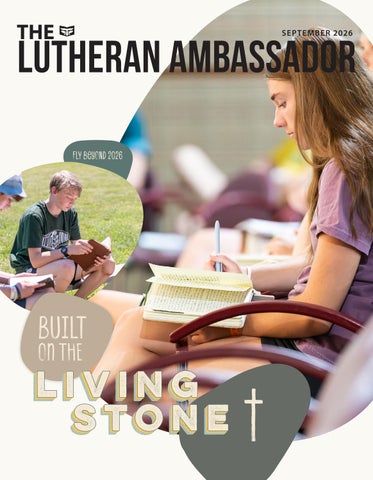
Lutheran AMBASSADOR FLY BeyoND 2026
BUILT on THE
LIVING STONE
EDITOR’S NOTE
THE LUTHERAN AMBASSADOR SEPTEMBER 2026
The Living Stone.
I
n this issue of the Lutheran Ambassador, we are highlighting the encouraging work God did at the FLY Beyond conference, held earlier this summer at the Association Retreat Center near Osceola, Wis. Taking place every other summer, FLY Beyond is designed to equip and train seventh- through twelfth-grade students for congregational investment. The week-long conference includes preaching, teaching, apologetics, and worldview training in a small group environment. Students and youth leaders gathered under the theme of “Living Stone,” taken from I Peter 2:4–9. Each day focused on a specific aspect taken from the text: “Living Stone,” “Rejected Stone,” “Chosen Stones,” and “Useful Stones.” Pastor Brent Olson, professor at Free Lutheran Bible College and Seminary, led campers in morning Bible study. Pastor Sam Wellumson of East Grand Forks, Minn., preached each evening, and Tim Barnett of Stand to Reason provided apologetics and worldview training. Pastor Adam McCarlson, the national youth director of the AFLC, opens the issue with an overview of the week. He speaks about the overall theme of “Living Stone” and why this week of training is such a tremendous opportunity for the youth of the AFLC. Pastor Alex Woodworth, who brought some youth to FLY Beyond from his congregation in Northwood, N.D., reflects on the theme of “Rejected Stone.” Pastor Chris Kumpula, from Tioga, N.D., writes an article on the theme of “Chosen Stones.” We also have some youths writing about their experiences at FLY Beyond! Joseph Haker from Trinity Lutheran in San Antonio, Tex., and Hannah Mobley of Solid Rock Free Lutheran in Anoka, Minn., write about their week and the theme of “Useful Stones.” Finally, Josh Johnson, currently serving an internship in Glyndon, Minn., writes with one of his students, Celia Trick, about the apologetics training the youth received at FLY Beyond. This issue also features the concluding section of Kirstie Skogerboe’s excellent piece titled, “Smitten by God: The Beauty of the Crucifixion.” Skogerboe includes a study guide for group discussion and a list of resources on the topic. Feel free to contact her (kirstie. skogerboe@aflc.org) for a copy of the entire paper, which is well worth a re-read even if you’ve been following along these last few months. You can also watch a recording of Kirstie delivering her paper at the 2026 Seminary Symposium at flbc.edu/media. This is one of the first times we’ve tried this serial publishing format, so let me know your thoughts on how it worked! I also want to thank everyone who signed up to be a writer for future issues of the Lutheran Ambassador during the Annual Conference. We are so appreciative of the volunteer hours our writers invest to make each issue possible. As we put together the issues every month, knowing who is able and willing to write and what subjects they’re interested in is such a help. If you are interested in writing, please let us know. —Pastor Andrew Kneeland
2
THE LUTHER AN AMBASSADOR
VOL. 64 NO.9
Editor Pastor Andrew Kneeland laeditor@aflc.org
Managing Editor Ruth Gunderson ruthg@aflc.org
Circulation Liz McCarlson lasubscriptions@aflc.org
Editorial Board Monica Coyle Pastor Jerry Moan Pastor Craig Johnson
The Lutheran Ambassador (ISSN 0746-3413) (USPS 588-620) is published monthly by the Association of Free Lutheran Congregations, 3110 E. Medicine Lake Blvd., Plymouth, MN 55441 Phone (763) 545-5631 Periodicals postage paid at St. Paul, MN and additional mailing offices. Postmaster send address changes to The Lutheran Ambassador, 3110 E. Medicine Lake Blvd., Plymouth, MN 55441.
subscriptions & giving The Lutheran Ambassador is a free publication of the AFLC. Our non-profit ministry is supported by readers’ gifts. To subscribe and give online, visit our website aflc.org/lutheran-ambassador Checks may be mailed to 3110 E. Medicine Lake Blvd., Plymouth, MN 55441 Email inquiries can be sent to lasubscriptions@aflc.org
SOUND BITES
It is now common practice in most evangelical churches to offer the people, especially the young people, a maximum of entertainment and a minimum of serious instruction. [A.W. Tozer]
Children have more need of models than of critics. [Carolyn Coats]
He has not given you children and the means to support them, only that you may do with them as you please, or train them for worldly glory. You have been earnestly commanded to raise them for God’s service. [Martin Luther] We recognize far too seldom that religious and confirmation instruction and the Sunday school can in no way give what previous generations knew from home through Bible reading and what was learned from pious parents. Today the need of the hour for the Lutheran Church is to become a teaching church again. [Hermann Sasse] You may speak but a word to a child, and in that child there may be slumbering a noble heart which shall stir the Christian Church in years to come. [Charles Spurgeon]
S eptember 2026
3
PASTOR ADAM McCARLSON 4
THE LUTHER AN AMBASSADOR
T
his past July, more than 140 attendees gathered at FLY Beyond, a training event for teens organized by AFLC Youth Ministries every evennumbered year. The theme this year was “Living Stone,” taken from I Peter 2:4–9. Over the course of the week, attendees were continually pointed to Jesus, the Living Stone, to find confidence in him, to be equipped to live as believers in a fallen world, to proclaim the excellencies of God, and to love and serve others in their families, congregations, and communities. Training like this is crucial for our youth. Knowing what they believe and why they believe it gives teens assurance of their identity when the world and the devil try to put all sorts of labels on them. Learning how to think well and communicate clearly provides teens with tools to give a defense for the
hope they have in Christ and to invite others to the wedding feast of the Lamb. It’s great to watch student peers and adults wrestle through life’s tough questions and doubts and then go to God’s Word for answers. Teens are pointed to Christ, his Word, and his church to help navigate whatever temptations, hardships, and trials may come their way. This is what FLY Beyond is all about. The planning team for FLY Beyond is made up of both pastors and laity from across the AFLC. They prayerfully considered the theme verse and identified a few areas to emphasize through the various sessions and services during the week. Day one focused on the person of Jesus Christ. Teens saw Jesus as the Good Shepherd who both fiercely defends and tenderly cares for his sheep through his death on the cross.
Jesus was not only identified as God but also as the Truth during sessions that helped teens understand objective truth in a confused culture. Day two focused on law and gospel. Teens were taught the importance of the law to see how God made creation to work, how we live in sinful ways that are contrary to how creation works, and how the law guides the Christian to right living. They spent time learning how to have conversations with unbelievers in a way that recognizes the need for both the law and the gospel. They learned how to use questions to understand and to promote helpful conversations. Day three focused on the doctrine of election and the gracious call and choice of God, which impacts the way we carry out the Great Commission to proclaim Jesus to the nations. Day four focused on the
FLY BeyoND 2026
THE LIVING STONE importance of vocation, seeking to equip teens to see how God calls both fishers of fish and fishers of men. It isn’t only pastors or missionaries who are called by God, but all of God’s children have a calling to love and serve neighbors in their families, communities, and congregations. To be clear, FLY Beyond is not the only place a teenager might find this kind of training. There are other organizations that put on conferences or have resources available to equip and train teenagers to engage with coworkers or classmates, to give a defense for the resurrection of Jesus Christ, and to lovingly proclaim Christ to the lost. And certainly, a teen’s home and church can be—and should be—places they receive training in apologetics, worldview, theology, biblical literacy, vocation, and more. But still, many AFLC congregations have for decades seen the need for this training and decided it is a worthwhile endeavor to join with other congregations to have an event like FLY Beyond to assist and supplement their own efforts to equip and to train teens. This gives the AFLC a unique opportunity to carry out
the training of teens in a way that promotes and celebrates the teaching and values of the AFLC. It really is a beautiful thing. Did your congregation have teens who were at FLY Beyond this past summer? I encourage you to talk with them about what they learned and how they were equipped. Encourage them to live out their vocation and invite them to use their gifts in your congregation. See how you can continue to equip and train them for service in God’s kingdom, both now and in the future, as they follow the Lord wherever he may lead. Is your congregation looking for ways to train and equip teens for service in God’s kingdom? Pray about ways you can meet that need starting today and consider if FLY Beyond is a tool that may help you in the future.
“AS YOU COME TO HIM, A LIVING STONE REJECTED BY MEN, BUT IN THE SIGHT OF GOD CHOSEN AND PRECIOUS ...”
McCarlson, who serves Solid Rock Free Lutheran as associate pastor, is the director of AFLC Youth Ministries. S eptember 2026
5
JOSEPH HACKER
USEFUL useful STONEs
6
THE LUTHER AN AMBASSADOR
F
LY Beyond is a Christcentered Bible camp situated in a beautiful landscape filled with grassy fields, tall pines, and blue lakes. This camp stands out as a one-of-a-kind teacher shaping people’s faith to better serve the Lord. My experience at this camp gave me many tools to combat the flaming arrows of the evil one and be a messenger of the gospel. I learned many interesting ways to give people God’s message. Pastor Brent Olson taught that we are living stones through Christ. He highlighted that as Christians we are no longer “stone dead but are alive.” His comparison of a human being to an individual temple and also how each of us is a stone in the walls of one great temple was encouraging to me. Tim Barnett taught me how to be an ambassador for Christ. His teaching revolved around asking questions. Questions such as “How did you reach that conclusion?” and “What do you mean by that?” showed me how to articulate thoughts without being offensive and keeping communication open. Barnett explained this approach is used to better understand the other person’s point of view. After gaining a full understanding of the other person’s view, he gave us five steps to respond to their claim: identify the
“THAT YOU MAY PROCLAIM THE EXCELLENCIES OF HIM WHO CALLED YOU OUT OF DARKNESS INTO HIS MARVELOUS LIGHT..”
claim, identify the reason for believing this claim, assess the claim itself, do some research about the claim (go digging for answers), and “red pen” the challenge or “grade it.” These steps helped me formulate a way to respond to others and to help build bridges and speak truth to them. God used both of these speakers in a practical way to stretch my faith. The morning sunrises were full of amazing colors laced with peaceful breezes and scents of freshness. The brisk mornings of quiet were a wonderful respite from the fantastic activities throughout the day. During the first small group challenge, teams picked names and made chants and posters. My favorite group to watch was
Goliath’s Goblins. They were extremely funny and never failed to make you crack a smile. The most notable thing about the team was their strange clap, usually followed by, “Goblins, assemble,” or some funny command. The basketball and Ultimate Frisbee tournaments were challenging and fun. My time at the camp gave me memories that will last a lifetime and knowledge that will help me obey the Great Commission with more ease and courage. If you ever get the opportunity to go, you should. FLY Beyond will heighten your level of faith to an extent you never thought possible. Hacker is a member of Trinity San Antonio, Texas.
I
HANNAH MOBLEY
came out of FLY Beyond with two words: “chosen” and “precious.” As I sat and listened to the speaker the first evening, I looked at the back of my pamphlet and read part of our theme verse: “As you come to him, a living stone rejected by men but in the sight of God chosen and precious, you yourselves like living stones are being built up as a spiritual house, to be a holy priesthood, to offer spiritual sacrifices acceptable to God through Jesus Christ” (I Peter 2:4–5). We all long to be accepted by our peers. Our Savior knows what it’s like to be unaccepted, but because Jesus is chosen and precious, we are chosen and precious. Because we are chosen, we are called to be ambassadors for Christ. As Tim Barnett, our apologist presenter, said, when you are an ambassador, you are also an apologist. Meaning, when we “sign up” to be an ambassador, we “sign up” to protect and defend our faith against the evils of this world. We can put a stone in people’s shoes by asking them, “What do you mean by that?” and “How did you come to that conclusion?” By asking them
these questions, we can clarify what they mean and how they define their terms in order to have a clear conversation. Later in I Peter 2:9 it says, “But you are a chosen race, a royal priesthood, a holy nation, a people for his own possession, that you may proclaim the excellencies of him who called you out of darkness into his marvelous light.” Pastor Sam Wellumson, our evening speaker, brought clarity to this passage, describing how a kingdom has the kingdom’s treasure, but the king may have his own personal stash. God looks upon us as his own personal treasure, a treasure he takes pride in and rejoices
over as if we were the Hope Diamond. Even better, our morning speaker, Pastor Brent Olson, described us as being more valuable than the Hope Diamond. God chose us and called us out of darkness and into the radiance of his treasure box! Knowing that I am chosen because my Savior is chosen makes me feel like I can be who God called me to be—a chosen and precious apologist, ambassador, and living stone redeemed by my creator and my King. Mobley is a member of Solid Rock Free Lutheran, Anoka, Minn. S eptember 2026
7
E
ach time we gather in the Tabernacle at the Ark in Osceola, Wis., I am reminded that buildings are constructed for a purpose. Every beam, wall, and stone is carefully placed according to the builder’s design. Just as the Tabernacle was built to gather people around God’s Word, this year’s FLY Beyond theme reminded us that God himself is building something far greater than any earthly structure. Through his Son, Jesus Christ, he is reconstructing sinners into his holy people. We are not merely visitors in God’s house; we are, by his grace, living stones being built into it. Students at FLY Beyond were blessed to explore this truth through the theme “Chosen Stones.” Throughout the week, Pastor Sam Wellumson led students through I Peter 2:4–9, helping them see both their identity and their purpose in Christ. Peter writes, “As you come to him, a living stone rejected by men but in the sight of God chosen and precious, you yourselves like living stones are being built up as a spiritual house.” Peter begins where all Christian teaching must begin: with Jesus. Before we understand who we are, we must first know who Christ is. He is the cornerstone, the perfect foundation upon which everything else must rest. Ancient builders relied upon the cornerstone to establish the alignment of the entire structure. If the cornerstone is true, everything built upon it would stand true, as well. Yet Peter also reminds us of a sobering reality: the perfect cornerstone was rejected. The religious leaders of Jesus’ day rejected him despite his perfection. The temptation
remains the same today. We are constantly tempted to build our lives upon grades, popularity, athletics, careers, possessions, politics, entertainment, or even our own reputation for goodness. Every generation searches for another foundation, yet every substitute eventually crumbles. Christ alone remains. Pastor Wellumson emphasized both God’s law and God’s gospel. Many Christians think of the law only as bad news because it exposes our failures. Indeed, God’s law serves as a mirror, revealing our sin and our need for a Savior. Using the memorable illustration of a dirty kitchen, students were reminded that a mirror can reveal what needs cleaning, but it cannot wash the dishes or scrub the counters. Like a small child instructed by a parent to clean the kitchen, we often leave much to be desired. Pastor Wellumson explained that the Ten Commandments, God’s law, also reveals God’s generous heart. “You shall not steal” is more than a prohibition; it is God’s gracious protection of our neighbor’s livelihood so families may flourish, work honestly, and even have enough to share with others. Students were encouraged to read through each commandment, asking, “What gift is God protecting here?” It is a simple exercise that reveals the goodness of God’s design and reminds us that his commands are given for our blessing.
Of course, none of us keeps God’s law perfectly. In Matthew 5, Jesus declares that he came not to abolish the law but to fulfill it. Pastor Wellumson illustrated this beautifully by asking students to imagine an Olympic swimming pool filled perfectly to the brim without losing a single drop. That is Christ’s obedience. He fulfilled every command completely, while we struggle to contribute even a few drops of our own righteousness. Another illustration struck home just as clearly. We imagined receiving a failing grade on an exam. Jesus takes our imperfect test, signs his own name to it, and places his perfect exam into our hands with our names written across the top. This is the gospel: Christ’s perfect righteousness is credited to sinners through faith alone. Those who belong to Christ are therefore no longer merely forgiven sinners. They become “a chosen race, a royal priesthood, a holy nation” (v. 9), living stones being built into God’s spiritual temple. Like the wedding guests in Matthew 22, united to the righteousness of Christ in the waters of baptism (Galatians 3:27), we are clothed in the righteousness of Christ that we may belong and delight in God’s presence and good pleasure for the Son. Our identity has been completely transformed by God’s grace. Students considered how these truths shape everyday life through vocation. Jesus called
Peter, James, and John to leave their fishing boats and become fishers of men. Yet their father Zebedee remained with the boats, the nets, and the family business. Someone still had to catch fish. God feeds his world through such ordinary workers. He provides daily bread through farmers, mechanics, teachers, nurses, parents, business owners, and countless others. Some are called to preach the gospel; many more are called to serve Christ faithfully in ordinary occupations. That is why the theme “Chosen Stones” matters. God has chosen us in Christ, placed us upon the perfect cornerstone, and is fitting each believer into his living temple. Whether he calls us into ministry, farming, teaching, or business, every faithful vocation becomes another place where Christ’s excellence shines through ordinary people. Buildings may change, ministries may adapt, and circumstances may shift, but the Cornerstone never changes. By God’s grace, we are his chosen stones, built upon Christ forever.
PASTOR CHRIS KUMPULA
CHOSEN STONEs
“YOU YOURSELVES LIKE LIVING STONES ARE BEING BUILT UP AS A SPIRITUAL HOUSE.”
Kumpula serves Zion Lutheran, Tioga, N.D. S eptember 2026
9
PASTOR ALEX WOODWORTH
THE REJECTED STONE
10
THE LUTHER AN AMBASSADOR
F
LY Beyond was a great week of equipping students in the Word of God as we considered I Peter 2:1–12 and highlighted Jesus, the Living Stone. There’s so much to take from this passage: we learned about Christology (Living Stone), vocation (living stones), and election (the rejected stone). These are important biblical truths for students to consider, as it is the case for all of us. On the matter of Christ, the stone rejected by the builders, I was reminded of a conversation I had not too long ago. A man wanted to discuss the Lutheran view of election. To his credit, he had done his homework. But he’d been caught in the whirlwind of opinions concerning sovereignty versus free will, monergism versus decision theology, etc. I sensed his frustration. What happened next has stuck with me. “So, if I’m saved, that’s all God’s doing,” he said. “It’s purely
a matter of his grace and a work of his Spirit to create faith.” “Yes, that’s right,” I said. “And if one is condemned, that’s because they have rejected Christ. That’s entirely on us.” “Yes, I think you’re onto it!” Then he said, “So, if I’m saved, that’s because of God; and if I’m condemned, that’s because of me. And everything beyond this, I can just say, ‘I don’t know!’” “Bingo! Welcome to the tension that we as Lutherans speak of!” With his hands in the air, he said, “Well, now, that doesn’t have to be so hard, does it?!” The Word of God tells us that Jesus is the rejected stone. “As you come to him, a living stone rejected by men but in the sight of God chosen and precious, you yourselves like living stones are being built up as a spiritual house, to be a holy priesthood, to offer spiritual sacrifices acceptable to God through Jesus Christ” (I Peter
2:4–5, ESV). Christ was rejected by the Pharisees, the scribes, and countless more during his earthly ministry. The same holds true today; many willfully choose to reject Christ. And so, we have work to do! We have a message of good news to proclaim! It is the Spirit of God working through his Word who is the sole creator and sustainer of faith. On this matter, “I believe that I cannot by my own reason or strength believe in Jesus Christ my Lord, or come to Him; but the Holy Spirit has called me through the Gospel, enlightened me with His gifts, and sanctified and preserved me in the true faith” (Luther’s Small Catechism). We would do well to recognize that only God can make a dead man alive. The dead man does not ask to be made alive; he in no way contributes to this. The Scriptures show that either we’re made alive by the Spirit and therefore chosen in Christ
through faith, or we willingly choose to reject Jesus in our sin and unbelief—just like the Pharisees. Let’s be careful not to say anything more. At FLY Beyond, we enjoyed wonderful preaching and teaching through this passage in I Peter 2. Indeed, Christ is “the stone that the builders rejected [and he] has become the cornerstone” (v. 7). Our teachers insisted that we view election as two questions, not one. The question is not “Why are some saved, and others not saved?” Rather, the questions are, “Why are some saved?” and, “Why are some condemned?” The Bible answers these as separate questions. In the simplest terms possible, those who are saved will acknowledge that he did it. And those who are condemned will acknowledge that fault lies with me. Jesus was rejected. He was despised. He was mocked, beaten, and crucified. But he did that for you. You didn’t ask him to do this; he did it for you because that’s just who he is! You can’t undo the promise. You can only reject it. You can’t change his gracious disposition toward you. You can only reject it unto the wrath of the same God who’s simultaneously holy and just. The choice only goes one way. He’s already the cornerstone. He’s already “the way, the truth, and the life” (John 14:6). If you believe that, praise God! It was his Spirit who worked faith in you. Scripture testifies that “no one can say, ‘Jesus is Lord’ except in the Holy Spirit” (I Corinthians 12:3b). If you’re made alive in Christ, the Holy Spirit gets the sole credit, as he’s the sole creator and sustainer of the gift of your faith. And this gift is delivered through Word and Sacrament. Perhaps your logic isn’t satisfied. If that’s you, join the club! But in all of this, let’s
be content to say what the Scripture says, and nothing more. These are two questions, not one. Where the Bible leaves tension, let’s leave the tension. What we can say for certain is that salvation is an unfathomably great gift. We can also say that the stone can be rejected. And so, let’s not reject so great a salvation. If he is your Lord, thank him for what he has done on that cross for you. And praise him for the gift that he alone has given to you. It doesn’t have to be so hard, does it?
“THOSE WHO ARE SAVED WILL ACKNOWLEDGE THAT HE DID IT.”
Woodworth, a member of the FLY Beyond planning team, serves Ebenezer Lutheran, Northwood, N.D.
S eptember 2026
11
LOGIC & GODLY JOSH JOHNSON
INFLUENCE
12
“H
e has, like, 150,000 subscribers!” “You’ve got to hear this guy!” There was a noticeable buzz among the students at FLY Beyond as we waited for Tim Barnett to pick up the mic on Tuesday night. Although Barnett had spoken in previous years, both the FLY Beyond veterans and newbies were keen to hear from this Christian apologist, known online as Mr. B. Barnett’s presentations did not disappoint. His unflappable wit and high energy came through on stage just as it does on his YouTube channel, Red Pen Logic, where he evaluates and responds to critics of the Christian faith. This year, he helped students answer difficult questions they might encounter while scrolling on social media or sitting in a secular classroom. Is God’s Word reliable? Is what we have now what they wrote then? How can we know God even exists? In these sessions, Barnett didn’t just tell students what to think. His goal was to show them how to think and how to have conversations. Throughout the week, Barnett modeled a graciousness that students don’t typically see from popular influencers. Most content creators look for the mic-drop moment that leaves their opponent speechless. That strategy might get clicks, but it does little to show people
THE LUTHER AN AMBASSADOR
a gracious God who desires to see everyone come to the knowledge of the truth. Barnett taught students to show “intellectual hospitality,” first clarifying an opposing claim before responding. Talking past someone will do little to change his or her mind or heart. In an age when “online influencer” is one of the most desired career paths, Barnett helped our young people stand on the truth of Scripture and proclaim that truth effectively. The world may seek fame and comfort, but the hard work of defending the Christian faith requires that we really listen to and seek the good of those who
oppose us. At the end of the week, each student was given a red pen. This was a tangible reminder that so much of what we see in our culture does not align with the eternal truth of God. Students were commissioned to share the good news that Jesus is the way, the truth, and the life. Let’s join this new generation of ambassadors for Christ with the same spirit of humility and reliance on our Savior to change hearts and minds. Johnson is serving his seminary internship at Maranatha Free Lutheran, Glyndon, Minn.
CELIA TRICK
FLY BeyoND 2026
A
t FLY Beyond our speaker Tim Barnett asked this question: “What is apologetics?” Apologetics is defending your faith. I Peter 3:15 says, “But in your hearts honor Christ the Lord as holy, always being prepared to make a defense to anyone who asks you for a reason for the hope that is in you; yet do it with gentleness and respect.” I learned that it is easy to make a claim to an atheist or an unbeliever, but it is harder to give evidence for your claim. For instance, imagine you are with your friend who is an
unbeliever, and they ask you why you are a Christian. You tell them that everyone who believes in Jesus is a Christian. Let’s say they still ask why, and you have no evidence. This is why Tim Barnett encouraged us that with every claim you make, you should have reasoning behind it. During a few of Barnett’s sessions, he talked about interacting with atheism. One notable atheist he brought up was a man named Richard Dawkins. Dawkins states that he would rather have more Christians in the world than
Muslims in the world. Dawkins even recently stated that he identifies with the morals of Christianity but denies its spiritual claims. This shows how reasoning can answer the questions in our minds but not necessarily change our hearts. Barnett went on to explain how to have meaningful and impactful conversations with unbelievers. He talked about the need to evaluate the opposite side of the argument. He encouraged us to ask questions like, “What do you mean by that?” and “How did you come to that conclusion?” These questions help us do what the apostle Peter encouraged believers to do in his letter. We need to speak with gentleness and respect even when we disagree, being careful not to bring others down but to lift them up. Barnett reminded us that we cannot convince the unbeliever to be a Christian with only reason. But you can point them to the truth while they are on their journey. Our goal as Christians is to keep planting seeds and having conversations with as many lost souls as we can. I know with confidence that I can use Tim Barnett’s wisdom to become a courageous defender of the faith as I pray, engage, and study the Bible. Trick is a member of Maranatha Free Lutheran, Glyndon, Minn. S eptember 2026
13
pt. 5 five
kirstie skogerboe
Smitten byGod CONCLUSION
T
o be beautiful in Christ is to be a casualty of war. God’s posture toward our sin is, as it always has been, violent enmity—a violence that names our enemy when we are reluctant to do so and rescues us from him. As much as we desire the piety this war wins for us, we never desire the experience of war itself: the exposure of our most flagrant ugliness, the ripping off of our scaly hide, the excruciating labor of contrition and birth of God’s beauty in us through faith. Little by little, through the course of our whole life, the leaves with which we covered ourselves are torn off, until what is left is again the shameful, naked body, still holding the bitten fruit in its hand. Abject shame before God leads us to terror—and sometimes, it lasts for a long time. We can forget that God has torn off our covering for a purpose. All we imagine is his disgust, and all we can feel is our own. But much as the Father allowed Christ’s suffering to be cut short once his work was completed, he does not intend for us to writhe interminably under his hand of war. He wants us instead to turn more and more quickly to the naked body of his Son, exposing what we tried to hide, bruised for our transgressions, crushed for our iniquities, in agonizing pain to bring us peace. He wants us to see more and more readily that Christ’s beauty centers on the moment of God’s violence against the Son. He wants us to recognize the crucified Christ in our ugliness so we can recognize our beauty as his. We can recognize this image with our hearts. But God has made us sensory beings, not only benefiting from but needing visual engagement with him as our crucified Savior. When we not only imagine but see honest, beautiful depictions of Christ on the cross, we experience a visual catechism. We are taught through both our eyes and ears that our sin is the greatest evil and Jesus carrying it is the greatest beauty. We are being shown, even if we learn slowly, that to be broken by God is to be made beautiful. Our eyes are meant to behold Jesus’ beauty. May our churches and our homes be places to gaze upon the beauty of the Divine Warrior, revealed by God’s hand of violence and offered to us in his flesh and blood. Skogerboe, Santa Fe, New Mexico, is the digital communications coordinator for the AFLC. Artwork: “Head of Christ Crowned with Thorns,” Lucas Cranach the Elder, c. 1510, Wikimedia Commons. 14
THE LUTHER AN AMBASSADOR
DISCUSSION GUIDE 1. What kind of pictures of Jesus are people in our church or community used to seeing? How have these images potentially shaped their perception of Christ and the crucifixion, for better or worse? 2. In our church and community, what style of art piece could help people pay attention to and meditate on Jesus’ crucifixion in a new or deeper way? 3. If our congregation already has depictions of Jesus’ crucifixion, are any of them in a prominent place or a place that’s conducive to prayer and meditation? Are any of them sentimentalized depictions that allow us to “pay passing tribute to love and sorrow without the trouble of feeling them”? (Roger Scruton, see below). 4. Are there any images of the crucifixion in our spaces for children’s Christian education? Are we making it easy for the kids in our church to internalize the crucifixion as the central revelation of God’s beauty? 5. How will our congregation catechize members and visitors visually? In what ways do we need to be challenged through visual catechesis? In what ways do we need to handle visual catechesis with sensitivity?
RESOURCES Reading • Silence and Beauty: Hidden Faith Born of Suffering by Makoto Fujimura • “The Consummation of the Exodus: A Study of the Exodus Motif in the Revelation” by Dr. Phil Haugen • “The Unity of the Scriptures and the Gospel” by Dr. Phil Haugen • The Quest for Holiness: A Biblical, Historical, and Systematic Investigation by Adolf Köberle • “Heidelberg Disputation” by Martin Luther • Martin Luther’s Theology of Beauty by Mark Mattes • Beauty: A Very Short Introduction by Roger Scruton • Love Alone Is Credible by Hans Urs Von Balthasar • The Art of Holy Week and Easter by Sister Wendy Beckett Viewing • Full of Eyes Exegetical Artwork • “Jésus sera en agonie jusqu’à la fin du monde” by Georges Rouault • “Golgotha” by Edvard Munch • “Crucifixion” by Giotto • “Weimar Altarpiece” by Lucas Cranach the Elder and Lucas Cranach the Younger • “Crucifixion” by Albrecht Dürer • “Christ Carrying the Cross” by Titian (c. 1565) • “Santo Spirito Crucifix” by Michaelangelo • “Deposition from the Cross” by Rosso Fiorentino • “The Crucifixion” (Isenheim Altarpiece) by Matthias Grünewald • “Christ Carrying the Cross” by Hieronymus Bosch S eptember 2026
15
MINISTRIES / PRESIDENT
Serving our pastors. BY PASTOR MICAH HJERMSTAD
O
Pastors’ Conferences. The 2026 Pastors’ Conference will be held at the Association Retreat Center near Osceola, Wis. • Theme: “Renewed By Hope” • Dates: October 6–8 For more information about this event and to register, visit: • aflc.org/pastorsconference The 2027 Pastors’ Conference will be held at the DoubleTree Hotel, Bloomington, Minn. • Dates: April 18–20
Hjermstad, a member of Grace Free Lutheran, Maple Grove, Minn., is president of the AFLC. 16
THE LUTHER AN AMBASSADOR
ne of the primary responsibilities of the AFLC president’s office is to plan and execute certain AFLC events. By far the largest we plan is the Annual Conference, as it should be. I’m glad we invest so much time into it. We also plan the Pastors’ Conference—an important time for training, equipping, and encouraging our pastors. We try to foster an environment for them to be refreshed by God’s Word and fellowship with one another. Sadly, the Pastors’ Conference has seen a steady decline in participation for several years. Last year, 65 people registered, not counting the pastors’ wives. That number is low, but it’s more concerning when 29 of those in attendance were seminarians or staff and faculty of our AFLC ministries. That means that 36 pastors who aren’t involved on our campus in a full-time capacity came. And only 32 of those in attendance were pastors currently serving AFLC congregations. My desire is to serve our pastors and provide a quality event for them. No matter the size of the group, we will continue to strive for excellence in this area. We also want the conference to be as accessible as possible. With that in mind, we are making some significant changes to the 2027 Pastors’ Conference. We will gather Sunday evening (April 18) for an informal time of fellowship and devotions and then engage in study and training on Monday and Tuesday (April 19–20), closing our time together on Tuesday morning (April 20). The conference will be held at the DoubleTree Hotel in Bloomington, Minn. Our hope is that this schedule will land on the calendar at a time when the busyness of Lent and Easter has passed, and typical May events are yet to occur. This will allow most of our pastors to preach on Sunday morning, make it to the conference by Sunday night or Monday morning, and get back in time for Wednesday activities. I know that this change will not satisfy everyone. For instance, one of the debates surrounding this event is whether it is a retreat or a conference. Is its primary purpose to provide rest and refreshment, or training and equipping? My answer is “all of the above.” However, transitioning away from the Association Retreat Center to a more professional setting like a hotel conference center will likely give it more of a conference feel. I encourage you to consider this a healthy step for our pastors. My hope is that pastors and congregations will see this as a mutually beneficial use of time for the pastor to receive edification in the Word, grow in his craft, and collaborate with other pastors. Yes, the pastor needs to rest, too. Congregations, let’s see this event not as vacation but as professional development and an important part of your pastor’s work—and please make sure you give your pastor separate vacation time. We will provide plenty of time at the conference for informal fellowship and refreshment. The ARC has been a great host for us over the years. We still have one more Pastors’ Conference there this fall, October 6–8. Our theme is “Renewed by Hope,” focusing on individual, personal renewal. Next spring, our focus will be on congregational renewal. Pastors, I invite you to attend these conferences, to be renewed and refreshed by sitting together with other pastors around the Word of God. Congregations, make every effort to encourage your pastor to attend. Cover his expenses and find a fill-in for him if he must miss something. Your pastor, your congregation, and the AFLC will be stronger for it.
MINISTRIES / PARISH EDUCATION
• CURRICULUM IN THE MAKING
From concept to the classroom. BY MARIAN CHRISTOPHERSON
W
hen will the curriculum be ready? That’s a question we often hear in Parish Education. But have you ever wondered what has to happen first? The development of Sunday school curriculum begins years before reaching a student’s desk. Selecting Bible texts and themes, establishing objectives, soliciting writers and illustrators, setting goals, creating learning activities, and building teacher lesson plans are all part of laying the groundwork for curriculum in the making. The AFLC Board of Publications collaborates in several of these steps. As director, I also regularly observe and compare material from various publishers, not to copy them, but to have an awareness of current educational practices as well as modern presentations. When redeveloping student materials, I carefully evaluate what can be salvaged or repackaged. Some of the factors to consider are current realities related to child development, learning goals, typical class length, age-appropriate Bible truths, vocabulary, and activities. Feedback from congregations using our curriculum is also very important. For instance, a noteworthy change recently implemented from teacher feedback is shifting level one and other early elementary curricula from a book format to a take-home leaflet, like our preschool. In addition, the positive response to the preschool parent page feature from parents and teachers led us to include that element in our new level one student leaflets. Once the foundational content is ready, design work begins. I meet with graphic designer Ruth Gunderson to discuss our needs and goals. Ruth thoughtfully prepares a design concept, and we work through layout details together to refine a template. Her creative gifts and professional skills always strengthen the visual impact of the educational content and bring an artistic cohesiveness to the curriculum. After she inserts the text, illustrations, and activities into the template, a rigorous back-and-forth editing process strives to perfect every last detail. Finally, it is time to let it go. Once the digital files are uploaded to the printer, we receive a print proof to review, usually within 24 hours. We inspect color, line precision, and layout positioning and get one last chance to catch errors. If corrections are needed, we make adjustments and review another proof. After final approval, we eagerly wait about three to four weeks to receive the finished product. Thanks be to God, the first unit of our new level one curriculum has traveled this long road from concept and is ready to complete its journey in your classroom. On July 30, we were pleasantly surprised when the new Teach Me God’s Word materials were ready for delivery two weeks earlier than expected, and the 43 boxes arrived the next day. Please pray for us as we prepare units two and three, which hopefully will be ready in November and February.
Teach Me God’s Word. Teach Me God’s Word is part of the Ambassador Sunday School Series designed to give children a complete overview of the Scriptures and Luther’s Small Catechism as they move from preschool through level six. The core biblical content and focus for each level remain constant, but we are continually updating various facets of the Ambassador curriculum. Centered on the gospel of Jesus Christ, this series can be life-transforming! The next levels slated for redevelopment are kindergarten’s Tell Me the Story of Jesus and level three, focusing on prayer and the Lord’s Prayer. Christopherson is the director of AFLC Parish Education. S eptember 2026
17
MINISTRIES / ARC
Abundant growth. BY KIRK RAUTIO “But grow in the grace and knowledge of our Lord and Savior Jesus Christ. To him be glory both now and forever! Amen” (II Peter 3:18).
A
Association Retreat Center. The ARC, located near Osceola, Wis., is a camp and retreat center owned by the AFLC. For more information about supporting the ARC, visit our website: • arc-aflc.org
Rautio, a member of Solid Rock Free Lutheran, Anoka, Minn., is the director of the ARC. 18
THE LUTHER AN AMBASSADOR
s another summer season ends at the Association Retreat Center, we pause to thank the Lord for his abundant faithfulness. “Abundant Growth,” our 2026 theme, was more than just words we displayed throughout camp. It has been a reminder that God alone gives growth as his Word is faithfully proclaimed and his people respond in faith. Throughout the summer, the ARC was filled with children, youth, families, volunteers, pastors, counselors, and retreat guests. Worship filled the Tabernacle, laughter echoed across the grounds, and friendships were formed. More importantly, the gospel of Jesus Christ was shared daily through Bible studies, worship, conversations, and countless acts of Christ-like service. One of the greatest blessings this summer was witnessing more than 60 individuals publicly confess their faith through baptism in Lake Elim. Standing along the shoreline, we were reminded that God is still calling people to himself through his grace. Each baptism was a testimony that Christ continues to change lives and faithfully keep his promises. The Lord also provided in another remarkable way. Through faithful giving, wise stewardship, and many answered prayers, the remaining debt on the Association Retreat Center has now been reduced to less than $35,000. We rejoice in his provision, but we also recognize that the greatest work accomplished this summer cannot be measured financially. Changed hearts, strengthened families, renewed churches, and believers growing in Christ are treasures of eternal value. As summer gives way to fall, campers return home, students enter classrooms, and churches continue into another season of ministry. It is tempting to remember camp simply as a wonderful week away. But Peter reminds us that growing in Christ is not seasonal. His encouragement to “grow in the grace and knowledge of our Lord and Savior Jesus Christ” continues long after the cabins are quiet and the campfires have gone out. The question each of us should ask is this: How will I continue growing where God has planted me? Abundant growth begins right outside our front door. It happens as parents faithfully teach their children God’s Word, as neighbors care for one another, as congregations gather around Scripture and the sacraments, and as believers serve Christ in their schools, workplaces, and communities. Growth often happens quietly through daily prayer, faithful worship, acts of kindness, and conversations that point others to Jesus. Thank you for praying for the ministry of the ARC and for partnering with us in sharing the hope of Christ. As we look ahead, our prayer is not simply that you remember what God did this summer, but that you continue to grow in him every day. May the abundant growth we witnessed at the ARC overflow into our homes, churches, neighborhoods, and communities, bringing glory to our Lord and Savior, Jesus Christ, both now and forever.
MINISTRIES / CHAPLAINCY
Ready to help. BY PASTOR JOHN AMUNDSON
T
he police, fire, and emergency medical service chaplain ministry’s purpose is to take care of those who take care of us. Sometimes, chaplaincy ministry even takes care of the chaplain. At the end of 2025, I was involved in a car accident with a herd of deer. I managed to hit two of the five deer that ran out in front of my car. While I was fine, Starlink automatically had the area’s emergency squads respond to my accident. One of the comments made by a responder was, “Aren’t you supposed to take care of us?” It is a nice reminder that chaplaincy is a ministry of presence. It is a ministry of building trust and relationships with our emergency responders. My Baptist colleague and fellow chaplain in the area stops by the county sheriff ’s office on a regular basis. Sometimes it is just to pop in the door and touch base with the deputies. Other times it could mean sitting down with one of them and listening to some of the burdens they are experiencing. I have a similar connection with the fire chief in a neighboring town where we also provide a chaplaincy presence. It is a similar routine. I will see him in the local café where we visit briefly. If there is a need to talk more, we will find a quiet place to sit and talk. These emergency workers know we are there for them 24/7. We will be there whenever they call after a traumatic event or when they experience stress in their lives or just the need to have someone to listen to them. In rural communities, where everyone knows everyone and most of the time the responders care for people they know—including family members— we have seen the need to not only reach out to our police officers, fire volunteers, and emergency medical responders but also to the local hospital staff and even funeral home directors. These are all community members who serve in these helping professions who can experience the emotions of dealing with the hurt and losses in life. As chaplains are there to listen, to offer that cold cup of water, to hold a hand, to offer a hug, to walk with them through those valleys, and to pray with each of them and their families. Currently there are 18 AFLC pastors who, in addition to their parish duties, serve as chaplains in their communities, ministering to police, fire, and EMS personnel.
AFLC Chaplaincy. AFLC Chaplaincy consists of several ministry emphases: • Institutional Chaplaincy • Police and Fire Chaplaincy • Military Chaplaincy If you or your congregation want to engage in these vital institutional ministries, AFLC Chaplaincy is here to walk that path with you. Whether you are looking for certification or seeking to place a chaplain in a local facility, let’s talk. Let’s ensure that no matter where our neighbors find themselves, the gospel is there to meet them.
Amundson, who serves Immanuel Lutheran, New Leipzig, N.D., and Trinity Lutheran, Mott, N.D., is the director of police, fire, and EMS chaplaincy. S eptember 2026
19
Photos from FLY Beyond 2026
Students at the 2026 FLY Beyond camp took in a busy daily schedule, from morning sessions (top left) to group discussions (top) to afternoon activities in which they formed teams and competed in daily challenges (above and middle left) as well as organized competitive events like Ultimate Frisbee (near left). Each evening, they gathered for a service led by Pastor Sam Wellumson (far left), who focused on the theme of “Living Stone.” 20
THE LUTHER AN AMBASSADOR
NEWS
FLS hosts Summer Institute of Theology The Free Lutheran Bible College and Seminary hosted the Summer Institute of Theology Aug. 3–7 on its Plymouth, Minn., campus. Students took part in classes that focused on both practical theology and ministry. Pastor Alex Amiot (top) offered the plenary session, an exegetical study on the Gospel of Matthew’s. Two other morning sessions were taught by FLBCS faculty. Dr. Nathan Olson (bottom right) taught “The Pastor as Theologian,” in which he established the foundational framework for the pastor’s work as a theologian as he shepherds his congregation. Andrew Hanson offered a practical ministry class on “Planning and Leading a Worship Service.” Two afternoon sessions were offered. Dr. Craig Johnson (top right) taught a session on how to cultivate a gospel culture in your congregation. And Dr. Martin Horn (center) taught “History and Aims of the AFLC.” Session videos will be posted in an online catalog at flbc.edu/sit. S eptember 2026
21
NEWS
PEOPLE & PLACES Emily Olson, a member of Living Word, Eagan, Minn., has been hired as the executive secretary of the Women’s Missionary Federation.
Pastor Karl Anderson, McIntosh, Minn., has accepted a call to Faith Lutheran Church in Blackduck, Minn., beginning October 1. Pastor Paul Kinney has resigned from Zion Lutheran Church, Silverhill, Ala.
Pastor Lynn Kinneberg, Wahpeton, N.D., has accepted a call as interim pastor at Calvary Free Lutheran Church, Fergus Falls, Minn. Members of the AFLC Coordinating Committee have accepted Light of Christ Fellowship, Bozeman, Mont., onto the AFLC congregational roster.
Members of Our Saviour’s Lutheran and Reiner Lutheran Free, Thief River Falls, Minn., will celebrate their congregation’s 75th anniversary Oct. 3–4. Events will include a banquet, worship service, and an anniversary service at 1:30 p.m. on Oct. 4.
Pastor Jason Holt introduces the new book at the Summer Institute of Theology.
Coordinating Committee publishes collection The Coordinating Committee recently published a new book, The Confessions and Rules for Work of the AFLC. According to Pastor Micah Hjermstad, president of the AFLC, the book is a collection of the creeds and publications adhered to by the AFLC. “Very simply, the Rules for Work state that our congregations unreservedly subscribe to the ecumenical creeds, Luther’s Small Catechism, the Unaltered Augsburg Confession, the Fundamental Principles, and Rules for Work,” said Hjermstad. “Those documents are all printed in various publications, but the
idea was that it would be nice to have them all printed in one place for clarity and simplicity.” Hjermstad said that every AFLC congregation and rostered pastor will be gifted a copy. Hjermstad and Pastor Jason Holt, presidential ministry associate, are delivering the books as they travel the country in order to reduce shipping costs. The books will also be on sale for $20 through Ambassador Publications. Visit the publisher’s online bookstore (store.ambassadorpublications.org) to order a copy of the book.
AFLC BENEVOLENCES Januar y 1-July 31, 2026 rec’d in july
total rec’d to date
% of subsidy
prior year-to-date
General Fund
$29,284
$263,767
52
$278,327
Evangelism
16,894
72,485
52
74,217
Youth Ministries
10,760
81,477
53
86,360
Parish Education
8,738
81,565
43
91,243
FLBCS
53,354
504,264
55
358,411
Home Missions
21,609
186,985
49
171,134
World Missions
27,185
253,923
49
256,256
Personal Support
47,826
340,671
44
376,679
TOTALS
$215,650
$1,785,136
52
$1,692,627
fund
Pastor Curt Emerson (far right) was installed May 31 at Trinity Free Lutheran, Janesville, Wis., with his son, Pastor Luke Emerson (center, Peace Lutheran, St. Francis, Kan.) officiating. Submitted photo.
J U LY M E M O R I A L S FLBCS Pastor Alvin Sather Kathryn Henderson Home Missions Harry Weinkauf
22
World Missions Richard Moen WMF Verlys Dilley Marleen Eidsmoe Marilyn Bowman
THE LUTHER AN AMBASSADOR
For additional financial information for each department, go to www.aflc.org/giving
Eternal weight of glory. BY MICHELE MOBLEY er slight frame of 70-plus years barely dented the mattress. Anna’s worn face was framed by limp, rusty curls. She remained upright in bed, firmly clutching the handles of a duffel bag, which, too, was weathered and worn. I sensed Anna would not lie down once the fluorescent lights in the warehouse—spanning almost one city block—were shut off, signaling to the residents it was time to sleep. Earlier in the day, I had lifted my eyes from my desk to see Anna open the steel door leading to the Women and Children’s Center at the Sioux Falls Union Gospel Mission. She approached my desk carrying the duffel bag, which pulled her slight frame into its weight. I welcomed her into a waiting chair. She sat, leaning slightly to keep her hold on the bag. Soon, I led Anna to her assigned twin bed, one in a line of many. She stood near it without setting down her duffel bag. Later that evening, I offered to carry the bag. Her kind face quickly became clouded in fear, and she bore the weight of the bag into her body, firmly replying, “No.” Anna appeared determined to bear her load down a flight of stairs and for one city block where we would cross the street to attend the evening chapel service and eat a meal. Why was she willing to bear such a heavy load? Christians are perishable vessels of an eternal weight of glory. This paradoxical truth marks the sufferings of the servants of Christ and manifests the glorious mystery of Christ’s deliverance from the curse of death. “But the marvelous thing is that this public manifestation is accomplished through ministers who are hounded by death,” writes R.C.H. Lenski in his commentary on II Corinthians. In Christ, perishable vessels faint not. The Apostle Paul, in his second letter to the Corinthian church, states, “We have this treasure in clay jars …” (4:7). Our life is marked by suffering. Yet, in Christ the bearing of suffering is mysteriously manifested in victory. Christians bear this creed: “afflicted in every way but not crushed; we are perplexed but not driven to despair; we are persecuted but not abandoned; we are struck down but not destroyed” (4:8–9). Death is at work in us, but its manifestation is life to a lost and dying world. In Christ, perishable vessels proclaim not themselves, but Christ.
ENCOURAGING
WORD
H
As I prepared to shut off the lights in the warehouse, my thoughts turned toward Anna and her duffel bag. I gathered four lamps and set one in each corner of the warehouse; their dim glow diluted the dark corners. As I walked the floor throughout the night, I noticed that one of the residents who often screamed out in the darkness remained peacefully asleep. Anna remained upright in her bed, fully clothed, one hand firmly wrapped around the handles of her bag while a peaceful smile graced her weathered face. The next morning, as she lugged her bag past my desk to leave for the day, she stopped to thank me. “Michele, you brought light to this floor last night.” Anna would not allow me to bear the weight of her load. But her acknowledgment of the light reminds me still that Christians are “the light of the knowledge of God’s glory in the face of Jesus Christ” (4:6). Fellow perishable vessels, proclaim Christ! In Christ, perishable vessels focus on the unseen. Our outer person is being destroyed. This is reality. And if our focus remains on what we can see, we will be overcome by despair. Yet, in Christ, we bear this miraculous truth: the derivative of our “momentary light
affliction” is an “absolutely incomparable eternal weight of glory” (4:17–18). The weight is determined by the comparison of time—the momentary in light of the eternal (Lenski). This is a wondrous mystery! Dear suffering one, we set our eyes on the unseen! Anna spent only a night or two at the mission. She was picked up on a street corner, duffel bag in hand, by the local police. They called the mission to inform us her family had reported her missing and to ask one question: “Do you know what was in her bag?” Anna’s bag was full of her life’s savings! The weight of the cash testified to her ability to live out the remainder of her earthly days in comfort. I grieved for the confusion that must have been afflicting this dear soul. When our eyes slip from the eternal to the temporary, we pick up our crushing duffel bags of despair. Christ is transforming our temporary sufferings into a glorious inheritance without comparison. Join me as I set down my duffel bag of despair, fixing my gaze to eternity. Mobley is a member of Solid Rock Free Lutheran, Anoka, Minn. Anna is a fictional name. S eptember 2026
23
BUILDING THE BASE \\\ THE FIVE SOLAS \ Part 5
Glory belongs to God alone. BY PASTOR STEVE SNIPSTEAD
I
t is fitting that Soli Deo Gloria is the last in this series. The other Solas led us here. The Bible tells us the gospel story, Sola Scriptura. We can’t earn our salvation; we simply receive it by faith, Sola Fide. God’s motives are grace and mercy, Sola Gratia. Jesus opens the door to the kingdom and invites us to join him, Solus Christus. The Solas bring us the inescapable conclusion—to God alone be the glory. But what is glory exactly? “Glory” is notoriously difficult to define. The Bible relies on amazing images to describe it. For instance, God’s glory will replace the sun. “And the city has no need of sun or moon to shine upon it, for the glory of God gives it light, and its lamp is the Lamb” (Revelation 21:23). But words don’t do God’s glory justice. Glory is best when it is seen and felt. In the age to come, all of God’s people will join the heavenly choir in glorifying God. “Then I looked, and I heard around the throne and the living creatures and the elders the voice of many angels, numbering
myriads of myriads and thousands of thousands, saying with a loud voice, ‘Worthy is the Lamb who was slain, to receive power and wealth and wisdom and might and honor and glory and blessing!’” (Revelation 5:11–14). Even humans who share just a little of God’s glory impress. In C.S. Lewis’ great book The Weight of Glory, he wrote, “Nations, cultures, arts, civilizations—these are mortal, and their life is to ours as the life of a gnat.” If the greatest glories of the world are to us as the life of a gnat, how much greater must be the God of glory in whom we live and move and have our being? God’s glory is great! His majesty bursts the bonds of our imagination. The challenge in describing God’s glory would seem to be finding big enough words to help us imagine the overwhelming awesomeness of God. But then Scripture throws us a curve. The same word— “glory”—used to describe the earth-shaking
presence and universal worship of God is also used to describe a baby born in humble circumstances, an event so minor it goes completely unnoticed by most. “And the Word became flesh and dwelt among us, and we have seen his glory, glory as of the only Son from the Father, full of grace and truth” (John 1:14). How can glory describe so much? Glory is the infinitely varied, allencompassing expression of the character of God. That’s why it is so difficult to describe. Glory belongs to God alone, and when we catch a glimpse of it, we are endlessly fascinated because we were made to worship God and be in relationship with him. Marveling at the glory of God is what the human soul is made for. To know and share his glory is where our hearts and minds find their true home. Soli Deo Gloria! Snipstead, who serves on the FLBCS Board of Trustees, is a member of Faith Free Lutheran, Kalispell, Mont.