THE
OC TOBER 2026
Lutheran AMBASSADOR
ERAS & HERESIES
EDITOR’S NOTE
Hold on to the ancient paths.
D
oes the word “history” conjure post-traumatic shudders of dry lectures and rote memory quizzes? True history is more than endless lists of names, places, and dates. And the history of the Church in particular demands our attention. Looking backwards is often the best and safest way to move forward. The quote from Anglican historian Alister McGrath on the next page is the heart behind this issue. The preacher in Ecclesiastes famously wrote, “There is nothing new under the sun” (1:9), and the proverb is still true. Modern heresies have ancient antecedents, and the spiritual blessings we enjoy today rise from old foundations. This issue includes three articles that highlight significant turning points in Christian history and three articles that explore heresies in Church history that we still encounter today. Annie Pedersen has an article on Charlemagne and the Carolingian Renaissance of the eighth and ninth centuries. We shouldn’t uncritically accept everything this Christian conqueror did in the name of the church, but there is no denying the huge impacts the Franks left on the Church and the world. Leanna Lunn writes an article on the Thirty Years’ War, which lasted from 1618 until the Peace of Westphalia in 1648. These were tragic years for the Church in many respects, but we can also see many ways this war left a permanent imprint on our faith. Looking to more modern history, Pastor David Johnson writes on the Lausanne Congress of 1974. This gathering of Christian leaders—including John Stott, Billy Graham, and Francis Schaeffer—cast a new vision for evangelizing the lost throughout the entire world. We are also including three articles on ancient heresies. Pastor David Niemela reflects on the Pelagian Controversy of the fifth century and how we still see this error today when Christians talk about salvation. Pastor Kevin Hall writes on the Donatism heresy, which is still as relevant to our faith today as it was 17 centuries ago! And finally, Pastor Matthew Pillman writes about Gnosticism, the ancient belief that all physical matter is evil and Christians should instead seek spiritual things. Pillman helps us see the dangers of this belief, and the many ways we are still tempted by modern Gnostic ideas. Singer-songwriter Andrew Peterson has a song titled “You’ll Find Your Way” on an old album. It’s a song written by a father for his son, but many of the words could be claimed as wisdom for our modern church as we grapple with changing culture and challenging contexts. Here are the words of the song’s outro: Go back, go back to the ancient paths Lash your heart to the ancient mast And hold on, boy, whatever you do To the hope that’s taken hold of you And you’ll find your way.
THE LUTHER AN AMBASSADOR
OCTOBER 2026 VOL. 64 NO. 10
Editor Pastor Andrew Kneeland laeditor@aflc.org
Managing Editor Ruth Gunderson ruthg@aflc.org
Circulation Liz McCarlson lasubscriptions@aflc.org
Editorial Board Monica Coyle Pastor Jerry Moan Pastor Craig Johnson
The Lutheran Ambassador (ISSN 0746-3413) (USPS 588-620) is published monthly by the Association of Free Lutheran Congregations, 3110 E. Medicine Lake Blvd., Plymouth, MN 55441 Phone (763) 545-5631 Periodicals postage paid at St. Paul, MN and additional mailing offices. Postmaster send address changes to The Lutheran Ambassador, 3110 E. Medicine Lake Blvd., Plymouth, MN 55441.
subscriptions & giving The Lutheran Ambassador is a free publication of the AFLC. Our non-profit ministry is supported by readers’ gifts. To subscribe and give online, visit our website aflc.org/lutheran-ambassador
—Pastor Andrew Kneeland
2
THE LUTHERAN AMBASSADOR
Checks may be mailed to 3110 E. Medicine Lake Blvd., Plymouth, MN 55441 Email inquiries can be sent to lasubscriptions@aflc.org
SOUND BITES
Too often, modern trends in theology are little more than knee-jerk reactions to short-term cultural trends. The study of history makes us alert to both the mistakes of the past and the alarming way in which they are repeated in the present. [Alister McGrath]
Misunderstanding of the present is the inevitable consequence of ignorance of the past. [Marc Bloch]
Keep the clean sea breeze of the centuries blowing through our minds. [C.S. Lewis]
Tradition is the living faith of the dead; traditionalism is the dead faith of the living. And, I suppose I should add, it is traditionalism that gives tradition such a bad name. [Jaroslav Pelikan]
In books of the past may be found a wondrously rich reservoir of engagement with the Scriptures by those who, though dead, still speak of what they found in the sacred texts. [Mark Noll]
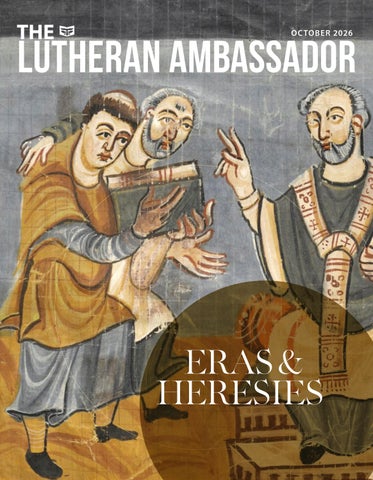
Cover artwork: Carolingian manuscript, c. 831. Rabanus Maurus with Alcuin dedicating his work to Archbishop Otgar of Mainz. O c tober 2026
3
CAROLINGIAN
RENAISSANC O
ne of the greatest tools that we have to fight against heresy is Christian education. We find a major push for Christian education during the reign of Charlemagne and the Carolingian Renaissance. However, as Christians looking at the life and legacy of Charlemagne, we find ourselves in a bit of a conundrum. Charlemagne, the so-called “Father of Europe,” expanded the reach and influence of Christianity across Europe on a scale the world had never seen before. In a way, this helped spread the gospel message of Jesus Christ because some form of Bible reading was happening in the newly established churches of those areas—and we know that God’s Word doesn’t return void. But Charlemagne’s expansion often came at the point of the sword through forced conversions and baptisms. Across Charlemagne’s growing empire, Christian beliefs and practices varied widely. If he wanted a unified Christian empire, he was going to need more than military strength. 4
THE LUTHER AN AMBASSADOR
As Romans 10:14 says, “How, then, can they call on the one they have not believed in? And how can they believe in the one of whom they have not heard?” Enter Alcuin of York, a deacon, schoolmaster, and librarian from Northumbria. Charlemagne first met Alcuin in March 781 when they crossed paths in northern Italy. Alcuin made quite an impression. Charlemagne was so convinced by Alcuin’s ideas that he invited him to join his royal court at Aachen, in what is now western Germany. There, Alcuin began educational reforms that western society still benefits from today. At the Palace School at Aachen, Alcuin educated Charlemagne and his royal household. Simultaneously, he began educational reforms that included collecting as many writings from the early Church fathers as possible. The Bible itself was often found as fragmented books of the Latin Vulgate. Very few individual churches had a complete Bible, and because of hundreds of years of hand copying, there
By Annie Pedersen
CE were quite a few errors and inconsistencies to be found in the manuscripts of various churches and monasteries. Under Alcuin’s influence, Charlemagne pushed for a standardized version of the Latin Vulgate to be produced and distributed throughout his empire, which encompassed most of present-day France, Germany, northern Italy, and parts of central Europe. Alcuin’s influence also extended beyond Charlemagne’s empire into the British Isles. Alcuin reformed education
in schools, educated clergy, corrected manuscripts, and helped standardize worship across the empire. One reform that may seem small to us today was the standardization of writing conventions. Spaces between words, lowercase letters, and punctuation might seem like an obvious necessity to us as modern readers, but at the time they were not used consistently or at all. Canyouimaginetryingtoreadabookiftheentirethinglookedlikethis? Alcuin and other Carolingian scholars helped regulate the practices of using spaces and punctuation, making texts easier to read for both royalty and the everyday person. Alcuin knew that clearer Bible manuscripts and better-educated clergy would go a long way toward teaching common people the Christian faith in Charlemagne’s now vast empire. Alcuin was also responsible for tackling a major heresy of the time, which was coming out of Spain, called “adoptionism.” This teaching basically argued that according to his divine nature, Christ is God’s natural and eternal Son. But according to his human nature, Christ is God’s adopted Son. To many people, it might seem like splitting hairs, but to Alcuin, the core Christian doctrine about God the Son, his incarnation, was at stake. Adoptionism divided Jesus into two different people. The truth that Alcuin fought for is that Jesus is God’s natural Son, while we become adopted children of God by grace. Adoptionism stands starkly against what had already been written in the Nicene Creed (AD 325), which claims that Jesus is “God of God, Light of Light, very God of very God, begotten, not made.” Why was Alcuin able to argue against this heresy so effectively? He valued biblical literacy. He prioritized both correcting biblical manuscripts that contained errors and gathering the writings of the church fathers and early creeds. What an undertaking that must have been in a time when literature was still handwritten primarily on animal skins! Think of Alcuin the next time you try to read a hashtag. Spaces and punctuation matter, and so does pure doctrine. Pedersen is a member of Our Saviour’s Evangelical Lutheran, Cannon Falls, Minn. Artwork: “Eight Seated Bishops,” by Raphael, 1516, Kunst Palast. “Saint Alcuin,” Tyrolean, 16th century, National Gallery of Art. O c tober 2026
5
THIRTY YEARS’
WAR By Leeanna Lunn
M
any people might have said Emperor Ferdinand II’s heart was in the right place. Out of all the political leaders roped into the Thirty Years’ War, he stands among the few who genuinely believed they were doing the Lord’s work. Unfortunately, Ferdinand forgot that “human anger does not produce the righteousness that God desires” (James 1:20). By taking matters of church and state into his own hands, he achieved the exact opposite of his goals, and the repercussions affect us all today. In a country where religious freedom is law, it is easy to forget that during the Protestant Reformation, state and church were so closely entwined as to be indistinguishable. It was considered a major step in 1555 just to allow each region to worship as its ruler desired. Even then, choices were limited to two: Catholic or Lutheran. While modern historians often frame the war as motivated by petty religious squabbles, the reality is that religion and politics were the same thing in the mind of 17th-century Europe. When Holy Roman Emperor Rudolf II signed the Letter of Majesty in 1609 allowing Protestants to worship freely in Bohemia, he did so only to gain political support. When Protestant nobility threw Catholic messengers out of the window for a second time, self-governance and the right to tax the peasantry reigned much higher in their hearts than their mode of worship. When thirty years of war followed—devastating the heart of Europe beyond anything 6
THE LUTHER AN AMBASSADOR
before or after for more than 400 years—a thin veil of religious fervor did little to hide the powergrabbing and land-seizing that truly motivated noble hearts. Little did the religious choices of the aristocracy matter to the everyday man robbed of hearth and home to the point of searching church graveyards for sustenance. Nowhere was this better demonstrated than with John George I, elector of Saxony—also known as “Beer George” by Swedish troops. This elector cared about one thing: his freedom to drink as much beer as he wanted without interference. Despite ruling the most powerful Lutheran region in Germany, he allied with Catholics because he knew the Calvinist leader of the Protestants would not tolerate his binges. But when the Holy Roman Emperor became a hard-liner, Beer George dropped him and ran to the Protestants. The moment Lutheran Swedes stepped on his soil, however, he turned tail back to the Catholics, continuing to taunt a local preacher who dared call him out by sending his parish 49 and three-quarter barrels of beer each year to ensure the priest did not “overdo it.”
To call this war a religious war is a gross oversimplification—except for one man. Emperor Ferdinand II was a firm believer in Catholicism to the point of defying the Holy Roman Emperor’s edict granting religious freedom to Protestants. He honestly believed it was his job to rid his realm of heretics and protect his nation from insidious teachings that threatened its way of life. Bohemia, over which he reigned as king, was historically, legally, and fundamentally a Catholic realm as far as he was concerned, and the only way to restore it was to rid it of foreign unbelievers. He committed political suicide repeatedly to achieve what he saw as the will of God: a unified Holy Roman Empire under one religion, turning the hearts of the people to Christ. Except the exact opposite happened. Rather than unify the Empire under the Catholic flag, Ferdinand pitted Catholics and Lutherans against each other to the point that previously inconsequential Protestant groups gained enough power to win their own freedom. From that point on, Christianity has struggled to pull its eyes from internal divisions back toward the cross of Christ and the desperate need of the lost. Rather than turn hearts to Christ, Ferdinand created a narrative of religious war and a culture
of Christian infighting that stains the Church to this day. The Thirty Years’ War and our behavior since give the world grounds to shun the Church for forgetting that Christ’s intended mark for his bride is not pure doctrine, perfect understanding, nor pious requirements. Rather, Christ called us to “Love one another. As I have loved you, so you must love one another. By this everyone will know that you are my disciples, if you love one another” (John 13:34–35). So, was Ferdinand’s heart in the right place in desiring his nation to unite in their love for Christ? Yes. But Ferdinand forgot how God calls us to pursue this goal: not by power, politics, or the schemes of man, but by the simple, powerful, self-sacrificial love of one person for another as they pursue the heart of Christ. “Therefore I would be very glad (I say it again) if men would open their eyes and ears and take this to heart, lest some time we may again be led astray from the pure Word of God” (Large Catechism). Lunn is a member of Word of Life Free Lutheran, Upsala, Minn. Artwork: “Il Brescianino delle Battaglie,” Francesco Monti, c. second half of the 17th century, Wikimedia Commons. “Portrait of Ferdinand II,” anonymous, c. 1614, Kunsthistoriches. O c tober 2026
7
I
By Pastor David Johnson
n 1932, several nations gathered in Switzerland to discuss a host of issues arising from the consequences of the first World War, specifically, reparations and elements of the Treaty of Versailles. It would eventually be known as the Lausanne Conference. However, in 1974, another Lausanne Congress was held—but for a very different reason. The theme of this conference was, “Let the Earth Hear His Voice,” and its representatives came to Austria to discuss the question, “How do we evangelize the lost around the world?” It wasn’t the first conference of its kind. However, this time 150 nations from around the world sent representatives to address the spiritual hunger facing each person on earth. The 1974 Lausanne Congress called 2,500 attendees to reflect on the idea that the Church holds the key that will unlock an eternity of answers for our lost world. The members of the Lausanne Congress were determined to see to it that a world full of lost sinners would be exposed to the gospel of Jesus Christ. One of the key figures in attendance, Rev. John Stott, made this observation: “Many a conference has resembled a fireworks display. It has made a loud noise and illuminates the sky for a few brief brilliant seconds. What is exciting about Lausanne is that its fire continues to spark off other fires.” But to put this gathering in some kind of context, we need to go back to Scripture, to Jesus’ own words: “All authority has been given to Me in heaven and on earth. Go therefore and make disciples of all the nations, baptizing them in the name of the Father and the Son and the Holy Spirit, teaching them to observe all that I commanded you; and lo, I am with you always, even to the end of the age” (Matthew 28:18–20). Though spoken to the first disciples, this Great Commission challenges each believer to take Christ’s teaching and pass that transforming gospel message on to other lost souls like themselves. Jesus’ disciples were assigned the task of making more disciples and building the Church (Christ’s Body) as they went about their daily routines. Today, we often quote the text, but do we actually live out that injunction? That is why the Lausanne Congress was called. Many years ago, I stood before my leadership team and asked them, “How do we best evangelize our community?” One man spoke up by
8
THE LUTHER AN AMBASSADOR
suggesting we send out evangelism teams to share the gospel. Another expressed the need to meet the various humanitarian issues facing our small town: a food pantry, a clothing drive, a car-care shop, etc. Soon the battle was on as to how to best live out the Great Commission. To say the least, there was more arguing than action. That is, until another man, expressing the wisdom of Solomon, said, “We need to do both.” And he was right. The answer to living out Jesus’ Great Commission is not in the proclamation of the gospel alone; we also need to show people the love of God in tangible ways. That is what came from the Lausanne Congress. There were plenty of ideas centered on proclamation and instruction. The Word of God—the gospel—must be preached. But it must also be lived, applied, and practiced within the sight and experience of the lost souls around us. After all, Jesus not only preached to the masses, but he also worked his miracles and served the needy who gathered around him. Those attending the Lausanne Congress of 1974 hoped to see the world evangelized by the year 2000. Missiologist Dr. Ralph D. Winter put an even finer point to the message in his plenary address. He introduced the concept of “unreached people groups” to refine the common understanding of unreached nations. But the sad reality is that there are still lost souls we encounter every day all over the world. And if that truth exists, our mission remains. The Great Commission still stands before us. The 1974 Lausanne Congress produced a statement that began, “We, members of the Church of Jesus Christ, from more than 150 nations, participants in the International Congress on World Evangelization at Lausanne, praise God for his great salvation and rejoice in the fellowship he has given us with himself and with each other.” And went on to declare, “Jesus Christ, being himself the only God-Man, who gave himself as the only ransom for sinners, is the only mediator between God and people. There is no other name by which we must be saved. All men and women are perishing because of sin, but God loves everyone, not wishing that any should perish, but that all should repent.” Oh, how we need that commitment to live gospel-centered lives today! Johnson serves Living Faith Free Lutheran, Larimore, N.D., and Middle Grove and Ness Lutheran, Mikinock, N.D.
LAUSANNE O c tober 2026
9
By Pastor David Niemela
Pelagian ISM “M
y faith in humanity was restored.” You may have heard this statement connected to heartwarming stories about feeding the homeless or saving a cat in danger. I don’t want to ignore the fact God can provide through such works. Nor do I want to ignore that a person’s God-given conscience feels good after accomplishing such service. The problem I want to address is that faith in humanity, belief in humanity’s basic goodness, is a recapitulation of ancient heresy. The face of this heresy is Pelagius, a teacher in the 5th century A.D. His heresy was labeled as “Pelagianism.” Concerning the nature of man and sin, Pelagius asserted that man is born without sin, in the same state Adam was before the fall. This is because, he believed, the sin Adam committed did not substantially damage human nature. Thus, Pelagianism is the belief that humans grow up to sin because of bad role models. Nonetheless, they have the continued ability in themselves to say “no” to sin and live righteously before God. Furthermore, Pelagianism taught that God’s grace is found in God’s commandments and Jesus’ example. Since, as stated earlier, man’s nature was not harmed by sin, Pelagianism affirms he is free (not bound by sin) to follow God’s commands and Jesus’ example. That’s what man basically needs, because he is basically good. Man, then, follows God’s law by his own efforts. Forgiveness through 10
THE LUTHER AN AMBASSADOR
the cross is acknowledged by Pelagianism, but, because of its teaching that man is good, forgiveness can be pictured more as sweeping dust off a shelf rather than dealing with a rotten apple. Augustine, Pelagius’ contemporary, is remembered as the chief opponent of Pelagianism. The following are some Scriptures Augustine employed in the battle. Romans 5:12 states, “Therefore, just as sin came into the world through one man, and death through sin, and so death spread to all men because all sinned ...” Sin came through one man, Adam. This verse and the subsequent passage emphasize that all people were affected by the fall of Adam into sin. This rottenness in our nature is what we call “original sin.” It is passed down to us from Adam through our parents. From original sin comes actual sin: thoughts, words, and deeds against God’s law. Pelagius believed in actual sin while denying original sin. In John 6:44, Jesus tells us, “No one can come to me unless the Father who sent me draws him.” This is in line with the teaching that man’s nature is damaged by original sin. His proclivity is toward sin, not God. So the Father must send his Spirit in the Word to draw us to Christ, since we are by nature unable to do this ourselves. Once coming to Christ, lest we try to finish the job ourselves, we need Philippians 2:13, “For it is God who works in you, both to will and to work for his good pleasure.” In this passage, we
see that God not only commands us what to do but also works in us to help us to will and work to that end. Both of these promises tell us God is with us from the beginning until the end of our lives, aiding us with his grace found in Jesus. Pelagianism isn’t a modern, organized religion. But it still threatens the Church today, specifically with two related errors. First, a danger can come from the same motive Pelagius himself had: moral reform of the Church. “We need to get serious about our Christian life,” someone might say. No doubt we should, but where should the emphasis for such reform lie? It shouldn’t be in our efforts, lest we make yet another self-help religion. Instead, the focus should be on Christ: His work for and through us. Second, because Pelagianism teaches that humans are born righteous, without sin, this belief can evolve into the excuse, “I was born this way.” This is the belief that the natural proclivities we carry with us into this world are excused before God. This is especially connected with sexual desires—both same-sex and opposite-sex perversions. The truth is, we all were born this way: lustful, prone to hate, deceptive—fill in the blank with your natural pet sins. Our birth solved nothing, nor excuses anything.
Only Christ’s birth, without sin, led to our new, spiritual birth unto eternal life. Much more could be said about God’s truth in contrast to Pelagianism’s lies. I point you to Luther’s Small Catechism and Explanation for further insights, specifically questions 103–105, 114–117, 210–211, and 223–227 and their related Scriptures. When someone expresses to you, “My faith in humanity was restored,” ask, “Why was your faith in humanity lost in the first place?” That lost faith points to the truth: man isn’t worth trusting in regard to eternal matters. Augustine and the Church won the day back in the 5th century. It wasn’t because they were stronger than Pelagius and his supporters (after all, why would they trust in themselves?), but because that doctrine, which they confessed, is true and living and is sustaining the Church beyond the 5th century to eternity. Niemela serves Abiding Faith Free Lutheran, Ortonville, Minn. Artwork: “Expulsion from the Garden of Eden,” by Thomas Cole, 1828, Wikipedia. “Pelagius,” unknown, c. 1500, Wikipedia. O c tober 2026
11
W
hen Christians fight with each other, it hurts. And sometimes, when Christians are hurting, it causes them to fight each other. Many of us have personal experience with these things. Any of us can see how these two things can play into each other and create a nasty downward spiral. When Christians fight—whether it’s between spouses, family members, friends, or congregation members—it has a disorienting effect on us, and it leaves us asking hard questions. It’s vital that we answer those questions with truth. “How in the world could anyone who says they are a Christian do that?” Well, the truth is, Romans 7 and Genesis 3 tell us that Christians can sin because we all still have an old, sinful nature. If we ever do anything good, it’s a miracle of grace (John 15:5), but until this old flesh dies, we wrestle with sin. Sometimes that wrestling match with temptation looks like John the Evangelist following Christ all the way to the cross despite the danger. 12
THE LUTHER AN AMBASSADOR
Sometimes our struggle with temptation looks like Peter failing Jesus but repenting and being forgiven by him anyway. And sometimes it looks like Judas. Our new hearts in Christ know that we should walk like John but that sinners can always repent and be restored like Peter. When we are hurting, though, we don’t always want Peter to be forgiven. Sometimes our wounded hearts want to hang Peter with Judas. In the wake of sin and betrayal, it’s pretty easy to silence Christ’s voice and listen to the voice of our wounded hearts instead. When this happens, we’ll answer questions like “How could they do that?” with words like “Because they aren’t as Christian as me.” The problem with that answer is that instead of listening to Jesus, you are listening to the same old sinful heart that your betrayer was listening to when he or she hurt you. This is essentially the dynamic that gave rise to the historically famous heresy of Donatism. In the third and fourth centuries, some of our brothers and sisters stood
For they were not worse than that betrayer Judas, with whom the apostles received the first sacrament of the supper, although they already knew that a guilty man of such a great crime was among them; and yet the filth in another’s heart did not defile them, and yet you dare to rebaptize Christian brothers. All you who rejoice in peace, now judge what is true.1
By Pastor Kevin Hall
DonatISM
strong in the face of persecution, offering even their suffering as a gift to the Church and her Lord. Many, though, failed and were later restored. Afterwards, the hurt and the division lingered. Bad answers to tough questions became acceptable to some itching ears. Hurts created divisiveness. Division inflamed hurts. Essentially the Donatists’ thinking became, “No real Christian would fail like that. If this guy failed, it’s because he’s not actually one of us.” Later questions arose: “If that guy’s not one of us, how can he baptize? He can’t give what he himself never had.” And just like that, the Donatist heresy was born. It sounded logical, but it directly contradicted I Peter 3:21, Romans 6:4–8, and many other Scriptures. When we speak of Donatism today, theologians mainly mean something like “a heretical teaching that denied the efficacy of sacraments administered by anyone deemed to be outside of the Church.” Donatism as a doctrine is widely and precisely rejected. Donatism as a practice, however, is not. The impulse to judge someone’s salvation by their lived experience, instead of by what Christ says about them—just because we’re angry with them—continues to wound and divide Christians. No Christian era seems to be exempt. What the Donatists failed to understand is that the
purity or “filth” of a Christian administering a baptism has no ability to obstruct the power of Christ. It’s absurd to say, “The scalpel has no heart, so how could it give a heart transplant?” The scalpel is just a tool with nothing to give. The Great Physician supplies the power. The same is true of a Christian administering Holy Baptism. When we doubt that it is solely Christ and his Holy Spirit who empower the means of grace, we heretically add human purity as a prerequisite to salvation. The inverse can happen also. If we demand human perfection as evidence of salvation, we spit on the cross of Christ and hold in contempt his appointed means of grace. So, we don’t just reject Donatist doctrine and practice because it’s incorrect. We reject it because it’s a rejection of the grace of Jesus Christ. Jesus, who patiently walked with Judas and graciously restored Peter, is not going to turn his back on those who fail in our era either. That’s a truth we can rejoice in. Hall serves Hegland Free Lutheran, Strandquist, Minn., and Westaker Free Lutheran, Newfolden, Minn. Artwork: “Landscape with the Baptism of the Eunuch,” by Herman van Swanevelt, c. 1634, Rijksmuseum. “Psalm against the Party of Donatus,” Augustine, Humanitext Reader, 1.253-1.257. 1
O c tober 2026
13
GnosticISM
T
his year, my wife and I had the immense joy of welcoming our daughter into our arms. She is our fifth-born and first girl. This pregnancy was the first we waited until birth to discover the baby’s gender. At birth I announced (to my wife’s shock and delight), “It’s a girl!” To some, this announcement is repulsive. “Gender is not what is between your legs, but what is between your ears.” To some, the body itself is repulsive—merely a disposable piece of matter distinct from a person’s being. These ideas are not new. Meet Irenaeus. Born in AD 130, he was a student of Polycarp. Polycarp was a student of the Apostle John. Not a bad résumé. Irenaeus served as a bishop in Lugdunum in Gaul (modern-day Lyon, France) for more than 20 years. It was a time of intense persecution. His successor was martyred. But what kept Bishop Irenaeus up at night was not persecution; it was a popular heresy—Gnosticism. Don’t let your eyes glaze over. Gnosticism is a big word, a broad topic, and hard to define comprehensively. Rooted in pagan culture, Gnosticism views the material world as evil—even the source of evil. Nancy Pearcey observes that Gnosticism treats “creation as a kind of fall of the soul from the higher spiritual realm into the corrupt material realm” (Love Thy Body, p. 35). In the Gnostic worldview, the physical world originated from an inferior being or lesser god. The goal, then, is to achieve gnosis (Greek for “knowledge”)—to find a spark of divinity or inner light that is trapped in each of us. Following this logic, the material world, especially the human body, is only a hindrance to true spirituality. Dear Christian, Gnosticism is wholly contrary to the teaching of God’s Word. The material world is the creation of God Most High. As such, it is good. This goodness is declared repeatedly by God himself (Genesis 1:10, 12, 18, 21, 25). Humans are created by God from the dust of the ground, given the breath of life, and graced with his stamp of approval as “very good” (1:31). In the words of Irenaeus: “The glory of God is man fully alive.” The value and goodness of the created world permeate every page of God’s Word. While Gnostic deities would distance themselves from the created world, our God 14
THE LUTHER AN AMBASSADOR
entered it. Jesus was born in Bethlehem with a physical body. Scandalous! Indeed, “the Word became flesh and dwelt among us” (John 1:14). Can’t be! “For in him the whole fullness of deity dwells bodily” (Colossians 2:9) and “He himself bore our sins in his body on the tree” (I Peter 2:24). Inconceivable! Pearcy writes: When Jesus was executed on a Roman cross, we might say he “escaped” from the material world, just as the Gnostics taught we should aspire to do. But what did he do next? He came back—in a bodily resurrection! To the ancient Greeks, that
By Pastor Matthew Pillman
was not spiritual progress. It was regress. Who would want to come back to the body? … Not only did Jesus rise from the dead but he also ascended into heaven. … Christ’s taking on of human nature was not a temporary expedient, to be left behind when he finished the work of salvation. Because he was taken bodily into heaven, his human nature is permanently connected to his divine nature (p. 37). How do you view the physical world? Is it a temporary reality that you can’t wait to escape? Or is it God’s gracious creation Christ came to redeem? Gnosticism continues to rear its ugly head today. Here
are two examples: First, consider the desecration of the human body. The sexual revolution is rooted in Gnostic thought that the person is distinct from the body. Abortion is okay if the living “clump of cells” is not a person. Hookup culture treats sex as mere physical recreation, not a personal relationship. Gender is decided through inner feelings, not biology. How dare we say at birth: “It’s a girl!” Friends, human meaning and value are given by our Creator. We can and should continue to affirm that we are created good—body, soul, and spirit! Evil is an aberration, not innate to the physical world. Second, consider embodied worship. Whereas the sexual revolution promotes a person/body divide, Christian life can be confused by a sacred/ secular divide. “Don’t allow physical things to distract us from Christ.” Wait, what about the incarnation? Historically, Christian worship was and is richly embodied. We engage our senses. We see beautiful stained-glass images that teach the gospel, from Genesis to Revelation. We stand, kneel, smell, speak, hear, and sit in silence. We taste Holy Communion. We feel the water of baptism. Embodied worship is beautiful and good. Holy Communion is a prime example. This is a blessed sacrament where spiritual and physical realities are one. Christ gives us his body and blood connected to the promise that our sins are forgiven. Irenaeus writes, “Just as bread from the earth, when it receives the invocation of God, is no longer common bread but the Eucharist, made up of two elements, one earthly and one heavenly, so also our bodies, in receiving the Eucharist, are no longer corruptible, for they have the hope of resurrection.” Praise God for the good and beautiful world that he has created. Praise God for the incarnation where our flesh-andblood Savior redeemed humanity. Praise God for his good gifts, given to us incarnationally now, preparing us for the physical reality of heaven! Remember: “The glory of God is man fully alive.” Pillman serves Emmanuel Lutheran, Ankeny, Iowa. Artwork: “Heraclitus” and “Democritus,” Hendrick ter Brugghen, 1628, Rijksmuseum. For more of Irenaeus’ teaching on Gnosticism, read his book, Against Heresies. O c tober 2026
15
MINISTRIES / JOURNEY MISSIONS
Generational service. BY PASTOR JON NELSON
J
Mission opportunities. Upcoming short-term mission trips with Journey Missions: • Brazil: Jan. 27–Feb. 12, 2027 Participants will travel to ministries in Bateias and Campo Mourão. The cost is $3,200. • Puerto Rico: May 22–28, 2027 Participants will work with Hunger Corp, a community development ministry. The cost is $1,100 + airfare. For more information and to apply for a trip, visit our website at: • aflcworldmissions.org/journeymissions Nelson, a member of Hope Lutheran, Minneapolis, is the department head of Journey Missions. 16
THE LUTHER AN AMBASSADOR
ourney Missions exists to give people an opportunity to step outside their normal routines and experience ministry firsthand alongside the global Church. Through short-term ministry trips, participants engage in practical service and encourage missionaries and ministries around the world. But Journey Missions is about more than simply taking a trip. It’s about helping people see God at work beyond their own communities, growing in faith, and discovering what it means for the Church to serve together. One of the lessons that continues to stand out from these experiences is the value of intergenerational ministry. The Church is at its best when people of different ages and stages of life serve alongside one another. Scripture presents faith as something that is lived out and passed on within a community and across generations. Ministry trips provide a unique setting for those relationships to develop as people worship, pray, and serve side by side. For younger participants, ministry trips provide opportunities to see mature believers live out their faith in real situations. They watch parents and grandparents pray with others, respond to challenges, persevere through unfamiliar circumstances, and demonstrate patience and compassion. Rather than hearing about what mature faith looks like, they experience it firsthand. Younger believers bring energy, flexibility, creativity, and enthusiasm to the mission field. Their willingness to embrace unfamiliar situations can encourage older participants to step beyond their own routines. As generations serve together, relationships grow and the Church becomes stronger. This unity also communicates something meaningful to the communities we serve. Generational ministry demonstrates that the work of Christ belongs to the whole Church. Missions is not limited to one age group or stage of life; it is a calling we share together. Our upcoming trip to Brazil is a wonderful opportunity to put these values into practice. The team will support ministries in Bateias and Campo Mourão through work projects and vacation Bible school. Participants will spend time at the ARCA camp and the Miriam Home and will help with and attend Carnival Camp. Throughout the trip, the team will have opportunities to spend time with our missionaries, learning from their experiences and joining them in ministry. These hands-on opportunities are an important part of the Journey Missions experience. And cultural immersion is an important part of the journey. Worshiping and serving with believers from another culture reminds us that the body of Christ is much larger than our local context. We hope that every trip will strengthen those who go and the communities they serve. Participants often return with a deeper burden for missions, a renewed understanding of the gospel, and a clearer sense of God’s calling. Just as importantly, their experiences can encourage a sending congregation to see its role in God’s mission.
MINISTRIES / HOME MISSIONS
Spiritual vitality. BY PASTOR ANDY COYLE
S
piritual vitality is more than activity, numbers, or programs. It begins with people who know the Triune God, receive his gifts, are being formed into the likeness of Christ, and live out their faith in the congregation, their homes, workplaces, and communities. Healthy congregations are made up of people who are growing in Christ. This fall’s Renewal Conference will explore both personal and congregational spiritual vitality: how God gives life to his people and how that life shapes the communities we share. The conference has three goals: to inspire a deeper hunger to know God, strengthen our vision for the congregation as God’s instrument for discipleship and mission, and provide practical tools for pursuing personal and congregational health. Andy Coyle will begin with “The Vision for Spiritual Vitality.” Vitality and piety belong together, but they are not identical. Piety describes the outward shape of Christian devotion; vitality is the Spirit-given life within it. This session will develop a gospel-optimistic vision of spiritual growth and God’s work of forming his people into the image of Christ. Dana Coyle will follow with “Walk by the Spirit: The Shape of New Life in Christ.” Christian growth is often slower and more difficult than we expect. This session will consider the struggles related to being saint and sinner, confession, and the long, slow work of sanctification. Matthew Ballmann will present “Wellsprings of Life: The Means of Grace and Vitality.” Lutheran Free Church founder Georg Sverdrup described the means of grace as the “wellsprings of life.” This session will examine Word and sacrament as God’s active gifts through which he creates and sustains the life of his church. Afternoon workshops will turn toward practical dimensions of congregational life. Jason Holt will lead “Life Together in the Congregation,” exploring how God uses relationships, encouragement, accountability, service, and even difficulty to shape his people. Mark Molstre will lead “Overcoming Spiritual Apathy,” examining how apathy develops and identifying practical ways individuals and congregations can renew their attention to Christ, his Word, and the life he gives. Micah Hjermstad will present “Conflicts and Congregation,” addressing the roots of congregational conflict and the biblical path toward honest conversation, reconciliation, and restored unity. Mike Brandt will lead “Vitality, Piety for Witness,” considering how Christian piety extends beyond the congregation into vocation, relationships, service, and witness. We celebrate that God has not left his Church without the resources needed for life and renewal. He gives us Christ. He gives us his Word. He gives us his Spirit. He gives us the means of grace. And he gives us one another in the congregation. Come ready to be encouraged. Come ready to learn. Come ready to ask what God might be doing in your congregation. Most of all, come ready to be refreshed in the joy of knowing Christ and the life he gives his people.
Renewal Conference. 8 a.m.–3 p.m., October 24 Abiding Savior Free Lutheran Sioux Falls, S.D. Schedule Devotions: 8:40 a.m. Session One: 9 a.m. • The Vision for Spiritual Vitality Session Two: 10 a.m. • Walk by the Spirit: The Shape of New Life in Christ Session Three: 11:10 a.m. • Wellsprings of Life: The Means of Grace and Vitality Lunch: Noon Devotions: 12:45 a.m. Workshop One: 1 p.m. • Life Together in the Congregation • Overcoming Spiritual Apathy Workshop Two: 2 p.m. • Conflicts and Congregation • Vitality, Piety for Witness Register Childcare and lunch provided with registration. Register online at: • aflchomemissions.org/conference Coyle, a member of Grace Free Lutheran, Maple Grove, Minn., is the director of AFLC Home Missions. O c tober 2026
17
MINISTRIES / WORLD MISSIONS
Living hope in Paraguay. BY ZACH RITLAND
T
Zach and Carey Ritland. Zach and Carey Ritland are AFLC missionaries serving in Villa Rica, Paraguay, with Pastor Matthew and Ednay Abel. For more information about the Rilands and to support them, visit: • aflcworldmissions.org Ritland is an AFLC missionary serving in Villa Rica, Paraguay, with his wife, Carey. 18
THE LUTHER AN AMBASSADOR
he Lord is at work in Paraguay, the South American country that boasts the highest percentage of Roman Catholics on the continent, with statistics showing 89 percent of the population trusting in the false doctrine of the Roman Catholic Church. The Matthew Abel family has been serving and ministering in Paraguay since 2019, and in 2025, we arrived to learn and do the same. Our goal is to establish free and living congregations that can serve and minister in the community for decades to come. God is growing his Church, and we are so excited for the future of the fledgling congregation, Esperanza Viva (Living Hope). Opportunities for ministry abound, from sporadic events, like hosting a birthday party where the gospel message gets shared, to the weekly prayer meetings and women’s Bible studies. Regularly, there are evenings for married couples to learn more about God’s design and gift of marriage. Recently, on Saturday nights, we shared The Truth Project and had some new young adults attend. To keep the momentum going with the same people, we are starting to walk through material from Answers in Genesis. The children’s ministry, through kids’ club, has been wonderfully blessed by the Lord. It is a great evangelistic ministry that not only reaches new hearts and minds for Christ but also builds up the little ones who are already members of the body of Christ. It takes place in either the church or at Kurusu Renda, the property where the ministry’s recently built pavilion is located. We sing songs, play games, practice Bible memory, provide snacks, and do either a puppet show or skit that ties to our Bible lesson of the day. Many kids have been attending! A few times, by partnering with a business connected to someone from the church, we have hosted large events for kids at Kurusu Renda with more than 100 people coming. I have been very blessed with an open door to be a witness to a group of guys who play basketball at the local park throughout the week. Through playing basketball, I have been able to make friends and invite them to different church events we have going on. We look forward to the day, perhaps not far off, when we can start a sports ministry at Kurusu Renda. Please partner with us in prayer for these ministries. Pray that God’s Word would change kids’ hearts and then the hearts of their families. God’s Word is living and active, and we can pray with confidence that it will change lives. Children’s ministry is a wonderful steppingstone to minister to parents. We have already seen this through parents coming to church whose children attend kids’ club who otherwise would have nothing to do with an evangelical church. In this small church, Esperanza Viva, we faithfully labor, trusting God with the results, excitedly dreaming of the day when free and living congregations are scattered throughout Paraguay. I invite you to join us in the battle for the souls of the Paraguayans. The King of kings and Lord of lords whom we serve is at work here. May he find each of us faithful in fulfilling his call to make disciples of all nations!
MINISTRIES / YOUTH
Music teaches. BY PASTOR MATTHEW NELSON
I
have experienced the blessing of going to many Bible camps in my life. Even now as a pastor, I bring kids to Bible camps, too. One time while driving home to Fargo from the ARC (Association Retreat Center), the teenagers in the back sang camp songs and hymns for almost the entire four-hour journey! They didn’t even have the lyrics written down. It was an incredible time of worship on the road. What a blessing to hear them sing from the heart to God. I am always amazed at how people seem to be able to remember song lyrics. Sometimes it is an earworm from some catchy jingle or the theme song of a favorite show. My confirmation students tell me they have a hard time memorizing Bible verses or parts of the Small Catechism, but they seem to be able to rattle off incredible amounts of lyrics from their favorite music. Memorizing lists, like the books of the Bible or the alphabet, are made much easier when they are put to music. Maybe you’ve experienced this for yourself. But music doesn’t just get stuck in your head; it also impacts your thinking and affects your beliefs. My dad, who is a church musician, warned me when I was young about what I listened to. He told me that what went into my ears went into my mind and heart, too. He wanted me to be careful to not put lies or corruption in there but to dwell on good things from God. He would often quote this verse to me: “Finally, brothers, whatever is true, whatever is honorable, whatever is just, whatever is pure, whatever is lovely, whatever is commendable, if there is any excellence, if there is anything worthy of praise, think about these things” (Philippians 4:8). Music also brings us together as we teach each other and learn to sing the same songs. As I visit people from my congregation, I will sometimes bring one or more of my four daughters with me. We gather in their room to pray for one another, confess our sins, read God’s Word, partake of Christ’s body and blood, and sing. We don’t usually have hymnals or projector screens to read lyrics from. There isn’t even an organist, pianist, or band of musicians to accompany us. But as I turn and ask my girls, “What should we sing together?” I find that we have many songs hidden in our hearts. I wish you could see everyone’s eyes lighting up and the wide grins of joy as we sing together familiar songs like “Jesus Loves Me.” These beautiful saints who are separated by 80 or 90 years of life are brought together in worship of the One true God and Savior! The songs we sing together around the piano at Sunday school, the campfire at Bible camp, the altar, the dining room table, or even in the car are impactful and powerful tools for shaping us and informing our faith. Keep singing songs that point to Christ, proclaim the gospel, and honor our maker. Teach your children and youth to follow Jesus so that when they are old, they will not depart from him.
“Be filled with the Spirit, addressing one another in psalms and hymns and spiritual songs, singing and making melody to the Lord with your heart, giving thanks always and for everything to God the Father in the name of our Lord Jesus Christ.” Ephesians 5:18–20
Small Catechism songs. For a resource for teaching the Small Catechism, visit: • youtube.com/@ ambassadorpublications595 • on.soundcloud.com/ K9E8H9oz7Q2DBnlrKI Nelson, a member of the AFLC Youth Board, serves St. Paul’s Free Lutheran, Fargo, N.D. O c tober 2026
19
NEWS
Upcoming Youth Ministries events Youth Worker Weekends Registration will open in October for Youth Worker Weekends, planned for Jan. 15–17, 2027, at the Association Retreat Center near Osceola, Wis. The theme for the event is “Rest in Jesus,” with session topics on dealing with burnout, keeping the Sabbath holy, and congregational involvement. Confirmed speakers include Ryan Tonneson, Brett Boe, Todd Erickson, Adam McCarlson, and Tim and Emily Herset. For more information and to register, visit aflc.org/youth. FLY Convention Registration to open in November Registration for the Free Lutheran Youth (FLY) Convention will open Nov. 3. With the theme of “Overcome,” the convention will be held July 5–10 at the YMCA of the Rockies, Estes Park, Colo. The first deadline with the best rate for registration is scheduled for Jan. 14, 2027. Subsequent deadlines are March 18, 2027, and April 22, 2027. A walk-up registration rate will be available for students and children.
Sharyn Ostrem Sharyn Lea (Whipple) Ostrem, 62, of Wakonda, S.D., died Sept. 3 at M Health Fairview St. John’s Hospital in Maplewood, Minn. Born May 23, 1964, in Osmond, Neb., she was the daughter of Donald and Carol (Dibbert) Whipple. She married Mark Ostrem Oct. 6, 1990, at Faith Lutheran Church in Stanton, Neb. She grew up in Stanton and was baptized at Golgatha Lutheran, rural Wausa, Neb., and later confirmed at Faith Lutheran in Stanton. She graduated from Stanton High School in 1982. She earned a Bachelor of Fine Arts in Music Education, a double major in instrumental and vocal music with a minor in strings, from Wayne State College. She later earned a master’s degree in vocal performance from the University of South Dakota. She performed with the Sioux City Symphony for 36 years and taught instrumental and vocal music at Hartington Public School (Nebraska), Sioux City Public Schools (Iowa), Centerville Public School, Sioux Falls Christian High School, Wakonda Public School (South Dakota), and as an adjunct professor of strings at Northwestern College in Orange City, Iowa. Sharyn studied nursing at Lake Area Technical College in Watertown, S.D., and became a licensed practical nurse and worked in various healthcare facilities. She was a member of the Turkey Creek Revival Band for 10 years, where she sang and played upright bass. Sharyn also recorded her own CD, Faith Step, which featured music she wrote and performed herself. Surviving are her husband, Pastor Mark Ostrem; her children, Lindsay (Stephen) Rogers, Irene, S.D., and Brittan (Leah) Ostrem, Centerville, S.D.; seven grandchildren; her parents, Donald and Carol Whipple, Norfolk, Neb.; two sisters, Denise (Gale) Bender, Norfolk, and LaDonna (Brian) Schulz, Pierce, Neb.; and extended family. The memorial service was held Sept. 11 at Calvary Lutheran Church, Irene, S.D., with Pastor Mark Ostrem officiating. 20
THE LUTHER AN AMBASSADOR
Rea Sliper Rea Monette (Maattala) Sliper, 73, Fargo, N.D., died Aug. 13 at her home. Born Aug. 7, 1953, in Moorhead, Minn., she was the daughter of Leo and Aurlette (Axness) Maattala. She married Pastor Richard Sliper in 1982. She graduated from Moorhead High School in 1971, where she was active in choir, drama, gymnastics, and cheerleading. She attended Golden Valley Lutheran College and later graduated from Northwestern College, St. Paul, Minn., with a degree in Christian ministries. After marriage, they spent 32 years in ministry, serving in Michigan, Minnesota, and Wisconsin. They retired to Fargo in 2021. She was an accomplished soloist for funerals, weddings, and church events, and she wrote and directed many plays in the churches where Richard served. Surviving are her husband, Pastor Richard Sliper; one sister, Jethe (John) Custer; one brother, Daro Maattala; one sister-in-law, Shelley Maattala; and many nieces, nephews, and extended family members. A service was held Aug. 22 at Hanson-Runsvold Funeral Home, Fargo, N.D., with Pastor John Custer and Pastor Richard Sliper officiating. Burial was in Riverside Cemetery, Fargo.
Pastor Steve Junker Pastor Stephen Duane Junker, 58, of Elbow Lake, Minn., died Sept. 4 at Mayo Clinic, Rochester, Minn., following a devastating spinal cord injury. Born July 31, 1968, in Edina, Minn., he was the son of Vernon and Joan Junker. He married Jeanine on December 19, 1992. He grew up in Redwood Falls, Minn., and later attended Southwest State University in Marshall, Minn., where he met Jeanine. Following college, they moved to Elbow Lake, Minn. He graduated from pharmacy school at Creighton University in Omaha, Neb., and dedicated himself to the care of others as a pharmacist. Later, answering a deeper calling, he attended the Lutheran Brethren Seminary in Fergus Falls, Minn., where he earned his Master of Divinity and became an ordained minister. He joined the AFLC clergy roster, and for nearly a decade, he served the congregation and community at Chippewa Lutheran Church in Brandon, Minn., with devotion. Being a minister was among the greatest joys and honors of his life. He was known for his animated sermons, his love of a good conversation on nearly any subject, and his readiness to help anyone in need, whether that meant offering counsel or simply producing the right tool for the job from his ever-prepared pockets. Surviving are his wife, Jeanine; five children and their spouses, Elizabeth Junker (Benjamin Lee), Benjamin (Laura) Junker, Nathaniel Junker, Victoria (Ya-Shen) Hong, and Josiah (Maddie) Junker; one grandson, Jonah Junker; his parents, Vernon and Joan Junker; and one sister, Sarah. The service was held Sept. 11 at Chippewa Lutheran, Brandon, Minn., with Pastor Troy Tysdal officiating. Memorials may be sent to Chippewa Lutheran.
NEWS
International Orality Institute breakfast The International Orality Institute will host a testimony breakfast from 8 to 10 a.m. Saturday, March 13, at Emmaus Lutheran Church in Bloomington, Minn. The event will give supporters an opportunity to hear about IOI’s expanding international ministry as well as testimonies from local individuals who are seeing friends trust Jesus through sharing the stories of God’s Word in their everyday lives. All are welcome to join IOI’s ministry event for pancakes, eggs, and sausages in celebration of what the Lord is doing. For more information, visit IOI’s website at oralityinstitute.org or email Kevin Olson at kevino@oralityinstitute.org.
All Boards and Pastors’ Conference
AFLC All Boards Conference The AFLC All Boards conference will be held Oct. 5–6, followed by the AFLC Pastors’ Conference on Oct. 6–8. Members of all of the AFLC boards and committees will meet on the campus of the AFLC Schools and administration building in Plymouth, Minn. Beginning on Monday, Oct. 5, the boards and committees will meet for regular business meetings. On Tuesday, Oct. 6, a large group meeting will be held in the Hauge Chapel basement classroom. The schedule includes the installation of new board and committee members at 8:30 a.m., followed by a session on “The ‘Why’ of AFLC Development,” by Pastor Micah Hjermstad, AFLC president, and Mark Sivertson, director of Development. Following a break, a member from each board or committee will share a brief update on their respective ministry.
AFLC Pastor’s Conference The AFLC Pastor’s Conference will be held at the Association Retreat Center, located near Osceola, Wis. The theme of this year’s conference is “Renewed by Hope” from Isaiah 40:31. Confirmed speakers include Pastor Peter Franz, Pastor Micah Hjermstad, Pastor Randy Nelson, Faith Nelson, Dr. Jason Holt, and Dr. Nathan Olson. An opening service will be held at 7 p.m. on Oct. 6. Sessions on Oct. 7 will be held at 9 a.m., 10:10 a.m., 11:05 a.m., and 1:15 p.m. A banquet will be held at 5:30 p.m., followed by vespers and an open discussion. Thursday morning’s schedule includes two sessions at 9 a.m. and 10:45 a.m. The conference will close following lunch. For more information and to register, visit the AFLC website at aflc.org/ pastorsconference.
Upcoming events at the Free Lutheran Bible College and Seminary The Free Lutheran Bible College and Seminary will host several upcoming events on their Plymouth, Minn., campus. For more info, visit flbc.edu/events. Spotlight: Step Into the Story Former Broadway actor Stephen Trafton will perform “Living Letters: Philippians” as an immersive theatrical experience at the fall Spotlight: Step Into the Story event planned for the evening of Oct. 4 in Hauge Chapel. Trafton is the co-founder and executive director of Resound, a ministry based in Orlando, Fla., with a mission to share the love of God through the arts outside of church walls. On Monday morning, Oct. 5, Trafton will lead three sessions on worship, the arts, and how the Church can engage culture with beauty, wonder, and creativity. In the opening session (9 a.m.) called “Witness: Leaving Room for Wonder,” Trafton will offer promising pathways into Christianity that invite, form, and deepen faith. In the second session (10 a.m.), titled “Word: Becoming a Living Letter,” Trafton will help students bridge the gap between the ancient world and the modern one, from text to transformation, from Word to worship. And in the third session (11 a.m.) titled “Worship: Shining as Lights,” Trafton will discuss what it could look like for the Church to be a visible sign of unity in a divided world. UpClose and alumni tournaments Junior and senior high school students and recent graduates are invited to attend a free two-day preview event in which they will be welcome to sit in on classes, attend chapel and vesper services, play volleyball and basketball, and meet current students and professors. The event will take place Oct. 15–16. The alumni tournaments will follow, beginning at 6 p.m. on Oct. 16 with the women’s basketball tournament, immediately followed by the men’s basketball tournament. The men’s basketball tournament continues at 9 a.m. on Oct. 17, with lunch served at noon for registered attendees. A family room will be offered from 6 to 8 p.m. Friday and 10 a.m. to 2 p.m. Saturday. Men’s team registration is $375 and $55 per individual; women’s team registration is $150 and $25 per individual. There is a $5 fee for lunch. Register online at flbc.edu/ alumnitourney2026. O c tober 2026
21
NEWS
PEOPLE & PLACES Pastor Tim Johnson has announced his resignation from Christ the King Free Lutheran, Pipestone, Minn., effective Feb. 1, 2027. Johnson plans to retire from full-time ministry and is open to interim work. Pastor Jon Benson resigned from Newark Lutheran, Newark, Ill., and has accepted a call to Living Word, Mankato, Minn. He will begin his service there on Oct. 1. Col. John Eidsmoe has accepted a call as interim pastor at Zion Lutheran Church, Silverhill, Ala. Pastor Caleb Korhonen, a 2026 Free Lutheran Seminary graduate, was installed Aug. 23 at Maple Bay Free Lutheran, Mentor, Minn., with Pastor Terry Olson officiating. Pastor Alexander Grimes, a 2026 graduate of the Free Lutheran Seminary, was installed Sept. 13 at Alsace Lutheran, Reading, Pa., with Dr. Wade Mobley, president of the Free Lutheran Schools, officiating. Living Stone Fellowship, which meets at the Hospitality Center for the Chinese, St. Paul, Minn., was removed from the AFLC congregational roster by the AFLC Coordinating Committee at their request and has become a campus church of Emmaus Lutheran, Bloomington, Minn. Living Stone is served by Pastor Holmes Zhao. The AFLC Coordinating Committee approved a removal form from Crown of Life Lutheran Church, Tomball, Texas. The AFLC Coordinating Committee approved a request from Trinity Bethany Lutheran Church, Harvey, N.D., to change their district from Western North Dakota/ Eastern Montana to Eastern North Dakota.
AUGUST MEMORIALS FLBCS Rea Sliper Pam Kinneberg Pastor John Abel Pastor Keith Quanbeck Pastor Alvin Sather Lutheran Ambassador Douglas Erickson Bonita Brazier Jeanette Wahl 22
WMF Don Bright Youth Ministries Idella Behl ... in honor of Lutheran Ambassador Dr. Lyle & Corrine Mattson Farrell & Anne Erickson
THE LUTHER AN AMBASSADOR
Statement of ownership The Lutheran Ambassador Publication No. 588-620, Filed 09-11-26 Issued monthly. Twelve issues annually. Annual subscription price $0 Mailing address of Office of Publication and headquarters of General Business Office: 3110 E. Medicine Lake Blvd., Minneapolis, MN 55441. Publisher: The Association of Free Lutheran Congregations. Editor: Pastor Andrew Kneeland, 3110 E. Medicine Lake Blvd., Plymouth, MN 55441 Managing Editor: Ruth Gunderson, 3110 E. Medicine Lake Blvd., Minneapolis, MN 55441 Owner: The Association of Free Lutheran Congregations, 3110 E. Medicine Lake Blvd., Minneapolis, MN 55441. Known Bondholders, Mortgagees, and Other Security Holders: None. The purpose, function, and nonprofit status of this organization and the exempt status for Federal income tax purposes has not changed during preceding 12 months. Publication Name: The Lutheran Ambassador. Issue date for circulation data: September 2026 Total number of copies (net press run): Avg. copies each issue during past year: 2933 Copies September 2026 issue: 2914 Paid circulation: Mailed outside-county paid subscriptions stated on Form 3541: Avg. copies each issue during past year: 0 Copies September 2026 issue: 0 Mailed inside-county paid
subscriptions stated on Form 3541: Avg. copies each issue during past year: 0 Copies September 2026 issue: 0 Through outside mail sales: Avg. copies each issue during past year: 0 Copies September 2026 issue: 0 Total paid and/or requested circulation: Avg. copies each issue during past year: 0 Copies September 2026 issue: 0 Free distribution by mail: Free distribution outside the mail: Avg. copies each issue during past year: 44 Copies September 2026 issue: 50 Total free distribution: Avg. copies each issue during past year: 2662 Copies September 2026 issue: 2644 Total distribution: Avg. copies each issue during past year: 2662 Copies September 2026 issue: 2644 Copies not distributed: Avg. copies each issue during past year: 271 Copies September 2026 issue: 270 Total: Avg. copies each issue during past year: 2933 Copies September 2026 issue: 2914 Percent paid and/or requested circulation, average and September 2026 issue: 0% Publication is required and will be printed in the October 2026 issue of The Lutheran Ambassador. /s/ Ruth Gunderson, Managing Editor
AFLC BENEVOLENCES Januar y 1-August 31, 2026 rec’d in august
total rec’d to date
% of subsidy
prior year-to-date
General Fund
$32,323
$296,091
59
$334,190
Evangelism
11,138
83,623
61
81,267
Youth Ministries
9,152
90,629
59
97,398
Parish Education
10,029
91,594
49
100,839
FLBCS
43,174
547,438
60
451,850
Home Missions
15,670
202,654
53
190,883
World Missions
35,055
288,977
56
280,535
Personal Support
39,471
380,142
49
426,060
TOTALS
$196,012
$1,981,148
58
$1,963,023
fund
For additional financial information for each department, go to www.aflc.org/giving
ISAIAH / IN THE WORD
More than enough. BY PASTOR MICAH MOAN “Come, everyone who thirsts, come to the waters; and he who has no money, come, buy and eat! Come, buy wine and milk without money and without price” (Isaiah 55:1). saiah 55 takes me back to college. Perhaps you are like me and have specific, traumatic memories of the college dorm refrigerator. As one of my favorite sports announcers would often exclaim, “Do not go in there!” Oftentimes, that statement applies to the dorm fridge situation quite well. While attending the Free Lutheran Bible College, I remember one weekend in the men’s dorm being hungry, thirsty, and ready to feast. Fortunately, I had my own mini fridge. Unfortunately, it was empty. Observing the sparse conditions, some inner thoughts followed: “Where did it all go? What’s the move here? How much are McChickens now? What about actually getting a good meal at the grocery store?” It wasn’t long before my suffering mind and hungry stomach recalled the loving invitations of my mother. Home was not far. My mom would often say something like, “Come, everyone who thirsts, come to the waters; and he who has no money, come, buy and eat! Come, buy wine and milk without money and without price” (v. 1). Okay, maybe she didn’t say it exactly like that, but the invitation was similarly sweet: “Come home, Micah. The food is free. Come and eat to your heart’s content.” As great as my mother’s invitation was, the invitation of God to longing souls is far greater. “Come home. You have nothing to offer, but the food you need is free.” Much like the pointless splurges of a college student, the question is then raised, “Why do you spend your money for that which is not bread, and your labor for that which does not satisfy?” (v. 2). Instead of eating the junk food our world offers, God invites his people to “listen diligently” to him, to receive the real food and drink that we need. With undercurrents of New Testament sacramental promises, God’s Word invites us to “come to the waters” and to “take and eat.” For what reason? Verse 3 explains our deepest need: “Incline your ear, and come to me; hear, that your soul may live.” All of us need to eat the Bread of Life (John 6:35), to drink from the Water of Life (Revelation 21:6), and to hold fast to this Word of Life (Philippians 2:16). The invitations continue. “Seek the Lord while he may be found; call upon him while he is near; let the wicked forsake his way, and the unrighteous man his thoughts; let
I
him return to the Lord, that he may have compassion on him, and to our God, for he will abundantly pardon” (vv. 6–7). Praise God, he may be found! The Lord cares for the spiritually broken and the soul who is brokenhearted. He beckons us all to forsake our own ways and trust in the Way, his son, Jesus. Yet, we are warned. Our wickedness is serious and real. Further, our current dorm room is not our eternal address. Life on earth is time sensitive, carrying eternal weight. For this reason, God gives his gospel call. He calls for humanity to return. Return, for the Lord is compassionate. Return, for the Lord abundantly pardons. Return, for the accomplished victory of Jesus Christ is more than enough for you. In Christ Jesus, you can confidently say, “I am pardoned,” for you are freely declared righteous by this abundantly compassionate Savior. “For my thoughts are not your thoughts, neither are your ways my ways, declares the Lord. For as the heavens are higher than the earth, so are my ways higher than your ways and my thoughts than your thoughts” (vv. 8–9). The immeasurable compassion of God has come into our world in the person of Christ, and this undeserved pardon comes into our lives through faith in Christ. Greater than the invitation of my mother, the suffering Servant and conquering Savior has called for you and me to come home to eat and be satisfied. “Come to me, all who labor and are heavy laden, and I will give you rest. Take my yoke upon you, and learn from me, for I am gentle and lowly in heart, and you will find rest for your souls” (Matthew 11:28–29). Moan serves Bethany Lutheran, Binford, N.D., and New Luther Valley Lutheran, McVille, N.D. O c tober 2026
23
SOMETHING TO SHARE
A tooth’s testimony. BY KYLEE GREENE
W
hen I was 6, the Lord revealed himself to me in an unexpected yet incredible way. It all began when I accidentally ate my loose tooth while eating my Honey Nut Cheerios one morning. To my 6-year-old mind, the ordeal was unpleasant and traumatic. After all, who wants to be robbed of the satisfaction of holding up a prized tooth, not to mention the monetary reward left afterwards by the tooth fairy? My childish tooth dreams were crushed. All that to say, when my next wiggly tooth appeared, I worried that the same tragic fate would befall it. In bed the night of March 25, 2010, I stared up at the ceiling and worried about my loose tooth. As I did, I suddenly realized that I could pray and ask God about it. Now, that may not seem like a profound thought to have, but despite growing up in a Christian home and attending Sunday school, I did not have a personal relationship with Jesus until I was 7. I knew there was a God, but I did not yet realize that he was the God who knew me and wanted me to know him in return. Yet with faith given by the Holy Spirit, I asked the Lord to keep me from eating my tooth. It was a simple prayer, and I recall falling asleep moments later. The next thing I knew was the sound of my dad waking me up the following morning. When he told me to look at the pillow next to me, I glanced sleepily over and saw my tooth! It sat exactly in the middle and was whole, clean, and undisturbed.
The Lord had answered my prayer, and what an answer it was! Not only had he kept me from eating it again, but he had taken it out. To this day, I still wonder what method he used. When I get to heaven someday, I intend to ask him! Regardless, I know with certainty that the moment I looked at my tooth, I realized just how much the Lord cared for me. He not only cared for my simple, seemingly insignificant request, but he was “able to do far more abundantly than all [I] ask or think” (Ephesians 3:20). My tooth’s testimony reminds me of the stories of Hagar in Genesis 16 and 21, when the angel of the Lord visits her in the wilderness. Scripture records that God saw and heard her when she was utterly helpless in her circumstances. He loved her and sought her out even before she knew his name. I believe that the miracle the Lord did for me that night helped me know him and come to trust in his saving power a year later. And why did he do it? He did it because he loved me, was powerful enough, and wanted me to know him as my Savior God. Be encouraged that the Lord hears our prayers and sees the cares of our hearts. He will use them to draw us closer to himself in faith. To Christ alone be glory! Greene is a dorm assistant at the Free Lutheran Bible College, Plymouth, Minn.