THE
NOVEMBER 2026
Lutheran AMBASSADOR SCRIPTURE’S REFORMS
EDITOR’S NOTE
THE LUTHERAN AMBASSADOR NOVEMBER 2026 VOL. 64 NO.11
Reformations.
Editor
C
hurch leaders through the years have had quite a bit to say about the sin of idolatry.
John Calvin called our hearts “perpetual factories of idols.” Martin Luther said that we commit idolatry whenever we cling to something that is not God. Even Tertullian, back in the third century, said, “The principal crime of the human race, the highest guilt charged upon the world, the whole procuring cause of judgment, is idolatry.” As long as Christians have been committing the sin of idolatry, there has been the need for repentance and reformation. When we think of reformation, our minds often go to sixteenthcentury Wittenberg, Germany, but the pages of Scripture are also filled with reformations. This issue includes six articles offering a fresh perspective on what it means for the Church to be reformed from idolatry and into the image of Christ. Shannon McNear writes on the judges of Israel and their many attempts at reform. Pastor Nate Jore looks at King Hezekiah in II Kings 18. Scripture says that “he did what was right in the eyes of the Lord, according to all that David his father had done” (v. 3). The young king inaugurated a reformation by tearing down the high places and pointing his people back to the one, true God. Similarly, Pastor Joe Frech looks at King Josiah’s reformation in II Kings 23. This king of Judah rediscovered the Book of the Law and committed his kingdom to a proper and reformed relationship with God. Pastor Ron Smith writes about the reforms of Ezra and Nehemiah, who rebuilt the walls of Jerusalem and reformed the people’s spiritual life. Pastor Alex Monseth, then, points us to Jesus as the grand fulfillment of Scripture’s many reformations. And finally, Esther Hylden encourages the Church that reformation is to continually return to Christ. The prophet Joel calls us to “‘rend your hearts and not your garments.’ Return to the Lord your God” (2:13). May we, too, rend our hearts, turn away from our many idols, and return to Christ. —Pastor Andrew Kneeland
Pastor Andrew Kneeland laeditor@aflc.org
Managing Editor Ruth Gunderson ruthg@aflc.org
Circulation Liz McCarlson lasubscriptions@aflc.org
Editorial Board Monica Coyle Pastor Jerry Moan Pastor Craig Johnson
The Lutheran Ambassador (ISSN 0746-3413) (USPS 588-620) is published monthly by the Association of Free Lutheran Congregations, 3110 E. Medicine Lake Blvd., Plymouth, MN 55441 Phone (763) 545-5631 Periodicals postage paid at St. Paul, MN and additional mailing offices. Postmaster send address changes to The Lutheran Ambassador, 3110 E. Medicine Lake Blvd., Plymouth, MN 55441.
subscriptions & giving The Lutheran Ambassador is a free publication of the AFLC. Our non-profit ministry is supported by readers’ gifts. To subscribe and give online, visit our website aflc.org/lutheran-ambassador Checks may be mailed to 3110 E. Medicine Lake Blvd., Plymouth, MN 55441 Email inquiries can be sent to lasubscriptions@aflc.org
2
THE LUTHER AN AMBASSADOR
SOUND BITES
Reformation refers to a restoration to pure doctrine; revival refers to a restoration in the Christian’s life. [Francis Schaeffer]
The call to repentance is a call to return, a call to go back home. [R. C. Sproul]
The Reformation was not about men, nor was it brought about by their power. The Reformation was about Christ, and it came by the pure preaching of His Word. [Philipp Melanchthon]
The Reformation did not begin with a program of church reform, but with a struggle for the purity of the Gospel. [Hermann Sasse]
When a poor sinner regards himself, he does despair; when he looks at Jesus he is made confident. [C.F.W. Walther]
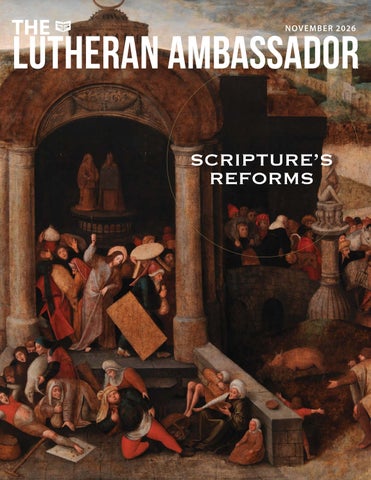
Cover artwork: “Christ Cleansing the Temple,” Peter Bruegel the Elder, 1570, Statens Museum for Kunst. November 2026
3
REFORMS
CYCLES of JUDGES BY SHANNON MCNEAR
T
he Book of Judges is chock-full of one story after another about the nation of Israel after the death of Joshua. Really it’s a continuation of a pattern that we first see in Exodus, right after Israel’s deliverance from bondage in Exodus. Moses gives them the Passover, then presents the law, and the people of Israel go straight from promising they’ll follow and obey God to questioning him and complaining about their situation. “Why did you bring us out here to die in the wilderness?” they asked Moses, accusing him of trying to kill them with hunger and with thirst. “Why did you make us leave Egypt? ... There we sat around pots of meat and ate all the bread we wanted” (Exodus 14:11–12; 16:3). Never mind that they’d been in slavery for 400 years. Human beings are remarkably short-sighted and impatient. It is worth noting that after the Israelites gave Moses all sorts of grief, there was relative peace while Joshua led them: “Israel served the Lord all the days of Joshua, and all the days of the elders who outlived Joshua and had known all the work that the Lord did for Israel” (Joshua 24:31). Just before this verse is Joshua’s famed “choose this day whom you will serve” (vv. 14–15) speech and his challenge to Israel’s insistence that they would indeed follow and obey the Lord: “But Joshua said to the people, ‘You are not able to serve the Lord, for he is a holy God. He is a jealous God; he will not forgive your transgressions or your sins. If you forsake the Lord and serve foreign gods, then he will turn and do you harm and consume you, after having done you good.’ And the people said to Joshua, ‘No, but we will serve the Lord.’ Then Joshua said to the people, ‘You are witnesses against yourselves that you have chosen the Lord, to serve 4
THE LUTHER AN AMBASSADOR
him.’ And they said, ‘We are witnesses’” (Joshua 24:19–22). I wonder if Joshua knew they wouldn’t remain faithful. The beginning of the Book of Judges covers the latter part of Israel taking possession of the land. The problem? God told them to completely wipe out the people already there—a perfectly righteous judgment upon cultures that were so corrupt there was no saving them. (Note: we know that individuals could indeed have been saved if they had been willing to come under the authority of Israel and the law and worship the true God.) But as time went on, the tribes of Israel either grew tired of the work or fell prey to sympathy with the enemy—or both—and went from wiping out those nations to merely conquering and subjugating them. The ESV says they were put to forced labor, while other translations say they were made to pay tribute. Their laziness in failing to root out the evil already entrenched in the Promised Land led to the Lord saying, okay, I’m going to let these other peoples remain and be a thorn in your side, not only to test your commitment to me but also so that successive generations learn how to fight (Judges 2:1–3:4). And so began the downhill slide. Subjugation softened to compromise as the children of Israel intermarried with the pagan nations and began serving their idols. The Lord let Israel come under the thumb of foreign kings and peoples, then “when the people of Israel cried out to the Lord, the Lord raised up a
“THEN THE LORD RAISED UP JUDGES, WHO SAVED THEM OUT OF THE HAND OF THOSE WHO PLUNDERED THEM” (JUDGES 2:16).
deliverer for the people of Israel, who saved them” (3:9). This is pretty much the story for about the next 13–14 chapters. Israel would forget God and pursue idol worship. Later in Judges we hear repeatedly, “There was no king in those days and everyone did what was right in their own eyes” (17:6, 18:1, 19:1, 21:25). Then God would send judgment in the form of harsh circumstances, the people would cry out, and he’d send a deliverer. That deliverer would in turn call the people back to following the Lord, with varying degrees of always-temporary success. Sound familiar? We see Christ in this pattern as our ultimate deliverer. And we see the Lord’s grace and mercy, even though midway through Judges (chapter 10) he rather loses patience with them. Can you blame him? Generation after generation of a wayward people and judges, who themselves often failed at reflecting the integrity of the God they were supposed to serve. Consider Samson and
Abimelech, a son of Gideon. And yet God kept calling, kept sending deliverance, and kept waiting for his people to return to him. As the accounts in Judges become more and more horrifying, devolving at last into civil war that leaves an entire tribe desolate—a testament to life lived according to “what is right in [our] own eyes”—it’s fair to question if God has any mercy and grace left for his people. And yet he does. Right after Judges, we step into the beautiful story of Ruth, which takes place during that era, and from there into I Samuel, named for the very last judge of Israel. The next step of God’s plan for his people unfolds with relentless precision, shining all the more vividly for the darkness of human hearts. McNear is a member of Trinity Free Lutheran, Minnewaukan, N.D. Artwork: “Deborah and Barak Against Sisera,” Juan de la Corte, c. 1630, Wikimedia Commons. November 2026
5
RETURN to the LORD BY PASTOR NATE JORE
H
ezekiah, King of Judah, lived during a very troubled time in Israel’s history. His father, Ahaz, had made metal images of the god Baal and had sacrificed Hezekiah’s brothers in the fire as part of his pagan worship (II Chronicles 28:2–3). When the Lord gave Ahaz into the hand of the King of Syria, he responded by sacrificing to their gods, saying, “Because the gods of the kings of Syria helped them, I will sacrifice to them that they may help me” (II Chronicles 28:5, 23). Ahaz never turned to the Lord, not even when Pekah, king of Israel, defeated him, killing 120,000 “men of valor” and capturing 200,000 from Judah (II Chronicles 28:6–8). The Northern Kingdom of Israel was in even worse shape. Their persistent disobedience of the Lord led to their defeat. Shalmaneser, king of Assyria, came against Hoshea, king of Israel, and defeated him and carried the Israelites off to Assyria in the sixth year of Hezekiah’s reign (II Kings 18:9–12). The situation was bleak, but Hezekiah was a man who trusted the Lord. Hezekiah began his rule at the age of 25, and the Bible says that there was none like him among the kings of Judah. “He held fast to the Lord. He did not depart from following him, but kept the commandments that the Lord commanded Moses. And the Lord was with him; wherever he went out, he prospered” (II Kings 18:6–7). He started his reign by reopening the temple that his father Ahaz had closed (II Chronicles 28:24) and commissioning the priests and Levites to clean it out and get it ready for service. The day that worship was restored in the temple was a glorious one. They dusted off King David’s instruments, and the Levites led them in 6
THE LUTHER AN AMBASSADOR
worship as they sang the psalms of David and Asaph with much gladness (II Chronicles 29:27–30). After restoring the temple worship, it was in Hezekiah’s heart to celebrate the Passover as a unified community. He sent couriers throughout not only Judah but throughout Israel as well, inviting all to come and celebrate the Lord’s Passover in Jerusalem (II Chronicles 30:1–6). Hezekiah also used the invitation as an opportunity to call the people back to repentance. “O people of Israel, return to the Lord, the God of Abraham, Isaac, and Israel, that he may return again to the remnant of you … For the Lord your God is gracious and merciful and will not turn away his face from you, if you return to him” (II Chronicles 30:6, 9). Many people ridiculed the invitation, but some honored it and came and celebrated the Passover (vv. 10–11). After seven days of joyful celebration, the whole assembly decided to extend the feast for another seven days (v. 23). Following the celebration of the Passover, they went out and destroyed all the high places of pagan worship where the people had been worshiping the gods of the nations around Israel (II Chronicles 31:1). Perhaps Hezekiah’s greatest test came in the 14th year of his reign when Sennacherib, king of Assyria, came against Judah. This was the same Assyrian army that had conquered Israel just eight years prior and led them away as captives (II Kings 18:10–11). When the Assyrian army invaded Judah, Hezekiah exhorted the people to put their trust in the Lord: “Be strong and courageous. Do not be afraid or dismayed before the king of Assyria and all the horde that is with him, for there are more with us than with
REFORMS
“SOME TRUST IN CHARIOTS, AND SOME IN HORSES, BUT WE TRUST IN THE NAME OF THE LORD OUR GOD” (PSALM 20:7).
him. With him is an arm of flesh, but with us is the Lord our God, to help us and to fight our battles” (II Chronicles 32:7–8). Sennacherib sent his field commander to Jerusalem, and he tried to persuade the people not to listen to Hezekiah or put their trust in the Lord: “Do not let Hezekiah deceive you, for he will not be able to deliver you out of my hand. Do not let Hezekiah make you trust in the Lord by saying, ‘The Lord will surely deliver us …’” (II Kings 18:29–30. Hezekiah took the letter that the field commander had written with its threat to completely destroy Judah and went into the temple and spread it out before the Lord and prayed. “Incline your ear, O Lord, and hear; open your eyes, O Lord and see; and hear the words of Sennacherib, which he has sent to mock the living God … So now, O Lord our God, save us, please, from his hand, that all the kingdoms of the earth may know that you, O Lord, are God alone” (II Kings 19:16, 19). Do you remember the rest of the story? Isaiah
prophesied deliverance, and the angel of the Lord went out and struck down 185,000 in the camp of the Assyrians (II Kings 19:35). Sennacherib returned to his land in great shame and was murdered by two of his sons (II Chronicles 32:21). Hezekiah trusted the Lord, who delivered him. It is important to tell the old stories as they instruct us how to live. Hezekiah was human. He faced incredibly trying situations, but he held fast to the Lord. He led an entire nation out of idol worship and into the worship of the true God. He wasn’t perfect, but he trusted the Lord. What do you learn from Hezekiah? What does it look like for you to trust the Lord in the trying situations of your life? What reforms are needed in your life, your family, or your church? What does it look like to trust in the Lord and not the “arm of flesh” like the Assyrians (II Chronicles 32:8)? Jore is serving as interim pastor at Hope Lutheran, Minneapolis. Artwork: “The Defeat of Sennacherib,” Peter Paul Rubens, 1614, Bavarian State Painting Collection. “Hezekiah,” Alexander Adamson, 1814, Davidson Art Center. November 2026
7
REFORMS
“GO, INQUIRE OF THE LORD FOR ME ... CONCERNING THE WORDS OF THE BOOK THAT HAS BEEN FOUND” (II CHRONICLES 34:21).
THE BOOK of the LAW BY PASTOR JOE FRECH
T
he moment that the good King Josiah was informed that the Book of the Law was found was pivotal to the nation of Israel. Josiah was a reformer, so the practices of falsehood and evil promoted by the idolatry of the neighboring nations were to be destroyed. For eight years Josiah personally saw to the destruction of the false altars, and for eight years, the faithful who remained in Judah saw their king as someone great, who would restore the proper worship of God. Then, when Josiah had the temple in Jerusalem restored, the Book of the Law was found. When it was read, a dreadful reality came to Josiah. In fact, he was wickedly sinful. And not him alone, but the nation he was leading, though called by God as his own, was failing. Judgment was not only deserved but also an imminent reality, and the good king acted in the only way he could—he repented. Here’s the thing about Israel’s worship of God in those days: not all of it needed to be thrown out. Feasts were still held, and even Josiah held the Passover feast at the beginning of II Chronicles 35. The temple, once restored, was to continue being used as a place to offer sacrifice and hear the Word of God. What had to change was the practices that violated what God had given to Israel. What had to change was the wicked deeds done in the name of God or any false gods. What had to change was a refocusing or reformation of the people to God alone. This aspect of human nature—where we find ourselves following our own morals and conscience—is not new. It was not new in Josiah’s day, either. Even Adam and Eve followed their own consciences in believing the word of the serpent. It was not new in Jesus’ day, and certainly this was nothing new in the days of Martin Luther. Even as Luther made promises as he entered a monastery, the wheels were turning for the Word of God to be found once again. When you realize that even the leaders of the Church are fallible humans, capable of abusing the Word of God in
spite of intentions, it is easy to see how the Roman Catholic Church could allow such atrocities like justification by works, purgatory, and indulgences. Even in the days of Josiah, the leaders of the temple had no recourse but to tear their robes and repent. They had lost the plot of God’s Word; thus, the temple was subject to reform after the law was found. When we approach the reformation of Luther, it is easy to see this as a radical change to Catholic doctrine—a completely clean slate. However, the truth is far more nuanced: those teachings that were good and right were kept. When you read through the defense of the Augsburg Confession (usually called the Apology), the reformers were quite clear in more than a few articles that Lutheran teaching was in agreement with the teachings of Rome. And when the Church leaders in Rome read the Augsburg Confession, they agreed wholeheartedly with some very fundamental truths: the doctrines of the Trinity, the person of Christ, and the necessity of baptism. The teachings that were unbiblical were stated as such by the reformers and were corrected. Luther and his like were hoping to reform Catholic doctrine, not simply abandon them altogether. So what about today? We continually return to the same teachings as in the days of Josiah. And within our AFLC, we confess the elements of the original reformation begun by Luther, such as the Augsburg Confession and the Small Catechism. We have great joy using such tools to act as the guards around which we form our congregations. As AFLC congregations, then, use these tools to better understand the Word of God and look and see God at work in your congregation. Frech serves St. John Lutheran of Schwer, Milford, Ill. Artwork: “Study for King Josiah Rending His Garments,” James Thornhill, c. 1730, Cleveland Museum of Art. “Josiah,” anonymous, 17th century, St. Mary’s Church, Åhus. November 2026
9
THE CALL to REBUILD BY PASTOR RON SMITH
W
hen we consider the Old Testament, it should not surprise us that reformation among God’s people began long before modern history. It was not invented by John Wycliffe, Martin Luther, Ulrich Zwingli, Johann Arndt, Georg Sverdrup, or Sven Oftedal. God was at work before them, through them, and through many others—known and unknown—calling his people back to himself. This month, I encourage you to read Ezra and Nehemiah. In these books we see God moving his people to accomplish his will. There is work to do, yet the goal is more than rebuilding an altar, temple, or wall. God calls his people to action so that exiles return, his law leads to confession, and his people are united in rejoicing and dedicating the work to his glory. In Ezra 3:1, the people gather “as one man.” This is a picture of the local congregation: united, not divided by details of tasks or even opinions. God’s call to rebuild was clear, and they moved forward—first with the altar, then the temple. Even through trials and obstacles, they remained steadfast in completing the work before them. We see the same in the Book of Nehemiah. In chapter 1, Nehemiah hears of Jerusalem’s broken walls and is moved to tears. With permission, he goes to inspect the damage firsthand. By chapter 3, the rebuilding begins. The work is systematic: each person has a part, families work beside families, and all labor for God’s glory. It is easy for us to become content in our churches. We look back and rejoice in what was accomplished. But if we look honestly, we may see damage: Spiritual walls torn down, protective biblical gates removed in the name of progress, and the altar and sanctuary weakened when God’s law is ignored and the gospel is not shared. In Ezra and Nehemiah, reformation meant refusing to leave what had fallen into ruins. God’s people saw the danger of living without sacrifice, worship, walls, and gates. What might reformation look like for you and your church today? Does it mean rebuilding the spiritual foundation needed in the sanctuary and altar? Have we spent so long away from God’s Word that a younger generation no longer recognizes the true gospel of Christ Jesus? Have people been in exile so long they don’t even remember God: Father, Son, and Holy Spirit? When was the last time you memorized a Bible verse?
10
THE LUTHER AN AMBASSADOR
When did you last enter God’s sanctuary alone to spend time kneeling at the altar in prayer? Reformation rarely begins with a grand proclamation, and even Martin Luther’s nailing of his 95 Theses to the church door was ordinary for the time. Rather, reformation begins with a child of God responding to his call so that God may be known and glorified for generations to come. We have allowed society to remove many of the walls and gates that once protected God’s people. The world speaks boldly to our families; the church must speak the truth with clarity and love. It is time for reform. It begins at home and must be taught in our churches. Let us hunger for truth and share it faithfully. May the law of God be preached with all its sharpness and the gospel shared with all its tender love and mercies. As we take responsibility, we take up the full armor of God. In rebuilding Christian families and communities, we hold the sword of the Spirit and do the work to which we are called. Instead of grumbling that “these people don’t know how to do church,” let us go to work. Volunteer. Encourage. Help rebuild. As a pastor, I know I cannot fix every problem in the congregation God has called me to serve. But together, we each have a part to pray and to play. Helpers in rebuilding the altar, sanctuary, walls, and gates come in many forms: teachers, singers, Sunday morning helpers, and those who work quietly behind the scenes—from cleaning to keeping water flowing, lights on, music shared, and all the parts of Sunday morning put together for God’s glory. These builders and reformers are people like you—people who love Jesus and want others to know him as their Lord and Savior. Let us strive to be local congregations who love Jesus and stand on, live in, and teach the truth of God’s Word. For that is the congregation where people confess their sins and the exiles return. Reformed and rebuilt, this is a place where God’s Word is preached with authority and the sacraments are rightly administered. Each Sunday, let us be united in worship of our risen Lord and Savior and dedicate our church and our lives as the sanctuary of God, who loves and forgives all who call upon Jesus as Lord. Smith serves Grace Lutheran, Bruce, S.D. Artwork: “Ezra Kneels in Prayer,” Gustave Doré’, 1866, Doré’s English Bible.
REFORMS
“AND THEY SAID, ‘LET US RISE UP AND BUILD.’ SO THEY STRENGTHENED THEIR HANDS FOR THE GOOD WORK” (NEHEMIAH 2:18).
November 2026
11
ULTIMATE REFORMER
the
BY PASTOR ALEX MONSETH
A
reformation I experience frequently occurs when I step into my home around dinnertime after my workday. I shut the door behind me and turn my gaze towards the living room. My brain experiences great confusion as I process how all of our furniture has been completely rearranged in the space. A reformation has occurred in my absence. Over the next few weeks and months, I progress from mild distaste to deep love for the new living room setup before I come home again to experience things arranged differently again. The living room reformation never quite lasts. It is not permanent. As we consider the theme of reformation, no name in Scripture ought to rise higher in our minds than that of our Lord Jesus Christ. The only reason to celebrate the reformation of the Church under Martin Luther is because Luther points urgently to someone other than himself. Christ is the ultimate reformer. Why? His reformation lasts. When Jesus got up to give his first sermon, people wondered if this new preacher had come to bring them something entirely different. Was he opposed to God’s law as revealed in the Old Testament, which they had known? Did Jesus come with a new agenda? Jesus preached to the people in Matthew 5:17, “Do not think I have come to abolish the Law or the Prophets. I have not come to abolish them, but to fulfill them.” He was not opposed to the law; rather, he wanted to reform their understanding of it. The people likely nodded, “Okay, we’re listening.” One by one, Jesus proceeded to show how the commandments are not merely a behavioral checklist but a vision of the very character of God meant to be imprinted upon his people. The Pharisaical teaching of the time treated the law as a laundry list of things to do or not do in order to keep a slate clean from sin. In their minds, so long as you did the homework, how you got the right answer was of no consequence. Jesus said otherwise. The message is not simply do not take oaths, but let
12
THE LUTHER AN AMBASSADOR
your words be trustworthy, as the Lord’s Word is trustworthy. The message is not simply do not commit adultery, but be faithful in all “FOR GOD HAS aspects to your DONE WHAT THE LAW, spouse, as the Lord is faithful in WEAKENED BY FLESH, all aspects to you. COULD NOT DO” The message is not simply do not (ROMANS 8:3). kill other people, but love and think well of others, as the Lord has loved you. In essence, the people did not simply need to obey more rules. Partial behavioral modification was not enough. They needed a complete transformation of their character. A character which reflected the heart of God. You can imagine the listeners were perhaps inspired to live differently after hearing the Sermon on the Mount. Yet, all of them went home that day and sinned once more. If you know their story, Israel had many reformations, but their history is littered with failure upon failure. Why would this be any different? We are no different. We are often inspired by great teachers, social media reels, or books to live our lives differently. We will be better! We will not go back to the complacency or indecency we once lived in! But what happens? Sooner or later, a short night of sleep, an argument at home, a discouraging day at work, or merely time passing by with no excuse at all, and we’re back to behaving just like we swore we never would.
REFORMS
Jesus the reformer knew that presenting the law— the vision of God’s character—properly was not enough on its own. This was not a reformation which would bring permanent change. People did not just need a new interpretation of the law. They needed to be shown Jesus himself as its ultimate fulfillment. As God himself, Jesus lived a perfect life the people could not. He fulfilled every demand of the law in his life. But Christ went further, because an embodied example of perfection still would not bring salvation to suffering souls. In the ultimate act of self-giving love, Jesus died a substitutionary, painful death on behalf of mankind to atone for their sins. The cross was filled so the law could be fulfilled. Sins are obliterated as far as the east is from the west. People are given Christ’s righteousness by faith. The reformation is completed and given permanence as Jesus rises from the dead and is declared Lord. Those who trust in him are now transformed to follow the law of
the Lord by his Spirit within them and filled with the future hope of resurrection. As Romans 8:3–4 points out, “For God has done what the law, weakened by the flesh, could not do. By sending his own Son in the likeness of sinful flesh and for sin, he condemned sin in the flesh, in order that the righteous requirement of the law might be fulfilled in us, who walk not according to the flesh but according to the Spirit.” This reformation will never be upended by another. It is Christ alone, crucified and raised, who is the banner and hope of the people of God for all eternity. Let us praise the Lord for sending Christ Jesus, the reformer, who has graciously enacted lasting change to each and every one of us who trust him. Monseth serves St. Ansgars Lutheran, Salinas, Calif. Artwork: “Adoration of the Lamb,” from the Ghent Altarpiece, Hubert and Jan van Eyck, c. 1426, the Yorck Project. November 2026
13
REFORMS
“BY THIS EVERYONE WILL KNOW THAT YOU ARE MY DISCIPLES, IF YOU LOVE ONE ANOTHER” (JOHN 13:35).
14
THE LUTHER AN AMBASSADOR
CALLED back to CHRIST BY ESTHER HYLDEN
T
ail in the air, without a backward glance, my neighbor’s cat, Ruby, deliberately walked away from her owner, Marsha. “Ruby, come back, Ruby,” Marsha called from her porch. Without even a pause, Ruby continued her journey to the other side of the street. Marsha ran to scoop Ruby up in her arms, bringing her back home to safety. Even as I laughed, I thought to myself, I am so like Ruby—every day! Ruby has a wonderful home, an owner who loves her, and all the food she needs. Yet when given the opportunity, she turns her back on her home and heads for the other side of the street. Why does Ruby run away? Why do we wander away from Jesus and his great love for us? Do our hearts become hard? Does tragedy cause us to turn away from God? Does busyness crowd our hearts, leaving no room to love? In Revelation 2:4–5, John writes to the church in Ephesus: “But I have this against you, that you have abandoned the love you had at first. Remember therefore from where you have fallen; repent, and do the works you did at first.” What were the works that they did at first? Jesus taught in Matthew 22:37–38: “You shall love the Lord your God with all your heart and with all your soul and with all your mind. This is the great and first commandment. And a second is like it: You shall love your neighbor as yourself.” Love, that is the work that they did at first. Somehow along the way, their love became cold. Sure, they worked hard, they resisted sin, they examined the claims of false prophets, and they endured hardships without growing weary. But their love for others had grown cold. Perhaps they were doing the right things for the wrong reasons. Perhaps they were feeding the hungry without looking them in the eyes, asking them how they were doing, and without staying and listening to their answer. Perhaps they were bringing clothing to the naked without helping them get a job. Perhaps they were bringing money to a widow without sitting down beside her and listening to her tell her story of how hard it is to continue on without her husband. In John 13:34–35, Jesus teaches the following: “A new
command I give to you, that you love one another: just as I have loved you, you also are to love one another. By this all people will know that you are my disciples, if you have love for one another.” The Bible is clear that we are not saved by our good works: “For by grace you have been saved through faith. And this is not your own doing; it is the gift of God, not a results of works, so that no one may boast” (Ephesians 2:8–9). In Martin Luther’s work, On the Freedom of the Christian, he formulates this concept: “God does not need your good works, but your neighbor does.” As we are transformed to be more and more like Jesus, love for others should freely flow from us. And how do we become transformed to be like Jesus? How are we changed so we will not forsake our first love? Often this is called sanctification, being transformed into Christ’s image. Jesus teaches us about sanctification in John 15:5, “I am the vine and you are the branches. Whoever abides in me and I in him, he it is that bears much fruit.” So then, the secret to bearing fruit and doing the works that God has for us, and not falling away, is abiding. Easier said than done! How does one abide? By reading God’s Word, praying, attending church, and fellowshipping with other believers. And through our baptism. Thus, as we abide in Christ, and as he transforms us to be more like him, let us not be like the church in Ephesus. Let us not be like my neighbor’s cat, Ruby. But let us live our lives like Jesus did, having as a first place in our hearts a love for God and love for others. Let us live this out in practical ways by showing transforming love to those in our sphere of influence, such as our hairdresser, our neighbor, the neighbor kids, our co-workers, and even the crazy relative who brings shredded carrots in green jello to every family gathering! Let us not let our hearts harden or our love grow cold. Instead, as Jesus declared, “Let your light shine before others, so that they may see your good works and give glory to your Father who is in heaven” (Matthew 5:16). Hylden is a member of Bethel Free Lutheran, Grafton, N.D. Artwork: “The Return of the Prodigal Son,” Bartolomé Esteban Murillo, c. 1667, National Gallery of Art. November 2026
15
MINISTRIES / FLY
Why FLY? BY PASTOR MICAH MOAN
A
“I have said these things to you, that in me you may have peace. In the world you will have tribulation. But take heart; I have overcome the world.” John 16:33
FLY 2027 registration. Registration for the 2027 FLY Convention opens Nov. 3. For more information and to register, visit the FLY Convention website: • flyconvention.org • Dates: July 5–10, 2027 • Location: YMCA of the Rockies, Estes Park, Colo. Moan, who serves Bethany Lutheran, Binford, N.D., and New Luther Valley Lutheran, McVille, N.D., is the first vice president of the 2027 FLY Committee. 16
THE LUTHER AN AMBASSADOR
s a member of the 2027 FLY Committee, I will occasionally be asked by people, “What is the value of attending the Free Lutheran Youth Convention?” To answer, I could discuss the necessity of young Christians coming together to praise Jesus. I could talk about the beauty of the mountains in Estes Park, Colo. I could mention the sports, the late-night acts, and the memories which will last a lifetime. But perhaps the best response to the question is our mission statement. “The purpose of the Free Lutheran Youth Convention is to provide congregations with a tool to WIN the lost, BUILD the believer, and ENCOURAGE student discipleship in the local congregation.” I am pumped that our verse for our theme “OVERCOME” directly addresses our mission to win, build, and encourage students in the Lord! WIN the lost: At FLY, the gospel of Jesus Christ will be unashamedly proclaimed. The message of salvation in Jesus’ name will permeate our week. We do not assume that all who attend this convention know the Lord. Instead, we intentionally craft the week in a way which exhibits the beauty and urgency of the gospel to lost students. Jesus said, “I have said these things to you, that in me you may have peace.” As Jesus spoke to his disciples, he still speaks to us today through his Word. For students who do not have peace with God, who are overcome with sin and crippled with shame, FLY 2027 will communicate the victorious news that we have peace with God through Christ, who has overcome! BUILD the believer: John 16:33 continues, “In the world you will have tribulation. But take heart; I have overcome the world.” There are many, many tribulations our students face. The corruption of our own sin and the depravity of our world are deep, but neither worldly tribulations nor the spiritual forces of the evil we face are the end of the story. Jesus invites us to “take heart.” At FLY, students will not only know what Jesus has done in the past but also presently grow in confidence knowing that Jesus has overcome all these. Our sessions, workshops, and electives will equip students and call them to the work of ministry that God has prepared for them. For students facing the tribulations of the world, FLY 2027 will communicate the victorious news that we are more than conquerors through Christ, who has overcome. ENCOURAGE discipleship: We have a great lineup of speakers who will exhort students to personally dive into God’s Word and participate in congregational life. Keith Ferrin will return, demonstrating the value of internalizing God’s Word. FLY 2027 is a week-long convention, but the message is an eternal investment. Lifelong discipleship within a faithful congregation is our prayer and desire. For students seeking an opportunity for growth in Christian maturity, FLY 2027 will reinforce the excellency of God’s Word and embolden students for a life of faithfulness through Christ, who has overcome. Why FLY? On July 5–10, 2027, come and see for yourself. Jesus has OVERCOME!
MINISTRIES / WMF
Making plans for the WMF’s future. BY KAREN PEDERSON
T
he National WMF Day held on June 10 of this year was our largestattended event to date. We heard wonderful speakers, sang with full voices, then prayed together before we covered new business. We updated and clarified our constitution and bylaws and voted to expand our giving ministries to include Youth Ministries and AFLC Evangelism & Discipleship (AED) so that all of our AFLC departments are included in our giving. The last new business was the election of our new treasurer, Pam Twedt, and second vice president, Kristin Peterson. We are grateful for their willingness to serve on the national WMF Board along with first vice president Jenna Lee, recording secretary Joanne Herset, communications secretary Linda Fugleberg, and myself as president. We are thankful for the six years that outgoing officers Margie Lee and Liz McCarlson gave to WMF. Be watching the mail for your WMF packet, which is being sent to every AFLC church. Included in the packet are the prayer and giving calendars with our new ministries and a new transmittal form to send to our treasurer, Pam Twedt. An order form will be in your WMF packet for our new 2027 WMF Bible study written by Becky Ideker titled “In All Things.” Please see the information in the sidebar at right to order. The WMF Board members met during the all boards conference at our Plymouth, Minn., campus to select our 2027 mission projects under each ministry that we support with your generous giving. The following designations were made: • World Missions: Refresh the furnishings at the ARC mission house, specifically in the primary bedroom and the living room. • Home Missions: Support the Alaska Mission’s financial needs. • Parish Education: New study materials for seventh grade through adults. A study titled Mystery of the Gospel: Christ in the Old Testament is in the publication process. • Youth Ministries: Travel expenses for the FLY Convention supply truck to get to the YMCA of the Rockies in Estes Park, Colo., in July. • AED: Support travel expenses for Director Randy Nelson, as the need for in-person ministry has grown. • Free Lutheran Seminary: Refreshing the nursery with new toys and books. • Free Lutheran Bible College: Raising funds for a new sign marking the location of our schools. We also began planning for WMF Day scheduled for June 16, 2027, at Warm Beach Conference Center in Stanwood, Wash. Save the date and join us to hear updates from our missionaries, learn from women in our AFLC, and sit under the teaching of our Seminary dean, Dr. James Molstre. More information will be coming in early spring.
WMF contact information. The new transmittal forms can be sent to Pam Twedt: • Address: 610 Evergreen Circle, Oxbow, ND 58047. Email: wmftreasurer@aflc.org Phone: (701) 793-1313. To order the 2027 Bible study, send form and payment to Emily Olson: • Address: 9407 Boiling Springs Lane, Shakopee, MN 55379. Email: wmfcomm@aflc.org Phone: (952) 288-7973 Pederson, a member of Zion Lutheran, Tioga, N.D., is the president of the WMF. November 2026
17
MINISTRIES / FREE LUTHERAN BIBLE COLLEGE & SEMINARY
State of FLBCS. The impact of FLBCS is evident in the lives of its alumni—faithful men and women who serve Christ in local congregations, global missions, families, businesses, and communities. Their lives are marked by conviction, compassion, and confidence rooted in Christ. The fruit of FLBCS’ ministry is both visible and enduring. • 98%: Student body living on campus • 65%: Student body from AFLC congregations • 40%: Of required courses that feature verse-by-verse Scripture study • 14:1: Student-to-faculty ratio
Annual Fund campaign progress 2025–2026: $1.5M
2026–2027: $1.5M 13%
Quanbeck is the director of marketing for the Free Lutheran Bible College and Seminary. THE LUTHER AN AMBASSADOR
BY LUKE QUANBECK
I
recently spent an alarming amount of money on a piece of “glass” for FLBCS. Specifically, glass for our camera—a new lens. It’s amazing how much clearer and brighter our photos turn out with higher quality glass in front of the sensor. It can focus quicker, take in more light, and has technology in it that I don’t fully understand. Of course, none of that matters if the glass is dirty. A consultant recently gave us the phrase “polishing the windows” as a summary of our job in marketing FLBCS to “mission-fit” students. Working here, I see evidence of the effect of the Word of God on our students every day. I forget sometimes that you all, living hundreds of miles away, don’t get to experience this place the same way I do. Our camera is your literal window into FLBCS. I want to polish the glass and give you a clearer peek inside. Our best marketers, or “windows” to continue the analogy, have always been our students. They aren’t thinking about slogans or audience retention or the cost-per-click. They have real stories from what happens when they study God’s Word in close community with other believers. At right is some of what they are learning in their first months of the Gospel of John class.
Annual Fund campaign • Dr. Wade Mobley, president
113%
18
Polishing windows.
I have some good news! Even if we don’t have good news, God is still good and faithful. This is good news, indeed. Generous friends like you provided for 113% of our $1.5M annual fund goal in 2025–2026. The Annual Fund allows us to charge only about two-thirds of what it costs to attend here, so that’s a big deal. This year’s annual fund goal remains at $1.5M, and we look forward to watching God continue to provide for our students. Please pray for our students, staff, faculty, and administration as we steward the mission of establishing students in the Word of God for life in Jesus Christ. We love our students, and every one of them is learning how to know and apply the gospel to every area of their lives. Families, congregations, and communities stand to benefit, so please pray for this supernatural work of God in their lives.
Course Spotlight: Gospel of John • Instructor: Dr. Nathan Olson One of the primary goals that I have for students as they study the Gospel of John is that they will come face-to-face with Jesus Christ and believe. And I think that’s what John is after, as well, as he writes the Gospel. He says toward the end of his book: “These things are written so that you may believe that Jesus is the Christ, the Son of God, and that by believing you may have life in his name” (20:31). “To believe”—John uses that verb 100 times in his Gospel. He’s not looking for his readers to have some abstract knowledge. Instead, he’s calling for real and living faith in who Jesus is. Since we believe that “faith comes by hearing the Word of Christ” (Romans 10:17), the second goal that I have for students is that they would spend a significant time in the text itself. To that end, we have each of the students pick up the ESV Scripture Journal and spend hours of devotional time studying through the Gospel in order to let the living and active Word of God work in their lives and hearts. • Sawyer Niles, freshman I absolutely love the Gospel of John class at FLBC! One of the themes we have been covering in class is the complete divinity and humanity of Jesus. While Jesus was fully God, he was also fully human. He understands what we are going through and can relate to us personally!
• Eva Borg, freshman One specific concept that I have learned more of from the Gospel of John class is the contrast between Nicodemus and the Samaritan woman. They had completely different ways of living, with Nicodemus being knowledgeable of the things of God and the Samaritan woman knowing hardly anything at all. Yet Jesus goes to both of them and changes their lives for the better. This shows that God does not care how much we know but instead cares that we have hungry, willing hearts to receive him and let him change our lives.
Upcoming events. • Connect: Nov. 6–7 A fun learning event for confirmation-aged students. • Christmas concerts: Dec. 4–6 Theme: “Thy Kingdom Come: From Bethlehem to the Throne” • Seminary Symposium: Jan. 21–22 Theme: “The Acts of the Apostles” • Campus Days: April 9–10 Preview event for high school students and recent grads. Registration for these events and livestream links can be found at: • flbc.edu/events November 2026
19
NEWS
Nominating Committee work Members of the 2027 Nominating Committee have begun their work to solicit nominees to serve on various AFLC corporations, boards, and committees. If interested in serving on a board that represents AFLC ministries, speak to your pastor or district representative for a full list of opportunities and qualifications. General questions and inquiries can be sent to NomComm@aflc.org.
Loretta Grothe Loretta Elizabeth (Larson) Grothe, 87, of Astoria, Ore., died September 28, 2026. Born in 1938 in Falun Township, Minn., she was the daughter of Oscar and Edith (Mattson) Larson. She married Pastor Alvin Grothe, a widower, on June 21, 1969. He preceded her in death. She attended Falun Country School in Falun, Minn., and graduated from Roseau High School, Roseau, Minn., in 1956. She began working at Citizens State Bank in Roseau during high school and continued after graduation. She sang with a women’s quartet, traveling to various churches, and she also sang with The King’s Messengers, a local traveling choir. The group produced a vinyl recording. After marriage, she helped raise her husband’s six children. They moved to Stacy, Minn., in August 1969 and then to Astoria, Ore., in August 1975. Her greatest joys in life were God, her husband, family, and her church. She was a prayer warrior who prayed for her family every day. She lived her last two years under the loving care of Clatsop Care Center’s numerous staff members. Surviving are six children, Terry (Jeff ) Owenby, James Grothe, Susan (Michael) Lynch, Kathy (Larry) Olson, Kelly (Lois) Grothe, and Joel Grothe; and a host of grandchildren and great-grandchildren. A memorial service will be held at noon Nov. 7 at Bethany Lutheran Church, Astoria, followed by a coffee hour. The service will be streamed live at bethanyfree.com. In lieu of flowers, the family welcomes donations to the WMF (Women’s Missionary Federation), of which Loretta was a longtime member: Bethany Free Lutheran WMF 45134th St., Astoria, OR 97103. 20
THE LUTHER AN AMBASSADOR
Astoria church opens The Annex Members of Bethany Free Lutheran Church, Astoria, Ore., recently celebrated the grand opening of the congregation’s new building expansion, called The Annex. The multipurpose building will enable the congregation to host youth group trips, various special events, and a new ministry aimed at providing pastors and ministry leaders a place to rest while enjoying the Pacific Northwest. The Annex consists of a gym, locker room and showers, a commercial kitchen, and a two-bedroom furnished apartment. Vi’s Kitchen was dedicated October 10 and is named in memory of Violet Paulson, a long-time member of Bethany who had a love and passion for serving others. An open house for the public followed the dedication. The congregation continued the celebration of the completed building on October 11 with a Scandinavian celebration of baked goods after church, followed by a formal ribbon cutting at The Annex. Dr. Mobley, president of FLBCS, and his family were honored guests for the celebration. Pastor Rich Carr, pastor of Bethany,
Submitted photos shared that despite the many obstacles Bethany members encountered in the completion of this project, God’s faithfulness was clearly evident. The congregation hopes this building will be used to help them better be the salt and light to the people along the Pacific Coast and the nation as a whole.
NEWS
AFLC hosts All Boards meeting
Members of AFLC boards and committees met Oct. 5–6 on the Plymouth, Minn., campus and administrative headquarters. Separate meetings were held throughout the day on Oct. 5, when newly elected members from the AFLC Annual Conference officially began their duties. On Oct. 6, a joint meeting was held in the lower level of the campus chapel building. After a morning devotions led by Pastor Lloyd Quanbeck, new board and committee members introduced themselves and were then installed by Pastor Micah Hjermstad, AFLC president. A session on “The ‘Why’ of AFLC Development” was presented by both Hjermstad and Mark Sivertson, the director of Development. Those present were encouraged to use the tools offered by Development in their ministries, congregations, and individually. Following a break, each board and committee gave a brief update on the work of their ministries. The meeting closed and was followed by the AFLC Pastors’ Conference.
Board and committee members were installed (top) by Pastor Micah Hjermstad (above center). The meeting included devotions and time for fellowship. November 2026
21
NEWS
PEOPLE & PLACES Pastor Lyndon Korhonen has accepted an interim call to St. Paul’s Lutheran, Jewell, Iowa, and Salem Lutheran, Radcliffe, Iowa. Pastor Paul Kinney has accepted an interim call to Spencer Creek Lutheran, Eugene, Ore. Members of Our Saviour’s Lutheran, Thief River Falls, Minn., celebrated the congregation’s 75th anniversary with a banquet on Oct. 3. On Oct. 4, Pastor Micah Hjermstad, AFLC president, spoke at the morning worship service. In the afternoon anniversary service, the congregation dedicated a bell tower, burned their mortgage, and heard messages from Pastor Greg Schram and Pastor Terry Olson. Members of Emmaus Free Lutheran, Bloomington, Minn., celebrated the church’s 75th anniversary Sept. 19–20 with a golf tournament and banquet on Saturday afternoon and evening and a special worship service and open house on Sunday afternoon.
Two AFLC World Missions candidates At the October meeting, members of the AFLC World Missions Board of Directors approved two missionary candidates. Second-year Free Lutheran Seminary student Kyle Gorman was approved as a missionary candidate preparing for ministry in Geneva, Switzerland. The second candidate will work in an undisclosed country, and his name cannot be released at this time. Both candidates will be available for an official call from AFLC World Missions near the end of their theological training in 2029.
Ambassador Discipleship Training AFLC World Missions’ Ambassador Institute has been renamed Ambassador Discipleship Training. The change was made at the request of our AFLC Uganda congregations and reflects the current use of the curriculum as a ministry of the congregations and not as an institute of higher education, which would be regulated by the Uganda government.
SEPTEMBER MEMORIALS World Missions Pam Kinneberg Florence Everson WMF Pam Kinneberg Rea Sliper 22
FLBCS Pam Kinneberg Beth Zeltinger Rea Sliper
THE LUTHER AN AMBASSADOR
2027 Lutheran Ambassador schedule Below is the 2027 schedule for The Lutheran Ambassador. Please be in prayer for each issue. Note the deadlines and special emphasis of each issue. If you have an idea regarding a general article, a certain issue, or have an interest in writing, please contact the editors. Email us at ruthg@aflc.org or call (763) 545-5631. ISSUE DATE January February March April May June July August September October November December
DEADLINE December 1 December 18 January 29 February 26 March 29 April 30 May 24 June 28 July 30 August 30 September 27 October 29
ISSUE THEME Seasons of Faith Revelation churches Lent/Easter AFLC Artists Missions Epistle Writers Christian Education Conference Review FLY Convention Church History Thanksgiving Advent/Christmas
Please note, information regarding the Annual Conference, scheduled for June 16–19, 2027, at Warm Beach Conference Center, Stanwood, Wash., will be featured in the May issue, with a deadline of March 29. This issue will include the schedule, board and committee nominees, registration, and WMF Day schedule and registration. Other conference information will be printed as it is available, including registration, housing, and youth and children’s activities.
AFLC BENEVOLENCES Januar y 1-September 30, 2026 rec’d in september
total rec’d to date
% of subsidy
prior year-to-date
General Fund
$50,627
$346,718
69
$363,812
Evangelism
5,968
89,591
65
90,566
Youth Ministries
7,845
98,474
64
106,178
Parish Education
9,573
101,166
54
113,783
FLBCS
73,113
616,405
67
523,538
Home Missions
15,637
218,292
57
214,339
World Missions
31,213
320,191
62
309,021
Personal Support
34,514
414,656
54
468,910
$228,491
$2,205,492
62
$2,190,147
fund
TOTALS
For additional financial information for each department, go to www.aflc.org/giving
ENCOURAGING
WORD
Satisfied soul. BY MICHELE MOBLEY s this year draws to a close, how is your soul? The memories of our year are carved into its peaks and valleys. We have rejoiced and we have wept. We have been built up and we have been brought low. We have been rooted and we have been uprooted. The events of our days settle upon our souls. And we are restless. The early years of my childhood were marked by a seven-mile stretch of gravel road. The road ran along the southern edge of our farm. On summer days, when the wind came out of the south, a fine dust would hang in the air over the farmyard. And then there were the days when the wind would suddenly shift, catching the windows of our home open, inviting dust to quickly settle into every inner crevice. In much the same way, a restless spirit hangs over our minds and works its way into the inner chambers of our hearts. Restless souls forget, frantically gazing inward as they try to reach equilibrium. Understanding this, the psalmist David tethers his soul to the holiness of God. “Bless the Lord, O my soul, and forget none of His benefits” (Psalm 103:2). Hallowing the name of the Lord lifts our gaze upward and places us before God’s throne of grace, where we remember our merciful Savior. “Who pardons all your iniquities, who heals
A
all your diseases, who redeems your life from the pit, who crowns you with loving kindness and compassion, who satisfies your years with good things, so that your youth is renewed like the eagle” (Psalm 103:3–5). Pardoned. Healed. Redeemed. Crowned. Satisfied. Renewed. Dear soul, remember the benefits of your God. Restless souls wander, searching for an attainment of status and riches that will not satisfy. The words of St. Augustine in his ancient work, Confessions, captures the restlessness of our wandering hearts. “... you have made us for yourself, and our heart is restless until it rests in you.” The Lord delivers us from our searching by directing our souls home. “Return to your rest, O my soul, for the Lord has dealt bountifully with you. For you have rescued my soul from death, my eyes from tears, my feet from stumbling. I shall walk before the Lord in the land of the living” (Psalm 116:7–9). Our valleys are etched in tears. Our paths are marked by stumbling. But the Lord has delivered us from the curse of death to an abundant life. We walk amongst the living in fellowship with our brothers and sisters in Christ. Dear soul, return to your bountiful rest. This year has found restlessness often hanging over my mind, sifting into the inner chambers of my heart. How easily my thoughts spiral inward in self-
condemnation. And how quickly my self-condemnation bleeds outward into condemnation of others. I have a list of reasons I am disappointed in myself, which quickly transforms into a list of souls who have disappointed me. But really, condemnation and disappointment are just my self-righteous words for anger. And my anger is ultimately toward God. I have cursed his holy name. I have forgotten his benefits to me. Faced with my sin, I cry out in the words of the Apostle Paul, “Wretched man that I am! Who will deliver me from this body of death? Thanks be to God through Jesus Christ our Lord!” (Romans 7:24–25a). The cloud of dust is beginning to dissipate. I can look back upon the peaks and the valleys of my year as an invitation to bless the Lord, to remember all his benefits, and to return to his rest. You see, the circumstances of our valleys need not define us, for God has refined us in them. And in just the same way, we do not exult in the mountain peaks, but we exult in the bountiful goodness of God to his children. God satisfies our years with his goodness. Oh, how good it is to walk in the land of the living! Mobley is a member of Solid Rock Free Lutheran, Anoka, Minn. November 2026
23
BUILDING THE BASE \\\ THE FIVE SOLAS \ Part 6
Living the Solas. BY PASTOR STEVE SNIPSTEAD
A
re the Solas just catchy Reformation slogans? These statements emerged from the Protestant Reformation as tools to summarize the reformers’ core theology. A better description would be memory devices rather than slogans. They were meant to capture the essence of this new movement for new believers. They are just as valuable for contemporary Christians following Jesus. Let me illustrate this through another famous statement from the Reformation. The very first of Martin Luther’s 95 Theses states, “When our Lord and Master Jesus Christ said, ‘Repent’ (Matthew 4:17), he willed the entire life of believers to be one of repentance.” Repentance isn’t a one-time act you perform at some moment of crisis or at a religious revival service. Repentance is a life of turning to God. Repentance is not just changing our minds, feeling sorry for something that we have done, or even making a determined resolve that we will never go back to what shames us. Repentance means to turn our minds in another direction and begin traveling a new
way. Repentance means turning to God. The Solas point the way. Let’s review. Sola Scriptura, by Scripture alone. The Word of God changed the world, is still changing it, and continues to change the world and us. Sola Gratia, by grace alone. Your salvation comes from God. Nowhere else. Everything depends on what God has done for you. Our salvation is accomplished by the work of Christ in history on our behalf. His sinless life and substitutionary atonement alone are sufficient for our justification and reconciliation to the Father. Sola Fide, by faith alone. The life of faith is a continual dependency on the gospel (grace alone). It is this dependency that leads to genuine spiritual growth and empowers the Christian life. Solus Christus, by Christ alone. We need no one to mediate between us and Christ. Connection to Christ means connection to his Kingdom, his body, his church. Through Christ alone we exercise that priesthood on behalf of society. Christ alone brings us together and calls to be his
body on earth. Soli Deo Gloria, glory to God alone. Because salvation is of God and has been accomplished by God, we affirm that salvation is for God’s glory and that we must glorify him always. We must live our entire lives before the face of God, under the authority of God, and for his glory. These Solas are far more than an ancient effort at branding. They are ideas that change lives. They help us turn to Christ and remember what he has done for us. The Solas point us in a new direction, where we find a deep sense of peace and confidence that come only from God. A life of repentance is a way of looking at yourself and the world unique to the Christian religion. When you begin to see yourself and the world through the lens of the Solas, everything changes. This is the life of repentance Jesus calls us to. Snipstead, who serves on the FLBCS Board of Trustees, is a member of Faith Free Lutheran, Kalispell, Mont.