Lutheran AMBASSADOR
Christian education.
How blessed I am for the huge impact Christian education has had in my life! As a pastor, former faculty member, and part of the editorial board for The Lutheran Ambassador, I’m truly grateful for how this periodical seeks to support the task of making disciples through teaching the truth.
Martin Luther was certainly a champion for Christian education. He boldly called for reform in the universities of his day. He realized the impact these institutions would have on future generations. He believed the Bible ought to be central to all education and that it is the responsibility and privilege of Christian parents to train their children in the faith and instill in them a biblical worldview. That’s why Luther wrote his Catechism.
Are we taking this stewardship seriously? Luther stated his opinion strongly: “I would not advise anyone to send his son to a place where the Holy Scriptures do not come first. Every institution where the Word of God is not taught regularly must fail.”
What advice would you give? In this issue you will discover a spectrum of articles that will help you shape your perspective regarding Christian education:
• The world of education is being tested by fast-paced developments in the field of technology. Dr. Daniel Hurner brings a thoughtful Christian perspective in his evaluation of a powerful tool that, at the same time, worries and fascinates our culture: artificial intelligence. Pastor Hurner discusses the pros and cons of AI in education in general and in Christian education in particular.
• The seasoned wisdom of a beloved veteran pastor and missionary, Richard Gunderson, is sure to instill (or revive) your passionate commitment to keep on learning all through your life. Pastor Gunderson blends his learning-tolove-learning story with sound advice encouraging lifelong learning.
• How do the classics help us think? This is the question addressed by FLBC educator Madison Trost, whose love for great literature shines through as she makes the case for the role of the classics in a well-rounded and Christian education.
• We rejoice with members of St. Paul’s Evangelical Lutheran in Leitersburg, Md., who are celebrating two centuries of God’s faithfulness! Pastor Terry Culler offers anniversary reflections encompassing 200 years of Christian education via the ministry of the congregation.
• In this issue you will find the next installment of Kirstie Skogerboe’s gripping essay, “The Holy War of Repentance,” delivered at the Free Lutheran Seminary Symposium.
Through every means possible, keep learning and growing in the grace and knowledge of our Lord Jesus Christ!
—Pastor Jerry Moan
JULY 2026
VOL. 64 NO.7
Editor
Pastor Andrew Kneeland laeditor@aflc.org
Managing Editor
Ruth Gunderson ruthg@aflc.org
Circulation
Liz McCarlson lasubscriptions@aflc.org
Editorial Board
Monica Coyle
Pastor Jerry Moan
Pastor Craig Johnson
The Lutheran Ambassador (ISSN 0746-3413) (USPS 588-620) is published monthly by the Association of Free Lutheran Congregations, 3110 E. Medicine Lake Blvd., Plymouth, MN 55441 Phone (763) 545-5631
Periodicals postage paid at St. Paul, MN and additional mailing offices. Postmaster send address changes to The Lutheran Ambassador, 3110 E. Medicine Lake Blvd., Plymouth, MN 55441.
subscriptions & giving
The Lutheran Ambassador is a free publication of the AFLC. Our non-profit ministry is supported by readers’ gifts. To subscribe and give online, visit our website aflc.org/lutheran-ambassador
Checks may be mailed to 3110 E. Medicine Lake Blvd., Plymouth, MN 55441
Email inquiries can be sent to lasubscriptions@aflc.org
Educating the mind without educating the heart is no education at all.
[Aristotle]
Let every good and true Christian understand that wherever truth may be found, it belongs to his Master.
[Augustine]
No man really becomes a fool until he stops asking questions.
[Charles P. Steinmetz]
Give instruction to a wise man, and he will be still wiser; teach a righteous man, and he will increase in learning.
[Proverbs 9:9]
The only palliative [for contemporary blind spots] is to keep the clean sea breeze of the centuries blowing through our minds, and this can be done only by reading old books. Not, of course, that there is any magic about the past. People were no cleverer then than they are now; they made as many mistakes as we. But not the same mistakes.
[C.S. Lewis]
Cover: “An Old Man Reading,” by Ferdinand Bol, 1642, National Gallery of Art.
a very modern dilemma
BY DR. DANIEL HURNER
In the heart of Hiroshima, Japan, the “Flame of Peace” burns in Peace Memorial Park. This site is dedicated to remembering the victims of the first atomic weapon at the end of World War II. The flame will be extinguished once nuclear weapons are dismantled and destroyed. This visual call for peace is admirable, yet it has an undertone of sadness: even if such weapons were eliminated, there’s no way to uninvent something. The same philosophical and wishful thought often arises when people discuss artificial intelligence: would the world be better if it had never been created?
Fear of the unfamiliar is nothing new. Our fight-or-flight responses make us focus on our survival when we encounter danger or uncertainty. Given enough time and observation, however, fear gives way to caution, caution to curiosity, and curiosity eventually grows into a general acceptance.
Given the growing prevalence of AI, some hesitancy is understandable. We lacked hesitancy during the advent of social media as we excitedly made connections in a digital world. Years later, studies continue to show us the sobering negative results of its impact on developing adolescent brains. Although we can only theorize about the future, it’s obvious that AI will significantly shape how people learn. This will further confirm Neil Postman’s warning that an overabundance of information can be more harmful than helpful (Amusing Ourselves to Death: Public Discourse in the Age of Showbusiness).


WHO IS AFRAID OF AI?
WOULD THE WORLD BE BETTER IF ARTIFICIAL INTELLIGENCE HAD NEVER BEEN CREATED?
When I asked an AI platform to define artificial intelligence, Gemini described it as a branch of computer science that develops systems capable of performing tasks that normally require human intelligence. That’s a useful and comprehensive definition, but one of the clearest definitions I’ve heard comes from Cliff Fegert, a member of my church: “AI is a statistical analysis algorithm.” In other words, when prompted, AI processes vast amounts of data through computation and answers the user with a summary of information.
Despite calls to avoid or even stop AI (including the construction of data centers around the nation), it is not going away. In fact, many people are already more comfortable with AI than they may realize. We have grown used to digital assistants like Siri and Alexa. We appreciate when navigation apps reroute us in real time when we miss our turn or when there’s increased traffic, and smart-home systems that connect our devices and appliances provide us with many conveniences and luxuries. Much of today’s concern seems to center on public AI platforms, which are still new enough that many people are trying to understand both how and when to use them and whether we can trust the results at face-value.
The growing prevalence of AI reminds me of the Latin phrase “hic sunt dracones” (here be dragons), which medieval cartographers used to mark dangerous or uncharted regions of the world. “You are about to leave the map” is chilling, mesmerizing, and a bit of an open challenge. Hic sunt dracones didn’t condemn exploration; rather, it called for preparation, caution, discernment, and courage. Some people respond to the unknown by withdrawing from it entirely, but fearfulness is not what God calls us to. As Paul reminds us in II Timothy 1:7, God has not given us a spirit of fear but of power, love, and self-discipline.
At its core, AI is a tool, and tools are meant to make work easier. But every tool can be misused. The mindset that “anything can be a hammer” usually leads to frustration, waste, and poor results. If AI is a tool, then we must learn to use it well. That includes recognizing its material costs: AI data centers consume significant

amounts of land, water, and electricity. For that reason alone, we should avoid wasting the tool on endless flippant prompts. “Show me an image of Ronald Reagan on a jet ski with a velociraptor” is hilarious and simultaneously a frivolous use of resources on my part.
Using AI well means treating it as more than a generic search engine. YouTuber theMITmonk offers advice on using AI more effectively in the workplace.1 Many of his principles apply more broadly, making the noted 17-minute video worth your time to watch. One of his most useful points is that better prompts produce better results.
Effective prompts usually have a clearly defined task and instructions on how the AI should approach the request. For example, you can ask ChatGPT to plan a family trip to Tennessee, and you would receive a comprehensive, generic itinerary. But if you frame the prompt by asking it to respond like an award-winning travel adviser who is known for family-friendly recommendations, for finding hidden gems, and for noting how many times you’ll need to shop for groceries vs. going out to eat, the result will be vastly superior. In that sense, refining a prompt is like sharpening a tool: the clearer the input, the better the output.
AI differs from many other tools as it moves past “assisting our work” to “doing our work outright.” That possibility understandably raises fears about job loss, diminished creativity, and what that might mean for future human innovation. AI can produce results quickly, but “faster” isn’t the same as “better.” It can function like a tutor, but it is not a teacher. It can generate images and video, but it is not an artist or cinematographer. It can make music, but it is not a musician. In a ministry setting, it may help assemble material for a Sunday service, but the results can’t (and shouldn’t) be identified as worship.
Imagine a man using AI to write his wife a love letter. The mere thought is repulsive because writing such a letter mandates
FASTER OR BETTER?
WHEN WE TRY TO ENTIRELY HAND OFF OUR CREATIVE RESPONSIBILITIES, WE RESIST GOD’S DESIGN FOR US.
intentionality, intimacy, and careful thought as words and phrases are assembled to convey such a heart-felt message. In a way, such a letter requires imperfections. These imperfections serve to amplify a spirit of sincerity and affection, much like a child drawing a picture for their grandparents. In a similar sense, worship is directed to God from the hearts of his people. God’s Word must first do its work in the human heart before it is proclaimed. An AI-generated sermon or Bible study bypasses that process and results in a hollow imitation of the lifegiving message of redemption we have in Jesus Christ.
I believe churches and ministries can use AI in healthy ways to support discipleship efforts, provided they resist the temptation to treat it as a shortcut. A pastor might use AI to assemble passages on a specific doctrine, topic, or question, but the work of exegesis must remain on his shoulders. Ministry leaders can use AI to coordinate schedules, improve communication with volunteers, or explore practical ideas for promoting their ministries, but the call to make disciples still belongs to people, not machines. I could have even used AI to write this entire article (wouldn’t that have been ironic), but it would lack the humanity that lies behind the creative process. AI may help facilitate ministry, but it cannot replace the spiritual work God has entrusted to his people. If we’re honest, we face ongoing reminders that digital connection and generated content are shallow substitutes for genuine community, real artistry, and true worship.
There is a greater danger: AI serves as a gateway to idolatry. God designed human beings to work, even in Paradise (Genesis 1–2), and that work is one way we worship him. When we try to entirely hand off our creative responsibilities, we resist God’s design for us. We pass off our work so that we can pursue our interests or hobbies, and in so doing, prop ourselves up as our own autonomous master.
As we consider how to move forward, one of the most important habits we can develop is refusing to accept AI responses at face
value. Sensational claims often begin to unravel when we ask, “Says who?” Too often, however, we don’t take the time to investigate. Let’s face it: we’re lazy. Not too long ago, a video emerged from a backyard security camera of rabbits discovering and enjoying the use of a trampoline. The video is fake, but people accepted it as though it happened because there’s a small part of us that would like to believe that the world around us is that innocent and whimsical. With the right prompts and some discernment, AI can even help debunk sensational claims by providing counterarguments and credible sources of alternative views.
Parents would benefit from becoming familiar with platforms such as Copilot, ChatGPT, and Gemini, since these are tools their children are most likely to encounter. Lifeway Research also offers helpful guidance on how parents may speak as primary disciple-makers within the home,2 including the need for us to be the shapers of worldview, to take time to prioritize authentic human connection, and to celebrate what is good rather than what’s polished and perfect.
My final encouragement is simple: nothing about AI has changed the fact that the gospel of Jesus Christ is powerful, God is still on his throne, the Holy Spirit is still at work in the hearts of believers, and Jesus Christ is still coming again. God remains faithful regardless of whatever technology or cultural trend confronts us. He made us for something greater than increasing digital dependence. He made us for genuine and eternal fellowship with him. May that remain the hope we celebrate and the truth we champion.
Hurner serves the Dalton Free Lutheran parish, Dalton, Minn., and is the networking coordinator for AFLC Youth Ministries. Artwork: “The All-Pervading,” George Frederic Watts, c. 1887, Tate Britain.
1 theMITmonk. (2026). “You’re Not Behind (Yet): How to Learn AI in 17 Minutes,” YouTube. https://www.youtube.com/ watch?v=EWFFaKxsz_s 2Melia, S. (2006, January 8). “5 Ways AI Is Impacting the Next Generation – Lifeway Research.” Lifeway Research. https:// research.lifeway.com/2026/01/08/5-ways-aiis-impacting-the-next-generation/

STILL LEARNING
BY PASTOR RICHARD GUNDERSON
Ihave come to believe that it is important to always be learning. That has not always been my way of thinking. If I knew then what I know now, I would have realized how little I actually knew! Just as there are six pillars of character, I believe there are at least that many pillars of learning—and probably more. When I was younger, I did not realize how much there was to learn, and sadly, I did not really care.
It is sad to admit that, as a child, my worst day of the year was the Tuesday after Labor Day, when school started. Looking back, I remember that each year the dark, cold days seemed to arrive just as summer ended, and that certainly did not help my attitude. On the other hand, the best day of the year was the Wednesday before Memorial Day, marking the end of the school year. As I think about it now, it seems the sun was always shining, the weather was warm, and everything was green and bright. Spending 13 years disliking school is a rather sad story.
What changed was what changed me. That happened the spring after I graduated from high school. Yes, the boy who did not like school enrolled at the Lutheran Bible Institute in Minneapolis, and during that 10-week quarter I came to a living faith in Jesus Christ. The need to know more about the Bible led me to discover the Truth—Jesus himself—in the Word of God. That discovery became the beginning of a hunger to learn more.
One of the reference books I used was The Joy of Discovery by Oletta Wald. The Word of God has been exactly that for me and has remained a purposeful part of my life ever since. A profound change took place, and “the joy of discovery” became part of who I am.
The Bible speaks of becoming a new creation in Christ, of being born again, of setting aside the old and taking on the new life, of running the race and pressing on toward the high calling in Christ Jesus. I do not want to sound Pollyannaish about what has happened, for I have learned that while I continue to struggle with sin, I have hope because of the blessed grace of God, which supplies my daily need.
I am now retired after nearly 60 years of ministry in the AFLC. During that time, my wife and I were privileged to spend 20 years serving in Bolivia and Mexico. Retirement in 2000 marked the beginning of a second career as a Bible school teacher and assistant to the president of the AFLC. I was also privileged to serve several congregations as an interim pastor.
Now, having finally stepped away from full-time work, I am in a season of learning things I have wanted to do for many years but never had time to pursue. These include learning Swedish and Norwegian through Duolingo, building projects for my great-grandchildren, making deck furniture and completing other repairs, reading history and other books that have long been on my list, and enjoying a variety of other activities.
As a learner, I make no claim to be an expert. However, I do have a few thoughts I would like to share. In an everchanging world, it is important not to become stagnant or be left behind. Even when it is difficult to operate the latest technology, it is important to stay current. Learn what you need to learn correctly, because it is often much harder to unlearn something and relearn it the right way. Verify information, evaluate it carefully, and use it purposefully.
I believe we also need to keep in mind that knowledge should serve a purpose and not be an end in itself. Recently, I mentioned to someone that I was learning to speak Swedish and Norwegian. The response was, “So what?” My immediate answer was, “Because I can!” But after giving it more thought, I realized there was more to it than that. I wanted to connect more deeply with my roots, and language provides a doorway into other cultures and people groups, just as we discovered while serving in the Spanish-speaking world. Even today, I hear words and expressions that were part of growing up in a home where both Swedish and Norwegian were spoken.
My point is this: when you retire—or whenever you find the time—do the things you have always wanted to do. My father-in-law, who lived to be 101, often said, “Do at least one significant thing every day.”
Look for ways to share what you know and what you can do. For me, that includes participating in a group of men from the local area who get together on Monday evenings for Bible study. It gives me the opportunity both to learn from others and to share significant truths from Scripture.
In closing, let me ask you this: How many pillars of learning can you define? As you think about them, look for ways to keep on learning.
Gunderson lives in Coeur d’Alene, Idaho. Artwork: “Project of Porta Pia,” Michaelangelo Buonarroti, 1561, Casa Buonarroti.
BY MADISON TROST
A Christian perspective READING GREAT BOOKS
Most of you will not finish reading this article.
In our instant-gratification culture, our attention spans are quite short. It’s not that we don’t read; we read captions, comments, and algorithmiccurated snippets before scrolling to the next distraction. Our culture is losing the skill of reading deeply.
This reality is clearly witnessed in the world of education. I recently read an article in The Atlantic in which a professor at Columbia claimed that over the past years, freshmen students are coming to college without reading a single book from cover to cover.1 Students have lost the skill needed to “attend to small details while keeping track of the overall plot.”
Even before convincing you to read the classics, I have to convince you why you should read in the first place.
WHY WE READ
There are plenty of scientific studies that show the importance of reading for our brains, but you can look up those on your own. What fascinates me is answering why humans thrive when reading. There is a biblical answer.
“In the beginning was the Word …” (John 1:1). God has chosen the means of language—words, formed into sentences, formed into a book—to reveal himself. Christians are, at the most basic level, people of the Book. Even if the whole world were to reject reading completely, the Christian tradition must never give up the importance of reading Scripture because in it we meet Christ. We must die on this hill. Sola Scriptura.
Even beyond reading, humans are uniquely designed to respond to a story, which is why fiction can often more profoundly affect our growth of character than reading theology books alone. For example, you can read a systematic theology book on substitutionary atonement and gain a thorough knowledge of the concept. But when Aslan gives up his life as a ransom for Edmond in The Lion, the Witch and the Wardrobe, you feel it in your gut. Your imagination is engaged.
My literary hero, C. S. Lewis, was a firm believer in the importance of developing your Christian imagination. He argued that consuming great works engages readers to say, “I have got out” or “I have got in” (An Experiment In Criticism). He writes, “Obviously this process can be
described as an enlargement or as a temporary annihilation of the self. But that is an old paradox; ‘he that loseth his life shall save it.’”
The most beautiful element of reading fiction is that it is an act of self-sacrifice. It breaks self-centeredness and broadens our human experience. You read great works of fiction to be a loving neighbor. Thus, we come to the next question: how do we know what to read?
PLUNDERING THE EGYPTIANS
In a world full of brain-rot entertainment, the stories you should allow into your imagination need to be quality— nourishing to your soul. I’ve made a short list of classics so that anyone can find something to enjoy. Much of the list I’ve curated is what classical educators call “The Great Books” (see list on next page). These works of literary fiction built Western Civilization, impacting the formation of how people have thought, argued, worshiped, and governed for thousands of years. Classical works of fiction endure because they often approach universal truths via themes that kindle the imagination: virtue and vice, sin and redemption, suffering and joy, courage and cowardice, death and resurrection. Drawing us to reread them over and over, great literature is an enlargement of the soul—wonder, courage, beauty, heartbreak, holiness, or joy—not merely an escape. Some stories that are included do not come from a Christian worldview. So why read them?
These stories teach Christians to recognize truth even in fallen authors, understanding that wherever goodness, truth, and beauty are found, they ultimately belong to God. The Christian tradition has long understood this; figures like Augustine of Hippo read pagan and secular classics deeply. Augustine contended that pagan writers possessed genuine insights into morality, human experience, and even truth, because all truth ultimately comes from God’s providence. However, these truths are often misused in the service of false worship. Augustine compares these insights to the gold and silver the Israelites took from Egypt: valuable things that rightly belong to God (On Christian Doctrine). We can take ideas from pagan writers much like the Israelites took gold from Egypt—not to absorb false ideas, but “to devote to their proper use in preaching the gospel.”
Finally, I think Leland Ryken excellently puts into

• The Odyssey
• Beowulf
• Sir Gawain and the Green Knight
• The Divine Comedy
• Paradise Lost
• The Winter’s Tale
• The Pilgrim’s Progress
• Frankenstein
• Pride and Prejudice
• A Tale of Two Cities
• Uncle Tom’s Cabin
• The Adventures of Tom Sawyer
• The Idylls of the King
• Phantastes
• 20,000 Leagues Under the Sea
• Red Badge of Courage
• The Great Gatsby
• Out of the Silent Planet
• 1984
• The Old Man and the Sea
• East of Eden
• The Hobbit
• One Day in the Life of Ivan Denisovich
perspective how we can think “Christianly” about literature: Christianity should neither undervalue nor over value literature. Literature is not exempt from artistic, moral, and intellectual criticism. Yet its gifts to the human race are immeasurable: artistic enrichment, pleasurable pastime, selfunderstanding, clarification of human experience, and in its highest reaches, the expression of truth and beauty that can become worship to God.2
So, don’t give up on reading quality fiction. In an age discipled by distraction, Christians need books that enlarge the soul, sharpen the mind, and teach us to hunger for truth, goodness, and beauty once again.
Trost, Hastings, Minn., works as the registrar and faculty at the Free Lutheran Bible College. Artwork: “The Bookworm,” by Carl Spitzweg, c. 1850, Grohmann Museum.
1 Horowitch, Rose, “The Elite College Students Who Can’t Read Books” The Atlantic, Nov. 2024.
2 Ryken, Leland, “Thinking Christianly About Literature,” The Christian Imagination, WaterBrook Press, 2022.
ST. PAUL'S LUTHERAN LEITERSBURG, MD
Leitersburg congregation celebrates 200 years PREPARED FOR ETERNITY
BY PASTOR TERRY CULLER
The summer of 1826 found the United States celebrating the 50th anniversary of its independence.
Two of the founding fathers, John Adams and Thomas Jefferson, both died on the July 4th anniversary of that momentous event. John Quincy Adams of Massachusetts was president, and John C. Calhoun of South Carolina was vice president of the new republic. In early August, St. Paul’s Lutheran Church was founded in Leitersburg, a rural village in western Maryland.
The area around Leitersburg was, like much of western Maryland, populated by people of German descent, and many of them were Lutherans. There were two Lutheran congregations near Leitersburg, St. Peter’s Lutheran and Jacobs Lutheran, but they were both located several miles outside of the town. In an era of unpaved roads, travel by wagon or horseback would often make it difficult for the residents of the town to get to church. The town had grown in the years since Jacob Leiter laid out the grid of streets and lots, and there were now enough people in Leitersburg itself to support a new congregation.
By the summer of 1826 the sanctuary was completed and ready for use. That sanctuary remains the worship center for the people of St. Paul’s to this day. A sturdy structure with thick walls and hardwood floors, the sanctuary has welcomed thousands of people over two centuries and witnessed countless baptisms, weddings,
and funerals. The gospel has been proclaimed from the pulpit, hymns sung, and prayers lifted up by many generations of local residents. We no longer know what order of worship was used prior to the publishing of the Common Service Book in 1887, but it is not too far a stretch to believe the congregation used the liturgy written by Henry Melchior Muhlenburg, the great Lutheran leader and father of organized Lutheranism in the 18th century.
Very soon after the congregation began regular worship, they saw the need for a cemetery. The earliest burials occurred within the first five years of the founding of the congregation. Originally, the cemetery was immediately beside and behind the church, but in the 1870s the congregation purchased several more acres behind the original church property, and that section is now the largest part of the cemetery.
Of course, the Church is an institution filled with sinners, and St. Paul’s is no different. During the latter part of the 19th century, the facility was significantly remodeled. To pay for the remodeling, members made pledges to a fund for that purpose. As a rural and generally farm- and working-class community, some number of families found it difficult to live up to their pledge. The church council debated whether to file suit against those people. Thankfully, they chose to show Christian mercy rather than act as a secular institution.
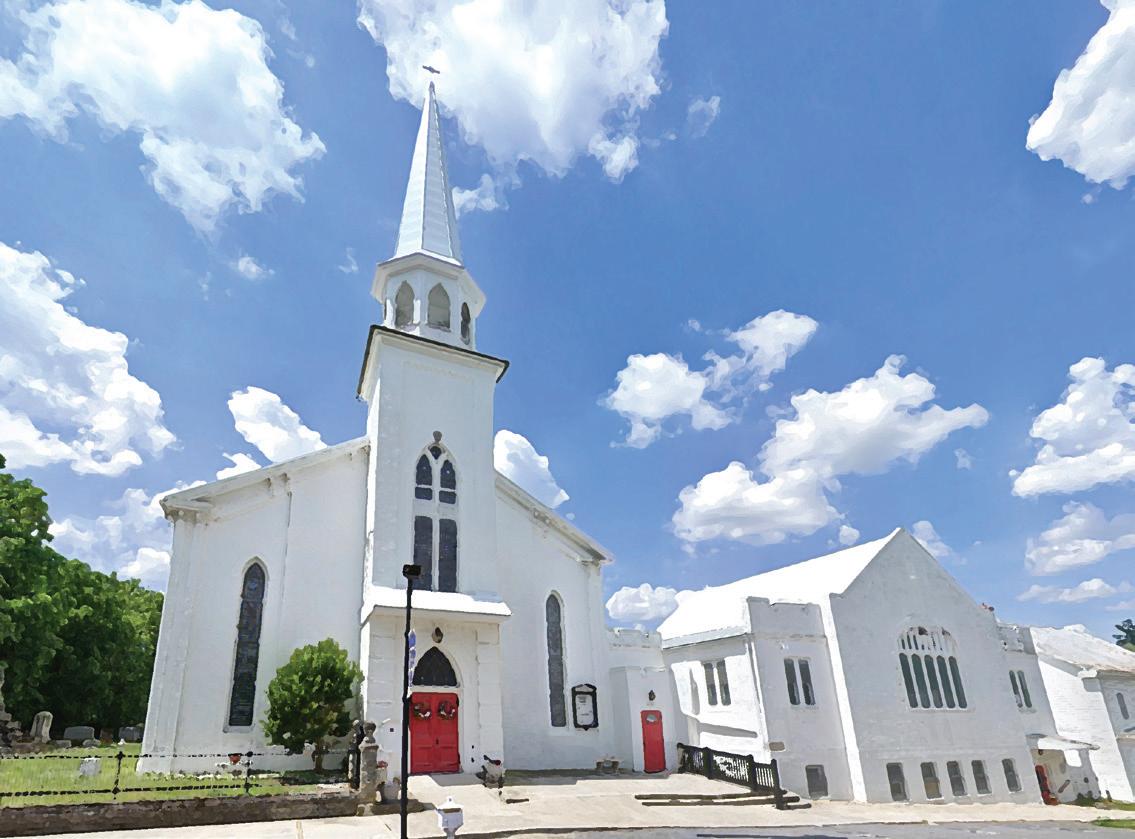
In 1926, St. Paul’s added a new building to the church property, initially called the St. Paul’s chapel. Both the upper and lower floors were principally used as Sunday school facilities. The lower floor also had a kitchen so that floor could also be used for a fellowship hall. There was a room for a furnace to replace the stoves, which had provided heat for the sanctuary during the colder seasons.
By the early 1950s, Sunday school attendance had grown so much that the numbers there often exceeded attendance at the regular service. It seems that many people would drop their children off for Sunday school but would not stay or attend the service. While it is good that the children received early training, St. Paul’s often lost contact with these youths when they grew up. We can only pray that the training they received bore fruit later in their lives.
In the 1960s, St. Paul’s was again in a multi-point parish with both Jacobs Lutheran and St. Peter’s Lutheran. Eventually, Jacobs Lutheran shut its doors due to poor attendance, leaving St. Paul’s and St. Peter’s as a two-point parish. This relationship ended in the early 1990s.
St. Paul’s has frequently experienced a pattern with pastors such that a long-term pastorate would be followed by multiple short-term pastorates, eventually ending with another long-term pastor. That pattern showed itself again in the 1980s after the retirement of Pr. Donald Warrenfeltz, who served the people of Leitersburg for 25 years. During
the following 25 years there were six different pastorates. I then served St. Paul’s from 2004 until my retirement in 2021. Since that time the pulpit has been filled by Pastor Michael Ross.
By the beginning of the 21st century, it was becoming apparent that the Evangelical Lutheran Church in America was moving theologically away from Lutheran orthodoxy. St. Paul’s made the decision to seek another home, one in which the gospel would be purely preached and the sacraments rightly administered. After reviewing the options, the congregation applied for membership in the AFLC and was accepted into this fellowship in 2005, where it has found a home amongst like-minded Lutheran Christians.
At its founding, St. Paul’s issued a statement of principles. One part of that statement is now the congregation’s mission statement: “It is our desire that here old and young will be edified, animated, encouraged, and prepared for eternity.”
Culler, who served St. Paul's Evangelical Lutheran for 17 years, is serving as interim pastor at Alsace Lutheran, Reading, Pa.
See page 21 for a story on events planned to mark the 200th anniversary of St. Paul’s Evangelical Lutheran.

Smitten by God
THE HOLY WAR OF REPENTANCE
When Jesus spoke the words, “It is finished,” he bruised the serpent’s head. The work of salvation was completed; the devil was defeated, beauty was given to the ugly sinner, sin no longer reigned in the child of faith, and the hope of eternal life in perfect union with God and one another was restored. But as we wait for the ultimate fulfillment of these truths and promises—the full restoration of beauty—the mission of the Divine Warrior is at once completed and ongoing. For this reason, the life of a Christian on earth is a life of war.
The New Testament repeatedly speaks of our Christian life with the terminology of violence and war. Our life with Christ begins with violent death and burial. “I have been crucified with Christ,” writes Paul. “It is no longer I who live, but Christ who lives in me” (Galatians 2:20, ESV). He says in Romans, “We were buried therefore with him by baptism into death, in order that, just as Christ was raised from the dead by the glory of the Father, we too might walk in newness of life” (6:4). After we are suffocated in this drowning and reborn through these waters, we find ourselves violently assailed by our enemies. “Be soberminded; be watchful,” writes the apostle Peter. “Your adversary the devil prowls around like a roaring lion, seeking someone to devour” (I Peter 5:8). Paul agrees: “For we do not wrestle against flesh and blood, but against the rulers, against the authorities, against the cosmic powers over this present darkness, against the spiritual forces of evil in the heavenly places” (Ephesians 6:12). Again, Paul says, “So I find it to be a law that when I want to do right, evil lies close at hand. For I delight in the law of God, in my inner being, but I see in my members another law waging
war against the law of my mind and making me captive to the law of sin that dwells in my members” (Romans 7:21–23). The story unfolded by the New Testament is that slaves are set free by the Son through his violence against their enemy and are then guaranteed a life of ongoing violent war against the devil.
As Christians in God’s holy war against Satan, we often think of our role as that of soldiers, and this is certainly true. Paul describes in detail the armor of such a soldier in Ephesians, outfitted with the protection of the warrior Christ. But we may consider less frequently that we are also the battleground of God’s holy war. We are not just advocates of God’s righteous cause; we still represent the unrighteous cause. We are infected by actual sinful desires, twisted thoughts, sharp words, and the abuse we inflict on our neighbors—a body of death. As Christ was simultaneously the blameless Son of God and the bearer of all human sin on the cross, and just as the apostles were called Jesus’ friends the very night they abandoned him to his arrest, we are both the friends and traitors of God. And the task of holy war is to annihilate what is unholy.

Christians can be glad of this annihilation. As we walk with Jesus, we grow to hate the ugliness of our sin. We desire greater piety in our hearts, words, and actions. We see a vision of glory promised in Scripture, of “being renewed in knowledge after the image of [our] creator” (Colossians 3:10), and of producing good fruit. But although

we know God has made us beautiful in Christ, what we really crave is a beauty that we can possess for ourselves. We want to possess a beauty that inspires the Bridegroom to burst out in wonder: “Behold, you are beautiful, my love, behold, you are beautiful!” (Song of Solomon 4:1). We want to inspire the Master to say, “Well done, good and faithful servant” (Matthew 25:21). Our secret desire (and sometimes our expectation) is that God will use a holy sponge to gently swab away the parts of ourselves we dislike most so that he will look at us as we think we really are and love what he sees. But Martin Luther reminds us: “The love of God does not find, but creates, that which is pleasing to it” (Heidelberg Disputation, Thesis 28). Christ does not make our inner beauty visible; he exposes that there is no such beauty and that he must generate it. He is much more interested in cleaning the inside than the outside of the cup (Matthew 23:25–26).
The reality is that annihilation of sin and emergence of beauty feel like nothing short of birth—an extension of our baptism that delivers beauty through the agony of repentance. There are the first aches, the ones where the pregnant mother can still multitask and distract herself from the discomfort. Then moments begin to come every several minutes where she can no longer do anything but focus on the pain. The water breaks. There is no cushion left to mitigate the force of the contracting muscles. She wants to throw up. Maybe she does. She groans. She yells, wondering how much longer her body can endure this. Then her body heaves, sometimes quickly, sometimes for a long time, pushing a baby through the gaps in her pelvic bones, with a final agonizing pain as the child’s head crowns in a conical mess of blood and vernix—and then she holds this ugly, beautiful baby.
Imagine if no one ever told this mother that such an experience of birth was not only common but expected. Imagine her terror in the grip of unforeseen violence and pain to her body. As it is, most mothers still feel fear giving birth, but the fear is not about whether or not they should be in pain.
Yet as Christians, our experience of the holy war of God in the moment of contrition resembles a mother who does
not expect to have pain when she gives birth. Adolf Köberle writes,
Where sin is regarded only as weakness or as a relative defect that could always be overcome and atoned for by an active exercise of self-discipline and by the merit of good deeds, the word of forgiveness can only mean the declaration of the rational truth of God’s graciousness, which is evident even to pure reason, or else the pleasant and comforting assurance that God was not so very particular about the required exertions.1
If we do not expect the violence and pain of our renewal, we think too little of our sinful nature’s enmity with God, which must, like the profaned items in the holy wars of the Old Testament, be devoted to destruction. We are like Eustace in The Voyage of the Dawn Treader, uncomfortable in his dragon skin and trying his best to scrape off the scales until Aslan finally says, “You will have to let me undress you.” “Agape, then,” writes Mark Mattes, “not only gets rid of the bad part but also, through God’s alien work over time, eliminates the entire diseased body” (Martin Luther’s Theology of Beauty). God will rip and tear away our dragon body, and if we have not reckoned with our utter desecration of God’s holiness, his violence will place us in a moment of unexpected, abject terror. When we are forced by God’s Word to see our ugliness exactly for what it is, we have two possible responses as Christians. The first is to suffer and celebrate the violent destruction of this sinful nature. Köberle continues:
sanctification, and God’s desire in both is that we receive the beauty of our union with Christ. Mattes again writes, “Paradoxically, whoever is most ugly— that is, most self-accusatory and thus humble, making no claims before God but in fact accusing oneself in agreement with God—is in fact the most beautiful, because such sinners are able to admit their sins due to God’s illumination.” The labor of repentance births beauty that is ugliness to any eyes but God’s, and he invites us through faith to share his sight. But there is another response, and that is to be so overcome by our wretchedness that we do not look at Christ but at our wretchedness. We are like the ignorant mother whose unforeseen pain eclipses the memory that she is birthing a child, and all she can think is that her body is sick, failing and betraying her. When God lays bare our sins, we see ourselves as we truly are. But to keep gazing in revulsion and dread at who we are sends us, with Judas, to a spiritual potter’s field (Matthew 27). In showing us our gutted reflection, God desires us to see another broken body stretching itself out, like Elijah and Elisha, to cover ours (I Kings 17:21–23, II Kings 4:32–35).
It is a God-given desire to want to look like Christ. But to be renewed after the image of our Creator, we must undergo a pain that feels—and is, in a way—disfiguring. It feels as though God himself is rejecting us, stamping his foot across our hearts each time he finds sin, wearing down the surface of our image until we give up all hope of being recognized as anything reminiscent of Christ. It is in this moment, which we face so often in the Christian life, that we must remember the image of the crucified Jesus.
Where there has been courage to face the facts honestly man just because of his zeal for the Law perishes through the Law; there self-glorification crumbles; there the confidence in self-salvation is utterly destroyed. Man has to “learn the greatest and most difficult art known on earth,” namely, to gain the consciousness of being a sinner; he must learn to regard his riches, his dependence on the results of his own efforts as his poverty, and the poverty of a humble, contrite heart as his true riches.
This moment of suffering and celebration is repentance—contrition and faith. Repentance does not just comfort the soul; it is destructive, deadly to our sinful nature every time it happens. But repentance is also more than war. Mattes writes, “Sinners reduced to nothing are in a position to receive Christ as their being, life, or identity.” This reduction happens both in our salvation and our
In our next issue, Skogerboe, the digital communications coordinator for the AFLC, will consider the artistic implications of Jesus’ beauty on the cross, reflecting on the catechetical power of and need for visual representations of the crucifixion in our churches, which have the capacity to reinforce both the horror of our sin as well as the epitome of what God considers beautiful. Yet to display the image of Christ crucified in a way that truly conveys its beauty requires the effort of respect, attentiveness, and humility. When we prayerfully choose a work of crucifixion art for our church in this way, we open a visual path for people to more deeply internalize the gospel we proclaim to their ears.
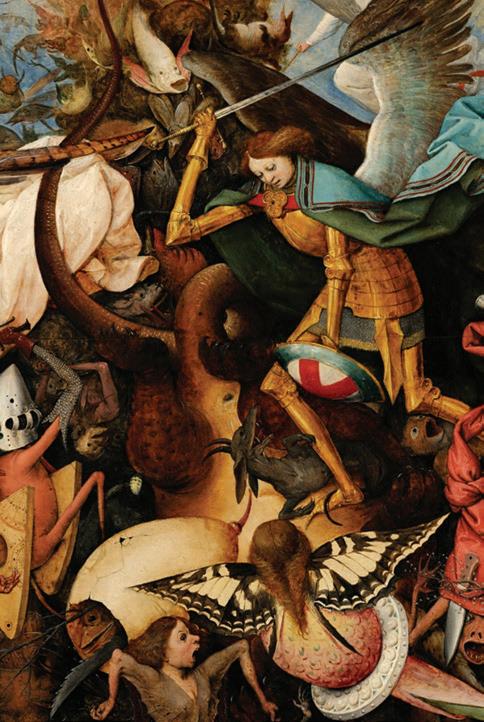
Artwork: “The Fall of the Rebel Angels,” by Pieter Bruegel the Elder, 1562, Royal Museum of Fine Arts of Belgium.
1 Köberle, Adolf. The Quest for Holiness: A Biblical, Historical, and Systematic Investigation. Wipf and Stock Publishers, 2004.
Crags of the hyrax.
BY MICHAEL ROKENBRODT
The footprints of Zechariah, called to Jerusalem in the time of Zerubbabel, a descendant of David, are still around in 2026. This young prophet was called to encourage the building of the new temple and its community, which just returned from exile. His listeners perceived themselves to be in a day of small things. My recent mission season put me alongside three congregations who sometimes tread in a similar perception: Jinja and Nabukosi Ambassador Free Living Church in Uganda and El-Shadai in Switzerland.
One Sunday morning during worship in Jinja, we had a friend stop by on his way out to a distant assignment. Pastor Godfrey asked to give the church a few words of encouragement. Our well-meaning friend looked around at us as we sat on the plastic chairs of Mamma Rose’s patio. Then he told us to be patient, that God would not leave our church to “be meeting in a house forever,” and then he added, “For who wants to meet in a house?” This comment was still in people’s memories months later. I had to remind them that Paul never chided Rome, Corinth, or Colossae for meeting in a house.
Out in the village of Nabukosi, we were having our weekly lesson on the Augsburg Confession. As we concluded, Ronald spoke. “Thank you for this program. We have been feeling alone and forgotten out here in the village.”
In Geneva, Switzerland, I was enjoying a Sunday dinner with some of the church leaders as we were discussing some of the barriers the congregation was facing. Was it possible to penetrate the Swiss and French populations around us when we were composed primarily of Portuguese-speaking immigrants from Brazil?
Every congregation has its perceived limitations, but do we define ourselves by them? Zechariah says, “Who dares despise the day of small things, since the seven eyes of the Lord that range throughout the earth will rejoice when they see the chosen capstone in the hand of Zerubbabel?” (Zechariah 4:10). So much of my ministry lately has boiled down to repeating this message of freedom. In view of the chosen capstone, there is no such thing as a small congregation, nor a lonely and forgotten one, nor one chained to boundaries. Of the four things “that are small yet extremely wise” in Proverbs 30, the hyrax applies here: “Hyraxes are creatures of little power, yet they make their home in the crags” (v. 26).
At the end of October, I gratefully watched Earl and Joan Korhonen and Mark and Joan Riley come from the United States to bring encouragement to these congregations, whether through participating in formal ceremony and worship, ministerial meetings, or in simple table fellowship. In each, the congregation had a chance to freshly assess themselves. Each congregation got a little more excited about who they already are today in addition to what they might be called to be tomorrow.
I am so thankful for those in America who hear the call to visit us in our remote crags. Every visitor is a courier of the Holy Spirit. You remind us of whose we are and on what we are built.
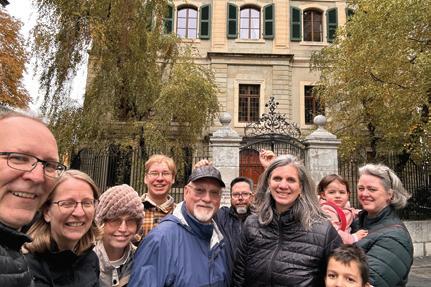
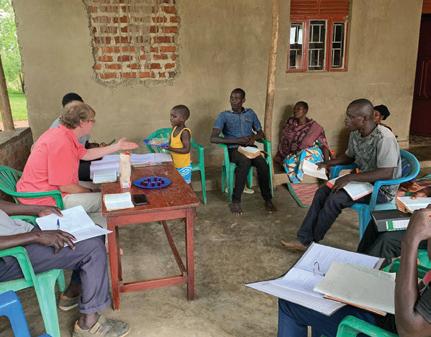
Earl and Joan Korhonen (left) and Mark and Joan Riley (center) joined Rokenbrodt on a visit to the El-Shadai congregation in Geneva, Switzerland. ABOVE: Rokenbrodt (left) teaches a class on the Lord’s Supper at Ambassador Free Living Church, Nabukosi, Uganda.
Rokenbrodt, an AFLC missionary, will serve his Free Lutheran Seminary internship at Emmanuel Lutheran, Williston, N.D.
TOP:
Alaska missionary support.

Please use the QR code or go to aflchomemissions.org/alaska/ to find information about our missionaries and opportunities to become a partner. We encourage you to prayerfully consider how the Lord may lead you, your family, or your congregation to participate in this shared gospel work across Alaska.
Congregational assessment.
What if your congregation could see itself clearly, not through assumptions, but through reality? A Congregational Health Assessment helps uncover what is truly shaping your church’s life beneath the surface. It moves beyond surface-level symptoms to reveal root causes, giving leaders clarity for meaningful renewal instead of guesswork. It creates a shared picture that aligns leadership, focuses energy, and helps the whole church move in the same direction. It also establishes a baseline so real growth in vitality, culture, and mission can be measured over time. This is an opportunity to listen deeply, discern wisely, and take the next faithful step together.
To learn more or begin the process, contact us to get started.
• Phone: 763-412-2018
• Email: homemis@aflc.org

Ministry changes.
BY PASTOR ANDY COYLE
The Alaska Mission is stepping into a new season with a renewed vision for long-term gospel ministry across Alaska. Building on decades of faithful ministry and the strong foundation laid by generations before us, we are seeking to strengthen and sustain the work for the future. Our desire is not simply to maintain existing ministry but to build toward even greater gospel impact through healthier missionary support systems, clearer mission priorities, stronger leadership alignment, and deeper partnerships across the AFLC. We are committed to creating a durable foundation for future generations of disciple-making, church planting, leadership development, and gospel outreach in communities across Alaska.
At the same time, we must acknowledge a sobering reality. The Alaska Mission has continually operated from a financial deficit. From 2010 to 2025, Alaska mission work experienced a total shortfall of nearly $940,000, with only two years ending without a deficit. While God has faithfully sustained the work and the gospel has continued to advance, the current model is not sustainable for the future we believe God is calling us toward within Alaska, church planting, and church renewal ministries.
Because of this, AFLC Home Missions is transitioning the Alaska missionaries toward a healthier and more sustainable missionary support model much like other foreign missionaries in the AFLC. This model is built on committed relationships, prayer, consistent communication, and strong monthly partnership teams. We believe missionaries thrive when they are supported by people who know them, pray for them, encourage them, and personally share in the mission.
This vision cannot move forward without partnership. We are inviting individuals, families, and congregations across the AFLC to become active monthly mission partners with an Alaska missionary through faithful prayer and consistent support. Monthly partners provide the stability missionaries need to remain focused on disciple-making, church planting, leadership development, and gospel outreach instead of ongoing financial uncertainty.
Coyle, a member of Grace Free Lutheran, Maple Grove, Minn., is the director of AFLC Home Missions.
When you become a mission partner, you are not simply helping meet a budget need; you are helping build a lasting gospel presence across Alaska for future generations. Together, we can strengthen missionaries, reach communities, and establish a sustainable future for gospel ministry throughout Alaska for years to come.

Expanding signal.
BY PASTOR JOE OCKER
For nearly 40 years, KAKN Radio in Naknek, Alaska, has been broadcasting Christian music, Bible teachers, local news, basketball play-by-play, weather, and fishing announcements. And now, so much more. Maggie Johnson, our radio manager, and Dave Perkins, station director, have been consciously focusing on making personal connections with our listeners in Alaska. Those connections are bearing fruit in so many new ways.
Recently, KAKN broadcast the school news projects of local tenth graders. We also broadcast fifth and sixth graders interviewing local elders in the community. Those experiences opened doors for Maggie to interact with staff and students, and she took advantage of the opportunity to give away 21 radios— with KAKN stickers—to students. Radios are also given away in the villages where our signal is available. The people who receive them are grateful to be loved and blessed in this way, and we are blessed to give them the gospel.
Becoming a more visible/audible part of the community continues with broadcasting basketball games and tournaments in Naknek. The school allowed us to put up beautiful banners in the gyms that advertise KAKN’s broadcast and how to listen. A physical sign, located on the highway in front of the station, will also be installed this summer to help the locals discover our station. The signs, the radios, and the local chatter are making an impact on listenership.
We are also excited to share that God has given us favor with the leadership and people of Koliganek to bring KAKN’s broadcast signal to that village. Koliganek joins Naknek, Dillingham, Manokotak, and Igiugig with KAKN broadcast capabilities. Many thanks to Rod Scheel for spearheading so many project trips to fix, upgrade, and enhance our broadcast presence in Alaska. Not everyone is online, and many still appreciate hearing KAKN over the airwaves.
I encourage all to pray, give, and go to Alaska in support of our mission there. You are making an impact on people who are desperate for the Savior. Our streaming of the KAKN content is now being listened to in an average of 140 countries around the world on a regular basis. We are awestruck at what the Lord can do. He brings the world to Naknek for salmon fishing; we minister the Word to them at the NET, and then the Lord sends the Word to the world through KAKN’s streaming. How awesome is our God?
Please listen to KAKN yourself. Listen for God’s call to join us in Naknek in ministering at the NET, on projects, on vacation Bible school teams to the villages, or as a pastor or missionary. Support our ministries in Alaska financially through gifts to AFLC Home Missions–Alaska, or go to our gift registry and purchase radios for us to give away and other items to bless our team in Alaska. We thank you for every prayer, every gift, and form of support you send our way. God is blessing his kingdom and bearing fruit in wonderful ways in Alaska.
KAKN Radio connections.
Local listeners can tune in to KAKN Radio at 100.9FM. Online, listeners can find KAKN Radio at KAKN.org. Streaming sites include:
• Alexa
• Tunein Radio (tunein.com)
• Radio.net
• Radio.garden
• Streema.com
Ocker, who serves Dell Lutheran, Frost, Minn., is the chairman of the Bay Broadcasting Board.
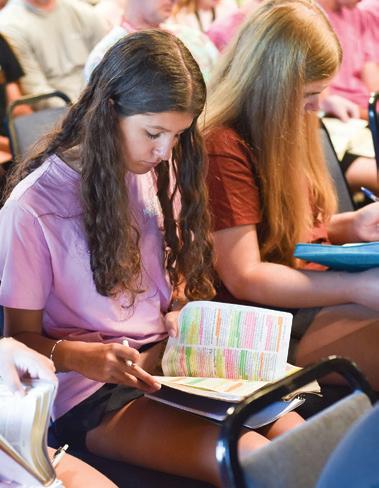
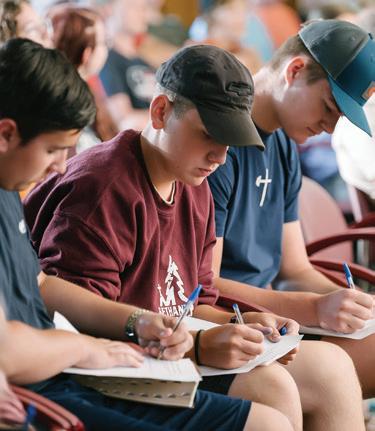
• “Your Word is a lamp to my feet and a light to my path” (Psalm 119:105).
Loving God’s Word.
BY WENDY GREVEN
“It looks like a clown car!” one of the dads joked as he watched kids stream out of our very small townhome after one of our Sunday night youth Bible studies. When we first moved to that tiny townhome on a military base in Japan, our oldest daughter, Madi, had just turned 13. We loved our new church, but the youth group consisted of her and a family of three awkward brothers. She was struggling to find friends. We tried the chapel youth group on base, but that was a total bust.
So, the Lord led us to start a Bible study in our home. It started out small, but as Madi continued to invite kids she had contact with, it grew. When I saw the students on Sunday mornings, they were excited about the Bible study and asked when we were having the next one, not about when we were doing the next fun activity. It made me realize a couple things: First, youths are hungry for truth. And second, God’s Word is powerful to work on hearts.
As youth leaders, you need to prioritize the study of God’s Word. A short devotion is just not going to cut it. Young people today are bombarded with truth claims all around them—in school, on social media, in books, on TV, etc. They long to know what is true, and you might be the only one to lead them to know the truth. To do this, you need to study God’s Word for yourself.
AFLC Youth Ministries has several resources available on its website at aflc.org/youth
• “God’s Wisdom for Vocational Living”: A four-week downloadable Bible study for teens.
• Youth Leader Small Groups: connect with other youth leaders for mutual encouragement.
• Apprenticeship Program: A yearlong program for youth ministers.
• FLY Beyond 2026: A youthequipping conference. Youth ministry resources.
Greven, a member of Living Hope, Rogers, Minn., is a member of the AFLC Youth Board.
Daily devotions are great, but if you’re only reading a short devotion a day, you are missing out on a deeper relationship with God. You are getting your application from an author instead of finding truth for yourself. You are living on the “milk,” and you need to move on to “solid food,” as Hebrews 5:13–14 says. Spend time seriously digging into God’s Word. Pray that the Holy Spirit would open your heart and mind before you study. Keep a list of all the things that you are learning about God. I can guarantee that by doing this you will fall more in love with the Lord every day, and you will be excited to share this with your students. Personally, I love studying through the Bible inductively. A couple of the resources that I use are The New Inductive Study Bible published by Precept Ministries and a notebook.
In all the years of doing youth ministry, I’ve observed that a key component for a leader is passion about the Lord and his Word. Students want you to be authentic in the way they see you follow Jesus. It doesn’t have to be emotional, just real. Let them ask questions, and if you don’t know the answer on the spot, be honest and go back to the Word on your own to find the answer. We sell students short by expecting that we need to do some kind of exciting activity to get them to come to youth group. This is often not the case. Don’t get me wrong, kids love fun and food. Have fun with them. Feed them snacks. But most importantly, feed them spiritually through the study of Scripture. By doing this, you are not only teaching them the truth of God’s Word, but you are also planting a love for God and his Word in the hearts.
Summer Institute of Theology will be held August 3–7
The Summer Institute of Theology will be held Aug. 3–7 on the campus of the Free Lutheran Bible College and Seminary, Plymouth, Minn. Sessions will include “The Gospel of Matthew” by Pastor Alex Amiot, “The Pastor as Theologian” by Dr. Nathan Olson, “Planning and Leading a Worship Service” by Andrew Hanson, “Cultivating a Gospel Culture in the Congregation” by Dr. Craig Johnson, and “History and Aims of the AFLC” by Dr. Martin Horn. Event information, including online registration and pricing, can be found online at flbc.edu/events.
FLBC hosts disc golf and Golf Scramble tournaments
Friends and alumni of the Free Lutheran Bible College and Seminary are invited to participate in two events in August. A free disc golf tournament will be held the morning of Aug. 8 at Lion’s Park in Shakopee, Minn. A Golf Scramble will be held Aug. 10 at The Refuge Golf Club in Oak Grove, Minn., to raise funds for scholarships. Find event information, sponsorship information, and online registration at the FLBC website (flbc.edu/events).
Leitersburg
FLY 2027 announces speakers
Members of the 2027 FLY Committee have announced the evening speakers for the 2027 FLY Convention. Opening the convention on July 5 will be Jason Holt, former director of AFLC Youth Ministries and current presidential ministry associate of the AFLC. On Tuesday, July 6, Gideon Johnson will speak. Johnson currently serves Hope Free Lutheran, Killdeer, N.D., and served as president of the 2023 FLY Committee. Pastor Alex Woodworth, who serves
Ebenezer Lutheran, Northwood, N.D., will speak on Wednesday, July 7. Pastor Adam Erickson, a 2026 graduate of the Free Lutheran Seminary who serves Faith Free Lutheran, Minneapolis, will speak on Thursday, July 8. Closing the event will be Pastor Andy Coyle, AFLC Home Missions director, who will speak on Friday, July 9.
With the theme of “Overcome,” the convention will be held at the YMCA of the Rockies, Estes Park, Colo.
congregation plans for 200th anniversary
In May 2025, members of St. Paul’s Evangelical Lutheran Church in Leitersburg, Md., formed a committee to plan events for the congregation’s 200th anniversary. Three days in 2026—August 23, 29, and 30—were chosen to remember the past, honor its former ministers and leaders, and give God the glory for his abiding love and guidance.
Pastor Micah Hjermstad, president of the AFLC, will launch the event by serving as our guest minister on August 23. Remembering that in 1826 St. Paul’s was a German-speaking congregation, a committee member said, “Why don’t we learn to sing ‘A Mighty Fortress’ in German?” As everyone’s eyebrows rose and raucous laughter ensued, the thought was tabled. But, when the member found a local woman who was born in Berlin in 1941 to teach the first verse of the hymn in German, 12 members committed four Sundays following church services to learn this verse. The remaining verses of the hymn will be sung in English. Following this
service, members and guests will share a German family-style meal that will include sauerkraut, brats, and apple strudel.
On the following Saturday, August 29, the outdoor atrium of St. Paul’s, which faces the main street, will be the setting for a reenactment of the church’s first five circuit riders and first resident pastor. Dressed in period robes and ranging in age from 15 to 88, each actor will dramatically explain their mission to carry God’s Word to all the little towns in the area as they travel by horse. The skits will be backed up by the gospel singing group Second Chances, who will continue to provide music for the day. Members of the congregation will be dressed in hats and clothes of various periods, from 1826 onward. A colorful invitation to the event will be delivered by mail to all Leitersburg residents.
On Sunday, August 30, Pastor Terry Culler, St. Paul’s most recent former pastor, will return to deliver the sermon. Special music is planned, and our honored guests
will be members of the Bell family, who served St. Paul’s from its foundation to the present day. A member of the congregation will give a summary of the positions held and services provided by an enormous number of Bell family members throughout the years. The family will also be gifted with a bell on an engraved base honoring their longtime service and dedication. The service will be followed by a meal in their honor.
As the time draws near, members are busily working to ready the church for a joyful celebration, from replacing the old marquee to deep cleaning the church and staining the atrium. Two bulletin boards will highlight the first circuit riders and the contributions made by each minister who served St. Paul’s. Fresh flowers will honor God’s presence with us for 200 years. If you are in the area for any of these events, please join us!
—Barbara Raschka
PEOPLE & PLACES
Pastor George Lautner, who serves Holmes Evangelical Lutheran, Clarion, Iowa, has resigned from the Coordinating Committee.
Pastor Adam Erickson, a 2026 Free Lutheran Seminary graduate, was installed June 7 at Faith Free Lutheran, Minneapolis, with Dr. Jason Holt, the AFLC's presidential ministry associate, officiating.
Pastor Adam McCarlson, a 2026 Free Lutheran Seminary graduate, was installed June 28 at Solid Rock Free Lutheran, Anoka, Minn., with Pastor Micah Hjermstad, AFLC president, officiating.
Pastor Micah Moan, a 2026 Free Lutheran Seminary graduate, will be installed July 12 at Bethany Lutheran, Binford, N.D., and New Luther Valley Lutheran, McVille, N.D., by Pastor Lloyd Quanbeck.
Pastor Leroy Flickinger, who served Abundant Life Lutheran, Thief River Falls, Minn., has retired.
Members of Our Saviour’s Lutheran, Thief River Falls, Minn., will celebrate the congregation’s 75th anniversary October 3–4.

Wilderness Camp is site of Chapel at the Lakes
Chapel at the Lakes will be held at 10 a.m. every Sunday through August 30 at Wilderness Bible Camp. All are welcome to the services. The camp is located at 12220 County Highway 5, Lake Park, Minn.
2027 conference to be held at Warm Beach
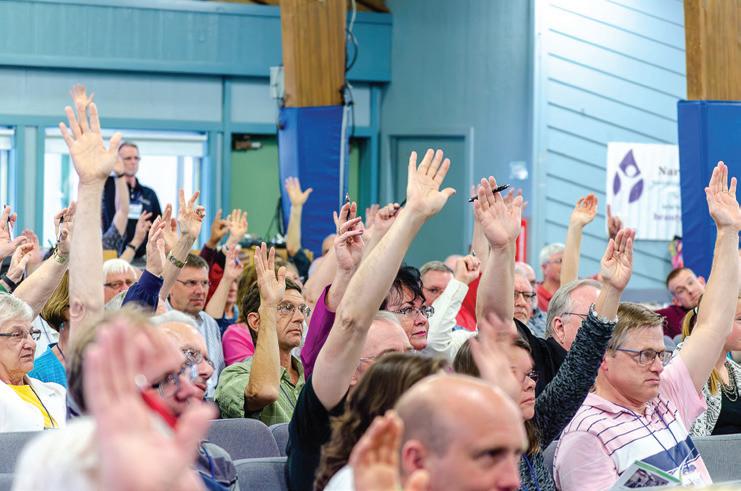
The 2027 AFLC Annual Conference will be held at the Warm Beach Conference Center (Stanwood, Wash.). The Conference Committee prayerfully pursued a location to host the AFLC national gathering since next year’s venue had not been secured at the end of the 2025 conference.
“We are grateful to find a beautiful setting in the Pacific Northwest, which has served us well in the past for our free, living, and Lutheran congregations to connect together,” explained AFLC President Micah Hjermstad.
The conference has been at the Warm Beach site multiple times (1986, 1996, 2006, and 2015), but it has been more than a decade since the national fellowship has assembled there.
The Warm Beach Conference Center will enable the AFLC Annual Conference to include their sessions, meals, and lodging options on the grounds. The dates will be June 16–19, 2027. Arrangements will be released in early 2027. More information on the Association of Free Lutheran Congregations and the AFLC Annual Conference can be found on the AFLC website (aflc.org/conferences).
Forsake the shortcut. WORD
BY MICHELE MOBLEY
Shortcuts play on illusions of cleverness. One of my children would often add a “shortcut” to our bike ride.
Upon nearing home, I would hear, “Mom, I’m going to take my shortcut. See you at home!” I would watch as this child left the straight path home and took a loop to the right or left! Smiling, I would slow my pace, allowing my imaginative offspring the satisfaction of arriving home first.
Adults revel in shortcuts, too. But our shortcuts are much more sophisticated. My husband and I like to refer to our shortcuts as “the scenic route.” It takes less humility to say, “I was just taking the scenic route,” than to admit, “My shortcut made us late.”
In life, shortcuts promise quick results. Shortcuts may feed our egos. And for a while, the ruse appears quite brilliant. Right under my scrolling fingertips is a world of shortcut influencers. The algorithm—clever. The promise of fulfillment—enticing. The final destination—bondage. Shortcuts of self-preservation deliver us right back into the very bondage we were fleeing. True deliverance is rarely experienced on the “scenic route.”
One of the greatest deliverance stories in all of history is the exodus of the sons of Israel from Egypt. The descendants of Abraham had lived in Egypt for 430 years (Exodus 12:40). The biblical account of the sons of Israel escaping Egyptian slavery records God leading his children into the wilderness, avoiding the most direct route to the land of promise.
“When Pharaoh let the people go, God did not lead them by way of the land of the Philistines, although that was near. For God said, ‘Lest the people change their minds when they see war and return to Egypt.’ Hence God led the people around by the way of the wilderness to the Red Sea; and the sons of Israel went up in martial array from the land of Egypt” (Exodus 13:17–18).
Left to their own impulses, I am quite certain the sons of Israel would have chosen the most direct route out of Egypt. Possible war? They were in martial array. But God knew this was not the time for Israel to slay Philistine giants. That battle was for another day (I Samuel 17). No, this was a day for Israel to see God slay the giants waging war in their own hearts.
God chose a route that was not only indirect but left them with no physical way out. And with the chariots of Pharaoh pressing in and the sons of Israel pressed up against the Red Sea, the hearts of the sons of Israel were revealed.
“Then they said to Moses, ‘Is it because there were no graves in Egypt that you have taken us away to die in the wilderness? Why have you dealt with us in this way, bringing us out of Egypt? Is this not the word that we spoke to you in Egypt, saying, “Leave us alone that we may serve the Egyptians”? For it would have been better for us to serve the Egyptians than to die in the wilderness’” (Exodus 14:11–12).
“Leave us alone.” But God did not forsake Israel. He instructed them to move forward. And as Moses lifted his staff and stretched out his hand over the sea, God provided a shortcut beyond man’s imagination. The sea parted and a nation of people crossed on dry

land. The parted waters became walls on Israel’s right and on their left, and a pillar of cloud moved between the camps of Israel and Egypt, giving light at night. At daybreak, Pharaoh’s chariots, horses, and his entire army were swept into the sea, and Israel saw their slaveholders dead upon the seashore. The sons of Israel broke into a song of deliverance (Exodus 14:15–22; 15).
My shortcuts are rooted in self-preservation, too. Their GPS readings are informed by the giants of my own heart—idols rooted in my search for significance. But you and I are too sophisticated to tell God to “leave us alone.” So, we develop elaborate ruses. We talk a lot. We demand the approval of others. We manipulate a following. We self-medicate our pain and our fear and our exhaustion. That’s the funny thing about our self-informed, kingdom-building shortcuts. They are exhausting. Eventually, the charade gives out, and we are left alone with our idols in desperate need of a Red Sea deliverance.
The Exodus points to the greatest deliverance story of all time—the cross of Christ. The shed blood of Christ upon the cross, his broken body, delivers to you the forgiveness of sins. God has slayed the curse of your giants. Repentance moves you forward, toward your eternal home. Your worth stands established at the cross. May your soul be satisfied in Christ alone.
Mobley is a member of Solid Rock Free Lutheran, Anoka, Minn.
BUILDING THE BASE \\\ THE FIVE SOLAS \ Part 4
Solus Christus.
BY PASTOR STEVE SNIPSTEAD
The doctrine of “Christ alone” made reconciliation with the Catholic Church impossible. Solus Christus confesses that Christ alone has the power to forgive sins. Christ alone has the authority to offer salvation. We need no other mediator to bring us to God but Christ alone. No parish priest nor bishop has more right to come to God and request forgiveness than any other Christian. Solus Christus means there is no one who stands between you and God. We need no one to mediate between us.
But Solus Christus also tells us that we need a Savior, and there is only one: Christ alone. Jesus speaks for us before God. The Book of Hebrews tells us that Christ will always and forever be there to intercede and pray for us. Nothing can separate us from the love of God that is in Christ Jesus. He lives to make intercession for us.
Only Christ can stand before God, but in him and by his gracious invitation, you and I and every Christian can stand before the throne of God. Do you think about that very often? There is a profound implication here. Those who stand before God are priests. When you stand before God, you have access to his presence. He sees you. God hears you. As his priest, you may offer up praise and thanksgiving to him. In prayer, you intercede for others. You pray for your people.
You may not feel you have the right to do this. You think, “My life isn’t what it should be. Why should God listen to me?” God knew, and knows, the depths of your heart and still called you to be his priest. You do not stand before God on your own merit:
Solus Christus. You have your own High Priest, Jesus, who has gone before you into the presence of God. He has sprinkled you with his blood and made you clean. In Jesus, you and I come boldly into God’s presence.
The priesthood of all believers rests on the doctrine of Christ alone, and it profoundly changes how we see our lives. Perhaps you know the words of the poem, attributed to Teresa of Ávila, titled “Christ Has No Body”:
Christ has no body now but yours, No hands, no feet on earth but yours, Yours are the eyes through which He sees, Yours are the feet with which He walks to do good, Yours are the hands with which He blesses all the world.
We know Christ ascended with his body, but this is the incredibly radical idea behind the movement Jesus started: that every man and woman could be a priest of God serving, sacrificing, and guiding one another to the peace and blessing of God’s presence. This is my calling. This is your calling. A calling that leads to sacrifice, but a sacrifice the followers of Jesus are willing to make because we have a great high priest who has gone before us, who stands before God on our behalf, Jesus God’s Son.
Snipstead, who serves on the FLBCS Board of Trustees, is a member of Faith Free Lutheran, Kalispell, Mont.