

Lutheran AMBASSADOR THE HYMN STORIES
Praise be to the God and Father of our Lord Jesus Christ, who has blessed us in the heavenly realms with every spiritual blessing in Christ.

Hymn stories.
Many scholars believe that Ephesians 1:3–14 is one of the first Christian hymns. Called the “Berakah Hymn”—from the Hebrew word for blessing—these verses are a single, 200-word-long sentence in the original language. This early hymn praises God for the blessings he has given to us through Christ.
Another early Christian hymn is found in Philippians 2:6–11. Called the “Christ Hymn,” these lyrics direct our attention to the humiliation and exaltation of Christ.
Hymns have a unique ability to capture profound theological truths in a language the heart can sing. The best hymns serve as “living catechisms,” teaching the faith and comforting the soul.
Our issue this month tells the stories behind several popular hymns. Pastor Mikey Meester opens the issue with the hymn “What a Friend We Have in Jesus.” We don’t need to wear a mask when talking to God; he is a friend who invites us to be completely and totally vulnerable before him.
Pastor Wes Langaas shares some of the background to the hymn, “Wherever He Leads, I’ll Go.” It’s a heartbreaking story about a missionary with a medical condition preventing him from returning to the field. When asked about his plans, with tears welling up in his eyes, the missionary said he wasn’t sure. “But wherever he leads, I’ll go.”

Marian Christopherson, director of Parish Education for the AFLC, writes about the hymn “When I Survey the Wondrous Cross.” This hymn is significant because Isaac Watts departed from the norms of hymn writing when he composed this in 1707. Instead of arranging paraphrased biblical texts together, the words to this hymn are original.
The hymn “Jesus Paid It All” has a serendipitous history. Pastor Ken Hart tells the story of several people coming together to give us this beloved hymn. We know many of the words by heart—“I hear the Savior say …” and “Lord, now indeed I find …”—and Pastor Hart reminds us of the precious gospel message that Jesus truly paid for all of our sins.
Pastor Dan Hurner helps us see “For the Beauty of the Earth” in a new light. There are endless reasons to praise our Creator God, and the verses in this beautiful hymn give us words to use.
And finally, Dori Unverzagt walks readers through the hymn “Come Thou Fount of Every Blessing.” The man who penned “prone to wander, Lord, I feel it” himself strayed from God’s fold throughout his life. Dori tells the story of how his own words reminded him that God’s streams of mercies still flowed.
In addition to interesting background stories, each of these hymns is filled with meaningful and powerful lyrics. The beauty of a hymn is not necessarily found in the unique context or the complexity of the notes but in the clarity with which it points sinners to Christ.
Our “In the Word” column also continues this month with a Bible study on the Christ prophecy in Isaiah 9. Darkness can be overwhelming and disorienting. But, as Pastor Mark Molstre reminds us, “God does not leave darkness unchallenged.” The true light has come into the world, and he stands in complete victory!
—Pastor Andrew Kneeland
Editor
Pastor Andrew Kneeland laeditor@aflc.org
Managing Editor
Ruth Gunderson ruthg@aflc.org
Circulation
Liz McCarlson lasubscriptions@aflc.org
Editorial Board
Monica Coyle
Pastor Jerry Moan
Pastor Craig Johnson
The Lutheran Ambassador (ISSN 0746-3413) (USPS 588-620) is published monthly by the Association of Free Lutheran Congregations, 3110 E. Medicine Lake Blvd., Plymouth, MN 55441 Phone (763) 545-5631
Periodicals postage paid at St. Paul, MN and additional mailing offices.
Postmaster send address changes to
The Lutheran Ambassador, 3110 E. Medicine Lake Blvd., Plymouth, MN 55441.
subscriptions & giving
The Lutheran Ambassador is a free publication of the AFLC. Our non-profit ministry is supported by readers’ gifts. To subscribe and give online, visit our website aflc.org/lutheran-ambassador
Checks may be mailed to 3110 E. Medicine Lake Blvd., Plymouth, MN 55441
Email inquiries can be sent to lasubscriptions@aflc.org
Next to the Word of God, music deserves the highest praise. [Martin Luther]
Let the word of Christ dwell in you richly, teaching and admonishing one another in all wisdom, singing psalms and hymns and spiritual songs, with thankfulness in your hearts to God. [Colossians 3:16]
When
your
heart is full of Christ, you will want to sing.
[Charles Spurgeon]
For nothing so uplifts the mind, giving it wings and freeing it from the earth, releasing it from the chains of the body, affecting it with love of wisdom, and causing it to scorn all things of this life, as modulated melody and the divine chant. [John Chrysostom]
Music … will help dissolve your perplexities and purify your character and sensibilities, and in time of care and sorrow, will keep a fountain of joy alive in you.
[Dietrich Bonhoeffer]
Music is an agreeable harmony for the honor of God and the permissible delights of the soul. [Johann Sebastian Bach]
Cover artwork: “Wooded Landscape with Figures,” Meindert Hobbema, 1658, National Gallery of Art.
TAKE IT TO THE LORD
Itend to overshare. I often leave a conversation feeling that I spoke too much and that the person I was speaking with probably didn’t need to know or care about all the things I shared. While I’ve known this about myself for many years, it has only been in the past year that I have come to yet another realization: while I tend to overshare with people, I tend to drastically undershare with God. I do this to be more godly. Yet I am simply wearing a mask.
Often, I wear this mask as I am expressing my desires. If I am feeling tempted, I will come before God in prayer and say, “Dear God, I am feeling tempted. I don’t want to give in. Please help me!” Yet, deep down, this is not what I want. I don’t want God’s help in my temptation. What I really want is to give in. But because I believe that God wants me to want to avoid this temptation, I put on my holiness mask and ask for help.
Other times, I wear this mask simply by refusing to come to God in prayer at all with the concerns that are on my mind. When I am sad or angry, I simply choose to dwell on those feelings rather than bring them to God. Instead, I pray as if everything is just fine, all the while my negative feelings continually simmer in the background.
Now, I’m sure I’m not the only person to have struggled this way in prayer. In fact, I know I’m not. And I must say, I thank God for the blessing of those who have gone before me who have shared in my struggle. For it is from God’s work in their struggles that we can be helped in ours.
One such man was Joseph Scriven. Being no stranger to misfortune in his life, Scriven moved from Dublin, Ireland, to Ontario, Canada, after his fiancée died by accidental drowning the day before their wedding. There he lived what most of us would consider to be a difficult life riddled with poverty, depression, and the death of his second fiancée. Yet during his troubled life, Scriven found the strength to pen “What a Friend We Have in Jesus.”
After reading Scriven’s heartfelt words, I can’t help but think that he also struggled with putting on masks before God. It seems that these words could only be written by one who has finally been set free from the compulsion to hide from God and has experienced the joy and relief of being completely and totally vulnerable before him.
While there is much from this song that expresses this kind of joy and freedom, three lines in particular show the journey from hiding to vulnerability. The first of these lines
frankly states:
Oh what peace we often forfeit, O what needless pain we bear, All because we do not carry everything to God in prayer.
Here Scriven poignantly describes the effects of masking before God—it is painful. Not only can we experience negative physical and psychological effects when we hide our true selves from him, but most serious of all is the rift that it creates between us and God. When we refuse to trust Christ with the darkest parts of us, we experience the pain of missing out on the fully transforming power of Christ in every aspect of our lives.
Even knowing the pain this rift causes is not always enough to remove our masks. In response to this, Scriven writes:
Jesus knows our ev’ry weakness. Take it to the Lord in prayer.
The reality is that hiding from God is futile. He already knows when you don’t want his help in times of temptation. He knows when you are angry. He knows everything. So, why even bother hiding it?
The final line, however, holds the greatest motivation for honesty before God:
In His arms He’ll take and shield thee Thou wilt find a solace there.
When you fully reveal yourself to God, he becomes your solace and shield. When you’re honest with God about how much you want to sin, God will change your heart. When you’re honest about your feelings, he will guide you through them. We have no need to hide in fear. He has promised to help and guide us, and he will.
It has been less than a year since I began to be more honest with God. However, I have already seen God’s promises fulfilled. I still struggle with hiding myself in prayer, but I have seen God work all the more in my life. I pray that you might be encouraged to be more honest with God as well. For he is your faithful friend who will not only share your sorrows but heal them, too.
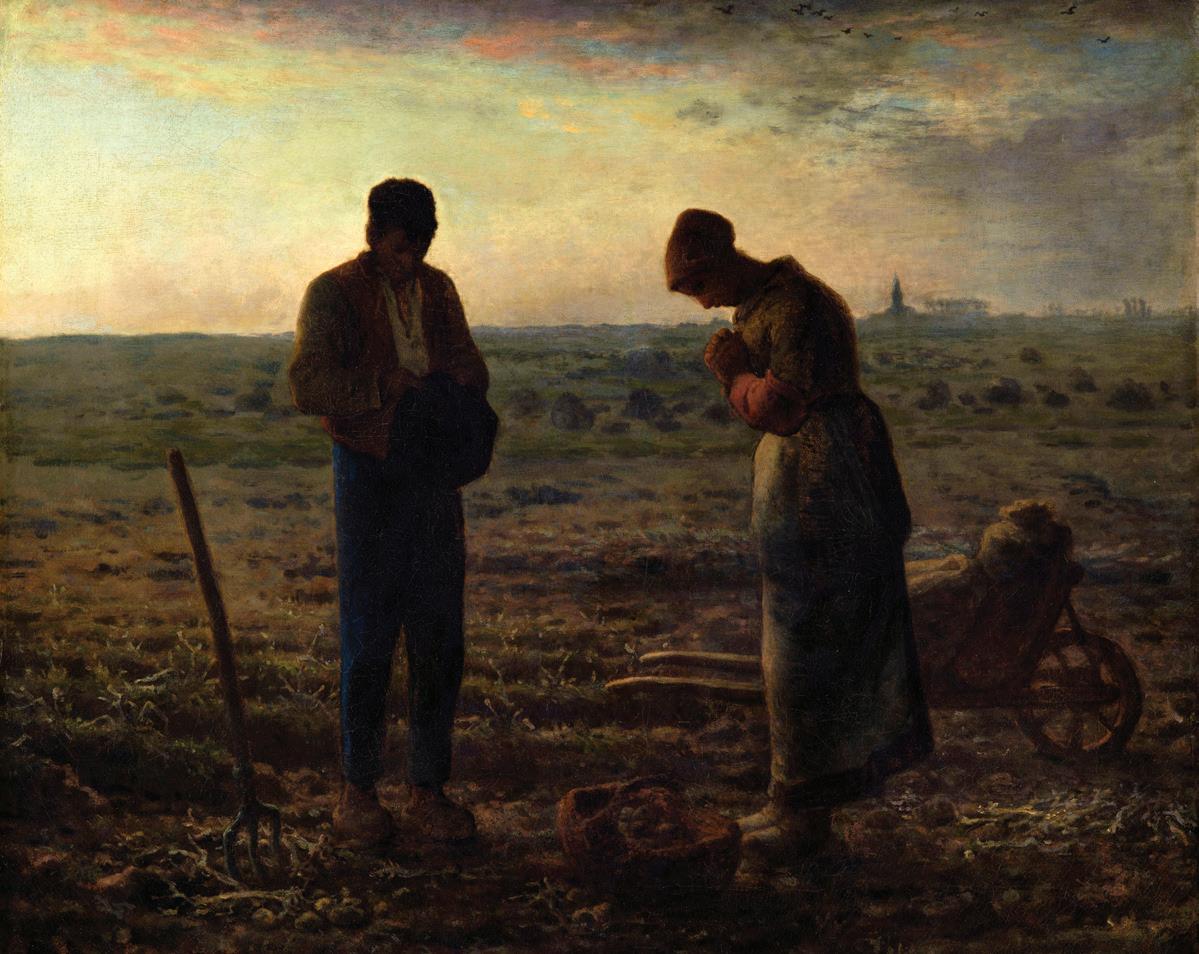
Meester serves St. Peter’s Lutheran, Melvin, Ill. Artwork: “Angelus,” Jean-Françios Millet, c. 1857–59, Musée d’Orsay.


By Pastor Mikey Meester

What a friend we have in Jesus all our griefs and pains to bear what a privilege to carry everything to God in prayer



Wherever he leas
I’ll go
Wherever he leads I’ll go
I’ll follow my Christ Who loves me so Wherever he leads I’ll go
By Pastor Wes Langaas




FOLLOWING JESUS
When B. B. McKinney was a young boy, his mother would consistently remind him to mean the words he sang. Years later, he stood in front of 10,000 Baptists and led them in singing “Wherever He Leads I’ll Go,” one of many songs he had written. When the singing ended, McKinney leaned toward the microphone and whispered the lesson he had learned so well: “Be sure that you mean the words you sing.”
Of course we should mean the words we say or sing. As a pastor I have often reminded my congregation to pay attention to the words they are singing because we do tend to sing hymns without thinking much about the words. For one thing, we know the words so well that our minds tend to drift. Also, we might love the music so much we don’t think too deeply about words or phrases. So, it is only right to be sure that you mean the words you sing.
It is good sometimes to point out certain words or phrases that emphasize Bible doctrine (which we do need) or some aspect of the Christian life and service. This hymn, and many others, is about serving God wherever he leads us. Jesus said, “Follow me” (Matthew 4:19). Where? Wherever he goes.

Scripture records 21 times when Jesus said, “Follow me.” Ask Peter or John or Matthew, or any of the other men who left everything and followed Jesus wherever he went. The Apostle Paul followed Jesus in his missionary journeys, even when he was called mid-journey in a different direction. Paul was planning to go east into Asia, but God called him to “come over to Macedonia and help us” (Acts 16:9–10). He went there and, in doing so, opened the door for the gospel to Europe and beyond.
Would you be willing, like the apostles, to give up your occupation and possessions to follow Jesus? Many Christians have done exactly that, selling their farms and business and moving their families to follow Jesus, often to a faraway mission field. When Jesus calls, it means changing the direction we have been going, as God closes one door and opens another. But how easily do we follow him even when we are disappointed by the changes?
One day in 1936, McKinney, already a well-known hymn writer by that time, was leading the music at an Alabama Sunday school convention. There he met the speaker, a Rev. R. S. Jones, who had recently returned from missionary service in Brazil. Over dinner, Jones revealed
that his doctor would not allow him to return to the mission field due to ill health, and that was hard for him to accept. McKinney asked him, “What will you do?” Jones replied, “I don’t know, but wherever he leads I’ll go.” Before the evening session began, McKinney had used his friend’s words to write both the lyrics and melody to his now well-known hymn. He sang the new hymn that evening, beginning with the words:
Take up thy cross and follow Me, I heard my Master say; I gave My life to ransom thee, Surrender your all today.
Jesus said to His disciples, “If anyone wishes to come after Me, he must deny himself, and take up his cross and follow Me. For whoever wishes to save his life will lose it; but whoever loses his life for My sake will find it” (Matthew 16:24–25).
The words imply that there is nothing in this life, nor in this world, that is worth having more than Jesus. Many Christians have understood the consequences of living such a life and have had what we would call very successful ministries. This call of Jesus is echoed in the famous words of Dietrich Bonhoeffer when he stood against the Hitler regime in his own country: “When Christ calls a man, He bids him come and die.” Even if he leads me there, I’ll go.
“Wherever he leads I will go.” These words are not meant only for missionaries who are called to some faraway land (where we may not want to go anyway). “Wherever” means wherever. It could be a call to an unknown land or people outside your comfort zone. It might be to your own land among your own people. “Wherever” begins at your own doorstep, with your home and family and community, with your occupation and “wherever” you might be at any time. It is in these times and places that we are called to be “ambassadors for Christ,” pleading with people “to be reconciled to God” (II Corinthians 5:20). Where should we not go to do that?
McKinney’s mother gave him—and us—good advice: “Be sure you mean the words you sing.”
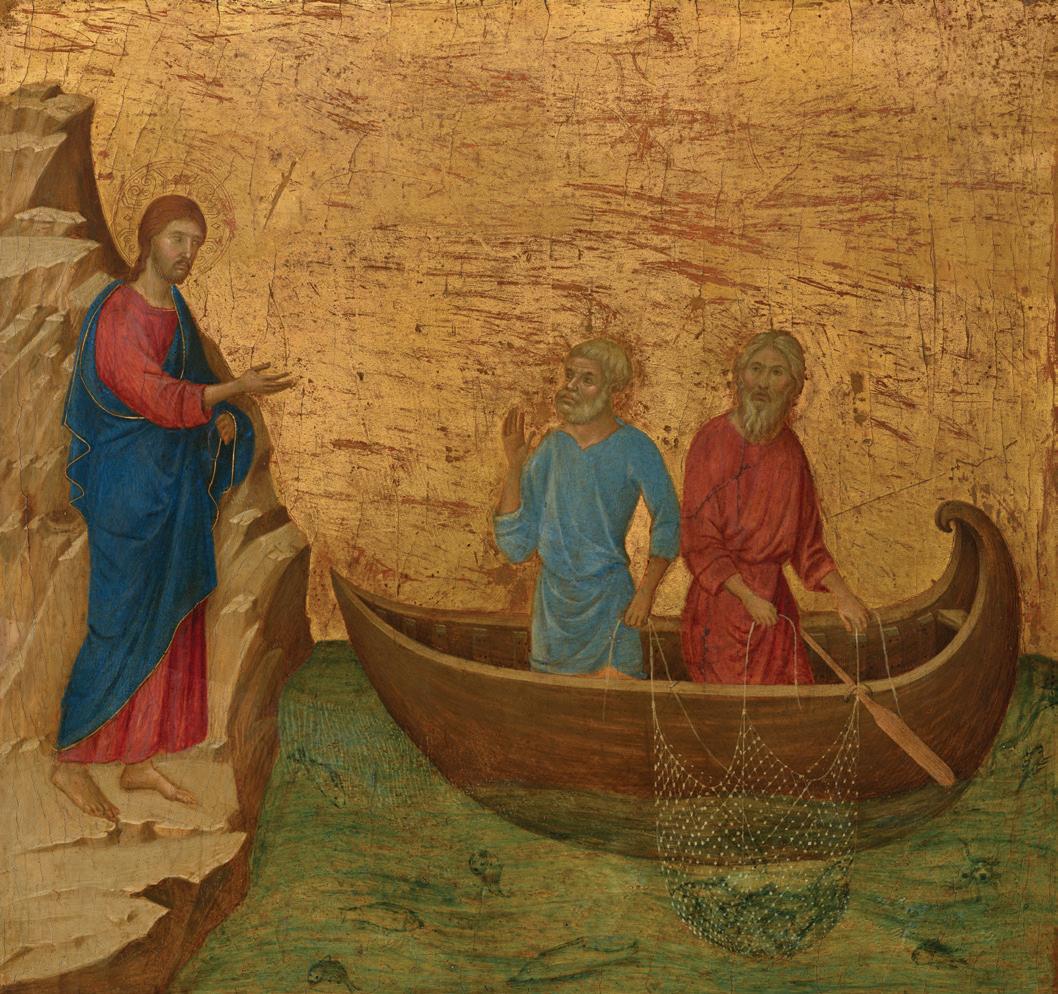
Langaas serves Badger Creek Lutheran, Badger, Minn. Artwork: “The Calling of the Apostles Peter and Andrew,” Duccio, c. 1308–1311, National Gallery of Art.

WHEN I SURVEY

By Marian Christopherson
Asurveyor set up his instruments on the edge of the field. Hours later a young girl noticed he was still there. Why would someone spend so much time looking at the land? Then he came back the next day for more looking! This seemed strange to me as a child. But I didn’t understand the meticulous work of a surveyor or the precise measurement needed, often for the purpose of assessing value.
To survey is not to issue a casual, passing glance. In the hymn “When I Survey the Wondrous Cross” by Isaac Watts (1674–1748), we are invited, even compelled, to set up our surveyor instruments and stay awhile. Ascertain the measurement—the height and depth, width and length (Ephesians 3:18–19). Examine the cross so as not to miss anything. Appraise its value and significance.
When I survey the wondrous cross on which the Prince of Glory died, My richest gain I count but loss, and pour contempt on all my pride.
The writer’s literary skills are displayed throughout this hymn. Notice the contrasting word duos in the first stanza: wondrous/cross, Prince of Glory/died, gain/loss, and contempt/pride. In the paradox of the wondrous cross, Watts pairs beauty with brutality. A horrific instrument of death becomes one of salvation. The Prince of Glory, the divine Son of God, at the highest pinnacle of power chooses the lowest depths of helplessness through death on a cross (Philippians 2:6–11). The countercultural confession of gain as loss is rooted in Philippians 3:7–8, “I count all things to be loss in view of the surpassing value of knowing Christ Jesus my Lord.” Finally, contempt is an action of lowering others, while pride is elevating self. Pouring contempt on our pride implies disgust to the extent that we want to annihilate or drown it, not a mere sprinkling to temporarily dampen its spirits.
Forbid it, Lord, that I should boast, save in the death of Christ, my God: All the vain things that charm me most, I sacrifice them to His blood.
The original title of this hymn, specifically written for communion, was “Crucifixion to the World by the Cross of
Christ,” and its inspiration was Galatians 6:14, which closely aligns with this stanza. Watts’ use of personal pronouns as shown in the first two stanzas was groundbreaking and somewhat controversial in 18th-century England. His intent was to encourage contemplation on the rich Christ-centered theology of Scripture and elicit devotional response.
The world pressures us to boast in wealth, power, and accomplishments, but here Watts helps us confess their vain charm is lost in the light of the cross.
See, from His head, His hands, His feet, sorrow and love flow mingled down!
Did e’er such love and sorrow meet?
Or thorns compose so rich a crown?
We gaze upon our Suffering Servant, the man of sorrows, acquainted with grief (Isaiah 53). The people hurl vehement accusations. They betray and mock and insult. Sorrow speaks through silence. They spit and scourge and torture. Love responds, “Father, forgive them, for they know not what they do.” We see the head that bears the thorny crown, the outstretched hands, the pierced feet. The Sorrowing One who willingly took the Gethsemane cup bears in anguish the weight of my sin and the sin of the world. The innocent is crucified for the guilty. My sin hangs before me on the tree of death and life.

Were the whole realm of nature mine, that were a present far too small; Love so amazing, so divine, demands my soul, my life, my all.
This “demands” is not a harsh finger-wagging ultimatum. The writer paints a picture that makes sorrow and love circular. His sorrow and love mingled on the cross evoke my sorrow and love in return. I survey the wondrous cross; the thorny crown pricks the depths of my innermost being. Love has freed me from the weight of sin. Love draws my heart. My sorrow and love flow back to the cross in repentance, devotion, and surrender.
Christopherson, the director of AFLC Parish Education, is a member of New Luther Valley Lutheran, McVille, N.D. Artwork: “The Cross,” Caspar Friedrich, 1804, Staatliche Museum Berlin.

When I survey the wondrous cross ... my richest gain I count but loss and pour contempt on all my pride.


This hymn is broadly considered the finest English hymn because of its poetic quality and theological depth. Composing his first hymn at age 18, Watts’ prolific writing totaled more than 600 hymns. Though small in stature at only five feet, with a notably unimpressive appearance and frail health since childhood, his perceived inferiority and weaknesses in the eyes of the world did not hinder God’s work through him. By age 6 Isaac exhibited poetic talent, and he became an insatiable reader. God gifted Isaac with a brilliant intellect, enabling him to master four languages besides English by his early teens: Latin, Greek, Hebrew, French. Yet he could not study at the established, prestigious universities of Oxford and Cambridge since only members of the Church of England could enroll. Isaac’s father was a Dissenter, imprisoned twice for his nonconformist religious views. Isaac studied at a dissenting academy established to train ministers for nonconformist
churches and then pastored an independent congregation. Watts’ hymn writing was pivotal in church music in England, and he has become known worldwide as the “Father of English Hymnody.” He published his first English hymnal in 1707. Germany and Scandinavia had rich hymnody coming out of the Lutheran Reformation in the 1500s. But the Church of England and broader Reformed or Calvinist tradition in Europe were restricted to chanting the Psalter. Young Isaac believed this left the people impoverished of the New Testament, and he also criticized shoddy hymns sung in the dissenting churches. When his father challenged him to write something better, Isaac immediately accepted and soon presented his first hymn. He continued to write poetic lyrics to express the theology of Scripture, integrating the Old and New Testaments, communicating redemptive history, and inviting personal piety.



By Pastor Ken Hart

For nothing good have I whereby thy grace to claim I’ll wash my garments white in the blood of Calvary’s Lamb

JESUS PAID IT ALL
This is one of the hymns that I have on the schedule every year during Lent. What I appreciate the most about it is that we are singing the good news of what Jesus has done for us.
The story of this hymn starts on a Sunday morning in the spring of 1865. In a church in Baltimore, the pastor had been delivering a particularly lengthy sermon. It was then followed by a lengthy prayer. Sitting in the choir loft was a 45-year-old woman named Elvina Hall. As the pastor prayed, her thoughts began to wander.
Romans 5:8 came to mind: “But God demonstrates his own love for us in this: While we were still sinners, Christ died for us.” And also, Isaiah 1:18, which refers to sins that are like scarlet being made as white as snow. From those verses, a poem was forming in her mind.
Elvina had brought her own hymnal to church. While the pastor continued to pray, she wrote the words on one of the blank pages at the back. She began:
I hear the Savior say, “Thy strength indeed is small; Child of weakness, watch and pray, Find in me thine all in all.”

We hear in Scripture (Matthew 26) about Jesus praying in the Garden of Gethsemane shortly before he was betrayed. Jesus warned Peter to watch and pray so that he would not fall into temptation. “The spirit indeed is willing,” Jesus told him, “but the flesh is weak” (v. 41). Not long afterward, Peter did deny that he knew Jesus.
The same words of Christ call all of us, when our strength indeed is small, to depend on the strength of our Savior. Elvina’s poem continued:
Jesus paid it all, All to Him I owe; Sin had left a crimson stain, He washed it white as snow.
he knew the words from Isaiah 1:18: “Come now, let us reason together, says the Lord: though your sins are like scarlet, they shall be as white as snow; though they are red like crimson, they shall become like wool.”
The pastor’s prayer came to an end. When the service finished, Elvina left the choir loft and handed him her poem. After reading it, the pastor remembered that, just a few days before this, the church organist had given him a tune that he had composed. It seemed to him that Elvina’s words and John Grape’s music might fit well together. And the pastor was right. Elvina and John worked on the lyrics and the
tune, and the result of their collaboration is “Jesus Paid It All.”
Elvina added a second verse, which also is an echo of God’s Word:
Lord, now indeed I find Thy pow’r and Thine alone, Can change the leper’s spots And melt the heart of stone.
Several people have asked me about this. The word is “leper.” It is not “leopard,” which is a large cat that does have spots. It is not “leaper,” which is someone who leaps. The word is “leper,” which is someone with a skin disease that used to be fairly common and is frightening.
We hear in Matthew 8:1–3: “When he came down from the mountain, great crowds followed him. And behold, a leper came to him and knelt before him, saying, ‘Lord, if you will, you can make me clean.’ And Jesus stretched out his hand and touched him, saying, ‘I will; be clean.’ And immediately his leprosy was cleansed.”
Elvina’s words remind us that the same Savior who can cure leprosy can also melt the hardness against God that we sometimes find in our own hearts.
In verse three, we sing:
For nothing good have I whereby Thy grace to claim.
We find that also in Ephesians 2:8–9, “For by grace you have been saved through faith. And this is not your own doing; it is the gift of God, not a result of works, so that no one may boast.”
Then we sing in the same verse:
I’ll wash my garments white in the blood of Calvary’s Lamb.
When I sing these words, I think of Revelation 7:14b: “They have washed their robes and made them white in the blood of the Lamb.”
In the last verse, the hymn reminds us that God’s people will stand before his throne, repeating the good news of “obtaining the outcome of your faith, the salvation of your souls” (I Peter 1:9).
Elvina Hall and John Grape have given us a hymn to sing thankfully that faithfully echoes Holy Scripture and testifies to our Savior. The news is good! Jesus paid it all. All to him I owe. Amen.
Hart serves Faith Lutheran, Fairbury, Neb.
Artwork: “The Lamb,” Paul Klee, 1920, Städel Museum.

OUR GRATEFUL PRAISE
The siding on my home is prone to come loose if the wind is from the right direction. This especially happens during the summer, when fixing what the wind shook loose grows into a labor of patience. The last thing I wanted to do late last August was to spend an hour fixing siding. But being a homeowner does not afford me the luxury of ignoring problems that need fixing, so with tools out and gloves on, up the ladder I went. Halfway through the project, I started to appreciate the fact that the wind was relatively calm. The setting sun was creating yet another brilliant spectacle we get so often in the Midwest. It was, despite the tedium of my work, one of those perfect summer days.
I imagine that’s very much what Folliott Pierpoint experienced one spring morning in 1864 outside of Bath, England. Once you get past all the frozen slush, unpredictable weather, and mud, spring is a beautiful season. With new life emerging after a long winter, the smell of freshly tilled earth and the warming sky bringing a promise of summer, a person may easily feel invigorated. For Pierpoint, the beauty of the created world around him caused a moment of inspiration, leading him to jot down what some identify as his crowning work: the words to our hymn, “For the Beauty of the Earth.”
The verses progress through a long list of praises to God, covering a wide range of gratefulness. In the Ambassador Hymnal, you can find this hymn under the

“Prayer, Praise” theme (no. 182, by the way). This hymn would also work well as an opening for worship, for the season of Thanksgiving, and for any time the Body of Christ celebrates Holy Communion. The progression of the verses flows and builds naturally to a grand culmination.
As it reads in our hymnal, verses one and two of this song begin with admiration for the created world and acknowledgment of God’s love for us. This points us to numerous psalms and New Testament passages. In verse three, there is gratefulness for being able to observe God’s work in the world around us. Verse four shifts to focus on the relationships a person may have with friends and family. This verse also points a grateful eye towards the community of believers within the Church, including “friends on earth and friends above.” Finally, this hymn concludes with verse five’s thankfulness for God’s sovereign plan of salvation. Above all the beauty in the world, surpassing our daily provisions, and reaching beyond our precious community and relationships stands God’s grand design to restore people to himself.
For yourself, best gift divine to the world so freely given agent of God’s grand design: peace on earth and joy in heaven!
By Pastor Dan Hurner
The flow of this hymn is often tied to Psalm 19, and it’s not difficult to see why. In Southwest Texas, Big Bend National Park serves as a destination for aspiring nocturnal photographers, being recognized as one of the darkest places in the continental United States. The resulting photos are astounding, with the cloud of the Milky Way being clearly seen even in photos from amateur photographers. It’s not hard to imagine what kind of impression such a view would have had on David as a young shepherd outside of Bethlehem. Admittedly, there are times when this kind of impression is more potent than others. For me, half-way up my ladder with an arm full of siding was such a time as I appreciated my little corner of God’s creation.
As David marvels at the wonder of the created world, his song of praise also shifts to glorifying God for his perfect law. Personally, the connection between the created world and the command of the Lord is obvious. David gives us the answer in Psalm 18:3a: “I will call upon the Lord who is worthy to be praised.” One who can create such profound, inspiring, wondrous, and mysterious things is,

at the very least, worthy of adoration. He would be one worth following, which is why David declares that God’s commands are perfect, trustworthy, right, radiant, and firm (Psalm 19:7–9).


We can take this a step further given Pierpoint’s focus on the Lord’s Supper as he writes this hymn. As if sustaining the world weren’t enough, the beauty of God’s sacrifice for us is highlighted in this hymn. As we hear the promise from Jesus, “poured out for many for the forgiveness of sins” (Matthew 26:28), we are invited to have eyes to see beyond the created world to God’s grand purpose and plan. With this perspective, we join Pierpoint in his chorus of worship:
Christ, our Lord, to you we raise this our sacrifice of praise.
Hurner serves the Dalton Free Lutheran Parish, Dalton, Minn. Artwork: “Autumn – On the Hudson River,” Jasper Francis Cropsey, 1860, National Gallery of Art.
Come thou fount of every blessing tune my heart to sing thy praise

STREAMS OF MERCY

By Dori Unverzagt



In college, my ministry team puzzle-pieced many worship sets around this hymn. It was one that every church we visited recognized—congregations of fellow believers who did not know us at all sang with worshipful abandon.
Eight years ago, we raised our voices, “tune my heart” drifting above the frosty morning of our winter wedding. And we have sung this hymn alongside Christmas carols but also with the withering passage of Habakkuk 3 (“yet will I rejoice in the Lord” v. 18). A morning rife with promises, of lean times, of mercy.
One day, we will sing this song at my pastor father-inlaw’s funeral, per his request. I have already sung it at a few others.
What is it about this hymn?
Prone to wander, Lord, I feel it, Prone to leave the God I love
… these words exploding with grace, riddled with honesty about our fallibility, our wavering creatureliness?
Jesus sought me when a stranger wandering from the fold of God
This hymn was written by such a “stranger” who himself knew what it was to wrestle with faith. Jacob-like, limping from God-encounters into unorthodoxy and disrepute and back into grace again, Robert Robinson penned these words and then lived them for the rest of his days.
Raised penniless and fatherless, Robinson was apprenticed to a London hairdresser at 14 years old in 1749 and, without parental restrictions, fell in with wild friends. Among other incidents, he and his gang plied a gypsy with alcohol until she gave them free fortunes.
The shaking finger and the frenzied eyes of the oracle haunted him: “You will live to see your children and grandchildren.” Robinson had no grasp of the future—until that moment. How could he make it to see his children and their children the way he was living now?
Not long after this agitating prophecy, evangelist George Whitfield arrived in London for a tent meeting.
“Let’s go laugh at the deluded Methodists,” Robinson goaded his friends. They could never know, he told himself, how much he wanted to go.
That night, Whitfield preached on Matthew 3:7, “O generation of vipers, who hath warned you to flee from the wrath to come?” The sermon gripped Robinson, following him for weeks. Later on, he wrote, “Those words sunk into my heart like lead in the water.”
Later sources indicate the gradual nature of grace in his life: he reached a degree of religiosity around 1752 and fully converted by 1755. He described this experience as [finding] “full and free forgiveness through the precious blood of Jesus Christ,” and it birthed in him a desire to preach.
Appointed by John Wesley himself, Robinson undertook leadership of the Calvinist Methodist Chapel in
Norfolk, England, where, upon the three-year anniversary of his conversion, he wrote “Come Thou Fount of Every Blessing” to accompany his Pentecost Sunday sermon.
Let Thy goodness, like a fetter, Bind my wandering heart to Thee.
In 1759, he married Ellen Payne, with whom he had 12 children. His stance on baptism caused dissension among the more orthodox of his various congregations, who wondered at his unbaptized babies. In later years, he left the Baptist fold where he had settled for 30 years and, grappling with doubt in the company of new friends, toyed with Unitarian theologies. Another blow to the kneecaps of his wavering faith was the death of his 17-year-old daughter, Julia—a wound from which he never fully recovered.
He died in bed at 54, health and seemingly everything else having failed him. At the funeral, the speaker asserted that Robinson had converted to Unitarianism, using one of Robinson’s letters to justify the claim. The uproar at this assertion can only be imagined. For most of his life, Robinson had stood against the deepest tenant of this theology that Jesus Christ was not fully divine. Could the writer of the beloved hymn have swayed at the very last?
Perhaps two clues indicate the steadfastness of the hymn writer’s first conviction—
Here’s my heart, O take and seal it,
Seal it for Thy courts above.
In life, having been witnessed dabbling in unorthodox friendships, Robinson was accused of despairing of Christ’s divinity. However, he spoke against this, in one sermon even specifically declaring that “Christ in Himself is a person infinitely lovely as both God and man.”
Another encounter perhaps more poignantly argues the endurance of Robinson’s grasp of grace. Toward the end of his life, Robinson was traveling by coach when an unknown young woman entered and began humming a tune.
“What do you think of these words?” she asked him, quoting to him his own song, “Come Thou Fount.”
“Madam,” the words sighed forth from him, “I am the poor unhappy man who wrote that hymn many years ago, and I would give a thousand worlds, if I had them, to enjoy the feelings I had then.”
We may imagine the softness of her countenance. “Sir,” said she, “the ‘streams of mercy’ are still flowing.” It is said in some records that he, from this moment on, “repented.”
O to grace how great a debtor
Daily I’m constrained to be!
How but by grace can we do this?
Unverzagt is a member of Christ is Lord Free Lutheran, Onalaska, Wis. Artwork: “Spring in the Mountains,” Yamamoto Shunkyo, 1933, Adachi Museum of Art.
BY JON NELSON
Deep relationships. A
fter years of leading Journey Missions and watching God work across cultures and generations, I thought I fully understood the power of partnership—until our recent trip to Brazil deepened my conviction that healthy relationships with missionaries and national leaders are the foundation of meaningful mission work.
Each Journey Missions trip begins with an emphasis on joining what God is already doing through long-term missionaries and church leaders. Before a team is ready to board a plane, we discuss heart posture. Mission work is not about being the hero but about being faithful partners. Missionaries build trust over years of faithful and consistent service, and our role is to come alongside that work in humility and encouragement. Serving in Brazil reminded me that shortterm teams are most effective when they support stable, ongoing work rather than attempt to lead it.
One of the clearest examples of this commitment to partnership was our team’s participation in the AFLC Carnival camp. While much of Brazil celebrates Carnival in ways that can draw attention away from Christ, our missionaries and national leaders have created a Christ-centered alternative: a camp focused on worship and teaching—with plenty of fun thrown in. Hosting a camp during Carnival is strategic, as it provides space for both students and many families to encounter Jesus.
Mission trip opportunities.
Upcoming short-term mission trips with Journey Missions:
• Uganda: June
• Czech Republic: July
• Nogales, Ariz.: July/August
• Israel: November
• Brazil/Paraguay: February 2027
For more information, visit our website at:
• aflcworldmissions.org/journeymissions
Nelson, a member of Hope Lutheran, Minneapolis, is the department head of Journey Missions.
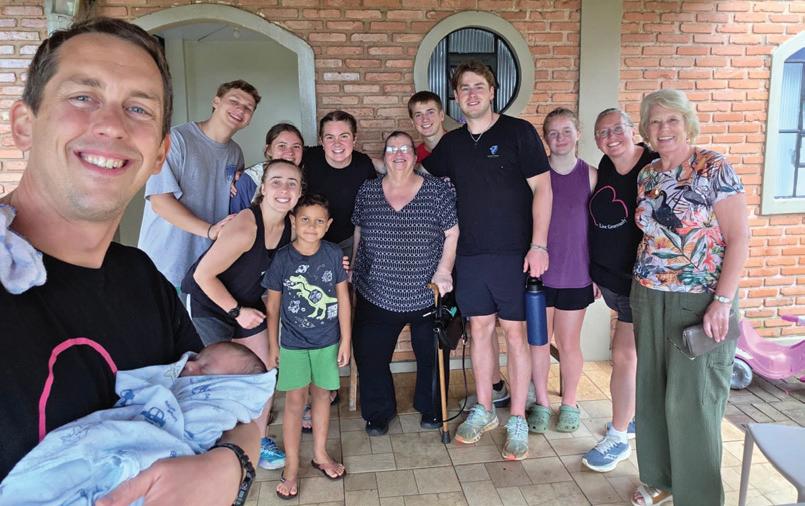
We also had the privilege of serving at the Miriam Home, which is a ministry committed to caring for vulnerable children. We loved working with AFLC Missionary Jonni Sliver and Pastor Silvio, who is the director of the home. Both are incredible leaders who love the ministry and value the unique role a ministry team can provide. Our teams’ willingness to play Uno or cars, kick around a soccer ball, or be a human jungle gym showed their hearts for sharing joy. Our hope is that we offered encouragement to children who have faced difficulties we can’t fully imagine.
In a meaningful moment for me, each of our missionaries shared their history, current work, and vision for the future. Projects like DRELL, long-term church plants, and community expansion efforts all highlighted the deep respect and collaboration between missionaries and Brazilian and Paraguayan leaders, which is something that short-term teams like ours are invited to join in and support. At every one of these missionary moments, our team took time to pray for our missionaries and the work the Lord has called them to do.
This trip was a reminder of the Lord’s faithfulness to the work of our AFLC in Brazil and Paraguay. And this trip has reaffirmed the lasting impact of the work in Brazil. The Lord continues to bless the work and cast a vision for the future. If you’re interested in seeing it firsthand, we’d welcome you to join us next February 2027.
Sending planters for training.
BY PASTOR ANDY COYLE
Home Missions believes that training church planters is not a luxury. It is an act of stewardship. Church planting is among the most complex and spiritually demanding forms of ministry. It requires theological clarity, emotional resilience, cultural intelligence, leadership skill, and missionary courage, all exercised simultaneously, often in isolation. To send leaders into that environment without preparation is neither wise nor loving. Because of your generous support, two upcoming planter couples were sent to Always Forward’s Church Planting Training Intensive March 2–5 in Hopkins, Minn.
Here are a few reasons why we believe this matters.
Biblical wisdom: Jesus didn’t simply call his disciples, announce he was the Messiah, and then send them out to make more disciples a week later. They spent three years with him. Every day was a mixture of formal and informal teaching and training. They listened, learned, watched, and were formed. Finally, after three years of intense training, he said, “Go and make disciples.” The Apostle Paul trained local pastors. For some like Timothy, it was a longer training time. Others were shorter depending on his missionary travels. In some of those cases, he had to write letters to these new leaders and congregations to correct them as they needed more training. None of this is surprising. If being trained to work in a general business is necessary and helpful, how much more to do soul work in a secular and hostile environment?
The stakes are high: Church planting is soul work. A planter is preaching Christ, administering the sacraments, forming disciples, and shaping the theology of a new congregation from day one. Weak preparation can result in doctrinal confusion, unhealthy culture, or long-term instability. Damage can be done. Strong preparation helps ensure that the gospel remains central and clear.
Sustainability matters: Church planters tend to be courageous and passionate. But passion without structure can lead to burnout. Vision without systems can lead to chaos. Training helps planters establish sustainable practices. It helps them build healthy rhythms, structures, and pace. Planting is not about launching events; it is about establishing lasting congregations. The reality is that a congregation that starts yet never transitions into a healthy, lasting congregation has a lasting negative impact on everyone involved.
Avoiding common pitfalls: Unlike established pastors, church planters often work without the support systems that long-standing congregations have developed. Financial pressure, relational strain, and spiritual opposition can intensify quickly. Solid training can help planters anticipate common pitfalls, conflict, discouragement, family stress, and misplaced expectations. This allows them to respond with maturity.
Systems shape theology: A congregation’s early systems—how it worships, disciples, organizes leadership, and handles conflict—will influence its theology for years to come. Training ensures those systems are intentionally aligned with sound doctrine rather than accidentally shaped by personality or cultural trends.
Emotional intelligence (EQ): Effective training helps planters grow in selfawareness and self-management. This growth then translates into effective social awareness and relationship management.
We believe that faithful preparation protects the planter, strengthens the congregation, and honors Christ, whose gospel they are sent to proclaim.
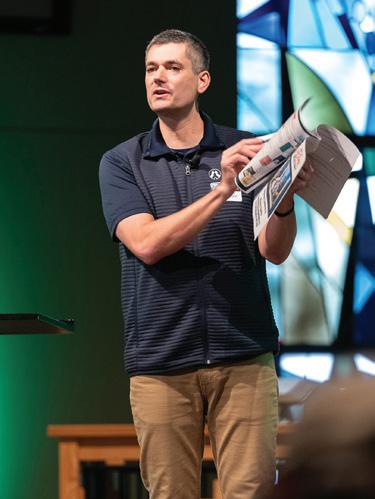
Church planting training.
The training covered these topics: Convictions
• Why We Plant
• Biblical & Theological Foundations
• Articulating Your Identity Culture
• Internal and External
• Critical Mass & Timelines
• Culture of Change Systems
• Vision & Strategy
• Connecting & Discipleship
• Leadership & Administration
• Worship & Care
Collaboration
• Support Network
• Mother-Daughter Plants
Coyle, a member of Grace Free Lutheran, Maple Grove, Minn., is the director of AFLC Home Missions.
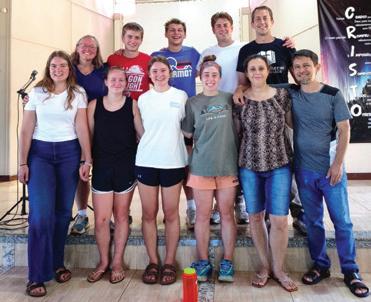
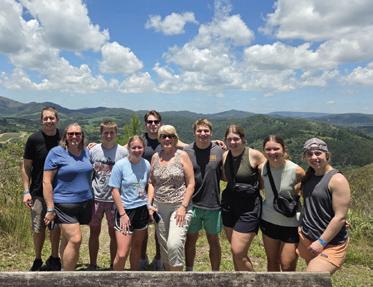
Members of a Journey Missions team that traveled to Brazil with Brazilian Pastor Marcos and his wife, Patricia (at right).

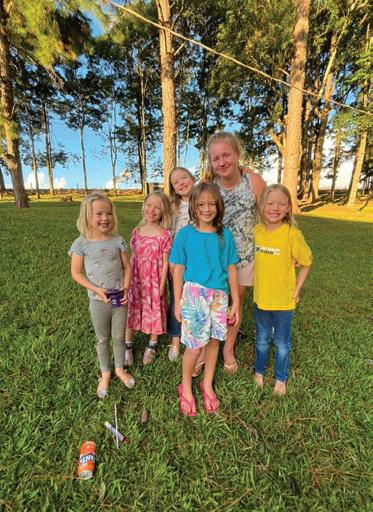
Attendees at a children’s camp with the theme, “Heaven is My Home.” Missionaries to Brazil.
AFLC World Missions currently has three missionary families, one single missionary, and a short-term assistant serving on the Brazil field.
• John and Hannah Lee: Campo Mourão
• Paul and Becky Abel: Bateais
• Jonathan and Tamba Abel: Maringá
• Jonni Sliver: Campo Mourão
• Michelle Abel: Maringá
Abel is an AFLC missionary serving in Bateais, Brazil.
Sixty years in Brazil.
BY BECKY ABEL
God is at work in and through his people in Brazil. This year began with many opportunities for fellowship, evangelism, and Christian growth.
In January, two Bible camps for children focused on the theme “Heaven Is My Home.” In February, 300 Brazilian youth and adults gathered for camp to consider the call of Jesus: “Follow Me!” Many volunteers make these events possible as they follow Jesus, serving in different roles. A Journey Missions group, AFLC World Missions Executive Director Earl Korhonen, and several others visited Brazil to see the ministry firsthand.
This year marks 60 years since the Free Lutheran Church began its mission outreach in Brazil. Today, the work of establishing churches and training Brazilians continues through missionaries and national workers. Local churches, the Free Lutheran Seminary, two Bible camps, and the Miriam Home continue to invest in ministry for the glory of God. Currently three missionary families, one single missionary, and one missionary assistant are serving in different cities and ministry areas. One Brazilian pastor and his family (Pastor Augusto) have started a church plant in Geneva, Switzerland, reaching out to Brazilians living overseas. And Matthew Abel and his family, who grew up in Brazil, have followed God’s call to Paraguay.
This year begins a new era for one part of the Brazil field. The first constitution of the Free Lutheran Mission was established 50 years ago, ten years after the first missionaries began their work in Campo Mourão. The mission, comprised of all the missionaries on the field, is now transitioning to include Brazilian nationals on its board. This board works in connection with the AFLC World Missions Board of Directors to determine projects and distribute funds for approved ministries. Please pray for them as they chart the course for future accounting procedures and the management of funds designated to help the church grow. With new laws in Brazil, the transfer of international funds is becoming more complicated as the government will begin charging taxes on all gifts coming from abroad. The Brazil mission continues to depend on financial support from the U.S. for various ministries.
In response to a plea for cooperation in constructing a church building in Campo Mourão, several U.S. donors joined together to raise more than $50,000 for this project. Construction is expected to begin in the first half of this year, pending government approval of the building plans.
Plans are also unfolding for a new one-year Bible school program, an international missionary program, and a mentoring program in youth ministry called FLAME.
The Brazilian Free Lutheran churches and pastors, like our sister churches in the U.S., face the ongoing challenges of maintaining active and engaging Bible-based ministries that point people to Jesus and his Word. The spiritual battles are real all around the world. Yet Jesus is still the answer for the world today. May we continue to encourage one another to “work the works of Him who sent Me while it is day; night is coming, when no man can work” (John 9:4).
Your investment through gifts, prayers, and personal involvement is making an eternal difference in countless lives.

Training youth leaders.
BY MICHELLE OLSON
Ihave a lot of hope for the future of youth ministry, and I think you should as well. The last few years I have had the privilege of teaching a few classes at the Free Lutheran Bible College. One of the classes is Introduction to Youth Ministry. I recently asked the students what they have learned in our class. I found it incredibly encouraging:
“I have been truly blessed to learn more how to minister to youth. Whether they are going through good or bad times, I can always point them back to Jesus and who he is and what he has done for them. I have learned a lot about myself and where I feel called by God, and I look forward to seeing where he will use me.” (Nate Wilhelm, Kalispell, Mont.)
“I have helped with Kids Club and VBS before this class, but youth ministry has a few key differences. There seems to be a lot more emphasis on discipleship and equipping teens, who are reaching a point where they are capable of growing into leaders. I learned how people of my generation and younger are in desperate need of Jesus. I mean, we all are, but there are so many things distracting them, and they need to be pointed in the right direction.” (Sawyer Strand, Greenbush, Minn.)
“The main thing I have learned is that you need to be intentional with everything you do. You cannot just say things and not actually mean it. Not only does it hurt people, but also it does not help you grow as a leader, especially if you want to make those real relationships and connections with the youth. … It is okay to not know everything right away, and it will be a learning process for you and everyone involved. It is all for the glory of the Lord and for growing his kingdom. Like they say, the only thing you can bring to heaven is other people. Well, I better get started!” (Lydia LaFromboise, Bottineau, N.D.)
“I had always wished I could have been a part of a youth group but never had the opportunity. So, when I learned that I could be a part of a youth group and one day become a leader by taking this class, I was so excited. I really enjoyed learning about what kind of leader I was and my spiritual strengths and how to best put them to use. Most important to my future was learning how to work with parents of kids in youth group.”
(Jessie Monsebroten, Aneta, N.D.)
For those of you investing in youth ministry, thank you. As our National Youth Director Adam McCarlson shared with the class at the start of the semester, as members of the body of Christ, we are all involved in youth ministry; we all have the opportunity to love teens and point them to Jesus. Thanks for supporting AFLC Youth Ministries. And thanks to our Free Lutheran Bible College for helping teach and train students in youth ministry.




Olson, who teaches the youth ministry classes at the Free Lutheran Bible College, serves on the AFLC Youth Ministries Board. She is a member of Living Hope, Rogers, Minn.
NEWS 2026 SEMINARY GRADUATES
Adam Erickson
Montgomery, Ill.
Iwas born on Jan. 29, 1998, to Marcus and Brenda Erickson and primarily grew up in Maple Grove, Minn. I was blessed to attend Grace Free Lutheran Church, and it was through that congregation that I was baptized, confirmed, and received God’s Word faithfully for many years.

One particular instance stands out, because I still struggled with the assurance of salvation for a while, and someone noticed my doubt. That person pointed me to Christ’s promise on the cross that “it is finished” and showed me that if Jesus isn’t a liar and if he’s capable of what he says, then I had to admit my sins were paid for and forgiven. I know I’ve heard the gospel numerous times in my life, but I think that was when my heart began to see Christ much clearer as my Savior, and I wanted to live for him.
Ministry seemed like a possibility, but I put it on the back burner and agreed with God that I would at least attend our Bible college. After graduating, I moved to the suburbs of Chicago and worked as a youth leader at St. Olaf Lutheran Church in Montgomery, Ill. I went back to school at the same time and earned a bachelor’s degree in criminal justice. Even more importantly, I found my best friend in one of the classes and received my wife, Alexandra (Alley) from the Lord. We were married in December of 2020. We’ve also been blessed with our firstborn son, Isaac, and are excited to welcome another child into the world this August!
After working as a police officer for a little while, I, along with Alley, discerned a call to at least prepare for ministry and attend seminary. During that time, I had the privilege to preach to many congregations, especially those without a pastor, and I loved bringing God’s Word to his people. My internship at Bethel Free Lutheran Church in Grafton, N.D., has only cemented my heart for feeding the Lord’s flock, and I’ll preach Christ crucified for as long as he lets me.
I have accepted a call to Faith Free Lutheran, Minneapolis, Minn.
Alexander Grimes
Sioux
Falls, S.D.
Born on July 17, 1992, I am the son of Steve and Lori Grimes. I grew up in Sioux Falls, S.D., where I was raised well, with my mother being my primary guide in my faith, while my father was a solid bedrock of a firm faith of both head knowledge and heart knowledge. Originally, my family went to an ELCA church until I finished confirmation. We left due to the ELCA’s drift from biblical inerrancy and joined Living Word Free Lutheran. After I left home, my family transferred to Abiding Savior Free Lutheran, and that’s been our home church since.
After high school, I tried studying engineering and then massage therapy in college. I was at a loss for where to go in my life. I prayed to God. Giving up on where I wanted to go, I asked where he wanted me to go, and he made it very distinctly clear that I was to go and be a pastor. Of course, my mother knew this would happen far before I ever had the notion!
I attended the University of Sioux Falls, earning an undergraduate degree in theology and biblical studies before attending the Free Lutheran Seminary.
In my seminary courses, what stuck out to me most was the way that all of Scripture is connected together and the way that Christ is revealed through even the Old Testament in many ways, far more than can be discovered in a single lifetime.
My internship took place at Rose and Spruce Free Lutheran congregations in Roseau, Minn., under Pastor Todd Erickson, where I learned a lot about the practical side of ministry. It certainly has looked a lot different than I expected!
My walk with Jesus has been a lifelong learning experience. I don’t remember a time when I wasn’t a believer. But when I was younger, my sanctification certainly needed some work, and I had my fair share of not walking with the Lord as I should. But by the grace of God, I’ve grown and have been so very blessed in my life.
Caleb Korhonen Radcliffe, Iowa

Iwas born on May 11, 1998, to Pastor Earl and Joan Korhonen. In my early years, I lived in Washington and Wisconsin but spent the majority of my upbringing in Radcliffe, Iowa, attending Stavanger Free Lutheran Church in Garden City. After graduating from high school, I attended the Free Lutheran Bible College (FLBC) and continued my education at Iowa State University (ISU), graduating with a degree in construction engineering.
I was baptized at Monroe Free Lutheran, Monroe, Wash., and was blessed with parents who faithfully taught me the Word of God. Morning family devotions were a major part of my upbringing. In one of those family devotions, I was shown the reality of my sinfulness and my need for a Savior. My parents had the joy of sharing the gospel truths of Christ’s grace and forgiveness with me.
As a child, I dreamed of being a pastor like my father. During high school, I wrestled with that calling and looked to serve the Lord in other areas. At FLBC, I participated in choirs, gospel teams, and vacation Bible school summer teams. One of those summers, the great need for pastors in the AFLC was made abundantly clear to me, and I began to consider and pray about seminary. After FLBC graduation, I enrolled at ISU, using this time to pray for clarity and direction from the Lord. Through co-leading a small group Bible study during college, I realized I had a passion to share God’s Word with people and applied for the Free Lutheran Seminary.
Seminary has been a great time of growth and learning. A highlight of seminary for me has been the year of internship at Grace Free Lutheran and Zion Free Lutheran churches in Valley City, N.D. I have found great joy in preaching and teaching God’s Word to people and have especially loved the ministry of visitation. I am thankful for the training I have received to shepherd the flock of God and share the promise of forgiveness as declared in I John 1:9.
Adam McCarlson
Sioux Falls, S.D.
Iwas born December 8, 1986, in Webster, S.D., to Mike and Juli McCarlson and was baptized at Tabor Lutheran Church. As I grew up, I struggled with doubts about my relationship with Jesus, but the Lord never gave up on me, and he remained faithful to his promises.

I graduated from the Free Lutheran Bible College in 2007 and from Augustana College (Sioux Falls, S.D.) with a music education degree in 2011. In 2008 I married Emily Pierson from Sioux Falls. We have five children, whose ages range from 7 to 16.
After college, I worked for seven years as the director of youth ministries at Abiding Savior Free Lutheran in Sioux Falls. After my time working there, I did some teaching and house flipping.
I was called by the Lord to attend the Free Lutheran Seminary to be trained for pastoral work. During seminary, I appreciated the challenges of being pushed to the point of dependence on the Lord for provision and endurance. I was assigned to complete my seminary internship at Faith Free Lutheran Church in South Minneapolis under the supervision of Dr. Jason Gudim. During my time there, God further solidified my love of the congregation and a desire to shepherd God’s flock through Word and Sacrament ministry and getting to know and care for the souls God has called.
I am looking forward to making use of my training as I continue my work as director of AFLC Youth Ministries, as well as being either a member or a pastor of a congregation.
Micah Moan Corcoran, Minn.
Iwas born September 18, 1999, the favorite child of my parents, Pastor Jerry and Rebecca Moan. Don’t tell my four older brothers I said that.

My dad had begun teaching at the Free Lutheran Bible College and Seminary in Plymouth, Minn., so Corcoran was my home base. God blessed me richly through my parents and our congregation, Solid Rock Free Lutheran, Anoka, Minn., where I was baptized into Christ and raised to a new life of following Jesus, failing, receiving forgiveness, and growing in Christ. God has sustained me in my life, and for that I praise him.
Attending the Free Lutheran Bible College was a milestone moment that God used to give me a heart for pastoral ministry. I was able to quickly graduate from Crown College in Saint Bonifacius, Minn., and began studying at the Free Lutheran Seminary at the ripe age of 21.
Throughout seminary, God has given me a greater love for his Word. Preaching has become a passion of mine instead of something to fear. Various on-campus ministries—counseling and small group discipleship—have given me further peace and motivation in pursuing pastoral ministry. The Lord has been so good to me.
In the summer of 2023, Kalei Kerby and I were married and are loving life together. She’s a winner. Our marriage has helped me appreciate more fully the beauty of the ultimate marriage between God and his bride, the Church.
An internship in Thief River Falls under Pastor Alex Amiot was what my wife and I needed. The two congregations of Our Saviour’s Lutheran Church and Reiner Lutheran Free Church have loved and cared for us well. Saying goodbye will be hard, and that’s how it should be. Our families and many congregations and faithful Christians have poured into us. Kalei and I are humbled by God’s goodness. He has been faithful. He is faithful. And he will be faithful as he leads us into what’s next as I will be serving Bethany Free Lutheran, Binford, N.D., and New Luther Valley Lutheran, McVille, N.D.
Alex Monseth
St.
Michael, Minn.

Iwas born July 17, 1995, to my parents, Nathan and Julie Monseth. I grew up in St. Michael, Minn., and attended Living Hope Church in Rogers. I am grateful for my parents, countless mentors, and steadfast friends who have shaped my faith in Christ Jesus. While I have grown up trusting in Jesus, I have experienced the grace of God in ever-increasingly deeper ways. He is showing me what his grace means as I encounter the depths of my sin, what his presence means in the depths of anxiety and fear, and what his power means as I depend on him for everything.
Though I once dreamed of writing about my beloved Timberwolves for work, I went to FLBC and afterwards began studying at the University of NorthwesternSt. Paul to work in the information technology world. During these years, I met my wife Erin (Dahl). She’s incredible. We’ve been married for eight years and have three wonderful sons: Wesley (5), Charlie (3), and Gilbert (1).
However, I felt restless in my studies and made for something different. At this time, I received an invitation to work in youth and worship ministry at Good Shepherd in Camarillo, Calif. We went for it. While there, I cherished ministry work, fell in love with congregational life, and discerned a call to seminary through encouragement of those I trust.
Seminary was a journey. I wrestled theologically and was stretched immensely. Yet, looking back now as I approach the finish line, I am deeply grateful. God taught me true strength in him comes through acknowledging weakness and sinking into dependence upon him. While learning about pastoring, God allowed me to be pastored by my professors and classmates. God allowed me to be in need; thus, I am learning to trust his provision.
I am so eager to serve as a pastor. I now get to write and speak about my beloved Jesus as a calling. What a gift! I earnestly desire to preach the gospel, to boast in weakness so the power of Christ may be displayed, and to love the congregation God calls me to serve with all I have.
PEOPLE & PLACES
Pastor Rick Gleason has accepted a call to serve Cornerstone Lutheran Church in Argyle, Wis.
Pastor Steve Jensen has resigned from Hope Free Evangelical Lutheran, Ishpeming, Mich., and has accepted a call to Lutheran Church of Hope, Loveland, Colo.
Pastor John Kiehl has retired from Spenser Creek Lutheran, Eugene, Ore.
Pastor Kenny Hale has resigned from Midway Christian Fellowship, Duluth, Minn.
Adam Erickson, who will graduate from the Free Lutheran Seminary in May, has accepted a call to serve Faith Free Lutheran Church, Minneapolis, Minn.
Micah Moan, who will graduate from the Free Lutheran Seminary in May, has accepted a call to Bethany Free Lutheran, Binford, and New Luther Valley Lutheran, McVille, N.D.
Members of the AFLC Coordinating Committee have accepted a removal request form from members of First Lutheran Church, Ellendale, Minn.
Members of the AFLC Coordinating Committee removed St. John’s of Lovi Evangelical Lutheran Church, Cranberry Township, Pa., from the congregational roster after they were unresponsive to many attempts to communicate with them.
Church plant launches website
Lamb of God Free Lutheran, an AFLC Home Missions church plant in the Fargo/Moorhead area, now has a website. The congregation is a plant of St. Paul’s Free Lutheran, Fargo, and is served by church planter Pastor Brandon Marschner. Visit LambofGodFM.org for updates on the church plant, including its values, beliefs, plant timeline, and how to support the ministry.
Lorilee Ann Mundfrom, 76, died February 15, 2026, at Avera McKennan Hospital, Sioux Falls, S.D. Born Sept. 11, 1949, in Fergus Falls, Minn., she was the daughter of Lorimer and Irene (Holt) Torgerson. She married John Mundfrom on Jan. 5, 1974, at Zion Lutheran, Fergus Falls. He preceded her in death. She grew up on a farm in Aurdal Township before her family moved to McIntosh, Minn. She studied at Hillcrest Lutheran Academy in Fergus Falls, Fergus Falls Junior College, the Free Lutheran Bible College, Plymouth, Minn., and Concordia College, Moorhead. She was a member of Calvary Free Lutheran, Fergus Falls. She attended and traveled with Lutheran Evangelistic Movement Gospel Crusaders and worked for the Billy Graham Evangelistic Association. They served AFLC congregations in Grand Forks, N.D., Fargo, Robbinsdale, Minn., Eagan, Minn., Eben Junction, Mich., Beulah, N.D., Bismarck, N.D., Eugene, Ore., and Beresford, S.D. She worked in music education as well as for credit unions and banks. She served on the board of the Women’s Missionary Federation, including as president.
Surviving are two sons, Timothy Mundfrom and Josh Mundfrom; one brother, Paul Torgerson; three brothers-in-law and their spouses; four sisters-in-law and their spouses; and nieces and nephews.
The service was held Feb. 27 at Abiding Savior Free Lutheran, Sioux Falls, S.D., with Pastor Mark Antal officiating. Burial will take place in Fergus Falls, Minn.
Wanda Jane Gerdeen, 91, of Columbia, Mo., died Feb. 21, 2026. She was born to Esther and Wilson (Bud) Larry in Sparta, Wis. She married James Gerdeen in 1960. He preceded her in death in 2025.
She grew up in Grand Haven, Mich. After high school, she worked at Gardner Denver in Grand Haven, where she met James Gerdeen. They lived in several states: Ohio, California, Michigan, Minnesota, Colorado, and Missouri. Wanda was born with a talent for singing and fine art. Later in life, she painted beautiful landscapes. She taught herself to play the violin and the piano. With her husband’s roles as professor and pastor (AFLC), she volunteered in the Sunday school, the nursery, and with preschoolers at Mothers of Preschoolers (MOPS).
Surviving are two daughters, Lori (Bill) and Sonya (John); one daughter-in-law, Wendy (Tim); one sister, Jeannine (Don); one sister-in-law, Lola (Don); one brotherin-law, Joel (Marilyn); six grandchildren; and six great-grandchildren.
A graveside service was held Feb. 28 at Memorial Funeral Home, Columbia.
Keith Quanbeck
Lorilee Mundfrom
Pastor Don Greven
Anna Marie Huesers
WMF
Dennis Weeg
Lorilee Mundfrom World Missions
Pastor Alvin & Francis Grothe ... in honor of
Ruth Quanbeck
Lorilee Mundfrom
Wanda Gerdeen
The Light has dawned.
BY PASTOR MARK MOLSTRE
“The people walking in darkness have seen a great light; on those living in the land of the shadow of death a light has dawned” (Isaiah 9:2).
f we could eliminate every source of light, the resulting darkness would be so complete that we could hold our hand an inch from our face and not see it. Darkness is not a substance; it is simply the absence of light. Where there is no light, there is darkness.
IScripture often uses this reality as a powerful spiritual picture. Sin is described as darkness (John 3:19). Satan and the forces of evil operate in darkness (Ephesians 6:12). Hell is called “the blackest darkness” (Jude 13). Even death is associated with darkness (Psalm 146:4).
Yet the Bible also tells us, “God is light” (I John 1:5), and Jesus declares, “I am the light of the world” (John 8:12). If darkness is the absence of light, then spiritual darkness is the absence of God. It is the absence of Christ. It is the absence of the Holy Spirit’s presence and truth.
But God does not leave darkness unchallenged. He breaks into it. He pierces it. He transforms it. And when his light shines, darkness cannot overcome it.
Isaiah speaks of people living in deep darkness—“the land of the shadow of death.” Yet into that darkness, light dawns. Notice the certainty of the declaration: “a light has dawned.”
The result is overwhelming joy: “You have enlarged the nation and increased their joy; they rejoice before you as people rejoice at the harvest, as men rejoice when dividing the plunder” (9:3).
Isaiah compares this joy to a harvest celebration—the relief and gladness of provision after months of labor—and to the exhilaration of unexpected victory and reward. It is the kind of joy that removes fear and replaces it with confidence.
Why such joy? Because oppression has been shattered: “For as in the day of Midian’s defeat, you have shattered the yoke that burdens them, the bar across their shoulders, the rod of their oppressor” (9:4).
The people had lived under the threat of a powerful and oppressive enemy. But Isaiah declares that the burden has been broken. The yoke has been shattered. The oppressor was defeated.
So complete is this victory that the equipment of war is no longer needed: “Every warrior’s boot used in battle and every garment rolled in blood will be destined for burning, will be fuel for the fire” (9:5).

When the light comes, darkness loses its power. When the victory is complete, the weapons are burned.
The New Testament reveals that Jesus is this Light. He came to expose sin, defeat Satan, and conquer death through the truth of his gospel and his sacrifice on the cross. For the Christian, we stand in the victory he has won (Romans 8:31–39).
In a world still marked by sin and confusion, the declaration remains: “A light has dawned.” There is hope. There is reason for joy. There is confidence that darkness does not have the final word. To live in this light is to live with the assurance that, no matter what circumstances bring, the ultimate victory belongs to Christ and, therefore, to us in him.
Isaiah wrote these words nearly 700 years before Jesus’ birth, yet he speaks with remarkable certainty: “For to us a child is born, to us a son is given, and the government will be on his shoulders. And he will be called Wonderful Counselor, Mighty God, Everlasting Father, Prince of Peace” (9:6).
These titles belong to God himself. We know Christmas to be not merely the celebration of a child’s birth but the coming of God to earth— Immanuel, God with us.
And Isaiah describes this dawning light in the perfect tense—a form that views the action as whole and complete. From God’s perspective, the victory is already accomplished. Though the fulfillment would unfold in history centuries later, in the purposes of God, it stood finished.
Only God can declare the end from the beginning. Only God can speak of salvation as completed before it appears in time.
And so Isaiah announces it with certainty: A light has dawned. Darkness does not win. The Light has come—and his victory stands complete.
Molstre serves Grace Free Lutheran, Maple Grove, Minn.
SOMETHING TO SHARE
Counting the cost.
BY KYLEE GREENE
If people seek to please everyone in their path, they will guarantee themselves nothing but disappointment.
Growing up, I wasn’t the type of girl who wanted to try every new trend or fit in with what the world said was important. That attitude was something I prided myself in; after all, I was meant to be different as a follower of Jesus, wasn’t I?
Don’t get me wrong, wanting to dress stylishly or try a fun trend is not inherently evil, but Scripture makes it clear that Christians are to be in the world but not of the world. Despite this truth, the more my vocation began to revolve around people, the more I realized just how hard it is not to live to please them. I began making decisions based on their approval and found myself conflicted when I was presented with two good options because it meant I was going to let someone down. Sometimes that person was me. And that’s just it: as a sinful human being living in a world of sinful human beings, it is inevitable that I will both disappoint and be disappointed by people, including myself. And if I am so focused on making others happy or living the way they think I should, I will constantly strive and never arrive.
In John 15:18, Jesus warns his disciples that the world will hate them, but only because it hated him first. So, it is no surprise that as a Christian I will face rejection. Everyone knows what it’s like to be excluded, disliked, and misunderstood. Jesus certainly did. But there is a fine line between loving others by witnessing to them
through my conduct and remaining holy and separate from them. And honestly, I’m still learning how to do that well.
Later in John, Jesus prayed for his followers on the night of his arrest and said, “I do not ask that you take them out of the world, but that you keep them from the evil one. They are not of the world, just as I am not of the world. Sanctify them in the truth; your word is truth” (John 17:15–17, ESV). Jesus didn’t say, “take them out of the hard situations” or “sanctify them in love and happiness.” Instead, he prayed that his followers would be made more like him through the hardships of rejection and the working of his Word. Still later, Christ prayed for the unity of the Church, that its members would be one like the Trinity (John 17:21).
Loving people in spirit and truth is a difficult thing. Yet it is precisely in these challenges that Jesus reminds us of our true, sole purpose in life: to follow and honor him above all else, no matter the cost. When I keep my eyes on who I am in Christ, I have the best outlook on my life and can love and serve others with the joy that is only found through him. And how wonderful it is to know that following Jesus is worth the cost of relational rejection and hardship, because his all-sufficient grace covers a multitude of sins (I Peter 4:8).
Greene is the lead dorm assistant at the Free Lutheran Bible College, Plymouth, Minn.