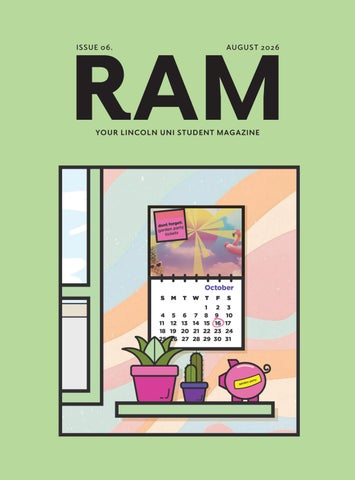
RAM ISSUE 06.
AUGUST 2026
YOUR LINCOLN UNI STUDENT MAGAZINE
RAM ISSUE 06 / AUGUST 2026
TO E S VO VEN OM LU TS E L NT W US EE HE A RI N NG
2
FR EE
FO OD
LU S
A
EX
EC
UN LO SK CK ILL N S EW
0 *PRES: $61,36 *VP: $11,725
Nominations: 10th Aug –13th Sept
Meet the Candidates: 23rd Sept
President Vice President Secretary Sustainability Rep Wellbeing & Engagement Rep Disability Rep Rainbow Rep International Rep Pasifika Rep PG Engagement Rep PG Academic Rep
Voting: 28th Sept –5th Oct
Results Announced: 7th Oct
lusa.org.nz/elections lusa.nz
studentsatlincoln
3
IN THIS ISSUE 7 Your President & Vice President Spotlights 10 Movie Review: Odyssey 12 Sustainability Week 2026 14 A Good-Ass Brain - NotJust a Peachy Ass 15 The Importance of Student Services 16 Winterball 2026 18 Meet the new Green Wellbeing Club 25 Guilty Until Proven Human 26 Let’s Get Politial (Issue 3) 30 Nastyscopes Get rewarded when you contribute to the RAM!
Articles:
Letters to the Ed:
Opinion Column:
Done some cool shit? We wanna hear it!
Spin a yarn, we love hearing what you’ve got to say.
Share your opinion about literally anything!
To submit a piece email comms@lusa.org.nz
Visit
THERAM.ORG.NZ
Read current issue online and contribute lusa.nz lusa.nz studentsatlincoln
theram.org.nz
4 4
RAM ISSUE 06 / AUGUST 2026 RAM ISSUE 06 / AUGUST 2026
LUSA 2026 EXEC Zara Weissenstein President
Are you starting to think about what to do next year? Will you still be studying on our gorgeous campus? Do you love to get involved in your community, get social, and earn some cash in the process? Then run for a position on the LUSA exec! Being on the exec is such an incredible experience, you get to work with a fantastic team, learn lots of new skills that you can add to your CV, and meet so many people from all sorts of backgrounds, all while having tons of fun along the way! Some challenges to being on the exec are balancing your uni life, LUSA life, and personal life. Of course, uni will always come first; you are first and foremost a student after all; however, in between classes, research, and meetings with your supervisor, you will have various meetings where you get to feed back to the university for the student body and ensure our voices are being heard in decisions. You work with a really supportive team that is rooting for you to succeed, so don’t feel like you’ll be in it alone. A fun fact about LUSA is that the first recorded official student representation at Lincoln University started all the way back in 1880, and the first woman was elected into an executive position in 1970! Something really cool about the President role itself is that you get to learn and practice skills such as managerial skills, governance skills, and cultural skills, some of which you likely
wouldn’t learn in a normal workplace until you’re like 30 or 40 or something. So if you’re interested in a particular role, hop on the LUSA website and then follow represent - LUSA/Exec 2026 scroll down to the bottom of the page, and that’s where you’ll find all the position descriptions for all the roles for next year! There are a lot of different roles depending on what part of the student experience you want to focus on, so have a look and see what you might like to run for! If you’re not sure or you have any questions at all, please feel free to email me or pop in to the LUSA office for a chat. I’d be more than happy to answer any questions you may have about the exec roles, life on the LUSA exec, or any other elections stuff. president@lusa.org.nz
look if environmental policy interests you. I also wanted to encourage you all to engage with a LUSA communication avenue. On the Represent section of the LUSA website, there is the Communications tab, where you can find some of the advocacy communication by LUSA in 2026. If you have anything that comes to mind about advocacy for students that you think we should know about – let us know. vp@lusa.org.nz
Zhexi (Chelcie) Zhang
International Rep
Sam Rajnikant Vice President
Kia Ora and Namaskara. I said that with a big yawn, which I’m sure is relatable in the season. The issue at hand is that THERE IS SO MUCH GOING ON. How do we even find the time nowadays? The good news for me is that we still have sunlight and bellbird song. On the policy hand, we have reviewed most recently the Executive Handover Procedure and the Environmental Sustainability Policy. The latter will be updated on the website soon, and we’ve had help with it from our wonderful advisor to make it reflect LUSA’s values, so take a
It was great to see so many new faces around campus during ReOri, and to welcome everyone back for another semester. As your International Rep. my role is to listen to international students, share your feedback with LUSA, help connect students with useful support, and encourage more opportunities for cultural exchange and community involvement. Recently, I have been keeping in touch with international students, student clubs, and the wider LUSA team. I have heard a range of helpful feedback, and I will continue raising student concerns and supporting activities that help international students feel more connected and included on campus. We have also been preparing the Get Acquainted event, and I am looking forward to seeing you guys there. The See the Snow trip was a
great opportunity for international students to experience Canterbury’s winter scenery, explore somewhere new, and enjoy the season together. For some students, it may have been their first time seeing snow in New Zealand. As ski season continues, please remember to dress warmly, check the weather and road conditions, use suitable equipment, and always put safety first when travelling to the mountains. The International Dinner was also a great chance to enjoy good food, spend time with friends, celebrate different cultures, and meet new people from across the university. Please feel free to come and talk to me if you have any questions, concerns, feedback, or ideas for future events. I am always happy to listen and help where I can. You can also follow LUSA’s social media pages to stay updated, see what is happening on campus, and get involved in upcoming events and activities - @lusa.org.nz international.rep@lusa.org.nz
along to our next board meeting, which will be held on 13 August at 5.10 pm in the Waimarie Meeting Room (018), Whare Auaha. Otherwise, have a read of the position descriptions or have a chat with one of the Exec. We would be more than happy to tell you about what we do. As a little bonus for those who have made it this far, the first person to email secretary@lusa.org.nz with the words “CRUNCHIE BAR” will win a free Crunchie Bar! Lastly, if you or someone you know needs support or advocacy at any stage, please do not hesitate to reach out. The Executive and LUSA staff are always happy to help.
Liam Moore
Wellbeing & Engagement Rep
Argile (Argie) Tsang
Disability EDI Rep
Eligh Ashby Secretary
I hope everyone is enjoying semester two and finding your rhythm! I have been busy preparing the minutes for Board Meetings 1–5. These are now available on the LUSA website under About > Official Documents. I encourage you to have a look through them to see what has been discussed and decided. You will also see that nominations are now open for the 2027 LUSA Executive. If you are passionate about supporting Lincoln University students, I would really encourage you to put your name forward. If you would like to learn more about what the Exec does, I recommend coming
5 5
of the term; as I start working on my KPIs to make a positive change with new initiatives, with the support of my fellow execs, of course. Keep an eye out for Iconic’s next event later in the term, which I have some solid ideas for. That’s all from me! ‘Til next time. disability.rep@lusa.org.nz
I hope that ReOri has gone swimmingly for you all. New courses! New faces! All very exciting. Here’s hoping I can keep up with it all. It has been a very busy start for me in my new role, to say the least. My first official appearance as an exec member was at Winterball - one of LUSA’s biggest events for the year, and it was a full-on way to get into the swing of things. Clubs Market Day (ReOri edition) was a delightful experience, with the early rise and setup going uncharacteristically smoothly for me! After the setup, I headed to the Iconic booth, which had some great engagement with students. On the topic of Iconic, we had our first event of the semester in week 2, which was our Sensory Quest. We had a small but cozy turnout. And to round things off, I had my first of many LUSA Exec weekly meetings and first-ever board meeting, where I learned a lot about the workings of LUSA. I’m looking forward to the rest theram.org.nz theram.org.nz
Wazzup campus creatures?! I’ve been getting back into the swing of things with a new set of classes and rejoining late-night social activities with clubs like LUNA and the pottery club. The more regular daily habitation of grounded time between lectures – come say hi anytime. Semester two kicking off has been so much fun, with the ReOri events including Club Market Day and Winterball; it’s so great to see so many new faces this semester as well as seeing all the returning students (and those who never left – my sympathies, post-grads)! Be sure to look out for the many great events to come this semester on the socials and on the noticeboard; the ones at the top of my head that I’m looking forward to are Sustainability Week, Mental Health Awareness Week, LUSA 2027 Elections, and of course Garden Party! See you there. engagement.rep@lusa.org.nz
6 6
RAM ISSUE 06 / AUGUST 2026 RAM ISSUE 06 / AUGUST 2026
Darius J Harris
Postgrad Academic Rep
research mahi, sometimes you do not necessarily know whom to approach initially.
Coral Peat Sustainability Rep
Please come and enjoy Sustainability Week on campus. We have some group workshops that are being promoted and held within Grounded in Forbes, but also a working Bee at the Arboretum (weather dependent). Get involved to blow away those winter blues. Tena koutou, Winter has finally set in, with those absolute nippy nights followed by brilliant sunshine days. Semester 2 is now well underway, and I hope that your studies are ticking over nicely. Personally, I’ve tended to abscond from my cold home during those early evenings to the welcoming warmth of the LU Library. It can be pleasantly quiet, and for me it is not so disturbing when concentrating on those allimportant published papers that one is critiquing. Here on campus, working alongside the LUSA Team, we have seen important steps in our advocacy work for many research-based postgraduate students. Our particular focus has been on after-hours Health & Safety within the AGLS Laboratory environments. We have developed a strong rapport with the Lab managers and are building the important relationships that will sustain constructive communication over time, rather than fading away after certain personalities depart from LU. I have been aware for some time that many of our Postgrads are not doing coursework, but are Researchers at the Masters and PhD level. Thus, they, as students, do not have that readily available direct fellow peer as the Course Representative to communicate with. Thus, there needs to be a direct framing of the pathway to LUSA for support and advocacy for those research-based students. This has obviously been a concern of mine for some time, as when looking for supportive folk around challenges that one may be facing when doing your practical
Obviously, I want to remind everyone to take care of yourselves and each other during this Winter season. Wrap up, and if you are sick, it is probably best to stay home and get well. Don’t come to class coughing and sneezing! It’s how we can express manakitanga by looking out for one another.
Kia ora koutou, It has been a busy term for me preparing for Sustainability Week, which is taking place this week! Check out the Sustainability Week timetable in this copy of RAM for the list of all the fun and educational activities and initiatives that we will be running across this week.
pg.academic@lusa.org.nz
We kick things off on Monday with some weeding and maintenance in the Arboretum (down the end of Farm Road). Lincoln Ecological Society are facilitating a Bioblitz, which will run across the week. This is your chance to download your iNaturalist App and join the project: LU Sustainability Week BioBlitz 2026. Each day, for the rest of the week, we will focus on a different sustainability topic, so keep an eye out for cool activities and come and say hi.
Sam Dryden Rainbow EDI Rep
Kia ora e hoa mā! What an awesome ReOri we’ve just had! I hope you all had a fantastic time and managed to score some good freebies too. One of my favourite parts of the week was definitely connecting with new people at Clubs Market Day. I was super impressed with everyone who had a go at the recycling game at the LESS stall and was stoked to see people picking up new tips to take back to their flats as well. If you’re looking for more everyday sustainability tips, make sure to join in as many activities this Sustainability Week as you can! The team has put together an awesome lineup. See ya there! rainbow.rep@lusa.org.nz
sustainability.rep@lusa.org.nz Here’s the QR code to join the iNaturalist project: LU Sustainability Week BioBlitz 2026
LUSA VICE PRESIDENT SPOTLIGHT Sam Rajnikant Vice President
I’m Samrddhi Rajnikant, and I also go by Sam. I’m in my Honour’s year of a Conservation and Ecology undergraduate degree, so the 4th year of a BSc. (Hons). I grew up across South India, spending most of my school years at boarding school, which was in a valley of semi-arid India. That’s where I got into bird-watching and nature-journalling, so I had my mind set on pursuing earth sciences relatively early on. Once I was drawn in by Ecology, I started looking for an undergraduate degree specific to it. Lincoln Uni; with its smaller community and friendliness, was what made me decide to study here - quite instinctively though its agricultural study was advertised more. That, being curious to understand how landscape and indigenous values are cherished in Aotearoa, and the support of my loving parents led me here. I’ve learnt a lot about Aotearoa, New Zealand and Ecology since, exploring new topics and becoming part of the diverse community. As an international student, I feel quite lucky to have been able to travel all the way here for my study, and enjoy the process of getting to know some very cool people and supportive friends. While my home in India remains so for me, I wanted to experience my time here fully so I challenged myself a bit socially, partly by joining uni clubs that interested me, like the International Cultural Society (LUICS) and the LU Ecological Society. Over the last couple of years my involvements at uni gradually led me to interact with different groups within the university. I enjoy taking initiative but I also saw that carrying an initiative to fruition can be quite draining,
especially if one doesn’t have the capacity for it. So, I wanted to be part of LUSA in the one year that I could, for the platform of representation and loca change-making that it gives. I also wanted to explore a different kind of role and new skills. The role of Vice President includes assisting initiatives as part of a team, in creative ways, while recognising values. As an international student, I’ve also existentially dealt with “integration”, whether it was expected or not. This has led me to find a nearly steady balance between the new parts of life here, nurtured parts of myself, and basic identity, which is why I think representation matters. One of the reasons I ran for this role was because I considered the value my background would bring to a student executive. The Vice President’s role may seem a little vague. While the LUSA President leads the executive and various LUSA Reps work closer to their portfolios, the Vice President assists the team with some organisational functions. The main responsibility that I’ve carried so far relates to the regular policy reviews that I chair. Apart from being about wording, policy reviews are also about reflecting on how we’re applying a policy practically. The other responsibility I have is to assist the President as they lead the executive, keeping in touch with the various representatives and how they’re going. With several events and aims often being planned at the same time, we aim to conserve efforts without compromising our consideration of something. That, and associated advocacy really covers the strategy part of the VP role at LUSA. The finance part of the VP’s role is a work in progress...! It’s a good idea for the Vice President to be familiar with how LUSA’s annual spending works (and the principles by which it works). In my limited financial experience I mainly ask questions and get informed. theram.org.nz theram.org.nz
7 7
How do you work with the uni to help improve the Student Experience for students? As LUSA executive, we are assigned to various uni committees for our term, so that there are student voices on those decision making committees relating to academics and student experience. When an issue is raised to us, this is one of the avenues we take to raise it with the university. The Student Experience team is one that we liaise with quite often, to raise issues, seek updates and for surveys. What are the biggest challenges currently facing students at LU today? A big challenge is the different ways in which student wellbeing can be affected. There is the cost-of-living crisis, mobility and accessibility, mental health and representation. Being worried about the price of food, basic necessities or even being unduly short of spending on wants is a current challenge affecting students which affects the way we are able to study, work and keep well. For the relatively small person-power of LUSA, all these issues aren’t always able to be tackled, so feedback from the student body on what is priority is appreciated. We have an amazing staff that are able to support students with advocacy and representation within the university, however the LUSA exec steps into addressing student challenges from a more political (not partisan) or governance sense. How do you manage and maintain your own wellbeing and studies in this role, whilst being a student? The honest answer is that I’m still learning. While I’m not always doing this well, I like going about my workload like a hike at Hinewai Reserve. The loop track is undulating within its slopes, so while after significant portions of uphill climb, there is rest for the aching knees with some downhill relief. Like a wavy track, where each wave is not the same as before. vp@lusa.org.nz
8
LUSA PRESIDENT SPOTLIGHT
RAM ISSUE 06 / AUGUST 2026
Zara Weissenstein President
I am currently in my last year of a Bachelor of Agriculture, and I have been at Lincoln University since 2022; however, I have been studying part time since 2023 to work full time (the LUSA President role is 40 hours a week). I was born in Mainz, Germany and lived there with my family until I was 6, when we moved to Whangaparaoa Auckland (it was still the Rodney district at that stage, I promise!). When I finished high school I started studying psychology at the University of Auckland which turned out wasn’t for me (the extra-long Auckland covid lockdown didn’t help), leading to a complete 180 into a Bachelor of Agriculture at Lincoln University! What inspired you to run for this executive position? Having had a difficult start at university, a big part of my journey into student leadership was a strong desire to ensure that no one else has the same experiences I did. I started as a residential assistant (RA) in halls to start making a difference before joining LUSA full-time in 2024. I was then elected as president for 2025 and again for 2026, an appointment I am truly grateful to the entire student body for. Your faith in me to represent you all has been an amazing responsibility that I take very seriously every day. What are the main responsibilities you have on the Student Exec? My main responsibility is representing the student body on the various committees within the university, all the way up to council. It is my job to make sure that the student voice is considered and taken into account in all decisions the university makes, and if there is a breakdown
in this process, to advocate for you as the students for the best possible outcome. Following this, I also lead the student executive team, chair our meetings, and ensure that everything at LUSA is running smoothly to bring various services to the student body including advocacy, advice, representation, events, student media like this RAM magazine in your hands, and much more. How do you work with the university to help improve the Student Experience for students? As mentioned, my job is to ensure that the university understands how their decisions affect the student body and make sure that they take the student voice into account in their decisions. I meet with university staff and leadership every week in various meetings and committees to communicate the opinions of students throughout all university departments. What are the biggest challenges currently facing students at the university today? I don’t need to tell you all but the cost-of-living crisis is one of the biggest challenges facing not just our student body, but all students across Aotearoa New Zealand right now. Students are having to choose between food, accommodation, fuel, university supplies, internet, and their social lives. This is not right and LUSA is consistently pushing for more funding from the government for the tertiary system, but also amping up the amount of free food we can provide to you to help you all through these tough times. Remember that the financial assistance fund is always there to help if you are facing unexpected costs. Just email students@lusa.org.nz to apply (and check if you are eligible)! How do you encourage students to get involved in uni life? I would absolutely say that you just need to jump in, give things ago, and take some chances. University is a truly incredible experience if you truly immerse yourself in the community, campus, student life, and traditions. If you’ve just joined us here at Lincoln University and are struggling to find your crowd, head to our clubs directory on the
LUSA website to join any of our many clubs. These are a great way to get involved with campus life so hop online to join, attend their events, and get to know students with similar hobbies and interests to you! How do you manage and maintain your own wellbeing and studies in this role, whilst being a student? I love a good To-Do list and that is what keeps me going to make sure I get everything done. I balance my studies, the president role, some extra committees in the community and wider New Zealand, as well as some volunteer roles in the community. Making sure I don’t have to keep everything I need to do in my head allows me to relax at the end of the day without thinking “oh I need to remember to do that thing tomorrow!” I also like to spend time with my friends, stay active at the gym, on the mountain skiing, or having a boogie with mates, as well as visiting my family in Auckland and back in Germany. I love a busy lifestyle though... president@lusa.org.nz
9
theram.org.nz
10
RAM ISSUE 06 / AUGUST 2026
MOVIE REVIEW
The Traps We Choose: Why Christopher Nolan’s The Odyssey Speaks to Our Modern Malaise (spoiler alert) By Zara Weissenstein
On a purely cinematic level, Christopher Nolan’s adaptation of The Odyssey is an incredible sensory and emotional experience, delivering grand, brutal maritime warfare and visceral mythical encounters. Matt Damon as Odysseus, leads the film, perfectly capturing the hero whose biggest challenge isn’t surviving the monsters he faces, but holding onto his own humanity and values in the process, feeling it slip through his grasp, day by day. But so many of us haven’t noticed the sharp critique of the psychological and political traps that define 21stcentury life, hidden beneath the spectacle of the story itself. Nolan’s most compelling narrative choices are less about direct translation from mythology, and more about reflecting modern human weakness, only some of which will have changed since Homer wrote the original story about three thousand years ago. A prime example of this is how the film condenses the classic “Lotus-Eaters” challenge into Calypso’s island. In classical mythology, these were separate encounters, but blending them in this rendition works seamlessly as a metaphor for modern addiction. When Odysseus eats the lotus on the island, he doesn’t just forget his home; he falls into a soft, low-effort routine that erases his ambition, direction, and burning desire to make his way home to Penelope. This acts as a cinematic mirror to our own mindless doom-scrolling, substance reliance, and comfort-seeking habits that feel good in the moment, all whilst draining away our purpose in the background. This sense of comfortable entrapment is reflected in Calypso’s domain. What makes her island terrifying isn’t physical restraint, but a life void of urgency, without which there is no drive to escape. The film captures the nature of comfort, noting that when we are shielded from pain, we forget why we are fighting in the first place. The film’s visual liberties also serve a psychological purpose. While purists might point out that the Sirens are depicted onscreen as alluring women on rocks rather than their traditional mythological bird-woman form (and I am absolutely one of those purists), the movie nails what their voices represent. The Sirens don’t just sing pretty melodies; they sing fatal flattery and lies in a bid to claim you as their next victim. Nolan’s touch here is an interesting spin where we never actually hear the song itself, but instead hear Odysseus describe the feeling it gave him. He describes it as all the things he wanted to be, followed by all the things he wished he never wished for. It was a “delicious itch” you want to scratch, only to find it’s under your skin where you can’t reach it; so the delicious itch becomes unbearable.
The song tells you that what you most want is what you most can’t have, and what you most can’t have is what you already had and lost. It was a song of every promise he failed to keep, whispering the ultimate lie, “I don’t really want to go home.” In an era of flattering echo chambers that validate our worst excuses and lure us away from our core purpose, Nolan’s off-screen Siren song is a chilling warning against the lies we let ourselves believe. Like a Trojan Horse that brings peace rather than war, The Odyssey hides its sharpest political teeth beneath the casing of this epic-sized blockbuster. In today’s modern world, this reminds us that severely stressed societies often use foreigners as the scapegoat for the decay of life as they know it and internal crises that actually originated from their own aggressive foreign policies. Look at what we’ve learned from history; we’re having to learn the same lesson today, every day on the news and depicted by “the people from the sea” on Nolan’s screen. The film serves as a warning against corrupt leadership, a toxic inclination for violence, and a collective inability to appreciate the beauty, stability, and gifts we already possess. All of this makes the online upset surrounding the film’s diverse cast feel especially ironic, completely missing the ultimate point of the movie. By fixating on “who gets to play” these mythical characters based on “historical accuracy”, critics fall into the same trap of tribalism that the story warns against. Where the film finds its true biting power is in its depiction of “Zeus’ Law”, Xenia, the ancient, sacred code of hospitality, sanctuary, and civic duty. Nolan frames the suitors tearing apart Odysseus’ home in his absence not merely as crude villains, but as a direct parallel to modern political opportunists. They exploit societal trust, dismantle ancient institutions, and consume resources without ever contributing to the common good. All whilst complaining that it’s not enough. They want more. Their blatant disregard for Zeus’ Law reflects a modern society suffering from an alarming breakdown in basic empathy, hospitality, and shared moral duty. Ultimately, Nolan’s The Odyssey succeeds because it understands that the real monsters aren’t out in the ocean; they’re built into human nature. It is a film that asks us to look past the spectacle and examine the soft routines, flattering voices, and societal decay we permit every single day, that lead us away from what we truly want and need. Can we handle what we see reflected back at us?
11
Children’s University Needs Volunteers! Te Mātāpuna Mātātahi | Children’s University (TMMCU) supports and encourages tamariki aged 7 to 14 to participate in exciting, engaging learning experiences outside the classroom. This programme aims to create a community of lifelong learners and help tamariki achieve their full potential. This programme aims to support aspirations to higher and further education, create a community of lifelong learners and help tamariki to achieve their full potential. Te Whare Wānanga o Waitaha | University of Canterbury and Te Whare Wānaka O Aoraki Lincoln University are working in partnership to deliver the programme in the Waitaha | Canterbury region. Campus Experience is an annual event run by Te Mātāpuna Mātātahi | Children’s University to introduce tamariki to tertiary education and campus life. This is part of instilling an appreciation of life-long learning and encouraging engagement in tertiary education. ~250 students, age 7 - 14 years of age will visit Lincoln University and engage in learning activities delivered by LU academics. To make this work we need LU students to guide the tamariki around our wonderful campus between learning activities. As you show your group around you can explain your course of study, why you chose it, what you hope to do at the end of it so that they have a fuller understanding of university life. No previous experience working with children is required as a schoolteacher will be present at all times If you can help us with Campus Experience on Thursday 3rd September please get in touch. Toby Johnson Learning Coordinator| Kairuruku Ako toby.johnson@lincoln.ac.nz theram.org.nz
Volunteer Registration
12 12
RAM ISSUE 06 / AUGUST 2026 RAM ISSUE 06 / AUGUST 2026
LU Bioblitz
During Sustainability Week, LU is hosting its very own BioBlitz! *more details to come - follow @lincolnecologicalsocietynz on instagram to learn more
How to Bioblitz Grab your phone with the free iNaturalist app installed or your camera Find some nature! It could be anything, plant, animal, or fungiand photograph it! Make an account and upload your observation through the iNaturalist app or website.
Tips & Tricks •
Turn your phone's location on! iNaturalist will use the photo’s metadata to automatically set the correct location for your observation.
•
Make sure your phone or camera is set to the correct timezone (UTC +12) and date.
•
If you are unsure what species you have, list what you know it is - e.g., plant, animal. Take photos from multiple angles! The more detail you have, the better.
•
For plants, photograph flowers, seeds, and close-ups of leaves.
•
For insects and invertebrates, photograph close up and include distinctive features.
•
Sustainability Week 2026
13 13
theram.org.nz theram.org.nz
14
YOUR RAM OPINION ISSUE 06 / PIECE AUGUST 2026
A GOOD-ASS BRAIN, NOT JUST A PEACHY ASS A good-looking ass is definitely not a bad thing. Let’s be clear. With university fees being this high, you never know when you might need your ass to shine on an OnlyFans account. But what does turn me crazy is that we are required to pay very high student services fees, while having very little say in where that money actually goes. Don’t get me wrong: it’s great to have a gym full of shiny new kettlebells to work your glutes off. Movement is good. Exercise is good. ‘Mens sana in corpore sano’. ‘A healthy mind in a healthy body’, and all that! But if I had to choose, I would rather see my fees used to provide laptops, lab coats, software, field equipment, or other essential tools for students who need them to study and do research. I have been hearing promises about laptops for research students for years and still, no laptop. Meanwhile, the gym seems to show off new equipment every season. And here is the part that really annoys me: we are told we have free access to these services. How free is it, exactly, when we support those costs every single year through our compulsory student services fees? A climbing wall, yoga classes, fitness equipment, these things are nice. If they are genuinely complimentary, amazing. I’ll take them and say thank you. But when students are struggling to pay for the basic tools they need to succeed academically, it feels backwards to prioritise lifestyle extras over educational essentials. Give us the tools to be successful students. Doing a workout on the bedroom floor is a bit sad, yes, but it is still functional, and actually free. Having to buy laptops, lab coats, software, safety gear, or research materials out of our own pockets, while carrying out work that directly benefits the university, is much harder to justify. Universities love to celebrate student research. They use it in reports, rankings, funding applications, publicity, and recruitment. So maybe it is time to support the students doing that research with more than inspirational emails and another set of dumbbells. By all means, keep the gym. Keep the kettlebells. Keep the peachy asses. But please, before upgrading the glutes department again, could we invest in the good-ass brains too?
15
YOUR OPINION PIECE
THE IMPORTANCE OF STUDENT SERVICES BY DHARMIK PATEL
I am a PhD student at Lincoln University, and I wish to thank and spread awareness about the importance of the university support system available to students, and particularly highlight something about LU that I have come to appreciate during my time here. I started my undergraduate degree in 2010, and I will hopefully be completing my PhD this year or, at the latest, next year. My academic experience has been diverse across these years in terms of study and research areas, places, finances, physical fitness, and personal life. The journey has had its share of ups and downs, which I believe you would expect from any journey you undertake. I would be very surprised if everything went exactly as planned. The reason I mention this is to emphasise that university life is not just about study. We all enter with dreams and responsibilities on our shoulders. But as humans, we have lives that are, surprisingly, much bigger than university. Balancing life is part of balancing university and studies. Physical and mental wellbeing is often neglected, especially by international students, I was the same. However, if this is not kept in check, a negative spiral of thoughts and consequences can trap our wellbeing, eventually resulting in poor academic performance. This may sound like something that is often said, but I am emphasising it here because I wish to talk about what I believe is one of the unique aspects of Lincoln University. There is a genuinely interconnected support system available to help students throughout their time at Lincoln. We have a wellbeing team with professionals who provide confidential mental health support. Chaplains similarly offer support. Academic advisors help with academic writing, referencing, and understanding assignments and assessments. They also organise extra support sessions for classes
that students find most challenging, with sessions conducted by fellow students. Inclusive Education is another unique support service that helps accommodate students’ individual circumstances and accessibility needs throughout their academic journey. International Student Advisors assist with the unique challenges faced by international students. Then there is LUSA, the student voice, helping students with not only academic matters but also life outside academics. The gym and Student Health provide free or heavily subsidised support for students’ physical health. I may have missed some support services, but I wanted to list these because they all exist with a clear purpose: to assist students. Similar services exist at other universities in one form or another. What I find unique at Lincoln, however, is not simply that these services exist. It is how interconnected and approachable they are. I have seen different teams work together to understand the needs of students and help connect them with the support they actually need. There is also the Student Experience team, which not only engages with students directly but can personally connect students with the right support behind the scenes. I am part of the Student Buddy programme within Student Experience, and through this role, I have had the opportunity to see this support system from another side. This amalgamated student support reduces barriers and keeps options open for a student in need. A student may not always know whom to approach or even what kind of help they need. What I value about the system at Lincoln is that finding one approachable person can often open the path towards the right support. As a Student Buddy, I have assisted students in accessing theram.org.nz
the appropriate help they need. At the same time, I have myself asked for help during my studies. I have therefore experienced this support system both as a student in need of support and as someone helping other students find it. These experiences have made me appreciate that the strength ofLincoln’s support system is not only in individual services, but in the community of people behind them and their willingness to help. A PhD—or a degree in general, is a journey where performance is highly dependent on stability in life. But life is not ideal, and support is needed for everyone to handle the small instabilities in this journey. I live with my wife, and living with whānau has helped me for the most part during my tough times. But many students do not have the right academic or wellbeing support around them when they need it. For these students, an approachable university support system can make a much bigger difference than we may realise. Lincoln University is, in my opinion, a university built on community values. Compared with many universities I have experienced, there is hardly any sense of hierarchy within the university as an organisation. This has created a very approachable environment for students, although they might not always realise it. It is not just the support system; the faculty are supportive as well. I believe this approachability and interconnectedness are what make the support system at Lincoln genuinely special. It is quite sad that there have been redundancies across the university, but I sincerely hope that the beautiful support system we have for students does not change. I hope we recognise the value of what exists here and preserve it. Most importantly, I hope every student knows about it, approaches it when they need it, and utilises the privilege we have here.
16
RAM ISSUE 06 / AUGUST 2026
17
theram.org.nz
18
RAM ISSUE 06 / AUGUST 2026
Our Green Wellbeing Club is a community where students can take a break from the stress of study and everyday life. Through fitness boxing, chess, healthy lifestyle activities, and connection with nature, we help students improve their physical health, mental wellbeing, and build meaningful friendships. We also believe that caring for ourselves goes hand in hand with caring for our environment.
Green Wellbeing Club and surrounded by technology, and it’s easy to forget to take time to reset. Your health is the greatest gift you have. You can be successful in your studies, career or sport, but if you don’t look after your physical and mental health, those achievements lose much of their meaning. That’s why I believe it’s important to build healthy habits during your student years and carry them with you throughout life.
We started the Green Wellbeing Club because we wanted to create a place where students could feel they belong. Many students, both international and local, are far from home or can sometimes feel alone. We wanted to build a community where people could connect through sport, chess, nature, healthy living and meaningful conversations. My hope is that everyone can find something they enjoy, make new friends, support one another, and discover their own potential. I think the biggest misconception is that wellbeing is something you can think about later in life. Many people underestimate the importance of looking after their mental and physical health while they are young. As life becomes busier with work, family and responsibilities, it often becomes much harder to build healthy habits. That’s why we believe university is the best time to start. If students develop healthy routines now, it will be much easier to maintain a balanced and healthy lifestyle in the years ahead. I wish someone had told me that balance is one of the most important things in life. In today’s world, we are constantly busy
For me, it wasn’t a place - it was the people. I was fortunate to meet mentors and friends who understood me, accepted me for who I am, and encouraged me to keep moving forward. Those conversations gave me a real sense of peace and belonging. I’m truly grateful to have met such people, and I hope every student is lucky enough to find mentors, friends, and a community that believes in them and helps them grow. When studying becomes overwhelming, my advice is to step back for a moment and reconnect with something that brings you joy and purpose. Find a hobby, a
passion, or an idea that inspires you. For me, it’s serving others by creating spaces where people can connect, feel welcome, and leave a little happier than they arrived. Over the years in New Zealand, I founded a Ukrainian community, a Saturday school for children, and organised cultural events and sports competitions. Now, through the Green Wellbeing Club at Lincoln University, I continue doing the same. Seeing people smile, connect, and enjoy themselves has given me endless energy over the years and always helps me recharge. We believe every student should give the Green Wellbeing Club a chance because it’s more than just a club - it’s a community. Even during yesterday’s Club Day, so many students stopped by, played chess, asked about our future activities, and wanted to be part of what we’re building. In today’s fast-paced world, I believe every university needs a space where students can feel happier, healthier, supported, and connected. Our club also allows students to develop real leadership skills. Last month, together with our members, we organised the first chess tournament in Lincoln University’s history. We found sponsors to fund the prizes, partnered with the Christchurch Chess Club to borrow chess sets and clocks, and successfully delivered the event. Every student has the opportunity to get involved, contribute their ideas, take on responsibility, and gain real leadership experience while making a positive difference in our university community.
How many International Presidents has LUSA had?
19
Written by Caterina Campese
I’ll tell you, but first, take a guess. Two? Five? Maybe ten? After all, LUSA has been around since 1919. Well… actually, the answer is zero. No one. Nessuno. Ninguno. Niemand. Kāore he tangata. That is a concerning figure when you consider that, of the 1,700 new students enrolled at Lincoln University this year, 666 are international students, approximately 40%, almost four in every ten new students (LU Insights Team, 2026 Student Enrolments at Lincoln University, data as at 4 pm, 23 July 2026). Yet international students who hold student visas face a substantial structural barrier to becoming LUSA President. Yes, you read that correctly. I am not saying that international students do not want to run. I am saying that, under the present structure, they cannot realistically take up the position.
LUSA’s Constitution defines all enrolled Lincoln University students as members and states that members are entitled to stand for positions on the Executive, including President. However, there is one tiny problem: the presidency is a full-time, 40-hour-per-week paid position.
International students studying full time under the usual student-visa conditions must remain enrolled in full-time study and may generally work no more than 25 hours per week during the academic term. Changing to part-time study requires applying for a different visa, involving additional cost, time and uncertainty. Consequently, while international students may formally be eligible to stand for President, many are effectively unable to undertake the role. International students are also unable to suspend their studies for more than 3 months without jeopardizing their VISA – something that domestic students can do instead, while formally remaining enrolled. Personally, I consider this a form of structural exclusion— and potentially indirect discrimination (maybe not that indirect either!). The same rules may appear to apply equally to everyone, international students are not prohibited to run on paper, but surely, they are not put in the conditions to take presidency on. In fact, the practical effect of the current rules is very different for students whose right to remain in New Zealand depends on complying with student-visa conditions. In an ideal world, Immigration New Zealand would recognise this problem and provide a specific visa pathway allowing international students to undertake elected studentrepresentation roles. International students have distinct experiences and needs, and they deserve equal access not only to voting, but also to leadership. In an ideal world, both LUSA theram.org.nz
and Lincoln University should be actively invested in finding a solution. One option previously proposed was dividing the presidency into two smaller roles, following the model used by Te Awhioraki. Such a structure could make the position accessible to a wider range of students—not only international students, but also parents, caregivers, disabled students and anyone unable to commit to a 40-hour working week. While no one here is living in an ideal world, we all can try to make our everyday world more accessible, less discriminating, and fairer. This is why, once I realised neither LUSA or LU were really committed to have this conversation, I contacted Te Kāhui Tika Tangata, the Human Rights Commission, and requested mediation on the basis of potential indirect discrimination. As part of this process, I would like to collect student perspectives on the current structure and possible alternatives. Whether you are an international or a domestic student, please send your thoughts to: caterina.campese@licoluni.ac.nz Everyone’s opinion is welcome – I ain’t a big fan of excluding anyone. Finally, this is not a problem unique to Lincoln University. Similar barriers exist across many New Zealand universities. Lincoln University and LUSA have now an opportunity to lead—to develop a fairer model of student representation and show that international students are not merely welcomed onto campus, but are genuinely able to participate in its leadership.
20 20
RAM ISSUE 06 / AUGUST 2026 RAM ISSUE 06 / AUGUST 2026
21
Waking up early on a cold winter’s morning is not how I usually plan on spending my weekend, but what started as a chilly morning quickly turned into a memorable day. During the semester break, thanks to Lincoln University’s Sports and Healthy Living Initiative, we were given the opportunity to experience professional archery firsthand. The Christchurch Archery Club is located in New Brighton, and the coaching team was led by Darren, who brought extensive experience and genuine enthusiasm for teaching Archery. This club is run by a group of volunteers who genuinely share a passion for the sport. While having a conversation with them, we learnt that this club was founded in 1942 and has a strong legacy of producing athletes who have competed at several national and international tournaments!
All the gear and equipment were provided by the club, which made it easy for us to fully immerse ourselves in the experience of being a professional archer. It was a surreal feeling, stepping into the range with a bow in hand,
16-22 pounds to begin with. The targets were placed at 10m initially, and we gradually moved them to 20m as our aim got better. Beyond learning the technical aspects, the day was filled with excitement and shared moments. Many of us couldn’t resist taking photos, enjoying the novelty of the experience while cheering each other on. It was not just about hitting the target, but also about trying something new, building confidence, and enjoying the experience together.
Anime Club at the Archery Park almost like stepping into the stories of Robin Hood or the scenes from Hunger Games, and of course anime, that many of us grew up watching. We were given a recurve bow ranging from theram.org.nz
Overall, the visit was a perfect blend of learning, recreation, and community engagement, an experience that we truly want to relive. Fortunately, Anime Club Lincoln University will be organizing a couple more of these events in August. So, if you want to experience something beyond university learning, I would recommend looking out for the next such activity.
22
RAM ISSUE 06 / AUGUST 2026
For those who have been living under a rock (pun intended), what is the Tramping & Climbing Club all about? We’re all about getting outdoors, exploring Aotearoa’s incredible landscapes, and sharing adventures with great people. Whether it’s a relaxed day walk, an overnight tramp, or a climbing session, the club is a welcoming place to challenge yourself, make new friends, and escape campus for a while. What kind of person joins a tramping and climbing club? Anyone! Whether you’re a complete beginner or an experienced adventurer, the club is open to everyone. If you enjoy the outdoors, want to meet like-minded people, or are keen to try something new while taking in Aotearoa’s beautiful scenery, you’ll fit right in. What made you decide to swap Netflix marathons for crisp mountains, muddy boots, and questionable dehydrated food? Getting outdoors is one of the best ways to improve your physical and mental wellbeing,
and there’s nothing quite like the feeling of reaching the top after a challenging hike. Plus, trail snacks somehow taste 10 times better than snacks at home. What’s the difference between a beginner climber and an experienced climber? Experience mainly comes down to confidence, technique, and judgement. More experienced climbers can safely tackle more challenging routes and make better decisions about movement and navigation, but everyone starts somewhere—and climbing is all about learning and improving. What’s the essential tramping item nobody tells beginners about? I would say three items, a decent pair of socks, snacks and lip balm! Good socks can make the difference between an enjoyable hike and spending the whole day battling blisters. Also, always pack more snacks than you think you’ll need, a mix of sweet and salty is always classic. Finally lip balm! High altitude, the sun and or wind can dry out your lips in a
heartbeat so we would always recommend bringing lip balm rather than battling cracked lips for days after! What’s the biggest lie trampers tell themselves before a trip? (“It’ll be an easy trek,” maybe?) I love eating freeze dried meat and veggies! What’s the weirdest thing someone has packed for a tramp that they absolutely did not need? The weirdest thing was probably scuffs instead of closed toed shoes. Scuffs are a great idea for lunch or the end of the hike however they probably aren’t an ideal footwear choice for the mountains. What’s the biggest adventure your club has planned this year? We’ve already had some incredible day trips this year, but one of the highlights still to come is an overnight mountain tramp later this term. Keep an eye on our social media for more details—we’d love to have some new faces along for the adventure!
23
On the 24th of May, LU Run Club had their term 2 event at McLeans Forest! Just a 25-minute drive from Lincoln, McLeans provided a good scenic route for us to come together and enjoy, without being too much of a hassle to travel. We had a great turnout, and with a 10am start, we sat in various groups depending on how far and fast we wanted to go. After an hour, when everyone was back to the main carpark, we enjoyed a drink and a bite at the park’s café. Overall, the weather provided, and we all enjoyed a great morning out with what was new scenery for a lot of us. We look forward to our next event, which is also local, when we take on the Rolleston Park Run together on the 8th of August.
There are weekends you talk about for years. The Fishing and Diving Club’s overnight trip to Kaikōura was one of them. A solid crew made the drive south with wetsuits packed and appetites ready, and Kaikōura delivered in every way it knows how. The weather was stunning - the kind of flat, windless autumn calm that makes you feel like the coast laid out a welcome mat just for you. Visibility underwater was brilliant, the swell had backed off, and conditions were about as good as this stretch of coastline gets. The diving was exceptional. We came up with limits of pāua - proper, legal,
hard-won limits, working the reef and tucking into crevices to find the good ones - along with kina and a few beautiful butterfish. For anyone who hasn’t chased butterfish before, they’re a worthy target: cagey, quick, and absolutely fantastic eating. Back on shore, the evening shaped up exactly the way a camping trip should. Fire going, saltwater barely dry, kina cracked open and eaten raw on the rocks while the butterfish went into the pan and the pāua got tenderised and sliced. There’s something deeply satisfying about cooking what you pulled out of the ocean a few hours earlier, right there on the coast where you got them. theram.org.nz
No restaurant, no ceremony - just good kai, good company, and smoke in your eyes. The group had a great turnout, which made the whole thing. New members getting their first taste of club diving trips, experienced divers getting back in the water after winter - that mix is what makes these trips worth running. Everyone went home with full chilly bins and a few solid stories. If you’re sitting on the fence about joining the Fishing and Diving Club, this is exactly the kind of trip you’re missing out on. Keep an eye on the club page for the next one.
24 24
RAM ISSUE 06 / AUGUST 2026 RAM ISSUE 06 / AUGUST 2026
Are you still trying to figure out where you need to be and what you need to be doing? Then consider registering yourself to have a Kaiwhakarite Tauira - A Student Buddy. They will be your go-to person when you have a query. They are a current student and have been exactly where you are before. They are ready and keen to answer any questions you may have. Keen to do some volunteer work? We are recruiting for a new team of Kaiwhakarite Tauira for 2027. Training starts in October, so we can support Summer School students, with more training in February 2027, so we will be ready for Semester 1, 2027 for new and returning students. You will become part of a group of volunteer leaders who make a difference to our campus community.
25 25
For years, our universities have given us the exact same lecture: “AI is bad.” We were told that using artificial intelligence would rot our brains, rob us of critical thinking, and never, under any circumstances, fly in the “real world.” We were instructed to keep our hands off the tech and treat every algorithm like it’s poison. Now we are starting to see a shift. Now, we are entering some classes only to find that using AI isn’t just permitted; we may be actively penalised if we don’t use it in our assignments. Yet, not once have they bothered to teach us how to use it properly. We are caught in a hypocritical crossfire. We are expected to possess high-level digital fluency, yet have been left to navigate a whole world of these tools with zero guidance, terrified that one wrong step will destroy our academic standing. The irony is that when you look past the panic and insecurity, the technology itself is vast, nuanced, and already standard across many professional industries. It isn’t just a chatbot that writes essays for lazy students. Today’s AI landscape ranges across a number of distinct categories from large language models and creative AI, to data tools, language translation, and autonomous AI agents. AI fluency is actively becoming a baseline requirement for hiring across the workforce. Isn’t the fundamental purpose of a university to prepare us for the workplace? Our institutions are so scared of the future that they refuse to allow us
to adapt to it. By treating innovation like a crime rather than a skill set they’ve left us unprepared for life after graduation and too scared to use the tools we need in this modern-day rendition of the Salem witch trials. Unreliable “AI detection” softwares such as Turnitin flags original student writing simply for having a strong vocabulary, structured tone, or even using em dashes and semicolons (what do you mean? I love a semicolon!). On the other hand, they also flag mistakes in referencing structure, even if your references are in fact real and you spent hours finding them on Google Scholar! There is no actual proof in these algorithms, yet the burden of proof falls entirely on us as the students. It is our word against these software tools, leaving us in an impossible position where we are forced to prove a negative. Students are now dumbing down their own content, stripping out elevated vocabulary and punctuation, just to appear “human enough” to pass an algorithm. So not only are we missing out on learning about the tools we will need in the future, we are also losing the ability to write eloquently and communicate efficiently. After having spent our time at high school learning how to write properly, we shouldn’t have to rewrite our now natural voices out of fear. The solution isn’t to ban the tech or quietly expect us to figure it out in secret. It’s to teach us what we don’t know, or stop blaming us for not knowing.
GUILTY UNTIL PROVEN HUMAN
theram.org.nz theram.org.nz
26 26
RAM ISSUE 06 / AUGUST 2026 RAM ISSUE 06 / AUGUST 2026
27 27
theram.org.nz theram.org.nz
28
RAM ISSUE 06 / AUGUST 2026
STUDENT EXPERIENCE
New Student Accommodation Hall Construction Starting Soon Work on a new 231-bed student accommodation hall is set to begin in August as part of the University’s Campus Masterplan.
Site setup begins in August. From 17 August, subject to final project scheduling, our construction partner BESIX Watpac will begin preparing the site on the former Union Lawn. This will include installing secure fencing around the construction area, encompassing Union Lawn, Union Car Park, and the area between Union Car Park and Farm Road. Changing to parking and EV charging. Students who park on campus should be aware that all parking spaces within the construction zone will be closed and inaccessible from 16 August. This includes the informal parking area on the old basketball court. To replace some of the Union car parking affected by the construction work, temporary parking spaces will be established on the site behind the Accommodation Office and will be available for staff and students throughout the construction period. The EV charging stations previously located behind the Old Dairy Building will also be relocated to this area, with an update on their availability to be shared once the relocation is complete.
Traffic management on Calder Drive. As the Union Lawn construction site is adjacent to Calder Drive, traffic management system measures will be in place at various stages of the project to support construction activities and maintain safety. This may include temporary parking restrictions and changes to traffic movements along Calder Drive. Advance notice will be provided when traffic management changes are planned. Alternative parking for LUSA and gym members. Alternative parking arrangements have been made for both LUSA and Whare Hākinakina, LU Gym, to accommodate the temporary loss of car parks within the construction zone. Union Lawn tree removals. As part of the new accommodation hall construction project, three trees; a cabbage tree, a kōwhai and a rimu, will need to be removed from Union Lawn. During the early project design stages, extensive work was
undertaken to explore a range of building layouts and locations. Multiple options were assessed, each with its own advantages and disadvantages. The final design was selected with consideration of the surrounding environment and the wider site. Karakia and poroporoaki to mark the start of construction. A karakia whakawātea to ‘clear the way’ for breaking ground on the site of the new accommodation building was held on 4 August. As part of the karakia, there was also a poroporoaki for the rimu and kōwhai trees before their removal from the site.
29
theram.org.nz
30
RAM ISSUE 06 / AUGUST 2026
NASTYSCOPES OFFENSIVE BUT FUNNY HOROSCOPES...LOVE-LIFE SPECIAL
(July 23 – August 22)
You’re convinced that a 2,000-word essay due at 11:59pm can easily be written at 11:15pm. You spent more time planning your outfit to walk into your 9am lecture late than you did the lecture. The lecture room aisle is not your runway bitch!
While the rest of campus is chaotic, you’ve color-coded your Google Calendar, organized your desk, and prepared a detailed study schedule, which you will spend three hours tweaking instead of actually studying. (August 23 – September 22)
(October 23 – November 21)
While everyone else is just trying to pass, you’ve turned higher education into a high-stakes psychological thriller. You don’t just take notes; you collect leverage. You treat your lectures like a classified government document and your study group like a syndicate.
(December 22 – January 19)
You are ruthlessly competent, deeply terrifying, and heading straight for an existential crisis by age twenty-two. Log off LinkedIn, touch some actual grass, and remember that nobody likes the person who reminds the professor about an assignment they forgot to assign.
While everyone else is struggling with course material, your biggest struggle this month is deciding which coffee shop has the best “vibes” for you to sit in for three hours while staring blankly at a single Google Doc. (September 23 – October 22)
You are inspiring, adventurous, and perilously close to repeating this paper next year! Sit your wild soul down, open the textbook, and save the world-traveler routine for summer break. (November 22 – December 21)
You’re currently convinced that your quirky, counter-cultural takes make you the smartest person in the lecture theatre. You love to act like you’re above the traditional education system, but you’re still paying full tuition. (January 20 – February 18)
(March 21 – April 19)
( February 19 – March 20)
You approach every academic challenge like a personal insult that needs to be fought down The Terrace. You’re the student who aggressively raises their hand two minutes into a lecture to debate the professor on a topic you haven’t even read the introductory chapter on.
(April 20 – May 20)
Your mouth moves at lightspeed while your brain actively refuses to retain a single concept from your course lecturer. You’re an absolute nightmare to keep on task. Close 46 of those browser tabs, mute the group chat, and focus on one single assignment. (May 21 – June 20)
(June 21 – July 22)
Neptune is floating through your sign, which means your brain has officially checked out of reality and moved into a cozy cottage in your head. You are deeply empathetic, wildly creative, and entirely detached from the concept of a deadline. Stop weeping to sad indie music, put down the chamomile tea, and actually open the textbook. You treat the uni lifestyle less like an academic pursuit and more like an expensive retreat. Your commitment to comfort is truly awe-inspiring, if completely counterproductive to getting a degree. Get off the couch, put down the gourmet snacks, and do an actual hour of work. Your current coping strategy for midsemester stress is retreating into your shell (your bed), wrapping yourself in a weighted blanket, and softly weeping into a bowl of instant noodles while staring blankly at a blank Word document. Crawl out from under the duvet, wipe your tears, and realize that getting a C+ on a test isn’t a tragic personal downfall.
Get new sudokus at https://sudoku.cba.si/ Get new sudokus at https://sudoku.cba.si/
3
7 4 8
2
#121388
4 7 2 3
8
#155885
8
8 7
3
5 1
2
2
1
7 5 2 6 4 8 3 5
5 1
4
4 5 2 4
1
1 7 8 6
Difficulty: easy
4 5 7 1 2 9
3 9
Difficulty: harder
Can't solve it? Check the solution at https://sudoku.cba.si/ Can't solve it? Check the solution at https://sudoku.cba.si/ Get new sudokus at https://sudoku.cba.si/ Get new sudokus at https://sudoku.cba.si/
8
2
#126556
9
3
5
#200345
3
1 3 8 1
3
6
4 7 1 3 2
8
9
2
theram.org.nz
9
5 7
7
Difficulty: moderate
5 3 1 4
9 1 7
6
2 8 5 1 3 8 8 5 6 4
6 2 1
Difficulty: hardest
Can't solve it? Check the solution at https://sudoku.cba.si/ Get new sudokus at https://sudoku.cba.si/
2
Can't solve it? Check the solution at https://sudoku.cba.si/ Get new sudokus at https://sudoku.cba.si/
5
#31203
#405
4
2 1 6 7
7 1
6 1 3
8
6 5
2
3 1 7 3 8 5 2 9 5 8 9 1
4 2
7 8 Difficulty: hard
8
5 6 3 4 9 5
6
2 3
2 1
4 9
4 7
Can't solve it? Check the solution at https://sudoku.cba.si/ Can't solve it? Check the solution at https://sudoku.cba.si/
SUDOKU 31
Difficulty: hardest
32
RAM ISSUE 06 / AUGUST 2026
SAVE THE DATE: GARDEN PARTY
Oct 16 2026 LOADING...