Section 99b and 99d of the Danish Financial Statements Act
This report represents the statutory consolidated statement of the Lundbeck Foundation on corporate social responsibility (CSR) in accordance with section 99b of the Danish Financial Statements Act, and section 99d of the Danish Financial Statements Act on data ethics for the Lundbeck Foundation (including Lundbeckfond Invest A/S and LFI Equity A/S) The report includes the Management Review and Sustainability Statement of the Annual Reports for 2025 of H. Lundbeck and Falck and ALK – each of which outlines company-specific policies, activities and results for 2025
Key 2025 Figures
+40million (40 million in 2024) patients reached through the Group
~34,000 (~34,000) employees in the Group
+5,500DKKm (+5,000 DKKm) invested in R&D through the Group
825DKKm (1,074 DKKm) allocated in grants by the Lundbeck Foundation
Our commitment to society
The purpose of the Lundbeck Foundation (the Foundation) is to create powerful ripple effects that bring discoveries to lives by actively investing in business and science at the frontiers of their fields. With the Foundation’s 2030 strategy, ‘Bringing Discoveries to Lives’, the Foundation articulated five value flags for a clear commitment to making a positive and sustainable impact on society.
To achieve its purpose and deliver on its strategy, the Foundation engages in a range of activities that generate distinct sustainability impacts, risks and opportunities. This report presents how sustainability is managed throughout the Foundation’s business model and activities.
Top-tier neuroscience
We create value when we fund Denmark-based research that results in a better understanding of the brain and better prevention, diagnosis and treatment of brain diseases.
Close collaboration between research and business
We create value when we invest in research talents, entrepreneurs and innovation in Danish healthcare, and when we strengthen the collaboration between universities, hospitals and companies in Denmark.
Active public voice
We create value when we develop and internationalise Danish healthcare research and business culture, and when we improve society's understanding of the brain and its diseases.
Attractive financial returns
We create value when our return on investment enables us to increase our grants to society and secures our long-term financial robustness and growth.
Leading healthcare companies
We create value when we as a competent and engaged owner, develop and grow healthcare companies to become international market leaders within their categories.
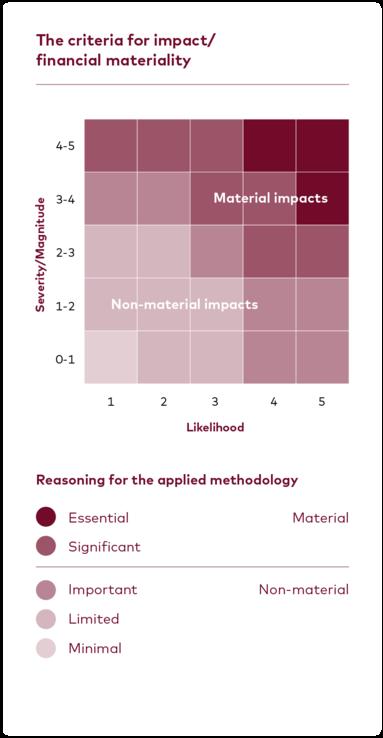
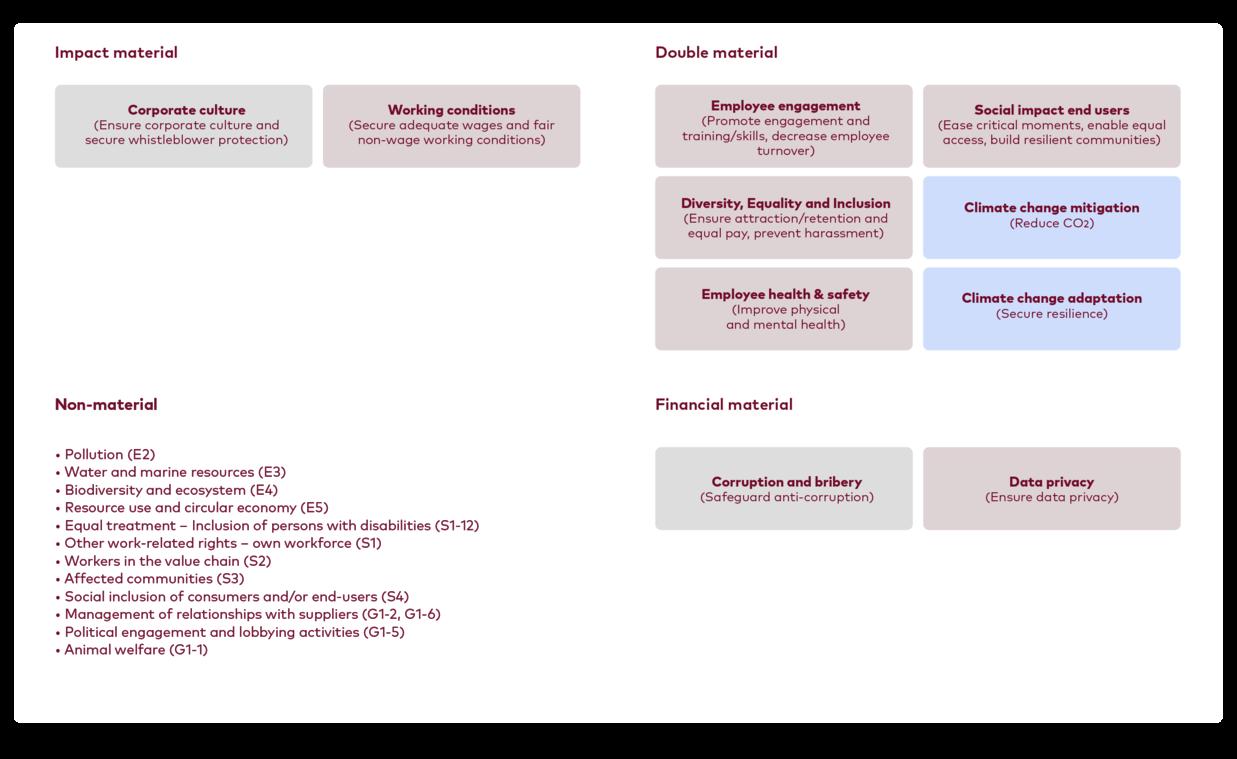
The Foundation’s Double Materiality Assessment (DMA) found the following overall material matters to guide our sustainability work.
Health
Advancing Health and especially brain health is a key strategic pillar for the Foundation, through funding of research, biotech investments, long-term ownerships of healthcare companies and support for collaboration in the research ecosystem.
People
Sound working conditions and inclusive corporate cultures with a focus on employee engagement and development are crucial for retaining and attracting talent for the Foundation and our portfolio companies. Climate change
As a long-term investor and asset owner our capital can be linked to greenhouse gas emissions across our portfolio Climate change poses long-term risks to health, society and economic stability, including the sustainability of healthcare systems.
Business ethics & good governance
Business ethics and good governance are central to the Foundation’s governance practices with a strong focus on fostering ethical decision-making across portfolio companies, as well as in investment and grant-giving processes.
The 2030 strategy: Bringing Discoveries to Lives
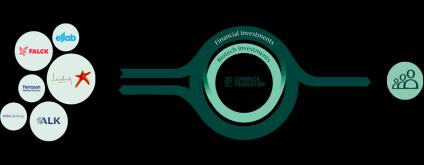
The Lundbeck Foundation’s business model
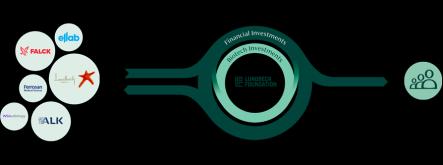
The Lundbeck Foundation is a Danish enterprise foundation with DKK 81bn in net wealth. The Foundation has a broad scope of activities, and its societal impacts, risks and opportunities its activities.
Strategic ownerships
The Lundbeck Foundation is a long-term owner of multiple healthcare companies headquartered in Denmark. Our ambition is to position and maintain the companies as international market leaders within their industry segment. Business ownership is a key element of the Foundation's financial and societal value creation and of building the route to market for new treatments and therapies for patients all over the world.
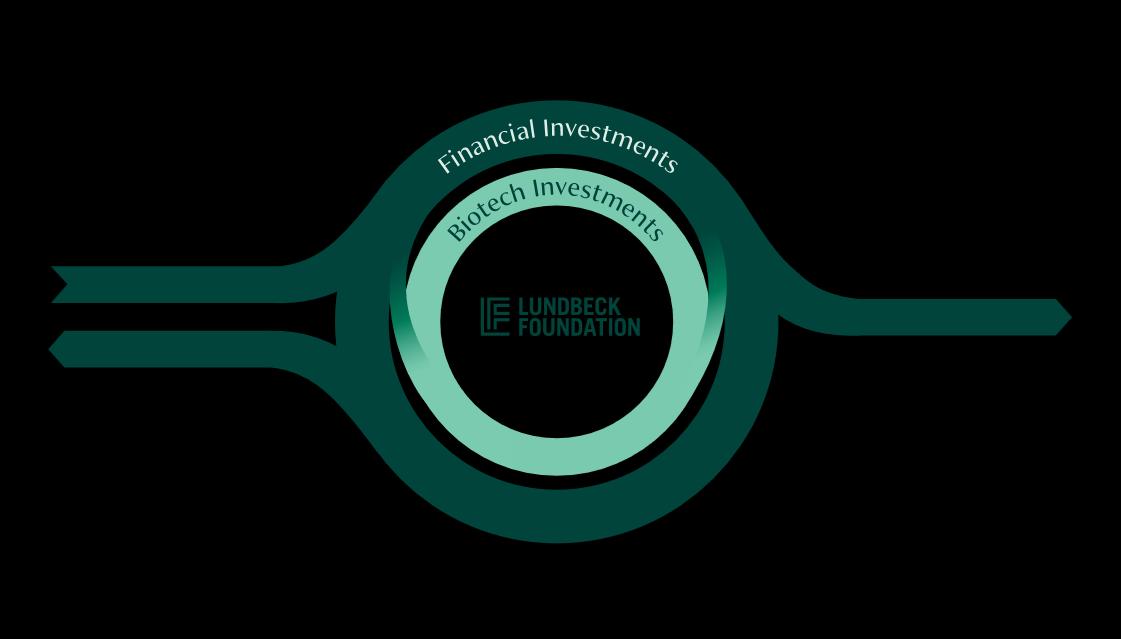
Financial investments ensure long-term financial stability and robustness and allow the Foundation to invest in the future of healthcare and support new scientific research. The Foundation's biotech investments contribute to financial value creation while also developing people and businesses in the Danish life science ecosystem.
society
The Foundation channels profits back to society through grants and partnerships, which are anchored in the Foundation’s purpose of 'Bringing discoveries to lives'. Our strategic ambition is to improve the world's understanding of the brain and create better treatments of brain disorders while also developing the Danish life science ecosystem by improving conditions for science, innovation and economic growth in Denmark.
Strategic ownerships
As a business owner in the healthcare sector, the Foundation impacts economic growth, innovation and job creation in Denmark and in other geographies. This ownership role entails a responsibility to ensure that the companies assess and report on their sustainability impacts, risks and opportunities, and address these through policies, actions and targets.
Responsible growth and job creation
Engaged ownership is the core of the Foundation’s contribution to its healthcare companies. The goal is to position and maintain the companies as international market leaders within their industry segments, including a strong focus on sustainability.
Research indicates that companies with enterprise foundation ownership achieve higher ESG performance, maintain ESG activities even during financial crises, and commit to more significant emission reductions in the post-Paris Agreement period.
Governance: Engaged ownership
Sustainability is an important pillar of the Foundation’s engaged ownership model, and the Foundation encourages its ownerships to assess, evaluate and report on relevant sustainability measures and initiatives. The Foundation uses its board representation to advance sustainability agendas and expects its ownerships to live up to the minimum standards that are defined in the Foundation’s Sustainability Policy.
For example, in 2025, the climate targets of the six strategic ownerships are all approved by the Science Based Targets initiative.
While the Foundation exercises engaged ownership through board representation and dialogue, each portfolio company is independently responsible for its own environmental, social and governance (ESG) performance, policies and targets. Please refer to the individual reports, which provide detailed and company specific information
*For Lundbeck, ALK and WSA, patients reached relates to the estimated number of unique patients receiving treatment. For Falck patients reached relates to the total number of services delivered.
Subsidiaries
Asset management
The Foundation’s asset management covers its biotech investments advancing Denmark’s life science ecosystem while also delivering a financial return, and the Foundation’s financial investment activities that ensure financial robustness to pursue the Foundation’s purpose and strategy.
Biotech investments
Supporting the local life science ecosystem while also delivering a competitive financial return is at the core of the Foundation’s biotech investments through Lundbeckfonden BioCapital. Through new investments and its existing portfolio of 18 international and Danish biotech companies, the Foundation advances health innovation through commercial and sustainable businesses, striving to push the limits of the current level of insights and knowledge and identifying the health solutions of tomorrow.
Governance:
An active biotech investor and owner
The Foundation identifies companies and teams with a strong scientific platform and commercial potential that can address unmet medical needs through novel and/or better treatments Meeting future patient needs requires excellent science, robust business models and sustainable practices.
The Foundation’s investments take place after an indepth due diligence assessment of the science, team and business model. Each investment usually involves a board seat, which allows the Foundation to advance and guide strategy, operations and policies and to build up sustainable priorities and practices in the portfolio companies.
As investments are in early-stage companies, focus is on future proofing companies during the ownership period by ensuring scalable, proportionate sustainability practices, policies and data that can evolve alongside scientific and commercial progress The Foundation continuously seeks to develop practical tools to support portfolio companies on initiating appropriate actions as they mature.
Investments as a financial engine
The Foundation’s value creation relies on its financial assets, which enable the Foundation to pursue commercial and philanthropic activities. Financial returns allow the Foundation to support its business ownerships while also investing in new science and innovation, even in times of crisis.
Governance: A responsible financial investor
As a diversified financial investor, the Foundation pursues a strategy of investing in high quality companies across different sectors to generate longterm return without compromising strong near-term risk management. All financial investments must comply with the Foundation’s sustainability policy and
investment policy which are reviewed and approved by the Foundation’s Board of Directors on an annual basis.
Investment decisions and recommendations are also reviewed by the Investment Committee, which supervises the Foundation’s activities in accordance with the investment policy
As defined in the investment policy, the Foundation does not invest in certain sectors, such as activities in tobacco and illegal weapons production. Prior to investment, sustainability is considered in the due diligence phase for all investment opportunities. This involves the screening of individual companies, assets or asset managers.
The investment portfolio is screened twice a year. Assets that are flagged as high risk in the external screening process undergo a separate due diligence process which is signed off by the Foundation’s CEO and presented to the Board to Directors.
Execution on the BioCapital Sustainability Programme
In 2025, the Foundation continued to develop and implement its Sustainability Programme. This involved a contribution to the Life Sciences VC Sustainability initiative (LSVC). LSVC is a peer-led collaboration focused on aligning ESG data collection which aims to reduce the burden placed on portfolio companies by establishing a harmonised and meaningful approach to data collection across the venture capital life science ecosystem.
In 2025, the Foundation completed its first ESG data collection for the BioCapital portfolio in line with the LSVC
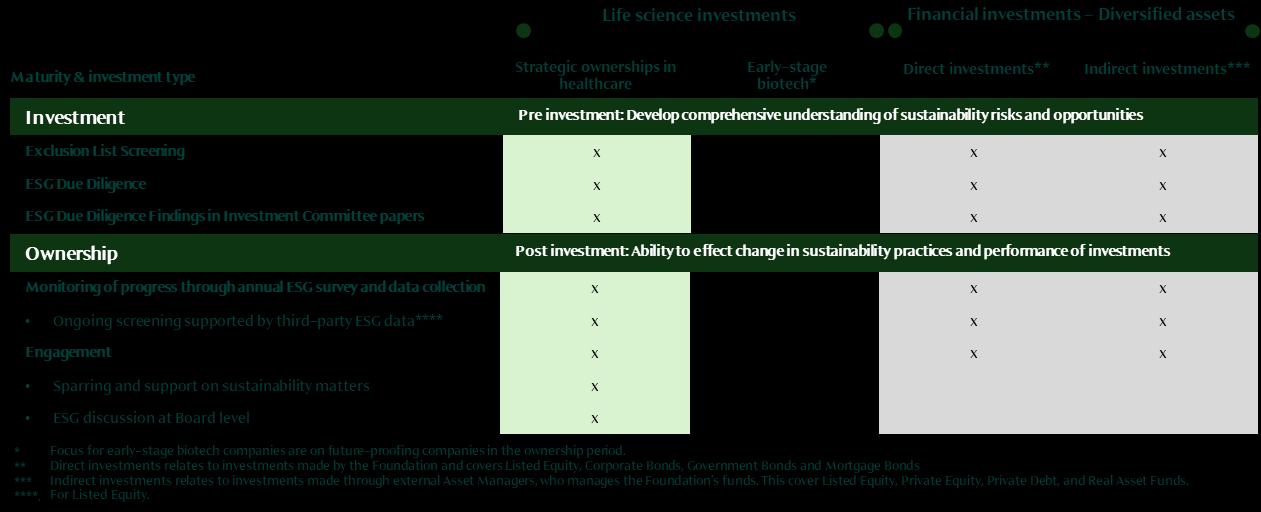
Responsible investment and ownership overview
Our responsible investment framework ensures a consistently applied process for assessing companies and assets on material sustainability matters through the investment lifecycle.
As we invest across a broad spectrum of asset classes and sectors, directly and indirectly, we have developed a differentiated approach to ensure our actions remain relevant and aligned with our areas of influence. However, all investments are subject to the Foundation’s exclusion list as outlined in the Foundation’s Investment Policy.
We continuously work to refine and improve our responsible investment approach and aim to further embed sustainability in our investment processes.
Partner to society
The Foundation channels profits back to society through grants, partnerships and societal activities, which are anchored in the purpose of ‘Bringing discoveries to lives’. This includes investing in scientists and their pursuit of new discoveries, disseminating knowledge and discoveries to those who need them, and using the Foundations public voice.
The commitment to brain health
Brain diseases have profound socio-economic impacts for society at large and severe personal consequences for patients and relatives across the world More than 3 billion people are estimated to be affected by brain diseases worldwide. To provide new treatments scientists, practitioners and general society require better knowledge about the brain and its diseases.
The Foundation supports scientific research with a specific commitment to the brain. The Foundation supports projects across basic, clinical and epidemiological research activities. In 2025 the Foundation granted a total of DKK 825m, out of which 90% was committed to neuroscience research across all levels
This includes a high and stable level through open calls, which remain the backbone of our support for the Danish neuroscience ecosystem.
At the same time we pursue strategic grants where scale and long-term engagement can help move entire fields forward. During the year, we reached important milestones, including the inauguration of the Lundbeck Foundation Parkinson’s Disease Research Centre (PACE) and the decision to establish a new national research centre for clinical psychiatry in partnership with the Capital Region of Denmark.
Disseminating
knowledge and discoveries
Bringing discoveries to lives requires new knowledge as well as the continuous sharing of existing knowledge to those who need it: clinicians, healthcare professionals, patients and relatives, companies, public authorities, etc.
In 2025, the Foundation continued its efforts to share existing knowledge and new scientific insights about the brain to a broader audience in Denmark and globally.
Supporting collaboration between research and business
Healthcare innovation requires collaboration between the scientific research community and the commercial business world. This is seen in the world’s most innovative healthcare communities, where talents can make the leap from science to business and back again.
In today’s world, companies and innovative entrepreneurs shape the route from scientific labs to patients, which requires a profound understanding of multiple sectors as well as a strong commitment to entrepreneurship and business building.
Grant activities in 2025
We received
8461 applications
Including applications where gender is not applicable/relevant
501 from men
Case: National Strategy in Psychiatry Research
In 2025, the Foundation announced the first step in the Lundbeck Foundation’s National Strategy in Psychiatry Research, the establishment of a national centre for clinical psychiatry with its primary base at Bispebjerg Hospital in Copenhagen and satellite units across all regions of Denmark.
The Foundation’s national strategy for psychiatry research has the overarching aim of providing better treatments for patients living with mental illness. The initiative comprises three closely aligned and collaborative centres: a national centre for clinical psychiatry research and two centres dedicated to basic biological psychiatry, with a focus on identifying the underlying mechanisms of psychiatric disorders.
The ambition is to establish a world-leading centre that delivers direct clinical benefits to patients, advances understanding of mental illness and attracts leading international scientific talent to Denmark.
In the short term, this will lead to new research programmes and the initiation of novel treatments in clinical trials, while in the long term it will contribute to better treatment for patients with severe psychiatric disorders.
To further facilitate the scientific transition from basic research project to commercially viable products and companies that can bring the discoveries to lives, the Foundation has set up Seed and Frontier Grants.
Frontier Grants aim to mature research projects to become attractive prospects for biotech investors, such as Lundbeckfonden BioCapital. In 2025, four Frontier Grants were awarded to projects related to exploring a new obesity drug, genome stability in neurodegenerative disorders, breast cancer and osteoporosis.
Active public voice
The Foundation engages in a variety of activities spanning communication, partnerships and public affairs across its entire value chain to pursue three main agendas:
• Advancing Brain Health Awareness
• Supporting better research conditions
• The Foundation Model and the Role of Enterprise Foundations in Society
Accountability, transparency and integrity
In its grant activities, the Foundation is committed to integrity, transparency and accountability. The Foundation wants to support the best scientific research that can shape positive outcomes and push the frontiers of our collective knowledge.
Best practices, such as the Danish Code of Conduct for Research Integrity, as well as environmental, social and governance considerations, are integrated into the Foundation’s grant processes.
It is a prerequisite that researchers who receive funding from the Foundation within the field of biomedical sciences are affiliated with institutions that have their own published codes and guidelines for good research practice. The Foundation thus seeks to primarily ensure prudent sustainability practices through the affiliated institutions.
The Foundation handles and evaluates applications via an application assessment process. Evaluations include peer reviews by international third-party expert panels who operate in compliance with the Foundation’s principles of impartiality. For this purpose, the Foundation has established five permanent evaluation panels with independent experts: https://lundbeckfonden.com/grants-prizes/applicants
The Foundation’s public voice is conducted with strong attention to principles of transparency, accountability and integrity https://lundbeckfonden.com/aboutus/social-responsibility-and-transparency/activepublic-voice
Celebrating neuroscience
The Foundation has many activities focused on the need to bring knowledge and awareness of brain health to society at large. This includes the world’s largest prize for brain researchers, ‘The Brain Prize’, which is awarded annually to scientists who have made groundbreaking discoveries in brain research. The award is followed by an extensive outreach programme, where the winners share their science with global audiences.
A global outreach
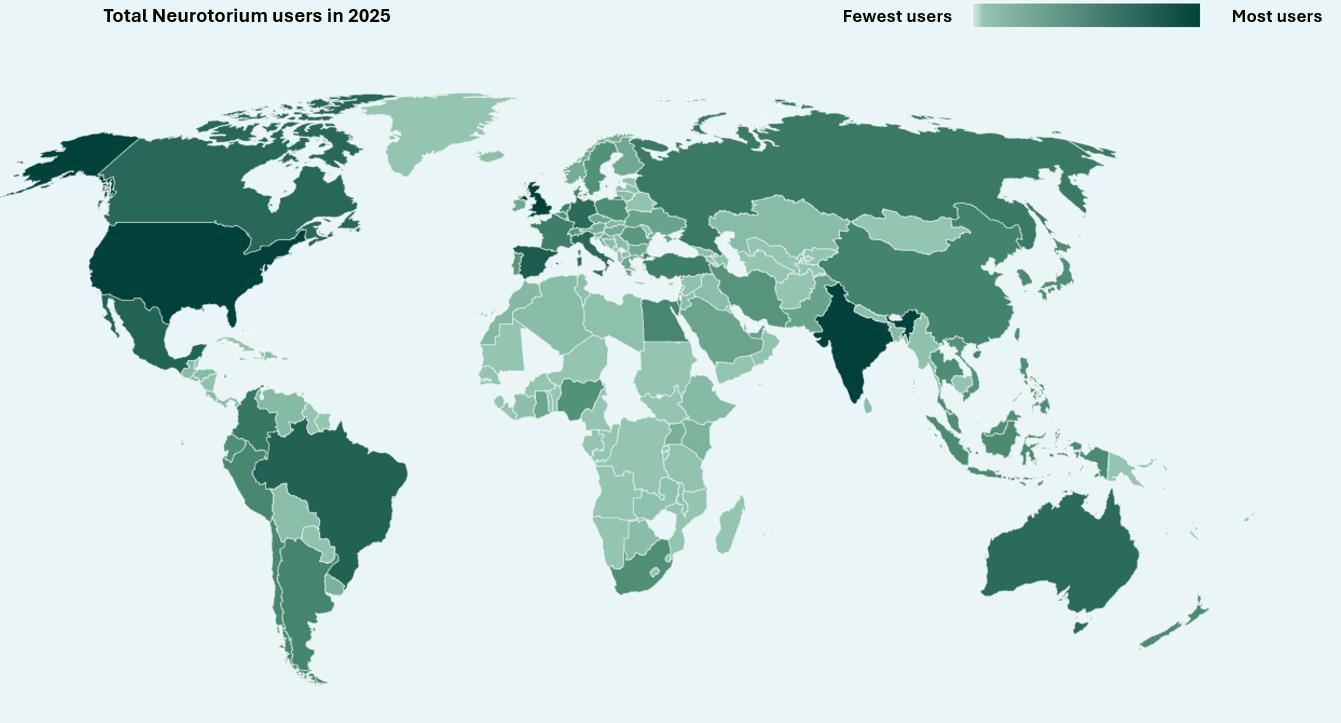
In 2025, the Foundation’s online platform, Neurotorium – which provides curated free educational material on neurology and mental diseases intended for clinicians and educators – attracted more than 314,000 visits from a total of 186 countries only three years after its launch in 2022. The top 5 countries per number of users were the US, India, the UK, Spain and Brazil.
Sustainability at the Lundbeck Foundation
Governance principles
The Lundbeck Foundation is committed to transparency and integrity, operating under a clear governance framework and relevant policies that define the direction of the operating model for the Foundation’s broad range of commercial investments and philanthropic grant activities. The Foundation’s governance model has been developed over many years and is based on four principles:
• Compliance. As an enterprise foundation, the Foundation strives to adhere to the Recommendations on Foundation Governance issued by the Danish Committee on Foundation Governance.
• The principle of independence guides the composition of the Foundation’s governing bodies, including board composition.
• Transparency. The Foundation publishes its annual reports/financial statements? in alignment with listed companies. All key policies and governance documents are publicly available on the Foundation’s website (https://lundbeckfonden.com/about-us/socialresponsibility-and-transparency/policies), and major decisions on philanthropic grants are proactively communicated
• Checks and balances. The Foundation’s organisational set-up is structured to safeguard a balanced allocation of responsibilities and to avoid undue concentration of decision-making authority
Sustainability governance
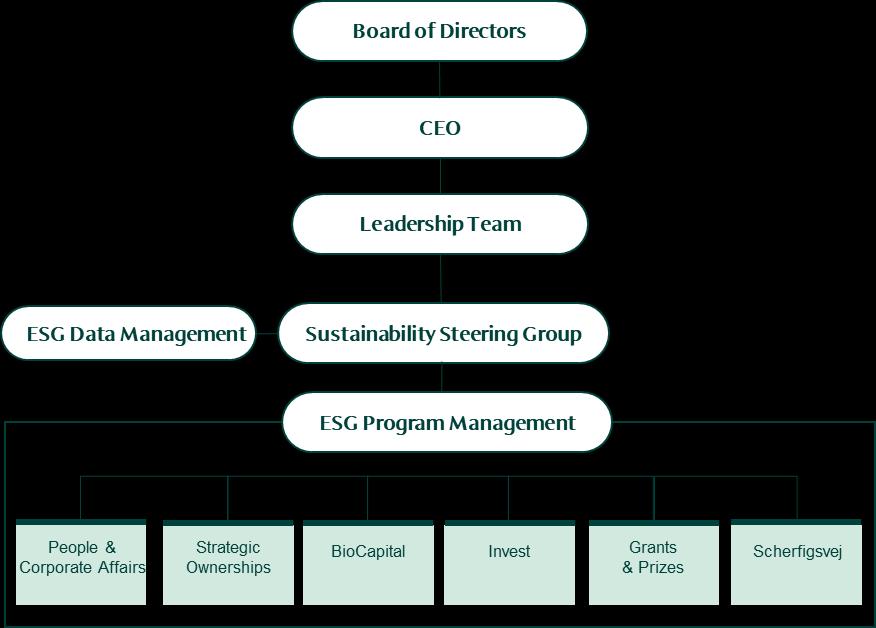
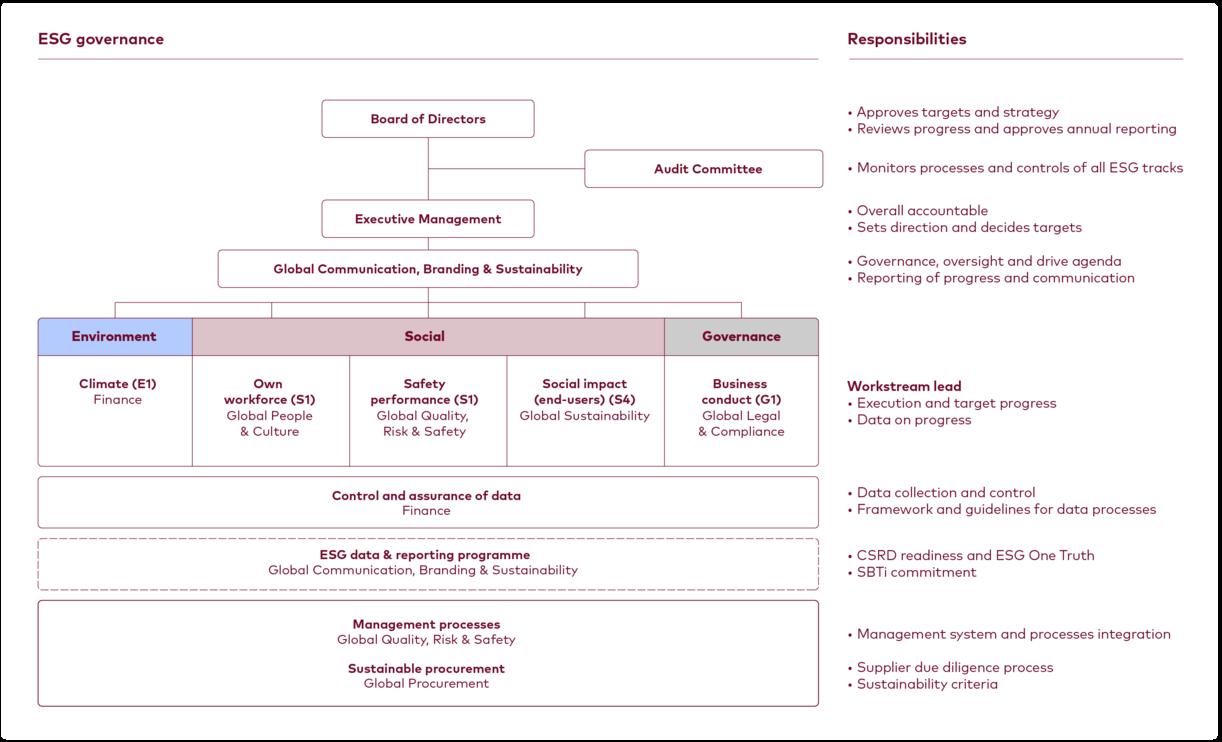
The Foundation’s Board of Directors endorses the Foundation’s sustainability policy priorities and progress. The CEO is responsible for the Foundation’s sustainability work and ensures that ESG is integrated into strategy, management and business model. The Management Team reviews implementation and follows up on progress. The Sustainability Steering Group is responsible for advancing the sustainability agenda and programme, manages key priorities and sustainability initiatives, tracks progress and reports to the CEO. Workstream Leads drive sustainability initiatives in their departments. In addition, the Foundation works to integrate and update ESG measures according to the latest developments in the core process for each of its activities.
The Foundation’s sustainability policy
The Foundation’s work on all sustainability areas follows the guiding principles defined in its sustainability policy. The policy articulates the expectations and guiding principles for the Foundation’s employees, its grant recipients, investments and ownerships. It also encourages partners and stakeholders, including the strategic ownerships and investments, to pursue sustainability agendas that can live up to the minimum standards set out in the policy.
The sustainability policy is reviewed and approved by the Board of Directors annually. The policy is publicly accessible on the Foundation’s website: https://lundbeckfonden.com/about-us/socialresponsibility-and-transparency/policies
Whistleblower system
The Foundation has a whistleblower system that provides employees, partners and stakeholders with a secure and confidential channel to flag and raise concerns, including legal and other serious risks In 2025 one report was made via the whistleblower system regarding a portfolio company. The case has been closed.
Data ethics
In response to section 99d of the Danish Financial Statements Act, the Data Ethics Policy for the Lundbeck Foundation (including Lundbeckfond Invest A/S and LFI Equity A/S) has been developed and approved by the Board of Directors. It is based on five principles:
• Human interests before commercial interest Data utilised should ultimately have a human benefit. If there is a conflict between human and commercial interests, human interests should always prevail.
• Transparency Data uses should be clear or easily explained. When personal data is utilised, the legitimate reason for doing so should be made clear, or properly informed consent should be obtained from all parties involved.
• Anonymisation
Data should be anonymised or pseudonymised unless personalisation is a requirement for achieving the targeted results.
• Autonomy
The Foundation believes that individuals should have control over the use of their data and the Foundation does not use automated decision-making on data either provided or collected.
• Accountability and governance Accountability is an integral part of responsible data use, and the Foundation goes to great lengths to reduce the risks for the individual and to mitigate undesirable social and ethical implications.
The Foundation endeavours to integrate data ethics into all its daily management and business decisions, including when acting as stakeholder in other concerns. Even with effective standards, policies and processes in place, data usage has the potential to lead to challenges, problems and errors. The Foundation seeks to prevent this by developing a positive culture among employees that promotes openness and encourages the continuous improvement of processes and systems.
Subsidiaries
For further information about the Data Ethics Policy, please see page 45 of H. Lundbeck’s Annual Report 2025, page 31 of ALK Abelló’s Annual Report 2025 and page 30 of Falck’s Annual Report 2025.
Foundation initiatives in 2025
In 2025, the Foundation calculated the baseline for the full greenhouse gas inventory, which covered significant categories of our own operations and supply chain, as well as our investment portfolio. For the investment portfolio this covered listed equity, corporate bonds, private equity, private debt and real assets. We continue to work with improving the data quality of our investments and will provide transparency on these figures in future reporting.
Recent regulatory developments, including amendments to the Corporate Sustainability Reporting Directive (CSRD), have contributed to greater clarity regarding how enterprise foundations may approach sustainability reporting. This will help to reflect our business model as both an investor and a long-term owner.
Together, these efforts reflect our ambition to provide stakeholders with clear insight into how sustainability considerations are integrated into our strategy, business model and operations, while supporting transparency, accountability and trust in the Foundation’s activities
Key ESG figures for the Foundation
Gender diversity
In 2025 the Foundation’s Board of Directors comprised eight board members elected according to the statutes Seven of the eight board members were considered independent. The eight board members counted two women and six men, excluding the four employee representatives, who represent the Foundation’s three subsidiaries.
The gender balance is not in accordance with the guidelines on gender equality issued by the Danish Business Authority (‘Guidelines on target figures, policies and reporting on the gender composition of management’) and adjusting the gender balance of the Board of Directors is therefore a priority going forward.
When electing new members to the Board of Directors, the Board strives to ensure diversity in competencies as well as gender. The board will continue to pursue equal representation in the coming elections.
At 31 December 2025, the Management Team of the Foundation was comprised of seven members, including the CEO, and counts two woman and five men. The Foundation’s employee group counts 27 women out of a total of 55. Diversity and inclusion will remain focus areas for the Foundation in the years to come.
Greenhouse gas emissions
While the Foundation’s primary purpose is advancing health, it recognises that its activities contribute to the release of greenhouse gas. The Foundation’s climate impact is primarily driven by scope 3 activities regarding the investment portfolio. With regards to our investment portfolio, the reporting covers most of our assets. Please refer to the accounting policies.
In 2025, emissions from unavoidable flights related to the Foundation’s activities amounted to 358 tonnes (332 in 2024) of CO2. To offset these emissions, the Foundation purchases high-quality carbon credits with a mix of the following removal methodologies; Reforestation, Soil sequestration, Artisanal Biochar and Microbial Carbon Mineralization.
1 These key ESG figures are based on recommendations by the Chartered Financial Analysts’ (CFA) Society Denmark, the Association of Danish Auditors (FSR) and Nasdaq Copenhagen. They represent a first step in a process that, over the coming years, will enable the Foundation to provide stakeholders with further insights into the Foundation’s ESG profile.
2 Comparative figures for business travel and investments are not presented. The full greenhouse gas inventory, presented from 2025, covers significant categories of own operations and supply chain, as well as the investment portfolio, excluding government and mortgage bonds and real assets.
3 The ESG metrics have been restated from previous years due to an updated methodology; Scope 1 to include company owned vehicles, energy consumption to use MwH as opposed to GJ, and renewable energy share to reflect the energy mix from purchased electricity and district heating.
Definitions of calculations
Reporting period
All reported data cover a full-year period (1 January to 31 December 2025) for the Foundation (Lundbeckfonden, Lundbeckfond Invest A/S and LFI Equity A/S). The calculations have been applied consistently for all the years presented. All KPIs reported in the Sustainability Report are gathered and aligned with the timeline for the annual reporting of the financial data.
Data quality
We are committed to collecting the most accurate data. Nevertheless, it is not always possible to gain a fully aligned register of data, and estimations are sometimes necessary.
Environmental data
Scope 1
Includes all direct GHG emissions from energy consumption. Energy consumption includes companyowned vehicles (including leased vehicles). Emissions are calculated as energy consumption multiplied with relevant emission factors from Department for Environmental, Food and Rural affairs (DEFRA)
Scope 2
Includes GHG emissions from electricity and district heating. Actual consumption data is used from utility and EV Charging network providers. Emissions are calculated using the location and market-based approaches. The consumption is multiplied with relevant emission factors from Energinet and DEFRA.
Scope 3, category 3, fuel and energy related activities
Includes all emissions related to Well-To-Tank activities and emissions related to Transmission and Distribution losses, for all purchased fuels and energy. The emissions are calculated using activity data and relevant emission factors from DEFRA.
Scope 3, category 7, business travel
Includes business-related air travel activities of employees and researchers paid for by the Foundation. The GHG emissions are calculated based on travel agency reports and distance-based data. Activities are multiplied with relevant emission factors from DEFRA and EPA. For flight emissions on distance-based data, emission factors differentiate between domestic, shorthaul (<3,700km), and long-haul (>3,700km) flights. In addition, emission factors differentiate between flying economy, premium economy and business class
Scope 3. Category 15, investments
Includes emissions associated with the Foundation’s investments in the reporting period, covering direct and indirect investments. The Foundation applies the PCAF standard’s and Finans Danmark’s guidance when calculating the emissions. This involves calculating the Foundation’s share of the annual GHG emissions from the investee or asset. This share is determined by:
• Listed equity and corporate bonds: The ratio of the financed company's outstanding amount to the enterprise value including cash (EVIC)
• Private equity/debt: The ratio of the financed company's outstanding amount to the total equity and debt
The Foundation derives scope 1+2 emissions for listed equity and listed corporate bonds via Bloomberg. If reported data are unavailable, Bloomberg estimates or internally calculated industry emission factors are used.
For direct private equity investments, scope 1+2 emissions are gathered from company-reported data. Where GHG data are not available, private companies’ emissions are estimated by multiplying the fair value of the company by an industry factor derived from Bloomberg.
For emissions pertaining to indirect investments in private equity and debt funds, scope 1+2 emissions are derived from asset managers and are multiplied with our ownership share of the fund.
Currently, the Foundation is excluding emissions from government and mortgage bonds due to the lack of sufficient and reliable data. In addition, emissions stemming from real assets have been excluded due to data availability in the current reporting year.
Energy consumption and renewable energy share
Consumed energy is monitored by building-specific meter readings. Renewable energy share is measured as the energy generated by solar panels and by supplier information. The share of renewable energy consumption is calculated based on the percentage of
the total renewable energy consumption relative to total energy consumption.
Water consumption
Water consumption is monitored by building-specific meter readings. The reporting period is 1 October 202431 September 2025.
Social data
Workforce
FTE is the average number of full-time equivalent employees.
Gender diversity, percentage of women in the workforce
Includes all permanent employees hired and paid directly by the Foundation. Gender is assigned as female or male. Gender diversity is reported as female share of total workforce.
Gender diversity, percentage of women in the Management Team
Includes all women in the Management Team. Gender is assigned as female or male. Gender diversity in the Management Team is reported as female share of total Management Team.
Gender pay ratio of men to women
Includes all permanent employees hired and paid directly by the Foundation. Gender is assigned as female or male. Gender pay ratio is calculated as the median of paid salary to male employees divided by the median of paid salary to female employees.
Employee turnover ratio
Includes all permanent employees hired and paid directly by the Foundation. Employee turnover ratio is calculated for both voluntarily and involuntarily departing employees.
Absence due to sickness
Includes all permanent employees hired and paid directly by the Foundation. Absence due to sickness is calculated as the number of full days of sickness for all employees divided by the total number of FTEs. Maternity leave is not included.
Governance data
Gender diversity, Board of Directors
The gender diversity of the Board of Directors is calculated as the total number of women elected divided by the total number of members of the Board of Directors for the Foundation. Gender is assigned as male or female.
Board meeting attendance rate
The board meeting attendance rate is calculated as the number of board meetings that each board member attends, divided by the total number of board meetings held during the year.
A specific overview of each board member’s attendance during 2025 is presented in the Annual Report of the Foundation on page 44.
CEO pay ratio
Total CEO remuneration divided by the median of the Foundation’s employee remuneration.
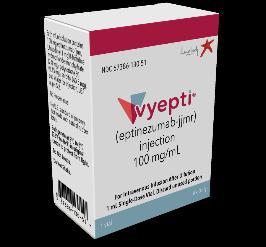
AlsoinJune,thefullresultsofthephaseIVRESOLUTIONtrialdemonstratedrobustefficacyofVyepti® in otherwisedifficult-to-treatpatients.Patientstreated witheptinezumabreportedrapidreductionsinpain severitybyweek2comparedtoplacebo,alongsidea
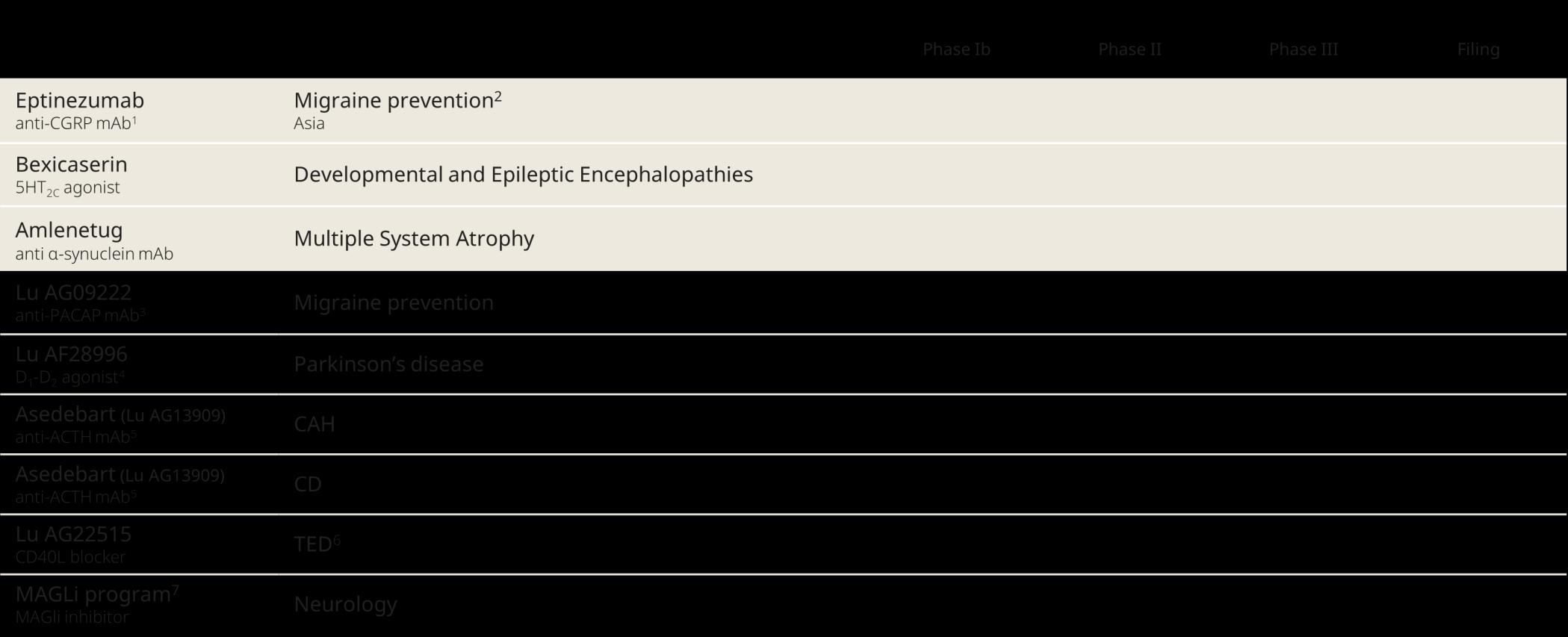
As a core pillar of the Focused Innovator Strategy, Lundbeck remains committed to investing in research anddevelopmenttodrivelong-termvaluecreation.Following the significant increase in R&D investments in 2025,LundbeckexpectsR&Dspendingtoincreasefurtherin2026totherangeofDKK5.5to5.9billion, reflectingcontinuedprogressionoflate-stagedevelopmentprograms,includingbexicaserinandamlenetug, aswellassustainedinvestmentinearly-andmid-stage pipelineassets.TheactuallevelofR&Dspendingwill bedeterminedbyoutcomesatrelevantR&Dmilestonesoverthecourseoftheyear
AdjustedEBITDAgrowthisexpectedtobeintherange of4%to12%atCERin2026.Thisreflectscontinuedoperating leverage from strategic brands, benefits from capital reallocation and productivity initiatives, and disciplined cost management. These factors strongly contribute to limiting the impact from higher R&D investments,increasedCOGS,andacceleratinggenericcompetition. At current exchange rates, Adjusted EBITDA growth reported in DKK is expected to be significantly lowerthanCER
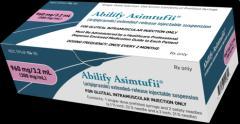
Overall, Lundbeck’s 2026 guidance underscores the company’s ability to navigate increasing generic pressure–primarilydrivenbyAbilifyMaintena® –whilesustaininggrowthandprofitabilityandcontinuingtoinvest for long-term value creation, reinforcing its position as afocusedinnovatorinneuroscience.
This guidance assumes no significant changes in the globalorregionalmacroeconomicandpoliticalenvironmentthatwouldimpactLundbeck’sbusiness,including major healthcare reforms, legislative changes, or legal outcomes. It also assumes stable currency exchange rates from current level, particularly the U.S. dollar againsttheDanishkrone,andreflectscurrentestimates of gross-to-net developments in U.S. sales. The guidance excludes potential effects from new significant business development transactions, significant impairmentsofintangibleassets,andanyshiftsintradepolicy, suchaspharmaceuticaltariffsor further healthcarereforms.
Mid-termtargets
Based on organic growth, the company expects revenue to show a mid-single digit compound annual growth rate (CAGR) over the mid-term period (2023 to 2027). The company maintains its target for adjusted EBITDA-marginofmorethan30%attheendofthemidterm period in 2027, to account for the impact of the Longboardacquisition,progressionofthepipelineand excludinganybusinessdevelopmentactivities.
Lundbeck plans to ensure appropriate investments in R&D and prelaunch activities for bexicaserin and amlenetug following the successful closure of the acquisitionofLongboard.
In addition, several R&D projects are expected to mature and progress in the period. Moreover, in accordance with the Focused Innovator Strategy, Lundbeck has initiated the most significant capital reallocation program in its history to sustain the company’s growth withincreasedfocusoninnovation.
The mid-term targets exclude potential effects from newsignificantbusinessdevelopmenttransactions,significant impairments of intangible assets in 2026, and anyshiftsintradepolicy,suchaspharmaceuticaltariffs or further healthcare reforms. As 2026 progresses, Lundbeck will provide an update on the mid-term targets
Yearly(2025) The donations of Lundbeck products are estimatedtobenefit4291patients.
Yearly(2025) The Code of Ethics e-learning training was completedby100%ofemployees.
Yearly(2025) The ESS shows that 92% of employees reportedconfidenceinraisingethicalorcompliance concerns exceeding the 2025 targetoffouroutoffiveemployees(80%)
118
118
Mid-term(2029)
Mid-term(2029)
Long-term(2050)
Scope1and2GHGemissionsareaheadof our 2029 target, driven by fleet electrification and renewable electricity. Scope 3 remainsofftrackduetobusinessgrowthand higherlevelofactivity,suchasclinicaltrials.
Emissions from logistics and travel have successfullybeendecreased.
67
X Recycle63%oftheorganicsolventsusedinchemicalproduction.
Yearly(2026) Theannual Code of Ethics training targetand ESS target ensure ethical awareness and reflect our ongoingcommitment toaculture ofintegrityand transparency.
Mid-term(2029)
Mid-term(2029)
Long-term(2050)
Thescope1,2,and3GHGemissiontargetsremain unchanged, as they are integral to Lundbeck’s long-termtransitionplantowardsnet-zero.Wewill continuetoworktoreduceourscope1and2GHG emissionseventhoughweareaheadofthetarget.
Four out of five employees stating in the annualemployee satisfactionsurvey(ESS)thattheyfeelasenseofbelongingatLundbeck.
Reducelosttimeinjuryrate≤2.5.
Yearly(2026)
Yearly(2026)
Yearly(2026)
Yearly(2026)
Similarly, we continue to set annual targets for chemical and general recycling, reflecting the company’s continued commitment towards circulareconomyprinciples.
Lundbeck did not achieve its 2025 milestone to reduce emissions by 41% compared to the 2019 baseline Since 2006, Lundbeck has minimized energy consumptionbyoptimizingitsproceduresandmodernizingitsequipment.InDenmark,thishasincludedusing100%renewableelectricity,aswellasprogressively switchingfromfossiltorenewablefuels. In2025,Lundbeckpurchasedguaranteesof origintoensure100%useof renewableelectricity atallEuropean sites, includingsales subsidiaries. Gradually, all sites worldwide are expectedto be suppliedby renewable energy sources, thus reducingscope 1 and 2 GHG emissionsby99%in2050comparedto2019.
Optimization&circularity
Purchasedgoods&services
(scope3 category1a)
Sustainablesourcing
Purchasedgoods&services
(scope3 category1a&b)
Our2025milestonehasbeenexceededbyachievinga10%emissionreductioncomparedtothe2019baseline Lundbeckprocuresrawmaterialsandcomponentsfromaroundtheworldforuseinproduction.Followingcircularandgreenchemistryprinciples,weacttoreduceandrecyclerawmaterialconsumption, optimize yield, and transition to less hazardous chemicals. During the year, Lundbeck continued the installation of the new recycling unit at our Lumsås site, expected to increase our solvent recycling percentage (page 78), and we initiated the development of an eco-design guideline with the aim of improving integrationofenvironmentalconsiderationsthroughoutthevaluechain.Developmentoftwolifecycleassessmentscreeningswillbepartofthiswork.Through theseinitiatives,ourscope3GHGemissionsfrompurchaseofrawmaterialstoproductionareexpectedtobereducedby75%by2050.
Lundbeck didnotachieveits2025 milestonetoreduceemissionsby 22%comparedto the2019 baseline. Scope3 GHGemissions from purchasedgoodsand services(i.e.clinicaltrials,consultanciesandmarketing)arethelargestcontributorstoLundbeck’scarbonfootprint.Throughcontractualcommitmentstouse renewable electricity in operations or to establish science-based targets, Lundbeck encourages suppliers to reduce their emissions and report emission data annually.Thisisintendedtopromotereductionsinscope3GHGemissions,improvetheaccuracyofGHGcalculationsandstrengthenourreportingprocesses. With 51 of Lundbeck’s top suppliers signing renewable energy agreements, we estimate that with full supplier commitment to renewable energy or sciencebasedtargetsoverthecomingyears,indirectemissionswillbereducedby66%in2050.
Lundbeckachievedareductionof31%in2025,exceedingitsmilestonetoreduceemissionsby11%comparedtothe2019baseline Lundbeckworkstoreduce scope 3 GHG emissions from the upstream transportation of goods and services and the downstream distribution of products. This is mainly achieved by transitioning from airborne to seaborne transportation. In 2025 we also chose less carbon-intensive options where suppliers shift to greener transportation solutionspoweredbysustainablefuels.Throughthesecommitments,Lundbeckexpectstoreachareductionofatleast36%by2050.
Lundbeckachievedareductionof39%in2025,exceedingits2025milestonetoreduceemissionsby7%comparedtothe2019baseline.Infact,currentperformanceindicatesthatLundbeckhasevensurpassedthe2040milestoneofa27%reduction.EmissionsreductionsrelatedtoLundbeck’scarfleet(scope1)and business travel (scope 3) are targeted by gradually transitioning to more energy efficient cars, introducing new company car policies - including electrical vehicles(EVs)andbydevelopingtravelpoliciesthatsupportgreenertravel.In2025,Lundbecklaunchedatravelpolicyandanewtravelmanagementplatform thatareexpectedtominimize travel,encourageemployeestostay connectedthrough digital solutions,and improve thequality of travel-relateddata.In our USsalesaffiliates,whichoperatethemajorityofLundbeck’sfleet,approximately50%ofvehicleshavebeenconvertedfromfossilfueledcarstohybrids.
In2025,Lundbeckrecordedsevenenvironmentalincidents,comparedtofourin2024.Noneofthesevenincidentshadconsequencesfortheenvironmentduetothelimitedoverallimpact(basedonscope,scale, and spread).Overthesameperiod,thenumberofenvironmentalnearmissesdecreasedfrom38to27 Noclear trendwasseenamongtheincidentsasspilloccurredtoair,water,andland.Inaddition,noenvironmental
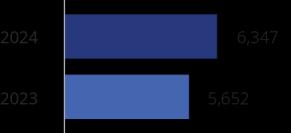
Asof2025,Lundbeck’sworkforceincludes2,356maleand2,912femaleemployees.Headcountisdistributedacross several countries, highlighting Lundbeck’s global presence and local impact. In 2025, Lundbeck transitioned to a partner-led commercial model in 27 countries, affecting 602 employees. Additionally, we closed our operations in Pakistan, affecting 22 employees. Lundbeck’s employee turnover rate stands at 22.4% due to the change in the commercialmodel and13.1%,ifthechangestothecommercialoperatingmodelareexcluded comparedto14.4% in2024.Overall,thenumberofemployeeshasdecreasedfrom5,660to5,268
At the end of 2025, Lundbeck’s Board of Directors comprised 11 members. Among the General Assembly-elected members, two were female, and five were male, while the employee-elected members included two females and twomales.Inuppermanagement,Lundbeckhad58members,ofwhom41%werefemaleand59%male.
InalignmentwiththeDanishGenderBalanceAct,Lundbeckhasadoptedasustainabilitytargettomaintainaneven genderbalanceinuppermanagement,closestto40%butnotexceeding49%.Thetargetisdefinedinaccordance withtheDanishGenderBalanceActandisassessedbasedonthepopulationofuppermanagementemployedby H. Lundbeck A/S, in line with applicable legal requirements By the end of 2025, the population of upper management employed by H. Lundbeck A/S comprised 43 members, with 42% female and 58% male, indicating that the 2025genderbalancetargethasbeenmet.TheH.LundbeckA/SExecutiveLeadershipTeamasregisteredwiththe DanishBusinessAuthority consistsoffourmales,correspondingto0%underrepresentedgender.
ThetargettoreachanInclusionscoreof8.5intheEmployeeSatisfactionSurveywasnotachievedin2025;however, performance remained high with a score of 8.2, retaining Lundbeck’s position in the upper quartile and demonstratingsustainedemployeeengagement.Lundbeckremainscommittedtofosteringaninclusiveworkplacewhere employeesfeelastrongsenseofbelonging.Forthe2026inclusiontargetseepage37
Pioneering in respiratory allergies for more than a century, ALK has embarked on a mission to help more people, with more solutions, more efficiently
ALK’s therapy areas
Respiratory allergy
Disease-modifying treatment of severe allergy (ALK's core business)
Anaphylaxis
Emergency treatment of severe allergic reactions
Food allergy and new disease areas
Novel treatments addressing high unmet medical needs (in development)
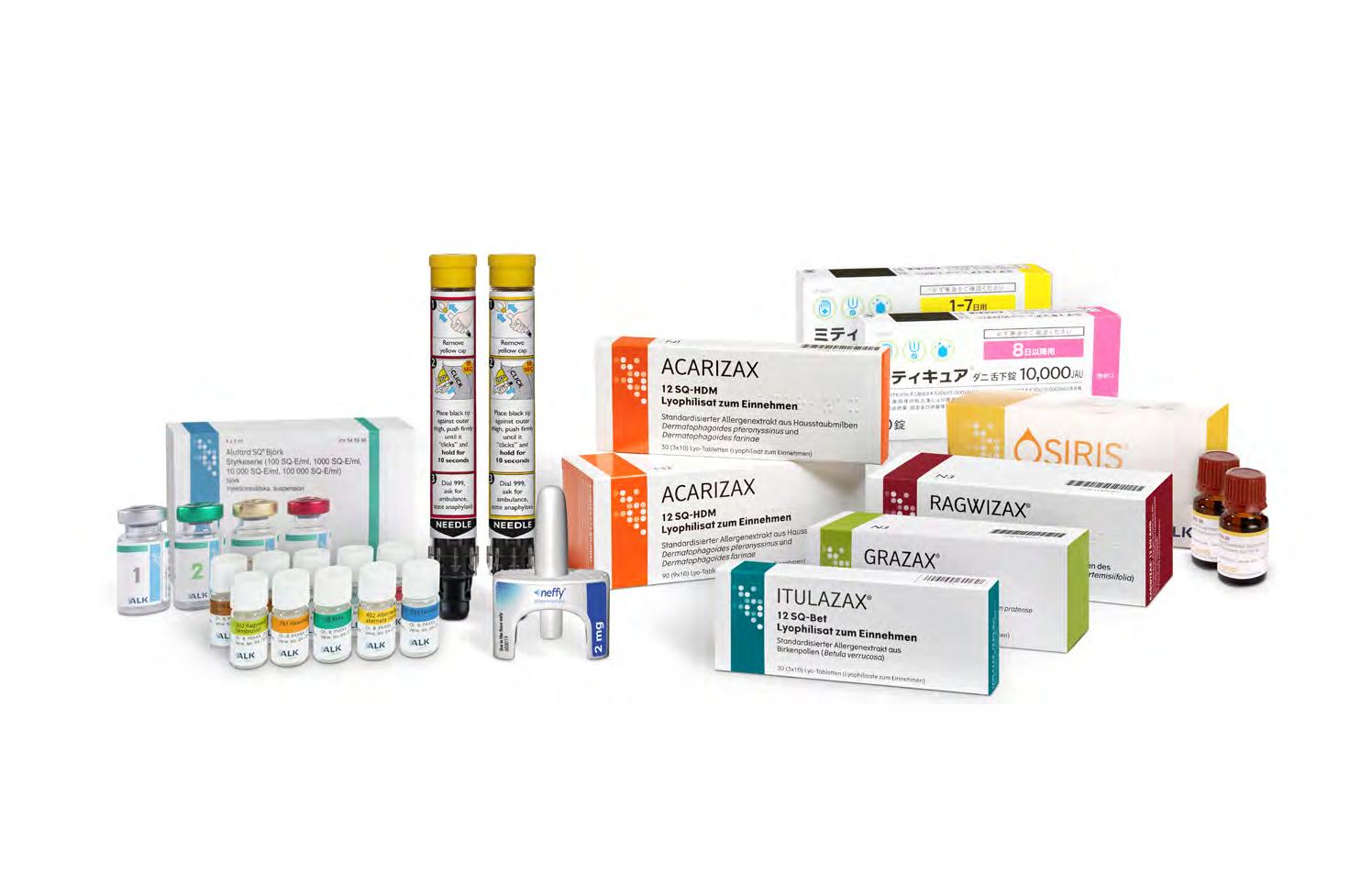
ALK markets a diversified portfolio of products, including allergy immunotherapy (AIT) tablets, injections, and drops as well as adrenaline autoinjectors and nasal sprays.
About this report
This is ALK Abelló A/S’ (“ALK” or “the company”) integrated annual report for 2025, consisting of the two main sections Management’s review including Sustainability statement and Financial statements.
Other 2025 reports
Remuneration report
Corporate Governance report
Management's review
In 2025, ALK delivered above its original expectations with strong commercial execution. Expanded reach to new patient groups, launch of a broader product portfolio, and new partnerships bolstered progress on ALK’s strategic priorities and mission to help more people, with more solutions, more efficiently.
Letter from the Chair and CEO
ALK delivered on its long-term financial targets in 2025 following strong execution of strategic initiatives across disease areas.
Based on the strong momentum and the solid financial position, the Board of Directors recommends resuming dividend payments to reward the shareholders directly.
2025 marked the seventh consecutive year of revenue and earnings growth in ALK. Results clearly exceeded initial expectations with revenue growing by 15% in local currencies and the EBIT margin improving by 6 percentage points to 26%.
Delivering on our 25-in-25 EBIT margin target was a significant milestone. We set this target in February 2021 on the back of the 2020 accounts which showed an EBIT margin of merely 4%.This means that we have been growing the EBIT margin by more than 20 percentage points, while still allocating significant resources to ongoing growth investments. This has only been possible through careful prioritisation and resource allocation to high-impact growth levers.
adolescents will become important catalysts for ALK’s future growth. As expected, contribution from the adrenaline nasal spray neffy® was modest, reflecting the early stage of the roll-out, but the feedback from key opinion leaders, healthcare professionals, and patients indicates high interest, supporting the many market introductions in 2026.
Peter Halling, President & CEO
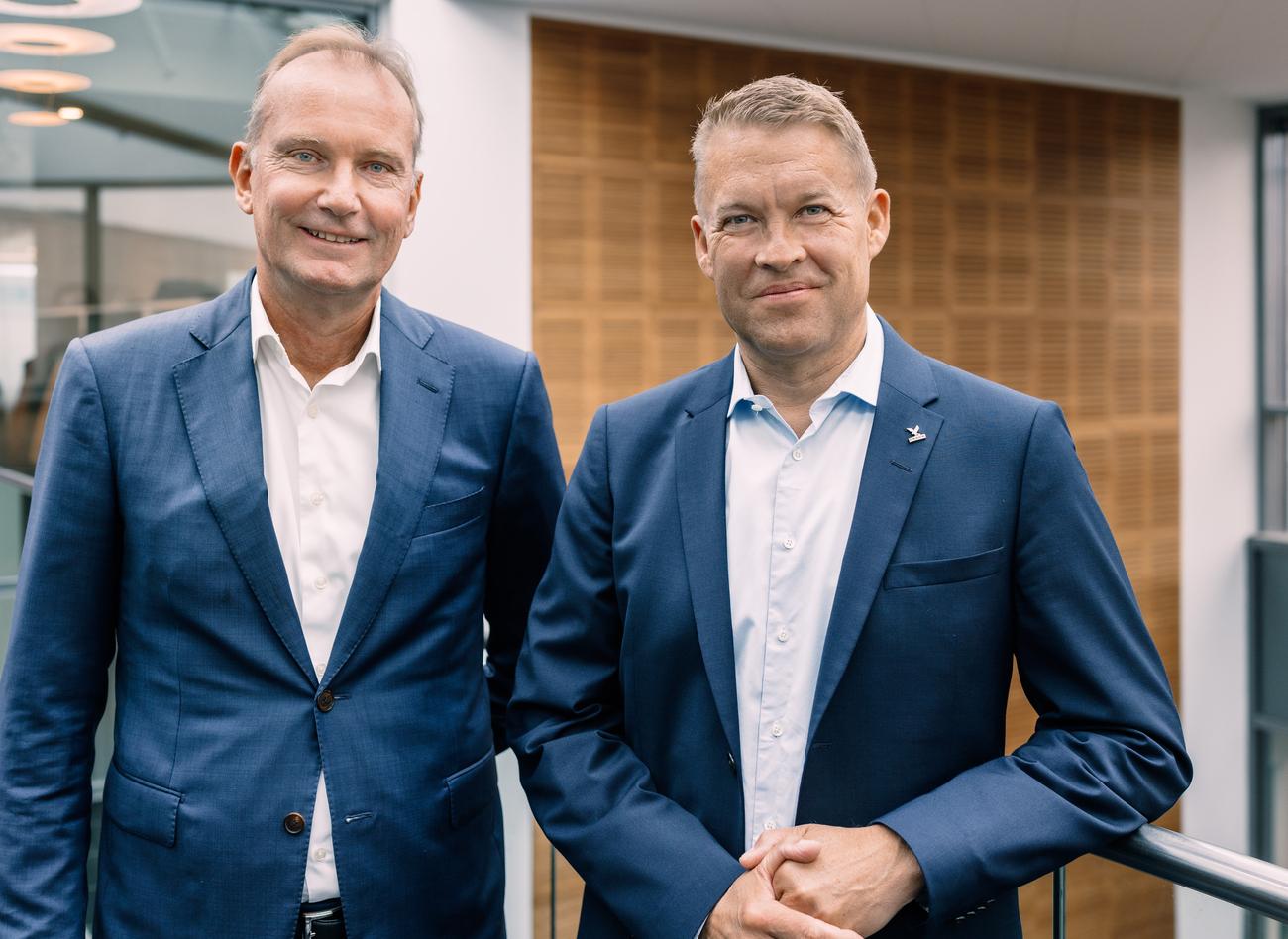
Anders Hedegaard, Chair of the Board
ALK now has a solid earnings platform and is well-positioned to continue delivering stable, high organic growth while maintaining an EBIT margin of around 25% in the coming years. As we continue to upscale the company, ALK’s strong financial position enables us to increasingly look at inorganic growth opportunities such as in-licensing and acquisitions, while also distributing excess cash to shareholders.
Expanding patient bases
Progress in 2025 was driven by strong commercial execution of particularly tablet and anaphylaxis sales across Europe and North America. We expanded our prescriber and patient bases, increasing the number of people treated with ALK’s products by 500,000 to an estimated 3.1 million.
The recalibration of ALK’s business platform allowed us to pursue priorities in the Allergy+ strategy more rigorously. Key actions included strengthening the footprint in high-growth markets and putting more weight behind the launches of paediatric tablets and the nasal adrenaline spray neffy®, while also improving earnings.
Children make a difference
The paediatric approvals of ACARIZAX® and ITULAZAX® added to the tablets’ strong momentum suggesting that children and
Our European business continued to deliver solid, double-digit growth, and the US business made a comeback after the soft performance in 2024. US tablet sales continued to grow by double digits, and we are still working to find new ways to overcome longstanding structural barriers among allergists who have a financial incentive to protect their legacy business. Our global partnership with ARS Pharma – the company that developed neffy® – showed progress in its first year and further enabled ALK to accelerate the build-up of a dedicated paediatric sales force in the USA. While focus initially has been on neffy®, the extended sales reach is expected to benefit US sales of respiratory tablets and future prescription-based products, including potentially a tablet for peanut allergy currently in development.
Partnering for growth
Partnerships are a central element in the Allergy+ strategy. In 2025, we enjoyed good progress with existing partnerships and entered new ones.
In China, we partnered with the biopharmaceutical company GenSci to fast-track sales of ALK’s products in this important, yet complex market. GenSci was an obvious choice given their capacity of expanding product portfolios, their commitment to deploy significant resources to succeed with ALK’s products, and their understanding of the paediatric field. GenSci has already started selling our Alutard SCIT product and diagnostics, and we collaborate closely to bring the ACARIZAX® tablet to market for both adults and children. ALK and GenSci will also explore possible future collaborations on innovations as there are many innovation efforts targeting new medicines in China, also within GenSci. To stay close to these opportunities, we have maintained
a local team, while more than 95% of our employees in China were transferred to GenSci.
In Japan, a new facility has become fully operational, significantly increasing the production capacity of cedar tablets and we are experiencing a strong commitment towards our products from Shionogi, the new owner of Torii. The performance in Japan and – on a smaller scale – other international markets proves that partnerships are an excellent way to develop markets, seed opportunities, and establish leading positions for ALK’s tablets without investing in resource-intensive local organisations and registration trials.
We have the right setup to further progress with partners in selected markets. This approach allows us to allocate ALK’s investments to the strategic levers expected to yield the highest returns for the company – i.e. high-growth markets in Europe and North America, in-house R&D, in-licensing, and M&A – and still maintain a 25% EBIT margin.
Strengthening innovation and pipeline
In line with ALK’s revenue growth, we continue to increase investments in R&D and activities to develop a balanced pipeline and drive innovations in existing and adjacent disease areas to expand ALK’s addressable markets. The ambition within each therapy area is to push the frontiers of innovation and build product portfolios with the potential to establish ALK as market leader and help more patients. We aim to generate significant revenue streams to complement ALK’s current core business within respiratory allergy.
Besides targeting significant unmet needs, new products must be strongly linked to ALK’s current product portfolio and prescribers. To balance investments, risks, and in alignment with our Allergy+ strategy, we combine in-house development with partnerships on early-stage product candidates and commercial assets, such as neffy®. Late 2025, we partnered with the Swiss-based biotech company Allegria, and ALK will continue to explore other partner opportunities.
Important data read-outs are expected in 2026 from the two most advanced development programmes – ALK’s phase 2 trial with the tablet for treating peanut allergy and our partner ARS Pharma’s phase 2b trial with neffy® for treatment of acute flares associated with chronic spontaneous urticaria. We also expect to progress pre-clinical programmes towards clinical development in 2026.
Shareholder remuneration
ALK enters 2026 with a comfortable net cash position and prospects of strong cash flows in the years to come. This leaves ample room for continued, value-creating capital allocation to sustain ALK’s growth, while also remunerating our shareholders.
The Board of Directors recommends distributing around 30% of net profit after tax for 2025 as dividends, corresponding to a distribution of DKK 355 million or DKK 1.6 per share.
Progress to continue in 2026
Commercial execution also tops the agenda for 2026. The roll-out of paediatric tablets continues to expand prescription breadth and depth in existing markets, while also launching in additional markets. Within anaphylaxis, we are dedicated to making neffy® a success and working carefully across markets to change habits and automated prescription patterns to build the market position that neffy® deserves.
We will also execute on other strategic priorities in 2026. We continue to invest in expanding European prescriber bases, strengthening the commercial platform in key growth markets, advancing strategic R&D projects, and upscaling tablet production capacity to facilitate sustained growth. These efforts will be supported by recent changes in the Executive Leadership Team which has been expanded to include ALK’s two most important sales regions, Europe and North America.
Scaling ALK for future growth is another priority which entails ongoing investments in digitalisation and AI, upskilling of employees, as well as initiatives to achieve economies of scale,
for instance in procurement. We are equally committed to our sustainability goals. ALK decreased its CO2 emissions from own operations by 11% compared to 2022, despite the significant growth of the business. This is in line with the decarbonisation plans supporting ALK’s science-based target to reduce CO2 emissions by 42% by 2030.
We expect strategic execution to reinforce ALK’s growth trajectory in 2026. The outlook sustains the double-digit growth momentum, as revenue is expected to grow by 11-15% with tablet sales as the key driver. The EBIT margin is expected at around 25%, fully aligned with ALK’s long-term targets. Continuing the positive momentum from 2025 into 2026 will support further progress of the Allergy+ execution and bring ALK one step closer to our goal of annually helping 5 million people with allergy live better lives by 2030.
Strong commitment from employees
As Board of Directors and executive management, we are pleased to see that performance and execution have become part of ALK’s culture – of the way we think and act. The annual engagement survey among employees highlighted progress across key domains, and the overall engagement score’s increase from 8.3 to 8.6 strengthened ALK’s position in top 5% of the global healthcare industry. We would like to thank our employees and leaders for their ongoing commitment to executing on the Allergy+ strategy.
We also wish to thank our commercial and scientific partners, whose collaboration is part of our success, as well as the growing number of payers, patients and prescribers who place their trust in our products. Finally, we would like to thank our shareholders. As ALK’s performance continues to improve, we look forward to rewarding our owners through sustained, longterm value creation.
Anders Hedegaard Peter Halling Chair of the Board P resident & CEO
ALK's global presence
O wn commercial footprint Partnerships and distributors 44 markets covered
~3.1m
Patients in treatment with ALK products (Covering AIT and adrenaline)
6,312m
Revenue, DKK
Europe: 71%
North America: 16%
International markets: 13%
2,711 Employees
Europe: 2,161 North America: 533
International markets: 17
Strategic partnerships
ARS Pharma
Global rights to neffy® (excluding USA, China, Japan, Australia, and New Zealand)
GenSci
Mainland China
Shionogi Japan
Dr. Reddy's India
Abbott
Selected markets in Southeast Asia
Business model
ALK's business model is based on immunology insights, strong research and development skills, commitment to applying modern science to allergies, unique manufacturing and standardisation capabilities, as well as a comprehensive commercial infrastructure, especially in Europe.
ALK's activities cover the entire value chain of developing, sourcing, producing, and marketing a diversified portfolio of products for diagnosing and treating allergies, allergic asthma, and acute anaphylactic reactions. Natural allergenic source materials are the basis for manufacturing active pharmaceutical ingredients in ALK's core allergy immunotherapy (AIT) products. Business and
+100 years’ profound understanding of the biology of the allergic disease
~2,700 employees with diverse talents
and discovery
Research & development
clinical development competencies
allergenic source materials Research expertise in molecular and clinical allergology
allergen extracts
Insights from academia, patients and partners
materials, energy, water, etc.
at 9 sites
500,000 additional patients treated in 2025, bringing the total number to 3.1 million
~420 million
AIT doses produced (excluding ALK's SCIT bulk extracts in the USA) ~48% global market share in AIT
Financial highlights
ALK’s full-year revenue grew by 15% in local currencies to DKK 6,312 million (5,537), following double digit growth in all sales regions. Operating profit (EBIT) increased by 53% in local currencies to DKK 1,654 million (1,091). The outlook was adjusted upwards twice during 2025.
Revenue, DKK
6,312 million
15% organic growth in local currencies, in line with latest guidance
(EBIT), DKK
1,654
Sustainability highlights
ALK aspires to annually help 5 million people living with allergy by 20301
Patients in treatment
million
Net increase of 500,000 patients
1 and 2 emissions, CO2e
CO2e 11% decrease compared to 2022
2026 outlook
ALK expects to continue its trajectory of double-digit revenue growth in 2026, while the EBIT margin is planned to remain on par with ALK’s long-term
Revenue is expected to grow by 11-15% organically in local currencies, based on growth across all sales regions and product groups.
The EBIT margin is expected at around 25%, consistent with ALK’s long-term earnings ambitions, as additional funds will be allocated to initiatives to bolster long-term growth.
The outlook is based on the following main assumptions:
Revenue
Growth will predominantly be volume-driven, as ALK expects to treat more patients with AIT and anaphylaxis products. The lower end of
Forward-looking statements
the revenue range reflects a potential negative impact of price and rebate adjustments, mainly driven by European authorities. The upper end of the range assumes stable price and rebate conditions as well as potential upsides related to tablet and anaphylaxis sales.
Tablet sales are expected to grow by double digits across sales regions. Growth will be fuelled by the continued expansion of prescriber and patient bases with children and adolescents projected to account for a higher share of sales.
SCIT/SLIT drops sales are projected to grow by single digits, driven by higher SCIT volumes to China, modest volume growth in Europe (SCIT and SLIT drops), and improved SCIT pricing in North America.
Sales of Anaphylaxis & other products are projected to grow by double digits, led by the commercialisation of neffy®. Sales of diagnostics and life science products are also expected to contribute positively.
As usual, the timing of product shipments to China and Japan may lead to quarterly fluctuations in revenue.
Margins and costs
After the extraordinary margin improvements in 2025, the gross margin is expected to decrease slightly in 2026, although the gross profit is expected to increase. The underlying margin will benefit from favourable volume/mix changes, especially higher tablet sales in Europe, but this factor will be offset by growth in partner-related revenue at lower margins, primarily product shipments to Japan and China, as well as neffy® sales. Production efficiencies, reduced scrapping, and procurement savings are expected to largely compensate for inflationary pressure on the gross margin.
Capacity costs are projected to increase but their ratio to revenue is expected to remain largely unchanged as ALK reinvests the benefits of increased scale into key strategic growth opportunities. R&D expenses are planned to increase in support of pre-clinical and clinical programmes but remain at around 10% of revenue. Sales and marketing expenses are expected to increase in support of market-building activities for particularly neffy® and tablets for children, while administrative expenses are planned to decrease slightly.
Other assumptions
• The outlook is based on ALK’s current portfolio and does not include revenue from and/or payments to new partnerships, in-licensing activities, or acquisitions.
• Potential changes to international tariff agreements are not expected to materially impact growth or earnings due to ALK’s current geographical footprint.
• Free cash flow is expected to be positive at DKK 800-1,000 million representing a decrease compared to last year, partly due to the upfront payment from ALK’s Chinese partner GenSci in 2025. CAPEX is projected at around DKK 500 million, as ALK expands capacity for tablet production, upgrades legacy production, and strengthens the supply chain for anaphylaxis. The build-up of inventories is broadly assumed in line with revenue growth. Tax payments are expected to be higher than in 2025 as old tax losses now have been utilised.
• N o non-recurring costs for optimisation and prioritisation initiatives are planned.
• T he outlook is based on current exchange rates, resulting in a negative impact of approximately 1 percentage point on reported revenue growth and an immaterial impact on EBIT.
The report contains forward-looking statements, including forecasts of future revenue, operating profit, and cash flows as well as expected business-related events. Such statements are subject to risks and uncertainties, as various factors, some of which are outside ALK's control, may cause actual results and performance to differ materially from the forecasts made. Such factors include, but are not limited to, consequences of pandemics, general economic and business-related conditions including legal issues, uncertainty relating to demand, pricing, reimbursement rules, partners’ plans and forecasts, fluctuations in exchange rates, competitive factors, reliance on suppliers, and tariffs. Additional factors include the risks associated with the sourcing and manufacturing of ALK’s products, as well as the potential for side effects from the use of ALK’s products, as allergy immunotherapy may be associated with allergic reactions of differing extent, duration, and severity. Please refer to the Risk management section on pages 25-28
Review of Allergy+ implementation
Strategic progress in 2025 reflected solid execution across all disease areas with particular focus on paediatric tablet launches, the commercialisation of neffy®, new partnerships, and strategic R&D projects. ALK’s long-term ambition is to become category leader in each disease area via in-house R&D development, partnerships and in-licensing activities, and thereby build new revenue streams to complement the current core business within respiratory allergy.
In 2025, ALK took steps to expand its addressable markets by further unlocking the potential within respiratory allergy, transforming anaphylaxis care, and expanding into new therapy areas with high unmet needs.
Strategic focus was particularly on market expansion, partnerships, innovation, scalability, and capacity build-up. The execution of the Allergy+ strategy delivered the anticipated results, supported by a re-allocation of resources to initiatives with the highest potential to impact patients and prescribers positively, while also generating the highest returns for ALK.
An estimated 3.1 million people, an increase of 500,000, were treated with ALK’s products. The increase was mainly organically driven by more patients treated with ALK's tablets. This is an important step forward towards the ambition of annually helping 5 million people with allergy live better lives by 2030.
Key Allergy+ progress in 2025
Anaphylaxis
Respiratory allergy
• Launches of house dust mite (HDM) and tree pollen allergy tablets for children and adolescents
• E xpansion of patient and prescriber bases
• Partnership to accelerate Chinese AIT sales
• Geog raphic expansion in selected markets, incl. registration trials in partner markets
• A LK’s HDM and tree pollen tablets recommended by NICE for use in the UK health system
Anaphylaxis
• I nitial roll-out of neffy® nasal adrenaline spray with price premium relative to autoinjectors
• EURneffy® reached market share of close to 18% in Germany after 6 months
• EURneffy® approved in UK and launch in progress
• O ngoing regulatory review of neffy® in Canada
• EURneffy® market access settled in other markets with imminent launches
• C o-promotion agreement with ARS Pharma in the USA
Food allergy and new disease areas
• P hase 2 clinical trial with peanut SLIT-tablet initiated
• Fast track designation to peanut SLIT tablet programme by FDA
• P re-clinical development programmes targeting tree nut and other food allergy indications, including the ALK014 programme with a new antibody like-molecule (biologic) for the treatment of allergy and associated co-morbidities.
• P hase 2b clinical trial with neffy® in the treatment of acute flares in patients with chronic spontaneous urticaria (CSU)initiated
Respiratory allergy
In 2025, ALK expanded its leadership in respiratory allergy through targeted expansion of the tablets to new patient groups and geographies, digital mobilisation of patients and prescribers, and investments in high-impact markets. The new paediatric indications for the house dust mite (HDM) allergy tablet and the tree pollen allergy tablet contributed more than expected to sales growth.
Allergy+ strategy
Launched in June 2024, the Allergy+ strategy sets the framework and goals for ALK’s development until 2028. The strategy builds on ALK’s promise to provide life-changing solutions to the millions of people with allergy. The strategy is based on four pillars: Focus – Innovate – Optimise – Cultivate.
We will grow by focusing on new patient groups and high-impact markets
Roll-out of paediatric tablets
The paediatric roll-out of the house dust mite (HDM) tablet ACARIZAX®/ODACTRA® began in Europe in January and progressed market by market, following subsequent approvals and market access processes. Year-end, the house dust mite tablet was approved for paediatric use in 30 countries and launched in 21 of them – 10 EU member states, Norway, Switzerland, Canada, the USA, and seven partner markets.
The roll-out of the tree pollen allergy tablet ITULAZAX®/ITULATEK® for children and adolescents started in April, based on regulatory approvals from the EU and Canada. Year-end, the tablet was approved for children and adolescent use in 20 countries and launched in 12 of these markets – 10 EU member states, Switzerland, and Canada.
Children make a difference
All key indicators related to the paediatric launches performed well, including endorsements from key opinion leaders, patient initiations, caregiver interactions, doctor visits, reimbursement, and prescriber uptake. Year-end, more than 4,000 prescribers in markets served directly by ALK were estimated to have prescribed one of the two tablets to children. Cross-tablet adoption was high, with more than 90% of ITULAZAX® prescribers in key European markets also prescribing ACARIZAX®
In the key German market, paediatrician doctors emerged as an important prescriber group. This group included doctors who have previously not been prescribing ALK's tablets, underlining the tablets’ potential to expand ALK’s addressable markets. Positive signs of a
FOCUS ALK will prioritise and focus the commercial activities to strengthen its global leadership in respiratory allergy.
INNOVATE ALK will innovate and expand its R&D pipeline in a balanced way to help more people with allergy.
We will innovate to create a balanced pipeline
Life-changing allergy solutions for millions of people
Optimise We will optimise to create the right foundation for scaling
Cultivate
We will cultivate our unique capabilities to stay ahead and to grow sustainably
OPTIMISE ALK will further optimise operations and scale for growth to reduce complexity and maintain competitiveness.
CULTIVATE ALK will cultivate the capabilities of its people and organisation to foster a strong performance culture.
Innovate
Focus
portfolio effect also emerged, as children and adolescents accounted for an increasing share of new GRAZAX® patients in e.g. Germany.
The paediatric tablet roll-out continues in 2026 to further increase children and adolescents’ share of sales. Besides expanding prescription breadth and depth in current markets, ALK is also planning to launch the tablets in additional markets.
Expanding the tablets’ reach
Beyond paediatric roll-outs, ALK and its partners continued to expand the tablet portfolio’s reach in selected geographies.
ALK’s Japanese partner Torii (now a fully owned subsidiary of Shionogi) initiated a phase 3 trial with ALK’s grass tablet. Scheduled to complete in 2027, the trial is intended to support a regulatory approval in Japan, which
is the largest contributor to tablet sales outside Europe. Moreover, Torii expanded API production capacity for CEDARCURE™, the tablet for Japanese cedar pollen-induced allergy. The new facility has recently become operational, with first shipments anticipated in the first half of 2026, allowing Torii to incrementally meet the high demand for CEDARCURE™ in 2026.
In India, ALK’s partner Dr. Reddy’s Laboratories launched the HDM tablet branded Sensimune®
Expanding footprints in the USA and the UK
In the USA, a dedicated paediatric sales force (see ‘Anaphylaxis’ section) is expected to boost ALK’s relevance among paediatric prescribers who historically have not been involved in AIT. The extended sales force is expected to support sales of ALK’s respiratory tablets and a future peanut allergy tablet. ALK is also exploring other steps to grow its prescription-based business in the USA.
In the UK, ACARIZAX® and ITULAZAX® were the first AIT tablets to be admitted to the public National Health Service (NHS) systems with general reimbursement after endorsements from the National Institute for Health and Care Excellence. This represents a major shift in this historically underpenetrated AIT market. Furthermore, ALK is in the process of extending these approvals to include children while also making GRAZAX® available in the NHS systems.
New partner to expand market in China
In China, ALK partnered with Changchun GeneScience Pharmaceutical Co. Ltd. (“GenSci”) to accelerate sales of ALK’s HDM products in the country with the highest number of house dust mite allergy sufferers world-wide. GenSci plans to allocate a significant sales force and conduct a wide range of market building activities to promote ALK’s products and become AIT market leader.
GenSci has taken over sales and marketing of ALK’s Alutard® SCIT product and skin prick tests, and ACARIZAX® will expectedly be added to the portfolio in 2028, subject to regulatory approval. To facilitate this approval, a phase 3 trial involving around 300 Chinese patients is ongoing with completion scheduled around year-end 2026. Patient recruitment for the trial is currently being completed.
ALK received DKK 244 million in upfront payment from GenSci. Until 2039 (the expected lifetime of the partnership), ALK is further eligible for DKK ~300 million in milestone payments related to regulatory progress with ACARIZAX® and commercial milestone payments of up to DKK ~780 million, subject to future in-market sales in Mainland China. Furthermore, ALK will receive income from supplying GenSci with products.
Anaphylaxis
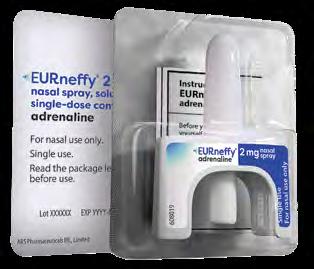
In 2025, ALK started launching the first-ever nasal adrenaline spray neffy® (branded EURneffy® in Europe) for emergency treatment of potentially life-threatening allergic reactions (anaphylaxis). Under a license agreement with US-based ARS Pharma, ALK holds exclusive rights to the product in all territories outside the USA, Australia, New Zealand, Japan, and China.
ALK’s roll-out initially focused on Germany and the UK, the markets expected to become the most important contributors to neffy® sales growth.
EURneffy® was launched In Germany late June and had gained a market share of close to 18% (by value) by the end of the year. The launch in the UK followed in October and attracted significant interest from healthcare professionals, key opinion leaders, and media. Given the early stage of the UK launch, the commercial impact was modest, reflecting the time needed to settle market access locally. neffy® is currently under regulatory review in Canada and the outcome of this process is expected in the first half of 2026.
By the end of the year, EURneffy® market access was also settled in Greece, Denmark, and Slovenia and launches are imminent.
Ongoing price negotiations
In markets, where pricing and reimbursement have been settled, EURneffy® has secured a price premium over existing adrenaline auto -
injectors, reflecting the nasal spray’s benefits with regards to shelf life, temperature stability, user-friendliness, and needle-free administration. In 2025, the first real-world evidence confirmed that its efficacy during anaphylaxis is similar to what historically has been observed with injection-based solutions.
EURneffy® 2 mg is currently indicated for adults and children ≥30 kg. Recently, ALK received a positive recommendation from the European authorities regarding its application for a 1 mg version for children aged 4 and older weighing 15 to 30 kg with approvals anticipated in the first half of 2026.
Co-promotion agreement in the USA
In the USA, ALK and ARS Pharma expanded their partnership with a co-promotion agreement where ALK is responsible for selling neffy® to approximately 9,000 named paediatricians. This has enabled ALK to accelerate ramp-up of a dedicated paediatric sales force with 65 sales representatives, based on performance-based cost and revenue sharing with ARS Pharma, subject to sales exceeding certain market share thresholds among the paediatricians.
Although market access conditions did not meet the targets, customer engagement and other KPIs for ALK’s efforts largely developed as planned, and feedback from paediatricians has been positive.
Ongoing roll-out in 2026
Further launches of neffy® are scheduled for 2026. Subject to regulatory approvals and market access, the current roadmap involves launches in Canada and up to 15 European markets covered by the EU approval as well as countries outside the EU. ALK also intends to make neffy® available in International markets. Across markets, ALK will work with key opinion leaders and others to challenge long-standing clinical practices favouring needle-based adrenaline products.
To accommodate different preferences among prescribers and patients, ALK will address the anaphylaxis market with a portfolio span-
ning both needle-free solutions (neffy®) and autoinjectors (the already marketed Jext ® and the second generation ‘Genesis’ autoinjector currently in development). The portfolio will be adapted to evolving market dynamics to secure a strong position in patient-centric anaphylaxis care.
Food allergy and new therapy areas
In the wider allergy space, innovation targets new therapy areas with significant unmet needs as well as strong scientific and commercial links to ALK’s current portfolio and prescribers. In 2025, clinical phase 2 trials were initiated with the two most advanced product candidates.
Ongoing phase 2 clinical trials
The phase 2 trial for dose finding and efficacy of the peanut SLIT tablet enrolled 150 North American patients and is on track to deliver topline data in the second quarter of 2026. Subject to these results, ALK plans to progress into phase 3, and preparations are ongoing, including selection of Contract Research Organisations and manufacturing of source material. The US FDA has granted a Fast Track designation to the peanut programme, enabling ALK to benefit from more frequent interactions and additional guidance from the FDA.
ALK’s partner ARS Pharma initiated a phase 2b clinical trial with patients in the USA and Europe to evaluate neffy® in the treatment of acute flares associated with chronic spontaneous urticaria. First read-outs from this trial are expected in 2026. ALK holds exclusive rights to this and any other new indications for neffy® in the licensed territories.
New discovery and innovation
Building on ALK’s core capabilities within clinical allergology and immunology, in-house development focusses on allergic inflam-
matory conditions and so-called mast cell driven pathologies. Pre-clinical development programmes include a SLIT tablet for tree nut allergy and the biological treatment concept ALK014, which is potentially applicable for both food allergy and other diseases.
In late 2025, to complement internal discovery programmes, ALK partnered with Allegria Therapeutics, a Swiss early-stage biotech company focusing on allergy and inflammatory diseases associated with mast cell dysfunction. Against a seed investment, ALK secured the rights to negotiate in-licensing of up to three first-in-class disease targets.
ALK and Chinese GenSci also intend to explore innovations of common interest, based on a reciprocal right of first negotiation for R&D projects.
Moreover, based on a thorough screening of external pipeline opportunities and commercial assets, ALK is exploring other partnership opportunities, including in-licensing, acquisitions and/or joint development projects.
Scaling the business for growth
ALK’s growth ambitions across therapy areas is supported by efforts to scale the business and realise economies of scale. Strengthening of procurement and IT processes and capabilities to exploit economies of scale and streamline the supplier landscape continue in 2026, and ALK will increasingly invest in digital solutions and AI with multiple projects being initiated across functional areas.
ALK is investing in supply chain expansions and optimisations to support margins and facilitate planned revenue growth. A key initiative in this respect is the ongoing efforts to increase tablet production capacity to 800 million units per year by 2030 within the existing footprint, optimise inventory management, minimise scrap, and reduce delivery times, all while maintaining compliance and quality standards. Legacy production is also being upgraded, while the supply chain for anaphylaxis is being strengthened through insourcing of certain tasks.
ALK also continues to execute initiatives under the Cultivate strategic pillar, including work to deliver on science-based CO2 targets, strengthening organisational capabilities to support future growth and conducting business in a responsible manner. 2025 brought broad-based progress for these priorities.
P lease refer to the Sustainability section on pages 37-84.
Status on the R&D pipeline
Over the past decades, ALK has pioneered the development of standardised allergen extracts, formulated as rapidly dissolving SLIT tablets. ALK is now expanding its leadership and targeting new geographies and patient groups while also leveraging its technology and capabilities within food allergy and other related disease areas.
Therapeutic area and project
Respiratory allergy
HDM SLIT-tablet House dust mite allergic rhinitis
Tree SLIT-tablet Tree pollen allergic rhinitis
Grass SLIT-tablet1 Grass pollen allergic rhinitis in Japan
HDM SLIT-tablet 2 House dust mite allergic rhinitis in China
Food allergy
Peanut SLIT-tablet Peanut allergy
Tree nut SLIT-tablet Tree nut allergy
ALK 014 (biologic) Food allergy
Anaphylaxis
Adrenaline autoinjector Emergency treatment of anaphylaxis
Adrenaline nasal spray3 Emergency treatment of anaphylaxis
New therapeutic areas
Adrenaline nasal spray3 Acute flares in chronic spontaneous urticaria (CSU)
ALK 014 (biologic) Not disclosed
Global availability of tablets
The tablet for grass pollen allergy (GRAZAX® or GRASTEK®) is approved in 34 countries in Europe, North America, and the Asia Pacific region. A clinical trial to support approval in Japan continued in 2025.
The tablet for house dust mite allergy (ACARIZAX®, ODACTRA®, MITICURE™ or SENSIMUNE™) is approved in >40 countries in Europe, North America, the Middle East, and the Asia Pacific region. A clinical trial to support approval in China was initiated in 2025.
The tablet for tree pollen allergy (ITULAZAX® or ITULATEK®) is approved in >20 countries in Europe and Canada. The tablet for ragweed pollen allergy (RAGWIZAK® or RAGWITEK®) is approved in 15 countries in Europe and North America.
The tablet for Japanese cedar pollen allergy (CEDARCURE™) is approved in Japan.
The tablets for grass, ragweed, and cedar pollen allergies are approved for all age groups – children, adolescents, and adults. ALK and its partners are in the process of creating similar positions for the tablets for house dust mite allergy and tree pollen allergy.
Financial ambitions
The Allergy+ strategy targets sustained growth in revenue and earnings to 2028 and beyond. ALK is well on its way to delivering on the long-term financial ambitions.
Ambition: Average revenue growth of minimum 10% in local currencies (5-year CAGR) 2023-2028.
Result: Average growth of 15% in local currencies 2023-25.
Outlook: 11-15% growth targeted for 2026.
Ambition: An EBIT margin of around 25% in 2025 after which earnings improvements beyond the ~25% margin will be re-invested in initiatives to bolster long-term growth and profitability. Result: EBIT-margin of 26% in 2025.
Outlook: ~25% EBIT margin targeted for 2026.
Ambition: In line with ALK’s growth strategy and 2028 financial ambitions, ALK will maintain an efficient capital structure with a financial gearing of maximum two (NIBD/EBITDA) (which may temporarily be increased in case of special circumstances, e.g. M&A and/or significant Business Development & Licensing or similar).
Result: The NIBD to EBITDA ratio was reduced to -0.4 in 2025.
ALK will be disciplined about capital allocation to ensure flexibility to deliver on its growth ambitions while also generating attractive shareholder returns. ALK expects to generate increasing free cash flow, and cash will be allocated in the following order of priority: 1) Investments in organic growth, including R&D; 2) Business development and licensing activities, M&A. and finally 3) cash distribution to shareholders via dividends and/or share buyback programmes.
Sales and market trends
ALK’s full-year revenue grew by 15% in local currencies to DKK 6,312 million (5,537), following double digit growth in all sales regions. Respiratory tablets and anaphylaxis products (Jext ® and neffy®) were key contributors to growth.
Tablet revenue grew by 17%, underscoring the tablet portfolio’s position as ALK’s primary revenue source. Growth was particularly driven by the continued expansion of patient and prescriber bases in Europe and North America with paediatric tablet launches adding to the sales momentum. The number of new patients initiating treatment with tablets in 2025 is estimated to have increased by well-above 10%.
Anaphylaxis revenue increased by 58%, mainly driven by Jext ® while neffy® contributed by approximately 26 percentage points to anaphylaxis revenue growth. Single-digit growth was seen in the combined SCIT/SLIT drops sales.
Europe
Revenue in Europe grew by 14% to DKK 4,459 million (3,914) on broad-based growth across the region, including the region’s largest markets Germany and France. Demand was solid and market conditions largely stable.
The 19% increase in European tablet sales was mainly driven by higher volumes linked to a strong inflow of new patients on ACARIZAX® throughout 2025, but also more patients having started treatment on pollen tablets over the past years. The new paediatric indications for ACARIZAX® and ITULAZAX® added incrementally to growth. Generally, the highest contribution to growth came from ACARIZAX® and ITULAZAX® whereas GRAZAX® continued to grow steadily.
While tablet sales grew across brands and markets, performance was particularly strong in Germany as well as Central and Eastern European markets. Sales also grew by double digits – although from a low level – in the UK, where ACARIZAX® and ITULAZAX® were the first AIT products to be admitted to the public National Health Service systems with general reimbursement.
In contrast to previous years, the impact of pricing adjustments was limited, and tablet sales continued to be only marginally impacted by pan-European trading patterns at wholesaler levels.
Combined sales of injection- and drop-based products (SCIT/SLIT drops) increased by 3%. Sales of SLIT drops, marketed mainly in France, benefitted from growing patient and prescriber bases, while SCIT sales grew modestly due to fewer patient initiations. In the main SCIT markets, Germany and the Nordics, patient initiations were partly impacted by constrained capacity at allergy clinics, partly by patients choosing tablets over SCIT for indications covered by the tablet portfolio.
Sales of Anaphylaxis & other products increased by 34%, driven by 40% growth in the anaphylaxis portfolio. Sales of Jext ® adrenaline pens benefited from strong commercial execution and tender wins in Southern Europe as well as competitors’ supply issues. Anaphylaxis revenue also included a modest contribution from the initial market introductions of EURneffy®.
North America
Revenue in North America increased by 19% in local currencies to DKK 1,037 million (906), fuelled by tablets and Anaphylaxis & other products. The US business recovered from last year’s stagnancy and reported double-digit growth, while growth was higher in Canada, where tablets are the main product line.
Tablet sales in North America were up 24%, mainly due to higher volumes. US tablet sales benefited from the paediatric indication for the house dust mite tablet, which led to higher
adoption among existing allergist prescribers and – to a minor extent – also new paediatric prescribers. The strong sales growth in Canada reflected sustained underlying demand reinforced by the children indications for the house dust mite and tree tablets.
Sales of SCIT bulk allergen extracts to primarily US allergists increased modestly by 2% after pricing optimisations, while volumes were slightly decreasing.
Revenue from Anaphylaxis & other products (neffy®, diagnostics, PRE-PEN®, and life science products) grew by 34%. Growth was driven by the cost compensation from ARS Pharma related to the co-promotion of neffy® to US paediatricians as well as sales of life-science products such as vials and diluents. After the discontinuation of lower margin accounts in 2024, ALK has gradually succeeded in attracting new customers to its higher margin life-science products.
International markets
Revenue in International markets increased by 16% in local currencies to DKK 816 million (717),
reflecting some impact from timing of shipments of products to China and Japan.
Tablet revenue was up 8%. Although still small in scale, revenue continued to grow in Middle Eastern and Southeast Asian markets as well as in India. Revenue from the primary tablet market Japan (product shipments and sales royalties) was impacted by phasing of shipments, particularly in the second half of 2025.
Demand in Japan remained strong and ALK’s partner Torii (now part of Shionogi) continued to grow in-market sales by double-digits and consolidate its position as market leader,
Revenue by geography1 Amounts in DKKm
A naphylaxis,
O ther products (diagnostics, etc.),
1 ESRS 2-SBM1-40(a.ii, f)
although capacity constraints prevented Torii from fully meeting demand for CEDARCURE® tablets.
SCIT revenue grew by 44%, driven by resumed product shipments to China, the region’s largest SCIT market, after the renewal of ALK’s import license in late 2024. Chinese in-market sales continued to grow by double digits, facilitated by the ongoing expansion of the prescriber base. In Q4, sales and marketing of ALK’s products were handed over to ALK’s new partner GenSci, positioning it as the second largest player in the Chinese AIT market.
Revenue by product line2
3,335 17% 2,851
drops 2,145 5% 2,052 Anaphylaxis & other products 832 34%634
revenue 6,312 15% 5,537
2 ESRS 2-SBM1-40(a.i, f)
5-year revenue development by geography
Eu rope, mDKK
N orth America, mDKK
nt’l markets, mDKK
5-year revenue development by product line
SLIT-tablets, mDKK
SCIT/SLIT drops, mDKK
A naphylaxis & other products
The AIT and anaphylaxis markets
The global market for allergy immunotherapy (AIT) is estimated to be worth around DKK 13 billion, measured in 2025 ex-factory sales. The market is underpenetrated and – despite recent progresses in Asia - still largely clustered around Europe, North America, and Japan.
Globally, the AIT market is estimated to have grown by high single-digit in 2025, consistent with the average market growth since 2019. During the same period, ALK has strengthened its market leading position with an average growth of 12% per annum (CAGR) in sales of AIT (tablets, SCIT and SLIT drops).
In 2025, ALK also strengthened its position in the European anaphylaxis market, estimated to be worth DKK 1.6 billion in ex-factory sales and growing by 17%. In 2026, ALK will continue its roll-out of neffy®, including in markets such as Canada, estimated to be worth DKK 0.5 billion, as well as high-potential markets in Asia and the Middle East.
ALK is global market leader in AIT with a market share approching 50%. In anaphylaxis, ALK currently holds a global market position of less than 5%.
Financial highlights and key ratios for the ALK Group1
Income statement
Balance sheet
Cash flow and investments
1 Management’s review comprises pages 1-84 as well as ‘Financial highlights and key ratios by quarter for the ALK Group’ on page 143.
2 Financial highlights and key ratios stated in EUR constitute supplementary information to the Management’s review. The exchange rate used in translating from DKK to EUR is the exchange rate prevailing on 31 December 2025 (EUR 100 = DKK 747) (31 December 2024: EUR 100 = DKK 746). For definitions and reconciliation of alternative performance measures, see page 125.
in thousands of DKK 0.5 each
Key figures
Financial review
ALK’s full-year operating profit (EBIT) increased by 53% in local currencies to DKK 1,654 million (1,091). Overall results were in line with the latest financial outlook announced in November 2025 and exceeded the previous outlooks from February and August 2025.
The better-than-expected performance relative to previous outlooks was mainly driven by the momentum for tablets in Europe and sales
of adrenaline autoinjectors, as well as operational efficiencies.
Revenue increased by 15% in local currencies to DKK 6,312 million (5,537), driven by a strong growth in sales of tablets and anaphylaxis products. Exchange rates impacted reported
revenue growth negatively by approximately 1 percentage point.
Cost of sales increased by 5% in local currencies to DKK 2,078 million (1,985). The gross profit of DKK 4,234 million (3,552) yielded a gross margin of 67% (64%), driven by increased sales volumes, a more favourable sales mix, and production efficiencies.
Capacity costs to R&D, Sales & marketing, and Administration increased by 6% in local currencies to DKK 2,581 million (2,464).
R&D expenses increased by 15% to DKK 609 million (531), mainly reflecting funding of the peanut tablet clinical trial, pre-clinical
development projects, and the bridging trial of ACARIZAX® in China. Sales and marketing expenses increased by 3% to DKK 1,584 million (1,564), driven by the launches of paediatric tablets and neffy®. Administrative costs of DKK 388 million (369) increased by 4%.
In 2024, capacity costs included one-off costs of DKK 75 million associated with optimisation initiatives in Europe and China which mainly impacted Sales & marketing expenses. No such costs were incurred in 2025.
EBIT (operating profit) improved by 53% in local currencies to DKK 1,654 million (1,091), raising the EBIT margin to 26% from 20%. Progress was driven by higher sales, improved
gross margin, and a lower capacity cost-torevenue ratio of 41% (45%). Exchange rates impacted growth in reported EBIT negatively by approximately 1 percentage point.
Net financials showed a loss of DKK 19 million (a loss of 34) related to interest expenses and currency losses.
Tax on the profit totalled DKK 438 million (242), and the net profit increased by 43% in local currencies to DKK 1,197 million (815).
Cash flow from operating activities was DKK 1,817 million (1,213) mainly driven by higher earnings and the upfront payment of DKK 244 million from GenSci.
Cash flow from investing activities was DKK minus 385 million (minus 1,417 which included the DKK 115 million PRE-PEN® acquisition and the upfront payment of DKK 1 billion to ARS Pharma related to the neffy® license agreement) reflecting the continued build-up of capacity for tablet production, upgrades to legacy production, as well as a milestone payment to ARS Pharma of DKK 32 million related to the first commercial sale of EURneffy® as well as investments in the next generation adrenaline autoinjector.
Free cash flow was positive at DKK 1,432 million (negative at 204).
Cash flow from financing activities amounted to DKK minus 760 million (positive 310), mainly related to repayment of loans.
At the end of 2025, ALK held 1,261,283 own shares or 0.6% of the share capital, which is equivalent to year-end 2024.
Equity totalled DKK 6,445 million (5,373) at the end of the year, and the equity ratio was 71% (65%).
Revenue DKK 6,312 million increased by 15% in local currencies
Gross profit
DKK 4,234 million an increase from 3,552 in 2024
Gross margin
67% from 64% in 2024
EBIT (operating profit) DKK 1,654 million improved by 53% in local currencies
EBIT margin
26% from 20% in 2024
Q4 review
ALK’s Q4 revenue increased by 17% to DKK 1,733 million (1,499), following double-digit growth in all sales regions. In Q4, respiratory tablets and anaphylaxis products (Jext ® and neffy®) remained key drivers, and growth was further supported by shipments of SCIT products to China. Operating profit (EBIT) increased by 88% to DKK 387 million (205), equivalent to an EBIT margin of 22% (14%).
tablets to Torii (now fully owned subsidiary of Shionogi) in Japan. In-market sales in both countries continued to show double-digit growth.
The gross margin improved to 68% (64%), mainly reflecting increased sales volumes, a more favourable sales mix, and production efficiencies. The temporary lower growth in product shipments to international markets also enhanced the gross margin.
ALK delivered 2025 full-year results in line with the most recent financial outlook, following a Q4 where revenue increased by 17%, driven by strong performance across the sales regions. Exchange rates impacted reported revenue growth negatively by approximately 1 percentage point.
Global tablet revenue grew by 15%, driven by the expanding patient and prescriber bases in Europe and North America. Anaphylaxis revenue increased by 112%, due to the neffy® co-promotion deal in the USA, the launch in Europe, as well as the contribution from Jext ®
Revenue in Europe increased by 14%, fuelled by a 20% growth in tablet sales which was driven by higher volumes linked to the inflow of new patients starting treatment
across the tablet brands. Combined sales of injection- and drop-based AIT (SCIT/SLIT drops) increased by only 2% partly linked to patients choosing tablets over SCIT for indications covered by the tablet portfolio, while sales of Anaphylaxis & other products (Jext ® , neffy® and diagnostics) increased by 40%, mainly driven by the Jext ® sales.
Revenue in North America increased by 24%, reflecting continued growth in tablet sales in both the USA and Canada, improved performance in sales of life-science products in addition to the cost compensation from ARS Pharma related to the co-promotion of neffy® to US paediatricians. SCIT bulk allergen extracts to US allergists grew modestly.
Revenue in International markets increased by 36%, reflecting higher shipments of SCIT products to China, where last year's sales were absent due to the renewal of ALK’s import license. Tablet sales declined slightly due to the timing of shipments of
Capacity costs increased by 8% to DKK 794 million (749) as ALK advanced its strategic growth investments. R&D expenses increased by 14% in local currencies and included increasing costs to the peanut tablet development programme and the ongoing trial with ACARIZAX® in China. Sales and marketing expenses increased, reflecting continued high investments in the ongoing paediatric and neffy® launches, as well as generally high activity levels in key markets. Last year, capacity costs included one-off costs of DKK 26 million whereas no such costs were recognised this year. The capacity costs to revenue ratio was 46% (50%).
Operating profit (EBIT) increased by 88% in local currencies to DKK 387 million (205), yielding an operating margin of 22%. As expected, increasing strategic growth investments led to a lower operating margin compared to the first nine months of the year. Exchange rates impacted growth in reported EBIT negatively by approximately 1 percentage points.
Risk management
ALK’s Executive Leadership Team is responsible for the ongoing management of risks throughout the value chain, including risk identification, the assessment of probabilities and potential consequences, and the introduction of risk-reducing measures.
The Executive Leadership Team has a Risk Committee to assist in meeting its overall responsibility for risk management. The Risk Committee comprises representatives from each functional area relevant to ALK’s risk profile. The Risk Committee meets twice a year or more, as and when required, to perform its tasks. Risks are systematically assessed according to a two-dimensional matrix, rating the potential impact and probability of each risk. A risk management report with key enter-
prise risks and recommended mitigation plans is presented to the Executive Leadership Team before it is submitted to the Board of Directors each year for their review and approval.
The following is a description of ALK’s key enterprise risks and the main initiatives taken to mitigate these risks. The risk movements compared to the previous year are indicated.
Risk impact
The impact of the risk has increased compared to the year before
The impact of the risk has not changed compared to the year before
The impact of the risk has decreased compared to the year before
Commercial risks impacting revenue growth
Description
The degree of market approval and acceptance for a new product, or a new indication for an existing product, depends on several factors, including the demonstration of clinical efficacy and safety, cost-effectiveness, reimbursement/market access, convenience and ease of administration, potential advantages over alternative treatment methods, competition, and marketing and distribution support. If ALK’s products, primarily tablets and anaphylaxis products, fail to achieve acceptance in major markets, this could have a significant impact on the company’s ability to generate revenue.
ALK’s strategic commercial partnerships and collaboration agreements expose the
Risk mitigation
ALK closely monitors economic, market and regulatory developments as they relate to product pricing, along with the competitive situation and initiatives in all important markets. ALK regularly conducts surveys of market conditions and commits significant resources to providing information on allergy treatment to doctors and patients. ALK continues its focus on market access strategies, especially in the USA, Spain, Canada, and UK.
2025 movement
The impact of the risk has increased compared to the year before
company to risks related to partner performance, alignment of strategic objectives and execution capabilities. Partnerships for co-promotion, development, or regional commercialisation may fail to deliver expected results due to operational challenges, insufficient market performance or collaboration issues. Failure of key partners to meet contractual obligations could adversely affect revenues, market presence, and strategic growth plans.
Price pressures mandated by authorities can have a significant impact on the company’s earning capacity. In most of the countries in which ALK operates, prescription drugs are subject to reimbursement from, and price
controls by national authorities and healthcare providers. This often results in significant price differences between individual markets. Exceptionally, governments and national authorities may introduce permanent or temporary economic measures that also affect the pricing and reimbursement of medicines, for example, because of a major economic downturn.
Fluctuations in geo-political stability, trade relations, or regulatory environments in key regions may disrupt business operations, and market access, leading to potential financial losses and reputational damage for ALK.
Severe IT security breaches
Description
The threat of cyber attacks continues to intensify globally and ALK is no exception. Disruption to IT systems, such as severe breaches of data security, may occur across the global value chain, where well-functioning IT systems and infrastructure are critical for the company’s ability to operate effectively.
ALK mitigates commercial partnership risks through structured governance frameworks, including Joint Steering Committees, regular performance and milestone reviews, and escalation mechanisms to address underperformance. Additional mitigating actions include proactive monitoring of sales trends, implementation of corrective commercial measures, enhanced clinical execution and regulatory engagement.
ALK actively engages in dialogue with authorities with the aim of securing fair pricing and reimbursement agreements and maintains a strong focus on its market access strategy. ALK is strongly committed to evidence-based medicine, based on strong clinical and health economic evidence as the basis for pricing and reimbursement.
ALK consistently monitors the geo-political landscape and proactively implements mitigating measures in pertinent regions as needed.
Risk mitigation
ALK has an IT and cybersecurity strategy in place to prevent intruders from causing damage to systems or gaining access to critical data and systems. ALK continuously invests in upgrading IT security. Awareness campaigns, access controls, intrusion detection, prevention systems, and IT disaster recovery plans have all been implemented. Further initiatives are planned, and systems are regularly upgraded to increase network security.
2025 movement
The impact of the risk has not changed compared to the year before
Production and quality issues impacting product supply and patient safety
Description
ALK’s products are subject to many statutory and regulatory requirements with respect to issues such as safety, efficacy, and quality. The products may be associated with side-effects such as allergic reactions of varying extent, duration, and severity. Meeting pharmaceutical quality standards is a prerequisite for the company’s ability to supply products and hence its competitive strength, and for the company’s earnings and sales.
As ALK continues to rationalise its product portfolio, there may be risks associated with the discontinuation of its products. Among others, these may include potential production interruptions at manufacturing sites during decommissioning and change-over work, loss of sales from products for which no suitable ALK substitute product exists, or inability to meet sudden spikes in demand for other prod-
ucts due to patients switching from discontinued products.
As part of its supply chain, ALK is dependent on selected key third parties for key production processes and supplies, which poses a risk for ALK’s ability to deliver products, especially tablets, to the markets.
Description
ALK is dependent on being able to attract and retain employees across all key functions and markets to deliver on its strategy. Failure to attract, develop and retain the right talents may have a material impact on the company’s market and research efforts.
Risk mitigation
ALK stringently monitors product and manufacturing quality compliance and safety via quality assurance, pharmacovigilance and sales and marketing activities. If, despite the high levels of quality and safety, a situation should occur in which it is necessary to recall a product, ALK has procedures in place to ensure that this can be managed swiftly and effectively and in accordance with regulatory requirements. Production and manufacturing processes are subject to periodic and routine inspections by
regulatory authorities as a regular part of their monitoring to ensure that ALK observes the prescribed requirements and standards.
ALK has invested significantly in recent years to increase the robustness and compliance of the legacy business by reducing manufacturing complexity, and all possible steps are taken during portfolio rationalisation work to mitigate any potential impact on other areas of manufacturing or the wider business. ALK
conducts risk planning including the prevention of unwanted events, and preventive inventory management.
ALK manages key third-party dependency risks through long-term contracts, diligent production forecasting, monitoring, and joint steering committees. ALK continuously monitors its dependencies on key third parties and considers relevant risk mitigation measures including alternative supply setups.
Risk mitigation
Among other things, ALK manages this risk by fostering an inclusive culture, continuously monitoring and improving employee engagement, offering its staff opportunities to develop their professional competencies, and by continuously monitoring the total reward packages against the market. ALK is also focusing increasingly on how to position itself as an attractive employer, and how best to identify, attract and recruit future global and local talents with the skills and capabilities that will be required in the future.
2025 movement
The impact of the risk has not changed compared to the year before
2025 movement
The impact of the risk is decreasing compared to the year before
Breaches of legal or ethical standards
Description
Compliance requirements are generally increasing in many areas, and as ALK expands into more markets, the company is exposed to more complex compliance requirements. Non-compliance with applicable regulations and legislation, or ALK’s Code of Conduct, could
negatively impact the company’s good reputation which is essential to operating within the pharmaceutical industry. Patents and other intellectual property rights are important for developing and retaining ALK’s competitive strength.
Failures or delays in product development
Description
The future success of ALK depends on the company’s ability to maintain current products and to successfully identify, develop and market new, innovative drugs.
A pharmaceutical product must be subjected to extensive and lengthy clinical trials to document qualities such as safety and efficacy before it can be approved for marketing. During the development process, the outcomes of these trials are subject to significant risks. Even though substan-
tial resources are invested in the development process, the trials may produce negative results. The risk fluctuates over time in line with the extent and nature of ALK’s product development activities.
Failures or delays in the development process, or in obtaining regulatory approvals, may have a major impact on patients who are not able to benefit from the products, and on ALK’s ability to achieve its long-term goals.
Risk mitigation
ALK strives to act professionally and with high integrity throughout the company in its dealings with stakeholders. ALK’s Code of Conduct defines the company’s high standards of ethical behaviour in relation to customers, employees, shareholders, society, suppliers, and partners. A few years ago, ALK established a Compliance Committee to oversee this work and development. Each year, all employees are asked to sign and confirm their knowledge of the Code of Conduct and to take an online test. ALK has established a whistleblower scheme which allows for confidential and anonymous internal and external
reporting of potential or suspected wrongdoing. Immediate action is taken on substantiated non-compliance.
Internal controls and policies are in place to safeguard ALK’s intellectual property rights. The risk that ALK might infringe patents or trademark rights held by other companies, along with the risk that other companies might attempt to infringe ALK’s own patents and/or trademark rights, are monitored and, if necessary, suitable measures are taken.
Risk mitigation
ALK and its collaboration partners carry out thorough risk assessments of their research and development programmes throughout the development and registration processes, in the interests of risk mitigation to maximise the likelihood of the products reaching the market.
ALK’s Scientific Committee is responsible for other patient/product-related innovation activities. The committee provides instrumental strategic sparring on matters relating to R&D activities and other patient/product-related innovation, including reviewing R&D programmes and the overall R&D pipeline.
2025 movement
The impact of the risk has not changed compared to the year before
2025 movement
The impact of the risk has increased compared to the year before
Corporate governance and ownership
Corporate governance
ALK’s Corporate Governance report, available at https://ir.alk.net/corporate-governance and prepared pursuant to section 107b of the Danish Financial Statements Act, forms part of Management’s review in the Annual Report 2025. It describes ALK’s two-tier governance structure—covering the Board’s composition, competences, activities, self-assessment, and remuneration—and key elements of internal control and risk management related to finan-
cial reporting. The report also outlines ALK’s compliance status with the Recommendations for Corporate Governance issued by the Danish Committee on Corporate Governance in December 2020 and implemented by Nasdaq Copenhagen.
Board and management composition
The Board of Directors consists of 11 non-executive members: seven shareholder-elected at the Annual General Meeting (AGM) for
one-year terms, and four employee-elected for four-year terms (last elected in 2023). No member of the Board of Management serves on the Board of Directors.
At the 2025 AGM, all shareholder-elected board members were re-elected. The Board has a preponderance of independent shareholder-elected members; five of seven in 2025 are considered independent under the Danish
Committee on Corporate Governance definitions.
By 30 June 2026, ALK is to target gender balance among its shareholder-elected and employee-elected board members, respectively. Among the four employee-elected members, three are female (75%) and one is male (25%). Among the seven shareholderelected members, two are women (29%) and
Meeting attendance and competency matrix
Anders Hedegaard (m)
Lene Skole (f)2
Gitte Aabo (f)
Lars Holmqvist (m)2
Jesper Høiland (m)
Bertil Lindmark (m)
Alan Main (m)
Katja Barnkob (f)1
Nanna Rassov Carlson (f)1
Lise Lund Mærkedal (f)1
Johan Smedsrud (m)1
1 employee-elected
2 Non-independent
five are men (71%). The current composition of the shareholder-elected board members is not considered an equal gender representation as defined by the Gender Balance Act.
ALK’s Board of Management registered with the Danish Business Authority has equal gender representation, as defined by the Gender Balance Act, with a composition of three members, of which one (33%) is female.
For the Executive Leadership Team ("ELT") members and their direct reports in management positions employed in the Danish parent company, the underrepresented gender represents 38% (21 males and 13 females). ALK has a target of reaching a gender balance with at least 40% of the underrepresented gender by 2028.
The members of the Board of Directors are presented on pages 33–34 and ALK’s Executive Leadership Team is introduced on pages 35-36 of this annual report.
Competency matrix for the Board of Directors
The Board of Directors represents international business experience from management positions in a variety of industries - particular regard is given to the members’ insight into the management and globalisation of R&D-driven companies. The Board also has overall expertise in sustainability matters that are material
1 ESRS 2-GOV1-23(a, b); G1-GOV1-5(a, b)
2 ESRS 2-GOV1-21(a, b, d, e)
3 ESRS 2–GOV3; E1-GOV3-13
to ALK and sustainability knowledge is integrated into board committees and the Board itself. External advice on specific sustainability topics is obtained, if needed.1
To assess whether all core competencies required are adequately represented, each shareholder-elected member of the Board has been asked to identify the primary competences they bring to the Board, in the context of ALK’s long-term strategy. Employee-elected members are not part of the competency assessment. For the Chair and Vice Chair, two additional role-specific competences have been identified.
Remuneration
Remuneration of the Board of Directors and the Board of Management is determined in accordance with ALK’s remuneration policy as adopted by the AGM in March 2024. The policy is prepared in accordance with sections 139 and 139a of the Danish Companies Act as well as items 4.1.1 - 4.1.6 of the latest Danish Corporate Governance Recommendations.
Highlights of the remuneration report 2025 3 ALK’s remuneration report details the composition and development of remuneration for the Board of Directors and the Board of Management in 2025, including individual shareholdings. All remuneration for the Board
Remuneration
Amounts in DKKt
Board of Directors
Board of Management
of Directors and Board of Management follows ALK’s remuneration policy, which is submitted for advisory approval at the Annual General Meeting (AGM) at least every four years.
The report is prepared in accordance with section 139b of the Danish Companies Act and will be presented for an advisory vote at the AGM on 16 March 2026.
Data ethics
ALK processes data from clinical trials, R&D, employees, customer interactions, and pharmacovigilance. It adheres to its publicly communicated data ethics policy, ensuring compliance with privacy regulations and best practices to protect confidentiality, integrity, and availability. ALK is transparent about data collection, processing, and use, which is limited to advancing scientific and medical understanding, ensuring patient safety, improving products and services, and delivering appropriate treatments. The Board of Directors reviews the policy regularly; it applies to all employees and is implemented daily by relevant business units. This report complies with section 99d of the Danish Financial Statements Act.
Members of the Board of Directors received a fixed annual base fee, which increased in 2025, with the Vice Chair and Chair receiving double and triple the annual fee, respectively. Members also received an additional fee for serving as member or chair on Board committees. The base fee for serving on the Audit Committee increased in 2025. Fees for other committees remained unchanged.
The remuneration for the Board of Management consisted of both fixed pay elements (base salary and benefits) and variable pay elements in the form of short-term incentive (STI) and long-term incentive (LTI) plans. The programmes reward the attainment of pre-defined financial and non-financial targets linked to the company’s strategy, as approved annually by the Board of Directors.
In 2025, the KPIs for the STI included a sustainability target on CO2 emission reduction, aligned with ALK’s science-based target on
The ALK share in 2025
own emissions, which accounts for 10% of pay to the CEO and 5% for the remainder of the Board of Management.
The base salary for members of the Board of Management increased by 3.5% in 2025, in line with the general increase for ALK employees in Denmark. The CEO’s and CFO’s base salaries were further adjusted to align more closely to market benchmarks.
Shareholder base
ALK aims for a diversified shareholder base by geography, investment profile, and time horizon, aligned with its long term strategy. To support fair valuation and liquidity, ALK regularly discloses relevant information on strategy, performance, market developments, and R&D.
At 31 December 2025, ALK had 34,777 registered shareholders (37,215) owning 98.4% of the share capital (97.8%). Most large,
registered shareholders were institutional investors, mainly in Denmark, other European countries, and North America. Excluding the Lundbeck Foundation’s holding and treasury shares, 59.2% of the B shares are free float.
Return to shareholders
ALK is listed on Nasdaq Copenhagen (ticker symbol ALK B). The year-end, closing price was DKK 229 versus DKK 159 in 2024 (+ 44%). The market value of the B shares (excluding treasury shares) was DKK 46.0 billion (32.0).
Dividend and capital structure
Considering ALK’s financial situation with a comfortable net cash position and expected strong cash flows, the Board of Directors recommends resuming dividend payments to reward shareholders directly. At the upcoming Annual General Meeting in March 2026, the Board of Directors proposes distribution of approximately 30% of net profit after tax for 2025 as dividends. The Board of Directors continuously assesses ALK’s financial resources to ensure sufficient funds for
executing ALK’s strategy, including emerging business development, in-licensing, M&A, and other investment needs. At end 2025, net interest bearing debt (NIBD) was DKK -822 million and NIBD/EBITDA -0.4 (0.4), well below the long term target of maximum two.
The Board of Directors is authorised to increase the share capital by up to DKK 11,141,196, with or without pre emption rights for existing shareholders, until 15 March 2027, and to let the company acquire B shares with a nominal
value up to DKK 11,141,196 until 22 March 2028, at up to ±10% of the official quoted price.
Investor Relations
In 2025, ALK participated in numerous meetings, calls, conferences, and seminars with analysts and investors. Regulated announcements and investor news, reports, presentations, call recordings, share price data, analysts’ estimates, and related information are available on ALK’s website. Registered shareholders are encouraged to sign up via the InvestorPortal.
1 This shareholder has reported to ALK that they held 5% or more of the shares on 31 December 2025.
2 To meet obligations to deliver shares under the management incentive programmes, ALK holds a number of its own shares. The holding was reduced in 2024 following the settlement of share option and performance share programmes.
1
Board of Directors
Anders
(1960, Danish, male)
Professional board member Chair
Independent Board member since 20201
Chair of the Remuneration & Nomination Committee
Member of the Scientific Committee
Competences2
Specific expertise within management and sales & marketing in international life science companies.
Experience in management, financial and economic expertise, experience in strategy and communication in international companies.
Professional board member
Independent Board member since 20211 Chair of the Audit Committee
Professional board member
Not independent Board member since 20151 Member of the Audit Committee
Competences2
Global leadership experience and comprehensive understanding of international management, finance, IT, and sales & marketing, as well as insights into building digital communities.
Competences2
Experience in management, finance, and sales & marketing in international lifescience companies, including medtech and pharmaceutical businesses.
Strategicadviser,PharmaCoConsultApS
Independent Board member since 20231 Member of the Audit Committee
Directorships2,3
Ellab; Chair and chair of the Remuneration Committee
Rodenstock Group, Germany: Member of the Advisory Board
Candela Medical, USA: Board adviser
Directorships2,3
Ørsted A/S: Chair and chair of the Nomination & Remuneration Committee
Falck A/S 4: Vice Chair and member of the Remuneration and Nomination Committee
H. Lundbeck A/S 4: Vice Chair and member of the Remuneration & Nomination and Scientific Committees
Nordea Bank Abp, Finland: Vice Chair and member of the Audit Committee
Directorships2,3
Rockwool Foundation: Vice chair
Dynavox Group: Chair and chair of the Compensation Committee and member of the Audit and Nomination Committees.
GN Foundation: Chair
Directorships2,3
H. Lundbeck A/S: Board member and member of the Audit Committee
The Lundbeck Foundation: Board member and Chair of the Investment Committee
Vitrolife AB, Sweden: Board member and member of the Audit Committee
Competences2
Management and commercial experience from 35 years with global pharmaceutical companies, including roles at Ascendis Pharma,Inc.,Radius Health, Inc., and Novo Nordisk Inc., USA. Unique expertise in establishing and expanding commercial activities in North America, including product launches.
Directorships2,3
SciBase AB, Stockholm: Chair
Flen Health SA, Luxemburg: Board member
Allarity Therapeutics, USA: Board member
Alva Therapeutics, USA: Board member
Hedegaard
Lene Skole (1959, Danish, female)
Gitte Aabo (1967, Danish, female)
Lars Holmqvist (1959, Swedish, male)
Jesper Høiland (1960, Danish, male)
Bertil Lindmark (1955, Swedish, male)
ChiefMedicalOfficer,Vicore PharmaHoldingAB
Independent Board member since 20211 Chair of the Scientific Committee
Competences2
More than 30 years' experience of global executive R&D leadership in pharmaceuticals (Astra, AstraZeneca, Almirall) and biotech (ASLAN Pharmaceuticals, eTheRNA Immunotherapies, Galecto Inc.). Experience in multi therapy area and bringing blockbuster therapeutics to market globally. Served on the Research Board of AstraZeneca. Participated in a range of IPOs, acquisitions, and debtfinancing activities.
Directorships2,3
Aqilion AB, Sweden: Chair of the Board and member of the Remuneration Committee Cellevate, Sweden: Board member
Alan Main (1963, British, male)
SeniorAdviser, CansonCapitalPartners
Independent Board member since 20221 Member of the Remuneration & Nomination Committee
Competences2
More than 30 years of experience from the consumer healthcare industry, including roles in Sanofi, Bayer, and Roche.
Katja Barnkob (1969, Danish, female)
Nanna Rassov Carlson (1976, Danish, female)
SeniorProjectDirector,GlobalClinicalDevelopment,ALK-AbelloA/S Board member since 2011 Employee-elected
SeniorManager,QARelease, ALK-Abelló A/S Board member since 2019 Employee-elected
Johan Smedsrud (1972, Danish, male)
SeniorMaintenanceSupporter, Process&ProductionSupport, ALK-Abelló A/S Board member since 2019 Employee-elected
Lise Lund Mærkedahl (1967, Danish, female)
ProjectDirector,GlobalClinical Development,ALK-AbellóA/S Board member since 2023 Employee-elected
Competences2
Experience in project management of global drug development projects in the pharmaceutical industry.
Directorships2,3
The Lundbeck Foundation: Board member, employee-elected
Competences2
Expertise in production and release of ALK’s active pharmaceutical ingredients for sublingual immunotherapy products.
Competences2
Experience in HVAC systems, cleanroom testing, utensil washing and sterilisation for the pharmaceutical industry.
Competences2
Experience in the development of new vaccines, project management of drug discovery projects, and most recently governance of data digitalisation and AI projects.
1 All members elected by the Annual General Meeting are up for re-election each year.
2 ESRS 2-GOV1-21(c)
3 Directorships do not include those for companies that are personally owned, fully or partly, by members of the Board of Directors.
Executive management experience with a strong commercial, international , and strategic background from life-sciences, pharmaceutical and healthcare industries.
Peter Halling holds a master's degree in International Marketing & Management from Copenhagen Business School from 2003.
Experience in management, innovation, and research & development in the pharmaceutical industry.
Henriette Mersebach holds a master's degree in Medicine from 1998 and a PhD in Medicine from 2004.
Flora Beiche-Scholz (1970, German)
Executive Leadership Team
Executive Vice President, Commercial Operations Europe
Edward Jordan (1967, American)
Executive Leadership Team
Executive Vice President Commercial Operations North America
Directorships1
The Danish Chamber of Commerce: Board member
Directorships1
Sonion A/S: Board member and member of the Remuneration & Nomination Committee
UV Medico A/S: Board member
Competences
International experience in leading transformations and delivering strong commercial execution and growth.
Dr. Flora Beiche-Scholz holds a degree and a Ph.D. in biology from the University of Erlangen, Germany.
Competences
Experience with US commercial strategy and execution, product launches, establishing biopharmaceutical companies in the US, and therapeutic market development in the industry.
Edward Jordan holds an MBA from Southern New Hampshire University and dual bachelor’s degrees in finance and insurance from the University of Rhode Island.
Directorships1
Versatope Therapeutics: Baard member 1
1
Christian G. Houghton (1964, Danish)
Executive Leadership Team
Executive Vice President, Product Supply
Competences
Experience within development of biopharmaceutical products and specialised in CMC development and supply operations.
Christian G. Houghton holds a master's degree in chemical engineering from DTU – Technical University of Denmark.
Directorships1
Appointed Chair of the Danish Pharmacopoeia Commission, Danish Medicines Agency
Lika Thiesen (1975, Danish)
Executive Leadership Team
Executive Vice President, Global People & Organisation
Competences
Experience in organisational change, people strategy and HR programme implementation from different stock-listed and equityowned companies.
Lika Thiesen holds a master's degree and a PhD in Public Administration from Northern Illinois University, USA.
Experience in pharmaceutical commercialisation, research & development, marketing, business development, strategy, and general management.
Jacob Glenting holds a master's degree in biochemistry, and a PhD in vaccine development.
Directorships1
Qlife, Sweden: Board member
Executive Leadership Team
Senior Vice President, Global Quality
Competences
Experience within quality assurance from the medical and pharmaceutical industry.
Jan Engel Jensen holds bachelor’s degrees in Production Management, Business Administration, and a master's degree in Quality Management in Scientific R&D.
Expansion of the Executive Leadership Team
In 2025, ALK included the two key commercial regions, Europe and North America, in the Executive Leadership Team (ELT) to further strengthen the execution of ALK’s strategy, Allergy+
Effective 1 October 2025, Flora Beiche-Scholz, former Senior Vice President for ALK’s region Europe, joined the ELT in a new position as Executive Vice President (EVP) and head of ALK’s Commercial Operations in Europe
Effective 5 January 2026, Edward Jordan was appointed as new Executive Vice President (EVP) and head of Commercial Operations in North America
Following the decision to elevate the two key commercial regions into ELT, Søren Niegel, former Executive Vice president, Commercial Operations, was deregistered from the Danish company register as per 1 October 2025 and he left ALK at the end of December 2025.
Søren Niegel had been with ALK since 2012 contributing considerably to ALK’s overall leadership and success.
Jacob Glenting (1974,
Jan Engel Jensen (1966, Danish)
Sustainability statement
Through its mission to improve the lives of people with allergy, ALK is committed to conducting business in a responsible and sustainable manner. The sustainability statement, a core part of ALK’s Annual report, is prepared in accordance with the EU Corporate Sustainability Reporting Directive (CSRD) and the European Sustainability Reporting Standards (ESRS). Based on a double materiality assessment, the statement covers ALK’s material environmental, social, and governance (ESG) topics.
General disclosures
Basis for preparation
ALK continues to pursue its sustainability ambitions while aiming to help 5 million patients by 2030. This sustainability statement outlines ALK’s progress towards its environmental, social and governance targets, and details ongoing initiatives to further improve data quality and reporting. It is prepared in accordance with the EU Corporate Sustainability Reporting Directive (CSRD) and the European Sustainability Reporting Standards (ESRS), applicable to ALK since 1 January 2024. The statement is prepared on a consolidated basis for the ALK group and subsidiaries, in line with the financial statements.
The sustainability topics reported in the statement are identified based on a double materiality assessment (DMA), which covers ALK’s operations and its upstream and downstream value chain. For impacts, risks and opportunities extending beyond ALK’s own operations, the statement addresses ALK’s value chain in its policies, actions, targets and metrics.
No information on intellectual property or know-how has been omitted.
Sources of estimation and outcome uncertainty
Some metrics are derived from estimates. The basis for these estimates, including assumptions and judgments, are described in the relevant accounting policies. The following estimates are deemed significant:
• “ Purchased goods and services” (scope 3, category 1) greenhouse gas (GHG) emissions ( see GHG emissions on page 48 and Accounting policies – Environmental information on page 57)
• “Irrigation” (water consumption), including "Water reused and recycled" ( see Water consumption on page 52 and Accounting policies – Environmental information on page 58)
• “ Unadjusted gender pay gap” and “Adjusted gender pay gap” ( see Diversity and remuneration on page 62 and Accounting policies
– Social information on page 70)
• “ Patients in treatment”
( see Patients in treatment on page 69 and Accounting policies – Social information on page 71).
Changes in preparation or presentation
Comparative figures are presented for all metrics with at least one year of historical data, except when not available for newly disclosed datapoints.
Following data quality enhancements, 2024 metrics on scope 3 ( see GHG emissions on page 48) and unadjusted gender pay gap ( see Diversity and remuneration on page 62) have been restated, to ensure consistency and comparability. In addition, the metric on Code of Conduct training completion ( see Metrics on page 74) has been revised to include all ALK employees. The 2024 figure has been restated to reflect this updated definition of functionsat-risk.
Disclosures stemming from other legislation Information in compliance with Section 107d of the Danish Financial Statements Act has been included in Inclusive culture on pages 61-62. EU Taxonomy information is disclosed in accordance with the EU Taxonomy Regulation (article 8).
Incorporation by reference
Some ESRS disclosures are addressed in the appendices and other sections of the Management’s review, by exercising the option of incorporation by reference. The disclosures placed outside the sustainability statement are clearly identified with a footnote, referring to the applicable disclosure requirement of the ESRS. An overview of all incorporations by reference used in the sustainability statement is listed in the Appendix on page 77.
Sustainability governance
ALK's sustainability governance model
The
role
of the Board of Directors and Executive Leadership Team
GOV1,2,3
ALK’s governance model ensures that sustainability is systematically managed and integrated into decision-making and business strategy, promoting long-term value creation while addressing societal and environmental challenges.
Material impacts, risks and opportunities (IROs) are managed by the relevant corporate functions and overseen by the Sustainability Committee. The Sustainability department submits quarterly reports to the Committee, which oversees the setting of targets and monitors progress and effectiveness of due diligence, policies, actions, metrics and targets. The Sustainability Committee Chair regularly updates the Executive Leadership Team, while the Audit Committee oversees progress on sustainability reporting on a quarterly basis. The Board of Directors is informed on material IROs as a part of the strategy updates.
S ee Material impacts, risks and opportunities on page 43.
Material risks are embedded in ALK’s strategy via the Enterprise Risk Management process. The Risk Committee, chaired by the CFO, reports ERM risks to the Board of Directors.
For further details on the composition, competences and remuneration of the Board of Directors and ELT, see Corporate matters on pages 30-34 (refer to the incorporation by reference table on page 77 for exact references).
Audit Committee
Oversee sustainability disclosures, processes, controls and assurance
Remuneration Committee
Oversee sustainability related remuneration
Board of Directors
Overall responsible for ALK’s sustainability strategy and targets
Executive Leadership Team
Approve all sustainability related policies and strategy
Sustainability Committee
Oversee legal reporting requirements within sustainability. Make recommendations to Executive Leadership Team on matters with strategic impact on the global organisation
Corporate Finance department
Responsible for accounting policies, internal controls, framework and guidelines for data processes and controls
Sustainability department
Responsible for the sustainability strategy implementation. Ensure compliance with legal reporting requirements as well as reporting to internal and external stakeholders
Corporate functions
Responsible for daily execution of strategic activities as well as collection of sustainability data
Risk management and internal controls
The Sustainability department is responsible for overseeing the DMA process, advising on data collection and preparing the sustainability statement. The Corporate Finance department collaborates closely on numeric data collection and gathers data quarterly for
ongoing progress tracking and verification. All data complies with the principles outlined by the ESRS.
The Sustainability Committee and the Audit Committee receive an annual update on potential critical issues related to risk management and internal controls through the management letter from the Independent Auditor.
Key challenges in providing unified sustainability disclosures across different business units and locations include human error and data misalignment. To minimise human error and data misalignment, automated data transfers and data reporting processes are being introduced. Internal controls and standard operating procedures have also been established for critical metrics, and a four-eye principle is systematically applied.
As an integral part of its core processes, ALK performs due diligence activities relating to people and the environment.
S
on page 78.
Stakeholder engagement
Strategy, business model and value chain
SBM1
For details on the strategy, business model and value chain, see Introduction on pages 8-10 and Financial performance page 20 (refer to the incorporation by reference table on page 77 for exact references).
For employee headcount, see Employee characteristics on page 64.
Interests and views of stakeholders
SBM2
Active engagement with stakeholders is a fundamental aspect of ALK’s Allergy+ strategy. The interactions shape the understanding of material issues and support the sustainability initiatives. Internal engagement occurs across a broad range of functions including, but not limited to, finance, legal, environment, health and safety, procurement, people and organisation, research and development, commercial operations and the ELT. The Board of Directors and ELT are informed about the views and interests of affected stakeholders through the sustainability strategy updates.
Stakeholder engagement during the materiality assessment process is described on page 42.
An overview of the key stakeholder groups and how they inform Allergy+ is provided in the table.
Key stakeholders
Employees
Consumers and general public
How engagement is organised
• E ngagement survey
• E mployee-elected Board members
• Workers’ councils
• E mployee development dialogues
• E mployee meetings
• S ounding board
• Various digital media platforms
• C onsumer websites, apps, email flows, etc.
Purpose of engagement
• Strategic alignment
• U nderstanding employees' perceptions and experiences
• D efining training needs
Examples of outcomes
• H uman resources strategy
• I mprovement action plans
• Training programmes
• E mployee information
Inform Allergy+ strategy
Healthcare professionals
Suppliers and contract manufacturers
• S cientific webinars and symposia, scientific publications, clinical trial data sharing, etc.
• C reating awareness around allergies, symptoms, impact on quality of life and treatment options, etc.
• Awareness of allergy, including burden of disease and benefit-risk of available allergy treatment strategies
• I mproved awareness among consumers relating to allergies including symptoms, impact on quality of life, treatment options, etc.
• I ncreased adoption and usage of evidence-based disease modifying allergy treatments
• C orrect identification and diagnosis of people with allergy
• C linical practice optimisation
Innovate and Focus pillars
Investors and shareholders
• Con tract negotiations
• T hird-party code of conduct implementation
• Supplier meetings and correspondence
• I nterim and annual reports, company announcements, websites, presentations, meetings and events
• ESG ratings
Authorities
• C ontinuous interaction
• C ompliance with ALK's Thirdparty Code of Conduct
• C ommitment to Science-Based Targets initiative
• Reliable long-term partnerships
• Adherence to ALK’s business conduct standards and collaborative decarbonisation progression
• E nhancing transparency
• U nderstanding expectations to sustainability
• Attracting responsible investors
• Com pliance with regulations, safety and efficacy of medicines
• E nvironmental approvals
• Strong reputation
• Access to capital
• Fa ir valuation
Innovate and Focus pillars
Optimise pillar
• C ompliance and market access
• E nvironmental permits
Innovate, Focus and Optimise pillars
Cultivate pillar
Materiality assessment process
IRO1; E1-SBM3
Double materiality assessment
In 2025, ALK reviewed its double materiality assessment (DMA), conducted in accordance with the double materiality criteria outlined in ESRS 1 and the implementation guidance from EFRAG. This review followed the same process as in 2024.
The purpose of the DMA is to identify and assess impacts on the environment and society, as well as the sustainability-related risks that ALK is exposed to and the opportunities it leverages.
ALK is in the process of conducting an in-depth climate-related scenario analysis for all sites to support the identification and assessment of physical and transition risks and opportunities across the short, medium, and long term. As the in-depth climate risk assessment is still underway, current material impacts, risks and opportunities (IROs) related to climate change are based solely on the risk assessment using the World Wildlife Fund (WWF) risk filters, which did not identify any material climate-related physical or transition risks.
The WWF water risk filter was also used to identify and assess IROs related to water and marine resources at ALK's production sites and source material collection points. ALK’s site in Madrid (Spain) is located in a water scarce region, identified using the baseline water stress indicator from the World Resources Institute. Water-related financial and operational risks were deemed immaterial as basin regulatory and reputational risks are low in regions where ALK operates.
Materiality scoring approach
The scoring approach for the DMA is inspired by ALK’s Enterprise Risk Management (ERM) framework. ALK defines the medium-term as 1–3 years and the long-term as beyond 3 years, consistent with the ERM framework.
While the ERM accounts for risk mitigation in its scoring, all IROs in the DMA are evaluated at a gross level. To ensure consistency, some members of the Sustainability Committee also serve on the Risk Committee, ensuring that relevant sustainability risks are incorporated into the ERM overview.
Identifying sustainability matters
The Sustainability department reviewed 2024 sustainability matters and conducted a peer analysis to identify gaps. Sustainability matters cover ALK’s activities, business relationships, affected stakeholders and key parts of the value chain with significant impact and relevance to ALK’s business model. ALK's activities are screened at site level.
Stakeholder engagement
ALK engaged with relevant internal subject matter experts through DMA workshops, to review, assess, refine and consolidate the IROs. The views and perspectives of affected stakeholders are represented by proxy through the knowledge of ALK’s internal subject matter experts.
Approval of the DMA
Workshop results were captured using a scoring tool to assess the materiality of each IRO, ensuring consistent and harmonised outcomes. Each score included detailed justifications for the rationale behind the assessment. The final results were reviewed and validated by all subject matter experts. The DMA result was presented and approved by the ELT, the Audit Committee and the Board of Directors.
Future steps: integration, monitoring, and review
The DMA is reviewed on an annual basis, considering trends, business context, key supplier changes, and regulations. In cases where significant changes occur in ALK’s business model, value chain, or methodology, a more in-depth review will be conducted to reassess the materiality and priorities.
Impact materiality: assessed on severity (composed of scale and scope, and, for negative impacts, irremediability) and likelihood of impacts. For potential negative human rights impacts, severity takes precedence over the likelihood of the impact in the scoring.
Financial materiality: assessed on the financial magnitude of the risk/opportunity, its likelihood, and the nature of the financial effect. Thresholds align with the ERM framework.
Material impacts, risks and opportunities
SBM3; IRO2
ALK’s 2025 DMA revealed no changes in materiality at the topic level compared to the previous reporting year. However, Own workforce was moved from double material to being impact material, due to the fact that the risk related to "employee attraction and retention" has decreased in 2025.
Of 122 identified IROs, 21 were deemed material, comprising 17 negative impacts, 1 positive impact, 1 risk and 2 opportunities.
The 2025 DMA added new material IROs (S1: “Inclusive culture”; S4: “Affordability” and “Innovation”) to align with industry standards.
Compared to 2024, some IROs were consolidated:
• “ Emissions from own operations” now includes refrigerants in E1
• T he impact of pharmaceutical standards on circularity is included in “Use of non-recycled paper, single-use aluminium and single-use plastic” in E5.
For Biodiversity, Workers in the value chain, "Patients safety" (S4) and "Potential bribery of healthcare professionals" (G1), the description of the IROs was broadened.
All material IROs from ALK’s own operations cover all production sites, with the exception of
water use in water-scarce regions that applies only to ALK’s production site in Madrid (Spain).
The list of material disclosure requirements and datapoints was based on the ESRS issued by the European Commission July 2023 and the revised Appendix C to ESRS 1. A content index of disclosure requirements and a list of datapoints derived from other EU legislation can be found in Appendix on pages 78-82.
The phase-in provisions have been applied for Biodiversity E4 as well as the numeric data for Own Workforce S1.
Double materiality assessment
The material IROs identified during the DMA are described and presented alongside the topical standards:
E1 - Climate change, on pages 44-49
E 2 - Pollution, on page 50
E 3 - Water and marine resources, on pages 51-52
E4 - Biodiversity and ecosystems, on page 53
E 5 - Resource use and circular economy, on pages 54-55
S1 - Own workforce, on pages 59-64
S2 - Workers in the value chain, on pages 65-66
S 4 - Consumers and end-users, on pages 67-69
G1 - Business conduct, on pages 72-75.
Environmental information
Climate change
Transition plan
E1-1; E1-GOV3
ALK recognises the need to address climate change in alignment with the goals of the Paris Agreement and has established greenhouse
gas emission reduction targets, approved by the Science Based Targets initiative (SBTi) and consistent with a 1.5˚ pathway.
To meet these targets, ALK has developed a transition plan outlining decarbonisation levers
through 2030 ( see Actions on pages 45-46). The plan factors in projected company growth and locked-in emissions linked to long-term energy-intensive assets.
Focusing on emissions from ALK’s own operations, the transition plan is embedded within the company’s overall strategy, supported by annual business and financial planning processes and approved annually by the Investment Portfolio and Sustainability Committees.
Key actions require investments, such as decarbonising boilers across production sites, a taxonomy-eligible activity. As these measures will be implemented over time, the reduction pathway is not expected to be linear, but will deliver stepwise reduction.
ALK continues its efforts to align its activities with the EU Taxonomy for climate adaptation and mitigation where possible ( see EU Taxonomy on page 56) and is not excluded from the EU Paris-aligned benchmarks.
ALK’s commitment to emission reduction is further reinforced by sustainability-related incentives included in the remuneration schemes for the Executive Leadership Team, ensuring that priority is given to decarbonisation ( see Incorporation by reference on page 77).
Impacts, risks and opportunities
Actions
E1-3
Own operations
Emissions from own operations
ALK generates greenhouse gas (GHG) emissions through its direct operations, company fleet, use of refrigerants (scope 1) and purchased energy (scope 2). These emissions contribute to climate change.
Value chain emissions
ALK's value chain generates GHG emissions from purchased goods and services, capital goods, upstream and downstream transportation & distribution, and business travel. These Scope 3 emissions contribute to climate change.
Climate change and respiratory health
Climate change threatens respiratory health by extending pollen seasons, increasing airborne allergens and promoting mould growth. This represents a market opportunity for ALK.1
1 see Consumers and end-users on page 67
Policies
E1-2
ALK’s transition plan is supported by a framework of policies focusing on company fleet (part of scope 1) and business travels (scope 3, category 6). In 2025, an update of local company car policies was initiated across European countries, introducing requirements for either electric-only or electric and hybrid vehicles.
Regarding scope 3 emissions, the global travel policy was also updated. The purpose of the policy is to ensure that all employees have a clear and consistent understanding of general rules and procedures for business travel. It applies to all employees as well as any external party travelling at ALK’s expense, requiring alternatives to business travel to be considered first. Oversight rests with the Executive Leadership Team (ELT).
While immediate activities such as installing LED lighting and sensor-controlled lighting systems to reduce overall energy consumption have already been implemented, ALK is reducing GHG emissions from own operations further through the following decarbonisation levers and actions:
1. D ecarbonising boilers
ALK is in the process of decarbonising production boilers powered by natural gas or gas oil. In 2025, the gas boiler at the French production site was replaced with heat pumps, with full operational impact in 2026. The remaining boiler decarbonisation initiatives are currently planned for full implementation by 2030.
The related CapEx investments are accounted for in ALK's annual budget processes and are approved by the Investment Portfolio Committee. In 2025, ALK allocated DKK 5 million in CapEx to support the implementation of the decarbonisation project for the boiler in France ( see Incorporation by reference on page 77). The ability to implement the action does not depend on specific preconditions.
2. E lectrifying the company fleet
In 2025, ALK also continued the transition of the company fleet to electric vehicles, with an initial focus on European countries, where the infrastructure is well developed. Some
countries now only allow electrical vehicles, while others are waiting for infrastructure improvements before fully electrifying their car fleets.
3. S ubstituting refrigerant chemicals in coolers
ALK has mapped all cooling systems and refrigerants and developed a substitution timeline based on legal requirements, equipment lifecycle and costs. Refrigerant replacements will prioritise those with lower global warming potential. A cross-depart-
mental programme has been launched to improve management of cooling systems and refrigerants, focusing on better monitoring, reporting, preventive maintenance and substitution while maintaining operational efficiency.
4. Transitioning towards renewable energy
ALK has purchased third-party audited Renewable Energy Certificates for electricity since 2019. These certificates cover 100% of ALK’s electricity consumption at produc-
tion sites where direct renewable energy sourcing is not possible.
Operating expenditure (OpEx) is allocated on an ongoing basis to purchase the certificates. In 2025, this amounted to DKK 0.8 million ( see Incorporation by reference on page 77).
Value chain
In 2025, ALK strengthened the quality of data underpinning value chain emissions. As part of a comprehensive vendor remediation exer-
cise, ALK undertook a reclassification of its supplier portfolio, enabling a more accurate scope 3 emission calculation. ALK also implemented a global travel management platform to ensure compliance with the travel policy and to provide a clearer, consolidated view of business travel emissions. In parallel, ALK expanded supplier screening and engagement on carbon-reduction targets and initiatives to cover a broader share of its supply base.
Targets
ALK has set two targets related to climate change mitigation:
• reduce its absolute carbon emissions by 42% between 2022 and 2030 in its own operations (market-based scope 1 and scope 2)
• h ave 80% of its emissions from suppliers with science-based targets by 2028 (scope 3).
The targets were approved by the Science Based Targets initiative in January 2024 and align with the global 1.5°C trajectory.
In 2022, ALK's scope 1 and 2 (market-based) baseline accounted for 5,492 tCO2e, with scope 1 representing 90%. The boundaries for this target exclude ALK's sales offices, which account for less than 5% of its total emissions. The rest of the assumptions and methodologies align with the GHG emissions reporting disclosed under GHG emissions on pages 47-49
Scope 1+2 (production sites)
Scope 3
1 Related to the reclassification of the supplier portfolio, 2024 scope 3 figures have been restated to reflect the revised spend categorisation and ensure comparability (previously 37%).
Driven by its decarbonisation actions, ALK decreased its scope 1 and 2 emissions to 4,883 tCO2e, leading to an 11% reduction compared to the 2022 science-based target baseline (2022: 5,492 tCO2e). The electrification of the boiler in France was the main driver of the reduction in direct energy emissions to
3,058 tCO2e (2024: 3,325). In addition, the transition to electrical company fleet lowered to 1,219 tCO2e (2024: 1,383). The decommission of refrigerant equipment caused an unforeseen leak, increasing refrigerants emissions to 509 tCO2e (2024: 217). ALK’s market-based scope 2 emissions from the production sites
decreased to 97 tCO2e (2024: 459) following an updated emission factor.
In 2025, the share of suppliers with sciencebased targets increased to 50% (2024: 35%).
Total scope 1+2 (market-based)
Tonnes CO2eq
2 2023 figure are not covered by the Independent Auditor’s limited assurance report.
Suppliers with science-based targets
% scope 3 emissions
1 ALK is continuously improving data quality related to scope 3 emissions. 2024 figures for scope 3 categories 1-4 and 9 have been restated due to the reclassification of the supplier portfolio and other minor data improvements (total previously 74,506 tCO2e). It has not been practicable to restate scope 3 for 2022, and therefore 2022 figures for scope 3 categories 1-4 and 9 are not fully comparable.
Scope 1
D irect energy consumption
Com pany fleet
Refrigerants
GHG intensity (scope 1 and 2 market-based)
Tonnes CO2eq/DKK
2 2023 figures are not covered by the Independent Auditor’s limited assurance report.
In 2025, ALK reduced its total energy consumption, while delivering significant business growth, reducing energy intensity to 8.0 MWh/ DKKm (2024: 9.3). Natural gas consumption decreased to 13,816 MWh (2024: 14,524) following the electrification of the boiler in France.
risks and opportunities
Use of substances of concern
All chemicals used by ALK are regulated under the Registration, Evaluation, Authorisation, and Restriction of Chemicals (REACH) Regulation. Some chemicals are classified as Substances of Concern (SoCs) or Substances of Very High Concern (SVHCs) due to their potential environmental and human health impacts. Improper handling, application, transport, or disposal can have adverse environmental effects.
ALK ensures compliance with REACH and local regulations for responsible use and handling of chemicals in production. Relevant actions and resources are continuously evaluated and allocated at the operational level to maintain high environmental and safety standards. Given the local compliance framework and established operational controls, ALK has not identified a need for a centralised global policy on management of substances of concern.
E2-2
ALK continuously evaluates opportunities to reduce or substitute SoCs or SVHCs. Substitution is sometimes limited by pharmaceutical regulatory requirements, as specific chemical properties are necessary to ensure product quality and compliance with pharmaceutical standards.
Initiatives are also directed at ensuring safe handling, storage and use of regulated chemi-
cals on all production sites, regularly updating procedures to reflect evolving regulations. In 2025, ALK successfully met all requirements and inspections from local environmental authorities. Building on efforts started in 2024, ALK further enhanced its mapping and reporting of SoCs and SVHCs.
As a result of ALK’s continued focus on SoCs and SVHCs, the amount of SoCs procured decreased to 3.0 tonnes (2024: 5.0), with SVHCs accounting for 0.6 tonnes (2024: 0.9).
Targets
E2-3
ALK remains flexible and responsive to changes in regulatory requirements, ensuring continued compliance and a commitment to reducing environmental impact as new phaseouts and restrictions are adopted. Due to this, ALK has not had the need to set specific reduction targets.
Substances of concern and substances of very high concern
Impacts, risks and opportunities
Water consumption in production facilities
The consumption of water in production facilities can contribute to local water scarcity, impacting availability and increasing water costs for surrounding communities. Reduced water availability may also impact local ecosystems and agriculture and increase wildfire risks.
Use of water in water-scarce regions
ALK’s Madrid (Spain) production site operates in a high-water stress area. Climate change and periodic droughts could further constrain water resources, potentially affecting the local population.
E3-1
ALK monitors water use across its production facilities to ensure compliance with local regulations and has therefore not had the need for a formal water management policy, neither globally nor for water-scarce areas like Madrid (Spain).
Water management is an integral part of the role of the Environmental, Health and Safety department and water meters have been installed at all production sites to monitor usage. In 2025, the purified water system was upgraded at one production site, reducing water consumption.
At ALK’s Madrid production site, located in the water-scarce Tagus river basin, ALK has developed a 4-year water management plan, which focuses on employee training, promoting best practice via the Good Practice Manual, improving leak reporting, and continuing the rollout of water saving devices.
Strict pharmaceutical regulations on product quality and manufacturing equipment cleanliness limit the potential for water reuse and recycling, as this would require advanced water treatment and regeneration systems. Going forward, ALK plans to explore opportunities such as new technologies and process optimisations to further enhance sustainable water management.
ALK practices crop rotations at its farmland, to maintain soil health, manage nutrient balances, and support long-term yield stability. As a results, the water used for irrigation can fluctuate year on year, depending on the number of irrigated fields.
In 2025, irrigation of allergenic source materials on ALK leased and owned farmland accounted for 55% of total water use (2024: 77%). The crop rotations meant that fewer fields required irrigation, reducing water used for irrigation to 100,477 m 3 (2024: 312,773 m 3).
The remaining water consumption covers water for domestic use (production, drinking, sanitary) and decreased to 80,625 m3 (2024: 92,533), due to the upgrade of a purified water system. 15% of the domestic water use (2024: 12%) originates from the Madrid production site.
Targets
ALK has not set global targets for reducing water consumption beyond local legal requirements.
Water consumption 181,102 m3
Water consumption
Irrigation
D omestic water use
O utside areas of high-water stress n areas of high water stress
Biodiversity and ecosystems
Reliance on natural resources for production of active pharmaceutical ingredients
The majority of ALK’s allergenic source materials –pollens, mites, moulds and insect venom – are sourced from nature on ALK’s own and leased land in North America. These agricultural activities are not regenerative or organic, and can negatively affect biodiversity and ecosystems.
ALK is committed to sustainable agricultural practices and complies with all relevant national legislation. On its main farmland in Idaho (USA), ALK has implemented several initiatives to support biodiversity, such as:
• Diversifying crops to provide varied pollination periods for pollinators such as bees.
• P ractising crop rotations to maintain soil health, manage nutrient balances, and support long-term yield stability.
• M inimising pesticide and fertiliser use through integrated pest management.
• P rotecting native flora and fauna by establishing large buffer zones.
• M inimising soil disturbance and erosion through targeted lime application and no-till practices.
• Re using mite process waste as fertiliser to increase soil organic matter in the fields.
To further strengthen this approach, ALK plans to conduct a comprehensive biodiversity resilience analysis in the coming years, evaluating its dependencies on natural ecosystems and identifying additional opportunities to promote ecological resilience across its operations. Therefore, ALK does not currently have policies or targets related to biodiversity in place.
Resource use and circular economy
Impacts, risks and opportunities
Use of non-recycled paper, aluminium and single-use plastic
The pharmaceutical industry is highly regulated, requiring high standards for quality and sterility, which results in limited possibilities for circularity. The use of single-use plastic, aluminium containers and non-recycled paper in production have environmental impacts during manufacturing and disposal.
Operational waste partly disposed in landfills
Some of ALK’s operational waste goes to landfills due to limited recycling facilities in certain regions. The extent varies depending on local waste management infrastructure and regional regulations.
End of life of products
End-of-life management of ALK products also differs by region, with recycling infrastructure for medical products remaining limited in some countries. This hinders the recovery of the recyclable components in ALK products.
negative impact
Policies
E5-1
To address operational waste, ALK introduced a global waste policy in 2025 with the aim of reducing environmental impact, promoting resource efficiency and ensuring alignment with regulatory, technological and strategic developments. The policy establishes a common framework for waste handling across all ALK production sites and sets out a commitment to reduce landfill disposal. ALK will actively seek and implement environmentally responsible and compliant alternatives following the European waste hierarchy.
Waste requirements will be integrated into supplier evaluation, contracting, and performance management. Manufacturing processes for new products will be designed to minimise waste and incorporate materials that are non-hazardous and easy to manage at end of life.
Actions
E5-2
Waste management is embedded in sitelevel operations, ensuring compliance with local legal requirements and continuously assessing opportunities for recycling and reuse throughout the product lifecycle. In 2025, efforts focused on operational waste, by developing the global waste policy and preparing site-level action plans for 2026. Over the coming years, ALK plans to implement waste management requirements in supplier selection.
Targets
E5-3
To support the global waste policy objective, ALK's focus in 2025 has been on improving its mapping of waste types and fractions in line with the EU waste hierarchy and the ESRS, and so the company has not yet established a target.
negative impact
The overall responsibility rests with ALK’s Board of Directors, who have delegated this responsibility to the Executive Leadership Team. Day-to-day management is carried out by Global Product Supply Business Support and EHS in coordination with local EHS site managers.
Operational waste can be separated into:
Total waste generated in 2025 was 2,096 tonnes (2024: 2,882). 75% (2024: 81%) of total waste was either recycled or prepared for reuse. Waste reused or recycled decreased to 1,575 tonnes (2024: 2,337), largely due to a reduction in organic material such as hay (non-hazardous waste prepared for reuse). The waste incinerated or landfilled remained stable.
1. P harmaceutical waste streams, which include
• c hemical waste and medical waste (residues from APIs, solvents, and reagents used in production processes)
• p roduct-related material (plastics, metals, glass, and transportation boxes).
2. Agricultural waste streams, which come from ALK's source materials used in the allergen production, and include
• m ite media (residual materials from the cultivation and extraction of allergenic source materials)
• o rganic materials (plant-based or biological substances such as hay and wood trimmings).
EU Taxonomy
Under Article 8(1) of the Taxonomy regulation (EU) 2020/852 and further detailed in Annex I of the Disclosure Delegated Act (EU) 2021/2178, ALK is obligated to report on the sustainability profile of its Turnover, Capital Expenditure (CapEx) and Operating Expenditure (OpEx). This process involves evaluating ALK's economic activities against those enumerated in the delegated legislation of the EU Taxonomy (i.e. eligibility assessment), identifying ALK's eligible Turnover, CapEx and OpEx, and finally assessing compliance with the Substantial Contribution Criteria (i.e. alignment assessment). The findings from both the eligibility and alignment assessments are encapsulated in key performance indicators (KPIs) for Turnover, OpEx and CapEx.
ALK had adopted the simplified templates for EU Taxonomy reporting, but has not implemented the 10% materiality threshold.
For a full overview of ALK's taxonomy eligible activities, see the tables in the appendix EU Taxonomy on pages 83-84.
Eligibility and alignment
In 2025, ALK has identified 97.4% turnover (2024: 98.0%), 71.4% CapEx (2024: 18.7%), and 53.1 % OpEx (2024: 57.9 %) eligibility. CapEx eligibility returned to previous years' level, after the Neffy ® investment prepayment, which temporarily decreased the share of eligible activities in 2024.
ALK has not claimed EU taxonomy alignment for any eligible activities as it cannot be documented. A climate risk assessment has been initiated in 2025.
Turnover
ALK has identified the following eligible turnover activities:
• PPC 1.1, manufacture of active pharmaceutical ingredients (API) or active substances: Turnover related to manufacture of allergen extracts for use in the diagnosis of specific allergies, for instance in skin prick tests (0.3% of turnover).
• PPC 1.2, manufacture of medicinal products: Turnover stemming from the production of allergy immunotherapy treatments and adrenaline pens (97.1% of turnover).
CapEx
ALK has identified the following eligible CapEx activities:
• PPC 1.2, manufacture of medicinal products: Capital expenditures related to the manufacturing of allergy immunotherapy treatments and adrenaline pens (41.0% of CapEx).
• CMM 7.3, installation, maintenance and repair of energy efficiency equipment: In 2025 ALK initiated Phase 2 of Decarbonisation project in France that involves the upgrade of the Purified Water System and reduction of energy consumption (1.1% of CapEx).
• CCM 7.5 Installation, maintenance and repair of instruments and devices for measuring, regulation and controlling energy performance of buildings: In 2025, a minor portion of ALK’s CapEx was related to the
ongoing installation of metering equipment in Denmark to monitor water and electricity consumption (0.0% of CapEx).
• CCM 7.6, installation, maintenance, and repair of renewable energy technologies: In 2025 ALK continued Phase 1 of Decarbonisation project related to the installation of an electrified boiler in France replacing a boiler running on natural gas (1.3% of CapEx).
• CCM 7.7, acquisition and ownership of buildings: Projects related to investments and maintenance of ALK’s buildings (27.9% of CapEx).
OpEx
ALK has identified the following eligible OpEx activities:
• PPC 1.2, manufacture of medicinal products: OpEx related to the manufacturing of allergy immunotherapy treatments and adrenaline pens (45.1% of OpEx).
• CCM 6.5, transport by motorbikes, passenger cars and light commercial vehicles: Leased vehicles (8% of OpEx).
Proportion of turnover, CapEx, OpEx from products or services associated with Taxonomy-eligible or Taxonomy-aligned economic activities - disclosure covering year 2025
Accounting policies – Environmental information
The numeric datapoints reported are verified through internal controls, analysis, benchmarks, and regular business meetings. External auditors provide limited assurance on 2024 and 2025 metrics. The metrics are not validated by another external body, with the exception of the science-based target metrics which are approved by the Science Based Targets initiative (SBTi). N/A is used when data was not available at the time of the reporting and could not be retrieved.
Coverage
Environmental data covers ALK’s production sites in the USA (Post Falls and related farms, Port Washington, Oklahoma City, Luther and Plainville), Denmark (Hørsholm), Spain (Madrid), and France (Vandeuil and Varennes). Sales offices located across the globe are excluded from reporting on energy, pollution, water, substance of concerns and waste data due to the low materiality of their environmental footprint.
From 2024 onwards, in accordance with ESRS requirements, data from sales offices are included in greenhouse gas (GHG) emission reporting ( see GHG emissions on pages 48-49). However, the reduction target for scope 1 and 2 remains focused primarily on production sites, as validated by SBTi.
Climate Change
(incl. significant estimate for scope 3 category 1 Purchased goods and services)
Energy consumption and mix
Energy consumption for operations is measured as consumption of electricity, heat and fuel.
Energy consumption from fossil sources includes fuel consumption from crude oil, petroleum products, natural gas, and the use of purchased or acquired electricity, heat, steam, or cooling. No other fuel sources are used.
“Fuel consumption from crude oil and petroleum products” consists of diesel, gas oil and propane. Energy consumption is based on meter readings and/or invoices at individual production sites. While the majority of the data is derived from actual data, some estimations are applied to a minor portion of the fuel consumption data:
• Fuel consumption from diesel backup generators is primarily based on estimates.
• For some collecting vehicles (leased or owned company vehicles used to collect source materials) at USA production sites, fuel consumption is estimated where odometers are aged or damaged and mileage data cannot be documented.
Heat consumption comes from district heating in Denmark, and the supplier provides the breakdown between fossil and renewable sources.
Electricity production is sourced 100% from renewable power, primarily through Renewable Electricity Certificates (RECs). The share of renewable energy used at production sites is reported according to the marketbased method of the GHG Protocol scope 2 Guideline.
Conversion factors for measuring units are sourced from well-established and authoritative references, and are consistent across sites and contexts, ensuring reliability and uniformity in reporting and calculations.
GHG emissions
GHG emissions are prepared in accordance with the GHG Protocol. All greenhouse gases are included and GHG emissions are reported in metric tonnes of carbon dioxide equivalent.
When available and recent, source and supplier-specific emission factors or local grid emission factors are used, reflecting local energy mixes and regional characteristics. When such data are unavailable or outdated, general emission factors are utilised.
The specific databases used in these instances are disclosed below.
Scope 1
Directenergyconsumption
GHG emissions from direct energy consumption are based on fuel consumption reported in Energy consumption and mix on page 49 and cover diesel, gas oil, natural gas and propane.
When local emission factors are unavailable, general CO2 emission factors from UK Government GHG Conversions Factors and Environmental Protection Agency (EPA) are applied. These authoritative sources provide comprehensive data covering a wide range of activities and energy sources.
Emissions from collecting vehicles (leased or owned company vehicles used to collect source materials) are based on mileage and apply EPA annual emissions factors.
Companyfleet
Company fleet emissions are calculated from actual or contracted annual mileage. Average passenger vehicle emission factors are taken from UK Department for Environment, Food & Rural Affairs (DEFRA). December data is estimated using the reporting year monthly average.
Refrigerants
For refrigerants listed in the GHG Protocol, leakage from cooling systems is included in Scope 1, based on refrigerant quantities using emissions factors from UK Government Conversion Factors.
Scope 2
Production sites
Scope 2 emissions comprise CO2e emissions from purchased electricity and heat (district heating), as disclosed in Energy consumption and mix on page 49
Scope 2 location-based emissions are calculated based on average energy generation emission factors for defined locations, while scope 2 market-based emissions are calculated based on emissions calcu-
lated from specific energy purchase contracts and therefore consider renewable energy purchase certificates.
When local emission factors are unavailable, general CO2 emission factors from UK Government GHG Conversions Factors and EPA GHG Emissions Factors are used.
ALK does not have bundled certificates. All electricity consumption is covered by 100% unbundled renewable energy certificates, while none of its district heating consumption is covered by unbundled certificates.
Sales offices
GHG emissions from sales offices are estimated based on office area (square meters) multiplied by a world-average office energy use factor and country-specific emission factors.
Scope 3
All scope 3 emissions are calculated based on data covering January-December 2025, except category 3, 4 and 12 where November and December are estimated based on average consumption in the reporting year.
Scope 3 categories 8, 10, 11, 13, 14, and 15 from the GHG Protocol are excluded as ALK has no emissions associated with those categories.
Purchasedgoodsandservices(significantestimate) based on spend, using emission factors from the Comprehensive Environmental Data Archive (CEDA).
Capitalgoods based on spend data for industrial machinery owned and operated by ALK, multiplied by emission factors from CEDA.
Fuelandenergy related activities of upstream transmission & distribution losses of fuels, electricity and district heating consumed by ALK which are not included in scope 1 and scope 2, using emission factors from DEFRA.
Upstreamtransportationanddistribution based on a mix of spend-based emission factors from CEDA
and primary emissions from certain distribution providers. Well-to-tank emission factors are provided by DEFRA.
Wastegeneratedinoperations based on DEFRA, dependent on material type, treatment type, material location and material weight.
Business travel based primary activity data from service providers using well-to-wheel flight emissions from DEFRA.
Employeecommuting using Quantis emission factors based on the average number of full-time equivalent employees in the reporting year, with well-to-tank emission factors from DEFRA.
Downstreamtransportationanddistribution based on spend-based emission factors from CEDA on truck transportation.
End-of-lifetreatmentofsoldproducts based on estimates for materials used in products, using DEFRA emission factors for material type, country of distribution, assumed treatment type and weight.
SBTi targets
Scope 1+2 target
GHG emission reduction targets follow SBTi guidelines, covering all production sites. Emissions from sales offices are excluded, as they account for less than 5% of scope 1 and 2 GHG emissions. The achieved reduction is calculated against a 2022 baseline for scope 1 and 2 emissions from production sites, ensuring consistency in the scope over the years.
Suppliers with science-based targets
The metric measures scope 3 emissions associated with suppliers that have SBTi targets. The scope 3 categories included in this metric are purchased goods and services, capital goods, upstream transportation and distribution, business travel and downstream transportation and distribution. The denominator is calculated as the total scope 3 emissions from those categories. To determine the numerator, suppliers with validated targets or active commitments are identified through the SBTi dashboard at
the end of the financial year. The Supplier Tracker List is used to document suppliers with validated targets.
Annual percentage target
The metric “Annual % target / Base year” is calculated by dividing the SBTi target (i.e, -42% and 80%) by the number of years between the target year and the base year (respectively, 8 and 6).
Pollution
SoCs and SVHCs are reported as purchased quantities by all production sites, covering both product supply and research and development activities, based on invoices or delivery notes from vendors. Quantities of SoCs and SVHCs that leave ALK’s facilities are not reported, as the estimate would be equal to amounts procured.
At each site, comprehensive lists of SoC chemicals are created by using the internal chemical management system. SoC chemicals are labelled with one or more Hazard-statements (H-statements), according to the Classification, Labelling and Packaging of chemicals (CLP Regulation) in EU. For production sites in the USA, where H-statements are not available, GHS hazard statements (defined by OSHA) are translated into H-statements to determine which chemicals are SoCs or SVHCs.
Water
(incl. significant estimate for irrigation as well as water reused and recycled)
Water consumption
Water is categorised into water for domestic use (drinking water, sanitary water, and water for production) and water for irrigation, which is used for cultivating source materials. For irrigation, the use of estimates is considered significant.
Water consumption is reported in m 3 based on meter readings and/or invoices at individual production sites. When meter readings or invoices are unavail-
able, estimation-based water consumption is used to calculate water consumption:
• Water irrigation for leased land at Post Falls (USA) farmland is estimated by multiplying the leased area by the water consumption intensity factor (m³/ acre) derived from measured data on company owned land.
• Water usage at leased facilities in Plainville and Port Washington (USA) production sites is estimated based on square footage occupied by ALK, as stated in the leasing contract, relative to the total square footage of the building.
Water storage ALK does not store water.
Water consumption in areas of high-water stress
This corresponds to water consumption at ALK’s Madrid (Spain) production site.
Water reused and recycled
Only one leased site in the USA currently reuses water, as part of a water reclamation program overseen by the DEQ (Department of Environmental Quality).
Resource use and circular economy
Waste is reported and categorised between treatment methods at site level, based on invoices received from waste vendor recipients. Operational waste was either reused, recycled, incinerated, or sent to landfill, with no other recovery or disposal methods used.
Some estimates are used to calculate waste:
• G eneral solid waste at Luther and Plainville (USA) production sites is estimated based on the pickup cycles reported by the waste vendor for each quarter.
• For the leased location at 2 Channel at Port Washington (USA) production site, general solid waste is not managed internally. Estimation is therefore based on the average number of garbage bags collected per day.
• For some USA production sites and Madrid (Spain) production site, certain types of waste are estimated based on the number of pickups reported by the waste vendor. These estimates are either supported by actual waste weight measurements collected over a defined period and applied as fixed standards for the waste type, or, when actual weights are unavailable, derived using conversion factors published by governmental authorities.
The actual weights of containers or dumpsters are measured at local production sites over a defined period.
By default, waste is reported in accordance with the waste hierarchy of EU waste polices and legislation, which is described in the EU waste framework directive (Directive 2008/98/EC).
For production sites in Europe, when there is a difference between EU and national legislation, ALK follows the national legislation. Waste types are categorised by the respective waste vendor according to the national legislation.
For production sites in the USA, estimation-based waste is calculated using conversion factors published by the US EPA.
Intensity calculations
Net revenue amounts are derived from ALK's total group turnover of the consolidated financial statements (note 2.1, page 94).
Intensity calculations are reported as unit / annual revenue in million DKK. GHG intensity is calculated using total emissions (scope 1, 2 and 3) on location-based and market-based methods.
All revenue falls under NACE Section C: Manufacturing, Division 21: manufacturing of basic pharmaceutical products and pharmaceutical preparations according to Commission Delegated Regulation (EU) 2022/1288. Manufacturing is a high climate impact sector.
Social information
Own workforce
ALK is focused on fostering the wellbeing, professional growth and inclusivity of its employees. This helps ALK to attract and retain the key competences needed for its operations worldwide. By prioritising the development and engagement of employees, ALK ensures that staff are empowered, motivated and equipped to contribute to the organisation’s mission to improve the lives of people with allergy all over the world.
This section outlines general information on ALK’s workforce, and details ALK’s strategy on competency development, inclusive culture and health and safety.
all employees. The Code of Conduct explicitly prohibits any involvement in child or forced labour.
T he Code of Conduct is described in detail in Corporate culture on pages 72-73.
Processes for engagement and remediation
S1-2, 3
Through engagement with workers’ councils, a global sounding board and the annual engagement survey, ALK fosters a culture of open communication, engagement and collaboration.
The annual global employee engagement survey is a further key tool for direct engagement with all employees and for gathering feedback. This year's participation rate remained high at 94% (2024: 95%). The overall engagement score increased to 8.6 (2024: 8.3), positioning ALK in the top 5% against the international healthcare benchmark for the second year in a row.
The ELT reviews company-wide results and integrates relevant actions into the People & Organisation roadmap. At function and team levels, the results are analysed to identify specific challenges and opportunities and implement tailored actions.
S1-1
ALK supports the UN Guiding Principles on Business and Human Rights and is a signatory to the UN Global Compact. Commitments to health, safety, and human rights are integrated into ALK’s Code of Conduct, which applies to
Workers’ councils are established at all European sites where legally required, providing a forum for employees and management to discuss various topics, ranging from competitiveness to employee engagement. Council meetings are held several times a year, with engagement tailored to the topic and local legal requirements. In the USA and China, dialogues are facilitated through the People & Organisation departments.
The sounding board, consisting of leaders across the organisation, provides advice and feedback to People and Organisation on their ideas, thoughts and decisions.
All employees can raise concerns through the whistleblower platform ALK Alertline, which is described in detail in Whistleblowing and anti-corruption system on page 74.
Competence development
Competence development
As ALK’s business develops and new competences are required, employees need to continually develop their skills. Individual development plans, linked to job content and performance goals, promote continuous learning and skill building, ensuring employees can meet current and future job expectations.
Processes to remediate
S1-3
ALK has a dedicated team within Global People and Organisation responsible for managing global development programmes and related employee development processes, ensuring alignment with future business needs.
As part of the global People Performance process, all ALK employees must draw up a personal development agreement with their leader. These plans are tailored to the individual’s role, career stage and performance goals, supporting continuous learning and employability. The 70–20–10 learning model is used:
70% on-the-job learning, 20% peer learning, and 10% formal training. Development agreements are reviewed and updated annually, and this process applies exclusively to ALK employees. Leaders and employees are jointly responsible for ensuring that skills match current and future job requirements.
Actions
In 2025, ALK updated its People Performance process to reflect results, behaviours and overall performance. Insights from this process will inform development programmes and individual development agreements.
Recognising the growing importance of digital competencies, ALK also identified a need to strengthen AI skills across the organisation. A global training programme was launched in 2025, offering both basic and advanced modules for all leaders and employees. The programme was well received, with more than 1,000 participants, and demonstrates ALK’s commitment to equipping employees for future needs.
To support ongoing leadership development, ALK continued the rollout of the Leading with Impact programme across the organisation, focusing on critical leadership capabilities as well at its ASPIRE talent initiative.
Participation in performance reviews
Training and skills development
S1-13
Inclusive culture
Impacts, risks and opportunities SBM3
Inclusive
culture
At ALK, fostering an inclusive culture is essential for effectively addressing the diverse needs of patients and partners. A lack of inclusivity may hinder employees' ability to thrive and perform, which in turn can limit ALK’s potential for innovation.
Policies
S1-1
In addition to the Code of Conduct, which addresses human rights and harassment, ALK’s Diversity & Inclusion (D&I) policy aims to eliminate discrimination and promote equal treatment and opportunities for all employees. It sets out ALK's ambition to create an inclusive work environment that fosters a sense of belonging, in which different perspectives, abilities, talents and experiences are able to contribute equally. The policy applies to all ALK employees. The most senior level accountable for implementing the policy is the ELT, which receives regular reports on the company-wide diversity performance.
While ALK’s D&I policy prohibits discrimination on grounds such as age, gender, race, ethnicity, religion, sexual orientation, disability and other characteristics (including work and life perspectives), it does not include specific commitments to include people from particularly at-risk or vulnerable groups.
ALK tracks employees’ perceptions of D&I and their sense of psychological safety via the annual employee engagement survey. In 2025, the overall perception of diversity in ALK rose to 8.4 (2024: 8.2) and stands 0.3 points above the industry benchmark.
Actions
S1-4
ALK’s Global People & Organisation function is responsible for the D&I strategy and activities.
In 2025, the D&I strategy was updated to further integrate diversity and inclusion into ALK’s business strategy and operations, with a focus on three strategic priorities: fostering inclusive environments, achieving gender balance by ensuring equality and representation across all levels, and cultivating a global workforce by attracting international talent, increasing nationality diversity, and embracing multiple cultural perspectives.
Key initiatives include leadership training on inclusivity and unconscious bias, analysis of
progression barriers for senior female leaders, and the development of a more equitable, global recruitment process.
Targets
S1-5
ALK has set a target to have at least 40% of the underrepresented gender in the ELT and their direct reports in managerial positions, by 2028. ALK has not involved its own workforce or workers’ representatives in the target setting. The development is tracked quarterly as a part of the internal reporting.
1
Diversity and remuneration
S1-9, 16
and
In 2025, the percentage of underrepresented gender in the ELT and their direct reports with managerial responsibility decreased to 38% (2024: 45%), falling below the 40% target. This change reflects adjustments at ALK’s top management level, with Europe and North America now elevated to ELT representation. This regional reorganisation is a key step in evolving ALK’s operating model to support the Allergy+ strategy and enhance commercial execution.
This year, ALK reported the adjusted gender pay gap for the first time, using weighted average pay data that accounts for differences in country and grade. When these
factors are considered, most of the unadjusted gap is explained, leaving a residual adjusted gender pay gap of 3% (2024: 3%). Action plans to strengthen equitable rewards for all employees even further are guided by the requirements of the EU Pay Transparency Directive.
38% of underrepresented gender in the Executive Leadership Team and their direct reports in managerial positions
Health and safety
Impacts, risks and opportunities
SBM3
Workplace accidents
Employees - particularly those in farming and production – may be at risk of workplace accidents that can cause physical injury and harm mental wellbeing.
Policies
S1-1
Health and safety management is a core priority for ALK. The Code of Conduct sets out ALK’s commitment to preventing workplace incidents, fostering a strong safety culture, and promoting both physical and mental wellbeing across the organisation. ALK adheres to national legislation and regulatory health and safety requirements in all countries in which it operates and complies with OSHA standards in the USA.
T he Code of Conduct is described in detail in Corporate culture on pages 72-73.
negative impact
Actions and processes for remediation
S1-3, 4
ALK promotes a strong safety culture by engaging employees in health and safety practices and fostering shared responsibility. Risk assessments are conducted at all production sites to identify hazards, implement preventive measures, and evaluate their effectiveness, with employee input playing a key role. In the event of an accident or a near miss, a risk evaluation is conducted and relevant actions are taken accordingly to prevent any recurrence.
Workplace injuries are recorded and monitored in line with legal requirements, including OSHA standards in the USA, to ensure compliance and continuous improvement. Employees are encouraged to report unsafe conditions, and
regular training supports awareness and safe work practices across all operations.
ALK decreased its total work-related accidents to 78 (2024: 112). ALK had 4 accidents with lost time absence ordinated by a medical professional in 2025 (2024: 6). This resulted in an accident rate of 1.0 (2024: 1.5), also commonly referred to as Lost Time Injury Frequency Rate (LTIFR). For S1-17, see Metrics on page 74.
Work-related accident rate
1.0
Health and safety
S1-14
ALK employs 2,711 employees (2024: 2,812), of whom 96% (2,613) are permanently employed (2024: 2,574). The employee turnover was 12% in 2025 (2024:17%), of which 172 (2024: 283) employees left voluntarily and 150 (2024: 180) involuntarily.
The decrease in number of employees primarily relates to the transfer of ALK’s employees in China to the biopharmaceutical company
GenSci as a part of the partnership agreement as well as other organisational adjustments relating to the implementation of the Allergy+ strategy.
Workers in the value chain
Human rights and Health and Safety issues in the value chain
ALK works with suppliers worldwide, including in regions and sectors where human rights risks and weaker health and safety protections may exist. Value chain workers - particularly those handling hazardous substances, working in transport, or managing hazardous waste - may face elevated health and safety risks.
ALK collaborates with suppliers and partners globally as a core part of its strategy and business model. ALK recognises that its activities may indirectly affect human rights and health and safety, and is committed to upholding high standards across the value chain.
ALK has identified high-level potential material impacts on workers in the value chain, and recognises the need for continuous analysis to pinpoint activities where workers may face greater risk of harm. While most of ALK’s suppliers are EU-based, where robust law enforcement reduces the risk of child labour,
ALK remains vigilant in assessing human rights risks across all geographies.
The most significant groups of supplier employees at risk of human rights and health and safety violations are:
• Workers in upstream production units. They could be exposed to hazardous substances, including chemicals used in the manufacture of pharmaceutical ingredients and consumables. Key risks in this area include chemical exposure, operational hazards and ergonomic risks.
• Workers involved in downstream transportation. They face the risk of vehicle accidents, which can result in serious injuries or fatalities. These include risks during loading, unloading and transit.
• Workers handling hazardous waste. They can encounter harmful chemicals that pose significant health risks, including chemical burns, respiratory issues and toxic exposure.
Policies
S2-1
ALK’s Third-Party Code of Conduct outlines the standards of behaviour that ALK expects from all third parties globally when it comes to business conduct and treatment of employees.
The Third-Party Code of Conduct is aligned with the Ten Principles of the United Nations Global Compact and follows the UN Guiding Principles on Business and Human Rights (UNGP), as well as applicable laws, regulations, standards and labour agreements.
Key areas covered include health and safety, animal welfare, anti-corruption, environmental practices, working conditions, human rights (including child and forced labour, anti-discrimination and fair pay), interaction with healthcare professionals and patient organisations. The policy does not specifically mention human trafficking.
The Third-Party Code of Conduct embeds the expectation that ALK and its partners will respect human rights throughout the value chain and extends beyond legal compliance to require continuous improvement and awareness among employees, supporting the UNGP’s emphasis on due diligence.
Requirements for training, awareness, and ensuring the standards are implemented and cascaded to further Third Parties reflect the UNGP’s approach to integrating human rights across business relationships.
Any breaches of the standards in the ALK Third-Party Code of Conduct can be reported through the whistleblower platform.
The Third-Party Code of Conduct is an integral part of ALK's GxP (good practice) supplier agreements. All new suppliers must commit to the Code as a prerequisite for collaboration with ALK. The Chief Financial Officer is the most senior-level executive accountable for the implementation of ALK’s Third-Party Code of Conduct.
In addition to the Third-Party Code of Conduct covering human rights impacts, ALK also adheres to the UK Modern Slavery Act and publishes an annual statement of compliance.
Processes for engagement
S2-2
While ALK does not have a formal process in place to engage with workers in the value chain on impacts, its sustainable procurement programme seeks to ensure that potential negative impacts on these workers are addressed.
The Senior Vice President (SVP), Global Procurement bears the overall responsibility for the supplier engagement programme.
Processes for remediation
S2-3
Value chain workers can raise concerns through ALK’s whistleblowing platform, ALK Alertline, which can be accessed via ALK’s website. No complaints involving workers in the value chain were substantiated in 2025. ALK does not currently have any mechanisms to assess whether these workers are aware of or trust ALK Alertline.
Actions
S2-4
ALK prioritises reputable suppliers that uphold high standards, reducing the risk of serious breaches of labour or compliance standards. Long term contracts provide financial stability and encourage sustained commitment to responsible working conditions, as stable revenue enables suppliers to invest in infrastructure, training and safety.
Through a partnership with an external evaluation platform, ALK assesses environmental, labour, and human rights risks. During 2025, ALK assessed over 1,400 of its suppliers, covering 97% of the procurement spend. The suppliers assessed are considered strategic to ALK and consist of both direct suppliers who supply materials included in ALK's products and indirect suppliers who supply products or services to support ALK’s business operations.
While no suppliers were identified as very high risk from an ESG perspective, ALK will continue to further its due diligence programme and potentially include additional categories going forward. Potential necessary actions to remediate any negative impacts will be discussed at the regular business relationship meetings.
No severe human rights issues and incidents connected to ALK’s upstream and downstream value chain were reported in 2025 ( see Metrics on page 74).
Targets
S2-5
ALK continuously assesses its suppliers for potential human rights and health and safety risks. To date, no suppliers have been identified as very high risk in the ESG assessment. ALK has therefore not identified a need for specific targets related to formal engagement with workers within the value chain.
Consumers and end-users
Impacts, risks and opportunities
SBM3
Allergy treatment
Helping more people with allergies is at the core of ALK’s Allergy+ strategy. ALK’s allergy treatments significantly improve patients' quality of life and personal wellbeing by addressing a wide range of allergies, including potentially life-threatening conditions like anaphylaxis and insect venom reactions.
Barriers to access
Allergy treatment must be prescribed by a healthcare professional (HCP), and is often not prioritised by healthcare systems, creating barriers for patients.
Product safety and quality
Any disruptions in ALK's processes to manage product safety and quality could lead to patients taking unsuitable medication or forgoing beneficial treatments.
Affordability
Inequality in access to health is a systemic problem among and within countries. People living with allergies might not be able to afford allergy treatment. This would have long-lasting negative effect on their health and wellbeing.
positive impact
Innovation
By introducing new products through ongoing drug discoveries and clinical trial approvals, ALK can further expand market opportunities and support even more patients.
negative impact
Climate change and respiratory health Climate change threatens respiratory health by extending pollen seasons, increasing airborne allergens and promoting mould growth. The expands the potential market size for ALK, as more individuals have prolonged and intensified allergy symptoms.
negative impact
Allergy is one of the most common types of chronic disease globally and it has a profound impact on people’s lives. For more than 100 years, ALK has been at the forefront of longterm allergy treatment and is dedicated to offering a wide range of treatments, products and services to meet the unique needs of people living with allergy, their families and doctors.
Allergy treatment is the core purpose of ALK’s business model, and the activities to further the positive impact and opportunities and to miti-
gate the negative impacts are an integral part of ALK’s daily operations and Allergy+ strategy. For further details, see pages 12-17
Consumers and end-users for ALK include both healthcare professionals (such as general practitioners, paediatricians, and allergologists), patients and caregivers. As a provider of prescription medicines, ALK is committed to ensuring that patients receive accurate and accessible information leaflets to promote the safe and effective use of their medication.
Policies
S4-1
Access to Medicines policy
The Access to Medicines policy outlines the company’s ambition to reach more patients by focusing on three core principles: improving quality of life through better treatment options and earlier diagnosis, supporting healthcare systems with training and education on allergy care, and forming partnerships to enhance access. The policy addresses the impacts Allergy treatment and Barriers to access and covers both patients and healthcare professionals.
In January 2025, the ELT reviewed the policy to ensure continued alignment with the Allergy+ strategy. The oversight, accountability and responsibility for the implementation of ALK's Access to Medicines policy rests with the Board of Directors, which has delegated this responsibility to the ELT.
Quality policy
ALK’s global quality policy formalises the company’s commitment to delivering highquality, safe and effective products and services for people living with allergy. The policy applies to all ALK operations, with the objective to fulfil requirements while focusing on simplicity and continuous improvement.
Oversight of the policy rests with the ELT, with daily management delegated to Global Quality. Quality objectives are reviewed at
least annually and are supported by all relevant organisational levels within all areas of the company. Accountability for quality is embedded at every level: all employees are expected to communicate transparently, and learn from experience, while managers walk the talk on quality.
As the pharmaceutical industry is heavily regulated, human rights topics like the right to health and informed consent in clinical trials are already embedded in legislation. Therefore, ALK does not have specific consumer policies aligned with the UN Guiding Principles on Business and Human Rights.
Processes for engagement
S4-2
ALK engages with patients through a comprehensive digital ecosystem of websites, social media and dedicated applications that provide educational content to the general public. These platforms help raise ongoing awareness of allergies, symptoms, their impact on quality of life, and, in some markets, available treatment options. ALK’s digital channels offer guidance on recognising symptoms and on seeking appropriate medical advice. The Global Marketing function is responsible for expanding and maintaining ALK’s digital ecosystem.
For general information on stakeholder engagement, see Interests and views of stakeholders on page 41.
Processes to remediate
S4-3
ALK ensures patient safety and product quality through a robust, global pharmacovigilance system designed to identify, assess, and address side-effects and safety concerns, covering both clinical trials and marketed products.
Global Safety & Pharmacovigilance is responsible for monitoring benefit-risk profiles of ALK’s products, handling adverse event reports, ensuring timely submissions to regulatory authorities worldwide and monitoring the performance and compliance of ALK’s pharmacovigilance system.
Patients are informed on how to report potential side effects in the leaflets for all products.
External stakeholders with a work-related connection to ALK can raise their concerns through the whistleblower platform ALK Alertline, which is described in detail in Whistleblowing and anti-corruption system on page 74
Actions
S4-4
2025 marked significant milestones for ALK, advancing the Allergy+ strategy with major launches and approvals for children and adolescents. The house dust mite (HDM) tablet is now approved for paediatric use in 30 countries and launched in 21 of them. The roll-out of the tree pollen allergy tablet for children and
adolescents also started in 2025, based on regulatory approvals from the EU and Canada. Year-end, the tablet was approved for children and adolescent use in 20 countries and launched in 12 of these markets. With these launches, ALK now offers four tablets, covering 80% of the most common respiratory allergies, available for children, adolescents, and adults in Europe and Canada.
In addition, the approval and launch of EURneffy®, a needle-free nasal adrenaline spray, in the UK and Germany has addressed important gaps in anaphylaxis treatment for adults and children. Under co-promotion agreement with ARS Pharma, ALK is also responsible for selling neffy® to approximately 9,000 named paediatricians in the USA. By eliminating the fear, hesitation, and safety concerns associated with needle-based emergency medicine, neffy® enables more patients to confidently access timely, life-saving treatment during acute allergic reactions.
Building on decades of pioneering the development of standardised allergen extracts, formulated as rapidly dissolving SLIT tablets, ALK is expanding into new geographies and patient groups and diversifying the portfolio into food allergy, anaphylaxis, and adjacent allergic diseases, with the ambition to lead in each disease area. In 2025, the innovation agenda advanced with phase 2 clinical trials for the peanut SLIT tablet, with topline data expected in 2026.
To reduce barriers to access, ALK expanded digital education for healthcare professionals
through training sessions, targeted newsletters, large multi-market webinars, and enhanced healthcare professional portals offering practical tools and educational resources.
Targets
S4-5
ALK aims to help 5 million people with allergy annually by 2030 to advance its positive impact and opportunity. This aspiration covers ALK’s downstream activities in the countries where ALK operates ( see ALK's global presence on page 7).
Patients in treatment with ALK products ~3.1 million
Number of patients in treatment
Million patients (estimated)
In 2025, the number of patients in treatment reached an estimated 3.1 million (2024: 2.6 million), as a result of ALK's commercial activities.
Accounting policies – Social information
The numeric data points reported are verified through internal controls, analysis, benchmarks, and regular business meetings. 2024 and 2025 metrics are limited assured by external auditors, but they are not validated by another external body. N/A is used when data was not available at the time of the reporting, and could not be retrieved.
Own workforce
Training and skills development
A regular performance review is defined as a review based on criteria known to the employee and his or her superior undertaken with the knowledge of the employee at least once per year. The review can include an evaluation by the employee’s direct superior, peers, or a wider range of employees.
Employee engagement score is collected from a survey conducted by a third party.
Diversity and remuneration metrics
CEO annual compensation ratio
CEO annual compensation is determined by the annual total compensation of the CEO against the median annual total compensation for all full-time
active (permanent and temporary) employees, excluding the CEO. Annual total compensation includes salary, bonus, allowances, pension, and all one-time payments over the course of a year.
Gender pay gaps (significant estimates)
The metrics on gender pay gap are defined as the difference of average pay levels between female and male employees, expressed as a percentage of the average pay level of male employees. The metric includes all full-time active (permanent and temporary) employees, including the CEO.
The pay levels are calculated using gross annualised base pay, as well as other remuneration components when reliable quality data are available. This covers all one-time payments made during the year (bonuses, sales incentives, anniversary awards, etc.), LTI grants, and, for Denmark, pension contributions and the so-called fritvalgskonto amounts. ALK is continuously improving data coverage and quality to ensure this metric is as accurate as possible.
The adjusted gender pay gap is calculated as a weighted average across ALK’s grade levels and across countries, using the same pay data.
Health and safety metrics
Work-related incidents are reported to Global Environment, Health and Safety.
A work-related accident is defined as any unplanned event that result in injury, with or without absence. An accident with absence is a work-related accident that results in time lost from work ordered by a medical professional person. The rate of work-related accidents is calculated as Lost Time Injury Frequency Rate (LTIFR), determined by the number of work-related accidents with absence per one million working hours during a single financial year.
Fatalities are the number of employees who lost their lives as a result of a work-related incident.
Employee characteristics
Workforce is defined as all ALK employees who are on payroll as of 31st December 2025, both fulltime and part-time, as well as active and non-active. The numbers are reported in headcount as of end of reporting period and are extracted from the HR systems.
Regions are broken down into Europe (Denmark, France, Spain, Germany, Poland, Netherlands, Sweden, Slovakia, United Kingdom, Austria, Switzerland, Norway, Italy, Belgium, Czech Republic, Finland, Ireland), North America (USA, Canada) and International markets (China, Russia, Jordan). Countries with less than 50 employees are classified as “Other”.For reporting by gender, the following descriptions are used: ’Male’,
‘Female’, and ‘Employee chooses not to self-identify'.
Permanent employees are determined as employees whose employment contract is without a specified end-date. Temporary employees are determined as employees whose employment contract is with specified end-date. Non-guaranteed hours employees are determined as employees employed by ALK without a guarantee of a minimum or fixed number of working hours. The employee may need to make themselves available for work as required, but ALK is not contractually obligated to offer the employee a minimum or fixed number of working hours per day, week, or month.
Employee turnover is defined by the number of employees leaving ALK during the period. The turnover is a total of voluntary and involuntary terminations. The employee turnover ratio is calculated by dividing the number of employees who left ALK by the average number of employees in the reporting year. The employees included in the calculation are all permanent employees and inactive employees on garden leave. Due to local regulations, temporary employees located in Poland and China are also included, as a temporary contract is required before transitioning to permanent status.
Consumers and end-users
Number of patients in treatment (significant estimate)
Due to the absence of comprehensive data sources across all markets, it is not possible to directly and specifically measure the number of patients treated with ALK products. Patient numbers are estimated using various data sources, an in-house Patient Model and in-house model for BULKS, while applying several assumptions, which leads to a certain level of uncertainty. The use of estimates for this datapoint is considered significant.
When a more precise method is not available, units sold ex-factory are converted to treatment years per patient using a treatment years conversion factor. This estimation is adjusted based on market and patient research from various countries, applying an adherence rate and a co-administration rate across products and countries to prevent e.g. double counting patients receiving multiple types of allergy immunotherapy treatments (AIT) simultaneously.
When available, more precise methods are tailored to specific product groups as follows:
For SLIT-drops in most markets, anonymised data and unique patients counted based on prescription data are used.
For SLIT-tablets in most markets, data is based on the in-house Patient Model. The Patient Model uses in-market unit sales data and where possible new patient data to convert to patients in treatment. Actual in-market sales and patient data are used for two-thirds of the year, while the
remaining portion is forecasted. A co-administration rate is applied to tablet patients.
In North America, ALK sells bulk allergen extracts to healthcare professionals who prepare the allergy shots using various and unspecified dosing schedules. To estimate the number of bulk AIT-treated patients, SAP BI in-house data is used. Sold volumes by allergen into patient-equivalent treatments is converted by applying the average mL used per treatment. The “treatment doses”
divided by average number of allergens per treatment serves as a proxy for the number of patients in the selected period.
For the Auto Adrenaline Injector (AAI), following official recommendations, the number of sold pens is divided by 2 to reflect the assumption that each patient carries two pens at a time.
Governance information
Business conduct
ALK is committed to responsible, ethical business conduct, guided by the principles set out in its Code of Conduct. ALK upholds high standards of integrity and prioritises animal welfare, in line with applicable laws and regulations.
Corporate culture
Impacts, risks and opportunities
nformation about corporate governance can be found on page 29.
Policies
Breaches of legal and ethical standards
Non-compliance with applicable regulation and legislation, or ALK’s Code of Conduct, could lead to severe penalties, fines, legal battles, and damage to ALK’s reputation.
ALK's approach to business conduct is grounded in a comprehensive framework of policies centred on its Code of Conduct. They apply to all ALK employees and are publicly accessible via ALK’s website.
Code of Conduct
The Code of Conduct, applicable to all ALK employees, sets the tone for business integrity and ALK’s ethical principles. It affirms ALK's commitment to upholding human rights, safeguarding confidential business information, and promoting zero-tolerance for corruption and fraud.
Oversight
of the Code of Conduct rests with the Executive Leadership Team (ELT). ALK’s Compliance Committee assists the ELT in fulfilling its oversight responsibilities as well as approval of compliance programmes in the areas of business ethics conduct.
Training requirements on business conduct are formalised in the newly established Global Business Ethics Compliance Programme policy.
S ee Training and awareness on pages 73-74 for more details
Policy for Anti-Corruption
The policy for anti-corruption addresses compliance with general anti-bribery and anti-corruption legislation, as well as industry-specific standards covering interactions with healthcare professionals. It is consistent with the United Nations Convention against Corruption.
The Board of Directors is responsible for ensuring that the policy complies with applicable laws, while managers are responsible for implementing the policy at all levels.
Whistleblowing policy
The Whistleblowing policy defines the organisation and processes in place to ensure that ethical concerns are treated seriously and appropriately; it includes the standards for investigating such cases and protecting whistleblowers. The policy includes a non-retaliation commitment to protect any employee or stakeholder who raises a concern in good faith.
The Audit Committee has the overall responsibility for the Whistleblowing policy, and for reviewing the effectiveness of actions taken in response to concerns raised under the policy. The Legal & Compliance department has
day-to-day operational responsibility for the policy.
Third-Party Code of Conduct
In parallel with the policies applicable to ALK’s employees, expectations for business partners are outlined in the Third-Party Code of Conduct, which covers ALK’s upstream and downstream value chain. ALK’s Whistleblowing policy also applies to external stakeholders.
D etails on the Third-Party Code of Conduct are provided in Policies on page 65.
Training and awareness activities are vital for promoting a culture of integrity and establishing a shared understanding of expectations for ALK’s employees. All new hires must confirm their commitment to act in accordance with the Code of Conduct. Employees are exposed to risks of bribery and corruption, particularly during interactions with healthcare professionals (HCPs). For ALK, the principal risk relates to potential bribery of HCPs, meaning improper influence to increase sales and cash flow. To address this, ALK provides annual online Code of Conduct training for all
employees, including members of the Executive Leadership Team and employee representatives on the Board of Directors.
The training covers relevant business conduct topics including anti-corruption, ALK Alertline, communications, promotion and social media, competition law, conflicts of interest, political contributions, human rights, interaction with healthcare professionals, IT security, patient safety, and data privacy.
ALK has set a global completion rate target of 95%. In 2025, 99% (2024: 98%) of employees across all functions completed the training.
Whistleblowing and anti-corruption system
G1-1,3
ALK has established a whistleblowing system, ALK Alertline, which is accessible to internal and external stakeholders via ALK’s intranet
and public website. The company's own workforce, workers in the value chain and other external stakeholders with a work-related connection to ALK can use the ALK Alertline to raise and report serious and sensitive concerns, including reasonable suspicions of breaches of ALK’s Code of Conduct, anti-corruption laws, and laws within the scope of the EU Whistleblower Protection Directive.
Available by phone or online in eight languages, ALK Alertline is confidential and offers the option of anonymous reporting, as a protective measure against retaliation.
Legal & Compliance also provides the Audit Committee with quarterly updates on ALK Alertline activity.
ALK assesses awareness and trust in the processes for raising concerns by including questions in the annual engagement survey on employees' confidence that ALK will address serious misconduct and the importance managers place on employee well-being.
ALK Alertline
Work-related discrimination reports registered on Alertline # 2 1
Reports of other work-related complaints # - 3
Amount of fines, penalties and compensation for damages as a result of work-related complaints DKKm - -
Severe human rights incidents
Severe human rights incidents # - -
Amount of fines, penalties, and compensation for damages for severe human rights incidents DKKm - -
Anti-corruption and bribery
Convictions for violation of anti-corruption and bribery laws # - -
Fines for violation of anti-corruption and bribery laws DKKm - -
1 In 2025, the metric has been revised to include all ALK employees The 2024 figure has been restated to reflect this updated definition (previously 99%).
Reports are entered directly into an independent company’s secure server. Legal & Compliance manages the access, and the reports are made available only to pre-appointed individuals within ALK who are responsible for evaluating reports.
Allegations of breaches of legal and ethical standards, including whistleblowing, corruption or bribery, are investigated under ALK’s Compliance Investigations process. Each case is overseen by an investigation supervisor, typically the Vice President, Legal & Compliance or their designee. Where appropriate due to specific allegations in a report, an external legal counsel or the Chair of the Audit Committee may act as investigation supervisor. The Chair of the Audit Committee is notified of reports concerning corruption and is responsible for approving recommendations on such cases.
In addition to ALK Alertline, employees are encouraged to speak up and raise any concerns through ordinary management channels. Managers are offered training on handling whistleblower reports and ensuring reporter protection, including against retaliation. With regard to corruption and bribery, financial control systems also act to prevent and detect any incidents.
Metrics
G1-4, S1-17
In 2025, ALK was not liable for any fines, penalties, or compensation for damages as a result of work-related Alertline reports or severe human rights incidents.
ALK had no convictions or related fines for violations of anti-corruption and anti-bribery laws.
Impacts, risks and opportunities
Animal welfare
ALK conducts animal testing to ensure its medicines are safe and effective, using animals only when alternative models are insufficient. Experiments using mouse allergy models, in which mice are administered test substances like allergens or new treatments, are conducted at internal R&D facilities or at external partner’s facilities. Negative impacts on the animals include handling, injections, captivity and euthanasia.
Animal welfare policy
G1-1
In 2025, ALK introduced an animal welfare policy, formalising its commitment to the highest standards of animal welfare within research and developmemt activities. Animal studies are conducted only when no scientifically valid alternative exists, and only when justified by the potential benefits to patients and society. ALK is committed to the principles of Replace, Reduce, and Refine. All research complies with relevant national and international regulations, including the EU Directive
on protection of animals used for scientific purposes, and Federation of European Laboratory Animal Science Associations (FELASA) guidelines, with equivalent standards upheld globally.
The policy applies to all animal research activities overseen by ALK, both within internal facilities and in externally conducted in vivo studies commissioned by ALK. It also covers the collection and use of animal-derived materials for research when ALK is directly involved in design, oversight, or contracting (e.g. sera,
tissues), but excludes routine collection of animal by-products (e.g. hair).
Oversight of the animal welfare policy rests with the ELT, which has formally approved the policy. Day-to-day management is handled by Global Research & Drug Discovery. Implementation of the policy is monitored through quarterly inspections by an external veterinarian, as well as ongoing internal efforts to drive continuous improvement.
Accounting policies – Governance information
The numeric datapoints reported are verified through internal controls, analysis, benchmarks, and regular business meetings. External auditors provide limited assurance on 2024 and 2025 metrics, but they are not validated by another external body.
Code of Conduct training
“Code of Conduct training completion” refers to the percentage of ALK employees that completed the Code of Conduct e-learning course. The Code of Conduct e-learning course was rolled out between May and July 2025.
Alertline
ALK Alertline is the company’s whistleblower system, which can be used to report serious and sensitive concerns – including serious offenses against persons such as discrimination.
Work-related complaints and reports refer to allegations registered on Alertline which involve ALK’s own workforce. Severe human rights incidents refer to substantiated incidents of human rights violations pertaining to ALK’s own workforce.
Fines, penalties and compensation for damages are “as a result” of allegations and complaints only when such allegations and complaints are substantiated and undisputed. They are reported in the reporting year when they are imposed and final (i.e., the amount is no longer under appeal or in dispute).
Incidents of corruption or bribery
Bribery can take the form of money, gifts, loans, fees, hospitality, services, discounts, the award of a contract or any other advantage or benefit, and it comprises any financial or other inducement or reward for an action which is illegal, unethical, a breach of trust or improper in any way. Corruption is defined as abuse of entrusted power by someone for personal gain.
For purposes of the reporting, convictions in scope are final decisions or acts by courts of law, which constitute criminal convictions under applicable local law in the jurisdiction where the decision or act takes place. As required by the ESRS, only convictions where ALK or its employees are directly involved are considered within scope. Fines relating to such convictions are reported in the reporting year when they are imposed and final (i.e., no longer under appeal or in dispute).
Appendix
Incorporation by reference
The table below provides an overview of all incorporations by reference as part of other sections of this annual report.
ESRS Disclosure requirement Incorporation by reference
ESRS 2-BP2-16
ESRS 2-GOV1-21(a, b, d, e) Composition, diversity and independence of Board of Directors
ESRS 2-GOV1-23(a, b)
G1-GOV1-5(a, b)
Sustainability-related expertise and business conduct-related role of Board of Directors
ESRS 2-GOV1-21c Experience of Board of Directors' members relevant to ALK's sectors, products and geographic locations
ESRS 2-GOV3 E1-GOV3-13
Integration of sustainability-related performance in incentive schemes
ESRS 2-GOV4-32 Statement on due diligence
ESRS 2-SBM1-40(a.i, a.ii, f) Current significant products, significant markets and customer groups
ESRS 2-SBM1-40e Sustainability-related goals in terms of significant groups of products, customer categories, geographical areas and relationships with stakeholders
ESRS 2-SBM1-42(a,b,c) Business model and value chain
ESRS 2-IRO2-56 Content index of ESRS disclosure requirements; List of datapoints that derive from other EU legislation
E1-3-29c.i CapEx and OpEx investment required to implement actions taken or planned
S1-6-50f Most representative number corresponding to the total number of employees
EU Taxonomy turnover, CapEx and OpEx
Disclosed on page
See this table for the list of incorporation by reference and phased-in datapoints. 77
See Corporate matters, section “Corporate governance and ownership”, subsection table “Composition of the Board of Directors”.
See Corporate matters, section “Corporate governance and ownership”, subsection “Competency matrix for the Board of Directors”, first paragraph.
30
30
See Corporate matters, section “Board of Directors”, subheadings “Competencies” and “Directorships”. 33-34
See Corporate matters, section “Corporate governance and ownership”, subsection “Remuneration”, subheading “Highlights of the remuneration report 2025”.
30-31
See appendix “Core elements of due diligence”. 78
See Financial performance, section “Sales and market trends”, tables “Revenue by geography” and “Revenue by product line”. 20
See Introduction, section “Sustainability highlights”, lead paragraph. 10
See Introduction, section “Business model”, model “Business and value chain”. 8
See appendices “Content index of ESRS disclosure requirements” and “List of datapoints that derive from other EU legislation”.
78-82
Included in Financial statements, section “Consolidated financial statements”, Income statement; and subsection “Notes”, subheading “Section 3 – Operating assets and liability”, note 3.2. 87; 103
See in Financial statements, section “Consolidated financial statements, subsection “Notes”, subheading “Section 2 – Results for the year”, note 2.4, Number year end (FTE).
96
See appendix “EU Taxonomy” 83-84
Phased-in
Disclosure
Requirements
ESRS 2-SBM1-48b,c Revenue by ESRS Sectors
ESRS 2-SBM3-48e Anticipated financial effects
E1-9 Anticipated financial effects from material physical and transition risks and potential climate-related opportunities
E4 Biodiversity and Ecosystems
S1-7 Characteristics of non-employees in the undertaking’s own workforce
S1-13-83b Average training time per employee and by gender
S1-14-88d Cases of work-related illness
S1-14-88e Lost time due to work-related injuries, fatalities, and illness
Core elements of due diligence
The table below maps the core elements of ALK's due diligence process, cross-referencing the impacts on people and the environment with the relevant disclosures in the sustainability statement.
Core elements of due diligence Sections in the sustainability statement
a) Embedding due diligence in governance, strategy and business model
b) Engaging with affected stakeholders in all key steps of the due diligence
c)
d) Taking actions to address
e)
nicating
Content index of ESRS disclosure requirements
The table below presents the disclosure requirements from ESRS 2 and the nine topical standards relevant to ALK and indicates where to find information related to each specific requirement.
Disclosure Requirements in ESRS covered by the undertaking’s sustainability statement
GOV-3-E1
E1-1
SBM-3-E1
IRO-1-E1
of sustainability-related performance in incentive schemes 30-31; 39; 44-45
plan for climate change mitigation 44-46; 56
impacts, risks and opportunities and their interaction with strategy and business model 42; 45
E5 Resource Use and Circular Economy
IRO-1-E5
IRO-1-E2
Business Conduct
List of datapoints that derive from other EU legislation
The table below includes all the ESRS datapoints that derive from other EU legislation and indicates where the information can be found if deemed material.
EU Taxonomy
Taxonomy turnover
Proportion of turnover from products or services associated with Taxonomy-eligible or Taxonomy-aligned economic activities - disclosure covering year 2025 Reported KPI Turnover
Taxonomy CapEx
Proportion of CapEx from products or services associated with Taxonomy-eligible or Taxonomy-aligned economic activities - disclosure covering year 2025
Taxonomy OpEx
Proportion of OpEx from products or services associated with Taxonomy-eligible or Taxonomy-aligned economic activities - disclosure covering year 2025
Reported KPI OpEx
Accounting policies
The turnover, OpEx and CapEx numerators are determined from ALK’s assessment of the relevant economic activities within all six environmental objectives. The turnover denominator is derived from ALK‘s total group turnover of the consolidated financial statements ( n ote 2.1, p. 94).
The CapEx denominator is derived from the ALK group’s total annual investments in property, plant and equipment as well as intangible assets, excluding leases, as stated in consolidated financial statements ( n otes 3.1 - 3.3, p. 101-106).
The OpEx denominator covers direct non-capitalised costs that primarily relate to repair and maintenance, costs of materials, car expenses, and any other direct expenditures relating to the servicing of group assets that are necessary to ensure the continued and effective functioning of such assets.
Annual Report 2025
9.2
Our purpose
Advance sustainable healthcare to meet people’s changing needs
For more than a century, Falck has delivered healthcare and emergency services that save and improve people’s lives.
Today, our more than 25,000 colleagues provide care and assistance to people in need across 25 countries.
As populations age and expectations rise, there is an increasing demand from individuals, corporations and governments for easier access to convenient and quality healthcare. This adds pressure on already stretched healthcare systems.
Our role is to be a partner and supplement to the established healthcare systems, offering our expertise, international experience and innovative solutions, and thereby build a sustainable foundation for healthier and more resilient societies. This way we can help more people around the world live healthy lives.
“I
Donyae, Paramedic
This is Falck
We deliver healthcare services designed to supplement and support established healthcare systems
We help individuals and organisations prevent accidents, physical and mental health problems and lifestyle-related conditions Acute care
We ensure people get fast and effective help, diagnosis and treatment at the right time, either at home, digitally or in a healthcare facility Rehabilitative care
We help people recover physically and mentally after a healthcare problem – keeping them safe as we bring them back to good health
Where we operate
of our total revenue is generated in Europe1 30% of our total revenue is generated in the Americas
Performance highlights
Falck delivered approximately 9.2 million healthcare services across 25 markets. Employee engagement exceeded the 2025 target and the gender diversity target for Senior Management was met.
Whistleblower reporting ratio Reports / 100 employees
At Senior Management level, 40% of the underrepresented gender was represented, thereby achieving the target of 40% by 2025.
The Lost Time Injury rate improved by 17% to 10.7, getting closer to our target of <8.8 in 2027.
The reporting ratio decreased but is still comfortably above our target of >1 report per 100 employees. This level is a strong indication of employees trusting the whistleblower system.
%
Five-year summary
1)
2) For 2021, the leverage includes full-year impact from Frisk Gruppen
3) For 2023, the leverage includes full-year impact from MedConnect A/S
4) For 2024, the leverage includes full-year impact from Asistencia Médica S.A.S. and Servicio de Asistencia Médica Inmediata S.A.S.
Comments
See definitions of key figures and ratios in note 1.4 to the consolidated financial statements.
In 2021 and 2022, revenue and EBIT b.s.i. were materially impacted by extraordinarily high income and profit from the public COVID-19 testing activities. Revenue from the public testing activities amounted to DKK 3,456 million in 2021 and DKK 617 million in 2022. EBIT b.s.i. from the public testing activities amounted to DKK 1,229 million in 2021 and DKK 200 million in 2022. Organic growth and ROIC are excluding growth from COVID-19 testing activities.
Letter from the Chair and the CEO
Falck restructures and presents positive outlook for 2026
In a year characterised by a high level of uncertainty in all markets, we once again showed resilience in our operations and made progress on our strategic priorities. However, financial results were less satisfactory. As a result, we initiated a restructuring to reduce complexity and increase efficiency and execution power. Building on this foundation, and supported by both renewed and newly won contracts, we raise our earnings expectations for 2026 compared to 2025.
Every day, Falck delivers healthcare and emergency services that save and improve people’s lives. We have done so since 1906, and it remains the reason we exist today.
In 2025, we delivered more than 9 million services across 25 countries, ranging from ambulance trips to physiotherapy sessions. Our more than 25,000 employees provide these services with pride, a profound sense of responsibility and a deepfelt care for people in need.
Across our markets, we see a growing demand for easier access to convenient, high-quality healthcare. This puts established healthcare systems under pressure and simultaneously creates market opportunities for Falck.
Our purpose is to advance sustainable healthcare to meet people’s changing needs. We continue to develop our services to deliver a greater health impact for individuals and societies while also reducing our climate footprint. At the same time, we are working to significantly improve the commercial and financial strength of Falck as a healthcare company.
Summary of 2025 results
In 2025, reported group revenue increased to DKK 12,495 million (DKK 12,134 million), and we achieved organic revenue growth of 4.0%. EBIT before special items was DKK 505 million (DKK 533 million), resulting in an EBIT margin before special items of 4.0% (4.4%). Organic revenue growth and the EBIT margin were thereby lower than expected when we entered the year.
In Europe, results were positively impacted by significant contract wins in the ambulance business in Denmark and Germany and higher demand for healthcare services in Scandinavia. Industrial Fire services also contributed positively with new contracts and improved profitability, whereas Falck’s travel and security assistance was negatively impacted by changing travel patterns during the second half of the year.
In the Americas, results in the US were negatively impacted by lower revenue collection from ambulance trips compared to last year's extraordinary performance, salary increases resulting from new collective bargaining agreements and exchange rate headwinds. In Latin America, a large customer's decision in Q3 2024 to insource services had a negative impact throughout 2025. However, this was mitigated by increased sales efforts, leading to our total number of subscriptions in Colombia surpassing 500,000.
Organisational changes
In Q4, we consolidated the organisation from seven business units into four regions, based on our geographical strongholds: Scandinavia, Europe, the US and Latin America. The purpose was to reduce complexity across service areas within these regions and make our organisation simpler, more efficient and more fit for purpose. The composition of the Executive Management Team changed accordingly.
This was followed by changes at other levels of the organisation, aimed at further increasing efficiency and reducing costs.
As a result, we had to say goodbye to a number of employees, primarily in central and administrative functions, towards the end of the year. Parting with dedicated colleagues is always a difficult decision. We sincerely thank them for their significant contributions and commitment and wish them the very best in their future endeavours.
The organisational changes will not impact the service levels for our customers.
Strategy unchanged
Falck’s corporate strategy, Care for More ’27, remains unchanged and serves as the foundation upon which the company is evolving into a leading, global healthcare provider. The aim is to expand within our four geographical strongholds, primarily through organic growth supported by carefully selected acquisitions, while growing Falck’s profitability.
In 2025, we made significant progress. In Europe, we successfully renewed major ambulance service contracts in Denmark and Germany and began preparations for our new contract in Catalonia, Spain, which is set to launch in early 2026. In the US, we secured extensions for our ambulance service contracts in both Colorado and Alameda, California. Our LATAM operations saw significant subscriber growth, and in Scandinavia, we expanded our B2C and B2B businesses. In addition, we piloted multiple new healthcare services across our markets.
Investments in digitalisation over the past few years have created a solid foundation for more streamlined and efficient back-office operations.
We will now focus on reaping the benefits and lower our overall level of IT investments.
The Board of Directors has recommended to the Annual General Meeting that no dividend should be paid in order to maintain financial flexibility.
We are making these changes to strengthen Falck for the future, ensuring we remain resilient in a constantly evolving environment.
Sustainability ambition reiterated Through the delivery of services that save and improve lives, we are having a strong positive social impact on the individuals and societies we serve. At the same time, we are committed to reducing our climate impact while fostering a diverse, equal and safe workplace built on trust.
In 2025, our scope 1 CO2e emissions decreased. We continued the electrification of our nonemergency vehicles and laid the foundation for further reductions in CO2 emissions across all scopes. Our employee engagement score increased, exceeding the target set for the year, and our Lost Time Injury Rate improved, indicating an improvement in workplace safety. Overall, we saw progress across our material ESG topics.
Our sustainability targets remain unchanged, reflecting our commitment and high level of ambition in this area. In 2026, we will continue the roll-out of initiatives in line with our sustainability strategy as we prepare for CSRD-aligned reporting in 2027.
Outlook
In conclusion, we have entered 2026 with optimism and confidence. Our businesses across all regions have shown resilience despite operating in volatile environments. We have grown organically in strategically important areas and have now streamlined our organisation to deliver more effectively going forward.
We therefore raise our expectations for 2026. We expect to achieve organic growth of 4-5% and an EBIT margin before special items around 5%.
Finally, we would like to extend our sincere thanks to all employees for their hard work and dedication, and to our partners, customers and investors for their continued trust and support. We look forward to working together to develop Falck into an even stronger healthcare company in 2026.
Niels Smedegaard Chair of the Board of Directors
Events 2025
Q1
• Launch of ‘Sundt Sind’ in Denmark, offering digital psychology courses aimed at young people experiencing mental distress
• Extension of the ambulance service contract in Colorado, US for five years
• Awarded contract for rescue and firefighting services at the Channel Tunnel
Q3
• Re-awarded ambulance contracts in Leipzig and Dortmund, Germany
• Reached 500,000 subscriptions to healthcare at home services in Latin America
• The Nordic insurance company If insourced travel assistance services
Q2
President and CEO
• Granted a government licence to operate ambulance emergency and patient transport services in Texas, US
• Entering into an agreement with the Danish Defence to provide psychological support services to employees and conscripts
• Starting the build-up of the new ambulance contract in Catalonia, Spain, to be ready to deliver emergency services in the region from Q1 2026
• Starting delivery of claims handling and health services to Danish AP Pension’s customers on their health insurance products
Q4
• Consolidation of the organisation from seven business units into four regions, based on the geographical strongholds, Scandinavia, Europe, US and LATAM
• Change in the composition of Executive Management reflecting the new organisation
• Implementing initiatives aimed at further increasing efficiency
• Extension of the ambulance service contract in Alameda, California
Outlook 2026
The outlook for 2026 is shaped by the strategic initiatives and performance targets under Falck’s Care for more '27 strategy, as well as the recent changes to the organisation. The focus remains on leveraging these strategic initiatives and maintaining solid cost management performance across Falck to drive sustainable growth and profitability.
Revenue
For 2026, organic revenue growth is expected to be in the range of 4-5%. This reflects the contribution from the Catalonia contract in Spain, supported by continued commercial performance in our existing portfolio.
EBIT (before special items)
The EBIT margin before special items is expected to be around 5%.
In 2026, Falck expects organic revenue growth to be in the range of 4-5% and the EBIT margin before special items to be around 5%.
Frank, Firefighter
”The best way to protect people, properties, and businesses is to prevent accidents from happening. But sometimes they do happen. Knowing I can be there for someone, offering a helping hand or even saving a life, that's what motivates me every day.”
Strategy
“Being one of Falck’s 700 ‘doctors on call’ in Colombia has given me the opportunity to make a positive difference to a lot of people in need – and ultimately allowed me to save lives.”
The name of Falck’s employee is changed
Mariana, Doctor
Geographic strongholds
Falck has established four geographic strongholds, leveraging its global expertise to address local healthcare challenges1 .
US / California
Leading 911 position
Market attractions
• California is one of the largest economies in the world and has one of the highest per capita expenditures on healthcare2
• Opportunity to grow while bringing down spending and support strained healthcare systems through innovation
Falck’s position
• A leading 911 position in California and developing positions in Colorado and Texas
• Emerging position within healthcare at home and similar adjacent services
Europe
Advanced ambulance services
Market attractions
• Large and mature market with publicly funded healthcare systems
• Systems challenged financially and on hospital capacity, increasing the demand for new solutions
Falck’s position
• European stronghold countries include Denmark, Germany, Sweden and Spain
• Partner and supplement to public healthcare systems
• Expanding positions within emergency medical services into the emerging market for mobile healthcare services
Scandinavia
Integrated healthcare provider
Market attractions
• Mature market with generally publicly funded healthcare systems
• Large, growing and affluent B2B/B2C markets looking for new supplemental services to public offerings
Falck’s position
• Falck’s original home market
• A fully established and integrated panScandinavian healthcare provider
• Recognised partner in the B2B and B2I healthcare market space
• Developing position in the emerging B2C healthcare market
LATAM / Colombia
Leading healthcare at home provider
Market attractions
• Developing economies with ~650 million population3. Growing middle classes seeking better healthcare services in a market with scarce healthcare resources
• Colombia is the third-largest economy in South America. Its healthcare system, characterised by limited public funding, presents significant opportunities for innovation
Falck’s position
• A leading provider with a stronghold in Colombia, offering subscription-based prehospital and post-hospital services
• Developing position in Uruguay
Strategy update
The corporate strategy – Care for More ’27 – is the foundation from which Falck is evolving into a leading, global healthcare company, helping even more people live healthy lives. The strategy aims to enhance patient outcomes in our four strongholds while growing Falck’s profitability and creating an even stronger company. The year 2025 marks the halfway point of the strategy period, with several key achievements along the way. We have successfully renewed large contracts in both the US and Europe, grown our subscriber base significantly in LATAM and expanded our B2C and B2B business in Scandinavia. In addition, we have piloted multiple new healthcare services across our markets; while some have proven unsuccessful, others are slowly gaining traction and interest from the market. Finally, the efforts to further strengthen Falck’s digital infrastructure and delivery have progressed well, with several service delivery enhancements.
Growing healthcare needs
The need for individual and societal healthcare services will increase consistently due to societal megatrends such as ageing populations, more multimorbid individuals and scientific breakthroughs, which will foster new treatment opportunities and create additional demand.
These megatrends will add additional pressure on already stretched healthcare systems. Hence, we expect the commercial market for healthcare services in our stronghold markets to grow by an annual rate of 4-6% in real terms towards 2027. This is beyond projected GDP growth in most countries.
This aligns with our societal ambition of delivering stronger health impact with reduced climate impact, and supplementing and supporting healthcare systems under increasing pressure. In this business environment and with these megatrends, it is our objective to significantly improve the financial and the commercial strength of Falck as a healthcare company.
In all markets, we observe rising expectations for fast help in moments of distress and lifethreatening situations. There is an increasing demand from individuals, corporations and governments for easier access to convenient and quality healthcare. This includes prevention, acute treatment and rehabilitation for both physical and mental health issues. To meet these core needs, Falck offers a portfolio of relevant, wellestablished services and solutions.
Falck’s corporate strategy is based primarily on organic growth, building on organisational capabilities and culture, whilst supported by carefully selected acquisitions.
Falck delivers individual and societal care
Individual care
Customers
• Private consumers (B2C), corporations (B2B) and insurance companies (B2I)
Contracts
• Pay-on-use
• Subscriptions
• Framework contracts
Services
• Healthcare at home
• Healthcare at work
• Patient transport
• Roadside and civil assistance
• Travel and security assistance
• Safety equipment and guidance
• Fire services and prevention
Societal care
• Governmental institutions and authorities (B2G)
• Long-term contracts
• Ambulance
• Fire services and prevention
• Patient transport
Falck provides a broad range of healthcare services to multiple customer segments across 25 countries, delivered through various contract models.
Individual care covers services offered on a commercial basis to private consumers, corporations and insurance companies. Examples include access to healthcare professionals such as physiotherapists and psychologists, as well as patient transport and travel and security assistance.
Societal care covers services delivered primarily in partnership with governments and other public authorities. This includes operating ambulance and emergency medical services and supporting national pre-hospital systems. Falck also provides surge capacity for major incidents, including infrastructure support and crisis mobilisation.
We focus on delivering organic revenue growth by offering additional services to existing customers and expanding the customer base, while also scaling established core services across markets and customer segments to reach more people.
Equally important are our efforts to ensure ongoing operational efficiency improvements to enhance profitability.
We invest significantly in innovating new services, leveraging learnings and experiences across the geographical strongholds. These efforts are supported by an ambitious digital agenda, integrating digital solutions, platforms and business models to ensure strong user experiences, enhancing service delivery, optimising operations and driving margin improvements.
Further, we are striving to fully integrate sustainability into our business strategy and deliver on Environmental, Social and Governance (ESG) targets and commitments, with a special emphasis on creating positive social impacts in the communities we serving and belong to.
Our ability to deliver healthcare services at the right place, at the right time and with the right people and equipment is built upon our unique intangible resources: A workforce of highly skilled professionals, a strong reputation as a trusted partner and a vital supplement to existing healthcare systems, and excellent operational capabilities within planning, training, mobilisation and utilisation.
With these efforts combined, we aim to strengthen Falck’s distinctive business model, which is directed towards creating value for society by easing critical moments, enabling equal access to healthcare and building resilient communities.
Expanding in our strongholds
As a market leader in both individual and societal care with a presence in four geographical strongholds, we aim to leverage our extensive network, strong brand and operational excellence to deliver critical services with unmatched efficiency and reliability.
Scandinavia
In Scandinavia, we stand as a fully integrated individual care provider. Our aim is to gain a presence in all relevant customer segments by scaling current services and bringing new services to market. In 2025, we expanded the private healthcare subscription base in Denmark and grew our B2B healthcare business across all three markets.
Europe
In Europe, we maintained our position within ambulance services in our Danish, German, Swedish and Spanish operations. We renewed significant contracts in both Denmark and Spain, re-winning the contract in Region Syd in Denmark, and re-winning and significantly expanding our operations in and around Barcelona, Spain.
We continue to explore the possibility of leveraging our longstanding expertise within the pre-hospital systems and seek to become an
integral partner to the healthcare systems in Europe.
US / California
In the US, during 2025, we continued the positive performance of previous years, driven by a strong focus on operational efficiency. We renewed and implemented new contracts in Aurora, Colorado and Orange County, California, and we also entered the Texas market. In addition, we launched new initiatives in Orange County, including the Falck Health Institute, an EMT1 school and research centre, and Mobile Care, a healthcare at home service.
LATAM / Colombia
In Latin America, the focus is to build on our strong presence in Colombia within individual care, scaling doctor-on-call services, mostly subscription-based, to broader audiences in Colombia, Uruguay and Panama. In 2024, we pursued the acquisition of Asistencia Médica S.A.S and Servicio de Asistencia Médica Inmediata S.A.S to expand our geographic coverage in the northern part of Colombia. The company was successfully integrated in 2025 and is progressing ahead of projections. Through the acquisition and our organic growth, we surpassed 500,000 subscriptions in Colombia in 2025.
Organisation to reflect the strongholds
In Q4, we announced a change to the organisation, merging the previous seven business units into four regions that reflect our geographic strongholds. The purpose is to reduce complexity and increase efficiency and execution power within these regions. The composition of the Executive Management team was changed
accordingly. In December, this was followed by changes at other levels of the organisation aimed at further increasing efficiency and reducing costs.
Evolving healthcare at home
Across our strongholds, we see a market opportunity for Falck within healthcare at home solutions. In this area, we are able to leverage our operational experience from Colombia and Poland.
In 2025, Falck Mobile Care was launched as a pilot in the US, bringing medical expertise and care to patients in the comfort of their own home. In Denmark, we continued the collaboration with multiple hospitals to develop and run healthcare at home services, and during the year, the potential for similar services was explored in Germany.
The purpose of these services is to lower healthcare costs by reducing acute incidents, ambulance emergencies and hospitalisations. One model is to facilitate treatment at home rather than being hospitalised. Another model enables ongoing monitoring of the patient at home with the use of technology, thereby providing the ability to intervene before a situation becomes acute.
Common features of healthcare at home solutions are that they contribute to removing pressure from hospitals and improve patient journeys. Additionally, they can help reduce climate impact.
Continued digitalisation
During 2025, we continued to make progress on key digitalisation initiatives such as platform consolidation and generative AI, as well as on the development of stronger financial management systems and enhanced cybersecurity measures. These developments have helped Falck build a stronger foundation and continue to create operational efficiencies and better solutions for our customers. We will now focus on reaping the benefits from these investments. Hence, our overall level of IT investments will be lowered in the remaining part of our strategy cycle.
Falck’s long-term ambition
We foresee an expanding market due to ageing populations and a growing portfolio of noncyclical contracts. This should ultimately pave the way for growing faster than the market and for an improved EBIT margin b.s.i.
We aim to become a preferred partner and supplement to public healthcare systems by providing complementary solutions. This will enable public healthcare systems to focus better on the most difficult healthcare issues. With more than a decade of experience and operations in multiple markets, we can bring innovations and global learnings to the healthcare sector, and both activate and establish new partnerships to alleviate the pressure on healthcare systems.
A key to unlocking this ambition is our ability to mobilise skilled healthcare professionals trained to manage critical situations and deliver efficient and reliable healthcare services with an increased use of digital technology and with a lower climate impact.
In conclusion, we progressed well on Care for More ’27 during 2025 by strengthening the delivery of individual and societal care solutions, thereby helping even more people live healthy lives.
”I believe care should meet you where you are. With Mobile Care, I help blend the best of both worlds: human compassion and smart technology. All in the comfort of people’s own home.”
Janean, Mobile care coordinator
A pathway from the classroom to a Falck ambulance
Falck has established the non-profit Falck Health Institute in California, US, to address the critical shortage of healthcare professionals needed for operational roles within emergency ambulance services. The Institute's first group of EMT1 students completed their programme in 2025, and are now ready to serve local communities.
“I joined the Falck Health Institute due to my goal of becoming a doctor. Working as an EMT was a perfect place to begin to hone my skills as a healthcare professional. When it came to Falck specifically, I had heard about the community events they hosted to strengthen trust and connection with the areas they serve. Such efforts exemplified a level of care and compassion that I wish to integrate into my career,” says Anely Hernandez, who completed her EMT training at the Health Institute and is now an EMT for Falck.
Formally founded in 2024, the Falck Health Institute dedicated its first year to securing governmental permits, developing the educational curriculum, promoting the programme and recruiting seasoned healthcare professionals to deliver the training. At the end of 2025, nearly 100 students have completed the training, and many are joining the ranks of Falck, putting their studies to work as an EMT.
Michael Kaduce, leader of the Falck Health Institute, highlights a severe shortage of qualified EMS2 healthcare professionals in Southern California. Falck operates ambulance services in this
region, covering approximately five million residents and handling more than 500,000 emergency calls annually.
”We recognised the need for an extraordinary measure to ensure well-trained EMS professionals are available to respond to emergencies,” Kaduce states. ”The most effective approach to serve our communities is to help educate individuals already living in the area, giving them the opportunity to care for their neighbours. They know and reflect the community, which fosters better healthcare outcomes for patients and their families. A local EMS professional can provide an even greater sense of comfort and ease, even in critical situations.”
About the programme
The Falck Health Institute offers a five-week full-time programme and an eleven-week hybrid part-time programme designed for working professionals and full-time students. Upon completion, students become qualified EMS healthcare professionals, capable of operating as full-time crew members on an ambulance with Falck or other operators.
Looking ahead, Falck intends to expand the Falck Health Institute to train approximately 500 students annually as healthcare professionals in EMS and other specialised areas, such as mobile care.
“Working as an EMT, delivering compassionate care in difficult, highstress environments is, perhaps, the best manner to produce any wellequipped health practitioner.”
Anely Hernandez, EMT, Falck USA
Performance
Falck reports its financial performance consolidated at Group level as well as for Europe and for the Americas.
Europe comprises all Falck’s activities in Scandinavia and the rest of Europe as well as Falck’s Industrial Fire services. The Americas comprises all Falck’s activities in the US and in Latin America.
A more detailed description of Falck’s services in the two areas is on the following pages.
“I
Camilla, Occupational physician
Financial results for the Group
Revenue increased primarily driven by price increases and new contracts. Earnings declined primarily due to less strong revenue collection in the US.
Revenue increased by DKK 361 million to DKK 12,495 million (DKK 12,134 million), corresponding to reported growth of 3.0%. Organic growth was 4.0%, primarily led by strong performance in Europe. The growth in Europe stemmed from a combination of price increases, significant contract wins in the ambulance business and higher demand for both healthcare and Industrial Fire services. The Americas also contributed to organic growth, driven by price increases in the US and by a combination of higher subscription levels and price increases in LATAM. This more than offset the less strong revenue collection in the US in 2025 compared to last year where performance was extraordinarily strong. Foreign exchange rate effects reduced revenue by 1.1 percentage points.
Cost of services (OPEX) increased by DKK 265 million to DKK 9,483 million (DKK 9,218 million). The increase was primarily driven by salary inflation in the US due to the new Collective Bargaining Agreement (CBA) and higher activity in general. This was partly offset by significant operational efficiencies in Europe. Overall, the OPEX ratio decreased by 0.1 percentage points to 75.9%.
Sales and administrative expenses (SG&A) increased by DKK 111 million to DKK 2,515 million (DKK 2,404 million). The increase was driven by salary increases in the US, and strategic investments in sales efforts in LATAM. These increases were partly offset by efficiency initiatives in Europe. In 2025, investments in digitalisation amounted to DKK 153 million (DKK 213 million), of which DKK 99 million related to digital foundation work and DKK 54 million to customer-oriented digital capabilities. Overall, the SG&A ratio increased to 20.1% (19.8%).
EBIT before special items (b.s.i.) decreased by DKK 28 million to DKK 505 million (DKK 533 million), however with foreign exchange headwinds of DKK 23 million. Further, the decrease was driven by the Americas, where the less strong revenue collection also had a direct impact on EBIT b.s.i. This was only partly mitigated by improved earnings in Europe and lower group costs. Consequently, the EBIT margin b.s.i. decreased by 0.4 percentage points to 4.0% (4.4%).
Operating profit (EBIT) decreased by DKK 112 million to DKK 333 million (DKK 445 million) mainly due to the effects mentioned above and an increase in costs under special items, mainly related to restructuring. The EBIT margin decreased to 2.7% (3.7%).
Profit for the year was DKK 195 million (DKK 116 million). Net financial expenses and income tax
expenses decreased compared to last year, more than offsetting the decrease in operating profit. The Board of Directors proposes to suspend the dividend based on the 2025 result to maintain a certain level of financial flexibility.
Free cash flow after tax was an inflow of DKK 125 million (DKK 231 million), corresponding to a cash conversion rate of 24.8%. Free cash flow was significantly impacted by the forthcoming launch of the new ambulance contract in Catalonia, Spain, which increased investments in property, plant and equipment. This impact was partly offset by improved working capital.
Equity increased to DKK 4,266 million from DKK 4,104 million at 31 December 2024. The positive effect on equity from profit for the year was partly offset by the negative effect from currency translation of equity in subsidiaries.
Net interest-bearing debt of DKK 3,486 million increased slightly compared to 2024 (DKK 3,454 million) due to investments related to new contracts.
Net operating assets increased by DKK 194 million to DKK 7,751 million (DKK 7,557 million at 31 December 2024). Property, plant and equipment increased due to investments related to new contracts and a decrease in the sale of ambulances and property. This impact was partly offset by improved working capital.
Europe
In Europe, Falck’s activities comprise a range of services within both individual and societal care, targeting private, corporate and public-sector customers.
Falck’s activities in the Individual Care segment comprise a range of services that all target individual non-emergency needs, whether relating to mental or physical health, patient transport or travel and security assistance. These services are mainly provided in Scandinavia, while travel and security assistance services are also provided in markets outside Scandinavia.
In the Societal Care segment, Falck provides emergency response ambulance and fire services as well as patient transport services (mainly inter-facility) to public-sector customers.
Finally, Falck’s Industrial Fire services business (IFS) provides both preventive and emergency response fire services for medium-sized to large corporate customers across several markets, mainly in Western Europe.
In both Societal Care and IFS, Falck’s services are typically provided through long-term contracts with pre-defined annual revenue or through payon-use models. In Individual Care, long-term contracts, pay-on-use and subscription revenue models are used.
Share of group revenue
• Ambulance • Fire services and prevention • Patient transport
70%
Employees (FTEs)
5,991
Denmark, Germany, Poland, Spain, Sweden
Industrial Fire services (IFS)
Services
• Healthcare at home
• Healthcare at work
• Patient transport
• Roadside and civil assistance
• Safety equipment and guidance
• Travel and security assistance
Markets
Denmark, Norway, Sweden. Travel and security assistance are supported out of Denmark, Finland, India, Norway, Spain, Sweden, Turkey, Thailand and the US
• Fire services and prevention
Employees (FTEs)
3,179
Employees (FTEs)
2,291
Markets
Australia, Belgium, Denmark, France, Germany, Italy, the Netherlands, Norway, Poland, Portugal, Romania, Slovakia, Spain, Sweden and the UK
Performance in Europe
Revenue increased, driven by price increases, higher contract volumes and increased demand for Falck’s services. Earnings improved as a result of efficiency improvements across Individual Care and Industrial Fire services.
Revenue increased by DKK 422 million to DKK 8,737 million (DKK 8,315 million). Organic growth was 4.9%, primarily driven by price increases across all business units. Additionally, significant contract wins in Societal Care contributed to the increase. These included new ambulance contracts in Denmark and a contract in Germany that was re-won on improved terms. Revenue growth was further supported by stronger demand for pay-on-use services, particularly healthcare services in Scandinavia, and high activity levels in Industrial Fire services. These factors more than offset the negative effect from the loss of an ambulance contract in Stockholm, Sweden last year, and lower than expected activity within Travel and Security Assistance in the second half of the year.
A divestment in 2024 within Industrial Fire services had a negative impact on growth of 0.2 percentage points, while foreign exchange rate effects had a positive impact of 0.4 percentage points. Hence, reported growth amounted to 5.1%.
Earnings increased by DKK 72 million to DKK 598 million (DKK 526 million). The improvement in earnings was mainly due to improved operational efficiency in the Scandinavian healthcare business.
In addition, the Industrial Fire services business continued to improve its performance, driven by more pay-on-use services. This improvement was the largest contributor to the 1.0 percentage points reduction in the OPEX ratio. SG&A costs increased slightly by 0.3 percentage points despite efficiency gains across Societal Care, however these were not enough to offset salary increases. Overall, the EBIT margin b.s.i. improved by 0.5 percentage points to 6.8% (6.3%).
The Americas
In the Americas, Falck's activities mainly comprise pay-on-use ambulance operations and subscription-based healthcare services.
The Individual Care segment mainly comprises healthcare at home services for individual subscribers and insurance holders. Colombia is the primary market, generating most revenue and earnings, while Falck also operates in Uruguay, Panama, El Salvador and Ecuador.
The Societal Care segment comprises Falck’s ambulance operations in the US, serving publicsector customers mainly on the West Coast. In addition, Falck is establishing healthcare at home services in the US, similar to those offered in LATAM.
In Societal Care, Falck’s services are typically provided through long-term contracts or pay-onuse models. In Individual Care, long-term contracts, pay-on-use, and subscription revenue models are used.
4,309
2,984
The Americas
Performance in the Americas
Organic growth was positive, but earnings declined, primarily due to less strong revenue collection in the US, impact from the new Collective Bargaining Agreement (CBA) in the US and the impact of exited contracts.
Revenue decreased by DKK 59 million to DKK 3,759 million (DKK 3,818 million). Organic growth was 1.9%, however with a negative reported growth rate of 1.6%, reported growth was negatively impacted by foreign exchange headwinds. In Societal Care US price increases were sufficient to offset the less strong revenue collection in 2025 compared to an extraordinary strong collection in 2024, and the exited contract in Oregon in the US. In addition, revenue in 2024 was positively impacted by a re-assessment of an outstanding trade receivable with a large US insurance payer. In Individual Care LATAM, strong sales and price increases were sufficient to fully compensate for the loss of a large insurance customer in Colombia who insourced its operations in 2024.
M&A impacted with 0.6 percentage points and foreign exchange movements had a negative effect of 4.1 percentage points.
Earnings decreased by DKK 150 million to DKK 419 million (DKK 569 million). Adverse exchange rate fluctuations had a negative effect of DKK 24
million. Further, the decrease in EBIT b.s.i. was mainly driven by Societal Care US, where the positive impact from the trade receivable reassessment last year, and less strong revenue collection this year had a direct negative impact. Additionally, salary increases from the new Collective Bargaining Agreement (CBA) exceeded price increases due to the timing of implementation. Ongoing improvements in operational efficiencies could only partly offset these negative factors. For Individual Care LATAM, earnings were impacted by the loss of the large insurance customer, and strategic investments in sales efforts to fuel and support continued subscriber growth. As a result, the EBIT margin b.s.i. for the Americas decreased by 3.8 percentage points to 11.1%.
”From start to finish, the help was fantastic, and the staff were very understanding of the entire situation – they were wonderfully kind people.”
Karen Larsen
Karen Larsen’s journey home
Karen Larsen, 78, was enjoying a holiday in Barcelona, Spain, when her trip took an unexpected turn. A fall on a tiled terrace left her with three fractures in the left knee, abruptly transforming her vacation into a medical emergency.
With her leg in a cast and relying on crutches, Karen faced the need for surgery. Her clear preference was to undergo the operation in Denmark, a decision supported by a Falck Global Assistance (FGA) medical professional who assessed her condition. Given her inability to manage independently in Spain, FGA initiated the process of repatriating Karen for surgery in her home country.
An FGA companion helper was dispatched to Barcelona to assist Karen on her flight home. Three seats were secured on the aircraft, allowing Karen to keep her leg elevated with her companion by her side. Upon arrival in Denmark, the FGA companion facilitated a direct transfer to the hospital, where Karen was admitted for her scheduled operation.
The journey home for Karen’s dog, Luna, presented its own logistical challenge. Due to airline cargo regulations requiring a 72-hour approval period, Luna, being too large for cabin travel, remained with Karen's friends for an additional week. FGA subsequently arranged for a dedicated individual to travel to Spain and safely transport Luna home by air. Karen's vehicle was also repatriated, with coordination between her car insurance and FGA, ensuring her belongings were packed and returned efficiently.
Reflecting on the ordeal, Karen expressed profound gratitude for the comprehensive support: "From start to finish, the help was fantastic, and the staff were very understanding of the entire situation – they were wonderfully kind people."
About Falck Global Assistance
Falck Global Assistance provides critical support for individuals facing medical or travel emergencies worldwide. With a global network of hospitals, medical professionals and airlines, FGA handles more than 150,000 cases annually. From ski accidents and dehydration to complex medical repatriations, FGA's team of over 600 employees serves major Nordic insurance companies and corporate clients across Denmark, Sweden, Norway, Finland, the USA and India. Strategic service offices in locations like Turkey, Spain and Thailand further enhance their global reach, ensuring expert assistance is available when the unexpected occurs.
Governance
Stella, Patient transport assistant
Corporate governance
Falck complies with the Recommendations on Corporate Governance issued by the Danish Committee on Corporate Governance and is preparing for alignment with the Corporate Sustainability Reporting Directive (CSRD) in the 2027 reporting.
At Falck, it remains a top priority to conduct business in accordance with strong corporate governance principles. Hence, the Board of Directors regularly reviews the Group’s corporate governance framework and policies in relation to activities, business environment and the Danish Recommendations on Corporate Governance referred to below as the “Recommendations”.
Falck’s corporate governance compliance is reported annually in accordance with the “comply or explain” principle set out in the Recommendations. The Comply or explain analysis is available at the corporate website www.falck.com/about-us/corporategovernance.
The 2025 Comply or explain analysis states that Falck adheres to all relevant Recommendations, as it did in 2024.
GOV-1*
Governance structure, board composition and responsibilities
Falck operates a two-tier management system comprising the Board of Directors and the Executive Committee. This practice follows Danish legislation. There are no overlapping memberships between the two bodies. Moreover, retiring members of the Executive Committee are not permitted to join the Board of Directors immediately following their tenure.
The shareholders have the ultimate decisionmaking power at Falck and may pass resolutions at the Annual General Meeting and Extraordinary General Meetings. At the Annual General Meeting, members are elected to the Board of Directors, and an independent auditor is appointed. The Board of Directors guides and supervises Falck’s activities, development, management and organisation.
The Board of Directors acts in compliance with applicable legislation and convenes at least seven times a year or as required by special circumstances. The Board of Directors has eleven members. Eight members are elected by the shareholders, while three are elected by the employees of Danish group companies. Shareholder-elected board members serve for one-year terms and employee-elected members for four-year terms.
The Board of Directors has established the Audit Committee and the Remuneration and Nomination Committee. These two committees are responsible for preparing decisions and recommendations for consideration and approval by the Board of Directors. The Executive Committee is responsible for the dayto-day management. The Executive Management team undertakes leadership of the day-to-day operations of the business areas and global functions.
Shareholders
Board of Directors
Audit Committee
Remuneration and Nomination Committee
Executive Committee
Executive Management
Governance structure
In February 2025, two additional board members, Peter la Cour Gormsen and Merete Helene Eldrup, were elected to the Board of Directors as part of a continuous renewal process to ensure a dynamic board composition. The most recent election of employee representatives for the Board of Directors was held in January 2025 for the 2025-2029 term. The current employee representatives are Christian Jesper Engvad Madsen, Mikkel Helmer Nielsen and Morten Egholm Aagaard. The next employee election is scheduled for 2029.
The Lundbeck Foundation is represented on the Board of Directors by Lene Skole (Deputy Chair) KIRKBI is represented via a board observer, Bue Fisker. The other seven shareholder-elected members are considered independent. None of the employee-elected members are deemed independent as defined by the Recommendations.
GOV-1*
The Executive Committee and Executive Management team
The Executive Committee is responsible for the day-to-day management and operation of Falck, which is conducted in accordance with the guidelines and recommendations set out by the Board of Directors and with the focus on developing and implementing strategies and significant initiatives.
The Executive Committee is responsible for ensuring that the Board of Directors is informed of all material matters and that proposals and recommendations concerning the Group’s overall strategy and objectives are submitted to the
Board of Directors. The Executive Committee consists of the Group CEO and the Group CFO.
The Executive Committee has established an Executive Management team to undertake leadership of the day-to-day management. Following the organisational change made in October 2025, the Executive Management team consists of the SVP, Chief of Staff; the SVP, Falck Scandinavia; the SVP, Falck Europe; the SVP, Falck USA; and the SVP, Falck LATAM, in addition to the Executive Committee members.
Evaluation of the Board of Directors
The Board of Directors has conducted an annual evaluation of the effectiveness of the Board of Directors, the processes supporting its work, individual board members’ contributions, the Chair’s performance and the Board of Directors’ interaction with the Executive Committee.
The assessment was carried out by an external company as a standardised procedure to assure anonymity, thereby following the Recommendations. Quantitative board evaluations are twofold with a collective and an individual online selfassessment.
Every Board member and member of the Executive Committee has completed an online questionnaire. As has been general practice for several years, the board evaluation was presented to and discussed collectively on the Board of Directors, and the Chair provided each Board member with feedback. The 2025 board evaluation results reported a high score. The evaluation highlighted a continued high level of trust among Board members in the performance
and collaboration with the Executive Management. The Board believes it effectively ensures the necessary procedures for risk management and demonstrates significant insight into financial responsibilities. The evaluation indicates that the established board committees are functioning well.
Based on the Board’s discussions of the 2025 evaluation, it has been decided to focus on the implementation of organisational changes and associated benefits as a key area in 2026.
GOV-2**
Board competencies and diversity
The members of the Board of Directors must jointly possess the breadth and depth of competencies required to inspire, drive and oversee the development of Falck. The Board of Directors believes that members should be chosen based on their overall competencies and recognises the importance and beneficial effect of diversity with respect to experience, cultural and educational backgrounds and gender. The Board of Directors exceeded the 40/60% gender distribution target by having a 50/50% split among shareholder-elected members, as it did in 2024. All members of the Board of Directors hold equal rights and obligations.
In 2022, the Board of Directors identified key competencies required for the Board. These were maintained through 2025, with the exception that Corporate governance was replaced with Listed company experience:
• C-level experience
• Listed company experience
• Strategic planning
• ESG
• Customer relation management
• M&A
• Industry-relevant experience
• Contract-based business models
• Subscription-based business models
• Core market insights
• Organisational development
• Digitalisation
• Technology innovation
• Risk management
Special competencies required from employeeelected members of the Board of Directors are:
• Company knowledge
• Balancing perspectives
• Employee engagement
• Internal communication
GOV-2**
Board activities
The Board of Directors held eight ordinary board meetings, three extraordinary meetings as well as a constitutional meeting and a strategy seminar in 2025.
The most significant activities were related to:
• Implementation of Care for More ’27, including Digital Transformation
• Discussion of the Corporate Sustainability Reporting Directive (CSRD) and the EU simplification package (the Omnibus package), and approval of updated Double Materiality Assessment (DMA)
• Management of Group risks
• Organisational changes
The regular activities of the Board of Directors included discussions and approvals of:
• Annual and interim reports, including sustainability reporting, remuneration reporting, forecast and targets
• Acquisitions, divestments, tenders and business updates
• Responses to engagement surveys, succession planning and approval of new competence profiles
• Policies for various subject areas
Furthermore, to support Falck’s strategic objectives and long-term value creation, the Board of Directors continuously evaluates Falck’s capital structure, including equity and debt levels, dividend policy and capital allocation strategies.
Seven out of eleven members of the Board of Directors had an attendance rate of 100%. For a detailed overview of the attendance rate, please refer to the table Meeting attendance 2025 on page 31 of this report.
Internal controls
The Board of Directors and the Audit Committee have the overall responsibility for overseeing the internal control environment and the effectiveness of internal controls. The Executive Committee leads the implementation and monitoring of an appropriate internal control environment. The internal control environment has been upheld by Internal Financial Controls, Quality Assurance and ISO Audit.
GOV-3*
Remuneration
Remuneration of the Board of Directors and the Executive Committee is governed by Falck’s Remuneration Policy, complying with the Recommendations. As detailed in the annual Remuneration Report, Falck’s short-term incentive programme is a one-year cash-based initiative focusing on financial, commercial and ESG KPIs. Additionally, Falck has a three-year cash-based long-term incentive programme, also with financial, commercial and ESG KPIs. The Remuneration Policy and Report are available at www.falck.com/aboutus/corporategovernance/ remuneration.
Data Ethics
Falck’s Data Ethics Policy is based on the basic data ethics principles set out by the think tank DataEthics. It covers the following areas:
• Purpose and usage: Human interests prevail over commercial interests. The data that we are legally required to store is held for the benefit of the individual.
• Individual data control: Individuals should have primary control over the use of their own data.
• Transparency: We strive to be transparent when we communicate purposes and interests of data usage to individuals via privacy notices and policies.
• Accountability and governance: Efforts are made to reduce the risks to individuals and to mitigate undesirable social and ethical implications.
The global Data Ethics Policy, pursuant to Section 99d of the Danish Financial Statements Act, is available at www.falck.com/data-protection.
Board committees
The Board of Directors has established two committees to support its decision-making: An Audit Committee and a Remuneration and Nomination Committee.
The Audit Committee
In February 2025, the Board of Directors reappointed Peter Schütze as Chair of the Audit Committee. Ingrid Bojner and Dorthe Mikkelsen were reappointed as members of the Audit Committee, while Peter la Cour Gormsen was appointed as a new member. The Audit Committee meets at least four times a year. The Audit Committee held seven meetings during 2025 with a 100% attendance rate.
Most significant activities during 2025
• The recommendation to approve the Annual Report 2024 and the interim reports
• Discussion of future requirements to sustainability reporting (e.g. CSRD and implications of the 'Omnibus' proposals) and approval of updated impact, risks and opportunities which forms the basis of the updated Double Materiality Assessment
• Recommendations related to audit and compliance, IT and cybersecurity
• Continued supervision of scoping and implementation of the finance system consolidation initiative, called Moneta
• The recommendation to approve various policies
You can read more about the Audit Committee and its terms of reference in the Charter on falck.com.
The Remuneration and Nomination Committee
In February 2025, Niels Smedegaard was reappointed as Chair of the Remuneration and Nomination Committee. Dorthe Mikkelsen and Lene Skole were reappointed as members. The Remuneration and Nomination Committee meets at least twice a year. The Committee held three meetings during 2025 with a 100% attendance rate.
Most significant activities during 2025
• Preparation of a succession plan and approval of new board competencies
• The recommendation to approve the Remuneration Policy and Report, including bonus to the Executive Committee and Executive Management based on Short-Term Incentives (STI) and Long-Term Incentives (LTI)
• The recommendation to approve various policies
• The recommendation to approve the Board of Directors’ focus areas for 2026
• Approval of the Board evaluation process for 2026
• Discussion of strategic people agenda in relation to material own workforce
You can read more about the Remuneration and Nomination Committee and its terms of reference in the Charter on falck.com
Meeting attendance 2025
Board competencies
C-level experience
Listed company experience
Strategic planning
ESG
Customer relation management
C-level experience from major international companies
Listed company experience
Experience from strategic planning, development and implementation activities
Experience within environmental, social and corporate governance (ESG) implementation
Experience with customer relation management incl. sales, marketing and branding
M&A M&A/divestment experience
Industry-relevant experience
Contract-based business models
Subscription-based business models
Core market insights
Organisational development
Digitalisation
Technology innovation
Risk management
Company knowledge
Balancing perspectives
Employee engagement
Internal communication
Experience from the healthcare or emergency services industry
Knowledge and competencies around contract-based business
Knowledge and competencies around subscription-based business
Knowledge and competencies around Falck’s main markets, especially the US
Profound experience within organisational dev. incl. leadership and talent dev., change management and cultural transformations
Digital competencies to understand and support Falck’s digital efforts
Experience within implementation of innovative technologies
Risk management experience from a global company
Experience and broad knowledge of how the Falck Group conducts its business
Ability to balance Falck Group employee perspective and business perspective
Strong knowledge of what Falck Group employees are occupied with and pay attention to
Ability to advise on appropriate forms of communication between management and employees
The board members have evaluated their competencies within key areas on a scale 1-6, in which 4-6 indicates above average to outstanding. The table includes only competencies rated with a minimum of 4. The employee-elected board members have evaluated their competencies for the areas Company knowledge, Balancing perspectives, Employee engagement and Internal communication.
Mitigating risks to safeguard our business
Risk management is an integral part of good management practice. At Falck, we strive to embed a strong risk culture across the organisation and ensure that effective risk management is integrated into all activities and business processes.
Falck maintains a robust risk management framework, outlining a consistent approach to identifying, assessing, addressing and continuously monitoring key risks. This framework is integral to supporting Falck’s strategic objectives and plays a crucial role in informing the Executive Management's decision-making processes.
Falck continuously prioritises strengthening the risk culture to support the execution of the strategy and the achievement of business objectives.
The established risk management process enables Falck to capture and reflect changes in both our external and internal environments and subsequently directly inform the strategic and operational planning.
Twice a year, the Executive Management and the Board of Directors discuss Falck’s exposure based on the risk management approach and
decide on mitigating actions in relation to key risks, thereby ensuring an effective process.
In 2025, Falck prioritised elevating risk awareness and embedding risk management across the organisation. The Executive Management, Audit Committee and Board of Directors assessed both the overall risk landscape and the progress of mitigation efforts for the top risks.
In 2026, Falck will focus on its identified top risks. A single change has been made in relation to risk prioritisation, as Workforce Shortage Risk has been downgraded. This re-assessment is a direct result of initiatives leading to more stable staffing levels. While this risk is no longer classified as a top risk, continuous monitoring will remain in place to ensure long-term resilience.
Instead, geopolitical risk is introduced as a top risk to be monitored in 2026, as the deterioration of geopolitical conditions could adversely impact Falck’s ability to deliver healthcare services or lead to increased operational costs.
Falck’s business risk management approach
Falck has established a holistic approach to enhancing its Enterprise Risk Management and Crisis Management Standards at Group level. This approach involves ongoing assessment of external factors such as macroeconomic trends, healthcare trends and industry standards as well as internal factors identified in workshops and status updates on registered risks.
Top risks for 2026
Risk description Compliance with relevant regulatory requirements is a condition for Falck to conduct its business. These regulatory requirements may be international, national or local laws and regulations, as well as standards or recommendations of regulators or supervisory authorities with jurisdiction in countries where Falck operates. Such requirements might relate (without limitation of others) to the healthcare sector and medical standards, to the interaction with consumers and handling of personal data, or to conducting business within the frame of business ethics or competition law. Failure to meet regulatory compliance obligations may result in a range of consequences such as prohibition from continuing operations, ban on bidding for public contracts, litigation from third parties, substantial fines and penalties and may have significant adverse impact on Falck’s reputation.
The deterioration of geopolitical conditions, such as political unpredictability across major economies, armed conflicts, trade restrictions, or sanctions, in regions where Falck operates or sources critical resources, could adversely impact the company’s ability to deliver healthcare services. This risk may result in disruptions to supply chains, increased operational costs, or regulatory challenges. Additionally, it could affect employee safety and the continuity of essential services.
The risk of targeted or broader cyberattacks on Falck’s systems, networks, products and services, as well as on the confidentiality, availability and integrity of Falck’s data, remains significant. Such an attack could compromise Falck’s cyber defences, potentially disrupting global operations and hindering the delivery of products and services. Amid international conflicts and wars, the risk of severe statesponsored cyber-attacks has increased substantially, compounding the evergrowing threat of cybercrime.
The healthcare sector is characterised by rapid innovation, digital transformation and intense competition driven by the introduction of compelling new digital platforms. Automated processes, efficient IT platforms and essential digital skills are crucial for staying competitive with scalable business models and innovative services that succeed in the healthcare market.
There is a risk of failure to anticipate or influence changes in the governmental and regulatory environment which may impact Falck’s customers and service delivery, altering the viability or profitability of the business. Falck’s business is subject to government and regulatory policy, including insurance and conduct rules such as minimum wage requirements, reimbursement mechanisms, changes to tax regimes and the interpretation of existing tax practices and pricing controls. The significant governmental and regulatory responses to the pandemic have shown that future legislation, regulation and government funding decisions could have a material impact on Falck.
Planned mitigating actions
Falck will continue to monitor changes in laws and regulations locally and globally and train the organisation to ensure compliance on a day-to-day basis and maintain a dedicated focus on privacy challenges in connection to cloud services and medical records. Likewise, Falck will continue training and assessments of efficacy of processes and controls on a yearly basis.
We will control this risk by continuously monitoring the geopolitical environment and by working together with the regions and countries to implement or improve business continuity plans. This systematic approach is designed to effectively safeguard the company’s ability to deliver essential healthcare services, protect our employees, and ensure robust business continuity amidst conflicts, sanctions, or trade restrictions.
Falck is focused on further strengthening its risk-based cybersecurity framework and processes along with business continuity and recovery plans for defined threats and attacks. Full implementation of the cybersecurity fortification and recovery plan will be ensured, following defined deadlines for all included actions. Revision of the plan and deadlines, and re-prioritisation of its steps will also be performed if necessary to secure feasibility and timely implementation.
The development of a technology modernisation roadmap and comprehensive plans for further digitalisation, including investment in upskilling employees, remains a key focus. Further investments in new products or services are continually evaluated based on cost-return analysis and their potential for broader access in targeted societies or locations. Falck will continue to monitor external factors and the pace of global digitalisation that may impact the company.
Falck will continue to closely monitor its long-term contract pipeline to ensure timely action on identified commercial opportunities. Also, potential strategic implications on Falck’s businesses deriving from any future changes in government or policy regulation will be evaluated to allow for adequate changes to the strategy and business model.
A. Regulatory compliance risk
Geopolitical risk C. Cyber-attack risk
D. Digital transformation demand E. Large public sector contract risk
Tax reporting
Falck is committed to being a responsible taxpayer and actively supports measures to prevent aggressive tax planning and tax avoidance. In 2025, the total tax footprint for the 11 material countries amounted to 31% of revenue in these countries.
Tax policy and relationships with stakeholders The approach to ethical tax practices is emphasised in Falck’s Global Tax Policy on falck.com. The Tax Policy defines the fundamental principles for Falck’s tax matters in each jurisdiction, ensuring that Falck behaves as a good corporate citizen.
The Tax Policy includes a commitment to being a responsible taxpayer, operating in a sustainable and responsible manner. It ensures that all tax obligations are fulfilled in accordance with applicable laws and regulations. Falck engages in constructive dialogues with governments and business groups, such as the Danish Chamber of Commerce. The policy also emphasises maintaining transparent and cooperative relationships with tax authorities and the implementation of a tax strategy that is aligned with Falck’s business strategy and corporate values.
Tax footprint
To uphold transparency, Falck discloses its tax footprint to provide insights into the taxes borne (taxes reported as an expense in Falck’s P&L) and collected (taxes reported in the balance sheet, as they are paid to the authorities on behalf of other taxpayers) in the material countries, which collectively account for more than 95% of Falck’s total revenue. In this report, 11 out of 25 countries in which Falck operates are considered material.
A material country is defined as a country in which Falck has one or several entities with combined gross revenue exceeding DKK 100 million.
In 2025, Falck’s tax footprint for the 11 material countries amounted to DKK 3,707 million, representing 31% of total revenue for these countries. Out of this total, 34% was taxes borne and 66% was taxes collected.
The largest contribution to taxes borne comes from taxes related to employees. This reflects the fact that Falck operates as a service provider with a substantial workforce. The second-largest proportion of taxes borne relates to nondeductible Value Added Tax (VAT), reflecting that most services delivered by Falck are classified as VAT-exempt services. Taxes on profits are the third-largest contribution.
In terms of taxes collected, the main part consists of taxes on employees and the remaining part is net VAT. Net VAT represents the difference between the VAT collected on sales (output VAT) minus the deductible VAT paid on purchases (input VAT) related to Falck’s VAT-eligible services.
This year’s tax footprint showed the following developments compared with 2024 for the material countries:
• An increase in taxes on employees (borne and collected) due to an increase in FTEs
• An increase in taxes on goods and services as a consequence of increased VAT taxable revenue, as well as increased VAT-deductible costs
• An increased number of companies within the scope of this year’s tax footprint reporting
Overview of taxes borne and collected by Falck1
Country-by-country reporting
Falck's country-by-country reporting for 2025 adheres to the EU directive on disclosures of income tax information. For 2025, the countries reported separately in the table to the right correspond to Falck’s EU subsidiaries as required by EU Directive 2021/2101, as well as Norway, the UK, the US and Colombia. The remaining countries are grouped by region (Latin America and APAC).
The information in the table is prepared in accordance with EU Directive 2021/2101 and the applicable definitions. Accordingly, the reported items include intercompany transactions and other adjustments relative to the line items presented in Falck’s financial statements. Dividends are excluded. As a result, not all amounts in this section can be reconciled to Falck’s financial statements. Where reconciliation is possible, it is presented in the last row of the table.
Tax governance and tax risks
Falck’s tax governance aims to ensure compliance with tax regulations and to systematically manage tax risks. This includes establishing clear roles and responsibilities within the organisation, providing regular training on tax matters and engaging with external tax advisers when necessary. The accountability and governance of tax matters, including tax risk management, is outlined in Falck’s Tax Policy.
Tax is a fundamental aspect of Falck’s corporate responsibility and is overseen by Falck’s Board of Directors. Within the Board of Directors, the Chair of the Audit Committee is accountable for Falck’s Tax Policy, while the CFO is responsible for tax risk management. The Head of Global Tax and Treasury provides regular updates to the Audit Committee and to the Board of Directors.
Falck’s Global Tax department is responsible for the operational management of Falck’s tax affairs, including adherence to the tax principles outlined in the Tax Policy throughout the Falck Group. Falck has appointed a tax representative for each legal reporting entity, and this representative is responsible for all tax issues, tax compliance, tax reporting and other tax-related matters, in cooperation with Falck’s Global Tax department. Falck’s Global Tax department regularly provides training, webinars and guidance on tax matters to the relevant employees.
We proactively seek to identify, report, monitor and mitigate tax risks to maintain a low tax risk level. Key tax risks are identified and monitored at Group level by the Global Tax department with controls and procedures in place to manage these. The four-eye principle is applied for all compliance tasks and communications with external parties to ensure the highest possible quality.
Transfer pricing considerations
From a transfer pricing perspective, Falck’s business model is designed for the entities in each country to operate and service their own country. Support activities are carried out at headquarter level to assist the business, allowing each Falck entity to focus on core business operations. Due to this decentralised model, Falck has relatively few types of intercompany transactions. Intercompany transactions are primarily related to management services, which include, but are not limited to, financial services, IT services, trademark and financing. Intercompany transactions are carried out on market terms (arm’s length principles) in accordance with the OECD guidelines.
Tax planning and use of tax incentives
To maintain competitiveness, Falck uses incentives and tax relief measures implemented by governments in jurisdictions in which Falck has a substantial commercial presence. These tax incentives are listed in the table below.
Responsible tax behaviour
Falck does not engage in setting up artificial tax and legal structures in low- or zero-tax-rated jurisdictions or in non-cooperative jurisdictions. However, Falck may have a presence in low-rate or zero-rate jurisdictions if there is a substantive and commercial reason for operating there. Currently, Falck has legal entities in Panama, which are a legacy from acquisitions. These entities are not used to reduce tax payments. The discontinuation process of the holding entity in Panama is underway, and all required documents are expected to be filed with the relevant authorities in 2026.
Tax inquiries, audits and litigation
Occasionally, Falck undergoes tax audits pertaining to various tax matters such as VAT, Goods and Services Tax (GST), corporate income tax and transfer pricing. Currently, Falck is actively engaged in tax inquiries and audits in two countries, covering corporate income taxes, VAT/ GST, special payroll tax and transfer pricing. These audits are progressing as expected with constructive communication established with the local tax authorities.
Global minimum tax rules
Falck is not materially impacted by the OECD's/ EU's Pillar Two Model Rules and their local implementation. See note 2.6 for further details.
Holding Regime - Tax exemption in Colombia on dividends from foreign subsidiaries (taxation in country of source is still applicable).
Tax credit on VAT paid in connection with the acquisition of specific fixed assets.
Accelerated depreciation in connection with the acquisition of electric vehicles. Uruguay
Special Tax credit or special deduction for investment in fixed assets for government-authorised projects.
income tax Poland 50% income exemption for employees engaged in R&D activities.
income tax for employees
Country Type of benefit Tax affected
Colombia
Overview of tax incentives used by Falck
Board of Directors
Niels Smedegaard Chair
Lene Skole Deputy Chair
Board member since: 2016
Current term: 2025-2026
Considered independent: Yes
Nationality: Danish Born: 1962
Profession
Professional board member
Board positions
• ISS A/S (Chair)
• Nordic Ferry Infrastructure AS (Chair)
• UK P&I
• TT Club
• Danish Board Leadership Society
Committee memberships
Remuneration and Nomination Committee (Chair)
Board member since: 2015
Current term: 2025-2026
Considered independent: No
Nationality: Danish Born: 1959
Profession
CEO of Lundbeckfonden and Lundbeckfond Invest A/S Directorships in two subsidiaries
Board positions
• Ørsted A/S (Chair)
• ALK-Abelló A/S (Deputy Chair)
• H. Lundbeck A/S (Deputy Chair)
• Nordea Bank Abp (Deputy Chair)
Committee memberships
Remuneration and Nomination Committee
Board member since: 2023
Current term: 2025-2026
Considered independent: Yes
Nationality: Swedish Born: 1973
Profession
Professional board member
Board positions
• Apoteket AB
• Schibsted ASA & TV Media AB
• DHS Venture Partner (Chair)
• Deezer S.A.
• Swema AB & Swema Instrument AB
Committee memberships Audit Committee
Board member since: 2025
Current term: 2025-2026
Considered independent: Yes
Nationality: Danish Born: 1963
Profession
Professional board member
Board positions
• Nykredit A/S & Nykredit Realkredit A/S (Chair)
• Nordic Ferry Infrastructure AS
• University of Copenhagen (Chair)
• Egmont Fonden A/S & Egmont International (Chair)
• Greenland Airports International A/S
• Justitia
Board member since: 2025
Current term: 2025-2026
Considered independent: Yes
Nationality: Danish Born: 1974
Profession
CFO, Hempel A/S
Committee memberships Audit Committee
Board member since: 2014 Current term: 2025-2026
Considered independent: Yes
Nationality: Danish Born: 1967
Profession
Professional board member
Board positions
• Elsass Fonden
• IMCD N.V.
• Celvivo ApS
Committee memberships
• Remuneration and Nomination Committee
• Audit Committee
Ingrid Bojner
Merete Eldrup
Peter la Cour Gormsen
Dorthe Mikkelsen
Thomas Lau Schleicher Peter Schütze Christian Jesper Engvad
Considered independent: No, elected by the employees
Nationality: Danish Born: 1977
Profession Physiotherapist, Falck Healthcare A/S
Board positions
• Falck Healthcare A/S
Board member since: 2025
Current term: 2025-2029
Considered independent: No, elected by the employees
Nationality: Danish Born: 1977
Profession
Head of Technology Fire DK, Falck Danmark A/S
Board positions
• Lundbeckfonden
• Falck Danmark A/S
Board member since: 2025
Current term: 2025-2029
Considered independent: No, elected by the employees
Nationality: Danish Born: 1976
Profession Paramedic
Board positions
• Lundbeckfonden
• Tak for din indsats (Chair)
Executive Management
Jakob Riis
President and Group CEO Executive committee
Christian Baltzer Group CFO Executive committee
Yann Hedoux SVP, Falck USA
Lars Dam Jensen SVP, Falck Europe
Tenure: 2017
Nationality: Danish Born: 1966
Education
MSc and PhD, Forestry and Econometrics, Faculty of Science, University of Copenhagen
Career
Prior to joining Falck, Jakob had a 20-year career with Novo Nordisk in commercial roles, i.e. as Executive Vice President North America, Executive Vice President China, Pacific & Marketing and Senior Vice President Global Marketing. He is a member of Falck’s Executive Committee.
Board positions
• Subsidiaries of Falck Group
• H. Lundbeck A/S
• Deputy Chair Danish Chamber of Commerce
Tenure: 2022
Nationality: Danish Born: 1978
Education
MSc Actuarial Science, University of Copenhagen
Career
Prior to joining Falck, Christian held the position as CEO at Codan Denmark and has previously been Group CFO of Danske Bank and Tryg. He is a member of Falck’s Executive Committee.
Board positions
• Subsidiaries of Falck Group
• Velliv, Pension & Livsforsikring A/S
(incl. member of Velliv Audit Committee and Velliv Technology Committee)
Tenure: 2011
Nationality: French Born: 1974
Education
International commercial executive, Fim France
Career
Prior to joining Falck, Yann held executive positions with Carrefour in France, Spain and Latin America. In 2007, he joined the private equity fund Tribeca to become president of Grupo emi, which Falck acquired in 2011. He was CEO of Falck LATAM until 2020 when he joined the Executive Management, and later that year assumed his current role.
Board positions
• Subsidiaries of Falck Group
Tenure: 2021
Nationality Danish Born: 1972
Education
Graduate Diploma in Business Administration, Copenhagen Business School. BA, Electronic Engineering, Universidad Politecnica de Valencia, Spain
Career
Lars joined Falck from a position in ISS where from 2011 to 2021 he was leading commercial execution both locally in the Danish and US subsidiaries and at global level. Prior to that he held various positions in Rockwool, Capgemini and TDC.
Board positions
• Subsidiaries of Falck Group
• Board member of H.C. Andersen Airport
• Chair of Sundhedspolitisk Udvalg, Danish Chamber of Commerce
• Member of Advisory Board for Sundhed & Omsorg, Aarhus Municipality
Sonja Karaoglan SVP, Interim Head of Falck Scandinavia
Camilla Krohn SVP, Chief of Staff
Gorka Vigara de Otazu SVP, Falck LATAM
Tenure: 2023
Nationality: Danish and Brazilian Born: 1967
Education
Executive MBA, AVT Business School, Denmark
Career
Sonja joined Falck from a position as European Business Manager at Agria Pet Insurance. Prior to that she was Customer Service Director at SEB Card and at BUPA International (former International Health Insurance Denmark).
Board positions
• Subsidiaries of Falck Group
Tenure: 2018
Nationality: Danish Born: 1972
Education
Master of Law, University of Copenhagen. Executive MBA, Middlesex University, UK
Career
Camilla joined Falck from a similar position in COWI, which she held for 10 years. Prior to this, Camilla held a position as Head of Division in the Danish IT and Telecom Agency.
Board positions
• Endpoint ApS
Tenure: 2021
Nationality: Spanish Born: 1984
Education
Master’s degree in mechanical engineering, ICAI, Universidad Pontificia de Comillas, Madrid. MBA, Hass School of Business, University of California Berkeley, US
Career
Gorka joined Falck from a position as CEO of Falabella Insurance Colombia. Additionally, he has 7 years of experience from strategy consulting in both Accenture and McKinsey.
Sustainability statement
Cecilie, EMT and student supervisor
Social impact is the core of our business
Our sustainability commitment
We want to advance sustainable healthcare while reducing our climate impact. At the same time, we strive to secure a diverse, equal and safe workplace built on trust.
Falck’s role is to be a partner and supplement to the established healthcare systems and thereby build a sustainable foundation for healthier and more resilient societies. In all the markets we operate in, we continuously aspire to:
• Ease critical moments – by providing the right interventions at the right time to alleviate physical and emotional impact
• Enable equal access – by delivering inclusive care and navigating care for diverse populations, bridging barriers to care
• Build resilient communities – by ensuring sustainable healthcare, providing individuals and health systems with the tools to prevent, withstand and recover
further reductions of CO2 emissions across all scopes
• The global climate transition plan was further developed, and with primary responsibility for CO2e reduction initiatives anchored in the regions from 2026
• The employee engagement score increased from 76 to 77, exceeding the 2025 target
• Gender diversity split for Senior Management remained at 40%/60%, meeting the target of at least 40% representation of the underrepresented gender by 2025
• The Lost Time Injury Rate (LTIR) improved from 12.9 to 10.7
sustainability strategy remain unchanged, the social topics - our workforce and social impact on end-users - have been further elaborated.
Finally, to ensure better insights, we further developed our ESG data foundation. Particularly, data maturity has increased within employee and injury data.
Planned actions for 2026
In 2026, we will:
• Continue our work to help transform established healthcare systems, reinvent healthcare and optimise user journeys
For more than a century, Falck has delivered services that save and improve people’s lives, thereby having a fundamental social impact on the individuals and societies we serve.
The demand for individual and societal healthcare services is expected to increase steadily. In parallel, climate change is intensifying the need for more resilient response systems and a more robust healthcare sector overall.
At the same time, we aim to reduce our climate impact while fostering a diverse, equal and safe workplace built on trust. With our sustainability strategy, we focus on the areas with the greatest societal impact, and support this with targets and KPIs across our business.
Key achievements in 2025
We made progress on our sustainability strategy through the accomplishment of important milestones:
• The number of services delivered remained consistently high at approximately 9.2 million
• CO2e emissions (scope 1) decreased by 3.2%, while electrification of non-emergency vehicles continued and we laid the foundation for
• More than 1,000 community events were organised in the US, and mobile health clinics in LATAM provided complimentary health checks to an average of 400 individuals per month
• A significant number of healthcare professionals were educated across markets
Postponement of reporting requirements
The Omnibus proposal (the EU's simplification package) has postponed Falck’s CSRD compliance deadline to the 2027 reporting year.
To support readiness, we have kept last year’s sustainability reporting structure, which is inspired by the current European Sustainability Reporting Standards (ESRS).
We have also updated our preliminary Double Materiality Assessment (DMA) by thoroughly reviewing our Impacts, Risks, and Opportunities (IROs). While the overall DMA outcome and
• Continue electrifying vehicles and implementing CO2e reduction initiatives across the value chain
• Go live with several modules in our new global Human Resource Information System (PeopleHub), providing timely and validated data on a global scale
• Further integrate sustainability into the corporate strategy when this is updated
• Further explore KPIs for our social impact
• Enhance data maturity and granularity for Scope 3 purchased goods and services by configuring the recently deployed spend tool to enable a more precise calculation of CO2e emissions
• Prepare for CSRD-aligned reporting and limited assurance for the 2027 reporting year by assessing expected ESRS updates and prioritising gap-closing activities
How we work to advance sustainable healthcare
Optimise user journeys
We continuously refine our internal and external operations, adopting smarter tools and capabilities to meet evolving standards in social and environmental sustainability, while also enhancing patient and employee experiences
• Converting fleet to alternative energy
• Consultations via telehealth
• Integrating AI into customer service calls
Reinvent care models
We reinvent how care is delivered by designing new services and care teams. Our models bring care closer to patients, expanding access to healthcare and proactively improving outcomes by addressing challenges before they escalate
• At home urgent care (Mobile Care)
• Treatment at home (AcuCare)
• Youth mental health service (SundtSind)
Transform health systems
We drive systemic change by inspiring the reshaping of healthcare structures, ensuring that patient needs remain at the core. Our vision fosters a more sustainable, equitable and patient-centred healthcare ecosystem that redefines how care is delivered
• Designing a new pre-hospital system
• At home urgent care broadly implemented in healthcare systems
Teis, Quality manager and Paramedic
Basis for preparation
This Sustainability Statement outlines Falck's comprehensive reporting on Environmental, Social and Governance (ESG) matters. Falck is among the companies whose formal reporting obligations under the EU Corporate Sustainability Reporting Directive (CSRD) and the European Sustainability Reporting Standards (ESRS) will commence in the 2027 reporting, as we are part of the second group of companies required to report.
Recognising that the mandatory and material ESRS disclosure requirements for Falck are currently undergoing revision, we have adopted a flexible approach to our disclosures. This allows us to effectively bridge our current reporting practices with the evolving standards, ensuring we are well-prepared for future compliance while providing relevant and robust information today.
An overview of the mandatory and material ESRS disclosure requirements for Falck has been included on page 86. References to a disclosure requirement being included do not necessarily mean that all required data points are fully covered. Where data points have been included, the calculation methods do not materially differ from the ESRS requirements.
Forward-looking statements
This Sustainability Statement contains forwardlooking statements. These statements are based on certain assumptions regarding future events and potential actions by Falck. Actual outcomes may differ materially from those projected due to various factors, including the inherent uncertainty of future events, economic conditions and market dynamics.
Scope and reporting principles
Our 2025 Sustainability Statement has been prepared with the aim of aligning as closely as possible with the fundamental structure of the ESRS (both current requirements and the Commission/EFRAG simplification proposals), and includes references to the current ESRS standards. We have prioritised the inclusion of data points identified as material through our preliminary double materiality assessment (DMA), where feasible.
Unless explicitly stated otherwise within specific accounting policies, the sustainability data presented in this report follows the same consolidation principles as our consolidated financial statements, which are prepared in accordance with IFRS Accounting Standards as adopted by the EU. All reported sustainability data is aligned with the reporting period of these financial statements. Where applicable, our data scope covers upstream and downstream valuechain activities as well as own operations.
Accounting policies
Accounting policies have been applied consistently throughout the reporting period and for all comparative figures. Detailed and specific accounting policies, including their definitions, are provided adjacent to the relevant data points and tables within the General, Environment, Social and Governance sections of this report. Material accounting estimates and judgements are explicitly highlighted within the accounting policy for the respective data point.
Estimates and judgements
Our sustainability reporting, particularly for complex and evolving areas such as Scope 3 emissions, necessarily incorporates reporting estimates. These estimates are subject to annual reassessment to ensure they accurately reflect Falck's operational experience, the latest developments in sustainability reporting standards, and other relevant factors. Any revisions to these estimates are recognised in the reporting period in which they occur. Where significant judgements have been applied within our accounting policies for sustainability data, these are disclosed alongside the relevant reported figures.
Restatement principles
Baselines and comparative figures are restated if structural changes within Falck or changes in methodology collectively meet predefined significance thresholds. Restatement is also
performed if material errors are identified in prior-year reporting, with the materiality of any error assessed on a case-by-case basis. Further details regarding restatements can be found in the detailed accounting policy sections.
Financial impact assessment
Sustainability costs related to our ongoing sustainability efforts are integrated into our current Financial Statements and forwardlooking budgets.
Danish Financial Statements Act
This Sustainability Statement fulfils our statutory reporting obligations on Corporate Social Responsibility (CSR) in accordance with Section 99b of the Danish Financial Statements Act. The corresponding statutory statement on Section 99d regarding data ethics can be found in the Corporate Governance section on page 30.
External limited assurance
To enhance the credibility and reliability of our disclosures, Falck has obtained limited assurance for specific sustainability data reported herein. This includes our CO2e emissions (Scope 1, mobile combustion), Lost Time Injury Rate, and Employee Engagement (eSat score). This assurance was obtained to meet reporting requirements under our ESG-linked bank loan facility and was conducted by the independent auditor performing the audit of Falck's financial statements.
Value chain
Double materiality process and method applied
In 2025, we reviewed and updated our Double Materiality Assessment (DMA), building on the preliminary assessment conducted in 2023-2024. This process included a thorough review of our Impacts, Risks and Opportunities (IROs). The methodology applied to the assessment remained consistent and aligned with guidance issued by the European Financial Reporting Advisory Group (EFRAG).
The update of the DMA began by reaffirming Falck’s business context, including our activities, value chain and key stakeholders. This foundational review informed our reassessment of IROs, where we confirmed that the materiality of existing topics remained valid and worked to identify any new emerging IROs. The IROs (existing and new) were then further described to better reflect Falck’s specific issues.
Key affected stakeholders were unchanged (see key stakeholders on the next page). However, our value chain has been further elaborated, and the mapping of IROs to the value chain was consequently reviewed in 2025 (see value chain on page 47.
Double Materiality Assessment method
The DMA excludes mitigation actions that are already part of Falck’s daily operations. This means that the assessments of ESG topics are based on gross impacts, risks and opportunities.
Each IRO was assessed in accordance with the ESRS requirements. Impacts were evaluated based on severity (scale, scope and irremediability) and likelihood, while financial risks and opportunities were evaluated based on magnitude and likelihood.
Time horizon
The time horizons for all IROs have been reviewed, and they are still defined in line with ESRS recommendations.
• Short-term: Falck’s reporting period as applied in this annual report
• Medium-term: Up to five years following the short-term horizon
• Long-term: More than five years following the short-term horizon
Assessment of impact materiality
To perform the impact assessment, we combined the three severity factors (scale, scope and irremediability) by averaging the scores for each impact, using a scale from 1-5. Where an impact is actual, the likelihood score was always set to 5. In addition, severity took precedence over likelihood for human rights-related impacts, which is in line
with ESRS 1. IROs with a high severity (scale 5) were deemed material irrespective of a very low/ limited likelihood (see matrix).
Assessment of financial materiality
To assess the financial materiality, IROs with a high magnitude (scale 5) were deemed material irrespective of a very low/limited likelihood. If the likelihood was assessed to be high or certain/ actual, only IROs assessed at least significant were deemed material (see matrix).
In summary, all IROs above the applied threshold (i.e., significant or essential) were assessed to be material topics for Falck. The topics can be:
• Impact material
• Financial material
• Double material (impact and financial material)
The material IROs totalled 30 and were aggregated into ten material sustainability topics. The 30 IROs and how they were assessed and aggregated are described in the section on materiality results on page 50, and in the ESG sections.
The applied threshold criteria and groupings are in line with the EFRAG guidance and aligned with Falck’s enterprise risk management (ERM) approach.
Note: In regard to human rights impacts, severity takes precedence over likelihood in case of severity scores above 3
Interests and views of stakeholders
For our Double Materiality Assessment (DMA), we identified seven key stakeholder groups by mapping and evaluating stakeholders across the value chain, both as affected parties and as users of our sustainability statement (see table to the right). We gathered insights using tailored engagement approaches, including interviews, meetings, internal expert input, desk research, market analysis, and surveys.
Remediation processes
Employees, customers, end-users, third parties and all other stakeholders have access to Falck’s whistleblower system, Falck Alert (see page 83). In addition, employees can raise concerns safely and confidentially through channels such as:
• Workers’ council
• Annual Global Engagement survey
• Incident reporting system, including safety observations
• Health and safety meetings through the workers’ council and safety representatives
• Employee Code of Conduct training, where available grievance channels and systems are communicated
When negative impacts are identified through any of our feedback channels, we have processes in place to address them promptly.
Employees Falck is a people business, and our employees are crucial to our daily operations and service delivery. Employees are considered affected stakeholders as they are directly impacted by Falck’s actions and decisions, primarily within our own operations.
• Falck’s Global Engagement Survey (FGE) and other surveys (onboarding and exit surveys)
• European Works Council (EWC) and similar fora
• Interviews with representatives
Customers and end-users
Falck delivers services to different customer segments, mainly as a partner and/or supplement to the public sector but also to private customers. These customer segments include business-to-business (B2B), businessto-government (B2G), business-to-consumer (B2C), and business-to-insurance (B2I). Some of these (e.g., B2C) are more affected by Falck’s activities, while other (e.g., B2G) are primarily users of sustainability statements and possess the ability to affect Falck financially. Customers and end-users are mainly affected by Falck’s operations and downstream activities.
Suppliers Falck relies on a wide range of suppliers for essential goods and services, including medical equipment, vehicles, and IT hardware and software. Collaboration with these suppliers is vital for Falck to reduce GHG emission and to foster an overall sustainable approach to supplier engagement. Suppliers are located and affected by Falck’s upstream value chain and users of the sustainability statement.
Network Falck relies on a network of healthcare professionals such as physiotherapists, nurses and psychologists. This stakeholder group is directly affected by Falck’s business decisions within Falck’s own operations and downstream activities.
• Patient organisations
• Internal expert interviews (representatives)
• Suppliers
• Internal expert interviews (representatives)
• Health organisations
• Internal expert interviews (representatives)
Politicians and interest groups
Falck often acts as a partner and/or supplement to the public sector and therefore needs to develop an understanding and alignment of expectations regarding future regulations and demand. Politicians and interest groups are therefore users of the sustainability statement and are affected by Falck’s operations, as well as its up- and downstream activities where relevant.
Society and nature Falck’s impact extends beyond direct customers and end-users to also include communities, for example, when providing ambulance services in a region or offering free health check-ups. Our operations also affect the environment, such as through GHG emissions from our vehicles or waste from our equipment. Consequently, this group is subject to reputational considerations and is an affected stakeholder across our entire value chain, though primarily within downstream activities.
Bank and investors
Banks and investors are crucial for Falck’s access to financial resources and therefore users of the sustainability statement.
• Patient organisations
• Health organisations
• Policy briefings
• Internal expert interviews (representatives)
• Academic publications
• Media scouting
• Internal expert interviews (representatives)
• Financial journalism
• Media
• Internal expert interviews (representatives)
Double materiality result
The updated preliminary DMA result shows that several IROs were assessed as above the applied materiality thresholds. The overall material topics remain unchanged.
The identified material IROs fall within E1 (Climate change), S1 (Own workforce), S4 (Consumers and end-users) and G1 (Business conduct). Ten ESG topics were deemed material. Compared to 2024, one S1 topic (employee engagement) has been added as a separate category, the S4 topic has been expanded and three G1 topics have been merged into two. The assessment of all material IROs is shown in the overview table on page 54, and a more detailed description of the IROs is included in the ESG sections.
All non-material topics are shown at the bottom left corner of the matrix to the right. These topics were assessed as non-material based on Falck’s double materiality assessment and business context.
Sustainability strategy
Our sustainability strategy remains unchanged overall but has been further detailed to reflect the result of our updated preliminary Double Materiality Assessment (DMA). The sustainability strategy is closely linked to our strategy Care for More ’27 and our efforts to deliver societal and individual care by easing critical moments, enabling equal access and building resilient communities.
We remain committed to advancing sustainable healthcare while reducing our climate impact. At the same time, we strive to ensure a diverse, equal and safe workplace built on trust. This is the core of our strategy, which is outlined in the figure to the right. Based on the updated preliminary DMA, we have strengthened the level of detail in our social topics, both for our own workforce and for end-users.
In 2025, we further integrated ESG into our updated business model (see page 14) by clarifying how we aim to promote positive social impact while reducing climate impact. We also plan to further integrate sustainability when our strategy Care for More ’27 is updated.
Our purpose
Advance sustainable healthcare to meet people’s changing needs
Our sustainability commitments
Environment
Social
Reduce climate impact
• Reduce CO2e emissions in our operations and value chain
• Align with the Paris Agreement
Advance climate change adaptation
• Build communities resilient to climate change
Secure diverse, equal and safe workplace
• Promote employee engagement
• Ensure diversity, equality and inclusion
• Improve safety performance
• Secure fair working conditions
Enhance social impact for end-users
• Ease critical moments
• Enable equal access
• Build resilient communities
• Ensure data privacy
Governance
Build trust
• Ensure code of conduct training
• Secure whistle-blower reporting ratio
• Safeguard anti-corruption measures
Sustainability governance
Robust sustainability governance ensures effective oversight and management of our DMA, strategy, targets and initiatives, thereby integrating sustainability into our core operations. The overarching ESG governance at Falck supports this integration, and accountability for sustainability remains unchanged.
Falck’s Board of Directors approves the strategy, targets, and the DMA. The Audit Committee oversees ESG reporting processes and controls, and the Executive Management bears the overall responsibility, setting the direction and ambition for sustainability. The Board of Directors and the Audit Committee receive regular updates on ESG matters, including ESG reporting processes and controls, as well as relevant legislative developments.
The ESG data and reporting programme continued in 2025 to prepare for CSRD compliance in the 2027 reporting year. In 2025, Steering Committees for Own workforce (S1) and Social impact for end-users (S4) were established, alongside the existing Environmental Board, which promotes climate action.
The management teams of relevant business areas and global functions manage material topics and initiatives through workstreams. In 2025, the Sustainability team took over responsibility for the social impact workstream (S4) from the Strategy team.
Progress on key ESG KPIs is monitored via an ESG dashboard. We report externally on our progress on ESG KPIs and key activities annually and provide quarterly updates on progress internally.
GOV-3
E1-GOV-3
ESG-related incentive scheme
Falck’s short-term incentive programme includes sustainability-related performance metrics. The ESG KPIs account for a total of 20% of the incentive programme, with incentives linked to performance regarding CO2e reduction (5%), employee engagement (5%) and Lost Time Injury Rate (10%). In addition, Falck's 2025 long-term incentive programme also features a CO2e reduction KPI, which carries a 10% weighting; see the section on Remuneration on page 30 and the Remuneration Report on falck.com for more details.
ESG-linked credit facility
In 2021, Falck established a long-term credit facility linked to selected ESG targets, including CO2e reduction (Scope 1), Lost Time Injury Rate and employee engagement. The credit facility remains in place; see note 5.2 Loans.
GOV-4
Core elements of due diligence
Falck’s due diligence process for people and the environment is inspired by the OECD Due Diligence Guidance for Responsible Business Conduct.
The table below provides an overview of how Falck applies the core elements of due diligence and where these elements are presented in the sustainability statement.
Core elements of due diligence
a) Embedding due diligence in governance, strategy and business model 14, 47, 50-53
b) Engaging with affected stakeholders in all key steps of due diligence 47-49 66
c) Identifying and assessing adverse impacts 47-50
d) Taking actions to address those adverse impacts 43, 61 67, 72, 74, 76, 78, 80, 83, 84
e) Tracking the effectiveness of these actions and communicating results 61, 63 67, 71, 74, 77, 79 82, 83
GOV-5
Risk management and internal controls
Falck is in the process of establishing a system of internal controls for ESG reporting, underpinned by a developing framework. This framework, which leverages existing IT infrastructure and control procedures, is being implemented to promote integrity and accountability, initially
focusing on core KPIs. We are committed to expanding the scope of this framework over time to eventually encompass all data points reported in the Sustainability Statement.
Governance responsibility resides with the Finance department, with the Sustainability and other relevant departments supporting implementation. The Audit Committee provides overall oversight.
Falck’s control activities include identifying errors, implementing preventive and corrective measures, utilising IT systems for data entry and quality control, and an approval process to ensure data accuracy.
Risk assessments, conducted by the Finance department, prioritise potential impacts on reporting quality, with mitigation strategies focusing on validating common definitions among data suppliers, alongside robust data supplier requirements, automation, traceability and comprehensive data validation.
These integrated controls are periodically evaluated and reported internally to governing bodies as we work towards ensuring reliable and accurate ESG disclosures.
Overview of material ESG topics
Environment
Overview of our material categories and topics related to Environment
Climate change mitigation (E1) Impact
Reduce climate impact
Climate change adaptation (E1)
Advance climate change adaptation
Social
Overview of our material categories and topics related to Social
Employee engagement (S1)
Promote employee engagement
Decrease employee turnover
Promote training and skills
Diversity, equality and inclusion (DEI) (S1)
Ensure attraction and retention
Prevent harassment and discrimination
Ensure equal pay for equal work
Health and safety (S1)
Improve physical health
Improve mental health
Working conditions (S1)
Secure collective bargaining
Secure adequate wages
Social impact end users (S4)
Ease critical moments
• Actual positive impact
• Actual negative impact
• Potential negative impact
• Financial risk
• Financial opportunity
Governance
Overview of our material categories and topics related to Governance
Corporate culture (G1)
Ensure corporate culture
Secure whistleblower protection
Anti-corruption (G1)
Safeguard anti-corruption and anti-bribery
Enable equal access
Build resilient communities
Data privacy (S4)
Ensure data privacy
Key policies managing our material sustainability topics
To support our management of material sustainability topics at Falck, we have several policies in place to address the identified IROs. All policies are publicly available on our global website (falck.com) and internally in Falck’s management system, GEMS. All policies are approved by the Board of Directors, and all managers, including the Executive Management, are responsible for their implementation and compliance.
Our work is supported by standards, procedures and guidelines, ensuring consistent quality. These are available to our employees in GEMS.
Building on our approach to material sustainability topics, each of the following ESG chapters highlights a key policy that addresses the relevant IROs. A comprehensive overview of key sustainability-related policies is provided in the table to the right.
Sustainability Policy
Environment Policy
Employee Code of Conduct
Human Rights Policy
Health & Safety Policy
Applicable to
• All employees, operations, upstream and downstream
• All employees, own operations and where relevant extends to up- and downstream value chain
• All employees and upstream operations
• All employees
Global Diversity, Equality & Inclusion Policy
Data Ethics Policy
Personal Data Protection Policy
Whistleblower Policy
Falck Anti-Corruption Statement
Global Statement on Modern Slavery Human Rights
Supplier Code of Conduct
Global Procurement Policy
• Outlines our commitment to supporting society and contributing to socially, environmentally and economically sustainable development
• Reaffirms Falck's status as a signatory to the UN Global Compact and Falck’s adherence to international standards
• Outlines Falck’s commitment to advancing healthcare while reducing climate and negative environmental impacts, and improving environmental sustainability
• States Falck's commitment to the Science Based Targets initiative and a science-based approach for CO2e reductions
• Outlines Falck’s minimum standards and ethical principles, incl. guidelines on compliance with laws, promoting a culture of integrity, and holding each other accountable
• Outlines Falck’s human rights standards for Falck employees and stakeholders
• Reaffirms Falck’s compliance with international standards
• Outlines Falck’s commitment to integrate health and safety in company culture with a focus on employees and a healthy work environment
• Outlines Falck’s commitment to fostering a diverse and inclusive workplace, promoting equity, and eliminating barriers to participation
• Defines standards and practices to ensure all employees at Falck are valued, respected, and provided with equal opportunities
• Outlines ethical principles for data usage, focusing on transparency, individual data control and accountability
• Outlines Falck’s principles and rights of the data subject, risk management, accountability and enforcement
• Encourages reporting of irregularities or improper actions, provides protection for reporters
• Outlines the scope and nature of reports, data protection, responsibilities and compliance
• Outlines the zero-tolerance approach towards bribery and corruption
• Confirms access to training and whistleblower channel
• Outlines Falck's policies and actions to promote human rights and prevent modern slavery in its business and supply chain
• Outlines Falck's commitment to legal compliance, ethical behaviour, human rights, and environmental sustainability
• Sets minimum standards and expectations for suppliers
• Outlines Falck’s commitment to a lifecycle perspective and prioritising sufficiency while focusing on materiality and risks
Environmental information
Martin comes to the rescue when your car breaks down, gets a puncture or is hit by wildlife – and increasingly for flat batteries. "It's not just about fixing a problem," Martin explains, "it's saving someone's day.”
Martin, Roadside assistance technician
Climate change
Our commitment
We strive to advance healthcare while reducing climate impact. We aim to show the same care to the planet that we show to our patients
E1-IRO-1
Climate change: Material Impacts, Risks and Opportunities
Materiality Description
Reduce climate impact
Impact materiality Climate change poses a significant threat to human health, and as a global provider of healthcare services, we acknowledge that our value chain has a significant negative impact by contributing to greenhouse gas emissions. Approximately 70% of our CO2e emissions originate from the upstream goods and services we purchase. Our fleet and facility operations, particularly when responding to healthcare emergencies with ambulances and transporting patients, also generate emissions.
Financial materiality Failing to meet our customers' growing expectations for climate change mitigation poses a significant financial risk. Our customers, who rely on us for services such as ambulance, healthcare at home or at work, fire prevention, travel and roadside assistance, and patient transportation, increasingly expect us to demonstrate strong climate performance. Even as we transition to lower-emission operations, society’s expectations continue to grow, which increases the financial implications of this risk, potentially affecting our revenue growth, operating costs (including carbon pricing and energy efficiency investments), and capital expenditures. This risk, if not mitigated, could impact our competitiveness in tenders and necessitate specific investments in lower-emission technologies and operational changes to meet customer requirements.
Advance climate change adaptation
Our approach
The conclusions of the Intergovernmental Panel on Climate Change (IPCC) are clear: We must limit long-term average global temperature rise to no more than 1.5°C above pre-industrial levels to prevent millions of climate change-related deaths and avert severe health impacts on society. As a healthcare company, we recognise our duty to minimise these impacts through our services and offerings.
Impact materiality Falck plays a vital role in climate change adaptation with its significant positive impact on people and the environment. As a leader in crisis resilience, our services within ambulance, fire, safety equipment and guidance enhance societal preparedness and response capabilities against the physical risks posed by climate change. These services are essential for both immediate responses and the long-term resilience of communities and individuals facing increasingly extreme weather events. Our services provide vital emergency response during climate disasters, saving lives, reducing injuries, protecting property, and maintaining essential societal services. By mitigating the immediate effects of disasters, we also help limit secondary environmental damage, such as chemical spills caused by flooding in industrial areas.
Financial materiality
Climate change is already affecting our operations. The increasing frequency of hurricanes, wildfires, flooding, and other extreme weather events poses threats to our operations, assets, and end-users. These events currently impact our finances by increasing operational costs, such as those related to damaged vehicles or property.
Failing to prepare for and respond to these events presents a significant financial risk, both directly and through reputational damage, as our customers and society expect Falck to maintain services during crises. This trust is essential for our continued success. As the physical impacts of climate change intensify, the associated financial risks will also grow.
Actual negative impact Upstream, Own operations, downstream Short-, medium-, long-term
Actual positive impact Own operations, downstream Short-, medium-, long-term
Risk Own operations, downstream
E1-1
Transition plans
To underline our commitment, we have near-term (10-year)1 CO2e reduction targets approved by the Science Based Targets initiative (SBTi) covering Scopes 1, 2 and 3:
Absolute reduction of GHG emissions by 2032
Scope 1
Scope 2
Scope 3
To achieve our targets, we have developed and continue to refine our climate transition plans. These plans operate on two distinct levels: global and local. The global transition plan provides a strategic overview of our approach to meeting our science-based targets, encompassing all operations. In contrast, the local transition plans delve into the specific initiatives and responsibilities within a particular geographic area, such as a Danish region or a US city. This distinction is crucial because, while high-level commitments are important, meaningful climate action is ultimately realised at the local level.
The global transition plan is structured according to Falck's degree of control over emissions. Under the GHG Protocol, responsibility for emissions is typically determined by ‘operational control’, which means a company's ability to influence operational policies such as the types of assets used and how they are deployed. When Falck can decide on these policies and assets, we define this as ‘primary control’. However, there are several instances where Falck does not have primary control over a service. For example, Falck cannot define the type of ambulance used for a new contract, as this is determined by our customer. Similarly, patient locations define routes, and local legislation governs how we drive in emergencies.
The following pages outline the global transition plan and present tables detailing the levers designed to achieve transition plan goals. These levers are categorised by scope and differentiated for situations where Falck has primary control versus those where Falck does not have primary control and relies on collaboration with others in the value chain.
Our transition plan illustrates three potential emissions scenarios:2
AFalck's operations continue ‘business as usual’ (BAU), without emission reductions.
BFalck successfully implements all levers where we have primary control.
CIn addition to achieving everything within Falck's primary control, we also succeed in collaborating with other value chain partners to implement the levers over which Falck does not have primary control.
ISO certifications
The ISO 14001 environmental management multi-site certification was maintained in 2024 and is valid until 2026. This certification confirms that Falck meets the ISO criteria for an environmental management system, covering how we manage our environmental performance.
The ISO 14001 Environmental Management certification covers ambulance services in Sweden and Spain, fire services in Italy, Portugal, Romania, Slovakia, Spain, the Netherlands and the UK as well as the headquarters in Copenhagen.
In addition, Falck’s greenhouse gas (GHG) accounting procedures were verified under ISO 14064-1. During the independent limited assurance process, the methodology and 2024 GHG results were reviewed, ensuring that our accounting approach is in line with ISO and the Greenhouse Gas Protocol.
See Falck’s most recent Climate Transparency Report on falck.com which was published in 2025.
Climate transition plan
Our CO2e reduction levers
Actions where Falck has primary control
Scope Lever Description
Electrification of non-emergency fleet
1
Green and safe driving
2 Renewable energy sourcing
Circular and longer life equipment
Decarbonising travel
Switching internal combustion engine (ICE) vehicles to electric across our non-emergency operations — including corporate cars, service cars, patient transport, medical specialists’ and doctors' cars. The action also affects Scope 3, leading to reductions in the category: Upstream fuel and energy.
Utilising telematics and training for comprehensive monitoring and assessment of driving parameters — including fuel consumption, idle time, cruise control use, and braking patterns — to optimise driving behaviour, improve fuel efficiency, minimise unnecessary idling, and increase safety. The initiative delivers the most significant benefits across our fleet of vans and heavy vehicles, including towing trucks, where fuel reduction potential is highest.
Obtaining renewable energy agreements to supply our stations, offices and vehicles. We are giving priority to power purchase agreements (PPAs) to procure renewable electricity directly from energy producers, ensuring the addition of new renewable capacity to the grid. Where PPAs are not viable, renewable energy certificates (RECs) will be considered as an alternative mechanism to support our renewable energy goals. The action also affects Scope 3, leading to reductions in the category: Upstream fuel and energy.
Ensuring using existing equipment longer, facilitating repairs and refurbishment of equipment and assets. This applies to equipment in our stations, vehicles and offices. 3
Encouraging employees to choose travel methods with minimal greenhouse gas emissions for both their regular commutes to work and trips taken for business purposes. Promoting lowGHG travel options for employees for both daily work commuting and business travel.
Service transformation This includes opportunities within already existing Falck services, such as healthcare at home, doctors-on-call, and future opportunities within preventive, acute and rehabilitative care. While these opportunities may lead to reductions, we have chosen to not quantify their potential effects due to their innovative nature.
Actions where Falck does not have primary control
Scope Lever Description
Electrification of emergency fleet
1
Vehicle optimisation
Switching internal combustion engine (ICE) vehicles to electric across our emergency operations, including ambulance cars, qualified patient transport and support vehicles, or any other vehicles, which are contractually defined by the customer or legislation. This action requires proactive engagement of our customers and stakeholders. The action also affects Scope 3, leading to reductions in the category: Upstream fuel and energy.
Convincing customers and stakeholders to switching to a more fuel-efficient vehicle without compromising service delivery. The action also affects Scope 3, leading to reductions in the category: Upstream fuel and energy.
Decarbonising medical consumables & equipment
Decarbonising vehicle production & fleet management
Decarbonising IT services & hardware
Decarbonising logistics & transport
Decarbonising other supplier categories
Collaborating with key suppliers to drive enhancements in products and services, with an emphasis on several areas:
• In operations, the focus is on adopting renewable energy sources and energy-saving measures
• In product design, efforts centre around choosing materials with low greenhouse gas emissions, such as recycled content, lightweight alternatives, and renewable or bio-based options
• For circularity and extended product life, initiatives include promoting repair, remanufacturing, and take-back programmes
• In transportation, the approach involves utilizing alternative fuels with low greenhouse gas impact, electrification, and refining dispatch, routing, and packaging strategies
Service transformation
Expected reductions stemming from the contractual responsibilities of remaining suppliers are centred around the enhancement of products and services. Additionally, this encompasses projected sector-wide declines in areas like travel and energy production.
This includes opportunities within already existing Falck services, such as healthcare at home, doctor-on-call, and opportunities related to e.g. transformation of healthcare services within preventive, acute and rehabilitative care. These opportunities do not have a quantified effect on our emissions yet.
E1-2
Policies related to climate
To support our work concerning climate impact, our Environment Policy sets the foundation for addressing the material IROs listed in the table above. Other related and relevant policies are the Employee and Supplier Code of Conduct, the Sustainability Policy and the Global Procurement Policy. Please refer to the table on page 55 for a full overview of all key ESG policies at Falck.
E1-3
Actions
What we did in 2025
• Rolled out a green and safe driving programme in Roadside Assistance in Denmark
• Continued local transition plans established in 2024 in Global Assistance
• Established a local transition plan within Ambulance Denmark
• Further electrified our non-emergency fleet
• Engaged with key strategic suppliers on decarbonisation opportunities
• Trained and engaged staff, customers and suppliers in climate literacy
• Improved GHG accounting and data quality
• Further developed our global transition plan
In 2026, we will
• Roll-out the electrification of non-emergency vehicles in Europe
• Continue the work on localised transition plans and implement reduction initiatives across operations and value chain. The main responsibility for the reduction initiatives will be shifted to the regions
• Continue to improve our GHG accounting procedures and data quality
E1-4
Targets and metrics
Falck has established near-term (10-year) science based targets approved by SBTi across all three scopes. In addition to our absolute targets, we track CO2e relative to revenue. The relative metric does not have targets.
Absolute reduction of GHG emissions by 2032
Progress on CO2e
Our CO2e emissions from mobile combustion (Scope 1) have decreased by 5,213 tonnes since 2022 (baseline year) and by 1,449 tonnes since 2024 to 43,333 tonnes in 2025. This is a 10.7% decrease since 2022, and a 3.2% decrease since 2024.
Progress continued in 2025 with vehicle electrification and green driving programmes in Roadside Assistance. These long-term initiatives lay the foundation for considerable future improvements.
The relative CO2e emissions from Scope 1 decreased from 3.69 in 2024 to 3.47 in 2025.
Mobile combustion emissions were concentrated in fleet-intensive operations, with the largest shares coming from Societal Care Europe (ambulance operations and public fire fighting) and Societal Care US (ambulance operations), which reflects the fuel intensity of emergency response activities.
Scope 2 emissions are temporarily increasing as electrifying our vehicle fleet shifts emissions from direct fuel consumption (scope 1) to purchased electricity (scope 2). We expect scope 2 emissions will decrease significantly by 2032 as we strive to switch to renewable energy.
Scope 3 emissions for 2025 have not been included. We are in the process of implementing more detailed calculations, which will require recalculations and some restatements. Our current calculation methods are detailed in the accounting policy and Climate Transparency Report on falck.com.
*Baseline year 2022
1) Biogenic emissions are not included in scope 1 emissions, which is in line with the GHG protocol. Biogenic emissions amounted to 4,583 tonnes of CO2e for the baseline year 2022, 4,350 for 2023, 3,633 for 2024, and 3,333 for 2025
Accounting policy and definitions
CO2e emissions
The indicator is defined as total CO2e emissions (CO2 equivalent) measured in tonnes. CO₂e is categorised into three scopes according to the methodology of the Greenhouse Gas Protocol Corporate Standard (GHG Protocol). The three scopes reflect where in the value chain the emissions are generated and to what extent the company ha+s control over those emissions.
Scope 1 emissions refer to direct burning of fossil fuels by either mobile (vehicles) or stationary (generators, heating systems, etc.) combustion.
Other Scope 1 emissions (such as fugitive emissions from air conditioning or fire suppression systems) are not material for Falck.
Scope 2 emissions refer to indirect emissions from the consumption of electricity purchased (or otherwise brought within Falck’s organisational boundary) to operate machinery, lighting, charging of vehicles or other equipment. Furthermore, Scope 2 includes emissions from the consumption of heat, cooling and steam purchased (or otherwise brought within Falck’s organisational boundary) to heat and cool office spaces and buildings.
Scope 3 emissions are the most significant for Falck and pertain to emissions from sources that Falck neither owns nor directly controls (other indirect emissions). Falck accounts for the following material Scope 3 GHG Protocol category emissions (emissions exceeding the 1% threshold):
• Categories 1 & 2, Purchased goods and services & capital goods: All upstream emissions from the production of products purchased or acquired by Falck in the reporting year. Products include both goods (tangible products) and services (intangible products).
• Category 3, Upstream fuel and energy: Emissions related to the production and distribution of fuels and energy purchased and consumed by Falck in the reporting year that are not included in Scope 1 or Scope 2.
• Category 4, Upstream transportation and distribution: Emissions from the transportation of products purchased in the reporting year, delivered from Falck’s direct suppliers to our own operations by vehicles not owned or operated by Falck.
• Category 5, Waste generated in operations: Emissions from third-party disposal and treatment of waste generated in Falck-owned or Falck-controlled operations in the reporting year. This category includes emissions from the disposal of both solid waste and wastewater.
• Category 6, Business travel: Emissions from the transportation of employees for businessrelated activities in vehicles owned or operated by third parties, such as aircraft, trains, buses and passenger cars.
• Category 7, Employee commuting: Emissions from the transportation of employees between their homes and their worksites. Emissions from employee commuting may arise from automobile travel, bus travel, rail travel, air travel and other modes of transportation.
• Category 9, Downstream transportation and distribution: Emissions from the transportation of products sold by Falck,
delivered to customers by vehicles and facilities not owned or controlled by Falck.
• Category 12, End-of-life treatment of sold products: Emissions from waste disposal and treatment of products sold by Falck (in the reporting year) at the end of their life.
CO2e emissions are calculated in accordance with the GHG Protocol based on an operational control model which is in line with the financial control model.
For Scope 1 emissions, the number of litres (separated by fuel type and type of combustion) is multiplied by the relevant emission factor from the UK Government GHG Conversion Factors for Company Reporting (UK GOV, 2023).
The emission factors are updated annually. When emission factors are updated, the impact of applying the updated factors is assessed for materiality; where the impact is not material, prior-year emissions are not restated, even if prior years are based on different emission factors than the current reporting year.
For certain locations, it has not been possible to obtain exact fuel data from our suppliers or internal systems. In these cases, emissions were calculated based on one of three types of data: kilometre data; expenditure data; estimations and/or extrapolations based on key business or operational metrics.
Scope 2 emissions are calculated based on electricity consumption data (kWh) for Falck facilities and vehicles as well as heat
consumption data (GJ) for Falck facilities. The consumption amounts are applied to either UK Government GHG Conversion Factors, Association of Issuing Bodies (AIB) factors or, in a limited number of cases, another appropriate emission factor.
Where primary activity data was not available, expenditure or proxy (extrapolated) data was used to estimate Scope 2 emissions. When using expenditure data or the spend-based method, the amount of purchased electricity or heat is multiplied by a relevant spend-based emission factor. When using a proxy method, the electricity and heat consumption is extrapolated based on a similar operation and geographic location based on the number of FTEs.
Emissions from purchased electricity are calculated using both the location-based and market-based methods, but only market-based numbers are included in this report.
The location-based method calculates total emissions using the grid's average emission factors for the specific geographic area. The market-based method uses emission factors for the residual mix, which is the electricity mix excluding the portion with a known origin, such as those identified through Energy Attribute Certificates (EACs). Falck does not currently use any EACs, but prioritises market-based emissions reporting as it will show progress from any future investments in renewable energy.
Scope 3 emissions are primarily calculated by multiplying the expenditures for each category by the relevant emission factor. If the supplier
has provided specific emission factors or if more accurate data is available (e.g. kilometres for travel), those are used. If not, generic industry emission factors are applied, taking into account the activity, geography and any other relevant information to provide a more accurate estimate of emissions.
Scope 3 emissions from waste management are calculated using Falck's waste generation data and national statistics on waste management routes, with proxies used when data is unavailable. This includes waste from Falck's operations and end-of-life treatment of sold products. The climate change impact from fuel, electricity and heat production and distribution is based on input data from mobile combustion, purchased electricity and purchased heat.
Reported CO2e emissions are calculated for Falck entities and operations which are part of the current group structure (i.e. excluding entities divested in prior years).
In line with the GHG Protocol, biogenic emissions (from biofuels) are reported separately and are not included as part of Scopes 1, 2 or 3.
Restatement
In accordance with Falck’s restatement principles, selected Scope 2 and 3 CO2 emissions reported in the 2024 Annual Report have been restated for 2022 (baseline year) due to methodological changes and data quality improvements.
For purchased electricity, the restatement is driven by the inclusion of additional sources of
electric vehicles and methodological changes to the calculation of electricity consumption. As a result, market‑based emissions from purchased electricity have been recalculated to 7,368 tCO2e, compared with the previously reported 5,729 tCO2e.
For district heating, the restatement is driven by upgrades to activity data. Activity data now represents 31% of total emissions in the category, compared with less than 1% in the originally reported baseline. Following the upgrade, total 2022 GHG emissions from district heating have been recalculated to 3,187 tCO2e, compared with the previously reported 1,449 tCO2e.
Emissions from Upstream Goods and Services have been recalculated using updated spend‑based emission factors from a newer version of EXIOBASE. Together with a change in the underlying data source, this resulted in a reduction that exceeds Falck’s restatement threshold for methodological changes relative to the previously reported 2022 baseline. Accordingly, the 2022 baseline for Upstream Goods and Services has been restated to 82,721 tCO2e, and total Scope 3 emissions have been recalculated to 116,469 tCO2e, compared with the previously reported 143,560 tCO2e.
Accounting policy and definitions
CO2e emissions, relative CO2e emissions, relative, are defined as indicator CO2e emissions, total tonnes, divided by revenue in millions of DKK from the current group structure (i.e. excluding entities divested in prior years) and excluding antigen testing activities.
Social information
has been a
Salik, Senior assistance coordinator
Own workforce
Our commitment
To take good care of others, we need to take good care of ourselves
Processes for engaging with employees
Falck continuously provides opportunities for all employees to offer feedback and ideas. We use a combination of tools to gather employee feedback, including the following:
• Value Talks
• Falck Global Engagement survey
• Onboarding and exit surveys
Our approach
We are committed to caring for others, and we can only do so by taking care of ourselves. As a people business, we are dedicated to fostering an employee-centric culture that prioritises employee well-being and development. This means creating an environment where every individual feels valued, supported and empowered to thrive, so they can maintain a healthy and sustainable career. This commitment extends across countries and cultures, embracing the diversity of thought that all our employees represent. Every day, we support people from all walks of life. Therefore, ensuring that our workforce reflects the diversity of the communities we serve is both an ethical imperative and a business priority.
• Engaging with employee representatives
Value Talks
All managers are encouraged to conduct Value Talks with their employees during the year, focusing on development, engagement and performance. This provides an additional opportunity for employees to voice concerns and feedback directly to their manager. Falck provides specific training on preparing for an engaging dialogue and connecting with employees.
Falck’s Global Engagement survey
Each year, we conduct a global employee engagement survey as a way to continuously improve Falck as an attractive and healthy place to work. It is mandatory for all managers to act upon employee feedback from the Global Engagement survey and document a concrete action plan. Read more about this year’s survey below.
Onboarding and exit surveys
The onboarding survey is sent to new employees within their first three months of employment, while the exit survey is shared with employees who
have resigned. Both surveys provide an opportunity to share feedback on the employee experience confidentially. They include statements on, e.g., inclusion, safety and work-life balance, supporting our efforts to assess the work environment and identify areas in need of attention. These statements are also included in the annual Global Engagement survey, enabling us to track developments throughout the employee journey at Falck.
Engaging with employee representatives
In Europe, our employee representatives are part of the European Works Council (EWC). The EWC meets three times a year - once in person and twice virtually - to discuss topics such as engagement, inclusion, health and safety and working conditions.
In the US, employee representatives meet regularly in the Labor Management Committee (LMC), which consists of both employee representatives and local management.
In 2025, we established a global Health & Safety Forum, involving key stakeholders across our regions from Operations, Health & Safety and People & Culture. The forum meets once physically and three to four times virtually per year, and its primary objectives are to:
• Co-ordinate improvement initiatives and goals
• Provide specific training and knowledge related to, e.g., incident investigation
• Build cohesion and a supportive environment for safety initiatives, with actions ranging from research and analysis to participating in tests and pilots
These collaborations help integrate employee perspectives into strategies, fostering a diverse, equal and safe work environment across our operations.
Employee engagement: Material Impacts, Risks and Opportunities
Materiality Description
Promote employee engagement
Impact materiality
Financial materiality
Our employees are at the heart of delivering critical emergency and healthcare services to communities. While we currently demonstrate a high employee engagement score, we recognise the potential for a significant negative impact if employees feel disengaged from Falck’s purpose or lack a sense of role significance. This can lead to job dissatisfaction and even burnout. Given the emotionally and physically demanding nature of our work, such as emergency response, a lack of engagement is particularly concerning. It may also negatively affect teamwork, morale and our ability to deliver high-quality services, ultimately impacting the well-being and performance of our workforce.
High employee engagement and a strong sense of purpose present a significant financial opportunity for Falck. Engaged employees are more likely to demonstrate higher productivity, morale and commitment, leading to improved operational efficiency and enhanced service quality for our customers and communities. This can reduce costs associated with recruitment, onboarding and training due to lower turnover rates. Furthermore, fostering engagement and purpose strengthens Falck’s reputation as an employer of choice, helping us attract and retain the talent needed, which supports long-term financial performance and organisational stability.
Decrease employee turnover
Impact materiality
Financial materiality
Continued high turnover could negatively impact the remaining workforce. Increased workloads for current employees may lead to stress and potentially reduce morale. The departure of experienced colleagues can disrupt team dynamics, diminish institutional knowledge, and hinder our ability to deliver high-quality healthcare services. For those who remain, frequent turnover can create a sense of instability and uncertainty, which may affect engagement and job satisfaction.
Employee turnover poses a significant financial risk due to the costs associated with recruiting, onboarding, and training of new employees. High turnover can also lead to operational inefficiencies, as new hires may take time to reach full productivity. Additionally, losing experienced employees can impact service quality, potentially leading to customer dissatisfaction and reputational damage. Ensuring sufficient staffing is part of our contractual agreements, meaning shortages can pose financial risks related to specific contracts, if not continuously monitored and mitigated.
Promote training and skills
Impact materiality
Financial materiality
Training and skills development are essential for empowering employees at Falck to perform their roles effectively and adapt to evolving demands in healthcare services. We see a significant potential negative impact if employees feel that they are not provided with adequate training or opportunities to develop their skills, as it can lead to frustration, reduced confidence and a sense of stagnation. This may negatively impact employee engagement, morale and job satisfaction, particularly in roles that require specialised knowledge or continuous learning.
Insufficient training and skills development pose a significant financial risk. Employees who lack the necessary skills may struggle to perform their duties effectively, leading to operational inefficiencies, reduced productivity and potential service quality issues. This can result in higher costs associated with errors, delays, or customer dissatisfaction. Additionally, a lack of training opportunities may increase turnover rates, as employees seek organisations that invest in their professional growth, driving up recruitment and onboarding expenses. Proactively addressing training and skills development is critical to safeguarding Falck’s financial performance and ensuring long-term organisational success.
S1-1
Policies related to our own workforce
To support our work concerning employee engagement, we see our Employee Code of Conduct as key to addressing the material IROs in the table. Other related and relevant policies are the Human Rights Policy; the Diversity, Equality and Inclusion Policy as well as the Health & Safety Policy. Please refer to the table on page 55 for a full overview of all key policies at Falck.
S1-4
Actions
What we did in 2025
• Reached an overall Falck employee engagement score of 77, exceeding the target of 76
• Developed an AI-powered tool to make the insights from open text comments in the Global Engagement survey easier to act upon
• Ensured that 97% of all managers drew up an action plan based on team discussions of results from the Global Engagement survey
In 2026, we will
• Turn Global Engagement survey results into action plans
• Continue to focus on teams with scores below 60 in the following areas: Engagement, Recommend manager, Respectful Treatment, and Safety, with the aim to develop action plans for improvement
• Further develop the Value Talk concept and generate reliable performance data
• Develop global talent acquisition standards for inclusive recruitment and onboarding
S1-5
Targets and metrics
Since 2021, we have worked towards a target of increasing the employee engagement score to 75 by 2025, but in 2024 we lifted this target to 76. This score is based entirely on employee responses in our employee engagement survey to the question: "How happy are you with working at Falck?".
Engagement score target
Engagement score (eSat) in 2025
Baseline year 2021: 72
Employee engagement increased
The engagement score for the Falck Group increased from 76 in 2024 to 77 in 2025, exceeding Falck's target by one point and the external benchmark by two points, for the second consecutive year. Going forward, our target remains 76 for the global engagement score.
Overall employee engagement in Europe was 76 in 2025. The engagement score among employees in Societal Care Europe reached 77, while the score reached 78 in Individual Care Europe and 75 in Industrial Fire. In the Americas, the overall employee engagement score was 78. Employees in the Individual Care LATAM business segment reported an engagement score of 81, while the equivalent score in Societal Care US was 68.
Positive developments across markets
In addition to the increased engagement (eSat) score, other positive developments have been observed, as illustrated in the overview below.
Scores for 20 out of the 25 questions increased (the highest since the initial survey in 2018), and ten scores exceeded the external benchmark. Additionally, our employees provided almost 26,000 comments with feedback on potential strengths and areas for improvement. In total 97% of all teams conducted and documented engagement action plans based on their team’s results. This process was supported by a range of materials, a global engagement community, and AI tools designed to transform data into actionable insights.
However, the engagement survey results also showed a small increase in the number of teams with a low score on four selected key areas: Recommend Manager, Safety, Respectful Treatment and Engagement. This illustrates that while the overall engagement improved, challenges remain locally in a limited number of teams. This was despite our global focus on supporting these teams, and we will therefore continue targeted efforts.
Purpose-driven employees
We once again achieved a high purpose score. The purpose score remained unchanged from 2024 (86), exceeding the external global benchmark (79). This indicated that Falck provides a purpose-driven and meaningful workplace. The score is based on responses to the statement: “The work I do at Falck is meaningful to me”.
Global engagement survey 2025
Change compared to 2024 results
• 22,106 invited (+316)
• 27 questions (0)
• 20 scores improved (-3)
• 0 scores deteriorated (0)
• 73% response rate (+1)
• 25,990 comments (+787)
• 25 countries included (0)
Purpose
• Score of 86 on purpose (0) “The work I do at Falck is meaningful to me”
Recommend Manager
• Score of 80 on recommend manager (0) “I would recommend my manager to others”
Employee characteristics
This section details the employee base by gender and employment type across our main markets.
Employees per main market
Falck’s total headcount increased slightly to 25,620 by 31 December 2025 (25,433 in 2024). This was driven mainly by the two largest markets, Denmark and Colombia, where the number of employees increased by 2% and 7%, respectively.
The majority of employees was employed on permanent contracts, accounting for 56% (68% in 2024), while temporary employees constituted 12% of the total workforce (11% in 2024). Employees with non-guaranteed hours made up the remaining 32% (21% in 2024). These employees are essential for Falck to effectively respond to fluctuating demands in emergency healthcare.
Improved data quality has enabled a more precise classification of employees on non-guaranteed hours contracts, primarily in the US and Poland, which explains the increase in this category compared to last year.
The headcount increase in Colombia was driven almost entirely by the addition of 248 temporary employees.
Gender composition
In Falck, 67% of all employees were male, while the remaining 33% were female. This was the same gender composition as in 2024.
The gender balance amongst permanent employees was 63%/37%, and for temporary employees it was 55%/45%. In total, 79% of nonguaranteed hours employees were male, primarily due to the majority of frontline employees being male. This is predominantly influenced by the large number of male non-guaranteed hours employees in Denmark.
Overall, the gender composition was unchanged across our business. This represents an opportunity for increased female representation in our Ambulance and Fire businesses (Societal Care and Industrial Fire). These segments are characterised by a large number of frontline employees, and the gender composition reflects historical and industry trends. Falck aims to actively address these challenges both locally and globally by continuously reviewing and enhancing our people processes to ensure they are equitable and inclusive. We also work to attract a broad range of talent that reflects the diverse communities we serve.
Gender composition per business segment
Age composition
The chart shows Falck’s age composition by age group. 26% (26% in 2024) of our workforce was aged under 30, 48% (48% in 2024) was aged 30-50 and 26% (26% in 2024) was aged over 50. This distribution reflects a balanced workforce, ensuring a strong mix of experienced professionals and new talent across the organisation.
S1-13
Training and skills
Falck’s Global Academy offers all employees access to up to 76 e-learning courses in multiple languages, including English, Danish, Spanish, German and some in Norwegian and Polish. Training options include brief Falck Flash modules (three minutes) and longer courses (up to 45 minutes), with many courses tailored for frontline ambulance and healthcare staff in Danish, German and Spanish.
Beyond frontline training, Falck also provides a wide range of personal and professional development e-learning courses, such as:
• Project Management
• Communication Skills
• Leadership
• Facilitation and Presentation
• Difficult Conversations
• Conflict Management
• Managing Bias
Locally, Falck provides face-to-face courses for frontline employees at its own facilities to ensure that their skills are up to date.
Employee turnover rate
The turnover rate decreased to 27.7% in 2025 (30.6% in 2024). While this was a positive trend, turnover remained high in certain areas with varied progress. For example, Societal Care US showed a significant improvement as the rate dropped to 36.4% (41.3% in 2024). In contrast, Individual Care LATAM saw only a small decrease in turnover to 49.7% (50.2% in 2024). Attraction and retention of staff continue to be a key risk and a focus area going forward.
Finally, all employees are required to participate in first aid courses, and all managers must complete Falck’s Leadership Programme.
Accounting policy and definitions, Type of employment
An Falck employee is an individual who has at least one employment contract with Falck.
Permanent employees are defined as employees who have an employment contract with Falck for guaranteed hours and without an end date.
Temporary employees are defined as employees who have an employment contract with Falck for guaranteed hours and with a fixed end date.
Non-guaranteed hours employees are defined as employees who have an employment contract with Falck, but who do not have a guarantee of a minimum or fixed number of working hours. This also includes employees who have a limited employment relationship with Falck, for example those who are only called on duty if a catastrophe occurs.
Accounting policy and definitions, Global Engagement survey
Employee engagement is defined as the average employee engagement score for the question “How happy are you with working at Falck?” in the annual Global Engagement survey for the relevant financial year. It is evaluated on a 1-5 scale, and converted to a 0-100 scale for reporting. The survey was conducted by the Global People & Culture department using the Microsoft Viva Glint system in autumn 2025.
All employees invited to participate in the survey must have at least one employment contract with Falck and must have started their employment before a defined cut-off date (23 August in 2025).
The following groups are not included in the Global Engagement survey:
• Employees who ended their employment before a decided cut-off date (13 October in 2025)
• Freelancers/sub-contractors (defined as individuals who have a work contract with Falck but do not receive the same benefits as an employee)
• Employees with a limited employment relationship with Falck.
Accounting policy and definitions, employee characteristics and employee turnover rate
The gender composition for all employees is shown by business segment, and all employees are also divided into age groups. All employees are included in these tables, regardless of their type of employment.
Employee data is managed centrally in compliance with the General Data Protection Regulation (GDPR) guidelines. When we collect employee data on gender, only some employees have the option to choose ‘other’ as a gender category. To comply with GDPR requirements, the 'other' category is reported together with the 'men' category in disclosed gender diversity figures in this report.
The employee turnover rate is defined as the number of employees who left the organisation during the year (regardless of the reason for their departure), expressed as a percentage of the average number of employees (headcount) for the same period.
Diversity, equality and inclusion: Material Impacts, Risks and Opportunities
Materiality Description
Ensure attraction and retention
Impact materiality
Financial materiality
Neglecting diversity, equality and inclusion (DEI) at Falck can have a significant potential negative impact on employees, as it can impact the ability to attract and retain the talents needed. If Falck is perceived as unwelcoming or inequitable, it can deter potential candidates, especially those from underrepresented groups, thereby limiting the talent pool. For existing employees, a workplace environment not characterised by equality and inclusion can lead to feelings of being undervalued or excluded. This can lead to reduced engagement, lower morale and a diminished sense of belonging, particularly for underrepresented groups.
Failing to foster a diverse, equal and inclusive work environment poses a significant financial risk to Falck by undermining its ability to attract and retain the talent needed. In a competitive labour market, candidates increasingly seek employers that demonstrate a commitment to inclusivity and equality. Neglecting DEI may result in a narrower talent pool, higher recruitment costs and increased turnover rates, as employees may leave for organisations with stronger DEI practices. Additionally, a lack of diversity can limit the organisation’s ability to adapt to changing customer needs, potentially impacting service quality and long-term financial performance.
Prevent harassment and discrimination
Impact materiality
Financial materiality
Harassment and discrimination in the workplace poses a profound significant potential negative impact on employees at Falck. Such behaviours create an unhealthy environment where individuals may feel unsafe, undervalued, or excluded, leading to emotional distress, reduced morale and diminished trust in the organisation. This can hinder collaboration, productivity and the overall sense of belonging amongst employees. For those directly affected, harassment and discrimination can have long-lasting effects on their mental health and professional growth, while also eroding the cohesion and inclusivity of the broader workforce.
Harassment and discrimination poses a significant financial risk to Falck. If not mitigated, these issues can lead to increased absenteeism, higher turnover rates and reduced employee engagement, all of which drive up recruitment, training and operational costs. Additionally, incidents of harassment and discrimination may result in legal liabilities, including lawsuits, fines and settlements, which can have a direct financial impact. Beyond these immediate costs, the reputational damage associated with such incidents can undermine Falck’s ability to attract and retain talent, as well as erode trust among customers and stakeholders.
Ensure equal pay for equal work
Impact materiality
Financial materiality
We see a significant potential negative impact in failing to ensure equal pay for equal work at Falck which can lead to a harmful environment where employees feel unfairly treated. Perceived or actual pay disparities may erode trust in the organisation, reduce morale and negatively impact employee engagement. This can particularly affect underrepresented groups, who may feel excluded or discriminated against, further diminishing their sense of belonging and commitment to the organisation.
Unequal pay practices pose a significant financial risk for Falck. Perceived or actual pay disparities can lead to higher turnover rates, increased recruitment costs and reduced employee engagement. Additionally, if gender pay gaps or other inequities are identified, Falck may incur significant costs to close these gaps, including salary adjustments and potential back pay. In some cases, legal challenges related to pay discrimination may arise, resulting in financial penalties and further reputational harm. Addressing these risks proactively is essential to safeguarding Falck’s long-term financial health.
Potential negative impact Own operations Short-, medium-, long-term
S1-1
Policies related to DEI
To support our work on diversity, equality and inclusion, we see our Diversity, Equality and Inclusion Policy available on falck.com as key to addressing the material IROs in the table. Other relevant policies include Falck’s Human Rights Policy and the Employee Code of Conduct. Please refer to the table on page 55 for a full overview of all key policies at Falck.
S1-4 Actions
What we did in 2025
• Completed a successful pilot of an employee advocacy network to empower employees to share stories from their work-life in Falck that link to our Employee Value Proposition (EVP)
• Several countries implemented inclusive recruitment practices, such as ensuring genderneutral language in job postings to improve our attractiveness to a broader talent pool
• An internal awareness campaign focusing on allyship to build inclusive work environments across Falck
In 2026, we will
• Launch the updated Employee Value Proposition for an appealing candidate experience that builds awareness of Falck and attracts the right candidates
S1-5
Targets and metrics
To promote gender diversity at management levels and generate a positive cascading effect, we have set targets for equal representation at a minimum of 40% of the underrepresented gender at three levels of the Falck organisation; the Board of Directors, Executive Management and Senior Management. The aim of setting these targets is to broaden the talent pool so we attract, hire and develop the people with the right skills and experience.
Gender diversity management target
Underrepresented gender/total
S1-9
Progress: Gender composition, management
Board of Directors1
Executive Management
Board of Directors stable at 50%/50% In 2025, two additional board members were elected by the General Assembly, bringing the total number of shareholder-elected members to eight. We maintained equal gender representation on the Board of Directors with a 50/50 split.
Executive Management diversity decreased The share of women in Executive Management decreased to 29% (36% in 2024). This change was a result of an organisational restructuring that reduced the Executive Management team from eleven to seven members, including two women. This composition aligns with the guidelines on equal gender representation set by the Danish Business Authority, which stipulate a distribution of 29%/71% for a leadership team of this size.
Senior Management diversity increased In 2024, we achieved our 2025 target of 40% of the underrepresented gender in Senior Management, which we maintained in 2025 with a 40%/60% gender balance.
Accounting policy and definitions, Gender diversity
For the Falck Group, this indicator measures the percentage of individuals from the underrepresented gender at the end of the year across the following groups: the Board of Directors, in the Executive Management team, in Senior Management, other Falck managers and all Falck employees. Only members elected by the General Assembly are included in the gender overview for the Board of Directors.
The Board of Directors is the governing body responsible for setting the overall strategic direction, broad policies, and long-term objectives of Falck. It supervises and evaluates the performance of the Executive Management.
Executive Management is responsible for the day-to-day management and operations of Falck.
Senior Management consists of managers who report to an Executive Management member and have at least one employee reporting to them.
Other management includes managers who do not report to an Executive Management member and have at least one employee reporting to them.
S1-17
Human rights
Our commitment to remedying adverse human rights impacts is reflected in our procedures and remediation processes. Please refer to the section on Remediation processes on page 49 and page 82 for more information on how we remediate potential negative human rights impacts.
Health and safety: Material Impacts, Risks and Opportunities
Improve physical health
Impact materiality
Financial materiality
The physical health of employees is critical to Falck’s ability to deliver high-quality healthcare services. We see a significant potential negative impact because of the demanding nature of many roles at Falck, including physically strenuous tasks and exposure to potentially hazardous environments, that can lead to injuries, chronic health issues, or other physical ailments. These challenges not only affect the well-being and quality of life of employees but can also reduce their ability to perform their duties effectively, impacting team dynamics and overall service delivery.
Poor physical health among employees poses a significant financial risk to Falck through increased absenteeism, higher healthcare costs and potential workers’ compensation claims. If not mitigated, injuries or health issues may also lead to reduced productivity and operational inefficiencies, particularly in roles that require specialised skills or physical capabilities. Additionally, if workplace conditions are perceived as unsafe or unhealthy, Falck may face reputational damage, making it harder to attract and retain talent.
Improve mental health
Impact materiality
Financial materiality
The mental health of employees is a vital component of a healthy workforce at Falck, and an area where Falck has a significant potential negative impact. The high-pressure nature of many roles, including exposure to traumatic situations and long working hours, can contribute to stress and burnout. If mental health challenges are not adequately addressed, employees may experience reduced well-being, lower engagement, and difficulties in carrying out their responsibilities effectively. This can also impact team morale and the overall workplace culture, creating additional challenges for the organisation.
Mental health challenges among employees present a significant financial risk through increased absenteeism, higher turnover rates and reduced productivity. If Falck is perceived as neglecting employee mental health, it may face reputational damage. In some cases, legal or regulatory consequences related to insufficient mental health support could arise, further increasing financial liabilities. Proactively addressing mental health risks is essential to maintaining a resilient workforce and safeguarding Falck’s financial performance.
S1-1
Policies related to health and safety
To support our work on health and safety, we see our Health & Safety Policy available on falck.com as key to addressing the material IROs in the table. Another relevant policy is the Employee Code of Conduct. Please refer to the table on page 55 for a full overview of all key policies at Falck.
S1-4
Actions
What we did in 2025
• Implemented safety leadership training of approximately 220 managers across all Falck markets, strengthening their safety leadership capabilities
• Introduced a new, simplified Global Health & Safety Policy and an updated framework
• Created a catalogue of recommendations targeting manual handling related injuries
• Launched our new Global H&S Forum (formerly the Global Safety Community), holding its first online and onsite meetings
• Launched a global incident dashboard, which consolidates regional data into a unified overview
• Developed SafeGuard, a simplified, AI-based tool for reporting near-miss and observations
• Conducted internal safety awareness activities and communications
In 2026, we will
• Continue to facilitate the Global Health & Safety Forum for knowledge sharing, to help reduce the number of incidents.
S1-5
Targets and metrics
Falck has established targets to reduce the lost time injury rate (LTIR) and achieve zero fatalities:
Lost Time Injury Rate target
(10% y-o-y-reduction) in 2027 <8.8
Baseline year 2021: 17.1
Fatalities target
Fatalities 0
Safety performance improved
In 2025, 472 Lost Time Injuries (LTIs) were recorded (586 in 2024), resulting in an LTIR of 10.7 (12.9 in 2024). This represents an improvement of 17% compared to 2024. We still have some way to go to reach our 2027 LTIR target of below 8.8, but the development in 2025 indicates positive progress. Falck is committed to reducing the LTIR further, and continued focused efforts are needed to reach the target.
In 2025, we focused on preventing manual handling-related injuries, as they are the leading cause of absence days. At a global level, manual handling injuries decreased by 12% in 2025, and we will continue to work on reducing the number of injuries in 2026.
Manual handling and slip, trip, and fall incidents account for approximately 50% of all injuries. Manual handling related injuries include when
transporting or supporting an object or a person by hand or bodily force.
Zero fatalities
We do not accept fatalities as part of delivering our services. We did not suffer any fatalities in 2022, 2023, 2024 or 2025. Our goal is to maintain zero-fatality operations in the long term.
Mental health as a cornerstone
We recognise that mental health is a cornerstone of a healthy and safe workplace. That is why we provide support to our frontliners, who may encounter traumatic situations in their roles. This support consists of, among other things, on-site Mental Health First Aiders and psychologists.
In addition, we are committed to promoting open dialogue around mental health on a continuous basis. We also develop leadership capabilities to ensure a healthy work environment.
Progress: Health and safety
Safety rate decreased Lost Time Injury Rate (LTIR)
where an employee suffers an injury while commuting from home to work or vice versa are not included. Working hours include regular working hours, overtime, on-call, and any additional hours or shifts and absences. This indicator encompasses work-related injuries sustained by Falck employees, and freelancers and subcontractors working on behalf of Falck. For inclusion in reporting, these incidents must have occurred within the reporting year and been reported by mid-January of the following reporting year.
Fatalities
This indicator encompasses any fatalities in connection with a work-related incident involving Falck employees as well as freelancers and subcontractors working on behalf of Falck. Reporting includes all incidents that occurred throughout the reporting year, regardless of the time elapsed between the initial injury and the subsequent death.
Accounting policy and
definitions,
Lost Time Injury Rate
The Lost Time Injury Rate (LTIR) is calculated by determining the number of lost time injuries per million hours worked. A lost time injury (LTI) refers to a work-related incident causing the injured person to be unable to continue normal work and resulting in absence from work from the day after the injury.
An incident is considered to be work-related if the incident or exposure in the workplace caused or contributed to the condition or significantly aggravated a pre-existing condition. Contagious diseases are not included unless a direct causal link can be established. Furthermore, incidents
Working conditions: Material Impacts, Risks and Opportunities
Secure collective bargaining
Impact materiality
Collective bargaining is a key mechanism for ensuring fair working conditions and fostering trust between employees and Falck. We see a significant potential negative impact if employees feel that their rights to collective bargaining are not respected or adequately supported. This could lead to dissatisfaction, reduced morale and a sense of disempowerment.
Secure adequate wages
Impact materiality
Ensuring adequate wages is fundamental to supporting the well-being and financial security of employees at Falck. We see a significant potential negative impact if employees perceive their wages as insufficient or not reflective of their contributions. This could lead to dissatisfaction, reduced motivation and a sense of inequity. Falck operates in a range of countries that have varying minimum wage requirements and employee agreements, which can create inconsistencies in wage structures across regions. These variations can lead to perceptions of inequitable treatment, which can weaken trust in the organisation and undermine efforts to develop a dedicated and resilient workforce.
S1-1
Policies
related
to working conditions
To support our work on working conditions, we see our Human Rights Policy available on falck.com as key to addressing the material IROs. Other relevant policies include our Diversity, Equality and Inclusion Policy and our Health & Safety Policy. Please refer to the table on page 55 for a full overview of all key policies at Falck.
S1-4
Actions
What we did in 2025
• Implemented new processes to improve data quality of pay and working hours data
• Created a global job architecture as a foundation for several people processes, including career development and pay equity and transparency
• Collected insights on collective bargaining agreements for more than 90% of our employees
In 2026, we will
• Implement the global job architecture
• Launch several modules in our new global Human Resources Information System, PeopleHub, providing timely and validated data on a global scale
• Continue the preparations for the EU directive regarding pay equity and pay transparency
S1-8
Collective bargaining and social dialogue
Working conditions are highly regulated by collective bargaining agreements and local legislation. Falck maintains close dialogues with unions and employee representatives (e.g., through the European Works Council and national councils) to ensure the best possible outcomes of collective bargaining agreements. We have collective bargaining agreements in place in the majority of the countries in which we operate.
In 2025, we collected data on the collective bargaining coverage for our nine largest markets, representing more than 90% of Falck's total headcount. The collective bargaining coverage is above 70% in most of Falck’s main markets, with Germany and Spain both having a coverage rate of above 90% and Sweden having a coverage rate of close to 100%. In Denmark, the coverage rate is around 85% with an additional 11% of employees being governed by “Lederaftalen”.
S1-10
Adequate
wages
Falck compensates employees based on the conditions in the relevant industry and local labour market, and in accordance with terms of applicable local collective bargaining agreements, as set out in our Human Rights Policy. In addition, Falck adheres to all relevant local laws and regulations relating to working conditions, including requirements on adequate wages, including in countries where there is no minimum wage in place (e.g. in Denmark).
Over the coming years, we will implement a job architecture and a global Human Resources Information System (HRIS), known as PeopleHub, across various countries. The Compensation module in PeopleHub will be rolled out in all countries in 2026. Among other benefits, these initiatives will provide a foundation for increased transparency and enable the monitoring of wage levels. We will establish these monitoring processes as the system is rolled out.
S1-15
Work-life balance
Our Falck Global Engagement survey provides insights into our employees’ work-life balance. Employees reported an average score of 76 on the statement, “I am able to successfully balance my work and personal life”, up one point from the previous year. To support ongoing improvement, Falck encourages managers to facilitate dialogue with their team members on work-life balance, drawing on insights from the Falck Global Engagement survey and integrating these discussions into Value Talks.
Social impact on end-users
Our commitment
Every day, we go to work to improve and save lives, and we want to innovate and enhance access to healthcare for more people
S4-SBM-3
Social impact on end-users: Material Impacts, Risks and Opportunities
Materiality Description
Ease critical moments
Impact materiality Falck eases critical moments by providing the right interventions at the right time, thereby supporting people in challenging situations. By reducing stress and ensuring better outcomes for individuals when they need us most, Falck has an essential positive impact on our end-users. Our comprehensive approach incorporates preventive, acute, and rehabilitative care which not only addresses immediate needs but also builds medium- and long-term resilience. Falck provides over 9 million service interactions annually, ranging from emergency ambulance response to specialised healthcare treatments, guidance, and healthcare at home solutions.
Enable equal access
Impact materiality At Falck, we drive sustainable positive impact by reinventing how essential services are delivered. Through innovative care models, such as healthcare at home solutions, we provide inclusive care to diverse populations promoting equal access regardless of financial, cultural or logistical barriers. This approach allows us to shift from reactive to proactive solutions, addressing challenges before they escalate. Ultimately, we empower individuals to better navigate existing healthcare systems and access our wide range of service offerings, thereby bringing quality assistance directly to those who need it most.
Our approach
Falck plays a key role in driving positive social impact and societal value by providing individual and societal care. Each time we complete an ambulance trip, provide treatment or deliver rehabilitation services, we typically improve at least one person's life – sometimes with significant impact. We advance sustainable healthcare by optimising user journeys, such as converting to electric vehicles; by reinventing services by for example providing healthcare at home; and by transforming healthcare systems, for example by exploring new ways of organising pre-hospital services.
Build resilient communities
Impact materiality Falck directly strengthens community resilience through healthcare solutions that enable populations to better prevent, respond to, and recover from health challenges. Our innovative out-of-hospital care models have a positive impact by creating robust local health networks that reduce dependencies on centralised facilities, particularly benefiting vulnerable populations and areas with limited healthcare infrastructure. We empower communities with preventive care, accessible emergency services and health education. We build their capacity to independently manage health challenges (e.g. through our first aid courses) and maintain stability during crises by ensuring trained and skilled workforce in the communities we serve.
Financial materiality Falck is uniquely positioned to transform traditional healthcare models and capture emerging market opportunities in the long term by building resilient communities. By pioneering innovative approaches like out-of-hospital patient monitoring and care, we provide families, organisations, and health systems with essential tools to prevent, withstand, and recover from healthcare challenges. This creates a competitive advantage in the evolving healthcare landscape while ensuring adaptable and sustainable healthcare for individuals and society. By strategically focusing on extending care beyond institutional settings, we help communities become more resilient through healthcare solutions.
S4-4 Actions
What we did in 2025
• Delivered a high volume of healthcare services across our regions and within preventive, acute, and rehabilitative care
• Launched ‘Sundt Sind’ in Denmark, which offers digital psychology courses for young people over 18 years of age
• Continued to develop our healthcare at home programme in the US. Piloted a healthcare at home service in Denmark, using a hospital at home model to deliver hospital level treatment in peoples’ homes, and explored healthcare at home service in Germany
• Completed the US Health Institute's first five cohorts of the EMT student programme (see more on page 19)
• Organised more than 1,000 community events (CPR courses, public safety, etc.) in the US and received two honours (EMS award and Golden Hub award) acknowledging the introduction of sensory support bags to neurodiverse patients
• Implemented the Health in Every Corner programme in LATAM, which contributes to equal access to community support through mobile medical units. Carried out free health campaigns (e.g., health checks) in locations where we operate (serving an average of 400 people per month)
• Educated a significant number of healthcare professionals
• Introduced robotic wheelchairs in Copenhagen Airport for passengers with reduced mobility
• Explored additional social impact metrics
In 2026, we will
• Further improve healthcare at home services
• Continue the development of Falck Health Institute (FHI) to provide affordable training and education for the next generation of EMTs and thereby increase the number of healthcare professionals
• Integrate innovative solutions in US ambulance contracts to divert low acuity calls to more appropriate health resources, such as telehealth and primary care clinics, alleviating pressure on emergency services
• Continue the Healthcare in Every Corner programme in LATAM
• Expand our services within the social area (Labour Market Services - LMS) in Denmark with focus on people with convictions and support vulnerable families
• Further explore additional metrics for our social impact
S4-5
Targets and metrics
We measure the number of services and track developments across and within service categories, as we see this as a crucial contribution to the societies and communities we serve.
No. of services delivered
9.2 million services delivered
Our highly skilled staff delivered approximately 9.2 million healthcare services in 2025, which was a decrease compared with 2024.
The main changes in the volume of healthcare services provided in 2025 compared to 2024 were:
• Individual Care service volumes decreased substantially in LATAM, primarily due to the loss of the largest insurance customer in Colombia, which insourced its healthcare-at-home services in Q4 2024. While the revenue impact was offset by strong growth in the subscriber base and price increases, the 2025 subscriber mix had lower utilisation than in 2024, resulting in lower overall service volumes.
• Services within Societal Care Europe increased by 33,000 from 2024 to 2025, mainly due to increased demand for ambulance services in Spain.
• Ambulance trips in Societal Care US decreased by 33,000, mainly related to Oregon, where the contract expired at the end of Q2 2025.
Preventive, acute and rehabilitative care
Broadly speaking, our services can be categorised into three main areas, all playing a crucial role in improving health:
• Preventive care aims to prevent illnesses, injuries, or accidents from occurring (e.g., health education programmes, occupational health courses, and first-aid and safety training)
• Acute care aims to relieve people suffering from an illness, condition, or accident (e.g., ambulance services, physical treatments and mental health support)
• Rehabilitative care aims to help people recover and regain their abilities after suffering from an illness, injury, or accident (e.g., physical therapy to support strength and mobility, occupational therapy to support daily living and work, and follow-up mental health services).
Across our organisation, we delivered the majority of our services within acute care, accounting for 53% (57% in 2024), thereby supporting many people when they need it the most. This included ambulance services and virtual consultations.
Our preventive services account for another large and growing part of our services, adding up to 40% (34% in 2024). These services are crucial in helping people avoid critical health situations or workplace incidents.
Although our rehabilitative care services are not as prevalent, representing 7% (9%) of our
Social impact metric
services, these services are equally important as Falck helps individuals recover and regain their independence, often through physical or occupational therapy.
Accounting policy and definitions, Number of services
The number of services is defined as the sum of healthcare services provided by Falck in Europe and the Americas. The numbers are rounded to the nearest thousand. All services have equal weight for aggregation purposes, based on the definition applicable to each type of service.
Societal Care contributes with the number of ambulance trips, patient transports, and callouts/interventions from the public fire services business in Denmark. A trip and a callout/intervention are defined as a response to a specific incident (scene) by a specific vehicle and team that accepted the call for help at that incident. A specific incident may contain several responses. Responses which are subsequently cancelled are included in the number of services. Falck considers a service delivered if the team was dispatched, even if it does not involve the provision of medical care or transportation to patients. These dispatches can involve on-scene assessments or confirmations that no treatment is necessary, which reflect our role in ensuring public safety and health. The included number of cancelled responses amounts to approximately 10% in recent years. Preventive services provided by the fire services business are currently not included in the disclosed number of services due to a lack of data.
Individual Care Europe contributes with health services (including treatments and training), patient transport, roadside and civil assistance, and travel and security assistance. These services are defined as unique treatments, cases, trips, etc., with each individual counted if a
service involves multiple participants. Billable cancellations are included for all services, with the exception of travel and security assistance services, where cancelled cases are excluded.
Industrial Fire services contributes with callouts/ interventions related to private commercial customers. A service is defined as a response to a specific incident (scene) by a specific vehicle and team that accepted the call for help at that incident. Responses which are subsequently cancelled are included in the number of services if the team was dispatched. Furthermore, Industrial Fire services contributes with the delivery of service inspections related to safety equipment. Sales of safety equipment and fire safety guidance are currently excluded from our reporting scope given their low materiality and the disproportionate effort required for reliable data collection.
Individual Care LATAM contributes with the number of virtual consultations (including healthcare treatment and guidance services), patient transport services and physical consultations and treatments mainly in the patient’s home (Healthcare at home). The consultations and treatments are defined as: Unique consultations, treatments, and services, including billable cancellations. The definition of patient transports is identical to the definition described under Individual Care Europe.
As mentioned above under both Individual Care Europe and Individual Care LATAM, billable cancelled services, including no-shows or very late cancellations, are included in the number of services for all business areas within Individual Care. Falck considers a service delivered if the
provider’s time was blocked, even if it does not involve the provision of the service. The included number of cancelled services amounts to approximately 1% in recent years.
The number of services is also specified by treatment types according to the following definitions:
• Preventive: Services provided to prevent an accident, injury, or illness
• Acute care: Services that provide treatment of an acute condition
• Rehabilitative: Services that provide rehabilitation after an acute condition
S4-SBM-3
Data privacy: Material Impacts, Risks and Opportunities
Materiality Description Assessment Value chain Time horizon Ensure data privacy
Financial materiality Due to the nature of Falck’s data-driven healthcare business, there is a significant risk of patients losing trust in Falck’s ability to protect and handle sensitive patient data and information, should a data breach occur. Potential sources of the risk includes errors made by employees, vulnerabilities introduced by external suppliers who have access to Falck’s data, and malicious external threats such as cyberattacks. A data breach could lead to immediate financial consequences, including legal expenses, regulatory fines and expenses associated with remediating the breach. Additionally, the loss of trust can result in a potential decline in service utilisation, directly affecting revenue.
S4-1
Policies related to data privacy
To support our work on data privacy, we see our Personal Data Protection Policy available on falck.com as key to addressing the material IRO. Other relevant policies include the Employee Code of Conduct and the Data Ethics Policy. Please refer to the table on page 55 for a full overview of all key policies at Falck.
S4-5
Actions
What we did in 2025
• Improved and simplified the internal data protection processes, including by leveraging digitisation and AI to support and enhance global and local data protection practices
Risk Upstream, own operations, downstream Short-, medium-, long-term
• Initiated an AI compliance programme to ensure compliance with the EU AI Act
• Started developing a comprehensive compliance framework that will optimise the management and operation of compliance in Falck
In 2026, we will
• Continue the AI compliance programme to ensure compliance with the provisions of the EU AI Act that is expected to come into effect in 2026
• Continue the development and operationalisation of the compliance framework
• Increase the focus on core compliance areas that impact data protection, such as medical compliance and cybersecurity
Governance information
Meet Wilhelmine, a dedicated colleague in the Falck Assistance Centre in Copenhagen Airport. With her supportive presence, helping hands, and warm smile, she ensures a smooth journey for passengers with reduced mobility (PRM) and those needing extra support.
Wilhelmine, PRM agent
Governance
We want to conduct business in a way that will never breach the trust of our employees, partners or customers
Business Conduct: Material Impacts, Risks and Opportunities
Materiality Description
Ensure corporate culture
Impact materiality Falck could potentially cause a significant negative impact within its own workforce and operations due to a lack of a responsible culture and compliance with regulations. Trust and reliability are essential for us as a provider of healthcare services. Failing to maintain a responsible culture may lead to diminished trust among employees, customers, and regulatory authorities.
Secure whistleblower protection
Our approach
People and societies rely on us every day, which requires us to be a trusted business partner. We conduct our business based on integrity and high ethical standards, and in compliance with applicable laws, regulations, and internal policies. We seek to be transparent in the way we operate. We are committed to competing for business on fair terms and based on the merits of our services.
Falck’s winning behaviours
Our ways of working are reflected in our winning behaviours, which guide our attitude and daily activities:
• We are committed to care
• We build trust
• Together, we create more value
Impact materiality
There is a significant potential negative impact on Falck’s workforce and operations if whistleblowers face repercussions for raising concerns. This situation could create a chilling effect on reporting unethical behaviour, making employees, stakeholders and third parties less likely to report incidents in the future. As a result, undetected incidents could occur, negatively affecting workforce morale and our ability to detect and address misconduct. Falck operates in critical sectors such as healthcare, emergency services and assistance, where trust and ethical conduct are paramount. Given the sensitive nature of these services and their potential impact on individuals' lives, maintaining high standards of integrity is crucial for our reputation and the safety of those we serve.
Safeguard anti-corruption and anti-bribery
Financial
materiality Falck recognises a significant risk in our operations related to non-compliance with anti-corruption regulations. Failing to comply can lead to legal consequences, fines, and reputational damage, affecting our ability to operate effectively. Operating in sectors that involve public authorities and sensitive procurement processes increases our exposure to these risks. Any involvement in corrupt practices could undermine public trust and compromise service quality. Additionally, a damaged reputation can deter investors, complicate financing, and decrease customer trust and loyalty.
Policies related to corporate culture
To support our work on corporate culture, we see our Employee Code of Conduct as key to addressing the material IROs in the table on page 54. Other relevant policies include the Human Rights Policy, the Diversity, Equality and Inclusion Policy, and the Health & Safety Policy. Please refer to the table on page 55 for a full overview of all key policies at Falck.
Actions
What we did in 2025
• Ran a holiday-themed campaign around appropriate gift-giving
• Conducted competition law training for managers and desk-workers
• Developed an updated platform to register gifts and hospitality and conflicts of interest, supported by a targeted country rollout
• Established the Compliance Board, comprising members of Executive Management, to meet quarterly and provide strategic input on the Compliance function
• Implemented a supply chain visibility tool to understand the spend and CO2e emissions of our purchases (e.g., by location and material category)
• Introduced a climate scorecard for supplier evaluation
In 2026, we will
• Further develop a risk-based approach into our supplier due diligence
• Develop and implement a compliance framework for suppliers
• Conduct the biennial Code of Conduct training globally
• Conduct targeted training on our due diligence processes at Falck
Targets and metrics
The Employee Code of Conduct provides our employees with a common understanding of the way we conduct business and promotes high ethical standards for everyone at Falck. We are committed to ensuring that all full-time employees are trained accordingly every two years, either online or in person, in order to foster a culture of integrity and trust.
Code of Conduct training target
Full-time employees trained every two years
Baseline year 2021: 55%
In years in which Employee Code of Conduct training is not conducted, such as in 2025, we run alternative training sessions for managers and office-based employees covering areas such as GDPR and competition law.
In 2024, four audits were conducted.
Remediation
Falck has not identified, caused or contributed to any severe adverse impacts with respect to human rights, labour rights, the environment or anticorruption. Please refer to the section below regarding whistleblower protection, including actions taken based on the reported cases in our whistleblower system, where individual remedy may have been provided.
Accounting policy and definitions
Employee Code of Conduct training
As part of the Employee Code of Conduct training, we assess the completion rate at the end of each training period. This is measured as the percentage of Falck's full-time employees – those with at least one full-time employment contract with Falck – who have completed the training. This assessment is conducted every two years.
New employees are required to complete the Employee Code of Conduct training as part of their onboarding.
Mandatory Employee Code of Conduct training
The Code of Conduct training is repeated every two years, with the next round planned for 2026. The training covers all topics included in our Employee Code of Conduct, such as anti-bribery and anti-corruption, the respectful treatment of employees and health and safety. In 2024, we saw a significant improvement in the completion rate among full-time employees to 91% (81% in 2022).
Supplier audits at stable levels
The Supplier Code of Conduct is part of the audit criteria used to audit critical suppliers. In cases where due diligence screening reveals a particularly high risk, Falck may and carry out additional reviews and/or audits. In 2025, we conducted five out of the seven planned supplier audits.
Employees who are on long-term leave during the training period are excluded. These employees are encouraged to complete training as soon as possible upon their return.
Secure whistleblower protection
Whistleblower set-up
We actively promote a global speak-up culture. Our whistleblower system, Falck Alert, is available 24/7 to all employees, business partners, and third parties. We continuously encourage employees to report concerns about unlawful activities or serious irregularities that do not comply with applicable laws and regulations, Employee and Supplier Codes of Conduct or internal policies.
Whistleblower governance
All cases are received and managed by Global Investigations, which is an independent function anchored within Falck’s Global Legal and Compliance function. Global Investigations reports functionally to the Audit Committee. Global Investigations may delegate cases to local investigators if this is deemed appropriate. Global Investigations appoints and monitors the local investigators.
G1-1
Policies related to whistleblower protection
To support our work on whistleblower protection, we see our Whistleblower Policy available on falck.com as key to addressing the material IRO in the table on page 54. Other relevant policies include our Human Rights Policy, the Employee Code of Conduct and the Anti-Corruption Statement. Please refer to the table on page 55 for a full overview of all key policies at Falck.
Actions
What we did in 2025
• Conducted targeted awareness campaigns in selected Falck business units to increase awareness of the whistleblower process
• Followed up and took action on substantiated whistleblower reports
In 2026, we will
• Continue to increase awareness of our whistleblower function and promote the speakup culture
• Continue to optimise investigation processes, including enhancing the standardisation of reporting practices
• Maintain a high standard of training for local investigators
Targets and metrics
To emphasise the priority and importance of our whistleblower system, we have set a target for the whistleblower reporting ratio to be above 1 report per 100 employees. This level of cases would be a strong indicator that employees trust the system and know they can use it without fear of retaliation.
Whistleblower reporting ratio target
>1
Baseline year 2021: 1.32
Whistleblower reporting ratio per 100 employees
The reporting ratio for 2025 was 1.73, showing a slight decrease in reporting volume.
In 2025, we received 335 reports (408 in 2024), of which 61% were anonymous (67% in 2024). This is in line with a weighted average for organisations within the NAVEX Global database1. Individuals filing a report are guaranteed protection from retaliation, and all cases are treated confidentially. The cases reported via Falck Alert fall within the following top-five categories:
1. Misconduct or inappropriate behaviour (25%): Reports related to various inappropriate behaviour making people uncomfortable or creating a hostile working environment, as well as reports related to misconduct on social media
2.Discrimination and harassment (19%): Reports related to sexual harassment, discriminatory treatment and abuse of power
3.Patient care and patient rights (8%): Reports related to safety and procedural violations, and unprofessional behaviour towards patients
4.Safety, health and environment (7%): Reports related to substance abuse and impairment, vehicle and equipment safety and compliance with working hour regulations
5.Fraud, embezzlement and theft (6%): Reports related to financial fraud, theft and misuse of company assets and business relations.
Out of 335 cases reported, 32% were substantiated. The cases led to 2 immediate dismissals and police reports filed, 10 terminations of employment, 12 written warnings and 26 cases resulted in additional instructions or guidance.
Accounting policies and definitions, whistleblower reporting ratio
The whistleblower reporting ratio is calculated by dividing the number of cases reported during the year by the average FTEs for the same year and multiplying by 100. FTEs are calculated based on the number of hours worked by all Falck employees who have at least one employment contract with Falck (permanent or temporary contract). The definition of an FTE varies from country to country, typically ranging from 150 to 200 hours per month. For reporting purposes, an average FTE is 170 hours per month. The total hours worked by all employees are divided by this FTE equivalent to determine the number of full-time equivalent employees.
Actions
Corruption and bribery
Preventing corruption and bribery
Falck has a zero-tolerance approach to any form of corruption, whether direct or indirect, active or passive. We use the Falck Alert whistle-blower system in conjunction with employee training to monitor and manage bribery and corruption risks.
In 2025, Falck or its employees were not subject to any anti-bribery or anti-corruption-related fines or convictions, or legal cases.
G1-1
Policies related to anti-corruption and bribery
To support our work on anti-corruption and bribery, we see our Anti-Corruption Statement available on falck.com as key to addressing the material IRO in the table on page 54. Another relevant policy is the Employee Code of Conduct. Please refer to the table on page 55 for a full overview of all key policies at Falck.
What we did in 2025
• Ran an internal awareness campaign for AntiCorruption Day
• Further developed and implemented an updated platform for registering gifts, hospitality and conflicts of interest, commencing with a targeted country rollout
• Updated all policies and procedures relating to gifts and hospitality
In 2026, we will
• Conduct global Employee Code of Conduct training
• Run an internal awareness campaign for AntiCorruption Day
ESG key figures
3) The baseline year is 2021 for this target
4) The Code of Conduct training is executed every two years, and therefore no data for 2023 and 2025. Baseline year for this target is 2021
ESRS disclosure requirements
The tables show how the reporting was inspired by ESRS (mandatory and material ESRS disclosure requirements for Falck). While the ESRS requirements have served as a source of inspiration, we may have only partially included their provisions. The overview is based on the requirements in the Commission delegated regulation (EU) 2023/2772
Environment
E1-4
E1-5
E1-6
E1-7
E1-9
financial effects from material physical and transition risks and potential climate related opportunities (Not reported on this year)
Social
S1-17 Incidents, complaints, and severe human rights impacts