Contents
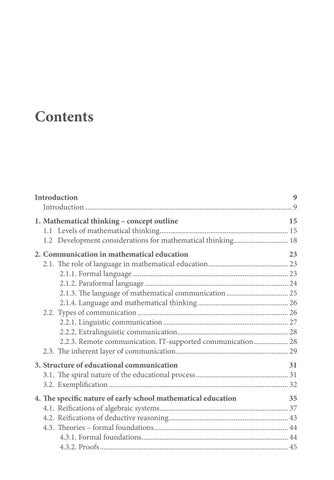
Introduction 9 Introduction................................................................................................................... 9 1. Mathematical thinking – concept outline 15 1.1 Levels of mathematical thinking........................................................................ 15 1.2 Development considerations for mathematical thinking............................... 18 2. Communication in mathematical education 23 2.1. The role of language in mathematical education............................................. 23 2.1.1. Formal language....................................................................................... 23 2.1.2. Paraformal language................................................................................ 24 2.1.3. The language of mathematical communication................................... 25 2.1.4. Language and mathematical thinking................................................... 26 2.2. Types of communication.................................................................................... 26 2.2.1. Linguistic communication...................................................................... 27 2.2.2. Extralinguistic communication.............................................................. 28 2.2.3. Remote communication. IT-supported communication.................... 28 2.3. The inherent layer of communication............................................................... 29 3. Structure of educational communication 31 3.1. The spiral nature of the educational process.................................................... 31 3.2. Exemplification.................................................................................................... 32 4. The specific nature of early school mathematical education 35 4.1. Reifications of algebraic systems........................................................................ 37 4.2. Reifications of deductive reasoning................................................................... 43 4.3. Theories – formal foundations........................................................................... 44 4.3.1. Formal foundations.................................................................................. 44 4.3.2. Proofs......................................................................................................... 45
4.4. Why logic theories in early school education.................................................. 47 4.5. Examples of logic theories.................................................................................. 47 4.5.1. Lorenzen’s theory (L)............................................................................... 47 4.5.2. Theory L – educational aspect................................................................ 49 4.5.3. Rhythms as logic theories (R(m))........................................................... 53 4.5.4. MIU-theory............................................................................................... 59 5. Intuition
61
6. Educational problems 63 6.1. Educational irregularities – mathematical thinking....................................... 64 6.2. Early school education........................................................................................ 71 7. Educational controversies 73 7.1. Mathematical content.......................................................................................... 73 7.2. Metalogic deficiencies......................................................................................... 75 7.3. Reifications and iconisations – examples and controversies.......................... 79 7.3.1. Reifications of natural numbers............................................................. 80 7.3.2. Reifications and iconisations of quotients............................................ 84 8. Possible causes of educational failures
89
Appendix
91
Index
93
Bibliography
95