From Rubble to Revival The efforts behind the
Rebuilding of Istalif, Afghanistan 2004 - 2005
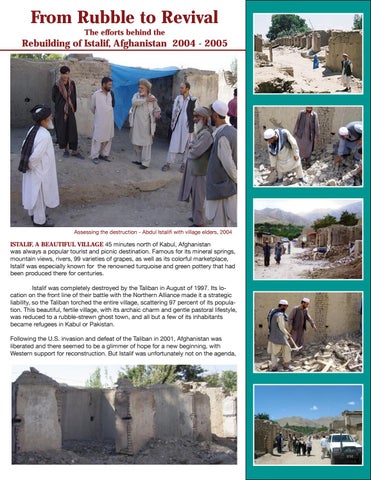
Assessing the destruction - Abdul Istalifi with village elders, 2004
ISTALIF, A BEAUTIFUL VILLAGE 45 minutes north of Kabul, Afghanistan was always a popular tourist and picnic destination. Famous for its mineral springs, mountain views, rivers, 99 varieties of grapes, as well as its colorful marketplace, Istalif was especially known for the renowned turquoise and green pottery that had been produced there for centuries. Istalif was completely destroyed by the Taliban in August of 1997. Its location on the front line of their battle with the Northern Alliance made it a strategic liability, so the Taliban torched the entire village, scattering 97 percent of its population. This beautiful, fertile village, with its archaic charm and gentle pastoral lifestyle, was reduced to a rubble-strewn ghost town, and all but a few of its inhabitants became refugees in Kabul or Pakistan. Following the U.S. invasion and defeat of the Taliban in 2001, Afghanistan was liberated and there seemed to be a glimmer of hope for a new beginning, with Western support for reconstruction. But Istalif was unfortunately not on the agenda,
(continued from previous page) with governmental funds prioritized for more populated areas. Nor were there any NGO projects or funds allocated to Istalif. NGOs tend to create projects in villages that have basic infrastructure. Istalif at that time had none, so its chances of aid were roughly zero. In May, 2003, Ira and Sylvia Seret invited their friend of forty years who had remained in Kabul during the entire war years, Abdul Istalifi, for a reunion in Santa Fe, N.M. Abdul’s wife Zabaida and their younger son Ali flew in from London as well. Acutely aware of Istalif’s plight — it had received no aid in the two years since its liberation from the Taliban and was still basically a ghost town —this small group of friends began brainstorming a plan to revive the heart of Istalif . By now Abdul was an elder of Istalif, and his strongest desire was to see his hometown rise from the ashes. Ira and Abdul, longtime friends and business partners, concluded that the best way to revitalize a village would be to jump-start its economic base. The strip of shops near the main mosque,
Clearing The Rubble A Community Effort
(continued from previous page) once a famed hub for tourists seeking local crafts and the center of the local economy, was now a street of rubble. The Serets and Istalifis decided to reconstruct 120 burned-out shops along this main marketplace. With funding provided through the Serets’ family foundation, Jindhag Foundation, Ali and Abdul offered to contract the work themselves, asking the villagers to help clear the rubble, a huge part of the task. This brought the project in line with a budget of $150,000 — a trifle in the realm of development projects. Community participation would be essential. In meetings with village elders Abdul and Ali made it clear that funds were not coming from an NGO or government source, but from old friends of Istalif. Numerous village meetings led to a community plan, and eventually to a cooperative effort to clear the wreckage of the destroyed shops.
Rebuilding
Ali remained in Istalif with his father, overseeing the daily work as project manager and filming the transformation and revival of his ancestral village. His documentary footage shows the sheer enthusiasm of those involved. One owner, whose bombed-out shell of a shop was at the far end of the street, feared that construction might stop or money run out before his shop was rebuilt. He would plead with Ali daily that his shop not be forgotten, and Ali had to continually reassure him that we had every intention of completing all 120 premises. In six months, the marketplace of 120 shops — sixty on each side of the street—was rebuilt. Even before the project was completed, some of the locals — a lone vegetable vender, a blacksmith — were so eager to open businesses that they moved into recently finished shops while construction farther along the street was still in progress. By the spring of 2005 the entire street was open for business.
(continued from previous page) Ali recalled, “It was like seeing an old dried out tree being watered and slowly coming back to life and blossoming.” The water in this case was hope and the confidence it brought with it. The project’s strength lay in its guiding principle — to build on people’s strengths, and help them to help themselves. The reconstruction of Istalif’s main commercial center gave many families the encouragement and hope they needed to return —mostly from Pakistan or Kabul, where they had sought refuge. Thousands began rebuilding and settling back into their gutted and abandoned homes.
Completion
Istalif 2015: Ali and Abdul Istalifi in front of Abdul’s shop
Before and after: Storefront next to the Mosque
Bringing Pottery to the West International Folk Art Market, Santa Fe 2007 - 2008
Sharif Seret, Ali Istalifi, Sylvia Seret
Santa Fe 2003: Abdul, Ira and Ali discussing Istalif’s Future
Ira Seret and Ali Istalifi at the Folk Art Market