National
.
.
NATIONAL WILDLIFE FEDER ATION | NWF.ORG | FALL 2025
Wıldlı ıldlıfe WHEN “GOOD FIRE” WORKS
MOVING SPECIES TO HIGHER GROUND
WEIRD, WONDERFUL PLAINFIN MIDSHIPMAN RETHINKING SAGEBRUSH STRATEGY
ACTION HEROES U.S. states and territories lay out the next decade of plans for wildlife conservation
¨
DEPARTMENTS
5 | EDITOR’S NOTEBOOK On tackling hard stories 6 | PRESIDENT’S VIEW Why we love national wildlife refuges 7 | PEER REVIEW Featured contributors and reader letters 8 | SCOPE The latest science news about wildlife 10 | NEXT GENERATION Celebrating two conservation leaders 12 | CASE STUDY Giving horned lizards a head start
8
14 | COMMON GROUND How peatlands act as a key climate ally
12
16 | GARDEN FOR WILDLIFE Rehabbing the reps of so-called pests 18 | COMMUNAL HABITAT Mitigating AI data centers’ eco-impacts 20 | NATURE’S WITNESS Angling to capture an elk road crossing
10
54 | FIELD WORK What’s new from NWF and affi liates 57 | CROSSWORD Back to school with unlikely mascots
22
22
18
20
58 | FOOTPRINT Honoring Indigenous ways of life
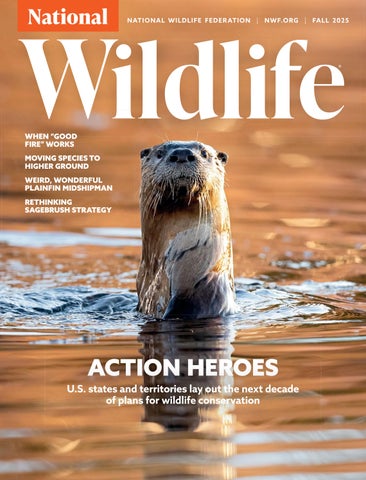
On the cover: The North American river otter was named a Species of Greatest Conservation Need in 2015 by nine states and Washington, D.C. Read about the next decade of wildlife planning on page 22. Photo by Savannah Rose Wildlife.
.
National
56
.
Wıldlıfe
Follow us on Instagram: @nationalwildlifemagazine 4 NATIONAL WILDLIFE . FALL 2025
54 CLOCKWISE FROM TOP: NICHOLAS HESS; COURTESY OF ISOBEL LINGENFELTER; ROB G. GREEN; DAVID KEITH PHOTOGRAPHY; SEAN CRANE; IBRAHIM RAYINTAKATH; CLAUDIO CONTRERAS (NATURE PICTURE LIBRARY)
E D I TO R ’ S N OT E B O O K
JENNIFER WEHUNT
Editorial Director
TAKING CARE Writing about fire in a year that began with tragedy and devastation in Los Angeles and has continued with destructive blazes burning from rural California to Florida requires extreme sensitivity. We aim to walk that line in “What Makes a Fire Good?,” on the benefits of prescribed and cultural burns by reporter Kate Gonzales (p. 40). No fire, not even a meticulously orchestrated one, is without peril, but as source after source told Gonzales, in some circumstances, planned burns can help prevent out-of-control devastation to people, wildlife and entire ecosystems. In putting this issue together, we visited a number of other at-risk landscapes. Brianna Randall talked to a bevy of experts to understand what approaches are most effective now in protecting the depleted but pivotal sagebrush biome (p. 28). Katarina Zimmer reported on relocating plants and animals in response to sea level rise (p. 48). And our assistant editor, Delaney McPherson, chased down updates for “Plan of Action,” on state blueprints for vulnerable wildlife species (p. 22). Every stabilized population of river otter or sage-grouse and every safely completed prescribed burn marks another conservation success. And as Lenya Quinn-Davidson, director of the University of California’s Fire Network, told Gonzales, “we need as many of those as we can get.” � SHARE YOUR THOUGHTS nweditor@nwf.org
MEMBERSHIP BENEFIT
Renew today and receive your free NWF polar bear puzzle
Fall 2025 | Volume 63 | Number 4 NATIONAL WILDLIFE FEDERATION MISSION Uniting all Americans to ensure wildlife thrive in a rapidly changing world
BOARD OF DIRECTORS Chair: Fred Kowal Vice Chairs: Allyn Dukes, Brad Powell, Rebecca Pritchett Past Chair: John Robbins Directors: Mark Berry, Arthur “Butch” Blazer, Robert Brown, Gerald Cobell, Priscilla De La Cruz, Jomar Floyd, John Goss, Andrea Keller Helsel, Arthur Johnson, Brad Johnson, Randy Jones, Koalani Kaulukukui, Jay Lanier, Dawn Levey, Catherine Novelli, Miguel Ordeñana, Mamie Parker, Sara Parker Pauley, Stevie Parsons, Sally Ranney, Bob Rees, Emily Schrader, Patty Schwalenberg, Rob Speidel, Rachel Sprague, Elizabeth Swisher, Benjamin Tuggle, Jeremy Vesbach, Beth Viola EXECUTIVE TEAM Collin O’Mara, President & Chief Executive Officer Mustafa Santiago Ali, Executive Vice President Beth Breaux, Senior Vice President for Philanthropy Ben Kota, Chief Operating Officer Sandra Miao, Associate Vice President for Membership Programs Diane Pataki, Vice President for Science & Chief Scientist Ismael Savadogo, Chief Financial Officer Dirk Sellers, Chief Development Officer MAGAZINE TEAM Jennifer Wehunt, Editorial Director Haley Mustone, Managing Editor Laura Tangley, Senior Editor Delaney McPherson, Assistant Editor Julianne H. Smith, Senior Production Manager Maxwell Bagley, Production Assistant David Whitmore, Design Director (RiverRun Creative) Eugenia Chang, Photo Editor
NWF REGIONAL CENTERS Headquarters: Reston, VA Field Offices: Denver, CO; Atlanta, GA; New Orleans, LA; Annapolis, MD; Ann Arbor, MI; Austin, TX; Missoula, MT; Montpelier, VT; Seattle, WA; Washington, D.C. Membership Services: 1-800822-9919. Membership: National Wildlife is one of the benefits of a membership in the National Wildlife Federation. Minimum contribution for a membership is $15 per year. Of this amount, $5 is designated for a one-year subscription to National Wildlife. The balance of the contribution is tax deductible to the extent permitted by law. For inquiries, write to NWF, 11100 Wildlife Center Drive, Reston, VA 20190-5362 or visit nwf.org. Contact Us: For general magazine inquiries, write to National Wildlife, 11100 Wildlife Center Drive, Reston, VA 20190-5362, or email info@nwf .org. For changes of address, please send both old and new addresses. (Not responsible for unsolicited submissions and materials.) National Wildlife (ISSN 0028-0402) is published quarterly by the National Wildlife Federation, a nonprofit corporation, 11100 Wildlife Center Drive, Reston, VA 20190-5362. Periodical postage paid at Herndon, VA, and additional mailing offices. Prepress and printing by Quad, Sussex, Wl. U.S. Postmaster: Send address changes to National Wildlife, P.O. Box 1583, Merrifield, VA 22116-1583. Canada Postmaster: Send address changes to IDS, P.O. Box 456, Niagara Falls, Ontario L2E 6V2, Canada. Copyright 2025 National Wildlife Federation. All rights reserved. Printed in the USA.
Simply visit nwf.org/renewmag While supplies last. Please allow 6-8 weeks for delivery.
NWF.ORG/NW 5
G A R D E N FO R W I L D L I F E
Please Don’t Call Them Pests Some of our most feared backyard wildlife are key to healthy garden habitats BY K ATH Y J E S S E
D
avid Mizejewski calls them “the unlovables”: snakes, bats, spiders and other creatures that make many of us shudder. But Mizejewski, naturalist for the National Wildlife Federation, says all these animals play key roles in backyard ecosystems. “If you see them in your yard, you’re doing it right.” Some unlovables specialize in eating rats and mice. Others perform environmental cleanup by scavenging on dead animals. Many—even the hated yellow jacket—serve as pollinators for plants, including the plants we like to eat. And beneficial predators such as spiders are themselves important nesting-season food for
to see in your home or garden. Like spiders, they’re also food for more-popular wildlife such as foxes, barred owls and red-shouldered hawks. “Almost all snake species are 100 percent harmless to people,” Mizejewski says. “They will never chase you or try to eat you, including venomous species. They will do everything in their power to get away from you.” To attract snakes to your backyard habitat, he recommends building brush and rock piles toward the edges of the property. To keep the reptiles from getting into your house, seal off crevices in your attic and basement with caulk. Keep screens in windows and keep dense vegetation, along with brush and rock piles, away from the home’s foundation. If a nonvenomous snake does find its way into your house, the nonprofit Humane World for Animals suggests you open a nearby door and gently coax the animal toward the door with a broom. If that doesn’t work, slowly place a bucket over the snake and put a weight on top. Then call a professional wildlife removal specialist. For venomous species, call a professional immediately. Bats. Many people find bats to be creepy, too, but Mizejewski says the animals are “super cool.” Not only do some species, including the little brown bat, feed on agricultural pests such as the corn earworm, they provide a “massive ecological service” by eating a prodigious number of biting mosquitoes. According to the nonprofit Bat Conservation International, a single little brown bat can consume 600 or more mosquitoes in an hour. “Without bats, we’d be in real trouble,” Mizejewski says. It’s true that bats can carry rabies, as can many mammals. “But it’s a myth they chase people,” he says. “They won’t get tangled in your hair.” And while vampire bats exist, they don’t live in this country and rarely feed on humans. To keep bats out of your attic—which certainly can happen, especially during the reproductive season—close
.
songbirds. “If you want birds, you want spiders,” Mizejewski says. Here are a few other backyard animals you may want to welcome to your garden after all. Snakes. A common cultural prejudice tells us “the only good snake is a dead snake,” Mizejewski says. “Frankly, that’s an ignorant thing to say.” Snakes that might find their way into your yard, including rat snakes, will prey on rats, moles, voles and mice you’d prefer not
.
16 NATIONAL WILDLIFE . FALL 2025
TOP: KARSTEN EGGERT (ALAMY); BOTTOM: DOUG WECHSLER (MINDEN PICTURES)
off access points with caulk, sealant or mesh. Then, invite these beneficial critters into your yard by mounting a bat box at least 12 feet off the ground and near a water source. A multichambered bat box encourages roosting of maternal colonies: groups of pregnant females that gather together to give birth and raise their pups until the youngsters are strong enough to fly. The best bat houses mimic the spaces between tree trunks and bark, creating tight spaces, a rough inside texture to get a good foothold and caulking for warmth. For tips on building and installing a bat house on your property, see nwf.org/bathousetipsheet. Wasps. Like their cousins the bees, wasps are important pollinators, visiting more than 960 plant species, including 164 that depend on them to reproduce. They also help defend these plants from the hungry hordes. Whether predatory or parasitic, wasps target a wide range of plant-devouring insects and other arthropods, including aphids, whiteflies, cabbage loopers and brown marmorated stink bugs. Unlike much-beloved bees, however, wasps are widely loathed and feared, because some may sting aggressively if provoked. But aggressive wasps represent only a handful of social species—such as paper wasps, hornets and yellow jackets—that defend communal nests, says Karen Goodell, professor of evolution, ecology and organismal
.
biology at The Ohio State University at Newark. The majority of wasp species are solitary. If you get too close to a social wasp colony, the insects indeed may attack. Still, it’s not always necessary to take action, Goodell says. “If they’re by the front door, you may want to destroy them. But if they’re at the back of your property, you might want to just let them be.” To prevent unwanted wasp encounters, author and biologist Heather Holm suggests surveying your yard in spring when colonies are small. Intervene—by closing a hole that ground-nesting yellow jackets are starting to use, for example—if a nest is in an area you cannot avoid. Because yellow jackets become more aggressive in fall, when their food sources become scarce, keep them at bay by covering sugary drinks when eating outside and securing the lids on garbage cans. Holm, Goodell and Mizejewski agree that the best way to attract wasps and other unheralded beneficial species is to plant a native landscape. (For tips, see nativeplantfinder .nwf.org.) Bat houses and brush and rock piles do indeed provide places for animals to live and raise their young. A water source also is important. But a healthy backyard habitat, like any ecosystem, is a food web, Mizejewski says, “and native plants are the foundation of all food webs.” n Kathy Jesse is a writer based in Bethesda, Maryland.
Snakes (common garter snake, right) and wasps (great golden digger wasp, left) eat potential garden ravagers such as slugs and plant-munching insects. Bats also feed on herbivores as well as enormous numbers of biting mosquitoes. You can attract bats by buying or building a bat box (above left).
MARK LEHIGH (ALAMY)
NWF.ORG/NW 17
C O M M U N A L H A B I TAT
G
oogle’s DolphinGemma aims to interpret wild dolphins’ vocalizations. Microsoft’s Project Guacamaya seeks to monitor deforestation and preserve biodiversity in the Amazon rainforest. Across the globe, scientists are collaborating with technology companies to deploy artificial intelligence that studies wildlife and the environment, among multifold other applications across all kinds of industries. But as the use of AI proliferates, environmental policy analysts, academic researchers and others are raising concerns about the impacts the data centers powering the technology are having on communities, ecosystems and the climate. Among those concerns are the immense energy and water resources the centers require and the air, light, noise and other pollution they generate. Recent reporting and research have pointed out some of the dangers, from diminished water supplies in regions already facing shortages to potential health risks from air pollutants.
his co-authors wrote in a report released in January 2025 by the Frontier Group, Environment America Research & Policy Center and the U.S. PIRG Education Fund. The report cited one estimate showing that a single data center could guzzle up to 5 million gallons of water per day— roughly equivalent to the daily use of a town with 50,000 residents, according to an analysis by The Washington Post. A December 2024 preprint of a study from researchers at the University of California, Riverside, and California Institute of Technology outlined the toll of AI-related air pollution. “AI contributes substantially to air quality degradation and public health costs through the emission of various criteria air pollutants,” the authors wrote. Other forms of pollution, such as light and noise, also could be problematic. Neil Carter, an associate professor at the University of Michigan’s School for Environment and Sustainability, has studied the links between sensory pollution and conservation. While he hasn’t researched
Powering Up As AI’s reach grows, the need for data centers multiplies. So could the environmental impacts. BY AM B I K A K A N DASAM Y
By 2030, data centers’ global electricity use is estimated to more than double to 945 terawatt-hours, a little more than Japan’s total electricity consumption in 2024, according to a report published in April by the International Energy Agency. The report points to AI as a key driver behind the anticipated increase and projects that the United States will use the largest share. As of now, the United States is home to the greatest number of data centers in the world, according to Cloudscene, a telecommunications company. “The surge in data centers, and their projected increase in electricity demand, are already contributing to slowing down the transition to clean energy, in particular in states where they have high concentrations of data centers,” says Quentin Good, policy analyst at the Frontier Group, a research and policy organization. Virginia currently hosts the most data center facilities in the United States. Data centers’ energy demands have driven some utilities to delay shuttering fossil fuel power plants and have prompted proposals to revive retired plants, Good and 18 NATIONAL WILDLIFE . FALL 2025
AI data centers’ impact on wildlife specifically, he says AI data centers potentially could be “sensory danger zones.” “Sensory danger zones are basically where we have reason to believe that the amount of light and the amount of noise is exceeding thresholds by which you can imagine there being a fitness consequence for species,” Carter says. “And they may not be able to carry out the necessary functions that they normally would.” Research by Carter and his colleagues has explored how light pollution, for example, could disrupt the dynamics between predator and prey species, such as cougars and mule deer. Their research also has looked into how anthropogenic sounds could affect reproduction in birds including the northern cardinal, oak titmouse and barn swallow. To address some of these issues, experts recommend adopting sustainable strategies when building and operating AI data centers and when using AI. The decisions “we make today will be having an impact on the public health for many years to come, due to the long life span for data center
projects,” says Shaolei Ren, associate professor of electrical and computer engineering at the University of California, Riverside, and an author of the air pollution study. Ren calls for “health-informed AI” that factors in health costs—not only carbon emissions—when deciding where a data center should be located. For example, the human health impacts of situating a data center in densely populated New York City would be much higher than an uninhabited desert, even if carbon emissions are comparable, according to Ren. Any location, however, could pose problems for wildlife and the local ecosystem. Some experts are seeking to lower data centers’ overall water and energy use. “I like to think of a data center almost like how you would think about your house,” says Vijay Gadepally of his work at MIT’s Lincoln Laboratory Supercomputing Center. One strategy for reducing energy consumption is to upgrade older hardware to newer, more energy-efficient platforms, he says. Another is to work with lower precision computing—using 4 or 8 bits instead of 16 or 32 bits—which can have huge energy advantages, according to Gadepally. He and his colleagues also have ILLUSTRATION BY IBRAHIM RAYINTAKATH
implemented “power capping,” or setting limits on the power of the hardware so it uses less energy over time. “Now, to be clear, an academic supercomputer is a little bit different in terms of the way people interact with it than a commercial system,” he says. “But we were able to show, for example, that you can reduce, on a consistent basis, almost 15 percent energy consumption and run our processors even cooler.” In order to implement and evaluate solutions, it’s necessary to get accurate data on how much energy the AI data centers—and the tech companies using them— are consuming. That information can be hard to come by. As co-founder of the nonprofit Climate Change AI, Priya Donti works on the responsible use of AI. While some data center operators might collect information on the energy usage of specific AI models, those data aren’t always publicly auditable, according to Donti. “The bigger thing is we need transparency,” she says. “But we also need action.” n Ambika Kandasamy is a freelance journalist. NWF.ORG/NW 19