
Passions Alongside the Law Is it time for a Rare Disease Act in Western Australia?ALSO INSIDE Intestacy Law Reform in Western Australia: At Last! The Passing of Her Majesty Queen Elizabeth II Time to Get Serious About Unfair Contract Terms Mind, Body & Environment in the Legal Profession A Focus on Mental Health Special Feature:


LEAP invests over $20 million in research and development every year. This is why our legal practice productivity solution is trusted by 61,000+ practitioners globally. Join us to celebrate 30 years of legal innovation at events hosted by major cities throughout Australia, commencing in November 2022 and continuing in early 2023. Celebrate 30 years of Legal Innovation 15 November 2022 | Sofitel Hotel, Sydney Secure your spot at leap.com.au/events/30-years



DISCLAIMER: The views and opinions expressed in Brief and the claims made in advertisements published within it, are not to be taken as those of, or as being endorsed by the Law Society of Western Australia (Inc.) or the Brief Editorial Committee. No responsibility whatsoever is accepted by the Society, or the Editorial Committee for any opinion e a substantial part of any article in Brief Journal should obtain permission from individual authors. If an author’s name is not provided, or if readers are not able to locate an author’s contact details, readers should contact the Law Society of Western Australia (Inc.). The trade mark BRIEF is the subject of registered trade mark 1253722 and is owned by the Law Society of Western Australia (Inc). Trade mark 1253722 is registered for Western Australia. Published bi-monthly (Feb, Apr, Jun, Aug, Oct and Dec) Advertising enquiries to Manager Corporate Communications: Madeleine McErlain Tel: (08) 9324 8650 | Email: mmcerlain@lawsocietywa.asn.au Communications and Design Officer: Des McKenzie RRP $16.00 incl GST. Editor: Jason MacLaurin SC Editorial Committee: Gregory Boyle, Thomas Camp, Dianne Caruso, Lucy Clark, Tracy Cole, Megan Cramp, Patricia Femia, Jessica Henderson, Anlee Khuu, Roselina Kruize, The Hon John McKechnie QC, Grace Ritter, Dr Pat Saraceni, Robert Sceales, Eu-Min Teng, Johann Andreas von Altenstadt. Proofreaders: Ingrid Briggs, Sonia Chee, Cassandre Hubert Brief is the official journal of the Law Society of Western Australia Level 4, 160 St Georges Tce Perth WA 6000 Phone: (08) 9324 8600 | Fax: (08) 9324 8699 Email: brief@lawsocietywa.asn.au | Web: lawsocietywa.asn.au ISSN 0312 5831 Submission of articles: Contributions to Brief are always welcome. For details, contact brief@lawsocietywa.asn.au. President: Rebecca Lee Senior Vice President: Ante Golem Junior Vice President & Treasurer: Paula Wilkinson Immediate Past President: Jocelyne Boujos Ordinary Members: Ben Bullock, Rebecca Bunney, Dr Brett Davies, Angie Gimisis, June Kenny, Gary Mack, Judy McLean, Terry Palmer SC, Kellie Woods Country Member: Michael Ryan Junior Members: Thomas Camp, Selina Gates, Hamish Glenister Chief Executive Officer: David Price FOLLOW US LawSocietyWA lawsocietywa.asn.au @LawSocietyWA ARTICLES 40 CONTENTS Volume 49 | Number 6 | October 2022 02 President’s Report 04 Editor’s Opinion 47 Ethics Column 55 Member Privileges 56 High Court Judgments 57 Federal Court Judgments 58 Family Law Case Notes 60 Quirky Cases 61 Cartoon 62 Law Council Update 62 New Members 63 Classifieds REGULARS @the_Law_Society_of_Western_Australia 06 Legal Profession Complaints Committee 07 The Passing of Her Majesty Queen Elizabeth the Second 09 Special Feature: Mind, Body & Environment in the Legal Profession 21 The Psychological Impact of Being Wrongfully Convicted: Interview with John Button 24 Unhappy Families – the Revealing Power of Workplace Culture Reviews 26 Search Inside Yourself Leadership – Promoting Mental Health Literacy for Modern Lawyers 28 The Sharma Decision: Establishing an Evidentiary Precedent for Future Climate Litigation 34 James And Mary Coultas and the Law Of Nervous Shock The Perth Connection 40 Is it time for a Rare Disease Act in Western Australia? 43 A warning on the urgent need to get serious about unfair contract terms: Australian Competition and Consumer Commission v Fujifilm Business Innovation Australia Pty Ltd [2022] FCA 928 44 Intestacy Law Reform in Western Australia: At Last! 48 YLC Section 08 01 Is it time for a Rare Disease Act in WA? Mind, Body & Environment in the Legal Profession The Psychological Impact of Being Wrongfully Convicted: Interview with John Button 21
PRESIDENT'S REPORT
Rebecca Lee
President, The Law Society of Western Australia
Welcome to the October edition of Brief
Included in this Report are updates on the Law Society’s advocacy on issues of importance to the legal profession and the wider community, as well as information on the 2023 Council elections, the upcoming Annual General Meeting and End of Year Celebration.
Western Australian Mental Health Week
Every year, both RU OK? Day (8 September) and Western Australian Mental Health Week (8-15 October) highlight the need to have meaningful conversations about mental health and promoting effective strategies to maintain positive mental wellbeing.
It is important for employers to take practical measures to make health and wellbeing a priority in the workplace, including by providing access to flexible working arrangements, fostering respect for work-life balance and promoting a positive, supportive workplace culture.
There are effective strategies for mindfulness and stress management that can be explored in the Law Society’s Continuing Professional Development programme or by visiting our website.
We also provide our LawCare WA health and wellbeing service for members, which includes an assistance programme and free counselling sessions.
This October edition includes a mental health and wellbeing special feature, which provides not only helpful advice and tools for creating a positive work life balance, but also provides some entertaining reading that we hope will offer inspiration. I would like to thank everyone who generously gave their time to contribute to this special feature, in particular Catherine Stokes, Executive Director of the College of Law Western Australia, for writing an insightful foreword. As Catherine said, “My hope is that we can continue to learn from each other: to evolve and expand our understanding about health and wellbeing, just as the law and legal practice have evolved and expanded since the time of James and Mary Coultas in their horse and buggy. Long may these conversations about our shared humanity continue.”
Congratulations to our Lawyer of the Year Award Winners
The Law Society’s Gala Dinner 2022 on Friday, 30 September 2022 at Crown
Towers Perth provided a wonderful platform to announce the Annual Awards for the Legal Profession. I felt truly privileged to play a part in this special evening along with over 370 members of the legal community, to celebrate the announcement of award winners for the Attorney General’s Community Service Law Awards and the Law Society’s Lawyer of the Year Awards.
Congratulations to Funmi Adesina from Gosnells Community Legal Centre, the winner of the Law Society’s Lawyer of the Year Award 2022 and to Monica Vu from MDC Legal, the winner of the Law Society’s Emerging Lawyer of the Year Award 2022.
Congratulations are also extended to the winners of the 2022 Attorney General’s Community Service Law Award winners.
A special thank you to the Chief Justice of Western Australia, the Hon Peter Quinlan, for his reflective address on “Community and Immunity”.
Elections for the Law Society Council 2023
Nominations for election to the 2023 Law Society Council closed on Wednesday, 12 October 2022. Congratulations to my 2022 Senior Vice President Ante Golem, who was deemed elected unopposed as the Law Society’s President for 2023, and to my 2022 Junior Vice President and Treasurer Paula Wilkinson, and 2022 Councillor Gary Mack, who have been deemed elected unopposed as the Law Society’s Senior Vice-President and Junior President respectively for 2023.
My congratulations also to the three Junior Members, Tyler Greatrex, Daniel DyerSmith and Robert Jamieson who were also declared elected.
Voting for the Ordinary Members to be elected for a two-year term will open on Wednesday, 26 October 2022 and will close on Wednesday, 9 November 2022. You will be advised where to find the candidate statements and photographs on the website in Friday Facts and via an email from CorpVote shortly.
Law Society Annual General Meeting
The Law Society’s Annual General Meeting, subject to Council approving the date at their meeting on the 26th October, will be held on Tuesday, 15 November 2022 at 5.15pm on Level 26, QV1 Building, 250 St Georges Terrace – the offices of Herbert Smith Freehills. Please mark this in your
calendars, and I look forward to seeing as many members as possible there for our meeting, followed by the opportunity to catch up with each other over drinks.
Advocacy Update
Since the last edition of Brief, The Law Society has facilitated a CPD seminar on Uniform Law with the Chair and CEO of the Legal Services Council who travelled to Perth especially for the occasion. This was attended by 250 delegates across all formats.

The Law Society has also worked with the Department of Health to host a CPD seminar on Advance Health Directives (AHD), the first education session delivered by the Department following the launch of the new AHD template document and associated resources.
During this time, the Law Society staff also met with the following stakeholders:
Sympli (E-conveyancing)
Justice Strk (Mesothelioma matters)
Principal Registrar McDonald (Cost Assessments)
Department of Health (Advance Health Directive Launch)
Western Australian Justice Association (Advocacy)

Our committees continue to contribute to and comment on many consultations and policy matters including making submissions to:
the Department of Justice Derivative Action in Deceased Estates matters; Chief Justice providing feedback on COVID19 initiatives implemented by the District Court and psychological reports; Law Council of Australia on the Joint Costs Advisory Committee Inquiry 2022;
Law Council of Australia on the Modern Slavery Act Review; conditional cost agreements under the Uniform Law; Law Council of Australia on Exemptions for Litigation Funding Schemes;
Commercial tenancies law review; and Australia’s Humanitarian Program 2022-2023.
02 | BRIEF OCTOBER 2022
In addition to this, the Law Society participated in Department of Justice consultations on the Legal Assistance Strategy; engaged with the Legal Practice Board of Western Australia to assist in the development of their practices regarding sexual harassment reporting; and continued to make enquiries about the Mandatory Registration of Children and Young people on the Sex Offenders Register campaigning for judicial discretion in registering a young offender as a reportable offender.
Concerns over the Liquor Control Amendment (PEP) Bill 2022
The Law Society expressed its concern regarding the amendments to the Liquor Licensing Act that will create five entertainment precincts that will prohibit certain categories of people with convictions from entering. The new laws are untested anywhere in the world and no assurance has been provided that the principles of administrative and procedural fairness will be available under the new
powers. The ne w laws are proposed to be in place by Christmas with no formal process for submissions or commentary having occurred to date. Read the full media statement here
End of Year Celebration is for Everyone – Save the Date!
The Law Society’s annual End of Year Celebration is always a great event with great people, music and conversation! The event this year will be held on Thursday, 8 December at Anzac House, St Georges Tce, from 5.30pm to 7.30pm.
We invite you to save the date in your diaries with registrations to reserve your place opening soon.
The End of Year Celebration always presents a great occasion to gather with friends and colleagues and especially for us to thank our valued members and wider profession for the support and generosity shown to the Law Society throughout the ye ar.
GAIN PRACTICAL LEGAL TRAINING WITH CURTIN LAW SCHOOL
Curtin’s Practical Legal Training program has a strong emphasis on technical legal skill development, with practical training conducted through the John Curtin Law Clinic.

Taught by experienced legal practitioners with extensive legal experience, the program is highly flexible, delivered through a blend of face-to-face teaching and online self-directed learning.
Find out more about the Practical Legal Training program or contact the Curtin Law School

Invitation to Get in touch
I wish you all a safe and happy month of October, and as always, would love to hear from you, our members. Please contact either me directly (president@ lawsocietywa.asn.au), any other member of the Executive or the Law Society’s Chief Executive Officer (dprice@ lawsocietywa.asn.au), to share with us your ideas, feedback and any concerns.
CRICOS Provider Code 00301J 5120FBL
EDITOR'S OPINION
Jason MacLaurin SC Editor, Brief | Barrister, Francis Burt Chambers
This October edition of Brief includes a mental health and wellbeing special feature, “Mind, Body & Environment in the Legal Profession.” We thank all contributors, with special thanks to Catherine Stokes for writing the foreword and introducing the contributors. The segment “Passions Alongside the Law” proved to be so popular that another instalment will be featured in our December edition (and possibly beyond?).
It is inspiring reading, showcasing the importance and pure joy of having hobbies and pastimes outside of the law.
It being a consistent theme of Brief (and this editorial section) that there are very few areas of life untouched by the law and lawyers, it is good to explore the other side of things: that there are very few other areas and talents that lawyers can’t or don’t enjoy and engage in as diversions (and often more than just diversions).
We are coming up to Halloween which, although not as intensely celebrated in Australia as in the USA, still piques some interest here.
We are also marking one year since the amazing exploits of Mark A Metzger III, a criminal defence and personal injuries lawyer from Galveston, Texas.
It seems Metzler, in common with some lawyers, finds his particular hobby and diversion in film buffery, with a specialty in horror films (no local comparisons spring instantly to mind).
About a year ago Metzler was arrested for disorderly conduct for walking along a Galveston beach, for some reason during a tropical storm, in an impressively authentic and accurate costume (including a knife dripping with fake blood) of Michael Myers/ The Shape from the classic John Carpenter movie (and subsequent franchise movies) Halloween (1978).1
His comments about the incident do bear some confluence with the themes in our special feature: “I try to find a little bit of positivity in, you know, the doom and gloom out there, with all this negative stuff going on.” He added that he was a bit “fuzzy” on what he had done that was actually illegal and, when asked if he had to do it all over again, said “I absolutely would.”
People familiar with Halloween and the 13 films in the franchise know that an ongoing leitmotif and refrain concerning Michael Myers is that “you can’t kill the Boogeyman” – although in Metzler’s case the law was able to have him handcuffed, arrested and taken to the police station.
However, as we will see later in the editorial, sometimes you just can’t kill the Boogeyman (or in this case Metzler’s irrepressible spirit).
Michael Myers is not of the course the only literary or cinematic horror figure who keeps coming back (and back) and seemingly can’t be stopped.

Sometimes the law and lawyers find a way to go close.
Celebrating this year its 100th anniversary the seminal German Expressionist masterpiece and amazingly influential vampire movie F R Murnau’s Nosferatu (1922) was almost erased from history and lost, due to a copyright lawsuit. Nosferatu, aside from some name (including renaming the vampire Count Orlok) and plot changes, was unmistakably based upon Bram Stoker’s 1897 novel Dracula (1897). Bram Stoker’s estate sued shortly after Nosferatu’s 1922 debut. A German Court found there had been an infringement and ordered all copies of the film to be destroyed (and all copies in Germany apparently were).2 However, one copy of the movie had already been sent to the USA and so survived. As the novel Dracula had already entered public domain in the USA, due to an oversight from Bram Stoker/his estate, there was no infringement involved in screening Nosferatu in the USA in 1929, thus still beating in time Bela Lugosi’s iconic cinematic turn as the famous vampire in Dracula (1931).
Lawyers did manage to drive a stake though the heart of the German production company of Nosferatu, Prana Film, which in a move not uncommon to lawyers, went immediately upon being sued in 1922, into bankruptcy to avoid the German copyright suit and was never resurrected.
Returning to Mr Metzger, in true horror movie protagonist fashion, especially that of his indestructible hero Michael Myers: he came back. Just a few weeks after his Galveston beach appearance he appeared in a Galveston court dressed again as Myers and representing four clients for a range of charges such as driving while intoxicated, assault with bodily injury and evading law enforcement.3
When asked why he did it, he said that the Judge had “triple dog-dared’ him.
He added that “my clients all loved it”, that nothing very serious was going to happen in court that day, it was purely procedural, that “obviously had today been a serious trial matter or a motions setting I’d have been dressed professionally”, and that “restoring our faith in humanity through humour is 100% what I’m about” adding that he and his colleagues typically dress up for the Friday
court appearances before major holidays like Halloween, Christmas or the 4th of July.
One waits with some interest to see whether Mr Metzger will, like his hero, continue to enjoy his particular hobby and diversion, so as to make the 12 appearances required to tie Michael Meyers in Halloween movie appearances (before anyone writes in to note4 that there are 13 Halloween movies in the franchise, the outlier in film Halloween III: Season of the Witch, currently celebrating its 40th anniversary of course, as Mt Metzger could tell you, went down a completely different plot path and only included a brief shot of Michael Myers on a TV in a bar and hence has not been counted).5
Mr Metzger is certainly in with a shot at a few more sequels. The Galveston beach walk charges were dropped, and he hit social media to declare that due to “[his attorney’s] zealous advocacy and a City Prosecutor with a sense of humor, the case against Michael Myers is DISMISSED” (the City Prosecutor seeming also to have some broader interests and diversions making the practice of the law more enjoyable.)6
This edition also includes a reflection of the passing of Her Majesty Queen Elizabeth the Second by the Hon John McKechnie KC; considering the impact of the pandemic, Marisa Taliangis and Dr Gareth Baynam ask the question, “Is it time for a Rare Disease Act in Western Australia?”; we have Stephen Doyle’s warning on the urgent need to get serious about unfair contract terms; and John Hockley discussing the long-overdue reform of the intestacy provisions of the Administration Act 1903 (WA). As always Brief has something for everyone!
End Notes
1 M Stunton, “Lawyer dressed as Michael Myers arrested after roaming Texas beach as prank, cops say”, 14 September 2021, www.star-telegram.com
2 D Scally, “Nosferatu and the fangs of copyright infringement”, 5 March 2022, www.irishtimes.com
3 “Eccentric Texas attorney wore Michael Myers costume to court because judge ‘triple dog-dared’ him”, 29 October 2021, www.click2houston.com.
4 And this is perhaps the least likely Editorial ever likely to elicit a (much desired and all too rare) letter to the Editor - other than perhaps one suggesting the Editor resign.
5 Also notable is that Halloween III: Season of the Witch is currently being revisited as a profound and prophetic meditation upon the evils of large globalist corporations, the effects of technology and corporate advertising. Go figure.
6 “Case dismissed against Galveston attorney seen roaming beach dressed as Michael Myers”, 7 December 2021, www.abc13.com
04 | BRIEF OCTOBER 2022
The Benchmark for demolish, design and rebuild.








Our solutions are designed to maximise your block’s potential in the easiest way possible. So if you’re considering upgrading your family home, or a multiple dwelling development, we can take care of everything. From the demolition of your current home to the design and rebuild of your beautiful new home and everything in between, we’ll keep it seamless and hassle-free. Atrium Homes are proud to have many members of the Perth legal fraternity as valued clients, to whom we have undertaken many demolition and rebuilds, and designed luxury custom-built homes over many years. Atrium Homes.
Visit our website to see our range of solutions, as well as offering you a complimentary, obligation-free on-site assessment where we can explore the possibilities. WH89842 atriumhomes.com.au *Conditions apply. BC # 13344 Scan to read our latest newsletterFollow us Find us on houzz.com The Long Island 6 Colin Street, Dalkeith Rod Dawes 0418 941 415 Sat/Sun 1-5pm & Wed 2-5pm or Private Appointment The Edge Mt Pleasant Ben McCarthy 0402 349 224 Private Appointment Only Head Office 9 Willcock Street, Ardross WA 6153 E: enquiries@atriumhomes.com.au Ph: 6310 8888 Fax: 6310 8889 A/H: 0418 941 415
Legal Profession Complaints Committee
In the August 2022 edition of Brief, Steven Penglis SC expressed concerns about the operations of the Legal Profession Complaints Committee (Committee), in particular, the unacceptable delays he experienced when dealing with the Committee. A response by the Legal Practice Board of Western Australia was published in the same edition.
Contributing to this discussion, the Attorney General, the Hon Jon Quigley MLA provides further context as first legal officer of the State.
The legal profession in Western Australia occupies a privileged and trusted position in that it is self-regulated.
This is both a luxury and a responsibility.
The argument in favour of self-regulation is that the intricacies involved in practicing the law are so nuanced that only a fellow practitioner is in a position to understand and fairly rule on complaints.
The argument against self-regulation is that while lawyers are well qualified to sift competing submissions, they are not trained or equipped to run an orderly and timely complaints-handling system.
Almost from the day I came to office, I received correspondence from practitioners who were the subject of investigation by the Legal Profession Complaints Committee complaining about inordinate delays in the process, causing them immense personal stress. One of the complaints drawn to my attention had been on foot for six years, another almost seven years. Whatever the reason for this delay, not only would this take an immense toll on the mental health of the practitioners involved, but it is totally unacceptable for the consumers of the legal services who make legitimate complaints.
Having said that, I appreciate that the members of the Committee participate on a voluntary basis and would invariably have commitments clashing with a Committee meeting, and that over the years its composition would change. Both of these factors would seriously disrupt the continuity of an investigation.
As Attorney-General, it would be inappropriate for me to become involved in individual complaints. However, as First Law Officer I have an overarching interest in ensuring the procedures which underpin our legal system operate effectively.
More specifically, I am an ex-officio member of the Legal Practice Board, of which the Committee is an independent statutory arm.
Notwithstanding my significant regard and appreciation for the contribution of senior practitioners on the Committee, in 2019 I asked the Ombudsman, Mr Chris Field, to review its processes and procedures to determine whether the system could be streamlined.
The Committee has a continuing requirement under the Legal Profession Act 2008, and now the Legal Profession Uniform Law Application Act 2022, to deal with complaints as efficiently and expeditiously as is practicable.
The Ombudsman is empowered by statute to undertake own motion investigations focusing on any aspect of public administration and make recommendations, including guiding public authorities on developing effective complaints-handling systems.
After a lengthy examination and with the cooperation of the Committee itself, the Ombudsman arrived at 13 recommendations aimed at ensuring compliance with its statutory obligations.
The Ombudsman’s 2020 Investigation Report revealed key areas for improvement.

The Committee did not have an electronic complaints management system, despite it having been identified as an urgent requirement for nearly 15 years.
The Committee did not have any key performance indicators. It stated on its website that it aimed to finalise all investigations within a year, but this was not reported against in any formal sense.
All new inquiries are referred to the Committee’s ‘rapid resolution team’, however as at 9 October 2019, 47 per cent of matters were more than 3 months old; and 13 matters were more than 12 months old, with the age of the inquiry ranging from 366 to 693 days, with a median age of 454 days.
For non- rapid matters, in 2018-19, the Committee’s aim to finalise investigations within 12 months was achieved in less than half (44.7 per cent) of complaints/ own initiative investigations. For the 53 complaints/own initiative investigations that were more than 12 months old at 9 October 2019, the age of matters ranged from 366 to 2150 days, with a median age
of 534 days. The oldest open complaint/ own initiative investigation was nearly six years old as at 9 October 2019.
The Ombudsman’s recommendations included KPIs to complete 75 per cent of RRT matters within three months, and 95 per cent with six months. He also recommended staged improvement to the timeliness of disciplinary investigations so that 85 per cent are resolved within 12 months by the end of the 2023-24 financial year.
Consistent with his function to track and monitor the implementation of his recommendations, the Ombudsman sought updates from the Committee earlier this year.
Pleasingly, despite some difficulties, the Committee has either achieved or taken steps to give effect to all 13 recommendations.
Setting KPIs is a good start, but real achievement would be sustained delivery against the targets over a significant period of time. This will no doubt be aided by the long-awaited introduction of an electronic complaints-handing system befitting a modern industry regulator.
I thank Mr Field for his diligent report which has now been tabled in Parliament, and I encourage all in the profession to read it. A link can be found here. https:// www.ombudsman.wa.gov.au/Publications/ Reports/Legal-Services-and-ComplaintsCommittee-Report-September-2022.pdf
It is very important that the Committee is operating at maximum efficiency because it has been accepted as a Local Regulatory Authority and renamed the Legal Services and Complaints Committee under the National Legal Profession’s Uniform Law.
As such, it must be acting with comparable efficiency to the Office of the Legal Services Commission of New South Wales and the Victorian Legal Services Commissioner – the equivalent entities in the other jurisdictions covered by the Uniform Law.
I once again thank the Committee, which is made up of dedicated practitioners who serve pro bono and on a part time basis, and its approximately 40 or so support staff.
The recent introduction of the National Legal Profession to Western Australia provides continuing opportunity to reflect on the best regulatory model for this jurisdiction and I will be giving ongoing consideration to this question.
 by the Hon John Quigley LLB JP MLA
06 | BRIEF OCTOBER 2022
The Passing of Her Majesty Queen Elizabeth the Second
By The Hon John McKechnie KC
“Queen Elizabeth II is dead. Long Live King Charles III.”

There is always a monarch. Proclamations of accession are important but legally unnecessary to appoint a Sovereign.
Coronation is a ceremonial occasion for publicly affirming the Sovereign who will have already been reigning for some months.
Sovereignty passes at the moment of death.
Fortunately Western Australia leapt into the 21st century in 2005 and changed many references to the Queen - Reginaor the King - Rex. These changes included the form of oath taken by all judicial officers and many other statutory office holders including members of parliament. The oath is to the people and the State of Western Australia.
This gave rise to a curious argument by some gentle souls involving all judicial appointees who have sworn the new oath instead of allegiance to our Sovereign Lady the Queen. Hence, it is argued, the amendment wrongfully effected such a constitutional change that those magistrates and judges are improperly sworn and their decisions are a nullity. The intriguing argument has yet to find acceptance in any court.
In other States, indictments will now be entitled The King against.. or R v…
The same is true of the Commonwealth whose indictments will continue to be presented in the name of the King, even in Western Australia.
The Criminal Procedure Act mandates that for state offences an indictment must be commenced in the name of Western Australia.
Interestingly, the Supreme Court retains jurisdiction in respect of pleas of the Crown. This might prove useful if ever another case like that of the Oteri brothers surfaces: (1975) WAR 120
Prerogative writs, once issued under the command of the Sovereign, are now modernized under the general rubric of judicial review.
Senior Counsel remain of that title, not having been appointed by the Governor but instead by the judges of the Supreme Court.
Queen’s Counsel, of whom there are a few left in the State, became King’s Counsel the moment Charles III became King.
Elizabeth II was, by the grace of God, Queen of Australia and her other realms and territories, head of the Commonwealth. This is formalized in The Act which curiously does not mention her successors.
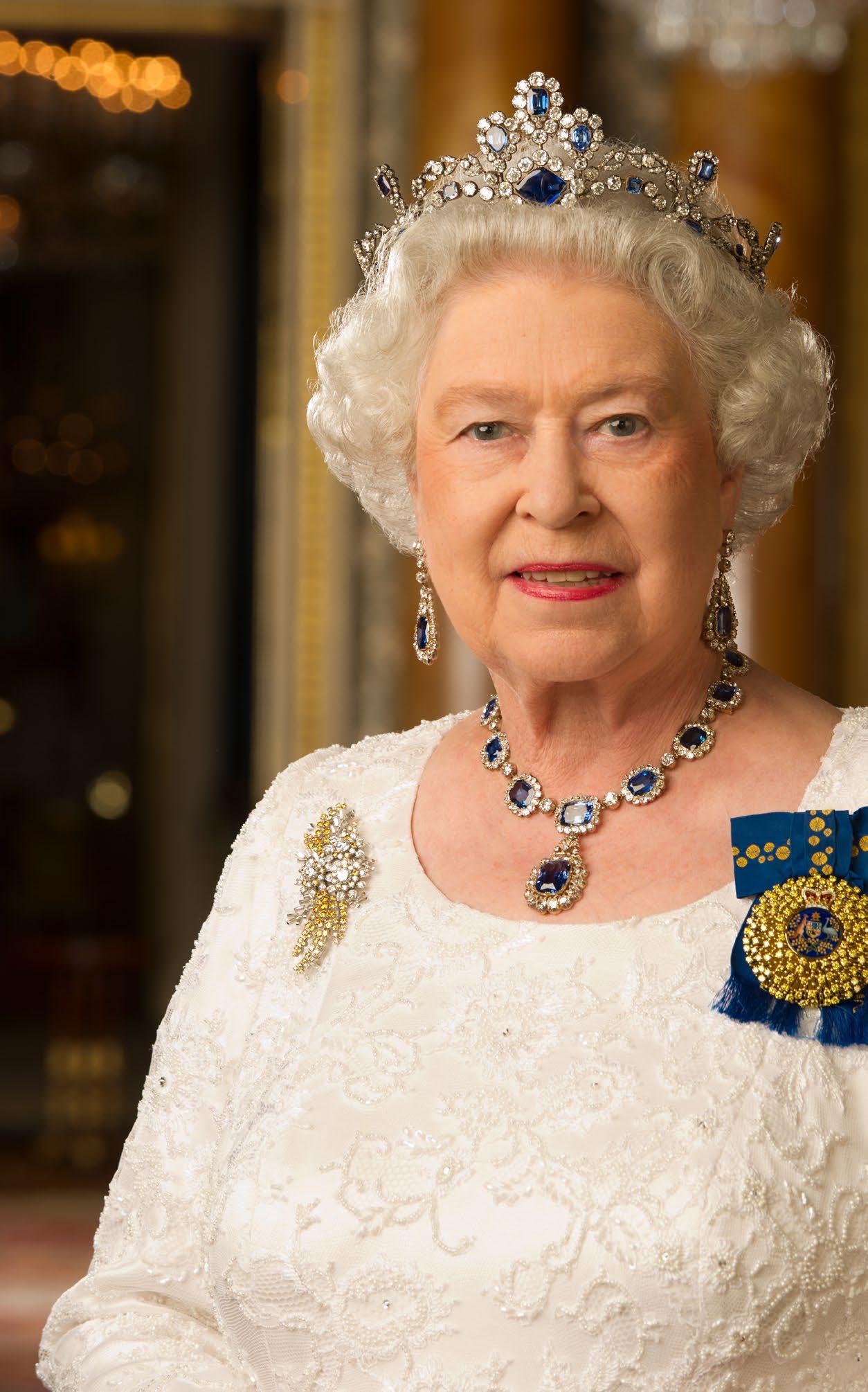
In Western Australia as a result of an amendment to the Constitution in 2017, s 75A specifies that the demise of the Sovereign has the effect of transferring all the functions, duties, powers, authorities, rights, privileges and dignities belonging to the Crown to the Sovereign’s successor; but has no other effect in law for any purpose.
“Uneasy lies the head that wears a Crown” said Henry IV according to Shakespeare. Statistically, 50% of all odd numbered
07

08 | BRIEF OCTOBER 2022
Special Feature
Mind, Body & Environment in the Legal Profession
Foreword by Catherine Stokes
BA LL.B (Hons.) MAICD, Executive Director, The College of Law (WA) and Accredited Mental Health First Aid Instructor
Welcome to this special edition of Brief. This edition enables us to reflect on various issues concerning health and wellbeing. In doing so, it provides us with the opportunity to be present and engage as learners, as well as members of a learned profession. One of my favourite quotes is from Eric Hoffer, who observed: “In times of change learners inherit the earth; while the learned find themselves beautifully equipped to deal with a world that no longer exists.”1
While merely reading this edition doesn’t mean you will inherit the earth as Hoffer promised, like all learning, it does better equip us to deal with a world that is rapidly changing.
Emeritus Professor Peter Handford’s article on James and Mary Coultas and the Law of Nervous Shock conjured up memories of a first introduction to the concept of nervous shock at law school. The image of the horse and buggy and the approaching train from that case stayed with me as a signpost of the moment when my understanding of the evolution and expansion of the law increased considerably. Concepts such as nervous shock were once so novel and now it is hard to imagine the practice of the law without it.
This issue also highlights an incredibly novel area of law by way of Neve Worthy and Professor Alex Gardner’s article on the Sharma case. They consider the possibility that Sharma could become an evidentiary precedent for litigation designed to target the real risk to health and wellbeing presented by climate change.
Natasha Fenner’s interview with John Button details the impact of his wrongful conviction and incarceration, including the implications for his health and wellbeing, currently the subject of a new exhibition at the Old Court House Museum.
Many of you reading this magazine will be aware that there is an increased level of psychological distress, anxiety, depression and substance use issues in the legal
profession and in the legal profession and law students compared to the general population. The best available national research informs us that at least 1 in 5 Australians experience a common mental illness in any one year.2 For lawyers and law students, the prevalence can be much higher.3 If you think about those numbers in the context of your own world, including your workplace, you will appreciate that many of our friends, families and legal professional colleagues may be experiencing mental health issues.
In that respect, I need to acknowledge that we have come a long way since I was one of many who began raising awareness of these issues 15 years ago. There is a multitude of initiatives which have greatly assisted in increasing awareness and opening up conversations, one of which is the 35,000 km motorbike journey described by Ben Bullock in his article. I related to his description of the timeoriented culture of legal practice.
I recalled a time while practising in London when I stopped cooking dinner and went to run the bath, pausing to register a thought that I needed to record both the time it had taken and the change of activity from one to the other. Although I was no longer physically at work, in that moment the cognitive approach to time, activity and outcomes took a while to leave me. I have found that tools such as those described by Lauren Rathbone in her article on the Search Inside Yourself Leadership Course can assist with making that cognitive shift when it is desirable to do so.
We now have a better grasp of some of the situational and dispositional factors which contribute to these higher levels of psychological distress within our profession. However, many of the changes required to address systemic and cultural factors are yet to materialise.
It is timely then that Barrister Heather Millar’s article on Workplace Culture Reviews highlights the impact of systemic

issues within an organisation’s workplace culture and the benefits of a culture review. The article references the high prevalence of bullying and sexual harassment within Commonwealth parliamentary workplaces and the mining industry. As we well know, legal workplaces are not immune.
In this issue you can read contributions from a selection of lawyers who generously share their stories about activities and interests outside the law, providing an example of the storytelling and shared humanity that Clarissa Rayward models so powerfully in her commentary.
The articles curated for this edition of Brief provide valuable insights into our shared sense of meaning and connection. My hope is that we can continue to learn from each other: to evolve and expand our understanding about health and wellbeing, just as the law and legal practice have evolved and expanded since the time of James and Mary Coultas in their horse and buggy. Long may these conversations about our shared humanity continue.
End Notes
1 Rich J. C. (1997). In times of change learners inherit the earth. The 1997 presidential address. Journal of neurosurgery, 87(5), 659–666. https://doi. org/10.3171/jns.1997.87.5.0659
2 Australian Bureau of Statistics, National Survey on Mental Health and Wellbeing. “Common mental illness” is defined as (in order of prevalence) anxiety, depression, and substance use disorders.
3 For example: Michalak, RT 2015, Causes and Consequences of Work Related Psychosocial Risk Exposure: A Comparative Investigation of Organisational Context, Employee Attitudes, Job Performance and Wellbeing in Lawyer and Nonlawyer Professionals, PsychSafe Pty Ltd, Brisbane, Australia; Bergin, A. J. & Jimmieson, N. L. 2014.
Australian Lawyer Well-being: Workplace Demands, Resources and the Impact of Time-billing Targets. Psychiatry, Psychology and Law, 21, 427-441; Kendall, C 2011, ‘Psychological distress and depression in the legal profession : summary of report’, Brief, vol. 38, no. 5.
Catherine Stokes, BA, LL.B (Hons.), MAICD is Executive Director of the College of Law Western Australia. She is a Mental Health First Aid Instructor and was a Finalist in the National Women in Law Awards for Wellness Advocate of the Year in 2019.
09
Passions Alongside the Law
Exploring ways legal professionals connect with environments outside the law to maintain a healthy
Daniel Estrin is a Lawyer and Partner at Estrin Saul Lawyers, Western Australia’s largest specialist immigration law firm, 40 under 40 winner (2021) and Lawyers Weekly Partner of the year (Migration) 2021.

When the tie comes off, Daniel is the lead singer and keytarist of progressive rock/metal band VOYAGER with 7 albums under their belt, countless Australian and world tours, Eurovision Australian finalist and currently on a 21 show tour throughout Europe:



Daniel: It’s a busy and fulfilling life.
It appears law and music are a perfect combination for a healthy mind – several members of the legal profession in Western Australia seem to have musical pastimes. There is a wonderful balance between the left (rational) and the right (creative) side of the brain which complement each other perfectly. The creative side helps the legal arguments and the rational/logical side helps with the endless spreadsheets, planning and organising you have to do as a musician (yes it’s not all just rockstar life).
I’ve been into music from an early age growing up in Germany; classical piano,
violin etc. This morphed into rock and metal music in my teens and the passion has never left me. I’ve always made sure I maintain the musical endeavours, despite going through what on paper looks like a traditional legal career. I’ve always had bosses that were music fans and understood what an amazing opportunity it is to be able to tour the world with a band, and formally thank them here for allowing me to flourish in this field. Now I thank my team and my business partner for being such incredible support while I am on tour.
Serious hobbies are important – people ask me: how do you do it all? The answer is simply: passion and drive, with that, anything is possible. Both areas of my professional life (and to an extent, the band is a calling and a profession, much like law) benefit from each other.
When I’m on stage, be it in Mexico City, Tokyo, Amsterdam, San Diego or back home in Perth, I consider myself the luckiest lawyer in the world for being able to do what I do!
10 | BRIEF OCTOBER 2022
Mind, Body & Environment in the Legal Profession
Morgan Solomon is a Director of Solomon Hollett Lawyers, an award winning firm in Perth specialising in commercial/corporate litigation, wills & estates, property & dispute resolution with a focus on providing practical legal advice. Outside of the office Morgan’s passion for the arts has driven him to a deep involvement in integral organisations within the arts.
Morgan: I am a succession lawyer. I tell people that this essentially means I help with the transfer of wealth from one generation to another, sometimes happily, but increasingly these days, somewhat unhappily.

By that I mean structured, considered and orderly estate planning usually has a happy ending (or at least a much better chance of having a happy ending)- but the wildly unpredictable outcomes of poor estate planning usually result in at least one beneficiary being unhappy and in dispute. At its extremes this manifests in litigation, which is always brutal and ugly.
I wasn’t always going to be a lawyer though. My first love was art, and when it came down to the wire at the end of year 12 my father (also a lawyer) said:
“Morgan, I didn’t want to be a lawyer but my father (also a lawyer) told me to. Its brutal, and ugly. Follow your love and go to art school.”
Which I did. My honours thesis in Fine Arts at UWA was on the Influence of Japanese Woodblock Prints on 19th Century French Impressionism. I have no idea why I chose that subject; 20th Century Abstract Expressionism has always been my favourite. But eventually the law was too strong a pull.
Anyway, this long winded introduction is to explain why I am still involved in the Arts.
I am the chair of the Arts and Culture Trust which came into being this year under new legislation, the Arts and Culture Trust Act 2021 (WA). Formerly I was the chair of the Perth Theatre Trust (PTT), and all of the assets under the PTT - the state owned and run theatres such as His Majesty’s, the State Theatre Centre (Heath Ledger), the Perth Concert Hall, Subiaco Arts Centre and Albany Entertainment Centre- now come under the Arts and Culture Trust.
The Trust’s remit is greater than the PTT though, and includes other cultural infrastructure such as the Perth Cultural Centre and other state assets to be
constructed such as the new Screen Facility. The Trust has expanded and exciting powers to activate State owned spaces and places and to assist in the strategic planning of the State’s future arts and culture needs and infrastructure.

Arts and culture matters: I believe in its value and that it makes life better. The greater the depth and breadth of arts and culture in Western Australia the better and more vibrant and alive our State is. I believe that access to arts and culture at all levels of society is intrinsic to a higher quality of life.
Being involved in the Trust means being involved in the very fabric and direction of the arts in Western Australia. There is no denying that it takes a great deal of time, but it’s deeply rewarding. In the knowledge that this Brief is focussed on mental health for practitioners, I cannot endorse participation in the arts enough as a way to keep a balance between the demands of the office and the world around us. Arts and Culture in Western Australia always requires lawyers with passion and energy to sit on boards and advisory committees. We often forget that our special skill sets are in demand - and not just from disgruntled beneficiaries.
11
Passions Alongside the Law
Isabel Inkster is a Solicitor with the State Solicitor’s Office and a member of the Law Society of Western Australia’s Young Lawyers Committee. When she isn’t busy on Barrack Street Isabel engages in a myriad of activities that would leave you wondering how she finds the time for rudimentary tasks like sleeping.

I sabel: Mental illness runs in my family. As a consequence, taking care of my own – and my loved ones’ - mental health is something I’ve always had to be mindful of. As a kid this meant having a close-knit family, counselling and ‘wellness days’ away from school (aka wagging, but with permission).
Choosing a career in law has only affirmed the importance of my ‘mental health regime’. I continue to combine those key tenets of connection, accessing professional help as needs be, and making time to play.
I have many hobbies, and despite practice, remain a rookie at all of them. But that’s the point. Distinct from my professional life, there is no competition or perfectionism when I am patching a leaky vase in the pottery studio, stacking it on my surfboard, or dancing in the dark for an hour at community dance group, ‘No Lights No Lycra’.
I’m particularly keen on getting out of the office and into nature. I am a committee member for Cambridge Coastcare, a not-for-profit which undertakes dune

restoration in the Town of Cambridge coastal precinct. We plant seedlings, build fences, and remove weeds & rubbish. This might not be everyone’s cuppa tea on a Sunday morning, but for me it provides a literal and figurative breath of fresh air away from my work in environmental law, and personal concerns about climate change. In addition to my Coastcare work, I can be found getting lost in Bold Park (yes, that can happen) and trying to keep my veggie patch alive.
Akin to going to the gym, or seeing a GP, these past-times are like preventative health measures for me. I recognise, however, that having the time and access to them is a privilege; and is something that I’m grateful for.
12 | BRIEF OCTOBER 2022
Ben Purser is a Senior Associate at Steinepreis Paganin, an independent law firm based in Perth and Melbourne and specialising in corporate/commercial law. He started at Steinpag as a graduate in 2015. When Ben isn’t in a court you’ll most often find him on a court (basketball court).

Ben: Growing up I was generally passionate about all sports, but particularly basketball. I remember going into the city as a young kid to watch the Perth Wildcats play at the old Perth Entertainment Centre. As a junior, I played with my local club, the Perry Lakes Hawks and loved the multifaceted nature of the game.
Part way through my law/commerce degree at the University of Western Australia I accepted a basketball scholarship to Augusta State University (in the state of Georgia, USA). The collegiate sports scene in the US is huge and although I was technically a “student athlete” the focus for me was basketball. We won our conference championship but lost in the final 8 of the national tournament. All in all, a fantastic experience!
I returned to Perth after one year in Georgia as I was offered a development player (<23 years of age) position at the Perth Wildcats. I spent 3 years with the Wildcats (while continuing my law/commerce degree at UWA). Highlights included travelling to NZ with the team and playing at the newly built Perth Arena in front of 10,000+ fans.
Ultimately, I wasn’t able to land a full-time contract with the Wildcats and when I aged out of the development player position, I shifted my focus to a career in law.
Since joining Steinepreis Paganin, I have continued to play in the Western Australian state league competition (known as NBL1) for the Perry Lakes Hawks. Basketball provides a great balance for me, allowing me to keep fit and switch off from work. It’s also great from a social sense in that you see your teammates 3 to 4 times a week and is why most of my closest friends were made through basketball.
Steinpag have always been super supportive of my basketball endeavours and have even sponsored my club. I hope other firms are equally supportive and genuinely encourage their employees to pursue passions/interests outside of work. It is not uncommon to hear fresh graduates or junior lawyers remarking that they have “no time” any more for X, Y or Z. I hope that by sharing my story young lawyers can see that its possible to keep these passions alive and, at least in my experience, is incredibly beneficial to health and wellbeing.

Mind, Body & Environment in the Legal Profession
13
Passions Alongside the Law
Danica Rizeski is a Disputes Lawyer at Birman & Ride, a modern Perth city-based law firm built on NewLaw ideals. In her downtime she trades the pen for the much mightier spatula as her alter ego @missmilkcakes.
I graduated from Murdoch University in February 2022 and was admitted as a lawyer in June 2022. My practice primarily concerns commercial and estate litigation. I had the idea of starting Miss Milk (@missmilkcakes) in late 2020. Although it was, and still is, casual and sporadic (with some way to go in respect of building a website and expanding my client base) Miss Milk began with personalised sugar cookies and has since moved to cakes (including wedding cakes). My favourite flavour is red velvet with raspberry jam and dark chocolate buttercream.
From my (very short) experience to date, law has its highs and lows. Sometimes your ego is inflated because the Master agreed with you on a point in your submissions, or because your partner praised you for something unique you added to the prayer for relief which has bolstered your client’s claim, but there will be times (no matter how competent you think you are) when your skills, intelligence and value are brought into question whether this be by your employer, a recruiter, a colleague, an opposing party, your client or the court (and sometimes all six at once). It is in these more difficult and humbling times that it proves invaluable to derive some morsel of support and confidence from other activities you are good at or enjoy doing – because it will not always be this profession.
As satisfying as the proverbial fight in contentious work can be, I consider
baking to be a welcome change from my career. The inspiration for many of my buttercream techniques comes from watching artists on Youtube. I also love being able to learn about food science, work with my hands and create structurally sound tiered cakes.


And unlike asking a client to put funds on trust to defend a matter that they have no choice but to or for recovery of a debt due in sums exceeding hundreds of thousands of dollars… dessert is never a grudge-buy.

14 | BRIEF OCTOBER 2022
‘Full Throttle: fun for bikes, bad for people’
By Ben Bullock, Law Society Council Member and Senior Associate at Steedman Stagg Lawyers


benbullockcooks Freedom Beach and View Point Resort - of all things, grab a pizza (I know) from Da Lorenzo. Italian bloke making bloody good Naples-style pizza cumberledgelisa What a fab pic! panca_siwi_soedadi Nice place...paradise.. sonyadaints Wow love this I wanna go there nicci_maxwell Looks like a fantastic way to watch the world go by raysiva_au How is this helping depressed people? All you are doing is making people who are not there depressed!!! nicci_maxwell Looks like a fantastic way to watch the world go by helenamargaridaferreira Wow... What an amazing view!!!!! lee.behan I hate you..... gauravkumar8713 Amazing place.
likes 2 DAYS AGO
a comment...
In September 2017, straddling a Hunter motorcycle, I left behind Perth, WA, and the legal profession. The compass was set nor’-west, bound for Perth, Scotland.
Earlier that year I competed in Season 9 of MasterChef Australia. I was hoping the 15-minutes of fame might draw interest in the ride and the cause I was riding for: raising awareness of depression and suicide prevention.

This was not a novel idea. West Australian Steve Andrews started the ‘Black Dog Ride’ in 2009, travelling solo around Australia by motorbike striking up conversations about depression, suicide and mental health. That single motorbike ride was the foundation of one of Australia’s truly wonderful mental health awareness charities.
Carrying Winston, the adorable plush-toy mascot of the Black Dog Ride, between the handlebars of a loud, red motorbike, provided the cute and fluffy segue into very serious discussions about things like the 9 people a day in Australia who die from suicide.
With Winston in tote, we covered 35,000km through South-East and Central Asia to Europe. It started countless conversations with people across more than 30 different countries and cultures. We talked not only of the sombre statistics, but also held uplifting conversations about life and the pursuit of happiness.
The common thread underpinning these conversations, across all languages, religions and creeds was, universally, an understanding of the need for balance. Ironically, there are few things lawyers do worse.
My awareness of a need for balance came somewhere in the Gulf of Thailand.
I posted a photo to Instagram of me in a hammock on a beach. In the comments, a good friend of mine asked ‘how is this helping depressed people?’ And added ‘all you are doing is making people who are not there depressed!!!’.

I often debated this with myself. I felt guilty taking time out from the ride to relax and self-indulge. Given the sobering charitable cause, it felt wrong to do anything other
than point the front wheel at Scotland, keep calm and carry on.
However, the societal pressure to stoically ‘trudge on’ through thick and thin was one of the ill-conceived social norms the ride aimed to combat. I soon reconciled the guilt of taking a moment to myself when I remembered one of the messages behind the ride was about encouraging people to take time for themselves; to do ‘that thing’ they had always wanted but kept finding life standing in the way.
Lawyers, and particularly junior lawyers, who I speak with feel a similar sense of guilt in their work lives. There is a pressure that keeps them from taking time out to relax or do something for themselves. As a profession, we are remarkably poor at stepping away from work and taking personal time. It is difficult to find even a few days away from the emails let alone a full week or month. And it is understandable.
We are ruled by court and client deadlines. The services we provide as trusted
508
Add
15
advisors are often such that if we aren’t immediately available, the work must necessarily be done elsewhere. In addition, the road to being a lawyer only begins after five years of university, a post-graduate diploma in legal practice, admission to the Supreme Court, two years of restricted practice and a sizeable higher education loan. Add five or ten years of practising to become even modestly proficient in a field of law on top of hourly rates that exceed the average Australian daily wage, and one can soon see how the view is taken that any time not spent billing ought reasonably to be considered as ‘time wasted’.
Our profession often values a work product on the time it takes to complete, rather than the outcome that is achieved. That model is in direct opposition to pursuing balance. Decisions about how we spend our time will always tend to place work above leisure, balance will be difficult to find and our mental health will suffer. A culture that values ‘time’ over ‘outcomes’ creates an unhealthy level of stress and anxiety. It is a culture that punishes us for taking ‘downtime’.
There is a lot of downtime across a 35,000km motorbike trip. Coming from a workplace culture that is so time oriented, it took me a long time to learn that not a single day of that journey was wasted. I had


the throttle pinned for the first few months of the ride, racing to make up for mishaps and unforeseen delays that cost me time. It was only later that I realised that the mishaps, the mistakes, the downtime; they were the best bits.
Hours upon hours were spent idle at border crossings. Days were ‘lost’ attending to repairs and reversing the work of a virtuous (yet entirely incompetent) welder in Nagaland. Weeks were consumed negotiating with government departments when the bike was rejected by Indonesian customs. Months were spent on the couch after breaking a knee. In fact, there might have been more days that didn’t go to plan than those that followed the script. However, it was during this downtime that I reflected on my travels and started to genuinely engage with the people and cultures that made the journey special.
When my chain broke in the Javanese mountains all I could think about was the timetable for the fortnightly ferry to Malaysia. How would I make up that time?
Would I have to start riding through the night? However, that downtime at the base of Semeru Mountain was spent with the kindest, most caring community. They took me in, showed me their culture, fed me their mouth-watering local cuisine and taught some very industrious repair
techniques. I made friends and memories for life.
When I crashed in a monsoon in Thailand, I didn’t worry about my bike or body. My first concern was about my visa expiring and whether I would be allowed into Myanmar. How would I make up that time? Would I have to start riding through the night? Again, that downtime in the Titiwangsa Ranges was spent with the kindest, most caring community. Again, I was taken in, shown their culture, fed their mouth-watering local cuisine and taught some very industrious repair techniques. I made more friends and life-long memories. It was during forced downtime that I enjoyed myself the most. I could engage with people. I wasn’t thinking ahead to ‘what next’. I wasn’t setting timetables. I wasn’t driven solely by the pressure to ‘be productive’.
Legal practice doesn’t have border crossings and mechanical failures to force you into downtime. Every now and then the IT might play up. But it’s not the same thing. In the 10 years I have been in the profession, people have started to do more than pay mere lip service to ‘worklife balance’. More people are working from home and having ‘unplugged’ days. A recent trend encouraging people to avoid sending emails outside of work hours is gaining momentum. We are starting to embrace downtime. However, while our industry-wide billing model dictates that value is derived by time spent on a matter rather than outcome achieved, it will be difficult to truly strike balance.
For this special ‘mental health and wellbeing’ edition of Brief, make space for yourself. Not everyone will think that spending day after day on a motorbike in monsoonal rains or beating desert sun is a valuable way of spending time. However, we all know we should, but don’t take, the literal, or metaphorical, time out from our respective journeys to spend guilt-free downtime in a hammock by the beach in Thailand. Make it happen and don’t apologise for it, because full throttle is fun for bikes, but bad for people.
Ben, his loud, red motorbike and locals in the Myanmar highlands
Ben, touring Indonesia with his faithful (mostly) wheels and Winston the plush-toy mascot
16 | BRIEF OCTOBER 2022
Mind, Body & Environment in the Legal Profession

Happy Lawyer, Happy Life
Reflections by Clarissa Rayward
Clarissa Rayward,
Director and Creator of Brisbane Family Law Centre, also known as the ‘Happy Family Lawyer’, has forged a community around the concept of ‘Happy Lawyer, Happy Life’ - a subject about which she has written books, created a podcast, websites, coaching and support programmes. This article is adapted from a Law Society CPD seminar (via webinar) which will be presented by Clarissa, on 18 November 2022.

Six years ago, I had finished writing a book, Happy Lawyer Happy Life and looked at following it up with a podcast series. I had spent a few years, some might call it navelgazing, others might call it researching, this question of ‘What does it take to build a career in law that has at the heart of it a happy life?’.
I pondered that question as I myself had been struggling with life as a lawyer. From the outside, I’m sure, I was perceived as a successful lawyer. I ran a firm, it had a whole bunch of lawyers working in it, and it seemed to do all of the things that a law firm should. And yet as a human being, I was exhausted, burnt out and struggling to find meaning and connection with the work that I was doing. My story is not unique. Many of us have, or will, experience these feelings at some stage in our career. At the time that I was questioning whether I could continue to be a legal professional, much
research was being published about the high rates of psychological ill health in our profession. To some degree, I am lucky I have not experienced depression, anxiety, or any other diagnosable mental health condition, but I have experienced what is now commonly referred to as burnout.
The best descriptor I’ve heard of burnout is the sense of an elastic band being stretched so much that it can’t stretch back. That was how I was feeling. Like I was completely stretched and there was no space to bounce back. It felt like my life was running ahead of me and I was forever trying to chase it. I did not want to go to work, felt disconnected from my family and didn’t feel like the best version of myself. I knew there was more to life, but I didn’t know how to find it.
I also knew that I didn’t want to throw in the towel and leave behind all of the years that I put into being a lawyer. I’m a good lawyer, sometimes even a great lawyer. But when I was feeling exhausted, I knew that I could not show up to be the best version of myself to my clients. While there was much research that told us all about why lawyers were leaving the law, there was very little that told us about what we could do to stay. And I guess that’s where I’ve stepped in. These past few years I have honed in on this question of what genuinely does it take to build a career in law that has, at the heart of it, a happy life. Have I found the answer?
I think I have, and I don’t think there is one simple answer to that question. Six years of speaking to lawyers, all around Australia and many overseas, has shown us that
there are so many different ways to be a lawyer. It has also shown us that at the heart of what makes for a happy lawyer is a meaningful life.
Happiness is an emotion. And some would suggest that emotions and the practice of law are not things that necessarily fit together easily. Happiness is also very much a personal feeling. What drives my happiness will be different to what drives yours. But what my research has shown is that there are a few core things that all of us need to live a happy life.
I’ve come to accept that for me to be a happy human being I am required to see my life as one continuum, to see my role as a lawyer as being as valuable, as meaningful, and as important as my role as a mother, wife, friend, and all of the other hats that I wear. One is no less important than any other. Some will pull in various ways at various times, some will require more attention, but at the end of the day, I’m one person with all these different parts, interests, talents, and goals, and all of them need to be present in my life for me to feel happy.

Research tells us that happiness does matter, particularly in the workplace.
Happier people are more productive, make better decisions, are healthier, and ultimately live longer. Happier people are more likely to make a positive contribution to society. And happiness is contagious. If you hang out with happy people, there’s a strong chance you’ll be happier too.
Those things matter, I think, in a legal workplace where we’re being asked to deal with really difficult situations or
17
clients who are in sometimes the most challenging circumstances of their lives. The content of the work that many of us do is deeply confronting and so, how we feel in our workplace will make a significant difference in terms of how we can show up and maintain the energy required to do the work that we do. Happiness is not the pursuit of some fluffy or nice-to-have luxury. It’s about helping people to live better and in turn create a society that is more productive, healthier, and cohesive. When I was struggling to find my way in the legal profession, I found it hard to find examples that demonstrated the way to find a career that worked for me and enabled me to maintain a life that contained the meaning, purpose, and connection that I hold so dear. I’m confident that having now spoken with 237 what I like to call, ‘happy lawyers’ as part of the follow-up podcast series, I have found many examples of lawyers that just like me have had their ups and downs, but have found a way to build a career in this profession that they (mostly) love.
Those stories have shown us that happiness really is different for all of us, but that there are common themes, a sense of belonging, purpose, and meaning, and a feeling of contentment, pleasure and joy.

I have learned so much over the past six years and it is hard to summarise that down to a few core points, but to bring it all home I thought I would share with you 10 things that I’ve taken from all of these guests, these many hours of chats, and my pondering in between.
1. There is space for all of us in this profession.
Apparently, there are over 70,000 solicitors in Australia. It’s extraordinary to think how many of us actually exist and hold down careers in this profession. And yet there’s a myth, the jobs are few and far between, it’s hard to get your foot in the door, and it’s hard to be successful. I really do believe that is a myth. There is space for all of us in this profession. And if there isn’t already a seat at a table that you want to be at, then you’ve got the scope and ability to create your own seat at a table that fits for you.
I think we can also thank the COVID pandemic for completely breaking some final barriers that some would say still existed in our profession. The opportunity now to work flexibly, to be anywhere, and to establish a business that could perhaps be run from your dining room table, is more prominent than ever before. Our clients’ expectations have shifted, because they, like us, have had to navigate the impact of a global pandemic and all of the joy that was thrown at us as a result. The willingness now for people to do law business online has completely opened up doors for lawyers all around this country.

And I’ve seen it in my friends. So many of my lawyer friends have opened businesses in the last two years, often from their homes, serving clients nationally, without any of the barriers that may have existed to that type of business model only a few years ago. I do believe that there is space for all of us in law.
There is no one way to be a lawyer.
There really is no one way to be a lawyer. And the more lawyers I spoke with, the more interesting ways I found to actually practice in our profession. I guess if you define a lawyer as being someone with a practicing certificate, then sure there are perhaps more restrictions on what you can do. By putting aside practicing certificates and thinking of lawyers as being people with a particular skill set for problem solving and critical thinking, then suddenly there are no end of opportunities for all of us.
3. No one has it all worked out.
Every lawyer I spoke with, at some point in their lives, has overcome one, if not many, significant hurdles and no one has it all worked out. And despite perhaps the glossy professional website or the social media platforms or whatever other perception we have of those around us, everyone is navigating many different challenges as they go about their day to day. But those that have found a way to be at one with the challenges that life likes to throw them, who are flexible, and who try as much as they can to take it all in their stride, seem to be the ones that ultimately find happiness, even in sadness.
Throughout the six years of my podcasts, I’ve certainly lived no end of life’s challenges. Losing my brother to suicide in the first few weeks, losing my best friend to brain cancer halfway through
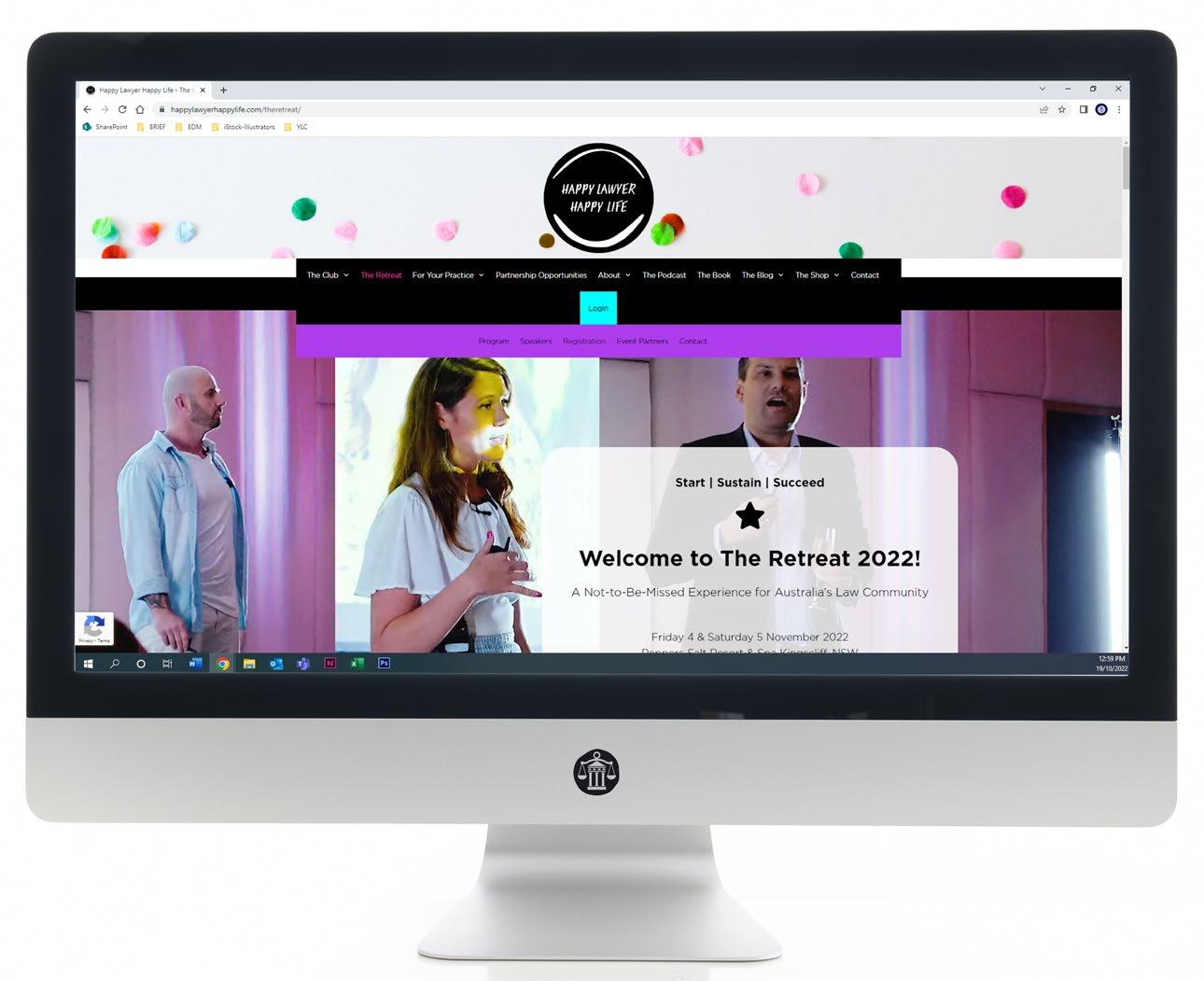
Clarissa’s Happy Lawyer Happy Life website is a hub for a myriad of resources including her book, podcast, speaking appearances, annual retreat, coaching and more.
18 | BRIEF OCTOBER 2022
Mind, Body & Environment in the Legal Profession
2020, and losing a number of professional colleagues in the last two years to health, mental health, and other of life’s challenges has had me asking lots of questions about what is the purpose in all of this.
I’ve found comfort from the conversations with many of my guests about how they themselves have navigated loss of life, loss of health, loss of career, and all of the other difficulties that get tossed at us at various stages of our days. No one has it all worked out and everyone is just doing their best with whatever tools they have in that moment.
4. We really can tackle the unnecessarily high rates of psychological ill-health in law.
When I started this work, it was to try and build resources for all of us to tackle what continue to be high rates of psychological ill health in our profession. There has been no end of research confirming that this remains the case, but little research into just what it takes to overcome those challenges.
There are things that we all need to do as individuals to give ourselves the best shot at managing the many stresses that come at us in life, not just through our careers.
Health - focusing on making sure that you are showing up as the healthiest version of yourself. So, sleeping, eating well and exercising and making that part of your everyday. Having a positive attitude and applying that to everything you do. Connecting with your purpose, the reason for doing what you do and reminding yourself of that even on those really tricky days. And finding passion in what you are doing, which may not always be connected to your career.
Creating space in your life for the things that bring you joy, just because, whether that be writing, reading, playing with your kids, hanging out in the garden, going for a walk in the sun. The things that bring us joy are often not massive and giant and expensive, they’re often teeny tiny, but they’re the things that get forgotten and they make such a difference to how we feel. And finally, you, showing up as yourself, not being afraid to just be who you are, and enjoying that authenticity for all that it brings.
Those individual traits of what ultimately brings us happiness are within the control of each of us as individuals and by crafting our lives around those drivers of happiness, we have a great chance at reducing psychological ill health for each of us.
Structurally our profession has grown in such a way that it ultimately fostered work practices that are unhealthy when it comes to mental wellbeing. Overworking, competitiveness, and adversarial lawyering are all in conflict with what it takes to be a content and happy person. And perhaps the biggest driver at the moment of stressed out lawyers is the pace at which our profession is operating.
The last two years have not assisted this at all. The ability now to work from anywhere and move between life at home and life at work almost seamlessly has of itself blurred the boundaries even further between what is a work- life and what is a life-life. And we’re seeing the impact of this on how lawyers feel. The expectation that I can be sitting, waiting to appear in court by phone or video and receiving emails from colleagues at the same time in the same court matter requiring me to respond whilst trying to listen to a judge is an extraordinary situation for any of us today. And yet it seems to be the expectation now that we’re somehow checking our emails whilst appearing in court, whilst answering phones, and who knows what else.
The work that still needs to be done is on these structural practices that make our industry unhealthy. These are things that are within the power and control of each of us, particularly those who are leaders within our profession. We need to change how we work and we can do that by simply saying, no. We can still be successful, high performance, great lawyers, but create these professional boundaries that will enable each of us to find the mental space to recharge and reconnect. You cannot lawyer 24/7 and do it well. We now know the answers. It’s up to us to implement the change.
5. There is no such thing as work-life balance
Work-life balance is highly connected in the conversation of happiness, but it’s no secret - I am not an advocate for the concept ‘work-life balance’. For me, it brings up pictures of the scales of justice. I associate the idea of balance with equality, and I know that in the moments in my life where I’ve tried to create this sense of balance or equality between my life as a lawyer and the other parts of my human life, I’ve failed dismally. Instead, I’m an advocate for work-life integration.
The quote, “There is no such thing as worklife balance, it is all life. The balance has to be within you,” sums it up well.
Every single one of the lawyers I
interviewed is juggling so many different hats and none have it all worked out, but I think most of them have found a way to accept that their lives as lawyers and their lives outside of law are all just one part of one big life. And somehow, they have found the balance within themselves to navigate the different roles that they have.
For me, the secret in all of this has been to focus on presence wherever I am, whatever I’m doing, to be present in that moment, doing that thing and not trying to ponder what I might need to do next or think about what I should have done yesterday. That is a constant work in progress for me. And some days I’m great at it and other days less so, but also seeing life as a bit of an adventure and accepting that some days go to plan and many don’t, particularly in the life of a family lawyer. I think the word balance should be tossed out of the window when it comes to talking about work and life, and instead, we should adopt the concept that it’s all just our lives. And at various times in our lives, our careers will pull our focus, and at other times in our lives, our family, friends, health, and hobbies will pull that focus just as much. And all of that is okay.
6. What is a successful life is entirely up to you.
There are many traditional or stereotypical markers of success that can distract us in law. Some of those are connected with status, power and money. When it comes to creating a successful life for yourself, you need to sit and ponder what that actually means for you, define it, chase it, and make your decisions accordingly.
What makes for a successful life will ultimately be different for all of us. What’s important is to chase your version of success and not someone else’s. And to do that requires some thinking.
There is a powerful but simple framework for working out just what a successful life looks like. Three simple questions can help you work out what matters most to you. And from there, will help you to make decisions not only about your career, but about what you are going to do with all parts of your life. “Ask yourself, if you were very sick, what would you get out of bed for? Thinking about a person that you most respect, if they were to compliment you, what would they say? And finally, when you are with your besties, what do you love talking about?”
Sitting in the answers to those three questions will be all that you need to work out, is this path that I’m on, is
19
this decision I’m about to make, is the career I am choosing the right one for me right now? The beautiful thing about life is when we make a decision and ultimately think, “Maybe that wasn’t the right decision for me.” It’s okay. We get to change it. A successful life and our definition of this, will change for each of us over time.
Lawyers that have achieved success, have a clear sense of what that means for them and make their decisions accordingly.
7. There is such power in storytelling.
All of us have a compelling story to share. We humans have been telling stories for more years than any of us could imagine. Through storytelling we are able to share connections and experiences and learn from each other.

Just the simple opening question, “If you weren’t a lawyer, what would you be?” is such an interesting conversation starter that I encourage you to use with your colleagues. It invites everyone to ponder perhaps a goal or a dream, an idea that they may have had in the past or have now, and it is an easy question to ask during a conversation that takes you outside of the professional realm. When we allow ourselves to share little snippets of our life outside of the law, we’re able to build connection and through that, trust. Our profession has been known as a collegiate one for years, but now it is bigger than ever before, and it is harder therefore, to build these relationships with others.
By sharing a snippet of your story and inviting others to do the same, you’ll build those relationships within our profession. And it is within those relationships that you’ll find the connection, support, and meaning that makes this work possible.
8. Is it about a happy life or perhaps a meaningful life?
I talk happiness all the time, and don’t get me wrong, I do believe in finding ways to live a happier life, but I think that is because I’m searching for a slightly deeper purpose, and that is to build a meaningful life. Through a loss of people deeply close to me these last few years, I have really been pondering that big question of, what is this all for?
For me, whenever the end comes, I know that I want to look back and feel that I have lived my life in a meaningful way. That doesn’t necessarily mean being famous or rich, for me it means making an impact in some small way, every single day, in everything that I do. It means giving my best to everything that I do, and if I’m not giving my best, it’s usually a sign that it’s not something I need to be doing. And it means spending every minute that I can with the people who I love most.
9. The power of community.
When I started my podcasts, I had never pondered that it would ultimately create a community of lawyers all around our nation. As each guest shared their story and listeners connected, they would reach out afterwards, often emailing the guest, connecting with them on social media, sharing snippets of their stories, letting them know what they appreciated, and building relationships. The show has been downloaded and listened to well over half a million times. Half a million listeners is an extraordinary number of hours of storytelling.
I never anticipated the community that would form through the shared experience and the storytelling and the connections between guests and listeners as a result. We’re human beings. We are social. We
are biologically wired for connection.
Community sits at the heart of all of this. Our profession has been known as being collegiate, but the bigger we get, the harder it is to find your place, your tribe within the many thousands of us that now exist worldwide.
The power of these communities is something yet to be fully explored. There are obvious advantages in terms of referrals, notoriety, brand, and all of those other business type things. But if we come back to that meaningful life, those connections are the things that give us purpose.
10. Our shared humanity.

If we were to sum up the power of the Happy Lawyer, Happy Life for me, it sits in this idea of living our shared humanity.
Individual conversations, sharing personal stories of success and challenge, or relationships between colleagues, highlights our shared humanity.
A shared humanity involves a higher or a deeper level of connection because it’s not just with individuals, but instead with the collective. Even though we might be lawyers from completely different parts of the globe, completely different practice areas, or completely different types of businesses, there are commonalities and connections that cannot be ignored. Those similarities enable each of us to feel that we are part of something bigger than ourselves. We create a sense of a shared identity that start to make our differences irrelevant. And importantly, that brings all of us together.
Within this sense of connectedness, this shared humanity, lies the answers to building a profession for the future that has at the heart of it wellness, or perhaps as I like to call it, happiness.
Leave a Lasting Contact us today to find out how! Support Future Generations with your Gift in Will childcancerresearch.com.au admin@childcancerresearch.com.au FUNDING RESEARCH INTO ALL CHILDHOOD CANCERS - FOR OVER 40 YEARS . Suite 3 / 100 Hay Street Subiaco WA 6008 9363 7400 Legacy WALawSociety-Oct22.indd 1 18/10/2022 21:13 Mind, Body & Environment in the Legal Profession 20 | BRIEF OCTOBER 2022
The Psychological Impact of Being Wrongfully Convicted: Interview with John Button
By Natasha Fenner, Museum Curator, Old Court House Law Museum

In the early 1960s two young Perth men, John Button and Darryl Beamish, were wrongfully found guilty of crimes committed by notorious serial killer Eric Edgar Cooke. A new exhibition at the Old Court House Law Museum examines their long path to exoneration in the early 2000s, specifically the evidence that proved instrumental for each man in overturning the wrongful conviction that has left lifelong psychological scars.
In 1963, on his 19th birthday, John Button was charged with wilful murder for the hit and run killing of his girlfriend, Rosemary Anderson. After helping police with their immediate initial inquires, John, still in shock from discovering his girlfriend severely injured, was driven back to police headquarters. John explained that he was then subjected to brutal questioning during which his interrogators accused him of lying and punched him in the stomach. It was during this period that he was told Rosemary had died.1
The strain of losing Rosemary combined with the mental and physical intimidation of the detectives was too much, and John says he broke and confessed to a crime he did not commit. John was not told that his parents were sitting in the corridor waiting to take him home. No lawyer had been present during the questioning and signing of the statement and confession that were drafted by the interrogating officers.2
However, that night was only the start of John’s psychological trauma. After being charged, he was sent to death row at Fremantle Prison to await trial, knowing that a guilty verdict would see him sent to the gallows. John was spared this fate, being found guilty of manslaughter and sentenced to 10 years imprisonment. He was released on parole from Karnet Prison Farm in late December 1967.
Writing about the impact of a wrongful conviction, Leslie Scott says that most people could not imagine the injustice of being ripped out of their lives, their communities, for a crime they did not commit.3 The psychological impact on the wrongfully convicted is ‘vast, severe and long-lasting.’4
While in prison John took an art course to try and concentrate on other things. Desperate to have Rosemary near, John completed this sketch, which he pinned to the wall in his cell. Courtesy John Button.

The impact continues after release with the struggle to reintegrate into a society that has moved on and still views them with suspicion. Scott lists poverty, societal and employment discrimination, and difficulty rebuilding relationships as issues that impact the mental health of the wrongfully convicted.5
John Button, the victim of one of the worst miscarriages of justice in Western Australian history, has kindly agreed to share with us the impact that his wrongful conviction has had on his mental health.
Q: How has the experience of being wrongfully convicted and incarcerated in early adulthood impacted your life?
A: From the moment I found Rosemary’s body in the sand, unconscious, my life changed forever, for the worst. For the
five years I was in prison I found the nights to be horrific. I paced the floor till the early hours of the morning arguing with an imaginary jury and judge. I kept myself busy in study to take my mind off the loss of my freedom.
After my release I found myself trying to pick up the pieces of my life as though there was no time gap between going in and coming out of prison. I was to find that the life that I once had was gone for good; the friends and things I used to do were no longer there.
Marriage and children gave me a purpose for life, but even that could not shake off the serious depression that I was sinking into. Medication only dampened any feelings of loss, but it also took away any feeling for my wife and children. The
21
Mind, Body & Environment in the Legal Profession
black cloud over me intensified until one weekend I realised I had taken too many sleeping pills.
Fearful for my life I took a long drive into the country at midnight where, naturally, I fell asleep at the wheel. Dozing on and off I collided with two white posts and finally ended up speeding across a freshly ploughed paddock at 100 km per hour. Not knowing what to do a voice immediately screamed in my ear, “turn left”, which I immediately did. It led me to the embankment from which I shot up onto the road and pulled over into a truck bay to sleep.
Believing in divine intervention, I asked a God that I had never believed in to take my life and heal me. I also asked that he give me justice in my lifetime. That decision was to shape my life and set me on a path I never dreamed of. My life changed from one of despair, to one of hope and purpose. I started finding love and happiness in my wife, Helen, and family. However, there was no closer to the events leading up to my imprisonment or the seven years following, and there never will be, but having someone bigger has given me blue skies and opportunities to help others that suffer like I did.
Q: How has your family been impacted?
A: My wife, Helen, has stood by me through all the most difficult times. After we married, we started a family straight away. Helen was prepared to take over everything to allow me to heal, even to the point of coming out to the building site with me so that I could try and spend a whole day at work. Otherwise, on my own I would pack up after a few hours and drive back to the Claremont area where I had spent so many wonderful hours with Rosemary. She would work beside me, her hands bleeding and sore, labouring for me as well as caring for the children in the playpen on the grass under the tree. She would then drive home and proceed to cook, wash and iron so that none of the other duties she had fell behind.
The children grew up wanting to be there for both of us; determined to make this whole experience work for them and to rise above the stigma of a killer father. My son, Gregory, worked first as a veterinary surgeon, then 5 years later went back to medical school and is now the director of emergency services at Orange Hospital, New South Wales as well as being a Lieutenant Colonel in the army reserves, training medics. My daughter, Naomi, is a child and family therapist specializing in the
use of puppets to converse with children.
Q: In a case as high profile as yours, how difficult has the stigma from society been to deal with and has it continued to impact you despite your exoneration?
A: The hardest criticism to bear was that of Rosemary’s parents, who accepted the police position of my guilt. Even after my exoneration Mrs Anderson stated that “You took her out that night and never brought her home, so it’s your fault.”

On many an occasion builders that I worked for would not pay, telling me that if I wanted my money to take them to court, knowing that I would never step inside a courtroom again.
There were others that would pay but
believed that I was guilty because I confessed. Their reasoning was that they would never confess to a crime they hadn’t committed no matter what happened to them, therefore I must be guilty.
Interestingly when the programme “Australian Story – Dancing with Strangers” was aired in 1998 and the follow up show, “Murder He Wrote 1-2” the public was invited to respond online; there was over 1000 letters and only one negative one amongst them.
Q: It took 39 years for your wrongful conviction to be overturned. Did exoneration make a meaningful difference to your mental health?
A: From my conviction in 1963, the next 39 years of my life became a mission to prove my innocence. It was all geared towards
John and Helen Button on their Wedding Day, 9 November 1968, Koonerwarra Presbyterian Church, Manning. Courtesy John Button.
22 | BRIEF OCTOBER 2022
the verdict handed down by the Chief Justice David Malcolm in 2002 in which he said he had come “to the conclusion that the verdict must be regarded as unsafe and unsatisfactory on the grounds that there has been a miscarriage of justice.” I was overjoyed and at the same time numb. I found it hard to believe that I had won and that all the fighting was finished.
However, after a fortnight I began to realize that nothing had changed; all those that had believed still believed and those that hadn’t possibly still didn’t.
Having nothing to fight for left me in turmoil so I looked for the next stage of my life, and that was to be the setting up of the Innocence Project. Those that helped me took it to Edith Cowan University, where they created the Innocence Project unit and the work is continued by Law students that I have the privilege of working alongside, following up on cases that I have been pursuing for the last 20 years.
Q: The current Attorney General, John Quigley, was quoted in the media in 2012 as stating that you were ‘a victim of state crime’ and that the discretionary ex-gratia payment you received from the State Government was ‘miserable’. How did the lack of transparency involved in its determination impact you? Would specific legislation for wrongful convictions help victims to feel something closer to justice had been achieved?

A: There are many important changes that must be made to the justice system. Certainly, one of those is proper compensation. This must be through the courts as in any compensation case where the victim has suffered due to the negligence of others. It must take into account the total financial cost of loss of
wages and all expenses related to the whole procedure of the charge. There must also be an amount paid for the emotional pain and loss of freedom.
To be told that the Government is not obliged to offer any anything at all only adds salt to the wound.
I contacted Mr Quigley after he became Western Australian Attorney General and reminded him of his comments in the paper. I asked if he would now put right what he deemed to be an entirely unacceptable outcome; he refused.
Q: An article written by Laura Ensigner, published in 2019 in the Griffith Journal of Law and Human Dignity, states that ‘Australia currently fails to provide any kind of short-term or long-term holistic support for exonerees.’6 What support would you have found beneficial to help you and your family deal with the impact of your wrongful conviction and incarceration?
A: Unfortunately, there is no support or programs for this type of injury. The closest psychiatrists have come to the problem is to treat it as PTSD, which doesn’t cover the many facets of a wrongful conviction.
In the case of being convicted of a loved one’s murder, you firstly have the heartbreak of losing the one you love. In my case, there was the trauma of facing the gallows. Then having to serve a long prison sentence in an horrific environment while trying to deal with the grief and trauma. Upon release you do not return to a sympathetic and loving society, as happens in an overseas hostage situation. Rather, you are thrown to a pack of wolves in a society that believes you to be the worst of the worst. You are not supported financially and are expected to find your
own solutions. I feel the only solution is to be paid proper compensation so that you can find your own solutions.
Q: You have rebuilt your life successfully – you have a family, you have written a book about your experience, and became involved with the Innocence Project. What advice can you give, to help people overcome adversity and challenges with resilience and strength, as you have shown?
A: You need to find someone that will support you no matter what. Someone that understands what you are going through, and don’t be afraid to call out to those that have given their pledge to help. Also, you need to find a purpose for your life to move forward. One pursuit, as I found, is to externalise it by writing it all down. Importantly, when all hope is gone, turn to God.
Visit the Old Court House Museum’s new temporary exhibition, When Justice Goes Wrong: John Button and Darryl Beamish to learn more. The museum is open Tuesdays to Fridays from 10am to 4pm.
End Notes
1 Button, J. (1998). Why Me Lord! The John Button Story p. 49.
2 Button, J. (1998). Why Me Lord! The John Button Story, p. 50.
3 Scott, L. (2010). “It Never, Ever Ends”: The Psychological Impact of Wrongful Conviction. American University Criminal Law Brief, 5(2), p. 10.
4 Brooks, S. K. & Greenberg, N. (2021). Psychological impact of being wrongfully accused of criminal offences: A systematic literature review. Medicine, Science and the Law, 61(1), p. 52.
5 Scott, L. (2010). “It Never, Ever Ends”: The Psychological Impact of Wrongful Conviction.
American University Criminal Law Brief, 5(2), p. 10-11.
6 Ensinger, L. (2019). Abandoning the Innocent: Recommendations for the Long-term, Holistic support of Exonerees. Griffith Journal of Law & Human Dignity, 7(2), p. 238.
Darryl Beamish emerging from Court embraced by John Button after his exoneration, 1 April 2005. Courtesy Post Newspapers Group.
23
Unhappy Families
the Revealing Power of Workplace Culture Reviews
By Heather Millar, Barrister, Francis Burt Chambers

Unhappy workplaces, like unhappy families, are each unhappy in their own way. The melancholy details of a number of highprofile workplaces have been publicised as a consequence of inquiries in recent years in Australia. Parliamentarians, judges in our highest court, white collar executives, members of Australia’s Special Forces, casino croupiers and mine site workers have all been called to reflect on their workplaces and their colleagues – the rules they play by, the risks they take and, in some cases, the ruin they inflict.
In each case, workplace culture reviews have provided valuable insights into the respective organisations’ workplace cultures. They have provided external tribunals and regulators detailed insight into the environment in which individuals in these organisations have worked, and the nature, extent and root causes of the organisations’ cultural malaise. Hopefully, they have also armed organisations with sufficient information to allow them to plan for a systematic remediation of the problems the culture reviews have revealed.
A. Workplace culture and workplace culture reviews
Culture reviews seek to understand and assess the underlying health of an organisation’s workplace culture. Workplace culture can be defined as the shared values and norms that shape the behaviours and mindsets of the individuals who make up the workforce. More colloquially, workplace culture is ‘what people do when no one is
watching’. Crucially, a workplace’s culture can drive or discourage misconduct.
Culture reviews are often carried out by external HR professionals, consultants and lawyers. Qualitative and quantitative data is collected through a range of means including interviews, focus groups, written submissions from employees, contractors and third parties, and largescale surveys. The quantitative (survey data) and qualitative (written submissions, focus group data and interview responses) materials are analysed in a bid to understand the organisation’s workplace culture and identify its strengths and its vulnerabilities. A culture review does not stop at identifying these issues, however. It will also seek to establish the underlying root causes of the cultural issues, the drivers exacerbating the problems and any barriers which might exist to remedying them.
Despite their prominence in recent inquiries and commissions, the workplace culture review – a marriage of human resource soft skills and management consultant data sets – remains a relatively alien concept to many lawyers. This article seeks to start demystifying the process and its benefits.
B. Recent high profile workplace culture reviews
Increasingly, public inquiries into crisisstricken organisations and industries have included in their scope a review of the relevant workplace culture. The Royal Commission into Misconduct in the Banking, Superannuation and Financial Services Industry involved detailed discussion of workplace culture issues within those industries. The allegations of sexual harassment made by former associates to Justice Heydon led to an investigation and workplace culture review (the details of which have remained largely confidential). One section of Major General Brereton’s Afghanistan Inquiry Report was
dedicated to a discussion of ‘Strategic, Operational, Organisational and Cultural Factors’.
Further high-profile examples of reports in which the details of culture reviews have been published include:
a. Sex Discrimination Commissioner Kate Jenkins’ Set the Standard report on safety in Commonwealth parliamentary workplaces;
b. The Bergin Inquiry and the Victorian and Western Australian Royal Commissions into Crown Casino’s operations in New South Wales, Victoria and Western Australia (all three of which dedicated significant attention to Crown’s organisational culture); and
c. Elizabeth Broderick’s Report into Workplace Culture at Rio Tinto
In each case, these inquiries and reviews have been conducted in response to public and private concern about legal and regulatory compliance. In some cases, these concerns have been raised by employees or ex-employees who have blown the whistle on practices which threaten employee and third-party safety (both psychological and physical). In others, the reviews have been commenced in response to concerns that there are hidden but systemic legal and regulatory breaches occurring within an organisation.
The Set the Standard Report about Federal Parliament reported on a range of culture issues within Commonwealth parliamentary workplaces. The culture review revealed, among other matters, high levels of bullying, sexism, sexual harassment, racism and other forms of discrimination. Ms Jenkins concluded in the Set the Standard Report that Commonwealth parliamentary workplaces are characterised both by intense loyalty and fear. Fear “around job security and the ‘weaponisation’ of information.” Ms Jenkins found that these dynamics “serve as barriers and

–
“Happy families are all alike; every unhappy family is unhappy in its own way”
Leo Tolstoy, Anna Karenina
24 | BRIEF OCTOBER 2022
Mind, Body & Environment in the Legal Profession
disincentives to reporting bullying, sexual harassment and sexual assault, and to seeking support, and in many cases lead people to tolerate or excuse misconduct.”
A central finding in the Set the Standard Report was the high prevalence of bullying within Commonwealth parliamentary workplaces. Thirty-seven percent of survey respondents reported that they had experienced bullying, with women experiencing it at a higher rate (42%) compared with men (32%). Seventyseven percent of survey respondents had experienced, witnessed or heard about bullying, sexual harassment or sexual assault in the Commonwealth parliamentary workplace. Only 50% of survey respondents, however, said they knew how to make a report about bullying or sexual harassment. Some interviewees said that they felt their only options were to tolerate the bullying or leave. Those who did make complaints said that they had experienced negative personal and career consequences as a result of making a complaint. One interviewee said: “Frequently, like at least every week, the advice was go and cry in the toilet so that nobody can see you, because that’s what it’s like up here.”
The Report into Workplace Culture at Rio Tinto also highlighted a range of cultural short-fallings. Ms Broderick found that bullying was systemic across Rio Tinto’s worksites. The majority of women surveyed “described experiences of everyday sexism which took a toll on their self-esteem, personal relationships and general health, as well as on their capacity to progress in the organisation”. Employees described negative impacts from reporting, including being excluded and targeted. They also reported a lack of confidentiality around reporting which had led to “a culture of silence”.
One particular focus of Report into Workplace Culture at Rio Tinto was the high prevalence of sexual harassment within the workplace. The report revealed that 28% of female survey respondents and 7% of male survey respondents at Rio Tinto reported having experienced sexual harassment in the previous five years. Less than 12% of those survey respondents said they had reported the sexual harassment they had experienced. One woman working in a Fly-In, Fly-Out camp reported that she had experienced cat calls, been told she was “asking for it” and been called a “frigid bitch”. She said she had felt intimidated and unsafe and that she feared that the sexual harassment she experienced would one day escalate into violence. Other women complained that men on the worksite go into women’s sleeping quarters, that
there is a lack of security cameras and that the lighting is poor. Another female interviewee said, “I complained about sexually harassing behaviour being inflicted on younger women. Nothing happened. The harasser was promoted and the women left.”
The Perth Casino Royal Commission Report, like Ms Bergin SC’s report into Crown Casino in Sydney and the Victorian Royal Commission Report into Crown Casino, included a section dedicated to Crown’s workplace culture. The Perth Casino Royal Commission Report relied on data drawn from a workplace culture review which Crown engaged Deloitte to undertake in Crown’s three Australian sites in early 2021. The report highlighted a number of areas within Crown’s workplace culture which required remediation. Deloitte’s workplace culture review included detailed consideration of employees’ perceptions of Crown’s leadership and the leadership’s perceived adherence to organisational values. Less than half of survey respondents perceived Crown’s then board members to be living Crown’s values and just over half of the survey respondents perceived Crown’s senior managers to be living the Crown values. Some managers were perceived to misuse their authority by being dismissive or demanding in their interaction with Crown employees. Half of survey respondents did not hold a positive perception of their relationship with their direct line manager.
Survey respondents also reported that Crown’s policies and policy frameworks were overly complex, poorly written and lacking in applicability. Perhaps as a result, some employees said they felt it was necessary to bend the rules and work around policies and procedures to get the job done. Additionally, Crown employees perceived a conflict between appeasing customers, driving profit, and adhering to policies and procedures. A third of survey respondents reported that they did not believe that Crown had its patrons’ best interests at heart. Rather, employees perceived a “customer centricity and a profit mandate” at Crown.
C. Root causes of ailing cultures
The culture reviews referred to above found that breaches of professional and compliance regimes, and incidents of sexual harassment, assault, discrimination and bullying were the out-workings of ailing workplace cultures.
Culture reviews are able to do more than just identify the problems within a
workplace and its culture, however. They can also identify the ‘root causes’ of the problems and the risk factors which make those problems more likely to occur.
This process of identifying root causes was undertaken by Ms Jenkins in relation to Commonwealth parliamentary workplaces in the Set the Standard Report. For example, Ms Jenkins found that drivers of bullying, sexual harassment and sexual assault within Commonwealth parliamentary workplaces included:
a. an imbalance of power between staff and their employers, and the misuses of power within the workforce;
b. a lack of accountability and the difficulty in sanctioning certain employers, such as parliamentarians;
c. gender inequality which led to gendered misconduct and the devaluing of women; and
d. a lack of diversity including in the form of privilege, with some groups within the workplace benefiting from privilege and deference, and others being marginalised and excluded.
In addition, the Set the Standard Report identified a number of contextual and institution specific risk factors which applied to Commonwealth parliamentary workplaces. Examples of those included:
a. unclear and inconsistent standards of behaviour;
b. a lack of training in people and leadership skills which leads to a leadership deficit;
c. a prioritisation of ‘optics’ and the presence of intense media scrutiny and public interest; and
d. employees being away from home for long periods combined with a ‘work hard, play hard’ culture which often relies on alcohol as a coping mechanism or conduit for socialising with colleagues.
D. Conclusion
There is an increasing recognition of the importance of maintaining healthy and functional workplace cultures. Workplace culture reviews provide a mechanism by which organisations, regulators and inquiries can better understand workplace culture. Every organisation faces its own operational, functional and industry-wide pressures and challenges. At their best, workplace culture reviews reveal the particular issues besetting an organisation, as well as the root cause for them, and provide a roadmap for remediating those issues.
25
Search Inside Yourself Leadership – Promoting Mental Health Literacy for Modern Lawyers
by Lauren Rathbone Lecturer, College of Law
The Search Inside Yourself
Leadership course (SIYL) is a little far removed from the usual CPD programmes offered by the Law Society of WA, both in name and with the emphasis being on self-development as opposed to advancing your knowledge of substantive law.

Our group of six participants found very quickly that this is not the course to commit to for simply ticking off some CPD points, although that was admittedly a side benefit.
The practical application of this course requires you to dig deep on both a professional and personal level, and fully commit to developing skills around mindfulness, emotional intelligence, and resilience.
I arrived at day 1 of SIY in July, running late as my usual city carpark was full, feeling Mum guilt as I had left one child sick at home with a grandparent, feeling work guilt as I was quite busy (and would be out of action for two days) and feeling distinctly un-zen like.
I reflect on the first hour of the SIY course and recall a distinct mixture in our group of 6 of both nerves and eager anticipation as to what the two days would hold. One participant was quite open about not having tried ‘wellness stuff’ before. Another admitted that she needed something in her life to change, frequently operating with high levels of stress and adrenalin– both in her personal and professional life.
Cathryn Urquhart, our SIY Facilitator set the pace for the 2 days ahead, creating a safe space and a warm and open learning environment. A clear framework was provided as to what would be covered in the SIY 2-day Leadership course.

Cathryn also shared compelling scientific research behind the program. One example being our fight or flight mode, a primal mechanism which is triggered when a threat (real or imagined) is identified, prompting our levels of cortisol (the stress hormone) and adrenaline to increase, and our capacity to think and respond rationally to decrease.
Why as lawyers do we need to search inside of ourselves?
The research around the mental health of the legal profession is far reaching and concerning, both in Australia and abroad. Lawyers suffer symptoms of depression, anxiety and stress or psychological distress at rates greater than the general population (Krill et al, 2016; Michalak, 2015).
As legal professionals, we work in an industry often focused on productivity and profitability over and above personal wellbeing often calling in our fight or flight mode to address the daily challenges of legal practice.
We now know that good mental health is important to our functioning as lawyers and the offering of the SIY course is a significant and positive step in advancing mental health literacy amongst our legal fraternity.
SIYL Foundations
SIYL originated at Google in 2007. Chade-Meng Tan, an engineer and one of Google’s earliest employees was instrumental in developing the course and wrote about it in his best-seller “Search Inside Yourself”. After extensive research, consultation with experts in mindfulness, neuroscience, leadership and emotional intelligence, the course was created and thereafter the Search Inside Yourself
Leadership Institute (SIYLI), which is now a globally recognised institute operating in over 50 countries.
Some of the key components of Meng’s work:
Attention training: “At any time, whatever is happening to you — whether you’re under stress, you’re being shouted at, or anything else — you have the skill to bring the mind to a place that’s calm and clear. If you can do that, it lays the foundation for emotional intelligence”
Self-knowledge: “Once your mind is calm and clear, you can create a quality of self-knowledge or selfawareness that improves over time, and it evolves into self-mastery. You know about yourself enough that you can master your emotions,”
Creating mental habits: “For example, there is the mental habit of kindness, of looking at every human being you encounter and thinking to yourself, ‘I want this person to be happy.’ Once that becomes a habit, you don’t have to think about it; it just comes naturally,”.
How does the course put the key components into practice?
Normalising meditation and mindfulness in day-to-day life:
I had always considered meditation to be a solitary activity conducted in a private space. We were regularly invited to close our eyes, take a deep breath and to participate in a ‘micro-practice’ – often comprising a short meditation and/or breathing exercise. At the start of day 1 our group were a little rusty on the group
26 | BRIEF OCTOBER 2022
Mind, Body & Environment in the Legal Profession
meditation, with differing comfort levels. By the end of day 2 we were well versed in meditation and breathing exercises in the company of others – in fact welcomed the practices as a valued part of our day and SIYL practice.
Journalling as a daily practice:
I have dabbled in journalling over the years however have always struggled to stay focused and avoid distraction. As with most key learnings in this course, Cathryn provided compelling research as to the benefits of journalling, including increased self-awareness. Over the 2 days I reflected on a number of areas in my life, including looking ahead to 5 years from now and what an ideal future would look like, who I am as a leader and how I show up for others, what I feel deeply committed to, the challenges in everyday life and the things in life that make me feel alive.
SBNRR: ‘Stop, Breathe, Notice, Reflect and Respond’.
I can’t emphasise enough the positive change in my responses to difficult situations post completion of the course, including my capacity to pause when I become aware of being emotionally triggered. SBNRR was a much needed tool in taking a moment to pause when faced with difficult situations and people.
Breathing exercises
Unlike meditation practice, breathing exercises can be done anywhere at any time and without the knowledge of others. I loved the ease of breathing exercises and the practical application – whether in a client meeting, lift, at home or in the car.
Micropractice
This practice can be done in 1 minute or
less, whether it be a breathing exercise, short meditation or body scan. This is now an everyday practice for me and I was provided with a sheet of various micropractices, which I keep in my top drawer at work.
Whether it be sharing in pairs, the wider group, journalling, undertaking breathing exercises or meditating for short periods, the benefits of SIYL were undeniable and were also confirmed when the group reflected on what they will take from the course.
The SIY 28-day Post Course Challenge
The post programme work consists of a 28-day challenge during which you will be encouraged to take time to integrate and practice what you learned in the two-day course, which is said to be a key piece to developing mindfulness and emotional intelligence.
Every day you receive daily dedicated and integrated practices that helps you put the course work into everyday practice. It is not a huge time investment, but I started to look forward to receiving my dedicated practice each morning.
For lawyers seeking evidence-based results, you will find them in the course – and they are compelling. The Garrison Institute in 2019 shared the following data:
SIY Participants reported a greater ability to focus and optimize their mental state. In terms of prioritization for example, 49% of pre-program participants report that they take time to prioritize versus 71% post program.
SIY Participants reported greater resilience and mental readiness to meet daily challenges: for example,
Bequests Help Save Cats’ Lives
For nearly 60 years, Cat Haven has relied on the generosity of West Australians bequests and donations to keep our doors open for cats in need. We are WA’s premier cat welfare organisation taking in over 8,000 cats a year and rehoming close to 90%.
We can assure your clients in the unfortunate situation of them passing away before their much loved
companion cat we will rehome it in a similar home as to the one it has come from via our Cat Custodians Program. All we ask is they remember us in their estate after providing for family and friends.
For further information please go to our website www.cathaven.com.au or call CEO 9442 3600 for a brochure.
34% reported being able to bounce back after a challenging situation preprogram, versus 60% post-program
SIY participants reported increased ability to maintain calm and poise in challenging situations, from 34% pre-program to 60% post-program
Has the Course Changed my Personal and Professional Life?
Yes, but in a lot of different ways, as opposed to one lightning bulb moment.
A key takeaway for me was the awareness that good leadership starts with selfmanagement and awareness, relying more upon your internal tools that on traditional and observable leadership behaviour.
The importance of role modelling from a senior level of what constitutes a good leader was paramount and central to the discussion as to what good leadership looks like. The balance of promoting personal resilience whilst growing a resilient culture within teams and organizations was of great value to my concept of a good leader.
We have a strong focus and acceptance in society on regular exercise and good physical health. Think of SIY as a boot camp for your mental health and wellbeing – as equally deserving of your time and attention as a trip to the gym.
Please Donate, Adopt Foster, Bequeath, Volunteer
27
The Sharma Decision: Establishing an Evidentiary Precedent for Future Climate Litigation


 by Neve Worthy, BSc (Environmental Science) UWA; Final year Juris Doctor student UWA and Alex Gardner, Professor, UWA Law School - BA(Hons) LLB(Hons) ANU, LLM Br.Col.
28 | BRIEF OCTOBER 2022
Mind, Body & Environment in the Legal Profession
Introduction
The applicants in Sharma by her litigation representative Arthur and Others v Minister for the Environment and Another (‘Sharma’) attempted, unsuccessfully, to establish a novel duty of care owed by the Minister for the Environment (‘Minister’) to Australian children.1 The proceedings were brought by a group of eight children (six on appeal) and their litigation representative, Sister Marie Brigid Arthur, on behalf of all children under the age of 18, who were residents of Australia at the commencement of the proceedings.2 The applicant children (‘the Children’) claimed that the common law duty of care attached to the Minister’s statutory powers under s 130 and s 133 of the Environment Protection and Biodiversity Conservation Act 1999 (Cth) (‘EPBC Act’).
As such, the Minister owed a duty of care when making a decision whether to approve an extension to the Vickery Coal Project (‘Extension Project’), in northern New South Wales.3 Following the finding of a duty of care at first instance, the Minister approved the Extension Project in September 2021.4 It is predicted that the project will increase the production of carbon dioxide (‘CO2’) by 100Mt over its 25-year lifespan.5
The primary judge’s finding of a duty of care was overturned on appeal by the Full Federal Court in March 2022.6 Most of the analysis in both the primary judgement and the appeal decision was focused on the substantive legal question of the common law duty of care and its application to the Minister’s approval power under the EPBC Act. All three Appeal Court judges found for a variety of reasons that the duty of care did not arise but the Court refused to dislodge the primary judge’s factual findings on the science of climate change and the real risk of catastrophic global warming.7 Significantly, the three judges split on the question whether it could be said, on the facts of Sharma, that the climate change impacts pose a reasonably foreseeable risk of harm to the Children.8 This question was especially important because the alleged harm in Sharma has not yet materialised and is unlikely to materialise for decades.9
Justice Wheelahan concluded that there was no reasonable foreseeability of harm.10 His Honour’s analysis differed from that of Allsop CJ and Beach J because he acknowledged that reasonable foreseeability should be assessed by reference to causation.11 On this inquiry, the future harm to the Children could
not be said to be caused by the Minister’s decision to approve the mine.12
Contrastingly, Allsop CJ noted that, at the duty stage, the question of reasonable foreseeability is at a higher level of abstraction, than when considering causation.13 Justice Beach agreed with this approach.14 The inquiry is whether, looking forward, the risk of the harm is ‘real and not fanciful’.15 According to Allsop CJ, based on the expert evidence, greenhouse gas (‘GHG’) emissions from the Extension Project could lead to a reasonable foreseeability of harm to the Children.16 However, His Honour concluded no duty existed, primarily because the relationship between the Children and the Minister, the governed and the government, lacked the required nearness and proximity.17 Overall, the expert evidence was important for answering the question of reasonable foreseeability.18 The decisions of Allsop CJ and Beach J show that unmaterialised harm from climate change, even though far into the future, may still be reasonably foreseeable.18
The Court’s decision shows that Sharma was not an appropriate factual vehicle for establishing a novel duty of care, but the Court’s reasonable foreseeability analysis may suggest that factual circumstances of present and near future climate change harm may be a more appropriate factual vehicle to establish a duty of care in the exercise of governmental authority to approve large increases in GHG emissions. In such a scenario, the expert evidence of Professor Steffen, a specialist in climate and ‘Earth System’ science,20 could be used as an evidentiary precedent. The High Court may be the only appropriate court to rethink the common law duty of care21 and Professor Steffen’s evidence is a useful basis from which to show the existential risk posed by climate change for present and future generations.
We first set out the uncontested evidence presented by Professor Steffen and the response by the Full Federal Court, before suggesting a path forward for climate litigation using Sharma as an evidentiary precedent. Finally, we suggest that the Western Australian government adopt a carbon budget to avoid future climate litigation and work towards a ‘2oC future world’.22
Factual Context
The parties agreed that since the Industrial Revolution, human emissions of CO2 have been a significant cause of global average surface temperature
increase.23 Professor Steffen was the only expert called to give evidence by either party and his evidence was not crossexamined by the Minister.24 The evidence was based on both his own research and the research of other eminent specialists, including climate modelling undertaken by the Intergovernmental Panel on Climate Change (‘IPCC’).25 The Minister’s failure to cross-examine was a point of contention on appeal and will be discussed below.26
The expert evidence will now be set out, as it could be used as an evidentiary precedent in future climate litigation.
Professor Steffen’s Evidence as an Evidentiary Precedent for Future Climate Litigation
The evidence presented by Professor Steffen was important to the Children’s case in Sharma because it showed the risk of future harm to the Children.27 This risk of future harm is a result of ‘climatic hazards’, such as bushfires, that are expected to increase in ‘frequency, ferocity or geographical spread’ as a consequence of increasing global average surface temperatures.28 The harm to the Children is expected to materialise towards the end of the 21st century, when global average surface temperatures are predicted to be significantly increased compared to preindustrial levels.29
The enhanced greenhouse effect
The greenhouse effect is a natural process that regulates Earth’s temperature.30 As the sun’s energy, in the form of light, passes through the atmosphere, it is partly absorbed by the surface of the Earth and partly reflected back into the atmosphere.31 Lighter surfaces, such as snow and ice, reflect more energy compared to darker surfaces, like bushland and oceans.32 The reflected energy is absorbed by GHGs which re-radiate some of the energy back into the lower atmosphere, known as the troposphere, and to the Earth’s surface.33
Human activity has led to an increase in atmospheric GHGs.34 Carbon dioxide is the focus of the Sharma case because it is the most abundant GHG.35 It is released through activities such as burning fossil fuels and deforestation.36 Methane and nitrous oxide are two other notable GHGs that have increased in abundance since the Industrial Revolution, however, they will not be the topic of further discussion.37 The increased abundance of GHGs in the atmosphere due to human activity has resulted in the ‘enhanced greenhouse effect’.38 More of the sun’s energy is trapped in the Earth’s
29
Mind, Body & Environment in the Legal Profession
atmosphere and, therefore, more energy is re-radiated back to Earth’s surface, increasing the average temperature.39
Professor Steffen did not make the distinction between the greenhouse effect and the enhanced greenhouse effect, however, the distinction is useful to illustrate the difference between Earth’s natural warming process and the impact of human activity on average surface temperature, as a foundational concept for this essay.
Carbon dioxide and the carbon cycle
The carbon cycle is an Earth System process where carbon moves between the oceans, land and atmosphere.40 Oceans and forests are carbon sinks that store carbon out of the atmosphere.41 These carbon sinks have been overwhelmed by human emissions.42 Professor Steffen noted that about 55% of human carbon emissions are absorbed by carbon sinks, leaving 45% of human emissions in the atmosphere.43 Human emissions of CO2 have increased surface temperatures by about 1.1oC compared to pre-industrial levels and the burning of coal has contributed to approximately 0.5oC of that temperature increase.44 The concentration of CO2 is currently increasing by about 2.5ppm per year.45 This approximately equates to a 0.5oC temperature increase every decade.46 By that measure, global average surface temperature will have increased by 5oC by 2100, compared to pre-industrial levels.47 However, at some stage, increases in surface temperature will likely slow and stabilise.48 The rate of stabilisation is dependent on a number of factors, including cumulative emissions of CO2 and feedbacks.49
Feedbacks have the potential to accelerate the increase of Earth’s average surface temperature
Within the carbon cycle, there are natural positive feedback loops, or feedbacks, which have been exacerbated by human emissions of CO2 50 Professor Steffen notes three examples: (1) melting ice, (2) forest dieback and (3) changes in circulation patterns.51 These are complex processes that we have synthesised here.
1. Melting ice
The reflection of the sun’s energy from lighter surfaces like snow and ice, assist in cooling the Earth.52
Increased temperatures have caused ice and snow to melt, so less energy is reflected back into the atmosphere.53 Consequently, more energy is absorbed by the Earth’s surface, increasing average surface
temperature.54 This temperature increase leads to more melting, the process repeats and temperatures continue to increase.55
2. Forest dieback
Forests, such as the Amazon Rainforest, are important carbon sinks.56 Increasing surface temperatures have led to increased drought frequency, a drier climate and greater fire risk. When forests are burned, the sequestered carbon is released into the atmosphere.57 The increased CO2 then contributes to surface temperature increase and a drier, more bushfire-prone climate.58
3. Changes in circulation patterns
Oceans absorb more heat with increasing surface temperature.59 Ocean circulation patterns transport the warmed ocean water, which is re-radiated back into the atmosphere, impacting regional air temperature.60 Oceans then absorb this heat, and the process continues.61
The positive feedback processes accelerate climate change, creating a ‘non-linear trajectory’ for temperature increase.62 Feedback processes will be amplified as surface temperature increases towards 2oC above pre-industrial levels.63 Feedbacks are interconnected processes and so the amplification of one feedback will influence others.64 Temperature increase raises the risk of reaching a ‘tipping cascade’ where the non-linear trajectory of climate change, compounded by feedback processes, will become uncontrollable by humans.65
The tipping cascade will lead to a much warmer Earth, termed ‘Hothouse Earth’.66
Hothouse Earth is one of the future climate scenarios explained by Professor Steffen.67
Stabilisation of CO2
Before explaining future climate scenarios, Professor Steffen considered a world where CO2 levels stabilise by the reduction of human emissions to net zero.68 Meeting net zero carbon emissions is one of the requirements for global average surface temperature to stabilise.69 However, it is not as simple as putting the brakes on human carbon emissions to drive temperature stabilisation. There will be a lag of decades, possibly centuries, between the stabilisation of atmospheric CO2 and the stabilisation of global average surface temperature.70 This lag is because of the ‘inertia’ of climate change.71 Surface temperature will continue to increase
once atmospheric CO2 has stabilised.72 This is a result of Earth System processes, including the transportation of heat into the oceans.73 The stored heat in the oceans will eventually transfer back into the atmosphere, before an equilibrium is reached between ocean and atmospheric temperatures.74
Future world scenarios
Professor Steffen put forward three future world climate scenarios.75 He used the IPCC representative concentration pathways (‘RCP’) as a guide for his future world scenarios.76 RCPs are derived from net ‘radiative forcing’, being the change in energy levels in Earth systems due to drivers of climate change, like GHG emissions.77 A radiative forcing above zero indicates global warming, while a radiative forcing below zero indicates global cooling.78 The IPCC has developed four RCPs: RCP 2.6, RCP 4.5, RCP 6.0 and RCP 8.5.79 The numbers reference the radiative forcing in the year 2100.80 Professor Steffen put forward three future world scenarios based on RCPs.
1. Scenario 1 – a 2oC Future World: This scenario is based on RCP 4.5 and represents a future world where temperatures stabilise between 1.8oC and 2oC.81 Professor Steffen expressed this as the lowest achievable temperature increase.82
2. Scenario 2 – a 3oC Future World: This scenario is based off RCP 6.0 and represents the outcome of the current national policy guiding future emissions.83
3. Scenario 3 – a 4oC Future World (Hothouse Earth): This scenario is similar to RCP 8.5, but, in the RCP 8.5 scenario, human emissions of CO2 are the dominant contributor to increasing temperatures.84 In Professor Steffen’s scenario, feedback processes are the dominant driver of temperature change.85
Professor Steffen did not put forward a scenario that correlated with RCP 2.6.86 He considered that RCP 2.6 is in line with the Paris Agreement target of keeping emissions to 1.5oC or well below 2oC.87 He noted that this scenario is unlikely to be achieved ‘without significant overshoot’.88
Instead, Professor Steffen predicts that the lowest possible temperature that could be achieved today is an increase at or around 2oC, represented by Scenario 1.89
While Professor Steffen put forward these three scenarios, he opined that Scenario 1 or Scenario 3 are the only
30 | BRIEF OCTOBER 2022
realistic scenarios now likely to occur.90 This is because it would be unlikely that temperatures could stabilise at 3oC without triggering the ‘tipping cascade’ and catapulting temperatures on a trajectory of stabilisation at 4oC.91 As reported by the IPCC in 2018, there is a moderate chance even a 2oC temperature increase could trigger tipping cascades and propel Earth towards stabilisation at 4oC.92 This was a point of contention on appeal and will be re-visited below.
Effects of a 2oC future world
The stabilisation of temperature will take decades, if not centuries to occur and so the future effects of temperature increase were relevant to the Children and those they represented.93 As Scenario 2 is unlikely to materialise,94 we focus here on the expected effects of Scenario 1 and 3.
Professor Steffen outlined some of the impacts likely to occur in Scenario 1.95 The global effects include that:96
37% of the global population will be exposed to extreme heat at least once every 5 years, impacting human health and wellbeing;
Sea levels will rise by an average of 0.46m by 2100, increasing coastal flooding;
Coral bleaching will lead to the death of 99% of coral; and
There will be high rates of extinction and increases in invasive species populations due to ecosystems shifting to a new biome on 13% of land, globally.
The likely effects Scenario 1 in Australia are:97
A significant increase in extreme weather events in any given year, including a ‘77% likelihood of severe heatwaves, power blackouts and bushfires’;98
‘Continued warming with more extremely hot days’;99
A decrease in seasonal rainfall, leading to more drought in the south and east;
A longer fire season for the south and east;
Fewer tropical cyclones but a projected increase in the intensity of cyclones;
More ‘frequent, extensive, intense and longer-lasting’ marine heatwaves, leading to more frequent coral bleaching;
The warming and acidification of oceans; and
Sea level rise and more frequent extreme sea levels.
Effects of a 4oC future world
There has been much less research on the effects of a 4oC to 5oC temperature increase, however, some of the predicted effects on a global scale are:100
Impacts on agricultural regions, leading to widespread starvation and mass migration from the most vulnerable countries;
The decimation of coral reefs and associated livelihoods;
The Amazon Rainforest becoming a savanna, leading to large releases of CO2 and increased rates of extinction;
Increased risks of coastal flooding; and
The rapid melting of mountain glaciers, changing run-off patterns and risking the water security of over 1 billion people.
Some of the effects that may occur in Australia include:101
Inland areas becoming uninhabitable for humans, except in artificial, enclosed environments;

Extreme heat and a reduction in rainfall, leading to the unviability of agricultural zones in the southeast and southwest and subsequent migration from regional areas;
Coastal cities at risk of flooding from storm surges and sea level rise metres above pre-industrial levels; and
The Great Barrier Reef will no longer exist.
How do we achieve Scenario 1?
Professor Steffen stated that there is a 67% chance of achieving Scenario 1 if CO2 emissions from 2021 onwards are restricted to 855Gt.102 This would require net zero emissions by 2050 from major emitting countries.103 The gravity of this task can be understood by the analogy that we can only afford to emit at 2019 rates for 20 years, before reaching the 855Gt carbon budget.104 Professor Steffen also discussed research by McGlade and Ekins who noted in their ‘carbon budget
Human emissions of CO 2 have increased surface temperatures by about 1.1oC compared to pre-industrial levels and the burning of coal has contributed to approximately 0.5oC of that temperature increase.44
31
There is no requirement for the Minister to consider the impact of GHG emissions from projects under the EPBC Act.125 This makes it difficult to attribute a duty of care to s 130 and s 133 of the Act. However, a route for future climate litigation could be to attach the duty to statutes that directly regulate GHGs.
evidence provides a solid evidentiary precedent for future climate change litigation and policy making.
The Full Court’s Response to the Evidence
The strength of Professor Steffen’s evidence was challenged by the Minister on appeal to the Full Federal Court. One ground of appeal brought by the Minister was that Bromberg J made factual errors in findings based on the evidence from Professor Steffen. In summary, these alleged factual errors were:113
1. A temperature increase of 2oC is the best achievable scenario;
2. At a stabilised temperature above 2oC, there is an exponential risk of propelling Earth on the trajectory to a 4oC temperature increase;
foreseeability could apply to harm that is yet to materialise.123 Based on the strength of Professor Steffen’s evidence and Beach J’s comments obiter dicta, a different outcome could arise in future cases. The answer might lie with attaching the duty to a statute that directly regulates GHG emissions, rather than the EPBC Act.124
The Future of Climate Litigation Following Sharma
framework’, that there was a 50% chance of meeting a 2oC temperature increase if a CO2 emissions budget of 1,100Gt is met for the period 2011-2050.105 The carbon budgets of Professor Steffen and McGlade and Ekins differ in both allowable emissions and the probability of success in meeting the 2oC target.106
McGlade and Ekins made a distinction between fossil fuel ‘resources’ and ‘reserves’.107 They defined resources as ‘all of the fossil fuels known to exist’ and reserves as the fossil fuels that are ‘economically and technologically viable to exploit’.108 They concluded that in order to meet the 2oC target, 90% of Australia’s coal reserves cannot be exploited.109 On that basis, currently operating coal mines must be phased out as soon as possible (ideally by 2030) and no new mines or extensions can be approved, to achieve the 2oC target.110
Conclusions to be drawn from Professor Steffen’s evidence
Professor Steffen’s evidence summarises the current state of knowledge about anthropogenic climate change and its impacts on the future world. The best available scenario is a temperature increase of 2oC and this requires net zero carbon emissions by 2050.111 Where average surface temperature increases above 2oC, there is an increased likelihood of reaching tipping cascades and propelling Earth towards a 4oC temperature increase by 2100.112 The predicted effects of the 2oC and 4oC temperature increases demonstrate the substantial difference in the magnitude of harm to the Children between the two scenarios. The expert
3. There is a risk that even a small increase above 2oC could trigger a 4oC temperature increase;
4. Approving the Extension Project would cause an increase in CO2 emissions of 100Mt; and
5. The CO2 emissions from the Extension Project would be above the emissions permitted by a ‘carbon budget’ to achieve a temperature increase of 2oC.
The Court unanimously dismissed this ground of appeal.114 Chief Justice Allsop began his judgement by acknowledging that the very real threat of climate change was not an issue of dispute between the parties.115 Justice Beach noted that this case was unusual because there was some contention about the tipping cascade hypothesis, however, only one expert was called and that expert was not cross-examined.116 His Honour was critical of the Minister for not calling an expert and not cross-examining Professor Steffen.117 As Professor Steffen was the only expert, his evidence stands.118
In his conclusion, Beach J commented that aspects of the common law duty of care ‘may have reached their shelf life’.119 His Honour opined that it is not for trial judges to re-invent the common law but perhaps there is scope for the High Court to re-think the duty of care.120 The Children needed to establish a novel duty of care owed to them by the Minister.121 That duty could not be established as the law currently stands, primarily because the relationship between the Children and the Minister was not sufficiently close and the duty could not be said to attach to s 130 and s 133 of the EPBC Act.122 It is perhaps the responsibility of the High Court to consider how causation and reasonable
There is no requirement for the Minister to consider the impact of GHG emissions from projects under the EPBC Act.125 This makes it difficult to attribute a duty of care to s 130 and s 133 of the Act. However, a route for future climate litigation could be to attach the duty to statutes that directly regulate GHGs. The Independent Planning Commission of New South Wales (‘IPC’) was responsible for granting development consent for the Extension Project.126 The IPC prepared a report under New South Wales State legislation, primarily the Environmental Planning and Assessment Act 1979 (NSW) (‘EPA Act’).127 The Commission was required to consider the impact of the Extension Project on GHG emissions, the risks posed to the environment and subsequent consequences to humans.128 Part of the evidence received by the IPC during the public hearing, was a report by Professor Steffen that was largely in accordance with the evidence he led before the primary judge.129 Ultimately, the IPC concluded that the GHG impacts of the Extension Project were acceptable and consistent with the public interest.130
It is worth questioning whether the IPC’s reasoning is consistent with the evidence on the impact of GHG emissions, because their conclusion does not accord with Professor Steffen’s evidence that no new coal mines or extensions should be approved.131 Professor Steffen drew this conclusion from a carbon budget analysis by McGlade and Ekins that seeks to limit CO2 emissions to 1,100 Gt for the 2011-2050 period, in order to have a 50% chance of meeting a 2oC temperature increase.132 The IPC was sceptical of the value of carbon budgets in their report,133 yet also acknowledged that the contribution of GHGs from the Extension Project to anthropogenic climate change needs to be assessed.134 It seems that a carbon budget analysis would be a useful tool to assess the impact of a project on anthropogenic climate change.
The threat of climate change, and certainly the threat of litigation against the government, should be a catalyst for Western Australia to prepare an emissions budget for net zero emissions. Climate
32 | BRIEF OCTOBER 2022
Mind, Body & Environment in the Legal Profession
Analytics, a not-for-profit research and policy body, calculated a carbon budget of 950 MtCO2 for Western Australia from 2018-2050, in line with the Paris Agreement target of 1.5oC.135 While the State Government has committed to net zero by 2050, a carbon emissions budget is yet to be adopted.136 The sooner a carbon budget is adopted, the sooner Western Australia can tangibly work towards a carbon-free future and contribute to keeping the global temperature increase on the Scenario 1 pathway.
Conclusion
The evidence presented by Professor Steffen echoes the current state of knowledge on the impacts of anthropogenic climate change. There is a real risk to the health and wellbeing of future generations that climate litigation seeks to address. Establishing a novel duty of care between the government and future generations was not successful in the Sharma case, however, climate litigation continues to challenge the boundaries of the common law. Ultimately, it will be for the High Court to establish a relevant duty of care in a case like Sharma but better situated in the statutory responsibilities to consider and regulate GHG emissions affecting potential applicants experiencing current and near future harm.137 Despite the Minister’s attempted ground of appeal, the evidence presented by Professor Steffen is a strong precedent for future climate litigation, where the statutory circumstances are the appropriate vehicle for a landmark decision to protect future generations from harm. For now, Western Australia can curb the impact of climate litigation by developing a carbon budget to show how it will implement the goal of net zero by 2050.
End Notes
(2021) 391 ALR 1 (‘Sharma’).
2 Ibid 331; Minister for the Environment v Sharma [2022] FCAFC 35, 10, 289 (‘Sharma Appeal’).
3 Sharma (n 1) 331-337.
4 Ibid 335-337; Minister for the Environment (Cth), Statement of Reasons for Approval under the Environment Protection and Biodiversity Conservation Act 1999 (15 September 2021).
5 Sharma (n 1) 331.
6 Sharma Appeal (n 2) 10.
7 Sharma Appeal (n 2) per Allsop CJ at [298].
8 Ibid 121 [295].
9 Ibid 121 [297].
10 Ibid 231 [757] and [869].
11 Ibid 282 [872].
12 Ibid 286-287 [882].
13 Ibid 129 [327].
14 Ibid 148-149 [417]; 154-155 [441].
15 Sharma Appeal Decision (n 1) 70-71 [131] (Allsop CJ), quoting Shirt [1980] HCA 12, 48.
16 Sharma Appeal Decision (n 1) 130 [332].
17 Ibid 132 [344].
18 Ibid 138 [371].
19 Ibid 130 [332]-[333] (Allsop CJ); 150 [423] (Beach J).
20 Sharma (n 1) 347 [34].
21 Sharma Appeal (n 2) per Beach J at [753]-[754].
22 Sharma (n 1) 354 [59].
23 Sharma Appeal (n 2) 11 [1].
24 Ibid 138 [369].
25 Sharma (n 1) 347 [35].
26 Sharma Appeal (n 2) 147 [407].
27 Sharma (n 1) 346 [29].
28 Ibid.
29 Ibid.
30 Michael Raupach and Paul Fraser, ‘Climate and greenhouse gases’ in Helen Cleugh, Mark Stafford Smith, Michael Battaglia, Paul Graham (eds), Science and Solutions for Australia: Climate Change (CSIRO, 2011) 15, 15-16.
31 Ibid 16.
32 Ibid.
33 Sharma (n 1) 347-348 [37].
34 Ibid 348 [39].
35 Ibid 348 [38]-[39].
36 Ibid 348 [39].
37 Ibid 348 [40].
38 JT Houghton, GJ Jenkins and JJ Ephraums, Climate Change: The IPCC Scientific Assessment (Cambridge University, 1990) 37.
39 Sharma (n 1) 348 [40].
Ibid 349 [46].
Ibid 349 [47].
Ibid 350 [48].
Ibid.
Ibid 348 [39].
Ibid 348 [42].
Ibid.
Ibid.
Ibid 348 [43].
Ibid.
Ibid 350 [49].
Ibid.
Ibid.
Ibid.
Ibid.
Ibid.
Ibid.
Ibid.
Ibid.
Ibid.
Ibid.
Ibid.
Ibid 350 [50].
Ibid.
Ibid 350-351 [51].
Ibid.
Ibid.
Ibid 351 [52].
Ibid 351 [53].
Ibid.
Ibid.
Daniel L Albritton et al, Climate Change 2001: Synthesis Report, ed Robert T Watson (Cambridge University, 2001) 16.
Sharma (n 1) 351 [53].
Ibid.
Ibid.
Ibid 354 [59]-[61].
Ibid 353 [56].
Ibid.
Ibid.
79 Ibid 353 [57].
Ibid.
Ibid 354 [59].
Ibid 355 [64].
Ibid 354 [60].
Ibid 354-355 [61]-[62].
Ibid.
Ibid 355 [63].
Ibid.
Ibid.
Ibid 355 [64].
Ibid 355 [65].
Ibid.
Ibid.
Ibid.
Ibid 355 [65].
Ibid 356-357 [67].
Ibid.
Ibid.
Ibid.
Ibid.
Sharma (n 1) 358-359 [69].
Ibid.
Ibid 359 [71].
Ibid.
Ibid.
Ibid 359-360 [72].
Ibid.
Ibid. 108 Ibid. 109 Ibid.
Ibid 360 [73].
Ibid 355 [64].
Ibid 350-351 [51].
113 Sharma Appeal (n 2) 89 [187].
Ibid 115-120 [278], [280, [283], [285], [290] (Allsop CJ); 148 [412] (Beach J); 266 [834] (Wheelahan J).
Ibid 11 [1].
Ibid 137 [368].
Ibid 147 [368]-[369].
118 Ibid 138 [372] (Beach J).
Ibid 229 [754].
Ibid 229 [753]-[754].
Ibid 242 [783]-[784].
Ibid 132 [344]-[346].
Ibid 229 [753]-[754].
124 The EPBC Act does not require the Minister to consider GHG emissions: Sharma Appeal (n 2) 20 [24].
Sharma Appeal (n 2) 20 [24].
Ibid 20 [22].
127 Independent Planning Commission, New South Wales Government, Vickery Extension Project (Issues Report SSD 7480, 30 April 2019) (‘IPC Report’).
128 Sharma Appeal (n 2) 21 [26].
129 Ibid 20 [23].
130 IPC Report (n 118) [223].
131 Sharma (n 1) 360 [73].
132 Ibid 359-360 [72].
133 IPC Report (n 118) [220].
Ibid [221].
135 Climate Analytics, A 1.5oC Compatible Carbon Budget for Western Australia (Report, November 2019) 3.
136 Department of Water and Environmental Regulation, Shaping Western Australia’s low-carbon future (Report, December 2021) 6-7.
137 Sharma Appeal (n 2) 229 [753]-[754].
1
40
41
42
43
44
45
46
47
48
49
50
51
52
53
54
55
56
57
58
59
60
61
62
63
64
65
66
67
68
69
70
71
72
73
74
75
76
77
78
80
81
82
83
84
85
86
87
88
89
90
91
92
93
94
95
96
97
98
99
100
101
102
103
1043
105
106
107
110
111
112
114
115
116
117
119
120
121
122
123
125
126
134
33
James And Mary Coultas and the Law Of Nervous Shock The Perth Connection
By Peter Handford*
Most lawyers, looking back to their days studying torts at Law School, will remember the case of Victorian Railways Commissioners v Coultas – the case in which James and Mary Coultas, together with Mary’s brother John Wilson, driving home from Melbourne in their horse and buggy one evening in May 1886, were allowed to cross a railway line when a train was coming, due to the negligence of a level crossing gatekeeper. James just managed to get the vehicle out of the way of the train, so avoiding a collision, but the experience caused Mary to suffer fright, and as the result of the fright, a severe nervous shock, which caused long-term injury to her health. Their action was successful in the Victorian Supreme Court,1 but the Privy Council allowed the appeal, holding that
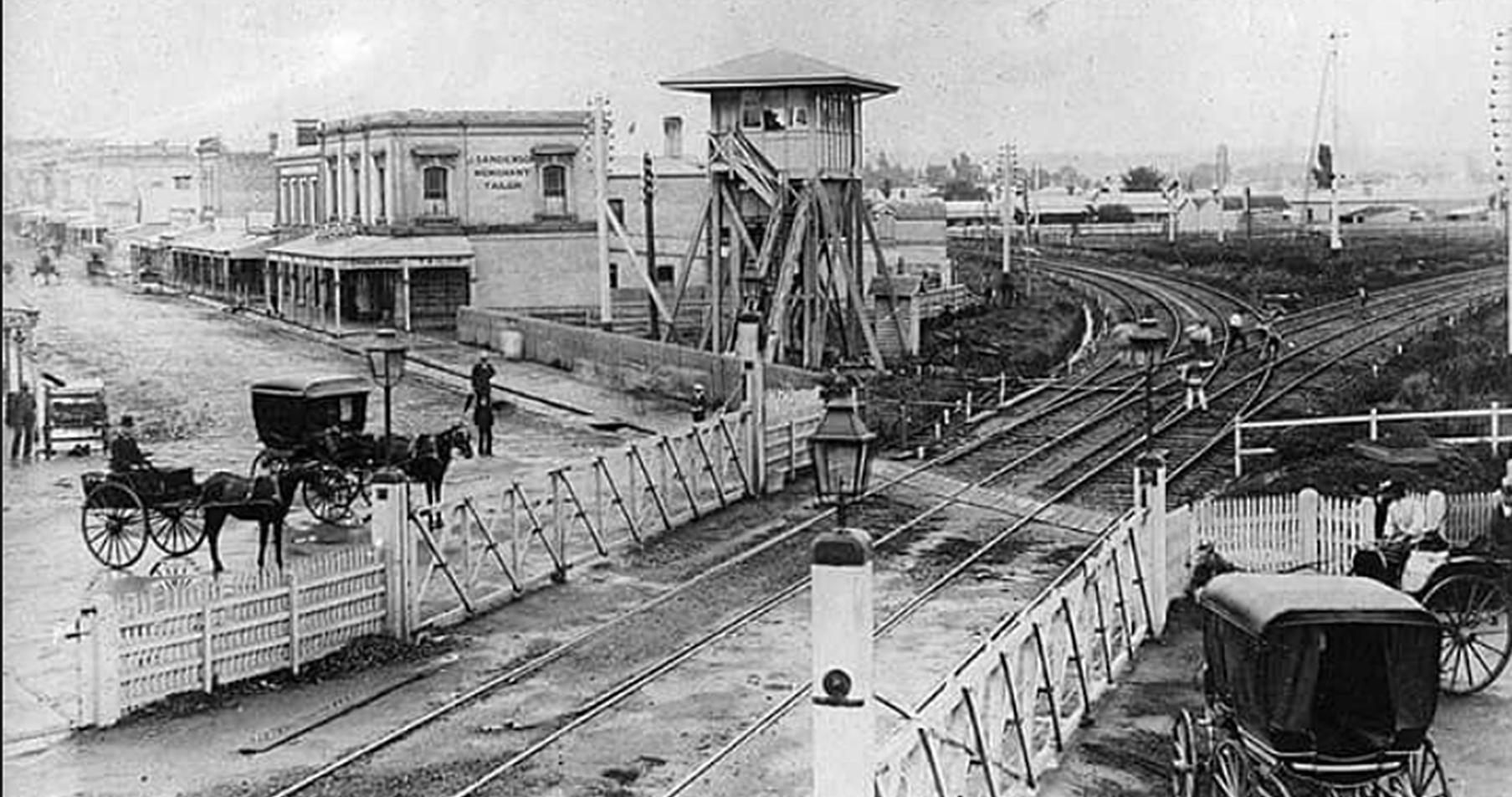
damages arising from mere sudden terror, unaccompanied by any physical injury, but occasioning a nervous or mental shock, could not be considered a consequence which in the ordinary course of things would flow from the negligence of the gatekeeper: in other words, the damage was too remote.2
Most lawyers will also know the rest of the story. Courts soon rejected the Privy Council decision. Dulieu v White3 held that a plaintiff could recover for shock which arose from fear of immediate personal injury to oneself – this was a case, like Coultas, in which the plaintiff was within the “zone of danger” and at risk of suffering physical harm. But then came cases like Hambrook v Stokes4 in which plaintiffs outside the zone of danger suffered shock through viewing injury or
near-injury to close relatives, causing the courts to abandon the limitation that shock must arise from fear of injury to oneself and permit recovery for shock caused by fear of injury to others providing the shock was suffered through one’s own sight or hearing, rather than being told about it by someone else. Over the years this limitation was gradually extended to cases where the plaintiff experienced the aftermath of the accident, rather than the accident itself, and Jaensch v Coffey5 extended the aftermath concept to the hospital to which the accident victim had been taken, not just the accident scene itself. Finally, the Australian High Court in Tame v New South Wales; Annetts v Australian Stations6 abandoned any requirement of direct perception, holding that what mattered was whether psychiatric injury (the term
 A similar level crossing on the same line, about a kilometre to the west of the one where the Coultas incident occurred, probably of very similar design. Thanks to Michael Gillooly for final confirmation of the location.
34 | BRIEF OCTOBER 2022
Mind, Body & Environment in the Legal Profession
now used in preference to the more traditional ‘nervous shock’ terminology) was reasonably foreseeable, given factors such as the nature of the relationship between the parties. (English courts have not yet gone this far.) The Annetts case involved psychiatric injury suffered by parents as a result of a telephone call informing them that their 16-year-old son, who was working on a cattle station deep in the outback, had disappeared: his employers failed to take proper care of him, and he had run away and became lost in the desert, many thousands of kilometres from civilisation.
The Annetts case, of course, has a particular association with Western Australia, because the cattle station was located in the far north of Western Australia and Mr and Mrs Annetts, though they received the telephone call in Sydney, chose to sue in the West Australian courts. However, what will not be well-known is that the Coultas case also has an important connection with Western Australia, although the accident happened in Melbourne. It was as a direct result of the accident and its aftermath that James and Mary Coultas decided to make a new life in Perth – where, after a few good years, their lives were again affected by an unfortunate occurrence, although this time a bad decision by James was the catalyst. The reason nobody knows these facts is that when we study cases, we focus on law reports to the exclusion of all other sources, and law reports tell us very little about the lives of the actors in those cases. All we know about James and Mary Coultas from the law reports is what happened to them on the evening of 8 May 1886 and how Mary suffered as a result of the incident, plus how the case progressed through the Victorian courts and the Privy Council. We learn nothing about their previous history or what sort of people they were, or how their lives were affected by losing the case, or what happened to them in the end. Scholars such as Professor Brian Simpson hold that in order to answer questions like these, it is necessary to go to other sources, because as sources of information, law reports suffer from the defect that, in order to limit the account of the case to matter relevant to the legal issue involved, they exclude much information that has explanatory value.7 In the case of John and Mary Coultas, genealogical sources and newspaper reports can tell us a great deal about their lives, and help to answer the questions asked above. Such sources also reveal that in at least one
important particular, the law reports are not just uninformative but simply wrong –something which had an unfortunate effect on the development of nervous shock law over the next half-century or so.
The problem is that the facts as stated in the report of the case at Full Court level in the Victorian Law Reports said that the shock Mary suffered as a result of the accident caused her to have a miscarriage. The report of the Privy Council decision makes no mention of a miscarriage; neither do any of the newspaper reports of the case, although they provide confirmation that Mary was pregnant or, as one newspaper put it, ‘in an interesting condition’. Victorian birth records confirm that about seven weeks after the accident, on 28 June 1886, Mary gave birth to a son, John Wilson Coultas, her sixth child – given the same name as a son who had died young in 1880. John Wilson Coultas lived a long life, dying aged 74 in 1961. So there was no miscarriage; but even though there was no mention of it in the Privy Council report, many scholars have accepted the statement made in the Victorian Law Reports that Mary had a miscarriage.8
This unfortunate error, combined with the fact that several plaintiffs in other early nervous shock cases9 experienced birth problems as a result of the shock they suffered, led to an assumption that nervous shock was something generally suffered only by ‘frail Victorian heroines’,10 and not by red-blooded males, leading the American torts scholar William Lloyd Prosser to remark that ‘[i]t is not difficult to discover in the earlier opinions a distinctly masculine astonishment that any woman should ever be so silly as to allow herself to be frightened or shocked into a miscarriage.’11 Who was responsible for this error? It seems that the finger points to WH Moule, the reporter for the Victorian Law Reports. We may perhaps not be too ready to forgive him for directing the law down this unfortunate path, even if, prior to commencing a legal career which saw him become a barrister and later a judge, he had been a Test cricketer, representing Australia in the first Test played in England in 1880 (at the Oval).
James and Mary Coultas to 1886
What can we learn about the lives of James and Mary Coultas, if we go behind the law reports to other available sources to shed some light on their history? James Francis Coultas was born in Scarborough, Yorkshire, in 1850, the ninth child of a
farmer. It appears that sometime prior to 1870 he served an apprenticeship as a tailor (following in the footsteps of his older brother Southwell) and then – for reasons that we now cannot discover – moved to Belfast, where he met and in 1874 married Mary Russell Wilson, the daughter of an engineer. They had two children in Belfast, Thomas William Coultas born in 1875 and John Wilson Coultas born in 1877.
Sometime in the late 1870s, James and Mary decided to emigrate to Australia – following in the footsteps of James’ brother Southwell, who was by this time established in the Melbourne tailoring firm of Scourfield & Coultas. They arrived in Melbourne in 1880. It could not have been an easy journey, for Mary was pregnant again, and it appears that their third child, James junior, was born during the voyage. Nor did their new life in Melbourne have a good beginning, because their second child John died, aged 3, within a few months of their arrival. However, they established a home in the suburb of Hawthorn, Mary’s brother John Wilson arrived from Belfast to live with them, and over the next few years James and Mary had two more children, Mary Wilson Coultas born in 1881 and George Augustus Coultas born in 1883.
James gradually established himself in the tailoring business, first assisting his brother and then working as a tailor for the Victorian Cooperative Dress Supply Association. In 1883 he set up his own business in Swanston St, and then in 1885 James joined his brother in the partnership of Scourfield & Coultas. Robert Scourfield had by now retired but the brothers continued to trade under the established name. As James made his way in business, so he and Mary gradually established themselves in Melbourne society. They became members of the local Presbyterian church; James became involved in politics, supporting the local candidate for election to the Legislative Assembly; and James was one of those listed as making a presentation at a levée held by the Governor to mark the Queen’s birthday.
Such was their history up to the evening of 8 May 1886, when James and Mary, accompanied by John Wilson, set out from Melbourne in their horse and buggy to drive home to Hawthorn. It was about nine o’clock in the evening when they reached the level crossing in Swan St, Richmond, where the fateful near-accident occurred, as a result of which James and Mary took action against the Railways Commissioners,
35
with Mary claiming damages for her shock and illness, and James for the medical expenses plus loss of Mary’s services and society. What caused them to initiate an action that has to be regarded as highly speculative, given that no case of this kind had ever previously been litigated? We can perhaps look for some clues. James would seem to have been possessed of typical Yorkshire stubbornness, convinced that wrong had been done and determined to assert his rights; his Irish wife was perhaps readier to accept the misfortunes of life but still determined not to be beaten by them. They had been prepared to emigrate in search of a better life, and James had been ready to try his luck in establishing himself in business in a new city. It seems that they found solicitors who gave them encouraging advice. At all events, within a few months of their narrow escape on the level crossing, their action against the Railways Commissioners commenced in the Second Nisi Prius Court.
The Accident and the Litigation
Today, there is a bridge which carries the railway across Swan St; but it was very different in 1886. A photograph from that era gives a graphic picture of the scene. James and Mary in their horse and buggy would have arrived at the gate; the gatekeeper would have opened the gate and led them across the track, carrying a light because it was about nine o’clock in the evening. They crossed the first of the two lines and were about to cross the second when the train bound for Flinders St Station appeared. The gatekeeper shouted to James to turn back, but James saw that their only chance was to go on, and he shouted to the gatekeeper to open the far gate, which he must have managed to do, because it seems impossible otherwise that James could have got out of the way of the train.
The newspaper reports give much more detailed information about the trial than the law report, for example setting out the statement of claim and defence, and the progress of evidence. When the case for the plaintiffs began, James and Mary both appeared as witnesses, followed by doctors, and a surveyor who had inspected the scene. Mary was subjected to cross-examination by counsel for the defence in an attempt to establish that her condition was such that even the most trivial occurrence might have had a disastrous effect. After unsuccessfully arguing that there was no case to go to the jury, counsel for the defence called various witnesses, including the train driver and the fireman. The gatekeeper was unfortunately unavailable because he
had been killed in an accident at the same location a few weeks later – testimony, perhaps, to the likelihood of accidents occurring at that particular spot. The jury gave a verdict that the gatekeeper had been negligent, and assessed the damages at £400 for Mary and £326 2s for James. Williams J reserved three points for consideration by the Full Court, which gave its decision the next day. The Full Court decision was brief and not very illuminating. As to the first two questions, the court simply ruled, without anything in the way of supporting reasoning, that the damages were not too remote and proof of ‘impact’ was not necessary. The third question was whether Mary could recover damages for physical or mental injuries occasioned by fright. The court held that Mary had suffered a nervous shock (of which the fright was an element) and could recover damages for the injuries which were the result of the shock.
The Railways Commissioners lost no time in announcing that they would appeal to the Privy Council in London – which was probably not surprising, because this was a potentially important point of law, and given that they were regularly sued for accidents to passengers and others resulting in personal injury, it was clearly not in their interests not to challenge a decision that exposed them to liability for a new kind of harm suffered in a case where no actual accident had taken place. The Judicial Committee of the Privy Council heard the case in December 1887 and in February 1888 Sir Richard Couch gave judgment on behalf of the court allowing the appeal. The judgment resorts to oft-repeated arguments against opening up a new field of liability: the damage was too remote, the law would be extended beyond its present limits, the difficulty of determining whether the damage was caused by the negligent act would be increased, a wide field would be opened up for imaginary claims, and no precedent had been cited in which any such action had been previously recognised.
The after-effects
Initially, it seemed that the Privy Council decision did not bring about any great change in the pattern of life for James and Mary. James continued in business with Scourfield & Coultas; he continued to be involved with the tailoring profession, for example representing the tailors on the Victorian Employers’ Union; he continued to be involved in politics and the community generally, for example persuading the Water Supply Department
to extend the scheme water service in the area where they lived; and he continued to receive invitations to important social events, such as levées held by the Governor, no doubt accompanied by Mary. Mary probably spent most of her time looking after her five children, but we catch an occasional glimpse of her, notably in 1892 when a neighbour, in the hearing of others, accused her of stealing his cat. Mary sued for slander in the County Court and was awarded damages to the tune of £10 10s, plus costs –showing that the Privy Council case had not destroyed her belief in the value of going to law as a means of redress for injuries done to her.
However, the ongoing effect of the loss in the Privy Council gradually became apparent. At the conclusion of the proceedings in the Victorian Full Court, James had requested immediate payment of the damages and costs awarded, so that he could provide treatment for Mary and in order to be able to defend the Privy Council appeal. Payment was ordered conditional on James giving security to refund the money should the appeal be decided against them. After the Privy Council’s decision, he became liable to pay a refund and other expenses totalling £1,350, though he eventually persuaded the Victorian government to return £375 of this sum, representing the costs of the appeal, on the ground that the costs had been particularly heavy because of the importance of the case to the Railways Commissioners.
As a result of paying out such a large sum of money, James’s business affairs started to go downhill. He fell out with his brother Southwell, left the firm of Scourfield and Coultas and went out on his own; a few months later, Southwell began a long-running court action to restrain James from carrying on business in a manner calculated to deceive Southwell’s customers. By 1889 James had to sell his horse and buggy; in 1891 he attempted to make some money by buying land and building on it, but lost money due to a decline in the price of real estate; and the following year he lost more money at the hands of a fraudulent employee. As a result, James was finally driven into bankruptcy. The process began in March 1892, when he filed a schedule in the Insolvency Court, and went on for months. A year later, his creditors received a dividend of about 25 per cent, but it was not until June 1895 that James was able to apply for his discharge. How the family survived during these three years remains a mystery.
36 | BRIEF OCTOBER 2022
Mind, Body & Environment in the Legal Profession
I’m Coultas, a trifle gone bung, Through possessing a garrulous tongue, And most of you know My damper is dough
And my classical swan-song is sung.
I blew myself out as a snip Through taking a confidence tip That Ernest E R Was sloping afar In a ready-to-run away ship.
The magistrates’ bench I’ve been on, And there a brief moment I shone, But if reasons you’d seek Leake made me a beak “De mortuis nil nisi bon.”
expanding into adjacent premises, and in 1899 James opened a branch in Kalgoorlie with Thomas in charge.
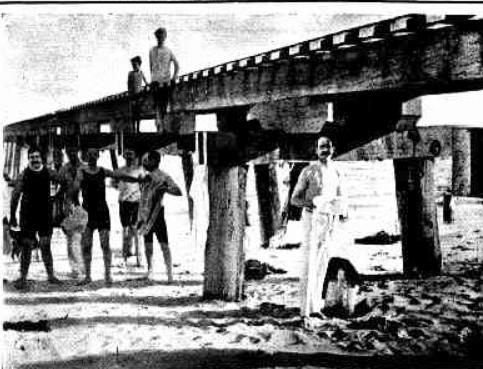
James must have decided that he was finished in Melbourne, and he and Mary decided to make a fresh start. They left Melbourne by ship and in February 1896 arrived at Albany to begin their new life in Western Australia.
James and Mary in Perth, 1895-1910
Within three weeks of his arrival in Perth, James commenced a tailoring business in Barrack St, and after a month or so in temporary premises established himself at 57 Barrack St, on the corner of Hay St, where he would remain for the next 11 years. (The present occupants, T Sharp & Co, selling ‘writing instruments and fine gifts’, took over when James moved out in 1907.) A year or so later James’s oldest son Thomas joined him (to be followed a year or so later by his second son James junior) and the business became known as James Coultas & Son. The business grew steadily,
James gradually consolidated his position both professionally and personally. Within a few years he was one of the leaders of the tailoring profession in Perth, being part of a deputation to the Premier petitioning for an increase in the duty on made-up garments brought into the colony, and by 1901 becoming President of the Master Tailors Association. He became active in local government matters, and supported candidates for election as mayor and councillors of the Perth City Council. His sons Thomas and James took up the sport of cycling, and James senior became a member of various cycling bodies. He also became involved with the new Presbyterian church in West Perth, then located in Havelock St, close to where they lived in Hay St. It is in this context that we catch an occasional glimpse of Mary, running a sale of gifts at the church and organising the refreshment stall. By 1900 they were clearly ascending the social ladder, leaving their card at the Mayor of Perth’s ‘At home’ and attending a civic reception to welcome the new Governor, Sir Arthur Lawley.
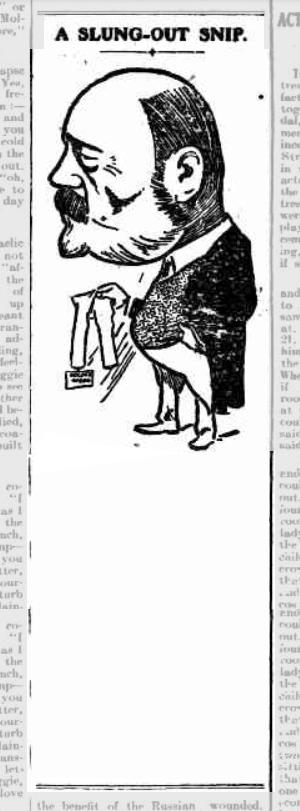
James’s experience in Victoria had clearly not dampened his readiness to litigate when he felt that he had been wronged. He sued two of his Melbourne employees who had moved with his business to Perth, for not keeping to their agreements; he regularly pursued business debts in
the Local Court; and he sued a firm called OL Haines & Co in the Supreme Court for failing to supply goods, and contested the case in the Full Court after Haines & Co appealed. He also supported his sons in various disputes about cycle races (it seems that they were as litigious as he was) and in one instance sued for libel as next friend of James junior. He also served regularly on coroners’ juries.
By the turn of the century, James and Mary were doing very well. The business was prospering: the premises in Barrack St were expanded, and James opened a branch in Fremantle. Late in 1901, James and Mary moved to a new house in South Perth, opposite the Zoo, selling their furniture and effects by public auction (and presumably buying replacement furniture). Mary was able to advertise for a cook. In May 1902 James and Mary were guests at a reception for Edmund Barton and Sir John Forrest, who called in at Perth en route to London to represent the recently-established Commonwealth of Australia at the coronation of King Edward VII. A few days later, it was announced that James had been appointed a Justice of the Peace (at the instance of Premier George Leake), and he began to sit in the Perth Police Court.
However, there was much criticism of his appointment, and of his performance on the bench – newspapers called him ‘numbscull Coultas’ and ‘a buzzard of the bench’. Eighteen months later, these misgivings were confirmed when he
Bowlers Snapped at Busselton’. James Coultas is on the left
Mind, Body & Environment in the Legal Profession
made a fatal mistake. Mrs Annie Marisa Rogers, wife of Mr Ernest Rogers, the principal of Perth Tramways Ltd, appeared before him and swore an affidavit that her husband was about to leave Western Australia owing money and leaving her destitute. James issued a warrant for his arrest under the Absconding Debtors Act 1877. Rogers was arrested – when in the company of influential friends, and apparently not about to leave the state – and brought back to the Perth Central Police Station, where he found another warrant waiting for him, for an unpaid tailors’ bill for £7 10s owed to James Coultas & Son.
All this received wide press publicity. The Sunday Press, for example, published a series of banner headlines: ‘Marital Menaces. Arrest of EE Rogers. Desperate Dealings with the Debtors Act. Wily Ways of a Winsome Wife’, for good measure adding in the text (in bold type), ‘Mrs Rogers is a blonde’. It is clear that marital relations between Mr and Mrs Rogers were very strained. Rogers vented his fury on James in every possible way. He sued James in the Supreme Court for wrongful arrest, and James was advised by his lawyer, Norman Ewing, that the case against him was unanswerable and he would have to consent to a verdict in Rogers’ favour; the jury awarded £600 damages. Rogers also took out a summons against James for oppressive use of the Absconding Debtors Act, and James was convicted and fined. James appealed to the Supreme Court, but had to abandon the appeal after the verdict against him in the civil case. Matters were not helped by the fact that Ewing was also Mrs Rogers’s lawyer: Rogers used his and his company’s influence to ensure that Ewing lost his Parliamentary seat at the next election. Rogers, by now owed a large sum in unpaid damages, pursued James into the bankruptcy court, and James had to make a composition with his creditors, although as it turned out the only person who was owed a substantial sum was Rogers. All this resulted in considerable press speculation as to whether James could continue to sit on the bench, and in November 1903 he was duly removed from office.
James Coultas and Son had to sell off stock at reduced prices. It is clear that the business suffered a downturn, but managed to survive. However, this unfortunate series of events had a major effect on the lives of both James and Mary. It seems that they had to give up the new house in South Perth (and probably also the cook), because within a year or two
they were back in West Perth, now living in Colin St. Invitations to social gatherings dried up, though they continued to be associated with the Presbyterian Church (James was one of the office bearers whose names were recorded on a document placed inside the foundation stone of the new St Andrew’s Church in St George’s Terrace in 1908.) But time was running out for Mary. By 1905 or thereabouts she was beginning to suffer from a long and painful illness, and she died on 2 October 1906, from gastritis and exhaustion following an abdominal operation.
James carried on for a few more years, still running his business: in 1908, The Mirror included him in a series of photographs of ‘Men about Town’. He remained active in the tailoring profession. It is clear that he had not lost his taste for litigation: he was involved in an important case in the Arbitration Court which, when appealed to the Full Court, set a precedent about the Arbitration Court’s jurisdiction, and he successfully defended a case in which he was accused of assault by a dissatisfied customer. In other respects, too, he showed that he was still prepared to accept a challenge. He started to play bowls at the King’s Park club, and when not selected for the pennants team he backed himself to show the form of which he was capable by accepting an offer by a member of the selection committee to play him in a one-on-one match, with a silk hat as a prize. James lost narrowly. James was still playing bowls in 1910: a newspaper photograph shows him with a group of fellow-bowlers on the beach at Busselton. He died suddenly of a cerebral haemorrhage a couple of months later.
Conclusion
James and Mary now lie side by side among the Presbyterian graves in Karrakatta. There is no headstone to tell the curious visitor who they were. Their lives have left no visible trace, either in Melbourne or in Perth (except in newspaper files). They had five children, whose descendants still probably live in Perth, but perhaps know nothing about their ancestors of four or five generations ago. However, James and Mary have left their mark on the law, not just in Australia but much further afield. Judicial summaries of the development of the law of psychiatric injury (or mental harm) in leading cases in the High Court and the House of Lords generally still start with the Coultas case.12 In the United States, the case has arguably had an even greater effect. In the 1890s, many jurisdictions adopted the ‘impact rule’, requiring some
form of contemporaneous physical impact as a condition of recovery for nervous shock, to guarantee the genuineness of the claim. This rule was based in part on the Coultas case, which was regularly cited, and even as recently as 2012, when Kentucky became the latest jurisdiction to repudiate the impact rule (leaving only five states in which the rule survives in one form or another) the Supreme Court found it necessary to discuss Coultas in some detail.13 A few years previously, Coultas was cited in the respondent’s brief in a case before the United States Supreme Court dealing with liability for emotional distress under the Federal Employers’ Liability Act. 14 So James and Mary no doubt now rest somewhere in the Elysian Fields knowing that they are remembered not just in Victoria and Western Australia but throughout the English-speaking world.
End Notes
* Emeritus Professor, Law School, University of Western Australia. For a full account of the history of James and Mary Coultas, together with studies of the trial, the potential liability of the railways, and the problem of freeing common law courts from the Coultas precedent, see my article ‘Victorian Railway Commissioners v Coultas: The Untold Story’ (2021) 61 American Journal of Legal History 416, which contains full references to the various newspaper reports and other source material. The present article discusses the history of James and Mary Coultas but goes into more detail on the Perth connection.
1 Coultas v Victorian Railway [sic] Commissioners (1886) 12 VLR 895.
2 Victorian Railways Commissioners v Coultas (1888) 13 App Cas 222.
3 Dulieu v White & Sons [1901] 2 KB 669.
4 Hambrook v Stokes Bros [1925] 1 KB 141.
5 (1984) 155 CLR 549; the equivalent English case was McLoughlin v O’Brian [1983] 1 AC 410.
6 (2002) 211 CLR 317.
7 Brian Simpson, Leading Cases in the Common Law (Clarendon Press, Oxford, 1995) 10-12.
8 Including myself, before I discovered the truth: Peter Handford, Tort Liability for Mental Harm (3rd ed, Lawbook Co 2017), 2.10.
9 Eg Dulieu v White & Sons [1901] 2 KB 669; Hambrook v Stokes Bros [1925] 1 KB 141; Bourhill v Young [1943] AC 92 (‘the case of the pregnant fishwife’).
10 Sir Thomas Bingham MR [later Lord Bingham of Cornhill] in the foreword to Nicholas J Mullany and Peter R Handford, Tort Liability for Psychiatric Damage: The Law of ‘Nervous Shock (Law Book Co/ Sweet & Maxwell, 1993) vii.
11 WL Prosser, Handbook on the Law of Torts (1st ed, West 1941), 55.
12 Eg Tame v New South Wales (2002) 211 CLR 317, [178] (Gummow and Kirby JJ); King v Philcox (2015) 255 CLR 304, [15] (French CJ, Kiefel and Gageler JJ); Page v Smith [1996] AC 155, 190 (Lord Lloyd of Berwick); White v Chief Constable of South Yorkshire Police [1999] 2 AC 455, 501 (Lord Hoffmann).
13 Osborne v Keeney 399 SW 3d 1 (2012 Ky).
14 Consolidated Rail Corporation v Gottshall 512 US 532 (1994).
38 | BRIEF OCTOBER 2022
Australia’s only mortgage

Is it time for a Rare Disease Act in Western Australia?
By Marisa Taliangis and Dr Gareth Baynam
On 16 December 2021, the United Nations General Assembly made a resolution addressing the challenges of persons living with rare diseases and their families (UN Resolution).
The UN Resolution promotes key pillars of the UN Sustainable Development Goals (SDGs) and encourages making legislation which contributes to the well-being of people living with rare disease.1 This raises the question as to whether Western Australia should take the lead and enact such legislation.
Rare diseases are typically complex (involving various systems of the body), chronic and require multidisciplinary care. They are often life-threatening, genetic and incurable. Rare diseases can be painful, disabling and lead to early death.2 About 70% of rare diseases start in childhood making caring for a paediatric patient a further aspect of the rare disease experience.3
Acknowledgments Made in the UN Resolution
The UN Resolution is grounded in the need to promote and protect the human rights of all persons and that health is necessary for social, economic and environmentally
sustainable development. As such, it specifically recognises that “persons living with rare disease and their families may be psychologically, socially and economically vulnerable through their life course, facing specific challenges in several areas, including but not limited to health, education, employment and leisure.”4
From a medical perspective, the UN Resolution acknowledges the need to “support, streamline and increase attention to research on rare diseases”5 although coordination of research and sharing of data needs to be respectful of privacy. The UN Resolution also calls upon Member States to strengthen health systems for people living with rare diseases.6
More Legislation for Something That’s Rare?
At first blush, an argument against rare disease legislation is that the ‘rarity’ of rare disease means that any legislation would not be sufficiently representative to draw on legislative resources. And yet therein lies the paradox: for while a given disease may be “rare” in terms of its occurrence, rare diseases as a group are cumulatively common. Approximately 5,000 to 8,000 different rare diseases7 affect around 6–10% of the population. This translates to an estimated 63,000 children in Western Australia alone.8 Indeed, the UN Resolution
conservatively refers to an estimated 300 million people living with rare disease worldwide.
Perhaps another argument against rare disease legislation in Western Australia is access to the Medicare system which guarantees Australians access to public hospitals and subsidised health care.9 However, as acknowledged by the Report of the United Nations High Commission for Human Rights:
“Even when access to some form of health care exists, coverage usually mirrors health issues experienced by the general population, with little or no attention paid to the specific needs and rights of persons living with rare diseases. … [The] paucity of medical and scientific knowledge about rare diseases drives this marginalization, with the result that many people remain undiagnosed and therapies are difficult to develop.”
Not Starting from a Blank Canvas
If Western Australia enacted rare disease legislation it would not be alone. While Western Australia would be the first jurisdiction in Australia with such specific legislation, similar legislation has been in place for many years elsewhere in

40 | BRIEF OCTOBER 2022
Is it Time for a Rare Disease Act in Western Australia?
WA Rare Diseases Strategic Framework 2015–2018 health.wa.gov.au
Western Australia has led the charge in addressing rare diseases by being the first Australian State to establish a rare disease action plan.17 Click the Thumbnail above to download.
the world such as the Rare Diseases Act of 2002 (US) and the Rare Diseases Act of the Philippines 2015. Most striking of these examples is that they are not long, bulky statutes. The wording is simple –providing statutory acknowledgement to initiatives that have since been found to be helpful to the rare disease experience.
As an example, the Rare Diseases Act of 2002 (US) established the Office of Rare Disease at the National Institutes of Health (NIH) in Washington DC and aims to “increase the national investment in the development of diagnostics and treatments for patients with rare diseases and disorders”.11 In 2008, the Office of Rare Disease established an Undiagnosed Diseases Program 12 where patients are evaluated at the NIH following their medical records being reviewed by up to five medical professionals representing 25 different specialties.13 Of note, one of the broader benefits of this program has been the discovery of “insights into human physiology, biochemistry and genetics” which in turn has provided valuable information for more common diseases.14 Similarly, the Rare Diseases Act of the Philippines 2015 seeks to “improve the access of patients diagnosed to have a rare disease or patients highly suspected of having a
rare disease to comprehensive medical care”. 15 Under this Act, the Department of Health is responsible for organising “a pool of medical specialists who will be responsible in the diagnosis and management of persons afflicted with rare disease and their families”. There is also a requirement to “develop a system to train a sufficient number of medical specialists to diagnose and manage persons with rare disease”.16
Has Western Australia Been Doing Anything About Rare Disease?

Western Australia has led the charge in addressing rare diseases by being the first Australian State to establish a rare disease action plan.17 The WA Rare Diseases Strategic Framework 2015–2018 set out a “framework for the coordination of Western Australian Health initiatives for rare diseases”.18 Objective 7 provided for building on existing Western Australian Health Services for the screening and diagnosis of rare disease. Objective 8 then encouraged the use of evidence-based, best practice guidelines to deliver health care for rare disease. Each objective was grounded in an acknowledgment that “[an] accurate and early diagnosis provides those living with a rare
disease and their families and carers an understanding of future healthcare requirements”.19
Western Australia was also the first Australian jurisdiction to establish an undiagnosed disease program (UDP) as part of Genetic Services of Western Australia. The UDP “incorporates a team of doctors from a broad range of specialties working together in partnership with researchers”.20 The UDP is made up of the Program Director, Program Co-ordinator, Genetic Counsellor and Expert Panel.21 The Expert Panel is made up of specialists from a deliberately diverse range of medical specialties at differing career stages. Members meet each month to discuss possible diagnoses and further assessment for referred patients following a review of the patient history. Patients come from within the Western Australian public health system and are limited to paediatric and transition age patients (defined as 16–25 years of age).
Even more exciting is that Western Australia now has a Centre of Expertise for Rare and Undiagnosed Diseases known as ‘Rare Care’.22 Rare Care’s Medical Director, Dr Gareth Baynam describes Rare Care as a holistic centre for coordinated and integrated (multi-sector) care for children, youth and their families living with rare and

Dr Gareth Baynam, Medical Director of ‘Rare Care’ focused on community engagement, community codesign, peer-peer child and family networking and support for Rare and Undiagnosed Diseases
41
Is it Time for a Rare Disease Act in Western Australia?
undiagnosed diseases. This will include a focus on community engagement, community co-design, peer-peer child and family networking and support.
As the Program Director of the Undiagnosed Diseases Program and the Head of the Western Australian Register of Developmental Anomalies (WARDA), which includes many rare diseases, Dr Baynam has first-hand experience of the power of legislation to underpin advances in medical diagnosis, research and support. The WARDA is a statutory register that collects information on babies born with a birth defect and/ or cerebral palsy diagnosed before age six.
In the context of rare disease, birth defects are a large class of mainly rare diseases, and the largest single class of rare diseases.23 The information held by WARDA is used to monitor developmental anomalies in WA; plan, monitor and evaluate services for the prevention, screening, diagnosis, treatment and management of developmental anomalies; gather and publish information about developmental anomalies and research the causes of developmental anomalies.
So What Would a Western Australian Rare Disease Act Look Like?
A Western Australian Rare Disease Act would not have to be long and in essence, could be an umbrella model which – as a start – provides a legislative imprimatur to what has already been undertaken in practice. This Act could acknowledge WARDA and Rare Care and empower the UDP (similar to the US approach). The Act could also recognise the rights of those living with rare disease by confirming access to the Health and Disability Services (Complaints) Act 1995 (WA) or the Equal Opportunity Act 1984 (WA). The Act could build upon elements of WARDA Regulations to become more inclusive of rare diseases. Similarly, the Act could bring together other existing Western Australian legislation that touches upon the rare disease experience.
Why ‘Fix What Ain’t Broke’?
Western Australia has already made such significant inroads into rare disease management so why ‘fix what ain’t broke’?
Surely we do not need legislation if such significant progress has already been made.
It is acknowledged that Western Australia is already ‘batting above its average’ without
any underpinning legislation but this has not happened overnight. Rather, it is the result of more than 50 years of the dedicated effort of multiple stakeholders from the rare diseases community, rare diseases advocacy groups, researchers, clinicians and policy makers in the Western Australian health system. This group includes entities such as Genetic Services of Western Australia and the Office of Population Health Genomics (a policy unit to translate genomics to community benefit.) More recently multi-partisan support for rare diseases has been shown in the creation of the Western Australian Parliamentary Friends of People Living with Rare and Undiagnosed Diseases.
Legislation would allow all these parties to point to one document which sets out the authority for existing initiatives. Legislation would also be a sign that diagnosing and treating rare disease, and the challenges of living with rare disease, are seen not only by the ‘players’ in the system but also, by the people of Western Australia.
Conclusion
One of the upshots of the COVID-19 experience is that we all now have a better understanding of how legislation intersects with the medical world. Indeed, we all now share a ‘lived experience’ regarding the significant impact of orders and declarations affecting our freedom of movement (and for some, livelihood) in the interests of health.
The UN Resolution encourages legislation which contributes to the well-being of those living with rare disease and their families thereby acknowledging that legislation can protect and empower vulnerable groups. Given Western Australia has a history of leading in practices for the diagnosis and treatment of rare diseases, let Western Australia be the first to heed this call. As Western Australia is already on its way to improving the rare disease experience we therefore approach any Rare Disease Act from a very powerful ‘starting position’.
End Notes
1 https://www.globenewswire.com/newsrelease/2021/12/16/2354050/0/en/First-ever-UnitedNations-Resolution-to-Increase-Visibility-for-the-300Million-Persons-Living-with-a-Rare-Disease.html
2 Communication from the Commission to the European Parliament, the Council, the European Economic and Social Committee and the Committee of the Regions on Rare Disease: Europe’s Challenges, Brussels, 11.11.2008 COM(2008) 679 Final at para 2.
3 S Nguengang Wakap et al, “Estimating Cumulative Point Prevalence of Rare Disease: Analysis of the Orphanet Database” (2019) European Journal of Human Genetics 16 September 2019.
4 United Nations General Assembly, Seventy-sixth Session, Third Committee, Agenda Item 28, Social Development, Preamble 2/5
5 United Nations General Assembly, Seventy-sixth Session, Third Committee, Agenda Item 28, Social Development, Preamble 3/5
6 United Nations General Assembly, Seventy-sixth Session, Third Committee, Agenda Item 28, Social Development, Resolution 1
7 G Baynam, S Broley and J Goldblatt, “Initiating an Undiagnosed Diseases Program in the Western Australian Public Health System” (2017) 12 Orphanet Journal of Rare Diseases 83, 2.
8 Department of Health, Government of Western Australia, WA Rare Diseases Strategic Framework 2015–2018 (Office of Population Health Genomics, Public Health Division, 2015) 3
9 Australian Government, Medicare <health.gov.au/ health-topics/medicare>.
10 United Nations Economic and Social Council, 2019 sess, Agenda Item 19(f) (15 May 2019) par 29.
11 Rare Diseases Act of 2002 (US) s 2(9)(b).
12 BM Kuehn, “US Launches Undiagnosed Disease Program” (2008) 300(1) Journal of American Medicine 27
13 WA Gahl and CJ Tifft, The NIH Undiagnosed Diseases Program – Lessons Learned (2011) 305(18) JAMA 1905Gahl and Tifft, n 23, 1904.
14 WA Gahl, “The Battlefield of Rare Diseases: Where Uncommon Insights Are Common” (2012) 4 Sci Transl Med 154ed7.
15 Rare Diseases Act of the Philippines 2015 (Philippines) s 3(a).
16 Rare Diseases Act of the Philippines 2015 (Philippines) s 17(e).
17 C Molster et al, “Survey of Healthcare Experiences of Australia Adults Living with Rare Diseases” (2016) 11 Orphanet Journal of Rare Diseases 30
18 Department of Health, Government of Western Australia, n 5, 1
19 Department of Health, Government of Western Australia, n 5, 16.
20 Project, <projectyudp.com>.
21 Baynam, Broley and Goldblatt, n 4, 4.
22 Media Statement ‘New Rare Care will co-ordinate rare disease care at Perth Children’s Hospital’, Government of Western Australia Child and Adolescent Health Service, 25 February 2022
23 https://eu-rd-platform.jrc.ec.europa.eu/sites/ default/files/eurocat-pub-docs/Special-ReportMajor-Group-of-Mainly-Rare-Diseases.pdf
42 | BRIEF OCTOBER 2022
A warning on the urgent need to get serious about unfair contract terms Australian Competition and Consumer Commission v Fujifilm Business Innovation Australia Pty Ltd [2022] FCA 928
By Stephen Doyle
On 12 August the Federal Court declared that 38 contract terms used in contracts entered into by Fuji with thousands of small businesses were unfair.
The financial and reputational damage to Fuji is likely to be significant. This could happen to you and your clients. If you and your clients have not already done so, take action now to comply with the UCT regime. The current law has cost Fuji. The UCT regime is going to get even tougher and a breach will cost even more.1
The types of terms which have been declared unfair and void included the following usual suspects:
1. Automatic renewal terms: permitting Fuji to renew the contract for a further period unless customers cancel the contract a certain number of days before the end of the contract term.
2. Disproportionate termination terms: allowing Fuji to terminate the contract in a significantly wider range of circumstances than those which allow the customer to terminate the contract, if any.
3. Liability limitation terms: limiting Fuji’s liability or require the customer to indemnify Fuji without corresponding rights for the customer.
4. Termination payment terms: requiring customers to pay extensive exit fees to Fuji in the event the contract is terminated, including certain charges which Fuji could set unilaterally.
5. Unfair payment terms: requiring customers to pay Fuji for software licensed pursuant to the agreement irrespective of whether Fuji delivered the software and, when goods are purchased, to pay the purchase price prior to delivery.
6. Unilateral variation terms: permitting Fuji to unilaterally vary some terms of the contract including the charges and terms contained in documents other than the signed contract.
It is my experience that many organisations are currently using clauses like this and they need to change or delete the clauses.
By consent (on the part of Fuji) the Court:
1. declared the unfair contract terms void and unenforceable;
2. issued injunctions to:
a. stop Fuji enforcing these terms in current small business contracts;
b. stop Fuji using these terms in 11 types of standard form contracts with small businesses for the next 5 years;
3. ordered Fuji to:
a. publish corrective notices in a specified form on specified platforms;
b. send a notice in a specified form:
i. to each counterparty of the example contracts2 containing identified unfair terms;
ii. to each person it is currently suing who is or was a party to certain contracts
Telling those persons that are a small business that certain terms of their agreement have been declared void and unenforceable so as to maximise the likelihood that all affected customers and potential customers will become aware of the Court’s orders;
4. ordered Fuji to establish and implement a compliance program to be undertaken by each employee of Fuji and any other person involved in Fuji’s s business who is involved in offering, drafting, negotiating, and enforcing contracts between customers and Fuji for a period of 3 years from the date of the order; and
5. ordered Fuji to pay the ACCC’s costs fixed in the amount of $250,000
Under the Australian Consumer Law and ASIC Act, businesses are not prohibited from including or relying on an unfair contract term against consumers or small businesses. Although courts can declare unfair terms to be void and consequently unenforceable, they cannot impose penalties on companies using these unfair terms. But this is likely to change in the near future.
Labor said: it would make unfair contract terms illegal, giving businesses with fewer than 100 staff (currently 20) or a turnover of less than $10 million a shield against dodgy contracts; and that once “dodgy contracts” are against the law, the ACCC will be able to issue civil penalties against those who use them; and
it will also mean that a contract term which is judged to be unfair will effectively be banned from that point on and will be void anywhere it’s been used.
End Notes
1 Likely changes to the UCT regime include: broadening the scope of contracts to which the UCT regime applies e.g. 2 new prohibitions on: including unfair terms in contracts; and applying or relying on (or purporting to apply or rely on) an unfair term.
expanding the definition of a standard form contract
new pecuniary penalties can be ordered against individuals and corporations who breach the prohibitions.
For individuals, a court could order penalties of up to $500,000.
Corporations could be subject to penalties the greater of: $10 million; 3 times the value of the benefit received from the offence; or (if the court is unable to determine benefit obtained) 10% of annual turnover in preceding 12 months.
expanding the court’s role, including giving Courts the power to order non-monetary remedies, such as to:
void, vary or refuse to enforce part or all of a contract;
issue public warning notices and disqualify persons from managing a corporation; and order injunctions preventing persons from breaching the UCT regime introducing a rebuttable presumption that a term is unfair, meaning a term that is alleged to be unfair is deemed unfair, unless proven otherwise.
2 About 34,000 but not all of them will benefit as they are not small businesses.
43
Intestacy Law Reform in Western Australia: At Last!
By John Hockley, Barrister Francis Burt Chambers
Introduction
The long-overdue reform of the intestacy provisions of the Administration Act 1903 (WA) became a reality on 30 March 2022 with the proclamation of the Administration Amendment Act 2022. It is 39 years since the intestacy provisions (ss 12-17 of the Administration Act 1903) were amended. The Administration Amendment Act 2022 ensures that the citizens of Western Australia will never have to wait for another 39 years before its monetary amounts in the main provision, section 14 are amended. The monetary amounts are now indexed, against average wages, every six months whereas previously they were indexed against the median house price in Perth. The monetary amounts will be changed by regulation and not by legislation.
This Act brings Western Australia up to or in advance of other Australian States and Territories that have changed their laws on intestacy in recent years either as a recognition of the need to update these laws or a part of the Uniform Succession Law Project.
The Administration Act 1903, in sections 12-17, covers what happens when a person dies intestate or without a will or omits some property from their will.
The intestacy provisions were last amended in 1982. Those laws did not make sufficient provision for a surviving spouse of an intestate. Statistics inform us that the surviving spouse is usually female.
Approximately one third of the 8,0009000 deaths in Western Australia per year involve the intestacy provisions.
A person can forget to make a will, or forget to update their will after a divorce. A person can forget to include some property in their will. Many young people who are high risk-takers do not have a will. The estates of many of the people who commit suicide fall under the intestacy provisions.
Many spouses and families in Western Australia will be beneficially affected by
the proposed changes. The Attorney General, Mr John Quigley must be commended for recognising the injustice of the existing intestacy provisions and acting promptly to remedy them.
Understanding the New Intestacy Provisions
The intestacy provisions are primarily found in section 14 Entitlements on intestacy in subsection (1) that is, subject to section 15 (De facto partners and distribution in intestacy), where a person dies leaving intestate property, it is distributed according to the entitlements set out in the Table below subsection (1).
Whole or Partial Intestacy
A person can die wholly intestate if they die without a valid will. A partial intestacy arises if the deceased omits one or more items of property from their will. For instance, if a person omits to include in their will, their interest in the family’s “holiday residence” or “bolt hole”.
Statutory Legacy or Declared Sum
Under the former legislation the surviving spouse of the intestate received a statutory legacy of $50,000 and one third of the estate. The children of the deceased intestate share equally the remaining two thirds of the estate.
The Statutory Legacy in Western Australia Could Only be Altered by Legislation
In other all other Australian States and Territories the Statutory Legacy has increased in recent years. For example, in New South Wales the Statutory Legacy has been increased to $350,000 but in South Australia the Statutory Legacy has been increased only to $100,000.
This sum is indexed, usually subject to an index, such as the CPI index and adjusted by regulation.
Proposed Changes
Under the new legislation the statutory legacy changes its name to the declared sum.
The declared sum is the sum the Minister has declared to apply for that item under an order.
An order ·means the order made by the Minister under section 14A (2).
A specified item means any of the following items, the monetary amounts ($ amounts) listed in the Table.
Item 2(a); and (b) (each occurrence); (original sum s14A(1) $472,000); [formerly $50,000].
Item 3(a); and (b) (each occurrence); (original sum s14A(1) $705,000); [formerly $75,000].
Item 3(b)(i)(A) and (B); (original sum s14A(1)(c) $56,500); [formerly $6,000]; Item 6(a); and (b) (each occurrence); (original sum s14A(1)(d) $56,500); [formerly $6,000].
Under section 14A(2), the Minister may make an order declaring for each specified item, the sum that is to apply for that item.
Under section 14A(3), a sum declared by the Minister in an order must be the amount in dollars determined by the following formula rounded to the nearest $500.
S = T x E 1769.90
Where:-
S is the sum that is to apply for a specified item, before rounding to the nearest $500.
T is the original sum for that specified item.
E is the estimate of the average weekly earnings of full-time adult employees in Australia most recently published by the Australian Statistician as an original estimate.
Under section 14A(4) an order is subsidiary legislation for the purposes of the Interpretation Act 1984
Pursuant to section 14A(5) the Interpretation Act 1984 section 42
44 | BRIEF OCTOBER 2022
applies to an order as if the order were regulations.
Innovative Use of Average Weekly Earnings
The use of Average Weekly Earnings to index the amounts in the intestacy provisions is an innovative use of this statistic calculated twice a year by the Commonwealth Statistician. The sum $1,769.90 is the sum calculated in November 2020.
This formula comes from the Defamation Act (2005), an Act that Government members in the new Labor Government had some familiarity with when the Bill was first introduced to Parliament is 2018.
The use of Average Weekly Earnings to index the amounts in the intestacy provisions fell between the amounts in draft Bills using the median house price in Perth and the fixed monetary amounts in earlier drafts of the Administration Amendment Bill
Statutory Legacy/Declared Sum Increased Significantly and Indexed to “Average Wages” and Changed by Regulation
The result of the application of the above formulae is that under subsection (4) the $50,000 statutory legacy is increased in Item 2(b) to $472,000 and the $75,000 on Item 3(b) is increased to $705,000. The new sums of $472,000 and $705,000 are indexed to ‘average wages’ and changed by regulation and not legislation.
Subsection (4) reads:-
(4) Where the intestate dies leaving a husband or wife who is entitled


to-
a) The sum of $472,000 mentioned in item 2(b) of the Table (or if there is a declared sum for item 2, that sum); or
b) The sum of $705,000 mentioned in item 3(b) of the Table, (or if there is a declared sum for item 3(a) and (b), that sum).
The increase in the statutory legacy from $50,000 not indexed, to $472,000 indexed, where there are issue, especially issue of a prior marriage of the intestate, is an enormous benefit to the surviving spouse as it gives her or him greater equity in the matrimonial home. This increased equity may be enough, in some cases, to obtain the whole of the matrimonial home. If not, the increased equity can be used to borrow money to ‘buy-out’ the children of a first marriage who, under the Table in Item 2(b), obtain two thirds of the residue of the estate. This change may reduce the number of Family Provision actions by widows of intestates who commence an action to obtain further provision from their former spouse’s estate so that they can obtain a greater share or all of the former matrimonial home from the children of the spouse’s former marriage or de facto relationship. This reasoning also applies to the increase in the statutory legacy from $75,000 not indexed to $705,000 indexed, to enable the surviving spouse where there is no issue to buyout parents, brothers or sisters or the children of deceased brothers and sisters of the intestate under the Table in Item 3(b)(i) or (ii).
Increased Amounts for Parents of the Intestate
The Parliament has recognised that many parents assist their children buy homes and if they survive a child who dies intestate they will now receive an increased amount from $6,000 to $56,500 under the Table, Item 3(b)(A) and (B) and under the Table, Item 6(a) and (b).
Recognition that the Amount is Indexed
The automatic indexation of the declared sum (formerly the statutory legacy), every six months has resulted in the need for a new provision in the Act. After the new section 14A a new section 14B has been inserted into the Act.
Section (14B) states:
14B Minister must review sums for specified items
(1) In this sectionrelevant sums means(a) the original sums for each specified item (as those items are defined in section 14A(1), or (b) if an order under section 14A(2) is in effect the sums declared by that order.
(2) The Minister must review the relevant sums and decide whether or not it is appropriate to make an order under 14A(2).
(a) On or before 30 June 2023; and
(b) On or before 30 June in every 2nd year after that.
LASTING LEGACY HOMELESS LEAVING A WILL HELP DOGS IN WA LASTING LEGACY
(3) As soon as practicable after completing the review, the Minister must-
(a) Prepare a report based on the review; and
(b) Cause the report to be laid before each House of Parliament.
(4) Subsection (2) does not limit the time at which the minister may make an order under section 14A(2).
The result is that in just under a year, before 30 June 2023, the relevant sum (the Declared Sum, formerly the Statutory Legacy, will be reviewed and if appropriate, further adjustments made.
When Do the New Provisions Commence?
In order to clarify when the new provisions commence a new section, section (11) has been added after section 14(10).
Section 14(11) states:
(11) The estate of a person who dies
intestate as to all or any of their property before the day on which the Administration Amendment Act 2022 section 4 comes into operation is to be distributed as if that section had not come into operation.
Conclusions
The need for reform of the intestacy provisions has been known in Western Australia for many years. The reforms are welcome. They bring the intestacy laws in Western Australia to be more closely aligned but not the same as those in any other Australian State and Territory.
Section 14B, a section proposed by the Opposition in State Parliament is welcome as it ensures that Parliament will not have to wait another 39 years before the intestacy provisions are amended.
Many people have contributed to these much-needed reforms including the Western Australian Law Reform Commission in 1988; members of the legal profession and various committees.
Thanks are also due to the editors and
editorial committees of Brief who over the years have kept the need for the reform of the unjust, antiquated intestacy laws before its readers.
Notes:
1. The reform of the intestacy provisions was recognised as far back as 1988. See: WA Law Reform Commission of Western Australia, Report: “‘The Administration of Assets of the Solvent Estates of Deceased Persons n the Payments of Debts and Legacies·, Project No-Part VIl.· June 1988”: See also: John Hockley, “The need for succession law reform in WA: please don’t die in WA?” (2003) 30(6) Brief 13.
2. Victoria in 2017. amended Part 1A of the Administration and Probate Act 1958 {Vic) increasing the statutory legacy to $451 .909. indexed to the CPI, as well as other changes.
3. A project of the Australian Law Reform Commission that was delegated to the Queensland Law Reform Commission to try to obtain uniform succession laws in Australia. The result is that the succession laws in Australian States and Territories are now closer aligned but unfortunately, uniformity was not achieved.
4. The Wills Act 1970 (WA) s 14A introduced by the Wills Amendment Act 2007 that commenced on 9 February 2008. No other Australian State of territory has changed their Will Act or equivalent legislation to revoke all wills on divorce.
On Demand, Anytime, Anywhere
CPD Online is an on-demand flexible learning platform allowing you to obtain high quality CPD seminars, at a time you choose, on your laptop, desktop or mobile device 24/7.
To Enter the CPD Online portal take the following steps:
Log in to the Law Society Member MyPage here: https://members.lawsocietywa.asn.au/
Click on My Membership located on the top left of MyPage
Then click on CPD Online from the orange menu options below
Once on the home page of the CPD Online you have several options:
Use the search bar to search by course name
Click on each of the competency areas to browse seminars for sale
Click on the seminar papers if you want to buy papers
online
Keeping a lid on things – the ethical boundaries
 Gino Dal Pont Professor, Faculty of Law, University of Tasmania

Some of the most difficult ethical issues emerge out of a conflict between the duty of confidentiality and the duty not to mislead the court.
Instances can surface of an ostensible misalignment between case law and the professional rules.
It cannot be assumed, moreover, that all judges share the same ethical perspective in this context.
Despite the importance of lawyers fulfilling the onerous duties owed to a client, those duties must, as is well known, yield to what the professional rules identify as the “paramount” duty to “the court and the administration of justice”.1 After all, lawyers perform a crucial role in assisting judicial (and other) decision-makers. To this end, the latter rely heavily on the word of lawyers for this purpose, which in turn explains why the rules state that a lawyer “must not deceive or knowingly or recklessly mislead the court”.2
Yet not every matter that could potentially inform decision-making is disclosed to the court. A lawyer’s duty of confidentiality operates as a constraint in this regard. And, as two of the leading cases below reveal, when compared to relevant professional rules, resolution of this tension appears open to differing views.
In Meek v Fleming, a classic legal ethics case, the plaintiff sued the defendant in tort (for assault and false imprisonment).
At the time of the alleged acts, the defendant was a Chief Inspector of the Metropolitan Police, in whose favour a jury entered judgment. Before the trial, the defendant was demoted in rank to Station Sergeant by reason of having been party to an arrangement to deceive the court in an unrelated matter.
At the trial, in walking an ethical tightrope in attempting to avoid misleading the
court, the defendant’s counsel took care to present the defendant’s case without referring to his rank (referring to him as “Mr”). Yet when opposing counsel and the judge addressed the defendant as “Inspector” or “Chief Inspector”, his counsel took no action to correct any misunderstanding concerning the defendant’s current rank. The English Court of Appeal ruled that the concealment functioned to mislead the court as to the defendant’s credibility, meaning that the verdict could not stand. Counsel’s actions, Holroyd Pearce LJ noted, had enabled the defendant to “masquerade as a chief inspector of unblemished reputation enjoying such advantage as that status and character would give him at the trial”.4 Hence, “the duty to the court … was unwarrantably subordinated to the duty of the client”.5
Meek is often cited as an illustration of lawyers’ duty not to be a party to a “halftruth” in failing to correct a misleading impression. Australian professional rules, though, state that a lawyer “will not have made a misleading statement to a court simply by failing to correct an error in a statement made to the court by the opponent or any other person”.6 On at least one interpretation of this rule, had it been extant, the defendant’s counsel in Meek might not have acted unethically, in turn raising questions as to the boundaries of lawyer obligation.
In the second case illustration, Vernon v Bosley (No 2), 7 the plaintiff had witnessed unsuccessful attempts to rescue his two daughters from a vehicle that had plunged into a river while driven by the children’s nanny (the defendant). The plaintiff succeeded at first instance. The defendant appealed, arguing that the trial judge erred in holding that the plaintiff had established that he had suffered post-traumatic stress disorder. Before judgment was delivered on appeal, the defendant’s counsel was informed that, in child custody proceedings between the plaintiff and his wife, different evidence had been presented by the psychiatrists who had led evidence on the plaintiff’s behalf in his tort action. In the custody proceedings, the psychiatrists had indicated that the plaintiff’s psychiatric condition had greatly improved.
Ethics Column
The plaintiff’s counsel in the tort proceedings was aware of the divergent psychiatric opinion before the judgment at the trial but advised that neither the trial judge nor the Court of Appeal should be informed. A majority found that the court was misled by the plaintiff’s legal team’s failure “to correct an incorrect appreciation”,8 who should have advised the plaintiff to make disclosure.
But the majority judges differed as to the ethical trajectory should the plaintiff refuse to authorise disclosure. Stuart-Smith LJ held that, in this instance, counsel should decline to continue acting for the plaintiff. This response ostensibly aligns with the Australian professional rules, which proscribe lawyers from disclosing to the court, without client consent, that the client has been a party to the presentation of false evidence,9 thereby favouring client confidentiality ahead of truth.
On the other hand, fearing that withdrawal here fosters “a remaining risk of injustice”, Thorpe LJ considered that the plaintiff’s lawyers should have disclosed the relevant material to the defendant and, unless the parties agreed otherwise, also to the judge.
His Lordship was concerned with the court being misled as to the truth, and unable thereby to render an informed decision.
The scenarios presented in Meek and Vernon, while admittedly not run-of-themill, serve to test the fault line between preserving client confidentiality and fostering the administration of justice. And, when placed in the context of Australian professional rules, reveal scope for alternative viewpoints.
End Notes
Profession Uniform Law Australian
Rules r 3.
r 19.1.
[1961] 2 QB 366.
at
at
Above n 1, r 19.3.
[1999] QB 18.
Ibid at 38 per Stuart-Smith LJ, Thorpe LJ agreeing on this point.
Above n 1, r 20.1.
[1999] QB 18 at 64.
1 Legal
Solicitors’ Conduct
2 Ibid
3
4 Ibid
380. 5 Ibid
379. 6
7
8
9
10
47
Welcome...
to the YLC section of Brief where we explore the minds, lives and careers of young lawyers in WA
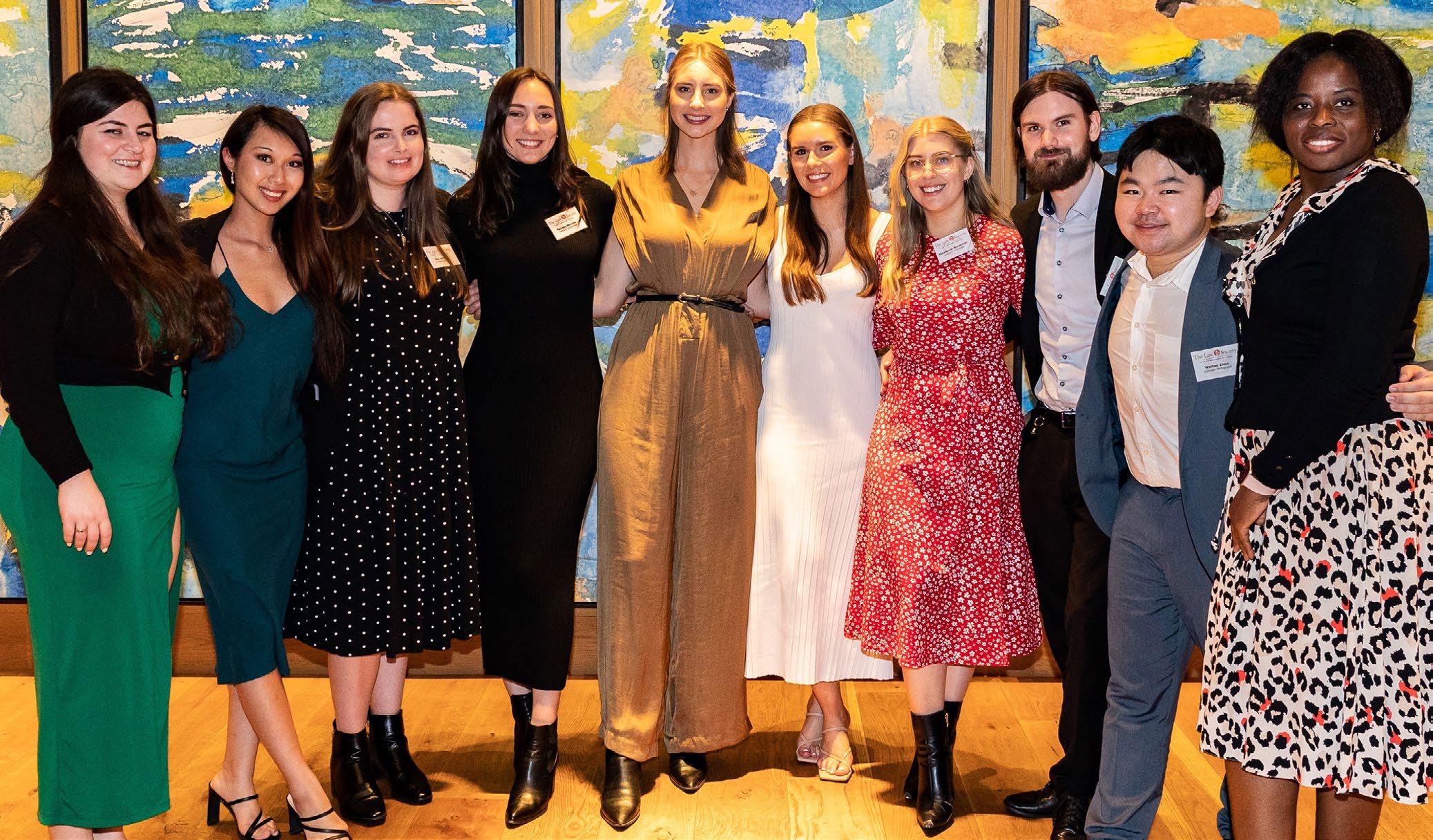





48 | BRIEF OCTOBER 2022
This edition of Brief is the first issue since our election as the new Chair and Deputy Chair of the Young Lawyers Committee (YLC). We thank Chris Burch for his dedication as Chair of the YLC over the last few years.


The year has already been a great success for the YLC, and we are looking forward to continuing this good work into 2023. In August the Golden Gavel was a stunning success, with over 300 junior lawyers attending
what was, by all accounts, a fantastic night. We also brought you the Social Justice Careers Opportunities Evening, with a further careers event just around the corner. In September, we released the Fair, Safe and Inclusive Legal Workplaces Guidelines to encourage the profession to put in place measures to ensure workplaces in the legal profession are the best they can be - from addressing burnout and unsatisfactory pay, to improving diversity and inclusion, and stamping out bullying and sexual harassment.
There is always lots more work to be done, and we are excited to bring you many more events and initiatives later this year and in 2023, including our annual Netball Competition, sundowners and other social occasions, panel discussions, advocacy campaigns and more. We will also be releasing the results of our workplace culture survey in the next edition of Brief, so watch this space!
Careers Uncut - Wednesday, 2 November 2022
5.30pm – 7.30pm | The Melbourne Hotel


Careers Uncut 2022 brings you behind the scenes, shares personal insights and provides a glimpse of life outside of commercial law firms.
With key take-aways for everyone, we encourage all law students, grads and young lawyers to come along and find out what lies ahead after graduation and be inspired by our diverse range of speakers including:
Catherine Fletcher, Information Commissioner, Office of the Information Commissioner
Thomas Pontré, Barrister, Francis Burt Chambers
Jasmine Sims, Defamation Lawyer and Senior Associate, Steedman Stagg Lawyers



Jamie Davidson, Family Lawyer, ASB Law


Alexander Gibson, Associate, Supreme Court of Western Australia

Emily Purvis, Founder & Principal, Pure Equine Law


After hearing from our amazing speakers, join us for refreshments and cocktail food, and the chance to chat one-on-one with the speakers and young lawyers.
Tickets are Free for members and $30 for non-members.
Book online at lawsocietywa.asn.au/events
Demi Swain Chair, Young Lawyers Committee
Aleks Miller Deputy Chair, Young Lawyers Committee
Daniel Sutherland, Policy Advisor to the Hon Patrick Gorman MP, Assistant Minister to the Prime Minister
Principal Sponsor
Golden Gavel 2022
Once more unto the Breach
On Friday, 12 August, over 300 junior lawyers congregated at the Ritz Carlton. No, they were not plotting to unionise the profession – they were attending Golden Gavel 2022.


“It can be disconcerting when everyone is laughing at you - fortunately I was speaking at the Golden Gavel! Hopefully the Chief Justice forgets the digs by the time I next appear before him.” - Daniel Coster.
As was the case last year, the event sold out in record time. Clearly, no one wanted to miss the opportunity to witness ten unsuspecting lawyers battle it out in a night of wit, comedy and (in one case) rap.
“It was nice to see my kaleidoscopic bowling approach be hit for six. As my speech turned and twisted, I was happy it lived up to expectations from an ever-strong line up of competitors that would give Lillee and Marsh, Marshall and Holding or Akram and Vaas on a bouncy WACA wicket a run for their money. Coming in as 11th man, the people’s choice award was a nice finish to a glorious evening.
The roaring laughter from the audience gave an “MCG on a World Cup like atmosphere stretching from Colombo to Calcutta, kudos again to my firm and mates for letting this one go into the history books.” - Aarahnan Raguragavan.
Like a Supervising Partner with a “please fix”, the Law Society (with the help of the Young Lawyers Committee) ruined yet another weeknight for juniors by providing each contestant with their topic at 4.30pm the night before the competition. The brave speakers were tasked with preparing a five-minute speech, which was delivered on the night, like a flimsy research memo nervously handed to an unrelenting and judgmental Senior Associate.
“Thank you to the Law Society for hosting a great night filled with lots of laughs, awkward silences and zero corporate guilt.” - Isabella Bynevelt.
The judges entrusted to decide the winner of the prestigious gavel were the
Chief Justice, the Hon Peter Quinlan, Ms Rebecca Lee, the President of the Law Society of Western Australia and Mr Simon Freitag SC. The judges were faced with a difficult decision, as contestants delivered some 10/10 banter amongst themselves as well as some proverbial gut punches to each other’s respective firms.
“It was an absolute pleasure to be a part of the 2022 Golden Gavel. Nothing beats the feelings of sheer terror and unrivalled power as you gaze out into a room of 300 members of the legal profession, including the Chief Justice, knowing you are about to spend five minutes roasting both them and yourself. I would highly recommend any graduate or young lawyer, if asked to do it, to take the opportunity. At the very least, no one gives you work on the day (sometimes).” - William Goyder.
Staying true to history, the big law firm contestants received the brunt of the insults, along with a smattering for the competitors from smaller and perhaps never-before-heard of firms.
50 | BRIEF OCTOBER 2022



 by Isabella Wilson Member, Young Lawyers Committee
51
“What an incredible event! I never would have imagined that I would open a public speaking event with a legal remix of the Fresh Prince of Bel Air theme song.....but it happened! The Golden Gavel sparked my new found love for public speaking. Thank you to the Law Society for encouraging all of the participants to stretch beyond our comfort zones, it was certainly worth it!” - Jeremy Nichole.
After a lengthy deliberation over dessert, the judges crowned Calvin Rokich of Herbert Smith Freehills as the deserved winner of the 2022 Golden Gavel. Calvin had the Gen Z crowd eating out of the palm of his hand with his response to the divisive question: “Boomer law v zoomer law”. Isabella Bynevelt from Norton Rose Fulbright and Zachary Heim from King & Wood Mallesons placed second and third respectively. The People’s Choice Award was presented to Arahnan Raguragavan
from Michael Paterson and Associates, whose incredibly fast-paced comedic timing received the loudest applause of the night.
“Golden Gavel was an exceptional battle of wits, full of questionable humour and proof I can turn in a document mere hours before the deadline. A real ‘eat, pray, love’ experience and highly recommended to those considering the lucrative career change from law to stand-up comedy.” - Megan Lee.
In addition to winning some prize money, Calvin is set to represent Western Australia in the National Golden Gavel competition, which will be held in Canberra – the comedy capital of Australia.

“Thanks to the Law Society and the YLC for organising an amazing night. It was an absolute privilege to be recognised as funny...”for a lawyer.” - Calvin Rokich.
Overall, it was a fantastic night. Congratulations must go to all of the contestants, and a big thank you to the judges and the Law Society for putting on a wonderful event. I am already looking forward to the competition returning in 2023.

It was a real pleasure to speak at the 2022 Golden Gavel. It was a tough ask to follow the speakers that went before me, every single one did an amazing job. Thanks to the Law Society and the Young Lawyers Committee for organising, it’s not every day you get the chance to be called unoriginal by the Chief Justice, I’ll cherish His Honour’s comment for the rest of my life. - Kenyon Lee.

Golden Gavel 2022
52 | BRIEF OCTOBER 2022
Social Justice Career Opportunities Evening
Thursday, 28 July 2022 Inspiring | Passionate | Rewarding
Interested in pursuing a career in social justice? There are a lot more opportunities out there for you than you might think. Being passionate about your work, getting your foot in the door through volunteering and not being scared to take alternative pathways to follow your dreams. These were the key messages from our passionate speakers at our Social Justice Career Opportunities Evening event.
On 28 July 2022 the Law Society of Western Australia’s Young Lawyers Committee hosted over 50 young lawyers, grads, and students at this popular information and networking evening. Guests received advice and firsthand experience from a wide variety of speakers as to how to peruse a meaningful career in the human rights and social justice space and how to get involved in pro-bono and volunteer opportunities. Later in the evening guests had an opportunity to pick the brains of each speaker while networking over drinks and canapes.
Thank you to our speakers for taking the time to share your experience and advice.
Social Justice Career Evening Review
As a student, I found the Social Justice Career Evening to be a very insightful event! The event went by smoothly with a positive atmosphere that really encouraged others to network and provided deep insight into the multitudes of opportunities in being involved in community-focused organisations. The speakers were very articulate in detailing their role, organisation and experiences. I found each speaker to be enthusiastic and encouraging - you could not get bored listening! The speakers elaborated on their legal approaches towards their social justice efforts which was especially motivational and encouraged students to ponder deeper about the legal and non-legal pathways available to become involved in such work. I was able to discuss their roles and organisations in further detail personally, which was extremely beneficial for an aspiring law student such as myself, who wants to further their knowledge before entering the legal industry. Through this event, I was able to gain valuable advice whilst networking with many industry professionals. Being surrounded by a professional environment was an eye-opening experience - I was able to grasp a better understanding of the working environment and how they operated towards achieving their goals. The social environment was much more welcoming than I had imagined, with each individual being very understanding and patient in answering any questions. I recommend any aspiring law student to take part in this event in the future, and any similar events like it. On another note, the food provided was also delicious! The Law Society and Young Lawyer’s Committee worked hard to provide the best networking and educational experience and I will be definitely looking forward to future events!
Your passion for your work really shone through and it was inspiring to hear. We are also very grateful to the organisations who came and shared how we can make a difference in the wider community during the networking portion of the evening.
Thank you to all who braved the weather
to attend the evening and special thanks to our event host and sponsor, The College of Law.
Gifts in Wills help us get closer to our vision of a cancer free future for our community.
How are we going to achieve this?
By funding world-class researchers here in WA.
By providing support from the point of diagnosis through to treatment and beyond.
By empowering healthier lifestyles and shaping public policies for West Australians to reduce their risk of cancer.
When writing a Will for a client please ask them to consider a charitable gift.
To find out more contact us on 08 9212 4333 or visit cancerwa.asn. au/getinvolved/a-gift-in-will Cancer Council Western Australia (Inc). Level 1, 420 Bagot Road, Subiaco WA 6008 ABN: 15 190 821 561
Attendee, Aliyah Butler, University of Western Australia
Event Speakers (L-R) Alice Barter, Melissa De Abreu, Alana Dowley, Luella Botteon, Megan McKrill, Hamish Glenister.
53
Dangers of charging ahead without client instructions.
A recent decision of the Court of Criminal Appeal in New South Wales highlights the perils of solicitors acting without instructions from their clients.

In Stuart v R [2022] NSWCCA 182, the applicant sought leave to appeal their conviction on the basis that he did not give his solicitor instructions to plead guilty to two of the charges. The solicitor had entered in the pleas despite the applicant not having been asked personally to confirm his guilty pleas either in the Local Court where the charges were first dealt with, or in the District Court when being sentenced.
The Court ultimately upheld the appeal, with the two convictions quashed, the charges to be retried and the applicant to be resentenced considering that the sentence was imposed as an aggregate with respect to all charges. All in all, the applicant’s solicitor caused quite the debacle in the matter, all because they proceeded without instructions.
The Arraignment Process
Kirk JA noted that, while it is not necessary that the accused be arraigned,1 at no stage were the charges read out to the applicant.2 The first time this occurred in Court was when the sentencing judge delivered the sentencing judgment.3 This is despite the applicant being told, at an earlier point in time, that he would be asked how he would plead.4
In New South Wales a plea will not be required until after a case conference certificate is filed.5 After the case conference occurred, the ruling judge: “…merely accepted the applicant’s plea after both the applicant’s solicitor and the DPP’s solicitor indicated, in a rather cursory fashion, that the applicant would be entering pleas of guilty to all charges.”
As Kirk JA states, a Court is entitled to rely on what is said by a legal practitioner on behalf of their client as being just that, the position stated on their client’s behalf.7 It is then incredible that a solicitor would not only act not in accordance with their client’s instructions, but without obtaining such instructions in the first place.
Solicitor’s Conduct
Prior to any committal hearing, the applicant’s solicitor had acted without any instructions in communicating to the
Case Note - Stuart v R [2022] NSWCCA 182
by Thomas Coltrona Member, Young Lawyers Committee
prosecution on three occasions that the applicant would be pleading guilty.8 This undermined the applicant’s ability to seek to negotiate a plea deal with the prosecution.9
Further, the solicitor accepted that he never obtained written instructions from the applicant to plead guilty to the charges, nor written confirmation of his plea, nor did he seek at any stage that the applicant sign the agreed statement of facts.10 Nor did he seek that the applicant be arraigned in the District Court.11
To complicate issues, the applicant’s solicitor largely communicated with the applicant through his brother, who Kirk JA found to be a “conduit of information”. 12
As a result of the findings above, Kirk JA found that the conduct of the applicant’s solicitor provided an indication that he had reached an early and clear view as to how the case should be conducted, and as a result paid little regard to the applicant’s views.13
Miscarriage of Justice?
The substantial legal question in this case, with the principles not in dispute, was whether a miscarriage of justice had occurred. The Court in this regard has particular concern to two issues:14
1. Whether a sufficient question arises about the integrity of the plea; and
2. Whether there is a real or triable question about the guilt of the accused.
There is not a high threshold regarding the latter issue, as the court is not required to investigate the guilt or innocence of the accused.15
With regards to the former issue, as a result of his solicitor acting without instructions, the applicant said that:16
1. the nature of the charge to which the plea has been entered is not appreciated;
2. there has been a ‘mistake or other circumstances affecting the integrity of the plea as an admission of guilt’; and
3. the plea is not unequivocal or is made in circumstances suggesting it is not a true admission of guilt.
Determination
Kirk JA acknowledged that it was conceivable that there were miscommunications and misunderstandings involved in this matter.17
However, this led him to emphasise that the risk of this occurrence meant that it was important for legal practitioners to obtain detailed written confirmation of instructions.18
As Kirk JA pointed out, the utilisation of the applicant’s brother as a conduit “was not the most reliable means for a lawyer to communicate with his client on matters of importance and complexity.”19
In light of the factual findings regarding the conduct of the applicant’s solicitor, the Kirk JA stated that the case was one where the plea was made in circumstances suggesting it is not a true admission of guilt,20 and a case in which there has been a “mistake or other circumstances affecting the integrity of the plea as an admission of guilt”.21
Accordingly, a miscarriage of justice was established.
Implications
This decision has significant, albeit unsurprising, takeaways for all junior practitioners, not just those that practice within the criminal space.
Ultimately the way a matter proceeds is down to the decision making and instruction of your client, and the solicitor’s role is to provide advice as to the best course of action they should choose once they have acquainted themselves with the full amount of knowledge available or that they can obtain.
While you may have differing ideas on how a case should be run, this should not overrule the instructions of your client. You should certainly not take any significant action, such as entering a criminal plea or accepting a settlement offer, without first obtaining your client’s instructions.
Accordingly, be thorough and specific in obtaining instructions, ensuring that you get those instructions in writing for the avoidance of any doubt. Otherwise, as concluded by Kirk JA, “large questions [may] arise about the conduct of” your own practice.22
End Notes
1 Stuart at [11].
2 Stuart at [12].
3 Stuart at [12].
4 Stuart at [12].
5 Stuart at [8].
6 Stuart at [12].
7 Stuart at [15].
8 Stuart at [31]-[35].
9 Stuart at [35].
10 Stuart at [56].
11 Stuart at [56].
12 Stuart at [59]-[60]
13 Stuart at [36].
14 Stuart at [16] citing Rotner v R [2011] NSWCCA 207 at [47][50].
15 Stuart at [16] citing R v Van (2002) 129 A Crim R 229; [2002] NSWCCA
148; R v Thalari (2009) NSWLR 307; [2009] NSWCCA 170; Layt v R [2020] NSWCCA 231; Bobbe v R (No 2) [2021] NSWCCA 150.
16 Stuart at [17]-[18].
17 Stuart at [88].
18 Stuart at [88].
19 Stuart at [60].
20 Stuart at [91] citing Maxwell v The Queen (1996) 184 CLR 501 at 511.
21 Stuart at [91] citing Sagiv v R (1986) 22 A Crim R 73 at 80.
22 Stuart at [102].
54 | BRIEF OCTOBER 2022
Dear Aunt Prudence, when I accepted a position at a big firm I was not expecting the constant after work events and social gatherings. I don’t mind my co-workers but I don’t want to be doing weekly quiz nights and escape rooms with them. How do I gently tell my colleagues that I just want us to be colleagues. - Eight to Nine

Dear Eight to Nine, Welcome to the cult of the top-tier firms! When they are not working you to the bone they are making sure you stay for life with wellintended perks like gym memberships, free lunch buffets and the dreaded team bonding exercises.
Of course what we all really want is better worklife balance. If better work-life balance means not spending time after work with people from work then it’s okay to say no. Here’s a tip from experience, having a “sick pet” is a good excuse for getting out the next karaoke evening
- Aunt Prudence.
Member Privileges
Prudence Juris
Dear Aunt Prudence, my “supervising” Partner is constantly out of the office. When I do reach him he is often at the local watering hole and his reviews of my work are just cursory glances and rubber stamped emails. How do I get more supervision from him?

- Desperate for Attention
Dear Desperate for Attention,
It is unfortunately common for graduates to come across Partners who lost the drive to train and mentor juniors decades ago. It is also quite disheartening (and embarrassing) to find out that when the Partner says that they are out marketing and bringing in the work, they are really just drinking amongst other alcoholics at one of the pubs near the District Court.
Unfortunately when one gets to that stage in the profession they are a lost cause. Keep detailed file notes of your “supervision” while you browse Seek and LinkedIn for new and better opportunities.
- Aunt Prudence
Dear Aunt Prudence, I hate my job. I hate the long hours, discovery and being yelled at by my boss, the client and other lawyers. What do I do? - Depressed Grad
Dear Depressed Grad, Sorry to hear that is happening for you. To be honest, it’s an all too common story for graduates. We all tell ourselves this is what we sign up for when we enter the profession, especially at the big firms, but that doesn’t make it right.
Despite it all try to find some work-life balance. Start by not checking your emails overnight. Tell yourself it can wait until tomorrow. Then don’t check them over the weekend. Tell yourself it can always wait until Monday. Finding a new employer may also help. Despite what your colleagues may tell you, the grass often is greener at small firms.
If you could use some help or someone to listen to you, remember your Law Society membership lets you access LawCare WA to help you manage your career, life, health and wellbeing.
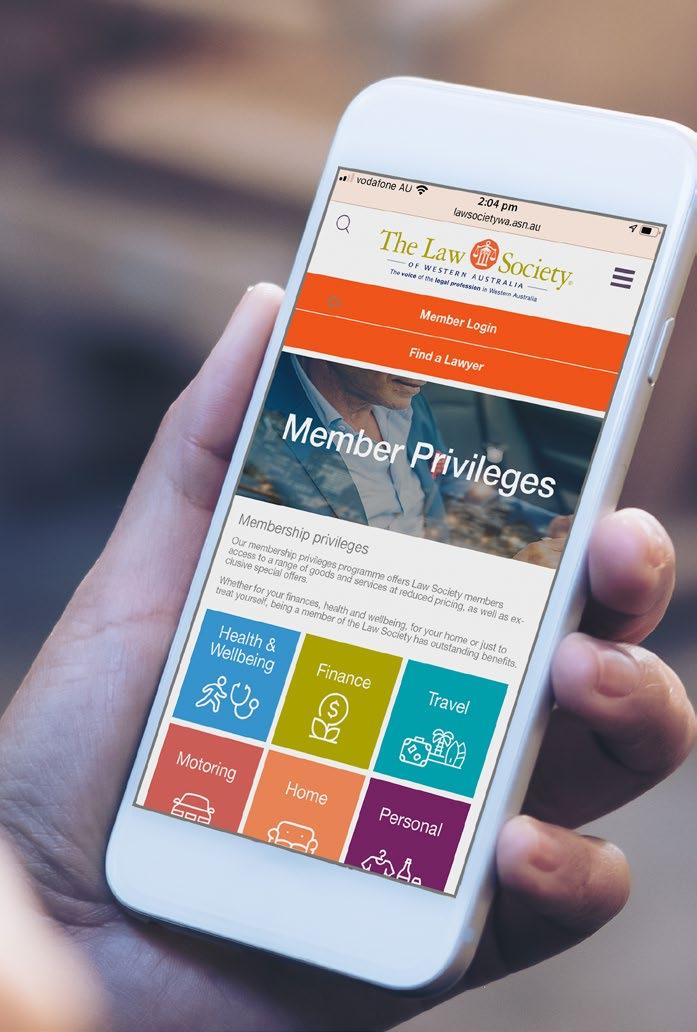

Take care of yourself first!
- Aunt Prudence
Do you have a question for your Aunt Prudence? Send all inquiries to younglawyers@lawsocietywa.asn.au and look out for your Aunt’s response in the next edition of Brief.

In
For
of member privileges head to our website : lawsocietywa.asn.au/member-privileges/
Myall Yoga & Wellbeing

Discount
Myall Yoga & Wellbeing Studio is a holistic health and wellbeing sanctuary, right in the heart of Perth City CBD. With yoga, pilates, breathwork and massage, Myall Yoga & Wellbeing Studio in Perth City CBD is your place to just be. Myall have a full timetable of yoga & pilates, an infra-red sauna, therapeutic & remedial Massage, mats & showers available for your convenience.
endota spa – 15% Discount
Myall also offer corporate massage and movement packages in your office!
Law Society members receive a 10% discount on yoga and therapeutic massage memberships.
Visit the members’ only privileges page (password protected) to learn more about this special offer and to access the discount information.
Members can enjoy 15% off the spa menu* endota spa stands for intensely wholesome, certified organic care, and it’s down to earth. endota spas are created by real people, run by real people for real people. The Perth CBD endota spa is an oasis; a place of retreat in the middle of the hustle and bustle of the city. When you slip upstairs and settle into the relaxation lounge, you are transported to another world. The CBD has a few smaller spas, but only endota spa brings together divine treatments and affordable prices.
*Visit the members’ only privileges page (password protected) to learn more about this special offer and to access the discount information.

each issue of Brief we highlight a small selection of the exclusive special offers and discounts our members receive on a variety of goods and services.
the full listing
10%
55
HIGH COURT JUDGMENTS
Dr Michelle Sharpe
Castan Chambers, Melbourne
Administrative law Judicial review
In Nathanson v Minister for Home Affairs [2022] HCA 26 (17 August 2022) the High Court was required to determine whether procedural unfairness by the Administrative Appeals Tribunal (AAT), during the hearing of the appellant’s application for a review of a decision not to revoke the mandatory cancellation of his visa, involved jurisdictional error.
The appellant, Mr Nathanson, a citizen of New Zealand, arrived in Australia in 2010. In 2013, Mr Nathanson was granted a Class TY Subclass 444 Special Category Visa. But, in 2018, the Minister cancelled the visa pursuant to s501(3A) of the Migration Act 1958 (Cth) (Migration Act). The Minister was satisfied that Mr Nathanson did not pass the character test in s501(6) of the Migration Act because Mr Nathanson was then serving time in prison for, among other things, theft and aggravated assault. The circumstances of Mr Nathanson’s offending which included an unprovoked attack on an elderly man and a high-speed car pursuit with police – were egregious.
In 2019 the Minister decided not to revoke the mandatory cancellation of Mr Nathanson’s visa, pursuant to s501CA(4) of the Migration Act. In making that decision, the Minister was required to comply with a ministerial direction known as “Ministerial Direction 65”. Ministerial Direction 65 required the Minister to have regard to a range of considerations in exercising the relevant consideration.
Relevantly, these considerations included crimes against vulnerable members of the community such as minors. By the time of the AAT hearing, Ministerial Direction 65 had been replaced by Ministerial Direction 79. The significant difference between the two directions is that the latter direction included for consideration “[t]he principle that crimes of a violent nature against women or children are viewed very seriously, regardless of the sentence imposed”.
At the hearing (at which Mr Nathanson was self-represented) the AAT member drew Mr Nathanson’s attention to the existence of Ministerial Direction 79. The AAT member marked out in red, on a printed copy of Ministerial Direction 79 (which she handed to him), all the changes from Ministerial Direction 65. The AAT Member described these changes
as “minor” and commented that “[m] ost of those changes relate to how we treat crimes where women and children are involved, and with respect to the conviction history I have for you in front of me, I think they are of minor relevance . . .”
During the hearing Mr Nathanson presented the AAT with a letter from his wife which referred to previous incidents of family violence but expressed her support for him to continue to remain in Australia. The solicitor acting for the Minister questioned Mr Nathanson about two reports of family violence involving him – although Mr Nathanson said he couldn’t remember much about them. In closing submissions, the solicitor contended that this conduct was extremely serious given the new directions in Ministerial Direction 79. The AAT took no steps to alert Mr Nathanson to the fact that the Minister had raised a new issue, based on the new directions, or allow him an opportunity to address this new issue. The AAT then found, having regard to Ministerial Direction 79, that the evidence of family violence weighed strongly against the revocation of Mr Nathanson’s visa cancellation.
Mr Nathanson appealed to a single judge of the Federal Court of Australia (Colvin J). Colvin J found that the course taken by the AAT was procedurally unfair but did not constitute jurisdictional error. Colvin J considered that there was no jurisdictional error because Mr Nathanson had failed to point to a “sufficient factual basis” on which the Court could conclude that the breach was material. Mr Nathanson appealed to the Full Court of the Federal Court (Steward, Jackson and Wigney JJ) but was similarly unsuccessful. Steward and Jackson JJ concluded that Colvin J was correct to find that the unfairness was not material. Steward and Jackson JJ, citing the majority in Minister for Immigration and Border Protection v SZMTA (2019) 264 CLR 421, considered that unfairness is only material if fairness could have realistically resulted in a different decision and this was a question of fact in respect of which Mr Nathanson bore the onus of proof. The majority concluded that there was little scope to infer that Mr Nathanson could have produced further evidence or made further submissions that could have resulted in a different decision. Wigney J, in dissent, considered that if Mr Nathanson had been given a fair hearing, he may have been able to persuade the
AAT to decide in his favour. Wigney J observed, for example, that Mr Nathanson could have given further evidence himself about the incidents of domestic violence, or the context of the incidents, he could have called his wife to give evidence, or he could have made submissions about the weight that the AAT should give to the incidents.
Mr Nathanson appealed against the decision and the High Court unanimously allowed his appeal. Kiefel CJ, Keane and Gleeson JJ (“Kiefel et al”), citing MZAPC v Minister for Immigration and Border Protection (2021) 95 ALJR 441, noted, at [32], that materiality requires a consideration of the decision that was in fact made, how it was made and whether the decision could have been different “as a matter of reasonable conjecture”. Their Honours observed that the onus falls on the plaintiff to prove, on the balance of probabilities, the historical facts necessary to enable the Court to be satisfied that a different decision could have been made. But, at [33], also noted that there generally will always be a realistic possibility of a different outcome and “(t) he standard of ‘reasonable conjecture’ is undemanding”. Further, Kiefel et al noted, at [39], this undemanding standard did not require Mr Nathanson to establish the nature of any additional evidence or submissions that might have been presented to the AAT. Gageler J agreed with the reasoning of Kiefel et al and observed further, at [56], that the denial of procedural fairness lay in the AAT’s failure to afford Mr Nathanson a fair opportunity to be heard on a decision-making criterion that was shown later to have been central to the AAT’s decision. Gordon J, at [86], considered that the AAT’s denial of procedural fairness was so fundamental that nothing further was required from Mr Nathanson to make out jurisdictional error. Edelman J explored (and lamented) what he described as the High Court’s erosion of the bedrock of natural justice ordinarily implied in statute before concluding that the Mr Nathanson’s appeal should be allowed.
Dr Michelle Sharpe is a Victorian barrister practicing in general commercial, real property, disciplinary and regulatory law, ph 9225 8722, email msharpe@vicbar.com. au. The full version of these judgments can be found at www.austlii.edu.au

56 | BRIEF OCTOBER 2022
FEDERAL COURT JUDGMENTS
By Dan Starr
Administrative Law – Practice and Procedure
The Hardiman principle – whether it applies to AFCA
In MetLife Insurance Limited v Australian Financial Complaints Authority (No 3) [2022] FCA 849 (20 July 2022) in the context of the argument on costs following the determination of the proceedings, the Court gave detailed consideration to the Hardiman principle. This is the principle articulated in R v Australian Broadcasting Tribunal; Ex parte Hardiman (1980) 144 CLR 13 at 35 6, to the effect that an administrative decisionmaker, which has continuing functions to be exercised in respect of the subject matter of the decision under challenge, is expected to maintain its impartiality in proceedings challenging its decision by not entering the field as a protagonist or, if it does, by confining its submissions to issues of its powers and procedures. The question arose whether and to what extent the principle applies to the Australian Financial Complaints Authority (AFCA).
AFCA is the operator of a scheme for the resolution of disputes, being a scheme that was established to give effect to laws introduced into the Corporations Act 2001 (Cth) (Corporations Act). AFCA is a private body whose members are financial services licensees. Any person who is the holder of a financial services licence and who provides certain types of services specified in the Corporations Act must be a member of the scheme.
The defendant (MetLife) is a member of AFCA. Certain complaints were made by a person about MetLife to AFCA and AFCA determined them in the complainant’s favour. MetLife commenced proceedings seeking declaratory relief that AFCA had no authority to determine the complaints. The original complainant filed a submitting appearance. AFCA actively defended the proceedings and also commenced a cross-claim against MetLife claiming an order for specific performance of its own determination.
In a defence to MetLife’s claim, AFCA advanced claims of estoppel and acquiescence. AFCA also advanced a defence to the effect that if the complaints had not been determined under the scheme then there had been

separate ad hoc agreements by which MetLife, AFCA and the complainant had agreed that AFCA should have the power to determine the complaints.
In determining a separate question, the Court in earlier reasons held that AFCA had authority to make the determinations: [2022] FCA 23. A dispute then followed as to the appropriate order as to costs to be made. MetLife sought an order that AFCA bear its own costs of the proceeding because AFCA failed to adopt a position of neutrality of a kind that it was required to adopt. AFCA argued that it was appropriate to take the course which it did and, as it has been successful, a costs order should be made in its favour. In this context, the Court addressed the case law on the Hardiman principle (at [9]-[14]). Colvin J also addressed the “somewhat unusual” status of AFCA (at [15]-[16]). While it is not a statutory body and exercises consensual authority, the scheme is mandatory for financial services licensees and this gives AFCA attributes of a statutory decision-maker.
In exercising its discretion on costs, the Court held that it was appropriate to distinguish between four categories: (1) the costs associated with the question whether AFCA had jurisdiction to make the determinations; (2) the costs associated with the cross-claim by which AFCA sought specific performance of the determinations; (3) the costs associated with the claim that there were ad hoc agreements to the effect that AFCA would make the determinations; and (4) the costs associated with the defences of acquiescence and estoppel (at [43]).
For category (1), the Court held it was consistent with the Hardiman principle for AFCA to make submissions in answer to MetLife’s claims that AFCA lacked jurisdiction. In the usual course, the appropriate order was that there be no order as to costs (at [48]).
For category (2), AFCA’s cross-claim was simply the obverse of MetLife’s application for declaratory relief and did not raise additional issues. The Court was not persuaded that the appropriate order was that there should be an order for costs in favour of AFCA (at [49]-[50]).
Category (3) also did not support a costs order for AFCA. AFCA had no interest in advancing a claim that there had been
ad hoc agreements which bound MetLife to the terms of the determinations and MetLife was successful on whether there had been such agreements (at [51]).
Category (4) also did not support a costs order for AFCA, noting that the additional defences had not been determined (at [52]).
Note: The Full Court heard MetLife’s appeal from the separate question judgment on 23 August 2022. AFCA’s cross-appeal on costs has been stood over until the Full Court has decided MetLife’s appeal.
Administrative law
Judicial review – standing/person aggrieved

In Australian National Imans Council Limited v Australian Communications and Media Authority [2022] FCA 913 (11 August 2022) the applicant (ANIC) brought an application for judicial review under s5 of the Administrative Decisions (Judicial Review) Act 1977 (Cth) (ADJR Act). ANIC sought to set aside a decision of the first respondent (ACMA) under the Broadcasting Services Act 1992 (Cth) (Broadcasting Services Act) to renew the community broadcasting licence of the second respondent, Muslim Community Radio Incorporated (MCR).
ACMA filed a notice of objection to the competency on the basis that ANIC lacked standing as it was not a person aggrieved by a decision.
MCR held a community radio broadcasting licence for the Sydney area since 2001. MCR’s 2015 licence was due to expire on 31 May 2021 and it applied to renew that licence. ANIC is Australia’s Muslim peak body representing mainstream Islam and Muslims in Australia. It applied to the Court to restrain ACMA from determining the renewal application. The proceeding was stayed to allow ACMA to make a decision on MCR’s licence renewal application. The judicial review challenge followed ACMA’s decision to renew MCR’s licence.
The Court held that ANIC had standing as a person aggrieved by ACMA’s decision to renew MCR’s licence to bring the application challenging ACMA’s decision under the ADJR Act, but that ANIC’s grounds of review must be rejected.
One of the main issues that arose in the judicial review challenge was
57
FAMILY LAW CASE NOTES
Children – Court’s reliance on academic article without notice breached procedural fairness, but not material to reversal of care order
In Berry & Andrews [2022] FedCFamC1A 120 (3 August 2022), the Full Court (Tree, Jarrett & Campton JJ) dismissed a mother’s appeal from final orders that the parties’ 12 year old live with the father.
The Court referred to the article of J B Kelly and J R Johnston entitled “The Alienated Child: A Reformation of Parental Alienation Syndrome”. The mother appealed, arguing an error of law resulting from a denial of procedural fairness, where she had been given no notice of the Court’s intention to rely on the article.
The Full Court said (from [10]): “ … [P]rocedural fairness require[s] that anything relied upon by a court … be made known to the parties to the proceeding prior to the making of the decision … [11] … All parties agree that neither the article nor any intention to rely on it was identified
[12] … If further information would not … have made any difference to the result …, an appeal establishing a breach of the rules of procedural fairness … will … fail … ( … )
[19] … [I]t is necessary to … scrutinise his Honour’s reasons … to discern whether it is … possible that the decision made could have been different had the breach … not occurred … ( … )
[38] … [H]is Honour … thought that [the mother] … demonstrated a lack of insight into the impact of her conduct on the child … ( … )
[43] … [H]is Honour considered that … continuing to live primarily with the … [mother] … would mean the child would not spend time with her father. ( … )
[52] The … [mother] … argues that … the reasons establish that the … judge’s approach to the evidence was … informed by the research to which he referred. …
[53] His Honour made no finding that the [mother] … was ‘guilty’ of parental alienation syndrome. …The judge’s focus was firmly on the facts of the case … ( … )
[58] … [W]e do not consider it realistically possible that the orders made … could have been different had the breach of procedural fairness not occurred. ( … )”
Spousal maintenance – No error in interim maintenance order where wife’s need was premised on anticipated, not actual costs
In Badir [2022] FedCFamC1A 109 (19 July 2022), McClelland DCJ dismissed a husband’s
appeal from an order that he pay interim spousal maintenance.
The order was worded to commence upon the wife vacating the home and establishing her own residence in alternate premises ([14]).
The husband appealed, arguing the Court erred where there were no findings as to when the wife would leave the home; and no findings as to what the financial circumstances of the parties would be at the time that the wife left the home ([16]).
McClelland DCJ said (from [20]):
“The appropriate process to follow in considering an application for spousal maintenance is the four step process as set out in Saxena and Saxena [2006] FamCA 588 … :
(1) To what extent can the applicant support him/herself?
(2) What are the applicant’s reasonable needs?
(3) What capacity does the respondent have to meet an order?
(4) If steps 1-3 favour the applicant, what order is reasonable having regard to s 75(2)? ( … )
[57] … [T]he [wife] … knew of the [husband’s] … desire for her to leave the matrimonial home. ( … )

[58] … [I]t was not only entirely appropriate
FEDERAL COURT JUDGMENTS CONTINUED
By Dan Starr
whether ACMA had to consider ANIC as a potential competing licensee when deciding to renew MCR’s license under s91 of the Broadcasting Services Act (at [57]-[76]). This was an issue of statutory construction. Jagot J held that ACMA was not bound to consider whether a third party could provide a superior community broadcasting service to that provided and proposed to be provided by the licensee in deciding whether or not to renew a community broadcasting licence. However if ACMA chooses to consider that issue, then that is a matter for ACMA (at [76]).
As to whether ANIC was “a person who is aggrieved by a decision” under s5(1) of the ADJR Act, the Court noted that the law relating to standing is not confined to a consideration of the subject matter, scope and purpose of the statute under which the decision is made. Jagot J explained how the concept of a person aggrieved depends on the interest affected by the decision by reference to various authorities (in particular, Argos Pty Ltd v Corbell,
Minister for the Environment and Sustainable Development (2014) 254 CLR 394) (at [87][90]). The Court held that ANIC had a special interest in the fact of MCR being able to continue to broadcast services focusing on its community purpose or community interest of “religious – Islamic” (at [94]). Jagot J explained (at [96]): “I consider that there is a material difference between: (a) a body (be it religious or not) seeking to challenge a decision which it considers is an affront to its religious, moral, ethical or other beliefs (as in Right to Life), and (b) a body (be it religious or not) seeking to challenge a decision which directly relates to a public service intended to be for the benefit of at least some of the very persons the body represents (relevantly, Muslims in the Sydney area)”.
Finally, the Court considered whether ACMA owed a duty to give procedural fairness to ANIC in making the renewal decision (at [101]-[155]). The Court held that in the context of the subject matter, scope and purpose of the Broadcasting Services Act,
ANIC’s status as a potential competitor to MCR as a licensee for the community purpose of interest in the Sydney area did not find an obligation by ACMA to give ANIC procedural fairness in deciding whether or not to renew MCR’s licence (at [116]).
However, as ANIC had a real, direct and sufficient interest in the renewal decision, this supported the conclusion that ACMA owed ANIC a duty of procedural fairness in making the renewal decision (at [127]).
Having regard to the content of the duty of procedural fairness in these circumstances, it was not breached by ACMA.
Dan Star QC is a Senior Counsel at the Victorian Bar, ph (03) 9225 8757 or email danstar@vicbar.com.au. The full version of these judgments can be found at www. austlii.edu.au. Numbers in square brackets refer to a paragraph number in the judgment.
58 | BRIEF OCTOBER 2022
By Craig Nicol and Keleigh Robinson
Accredited family law specialists Editor and co-editor of The Family Law Book

but necessary for the … judge to make an assessment of the [wife’s] … future needs based on the assumption that she would vacate the matrimonial home. ( … )
[62] [T]he … judge based his assessment of the [wife’s] … future needs on a finding that she would vacate the matrimonial home … The [wife] … gave evidence that she had made … inquiries as to the availability and likely cost of rental accommodation. … ( … )

[65] Insofar as the [husband] … contends that there is uncertainty and/or potential injustice in the manner in which the orders have been expressed such that he is unable to reasonably comply with them, that is … a matter which he can raise in the event of there being the need for enforcement proceedings.”
Property – UK pension treated as a financial resource but in personam orders made to divide future pension payments equally
In Hardrick [2022] FCWA 90 (29 April 2022)
Case Note - Isles & Nelissen [2022]
by Alice McShera, Barrister, Murray Chambers
In Isles & Nelissen [2022] FedCFamC1A 97 the Full Court (Alstergren CJ, Mcclelland DCJ, Aldridge, Austin & Tree JJ) heard, and dismissed, a father’s appeal from orders that provided for four children to live with their mother and spend supervised time with him. The central issue before the primary judge was the allegation that the father posed an unacceptable risk of harm to the children – which his Honour found he did.
The decision is an important one for family law practitioners, as the Full Court set out at [1] – [9]:
More than 30 years have passed since the High Court decision in M v M (1988) 166 CLR 69 was decided.
In the years which have since elapsed this Court has on occasions posited that the risk of [sexual] abuse (and hence the risk of consequent harm to the child) must be proven on the balance of probabilities according to the civil standard of proof, in just the same way that facts are proven. We consider that statement of principle to be incorrect and now state it to be so ...
The appeal presented an opportunity for the Full Court “to state clearly and authoritatively” that “the balance of
Duncanson J of the Family Court of Western Australia heard an application for property settlement after a 23 year relationship. The parties had met and married in the United Kingdom (“UK”) before moving to Australia in 2004.

Single experts had been appointed in respect of the husband’s UK Pension (“Pension A”), which provided for a pension upon the husband reaching retirement age (of 65) of £10,346 per annum ([51]).
A UK lawyer, as single expert, gave evidence that because neither party was domiciled in the UK, it was unlikely that a UK Court would have jurisdiction to make a pension sharing order ([55]).
The Court said (from [134]): “ … The pension to which the husband is entitled [ed. ‘Pension A’] … at normal retirement age of 65 years … is £10,346 per annum. [T]hat is equivalent to $18,933 per annum. …
[135] The husband will be entitled to a UK State pension … which the wife estimated to
probabilities is not the measure by which an unacceptable risk of harm is to be assessed”. [47]
At [7] the Full Court noted that:
1. “courts should (and do) react to dangers in the form of risks of harm which may merely be possibilities”;
2. “risks of harm are not susceptible of scientific demonstration or proof”;
3. “it is an oxymoron to expect such possibilities to then be forensically proven on the balance of probabilities according to the civil standard of proof”; and
4. “by definition possibilities are not, and could never be, probabilities.”
With considerable emphasis on the important distinction between “fact finding” and “risk assessment”, the Full Court canvassed how the alleged risk of abuse would be established on the evidence before the Court – which can be distilled as follows:
1. a judicial officer does not need to make a positive factual finding that a party has with “certainty” or has “probably” sexually abused a child in the past. ([7] & [50])
2. a party does not need to adduce, or point to, evidence that the other party has with “certainty” or has “probably” sexually abused a child in the past. ([50])
3. a party is required to adduce, or point to, evidence that establishes there is a “possibility” the other party may have
be $325 per week.
[136] The wife will be entitled to Pension B, the value of which she said was $50,139 as at January 2021, although the weekly amount is not known. The wife will also be entitled to a UK State pension … This is estimated to be £86 (or $156) per week … ( … )
[156] … I consider that to the extent possible, Pension A and the other pensions should be divided equally. ( … )
[165] … This Court … can make an order with respect to Pension A by making an order that the husband deal with it in a particular way. …”
The Court ordered a 55:45 division overall in favour of the wife with in personam and injunctive orders, requiring the husband to pay 50 per cent of future pension payments received by the husband, net of tax, to the wife.
sexually abused a child in the past. ([7] & [50])
4. it is the relevant “historical facts” said by a party to be evidence of the “possibility” of past sexual abuse which need be proven on the balance of probabilities. ([53])
5. when a judicial officer looks at all the evidence adduced in the case and finds those “historical facts” are proven on the balance of probabilities, they are then part of “the known facts”. ([85])
6. the judicial officer then undertakes a predictive inquiry into the assessment of risk postulated from “the known facts” and present circumstances. ([7] & [105])
7. the judicial officer is focused on what “the known facts” and present circumstances imply is the risk of harm to the child in the future. ([50])
At [59] the Full Court provided a reminder to litigants and practitioners that parenting disputes should be conducted by reference to the express provisions of the Family Law Act 1975 (Cth) (“the Act”).
In the context of alleged child abuse, parenting disputes should be conducted on the basis of an:
1. “unacceptable risk” of “family violence” ([58] and s 60CG of the Act; and/or
2. “unacceptable risk” of “physical and/ or psychological” harm through the child’s subjection or exposure to “abuse”, “neglect” or “family violence” ([58] and ss 4(1), 4AB and 60CC(2)(b) of the Act).
59
The Tale of the Prevaricating Witness
By The Hon John McKechnie QC
Dr Robert (Bob) Withers loved camellias and rhododendrons, going so far as to write a book about them: Liliums in Australia. He was very knowledgeable about the species and was recognised in 1995 with an award of AM for services to horticulture. He even managed to have one of his creations recognised on a stamp. When he died in 2005, aged 82, he bequeathed his collection to the Royal Botanic Gardens in Melbourne.
All of which has nothing to do with the time he brushed with the law and ended in gaol –briefly.

It happened this way.
After serving as a private in World War 2, Bob Withers qualified as a doctor in 1946 and commenced practice. Now these were the days before breathalysers took all the fun out of defending drink drivers (thank you Mr Bunning). In the absence of any scientific way of proving intoxication, witnesses were often called to give evidence of sobriety, or lack thereof. One evening police asked Dr Withers to assess the sobriety of a suspected drunk driver. Dr Withers agreed and performed some tests.
In due course, Dr Withers was called as a witness for the defence. He said, “I asked the defendant to walk up and down some steps I had in the surgery which I consider he did in a satisfactory manner.”
But there was a problem. In earlier evidence a witness said that the first time the defendant had walked up the steps, he had fallen. Naturally the magistrate, sitting with 2 justices, asked: “Tell me about the first time the defendant stumbled.”
Dr Withers answered, “I did not feel it was a matter of importance”.
That seemed to have riled the whole bench. The magistrate said “I consider you have prevaricated in not disclosing the defendant failed to do the test satisfactorily on the first occasion and I propose to have you taken into custody to be dealt with.”
And so he did.
But the magistrate had made several mistakes. The section in the Justices Act made wilful prevarication a contempt of court, not mere prevarication. Next, the magistrate gave Dr Withers no opportunity to answer the charge.
Dr Withers obtained an order nisi which was made absolute by Justice Martin who entertained grave doubts that the evidence showed intentional evasion.
He also had no difficulty in finding that the magistrate had failed to accord Dr Withers with what we would today call procedural fairness.
Dr Withers continued to practice medicine until 1989 though one suspects he was rather less willing to assist police in the future.
After retirement he became a judge of camellias, no doubt fortified in that role by knowing camellias can’t prevaricate.
(Adapted from Morriss v Withers (1954) VLR 100).
60 | BRIEF OCTOBER 2022
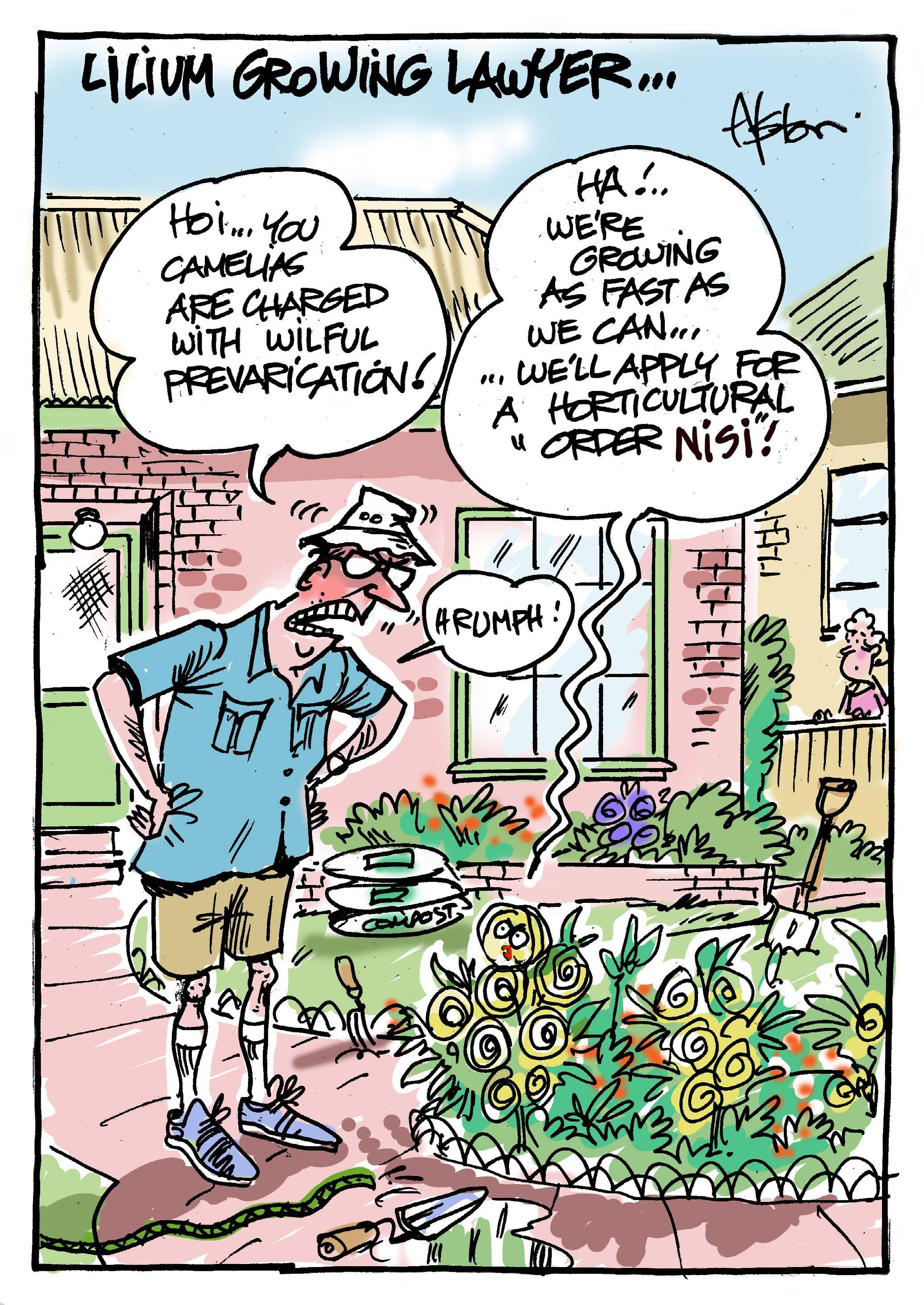
61
Law Council Update
Australia must protect its troops from death penalty
Military personnel who serve Australia as members of its Defence Forces should not face the risk of being sentenced to death when training or conducting operations overseas.
Appearing before the Joint Standing Committee on Treaties today, the Law Council called for urgent amendment of the Australia-Japan Reciprocal Access Agreement to guarantee that Australian military personnel would not be subject to the death penalty if convicted of crimes while in Japan pursuant to the Agreement.
“Broadly, the Agreement is designed to facilitate cooperative activities between the Australian Defence Force and the SelfDefense Forces of Japan, for example, by allowing each nation’s military personnel to train within the other’s respective territory,” Law Council of Australia President, Mr Tass Liveris said.
“Under the Agreement, Australian military personnel present in Japan’s territory in connection with cooperative activities can be subject to the criminal law of Japan, and vice versa, for their off-duty actions.
“While the Agreement includes a range of rights for a person prosecuted in either country, it does not contain a clear and legally binding commitment that Australian Defence Force members will not face the death penalty in Japan.
“Australia’s commitment to pursuing global abolition of the death penalty is strong and bipartisan, as outlined in its 2018 Strategy for Abolition of the Death Penalty.
“Considering the strength of the position taken under the Strategy, it is disappointing that we would therefore agree to bilateral arrangements, such as this, which do not include clauses to prevent Australian citizens being condemned to death.
“Japan maintains the death penalty with executions by hanging being publicly reported as recently as July 2022.
“In the week this issue is being considered by the Joint Standing Committee on Treaties, it was coincidentally World Day Against the Death Penalty.
“We are asking the Treaties Committee to recommend that binding treaty action in respect of the Agreement be withheld until a written amendment is agreed to the effect that no member of a visiting defence force, including its civilian component, will be subject to the death penalty.
“We must protect those who protect us.”
Sunset on AFP powers is one to watch
The Law Council of Australia considers that ongoing Parliamentary scrutiny is needed regarding the Australian Federal Police’s counter-terrorism powers.
This week the Parliament will consider the Counter-Terrorism Legislation Amendment Bill (AFP Powers and Other Matters) Bill 2022, which seeks to extend the preventive detention order regime, control orders regime, and stop, search and seizure powers a further 12 months beyond their current sunset date.
The Law Council notes that the purpose of the 12-month extension is to allow the Government to consult on, and then implement, its response to the recommendations made by the former Parliamentary Joint Committee on Intelligence and Security (PJCIS) in October 2021.
“The Law Council’s longstanding view is that there is no persuasive case for retaining either the control order regime or the preventative detention order regime. These powers are not necessary or proportionate responses to the threat of terrorism,” Mr Liveris said.
If some or all of these powers are to remain in force, the Law Council maintains its position that amendments are needed to strengthen safeguards.
“The PJCIS’s recommendations in relation to strengthening issuing thresholds, applicable oversight mechanisms, and procedural requirements are important and were critical in the PJCIS’s support for the renewal of these powers,” Mr Liveris said.
The Law Council’s view is that reliance should instead be placed upon agencies’ extensive surveillance and investigatory powers, which enable the enforcement of the wide range of terrorism and security offences under Commonwealth laws, including offences that specifically target preparatory and ancillary activities to terrorist acts and foreign incursions.
The Law Council acknowledges that, in circumstances of emergency, the extraordinary powers in Division 3A of Part IAA of the Crimes Act, which permit extraordinary police powers of stop, search and seizure, could be necessary and proportionate for the prevention of an imminent terrorist act, and to managing its immediate aftermath. In its October 2021 report, the PJCIS recommended that the Government investigate the cost of providing legal aid to those affected by these powers and recommended a report be submitted to the PJCIS within 12 months.
“The Law Council reiterates the need to ensure those who are subject to proceedings for a control order or preventative detention order have access to legal representation, and this requires availability of timely legal assistance funding,” Mr Liveris said.
The Law Council also supports the recommendation of the PJCIS that section 29 of the Intelligence Service Act 2001 be amended to enable the PJCIS to commence a review of these powers prior to the next sunset date.
New Members New members joining the Law Society (August 2022 & September 2022) Associate Membership Ms Maud Bonbayl Clifford Chance Mr Jadranka Strbac The University of Western Australia Mr Karl McGrail Miss Jade Williams Murdoch University Mr Darryl Flintoff Murdoch University Mrs Jasmine Gianoli Queensland University of Technology Ms Sarah Ceric AGH Law Mr Saad Omari University of Notre Dame Australia Ordinary Membership Mr John Suttner McNally & Co Ms Susie Rose Ashburton Services Pty Ltd Part Time Membership Ms Julie Cavoli Lawton Macmaster Legal Ms Emma Miller Grondal Bruining Restricted Practitioner Mr Joshua Hynes-Brown DCH Legal Group Ms Heather Siemaszko Department of Transport Ms Khai Ling Yeoh AH2 Legal Mr Steve Svirac Sparke Helmore Lawyers Miss Qitian Chen Dentons Australia Limited Ms Moashka Audit JNC Legal Pty Ltd Mr Keegan Britto Kean Legal Barristers & Solicitors
LEGAL PRACTICE SALES
Law Firm For Sale
practiceadvertiser@gmail.com
Missing Will
Would any person or firm holding or knowing the whereabouts of a Will or any other testamentary documents of Mark Anthony Atkinson, late of 174 Suffolk Street, Caversham, Western Australia (DOB 19 August 1972) please contact Leanne Laycock on 0488 286 411 or email laycockjl23@gmail.com
Missing Will
Would any person or firm holding or knowing the existence or whereabouts of a Will or other testamentary document of EDWARD ALAN SARA, born 8 August 1944, late of 5 Kemp Place, Belmont, Western Australia, who died 19 April 2022, please contact Joss Legal, Suite 1.6, Level 1, 9 Bowman St, South Perth, WA 6151 (Tel) (08) 6559 7480 (Eml) lawyers@josslegal.com.au
Missing Will
Would any person or firm holding or knowing the existence or whereabouts of a Will or any other testamentary documents of the late SALLY ELIZABETH RICHARDSON, late of Unit 6/55 York Street, Tuart Hill found on 9 May 2022, please contact Lark Lawyers, (Ref: 2671) of Level 2, 6 Thelma Street, West Perth on (08) 9322 8200 or email lark@larklaw.com.au within one month of the date of publication of this advertisement.
Solomon Hollett Lawyers

Morgan Solomon & Craig Hollett are pleased to announce the promotion of Andrew Bower and Brandon Hetherington to the role of Senior Associate at Solomon Hollett Lawyers with effect from 1 July 2021.
Andrew and Brandon are both outstanding solicitors, who have significant experience in their respective fields. Andrew practices primarily in the areas of commercial litigation and commercial law. Brandon practices primarily in the areas of property law, estate litigation and commercial law.
O’Sullivan Davies Family Lawyers
O’Sullivan Davies Family Lawyers is pleased to welcome Sebastian Sweeney as an Associate of the firm.

Sebastian graduated from The University of Western Australia in 2016 with a Bachelor of Laws and a Bachelor of Commerce, with a double major in Corporate Finance and Investment Finance.
Since being admitted to practice in Western Australia and the High Court of Australia in 2018, Sebastian has practiced Family Law exclusively. He is currently studying a Masters of Family Law to further his specialised knowledge.


Missing Will
Would any person or firm holding or knowing the whereabouts of a Will or any other testamentary documents of Trevor Andrew Cox, late of Unit 66, 23 Junction Boulevard, Cockburn Central, Western Australia (DOB 2 April 1969) please contact DPSK Lawyers of Suite 3, Level 1, 7 Ventnor Avenue, West Perth, WA by phone (08) 6186 4100 or email contact@dpsk.com.au
Missing Will
Would any person or firm holding or knowing the existence or whereabouts of a Will or other testamentary document of TERRENCE WAYNE BYFIELD, born 16 March 1969, late of 11 Kathleen Street, Bassendean, in the State of Western Australia, who died 12 December 2021, please contact Joss Legal, Suite 1.6, Level 1, 9 Bowman St, South Perth, WA 6151 (Tel) (08) 6559 7480 (Eml) lawyers@josslegal.com.au
Missing Will
MIGUELA CABAHUG RADALJ late of 82 Barlee Way, Beechboro died on 2 May 2020. Would any person holding or knowing the existence or whereabouts of a Will or other testamentary document of MIGUELA CABAHUG RADALJ please contact Maryse Aranda Lawyers, Suite 9, 8 Clive Street, West Perth WA 6005 telephone 0432 913 679 email mjabarrister@bigpond.com within one month of the date of publication of this advertisement.
Professional AnnouncementsClassifieds
Andrew Bower Brandon Hetherington
Sebastian Sweeney
Mount Hawthorn / Leederville *Civil litigation *Commercial Law *Construction *Wills / Estates / Disputes *Will Bank *General risk management Fee revenue average +/- $350kpa Reason for sale: Career change / lifestyle / personal Confidential enquiries to:
For advertising opportunities in Brief please contact: Madeleine McErlain Manager, Corporate Communications T: (08) 9324 8650 E: advertising@lawsocietywa.asn.au lawsocietywa.asn.au
The Law Society’s Wellbeing and Resilience Programme
Specialised Support
We understand that people face many challenges in their lives and that sometimes these require specialised support. We believe the counsellors providing this support should be specialists with specific social or cultural experience, knowledge and understanding. LawCare offers access to one session of specialist support per annum (available during business hours only).



and Torres Strait Islander Peoples helpline:
LawCare WA
help support
‘CoronaCare’

organisation manage through the uncertainty that we are all experiencing as a result of the emergence of COVID-19 (Coronavirus). Visit our website to find out more.
and
more
about
WA
visit lawsocietywa.asn.au/lawcare

For
information
LawCare
please
The member assistance programme offers support with personal and work-related issues that may impact your job performance, health, mental and emotional wellbeing. Members of the profession connect with experienced practitioners for advice on ethical issues or complaints through the Ethical Guidance Panel and Western Australian Bar Association Referral Service.
now includes a suite of dedicated support programmes called
to
you
your
Phone: 1300 687 327 Phone: (08) 9220 0477 Aboriginal
Domestic and Family Violence Helpline: LGBTIQ helpline: Service provided by Converge International Referral service provided by WABA Telephone 1300 287 432 Telephone 1300 338 465 Telephone 1300 542 874 Member Assistance Programme Practitioner Advice
CoronaCare Did you know? Your membership with the Law Society provides complimentary access to these support programmes through LawCare WA. To find out more about all resources offered through LawCare WA, visit www.lawsocietywa.asn.au/lawcare-wa LawCare WA is available to members of This service is only for a Law Society member who is an individual employee (not an employer). Disclaimer: The Law Society facilitates all the above services and does not warrant or guarantee the work undertaken by any third party organisation, firm or individual listed or provided and is not liable in relation to any aspect of services they may provide to you. Phone: 1300 687 327 Service provided by Converge International PDF Info Sheet PDF Info Sheet PDF Info Sheet
