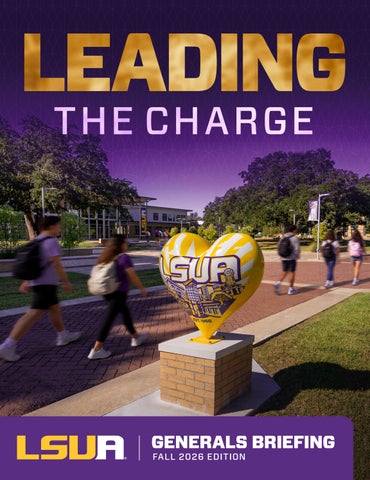
GENERALS BRIEFING FALL 2026 EDITION
FROM CHANCELLOR ELIZABETH BEARD During my first few months as chancellor of LSUA, I have been reminded that our success comes from our people. Our students bring determination and ambition. Our faculty and staff bring expertise and a commitment to help them succeed. Our supporters bring the partnerships and investments that make new opportunities possible. LSUA’s progress is the result of hard work, but to us, it is also our heartwork. It is the care behind a professor’s guidance, a staff member’s support, and a partner’s investment in a student’s future. That personal commitment gives meaning to this edition’s theme: Leading the Charge. For me, leading the charge means building on LSUA’s progress while remaining focused on the people we serve. Chancellor Emeritus Paul Coreil established a remarkable foundation for growth. I am honored to continue that work alongside a campus community that understands the responsibility that comes with every student’s decision to pursue a degree from LSUA. This fall, a record 8,600 students have placed their trust in LSUA. That number represents thousands of individual goals: a first-generation student pursuing a degree, a working parent preparing for advancement, or a future health care professional hoping to serve close to home. As we grow, protecting the quality, personal attention, and sense of belonging that define LSUA will remain one of our highest priorities. The stories ahead show how we are putting that commitment into practice. Our accelerated bachelor’s degrees offer new options for reducing the time and cost of college. Partnerships in pharmacy and physical therapy create streamlined pathways into professions needed across Louisiana. Building our Health Education Campus advances the shared commitment to preparing more nurses and allied health professionals for central Louisiana. Just as important are the people whose experiences show what those opportunities can accomplish. Our students are finding direction and confidence through mentorship and hands-on experiences, and our staff is earning recognition for work that serves families and strengthens our community. Their achievements remind us that LSUA’s impact is measured not only in enrollment or new programs, but in the lives changed by the opportunities we create together. You will also see how faculty research, innovation, and the arts connect our university to the region. Endowed faculty positions sustain that work and demonstrate the lasting value of your support. Those investments matter because they give students access to mentors, practical experiences, and possibilities they might not otherwise encounter. To our donors, community partners, employers, parents, and friends: Thank you for helping LSUA move forward. Your confidence in this university carries a responsibility we take seriously. We must translate your support into academic excellence, meaningful opportunities, and career-ready graduates. Our next chapter will be measured not simply by how much we grow, but by how well we serve. I look forward to leading that work with you!
Elizabeth Beard, Ph.D. LSUA Chancellor
1
ONE LSU. ONE LOUISIANA. A SHARED RESPONSIBILITY. Wade Rousse, Ph.D., Louisiana State University System President LSU has made an important promise to the people of Louisiana. A promise to provide access to life-changing higher education opportunities that improve overall quality of life, strengthen our local communities, and meet today’s rapidly changing workforce needs. Said simply, we promise to change the way we educate Louisiana. What does that responsibility mean? It means pursuing excellence at the highest levels in teaching, learning, research, philanthropy and athletics while ensuring an LSU degree remains attainable. Excellence and access are not competing priorities. It takes both to move Louisiana off the bottom of the educational attainment rankings and into the orbit of the nation’s Top 50 institutions. To get there, we cannot settle for the status quo. Across the LSU System every one of our nine institutions brings something unique to the table. When we empower each institution to meet the needs of its community while leveraging the strength of the entire LSU System, we create opportunities that no single campus can deliver alone. LSU Alexandria is a great example of our promise in action. LSUA is expanding access for students in central Louisiana and beyond. Its faculty and staff are building programs that prepare students for the workforce while building partnerships in health care, education, business, technology, and other critical industries. This is what happens when we listen to the needs of our communities and respond with purpose and a plan.
L-R: Wade Rousse (LSU System President), Angela Rousse, Abbey Bain (LSUA Vice Chancellor for Enrollment and Student Engagement)
Under Chancellor Elizabeth Beard’s leadership, LSUA will continue building upon that momentum while protecting what has made the university successful: an uncompromising commitment to the students who entrust LSU with their futures. Our responsibility at the System level is to help make those connections even stronger. We want students to see LSU not as a collection of separate institutions, but as one statewide network working together to help them succeed. Whether a student begins in Alexandria, Eunice, Shreveport, Baton Rouge, New Orleans, or elsewhere in our System, they will have opportunities to learn, grow, and build a meaningful career. They immediately become part of the LSU family. Winning means LSU consistently delivers an education of real value by aligning our programs with the needs of our state, and we hold ourselves accountable by measuring what matters and producing results that strengthen Louisiana.
President Wade Rousse met students and their families at LSUA's Fall 2026 orientation.
2
LSUA is doing that work every day alongside their partners in Baton Rouge, Shreveport, Eunice, New Orleans and in 64 parishes through our Ag Center Extension programs. Together we proudly represent 3 letters, 2 colors, 1 state. We are ALL LSU!
NEW PATHWAY PARTNERS
LSUA partners with other institutions to provide top-tier educational experiences that prepare graduates for immediate success. LSUA’s degree pathways combine advanced technology, career-focused learning, and community collaboration to meet the evolving demands of today’s workforce.
Administrators from ULM and LSUA were on hand to celebrate the signing of the agreement.
LSUA and ULM Establish New Pre-Pharmacy Pathway to Expand Access to Pharmacy Education in Louisiana LSUA and the University of Louisiana at Monroe have established a pre-pharmacy pathway to expand access to pharmacy education and help address pharmacist shortages in rural and underserved Louisiana communities. Students pursuing bachelor’s degrees in biology or chemistry with a preprofessional concentration at LSUA will receive dedicated advising aligned with ULM’s pharmacy prerequisites. Eligible students may apply to pharmacy school after completing as few as 67 credit hours. ULM’s College of Pharmacy, Louisiana’s only public college of pharmacy, will reserve five seats in each entering Doctor of Pharmacy class for qualified LSUA students who meet admission requirements and demonstrate a commitment to serve rural or underserved communities in the state. Both universities will connect students with health care systems and pharmacy employers, promote awareness of rural practice incentives and loan forgiveness programs, and track long-term workforce outcomes. The agreement builds on LSUA’s efforts to link undergraduate study with professional programs in high-demand fields. It also gives central Louisiana students a clear pathway to pharmacy careers while allowing them to begin their education close to home.
LSUA, LSU Health Shreveport Expand 3+3 Partnership with New Doctor of Physical Therapy Pathway LSUA and LSU Health Shreveport have expanded their partnership with a 3+3 pathway allowing eligible biology students to earn a bachelor’s degree and a Doctor of Physical Therapy in six years, one year less than the traditional route. Students will complete 85 to 90 credit hours at LSUA before entering the doctoral program. Approved doctoral coursework will transfer back to fulfill remaining bachelor’s degree requirements. Participants who meet minimum admission requirements and application deadlines are guaranteed an interview, not admission. A designated LSUA faculty adviser will guide students through coursework, preparation, and program requirements. Doctoral study is available in person in Shreveport or through a hybrid program based in Lafayette.
L-R: Dr. Lester Johnson, M.D. (Senior Vice Chancellor, LSU Health Shreveport), Elizabeth Beard, Ph.D. (Chancellor, LSUA), Nathan Sammons, Ph.D. (Provost, LSUA)
The agreement builds on the institutions’ occupational therapy pathway launched in 2025. Together, the programs expand access to professional education within the LSU System, allowing students to begin close to home while preparing for Louisiana’s health care workforce.
3
LSUA Outpaces National Trends with Record Fall Enrollment LSUA opened the fall 2026 semester with 8,600 students. That is the largest enrollment in university history and an 11.9% increase over Fall 2025. Enrollment has grown 128.1% in five years and 162.5% over the past decade, making the central Louisiana institution one of the nation's strongest examples of sustained public university growth. The growth extends across every way students access the university. On-campus enrollment rose 14.2% to 3,476, online enrollment grew 10.3% to 5,133, and dual enrollment jumped 45.5% to 1,168. Students now come from all 64 Louisiana parishes, all 50 states, and 49 countries. The pace stands out nationally. Final Fall 2025 data from the National Student Clearinghouse Research Center showed undergraduate enrollment at public four-year institutions rising just 1.4%. LSUA's increase is more than eight times that rate. Chancellor Elizabeth Beard credits the growth to students seeing that access, affordability, and excellence can go together at LSUA. She has made protecting and strengthening the student experience one of her top priorities as the university grows.
As Louisiana's most affordable four-year public university, LSUA pairs longtime programs in nursing, accounting, education, and criminal justice with newer degrees in computer science, professional aviation, and digital storytelling built around the state's changing workforce needs. Humanities and arts offerings preserve the breadth of a university education. Faculty whose main mission is teaching and mentoring connect classroom learning to research, graduate study, and careers. LSUA's strategy is designed for central Louisiana, a region with large rural communities and lower bachelor's degree attainment rates. Nearly half of LSUA students are adult learners. The university also serves large numbers of first-generation students, working professionals, rural residents, and military-connected students, including those studying on base at Fort Polk. Partnerships with communities such as the Tunica-Biloxi Tribe further expand access. This approach earned national attention in December 2025, when The Chronicle of Higher Education featured LSUA in a cover story on how rural-serving universities can reverse falling enrollment.
12% YTY Growth 162% 10-Year Growth From Fall 2025 to 2026
From Fall 2016 to 2026
LSUA's Paul Coreil Honored as Chancellor Emeritus at Tiger Stadium Retired LSUA Chancellor Paul Coreil has been named Chancellor Emeritus, an honor recognizing more than four decades of service to LSU and the people of Louisiana. LSU President Wade Rousse conferred the title during the first quarter of LSU's season opener in Tiger Stadium. Coreil retired July 1, 2026, after eight years leading LSUA, capping a 43-year LSU career that included extensive work with the LSU AgCenter and the Louisiana Cooperative Extension Service. LSUA's administration, faculty, staff and students formally endorsed the designation.
L-R: Wade Rousse (LSU System President), Paul Coreil (LSUA Chancellor Emeritus), and Arlene Coreil
4
His tenure coincided with the most consequential period of growth in university history. Enrollment climbed from about 3,285 students in 2019 to nearly 8,000 in spring 2026, making LSUA Louisiana's fastest-growing university four years running. Coreil championed workforce-aligned pathways in professional aviation, health care, pre-medicine, and technology while broadening student access to advanced degrees across the LSU System.
LSUA RANKED #3 SAFEST COLLEGE CAMPUS IN AMERICA LSUA has been ranked the No. 3 safest college campus in America and No. 1 in Louisiana in Niche's 2027 Best Colleges rankings, earning an A+ grade for safety in the organization's annual evaluation of colleges and universities nationwide. The ranking is based on two factors: LSUA's low rate of reported campus crime and students' perceptions of safety while learning, living, and spending time on campus. Niche's methodology weighs campus crime rates and student safety surveys at 25% each, with crime in the surrounding community accounting for another 20%. Remaining factors measure alcohol- and drug-related arrests and reported incidents of dating violence and rape in residence halls. Most of the statistical data comes from the U.S. Department of Education.
Across the three most recent annual crime statistics reports, LSUA reported no murders, rapes, robberies, or aggravated assaults, the four offenses the FBI uses to calculate violent crime rates. Based on an on-campus population of roughly 3,500, that represents a reported violent crime rate of 0.0 incidents per 1,000 people. By comparison, SafeWise's 2026 analysis of FBI data placed the national rate at 4.43 incidents per 1,000, and even among the 100 safest communities in America, the average was 0.2. The numbers carry particular weight for a campus that operates much like a small town. The honor arrives as LSUA continues to grow rapidly, requiring coordination among University Police, faculty, staff, and students. As enrollment climbs, preserving that sense of security remains central to the LSUA experience.
L-R: Interim Chief Marty Brown, Sgt. Mechelle Williams, Officer Brandon Bryan
LSUA Continuing Education Launches $300,000 Healthy Living Initiative LSUA Continuing Education has launched a three-year initiative to bring health and wellness programs directly into communities across central Louisiana. Thrive Together: Healthy Eating, Active Living, Connected Communities is funded by a $300,000 Healthy Eating, Active Living Program Grant from The Rapides Foundation. LSUA Continuing Education will work with local organizations to learn what residents need and care about most, then build evidence-based programs around those priorities. Activities will include hands-on nutrition and healthy cooking sessions, physical activity programs, youth engagement, and other areas identified through those partnerships. The initiative gives LSUA Continuing Education a regional role beyond professional and workforce development. In its first phase, the program will work with partner organizations to set local priorities and begin offering programs for residents of all ages. The goal is to help residents make healthier food choices, stay active, and build habits that support long-term well-being.
5
LSUA Health Education Campus
HOMEGROWN
A $50.5M Investment in Central Louisiana's Healthcare Construction is now underway for the LSUA Health Education Campus, a project aimed at easing the shortage of nurses and allied health professionals in central Louisiana. The university held a groundbreaking ceremony on June 30, 2026, joined by several community leaders, donors, and supporters who have contributed to this transformational project. The $43 million, four-story, 78,266-square-foot facility in downtown Alexandria grew out of a healthcare summit convened by LSUA. Physicians, hospital administrators, and other health care leaders urged the university to help meet rising regional demand. The campus is designed to double the number of nurses and allied health professionals LSUA graduates each year. The building will house the School of Nursing and programs in healthcare administration, health sciences, medical laboratory science, and radiologic technology. Partnered programs with the LSU School of Dentistry and LSU Eunice also will be based there. A planned $7.5 million parking garage on the lot in front of the campus will support students, faculty, and visitors. Economic projections estimate the campus will support about 700 additional health care jobs and generate $176.5 million in annual economic activity, while allowing more students to train close to home.
6
HEALTHCARE COMING FALL 2028
CONCEPT ONLY
7
EMPOWERING STUDENTS WITH ARTIFICIAL INTELLIGENCE Grant Clary, Ph.D., Endowed Chair of Entrepreneurship & Innovation
LSUA students in Grant Clary’s entrepreneurship classes use artificial intelligence to develop physical prototypes, build functional websites, and create business plans. The projects reflect a shift in how Clary prepares students for careers: integrating technology into the learning process while keeping their ideas, judgment, and responsibility at the center. Clary is redesigning coursework around a question facing higher education as AI becomes more accessible: What should students learn to do when technology can handle many technical and routine tasks? His approach starts with assignment design. Students often respond to grade incentives, and traditional assignments can encourage them to take the fastest route to completion. Rather than focusing solely on preventing AI use, Clary emphasizes work that requires students to apply knowledge, solve problems, and create something meaningful. Students should understand the purpose of what they are learning, not simply produce a finished assignment. In entrepreneurship, AI can reduce the technical barriers between an idea and a working product. Clary’s students use that assistance to put concepts into practice, making the quality of an idea and the decisions behind it increasingly important. He sees those projects as opportunities to exercise critical thinking rather than avoid it.
8
That preparation extends beyond technical proficiency. Clary emphasizes creativity, judgment, real-time communication, and emotional intelligence as skills that remain valuable as more tasks become automated. Intellectual curiosity also matters. When information is readily available, identifying worthwhile problems and asking thoughtful questions can help students determine how to use it. Clary encourages or requires AI use on many assignments so students can learn to use the tools responsibly before entering the workforce. Rather than simply warning against AI, he teaches students to be transparent about its use, uphold academic integrity, and use it to support their own thinking, not replace it. That approach also reinforces the human aspects of higher education. As AI makes information easier to access, Clary believes universities must offer more than knowledge alone. Faculty mentorship, collaboration, personal relationships, and growth opportunities remain central to preparing students for their careers and lives beyond college. His vision for LSUA includes more hands-on projects, connections with local organizations, and opportunities for students to address community needs. For Clary, preparing students for an AI-enabled workplace means helping them create and solve problems without losing the human connections that make those efforts valuable.
FROM BIOLOGY STUDENT TO NUCLEAR ENGINEER Lakelyn Donaghey, Biology Graduate
An LSUA biology graduate is taking her degree to one of the nation's premier research institutions, joining Los Alamos National Laboratory as an R&D nuclear engineer. Lakelyn Donaghey begins her career with the laboratory's PSD-4 Materials Recovery and Recycle group, part of the Plutonium Supply and Disposition Division. The group supports the lab's plutonium mission and national nuclear weapons modernization efforts. Her work will center on research and development tied to materials recovery and recycling, a field at the intersection of chemistry, safety, and national security. Her path there began with a different goal. Donaghey came to LSUA intending to become a physician, drawn to understanding how the human body works and how science can help people. As she progressed through the biology program, her interests widened to microbiology, research, public health, environmental science, and eventually to nuclear and radiological science, shaped by six years of military service in chemical, biological, radiological, and nuclear operations. A first-generation college student and the first in her family to serve in the military, Donaghey navigated much of that journey on her own. She enlisted in part to gain technical experience and help pay for college. She later left a full-time job to finish her degree at LSUA, trading financial stability for the credential she needed to move forward.
That combination of academic preparation and field experience proved decisive during the hiring process. Through LSUA's biology curriculum and laboratory coursework, she built skills in microbiology, research methods, quality control, documentation, troubleshooting, and scientific communication. Her military background added expertise in radiological hazards, technical equipment, and operating safely in highly regulated environments where accuracy is not optional. Her independent research project, "Advancing Women's Health Education in Rural Louisiana," brought those threads together. Donaghey led the study, comparing approaches to health education in rural communities while collaborating with LSUA faculty, physicians, health care professionals, and fellow students. She designed the project to open doors for students who had not had the same access or exposure to research, giving them a chance to build confidence alongside her. Laboratory officials noted the initiative and its community benefit. Donaghey's trajectory reflects a broader pattern at LSUA, where small class sizes, faculty mentorship, and hands-on research place graduates in competitive technical careers across the region and the country. Her placement at a national laboratory underscores the university's growing role as a pipeline for high-demand scientific and engineering talent in central Louisiana. As she relocates west, Donaghey is looking ahead to an unfamiliar landscape and work she has wanted to pursue for years. Her advice to current students is direct: take the opportunity, ask questions, accept discomfort as part of growth, and take care of the people around you.
9
LOUISIANA'S FIRST ACCELERATED BACHELOR'S DEGREES LSUA has received accreditation approval for two accelerated bachelor's degrees. The 90-credit-hour programs in bioinformatics and information technology are designed to cut the time and cost of earning a degree while preparing graduates for fast-growing technology careers. The Commission on Colleges and Universities approved the programs under its new accelerated bachelor's framework. LSUA is the first public institution in the commission's membership to earn approval under that framework, which lets institutions show that rigorous learning outcomes can be met in fewer than the traditional 120 credit hours. The degrees are also the first of their kind approved in Louisiana by the Board of Regents, which supported their development and adopted a statewide policy encouraging other institutions to create three-year, 90-credit-hour degrees.
LSUA faculty developed the curricula after identifying an opportunity to rethink degree structure in high-demand STEM fields. Each program keeps the full 39-credit-hour general education core and adds 51 credit hours of intensive major coursework. The university evaluated and removed electives that did not support degree outcomes. Nathan Sammons, LSUA Provost and Vice Chancellor for Academic Affairs, championed the model and led the faculty effort. The information technology degree prepares students for careers in systems administration, networking, cloud computing and cybersecurity. Coursework aligns with industry credentials from CompTIA, AWS, and Cisco, so students can earn employer-valued certifications as they complete their degrees. The bioinformatics degree combines biology, data science, and computational analysis. Students study genomics, programming, machine learning and applied artificial intelligence. They prepare for careers in biotechnology, health informatics, genomic research, and other data-intensive life sciences. The programs arrive as students, families, and employers place more emphasis on affordability and career relevance. The accelerated degrees stand alongside LSUA's traditional bachelor's programs rather than replacing them. Now, students can choose the path that best fits their academic and career goals.
What is Bioinformatics? Bioinformatics combines biology, computer science, and statistics to make sense of overwhelming amounts of biological data. Researchers use software, algorithms, and machine learning to read genetic sequences, compare DNA across species, and model how proteins work. The field grew quickly with the Human Genome Project, which mapped the human genome and produced more data than scientists could analyze by hand. Today, bioinformatics helps doctors tailor treatments to a patient's genetic profile, speed the discovery of new drugs, track how viruses spread and mutate, and improve crops. As health care and research rely more on data, demand is growing for professionals who understand both biology and computing.
10
MYCOLOGIST PUTS LOUISIANA FUNGI TO WORK FOR FARMERS & STUDENTS Pedro Santos, Ph.D., Assistant Professor of Agriculture, Henry Dade Foote Family Endowed Professorship
Pedro H. D. Santos, Ph.D., sees Louisiana's heat, humidity, and heavy rainfall as both a challenge and an opportunity. Santos is an assistant professor of crop production in LSUA's Department of Biological Sciences. He studies fungi, the organisms behind most plant diseases, and is building a research program that turns that science into practical help for farmers, gardeners, and students in central Louisiana. Fungi grow nearly everywhere: in soil and air, on every plant, and in everyday products such as bread and medicine. They break down dead material and recycle nutrients; without them, forests would be buried under fallen leaves. Santos studies both the harmful and beneficial roles of fungi, examining how some damage crops while others may help protect them. Louisiana's climate adds urgency to the work. Growers fight fungal disease every season in sugarcane, rice, soybeans, and sweet potatoes, as well as in backyard gardens. Even so, scientists have done little research on the state's native fungi. Santos wants to find local species that can suppress plant disease or restore damaged soils, so the solutions come from microbes that already live in the region. His students learn by doing. They collect fungi in the field, grow them on plates, study their structures under microscopes, and identify each species. The best specimens join the lab's Mycology Collection, a living library of Louisiana fungi, and students learn to preserve the cultures so they last for years.
Santos has revitalized the campus garden and greenhouse, often calling them the best classroom. Last spring, students grew tomatoes, cucumbers, lettuce, and zucchini, and planted native flowers to attract bees and butterflies. In the greenhouse, students are experimenting with papaya and passion fruit to see how well tropical plants withstand Louisiana winters. Lessons about plant diseases become more meaningful when a student discovers a spotted leaf, investigates the cause, and selects a treatment. This space is designed for both students from farming families and those who have never grown anything before. Another project starts on the coast. Most oyster shells harvested in Cameron Parish are thrown away. However, they are mostly calcium carbonate, the same material as agricultural lime, which is used in some of the oldest plant disease treatments. Santos and his students are working with the Habitat Recovery Project to test whether the shells can protect crops. Two students, a senior and a recent graduate, have checked the quality of lime made from the shells and are now testing it against plant pathogens. Santos' long-term goal is for LSUA to become the place central Louisiana turns to for answers about plants and fungi. He hopes to open a plant diagnostic clinic on campus where farmers could bring samples for testing and learn treatment methods. Students would get real-world cases that could result in saving a local farmer's crop or supporting future research.
11
REVITALIZATION OF VISUAL & PERFORMING ARTS Patrick Hunter, MFA, Assistant Professor of Performing Arts, Howard and Eloise Mulder Endowed Chair
Student participation in LSUA performing arts is growing as Patrick Hunter expands opportunities and builds partnerships across central Louisiana. This fall, Empty Space Players auditions drew ten times as many attendees as in fall 2023, with consistent growth across each semester. Hunter, the Howard and Eloise Mulder Endowed Chair of the Arts, has focused on making theater more visible while giving students greater responsibility for the work presented onstage. His approach draws on his professional experience as an actor and director, encouraging students to contribute ideas rather than follow instructions for every movement or line. Productions feature student casts, original designs, and concepts developed for LSUA’s stage. Rather than reproducing Broadway staging or film performances, students create their own character interpretations. The process puts their decisions at the center of each production and introduces them to professional theater expectations.
For many participants, these responsibilities come with their first performance. Rehearsals and live productions provide opportunities to practice communication, teamwork, problem-solving, and conflict resolution. Students learn to contribute to a shared project while building the confidence to present their work to an audience, skills that apply well beyond a theater career. New performance opportunities include Broadway Melodies, an annual season-opening cabaret, and the CENLA Young Playwrights’ Festival. Hunter also revived Shakespeare on the Green in 2024, bringing an allstudent production of A Midsummer Night’s Dream outdoors and welcoming the community back to a longstanding campus tradition. In 2025, students collaborated with the Rapides Symphony Orchestra on Worldwide Yuletide, performing alongside a professional orchestra with limited rehearsal time. Community outreach also extends to younger performers. Last spring, Hunter helped the Rapides Parish Schools Gifted and Talented program stage its first full-scale production, providing access to LSUA’s theater and technical support. Students from schools without theater programs gained opportunities to participate in a fully staged performance, many for the first time. As the program grows, Hunter aims to expand partnerships, create more educational theater opportunities for K-12 students, and connect with professional organizations across Louisiana. On campus, the priority remains giving students a welcoming place to contribute, build relationships, and develop their own creative voices. Together, those efforts support his goal of making LSUA a regional destination for arts and culture.
12
Foundation
GIVING THAT MOVES LSUA FORWARD The Impact of Endowed Professorships
Lead the Charge. Donate Today. Individuals, businesses, and community partners can advance LSUA’s mission by supporting the LSUA Foundation. Gifts that support endowed faculty positions and other university priorities strengthen educational opportunities and expand LSUA’s impact across central Louisiana. Those interested in giving are encouraged to contact the Foundation to explore how their support can make a lasting difference for students, faculty, and the communities LSUA serves.
Donate at lsuafoundation.org 318.619.2916 | 888.473.6417
Private giving at LSUA supports more than the university’s growth. Through endowed faculty positions, donors invest in the teaching, research, and creative work that turns academic opportunity into practical benefits for students and central Louisiana. The LSUA Foundation, a nonprofit dedicated to supporting the university’s educational mission, connects that commitment with campus needs. Its work promotes education and cultural enrichment, supports university departments, and helps develop and improve facilities. Endowed professorships and chairs provide a lasting approach to that mission, sustaining faculty support over time rather than limiting a gift’s impact to a single year. The work of Pedro Santos, Ph.D., Grant Clary, Ph.D., and Patrick Hunter, MFA, illustrates the range of disciplines these investments strengthen. Clary, Endowed Chair of Entrepreneurship & Innovation in the College of Business, provides guidance on the adoption of artificial intelligence in business. That focus connects business education with technology reshaping how organizations operate and make decisions.
New Podcast Coming Soon! Patrick Hunter will soon host “Generally Speaking,” a new official LSUA podcast featuring interviews and stories about the people contributing to the university’s success. The podcast will feature conversations with staff, faculty, and other guests, highlighting their experiences and contributions to the university and the broader community. The podcast is currently in development, with more details about its launch to be announced soon.
Santos, an Assistant Professor of Agriculture and Henry Dade Foote Family Endowed Professor, brings students into agricultural research with direct relevance to Louisiana farmers. Hunter, an Assistant Professor of Performing Arts and the Howard and Eloise Mulder Endowed Chair, represents philanthropy’s role in supporting the arts at LSUA. His focus on theater and revitalizing campus arts complements the university’s investment in science and business. Together, these faculty members demonstrate why giving matters beyond an endowed title. Their work connects students with emerging ideas, hands-on learning, and disciplines that serve the region’s economic and cultural needs. By encouraging gifts and bequests, the Foundation helps donors support the people and opportunities that advance LSUA’s mission and broaden access to quality higher education.
13
COMMANDING HER CAREER Nimtanee Bouasavanh, Ms. LSUA, Information Technology Student
Nimtanee Bouasavanh once associated leadership with outspoken personalities, authority, and being in charge. Now in her third semester at LSUA, the Ms. LSUA titleholder is developing a different understanding, shaped by faculty mentorship, career exploration, and opportunities to connect with local employers. Her platform centers on helping students recognize that leadership can begin with the strengths they already possess. Listening, preparing, encouraging others, and taking responsibility all fit into that approach. Rather than asking students to fit a particular image, Bouasavanh wants to help them find opportunities to contribute and develop confidence through experience. That perspective begins at home. As the eldest of four sisters, she sees everyday decisions as chances to set an example. Consistency, responsibility, and service matter as much as visible accomplishments. On campus, she has found similar qualities in professors who build relationships with students beyond the classroom, demonstrating leadership through preparation, composure, and sustained support. For Bouasavanh, a woman pursuing a career in science, technology, engineering, and mathematics, broadening that definition also means helping others feel that their perspectives belong in fields where women are often underrepresented. Her goal is to create opportunities for students to recognize their capabilities rather than assume that leadership requires a different personality or a formal title.
Career exploration has helped her apply those ideas to her own future. Through Job Shadow Day, she visited Crest Industries and gained a closer look at local career possibilities. Watching employees communicate, collaborate, and solve problems helped her better understand workplace expectations and the professional environment she hopes to join. Bouasavanh attended company workshops on campus, connected with human resources staff, and later participated in an internship interest meeting for computer science students hosted by DIS-TRAN Steel, a Crest Industries company. Those experiences reinforced the value of asking questions, maintaining relationships, and following through when opportunities arise. As she considered whether to continue her engineering education elsewhere, Bouasavanh began examining the opportunities already available at LSUA. Faculty relationships, campus involvement, and employer connections offered ways to explore her interests while continuing her education. Through Command Your Career, she ultimately decided to pursue information technology, gaining a clearer direction without transferring to another institution. Her experience has also shaped the message she hopes to share with fellow students: Confidence does not always precede participation. It can develop through taking responsibility, exploring unfamiliar settings, and making a first attempt. For Bouasavanh, leadership is less about becoming someone else than using existing strengths to serve others and remain willing to learn.
Learn more about Command Your Career
www.lsua.edu/command 14
LOUISIANA EARLY CHILDHOOD LEADER OF THE YEAR Sarah Corley, LMSW, LSUA Children’s Center Director
Sarah Corley, director of the LSUA Children's Center, has been named Louisiana Early Childhood Leader of the Year. The statewide honor recognizes her leadership, her commitment to young learners, and her work on behalf of children, educators, and families. The Louisiana Department of Education, in partnership with Dream Teachers, presented the award this summer during its annual celebration of the state's outstanding educators. The honor goes to directors and leaders who advance early childhood education and create environments where young children build the foundation for long-term academic success. Corley earned the award after being named one of five finalists in April. Corley has five years of experience in early childhood education. She bases her work on the belief that intentional play becomes foundational learning. Under her leadership, the center offers safe, nurturing classrooms where children learn through exploration and educators and families work together to support each child's development. Her career began in elementary education before she felt called to serve children in their earliest years. She has since focused on empowering early childhood teachers and building strong partnerships with families, and she sees both as essential to preparing children for what comes next. Abbey Bain, LSUA vice chancellor for student engagement and enrollment, credited Corley with balancing the business, leadership, and educational demands of early childhood programming with authenticity and heart. Bain also described Corley as an inspiration and a true advocate for early childhood education whose impact reaches families across the university community.
The award also highlights the Children's Center's dual role on campus. The center provides high-quality early education for young learners and gives LSUA students, faculty, and staff dependable child care close to their classrooms and offices. For student parents, access to childcare can influence whether they keep working toward a degree or put their education on hold. For faculty and staff, the center is a trusted resource that lets them stay engaged in their work while their children learn nearby. Corley will continue to lead the Children's Center as it serves children and families across the university community. Through intentional early learning and accessible on-campus child care, the center prepares young children for school and gives LSUA parents the support they need to pursue their goals.
15
Shrimp Jam continues to connect community participation with financial support for LSUA. More than 600 people gathered at the Randolph Riverfront Center in downtown Alexandria for the sixth annual Shrimp Jam, bringing central Louisiana supporters together to raise money for LSUA student-athletes and the LSUA Foundation. Hosted by the LSUA Foundation and the Generals Athletic Association, the event featured a shrimp dinner, live and silent auctions, artwork raffles, and a keynote address from LSU Vice President and Director of Athletics Verge Ausberry. Ausberry, a New Iberia native, became LSU’s 11th athletic director in November 2025 after more than three decades of service to the university. He began his athletics administration career as a compliance office intern in 1991 and subsequently worked across academics, fundraising, corporate relations, marketing, sports administration, and other departmental operations. Early in his tenure as athletic director, he led the hiring of football coach Lane Kiffin and men’s basketball coach Will Wade. Verge Ausberry (LSU Vice President and Director of Athletics)
LSUA Receives $1.39M LDH Grant to Expand Rural Healthcare Education and Workforce Development LSUA’s School of Nursing received a $1.39 million grant from the Louisiana Department of Health to expand rural health care education and strengthen the workforce serving communities statewide. The Rural Health Education and Training Pathways initiative will establish learning labs at Winn Parish Medical Center, Avoyelles Hospital, and Opelousas General Hospital. The project began Sept. 1 and will bring educational technology, simulation equipment, and training resources directly into partner hospitals. A dedicated instructor at each site will support nursing students, connecting classroom instruction with hands-on experience in rural settings. The initiative also expands clinical education for allied health students, helping them understand rural patients’ needs while building connections with local health care professionals. The investment also supports equipment and educational resources at participating hospitals to sustain continuing education and professional development for employees serving those communities. Over the next two years, LSUA aims to build partnerships that extend beyond the grant period. By introducing students to rural practice before graduation, the university hopes to make local career opportunities more visible and strengthen connections among graduates, hospitals, and the communities that need them. The effort supports workforce preparation while bringing training closer to rural Louisiana.
16
8100 Hwy 71 South Alexandria, LA 71302 Donate at lsuafoundation.org
www.lsua.edu 888.473.6417
318.445.3672