JULY 2025-JULY 2026
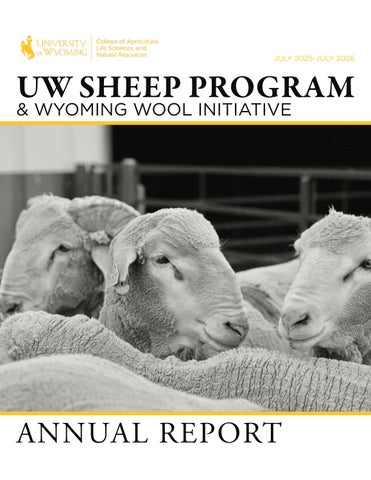
UW SHEEP PROGRAM & WYOMING WOOL INITIATIVE
ANNUAL REPORT 1
WELCOME The University of Wyoming Sheep Program and Wyoming Wool Initiative are honored to share our 2025–2026 Impact Report—a reflection of the growth, partnerships, advocacy, and progress we’ve achieved together for Wyoming’s sheep and wool industry. This work happens because of you. Through your generosity, we’re able to offer hands-on education, lead applied research, extend statewide outreach, and build new market opportunities that serve producers, inspire students, and strengthen the future of Wyoming wool and lamb. Wyoming agriculture has a good story — but a story alone doesn’t earn a premium; the difference has to be something you can measure.
2
3
ABOUT US
Sustaining and Growing Wyoming’s Sheep and Wool Industry Some Factors that motivate us to work for the sheep and wool industry: WY IS NO. 1 IN THE U.S. FOR WOOL VALUE According to the 2026 USDA NASS Sheep and Goat Report, Wyoming leads the nation in the value of its wool clip, shearing 2.30 million pounds a year. The state also holds the 4th spot in both breeding sheep and total sheep numbers. Much of this wool is sent out of state, where it undergoes further processing and manufacturing.
4
UNTAPPED POTENTIAL OF WYOMING WOOL More of the value in Wyoming’s wool and lamb should stay in Wyoming. That conviction runs through this report, and the pages that follow are our attempt to prove it can be done. HONOR HERITAGE & EMBRACE INNOVATION Heritage and innovation are not opposites here. On the same rangelands where sheep have grazed for generations, our students collect carcass data and test which breeds match which country. The Warhill flock — a composite bred in the 1930s and still lambing above 180% — is proof the two have always traveled together.
5
HIG H POI N TS
OF THE YEAR »
WYOMING PREMIUM LAMB: A new ranch-to-table effort paired donated Lamb-A-Year lambs, 21-day dry aging, and a Laramie restaurant partnership — 450+ Wyoming Premium Lamb entrées served to consumers.
»
STUDENT TRAINING & SUCCESS: UW Wool Judging Team earned Reserve Champion finishes at both the Black Hills Stock Show and the National Western Intercollegiate contests, plus Champion Handspinning Division at National Western.
»
LARGEST CONTEST YET: The 7220 National Wool Contest reached its biggest scale to date—53 collegiate competitors from five universities and more than 100 youth— and is now the official Wyoming State FFA Wool Judging Contest.
»
OUTREACH: Hosted multiple webinars, published and delivered critical briefs and resources to producers. Collaborated with the U.S. Army Veterinary Corps at the Laramie Research and Extension Center on a large-animal field training program.
»
RESEARCH: Published a UW–USDA-ARS study in Small Ruminant Research on matching sheep breeds to rangeland, showing that timing flock moves to grazing behavior improves both livestock and range.
»
FUNDRAISING AND DEVELOPMENT: 90 lambs donated by 23 producers through the Lamb-A-Year program. Record breaking Giving Day campaign with 80 donors and nearly $30,000 in donations.
This year UW Wool Judging Team earned mutliple Reserve Champion finishes at both the Black Hills Stock Show and the National Western.
6
STUDENTS:
LEARNING DOING LEADING
Collegiate Wool Judging Team The UW Wool Judging Team delivered a standout season on the national stage. At the Black Hills Stock Show Intercollegiate Wool Contest, the team earned Reserve Champion overall—finishing just six points behind the first-place team—and placed first as the High Team in the Wool Grading Rail. Trevor Halverson was named High Individual Overall, Hadley Paisley placed second in the grading rail, Claire Poppenberger finished sixth overall in placings, and Elizabeth Schroeder took fourth in high reasons. At the National Western Intercollegiate Wool Judging Contest, the team again earned Reserve Champion honors and won the Champion Handspinning Division. After a seventhplace finish out of eight universities at the UW 7220 Wool Contest just two days prior, the same squad regrouped for an excellent all-around finish on a national stage. Team members: Trevor Halverson (Big Timber, MT), Hadley Paisley (Wheatland, WY), Claire Poppenberger (Prescott Valley, AZ), and Elizabeth Schroeder (Evergreen, CO). The team is coached by Dr. Whit Stewart, with support from assistant coaches Cameron Herrick (Laramie, WY) and Allie Van Why (Chugwater, WY).
7220 National Wool Contest This year’s National Wool Contest was our largest event to date, with 53 collegiate competitors representing five universities and more than 100 youth participants from FFA and 4-H programs. The contest has now become the State FFA Wool Judging Contest. Officials sorted more than 120 fleeces over 12 hours to build a premier contest that reflects the best of Wyoming’s sheep and wool industry. Over the past five years, more than 670 youth have learned about wool evaluation here, many of them handling a fine fleece for the first time. 7
Lamb Cook-Off This marked the 9th year of our lamb cook-off final—one of the more hands-on ways students engage with the product they spend a semester studying in the Advanced Sheep Production class. Each group is assigned a subprimal cut and asked to prepare and present it to a panel of guest judges, using recipes and inspiration from the American Lamb Board database. The focus stays on cuts that don’t always get the spotlight— shoulders, shanks, and the leg—that are often more affordable but just as worthy of attention. With growing demand for ground lamb, this year expanded to include two ground lamb groups alongside braised shoulder dishes and a lamb chop category. It is the rare assignment where a student meets the same animal twice — once on the hoof, once on the plate — and it changes how they talk about lamb.
Field Experiences: ANSC 4230 Advanced Sheep Production Students grounded classroom concepts in the realities of the industry through field study. At Centennial Livestock Auction, students evaluated market trends within the ethnic market in the period following Eid al-Fitr and leading into Easter weekend, and visited directly with order buyers to understand where and how value is added across the system. The class then traveled to Warren Livestock to observe a historic and highly functional lambing system, including one of the last remaining populations of Warhill sheep—a 1930s composite developed through collaboration between Dr. John Hill at the University of Wyoming and Warren Livestock, still lambing at rates well over 180% in a high-plains shed system.
8
Lamb-A-Year in the Classroom Donated lambs continue to advance every aspect of our land-grant mission in research, Extension, and teaching. The University of Wyoming Collegiate Lamb Growers Club met regularly to coordinate lamb processing and weigh-in events, while students engaged in research and data collection on lamb performance. Lamb-A-Year lambs play a central role in coursework where students estimate carcass traits from live animals, then follow those same lambs through processing to collect carcass data and compare results—applying real-world market strategy and budgeting skills through hands-on learning.
9
STUDENT SPOTLIGHTS 10
Hadley Paisley Hadley grew up on her family’s fifthgeneration cow-calf ranch north of Wheatland, Wyoming. She graduated from the University of Wyoming last spring with a degree in Agricultural Business and began her master’s in Agricultural and Applied Economics this fall. She saw the Lamb-A-Year internship as an opportunity to broaden her understanding of production agriculture beyond the cattle industry. During her undergraduate career, Hadley competed on both the UW Meat Judging and Wool Judging teams, which introduced her to lamb as both a high-quality protein and a valuable natural fiber. Her summer work with Lamb-A-Year has focused on understanding the market potential for Wyoming Premium Lamb— benchmarking pricing and marketing strategies used by regional lamb brands across the United States while helping promote Wyoming Premium Lamb through restaurant partnerships and outreach. Working with local chefs and restaurants has given her a firsthand look at how consumers respond to locally produced lamb and how regional identity, production practices, and branding influence purchasing decisions.
Trevor Halverson Trevor is a sophomore at the University of Wyoming, majoring in Agricultural Business and Applied Economics with a minor in Animal Science. He grew up on his family’s sixth-generation sheep and cattle ranch east of Big Timber, Montana, and hopes to return home to work on the operation. As an undergraduate research assistant in the UW Sheep Program, Trevor has seen parts of the industry his home ranch never reached—where work with the lamb crop ended at weaning. Through Lamb-A-Year, he has followed lambs down the whole chain: receiving them, monitoring growth, collecting carcass data in the Meat Laboratory, and helping deliver Wyoming Premium Lamb to restaurants. He has also crossed Wyoming with Dr. Stewart on the on-farm testing program and helped manage National Sheep Improvement Program (NSIP) records for the UW flock at the Laramie Research and Extension Center. He hopes to take it home—keeping more performance data, feeding and marketing their own lambs, and making sharper management decisions.
Bailey Lamb P.h.D Candidate This fall, we are excited to welcome Bailey Lamb to the University of Wyoming Sheep Program as she begins her Ph.D. in Animal Science. Bailey joins us from Huntsville, Texas, bringing a combination of sheep industry experience, wool judging excellence, and meat science expertise that aligns with the future direction of the Lamb-A-Year program. She was named to the 2021 All-American Wool Judging Team and, while completing her master’s degree at West Texas A&M University, established the university’s first wool judging team and served as its graduate coach—leading the team to championships at the National Western Stock Show, the 7220 Invitational, and the Black Hills Stock Show. At the University of Wyoming, Bailey’s doctoral research will build on the foundation of the Lamb-A-Year program by examining how live-animal performance translates to carcass value and, ultimately, the eating experience of the consumer—strengthening our understanding of the relationships between genetics, nutrition, management, carcass characteristics, and the products that reach the dinner table. 11
LA M B A Y EA R 12
A WORKING MODEL
FOR TEAC HI N G & P R O DU C E R F E E DB AC K
Thanks to the generous support of 23 producers, 90 lambs were donated and evaluated for growth, feed efficiency, and carcass merit this year. These lambs were raised, tracked, and evaluated by UW students and faculty, providing individualized lamb performance reports, feed-to-gain and average daily gain data, and carcass quality metrics. The program continues to integrate all pillars of the land-grant mission—teaching, research, and outreach—and provides actionable performance data back to producers.
BY THE NUMBERS »
23 PRODUCERS PARTNERED WITH THE UNIVERSITY OF WYOMING
»
90 LAMBS EVALUATED FOR GROWTH, FEED EFFICIENCY, AND CARCASS MERIT
»
450+ WYOMING PREMIUM LAMB ENTRÉES SERVED TO CONSUMERS
»
3 UNDERGRADUATE RESEARCH ASSISTANTS TRAINED THROUGH THE PROGRAM
»
51 UNIVERSITY STUDENTS ENGAGED THROUGH LAMB-A-YEAR EDUCATIONAL EXPERIENCES
13
One of the primary goals of the Lamb-A-Year program is to provide both you and your prospective buyers with an objective snapshot of how your lambs perform beyond the ranch gate. While genetics establish an animal’s potential, many factors before arrival— age, type of birth and rearing, health status, previous nutrition, and environmental variation among ranches—influence the performance we ultimately measure. These results should be viewed as one important piece of the puzzle rather than a final verdict on any individual lamb or breeding program. 0.42–1.38 lb/day The summary below highlights the (breed-division averages 0.70–0.79) overall range in performance observed across this year’s class and reflects the diversity of genetics represented throughout Wyoming’s sheep industry. 2.75–13.69 (breed-division averages 5.88–6.66) Each measurement we collected showed the diversity within this year’s class—differences shaped by genetics, 2.0–3.8 in² nutrition, health, and management together.
Average Daily Gain: Feed to Gain:
Loin Eye Area:
Red Meat Yield: 69.0–84.5%
Breed-Division Data
(breed-division averages 76.4–80.8%)
The Lamb-A-Year program looks at performance two ways. Participating producers receive detailed ranch-level comparisons—how their flock stacks up against other operations on growth, efficiency, and yield. For this report, we step back to the breed-division view: averages for White Face, Crossbred, and Blackface lambs. The point isn’t to crown a “best” type. Every average reflects genetics, nutrition, health, and country working together, and the spread between divisions is where the useful conversations start.
2025-2026 Lamb-A-Year Breed-Division Averages Average Daily Gain 0.793 0.704
Feed to Gain 7
0.762
6.24
6.66 5.88
6
0.6
Red Meat Yield
F:G
4
78.7%
White Face
Crossbred
80.8%
0.4
3 2
0.2
76.4%
0.6
5
0.4
0.8
%
0.8
lb/day
1
PERFORMANCE BEYOND THE RANCH GATE
0.2
1 0.0
14
White Face
Crossbred
Blackface
0
White Face
Crossbred
Blackface
0.0
Blackface
RANCH TO TABLE
Learn how this initiative adds value to Wyoming-raised lamb. bit.ly/wy-premium-lamb-press
This year we set out to answer a question producers have long asked: What makes Wyoming lamb different, and does it command a premium? We call the effort Wyoming Premium Lamb. For generations, Wyoming lamb has been shaped by landscapes found almost nowhere else—from highelevation mountain pastures to sagebrush rangelands—and by decades of genetic selection that often yield larger carcasses and primal cuts than competing regions. But a good story alone doesn’t earn a premium; the difference has to be measurable. So we studied how genetics, nutrition, carcass traits, and post-harvest handling shape quality and the consumer’s eating experience. Every Lamb-A-Year lamb was processed through the University of Wyoming Meat Laboratory and dry aged for 21 days, and we quantified fabrication yields and moisture loss to see where value is created—and lost— from carcass to consumer. Working with Altitude Chophouse & Brewery in Laramie, we introduced premium rib chops and value-added ground lamb dishes: green chile meatloaf, kofta, and lamb burgers. The early response has been encouraging. More than 450 Wyoming Premium Lamb entrées have been served, with the chop and ground offerings ranking among the secondand third-highest sellers in comparable protein categories. The work also challenged our assumptions: we expected consumers to prefer leaner ground lamb, but the traditional 80/20 blend often delivered better juiciness and flavor. This fall, Bailey Lamb joins as a Ph.D. student to identify the optimal dry-aging period and expand consumer research to more Wyoming restaurants, adding tenderness evaluation, trained sensory analysis, and taste panels. The aim is to keep more of that value in Wyoming. None of this happens without our producers and partners: Altitude Chophouse & Brewery, the UW Meat Lab, Dr. Cody Gifford, and Cheyenne Schisler. 15
OUTREACH
UW Sheep Task Force
The UW Extension Sheep Task Force continues to serve as a statewide leader in sheep education, combining evidence-based research with on-the-ground implementation dedicated to serving Wyoming’s sheep ranchers. The Task Force includes Extension educators from across Wyoming, UW faculty, and Sheep Program staff, ensuring practical, timely, and accessible information reaches every corner of the state.
Lambing Management Webinar Mini-Series The Task Force hosted a free two-part Zoom webinar series focused on flock health during lambing season, now available as recordings on YouTube: »
EPISODE 1 — COLOSTRUM AND ORPHAN LAMB MANAGEMENT FEATURING: Dr. Whit Stewart (University of Wyoming) Isaac Brunkow (U.S. Meat Animal Research Center) Steven Kier (U.S. Meat Animal Research Center)
»
EPISODE 2 — PERIPARTURIENT EWE MANAGEMENT: EWE METABOLIC STRESS IN LATE GESTATION AND EARLY LACTATION FEATURING: Dr. Whit Stewart (University of Wyoming) Dylan Laverell (Lincoln University, New Zealand)
97th Annual Wyoming Ram Test Partnerships make the difference. At the 97th Annual Wyoming Ram Test, the Sheep Task Force, UW students, and producers came together for two days of learning, conversation, and handson work. From sifting rams and talking genetics to evaluating fleeces and loading out sale-day purchases, it was a team effort that showcased the strength of Wyoming’s sheep community. We are proud to partner with the Wyoming Wool Growers Association, and we look forward to more good conversations at the fall ram sales.
Explore the full collection of expert-led webinars. 16
bit.ly/UWyoESTFvideoplaylist
U.S. Army Veterinary Corps Exercise High Plains Thunder Field Training The Laramie Research and Extension Center Sheep Program hosted members of the U.S. Army Veterinary Corps for a large-animal field training exercise. The team provided both in-class and hands-on instruction focused on practical readiness skills, including sheep blood collection, proper handling and restraint, body condition scoring, and evaluation of metabolic and serum chemistry in post-lambing ewes. Participants also engaged in internal parasite management using the 5-point check and McMaster technique. We are grateful for the continued connection through UW alum Lieutenant Colonel Craig Calkins, Commander of the U.S. Army Veterinary Readiness Activity in San Diego.
“The University of Wyoming staff is very knowledgeable, so they’ve been giving us pointers and tips and tricks here and there... The reason we’re out here in Wyoming is to get a little bit more hands-on experience... it’s better than just reading about it. We need to actually come out here and do it and get a feel for how to do these things properly.” — Sgt. 1st Class Jared Donnell Veterinary Readiness Activity, Fort Carson
See how military veterinarians gain hands-on experience at LREC. bit.ly/army-training-lrec
17
RESEARCH
From Ranch to Consumer
Value-added wool is a standing line of research in the UW Sheep Program. Building on our Wyoming wool blanket, we work with Mountain Meadow Wool and other private partners to develop fully traceable, ranch-to-consumer wool products made entirely from Wyoming-grown wool. Each pilot traces the whole path—supply-chain logistics, infrastructure gaps, and what consumers will pay for Wyoming-branded goods—to test whether a rural state can capture more of that value at home. Our consumer survey remains open, and the early data is encouraging. Among respondents to date: »
Nearly all are familiar with wool and value sustainable, American-made products.
»
More than 90% are more likely to buy wool that supports Wyoming ranchers.
»
Most would pay a premium over a comparable imported wool shirt—commonly up to $225, and in some cases more than $270.
»
Ranch-level traceability appeals to nearly every respondent.
These findings point to real demand for premium, locally branded wool, and to Wyoming’s opportunity to lead in sustainable, value-added production. We continue to collect consumer data, and we expect to share new product-development research in the year ahead. Revenue from work like this strengthens the Sheep Program’s teaching and outreach, preparing the next generation of producers to innovate and lead.
18
WYOMING WOOL CONSUMER SURVEY Ongoing survey results continually show people value quality, sustainability, and Wyoming ranchers.
SHARE YOUR VOICE. Scan here or visit: bit.ly/3UYUEHn
19
Questions from the Range Matching Sheep to the Landscape Aaron Kersh started with a practical question: if sheep and cattle graze the same country, could you use one to improve the range for the other? His answer, published this year in Small Ruminant Research, grew out of a collaboration between the University of Wyoming (Drs. Whit Stewart and Derek Scasta) and the USDA-ARS Rangeland Resources and Systems Research Unit in Cheyenne (Dr. Justin Derner). Kersh, now a Ph.D. student in the UW Sheep Program, found that both timing and breed matter. The study explored how different breeds of sheep can be strategically used within sequential sheep–cattle grazing systems to improve both livestock production and rangeland stewardship. Sheep naturally prefer broadleaf plants, or forbs, that cattle often avoid. Many of these plants— including toxic species such as plains larkspur—can reduce available forage or increase risk to cattle. By grazing sheep ahead of cattle, producers have the opportunity to reduce these undesirable plants while conserving valuable grasses for the cattle that follow. Even more importantly, we found that timing matters. After approximately one week, sheep 20
shifted from selectively grazing forbs to primarily grazing grasses, highlighting a practical window for moving flocks that maximizes the benefits of multispecies grazing. The research also revealed that not all sheep graze alike. Dorper sheep consumed a broader diversity of plants and showed a greater preference for forbs than Rambouillet or Hampshire sheep, reinforcing the idea that sustainable grazing is as much about matching the right sheep to the right landscape as it is about managing the landscape itself. This work illustrates both the science and the art of grazing management—using animal behavior as a biological tool to improve forage utilization, reduce toxic plants, and build more resilient grazing systems that work with nature rather than against it.The research also revealed that not all sheep graze alike. Dorper sheep consumed a broader diversity of plants and showed a greater preference for forbs than Rambouillet or Hampshire sheep — confirming that sustainable grazing is as much about matching the right sheep to the right country as about managing the country itself. The lesson is plainspoken: move the right sheep at the right time, and the animals do work no herbicide can.
Do Wildlife-Friendly Fences Effectively Contain Sheep? Conservation agencies increasingly promote—and often require—”wildlife-friendly” fences that let pronghorn and other big game pass under or through. But almost no one had tested whether those same designs still hold sheep. A UW study led by Daniel Reynolds Jr., with Aaron Kersh, Derek Scasta, Whit Stewart, and colleagues, set out to answer it. Published in Rangelands, it is the first study to evaluate wildlife-friendly fence designs specifically for containing sheep. At the Laramie Research and Extension Center, the team built nine designs—eight promoted by the NRCS, BLM, and Forest Service, plus a UW design—and ran four small groups of Rambouillet ewes through 48-hour trials, watching each fence on infrared camera. They expected hunger to do the work: as forage ran down, the sheep would test the wire. The forage never did. Higher grazing pressure didn’t push sheep across—if anything, crossings dropped as utilization rose, and the groups that never escaped grazed their pastures down to about 82%. What mattered was the bottom wire. Every crossing was a ewe crawling underneath, never jumping over. Low strands, 10 to 12 inches off the ground, held sheep in 95% of trials; higher strands, 15 to 18 inches, held only 75%—the height of that lowest wire was the best predictor of whether a fence held. And only one group crossed at all— two ewes following each other, moved more by social bonds than by the fence. The lesson is practical. Most wildlife-friendly designs can contain sheep, even under heavy grazing, if the bottom wire sits low. There is no universal fence—producers still weigh containment against wildlife passage—but now they have the evidence to choose well.
EXPLORE THE SCIENCE
Learn
how the findings could inform sheep–cattle grazing decisions.
See
which fence designs researchers tested—and what they learned.
21
COLLABORATORS &
INDUSTRY PARTNERS We continued our strong partnerships across campus and with manufacturers, restaurants, and industry leaders. They include: Public Sector & On-Campus Collaborators » » » » »
Department of Animal Science – Meat Science and the University of Wyoming Meat LaboratoryLaramie Research & Extension Center UW Extension Sheep Task Force UW College of Agriculture, Life Sciences & Natural Resources USDA-ARS Meat Animal Research Center, Clay Center, NE U.S. Army Veterinary Corps / Veterinary Readiness Activity
Allied Industry Partners » » » » » » » » » » 22
Altitude Chophouse & Brewery (Laramie) American Sheep Industry Association American Woolen Company American Wool Council American Lamb Board Mountain Meadow Wool Warren Livestock and Centennial Livestock Auction Wyoming Wool Growers Association Weather Wool Wyoming Business Council
THANK YOU We extend our heartfelt thanks to the individuals and organizations whose generosity made a lasting impact this year. Your support comes in many forms—through donations, volunteering, and even sharing our story with others. Every act of support helps sustain the UW Sheep Program and Wyoming Wool Initiative. The donors listed below represent just some of the many people who stand with us in advancing Wyoming’s sheep and wool industry.
2025-2026 Donors » » » » » » » » » » » » » » » » » » » » » » »
Bar SX Ranch LP Berry Bauer Kristy Benjamin Kathleen Bertoncelj Kathryn Okano Blaney Jeremy Block Jay Butler Craig Calkins Camino & Sons, LLC Carly-Ann Carruthers Cosner Brothers Curuchet Ranch Camilla DeJoia Jacqueline den Otter Barbara Dilts Elizabeth Downare Geis Brothers, LLC Lynda German Mark Gibbs Marcy Gruber Trevor Halverson Robin Hill Julie Horsch
» » » » » » » » » » » » » » » » » » » » » » »
Ben Hostetler Jarrard Ranch Scott Johnson Julian Land & Livestock Steve Kier Jurgen Kropf Ladder Ranch Ivan Laird Megan Landes-Murphy Dylan Laverell Anne Leonard Shae Lynch John & Brie Marton Marton Ranch Randy Marton Vernita Marton Lindsay Mergelman Suzy Noecker Paul & Jessica Norfleet Diane Noton-Coale Steffany Perham Elizabeth Philp Larry Prager
» » » » » » » » » » » » » » » » » » » » » » » »
R Ranch LLC Chris Rodriguez Sage Creek Targhee Katherine Saldana Susan & Doug Samuelson Marvin Schmidt Regan & Wendy Smith Spearhead Ranch Deniz Stark Fredrick Stormshak Dennis Sun Lisa Surber Seth Swenson Kimberly Tatsch Todd & Lynnette Taylor TK Ranch TLE Ranch, Inc Charlie Tower John Tower Stevie Tower WeatherWool Ronda & Dave Whitman Susan Wilson Wyoming Wool Growers
YOU CAN ADD YOUR NAME TO THIS LIST
— give to the program, or donate a lamb through Lamb-A-Year, and help the next generation learn and Wyoming’s wool and lamb industry grow.
Make a Gift Online bit.ly/4ngXUtG
Lamb-a-Year Donor Form bit.ly/26-27-LAY
23
A LETTER FROM DR. WHIT STEWART As another year comes to a close, the realities of agriculture are the same as ever. Rain, grass, and markets stay beyond our control. What stays constant is our commitment to the flocks, the land, and the people who make their living from both. That commitment shows up in steady work on every front. We advanced research on sheep performance and health, kept building Wyoming Premium Lamb and our value-added wool efforts, and carried practical, science-based guidance back to producers across the state. Some of this work is about growing something new; much of it is about maintaining what already works and doing it well. The thread running through all of it is simple — connect what Wyoming raises with the people who value it, and return more of that value to the ranch. Innovation matters here, but never for its own sake. We test new ideas against real conditions, keep what earns its place, and stay honest about what doesn’t. That discipline is what makes the work worth trusting. Our aim also reaches past the data. We want students to leave here with experience, not just exposure — in the classroom, on the judging floor, at the lambing shed, alongside producers. Because of you, our graduates are now researchers, veterinarians, Extension educators, nutritionists, producers, and industry leaders across the country. That may be the most lasting thing this program makes. None of it happens alone. Thank you for standing with us — for believing in this work, and in the people who will look after these flocks, this land, and the communities they hold together. Eat lamb. Wear wool. Go Pokes! Sincerely,
Whit Stewart, Ph.D.
Associate Professor and Extension Sheep Specialist University of Wyoming, College of Agriculture, Life Sciences, and Natural Resources Department of Animal Science 24
25
MEET THE TEAM Whit Stewart P.h.D Associate Professor UW Extension Sheep Specialist Whit leads research, teaching, and extension efforts that strengthen sheep and wool production.
Mallery L. Larson Extension Educator, Uinta County Mallery helps producers address sheep health, management, and production challenges.
Jedidiah Hewlett UW Extension Educator, Converse County Jedidiah helps ranchers improve grazing systems, manage costs, and strengthen profitability.
Micah Most Extension Educator, Johnson County Micah supports animal health, sustainable ranching, wool quality, and regional food systems.
McKenna Julian Extension Educator, Lincoln County McKenna helps livestock producers improve nutrition, animal performance, and range-based management.
Dan VanderPloeg Extension Educator, Washakie County Dan provides practical guidance for forage production, show sheep, and small flocks.
Kalli Koepke Assistant Farm Manager—Sheep Albany County Kalli supports sheep research and key LREC programs, including Ram Sire Testing and Lamb-a-Year.
Stay connected. Receive sheep industry research, resources, and program updates.
Join our newsletter!
bit.ly/uwsheepnews 26
Our story doesn’t end here. Explore more on the UW Sheep Program websites and join the conversation on social media. Together, we can advance Wyoming’s sheep and wool industry for generations to come.
UW Sheep Extension Resources Wyoming Wool Initiative Wyoming Premium Lamb Facebook
bit.ly/uw-sheep-program uwyo.edu/wyowool bit.ly/wy-premium-lamb facebook.com/uwsheep
27
1000 E. University Ave. • Dept. 3354 • Laramie, WY 82071 (307) 766-4133 • Whit.Stewart@uwyo.edu
28