July 10, 2026
Texas’ Hunting and Fishing Newspaper Since 2004
Volume 22, Issue 22
Starlit swine Beating the heat for pigs at night By Nate Skinner
For Lone Star Outdoor News With the dog days of summer upon us, hog hunters across the state have resorted to chasing
wild pigs from late in the evening through the wee hours of the morning. The hogs have been on their feet consistently during this time period to beat the heat, and many folks using thermal optics have followed suit. Jeraan Arguellez said the hog activity in Victoria and DeWitt
counties has been solid during the nighttime hours in grazing pastures where the pigs have been rooting on the properties he hunts. “I’ve been finding quite a few hefty, lone boars cruising around at night in Victoria County,” Arguellez said. “The property I’ve Please turn to page 11
Andre Kielczewski harvested this hog near a corn feeder after dark on a property he hunts east of Dallas. Photo from Andre Kielczewski.
Not as popular, but should be Smallmouth bite solid in Texas By Nate Skinner
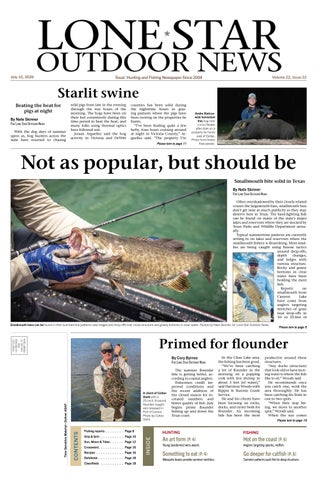
For Lone Star Outdoor News Often overshadowed by their closely related cousin the largemouth bass, smallmouth bass don’t get near as much publicity as they may deserve here in Texas. The hard-fighting fish can be found on many of the state’s major lakes and reservoirs where they are stocked by Texas Parks and Wildlife Department annually. Typical summertime patterns are currently setting in on lakes and reservoirs where the smallmouth fishery is flourishing. Most smallies are being caught using finesse tactics around drop-offs, depth changes, and ledges with various structure. Rocky and grassy bottoms in clear water have been holding the most fish. Reports on smallmouth from Canyon Lake have come from anglers targeting stretches of grass near drop-offs in 10- to 25-feet of Smallmouth bass can be found in their summertime patterns near ledges and drop-offs over rocky structure and grassy bottoms in clear water. Photos by Nate Skinner, for Lone Star Outdoor News.
Please turn to page 9
PRSRT STD US POSTAGE PAID DALLAS, TX PERMIT 3814
Primed for flounder By Cory Byrnes
A client of Colton Stahl with a 25-inch, 8-pound flounder caught and released in Port O’Connor. Photo by Colton Stahl. Fishing reports . . . . . . . . . Page 8 Grip & Grin . . . . . . . . . . . Page 10 Sun, Moon & Tides . . . . . . Page 12 Crossword . . . . . . . . . . . Page 16 Recipes . . . . . . . . . . . . . Page 16 Datebook . . . . . . . . . . . . Page 18 Classifieds . . . . . . . . . . . Page 18
INSIDE
CONTENTS
Time Sensitive Material • Deliver ASAP
For Lone Star Outdoor News The summer flounder bite is getting better, according to coastal anglers. Fishermen credit improved conditions and the recent addition of the closed season for increased numbers and better quality of fish. July begins prime flounder fishing up and down the Texas coast.
In the Clear Lake area, the fishing has been good. “We’ve been catching a lot of flounder in the morning on a popping cork with live shrimp in about 3 feet [of water],” said Harrison Woods with Rippin & Runnin Guide Service. He and his clients have been focusing on rocks, docks, and oyster beds for flounder. An incoming tide has been the most
productive around these structures. “Any docks (structure) that look old or have moving water is where the fish like to sit,” Woods said. He recommends once you catch one, work the area thoroughly. He has been catching his limit in one to two spots. “When they stop biting, we move to another spot,” Woods said. When the sun comes Please turn to page 19
HUNTING
FISHING
An art form (P. 4)
Hot on the coast (P. 6)
Young taxidermist wins award.
Anglers targeting specks, redfish.
Something to eat (P. 4)
Go deeper for catfish (P. 6)
Mesquite beans provide summer nutrition.
Summer patterns push fish to deep structure.
Page 2
July 10, 2026
LoneOStar Outdoor News
LSONews.com
LSONews.com
LoneOStar Outdoor News
July 10, 2026
Page 3
Page 4
July 10, 2026
LoneOStar Outdoor News
LSONews.com
HUNTING
Beans provide boost Having critical brooding habitat is key to growing quail to maturity. Photo by David J. Sams, Lone Star Outdoor News.
Brooding habitat important By Kyndal Underwood
For quail, hatching is only the beginning. While a successful nest is an important milestone, the first few weeks of a chick's life are among the most critical for survival. Unlike many birds, bobwhite and scaled quail chicks are precocial meaning they leave the nest within hours of hatching and begin searching for food almost immediately. During their first two weeks, chicks rely heavily on insects, which provide the protein needed for rapid growth and feather development. Habitats rich in native forbs and diverse plant communities support abundant insect populations and give young quail the best chance of survival. Quality brood habitat is equally important. Quail chicks need overhead cover to protect them from predators and weather, while maintaining enough bare ground beneath the vegetation to move freely and forage. Areas that are too dense can restrict movement, while areas with little cover leave chicks vulnerable. At the Rolling Plains Quail Research Ranch, we monitor nesting and brood-rearing success to better understand the factors that influence quail populations. Here are a few suggested tips to creating better quail brooding habitat on your property: Maintain Some Patches of Bare Ground • Chicks are only about the size of a bumblebee when they hatch and need open ground to move freely • Too much grass litter can prevent chicks from reaching insects Promote Native Forbs • Wildflowers and broadleaf plants attract insects far better than dense grass • Plants like ragweed, croton, sunflower, broomweed and partridge pea are excellent brood habitat Avoid Dense Grass Monocultures • Thick stands of introduced grasses such as bermudagrass or old, ungrazed CRP fields limit chick movement and insect availability • Think "patchy," not "carpet. Provide Overhead Canopy • A light canopy of grasses and forbs protects chicks from hawks and extreme heat while allowing them to forage underneath Keep Escape Cover Nearby • Broods rarely venture far from low-growing shrubby escape cover • Plum thickets, lotebush, skunkbush sumac, or scattered brush mottes provide quick protection from predators Use Prescribed Fire • Fire removes excess litter, stimulates annual forbs, increases insect abundance, and creates excellent brooding habitat during the first few growing seasons Manage Grazing • Proper stocking rates create the patchy vegetation structure quail need • Both overgrazing and complete rest can reduce brood habitat quality Control Excessive Brush • Light to moderate brush is beneficial, but dense mesquite or juniper reduces sunlight reaching the ground, limiting the growth of forbs and insect-producing plants The Perfect Brooding Habitat Please turn to page 17
Mesquite beans provide solid forage for deer and other animals, especially when spring rains do not fall as needed. Photos by David J. Sams, Lone Star Outdoor News.
By David J. Sams Lone Star Outdoor News
With much of the Texas landscape receiving drought-stopping rainfall this spring and early summer, there are still plenty of pockets where every passing thunderstorm seems to drift around instead of through. While those dry areas continue waiting for relief, Mother Nature is offering wildlife a valuable consolation prize. Mesquite trees across drought-stricken portions of Texas are loaded with bean pods this summer, providing white-tailed deer with one of the most important seasonal food sources avail-
able. The naturally sweet pods arrive just as many nutritious forbs begin drying up, helping deer bridge the nutritional gap until cooler weather returns. According to Biologist Dana Wright in Mesquite: A Drought Survival Strategy, mesquite trees seem to experience their own boom-and-bust cycle when it comes to bean production, with drought often producing the biggest crops. “Many plants exhibit a stress-induced reproductive response, and drought is one of the triggers,” Wright wrote. “When growing conditions become harsh, mesquite trees often slow their normal growth and shift their en-
ergy into producing large numbers of bean pods. It's the tree's way of ensuring the next generation survives.” That strategy benefits much more than the trees. Wildlife biologists with Texas A&M AgriLife Extension and the Texas A&M Natural Resources Institute identify mesquite beans as an important natural food source for white-tailed deer during late spring and summer. The pods are rich in carbohydrates, contain moderate levels of protein and are highly digestible for ruminants, making them an excellent energy source when quality green forage becomes scarce. Please turn to page 13
Focused on the art Young taxidermist wins DU award at state competition By Conor Harrison Lone Star Outdoor News
Many 9-year-old young ladies love art. But not many are willing to get their hands dirty when it comes to the art of taxidermy. That has never been a problem for Ella. The Central Texas youngster, whose uncle Caleb Ferreri owns and operates Outlaw Taxidermy in Hutto, was introduced to hunting at an early age. Ella recently won the Ducks Unlimited Youth Division Award at the Texas Taxidermy Association Annual Awards. While she enjoys sitting in a blind with her grandfather or other family members, it isn’t the shooting that interests her. It’s what comes next that she enjoys so much. “I love animals and don’t want to hunt them,” Ella said. “I entered my first taxidermist competition when I was 8. My uncle Caleb asked me if I wanted to do it. I don’t have to shoot them or flesh them out. I wanted to do a bobcat. I won first place in the under 8 category, Nine-year-old taxidermist Ella holds her award-winning green-winged teal in but I didn’t think my bobcat was very good.” the youth Division at the Texas Taxidermy Association’s annual awards. Photo Ella’s mom, Christy, said her daughter spends a lot of from Caleb Ferreri. time at the taxidermy shop. “She’s grown up over there and she just loves the art aspect of it,” Christy said. “She seems to be able to separate herself from the dead animals and focus on the art of it. She’s definitely gotten closer to her uncle. He’s been really present with her.” For this year’s competition, Ella chose a green-winged teal as her subject. “My wife does all the ducks,” Caleb said. “My wife coached her through it and they both did a great job.” “I just wanted to do a duck,” Ella said, “and they had one at the shop. I really like how they look. They are cool.” Please turn to page 13
LSONews.com
LoneOStar Outdoor News
July 10, 2026
Page 5
TPWD clarifies drone rules for filming wildlife By Cory Byrnes
For Lone Star Outdoor News For hobbyists and content creators wanting to film any Texas wildlife without a permit, the news is not good. TPWD defines wildlife as vertebrate species. Vertebrate species include fish. In short, a drone operator that doesn’t hold an Aerial Management Permit (AMP) with a Landowner Authorization (LOA) filming fish or other wildlife is committing a Class A misdemeanor and is subject to fines, even if it is not the intention of the drone operator. LSON asked TPWD the following questions. Below are their answers. TPWD’s own Drones/UAVs FAQ page is titled and framed around drone use "in Hunting," and its explanatory language consistently ties the prohibition to hunting-related activity — yet the actual code text you cite (TAC §65.152) prohibits "photographs" on its own, with no huntingcontext qualifier. Which governs: the narrower hunting-context framing implied by your page, or the literal, unqualified text of the code? Except under permits issued by Texas Parks & Wildlife Department, the use of drones to hunt, drive, capture, take, count or photograph any wildlife is unlawful. Requirements include an Aerial Wildlife Management Permit (AMP) issued by TPWD and an approved Landowner Authorization (LOA). Department rules are adopted under the framework and guidelines of the Federal Airborne Hunting Act. Does TPWD actively enforce §65.152 against hobbyists and small content creators who incidentally capture wildlife while filming themselves, as opposed to ranches, commercial operators, or individuals actively scouting or targeting animals? A person is required to possess an AMP to engage in the management (defined as counting, photographing, relocating, capturing, or hunting by the use of air-
craft) of wildlife and exotic animals by the use of aircraft only on the tract(s) of land specified in the approved LOA. Texas Game Wardens assess each situation based on the totality of circumstances and take appropriate action in accordance with state law. When a person discloses full context — that they were filming themselves or others, with wildlife appearing incidentally, not being pursued or sought out — does TPWD draw any distinction between incidental capture and active targeting? Or is §65.152 enforced as a blanket prohibition regardless of stated intent?
TPWD has clarified its ruling on drone use and filming any wildlife, including fish. It is a Class A misdemeanor in every instance. Photo by LSON.
Texas Game Wardens evaluate and investigate each situation individually and handle them as appropriate. Has TPWD's enforcement posture or guidance on incidental wildlife photography changed in the past one to two years? If so, what prompted the change? There has not been a new regulation enacted or any changes made at the state level. How many citations or enforcement actions has TPWD issued under §65.152 specifically for inciden-
tal wildlife capture — as opposed to active hunting, scouting, or baiting — in the last five years? A violation of §65.152 is a class A misdemeanor. We do not classify violations based on whether the conduct was incidental or intentional. Under state law, a person either meets the elements of the regulation or does not. In the last five years (June 29, 2021-June 29, 2026) there have been 29 enforcement actions taken related to §65.152. Since the same incidental-capture issue does not apply to a phone, GoPro, or AI glasses, what is the basis for treating aerial capture differently when the underlying act is otherwise the same? Aerial imaging is regulated differently because state law specifically distinguishes aircraft‑based photography of wildlife from ground‑based photography. The use of drones or other aircraft to capture images of wildlife requires an Aerial Management Permit (AMP) and Landowner Authorization (LOA). These requirements apply regardless of whether the wildlife is intentionally or incidentally captured via-photography. By contrast, devices such as phones, GoPros, or AI glasses are not classified as aircrafts and therefore are not subject to the same statutory framework. What would TPWD recommend a hobbyist or monetized content creator who routinely fishes or hunts do to stay compliant with §65.152, short of obtaining a full AMP/LOA permit? If a wildlife resource (which includes fish) enters the frame while someone without the appropriate AMP and LOA permits is filming, that person should stop filming or reposition the camera angle so that the wildlife resource is no longer in the frame. (Note: Per the Federal Airborne Hunting Act, states may not issue permits for the purpose of sport hunting.) Drone hobbyists can purchase an AMP permit from TPWD for $100.
July 17-19, 2026 SHOW HOURS:
Texas public draw hunts open for applications Hunters can now apply for opportunities through Texas Parks and Wildlife Department’s drawn hunt permits program. The drawn hunts program issues permits to hunters for drawn hunts on both public and private lands throughout Texas. Applications are now being accepted for a shot at nearly 9,800 permits in more than 60 high-quality hunt categories. Last year, more than 500,000 applications were submitted to TPWD. Key additions for the 2026-27 season include a mentored dove hunt at Lake Corpus Christi State Park along with deer and exotic game hunts at newly acquired Bear Creek and Silver Lake State Parks. Other recently acquired state parks properties providing public hunts include Post Oak Ridge and Caprock Canyons State Parks, along with Enchanted Rock and Honey Creek State Natural Area. Application deadlines are the 1st and 15th of each month between Aug. 1 and Nov. 1. For example, applications for all alligator hunt categories and private land dove hunts are due Aug. 1, while deadlines for archery deer, archery mule deer, pronghorn, private land pronghorn and javelina are Aug. 15. Application fees range from free to $3 to $10, depending on the hunt category. If selected, adult hunters may need to pay a special permit fee of $80 for regular hunts or $130 for extended hunts. Categories such as youth-only hunts and specified others do not require application or permit fees. Permits are open to residents and non-resident hunters alike, something Texas resident hunters have long complained about. The state does not give resident hunters preferential treatment in the draw system like almost every other Western U.S. state operating a draw hunt system. Many states cap non-resident tags at 20% of total tags drawn or have a points-based system heavily skewed toward residents. —Staff report
McAllen Convention Center
FRIDAY 5PM-10PM | SATURDAY 10AM-7PM | SUNDAY 11AM-6PM
DIAMOND/TITLE SPONSORS
PLATINUM SPONSORS
GOLD SPONSORS
For more information, visit huntmcallen.com | Follow us
@txhunterexpo
Page 6
July 10, 2026
LoneOStar Outdoor News
LSONews.com
FISHING
Focused on trout
Taylor Krumholz shows off a chunky speck he caught in dirty, off-colored water in East Matagorda Bay. Photo by Nate Skinner, for Lone Star Outdoor News.
Redfish, black drum also in the mix By Nate Skinner
For Lone Star Outdoor News Speckled trout continue to be the focus of many anglers fishing with both artificial lures and live croaker up and down the Texas coast in July. Redfish have been in the mix as well, along with black drum. Wade-fishing has still been productive for those willing to push out to waist-deep water and deeper. Covering water while drifting across flats in 3 feet of water or more has also rendered plenty of catches.
Upper-coast anglers are reporting decent numbers of speckled trout and redfish while drifting over areas with scattered oyster shell and clam shell in 4- to 8-feet of water in the Galveston Bay complex, along with Sabine Lake. Both live bait and soft plastics have been drawing strikes. Decent-sized speckled trout have been striking soft plastics along the jetties, according to many local Sabine area anglers. The key has been getting calm enough winds to safely navigate the waters surrounding the granite rocks. Taylor Krumholz recently caught limits of speckled trout in the 17- to 20-inch range while wade-fishing the edges of oyster shell
in waist deep water in East Matagorda Bay. He said the water clarity was poor and dirty due to strong winds and recent rains. “I could only get bites throwing bright or dark-colored soft plastics,” Krumholz said. “Anything with a more subtle or natural color pattern wouldn’t work. I don’t think the fish could see those types of color patterns very well in the dirty water.” Krumholz said some over-slot specks pushing 22 or 23 inches were also in the mix. “The fish seemed to be holding tight to the bottom,” he said. “I got most of my bites using an extremely slow retrieve and bouncing baits along the bottom.”
Capt. Adam Higgins wade fished along the south shoreline of Baffin Bay at nighttime during the full moon at the beginning of the month. He said speckled trout wanted nothing to do with top-water plugs under the light of the moon, but they were willing to strike soft plastics and slow-sinking twitch baits. Reports around Corpus Christi along the Upper Laguna Madre from local anglers indicated speckled trout have been stacking up along grass line drop-offs from Pita Island to Emmords Hole. Many folks have said live croaker has produced the most consistent bite, but soft plastics have been catching fish, too. Please turn to page 17
Just roaming
Cats holding deeper
Stripers, hybrids feeding in 25- to 40-feet of water
By Cory Byrnes
random schooling action on the surface, but a lot of the stripers that have been busting on top during the early morning hours have been on the small side,” Vinson said. “We’ve been dropping baits down below them to catch larger fish when we find them schooling on the surface.” Vinson said live shad has been the best bait for consistently catching good-sized stripers, day
seen better-quality fish. “So when the water is up high, it is more oxygenated, so now As it heats up in Texas, catfish the big fish come out of the holes anglers across the state will need they were in,” Smith said. “Anto follow the fish out to their glers should still look for deeper pockets of water with structure. deeper summer haunts. With stained On the Brawater, look zos River near along the Richmond, banks for the fishing signs of deephas been exer pockets. cellent, acIf there is a cording to bend in the Jaxson Smith river, what’s with Fade the happening River. is when the “The catwater is runfishing has ning and hitbeen good the ting the walls, past couple of Kashi Fukunuga from Japan with a blue it carves the weeks,” Smith cat caught on Lewisville Lake. Photo by river deeper.” said. “Espe- Steve Schiele. Lay downs cially with and either side of a sand bar are the river being high.” With river levels up, Smith has also likely to hold fish. Smith
Please turn to page 17
Please turn to page 19
For Lone Star Outdoor News
By Nate Skinner
For Lone Star Outdoor News Go deep this month for stripers and hybrids. While there are reports of some striped bass and hybrid striped bass schooling action taking place, the majority of the fish are feeding heavily around main-lake humps, points, and drop-offs in anywhere from 25- to 40-feet of water. There are also fish being caught suspended over deep open water flats in 50 feet of water or more. Vertically jigging slabs, casting deep-diving crankbaits, and trolling bucktail jigs and soft plastics with downriggers have all been producing strikes. However, the most consistent action has been reported by anglers fishing with live shad. Owner and Operator of Guar-
Anglers chasing stripers and hybrids have found schooling fish down deeper in July. Photo by David J. Sams, Lone Star Outdoor News.
anteed Guide Service, Capt. Cory Vinson, said he and his anglers have been catching limits to near limits of stripers on Lake Whitney consistently over open water flats in the middle of the lake in 50 feet of water or more. Most of these fish are in the 24- to 28-inch range and about 6 to 7 pounds, with some pushing 10 pounds or more mixed in. “We have been seeing some
LSONews.com
LoneOStar Outdoor News
July 10, 2026
Page 7
Following the bite
Bass anglers are finding solid numbers of bass stacked up over deep structure using deep-diving crankbaits, jigs, and a variety soft plastics. Photo by Nate Skinner, for Lone Star Outdoor News.
Largemouths pushing from shallow to deep By Nate Skinner
For Lone Star Outdoor News Summertime action persists for anglers pursuing largemouth bass. The fish have been found up shallow, both early and late. During the bulk of the daytime hours, however, bass have been stacking up in deeper water along various forms of structure in depths from 10- to 30-feet of water or more. Deep-diving crankbaits worked along drop-offs have been producing plenty of action for those who like to cover water. A variety of soft plastic presentations and jigs have also been drawing strikes for those who prefer a slower, more subtle approach. Kayak angler Marcus Cupp has been catching good numbers of bass on Lake Palestine and Sam Rayburn Reservoir on soft plastic stick baits and jigs. He’s been fishing up shallow along the banks during the early morning and late evening hours, targeting laydowns and other structure. During the heat of the day, he’s been moving out to main lake humps, points, and drop-offs in 10- to 15-feet of water or more. Please turn to page 9
Best bang for the buck
Chad Pavlu and his wife, Melissa, stand in their lure shop. Photo from Chad Pavlu.
Manufacturing high-quality baits for serious inshore anglers By Nate Skinner
For Lone Star Outdoor News Chad Pavlu and his wife, Melissa, are the owners and operators of PavLures, a Texas-based fishing lure company that has a growing reputation among inshore fishing guides, tournament pros, and avid anglers for producing high-quality soft plastic baits, slow-sinking and suspending twitch baits, jig heads, and weedless hooks. They manufacture the lures and products themselves out of their shop where they
live in Port Mansfield. This allows them to maintain the premium level of quality they strive to provide to their customers, as they are able to touch every single bait before it ever reaches the hands of an angler. Pavlu said PavLures originally began as a hobby. “I was guiding fishing trips part time and just fishing a lot in general, mostly out of the Rockport area, and felt like the quality and durability of the lures I was fishing with was gradually declining,” he explained. “So, I started tinkering around with making some baits.” Pavlu said the initial process started slow. He acquired the equipment he needed to start making his own baits a little at a time. Please turn to page 19
LSON CCA QTR 4C 06182026.indd 1
6/10/26 11:30 AM
Page 8
July 10, 2026
LoneOStar Outdoor News
LSONews.com
LONE STAR FISHING REPORTS SALTWATER FISHING By Chuck Uzzle
For Lone Star Outdoor News
•
SABINE LAKE • •
•
• • •
Speckled trout fishing has been very good from the north end to the Gulf Open water slicks near concentrations of shad have been producing good numbers of fish and even some schooling activity The jetty and beachfront bite has picked up considerably and is producing some very nice over-the-slot trout on swimbaits and top-waters Redfish are thick from the Causeway Bridge to the Gulf Live shrimp under a cork has been the best bait for redfish, black drum, and sheepshead Tripletail are out in good numbers along the beachfront when the wind allows
•
BAFFIN BAY • • • •
•
•
• • • •
Water temperatures are between 85 and 87 degrees When the wind allows, trout action is good while drifting shell in 5 feet of water on Gulp Turbo Shrimp and Bass Assassins Wade anglers have caught fish on mid-bay reefs Offshore has been good for red snapper Weed lines are holding dorado and tripletail A few tarpon are showing up on the beach
PALO PINTO
•
•
•
•
•
• • • • • •
West Matagorda has been producing steady limits of trout The best options have been on live shrimp under Coastal Corks Lower winds have allowed for more beachfront access while chasing tripletail Best bite is live shrimp either freelined or under a cork when you find the tripletail Shark fishing has been very easy Plenty of fish in the 4- to 6-foot range are taking chunks of cut skipjacks
ROCKPORT • •
Trout fishing continues to be fast and furious before the sun gets up as long as the winds allow Live shrimp under a popping cork,
Water level is .44 feet below pool at 96.4% full, typically stained Water temps are about 84 degrees Current conditions suggest a typical midsummer pattern — warm water, active fish early and late in the day, with slower action during the hottest afternoon hours Target water 12- to 25-feet deep, as many fish are holding deeper during daylight hours; Focus on shaded docks, rocky structure and submerged brush Largemouth bass can be found around deep brush piles, creek channels, and rocky points with Texas-rigged worms, football jigs or deep-diving crankbaits; Low-light top-water action is possible around shoreline cover
•
Channel and blue catfish are productive on nightcrawlers, cut bait or stink bait around submerged timber, creek channels and deeper flats, especially after sunset Look for crappie suspended around bridge pilings, brush piles and standing timber in deeper water Small minnows and jigs work well; Crappie anglers usually do best with colors that provide contrast and visibility in the stained water Chartreuse/black is often the most consistent producer with blue/chartreuse excellent around brush piles and docks
• • •
•
•
•
•
•
•
•
•
Water level is 0.54 feet above pool at 100% full Water temps are around 80 degrees; Water clarity varies from lightly stained to clear depending on location If you're heading out in early July, target: White bass on deep humps at sunrise Catfish during the day on channel edges and deeper flats Bass around timber and shaded cover White bass (sand bass) schools are holding on main lake humps, ridges and points; fish in roughly 20- to 25-feet of water Slabs, jigging spoons and shad-
•
•
• •
• •
• •
Water level is 0.74 feet below pool at 96% full Water temps are about 79 degrees Fishing can be good, but you'll generally have the best success during the first few hours after sunrise, the last couple of hours before sunset or after dark; Strongest feeding periods are around sunrise Lake Nacogdoches is known for producing trophy largemouth bass; During the day, target timber, creek channels, brush piles, and offshore points in 10- to 20-feet of water Use Texas-rigged worms, football jigs, deep-diving crankbaits or large swimbaits. Early and late, try frogs or walking top-waters around vegetation and shoreline cover Crappie are suspended around brush piles, standing timber and bridge structure; Small jigs and live minnows are the best bets Channel catfish should be active on cut bait, punch bait or nightcrawlers along creek channels, timber edges and flats, especially after sunset Night fishing can be productive for both bass and catfish as the water cools slightly
drops, submerged timber, hydrilla edges and points in about 10- to 20-feet of water Early mornings, try walking top-waters or buzzbaits around vegetation; As the sun rises, switch to Texas-rigged worms, football jigs, Carolina rigs or deep-diving crankbaits Crappie fishing is fair to good; Submerged brush piles, standing timber and bridge structure are producing fish Small minnows and 1/16-ounce jigs are productive, especially in 12- to 18-feet of water Good conditions for channel and blue catfish; They are active along creek channels and flats adjacent to deeper water Cut shad, punch bait and stink bait should all produce, especially after sunset Look for schooling hybrid striped bass and white bass near the main river channel or where baitfish are concentrated Jigging spoons and small swimbaits work well when fish are suspended Because hydrilla and giant salvinia are present in parts of the lake, concentrate on clean vegetation edges rather than fishing directly through heavy mats
LAKE TRAVIS •
•
•
•
•
Water level is 9.10 feet below pool at 85.1% full, though recent rains have significantly improved compared with earlier in the season Water temps are around 83 degrees, clear with approximately 4 to 6 feet of visibility; Because the lake is clear, use lighter fluorocarbon line and make longer casts to avoid spooking fish Lake Travis is fishing well for midsummer, especially if you focus on early morning (daybreak until 9 a.m.), late evening, or nighttime Good conditions for largemouth bass; Schools are gathering around marinas, bluff walls, offshore humps, rocky points and submerged brush Early in the morning, top-waters such as walking baits and poppers can produce explosive strikes; Once the sun is up, switch to dropshot rigs, shakyheads, football jigs or deep-diving crankbaits in 15- to 35-feet of water
LAKE TEXANA •
LAKE RAY ROBERTS •
imitating lures are producing fish Catfish are one of the strongest bites on the lake right now; Blue and channel catfish are active around deeper structure, channels and bait concentrations Cut shad and prepared baits are working well Largemouth bass are holding around flooded timber, submerged points and shoreline cover Until 9 a.m., fish in 2- to 8-feet of water using white- or shad-pattern top-waters, white/chartreuse spinnerbaits, green pumpkin soft plastics and watermelon red worms and creature baits; Late evening in 5- to 12-feet of water, white buzzbaits, frogs and spinnerbaits can also be effective Crappie are generally reliable yearround on this fishery Focus on standing timber, brush piles, bridge pilings and submerged cover near creek channels Suspend minnows just above piles and cover; Small jigs in chartreuse/ black, monkey milk and blue/white remain productive; Switch to pink/ white when the bite gets tough
LAKE NACOGDOCHES
•
•
WEST MATAGORDA BAY
•
•
EAST MATAGORDA BAY •
•
For Lone Star Outdoor News
By Vivian Leopold
GALVESTON/TRINITY BAYS
•
•
•
• •
Speckled trout and redfish are good on open water reefs in East Galveston Bay and along the rocks and spoil banks near the channel, despite the water color Beachfront fishing has been very good when the wind allows Clear water has produced solid fish in the first gut with some heavy fish taking top-waters at first light
Water temps ranging from 87 to 92 degrees has pushed most of the bait out to deeper water Best baits are slow-moving mullet imitations or larger paddle tail soft plastics in 3 feet of water Low water conditions have scattered the trout Look for them to get back shallow once the tides increase
•
FRESHWATER FISHING •
•
as well as live croakers are producing good numbers of quality speckled trout The redfish bite is improving daily for anglers throwing both live and dead bait on the bottom Wade fishing has been slow overall
Water level is 0.27 below pool at 98.3% full; The reservoir has generally remained near conservation pool with healthy habitat including standing timber, vegetation and creek channels
•
• •
• •
Water temps are about 82 degrees, typical for early July and keeps most game fish in summer patterns – warm water, fish holding on deeper structure during the day and the best bite occurring around sunrise, sunset and after dark Largemouth bass conditions are good Fish are holding on creek-channel
•
•
Striped bass are good, with live shad remaining the top producer over deep water, especially near the main river channel and humps; Vertical jigging spoons can also be productive when fish are schooling. White bass are fair to good; Watch for schooling activity during the first hour after sunrise and use small spoons, swimbaits, or tailspinners Catfishing is good; Use cut bait or punch bait on channel edges and flats adjacent to deeper water, particularly after sunset Night fishing is often excellent for bass and catfish as water temperatures cool slightly
LSONews.com
LoneOStar Outdoor News
July 10, 2026
Page 9
Texas Team Trail announces schedule
Smallies Continued from page 1
water. Danny Uribe has been finding scattered smallies mixed in with largemouth bass around the edges of main lake points and humps with grassy bottoms on Canyon. “The most consistent action has come from areas where flats drop off into 15- to 25-feet of water with decent-sized stretches or clumps of grass,” Uribe said. “Small, finesse worms rigged weightless or on lightweight Texas rigs have been the ticket, along with minnowstyle baits rigged on a 1/16-ounce jig head.” Uribe was recently testing out some new products on Canyon and found smallmouth pushing 3.5 pounds around various drop-offs over thick grass. The fish were holding tight to the edges of outside grass lines on main lake ledges near humps and points. Stretches that dropped off from 10- to 20-feet of water or more produced the most bites. On Lake Texoma, smallmouth bass are currently in their post-spawn and summer patterns, holding around steep, rocky drop-offs, points, and bluff walls in stretches of clean, clear water. According to fishing guide John Blasingame, anglers targeting smallies should focus on main lake points, drop-offs and ledges, and riprap along the Denison dam. Blasingame said submerged structures and rocky points extending into the main lake are good options, as well as just about any steep, rocky drop-offs where the fish can retreat to deeper water during the midday heat. Live shad have been effective for anglers chasing smallmouth. A variety of soft plastics fished on drop-shot rigs, as well as 7-inch worms and crawfish imitations rigged Texas style or on shaky head jigs have also been drawing strikes from smallies. Sporadic catches of smallmouth bass have been coming from the middle and lower portions of Lake Whitney over rocky bottoms in clear water, according to various reports from recreational bass anglers. Most of the fish have been caught in 15- to 20-feet of water or more. As is common with smallies, drop-offs and ledges near the ends of rocky points have been holding fair numbers, along with stretches of riprap along the dam, and ledges along the lake’s lower river channel. With water temperatures continuing to increase, some anglers are having better success targeting smallmouth bass during the nighttime hours.
The Bass Pro Shops and Cabela’s Texas Team Trail has released its 2027 schedule, giving anglers a mix of new opportunities, familiar favorites and a Championship return to a lake that fished well at the finale of the 2026 season. The 2027 season will feature four regular season stops before the trail closes with a two-day Championship on Lake Palestine in Tyler. The schedule opens February 6 on Lake Conroe, followed by a March 6 stop at Toledo Bend, where anglers will launch from the new Sabinetown facility. On May 1, the trail returns to Lake Texoma and West Bay Casino and Resort. The regular season wraps May 22 at Lake ‘O the Pines, a new venue for the Texas Team Trail. After huge weights and a strong welcome, TXTT will return to Lake Palestine for a twoday shootout with Team of the Year on the line. Lake Palestine proved last season that it can host a great tournament on a championship stage, producing big weights and a strong host-community experience. Its return gives the top qualifying teams another shot at a fishery capable of the kind of two-day Championship drama TXTT anglers expect. 2027 TXTT SCHEDULE: February 6, 2027 – Lake Conroe March 6, 2027 – Toledo Bend May 1, 2027 – Lake Texoma May 22, 2027 – Lake ‘O the Pines June 5-6, 2027 – CHAMPIONSHIP – Lake Palestine —TXTT
YOUR EAST TEXAS PREMIER HUNTING & OUTDOOR EXPERIENCE Experience exceptional hunting on a private ranch where great memories are made. Whether you're chasing trophy whitetails or wild hogs, The Lodge at Davis Creek delivers the adventure you've been looking for.
Whitetail Deer • Wild Hogs • Turkey
Largemouth
Managed hunting grounds for all skill levels Stay in our beautiful 2 bedroom/2 bath lodge! Day Hunts available
Continued from page 7
“The bass are really stacking up out over deeper structure during the middle of the day right now,” Cupp said. “Belly-weighted stick baits have been the ticket for getting bites out deep. A slow retrieve has really been working well along dropoffs, the ends of points, the edges of humps, and anywhere there is a significant depth change near structure.” For the short windows of time the fish are up shallow, Cupp has been having the most success on soft plastic stick baits rigged weedless and weightless. Jigs in a bluegill pattern rigged with a soft plastic trailer have also been producing consistent strikes for him. Most of the bass Cupp has been catching on Palestine and Rayburn have been in the 2.5- to 3.5-pound range, with some larger fish mixed in. He has also been targeting rocky points, humps, Kayak angler Marcus Cupp shows off a bass he caught while flipping and docks adjacent to rock jigs underneath the shade of docks on Lake Limestone. Photo from walls on Lake Limestone to Marcus Cupp. consistently stay hooked up with bass. “The fish have really been relating to the shade that docks provide in 7- to 10-feet of water, and the best docks have been those near rock walls,” Cupp said. “If you can skip a jig underneath these docks, you can really catch some nice bass.” Cupp has been catching bass up to about 7 pounds on Limestone. Kayak tournament angler Sergio Romanos has been fishing Lady Bird Lake where he has been catching largemouth bass up to about 4.5 pounds. According to his Facebook page, during a recent fishing tournament he caught a limit of bass by 9:45 a.m. on Texas-rigged soft plastics around bridge pillars. “An underspin jig and crankbait worked well when the schooling bass were munching on top,” Romanos wrote in a recent post. “I culled fish a few times and caught 13 total bass throughout the day.” Bass fishing guide Haydan Marshall posted on the Fishing TEXAS Facebook group page that he and his anglers have been consistently catching bass over 4 pounds recently. “I had a fun day on Fork with Lane Miller,” Marshall wrote in his post. “We boated around 20 fish, and most of them weighed over 4 pounds. We had a total weight of right at 33 pounds for our best five bass. The lake is so healthy right now. We caught solid fish in a foot of water chasing bream, and all the way out to 27 feet of water where they were chasing gizzard shad.” Recent local reports from Lake Falcon described the bass bite as solid to excellent right now. The fish have been transitioning into deeper water and staging on secondary points and drop-offs in depths of 15 feet or more. Deep-diving crankbaits, Carolina-rigged soft plastics, and jigs have been triggering plenty of strikes along the bottom.
409-423-4404 @daviscreeklodge
www.daviscreeklodge.com
daviscreeklodge@gmail.com• Bon Wier, Texas
Page 10
July 10, 2026
LoneOStar Outdoor News
LSONews.com
GRIP & GRIN
Darren Pyfer shows off one of the specks that he caught under the lights in Offatts Bayou on a recent trip.
Horacio Delarosa, 13, got his first buck last fall on a friend’s ranch in Palo Pinto County.
Reagan Lehmann, 6, with her 29-inch speckled trout caught recently in Port Aransas while fishing with her dad, Corey, and grandfather “Bwana” on Capt. Scott McHune’s boat.
SHARE AN ADVENTURE
n Want to share hunting and fishing photos with other Lone Star Outdoor News readers? Email them with contact and caption information to editor@lonestaroutdoornews.com. High-resolution original jpegs only. Mail prints to Grip & Grin, Lone Star Outdoor News, P.O. Box 551695, Dallas, TX 75355.
Brad Jackson with a nice axis killed at Woodie Creek Ranch in San Augustine.
Wes Pyfer with one of several sharks he caught near the Pelican Island Bridge in Galveston on recent trip.
LSONews.com
LoneOStar Outdoor News
July 10, 2026
Page 11
Hogs
Continued from page 1
SINCE 1960
BUYING, SELLING AND TRADING GUNS
Used and new firearms, ammunition, knives, and optics for all of your hunting, shooting and personal protection needs.
123 Carroll Rd, Wharton, TX 77488 F o l l o w us
Jeraan Arguellez harvested these two boars in Victoria County on a bright night under a big moon. Photo from Jeraan Arguellez.
been hunting in DeWitt County has been holding larger groups of pigs.” Arguellez said he’s also been catching pigs coming into corn feeders after dark. “A few weeks ago, I started getting consistent pictures from a trail camera of boars hitting one of my feeders,” Arguellez said. “I had just filled that feeder and got it back up and running. As soon as I started feeding, they showed up.” Scott Young has been hunting hogs at night using thermal optics in the northeastern portion of the state in Hunt, Lamar, and Delta counties, where he said the pigs have been feeding in wheat and peanut fields, as well as over baited corn piles. “There’s been a handful of lone boars moving around right at sunset, but for the most part, the activity from large groups of pigs has been taking place after midnight, during the wee hours of the morning,” Young said. “I’ve had the best luck scanning fields with thermal optics throughout the night, locating a group of hogs, and then stalking into shooting range of them to get a shot.” Young said setting up on treelines on the edges of fields and waiting for the pigs to come out into the crops to feed has also worked well. YouTube creator Andre Kielczewski said he has been chasing pigs east of Dallas, between Terrell and Tyler, during the late evening hours and throughout the night using thermal optics. “The hogs have consistently been feeding and rooting in coastal fields after dark,” Kielczewski said. “There are a lot of pigs hanging out in corn fields right now, but they are hard to find, because farmers in the area have not started harvesting corn and cutting these crops yet.” Kielczewski said he’s had the most consistent success hunting pigs over a corn feeder during the late evening hours and after sunset. He’s been monitoring cellular game cameras overlooking feeders near water sources, and then stalking into shooting range of these areas once his cameras alert him that hogs have shown up. “Feeders near creek bottoms, low lying areas and wallows, or tanks have held consistent activity from hogs on the properties I’ve been hunting lately,” Kielczewski said. “Most of the activity around feeders has been right around sunset and throughout the middle of the night.” Montrea Hobbs said he’s been having success hunting hogs at sunset and throughout the night in Hunt, Franklin, and Kaufman counties over cattle grazing pastures. He said the pigs are moving in these pastures almost exclusively at dusk and during the nighttime hours with the elevated daytime temperatures.
Defender Outdoors announces move Defender Outdoors has announced it is moving. “To maintain a convenient location while creating room to grow, we’ve secured an incredible new property that makes both possible,” according to their website. The current Team Ranch location (8270 Aledo Rd.) closed June 29. The new location at 8137 FM1902 will open July 15 and include everything shooters have ever needed or wanted for shotgun sports. The new location is super convenient, right off Chisholm Trail Parkway south of Ft. Worth, and the Defender Outdoors Clay Sports Ranch event space will be one-of-a-kind. With all they learned over that last 8 years and over 1,000 events, Defender Outdoors aim to please everyone with this new space. Defender Outdoors was founded in 2012 with one mission in mind: create a place where all shooters can come together and enjoy a shooting experience like no other. The Defender Outdoors team strives to create a warm and inviting atmosphere that encourages shooters of all walks of life to share in our passion for the shooting sports. —Staff report
July 4th weekend Game Warden reports Lake Conroe accident Around 9:30 p.m. July 4, Texas Game Wardens in Montgomery County responded to a single-vessel incident on Lake Conroe. A vessel struck a bulkhead near Cude Cemetery Road, resulting in the two adult occupants being ejected onto the shore. Both were transported to area hospitals for treatment. This is an ongoing investigation, and no other details are available at this time. Lake Hawkins fatality At 1:30 p.m., Texas Game Wardens in Wood County responded to a possible water-related fatality at Lake Hawkins. Witnesses reported seeing a 27-year-old man go underwater in the swim area and not resurface. The 27-year-old man was recovered deceased from Lake Hawkins by a local dive team around 5 p.m. —TPWD
(979) 532-3175
c a r r o ll s _ h u n t i n g _ f i s h i n g
howdy@carrollsgunshop.com C a r r o ll ' s G u n S h o p
Page 12
July 10, 2026
LoneOStar Outdoor News
LSONews.com
TEXAS SUN, MOON AND TIDES Moon Phases Houston
New
First
Full
Last
July 14
July 21
July 29
Aug 10
Solunar Sun times Moon times Dallas
2026 July
A.M. Minor Major
P.M. Minor Major
SUN Rises Sets
MOON Rises Sets
2026 July
A.M. P.M. SUN MOON Minor Major Minor Major Rises Sets Rises Sets
10 Fri 11 Sat 12 Sun 13 Mon 14 Tue 15 Wed 16 Thu 17 Fri 18 Sat 19 Sun 20 Mon 21 Tue 22 Wed 23 Thu 24 Fri
1:53 8:07 2:46 9:02 3:44 10:01 4:46 11:02 5:49 ----6:52 12:38 7:53 1:40 8:50 2:38 9:43 3:32 10:33 4:22 11:20 5:09 ----- 5:54 12:26 6:38 1:09 7:21 1:52 8:05
2:22 8:37 3:18 9:34 4:17 10:34 5:19 11:35 6:21 12:36 7:21 1:07 8:19 2:06 9:14 3:02 10:06 3:55 10:55 4:44 11:42 5:31 12:05 6:16 12:49 7:01 1:33 7:45 2:17 8:29
06:27 08:24 06:28 08:24 06:28 08:23 06:29 08:23 06:29 08:23 06:30 08:23 06:30 08:22 06:31 08:22 06:31 08:21 06:32 08:21 06:32 08:21 06:33 08:20 06:34 08:20 06:34 08:19 06:35 08:19
2:20a 4:53p 3:11a 6:05p 4:11a 7:12p 5:19a 8:12p 6:32a 9:03p 7:46a 9:45p 8:57a 10:22p 10:03a 10:54p 11:05a 11:24p 12:04p 11:53p 1:02p NoMoon 2:00p 12:22a 2:58p 12:54a 3:56p 1:28a 4:52p 2:08a
10 Fri 11 Sat 12 Sun 13 Mon 14 Tue 15 Wed 16 Thu 17 Fri 18 Sat 19 Sun 20 Mon 21 Tue 22 Wed 23 Thu 24 Fri
1:58 8:13 2:52 9:08 3:50 10:07 4:52 11:08 5:55 ----6:58 12:44 7:59 1:46 8:56 2:44 9:49 3:38 10:39 4:28 11:26 5:15 ----- 6:00 12:32 6:43 1:15 7:27 1:58 8:10
2:28 8:43 3:24 9:40 4:23 10:40 5:25 11:41 6:26 12:42 7:27 1:12 8:25 2:12 9:20 3:08 10:12 4:01 11:01 4:50 11:48 5:37 12:11 6:22 12:55 7:06 1:39 7:51 2:23 8:35
06:26 08:36 06:27 08:36 06:27 08:36 06:28 08:36 06:28 08:35 06:29 08:35 06:30 08:34 06:30 08:34 06:31 08:34 06:31 08:33 06:32 08:33 06:33 08:32 06:33 08:32 06:34 08:31 06:35 08:30
2:19a 5:07p 3:08a 6:20p 4:07a 7:27p 5:16a 8:26p 6:30a 9:16p 7:46a 9:56p 8:58a 10:31p 10:07a 11:01p 11:10a 11:29p 12:11p 11:56p 1:11p NoMoon 2:11p 12:24a 3:11p 12:54a 4:10p 1:27a 5:07p 2:05a
San Antonio
Amarillo
2026 July
A.M. Minor Major
P.M. SUN MOON Minor Major Rises Sets Rises Sets
2026 July
A.M. Minor Major
P.M. Minor Major
SUN Rises Sets
MOON Rises Sets
10 Fri 11 Sat 12 Sun 13 Mon 14 Tue 15 Wed 16 Thu 17 Fri 18 Sat 19 Sun 20 Mon 21 Tue 22 Wed 23 Thu 24 Fri
2:05 8:20 2:59 9:15 3:57 10:13 4:58 11:15 6:02 ----7:05 12:50 8:05 1:52 9:03 2:51 9:56 3:45 10:46 4:35 11:33 5:22 ----- 6:06 12:39 6:50 1:21 7:33 2:05 8:17
2:35 8:50 3:31 9:47 4:30 10:46 5:31 11:48 6:33 12:49 7:34 1:19 8:32 2:19 9:27 3:15 10:19 4:07 11:08 4:57 11:54 5:43 12:18 6:29 1:02 7:13 1:45 7:57 2:29 8:42
10 Fri 11 Sat 12 Sun 13 Mon 14 Tue 15 Wed 16 Thu 17 Fri 18 Sat 19 Sun 20 Mon 21 Tue 22 Wed 23 Thu 24 Fri
2:18 8:33 3:12 9:28 4:10 10:27 5:12 11:28 6:15 ----7:18 1:04 8:19 2:06 9:16 3:04 10:09 3:58 10:59 4:48 11:46 5:35 12:07 6:20 12:52 7:04 1:35 7:47 2:18 8:31
2:48 9:03 3:44 10:00 4:43 11:00 5:45 12:01 6:47 13:02 7:47 1:33 8:45 2:32 9:40 3:28 10:32 4:21 11:21 5:10 ----- 5:57 12:31 6:42 1:15 7:26 1:59 8:11 2:43 8:55
06:40 09:03 06:41 09:02 06:41 09:02 06:42 09:02 06:43 09:01 06:43 09:01 06:44 09:00 06:45 09:00 06:45 08:59 06:46 08:59 06:47 08:58 06:47 08:58 06:48 08:57 06:49 08:56 06:49 08:56
2:34a 5:36p 3:21a 6:50p 4:20a 7:57p 5:28a 8:55p 6:44a 9:43p 8:01a 10:21p 9:16a 10:54p 10:26a 11:23p 11:31a 11:49p 12:34p NoMoon 1:35p 12:15a 2:37p 12:41a 3:38p 1:09a 4:38p 1:41a 5:36p 2:18a
06:41 08:35 06:41 08:35 06:42 08:35 06:42 08:35 06:43 08:34 06:43 08:34 06:44 08:34 06:44 08:33 06:45 08:33 06:45 08:33 06:46 08:32 06:46 08:32 06:47 08:31 06:47 08:31 06:48 08:30
2:34a 5:05p 3:25a 6:16p 4:25a 7:24p 5:33a 8:23p 6:46a 9:14p 8:00a 9:57p 9:10a 10:34p 10:16a 11:06p 11:18a 11:36p 12:17p NoMoon 1:14p 12:06a 2:12p 12:36a 3:10p 1:07a 4:08p 1:42a 5:04p 2:22a
Legend: Major=2 hours. Minor=1 hour. Times centered on the major-minor window. For other locations, subtract 1 minute per 12 miles east of a location, and add 1 minute per 12 miles west of a location.
Sabine Pass, north Date Jul 10 Jul 11 Jul 12 Jul 13 Jul 14 Jul 15 Jul 16 Jul 17 Jul 18 Jul 19 Jul 20 Jul 21 Jul 22 Jul 23 Jul 24
Time 2:25 AM 3:19 AM 4:07 AM 4:54 AM 5:38 AM 6:19 AM 6:57 AM 7:32 AM 12:49 AM 1:40 AM 2:37 AM 3:57 AM 1:30 AM 2:43 AM 3:35 AM
Height 1.69H 1.83H 1.89H 1.89H 1.83H 1.74H 1.64H 1.55H 0.07L 0.45L 0.81L 1.11L 1.44H 1.58H 1.66H
Time 7:07 AM 8:12 AM 8:54 AM 9:32 AM 10:13 AM 11:00 AM 11:56 AM 12:57 PM 8:03 AM 8:31 AM 8:55 AM 9:10 AM 5:35 PM 6:20 PM 7:03 PM
Time 9:47 AM 10:40 AM 11:50 AM 1:02 PM 2:12 PM 3:22 PM 4:37 PM 6:03 PM 1:59 PM 3:00 PM 3:56 PM 4:47 PM 9:09 AM 9:20 AM 9:47 AM
Height 1.47H 1.55H 1.62H 1.66H 1.66H 1.59H 1.47H 1.32H 0.68L 0.44L 0.22L 0.04L 1.34H 1.39H 1.47H
Time 6:51 PM 7:42 PM 8:35 PM 9:27 PM 10:18 PM 11:09 PM 11:59 PM 7:07 PM 7:47 PM 9:45 PM 11:46 PM 6:25 PM 5:13 PM 6:01 PM 6:51 PM
Height -0.67L -0.85L -0.94L -0.93L -0.81L -0.59L -0.28L 1.25H 1.20H 1.18H 1.28H 0.02L -0.12L -0.42L -0.67L
Time
Height
Time
Height
3:17 PM 4:43 PM 1:37 PM 2:28 PM 3:19 PM 4:06 PM 4:53 PM
1.56H 1.47H 1.03L 0.76L 0.48L 0.24L 0.03L
11:21 PM
-0.55L
6:05 PM 7:53 PM 9:48 PM 11:30 PM
1.35H 1.23H 1.23H 1.31H
Time
Height
Time
Height
4:03 PM 5:31 PM 2:40 PM 3:12 PM 3:45 PM
1.13H 1.05H 0.60L 0.33L 0.10L
11:36 PM
-0.44L
7:00 PM 9:23 PM 11:38 PM
0.96H 0.97H 1.14H
Time
Height
Time
Height
Galveston Bay entrance, north jetty Date Jul 10 Jul 11 Jul 12 Jul 13 Jul 14 Jul 15 Jul 16 Jul 17 Jul 18 Jul 19 Jul 20 Jul 21 Jul 22 Jul 23 Jul 24
Time 2:59 AM 4:01 AM 4:51 AM 5:35 AM 6:14 AM 6:51 AM 7:28 AM 12:13 AM 1:02 AM 1:55 AM 3:01 AM 4:33 AM 1:28 AM 2:56 AM 4:01 AM
Height 1.76H 1.96H 2.06H 2.07H 1.99H 1.86H 1.70H -0.25L 0.10L 0.48L 0.83L 1.12L 1.45H 1.60H 1.71H
Time 6:48 PM 7:38 PM 8:30 PM 9:26 PM 10:25 PM 12:35 PM 12:58 PM 8:01 AM 8:30 AM 8:53 AM 9:08 AM 9:10 AM 5:39 PM 6:24 PM 7:05 PM
Height -0.64L -0.83L -0.91L -0.89L -0.77L 1.48L 1.27L 1.56H 1.44H 1.36H 1.31H 1.30H -0.12L -0.24L -0.31L
Height 1.67H 1.88H 2.01H 2.04H 1.97H 1.82H 1.62H 1.41H -0.06L 0.34L 0.72L -0.08L 1.34H 1.50H 1.61H
Time 6:09 PM 7:06 PM 8:00 PM 8:53 PM 9:48 PM 10:44 PM 1:51 PM 2:11 PM 7:53 AM 7:59 AM 7:55 AM
Height -0.76L -0.96L -1.08L -1.09L -0.98L -0.76L 1.08L 0.86L 1.23H 1.08H 1.01H
Time 2:45 AM 3:46 AM 4:42 AM 5:28 AM 6:08 AM 6:43 AM 7:14 AM 7:37 AM 12:27 AM 1:21 AM 2:39 AM 4:20 PM 1:23 AM 2:25 AM 3:19 AM
5:01 PM 5:51 PM 6:43 PM
-0.20L -0.29L -0.35L
Height 0.75H 0.82H 0.86H 0.87H -0.51L -0.48 -0.39L -0.25L -0.07L 0.12L 0.42H 0.53H 0.63H 0.70H 0.74H
Time 9:01 PM 10:04 PM 11:08 PM
Height -0.39L -0.46L -0.50L
1:00 PM 2:26 PM 3:32 PM 4:28 PM 12:03 PM 10:26 AM 6:16 PM 6:59 PM 7:44 PM 8:33 PM 9:26 PM
0.84H 0.78H 0.68H 0.53H 0.40H 0.36H 0.02L -0.10L -0.18L -0.22L -0.24L
5:30 PM
0.18L
Height 0.64H -0.25L -0.31L -0.35L -0.38L -0.39L -0.36L -0.29L -0.18L -0.04L 0.30H 0.24H 0.39H 0.44H -0.24L
Time
Height
Time
Height
2:39 PM 3:15 PM 3:56 PM 4:40 PM 5:30 PM 6:28 PM 7:46 PM 9:35 PM 3:38 PM 7:30 AM 6:55 AM 11:20 PM
0.73H 0.80H 0.85H 0.85H 0.82H 0.73H 0.60H 0.44H 0.33H 0.10L 0.21L -0.18L
8:19 PM 2:27 PM 1:48 PM
0.25L 0.31H 0.34H
1:38 PM
0.48H
Port O’Connor Date Jul 10 Jul 11 Jul 12 Jul 13 Jul 14 Jul 15 Jul 16 Jul 17 Jul 18 Jul 19 Jul 20 Jul 21 Jul 22 Jul 23 Jul 24
Time 8:36 AM 9:24 AM 10:24 AM 11:33 AM 12:07 AM 12:58 AM 1:42 AM 2:20 AM 2:50 AM 3:05 AM 8:48 AM 7:59 AM 7:31 AM 7:45 AM 8:22 AM
Time 2:13 PM 12:43 AM 1:40 AM 2:40 AM 3:39 AM 4:32 AM 5:18 AM 6:00 AM 6:37 AM 7:10 AM 12:27 AM 3:25 AM 1:28 PM 1:21 PM 12:14 AM
Time 9:40 AM 10:17 AM 12:00 AM 1:00 AM 1:57 AM 2:47 AM 3:31 AM 4:10 AM 4:46 AM 5:16 AM 1:49 AM 10:04 AM 8:40 AM 9:05 AM 9:36 AM
San Luis Pass Date Jul 10 Jul 11 Jul 12 Jul 13 Jul 14 Jul 15 Jul 16 Jul 17 Jul 18 Jul 19 Jul 20 Jul 21 Jul 22 Jul 23 Jul 24
Time 4:06 AM 5:02 AM 5:54 AM 6:44 AM 7:32 AM 8:09 AM 8:31 AM 12:17 AM 1:10 AM 2:05 AM 3:13 AM 12:49 AM 3:08 AM 4:09 AM 4:55 AM
Height 1.46H 1.55H -0.49L -0.56L -0.58L -0.54L -0.40L -0.17L 0.14L 0.48L 0.85H 1.11H 1.30H 1.43H 1.49H
Time 11:03 PM
Height -0.39L
11:08 AM 12:09 PM 1:02 PM 1:34 PM 12:34 PM 11:57 AM 11:57 AM 11:58 AM 5:02 AM 8:46 PM 9:25 PM 0:13 PM 11:06 PM
1.58H 1.57H 1.51H 1.41H 1.28H 1.19H 1.13H 1.10H 0.80L -0.00L -0.09L -0.13L -0.14L
Height 1.27H 1.40H 1.45H 1.44H 1.37H 1.25H 1.11H -0.24L 0.03L 0.32L 0.59L 0.86H 1.02H 1.14H 1.20H
Time 6:56 PM 7:47 PM 8:39 PM 9:33 PM 10:28 PM 11:23 PM 1:39 PM 8:41 AM 8:42 AM 8:38 AM 8:31 AM 5:26 AM 5:46 PM 6:28 PM 7:09 PM
Height -0.55L -0.68L -0.75L -0.73L -0.64L -0.47L 0.97L 0.98H 0.88H 0.82H 0.82H 0.81L -0.16L -0.24L -0.28L
Height 0.40H 0.44H 0.47H 0.48H 0.48H -0.15L -0.12L -0.06L 0.02L 0.11L 0.18L 0.26H 0.29H 0.30H 0.29H
Time 8:53 PM 9:55 PM 10:59 PM 11:59 PM
Height -0.12L -0.14L -0.15L -0.16L
3:53 PM 4:48 PM 5:50 PM 11:51 AM 9:26 AM 8:57 AM 6:59 PM 7:44 PM 8:30 PM 9:20 PM
0.47H 0.42H 0.34H 0.23H 0.22H 0.24H -0.05L -0.10L -0.13L -0.15L
Height 0.98H 1.08H 1.13H 1.13H 1.08H 0.99H 0.88H 0.69H -0.05L 0.19L 0.41L 0.69H 0.78H 0.89H 0.94H
Time 6:30 PM 7:22 PM 8:15 PM 9:08 PM 10:04 PM 11:01 PM 11:57 PM 1:26 PM 7:45 AM 7:36 AM 7:39 AM 4:29 PM 5:17 PM 6:04 PM 6:46 PM
Height -0.53L -0.66L -0.72L -0.70L -0.62L -0.47L -0.28L 0.65L 0.60H 0.60H 0.64H -0.07L -0.17L -0.24L -0.29L
Height 1.35H 1.50H 1.59H 1.59H 1.53H 1.41H 1.24H 1.06 -0.06L 0.31L 0.64L 0.94H 1.11H 1.23H 1.30H
Time 6:01 PM 6:56 PM 7:52 PM 8:48 PM 9:44 PM 10:39 PM 11:32 PM 1:39 PM 8:07 AM 7:43 AM 7:29 AM 2:50 AM 4:37 PM 5:24 PM 6:12 PM
Height -0.80L -1.01L -1.11L -1.10L -0.97L -0.74L -0.42L 0.89L 0.94H 0.90H 0.92H 0.91L -0.23L -0.35L -0.45L
Time
Height
Time
Height
6:54 PM 7:19 PM 7:46 PM 11:50 AM
0.91L 0.65L 0.38L 1.08H
9:26 PM 11:11 PM
0.99H 0.86H
8:14 PM
0.16L
Time
Height
Time
Height
4:12 PM 2:12 PM 2:52 PM 3:36 PM 4:20 PM 8:19 AM
1.02H 0.77L 0.55L 0.33L 0.12L 0.85H
5:36 PM 7:15 PM 9:55 PM
0.90H 0.78H 0.74H
5:03 PM
-0.04L
Date Jul 10 Jul 11 Jul 12 Jul 13 Jul 14 Jul 15 Jul 16 Jul 17 Jul 18 Jul 19 Jul 20 Jul 21 Jul 22 Jul 23 Jul 24
Time 9:40 AM 10:11 AM 11:07 AM 1:16 PM 2:51 PM 12:51 AM 1:38 AM 2:19 AM 2:56 AM 3:24 AM 2:07 AM 8:06 AM 6:36 AM 7:15 AM 8:10 AM
Time
Height
Time
Height
3:29 PM 5:06 PM 6:10 PM
0.21L 0.12L 0.02L
7:39 PM 10:52 PM
0.25H 0.19H
Time
Height
Time
Height
4:49 PM 2:08 PM 2:53 PM 3:40 PM
0.76H 0.45L 0.25L 0.08L
6:19 PM 8:44 PM
0.63H 0.55H
Time
Height
Time
Height
4:33 PM 1:58 PM 2:32 PM 3:11 PM 6:38 AM
0.94H 0.64L 0.38L 0.14L 0.97H
6:32 PM 8:55 PM
0.84H 0.82H
3:53 PM
-0.07L
Port Aransas
Nueces Bay Date Jul 10 Jul 11 Jul 12 Jul 13 Jul 14 Jul 15 Jul 16 Jul 17 Jul 18 Jul 19 Jul 20 Jul 21 Jul 22 Jul 23 Jul 24
Date Jul 10 Jul 11 Jul 12 Jul 13 Jul 14 Jul 15 Jul 16 Jul 17 Jul 18 Jul 19 Jul 20 Jul 21 Jul 22 Jul 23 Jul 24
East Matagorda
Freeport Harbor Date Jul 10 Jul 11 Jul 12 Jul 13 Jul 14 Jul 15 Jul 16 Jul 17 Jul 18 Jul 19 Jul 20 Jul 21 Jul 22 Jul 23 Jul 24
High Island
Date Jul 10 Jul 11 Jul 12 Jul 13 Jul 14 Jul 15 Jul 16 Jul 17 Jul 18 Jul 19 Jul 20 Jul 21 Jul 22 Jul 23 Jul 24
Time 5:33 AM 6:14 AM 7:11 AM 8:24 AM 9:38 AM 10:30 AM 3:27 PM 10:38 AM 12:49 AM 1:34 AM 2:07 AM 7:29 AM 4:57 AM 5:06 AM 5:40 AM
South Padre Island Time
9:25 PM 10:25 PM
Height
0.08L -0.07L
Date Jul 10 Jul 11 Jul 12 Jul 13 Jul 14 Jul 15 Jul 16 Jul 17 Jul 18 Jul 19 Jul 20 Jul 21 Jul 22 Jul 23 Jul 24
Time 4:13 AM 5:08 AM 6:03 AM 6:58 AM 7:50 AM 8:34 AM 8:59 AM 8:53 AM 12:23 AM 1:13 AM 2:00 AM 12:17 AM 2:45 AM 3:51 AM 4:36 AM
Texas Coast Tides
Height 1.43L 1.51L 1.54L 1.52L 1.44L 1.31L 1.13L 0.92L 1.46H 1.39H 1.32H 1.28H -0.10L -0.20L -0.27L
LSONews.com
LoneOStar Outdoor News
July 10, 2026
Page 13
Mesquite beans Continued from page 4
Research shows mesquite beans typically contain 8 to 18 percent crude protein and about 50 percent carbohydrates, primarily natural sugars. While they are not a complete diet, they help deer maintain body condition during stressful summer months and drought. Deer still depend on a variety of native browse, forbs and mast-producing plants throughout the year to meet all of their nutritional needs. The pods also feed a long list of Texas wildlife. Deer, cattle, coyotes, javelinas, feral hogs, rabbits and rodents readily consume the sweet beans. In the process, they help spread mesquite by passing the seeds through their digestive systems. Mesquite relies on that process to reproduce. Wright notes the pods, which are typically 8 to 12 inches long and contain 10 to 30 seeds, do not split open naturally. Instead, animals disperse the seeds after eating the pods. Although many seeds are destroyed by insects, fungi or wildlife, some remain viable in the soil for up to 10 years. Quail benefit from mesquite as well, although indirectly. They cannot eat the tough pods themselves, but they readily
consume the seeds after they have passed through another animal's digestive tract. While mesquite has long been viewed as an unwanted brush species, wildlife managers often recommend leaving scattered trees while controlling dense stands. According to the Texas A&M Natural Resources Institute, mesquite provides valuable shade, thermal cover and escape cover for deer while creating habitat for numerous wildlife species. Individual trees can also support desirable browse beneath their canopy. Mesquite has been useful to people for centuries as well. Indigenous peoples ground the sweet pods into flour, and today the beans are used to make flour, coffee substitutes, syrup, jelly and other specialty foods. For Texas hunters, however, the biggest value is what happens beneath the trees. As bean pods continue falling throughout the summer, deer are taking advantage of one of nature's most dependable seasonal food sources. In the driest parts of the state, where green groceries remain in short supply, that annual mesquite bean crop can make all the difference.
Nutritional value of mesquite beans for white-tailed deer Mesquite beans, the seed pods of honey mesquite (Prosopis glandulosa), are an important natural food source for white-tailed deer throughout much of Texas. They are especially valuable during late spring and summer when many other high-quality forage plants become less abundant. The pods are highly palatable and provide deer with a rich source of carbohydrates and moderate amounts of protein. While they are not a complete diet, they are an important seasonal energy source. Nutritional Composition Typical nutrient values for mesquite beans (dry matter basis): • Crude Protein: Approximately 8–18% • Carbohydrates (mostly natural sugars): Approximately 50% • Fat: Approximately 2–3% • Digestibility: Approximately 68% for ruminants These values vary depending on the mesquite species, growing conditions, and stage of maturity. Importance to White-tailed Deer Research indicates that white-tailed deer readily consume mesquite beans when available.
Benefits include: • High-energy food source during summer • Moderate protein that helps supplement the diet • Valuable food during drought and periods when green forage is limited • Seasonal mast crop that can help maintain body condition Mesquite beans should be considered an energy-rich supplement rather than a complete food source. Deer still require a diverse diet that includes forbs, browse, mast, and other native vegetation to meet their nutritional needs throughout the year. Habitat Value In addition to producing beans, mesquite trees provide: • Shade and thermal cover • Escape cover from predators • Habitat that supports other desirable browse species • Nesting and loafing habitat for many wildlife species For these reasons, many Texas wildlife managers recommend retaining scattered mesquite trees while controlling dense stands that reduce grass and forb production.
THE ORIGINAL DEER BLIND WINDOW CO.
—TAMU Natural Resources & AgriLife
(flip open)
Young artist Continued from page 4
But it wasn’t easy. The toughest part? Stretching the skin over the molded head. “You really had to pull on it,” Ella said. “It was really a head used for a sitting duck and we put it on a flying body. We learned our lesson.” For this year’s competition, Ella had to compete in the very competitive 9-14 age group, where she would be one of the youngest and least experienced taxidermists. “There’s this really good girl, Allie, she’s really good,” Ella said. “She won with her fallow. I wasn’t expecting to win because she is such a good taxider- Young taxidermist Ella shows her award mist. I thought it was over and that was alright. But from the recent competition. Photo from then they put another award up on the screen and it Caleb Ferreri. had my name on it. I was so surprised.” Ella had been chosen as the winner of the first ever Ducks Unlimited Youth Division Award, which is the best duck in the overall youth division chosen by the judges. “This was the first year this award was presented in the Youth Division, making it even more meaningful,” said her uncle Caleb. “I really want to give a shout out to the Texas Taxidermy Association and Ducks Unlimited for having these awards and inspiring kids. Ella loves the artistic side of it. She wants to tackle the biggest stuff, but I told her to keep it small to start.” Caleb said he was a proud uncle when her name was called for the award. “It was so cool,” he said. “Competition definitely makes you a better taxidermist. She’s already talking about next year. She has shown a ton of interest.” What species is Ella thinking about for next year’s competition? “Probably another duck,” she said.
MORNING STAR RANCH
Providing Excellen Hunting Experiences for Over 27 Years Specializing in Trophy Whitetail Deer Hunts Located in Hico, Texas All Hunts are Fully Guided and All Inclusive 3 Day & 2 Nights with Food & Drinks
Britt Holt: 254-485-6333
LarryBrittHolt@gmail.com
www.MorningStarHunts.com
Page 14
July 10, 2026
LoneOStar Outdoor News
LSONews.com
Drum also deeper
Current CCA Star Tournament leaderboard
By Cory Byrnes
As of 7/7/26
For Lone Star Outdoor News The drum fishing up and down the Texas coast has been excellent to start the month of July. With Texas summer firmly here, the black drum have moved out to deeper waters. Anglers need to target channels, sunken debris, oyster reefs, and rocks if they want to be successful this summer. In East Galveston Bay, Mitch- Anglers are finding plenty of black drum in Texas bays this month. Photo ell Stotts with Honey Hole Out- by LSON. fitters has been fishing in 14- to 30-feet of water. Tide has not made any difference to Stotts. “Both [tides] have been the exact same, catching our limit in the mornings by 8 o’clock,” Stotts said. “The evening bite has been just as good.” Most of his success has been on shrimp running a Carolina rig with a weight heavy enough to get you to where the fish are near the bottom. He will also use a slip cork with fishing over a lot of oyster reefs to avoid losing tackle. This type of fishing doesn’t require you to move around a whole lot. Once you find them, you can stay put and work on filling your ice chest. “Some spots you will catch little ones and then you move 10 feet to the left or right and you got the big ones,” Stotts said. Further back in the marsh, anglers can target the occasional lone bigger black drum cruising in the shallow water. Jared Sesley with Tails and Scales Kayak Guide Service mainly targets redfish back deep in the marshes. “Now and then I’ll see them [black drum], you know, with their tails out of the water over oyster reefs and stuff like that,” Sesley said. Sesley and his clients have been fishing shallow. Look for structure in 1- to 2-feet of water with a way to get out of the marsh. When he does see the big drum feeding, paddle tails and popping corks have been productive. Tide has not been a huge factor according to Sesley. “The important part is you got to get out there before daylight, that’s when the fish are feeding the most, and as the sun comes up and gets hot, they kind of shut down until late afternoon,” he said. “The early bite is kind of the key.” In the Clear Lake Area, the drum have been better during the evenings on deeper structure. Tide and moving water haven’t been a major factor for Harrison Woods. “In the Kemah Channel, the water is always moving, so fish will always be staged there,” Woods said. “Little transitions and structure changes are places that fish will hold.” Use your graph to pinpoint those spots to improve your chances. If you don’t catch anything quickly, then move on to the next location. He and his clients have been most successful with knockers and Carolina rigs with live or dead shrimp. “Whenever it gets really hot, everything moves deep,” Woods said.
Texas Ford Dealers Red Tag Division 1. Matthew Silvas, Sr., Beeville, TX 2. Michael King, League City, TX 3. Conner Stevens of Richmond, TX Tags of Texas Division 1. Alejandro Gonzalez, Bay City, TX 2. Riley Kutach, Hallettsville, TX INSHORE DIVISION Sheepshead 1. Ramon Zapata, Baytown, TX, 9 lbs., 15 ozs. 2. Luis Ibarra, Baytown, TX, 9 lbs., 6 ozs. 3. Hadley Basci, League City, TX, 7 lbs., 6 ozs. Gafftop 1. Orin Ellis, Jr., Winnie, TX, 5 lbs., 15 ozs. 2. Brad Smelley, Livingston, TX, 5 lbs., 12 ozs. 3. John Ivy III, New Braunfels, TX, 5 lbs., 6 ozs. Black drum 1. Drake Jordan, Winnie, TX, 13 lbs., 5 ozs. 2. Mitchell Donaldson, Canada, 13 lbs., 2 ozs. 3. Rebecca Gary, Deer Park, TX, 12 lbs., 8 ozs. HOFFPAUIR OFFSHORE DIVISION Kingfish 1. Daniel Rowe, Corpus Chrisi, TX 43 lbs., 5 ozs. 2. Vincent Oliver, Rio Medina, TX, 34 lbs., 14 ozs.
Dorado 1. Derrick Jasek, Fayetteville, TX, 35 lbs., 9 ozs. 2. Lucas Pena, Houston, TX, 33 lbs., 11 ozs. 3. Justin Hoffman, Port Aransas, TX, 30 lbs., 11 ozs. Ling 1. Ruben Hinojosa, Jr., Mission, TX 68 lbs., 6 ozs. Red snapper 1. Robert Bage, Baytown, TX, 22 lbs., 0 ozs. 2. Liz Christensen, Galveston, TX, 21 lbs., 10 ozs. 3. David Kohlhofer, Beaumont, TX, 21 lbs., 6 ozs. STAR Kids Scholarship Division Sheepshead 1. Faith Lavender, 6, Alvin, TX, 5 lbs., 11 ozs. Gafftop 1. Case Justus, 10, Katy, TX, 5 lbs., 2 ozs. STAR Teens Scholarship Division Sheepshead 1. Zoey DuBois, 17, Montgomery, LA, 8 lbs., 14 ozs. Gafftop 1. Joshua Lorfing, 16, Houston, TX, 5 lbs., 2 ozs. —CCA STAR
OUTDOOR BUSINESS
NEW BUSINESS CARD SECTION $25 PER ISSUE/MINIMUM OF 12 ISSUES
2 EASY OPTIONS: CALL THE OFFICE (214) 361-2276, OR EMAIL EDITOR@LONESTAROUTDOORNEWS.COM
LSONews.com
LoneOStar Outdoor News
July 10, 2026
Page 15
Page 16
July 10, 2026
LoneOStar Outdoor News
LSONews.com
INDUSTRY
LONE STAR OUTDOOR PUZZLER
KDG transitions
Solution on Page 18
KDG, headquartered in Seymour, Connecticut, officially transitioned to its new brand identity after dealers, distributors, and customers already referred to the company by the abbreviated name.
Blaser hiring in Texas Blaser USA is hiring a Regional Sales & Account Manager to drive rifle sales growth throughout Texas and neighboring states. The position requires firearms industry experience, proven sales success, and extensive territory travel to manage dealer relationships and execute sales initiatives for the Blaser Group portfolio.
Heritage Outdoor Group acquires Badlands Heritage Outdoor Group announced the acquisition of Badlands, a hunting backpack and gear brand founded in 1992, from W. C. Bradley Co. The brand will continue operating under Heritage's ownership while investing in product development and growth alongside PSE Archery and Kryptek.
Roberts wins award Dave Roberts of MWS Associates, Inc. has been named 2026 Sales Rep of the Year by TenPoint Crossbow Technologies for excepACROSS
DOWN
7. Popular lure company 8. Waiting motionless for game 10. Steep Texas landform 12. Informal target shooting 13. Basket to carry fish 15. Animal after the harvest 17. Often confused with a hen mallard 19. Slow-moving Southern waterway 20. Small fish used as bait 22. Portion of Texas with lots of exotics 24. Invasive to Texas lakes 26. Artificial reservoir 28. Smaller stream entering a bigger one 29. Type of shad 30. A traveling hunter's wish 31. Protects a shoreline from erosion 33. Texas grasslands 34. Outdoor enthusiast 35. Saltwater nurseries 36. Good place to wade fish
1. East Texas river 2. Best time to catch fish 3. Texas digger 4. A great place to watch the sun rise 5. Popular gamebird 6. Tasty freshwater fish 9. Keeps you dry and warm 11. Ribeye of the bay 13. Deep, natural gorge 14. The place where fresh and salt meet 16. Lure effective by quick movements 18. Name for a trophy bass 21. Place to store a rifle 22. Birthplace of a river 23. Common Hill Country rock type 25. Common 2-year-old buck 27. Type of boat 28. Commonly found along fences and edges 32. Dry creek bed 33. Bluegills, redears, among others
tional performance in driving sales growth and expanding brand presence across Texas and Oklahoma.
Steiner Optics appoints Thornburg Steiner Optics appointed Clinton Thornburg as Law Enforcement sales manager. Thornburg brings over 20 years of law enforcement and sales experience, including service with the U.S. Marshals Service Violent Fugitive Task Force and Daniel Defense.
Guns.com announces council Guns.com announced its newest Dealer Advisory Council comprising six firearm retailers and pawnbrokers including Mike Loy, Bert Inslinger, Anthony Vanegas, Hannah Hopkins, Tim Hensley, and Sam Smith. The council guides Guns.com's strategic initiatives supporting its network of over 2,000 independent dealers.
Postol elected Megan Plete Postol, lead editor of Athlon Untamed, has been elected to the Board of Directors of the Outdoor Writers Association of America. She will begin her three-year term following the organization's August 2026 board meeting in Madison, Wisconsin.
Puzzle by Conor Harrison, Lone Star Outdoor News
FOR THE TABLE *email LSON your favorite recipe to editor@lonestaroutdoornews.com.
Crispy pan-seared striped bass Striper fillets, patted perfectly dry 1 Tbsp. high-heat oil (safflower, sunflower, or avocado oil) 2 Tbsps. unsalted butter 1/4 cup white wine or lemon juice 1 Tbsp. capers
Ensure the skin is completely dry by patting it with a paper towel. Score the skin lightly if the fillet is thick. Heat the oil in a heavy cast-iron or non-stick skillet over mediumhigh heat. Add the fillets skin-side down and press gently for 30 seconds. Cook on the skin side for about 6-8 minutes until golden. Flip and cook for 1-2 more minutes. Remove the fish to a warm plate. Deglaze the pan with lemon juice/ wine and capers, scraping up the crispy bits, and pour over the fish. —Staff report
Venison medallions with cilantro orange tapenade Venison tenderloin or backstrap, trimmed of silverskin (cut into 1.5 to 2-inch medallions) Kosher salt and freshly ground black pepper High-heat oil (avocado or grapeseed) Unsalted butter 1 garlic clove (smashed), thyme/rosemary sprig Orange & Cilantro Tapenade Fresh orange juice + zest Lime zest Extra-virgin olive oil Kalamata olives (pitted, finely chopped) Capers (finely chopped) Cilantro leaves (finely chopped) Kosher salt & black pepper Combine all of the ingredients for the tapenade to a bowl and mix well. Season with salt and pepper as desired. Covered tightly, this mixture will keep in the refrigerator for up to 1 week. Remove silverskin completely so the meat
doesn’t curl or turn chewy. Cut medallions 1.5 to 2 inches thick; square edges for even browning. For even cooking, tie butchers’ twine around the medallions for a uniform shape. Season all sides with kosher salt 30 to 60 minutes before cooking (room temperature, uncovered). Pat very dry before searing. Heat a cast-iron skillet or other heavy pan over medium-high/high until it lightly smokes. Add a thin film of oil; it should shimmer instantly. Lay medallions in without crowding. Sear 1 to 2 minutes per side until a deep brown crust forms. Flip once. Add 1-2 Tbsps. butter with smashed garlic and a thyme or rosemary sprig. Tilt the pan and spoon the foaming butter over each medallion for 20 to 30 seconds. Probe into the center of the venison. Pull at 120-125°F and rest 5 to 10 minutes. —Staff report
LSONews.com
LoneOStar Outdoor News
NATIONAL NEW JERSEY
SCI joins lead ban fight Safari Club International and the Sportsmen's Alliance Foundation filed a motion to intervene in support of the New Jersey Fish and Game Council's well-reasoned denial of a petition seeking to ban use of traditional lead ammunition for hunting in the Garden State. Petitioners Center for a Humane Economy and Animal Wellness Action—founded by former Humane Society CEO Wayne Pacelle— called for a broad ban on use of traditional ammunition for hunting. However, the New Jersey Fish and Game Council rejected the petition, finding that it lacked sufficient scientific support and failed to justify the proposed regulatory changes. SCI's motion to intervene explains that the petitioners did not present credible scientific evidence demonstrating population-level harm to wildlife or documented impacts to habitat or human health resulting from the use of traditional ammunition. In contrast, the Council's decision reflects careful consideration of available science, practical realities, and the state's wildlife management needs. SCI's motion also highlights that a mandatory ban on traditional ammunition would have significant adverse consequences for hunters and wildlife conservation in New Jersey, including reduced access to effective and affordable ammunition, decreased hunter participation, and diminished capacity to manage abundant wildlife populations, including white-tailed deer and black bears. —SCI
MONTANA
Bonus, preference points available Hunters who did not apply in 2026 for a license or permit can purchase a preference point and/or bonus point beginning today, July 1. As a reminder, preference points are used for drawing Nonresident Combination Licenses. Preference points move you ahead in line for the drawing. Hunters with the most preference points are drawn before hunters with fewer preference points. However, 25 percent of Nonresident Combination Licenses are issued through a random drawing to applicants who have no preference points. Any accumulated preference points are lost when the hunter draws a Nonresident Combination License or if they do not apply in consecutive years. Bonus points are used in other drawings. They offer additional chances of being drawn for a first-choice license or permit for a given species. Bonus points are only used in firstchoice drawings. Unlike preference points, bonus points do not guarantee a license or permit to the applicants with the most bonus points. —MFWP
Mule deer numbers rebounding Three years of extreme drought conditions have resulted in lower-than-average mule deer numbers across much of north-central Montana. But in trend area surveys conducted earlier this year, biologists saw good overwinter survival of fawns born in the spring of 2025 and are hopeful that significant rainfall in May and June will translate to better habitat conditions and lead to an increase in mule deer populations across the region in coming years.
July 10, 2026
Page 17
Trout Continued from page 6
“Right now, the country is as lush and green as we have seen in a long time, which is important since the physical condition and health of the doe is the single biggest factor driving fawn production, survival and recruitment into the adult population.” said Cory Loecker, FWP wildlife manager in Great Falls. “So, with the favorable conditions we are enjoying now, we are hopeful that our deer numbers will begin to rebound. But it took several years of poor conditions to get us to this point, so we expect it will take a few consecutive good years to see significant recovery.” —MWFP
GEORGIA
Safety recall for CVA Paramount Series muzzleloaders CVA is issuing a safety recall for all Paramount, Paramount HTR, Paramount Pro, and Paramount Pro V2 muzzleloading rifles. This recall pertains to all production years of these models. Owners are required to cease use of all Paramount rifles immediately and, if loaded, safely unload them as instructed in Section 17 of the owner's manual. An unsafe condition may occur if a Paramount rifle is improperly loaded, including but not limited to: • Double loading • Use of incorrect or incompatible powder • Improper loading, cleaning, or storage procedures • Presence of obstruction These conditions may create an increased risk of failure, serious injury, or death to the user or bystanders during the initial or subsequent firings. —CVA
ARKANSAS
New fishing regulations Arkansas has adopted several new changes for anglers. Here are a few of the most important changes for anglers, effective July 1: • Anyone 16 and older camping, hiking, birding, fishing, hunting or otherwise accessing AGFC-owned wildlife management areas or lakes must have either a valid hunting license, fishing license or AGFC WMA/Lake Conservation Permit for $10.50 • All possession limits of fish have been eliminated. Daily creel limits are still in place, but fish no longer count toward a possession limit once they reach a final point of storage and consumption • The following 10 Arkansas streams have been designated as “Blue Ribbon Smallmouth Streams,” where anglers may only keep 1 fish per day, which must be longer than 15 inches: Buffalo River Caddo River Crooked Creek Current River Eleven Point River Illinois River Kings River Spring River War Eagle Creek White River On all other flowing waters in the state, the smallmouth daily creel limit is 2 fish, which must be longer than 12 inches —AGFD
Quail Continued from page 4
A good rule of thumb is to imagine a quail chick moving through the habitat. It should be able to: 1. Walk easily beneath the vegetation. 2. Find insects every few steps. 3. Stay shaded from the hot summer sun. 4. Reach protective shrub cover within a few seconds if danger appears. That's the recipe for successful brood rearing, and ultimately, more quail on the landscape. —Rolling Plains Quail Research Ranch
Drifting over flats in 3 feet of water or more has been productive for anglers who prefer to fish from the boat. Photo by Nate Skinner, for Lone Star Outdoor News.
Capt. Roger Perez’s recent fishing report on the Captain Experiences website said black drum have remained consistent around structure and scattered shell. These fish have been feeding on fresh dead shrimp and live shrimp. Redfish along the Upper Laguna have been feeding on shallow mud flats adjacent to deeper water, according to Capt. Kevin Godsey. He said cut skipjack has been the go-to bait of choice for reds, along with soft plastics rigged weedless. “Schools of reds are starting to tighten up along the flats,” Godsey said. “When you find one fish, there’s usually 20 others close by.” Down in the Lower Laguna Madre, anglers are reporting limits of speckled trout with scattered redfish mixed in. The best action has been taking place around the edges of grass lines and grass beds, drop-offs, and deeper potholes. Most are getting out of the boat and wet wading to stay cool, however, drifting over deeper grass beds with potholes in the 3- to 4-foot range has also produced plenty of bites. Live croaker, soft plastics, and top-water baits have all been drawing strikes. More and more redfish are beginning to show up over shallow sand flats that are littered with rafts of mullet. Some Lower Laguna anglers have been lucky enough to catch speckled trout weighing over 5 pounds. Sam Moore recently caught and released his new personal best speckled trout while fishing out of Getaway Lodge at Port Mansfield with Capt. Ruben Garza Jr. According to a recent post on the Getaway Lodge Instagram page, Moore’s fish measured 26.5 inches and weighed about 6.25 pounds.
Stripers deep Continued from page 6
in and day out. “The fish are just roaming in deep, open water,” Vinson said. “They really aren’t relating to humps, points, or drop-offs right now. Some days we really have to cover some water until we find them. But once we get them located, they have been willing to strike live bait the majority of the time.” On Richland Chambers Reservoir, Vinson said the hybrids have been sticking to a pretty standard summertime pattern and feeding along the edges of various main lake humps, points, and flats. Jigging spoons, trolling deep diving crankbaits, and live shad have been producing the most consistent action. “Most of our anglers fishing on Richland Chambers are catching limits of hybrids in the 5 pound range,” Vinson said. “The fish have been holding in 25- to 35feet of water.” This family caught limits of stripers on Lake Whitney while Lake Texoma anglers reported fishing deep, open water with Capt. Cory Vinson of Guaranstripers have been schooling teed Guide Service. Photo by Capt. Cory Vinson. along flats and rocky banks at first light, before pushing out to deeper humps and points in 20- to 45-feet of water after the sun comes up. Top-waters and slabs are working well when casting to schooling fish on the surface. Once the fish have moved out deep, dropping slabs or live bait down to them has been the ticket. Fishing guide Tony Parker said his anglers are catching limits of hybrids on Cooper Lake in 12- to 20-feet of water over main lake humps. Slabs and soft plastic jigs have been his go-to bait presentations of choice. Reports from Lake Tawakoni have indicated excellent numbers of hybrids being caught in 25- to 40-feet of water. The best presentations have been vertically jigging slabs, swimbaits, dead sticking jigs, and live shad.
Page 18
July 10, 2026
LoneOStar Outdoor News
LSONews.com
CLASSIFIEDS HUNTING
PURE-BRED GSP FOR SALE IN AUSTIN
MOBILE SPORTING CLAYS FOR HIRE!
Fundraisers, Corporate, Parties! Sales/Service all Traps! 40+ Years Experience! (817) 999-1395
BIOLOGIST 4 HIRE, LLC. Fish & Wildlife Habitat Consulting, 1-D-1 Wildlife Agriculture Valuation, Conservation Land Assessment & Management Plans, Drone Mapping Services. Chad E. Simmons USDA NRCS TSP B-19-22936 chad@biologist4hire.com (972) 837-0392
HUNTING CAMP FOR LEASE Between Rocksprings and Del Rio 3 Bedroom Cabin 4 blinds One year lease (612) 723-1323
3 years old. Points and retrieves birds. $3,200 OBO. Call or text info, (512) 626-5911
FISHING
361 FISHING Get the Texas saltwater fishing app (iOS) that has it all. Bite times, top 5 spots right now, real-time weather and local intel from guides. Focused on artificial and fly, use the app to determine where to go, when to go and what to throw to increase your fishing success. Free trial to get started.
TEXAS TROPHY WHITETAILS Axis, Blackbuck, Hogs Free range whitetail and exotic hunts in Sonora, TX HuntTexasWhitetails.com (717) 512-3582
361FISHING.COM
MISC JMB SERVICES Commercial Fencing, Residential Fencing Ranch Fencing, High Fencing Privacy Fencing, Gate Entrances Land Clearing, Root Plowing Metal Buildings, Post Driving Retaining Walls, Concrete Work Water Lines, Trenching John Batot (830) 560-6877
CATTLE MARKET IS HOT Cash out every Tuesday @10 am Atascosa Livestock Exchange Pleasanton Hauling Available Call (210) 289-7698
JOBS RANCH FOREMAN – BURNET, TEXAS Seeking a hardworking, self-motivated ranch foreman for a beautiful 120-acre ranch with a small cattle herd. Duties include fencing, mowing, tree trimming, cedar clearing, road maintenance, irrigation, pest control, and general ranch upkeep. Compensation includes $2,000/month salary, utilities, and an RV/5th wheel site. Must provide your own RV or 5th wheel. Equipment and tractors are provided. Couples welcome. Looking for someone who will care for the ranch as if it were their own and maintain it to owner standards. Enjoy peaceful country living, stocked fishing, and incredible Texas starry nights. JGILL@ATXATTORNEY.COM
$1
CLASSIFIEDS (PER WORD) ADD A PHOTO/LOGO $25 2 ISSUE MINIMUM 2 EASY OPTIONS: CALL THE OFFICE (214) 361-2276, OR EMAIL EDITOR@ LONESTAROUTDOORNEWS.COM
DATEBOOK JULY 10
SAFARI CLUB INTERNATIONAL Bayou City Chapter Steaks and Clays Greater Houston Sports Club scibayoucity.com
JULY 11
COASTAL CONSERVATION ASSOCIATION Dallas Chapter Anglers Night Out Ball and Buck, W. Lovers Lane (713) 626-4222 ccatexas.org
JULY 17-19
TEXAS HUNTERS AND SPORTSMAN EXPO McAllen Convention Center (956) 664-2884 justin@huntmcallen.com
JULY 18
ROCKY MOUNTAIN ELK FOUNDATION Central Texas Big Game Banquet Arrowheads Bow Shop, McGregor (318) 927-7147 rmef.org
JULY 23
NATIONAL WILD TURKEY FEDERATION Tri-County Longbeards Banquet SPJST Lodge 47, Temple your.nwtf.org
JULY 23-26
DALLAS SAFARI CLUB Summer Expo & Foundation Gala Gaylord Texan Resort, Grapevine (972) 980-9800 biggame.org
JULY 25
ROCKY MOUNTAIN ELK FOUNDATION Texas Gulf Coast Big Game Banquet Knights of Columbus, Pearland (281) 703-8747 rmef.org
JULY 31
DUCKS UNLIMITED Cibolo Creek Banquet Mikulski Hall, Schertz (303) 915-5371 ducks.org
Puzzle solution from Page 16
NATIONAL WILD TURKEY FERDERATION Fort Worth/Panther City Inaugural Banquet 7640 NE Loop 82 Suite 110, North Richland Hills (817) 448-7386 your.nwtf.org
AUGUST 13
DUCKS UNLIMITED Fayette County Banquet KC Hall, La Grange (979) 966-7688 fayettecodu.com
AUGUST 13
DUCKS UNLIMITED Angelina County Banquet Lufkin Convention Center (903) 733-7838 ducks.org
AUGUST 14
NATIONAL WILD TURKEY FERDERATION Kaufman County Hunting Heritage Banquet 3000 FM 429, North Terrell tammywomack@anbtx.com your.nwtf.org
For home or office delivery, go to LSONews.com, or call (214) 361-2276, or send a check or money order to the address below. Lone Star Outdoor News, ISSN 2162-8300, a publication of Lone Star Outdoor News, LLC, publishes twice a month. A mailed subscription is $35 for 24 issues. Newsstand copies are $3, in certain markets copies are free, one per person. Copyright 2026 with all rights reserved. Reproduction and/ or use of any photographic or written material without written permission by the publisher is prohibited. Subscribers may send address changes to: Lone Star Outdoor News, P.O. Box 551695, Dallas, TX 75355 or email them to editor@lonestaroutdoornews.com.
Executive Editor
Conor Harrison
Design Editor
C2-Studios, Inc.
Copy Editor
Carl Ellis
Reporters
Cory Byrnes Meghan Jackson Vivian Leopold Nate Skinner Chuck Uzzle Tony Vindell
Operations Manager Mike Hughs Accounting
Lea Marsh
Website
Bruce Solieu
National Advertising Mike Nelson Founder & CEO
David J. Sams
Editor Emeritus
Craig Nyhus
For home delivery subscriptions www.LSONews.com(214) 361-2276 Advertising: Call (214) 361-2276 or email editor@lonestaroutdoornews.com to request a media kit.
LSONews.com
LoneOStar Outdoor News
Cats
Continued from page 6
almost exclusively uses live and cut bait on a Carolina rig. “I make my own leaders. I use steel leaders up to 275 pounds,” Smith said. Anglers can expect alligator gar as a bycatch, so come prepared. As the season progresses, Smith will look for pockets with shade and primarily target evenings and early mornings. On Lake Somerville, the catfishing is in transition to its normal summer patterns. “I think everything is a little later this year because the lake was so low before the spawn,” said Anthony Perez with Perez Guide Service. “The lake has come up about three or four feet.” He and his clients are still targeting the shallows for slow-spawning fish. “Some fish still have eggs, but very few. I think the bank fishing is almost over,” Perez said. Perez is now transitioning to deeper structure near wind-blown points targeting 10- to 12-feet of water. “Anything that’s got wind on a point or structure will really start to hold fish pretty soon,” Perez said. With a good wind, anglers will be able to find a point and stay put for the most part. It gets more difficult to locate biting cats with the wind calm. Do not be afraid of picking up and moving if the bite isn’t what you are looking for. Perez’s most productive bait has been chicken breasts. “I put a big chunk of chicken breast on a big 8/0-hook and caught about a 15-pound blue,” Perez said. “Other cut baits like shad have been effective, as well. Going into late July and August, look for deep water with some kind of structure. When that heat kicks in, that’s when you really got to start looking for that structure in the middle of the lake.” On Lewisville Lake, the fishing has been better than normal this time of year. “It’s been pretty good. I had a customer last week who wanted to catch a big blue cat, which we normally don’t catch any big fish like that in the summertime,” said Steve Schiele with Steve’s Professional Guide Service said. A recent client from Japan was here to watch one of the World Cup games going on across the state, and Schiele and the angler were having a productive day on the eater-sized catfish. “We kept fishing, kept catching them, and kept catching them, and then finally hooked into a good one,” he recounted. “He ended up losing him right at the boat.” Schiele was concerned that might have been his only chance. “I said, well, let’s go try one more spot. We pulled up there, and within five minutes, he caught a 52-pounder,” Schiele said. Schiele and his client focused on points where the flat transitions from 14- to 25-feet of water on a slow drift. For drifting, he uses a Santee rig with big baits for the bigger fish. “We used whole perch and drum,” Schiele said. “I fillet the drum and uses the whole carcass. As the season progresses, the eater-sized fish will continue to stay active, and the trophy fish bite will drop off until fall. Although you never know. You can always end up hooking one, so be ready.”
Baits
Continued from page 7
“Some friends would come over and see the baits I was messing around with, and often, they would mention they would be willing to give my baits a try,” Pavlu said. “More and more of my friends started using the lures I was making, so I started bagging some, and the hobby slowly began to evolve into a business.” One thing led to another and by 2025, owning and operating PavLures became a full-time occupation for Pavlu and his wife. All of the products in the PavLures lineup have undergone a lengthy and extensive design and testing process. “We went through multiple prototypes and generations of each and every one of our baits before we were able to perfect them and produce Owner Chad Pavlu personally inspects every lure he sends to the models that make up our cur- customers. Photo from Chad Pavlu. rent line-up of products,” he said. “Our goal is to provide anglers with the highest quality products for their hard-earned dollar. We don’t cut any corners.” Pavlu said the entire production process for their baits is done in-house. “Melissa and I make it all here in our shop,” he said. “That includes bending all the wires for our Softy models. We do all that by hand. We handle all the painting of the baits, the packaging, and everything in between. It’s all done in-house, including our jig heads and our weedless hooks. We personally make and touch every one of our products ourselves.” PavLures uses Gamakatsu hooks for all jig heads, weedless hooks, and soft suspension and floater baits. All of their jig heads and weighted weedless hooks are lead free. “All of our soft suspension and floater baits have 100% real cork in them,” Pavlu said. “That is a major factor in how those lures move through the water.” Pavlu said he and his wife are big on creating new, custom-color combinations for anglers to try. They often take suggestions from seasoned fishing guides, their pro staff members, their brand ambassadors, and customers. “Because we manufacture all our lures in-house, we can develop custom baits fairly quickly,” Pavlu said. “We don’t have to deal with a lengthy production process from a factory to get our hands on a few prototypes. We can make what we want to make, when we want to make it.” According to Pavlu, owning and operating PavLures is a labor of love for he and his wife. They make an excellent team and are great at brainstorming and bouncing ideas off of one another. “At the end of the day, we love what we do,” Pavlu said. “It doesn’t feel like work to us. We are passionate about helping anglers become more successful, and we are always trying to come up with ways to offer new and improved products to our customers.” Current Texas dealers for PavLures include the Waterloo Rod store in Victoria, Jeco’s Marine & Tackle Outdoor Shop in Port O’Connor, Bayou City Angler in Houston, Anglers Anonymous in Katy, and Harold’s Bait & Tackle in Crystal Beach. They also have dealers in North Carolina and Virginia. PavLures can also be purchased online at pavlures.com.
July 10, 2026
Page 19
Flatties Continued from page 1
Flounder are beginning to be caught in solid numbers along the coast. Photo by David J. Sams, Lone Star Outdoor News.
up, Woods transitions to a bottom rig to target flounder in deeper water with current. In the Galveston Bay area, the gigging has also been solid for flatties. “The wind has finally laid down enough to let us get out there and get to some water we’ve been wanting to gig,” said Donnie Wood with Galveston Saltwater Charters. Wood and his clients do a lot of combination charters where they will fish just before dark and then gig at night. On rod and reel, he and his clients use jig heads and soft plastics over shallow water with oyster reefs near the main bay. “Mainly targeting trout, reds, and drum right now in the summertime, and then catching a few scattered flounder,” Wood said. When it gets dark, he makes his way back into shallow water on a low tide. “I like a lower tide because we are able to see better,” Wood said. On a high tide, Wood and his clients go even further back into the shallows. “Right now, it has been better on the low [tide],” Wood said. In Port O’Connor area, the fishing has been steady and improving. “Flounder fishing has been good,” according to Colton Stahl with High Roller Guide Service. “We’ve been catching them here and there during our wading trips. I had a few tournaments that we needed a flounder for and ended up getting a few that put us in the money.” He has been targeting drainages coming out of the back lakes and deeper holes along the shoreline. “Anywhere there is water movement and some sort of drainage really seems to work well,” Stahl said. “It seems the outgoing tide is a little better.” He and his clients’ most productive baits have been Down South lures with a light jig head. “Something with a small profile with a 1/4-ounce jig head or, I mean, always a white Gulp in a New Penny (color),” Stahl said. When the water heats up, the flounder move out to deeper flats and guts with primetime fishing happening in the early mornings or late evenings.
Page 20
July 10, 2026
LoneOStar Outdoor News
LSONews.com