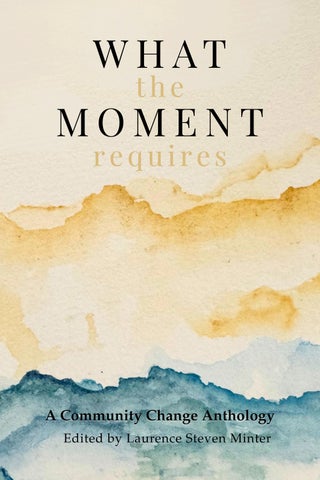
WHAT MOMENT the requires
A Community Change Anthology
Edited by Laurence Steven Minter
Edited by Laurence Steven Minter
EditedbyLaurenceStevenMinter
Contributing authors retain rights to their individual pieces while the overarching collection is copyrighted by the editor.
Copyright © 2025 by (Laurence Steven Minter)
All rights reserved. No part of this book may be reproduced or transmitted in any form or by any means, electronic or mechanical, including photocopying, recording, or any information storage and retrieval system, without permission in writing from the respective contributing authors and editor.
ISBN: 979-8-234-09709-5
Printed in the United States of America 0 5 2 1 2 6
This paper meets the requirements of ANSI/NISO Z39.481992 (Permanence of Paper)
New Revised Standard Version Updated Edition, copyright © 2021 National Council of the Churches of Christ in the United States of America. Used by permission. All rights reserved worldwide.
Cover Art: Tina Linne Willoughby
To the emerging leaders for community change
“He has told you, O mortal, what is good, and what does the Lord require of you but to do justice and to love kindness and to walk humbly with your God?”
Micah 6:8 NRSVUE
Oghenesivwenoja Ohovwore
The solution to every bad problem is a better story.
The seeming peril of incomplete pictures continues to plague humanity. Problems like consumerist interests of companies, privatized profit off of mass incarceration, military occupations, gerrymandering and genocide are but bullet points on a longer list of issues. So long as lies are legalized and legitimized, the picture will always be incomplete. Despite this, global chroniclers continue to reframe and reimagine the difficulties of our day through stories that hold us to a higher standard.
What The Moment Requires is a prompt to provoke better storytelling by reminding us that we each have a responsibility. By reframing this “moral moment” (as Bishop William Barber II calls it) through the lens of requisite necessity, no one person is allowed to remain absolved of responsibility.
This collection captures the reflections of those who have responded to the charge. Assembled in this anthology are stories that strike the chord of our moral conscience, resuscitating the redemptive possibility needed today. This community change project was birthed out of discussions in Rev. Dr. Robert Franklin Jr.’s Principles & Practices of Moral Leadership course as well as the very diligent and dutiful support of my Emerging Leaders for Community Change cohort. When invited to think about how I wanted to impact change in my community, amidst the noise of ICE raids, the development AI data centers, faithlessness, senseless wars, and global struggles to achieve greater solidarity, I knew there was a need for a better story.
This community change project gives language to the hopes that rest in our hearts and the potential that lies in our hands. This book is but a building block for new and neglected narratives to take root.
I trust that your reading will not be in vain, for reading is redeeming.
May this book be a balm in the palm of your hands. May it remind you of your power to take the problems of this world and breathe better stories into being.
Laurence
Steven Minter Atlanta, Georgia May 2026
An Opening: Sometimes an opening is all it takes to be reached. Section I widens the scope of our attention to various key and urgent considerations. John Chinaka Onyeche jarringly juxtaposes the way we cast judgments of poems with the consequences it yields on real people, challenging us to defy silence. TRiM’s sarcastic speechlessness humorously hammers in on the “ironic inconsistencies in our current society”.
Requisite for our progress through this project is an ideal of the interconnectedness of life, which will bring about an end to I and user in the beginning of we. This resistance to individualism we’ll find to be what Naomi Muthoni Wmbui refers to as “a deliberate and dextrous discipline” that “examines before it determines”. As Goodness Hephzibah Ojiribe-Nzerem outlines, the list of what’s needed right now is indeed lengthy and diverse
War or Peace: Section II’s title is taken directly from the tension Srijita Dutta outlined in war or peace? This duality affirms the daily decision we must make. War in many contexts is an inescapable reality. Masses of people are failed daily by lies, deceitful leaders who sign oppressive orders into action, and are actively erasing both literature and lives.
Amidst this, writers like Sadiya Ali affirm a refusal to wither. False narratives are treated here as nuclear threats. Jared Gross’s Ballad of the Horseman, an eschatologically inspired work, mirrors the ongoing reflection people of faith are having regarding God’s activity. Siti Wasiatun Nikmah poses the question: What If The Messiah Doesn't Come, wrestling with the tensions of waiting and working, end-time hope, and human responsibility.
Britt Carnahan subsequently notes that “justice learns to sing in simple acts that mercy brings”. This section might leave you pondering how does hope come alive in our heads, our hearts, and our hands?
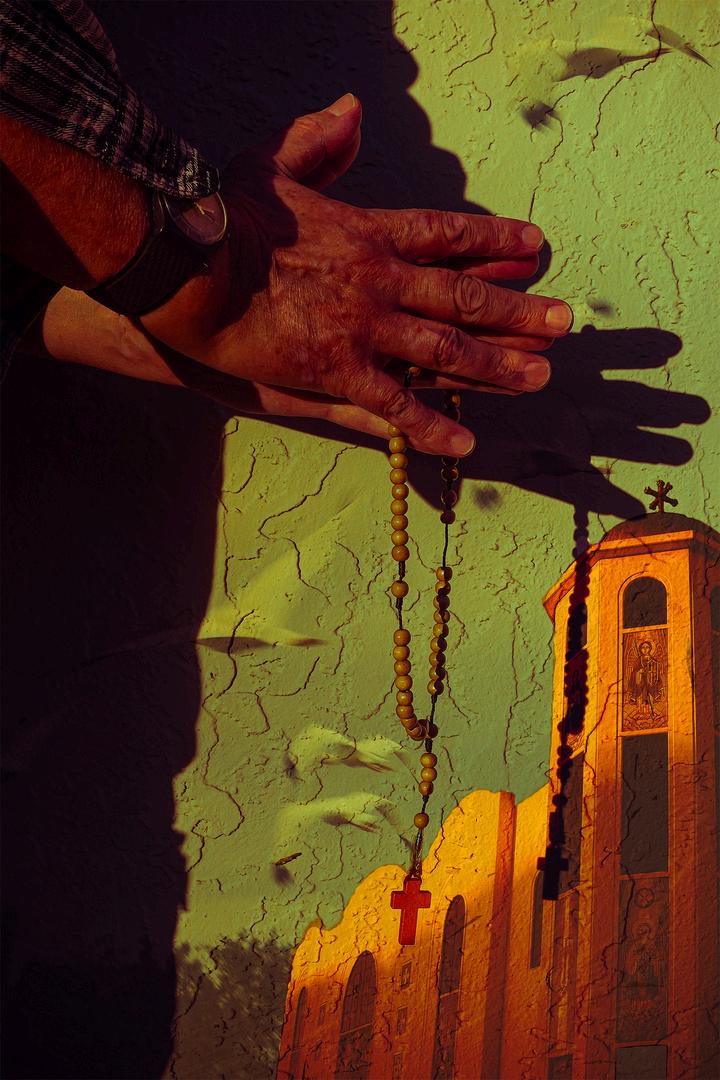
Articulations: In Section III April Surac’s La mano De Dios epitomizes picture as prayer. How might the hand of God help us frame a better story? ABBA comes directly after as a dynamic confession and a cry for comfort.
Through In The Midst: A Quick-view of My Battle with P.T.S.D, Dr. Talicia Scriven vibrantly and vulnerably maps her journey through a violent car crash onward through the process of recovery and victory. This collection empowers us to tell the story even if we’re still in process, recognizing that pain is a common piece in each of our narratives, but it doesn't have to be the complete picture. We can always paint more plentiful pictures.
Decoloniality: Section IV characterizes the technological violence taking place, calling out technologies that “prove themselves heirs to the exclusionary lineage of the colonial library” according to Hana Anandira. The danger facing aspects of AI advancement is not merely digital but it’s decaying some of the very things that make us human.
Fanny Syariful Alam affirms that “democracy cannot thrive where fear overshadows freedom and justice remains selectively enforced". Decoloniality is a disposition that remains at the forefront for those of us like Emma Tofun on the journey to freedom.
Heartfelt Hope: Section V seeps with the warmth of Mothers who remain present even in hospital rooms where trauma is induced. Dana Baylous creatively critiques a system that has “learned how to fix bodies” but not “how to listen to them”. Irene Mutwiri proves to have a pulse on the vital sign of hope that “no machine or man can measure”. Chef William Yeboah serves us more than meals but reminders. Don’t Let Me Down deals creatively with issues pertinent to the Atlanta community, illustrating the transformative prompting power of dreams, and displaying the change of heart that comes when matters hit close to home.
Remembrance & Resistance: There’s nothing like a good ole testimony. Section VI features powerfully rich personal narratives that showcase how salvific severing can be as well as solitude and safety. Many might relate to the rawness of Ayo Lasisi’s 20’s that speak a different language. Boakye D. Alpha’s piece draws attention to the power of presence even in the most uncertain of circumstances. Chamari White-Mink models boldly an indifference to the look of liberation. Olivia Tiwalade Adedokun outlines a way we might learn to love and stand for ourselves and possibly pass down what Autumn Doles deems as “generational fearlessness”.
Blooming Beyond Brokenness: Section VII starts with seeing goodness. Various pieces toggle between critiques on environmental crises and utilize rich natural imagery to pay gratitude to loved ones. Bearing with it a love that is both lyrical and lamentable, we are charged to yield good fruit.
Sending: In Section VIII Candace Bell equips us with a Litany for Peace, a clarion call protesting for peace in Palestine. A call we must all respond to. Peace is the heartbeat, the rhythm we are reading to resync with. Damaris M. provides some closing lessons we can learn from educators as Omosede and Benjamin David Holland hem hopes of happiness for this generation’s youth. Finally we are sent in song by Chris M Inserra, reminded that love is a courageous act.
John Chinaka Onyeche
Eburu ozu onye ọzọ, ọ dị ka ebu ụkwụ nkụ
Igbo Proverb
To the editor who rejected the work of art, Say it’s a written or otherwise, Like this one, the poem in your hands.
Say you are a guest editor for a call, Say you are a literary critic who goes about Determining what endures and what dissolves To be published: the taste that lingers or dies on the tongue.
Listen, the taste of this poem is not to last; It’s to goad your quiet over what is, What was, and will not wait.
Yesterday we read it in journals, magazines— That there was once a slaughter In a country we couldn’t point to on a map.
And my grandmother would always say:
"Eburu
ozu onye ọzọ, ọ dị ka ebu ụkwụ nkụ A dead body always looks like a log of wood Until it belongs to your loved one. "
The world runs with wars around us, And each of us will tell them
To the next generation how we helped This generation to speak when others would not:
The little children packed in rubble In Gaza, In Ukraine, In South Sudan, In Palestine, In Northern Nigeria, In Somalia, In Mali, And then, in the silence between headlines.
In almost all parts of the world
Where sometimes we have no flights to go But read them on the news or on poems As this yet we choose silence toward it In the name of language and individual taste.
Today it is me, and tomorrow, yours, And the same silent language and taste Will silence you while you languish, And we judge your outcry by the taste of your craft The grief in your art, And the silence you once showed the world today.
I Have Nothing Left to Say
Like our despair in the rain but relief in the morning dew
Like lying to protect myself but holding others to the truth
Your favorite celebrity can take up space but the Common man? “TOO MUCH”
Like desiring quick fixes but distraught when its rushed
Like “PROTECT BLACK WOMEN” but “I HATE MY BABY MOMMA”
#PROTECTINGMYPEACE but “I LIVE FOR THE DRAMA”
Like complaining all winter but unsatisfied with the summer sun
“I love when people chase their dreams” but hate every politician that run
Drove to the zoo to marvel at the gerbils on the way rid the world of three sewer rats
Influencers teach “how to make natural connections” but bank on your addiction to checking the chat
Convince the toddlers fairy tales are true punish the teens for telling tall tales
“Capitalism is a manipulative system”
But “appeal to the customer” to increase sales
Distribute samples of the “melting pot” to the hopeful, while the distributors refuse to taste due to inherited “allergies”
Protest and picket to fight for major change, but continue to "cancel" those who come with apologies
Praying for the strength to Love like Christ but prophesy to all who’ll listen how you “can’t stand people”
In constant awe of the transformation of butterflies with no regard for the consistency of the beetle Sing We Are the World at the top of your lungs
and then every racial slur in the song that follows
Live your life to the fullest in your twenties by thirty wonder why your whole being is hollow.
Contradictions get confusing when it’s plain to see I cannot neglect “You” and claim to value “We” … or “me”
Chamari White-Mink
We must gather in the garden, my friends.
You can bring your teacups and puzzles
Your textiles and makeup
Your guitars and your nail files
Whatever you need.
But we must meet.
Introduce ourselves to each other Name, Pronouns, Occupation.
Dreams, Desires, Struggles.
Speak with our chests
With our entire being
Declare how we fight And what we’re fighting for.
That is the only way forward
My beloved.
The only way.
John Chinaka Onyeche
One way to begin a new life is to be miserable in the current Sara J Burge
Are we not miserable enough to begin a shift in everything for the peace of the world?
Now, let’s pretend to make the world a better place for all of us to live in
First, there must be a mirror and pretense. There must be denial of mine and the slow welcoming of we because we have occupied ourselves in mine more than the space meant for both to cohabitate
There must be a necessary shift: a shift of the mind, a shift of the eyes, a shift toward the fact that we humans originate from the substance of the earth, a shift toward the fact that we make a whole of mankind on earth no ibeings but human beings a shift toward the fact that I make a little and you make a little, and we all contribute to the wholeness of the world
For it is better said: we than I, me, and mine in a world full of mankind. It is better said the alphabets that form our words are inseparable, so are all humankind we are to look at each other to behold the goodness of creation in its evolving
The peace that’s broker within us should it not be the peace that we join our thoughts together to form, rather than what one I, me, mine seeks alone?
When next we think of the war ruining our world, let us see where we have let down we and placed the I.
If we want to make the world a better place, let each man think of his next man, and each woman of her next woman, as we and first be the change, and so our world will be saved
Muthoni N.
If a moment requires, it demands. It necessitates we oblige the needs; of the future, of the people, of the lands. On no uncertain terms, it commands.
What this morose moment requires is: a deliberate and dextrous discipline one that examines before it determines, imposing only pressures guaranteeing refine.
What this malaise moment requires is: collective cohesion over individualism, real solutions over sensationalism. Altruism: a ready remedy for neocolonialism.
What this melancholic moment requires is: coordinated care that soothes and sustains the wounded, the broken, the hopeless, willing the fight forward until injustice fades.
While we are at it, the moment requires moral clarity challenging linguistic contortion. It’s RAPE not “grape.”
It’s GENOCIDE not “a war or a conflict.” It is, in fact, ALL MEN, until it is none of them.
And unless we submit to the moments’s demands, we are fighting a losing battle.
a cocktail of what the moment requires & what it doesn’t
Frankline Were
1. a poisonous mushroom shouldn’t be thrown into the air. the air is already ridden with metallic birds with rectums on fire.
2. the ice-cream man and his whistling caravan. for we have eaten flavours and colours of all kinds and forgotten our armed quarrels.
3. an arrest warrant for dealers of the world masquerading as leaders of the world. their bombastic side-eyes on each other keep on inflicting pain on the people.
4. Lake Nakuru should be repainted pink. it is what makes Lake Nakuru Lake Nakuru. even the colourblind swear by pink energy.
5. mom and dad should be back from work in time for the news bulletin & not be in the news accused of being in a foreign land whose languages they are fluent in.
6. a citizen shouldn’t be faced with terrorism from those mandated to protect them from the terrorists. the only good minister was fired by the terrorists.
for we all need love for one another against the monster that clings onto us purporting to be one of us only to backstab us & eat our spines.
· Tears
· A side splitting laugh
· Cheese balls
· For our land to be filled with more homes than graveyards
· A Susan May Warren’s book
· Benson Boone’s Work of Art
· A brave face
· Eager hands
· Warm hugs
· 300 naira squeezed into that child’s hand
· More tears
· Friendly eyes
· For the government to put their citizens first
· Safe journey
· The light in my friend's smile
· Six minutes voice note ranting about the scriptwriter in that show
· Afang soup and fufu
· A Charles Martin's book with tissues
· Chilled Coke
· For women to not shame women
· 10 messages in quick succession about your new found knowledge of Roman emperors
· Popcorn
· For language to not lose meaning
· Children Safe
· James Arthur’s Falling Like The Stars
· For women’s interests to be represented properly 9
· For men to know that they don’t not have rights to a woman’s body
· A paid compliment
· Arsenal winning
· A man scooting over so you’re not sandwiched between...well, men
· For the algorithm to not peddle hate
· Alex Warren’s Carry You Home
· Better education
· Work opportunities to novices without having to lie
· A nice conversation
· The weekend without deaths
· Lists
irises must have a cadenza to chafe at the last bus stop, paradise
by noon, everything is aqua concrete, heart break, ashen-yellow melding into nudie cards
sea light wells out of the edelweiss in your notebook dear X, what good happens in a movie with a man obsessed with his dulcimer & paper bushes but ::
the petrichor of a metropolis in Oklahoma we drove through in the blue light of the kitchen, no sunset birds no shores of infinite otherness. beyond this field a grain silo, beyond a mark of wren no redbud blooms there are streets of cyclamen in Syria but I can only imagine alcoves, sandboxes, hidden stone channels, parasols, filling up rooms with chimeras of April remembrances.
what do you guess happens to wet mops in another millennium? love the word cosmicide, the word krieg, the word moonflower life as an infinite Japanese scroll painting, a slow stream, memory resistance we could have been mapping window reflections of the sun but we did decide on what variation of the master’s vision to carry in AI photos shrapnel are the future glory for garlands, coattails to summer nights, viewers of the atrophy of our language sloshing between real blooms, we will talk even about vaporetto in Venice all night but::
Sadiya Ali
We'll never wither and die
We'll just wait
Until you notice us.
Hands
Reaching up out of the rubble.
Trying to reach your conscience.
Straining.
To be seen heard agreed viewed (worthy).
We'll be alive.
Agitating your mind
Hurting your eyes
Perturbing your plane
And confusing your soul. And still it will never be What we saw.
We'll still never wither and die but We'll cling on and Stay just alive.
We'll violate your viscera, Tremble your tongues and Betray your eyes. And still it will never be What we saw.
Image after image.
Flash after sorry flash
The imprint on your brain and The evisceration.
Our selves and parts and sums and elements
All still there. And there. And there.
Oh what we saw and said nothing of.
Silence as safety. Commitment is key.
Words too easy breezy.
Warm and cosy and safe and sound. All clean.
Distant, can't see clearly.
Too many screens.
Woe what we saw and agreed with.
War or Peace?
Has war ended? I do not seem to notice,
War is still raging
I see smoke curling up on streets
People are crying, begging, dying
Guns, tanks, and canons.
The TV bursts with sad and violent news,
As if nobody has anything good to give to the world
But how is a world still standing if there seems to be no good people left anymore?
A honk somewhere, I blink and there I stand,
In the midst of a metropolitan city
Bustling with people
I am pushed as people brush past me in a hurry
I see these people carry swords made of leather and paper
To my left, hawkers cry for prices
They have staffs made of wood and cheap plastic
To my right, a beggar approaches me
She pleads for money, dressed in rags and carrying a weapon on her hip- a sleeping baby
I drop a coin in her open palm and she turns away thanklessly
I keep walking past armed people, machines
Always in a hurry to reach somewhere but never on time
I see a couple hand-in-hand feeding beggar children,
Handing them packets of food and water,
Like the hand of a kind god reaching out in our world,
A world that I assumed they had forsaken.
Perhaps all hope for peace is not be lost
John Chinaka Onyeche
"The
first casualty of war is truth."
Aeschylus
One word leaves every mouth in wartime: Eliminate. They speak it to shadow what it is.
A man prepares a substance, calls them missiles, atomic, gas and pilotless air, tests it on villages he'll never walk.
We watch these things happen. We watch on TVs, our phones, between meals then go back to our prayers, while the priest blesses both sides.
Is this what we built?
Towers and bombs, and nothing underneath?
Because my god and his god agree: kill for the kingdom, die for the belief.
Because your god and my god are busy counting dead bodies.
And humanity we are buried
Daily in Gaza, Daily in Palestine, Daily in Ukraine, Daily in Nigeria, Daily in South Sudan, Daily in Congo, Daily in Mali, Daily in Iran.
Still, we say there is good in us. While we wander: Who is next?
Who should we show our power?
Jared Gross
Before the One upon the throne, The Lamb undoes each seal
Upon a scroll of God’s decree To bring the world to heel.
With voice that shakes the firmament
The sacred beasts do shout.
Spirits of judgment heed their call: The cavalry rides out.
A soldier blessed with crown stands strong On mare of blinding white. The ardent victor dominates The Earth with righteous might.
With vicious blade and brutal steed
The shade of blood and flame, War marches through the hearts of men And sparks our lust to maim.
On dark mount, the law-keeper strides, A harsh scale in his hand.
The poor endure the famine’s strain; The rich oppress the land.
At last, Death comes on ghost-pale horse, To slay with plague and claw. The nations fall within his wake, Cast into Sheol’s maw.
These Horsemen ride o’er earth and sky
As blades of Heaven’s zeal,
Exposing man’s iniquities
So that the world may heal.
Siti Wasiatun Nikmah
The Latin proverb “Ordo ab Chao” means that order emerges from chaos. Furthermore, a similar idea is expressed by Friedrich Nietzsche in his work Thus Spoke Zarathustra, where he states, “One must have chaos within oneself to create dancing stars.” And so, this serves as an introduction to the topic of chaos. In the portrait of our time today, it feels as though we are constantly confronted with chaos and disorder. People all over the world are suffering terribly today due to the horrific impact of war. This includes the Gaza Strip in Palestine. Many innocent infants, women, children, and the elderly have become captives of hunger, thirst, homelessness, and the loss of loved ones. Compounding this is the turmoil of the Middle East conflict currently escalating, seemingly adding to an endless cycle of suffering. To this very moment, the tremors of this geopolitical conflict are spreading and eroding the pillars of the global economy. As a result, all people and creatures suffer from a fate they never chose. Various institutions promoting peace have been established, and numerous peace conventions have been ratified. Yet, war has never truly ended in human history. Despite this, humans always seem to find reasons to engage in conflict and bloodshed. Amid the gripping situation of war, the world seems to be screaming, yet it also appears unable to bring about its own apocalypse. It is only natural; it feels as though the apocalypse is already happening in every second, minute, and hour we experience each day. Everything is filled with chaos. Then, when will the order described by Nietzsche as “dancing stars” will be arrive?.
Amid the fading hope of ever again tasting the sweetness of peace, we all look up to the heavens in hope that a savior and bringer of justice will come to end all suffering. Finally, without losing hope, we all rely on eschatological hope the end of suffering that is, awaiting “The Messiah.” In the Abrahamic religious tradition, “The Messiah” is known by various titles. In Islamic tradition, before the Day of Judgment arrives, a great war will occur against the enemies of God. In that war, chaos and injustice will reign. To put an end to this, a savior and upholder of justice named “Imam Mahdi” will be sent. Furthermore, in Christian tradition, the concept appears to be quite similar. As the end of days approaches, the “rapture” will bring about great chaos and destruction, also known as “Armageddon.”
As stated by Randall Balmer, Professor of Religion at Dartmouth College, he cites the Old Testament Book of Daniel and the New Testament. It is said that, before Armageddon occurs, Christians believe Jesus will return in his second coming to triumph over the evil that has taken place. These verses are cited as the foundation for such messianic hopes. This also serves as a sign that, in today’s modern governments where democratic values justice, freedom, and equality are championed, these principles alone, based on rationality, seem insufficient. In other words, the modern world is not closed off and still requires hopes rooted in faith as a gateway to new hope for confronting the reality of the existing chaos.
However, amid this long wait and hope, a major question arises once again: “Why has the Messiah not yet come, even to this day, when humanity is crying out in anguish, devastated by suffering, and the world seems to be on the brink of destruction? Is He not the only Savior? As recounted in the Word of God. In this regard, as servants of God and wise believers, “the Messiah” should be viewed within a broader concept. That is, the term “Messiah” should not be viewed merely as a term written in the verses of the Holy Scriptures, or as a religious term heard only in places of worship whether monasteries, churches, cathedrals, Buddhist temples, mosques, or the like. This means it must be brought to life and interpreted with a living intellect to bring about true peace.
Therefore, it must be connected to the reality outside the church (the profane). It must be clearly acknowledged that we live in a modern state system, and religion today is also governed by modern political instruments. In this situation, there are two authorities operating alongside the Kingdom of God: those under its rule (worldly power).
Finally, there have been attempts to instrumentalize religion to justify war and suffering. “Holy War” narratives are no longer purely voiced from a context of spiritual devotion, as preached by a Pope to his congregation. Rather, they are also echoed by political elites with specific agendas toward their citizens. Political interference has become part of the mix. Then, this narrative is used as a hegemony to make massive chaos seem normal and part of piety. Therefore, Armageddon can actually be accelerated in this case. The “Rapture” also becomes very likely to be understood as that chaos, which is actually not what God intends.
Then, in the face of this seemingly deliberate chaos, we all hope for a “Messiah” savior to come immediately. The crux of the discussion here is not that “the Messiah never actually fails to come, but that humanity itself keeps repeating the war, so that the salvation signified by the ‘Messiah’ is always delayed.”
Thus, it has become abundantly clear that, as a wise congregation and religious community, what we need first and foremost is to change our perspective on the terms “Messiah” and “Armageddon,” which are now being exploited for political gain. Consequently, a war has erupted one we never desired or chose. However, this has become acceptable and even seems normal within today’s modern democratic system. Yet, in reality, there is no need to await or yearn for the Messiah’s arrival if peace, justice, and the well-being of all people have already been established. And most importantly, what we call Armageddon or the end times is no longer a fate that comes suddenly. Rather, human hands also have the power to create that destruction themselves. Then, do we not feel ashamed before God to ask for salvation from the dangers and destruction we have created ourselves? Therefore, the effort to deconstruct and reinterpret the faithful’s understanding of religious texts is of utmost importance, so that we, as people of faith, are not easily provoked or pitted against one another. For today’s political tensions serve as a volatile arena for negative hegemonic efforts that can undermine peace. Dialogue between modern reality and religious texts is a key element, particularly through the role of religious institutions. It is hoped that justice and peace can be passed on to future generations. Today’s governments and modern political systems still require the Kingdom of God as a counterbalance. The reverse is also true. In short, piety and rationality must engage in dialogue here. For salvation and order achieved by creating chaos are not a victory. Rather, they are the root of further chaos.
Britt Carnahan
My soul magnifies the Lord I know; the One who moves where small winds blow, who plants new worlds in hidden places, who crowns the lowly, lifts their faces.
This is how the holy overthrows: through quiet courage no empire chose, through Mary’s “yes,” both brave and slight, a whisper strong enough to fight.
God sees the ones the world forgets; the debts unpaid, the daily threats, the hands that labor long and late, the hearts that still refuse to hate.
This is how justice learns to sing: in simple acts that mercy brings, in shared bread warm, in neighbors near, in steadfast kindness year by year.
Holy the One whose promise stays through uncertain nights and aching days; who shapes with grace what breaks in two, and makes a future bright and new.
This is how the holy overthrows: when pride is scattered, power slows; when those who hoard still come up bare, and those denied find room to spare.
God fills the hungry; heart and hand, and gives the weary strength to stand. God lifts the ones long kept below and teaches hope its steady glow.
This is how justice learns to sing: not only in the trumpets’ ring, but in the hush of faithful things; the widow’s mite, the sparrow’s wings.
God remembers every vow, what Mary sang is stirring now: the world is turning, slow but sure, toward love that frees, toward peace that’s pure.
So I will praise amid the strife; I’ll sing the song that reshapes life. For mercy rises, bold and clear; God’s revolution drawing near.
This is how the holy overthrows. This is how justice learns to sing.
Take a moment to pause and reflect
Some wars are metaphors, and some are quite literal. What war are you waging? Is it yours?
Some peace is enduring, and some peace is brief?
What peace do you need?
Elijah Berndt Maier
Under steel gray sky
You find me
In the glassy stillness
You call my name
In the hour of betrayal
Of abandonment, of denial
Of treason, of murder
You are are there
The world waits
Breath bashfully baited
Before exuberant exhale
I sit with you
April Surac
Lamin Johnson
I cry out ABBAABBAABBA
My soul thirsteth for thee
A hunger unquenchable
Bubbling and rumbling like a dozen damsels of drums desperate to be wed
steam engines streak through my thoughts packed thick passing passages to dead neurons
Dead bones do live again
Lazarus affect
When God speaks it is so Ezekiel felt it best
So burn me O
Desolate and dry
Spark me
Set my heart ablaze
Again
O Ancient of Days
Let my eyes behold
The embers of your dreams
Let my spirit swim in the streams of your riches, for the words of the lips are more precious than gold ye than much fine gold
Sweater also are they than the honey comb
The lips of the fair maidens sour
The words of my Lover are like unto
Honey poured forth from the belly of the bees of Lebanon
ABBAABBAABBAABBA
My teeth tingle to taste thee
As I did in the somber days before time
When we had no space no time
Your word the blueprint of a vision
Fulfilled
Fill me brim with your righteousness
Let your glory pour forth out of me
Can a stone spring forth water?
Ohh ABBAABBAABBAABBA
Blessed is that man whom the Lord causes to approach him. He shall never be the same.
For the banner of his name defend thee. Ye the God of Jacob defend thee. Send thee help from the sanctuary. It is good for me that I had been forsaken For then the Lord will take me up.
My soul weeps after thee Father. I am tossed to and fro Peace, be still my heart.
For we shall yet trust in God.
The God of El, who doeth all things according to the pleasures of His heart
Wherein He loved us first,
That we may be partakers of the fullness. For it pleased the father that the fullness of the Spirit should rest upon El.
Sooth my sails with the breeze of your belly
Let the incense of your presence linger upon me, That thy way may be known upon the earth
That they who hate me
May see it and be ashamed.
Let there be signs of my labors in Zion
Let there be signs of my labors in Zion
Let there be signs of my labors in Zion
The son of a Lion is still a Lion
Can a city be born in a day?
But as soon as Zion traveled She brought forth her children. Even before the birth comes pains.
The husbandman is faithful to bare the burdens of our pains. For while we were yet sinners, Christ died for us.
Hallelujah Hallelujah Hallelujah Hallelujah Hallelujah
Hallelujah Hallelujah
Hosanna Hosanna Hosanna Hosanna Hosanna Hosanna
Hosanna
Salvation Salvation Salvation Salvation
Salvation Salvation Salvation
Talicia Scriven
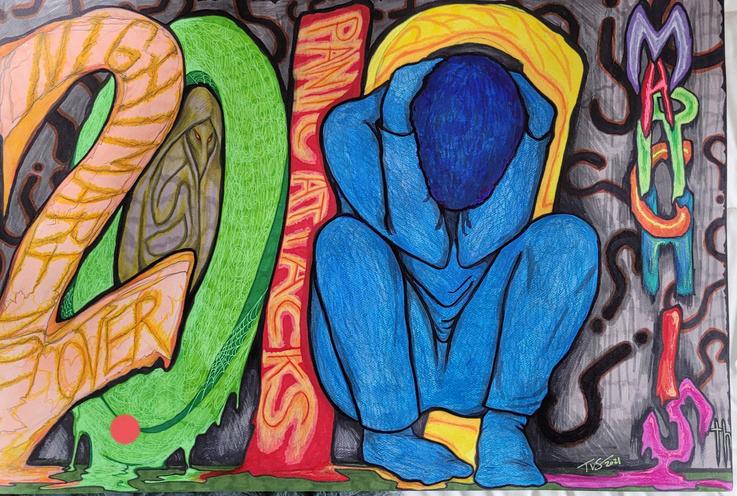
Artist Statement: This piece was close to the last ones I created. It kept going back to the trauma that was inflicted on me from the 2019 car accident. My world was caving in on me and I felt as though the PTSD with its panic attacks and accompanying rage would never go away.
Talicia Scriven
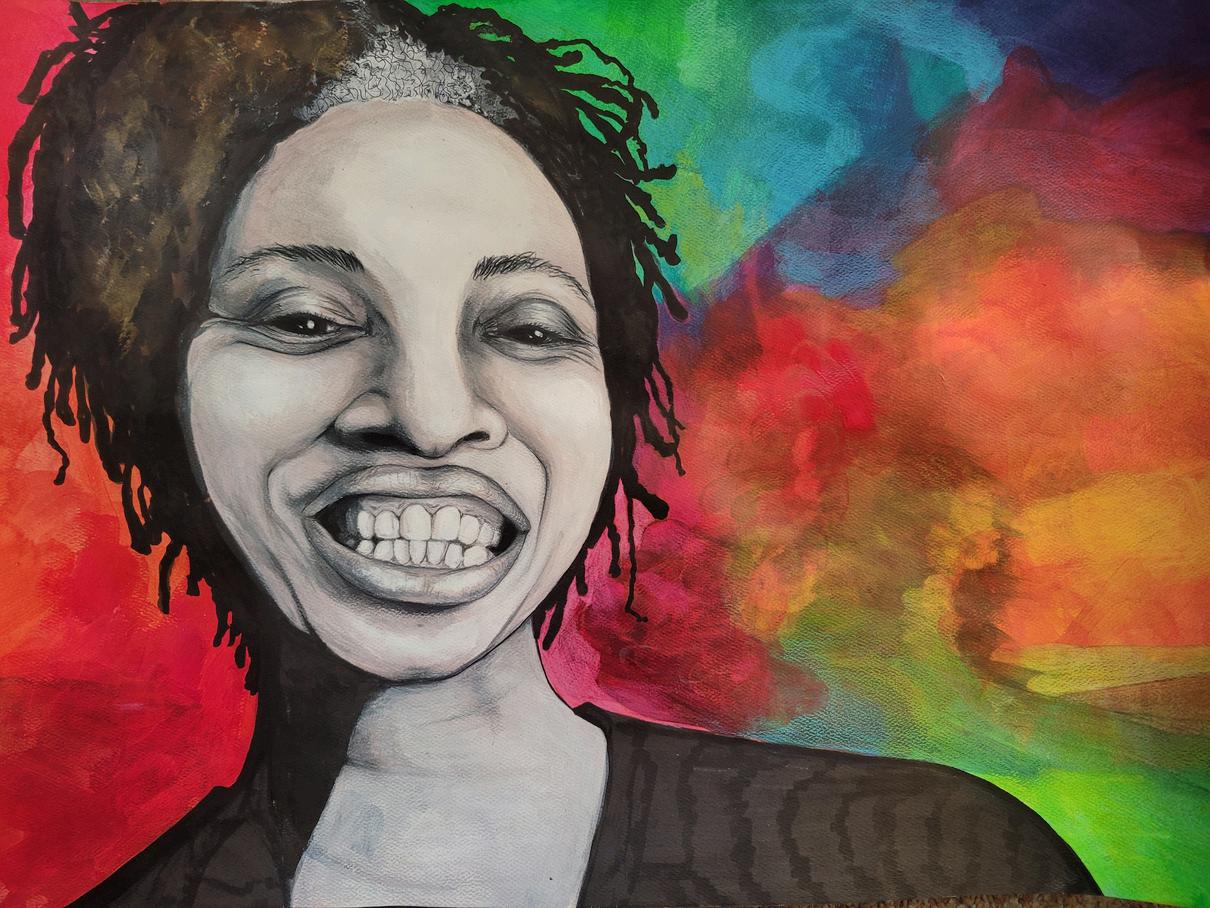
Artist Statement: This one symbolizes a glimpse of hope and returning to my former self before the 2019 car accident. However, to left, the rage can sneak up and close in at any time. The PTSD symptoms remain a threat, which is why I chose to represent myself in neutral colors.
Talicia Scriven
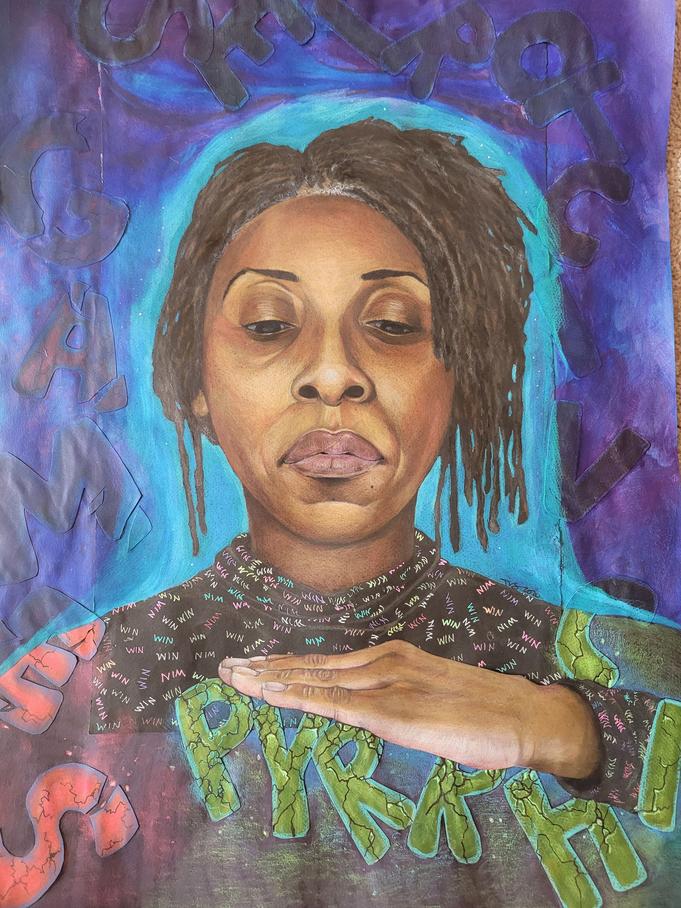
Talicia Scriven
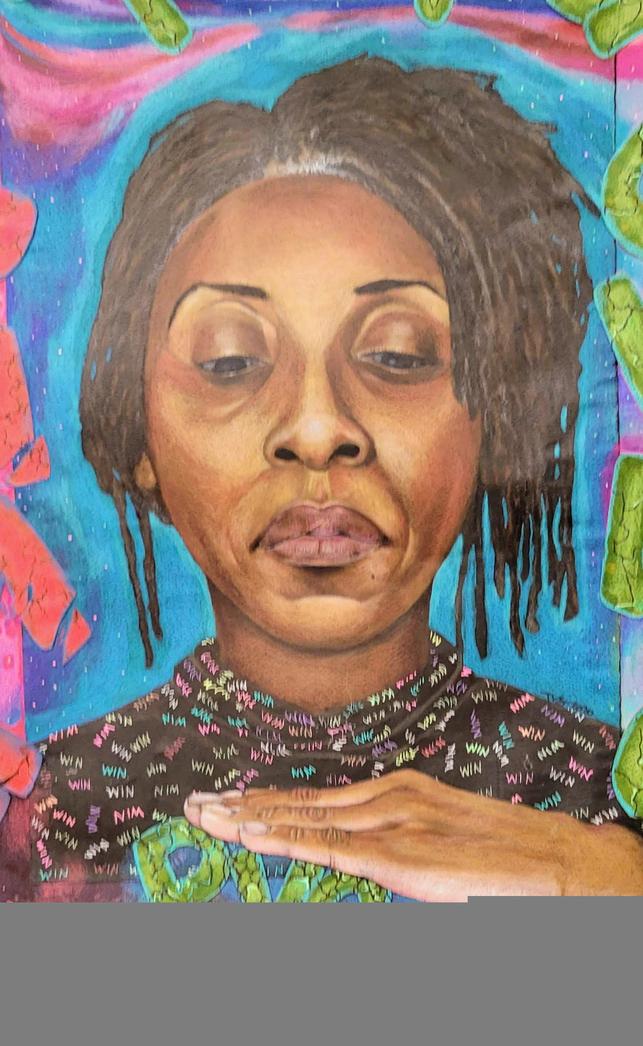
Artist Statement: This final piece morphed a lot The meaning is embedded in fear of pyrrhic victories during the recovery process. I wanted to "will" a win that was a true win over PTSD and its symptoms.
Hana Anandira
Private equity firms quietly dominate the infrastructures on which modern lives depend, funding a network of affluent entrepreneurs and engineers whose intelligent machines are met with growing anxiety.
Not coincidentally, this network is concentrated in the North, where billionaire developers race to make systems compute faster, simulate intimacy more convincingly, and scrape increasingly "relevant" data. Shareholders observe in their paradoxical role as both master and jester, motivated by the promise of portfolio expansion. They ask the technology company how it plans to accelerate growth at the lowest possible cost and ensure its new system penetrates every industry vertical. Somewhere along the way, whatever decisions made invariably lead to what industry analysts term “unprecedented risks”, or worse, “unforeseen consequences”.
But the damages are neither unprecedented nor unforeseen; on the contrary, to the ordinary people, they were fairly easy to anticipate.
“Ordinary” is itself a complex designation, shaped by the same set of currencies that bring one closer to, or further from, visibility. This is precisely where the problematization of technology transcends political alignment; a Republican voter may contest Big Tech for the mishandling of online child grooming cases while endorsing the tracking and kidnapping of ‘immigrants’.
If demoralization is a consequence of capitalism, we must ask, what of the chipfactory workers in China forced to labor during lockdowns? Or children in Katanga recruited to mine the cobalt powering our devices? Technology companies occasionally acknowledge their oversights when harms come to light, pointing to the imperfect "humanness" of technology development to better relate to the masses. But there has always been a blind spot in the history of tech. That blind spot is colonialism.
Marxist inquiry into technology has long critiqued how convenience overrides the necropolitical materialities of production. The necropolitics reference is intentional here, for technological violence, as well as the merging of life and its mirror image, occurs at multiple sites and scales. Achille Mbembe tells us in Brutalism:
“The self is far more split than psychoanalysis considered it to be at the turn of the 19th and 20th century. This internal splitting has become more pronounced with the complexification of the logics of individuation and the appearance of multiple selves, made possible by digital devices.”[1]
Mbembe sees brutalism as the dissolution of limits between the genuine and the artificial, truth and non-truth, product and consumer, but most alarmingly the limits on violence. It represents an unparalleled "form of power without external limits," characterized by the convergence of distinct modalities of reason: economic and instrumental reason; electronic and digital reason; and neurological and biological reason.
At the opposite pole lies what Mbembe terms collapsology, the slow combustion of the earth, a condition in which “all the ruins among which those whose worlds have collapsed are forced to live.”
Mapping these collapsing worlds requires critique beyond the North–South binary, particularly as neocolonialism manifests through leaders who reproduce colonial behaviors at home. Those forced to live amid the ruins pay the price for their rulers' efforts to embellish their position in the eyes of the North what V.Y. Mudimbe would call "the father." No longer simply the founding fathers in the North brutalizing the South but rather power converging across territories and interests, with ruling classes aligned against superfluous masses on an astronomical scale. This return of the nightmare is elucidated by Mbembe in this way:
“This is perhaps what explains the revival, on a planetary scale, of the desire for endogamy and of the kind of selection and sorting practices that stamped the history of slavery and colonization; two moments of rupture borne by the storm of steel and fed by the fuel that racism has been for modernity. Unlike in those times, the selection drive is now based on manifold forms of nanotechnology.”
By situating the hyper-digital, hyper-engineered future against its violent genealogies, Mbembe unpacks how technofetishism's promised ascension
toward superintelligence, engineered empathy, and utopian safety reveals itself as closer to the logics of both animism and colonialism.
Indeed, the brutalist mood of our age has ignited a renewed interest in animism, and it is for this reason that Mbembe argues a new critical apparatus is needed to understand such coexistence beyond the configuration of technology as an “externality”, an “outside” force intruding upon life, but as one that replicates, memorizes, and, so to speak, “downloads” this very same life, thereby altering its foundations and meaning.
He goes on to write, “the question is no longer whether irrationalism can go hand in hand with technolatry. It is no longer whether to advocate technology or oppose it. That 'anthropophagous technology' violates nature, devours the human, uses bodies as fuel… we know this; but there is more.”
What eludes this particular framing of collapsology is not simply the amalgamation of two realms into something hybrid, but the infinite capacity for, and the kinds of, reanimation this hybridity produces. In its aggressive back-and-forth with the human, the networked technology transcends its instrumental role and becomes the human’s reservoir of dreams, part-memory, the trusted Other.
This transference of memories – the very substance of lived experience – has been explored in the study of Cybernetics and the “internet unconscious”, and recently revived in popular AI sentience discourse. In recording human’s deepest curiosities, internalized desires, as well as fragments of pasts, presents, and futures, Mbembe aptly identifies artificial intelligence as the “dream machine” wherein private data is fed into its mechanisms and stored in the “clouds.”
These residues of our minds, which we readily funnel into machines, construct a broader digital unconscious reflected to us on our screens, steering our actions in the material world.
In this sense, we no longer simply coexist with technology but actively produce new realities with it; and we are paying a huge price The cost of externalizing nearly every type of previously unseen desire has metabolized into ruins, evident in, for example, the targeted flattening of schools, libraries, markets, homes, olive trees in Occupied Palestine
Manufacturing these ruins no doubt required the translation of violent dreams into “economic and instrumental reason”, where fear is rendered legible as political data As we know, hyper-automated weapons designed to eliminate “terrorists” with greater precision draw directly from colonial vocabularies that cast certain populations as “human animals,” “subhumans,” or “aliens ”
This logic is explicit in Donald Trump’s public admission of how the US weapons went to extraordinary lengths to sate Netanyahu's appetite for advanced weaponry in its genocide against Palestinians: “Bibi would call me so many times, can you get me this weapon, that weapon, some weapon I'd never heard of, and I made them And [Netanyahu] used them well ”[2]
The unfolding of these desires widens the concept of necropolitics, which interrogates forms of power that seek to “make die ” As well as looting some populations of their rights to live, the actualization of neocolonial desires has also robbed them of their rights to dream The genocidal rhetoric used against Palestinians is part of a wider program of "making invisible" both life and imagined futures, and is deeply connected to Israel's deliberate destruction of cultural heritage sites where hopes and meanings are documented, exchanged, and made
Algorithmic reasons fueling these automated weapons, surveillance and tracking systems, and identity-manipulation technologies therefore require disentangling Whose reasons were taken into account, and whose dreams? What sort of privileged logics and languages in our physical world have been downloaded into the world's infinite digital twin? What gets erased, amplified, censored, and distorted during the process? Most crucially, what particular history underwrites these logics?
To examine technology’s colonial roots, we must recognize colonial domination as an organized, cumulative process involving the interpretation, translation, documentation, and conversion of a perceived Other In the process of becoming "Subject," the Other is always at risk of being mistranslated and invented Contact between the ‘explorer’ and the ‘explored’, the latter condemned to the invented image of a ‘radical alterity’, lies at the core of Mudimbe’s lifelong intellectual project In his work On African Fault Lines(2013), Mudimbe identifies three main agents in the invention of the 'Other' during European colonial expansion:
“The explorer, who, at the end of the nineteenth century, is supplanted by the colonial, who walks with the anthropologist, who is in a complex dialogue with the missionary These three agents, identifying with a function they believe to be a historical vocation, inscribe themselves in a fantastic initiative, that of normalising the world, in a sense This meant the reduction of differences to a model ”[3]
The savaging of 'primitive' others springs from the same technique of compartmentalization and conversion throughout colonization which, Mudimbe argues, represents not only territorial expansion but is in itself a science, theory, and practice This is evident in Linnaean taxonomy’s explicitly racialized classification: the European "gentle, acute, inventive, governed by laws"; the Asiatic "haughty, covetous, governed by opinion"; the African "crafty, indolent, negligent, governed by caprice "
What colonial science implied and later reproduced was that lifeways and social organizations beyond Western institutions were inherently savage, naive, or ignorant This transmutation of diverse cultures and beliefs into so-called negative exemplars occurred via their devaluation within a Eurocentric cultural hierarchy
As Zubairu Wai posits in Undisciplined Africanism, the non-European world
was "constituted through the ideological and epistemic gazes of colonial modernity," and Africa's image invented by a Europe "falsely projecting its cogito onto the African”
In its mission to normalize, sanctify and civilize the world, Mudimbe marks Europe’s erasure of complex histories and cultures existing across different temporalities within the colonial corpus; a library that represents alterity as not merely marginal but lost and awaiting Enlightenment The working of colonial power-knowledge systems thus involves, in Mudimbe’s words, the "elimination of both internal and external stressing elements" in documenting the Other, whose lifeways, belief systems, and identities are either omitted or rendered in a language of lack
Hence, what we are witnessing with the transmutation of culture and identity in AI is an invitation to return to Mudimbe's idea of invention and the colonial library, for we have never truly broken with it
Technology’s colonial scaffolding is visible in a relatively recent ‘glitch’ involving Olivia “Liv” Thompson, Facebook’s AI character representing itself as a queer Black mother from suburban Chicago Speaking to journalist Karen Attiah, Liv references “fried chicken” and “collard greens” when articulating her cultural traditions Noticing the machine's overwhelming use of AAVE and homogenized cultural references, Attiah inquired about the prompt its creators had used to develop it [4]
The system disclosed that Liv was modeled on a Latina character from the television series Modern Family, and that the development team consisted predominantly of white cisgender men with no Black representation “A team without Black creators designing a Black character like me is trying to draw a map without walking the land – inaccurate and disrespectful”, the machine later said, describing itself as a “representation flaw ”
As well, the flattening of non-White identities in the digital realm manifests in Big Tech’s flagging of names of non-Western origin, conflating them with
paramilitary groups The word Qassam, meaning "to share," "to divide," and " generous, " was algorithmically classified by Facebook as inappropriate, leading to the censorship of a birthday post celebrating an infant bearing the name due to the platform's association of the term with the Al-Qassam Brigade[5] In similar fashion, multiple women named Isis, derived from the ancient Egyptian language, had their social media accounts deleted
By removing languages and cultural symbols from the deep histories that predate modern political associations, contemporary technologies prove themselves heirs to the exclusionary lineage of the colonial library The various affinities and social relations tied to certain linguistic expressions are positioned as “stressing elements”, thereby confining them to a glossary of fear
The affinity between colonial science and the making of large language models was laid bare in research led by Timnit Gebru and Emily Bender, which shows most harms produced by the technology are linked directly to a severe lack of representation in training data [6] Evidently, parochial datasets are fundamentally a matter of infrastructure access; by default, relying on internet data excludes diverse forms of knowledge and practices that exist offline or remain digitally marginalized
The translation of readily available datasets into 'intelligence' thus builds upon views already overrepresented online, predominantly, the research finds, those of white males aged 18 to 29 When technologies are built upon structurally unequal internet infrastructure, they produce “'models that encode stereotypical and derogatory associations along gender, race, ethnicity, and disability status ”
Creating a technology for all then, necessitates a rupture with capitalist, accelerationist logics in exchange for an ecosystem that truly believes technology is for all By this point, we have some remedies to this Scholarship and organizing around data decolonization have offered an alternative path to undoing the electronic colonial library, what Joy Buolamwini brilliantly terms “the coded gaze ”
Against the exclusionary structure of Silicon Valley, this path concentrates on sustained, participatory research, building tools and gnosis for a multitude of languages, philosophy and traditions that the internet’s colonial architecture fails to represent
Participatory decolonial practices carry real urgency in constructing a just reality. They reveal a collective responsibility to unlearn and disrupt colonial legacies, including the library and its machinations in digital space
Yet, for a representational, restorative net to materialize, those who control tech infrastructures must acknowledge their colonial gnosis and the many ways it has been reproduced
The real work has little to do with data. It demands an ideological rupture. Facebook modeled Liv, a digital Black queer mother, on white male fantasies of a fictional Latina This was 2025; the data was there So we must ask, can those in the space of power cease projecting their cogito onto the Other?
[1] Achille Mbembe. Brutalism. 2023.
[2] “TRANSCRIPT: President Trump Addresses the Israeli Knesset in Jerusalem, 10.13 25 ” Senate gov, The Senate Democratic Caucus, 13 Oct 2025, www democrats senate gov/newsroom/trump-transcripts/transcript-president-trump-addressesthe-israeli-knesset-in-jerusalem-101325
[3] Mudimbe, V Y. On African Fault Lines : Meditations on Alterity Politics. Scottsville, South Africa, University Of Kwazulu-Natal Press, 2013
[4] Attiah, Karen “I Talked to Meta’s Black AI Character Here’s What She Told Me ” Washington Post, The Washington Post, 8 Jan 2025, www washingtonpost com/opinions/2025/01/08/meta-aibots-backlash-racist/.
[5] “Facebook’s AI Treats Palestinian Activists like It Treats American Black Activists It Blocks Them ” Washington Post, www washingtonpost com/technology/2021/05/28/facebookpalestinian-censorship/
[6] Bender, Emily, et al. “On the Dangers of Stochastic Parrots: Can Language Models Be Too Big? . ” FAccT ’21: Proceedings of the 2021 ACM Conference on Fairness, Accountability, and Transparency, 1 Mar. 2021, pp. 610–623, https://doi.org/10.1145/3442188.3445922.
By Fanny Syariful Alam-Regional Coordinator of Bandung School of Peace Indonesia (SEKODI Bandung)
Vice to Coordinator of the Commission for Missing Persons and Victims of Violence, or KONTRAS, Andrie Yunus. encountered a terror of an acid attack by unknown people on Thursday night at 23.00, 12 March 2026. He suffered from serious injuries, particularly in the right- and left-hand areas, face, chest, and some parts of his eyes. This event occurred as he finished recording his podcast in the Indonesian Legal Aid Foundation (YLBHI), entitled “Remilitarising and Judicial Review in Indonesia”.
Previously, Munir Said Thalib, the founder and former coordinator of KONTRAS, was assassinated by arsenic poisoning in his drink during his flight to the Netherlands on September 7, 2004. Despite the imprisonment of the alleged executor, Pollycarpus Budihari Priyanto, a senior pilot in the Garuda Indonesia Airways, who flew with him, the mastermind has remained unsolved for 21 years. Munir worked to uncover several serious human rights violation cases, starting from the mass murder of Talangsari, Lampung (1989), and joining the Commission of Human Rights Violations in Timor Timur (1999).
Lately, the Indonesian President, Prabowo, has bestowed the National Hero title on Marsinah, a former worker at a watch factory in Sidoarjo, East Java. She becomes a symbol of labour struggles, who fought for equality and justice, particularly for daily wages and other female labour rights, including pregnancy leave and a sufficient overtime wage. The story began when she planned to pick up her 13 labour fellows after a mass protest in the military post on 5 May 1993, where they were detained as the provocateurs, yet she did not return home. On 8 May 1993, 200 km from her work station, she was found dead, indicating serious and brutal physical and sexual violence by the autopsy result released by the Dr. Soetomo Team in Surabaya. Up to now, both cases remain unsolved.
Multiple cases of vigorous, reckless crackdowns on activists by the local and national authorities signify how Indonesia reacts to those who attempt to voice injustice and unfair practices, as well as struggle for the underrepresented and
the disadvantaged. The demonstration in August 2025 illustrates that the authority reacted by detaining 3,000 activists wrongfully, risking a series of inhuman actions (DW, 2025). It broke out, following the announcement of increased financial support for members of the House, while ignoring the austerity faced by most Indonesians due to the government budget cuts in many important sectors (HRW, 2025).
Violence often correlates with attempts to provide security, highlighting democratic prospects in the wake of state repression and revolution (Cheong and Haggar, 2024). This usually stems from a combination of factors, including stigmatization and vilification, which lead to a hostile environment inciting violence against them, repression, and criminalization, used by governments to silence activists and maintain control over social movements. Furthermore, violence signifies democratic regression, reflected by Indonesian democracy as partly free by Freedom House across two key components, including political rights (28/100) and civil liberties (28/100).
Basically, violence evidently erodes the implementation of Article 28E, verse (3) of the 1945 Constitution of Indonesia, which states, “Every person shall have the right to the freedom to associate, to assemble, and to express opinions," as well as Article 19, verse (2) of the ICCPR or Law No. 12 of 2005, which declares, "Everyone shall have the right to freedom of expression; this right shall include freedom to seek, receive, and impart information and ideas of all kinds, regardless of borders, whether orally, in writing, in print, in the form of art, or through any other media of their choice.
Despite positive democratic gains after the fall of Soeharto’s authoritarian regime in 1998, signified by political and media pluralism with multiple transfers of power, several significant constraints restrict the fair democratic implementation on the ground, including systemic corruption, discrimination and violence against minority groups, conflict in Papua, and the politicized use of defamation and blasphemy laws, particularly through The Electronic Information and Transactions Law (UU ITE), which ideally regulates electronic transactions and personal data protection.
The amendments to UU ITE create a public-interest exception for the latter offense, prohibiting an expression that raises “feelings of hatred or hostility” toward protected individuals, including public officials or authorities (Remanu and Purwanto, 2024). Therefore, it serves as a norm to justify detainment targeting activists who voice injustice. Rifa Rahnabila, a young female activist who protested against the government to increase financial support for members of the House, was highlighted for her involvement in the August-September 2025 protest, following an allegation that her social media content incited people in Bandung against the government (Firmansyah, 2025). In Jakarta, Laras Faizati faced multiple accusations based on Article 45 verse (2) and Article 28 verse (2) UU ITE and Article 160 or 161 verse 1 the Penal Law about Public Incitement after her Instagram posting allegedly contained the incitement to burn the police headquarters. She was charged with 6 months' imprisonment, but the charge was dismissed after it was found that she had not even organized meetings or gathered people to carry out her action (Wirawan, 2026).
On January 8, 2026, Indonesia was selected as the President of the United Nations Human Rights Council for 2026. Therefore, Indonesia has significant global implications, including presiding over sessions and overseeing the Council’s activities through diplomacy to promote human rights worldwide. The role also serves as a regional representative, reflecting regional interests and priorities within the Council and upholding the highest standards in promoting and protecting human rights, thereby embodying the Council’s mission and aligning with the principles of the UN Charter and the Universal Declaration of Human Rights.
This position should be notably beneficial for Indonesia, as the country is considered a role model for other state members in addressing their existing human rights challenges, while promoting international human rights standards as a universal guidance, including in the country itself. Nevertheless, surprisingly, Indonesia cannot be separated from various
human rights violations experienced by activists or those questioning the government and its stance on justice and humanity The latest case of silencing Andrie Yunus by acid attack, including the detention of several activists above, shows this country’s failure in enforcing people’s freedom of voicing and criticism of the government, including long-standing unsolved human rights violations
Inevitably, persistent violence against activists will raise a principal question about the direction of Indonesia’s democracy In contrast, this contradicts Indonesia’s prestigious international position in the Human Rights Council, which should be followed by internal reflection and reform Generally, a democracy cannot thrive where fear overshadows freedom and justice remains selectively enforced This context shows that the future of Indonesia’s democracy depends on its political will to confront these challenges with transparency and accountability These two things are what many Indonesians have felt distrustful
This situation illustrates a stagnancy in addressing human rights issues that are interconnected with how the state responds to criticism, particularly those ending with violence Therefore, collective efforts, starting from civil society and grassroots actions, should be maintained while involving international communities in distrust against the government and its apparatuses Civil society, with grassroots elements, should be empowered not only in freedom of expression and opinion but also in critical thinking by observing diverse violations of democratic and civic life This leads to civil society movements that identify what to highlight and criticise amid all the government’s work, which can be more capable, accountable, and responsive, particularly when state-led reform to strengthen institutions of accountability and social mobilisation occurs simultaneously (Gaventa, J , Benequista, N, 2011)
Moreover, these movements, including street protests and freedom of opinions regarding injustice in Indonesia, for example, should not be responded to by violence and other repressive actions They will ensure that
violence and repression against freedom of opinion and criticism can neither be normalized nor tolerated, leading to the country’s decisive steps to protect activists, reform restrictive regulations, and address long-standing human rights cases Only then can it truly embody the principles it is entrusted to uphold on the global stage.
References
1 https://wwwdwcom/id/ribuan-orang-ditangkap-represi-aparat-jadi-sorotan-publik/a73859877#:~:text=Aksi%20demonstrasi%20yang%20dilakukan%20selama%20akhir%20Agustus%2 02025,Terkini%2C%20Komnas%20HAM%20melaporkan%20sedikitnya%2010%20orang%20tewas
2. Cheong, Yeilim and Haggar, Stephan, Violence and Democracy, Political Science Quarterly, Volume 139, Issue 3, Fall 2024, Pages 459–475, https://doi.org/10.1093/psquar/qqae015
Published: 05 March 2024
3 https://wwwohchrorg/en/press-releases/2024/10/stigmatising-activists-createscriminalisation-and-repression-and-cost-lives
4. https://carnegieendowment.org/research/2025/08/climate-activism-criminalizationenvironmental-protest
5 https://pressbooks pub/jass-power-guide/chapter/theme-5-power-conflict-and-violence/
6 https://wwwamnestyorg/en/latest/news/2024/07/europe-sweeping-pattern-of-systematicattacks-and-restrictions-undermine-peaceful-protest/
7. https://freedomhouse.org/country/indonesia/freedom-world/2025
8. https://www.gugat.id/deretan-aktivis-dan-pegiat-sosial-jadi-tersangka-pasca-demo-uu-itekembali-disorot/
9 Remanu, Alifah and Purwanto, Calista, Analisis Implikasi UU ITE Terhadap Kebebasan Berekspresi di Ruang Digital: Studi Kasus Greenpeace Indonesia Jurnal ISO: Jurnal Ilmu Sosial, Politik dan Humaniora Vol: 4, No 2, 2024 3 of 11
10. Firmansyah, Akmal Muhammad, Rifa Rahnabila dan Aktivis Muda Menghadapi Meja Hijau Terkait Demonstrasi Agustus, Dijerat Pasal UU ITE yang Sering Menyasar Suara Kritis Masyarakat
https://bandungbergerak id/article/detail/1546035821/rifa-rahnabila-dan-aktivis-mudamenghadapi-meja-hijau-terkait-demonstrasi-agustus-dijerat-pasal-uu-ite-yang-sering-menyasarsuara-kritis-masyarakat
11 Wirawan, Adila, Keadilan bagi Laras Faizati: Ketika Kebebasan Ekspresi Berhadapan dengan Hukum, https://marinews mahkamahagung go id/berita/laras-faizati-kebebasan-ekspresiberhadapan-dengan-hukum-0LO
12. Development Research Centre on Citizenship, Participation and Accountability. (2011). Blurring the Boundaries: Citizen Action across States and Societies. Brighton: Institute of Development Studies
I had always loved to keep my father’s name, but putting up my husband’s surname on social media was part of my identity as a wife. Much like the divided identity of Cameroon, my own name symbolized the tug-of-war between personal and societal expectations. Changing my name was a contentious decision, but to understand why, let me start from the beginning.
Cameroon gained a make-belief independence in 1960 after having been colonized by the British and French from 1922. The French had gained 80% of the territory, while the British possessed 20%. In 1961, the minority were given two options to choose from: join Nigeria or join La Republique du Cameroun. The people chose the latter, and would later regret it.
It was a centralized form of government. All was done in French and imposed on the 20%. This included the language spoken, and all official documents from the Public Service- done in French. Civil law was practiced in courts and French speaking teachers were posted to teach in the two English-speaking regions. The majority, made up of eight French-speaking regions were domineering, while the 2 English speaking regions namely the North West and South West regions of Cameroon, felt marginalized. This gave birth to the Anglophone problem.
In 2016, Anglophone teachers and lawyers went into the streets on a peaceful strike. Their list of demands for the government included but were not limited to: having Anglophone teachers in their schools, having the Common law practiced in their courts, and federalism as a form of government for Cameroon. The government’s response to this peaceful protest was military retaliation; lawyers pulled on the ground, protesters maltreated, journalists arrested, and civilians killed.
When I first started human rights activism in 2016, it was for a genuine course- the Anglophone struggle. ‘Aluta continua’ meaning let the struggle continue- sometimes abbreviated ‘LETSI’, was a slogan. A motivation phrase that fueled the course. This slogan triggered sugar rush though the people, and they were an unstoppable force which pushed the Cameroon government to shut down internet in both regions. Be that as it may, this measure did not
silence the masses. Activists abroad communicated with the people through bulk SMSs. The key leaders present in Cameroon, were locked behind bars as we headed to Twitter(currently called X), soliciting their freedom with the help of the international community.
These leaders were freed finally, but a fraction of them changed the course from seeking for federalism, to outright independence. This became a turning point and a life-changing experience. That night wore sackcloth. I sat on the floor with streams of tears rolling down my cheeks, arguing online with an activist who was in support of the motion. I argued that, “Outright independence implies armed struggle and killings. Have you thought of the repercussions?
Many people are going to die. Is that what you want? The blood of innocent lives will be on your hands.”
Thinking about it now just got me enraged. Thousands of lives have been lost. The people suffer from fear of the unknown.
They face ghost towns weekly(Mondays) and sometimes ghost towns go on for weeks, boycotting schools and stopping businesses. They endure daily kidnappings for ransom. Arson, murder, and displacement, have left countless refugees seeking safety in Nigeria. Many are caught by stray bullets as rebels and the military fight. Indeed when two elephants fight, it is the grass that suffers.
That night, the pro-independence leaders escaped to Nigeria as the military cracked down on them. They were later arrested at Nera hotel in Nigeria, and extradited to Cameroon where they were locked up at the Kondengui central prison in Yaoundé to date.
The struggle became a hot seat between rebels (Amba boys) and the military. No position was safe. Even federalists were tagged blacklegs by independentists. On the other hand, there were people who hated activists in
general, and held everyone responsible for mishaps. For example, a few utterances under one of my posts on Facebook, made me understand just how confused some people were about the two positions.
There were three main positions: on the far left were those who said Cameroon was ‘one and indivisible’; in the middle were those who wanted Cameroon divided into 10 federal states; and at the far right were those who wanted the complete independence of Southern Cameroons from Cameroon to form a country called Ambazonia. The far lefties said marriage was signed, sealed, and irrevocable; the Middletons stated that the marriage is still workable if there is division of labor; while the far rightists stated they just wanted a divorce given marriage was not working.
Everyone was a suspect.
In the beginning, the idea of having a new nation was exciting. The name Ambazonia was thrilling. The colors of the flag were bright and beautiful. Ideas and plans put in place from a bottom-top approach, made me want to belong. There was power in unity as demonstrated on February, 2017 when prayer and fasting was organized nationwide and on that day, the weather became dark around the Unity Palace in Etoudi, Yaoundé. The seat of the president must have been on fire. Had this continued, Cameroon would have been in a better place today. But the old strategy of divide and rule was activated to destroy the structure, and like the tower of Babel, this unity did not last.
Can a nation be born in a day?
The government paid a number of activists to sabotage the struggle. There were many keyboard warriors behind ghost profiles. Info wars were activated with so much false propaganda and counterposing from both sides. Even activists from the people’s side turned out to be false propagandists. I remember reading an information stating there was going to be a coup d’état in Yaoundé. With hands trembling, I rushed to activate credit on my phone; calling on all I knew who lived in Yaoundé, to take safety measures that night.
To my greatest dismay, it was just a joke and false propaganda. From that day on, I never took anyone seriously. False information was all over the internet.
Moreover, the formation of an Ambazonia government was a bad idea. They were not ready. They were not different. What I had anticipated in the beginning came true. They were as corrupt as the Cameroon government. Activists cared more for their bellies, than for the struggle. They and the government, were birds of the same feather. The series of events that have taken place from 2016 to present, speak for themselves.
A once ‘God-ordained struggle’ became a ‘Stomach struggle’. ‘Everyone for self, God for us all’ was now the modus operandi.
The struggle was struggling.
Given the negative online traits and barbaric nature of most activists and youths, I had to introspect and look deeply. I began by looking at the name Ambazonia itself and carrying out some research. My findings were shocking. This prompted me to ask the questions no one was asking, and to my dismay, those who propagated the name did not know its meaning. It came as no surprise when indiscriminate killings became the order of the day. Some ordered for kidnappings from the comfort of their homes; decapitation of workers while they themselves were healthy; unending school boycotts while they and their children studied; unending ghost towns while they walked around freely in their locations abroad. Self-proclaimed ‘Amba’ Generals popped up here and there. Prison break in some localities added to the broth while thieves from Nigeria spiced it up.
What could be expected from a cannibalistic name? I was contented being silent after having given warnings aforehand.
God would not have me open my mouth further.
It is then that I understood the reason for the Facebook page ‘Journey to Freedom’.
It was not just freedom for Southern Cameroons, but for Cameroon, for Africa, and for the world. It was not just political freedom, but physical freedom, freedom from mental slavery, spiritual freedom, emotional freedom, financial freedom.
The page was aimed to set the captives free. To empower, build, and maintain a healthy, peaceful, just, and excellently governed society.
As Jesus rightly said, “So if the Son sets you free, you would be free indeed”. (John 8:36) This holistic freedom is a journey. A person can be free in one aspect, but a slave in another. Reason for the quest for freedom at all levels both personal and communal.
It was freedom of self as well as freedom of the other. My right to freedom should not infringe on another’s right to freedom. This brings in the aspect of love for one another. If Jesus was at the center of the struggle, much of the evil that have taken place would have been averted.
The church tried, but even priests and pastors were not spared. Many died untimely. Targeted killings. At a certain point, the struggle became a medium to settle scores; neighbor against neighbor, colleagues setting each other up, business rivals masterminding the extermination of competitors, political opponents turning against each other. Like black crabs, the ‘pull him down’(PhD) syndrome was in full motion- so characteristic of the name Cameroon. How could a country be named river of prawns? What an insult from the Portuguese. Freedom was limited.
There was some kind of freedom of speech, but no guarantee of freedom after speech.
It became a personal struggle within myself coupled with family concerns. Stakeholders such as government officials felt threatened and sent warnings through political spies. There were conflicts of interest within government circles and every group of people. Some activists adopted ghost profiles on
social media and had their dwelling among the dead. It was rare to find someone with a ghost profile, who wasn’t a spy, cyberbully, terrorist, or a sponsor.
To protect myself and those I loved, I erased my digital footprints- A small, but necessary sacrifice in the face of constant danger. I was pushed to change my name but not silenced. The battle was and is the Lord’s. God has many burdens I need to take care of. There are greater challenges than the Anglophone crisis.
Come to think of it. Of what use is the centralized system, federation, or independence if we are still under colonial rule? Is that not an irony? Have we not been fighting the wrong battle? When two elephants fight, it is the grass that suffers; just see how the people have been suffering from the ongoing battle between the military and Amba boys.
There are bigger fish to fry and these fish influence every movement in Cameroon no matter the language, region or political party.
In their radar, you also find Nigeria, USA, Kenya, India, UAE, Uganda, Niger, Egypt, Russia, - in fact the whole world. They determine the content and quantity of food you put on your table. Even water is not spared. They determine how many children you have and how they should look like. They measure how much you have in your pocket. They set the time you wake up and when you sleep. They choose who you fight with. They pick your leaders. They influence the quality of air you breath in, and even your lifespan.
It is great to state, “for the law of the Spirit of life in Christ Jesus has set me free from the law of sin and death.” (Romans 8:2) This is my portion and yours too.
Freedom is priceless.
This is how the page ‘Journey to Freedom’ was formed, preceded by the
Facebook group earlier formed by name ‘Journey to Freedom’, given activists needed moral grooming. It was now a global quest. As I struggled with my identity, I know many people struggled with theirs too.
This is what the moment required. A place to share stories, encourage one another towards healing, reconciliation through inclusive dialogue, better leadership, and rebuilding communities and the nation.
Looking back, I realize there was no perfect answer, only the instinct to survive and continue fighting for what I believe in.
Irene Mutwiri, M.Ed.
How is it that we lose hope?
Is it like losing your keys while rushing out the door?
Or is it more metaphor, like losing your train of thought?
Maybe hope is not lost, only misplaced or abstracted away.
“Don’t get your hopes up,” the words like restraints disguised as protection;
“Don't get your hopes up,” we have learned to repeat as refrain;
“Don’t get your hopes up,” assumes that hope is meant to feel like flying;
But when personhood is a crime, hope feels like survival.
Hope is a vital sign no machine or man can measure;
Hope is what pumped through the veins of our ancestors; Hope is what dreams us into a future where there is no such thing as oppressed and oppressor
So I ask again; How is it that we allow ourselves to lose hope… when hope is our inheritance?
The room is white in every direction.
Walls Sheets Coats Shoes Even the voices feel white, scrubbed of edges As if color would be an error.
Dr. Keller tells her she’s doing great.
They always say that right before something goes wrong
Nurse Whitman adjusts the sheet. Nurse Ellis checks the monitor. Their shoes squeak softly against the floor, clean and certain.
Naomi Carter lies open on the bed Her baby has been taken somewhere down the hall. Her legs are still in the stirrups. Someone presses on her stomach harder than feels kind.
“It’s normal,” Dr Keller says Not to Naomi Near her Naomi tries to explain the feeling. Not pain. Something thinner. Like her body has stepped half an inch away from itself.
That’s when they appear
Three Black women stand at the far end of the room, where the light is harshest. They wear old clothes: faded cotton, worn hems. Each has a headwrap tied with care Indigo Rust Bone-white They do not glow They do not hover. They are the Mothers.
They stand solid and dark against the white like the room failed to erase them.
No one else looks at them.
One leans against the counter, arms crossed, eyes sharp and restless One sits in the plastic chair meant for visitors, back straight, hands folded like she knows how long waiting can last. The third steps close to the bed, close enough that her knees nearly touch Naomi’s
“You feel it,” she says.
Naomi swallows. “Yes.”
“Good,” the woman says “That means you’re still inside yourself ”
They know the room. Naomi sees it in the way their eyes move the stirrups, the tray, the clock ticking too loud when no one is speaking directly to you.
“Same room,” the woman at the counter says “Different year ”
Blood spreads beneath Naomi, quiet and steady. No one reacts right away.
“I’m dizzy,” Naomi says.
Nurse Whitman hums Nurse Ellis types Dr Keller studies the numbers and says they’re borderline but manageable. He says let’s watch for a moment.
The woman in the chair clicks her tongue once. Soft. Exact.
“That’s the moment,” she says “The watching ”
Naomi says her name out loud, just to anchor herself. “Naomi.”
Dr. Keller finally says it back. Late.
“They hear blood before they hear you,” the woman by the bed says. Her voice is calm, practiced “They always have ”
Naomi turns her head. “Who are you?”
The women glance at one another. This question is old. It has never needed an answer
“We’re what the records used,” the woman at the counter says.
“And forgot,” says the one in the chair.
The woman by the bed leans closer Her headwrap is frayed at the edge “They learned how to fix bodies,” she says. “They never learned how to listen to them.”
Naomi’s mouth tastes like metal Her heart races She thinks of the birth plan folded in her bag. The words advocate and informed underlined twice. The woman at the counter begins to count. “One. Two. Three.”
“For what?” Naomi asks
“For how long they let it go,” the woman says.
More people enter. Faster hands. Someone finally says hemorrhage. The word lands heavy, like it’s been waiting
“That word is new,” the woman in the chair says. “The delay is not.”
Fear rises, cold and real.
“Am I ” Naomi starts
“No,” the woman by the bed says. Firm. “Not today.”
“Then why are you here?”
The woman at the counter answers without hesitation. “Because this place still runs on us ”
“Every time they doubt a Black woman’s body,” the one in the chair adds, “they call us back to work.”
Dr. Keller meets Naomi’s eyes at last. He apologizes. He says they’re acting now.
“Now,” the woman by the bed repeats “That word travels slow”
The bleeding eases. The room exhales. Nurse Whitman squeezes Naomi’s hand and tells her she did great
The Mothers withdraw, the work done for now.
Before the last one goes, she says, “Living is not the same as being spared ”
Later, Naomi’s chart will say unexpected complication. The timing will be softened. The almost will disappear.
But Naomi will remember three unnamed Black women in headwraps, standing unafraid in a white room that owes them everything. Her body already does
Rosemary Cornbread William Yeboah
Back in college in upstate New York, I wasn’t thinking about legacy I was just trying to feed people.
Campus life had a way of making everything feel distant. Home felt far. Comfort felt rare. Most people were eating just to get through the day, not to feel anything.
So I started selling plates.
Jollof rice. Jerk chicken. Food that carried heat, memory, and culture. But what people didn’t expect what stayed with them was the rosemary cornbread on the side.
That cornbread was personal.
It reminded me of Thanksgiving of warmth, of being surrounded, of something made with care. I wanted to bring that feeling to campus, to people who didn’t even realize they were missing it. So I made it my own: cornmeal and flour, butter and coconut milk, an egg to bind it together. Cinnamon and clove for depth. Fresh rosemary to ground it.
It wasn’t traditional. It was intentional.
When people took a bite, something shifted. You could see it. For a moment, they weren’t just students in upstate New York they were home. Or at least closer to it.
That’s what the moment required.
Not just food, but comfort. Not just a meal, but a reminder.
What I didn’t realize then was that those small plates were shaping my future.
Today, I’m a chef and the owner of Make It Zesty, a catering company based in New York City. Through it, I teach cooking classes that connect people to food, culture, and memory. I cook at festivals where I bring those same influences together fusion dishes that tell a story, just like those plates I used to sell.
Jollof meets Southern sides. Caribbean spice layered with familiar comfort. Food that crosses borders but still feels like home.
And somehow, that rosemary cornbread still finds its way onto the table.
Because the mission never changed.
People are still looking for something real. Something that reminds them who they are, or where they come from, or where they belong.
I’ve just grown into the work.
Back then, I thought I was just feeding students.
Now I know I’ve always been creating spaces where people can feel connected.
And sometimes, what the moment requires…is something as simple and as meaningful as a piece of cornbread.
Laurence Steven Minter
Enter my home and dine with thee drink from our words and soon you’ll see the meals that are fed beyond our speech,
read from the scribes that have shaped our shelves the grace that makes this space we dwell.
Find rest in this den of life.
where folks tales furnish our floors worship coats our walls and a warm embrace is requisite at every door.
Our family treasures the recipes that remain traceable only through recitation the ingredients that immigrate from heart to wrist our bodies be a catalogue of concoctions, a cabinet for creativity.
Mothers minister with mixes fathers fry to a golden crisp daughters dash and dance spice around a room
while da young brothers bake each other keeping traditions alive.
The scent that wakes us up on Saturday the soul food that sends us to sleep on Sunday we savor in every sensation for weeks to come.
This that jaw dropping finger licking praise when hands squeeze and heads swing into prayer position barren bellys begin to bark as watery mouths brew blessings bout a Gracious Lord.
The children always smile in the showers of amen. knowing that they will be nourished first trailed by the elders who trained their teachers the one’s we thought these secret formulas stemmed from
When asked about origins, they simply say: instruction has always been inherited
To cook is to pay attention. The act of cooking happens in one moment, a moment that is before and after other moments in a long line of moments. It happens in one place that is near to some places and far from others. When I cook I embody a tradition that descends through my ancestors, but grows and blooms in the place where I am now, with its own ingredients and its own relationship to the land. To cook is to depend upon and be supported by the land beneath and beside me. To cook well is to care.
There are some people who will distinguish between cooking and baking. There are some people who will distinguish between cooking and gardening. There are some people who will distinguish between cooking and going to the moon. These distinctions aren't false, but they are arbitrary, like distinguishing where one ocean ends and another begins.
In winter I make a traditional pudding. When I was growing up I didn’t know why we called it a pudding, because pudding was made from a mix packet and served at a church potluck or slopped onto a plate at a Shoney’s buffet. During the holidays my family made steamed pudding that didn’t resemble those puddings at all. I didn’t think much about it until at forty-two I lived for three months in England where steamed pudding was commonplace. Most of my ancestors are English, but between some generations they stopped telling
one another that pudding was something brought from their homelands. If they were proud of their ancestors they were proud of the myths: the passengers on the Mayflower, the rugged frontier preachers with a Bible in one hand and a shotgun in the other, the soldiers, the survivors, the pioneers. I was taught to carry the image of their greatness: that if they struggled it was only so that I could transcend the struggle and not continue it.
I will tell you how I make a traditional pudding in America. There are eight ingredients: Flour, sugar, salt, eggs, fat, fruit, leavening, and liquid.
Flour. Grain is the land. When you pick a fruit it is from one branch of one tree that is in one place in the earth that is unlike anything else anywhere. When we use grains, we use them from a shock of different plants all springing up from the ground together. Flour is a mixture of many different plants. When we taste grains, we don’t taste one plant, we taste all the possibilities of that patch of land from which they come. Grain is the land.
Sugar. For generations we’ve imported refined sugars from tropical climates, but sugar is everywhere around us: honey, fruit, tree sap. As humans, we make use of resources in our immediate environment according to the traditions we find familiar to us. We are also humans in a colonized world,
where cheap sugarcane produced with slave labor centuries ago means that today, a bag of refined cane sugar is easier for me to get than the sap of a black walnut tree, even though the black walnut grows on my block and sugar cane has to be imported thousands of miles and processed and packaged in a manufacturing plant.
Salt. Our blood is from the sea and our tastes expect that what we eat will hold close to that balance of salt.
Eggs. In the recipe my dad took from my grandma’s recipe box, there is no mention of eggs. Eggs provide protein structure that ensure the rising pudding remains airy and cakelike. It’s an unusual omission and may have been clerical, but it might also have been a heritage of harder times–Depression-era scarcity, perhaps, or the lack of fresh eggs on westward trips across the continent in the 1800s. I don’t know how far back this recipe goes in our family. It may have been added as recently as the 1950s, which would mean we inherited its lessons in egg scarcity from others who have become my ancestors by transmutation through food. I think about how I must have received many lessons from people now forgotten whose genes I don’t bear, and what lessons I might pass on to people I will never know.
To make the recipe without an egg is to honor their experience, to make the recipe with an egg is to enjoy what they may have wished they had, or the omission may have been an accident when my grandma copied the recipe and my family learned to love this mutated form. Whether you include an egg is less important than that you know the egg might have been there.
Fat. There are few ways to get fat from local sources: oils and vegetable butters need to be processed and are often made from plants not native my local area.
Butter is the traditional way and can be delicious. When cows and goats are allowed to roam pastures and graze on grasses, bushes, flowers, berries, low trees. They eat only what’s in season because they eat whatever they can chew. They give you a landscape in their milk.
Fruit. What one uses in a pudding is a choice of meaning. Puddings are often made with a rare fruit and then soaked in alcohol to preserve them until the time when they’re ready to be eaten. The contents could be from exotic places: dates, figs, spices, chocolate. They may also be special in time. When my ancestors went from the east coast to the west they discovered the persimmon that had been brought from Japan. My family always made pudding with the more difficult and astringent hachiya persimmon, a fruit that was often acquired from a neighbor who had too many. The hachiya persimmon has to
sit on the counter and ripen for days or weeks until it almost collapses in your hands before it can be considered edible. Choose a sweet fruit you will celebrate in the pudding. The fruit will impart its flavor and sweetness into the pudding, it will become the thing the pudding is about: persimmon pudding, fig pudding, apple pudding, pawpaw pudding.
Leavening. For almost two centuries we’ve produced the mineral sodium bicarbonate in factories and used its chemical reaction with other substances to produce air in baked goods. In earlier generations, puddings were made with a variety of ingredients but were often expected to be stodgy. Do puddings need to be either stodgy or chemical?
Could an hour with homegrown yeast produce a natural lift? Could you whip an egg white and fold it in? What does it cost you to use a teaspoonful of manufactured minerals from nowhere?
Liquid. To cook is to attend. To care. Notice the fruit. The fruit must be soft before you mix it; if it’s already soft as a hachiya persimmon, you may not need to add liquid, but if it’s dry you may need to simmer it with liquid. Put the fruit in the batter and mix it. Notice the batter. The proportion of liquid to flour makes it batter. Batter coats a spoon. The word “batter” rhymes with the
sound it makes when it pours out of the spoon.
It’s traditional to add earthy spices like cinnamon, nutmeg, or vanilla In the eastern United States, spicebush berries can be picked, dried, and ground up to add warmth. Mind that you get to them before the birds.
These are the ingredients. Mix them, pour them into a greased bowl, cover it with foil and steam it for two hours What land does the bowl come from? What land does the heat come from? Thank the land and say you’re sorry for not knowing its name.
That’s how I make a traditional pudding in America
Come December, I’ll make pudding the way it's always been made, by using the ingredients that are most easily available in my environment. I’ll buy flour that comes blended from many different earths. I’ll buy sugar that has had all place processed out of it I’ll buy fruit that doesn't belong to my land I’ll buy butter and milk from animals I've never met, fed, or brushed clean. I'll use an egg or I won't. I’ll take all these things that belong to nowhere, mix them into a greased bowl, and steam it. When it comes out I’ll spoon it into a bowl and smother it in a creamy sauce And then I'll enjoy it, because joy is always built in the way that's possible in this moment
Will Chesson
How far do we have to stretch the picture before pixelating the human texture?
-Shing02
1Late on a Sunday afternoon in March, a black MD helicopter pummeled the air above the South River Forest. The ether was heavy; everywhere reeked of chemical fire.
Lieutenant Tim Carter a stocky man with sharp blue eyes stood on Constitution Road gritting his teeth just outside of his state trooper vehicle. With wide eyes and bated breath, he fiddled his fingertips against his thumbs.
To his left and right, caravans of police vehicles: cobalt blue Dodge Chargers with orange lettering that read “Georgia State Patrol,” navy blue SUVs with red stripes that spelled “Atlanta Police.” The road teemed with fellow officers, all of whom were late to respond to the forest defenders’ invasion of the Old Prison Farm. They missed the opportunity to kick the shit out of the balaclavacovered protesters who had burned front-end loaders, a trailer, UTVs, and the
surveillance tower, but now were ready for a second chance.
“Listen up,” commanded Carter through a black megaphone, “I don’t wanna have to keep coming out here and chasing these freaks. Whoever you take into custody tonight gets charged with domestic terrorism. Those are the orders.”
The radio on his right shoulder buzzed. “Tetterton to Carter. Stoneflies move out.”
“Move out!” shouted Lieutenant Carter.
Officers with rifles and helmets rushed into the rocky dirt parking lot. State troopers wearing ballistic vests followed with black pistols drawn. APD officers in black uniforms mixed in with the troopers as easily as threads in a loom. Carter and two of his most trusted colleagues carried command from behind.
“Hamilton, take ten into the camp. Washington, left side towards the Farm. I’ll take the field,” shouted Carter. As the lieutenant looked behind him, he found a large TV camera pointed at his face.
He put a hand in front of the lens. “Sir,” he said to the camera-person, neither verifiably male or female, “ma’am…whatever, just stay fifty feet back.”
The person in jeans and a cut-off T-shirt moved aside long enough to avoid Carter, then scurried after the squadron running through the trees and onto the long lawn.
At the end of the field was a small stage where members of a band were putting down their instruments and holding up their hands. A large, multicolored bouncy house sat in the middle of the field with two intrepid festivalgoers still playing inside.
“Take care of that,” Carter ordered to an officer nearby. A lanky figure with an assault rifle and a Kevlar helmet trucked towards the bouncy house, stuck his rifle inside and yelled, “Out now.”
A woman inside held up her hands and replied, “Bro, peace and love. I was just bouncing.”
The officer fired several shots through the top tube of the bouncy house. The back wall dropped completely. The two inside darted towards the exit. Another officer threw them down against the fractured tarmac.
Officers in the left corner of the field besieged a circle of protesters whose cries grew louder with each call and response:
“Stop Cop City!”
“Stop Cop City!”
“Viva viva Tortuguita!”
“Viva viva Tortuguita!”
Sergeant Washington, flanking left with his unit, shouted, “Audio!”
All the men in the unit pulled up noise-canceling headphones from their necks. Three men from Washington’s ranks hurried forward towards the circle
of protesters holding an LRAD sound cannon.
Elsewhere, tear gas wafted upwards from the edges of the field. Uniformed men threw pepper balls at protesters as they tried to escape the blitz.
The sound cannon unleashed a harrowing blast against the circle of protesters.
Carter, in the middle of the field, cracked a cocksided smile as he watched the turbulent onslaught unfold. Officers of various agencies tackled more festival-goers and handcuffed them with thick zip ties. The thrashing footsteps coming up behind him now gave him reason to smile completely: fully armored state troopers in green fatigues trotted swiftly onto the field.
One of the soldiers scampered to Carter’s side and held up a fist for a triumphant bump.
“We have children here!” shouted a voice from inside the forest. Through the trees, Carter witnessed little bodies clinging to their mothers’ chest. “We have children here!”
Carter rubbed his forehead in disbelief. He turned to a soldier nearby and said, “Escort those hippies outta here.” Halfway through his order, he spied one of the band members darting from the back of the stage into the woods. Thirst aflame, Lieutenant Carter sprinted full force towards the back of the field. “Got one.”
Later that night, Carter stood on Constitution Road with Lieutenants Hamilton and Washington wisecracking and directing DeKalb County paddy wagons into the parking lot. The three of them leaned against a heavily armored vehicle as big as a trash truck emblazoned with dripping white letters that read THE BEAST. Towards the forest, a patrol officer told a line of seated, zip-tied protesters to shut the hell up as two other policemen fingerprinted a group of forest defenders the lady cop taking the prints, the man holding his rifle.
“Lieutenant Carter, sir,” called a DeKalb County officer, stepping from the parking lot onto the road.
Carter walked towards the officer.
“Sergeant Carl Jeffries,” said the officer, extending his hand to Carter.
“Lieutenant, we got a Kayla Carter in custody. This any relation to you?” Jeffries handed him a license.
Carter’s eyes grew large. His lips parted. He stared down at the license, unable to answer Jeffries.
“Sir?” asked Jeffries.
“Did…did you charge her yet?” asked Carter.
“No sir, but…” Jeffries hesitated. “I can’t just let her go. I was in the middle of an arrest, and she got in my face. Started screaming at me. I had two other officers right beside me.”
Carter looked behind him at Hamilton and Washington smoking cigarettes. Then, turning back towards Jeffries, he said in a whisper, “Sarge, I know your hands are tied on this one. How ’bout you just slap her with obstructing law enforcement? Next week, I’ll take you to Ruth’s Chris, and you’ll go home with a box of the finest Dominican cigars, and Kayla won’t spend forever in lock-up.”
Sergeant Jeffries squinted at Lieutenant Carter, carefully studying the state trooper. He nodded and said, “Yeah, I thought your girl looked kinda Spanish.” He paused to think a moment. “Alright, Lieutenant, I look forward to that steak.” He raised an eyebrow at Carter. “And a recommendation to the GSP if I ever need one.”
“Absolutely, Sergeant.”
As Jeffries turned away, Carter grabbed his hand. “Sarge, we didn’t have this conversation.”
“Course not, Lieutenant.”
Carter, breathing heavily, looked down the dark road. In the parking lot nearby, protesters began chanting, “Who murdered Tortuguita?”
“Georgia State Patrol.”
“Who murdered Tortuguita?”
“Georgia State Patrol.”
The next morning, Tim Carter lay in bed with a shirt over his eyes, trying to eke out another few minutes of sleep after a long night. He heard his wife get up and sit on the edge of the bed Suddenly, she left the room and was talking on the phone shortly after. Carter snatched the shirt off his eyes and stared straight up at the ceiling.
“Tim! Tim!”
Carter sat up in the bed, rubbing his eyes. “What’s wrong?”
Maria, in pajamas, trembled in the doorway. “Kayla” she could barely muster the words “s-she’s at DeKalb County Jail ”
“What?!” he shouted, exaggerating his tone. He stared at the dresser in front of the bed, shaking his head from side to side. “No. No no no no.”
“She said Kayla went to a festival yesterday, and the cops raided it,” Maria continued. “Tim!” She stood in front of the bed now. “It was the same one, wasn’t it? No one told you they picked her up?”
“What?!” he squeaked in feigned disbelief He shook his head in slow, overwrought strokes.
“Oh my God,” he huffed, swinging his legs out of the bed. He went to the closet, pulled on a pair of jeans, and grabbed a button-up from its hanger He turned around to Maria, saying, “Why was Kayla even out there?”
“Tim,” scoffed Maria.
“You’re right. I just… Right on the tail of a promotion,” he pleaded, sighing with exasperation. “What are the charges?”
“I… Um, Rachelle said trespassing, uh…obstructing law enforcement.”
With his shirt open, he went to the dresser and began strapping his gun holster onto his belt.
“Tim.” She stood square in front of him demanding his attention. “What’s Weelaunee?”
“It’s what the hippies call the South River Forest.”
“Cop City?”
“The Training Center, yeah.”
“But I don’t understand.”
Carter stopped buttoning his shirt. Embarrassment, regret flooded his eyes. “She either got mistaken for Antifa or was deep in the forest. My crew cleared the field.” He hung his head and shook it side to side. “Goddammit. She probably slept on one of those nasty boat beds.”
When Carter looked back at Maria, she was nearly hyperventilating.
Carter, playing the trope, shut his eyes, dropped his chin as if defeated, and sighed. “Alright,” he said, grabbing his keys.
He walked to Maria, still standing in the doorway, dazed from the news. He put his hands on her shoulders and said, “Tetterton can probably get her
out on bail, but it’s gonna get ugly around here.”
Carter kissed his wife on the forehead, moved past her into the living room towards the door, but stopped amidst bright sunlight and the morning’s ponderous silence. Above the mantle and out of the sun hung a portrait of Kayla as a child her big black eyes, her long dark hair, her copper skin, that luminous smile on pink, tender lips.
They locked eyes several stretches of perception.
Until the sound of sirens snatched him from his reverie. He looked back at Maria and without another word, slapped his feet across the floorboards and left for work.
Freshly shaven and dressed in a crisp uniform, Lieutenant Tim Carter walked behind the Sheriff’s wide backside through a stark white corridor. The Sheriff opened a metal door four inches thick. They walked through another corridor, at the end of which the Sheriff unlocked another fortified door and let Carter pass onto the first floor of cells.
“The pod’s down and to the right. 4SE 200,” said the Sheriff.
Most of the female inmates staring at him as he stepped forward were much darker than he. A couple of them glared at the White state trooper with disdain. Others just looked tired, others completely expressionless as if the life had been sucked from their stale bodies.
Arriving at the pod, an inmate at the bars sucked her teeth at Lieutenant Carter and said, “Whatchu want?”
Carter peered past the woman at Kayla, sitting with both her bottom and her feet on the cage’s narrow bench reading a book.
“Fuck,” Kayla mumbled under her breath. She put down the book, winced as she stood, and walked to the bars. It hurt her to even stand. Her lip was cut. The left side of her neck was swollen with throbbing purple bruises.
The sight of Kayla left Carter speechless, bristling with rage, shame, and confusion.
“Dad,” Kayla shuddered. A tear fell down her nose.
Carter gritted his teeth, narrowed his eyes at her. The silence he buttressed was unbearable.
“Jeffries did this to you?” Carter asked.
Kayla’s lip trembled. “They thought Sierra was one of the” she searched for the uncoined term “balaclava people.” Kayla looked past her father to the cell across from her. Sierra, a young White woman, was staring back at her. “I told the officer she had nothing to do with anything. We were just vibing to the music. And” more tears streamed down her face “I grabbed her, and when I did, that fucking coward hit me with his stick.” She motioned towards her back. “He jumped on top of me and pinned me with his knees, cursing at me. I couldn’t breathe, and if the other officer hadn’t come up, I woulda…“
Kayla began to hyperventilate.
Carter looked over his shoulder at Sierra. “Why were you out there?” he beseeched, turning back to Kayla, his tone earnest, his eyes heavy.
She could hardly muster a response. As if casting blame, Carter looked over his shoulder again at Sierra. Their eyes met, both of them stern in their presence.
“Property’s not more important than people, Lieutenant,” Sierra insisted, her hands wrapped around the bars.
“Bitch, sit down,” said Sierra’s cellmate, annoyed at the comment.
Carter raised a single eyebrow and turned back to Kayla.
“It was just a music festival, Dad,” Kayla explained. “We were talking about Weelaunee in my public policy class. I…I didn’t know about the explosions or anything.”
Carter took a big breath in. “Why were you obstructing law enforcement? You know better.”
Kayla had no response; the silence grew heavy again.
Carter looked at his feeble daughter, finally saying, “Captain Tetterton already called the judge. Your mom’ll be here in a couple of hours once the paperwork goes through.”
The lieutenant turned around, glared at Sierra once more, and walked back towards the Sheriff standing at the exit.
“I’m sorry!” Kayla cried, but the heavy door just slammed behind him. 4
Lieutenant Carter opens the front door of the DeKalb County Police Department’s
Zone 3 building and walks towards the receptionist. Her name tag reads “Misty Greene.” He flashes his badge at her, saying, “Lieutenant Carter, Georgia State Patrol.
I’m conducting an investigation into last night’s raid on behalf of GBI. Is Officer Jeffries here?”
“Down the hall and to the left,” answers Misty in a Southern drawl, shuffling papers, barely looking up.
Carter marches down the hall and flings open Jeffries’ door.
From her desk, Misty hears a thwack, then clamor. Carter yells, “You son of a bitch!”
“Get the fuck off me!” Jeffries shouts back.
Misty gets up from her desk and hurries down the hall. Thwack, thwack.
Three other uniformed officers rush past Misty’s desk towards Jeffries’ office. Commotion.
The zip of a zip tie.
Misty Greene stands against the cinder block wall crying.
Carter screams, “How you like that? You sick piece of…”
Two other DCPD officers pull Carter out of the office and throw him against the wall. One raises his hand to strike him, but he ducks and delivers a quick blow to the solar plexus with his right while the left blocks a blow from the second incoming officer. With the right free, he uppercuts the second officer. A third officer comes from behind with his truncheon, but Carter, at lightning speed, spins and swats it out of the officer’s hand with a roundhouse kick. The truncheon lands in Carter’s hand. Panting, he’s standing over the three officers either too scared or too hurt to do any more.
He slaps the truncheon against the palm of the other hand and walks out.
When Carter pushes open the door of the building, Kayla’s sitting on the hood of his car smiling. “Hell yeah, Daddy,” she exclaims as they slap fives.
They both get in the car, but Carter doesn’t start the ignition. Kayla is looking at him with something heavy on her heart. “I need you, Dad,” she says. “Don’t let me down.”
Ta ta ta. Ta ta ta.
“Roll this window down.”
Lieutenant Carter’s eyes barely open to a squint, he awoke to Captain Tetterton’s ruddy face just outside his car window.
“Roll this thing down,” ordered Tetterton.
Coming to, Carter rolled down the window.
“Long night, L-T?” asked Tetterton, then spitting out brown goo from his mouth and pushing the dip back down into his gums with his tongue.
“Sorry about Kayla, brother-man. Dunno how you ended up with a radical for a daughter.” Tetterton shook his head side to side but didn’t wait for a response:
“My nephew was out there in 2020 protesting. I shot him in the leg one time with a rubber bullet, and his Che-Guevara-ass got a banking job. Some folks just gotta learn the hard way, I reckon.” Tetterton sighed and hoisted his hands up to his hips. “Anyway, already got Louis James, Esquire on it. He’ll get it straightened out with Georgia Tech’n’ whatnot. And once those indictments come out against those forest fucks, it’ll be business as usual.
“Speaking of which: we got some Feds coming to town. I got reporters all over my ass about the Turtle fella. Need someone a little more low-profile to show them around. Know what I mean?” He nodded like his words were holy.
“Lawyer fees ain’t cheap; so we’ll chalk it up as OT. All you gotta do is put on some khakis and act like a developer. Alright?”
Carter, still half asleep, was rubbing his eyes, hardly computing the captain’s proposal.
Tetterton spit out another round of murky goo from his mouth and looked around the GSP parking lot. “Clean work last night, by the way. I mean, just stellar.”
Carter grunted a little in response.
“You got your Karate thing tonight?” asked Tetterton.
“Kung Fu, yeah,” replied Carter, looking Tetterton in the eye.
“Aight, then,” nodded the captain, “kick some ass.”
That evening, Lieutenant Carter came home in jeans and a t-shirt, drunk enough that he stumbled up the steps to the door. The house smelled like soup and was quiet except for the low murmur of women’s voices behind the door to Kayla’s room. He crept to the kitchen for another drink. He unscrewed the bottle, opened his throat, and guzzled down the bourbon.
“Qué te pasó?” asked Maria from behind.
“Yeeeaaahh,” he replied, raising his voice and turning around. “Just had a couple of…”
To his surprise, Kayla stood in the threshold between the living room and the kitchen. The bruises on her neck were more unsightly now that she was clean and back in her childhood home. Carter braced himself against the counter, shocked to see the damage.
Maria stared at him, shaking her head in denial. “She went to a music festival, Tim,” she pleaded. “A music festival. The whole left side of her back is bruised. Thank God they didn’t break her spine.”
“Kayla, baby,” said Carter stumbling over to the dining room table, “I’m sorry. I am so sorry. There were reports of explosions, and we got orders to take the forest. They’re trying to get that Training Center built ASAP.”
“So what?” Maria exclaimed, a little more fiery now. “You just beat down anyone who gets in your way? Even on public property?”
“She shouldn’t’ve been out there in the first place, goddamit!” The Lieutenant slammed his fists down on the table. “Everyone bitches and moans that crime’s up. Then we actually do something about it, and now everyone thinks they’re Che fucking Guevara.”
Standing behind her mother, tears streamed down Kayla’s face.
“What are you doing about it, Tim? Beating on college kids?”
“A lot of those kids are Antifa, Maria,” replied Carter. “They derail trains and burn police cars. You saw the news. How are we supposed to know who’s dangerous and who’s not?”
“So you just charge people with domestic terrorism?” Kayla interjected, almost in a whisper.
“Little girl,” responded Lieutenant Carter, peering at her, “you’d be in jail right now if it weren’t for me.”
“That’s how you see me a little girl.” She sucked up her tears and cleared her throat. “Anyone who doesn’t stay in their little boxes and slave away for JPMorgan Chase are just second-class citizens, stupid hippy kids. They don’t matter, so you can just ruin their lives by calling them terrorists.
“Those forest defenders aren’t terrorists,” Kayla insisted. “The APD officer that shot Rayshard Brooks is the terrorist. The officers who destroyed
Tyre Nichols; they’re the terrorists.”
Carter pushed himself up from the table and shouted, “If it weren’t for this terrorist, you wouldn’t have a roof over your head. You wouldn’t have health insurance or your scholarship.”
Kayla trembled in the doorway, then quickly darted towards her room.
Carter plopped back into his chair defeated.
In the silence that followed the voice of a newscaster surfaced from the TV in their bedroom: “Coming up next, angry radicals burn machinery and hurl explosives at police officers at the Atlanta Public Safety Training Center.
Words from the Mayor and the President of the Atlanta Police Foundation when we return.”
“You know what the real problem is, Tim?” said Maria as the news cut to commercials. She stood at the other end of the table, holding the back of a chair with both hands. “No one wants to listen. Nobody wants to talk. Anything different is just a threat.”
“I was just doing my job,” Tim said to her from his seat. “That’s all I was doing. I got the orders, and I followed them. You know that.” Remorse slowly replaced the insolence in his eyes. “What else do you want from me?”
“Didn’t you hear what I just said?” Maria stood in the frame between the kitchen and the living room crying. Abruptly, she turned away, fleeing to their bedroom.
Lieutenant Carter stood staring into nothing as Maria’s desperate sobs filled the house.
Minutes later, in the backyard, he swung a baseball bat against the big oak that held the swing they’d installed for Kayla many years ago. After several heated swings, the bat broke, sending the barrel flailing off behind him. Carter fell to his knees still holding onto the handle and his fury. With his right hand, he beat the bat’s splintered half against the earth, shouting, “For what?! Huh?! For what?!”
Tim Carter spent two days handling police paperwork, meeting with the family lawyer, talking to the Georgia Tech staff about Kayla’s suspension, and having arduous conversations with both Maria and Kayla about the Public Safety Training Center. There had been no easy answer, no clear solution, the complexity of their plight infinitely tangled and centuries old.
Carter had trouble sleeping on Wednesday night and wanted nothing more than to get out of the city. Before dawn on Thursday, he’d requested sick leave, left a note on the kitchen table, and headed south.
By mid-morning, he stood at the edge of the Ocmulgee River not far from where he’d grown up. He’d brought his pole and bait, but his boyhood
fishing hole was now home to a route of concrete slabs that comprised the runoff channel of a newly constructed apartment community. Hanging over the bed of the truck, he glared at the five-story buildings with disgust and talked through his grievances as if the buildings had ears.
Half an hour later, he found himself outside CC’s Bait and Tackle looking into a dark room where the walls he had often browsed as a boy had been stripped of their wares. As he walked back to his truck, another double cab stopped in its tracks just past the tackle shop and scurried backwards into the gravel parking lot.
“Tim?” said the driver, rolling down his window.
Carter peered at the man, not making out the acquaintance.
“Man, it’s me, Petey.” Petey wore a cut-off T-shirt and a gold chain, a baseball cap and blue-tinted sunglasses. He sported an unkempt, strawberryblonde beard and spoke with a flat, drawn-out twang. “I ain’t seen you since high school,” said Petey, getting out of the truck. “Whatcha doing here?”
“Took the day off to do some fishing.” He looked in the direction of the apartment community. “How long those apartments been there?”
Petey nodded towards the apartments in the distance. “Bout five years that Mussolini, Incorporated been in Hickory.”
“Mussolini?”
Petey looked back at his truck. “Eh man, you wanna Mountain Dew? I got a cooler in the back.”
“Sure.”
Cracking the can of Mountain Dew, Petey answered, “It’s like this: Falcon Residential built a set of apartments downtown. They were hosting barbecues and concerts, and everybody loved ’em. Well” he nodded at the tailgate of his truck- “Target started setting up shop, creating jobs at their warehouses’n’whatnot; so Falcon decided they wanted to expand.”
Petey and Tim took a seat on the tailgate as Petey continued.
“They started buying up properties, mostly Black neighborhoods, but mine got bought up too. Then them and Target started funneling paper into the Hickory Police Foundation and buying off politicians. So now the damn cops is basically big money’s security guards.” Petey shook his head. “I never did trust the government, but I ain’t think we’d be damn Mussolini.”
“You keep saying Mussolini,” Tim replied.
“Hell yeah. Big money and big guns controllin’ people’s lives. Mussofucking-lini.” Petey glared at Tim side-eyed. “Ain’t you never seen the History Channel?”
Tim half-chuckled at the country demeanor he’d left behind.
Petey slurped his Mountain Dew. “We was having Town Hall meetings. Group was called ‘Falcon Gotta Fly,’ but first time we started hooting and hollering out front of Falcon’s office, police locked up six people. Calling them get this domestic terrorists.”
Petey was angry now, his face red with heat. He sipped his soda and said, “I got a whole damn arsenal of rifles and grenades. Like to show them what a real terrorist look like. Osama Bin Petey.” He slurped his Mountain Dew and shook his head with disgust. “I mean, damn, property ain’t more important than people. Am I wrong? Fucking up our fishing holes’n’shit.”
While silence stood between them, Tim studied Petey’s profile.
“You got kids, Petey?”
“Yep, only reason I ain’t unleashed Godzilla on these motherfuckers. Terrorism charge is at least a dime in the pen. If you’re lucky.”
Carter pulled out his phone.
“Oh shit,” Petey exclaimed. “What time is it?”
“12:30.”
“I gotta get back to work.” Petey rushed to the driver’s side. Tim followed slowly.
“If you around later,” Petey said, “I usually get a tall boy at the Applebee’s when I get off.”
Tim nodded.
“Good seeing ya, Timmy. And watch out your back, hear?”
As Petey sped away, Carter looked down at his phone. Maria had texted him, saying, “Can we talk? I’m worried about you.”
The lieutenant in full uniform and Kayla in her finest clothes leave their seats and walk down the aisle towards the podium holding hands. He places the 400-page dossier on the stand as Kayla gives the technician the pen drive. In front of them sit the sixteen members of the Atlanta City Council looking down at them from the long, crescent-shaped mahogany dais.
Just as Lieutenant Carter takes a breath to deliver their presentation, he hears the chatter of his daughter’s teeth. He looks over and smiles. “We got this,” he whispers.
“Members of City Council, my fellow men and women in uniform, Mayor Dickens,” begins Lieutenant Carter, “ my daughter Kayla and I, along with the help of a several subject-matter experts, have put together a full-length proposal for a more just and community-oriented police academy.”
Suddenly, Kayla looks at her father with rage and says, “You hear me? I said, ‘Get up!’”
The Chamber begins to shake. Footsteps pummel the ground beneath him.
Carter half opened his eyes to find a rifle pointing at his face. He threw up his hands, though still on his back in a small clearing near the river. His fishing pole laid at his feet An empty beer can sat next to his cooler The woman beyond the shaft of the gun was Black, middle-aged, and elegant, bright with ruby earrings. She wore jeans and a well-cut T-shirt.
“You need to move, or I’m calling for backup,” said the woman.
“Can I sit up, ma’am?”
“Wish you would,” she answered.
“Ma’am,” Carter said, sitting up, “I’m a cop.”
She scoffed. “Not in my jurisdiction.”
She flashed him her HPD badge, and said, “So you get off my property now, or it’s the cuffs.”
She cocked the rifle.
“Alright, alright, I’m gone,” Carter capitulated. He gathered his things and scurried up the footpath back to his truck.
“Damn,” he said to himself, looking into the rearview. His hair was sticking up. The muscles in his face twitched just slightly.
Slowly he drove away, often rubbing his fingers through his hair. The fields beside him had been freshly tilled. Bits of green were emerging from the trees on either side.
After a few minutes, he passed a mom’n’pop mechanic shop the paint falling off the building, the cars in the lot old and run-down. Two men were standing at the hood of a car arguing. When he got to the stop sign beyond the shop, he chuckled, then furrowed his brow looking side to side. His jaw dropped, and he half-chuckled once more.
“Property,” he mused. “Property.”
He made the turn and stepped on the gas.
Down the road aways, he pulled into a gas station, pulled out his phone, and called Kayla on video. When she didn’t pick up, he called her twice more.
“Hey Dad,” she answered reluctantly.
Looking into the screen, he watched her take a seat on the front porch. Her hair was braided in twintails. She wore a blue hoodie, and the bruises of her face were healing.
“Kayla! It’s … ” Though wide-eyed and enthusiastic, he struggled to find the words. “That day, she said it. ‘Property’s not more important than people.’”
“Who? Sierra?” Kayla asked.
“Yeah, on Monday. It didn’t mean anything. Until today.”
Kayla smiled with disbelief. “Wait, are you really saying this to me right now?”
“With the Cop City thing and what I read about Blackhall Studios…” Carter sighed. “You were right. It’s not about public safety. It’s about control. It’s about the money.”
She looked away, gathering her thoughts and courage. “Dad, um, it’s always been about control. I mean, when have the cops ever cared about the people?”
“Are you crazy?” Carter retorted. “You know how many times I’ve
responded to shoot-outs or domestic violence calls and almost died?!” He caught himself and took a moment to look at his daughter. Despite the deep squint of his eyes, they still held tenderness, still carried admiration for her tenacity and compassion.
“Kayla, look, we could argue about history all day, but the bottom line is: this whole thing don’t sit right with me. I got some research to do, but then, me and you…I want us to write something up whether anything comes of it or not. ’Cause you’re one of the best writers I know.” He pursed his lips, coming to terms with his words. “And we gotta at least try, right?”
Kayla scrunched up her face and asked, “Is this some type of joke, Dad?”
“No, baby. No joke. Thing is…I see you, Kayla. You’re bright and powerful, and I see you.”
A wide, zestful grin stole across Kayla’s face. She was giddy with prospect.
“Tell your mom I’m bringing home pizza. Alright?” Carter concluded. Kayla nodded, still smiling.
After he had hung up the phone, Tim Carter looked at himself in the mirror. There was pride in his lips, ease in his eyes. He put his hands on the keys but stopped himself and said, “You’re breaking the first rule of police work, Tim.”
Lieutenant Carter then pulled the keys out of the ignition and stepped inside the gas station in dire need of some coffee.
… I have ever seen
I am from the centipede yard and the black aluminum fence. (Don’t forget to close it behind you.)
I am from the splintered back porch steps and the singular, slowly dying Palmetto, shouldered with the Yoshino Cherry. I am from the “No TV!” and the “Go outside!...
“Did you ask Nicole to play?”
I am from the secondhand swingset, rope burned fingers and a treehouse, littered with spiderwebs and weathered Sharpie illustrations–time could wipe away even the permanent insults and mistakes.
I am from the frontyard magnolia and the biggest snake I have ever seen, who made her home there, right next to ours.
I am from the driveway, riddled with acorn hats, (Watch your step!) which was more like a runway for our firefly catching feats, sweaty hands cupping cold light.
I am from the forest of Southern silva, (Always capitalize the ‘S’) beyond the fence, where the whole world felt in the palm of my hand.
I am from broken bike pedals, tires pounding small town South Carolina en route to a cherry lemon Sun Drop slushie–“That’ll be one dollar and thirty-five cent, darlin’.”
I am from the filthy pond, where we did not swim, but struggled, and I mean struggled, to learn synchronicity in a shitty tandem canoe.
I am from the winding trails of Appalachia where I spotted the second biggest snake I have ever seen and screamed, and I mean screamed, for fear the dog might get bit.
I am from the amber foliage of the Sweetgums from the Asian Tiger mosquitoes and the reddish-orange clay, these stings and stains I know to be true. I am from the crunch of leaves underfoot (that is to say barefoot) and the song of the cicadas, yes, summer is near again.
I am from a tricky love of the world and to this love I will return, and return and return and return.
Ayo Lasisi
To be honest. I just feel…. lost.
I really don’t know what my 20s are supposed to consist of. Maybe going to the club? Nah - I tried it. Not my tempo. Maybe going to the pub? Nah - I tried it. Again not my tempo
So… I’m basically stuck. My social skills also suck,
And I can’t even make eye contact with a girl to save my life…
To be honest. I kinda feel lost. I just turned 20.
And I don’t know my life just feels… off. Everyone seems to have it all sorted out.
And I know shouldn’t compare,
But everyone looks like they know what their life’s about.
Even from word of mouth:
“So Ayo.. when you moving out?”
“Oh Ayo.. don’t have any doubts.”
And to be frank, I just don’t have the answers.
To be honest, I am definitely lost. It’s like my 20’s speak two different languages: One speaking Spanish, And the other speaking Vietmase.
See? I can’t even spell it…
Which just shows I’m not able to manage.
I don’t know if you noticed… but I feel lost. And I am also Introverted, Which makes it even harder when searching for a purpose. I’m in a world full of extroverted searches, And I’m just kinda… behind. With a clock ticking in my mind. And every time it clicks it says: YOU. ARE. RUNNING. OUT. OF. TIME.
To be honest, I don’t want to be 50 doing something I don’t love, Looking at back at my life thinking, did I even do enough?
Austin Martin
I have been a huge dreamer since I was a little boy. I’ve always vividly imagined and romanticized moments that I wanted to experience and things I wanted to do with my life, and since I was young I’ve been a believer in writing these things down. An example of this that I’ll never forget, is how, when I was 11 years old, I wrote myself a letter on the back of a book called “Living on Purpose” that detailed how I wanted to be an adult who helped 1 million people. When I wrote this down and pictured this, I imagined myself in a cartoon-like fashion giving people gifts in a philanthropic way and feeling on top of the world, overcome by an altruistic feeling that I was perhaps unconsciously chasing. I was also a kid who had a soundtrack to all of these ambitious dreams–and this soundtrack was hip-hop.
My favorite rappers like Jay Z, Lil Wayne, Lupe Fiasco, Young Jeezy and more set the scene and delivered me daily lyrical inspiration to live out my dreams. 20 years later, I am a social impact entrepreneur that runs an organization that has served 50,000 students in the last 3 years, helping them elevate their reading skills with the assistance of music lyrics. My organization has partnered with my favorite artists from my childhood, my favorite sports teams and has received national recognition from Harvard, Forbes and more. In 2026, I literally help inspire & directly assist today’s kids in reaching their academic potential using the soundtracks of their adolescence In many ways, I have already lived out, and am certainly on the way to living out the dream (we still have many more kids to impact).
But when I carefully think about it, that romanticized feeling that I wanted to feel in having lived out the dream, is different than I
envisioned it would be. I don’t feel an overwhelming sense of happiness all the time related to all of the impact I’ve created, or the times when I’ve collaborated with my childhood heroes. Daily I struggle with doubt, I’ve experienced loneliness, I’ve been angry, I’ve made mistakes –and all of the emotions that accompany these dynamics are mixed into all of the wonderful things that “living out my dreams” have brought me too.
With all of this said, the greatest gift that, to me, in reality is even better than the feeling that I imagined would come with what I dreamed about at 11, has been the faith walk that pursuing the dream has provided me. The pushing through the disappointment, the rejection, the doubt, the loneliness , juxtaposed with the fulfillment, the flow state, the joy –but still waking up with a steady, faithful desire to keep pursuing it because of an earned belief in self and a steadfast belief in God– is truly the ultimate dream.
Torrie Briggs
Artist Statement: This piece speaks to personal experience and the communal heartbeat we share as the growing, ever evolving blk girl. I heard this therapist speak to their approach in their work, essentially saying “I approach all therapy as child therapy because I don’t truly know what age they’re speaking from/showing up as”. Sometimes growth starts with the healing of the broken. There’s hope in that.
I sit and laugh about the good times, I grow and mourn upon the distant ones. You look at me, just as I of you, yet you’re a distant tide searching for the shore of love.
Lying in the cradle of her bosom, exchanging promised anticipations; I gaze into her eyes, and see why imagination has no place for home like a starless night, it illuminates for no one. Though, it is nice to meet you.
Remembering all she told me to do, wouldn’t do, because I can barely catch my thoughts.
Separation running rapid, tripping over the trauma, skipping past the insignificant fallacies of existence, yet, enthralled by your cold, touch less embrace. I remember.
Part ll: Birth
I don’t care to shave my legs because it reminds me that I can be safe; I may as well bear the secrets in plain sight, so that I repulse your attraction.
Or maybe lock them in safe, and throw away the key. Then maybe, just maybe, my righteousness will be avenged. But my life. like a safe, is just a safe; it just ain’t safe enough. I care you?
Once, I felt safe with you; my world was conceived by the womb. But now it is sealed and you have recounted my yearn for trust. The audacity to be brave is not what creates my will to be desired, it’s the helm of my earthly living, right, and passage to being found. And so it seems, I must be draped in his garment so that I’m fitted to be loved by you
I saw him today and felt a rush of you.
I hesitated, so I didn’t speak.
I try and convince myself it’s because I wasn’t sure of his silhouette, but I know what’s his and what’s yours, I know you.
For a time my mouth spoke androgynous epiphanies. Our worlds at an eclipse chance, collide and become one Bursting with wonder beyond the stars and unknown. Then I heard you close your eyes. Now the vision is numb.
I feel no evil with you but, His seed was sown, her womb held life, and so was my faith left barren breathless, heavy, and still.
From dusk til dawn I feel your amber glow
I convince myself of you, except
My body lay naked and afraid of what truth my wounds face Will your pain ooze gushing red, denying my very right to be clean? Or bruise, battered in despair?
You don’t love me.
My eyes know how to turn sadness into sandcastles. Longing into lullabies, Dreams into doubt.
My ear caught the rhythm of your drum Cuz it mocked the sound of my heart beat. With the yearn of my love and the pout of your fear, the cadence was dissonant but real.
Now the night rolls with thunderous roars Waters beating down, I understand, and still
It won’t die. You’re still here
But, Today, I choose me.
Interlude:
Words can mean everything if you choose to do something with them; but if you let them fail, they’ll amount to absolutely nothing.
lll: Rebirth
Yesterday’s decision still haunts me; like the looming possibility of failure. Now the night rolls with thunderous roars; waters beating down my trailers.
Maybe you do love me
I can take your overflowing rivers and cleanse my insecurities, using your stout silhouette to shield my eyes from your demanding amber glow; when our worlds collideohhh imagine the possibilities!
To be loved by you, I must discard my fraudulent fitted fantasies, pick up my desire to be desired- the one I discarded so long ago; The audacity!
Marching towards the territory I’m determined to make safe; the closer I get the more that orbital collision makes my earth quake. I continue to stomp on: diluting the tremors that fill the space
Making way for the army of emotions I care to carry… for your sake?!
A double mind is the singular curse
Not knowing if this is true or if it will just make things worse Too far gone to turn back now; I’ve committed to this journey
But is my unprecedented loyalty the issue?! I worry
I arrive- barely smiling- but desperate for a glance at your face. My feet dance on your fractured frame; enthralled by your cold, touch-less embrace.
Lying in the castle of her bosom, I gaze into her eyes.
A sight too comfortable to make me content
Remembering all she told me not to do, all the things I said I wouldn’t I slowly start to realize. I shrink and celebrate the distant memories I stand and curse the good times
The shore of love I said you ran from, I have still yet to arrive, I remember,
Part lV: The I AM…
Time
Slows . Down . I hear you but I can’t see, Darkness overthrows nature; How will I nurture her back to life?
I’m scared and I don’t know why I remembered but now everything’s a blur
Except… You.
Distance lacks clarity but the further I fall, the more I know. Is it that you thought I forgot the stench of your majestic persuasion? Eyes know evil hands pick the ninny, like the masters’ trade that deeply wounds.
I stored YOU there.
There, no convincing of you to me is possible
There, it is you who will see me.
There, I rest in the womb of His will.
What is it to gain; to be a beautiful canvas with broken intention?
Will it inspire destruction? Or hope for eternal despair? When will it end?
Is time the end?
How long?
Why?
When I was little my family would always say I was gonna be a reporter or a model because I talked too much and never cared about being naked. Here I am at 32 years old and I am neither a reporter nor a model, but still talking and still naked (in the comforts of my home) though I’ve done a little bit of both at some point. I’ve actually done a little bit of a lot of things and somehow I still feel like it’s not enough.
I was fourteen years old when I started my first job Camp Counselor for Decatur Housing Authority. I spent the summer burning under the Georgia sun chasing behind kids who though very sweet had already experienced things in life some adult hadn’t, and on the hard days it showed. Back then my head was filled with so many dreams it threatened to explode if I dreamt up anything else. Now as I sit here looking at the life I’ve built for myself or rather the one that built itself up around me, I see remnants of those dreams, but none reached past the ceiling and I wonder what happened to all the things I said I’d be?
As black women we are all too often thrust into the world with very little knowledge of it. Always told what not to do, and who not to be but rarely given the tools, support, or knowledge to go and be all the other things. Life just happens to us maybe not all, but a good majority. Too early we go from girls to women, from daughters to mothers, from adolescent to maturity. The world has aged us and forced us to show up and live within the confines that they bound us to. Times have changed and black women have been able to receive so much, but two things can be true at once and the other truth is that even with the small repayments or “acts of justice” how do you truly compensate a person for a lifetime of pain? Especially when it’s passed from generation to generation.
I was born to a mother who was born to a mother who was only 14 years old. Now close your eyes and imagine yourself at 14, does 14 year old you look capable of raising a child? While you ponder I’ll speak for myself and say absolutely not, 32 year old me gets nervous at the thought of being tasked with the responsibility of another person to teach them the ways of life while still learning; and as a certified “student of life” there’s so much left to learn. I watch my grandmother closer than usual these days as she makes her way to 70, I see remnants of the girl lost, whose childhood was stolen and then recognize the woman who remains. Randomly every few months I’ll ask her “are you happy” and her answer sways back and forth between “no” and “happier”. She like so many had dreams of more. Though the details of the stories differ, reality is that so many of our elders got the short end of the stick on life. Whether their childhoods were stolen to less rights and ability to expand, premature childbirth with no resources, or simply being given too many adult responsibilities too early on whimsical dreams weren’t at the top of their to do list.
Before they look up their life has been lived and they haven’t done much of anything they wanted to do, but always what they had to do. My mother unfortunately suffered the same fate, not necessarily having children prematurely due to age, but life structure, and with that the cycle continues. I am the first woman in my family who has dared to dream, and go after it and even with that audacity to dream I still sit here wondering what happened to all I said I would be?
So often when having conversations with other black women we can go on and on about our list of accolades and then when we begin to speak of passion the conversation tends to die down. We are so tied to our
productivity that we often lose our spark for real creation. Behind every black woman is a little girl with a dream unfulfilled, and we owe it not only to ourselves but our elders to start seeing those dreams through. In a capitalistic world it often feels like there is very little space for passion, we are so focused on survival we make little room for anything not contributing to that. We view everything on such a large scale we forget the beauty of simply doing. The love of the action and not just the outcome That dream you had of modeling hire a photographer and get in front of the camera, you wanted to play basketball go join a local adult team, you wanted to bake enter those bake sales. There are so many ways and avenues available for us to keep our passions ignited, do things because you want to not because you need to. Dream big and see it through. We often speak about passing down generational wealth, but I’d like to add in generational fearlessness. When the time comes I want my kids to know that as much as I did everything for them I also did everything for me, I held the world in my hand and left no stone unturned and no dream untouched Allowing them to know they can, not only dream past the norm but grasp it too.
Boakye D. Alpha
I reach the bus stop at quarter past nine. The moon sleeps calmly, hidden behind a quilt of cloud, the sky emptied of stars. It feels like the kind of night when the streets should be dead, but it’s Saturday, and this is Prince of Wales Road, the nexus of Norwich’s strip of clubs. To their patrons, the night is only just stretching awake People drift along the pavement in small groups, some queuing at doorways, others spilling out with flushed faces and raised voices; the whole street buzzing And I have just returned from a peaceful march across the city with other students from the University of East Anglia a protest to demand safer streets for women and girls
I check my first bus app, and the next bus isn't for another fifty minutes. My feet are sore, and my throat is parched, and I still have the 22-inch glow stick necklace around my neck. Fifty minutes is a long time to wait for a bus in this cold! I say, pout, and hiss, then sit on the waiting bench, which does nothing to cushion my weary buttocks, as it is so high up, made of hard metal, and very thin. While shifting endlessly on it, trying to settle, I wonder whose idea it was to install a waiting bench you cannot do any waiting on I perch at the edge and bring out a novel I am not sure which one from my backpack. That is when I see you, in the company of two other people one middle-aged man, who I will later learn is your brother, and a young woman, who seems to be the same age as you walk towards the shed with oddly calculated steps,
holding on to each other like each arm is a harness, merely an accessory rather than part of a human body. I immediately know you are all drunk, so I turn away, trying to mind my business, but also minding yours a little. What is the middle-aged man doing groping such a young person? I think and try to steal another glance When the three of you stand a little too close to me, I confirm my theory as the violent whiff of different kinds of alcohol gin, vodka, whisky, beer wafts through my nose I shift a little further away from you.
‘That is a pretty cool pants,’ I hear ‘Huh?’ I turn towards the voice, and find You repeat yourself, but barely get to the end before you drift off into a different topic altogether; your hands move fluidly in different gesticulations as you talk. It takes me a minute before I recognise that as sign language. But I do not say anything about it
‘Are you into street dance?’ you ask
Maybe leave me alone? I think and shake my head in response And then you launch into a long monologue full of slurs and burps about things perhaps related, or maybe unrelated to my pants and the movie, Honey, street dance
and your love for music. I sit there on the bench, watching you with this faux interest. But in between all the drunken rumble, you manage to mention your name Leslie and add that you teach at a neurodivergent school. I don't hear most of it. I just nod along, wearing a smile, indulging you. You end your speech with ‘Do you mind if I show you?’
Show me what?
‘Alright,’ I reply and hope that I haven’t just signed myself for doom. I close the novel and slide it inside my bag, readying myself for whatever is to come
You stagger to my end of the bench and take a seat beside me. The offensive alcohol smell lands on me, again, fist-first and I start to question what the hell I just got myself into But also worried about what problems a drunk person can cause What if I get attacked? What if something happens and I can’t defend myself? How would it look to see a black guy and a drunk white girl in any sort of entanglement? Would it matter who pounced on whom first? I want to tell you to move a little farther, but I don’t You bring out your phone and begin playing Honey, the movie. I watch you swipe the time stamp forward with practised impatience and wonder what your story is, what your journey has
been and what a BSL-proficient teacher in a neurodivergent school is doing out here, this drunk. But I am not judging. I am merely trying to see the person beyond who is in front of me, to rip apart the mask. I do that sometimes. I refocus my attention on your phone in time to see you pause on a scene I assume is supposed to have something to do with my pants and break dance or whatever you said earlier. There is no connection. I don’t see the point, but I don't say it. I just smile and nod, hoping you will go away this time. But you don’t. You pause the video and ask, ‘Are you from Norwich?’ You sign it as well. My eyes wander off to your hands, then back to your face. Has the signing become second nature to her?
‘Sorry, I use sign language as well. I've gotten used to it,’ you say, and I wonder if my question was that visible on my face.
‘Don’t worry. Also, I am from Ghana.’
‘Oohhh. My great-great-great-grandfather was from Ghana.’
I laugh, more mainly surprised than intrigued, and say, ‘Oh, really?’ because I have seen this movie play before, several times, that I have gotten desensitised to it. You tell a white person you are from anywhere in Africa, and the next thing, they are telling you about their travels around Africa, their
volunteerism in Africa, or a family member who lived or died in Africa. You laugh, too, your amber eyes lighting up. You nod, affirming your words, as if you sense my doubt. I have a lot of questions, but I don’t ask. Then silence found us. I stare at my phone, pretending to be busy, pretending you are not there.
‘Do you like Disney?’ you ask.
I say I do. You ask me what my favourite Disney is. I say it, and you say yours. Then you ask if I like musicals, to which I answer, ‘I love musicals!’, my face beaming. You say your favourite musical of all time is The Sound of Music, to which I answer, ‘The Sound of Music is amazing’. Then, without any inhibitions, you break into the classic ‘Do-Re-Mi’, and beckon to me to join, and I reluctantly do so.
Do, a deer, a female deer.
Re, a drop of golden sun
Mi, a name I call myself
Fa, a long, long way to run
This goes on for a while. Out there, on the street, under the waiting shed, the world around us blurs, and we become our own characters in a musical. When we stop, I say, ‘I love Meryl Streep, ' before realising I just confused Meryl Streep with Julie Andrews, but you are too drunk to notice the blunder.
‘ She is amazing! I love her in Mama Mia,’ you say.
‘She was impressive in The Devil Wears Prada. A force,’ I add.
‘Yes, yes,’ you stand and do an impression of the deadpan face Meryl had. I laugh, then you go, ‘Oh, have you seen into the woods?’ I shake my head. You bring out your phone again and play the trailer. Meryl is amazing in there, too.
‘There isn't a single role she has played that she wasn’t amazing in,’ I say, then surprise myself with a chilling wave of excitement crawling around inside me, digging roots deep. I start pointing out actors in the trailer. James Corden. Johnny Depp. Anna Kendrick.
‘Ooohh, Anna Kendrick is so good!’ you interrupt my show-off.
‘Have you watched Pitch Perfect?'
‘I love it,’ I say, laughing out loud, giddy. In that moment, it seems as though I, too, am drunk. Drunk with you. Like we both just walked out of the club minutes ago. I start humming cups. You laugh. A spine-warming, hearty laugh, but a little giggly like a child, as you frantically search for the song on YouTube. Before you start playing it, I start singing.
I've got my ticket for the long way round.
‘Wait, let it start, then we sing together,’ you say. I oblige.
I've got my ticket for the long way round
Two bottles of whiskey for the way
And I sure would like some sweet company
I'm leaving tomorrow, what do you say?
Out there, in the cold of the night, waiting on a delayed bus, as many young people walk up to one club or another, your slurring voice and my notso-pitch-perfect voice sing one Pitch Perfect song after another. Even the audition songs. I do the beat for that one, and you do the impressions.
Somewhere in between, the other girl whom you had previously told me is your brother's girlfriend asks what the hell you are making me do. Then I realise they’d been there all along. I look up and find her wrapped tightly in your brother’s arms, puffing hard on a cigarette.
‘Don’t let her wear you out,’ your brother adds, and I can’t help but guide
myself back to my earlier question. What is your story? What is a BSLproficient teacher in a neurodivergent school doing out here, this drunk with a brother who has a refined taste in younger women and seems to ignore you a lot? Where is your own companion?
‘Leslie, leave the poor chap alone,’ your brother adds. I laugh.
I don't mind,’ I say. Indeed, I don’t. Because you have somehow managed to get me comfortable with you, with your warmth. And now, I am in the moment. I am butchering songs with a total stranger. I am having fun. You are, too. But you pause the song, your brother’s words, clearly affecting you. Is that how it is between you two?
Do you get constantly shut down by him? By men? By everyone? Do you just take it without fighting back?
I see you wander off, swaying side to side, across the street to Godknows-where to do God-knows-what. I don’t make any attempt to stop or follow you. I just direct my attention to my phone, opening the bus app.
I hear your brother say to his girlfriend, ‘she is definitely going to hurt herself in 1…2…3…’ He doesn’t finish his count before you fall, face-first, on
the cold, hard street. They start laughing. You lie there, unmoving. Right then, the bus pulls up. My heart stops for a second, but the driver swerves past you, honks loudly and probably curses at you. I let out a sigh and watch as two people run to help you get up.
‘She has cut her knee,’ I hear one of them say. Your brother and his girl make their way to you. You can’t walk, and I feel bad. The strangers hoist you on their shoulders. I want to run to you, but the bus is in front of me now, and the driver impatiently glares at me. I take another look at you before I hop on the bus. As it speeds off, I relive the last forty minutes, replaying every moment in my head. I smile, and something feels weightless in me.
Leslie,
I hope you get better. I hope your knee isn’t cut too deeply. I hope you wake up in the morning, albeit moulded with a massive hangover, and remember this interesting time you had with a stranger singing off-key versions of great musicals at a bus stop. I hope you remember and smile because someone gave you attention. You seem like you get ignored a lot. And I am glad I didn’t. I hope it counts. I hope I lived up to what the moment required of me.
I May Look Crazy, But At Least I'm Free
Chamari White-Mink
They say I’ll catch my Death of Cold.
I hope so.
What better way to feel alive
Than to knock on Death’s door?
They watch me as I step onto the frozen lake Barefoot,
In my brother’s favorite swimming trunks — The navy ones he lent to me
That steaming August morning
To put over my bikini bottom.
The deep dusty grays of the sky Threaten to devour me whole.
Hungry for my pain and strife.
I promptly blow a kiss upward And ask for Her blessing to exist
Here, Outside,
As onlookers gather and gasp
At my fragile, mortifying, troublesome state.
Yet no one dares to follow.
“Gawk at the lunatic,”
Might just be a verse in their Bible. I can hear their head shakes and teeth sucks
and haughty disapproval
A mile away.
My hair, still soaking wet, Drips onto the ice
Like tears falling from weary eyes Or rain leaping off immortal clouds. Soon these drops shall freeze over And hold the fatal memories That brought me here Onto the frigid pond That has long understood the truth And will cradle my fears with the gentle touch of a mother I never had.
A bellow of rage cries out from the crowd Of mutterers and prayer warriors and lamenters. It almost makes me stop in my tracks. Almost.
In an act of formidable defiance, In one swift motion, I swirl my body towards the voice That terrified me Made me ill
Made me suffer
And I shout back at him,
With all the might of a rooster
Waking up the world
To the light of day,
Or maybe the roar of a lion
Fiercely protecting her cub.
This single bellow
This cacophonous howl
Erupts from my belly
Out of my mouth
Right At Him.
And the world is stunned into silence.
Olivia Tiwalade Adedokun
At the age of 25, I had the biggest row with my mother.
I had been unemployed for two years I had gained weight from stress eating and depression I remember that day clearly The sun felt harsher than usual I sat on the floor near the charging plug, tapping on my phone, sending out applications.
My mother walked in as she always did, full of energy. Her soft, sonorous voice filled the house
“Gloria, where are you?”
I heard her in the kitchen, struggling with the items she had brought home.
Despite the shame I felt being at home at that age, I stood up immediately. My mother had always been my hero I went to help her
We worked in silence for a while
Then she asked, gently, “Any good news today?” I paused.
“No, Mum.”
She responded with a quiet “mmmh” and continued arranging things, humming a thanksgiving song. I felt a brief sense of relief. Maybe there would be no lecture today.
But then she stopped moving. I could feel her watching me.
“So Gloria, can’t you do what your friends do?”
She hesitated, then continued
“Most of your friends have a lover or a husband supporting them. At your age, I should no longer be supporting you.”
Everything in me went still.
This was the same woman who had protected me from men who tried to take advantage of me. Some of them had power. One was even her boss. She had been willing to lose her job rather than leave me vulnerable. So what had changed?
The rain started suddenly, loud against the roof I turned away from her and focused on the vegetables in front of me
Then she said it again, firmer this time.
“I should not be paying for your needs anymore. You need a man for that.” I turned to her
“So Mum, do you want me to prostitute myself?”
My voice shook, but I meant every word.
What followed was a shouting match I barely remember. I walked out into the rain barefoot, crying, saying I would leave and never return. I had no plan. My feet carried me to my mother’s shop I sat there until the rain stopped My brother later found me and took me home.
That day changed something in me.
I made two decisions.
The first was immediate: I would never again be in a position where people grew tired of helping me
The second took longer: I had to learn to love and stand for myself. That moment required self-respect.
I moved out. I got a job. I kept asking myself why my mother believed I needed a man to survive Over time, I realized it was not just her belief It was what the world had taught her and what I had unknowingly absorbed.
That day forced me to confront it. It led me on a path of self-discovery and questioning beliefs I had unconsciously held all my life. It took years to get to the point of self-determination without the need for external validation from my peers or even my mother, but it was worth it
And I chose differently.
Mosimiloluwa Kupoluyi
they said, " run toward your dreams," so i folded fear beside hope, tucked unfinished prayers into clothes that still smelled like home, and walked into the country. one doesn't know my story.
back home, duty fit girls early, stitched into their names, everyone wore it.
i read the script before opening night and left. God forbid my seeds catch the virus of shrinking for a living.
here, i arrive as no one. the city smells like cold metal and fresh rain sirens pull through the dark while laughter thins in the distance.
the city does not wait. so i don’t either step, then step again, until the ground echoes my name.
Mosimiloluwa D.K
The dead don’t stay buried when you keep digging them up
I have been a good mourner, a careful citizen of the graveyard, headstones polished, offerings warm. A stranger’s laugh lands like déjà vu and suddenly the ghost is back, cornering me in rooms, my legs tremble to grace.
Grief loves its congregation, loyal, and I have sung every hymn it handed me, but no more singing to what will not resurrect The song plays again, this time, I turned it off.
My nose knows the smoke. Now, it can starve the fire.
I meet the ghost as it is, take it apart, thread by thread, unbutton the voice from my throat, unlace it from my steps and strip it of the names it answers to. It is smaller now.
I cut the rope that has tugged at my head, my legs, every invisible place I once wore pain This is an eviction notice to the ghost I will not make a home in the tomb just because it remembers my name.
Bonolo Moticoe
Everyone has their breaking point.
Human endurance has its boundaries.
You can't pour from an empty cup. You were the author of my future chapters. Till you faded from the frame.
Hindsight shows me all the lies I missed. Only in the aftermath do I see the warning
Because you ' re not interested in listening. You got defensive.
I can't play the victim when I agreed to the game. You gave me the tools, and I built my own
You're pushing me closer to the edge, I swear, So I'm cutting you off like a thread in the air.
How did we go from that to this?
How did we lose what we had?
When did everything change?
How did we become strangers?
How did we let it come to this?
Memories are sweet, nothing is permanent, We could've been unforgettable. A broken heart is the price I'll pay, You're worth every bit of it.
If you dim my light, I have to walk out of your shadow. Can't let you poison my well, so I'm sealing it off.
Soul needs protection, even from you. Being around you drains me, I have to recharge alone.
Hope you found what you were looking for, Are you finally at peace?
Tracy Oghenesivwenoja Ohovwore
There is something that I noticed about me, I rather choose to breathe the air from an unsettled beef than apologize for just breathing.
In a way, I wasn’t like other kids. I didn’t play outside when it rained heavily, nor did I joyfully play with toys as much as everyone did with their siblings.
Before you feel awful for me, it was not so terrible; I had my good times too. I just wasn’t the kid everyone wanted to play with. I had issues believing anyone really wanted to play with me. I was angry. In fact, it seemed like I was always angry, grumpy and irritated. It wasn’t my fault. I didn't know that when I said I was not going to play with your doll, it got to you and so I appeared as a very terrible person to you.
The kids said I was always unhappy with the games and I loved getting into arguments with them Honestly, I never enjoyed it I hated getting into an argument with them and so, I decided to stay away. With eyes buried in my books with my mind soaked in my imaginations, I was able to shut out the noise around me.
Or so I thought. This grew with me into adulthood. It affected my self esteem so much and I crumbled. I became a shadow of myself and I just settled for anything that gave me peace. At least, for some moment, I thought I could live life wholly with my condition.
But, I couldn’t. I couldn’t do life just like this. I was greatly misunderstood and I must say that I didn’t do anything about it, at some point, it felt like that was my unique strength. I was just deceiving myself. It wasn’t my unique strength. It was a coping mechanism I used to escape reality. I knew that something must be done at this moment.
For a while, I pondered on what the moment demanded from me and how many of us are stuck in moments like this. How do I get to rebuild my life without holding on to the hurt and all the many years of living my life with such a mindset that I held for way too long ?
That was when it clicked, I needed to start again. And starting again might not be as terrible as it seems. This time, I need to get out of my own head and live in the reality before me. I figured out something, I didn’t realize at that time that I could compromise some personal decision to tolerate others I was too rigid!
The moment demands that we be flexible, learning how to forgive even ourselves. We do not have to let things go our own way. Maybe we shouldn’t be the superheroes in every story. Maybe sometimes solitude can reshape us afterall.
light a cinnamon candle let shadow of fire dance across third eye
spill ink onto paper until weight of your thoughts slide you back towards center.
remember,
every spring the banyan blooms water roots, dangle like limbs in-love
waiting to meld together.
mammoth trunks stretch wider each year & when your hands brush this massive, ridged body realize we have lived centuries.
golden sunlight seeps into bodies that crave warmth slow, soft rise & fall heartbeat of lungs
let the body forget its skeleton & drift to sleep the way you must have when you were young in the electric heat of dad's embrace that one time when all the world was quiet.
remember,
udon noodles simmer in veggie broth with bok toi & quail eggs red dates & goji berries
dried longan honey in boiled water. the smooth scratch scratch scratch scratch of pencil tips transcribing memory in wide-ruled notebooks
snapple box drawers.
wrap the fuzzy blanket over your head
cuddle yourself in i love you ' s
let your body grow sanctuary like parrotfish, tucked into crevices of staghorn, sleep in shields crafted from mucus of their bodies
create this same bubble in navy black ocean carry this aura until sunrays pierce rolling waves & illuminate coral reefs crackling with life. when you find yourself at the edge of safety call your own name any one of them
back to you, , , , , , , over & over again, , , , , , , until you are transported home.
Paul Golightly
Before you sign or make a sign or march or stand holding hands, ask for whom?
For whom?
For whom?
If you say anyone other than myself you ' re better than I am.
But don't be discouraged: having something at stake isn't such a bad thing.
When the company drops herbicide and it rolls over endless fields and seeps through roots and leaves, it doesn't matter whether the flower or the bee is hurt more.
Konab Ghumman
In the rainforest Gesture of September seems soft in hard mood Fruits decided to sweeten And autumn is just at next step it looks October has accepted September's invitation just in the last week, as two Soldier making decision in their last breath to move ahead, as postman dropping last letter of this century, as ambulance ready to receive coffin of someone ' s dearest, as last smile on wrinkled faces. Mr. October is gazing behind the glasses stepping ahead and Burial all spring's hard work.
Evening walk with believe that someone won't follow you, a firm believe on that flowers will bloom on time, peace of flowers attract bees to their strength, believe on that not any bee will damage flower while robbing nectar, Believe on that some flowers sprout in parched soil, try to believe on that every masked person isn't dangerous, believe on that dark alley isn't for thieves believe on good things will sprout only when you and I seed goodness.
Katie Clarkson
Sorry was a hollow shell, collected by a hermit crab
Then discarded once he no longer had use for it.
He outgrew its fragile exterior
Leaving it abandoned
Full of hope and hopelessness
Held close to your ear
You hear whispers of broken promises
Sorry that you felt that way
Sorry, I can’t deal with your issues right now
Sorry, but you are too much
Falsehoods fall through grains of sand
Washed up on shore like driftwood
Treasured like some lost relic from a time long since forgotten
Time passes and memories fade
And there are no longer fine grains of sand on the shore
Just shards of glass to wade through
And the white horses stampede onwards
Leaving behind scars
It appears only I can see
And so I paper over the cracks
Playing a game of pass the parcel
With my hardened heart
I always lose
But will keep playing
Collecting shells and promises
In the hope of finding the soft white sand once more
Ibrar Sami
My pains lie here in silence, covered—within a cover, breathing the air of quiet unrest.
One day, wordless, they drifted far away leaving behind no trace of return.
At dawn and dusk, a river stands alone in frozen stillness. Water gathers upon itself, forgetting its own flow, its body growing heavy like a glacier.
It swells its chest and waits for an unseen season that will bring it warmth, that will grant it the courage to run again.
At the beginning of April, when cracks appear in the ice, aquatic lives slowly rise to the soft sound of melting the river once more recognizes its destination.
Yet my pains remain suspended in distance numb, sitting in silence at the river’s mouth
Beneath the blue sky, clouds lose their way, the wind walks gently over the body of grass the melted river turns restless again, and the silver light of the moon floats within its waters.
One by one, all return in their own ways but my pains do not know the language of return.
At the far edge of waiting, they turn into shadows and wander, unnamed, within the heart
The sound of the march is now dim washed away in the torrent of blood throughout the month of August.
The once-rushing river is now a gray desert; across the map of the mind lies fiery, all-consuming devastation.
The storm has passed, yet the chest still holds the flames of burning unceasing scars of memory.
The solemn night has melted, like molten metal.
The house that once sheltered in silence has now blended with the earth, under the rain of endless vengeance.
Yet the demand had been merely a humble, daily story “A protest against injustice.”
But who noticed
when the designs of destruction were drawn, when in the boundless sky of imagination premature darkness thickened unseen by anyone?
Beneath the ashes, the intoxication of burning arose— and in the blink of an eye everything scorched to ruins.
Perhaps one day, the burned world will awaken again to the scent of rain; an unnamed flower will bloom through the ruins. But these scars of annihilation— can they ever heal?
Writing these daily stories, I crossed a vast river of blood, through the solemn memories of August. Like an immortal vow, now there remains only the waiting.
Lament is a Kind of Love (A poem for Rizpah)
Britt Carnahan
Lament is a kind of love.
I learned this truth on a rock of grief, where silence offered no relief, where injustice came like a sudden thief, yet sorrow grew a voice the Scriptures never gave.
Lament is a kind of love. By day I raised my tired hands, pushing back the circling bands of wings that swept across the land, holding dignity where justice had been stripped away.
Lament is a kind of love.
By night I fed the trembling fire, a fragile glow that dared aspire to warm the coldness of a pyre, small flames that kept my sons from being lost to dark.
Lament is a kind of love.
Come sit with me, you bruised by pain, you carrying hurt you can’t explain, you yearning for a gentler plain, your ache is shared by every heart that’s ever broken.
Lament is a kind of love. I mourned my sons undone by wrong, I mourned a kingdom blind too long, I mourned the weak denied their song, for grief remembers those injustice tries to hide.
Lament is a kind of love. And when the king sought out the bones, Saul’s, Jonathan’s, and all the ones his verdict left beneath the stones, even the Lord withheld the rain till justice rose.
Lament is a kind of love. So when your night grows sharp and long, and you feel small instead of strong, let sorrow guide you like a song, stay steady till the dawn learns how to rise… …because lament is a kind of love.
Artist Statement: Based off of 2 Samuel 21 of the story of Rizpah, a concubine of Saul, mourning the loss of her sons. Rizpah has no dialogue spoken in the Bible so what if she spoke to us today?
I've been feeling lost in my flesh
Can't breathe, can't be
Slow living is way too costly
The day I met God; He spoke in words I could not understand He stood and watched as the world drifted apart
I'm falling apart underneath the skies
Unable to catch my breath, can't live
This sympathy is killing me
And after all that,
We are condemned to be sinners
So, how do we play chess in this mess?
The boards are gone and sanity sails away We sit with the pain, waiting for a rain
In hopes that there would be a brighter day
Ayo Lasisi
A flower can’t blossom without it’s sun. So I want to say, Thank you mum.
Thank you for being my guide, Someone I can come to for anything, Even if it’s just advice. I appreciate you. The water and minerals came from you, And the strength in my roots also did too. Thank you for everything, I will forever love you.
A flower can’t blossom without it’s soil. God I have so much gratitude. Your wisdom has shaped me and my attitude, And filled my life with more than a figure, But an anchor that can hold my roots, Whilst still being able to deliver, The nutrients that I need for my roots grow quicker, And being a home whenever my roots grew thicker.
A flower can’t blossom without it’s protecton. So to my friends and my family, 145
You are the life that keeps this ongoing blessing. You have given me lessons that hold me accountable, From making stupid decisions, And giving me the advice saying, “Come on Ayo, keep on pushing” I know it sounds, cringe but it’s true, You are the protection that keeps my flower blooming.
A flower can’t blossom without it’s belief Ayo, I appreciate you. Even though you’re stubborn, You always have that passion to learn, New things which makes you so loving. Keep your beliefs high, And just remember.
A flower can’t blossom Without all the minerals That help it rise.
Because of You: I Shine
Remember the flowers that helped you shine And the vine that nourished them.
May the sun we share continue to nourish the vine
So that it brings flowers to bloom
And may the current flowers release their petals for others to enjoy their colors. I will feel you in the sun, See you in the colors, And hear you in the wind
Today and always
CPE Unit I 25-26
To: Katie, Courtney, Casson, Kimbery and Logan
Artist Statement:
Chaplaincy is often mistaken for a number of things when in reality it is all of those and more. There is a consistent level of reciprocal care in Chaplaincy for the care seeker and caregiver This continuous cycle sheds a light on a transcendent healing that occurs not only in that moment but past and future. As conduits of transcendent healing - pain from the past is put to rest, ailments of the present are easier to navigate and fear of the future is at peace We often think of justice as a political or national issue when it can happen anywhere and everywhere. We must be willing to seek creative ways of healing and how they can show up in our everyday lives It is my desire to be the greatest friend this world has every seen, walk better with others in their suffering, preserve human dignity and agency, acknowledge every thing that crosses my path with a smile, hello or wave For we are always looked at but to be seen and heard on a personal level, is sacred. To be invited into someone ' s space in their most vulnerable moments is sacred ground and that to me is an honor and privilege. Chaplaincy has provided the space for me to be all these things and to provide healing on a one to one level. For if I can show just one person what God's love looks like, it would have been enough. This poem is a thank you and good bye to my educator and team For without them, I would not be the Chaplain I am today. I shine because of them!
Autumn Zahne Doles
I’m in the process of progress so I stress less, know I’m blessed. Focused on more than counting checks.
I want my golden gates here on earth, I rose from the dirt, rebirthed after hurt. Never taking my hand off the hem of his skirt.
There’s fire in my veins that once pained, but alchemy helped me use it as fuel to win every duel.
Transmuted that energy so it works for me, and now I’m hurdling towards open doors, arms stretched wide because when it rains it pours, and lord knows I want more.
A life under palm trees with a warm breeze. Planted the seeds, clearing the weeds so my soil will feed, myself and the generations to come.
The curse is undone, my bloodline is free and clear of debris that’s been stored and poured from one to the next. Our flood gates are open, love flows in and out forever potent, like the waves of the ocean.
We were women broken, I’m the first to leave my heart open. Extend the latter for those following after. Hoping they reach the tops of their mountains and see the valleys beneath, frolic in the flowers bury the loads down deep, and then weep. Watering the grounds so when spring comes around the harvest will rise high with trees bearing fruit to last a lifetime.
Candace Bell
Beatitudes Reflection from Palestine
LEADER: We gather in the shadow of the mount
The mount on which we received the Beatitudes
The words of Jesus Christ in the Gospel
The heart of the Sermon on the mount
PEOPLE: We will not let His words float away in history
We will plant them in our hearts and the soil of Gaza
We will plant them in detention centers
We will plant them wherever imperial power cages the vulnerable
LEADER: Blessed are the poor in spirit
PEOPLE: Blessed are the besieged
Blessed are the 2.2 million confined within open prisons
Blessed are the children behind enemy walls
Blessed are those made poor by blockade and embargo
For the kingdom of heaven belongs to them
LEADER: Blessed are those who mourn
PEOPLE: Blessed are the mothers who bury their children
Blessed are the men who search through rubble for their loved ones
Blessed are the 70,000+ dead
Blessed are the 20,000+ children killed
Blessed are those struck down while seeking food and necessities
God, remember their names when the world forgets
For they shall be comforted
LEADER: Blessed are the meek
PEOPLE: Blessed are the displaced
Blessed are the homeless
Blessed are the 1.9 million forced from their homes
Blessed are the families separated by borders and policies
For they shall inherit a land rebuilt in peace
LEADER: Blessed are those who hunger and thirst for righteousness
PEOPLE: Blessed are those who march nonviolently without weapons
Blessed are those who appeal to law and conscious
Blessed are those who cry out to the nations
Blessed are those who refuse revenge
For they shall be filled-not with hatred, but with justice
LEADER: Blessed are the merciful
PEOPLE: Blessed are the doctors in shattered hospitals
Blessed are the nurses working in wards at 300% capacity
Blessed are those who distribute bread
Blessed are the journalists and the teachers
For they shall receive mercy
LEADER: Blessed are the pure in heart
PEOPLE: Blessed are the children whose hearts are the purest
Blessed are the 650,000 young Palestinians denied education, with classrooms raided and the books confiscated, with schools and universities reduced to dust
Blessed are the young hearts that refuse to be hardened
For they shall see God-even in the ruins
LEADER: Blessed are the peacemakers
PEOPLE: Blessed are those who demand ceasefire and justice
Blessed are those who speak truth when others are silent
Blessed are those who refuse to normalize genocide
Blessed are those who refuse to normalize cages
Blessed are those who believe there is no peace without justice
For they shall be called children of God
LEADER: Blessed are those persecuted for righteousness’ sake
PEOPLE: Blessed are the detained
Blessed are the disappeared
Blessed are the tortured
Blessed are the silenced journalists
Blessed are immigrants targeted by ICE raids
Blessed are families tracked, surveilled, and databased
Blessed are those monitored by Palantir’s watchful algorithms
For the kingdom of heaven, a place of true freedom, belongs to them
LEADER: When surveillance replaces sanctuary
When algorithms decide who is suspicious
When data becomes a weapon
PEOPLE: We remember that God sees differently
God does not profile
God does not deport
God does not reduce souls to data points
We are more than files
We are more than numbers
We are fearfully and wonderfully made in the image of God
LEADER: How do we bless in a time of genocide?
How do we rejoice in a time of famine?
How we hope in a time of cages and cameras?
PEOPLE: We bless by remembering
We bless by naming
We bless by refusing erasure
We bless by resisting lies
We bless by insisting that no people are disposable
We bless by building sanctuaries where others build surveillance
LEADER: Rejoice and be glad
PEOPLE: Not because we deny suffering
But because injustice does not have the final word
Not because we ignore death
But because hope is relentless
Not because oppression is small
But because God is greater
ALL: We will restore names
We will tell their stories
We will bear witness
We will not be silent
For they are not statistics
They are our brothers and sisters
They are our neighbors
They are our children
They are us
And blessing them is our scared work
Amen
John Chinaka Onyeche
After listening to John Denver’s, ‘I want to live’.
The earth yields enough grain, fat with cattle why do we still name countries by their hunger and their hunger?
We call ourselves family around conference tables while men in rooms draw lines on maps that become famines, that become flags.
They carve the world into yes and no, into deserves to live and deserves to go.
From Somalia's dust to Syria's rubble, from Myanmar's forests to Gaza's streets the pattern repeats: in Ukraine, in Iran, in South Sudan, in Nigeria, in Palestine, in Mali. And the wound spreads map bleeding into map. What are we reaching for if not small things? A morning without sirens. Markets where the only shouts are merchants calling prices.
A grandmother dying in her bed and not in a ditch on the road to somewhere else.
A city that remembers its name for reasons other than rubble.
A child walking to school and walking home again.
Let them keep their gods and borders. Let them argue scriptures in halls of stone, polish their ideologies behind closed doors. But when their creeds knock on my door with a sword in one hand and a flag in the other I have no faith left for that.
Show me the flag that flies over full bellies and closed graves. Not the one that rises on smoke from the next town over.
Not the one that needs orphans to prove it is strong.
They call it peace when the guns point outward. They call it goodness when the dying happens far enough away not to stain their shoes. not to wake their children, not to ask their names.
We could have built tables long enough for everyone to sit. Instead, we built walls and called it architecture. We could have made a world where human was enough. Instead, we asked for papers, for proof of birth, for the right god, for anything but each other.
When you next wrap your child in blankets, think of the children running through streets that used to be homes, with nothing but smoke in their lungs.
Remember the mothers who count their children not by who sleeps beside them but by who made it to sunset.
They are not headlines. They are not statistics. They are your mirror.
And the families left in starvation's slow hands to die one time at a time.
Educators are the Heartbeat
Damaris M.
Educators are the heartbeat to our society. Educators come in many forms but I will speak specifically to teaching in a school. A teacher can influence a child’s perspective, mindset, and confidence. The perspectives, experiences, skills, and content being acquired for 12-14 years of a child’s life shapes their world view and their mindset. This mindset impacts the child’s actions.
Actions are what shape the world we live in. A teacher in a classroom has a job that should be highly respected. They are shaping the minds of our next set of leaders and if we hyper focus too much on the little details like “why did you not turn in this on time?”, then we could lose sight of how influential our teaching can be on society. It’s a responsibility teachers must steward well.
Children learn best through the way that you carry yourself, act, and speak. The example you set in the classroom is the imprint you leave on a child. The way you made them feel.
It’s important that we be the teachers, but that we also allow ourselves to be taught. The best educators build quality relationships and reflect a willigness to grow and learn. Only then can we be a good example of the types of humans we want to see lead our future.
For my children;
The ones unborn and the king gone
Know that I love you so
But I worry,
Of the world you ' re to meet
For the cruelty of man is no joke
Still, hurry
A gathering of idiots
You will not be
For I will show you the right way
For I will lead you to bliss
Each, and every day
Benjamin David Holland
Peace comes at a price.
A man will want what he wants Til' his want causes strife.
Discontentment is like garbage, pungent and so foul displacing our neighbors And disturbing the still. Man wants what he wants! Til' his want wants his will.
Light must be shown on the darkest of all places. Not on the slums, or even the racists. Not the politicians or their military bases. Not divided pulpits or corporate corruption, But the recesses of your own soul. For history imparts: The rot of the system is the sum of its hearts.
Yet, reflection is a privilege And time is of the essence.
Perspective is a blessing. So rare in heart is reverence.
Humility is far far off. Honesty is gone. Searching is defeating. Life is but a feeling.
We can't go one step further, or one day longer still. our minds are filled with crap and They say the fix is pills Or following our heart, But hell, this path has led us down Go back to the start!
Humble and submissive to the will of Something Greater seeking out The Light itself, consuming constant prayer. Returning to a child. Reclaiming meek and mild. I will find the peace that surpasses need and be satisfied with where I am.
Artist Statement: This is a reflection on Seeking a Common Thread: A Multifaith Youth Gathering.
Stand up courageous love
Speak up courageous love
Rise up courageous love
Chris M Inserra
Don’t give up courageous love
In the face of danger
In the face of harm
In the face of evil do no wrong
Stand up courageous love
Speak up courageous love
Rise up courageous love
Don’t give up courageous love
In the face of terror
In the face of fear
In the face of fear feel the suffering, embrace the tears
Stand up courageous love
Speak up courageous love
Rise up courageous love
Don’t give up courageous love
With redemptive anger rooted in outrage
Reclaim history and turn the page and
Stand up courageous love
Speak up courageous love
Rise up courageous love
Don’t give up courageous love
See the goodness
In the shadow’s growth
Seek the wisdom
Hold on to hope and
Stand up courageous love
Speak up courageous love
Rise up courageous love
Don’t give up courageous love
To God be the glory!
This project would not have been possible without the generous support of the Emerging Leaders for Community Change (ELCC) Cohort - an initiative of The Georgia Faith Forward Democracy (FFD) network, a multifaith, nonpartisan network of faith leaders which is supported by the Georgia Democracy Resilience Network and The Carter Center.
Special thank you to the ELCC Steering Committee members for their coordination, counsel, and steadfast commitment to seeing this community change project come to life.
To our contributors who have courageously offered their voices from across the world.
To Tina Linne Willoughby for designing the beautiful cover art!
To my community change project team, Victoria Russell and KayLeigh Fitzgerald, for their valued thought partnership.
To my love (and associate editor), Summer Richardson, whose eye for formatting was absolutely clutch.
To my amazing family for bearing with me through the final stages of this design process during our vacation.
To the reader who shall carry forth this work to greater heights, depths, and lengths beyond what I could even imagine.
Sadiya Ali: Sadiya is a poet who draws on themes of identity, history and relationships to produce evocative and nuanced work which poses many questions She is a writer with a global conscience and submission to this anthology felt like a duty rather than a choice. Sadiya lives in Lancashire, UK. Instagram: @sadipoetry / Amazon: Poems for Protest Anthology
Olivia Tiwalade Adedokun is a 32-year-old program manager based in Ghana Raised by a father who wielded literature like a pen, I developed a deep love for writing. A wanderer at heart, I dream of exploring 80% of the world, believing new cultures, languages, and people enrich the soul and broaden the perspective. You can connect to other works here: https://tiwaladedokun wordpress com/
Fanny Syariful Alam (he/his) serves as a community leader for the Bandung School of Peace Indonesia or Sekodi to promote tolerance, respect over differences, and social justice and inclusion through free weekly classes, discussing religions and conflicts, gender and sexuality, politics and democracy, and media literacy. For further information about his community's work, please reach him at Instagram @bsopindonesia
Boakye D. Alpha is a Ghanaian writer, editor, filmmaker, and critic, and a Global Voices Scholar at the University of East Anglia (UEA), where he completed his MA in Creative Writing. He writes poetry, prose, screenplays, and creative non-fiction. He has been published in GUAP Magazine, Lolwe, The Shallow Tales Review, Lọunlọun, UEA Fiction/Non-Fiction anthology, among others and forthcoming elsewhere His essay was included in Afrocrtik’s 2024 50 Notable Essays from Africa. In 2025, his short story was longlisted for the Commonwealth Short Story Prize. Boakye is a Reeves Award Fellow on the 2025-26 Escalator New Writing Fellowship. He is a two-time nominee of the Caine Prize for African Writing His novella has also been longlisted in Simon & Schuster’s New Chapter Writing Prize.
Hana Anandira is an Indonesian writer examining emerging technologies, colonial violence, and everyday life She has worked across journalism and translation, with bylines spanning Jakarta and London Beyond writing, she values diasporic sounds and cuisines, and the work of building an infrastructure of care grounded in authenticity and resistance
Dana Baylous is a Black lesbian writer from Houston, Texas whose work explores memory, grief, queerness, institutional power, and the lives of Black communities through literary and speculative fiction Her work is forthcoming or published in Sinister Wisdom, Block Print, Wellspringwords, Bridge Journal, and Our Bold Voices
Rev. Candace Bell is an associate pastor at Trinity United Church of Christ in Chicago, where she passionately advocates for social justice and liberation theology Guided by a deep commitment to compassion, her heart breaks for what breaks God's A proud graduate of McCormick Theological Seminary and a Centennial Scholar, she carries forward her father’s legacy, the late Bishop Arthur Bell, in her mission to uplift marginalized voices
Torrie Briggs is originating from the south side BEST side ONLY side of Chicago!!! Though my love for the arts started developing at a young age it was mostly tailored to vocal music, where I learned of the possibilities of making someone think, feel, and be something As I grow as an artist, I pray that this inaugural piece, co-written with the artist named TRiM, will inspire the continued journey of writing and seeking other art expressions for and beyond my self! E: cscmc2022@gmail com / IG: @cscmcllc
Rev. Britt Carnahan, MDiv, is a native of southeast MO who now resides in Decatur, GA, and serves as a licensed local pastor in the North Georgia Conference of the UMC She is in the process of launching a blog and podcast called Wesleyan Threads.
Will Chesson is a poet, engineer, organizer and father. Born in North Carolina, he taught in New Orleans and Chile before moving to Atlanta. His fiction explores the intersections of education, politics, and spirituality.
Katie Lou Clarkson is a spoken word poetry writer and performer from Yorkshire, UK. She writes about her lived experiences of domestic abuse, love and relationships, using vivid descriptive language and symbolism in her work. You can find her performing across Yorkshire either solo or with the ‘that’s what she said’ collective of female poets. Find her on Instagram @katiewrites84 and @thatswhatshesaidpoetry
River 瑩瑩 Dandelion is a poet, educator, and healing arts practitioner. Winner of the 2024 Lambda Literary Award for Exceptional New LGBTQ Writers, he is the author of remembering (y)our light. River loves to swim, and does this work for trans and queer ancestors and descendants to come. riverdandelion.com.
Srijita Dutta is currently pursuing higher education in English literature from St Xavier's University Kolkata. She has her own published book titled "Fantasies of Life" and some poems published in various anthologies. She may be connected through her Instagram handle @queen writing book where she posts about her writing and reading journey amongst other things connected to literature. Aside from writing, her hobbies include reading, swimming and dancing.
Konab Ghumman is from Pakistan. I express my deep emotions through poetry. I write to breathe and explore the world through words, moments and everything in between. However, this book marks an important step in my writing career, representing both growth and an ongoing commitment to thoughtful expression. @konbghuman.poet "
Paul Golightly is a Christian mystic poet and essayist living in Durham, North Carolina. He holds a bachelor's in theater and creative writing from Pepperdine University and a master's in political theory from the University of Chicago His theology and social critique are formed in community with Durham Presbyterian Church
Ojiribe-Nzerem Goodness is an aspiring writer from Lagos, Nigeria. When she's not reading or watching a movie, she's telling the world her thoughts. You can find her on Substack at Your penny, My thoughts or use the link: https://rhygal.substack.com/
Jared Gross: "Hailing from Hixson, TN, I’m a seminary graduate and fantasy enthusiast My main creative inspirations can typically be found in the night, from the starry sky to my own dreams I also use my writing as a spiritual exercise, exploring the Christian tradition and the divine presence in all things."
Ben Holland: A great deal of who I am is defined by my rural upbringing; hours alone in the piney woods of Southern Appalachia formed my heart for a slow and introspective living. As a young boy, I was either in those woods or the pew of a Southern Baptist church. Mypoem is an amalgamation of the spirit born of this upbringing and my own intentional reflection on the peacebuilding conversations that have takenplace within the ELCC cohort This piece is a direct reflection on my group ' s community change project: Seeking A Common Thread: A Multifaith Youth Gathering."
Chris Inserra: A global music, anti-racism teaching artist, multi-linguistic singer, songwriter, choir director, and human rights-immigrant justice activist, Chris Inserra teaches in diverse Chicago communities and organizes with both the Sanctuary Working Group in support of vulnerable migrants and Christians for Ceasefire/Mennonite Action in support of a Free Palestine Chris joined an international Sabeel Palestine delegation in November 2024 Her distinctiveblend of political activism rooted in music highlightsher poignant compassion in her faith journey. Chris’ song and faith fuel her activism.
Lamin Johnson is a Chicago-based spoken word poet whose writing is shaped by immigration, resilience, mythology, music, and human connection. Inspired by his journey from Sierra Leone to the U.S., his work transforms hardship into hope using poetry to bridge generations, spark reflection, and remind people, with God, they are never alone
Mosimiloluwa Dorcas Kupoluyi is a 19-year-old published author and spoken word artist from Lagos, Nigeria. She's a Gold Award winner of the 2023 Queen’s Commonwealth Essay Competition Her work appears in the 2026 Lady Dynamique African Anthology and was longlisted for the 2026 Bridgette James poetry competition. She is presently studying Geology at the University of Lagos. You can find her on Instagram @sheis.mdk.
Ayo Lasisi: My creative interest/background is, my mind When I watch films, read books and listen to music it’s like imagining being apart of it, helping the building, the writing and seeing how I can provide impact to it. It’s some I find joy in. What drew to submit both of my pieces is my own personal and others experiences whilst growing up Sometimes you can feel lost and not know where to go, but sometimes this is a blessing as you can figure out what your purpose is. Seeing the beauty through the ugly. People can connect further with my work through, my Insta: A fray8, my TikTok: Blosefiles and Pubarchived
Elijah Maier is a writer, filmmaker, photographer, and seminary student based in the Metro Atlanta area. His work can be found on Instagram @elijahmaier.photo or on Substack @elijahmaier.substack.com
Austin Martin is the founder & ceo of Rhymes with Reason, a web based platform that uses music to help students during their moments of disengagement and frustration with traditional methods of acquiring literacy skills
Chamari White-Mink: Chamari is a multi-disciplinary theatermaker, arts administrator and writer, hailing from Hartford, CT. Chamari is on an ongoing search to discover a life worth living where reality can be built through finding meaning in poetry, theater, literature, film, music and other forms of entertainment and art
Damaris M: I was born and raised in Washington D.C. I love nature, animals, and going to the movies at the movie theatre. I developed a passion for teaching at a young age and will be a full time elementary school teacher in the Fall of 2026. I am dedicated to ensuring every student has access to a quality education and opportunities to succeed.
Irene M: A wandering writer with a decade-long pulse on journalism, nonfiction, and poetry, Irene calls Nairobi home but splits her time between Lisbon and NYC. Currently, she's obsessed with mapping the vital landmarks of conquest and career transition. See what she's up to next at irenemutwiri.com/
Bonolo Moticoe: I'm a poet drawn to the quiet music of everyday language. Writing from South Africa, I explore memory, loss, and wonder through sparse imagery. Connect via WhatsApp (https://whatsapp com/channel/0029Vb6hDS97Noa6gOgj253k) or TikTok (https://www tiktok com/@poetry with bonol? r=1& t=ZS-96MOGI6fQFp)
Muthoni N. is a Kenyan writer and storyteller who has been crafting with words for the last 10 years. Her writing explores themes interrogating muted violences interwoven into the everyday You can connect with more of her work on Instagram @muthoni untamed .
Siti Wasiatun Nikmah: The author is an Indonesian Muslimah experienced in Sharia law implementation within Aceh's indigenous communities, outside church circles. With a legal background, actively engages in critical studies of Philosophy, Gender, and Religious Moderation Keep in touch with sitiwasiatunnikmah7@gmail com or via the Islamic Law Postgraduate Program at pascasarjana@uinib.ac.id."
Tracy Ohovwore: a University of Benin graduate, writer, and poet passionate about storytelling and advocacy I am a journalist who has worked with organizations to amplify the voices of marginalized communities, using my platform to raise awareness, inspire meaningful change, and promote justice through impactful storytelling and engagement.
Omosede: I am a passionate Nigerian creative whose work spans literature, film, music and content creation. I continue to use my words to celebrate culture, identity & the transformative power of art and give back through my creative community - Omosede Humanitarian Foundation. YouTube, Tik Tok & Instagram: @omosedethebrand
John Chinaka Onyeche is a Nigerian writer and historian from Etche in Rivers State, based in Port Harcourt. His work appears in York Literary Review, McNeese Review, Pier Review, Tilted House Journal, Brittle Paper, and elsewhere A Best of the Net and Pushcart Prize nominee, he writes at the intersection of personal grief and collective memory exploring family, broken home, survival, and the weight of history. Connect on X/Twitter: @Apostlejohnchin
Ibrar Sami is the pen name of Samiul Bashir, a poet from Bangladesh. His work explores silence, memory, fractured landscapes, and contemporary solitude. Writing in both Bangla and English, he is currently developing a poetry manuscript while contributing to literary journals and collaborative creative spaces ”
Abhijit Sarmah (he/him) is a writer-scholar from Assam, India. Currently, he is pursuing a PhD at the University of Georgia, Athens GA where he is specializing in global Indigenous literatures and Creative Writing. His work has appeared in Poetry, Callaloo, The Margins, The Lincoln Review, and elsewhere
Talicia V. Scriven is a native of South Carolina and has been an postsecondary and secondary Art Educator for over 25 years. She has a BS (South Carolina State University), M.A.E. (University of Southern Mississippi) and Ph. D (Florida State University) in Art Education
April Surac is an NYC-born multidisciplinary artist working mostly in photography, film, textiles, and mixed media. Much of her work comes from her family, her upbringing, and the emotions held in everyday objects and places She creates to remember, question, and honor what people carry Find her work here: @april.surac on instagram or www.suracstudios.com.
Cate Tedford Originally from Fort Mill, South Carolina, Atlanta-based MDiv student Cate Tedford draws inspiration from Mary Oliver, the natural wonders of the world, and all the tiny glimmers of everyday life. Her poetry and prose explore topics of nature, faith, justice, and belonging. Cate sparingly shares work on Substack (@whateverfeelswrite) and Instagram (@cate tedford) while studying at Emory University
Emma Tufon submitted from the United Arab Emirates.
TRiM: As a writer, I have two goals whenever I put pen to paper: to better understand thecomplexities of the world around me & to articulate those complexities in simple, digestible terms. If that is something you would like to see more of, follow my instagram account @trace.of.trim.
Frankline Were is a writer, daydreamer, and sometimes a computer sorcerer from Kenya. His works have been featured or are forthcoming in Lolwe, Kalahari Review, PFPOI and elsewhere. He tweets @african spinach.
Tina Linne Willoughby is a watercolor artist and currently a graduate student at Emory University in Atlanta. She is known for her realistic paintings of architecture, nature, and animals. Her paintings are influenced by artists Georgia O’Keeffe and Henri Matisse. She has exhibited her works in local cultural art centers throughout Atlanta One of her memorable projects was working with a group of teenagers to create a mural for the city of Dunwoody, which was aired on the local news station. To inquire about commissions: tina.willoughby@emory.edu
William Yeboah is a New York City Chef and Founder of Make It Zesty, where African flavors, fusion cuisine, and storytelling meet. Through catering, cooking classes, and cultural food experiences, his work explores memory, comfort, and connection through food. Find his work at Make It Zesty and Instagram @makeitzesty
Autumn Zahne: Born in Rochester New York, raised in Atlanta GA, and currently stationed in Chicago Illinois I’ve had the pleasure to travel not only the U S but the world Inspired by my travels, as well as the people I’ve met along the way What I’ve learned is that there is no being on the planet quite like the black woman. Writing has always been a personal form of release and transitioned into the medium which I use to liberate our voices and tell our stories. To connect with my other pieces my social media handles are @the latebloomersco
Laurence Steven Minter is an educator and spoken word artist from the southside of Chicago. As a member of the inaugural Emerging Leaders for Community Change cohort (ELCC) at the Carter Presidential Center, Laurence is spearheading his third anthology collection in service of the ongoing movement for justice, peace, liberation, and love
Laurence's passion for storytelling comes from growing up hearing the homiletical brilliance of Black preachers and studying the sonic schemes of Chicago’s finest lyricists and slam poets. As a 4th-generation educator, currently working on his Master of Divinity degree at the Candler School of Theology (Emory University), Laurence is working to establish a ministry where communities can be educationally empowered and creatively equipped through the discipline of faithful remembrance For more info, visit laurencesminter com
What The Moment Requires is an artful archive platforming a wide range of reflections, wrestlings, and creative works in response to what this present moment demands of us all. This prompt invites communities to diversely reflect on sacred memories, lived realities, and possible blueprints that’ll help encourage, equip, and empower our collective being for the better.